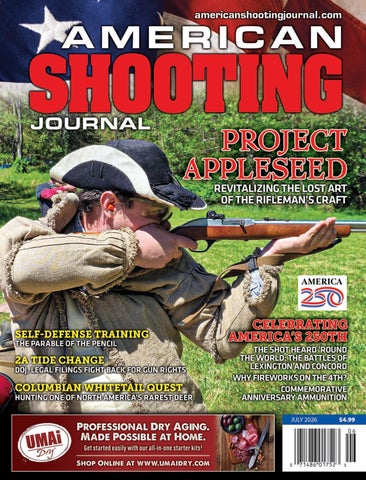
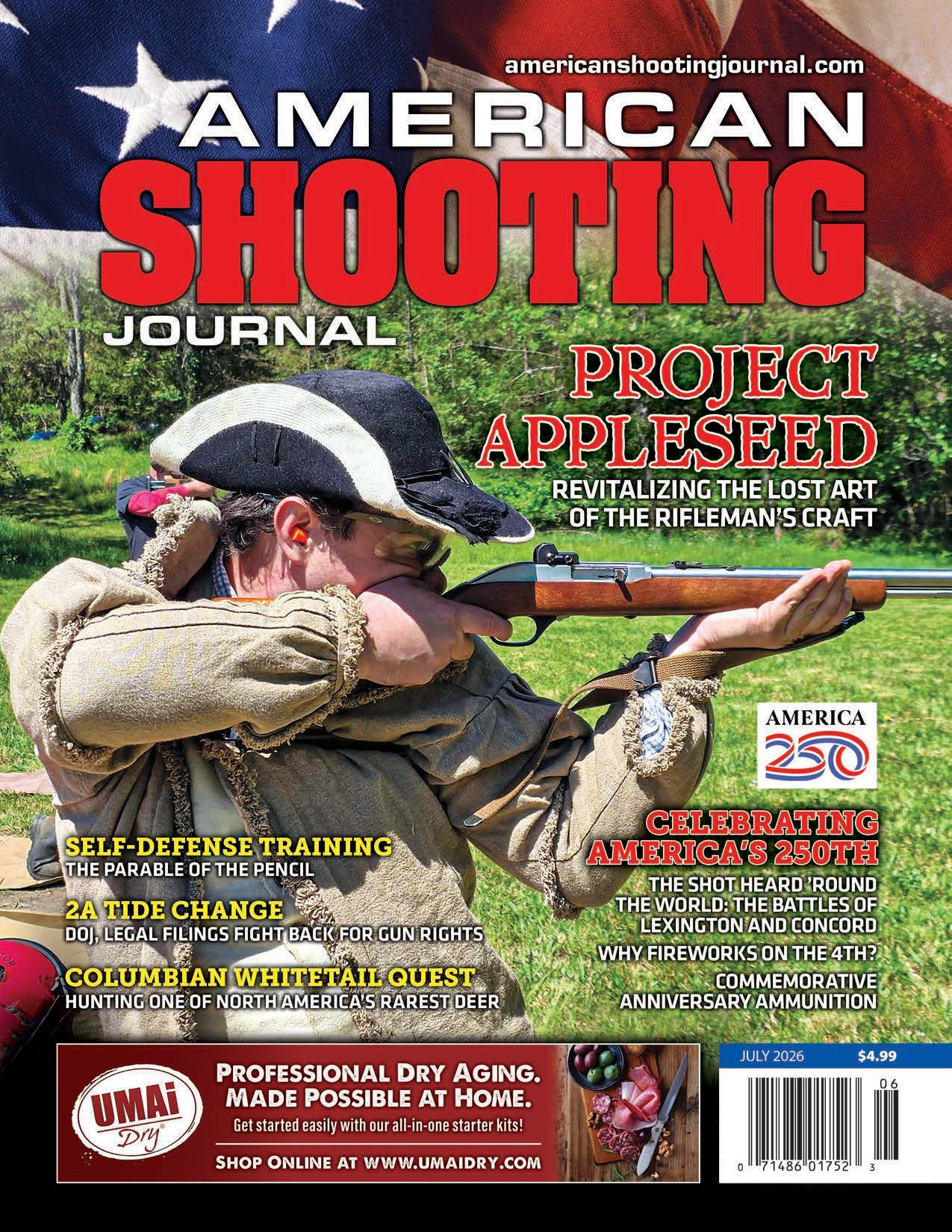
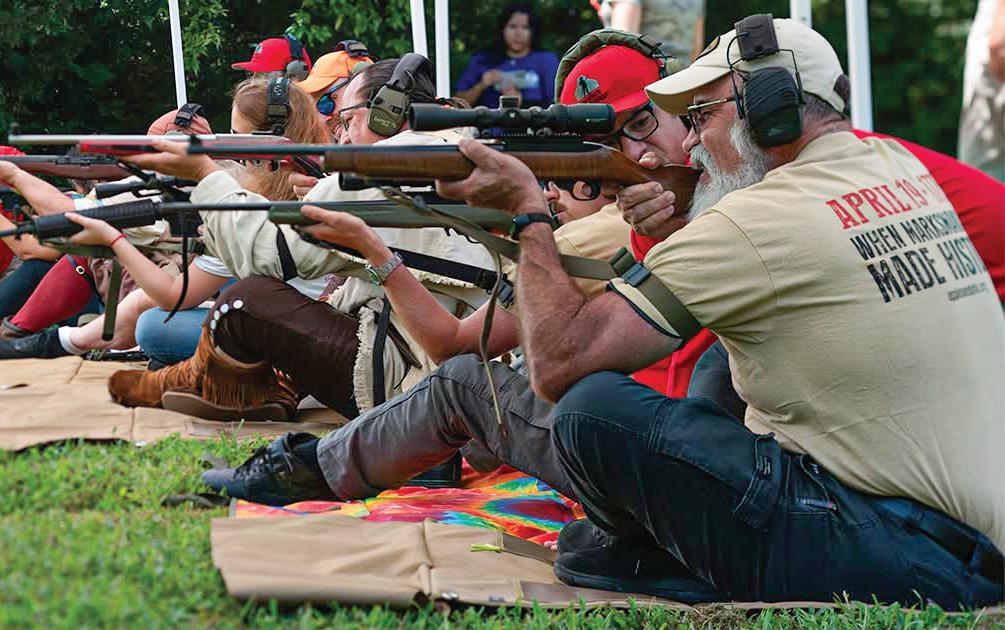
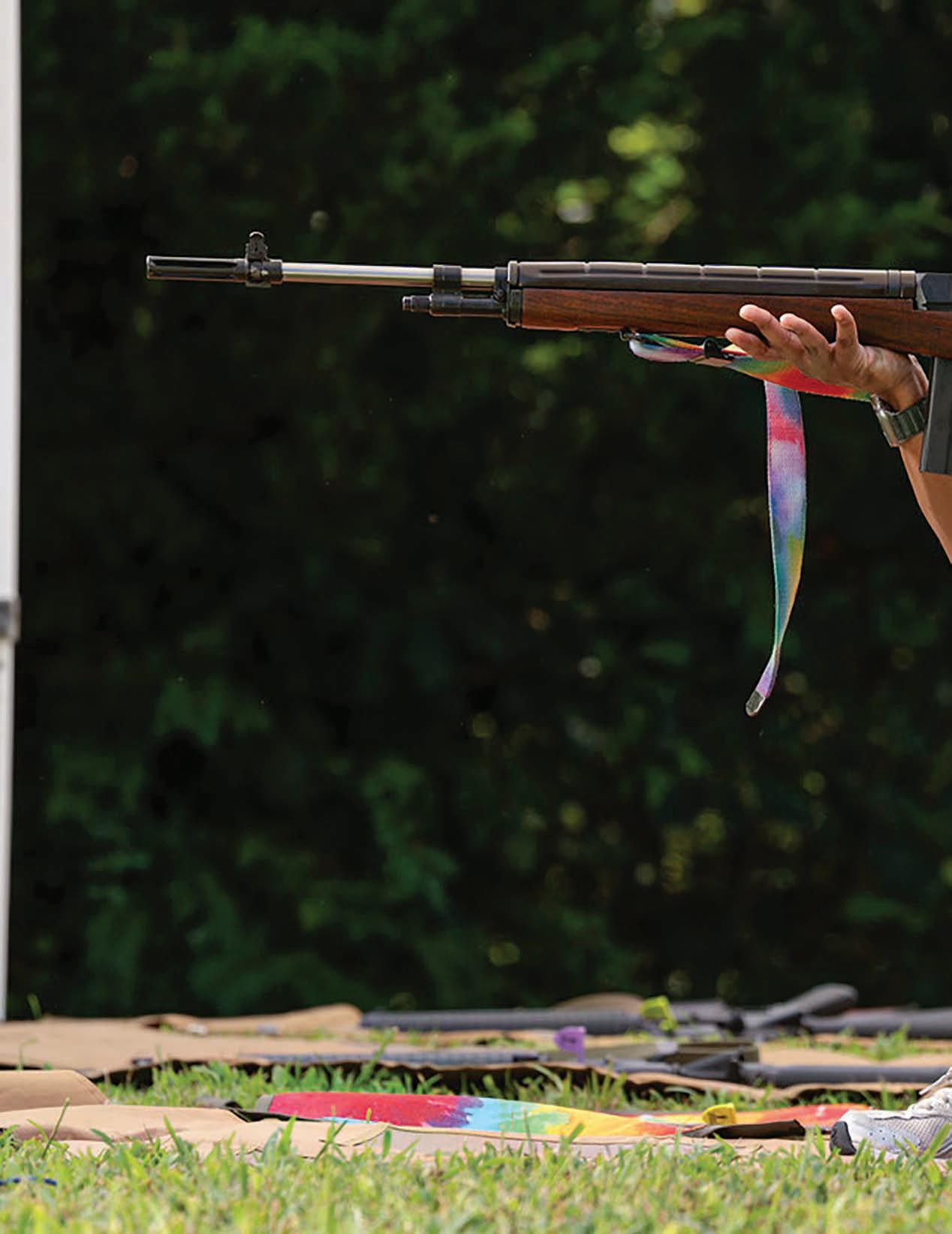
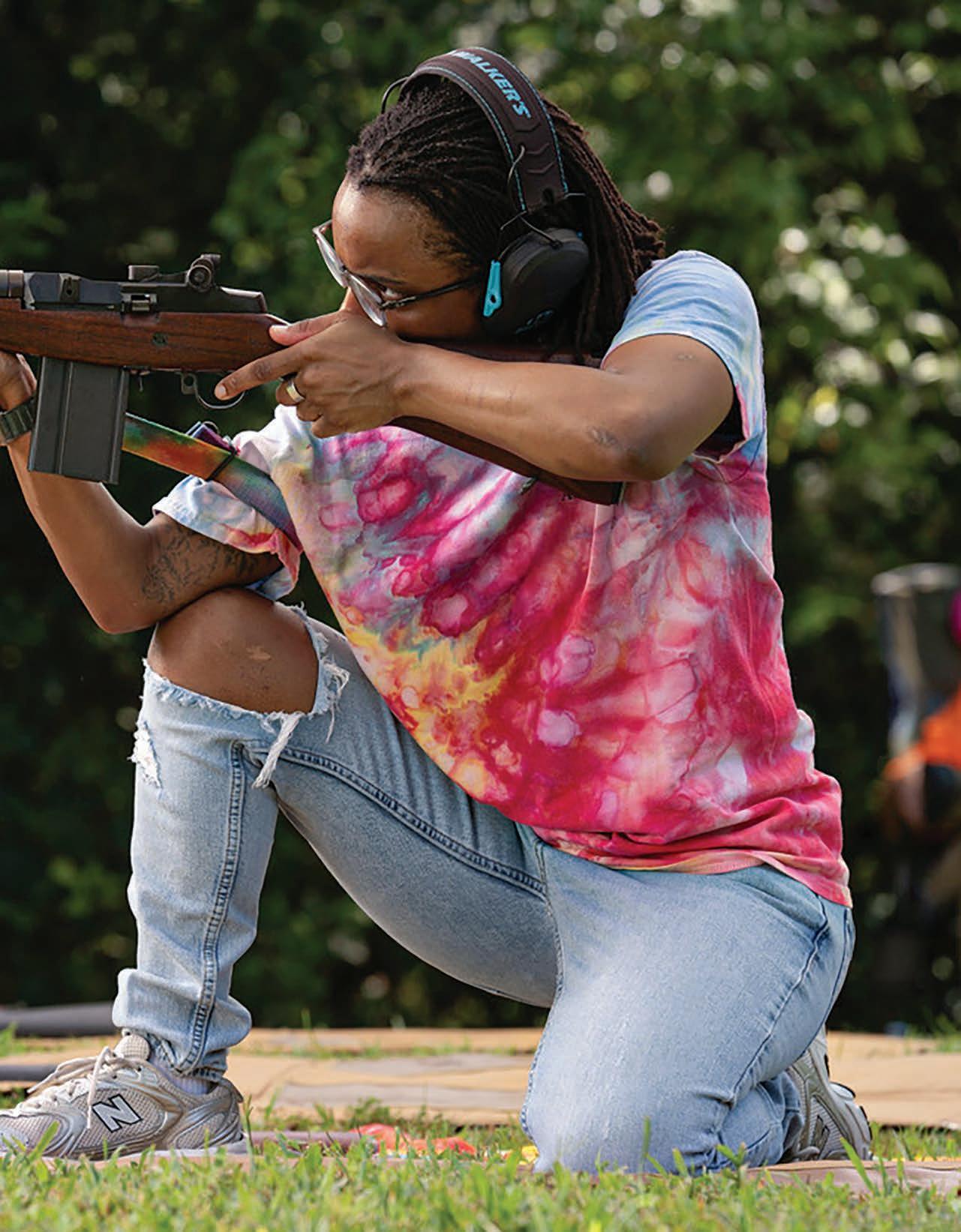
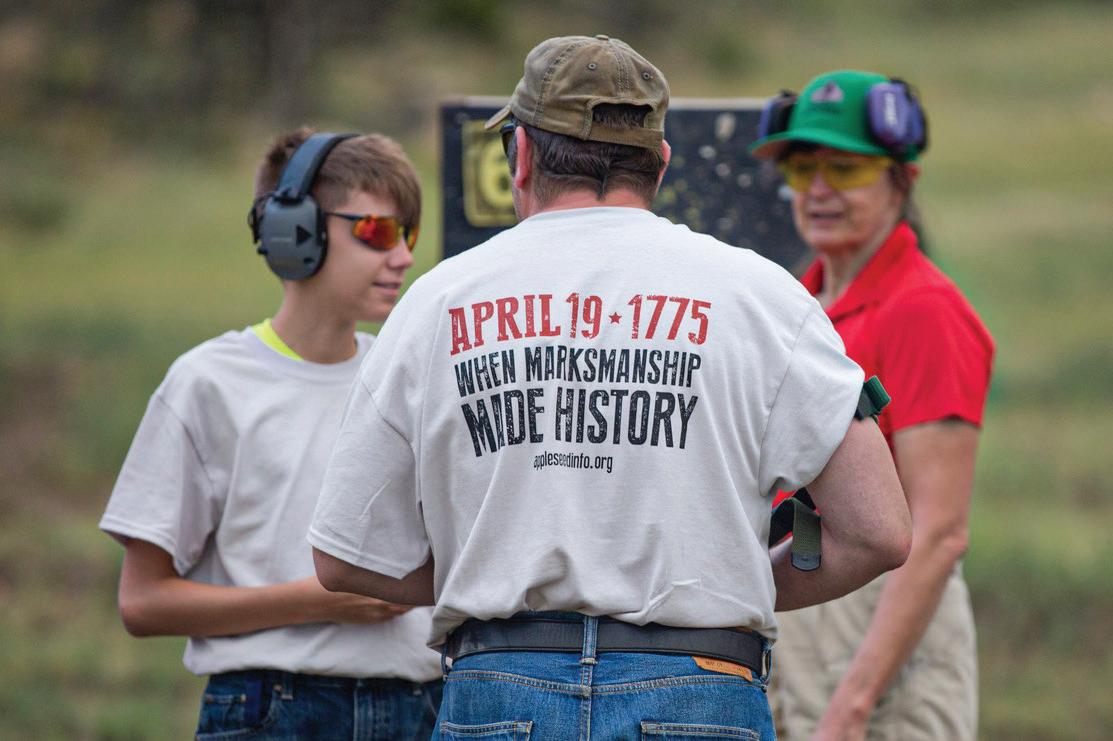
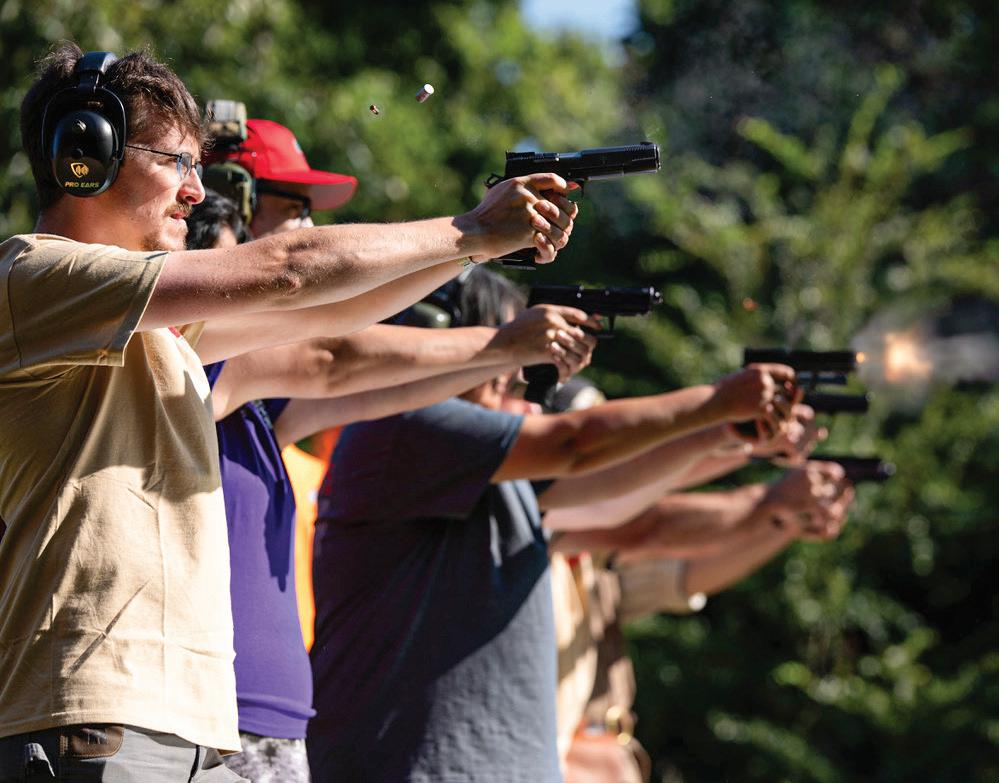
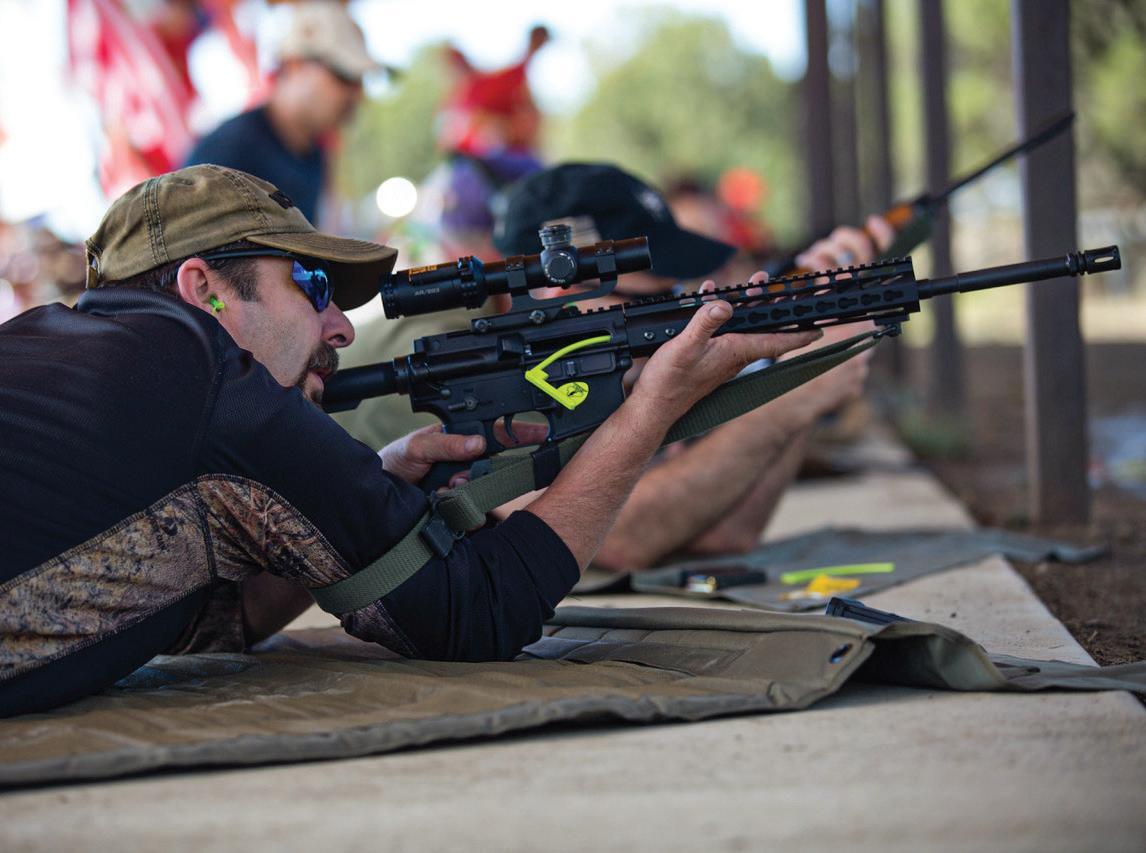
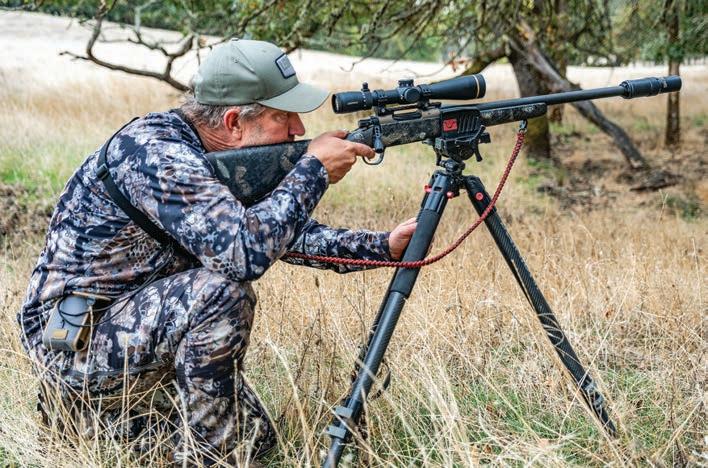
A participant at a Project Appleseed event takes careful aim. The unique program teaches the fundamentals of rifle shooting through the lens of how civilian marksmanship helped shape early American history. (PROJECT APPLESEED)
BACK TO BASICS 20
In a gun world enamored with the latest upgrades and gear, Project Appleseed emphasizes the lost art of the rifleman’s craft. Linda and Paul Pawela detail this marksmanship program that combines shooting fundamentals with stories of ordinary civilians who took up arms for the American Revolution.
FEATURES
26 THE SHOT HEARD ’ROUND THE WORLD: THE BATTLES OF LEXINGTON AND CONCORD
Two years before that momentous day we celebrate this month, the United States flickered to life in the sparks of the minutemen’s rifles firing back at British soldiers who had come to take their guns and supplies. The Pawelas recount the story of the Battles of Lexington and Concord and the ordinary people who stood up to a king and his army.
34 FIRE WORKS ON THE 4TH
Why do we celebrate the Fourth of July with fireworks and how did pyrotechnic displays become synonymous with this special day in American history? We trace the story back to the very first official celebration of Independence Day in 1777 and the roar of ships’ cannons.
36 BULLE T BULLETIN: AMERICA’S 250TH ANNIVERSARY AMMUNITION
Four ammunition companies and a firearms manufacturer are celebrating our country’s semiquincentennial with collectible ammo, and Phil Massaro is all over it. From buckets of bullets to unique ammo box designs, he details the commemorative products on offer from Federal Premium, Remington, Winchester, CCI and Henry Rifles.
60 R OAD HUNTER: COLUMBIAN WHITETAIL DEER QUEST
The whitetail is North America’s most popular game animal, and while Pennsylvania and Alberta are among top places to hunt these deer, the Pacific Northwest shouldn’t be overlooked either. Scott Haugen shares his experience chasing a rarer subspecies in a beautiful western Oregon valley rife with nice bucks.
MORE FEATURES
45 2A TALK: THE SECOND AMENDMENT TIDE TURNS, AND HOW
A recent “tidal wave” of legal filings at federal, state and local levels are helping to clarify that the Second Amendment is a “restriction on government, not on the people.” So declares Dave Workman as he outlines the new defense of a civil right that perhaps has been pooh-poohed over the decades.
49 L AW ENFORCEMENT SPOTLIGHT: SWAT VEHICLES HELP TAKE DOWN KILLER
When a California cop killer refused to surrender and instead kept shooting, officers had to make a decision: risk losing another deputy, or neutralize the threat for good? Nick Perna details how officers used their BearCat and Rook armored vehicles to subdue the man who killed one of their own.
53 SELF-DEFENSE TRAINING: THE PARABLE OF THE PENCIL
Most tests taken with a pencil aren’t life-threatening, but the innocuous and universally available writing implement can also serve as a self-defense weapon in a pinch. In words and pictures, Paul Pawela shows how a pencil – as well as awareness, improvisational skills and a will to survive – can help ward off an attack.
69 BL ACK POWDER: EIGHT IS (BARELY) ENOUGH
Who’s to say if silhouette matches are losing appeal among black powder cartridge shooters, but Mike Nesbitt and seven pals still had a good time at a recent lightly attended club contest. Mike shares official results – and unofficial ones between himself and a rifleman who made a special trip “over the hill” to shoot at the event.
(PAUL PAWELA)
Create dry aged steak and cured meats from home!
Whether you’re preserving whole muscle for charcuterie or grinding coarse for fermented salumi, our time-honored spice blends, easy starter kits, and UMAi Dry® technology make it safe and simple to cure like a pro!
GUN SHOW CALENDAR
COMPETITION CALENDAR
USA Shooting usashooting.org
August 1-3
2026 World Championships (WCH) Selection Match For The Non-Olympic Events Missoula, Mont.
United States Practical Shooting Association uspsa.org
July 11-12
2026 Rushmore State USPSA Championship Piedmont, S.D.
Buckeye State Ballistic Challenge Wingett Run, Ohio
July 11-12
Coeur d’Alene Glock Classic Coeur d’Alene, Idaho
Cowboy Mounted Shooting Association cmsaevents.com
International Defensive Pistol Association idpa.com
July 3-5
Mid Mountain Regional Shoot Pueblo, Colo.
July 11-12
Idaho State Championship Newport, Wash.
July 18-19
Great Lakes Regional Classic Brighton, Mich.
July 18-19
Twin Tiers Regional Classic Pine City, N.Y.
July 23-26
2026 Cheely Custom Gunworks Area 5 Championship Lyons, Mich.
July 31-August 1
2026 USPSA Idaho Sectional Idaho Falls, Idaho
July 11
Northern Illinois Rifle and Pistol Club Monthly Match Rockford, Ill.
July 18-19
North Mountain Regionals Deer Lodge, Mont.
July 23-26
CMSA Western Championship Las Vegas, Nev.
July 25-26
Virginia Ballistic Challenge Bluefield, Va.
July 25-26
Scarborough Fish & Game Annual GSSF Match Scarborough, Maine
July 31-August 2
Erie Shore Border Brawl Jefferson, Ohio
July 12
Ripon IDPA July 2026 Club Match Ripon, Wis.
To have your event highlighted here, send an email to kaumann@media-inc.com.
July 25-26
Hoosier Daddy Classic v11 Sturgis, Mich.
BACK TO BASICS
In a gun world enamored with the latest and greatest, Project Appleseed emphasizes the rifleman’s craft, with a side of American history.
STORY BY LINDA AND PAUL PAWELA • PHOTOS BY OLEG VOLK
In today’s firearms world, it is easy to get lost in the endless cycle of gear debates. New cartridges, optics with increasingly complex reticles, modular rifle systems and accessory ecosystems dominate conversations in gun shops and online forums. Yet beneath it all lies a more fundamental question, one no amount of equipment can answer: Can you actually shoot well, consistently, under pressure, using basic fundamentals?
Twenty years ago, the vision of making basic rifle and pistol marksmanship a way to reconnect with our nation’s roots gave rise to Project Appleseed. For the past 15 years, Tom Kehoe has spearheaded the project under a constant, watchful eye. As Tom points out, what is so remarkable about those involved in Project Appleseed is that the entire organization is made up of 100 percent volunteers.
Considering Project Appleseed is in all 50 states, it is quite an accomplishment.
Tom Kehoe.
Regardless of a participant’s skill level, Project Appleseed events teach the marksmanship skills so crucial to the success of our nation’s founders. Aside from fun and camaraderie, each event also offers a renewed sense of civic responsibility to take home.
Project Appleseed is a nationwide marksmanship program that has built a reputation not on hardware but on disciplined shooting fundamentals and a strong emphasis on historical storytelling. It aims to do something uncommon in modern firearms training: produce measurable skill improvement in a short time while connecting participants to a narrative about the origins of American rifle culture.
Project Appleseed operates under the umbrella of the Revolutionary War Veterans Association, a nonprofit dedicated to preserving both marksmanship skills and Revolutionary War history. From its inception, Appleseed was designed to serve two purposes. First, it would provide structured rifle instruction that any civilian could attend, regardless of experience. Second, it would pass on stories of the American Revolution, particularly those centered on ordinary citizens who took up arms to defend their communities.
This dual mission is not incidental;
it defines the entire experience. An Appleseed event is not just a shooting clinic. It is also a guided narrative that places modern rifle shooters within a historical continuum stretching back to events such as the Battles of Lexington and Concord, often described during instruction as the moment when colonial militia first demonstrated the effectiveness of citizen marksmanship against regular British forces. Whether one views that historical framing as literal instruction or interpretive storytelling, it remains central to the program’s identity. It is designed to inspire, contextualize and reinforce the idea that marksmanship is not merely recreational; it is historically rooted in civic responsibility and individual competence.
AT ITS CORE, an Appleseed “clinic” is a two-day rifle marksmanship course held on a standard outdoor range. Participants bring their own rifles, often .22-caliber rifles for cost efficiency,
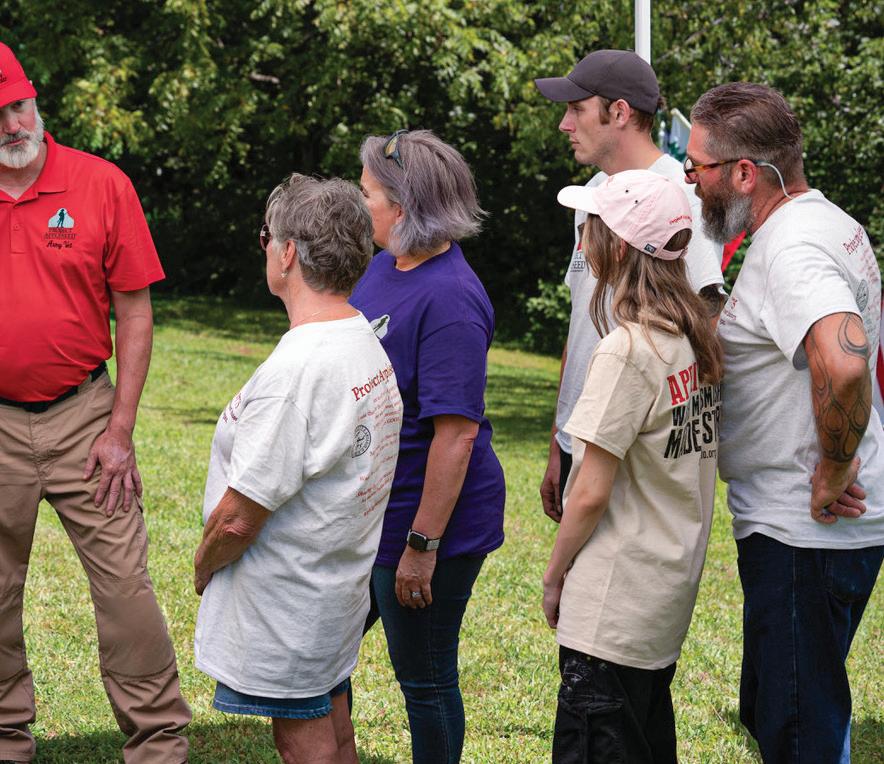
Project Appleseed instructors are passionate about marksmanship, history and the principles that the United States was founded upon. They play a vital role in teaching and preserving traditional rifle marksmanship skills by sharing stories of the events and sacrifices that took place during the American Revolutionary War.
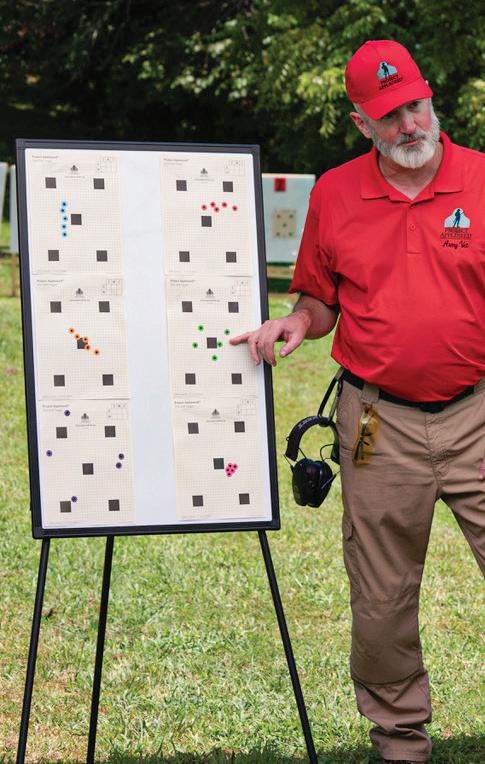
A volunteer instructor reviews targets with participants.
and are guided through a structured progression of fundamentals.
The instruction begins with safety and the basics of rifle manipulation. From there, shooters move into the core pillars of marksmanship: sight alignment, sight picture, steady position, breathing control and trigger press. These fundamentals are not presented as abstract theory but are immediately applied through repetitive live-fire drills.
Unlike many shooting courses that rely heavily on classroom instruction, Appleseed emphasizes doing over listening. Instructors briefly demonstrate a skill, then students immediately replicate it on the firing line. Corrections are made in real time, often one shooter at a time, with constant feedback on stance, sling use and natural point of aim.
One defining feature of the program is its use of sling-supported shooting. Participants learn to stabilize their rifles with a traditional loop sling, reducing reliance on bipods or shooting rests. This technique, once standard among military and
civilian riflemen, is now uncommon among many recreational shooters accustomed to optics and support accessories. Appleseed reintroduces it as a foundational skill, emphasizing that stability is primarily a product of body mechanics, not equipment.
Central to the Appleseed curriculum is the Appleseed AQT, or Army Qualification Test, a course that serves as the program’s benchmark for evaluating performance.
The AQT is divided into multiple timed stages that simulate engagement at different distances, typically using scaled targets. Shooters must transition among standing, sitting and prone positions while engaging multiple target zones under time constraints. The test requires not only accuracy but also efficient movement, rapid position changes and consistent execution of fundamentals.
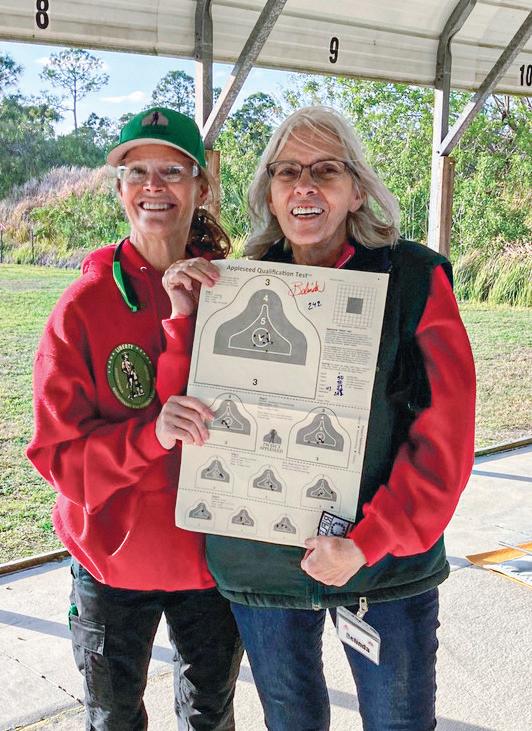
The scoring system is straightforward yet demanding. A perfect score is 250 points, and a score of 210 or higher earns the title of “rifleman.” This designation is not merely symbolic; it is treated as a
meaningful threshold of proficiency. Achieving it requires tightly grouped shots, effective time management and consistency throughout the course.
For many participants, the AQT is their first experience with structured pressure in a marksmanship setting. Even shooters who are capable of good accuracy in informal range sessions often find that time limits and positional changes expose weaknesses in trigger control or sight management. The AQT is designed to reveal those gaps.
ONE OF THE most distinctive aspects of Appleseed is its instructor model. Instructors are not positioned as distant lecturers or evaluators. Instead, they serve as constant coaches on the shooting line.
Instruction is typically delivered in short, focused segments, followed by immediate application. If a shooter struggles with consistency, instructors intervene directly, often adjusting sling tension, body position or grip. The goal is not to overwhelm participants with theory but to produce immediate, observable improvement.
This method reflects a broader philosophy within the program: marksmanship is a physical skill built through repetition and correction. Understanding the mechanics intellectually is helpful, but proficiency comes only from doing the work correctly and repeatedly
Shootboss Kim Williams helps shooter Belinda Kehoe show off her score of 242 out of 250 at a women- and girls-only Ladyseed event in Palm Bay, Florida. (PROJECT APPLESEED)
under guidance.
The instructor cadre is also notable for its consistency across events. Although individual teaching styles vary, the curriculum remains standardized. This ensures that whether a shooter attends an Appleseed event in one state or another, the core instruction and expectations remain the same.
The term “rifleman” carries significant weight within Appleseed culture. It is not used casually to describe someone who merely owns or occasionally fires a rifle. Instead, it denotes a shooter who can consistently demonstrate competence
in structured conditions.
At a technical level, it represents the ability to apply fundamentals across multiple positions, distances and time constraints. At a cultural level, it is framed as a standard worth striving for and as an indicator of discipline, patience and repeatable skill.
Importantly, Appleseed does not present rifleman status as an endpoint. Instead, it is treated as a baseline. Once a shooter can reliably meet that standard, they are encouraged to refine and maintain it. Many participants return multiple times, using the AQT as a personal benchmark to track progress.
THROUGHOUT A WEEKEND
event, a continuous thread of historical narrative runs. Instructors pause to deliver what are often called “heritage talks.” These segments recount stories from the Revolutionary War era, focusing on individuals and events that highlight the role of civilian marksmanship in early American history.
The most frequently cited events include the opening confrontations at Lexington and Concord, where colonial militia forces first engaged British troops. These events illustrate that when ordinary citizens are trained and prepared, they play a significant
role in shaping historical outcomes.
For some participants, this historical framing is a motivating force, linking the mechanical act of shooting to a broader sense of identity and continuity. For others, it serves as background context that enhances engagement with the training. In either case, it is a defining characteristic of the program.
Appleseed is also especially accessible. The program welcomes both beginners and experienced shooters, with no need for costly gear or specialized firearms. Many participants attend with basic .22 rifles and iron sights.
This equipment neutrality reinforces a core message: skill is more important than gear. While modern optics and accessories can enhance performance, they are not necessary for learning or demonstrating fundamental marksmanship. The program deliberately emphasizes what the shooter can control, including body position, breathing, trigger discipline and consistency.
This approach also lowers barriers to entry. By minimizing equipment requirements, Appleseed makes structured firearms training accessible to a broader audience, including those new to shooting or working on a limited budget.
IN AN ERA when firearms training is often segmented into highly specialized disciplines, such as competitive shooting, defensive training and long-range precision, Appleseed occupies a unique space. It focuses on foundational rifle skills that apply broadly across all contexts. Its continued popularity stems from its clarity of purpose. Participants know exactly what they are getting: structured instruction, measurable performance standards and immediate feedback. Expectations and outcomes are unambiguous.
For new shooters, it provides a structured entry point into marksmanship. For experienced
shooters, it offers a way to validate and refine fundamentals that may have eroded over time. In both cases, it reinforces the idea that proficiency is not accidental; it is built deliberately.
Project Appleseed remains one of the most distinctive civilian firearms training programs in the United States because it focuses on something timeless: the fundamentals of rifle shooting. Through a combination of structured instruction, hands-on coaching and a strong historical narrative, it offers participants more than a weekend of range time. It provides a framework for measurable improvement and a reminder that marksmanship is defined not by equipment or trends but by the disciplined execution of basic skills. Whether participants arrive for the history, the challenge of the Appleseed AQT or simply to become more competent with a rifle, they leave with a clearer understanding of what it takes to achieve consistent performance.
In a firearms culture often focused on the next upgrade or the latest system, Appleseed stands out by emphasizing something older, simpler and ultimately more demanding: the rifleman’s craft. ★
Editor’s note: For more information, visit appleseedinfo.org.
While heavily focused on rifle marksmanship, Project Appleseed also offers a pistol clinic.
Instructors briefly demonstrate a skill, then students immediately replicate it on the firing line. Corrections are made in real time.
THE SHOT HEARD THE WORLD: THE LEXINGTON
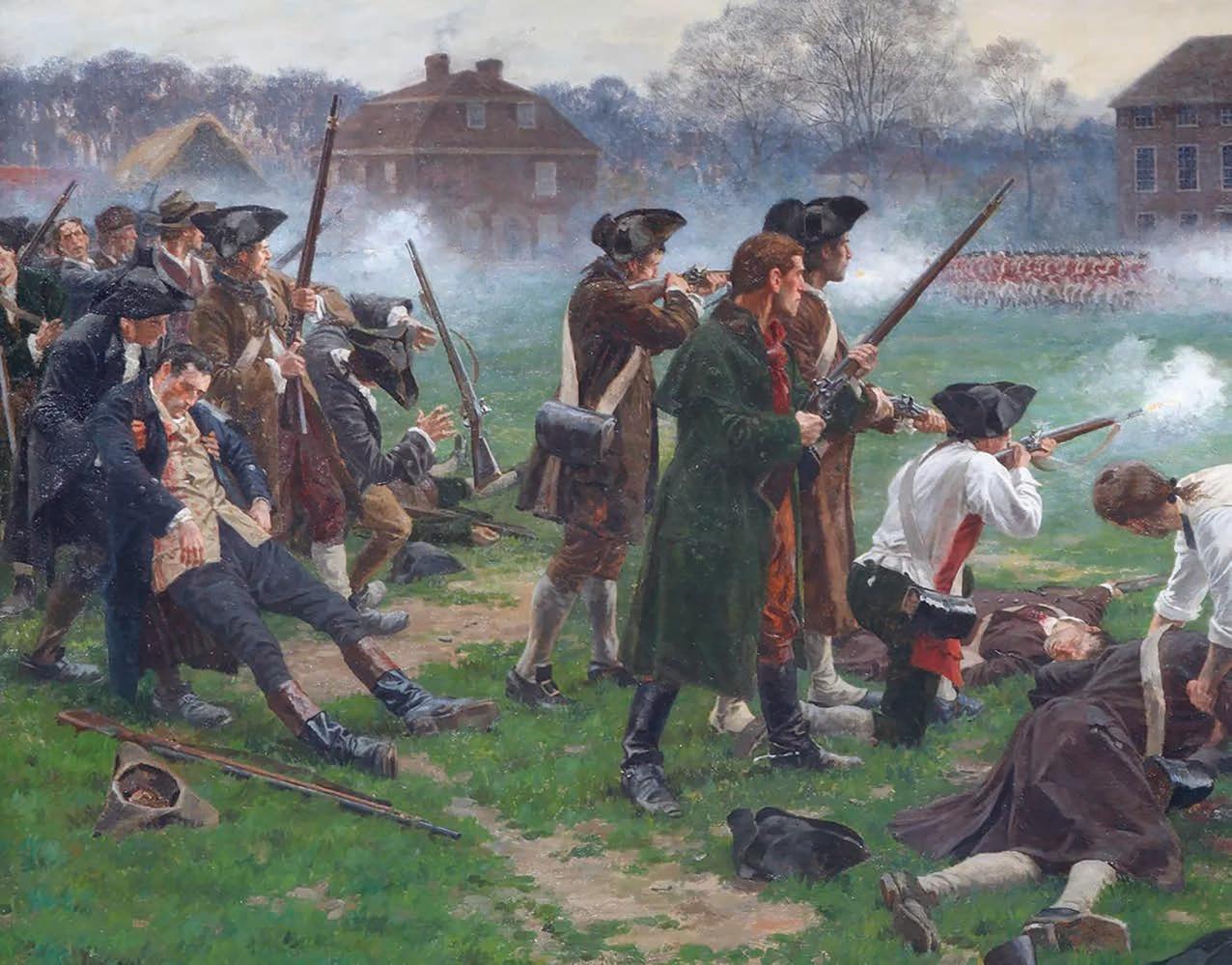
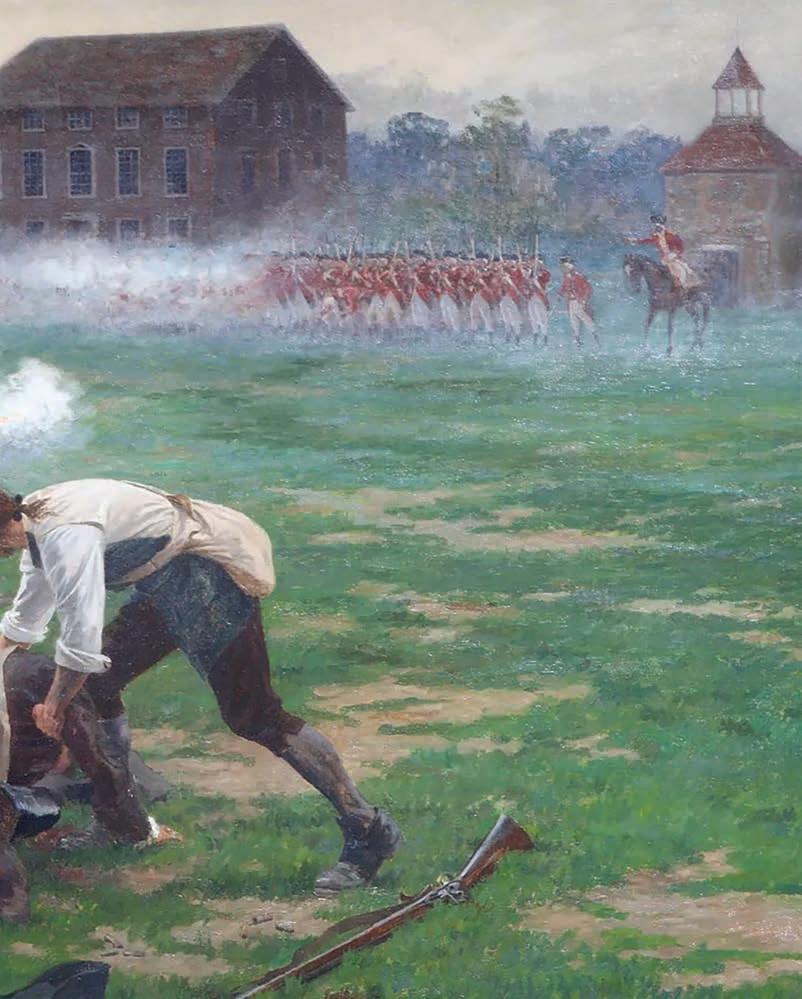
The Battle of Lexington by William Barnes Wollen, 1910. (NATIONAL ARMY MUSEUM)
HEARD ’ROUND THE BATTLES OF AND CONCORD
The small sparks that changed not only American history but the world's.
STORY BY LINDA AND PAUL PAWELA
On the cool morning of April 19, 1775, few residents of the quiet Massachusetts towns of Lexington and Concord realized they were about to witness the start of a revolution. Farmers, blacksmiths, merchants and ordinary families were suddenly caught up in a conflict that would grow into the American Revolutionary War. By day’s end, nearly 300 British soldiers had been killed, wounded or captured, and the relationship between Great Britain and its 13 American colonies had changed forever.
The Battles of Lexington and Concord are often remembered as the moment when the first shots of the American Revolution were fired. Sometimes called “the shot heard ’round the world,” these battles marked the beginning of America’s fight for independence and showed that ordinary citizens were willing to
stand up to one of the world’s most powerful armies.
LONG BEFORE THE fighting began, tensions between Great Britain and its American colonies had been mounting. After the costly French and Indian War, Britain faced enormous debt and believed the colonies should help pay for their defense. Parliament imposed several taxes, including the Stamp Act and the Townshend Acts, which many colonists opposed because they had no representation in Parliament. Their rallying cry became “No taxation without representation.”
Although some taxes were later repealed, distrust continued to grow. The Boston Massacre in 1770 and the Boston Tea Party in 1773 deepened the conflict. In response to the Tea Party, Britain imposed the Intolerable Acts, closing Boston Harbor and reducing Massachusetts’s selfgovernment. Rather than restoring order, these actions united many colonists against British rule.
By early 1775, Massachusetts had become the center of colonial resistance. Local militias, known as Minutemen because they could be ready to fight at a minute’s notice, trained regularly and stored weapons and supplies in nearby towns, including Concord.
British leaders learned that the colonists were stockpiling military supplies in Concord. General Thomas Gage, the royal governor of Massachusetts, ordered about 700 British soldiers under Lieutenant Colonel Francis Smith to march from Boston to Concord. Their mission was to seize and destroy the weapons
before the colonists could use them.
However, the mission was far from secret. Patriot leaders maintained an effective network of spies and messengers. On the evening of April 18, silversmith and patriot Paul Revere, along with William Dawes and later Samuel Prescott, rode through the countryside warning that British troops were on the move. Although the phrase “The British are coming!” is often associated with Revere, historians believe he was more likely to have warned that “the Regulars are coming,” since many colonists still considered themselves British. Thanks to these riders, militia members across the region began gathering before dawn.
As British troops reached Lexington early on April 19, they found about 70 colonial militia members assembled on the town green under the command of Captain John Parker. Parker knew his small force could not defeat the British army. His orders reportedly instructed his men not to fire unless fired upon.
A gunshot rang out. To this day, no one knows who fired the first shot. It may have been a nervous militia member, a British soldier or even someone watching from afar. Whatever its origin, chaos erupted. British soldiers fired volleys at the militia, who briefly returned fire before retreating. When the smoke cleared, eight colonial militia members were dead and 10 others were wounded. Only one British soldier was injured. Although the fighting lasted only minutes, the Revolutionary War had begun.
After Lexington, the British
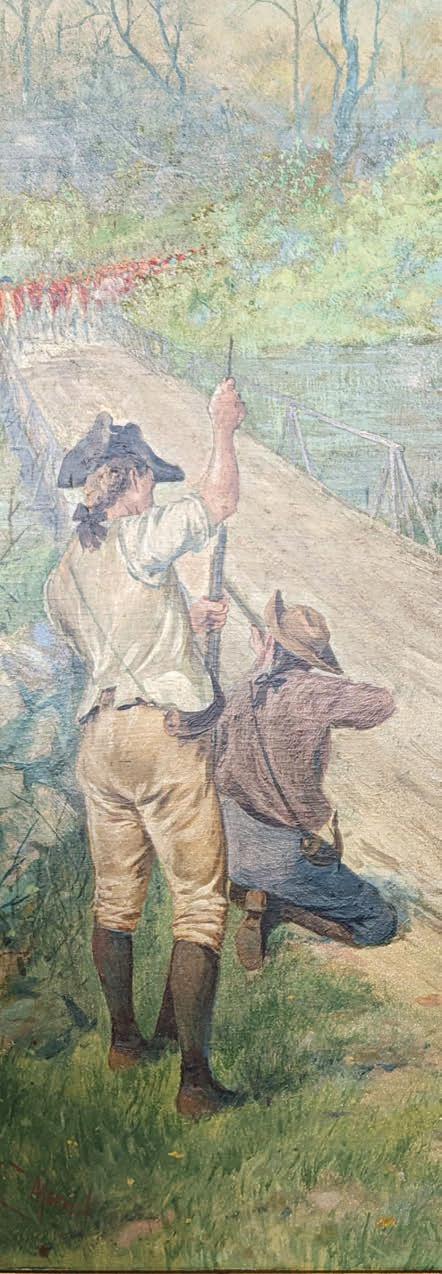
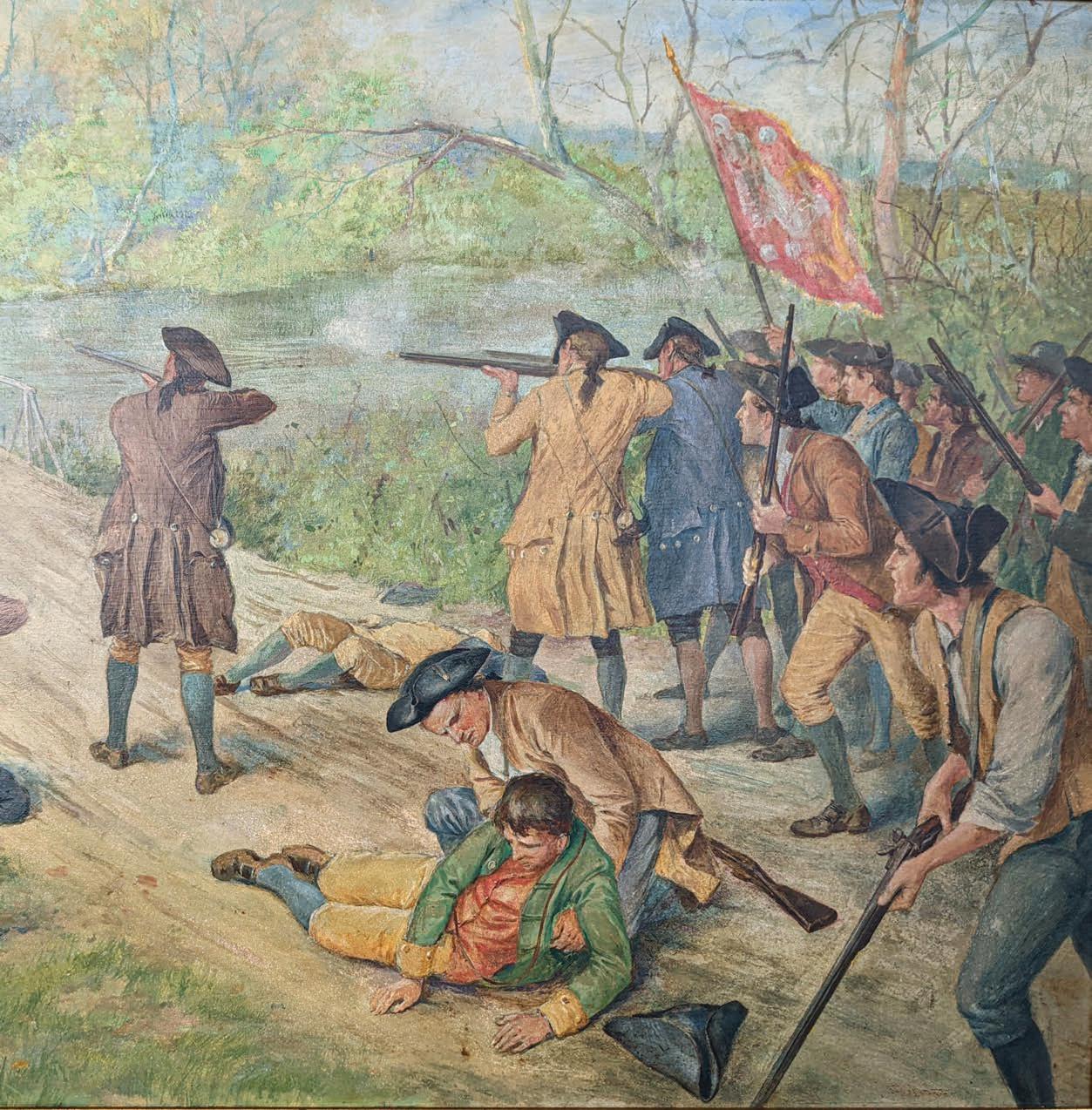
North Bridge, Concord, Massachusetts, April 19, 1775, by Frank T. Merrill, 1909. (WIKIPEDIA)
continued toward Concord. Thanks to early warnings, most of the military supplies had already been hidden or moved. The British found and destroyed only a small amount of equipment. Meanwhile, hundreds of militia members from surrounding communities gathered outside Concord. As their numbers grew, they decided to confront the British. The two forces met at North Bridge. This time, colonial commanders ordered their troops to advance. When British soldiers fired first, the militia returned disciplined volleys. Several British
soldiers were killed or wounded, forcing the British to retreat across the bridge. The Battle of Concord demonstrated that colonial militias could stand together against trained professional soldiers. It also gave colonists renewed confidence in their ability to resist British military power. The fiercest fighting occurred during the British march back to Boston. By then, thousands of militia members from nearby towns had joined the fight. Rather than confronting the British in a single large battle, they used the countryside to their advantage. Militia
members hid behind trees, stone walls, fences and buildings, firing on the British column before moving to new positions. This style of fighting made the return journey extremely difficult.
The exhausted British soldiers faced constant attacks for nearly 16 miles. Reinforcements eventually arrived from Boston, helping avert a complete disaster, but the retreat remained costly. By the end of the day, British casualties totaled about 273 men killed, wounded or missing. Colonial forces suffered approximately 95 casualties. Although the British technically reached Boston safely, they had failed to accomplish their mission and had suffered unexpectedly heavy losses.
ONE REMARKABLE FEATURE
of the Battles of Lexington and Concord was the people who fought in them. Many of the colonial soldiers were not professional warriors. They were farmers, shopkeepers, teachers, blacksmiths and craftsmen who left their daily work to defend their communities. The battles also involved women in significant ways. Many helped hide military supplies, cared for the wounded, prepared food for militia members and carried messages between towns. Their contributions, though often overlooked, helped sustain colonial resistance.
The events of April 19 showed that the conflict was no longer merely a political disagreement. It had become an armed struggle involving ordinary citizens determined to protect what they believed were their rights. The Battles of Lexington and Concord were small compared with later battles of the Revolutionary
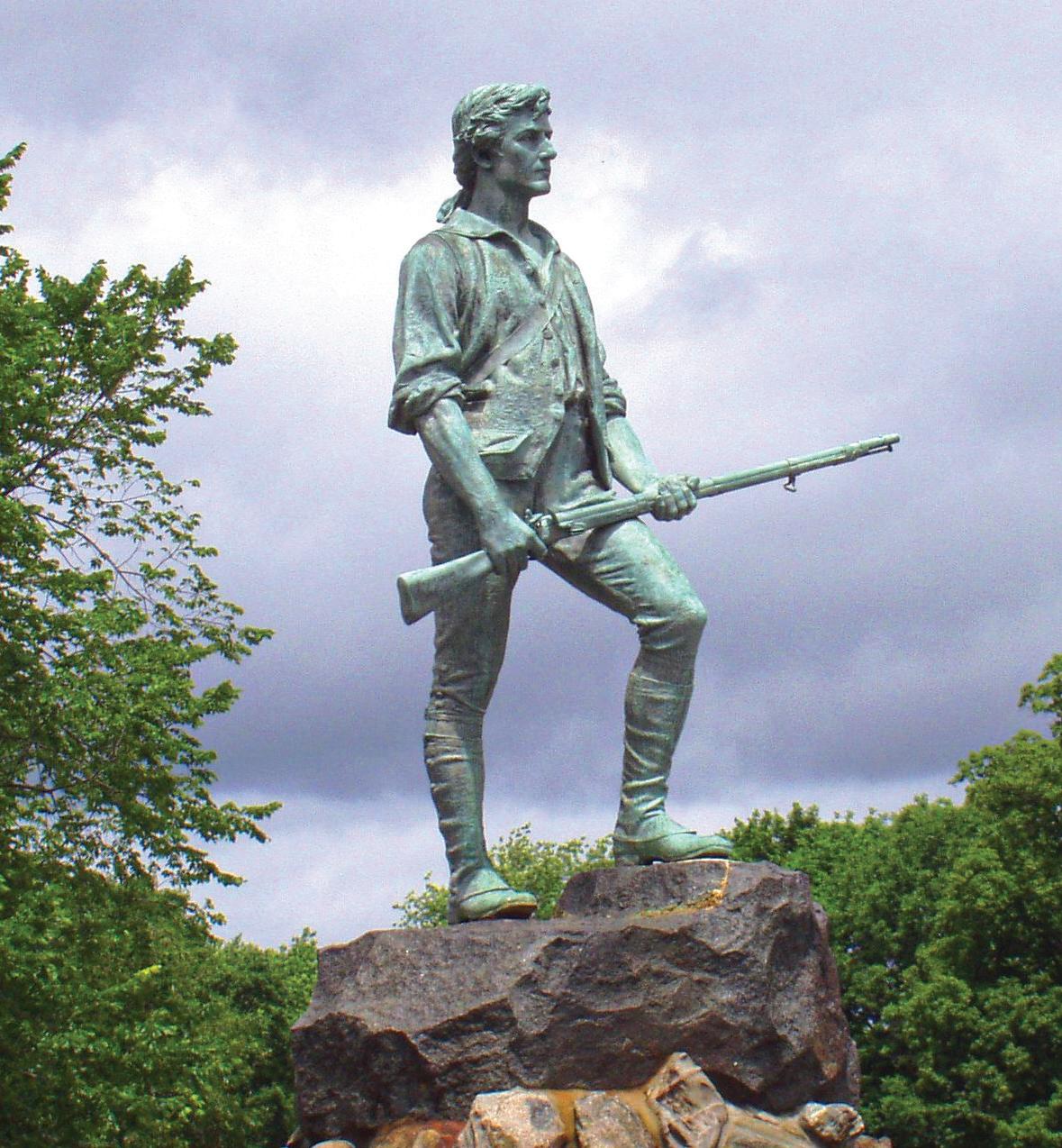
The Lexington Minuteman is commonly believed to depict Captain John Parker. It was sculpted by Henry Hudson Kitson and stands on the town green of Lexington, Massachusetts, where it was unveiled in 1900 on the 125th anniversary of the eponymous battle. (WIKIPEDIA)
War, yet their importance cannot be overstated. They marked the first open military conflict between Great Britain and the American colonies.
News of the battles spread rapidly across the colonies. Thousands of volunteers traveled to Massachusetts to join the growing colonial army. Within weeks, British forces in Boston were surrounded by colonial militia during the Siege of Boston. The fighting also convinced many colonists who had previously hoped for compromise that peaceful solutions were no longer possible. Over the next year, support for complete independence continued to grow, culminating in the adoption of the Declaration of Independence on July 4, 1776, by the Second Continental Congress in Philadelphia.
The phrase “the shot heard ’round the world,” later popularized by poet Ralph Waldo Emerson, captures the global significance of the first shot fired at Lexington. The American Revolution inspired democratic movements and independence struggles in many other parts of the world, demonstrating that ordinary people could challenge powerful governments.
The Battles of Lexington and Concord remain an enduring symbol of determination, sacrifice and the pursuit of liberty. Although the war would continue for eight more years, the events at Lexington and Concord proved that the American colonies were willing to fight for the future they sought. The battles were more than the opening clashes of the American
Revolution; they represented a turning point in world history. What began as an attempt by British troops to seize military supplies became the spark that ignited a movement for independence.
The bravery of ordinary citizens, the determination of colonial militias and the willingness to stand against overwhelming odds transformed a local conflict into a revolutionary cause. The echoes of that spring morning in 1775 continue to shape the ideals of freedom, self-government and democracy that many nations cherish today.
More than 250 years later, the story of Lexington and Concord reminds us that history is often shaped not only by famous leaders but also by ordinary people who choose to act in the face of extraordinary challenges. ★
Independence Day fireworks over the National Mall. (SHUTTERSTOCK/LAURA LYNN)
Fireworks On The 4th
Why we celebrate Independence Day with pyrotechnic displays.
When fireworks fill the air every year on July 4 – and oftentimes in the days leading up to it, thanks to some overzealous early celebrators – have you ever stopped to wonder why? Why have fireworks become synonymous with Independence Day celebrations? What is it about the colorful bursts of light and sound that scream, quite literally, freedom?
The history of July 4 fireworks dates back to American independence itself. On July 4, 1776, Congress officially adopted the Declaration of Independence, establishing its freedom from British rule. The first official Independence Day would be held one year later on July 4, 1777.
On that occasion, the Pennsylvania Evening Post of Philadelphia reported: “Yesterday the 4th of July, being the anniversary of the Independence of the United States of America, was celebrated in this city with demonstrations of joy and festivity. About noon all the armed ships and gallies in the river were drawn up before the city, dressed in the gayest manner, with the colors of the United States and streamers displayed.” Each ship’s cannon fired a 13-gun salute in honor of the 13 colonies and revelry continued all day and into the night, culminating with a grand fireworks display.
Other cities held their own celebrations that year, marking the occasion with parades, speeches and, of course, fireworks.
Over the years, Independence Day festivities became more widespread, and the firework displays got bigger and better as cannon- and gunfire were phased out. Finally, in 1870, Congress established Independence Day as an official holiday. And the rest, as they say, is history.
We at American Shooting Journal would like to wish all Americans a happy Independence Day!
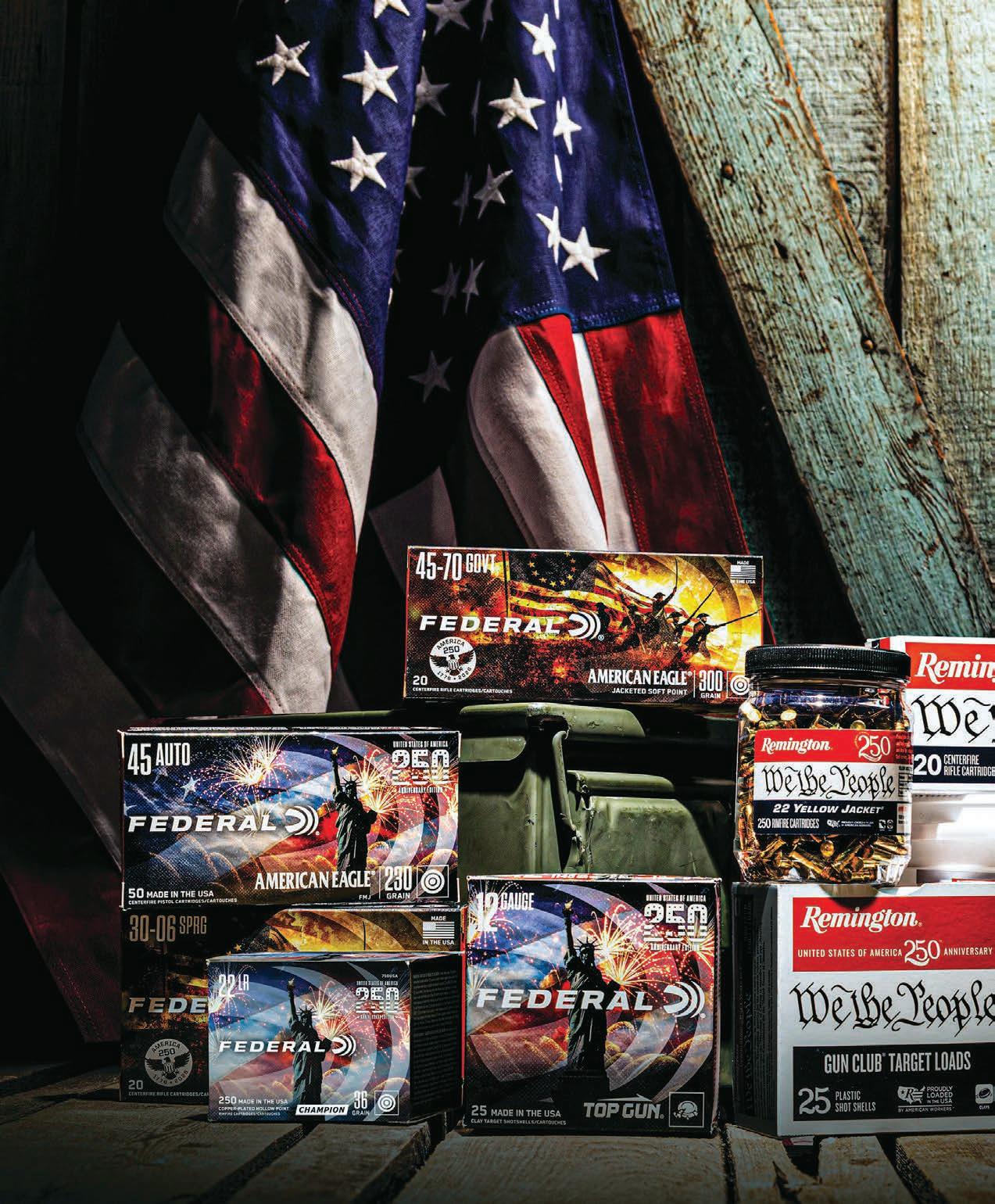
Federal Premium and Remington are two of the companies that have embraced America’s 250th birthday with commemorative ammunition lines. (FEDERAL PREMIUM/REMINGTON)
AMERICA’S 250TH ANNIVERSARY AMMUNITION
Celebrating the USA with collectible ammo.
As our country prepares to celebrate our 250th birthday, many ammunition companies are offering commemorative products, with either unique packaging or a special load developed just for the occasion.
Harkening back to 1976, I remember Winchester producing commemorative rifle ammunition – specifically the Winchester Bicentennial ’76 Silvertip ammo, with the special “W ’76 W” – and I believe I still have several examples of that stuff floating around in my collection. Well, 50 years on and we’re looking at an excellent lineup of commemorative and collectible ammunition, so perhaps you’d better make room on your shelves. Let’s dive into what’s available to celebrate this extraordinary event.
REMINGTON
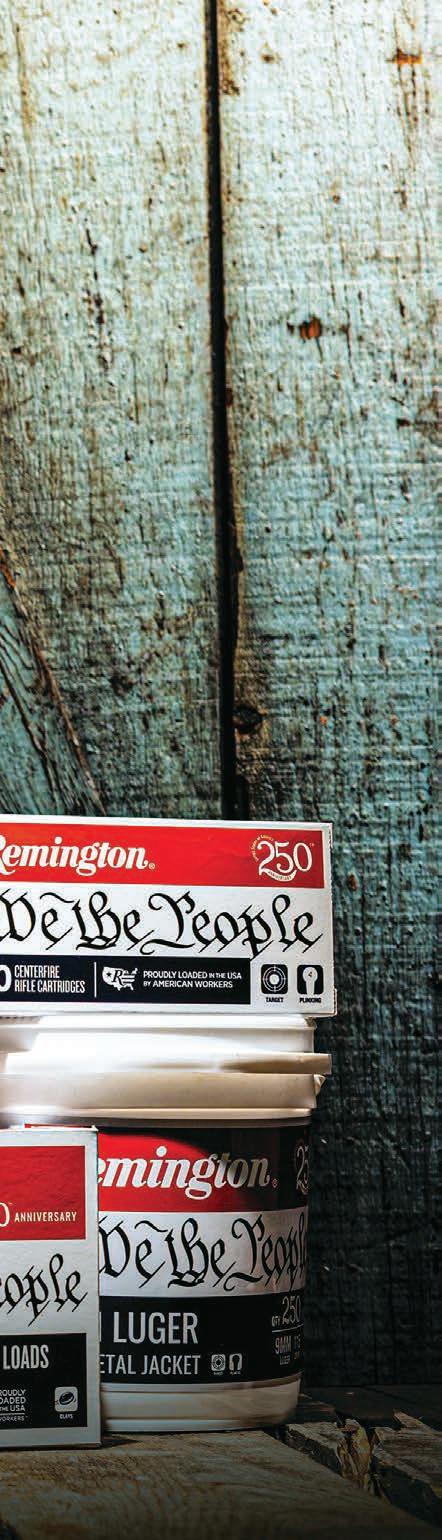
Remington has stepped up hard, bringing three different ammo lines to celebrate America. The “We the People” series sees both bulk buckets and the more familiar round-count boxes, all in a red-white-and-bluelabeled container, with the same font as our beloved Constitution. The 22-250 Remington is represented, coming in 20-count boxes, seeing a 55-grain pointed softpoint bullet at
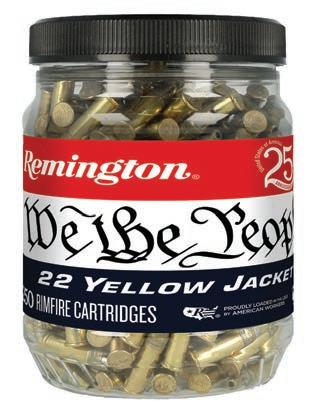
3,680 feet per second. The Gun Club 12-gauge shotshells are packaged in conventional 25-round boxes, featuring 2¾-inch shells loaded with 1⅛ ounces of No. 8 shot to a muzzle velocity of 1,145 fps. The bulk buckets have a centerfire rifle and centerfire pistol choice. Included in that mix is a 250-count bucket of .223 Remington loaded with a 55-grain full metal jacket at a muzzle velocity of 3,240 fps, and a 9mm Luger offering, featuring a 115-grain full metal jacket bullet at 1,145 fps. Lastly, a smaller plastic jar of 250 rounds of .22 Long Rifle is available, with 33-grain Yellow Jacket ammo.
Remington’s “Come and Take It” line of bulk ammunition helps celebrate the American spirit of defiance and self-reliance, and is loaded in buckets featuring a cannon image along with the logo. There are three available buckets, offering two handgun loadings and one rifle cartridge. The .223 Remington is offered in a 250-count bucket and features a 45-grain jacketed hollowpoint bullet loaded to a muzzle velocity of 3,550 fps. There are two 9mm Luger loads, one featuring a 115-grain full metal jacket at a velocity of 1,145 fps in a 350-count bucket, and the other featuring a 115-grain jacketed hollowpoint at the same muzzle velocity, but in a 250-count bucket.
The Gadsden flag – the famous
STORY BY PHIL MASSARO • PHOTOS BY MASSARO MEDIA GROUP
BULLET BULLETIN
Who
device featuring the coiled snake on a mustard background and the “Don’t Tread on Me” motto – is no stranger to patriotic Americans, and Remington has used that image for a celebratory line of ammunition. Like the “Come
Honoring America’s independent and defiant attitude, Remington’s “Come and Take It” line represents a great value to high-volume shooters. (REMINGTON)
and Take It” line, these are loaded in bulk buckets for the high-volume shooter. There is a quartet of loads in this line, starting with the .22 Long Rifle bucket, featuring 1,400 rounds of -grain hollowpoint ammo loaded to 1,280 fps, making a great value for the high-volume shooter or hunter. For the handgunners, there is a 300-count “Don’t Tread on Me” bucket filled with 115-grain 9mm Luger ammo loaded with jacketed hollowpoint at 1,145 fps. And the rifle crowd is offered two bulk buckets, one filled with 200 rounds of .223 Remington with 45-grain jacketed hollowpoints at 3,550 fps, and the other stuffed with 200 rounds 62x39mm, featuring a -grain pointed softpoint at a muzzle velocity of 2,365 fps.
CCI AMMUNITION
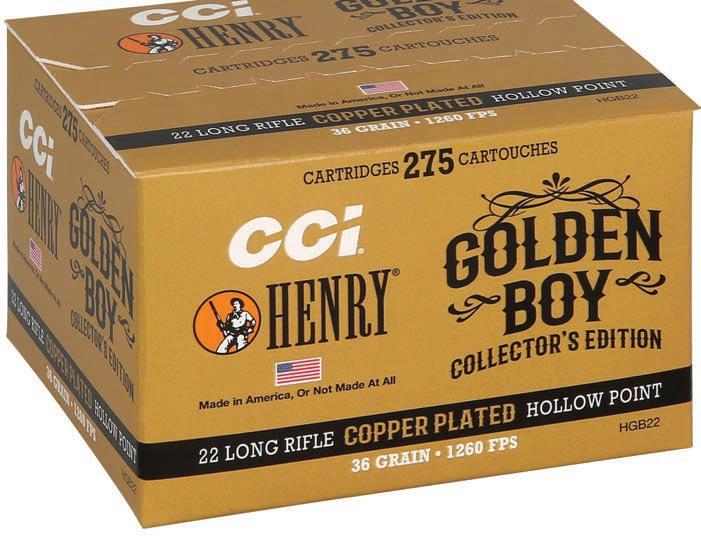
CCI – long famous for its rimfire ammunition products – has partnered with Henry Rifles, which is also celebrating the 250th with a commemorative Golden Boy leveraction rifle, to produce .22 Long Rifle ammo for the celebration. The CCI/Henry Rifles “Golden Boy Collector’s Edition” ammo box rounds of .22 LR loaded -grain copper-plated hollowpoint cruising at 1,260 fps.
Remington’s “We the People” line includes some commemorative bulk buckets, like this 250-count container of .223 Remington ammo. (REMINGTON)
The existing line of Remington Gun Club shotshells are also offered in celebratory packaging in 25-count boxes. (REMINGTON)
wouldn’t love an anniversary jar of Remington .22 Long Rifle Yellow Jacket ammo? Especially in a 250-count anniversary jar! (REMINGTON)
Love the Gadsden flag? Then the Remington “Don’t Tread on Me” celebratory bulk buckets are just for you. (REMINGTON)
WINCHESTER
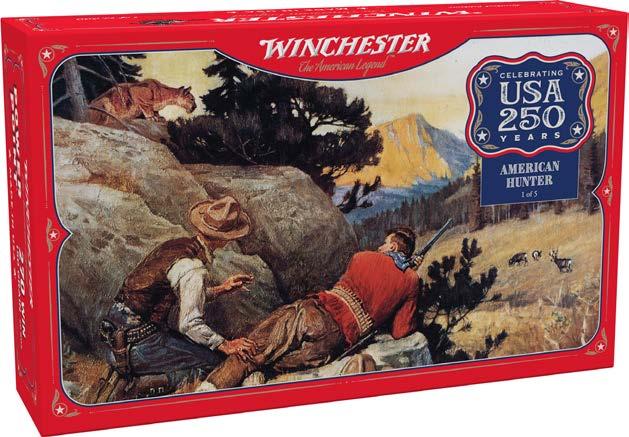
Winchester has a slew of collectible boxes of ammunition with unique cover art to celebrate our 250th in two different themes. The first has five offerings, each celebrating a different aspect of American labors of love. The AA target shotshells celebrate “Building Traditions” and feature 1⅛ ounces of lead No. 8 shot
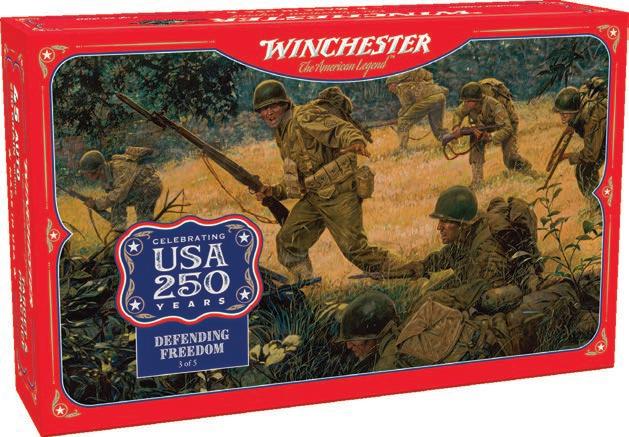
at 1,145 fps, while the Xpert Waterfowl shotshells depict how Americans are “Committed to Conservation,” loading 1⅛ ounces of No. 2 steel shot at 1,550 fps; both are offered in 25-count boxes. To commemorate our passion for “Defending Freedom,” Winchester offers the timeless .45 ACP, loaded with the 230-grain full metal jacket bullet at 835 fps, in 50-count boxes. For
the “Pioneering America” option, we see a 170-grain Power Point bullet in the .30-30 Winchester loaded to 2,200 fps, and to celebrate the “American Hunter,” the .270 Winchester is offered with a 150-grain Power Point bullet loaded to 2,850 fps. Both of the centerfire rifle cartridges are loaded in commemorative 20-round boxes.
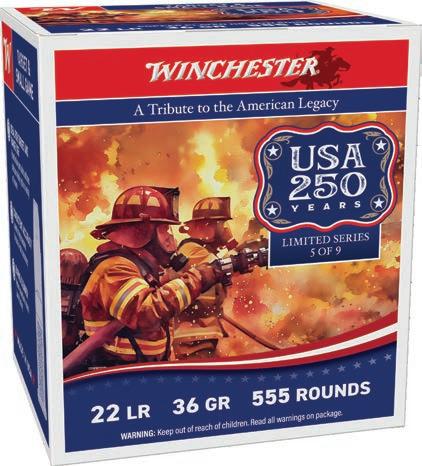
The second theme offers a celebration of varying occupations. The “Farmer” series, for example, features a 100-count box of the same .45 ACP ammo described above, as well as a 25-count box of the Super Target line of 12-gauge shotshells at 2¾ inches with 1⅛ ounces of No. 8 shot at 1,200 fps. The “Police” sees a 200-count box of 9mm Luger ammo with a 115-grain full metal jacket bullet at 1,190 fps from the USA line. “Firefighter” crews are celebrated with the .22 Long Rifle, loaded with a 36-grain copper-plated hollowpoint at 1,280 fps, in either 333or 555-count boxes. The “Welder” is honored by a 20-count box of .30-06 Springfield ammo from the Power Point line, with a 180-grain softpoint bullet at 2,700 fps, and “Factory” workers are celebrated with a 125-round box of 5.56mm NATO ammo with the 55-grain full metal jacket at 3,180 fps. Among the
To help Henry Rifles celebrate our 250th anniversary, CCI has commemorative .22 Long Rifle ammo in collectible 275-count boxes. (CCI)
Winchester’s .270 Power Point load celebrates the “American Hunter” with some excellent nostalgic art. (WINCHESTER)
Our passion for “Defending Freedom” is honored on the .45 ACP ammunition collectible boxes, depicting the American soldier. (WINCHESTER)
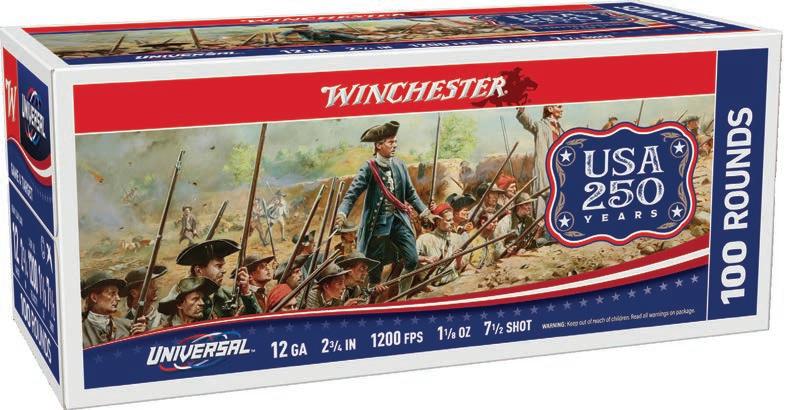
other shotshell offerings are 25- or 100-count boxes of 12-gauge ammo illustrated with the themes “Rancher,” “Lineman,” “Excavator” and “Colonial.”
FEDERAL PREMIUM
Lastly, Federal Premium has a line of ammunition celebrating the 250th, including such American classics as the .45 ACP, .45-70 Government, .30-
06 Springfield and .22 Long Rifle, as well as a commemorative 12-gauge shotshell load. The 250th Anniversary USA rimfire ammo sees a 250-count box of the Champion 36-grain copperplated hollowpoint at 1,260 fps, with an image of our beloved Statue of Liberty
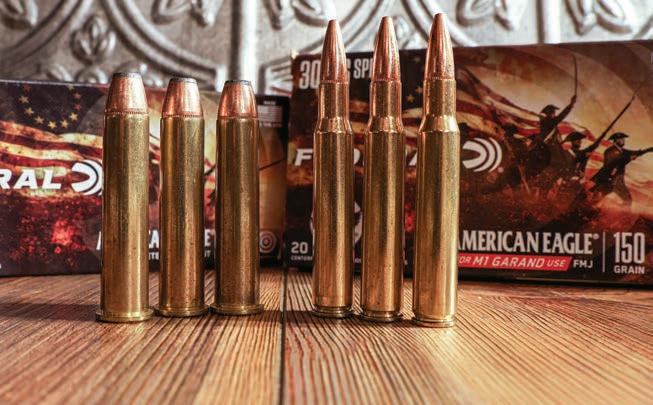
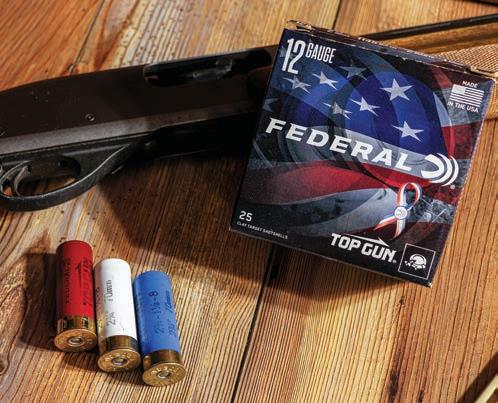
surrounded by exploding fireworks. The .30-06 load is from the American Eagle line, featuring a 150-grain full metal jacket spitzer optimized for use with the M1 Garand, and comes in a 20-count box decorated with Colonial soldiers and the Betsy Ross flag. From the same American Eagle line comes the 300-grain jacketed softpoint load for the .45-70 Government in the same Colonial soldier motif, while the .45 ACP load with the 230-grain full metal jacket bullet at 890 fps comes in the Statue of Liberty 50-count box. Lastly, the Top Gun shotshell line gives a 25-count anniversary box with the 12-gauge 2¾-inch shell, loaded with 1⅛ ounces of lead No. 8 shot at 1,145 fps, in red, white and blue hull colors.
I often wonder what General Washington would think if he could’ve had a vision of what the country he fought so hard to create would look like 250 years later. I do believe he’d be proud of how strong our firearms industry has become – despite the antigunners’ best efforts – and the efforts made to ensure we keep the freedoms he and his colleagues set down as the framework for our nation. This commemorative ammunition is a small part of the celebration, but a great part nonetheless. ★
Firefighters risk life and limb to save families from catastrophe and are celebrated on the front of the 555-count box of .22 Long Rifle in the 250th anniversary line. (WINCHESTER)
Winchester loads 100 rounds of 12-gauge target shotshells from its Universal line in a box depicting our brave Continental Army. (WINCHESTER)
Federal Premium celebrated our 250th anniversary with five different ammunition boxes, including the .45-70 Government 300-grain jacketed hollowpoint and the .30-06 Springfield 150-grain FMJ load optimized for the M1 Garand.
Cleverly guised in red, white and blue hulls, Federal’s Top Gun 12-gauge shotshells help celebrate 250 years of American independence.
THE SECOND AMENDMENT TIDE TURNS, AND HOW
Federal, state and local lawsuits are being filed to restore citizens' rights to keep and bear arms.
STORY BY DAVE WORKMAN
hen Virginia Governor
WAbigail Spanberger cavalierly signed Senate Bill 749 in May, banning so-called “assault firearms” and “largecapacity magazines,” she had already been warned about guaranteed legal action and a possible challenge by the federal Department of Justice (DOJ). She probably didn’t think the hammer would fall with such a thud.
Within hours, the Second Amendment Foundation (SAF), National Rifle Association (NRA), Firearms Policy Coalition (FPC) and two private citizens, Anthony Groeneveld and Justin McDonald, filed the first legal
challenge, known as McDonald v. Katz. Their complaint was filed in US District Court for the Eastern District of Virginia, Alexandria Division.
Named as defendants are Colonel Jeffrey Katz, superintendent of the Virginia State Police, Goochland County Commonwealth’s Attorney John L. Lumpkins, Jr., Goochland County Sheriff Steven Creasey, Prince William County Commonwealth’s Attorney Amy Ashworth and Prince William County Sheriff Glendell Hill. Governor Spanberger is not a named defendant.
Remarkably, at least four commonwealth’s attorneys (county prosecutors) in Virginia went on record refusing to enforce the new law, which was scheduled to take effect July 1, saying the new statute
is unconstitutional. Prosecutors in Powhatan, Pulaski, Smyth and Spotsylvania Counties have lined up against enforcement of the ban.
Commonwealth’s Attorney Kyle Kilgore of Scott County “made similar remarks,” according to a newspaper report.
Next in line at court, the National Shooting Sports Foundation (NSSF) announced it is funding a state-level lawsuit in Fauquier County, Virginia, Circuit Court. The lawsuit was filed by Eric Black, Britton Condon, Clark’s Gun Shop, Inc., Optimus Arms, LLC and Hexmag USA, LLC.
The NRA filed a separate state lawsuit in cooperation with the Virginia Shooting Sports Association (VSSA), Middletown Firearms, Middletown Training, Virginia Pride Ltd. and VSSA members Joseph
A recent “tidal wave” of legal filings is meant to clarify that the Second Amendment is a “restriction on government, not on the people,” writes author Dave Workman. (ALEXANDER BORSHCHOV/SHUTTERSTOCK)
2A TALK
Santolla, Reagan Adams, James Rowe, Robert Pride and Stephen Bokmiller. That case will be heard in the Washington County, Virginia, Circuit Court.
Then came Gun Owners of America (GOA) and the Gun Owners Foundation (GOF), along with the Virginia Citizens Defense League (VCDL) and journalist John Crump, with another lawsuit.
The Justice Department did not immediately sue, perhaps because the courts were already jammed with the other legal actions. Maybe by the time you read this, that will have changed.
Meanwhile, in nearby Maryland, antigun Governor Wes Moore signed SB 334, prohibiting the manufacture, sale, purchase, receipt or transfer of “a machine gun convertible pistol,” which translates to a ban on Glock and similar handguns. He was promptly sued by SAF, NRA and the FPC. In addition to Moore, defendants are Maryland Attorney General Anthony G. Brown and Michael A. Jackson, acting superintendent of the state police.
However, DOJ isn’t sitting on the sidelines, as it has in past administrations. The department had already been busy. Last September, DOJ filed a lawsuit against the Los Angeles County Sheriff’s Department “due to their pattern or practice of infringing the Second Amendment rights of law-abiding citizens seeking concealed carry weapons (CCW) permits.” An investigation had found that there were only two approvals from over 8,000 applications for concealed carry licenses, and that the sheriff’s office set out interviews to approve licenses as far as two years after receiving the completed application, DOJ said.
In December, DOJ sued the District of Columbia’s Metropolitan Police Department (MPD), alleging that the District government and MPD unconstitutionally banned the AR-15 and many other firearms protected under the Second Amendment. The DC Code provides a broad registration ban on numerous firearms – an unconstitutional incursion into the Second Amendment rights of law-abiding citizens seeking to own protected firearms for lawful purposes, DOJ said in a news release.
On May 5, DOJ sued the city of Denver, Colorado, alleging that the city unconstitutionally bans certain constitutionally protected semiautomatic rifles. These laws unconstitutionally infringe on the Second Amendment rights of lawabiding citizens to keep and bear arms in common use for lawful purposes.
The very next day, DOJ filed a separate lawsuit against the state of Colorado, alleging that the state unconstitutionally bans certain constitutionally protected standardcapacity firearm magazines. Americans own hundreds of millions of magazines such as those banned by the state. In 2008, the US Supreme Court ruled in District of Columbia v. Heller that the Second Amendment protects the right of law-abiding citizens to possess weapons that are in common use for lawful purposes.
A LEGAL TECTONIC SHIFT
In the past, the federal Justice Department has essentially stayed out of the Second Amendment battle, whether the presidential administration was Democrat or Republican. Not anymore. Acting Attorney General Todd Blanche made it clear in May that the Second Amendment is not a second-class right.
The same sentiment has been expressed by Assistant Attorney General Harmeet Dhillon, head of the DOJ’s Civil Rights Division and that division’s Second Amendment Section.
When she sued Colorado, Dhillon stated, “Colorado’s ban on certain magazines is political virtue signaling at the expense of Americans’ constitutional right to keep and bear arms.”
It has become painfully clear to the gun prohibition lobby and their allies on Capitol Hill and in state legislatures that there is a new and very different DOJ, led by people who don’t consider the Second Amendment to be an ugly stepchild in the Bill of Rights. This was made clear by NPR’s Martin Kaste during a May 14 broadcast in which he observed about gun control zealots, “Well, they’re not so happy, as you’d imagine.”
“The group known as Brady called the Second Amendment section a diversion of scarce resources from what it considers, quote, ‘traditional and historical discrimination issues,’” Kaste said. “Gun control groups also wonder, where does this end? If the administration is going to push to expand the scope of the Second Amendment rights to mean there can’t be bans on semiautomatic rifles or large ammunition magazines, which are often used in these mass shootings, then does that also mean the next step is to extend these protections to full-on machineguns?” (He quickly dismissed the notion because nobody in the administration has said any such thing.)
To correct Kaste, this tidal wave of legal actions isn’t designed to “expand the scope of the Second Amendment,” but to restore the right to keep and bear arms to its original status as a restriction on government, not on the people. The right, which the 2A said “shall not be infringed,” has been repeatedly infringed by state and federal laws that have reduced the right to a governmentregulated privilege. As this column noted in April, laws requiring citizens to obtain a permit to purchase from a state police agency in order to buy a firearm are restrictions, and the Supreme Court already set the bar in a 1943 case known as Murdock v. Pennsylvania that “A state may not impose a charge for the enjoyment of a right granted by the Federal Constitution.”
For the first time in history, the Department of Justice is taking sides with gun owners. Anti-gunners don’t like it, primarily because until now they’ve had essentially a free ride. They’ve forgotten the right to keep and bear arms is a civil right, and the DOJ’s Civil Rights Division is supposed to defend all civil rights.
Now, the Supreme Court needs to take a case about modern semiautomatic rifles and pistols, and magazines. The justices need to do this soon. ★
Editor’s note: Dave Workman is a longtime reporter on gun rights issues.
L.E. SPOTLIGHT
SWAT VEHICLES HELP TAKE DOWN KILLER
How officers used a
STORY BY NICK PERNA
BearCat and Rook to pursue and eliminate a deadly threat.
mprovise, adapt, overcome.”
Wise words spoken by Gunny Highway in the movie Heartbreak Ridge. I don’t know who originally coined the phrase, but this simple mantra has applications outside of the military as well.
Tools are built for specific purposes: hammers drive in nails, saws cut wood, and so on. In law enforcement, officers deploy tools for specific reasons as well. This is especially true when it comes to weapons. Law enforcement uses pepper spray to break up unruly crowds, tasers to incapacitate violent subjects and firearms for applying deadly force when necessary. There are times, though, when a tool is used for a purpose it was not designed for.
ON APRIL 9, 2026, deputies from the Tulare County, California, Sheriff’s Office attempted to serve an eviction notice on David Morales, 59, at his residence in Porterville. Morales opened fire, striking and killing Detective Randy Hoppert. This prompted TCSO to call for assistance. That help came in the form of the Kern County SWAT Team and their BearCat and Rook vehicles.
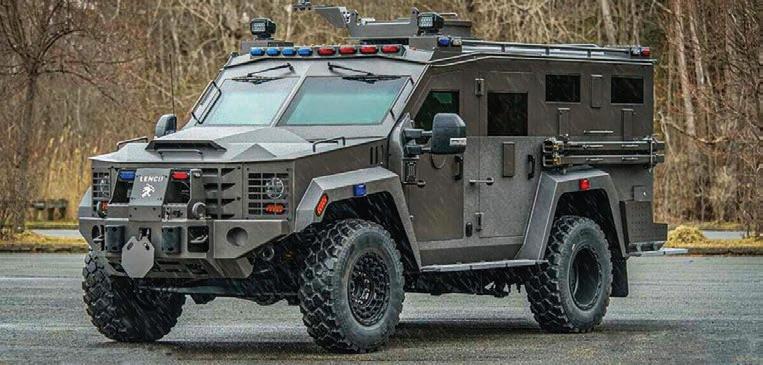
For anyone unfamiliar with the BearCat, it is an armored vehicle built by Lenco Industries. It is designed specifically for law enforcement tactical operations, and it excels at such.
The BearCat gets a lot of bad press, mainly from anti-police “social justice” advocates who call it a tank (which it isn’t) and point to it as being (what they
consider) a sign of the militarization of law enforcement.
The BearCat does one thing exceedingly well: It stops bullets. Introduced in 2001, the BearCat’s armor can stop most high-powered rifle rounds, including armor-piercing ammo. It’s an armored rescue vehicle, designed to safely get tactical operators to a location where they can address any armed threats.
To its critics, I would say that the BearCat is nothing more than body
armor that encases its occupants so they can get to their objective safely. As a former SWAT officer I can attest to the vehicle’s effectiveness. It’s often used to get hostage negotiators closer to those they are trying to talk to. It’s also used to rescue downed officers and civilians. It can deploy gas, knock down doors and walls, forge deep rivers, etc. Its mere presence is often all that is needed to convince someone to surrender. It is the ultimate deescalation tool.
But, in a pinch, it can also be used as
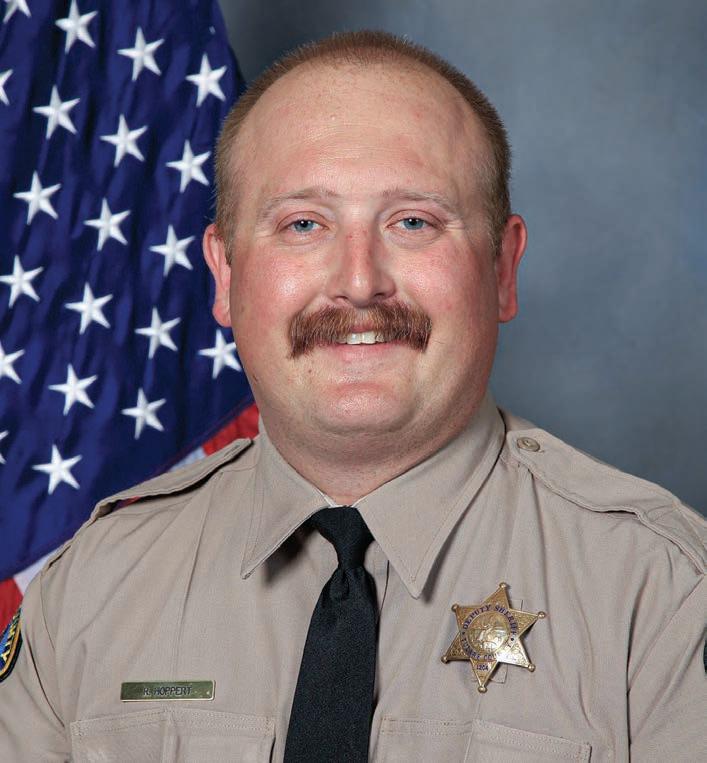
Tulare County, California, Sheriff’s Office Detective Randy Hoppert was killed while serving an eviction notice in April. (TULARE COUNTY SHERIFF’S OFFICE)
L.E. SPOTLIGHT
a lethal weapon.
After killing Detective Hoppert, suspect Morales barricaded himself inside the residence he was supposed to be evicted from. According to TCSO Sheriff Mike Boudreaux, Morales had “armed himself and prepared himself and was lying in wait.” KCSO SWAT officers used drones and other equipment to gain tactical visibility of the situation. Morales, armed with a rifle and a handgun, repeatedly exchanged fire with the deputies, showing absolutely no intention of giving up or stopping the level of violence.
KCSO SWAT used The Rook, a tracked armored vehicle that looks like a skid steer, to tear off part of the front of the house Morales had been hiding in while shooting at officers. Morales then fled to a wooded area in the backyard. As SWAT officers pursued in the BearCat and tried to take him into custody, Morales continued to shoot at them.
SWAT officers realized that Morales
presented an ongoing, deadly threat to not only the officers but to the surrounding community. He showed absolutely no signs of giving up, leaving SWAT with only one option: deadly force. Rather than risk another officer’s life, they picked a better option, using their BearCat as a weapon (improvise, adapt, overcome), running him over with the vehicle, killing him and ending the incident.
In a press conference afterwards, Sheriff Boudreaux summed it up perfectly: “Don’t shoot at cops. You shoot at cops, we’re gonna run you over; he got run over. He got what he deserved.” Enough said. ★
Editor’s note: Author Nick Perna served for more than 24 years with the Redwood City Police Department in Northern California before his 2025 retirement.
The Kern County SWAT Team used a Lenco Industries BearCat G3 to drive over and neutralize Hoppert’s killer, who would not surrender and kept shooting at them. (LENCO)
Self-Defense TRAINING
THE PARABLE OF THE PENCIL
A lesson in improvisation, mindset and survival.
STORY AND
BY PAUL PAWELA
once saw John Wick kill three men in a bar with a pencil.” Few movie quotes have elevated an ordinary object to legendary status quite like this line uttered by Russian crime boss Viggo Tarasov in John Wick. The image of a simple No. 2 pencil becoming a symbol of determination and resourcefulness captivated audiences
around the world. While the scene itself belongs firmly in the realm of cinematic fiction, it highlights an important concept familiar to many self-defense instructors: In a genuine emergency, people often have to rely on whatever is immediately available.
Long before John Wick popularized the pencil, many instructors in the self-defense community used ordinary household objects as training aids to demonstrate principles of awareness, improvisation and survival. The pencil
was never seen as a magical solution or a substitute for proper training. Instead, it was an object nearly everyone carries, making it useful for illustrating that mindset and preparation matter far more than specialized equipment.
For generations, knowledge of weapons and combat systems was often closely guarded. Military organizations, law enforcement agencies and traditional martial arts schools often reserved advanced instruction for select students. Today,
PHOTOS
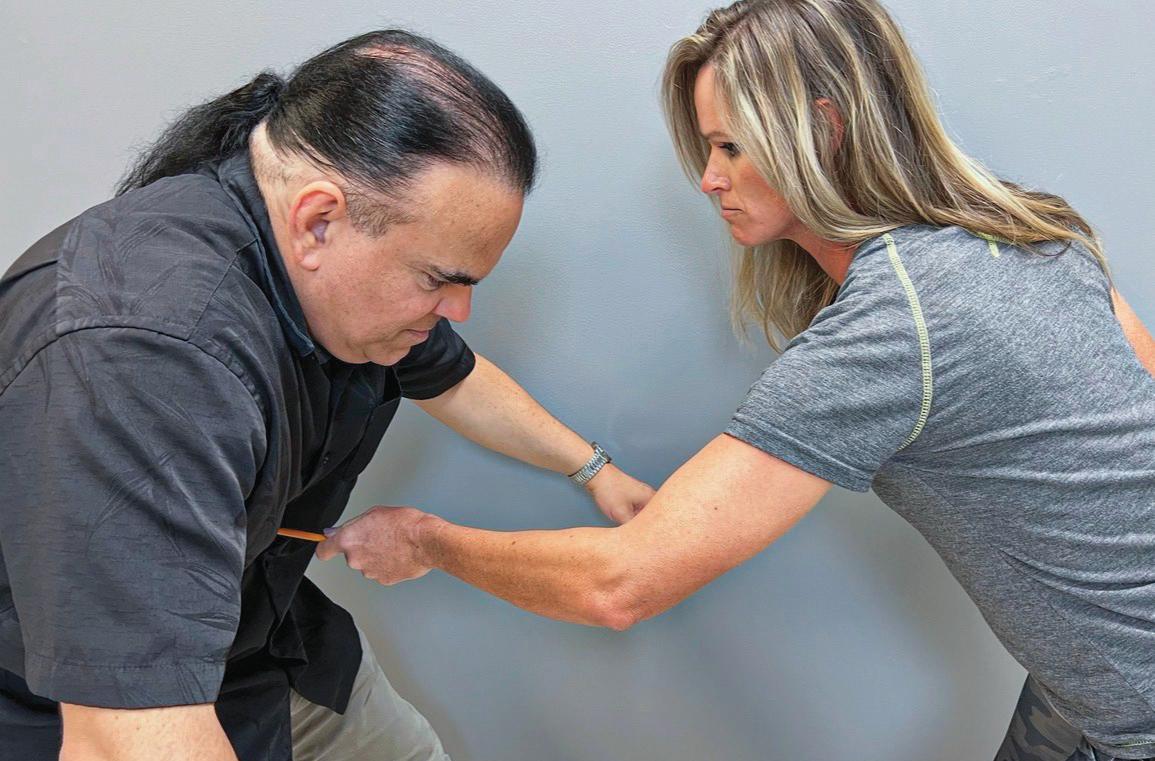
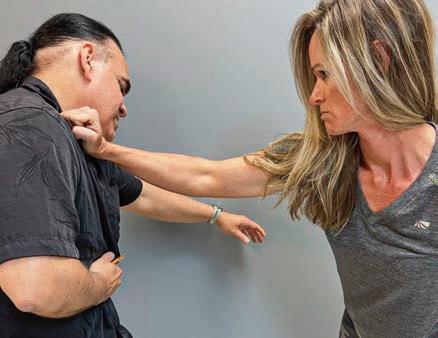
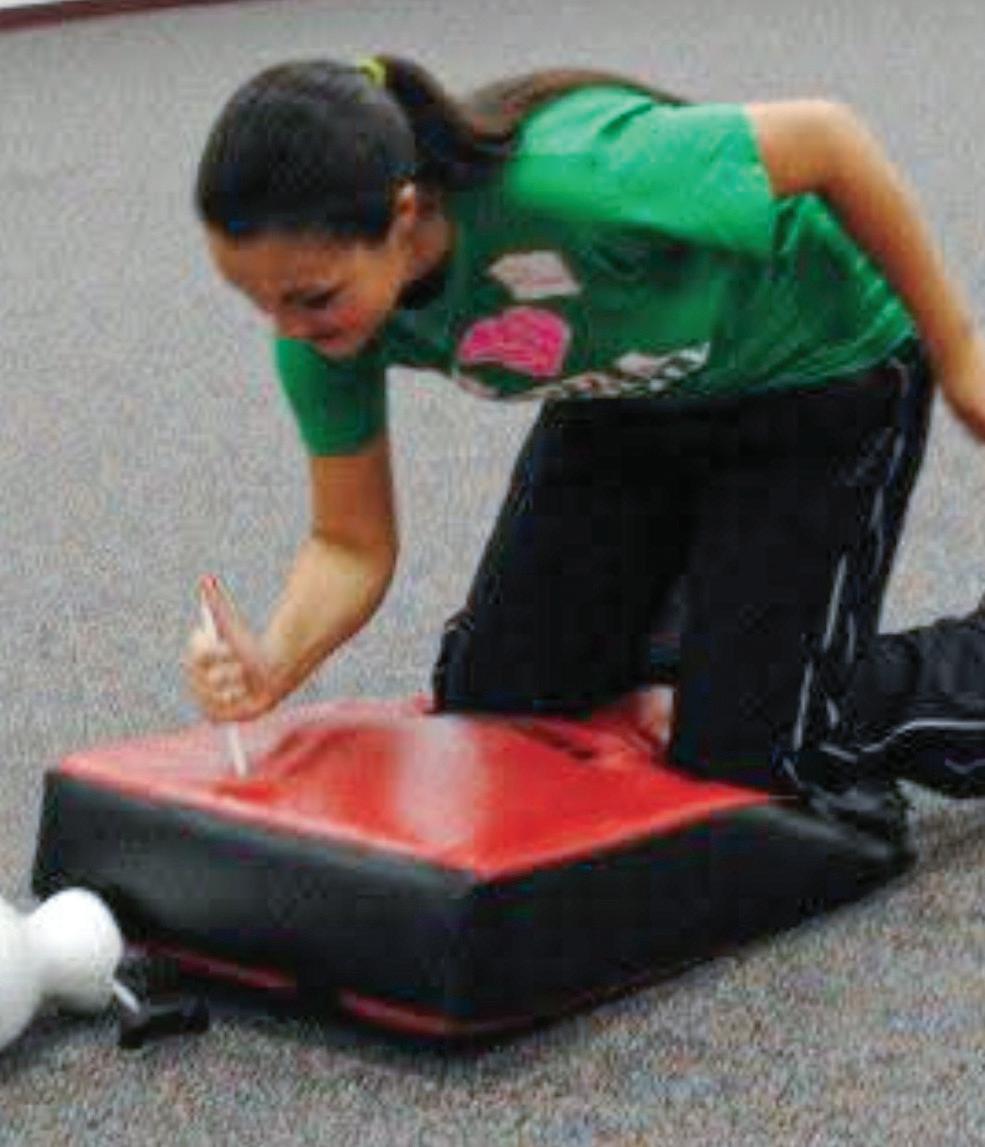
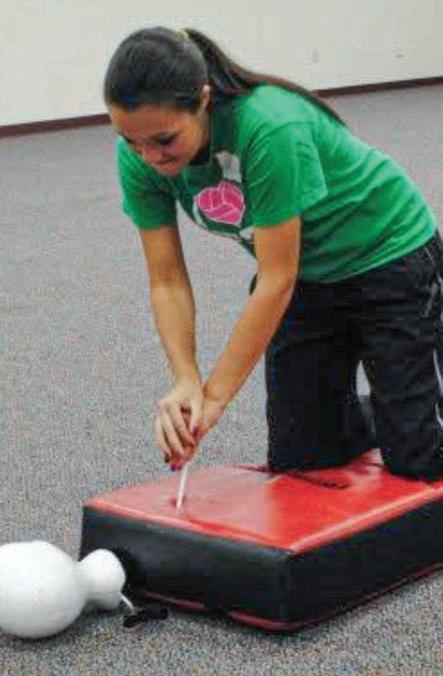
Now pay attention, class ... Self-defense trainer Sherry Myers shows how she defends herself with just a pencil – a lesson that serves both practical and metaphorical purposes.
SELF-DEFENSE TRAINING
that is no longer the case.
Modern films such as The Hunted, Under Siege, The Punisher and Sharky’s Machine have introduced audiences to concepts once considered obscure. Television, books, documentaries and the internet have made information about self-defense more accessible than ever before.
Although Hollywood often dramatizes violence for entertainment, it has also encouraged many viewers to think seriously about personal safety. The challenge for today’s instructors
is separating fiction from practical reality. Real self-defense is rarely dramatic. It emphasizes awareness, avoidance, escape and sound judgment far more than spectacular techniques.
GIVEN THE COUNTLESS defensive tools available today, why spend time discussing something as ordinary as a No. 2 pencil? The answer is simple: It is legal everywhere. Pencils are nearly universal. They are found in schools, offices, libraries, workshops and homes around the world. Unlike many purpose-
built defensive tools, a pencil is carried for innocuous everyday purposes.
All this makes the pencil a useful teaching aid. Rather than encouraging people to rely on specialized equipment that may not always be available, instructors can demonstrate broader principles of preparedness using an object students already recognize.
The lesson is not really about pencils. It is about developing the mindset to remain calm, think clearly under stress and use whatever lawful resources are available to create an
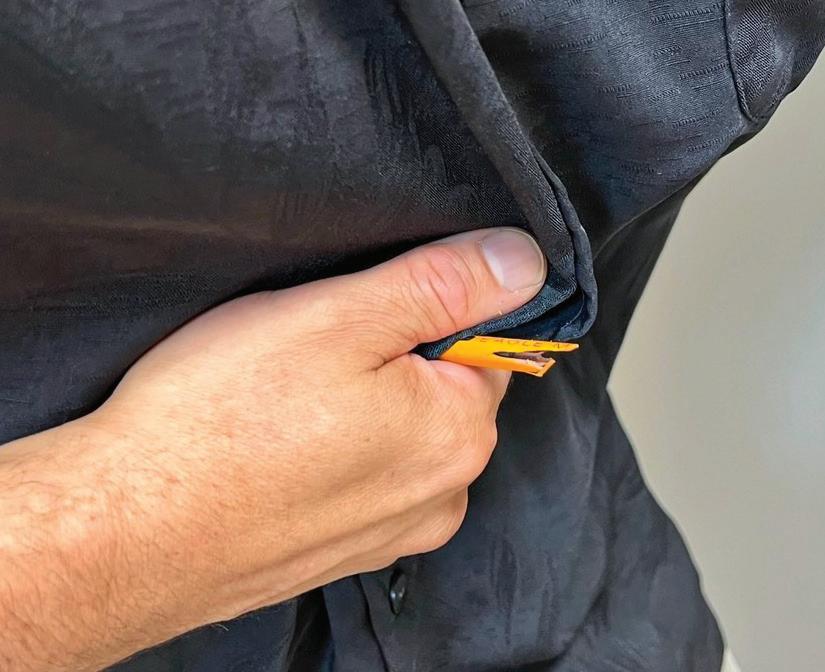
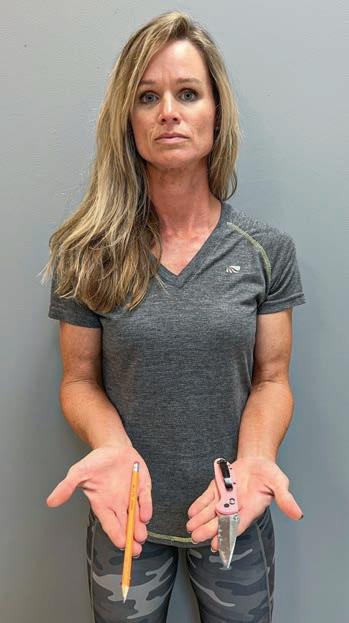
When she can’t carry a gun, Sherry carries a pencil or a pink-handled knife.
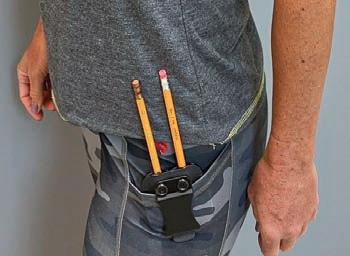
Sherry shows how she carries her pencils in her pocket. The configuration holds two pencils carried on her nondominant side.
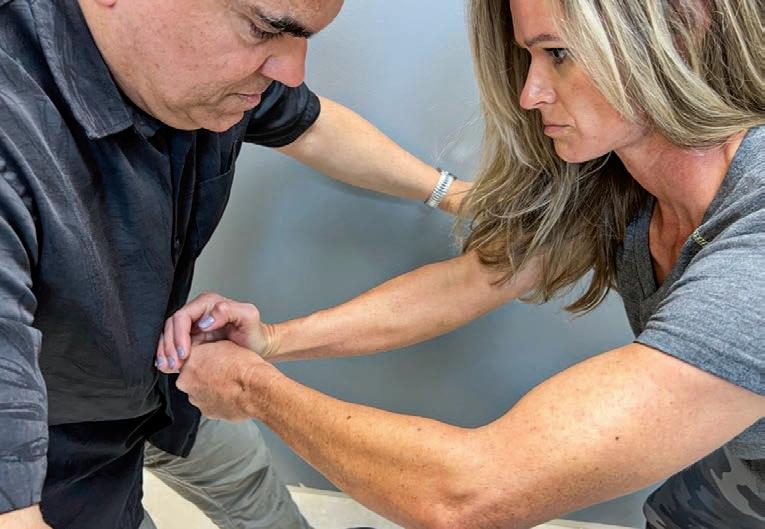
Disparity of force always goes against a woman because men generally have height, size and weight advantages. To overcome this, Sherry first stabs the attacker with a hard thrust to the body.
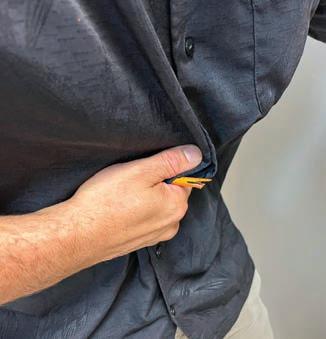
Then, with the pencil in the body, Sherry breaks the pencil off into her attacker and uses the remaining stub to stab into her opponent’s neck. This does two things: 1) It creates multiple wounds in different locations, prompting the attacker to seek immediate medical attention; and 2) The pencil is in the body so deep that authorities will have physical evidence of the attack.
SELF-DEFENSE TRAINING
opportunity to escape danger. One reason many instructors choose simple training tools is that younger students often have limited legal options for defensive equipment.
When instructing teenagers, particularly young women, the conversation naturally shifts toward awareness, confidence, boundary setting and escape skills rather than equipment.
Violence against women remains a serious concern worldwide. Statistics consistently show that hundreds of thousands of people experience sexual assault or attempted sexual assault each year. These numbers remind us that personal safety education is not merely a hobby; it is an important life skill.
Because students already carry pencils to school, they offer a familiar object for discussing emergency preparedness without introducing specialized weapons into the classroom. More importantly, they remind students that the most effective defenses usually begin long before a physical confrontation.
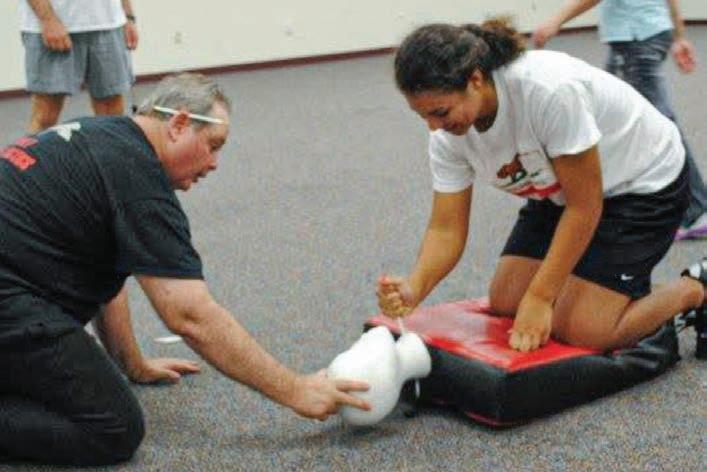
Author Paul Pawela teaches a class of girls aged 13 to 17 using the only tool available to them, a pencil. Because students already carry pencils to school, it offers a familiar object for discussing emergency preparedness without introducing specialized weapons. This type of training builds confidence, and confidence improves decision-making under stress.
SELF-DEFENSE TRAINING
Recognizing suspicious behavior, trusting intuition, avoiding isolated situations whenever possible and confidently seeking help are skills that deserve far more attention than any particular tool.
Students of military history often look to ancient armies for lessons in discipline and efficiency. Among the most respected examples is the Roman legion. The Roman centurion commanded soldiers whose success depended less on individual heroics than on discipline, teamwork, conditioning and relentless practice. Roman military doctrine emphasized economy of movement, maintaining formation and applying simple techniques under extreme pressure.
Whether studying Roman history, modern law enforcement or contemporary martial arts, the lesson remains the same: Training builds confidence, and confidence improves decision-making under stress. The object being carried is rarely the deciding factor. One of the greatest benefits of self-defense training has nothing to do with physical techniques. It is confidence.
PEOPLE
WHO
DEVELOP
situational awareness often carry themselves differently. They make better decisions about where to park, how to travel and how to respond to uncomfortable situations. They become more observant without becoming fearful.
Preparedness is not paranoia. It means recognizing that emergencies are rare but possible and making reasonable decisions to reduce unnecessary risk.
Simple habits can dramatically improve personal safety. These include:
• Paying attention instead of becoming absorbed in a phone;
• Trusting instincts when something feels wrong;
• Maintaining awareness in parking lots and on public transportation;
• Letting family or friends know travel plans;
• Avoiding distractions in unfamiliar
environments;
• And seeking populated, well-lit areas whenever possible.
These habits cost nothing yet often provide greater protection than any object someone could carry.
Many defensive systems, despite their differences, share common objectives. Rather than focusing on complex techniques, they emphasize broad principles that increase the likelihood of escaping danger.
These include:
• Maintaining or recovering balance;
• Protecting vision and awareness;
• Creating space to disengage;
• Breaking free from restraint or control;
• And escaping and reaching safety as quickly as possible.
These principles reinforce an important truth: Successful selfdefense is measured by getting home safely, not by winning a fight.
Quality self-defense instruction should include much more than physical techniques. Students benefit from learning verbal de-escalation, conflict avoidance, environmental awareness, legal considerations, stress management and emergency decision-making.
Scenario-based training can help people recognize danger earlier, communicate more effectively and understand when leaving is the best option.
The best instructors emphasize restraint as much as action. They teach students to avoid unnecessary confrontation whenever possible and to prepare to respond decisively if escape becomes necessary.
Laws governing self-defense vary by jurisdiction, but one principle remains remarkably consistent. The purpose of defensive force is to stop an immediate threat, not to seek revenge or prolong a confrontation after the danger has passed.
Anyone interested in personal protection should become familiar with the laws in the places where they live, travel or work. Understanding those legal boundaries is just as important as learning physical skills. Responsible
self-defense always includes responsibility afterward: contacting emergency services, accurately reporting the incident and cooperating with law enforcement.
THROUGHOUT HISTORY,
PEOPLE have debated which weapon, tool or piece of equipment is best. Experienced instructors often reach the same conclusion. Equipment matters far less than awareness. A prepared individual who recognizes danger early will usually outperform an unprepared person with expensive gear. Confidence, judgment and training consistently outweigh gadgets and gear.
The pencil serves as a reminder of that philosophy. Its significance is symbolic rather than tactical. It shows that preparedness begins in the mind, not in a catalog of equipment.
The popularity of John Wick gave the humble pencil an unforgettable place in popular culture, but the true lesson extends far beyond the action movie.
Personal safety rests on awareness, education, sound judgment and ongoing practice. Ordinary objects remind us that emergencies rarely unfold under ideal circumstances. We may not have specialized equipment, but we always have our awareness, our ability to think and our determination to survive.
Whether you’re a martial artist, parent, educator or simply someone interested in becoming better prepared, the pencil represents something larger than itself. It symbolizes adaptability, the understanding that survival often depends not on having the perfect tool but on developing the mindset to recognize danger, remain composed under pressure and make the decisions that lead safely home.
In the end, that is the most valuable lesson any self-defense system teaches. ★
Editor’s note: Author Paul Pawela is a nationally recognized firearms and self-defense expert. For his realistic self-defense training, see assaultcountertactics.com.
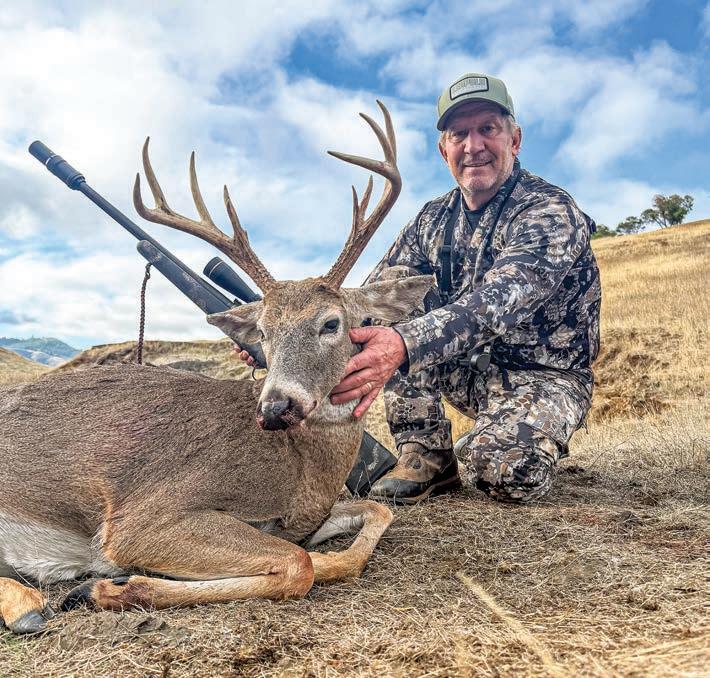
Author Scott Haugen’s target buck, dubbed The Freak, was exceptional for a Columbian whitetail deer. He hopes to find it again this coming season.
ROAD HUNTER
COLUMBIAN WHITETAIL DEER QUEST
Bucks
of this rarer Pacific Northwest subspecies a worthy challenge to hunt.
STORY AND PHOTOS BY SCOTT HAUGEN
inety minutes from my home in western Oregon is the only huntable population of Columbian whitetail deer on the planet. Back in the 1950s and early ’60s, my family regularly hunted these now-prized gems. Back then the deer were considered a nuisance to landowners and ranchers. The deer could be shot on a general season, overthe-counter tag. Then the season closed for almost 40 years due to population declines and a federal listing.
In 2005, the Columbian whitetail season opened once again. Landowner and limited draw tags were highly
sought after. Some landowners and outfitters were fetching $10,000 per tag. My wife drew a tag the first year hunting reopened. She held out for a big buck, one we never found. She went home without firing a shot.
The following year I got a Columbian whitetail tag and shot a mature buck, not a giant. Weighing no more than 120 pounds, it was one of the best eating deer we’d ever had.
LAST SEASON AN opportunity came my way, one I never thought would again. I secured a landowner tag to hunt Columbian whitetails. In late July I joined longtime friend and noted guide Jody Smith (jodysmithguideservice.com).
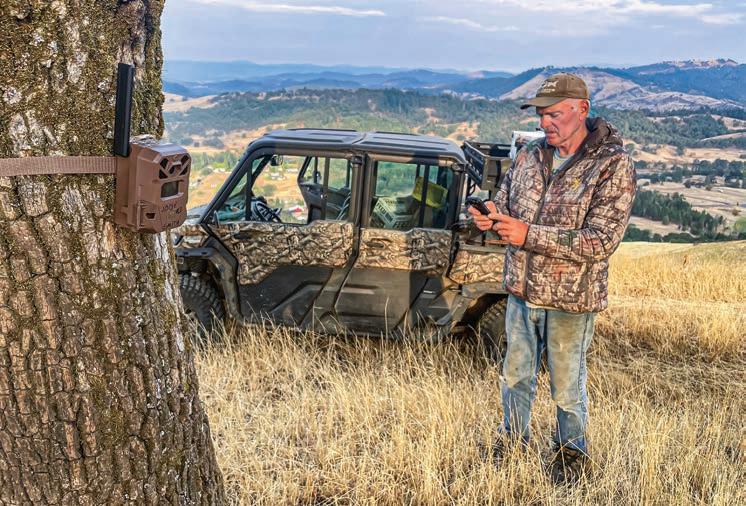
Guide Jody Smith sets one of several Moultrie cellular game cameras for the subspecies of whitetail. He’s been hunting this ranch for nearly a decade and has a success rate of 100 percent.
ROAD HUNTER
I spend more time hunting, scouting and running trail cameras with Smith than anyone else.
“Once you see how these Columbia whitetails can be patterned, you’ll be surprised how addicting it gets hunting them,” Smith shared on our first run to set trail cameras.
We also set out two Moultrie Deer Feeders, which I controlled feeding times on with my cell phone on the Moultrie app, as well as hung multiple Moultrie Feed Bins and tossed out some deer
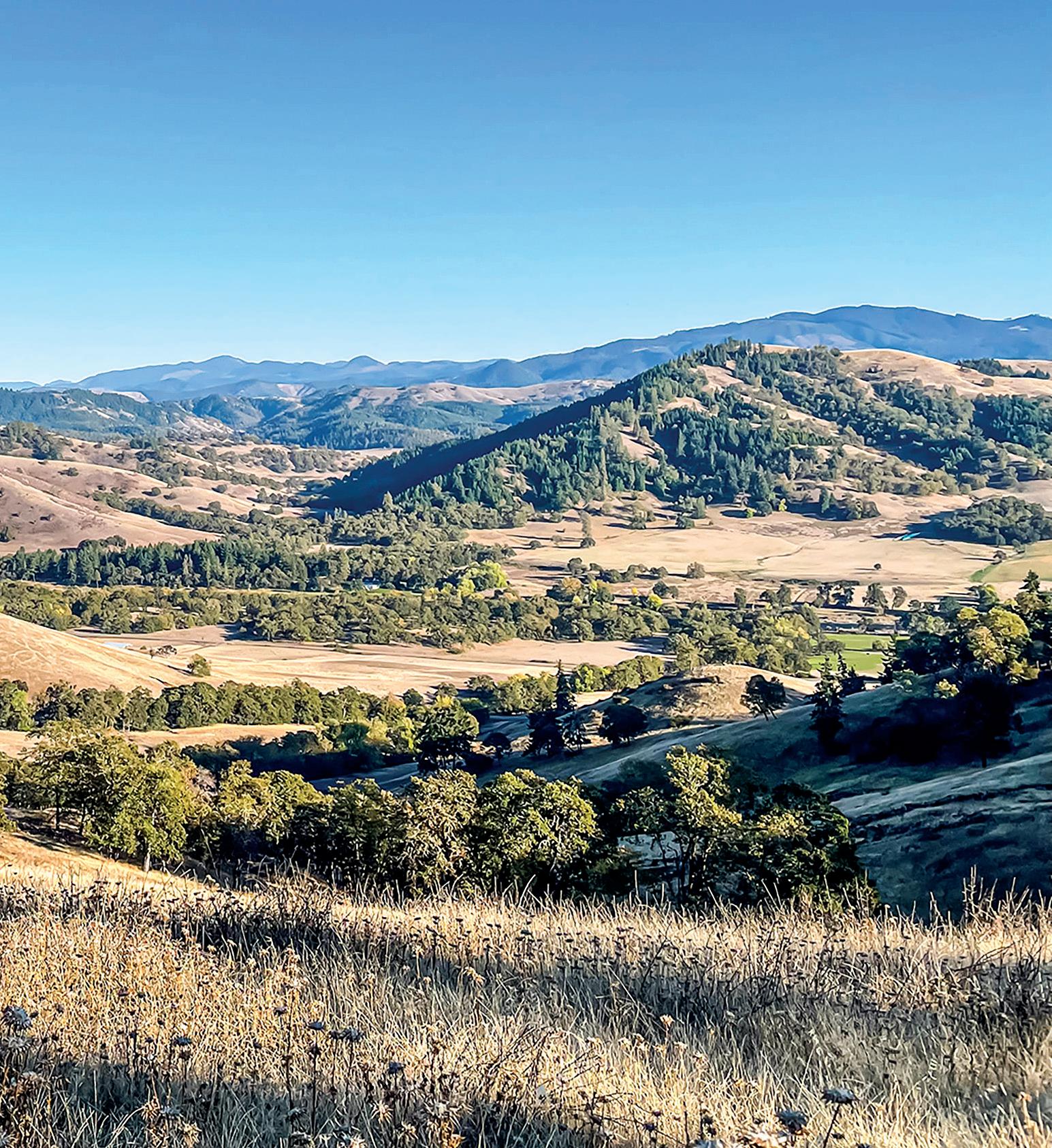
Oregon’s North Umpqua River Valley is home to the best Columbian whitetail hunting there is– also the only, though a population to the north is close to recovery.
The day before the season last year, one of the author’s target bucks, Sweeper, broke off its left main beam at the eyeguard. Maybe the buck will show up this season, for which Haugen has another tag.
blocks. That afternoon every feeder was hit. Having never run deer feeders before, I was struck by the instant action.
I’ve hunted whitetails in multiple Western states. They’ve all been spot-and-stalk hunts. No feed. No patterning. The Columbian whitetail was different. When a big buck in velvet showed up, its main beams sweeping wide and far forward, patterning it consumed me. We nicknamed it Sweeper. Then an even bigger buck arrived, one we dubbed
The Freak.
A few days after The Freak appeared, Smith and I went to scout and hang more Moultrie cellular game cams. That’s when we laid eyes on The Freak and Sweeper for the first time. The Freak was an exceptional buck, especially in velvet. That was the buck I wanted. We caught it on multiple trail cameras over the next six weeks.
On opening morning I was in position. Smith stayed on the high ground to glass. As fog lifted from
the valley below, I could clearly see The Freak’s domain. I glassed three bucks, two of which were shooters, but I held out. Then, 90 minutes into the morning, the familiar heavy white rack flowed over a dark line of poison oak. The Freak was headed to a block to feed. All I had to do was wait.
Set solid in the tripod shooting sticks, I could see the buck’s head. At over 300 yards, there was no shot. The bait was inside 200 yards. The Freak was headed straight for it … until
ROAD HUNTER
another buck appeared. When The Freak saw the tall three-point, it turned and strutted right at it. The rigid walk and upright neck screamed prerut. When the two bucks locked antlers and pushed one another down the hillside, out of sight, I made a move.
With the new buck challenging the boss, I figured they’d be sparring long enough to allow me to hustle into position for a shot. With The Freak’s attention turned on a buck, I also thought it would forego food. I was wrong.
In less than five minutes I was in position overlooking the knoll where the sparring bucks had disappeared. I couldn’t find them. Edging forward to
see over the rolling hillside, the wind was perfect. The bucks had to be below me, but where?
A few minutes later, brush to the right of me erupted. The Freak’s lightcolored rack glowed in the dull morning light as it sped away. At 130 yards it stopped. The shot would have been easy but the buck was screened by a thick stand of poison oak. I waited. One step in either direction and the buck would be clear for a shot. Instead, the buck buckled down and emerged at a full sprint. There was no shot as it sped through thickets of brush. I could have shot but didn’t. It was next to a property line and I didn’t want to chance it.
MY RIFLE SETUP
On this hunt I was shooting a Christensen Arms Ridgeline FFT chambered in .243 with a 20-inch barrel. It’s a lightweight tack driver that’s fun to shoot and punches dime-size groups at 100 yards off shooting sticks.
Nosler’s Whitetail Country 100-grain solid base was the bullet of choice. I intentionally shot my buck high on the shoulder. The bullet passed through the near shoulder blade, exited the other one, and dropped the buck on the spot.
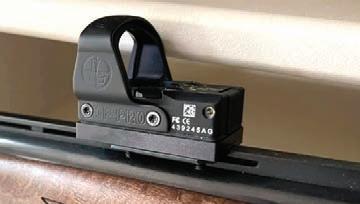
An illuminated reticle is a game changer when it comes to quick target acquisition and accurate shot placement, especially in low-light conditions and when hunting in cover. The rifle was topped with Leupold’s Gen 2 VX-5HD in a 3-15x44. The duplex FireDot is simple and fast to control, and the clarity of the scope is impressive. The scope was fitted with Leupold’s Custom Dial System (CDS), another technological benefit that increases shooter accuracy.
The rifle was tipped with Nosler’s SR-30KH suppressor. I’ve been an advocate of suppressors since first using them in Africa over 30 years ago. This one rounded out a compact build while still delivering obvious noise reduction and less recoil, albeit on a small bore.
It was day one. Surely I’d see the buck again during the five-day hunt.
THE FOLLOWING MORNING we were back, glassing the hillside and thicket where The Freak was last seen. But the wind was wrong. “Let’s back out and give it a couple days to calm down,” suggested Smith. “Let’s go to the other side of the property and look around.” Smith knew I wanted this buck. In the first two days we’d laid eyes on 32 whitetail bucks, nearly one-third of which would have qualified for the record books. But The Freak was in a class by itself. As for Sweeper, it showed up on trail camera a day before the season opener. It had broken one side of its rack at the base. It was safe.
Day four found Smith and I overlooking The Freak’s domain. It was nowhere to be seen. With time running out, we made a push. We saw The Freak one last time, engulfed by the sanctuary of another property.
With one day left in the hunt, I had a decision to make. I’m not a trophy hunter but I do thrive on trying to outwit mature bucks. My addiction lies more in the process of what it takes to outsmart wise old deer rather than total inches of antlers. In fact, I’ve never entered an animal into a record book. I could have easily filled my tag on opening morning, but oh what I would have missed. By the time I filled my tag, Smith and I had laid eyes on 42 bucks. Many were mature bucks. We hunted daylight to dark, even glassed in the midday heat when the shifting sun forced bucks to change bedding locations to avoid the 80-plus-degree temperatures. To become better hunters we must spend time afield. I was in no hurry for this hunt to end.
On the last morning Smith and I sat on the edge of a creek bottom well before daylight. As dawn broke, Columbian whitetails began filtering into wooded, brushy draws. Five bucks moved by, three of which were hard not to pull the trigger on. The Freak never appeared. When a buck with split eyeguards appeared, the decision
Haugen is a suppressor advocate and used one from Oregon manufacturer Nosler on this hunt.
TROPHY MOOSE & BEAR HUNTING
River
MORE THAN A HUNT
This is an unforgettable Alaskan adventure that blends raw wilderness, world-class game, and the thrill of pursuing some of North America’s most iconic animals in their natural environment. Long days on the river. Close encounters. The kind of moments you’ll talk about for the rest of your life.
WHY HUNT WITH US
• Trophy moose & bear hunts in prime river systems
• Regular 60”+ bull moose opportunities
• Near-100% opportunity rate on legal bulls
• High success on large Alaskan bears
• Fully guided & all-inclusive hunts
• Expert guides with deep local knowledge
• Carefully selected locations for consistent results
• 11–15 day hunts with 15-day combo moose & bear hunt available
Every hunt is carefully planned and professionally guided from start to finish. From scouting and calling to field care and logistics, your guide handles every detail so you can stay focused on the hunt.
Contact us today to secure your hunt and discuss available dates.
I was rock-solid in the shooting sticks, the glowing FireDot of the Leupold scope right where I wanted it. At 154 yards, the shot was simple.
Feelings of ambivalence consumed me. I was elated to have taken a nice buck with one of my best friends by my side. I was pleased that the hundreds of miles driven and countless hours spent scouting resulted in some great eating meat. But I felt defeated, failing to close the deal on The Freak.
However, as I write these words, I again have a Columbian whitetail deer tag in my pocket. In three months’ time, Smith and I will be hunting The Freak and Sweeper. Whichever shows first matters not. I’ll be happy either way, even if neither ends up in the freezer.★
Editor’s note: For copies of Scott Haugen’s popular line of hunting and fishing books, and Tiffany Haugen’s cookbooks, visit scotthaugen.com.
SUCCESS WITHIN SIGHT
Haugen’s whitetail sported split eyeguards. It was one of more than 40 bucks seen on his five-day hunt.
BLACK POWDER
EIGHT IS (BARELY) ENOUGH
Despite low turnout at a club silhouette match, shooters still have a good time.
STORY AND PHOTOS BY MIKE NESBITT
At the shooters’ meeting before the first relay was called to the firing line at a recent Silhouette Match, Steve Morris announced that we’d be having no more such matches at the Upper Nisqually Sportsman’s Club in Eatonville, Washington, until July. The reason was
simply because of other events being held elsewhere. So, with that information buzzing in our heads, the eight shooters at this very lightly attended match decided to make the best of it and shoot for the highest scores.
In my 12 years of shooting silhouettes at this range, this was the lowest turnout I had seen. Let me say right now, I hope this is not an indication of the black powder
silhouette matches losing any appeal to shooters. I’d like to see these matches continue, most certainly.
One reason I really want to see these black powder cartridge matches continue is because these are the only easy-to-get-to matches for me that include shooting out to 500 meters (about 550 yards). To say that I’ve learned a lot while shooting in these matches would simply be putting it too
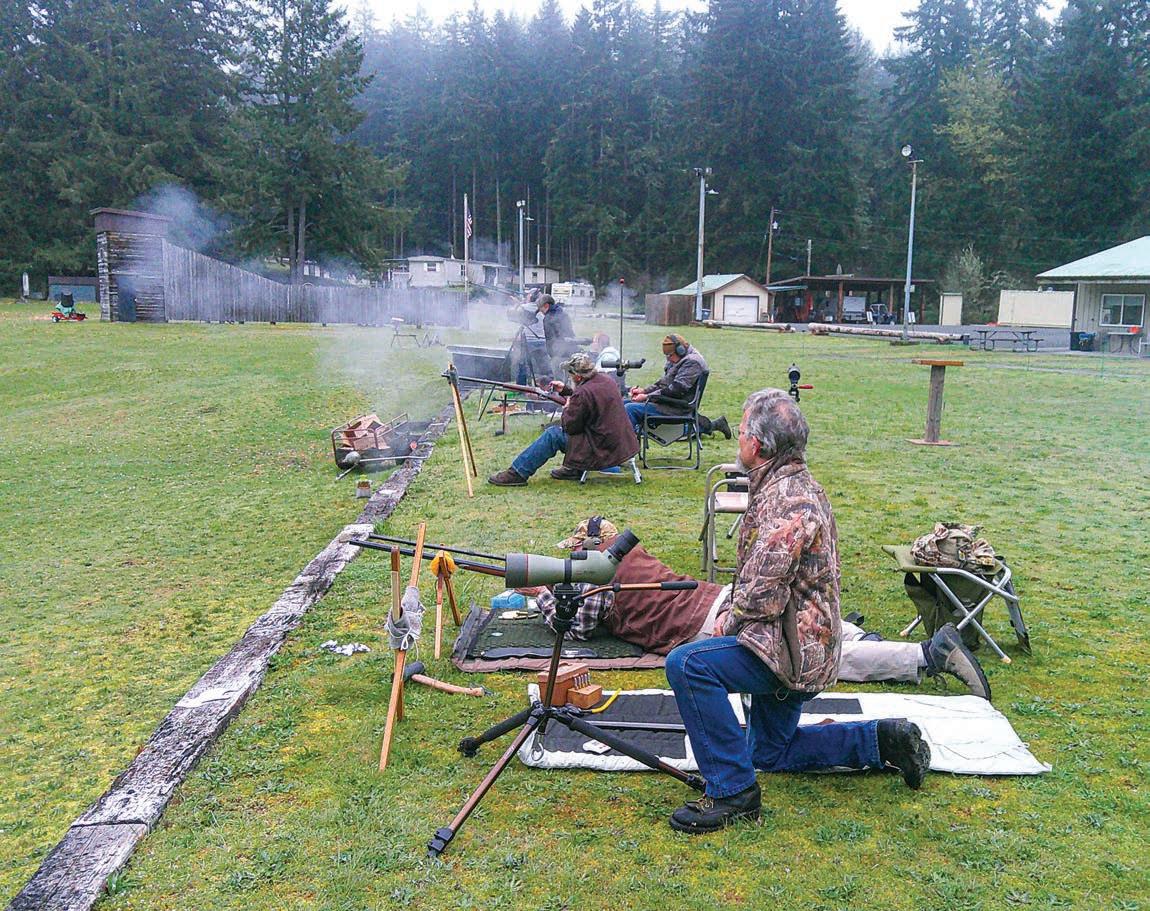
A relay of black powder rifle shooters fire during a silhouette competition at a western Washington club.
BLACK POWDER
mildly. Besides that, the black powder silhouette matches are a great sport all on their own.
Out of the eight shooters doing their best at this match, only three used rifles with iron sights. The other five shooters, which included me, used
scope-sighted rifles. There’s nothing wrong with that; all three of the ironsight shooters would receive awards because the top three shooters in each sighting class earned placement prizes for first, second and third place. The scope shooters would still have to
battle it out for awards, which was just what we came to do.
AN OLD PARTNER, Ash Garman, came “over the hill” from the Yakima area east of the Cascade Range to shoot in this match. He’s been “off of the list” for a while and really wanted to get back into good shooting, especially because he was planning on doing well at this year’s Matthew Quigley Buffalo Rifle Match. Ash and I partnered again and it was good to see him on the firing line once more.
The first targets that Ash and I shot at were the rams, out at 500 meters. Ash shot in the first relay and knocked down five of those often-elusive targets. That wasn’t a bad start at all. Of course, Ash thought he should have done better and we began a little “contest” of our own to see which one of the two of us would get the best scores.
When my turn came at the rams, I thought I might do better, especially after knocking down ram number one with my first shot. But in the first batch of five targets, I hit only two. My second batch of rams was just a little better; I got three of them, shooting with my .45-90 Sharps. That meant Ash and I were tied.
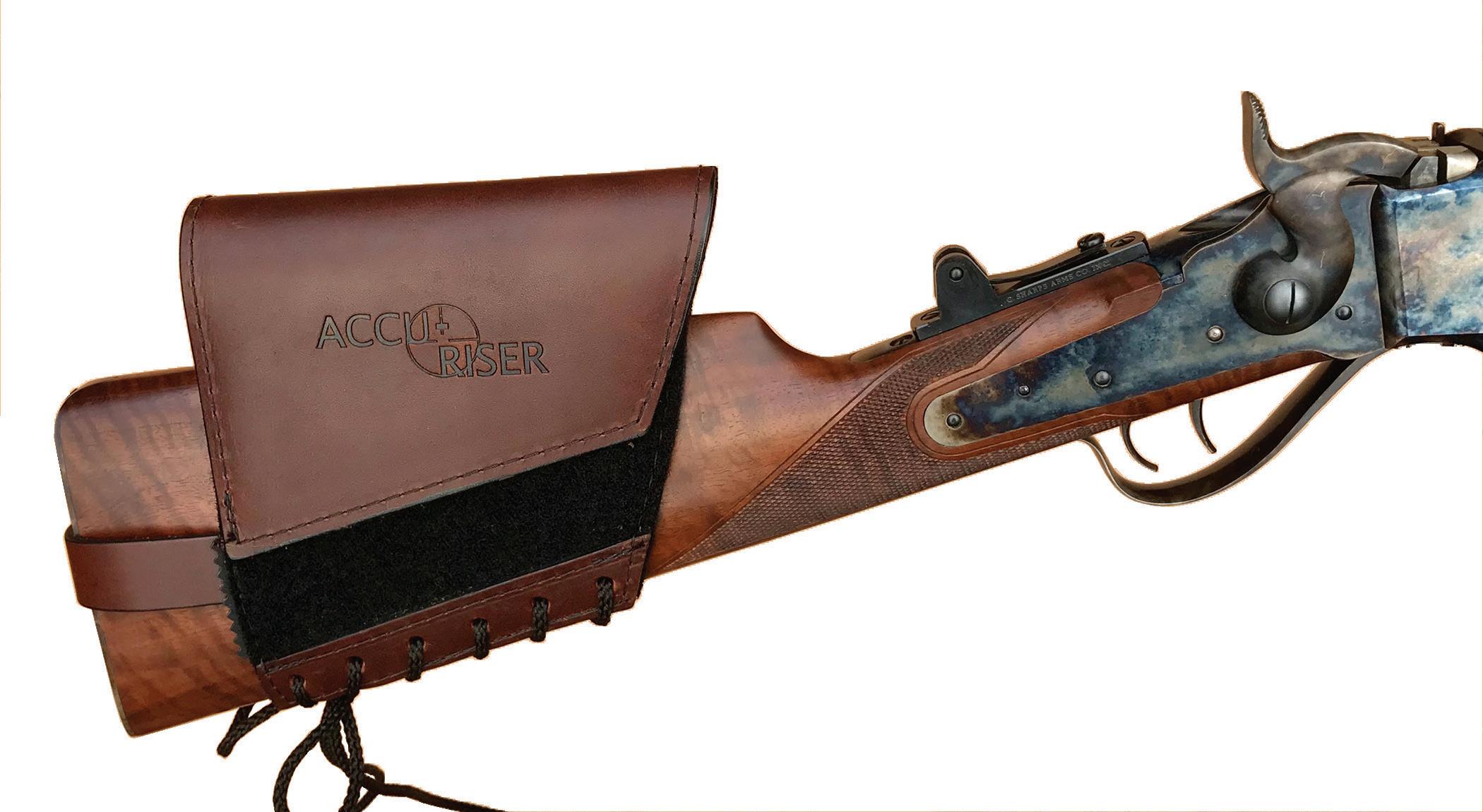
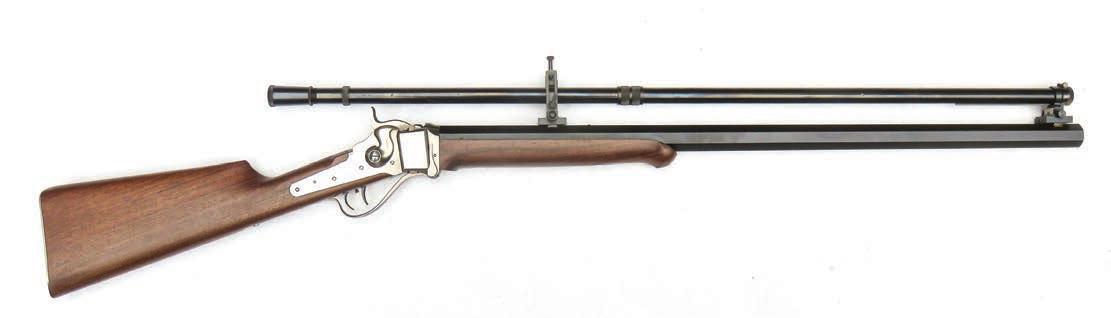
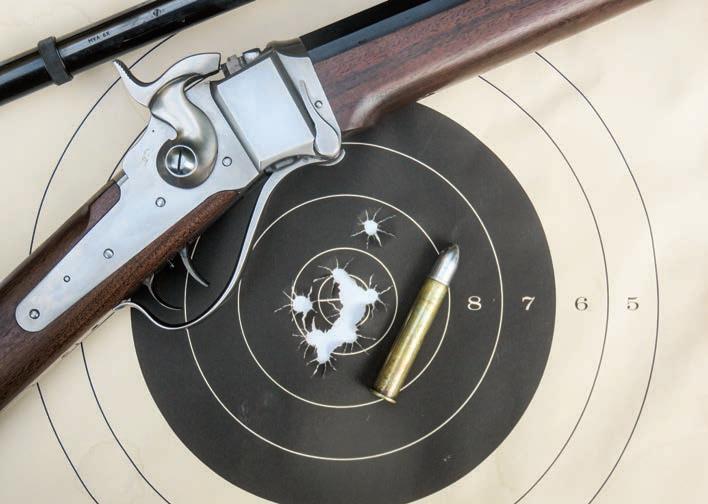
My .45-90 Sharps has been mentioned before, but I will add some details about that good rifle here. It is a Model 1874 Bridgeport by C. Sharps Arms. This is a heavy rifle, weighing 14 pounds, and it has a 1¾ Heavy barrel that is 30 inches long. That weight helps to “tame” the recoil of the .45-90 loads, but not completely. My loads use the 550-grain bullets cast from a discontinued Hoch mold over just 70 grains of Swiss 1½ Fg powder. The
Author Mike Nesbitt’s .45-90 Sharps, a Model 1874 Bridgeport by C. Sharps Arms, is an accurate – and heavy – long-range rifle.
Ash Garman, showing a chicken target that he hit near the tail.
BLACK POWDER
scope on this rifle is the 6X full-length tube from Montana Vintage Arms and I do believe this is the most accurate long-range black powder rifle I have.
This is the rifle that has given me my highest score at the Quigley match in Forsyth, Montana, and also helped me get my highest score at the Little Quigley Match at our own club’s Buffalo Camp last year. In addition to that, this heavy rifle also treats me rather well at silhouettes even though it is bigger than what most silhouette shooters generally use.
In one match not long ago, I was shooting next to Beth Morris. After I had fired a shot at the targets, Beth turned to me and asked, “What caliber are you shooting?” I told her it was my .45-90. She replied with, “It sounded big!”
AFTER THE RAMS, Ash and I moved to the closest targets, the chickens at 200 meters, which are always shot offhand in regular silhouette matches. Ash got one of those small targets and I did not. At least my missed shots were all close enough that he could tell which bird I was shooting at. That put Ash one hit in the lead, between the two of us. Other shooters, of course, were doing better. Corey Everett got two chickens with his iron sights and Pat Ochoa clobbered three of the little hard-to-hit targets with his scoped rifle.
Getting some pigs at 300 meters is where I was able to save face just a little bit. I got all 10, earning another 10-pin for myself. (If five of the targets are hit in a row, cleaning the target rail for half a relay, a 5-pin is awarded.) I do enjoy getting those pins even though mine are usually kept sticking through the scorecards for the matches where they are won. Maybe I should display those pins … Out of the eight shooters in the match on this day, half of us got all 10 pigs, so I was sharing the “animal money” with quite a few shooters.
Ash missed one of his pigs, which gave him a score of nine out of the 10. That meant we were tied again.
Then we came to the turkeys, standing tall at 385 meters (or about 420 yards). For me, the turkeys are often hard to hit. Ash was shooting first, and he set the bar rather high for me by getting eight of those big birds. If I was going to keep up with Ash, I’d need to clobber at least eight of those turkeys. (Although to earn the highest turkey score of the day, I’d need to tie or best the score of nine birds, set by Pat Ochoa and shared by Diana Mitchell.)
When relay two got the range command to “Fire!” I was ready, and after a sighting shot or two, my first turkey fell nicely with my first shot for score. Big birds two and three fell just
as well and I thought I had it figured out. But then turkey number four must have seen me coming. At the hit, it turned slightly on the rail but did not fall, so it could not be scored. My bullet had hit the bird on the edge of the breast, maybe just half of the bullet’s diameter, so it was not a complete hit. Even so, that 550-grain bullet should have knocked the target off of the rail. Obviously it didn’t and my lucky streak of hits had come to a sudden end. With a fresh breath and a new cartridge, turkey number five didn’t fall either, not at all like it was supposed to. That gave me just three hits for the first half of the relay. I would need to get all five turkeys in the second half of the relay in order to tie with Ash. So when the second half of the relay got started, I was trying my best. And “my best” was almost good enough because the first three – turkeys six, seven and eight – fell quite nicely. But then I missed target number nine. My chance of tying with Ash was over with, even though I did hit turkey number 10. My score on turkeys was just seven hits.
So, Ash beat me by one point, or one hit, 23 to 22. That’s not hard to take; sharing some competition in fun with him added to the day at the match. It was good – and it was also good that he beat me by only one point. We’ll do that again, the first chance we get. ★
A pretty good 10-shot group fired at 100 yards while sighting in.
Handloads with 550-grain bullets for the .45-90.
• EZ-XL accommodates 2 dogs over 65 lbs each
• Made from High Density Polyethylene with UV protection
• Easy Loader fits most full size pickups, SUVs & large UTVs
• Deuce fits smaller pickups, SUVs & UTVs
• EZ-XL is for larger breed dogs & full size vehicles
• Vents, cold weather door covers, insulated covers & custom kennel pads available