Voted BEST BUTCHER 5 years in a row!
S DER I NO OR RGE
A TOO L R O ! MALL O TO S
Proud to be family owned for over 50 years.
www.freedommeatlockers.com Shop Hours: Tuesday-Saturday 9-6pm | Butcher Shop: 831-724-4355 Deli Hours: 10-4pm | Deli Hours: 831-724-1167 160 Hi Grade Lane, Freedom, CA 95019
A M ERIC AN
SHOOTING JOURNAL Volume 15 // Issue 8 // April 2026 PUBLISHER James R. Baker GENERAL MANAGER John Rusnak EDITOR-IN-CHIEF Andy Walgamott OFFICE MANAGER / COPY EDITOR Katie Aumann LEAD CONTRIBUTOR Frank Jardim CONTRIBUTORS Elizabeth DePompei, Scott Haugen, Phil Massaro, Mike Nesbitt, Linda Pawela, Paul Pawela, Nick Perna, Trampas Swanson, Dave Workman SALES MANAGER Paul Yarnold ACCOUNT EXECUTIVE Janene Mukai DESIGNER Kha Miner PRODUCTION ASSISTANT Emily Baker WEBMASTER / INBOUND MARKETING Jon Hines INFORMATION SERVICES MANAGER Lois Sanborn ADVERTISING INQUIRIES ads@americanshootingjournal.com
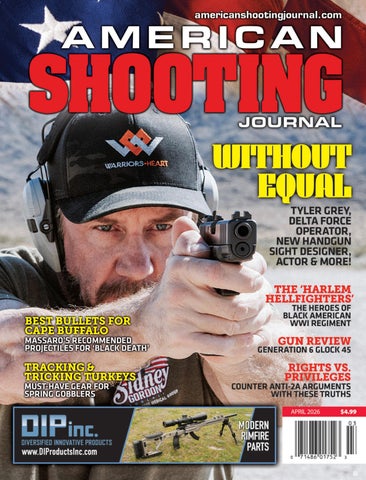
ON THE COVER Tyler Grey has been a lot of things in his life – Delta Force operator, Hollywood military advisor, actor, podcaster, author – and now he can add handgun sight designer to his résumé. (STAFFORD BAIN VISUALS)
Website: AmericanShootingJournal.com Facebook: Facebook.com/AmericanShootingJournal X: @AmShootingJourn Reddit: r/AMSJ/
MEDIA INDEX PUBLISHING GROUP 941 Powell Ave SW, Suite 120, Renton, WA 98057 (206) 382-9220 • (800) 332-1736 • Fax (206) 382-9437 media@media-inc.com • www.media-inc.com
8 American Shooting Journal // April 2026
VOLUME 15 • ISSUE 8
CONTENTS
FEATURES
COVER STORY
26
BULLET BULLETIN: LET’S TALK CAPE BUFFALO BULLETS A Cape buffalo hunt might be the easiest on the wallet of Africa’s five most dangerous game animals, but you don’t want to scrimp on bullets when pursuing “Black Death.” Phil Massaro has recommendations for partition, monometal, bonded-core and expanding solid projectiles.
39
ROAD HUNTER: TRACKING AND TRICKING TURKEYS There are two types of gear that gobbler gunner Scott Haugen can not live without. He shares how year-round trail camera scouting and picking the right decoys based on springtime conditions will lead to notched tags for you this season.
62
‘FINEST OF RECORDS’ Just over a century ago now, the “Harlem Hellfighters,” the Black American soldiers of the 369th Infantry Regiment, came back from World War I heroes. Elizabeth DePompei traces the story of these men who fought longer than any other American unit in France – and who returned home to more battles.
62
18 FRAME OF MIND
For over 12 years Tyler Grey worked on and off to develop his vision for a new handgun sight, a quest recently sidetracked by the theft of his designs. For a lesser person, that might have been the crushing blow, but it was just one more bit of adversity for this combat-wounded former Delta Force operator to overcome. Linda and Paul Pawela share Grey’s story and his new NDEX sight. (NATIONAL ARCHIVES 165-WW-127-028)
(STAFFORD BAIN VISUALS)
AMERICAN SHOOTING JOURNAL is published monthly by Media Index Publishing Group, 941 Powell Ave SW, Suite 120, Renton, WA 98057. Display Advertising. Call Media Index Publishing Group for a current rate card. Discounts for frequency advertising. All submitted materials become the property of Media Index Publishing Group and will not be returned. Copyright © 2026 Media Index Publishing Group. All Rights Reserved. No part of this publication may be copied by any means, electronic or mechanical, including photocopying or recording by any information storage or retrieval system, without the express written permission of the publisher. Printed in U.S.A.
americanshootingjournal.com 11
MORE FEATURES 55
2A TALK: RIGHTS VERSUS PRIVILEGES – KNOW THE DIFFERENCE Sorry, anti-gunners, the constitutionality of the Second Amendment isn’t subject to permit-to-purchase, public opinion polls or opprobrium. Longtime gun world reporter Dave Workman has a refresher on rights versus privileges.
59
LAW ENFORCEMENT SPOTLIGHT: THE WORLD NEEDS MORE COPS LIKE DEPUTY CHIEF EDWARDS As retired officer Nick Perna knows, as you move up the ladder in a police department, chances are you’ll be spending more time in seats than beats, but that doesn’t mean the senses of a cop are ever dulled. He shares the story of a New York City deputy chief whose instinctive actions went viral.
66
MAKING THE CUT: THIS AIN’T YOUR GRANDPA’S BUCK Buck Knives is famous for its iconic folder, that gold and brown knife familiar to so many hunters. But reacting to the demand for an auto-deploying version, the company introduced the 110 Auto Elite. Trampas Swanson details how it merges tactical and everyday self-defense practical in an heirloom-quality blade.
76
BLACK POWDER: LOADING 12-GAUGE BRASS SHOTGUN SHELLS Mike Nesbitt’s passion for black powder shooting knows no bounds. He offers up a lesson in reloading your own scattergun shells – it’s not only a great way to ensure he has quality ammo on hand, but just about as fun as the actual shooting itself!
Gun REVIEW
46
(NICK PERNA)
46
GENERATION 6 GLOCK 45 If you’re looking to replace or upgrade from a Generation 4 or earlier Glock, Nick Perna just might have the model for you. He shares the specs on the Gen 6 Glock 45 and what sets it apart from previous handguns from this maker of reliable firearms.
DEPARTMENTS 15 17 12 American Shooting Journal // April 2026
Gun Show Calendar Competition Calendar
americanshootingjournal.com 13
PRIMER
GUNSHOW C A L E N D A R
April 4-5
Fayetteville, N.C.
Crown Expo Center
April 11-12
Columbus, Ohio
Ohio Expo Center
April 18-19
Dayton, Ohio
Montgomery County Event Center
April 18-19
Hickory, N.C.
Hickory Metro Convention Center
April 11-12
Ogden, Utah
Weber County Fairgrounds
April 11-12
Las Vegas, Nev.
Las Vegas Motor Speedway
April 25-26
Phoenix, Ariz.
Arizona State Fairgrounds
April 25-26
Ontario, Calif.
Ontario Convention Center
April 11-12
Tampa, Fla.
Florida State Fairgrounds
April 18-19
Fort Myers, Fla.
Lee Civic Center
April 25-26
Miami, Fla.
Miami-Dade Fairgrounds
April 11-12
Phoenix, Ariz.
Ben Avery Shooting Facility
April 11-12
Roseville, Calif.
@the Grounds
April 18-19
Tucson, Ariz.
Tucson Expo Center
April 24-25
Queen Creek, Ariz.
Horseshoe Park & Equestrian Center
April 3-4
Richmond, Ky.
Madison County Fairgrounds
April 3-5
Osage Beach, Mo.
The Lodge of Four Seasons
April 11-12
Cartersville, Ga.
Clarence Brown Conference Center
April 18-19
Gray, Tenn.
Appalachian Fairgrounds
April 18-19
Marietta, Ga.
Machinists Aerospace Union Hall
April 25-26
Knoxville, Tenn.
Knoxville Expo Center
April 25-26
Kansas City, Kan.
Wyandotte Fairgrounds
April 10-12
San Antonio, Texas
Alzafar Shrine Auditorium
April 17-19
Round Rock, Texas
Round Rock Embassy Suites
April 25-26
Eagle Pass, Texas
International Center for Trade
Tanner Gun Shows
April 18-19
Aurora, Colo.
Arapahoe County Fairgrounds
Wes Knodel Gun Shows
April 5-6
Redmond, Ore.
Deschutes County Fair & Expo Center
C&E Gun Shows cegunshows.com
Crossroads Of The West Gun Shows crossroadsgunshows.com
Florida Gun Shows floridagunshows.com
GunTVShows.com guntvshows.com
RK Shows rkshows.com
Texas Gun Shows gunshowstx.com
tannergunshow.com
wesknodelgunshows.com
To have your event highlighted here, send an email to kaumann@media-inc.com. americanshootingjournal.com 15
PRIMER
COMPETITION C A L E N D A R
April 8-13
2026 Rifle National Junior Olympic Championships Anniston, Ala. USA Shooting usashooting.org
April 24-26
30th Anniversary Mississippi Classic Florence, Miss.
Sig Sauer Academy New England Sectional Epping, N.H.
May 14-17
April 11-12
April 18-19
May 2-3
April 18-19
April 25-26
May 2-3
April 3-5
April 17-19
April 17-19
April 3-4
April 16-18
April 24-25
Old Dominion Glock Challenge Hurt, Va.
Missouri State Championship Festus, Mo.
Tri-State Shootout Daleville, Ala. International Defensive Pistol Association idpa.com
May 14-17
California State Championship Richmond, Calif.
North Texas Sectional Ladonia, Texas
April 17-18
Delaware State GSSF Challenge Bridgeville, Del.
Cowboy Mounted Shooting Association cmsaevents.com
April 22-26
Shotgun National Championships-Trap Hillsdale, Mich.
2026 Pistol National Junior Olympic Championships Colorado Springs, Colo.
DELMARVA Section Championship Montpelier, Va.
Glock Sport Shooting Foundation gssfonline.com
May 23-27
Shotgun National Championships-Skeet Hillsdale, Mich.
April 15-20
April 16-19
United States Practical Shooting Association uspsa.org
May 16-20
April 10-12
Virginia Indoor Regional Chesapeake, Va.
Gem State Classic Nampa, Idaho Homestead Glock Challenge Homestead, Fla.
NC State Championship Lumberton, N.C.
Arkansas State IDPA Championship Perryville, Ark.
April 24-25
Indiana State IDPA Championship Atlanta, Ind.
Washington State Championship Benton City, Wash.
Foothills GSSF Match Cherryville, N.C. Pacific Coast Challenge Shedd, Ore.
Red Bluff Round-Up Rodeo Shootout Red Bluff, Calif.
Maryland IDPA Championship Lexington Park, Md.
April 30-May 3
Western Regional IDPA Championship Sloughhouse, Calif.
To have your event highlighted here, send an email to kaumann@media-inc.com. americanshootingjournal.com 17
Tyler Grey was a member of Delta Force before being injured in combat and medically retired. (TYLER GREY)
18 American Shooting Journal // April 2026
FRAME OF MIND From his days in Delta Force to recovering from combat injury, acting and podcasting to designing a unique handgun sight, Tyler Grey embodies what's possible. STORY BY LINDA AND PAUL PAWELA PHOTOS BY STAFFORD BAIN VISUALS
I
n an industry where authenticity is often manufactured, Tyler Grey stands apart. Soldier, survivor, actor, technical advisor, podcaster and entrepreneur, Grey has built a career on something Hollywood can’t replicate: lived experience. Before stepping onto a film set, Grey served in the US military’s most elite unit: Delta Force. After a grueling selection and assessment process, he joined the tier one counterterrorism unit tasked with some of the most sensitive missions in modern warfare.
Sight seer: For over 12 years Grey worked on and off to develop his vision for a new handgun sight, a quest that also saw him overcome the theft of his designs. The outcome is the NDEX sight. americanshootingjournal.com 19
On the set of SEAL Team: (left to right) Raffi Barsoumian, Justin Melnick, Grey, David Boreanaz, Beau Knapp and Judd Lormand. (© 2020 CBS BROADCASTING INC.)
Delta operators are known for discipline, adaptability and obsessive attention to detail, traits that would later shape Grey’s second career. He deployed multiple times to combat zones, operating in environments where preparation and teamwork meant the difference between life and death. Let’s pause for a moment, as this sounds like how someone would define the word “hero,” right? “A person admired for exceptional courage, noble qualities or outstanding achievements, often risking themselves to help others. Also: selflessness, bravery and resilience. More to the point, a reallife rescuer, all the traits that make for mythological figures in books and movies.” The irony is that while Grey is all of that and then some, he is a very humble, salt-of-the-earth kind of man. Strangely, Grey doesn’t think of himself as a hero nor consider himself one. Sir, no disrespect, but here is where the authors will disagree with you: Everyone knows you and your brothers-in-arms are all heroes! 20 American Shooting Journal // April 2026
GREY’S MILITARY CAREER was
cut short by a devastating combat injury sustained in a suicide bombing. The blast caused severe physical trauma and forced him into a long and difficult recovery. For many, such an injury would mark the end of forward momentum. For Grey, it marked a pivot. Recovery required not only physical rehabilitation, but also mental recalibration. Transitioning from the intensity of special operations into civilian life can be disorienting. Grey approached it the same way he approached mission planning: with structure, discipline and intent. Grey initially entered the film and television world as a technical advisor, ensuring authenticity in military portrayals. He quickly proved invaluable. Directors and producers recognized that he wasn’t simply choreographing movement; he was delivering realism grounded in muscle memory and experience. From how a rifle is mounted to how a team
clears a room, Grey brought nuance that audiences may not consciously identify but instinctively recognize. His behind-the-scenes work eventually evolved into an on-screen role in the hit television series SEAL Team. Unlike many actors who learn to portray special operators, Grey didn’t have to act confident; he embodied it. His presence in Hollywood coincided with a broader shift in how military stories are told. Today’s audiences are more informed. They can tell when tactics look forced or when dialogue feels artificial. Grey has helped narrow the gap between dramatization and reality. He has spoken openly about the responsibility of portraying service members accurately, not as caricatures, but as professionals shaped by brotherhood, sacrifice and accountability. For him, storytelling isn’t about glorifying war; it’s about honoring those who lived it. Grey expanded his reach through podcasting as cohost of 2 Fake SEALs
MODERN RIMFIRE PARTS
www.DIProductsInc.com
alongside fellow SEAL Team actor AJ Buckley. The show blends humor with candid discussion about military culture, Hollywood portrayals, current events and the blurred lines between fact and fiction in the special operations community. The title is intentionally tongue in cheek, a nod to the phenomenon of “stolen valor” and fabricated service records. Through sharp conversations and interviews, the podcast tackles serious issues affecting veterans while maintaining an irreverent tone.
THAT MINDSET EXTENDS directly
into Grey’s entrepreneurial ventures. Grey’s former unit was big on handgun proficiency, and he shot thousands and thousands of rounds. Like other units, they were taught “front sight focus,” which was just the way it was done. But it never felt right to Grey to be looking at the sights. So he started asking people why they did it that way, and the answer was always the same: “I don’t know, that’s how it’s always been done.” Then, on one of his combat deployments, something clicked that he couldn’t shake: You have to focus
on your target in a gunfight, so why were they teaching something in training only to do the opposite in reality? He brought it up to others, and everyone agreed it was a problem – but like him, they had no solution. After Grey was injured and medically retired, the thought didn’t go away; in fact, it became stronger. He realized that gunfighting and flat range target shooting have almost nothing to do with each other. The problems became clearer and clearer, but the solution still wasn’t there. Then one day, while working on a movie set, the director held up his fingers and “framed” a shot showing what he wanted to capture on film. That’s when it hit Grey: When we want to see something clearly, we frame it. But when we shoot, we block half of it with a front sight post. Now there were two problems locked in his mind: First, you must focus on the target in combat; and second, why are we blocking half of what we need to see? Later that day, sitting down to eat, Grey noticed two ketchup bottles, one of which was glass with the opening at the top, the other plastic with the opening at the bottom. For As proficient with handguns as he is, Grey never felt that looking at the front sight was the right way. That’s when it hit him: When we want to see something clearly, we frame it. Removing the front post but framing that negative space as the sight allows a shooter to clearly see their target instead of have it obscured.
some reason, that was the moment everything came together. The solution was to stop fighting the laws of nature. The brain wants to focus on the target, so make the target the front sight, and get rid of the front sight altogether. It sounded crazy. But how long did people struggle with the Heinz bottle before someone finally said, “What if we stop fighting gravity and put the opening on the bottom?” The idea behind NDEX sights was the same: stop fighting how the brain and 22 American Shooting Journal // April 2026
body naturally work. Let the shooter focus on the threat. Remove anything that blocks the shooter’s view and allow them to see the entire target to determine whether it’s truly a threat. Grey told around 50 experienced shooters and knowledgeable people. Every single one said the same thing: “It can’t work.” When he asked why, the answer was always identical: “Because if it did, someone would have already done it.” That was the moment he knew he had to pursue it.
IT TOOK SIX years to figure out the measurements because everything had to be created from scratch; nothing from existing sight systems could be used. Grey was also working full time, and he wasn’t a machinist, engineer or product designer; his background was in nylon gear. Once he had a working prototype, he spent three years testing it himself. No one else saw it. Grey pushed the design in every way imaginable and learned it inside and out. He wanted to have
an answer for every possible question because he knew there would be a tidal wave of skepticism once it was released. Then Grey started working on SEAL Team, and for seven years he was too busy to launch anything. So everything – development notes, prototypes and versions – went into a box and was shelved. About a year ago, someone broke into Grey’s storage unit and stole that box. Everything was gone. Twelve years of work gone, because there were a few americanshootingjournal.com 23
Glock slides inside and the thief took the whole thing. At first, Grey couldn’t believe it. For days, he thought it had to be somewhere else. But eventually, the reality set in. It was gone. He was devastated for a full week. Then something shifted. Grey saw it differently: that theft wasn’t the end, it was a message. A push to stop waiting and finally finish what he started. Instead of a devastating loss, it became a call to action. That day, he made a promise to himself and to God that he wouldn’t stop until it was done. Grey went back to the drawings he still had. They weren’t perfect, but most of the measurements were there. It took another six months to rebuild what was lost, and about a year after the theft, he had working models again. Then came the next obstacle: money. Grey didn’t have enough to fund production, and machine shops require minimum orders. The show had ended, Hollywood work had dried up, and resources were limited. Still, he was fully committed. He scraped together what he could and put down 20 percent for production without knowing how he’d cover the remaining 80 percent. The order was finished sooner than expected. Grey still didn’t have the money, but someone stepped in, believed in him, and helped him complete it. That was four months ago. Now he’s ready to bring it to the shooting community and see what the market says. Grey stands behind it completely, believing these sights are better for defensive shooting than traditional front posts, and he’s willing to put his name and reputation on it. This project represents years of work, sacrifice and persistence. It wasn’t an easy road, but it is finished. Almost everyone said it wouldn’t work, and yet here it is. Every new idea looks crazy at first until people open their minds, try it, and realize it works. Then it becomes 24 American Shooting Journal // April 2026
Grey’s most personal project is his memoir, Forged in Chaos: A Warrior’s Origin Story. (TYLER GREY)
the new standard. So the question is simple: Are you going to be one of the people who says, “That’s how it’s always been done” or one of the people willing to ask, “What’s possible?”
GREY’S MOST PERSONAL project to date is his memoir, Forged in Chaos: A Warrior’s Origin Story. The book chronicles his journey from a young man seeking purpose, through the crucible of Delta Force selection and combat deployments, to the life-altering injury that forced him to rebuild his life from the ground up. More than a military memoir, Forged in Chaos explores identity, trauma, anger and reinvention. After his injury, Grey faced not only physical recovery but the emotional fallout of losing the role that had defined him. For a time, he struggled with pent-up anger and the sudden absence of the structure that had shaped his life. He had lived in controlled chaos for years; now he had to reinvent himself without it. The book’s central message mirrors his life: chaos can either consume you or forge you. Strength
isn’t simply physical dominance; it’s the ability to endure, adapt and reorient when everything changes. What makes Grey’s story compelling isn’t just the résumé; it’s the continuity of purpose. The battlefield, the soundstage and the product workshop may seem like separate arenas, but for Grey, they’re connected by one constant: standards. In special operations, standards are unforgiving. In film, authenticity builds credibility. In product design, performance defines reputation. Grey understands that excellence transfers. Grey also represents a broader narrative about veteran reinvention. The transition out of elite military service can be isolating, but his path demonstrates how discipline, attention to detail and leadership can evolve into creative and entrepreneurial success. As Grey continues to act, podcast, write and innovate within the firearms industry, he occupies a rare spot as a public figure rooted in the ethos of special operations. He doesn’t depend on spectacles. Grey relies on experience. For Tyler Grey, authenticity isn’t branding. It’s the forge. ★
americanshootingjournal.com 25
Author Phil Massaro used the Hornady DGX Bonded in .404 Jeffery to take this Zimbabwean Cape buffalo. (MICHAEL HEFFERMAN OF G&H)
26 American Shooting Journal // April 2026
BULLET BULLETIN
LET’S TALK CAPE BUFFALO BULLETS Projectiles suited for pursuing 'Black Death.' STORY BY PHIL MASSARO • PHOTOS BY MASSARO MEDIA GROUP
T
he hunting conventions are over, and hopefully you’ve had a chance to enjoy some time discussing your upcoming safari with your chosen outfit. You’ve got the rifle – hopefully it’s one you’ve always dreamed of – and have chosen a cartridge worthy of an animal the size and stature of the Cape buffalo, but one important part remains: what bullet? Among the world’s dangerous game animals, the African Cape buffalo (Syncerus caffer caffer) is one of the most famous, and one of the most financially affordable. The lion may be the king of the jungle – though I firmly believe that title should be bestowed upon the elephant – and the leopard the prince of darkness, but the cost of hunting any one of those three can be daunting. A buffalo hunt is the easiest on the checkbook, yet in the opinion of this author, one of the best hunts on earth. The animal has all the tools – incredible vision, sharp hearing, a whitetail’s sense of smell – and is constantly paranoid due to the harassment caused by innumerable generations of lions. Its hide is thick and its vitals located behind either tough shoulder bones or shiplapped ribs, depending on the shot angle. The hunt is a tracking affair, so as a hunter you get to build a relationship with the trackers that you won’t soon forget. So after all the miles on the
tracks, when your professional hunter, or PH, finally spreads the sticks and you align the sights on the bull’s vitals, you want a projectile that is utterly reliable.
ONCE UPON A time, PHs insisted that their clients use solid (read: nonexpanding) bullets for buffalo, as the softpoint expanding bullets of the day were OK on broadside shots, but penetration was marginal for those follow-up shots, especially when the animal was running away. The standard cup-and-core bullets, even when of a proper sectional density and velocity, could be compromised when asked to penetrate the stomach – filled with wet, compact grass – after meeting that thick hide of the buffalo, and heavy shoulder bones could certainly test the bullets’ mettle. But while the solids could give the penetration needed, sometimes they gave too much of a good thing. Buffalo are herd animals, and the possibility of a solid bullet passing through one animal with enough energy to kill or wound another animal standing behind it could make quite the mess. So, right around the first decade of the 21st century, the PHs began to ask for a softpoint (preferably a premium softpoint) in the chamber, and the rest of the magazine loaded with solids. Over the last 20 years, however, I’ve seen the undeniable shift from that mentality to the current recommendation of premium softpoints only, with the majority of PHs asking clients to leave the solids in camp while americanshootingjournal.com 27
BULLET BULLETIN
The Woodleigh Hydrostatically Stabilized Solid is a devastating bullet, but beware the penetration; it has the potential to exit and kill or wound another animal in the herd.
North Fork’s Cup Point Solid gives the slightest bit of expansion at the nose upon impact, but you still need to make sure there are no other animals behind the one you’re taking.
hunting buffalo, or at least in the gun belt should an elephant be on your list. You might find some PHs who’ve embraced the “slightly expanding solid,” such as the Woodleigh Hydrostatically Stabilized Solid or the North Fork Cup Point Solid, but the vast majority are going to want nothing more, and nothing less, than a premium softpoint bullet. Because the buffalo is a herd animal, this is one instance where I am OK with my bullet staying within the chest cavity, without leaving an exit wound. One injured buffalo, even if injured fatally, can be enough to deal with on the follow-up, let alone the surprise of a second wounded animal coming at you in the thick bush. The most popular choices for the Cape buffalo are the lead-core bullet with the jacket chemically bonded to the core, a copper monometal, or a partitioned bullet where a wall of gilding metal protects the rear lead core. I have used several of these designs over the years and have some favorites based on not only my own experiences with Black Death, but on the experiences of dozens of
ammunition clients who have taken my handloads abroad. That said, here are some of my favorite buffalo bullets in each category.
THE PARTITIONED PROJECTILES
John Nosler pioneered the design, and the Nosler Partition, which is celebrating its 80th birthday, remains a sound bullet for buffalo. Some may complain that the front core is on the softer side, but when we’re talking about heavy-for-caliber bullets like the 300-grain .375s, the 400-grain .416s and 500-grain .458s, the bullet will function just fine. They are plenty accurate, feed without issue in a wide range of rifle designs and give a great blend of expansion and penetration. The Nosler Partition has been, is, and shall be a fantastic hunting bullet. The Swift A-Frame took the partitioned design to the next step, thickening the jacket walls and chemically bonding the front core. The A-Frame is no joke, and is a bullet I would highly recommend to any prospective Cape buffalo hunter. I A 400-grain .416-inch-diameter Swift A-Frame recovered from a buffalo bull in Zambia; this is one of the author’s favorite bullets for buffalo hunting.
Massaro with his first Cape buffalo bull in Zambia’s Luangwa Valley, taken cleanly with a couple 400-grain Swift A-Frames from his .416 Remington Magnum.
28 American Shooting Journal // April 2026
BULLET BULLETIN
The Nosler Partition has long been hailed as an all-around hunting bullet, and when in the proper caliber and weight, it works well on Cape buffalo.
took my first bull with a 400-grain Swift A-Frame from my Winchester 70 in .416 Remington Magnum, and recovered the bullet. Weight retention was well into the 90 percent range, and that bull went down within 30 yards. I could spend the rest of my buffalo hunting career with a Swift A-Frame in the chamber, with no qualms.
THE MONOMETALS
For the big-bore rifles, a copper
monometal that has no core to contain makes a whole lot of sense. Quite obviously, the Barnes TSX is the cock of the walk, for good reason: it’s readily available, utterly reliable and proven in the field. I just used a 300-grain Barnes TSX in a Griffin & Howe rifle in .375 H&H Magnum to help sort out a Zimbabwean buffalo bull, and the bullet performed perfectly. My good buddy and safari partner Dr. Mike McNulty has a Heym Express rifle in .505 Gibbs that
The Barnes TSX is a lead-free copper hollowpoint known for its structural integrity and high weight retention. This trio was recovered from a buffalo bull in the Chirisa block in Zimbabwe, fired from a .505 Gibbs.
30 American Shooting Journal // April 2026
absolutely loves the Barnes TSX, and he’s used that combination for several bulls over the years. South Africa’s Peregrine Bullets has an excellent copper monometal in their Bushmaster, which features a brass plunger over a hollow cavity. Upon impact, the plunger compresses the air in the cavity, forcing the sidewalls outward in a radial direction. This guarantees reliable expansion, and the rear shank of the bullet gives deep penetration. I’ve killed a number of buffalo with the Peregrine Bushmaster in a number of different cartridges, and would happily reach for it again for any buffalo hunt. They are only available in component form as of this writing.
THE BONDED-CORE BULLETS
I like bonded bullets in many different calibers and applications, but especially for buffalo. They definitely stay together better, retain the majority of their original weight, and expand reliably. I recently used the Hornady DGX Bonded .404 Jeffery load to take a buffalo bull and cow in Zimbabwe’s Savé Conservancy with the G&H Criterion rifle, and was highly impressed with both the accuracy and terminal performance. The shots were both over 100 yards, and both
The Peregrine Bushmaster, manufactured in South Africa, is among Massaro’s favorite buffalo bullets. This trio was recovered from a pair of buffalo taken in Zimbabwe with his Heym .470 NE double rifle.
BULLET BULLETIN Hornady made the wise decision to bond the core and jacket of their DGX bullet, and it made a huge difference for the better. (HORNADY)
Federal’s Trophy Bonded Bear Claw sees a shortened lead core chemically bonded to the thick copper jacket. (FEDERAL PREMIUM)
animals were down quickly. While the original DGX had a poor reputation for premature breakup, bonding the core and jacket sure did the trick, and the DGX Bonded has earned the respect of many of the PHs I know. Federal’s Trophy Bonded Bear Claw uses a short lead core in front of a long copper shank, but still sees the core bonded. This is a great bullet,
The Hornady DGX Bonded is available in loaded ammunition and in component form; the author’s Heym Express in .404 Jeffery loves this bullet.
32 American Shooting Journal // April 2026
one which I’ve carried on safari with no questions. Federal offers it in both loaded and component form – but sadly not in .423-inch diameter for my .404 Jeffery – and I highly recommend this bullet if your rifle likes it. The Woodleigh Weldcore is a roundnosed, bonded-core bullet with a profile very similar to the old Kynoch designs. Not only do they shoot well in
the classic double rifles, but they are a wonderful choice for buffalo, and few who use them look elsewhere. North Fork’s bullets blend pure copper and pure lead, with a good number of tiny grooves to reduce pressure; they also seem to help keep your bore cleaner. I’ve yet to use these bullets on buffalo, but have loaded them for clients and have heard
BULLET BULLETIN
Norma’s African PH line featured the Australian Woodleigh Weldcore softpoint, a great choice for the buffalo hunter. North Fork chemically bonds pure lead to pure copper for an excellent bullet design. These are currently manufactured in Sweden.
A 500-grain Woodleigh Weldcore from a .458 Lott, recovered from a buffalo in Zimbabwe. Note the expansion to twice caliber diameter.
nothing but positive accolades. These are only available in component form, so you or someone else will need to handload them.
EXPANDING SOLIDS
I’ve mentioned the Woodleigh Hydro and the North Fork Cup Point, and while both of those lead-free solids do give a bit of expansion at the front, they are definitely going to give 34 American Shooting Journal // April 2026
BULLET BULLETIN A wide-horned Cape buffalo cow, taken cleanly with the Griffin & Howe Criterion rifle in .404 Jeffery, on the banks of Zimbabwe’s Savé River. (MICHAEL HEFFERMAN OF G&H)
incredible penetration. I’ve had the Woodleigh exit on body shots on big bull elephants, and there is no doubt that they will exit on the biggest of buffaloes. The North Fork Cup Point might not penetrate as deeply as the Hydro, but you will surely run the risk of overpenetration with this one as well. Should you feel that you absolutely must use these, take extreme care to ensure there is not another animal behind your bull. As a hunter, two holes are generally better than one, but as a buffalo hunter, nothing makes me happier than standing over a bull that has gone down quickly and humanely, and finding those expanded bullets up against the offside skin, making a nice little lump that can be cut and the bullet retrieved. I keep my collection of expanded bullets taken out of the buffalo I’ve hunted, and each one brings back happy memories of the hunt and the entire African experience. ★
SUCCESS WITHIN SIGHT
• Red dot optic mounts • No drilling & tapping required • Fits any gun with a rib • Improves sight picture • Optimal optic placement for fast target acquisition • Receiver mounts also available
www.meadowcreekmounts.com | Use code NWSM2025 for 10% off! 36 American Shooting Journal // April 2026
CHEEK PADS and COMB RISERS for many types of rifles and shotguns
.COM
ROAD HUNTER
Turkey season is here, and there are certain steps you can take to increase your odds of success.
TRACKING AND TRICKING TURKEYS
How year-round trail camera scouting and picking the right decoys based on springtime conditions can lead to notched tags. STORY AND PHOTOS BY SCOTT HAUGEN
I
t’s April! With turkeys on the brain, let’s take a look at two important factors: last-minute scouting efforts and how decoys can affect shot placement. I’m a former high school science teacher with a biology degree. I grew up in a hunting family and am entering my 40th
season of turkey hunting. My attempt to fully understand wild turkeys is a year-round obsession, which means the scouting never stops. While physical scouting is important, we can’t be in the woods all the time, or in multiple places at one time. Enter trail cameras. I have over 160 trail cameras set out in three states and many are solely for turkeys. Eighty-nine trail cameras are Moultrie cellular models; the rest are non-cell for where reception is lacking.
Cellular trail cameras are ideal this time of year because they keep you from having to go into the woods and physically search for turkeys, which can potentially spook them. Scouting dense habitats like river bottoms or timber and intruding on turkeys this close to the season can educate them. For the past 26 years I’ve made my living as a full-time freelance writer. I don’t consider myself a journalist. I’m a hunter first, writer americanshootingjournal.com 39
ROAD HUNTER
Moultrie cellular trail cameras have greatly increased author Scott Haugen’s knowledge of wild turkeys. He runs them year-round to learn all he can.
second. Nothing I’ve found teaches me more about turkey population densities, flock dynamics, migrations, breeding cycles, clutch sizes, travel routes, seasonal shifts in territory and the impact predators have on turkeys than running trail cameras. I set cameras on game trails, the edges of meadows, deep in the forest, on creeks, along rivers, on farm roads in the valley and in the timber up to 3,000 feet in elevation. I also physically scout for turkeys. Starting in late January, I begin looking for toms that I’ll be hunting in the spring. Once bachelor flocks of mature toms are located, along with big winter flocks of hens and young of the year, I’ll move trail cameras to those areas. I’m looking for toms and tracking hen movement. Some areas I’ve been running trail cameras in for many years, while others are set in places I’ve never before seen turkeys. Turkeys move with the food sources, especially when flock numbers are high. As hens disperse from their winter flocks and begin heading to nesting grounds, I move trail cameras to follow 40 American Shooting Journal // April 2026
them. Toms follow hens too. I’m always amazed at how much ground a tom can cover in a day, sometimes relocating miles from wintering grounds.
PREDATORS ALSO IMPACT turkey When three new toms show up on a game cam late in the season, it’s time to hit the woods.
locations and propagation, thus when and where I hunt. Two springs ago when hunting and scouting – I scout all hunting season long – I only laid eyes on one clutch of chicks. But I caught seven clutches on multiple trail cameras. The average clutch size was 11 poults. In just under three weeks, the estimated poult population dropped from 77 to four. Those four survived and later in the summer most of the hens renested and raised an average of three poults to subadult stage. This is something to look for, as it will impact hunting in that area the following year. Trail cameras revealed bobcats hunting poults at night as they roosted in trees. I caught ravens and multiple raptors preying on poults; owls kill a lot of turkeys. The predator activity was so intense it kept turkeys in the timber all spring, and that’s where I ended up punching three tags, all on big toms. Had it not been for trail cameras, I would have struggled to fill tags. I set all trail cameras on highdefinition video mode because a video clip captures sounds and sights a still image never will. I’ve captured predators attacking turkeys,
TROPHY MOOSE & BEAR HUNTING Alaska’s Premier Fully Guided River Hunts
MORE THAN A HUNT This is an unforgettable Alaskan adventure that blends raw wilderness, world-class game, and the thrill of pursuing some of North America’s most iconic animals in their natural environment. Long days on the river. Close encounters. The kind of moments you’ll talk about for the rest of your life.
WHY HUNT WITH US • Trophy moose & bear hunts in prime river systems • Regular 60”+ bull moose opportunities • Near-100% opportunity rate on legal bulls • High success on large Alaskan bears • Fully guided & all-inclusive hunts • Expert guides with deep local knowledge • Carefully selected locations for consistent results • 11–15 day hunts with 15-day combo moose & bear hunt available Every hunt is carefully planned and professionally guided from start to finish. From scouting and calling to field care and logistics, your guide handles every detail so you can stay focused on the hunt.
BOOK YOUR ALASKAN TROPHY HUNT! Contact us today to secure your hunt and discuss available dates. www.alaskaeliteoutfitters.com 218-434-0068 • 907-464-6165 mike@alaskaelieteoutfitters.com
ROAD HUNTER
A Final Approach Live Breeder Hen decoy put this tom in perfect shooting position.
a single hen calmly walking by while a cacophony of toms gobbled off camera, and often catch toms I rarely see with the naked eye. Many of my non-cellular trail cameras – I primarily use Stealth Cam DS4K – are set to run for two minutes. The longer the video clip, the better, as it holds more information. It takes time to scrub through video clips, but that’s a small price to pay for knowledge. Run trail cameras all season long and you’ll be amazed with hen movement and how many new toms pass through an area. You’ll also discover the best places to hunt, and even the best times to target toms in specific spots.
WITH TURKEY SEASON getting underway, decoy choices are not to be taken lightly. I use decoys that mimic what I’m seeing happening through scouting, on both trail cameras and in person. If it’s raining and hens spend
42 American Shooting Journal // April 2026
several hours a day preening under trees, a preening decoy is what I’ll use. If hen numbers are high and breeding is taking place early in the season, a breeding hen decoy is used. If jake numbers are high, I’ll use one of those in conjunction with a hen decoy. The list goes on. In addition to knowing which decoy to use, it’s imperative you know how to situate the decoy to get the shot you want. My preferred shot with a bow is when a tom faces straight away. Ideally it’s alert, standing upright, exposing the spine and lungs. A strutting, facing-away shot also yields perfect success if the shot is true. To get a tom with its back to me, I set one upright hen decoy facing my popup blind, 10 yards away. Turkeys have exceptional vision but their depth perception is poor, which explains why they’ll approach so closely to a blind. I want a close shot with a bow and this setup provides
it. When the tom steps in front of the decoy, a facing-away shot is presented. When turkey hunting with a 12or 20-gauge, the load needs time to open up. If hunting with a .410, the target should be closer because these patterns open more quickly. Patterning your shotgun on a turkey target is critical so you know exactly how it hits. I like patterning every load at 10, 20 and 30 yards, and out to 40 yards if using a 12-gauge. If shooting a .410, I want the bird inside 20 yards. TSS loads perform at longer distances, but if I’m not confident I can get a tom in close on a particular hunt, I’m stepping up to a 20- or 12-gauge with more pellets and killing power. I’m not going to use a .410 with TSS just to say I killed a tom at 50 yards. To get a tom inside 20 yards, I often rely on a single hen decoy that’s standing upright, walking or preening. I want an approaching tom to focus on one hen, not a hen and a
ROAD HUNTER strutting tom decoy – or jake – that it has to intimidate and likely try to fight. The more still a tom’s head when shooting light payloads, the greater the odds of a clean kill, thus a single hen decoy. I like positioning the hen decoy broadside to where I’m sitting, but away from where I anticipate an approaching tom to come from. This creates the illusion that the hen is moving away, making the tom hurry to get in front of it. When in front, the tom often breaks into a strut. Once broadside and its head is separated from the body, shoot. Avoid shooting
when the head is retracted tight to the body while strutting, as this will put too many pellets in the breast meat.
IF CONDITIONS ARE wet and cold early in the season, I like using a breeding hen decoy. I’ve noticed breeding periods extend during harsh springs. But no matter how wet or cold it is, lengthening photoperiods boost testosterone levels in toms and when they see a hen ready to breed, they’ll often move in. If hunting on rainy days, a brief break in the weather is prime time to call in a tom, especially
Haugen used two hen decoys to bring this lone tom into .410 range.
44 American Shooting Journal // April 2026
if the sun comes out, even if only for a few minutes. When predator numbers are high or hens have lost broods due to bad weather, the mating hen decoy can be effective all season long. Late in the spring, hens will often rebreed, and toms are ready. Shots routinely come while the tom is mounting the decoy, making this a great subgauge option. In areas with high tom-to-hen ratios I like adding a strutting tom to a hen decoy. When seen from a distance a strutting tom decoy will often bring toms on the run. I’ll place the strutter decoy broadside, either behind a hen decoy to make it look like it’s chasing it, or in front of it to make it look like the tom is showing off. Leave a 3-yard gap between the decoys, as the approaching tom usually tries getting in front of the strutter to establish dominance; you don’t want to shoot your decoy. If tom-to-hen ratios are low, I like using a strutting jake decoy. The jake strutter is less threatening and encourages leery toms to come close. Should wet conditions prevail, try a preening hen decoy. Hens spend a lot of time preening before hopping back on their nest and usually do so under cover, which means you can set up for a close shot. As the season progresses, early in the morning and late in the day are the best times for this move, as that’s when nesting hens feed. With another turkey season upon us, scouting is time well spent. Even if you tag out early in the season, keep trail cameras running because they can reveal valuable information that will impact next season, even several future seasons. By knowing where toms are, and choosing the right decoy based on what you’re observing, get ready for close encounters and a turkey season you’ll never forget. ★ Editor’s note: For signed copies of Scott Haugen’s popular book Western Turkey Hunting: Strategies For All Levels, visit scotthaugen.com. Follow Scott on Instagram and Facebook.
A look at the new Generation 6 Glock 45, here with aftermarket sights, light and compensator.
46 American Shooting Journal // April 2026
gun review
GENERATION 6 GLOCK 45 Another good, reliable Glock if you're looking to replace or upgrade from a Gen 4 or earlier. STORY AND PHOTOS BY NICK PERNA
S
o, Glock has a new series of handguns that recently came out. The first response many might have is, “So what?” A Glock is a Glock. To some, the Generation 6 series may not appear to be a whole lot different from the guns they have been producing since the early 1980s – a polymer-frame gun with a metal slide, just like all the rest, right? For point of reference, I have been a Glock user/owner since the mid-1990s. I started out carrying a Gen 2 Glock 21 when I was a bounty hunter. As a cop in the 2000s, I carried just about every variety of the gun, from generations 3 through 5. Beginning with a Gen 3 Glock 22 (with a Glock 27 backup), I transitioned to a Gen 4 Glock 22 and later the same generation Glock 21 (Glock 30 backup), and finished my career with a Gen 5 Glock 48. I’ve seen the incremental improvements made over the years to this weapon system. Gaston Glock, the designer/owner of the handgun series, was known for building a solid product, but he was also known for being reluctant to change the system in any significant way. The “If it ain’t broke, don’t fix it” philosophy was one of the hallmarks of the weapon system. At times, though, this came at a cost. For example, the handgun Glock produced to compete for the US military’s replacement for the venerable Beretta 92, the Glock 19X. Glock begrudgingly added an external safety to the handgun to meet the demands of the military’s specifications. As history would show, it was beaten out by Sig Sauer with their 320 series, which has had some safety concerns of its own. americanshootingjournal.com 47
gun review
In response to lawmakers’ attempts to ban Glocks in places like California, the company took the opportunity to redesign the gun to make it a better product overall.
BUT, AS TIMES change, so do handguns. Gaston Glock passed away in 2023 but the company he built lives on. With his passing, the company’s philosophy has changed. So has the market. In places like California, legislators have tried to ban Glocks, their faulty argument being that the guns are easy to convert to fully automatic fire. In reality, many handguns can be converted to full “pew, pew, pew” mode with simple modifications. What was really taking place was a longtime effort by the antigun types in California and elsewhere to ban all guns, using a proven method of banning one brand at a time for some ridiculous reason or another. Regardless of the reasons, 48
American Shooting Journal // April 2026
Glock responded with the Gen 6. Modifications were made to make it more difficult to turn it into a machine gun. That being said, Glock took the opportunity to redesign the gun to make it a better product overall. Not to confuse things too much, but Glock’s initial fielding was labeled the V series, which was a rapid functional update to address the full-auto issue and some other manufacturing concerns. From that, improvements have been made, resulting in the Gen 6. They also streamlined their product line. The Glock model numbering system was and is, well, very Glocklike. The model number represented the sequence in which the gun was
introduced to the market, starting with the Glock 17 and ending with Glock 48. Until recently, Glock was still producing numerous models and generations. They have reduced their product line to 10 models, down from a high of 34 models with previous generations. The current product line contains full-size renditions of the Glock 17, Glock 20 and Glock 21. The Compact line has multiple variants of the Glock 19, including a compensated Glock 19 and one with a threaded barrel, as well as the .40-caliber Glock 23 (with Modular Optic System and non-MOS variants). For subcompacts there is the Glock 26. There are also a couple of variants of the Glock 45, as well as the .22 LR plinker, the Glock 44. Most of the guns are MOS-compatible, making optics mounting easier, and the MOS locking system has been improved for more secure optic mounting. Glock will continue to manufacture Gen 5 models 43, 43X and 48, but plans on discontinuing the Gen 3, 4 and most other Gen 5 models, so if you want a new one, get it now. To make it a little less confusing, Glock will offer handguns in the following calibers: .22 Long Rifle, 9mm, .40, 10mm and .45. Frankly, I was a little surprised they chose to retain the .40-caliber Glock 23, as the caliber has fallen out of favor in recent years. We’ll see how long it lasts. Bye-bye, .45 Glock Automatic Pistol (GAP) and .357 Sig, two rounds that have disappeared into oblivion. SO, WHAT’S DIFFERENT about the Gen 6 series? As previously mentioned, the new models are designed to prevent the installation of full-auto switches. Despite the change, there are unconfirmed reports that users have figured out a way to still make the gun full-auto. The Gen 6 guns retain many of the features of the Gen 5s, which, in my opinion, are the best Glocks ever produced previously. The 6 series parts are compatible with many, but not all, parts from the
gun review
Aggressive checkering on the handle and gas pedal. The gun comes with three additional magazines.
Enlarged beavertail section.
Gen 5. The external parts – like sights, magazines, recoil assemblies and other parts – are interchangeable while other sub elements, like the trigger assembly and firing pin mechanism, are not. The changes to the firing pin and striker assembly were part of the process to make it unable to convert to full-auto. The back plate has been modified too, for the same reason. It is important to note that aftermarket performance triggers for Gen 5s will not work in a Gen 6. It’s safe to assume, as the product line matures, there will be aftermarket triggers available. 50
American Shooting Journal // April 2026
Regarding trigger feel, the Gen 6s have a cleaner break than previous models. This started with the Gen 5s, which addressed the somewhat sloppy triggers in earlier variants. The trigger pull comes in at around 4.5 pounds. It is unknown if Glock plans to produce guns with “New York” triggers, models with significantly higher pull weights, designed to satisfy bureaucrats in New York City and elsewhere who felt it would be safer to equip law enforcement with guns that take more effort to shoot. The new trigger is flatfaced with a shorter reach.
Externally, the new Glocks have a few nice features to make them more comfortable to shoot. The grips have been revamped and the checkering on the handle portion makes for a more secure grip. I used skateboard tape on previous models to ensure it wouldn’t get pulled from my hand during a gun fight, but now, with the new grip texturing, this is unnecessary. Other improvements include a “gas pedal” rest cut into the frame. This is basically a checkered portion where you can rest the index finger on your support hand. The beavertail length has been increased to help with controlling the weapon. An ambidextrous slide lock lever has been added; since I’m a southpaw, I appreciate this. The cocking serrations are deeper and, as with the Gen 5, there are serrations on the slide close to the barrel to make it easier to “press check” the gun. The gun comes with two extra backstraps and three magazines. It comes with the standard Glock sights, the ones that just about everyone replaces right after they buy one. I think Glock should have remedied this, adding a tritium sight setup. That being said, with optics becoming standard on most carry guns, this is less of an issue for most. I HAD THE opportunity to run a Gen 6 Glock 45 through its paces. Officer Aaron Odom, a firearms instructor and SWAT team member at a Northern California police department, was kind enough to let me get my mitts on it. Officer Odom’s gun had a few aftermarket additions to it. For the optic, he added a Trijicon RMR HD. Trijicon is one of the top producers of all types of optics and is no stranger to the RMR market. For a light, he chose the Olight PL X. This is a nice, compact, powerful light with maximum lumens of 1200. It has two modes: floodlight, which covers a broader area, and spotlight, which is a more defined beam for a specific object. A really nice feature is that the light is charged via a USB system. Weapons
gun review lights are notorious battery-drainers, so having one that is rechargeable is great. Finally, he topped the gun off with a Radian Afterburner Ramjet compensator. The new checkering on the grips made for a tight, secure grip. The gas pedal on the side of the receiver also increased stability and overall control of the weapon, as did the larger beavertail. The trigger pull felt similar to the Gen 5 series – much lighter, shorter and crisper than previous generations. Recoil was light, due in part to the aftermarket compensator. I’m assuming that will also be the case with Gen 6 Glocks that are factory-equipped with Glockbrand compensators. Quick magazine changes were facilitated by a flared mag well. Accuracy was typical of later generation Glocks. My overall impression is that Glock has built yet another good, reliable gun. The changes from the previous, earlier generations aren’t significant but add to the overall functionality of the firearm. If you already have a Gen 5 Glock, you may not want to run right out and pick up a new Gen 6, as the differences between the two aren’t that significant. That being said, if you own a Gen 4 or earlier model and want to upgrade, or if you’re in the market for a boringly reliable handgun, the Gen 6 series is the right choice. ★
52
American Shooting Journal // April 2026
Officer Aaron Odom, a firearms instructor and SWAT team member at a Northern California police department, fires the Gen 6 during testing with author Nick Perna. New checkering makes for a tight, secure grip, while the gas pedal on the side of the receiver increases stability and overall weapon control.
LEATHER HOLSTERS, GUN BELTS, AMMO POUCHES AND ACCESSORIES
PROTEC T WH A T YOU LO VE Simply Rugged Holsters, P.O. Box 6480, Chino Valley, AZ 86323
ORDER NOW: www.simplyrugged.com | 928-227-0432
2A TALK
RIGHTS VERSUS PRIVILEGES – KNOW THE DIFFERENCE
No, anti-gunners, the constitutionality of the Second Amendment isn't subject to permit-to-purchase, public opinion polls or opprobrium.
STORY AND PHOTO BY DAVE WORKMAN
A
mong the most onerous assaults on Second Amendment rights is the notion that the government can require private citizens to obtain a permit-topurchase from a state police agency in order to buy a firearm; that is, to exercise a constitutionally protected fundamental right. In 1943, the US Supreme Court ruled in a case known as Murdock v. Pennsylvania – a First Amendment case – that “A state may not impose a charge for the enjoyment of a right granted by the Federal Constitution.” Doing so reduces a right protected by the Constitution to the level of a government-regulated privilege. Wherever such mandates are in place, they must be challenged legally. Last year in Washington state, for example, the legislature passed a permit-to-purchase law, scheduled to become effective May 1, 2027, and this year, Democrats are already trying to allow the State Patrol to boost the fee for a background check involved in obtaining this permit from a maximum of $18 to essentially whatever the traffic will bear. Taking the proposal to task was Washington State Representative Jim Walsh, who also happens to chair the State Republican Party. Walsh delivered
a rousing defense of rights that grassroots activists should copy and use, wherever they happen to encounter a permit-to-purchase scheme. “This fee, this tax, to exercise a constitutionally protected right is unconstitutional,” Walsh said during floor debate. “There is no amount of money that can be reasonable or justified to be charged to a citizen to exercise a constitutionally protected right …” “Constitutional rights,” he stated, “cannot be taken by the government and sold back in pieces to individual citizens.” After noting how such a cost impairs the exercise of a
constitutional right, Walsh added this bit of wisdom: “By impairing that right, we (lawmakers) are not only restricting your ability to defend yourself, but the part that isn’t stated, the negative space in this unconstitutional proposal, is that a criminal isn’t going to pay the fee for this background check to start with. The criminal is going to acquire a gun – buy, steal, get a gun – in an illegal way that obviously doesn’t involve paying an escalating fee to acquire the firearm.” Colorado is imposing a similar mandate starting later this year, for the purchase of certain firearms. Regardless of its scope, such a law cannot pass the
americanshootingjournal.com 55
2A TALK constitutional smell test, no matter where it is imposed, whether a state in the east or one in the west or one in between. APPLES AND ORANGES The most inane argument in favor of requiring a permit-to-purchase is the driver’s license ploy. The argument is simple, and simply stupid: “You can’t drive unless you take a test and get a driver’s license, so it should be the same with buying a gun.” Whoever cooked up this cockamamie argument needs to take a refresher course on the Constitution. Driving is a privilege, whereas the keeping (owning) and bearing (carrying) of arms is a fundamental right delineated in the federal constitution and 45 state constitutions. And, since the 2010 Supreme Court ruling in McDonald v. City of Chicago – a case brought by the Second Amendment Foundation and Illinois State Rifle Association – the Second Amendment has been incorporated to the states via the 14th Amendment. Driving versus keeping and bearing arms is the proverbial apples and oranges argument, and even if gun control proponents don’t know this, elected representatives in state legislatures and Congress should. POLLING IRRELEVANT Something else the gun prohibition lobby and their allies in state legislatures – and on the editorial boards of major newspapers – evidently don’t understand, or simply choose to ignore, is the fact that rights guaranteed by the Constitution are not subject to public opinion polls. Whether the issue is gun rights, freedom of the press, freedom of speech, the right to legal counsel, privacy or other rights mentioned in the Bill of Rights, none of those things can be subject to the whims of survey respondents. It’s nice to know their opinions, one supposes, but those opinions cannot be used to guide public policy if it infringes upon or impairs the exercise of a fundamental right. Suppose a Gallup or Rasmussen poll revealed a majority of respondents believed CBS, NBC or ABC News ought to be blocked from the airwaves; silenced 56 American Shooting Journal // April 2026
because people didn’t like the news or opinions expressed on air. Too bad, because the First Amendment protects those news outlets. Ditto, when it comes to the Second Amendment, although some state legislatures have yet to figure this out. Pretty soon, the US Supreme Court will have to take one or more cases to determine, once and for all, whether modern semiauto rifles are protected by the Second Amendment (common sense says they are). Such a ruling will put an end to state laws banning those firearms. There is a growing suspicion that the court hasn’t taken such a case because there is only one way the ruling could go, and the court is reluctant to say so. Polling usually shows the public favors tougher gun laws, but many of the laws they seem to want are already on the books, and they haven’t prevented criminals from getting guns, nor have they prevented violent crimes. Many of these laws are being challenged in state and federal courts on Second Amendment grounds. As for public opinion, rights cannot be subject to popularity polls, else your individual rights would vary from week to week. THEN COMES THE MAYOR An example of how social prejudice seeps into the debate over gun rights can be seen in the recent flap involving Mayor David LaGrand of Grand Rapids, Michigan. During a public forum in February, he made a comment that went viral within 24 hours. “Nobody gardens with a gun, right? Nobody changes their tire with a gun,” LaGrand stated. “What they’re for is killing human beings and so it’s really hard. I think as a community we have to start having some shaming around gun possession. I think if you’ve got a gun, you should be ashamed of yourself. I really do.” “Now, I’m sorry, that’s gonna be the soundbite of the night,” he continued, “and the NRA, the NRA is gonna be mad at me, but like, you know … I get that we got a Second Amendment, I get it. But, you know, you also should be ashamed
of yourself if you smoke. That’s not against the law. I think if you own a gun, you should be ashamed of yourself, and you should really do some self-reflection. And I think that’s … I just see so much more harm, just like cigarettes. I see so much harm, more harm done than benefit.” Two days later, he issued a “clarification,” which didn’t back away from his remarks but only tried to “shift the conversation” away from his initial foot-in-mouth performance. “I want to clarify my recent remarks regarding gun ownership to ensure my intent and perspective are clearly understood by the community,” he said in a prepared statement. “We must be willing to confront the reality of gun violence in our city, and I hope we can move forward together to find solutions that keep our families safe. As a former prosecutor, I saw firsthand that handguns are used disproportionately in the commission of crimes, domestic disputes and suicides, leading to devastating injuries and the tragic loss of life. Now, as Mayor, I continue to bear witness to the aftermath of that violence. I see the pain it causes families and the damage it inflicts on the fabric of our neighborhoods. I am fully aware that the Second Amendment and state law limit the policy options available to a municipal leader. I cannot legislate this pain away. Therefore, my comments were not a signal of impending policy, but an expression of personal frustration and deep sorrow. My goal was to shift our community conversation away from the status quo and toward a serious, honest dialogue and provide an opportunity for all of us to reflect on what truly responsible gun ownership looks like.” Nice try, but no cigar. Millions of citizens own guns for personal protection, recreational shooting, competition, hunting and other purposes. They’re not ashamed of it, nor should they be. ★ Editor’s note: Dave Workman is a longtime reporter on gun rights issues.
L.E. SPOTLIGHT
THE WORLD NEEDS MORE COPS LIKE DEPUTY CHIEF EDWARDS Praise for NYPD officer whose spring into action went viral.
STORY BY NICK PERNA PHOTO COURTESY OF THE NEW YORK POLICE DEPARTMENT NEWS
T
he public has certain expectations of law enforcement. During times of duress the expectation is that officers are willing and able to expose themselves to danger in order to keep the public safe. More often than not, officers do just that, placing themselves in the line of fire to stop a threat and protect others. As with any organization, officers move up through the ranks. After the academy, they hit the streets as recruits. If they successfully complete a field officer training program, they go on to become full-fledged police officers. Some move on to specialty positions like detective or traffic officer, utilizing the skills they learned on the street to work in a specific area. Others choose to promote, beginning in line-level positions like corporal or sergeant. Some then opt to move on to the administrative positions of lieutenant or captain, and a select few make it to the top echelon positions such as deputy chief, sheriff or chief of police. To some extent, those promotions come at a cost. The farther you move up the food chain, the farther away you get from the street, chasing bad guys and enforcing laws. You swap your patrol car for a desk, or your in-car computer for a desktop model. For many, the move to lieutenant or above is a natural progression; moving from cop to paper pusher is a seamless transition. Truth be told, some officers are better administrators than they were law enforcers. In the grand scheme of things, this is really the way it should be. Let the cops do the police work and let the administrators supply them with the tools they need and make sure the department runs smoothly. Occasionally, though, someone moves through the rank structure but never really loses the desire to go out there and fight crime. They took promotions for different reasons, say, a desire to take care of the troops and make the department a better place. Sometimes the decision is based on economic reasons: Captains make a lot more money than line-level officers and, as a cop gets towards the end of his or her
NYPD Deputy Chief Aaron Edwards vaulted a barricade to run toward a terrorist threat and “end their reign of terror” in early March. americanshootingjournal.com 59
L.E. SPOTLIGHT career, they realize the importance of being financially secure and giving their families everything they deserve. But still, there are those bosses who like to get out there and mix it up every once in a while. They still wear their body armor and full kit of gear, even when they are in the office, just in case something pops up. They show up at inprogress calls to help out, or still do the occasional traffic stop when a flagrant violation occurs in front of them. They come in outside the 9-to-5 schedule and hit the street at night, longing for a little excitement. The troops like and respect these types, the ones who still consider themselves cops and are viewed as such by those they work with.
ON MARCH 7, 2026, New York Police Department Deputy Chief Aaron Edwards was part of a police deployment at a political rally outside of Gracie Mansion, the mayor’s residence. The 46-year-old Edwards is currently
60 American Shooting Journal // April 2026
assigned as the commander of the Patrol Bureau for Manhattan North. During the event, two ISIS-inspired terrorists attacked rally-goers. The two criminals threw homemade pipe bombs at the attendees, trying to recreate the chaos, violence and destruction at events like the Boston Marathon bombing. Deputy Chief Edwards was positioned next to a barricade when he observed the terrorists throwing pipe bombs at the crowd. Demonstrating the prowess and physical ability of a much younger man, Edwards effortlessly hurdled the barricade. With the help of NYPD Sergeant Luis Navarro, Edwards ran towards the threat and tackled one of the suspects as he was preparing to throw a second IED, ending their reign of terror and, no doubt, saving the lives of others in the process. Edwards was a college student during the 9/11 terror attacks. He witnessed first responders run towards the Twin Towers, disregarding their
own safety. The selfless actions he observed that day motivated him to drop out of college and join the New York Police Department. For the folks outside of Gracie Mansion that day, the decision that he made almost 25 years earlier saved many of their lives. The world needs more administrators like Deputy Chief Edwards, the type who never forgot that, first and foremost, they are cops and their primary function is to protect others. ★ Editor’s note: Author Nick Perna served for more than 24 years with the Redwood City Police Department in Northern California before his retirement in early 2025. He previously served as a paratrooper in the US Army and is a veteran of Operation Iraqi Freedom. He also has a master’s degree from the University of San Francisco. He is a frequent contributor to multiple print and online forums on topics related to law enforcement, firearms, tactics and veterans issues.
TESTED. PROVEN. TRUSTED.
Get FREE SHIPPING on orders over $30 with discount code ASJ
www.truebluegunlube.com
Performance Proven Firearm Care Products Developed by Dumonde Tech Racing Oil Urban Dictionary: True Blue “The real thing, no bullshit.”
GUN OIL * GUN GREASE * SUPPRESSOR SYRUP * GUN CLEANER CLEANER CONCENTRATE * SUPPRESSOR PLUG Dealer Inquiries Encouraged. On-line Purchases: truebluegunlube.com
Originally known as the 15th New York, an African American regiment in a segregated US Army and National Guard, the men of the 369th Infantry Regiment distinguished themselves in combat in World War I. (US ARMY)
‘FINEST OF RECORDS’ This Black American World War I regiment fought longer than any other. They returned home to more battles.
E
STORY BY ELIZABETH DePOMPEI
Members of the all-Black 369th pose on the boat home from France, where they fought valiantly during what was then known as the Great War. (NATIONAL ARCHIVES 165-WW-127-028)
62 American Shooting Journal // April 2026
ven the blaring sounds of a 100-piece jazz band turned to whispers in the throngs of cheering Americans who lined New York City’s Fifth Avenue on February 17, 1919. It was the city’s first homecoming for troops returning from the Great War. The Sun newspaper described the crowds as “two solid walls of booming, roaring welcomers,” and soldiers
Soldiers of the New York Army National Guard’s 369th Infantry Regiment arrive back in New York Harbor on February 12, 1919. The 369th served under French Army command but earned so many awards for heroism that they became known as the Harlem Hellfighters. (NATIONAL ARCHIVES 165-WW-127-042)
“decorated with flowers like brides.” The men were the city’s own, having originated as the 15th New York National Guard Regiment in Harlem before being shipped off to France as the 369th Infantry Regiment. They quickly gained a reputation for their steadfast fierceness in battle, eventually earning the moniker “the Harlem Hellfighters.” “Theirs is the finest of records,” the New York Tribune reported at the time. “Under fire 191 days, they never lost a prisoner or a foot of ground.” But their welcome was a far cry from the regiment’s sendoff in 1917 when they were prohibited from marching in the farewell parade of New York’s National Guard because of the color of their skin. It wasn’t the first and wouldn’t be the last battle the men of the 369th – composed entirely of Black soldiers
under a white commander and mostly white officers – faced on the home front. They fought racist ideologies and policies to even be allowed to wear the uniform. Once in service, they were often overlooked, disrespected and undermined. Somehow, even sacrificing their bodies and contributing to the Allied victory still wasn’t enough to fully realize the rights, esteem and dream of American citizenship.
RED-BLOODED AMERICANS Black Americans had served in uniform since the Revolutionary War, segregated from their white counterparts and often treated as inferior. Leading up to World War I, those circumstances hadn’t changed. Even in New York, a beacon for Black Americans escaping the post-Civil
War South, resistance to Black people serving in uniform persisted. It wasn’t until 1913 that legislation allowed for a Black unit in the New York National Guard – but victory was delayed. “It would be another three years before the actual organization of the 15th New York National Guard would take place because of the resistance of the white New York National Guard,” said Jeffrey Sammons, a professor emeritus of history at New York University and coauthor of Harlem’s Rattlers and the Great War: The Undaunted 369th Regiment and the African American Quest for Equality. A series of events – including a 1916 fight on the Mexican border that depleted New York National Guard troops as World War I raged – finally led to the formation of a Black unit. “We need men in this war effort, americanshootingjournal.com 63
and it doesn’t matter what color they are,” Sammons said of the sentiment at the time. Thousands of Black men answered the call. “An awful lot of them were patriotic and were red-blooded Americans who wanted to serve their country,” said Krewasky Salter, a retired Army colonel and military historian. “Their motivations for joining were analogous to just about any other American soldier.” But the Black service member who expected to prove his value and patriotism had a unique burden. That burden grew heavier on April 2, 1917, when then-President Woodrow Wilson declared in his address to Congress calling for war, “The world must be made safe for democracy.” Salter said that many Black soldiers thought, “If I continue to show my willingness to fight and die for this country, then perhaps I’m going to reap all of the benefits” of American democracy. By December 1917, the 369th was in France.
A SLAP IN THE FACE When Gina McVey recounts the story of the Hellfighters, she tells it like it’s old family lore – because it is. As a member of the 369th, her grandfather Lawrence
McVey was among the first American infantry soldiers to arrive in France. But instead of rifles, McVey and his fellow soldiers were given pickaxes and shovels, Salter said. Although the regiment was all volunteer and infantry, it was designated as a draftee unit and given manual labor duties. “That was kind of a slap in the face,” Salter said. By early 1918, the 369th found their place in the war – under the French flag. Fighting since 1914, France’s forces were depleted. There was pressure for the US to supply reinforcements to French command, but Army General John Pershing, commander of the American Expeditionary Forces (AEF), had marching orders to maintain the independence and identity of American forces. “So the African American soldier gave Pershing an out, because he wasn’t going to give any of the white soldiers,” Salter said. “So he gave the African American soldier.” When Gina McVey started researching the 369th, she came upon a now-infamous letter from AEF headquarters to French forces. In it, the French are advised not to eat with or shake hands with Black soldiers and not to “commend too highly” the Black American troops. The danger, the letter stated, was that contact with the French – who didn’t hold the same
Throngs of New Yorkers line Fifth Avenue to welcome home the soldiers of the 369th Infantry Regiment returning from World War I. But despite their valiant, patriotic service, members of the Black unit continued to face racism and discrimination at home. (NATIONAL ARCHIVES 165-WW-127-033)
64 American Shooting Journal // April 2026
“THEY NEED TO BE HONORED, BECAUSE THEY FOUGHT FOR A COUNTRY THAT DIDN’T FIGHT FOR THEM.” –GINA MCVEY
Y D E D, E Y T A Y T T T R ”
racist ideologies held in America – would “inspire in Black Americans aspirations which to them [the whites] appear intolerable.” “It broke my heart,” McVey said of the letter. Under French command, the men of the 369th performed their duty, serving in the trenches longer and suffering more casualties than any other American regiment. They participated in important battles, including the deadly Meuse-Argonne Offensive, during which they captured the village of Séchault, and were there for the armistice of November 11, 1918. Regiment soldier Henry Johnson became the first American ever awarded France’s Croix de Guerre military honor after engaging in hand-to-hand combat with an enemy raiding party. Lawrence McVey received the same French military honor for his courage in leading an attack that resulted in him being injured. According to his application for veterans disability allowance years later, McVey had suffered a gunshot wound to the arm. “I’m just so proud that he fulfilled his duties to the best of his ability, and they were instrumental in turning the tide of war,” Gina McVey said. “Knowing that – all the times people have told us we didn’t do anything and we were lazy and we were good for nothing – that we were good for something.” Another 169 members of the 369th received the prestigious Croix de Guerre. Yet at the time, few Black members received formal American honors.
Y
HONOR DELAYED
Top: Lawrence McVey, who served with the 369th, was honored with France’s Croix de Guerre after leading an attack that left him wounded. Thanks to the efforts of his granddaughter, Gina McVey (left), the medal now resides at the Smithsonian’s National Museum of African American History and Culture. (NATIONAL MUSEUM OF AFRICAN AMERICAN HISTORY AND CULTURE; GINA MCVEY)
Once the glory of their welcome home faded, the members of the 369th and other Black regiments were left to deal with racism intensified by the shifting roles brought on by the war. “One can see in the press that there’s a great deal of trepidation, of concern about these guys who have been trained to kill and had been transformed in many ways by their war experience and their interaction with people on a global stage,” Sammons said. “So it’s essentially, ‘How are we going to return Blacks to the status quo after the war?’”
Within months of returning home, the country was seized by the Red Summer of 1919, an outbreak of racial violence across dozens of cities. Over the course of 10 months, an estimated 250 Black Americans were killed. In Arkansas, wounded 369th veteran Leroy Johnston and his three brothers were killed in the Elaine Massacre, the deadliest racial confrontation in that state’s history. It became clear that Wilson’s call to make the world safe for democracy didn’t apply to Black Americans, even those who fought in its name. Then in 1925, the Army War College released a report on the role and value of Black soldiers. In the report, Black Americans were described as “inherently weak in character” and accused of having “failed in the World War.” “This is a devastating document,” Sammons said, adding that it institutionalized the denigration of the Black soldier, something that continued into World War II. It wasn’t until 1948 that then-President Harry Truman signed an executive order desegregating the US military and mandating equality. For most of the 369th’s Black members, it would take years, even decades, to receive American military honors. McVey received the Purple Heart in 1932. Johnson received the same in 1996, as well as the Medal of Honor in 2015. In late 2021, the 369th Infantry Regiment was awarded the Congressional Gold Medal – well after its members had died. “They need to be honored,” McVey said, “because they fought for a country that didn’t fight for them.” More than a century after the Harlem Hellfighters marched up Fifth Avenue to thunderous cheers, their story still resonates – proof that courage often arrives long before recognition. As the echoes of that parade fade, the nation can finally hear what was once drowned out: the call to honor all who fought for freedom. ★ Editor’s note: This story was originally published in the January/February 2026 issue of DAV Magazine. americanshootingjournal.com 65
THIS AIN’T YOUR GRANDPA’S BUCK
Famed knifemaker’s 110 Auto Elite merged tactical and everyday practical in heirloom-quality blade. STORY AND PHOTOS BY TRAMPAS SWANSON
ot many brands in the 2A industry are as synonymous with the heritage of America’s great outdoors as Buck Knives. For many of us, especially in the South, Buck Knives were a part of our coming of age for hunting, bushcrafting and learning the responsibilities of knife ownership. These life skills built upon quality American-made knives carry into our personal and professional lives as adults, with one flagship model folding knife in particular – the model 110. This article focuses on Buck Knives’ ability to be the blade industry’s “gold standard” while still being able to be innovative and modern in their designs and redesigns. Follow along as we discuss the company’s history and evolution that has brought our grandfather’s pocketknife into the 21st century. Learn how this company bridged classic styling and today’s top materials into a cutting-edge automatic knife known today
N
66 American Shooting Journal // April 2026
as the 110 Auto Elite. Enjoy, and remember to always keep up to date with your state’s carry and concealment laws.
BRIEF HISTORY OF BUCK KNIVES
Founded in 1903 by Hoyt H. Buck, each knife was originally made by hand, using worn-out file blades as raw material. During World War II, Buck would set up his blacksmith shop in a local church and produce knives for the US war effort. (Later, Buck would continue working with the US military in production of the famous M9 bayonet.) By the 1950s, the company began manufacturing on a much larger scale and
MAKING THE CUT
BUCK 110 AUTO ELITE SPECS Blade length: Folded length: Overall: Blade: Handle: Weight: Sheath: MSRP:
3 3/4 inches 4 7/8 inches 8 1/8 inches MagnaCut steel, clip-point blade G10 with nickel silver bolsters 7.3 ounces Genuine leather $259.99
The 110 Auto Elite builds on Buck Knives’ iconic 110 Folding Hunter knife and opens automatically with the push of a button on one side of the handle.
americanshootingjournal.com 67
MAKING THE CUT Improvements on the 110 Auto Elite (top) from the original 110 Folding Hunter (bottom) include a blade made from MagnaCut steel versus 420 high carbon steel, black G10 fiberglass laminate handle instead of wood and nickel silver bolsters rather than brass.
marketed through dealers as opposed to direct mail. Today, this large production company is still owned by the Buck family and has now passed through five generations. Their company is credited within the knife industry for inventing the “folding hunting knife.” Much like the Q-Tip or Band-Aid companies, the Buck Knives company is so synonymous with the folding hunting knife that the term “buck knife” has become a general term for that style. When it comes to branding a business, it does not get more successful than that.
MODEL 110
In 1964, the company introduced the model 110 Folding Hunter by Al Buck to meet the growing demands for a compact folding knife that would offer all the benefits of a traditional fixedblade knife. The new design featured a sturdy locking mechanism and a substantial clip-point blade suitable for butchering and skinning large game animals. At the time, it completely revolutionized how the industry interpreted the pocketknife platform. With over 15 million produced, the Hunter model is still a popular choice with outdoorsmen. 68 American Shooting Journal // April 2026
By now, you may ask, “Just what makes the model 110 so special?” Well, to begin with, it sports a 3¾-inch 420 high carbon steel blade with a hightension lock, and a low-pressure release. The handles are typically wood with bolsters made of attractive, heavygauge brass. The knife offers an overall length of 8⅛ inches when open and only 4⅞ inches in length when closed. This equates to the end user having all the benefits of a medium-sized fixed-blade but in a compact, easy-to-carry size that is perfect for pocket carry or on the belt with its attractive black leather sheath. Prior to the model 110’s release, the standard rested between two options. As anyone who has carried a traditional fixed-blade knife can tell you, they get bulky when worn on the belt and can often limit movement or hang up in thick brush. The other common option for end users was the traditional jack knife, a simple, one- or two-bladed folding knife that either lacked a locking blade or had a very weak slip joint lock. As I discovered with my first knife when I was 10 years old, these style knives can inadvertently close on your fingers during hard use. I don’t have that knife any longer, but I still have the scar on my thumb 39 years later.
110 AUTO ELITE
As with any successful product, it doesn’t take long for a design to be copied or even modified by other companies. Over the years, Buck Knives noticed several model 110s coming into the service center for repairs on non-factory-related issues. It seems there were a few companies making money by modifying the Buck 110 Hunter into an automatic deployment system with the addition of drilling and installing a spring and push-button system. Obviously, this voided the tried and true Buck Knives factory warranty, but it did give designers and company ownership the realization that many 110 Hunter owners wanted an auto design. At the time, many state regulations on knife restrictions regularly made the news and company owner Chuck Buck did not want any part of the daily drama. A few years later, the industry heat surrounding carry and ownership laws had eased significantly. Months prior to Chuck Buck’s passing, designers were finally given the green light to start designing the company’s first auto knife but did not want to take any chances soiling the legacy of the 110 Hunter. Their task was to create a new model featuring an auto-deploying
MAKING THE CUT
Introduced in 2018, the 110 Auto Elite offers the benefits of a good quality medium-sized autodeploying fixed-blade with the compactness of a folding knife for everyday carry.
push-button blade. In 2016, the model 898 Impact was released on the market to mixed reviews. While this featured the same quality and dependability folks had come to expect from Buck Knives, it was still not a variant of America’s favorite Buck model, the 110 Hunter. The 898 Impact was smaller, lighter and did not deliver the same power and feel as its larger classic 110 sibling. In many ways, this spurred the demand for an auto variant of the 110 even more so than before. When CJ Buck took over the company following his father’s passing, his first goal was to upgrade their flagship product, the model 110. As you can guess, the increasing demand for an automatic version of the 110 Hunter was the first item of business the new owner addressed. By 2017, the first Buck 110 Auto known as the 110 BRSA, featuring a small button nestled into the right side of the knife’s handle, was released. This quick-releasing blade locked up tight and delivered a positive deployment time after time. Finally, fans of the 110 had a solid design and reliable auto version of their tried and true favorite Buck knife. Several 70 American Shooting Journal // April 2026
ensuing versions would feature better materials and new variants from which the newest installment was derived, the 110 Auto Elite, introduced in 2018. The 110 Auto Elite’s clip-point blade engages with lightning speed with the push of a button and now features upgraded MagnaCut steel. Test results show MagnaCut steel outperforming CPM S35VN in each of four major categories: corrosion resistance, toughness, edge retention and ease of sharpening. The only noticeable disadvantage is an increase in cost of material. Question: What is so special about MagnaCut steel? For the best answer, I turn to the description given by the folks at Blade HQ, a knife retailer with two physical locations and an online shop: “MagnaCut steel is special due to its unique combination of high toughness, strong wear resistance, and excellent corrosion resistance. This makes it stand out from other knife steels, as it can handle hard use, hold a sharp edge, and resist rust better than most stainless steels used in knives today. The steel’s fine grain structure and high vanadium content
contribute to its wear resistance and ability to hold a sharp edge. MagnaCut is a powder metallurgy (PM) steel, which means it is made from very fine particles of metal that are sintered together, resulting in a very uniform microstructure. This uniformity enhances the steel’s toughness and edge retention, making it a favorite among knife makers and users.” The handle material is also upgraded from the classic 110 wood offerings to black G10, a composite material, along with switching from brass to nickel silver bolsters. Included with each knife is a genuine black leather sheath that is designed to prevent deployment when removing the knife. This knife has a closed length of 4⅞ inches and 3¾ inches of razor-sharp blade contributing to a knife that truly gives you the feeling of a quality tool in your hand. Best of all, just like the 110 Hunter, each 110 Auto Elite is proudly made in the USA and carries the famous Buck Forever Lifetime Warranty. Aside from being a lifelong hunter/ outdoorsman following in the footsteps of several generations of my family,
Start your dry age now and be ready for Memorial Day! Memorial Day isn’t as far away as you think. The perfect dry-aged steak takes time. Time to deepen flavor, time to tenderize, and time to transform something great into something unforgettable. With UMAi Dry®, you can start today and serve something extraordinary when it matters most. Start aging now. Taste the difference later.
And while you’re planning ahead… UMAi Dry® is the ultimate Father’s Day gift. For the dad who takes pride in doing it right—this is more than a gift. It’s an experience!
Learn how to get started in just minutes!
UMAIDRY.COM
MAKING THE CUT
According to author Trampas Swanson, the 110 Auto Elite should not be overlooked for self-defense.
I am a husband to a wonderful wife and father of two daughters. I am constantly bombarded with requests to cut plastic tags off clothing, toys and other recently purchased items. As I work from home, we constantly receive UPS and FedEx boxes bound with heavy packing tape and even thick plastic straps. The model 110 Auto Elite’s blade held a razor-sharp edge very well to perform many of these tasks before needing to be resharpened after a few weeks of hard use. The weight and overall design allowed complete control in bearing down to cut through tough cuts. It offered everything I have come to expect from the 110 series over my many years of experience field dressing wild game and doing various tasks around secluded campsites.
IN MY DEFENSE
One aspect that isn’t touched on much when mentioning Buck Knives is that of self-defense. This is due to several reasons, including the fact that not many writers are credentialed with a background in knife defense training. Many come to the blade world from martial arts, with “art” being more 72 American Shooting Journal // April 2026
of a focus than the actual practical application of the tool. Those whom I have had the honor of working with during my law enforcement special operations career and a decade or more later in my civilian instructor career come to the industry with realworld experience. I have had the honor of training with many of the top blade trainers from around the country over the past 25 years, in addition to my own martial arts background. Another reason the Buck Knives brand isn’t often mentioned is because of their own success of being the poster brand for Cabela’s outdoor adventures and its “Norman Rockwell imagery of grand hunting traditions” that it has well earned as “America’s knife” type mindset. The “self-defense tool” moniker would probably tarnish their image to some purists. Buck Knives’ wholesome outdoor image is well deserved, but I do believe the 110 Auto Elite should not be overlooked as a great daily carry knife for self-defense. Let’s face it, the reality of using a knife for self-defense is a dirty business that takes determination, deliberation and a good quality tool. The easy onehanded operation of the 110 Auto Elite
and reliable positive deployment of the blade are a godsend when using one hand to hold off an attacker while trying to get a knife into action quickly. Failure to deploy a knife into action reliably could mean the difference between life or death. Without getting too graphic, consider the medium in which you’d apply a knife to protect yourself. Tendons, ligaments, muscles and nerve clusters make up your optimum target areas, and reaching them requires defeating thick, elastic skin tissue that attempts to self-seal as best as possible when struck. A knife needs to offer a positive grip, even when wet, and be shaped in such a way the blade does not work its way back towards the hand. The model 110’s legacy as a hunting knife lends its design to exactly those requirements on any animal in North America. The 110 Auto Elite flies under the radar in its appearance of being a traditional folding knife rather than an overhyped “tactical” auto design that lends itself more to stabbing than the reality of getting to the dirty work of disabling. The 110 Auto’s size, shape and rapid deployment basically put
MAKING THE CUT a good quality medium-size fixedblade in your hand at the blink of an eye while still offering a folding knife compactness for carry.
FINAL THOUGHTS
Growing up in eastern North Carolina, carrying a knife wasn’t a political statement or show of force; it was simply a rite of passage. Boys were closer to inheriting the mantle of being a man when they were gifted a knife for the first time. It was a tool to
Buck Knives merged tactical and everyday practical into an heirloomquality knife with the 110 Auto Elite.
74 American Shooting Journal // April 2026
grow and learn with. A time-honored Southern tradition to become part of the hunting party, the “fixer” at home and independent woodsman alike. Buck Knives were and remain part of our culture as reflected in classic outdoor magazines, television shows like The Dukes of Hazzard, The Fall Guy, Sons of Anarchy and Longmire, and even movies such as Snow Walker and the cult classic Don Johnson film Harley Davidson and the Marlboro Man. These beautiful knives have
Hollywood looks with a Pennsylvania pipeline work ethic. The Buck family brand has proven time and time again that they make real knives for the real men and women who depend on them. Retailing for $259.99, the 110 Auto Elite takes the Buck Knives brand to a new level of quality, precision-made modern knives ready for tasks ranging from camping to self-defense. The redesign of a classic folding knife into a rapid deployment automatic knife is a stroke of genius. It really shows how the company strives to keep up with the times. I especially enjoyed the easy, one-handed operation of the auto button release. It made deployment a breeze while still having the reliability of the tight blade lock to prevent injury. The elegant nickel silver bolsters give it a classic overall appearance to mask its dirt-tough durability. Using MagnaCut steel and G10, two of the industry’s top materials, Buck Knives designers further set this updated auto blade version apart from the classic brass and wood construction of the original 110 Folding Hunter model. It’s easy to see that Buck Knives did a great job managing to merge tactical and everyday practical into one heirloomquality knife. If your ideals feature terms such as “legacy,” “tradition” or “quality,” then the Buck Knives brand is the place to turn. These knives are designed not just to serve a lifetime, but with proper care, even multiple lifetimes. Till next issue, keep your blades sharp and your mind even sharper. ★ Editor’s note: Visit buckknives.com to learn more about their wide range of blades. Retiring early from law enforcement, where he worked as a deputy sheriff, primarily serving as a SWAT sniper, Trampas Swanson now travels the US as an NRA and USCCA training counselor and instructor in his 23rd year as a professional firearms trainer. He has also worked for 24-plus US and international publications, ranging from recreational shooting to private military contracting.
30
TOUGH • DURABLE • LIGHT Easy Loader, Deuce & EZ-XL Models
• • • •
Easy Loader & Deuce accommodate • 2 dogs up to 65 lbs each EZ-XL accommodates 2 dogs over • 65 lbs each Made from High Density • Polyethylene with UV protection Easy Loader fits most full size pickups, SUVs & large UTVs
Deuce fits smaller pickups, SUVs & UTVs EZ-XL is for larger breed dogs & full size vehicles Vents, cold weather door covers, insulated covers & custom kennel pads available
TRIPLE
NEW! KENNELS
THE DRINKING SPOT
Outdoor Gravity-Fed Pet Watering System
Introducing the th e EASY XL. For large breed dogs. EASY-LOADER Dog Kennels
ww
w. e as
yloaderkennel
s.co
m
Bartlesville, OK • 800-853-2655
Call 800-853-2655 Check out our website for new accessories www.easyloaderkennels.com
BLACK POWDER
LOADING 12-GAUGE BRASS SHOTGUN SHELLS
A lesson in rolling your own scattergun loads. STORY AND PHOTOS BY MIKE NESBITT
oading brass shotgun shells is much like loading a muzzleloading shotgun. Here’s how I do it. What is needed, right from the beginning, are some brass shotgun shells. In my small variety of 12-gauge brass shells, I have gotten shells from two sources. The first was a cartridge show where I purchased loaded brass shells. Those were a combination of RemingtonUMC and Winchester shells. The other source is new brass shells by Magtech. The Magtech cases should be available from several places and I bought mine from Midway USA. One advantage, at least for me, with the brass shotgun shells is the fact that they must be primed with large pistol primers. Standard 209 shotgun primers cannot be used. And before trying to prime the new brass cases, I recommend reaming out the primer pockets. The reamer I used was intended to remove the primer pocket crimp often found in military cases. At this point in the reloading, a special tool called a priming tool is
L
For black powder enthusiast Mike Nesbitt, loading his own brass shotgun shells is not only a great way to ensure he has quality ammo on hand, but it’s just about as fun as the actual shooting.
americanshootingjournal.com 77
BLACK POWDER Nesbitt reloads for his 12-gauge CZ coach gun with hammers, a fine scattergun.
needed. I’ve seen how some reloaders get the cases primed without using such a tool. They do it by placing the primer on a hard surface and placing the unprimed case’s primer pocket over the primer. Then a piece of large wooden dowel is placed into the case, all the way to the bottom, and the top of that dowel is tapped lightly with a hammer. Repeated tapping will work the case down over the primer and, when the primer is fairly flush with the head of the case, it is done. I looked for an antique 12-gauge priming tool and found several. This old tool does a fine job in holding the brass shotshell and forcing the primer into position with “nutcracker”-type handles. I use CCI large pistol primers and, after the primer pockets were reamed, the 25 cases in the box of brass shotshells were quickly primed and ready.
NEXT, ADD THE powder. For this you need
some idea of how much powder you want to use; I stay with my old habit of using the same volume of powder and shot. (Using a greater volume of powder than shot often results in blown or hollow patterns.) For measuring the powder (and the shot), I used one of the new shot and powder dippers from Cash Manufacturing. They make dippers marked for either shot or powder, and the dipper marked for the charges of powder can be adjusted from 2½ drams to 3½ drams, in ¼-dram increments. (A dram of black powder is about equal to 27 grains.) I selected a 3-dram load and charged each case with that much powder. Shotguns are most commonly loaded with faster burning powders, a habit that carries over to smokeless powders as well. Remember that my recommendations are for black powder
78 American Shooting Journal // April 2026
only. And my selection of powder was a 1½Fg by KIK, powder that I previously used in my rifles but it is now discontinued and I want to use it up. While a faster burning powder, such as a 2Fg, might give better performance, the 1½Fg seems to be working fine so far. Now, about the wads. For loading in the 12-gauge brass cases, you’ll want to get 11-gauge wads. The walls of the brass cases are thinner than the paper or plastic cases, so 11-gauge wads are used to keep things well fitted. Instead of using over-powder wads, I simply put two over-shot wads down over the powder. Those wads are pushed into the mouth of the case, then rammed down to the powder with the “rammer” (that’s just a section of large dowel with an enlarged head to push against). Go
ahead and push the wads all the way down, so no air gap can remain. Next we’ll want to add one of the ½-inch-thick cushion wads, but before we do that, let’s talk about lubrication. Lubrication in the load is not essential, although it certainly doesn’t hurt. We can fall back and consider muzzleloaders for just a moment and realize that when loading from the muzzle, lubrication in the load is basically required. With a muzzleloading shotgun, if you don’t use lubrication in the loads, most commonly done with greased wads, you’ll have a terrible time getting the following load down the barrel after firing only a couple of shots. So, when I’m loading my brass shotgun shells, I use lubrication and that is done in a couple of ways.
A brass 12-gauge shell is reprimed using an antique priming tool the author found.
BLACK POWDER
Loose black powder in a bowl, along with brass shotgun shell reloading implements.
The first method is to use a ⅛-inchthick “wad” of beeswax and that goes right over the over-powder wads. Then the fiber cushion wad is placed over the beeswax. Another way of adding lubrication is to soak the cushion wads in melted bullet lube, so the cushion wads will carry the lube; this will be squeezed out of the wad as the wads and shot are headed toward the gun’s muzzle when the load is fired. Either method should work just fine, but you need to be prepared either way by prelubing the cushion wads or by having ⅛-inch pieces of beeswax ready for loading. Again, push the cushion wads down over the over-powder wads so there is no air gap left inside the case.
NOW, WE LOAD the shot. The shot can be 80 American Shooting Journal // April 2026
anything you want, just as long as it fits into the shotshell. It most likely will be lead birdshot of the size you prefer, but it could also be buckshot, which is mostly favored for “social events.” Or you could even load a single round ball if you have the proper diameter, maybe even a slug. So far, I have used reclaimed birdshot of mixed sizes, leaning to the smaller sizes, as my targets are usually clay pigeons or, even more hopefully, a grouse. The 3-dram setting on the powder and shot dippers is equal to 1¼ ounces of birdshot. The dipper is filled flush to the top with birdshot, which is simply poured into the mouth of the case, added on top of the cushion wad. Those new shot and powder dippers are available from Cash Manufacturing at $32.95 each. Visit
tdcmfg.com for more. Next – almost the finishing touch – is the over-shot wad. That is easily added and simply pushed into place with the fingertips. The over-shot wads can be marked with the shot size for identification of the load, important if you are assembling different shot size loads. But the real finishing touch is sealing the over-shot wad in place, and to do that I use beeswax again. To prepare for sealing the loads, I put all other ingredients away, especially the powder. My favorite way of sealing the loads is the old-fashioned method of using a burning candle. Light the candle and let it burn just a little while. Then, while the candle is still burning, hold the loaded shell at an angle and let some melted beeswax
americanshootingjournal.com 81
BLACK POWDER “shell holder” a partner made for me. Then clean the cases with a water solution, inside and out, and dry them. That prepares them for being loaded again; resizing isn’t necessary unless the cases have become deformed, such as by being stepped on. Loading brass shotgun shells with black powder is one of the easiest ways to get good shotgun reloads and it’s almost as much fun as doing the shooting. ★ Beeswax almost covers the top wad, nicely sealing the load in the case. Loaded shells about to be sealed with beeswax from a candle.
drip into the mouth of the case. While the shell is held at the angle, the wax will flow to the edge of the top wad. Rotating the shell as the drips of wax continue will put a ring of wax around the edges of the top wad, sealing the wax to the sides of the case and also
82 American Shooting Journal // April 2026
offering more lubrication when the load is fired. The loads are now ready for shooting. After they are fired, the cases need to be decapped, and for that I use a Lee depriming rod and a hammer, with the case resting in a hardwood