FISHING • HUNTING • ADVENTURE
AKSPORTINGJOURNAL.COM
TO CATCH FISH YOU NEED TO GO TO WHERE THEY ARE!
FULL LIMITS ON KINGS, SILVERS, HALIBUT, LINGCOD & MUCH MORE! BRITISH COLUMBIA, CA
SCAN TO SEE OUR VIDEO
“BRING YOUR LARGE COOLERS. YOU WILL NEED THEM WHEN YOU FISH WITH US!”
BOOK NOW FOR 2027
(AT 2026 PRICES)
WE ALSO HAVE SPECIALS for B ring Y our O wn B oat Fishing/Catching
Lodging 4 PERSON DRIVE-IN FISHING/CATCHING •• 43 Nights Full days of Guided Fishing / Catching
Halibut, Lingcod & MORE CHARTER $2,100 ea. US •• Salmon, All your meals from our large restaurant menu MUST BE BOOKED BY SEPTEMBER 30 TO GET 2026 PRICING
250-287-1394
BOOK YOUR CANADIAN FISHING/CATCHING ADVENTURE NOW! info@westviewmarina.com | westviewmarina.com
H O !
6
30
TOUGH • DURABLE • LIGHT Easy Loader, Deuce & EZ-XL Models
• • • •
Easy Loader & Deuce accommodate • 2 dogs up to 65 lbs each EZ-XL accommodates 2 dogs over • 65 lbs each Made from High Density • Polyethylene with UV protection Easy Loader fits most full size pickups, SUVs & large UTVs
Deuce fits smaller pickups, SUVs & UTVs EZ-XL is for larger breed dogs & full size vehicles Vents, cold weather door covers, insulated covers & custom kennel pads available
TRIPLE
NEW! KENNELS
THE DRINKING SPOT
Outdoor Gravity-Fed Pet Watering System
Introducing the th e EASY XL. For large breed dogs. EASY-LOADER Dog Kennels
ww
w. e as
yloaderkennel
s.co
m
Bartlesville, OK • 800-853-2655
Call 800-853-2655 Check out our website for new accessories www.easyloaderkennels.com
Everything we sell, we fish ourselves
fishermansgold.com
Offering the highest quality fishing weights and jigs
Use code FISHING10 for 10% OFF
LIGHTWEIGHT. The lightest 200-hp four stroke on the market
POWERFUL.
2.8L displacement and Variable Camshaft Timing give it the best power-to-weight ratio of any 200-hp four stroke
COMPACT.
Nearly 120 pounds lighter than our four-stroke V6 F200
THE F200 IN-LINE FOUR.
FORWARD THINKING.
Show the water who’s boss with the F200 In-Line Four. Incredibly light, responsive and fuel efficient, it serves up plenty of muscle to handily propel a variety of boats. On top of that, its 50-amp alternator offers the power to add a range of electronics, and its 26-inch mounting centers and compatibility with either mechanical or digital controls give you the flexibility to easily upgrade your outboard or rigging. Experience legendary Yamaha reliability and the freedom of forward thinking, with the F200 In-Line Four.
WASHINGTON
OLYMPIA US Marine Sales & Service (800) 455-0818 www.usmarinesales.com
YamahaOutboards.com/F200InLine
Follow Yamaha on Facebook® and Twitter™
REMEMBER to always observe all applicable boating laws. Never drink and drive. Dress properly with a USCG-approved personal intended to be an endorsement. © 2013 Yamaha Motor Corporation, U.S.A. All rights reserved.
8
ALASKA SPORTING JOURNAL
SEPTEMBER 2026 | aksportingjournal.com
aksportingjournal.com | SEPTEMBER 2026
ALASKA SPORTING JOURNAL
9
Fishing for Walleye, Trout, Pike, Pan Fish, Bass, Stripers, Salmon and Whitefish with Bay de Noc Lures
WWW.BAYDENOCLURE.COM Dealer Inquires Welcome!
B O O K Y O U R T R I P T O DAY ! www.islandpointlodge.com 1-800-352-4522 | frank@islandpointlodge.com
10
ALASKA SPORTING JOURNAL
Island Point Lodge offers a 7-day, 6-night self-guided Alaska Salmon, Halibut, and Dungeness Crab trip for $2,699. The trip includes lodging, meals, fishing rods and reels, boat fuel, and fish cleaning/packaging. Add a self-guided Black Bear hunt at no extra charge, with over-the-counter bear tags available in town. The Black Bear hunt is self-guided, including cleaning and preparation.
SEPTEMBER 2026 | aksportingjournal.com
Volume 16 • Issue 3
www.aksportingjournal.com
PUBLISHER James R. Baker GENERAL MANAGER John Rusnak EXECUTIVE EDITOR Andy Walgamott EDITOR Chris Cocoles WRITERS Scott Haugen, Tiffany Haugen, Brian Kelly, Mary Catharine Martin, Brian Watkins SALES MANAGER Paul Yarnold ACCOUNT EXECUTIVE Janene Mukai DESIGNER Katrina Ngor WEB DEVELOPMENT/ INBOUND MARKETING Jon Hines ADMINISTRATIVE ASSISTANT Katie Aumann INFORMATION SERVICES MANAGER Lois Sanborn ADVERTISING INQUIRIES media@media-inc.com
12
ALASKA SPORTING JOURNAL
SEPTEMBER 2026 | aksportingjournal.com
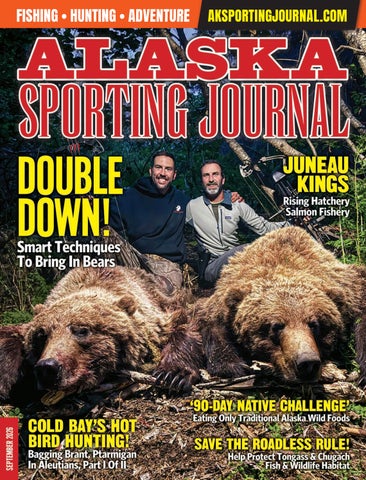
MEDIA INDEX PUBLISHING GROUP 941 Powell Ave SW, Suite 120 Renton, WA 98057 (206) 382-9220 • Fax (206) 382-9437 media@media-inc.com www.media-inc.com ON THE COVER Brian Watkins (left) is a longtime proponent of using bait stations to hunt Alaskan brown and black bears. “In people’s heads, bear baiting is throwing food on the ground and sitting over the pile of food until a bear comes in,” he writes, but it actually “takes thought, knowledge and skill.” See more details starting on page 32. (BRIAN WATKINS)
CORRESPONDENCE X@AKSportJourn Facebook.com/alaskasportingjournal aksportingjournal.com Email ccocoles@media-inc.com
W I L LO W ◆ M AT S U - VA L L E Y ◆ TA L K E E T N A ◆ W E S T E R N A LA S K A
NOW BOOKING
FOR THE 2026 SEASON!
Alaska
Visit
Join us for:
• Day Trips • Heli-Fishing
• Expedition Trips • Ice Fishing
Mention this ad and receive a FREE Swag Package! 907-382-1802 • fishhoundexp@gmail.com • www.fishhoundexpeditions.com
aksportingjournal.com | SEPTEMBER 2026
ALASKA SPORTING JOURNAL
13
CONTENTS
FEATURES
VOLUME 16 • ISSUE 3
50
JUNEAU FISHERY HUMS WITH HATCHERY SALMON
Brian Kelly, following up on wife Anne’s August recap of their fishing trip to Juneau, digs a little deeper into the salmon fishery powered by the Douglas Island Pink and Chum, Inc., hatchery. Kelly writes about the organization that “has morphed into a worldclass operation that raises millions of chum, Chinook and coho” for not just commercial fishermen but recreational anglers too. Find out where and how to fish these waters for Chinook and how the whole program works.
26
EATING THE WILD WAY Alaskans take pride in eating wild game and fish, but for Mary Goddard, a Tlingit forager and filmmaker, “eating wild” was an understatement when she took the “90-day Native” food challenge of sticking to a strictly naturally sourced diet. “This challenge is not about perfection. It is about curiosity, connection and taking one meaningful step toward understanding Alaska Native food systems,” she tells SalmonState’s Mary Catharine Martin in a profile.
32
BUDDIES, BAITS AND BEARS Longtime bear hunter Brian Watkins thinks baiting gets a bad rap. It’s a selective tactic that “takes thought, knowledge and skill.” Watkins shares some of his most important strategies for successfully filling a bear tag at a bait station, and recaps this year’s hunt, when he and his friend, who was seeking his first brown bear, had to work to score the bruins of their dreams.
45
HOT ACTION AT COLD BAY Scott Haugen is a diehard waterfowl and upland bird hunter who travels to some of Alaska’s most pristine and remote landscapes to experience terrific hunting. In the first of a two-part series, Haugen recalls a memorable trip with his father and a guide to the Aleutians’ Cold Bay and Izembek Lagoon, which didn’t disappoint with great numbers of brant and ptarmigan.
ALSO IN THIS ISSUE 17 21 25 38
Editor’s Note The Alaska Beat: News and notes from around the Last Frontier Outdoor Calendar From Field to Fire: How to analyze elk wallows
(BRIAN KELLY)
Alaska Sporting Journal is published monthly. Call Media Inc. Publishing Group for a current rate card. Discounts for frequency advertising. All submitted materials become the property of Media Inc. Publishing Group and will not be returned. Copyright © 2026 Media Inc. Publishing Group. All Rights Reserved. No part of this publication may be copied by any means, electronic or mechanical, including photocopying or recording by any information storage or retrieval system, without the express written permission of the publisher. Printed in U.S.A. 14
ALASKA SPORTING JOURNAL
SEPTEMBER 2026 | aksportingjournal.com
EDITOR’S NOTE
In adored Alaska wild lands like the Tongass National Forest, a repeal of the Roadless Rule and opening up of these lands for commercial purposes could threaten their long-standing fish and wildlife conservation benefits. (MARCI JOHNSON/US FOREST SERVICE)
W
hen I was in college, a friend and I joined some of his buddies on a West Coast road trip from California to Washington. We took our time on the first day and drove up the California coast on scenic Highway 1, stopping to camp for the night in Redwood National and State Park, home to some of the tallest trees in the world. We were winging it, so we just crashed in sleeping bags in the camper bed of his truck. I remember being in awe of the giant redwoods surrounding us in this lush forest. It’s the kind of place that fortunately has not been taken for granted and is permanently protected public land. It’s also the kind of place any reasonable person would fight to preserve. So in August, when the Trump Administration sent out a United States Forest Service press release announcing its intent to repeal the 25-year-old Roadless Rule that prevents large-scale logging and other projects in protected places like Alaska’s massive Tongass and Chugach National Forests, there was outrage.
President Trump has longed to roll back these kinds of fish and wildlife habitat protections from the first day of his second term in the White House, and Alaska’s vast natural resources have been prime targets to develop mining, drilling and, especially in the case of the Tongass, logging projects. The Forest Service’s spin on rescinding the Roadless Rule is to prevent wildfires, and a press release derided the rule as “a one-size-fits-all restriction that has frustrated land managers and served as a barrier to wildfire risk reduction work across large swaths of America’s national forests.” In response to the administration’s reasoning behind scrapping the Roadless Rule and citing wildfire risk, the Center for Biological Diversity countered that such a move would actually increase the risk of more blazes at a time when they have affected just about everywhere in North America, including Alaska. “Most wildfires are human caused and occur near roads, with a decades-long,
nationwide study finding human-caused wildfires are four times more likely in areas with roads than in roadless forests,” a CBD press release concluded. The Tongass, at 17 million acres about the size of West Virginia and the nation’s largest national forest, has been the focal point of pushback from organizations inside and outside of Alaska. “We saw what the mining and logging companies did to the Tongass National Forest before it was accorded protections, and I can assure you we do not want to return to those dark ages,” said Hunter McIntosh, The Boat Company president and chief executive officer. “The agency’s short-term bureaucratic thinking behind rescinding the Roadless Rule makes no sense, and their purported reasons are an obvious smokescreen for allowing wealthy corporations and individuals to monetize Southeast Alaska’s natural resources.” And that’s when I start to think about sleeping on the hard tailgate of my buddy’s truck amid the majestic California redwoods. These are areas that make
aksportingjournal.com | SEPTEMBER 2026
ALASKA SPORTING JOURNAL
17
“We saw what the mining and logging companies did to the Tongass National Forest before it was accorded protections,” warns Hunter McIntosh, The Boat Company president and chief executive officer, “and I can assure you we do not want to return to those dark ages.” (WENDY ZIMGIBL/US FOREST SERVICE)
18
ALASKA SPORTING JOURNAL
SEPTEMBER 2026 | aksportingjournal.com
memories we won’t ever forget. Wild places like the Tongass should remain as untouched as possible. The Roadless Rule represents everything that we should be fighting to maintain, certainly when big-money companies are looking to make a buck on public, protected lands that so many recreate on, so many others consider to be spiritual, if not sacred, places, and are so critical for fish and wildlife. “This is a classic example of a solution in search of a problem,” said Chris Wood, Trout Unlimited president and CEO. “The Roadless Rule is and always has been about valuing our public lands and the open space, prime hunting and fishing, clean drinking water, and freedom they provide. Instead of repealing it, the Forest Service should shelve this idea and work with stakeholders on better ways of balancing protecting roadless areas and managing our national forests to mitigate the risks of unnaturally intense wildfires.” Public comment on repealing the Roadless Rule is open through midnight September 21. To submit your input or learn more info, see fs.usda.gov/managing-land/planning/roadless. -Chris Cocoles
aksportingjournal.com | AUGUST 2026
ALASKA SPORTING JOURNAL
19
SOCIAL MEDIA POST OF THE MONTH A great moment for a young angler courtesy of our friends from Juneau Charters (907-723-8472; juneaucharters.com).
TWO CUBS KILLED IN BEAR-ONBEAR ATTACKS AT KATMAI NP
W
hile Alaskans are no strangers to news of bear attacks on hunters, hikers, residents and others, bear-on-bear violence also occurs, including males that kill cubs to accelerate the mating process. But there are also cases of sows attacking and killing unrelated bruin cubs that stray too close to their own brood. Still, it was disturbing to see two separate attacks on cubs by female bears in Katmai National Park and Preserve within a week of each other between late July and early August. Worse yet, the incidents appeared in real time on the popular Brooks River webcam. The attacks involved first bear 806, which killed and actually ate one of the offspring of bear 909, and days later a yet-to-be-identified sow fatally mauled a cub belonging to bear 335. In a livestream information session on explore.org, which runs the bear cam, Katmai ranger Sarah Bruce described the most recent tragedy as “not an easy thing to watch, especially coming off of the heels of witnessing another cub death.” The National Park Service indefinitely closed the area around the second attack, and sadly, bear 335 was seen in the area exhibiting behavior that was part desperation, part grieving. “She has been seen in the area still kind of huffing and looking for her cub,” Bruce said, according to a Alaska’s News Source report. “It’s likely that she knows her cub is dead. She’s still just kind of in that grieving process before she moves on from the area.” The Katmai Conservancy, which works closely with the national park for bear conservation and advocacy, posted about the “heartbreaking” event on Facebook, but also acknowledged that these are wild animals and the reality that such incidents are part of the natural world. “The bears of Katmai live without human intervention,” the organization’s post stated, “and the bear cams provide an unfiltered look at their lives, including the difficult moments alongside the joyful ones.” Tragedy struck Katmai National Park twice in about a week when sow bears killed unrelated bear cubs, a reminder that life in the animal kingdom is red in tooth and claw. (NATIONAL PARK SERVICE)
ALASKA BEAT
“
THEY SAID IT
“The goal of this is to provide hunting opportunity and food security for Alaskans.”
”
–Alaska Department of Fish and Game commissioner Doug VincentLang, updating a 2025 program that translocated 19 Sitka blacktail deer from Sitkinak Island to the southern Kenai Peninsula. As of early August, ADFG reports “13 confirmed mortalities in the transplanted deer population including two drownings, one coyote predation event, one from non-infectious pneumonia, and one from hypothermia after the deer ended up in a creek with steep banks and was unable to get out.” But a press release also stated, “Most of the deer remained within 5 miles of each other during the last rutting season, increasing the chances of successful breeding.”
17 NOTABLE NUMBER
Years between the time a hunter vanished on Nunivak Island (2009) and DNA confirmed that remains found were indeed 79-yearold George Smith Sr., whose snowmachine fell through the ice into the Ungalikthluk River.
aksportingjournal.com | SEPTEMBER 2026
ALASKA SPORTING JOURNAL
21
Continuing a recent tradition, welding students at Kodiak High School constructed a bear-resistant dumpster for bruins at a wildlife sanctuary to try to crack open. “This is the third year we’ve tested it,” Alaska Department of Fish and Game area biologist Nate Svoboda told TV station KTUU. “The first year it didn’t take the bear too long to get into it. Last year they spent about ... 30 to 45 minutes trying to get in without success and we needed to get a little bit more handling time. So, we brought it back this year.” The result? The young welders won this round of bear versus garbage receptacle.
FROM THE ASJ ARCHIVES – SEPTEMBER 2016
POUNDING THEM ON PRINCE WILLIAM SOUND
W
e had moved offshore enough to where you could just barely see Montague and its sea-battered headlands. I used a somewhat lighter rod than the others, who dropped circle hooks baited with herring, sockeye carcasses and octopus. I lowered a 16-ounce jig with a white twister tail until I felt the obvious thud of the bottom. I pumped the rod only six or seven times before I felt a jolt. The fish held tight to the bottom. I strained to move it. Finally, the fish began to come up. Halfway through the fight, the fish sort of stopped struggling. “It’s a big yelloweye,” said Captain Gregg, who had appeared over my shoulder with a bamboo-handled gaff in hand. He was right; it was a yelloweye and the biggest I had ever seen. Jigging seemed to be the ticket that day. We took turns until we had limited out on the rockfish. They were huge, with one topping 20 pounds. A few small halibut also fell to herring, but mostly it was a yelloweye bite. “We’ve found the pumpkin patch,” said Matt, as he gaffed another trophy yelloweye. John, an angler from California who was fishing with his nephew, suddenly groaned as his rod doubled over, the last eyelets of his rod touching the sea’s surface. Others had halibut on at the same moment, but none seemed to be dragging them around the deck of the Tail
22
ALASKA SPORTING JOURNAL
Dave Zoby’s fishing trip out of Port Ashton provided quite a haul of Prince William Sound halibut, yelloweye and salmon. (DAVID ZOBY)
Watcher like the beast John had hooked. It took him over 30 minutes to raise the fish, a beautiful 100-plus-pound halibut with astonishing markings on its back. The boat’s crew, all three of them, handled the fish in a scrum of gaffs and clubs. We all stood back out of the way of the huge tail that was thumping the deck of the boat, and I could feel the raw power through the steel as the fish made its last struggles. John seemed dazed and awed by what had just happened. He told me later he had never caught a fish like this one. “That flounder did not want to come on board,” said Matt.
SEPTEMBER 2026 | aksportingjournal.com
My halibut, a 50-pound fish with a greenish hue, bit a jig. I’d been talking about elk hunting with one of my boatmates when I felt a solid hit. The drag ran for 30 seconds and the jigging gear is so much lighter than bottomfishing gear that you get to feel it all. You are in the fight in a way that you can hardly imagine. When the fish finally came alongside the boat, Captain Gregg, gaff in hand, asked if I wanted to keep it. I peered over the gunnels to see a fine manhole cover of a halibut in the clear water. I hadn’t caught a nice halibut like this one in years. “Absolutely,” I said. -David Zoby
(CAPTAIN/CREWED CHARTERS)
Charter Fishing For Salmon And Halibut
Near Juneau, Southeast Alaska.
Whale Watching Trips Also available.
“BE YOUR OWN CAPTAIN” EXPERIENCE
Juneau Boat Rentals Bareboat rentals
JuneauCharters.com • info@juneaucharters.com • 907-723-8472
Something for everyone! Fishing •Bear Viewings •Ecotourism
907-246-8643
KINGSALMONLODGE.COM
907.440.9510
Customize Your advenure in south Central alaska book your tour: fishwhittier.com
Do It Yourself rent from our selection of boats so you can explore the Prince William sound on your own!
Fishing Charters, Whale WatChing, glaCier tours
reserve your own boat:
alaska-boat-rentals.com
24
ALASKA SPORTING JOURNAL
SEPTEMBER 2026 | aksportingjournal.com
OUTDOOR CALENDAR SEPTEMBER 1 ■ Black bear season opens in Game Management Units 1 (Southeast Mainland), 2 (Prince of Wales Island), 3 (Petersburg/Wrangell) and 5 (Yakutat) ■ Wolverine season opens in GMU 4 (AdmiraltyBaranof-Chichagof Islands) ■ Moose season opens in GMU 5B (Yakutat) ■ Brown bear season opens in GMUs 5, 6A, 6B and 6C (North Gulf Coast and Prince William Sound) and 14A (Mat-Su Valley) ■ Moose season opens in GMU 7 (Seward) ■ Bison season opens in GMU 11 (east of the Copper River, south of the Klawasi River and west of a line from Mount Sanford to Mount Wrangell to Long Glacier, west of the Kotsina River) ■ Goat season opens in GMU 14A (south and east of the Matanuska River) ■ Brown bear season opens in GMUs 14A and 14B ■ Resident caribou season opens in GMU 17 (Upper Tanana/ White River
SEPTEMBER 1-6 ■ Valdez Silver Salmon Derby (valdezfishderbies.com/ silver-derby) ■ Valdez Salmon Slam Tournament (valdezfishderbies.com/ tagged-fish-contest) SEPTEMBER 4 ■ Valdez Big Fish Friday (valdezfishderbies.com/silver-derby/ big-prize-fridays) SEPTEMBER 15 ■ Brown bear season opens in GMUs 1 and 3 ■ Moose season opens in GMU 3 ■ Deer season opens in GMU 4 (Chichagof Island east of Port Frederick and north of Tenakee Inlet and remainder of unit) ■ Black and brown bear seasons open in GMU 16 (Lower Susitna) SEPTEMBER 25 ■ Elk season opens in GMU 8 (southwest Afognak Island) For more information and season dates for Alaska hunts, go to adfg.alaska.gov/index.cfm?adfg=hunting.main.
Black bear hunting seasons will open on September 1 in Southeast Alaska’s Game Management Units 1 (Southeast Mainland), 2 (Prince of Wales Island) and 3 (Petersburg/Wrangell). (DON MACDOUGALL/US FOREST SERVICE)
aksportingjournal.com | SEPTEMBER 2026
ALASKA SPORTING JOURNAL
25
THE ‘90-DAY NATIVE’ FOOD CHALLENGE
A WOMAN SPENT THREE MONTHS EATING ONLY TRADITIONAL TRIBAL FOODS AND IS FUNDRAISING TO MAKE A DOCUMENTARY ABOUT IT
BY MARY CATHARINE MARTIN
L
ast summer, Tlingit forager and filmmaker Mary Goddard challenged herself to eat only traditional Alaska Native foods for three months. Now, she hopes to make a full-length documentary about the experience. Goddard has been eating wild and foraged foods her whole life, but her “90-Day Native” challenge took it to another level. Deer? Yes. Berries? Yes. Dryfish? Yes. Nettles? Yes. That tomato grown in a local garden? Didn’t make the cut. Goddard is of the Kaagwaantaan clan, out of Klukwan. She grew up in Yakutat and now lives in Sitka. For many years, she has been thinking about food systems, and about how what we choose to eat not only shapes us, but the world around us. She also works in film and knew from the beginning that she would want to document the challenge and to track its impacts. “When we were discussing, for months, what TV shows we were going to do, all of it was culturally based and around food systems,” she says. “My business partner, Dave Fedorski, says ‘You want to do this anyways, TV show
or not. Why don’t you just do it?’” They documented the challenge on Goddard’s Instagram, Facebook and YouTube pages (@alaskamary). It was “a new experience to be that vulnerable with people,” she says.
GODDARD HAD THREE MENTORS throughout the challenge: Naomi Michalsen of Ketchikan; Rob Kinneen, known as “The Tlingit chef”; and Steve Johnson, a handson Sitka mentor. Michalsen has a deep knowledge of Alaska Native plants, Goddard says. Kinneen has deep knowledge of traditional foods and how to prepare them. Johnson took her out gathering seaweed and herring eggs, and fishing. Friends and people she connected with on social media were also helpful. One person suggested getting birch syrup from the Anchorage area, which was a game changer midway through the challenge. Another sent her muktuk, whale skin and blubber. A friend brought her smoked octopus. Several of the foods she ate for the first time – two different kinds of gumboot chiton; uni, or sea urchin; sea cucumber. She gathered mushrooms. She
Mary Goddard, here with her family preparing a white king salmon wrapped in skunk cabbage leaves and stuffed with beach asparagus for a traditional bake in the ground, spent 90 days eating only traditional Alaska Native foods. She hopes to make a documentary from her experiences. (MARY GODDARD)
aksportingjournal.com | SEPTEMBER 2026
ALASKA SPORTING JOURNAL
27
Salmon, like these Goddard and Oliver Koutchak dipnetted, became a key ingredient in her diet during the three-monthlong challenge. “Just eating salmon, you can feel the difference in your body,” she says. “It’s so satisfying.” (DAVE FEDORSKI)
made a whole cupboard of teas from different plants that grow in Sitka. Dryfish was her version of fast food, she says, and “salmon was a staple. I had salmon nearly every day,” she says. “Just eating salmon, you can feel the difference in your body. It’s so satisfying.” The challenge wasn’t easy socially. She couldn’t eat birthday cake at family birthday parties. Instead of eating from a food truck, she drank water at a local music festival and ate salmon when she got home. 28
ALASKA SPORTING JOURNAL
She had to be intentional even about how she cooked her food. Frying in olive oil, for example, was a no; instead, she used seal oil. With limited carbohydrates, there was the challenge of getting enough calories. A doctor and a nutritionist at the Southeast Alaska Regional Health Consortium tracked her health along the way. At first, they were concerned with her rapid weight loss. “I really don’t know how to eat any more food on this diet,” she says at week seven.
SEPTEMBER 2026 | aksportingjournal.com
On the plus side, she had no stomach issues over the 90 days. As someone who has celiac disease, an autoimmune condition that causes the body to attack the small intestine when a person eats gluten, she has been dealing with stomach issues for years. A key difficulty she dealt with was living her normal life while doing the challenge, which was very time consuming to both find and prepare foods. “Life is always going to have twists
Dried halibut with salted seal oil for dipping. The latter was a requirement to cook with instead of more accessible olive oil. (MARY GODDARD) Goddard grins over her abundant supply of chicken of the woods mushrooms. (DAVE FEDORSKI)
and turns and challenges,” she reflects when asked if she could have chosen a better time. “I think if it’s something you want to go for, you should go for it.”
LOOKING BACK ON THE experience, Goddard says a common theme was guilt. “I’m filling my freezer with this mindset of ‘Will I have enough?’ but I should share with Elders, and I wanted to share with an upcoming ku.éex’ (potlatch). There was a lot of guilt in the beginning.”
“Eight months later,” she continued, “I actually don’t have guilt when it comes to eating; thoughts like, ‘Oh, I shouldn’t eat that.’ As a result of this challenge, it’s not there.” Goddard is now offering three-day Native food challenges (alaskamary .com/group-events) for anyone interested in participating, raising money to create a full-length documentary on 90-Day Native, and speaking in schools about Native Alaskan foods and Alaska’s food system. “This challenge is not about perfection. It is about curiosity, connection and taking one meaningful step toward understanding Alaska Native food systems that have nourished our communities for generations – and finding our way back to the foods, knowledge and relation-
Goddard, here harvesting black seaweed with mentor Steve Johnson, says, “Food is culture. In foodways and systems like this, you understand that everything is interconnected. As we have changed our food systems, we have changed the way we live with the world around us.” (DAVE FEDORSKI) 30
ALASKA SPORTING JOURNAL
SEPTEMBER 2026 | aksportingjournal.com
ships that continue to sustain us,” she writes on her website. “Food is culture,” Goddard adds. “In foodways and systems like this, you understand that everything is interconnected. As we have changed our food systems, we have changed the way we live with the world around us. Eating Native foods – maybe it seems traditional, or culturally relevant, but really, it’s getting you to see how you work with the world around you, versus systems that don’t take that into consideration.” ASJ Editor’s note: Mary Catharine Martin is the communications director at SalmonState, which works to keep Alaska a place where wild salmon and the people whose lives are interconnected with them continue to thrive. Go to salmonstate.org for more information.
“This challenge is not about perfection,” says Goddard, with fresh salmonberries. “It is about curiosity, connection and taking one meaningful step toward understanding Alaska Native food systems that have nourished our communities for generations.” (MARY GODDARD)
aksportingjournal.com | SEPTEMBER 2026
ALASKA SPORTING JOURNAL
31
Getting bears to come to a bait station and return is only part of the equation for scoring an Alaskan bruin. As author Brian Watkins writes, “Baiting takes thought, knowledge and skill.” (BRIAN WATKINS)
32
ALASKA SPORTING JOURNAL
SEPTEMBER 2026 | aksportingjournal.com
BAITING AND WAITING ... AND WAITING SPORADIC BRUIN VISITS TO THEIR STATION TEST BEAR HUNTERS
BY BRIAN WATKINS
B
ear baiting may be one of the most controversial and debated subjects within the hunting community. Hunter ethics and fair chase come into question. But there is a reason some bear hunters, specifically baiters, are often more successful than others. Baiting is hard work. It takes dedication and persistence. It also takes self-control to avoid mistakes such as: sitting on a bad wind; letting a bait go dry;
not consistently checking or hunting the site. Indeed, there are a lot of factors that make or break success when baiting. In people’s heads, bear baiting is throwing food on the ground and sitting over the pile until a bear comes in. Yes, success can be achieved that way by the lucky – but not often. Baiting takes thought, knowledge and skill. There are people who consistently find success in bear baiting. You’ll likely find that those
Dog food is commonly used to attract bears, and it can get expensive. "Refreshing a bait with scent and food keeps the bears in the area,” the author writes. “I check my site twice a week. I also put out a ton of food so that they never eat it dry.” (BRIAN WATKINS)
aksportingjournal.com | SEPTEMBER 2026
ALASKA SPORTING JOURNAL
33
people also have success in the field on other game animals, or spotting and stalking bears as well.
THINK AHEAD Finding a baiting spot takes a lot of thought. You have to have knowledge of bears’ travel corridors, comfort zones and natural habitat, plus you have to distance yourself from areas people normally travel to or spend time in. Contrary to popular opinion, bears are shy by nature and reclusive in presence. It’s also imperative to distance yourself from other baiters. Not all people know how to hunt baits, and an increase in pressure tends to have the inverse effect on success. Those who are successful watch the wind and weather. When setting up a stand, pay attention to the prevailing wind direction. Nothing kills a baiting spot like hunting in bad wind. I’ll stay out of a stand not only due to a bad wind direction, but if it’s blowing over 15 miles per hour. Bears don’t like to move on windy or rainy days. There’s no use putting unneeded pressure on an area when the bears aren’t typically there. Save it for a nice calm day when the wind direction is favorable.
DETAILS MATTER Consistency is key with baiting as well. Refreshing a bait with scent and food keeps the bears in the area. I check my site twice a week. I also put out a ton of food so that they never eat it dry. Bear baiting is expensive and takes a lot to run. The only time I let a bait run out of food is when a sow and cubs come in. I’ll let it go dry for three days. The reason for that is in hopes the bears move on and don’t eat all of my food, which costs a lot. This season, I had two black bear sows with three and four cubs coming in. I let the bait go dry twice, but they came back and ate roughly 50 pounds of dog food a day. That was fun.
DON’T GET DISCOURAGED This hunting season was extremely slow. Spring held on and it was below freezing through the end of May. Most bear hunters gave up. As I said, be consistent. Know how the bears act as well. I constantly monitor trail cameras and track what bears are in. Learn how to tell a sow from a boar. 34
ALASKA SPORTING JOURNAL
The author (left) and his good friend Dave with a double, made even more special because it was Dave’s first successful brown bear kill. (BRIAN WATKINS)
The sows will eventually bring the boars in. I had assistance this spring as well. For the first time in years, I had a partner run the bait with me. We stocked the bait and kept it replenished throughout the spring. The families of black bears kept eating piles of dog food all spring. I went through 1,500 pounds of dog food, with most of it keeping those two families fed. We had a couple of other bears in and out, but nothing consistent. We passed on some smaller black bears and one small brown bear that liked to camp on the bait too.
BROWN BEAR VISITORS The season was winding down, and with 10 days left, a breeding pair of brown bears started to show up. We sat one night after the pair had been in the previous two nights. They came in between
SEPTEMBER 2026 | aksportingjournal.com
1 and 2 a.m. Knowing that a breeding pair can be on station any time of day, I advised my buddy Dave to be ready all night. At first, brown bears tend to come in in the middle of the night, then they’ll begin arriving earlier and during daylight. They’ll do this for between four to six days on average. Once the boar breeds the sow, they’ll both leave. As I said before, consistency is key, so we hunted as soon as we saw them on camera. Since we check twice a week, it increases the odds of bears on bait when they’re there. Dave had never shot a brown bear before and I’d made up my mind he could shoot the first nice one that came in. This was our ninth sit together. The boar came in first. Dave took his time and waited for the bear to be at a good broadside position, then took a shot. The bear spun around and took off. What I didn’t tell Dave
E T A M I T L U ! T N U H A K ALAS
Experience the thrill of big game hunting in Alaska’s untamed wilderness with Deltana Outfitters—Alaska’s premier guide service. Whether you’re after Brown Bear, Grizzly, or Moose, our expert guides lead unforgettable Spring and Fall hunts in the remote, pristine Alaska Peninsula andWestern Alaska.
Adventure. Expertise. Results.
That’s what we do—and Deltana does it best.
90% Success Rate! Average Moose: 64” Grizzlies: 7’6” - 8’6” Black Bears: 6’ - 7’ Brown Bears: 9’ - 10’
Start your ultimate hunting experience today!
Visit: www.deltana.com | Email: hunts@deltana.com | Call: 907- 347-7204
was that I’d seen another bear behind the bait as his boar came in. I knew it was the pair, but I didn’t want to pull his attention away from his shot. I also knew it was the boar he’d drawn back on.
DOUBLE DOWN!
Watkins understands that bear baiting is divisive even among fellow hunters. But he also knows it’s not as easy a process as some critics may assume. (BRIAN WATKINS)
Seconds after Dave’s bear took off, the sow came in. I typically wouldn’t shoot a sow, as there are strict guidelines on how many Kenai Peninsula sows can be harvested in a season. I had called earlier that day and knew that only two of the 12 in the quota had been taken. With a little more than a week of hunting left, I knew the sow count wouldn’t be met, so I let an arrow fly for a double brown bear harvest. I double-lunged my bear. Both animals were dead within 100 yards of the bait! A slow season had turned into an epic night. After things settled, Dave looked at me and said, “My whole body is shaking! I have never felt this before!” I replied, “Welcome to hunting brown bears!” As college friends, I don’t think either of us would’ve thought we’d be hunting brown bears together in Alaska. But here we were with a double. ASJ
Rated the# 1 Fishing Cha rt er in Alaska in 2021!! Rated in th e Top 3 Fishing Cha rter 2019-202 s 2 -Via An chorage Pr ess Picks 2019 -2022
Located in Seward, Alaska
HALIBUT, SALMON, ROCKFISH, AND LINGCOD AlaskaDreamCharters.com
907-422-7070 36
ALASKA SPORTING JOURNAL
Alaska Dream Charters alaskadreamcharters
SEPTEMBER 2026 | aksportingjournal.com
LESSONS LEARNED FROM THE WALLOWS
STUDYING WHERE ELK CONGREGATE WILL HELP YOU FILL TAG BY SCOTT HAUGEN
W
hether you’re heading to a remote destination in Alaska or somewhere in the Lower 48 to chase elk this fall, there are lessons to be learned from studying wallows. They might even help you fill your tag. Over the decades, closely studying wallows has taught me a lot about elk and elk hunting. Early in my hunting days, I made a lot of mistakes by simply locating wallows and assuming bulls were using them, or not using them. I rarely approached them for fear of contaminating the scene. Today, I scrutinize every elk wallow I encounter. When you find an elk wallow, don’t just look at it; study it. Swirl any water with your boot or a stick to see if there’s a current. If there is, sediment will quickly begin to flow. Watch to see how long it takes for the wallow to run clear. It might take just a few minutes, or hours. The more current flow there is in a wallow, the more it can mask elk sign. I’ve seen wallows run clear after being used by a bull less than 15 minutes prior. Conversely, a wallow with no flow can seem much fresher than it really is, making it
38
ALASKA SPORTING JOURNAL
appear as if a bull just used it when, in reality, days could have passed.
DILIGENT INSPECTION To unlock the truth, inspect the surroundings for tracks and scour the area for wet splash marks. Look at leaves of low-growing bushes, examine coniferous boughs and inspect trails for wet water droplets, or even mud. The darker and more moist the mud, the fresher it is. Work in circles around the wallow to identify which trails bulls are using to enter and leave the wallow. Even deciphering the angle of water and mud splashes can offer valued insights. If water and mud droplets are concentric, the bull leisurely walked out of the wallow. This means it was likely alone and in no rush. Calling to a lone bull can boost success rates. On hard, dry ground, elk tracks aren’t easy to read, but details left from a wet, muddy bull exiting a wallow are simple to interpret. If the droplets have made impact at an angle, you can tell which way the bull was moving, even at what speed. A rushed exit means other bulls or cows were likely nearby, thus provid-
SEPTEMBER 2026 | aksportingjournal.com
Roosevelt bulls are North America’s biggest-bodied elk. Their presence in and around a wallow leaves valuable information for elk hunters. (SCOTT HAUGEN)
aksportingjournal.com | SEPTEMBER 2026
ALASKA SPORTING JOURNAL
39
Chefs want to work with the best of the best, even outside of the kitchen. Two of author Tiffany Haugen’s favorites are handy products from Yeti and WaterPort . (TIFFANY HAUGEN)
A CHEF DISHES ON HER FAVORITE GEAR BY TIFFANY HAUGEN
S
eptember marks the time when people across Alaska start gearing up for hunting camps. Here are some worthy pieces of gear I used this summer and liked.
YETI 15 HARD COOLER, 20L DAYTRIP, 35 CARRYALL TOTE Looking for a durable, compact and portable hard cooler? Give the Yeti 15 a try (yeti.com). I almost got the 24 because I wasn’t sure if the 15 was going to be big enough to hold food and drinks for two people for a day afield, but it was. It kept ice frozen plenty long, and when it did start to melt on those excessively hot summer days, the built-in drain plug was very convenient. The shoulder strap and two side handles made transporting the cooler easy and comfortable, no matter how full it was. I really like the quick, easy operation of the latching handles, which are simple to open and close with one hand. The nonslip feet work great, keeping the cooler in place in boats, ATVs and even on a paddleboard. The shoulder strap is easy to remove if you want to secure it to an ATV, and the sturdy build makes for a great stool around the campfire.
If looking for a portable daytime cooler that’s streamlined and easy to carry, check out Yeti’s 20L Daytrip insulated tote bag. With a brick of ice, the tote keeps food cool and fresh all day long, thanks to a very lightweight, closed-cell foam design. Wine bottles can even be stowed upright. The interior is surprisingly roomy, holding more items than anticipated. And the magnetic lid securely closes, holding items in place and keeping them cool. A zipper pocket on the side is great for stowing keys and phones, while the stash pocket on the other side is nice for quick access to special items. The hitchpoint is convenient for attaching items, and the weather-resistant material is durable and easy to clean. One of my husband’s most-used pieces of gear is Yeti’s Carryall tote bag. He has three of them in three sizes. I borrowed his 35 Carryall, then got one for myself. Then I got the smaller 20 Carryall. These totes are sturdy and stand up by themselves, and the deployable inside dividers are a great feature. Whether I’m packing for a day trip or loading it to keep
in my truck for extended use, the 35 Carryall has been a great, all-around size. The two interior zip pockets are practical, as are the crossbar handles, which make for easy carrying of heavy loads, and the hook closure is perfect for holding items securely inside. This is a tough tote that’s easy to clean, holds a lot of gear and is now one of my most-used outdoor items.
WATERPORT 2-GALLON GOSPOUT TANK One of our most-used pieces of gear this summer comes from WaterPort (waterport.com). We got their 2-Gallon GoSpout, which is a good size for camping. Originally we got it to use as a shower, but soon discovered its value in washing cookware, cleaning gear and even hosing off muddy dogs. I’ve even used it around home to water plants on the porch and pots in the garden. The GoSpout is a very durable, self-pressurized tank. It’s easy to carry and the 8-foot coiled hose is plenty long and won’t tangle. The five-pattern, high-pressure nozzle serves a range of needs. This is one of those pieces of gear you think you might use but aren’t really sure, but you’ll then ask yourself how you got by without it. Next month I’ll have a new recipe for you to enjoy. In the meantime, check out the 11 recipes I included in Scott’s new book, Elk Hunting The West: The Experience, available now on Amazon. Heck, the recipes alone are worth the price of the book! Editor’s note: To order signed copies of Tiffany Haugen’s popular book, Cooking Big Game, visit scotthaugen.com for this and other titles.
40
ALASKA SPORTING JOURNAL
SEPTEMBER 2026 | aksportingjournal.com
Create dry aged steak and cured meats from home! Whether you’re preserving whole muscle for charcuterie or grinding coarse for fermented salumi, our time-honored spice blends, easy starter kits, and UMAi Dry® technology make it safe and simple to cure like a pro!
Learn how to get started in just minutes! SCAN TO WATCH
Hunter’s Tip: For salumi, ask your butcher for a coarse grind. For charcuterie, keep whole muscle cuts intact. Proper prep makes all the difference!
WITH
SALUMI PRO TIPS
CHARCUTERIE PRO TIPS
The more info you can glean from wallows and their surroundings, the more consistent you’ll become in tagging elk like this big bull author Scott Haugen bagged.
NEW BOOK CHRONICLES ELK HUNTING TIPS
(SCOTT HAUGEN)
A
long with 50 years of big game hunting experience, Scott Haugen is also one of North America’s most published outdoor authors and renowned hunters. His latest book, Elk Hunting The West: The Experience, is now available on Amazon. The e-book is available for purchase on Kindle for e-readers, phones, tablets and computers. With a formal education in the sciences, Haugen combines his knowledge of and personal experiences with elk to help fellow elk hunters achieve consistent success. This is a book based on personal experiences, not theories or ideas. It’s not about gear, guns or the best units to hunt elk. It’s not a picture book. It’s an educational hunting book based on situational learning and experiences acquired through thousands of hours spent in the elk woods. ASJ ing a starting point for a hunt.
BE CAMERA-READY Three years ago I found a tiny wallow in a forested draw. It was barely big enough to hold a bull. I hung three trail cameras around it and checked them once a month. I run Stealth Cam DS4K cameras in high-definition video mode and set them for two minutes of run time. Video clips reveal far more than still images can. Bulls began drinking from the tiny spring upwelling in late June. In early August they were rolling in it. The wallow grew wider and deeper. A wallow soon formed above it, another below. One day in early September, seven bulls used the wallow over a six-hour period. Buddies eventually arrowed two 42
ALASKA SPORTING JOURNAL
SEPTEMBER 2026 | aksportingjournal.com
of those bulls inside half a mile of the wallow on trails bulls used to access it.
PUTTING IT ALL TOGETHER Don’t think wallows are a slam dunk for killing a bull. I’ve never shot a bull in a wallow, but the information I’ve gleaned from them has accounted for many thrilling encounters and helped fill tags. I’ve captured bulls using wallows in November. The more wallows you inspect, the more you’ll learn about elk and how they use them. Consider how daytime temperature, humidity, wind currents, sunlight and shade impact sign in and around a wallow. By piecing together all the info you find, then hunting wisely, your level of consistently filling elk tags will rise. ASJ
44
ALASKA SPORTING JOURNAL
SEPTEMBER 2026 | aksportingjournal.com
EXPERIENCING COLD BAY’S HOT ACTION
FIRST OF TWO PARTS
HUNTING WATERFOWL AND PTARMIGAN IN THE RUGGED ALEUTIANS
Editor's note: For 35 years, author Scott Haugen has hunted and fished throughout Alaska, including while living north of the Arctic Circle for nearly a decade. His Cold Bay experiences are among his most memorable, and captured here in part one of a two-part series. BY SCOTT HAUGEN
O
ne of my favorite flights in Alaska is the descent into Cold Bay. The rugged shorelines, lush green treeless hills and snowcapped mountains stretch your imagination. Approaching the landing strip, the streams you’ll soon be fishing, hills you’ll be hiking for ptarmigan and water you’ll be boating for waterfowl materialize. It takes your mind to other places. Happy places. All of them. I first visited Cold Bay and Izembek Lagoon over a decade ago. There’s a reason I keep coming back to this magical destination.
“LET’S GRAB YOUR GEAR and get to the lodge; lunch is ready and the afternoon tide is going to be perfect,” instructed Jeff Wasley, a longtime friend and one of North America’s most respected waterfowl guides, as I reached out to shake his hand at the little airport in Cold Bay. Soon we were in waders, headed out the door. “It’s low tide now, so once it starts rolling in, the brant will be coming back
Willow ptarmigan hunting can be exceptional around Cold Bay, and bird numbers have been high in recent years. Author Scott Haugen pulled four from a covey with his Citori 20-gauge. He’s also experienced some of the best waterfowl hunts of his life there. (SCOTT HAUGEN) aksportingjournal.com | SEPTEMBER 2026
ALASKA SPORTING JOURNAL
45
Izembek Lagoon is home to the world’s largest gathering of Pacific black brant. (SCOTT HAUGEN)
through to feed,” noted Wasley as he organized gear in the big boat. Making sure our anchors were solid in the layout boat, my dad and I climbed in. In no time we were lying comfortably in a two-man layout, with three dozen strings of black brant decoys bobbing in front of us on Izembek Lagoon. We were in a foot of water surrounded by over 40,000 acres of eelgrass. Izembek Lagoon encompasses 150 square miles and holds one of the largest eelgrass beds on Earth. It’s the eelgrass that attracts waterfowl in mind-boggling numbers, and in an array of species. Black brant thrive here. “I’ll be back in 30 minutes with two more hunters and we’ll switch out; you guys should be done by then,” Wasley informed us. As his boat sped east through Izembek Lagoon back to the boat launch, Dad and I sat in silence. A descending sun was at our back. There was barely a breath of wind on this sunny afternoon. In the distance, we could occasionally hear a faint resonance of crashing waves in the Bering Sea. “What’s that?” Dad asked, inquisitively gazing across the bay, trying to locate the 46
ALASKA SPORTING JOURNAL
source of an eerie sound he’d never heard before. “Get ready; here they come,” I smiled. It was Dad’s first brant hunt. Instantly, the horizon line was painted with black brant – their fluttering calls echoing across the lagoon. They were noisy and coming right at us. Wasley had told us this was the most brant he’d ever seen this early in the season, and how a noticeable number of birds were showing up every day. Tens of thousands of brant were on the move with the rising tide, and all of them were funneling by our setup. It was September 2018, and this was my 77-year-old dad’s first time hunting from a layout boat. Dad fired four shots and had his three brant; then it was my turn. It was only a matter of minutes until we were done. Back then the daily limit was three Pacific brant; today it’s two. For the next 20 minutes, Dad and I just watched and listened, not saying a word, as thousands of brant flew by, many landing in the decoys. It was a moment Dad and I still talk about as one our most memorable waterfowling experiences ever.
OVER THE PAST DECADE I’ve hunted a lot with Wasley, owner of Four Flyways Out-
SEPTEMBER 2026 | aksportingjournal.com
A boat ride across Izembek Lagoon can lead to world-class waterfowl hunting, excellent ptarmigan hunting and never-to-be-forgotten wildlife watching. (J. FERRONATO)
fitters (fourflywaysoutfitters.com). I’ve been fortunate to hunt with many avid waterfowlers over the years, and Wasley is among the best of the best. A former waterfowl biologist, Wasley’s passion for duck hunting is contagious. His knowledge of the birds he hunts and the land where he makes his living is unmatched. Wasley is one of the best, safest boat captains I’ve ever been with. He’s also the mayor of Cold Bay. This is his life. I love hunting brant because they decoy unlike any goose I’ve seen. They’re also my favorite table fare of all waterfowl. I’ve hunted them along the Pacific Coast and in famed San Quintín in Mexico’s Baja Peninsula. All places pale in comparison to the brant hunting that Izembek Lagoon offers. “Last year over 80,000 brant wintered here,” Wasley shared while I was on a hunt with him two seasons ago. “I watched the lagoon freeze over, then saw big tides move in and turn over massive chunks of 3-foot-thick ice. Eelgrass was frozen to the underside, and when it
was exposed, that’s what the brant were feeding on. They were pulling it right off the bottom of the ice and did that all winter long. These birds are so tough.” Twenty years ago only a couple thousand brant wintered on Izembek Lagoon. Today, along with the brant, you’ll also see what’s likely the largest gathering of Steller’s eiders. Though they’ve been closed to all hunting since 1991, they’re a sight any waterfowler will appreciate. The next morning of Dad’s first hunt with Wasley and I, the tide was perfect to hunt from shore. We headed across the lagoon. “Grab the decoys and walk that way about 100 yards,” Wasley pointed. The water was only ankle-deep and the tide was still running out. “You guys start setting up; I’m going to hide the boat before we run out of water.” Along the edge of a sandy shore we set out duck, brant and Canada goose decoys. By the time the tide started rolling in, blue sky shone while snow-covered peaks loomed large behind us. Waterfowl could be heard screaming in all
directions. Dad limited out on the first flock of brant to coast into the decoys. Soon, Wasley and I had our brant. But we were far from finished. Over the next two hours, the three of us would take limits of puddle ducks and Taverner’s geese from that spot too. Early-season waterfowl hunting in this part of Alaska is as good as it gets anywhere in North America. One of my favorite hunts is tossing out a few dozen silhouettes on the tundra and flagging cacklers as they look for blueberries to graze on. Variety and options; that’s what you get here.
LATE LAST AUGUST, SEVEN buddies joined me on a cast-and-blast adventure with Wasley. One day, we parked the boat right where Dad, Wasley and I had secured our mixed bag limits of ducks and geese. But this time everyone in the group was toting double-barrel shotguns. We split into two groups and hiked toward the hill country at the base of Mount Frosty, the most prominent peak that can be seen from anywhere on Izembek La-
aksportingjournal.com | SEPTEMBER 2026
ALASKA SPORTING JOURNAL
47
Brown bears frequent Izembek Lagoon in the fall, searching for fish, cruising the beaches and feasting on berries in the rolling tundra. (SCOTT HAUGEN)
goon. This part of the volcanic Aleutian Chain is still active, and many times over the years I’ve seen steam being released from distant peaks. The other group killed more willow ptarmigan than we did. We saw more brown bears than they did – 11 in all. We also ate more wild blueberries than them. Everyone was happy. We enjoyed five days of epic ptarmigan hunting in the hills and tundra dividing Izembek Lagoon and Cold Bay.
Ptarmigan numbers have been building the last three years on this stretch of the chain, and last summer saw another great hatch. With a 10-bird daily bag limit and countless miles to roam, the time was perfect to hit the tundra. I was testing Browning’s new Citori 825, an over-and-under beauty, on the ptarmigan hunt. High-volume shooting at live birds is the best way to truly learn how well a shotgun performs, and it’s a testa-
ment to bird numbers in this part of Alaska as to why my buddies and I were there. Hiking across the tundra on our last ptarmigan hunt, our vests stuffed with the great-eating birds, the boat finally came into view. Near it was a big brown bear chasing pink salmon in the shallows. We came across another brown bear, this one plucking blueberries from a trail carved deep into the tundra. “There’s never a dull moment around here, is there, Haugen?” Wasley asked with a smile. With visions of a smooth boat ride back to the ramp and fresh grilled ptarmigan appetizers, it felt like the day was winding down. Little did I know some of the most exciting moments were still ahead. ASJ Editor’s note: Look for part two next month. For signed copies of Haugen’s best-selling adventure book, Hunting The Alaskan High Arctic, visit scotthaugen.com. Follow Scott’s adventures on Instagram and Facebook.
An early-season limit of cacklers and brown ducks – pintail and teal – taken near Cold Bay. “I first visited Cold Bay and Izembek Lagoon over a decade ago,” Haugen writes in the first of a two-part series about this region. “There’s a reason I keep coming back to this magical destination.” (SCOTT HAUGEN) 48
ALASKA SPORTING JOURNAL
SEPTEMBER 2026 | aksportingjournal.com
SPECIALIZING IN FRESH BEEF, PORK, POULTRY AND OUR OWN SPECIALTY ITEMS We also carry game processing items such as fat, spices and casings
CALL US AT 907-349-3556 OR TOLL FREE WITHIN ALASKA 800-478-3556 MRPRIMEBEEF.COM
| PRIMEBEEF@MRPRIMEBEEF.COM
Arctic Wolf Tannery 1901 W 48TH AVE ANCHORAGE ALASKA 99517
(907) 868-3227
Taxidermy tanning services offered to the general public, along with expediting services. (Airport pick up, sealing, skinning, fleshing and tanning)
marine mammals bison • goat • bear • moose aksportingjournal.com | SEPTEMBER 2026
ALASKA SPORTING JOURNAL
49
DEEP DIVE IN EXPLORING JUNEAU’S HATCHERY SALMON FISHERY AND THE PROGRAM POWERING IT SECOND OF TWO PARTS
Editor’s note: Last month, Anne Kelly chronicled a sightseeing and fishing trip to Juneau with her husband Brian, who follows up with a peek into Juneau’s hatchery salmon fishery scene. BY BRIAN KELLY
T
he tide change was happening and all the fish that had raced past us on the incoming tide were now slowly making their way past us again. Kings were rolling all across the dwindling confines of the Gastineau Channel,
50
ALASKA SPORTING JOURNAL
as this was a good tide swing – it felt like someone had pulled the drain plug in the bathtub. Kings aren’t big fans of hanging around in clear, skinny water, so our bite window was going to be tight. And then, bang! An ocean-bright king chomped
SEPTEMBER 2026 | aksportingjournal.com
down on my homemade skirted chartreuse spinner with a size 6 blade. The head shakes were violent and short, as were the runs, so I knew this wasn’t a big fish, but it was the first one of the trip. After beaching the dime-bright Chinook, my adrenaline was racing and I was ready for another shot at the bigger fish that kept showing themselves. Unfortunately, my “client” wasn’t feeling it: cold toes, cold hands and being thirsty and hungry
Author Brian Kelly has made multiple salmon fishing trips to the Juneau area, taking advantage of production from the Douglas Island Pink and Chum, Inc., hatchery, which, as Kelly writes, “has morphed into a world-class operation that raises millions of chum, Chinook and coho.” (BRIAN KELLY)
INTO DIPAC weren’t cutting it for my wife Anne. I failed miserably as a guide that morning for not packing proper nourishment and hydration supplies. But I must tell you I have this problem: I have been casting to rolling kings most of my adult life and know sooner or later that one will bite. That means ignoring hunger and thirst for hours at a time when the fish are rolling around and doing that thing that drives us nuts but keeps us in the game!
Anne took the keys and went up to the truck to get feeling back in her lower extremities while I kept flailing away to no avail. As I turned to head back to shore and grab my only fish of the morning, I saw that a large adult bald eagle was trying to stake his claim to it and had begun pecking away at the gills. We had a short exchange of heated words before the eagle tried to take off with my fish, which was still on the stringer.
Fortunately, the salmon was just a tad too large for his talons to grasp, and he dropped it before getting too far away. Never a dull moment in Alaska!
JUNEAU’S HATCHERY ROOTS Thanks to the foresight of a man by the name of Ladd Macaulay, the DIPAC, or Douglas Island Pink and Chum, Inc., hatchery was established in the mid1970s, when wild salmon fisheries had
aksportingjournal.com | SEPTEMBER 2026
ALASKA SPORTING JOURNAL
51
The waters off northern Douglas Island adjacent to Gastineau Channel usually open for king retention on June 1 and can be effectively fished by fly and conventional gear anglers. (BRIAN KELLY)
reached historic lows and the state of Alaska began funding hatchery enhancement programs. While this hatchery started out raising pinks and chums to boost returns in the local streams, it has morphed into a world-class operation that raises millions of chum, Chinook and coho for both local commercial fishing interests and sportfishing opportunities for the entire community. Juneau is more than just a stop along the cruise ship circuit; it has become a thriving angling destination thanks to the dedicated staff at DIPAC. Let’s take a closer look at the Chinook fishery, as there are a number of smolt release sites around town for anglers to focus on for returning adult salmon depending on the time of year.
NORTH DOUGLAS: JUNE 1 The Alaska Department of Fish and Game usually keeps the Gastineau Channel and surrounding waters closed to Chinook retention through the month of May to allow wild stocks to make their way through town on the way to their home waters of the Taku, Stikine or Chilkoot Rivers to finish their spawning journey. An emergency order is then typically released to announce the king opener for June 1 so anglers can focus on the DIPAC-reared Chinook that begin to make their way back to town. The broodstock for this run came from Andrew 52
ALASKA SPORTING JOURNAL
Creek, a tributary of the Stikine River that flows into the North Pacific near Wrangell. Thanks to these Southeast Alaska genetics, this stock has proven to be adaptable in several locations from Ketchikan to Juneau, and while most are the juicy, orange-fleshed Chinook we are accustomed to, there are some white king genetics too. It is quite a sight to cut into a chrome-bright Chinook with white flesh. Their meat is exceptionally firm and mild, almost like a flavor cross between a halibut and a salmon. Enjoy it if you run across one; my wife landed four of them on our trip, and these fillets have become a favorite in our house. While the fish can be on either side of Juneau come the June 1 opener, the first push of staging kings tends to show up in Fritz Cove on the north side of town. These are fish that will be pushing up into the shallow side of Gastineau Channel with the bigger tides, but early in the season the fish like to stage in the cove itself and are targeted by both trollers and shore-bound anglers; the latter either cast spinners or soak whole herring under a float. The fish will linger around here for a week to 10 days, and when the big tides arrive, they will push up the channel and drop back into the cove for another week or two. This is when fly anglers shine, as the channel on the north side of Douglas is quite shallow compared to the south end
SEPTEMBER 2026 | aksportingjournal.com
aksportingjournal.com | SEPTEMBER 2026
ALASKA SPORTING JOURNAL
53
Big skirted spinners, shallow-diving plugs and midsized to larger herring under a float are among the best bets for shorebound hardware anglers. (BRIAN KELLY)
54
ALASKA SPORTING JOURNAL
SEPTEMBER 2026 | aksportingjournal.com
of town. Successful fly anglers lean toward two-handed Spey setups with full floating lines and weighted flies, since most of the holding water is less than 10 feet deep. The local fly shop, Alaska Fly Fishing Goods (alaskaflyfishinggoods.com), publishes a weekly fishing report that dives into the details fly anglers need for this rare shot at Chinook on a swung fly. Gear anglers can also take advantage of this stretch of water; yours truly had some memorable days with skirted spinners and shallow-diving plugs. Since this section of the channel is quite shallow, one must time the tides and weather correctly, as the bite windows tend to be quite short. While the fish blast up the channel with the incoming tide, they tend to be tight-lipped until the tide goes slack and starts to turn. The trick is finding how far up they pushed with the tide; they seem to bite better as they drift back down on the outgoing tide, especially with some clouds and rain. Bright, sunny, warm days make for a tough bite. Oh, and bring your bug net when you fish this section; the no-see-ums can be brutal when the hatch is on. You have been warned.
called Dupont Dock. One can cover quite a bit of water from Dupont back to town, with the focus on the nearshore water from 50 to 75 feet. Flashers and herring are the typical rig of choice for the local trollers, but don’t overlook a plug – think a classic J-Plug or Tomic – trolled at a slightly higher speed than the normal flasher crowd. Big, hungry Chinook aren’t afraid to chase down a big presentation! Most of the bank fishing in this stretch is done with herring or hard-
ware. A Mepps Flying C is the preferred spinner, but don’t forget to bring a size 6 Vibrax as well. Chartreuse-themed baits seem to get most of the attention, but there are years when the kings act like their coho cousins and hit anything pink. Pack accordingly. The other local method of choice is to fish a whole herring – either green- or blue-label size – under a 1-ounce float. Some days the fish want this twitched or brought in with a super-slow retrieve. On
SOUTH SIDE: THANE ROAD While the north side of Gastineau Channel can literally dry up on a negative low tide, the south side is a completely different beast. It's big water, wide and deep; cruise ships enter port from this side of town, and the kings will also drift in this way. Even though this stretch along the Thane Road access areas can seem daunting due to its size, the fish do have a habit of hugging the shoreline and pushing in with the tide. With 50 feet of water within easy casting distance from shore, the fish riding the incoming tide tend to take their time moving into town. If the fish aren’t showing themselves where you started, don’t hesitate to move down the road with the incoming tide. Sooner or later, the fish will show up and stop somewhere along the road, and the bite can fire up in a hurry. Boat anglers take advantage of this fishery as well, as there is a sizable launch area on Douglas Island and a marina right in town. Most of the trolling activity starts down towards the Taku Inlet, at the point
Euming Suewing with a Juneau-area Chinook double. “The beauty of this fishery is that Chinook smolt plants are spread around town, so it’s not a one-site, free-for-all situation when adults return,” the author writes. (BRIAN KELLY)
aksportingjournal.com | SEPTEMBER 2026
ALASKA SPORTING JOURNAL
55
other days, peg the float at 4 to 5 feet and the fish will find it.
TERMINAL HARVEST AREAS The beauty of this fishery is that Chinook smolt plants are spread around town, so it’s not a one-site, free-for-all situation when adults return. There tend to be areas where fish that aren’t yet ready to spawn gather and are still easily accessible for both shore and boat anglers. DIPAC does release some fish at the hatchery itself, which is convenient for shore anglers in town. There is a public dock that is handicap-accessible, along with fish-cleaning tables for all to use. The hatchery is located at about the midpoint of the channel, which is a convenient place for returning fish that come in from either side of the channel. The only drawbacks to this spot are the crowds when the fish show up in force, or if there’s a complete ADFG closure due to low returns and the hatchery folks need all the fish they can get back to the fish ladder. (Speaking of, in late August ADFG announced that a portion of the Gastineau Channel from the Juneau-Douglas Bridge to a half mile northwest of the Macaulay Salmon Hatchery would close to all sport fishing because coho broodstock goals were not expected to be met due to a “poor run.”) Lena Cove is located on the north side of town on the mainland, an easy drive or boat ride from Auke Bay. This area sees quite a bit of trolling activity in June, as the returning fish tend to stage at the head of the cove, in deeper water, before pushing into the back of the cove, where bank anglers can get their shot by casting spinners or herring under a bobber. Local trollers deploy the usual assortment of flashers with either herring or hoochies trailing behind, but don’t overlook a wide-wobbling plug like a Kwikfish, which can irritate a moody Chinook into biting. As June rolls on, the fish go from actively feeding into atrophy mode with the urge to spawn coming on strong. The bite can be red-hot one day, then dead for days. Be willing to put in the time, especially with a weather change. Fish Creek is the final Terminal Harvest Area plant site in the Chinook fishery. This popular spot is located on northern Douglas Island in close prox56
ALASKA SPORTING JOURNAL
imity to the mouth of Fritz Cove. What makes this area unique is “The Pond,” which the fish pile into after a short run up Fish Creek itself. Anything goes in the pond, so be aware that snagging is legal. Even though the technique is allowed, it is frowned upon by the majority of sport anglers. Cured eggs under a bobber tend to get bit the most here, but fish will hit a skirted spinner, plug or even a stripped fly. It takes a series of big tides, like over 15 feet, to get fish up the creek and into the pond. Most years, this area doesn’t really fire up until late June, with the peak running into the middle of July.
BREAKING DOWN THE PROCESS The folks who operate the DIPAC Ma-
caulay Salmon Hatchery are a proud sort and do a marvelous job of enhancing the fishery all around the Juneau area. I spoke with Steve Wiechmann, who is the research and evaluation manager for DIPAC, about some recent infrastructure upgrades that should help enhance future Chinook and coho plants. “We have a new recirculation system in our incubation room, which allows us to reuse water and control the temperature. Salmon development is closely tied to water temps, so this will allow us to better control their growth, as opposed to being reliant on ambient water temps, which can be a problem in cold winters,” Wiechmann says. “We also installed new start tanks for the emerging fry that provide extra
Improved infrastructure at DIPAC’s Macauley Salmon Hatchery should provide more growing room for salmon fry, “so they can get their legs under them, so to speak,” says Steve Wiechmann, a research and evaluation manager there. (BRIAN KELLY)
SEPTEMBER 2026 | aksportingjournal.com
Your one-stop destination for self-guided saltwater fishing adventures in Sitka, A laska. We offer comprehensive packages that include lodging, fully equipped rental boats, rods, reels, tackle, downriggers, depth finders, VHF radios, GPS, marine charts, safety gear, and more.
Book Today! w w w . f i s h b a ra n o f . co m
|
9 0 7- 7 3 8 - 9aksportingjournal.com 0 9 0 | | fSEPTEMBER i s h b 2026 a r aALASKA n o f @SPORTING g m a i l .JOURNAL c o m 57
space for them to grow. Previously, our hatched fry would be transferred directly into large raceways, which was sometimes problematic because Chinook and coho take 20-plus months of rearing in our care before they get released, meaning we always have two brood years of fish in our facility. If the younger fish developed too fast, they would be ready to leave the incubation trays before the older fish in the raceways were ready to be released. This would lead to overcrowding and inevitable mortality. The start tanks provide a gentler rearing environment for the fish, so they can get their legs under them, so to speak.” According to Wiechmann, one final addition should help the fish at smolt stage. “Finally, we installed larger saltwater net pens, both here at the hatchery and the rearing site out at Sheep Creek. Bigger pens and the same number of fish mean lower-density rearing conditions, which are often favorable to growth and health,” he says. Wiechmann also assessed what these changes mean for future salmon plants around the Juneau area. “The net effects of these upgrades should mean continued healthy releases into the future with an emphasis on consistency. While we cannot control what happens to them in the open ocean, we can give them the best possible start, which means a better chance of survival once they are released. We hope these changes will make our releases and returns more consistent year to year, provided similar ocean conditions (occur).”
KEEP SALMON RUNNING
“The net effects of these upgrades should mean continued healthy releases into the future with an emphasis on consistency,” says Wiechmann. “While we cannot control what happens to them in the open ocean, we can give them the best possible start, which means a better chance of survival once they are released.” (BRIAN KELLY)
58
ALASKA SPORTING JOURNAL
SEPTEMBER 2026 | aksportingjournal.com
In a day and age where hatcheries seem to be under constant threats from outside sources, it is refreshing to see the successful fisheries created by visionaries like Ladd Macaulay and hard work put in by forward-thinking managers like Steve Wiechmann. If you visit Juneau and participate in this unique and thriving Chinook fishery, do pay a visit to the team at the DIPAC Macaulay Salmon Hatchery and see their work in action. ASJ Editor’s note: For more information on Juneau’s DIPAC Macaulay Salmon Hatchery, go to dipac.net.
aksportingjournal.com | SEPTEMBER 2026
ALASKA SPORTING JOURNAL
59