FISHING • HUNTING • ADVENTURE
AKSPORTINGJOURNAL.COM
W I L LO W ◆ M AT S U - VA L L E Y ◆ TA L K E E T N A ◆ W E S T E R N A LA S K A
NOW BOOKING
FOR THE 2026 SEASON!
Alaska
Visit
Join us for:
• Day Trips • Heli-Fishing
• Expedition Trips • Ice Fishing
Mention this ad and receive a FREE Swag Package! 907-382-1802 • fishhoundexp@gmail.com • www.fishhoundexpeditions.com 4
ALASKA SPORTING JOURNAL
OCTOBER 2026 | aksportingjournal.com
Something for everyone! Fishing •Bear Viewings •Ecotourism
907-246-8643
KINGSALMONLODGE.COM aksportingjournal.com | OCTOBER 2026
ALASKA SPORTING JOURNAL
5
E
e h t e c n e i r xp e Rated the# 1 Fishing Cha rt er in Alaska in 2021!! Rated in th e Top 3 Fishing Cha rter 2019-202 s 2 -Via An chorage Pr ess Picks 2019 -2022
Located in Seward, Alaska
HALIBUT, SALMON, ROCKFISH, AND LINGCOD AlaskaDreamCharters.com
907-422-7070
Alaska Dream Charters alaskadreamcharters
Fish the Old-School Way You won’t get sea sick in our non motorized beach dories- a true old school Alaskan adventure including a scenic 4 wd down the beach, wildlife viewing, enjoy beachcombing—agate, gold hunting as we clean your catch after the charter. CALL 907-953-3023 AND BOOK TODAY! 6
ALASKA SPORTING JOURNAL
OCTOBER 2026 | aksportingjournal.com
WINKLE’S FISHING
Experience the legend of Tikchik!
Come fish with us at southwest Alaska’s most remote full-service flyout fishing lodge. Giant char, leopard rainbows, salmon, grayling, pike… there’s something for everyone. Call or email today!
ALASKA 7 w w w. t i k c h i k l o d g e . c o m • ( 9 0 7 ) 2 4aksportingjournal.com 3 - 8 4 5 0| OCTOBER • i n2026 fo@ t i k cSPORTING h i k . c JOURNAL om
CALL THE LODGE FOR AVAILABLE DATES
Volume 16 • Issue 4
www.aksportingjournal.com
PUBLISHER James R. Baker GENERAL MANAGER John Rusnak EXECUTIVE EDITOR Andy Walgamott EDITOR Chris Cocoles WRITERS Bjorn Dihle, Jerry Han, Richy J. Harrod, Scott Haugen, Tiffany Haugen SALES MANAGER Paul Yarnold ACCOUNT EXECUTIVE Janene Mukai DESIGNER Katrina Ngor WEB DEVELOPMENT/ INBOUND MARKETING Jon Hines ADMINISTRATIVE ASSISTANT Katie Aumann INFORMATION SERVICES MANAGER Lois Sanborn
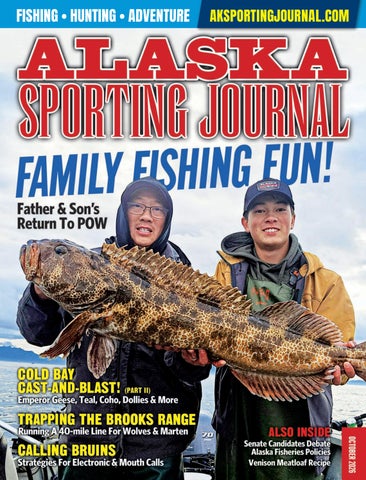
MEDIA INDEX PUBLISHING GROUP 941 Powell Ave SW, Suite 120 Renton, WA 98057 (206) 382-9220 • Fax (206) 382-9437 media@media-inc.com www.media-inc.com ON THE COVER Austin Han (right) and his dad Jerry had a memorable trip to Southeast Alaska’s Prince of Wales Island, catching plenty of halibut, lingcod and salmon out of Calder Mountain Lodge. “My biggest reason for returning to Calder Mountain was to have an adventure and make lasting memories with Austin,” Jerry writes. See page 56 for details. (JERRY HAN)
CORRESPONDENCE X@AKSportJourn Facebook.com/alaskasportingjournal aksportingjournal.com Email ccocoles@media-inc.com
ADVERTISING INQUIRIES media@media-inc.com
4
C
12
ALASKA SPORTING JOURNAL
OCTOBER 2026 | aksportingjournal.com
TO CATCH FISH YOU NEED TO GO TO WHERE THEY ARE!
FULL LIMITS ON KINGS, SILVERS, HALIBUT, LINGCOD & MUCH MORE! BRITISH COLUMBIA, CA
SCAN TO SEE OUR VIDEO
“BRING YOUR LARGE COOLERS. YOU WILL NEED THEM WHEN YOU FISH WITH US!”
BOOK NOW FOR 2027
(AT 2026 PRICES)
WE ALSO HAVE SPECIALS for B ring Y our O wn B oat Fishing/Catching
Lodging 4 PERSON DRIVE-IN FISHING/CATCHING •• 43 Nights Full days of Guided Fishing / Catching
Halibut, Lingcod & MORE CHARTER $2,100 ea. US •• Salmon, All your meals from our large restaurant menu MUST BE BOOKED BY OCTOBER 30 TO GET 2026 PRICING
250-287-1394
BOOK YOUR CANADIAN FISHING/CATCHING ADVENTURE NOW! info@westviewmarina.com | westviewmarina.com
CONTENTS
VOLUME 16 • ISSUE 4
56
THERE, AND THEN BACK AGAIN!
Jerry Han had such a glorious time fishing out of Prince of Wales Island’s Calder Mountain Lodge, he arranged for a return trip this year with son Austin and their “fellowship of fishermen.” There, the crew enjoyed epic late-night billiards at the lodge, and oh yeah, some outstanding halibut, salmon and rockfish action. Jerry recaps their latest Last Frontier adventure.
(JERRY HAN)
FEATURES
ALSO IN THIS ISSUE
26
17 19
COLD BAY MEMORIES, PART II Our Scott Haugen continues his series reminiscing about great trips to the rugged Aleutians and Cold Bay, home to some of Alaska’s best bird hunting opportunities. This time, Haugen and his dad Jerry break out the fishing rods to target coho and Dolly Varden, and Scott also shares a memorable hunt for emperor geese when it was still legal to pursue these majestic waterfowl on Izembek Lagoon.
23 33
Editor’s Note The Alaska Beat: News and notes from around the Last Frontier Outdoor Calendar From Field to Fire: Calling in black bears; venison meatloaf recipe
40
TRAPPING IN THE BROOKS RANGE From longtime correspondent Bjorn Dihle, come along on a trapping journey in the majestic Brooks Range with Daniel Skarzynski, who needed a change from the working grind in Massachusetts and now pilots his sled dogs out to work a trapline along a 40-mile stretch of wilderness. Wolves, martens and even the occasional wolverine make Skarzynski’s days rarely dull. Dihle shares his story and how this way of life is threatened by the proposed Ambler Road.
48
FIRST CASTS IN THE LAST FRONTIER Returning to the Kenai Peninsula’s vast fishing waters became extra special for Richy Harrod when his son Tyler, who’d never had a chance to fish in Alaska, came along on the trip. After connecting with one of Richy’s college buddies and heading out onto Kachemak Bay, the guys landed some halibut and cod and enjoyed stays in waterside yurts with spectacular views. Richy recaps an Alaska fishing adventure that “was a dream come true for Tyler” – and just maybe his dad too.
Alaska Sporting Journal is published monthly. Call Media Inc. Publishing Group for a current rate card. Discounts for frequency advertising. All submitted materials become the property of Media Inc. Publishing Group and will not be returned. Copyright © 2026 Media Inc. Publishing Group. All Rights Reserved. No part of this publication may be copied by any means, electronic or mechanical, including photocopying or recording by any information storage or retrieval system, without the express written permission of the publisher. Printed in U.S.A. 14
ALASKA SPORTING JOURNAL
OCTOBER 2026 | aksportingjournal.com
M
y elementary school’s fifth grade class got to take an annual week-long getaway to a wilderness camp in La Honda, California, about 45 minutes from my home in the suburbs of San Francisco. I was excited when it was my turn. Besides being a great opportunity for me and my classmates to get away from our parents, I figured it would be fun. And it was, with a few exceptions. The food was about as bad as you’d expect at one of these camps, I nearly fell into a creek, and I sucked badly at a predator-prey game in which two students are blindfolded and one tries to catch the other using directions from the other kids. In other instances, we played competitive and fun softball games, played harmless practical jokes on each others’ cabins, had some fun singalong events and even got to visit sea critters at a tide pool nearby along the Pacific Ocean. But by far, my least favorite time during the trip was when our group did an eve-
EDITOR’S NOTE ning hike. We were given headlamps and spaced out between one another, so each of us walked somewhat alone, though the counselors were always close by during the short walk. Still, as a 10-year-old way back in the dark ages of the late 1970s, I was terrified, convinced that a coyote or even a mountain lion was about to jump out of the woods and maul me to death (these days, that area has seen a number of mountain lion-human encounters). Even these days as an old guy, whenever I walk my dog in rural settings, it’s always in the back of my mind that at any moment a predator might just size us up. Not that I hike in fear; I just wonder if I’m going to be the unlucky victim! Alaskans reading this would likely make fun of me, as headline after headline share how hunters, anglers, hikers, joggers and dog walkers in the Last Frontier come face to face with the rather unpredictable fauna that share some of these rugged and beautiful places. I bring this up this month after reading about one of the latest incidents,
and this was as harrowing as some of the slasher movies we’ll be scared by this Halloween. In late August, caribou hunter Jadon Nicoara of Walla Walla, Washington, was attacked by a charging brown bear on the North Slope while hunting with his cousin. Nicoara described the grisly details of the grizzly’s attack to media outlets. Seriously injured, he called surviving the attack a “miracle” in his interviews. I have so much respect for Nicoara’s candor in describing what we all fear: that moment when you find yourself in the wrong place at the wrong time – a victim of circumstances when a wild animal is spooked or startled or just angry enough to unleash its fury. But what inspires me the most are the many who have survived bear attacks or been bitten by a shark while surfing or swimming and get right back into the water or out in the backcountry, which is where they feel destined to be. I just hope they stay safe – and me too the next time I’m in a similar spot. -Chris Cocoles
Bear attacks are common enough in Alaska that hunters, anglers and even joggers or dog walkers understand you never know when wildlife will emerge. The editor is impressed with the resilience of folks who’ve been attacked and continue to head afield. (K. JALONE/NATIONAL PARK SERVICE) aksportingjournal.com | OCTOBER 2026
ALASKA SPORTING JOURNAL
17
(CAPTAIN/CREWED CHARTERS)
Charter Fishing For Salmon And Halibut
Near Juneau, Southeast Alaska.
Whale Watching Trips Also available.
“BE YOUR OWN CAPTAIN” EXPERIENCE
Juneau Boat Rentals Bareboat rentals
JuneauCharters.com • info@juneaucharters.com • 907-723-8472
SOCIAL MEDIA POST OF THE MONTH
ALASKA BEAT
Indeed, gorgeous Bullseye is ready for her Tongass National Forest closeup.
ALASKA SENATE CANDIDATES DEBATE STATE’S FISHERIES ISSUES
T
he war in Iran? Rising gas prices and continued high grocery costs? What party will control the House and Senate after the November midterm elections? These questions are surely on the minds of Alaskans just as they are for most of the nation. But in the Last Frontier’s US Senate race – one of several that will decide if Republicans retain or Democrats retake the majority in Congress – the state’s fisheries and seafood industry and how to manage them are a major topic. In a hotly contested battle between GOP incumbent Dan Sullivan and his main challenger, former US Representative and Democrat Mary Peltola, a September 12 debate in Kodiak focused on Alaska fisheries issues. Among the hot-button topics discussed were the trawler fleet and concern over bycatch from those and other In a viral moment during their mid-Sepcommercial fishing boats, protecting the tember US Senate debate that focused state’s valuable salmon runs, and tension on Alaska fisheries, incumbent Dan between Alaska’s fishing industry and con- Sullivan hesitated on a question about how federal agencies are responding flicts with Russia’s commercial vessels. Both candidates committed to making to some of the state’s fishing industry issues, then subtly looked at opponent fisheries a vital part of their agenda if elect- Mary Peltola’s answer before also ed (or, in the case of Sullivan, re-elected). answering no. (YOUTUBE SCREENSHOT/THE “For us, fish is more than food – it’s our MEIDAS TOUCH) way of life. It’s who we are. I started commercial fishing in Alaska when I was 6 years old. I’ve spent my life fighting for Alaska fisheries, and it’d be a privilege for me to continue that lifelong fight as your senator,” Peltola declared in her closing statement. “In the Senate, I’ll always put Alaska fishermen first.” The debate even included a viral moment. In answers to moderator questions,
Three Southeast Alaska commercial fishermen pled guilty to deliberately destroying their boats. The abandonment of old ships due to the expense of scrapping them is becoming a real problem in state waters. The Alaska Beacon reports that a state program has a registry of 400 abandoned vessels.
“
THEY SAID IT “This isn’t how the law is supposed to work, the Board’s action falls well outside what ANILCA allows. Congress gave the Secretaries, not federal staff, and not a board acting by email, narrow, specific authority to close federal lands, and only when it’s necessary to conserve wildlife or protect a genuine subsistence need. That standard was not met in this case, and Alaska hunters will pay the price.”
”
–Jeremiah Williams, Safari Club International’s Alaska Chapter board president, after the US Department of the Interior’s Federal Subsistence Board announced a sudden closure of a September moose hunt in the Alaska Interior (Unit 25D).
aksportingjournal.com | OCTOBER 2026
ALASKA SPORTING JOURNAL
19
the candidates were expected to quickly lift a yes or no paddle. “Do the North Pacific Fishery Management Council and NOAA Fisheries adequately consider impacts on subsistence users, salmon migration, habitat and Indigenous ways of life?” was asked. While Peltola quickly responded with her placard showing no, Sullivan hesitated, sifted through his notes, and then turned just enough to see his opponent’s answer before also displaying a no vote, which drew laughs from the crowd and a “sorry” from Sullivan. Post-debate headlines questioned if those few seconds would destroy his campaign. In a subsequent tweet of the clip following the debate, Peltola deadpanned, “Happy to help, Dan.” From his personal X account, Sullivan tweeted, “Senator Dan Sullivan: 63 bills signed into law – many delivering real results for Alaska’s fisheries and fishermen. Mary Peltola: 0 bills signed into law. During her first term in Congress, she didn’t even introduce a single fisheries bill.” In his own closing debate remarks, Sullivan had this to say: “Fishing is the heart and soul of Alaska. It is the cornerstone of our culture and has been the cornerstone of my work in the Senate, getting things done. … Healthy fisheries and strong fishing communities are not just campaign talking points for me. ... I would be honored to have your vote.” Election day is set for November 3, and Alaskans have a fascinating decision to make that could help sway control of the Senate, and how the candidates handle fish will define the state’s culture.
FROM THE ASJ ARCHIVES – OCTOBER 2016
SAVORING THE BEAUTY, FREEDOM OF THE TONGASS
H
asselborg Lake is named for Allen Hasselborg, a reclusive man who homesteaded in nearby Mole Harbor for decades, and one of the two cabins we were staying in was originally built as a base for a scientific expedition he guided in the early 1900s. That cabin, Big Shaheen, is situated on the southern-facing shore of a point that looks out over the south part of the lake. Little Shaheen looks west over the lake to Thayer Mountain, which is named for a timber surveyor who was the first and – up until a few years ago – only person recorded as killed by brown bears on Admiralty Island during the last century. That first evening, Sam rowed the kids around as Bjorn cooked. Shiras and Silas, the two oldest kids, raced to see who could help reel in their parents’ catches first. As Autumn and I woke throughout the night to feed the babies, a pair of loons called to each other across the lake.
PUDDLES, PUZZLES AND A MILESTONE
NOTABLE NUMBER
$10,000 When he took the lead in the Valdez Silver Salmon Derby with an 18.80-pound fish on August 12, Chase Edstrom of North Pole vowed to donate his prize winnings to The Door, a Fairbanks youth advocacy organization. Sure enough, Edstrom held onto the title and the $10,000 first prize. Well done! 20
ALASKA SPORTING JOURNAL
The next day we were forecasted to get a few inches of rain in less than 24 hours, so we settled in Helping his son Shiras reel in his first fish within the at the larger cabin with a massive and gorgeous Tongass National Forest was 1,000-piece puzzle. We memorable for Bjorn Dihle, Shiras and the rest of the family. (MARY CATHARINE MARTIN) didn’t get far, but it ended up providing a half-hour of adult conversation as the older kids occupied themselves by hurling the pieces against the walls. Later, as the sun came out and I put the baby down for a nap, Bjorn cast for cutthroats in front of the cabin. “MC!” I heard him yell. “MC!” I ran outside to see him more excited than I had in years. “Get your camera!” he yelled. “Shiras is reeling in his first fish!” Shiras was thrilled. “I have another one!” he yelled, Shiras-speak for, “Let’s do that again.” Sam landed quite a few with his fly rod throughout the weekend. The two boys even cast some themselves using a kid-friendly rod that Silas had. -Mary Catharine Martin
OCTOBER 2026 | aksportingjournal.com
OUTDOOR CALENDAR
Moose hunting seasons open this month in portions of Game Management Unit 5 near Yakutat and GMU 14 in the Anchorage area. (US FISH AND WILDLIFE SERVICE/R. HAGERTY)
OCTOBER 1 ■ Goat season opens in Game Management Unit 1C (Southeast Mainland, area draining into Lynn Canal and Stephens Passage between Antler River and Eagle Glacier/River) ■ Deer season opens in GMU 3 (Petersburg Management Area and, for residents only, remainder of Mitkof, Woewodski and Butterworth Islands) ■ Elk season opens in GMU 3 (Etolin Island) ■ Moose season opens in GMU 5 (Yakutat, in area east of Dangerous River and Harlequin Lake) ■ Deer season opens in GMU 6 (North Gulf Coast and Prince William Sound) ■ Elk season opens in GMU 8 (Raspberry Island) ■ Deer season opens in GMU 8 (Kodiak Island, areas not including the Kodiak Road System Management Unit) ■ Brown bear season opens in GMU 10 (Unimak Island) ■ Archery sheep season opens in GMU 14 (AnchorageEagle River) ■ Black bear season opens in GMU 14C (McHugh Island) ■ Brown bear season opens in GMU 14C (McHugh Creek drainage) OCTOBER 7 ■ Goat season opens in GMU 6C (North Gulf Coast and Prince William Sound) OCTOBER 8 ■ Elk season opens in GMU 8 (Southwest Afognak, that portion of Afognak Island and adjacent islands)
OCTOBER 11 ■ Second elk season opens in GMU 8 (Raspberry Island) OCTOBER 15 ■ Nonresident deer season opens in GMU 3 (Petersburg/ Wrangell, in remainder of Mitkof, Woewodski and Butterworth Islands) ■ Youth deer season opens in GMU 5 ■ Moose season opens in GMU 5 (west of Dangerous River and Harlequin Lake, and southwest of Russell and Nunatak Fjords and the East Nunatak Glacier) ■ Brown bear season opens in GMU 6D (Montague Island) OCTOBER 16 ■ Second/alternate elk season opens in GMU 3 OCTOBER 20 ■ Resident moose season opens in GMU 14C (northern portion of the remainder of GMU 14C) OCTOBER 23 ■ Elk season opens in GMU 8 (Southwest Afognak and additional areas) ■ Third elk season opens in GMU 8 (Raspberry Island) OCTOBER 25 ■ Brown bear season opens in GMU 8 (Kodiak/Shelikof) ■ Moose season opens in GMU 14C (Ship Creek drainage above Joint Base Elmendorf-Richardson Management Area) For more information and season dates for Alaska hunts, go to adfg.alaska.gov/index.cfm?adfg=hunting.main. aksportingjournal.com | OCTOBER 2026
ALASKA SPORTING JOURNAL
23
\/\/\/\ HUNT AFRICA \/\/\/\ \ YOUR AFRICAN
ADVENTURE AWAITS
Hunt hard. Experience more. At van Wijk Safaris, every hunt is lf personal—from the pursuit itse to the stories shared around the d fire afterward. With experience guides, exceptional areas, and a genuine passion for creating memories and sharing Africa with you we will exceed your African dream!!!
vanwijksafaris.com hunt@vanwijksafaris.com USA Phone : 410-251-7149 RSA Phone, Andries: +27 82 921 3136 RSA Phone, Steffi: +27 82 852 3092
\ \/\/\/\ HUNT AFRICA \/\/\/\
Experience the best Africa can offer with Bullet Safaris Unforgettable Hunts - Breathtaking Landscapes - Incredible Big Game Conducting Custom Designed Adventures since 2003
Professional Hunter Nathan Askew | USA Office (+1) 573.587.1234 |
@bulletsafaris
CASTING AND BLASTING IZEMBEK LAGOON
SECOND OF TWO PARTS
MORE TALES OF EPIC COHO, WATERFOWL ACTION ON THE ALASKA PENINSULA
Editor's note: In part one of this two-part series, Scott Haugen had just shot a limit of willow ptarmigan. But as he’s come to learn, Alaska is about far more than just pulling the trigger. BY SCOTT HAUGEN
H
opping into the boat, my buddies and I took off our vests, which were loaded with ptarmigan. The tide was high on Izembek Lagoon; the ride back to the lodge was sure to be smooth. Sea otters floated about by the hundreds. I’ve seen a lot of sea otters in a lot of places around Alaska, but nothing close to this encounter. Half my friends aboard had never seen a sea otter. It was a special moment for everyone. Then we caught a whiff of something awful. Jeff Wasley, owner of Four Flyways Outfitters (fourflywaysoutfitters .com), and I looked at one another and smiled. No words were exchanged. We’d encountered this odor before. Moments later Wasley killed the motor and handed his binoculars to a buddy. Over 200 walruses were piled onto a sandy beach. Everyone watched from afar and took in one of the most Alaskan sights you
26
ALASKA SPORTING JOURNAL
could ever dream of.
ON OUR WAY BACK to the lodge someone asked about the coho fishing. With a few hours of daylight still remaining, we slipped out of our upland hunting gear, got into waders and were fishing for salmon in a small creek. Nearly everyone came back to camp with a five-fish limit. I’ve caught coho in many places throughout Alaska over the decades, but the silvers here are among the largest on average I’ve ever seen, with at least one fish tipping the scales to nearly 15 pounds almost every day from mid-September into early October. My dad is one of the best salmon anglers I’ve ever met. He loved fishing coho every day during our time with Wasley. He still talks about how big and what hard fighters those coho were. But if you were to ask him what his favorite fishing
OCTOBER 2026 | aksportingjournal.com
For nearly a decade Scott Haugen has been traveling to Cold Bay and Izembek Lagoon to experience all this place offers. Last fall, he tagged this coho salmon limit following a fine morning of ptarmigan hunting. (SCOTT HAUGEN)
aksportingjournal.com | OCTOBER 2026
ALASKA SPORTING JOURNAL
27
moment was from the trip, he’d tell you it was bead fishing a small creek for Dolly Varden. For this, we rigged rods with small beads and hiked along a remote, crystal clear stream flowing from the mountains. Dad caught a beautiful Dolly on his first cast, which landed smack behind a pair of spawning chum salmon. I was so enamored with watching the hundreds of spawning chums in the shallow creek that I barely wet a line for the first hour. I was happy with a few gorgeous Dollies. Dad finally put the rod down after landing and releasing 47 of the beautifully colored fish.
IN FALL 2020, I spent much of the season with Wasley. I helped when and where I could. It was great to meet and spend time with so many avid bird hunters from around the country, but what was more memorable was watching the place transform as the days and weeks passed. The early-season duck and goose hunting was special, as was the fishing. But by October, the number of brant and puddle duck species on Izembek Lagoon was mind-boggling. Later in the month the willow ptarmigan were on their way to carrying all-white plumage, and the fur of red fox and brown bears
was thick and shiny. Early one November day I helped Wasley with a group of brant hunters. It was windy and the little geese traveled close to shore. The group eventually shot limits, then elected to spend the rest of the afternoon back at the lodge to warm up. That’s when Wasley, myself and one guest who wanted to hunt ducks headed to a protected little creek that flowed into Izembek Lagoon. “This time of year, when the wind is blowing like this, greenwinged teal can pile into this creek,” Wasley said with a smile. “There are no guarantees, but it’s worth a shot.” We poked our heads over the tall grass as ripples covered the water. We kept walking and jumped hundreds of teal all at once, but didn’t fire a shot. “Let’s get on the other side and toss out some decoys,” Wasley suggested, with the thought of getting the wind in our favor. But before we made it across, teal started bombing back in. In less than 20 minutes the three of us had our limits of teal. It was the first time I’d ever shot an all-drake greenwing limit, including a couple juvenile Aleutian drakes as a bonus. The crazy part was we didn’t have a single decoy out. When you truly hit the X, waterfowl hunting reaches new heights.
More than once the author has come across walrus herds (or huddles) on the outskirts of Izembek Lagoon, one of the true icons of Alaska’s vast wilderness. (SCOTT HAUGEN) 28
ALASKA SPORTING JOURNAL
OCTOBER 2026 | aksportingjournal.com
LATER IN NOVEMBER 2020, I had the chance to hunt a bird I never thought I’d have the opportunity to. I held one prized emperor goose tag. I remember when the season closed down while we lived in Anaktuvuk Pass, and I thought I’d likely never get to hunt these grand birds in my lifetime. Over the years I’d photographed them on Kodiak Island, Egegik Bay, Izembek Lagoon and along the south shores of Cold Bay, but holding a tag was different. Josh Powell, Wasley’s camp chef at the time, and I headed to the beaches of Cold Bay with his Drahthaar dog Eudor. We’d been getting hammered by intense winds that made reaching our hunting spot by boat impossible, so we drove and hiked in the snow. The tide was low when we arrived on the black rock beach covered in kelp. Emperor geese, often referred to as beach geese by the locals, love combing beaches at low tide, feeding on kelp and other sea foods. We found a point, set out two dozen shell decoys and then retreated into the tall beachgrass for cover. The first flocks that passed didn’t have a big gander I was hoping for. One flock even landed in the decoys. They were spellbinding to watch. But things
changed when the next flock flew by. They were wide, but once they saw our decoys, they swung into range, circled once, and that’s when a big-headed gander stood out. The flock banked into the decoys, but it wasn’t until the gander separated from the flock and dropped its bright-orange feet that I had a clear shot. Soon I was admiring what many avid waterfowlers consider to be the world’s most prized bird. I was shaking with joy and so thankful for a moment I never thought I’d experience. Who knows if or when there will be another emperor goose season in Alaska. The next day the winds let up. We hunted brant on Izembek Lagoon, then went beachcombing on the barrier islands to the west. Three of us came away with nearly 50 glass floats. It was far from the more than 500 floats four of us once gathered in a morning following a major storm in the same place, but it was a lot of prized glass nonetheless. “These things are becoming a hot commodity for many hunters,” Wasley shared. “Many are incorporating them into brant and emperor goose mounts, they look really nice and they tell a great story from this magical place.”
The greenwing teal hunting can be a world-class experience on Izembek Lagoon. (SCOTT HAUGEN)
aksportingjournal.com | OCTOBER 2026
ALASKA SPORTING JOURNAL
29
In the early 1900s, Japanese fishing fleets began using glass floats to suspend their nets. Some European countries also used glass floats. Many years ago glass floats were replaced by plastic, but high numbers of the glass floats are still out there, caught in ocean currents or buried in ocean shorelines. They’re a great piece of history that serve as a memento from a trip to Izembek Lagoon.
BY MID-NOVEMBER SEA DUCK hunting action heats up in Cold Bay on the opposite side of the Alaska Peninsula from Izembek Lagoon. Here, Wasley focuses on prized common eider, and the harlequin duck hunting can be worldclass. I’ve enjoyed some fine sea duck hunting over decoys here and can’t wait to get back. From the Arctic to Southeast Alaska, I’ve been fortunate to live in some very special corners of the state, and I’ve seen much more of the Last Frontier through more than three decades of travel. When it comes to Izembek Lagoon, it’s hard to
Jeff Wasley, the owner and operator of Four Flyways Outfitters, is one of the most accomplished waterfowl hunters the author has ever had the honor of hunting with. Even after a lifetime of hunting, cacklers still get Wasley excited! (SCOTT HAUGEN)
match the waterfowl hunting, ptarmigan action, small stream coho and Dolly fishing, not to mention the wildlife viewing and sightseeing that exists. I’ve already planned a return cast-and-blast trip for next September, and I can’t wait to see it through the eyes of friends who’ll be
experiencing it for the first time. ASJ Editor’s note: For signed copies of Scott and Tiffany Haugen’s best-selling adventure book, Hunting The Alaskan High Arctic, visit scotthaugen.com. Follow Scott’s adventures on Instagram and Facebook.
Haugen with a prized emperor goose taken in 2020 on Cold Bay. Who knows if or when this season will open again. “I was shaking with joy and so thankful for a moment I never thought I’d experience,” he writes. (SCOTT HAUGEN)
30
ALASKA SPORTING JOURNAL
OCTOBER 2026 | aksportingjournal.com
E T A M I T L U ! T N U H A K ALAS
Experience the thrill of big game hunting in Alaska’s untamed wilderness with Deltana Outfitters—Alaska’s premier guide service. Whether you’re after Brown Bear, Grizzly, or Moose, our expert guides lead unforgettable Spring and Fall hunts in the remote, pristine Alaska Peninsula andWestern Alaska.
Adventure. Expertise. Results.
That’s what we do—and Deltana does it best.
90% Success Rate! Average Moose: 64” Grizzlies: 7’6” - 8’6” Black Bears: 6’ - 7’ Brown Bears: 9’ - 10’
Start your ultimate hunting experience today!
Visit: www.deltana.com | Email: hunts@deltana.com | Call: 907- 347-7204
Calling predators that have the ability to kill you is hunting’s ultimate thrill. Using a mouth call, author Scott Haugen brought this black bear within spitting distance. (SCOTT HAUGEN)
MAKE THE CALL
STRATEGIES FOR BRINGING IN FALL BLACK BEARS WITH ELECTRONICS, MOUTH CALLS
BY SCOTT HAUGEN
W
hen it comes to calling black bears, I’ve had the best success calling nonstop and changing up sounds. In my former life I was a high school science teacher and coach. My wife and I also raised two sons, and bears are like teenagers; you never know what they’ll do or how
they’ll respond to a situation. Sometimes their reactions make no sense. For this reason I like to first find a bear before calling commences, so its response can be observed. Sometimes bears come on a dead run the instant they hear your calls. Other times they sprint in the opposite direction. Occasionally they
hear your calls, start coming in, then put their head down and continue feeding.
KNOW THE SIGNS If hunting in thick cover where seeing a bear is unlikely, look for fresh sign before calling. Tracks and droppings reveal a lot. The more fresh and concentrated
aksportingjournal.com | OCTOBER 2026
ALASKA SPORTING JOURNAL
33
Chef Tiffany Haugen’s venison meatloaf with a Mexican food twist offers something original to make with that big game meat in your freezer. (TIFFANY HAUGEN)
VENISON MEATLOAF, SOUTH OF THE BORDER STYLE BY TIFFANY HAUGEN
W
ith big game seasons well underway in Alaska, freezers are filling up. If you’re like us, savoring fresh game for breakfast, lunch and dinner is the norm. This means variety can be the spice of life, as the more ways you cook big game, the more enjoyable it will be. This is a Latin American food-inspired recipe I first used on a big bull moose that was taken during the peak of the rut. It was excellent. I later tried it on fat caribou from Adak Island, then deer. It was a winner all around.
1/3 cup crushed tortilla chips
1 teaspoon cumin 1 teaspoon chili powder 1 teaspoon oregano 1 teaspoon salt SAUCE 1/4 cup red enchilada or taco sauce 1/4 cup ketchup
1/2 cup chorizo, crumbled
GARNISH Guacamole Salsa Sour cream Tortilla chips Fresh cilantro
One egg 1/2 cup onion, finely chopped 1/2 cup salsa
In a large bowl, mix ground meat, chorizo, egg, onion,
1 pound ground venison
34
1/3 cup shredded pepper jack cheese
ALASKA SPORTING JOURNAL
OCTOBER 2026 | aksportingjournal.com
salsa, cheese, crushed tortilla chips and spices until thoroughly combined. Press into a 9-by-9 baking dish. In a small bowl, mix enchilada or taco sauce with ketchup until thoroughly combined. Spread evenly over the top of the meatloaf. Bake in a preheated 350-degree oven for 30 minutes or until the internal temperature of the meatloaf reaches 150 to 160 degrees. Garnish with guacamole, salsa, sour cream, tortilla chips and fresh cilantro. Leftovers tip: Meatloaf freezes well in individual serving sizes and heats up in two to three minutes in the microwave. Editor’s note: To order signed copies of Tiffany Haugen’s popular book, Cooking Big Game, visit scotthaugen.com for this and other titles.
SPECIALIZING IN FRESH BEEF, PORK, POULTRY AND OUR OWN SPECIALTY ITEMS We also carry game processing items such as fat, spices and casings
CALL US AT 907-349-3556 OR TOLL FREE WITHIN ALASKA 800-478-3556 MRPRIMEBEEF.COM
| PRIMEBEEF@MRPRIMEBEEF.COM
aksportingjournal.com | OCTOBER 2026
ALASKA SPORTING JOURNAL
35
the bear sign, the better the opportunity to call one in. Shooting windows in thick cover are confined, so be ready.
what determines your every move. If the bear likes a sound, keep it going. If a bear begins to slow down its approach, increase the volume of that sound. If the bear loses interest, switch sounds. If the bear gives up, quickly change to a different sound and increase the volume. I mix up volume, pitch, tone and variety continually when trying to convince a reluctant bear to commit.
CALLING CARDS
WORD OF MOUTH
Electronic calls are a big advantage because they offer continuous run times at high volume, and with the touch of a button you can instantly switch sounds. The biggest challenge I’ve had in calling bears is keeping their attention. To overcome this, frequently changing sounds and keeping them rolling have helped. A sequence might begin with a fawn distress call, then shift to a jackrabbit, cottontail, doe distress, squirrel and then bird chatter. Once a calling sequence begins, keep it rolling. The only break in the calling sequence comes when changing calls. Being able to watch a bear’s reaction is
Mouth calls are always handy tools. More than once I’ve been calling bears on the edge of thick timber, only to have them hang up. They can be hesitant to leave cover and run into the open. When this happens, pause the electronic call and switch to mouth calls. Mouth calls allow for finesse – the ability to throw the angle of your sounds – and a range of sounds can be made with them. Single- and triple-reed diaphragm calls are good to have in order to create a variety of sounds. They’re also perfect for stopping an approaching bear should you need to lace an arrow through a narrow shooting lane.
CUMBERLAND’S NORTHWEST TRAPPERS SUPPLY Hide Tan Formula has been used successfully by thousands of hunters and trappers across the U.S. and Canada. No more waiting several months for tanning. Now, you can tan your own hides and furs at home in less than a week, at a fraction of the normal cost. Our Hide Formula tans deer hides either hair-on for a rug or mount, or hair-off for buckskin leather. Tans all fur skins – muskrat, mink, beaver, fox, coyote, raccoon, squirrel, rabbit, etc. It also applies to bear, elk, moose, cowhide, sheep and even snakeskin. Hide Tan Formula is premixed and ready to use and produces a soft, supple Indian-style tan in five to seven days. One 8-ounce bottle will tan one deer hide in two medium-sized fur skins. Bear, elk, moose and caribou require three to six bottles. Complete instructions are included. You’ll be amazed how easy it is! Tanned hides and furs are great to decorate your home or camp and also to sell for extra income. Tanned hides and furs are in demand by black powder enthusiasts, American Indian traders, fly tyers, country trading posts and many crafters. Our products are proudly produced and bottled in the U.S. for over 20 years. Available at Cumberland’s Northwest Trappers Supply in Owatonna, Minnesota. Call (507) 451-7607 or email trapper@nwtrappers.com. nwtrappers.com
36
ALASKA SPORTING JOURNAL
OCTOBER 2026 | aksportingjournal.com
Mouth calls can be great finishers when it comes to pulling bears from thick cover. (SCOTT HAUGEN)
From pursuing big game in the Alaska Range to watching brown bears in their pristine natural habitat, experience Alaska from a truly wild perspective. Experience remote wilderness, incredible wildlife, and the Alaska you came to see.
Where the road ends, the adventure begins.
Guided Alaska hunts. Moose, black bear, brown bear, & caribou. Remote hunting camps. Bush plane transportation. Luke Miller 907-830-4968 alaskahunting.net fly907.com alaskabearview.com
14,000+ flight hours Experienced guides & pilots Secondgeneration guide Lifelong Alaska experience
Beyond ordinary and into Alaska.
If operating diaphragm calls is a challenge, which it can be when an apex predator is approaching and your mouth dries up, try an open-reed call. Open-reed handheld calls are my preferred mouth calls due to the range of sounds they offer and the ease with which they can be blown. Another bonus is volume control, which is very precise with bite-down calls.
DON’T STOP CALLING If you can see a bear but it’s not responding to your calls, keep calling. As long as you keep it in sight, there’s a chance of calling that bear in. It’s important to have a range of electronic and mouth calls, as variety can be everything. If cold calling – calling without first seeing a bear – give it at least an hour. Find fresh sign and chances are bears won’t be far. Load your electronic call with a range of bird, bear, deer, elk and small game distress sounds. Bird flock distresses, even livestock in anguish, can be good. I once called in a bear high up in remote mountains using goat distress sounds; the nearest farm was over 25 miles away. Build some presets for quick sound changes.
HEEDING THE CALL When it comes to calling bears, you never know what will happen. One season in Southeast Alaska I called into some thick timber where a set of fresh tracks disappeared. In less than 30 minutes, three bears came in, all at different times. I once watched a massive boar walk into some thick spruce trees near Hyder on the Alaska Panhandle. I quickly got to the forest edge and began blowing on an open-reed call. Minutes later a 250-pound boar busted out of the trees. It wasn’t the big one I was after, so I let it walk. I blew for several more minutes, finally quitting when I grew light-headed. The big boar never came out of hiding. Calling predators is one thing. Calling predators that have the ability to kill you is another. That’s what makes calling bears so exciting. ASJ Haugen has called in many bears. He ranks them among the toughest big game species to consistently call in, largely because of their unpredictable demeanor. This one came from Southeast Alaska. (SCOTT HAUGEN) 38
ALASKA SPORTING JOURNAL
OCTOBER 2026 | aksportingjournal.com
Editor’s note: For signed copies of Scott Haugen’s best-selling books, visit scotthaugen.com. Follow his adventures on Instagram and Facebook.
TRAPPING THE BROOKS RANGE
Daniel Skarzynski with a wolf from his trapline in the Brooks Range. He and a friend had quite a memorable experience in their first trapping adventure in one of Alaska’s wildest environments. (DANIEL SKARZYNSKI)
40
ALASKA SPORTING JOURNAL
OCTOBER 2026 | aksportingjournal.com
RUNNING 40-MILE LINE BRINGS HOME HOW SPECIAL REGION IS FOR JOURNEYMAN TRAPPER BY BJORN DIHLE
T
he first winter Daniel Skarzynski trapped, he joined a friend on a short 15-mile line near where he lives in Coldfoot in the Brooks Range. Neither had trapped before. The duo had four dogs and a sled, an old snowmachine and a dozen No. 1 longspring traps for marten. Wolves had killed a moose nearby and they found the tracks of a wolverine that had been feeding on the carcass. Soon, the wolverine began running their line and stealing marten from their traps. They were using pole sets for marten, a method where a trap is fastened on a leaning pole – usually a dead or bent-over spruce tree – in front of a wired-down piece of bait. The marten gets caught in the trap as it runs up the pole to try to access the bait. One day as the two men came up on one of their sets, they were surprised to find an extremely alive, angry wolverine caught in the small trap, hanging and thrashing about. For a wolverine’s relatively small size – an adult weighs 18 to 45 pounds – they have big paws and are immensely powerful. There are stories of wolverines occasionally being caught in small marten traps, but generally a much bigger and more powerful trap is needed to hold the largest terrestrial member of the weasel family. The two men, not expecting they’d need a gun, had left their .22 around 5 miles back at camp. Skarzynski’s buddy roared back on the snowmachine to grab it to dispatch the animal. “It was a long wait,” Skarzynski says. “By the time he got back, that wolverine had nearly chewed through that 5-inch pole.”
NORTH TO ALASKA Two years before this surprise wolverine encounter, Skarzynski was living in Massachusetts, working a job he didn’t like. That’s when a friend who’d done a few
aksportingjournal.com | OCTOBER 2026
ALASKA SPORTING JOURNAL
41
Skarzynski and his sled dogs have shared plenty of great moments in the Last Frontier from their Coldfoot home base. (DANIEL SKARZYNSKI)
summers of field work in Alaska told him about the Brooks Range. “I’d never heard of the Brooks Range, and I’d never thought much about trapping,” Skarzynski says. “But the way my friend described the Brooks made it sound like the wildest place on Earth. I wanted to see it for myself.” Skarzynski found a job working as a tour guide in Coldfoot and quickly fell in love with the Brooks Range and the life42
ALASKA SPORTING JOURNAL
style it afforded. It was during his second winter there that he began trapping. When he started to set a line for wolves, Skarzynski didn’t think he wanted to catch more than one. If he was lucky enough to have success, he planned to use the wolf’s fur in part for the ruff of his parka. With winter temperatures of minus 50 and below in the Brooks Range, having a wolf or wolverine fur ruff adds invaluable insulation for your face and neck.
OCTOBER 2026 | aksportingjournal.com
As luck would have it, wolves killed a moose near Skarzynski’s camp. He had two wolf traps, so he made two sets. When he returned to check, the area around one of the sets was torn up. Snow and debris were scattered all over. The trap held a bit of fur but no wolf. He was feeling bad about there being an injured wolf wandering around suffering when he found a severed paw lying in the snow. A little farther off he found a tail in the brush.
“We found what little remained of that wolf. Other wolves had torn it out of the trap and eaten it,” Skarzynski says. “I had beginner’s luck that first season and ended up catching four. After that I was hooked on wolf trapping.”
OLD SCHOOL These days Skarzynski runs a 40-mile line that he extends a bit farther each year. Most trappers now use snowmachines, aksportingjournal.com | OCTOBER 2026
ALASKA SPORTING JOURNAL
43
but Skarzynski prefers running dogs to check his line. He acknowledges that there is a lot to be said for machines, but he likes the work that comes with using dogs. “They’re tuned into what’s going on and act as a bridge to nature. It makes you work more with the country,” he says. Skarzynski targets marten and wolves. It doesn’t take a lot of learning to be an efficient marten trapper, but Skarzynski says being a good wolf trapper basically involves a Ph.D. education in trapping. To be successful, you have to get in a wolf’s head and understand how they think, how they travel and use
the land. The more Skarzynski pursued wolves, the more he appreciated them. “Some people hate and want to get rid of wolves. I love having them around. They are incredibly smart. They are a symbol of this place being totally wild,” Skarzynski says. Skarzynski’s annual marten catch is around 50. Last season was a good one for wolves, and he caught eight. He usually picks up a wolverine or two. He’s hopeful lynx will start bouncing back as the cyclical snowshoe hare population continues to grow, but right now there are not many cats in the country.
It’s difficult to make much money if he sells his furs raw to buyers, so he tans them and sells them himself.
THE SOUTH FORK BANDIT The Brooks Range is hungry country, and trapping brings you in direct contact with the constant struggle between life and death in this ecosystem. Trapping can be challenging and it has its highs and lows. Coming off his first season, Skarzynski felt good about his efforts. The following winter he ran a line alone, and wolf trapping was so challenging that at
“I’d never heard of the Brooks Range, and I’d never thought much about trapping,” Skarzynski, with a local moose, says of his relocating to Alaska from Massachusetts. “But the way my friend described the Brooks made it sound like the wildest place on Earth. I wanted to see it for myself.” (DANIEL SKARZYNSKI)
44
ALASKA SPORTING JOURNAL
OCTOBER 2026 | aksportingjournal.com
OVER 50 YEARS OF SERVICE TO THE TRAP & FUR INDUSTRY
Cumberland’s
Northwest Trappers Supply, Inc. Cumberland’s Northwest Trappers Supply is your onestop trapping supply headquarters, featuring one of the largest inventories in the U.S. We are factory direct distributors on all brands of traps and equipment which allows us to offer competitive prices. Give us a try. Our fast, friendly service will keep you coming back. We are the new home of “Trappers Hide Tanning Formula” in the bright orange bottle. Retail & dealer inquiries are welcome.
.If you are in the area,
visit our store!
Place an order by phone, mail or on our website.
P.O. Box 408, Owatonna, Minnesota 55060 • (507) 451-7607 trapper@nwtrappers.com • www.nwtrappers.com
While many trappers check their lines via snowmachine, call Skarzynski old school, if you will. He prefers to sled with his trusted dogs to see what critters he’s trapped. (DANIEL SKARZYNSKI)
“When I’m running my trapline, I’m reminded of how special the Brooks Range is,” Skarzynski says. “Most people can’t even imagine a place like this exists.” (DANIEL SKARZYNSKI) 46
ALASKA SPORTING JOURNAL
times he questioned whether he should call it quits, pack up and leave Alaska. He laughs it off now and says the country was teaching him a lesson. Despite having several seasons under his belt, there is still one wolf in his territory that continues to evade him. “I call him the South Fork Bandit,” Skarzynski says. The wolf has a habit of digging up sets to show other wolves his traps. Skarzynski has even tried dummy sets – traps placed in front of a trail set – but the animal is always on to him. “Finally, I found a wolf in a dummy set, and I thought I had him,” Skarzynski says. “But I was wrong. The next time I ran my line, the South Fork Bandit had dug out a few of my sets. He’s still out there as far as I know.”
BROOKS RANGE ADVOCATE Skarzynski is a staunch opponent of the
OCTOBER 2026 | aksportingjournal.com
proposed Ambler Road. The 211-mile industrial corridor, designed to support the development of an unknown number of foreign-owned mines, would alter the wild freedom the Brooks Range offers. If built, Ambler would damage the most Alaskan part of Alaska – the trapping, hunting and fishing lifestyle – to benefit foreign interests while leaving local and visiting hunters and anglers to bear the cost. “When I’m running my trapline, I’m reminded of how special the Brooks Range is,” Skarzynski says. “Most people can’t even imagine a place like this exists.” ASJ Editor’s note: This piece was originally published by Hunters & Anglers for the Brooks Range. To learn more, visit huntfishbrooksrange.com. Order author Bjorn Dihle’s books at amazon.com/stores/Bjorn-Dihle/ author/B01N2KAFAC?ref=ap_rdr&shoppingPortalEnabled=true.
Fishing for Walleye, Trout, Pike, Pan Fish, Bass, Stripers, Salmon and Whitefish with Bay de Noc Lures
WWW.BAYDENOCLURE.COM Dealer Inquires Welcome!
Arctic Wolf Tannery 1901 W 48TH AVE ANCHORAGE ALASKA 99517
(907) 868-3227
Taxidermy tanning services offered to the general public, along with expediting services. (Airport pick up, sealing, skinning, fleshing and tanning)
marine mammals bison • goat • bear • moose aksportingjournal.com | OCTOBER 2026
ALASKA SPORTING JOURNAL
47
Tyler Harrod took on Kachemak Bay during his first fishing trip to the Last Frontier. “Taking a plane thousands of miles away to Alaska for a fishing adventure was a dream come true for Tyler,” writes author Richy Harrod, Tyler’s dad. (RICHY J. HARROD) 48
ALASKA SPORTING JOURNAL
OCTOBER 2026 | aksportingjournal.com
FIRST CASTS IN THE LAST FRONTIER
A SON’S MAIDEN ALASKA ADVENTURE INCLUDES KENAI HALIBUT FISHING, WATERFRONT CAMPING
BY RICHY J. HARROD
T
he massive jet plane left the taxiway and rounded the corner for the runway bouncing up and down like an old ranch pickup with worn-out shocks. The pilots skillfully squared the plane runway center and immediately throttled the jet engines to maximum RPM. The concrete surface appeared smooth, but as speed increased, its apparent roughness caused the entire fuselage to shake and thump loudly, which when mixed with the screaming engines led to a deafening cacophony. My son Tyler had a look of concern on his face. The nose of the plane pointed skyward, and with a final thump of the wheels tucking into the belly, the ride was smooth with only the hum of air passing over the wings. The 3,000-mile journey to Anchorage, Alaska, had begun. I had experienced the rush of flight many times, but Tyler was wide-eyed with amazement. Hunting and fishing trips close to home are the norm in our household, but taking a plane thousands of miles away to Alaska for a fishing adventure was a dream come true for Tyler. He stared out the window at mountains underneath as we sped to our destination, where only his imagination had been before.
ALASKA REUNION My friend Scott Shumway met us in An-
chorage. Scott and I met while in college at Western Washington University. He was also raised in a family where hunting and fishing were a way of life. We became close friends and made plans to take each other to our favorite hunting or fishing spots. The plans never materialized as life got in the way and much time passed. But now, nearly 20 years later, my excitement was on par with Tyler’s as we hurried towards Scott’s favorite halibut haunts. Scott and I talked by phone many times prior strategizing the logistics
needed to complete his full itinerary. We planned to fish for halibut and cod in Kachemak Bay, where we would stay two nights in remote yurts. The first night was reserved for this travel day and we wanted time to fish. We landed in Anchorage, met Scott at baggage claim and hurried to his house.
TO THE HALIBUT GROUNDS Scott used his garage to neatly lay out all the gear needed to fish and stay overnight in the Alaska bush. Before loading
aksportingjournal.com | OCTOBER 2026
ALASKA SPORTING JOURNAL
49
Celebrating a nice cod for the cooler. (RICHY J. HARROD)
the gear, we needed to pick up Scott's boat, which was with his good friend Brian, who would be joining us on this trip too. The boat was hooked up to Scott’s pickup, the gear packed and we headed for the Kenai Peninsula with great anticipation. The drive along Turnagain Arm of the Cook Inlet is beautiful, with inland bay views and snow-covered peaks in every direction. Tyler was in awe taking pictures at every turn. The Seward
Highway heads southeast to Portage at the head of Turnagain Arm, then travels south and west towards Soldotna. Further south down the Kenai Peninsula the terrain is gentler and trees are short – scraggly black spruce with a mossy forest floor. The highway once again follows the coastline along the Cook Inlet, and mountains across the inlet loom large. The saltwater looked inviting, and Tyler wondered where in those vast waters we would fish. Scott Shumway, the author’s college buddy, hooks a Kachemak Bay halibut. (RICHY J. HARROD)
50
ALASKA SPORTING JOURNAL
OCTOBER 2026 | aksportingjournal.com
Waterside accommodations on Tutka Bay made for scenic spots to cook dinner and spend the night. (RICHY J. HARROD)
Homer was finally visible as we descended the last 15 miles from Anchor Point. The sun was shining and Kachemak Bay glistened below snowcapped mountains. Since this was June with about 19 hours of daylight, there was plenty of time to fish and get to camp. The chatter in the vehicle increased with excitement for the adventure about to begin. We drove through town onto Homer Spit and finally arrived at the boat launch by Seafarer’s Memorial park. Scott slowly backed down the launch until the 26-foot aluminum behemoth floated free of its trailer shackles. Tyler and I struggled to hold the boat near the dock and not interfere with other boats taking out. Thumps on the wood dock signaled Scott’s return from parking. Departing the dock, the boat idled towards the wide-open waters of Kachemak Bay. The adventure was underway, and Scott followed his GPS to a favorite halibut fishing spot.
FIRST FISH, DEEP WATER The plan was to halibut fish for a few hours, then boat to a shoreline camp for the evening. Nearing the GPS coordinates, the shoreline in every direction became uncomfortably distant with only rolling waves lapping at the boat. Scott nosed the boat into the wind and incoming tide to facilitate easy anchoring in 200 feet of water. The anchor grabbed the muddy bottom while Scott backed into position before tying off the anchor line. Cut herring was threaded on a large circle hook, which was taken to the bottom by an 8-ounce lead ball. We’d have to hook the fish not by a jerk but slowly lifting the rod tip while the fish was biting, thereby forcing the hook tip into the mouth. Once the fish was hooked, the circle hook was very effective at keeping heavy fish on the line. Scott gave Tyler a little tutorial and then told him, “Now you’re on your own and you’ll figure it out; ha ha!”
With bait on the bottom, we quietly concentrated on our rod tips. The water was less tumultuous at this point and gently gurgled against the side of the boat. The occasional seagull screeched as it lazily flew by. It was peaceful and beautiful, a moment in time when the long travel day was easily forgotten. Scott was the first to break the silence, quickly moving from his seated position on the gunwale. “Fish on!” he said while slowly retrieving several hundred feet of line from the bottom. Tyler watched closely for any lessons. Soon, a glimpse of sandy brown in the blackness of deep saltwater made us lean over the gunwale on Scott’s side of the boat. “It’s a nice one; Brian, get the gaff,” Scott said as he continued to give guidance. “I’ll be keeping the fish just under the surface, and when I say ‘now,’ stick the gaff into the water and pull it up hard just behind his head.” “OK,” Brian replied with confidence. Scott led the head to-
aksportingjournal.com | OCTOBER 2026
ALASKA SPORTING JOURNAL
51
The guys savored their stays in the state park yurts. “Another beautiful end to a memorable day,” the author writes. (RICHY J. HARROD)
The view from camp was quite illuminating. (RICHY J. HARROD) 52
ALASKA SPORTING JOURNAL
OCTOBER 2026 | aksportingjournal.com
ward the boat and then shouted, “Now!” Brian made a perfect thrust with the gaff, and with Scott’s help pulling on the gaff handle, the 25-pound halibut flopped into the boat. “Nice job, Brian!” Tyler admired the strangely shaped fish and had a look of envy. But it wasn’t long before he had a bite. “There we go!” Tyler said, but quickly followed with, “Uh-oh; nope; I think I jerked.” “Yep. You got to remember just to lift the rod tip,” Scott reminded him. Tyler reeled up, added more bait and sent weight and hook back to the deep. Brian was next to get bit, and with a bit more experience, he skillfully hooked the fish. “Seems like a good one!” he said. Tyler was now seriously concentrating on his rod. Brian’s fish neared the surface, and soon we could see it wasn’t a halibut but a beautiful Pacific cod! Scott reached out, gaffed it and quickly flipped it into the cooler. Fish started biting consistently after Brian’s cod. Finally, Tyler hooked his first halibut with a gentle lift of the rod tip and steady reeling. He jammed the rod butt into his hip lifting and reeling for several
Everything we sell, we fish ourselves
fishermansgold.com
Offering the highest quality fishing weights and jigs
Use code FISHING10 for 10% OFF
minutes. Soon we could see color. “Oh, that’s a nice fish, Tyler,” Scott said while leaning over the rail. “Remember: Keep it under the water until I can get the gaff into it.” The fish slid towards the boat and Scott made short work of landing the fish. “My arms are tired,” Tyler said, laughing. The halibut was near 30 pounds and barely fit into Scott’s cooler. The good fishing continued until we each landed our two halibut and several cod. With a full cooler, Scott motored towards Seldovia on the south side of Kachemak Bay. The marina in Seldovia had a cleaning station where the halibut and cod could be easily processed. Four guys made short work of fileting fish, and after a short walk through town we idled out of Seldovia to find our remote yurt in a nearby bay.
A BAY THAT STAYED WITH THEM Kachemak Bay State Park has several remote yurts accessible only by boat. Scott reserved two separate yurts in Tutka Bay for our two-night, three-day fishing trip. Scott steered the boat out of the rough waters of the larger Kachemak Bay, past Hesketh and Herring Islands, and into the quiet waters of Tutka Bay. Our first night’s yurt was on the bay’s south side about 6 miles back. Scott nosed the boat onto the beach so we could unload camping gear. Tyler, Brian and I hauled the gear off the beach
to the yurt, while Scott put the boat on anchor well off the beach and rowed a small Zodiac back. “This is amazing,” Tyler said as he admired the view of Tutka Bay. Scott planned a special supper for Tyler. We sat on the beach cooking our meal in the calm, warm evening air. The smell of burgers caught Tyler’s attention. “Have you ever eaten moose before, Tyler?” Scott asked while tending the propane grill. “No. I have had elk or deer, but never moose. Sounds good!” Tyler replied. The burgers were delicious on their own, but the remote marine setting made the meal unforgettable. The sun hung above the skyline hidden by a few passing clouds in the late Alaskan evening. A waterfall across the bay roared in the distance. Eagles screeched while circling above the beach, occasionally swooping down to the surface of the bay to pluck some unsuspecting fish from its watery world. We sat mostly in silence observing rhythms of life in the bay. Tyler and I finally succumbed to the tranquil evening and retired to the yurt for peaceful sleep in the wilderness. We loaded the camping gear onto the boat the following morning. A yurt on the north side of the bay would be our new home at the end of the day. “Morning, outlaw,” Scott laughed as he greeted Tyler onto the boat. He pointed the boat out of the bay and we sped towards the
For Tyler (left) and Richy Harrod, catching fish was only part of the fun. “Time together with my son making his first casts in the Last Frontier was truly special,” Richy writes. (RICHY J. HARROD) 54
ALASKA SPORTING JOURNAL
OCTOBER 2026 | aksportingjournal.com
fishing waters. Scott anchored near the mouth of Tutka Bay by some small islands. Tyler was the first to bait his circle hook and drop his setup to the halibut depths. “You’ve got this fishing routine down,” Brian said to Tyler. “I’m hoping for the big fish of the day,” he added with a chuckle. The bites were few and far between. Tyler caught a small halibut, Brian a cod. Scott moved us around from spot to spot, but the fishing remained slow through the day. Ultimately there were four cod and six halibut in the cooler by early afternoon. “You guys want to explore more of Kachemak Bay?” Scott asked. “I’m up for anything,” Tyler quickly replied. We boated in and out of coves and slowly idled along the shoreline. All the while, Scott and Brian told stories of places fished and camped in the past. The snowy mountain peaks towered above the saltwater in all directions. Tyler stood at the rail watching for wildlife. “There’s a bear!” he said pointing at the brushy bank. “Yep. It’s a good chance we’ll see several more,” Scott said with a big grin. The afternoon passed quickly. We motored back to Tutka Bay to process the fish at the new camp. The shoreline was small cobble, making it easy to filet fish and rinse the meat at the water’s edge. We tossed the chopped-up carcasses in the water for the crabs, but as the tide dropped a few reappeared on the shoreline. Numerous bald eagles swooped down for an easy feast. “Those bald eagles are really cool,” Tyler said as he sat on a rock a few yards from the majestic birds. He sat there mesmerized by their antics until Scott and Brian called him for supper. It was another beautiful end to a memorable day. Our time spent on the saltwater ended the following morning after a few more hours of fishing. Returning to Homer, we traveled up the Kenai River to fish for trout. Later in the trip, a jetboat ride up the Talkeetna River to a remote cabin culminated the Alaska trip. However, the time fishing together on waters of Kachemak Bay remained the most vivid in our memory. Time together with my son making his first casts in the Last Frontier was truly special. ASJ Editor’s note: For more on the author, check out harrodoutdoors.com.
Your one-stop destination for self-guided saltwater fishing adventures in Sitka, A laska. We offer comprehensive packages that include lodging, fully equipped rental boats, rods, reels, tackle, downriggers, depth finders, VHF radios, GPS, marine charts, safety gear, and more.
Book Today! w w w . f i s h b a ra n o f . co m
|
9 0 7- 7 3 8 - 9 0 9 0
|
f i s h b a ra n o f @ g m a i l . co m
56
ALASKA SPORTING JOURNAL
OCTOBER 2026 | aksportingjournal.com
THERE, THEN BACK AGAIN!
‘FELLOWSHIP OF FISHERMEN’ REUNITE FOR MORE ADVENTURE AT PRINCE OF WALES ISLAND LODGE BY JERRY HAN
L
ast year, as my first trip to Prince of Wales Island’s Calder Mountain Lodge ended and we began the journey home, the fellowship of fishermen I had just spent the last week with began discussing plans for a return trip to these rich Southeast Alaska waters. After a quick council, it was determined that we would shoot for August 26 to September 1 as the days we would
descend once again on Calder Mountain to do battle with the monsters of the deep. Ha ha; sorry for the JRR Tolkien references, but I’m a big fan. So, just under a year out from hopefully a triumphant return, the planning and strategizing began. The first plan of attack was to determine what had worked on the first trip. For salmon it was the usual offerings like 360 flash-
ers in front of hoochies, stuffer baits and spoons. For halibut it was 16-ounce jigs with grubs and spreader bars with bait. Lingcod and rockfish were suckers for slow-pitch jigs. Our second plan of attack was to set goals for this next trip. I have found that if I don’t have a strategy or game plan, I can get overwhelmed by the plethora of opportunities available and end up
A return trip to do-it-yourself Calder Mountain Lodge for a group of buddies – whom author Jerry Han called “the fellowship of fishermen” – included Han’s son Austin, who got into some of the potluck action with a pair of halibut. (JERRY HAN)
aksportingjournal.com | OCTOBER 2026
ALASKA SPORTING JOURNAL
57
Heading out on a fish quest. Self-guided anglers use the lodge’s boats. (JERRY HAN)
not fishing efficiently or effectively. An integral part of this second plan was to prioritize what we wanted to fish for, and that would involve Aragorn – uh, sorry; I meant my son Austin. I think there’s a point in every young fisherman’s life where they want to catch something that requires just brute strength and not a lot of finesse. Halibut was the top of the priority list, which meant we would be dedicating as much of the tide changes as we could to get after them before the currents would make the halibut grounds unmanageable. The rest of the priority list was salmon, lingcod and rockfish.
PREPARING FOR AN ALASKA ADVENTURE The next few months involved visits to all my local sporting goods stores in Southcentral Washington, the occasional trips to Sportco and John’s Sporting Goods on the west side of the state on the way to visit in-laws, and lots of Amazon boxes on the doorstep. Soon there was a small 58
ALASKA SPORTING JOURNAL
OCTOBER 2026 | aksportingjournal.com
Both father and son battled some nice salmon and lingcod on their adventure. (JERRY HAN)
section of the garage covered in jigheads, 16/0 circle hooks, aluminum crimps for halibut leaders, salmon gear and rockfish jigs. Then before we knew it, it was time to pack everything and head to the airport. If you get the chance to spend a little time in Petersburg, Alaska, I would highly recommend it. The boat that Calder Mountain uses to ferry guests to the lodge doesn’t leave until around noon, so there is some time to see town if you get there that morning. Austin and I like to get there the day before and hit up the local shops like Lee’s Clothing for souvenirs and last-minute supplies at a more leisurely pace. There are also some terrific restaurants in town, and our favorite is Inga’s Galley for some really delicious food that features fresh seafood like their spot prawn burger.
ALL ABOARD! After cruising through the Wrangell Narrows and Sumner Strait, you reach Point Baker and Calder Mountain Lodge itself (caldermountainlodge.com). At the dock the friendly staff will greet you and tell you your room and boat numbers. The previous year we were at their smaller lodge, just a short distance away from their bigger lodge, where we were going to be staying this time around. The smaller lodge is definitely quieter and more personal, but being in the bigger lodge lets you get the pulse of the fishing a little better. There, you can talk with other groups of fishermen and compare notes on where the halibut are biting, how deep the salmon are being caught and what lures are productive. After a short orientation and going
over current fishing regulations, it was time to head down to the boats and get the fishing started. In late August, when we went, the most abundant salmon in the area will be coho and pinks; there are also very infrequent king salmon caught at this time. Kings require the purchase of a separate stamp, and it’s a roll of the dice if you think you’ll need or want one. That being said, one boat in our group did lose a king estimated at over 30 pounds right at the net, which was a heartbreaker. Over the course of the next five days, Austin and I fished our brains out, ate great home-cooked meals and had an epic billiard battle every night prior to bedtime. Lots of great stories or lies were told with the rest of the group, and we all made a bunch of new friends.
One of the perks of fishing off Prince of Wales Island is sharing the water with humpback whales. “The scenery is spectacular,” Han writes of the Panhandle’s misty mountains, old forests and more. (JERRY HAN) 60
ALASKA SPORTING JOURNAL
OCTOBER 2026 | aksportingjournal.com
FISHING FOR FUN This brings up a very big point: If you are thinking of coming up to fill limits and freezers, you would be economically better off just going to the fish market. We had done well to this point in catching plenty of fish and bringing a bunch home, but what you should be really coming up here for is to have an experience. The scenery is spectacular with humpback whales feeding all over the place, along with sea otters, eagles and wild, untouched shorelines. Just like the previous year, my biggest reason for returning to Calder Mountain was to have an adventure and make lasting memories with Austin. I hope to come back with Austin’s brother, sister and a new fellowship of fishermen so I can make similar memories with them that I hope will last an Age. ASJ
Bringing a big flatfish to the boat was a memorable moment that Austin was able to experience. (JERRY HAN)
A great view of the action. (JERRY HAN)
“My biggest reason for returning to Calder Mountain was to have an adventure and make lasting memories with Austin,” Jerry Han (left) writes. “I hope to come back with Austin’s brother, sister and a new fellowship of fishermen so I can make similar memories with them that I hope will last an Age.” (JERRY HAN) aksportingjournal.com | OCTOBER 2026
ALASKA SPORTING JOURNAL
61
B O O K Y O U R T R I P T O DAY ! www.islandpointlodge.com 1-800-352-4522 | frank@islandpointlodge.com
62
ALASKA SPORTING JOURNAL
Island Point Lodge offers a 7-day, 6-night self-guided Alaska Salmon, Halibut, and Dungeness Crab trip for $2,699. The trip includes lodging, meals, fishing rods and reels, boat fuel, and fish cleaning/packaging. Add a self-guided Black Bear hunt at no extra charge, with over-the-counter bear tags available in town. The Black Bear hunt is self-guided, including cleaning and preparation.
OCTOBER 2026 | aksportingjournal.com
Do It Yourself
907.440.9510
Customize Your advenure in south Central alaska book your tour: fishwhittier.com
rent from our selection of boats so you can explore the Prince William sound on your own!
Fishing Charters, Whale WatChing, glaCier tours
reserve your own boat:
alaska-boat-rentals.com
aksportingjournal.com | OCTOBER 2026
ALASKA SPORTING JOURNAL
63