FISHING • HUNTING • ADVENTURE
AKSPORTINGJOURNAL.COM
How To Have FUN Making Money Working On Guns, Part-Time, Full-Time or in Retirement!
BECOME A CERTIFIED GUNSMITH! Study from home and become an AGI Certified Professional Gunsmith!
Learn through the American Gunsmithing lnstitute's studv.-at-home Virtual Campus™ where Master Gunsmiths teach you gunsmithing step-by-step using video instruction with cutaway firearms to take you deep inside the guns. You will understand complete Design, Function, and Repair for all pistols and revolvers, shotguns, centerfire, and rimfire rifles.
AS A GUNSMITH YOU CAN BE YOUR OWN BOSS!
BE IN CONTROL OF YOUR TIME AND INCOME!
You can open a small shop or even work from home! Anyone can learn this important and essential IN-DEMAND TRADE.
1-800-797-0867
• The ONLY Gunsmithln1 School with Desi,n, Function, and Repair Tralnin1 • Comprehensive how to instruction on video • How to step-by-step courses on customizing firearms • Complete machine shop and welding courses • Start making money Gunsmithing in as little as 90 days! • Ongoing support from AGI Master Gunsmiths • Gunsmithing Business Success Training • FFL starter kit included
Get Your FREE Information On How To Get Started In r.::> "!..��� .,., Gunsmithing Today!
The American Gunsm� lnstitute's app-oval to operaie as a private postsecondary institution in Ille state of California is based on p,-ovkions of the Caf.fomia Priva:e Pos�ondary EduG!tion kt (CPPEA) of '2<111 [Ca'ifomia Edation Code, Title 3, Divi,ion 10. Part 59, Chapter 8), which was effective J.nua,y 1. 2010.e The Bu!eau can be reached at 2535 Capitol Oaks Oive. Suite 400. Sacramento. CA 95833. 1 www.bppe.cap.to' free telephone runber (8881370-7589 or b'f f.lX (916) 263· 1897. Profsli(wlal Gunsmithif1 Coorses not avaiable to Ok� residents al lhis time. ..,_... 1
IUU
Goto
www.AmericanGunsmithinglnstitute.net/ AKSJ
usecode
AKSJ26
4GI i, the #I hixlml rated G1111.1111ithi11g Schofll i11 the 11utill11, rec-og11i,edfor 01tl\l/111tli11g ,·u,t,m,er w1tiifuctio11! Rutetl b.1 wh11t trn(r 1111,tten - actuul 011/i11e rei·iewf from AG/ G11111mitlti11� Stmle11t\. Check out AG I Student m ie,,s at www.AGIRevlews.com
HOW-TO GUNSMITHING COURSES ON VIDEO!
American
Gunsmithing Institute 1-800-797-0867
AGI, Preserving Freedom One Gun at a Time Since 1993!
• Cerakote Application Course • Extractors & Ejectors Course • Survival Gunsmithing Course • Build A Custom Mauser Rifle • Building An M-1 Garand At1iiilt1bl e • How To Build An AR-15 n, pVV • Building The Ultimate O,i,Li,i,e! Tactical or Varmint Rifle 0°1 • Building A Custom Ruger 10/22 Rifle • Pillar Bedding Rifles for Accuracy • Professional Gun Cleaning Course • Stock Refinishing Course • Glass Bedding Course • Custom Barreling Bolt Ac_tion Rifles • How To Rebaml, Blue�nnt and
Step-by-Step Instruction GET CERTIFIED NOW!
• Certified Master Armorer Course • Certified Glocksmithing Course • Certified 1911 Pistolsmithing Course • Certified AR15 Riflesmithing Course • Certified Machine Shop Course • Certified Professional Welding Course • Certified Reloading from A-Z Course • Certified Red Dot Installer Course • Certified Firearms Appraiser Course • Certified Cowboy Action Armorer Course • Certified Law Enforcement ■ !l,#1; ■ A,mom Cou,se
Tune Mauser Bolt Action Rifles • How To Install a Recoil Pad Scan the QR to Learn More! � r:, • • • � • Relining .22 Barrels L!J • •
www.Amer1canGunsm1th.com
OVER 50 YEARS OF SERVICE TO THE TRAP & FUR INDUSTRY
Cumberland’s
Northwest Trappers Supply, Inc. Cumberland’s Northwest Trappers Supply is your onestop trapping supply headquarters, featuring one of the largest inventories in the U.S. We are factory direct distributors on all brands of traps and equipment which allows us to offer competitive prices. Give us a try. Our fast, friendly service will keep you coming back. We are the new home of “Trappers Hide Tanning Formula” in the bright orange bottle. Retail & dealer inquiries are welcome.
.If you are in the area,
visit our store!
Place an order by phone, mail or on our website.
P.O. Box 408, Owatonna, Minnesota 55060 • (507) 451-7607 trapper@nwtrappers.com • www.nwtrappers.com
30
TOUGH • DURABLE • LIGHT Easy Loader, Deuce & EZ-XL Models
• • • •
Easy Loader & Deuce accommodate • 2 dogs up to 65 lbs each EZ-XL accommodates 2 dogs over • 65 lbs each Made from High Density • Polyethylene with UV protection Easy Loader fits most full size pickups, SUVs & large UTVs
Deuce fits smaller pickups, SUVs & UTVs EZ-XL is for larger breed dogs & full size vehicles Vents, cold weather door covers, insulated covers & custom kennel pads available
TRIPLE
NEW! KENNELS
THE DRINKING SPOT
Outdoor Gravity-Fed Pet Watering System
Introducing the th e EASY XL. For large breed dogs. EASY-LOADER Dog Kennels
ww
w. e as
yloaderkennel
s.co
m
Bartlesville, OK • 800-853-2655
Call 800-853-2655 Check out our website for new accessories www.easyloaderkennels.com
Lakeside Lodge Life at Odell Lake Resort Whether you’re working the water, playing a round of disc golf, or basking in the perfect sunset, Odell Lake Resort is your place to unwind and explore. • Lakeside Sauna - a private, relaxing extraordinary experience • 18-hole Disc Golf Course - fun, challenging & rewarding • Boat Rentals - an escape on the water • Guided Fishing Trips - we offer the best • Restaurant - a delicious and good time
Come experience Odell Lake Lodge Life! Book your stay today! w w w . o d e l l l a k e r e s o r t . c o m | ( 5 4 1 ) 4 3 3 - 2 5 4 0 | o d e l l l a ke re s o r t @ g m a i l . co m
LIGHTWEIGHT. The lightest 200-hp four stroke on the market LIGHTWEIGHT. The lightest 200-hp four stroke on the market POWERFUL. 2.8L displacement and Variable Camshaft Timing give it the best power-to-weight ratio POWERFUL. of any 200-hp four stroke 2.8L displacement and Variable Camshaft
Timing give it the best power-to-weight ratio of any 200-hp four stroke
COMPACT. COMPACT. Nearly 120 pounds lighter than our Nearly 120 pounds lighter than our four-stroke V6 F200 four-stroke V6 F200
THE F200 IN-LINE FOUR.
FORWARD THINKING. FORWARD THINKING. THE F200 IN-LINE FOUR.
Show the water who’s boss with the F200 In-Line Four. Incredibly light, responsive and fuel efficient, it serves up plenty of muscle to handily propel a variety of boats. On top of that, its 50-amp alternator offers Show the water boss the F200 In-Line Four. Incredibly responsive and fuel efficient, the power to addwho’s a range of with electronics, and its 26-inch mounting light, centers and compatibility with either itmechanical serves up plenty of muscle to handily propel a variety of boats. On top of that, its 50-amp alternator offers or digital controls give you the flexibility to easily upgrade your outboard or rigging. Experience the power to add a range of electronics, and its 26-inch mounting centers and compatibility with either legendary Yamaha reliability and the freedom of forward thinking, with the F200 In-Line Four. mechanical or digital controls give you the flexibility to easily upgrade your outboard or rigging. Experience legendary Yamaha reliability and the freedom of forward thinking, with the F200 In-Line Four.
OREGON
FLORENCE Y Marina (541) 590-3313 www.ymarinaboats.com YamahaOutboards.com/F200InLine
Follow Yamaha on Facebook® and Twitter™
REMEMBER to always observe all applicable boating laws. Never drink and drive. Dress properly with a USCG-approved personal
YamahaOutboards.com/F200InLine
Follow Yamaha on Facebook® and Twitter™
intended to be an endorsement. 2013 Yamaha Motor Corporation, U.S.A. All rights reserved. REMEMBER to always observe all©applicable boating laws. Never drink and drive. Dress properly with a USCG-approved personal intended to be an endorsement. © 2013 Yamaha Motor Corporation, U.S.A. All rights reserved.
10
ALASKA SPORTING JOURNAL
JULY 2026 | aksportingjournal.com
Experience the legend of Tikchik!
Come fish with us at southwest Alaska’s most remote full-service flyout fishing lodge. Giant char, leopard rainbows, salmon, grayling, pike… there’s something for everyone. Call or email today!
w w w. t i k c h i k l o d g e . c o m • ( 9 0 7 ) 2 4 3 - 8 4 5 0 • i n f o @ t i k c h i k . c o m
ikchik! T f o d n e g e l
Volume 16 • Issue 1
www.aksportingjournal.com
PUBLISHER James R. Baker GENERAL MANAGER John Rusnak EXECUTIVE EDITOR Andy Walgamott EDITOR Chris Cocoles WRITERS Bjorn Dihle, Scott Haugen, Tiffany Haugen, Tiffany Herrington SALES MANAGER Paul Yarnold ACCOUNT EXECUTIVE Janene Mukai DESIGNER Katrina Ngor WEB DEVELOPMENT/INBOUND MARKETING Jon Hines ADMINISTRATIVE ASSISTANT Katie Aumann
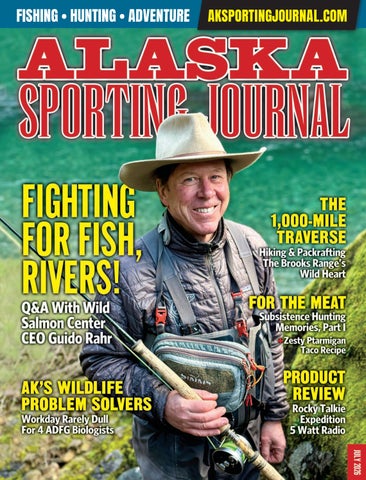
MEDIA INDEX PUBLISHING GROUP 941 Powell Ave SW, Suite 120 Renton, WA 98057 (206) 382-9220 • Fax (206) 382-9437 media@media-inc.com www.media-inc.com ON THE COVER Wild Salmon Center president and CEO Guido Rahr has spent his professional career protecting the rivers and fish he’s always felt a connection to. “My father told me that every outdoorsman has been given a gift to behold,” he explains in an interview (page 28) about conservation and Alaska fishing memories. (GUIDO RAHR) CORRESPONDENCE X@AKSportJourn Facebook.com/alaskasportingjournal aksportingjournal.com Email ccocoles@media-inc.com
INFORMATION SERVICES MANAGER Lois Sanborn ADVERTISING INQUIRIES media@media-inc.com
Fish Alaska’s Epic Float Fishing Rivers Experience the difference with over 30 years of expert-guided trips on Alaska’s premier rivers!
Book Kanektok | Arolik | Alagnak | Goodnews & More Today Comfortable Camp ~ World-Class Fishing!
www.akrainbow.com | 907-357-0251 | info@akrainbow.com 14
ALASKA SPORTING JOURNAL
JULY 2026 | aksportingjournal.com
4
C
TO CATCH FISH YOU NEED TO GO TO WHERE THEY ARE!
FULL LIMITS ON KINGS, SILVERS, HALIBUT, LINGCOD & MUCH MORE! BRITISH COLUMBIA, CA
SCAN TO SEE OUR VIDEO
“BRING YOUR LARGE COOLERS. YOU WILL NEED THEM WHEN YOU FISH WITH US!”
JULY 2026 SPECIAL
WE ALSO HAVE SPECIALS for B ring Y our O wn B oat Fishing/Catching
Lodging 4 PERSON DRIVE-IN FISHING/CATCHING •• 43 Nights Full days of Guided Fishing / Catching
Halibut, Lingcod & MORE CHARTER $2,100 ea. US •• Salmon, All your meals from our large restaurant menu MUST BE BOOKED BY JULY 30 W/ 20% DEPOSIT TO GET THIS SPECIAL PRICE
250-287-1394
BOOK YOUR CANADIAN FISHING/CATCHING ADVENTURE NOW! info@westviewmarina.com | westviewmarina.com
CONTENTS
VOLUME 16 • ISSUE 1
46
NEVER A DULL MOMENT
(ALASKA DEPARTMENT OF FISH AND GAME)
Tiffany Herrington continues her series on some of the state’s unsung heroes by introducing us to four Alaska Department of Fish and Game biologists whose jobs serve up a cavalcade of fascinating wildlife assignments. “You never really know what the day is going to turn into,” Kodiak elk wrangler Nathan Svoboda tells her. “That’s what keeps it interesting.”
FEATURES
ALSO IN THIS ISSUE
28
19
KEEPING RIVERS, FISH WILD Last month, we featured a new documentary film, Running Wild: Return to the River, coproduced by the Wild Salmon Center, including an appearance by its president and CEO Guido Rahr. And this month we wanted to share some of Rahr’s Alaska fishing affection. During our wide-ranging interview, Rahr talked to us about fishing the pristine waters of Bristol Bay as well as detailed some of his bucket-list rivers in Alaska and beyond.
23 27 38
Editor’s Note: Celebrating America’s birthday with a D-Day tour in Normandy The Alaska Beat: News and notes from around the Last Frontier Outdoor Calendar A father-daughter traverse of the Brooks Range
59
HUNTING FOR SUBSISTENCE (PART I) Scott Haugen dusts off his memory lane once again with more stories from his days in Point Lay and Anuktuvuk Pass, places where grocery store runs take place about once every nine months. Living off the land is commonplace, and Haugen recalls some of his memorable subsistence hunts in the first of a two-part series about the importance of the caribou and other critters that locals rely on for full freezers and plenty of organic cuisine.
67
STAY IN TOUCH, STAY ALIVE Cell phone coverage is pretty good these days, but there are still places with no signal, and that’s just where you’ll find hardcore backcountry sportsman Haugen prowling. With safety and peace of mind front and center, he shares his favorite new walkie-talkie device, while in her portion of their From Field to Fire column, wife and chef Tiffany Haugen serves up a great summer party favorite, upland bird tacos made with tasty ptarmigan.
Alaska Sporting Journal is published monthly. Call Media Inc. Publishing Group for a current rate card. Discounts for frequency advertising. All submitted materials become the property of Media Inc. Publishing Group and will not be returned. Copyright © 2026 Media Inc. Publishing Group. All Rights Reserved. No part of this publication may be copied by any means, electronic or mechanical, including photocopying or recording by any information storage or retrieval system, without the express written permission of the publisher. Printed in U.S.A. 16
ALASKA SPORTING JOURNAL
JULY 2026 | aksportingjournal.com
EDITOR’S NOTE
The editor’s trip to France included an emotional tour of Normandy’s D-Day sites. It hit home hard considering the United States will celebrate its 250th anniversary on July 4, an event made possible in part by these World War II heroes. (CHRIS COCOLES)
CAEN, France–If I came to Paris for tennis, my heart for this trip would be left not in San Francisco – though that’s the airport I flew from – but here in Normandy. My solo trip to France was primarily for the aforementioned Paris Grand Slam tournament, the French Open, known as Roland Garros by the Parisians and other locals. (I now have been able to attend each of the four major pro tennis events, including the US Open, Australian Open and London’s Wimbledon Championships.) But the highlight of this vacation was a two-day side trip to Caen, a major city in the region where the Allies’ D-Day invasion in June 1944 would eventually liberate France and the European continent from the Axis Powers. I took a train from Paris to Caen a week before the 82nd anniversary of D-Day on June 6. There I toured many of the sites
that defined that great and terrible day, which itself was just the start of the twoplus-month-long Battle of Normandy. Seeing it just a month before our own country’s 250th birthday moved me to lots of swirling emotions.
I met my day-long tour companions, guide Andrea and driver Alan, at the Mémorial de Caen museum. And it was my good fortune that no one else signed up for the tour on that day, so I had the van and my hosts’ attention all to myself.
aksportingjournal.com | JULY 2026
ALASKA SPORTING JOURNAL
19
The editor with his tour guides Andrea and Alan in front of the Mémorial de Caen. (CHRIS COCOLES)
20
ALASKA SPORTING JOURNAL
On a gorgeous and warm sunny Saturday, we drove through tranquil rolling hills and green fields, seemingly peaceful ground that actually saw some of the fiercest fighting of World War II. Especially on the morning portion of my tour without many fellow tourists, I had sites such as the Bény-sur-Mer Canadian War Cemetery and, to a lesser extent, the British Normandy Memorial virtually to myself. In the van and on the grounds, Andrea regaled me with lots of fascinating backstories of the invasion. When she encouraged me to take a walk on my own, I was at times overwhelmed by the setting. After a delicious lunch back in Caen, we took in the American sites, Pointe du Hoc, where United States Army Provisional Ranger Group troops scaled the cliffs and broke through German defenses; the sacred sand of Omaha Beach, which I quietly strolled on with no more than a few dozen people and some frolicking dogs also taking it in; and finally, the Normandy American Cemetery, the final resting place for 9,389 Americans, most of whom participated in Operation Overlord.
JULY 2026 | aksportingjournal.com
Back in Caen, I said my goodbyes to Andrea and Alan and returned the next day to tour the museum before catching my train back to Paris. The City of Lights proved to be worth its reputation, from checking the tennis bucket-list destination off my list to other Parisian attractions and neighborhoods I explored. But Normandy had me wondering why it took me so many international trips before finally walking these hallowed spots – a journey made more meaningful since it was shortly before America’s milestone moment on Independence Day. I’m expecting July 4’s firework-induced noise to stress out my dog and surely spawn the all too expected political grandstanding from Washington, DC, but I will also have a newfound appreciation for the sacrifices that were made during the D-Day invasion to ensure we can celebrate freedom. When I texted a buddy some photos of my day in Normandy, he had the quintessential reply. “Aren’t you glad they made that invasion so we didn’t have to.” -Chris Cocoles
(CAPTAIN/CREWED CHARTERS)
Charter Fishing For Salmon And Halibut
Near Juneau, Southeast Alaska.
Whale Watching Trips Also available.
“BE YOUR OWN CAPTAIN” EXPERIENCE
Juneau Boat Rentals Bareboat rentals
JuneauCharters.com • info@juneaucharters.com • 907-723-8472
Your one-stop destination for self-guided saltwater fishing adventures in Sitka, A laska. We offer comprehensive packages that include lodging, fully equipped rental boats, rods, reels, tackle, downriggers, depth finders, VHF radios, GPS, marine charts, safety gear, and more.
Book Today! w w w . f i s h b a ra n o f . co m
|
9 0 7- 7 3 8 - 9 0 9 0
|
f i s h b a ra n o f @ g m a i l . co m
ANOTHER ARCTIC GAS LEASE SALE SEES SPARSE INTEREST
A
s the Trump Administration pushes to drill within once protected Arctic National Wildlife Refuge, lease sales continue to draw only lukewarm interest from the petroleum industry. A little more than a year after one such lease sale drew zero bids, the Department of the Interior excitedly touted an early June sequel, but in the end only saw a slight uptick in interest. Of 58 available tracts, only five received bids and from just two companies, with a total of $3.7 million involved. Still, a Bureau of Land Management press release headline trumpeted the “First Successful Coastal Plain Oil and Gas Lease Sale Under Working Families Tax Cuts Act.” “Today’s lease sale underscores the vision that both industry and government share about the viability of development in the Coastal Plain,” BLM Alaska state director Kevin Pendergast said in the release. “Alaska is a bedrock of America’s energy security, and this sale will bolster the state’s economy and ultimately lead to additional energy production.” Opponents of the sales were quick to point out the lack of enthusiasm from oil companies. The “results of the lease sale speaks for itself,” said Kristen Moreland, executive director of Gwich’in Steering Committee. “Yet again, no major oil and gas companies showed up to bid, because they know that drilling in the Arctic Refuge is a losing proposition.” Moreland vowed that her organization “will continue to fight the Trump Administration’s leasing program.” The land in question is home to the Western Arctic Herd of caribou and other subsistence resources locals have depended on for generations. Ryan “Cal” Callaghan, president and CEO of Backcountry Hunters & Anglers, said in referring to the lands and waters around Arctic NWR, “Hunters, anglers, recreators, and outdoorsmen of all types look to our public lands for opportunities available nowhere else in the world.” “Despite a lack of broader industry interest, the Alaska Industrial Development and Export Authority and Hex Energy LLC are gambling with our nation’s invaluable public resources,” he added. “The refuge supports iconic wildlife, world-class hunting and fishing opportunities, and migratory birds that travel from every corner of the planet. These public lands are meant to be enjoyed by all Americans, not reserved for the interests of a select few.” With just 70,000 of 700,000 acres bid on, the relative lack of buzz this latest sale generated made for an easy target. “Most Americans want the Coastal Plain protected, not sold to the highest bidder,” said Earthjustice attorney Hannah Foster. “A reckless few should not be allowed to destroy this sacred place to line the pockets of oil companies.”
ALASKA BEAT SOCIAL MEDIA POST OF THE MONTH
A Southeast Alaska hunter harvested a mule deer, the first such recorded kill after years of reported sightings of the non-native species around the Last Frontier.
NOTABLE NUMBER
1,000
The Hulahula River, part of Arctic National Wildlife Refuge, could breathe a sigh of relief after just two petroleum companies bid on five of 58 available tracts at a federal lease sale in early June. “Most Americans want the Coastal Plain protected, not sold to the highest bidder,” said Earthjustice attorney Hannah Foster. (DANIELE BRIGDA/US FISH AND WILDLIFE SERVICE)
An Alaska Department of Fish and Game proposal, in partnership with the Salcha-Delta Soil and Water Conservation District, would clear 1,000 acres of forested land within the Delta Junction Bison Range to improve forage opportunities for the herd. aksportingjournal.com | JULY 2026
ALASKA SPORTING JOURNAL
23
“
THEY SAID IT “This program works to protect salmon habitat by working cooperatively with land managers and landowners who may be experiencing erosion or habitat degradation on their property. These issues can be common in heavy-use areas such as the Chena, Salcha and Tanana River. We aim to promote landowner engagement by providing information and funding for the use of fish-friendly erosion control techniques. By making bioengineering solutions more readily available, the outcome is a win-win situation for both the people and the salmon who utilize these areas.”
”
-Habitat biologist Jessica Johnson on the July 15-16 Streambank Rehabilitation Workshop in Fairbanks.
FROM THE ASJ ARCHIVES – JULY 2015
THE LAST ALASKANS SAVORED BEING OFF GRID
(VALDEZ FISH DERBIES)
H
eimo Korth and his clan are among a couple handfuls of families still allowed to maintain residency on Alaska’s lonely – that’s lonely, even for Alaska’s standards – Arctic National Wildlife Refuge, featured on Animal Planet’s rookie series, The Last Alaskans. “This is an adventure; this is joy. You’re bound to nature; nature directs your path,” Korth says during the first few minutes of the show’s premiere episode. “I mean, that’s the way that man has been for nearly three million years. In the land we live in you’re part of the food chain. The only pressure you and all the animals have here is keeping yourself alive.” In 1980, Congress banned new human occupation in ANWR, which at 113 million acres is about the same size as South Carolina. The owners of seven cabins on the refuge were allowed to continue residing there until their direct living descendants pass away, whenever that time comes. Most don’t spend the entire year there – the Korths spend a few months out of the year at a cabin in Fort Yukon in the Alaskan Interior, but they trap and hunt through the fall to have enough food to get through the winter. It can be dangerous, regardless of how many months are spent on the refuge. Korth and his wife, Edna, know all about how fragile life can be in their rugged northeast corner of Alaska, where your nearest neighbor can be hundreds of miles away. Thirty years ago, the Korths lost a child in a river accident when she was 2. It was the kind of unthinkable and horrific tragedy that could destroy a family’s resolve to live in such a primitive setting. But Heimo and Edna and the others who remain on this beautiful but dangerous refuge – residents share their land with polar bears, brown bears and wolves – are filled with resolve, not regret. And it’s the kind of fend-for-yourself approach they chose compared to past generations with no such choice. “If you think about it, any anthropologist will tell you man has been the nomadic hunter for far, far longer than he has farmed in the world,” Korth said. “I guess I feel like me and my wife were kind of keeping up the tradition; I shouldn’t say tradition, but should just say (keeping up) a way of life – with the human population growing – that is dwindling. I’m glad that we live like that, and I’m proud of it.” -Chris Cocoles
How good can Alaska fishing be? So good that two Valdez Halibut Derby anglers can catch leaderboard-changing fish on the same boat and same day, as Steve Hylton of Boise, Idaho, and Paul Sherrell (below) of Port Aransas, Texas, did with a pair of triple-digit flatties hooked within minutes of each other off the Hofshore on June 12. A third angler also landed a 100-plus-pounder that day. “I’ve never been on a halibut boat that caught that many big ones in a day,” Hylton, a veteran Alaska halibut angler, told Valdez Fish Derbies.
(VALDEZ FISH DERBIES)
24
ALASKA SPORTING JOURNAL
Heimo Korth found a new calling sharing what it’s like to be one of the few residents of Arctic National Wildlife Refuge, as chronicled on Animal Planet’s 2015-19 series The Last Alaskans. (ANIMAL PLANET)
JULY 2026 | aksportingjournal.com
TROPHY MOOSE & BEAR HUNTING Alaska’s Premier Fully Guided River Hunts
MORE THAN A HUNT This is an unforgettable Alaskan adventure that blends raw wilderness, world-class game, and the thrill of pursuing some of North America’s most iconic animals in their natural environment. Long days on the river. Close encounters. The kind of moments you’ll talk about for the rest of your life.
WHY HUNT WITH US • Trophy moose & bear hunts in prime river systems • Regular 60”+ bull moose opportunities • Near-100% opportunity rate on legal bulls • High success on large Alaskan bears • Fully guided & all-inclusive hunts • Expert guides with deep local knowledge • Carefully selected locations for consistent results • 11–15 day hunts with 15-day combo moose & bear hunt available Every hunt is carefully planned and professionally guided from start to finish. From scouting and calling to field care and logistics, your guide handles every detail so you can stay focused on the hunt.
BOOK YOUR ALASKAN TROPHY HUNT! Contact us today to secure your hunt and discuss available dates. www.alaskaeliteoutfitters.com 218-434-0068 • 907-464-6165 mike@alaskaelieteoutfitters.com
Everything we sell, we fish ourselves
fishermansgold.com
Offering the highest quality fishing weights and jigs
Use code FISHING10 for 10% OFF
OUTDOOR CALENDAR JULY 1 ■ 2026-27 hunting regulations take effect JULY 4 ■ Mount Marathon Race, Seward (mountmarathon.com) JULY 17-18 ■ Copper River Salmon Jam, Cordova (salmonjam.org) JULY 25 ■ Start of Valdez Silver Salmon Derby (valdezfishderbies.com/silver-derby)
■ Valdez Kids’ Pink Salmon Derby (valdezfishderbies.com/kids-derby) JULY 31 ■ Valdez Big Prize Friday (valdezfishderbies.com/silverderby/big-prize-fridays) AUGUST 1 ■ Deer and goat seasons open in Game Management Unit 1 (Southeast Mainland) ■ Deer season opens in GMU 2 (Prince of Wales Island)
■ Wolf season opens in GMU 3 (Petersburg/Wrangell) ■ Goat season opens in GMU 4 (Baranof Island) ■ Deer season opens in GMU 4 (Chichagof Island east of Port Frederick and north of Tenakee Inlet) ■ Goat season opens in GMU 5 (Yakutat) AUGUST 7-9 ■ Golden North Salmon Derby, Juneau (goldennorthsalmonderby.com) AUGUST 8 ■ Valdez Women’s Silver Salmon Derby (valdezfishderbies.com/ womens-derby) AUGUST 8-16 ■ Seward Silver Salmon Derby (seward.com/salmon-derby) AUGUST 19-21 ■ Ted Stevens Kenai River Classic (krsa.com/program/classic) AUGUST 28-SEPTEMBER 6 ■ Valdez Salmon Slam Tournament (valdezfishderbies.com/tagged-fishcontest)
For more information and season dates for Alaska hunts, go to adfg.alaska.gov/index .cfm?adfg=hunting.main. The Valdez Silver Salmon Derby begins on July 25 and features a $10,000 cash prize for the largest fish. The event runs through September 6. (VALDEZ FISH DERBIES)
aksportingjournal.com | JULY 2026
ALASKA SPORTING JOURNAL
27
Guido Rahr, president and CEO of the Wild Salmon Center, is based in Oregon, but he’s just as passionate about the fisheries of Alaska as he is protecting the waters of the Pacific Northwest. (GUIDO RAHR)
28
ALASKA SPORTING JOURNAL
JULY 2026 | aksportingjournal.com
PROTECTING RIVERS, FISH, LEGACIES WILD SALMON CENTER’S GUIDO RAHR ON CONSERVATION, ALASKA PASSIONS
BY CHRIS COCOLES
L
ike most trout and salmon anglers, Guido Rahr loves a heartwarming river restoration project. “The satisfaction from fishing a river that you’ve worked so hard to protect, there’s nothing like it. It’s a wonderful feeling,” the Oregon native says. “And when I’m an old man at the side of the river drinking a flask of bourbon or something, I can think, ‘I actually did something in my life.’” And it’s been quite a life of ensuring that many of the same fisheries Rahr has cherished have been part of his life’s work. He’s now the president and CEO of the Portland, Oregon-based Wild Salmon Center. Last issue we featured the documentary film Running Wild: Return to the River, which Wild Salmon Center coproduced and Rahr served as its technical advisor. “If we want beautiful rivers alive with all the species that salmon depend on, protecting these wild fish is critical,” Rahr said in a press release introducing Running Wild. He also appears in the project, fishing alone on British Columbia’s pristine Dean River. In a voiceover, Rahr says, “Nature was my refuge when I was young.” “The fight to protect a river is extremely fulfilling. It’s not drudgery. There are moments of great triumph and then moments of defeat. But it’s important work that has value and is essential,” he tells us. Rahr also has a spiritual connection with Alaska, from both fishing its iconic waters and spending a career working to protect them and other fisheries for generations to come, including for his three fishing-crazed sons. Rahr – his first name is pronounced the German way (GEE-do) – talked to us about making fishing memories in the Last Frontier, his passion for maintaining and recovering wild salmon and steelhead runs, as well as the places that he still wants to fish.
Chris Cocoles In your scene in the movie, you talked about how the outdoors, fishing, hunting and exploring were a big part of your early life. What can you share about those early days and how they shaped you into who you are today? Guido Rahr Tucker Malarkey wrote a book called Stronghold that’s about my work and my childhood stuff, so I share a lot of my stories in that book, but I grew up with a fly rod in my hand. That connection with nature and fly fishing dominates my life. My father told me that every outdoorsman has been given a gift to behold – in the case of an angler, to (savor) the privilege of visiting a beautiful (fishing spot), especially your home river, becomes an obligation. My father and grandfather were very active conservationists, so that’s something that I’ve told to my boys. Those two things go together.
CC How proud are you of the work that you’ve done at the Wild Salmon Center?
GR We just have been quite determined
aksportingjournal.com | JULY 2026
ALASKA SPORTING JOURNAL
29
to focus on a certain number of watersheds, and then to make a commitment that will go on potentially forever to protect them, and try not to get distracted outside of that. We’ve fought for all these challenges, stayed with it, tried to be smart and strategic, and we’ve basically fought hard-rock mining, hydroelectric development and logging in certain places, water withdrawals from streams, poaching in the Russian Far East, and we’ve won almost every single fight so far. And that can change tomor-
row, but we’ve learned how to deliver long-term conservation goals on the ground. And that’s extremely satisfying as an angler and a conservationist. And it’s hard work, and you’re not always going to win. We’ve been fortunate because we’re pretty good at what we do.
CC What is your Alaska background? GR Oh, I’ve been fishing up there since I was a teenager – mostly in Bristol Bay. And there’s just nothing like it. And we’ve been super involved in the Pebble Mine.
Rahr, here with a steelhead he caught on California’s Smith River, has plenty of Alaska memories, particularly in the Bristol Bay region, which his organization continues to work to protect from any mining projects. “For us, what works is taking the long view,” he says. (GUIDO RAHR) 30
ALASKA SPORTING JOURNAL
JULY 2026 | aksportingjournal.com
That’s dominated our organization for the last 10 years. And I’m feeling good about Pebble right now. This administration is really against developing that mine, which is good. But I’m very concerned about the 1.2 million acres of land in Bristol Bay just downstream from the mine site that are BLM lands, and they’re a category in the BLM lands called the D-1 lands. They’ve been withdrawn from development since the 1970s. But now, the state of Alaska wants to open those lands up. It’s 28 million acres overall, but because of Alaska
CALL THE LODGE FOR AVAILABLE DATES
law, once they open those up they can not be protected again by a subsequent administration without an act of Congress, so that is a real threat. Those 1.2 million acres in Bristol Bay, if they open that up, that can create a whole new mining area. So we’re not done on Bristol Bay; there’s still a lot more work to do. There’s also state legislation to protect the state’s lands. The goal is to get all those lands protected in Bristol Bay and make that a stronghold forever for wild salmon. It’s the most productive salmon ecosystem in the world.
Rahr addresses the crowd at a Seattle screening of the Wild Salmon Center’s new documentary Running Wild: Return to the River. “Through this film, we are hoping to build people’s connections to – and their dedication to – salmon and rivers,” he says. (CHRIS COCOLES)
CC What’s it been like to fish in such a wild place?
GR It’s dramatic, because usually you’re fishing in close proximity to these bears.
And sometimes maybe a couple of rod lengths, and you’re not looking for those situations. You’re really sharing the river with the bears, and what’s happening is you have all these sockeye spawning and then the rainbows below. They’re very hard to see in the water column because their camouflage is so good. You’re fishing egg imitations drifting down below where the salmon are spawning, and those rainbows are big and strong; they really pull. And that’s punctuated by out of the corner of your eye you see a 600-pound bear walking down the bank towards you. And you have this dilemma, “How badly do I want to catch that rainbow?” And that means I usually keep fishing [laughs]. It’s like being at Pleistocene Park. And there’s so much fauna there. Even when you look down at the river from the plane you see moose; sometimes you’ll see wolves, caribou. It’s like all the pieces of the puzzle are still there. How many places can you go where everything is still there?
CC What about your experiences fishing and working in Asia?
GR Russia was like going back in a time ma-
Rahr made it a point to get his three sons involved in the outdoors, and now they share the joy of hunting and especially fishing. “Fortunately they all loved to fish,” he says. “I’ve been blessed that they loved that.” (GUIDO RAHR) 32
ALASKA SPORTING JOURNAL
JULY 2026 | aksportingjournal.com
chine. I went to Russia when (the former communist country) opened in the early 1990s with the first people who went over there. And I’ve been back multiple times for 20 years and I explored a lot of those rivers. Some of them have never been floated before. We worked with the Russians to set up protected areas in some of the most extraordinary rivers.
We are a rafting and fly fishing guide service based in Willow, Alaska, with more than 20 years of experience on the rivers of Southcentral Alaska. We offer road-accessible day trips as well as fly-out, multi-day adventures for those seeking a more remote fishing experience. Our team is made up of highly skilled, experienced guides who are passionate about Alaska’s rivers and dedicated to providing a safe, professional, and enjoyable trip on the water.
e We’ll s e you on t he riv
! er
BOOK YOUR TRIP TODAY! www.akwildriver.com
When you go over there it’s like Oregon was 200 years ago, and it’s a little bit different than Alaska. Ecologically, the northern part of the (Kamchatka Peninsula) is more similar with tundra and stone birch. But it is like literally going back in a time machine and seeing what a completely pristine landscape looks like. And Kamchatka has 30 active volcanoes. I’ve landed in Petropavlovsk and smelled the sulfur in the air from the cockpit. One time I was fishing in a river called the Zhupanova on a sunny day, caught and released this beautiful 23-inch rainbow, looked up and saw a brown bear walking up the bank and then heard what sounded like a thunderclap. I thought, “How could there be a thunderclap? It’s sunny out.” But I looked up and there was the top of a volcano erupting at the same moment: the volcano, the brown bear and the rainbow.
CC Is there an Alaska bucket-list item you still want to do?
GR Oh boy. I’ve always wanted to fly fish the Kanektok (River) – swing that for summer Chinook; I’ve never done that. I’d like to fish the Sandy and those rivers in the Aleutian chain. Those are two places, and I’d love someday to fish for sheefish in northern Alaska. That would be really cool.
CC Even with the success everyone has
Rahr’s work with the Wild Salmon Center stretches from Alaska down the Pacific coast and across the ocean to Russia. “We’ve won almost every single fight so far. And that can change tomorrow, but we’ve learned how to deliver long-term conservation goals on the ground,” he says (GUIDO RAHR) 34
ALASKA SPORTING JOURNAL
JULY 2026 | aksportingjournal.com
had to keep the Pebble Mine blocked, I guess it’s a never-ending Alaska crusade to continue the fight given the Ambler Road controversy and the threat of logging in the Tongass National Forest. GR For us, what works is taking the long view and to realize that there are three things we need to do on these rivers. One is protect as much habitat as we can while we can, and then over time to keep strengthening the habitat. Second is to ensure that the rivers are managed with wild fish, and Alaska is pretty good that way. What you don’t want to have happen is on a river like the Yukon or some other river, where you have a couple bad years and then someone in the legislature says, “Let’s build a fish hatchery.” And that’s not going to fix the reason why the river went (bad). Then you suddenly have the wild fish competing with the hatchery fish. Fortunately, Alaska sees its future when
they don’t need hatcheries for most of their rivers. And then the third piece is to make sure there are local groups that will really fight hard to defend those rivers, and so then they’re ready for the next generation of threats. So, it’s so much easier to get ahead of those and to prevent those from happening than it is to come in after the big, scary project is underway, and then you’re fighting this huge, well-financed corporation. Sometimes, like Pebble, you’re in that situation anyway. But if you think long-term about this key question, “What’s it really going to take so we can deliver this system like it is for our kids?”, that leads to the strategy of “Let’s try to get ahead of the next generation of threats so the local groups can be like an immune response and find it.” ... We are not against all development; we are just focused on preventing largescale development that would permanently degrade the ecological health of the strongholds.
CC Did you have a welcome-to-Alaska moment?
36
ALASKA SPORTING JOURNAL
GR I was 14 with my dad and we were at Bristol Bay Lodge when it was run by Ron McMillan. And I grew up as a trout fisher, but I never knew until I hooked my first salmon, and it was a chum salmon. I’d never felt anything that powerful. And as any angler, it was like, “Oh my gosh; I can’t handle this fish. I didn’t know they could do this.” And being in that country with those rainbows, they were really strong rainbows. It just recalibrated my piscatorial set of goals and passion. There was no going back.
CC Is there also a worldwide bucket list that you want to achieve?
GR There’s a river to the north of the Tugur River in the Russian Far East, and it’s got the giant taimen and is called the Uda. And just before they shut off Russia for Westerners, I was over there in 2019 and we helicoptered over on a really dicey trip over these mountains and in and out of the clouds. We had to stop and wait for openings in the weather, and we finally got to this river and we just didn’t know where to start. The section we chose to float was not that
JULY 2026 | aksportingjournal.com
great. I hooked one big fish that broke me off on the strike [laughs]. But I have some unfinished business on the Uda. And there are other rivers I really want to fish. I really want to catch a big sea-run taimen in the Sea of Japan. I’ve never gotten a big one on the fly. Other bucket lists: I’d love to fish the Yokanga River on the Kola Peninsula for big Atlantic salmon. I’d love to someday fish for golden dorado in the tropical rainforest.
CC Did you get your kids [Rahr and his wife have three sons] involved in the outdoors right away? GR It’s what we did together – mostly fishing, but hunting too. And fortunately they all loved to fish. I’ve been blessed that they loved that. They liked being with their dad – most of the time [laughs]. I generally fish alone, and when I’m not fishing alone, I fish with my boys. ASJ Editor’s note: For more on the Wild Salmon Center and to donate to their causes, go to wildsalmoncenter.org. Follow at instagram .com/wildsalmoncenter.
Do It Yourself
907.440.9510
Customize Your advenure in south Central alaska book your tour: fishwhittier.com
rent from our selection of boats so you can explore the Prince William sound on your own!
Fishing Charters, Whale WatChing, glaCier tours
reserve your own boat:
alaska-boat-rentals.com
aksportingjournal.com | JULY 2026
ALASKA SPORTING JOURNAL
37
THE 1,000-M TRAVE
A FATHER-DA
Caribou are just a small part of the vast wilderness of the Brooks Range, which author Bjorn Dihle’s brother and niece, Luke and Kiah Dihle, experienced to the fullest on a 1,000-mile traverse via hiking and packrafting. (KIAH DIHLE) 38
ALASKA SPORTING JOURNAL
JULY 2026 | aksportingjournal.com
-MILE L VERSE
THER-DAUGHTER BROOKS RANGE JOURNEY
BY BJORN DIHLE uke and Trish Dihle were pregnant with their first child when they moved to Fairbanks in 2003. Not long after their daughter Kiah was born, Luke began hunting caribou in the Brooks Range. The October after Kiah was born, he made his second hunt in the Arctic. There were big bulls around, but since it was the rut, he harvested a young bull so the meat wouldn’t be gamey. The solitude and quiet was like nothing he’d experienced. Watching caribou move effortlessly through the snow and the aurora streaming across the night sky left a visceral impression on him. Luke studied the mountains to the west and wondered what lay beyond. The deep cold was coming and he thought about what that meant for life to survive. Back at home, that caribou accounted for some of Kiah’s first solid food. Maybe it was the diet of caribou, bear, deer, mountain goats and salmon, or maybe she’s just geared that way, but Kiah grew up with a deep reverence for wild places and hunger for adventure.
aksportingjournal.com | JULY 2026
ALASKA SPORTING JOURNAL
39
A WILD DREAM Life is short and kids grow up too fast. Despite his moving back to Southeast Alaska to raise his family, the Brooks Range remained one of Luke’s favorite places. When Kiah graduated from high school in 2021, he decided to take her on a two-week hiking and packrafting trip in the central Brooks. This sort of a trip was the first of its kind for Luke. In the past, he used his time off to focus on hunting. He included his three daughters whenever he could. By 18, Kiah had taken Sitka blacktails, caribou and even a mountain goat. Making a trip that did not involve hunting felt strange at first, but that adventure left a big im-
Luke and Kiah spotted wolf tracks along the Noatak River. (KIAH DIHLE)
While the bears the Dihles encountered along the trip really weren’t fazed by their presence, a more aggressive bull muskox that came close to a campsite did provide some nervous moments. (KIAH DIHLE) 40
ALASKA SPORTING JOURNAL
JULY 2026 | aksportingjournal.com
pression on both Kiah and Luke. They didn’t encounter another person during the time they spent in one of the most beautiful places either had ever been. Luke and Kiah dreamed of returning to the Brooks Range for a bigger adventure. They kicked around different ideas, but with both subscribing to the philosophy that we should make the most of life with the time we have, they decided on a full east-to-west traverse. This roughly 1,000-mile journey from the Canadian border to the town of Kotzebue on the Chukchi Sea is a daunting dream and involves no shortage of headaches and sacrifices to make come true. In early June 2025, Luke and Kiah,
crammed in a small plane with a handful of food drops, flew from Fairbanks to the eastern edge of Alaska’s Arctic. Both are prone to motion sickness. “The pilot was really impressed with how Kiah would be chatting with him like nothing was wrong right up to the moment she puked,” Luke said.
THE BIG WALK The mountains and tundra were just coming to life after the long Arctic winter. One of their first nights, they were at their camp high in the mountains, the sun hanging low on the horizon, when they heard a clicking sound. A caribou’s ankle tendons make a snapping sound as
it travels. Soon, a herd of caribou came so close Luke and Kiah could have almost reached out and touched the animals. Another day, while they hiked over a mountain pass, they almost ran into a bull caribou traveling the opposite direction. The first week of their journey passed like a wilderness dream, but then Luke injured his ankle. He was humbled by the realization that he might not be able to continue. He struggled on, watching in admiration as Kiah stepped up to carry more weight and boost morale. It took a few weeks of bad limping before Luke’s ankle stabilized enough that he thought he could complete the trek. The bugs awoke with a vengeance,
The vistas you’ll experience on a Brooks Range adventure are spectacular. (KIAH DIHLE) aksportingjournal.com | JULY 2026
ALASKA SPORTING JOURNAL
41
but it didn’t faze either of them. The miles were filled with simplicity punctuated by encounters with grizzlies, wolves, caribou, Dall sheep and other wildlife. The mountain scenery alternated between beautiful and extremely beautiful. Luke has lived all his life in Alaska, except for five years in Montana. The Brooks Range, he says, is next-level wild even by Alaska standards. “It’s basically the same since the last ice age. The feeling you get up there. The lack of noise. Being connected to the old people. The wildness. I’ve never felt
those things as strongly as I do in the Brooks,” Luke said. After a month of hiking, they made it to the Dalton Highway, which is roughly the halfway point of the traverse. There, they met Trish and their second-born daughter, Adella. The two had traveled from Southeast Alaska with gear, food and inflatable kayaks for the last portion of the journey. They drove to Coldfoot and left boats and supplies with Coyote Air to be flown to the headwaters of the Noatak River at the end of July. After crossing the Dalton Highway,
The traverse took two months, but almost ended early after Luke injured his ankle. But he soldiered on with a bad limp as Kiah took on extra weight. (KIAH DIHLE)
42
ALASKA SPORTING JOURNAL
JULY 2026 | aksportingjournal.com
Luke and Kiah hiked through the mountains of Gates of the Arctic National Park and Preserve. Occasionally, they had a tricky river crossing, but travel was easy for the most part. The mountains became less rugged the farther west they went. Haze from fires hung over the tundra as they passed from one valley to the next. The last mountain pass they crossed led from the Alatna River to the Noatak River valley.
FLOATING TO THE CHUKCHI SEA At the headwaters of the Noatak River,
they were relieved to see that no bear had messed with their boats and gear, but they hadn’t been on the river for long before they came face to face with a bear guarding its fishing hole. Chum salmon were running, and bears had come from far and wide to feast. Despite Arctic grizzlies having a reputation for being “inquisitive” and sometimes surly, they didn’t encounter an aggressive bear during their entire journey. The only spooky encounter Luke and Kiah had with wildlife came as a surprise. One night they pitched their tent on a grav-
el bar above the Noatak River. Not long after, a big bull muskox came out of the willows and strolled into camp looking for a fight. The tense standoff lasted for several minutes before the beast moved off. Luke and Kiah had expected the river to be the easiest part of their trip, but their 400 miles on the Noatak turned out to be the hardest. They were running out of time and had to paddle long hours, often into big headwinds. Still, the beauty of the river as it wound through the mountains and adjoining tundra of the northern Brooks Range
left father and daughter hoping the adventure would never end. It was bittersweet when they beached their boats on the shore of Kotzebue Sound and reached the end of the journey. “Mostly I just felt thankful to have the time in the Brooks with my daughter,” Luke said.
TROUBLE IN PARADISE It took Luke and Kiah two months to cross the Brooks Range, the wildest stretch of public land we have left in America. After they returned home
aksportingjournal.com | JULY 2026
ALASKA SPORTING JOURNAL
43
“It’s basically the same since the last ice age,” Luke observes. “The feeling you get up there. The lack of noise. Being connected to the old people. The wildness. I’ve never felt those things as strongly as I do in the Brooks.” (KIAH DIHLE)
late that summer, the proposed Ambler Road positioned itself at the forefront of public land battles. Luke is strongly opposed to the project. The 211-mile industrial corridor, designed to support the development of an unknown number of foreign-owned mines, would negatively impact the wild character of the Brooks. Luke points out how fast public land is being eaten up and how there is very lit-
tle true wilderness left to experience. “Sure, development is needed, but God only made so much earth. Once it’s manipulated or destroyed it’s not coming back anytime soon. Ambler seems like a no-brainer. It’s not worth it,” Luke said. “It’s hard to swallow that the last best wilderness could be lost to foreign interests. Even if you don’t ever get to go to the Brooks Range, it’s going to steal
With the Ambler Road project closer to becoming a reality, Luke has become melancholy. “Even if you don’t ever get to go to the Brooks Range,” he says, “it’s going to steal something special from all of us who like to hunt, fish and wander wild places.” (KIAH DIHLE)
44
ALASKA SPORTING JOURNAL
JULY 2026 | aksportingjournal.com
something special from all of us who like to hunt, fish and wander wild places.” ASJ Editor’s note: This piece was originally published by Hunters & Anglers for the Brooks Range. To learn more, visit huntfishbrooksrange.com. Order author Bjorn Dihle’s books at amazon.com/stores/Bjorn-Dihle/ author/B01N2KAFAC?ref=ap_rdr&shoppingPortalEnabled=true.
EMBARK ON AN
UNFORGETTABLE ADVENTURE!
At Jake’s Saltwater Adventures, we offer unforgettable fishing and bear viewing trips tailored to your wildest dreams!
Mention this ad to receive 20% OFF any charter between May 16th and June 10th along with any bear viewing trips on Tuesdays and Wednesdays throughout the Summer!
Homer, AK
jakessaltwateradventures@gmail.com • 507-848-0609 Facebook Page Jake’s Saltwater Adventures
Website jakessaltwateradventures.com aksportingjournal.com | JULY 2026
ALASKA SPORTING JOURNAL
45
STEWARDS OF WILD ALASKA
MEET FOUR DEPARTMENT OF FISH AND GAME BIOLOGISTS MANAGING THE STATE’S MOOSE, BEARS AND MORE
Editor's note: Alaska’s wildlife is sustained by a network of biologists, technicians and field crews working across some of the most remote and complex landscapes in North America. While hunters and residents see the results in the field and on the ground, much of the effort supporting those opportunities happens behind the scenes, in aircraft, field camps, offices and communities throughout the state. This installment of Alaska Sporting Journal’s unsung helpers of the wild series highlights four Alaska Department of Fish and Game wildlife biologists working in vastly different regions. From the Panhandle to the North Slope, these profiles offer a look at the people responsible for managing wildlife populations, navigating human-wildlife interactions and helping maintain the systems that keep Alaska’s wild places and the opportunities they provide intact. BY TIFFANY HERRINGTON
F
or a wildlife biologist in Alaska, the workday often unfolds unpredictably. There might be a call about a bear inside the Kodiak Landfill, a moose tangled in an Anchorage fence or a narrow break in the weather that finally allows biologists to launch a long-awaited aerial caribou survey. A pending storm may cancel those plans just as quickly. On the same day, wildlife biologists may be working from helicopters, small aircraft, boats or office desks, moving between field surveys, public outreach and decisions carrying real consequences for both wildlife and the people who depend on it.
FOR CHARLOTTE WESTING, AREA biologist for Game Management Unit 6 in Prince William Sound and the Copper River Delta, uncertainty simply comes with the territory. She often tells people she man46
ALASKA SPORTING JOURNAL
ages “anything with hooves or claws,” a shorthand description for a job involving everything from mountain goats and black bears to moose, deer and wolves spread across one of the wettest regions in the state. A typical day starts indoors, answering emails, talking with hunters or preparing logistics, but the real excitement begins when the weather finally breaks. “When it gets here, we hit the ground,” Westing said. “Once you’re in the field, it’s the dream work that you can’t believe you get paid for.” That field time comes with its own challenges. In coastal Southcentral Alaska, weather is not simply uncomfortable. “The weather here can kill you,” Westing said bluntly. Rain gear is packed in multiples, including what she jokingly calls her “commercial-grade” set, because staying dry is
JULY 2026 | aksportingjournal.com
Regardless of where they work in Alaska, state wildlife biologists rarely have a dull day while on the clock. Charlotte Westing, here helping to capture a Kobuk River caribou, says, “You’re trying to make the best decisions you can for both wildlife and people.” (ALASKA DEPARTMENT OF FISH AND GAME)
aksportingjournal.com | JULY 2026
ALASKA SPORTING JOURNAL
47
not just about comfort. It is about safety. “It’s the damp cold that gets you,” she said. “You can be soaked for days.” Long hours in wet brush, steep terrain and relentless rain are routine, especially during survey season, when narrow weather windows determine whether crews can fly at all. Still, Westing lights up talking about the field. Some days involve flying low over coastal peaks tracking mountain goats. Others mean glassing alpine terrain through rain and fog. “There’s nothing else I’d rather be do-
ing,” she said. Westing grew up in a family deeply connected to the outdoors, and she still carries a sense of awe about the places surrounding her. She described one black bear research project that followed how nutrients from salmon move from streams into surrounding forest ecosystems, shaping everything from vegetation to wildlife far from the water itself. “You realize everything out there is connected,” she said. “The salmon are feeding the mountains.” Even after years of doing the job, mo-
ments in the field still stay with her. She described watching the weather move across Prince William Sound from the air and seeing entire mountainsides disappear into fog while waterfalls poured toward the ocean below. “There are days where you stop and think, ‘I can’t believe this is my job,’” she said. Westing also spoke about the responsibility that comes with wildlife management and making decisions with incomplete information. “You’re trying to make the best decisions you can for both wildlife and people,” she said. “There’s an art to figuring out how to investigate those questions and interpret what you’re seeing in the field.”
Nathan Svoboda works with the mighty brown bears and other diverse wildlife of the Kodiak Archipelago. “You want to do right by the animals and the people who depend on these resources,” he says. “That’s always in the back of your mind.” (ALASKA DEPARTMENT OF FISH AND GAME) 48
ALASKA SPORTING JOURNAL
JULY 2026 | aksportingjournal.com
ON KODIAK ISLAND, AREA wildlife biologist Nathan Svoboda works in an environment where weather, aviation and daily priorities can change without warning. His responsibilities span the
In the urban environment of by far Alaska’s largest city, biologist Cory Stantorf responds to wildlife encounters that can include keeping track of a moose chowing down on a banana at a food bank (below) to helping remove a jar stuck on a black bear’s head. (ALASKA DEPARTMENT OF FISH AND GAME)
Kodiak Archipelago, where brown bears, elk, deer, mountain goats and caribou occupy rugged terrain shaped by storms, steep mountains and isolation. One morning may begin in a helicopter flying over remote country in search of radio-collared brown bears. Headsets crackle over rotor noise while biologists scan valleys and hillsides below, tracking signals and documenting cub survival in isolated portions of the island. “No day goes as expected,” said Svoboda, who recalled one day that started quietly with office work, reviewing a manuscript for publication and issuing bear hunting permits before wildlife troopers called about two deer that had fallen through the ice on a local lake. Suddenly, the day moved outdoors, gathering rescue equipment and navigating dangerous ice to pull the animals out safely. Not long after returning to the office, another call came in. This time, a brown bear had gotten into the landfill. “You aksportingjournal.com | JULY 2026
ALASKA SPORTING JOURNAL
49
can go from paperwork to complete chaos pretty quickly,” he said. Rather than frustrating him, that constant variation is one of the things he enjoys most. “You never really know what the day is going to turn into,” Svoboda said. “That’s what keeps it interesting.” Some of his favorite moments happen far from roads or communities, flying over sections of Kodiak that few people will ever see. “There are places out there that feel completely untouched,” he said. “You realize how wild Alaska still is.” The work itself can be exhausting. Helicopter surveys often involve long hours in the air while visibility changes rapidly around the aircraft. But those same flights can also produce moments that stay with
him long after the workday ends. “You get to see corners of Alaska most people never will,” said Svoboda, who also appreciates how tangible the work can feel. Research may unfold slowly over years, but the information gathered eventually shapes hunting seasons, harvest limits and conservation decisions throughout the region. “Providing reliable scientific data that is used to make decisions regarding harvest, bag limits and seasons is not as simple as it may seem,” he said. “A lot goes into it that people never really see.” Svoboda said he also values the responsibility that comes with handling wildlife directly and contributing to longterm conservation work. “You want to do right by the animals and the people who depend on these re-
Carmen Daggett works about as far north as you can get. Based in Utqiagvik, formerly known as Barrow, Daggett is the lone biologist working the North Slope’s Unit 26A, where caribou captures and herd surveys are regular parts of the job. (ALASKA DEPARTMENT OF FISH AND GAME)
50
ALASKA SPORTING JOURNAL
JULY 2026 | aksportingjournal.com
sources,” he said. “That’s always in the back of your mind.”
THAT RELATIONSHIP BETWEEN WILDLIFE and public life becomes even more visible in Anchorage, where area biologist Cory Stantorf works in one of the most densely populated areas in the state. In Anchorage, moose calve in greenbelts, black bears move through neighborhoods and salmon streams flow behind subdivisions and shopping centers. “Day to day, the job is a mix of science and service,” Stantorf said. Some mornings begin with data analysis or planning aerial surveys. Others start with reports of a moose collision, a bear accessing garbage or a neighborhood conflict involving wildlife. “Wildlife management is as much about
B O O K Y O U R T R I P T O DAY ! www.islandpointlodge.com 1-800-352-4522 | frank@islandpointlodge.com
Island Point Lodge offers a 7-day, 6-night self-guided Alaska Salmon, Halibut, and Dungeness Crab trip for $2,699. The trip includes lodging, meals, fishing rods and reels, boat fuel, and fish cleaning/packaging. Add a self-guided Black Bear hunt at no extra charge, with over-the-counter bear tags available in town. The Black Bear hunt is self-guided, including cleaning and preparation.
W I L LO W ◆ M AT S U - VA L L E Y ◆ TA L K E E T N A ◆ W E S T E R N A LA S K A
NOW BOOKING
FOR THE 2026 SEASON!
Alaska
Visit
Join us for:
• Day Trips • Heli-Fishing
• Expedition Trips • Ice Fishing
Mention this ad and receive a FREE Swag Package! 907-382-1802 • fishhoundexp@gmail.com • www.fishhoundexpeditions.com aksportingjournal.com | JULY 2026
ALASKA SPORTING JOURNAL
51
people as it is about animals,” he said. In Anchorage, that reality plays out constantly. A bear wandering through the backcountry may never create concern, but the same animal in a residential neighborhood can quickly become a public safety issue. Residents often have very different opinions on how those situations should be handled, with some advocating for removal and others strongly opposing it. “There are a lot of emotions involved,” Stantorf said. Helping residents understand animal behavior has become one of the most important aspects of his job. Securing trash, removing attractants and learning how wildlife moves through urban areas can prevent many conflicts before they begin. “Preventing a problem is always better than responding to one,” he said. Many residents assume problem animals can simply be trapped and relocated, but in many cases bears return and continue their problematic behavior, or they create conflicts elsewhere. “People care deeply about wildlife here,” Stantorf said. “But there’s often a disconnect between what people believe should work and what proves effective in practice.” Social media has added another layer to that challenge. Word of wildlife encounters can spread rapidly online, often
Svoboda, with a captured and radio-collared Roosevelt bull elk on Afognak Island, is, like most of his Last Frontier colleagues, trained to expect the unexpected on a daily basis. “You never really know what the day is going to turn into,” he says. “That’s what keeps it interesting.” (ALASKA DEPARTMENT OF FISH AND GAME)
before complete information is available, increasing public pressure around already complicated situations. Even after years in the profession, Stantorf still appreciates how unusual Anchorage really is. “There aren’t many places where
A quilled cow moose near Elmendorf Hospital in Anchorage generated a lot of calls and reports to ADFG. Stantorf and his colleagues were able to dart the animal and pull out the porcurpine quills. “Day to day, the job is a mix of science and service,” he says. (ALASKA DEPARTMENT OF FISH AND GAME) 52
ALASKA SPORTING JOURNAL
JULY 2026 | aksportingjournal.com
you can leave work, drive home and see a moose standing in someone’s front yard,” he said. People in Anchorage live alongside wildlife every day. Stantorf said those interactions are part of what makes the city unique. In most urban areas, wildlife exists at a distance. In Anchorage, residents experience it constantly, whether it is salmon returning to neighborhood streams or moose bedded down near bike trails and schools. “You can’t really separate the city from the wildlife here,” he said. “They’re woven into daily life.”
FAR TO THE NORTH, Carmen Daggett works in a completely different world than Stantorf’s. Based out of Utqiagvik, formerly known as Barrow, Daggett is the sole ADFG biologist responsible for Unit 26A on the North Slope. She manages wildlife across a vast Arctic region where logistics often become just as important as biology itself. “I do a little bit of everything,” she said. Her responsibilities include organizing surveys for caribou, moose and muskoxen, coordinating aircraft, main-
Rated the# 1 Fishing Cha rt er in Alaska in 2021!! Rated in th e Top 3 Fishing Cha rter 2019-202 s 2 -Via An chorage Pr ess Picks 2019 -2022
Located in Seward, Alaska
HALIBUT, SALMON, ROCKFISH, AND LINGCOD AlaskaDreamCharters.com
907-422-7070
Alaska Dream Charters alaskadreamcharters
Now Booking For: October - December Kings and Coho December - April Winter Steelhead
CALL TODAY!
97 1-442-0409 jcolemansguideservice@gmail.com
Jordan Coleman
aksportingjournal.com | JULY 2026
ALASKA SPORTING JOURNAL
53
Westing – here prepared to immobilize a black bear in a snare with a jab stick in 2018 – and the other wildlife biologists take a lot of pride in their work. “Once you’re in the field, it’s the dream work that you can’t believe you get paid for,” she admits. (ALASKA DEPARTMENT OF FISH AND GAME)
taining facilities, preparing reports, presenting to the Board of Game and conducting outreach with local communities and schools. In regions like the North Slope, there is rarely the luxury of specialization. Whatever needs to get done becomes part of the job. Much of the work depends on aviation. Surveys are often conducted from small aircraft operating out of field camps such as Umiat, where every detail must be planned in advance, from food and fuel to emergency supplies and communication systems. “Logistics drive everything,” Daggett said. Pilots may need to be scheduled months or even a year ahead of time. Fuel caches must be coordinated carefully. Weather delays are routine, and during parts of the winter darkness itself becomes a limiting factor. “There are times when you’re dealing 54
ALASKA SPORTING JOURNAL
with two months of darkness,” she said. In spring and fall, surveys rely on narrow seasonal windows when snow provides enough contrast for visibility and there’s still enough daylight to fly safely. Fog, wind and poor visibility can shut operations down immediately. Even in that environment, Daggett describes the work with a sense of wonder. She talked about flying across enormous stretches of Arctic tundra, watching caribou move through the landscape and spending time in places so isolated they feel removed from modern life. “It’s hard to explain how big and wild it feels up there,” she said. She also spoke about the isolation that comes with the territory. In many parts of Unit 26A, there are no roads, no nearby services and very few people. “You really have to be self-sufficient,” Daggett said. “If something goes wrong out there, you need to be prepared to
JULY 2026 | aksportingjournal.com
handle it.” At the same time, she values the relationships built with local communities across the region, particularly through outreach with schools and residents. Those interactions, she said, help connect people more directly to the wildlife and places surrounding them. Daggett said those conversations are especially important in smaller communities where subsistence hunting remains deeply tied to everyday life. “People out there have such a strong connection to the land and the animals,” she said. “You learn a lot just listening.”
ACROSS ALASKA, OPPORTUNITIES TO gather information often come down to brief windows when conditions finally align. Data collected during those flights and surveys helps shape future hunting seasons, harvest limits and long-term understanding of wildlife populations.
Something for everyone! Fishing •Bear Viewings •Ecotourism
907-246-8643
KINGSALMONLODGE.COM
Fishing for Walleye, Trout, Pike, Pan Fish, Bass, Stripers, Salmon and Whitefish with Bay de Noc Lures
WWW.BAYDENOCLURE.COM Dealer Inquires Welcome!
aksportingjournal.com | JULY 2026
ALASKA SPORTING JOURNAL
55
Daggett was pregnant when she went on a flyout caribou survey. Working where subsistence hunting is a critical lifeline, she finds it important to reach out to locals for perspective. “People out there have such a strong connection to the land and the animals,” she says. “You learn a lot just listening.” (ALASKA DEPARTMENT OF FISH AND GAME)
Just as often, though, the profession revolves around communication as much as science. Biologists spend a significant amount of time speaking with hunters, local residents, subsistence users and community groups, helping explain decisions that can directly affect livelihoods and traditions. “Most of what we’re doing is people management,” Westing said. Whether responding to bears in Anchorage neighborhoods, balancing harvest opportunities on Kodiak or coordinating wildlife work in Arctic communities, much of the profession revolves around navigating expectations, emotions and competing priorities. Even with the long hours, difficult weather and constant uncertainty, none of the biologists spoke about the profession with anything less than deep appreciation. For Westing, it is the opportunity to spend time in Alaska’s wildest places while contributing to a better understanding of the ecosystems surrounding them. For Svoboda, it is combining field science with work that directly affects both wildlife and local communities. For Stantorf, it is helping people and wildlife coexist in one of the few major cities where those interactions remain part of everyday life. For Daggett, it is the responsibility of helping ensure wildlife resources remain 56
ALASKA SPORTING JOURNAL
available for future generations. The work rarely unfolds predictably. Weather closes in, aircraft get delayed and circumstances can change quickly, often forcing decisions to be made with limited time and imperfect information. Some days are spent gathering data that may shape future seasons years down the road, while others require immediate response, where the outcome affects both animals and people in real time.
Much of it happens far from public view, in aircraft, field camps, offices and communities spread across Alaska, where preparation, judgment and adaptability matter as much as the data itself. ASJ Editor’s note: For more information on the Alaska Department of Fish and Game’s wildlife management, go to adfg.alaska .gov/index.cfm?adfg=research.main. Tiffany Herrington is a writer based in the Seattle area.
Westing and colleague Arin Underwood’s use of fat tire bikes to conduct a migratory shorebird survey in Southcentral Alaska’s Controller Bay is emblematic of what it takes for biologists to handle their varied workload. (ALASKA DEPARTMENT OF FISH AND GAME)
JULY 2026 | aksportingjournal.com
aksportingjournal.com | JULY 2026
ALASKA SPORTING JOURNAL
57
E T A M I T L U ! T N U H A K ALAS
Experience the thrill of big game hunting in Alaska’s untamed wilderness with Deltana Outfitters—Alaska’s premier guide service. Whether you’re after Brown Bear, Grizzly, or Moose, our expert guides lead unforgettable Spring and Fall hunts in the remote, pristine Alaska Peninsula andWestern Alaska.
Adventure. Expertise. Results.
That’s what we do—and Deltana does it best.
90% Success Rate! Average Moose: 64” Grizzlies: 7’6” - 8’6” Black Bears: 6’ - 7’ Brown Bears: 9’ - 10’
Start your ultimate hunting experience today!
Visit: www.deltana.com | Email: hunts@deltana.com | Call: 907- 347-7204
FOR THE MEAT, NOT THE SPORT HOW SUBSISTENCE HUNTING IN THE ALASKAN ARCTIC CHANGED A LIFE (FIRST OF TWO PARTS)
BY SCOTT HAUGEN
T
wo caribou fed along the shore of the Kokolik River, 230 miles north of the Arctic Circle. They were bulls. Hidden by a rise in the land, my Iñupiat Eskimo hunting partner Perry Pikok nosed his 14-foot Lund into the tundra. It was soft and silent. I grabbed the anchor and hopped out. Perry followed. I stepped back to let him take the lead, but he pointed me ahead. The spongelike soil was so soft, so quiet. The only sounds were the rubbing together of my hip boots and the gentle waves of the Chukchi Sea lapping on the beach in the distance. The ocean breeze was gentle and blew in our face. I looked to Perry
for directions. He pointed at me and gestured with a signal to shoot. Easing over a rise in the tundra, I saw that the bulls were feeding where we’d last seen them. “You shoot the one on the right; I’ll take the other one,” Perry whispered as he lay next to me. There was no counting, no more communication. I laid prone on the spongy ground. It felt like a waterbed cushioned by thick, soggy moss. Gaining a steady rest wasn’t easy. I searched for a taller, dry tussock of grass and nestled the .30-06 into it. The shot was surprisingly quiet on the moonscape tundra. The bull dropped. The other bull lifted its head. Perry instantly hit it
in the lungs with a .243. His bull ran over 200 yards and finally collapsed 50 yards out in the middle of a chest-deep pond. It was August 1990. My wife Tiffany and I had just moved to the village of Point Lay, Alaska, two weeks prior. This is where we began our teaching careers. “You better go to Alaska now, while you’re single, because no woman will follow you up there,” Tiffany told me eight months prior on our first date. I knew that night she was the woman I’d marry. Four months after our date we were engaged. Three months after that we married. That was 36 years ago. We’re still happily married.
When author Scott Haugen moved to Alaska to teach school with his wife Tiffany, hunting changed for him. “It was about the meat and not the headgear,” he writes. This caribou was taken on a Thanksgiving Day amid severely cold conditions. (SCOTT HAUGEN)
aksportingjournal.com | JULY 2026
ALASKA SPORTING JOURNAL
59
Beluga whales were a mainstay for Iñupiat residents of Point Lay when the Haugens lived there in the early 1990s. (SCOTT HAUGEN)
Just know that Point Lay is one of the most remote villages in Alaska. When we arrived, less than 100 Indigenous Iñupiat people lived there. We were two of the four schoolteachers. I taught every subject at the high school, Tiffany every subject from third through eighth grade.
MY FIRST CARIBOU WAS was one I’ll never forget. It was the first animal I hunted in Alaska. It was the first time I set foot on the tundra. The forgiving ground was so easygoing, I thought. I had a lot to discover. Though I still had a year until gaining residency, which would qualify me for subsistence hunting, filling tags on my sport hunting license got us through. Already, it felt different than sport hunting. It was about the meat and not the headgear. There was no store in Point Lay during our three years of living there. Each summer we did nine months 60
ALASKA SPORTING JOURNAL
worth of grocery shopping in Anchorage and had it flown into the village on bush planes, a process that wasn’t easy or quick back then. All the meat we ate was what I hunted and fished for. Little did I know the impact this lifestyle would have on my life and future career. Before skinning my caribou, Perry pulled out a kidney and handed it to me. “You must eat it. It’s tradition with animals we kill,” he said. He took a bite first. Juices oozed from the corners of his mouth. My bite wasn’t as deep. Having a biology background, I was aware of the kidney’s function. I consumed the outer meat. It was warm and sweet. It tasted the same in moose and Dall sheep. Caribou was the only big game we had access to in Point Lay. We were too far north for moose. Grizzly bears were rare visitors. The Iñupiat people of Point Lay largely depended on beluga whale
JULY 2026 | aksportingjournal.com
meat and blubber, which they hunted in the summer. They also hunted seals and, occasionally, walruses. They stored their meat in communal underground ice cellars, thanks to the permafrost that began forming a foot or two below the tundra’s surface. As a non-native, I didn’t qualify to hunt sea mammals, only the usual big game and birds. That was plenty. Tiffany and I ate three or four caribou a year in Point Lay. When subsistence hunting, antler size isn’t a thought. Many times, racks were left on the tundra. Subsistence hunting is all about the meat. Ptarmigan, ducks and fish rounded out our diet.
ON ONE OF MY most memorable caribou hunts, I came across a herd of more than 200 bulls that were crossing a stream. I worked ahead of them with the wind in my favor. The whole herd
swam across the narrow river, their backs riding surprisingly high due to the hollow hairs that make up their coats. The amount of water on the Arctic tundra is mind-boggling and makes for less than easy navigation. Out of necessity, caribou spend a lot of time in the water. The herd hauled out on a gravel bar. Shaking like dogs, silver water dissipated from every bull. They continued walking right at me. But when they hit the alders, they stopped. It was then that I experienced one of the most amazing encounters I’ve had with these animals. The bulls started stripping their velvet racks in the green-leafed thickets. It was intense and loud. They grappled for footing on the gravel – their hooves making sharp sounds as they dug in for leverage. The power on display as they rid their racks of the itchy tissue was awesome. It was not a passive act. When a bloody-racked bull stepped out four paces from me, I held out the rifle and pulled the trigger. There was no
While living on the Arctic Coast, Haugen trapped and hunted Arctic fox for their pelts. (SCOTT HAUGEN)
need to look through the scope. The rest of the herd wasn’t phased. I shot another bull. It dropped on the gravel bar around 20 yards from the first bull. I gutted and strapped them to the
Haugen enjoyed many great subsistence hunts with the locals of Point Lay. (SCOTT HAUGEN) 62
ALASKA SPORTING JOURNAL
JULY 2026 | aksportingjournal.com
three-wheeler – one on the front rack, one on the back – and headed home. It was a miserable, long, frustrating ride across the hard, bumpy tundra. Balancing two bulls on a three-wheeler while
negotiating some of the most uneven terrain I’ve ever seen is far from easy. This was one of my first tastes of how challenging the tundra can be. By the end of my time in the Arctic – and 28 more years of hunting throughout Alaska – I came to despise many parts of the tundra. It can be simple in places. But largely, I rank it as some of the most challenging habitats to navigate on the planet, and I’ve been fortunate to hunt in many places.
AFTER THREE YEARS OF living in Point Lay, Tiffany and I moved to Anaktuvuk Pass to continue our teaching careers. Situated on the North Slope of the Brooks Range in Gates of the Arctic National Park, this was reportedly the last Native village in all of North America to be settled. Traditionally, the people of Anaktuvuk Pass were nomadic, following caribou through the Brooks Range all winter long. In the Iñupiat language, anak means
droppings and tuvuk translates to caribou. It was a fitting place to call home for the next four years. The region is regarded as one of the most game-rich places in the Last Frontier. This was what I moved to the Arctic for: to experience subsistence hunting at the highest level and learn from the Iñupiat men and women how it’s done amid one of the harshest climates on Earth. One year in Point Lay we went 199 consecutive days below zero. Not freezing; zero. We charted it in school. Hunting and trapping in these conditions is unlike anything I’ve known. On one Thanksgiving day in Anaktuvuk Pass, I went caribou hunting. I was alone. It was 23 degrees below zero when I left home. I had to travel farther than planned to find caribou. This far north, there are only a few hours of twilight in late fall. Right before dark I shot a bull. Quickly, I began skin-
The author’s first caribou, taken in August 1990. It was a memorable time in he and his wife’s lives. “All the meat we ate was what I hunted and fished for,” Haugen writes. “Little did I know the impact this lifestyle would have on my life and future career.” (SCOTT HAUGEN) 64
ALASKA SPORTING JOURNAL
JULY 2026 | aksportingjournal.com
ning it. The wind was fierce, it was brutally cold and the bull was freezing faster than I could get the hide off. I gutted it, rolled it onto the sled of my snowmachine and sped back to the village. I put the bull in the school shop to keep it from freezing. I went home to warm up, as it was minus 43 and the high winds took the windchill to more than 70 degrees below zero. It was a luxury having the school to work in. Many locals used a machine shop – even their homes – to process game. I can’t imagine what it was like hundreds of years ago, without the modern conveniences we now have. ASJ Editor’s note: Look for part two of this series next month. For signed copies of Scott Haugen’s best-selling book, Hunting The Alaskan High Arctic, visit scotthaugen .com. Follow Scott’s adventures on Instagram and Facebook.
Arctic Wolf Tannery 1901 W 48TH AVE ANCHORAGE ALASKA 99517
(907) 868-3227
Taxidermy tanning services offered to the general public, along with expediting services. (Airport pick up, sealing, skinning, fleshing and tanning)
marine mammals bison • goat • bear • moose
SPECIALIZING IN FRESH BEEF, PORK, POULTRY AND OUR OWN SPECIALTY ITEMS We also carry game processing items such as fat, spices and casings
CALL US AT 907-349-3556 OR TOLL FREE WITHIN ALASKA 800-478-3556 MRPRIMEBEEF.COM
| PRIMEBEEF@MRPRIMEBEEF.COM aksportingjournal.com | JULY 2026
ALASKA SPORTING JOURNAL
65
CHEEK PADS and COMB RISERS for many types of rifles and shotguns
.COM
PREVENT A FAILURE TO COMMUNICATE
For the unforgiving, at times dangerous Alaska landscape, the Rocky Talkie Expedition 5 Watt Radio is something anglers, hunters, boaters and hikers should consider carrying. (SCOTT HAUGEN)
AN OUTDOORSMAN SWEARS BY THIS WALKIE-TALKIE FOR THE ALASKA BACKCOUNTRY BY SCOTT HAUGEN
F
ew places where we hunt and fish in Alaska offer cell phone coverage. When we lived in the Arctic in the 1990s, communication from the field didn’t exist. Today there are options. Most handheld radios function as they did 60 years ago. These two-way radios are fine for around camp when in line of sight with one another, or less than a mile from the person you’re talking to. But the Rocky Talkie Expedition 5 Watt Radio has taken communi-
cation to another level.
MADE FOR ALASKA CONDITIONS Last winter I used the Expedition Radio on multiple waterfowl and big game hunts. In rainy, windy conditions and when hunting saltwater bays, it worked without a glitch. Even in those windy, rainy conditions, the sound quality and volume surpassed any walkie-talkie I’ve used. It was blowing hard on one hunt in a layout boat in Cold Bay. Saltwater ripped over the edges and repeatedly hammered me in the face. Everything got
soaked. But the sea ducks were decoying in picture-perfect fashion. The mothership that dropped me off was going to return in an hour. I called them on the Expedition 12 minutes into the hunt. I’d shot my limit, and though my radio took a saltwater soaking that brief morning, it worked perfectly. A quick rinse in freshwater and it continued working with precision.
BASICS TO KNOW The Rocky Talkie Expedition 5 Watt Ra-
aksportingjournal.com | JULY 2026
ALASKA SPORTING JOURNAL
67
Spice up taco Tuesday with Tiffany Haugen’s ptarmigan recipe. Waterfowl and big game meat can also be used instead. (TIFFANY HAUGEN)
PTARMIGAN MAKES TACOS TWINKLE BY TIFFANY HAUGEN
E
arly-season ptarmigan are our favorite upland game birds to eat in North America. No matter how you cook these ptarmigan, you really can’t go wrong. When we lived on the North Slope, we ate a lot of ptarmigan year-round. This recipe works great with early-season birds, winter ptarmigan and even birds that have been frozen. The key is to slice the meat thinly, cross-grain it and cook hot and fast. Not only are ptarmigan excellent in this taco recipe, but so are other upland birds, waterfowl and even big game. With hunting season fast approaching, now’s the time to make room in the freezer and enjoy some summer tacos.
68
ALASKA SPORTING JOURNAL
PTARMIGAN TACOS 1 pound ptarmigan breasts 1 tablespoon olive oil 1/2 teaspoon granulated onion 1/2 teaspoon granulated garlic 1/2 teaspoon chili powder 1/2 teaspoon smoked paprika 1/2 teaspoon cumin 1/4 teaspoon black pepper 1/4 teaspoon salt One medium tomato, chopped Half an onion, chopped 1/2 cup fresh cilantro, chopped 2 tablespoons lime juice 1 tablespoon honey Salt and pepper to taste 1 tablespoon olive or coconut oil for frying Corn or flour tortillas Slice ptarmigan breasts into thin strips.
JULY 2026 | aksportingjournal.com
In a medium bowl, mix olive oil, granulated onion and garlic, chili powder, paprika, cumin, salt and pepper until thoroughly combined. Add sliced ptarmigan and marinate at room temperature for 30 minutes. In a medium bowl, combine tomato, onion, cilantro, lime juice, honey, salt and pepper. Keep refrigerated until ready to serve. Heat olive or coconut oil in a large skillet on medium-high heat. Add all ptarmigan meat and marinade to the pan. Pan fry for five to seven minutes, stirring constantly. Serve on a warmed tortilla with the tomato, onion, cilantro mixture or your favorite taco toppings. ASJ Editor’s note: For signed copies of Tiffany Haugen’s popular cookbook, Cooking Game Birds, visit scotthaugen.com.
Create dry aged steak and cured meats from home! Whether you’re preserving whole muscle for charcuterie or grinding coarse for fermented salumi, our time-honored spice blends, easy starter kits, and UMAi Dry® technology make it safe and simple to cure like a pro!
Learn how to get started in just minutes! SCAN TO WATCH
Hunter’s Tip: For salumi, ask your butcher for a coarse grind. For charcuterie, keep whole muscle cuts intact. Proper prep makes all the difference!
WITH
SALUMI PRO TIPS
CHARCUTERIE PRO TIPS
nect to the one in your area. This feature alone can be a game changer, not just for figuring out where and when to hunt, but also for getting out of a remote camp before a major storm closes in.
CARE FOR YOUR UNIT
Author Scott Haugen uses two-way radios while hunting, fishing and running trail cameras in remote settings all summer long. (SCOTT HAUGEN)
dio is a General Mobile Radio Service (GMRS) radio, which means you need a Federal Communications Commission license in order to use it. It’s straightforward to get and no tests are necessary. Simply register your device online, pay $35 and it’s good for the whole family for 10 years. This licensing requirement allows the FCC to better regulate the frequencies that two-way radios utilize. One of the big advantages the Expedition offers over standard two-way radios that you can get for cheap at any sporting goods store is the ability to switch to a stronger antenna, which increases your range. I picked up a UHF GMRS whip antenna, which greatly boosts the radio’s effective distance of communication. It allows messages to reach repeaters and then be transmitted to the other side of the mountain you’re on. Depending on the terrain and conditions, it could increase your reach dramatically – up to 8 miles in ideal conditions. The steel alligator clip on the back of my hi-vis orange Expedition Radio is strong and pivots 360 degrees, holding in place at eight locking points. This allows the unit to be securely clipped to a range of objects. Multiple mounting options are available to suit your needs. 70
ALASKA SPORTING JOURNAL
MIC DROP NOT NECESSARY The more I used the Expedition 5W Radio, the more I found myself wanting a hand mic. I picked up the Rocky Talkie Waterproof Hand Mic, which is compatible with the Expedition Radio and also comes in hivis orange. These are simple to install and easy to operate. They also feature a steel alligator clip with 360-degree pivoting for secure, efficient access and operation. Where the Rocky Talkie really shines is in the battery life and transmitting range. Depending on your level of use, it will last four to six days. The radio is easy to recharge thanks to a versatile USB-C charging port. In open terrain, the Expedition Radio has a range of up to and even beyond 35 miles. Backcountry users in the mountains can expect a range of 2 to 8 miles, while hunters in timbered hills can expect a reach of 0.5 to 5 miles. Rivers and bodies of water can dampen radio signal travel, but the Expedition still reaches 0.5 to 3 miles on the water. The unit has 22 channels and 121 privacy code options. It features a high and low power mode to conserve battery life, a scan mode, and what I really like, access to NOAA weather channels. Simply scan the NOAA channels and it will con-
JULY 2026 | aksportingjournal.com
Rocky Talkies’ screens are waterproof, scratchproof and tough. Because the screen is black and there are no indicator lights that show the radio is turned on, be sure to turn off the unit when not in use. Another tip is to lock your settings. The toggle switch that sits atop the unit actually protrudes a tiny bit above the frame of the unit. I found myself accidentally hitting the channel toggle switch and changing channels. Simply locking the settings will remedy the issue. The Expedition Radio can be submerged 1 meter in water. I’ve had it in torrential downpours and it sheds water very efficiently. All buttons and ports are sealed, so water and snow aren’t a concern. The temperature rating of the radio is from -20 to 120 degrees, and it serves the needs of hunters all year long. The radios arrive ready to use, but you’ll want to become familiar with the options and settings. For this, refer to the quickstart guide that comes with the radio. I suggest putting it in a ziplock bag and taking it with you the first few times afield until you get familiar with the radio. You won’t always have internet access to answer questions. Before heading out, be sure to visit the Rocky Talkie website (rockytalkie .com) and watch their extensive line of YouTube videos for further help and clarity. Once set up, the unit is very user-friendly.
DON’T SKIMP ON SAFETY Cheap walkie-talkies don’t cut it in Alaska. The Rocky Talkie Expedition 5W Radio does. I’ll be using it on a moose hunt this fall, as well as on bird hunts and fishing trips to remote places. As for the price point, it’s a no-brainer. The full setup is a small price to pay for potentially saving your life. ASJ Editor’s note: For copies of Scott Haugen’s popular line of hunting and fishing books, and Tiffany Haugen’s cookbooks, visit scotthaugen.com.