FISHING • HUNTING • ADVENTURE
AKSPORTINGJOURNAL.COM
Volume 15 • Issue 7
www.aksportingjournal.com
PUBLISHER James R. Baker GENERAL MANAGER John Rusnak EXECUTIVE EDITOR Andy Walgamott EDITOR Chris Cocoles WRITERS Marian Giannulis, Scott Haugen, Tiffany Haugen, Tiffany Herrington, Brian Kelly SALES MANAGER Paul Yarnold ACCOUNT EXECUTIVE Janene Mukai DESIGNER Kha Miner WEB DEVELOPMENT/INBOUND MARKETING Jon Hines ADMINISTRATIVE ASSISTANT Katie Aumann INFORMATION SERVICES MANAGER Lois Sanborn ADVERTISING INQUIRIES media@media-inc.com
Something for everyone! Fishing •Bear Viewings •Ecotourism
907-246-8643
KINGSALMONLODGE.COM 4
ALASKA SPORTING JOURNAL
JANUARY 2026 | aksportingjournal.com
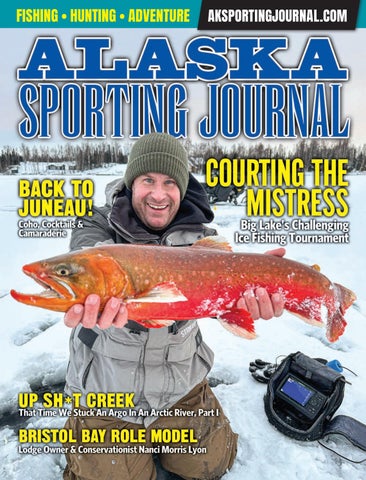
MEDIA INDEX PUBLISHING GROUP 941 Powell Ave SW, Suite 120 Renton, WA 98057 (206) 382-9220 • Fax (206) 382-9437 media@media-inc.com www.media-inc.com ON THE COVER The Still Cold Open is a popular annual ice fishing tournament on the Mat-Su Valley’s Big Lake. The event, which runs several weekends from January to March, is a competitive contest but also a source of fun and excitement for the locals and those who participate. (STILL COLD OPEN)
CORRESPONDENCE X @AKSportJourn Facebook.com/alaskasportingjournal aksportingjournal.com Email ccocoles@media-inc.com
CONTENTS
VOLUME 15 • ISSUE 7
(BRIAN KELLY)
18
AT HOME IN JUNEAU
Our Upper Midwesterner Brian Kelly returned to his happy place of Southeast Alaska in fall 2025, joined by old friends from his Pennsylvania/Michigan roots and new friends he’s met along the way on countless coho fishing adventures around Juneau and beyond. This latest trip had plenty of ups and downs, but as usually is the case, there were salmon biting, drinks flowing and good times celebrating. Kelly recaps another memorable Last Frontier fling.
(BRIAN KELLY)
FEATURES
ALSO IN THIS ISSUE
31
9
BREAK THE ICE ON BIG LAKE Each January and for several weekends until early March, hearty ice fishers brave the cold on the Mat-Su Valley’s Big Lake to compete for cash prizes for catching and releasing the biggest Arctic char and rainbows they can, not to mention pick up bonus points by culling invasive northern pike. The Still Cold Open is both a competitive event and a big party for the local community. Tiffany Herrington details this growing annual tournament.
11 15 44
Editor’s Note: An ode to creative contraptions The Alaska Beat: News and notes from around the Last Frontier Outdoor Calendar A profile of groundbreaking Bristol Bay conservation queen/lodge owner Nanci Morris Lyon
52
STRANDED BY A SUNKEN ARGO (PART I) Scott Haugen is no stranger to dangerous experiences and close calls in the wilds of Alaska. And in the first of a two-part series, Haugen shares the tale of he and another hunter’s harrowing journey while searching for caribou in the shadows of the rugged Brooks Range, where they sank an Argo in the rushing, freezing waters of the Kalutagiaq River. Hold on tight for one wild ride!
59
GEAR UP FOR NEXT WATERFOWL SEASON Happy New Year, waterfowl hunters! While the next opportunities to hunt Alaska geese and ducks are a ways off, the From Field to Fire team of Scott and Tiffany Haugen has you covered with the best new gear to stock up on – from topshelf waders and a warm, comfortable hoodie, to speakers to help stay entertained while setting out or picking up decoys – plus a delicious recipe to add some flavor to sometimes difficult-to-prepare sea and diving ducks.
Alaska Sporting Journal is published monthly. Call Media Inc. Publishing Group for a current rate card. Discounts for frequency advertising. All submitted materials become the property of Media Inc. Publishing Group and will not be returned. Copyright © 2026 Media Inc. Publishing Group. All Rights Reserved. No part of this publication may be copied by any means, electronic or mechanical, including photocopying or recording by any information storage or retrieval system, without the express written permission of the publisher. Printed in U.S.A. 6
ALASKA SPORTING JOURNAL
JANUARY 2026 | aksportingjournal.com
CALL THE LODGE FOR AVAILABLE DATES
(CAPTAIN/CREWED CHARTERS)
Charter Fishing For Salmon And Halibut
Near Juneau, Southeast Alaska.
Whale Watching Trips Also available.
“BE YOUR OWN CAPTAIN” EXPERIENCE
Juneau Boat Rentals Bareboat rentals (two boats available)
JuneauCharters.com • info@juneaucharters.com • 907-723-8472
EDITOR’S NOTE
When writer Brian Kelly made his most recent fishing trip to Alaska, his friends Euming Suewing and Eric Greiner took advantage of the former’s famous “Fish Taxi,” a modifed ice fishing sled, to float their salmon and gear through the rising tide back to dry land. (BRIAN KELLY)
H
aving spent almost 25 years in press boxes – covering everything from high school soccer to bigtime college football games – I always appreciated creativity from teams. It could be a bold uniform choice, a game-time lineup decision or, most importantly, an outside-the-box play call that turned the tide in a game. So from an outdoors-editor perspective, when our correspondent Brian Kelly, as part of his page 18 story on his latest Southeast Alaska salmon fishing adventure, sent me a photo of a contraption called “The Fish Taxi,” I was intrigued. That creativity thing also includes gadgets I’ve encountered over the years. When I was a young angler, I bought a department store spike to place my fishing rod in, but was unimpressed with it.
It paled next to the homemade spike a friend’s uncle built and made it easy for his rod to stick comfortably next to his lawn chair. In college, one of my buddies, Glenn, who I went to the football games with, introduced to me to his pair of “barnoculars,” which instead of providing a closer look at the action doubled as whiskey containers for a quick nip on cold fall evenings. What would they think of next? Which is why I had to know more from Kelly about his fishing buddies’ Fish Taxi, a makeshift tub that they had loaded with gear and fish and were photographed pulling by rope toward the shore around the Juneau area. I loved it. The Fish Taxi was the brainchild of Kelly’s new friend Euming, a local who is used to the challenging situations outdoorsy types face on a regular basis in
the Last Frontier. “The current version of The Fish Taxi came to life in 2024, after too many years of dragging rope-fulls of fat coho,” Kelly told me. “Euming played with some wheeled carts over the years, but those aren’t super handy when one stays too long into the incoming tide, whereas The Fish Taxi floats and is a dream to drag through high water.” It makes sense to use when fishing for salmon along the shores of Southeast Alaska and you’ve got to get your stuff and catch back to the beach as the tide rises toward your waist. Anything to make that outing safer, more enjoyable and easier! Keep up the creative ideas, folks. It makes me think of sports teams I covered and football game drinks from Glenn’s barnoculars. -Chris Cocoles
aksportingjournal.com | JANUARY 2026
ALASKA SPORTING JOURNAL
9
Alaska’s Premier Mothership Sportfishing Experience
THE BEST WAY TO FISH ALASKA,
IS FROM THE WATER Wild Alaska offers an unmatched mothership sportfishing adventure in Southeast Alaska. With over 25 years of experience, we provide exclusive access to vast, untouched marine wilderness—far beyond the reach of traditional charter operations.
THE EXPERIENCE
Immerse yourself completely in Southeast Alaska’s marine wilderness. Fish calm, sheltered waters of Frederick Sound, Stephens Passage, and Chatham Strait, surrounded by glaciers, wildlife, and breathtaking scenery. Our mobility ensures new waters and fresh opportunities every day—keeping you where the fish are.
LIFE ONBOARD
• Hot breakfast each morning • Soup and sandwich lunch • Fresh seafood dinners • Relaxed evenings—or continue fishing and exploring • Comfortable cruising in 50–70° temperatures
WHAT YOU’LL ENJOY
• World-class sportfishing • Up-close wildlife viewing • Photography opportunities found nowhere else • Safe, warm, and welcoming onboard environment • Exceptional crew and personalized service
Join Wild Alaska for the adventure of a lifetime! Pack a smile—and get ready for the best fishing in Alaska. www.wildalaskacruises.com | 907.723.1596 • 866.945.3252 | larry@wildalaskacruises.com
Teshekpuk Lake is part of a subsistence-resource-rich area of the National Petroleum Reserve-Alaska, and those who oppose ConocoPhillips’ exploration program there filed a lawsuit challenging the Bureau of Land Management’s overturning of previous protections. (TIM CRAIG/BUREAU OF LAND MANAGEMENT)
ALASKA BEAT SOCIAL MEDIA POST OF THE MONTH
LAWSUIT TARGETS EXPLORATORY DRILLING PROGRAM ON NATIONAL PETROLEUM RESERVE
T
he back-and-forth saga of whether the Trump Administration will get its way and allow drilling on Western Arctic public lands has a new legal challenge. “The Bureau of Land Management on November 26 approved the one-year exploration program proposed by ConocoPhillips,” the Center for Biological Diversity stated in a press release announcing a lawsuit from conservation, environmental and Native organizations against the move. “The work would subject hundreds of square miles within the National Petroleum Reserve–Alaska to a caravan of industrial traffic, including bulldozers and ‘thumper trucks’ that repeatedly strike the ground with a large plate to send seismic waves into the earth to help detect oil deposits.” Part of the reasoning for filing the suit was the less-than-three-week opportunity to provide public comment after the BLM announced on November 10 its intentions to allow exploratory oil and gas drilling activities. “BLM is jamming through approval of this poorly designed program without regard for proper process or for the integrity of this vital ecosystem and the people who depend on it,” Earthjustice attorney Ian Dooley said. “We’re suing to hold BLM accountable to federal laws and to prevent harm to resources and values that cannot be undone. The Arctic is an irreplaceable resource for people and wildlife and should remain that way for future generations.” The longstanding objection to overturning protections for the National Petroleum Reserve-Alaska centers on the region’s subsistence fish and wildlife resources, specifically in the Colville River and Teshekpuk Lake Special Areas. Sovereign Iñupiat for a Living Arctic executive director Nauri Simmonds, citing the importance of land left whole instead of being leased out for fossil fuel exploration, stated, “It is the heart of our culture, our food security and our survival. Each new project compounds decades of human rights violations and cultural degradation, deepening divides within our communities and eroding the bonds that sustain us.” Other organizations such as The Wilderness Society are standing by Western Alaska tribal interests in this fight that is about far more than just keeping the state’s valuable public lands untrammeled. “The company’s plans would crush sensitive Arctic tundra under 95,000-pound thumper trucks, disrupt caribou migration patterns and destroy our ability to enjoy these magnificent lands,” said Wilderness Society Alaska senior director Matt Jackson. “With an administration bent on ignoring the public, our only choice is to turn to the court to defend these public lands for generations to come and ensure that our rural communities remain free to sustain our Alaskan way of life.”
Looking for a 2026 dream fishing adventure? Contact King Salmon Lodge (907-246-8643; kingsalmonlodge.com) for more information.
BY THE NUMBERS
121,000 Per the Alaska Beacon, the latest estimated count of the dwindling Western Arctic Caribou Herd. It’s the lowest total for the herd since the 1970s and significantly down from its peak of 490,000 animals in 2003.
aksportingjournal.com | JANUARY 2026
ALASKA SPORTING JOURNAL
11
FROM THE ASJ ARCHIVES – JANUARY 2024
There are snow days and there are Alaska snow days. When a Last Frontier storm shuts down an Alaska community, you know it’s a big deal!
THE ICE FISHING MAN COMETH
T
“
THEY SAID IT
“These numbers make one thing clear: Alaskans want Bristol Bay protected for good ... Salmon are the foundation of our way of life. They feed our families, sustain our communities, and support thousands of jobs. It’s time to follow the will of the people and secure permanent protections.”
”
–Alannah Hurley, executive director of United Tribes of Bristol Bay, after a survey conducted by David Binder Research found that 95 percent of polled Alaskans, “including overwhelming majorities of Republicans, Independents and Democrats,” believe it is important to protect Bristol Bay. 12
ALASKA SPORTING JOURNAL
his ice fishing adventure will be tough to beat, as it took place in a familiar place but for an unfamiliar species. I was in Kotzebue, fishing with longtime friend Lew Pagel. For many years Lew has had a chiropractic practice in Kotzebue and he loves his hunting and fishing there. He especially revels in fishing through the ice for big sheefish. The first time I tasted sheefish, it left me wanting more. I’d caught them on spinning gear and a fly rod, but never through the ice. “This time of year the sheefish will come into the bay in big schools, swimming in circles looking for herring,” Lew shared. “We can either drill holes and wait them out or go on the move in search of them.” We did both. I’ve fished sheefish through the ice with Lew multiple times in March and April. Drilling through 7 feet of ice is the norm. Bundling up to cope with subzero temperatures is a must. When it was brutally cold, we’d put up an ice fishing tent and turn on a heater, but we only did that twice. We preferred being in the wide-open spaces and enjoying the grandeur of this special place. The first time I fished with Lew I was by myself. It was such a wonderful experience that the next time up, my teenage son joined me. And the year after that, my wife Tiffany came. When Kazden, my then 12-year-old son, went with me, it was his first time to the Arctic. He’d been to other places in Alaska, but never above the Arctic Circle. His whole life he’d heard stories about me and Tiffany’s years in the Arctic, so for him to experience the desolation, the unique fishing, the warm people and the brutal conditions was life-changing. It also taught him patience, as it took three days to find the sheefish. Until then we’d not had a bite. As the sun descended toward the frozen ocean to the west, Kazden finally got a bite on the big spoon he was jigging. Soon after he was pulling a 22-pound sheefish through the ice. More followed. In fact, for the next 30 minutes it was nonstop action. It made the prior few days of effort well worth it. We ended up with a pile of sheefish and took home 100 pounds of meat. Sheefish is my favorite smoked fish, even over any of the salmonids. -Scott Haugen
Scott Haugen (right, with son Kazden) has spent many a day on a frozen Alaska body of water pulling up sheefish and other species from the icy waters below. (SCOTT HAUGEN)
JANUARY 2026 | aksportingjournal.com
Indigenous Adventure offers:
BO OK
Full/Half Day Trips • Flyfishing • Saltwater fishing • Glacier tours • Whalewatching
R T R U YO
www.indigenousadventure.com
Fish Camps • Guided all-inclusive camps • Remote cabin locations on world class rivers • All inclusive
A Y! D O T IP
◆ 9 0 7- 5 1 8 - 4 0 5 4 ◆
indigenousadventurecharters@gmail.com
E T A M I T L U ! T N U H A A L A SK
Experience the thrill of big game hunting in Alaska’s untamed wilderness with Deltana Outfitters—Alaska’s premier guide service. Whether you’re after Brown Bear, Grizzly, or Moose, our expert guides lead unforgettable Spring and Fall hunts in the remote, pristine Alaska Peninsula and Western Alaska. Adventure. Expertise. Results. That’s what we do—and Deltana does it best.
90% Success Rate!
Average Moose: 64” Grizzlies: 7’6” - 8’6” Black Bears: 6’ - 7’ Brown Bears: 9’ - 10’
Start your ultimate hunting experience today!
Visit: www.deltana.com | Email: hunts@deltana.com | Call: 907- 347-7204
OUTDOOR CALENDAR JANUARY 1 ■ Nonresident black bear season (without the use of registered guides) opens in Game Management Unit 2 (Prince of Wales Island) ■ Resident caribou season opens in GMU 26A (Arctic Slope, the Colville River drainage upstream from the Anaktuvuk River to the Nuka River) JANUARY 3 ■ Start of Still Cold Open ice fishing tournament, Big Lake (907-521-5777) JANUARY 15 ■ Last day of resident moose season in GMU 9B (King Salmon) JANUARY 20 ■ Last day of resident moose season in GMU 9D (King Salmon) JANUARY 31 ■ Last day of goat season in GMU 6 (North Gulf Coast/Prince William Sound)
FEBRUARY 1 ■ Resident muskox and resident caribou seasons open in GMU 21D (Middle Yukon) FEBRUARY 7 ■ Yukon Quest Alaska sled dog race, Fairbanks (yukonquestalaska.com) FEBRUARY 20 ■ Date draw results of the November 1 to December 16 Draw, Tier I/II, and Community Subsistence Harvest application period are expected to be available online (adfg.alaska.gov/ index.cfm?adfg=huntlicense.draw) MARCH 7 ■ Scheduled ceremonial start of Iditarod sled dog race, downtown Anchorage (iditarod.com) MARCH 21 ■ Homer Winter King Salmon Tournament (homerwinterking.com)
2026 ALASKA SPORTSMEN’S SHOWS MARCH 6-8 ■ Great Alaska Sportsman Show, Sullivan Arena, Anchorage (greatalaskasportsmanshow.com) APRIL 17-19 ■ Mat-Su Outdoorsman Show, Menard Center, Wasilla (matsuoutdoorsmanshow.com) APRIL 24-26 ■ Fairbanks Outdoor Show, Carlson Center (fairbanksevents.com/ fairbanksoutdoorshow) For more information and season dates for Alaska hunts, go to adfg.alaska.gov/index .cfm?adfg=hunting.main.
The Still Cold Open ice fishing tournament begins on January 3, and continues every other Saturday until the first Sunday in March. (STILL COLD OPEN)
aksportingjournal.com | JANUARY 2026
ALASKA SPORTING JOURNAL
15
WELCOME TO
OCEAN CREST RESORT Located in beautiful Moclips Washington, Ocean Crest Resort is the resort for all seasons, and all sportsmen! Fishing, game hunting, clam digging, hiking, trail biking, and much more, all less than 45 minutes away from your home base! With studio, 1 bedroom, and 2 bedroom units, ranging from rustic to renovated, on-site pool, hot tub, sauna, and restaurant, the perfect vacation is just a phone call away! Mention codeword “SPORTSMAN” when booking by phone to save at least 25% on stays between 9/15/2025 and 6/15/2026.
www.oceancrestresort.com | 360-276-4465
A SOUTHEAST CIRCUS
JUNEAU FISHING TRIP NETS FRUSTRATION, BUT LOTS OF SALMON IN THE END
Author Brian Kelly (inset, far left with salmon) was joined by old friends and new ones in the Pennsylvanian’s latest fishing adventure in Southeast Alaska, which featured a little bit of everything. (BRIAN KELLY)
18
ALASKA SPORTING JOURNAL
OCTOBER 2025 | aksportingjournal.com
BY BRIAN KELLY
A
nticipation is defined as the feeling of excitement and expectation of a future event. Some years this feeling can be stronger than others as the time approaches for me to jump on that flight to the West Coast. This past year’s trip certainly had that strong sense of anticipation. Based on reports we had been seeing from the lodges on the outer waters of Southeast Alaska, big, fat coho were feasting on a seemingly never-ending supply of herring in the Gulf of Alaska. On top of that, a predicted record return of Taku-strain coho back to the Macauley Douglas Island Pink & Chum Hatchery in Juneau had our crew all sorts of fired up as we boarded our first flight west to Seat-
tle. But, as per usual, Alaska had other things in mind for us on this trip.
ONE OF MY COMPANIONS on this trip was Eric Greiner, my mentor and longtime fishing partner from Michigan. Eric took me on my first steelhead journey in December 1989 to the Big Manistee River in northern Michigan, and I returned the favor years later with the first of many trips to Juneau. We have been around the proverbial block a few times in our lives, as our ever-mounting supply of gray hairs would attest to. Meeting us in Alaska’s capital city for this trip was our pal from Texas, Hunter Drozd, as well as many of his family members. More on them later.
We watched the weather forecast leading up to the trip, and it was a constant flip-flop from tourist weather – sunny and warm – to fishing weather – wet and cool. A dandy low-pressure system rolled up from the Gulf of Alaska in mid-August and brought with it an early slug of coho into town. It was a great sign, as strong runs are usually front-end loaded with the bulk yet to come. But then the dreaded high-pressure dome followed behind the front and parked its bright and clear sky over Southeast Alaska and didn’t move. Now, for those in the lodges that cater to trolling and bottomfishing clientele, this was a godsend for late August into early September, when the weather usually turns for the worse and stays
aksportingjournal.com | JANUARY 2026
ALASKA SPORTING JOURNAL
19
that way until the following spring. It didn’t really hit us how warm and dry it had been until we landed in Juneau and headed straight to the Sheep Creek access. There was no water coming off the side of Mount Juneau as we drove along Thane Road; usually there are steady streams pouring off the mountain, as this is a rainforest. As Eric and I suited up and walked out at low tide, I noticed that Sheep Creek only had one branch of flowing water; it had been so dry that the back channels were bone-dry and filled with rotten humpy carcasses. Even so, we both walked into the cool ocean water and managed to land large, bright males in short order. We figured things might be a bit tough after the first-light bite each morning, but we’ve had plenty of success on past trips in tourist weather. Well, little did we know how tough it would be.
Eric Greiner blesses a channel marker – referred to as “The Office” – at low tide during a day of fishing. (BRIAN KELLY)
20
ALASKA SPORTING JOURNAL
JANUARY 2026 | aksportingjournal.com
OUR FIRST FULL DAY actually went pretty well; a decent slug of fish showed up on the incoming tide and the weather cooperated with some wind and scattered cloud cover, which helped to get some stain in the water for a great spinner bite. While we didn’t limit out, we had plenty of action and started to accumulate a meat pile for the freezer. Team Texas was nowhere to be found on this day, as they had to go hiking and sightseeing, along with an extensive tour of the local breweries and distilleries. Some go to Alaska to fish. Others? Well, not so much. The weekend turned out to be a complete gong show. The sun and warm weather were in full effect, which brought out the locals in droves. Added to this was the ever-clearing water and a noticeable lack of fresh fish with the incoming tide. Let’s talk about that incoming tide for a moment. We witnessed an odd phenomenon, as the water didn’t change directions and flow like it normally does with the tide change. Instead, the water just slowly rose with the incoming, which seemed to confuse the fish, as they didn’t have their usual free ride into town with the tide push. This made for very small bite windows and Saturday marked the first day I was ever skunked in Alaska. But we fished hard, because it’s what we do; we fished through the tide change,
all the hard work and countless casts to fishless water were about to pay off. A lovely low-pressure system formed on the Gulf of Alaska and was due to roll into Juneau any day. When it finally arrived, so did the fish. The atmosphere just felt fishy when the weather arrived, and on that first incoming tide, there were more jumpers in that first hour than we had seen in the entirety of the trip to that point. It was happening, and these fish were kind of eager to kick anyone’s ass in their own way. The trip crescendo happened on Thursday; we hit a few fish during the first-light period on the remnants of the outgoing tide and waited for the turn to bring the fish to us. The tide was back to its normal routine, as the water moved with force this time around. We could see the choppy water coming down the channel towards us with jumpers out ahead of the wall of moving water. When the water hit the edge of the bar, the first wave of fish was seemingly at our rod tips. The bite was fired up and didn’t quit for a few hours. During this melee, I had the fish fired up on a pink and white squid spinner that I’d built using a Flying C blade repurposed from a rusted-out lure I found years ago at low tide. One particularly angry coho decided The author was inspired by the famous Texan “Mama Tex” to don her Texas A&M University Aggies cap despite his Big 10 Conference roots in the Upper Midwest. (BRIAN KELLY)
checked the other side of the channel – you name it, we did it. It was becoming apparent that the fish just weren’t around and there wasn’t much we could do about it, except keep casting and praying for a significant weather change. The highlight of the weekend was being graced with the presence of Team Texas on Sunday morning. This roving band of hearty tourist anglers put down their G&Ts long enough to slap on the Simms and show us how it’s done. Well, Hunter’s wife did just that by landing the biggest fish on the trip that morning, a dandy 16.5-pound buck that annihilated her pink Arctic Spinner and dragged her and Hunter up and down the beach.
AS THE GRIND CONTINUED into Monday, we came to our senses and called it quits 22
ALASKA SPORTING JOURNAL
early that afternoon in order to meet for dinner at one of our favorite places on Douglas Island, the Island Pub, for pizza, beverages and more stories than we bargained for, including how Hunter’s parents met on a flight. Oh, the people you meet while wading in Alaska. Now, there is a good reason why we typically plan our Alaskan expeditions so there’s eight or nine days of fishing, as the weather doesn’t often cooperate and we just want to be there for that two- to three-day window when all hell breaks loose. And that was about to happen, as Some days, the fish and the weather don’t cooperate, so a night on the town with a good meal and something to drown your sorrows is welcome relief. Even the usually productive incoming tide betrayed them on one lost outing. Kelly called it “the first day I was ever skunked in Alaska.” (BRIAN KELLY)
JANUARY 2026 | aksportingjournal.com
EXPERIENCING ALASKA WITH A CAST OF CHARACTERS
Y
ou meet all sorts of folks while fishing your way around Alaska, people with the same desire to catch fish and enjoy the surroundings. The Drozd family is a perfect example of this. I met Hunter Drozd during my 2020 trip when we had to jump through Covid hoops just to get there. He took the opportunity to work remotely at that time and lived in Juneau for a year. We met while casting for silvers, and he stuck out like a sore thumb with that west Texas drawl and Cheshire cat grin. We hit it off and have been friends and travel fishing pals ever since. And with Hunter comes the rest of the crew, including the matriarch of the family, the one and only Jeri “Mama Tex.” This Ohio native is a force of nature; meet her once and you’ll never forget Mama Tex. Hell, the usual crew at Sheep Creek all get a smile on their face when she rolls out, usually late, to show us how it’s done. Now, there were some legal wranglings after yours truly supposedly disparaged her over a high-tide rescue event, but that’s in the past. This year she happened to fill her waders on another “tide event” situation, but she managed to pay off the witnesses and I cannot comment further on what actually transpired. All joking aside, these are the moments and people that make every trip such a pleasure. Take it all in and enjoy everything that happens along the way, especially the after-fishing-hours shenanigans at the local watering hole. BK
John and Jeri Drozd, part of a Texas family who befriended the author and have reunited on the Alaska Panhandle, were all smiles after their son “guided” them into this fine stringer of coho. (BRIAN KELLY)
24
ALASKA SPORTING JOURNAL
JANUARY 2026 | aksportingjournal.com
to hit at my rod tip, and I broke off my one and only hot spinner. We laughed about it over dinner and drinks that evening, but secretly I was a bit pissed, considering it was the only one I had built up. But, as fate would have it, on the next morning’s tide change I caught a glimpse of something bright as I walked down the beach towards the point where the action had been the day before. And there it was; sitting on the rocks and exposed kelp was my spinner. Fortunately, it had fallen out of the fish’s mouth the day before, and I was overjoyed to be reunited with my old pal!
WHILE THINGS WERE LOOKING bleak early
on, a couple good days with full ropes of teener coho had the meat piles adding up quickly. After some sketchy math while having a few pours of fine Kentucky happy juice, Eric and I figured we just needed a couple fish each to top off our boxes. Huh. Funny how that changed once we got on the water. Friday was our last day to fish for fun and the freezer, so we set out with high hopes, albeit a bit late after a night of “one more pour.” All week, we’d made a point to get to the parking lot before our local pal, Euming Suewing, the self-appointed mayor of Juneau. He was taken aback a little and probably a bit disappointed that we weren’t prompt on our last day. But we didn’t miss much, as the water once again went gin clear and the coho reverted back to their normal state of weirdness. Euming’s pal dinged a couple fish on a whole herring, and the fish went back to thumbing their fins at our usual offerings. So we all dug deep into our tackle boxes trying to fire up the bite. Well, except for Hunter, who fishes with two, maybe three flies on a trip. He stayed with his beloved black and white Dolly Llama for an easy limit while we all scratched our heads. But never underestimate those dudes with a few gray hairs; while we may not move at the speed of light, we have many tricks up those crusty old sleeves. Yours truly got things fired up on the gear front by slow-swimming an old pink Tadpolly (Google that antique plug young salmon padawans). I followed that up with a pink and purple bunny strip jig that the fish found particularly attractive in the clear wa-
907.440.9510
Customize Your advenure in south Central alaska book your tour: fishwhittier.com
Fishing Charters, Whale WatChing, glaCier tours
Do It Yourself
rent from our selection of boats so you can explore the Prince William sound on your own!
reserve your own boat: alaska-boat-rentals.com
There’s a reason why Kelly’s buddy Greiner (inset) is known as the “Jig Baptist.” His Synth Minnow jig really caught fire towards the end of the trip, including with this midteens beauty. (BRIAN KELLY)
ter. Meanwhile, Eric and Euming fired up their jig bite, switching to black and white after watching Hunter’s earlier beatdown. It was all coming together as the tide turned and wind picked up. I had four average fish on the rope and said to hell with it and put on my recycled pink and white squid spinner to finish off my limit. First cast in and bang: Fish on! I looked to my right and Euming was hooked up as well, on the pink Arctic Spinner I’d given him earlier that morning. Not to be outdone, Eric completed the triple with a dandy male of his own. It was a fitting way to end the morning after a grind to start, followed by plenty of laughs, anguish and redemption that one can only experience in Alaska. ASJ 26
ALASKA SPORTING JOURNAL
Mama Tex oversees and coordinates the fish processing after a successful morning haul of fish. (BRIAN KELLY)
JANUARY 2026 | aksportingjournal.com
30
TOUGH • DURABLE • LIGHT Easy Loader, Deuce & EZ-XL Models
• • • •
Easy Loader & Deuce accommodate • 2 dogs up to 65 lbs each EZ-XL accommodates 2 dogs over • 65 lbs each Made from High Density • Polyethylene with UV protection Easy Loader fits most full size pickups, SUVs & large UTVs
Deuce fits smaller pickups, SUVs & UTVs EZ-XL is for larger breed dogs & full size vehicles Vents, cold weather door covers, insulated covers & custom kennel pads available
TRIPLE
NEW! KENNELS
THE DRINKING SPOT
Outdoor Gravity-Fed Pet Watering System
Introducing the th e EASY XL. For large breed dogs. EASY-LOADER Dog Kennels
ww
w. e as
yloaderkennel
s.co
m
Bartlesville, OK • 800-853-2655
Call 800-853-2655 Check out our website for new accessories www.easyloaderkennels.com
LIGHTWEIGHT. The lightest 200-hp four stroke on the market
POWERFUL.
2.8L displacement and Variable Camshaft Timing give it the best power-to-weight ratio of any 200-hp four stroke
COMPACT.
Nearly 120 pounds lighter than our four-stroke V6 F200
THE F200 IN-LINE FOUR.
FORWARD THINKING.
Show the water who’s boss with the F200 In-Line Four. Incredibly light, responsive and fuel efficient, it serves up plenty of muscle to handily propel a variety of boats. On top of that, its 50-amp alternator offers the power to add a range of electronics, and its 26-inch mounting centers and compatibility with either mechanical or digital controls give you the flexibility to easily upgrade your outboard or rigging. Experience legendary Yamaha reliability and the freedom of forward thinking, with the F200 In-Line Four.
WASHINGTON
OLYMPIA Us Marine Sales & Service (800) 455-0818 www.usmarinesales.com
YamahaOutboards.com/F200InLine
Follow Yamaha on Facebook® and Twitter™
REMEMBER to always observe all applicable boating laws. Never drink and drive. Dress properly with a USCG-approved personal intended to be an endorsement. © 2013 Yamaha Motor Corporation, U.S.A. All rights reserved.
30
ALASKA SPORTING JOURNAL
JANUARY 2026 | aksportingjournal.com
ROMANCING ‘THE MISTRESS’ WHAT IT TAKES TO WIN BIG LAKE’S STILL COLD OPEN, ALASKA’S TOUGHEST ICE FISHING TOURNAMENT BY TIFFANY HERRINGTON
E
ach winter on Southcentral Alaska’s Big Lake, a devoted group of hardwater anglers leans into the cold, drilling holes through the ice and chasing Arctic char during some of the toughest conditions Alaska can throw at them. The Still Cold Open is more than a fishing derby. It is a season-long test of endurance, teamwork and skill that has turned strangers into friends and weekend ice fishermen into serious competitors.
Organizer Jerrid Hixon has watched the tournament grow from a local bragging-rights showdown into a multi-week event that draws some of the most dedicated anglers in Southcentral Alaska. A former fisheries biologist, Army veteran and guide, Hixon keeps one eye on the leaderboard and the other on the health of the fishery that makes the Still Cold Open possible. In our conversation with Hixon, he
As Southcentral Alaska’s popular Big Lake freezes each winter, it’s a sign that one of the area’s most popular events, the Still Cold Open ice fishing tournament, will create a buzz. The event starts on January 3 and runs every other week until the grand finale on the first Sunday in March. (STILL COLD OPEN) aksportingjournal.com | JANUARY 2026
ALASKA SPORTING JOURNAL
31
talks about the history of the tournament, what makes Big Lake such a special place to fish and why protecting its native char and trout matters as much as the final standings.
Tiffany Herrington How did the Still Cold
Open begin and what inspired you to create a tournament of this scale on Big Lake? Jerrid Hixon The SCO began in 2015 when Jim McCormick began the tournament to give local guides and anglers something to look forward to and compete in during our long Alaskan winters. Legend has it that it began as trash talk, then bragging rights to earn the champion team jackets. I did not take this tournament over until Jim asked me after I had competed in the tournament five times, but he approached AJ Hoffman, Mike Hudson and me when I was staff at 3 Rivers Fly and Tackle in Wasilla (a major sponsor and highly active in the community of Mat-Su Valley fishing). I took over the tournament in January of 2022 in a trusted effort by Jim to retire from guiding in Alaska and move to Arizona. We are all grateful for his building of this tournament, but we all want to see this go to the next level with teams from Canada and the Lower 48 states. As I am entering my fourth season running this tournament, which has seen a revitalization in participation, more staff and leadership, the organization has drastically improved, and prizes have exponentially gotten bigger and better with local businesses participating with sponsorships. As a result of this tournament, and working with (Alaska Department of Fish and Game) for two years, I have provided enough data that will protect the amazing trophy-class Arctic char that are uniquely native to the Big Lake area to catch and release only. We pride ourselves as stewards of the lake, cleaning up trash and being vehement voices of protection for this finite resource. As a former fisheries biologist, Army veteran and local guiding business owner, I, among many others who compete, want to see these wonderful fish flourish and be protected for generations to come and enjoy.
TH The event is described as Alaska’s toughest and longest ice fishing tourna32
ALASKA SPORTING JOURNAL
ment. What makes the SCO stand out from other derbies in the state? JH As a former competitor and now director, I can say with confidence that this tournament can take a novice angler and exponentially turn them into an expert at targeting these coveted Arctic char for those willing to endure the conditions and display resilience. We have fished days where it was minus 47 degrees out there beginning at 9 a.m. to 4 p.m. in the elements with the best gear ice anglers can find to protect themselves. Many of us are avid outdoors folks who have learned many tough lessons on how to survive these conditions, continue to compete ferociously and, most importantly, take care of these fish once they are exposed to the harsh elements out of water. Speed, practice, learning from others, education and awareness are key to mastering the ability to compete at this level. The staff takes extra precautions to ensure the safety of the anglers and the fish alike with briefings every competition morning before the shotgun release. Anglers race off with team plans to hit their favorite spots, where they believe the fish might be, in a spectacle of a rush to lock down their positions on the lake, working quickly, exhibiting teamwork, working diligently all day in sometimes extreme cold, snow and wind, exposed the entire time, to overcome obstacles that may arise, catch their five best fish for turn-in times, and return all fish alive successfully. Anglers begin this tournament on the first Saturday of every January and fish every other week until the first Sunday of March, which is the championship weekend. Catching fish with bait any angler can do. However, on Big Lake, by ADFG regulations there is a single-hook (restriction), artificial lure (only rule), no scent allowed, and no chumming allowed. Getting the Arctic char to hit is sometimes a chore all in itself, with these fish being notoriously finicky. The right barometric conditions help, (as do) the angler’s ability to get the fish to hit. All of the seasoned SCO veterans call Big Lake “the Mistress,” with many beginners abandoning their short-lived efforts to fish it. To the ones who are determined and land their first big char, they describe it as wrecking their life with a crippling addiction to chasing these big native fish. It can literally be-
JANUARY 2026 | aksportingjournal.com
come an addiction that replaces all the anglers’ spare time – hence why she is called “the Mistress.” We are not currently aware of any other tournament in North America that lasts as long as this tournament does, and we definitely know that no other ice fishing tournament in Alaska lasts like this one does. These anglers and staff work all year to compete in this tournament, ensuring that they even have work days off to compete, for instance. These are, without a doubt, the toughest ice fishing junkies I have ever heard of and witnessed. Many (others) do not have the fortitude or willingness to endure this type of commitment required to compete at the highest level required to win a first-place championship SCO.
TH What do you love most about Big Lake as the home of the tournament and what makes it such a special fishery? JH To those who recreate on Big Lake, let alone in the winter, we all know why it is locally dubbed “Alaska’s Playground.” Riding snowmachines in very extensive trail systems that Iron Dog racers use to get to Nome and back begins at Big Lake. A massive pond hockey tournament is conducted by Burkshore Marina that has concerts and celebrations that are amazing to attend. There is the Islander Lounge and Grill you can only access by boat in the summer and sleds or side-by-sides in the winter, with many others who recreate the same way. We all have a big family and meet new, awesome people who are so amazing to recreate with, all because we all do these things together. Our amazing host, Susitna Brewing Co., with permission from Matt and Whitney Dow, has been absolutely outstanding working with us and hosting us every year since I took over. Big Lake is one of my favorite places in Alaska, and ... uniquely harbors trophy-class Arctic char. With abundant salmon runs that enter the lake from Cook Inlet to Fish Creek to Big Lake and onward, this brings a lot of food for the resident fish species in the area. There are no other lakes this accessible in the Valley that have native Arctic char this big. It is imperative that we treat this fishery responsibly, as well as the dwindling salmon runs that remain in stiff contention as a topic of controversy in Southcentral
Hungry Arctic char are the main attraction at the derby. Char are a native species to the lake and are handled with care. Each fish caught and measured gets released back through the ice. (STILL COLD OPEN) aksportingjournal.com | JANUARY 2026
ALASKA SPORTING JOURNAL
33
Alaska. Ultimately, we have a gem that is a short drive away from many of us Valley residents where we can all enjoy getting outdoors, whether it is fishing, boating or riding snowmachines. It is just the icing on the cake that Big Lake has these big fish that fight so hard and are beautiful species to target. Our participants deeply love this fishery, and I can attest that they take protecting this resource very seriously, as well as being responsible outdoors people.
TH The SCO focuses heavily on teamwork, strategy and endurance. What do successful teams usually have in common? JH I would be a fool not to mention the Hughes team of Josh and Caleb. They have been five-time champions out of 11 annual tournaments now, and their competitiveness, coupled with hard work, is unrivaled. Having a plan and sticking to that plan with rigor is their mantra. Not to discount everyone else, by any means, (but) they have discovered a regimen within all confines of the rules that works, and that rule is simple: Work hard, do not waste time, know the lake structure and know the target fish behavior. Even the best of us can say that this lake will humble the best, including the Hugheses, from time to time. I know I have received many comments or questions about Josh and if he will be competing. They usually have the attitude, “If they are competing, then why even enter?” My reply to this attitude is hilariously simple. This is a big dawg tournament. If that is the attitude you have, then you have already lost. You have to fish this lake a lot, and you have to have a good team that is willing to work hard and fish tenaciously and consistently. I always quote the great Ric Flair: “If you wanna be the man, you gotta beat the man; woooooooooo!” Now, there are teams I know that can dethrone the Hugheses, but they are going to have to earn that right because they are that good. Many teams are very friendly and share knowledge with each other, and we all know by this point that the best strategy is your fishing work ethic and tenacity. TH The tournament targets Arctic char, rainbow trout and awards bonus points for pike. What draws anglers to these species and what challenges do they present? 34
ALASKA SPORTING JOURNAL
JH To avoid controversy and state facts, the
pike here are invasive and have not had thousands of years coexisting with the native char, trout, burbot and salmon. With that being said, I have personally witnessed what has happened to the Alexander drainage system, where these pike were initially introduced. Since 1953, the pike were illegally introduced by a local angler into Alexander Lake at the foot of Sleeping Lady (Mount Susitna), with Alexander having the most prolific salmon fishery in the Upper Cook Inlet. Since then, nearly all salmon have been decimated, along with many other native species, to the point of complete closures of fishing besides pike. Along with invasive elodea, theorized to have been brought in by floatplanes landing there, the habitat has been uninhabitable due to human interference. Many other factors are at play here, but to keep it short, this is not up for debate. We target pike as an incentive to use angling to keep the pike population in check to help the Big Lake native species in their ecological niche that they have evolved over thousands of years to first occupy. To keep things fair, the pike can grow larger than the other species, so competitors can target pike, kill them by regulation, and bring them (up to five) to turn in for bonus points, with a potential of plus-25 points max. The char are by far the most targeted for a good reason. They accumulate the most points by length that is rounded up to the inch. I have caught 30-inch char in Big Lake before, with 27 inches-plus considered trophy-class. This is the reason we primarily target the char. However, rainbow trout are allowed to be used as length points as well. Both char and rainbows must be released immediately after a picture on a bump board with measurement, as long as they are 12 inches or larger. The char can be found from shallow to deep, and anglers inadvertently catch burbot and sockeye sometimes, which do not qualify for submission. There were two very large Big Lake rainbows that hit 25 inches last season, but most rainbows are in the 12- to 18-inch range, so it behooves the teams to replace those potential submissions with larger char. It is safe to say that five submitted char will almost always beat five submitted rainbows. This is difficult because you
JANUARY 2026 | aksportingjournal.com
Don’t forget the rainbow trout, which are also feisty fighters and also get released. “There were two very large Big Lake rainbows that hit 25 inches last season, but most rainbows are in the 12- to 18-inch range, so it behooves the teams to replace those potential submissions with larger char,” strategizes tournament director Jerrid Hixon. (STILL COLD OPEN)
aksportingjournal.com | JANUARY 2026
ALASKA SPORTING JOURNAL
35
Unfortunately, invasive northern pike, introduced into the watershed in 1953, have devastated salmon runs in Upper Cook Inlet. Still Cold Open entrants can enter up to five pike caught and get as many as 25 bonus points added to their cumulative total. (STILL COLD OPEN)
never know what is going to bite sometimes. Because everyone is targeting char and rainbows, they intelligently rig their lines specifically for these finicky fish to fool them into biting. The most frustrating thing for me personally is when a pike bites your rig off with their thousands of sharp teeth and big mouths that inhale your lure almost immediately, causing anglers to re-rig their lines. Every once in a while, you can hook a pike just right and land it, but if you want to target them, using a long steel wire rig to your lure is best.
TH The multi-week format and the split be36
ALASKA SPORTING JOURNAL
tween pro and recreational divisions give the tournament a unique structure. How did you develop that system and what do you feel it brings to the experience? JH It first came to fruition, like I said before, as a macho bragging thing, coupled with something to keep us busy constantly throughout winter. The divisions get split as teams jockey for position in the first three weeks of competing. Upon the closure of week three, the top half of the participant teams are divided evenly in half, with the top half being the professional division and the lower half being the recreational division.
JANUARY 2026 | aksportingjournal.com
We all know luck plays a bit into fishing, but you have to create your own luck by competing hard as well. This was devised to keep competitors involved instead of dropping out, because the recreational division top three can win prizes, embroidered champion hoodies and trophies as well. The pro division receives top-three trophies, embroidered jackets, prizes and cash payouts divided by positions. We have discovered that with proper incentives, doing random drawings weekly for big gift cards and prizes at the end of daily competition, regardless of performance, teams stay involved and continue to com-
aksportingjournal.com | JANUARY 2026
ALASKA SPORTING JOURNAL
37
Despite the usual Alaskan threat of Old Man Winter shutting down the tournament, most years the event has gone without weatherrelated cancellations. It’s an event that instills community pride and continues to grow. (STILL COLD OPEN)
pete with higher retention and returns. Some anglers are out there having a good time for the experience, not worried about how they place, and others are ferociously competing. With our system, it all sorts itself out as fairly as possible to keep the majority happy. We encourage everyone who is properly equipped, regardless of skill level, to come compete and stick with it, because they will drastically improve as an ice angler being around this group of competitors. We have had everyone from highschool-aged teens to seniors out there getting after it. 38
ALASKA SPORTING JOURNAL
TH How do winter conditions on Big Lake influence the competition and what kind of preparation do anglers need to have? JH Since I have been there competing or directing, we have only cancelled one tournament after a very unseasonably warm winter with lots of rain that degraded the ice so much that areas of the lake were unsafe or inaccessible at entrances (we did this after week four). We certainly keep safety at the uppermost importance for competitors, although liability waivers are signed acknowledging the risks of this tournament. In such cases, we move the competition to the pro-
JANUARY 2026 | aksportingjournal.com
verbial right and continue when Mother Nature allows. There are many years when we have zero interruption from conditions and compete as normal. We had a winter a couple of years ago with tons of snow causing mass amounts of overflow (naturally from weight and gravity, not ice holes) that caused a lot of problems for competitors with massive snowdrifts from high winds. These are problems that competitors must monitor and draft plans to overcome to continue to compete effectively. Last season, with little snow and warm spells, the lake was accessible everywhere by vehicle instead of the popular snowmachine set-ups many use consistently. A big point of contention was a cold snap that had not been seen in 30 years in the area – many pleaded to postpone on a tournament day. We held a vote that overwhelmingly said, “This is what we signed up for and we are fishing.” Many noncompetitor barstool and couch referees blasted us on social media, saying us competing would harm the fish when it is minus 47 degrees at the start. We instead had competitors bring insulated temporary shelters with heaters to set up to prevent cold-weather injuries to the competitors and the fish. All fish were reported released alive and successful with no freezing of the gills and eyes. Many teams prefer the run-and-gun techniques to cover as much structure as possible, yet this is a part of the tournament, to adapt and overcome. Sitting in one spot in this tournament is risking getting the dreaded “skunked” label, returning with no fish on Big Lake. Since I have been competing, I am aware of one competitor getting a minor frostbite injury on that brutal cold day, with full recovery and even stating it was their fault for not being properly equipped for that particular day.
TH The SCO is known for its strong community feel. What does the community aspect mean to you and how have you seen it grow over the years? JH I will say that when I first started, the feeling was much different, with an almost elitist attitude and big egos compared to what the second half has
Your one-stop destination for self-guided saltwater fishing adventures in Sitka, A laska.
We offer comprehensive packages that include lodging, fully equipped rental boats, rods, reels, tackle, downriggers, depth finders, VHF radios, GPS, marine charts, safety gear, and more.
Book Today! w w w . f i s h b a ra n o f . c o m | 9 0 7-7 3 8 - 9 0 9 0 | f i s h b a ra n o f @ g m a i l . c o m aksportingjournal.com | JANUARY 2026
ALASKA SPORTING JOURNAL
39
transformed into. This tournament has changed complete strangers into best friends. Everyone helps each other and shares limited information respectfully. The Big Lake locals have gone from hating us out there drilling holes to either ignoring us or being respectful to one another, sharing the lake for everyone to recreate. The staff of the SCO preaches constantly that everyone competing is a representative of us all and that one bad apple can ruin it for everyone. We have had to dismiss teams before for being egregiously disrespectful and warn teams of the repercussions of not being professional. However, I can say that all
of our current competitors the last couple of years have been outstanding, with some teams even showing up to clean areas that were trashed or fireworks littering the lake, for instance. Our teams pack it in and pack it out. I have personally made so many good friends who are in the ice fishing community and eliminated points of contention within the tournament and outside the tournament with lake residents, for instance. We have definitely had a positive impact on the lake as a whole, and this tournament will create memories that will last a lifetime.
TH The event supports local youth and
It’s referred to as “Alaska’s toughest ice fishing tournament,” but those who participate in the team format love every minute of it. “These are, without a doubt, the toughest ice fishing junkies I have ever heard of and witnessed,” Hixson says. “Many (others) do not have the fortitude or willingness to endure this type of commitment required to compete at the highest level required to win a first-place championship.” (STILL COLD OPEN) 40
ALASKA SPORTING JOURNAL
JANUARY 2026 | aksportingjournal.com
veterans groups. Why is giving back an important part of the tournament and how do participants respond to that? JH As a community, the Valley definitely is very outdoors oriented. We love the fact that former competitors like Colton Connor, who is a teacher at Wasilla High School, began an ice fishing club that is getting kids off iPads and drugs while getting them outdoors fishing in a positive and constructive team-building environment. As an Army combat veteran, I am a VFW member at Post 9365, where we donate by Alaska state law using their gambling permits, donating a portion of our proceeds to that VFW. Last year, the Wasilla High School ice fishing club asked the VFW for a $1,000 donation that we encouraged members at a meeting to give to the club to provide more gear to the students participating. This motion unanimously passed, all in favor, to donate that money we raised to high school students out there enjoying the great Alaskan outdoors. Everyone was in agreement that this was an outstanding way to donate in a charitable fashion to veterans and students. Many veterans compete in the tournament, and everyone in our community supports our service members, thankfully, and the high school students have turned into competitors in the SCO as a result, which keeps the circle going. We could not be happier to see this going this well at this point and are very thankful for our supportive community, local businesses, students, competitors and sponsors.
TH What have been some of the most memorable catches or standout moments from past years? JH For myself, it was my first 30-inch male char I landed. I do not believe I have been so exhilarated before that coveted mark, and I can say, from hearing all the excitement out on the ice and celebrations that have gone viral on Instagram, that all our participants feel the same way. The largest char landed in the tournament was Colton’s wife Alyssa, who is still on our page – front and center – for landing the largest char in tournament history. I have said, if anyone can beat hers, they can get the photo spot.
aksportingjournal.com | JANUARY 2026
ALASKA SPORTING JOURNAL
41
I believe, for all of us, the best parts are hearing the exciting stories when everyone comes back, the banter on the brag boards during the tournament, and, of course, seeing all the big fish, regardless of species, caught that day. Nabbing first place on the day or how everything shakes out on the spreadsheet leaves everyone tense with anticipation, but the one team that lands the largest fish on the day always has a very cool moment with massive bragging rights.
TH What do you hope new anglers or first-time teams take away from their experience with the SCO? JH All the staff always gather all the new competitors before day one begins to go over some encouraging points. We want people to have fun first, compete, learn immensely, increase sportsmanship, display resilience, and integrate with the veterans of the tournament to become what they are, which are prime examples to emulate in how they have become conservationists for a fishery, community and lake they all love.
42
ALASKA SPORTING JOURNAL
At the end of day one, we get all the teams that get skunked, if they do, and give them encouragement, go over points that would increase their success, teach and highly encourage them to keep on going toward realistic goals they have set. I do not know anyone at this tournament who walks away without learning and getting better.
TH Looking ahead, what are your hopes for the future of the Still Cold Open and how do you see the tournament evolving? JH I believe that all of us staff, who are absolutely wonderful and donate so much of their time to make this tournament grow, all want the same thing. We want this tournament to max out participation of 50 teams every year, gain more popularity, have high demand for competitor slots available, have coverage like the Iron Dog or Iditarod, TV time or on the Outdoor Channel, and huge high-dollar prizes to raise the stakes, which increases the level of competition and the best competitors who would travel to compete with us. I think it would be amazing to have a Norwegian team, a Canadian
JANUARY 2026 | aksportingjournal.com
team, a Minnesota team, a Michigan team, and so on that travel here to fish for these char. We have many sponsors who have been absolutely amazing, such as Cabela’s, Bass Pro, B&J’s Sporting Goods, 3 Rivers Fly and Tackle, Home Depot, Bear Paw River Brewing, Susitna Brewing, Big Dipper, Kodiak Custom Tackle, DeadStick Fishing, Hooked on Alaska Fishing, Hooks of Alaska lures, Bunker Baits, and several more to come. Hopefully I did not forget anything in the shout-out that I am rambling off without looking, but everyone who helps out is incredibly generous and so helpful. We greatly appreciate everything that our community is helping us out with. ASJ Editor's note: To learn more about the Still Cold Open, including registration, rules, dates and updates throughout the season, visit the tournament’s Eventbrite page at eventbrite.com/e/ice-fishing-tournament-for-the-2026-still-cold-open-tickets1855914182279?aff=erelexpmlt or follow the event on Facebook at facebook.com/ scofishing.
aksportingjournal.com | JANUARY 2026
ALASKA SPORTING JOURNAL
43
A STEWARD TO PROTECT BRISTOL BAY BEAR TRAIL LODGE OWNER NANCI MORRIS LYON’S LEGACY: BREAKING BARRIERS, GUIDING ANGLERS, PRESERVING ALASKA’S WILD SALMON
Lyon’s two brothers played a major role in her favorite childhood memories. (NANCI MORRIS LYON)
44
ALASKA SPORTING JOURNAL
JANUARY 2026 | aksportingjournal.com
Nanci Morris Lyon has become something of a mythical figure in Bristol Bay. She broke barriers at a time when women neither owned lodges nor were prevalent in the fishing industry. Now her Bear Trail Lodge is one of the region’s best and she’s fought for decades to protect Bristol Bay’s fish and fisheries. (NANCI MORRIS LYON)
BY MARIAN GIANNULIS
N
anci Morris Lyon isn’t afraid of working hard when the odds are stacked against her. When describing her ascent from a working-class upbringing on a small farm in eastern Washington, to being one of the first female guides in a world-class fishery, and now owning a premier fishing lodge in a coveted destination, she had this to say: “The possibilities and opportunities for
failure were so numerous. It’s unbelievable. But I never thought about that, and I just continued to look ahead and move ahead.” That fortitude has led to Lyon’s success in business and contributed to one of the most significant conservation wins in recent memory.
FOLLOWING HER PASSION Lyon’s love for fishing and the outdoors
has guided her entire life. Her father sparked that passion early on. “Some of my earliest childhood fishing memories are of my father holding me over the edge of the boat so I could pee. So that gives you an idea of how little I was to be able to do that,” she said. “I can never remember him leaving me home or us not fishing at every opportunity we had.”
aksportingjournal.com | JANUARY 2026
ALASKA SPORTING JOURNAL
45
Lyon’s father didn’t let her age or gender stop her from coming along on all those outdoor adventures. That passion took her north to Alaska. Lyon spent some time moving between careers – veterinary medicine to real estate, business management to guiding – before she settled into her true calling and home: guiding the bountiful waters of Bristol Bay. “I fell in love with Bristol Bay so fast,” Lyon said. “It felt like home. There was water everywhere and it was clear and it was clean and you could see fish in it.” When Lyon first landed in Western Alaska in the mid-1980s, things looked a lot different than they do today. She
was a pioneering female guide at a time when there were few sportfishing lodges and female anglers in the region. After almost a decade of guiding in Bristol Bay for others, she launched her own guiding business. That quickly grew from her being a single-guide operation to running a crew of seven guides. Lyon then took over as the head guide for Bear Trail Lodge (beartraillodge.com) before she became a part owner. Eventually, she took sole ownership of Bear Trail with her husband Heath.
FIGHT OF A LIFETIME Nanci Lyon has spent the last 40 years guiding in one of the most incredible fish-
A legendary Bristol Bay rainbow. Lyon has dedicated her life to chasing and fighting for these fish. (NANCI MORRIS LYON)
46
ALASKA SPORTING JOURNAL
JANUARY 2026 | aksportingjournal.com
eries on the planet. She’s spent half that time fighting against the largest proposed open pit mine in North America. Initially, Lyon was curious and intrigued by the potential opportunity with Pebble Mine. At first blush, the mine seemed promising for the region’s economy. “I quickly began to see how this was not going to be a good thing for Bristol Bay,” she said. “And there were several other people out here (who) came to that conclusion in the same amount of time that I did.” The realities of developing a mine spanning 20 square miles, with a 700-foot-tall and miles-wide earthen pit
dam holding back billions of tons of toxic waste, all on top of the seismically active headwaters of the world’s most productive salmon fishery, soon sank in. Lyon worked alongside other locals and lodge owners, like Brian Kraft, who saw past the promise of short-term riches to longterm destruction of the habitat that would threaten their salmon-based economy, cultures and communities. Together, they traveled throughout Bristol Bay and educated others on the massive threats the proposed mine would bring, village by village. It took real courage to speak out in those early days. Disagreements on Pebble fractured families and divided communities, but Lyon knew she owed it to her neighbors and the fish to make sure all were informed. She also knew they couldn’t win this fight on their own. “One of the first contacts I made was to Trout Unlimited looking for help,” Lyon said. “I knew that we needed other people more knowledgeable and with more clout to be able to come take a look at what was happening and advise us in what direction we should consider going.” Trout Unlimited president and CEO Chris Wood visited the region and pledged TU’s support for the fight that has lasted 20 years and is still ongoing. Lyon has collaborated with TU ever since. This decades-long battle is peppered with significant moments and memories for Lyon. Testifying at community meetings with her infant daughter Rylie on her lap. The turmoil of constantly battling against an incredibly powerful and wealthy foreign mining company. The countless fishing trips where she used her skills as a guide to introduce powerful people to the wonders of Bristol Bay, seeking donations, support and influence.
Lyon has worked with Trout Unlimited for two decades to advocate for safeguarding fish habitat. “I fell in love with Bristol Bay so fast. It felt like home. There was water everywhere and it was clear and it was clean and you could see fish in it,” says Lyon (third from left), here with TU staff, other lodge owners and former Alaska Governor Bill Walker. (NANCI MORRIS LYON)
“I wonder what else we could have accomplished if we weren’t battling Pebble all those years,” she pondered.
A LOCAL LEGACY Safeguarding Bristol Bay has taken up much of Lyon’s time, but her legacy doesn’t stop there. She resides in the community of King Salmon year-round, just a short drive from her lodge on the banks of the Naknek River. In her early days in Western Alaska, most locals did not fly fish, and many were wary of the practice. “I’d visit local schools to referee basketball, and as the kids got to know me, they’d be like, ‘So what’s that? What’s fly fishing like?’” she said. Lyon responded to the interest by teaching fly fishing classes at the local college, and they always sold out. She was then approached by Luki Akelkok and Tim Troll from the Bristol Bay Heritage Land Trust to come on as the lead instructor for the newly formed Bristol Bay Fly Fishing and Guide Academy. The Guide Academy prepares young adults for jobs in the sportfishing and tourism industries while inspiring them to become local leaders in salmon stewardship. This free, week-long course has taught nearly 200 students from the region. Several of the graduates have gone on to leadership roles in the tourism industry in Bristol Bay, including guiding at Lyon’s lodge. Lyon loves sharing her passion for fishing with anglers young and old. She became lead instructor for the Bristol Bay Fly Fishing and Guide Academy. (NANCI MORRIS LYON)
48
ALASKA SPORTING JOURNAL
JANUARY 2026 | aksportingjournal.com
“The people who have roots here and have culture here are the ones who are going to protect it better and more thoughtfully than anyone else could,” Lyon said. “The more graduates we can put into the guiding business, the closer we are to that goal.”
A COMMUNITY OF CHAMPIONS When Lyon reflects on the immense effort to save Bristol Bay, she focuses on the good. This fight has brought together so many people from different walks of life to support a shared cause. Commercial, sportfish and subsistence fisherman typically don’t see eye to eye, but within Bristol Bay these groups have worked together to defend the shared resource that supports them all. And these local champions have banded together and worked alongside Alaskans, conservation groups, business leaders, Republicans, Democrats, and Americans from throughout the country to safeguard this national treasure. “The fight has been so awful and so long and so strenuous in so many ways, but so much good came out of the fight. Lyon said. “You have to ask yourself if we would be the people we are today without the fight.” ASJ Editor’s note: For more on Nanci Morris Lyon’s Bear Trail Lodge, check out its website (beartraillodge.com) or call (907) 2462327. This story originally ran on the Trout Unlimited Alaska chapter website (tu.org/ chapters/alaska). Marian Giannulis is TU Alaska’s communications director.
Something for everyone! Fishing •Bear Viewings •Ecotourism
907-246-8643
KINGSALMONLODGE.COM 50
ALASKA SPORTING JOURNAL
JANUARY 2026 | aksportingjournal.com
OVER 50 YEARS OF SERVICE TO THE TRAP & FUR INDUSTRY
Cumberland’s
Northwest Trappers Supply, Inc. Cumberland’s Northwest Trappers Supply is your onestop trapping supply headquarters, featuring one of the largest inventories in the U.S. We are factory direct distributors on all brands of traps and equipment which allows us to offer competitive prices. Give us a try. Our fast, friendly service will keep you coming back. We are the new home of “Trappers Hide Tanning Formula” in the bright orange bottle. Retail & dealer inquiries are welcome.
.If you are in the area,
visit our store!
Place an order by phone, mail or on our website.
P.O. Box 408, Owatonna, Minnesota 55060 • (507) 451-7607 trapper@nwtrappers.com • www.nwtrappers.com
A SUNKEN ARGO
TWO HUNTERS FACE DISASTER ON THE KALUTAGIAQ RIVER FIRST OF TWO PARTS BY SCOTT HAUGEN Editor's note: Alaskans know the value of an Argo when it comes to tundra travel. In part one of this adventure story, Scott Haugen and his Iñupiat hunting partner get themselves into a life-threatening situation when their Argo sinks in the middle of an Arctic river.
T
he numbness in my feet made its way up both legs. I could no longer feel my calf muscles. After 15 minutes of standing in the glacial waters of the Kalutagiaq River, I had to make a decision: wait for possible help or ford the rampaging, chest-deep river. Not only was the chilling water affecting me, but the 30-mile-per-hour
52
ALASKA SPORTING JOURNAL
winds, blowing snow and 24-degree temperatures were beginning to take their toll. With the sun slipping behind the towering Brooks Range, temperatures rapidly dropped into the low teens. I couldn’t stand the pain in my legs any longer. Fearing numbness would plague my motor skills, I knew I had to try swimming to shore. If I stayed where I was any longer, I might not be able to feel my legs, rendering me incapable of maintaining my balance while trying to cross the raging river. The potential of cramping muscles also entered my mind, which would mean sure death by drowning.
OCTOBER 2025 | aksportingjournal.com
I FOUND MYSELF IN this predicament
while hunting Dall sheep, moose and caribou with my good friend and lifelong North Slope resident Ben Hopson Jr. The now late Hopson was a Native Iñupiat man who grew up in the village of Wainwright before moving to Anaktuvuk Pass, where we both lived at the time. My wife and I were schoolteachers in this village on Alaska’s North Slope, just over 250 miles north of Fairbanks. Hopson was one of the most knowledgeable men I’d ever met when it came to Arctic survival, hunting and trapping. The outdoors was a part of Hopson’s culture for many generations, and he was most happy when out, exploring
O IN THE ARCTIC new territory in the challenging Arctic. He had a sixth sense that was fascinating to witness in the wild, and it added to his level of confidence and fearlessness in this most unforgiving of environments. While living four years in Anaktuvuk Pass in the mid-1990s, I had the good fortune to hunt and trap with Hopson on numerous occasions. I spent more time in the wilderness with him than anyone during my time there and will be forever grateful for all he taught me about the Arctic. On more than one occasion I entrusted Hopson with my life.
plans were not going as hoped. With 3 inches of fresh snow on the valley floor, there was not yet enough powder to break out the snowmachines. Instead, we took Hopson’s Argo. The all-terrain, amphibious, eight-wheel vehicle is an important mode of transportation for the people of mountainous Anaktuvuk Pass, as they are for many people in Alaska. I have been in Argos that have climbed up and down hillsides so steep it felt like the machine was going to flip
over at any moment. I’ve crossed creeks and rivers where water has flowed into the cab, but the machine kept going. The amphibious vessel even has a place for an outboard motor, making the maneuverability much more efficient in deep water versus depending only on the fat, paddle-treaded tires. On our river crossing, we had no outboard motor.
ON THIS 23RD DAY of August 1994, our
What started out as a hunting trip turned into a lifeand-death ordeal. The late Ben Hopson Jr. glasses for caribou just hours before his Argo sank in the middle of an Arctic river, leading to a scary crisis for he and author Scott Haugen. (SCOTT HAUGEN) aksportingjournal.com | JANUARY 2026
ALASKA SPORTING JOURNAL
53
Our August day began as a good one. Hopson and I traveled 11 miles south of Anaktuvuk Pass to a point where we could look over thousands of acres. We glassed multiple mountainsides and one creek drainage, along with the John River. Picking up no sign of moose, sheep or caribou, we moved south into the Kalutagiaq River drainage. After starting the machine, we went only a few feet before a throttle cable broke. We came up with a makeshift fix; I reached across Hopson and worked the cable while he steered. Argos don’t have a steering wheel, per se; rather, two levers you pull back and push forward, much like the steering on a Caterpillar tractor. We bounced about the topless Argo and practically gave each other concussions with every bump we hit. That’s when we stopped and Hopson used his CB to radio the village. Within all Arctic villages – as in most villages throughout the Last Frontier – CB radios were the foremost source of communication. On this day it proved a lifesaver.
MIRACULOUSLY, SOMEONE FROM THE vil-
lage heard us as they prepared to head in our direction in search of caribou. Two hours later we had a new cable. It was midafternoon, and whoever it was that dropped off our cable continued south to Masu Creek. Hopson and I went over a few more knolls and glassed for caribou. With no luck, we, too, headed south toward
For four years, Scott and his wife Tiffany Haugen lived and worked as schoolteachers in Anaktuvuk Pass, a tiny village on Alaska’s North Slope. (WIKIPEDIA/U.S. ARMY PHOTO
BY LIEUTENANT COLONEL BRENT CAMPBELL)
Masu Creek, a big drainage known to hold moose and caribou. As we neared the Kalutagiaq River, Hopson commented on how high it was. I’d never seen this part of it. We had been getting an unusual amount of rain and snow during the month. The increased runoff led to high water levels in all of the valleys. Then, as we approached the river, the Argo died. It just quit running 50 yards from the riverbank. Hopson started it up, seemingly not too concerned about the mishap. We crawled to the river’s edge and surveyed the rapids with the engine idling. Again, the Argo died. My confidence in the machine quickly diminished, knowing
Argos are an eight-wheel workhorse that are usually tough and reliable. Haugen stands by an Argo loaded with camping gear, two Dall sheep and a caribou. (SCOTT HAUGEN)
we would soon be crossing this river. Hopson noted how the Argo had never behaved like this. He started it up again and turned along the bank to where a trail led down to the river. A big lump formed in my throat. I had never crossed a river of this magnitude in an Argo. I got hot and sweaty under my layers of clothes. After much discussion, Hopson decided to attempt a crossing. The heavy silt being transported in the glacial river prevented our seeing the bottom, so we had no idea how deep it was. Even if we had to float a distance, as long as we kept the paddle-treaded balloon tires moving, we figured we could maintain our momentum and reach the other side of the river. Hopson eased the front end of the Argo into the river. There was no turning back. Immediately the current tugged at us, whipping our front end straight downstream. It was deep enough that the Argo didn’t touch bottom, and we began floating downriver, not across as planned. Right when Hopson started making headway straightening the Argo out, the engine died again. Now we drifted out of control. We had no oars. I could see a massive, partially submerged root wad sticking out from the riverbank, 40 yards downstream. We were headed straight for it.
AFTER FLOATING OUT OF control for 25 yards, our tires finally found gravel. We 54
ALASKA SPORTING JOURNAL
JANUARY 2026 | aksportingjournal.com
NOW ING BO OK
JANUARY - MARCH WINTER STEELHEAD
Experience the BEST of Gabriola Island’s Saltwater Fishing Silva Bay, Gabriola Island, B.C.
Want the latest fishing opportunities and regulation updates? Email me to sign up for my free newsletter, published 6–8 times a year.
www.predatorcharters.ca 604-329-8642 | davekorsch@gmail.com
B O O K Y O U R T R I P T O DAY ! www.islandpointlodge.com 1-800-352-4522 | frank@islandpointlodge.com
ALSO BOOKING SEPTEMBER & OCTOBER! LODGE TO LODGE ROGUE RIVER WILD AND SCENIC CANYON TRIPS!
www.roblessportfishing.com
925-353-6336
marcuscrobles@gmail.com roblessportfishing
Island Point Lodge offers a 7-day, 6-night self-guided Alaska Salmon, Halibut, and Dungeness Crab trip for $2,699. The trip includes lodging, meals, fishing rods and reels, boat fuel, and fish cleaning/packaging. Add a self-guided Black Bear hunt at no extra charge, with over-the-counter bear tags available in town. The Black Bear hunt is self-guided, including cleaning and preparation.
aksportingjournal.com | JANUARY 2026
ALASKA SPORTING JOURNAL
55
WE FOUGHT TO MAINTAIN our balance. Af-
Until the Brooks Range and nearby lands are covered in enough snow to break out the snowmachines, traveling by Argo to hunt is the norm for many villagers. (SCOTT HAUGEN)
figured we could ease our way up the submerged gravel bar we were treading on. Instead, we got high-centered on a big rock in the middle of the river. After several attempts, Hopson got the machine started. But our efforts to move forward were futile, as the wheels just spun. Realizing our predicament, we began rocking the Argo from side to side. As the machine bobbed up and down, a wave caught the front end, kicking us loose. We were again on the move and out of control. Again, the engine died. The root wad downstream grew larger as we swiftly drifted right for it. Knowing we had to get by the root wad – or face getting tangled in it and inevitably sinking – I crawled onto the front end while Hopson moved to the back to maintain our balance. Drifting at such a high speed, I realized we had too much momentum for us to alter the course of the half-ton Argo. I reached out as far past the hood as I could, trying to keep us from getting entangled in the gnarled heap. I grabbed the closest root and shoved with all my might. It wasn’t enough. The left front end caught the root wad, spun us 180 degrees and slammed us into the rest of the mass. Instantly we began taking on water over every edge. Ben grabbed what gear he could as it floated away. I lunged for my rifle – my late grandfather’s Winchester pre-1964 Model 70 .30-06 that Grandma gifted me when I turned 12. Then I lunged for the CB. Seeing the radio was submerging 56
ALASKA SPORTING JOURNAL
in water, and fearing it would short out at any moment, I yelled for help. I shouted into the CB microphone, “This is Ben and Scott; we’re sinking in the river! We’re on ...” Tcchhhhhhh. As I held the microphone in my hand yelling for help, static came from the receiver as the unit shorted out. Whether anyone heard us, we did not know. We were now on our own, sinking, and being carried downstream out of control. The current began forcing us back into the middle of the river. I grabbed my pack as other odds and ends floated out of the Argo and carried away downstream.
ter drifting another 40 yards out of control, the Argo’s tires finally settled on the bottom. Though we were now in only 3½ feet of water, we were far from safe, as the swiftness of the river was overpowering. With the Argo totally submerged, Ben and I stood knee-deep in the glacial water. Our feet faced downstream so water could be kept out of our boots’ eyelets. I’d lost my gloves to the river, and all of our extra clothes were soaked. We lost our food, a tarp, some cushions and a few other minor items. Coming to rest at the widest portion of the stream, smack in the middle of the river, we were in trouble. We still had another 30 yards to reach the riverbank, opposite from where we had entered. If we could successfully get to the bank, we would be on the opposite side of the river from the village. Crossing over to the village side of the river was impossible, as it was too deep and too swift. Death would have been almost certain. We also knew that nighttime temperatures would soon be reaching single digits. We had to make a decision, and fast. ASJ
Editor’s note: Check out part two next month. For signed copies of Haugen’s best-selling book, Hunting The Alaskan High Arctic, visit scotthaugen.com. Follow Scott’s adventures on Instagram and Facebook.
The sunken Argo was carried downstream by the Kalutagiaq River, eventually coming to rest on a gravel bar some 30 yards from shore. “Crossing over to the village side of the river was impossible, as it was too deep and too swift. Death would have been almost certain,” Haugen writes. “We also knew that nighttime temperatures would soon be reaching single digits …” (SCOTT HAUGEN)
JANUARY 2026 | aksportingjournal.com
LEATHER HOLSTERS, GUN BELTS, AMMO POUCHES AND ACCESSORIES
PROTEC T WH A T YOU LO VE Simply Rugged Holsters, P.O. Box 6480, Chino Valley, AZ 86323
ORDER NOW: www.simplyrugged.com | 928-227-0432
Create dry aged steak and cured meats from home! Whether you’re preserving whole muscle for charcuterie or grinding coarse for fermented salumi, our time-honored spice blends, easy starter kits, and UMAi Dry® technology make it safe and simple to cure like a pro!
Learn how in just minutes and get started with your next wild game — just in time to make this season extra merry!
SCAN TO WATCH
Hunter’s Tip: For salumi, ask your butcher for a coarse grind. For charcuterie, keep whole muscle cuts intact. Proper prep makes all the difference!
WITH
SALUMI PRO TIPS
CHARCUTERIE PRO TIPS
NEW YEAR, TOP GEAR SCOOP ALL THE BEST TOYS, TOOLS FOR WATERFOWLING
BY SCOTT HAUGEN
I
know, it feels like forever until waterfowl season returns to Alaska. But if you want to catch some sales, or maybe you’re heading out of state to chase ducks or geese this winter, here are some pieces of gear to consider. It’s stuff I’ve tested extensively and will keep using because it works.
SITKA DELTA PRO ZIP GTX WADERS I’m pretty sure I was the last outdoor writer in the industry to try Sitka clothing. Once I did, three seasons ago, I had regrets because it was a big upgrade from the attire I’d been wearing, especially their waders. New this season to the Sitka line is their Delta Pro Zip GTX Wader. I wasn’t sure they could improve on their Delta Zip Waders, which I wore on over 175 hunts the two seasons prior. Then I tried the new Pros during a five-day waterfowl hunt on the Alaska Peninsula. Oh my! The upgraded boot immediately caught my attention. An athletic design means a comfortable fit, and the boots are lightweight. The tread worked great, even on wet clay and kelp, and the new heel kicks make for simple removal. Touted as Sitka’s most durable wader without sacrificing mobility and fit, this is what I’ll be wearing on a few upcoming hunts in Northern California and in the San Francisco Bay Area, as well as other hunts around the country.
SITKA DUCK OVEN LT HOODIE The first time I wore Sitka’s famed Duck Oven Jacket, it was so cozy it in-
One idea for a New Year’s resolution? Stock up on waterfowl hunting gear. From Alaska to California, Scott Haugen has been very pleased with the performance of the Grundéns Neptune Thermo Bib and Portal Gore-Tex Wading Jacket. (SCOTT HAUGEN) aksportingjournal.com | JANUARY 2026
ALASKA SPORTING JOURNAL
59
Chef Tiffany Haugen’s duck or goose breast recipe makes for the best-tasting meat when it’s properly bled out after you bag your birds. “Cutting the breast meat into thin strips or small chunks will further help combat that strong flavor,” she adds. (TIFFANY HAUGEN)
Eight to 12 duck breasts or four to six goose breasts, skinless 2 tablespoons mustard oil One onion, thinly sliced Two to three green chilies, sliced 2 cloves garlic, minced 1 teaspoon fresh ginger, grated 10 to 12 cherry tomatoes 1 teaspoon ground coriander 1 teaspoon ground cumin 1 teaspoon turmeric 1/2 teaspoon salt 2 tablespoons cold water 1 teaspoon corn starch (optional) Fresh cilantro for garnish
HOW TO PREPARE YOUR BEST BIRD BY TIFFANY HAUGEN
F
or most of the 1990s, Scott and I lived a semi-subsistence life in Alaska’s high Arctic. We not only hunted puddle ducks, but also brant. They were delicious and easy to cook. But once we started adding sea ducks and diving ducks to our cache, I had to quickly learn the best way to cook them. From king and common eiders to scoters, goldeneyes and more, this recipe helps turn a wide range of ducks that many hunt-
60
ALASKA SPORTING JOURNAL
ers struggle to eat into something that will fool the palate of even veteran waterfowlers. It works great with tender puddle ducks and all geese as well. The key to good-tasting waterfowl is properly bleeding the meat. Be sure to remove all bloodshot and clean the wound channels. Cutting the breast meat into thin strips or small chunks will further help combat that strong flavor.
JANUARY 2026 | aksportingjournal.com
Chop breasts into cubes or slices. Let sit in your refrigerator overnight in water. In a medium skillet, heat mustard oil on high heat until it begins to smoke. Set aside and let it cool down for a few minutes. Add onions to the warm oil and sauté two to three minutes at medium-high heat. Add green chilies, garlic, ginger and tomatoes and sauté for two or three more minutes. Add spices and sauté another minute. Push vegetable mixture to the edges of the pan and add meat to the middle of the pan. Press evenly into one layer and let meat brown. Turn meat over and brown on the other side. Mix meat in with the vegetable mixture and simmer a few minutes. Dissolve 1 teaspoon cornstarch in 2 tablespoons of cold water and add to meat mixture. Bring to a boil for one minute. Serve with rice or naan, garnished with fresh cilantro. Editor’s note: For signed copies of Tiffany Haugen’s popular cookbook, Cooking Game Birds, visit scotthaugen.com.
Quality products including commercial grade processing equipment
Local Family owned since 1989
AVAILABLE SERVICE AND RENT EQUIPMENT • VACUUM PACKERS • MEAT GRINDERS • SAUSAGE STUFFERS • MIXERS
4507 Mountain View Dr Anchorage, AK 99508
907-258-7502
ALASKABUTCHEREQUIP.COM
SPECIALIZING IN FRESH BEEF, PORK, POULTRY AND OUR OWN SPECIALTY ITEMS We also carry game processing items such as fat, spices and casings
CALL US AT 907-349-3556 OR TOLL FREE WITHIN ALASKA 800-478-3556 MRPRIMEBEEF.COM
PRIMEBEEF@MRPRIMEBEEF.COM aksportingjournal.com | JANUARY 2026
ALASKA SPORTING JOURNAL
61
stantly became my Christmas sweater. I wore it on a few cold weather hunts in the Midwest, but it was a bit warm for where I do most of my waterfowl hunting in the Pacific Northwest, and it lacked a hood. Then their new Duck Oven LT Hoodie arrived. It’s a warm, windproof and durable hoodie with an
ergonomic design that makes it perfect for wearing under waders. The hood cuts the wind and its streamline design prevents it from blocking your field of view. The uniquely lined interior, along with the pockets, further increases the overall comfort of this hoodie. Once I wore the Duck Oven LT Hoodie, it replaced my bulkier, less functional cotton-hooded sweatshirt, and worn with one to two base layers, it’s that comfortable and efficient.
GRUNDÉNS NEPTUNE THERMO BIB AND PORTAL JACKET Last winter – and twice so far this season – I hunted surf scoters in multiple bays along the Pacific Coast. You don’t need camo on these hunts that take place in a dark boat on gray water, but you do need quality gear that’ll handle potentially brutal conditions. I wore a Grundéns Neptune Thermo Bib. Their medium-weight, polyurethane-coated, fleece-lined fabric is comfortable and
Sitka’s new Delta Pro Zip GTX Wader is Alaska-tested, and is their best wader yet. (SCOTT HAUGEN) 62
ALASKA SPORTING JOURNAL
JANUARY 2026 | aksportingjournal.com
CHEEK PADS and COMB RISERS for many types of rifles and shotguns
.COM
stretches well, which makes getting up and down and swinging on birds easy. The Grundéns Portal Gore-Tex Wading Jacket is my jacket of choice on these hunts; it’s also a top-notch saltwater fishing jacket. The protection and warmth this piece of clothing provides against high winds, driving rains and boat spray is exceptional. I’ve worn this set from California to Alaska, in saltwater and torrential downpours, as well as extreme winds. It’s worth every cent.
KENT TEALSTEEL In recent years I’ve been shooting a 20-gauge with more frequency – first a gas-operated gun, and recently, an inertia gun. I do a good bit of hunting in creeks and sloughs. In these situations the shooting can be quick and close, so I like a pattern that opens up, yet packs a punch that kills birds. Enter Kent’s TealSteel Precision in 3–inch, size 6 shot, which has shot impressively well in both guns. The first time I used this load was on a wood duck hunt in a creek. The duck flew early and came in fast; the
64
ALASKA SPORTING JOURNAL
TealSteel got my attention. Next came a teal hunt in a wide-open farm pond. Little greenwings buzzed into the decoys, and again, the TealSteel shot great. Soon after that I was hunting the slough of a rising river, where fat mallards from the north were the target. The No. 6 TealSteel had no trouble cutting through the fat, densely feathered mallards. These precision loads deliver accuracy and the reduced recoil makes follow-up shots, fast and deadon. They’d be great for early-season teal hunts when decoying in potholes throughout Alaska.
TURTLEBOX GEAR My first experience with a Turtlebox speaker came last winter when six buddies and I started setting a massive goose decoy spread at 2:30 in the morning in Northern California. It made the laborious process fun; so fun that I had to have one. I chose their new Ranger. There are few pieces of outdoor gear I recall enjoying this much. I use it a lot – multiple times a week – be it working outside, in the
JANUARY 2026 | aksportingjournal.com
shop and even when getting in a workout in our weight room. This season I got the new Gen 3 Turtlebox. Now I can rock out to my 1980s hair band music anytime I like. It’s been fun on boats and when picking up massive spreads of goose decoys with buddies in the middle of the day. This thing is plenty loud for my needs; it’s powerful, clear and simply rocks! The USB-C charging port is a nice addition. It can be paired with other Turtlebox models for a surround-sound experience. It’s easy to pack, has outstanding battery life, doesn’t take much room and it’s 100-percent waterproof. With the best weeks of waterfowl season still ahead for most of us, it’s not too late to invest in new gear. Trust me: You’ll be using it next season and likely the season after that; that’s how good these things are. Good hunting and happy New Year! ASJ Editor’s note: For signed copies Scott and Tiffany Haugen’s popular book, Cooking Game Birds, visit scotthaugen.com. Follow Scott on Instagram and Facebook.