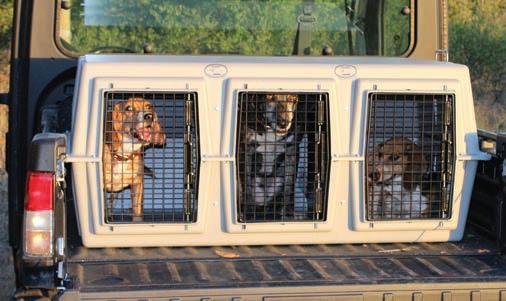
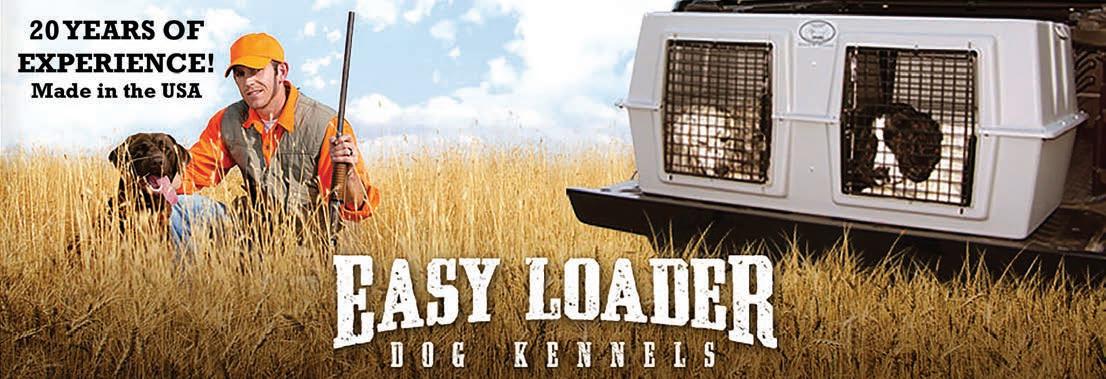
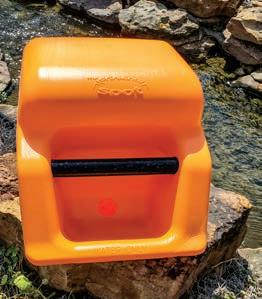
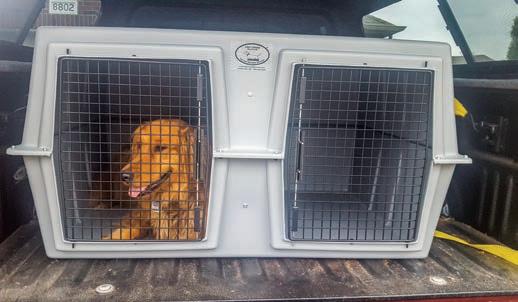
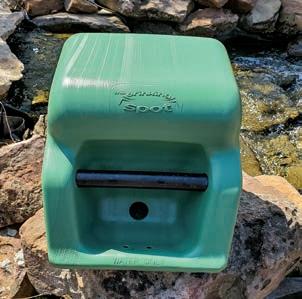
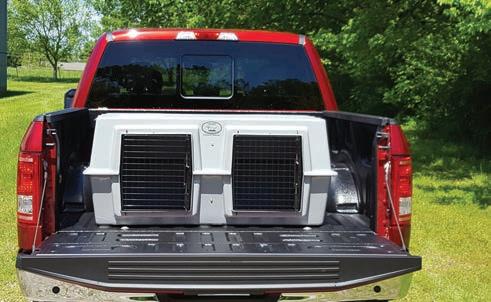
• Easy Loader & Deuce accommodate 2 dogs up to 65 lbs each
• EZ-XL accommodates 2 dogs over 65 lbs each
• Made from High Density Polyethylene with UV protection
• Easy Loader fits most full size pickups, SUVs & large UTVs
• Deuce fits smaller pickups, SUVs & UTVs
• EZ-XL is for larger breed dogs & full size vehicles
• Vents, cold weather door covers, insulated covers & custom kennel pads available
LIGHTWEIGHT.
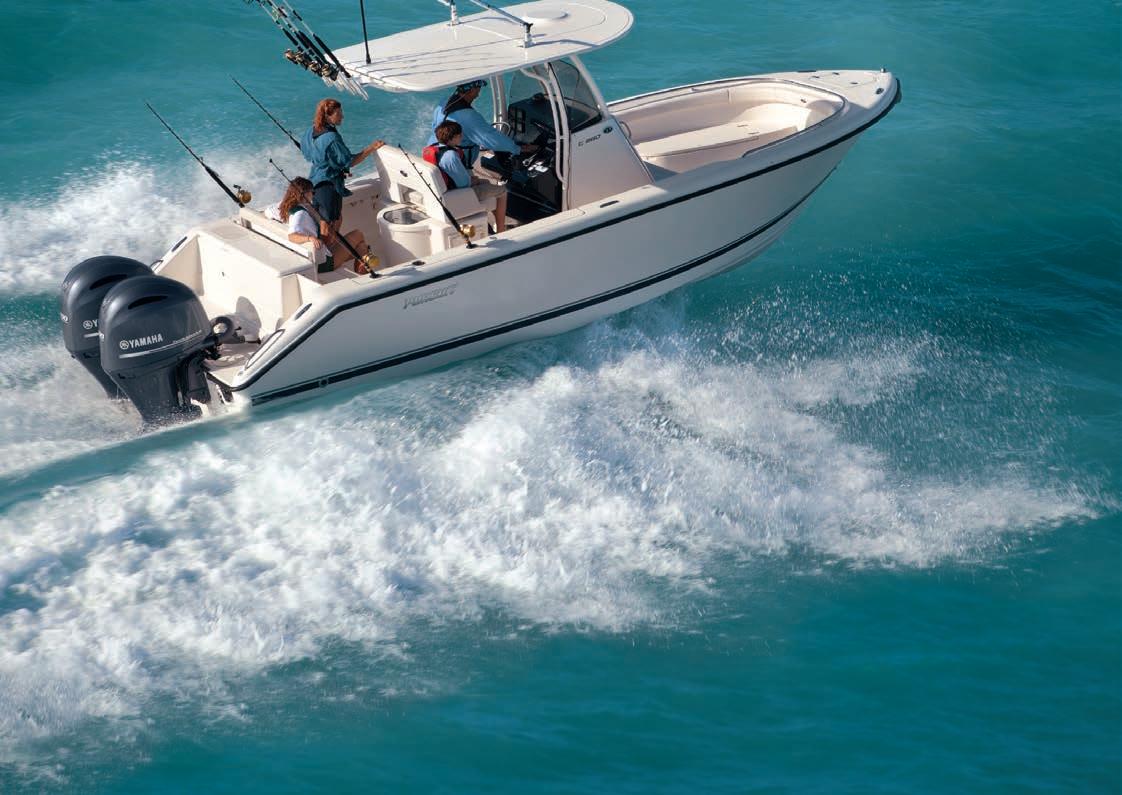
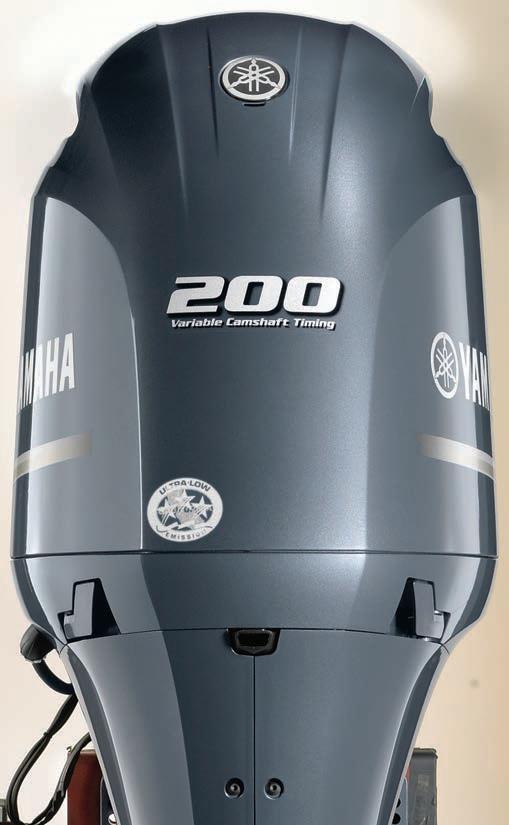
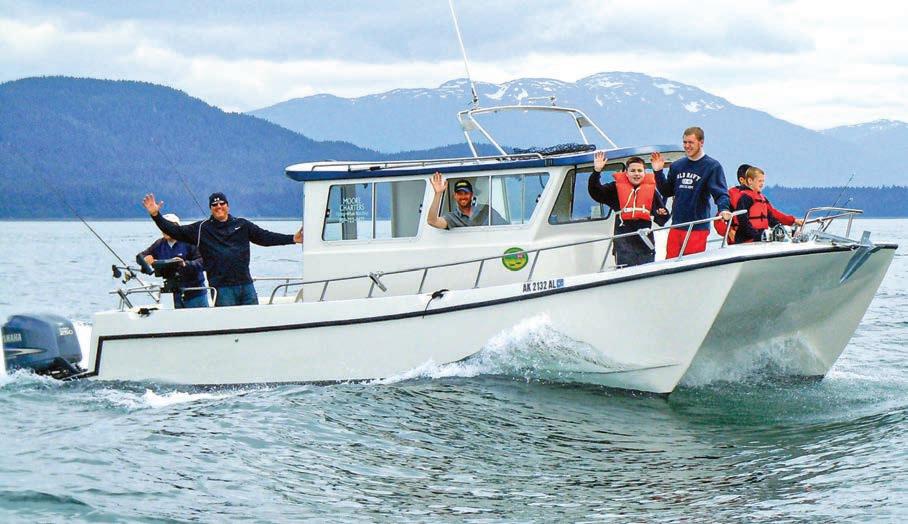
The lightest 200-hp four stroke on the market
2.8L displacement and Variable Camshaft Timing give it the best power-to-weight ratio of any 200-hp four stroke
Nearly 120 pounds lighter than our four-stroke V6 F200
Show the water who’s boss with the F200 In-Line Four. Incredibly light, responsive and fuel efficient, it serves up plenty of muscle to handily propel a variety of boats. On top of that, its 50-amp alternator offers the power to add a range of electronics, and its 26-inch mounting centers and compatibility with either mechanical or digital controls give you the flexibility to easily upgrade your outboard or rigging. Experience legendary Yamaha reliability and the freedom of forward thinking, with the F200 In-Line Four. THE F200 IN-LINE FOUR.
Lakeside Lodge Life at Odell Lake Resort
Whether you’re working the water, playing a round of disc golf, or basking in the perfect sunset, Odell Lake Resort is your place to unwind and explore.
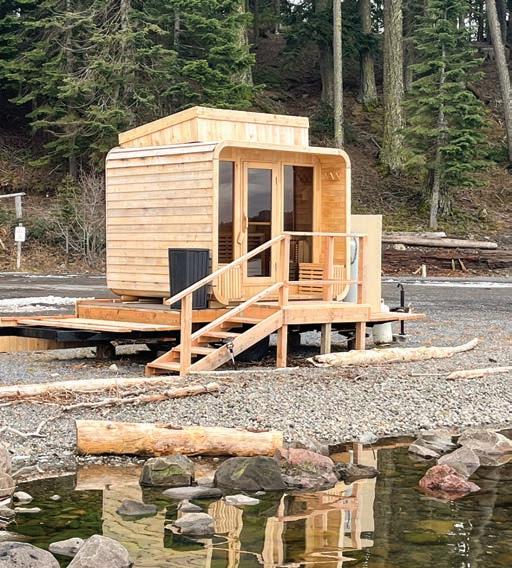
• Lakeside Sauna - a private, relaxing extraordinary experience
• Revitalized Outdoor Patio - a great time any day of the week
Come experience Odell Lake Lodge Life! Book your stay today!
PUBLISHER
James R. Baker
GENERAL MANAGER
John Rusnak
EXECUTIVE EDITOR
Andy Walgamott
EDITOR
Chris Cocoles
WRITERS
Richy J. Harrod, Scott Haugen, Tiffany Haugen, Tiffany Herrington, Brian Watkins
SALES MANAGER
Paul Yarnold
ACCOUNT EXECUTIVE
Janene Mukai
DESIGNER
Kha Miner
WEB DEVELOPMENT/INBOUND
MARKETING
Jon Hines
ADMINISTRATIVE ASSISTANT
Katie Aumann
INFORMATION SERVICES MANAGER
Lois Sanborn
ADVERTISING INQUIRIES media@media-inc.com
MEDIA INDEX
PUBLISHING GROUP
941 Powell Ave SW, Suite 120
Renton, WA 98057
(206) 382-9220 • Fax (206) 382-9437
media@media-inc.com www.media-inc.com
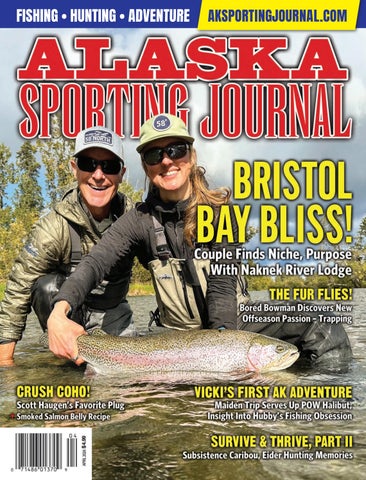
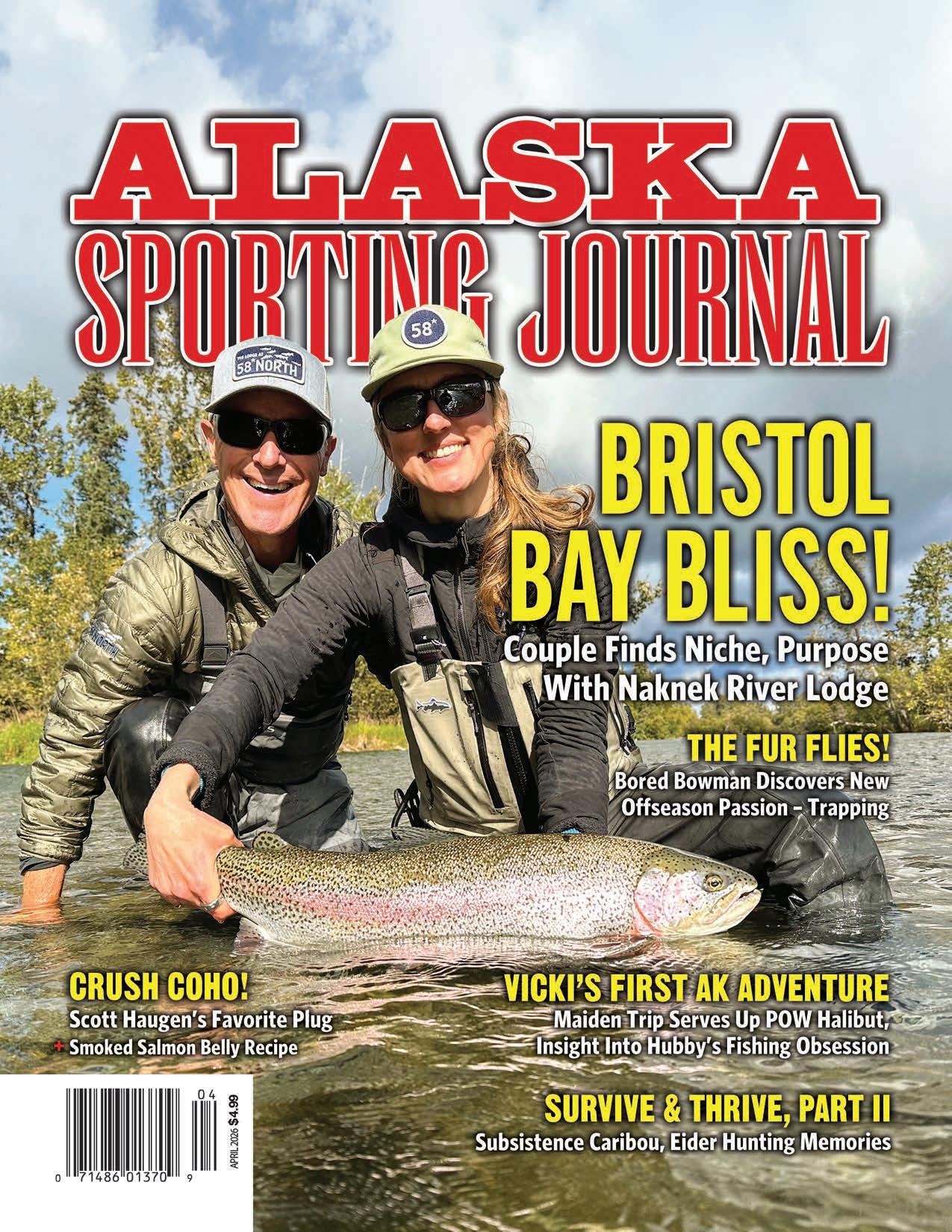
ON THE COVER
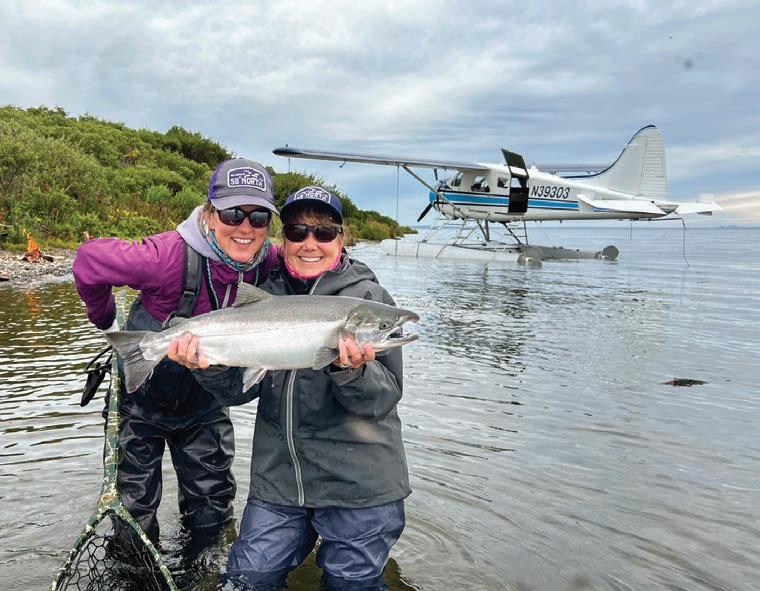
Bristol Bay’s Lodge at 58* North on the Naknek River is the vision Kate Crump and her husband Justin had after starting and expanding their guide service in Alaska. Crump called discovering the waters they now take clients on “a love-at-first-sight type of moment.” (KATE CRUMP)
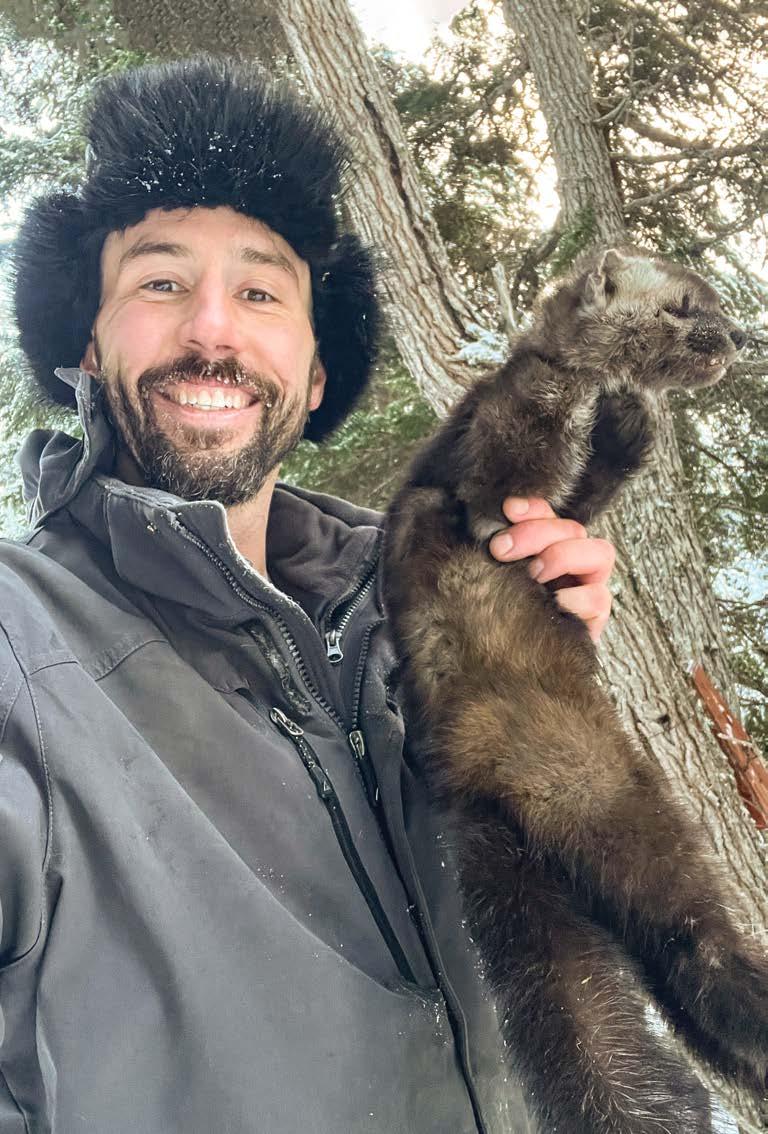
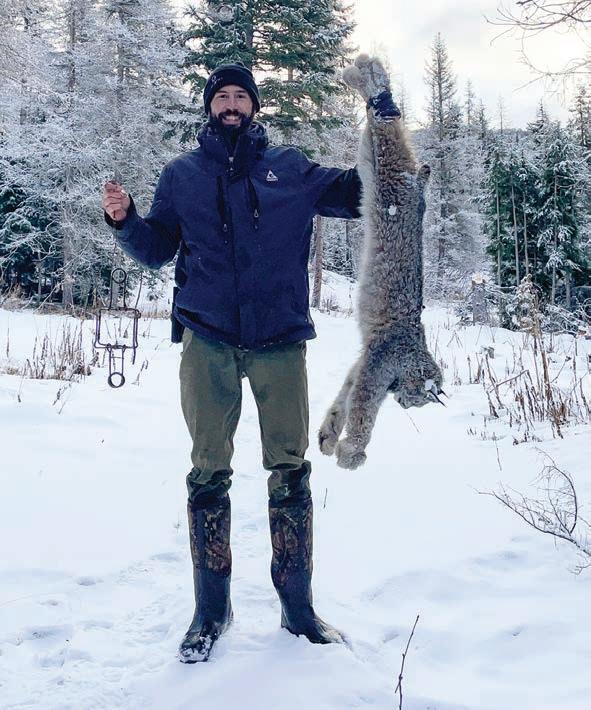
As winter used to drag on, Brian Watkins would patiently wait for spring hunting opportunities. But in recent years, a friend sold him on the joys of trapping, and after picking his brain and getting more tips from YouTube, Watkins started successfully setting out his own trap lines on the Kenai Peninsula. He admits he’s still learning, but find out what it’s like to be an adult-onset trapper whose big goal is to get a wolverine!
25 BIG BREAK IN BRISTOL BAY
When Alaska called Pacific Northwest resident Kate Crump to head north, she found a new home, new purpose and a new business to run in Bristol Bay. Crump and her husband Justin’s burgeoning guide service led to their new vision, The Lodge at 58* North on the Naknek River. Tiffany Herrington caught up with Kate Crump to continue her outstanding Alaska Women and the Outdoors series.
33 WHERE THE HALIBUT BITE
Fishing adventures have always been a part of Richy Harrod’s life, but when he brought along his wife Vicki for her first Alaska trip, he worried that the floatplane flight and big seas might be too much for her. Instead, Vicki savored the beauty of Prince of Wales Island, the Thorne Bay lodge they stayed at and the halibut they caught off Naukati Bay. Harrod shares how his wife “discovered that being uncomfortable can be rewarding.”
47 EXPERT TIP: FISH MAG LIPS
Sometimes, anglers have a hunch about what might work. Scott Haugen recalls watching fellow salmon chasers struggling to catch finicky Alaska coho when he threw a changeup: a 3.0 Mag Lip plug. Suddenly, he couldn’t limit out fast enough, much to the chagrin of everyone else. Haugen pays homage to one of his favorite new offerings for slamming silvers, and Chef Tiffany Haugen prepares smoked salmon belly in their popular From Field to Fire feature.
17 Editor’s Note
19 The Alaska Beat: News and notes from around the Last Frontier 23 Outdoor Calendar
61 Subsistence hunting memories, part II
(BRIAN WATKINS)
125 RIVER GLEN TERRACE, KALAMA
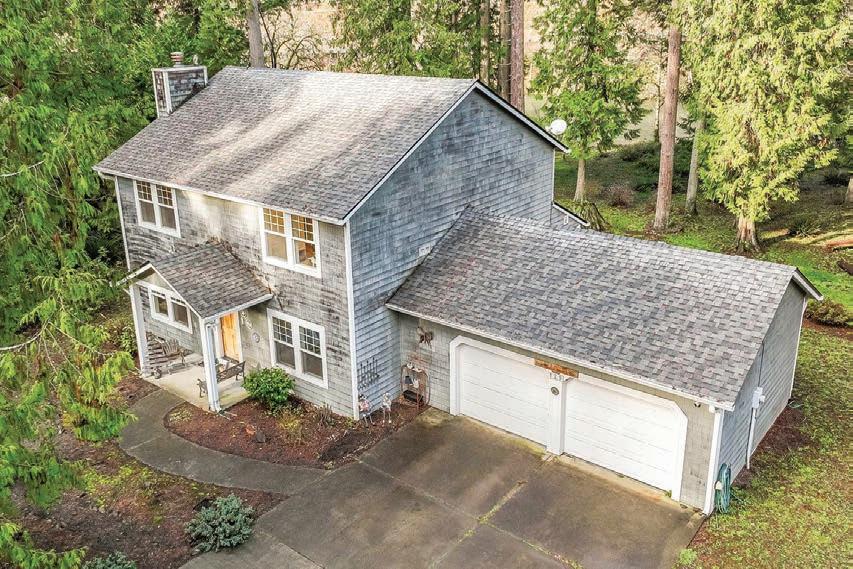
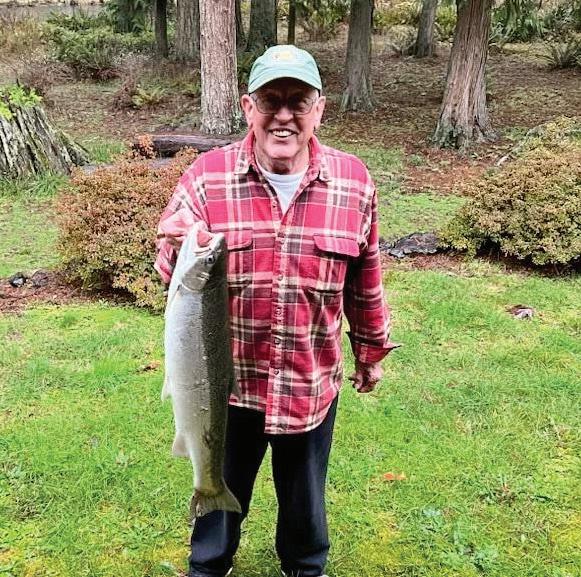
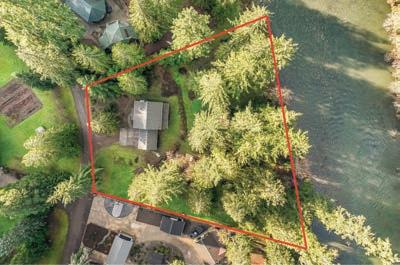
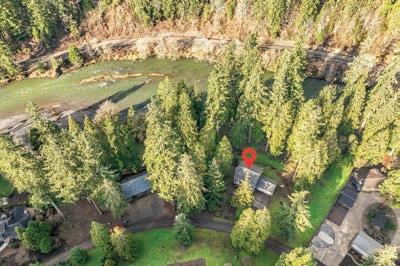
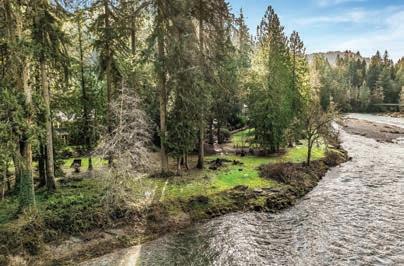
We have an incredible property for sale on the Kalama River, perfect for fishing enthusiasts. It’s located on Beginner’s Hole, and our client has caught hundreds of steelhead right from his backyard over the 30 years he has lived here!
• 2.27 nearly flat acres, with mature evergreen trees
• On ‘Beginner’s Hole’ on the Kalama River
• Photos of steelhead he’s caught
• Peaceful neighborhood, mostly retirees
• Only 10 min from town
• New roof in 2021
• Fiber internet connection may be available
• Home being sold by original owner - immaculately cared for!
• $875,000
Photos, videos, flooplans, and more are all here: www.kalamariverhouse.com
Please text or call me at 360-776-9599 for a private showing. We would love to show the property to any fellow fishermen!
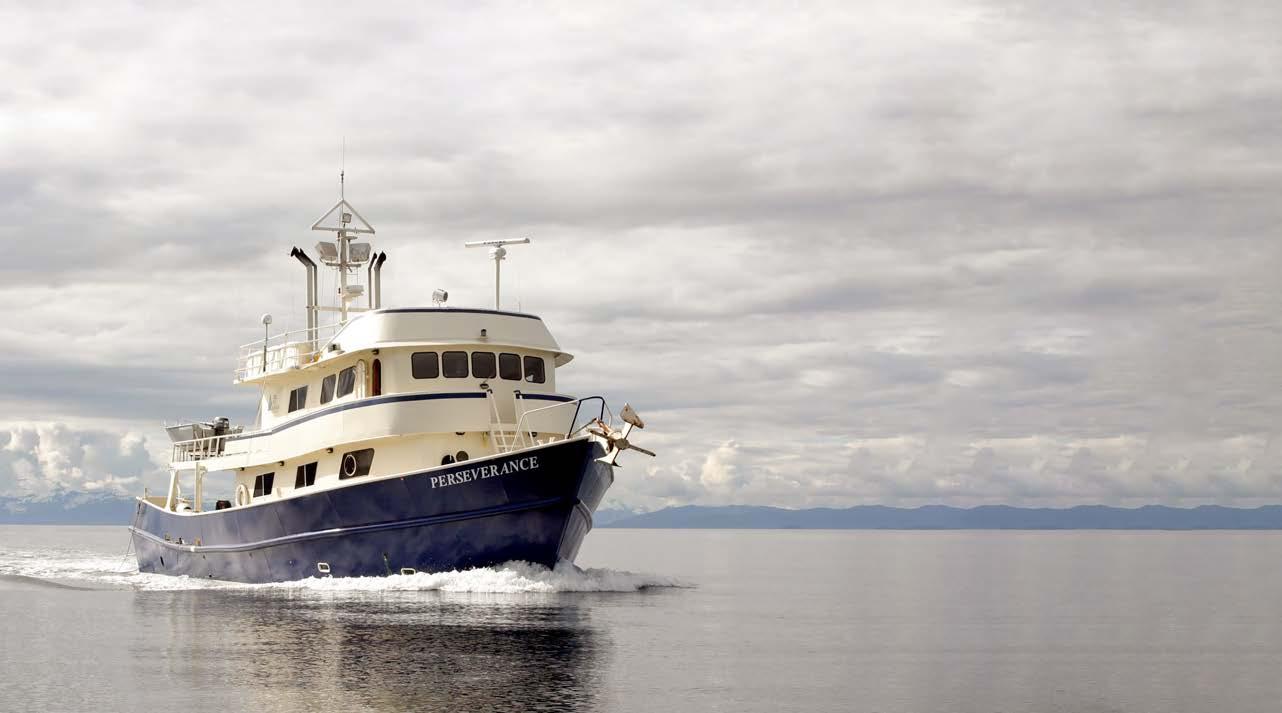
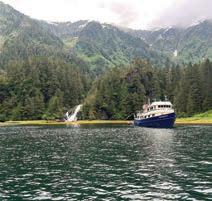
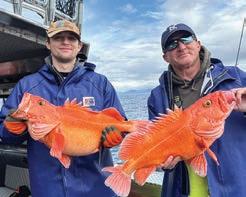
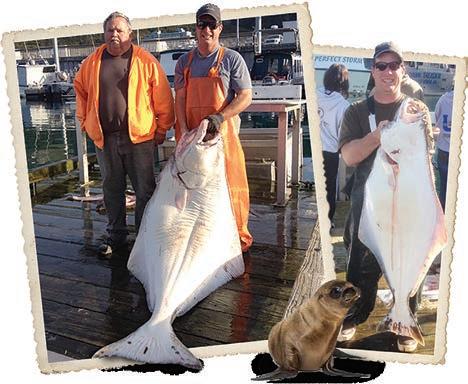
Wild Alaska offers an unmatched mothership sportfishing adventure in Southeast Alaska. With over 25 years of experience, we provide exclusive access to vast, untouched marine wilderness—far beyond the reach of traditional charter operations.
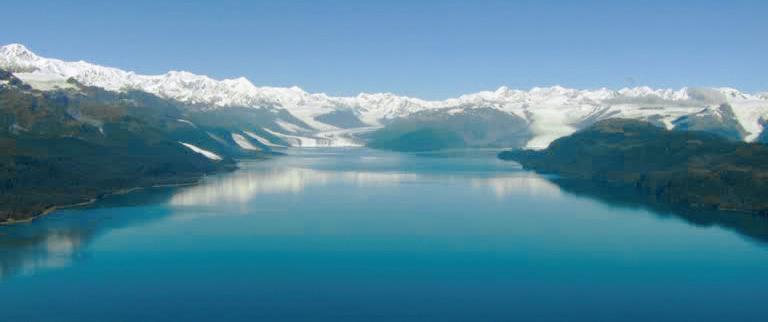
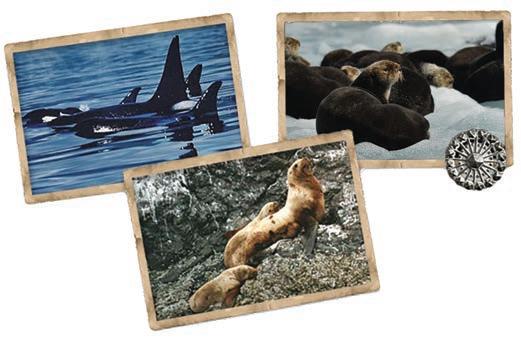
Immerse yourself completely in Southeast Alaska’s marine wilderness. Fish calm, sheltered waters of Frederick Sound, Stephens Passage, and Chatham Strait, surrounded by glaciers, wildlife, and breathtaking scenery. Our mobility ensures new waters and fresh opportunities every day—keeping you where the fish are.
LIFE ONBOARD
• Hot breakfast each morning
• Soup and sandwich lunch
• Fresh seafood dinners
• Relaxed evenings—or continue fishing and exploring
• Comfortable cruising in 50–70° temperatures
WHAT YOU’LL ENJOY
• World-class sportfishing
• Up-close wildlife viewing
• Photography opportunities found nowhere else
• Safe, warm, and welcoming onboard environment
• Exceptional crew and personalized service
Join Wild Alaska for the adventure of a lifetime! Pack a smile—and get ready for
EDITOR’S NOTE
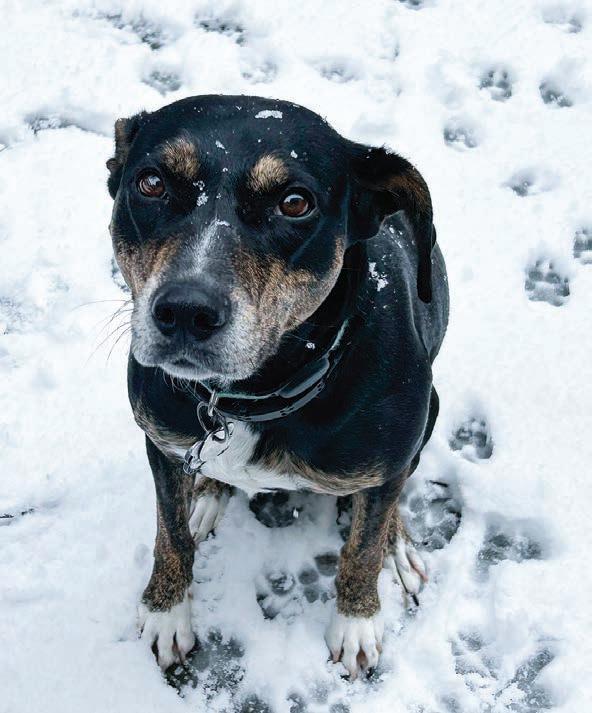
Irecently woke up to a dusting of snow in Seattle, where our company is headquartered. It was a surprise for both me and my dog Olive, a rescue who came to the Seattle Humane Society from a Houston, Texas-area shelter, and hasn’t endured many snow days since we found each other.
The previous winter, Olive’s first in her forever home, was mild, and it looked like this latest one would be a snow-free season ... at least until that mid-March dusting. I get her into the backyard every morning to do her business, and while I was curious how she’d react to the snow, the South Texan in her made for a rather quick cameo appearance as she darted back for the warmth of our townhouse.
I can’t blame her; the Californian in me is also not super excited about getting around in the snow, though it’s fun to look at. Of course, it’s all relative, and as Alaskan Brian Watkins can relate in his trapping piece this month (page 55), winter is a whole different story in the Last Frontier.
I asked Watkins about how setting out trap lines provides a distraction from the usual frigid, snowy and dark Alaskan winters.
“An outdoorsman needs to slow down and enjoy the quietness of winter – maybe snowshoe or backcountry ski through the woods and see what’s around. It’s the perfect time to trap and observe,” he told me.
“(Trapping) allowed me to slow down and observe movements and tracks between checks,” he added. “You truly learn how animals move by taking your time and seeing what’s happening through the prints in snow. You notice travel corridors and where certain creatures tend to spend their time. (Noted outdoorsman) Tom Miranda once said a good trapper makes a great bowhunter. I never understood that until I became a trapper myself. It allows you to really take it all in. The bridge between seasons has a perfect filler: trapping. It keeps the winter blues away and delays cabin fever come spring.”
When I spent six years as a sports reporter in Fayetteville, Arkansas, winters could be a grab bag of everything from 70 degrees and sunshine to bitter cold, ice and sporadic snow. One particularly brutal winter – which included a historically nasty ice storm that hampered the region for weeks – getting outside for some spring fishing was welcomed.
My buddy and I picked a glorious sunny April morning that year and drove about an hour or so north of Fayetteville to a popular trout fishing spot in the tailwaters below the Beaver Lake dam. We basked in the glory of much-needed warmth and caught some nice rainbows. It was a great transition to spring as well as a fun time, as I usually worked most weekends to help cover the University of Arkansas baseball season, which made fishing trips rare. But the days I was able to get away were special – at least until summer, when the heat, at times oppressive humidity and gnarly thunderstorms meant summer vacations to more temperate locales were coveted after a long year of writing about college and high school sports.
As the Seattle snow fell on that March morning, I started thinking about getting out to fish once the weather improves. Watkins will be thrilled to get out and continue his passion for spring bear hunting, and I guarantee my pup Olive will be a lot more excited to get outside and not be covered in wet snow soon. -Chris Cocoles
From the editor’s dog soaking in a rare snow day since being rescued from Texas, to Alaskan Brian Watkins’s new winter obsession with trapping, the coming of spring, warmer weather and new animals to hunt or fish to catch can be cathartic. (CHRIS COCOLES; BRIAN WATKINS)
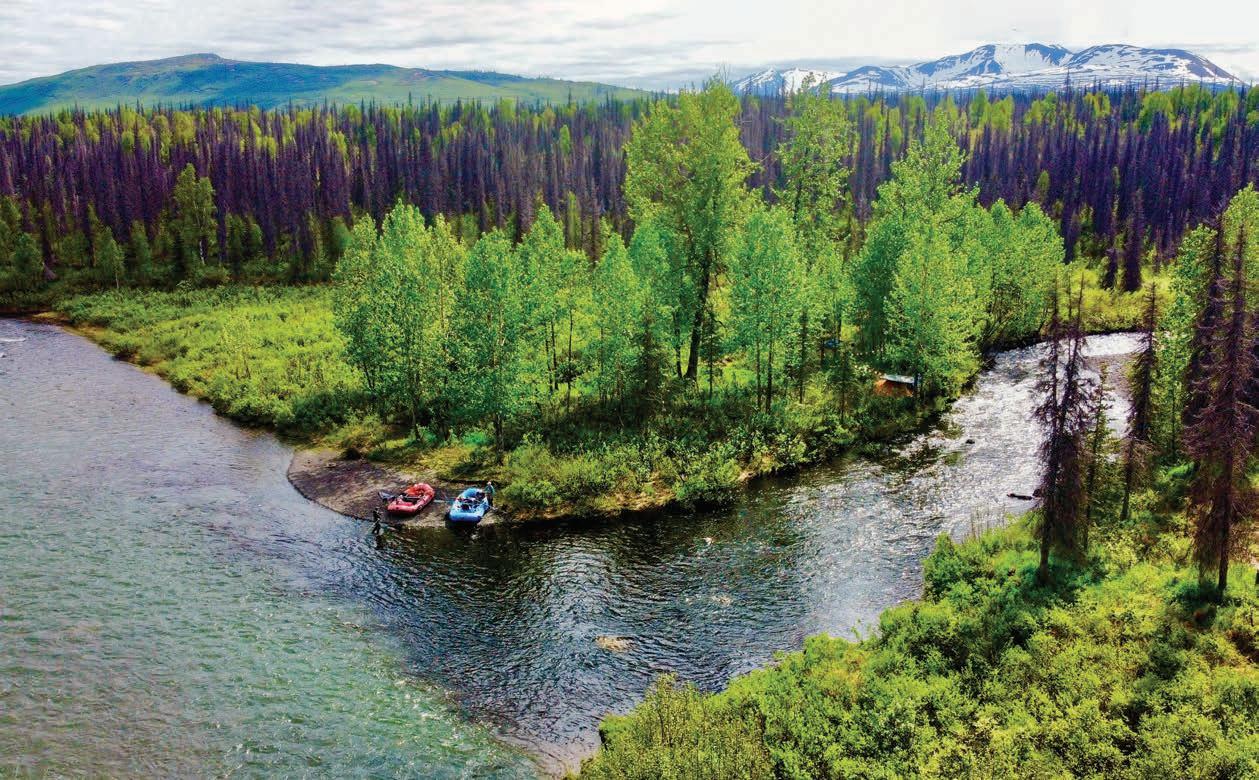
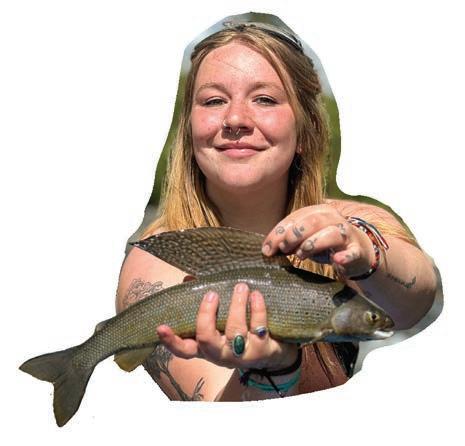
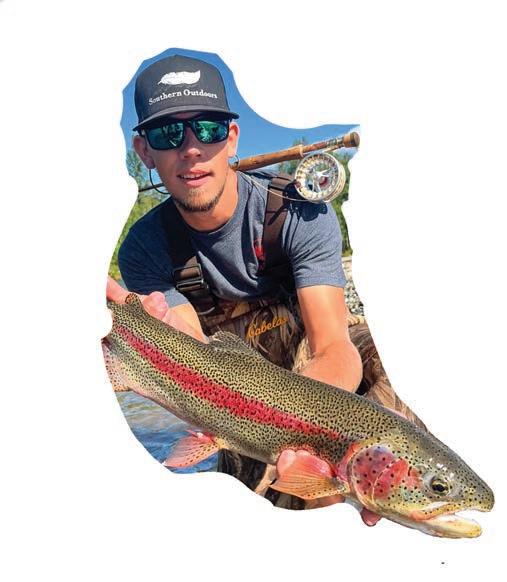
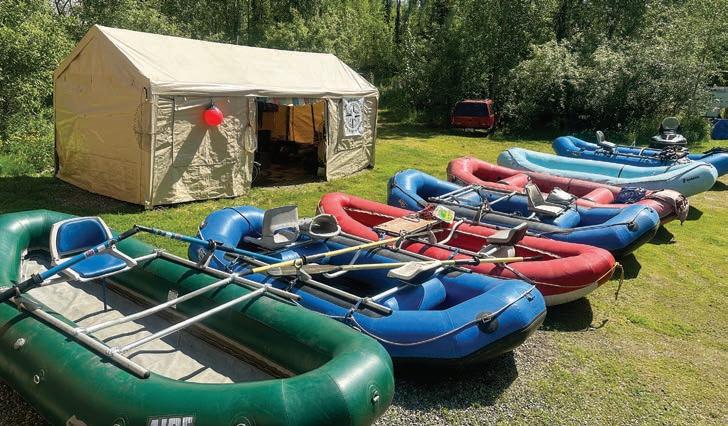
We are a rafting and fly fishing guide service based in Willow, Alaska, with more than 20 years of experience on the rivers of Southcentral Alaska. We offer road-accessible day trips as well as fly-out, multi-day adventures for those seeking a more remote fishing experience. Our team is made up of highly skilled, experienced guides who are passionate about Alaska’s rivers and dedicated to providing a safe, professional, and enjoyable trip on the water.
LAWSUIT CHALLENGES AMBLER ROAD PLANS
Even as the Trump Administration appears to be avoiding intervention and keeping the Pebble Mine project blocked in Bristol Bay, and Alaska’s US Senators Lisa Murkowski and Dan Sullivan wrote a letter opposing new British Columbia mines along transboundary rivers shared with Alaska, Washington DC has more ambitious plans for other lands in the Last Frontier.
As the Department of the Interior announced last fall that it planned to open up 2.1 million acres for energy projects – headlined by the divisive Ambler Road proposal that would connect the Dalton Highway with a mining district – opponents are fighting back with legal action.
“Ten Alaska and national groups sued the Interior Department today for unlawfully removing federal protections from public lands in an area stretching from the Yukon River to the Brooks Range,” a press release announced in early March.
“These public lands orders should never have been revoked without a thorough environmental review, public accountability and meaningful consultation with the communities most directly affected,” added Krystal Lapp, board president of the Northern Alaska Environmental Center. “These 2 million acres form an essential ecological connection between Gates of the Arctic National Park and Preserve and the Arctic National Wildlife Refuge and support world-renowned wildlife migrations, subsistence hunting and fishing, and intact Arctic ecosystems. Eliminating these protections opens the door to state land selections, mining claims and industrial development in one of the most ecologically significant landscapes in North America.”
The Ambler Road is as almost a high-profile issue in Alaska as the for now shuttered Pebble Mine and President Donald Trump’s revoking of the Roadless Rule that would leave large sections of Tongass National Forest at risk to logging and other ventures.
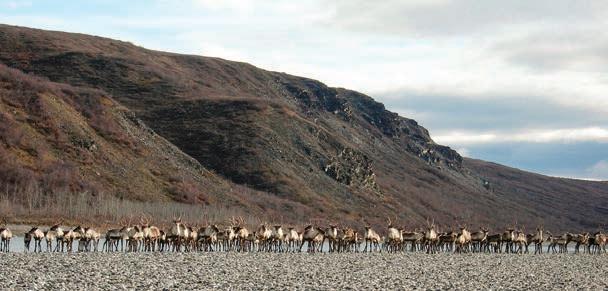
Ambler’s 211 miles of gravel road would cross through portions of the Brooks Range, Gates of the Arctic National Park and Preserve, salmon streams and Western Arctic Caribou Herd calving and migration grounds.
DOI stated in a press release last fall that if built, Ambler “would enable access to large deposits of copper, cobalt, gallium, germanium, and more.
“The Dalton Corridor is not an empty stretch of tundra waiting to be exploited,” said Nicole Schmitt, executive director of Alaska Wildlife Alliance, part of a lawsuit that challenges the federal government’s plans to open 2.1 million acres to development. “These ecosystems support the migration of the Western Arctic Caribou Herd, along with salmon-bearing rivers, Dall sheep lambing grounds, habitat for grizzly bears, wolves and countless other species, as well as subsistence hunting grounds for Alaska Native communities. The current administration has been clear in its intent to open federal lands to extraction industries.” (MIKE THOMPSON/NATIONAL PARK SERVICE)
AL ASKA BEAT
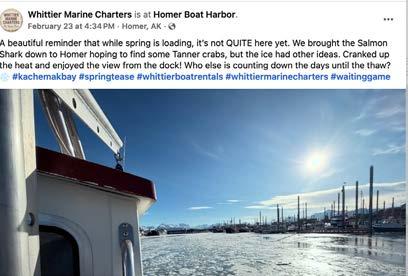
SOCIAL MEDIA POST OF THE MONTH
and summer fishing trips. Check them out at fishwhittier.com.
A study by Colorado State University concluded that “from 2018 to 2024” – a span of just six years – glacial lakes in Alaska grew 50 percent faster than they did from 2009 to 2018. More water, more fish?
NOTABLE
Our pal (and February cover subject) Andrew Kurka won a skiing bronze medal at the Milan Cortina Paralympic Winter Games in March, his third career Paralympic medal. He now has gold, silver and bronze, and bore the US flag during closing ceremonies. (ANDREW KURKA)
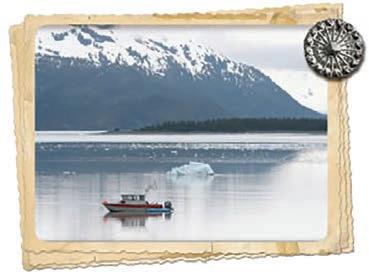
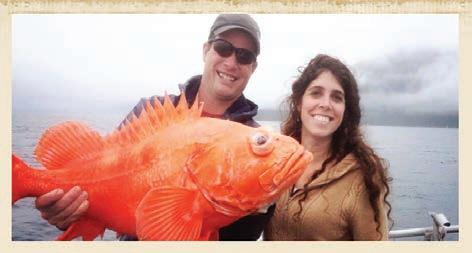
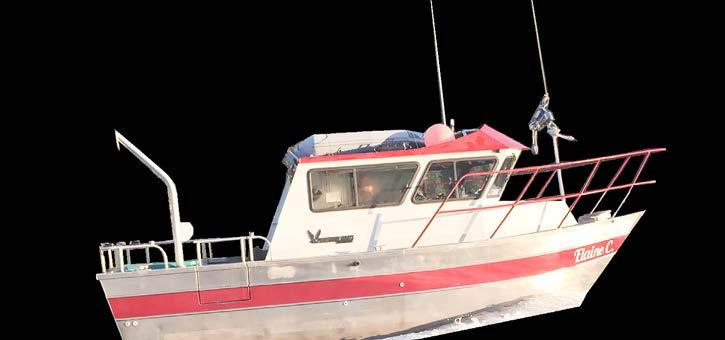
Whittier Marine Charters is ready for spring
The permits for the road have been held for years due to protracted litigation, and the President has finally allowed this project to go forward to support the Administration’s energy dominance agenda.”
Secretary of the Interior Doug Burgum used a Trump oil and gas talking point staple in proclaiming “mine, baby, mine” when the announcement was made, but the joint lawsuit filed last month means, just as with the Pebble Mine that was eventually vetoed by the Environmental Protection Agency, the opposition won’t go down without a fight.
“This decision to remove protections from these irreplaceable public lands smacks of corruption,”
Aaron Mintzes, deputy policy director at Earthworks, said. “On behalf of the federal government, the administration recently bought shares in Trilogy Metals, the mining company that would profit from the damaging Ambler Road that would subsidize their speculative mine.”
THEY SAID IT
(STILL
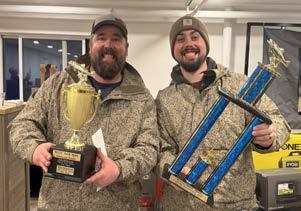
“This last weekend was the coldest in tournament history with brutal conditions and tough fishing. These teams are dedicated and Alaska tough!”
-Jerrid Hixon, tournament director of Big Lake’s Still Cold Open ice fishing tournament, on temperatures as low as minus 24 degrees, which didn’t dampen the spirits of those who participated, including pro division champions Caleb Hughes and Josh Hughes.
FROM THE ASJ ARCHIVES – APRIL 2018
ALASKAN NHL PLAYER NETTED GOALS, FISH
Some Alaskans weren’t born in Alaska. But so many times you can find yourself there and never want to leave again.
The oil boom in Alaska helped Nate Thompson’s parents get there. Robert is from Ohio and Nate’s mom Cathy hails from the island of Trinidad in the Caribbean nation of Trinidad and Tobago. Cathy’s parents moved north as part of the industry, and after she and Robert met in California, they joined them.
Robert wasn’t much of an outdoorsman in the Lower 48, but living in our 49th state has a way of sucking you in – your kids too. Robert now lives on the salmon-filled Kenai Peninsula and fishes whenever possible. Young Nate and his sister, Tiffany, were introduced to the flora and fauna, even living in urban Anchorage.
“It really is the Last Frontier,” Nate says. “To be able to drive a half hour out of Anchorage, you can be in the middle of nowhere. Or you can drive to a place in Anchorage, go on a hike and next thing you know, you’re in the wilderness. There’s no place like that.”
Fly fishing became part of the father-son bonding process. They took local classes in how to tie flies and it soon became the Thompsons’ favorite outdoor pastime. Catching a hard-fighting salmon on a fly rod was a challenge Nate couldn’t get enough of.
When he got older, the endless sunlight of Alaskan summers allowed Thompson and his friends to do a “suicide run” down to the Kenai, which is a lot less sinister than it sounds.
“You leave your house at, say, 8 or 8:30 (p.m.), then drive about an hour and 45 minutes to the Russian River,” he says. “You fish and catch your limit and finish –depending on how fast – and whether it’s midnight, 1 or 2 in the morning, you then drive back home. The benefit of that is still mostly light outside. You don’t have to worry about it getting dark on you.”
“That’s one of the perks of being in Alaska in the summertime.”
If summer was a time for using a net to secure a salmon or trout, winter meant nets of a different kind. Thompson would lace up his skates and never be far away from a frozen pond.
“I think that’s where I improved the most as a player, playing hockey outside,” he says. “We would have practice (indoors) at 9 a.m. on a Saturday, and there was an outdoor rink right next door. We’d take all our gear off and put on our hats and gloves and walk to the outdoor rink.” -Chris
Cocoles
many memorable fishing outings during his days in the Last Frontier. (NATE THOMPSON)
Anchorage native Nate Thompson played 844 National Hockey League games and likely has had just as
COLD OPEN)
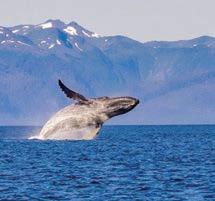
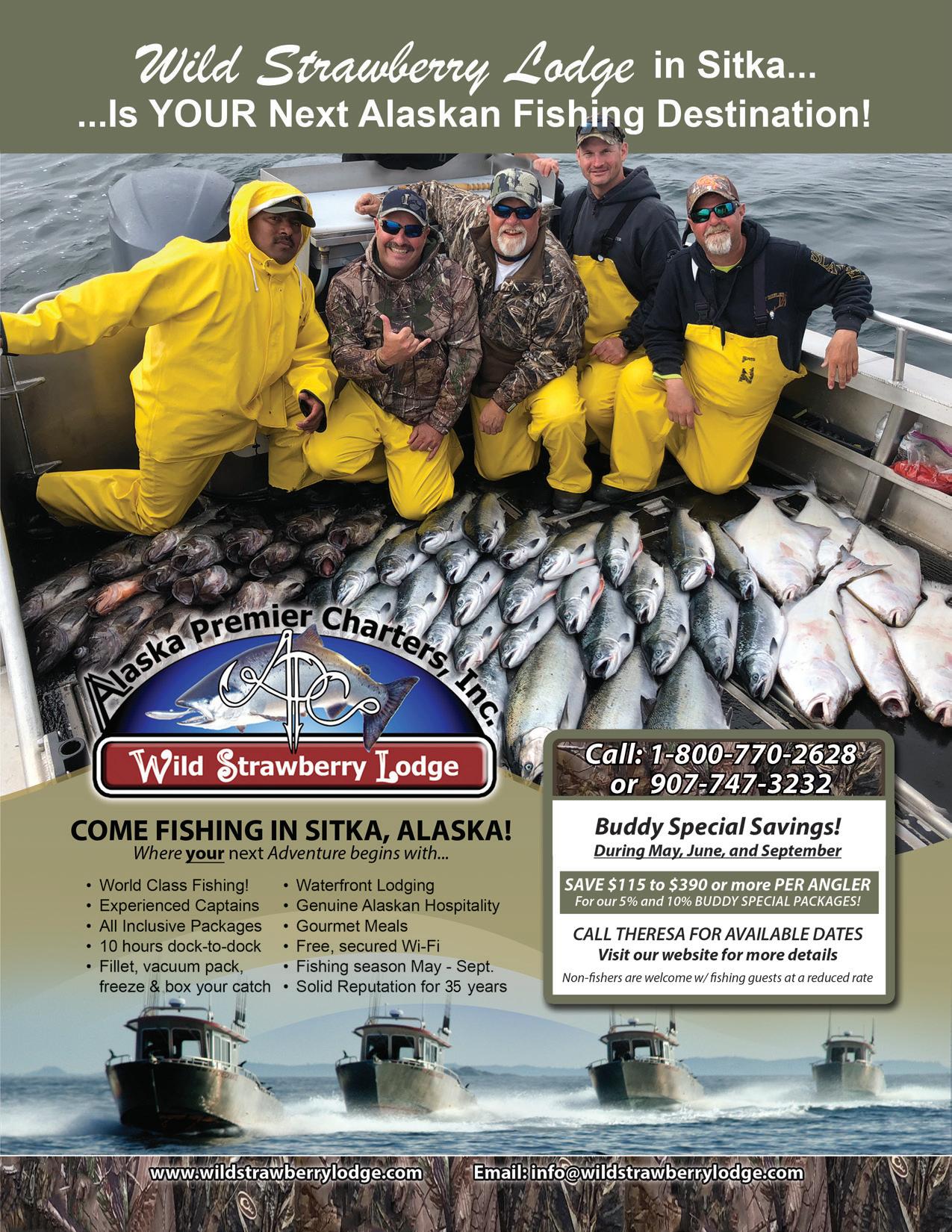
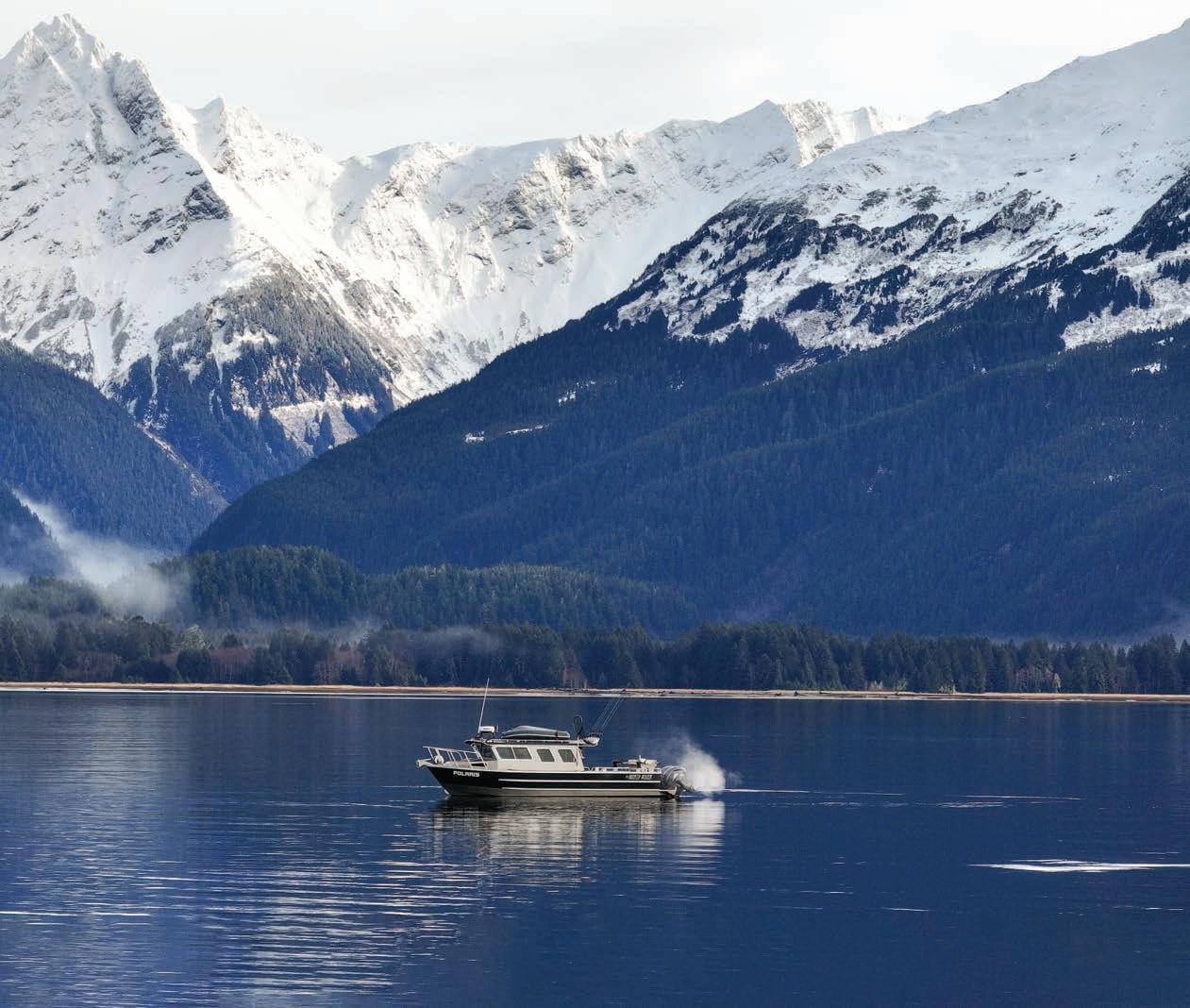
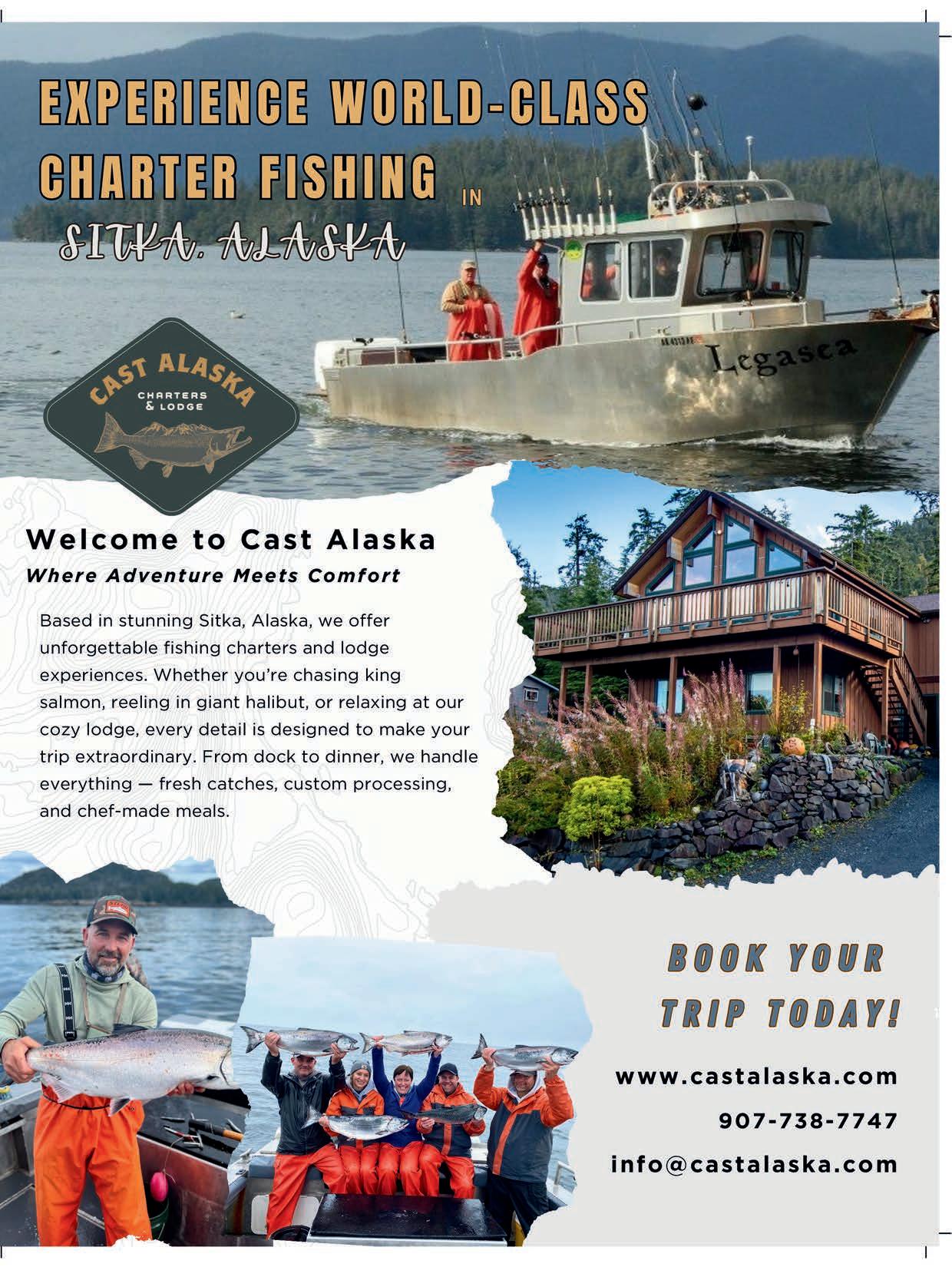
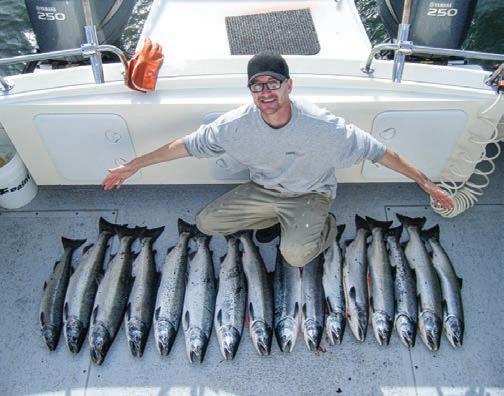
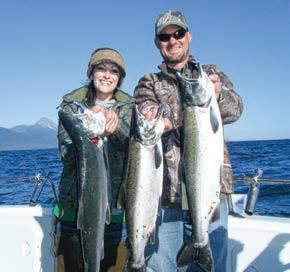
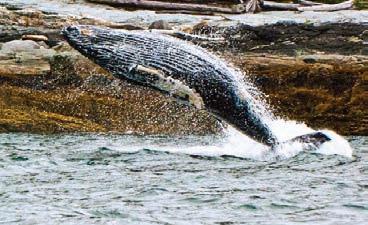
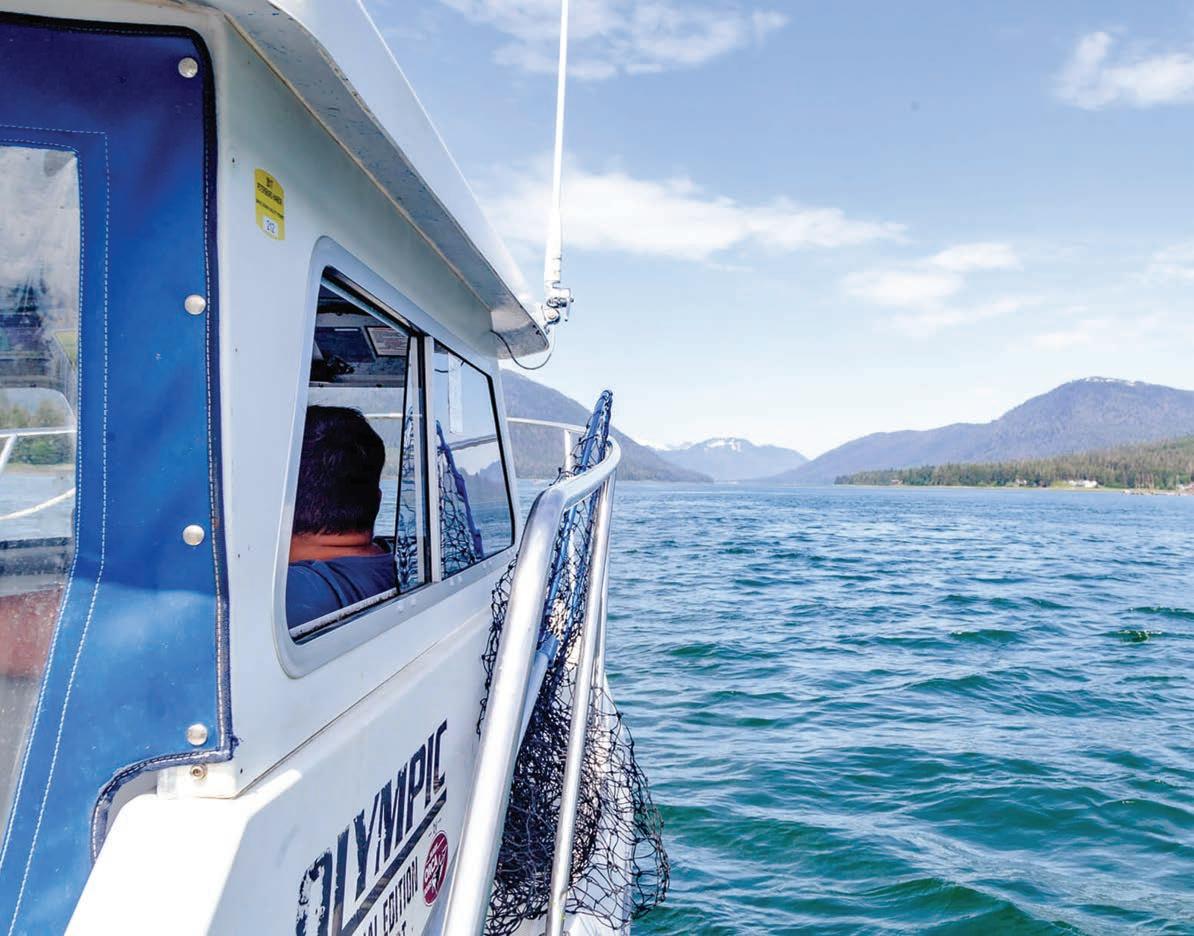
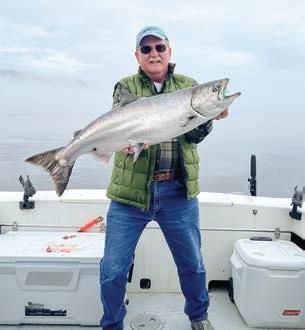
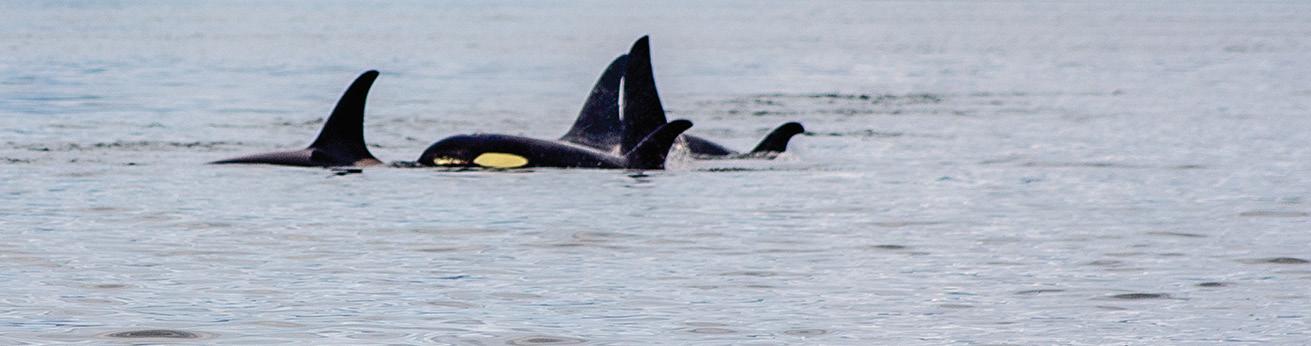
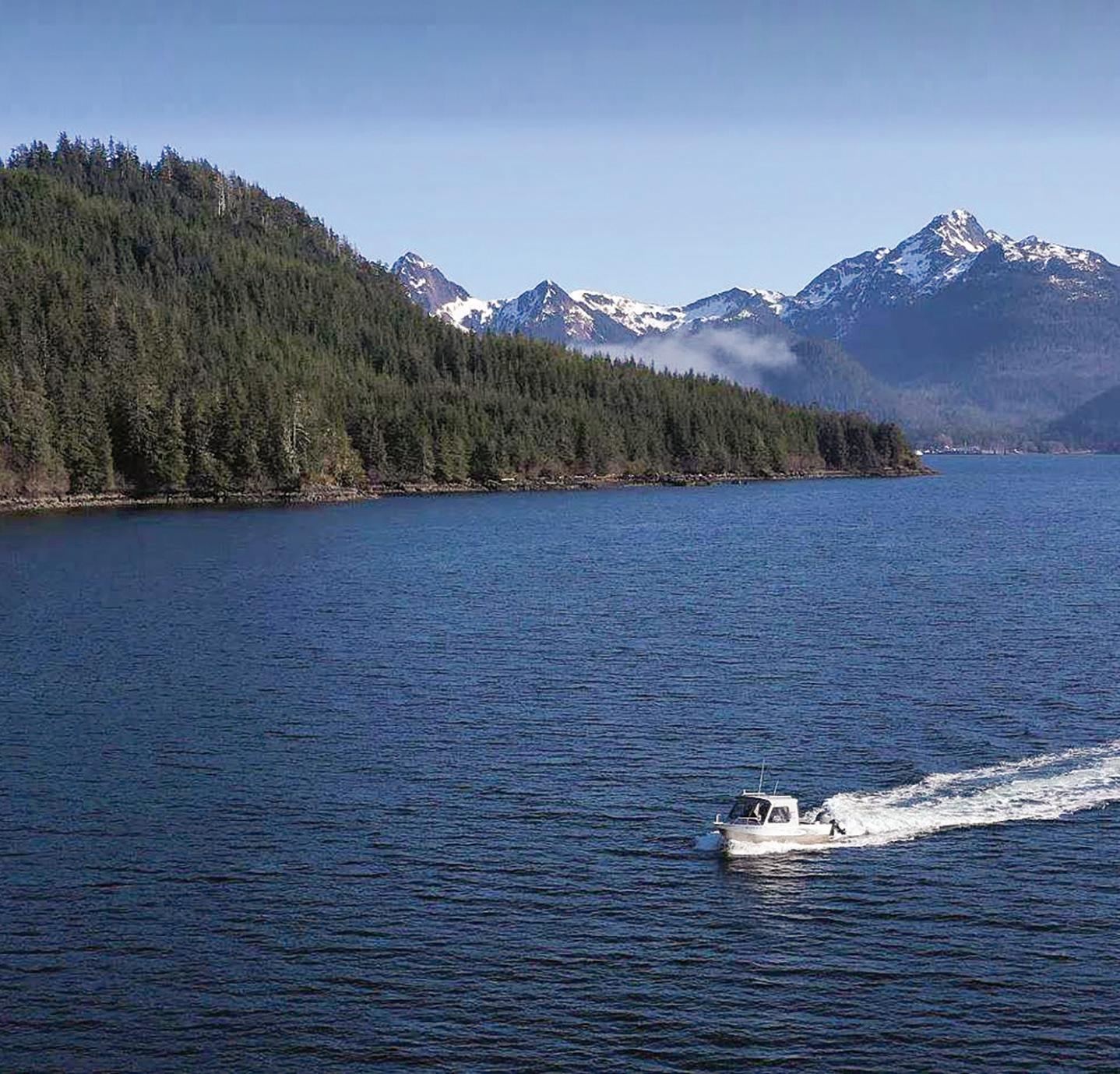
Whether you’re chasing the thrill of reeling in a powerful King Salmon or hoping to witness a 50-ton whale breach, set out on one of our dedicated wildlife or charter boats. We make unforgettable adventures possible.
WHAT’S INCLUDED:
• Snacks and water
• State of the art fishing gear
• On board restroom
• An exciting Sitka Alaska fishing experience
OUTDOOR CALENDAR
Spring brown bear seasons get started on April 1 in both Game Management Units 6D (Montague Island) and 8 (Kodiak/Shelikof). (LISA HUPP/U.S. FISH AND WILDLIFE SERVICE)
APRIL 1 Spring brown bear season opens in Game Management Unit 6D (Montague Island)
APRIL 1 Spring brown bear season opens in GMU 8 (Kodiak/Shelikof)
APRIL 4 Homer Winter King Salmon Tournament (rescheduled from March 21; homerwinterking.com)
MAY 10 Spring brown bear season opens in GMU 10 (Unamik Island)
MAY 20 ASYMCA Alaska Combat Fishing Tournament, Seward (alaska.asymca.org/combat-fishing-tournament)
MAY 21-25 Kodiak Crab Fest (kodiakcrabfest.com)
MAY 23 Start of Valdez Halibut Derby (valdezfishderbies.com/halibut-derby)
MAY 25 Last day of brown bear season in GMU 6D (Montague Island)
MAY 31 Brown bear season ends in several GMUs
JUNE 12-21 Valdez Halibut Hullabaloo (valdezfishderbies.com/halibut-derby/halibut-hullaballoo)
2026 SPORTSMEN’S SHOWS
APRIL 17-19 Mat-Su Outdoorsman Show, Menard Center, Wasilla (matsuoutdoorsmanshow.com)
APRIL 24-26 Fairbanks Outdoor Show, Carlson Center (fairbanksevents.com/fairbanksoutdoorshow)
For more information and season dates for Alaska hunts, go to adfg.alaska.gov/index.cfm?adfg=hunting.main.
SHE’S HOLDING THE LINE
LODGE OWNER KATE CRUMP ON BUILDING A LIFE IN BRISTOL BAY
BY TIFFANY HERRINGTON
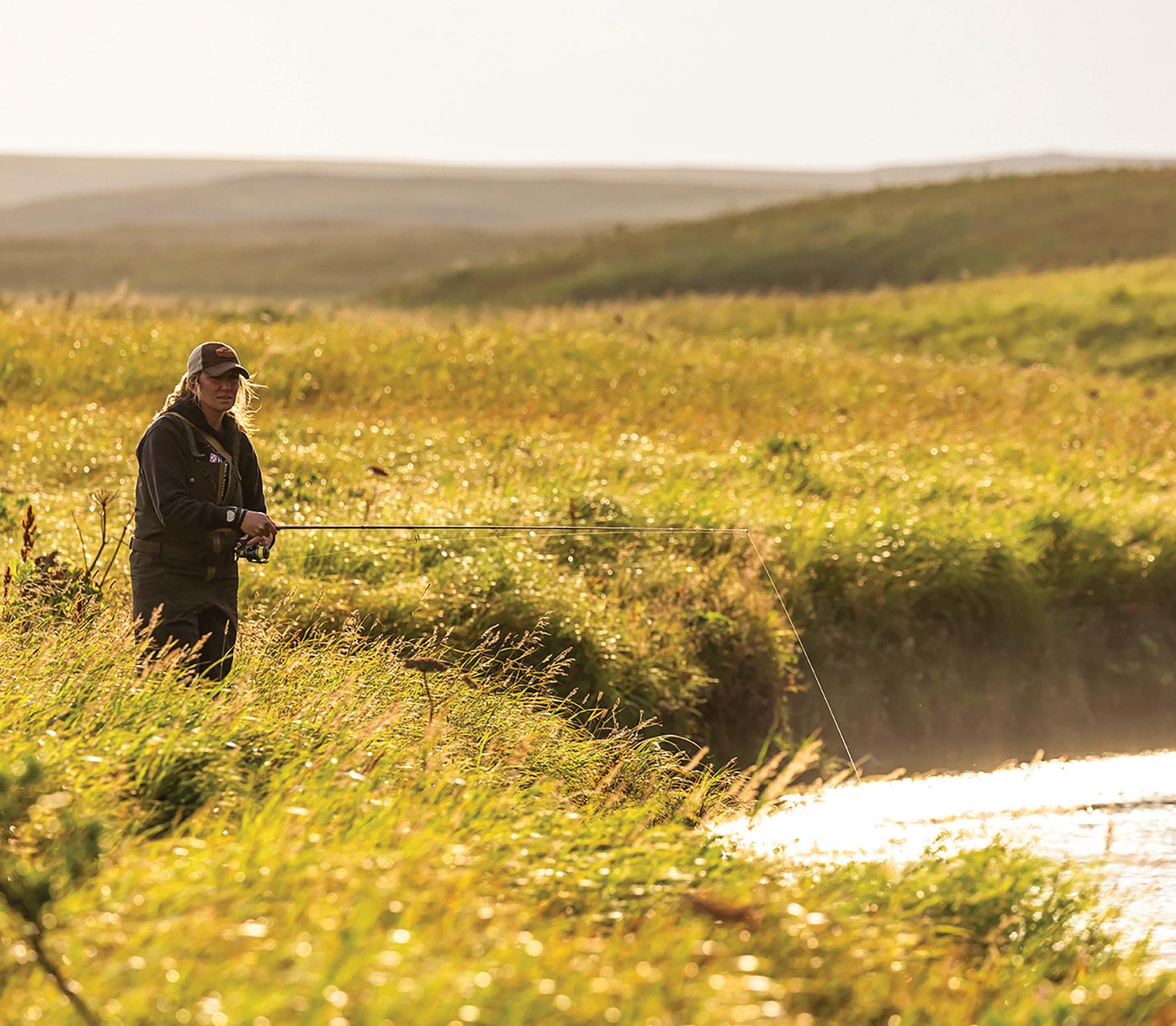
For most anglers who step off a floatplane into Bristol Bay for the first time, the experience feels almost disorienting in its scale. The rivers run broad and cold beneath open sky, salmon push upstream in numbers that defy logic, and the surrounding country remains largely roadless, uncut and unsoftened by the infrastructure that has reshaped so much of the Lower 48. It is the kind of place that does not need to announce its wildness; it simply operates on its own terms, indifferent to trend or convenience.
Kate Crump first came north in 2008 to guide in this wild country, and what she found was not simply opportunity but permanence. “I learned then how this place is like a mirror into the past,” she says, describing Bristol Bay as an image of what North America once was before its rivers were dammed and its salmon diminished. What began as a guiding season quickly became a trajectory, and over time that trajectory narrowed toward one particular bend in the Naknek River that she could not quite shake.
RAISED ON A FARM in rural Virginia, Crump did not grow up assuming she would one day run a remote Alaska fishing lodge. She left home for the Pacific Northwest searching
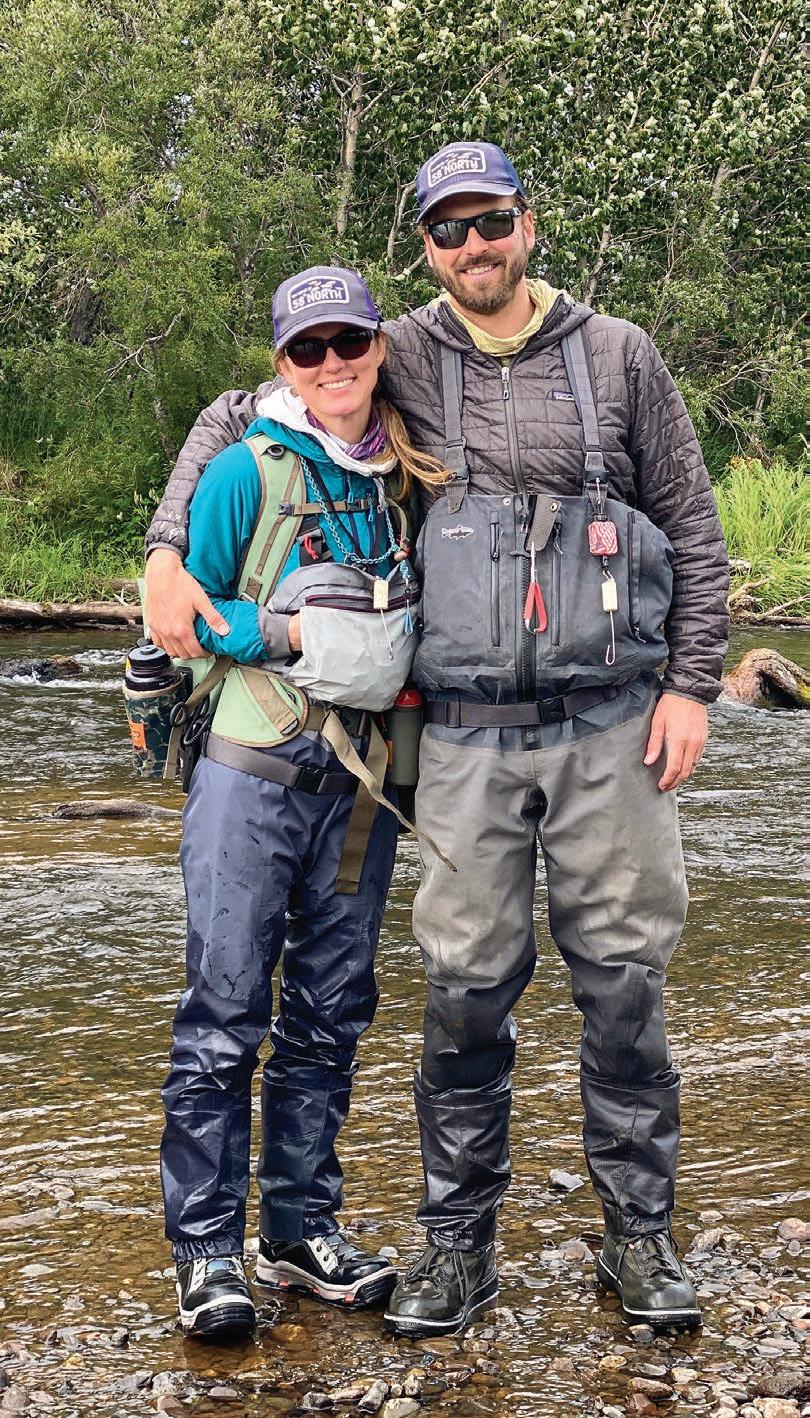
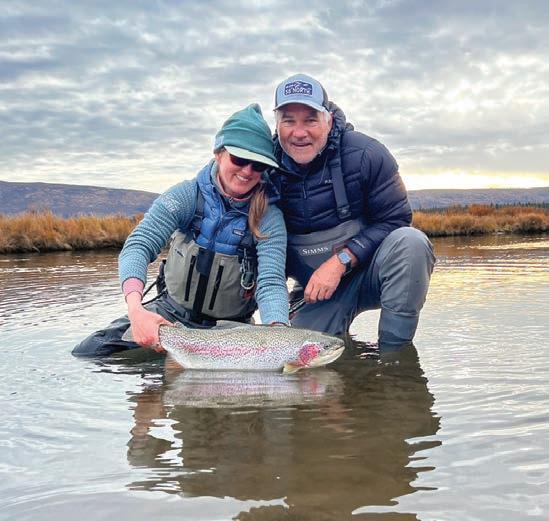
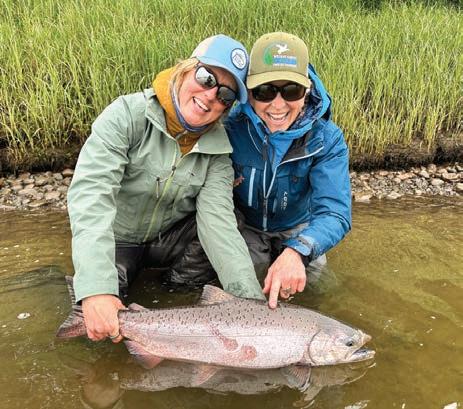
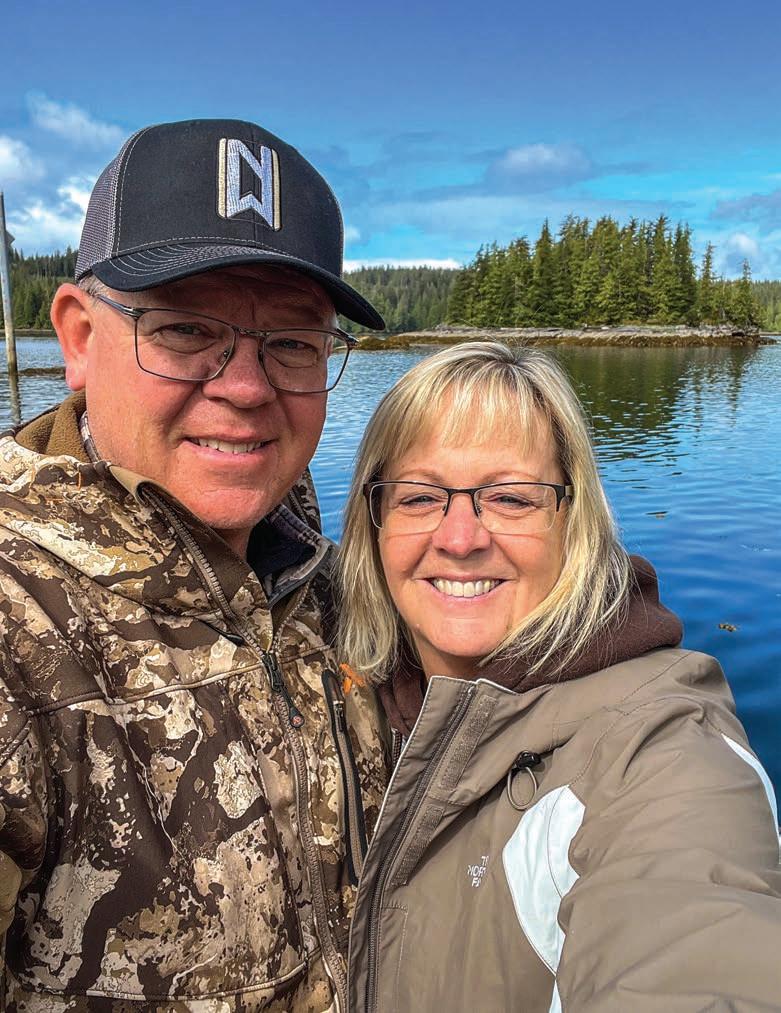
Kate Crump discovered the rugged beauty of Alaska’s Bristol Bay in 2008. Now she’s co-owner and -operator of The Lodge at 58* North, representing the vision she’s been building toward all along. (KATE CRUMP)
for direction, tried her hand at more conventional work and briefly interned at a veterinary office before realizing that a structured, predictable life was not what she wanted.
“Working 9-to-5 on repeat, patiently waiting for the freedom of retirement” was not going to hold her, she says. What did hold her – unexpectedly and completely – was salmon fishing.
“That beacon in my soul lit up for the first time,” she recalls. “All I knew was that I wanted to be on the water for the rest of my life.”
Guiding in Bristol Bay gave that instinct shape. The work demanded more than casting and knot-tying; it required learning to read glacial rivers that change character by the hour, understanding the timing and biology of all five Pacific salmon species and navigating a logistical reality where weather can ground aircraft and strand even seasoned crews.
Over the years, she and her husband Justin built a guiding business that split time between Alaska and Oregon, chasing steelhead in the offseason and returning north for the salmon runs that remain the economic and ecological backbone of Bristol Bay.
Even with advances in forecasting, she says, “the unpredictability of Alaska’s weather can still shape the
day for an Alaskan guide,” which is why satellite communication devices and constant coordination with pilots and neighboring guides are not luxuries but safeguards. In country this remote, margins matter, and the ability to make quick decisions before weather closes in can define whether a day remains productive or becomes dangerous.
SOMEWHERE IN THOSE EARLY seasons of running jet boats up the Naknek and guiding anglers across its gravel bars,
Crump passed a particular bluff and felt something shift. “It was the same day I found myself running a jet boat up the river for the first time,” she says. “A love-at-first-sight type of moment.”
The idea of owning a lodge there seemed unrealistic at first, something closer to a passing thought than a business plan, but the image of that bend in the river stayed with her for years. It would eventually resolve in her and Justin’s The Lodge at 58* North.
When the property eventually came up for sale more than a decade later, the decision to buy it was equal parts audacity and inevitability. The existing structures required significant work, and nothing about building in rural Alaska is simple. Materials must be barged or flown in, freight costs run high and timelines stretch when weather and transport fail to cooperate. Days routinely pushed past 20,000 steps as they hauled supplies between the river and the bluff above, rebuilt cabins and constructed a new lodge designed to frame the river through large windows rather than compete with it.
“The dream was rooted in having freedom over our guests’ experiences on and off the water,” Kate Crump says, explaining that ownership allowed them to shape not only the fishing program but the culture of the place. They built raised beds and a greenhouse, added a
mirror into the past,” she says. (KATE
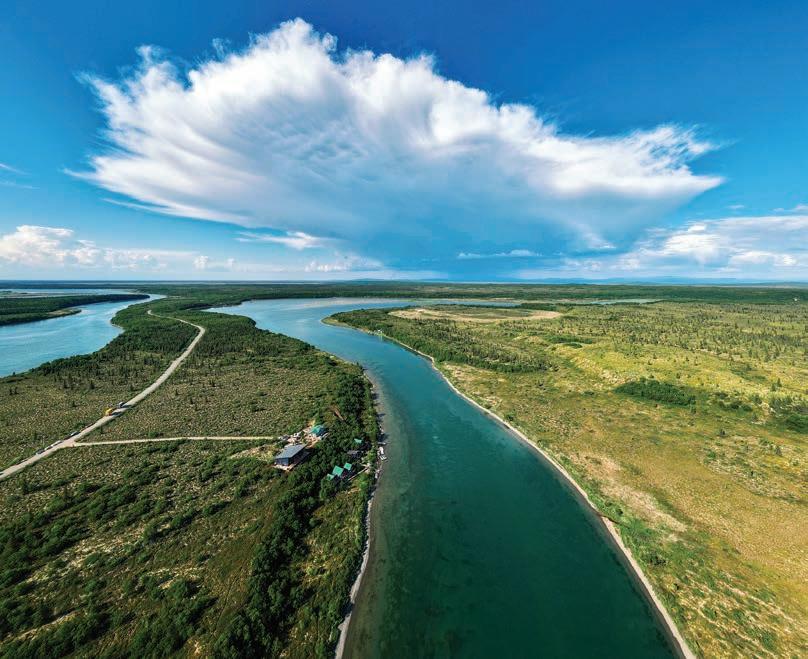
Crump and husband Justin’s lodge, located along the Naknek River, features premier accommodations and elite fishing for the system’s famed salmon. (KATE CRUMP)
While Crump has always been connected to nature, there was something much deeper when she first set eyes on Bristol Bay. “I learned then how this place is like a
CRUMP)
TROPHY MOOSE & BEAR HUNTING
River
MORE THAN A HUNT
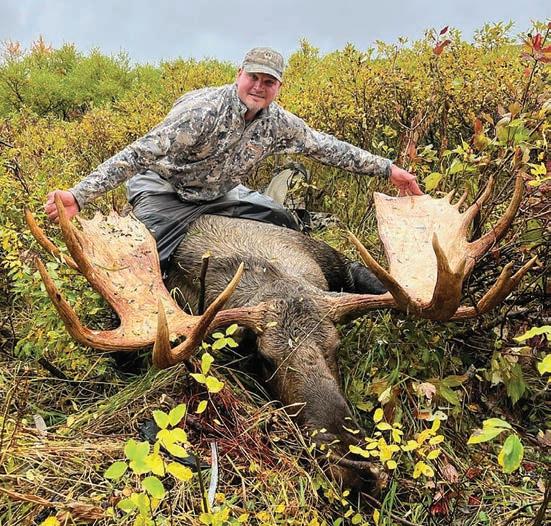
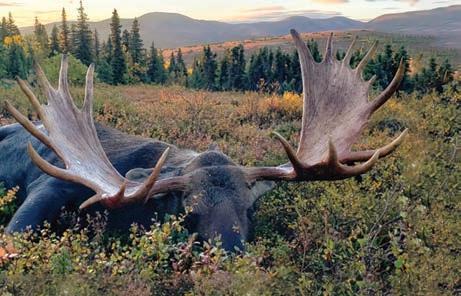
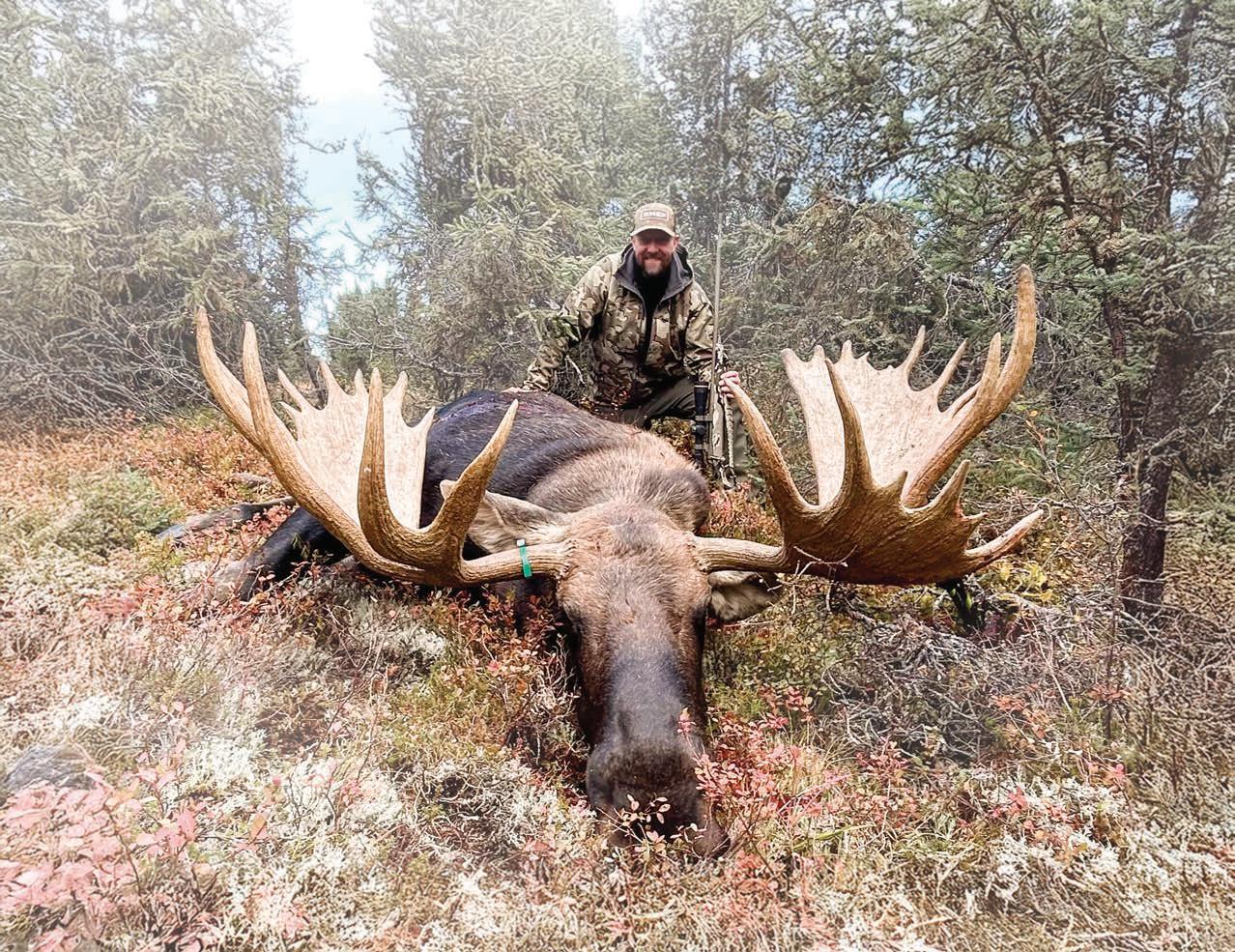
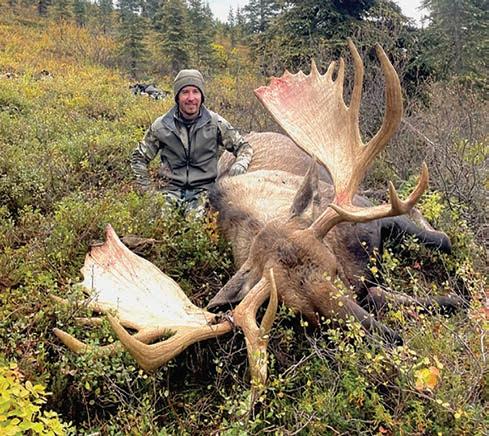
This is an unforgettable Alaskan adventure that blends raw wilderness, world-class game, and the thrill of pursuing some of North America’s most iconic animals in their natural environment. Long days on the river. Close encounters. The kind of moments you’ll talk about for the rest of your life.
WHY HUNT WITH US
• Trophy moose & bear hunts in prime river systems
• Regular 60”+ bull moose opportunities
• Near-100% opportunity rate on legal bulls
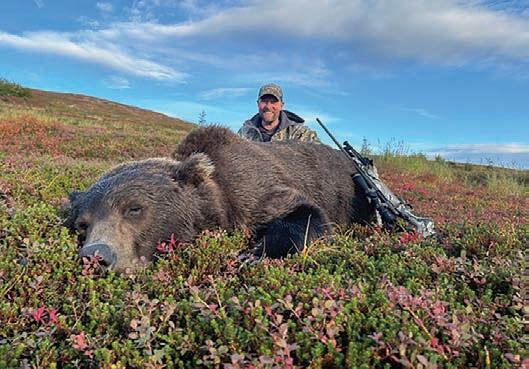
• High success on large Alaskan bears
• Fully guided & all-inclusive hunts
• Expert guides with deep local knowledge
• Carefully selected locations for consistent results
• 11–15 day hunts with 15-day combo moose & bear hunt available
Every hunt is carefully planned and professionally guided from start to finish. From scouting and calling to field care and logistics, your guide handles every detail so you can stay focused on the hunt.
Contact us today to secure your hunt and discuss available dates.
chicken coop and brought in a chef to elevate meals beyond standard lodge fare, understanding that a week in Bristol Bay should feel cohesive rather than transactional.
Still, the fishing remains the core for this operation. The Naknek and surrounding watersheds offer access to salmon runs that remain among the strongest in the world, and for visiting anglers the sheer volume of fish can feel surreal. Yet Crump is quick to push back against a numbers-only mindset. Salmon, she notes, are fickle, and there are days when conditions or timing do not align perfectly, but those days can still matter deeply if anglers allow themselves to absorb the broader landscape.
“We try to focus on the moments rather than the catches,” she says, emphasizing that an experience rooted in connection to place will hold up even when a run stalls or a bite slows.
The moments she remembers most clearly are not always tied to fish at all. She recalls watching guests hold hands while crossing creeks, steadying one another on slick rocks and seeing relationships shift in subtle ways when people are removed from routine and placed in wild country. She remembers a guest who hiked into a remote river system to scatter his sister’s ashes, an act that required physical effort and intention, and which underscored how deeply certain places imprint on those who visit them.
“When someone does something like that, it reminds us how impactful these places are,” she says. “The wilderness deeply affects people, including myself.”
That awareness carries weight in Bristol Bay, where the health of the salmon runs is both a biological miracle and a political fault line. Crump serves on the board of Pacific Rivers (pacificrivers.org) and is involved with Oregon-based North Coast Citizens for Watershed Protection, fully aware that while salmon runs across much of the globe are declining, Bristol Bay continues to produce record returns because its watershed remains largely intact.
“The robust health and acknowledged value of the salmon in Bristol Bay are both
Crump (here with Justin) was deeply moved when a lodge guest scattered the ashes of his sister in this remarkable, spiritual corner of North America. “When someone does something like that, it reminds us how impactful these places are,” she admits. “The wilderness deeply affects people, including myself.” (KATE CRUMP)
Experience the thrill of big game hunting in Alaska’s untamed wilderness with Deltana Outfitters—Alaska’s premier guide service. Whether you’re after Brown Bear, Grizzly, or Moose, our expert guides lead unforgettable Spring and Fall hunts in the remote, pristine Alaska Peninsula andWestern Alaska.
Adventure. Expertise. Results. That’s what we do—and Deltana does it best.
90% Success Rate!
Average Moose: 64”
Grizzlies: 7’6” - 8’6”
Black Bears: 6’ - 7’
Brown Bears: 9’ - 10’ Start your ultimate hunting experience today! Visit: www.deltana.com | Email: hunts@deltana.com |
“the fishing remains the core” of what Crump’s story reflects. “The Naknek and surrounding watersheds offer access to salmon runs that remain among the strongest in the world, and for visiting anglers the sheer volume of fish can feel surreal.” (KATE CRUMP)
rare and intrinsically reliant upon one another,” she says, framing the region not as an endless resource but as a system that survives because it has not yet been compromised at its source.
Crump’s own path through the guiding world has not been without friction. When she began in Bristol Bay, female guides were less common, and she often found herself working in maledominated camps where expectations
needs before they are voiced and to maintain control of the day without diminishing the experience for guests who may be fishing waters like these for the first time.
RUNNING A LODGE IN
remote Alaska is not a seasonal hobby for Crump; it is a sustained commitment that stretches far beyond summer. Her offseason is spent planning, repairing, coordinating and often guiding in Oregon, while summers are defined by long days on the water followed by evenings ensuring that guests feel cared for and connected.
were unspoken but unmistakable. Rather than shrinking from that environment, she leaned into it, building technical proficiency and command while understanding that her presence carried implications beyond her own career.
“I felt a responsibility to pave a positive way for the female guides coming up behind me,” she says, noting that she now sees more women stepping confidently into roles that once felt out of reach.
In her view, what separates a good guide from a great one has little to do with bravado and everything to do with steadiness. A great Alaskan guide, she says, understands that their role is to safely share the beauty and abundance of the place, to anticipate
“It’s a nonstop grind to run a lodge,” she says, acknowledging that fatigue is part of the equation, but so is clarity. The life she and Justin have built is not an accident; it is the product of years of incremental decisions that led back, again and again, to that bend in the Naknek.
On quiet mornings, before boats launch and guests gather their rods, she sometimes stands on the bluff and looks downriver, watching the current slide past the inside bend that first caught her eye years ago. The salmon continue to return, feeding bears, birds and the broader ecosystem that depends on them, and the lodge now stands where once there was only an idea carried forward from season to season.
For Kate Crump, Bristol Bay is not a backdrop but a working landscape, one that demands respect, stamina and vigilance, and one that continues to reward those willing to hold the line.
In a place where the salmon still run strong and the margins remain real, she has built more than a business; she has built a life rooted in current, country and the conviction that some waters are worth committing to for the long haul. ASJ
Editor’s note: For more on Kate Crump and The Lodge at 58* North, check out thelodgeat58north.com or call (541) 7431255. Tiffany Herrington is a writer based in the Seattle area.
WHERE THE HALIBUT BITE
A WOMAN’S FIRST
BY RICHY J. HARROD
KALASKA FISHING ADVENTURE TAKES HER TO PRINCE OF WALES ISLAND
etchikan disappeared behind us as the plane sped towards Thorne Bay somewhere in the unknown distance. The hum of the Beaver’s 450-horsepower Pratt & Whitney engine and the views of the towering mountains surrounding Clarence Strait were mesmerizing.
My wife Vicki and I were on the last leg of multiple flights to go fishing with our good friend Gary Anderson, who lives in this remote Southeast Alaska town. Flying is an unpleasant experience for Vicki, and I was worried the small plane ride would be difficult. Turning quickly, I expected to see strain on her face, but instead she was smiling ear to ear as she pointed to beautiful snow-covered peaks and enchanting small islands. Her first Alaska experience was off to a promising start.
A NEW ADVENTURE
Traveling to remote areas to hunt or fish is familiar to me. A dozen states, including Alaska, plus British Columbia, have provided cherished memories of pursuing elk, deer, upland birds or multiple species of fish. Vicki has always supported these adventures and patiently awaited my return, sometimes weeks later. Not a hunter or fisher herself, she doesn’t emotionally connect with stories of close encounters with elk or trophy kokanee fishing in isolated, crystal clear lakes.
In my opinion, outdoor experiences are best shared with family or close friends, so it was with great anticipation that Vicki agreed to join me on a saltwater fishing journey on Prince of Wales Island.
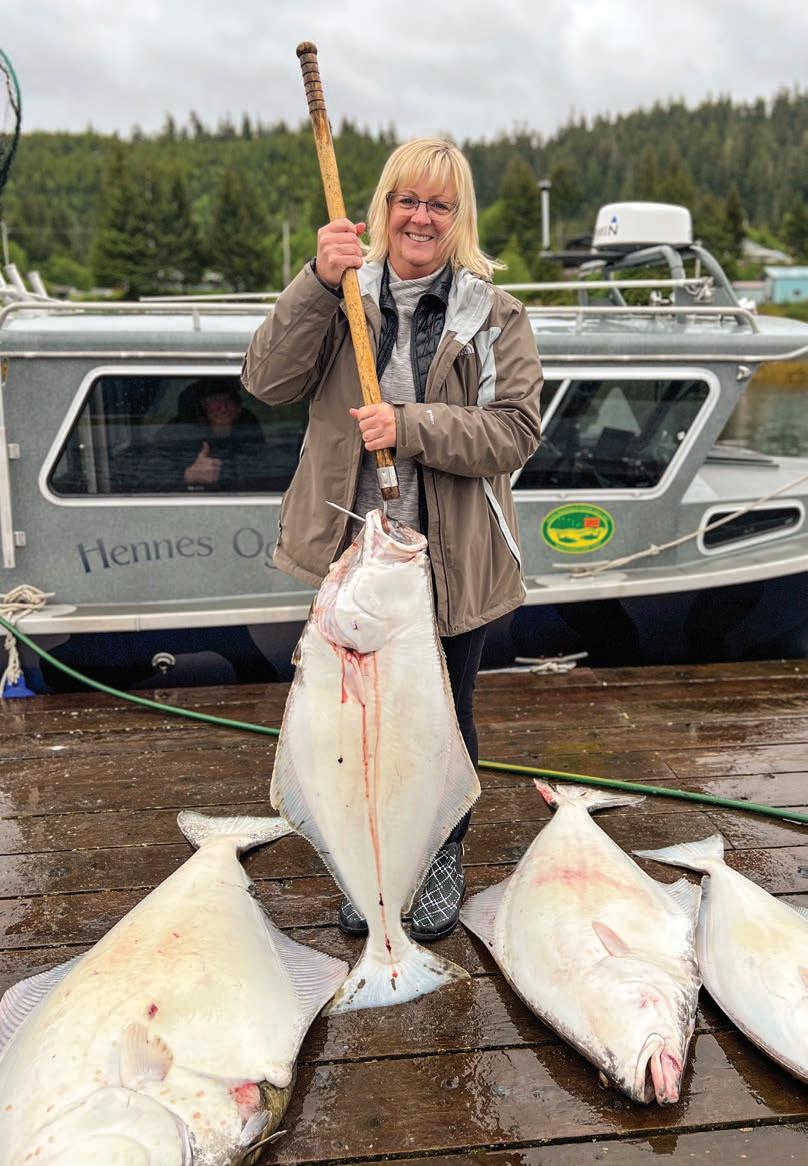
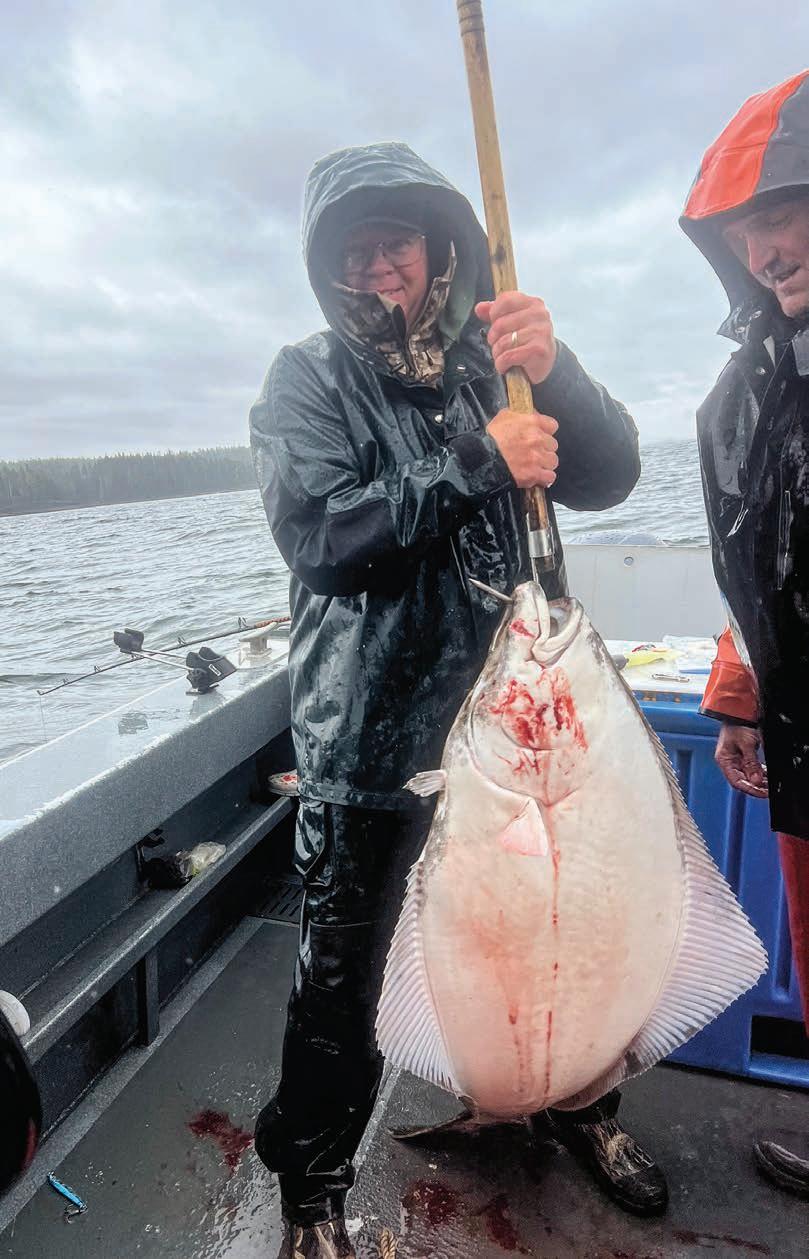
Vicki Harrod’s first Alaska trip dove right into angling for one of the state’s biggest game fish, the hard-fighting halibut around Prince of Wales Island. But as husband and author Richy Harrod explains, Vicki was up to the challenge. (RICHY J. HARROD)
THE LODGE
The pilot finally guided the plane from the wide strait into the narrow and winding Thorne Bay. Gary had been out setting shrimp pots outside of the bay. I sent a message letting him know we were leaving Ketchikan, and he replied that he’d race in once he spotted our plane. As our pilot started his descent, Vicki spotted a boat speeding towards town. We made eye contact and nodded with a smile, acknowledging that our friend was nearby.
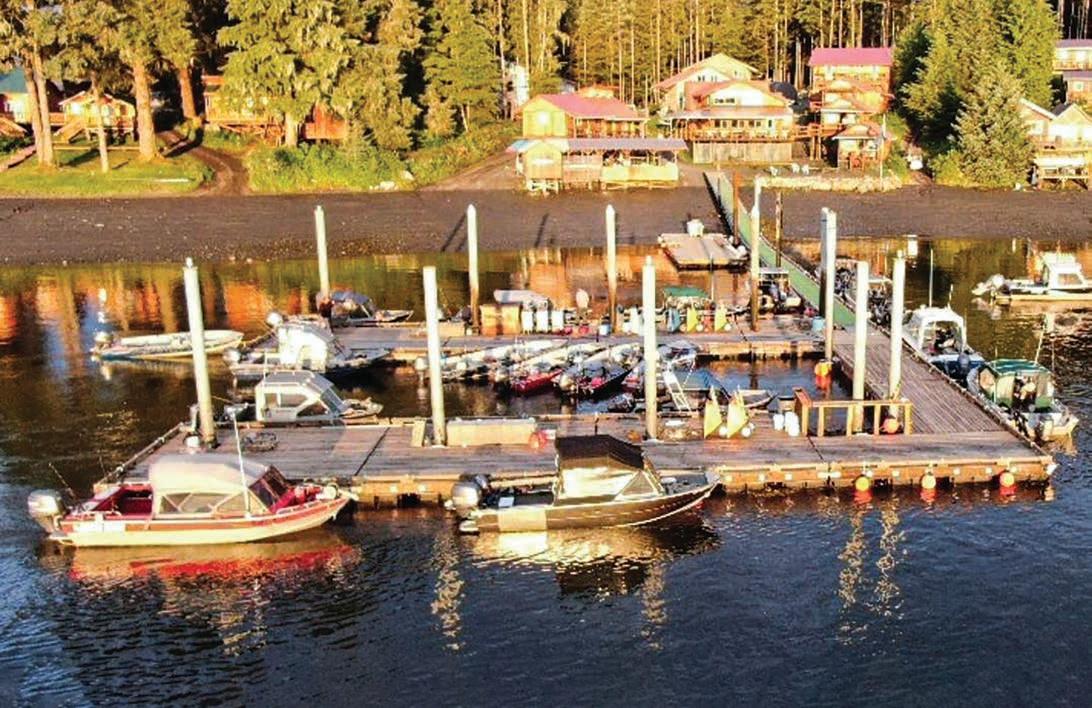
Gary is the owner and operator of Anderson Lodge Alaska. The quaint lodge and onsite tackle shop are situated on the waterfront in the town of Thorne Bay. He offers guided or self-guided opportunities to fish for
Richy had a pretty good idea that Vicki would be up to the task right away when she handled the small plane trip from Ketchikan to Thorne Bay. (RICHY J. HARROD)
after his generous offer, we were finally standing on the dock wondering why it had taken us so long to travel to this beautiful coastal island.
The remoteness of the bay and nearby forests was immediately apparent. The only sounds were the gentle lap of saltwater on the shoreline and shrill, high-pitched calls of bald eagles. “Look at all the bald eagles!” Vicki exclaimed while taking multiple pictures. The majestic birds have always fascinated her. “I’ll bet you’ll see several every day,” I replied.
salmon, halibut, lingcod, black seabass or yelloweye. You can even catch your own crab for supper in the bay within eyeshot of your room. The lodge itself has charming accommodations, and its staff prepares amazing homecooked meals in generous portions. Gary’s goal has always been to treat his clients like family, making lasting memories for guests.
We met Gary at various sportsmen’s shows in the Pacific Northwest, as we both had vendor booths for our businesses. He had sent invites many times to visit in early June, before his lodge opened for the season and guided clients arrived.
“You guys can help me find the best fishing spots before customers arrive,” he would say enticingly. Now, years
HAIL, HAIL, THE GANG’S ALL HERE
Gary showed us around his lodge, store, outside deck and dock area. A couple of his cousins, Jim and Tim, and Tim’s friend Heather had arrived the day before. Coincidently, Vicki and I knew Tim, who was also a vendor at sportsmen’s shows and often our booth neighbor. Jim and I worked together at a county fire department in the Spokane, Washington, area. “I still can’t believe these two turkeys are your cousins!” I exclaimed, laughing out loud. “It really is a small world,” Gary replied, shaking his head in disbelief.
We spent the evening in goodhumored conversation, eating fresh crab at the large lodge table and preparing the boat and gear for the
upcoming halibut fishing adventure. We would fish in big water on the west side of the island, and again I worried that Vicki would be apprehensive. She’s no stranger to fishing boats, but the swells in saltwater can be intimidating.
“You nervous about tomorrow?” I asked with concern. “Not really; Gary’s boat is huge, so it should be alright,” she said confidently. After chatting about an eventful travel day, we slowly drifted to sleep in the dusky light of an Alaska spring evening.
OTTERS AND MORE
Gary was up early making final preparations for his boat’s first spring trip, a trailered ride across the island. Jim, Tim and I awkwardly helped, unaware of the routine. The kitchen staff practiced their routines too. Breakfast sandwiches and coffee were soon ready for our departure. The ride across the island on a winding, narrow, two-lane road would take about an hour. The excitement in the vehicle was palpable, especially for Gary. He shared stories about deer, bear and moose as we passed his familiar landmarks.
The small boat launch at Naukati Bay was beautiful as we took in views of small islands and the wide fjord. The
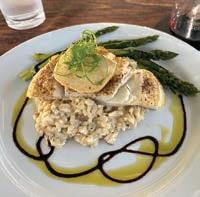
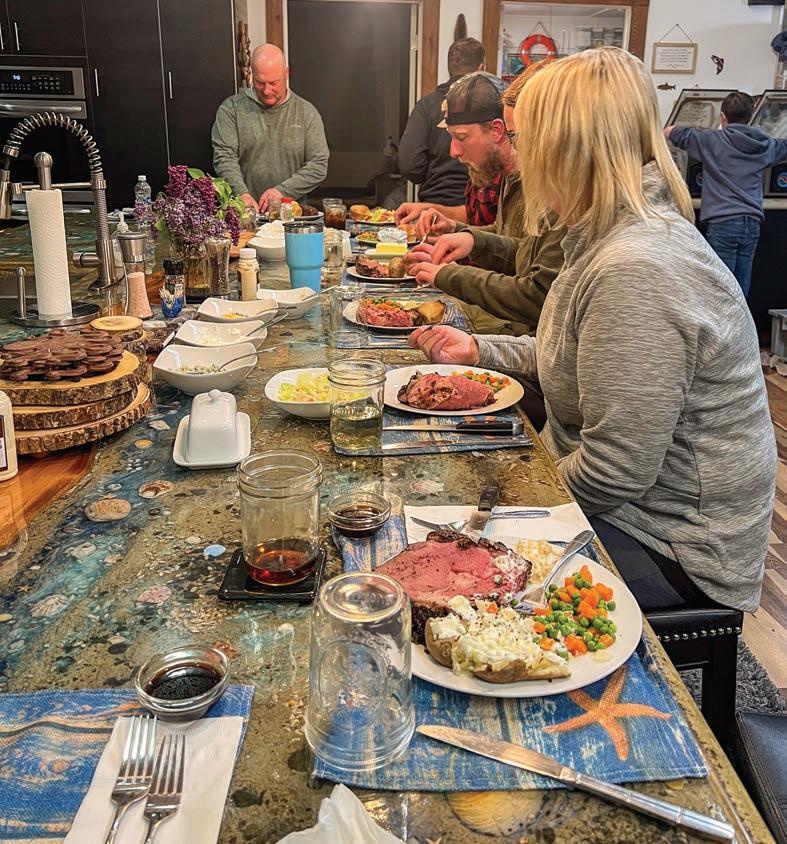
Richy’s buddy, lodge owner Gary Anderson, treated the Harrods and other guests to gourmet meals at his Anderson Lodge Alaska dining room. (RICHY J. HARROD)
Indigenous Adventure offers:
Full/Half Day Trips
• Flyfishing
• Saltwater fishing
• Glacier tours
• Whalewatching
BOOKYOURTRIP TODA Y!
Fish Camps
• Guided all-inclusive camps
• Remote cabin locations on world class rivers
• All inclusive
sun was shining on calm water while seagulls called to each other and eagles glided overhead. I watched with delight as my wife reveled in the sights, sounds and smells of this coastal paradise. Gary gave us clear directions about how to help with the boat launch. We felt more like helpful deckhands, and Tim, Jim and I soon had the 28-foot vessel lashed to the dock.
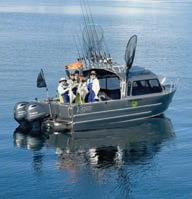
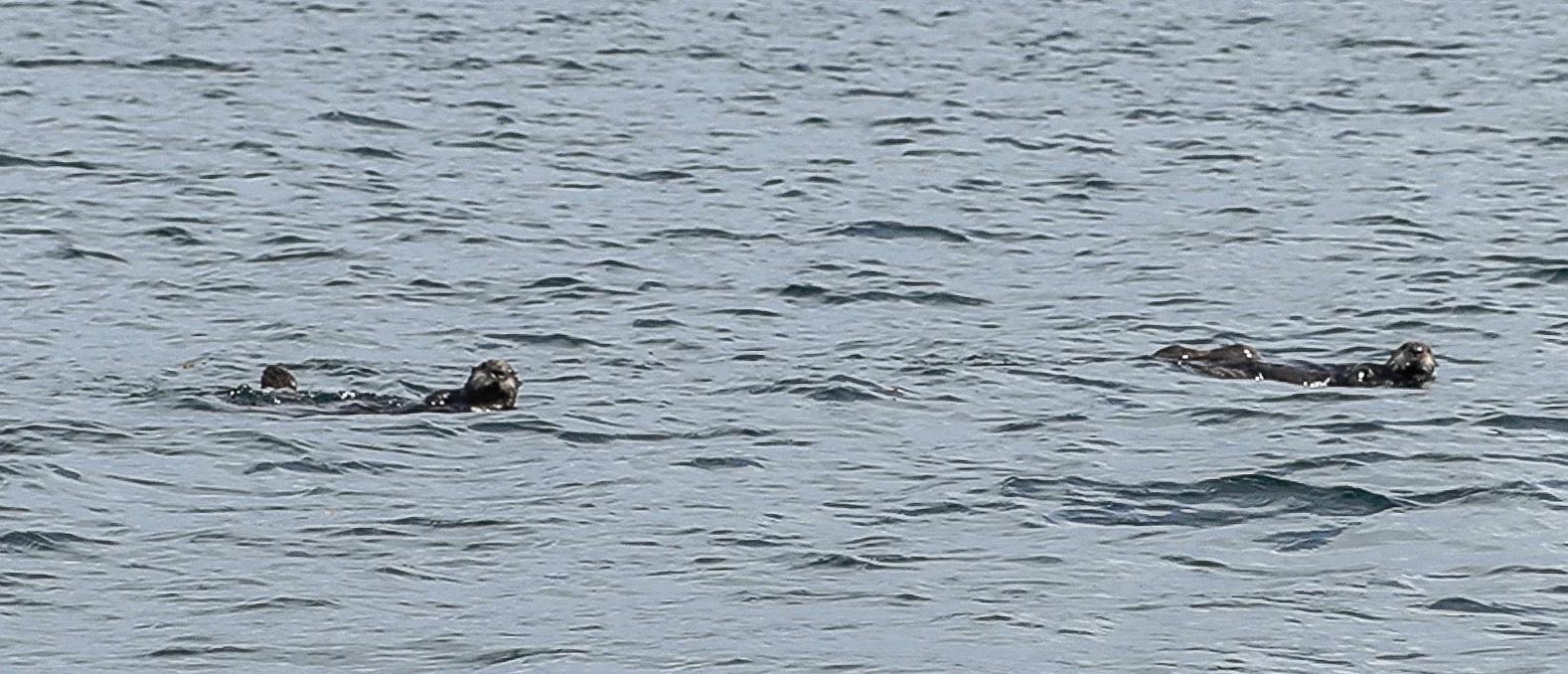
After a safety briefing, we pushed off and were underway. Rafts of sea otters dotted the small bays and coves. Vicki swore they waved to us as we motored by. Gary’s route weaved around numerous islands and through narrow fjords. Some of the passages were rough from large swells arriving from open water, but Vicki and the rest of the crew were unphased. Ultimately, we stopped at an undisclosed spot in the middle of dark blue saltwater.
FIRST FLATFISH
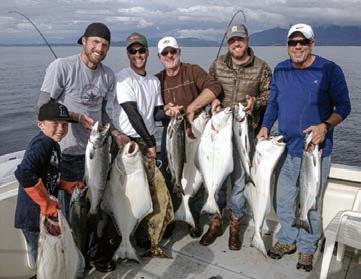
Halibut are typically caught with either bait such as herring or squid on a circle hook, or by jigging heavy leadhead jigs with soft plastics tipped with a small piece of bait. On this trip, Gary outfitted each of our rods with 4- to 6-ounce jigs and herring pieces. The technique was to drop the jig to the bottom (150 to 200 feet deep), raise it up a couple feet, then let it return to the bottom in free fall. Unlike with a circle hook, a quick jerk when bit set the hook on biting fish.
“(Do) you understand how to do it?” I asked Vicki as we started dropping our gear to the depths. “Yeah; will I know when I’m on the bottom?” she asked. “Yep; just like our bottom bouncers for walleye, it will abruptly stop.”
Everyone onboard had some fishing backgrounds. I’m an experienced boat captain and could help Gary with
maneuvering the boat so he was able to fish as well. With the boat on a slow drift with the current and wind, the six of us found bottom and soon our rod tips bobbed up and down as if being operated by a perpetual motion machine. It didn’t take long before the action started.
Tim was the first to break the ice. “Oh yeah, here we go!” His halibut rod bent over the rail as he reeled hard to bring the tugging fish from just over 200 feet deep. “Wahoo! Good job, Tim!” Heather cheered him on.
Gary and I stared into the water watching for color and some indication of size. “Not sure it’s really big,” Tim said. “I see it; nice fish, but just chicken-sized,” Gary observed as the 20-pounder neared the surface (the term “chicken” is used to describe small halibut).
Vicki watched with envy as Gary
Tim, Anderson’s cousin who the author knew from their sportsmen’s show interactions, gets in on some of the halibut action. (RICHY J. HARROD)
Your one-stop destination for self-guided saltwater fishing adventures in
We offer comprehensive packages that include lodging, fully equipped rental boats, rods, reels, tackle, downriggers, depth finders, VHF radios, GPS, marine charts, safety gear, and more.
gaffed the fish and pulled it onto the deck. That feeling was short-lived since her rod was the next to get bit. “Oh gosh; I’ve got one on,” she said nervously. “Keep steady pressure and reel; you got this,” Gary reassured her. Vicki pinned the rod butt into her hip and reeled until her arms and back tired from a halibut refusing to leave the bottom. Finally, a slightly larger 30-pound halibut appeared from the inky depths. Gary reached over the rail to quickly gaff the dark brown flatfish and flipped it directly into the onboard cooler.
“How about that? You landed your first Alaska halibut!” I said while beaming with husbandly pride. “It seemed like it would never get to the surface. I’m not sure I could land a bigger fish!” she said with a laugh.
Gary had found some hungry halibut. Making multiple passes on the same GPS track resulted in numerous bites. We tried two more spots marked on his depth finder and continued to find biting fish. There was constant chatter, laughter and appreciation for the bounty. Less than three hours passed before we each had hooked and landed
our two chicken halibut.
With a boat full of fish, we returned to Thorne Bay to process our catches. In a team effort, Gary and I removed meaty filets, while Tim and Jim separated skin from the meat, and Vicki and Heather rinsed, dried and bagged the filets. A vacuum sealer in the lodge made quick work of preparing portions of meat for the freezer.
With the catch processed, we sat down at the oversized island in the lodge to enjoy a home-cooked supper and recount stories from the day.
IN SEARCH OF BIGGER ’BUTS
The following day we repeated our steps, returning to the west side of Prince of Wales Island for another day of fishing. The weather was very different, however. Clouds, rain and wind buffeted the boat as we returned to the halibut grounds. The narrow passages boiled with large swells and white water broke over exposed rocks. Again I worried that the conditions would be unnerving for Vicki, but just as before, she rolled with the boat like she’d experienced it 100 times before.
Gary decided to start fishing at a more protected stretch of water and hoped to locate some larger fish. We dropped our jigs to the bottom in slightly shallower water, and Vicki was the first to hook a halibut. “Seems like about the same size as yesterday,” she said, now with a more experienced tone from the previous day. A quick lift with the gaff and a 15-pound, mottled brown
The sea otters were curious about all the fuss on the water. (RICHY J. HARROD)
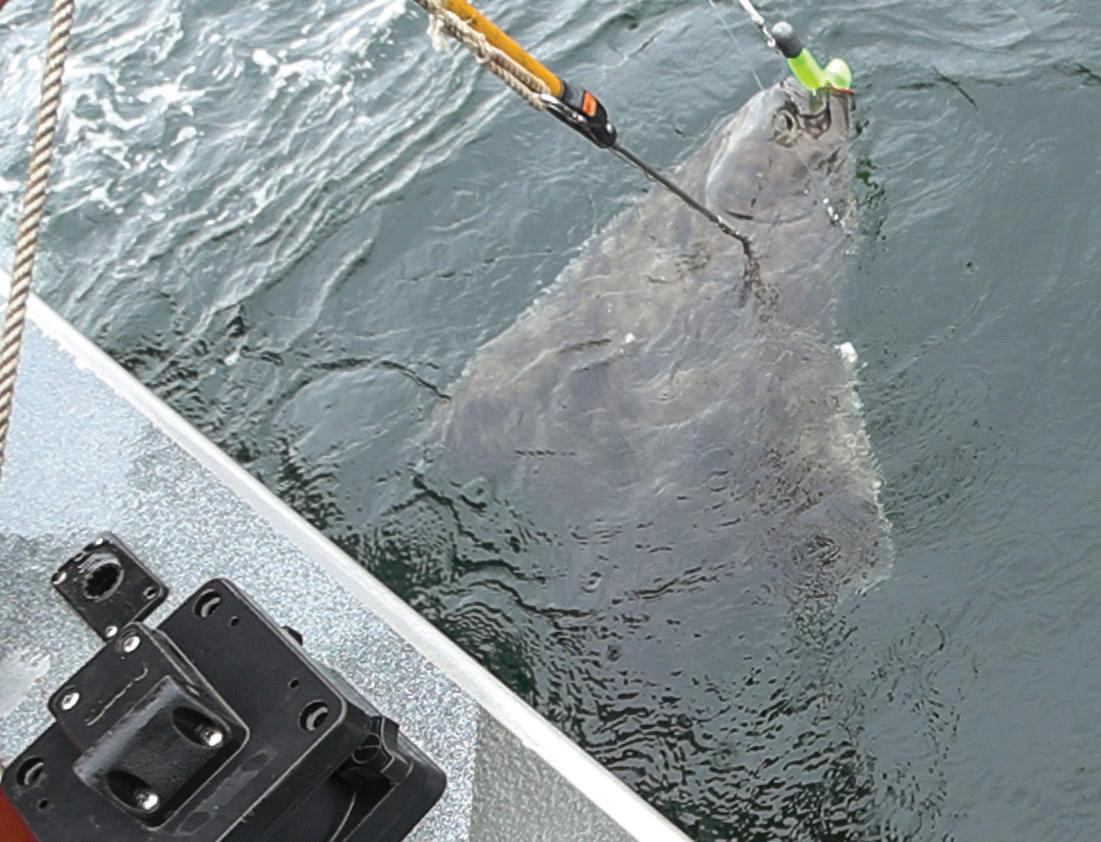
The last step in getting a barndoor halibut from the bottom to the boat. (RICHY J. HARROD)
Alaska’s Preeminent Float Fishing Trips
The author shows off his big ’but after it was gaffed onto the deck. Despite the cold, wet conditions, everyone was having fun. (RICHY HARROD)
flatfish hit the deck.
“Good job, Vicki; you broke the ice,” Gary stated.
We hooked and landed a couple more small halibut and Pacific cod on the next drift. But then no one got a bite over the next hour. The water lapped on the boat sides and we could hear the distant roar of waves crashing on the rocky shoreline. The rain pelted our
raincoats while we jigged in silence.
“How are your hands doing?” I asked Vicki with concern as I noticed their red hue. “Uh, they’re almost numb,” she reluctantly replied. I suggested she could sit inside for a while, but Vicki refused my offer and kept fishing. Her decision was fortuitous.
“Oh my gosh! I think I have a really big one!” Vicki said under the strain
of a bent rod. Gary put his halibut rod into the holder and hustled to the rail to evaluate her catch. “Oh yeah; just take your time. You’ve got a good fish on,” he said with a big grin.
Vicki’s fight lasted nearly 20 minutes, as the big fish would head back to the bottom, negating her reeling progress. I’ve fought 7-foot sturgeon in the Pacific Northwest’s Columbia River, which left my arms feeling like useless lead weights. “Are your arms burning?” I asked, remembering my big fish experience. “Oh yeah,” she replied with a tired-sounding deep breath. Gary leaned close to subtly ask, “Do you need help?” “No. I can do it.”
Her effort paid off when the brown and white colors of a 60-pound halibut neared the water’s surface. “Keep the fish below the surface. I think we can just gaff this one. Give me a hand, Tim,” Gary said. The two tall men grabbed the gaff handle and lifted Vicki’s prized fish over the rail. It flopped loudly on the deck.
“Nice fish, honey!” I said, beaming with excitement.
“I’ve never caught a fish that big! Oh my gosh; that’s a big fish,” she said while admiring the prehistoric-looking fish.
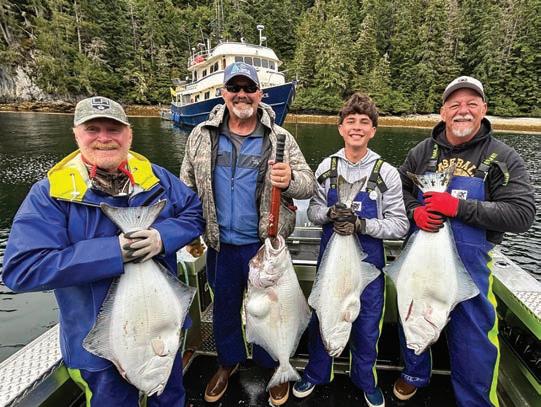
The bite was slow, but we landed two more big fish. I was fortunate to land an 80-pound halibut, while Jim caught the fish of the day at about 150 pounds! Halibut can reach weights of over 500 pounds, and we tried to imagine the herculean effort required to land such a fish. As we quietly marveled at our fish, Gary suggested we leave the halibut grounds to return to the warmth of the lodge.
MORE THAN THE FISH
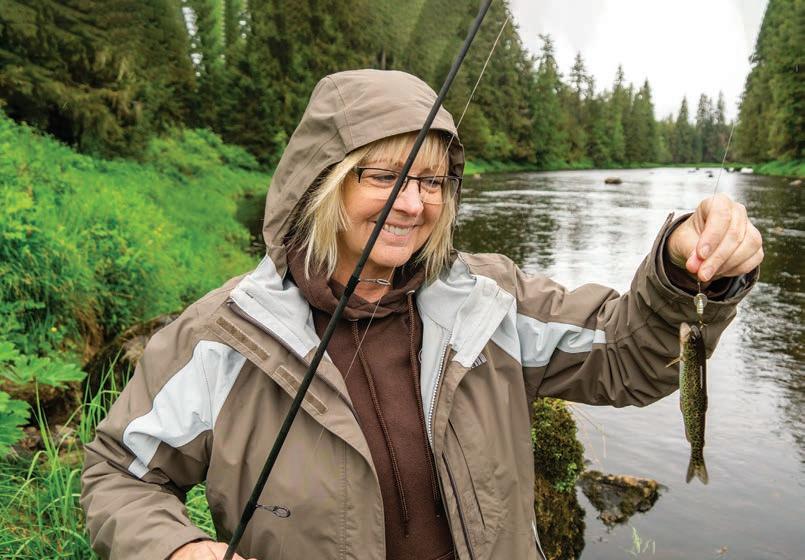
Wind and rain worsened the following day. Fishing on the halibut grounds would have been dangerous, so Gary took us on a shore fishing adventure near the lodge. A short hike brought us to a beautiful river. We cast spinners and caught small brook trout.
“It’s so beautiful and quiet here,” Vicki said as she admired the bright green vegetation contrasted against the dark green water. She had never fished a stream before, but after some practice
she caught several trout.
A NEW APPRECIATION
Fishing the river was an enjoyable ending to Vicki’s Alaska experience. The cool, wet weather was a challenge for her, but she persevered alongside the rest of us. An outstanding meal and drinks in the comfortable lodge gave
Vicki time for reflection.
“I think I understand why you like doing this,” she said. “Oh yeah; why?” I asked. “It was fun spending time with friends. Catching those big fish was exciting. Watching everyone’s excitement was so enjoyable,” she replied. I simply smiled and nodded my head in silent agreement. I was proud of my
“I think I understand why you like doing this,” Vicki, here with a river-caught trout, told her husband at the end of their first Alaska adventure together. “Vicki overcame her apprehensions and embraced the difficult conditions,” Richy writes. “She discovered that being uncomfortable can be rewarding.” (RICHY J. HARROD)
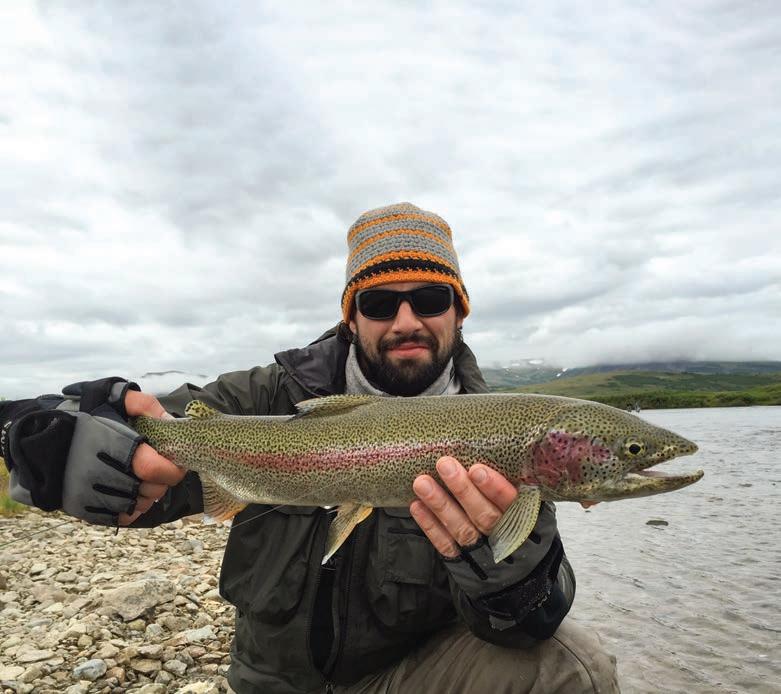
wife. Vicki overcame her apprehensions and embraced the difficult conditions. She discovered that being uncomfortable can be rewarding. She appreciated more than ever the meals from the halibut we caught because she understood the effort required to obtain the amazing protein. There is mutual understanding in doing hard things together. Our relationship was strengthened during this time together. Vicki now has a better understanding of my passion for the outdoor way of life after having ventured to where the halibut bite. ASJ
Editor’s note: Anderson Lodge Alaska’s website is andersonlodgealaska.com, or call (907) 419-0957. For more on Richy J. Harrod, check out harrodoutdoors.com.
HERE’S A TIP: FISH WITH THE LIP
ANGLERS FIGURE OUT THE SECRET SETUP FOR SLAMMING SILVERS
BY SCOTT HAUGEN
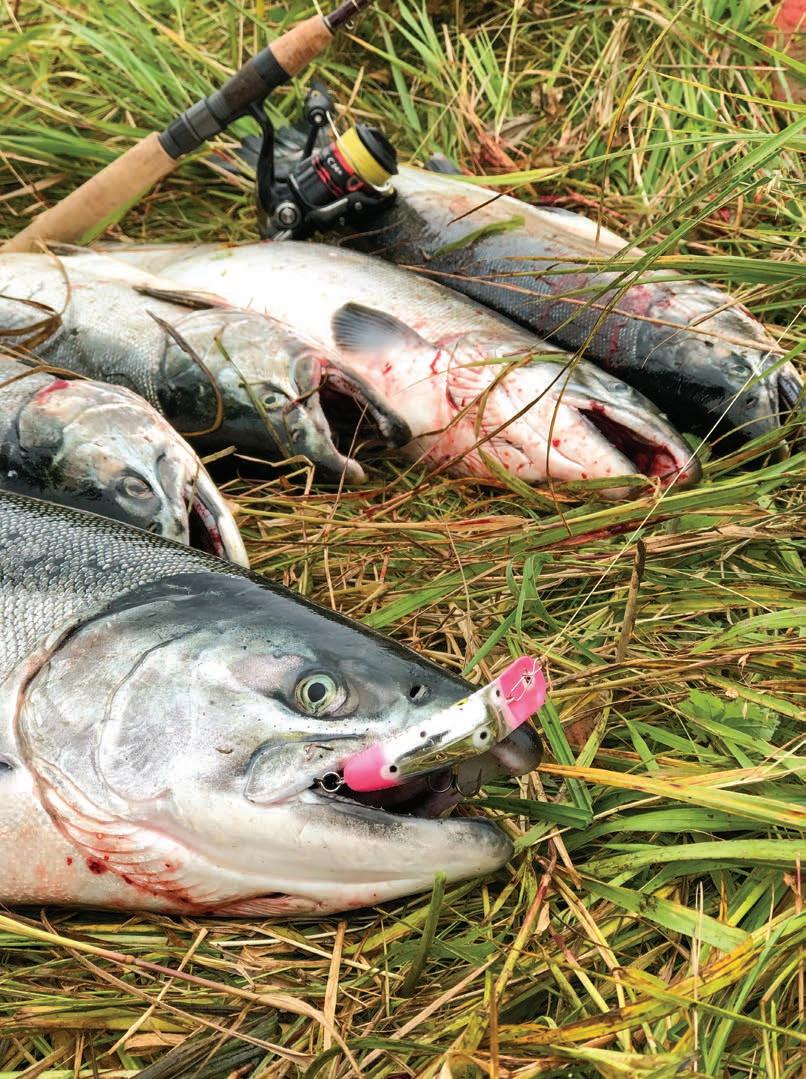
Iwas late getting to the salmon hole I wanted to fish. Below me were four anglers. They’d been fishing the spot for over 30 minutes. They had one coho on the bank and had lost another. I watched to see what they were using and how they were fishing. Two drifted cured eggs, one worked a bobber and eggs and another had a bead suspended beneath a float. Considering these were subtle sightand scent-based presentations, and the fact they were all getting first crack at the salmon as they swam upstream to where I stood, I removed my egg rigging and tied on a 3.0 Mag Lip.
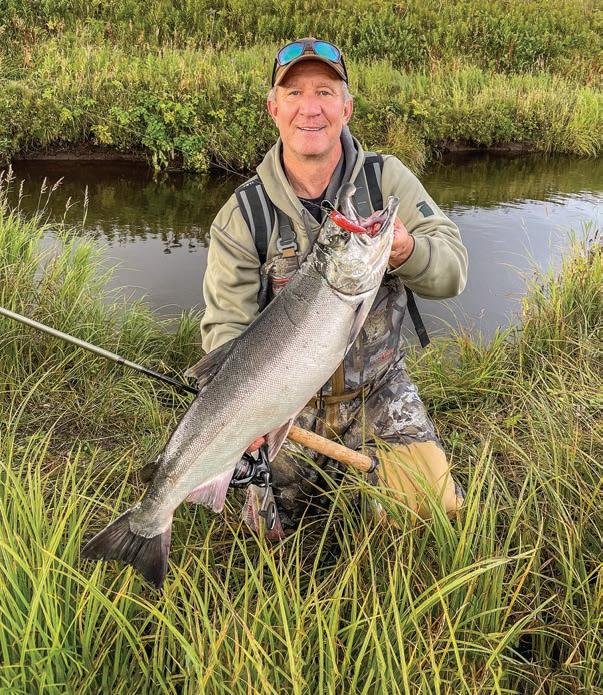
On the first cast, I latched into a mint-bright coho, complete with sea lice. I did the same on the next cast, pulling another fresh silver from the same spot. I took a few minutes to let the water rest, sharpened my hooks, made sure my leader was fine, and watched the others continue to fish. None got a bite.
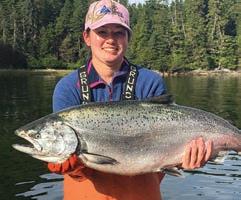
Five minutes later I made another cast and landed another coho. In less than 15 minutes I had a five-coho limit. The other anglers hadn’t touched a fish. All five of my coho hammered a Mag Lip in the doctor death pattern. I was simply casting it slightly upstream, letting it float a few feet, then reeling in so that it would dig in fast and start raking the gravel bottom of the Egegik River. The slot was only 6 feet deep and the holding window 5 feet wide.
My decision to go with a Mag Lip, which has an aggressive, skip-beat action in addition to rattles, paid off.
Mag Lip plugs in sizes 2.0, 3.0 and 3.5 can be cast in an array of Alaska rivers and small streams. The versatility of the plug, its unique action and the way its speed and depth can be controlled make it a proven coho catcher. (SCOTT HAUGEN)
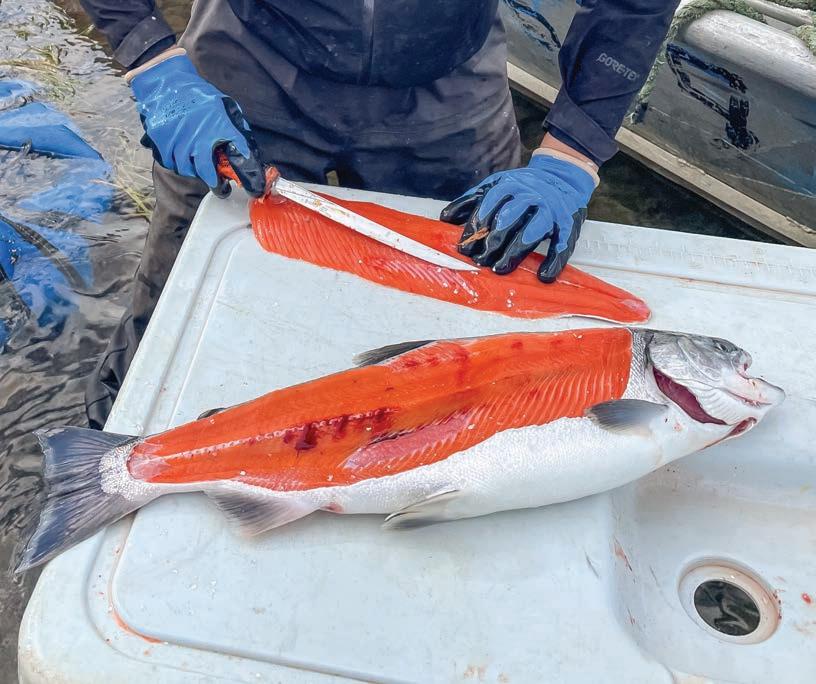
Leave the belly section on the salmon while fileting off the loins, then remove it whole. Smoked belly meat can be eaten as is, flaked into salad or added to a dip.
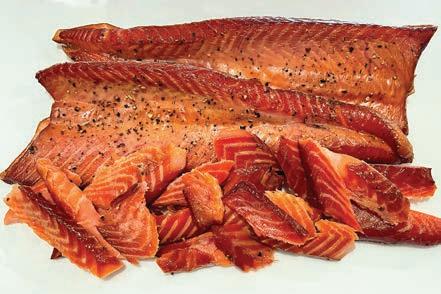
BELLY MEAT MAKES FOR DELIGHTFUL SMOKED SALMON
BY TIFFANY HAUGEN
Salmon bellies are fattier than filets, making them the ideal part of the fish to smoke. The key to a quality smoked salmon belly starts with the moment you catch the fish. Give it a quick blow to the head and immediately cut a gill rake or two. This will ensure the salmon bleeds out, thereby optimizing the flavor of the meat.
When fileting the salmon, leave the belly intact without removing it with the filets. With both filets removed, cut around the belly meat and remove it from the carcass. On big coho or kings, the belly meat can be cut in half, crossways, in order to achieve an even smoke.
Be sure to leave the subcutaneous layer that’s inside the belly in place. This not only helps retain fat that’s in the belly, but it keeps thin sections of meat
from drying out in the smoker. Once done smoking, the subcutaneous sheath can be removed.
2 to 4 pounds salmon bellies, skin on
1 quart cold water
½ cup brown sugar
¼ cup noniodized salt
2 teaspoons granulated garlic
2 teaspoons granulated onion
2 teaspoons black pepper
In a large container, whisk all brine ingredients until salt and sugar dissolve. Submerge salmon bellies in brine. Refrigerate two to four hours.
Remove from brine and pat dry. Lay on smoker racks and air dry one hour or until fish forms a pellicle (tacky surface). Smoke in a preheated 150- to
170-degree smoker over two
to six hours, or until fish reaches desired texture and doneness (or an internal temperature of 135 to 140 degrees). For a stronger smoke flavor, replace chips up to two more times during the smoking process.
For a candied-style fish, glaze bellies with a brush of honey or maple syrup a few times during the last hour of smoking time. Enjoy the fish hot from the smoker or break it into pieces for dips, salad toppings or whatever else pleases the palate.
Editor’s note: For signed copies of Tiffany Haugen’s popular cookbook, Cooking Seafood, visit scotthaugen.com.
(TIFFANY HAUGEN)
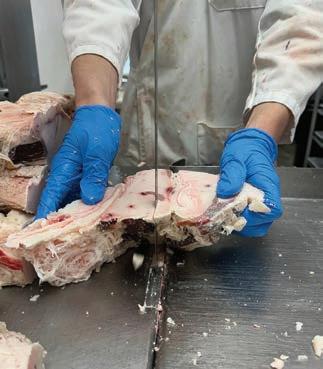
Start your dry age now and be ready for Memorial Day!
Learn
Memorial Day isn’t as far away as you think.
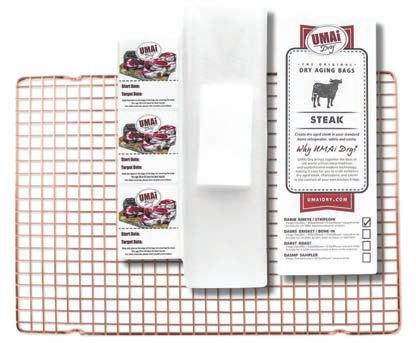
The perfect dry-aged steak takes time. Time to deepen flavor, time to tenderize, and time to transform something great into something unforgettable. With UMAi Dry®, you can start today and serve something extraordinary when it matters most. Start aging now. Taste the difference later.
And while you’re planning ahead…
UMAi Dry® is the ultimate Father’s Day gift. For the dad who takes pride in doing it right—this is more than a gift. It’s an experience!
The quick retrieves got the plug deep right away and triggered an aggressive response from the coho that other fishing methods failed to do. Over the next four days of fishing that river and using many presentations, the Mag Lip was the number one producer.
A WEEK LATER, I was fishing two small streams further down the Alaska Peninsula with a buddy who joined me. I’d already swapped out the trebles for
siwash hooks on half a dozen Mag Lip 3.0s and 3.5s. In two hours I’d landed a five-fish limit and released 13 more. My buddy, who was fishing spinners, had three coho on the bank.
I gave him a couple Mag Lips and told him to head downstream a quarter mile, to water no one had fished. Three hours later we met up. He’d landed and released 34 coho. “This is the most amazing thing I’ve seen,” my friend said. He’s one of the best anglers I know and has fished Alaska for over 30 years. But he’d never cast a Mag Lip from shore.
Some of the water we fished together over the next few days was
slow flowing, shallow and brown due to headwaters in the tundra. Visibility was often only a foot. Using the bigger 3.5 Mag Lips and casting and retrieving them very slowly produced astonishing numbers of coho.
“I caught triple the coho I usually catch; they just can’t leave this plug alone,” my buddy said after day two of fishing the Mag Lip.
Over the next two days he averaged over 50 coho a day, all caught on Mag Lips. Prior to that he was averaging just over 20 coho a day – still good numbers, but the Mag Lip left no doubt as to how many salmon were out there.
One day we went to a popular little
Mag Lips can be fished in small, crystal clear streams or big and muddy rivers. (SCOTT HAUGEN)
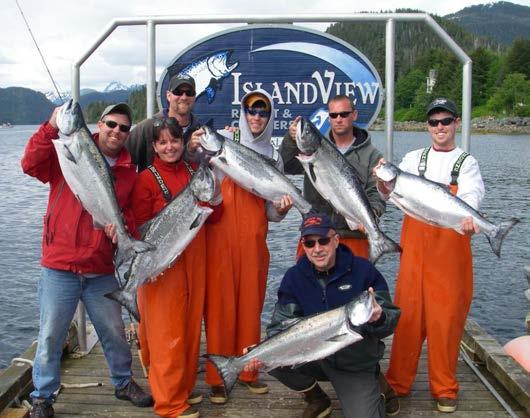
Island Point Lodge offers a 7-day, 6-night self-guided Alaska Salmon, Halibut, and Dungeness Crab trip for $2,699. The trip includes lodging, meals, fishing rods and reels, boat fuel, and fish cleaning/packaging. Add a self-guided Black Bear hunt at no extra charge,
Author Scott Haugen has fished Mag Lips since they first came on the scene in many parts of Alaska, and he ranks them among the best all-around fish-catching pieces of gear when it comes to coho in rivers and streams. (SCOTT HAUGEN)
river where many locals fished. We were going to leave, then a hole opened up. Seven or eight anglers remained. Most cast spinners, and a few used cured eggs. All my buddy and I used were Mag Lips. We landed over 30 coho in a couple hours and saw less than 10 caught by all the other anglers combined.
That river was moving fast but shallow. There, we barely reeled the plugs, letting the current do the work. We’d cast out and once the plugs floated downstream and reached a 45-degree angle, we flipped the bail and let them swing just under the surface. If a coho didn’t attack it before it reached the deep slot along the bank, then we’d flip the bail and slowly let out line. The back-trolling approach from the bank – just as you’d do from a boat – caught a lot of coho. Many of those salmon were being cast over by the other anglers.
FIFTY-SEVEN YEARS AGO, AT age 4, I caught my first salmon. Back then, casting plugs was a common approach. Since the 1970s plugs have primarily been trolled or back-trolled from boats. But if you really want to catch coho and see for yourself just how many salmon are out there, get some Mag Lips and hit the river. It’ll change how you think and fish forever. ASJ
Editor’s note: For signed copies of Scott Haugen’s popular book, Bank Fishing for Steelhead & Salmon, visit scotthaugen.com.
HOW I GOT INTO TRAPPING
A BOWHUNTER DABBLES IN A NEW WINTER ACTIVITY
BY BRIAN WATKINS
Winter in Alaska can be a long, arduous endeavor. Long nights and overcast days wear down the strongest of people. To circumvent depression, picking up winter hobbies is a must. Since moving to Alaska in 2010, I have played hockey, ridden snowmachines, skied and engaged in a plethora of other activities. For me, it’s a long break from hunting between November deer and spring bear. The lack of chase withers my spirit.
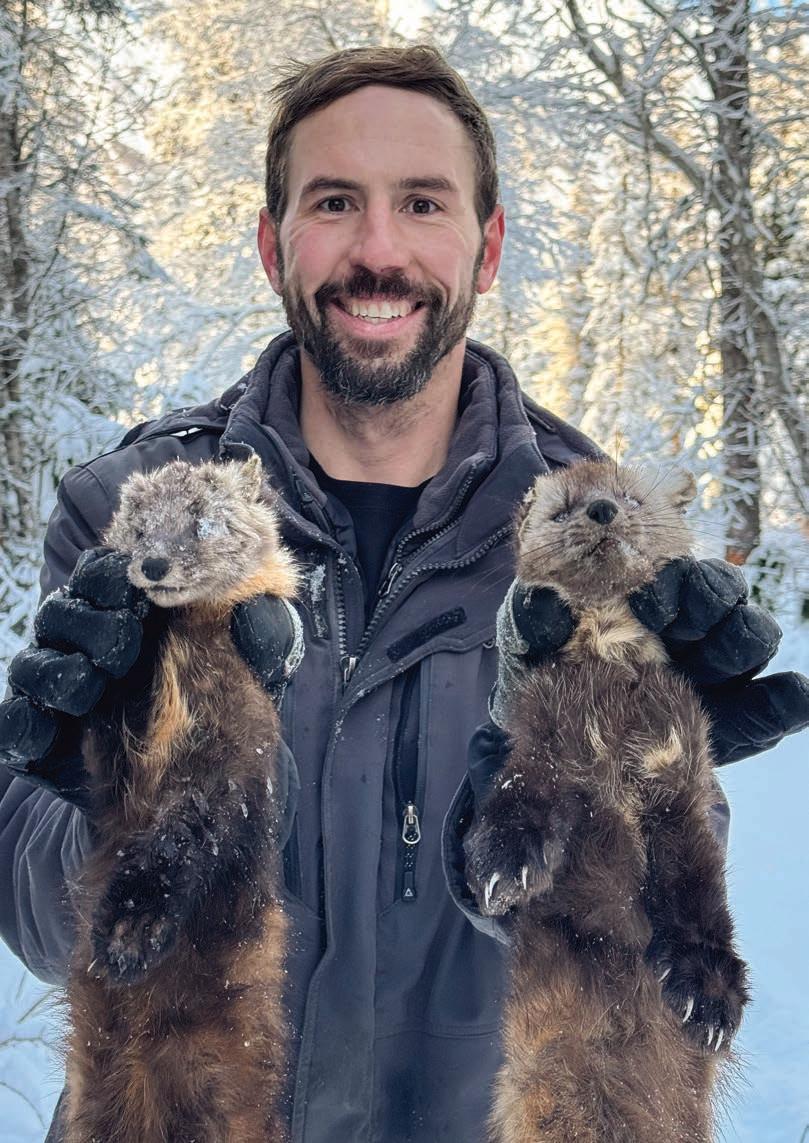
In 2020, a close friend of mine, Jon, picked up trapping. He lives in Chitina, about 250 road miles east of Anchorage, where there seems to be more predators to find. I watched him flourish into a successful trapper of lynx, wolverine, marten and ermine. I have always had a desire to trap, but the winter blues kept me from pursuing the task.
Jon was coming to Anchorage to “hit town” one weekend back in 2022. He knew I was interested in trapping, as I had asked him hundreds of questions, so he brought a box of snares over and said, “Figure it out.” That’s all it took for me to finally start a line of my own.
GIVING TRAPPING A SHOT
I put snares out without success. A line of pass-through sets and minimal tracks made for a tough first year. Where I decided to go, the lynx numbers were at a low and finding success was nearly impossible. But the trap was set for me to take it further.
In 2023, I built marten boxes, learned about marten habitat and set back out to continue my learning curve. I’m a YouTube learner and found successful trappers to follow. I built 10 marten boxes and headed out to try again.
Author Brian Watkins (with a pair of marten he caught on the same trap check) started his own trap line to keep himself busy until spring hunting seasons. Now it’s becoming a winter obsession. (BRIAN WATKINS)
Watkins tucked this 330 Conibear trap into a natural log pile set. He only uses Conibears and snares on his trap line. “I don’t have anything against footholds,” he writes, “but I am not able to check traps often enough to want an animal in a foothold.” (BRIAN WATKINS)
Meanwhile, lynx numbers still haven’t recovered in the area, but they’re on the rise and I successfully trapped one last winter for the first time.
LEARNING TO READ TRACKS
I’ve always been told that trappers make great bowhunters. There is truth to that. You must have patience and focus to be a good trapper. It’s imperative to identify each track and figure out the travel route. Most of the animals I’ve tried trapping aren’t seen frequently. They hunt at night (marten) and are reclusive (lynx).
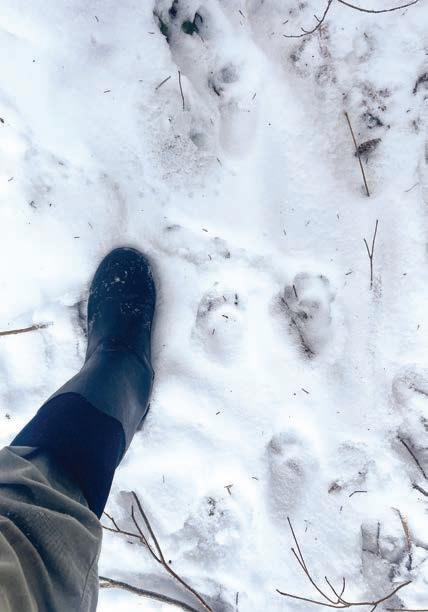
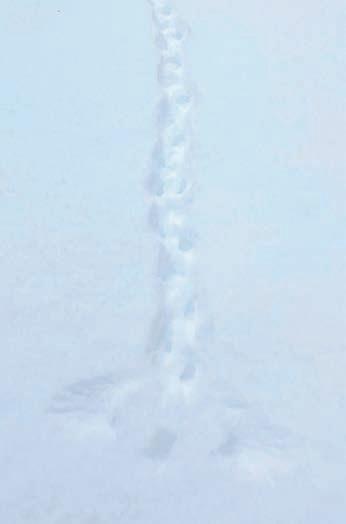
Identifying the tracks is a bit of a challenge where I’m at on the Kenai, as frequent snowfalls and mixed conditions often blend tracks into an indentation instead of a visible distinction. Still, I’ve learned about each animal and how their tracks lay out. Squirrels leave four imprints almost in a square formation. Weasels (marten and ermine) leave
Lynx tracks on the line are a welcome sight for trappers hoping to discover something in their setup. (BRIAN WATKINS)
Here’s something you don’t see often: Ermine tracks end where a bird of prey captured it to eat. (BRIAN WATKINS)
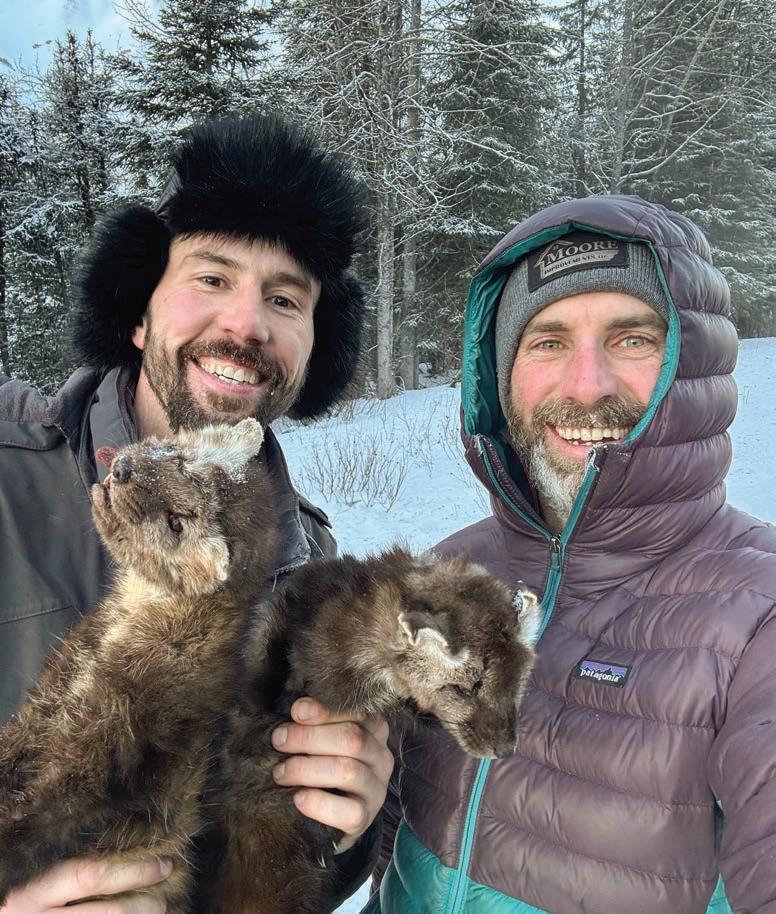
The author and Dave Moore with a successful haul from the trap line.
(BRIAN WATKINS)
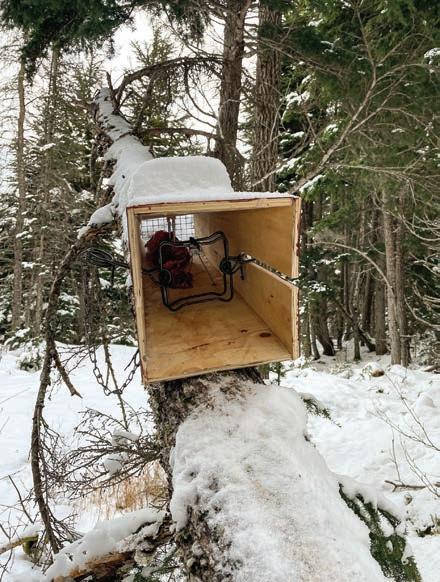
Sometimes it takes a little bit of ingenuity to set up your trapping operation. Watkins built this marten box with a 120 Conibear trap inside. He used stomach lining strips as bait. (BRIAN WATKINS)
tracks in twos – front right and back left; front left and back right. Lynx walk staggered like bears. Cats don’t have nails in their tracks. Wolverines plow the snow a bit and have tracks that are staggered.
A CURE FOR CABIN FEVER
All of this has been a learning experience that whisks away the winter blues. I have a snowshoe line. I’ve opted for this over the snowmachine to get my workouts in and sweat out that pressing
“I have always had a desire to trap, but the winter blues kept me from pursuing the task,” writes Watkins (here with friend Sean). He’s learned the tools of the trade through asking friends experienced in the trapping game and studying experts’ YouTube videos. (BRIAN WATKINS)
In heavy winter snow, Watkins works hard to reach his traps via snowshoes. “I’ve opted for this over the snowmachine to get my workouts in and sweat out that pressing winter depression.” (BRIAN
winter depression.
As I learn more, I grow eager to lengthen the line and explore new areas. I hit a new spot this year by looking at the forest canopy and finding marten habitat on the onX app. Once I found what looked good, I set out and found instant success.
If interested, you can also check out YouTube videos on how to set marten boxes. I put my boxes vertically on trees with a 120 Conibear at the entrance. I leave the back of the box open with chicken wire covering it. This way a
marten can see through the box and is more likely to go into it.
I hang a piece of bait on the chicken wire. Being in the vertical position, it makes the marten lunge into the box for the bait, making for an easier catch. This is the same setup for ermine.
Every once in a while, I’ll make a set without a box and brush the back side of the bait in with twigs. This is a harder tactic; it’s susceptible to the weather and if not set up right, the target animals can get to the bait easier.
TRUSTED TACTICS
Personally, I only use snares and Conibears when trapping. I don’t have anything against footholds, but I am not able to check traps often enough to want an animal in a foothold.
In many states, there are laws for frequency of checking. In Pennsylvania, for example, it is every 36 hours. The traps I set are meant to kill an animal as quickly as possible.
NEXT GOALS
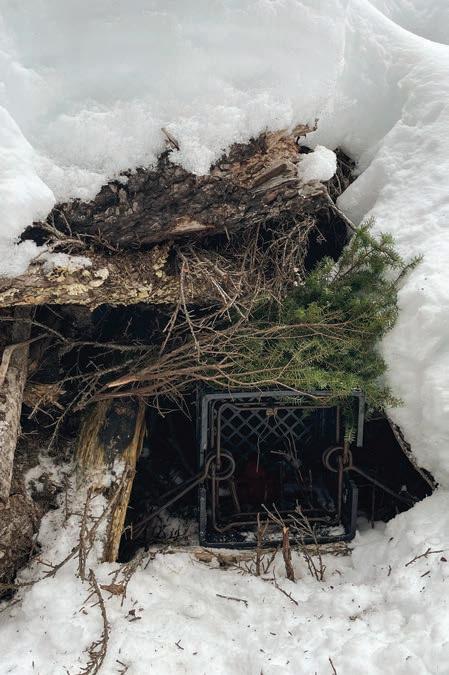
I have yet to trap a wolverine, but I have many sets out for them. I use a milk crate with a 330 Conibear across the front. I have caught marten in this set. My trapping area has very sporadic wolverine sign. About once a winter one will come through. Next year, I plan to try another part of the state with more wolverines. I hope this cure for winter blues brings more success. ASJ
WATKINS)
Cumberland’s Northwest Trappers Supply is your onestop trapping supply headquarters, featuring one of the largest inventories in the U.S. We are factory direct distributors on all brands of traps and equipment which allows us to offer competitive prices. Give us a try. Our fast, friendly service will keep you coming back.
We are the new home of “Trappers Hide Tanning Formula” in the bright orange bottle.
Retail & dealer inquiries are welcome.
If you are in the area, visit our store!
Place an order by phone, mail or on our website.
MEMORIES OF SUBSISTENCE HUNTS
SECOND OF TWO PARTS
Editor’s note: In this second of a two-part series, Scott Haugen shares more incredible subsistence living experiences from his time on the North Slope in the 1990s.
BY SCOTT HAUGEN
Working together, Danny Pikok and I gutted the caribou, setting aside the heart, liver and lungs. Danny skillfully disarticulated the web of fat from around the caribou’s stomach. He tied a few knots in it and made a basket. I asked what it was for. Danny pointed to the skin of the caribou.
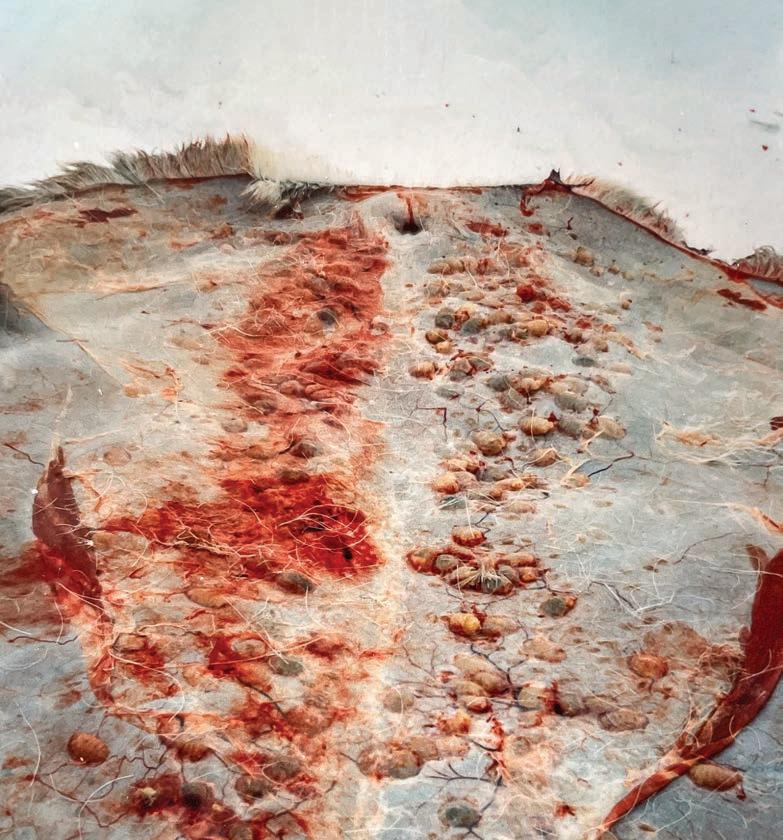
Then Danny cracked a grin, bent over with his knife, slit open one of the round, 50-cent-coin-sized boils on the skin, and withdrew a grub the width of an index finger and about an inch and a half long.
“Eskimo candy,” he bubbled, popping the wriggling creature into his mouth. He ate half a dozen of the grubs like they were candy. He offered me one. “No, thanks, I’m full from the kidney,” I said with a grin.
CONSUMING A RAW KIDNEY was a tradition I partook in every time I hunted with Danny. This caribou also had nearly 200 of the larvae on its back. This was the first caribou I’d taken in the spring, thus, the first time I’d seen such a sight.
The Eskimo candies are actually botfly larvae. In summer, female botflies lay their eggs on the lower legs of the caribou, attaching them with a sticky mucus. A week or so later the eggs hatch and the larvae burrow their way under the hide of the caribou. The larvae
EXPERIENCING SACRED TRADITIONS, DANGEROUS MOMENTS IN ALASKA’S ISOLATED ARCTIC
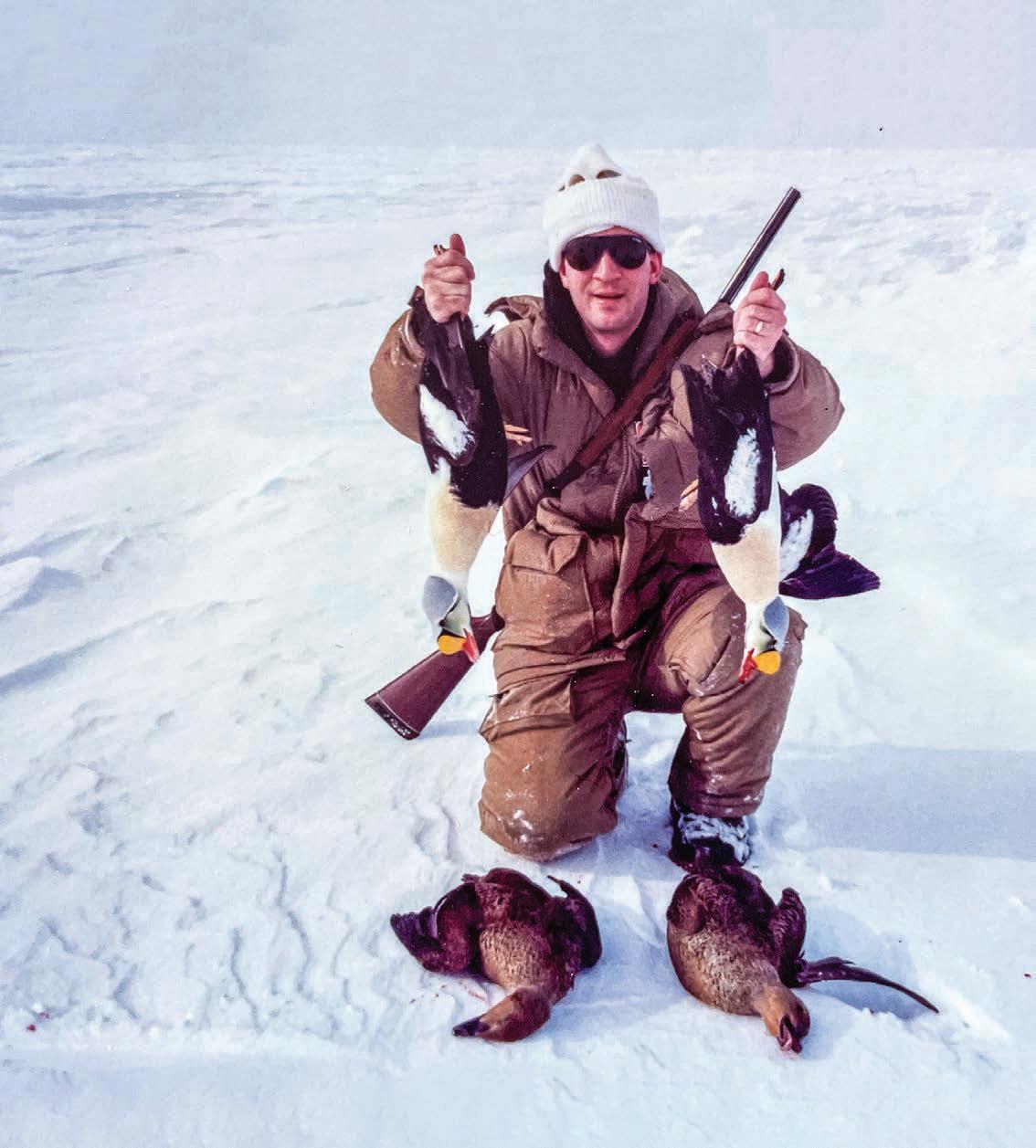
Author Scott Haugen lived a unique subsistence life in Alaska’s high Arctic through most of the 1990s. He and his wife Tiffany ate their share of eider ducks, both commons and kings. (SCOTT HAUGEN)
then migrate through the muscle tissues of the caribou upwards until reaching the soft tissues around the esophagus. There they hang out, literally, for five months while attached to the throat tissues of the caribou. Then the larvae migrate to the caribou’s back, traveling within the subcutaneous tissues.
At this point the larvae find a warm spot on the back of their host, where they spend the cold winter and continue developing into a grub. Each grub is contained inside a blister-like sack. They use their spiracles to bore a small hole in the hide, which first serves as a breathing hole and then as an escape route to the outside world. The larvae emerge, dropping to the tundra in late spring to early summer. One month later, the adult fledges from the pupal
case and the botfly breeding season begins anew.
Other than being annoyed and stressed by the parasites in their bodies, there is minimal harm to the caribou.
On several occasions, I watched caribou violently cough to rid themselves of the larvae that hung at the back of their throat and restrict their breathing. Caribou, with their superb insulation and resiliency to live in such harsh conditions, serve as the perfect host for the botfly.
DANNY WAS THE MAINTENANCE man in our school at Point Lay. He was a hardworking man. We shared many fine hunts during our three years together.
In his early 50s at the time, Danny was most in his element when out hunting.
His rounded face wrapped in wrinkled, leathery skin was testimony to a lifetime spent battling the wind-swept tundra and frigid pack ice.
Danny shared with me how, as a young boy growing up in Barrow, people would eat every larva they could get. If there were more than they could eat on a freshly killed caribou, they would take the remainder home to the family.
Today, few Native hunters utilize the botfly larvae as a staple in their diet. It’s a tradition that has passed by many of today’s elders, largely because it’s not necessary with access to outside food sources. Some hunters will toss a few in their mouths, perhaps more to commemorate the ritual their ancestors practiced for survival in the not too distant past rather than out of necessity.
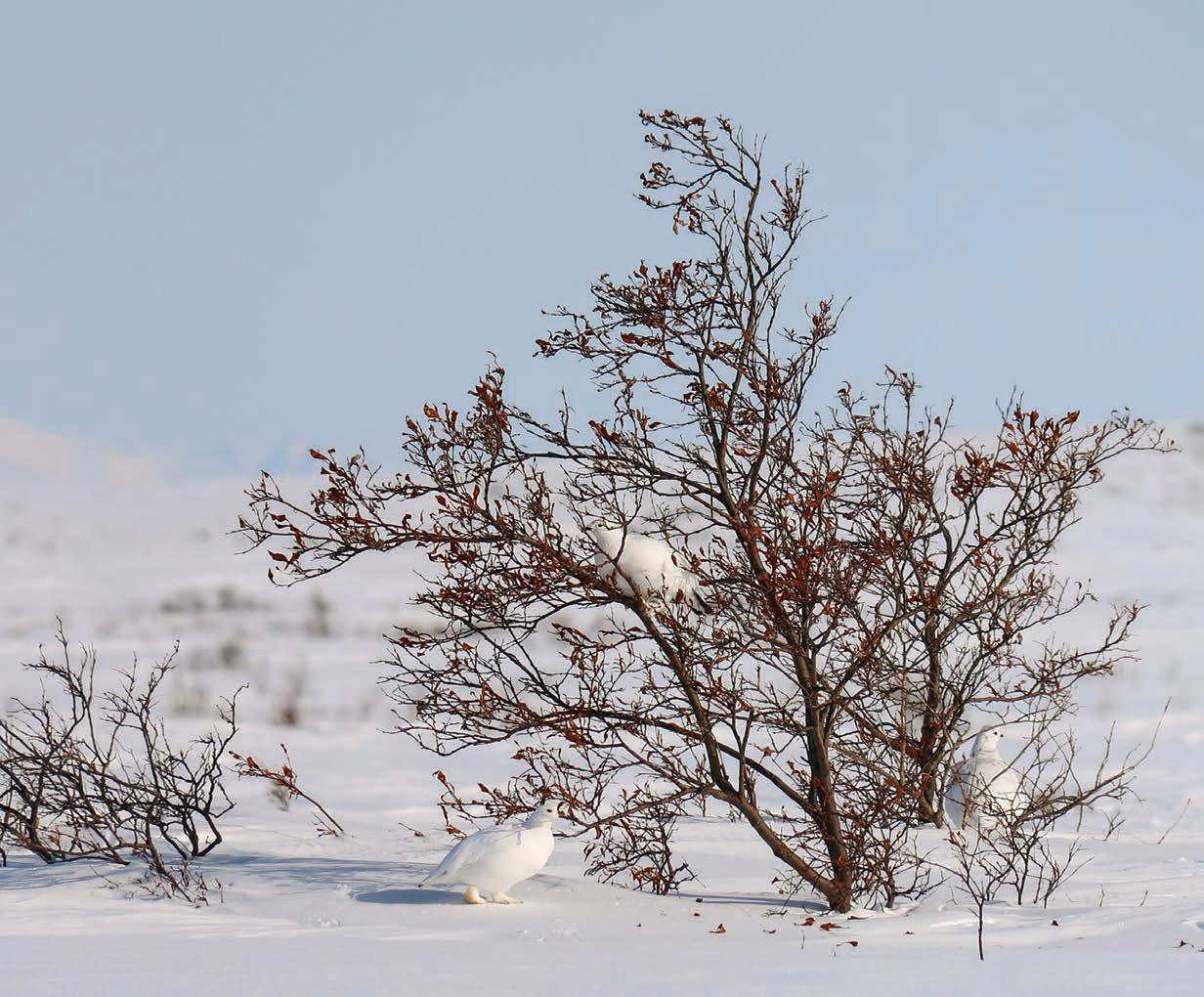
During their years in the Arctic, willow ptarmigan were a staple for the author and his wife. (SCOTT HAUGEN)
Loading the sled with the cow caribou and its fetus, hide and dozens of wiggling larvae in the fat sack Danny had crafted, we headed back to the village. Looking back, I regret not trying the larvae. Since then, anywhere in the world I’ve gone and been presented with similar opportunities, I’ve accepted.
A FEW DAYS LATER Danny and I were on the pack ice, hunting king and common eider sea ducks. We drove our snowmachines 22 miles onto the ice. It was 2 a.m but the sun was shining bright in the sky.
We stopped near the edge of the open lead, where the pack ice breaks apart due to ocean currents. The ice was 10 to 12 feet thick. Standing on it and hearing and feeling it shift beneath your feet is very surreal. Many elders shared stories of how in the past, hunters on the pack ice often went out with their dog teams for seals and polar bears –never to return. It’s speculated that they got caught in a breakup, with no way to return to land.
Fifty yards from the edge of the open
lead, we unfolded a blue plastic tarp –the kind many of us carry today in the back of our truck. We secured it with
chunks of ice placed along the edges. We parked our snowmachines off to the side and piled up snow and ice to conceal them. They became our blinds. We used no decoys.
“When the ducks fly up the lead they’ll see the blue tarp and think it’s water,” Danny said. “They won’t try to land on it, but it will pull them over top, within shooting range, and this way no ducks will fall in the water where we can’t get them.”
The tarp was like a magnet. Every wave of eider that flew the lead dipped over the tarp. Thousands of them. We went home that morning with common and king eiders piled onto our sleds. Many people in the village, elders included, were happy to have fresh duck.
On our way home across the pack ice, we hit open water before we reached land. Adrenaline overtook me in fearing we were stranded on floating pack ice. Danny was unsure. Wasting no time, we sped north as fast as we could. At times, the going was slow, given that pack ice, even when covered in snow, is as hard as concrete. It’s jumbled and uneven, having been shifting around all winter long atop the moving sea. Sometimes we moved at a crawl.
We traveled nearly 30 miles before
Botfly larvae, which locals called “Eskimo Candy,” on the inside of a caribou skin near Point Lay. (SCOTT HAUGEN)
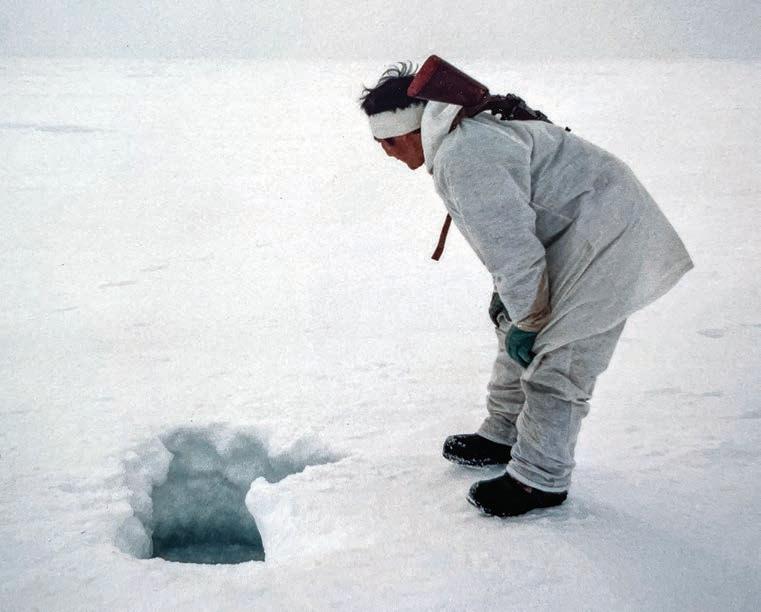
Danny Pikok inspects a fresh bearded seal hole. The hole was made through 7 feet of pack ice roughly 15 miles from shore. (SCOTT HAUGEN)
Danny stopped. I pulled up behind him. He looked while standing on the seat of his snowmachine. “The river broke,” he pointed. “We have to hurry and get on the other side of it.”
Eventually we made it to land but had to travel several more miles upriver before we could finally cross. Though we traveled just shy of 100 miles out of our way, we eventually made it home. For Danny, it was a normal day of hunting on the frozen Arctic Ocean. For me, it was a harsh reminder of how serious a seemingly simple day of subsistence hunting in the Arctic can turn bad.
“HANG YOUR DUCKS LIKE this,” Danny showed me when we got to his house. He put their necks in a strap and hung them on the side of his house – the side facing the sun. “Let them hang in the
sun for four or five days – then they’ll be ready to boil.”
“How will I know they’re ready to boil?” I asked.
“They’ll bloat, then their skins will start sliding off as all the fat underneath melts,” Danny said. “When all the skin is off, put the duck in a pot of boiling water, then eat it.”
All the locals cooked eiders the same way. They boiled the whole bird – guts, feet, head and all. Tiffany, my wife, cooked ours in a slow cooker after thoroughly cleaning them and soaking and rinsing the meat in cold water. They were good. We ate a lot of eider ducks over the years, including some I was able to intercept in early fall as they migrated down the coastline.
Back then I wasn’t an outdoor writer or photographer. Those jobs came later,
but the knowledge and skills I acquired during our time in Alaska’s Arctic –through the late 1990s – helped pave the way to my now 25-year writing career.
AFTER THREE YEARS IN Point Lay, we moved to teach at the school in Anaktuvuk Pass. “God’s country” is what everyone on the North Slope calls this magical place. The moment you set foot in the Pass, you know why.
Here, from Dall sheep to moose, caribou to wolves, some of the most memorable and impactful hunts of my life took place. But those stories are for another time. ASJ
Editor’s note: For personally signed copies of Scott Haugen’s best-selling book, Hunting The Alaskan High Arctic, please visit scotthaugen.com.
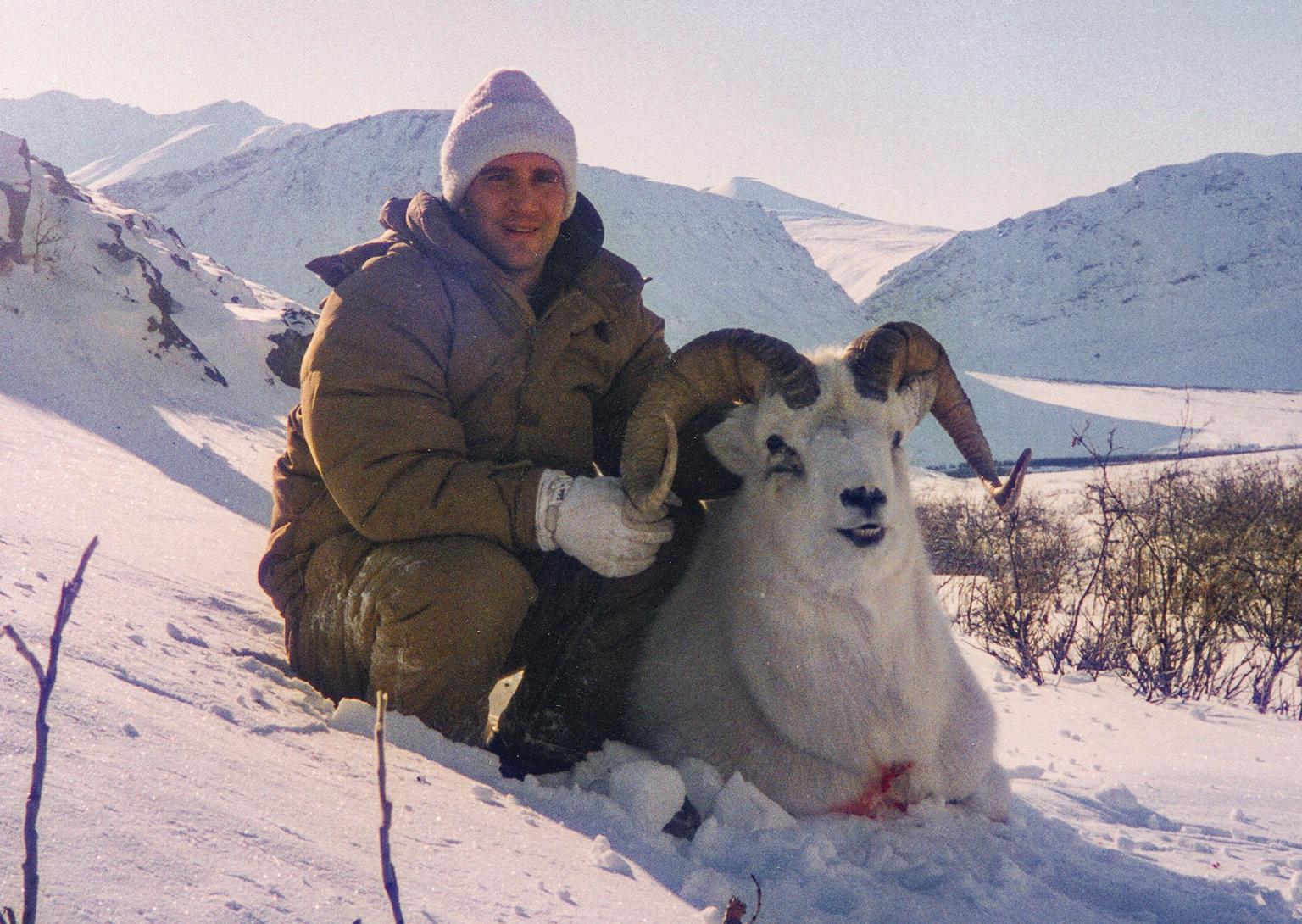
When the Haugens moved from Point Lay to Anaktuvuk Pass in 1993, the author’s hunting experiences hit a whole new level, including pursuing Dall sheep in the Brooks Range. It was a time in his life he’ll never forget. (SCOTT