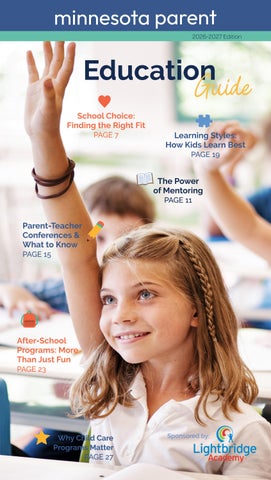
2026-2027 Edition
Education
Guide
School Choice: Finding the Right Fit PAGE 7
Learning Styles: How Kids Learn Best PAGE 19
The Power of Mentoring PAGE 11
Parent-Teacher Conferences & What to Know PAGE 15
After-School Programs: More Than Just Fun PAGE 23
Why Child Care Programs Matter PAGE 27
Sponsored by:
Blaze Your Path with One91 Virtual Academy: Instruction built for online, not just online delivery of instruction
From kindergarten through graduation, families and students all across Minnesota choose One91 Virtual Academy for 100% online instruction for many reasons. Students are given the same tools and knowledge as those in a traditional classroom, including access to District 191’s renowned Pathways program, and full tech and academic support for success along their journey. No matter where your child opens their computer, they’ll be connected to teachers and staff who are ready to help them blaze their path.
Is Virtual Academy right for your student? Virtual Academy is a great fit for students who…
Enjoy learning and connecting with others online
Work well independently
Want more choice in class pacing
Thrive in a personalized home learning environment
Need more flexibility in their schedule
LEARN MORE
virtualacademy.isd191.org
Elementary Trailblazers Live lessons. Strong community. • Live instruction daily + independent learning time • Art, music, PE and digital learning–all live • Small group sessions and office hours for extra support • Pathways exposure: exploring interests through themed learning • In-person field trips and access to district clubs and activities
Middle and High School Trailblazers Independence. Opportunity. Flexibility. • Learn on your own schedule with mostly asynchronous classes • Individual check-in meetings and office hours for extra support • Wide range of electives, honors programming and Pathways opportunities • Full-time or part-time (supplemental) enrollment options • Access to district clubs and activities
STAY CONNECTED ELEMENTARY (K-5) Principal Angie Pohl 952-707-3401 apohl@isd191.org
SECONDARY (6-12) Principal Kelly Ronn 952-707-4077 Kronn@isd191.org
IN THIS ISSUE:
7 11 15 19 23 27
School Choice: Find the right school fit Helping Kids: Why mentoring matters Parent-Teacher Conferences: What to bring and ask Learning Styles: Discover how your child learns After-School Programs: The benefits of after-school fun Child Care: Why quality care matters
CHECK OUT OUR RESOURCES ON SOCIAL MEDIA, TOO!
Editor Katie Heruth katie@minnesotaparent.com
Brand Partnerships & Sales Ann Knuttila ann@minnesotaparent.com
Follow us to find the best parenting news, local events and parent humor.
Graphic Designer
Read our local travel guides. Find cool crafts, food and art.
Contributor
Follow our fun adventures in parenting through pictures and videos.
Minnesota Parent is published by Minnesota Parent Publications, LLC. Reproduction in whole or part without written permission is prohibited. Minnesota Parent cannot be held responsible for any errors or omissions.
3
For 40 years, Minnesota Parent has been proud to support and inspire families with trusted resources, local insights, and meaningful connections. We’re honored to be part of so many parenting journeys and grateful to grow alongside the communities we serve.
Amanda Del Vecchio Focuspoint Designs
Tanni Haas, Ph.D. Thank you to our premier sponsor Lightbridge Academy
Visit the nature center
in your neighborhood • Hiking Trails • Activities for All Ages • Day Camps • Nature Preschool and more!
West St. Paul Mendota Heights Cottage Grove
OUR WOLVES ARE ALL-SEASON! Family-friendly programs! Youth Wolf Biologist Camps! Wolf Family Rendezvous! Visit
Preregister to Save!
for details.
1396 Hwy 169 • Ely MN 55731 218-365-4695 4
New in the Minneapolis Area! Centers conveniently located in Champlin, Ramsey & Prior Lake
Through every milestone and “a-ha” moment, your child will thrive in an environment of nurturing care at Lightbridge Academy. Every child, parent, and teacher within our Circle of Care is valued and supported through life’s journey.
Enrolling Infant, Toddler & Pre-K Programs • Extended hours • Seedlings® Early Childhood Education Curriculum
• STREAM, Yoga & Mindfulness, Sign Language, Spanish, and Music included
• Parent eCommunication app • Interactive whiteboards and iPad technology
• Enhanced health & safety
protocols with air purification and filtration
• ParentView® Internet Monitoring
• State-of-the-art security systems
Lightbridge Academy is the Solution for Working Families, providing a safe, nurturing, educational environment for Infant, Toddler, and Preschool-aged children. We welcome everyone in our community to be a part of our unique Circle of Care, where we transform the lives of children and their families by offering excellence in the childcare experience. We play a transformative role in the lives of families and we take this very seriously. Our proprietary early childhood education curriculum impacts the “whole” child in a multitude of ways. Throughout our years of operation, we continue to uphold our Core Values, while surrounding the children and communities we serve with love, guidance, and inspiration. Our state-of-the-art child care center provides a professional yet nurturing home-away-from-home environment where you and your child will feel comfortable. We can’t wait for you to become a part of our family! Our top priority is the health and safety of all those in our care. We have enhanced our protocols by developing the
Gold Standard in the child care industry for cleanliness, security and peace of mind — The Lightbridge Promise. It’s our promise to hold ourselves to the highest of standards and that our centers will be cleaned throughout the day, and continuously sanitized by an enhanced air purification and filtration system. Also, all Lightbridge Academy centers follow CDC and state protocols in addition to wearing PPE and conducting daily screenings. Our Signing Sprouts enrichment program fosters communication and language development; American Sign Language is used throughout all programs and age groups, even infants! Our Parent eCommunication app is used to send ongoing updates on your child. You’ll receive important classroom announcements, reminders, photos, videos and daily reports. You won’t miss a thing! It is also a great tool for doctor visits helping to keep track of important information such as what your child ate, how they slept and even potty details! With the ParentView® Internet Monitoring System, you stay connected to your child, real time! It’s one of the most popular services we offer to parents. You have full control and only authorized users can log in and view your child’s classroom. Even if a business trip takes you halfway around the world, you can check in at any moment of the day.
6
School Choice: Picking the Right School for You
Parents looking for a school for their kids for the first time can be forgiven if they’re confused. There are many different kinds of schools, and it can be difficult to tell the difference between them. Here, is an overview of the 10 most common school choices, so that families can make informed decisions that best serve their particular needs.
instruction often emphasizes hands-on learning. Unlike charter schools, however, magnet schools don’t admit students via a lottery but instead try to promote a diverse student body in terms of demographics, while at the same time factoring in the academic merit of students.
Charter Schools
Distance-learning schools, also known as online or virtual schools, are schools where students receive instruction from home, similar to what’s happening during the pandemic but on a permanent basis. They can be public or private, and they often abide by the same educational regulations and standards as brick-andmortar schools. Parents often choose distance-learning schools because they like their convenience and flexibility.
Charter schools are a specific kind of public schools. Like regular public schools, they receive public funding. However, they’re independently operated and have more autonomy than most public schools when it comes to curriculum and instruction. They tend to have a specific educational focus like performing arts or math and science. Students are often selected through a lottery rather than on their academic merit or other factors like demographics.
Magnet Schools Magnet schools are public schools that are open to kids from multiple districts. Like charter schools, they operate alongside regular public schools, have a particular educational focus, and their
7
Distance-Learning Schools
District-Zoned Schools District-zoned schools, or neighborhood schools as they’re also known, are the formal name of the regular public schools in your area. These are publicly funded, follow state guidelines for curriculum and instruction, and are open to all kids living within their catchment area (or zone). Most parents send their kids to district-zoned schools because they’re conveniently located and their kids are virtually guaranteed to have their neighborhood friends as classmates.
Language Immersion Schools Language immersion schools are private and public schools in which all or most of the instruction is delivered in a language other than English. The teachers are often fluent in two or more languages. The educational programs are typically designed for students whose native language is English, and they’re great if
you want your kids to become fluent in another language. Common languages of instruction include Chinese, French, Mandarin, and Spanish.
Montessori Schools Montessori schools are private schools that follow the educational philosophy of the Italian physician Maria Montessori who promoted a child-centered approach that includes lots of hands-on exploration. Instead of a one-size-fits-all curriculum, Montessori schools appeal to each individual student’s interests and abilities. Another feature that distinguishes Montessori schools from traditional schools is that teachers stay with the same group of students for several years.
Boarding Schools Boarding schools are private schools where students live and learn together on a campus. You can send your kids to a boarding school from kindergarten right ...Continued on page 9
Joyful and
Rigorous. Genuinely both.
NOW ENROLLING!
18 MONTHS - 8 th GRADE Screen-free • Play-focused • Science-supported Book a tour at clws.org
8
up through high school, or for a single school year. They attract kids from across the globe, have high academic standards, offer lots of extra-curricular activities, foster close relationships between teachers and students, and are great if you want your kid to develop their independence and become more mature.
Parochial Schools Parochial schools are private Christian schools that operate under the auspices of local parish churches (hence the name). Parochial schools teach regular academic subjects like language arts, math, science, and social studies in addition to offering religious instruction and prayer services. Parents often choose a parochial school because they want their kids’ education to be grounded in particular religious values.
Special Education Schools Special education schools are private and public schools that serve students with
special needs. Some focus on multiple needs, others on specific learning differences. These can include communicative, physical, and social learning differences like ADHD, autism, and hearing impairment. Teachers are educated to meet the specialized learning needs of students. They often have an extensive support staff of guidance counselors, psychologists, and social workers.
Waldorf Schools Waldorf schools, also known as Steiner schools, are private schools that follow the educational philosophy of Rudolf Steiner, an Austrian philosopher and social reformer who promoted a specific kind of holistic learning that emphasizes practical skills, imagination, and intellectual development. Like Montessori schools, teachers tend to stay with the same group of students for several years to foster a close and intimate mentor - mentee relationship.
Want a little practice before taking a trip?
Buckle up. The Navigating MSP Airport program was created in partnership with the Fraser organization to allow people to practice unique airport experiences— including security screening, boarding and fastening your seatbelt—before you fly.
Thinking forward. Rising above.
Learn more about Accessibility at MSP.
9
OFFERING
Elementary Spanish Dual Immersion! Para Español por favor llame al 651-407-7625
GO DISCOVER.
Xav tau ntawv Hmoob hu rau 651-407-7623
WHY BE A BEAR?
Design Your Future. Create Your Success.
FOLLOW WHITE BEAR LAKE AREA SCHOOLS
/isd624
• Student-centered instruction. We believe all students grow and learn in different ways and at different rates, all can achieve. • More academic opportunities to explore interests, excel and design your future. • Students are agents and owners of their own learning in an environment that is safe, supportive and challenging — with high expectations for student success. • Our educators inspire, facilitate, and challenge students, nurturing curiosity and confidence. We provide a window to their future. • We are transforming learning. Our flexible learning spaces and learning studios ignite opportunities for communication, collaboration, creativity and critical thinking.
White Bear Lake Area Schools
10
Kids Helping Kids: Why It’s Good For Your Kids To Be Mentors – And Where To Do It
Most people know that having a mentor is really helpful for the person being mentored - the mentee. But mentoring is also good for the person who’s doing the mentoring - the mentor. Research shows that kids who help other kids improve their own leadership, organizational, and time management skills, become more self-confident and patient with others, and feel a strong sense of accomplishment and fulfillment. If being a mentor is such a great thing, where can your kids go to do it?
11
u National Mentoring Organizations One possibility is to volunteer with the local chapter of well-known national mentoring organizations like Big Brothers Big Sisters of America or the National Mentoring Partnership. These organizations have formal programs that provide extensive training to anyone who wishes to be a mentor. However, their preference is for young adults aged 18 or older to serve as mentors.
v Local Schools If your kids are younger than 18 and/or there’s no local chapter of a national mentoring organization near you, they can join a peer mentoring program at the local school. Most middle and high schools have mentoring programs that pair up kids from different grades (typically seniors with freshmen) during the school day or at their after-school programs. While national mentoring organizations tend to focus on developing the mentees’ general life skills, like how to focus on the positive in their lives and make good life choices, school-based programs typically focus on enhancing their academic skills, such as how to take better notes in class, how to organize their homework, and how to prepare for exams. My son’s middle school had such a peer
mentoring program in its after-school program, while his high school matches up older and younger students once a week during the regular school day. If your kids are really strong academically, mentoring in a school-based mentoring program may be just right for them.
w Local Community Institutions Another option is to find a mentoring program at your local community center or library that offers mentoring programs aimed at helping kids learn to read, write, and do basic math. If no formal programs exist, some places let kids start up their own informal programs. Our local community center has had many informal programs run by groups of local high school students over the years. So if your kids aren’t afraid to roll up their sleeves and create a mentoring program together with one or more of their friends, this could be a great experience for them.
x Private Mentoring Finally, if your kids are very mature and independent-minded, nothing should
stop them from creating and offering their own private mentoring program. If you know of neighborhood kids who could benefit from having positive role-models in their lives, encourage your kids to meet up with them on a regular basis to serve as their mentors. Mentoring is not only the right thing to do if you have what it takes; it can also help your kids in both the short and long term. Many middle and high schools have a community service component that requires them to volunteer for a certain amount of hours in order to graduate. Participating in an authorized mentoring program often satisfies that requirement; it does at my son’s high school. Your kids can also use any letters of recommendation that they receive about their mentoring activities as part of their college application. Virtually all colleges and universities across the country consider giving back to the community - especially helping other kids achieve their academic potential - a worthwhile goal, and service through mentoring could be an asset during the admissions process.
Providing High-Quality Education Since 1999! Serving Infants - Age 5 17 Metro Locations
Start Your LADC Journey
Faith-Based Parent NAEYC Learning Aware Rated Accredited
SPANISH IMMERSION
SCRATCH-MADE MEALS
6 WEEKS - PRE-K
OPENING YOUNG MINDS
THROUGH LANGUAGE & LEARNING
13
14
Parent -Teacher Conferences: Documents to Bring and Questions to Ask Parent-teacher conferences are one of the best ways to communicate with your kids’ teachers about how they’re doing at school. But what’s the best way to prepare for these conferences? Based on the advice of such well-respected institutions as the National Parent Teacher Association, the National Education Association, and the Family Research Project at the Harvard Graduate School of Education, I’ve compiled a list of important documents to bring and questions to ask.
Documents to Bring u Report cards from previous school years This gives teachers a broad understanding of how your kids have been doing academically so far. It’s especially important to bring report cards if your kids recently changed schools and/or are doing worse academically than in previous years.
v Test scores This gives teachers a good sense of whether your kids are thriving or struggling as testtakers. It’s especially important to bring test scores if your kids attend schools that place emphasis on such scores; teachers may be able to share useful test-taking strategies with you.
w Homework assignments Bring examples of homework assignments that your kids had an easy and a difficult time with, spent little and a lot of time on. This gives teachers a nuanced understanding of your kids’ abilities when it comes to completing assignments on their own.
x Health forms
15
Bring documentation for any health-related issues that already have or could affect your kids’ learning, such as asthma, diabetes, or serious migraines. This helps teachers better understand why your kids sometimes need certain accommodations.
A Few Questions To Ask u How are my kids doing academically? Ask questions about how your kids are doing overall, relative to other kids in the class, and in terms of any standards they’re supposed to reach. Also ask questions about how they’re doing on tests, in-class projects, and homework assignments, whether they ask questions when they don’t understand something, whether there are any areas in need of improvement, and how they should go about making those improvements.
v What do you expect from my kids in the coming school year? Ask questions about what your kids are expected to accomplish in the coming school year, which assignments they’ll get to determine whether they’re living up to those expectations, and how those assignments will be assessed (specific benchmarks, standardized tests, grading criteria). Also ask how your kids can best organize their time and what you can do to support them in their learning at home.
w How are my kids doing behaviorally and socially? Ask questions about your kid’s behavior in the classroom. Are they participating constructively in class discussions, talking when they should do that and listening when that’s appropriate? Or do they tend to disrupt the classroom by disturbing other kids? Also ask questions about how they’re doing socially with other kids? Are they thriving and having lots of friends, or do they tend to be isolated and keep to themselves?
x What kind of relationship do you prefer to have with parents? Ask questions about what kind of relationship your kids’ teachers would like to have with you going forward. Do they want to stay in contact with you on a regular basis or only in emergencies? Do they prefer face-to-face, phone, or email conversations? How will they keep you informed about your kids’ progress? Is there anything they’d like you to do before the next scheduled parent-teacher conference?
TUITION-FREE K-12 PUBLIC CHARTER SCHOOL
ACADEMIC RIGOR
Where high expectations and success matter to all! Check out Woodbury Leadership Academy is a welcoming and inclusive K-12 public charter school focused on academic rigor, community building, and preparing students to be exceptional leaders in their community.
wlamn.org WOODBURY LEADERSHIP ACADEMY
our video!
EXPERIENCE THE DIFFERENCE AT WLA
SMALL CLASS SIZES
TUITIONFREE
SCHOOL UNIFORMS
Call 651-571-2100 or email enrollment@wlamn.org
8089 GLOBE DRIVE | WOODBURY, MN 55125
COLLEGE PREPAREDNESS
EXCEPTIONaL CaRE FaMILIES KNOW aND TRUST. For more than 35 years, Kinderberry Hill has been a leader in early childhood education, offering exceptional programs for infants, toddlers, and preschoolers. More than daycare, our state-of-the-art schools provide a proven, high-quality learning experience that helps Twin Cities’ youngest learners grow, thrive, and prepare for kindergarten and beyond.
See the unique AdvAntAges of KinderberrY Hill
the Unique advantages of kinderberry hill Small Class Sizes Onsite School Nurse STEAM Enrichment Program Spanish Enrichment Program Year-Round Outdoor Classroom Meals Cooked Onsite Infant Care Items Included
COMING TO EXCELSIOR IN 2027! We are excited to announce our newest Kinderberry Hill school will be opening at 19625 Highway 7 in early 2027.
LeArn more!
Explore our locAtions: Eden prAirie
MinneApolis
st.pAul
EdinA
PlYmouth
WoodburY
Excelsior
roseville
Understanding Your Kids’s Learning Styles
As your kids head back to school, one of your top priorities, as a parent, is to help them with their homework. But how do you best do that? To be sure they truly understand the material, it’s useful to know how they learn. Researchers have discovered that there are four major learning styles: visual, auditory, reading/ writing, and kinesthetic. Below are brief descriptions of each learning style and how you can tailor your homework help.
Visual Learners How They Learn: Visual learners process new information by seeing it. A sign that your kids might be visual learners is that from a young age they lingered over illustrations in books and other visual stimuli. Another sign is that they love to draw or paint. At school, visual learners often doodle when they listen to the teacher. It helps them better understand and remember the material.
How To Help With Homework: Have your kids create visual representations of the material they’re supposed to learn. This can be charts, diagrams, figures, maps, and timelines. Other useful tools include color-coded flashcards, sticky notes, and folders. If they have a hard time understanding something, show them how it’s done instead of telling them how to do it. Since visual learners often get distracted from too many visual stimuli, it’s important to keep their study space neat and clutter-free.
19
Auditory Learners
TUITION-FREE K-8 PUBLIC CHARTER SCHOOL
How They Learn: Auditory learners process new information by having it explained to them out loud or by vocalizing it themselves. A sign that your kids might be auditory learners is that they “read” books out loud to themselves, even before they learned to read properly. Another sign is that they love listening to music and singing. At school, auditory learners often hum when they do their work.
How To Help With Homework: Have your kids vocalize the material they’re studying. Making up rhymes and songs will help them better remember it. Have them record themselves explaining the material, so that they can listen to the recordings whenever needed. If they have a difficult time understanding something, explain it to them orally. Since auditory learners are highly sensitive to auditory stimuli, have classical or instrumental music playing in the background when they study.
EMPOWERING STUDENTS TO LEARN!
A place for your child to learn and explore.
STEM FOCUSED
HOLISTIC DEVELOPMENT
Reading/Writing Learners How They Learn: Some kids process new information by reading or writing about it. A sign that your kids might be reading/ writing learners is that they enjoy keeping a journal or writing creative stories. At school, reading/writing ...Continued on page 21
PROVEN RESULTS
Twin Lakes STEM Academy curriculum encourages students to explore science, math and engineering in a hands-on way on a daily basis. Students learn confidence, cooperation, empathy and problem-solving skills as they work together.
Call 763-338-9373 email info@twinlakesacademy.org
6201 NOBLE AVE N | BROOKLYN CENTER
TwinLakesAcademy.org
learners are especially good at taking notes from their textbooks and from what the teachers are writing down on the blackboard.
How To Help With Homework: Have your kids write down what they’re supposed to learn in an organized way. Have them create detailed study notes, organized nicely into sections with proper headings. Get them to look up information online and in reference material as they work. Since reading and writing require focus, make sure their study space is nice and quiet.
Kinesthetic Learners How They Learn: Kinesthetic learners process new information through hands-on activities that allow them to touch and manipulate objects. A sign that your kids might be kinesthetic learners is that they love creating new things with building blocks or taking things apart to see how they work. At school, kinesthetic learners especially enjoy tactile scientific experiments.
How To Help With Homework: Have your kids study with physical objects. This can be using coins to learn math, or cutting letters to practice spelling. Since touch and movement help kinesthetic learners process new information, encourage them to stretch regularly or move when they study.
CHECK OUT OUR RESOURCES ON SOCIAL MEDIA, TOO!
Individual Learning for Grades 1 - 12
ONE-TO-ONE EDUCATION Meets MN State Standards Full & Part-Time Programs Individual Courses Skill Building Tutoring Test Prep Open Enrollment | Flexible Scheduling
BrightmontAcademy.com
21
FREE
ONLINE HOMEWORK HELP WITH TUTORS FOR GRADES K-12
24/7
gothomework.org
Why After-School Programs Are Great for Kids
As the new school year begins, parents ask themselves whether or not they should enroll their kids in an after-school program. The answer is a resounding “Yes!” Experts agree that after-school programs not only boost kids’ academic performance, they also enhance their social and emotional development, as well as their overall health and well-being.
Academic Performance Kids who attend after-school programs tend to do better academically than those who don’t. They pay more attention in class, are more involved in classroom discussions, develop stronger study habits, and earn higher test scores. Researchers believe that’s because they spend more time doing homework and get the material explained by a wider variety of adults with different teaching styles. After-school programs generally offer more hands-on, experiential ways of learning, which are great for many kids. In addition to their academic tutoring, most after-school programs also offer different extra-curricular activities like art, music, and sports. These activities also have a positive impact on their academic performance. When kids discover they have a particular talent, they gain self-confidence and that translates into better classroom behavior and performance. They also learn important time-management skills. When kids have homework to finish but are looking forward to a favorite activity, they learn how to manage their time so that they can do both.
23
Social and Emotional Development After-school programs are great for social and emotional development. Kids spend considerable time interacting with kids other than their regular classmates, including with kids from different grades. This teaches them important interpersonal skills and how to make new friends. They also learn so much from the extra-curricular activities. Whether they’re working together on an art project, a music performance, or are preparing for a sports competition, kids learn how to support one another and solve problems through teamwork. These are extremely valuable lessons that will serve them well for the rest of their lives. Almost all professional jobs require good communication and conflict-resolution skills, and the ability to work well with others.
Health and Wellness
Finally, attending an after-school program is excellent for their overall health and well-being. Most after-school programs teach kids about proper nutrition, engage them in physical activities that are good for their health, and offer them healthy snacks - all in a safe and structured learning environment.
HALL PASS KIDS UNDER 18 ATTEND FREE!*
Family & Sensory-Friendly Concerts
For more information, visit MINNESOTAORCHESTRA.ORG/HALLPASS. *Thanks to the generosity of Cynthia and Jay Ihlenfeld, free tickets are available for Family and Sensory-Friendly concerts. Full terms and conditions available online.
24
Why Child Care Is Great For Your Kids
I’ll never forget the first time I dropped off my now-teenage son at day care. He was just three months old, but I had to go back to work and I didn’t have any family members living nearby who could take care of him; dropping him off that first day made me feel really sad and guilty. In hindsight, I didn’t need to worry so much. My son has grown to become a smart, confident, and well-adjusted teen, and apparently so do other kids who were babies or toddlers in day care. Research shows that attending a high quality child care is good for kids in so many ways, and those benefits persist over time.
27
Communication and Social Skills In a typical day care, your kids spend their days in the company of many other kids and adults. So it’s not surprising that kids who attend day care develop excellent communication and social skills. They’re well-behaved, good at playing, taking turns, and sharing with other kids, and can solve conflicts with peers on their own. Since they’re exposed daily to a lot of adults with different personalities, they become versatile communicators who successfully interact with people in different situations. That’s certainly the case with my son. Since he was a toddler, he has engaged with confidence with all kinds of adults, including teachers, after-school counselors, and doctors.
Cognitive and Language Development Kids who spend so much time in the company of other kids and adults at day care also develop language skills rapidly. “High-quality daycare focusing on structured educational activities,” says Dr. Noam Shpancer, a clinical psychologist, “has been linked to improved cognitive and language development.” I observed this from my own
experience. When my son first started day care, I was concerned that he’d be confused when spoken to in two languages: English in day care, and Danish (my native language) at home. I was wrong. One of the care givers from South America told me that my son understood Spanish after a year there. With continued Spanish language classes at school, today he’s fluent in all three languages.
Academic and Employment Preparation Virtually all day cares have a daily schedule that includes play, meal, story, song, and nap times. The structured environment makes it easy for the kids to transition to a formal school day, teaching them both discipline and the ability to focus and listen attentively to teachers. These benefits persist over time. One recent study, which tracked a large sample of kids over several decades, found that kids who went to day care were
more likely to earn college degrees, and they had an easier time finding jobs than kids who hadn’t gone to day care.
Health Benefits
Some parents are very concerned about health at day care centers. They hesitate to send their kids to day care, fearing their kids might frequently get sick. They’re not completely wrong: research shows that kids who attend day care get more infections than those who don’t. However, here’s the good news: they build up their immune system so well that by the time they start elementary school, they’re much less likely to get sick than their peers. As Dr. Gail Demmler-Harrison, a prominent researcher of the health benefits of day care, puts it, attending day care “benefits the immune system and the ability to fight infections.”
CHECK OUT OUR RESOURCES ON WEBSITE, TOO!
Before they dream big, they wonder. OUR EARLY CHILDHOOD PROGRAM IS EXPANDING! LEARN MORE:
Office of Admission admission@moundsparkacademy.org phone 651-748-5577 mpa.link/learnmore
29
Landmark Center in downtown Saint Paul offers free or low-cost programming featuring music, dance and theater. Free to visit, it hosts five museums along with cultural events held year-round.
Find out more landmarkcenter.org | 75 5th Street W, Saint Paul, MN
Create new memories at the Bell Museum Travel the Minnesota landscape through our world-renowned wildlife dioramas, visit the hands-on Touch and See Lab, and journey through the cosmos in the Whitney and Elizabeth MacMillan Planetarium.
The fun starts here z.umn.edu/bell-memories
FR M HI EE EM ST A BE OR DM RS IC ISS R SIT IO EC ES N T EIV & OA E MU L SE L 2 UM 6 S!
FOREST HISTORY CENTER GRAND RAPIDS
OLIVER KELLEY FARM ELK RIVER
JEFFERS PETROGLYPHS COMFREY
SPLIT ROCK LIGHTHOUSE TWO HARBORS
Plan your adventure at MNHS historic sites and museums around Minnesota. Begin at mnhs.info/mnhsadventures
Education and School Online Directory