Passing of the Baton in Catholic Youth Ministry
A National Longitudinal Research Study of Catholic Youth Ministry Leaders

Sponsored by Ministry Training Source and the National Federation for Catholic Youth Ministry in Collaboration with Project YM
Copyright © 2018
National Federation for Catholic Youth Ministry, Washington, D.C. and Ministry Training Source, Metairie, Louisiana.
All rights reserved. No part of this publication may be reproduced, distributed, or transmited in any form or by any means, including photocopying, recording, or other electronic or mechanical methods, without the prior writen permission of the publisher, except in the case of brief quotations embodied in critical reviews and certain other noncommercial uses permited by copyright law.
Photos from Shuterstock.
Table of Contents
the Author and Researcher Page 5
Page 5 Introduction Page 7
Section One How Was the Research Conducted? . . . . . .
Page 11
Section Two What Do We Know about the Catholic Youth Ministry Leaders in the Sample? Page 16
Section Three How Do Youth Ministry Leaders Serve the Church? .
Page 21
Section Four How Have Youth Ministry Leaders Been Formed and Educated for Ministry? Page 33
Section Five How Were Youth Ministers Called to Ministry and What Are Their Plans for Future Service in Ministry? Page 39
Section Six What Are the Elements Included in Youth Ministry Leaders Professional Relationship with the Church? Page 43
Section Seven Conclusion—Findings and Recommendations Page 51
Tables
1. Generation by Percentage of Sample Page 9
2. Breakdown of How Survey Was Accessed by Sample .
Page 12
3. Breakdown of Sample by Geographic Region Page 13
4. Breakdown of Sample by Episcopal Region .
Page 14
5. Vocational Status of Youth Ministry Leaders Page 17
6. Years of Professional Experience of All Youth Ministry Leaders Page 18
7. Participation in Catholic Programs by Generation
Page 19
8. Demographics of Lay Ecclesial Youth Ministers Page 20
9. How Signifcant Is the Lack of Understanding about Youth Ministry? .
Page 22
10. Youth Ministry Roles Page 23
11. How Signifcant Is Parental Involvement in Youth Ministry Programs? Page 27
12. Percentage of Full-Time Parish Ministers Not Ofering Parent Programs by Generation Page 27
13. Use of Text Messaging in Ministry by Youth Ministry Leaders Page 28
14. Social Media Use by Youth Ministry Leaders
Page 28
15. How Signifcant Is the Pervasiveness of Digital and Social Media? Page 29
16. How Signifcant Is an Insufcient Budget to Your Ministry Programs? .
. Page 31
17. The Signifcance of the Polarization Occurring in Our Church and Society Page 31
18. My Work in Youth Ministry Is Fulflling
19. Youth Ministry, in My Parish, Is Efective
Page 32
Page 32
20. Highest Level of Education Completed Page 33
21. Percentage of Each Generation Obtaining Degrees in Ministry Related Area
Page 36
22. College/University/Seminary Programs of Study Directed towards Preparing Lay Youth Ministers for Service in the Church Page 37
23. How Signifcant Is My Lack of Training for Some of My Duties?
Page 38
24. Reasons for Becoming a Youth Ministry Leader Page 40
25. Long-Term Commitment to Youth Ministry by Generation
Page 41
26. Future Intentions Reported by Lay Ecclesial Youth Ministers Regarding Their Plans to Work in a Formal Youth Ministry Position . . . .
Page 41
27. Description of the Most Likely Reasons that Would Infuence Youth Ministers in Their Decision to Leave Youth Ministry Service Page 42
28. Description of the Percentage of Full-Time Parish Youth Ministers Reporting that Selected Elements were Present in Their Formal Relationship with the Parish Page 44
29. Work-Related Beliefs of All Youth Ministry Leaders
Page 45
30. Mean Annual Salaries of Youth Ministers by Youth Ministry Employment Status Page 45
31. Salary by Gender Across the Three Studies Page 47
32. Mean Salary for Full-Time Parish Youth Ministers by Highest Education Level Completed Page 48
33. Importance of a Professional Journal for Catholic Youth Ministry Leaders Page 50
34. Importance of National Certifcation for Youth Ministry Leaders .
Chart
Page 50
1. Breakdown of Sample by Geographic Region Page 13
2. Breakdown of Percentage of Sample by Episcopal Region
Page 15
3. Breakdown of Sample by Generation Page 19
4. Comparison of Percent of YMLs Completion of Ministry Formation Types . . . . . . . Page 37
5. Mean Salary by Geographic Region Page 46
6. YML Salary Comparisons by Gender . .
Page 47
About the Author and Researcher
Dr. Charlote McCorquodale, originally from Lake Charles, Louisiana, completed her Bachelor of Arts degree at McNeese State University in 1985, majoring in psychology and minoring in sociology. In 1988, she completed her Master of Arts degree in religious education from the University of St. Thomas in Houston, Texas. In 2001, she received her Doctor of Philosophy degree from the School of Human Resource Education and Workforce Development at Louisiana State University. The title of her dissertation is The Emergence of Lay Ecclesial Youth Ministry as a Profession in the Roman Catholic Church in the United States. She also has a national certifcate in youth ministry studies from the Center for Ministry Development, a certifcate in E-Learning, and is a nationally certifed 4MAT Instructional Designer.
Her professional career in Catholic ministry began in 1981. For the past thirty years, she has worked in parish, school, and diocesan ministry setings in the dioceses of Los Angeles, Lake Charles, Galveston-Houston, and Mobile. She currently serves as an international consultant and trainer in the felds of youth ministry, lay ecclesial ministry, adult training, and online education. Charlote is president and executive director, for Ministry Training Source (MTS), a non-proft organization commited to providing the church with customized ministry formation solutions for lay ecclesial ministry leaders. She has served on various national boards and commitees, including the serving as Chair of the Board of Directors for the National Federation of Catholic Youth Ministry (NFCYM) and as a consultant in various capacities to the United States Catholic Conference of Bishops Commitee on Laity, Marriage, Family Life, and Youth. She has published various resources, research reports, and journal articles on Catholic youth ministry.
Acknowledgments
An endeavor such as a research study, especially one with a national focus, can be done only with the support and assistance of others. I would like to recognize and thank the board, staf, and membership of the National Federation for Catholic Youth Ministry for their assistance and permission to gather data youth ministry leaders at the 2000, 2008, and the 2016 National Conference for Catholic Youth Ministry. Additionally, I would like to thank Project YM for their collaboration in data gathering through the Catholic Youth Ministry Facebook Group, as well as diocesan leaders who shared the survey through their networks. The willingness of so many to support national research on the feld is truly a sign of their vision for and commitment to the continued growth of the feld of Catholic youth ministry. Finally, I would like to especially thank the following of
group of colleagues who gathered in September 2017 to help analyze the data, as well as make recommendations for the additional areas of exploration. Thank you for your insights and your commitment to the feld of Catholic youth and young adult ministry:
• Brigite Burke, National Federation of Catholic Youth Ministry
• Paul Jarzembowski, United States Conference of Catholic Bishops
• Michael Marchand, Project YM
• Ted Miles, Catholic Relief Services
• Bob Rice, Steubenville University
• Tony Vasinda, Project YM
• Michael Theisen, National Federation of Catholic Youth Ministry
• Nick Stein, United States Conference of Catholic Bishops Young Adult Advisory Team
• Joan Weber, Center for Ministry Development
Also, I would like to thank Kathleen Carver, Ruby Freeman, and Ryan Bao, for their assistance in the development and editing of this research report.
Introduction
My journey in youth ministry began in 1979. As a senior in high school I became involved in my parish CYO through a personal invitation from my youth minister and mentor. This began my near forty-year journey in youth ministry that has seen three popes with a tremendous impact on ministry to young people, two guiding documents for the feld,1 three generations of youth from Gen X to Gen Z, and the evolution of the Internet and digital technologies that have changed our lives and ministry. The only constant has been change, except for the ever-present Holy Spirit that guides all ministries. It is through the lens of change that I will examine how youth ministry leadership has grown and evolved, and what changes might be needed to continue to support those who serve the young church.
This 2016-17 National Study of Youth Ministry Leaders is a followup to the frst two national studies, conducted in 2000 and 2008 by Ministry Training Source, in collaboration with the National Federation of Catholic Youth Ministry and this year Project YM. The three studies all have examined the broad scope of the feld of Catholic youth ministry leaders including volunteer, part-time, and full-time ministry leaders in a variety of ministry contexts such as parish, school, diocese, itinerant, and resource organizations.
Research Purpose
The purpose of these studies has been to assess and describe the profession of the lay ecclesial youth minister. This national study, as with the previous two studies in 2000 and 2008, sought to describe current youth ministry leaders—both paid and volunteer—including titles, responsibilities, salaries, and ministry formation, as well as key beliefs and atitudes. Additionally, the researcher hoped to beter understand how the feld of Catholic youth ministry has evolved and changed over the past sixteen years. The 2000 and 2008 survey instruments were utilized in this study with modifcations and additional questions that refected some current trends and developments.
A Longitudinal View
In 2000, with 18 years of working in paid youth ministry, I was writing my dissertation, which was the frst of the three studies this report examines. I often joked it was my way of proving to my dad that I indeed had a real job. The reality of the feld was refected in the title, The Emergence of Lay Ecclesial Youth Ministry as a Profession in the Roman Catholic Church in the United States.2 It explained how
1. A Vision of Youth Ministry (1976) and Renewing the Vision (1995) both published by the United States Conference of Catholic Bishops.
2. Dr. Charlote McCorquodale, The Emergence of Lay Ecclesial Youth Ministry as a Profession in the Roman Catholic Church (2001), Louisiana State University
I will examine how youth ministry leadership has grown and evolved, and what changes might be needed to continue to support those who serve the young church.
serving as a lay youth ministry leader was both a profession and a vocation. The structure of the report focused on examining the feld of Catholic youth ministry leadership considering the typical ways a profession is identifed including education and credentials, role responsibilities, employment relationship, professional relationships, and professional resources. However, because this profession is in a ministry seting and context, and as described and expressed by many as a vocation to serve the church it was also important to examine the ministerial aspects beyond just the professional ones. The study found that there was a need for further role initiation and clarifcation in the feld, which included continuing to structure and codify the relationship and responsibilities of this new emerging post-Vatican II ministries, of which youth ministry was one. The term lay ecclesial minister had not yet fully evolved, although preliminary thinking about this reality was beginning at the U.S. Conference of Catholic Bishops (USCCB).
In the second study, the USCCB had just published its seminal document on lay ecclesial ministry, Co-Workers in the Vineyard of the Lord (Co-Workers).3 The framework of Co-Workers became the paradigm for the second study articulating how lay ecclesial ministers were called, designated, formed, and authorized for leadership in a specifc ministry. It was clear then that youth ministry leaders were continuing to develop and that from the bishops’ description within Co-Workers there were lay ecclesial ministers serving in many youth ministry leadership roles. While the role had further developed, and education and salaries had increased, much more was needed from the church to support adults who minister to its young members. In place of increased clarity and consistency, diversity was beginning to occur in roles and the people who flled them.
In this third iteration of this longitudinal study of Catholic youth ministry leaders (YML), the lens of the diferent generations currently serving as youth ministry leaders will be used to examine the evolution of the feld and those who serve in leadership. While generational breakdowns will not be the only factor examined, many researchers, such as the Pew Research Center explains “Generations provide the opportunity to look at Americans both by their place in the life cycle—whether a young adult, a middle-aged parent or a retiree—and by their membership in a cohort of individuals who were born at a similar time.”4 As you see from Table 1. Millennials have gone from not being represented in the frst study to being the largest group in this third study.
3. Co-Workers in the Vineyard of the Lord, is a document published by the USCCB providing resources and guidance about lay ecclesial ministry leaders serving the Church.
4. Michael Dimock, Defning generations: Where Millennials end and post-Millennials begin, Pew Research Center.
A Generational View
The frst study primarily included: Baby Boomers (Boomers) by twothirds followed by Generation X (Gen X) and the Silent Generation (Silents.) The second study of youth ministry leaders again saw Boomers as the majority at nearly ffty-percent followed again, Gen X with the early Millennials starting their service. As Boomers head towards retirement, this third study shows that Millennials have overtaken the Boomers as the largest group of youth ministry leaders serving, again with Gen X being next. Across the life of this study, Gen X youth ministry leaders, have consistently been about a third of the sample in each study, never rising to the top probably due to the size of the Boomer and Millennial generations.
Does this shift signal a passing of the baton in Catholic youth ministry? In examining the swing in leadership by generation, this premise becomes apparent. As lay people entered ministry and leadership in the church after Vatican II, the Silent Generation and the Baby Boomers entered church ministry with Boomers quickly making up the majority of youth ministry leaders. Now, they are retiring (older Boomers) or planning soon to retire (younger Boomers.) Boomers in this study were found to serve in all types of youth ministry roles and it is interesting to note they make up 44% of those youth ministry leaders who indicated that they serve in roles with resource organizations or as itinerant ministers. Gen X follows this at 35% and Millennials at 21% serving in that role. It was found that Gen X, which followed the Boomers, are in positions of leadership in the church with 41% of them making up the majority of those serving in youth ministry diocesan leadership positions. In their roles they ofer the church more education and experience.
The largest generation serving as Catholic youth ministry leaders are the Millennials who comprise the majority of full-time parish youth ministry leaders. Both Gen X and Millennials are products of Catholic youth ministry from the eighties and nineties, which has infuenced their call to ministry. But as with each generation new gifts are ofered; new challenges are also presented. In recent years, data from the Pew Research Center has documented the decline of religious afliation which is highest among Millennials with 44% being
unafliated with a religion5 and the trend of disafliation continuing. This is both a present and future challenge for the current generation of youth ministry leaders.
The youngest of the next generation of youth ministry leaders, Generation Z (which some researchers are referring to as the postMillennial generation) are beginning to enter the workforce. How are church leaders and current youth ministry leaders inviting this generation to consider youth ministry leadership as a profession and vocation? Being intentional about this invitation is especially critical today since we know that participation in youth ministry is one factor that contributes to service in youth ministry as an adult. However, the majority of Gen Z are in high school and college now with Generation Alpha (the name some researchers are giving the next generation) on their heels. Some members of Generation Alpha are still being born with the oldest in elementary schools.6
Change will continue, but what are the implications of these changes for those who serve the church as youth ministry leaders?
In examining the longitudinal data and fndings, there is no doubt “change” or maybe beter said “evolution” is a key theme. Certainly, the pace of this evolution will continue to increase given the pace of change in our society. Regardless of your generation, where we have been is not as important as where we are going. This research report will look at the past but more importantly the present, and possible future to give insight to the evolution of the role of the Catholic youth ministry leader.

Sample Identifcation
The challenge of studying Catholic youth ministry leaders is the diversity of the population, demonstrated by the difculty in clearly defning youth ministry-related roles. The range of youth ministry leaders includes:
• Context (school, parish, diocese, national, international)
• Compensation (paid, full-time, part-time, stipend, or volunteer)
• Ministry type or focus (retreat, formational, athletic, music, etc.)
This range makes drawing a random sample of Catholic youth ministry leaders impossible. To draw a random sample, the researcher must be able list the entire population that is being studied and draw a sample from it. For example, one could draw a random sample of all full-time Catholic high school teachers, because a common defnition exists for that role and a list can be made of all the members of this population.
Accessible Population
Without the ability to draw a random sample, a survey was conducted during the most common professional conference or gathering of youth ministry leaders, the National Conference for Catholic Youth Ministry (NCCYM), sponsored by the NFCYM for the frst two data collections. This resulted in the accessible population for the 2000 and 2008 YML studies being registered participants of the 2000 National Conference on Catholic Youth Ministry, held in Birmingham, Alabama and 2008 NCCYM in Cleveland, Ohio who identifed as lay ecclesial youth ministry leaders. The accessible population of the 2016-17 Study was larger than in the previous two studies. Data collection in this most recent study, included:
• Registered participants of the 2016 NCCYM in San Jose, California
• Youth ministry leaders contacted through the Project YM sponsored Catholic Youth Ministry Facebook Group, and
• Youth ministry leaders from dioceses throughout the country who were given access to the survey by diocesan leaders
Because of broadening the accessible population to include youth ministry leaders reached through social media platforms, as well as sharing of the survey via email by diocesan leaders, this makes the current sample broader and the results more generalizable than the previous two studies.
Research Methodology
Data was collected for this survey via an Internet link. An email with a link was sent to the registered participant list of the 2016 NCCYM. Three atempts at collecting data occurred prior to the conference, and two following the conference, as well the option of completing the survey at the Ministry Training Source exhibit booth during the 2016 NCCYM. Additionally, the survey was shared twice in Section One: How Was
Catholic youth ministry leaders have a diverse population, demonstrated by the diffculty in clearly defning youth ministryrelated roles.
early 2017 with diocesan leaders via the NFCYM Connected E-Mail Bulletin. Also, the link to the survey was posted twice in the frst quarter of 2017 on the Catholic Youth Ministry Facebook Group that had over 2000 members at the time. In September 2017, youth ministry colleagues gathered to review the preliminary data and draw conclusions, as well as make recommendations for areas of exploration.
Research Sample
A diferent sampling strategy was used in the 2016-17 Study versus the previous two studies that only included NCCYM registered participants. The 2016-17 Study also included youth ministry leaders from the Project YM Facebook Group, and youth ministry leaders from dioceses where the diocesan leader shared the survey. This resulted in a larger valid sample in the 2016-17 study of 1223, however the largest group represented in the sample is still NCCYM registered participants, at 55%. Table 2 provides a breakdown of the sample of the 2016 study by how the survey was accessed. A summary of the total samples from each study and response rates is provided below:
• Valid Sample 2000: 770 Total Sample (51% response rate of NCCYM Participants)
• Valid Sample 2008: 935 Total Sample (68% response rate of NCCYM Participants)
• Valid Sample 2016-17: 1223 Total Sample
o NCCYM: 587 (48% of total sample, 55% response rate of NCCYM Participants)
o Facebook Group: 213 (17% of total sample)
o Emailed Link: 423 (35% total of sample)
I Found out About the Survey as a Member of the Facebook or Social Media Group Focused on Youth Ministry.
Comparing Type of Survey Access by Generation
Due to the three distinct ways the survey could be accessed, a crosstabulation of the diferent types of access by the participant’s
generation showed that Millennials were more likely than the other generations to have participated in the research via the Catholic Youth Ministry Facebook page with almost half (49%) of the Catholic Youth Ministry Facebook participants being Millennial followed by Generation X (27%) and Baby Boomers/Silent Generation (24%). Generation X was the generation that most commonly participated because of NCCYM participation (36%) followed by Baby Boomers/ Silent Generation (33%) and then Millennials (31%).
Sample by Geographic Region
The representativeness of the sample can also be understood by examining the geographic regions from which the sample comes (see Chart 1). The Midwest region had the highest representation at 29% with the Northeast being the lowest at 21% (see Table 3).
Sample by Diocese
There were 163 dioceses represented in the sample. Thirteen dioceses had 20 or more responses and forty-three dioceses with at least 10 or more responses. A full list of the dioceses that participated in the study can be found in Appendix I.
Sample by Episcopal Region
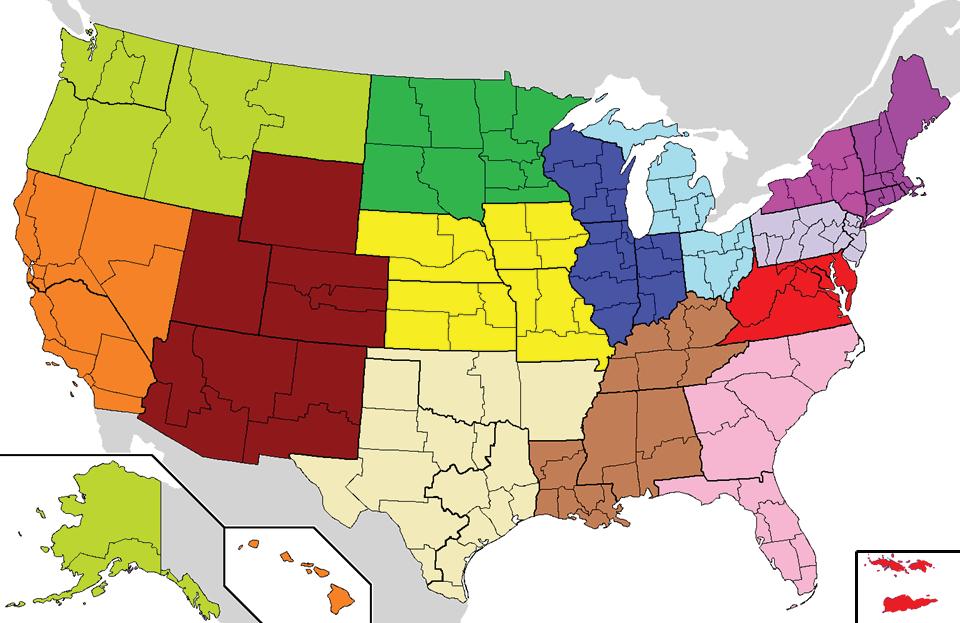
The sample can also be described by geographic and Episcopal Region. Chart 2 provides a graphic breakdown of the percentage of youth ministry leaders in the sample by episcopal region. Six episcopal regions have over 100 responses, eleven episcopal regions have over 50 responses, and only Region 13 has below 40 responses with a total at 34. Region 11 had the most responses at 192 and made up 16% of sample followed by Region 2 with 134 responses making up 11% of the sample (see Table 4.)
Table 4. Breakdown of Sample by Episcopal Region
Chart 2. Breakdown of Percentage of Sample by Episcopal Region
Analysis of Sample
The strategy to broaden the sample by increasing availability to the survey via diocesan leaders’ networks and social media networks was successful. The sample had all of the geographic regions represented with every region making up 21% to 29% of the sample. Additionally, each episcopal region was represented in the sample, but a beter sampling strategy is needed to increase the participation by some regions. A variety of youth ministry leader roles were included, but again, a beter sampling strategy is needed to include diocesan leaders and Catholic school personnel to increase representation by those groups. While the diversity of the sample has increased over time, the sample is underrepresented in its ethnic diversity. Future studies need to consider expanding the sampling strategy and ofering at least a Spanish language option for completing the survey.
It is interesting to note that of the entire sample 46% had never atended an NCCYM, which makes the broadening of the sample beyond NCCYM an important evolution of this research. However, continuing to include NCCYM participants as members of the sample will be important because 36% of YMLs in the study had atended two or more NCCYM’s, which can help provide continuity of research as well.
Youth ministry leaders are now more diverse, but still do not refect the current ethnic diversity in the church.
Section Two: What Do We Know about the Catholic Youth Ministry Leaders in the Sample?
Overview
In comparing the demographics of youth ministry leaders from the three studies (see Table 8), youth ministry leaders are now more diverse, but still do not refect the current ethnic diversity in the church7 and have seen an increase in the number of men serving in the feld. Youth ministry leaders are beter educated (especially in comparison to the 2000 study), and beter paid with more experience in youth ministry while also responsible for more ministry areas. Table 8 ofers a compilation of demographic information across all three studies. Snapshots of the most common descriptors of YMLs are below and many of them are explored in more depth in other areas of this report.
Gender
Lay ecclesial ministers in the church are primarily female making up 80%.8 Like the broader church, female lay ecclesial youth ministry leaders make up the majority with two-thirds (67%) of YMLs being female. There has been an increase of men in the feld by 10 percent since the frst study in 2000. It appears that some of this increase maybe due to an infux of Millennials who make up 47% of all the males in the study, ahead of Gen X at 29%.
Race
Most are Caucasian (78%) with Hispanics and Latinos (15%) forming the second largest ethnic group followed by Asian and Pacifc Islanders (5%) and African-Americans (2%).
Vocational Status
In this study, as well as the other two studies, the clear majority (97%) described their vocational status as lay, including religious sisters and brothers. This percentage has held steady over the life of the longitudinal study (see Table 5). At times this report will provide statistics on only those who are lay, taking out the ordained responses, but the most common data will include all the responses including ordained.
7. Fact Sheet: Hispanic Catholics in the U.S. from the Center for Applied Research in the Apostolate, Georgetown University.
8. CARA reports that 80% of LEMs are female. Research Review: Lay Ecclesial Ministers in the United States (February 2015) from the Center for Applied Research in the Apostolate, Georgetown University.
Highest Level of Education
Forty-six have a bachelor’s degree as their highest level of education. A master’s degree is the next highest level at 31%, an increase of 11% since 2000, but only a 2% increase in the last 8 years.
Age
The mean (mathematical average) and median age (50 percentile) is 42; meaning there is a normal distribution with half of the population being over 42 and have being under. Since the 2000 study the mean age has held constant only varying from 40 to 43 years old, over the 16 years of study. The age range in the 2016 study was from 20 years old to 82.
Generation of Youth Ministry Leaders
The sample can be described by generation9 since their age was asked. Chart 3 shows the breakdown of the sample by generation pointing to Millennials (38%) making up the largest part of the sample followed by Generation X (32%) and the combined group of Baby Boomers and the Silent Generation (30%).
Years of Experience
The mean number of years of youth ministry experience is 14, up from 12.5 years of experience in 2008, with only an increase of 4.5 years of experience since 2000. Fifty percent of youth ministers have been involved 11 years or more years in youth ministry, up from 7 years in 2000. The mean number of years of professional youth ministry experience is slightly lower at 11 years with 27% of youth ministry leaders having 3 years or less professional experience (see Table 6).
9. The breakdown of the ages of the diferent generations in 2016 was provided by Pew Research Center. Richard Fry, Millennials projected to overtake Baby Boomers as America’s largest generation (March, 2018) from the Pew Research Center
Years of Experience by Role
Diocesan staf members are the most experienced group of YMLs with an average of 19 years of experience in youth ministry and 15 years of professional ministry. Full-time parish youth ministers have 13 years and 9 years of professional ministry experience, which is slightly less that those serving in full-time parish ministry with youth ministry as one responsibility, who have 15 years of youth ministry experience and 11 years of professional ministry experience.
Table 6. Years of Professional Experience of All YMLs
Intent to Work in Youth Ministry in Future
Sixty-one percent intend to continue working in youth ministry for six years or more, with 37% of those planning to continue ten years or more (see Table 7).
Catholic Faith Engagement
Forty-seven percent atended a Catholic elementary school, 34% a Catholic High School, with 40% atending a Catholic College or University. Sixty-one percent participated in youth ministry as a young person. Nine percent have converted to Catholicism. When examining this by generation, it is evident that Millennial youth ministry leaders are products of the programs they participated in as an adolescent, with 55% of them having participated in youth leadership programs. Clearly, these programs, especially ones focused on leadership have been part of calling forth the next generation of youth ministry leaders.
Table 7. Participation in Catholic Programs by Generation
Itinerant Minister, Publisher, or Staf of a Resource Organization Role
Those serving the feld in a role as Itinerant Minister, Publisher, or Staf of a Resource Organization are the most educated in the youth ministry feld with 71% having a graduate degree, and more likely to be Baby Boomers.
Table 8. Demographics of Lay Ecclesial Youth Ministers
Pacifc Islander, Filipino,
Note. aRespondents who chose “other”, Native-American, biracial or multi-ethnic group, and those who did not specify. bThose responding other included some college completed but no degree, national youth ministry certifcate, diocesan certifcation, or chose not to respond to this question.
Section Three: How Do Youth Ministry Leaders Serve the Church?
Overview
There is a consensus on the purpose of youth ministry: discipleship making. There are also, common types of programs, activities, methods that are used by youth ministry leaders such as games, Eucharistic Adoration, retreats, service programs, mission trips, etc. However, depending on the context, those common activities may look very diferent; such as parish size, or what happens in a school or campus seting vs. the parish seting. Regardless of what they do, YMLs are positive about their ministry and its efectiveness. In assessing the titles, roles, and stated purpose of youth ministry, we begin to have a beter picture of what youth ministry leaders are engaged in as part of their service to the church. In this section, we take a deeper look at what youth ministry leaders—serving in full-time and part-time roles—do on a regular basis and at what frequency. As we compare how youth ministry leaders are serving generationally, Millennials are now the largest group serving in parish youth ministry.
Youth Ministry Titles
Due to the breadth of service and leadership in the feld of youth ministry, there has been an intentional shift toward use of the title “youth ministry leader” not to describe a specifc position, but to describe all those serving in youth ministry, instead of a narrower approach, such as coordinator of youth ministry or youth minister. In previous studies, there was great diversity among these titles of YMLs. Titles in the 2016-17 Study revealed the same, if not more, diversity in titles present in the feld. When coding the titles into common categories, most (54%) of the titles focus around the concept of coordinating or directing youth ministry. While there was no one set way of describing the title, Coordinator of Youth Ministry and Director of Youth Ministry were very common but often had another ministry added in it such as young adult or family. The next highest (24%) common title surfaced was simply of “youth minister.” Many of the titles included the ideas of faith formation, catechesis, and/or discipleship. Often titles included the audience served. Commonly mentioned in the titles were descriptors such as: “middle school” or “high school” or “youth” or “young adult” or “confrmation” or “campus.”
Purpose of Youth Ministry
Youth ministry leaders were asked how they would defne the purpose of their youth ministry. In examining the top responses, the most common was forming disciples (65%) followed by sharing the teachings of the church (11%). Geting youth involved in the church (10%) was the third most highest response followed by community
YMLs are positive about their ministry and its effectiveness.
building (9%) and developing leaders (5%) and helping young people to understand their vocation (less than %1). In 2000, the ideas of comprehensive youth ministry and the three goals of Renewing the Vision10 were utilized. In 2008, the addition of the idea and language of “new evangelization” clearly permeated responses to questions like this one. Now another shift is seen with language that focuses on missionary discipleship, encounter, and accompaniment as common ways of describing youth ministry eforts. The next largest set of responses (29%) focused on engaging young people in the Catholic faith by forming them in the teachings of the church and on building community among young people and the Catholic faith community.
Lack of Understanding about Youth Ministry
While youth ministry leaders are clear about their purpose, there is concern regarding the lack of understanding about youth ministry (see Table 9). When youth ministry leaders were asked how signifcant the lack is of understanding about youth ministry to their ministry, one in fve said this issue was very signifcant, while one in four said it was not signifcant at all. Every generation indicated this was a signifcant or very signifcant issue with Millennials being the highest at 48% but only a 4% diference from Boomers and Silents.
Table 9. How Signifcant Is the Lack of Understanding about Youth Ministry?
10. Renewing the Vision of Catholic Youth Ministry, published by the United Conference of Catholic Bishops (USCCB), has three primary goals. A summary of RTV is provided on the USCCB website.
Leadership Roles/Positions in Youth Ministry
In understanding how YMLs serve in a particular area of ministry, it is important to consider the context of their service (diocesan, parish, or school) and the parameters of their service (full-time, part-time, or volunteer.) As demonstrated in Table 10, the number of full-time Parish YMLs increased slightly to 36% of youth ministry leaders in the study; another 10% work full-time in multi-ministry roles, with one of the roles being youth ministry. To understand the full picture of parish full-time ministry, one must include those who work full-time in multi-ministry roles, with one of the roles being youth ministry since there has been a trend in parishes to create roles that oversee more than one ministry. This seems to be especially true in youth ministry where the expansion can easily happen on the spectrum of early adolescent to young adult.
Generally, the number of youth ministry leaders serving in parishes in a full-time capacity has held steady. In the 2000 Study, forty-nine percent of youth ministry leaders served in full-time roles. In 201617 Study, 46% served full-time when combining full-time youth ministry leaders and those who have youth ministry as one of many responsibilities. When comparing geographic regions, the Midwest has the highest percentage of full-time staf at 53%, followed by the South (50%), Northeast (41%), and West (40%). Millennials are serving in parish full-time ministry roles at higher percentage than any of the other generation. Generation X is the most common generation serving in a diocesan staf role.
The other important descriptor of full-time ministry roles is not only the move towards multi-ministry roles, but multi-parish or cluster parish roles as well. Eighteen percent reported serving in a multiparish or cluster parish seting, which is down from 27% in 2008.
Minister and/or Catholic School Teacher
Itinerant Minister, Publisher or Staf of a Resource Organization, or Other
Primary Populations Served
Youth ministry leaders serve a broad age span in their ministries, with full-time and part-time ministry leaders having responsibility for junior high through young adult ministry. Especially in examining titles, it is clear that more and more youth ministry leaders are actually “youth and young adult” ministry leaders.
• Full-Time Parish Youth Ministry Leaders: The vast majority (81%) of parish full-time ministers serve both junior high and high school with 38% also having responsibility for young adult ministry. Less than a third (28.5%) also have responsibility for confrmation as part of their job.
• Full-Time Parish Youth Ministry Leaders with Youth Ministry as One of Their Ministry Areas: Eighty-four percent of this group are responsible for both junior high and high school with 42% having responsibility for young adult ministry. A litle over a third (34.5%) have responsibility for confrmation as part of their job. However, in addition to youth and young adult ministry these ministry leaders often had an additional area of responsibility such as family or faith formation.
• Part-Time Youth Ministry Leaders: Sixty-seven percent of parttime youth ministry leaders are responsible for both junior high and high school with only 23% being responsible for young adult ministry. Sixteen percent of part-time leaders also had confrmation under their leadership.
Parish Activities and Programs Ofered
All youth ministry leaders tend to ofer the same type of programs at certain intervals: weekly, monthly, or annually, regardless of employment status (full-time, part-time, or full-time with multiple ministries of which youth ministry is one). Those with a full-time focus on youth ministry are more likely than their counterparts to ofer these programs with increased frequency, while those with less time or more areas of ministry do so less frequently.
Youth group, religious education, and confrmation classes are most frequently ofered on a weekly basis, while overnight retreats, national conferences, and mission trips are ofered most frequently on an annual basis. Regardless of the role, only 6% or less of these parish leaders do not ofer youth group meetings as part of their service, which means youth group meetings are the most frequently ofered program followed by religious education classes. Another common program ofering regardless of role is participation in diocesan programs, with only 8% or less not ofering that at all in their parish ministry.
Full-Time Parish Youth Ministry Leaders ofer the following programs most often on a:
• Weekly Basis:
o 75% Youth Group Meeting
o 69% Religious Education
o 49% Confrmation Classes
o 23% Bible Study
• Monthly Basis:
o 52% Local Service Programs
o 37% Eucharistic Adoration
o 31% Youth Prayer Meetings
o 20% Youth-Focused Eucharistic Liturgy
• Annual Basis:
o 77% Overnight Retreat
o 74% National Conferences
o 68% Mission Trips
o 67% Diocesan Programs
o 47% Daylong Retreats
o 47% Youth Leadership Programs
o 47% Out of Town Social Trips
o 39% Parent Teen Programs
o 37% Adult Leadership Programs
o 32% Parent Education Programs
Full-Time Parish Youth Ministry Leaders with Youth Ministry as One of their Ministry Areas ofer the following programs most often on a:
• Weekly Basis:
o 74% Religious Education
o 56% Confrmation Class
o 54.5% Youth Group Meeting
o 16% Bible Study
• Monthly Basis:
o 48% Local Service Programs
o 32% Eucharistic Adoration
o 31% Youth Prayer Meetings
o 24.5% Youth-Focused Eucharistic Liturgies
o 24.5% Youth Prayer Meetings
• Annual Basis:
o 77% Diocesan Programs
o 74% National Conferences
o 70% Daylong Retreats
o 64% Overnight Retreat
o 53% Mission Trips
o 41% Out of Town Social Trips
o 34% Adult Leadership Programs
o 33% Parent Teen Programs
o 31% Youth Leadership Programs
o 24% Parent Education Programs
Part-Time Youth Ministry Leaders ofer the following programs most often on a:
• Weekly Basis:
o 63% Religious Education
o 57% Youth Group Meeting
o 45% Confrmation Class
• Monthly Basis:
o 47% Local Service Programs
o 38% Eucharistic Adoration
o 35% Youth Prayer Meetings
o 24.5% Youth-Focused Eucharistic Liturgies
o 18% Bible Study
Parental Involvement
• Annual Basis:
o 74% Diocesan Programs
o 54% National Conferences
o 77% Daylong Retreats
o 73% Overnight Retreat
o 42% Mission Trips
o 41% Out of Town Social Trips
o 31% Adult Leadership Programs
o 27% Parent Teen Programs
o 48% Youth Leadership Programs
o 26% Parent Education Programs
Parent education programs and parent-teen programs are ofered by a third or less of most parishes even though there have been big pushes nationally to reach out to include parents and do intergenerational programming. However, it is important to note that thirty-nine percent of parishes with a full-time paid youth ministry leader ofer parent-teen programs annually. When youth ministry leaders were asked how signifcant parental involvement in youth ministry would be over the next three years (see Table 11), two-thirds (66%) said it was signifcant (35%) or very signifcant (31%.) While parental involvement continues to be signifcant it seems that signifcance does not translate into parish youth ministry programing on a regular basis. Millennials were more likely than others to indicate it was very signifcant. This is consistent among those serving in a full-time youth ministry position in parishes. Additionally, Millennials (see Table 12) are the generation most likely not to include parent/teen programs (61%) and parent education programs (59%).

Table 11. How Signifcant Is Parental Involvement in Youth Ministry Programs?
Table 12. Percentage of Full-Time Parish Ministers Not Offering Parent Programs by Generation
That Does Not Ofer Parent/Teen
Does Not Ofer
Participation in National and International Events
Forty-one percent of youth ministry leaders in the study have taken youth to the National Catholic Youth Conference (NCYC) with 31% participating in World Youth Day. Those who take youth to NCYC fnd the NFCYM to be a more valuable resource than those who do not.
Social Media and Communications
Predictably, the majority of all youth ministry leaders frequently use social media (59%) and text messaging (58%) in their ministry (see Tables 13 and 14.) When including those who responded occasionally, the percentages for both types of communication rise to at least 80% of all youth ministry leaders. Full-time parish youth ministers use text messaging (70%) and social media (68%) more frequently than other youth ministry leaders except for diocesan leaders who utilize social media the most at 74%. Millennials use both social media and text messaging slightly more than the other generations.
Although, youth ministers utilize social media in their ministry, when asked about how signifcant the pervasiveness of social media would be to their ministry (see Table 15) in the next 3 years 55% of youth ministry leaders it was signifcant or very signifcant with 22% saying very signifcant. Millennials overall did not fnd this to be as signifcant as the older generations.
13.
Table 14. Social Media Use by Youth Ministry Leaders
Table 15. How Signifcant Is the Pervasiveness of Digital and Social Media?

Issues Impacting Ministry
Youth ministry leaders were asked about the signifcance of various issues to their ministry in the next few years. Polarization in our church and society was the issue highlighted by most youth ministry leaders as signifcant with recruitment and the pervasiveness of social media both tied for second.
• Budget. Youth ministry leaders were asked how signifcant insufcient budget was to their ministry program (see Table 16.) Less than half (39% down from 49% in 2008) indicated it was signifcant or very signifcant. Thirty percent indicated it was not signifcant at all, and of those, Millennials were the largest group to respond this way. Diocesan staf members were more likely to indicate that an insufcient budget in this next three years would have a signifcant impact at 42.5% with 22% of those indicating it would be very signifcant.
• Polarization. Most (59%) youth ministry leaders believe that the polarization occurring in our church and society is signifcant (34%) or very signifcant (25%). Generation X and Millennials are almost ten percent more likely to think this issue is more signifcant than Boomers and Silents (see Table 17).
• Recruiting Leaders. Another issue impacting ministry for over half of all youth ministry leaders is the recruitment of volunteers, with 56% of youth ministers indicating that the fnding of youth and adults to support ministry is a signifcant issue in the next three years. Millennials (46%) fnd this, more than other generations, to be a very signifcant issue.
Youth ministry leaders were asked to identify a main obstacle or barrier to their youth ministry eforts. Interestingly, almost a third said geting youth to participate and make youth ministry a priority. This was followed by a litle over a quarter saying lack of support from parents, pastors, and the parish and almost one in fve identifying a lack of resources such as budget to do their ministry.
• 31% Youth Participation: This obstacle is mainly about youth participation where the youth minister struggles to bring youth from the pews into a ministry seting. Much of this problem was reported due to the fact that the youth had additional priority activities (i.e., sports practice, clubs) with youth ministry last on the list. Many of the participants in the survey thought that youth ministry was uninteresting to the youth.
• 27% Lack of Support: This popular statement included lack of support from parents, the parish, and also the pastor. These three groups were strongly emphasized as proponents of litle support.
• 18% Lack of Resources: Many participants struggled with budget from the perspective of their youth ministry or their salary. In addition, many found that it was hard to fnd enough parent volunteers.
• 11% Cultural: This obstacle included a difculty in understanding diferent languages as well as pop culture and technology as a barrier to atendance. Many reported a disconnect to the relevance of youth ministry and the lives of the youth and a weak or opposing parish culture.
• 8% Lack of Time: Many entries were simply stated that “time” was an issue. More specifcally, time that they had to spend with the youth and plan for their events was limited.
• 5% Other: A variety of other responses not related to the issues identifed above.
Positive about Ministry
Ninety-four percent of YMLs indicated that their work in ministry was fulflling (see Table 18). Additionally, regardless of what youth ministry leaders are doing as part of their ministry, they are positive about the efectiveness of the youth ministry program (see Table 19). Seventy percent of youth ministry leaders said it was true or very true, that youth ministry in their parish was efective. Only four percent said that the statement was not true at all.
Table 16. How Signifcant Is an Insuffcient Budget to Your Ministry Programs?
Table 17. The Signifcance of the Polarization Occurring in Our Church and Society
Table 18. My Work in Youth Ministry Is Fulflling.
Table 19. Youth Ministry, in My Parish, Is Effective.

Section Four: How Have Youth Ministry Leaders Been Formed and Educated for Ministry?
Overview
In each iteration of this longitudinal study, youth ministry leaders have become slightly more educated. The growth in the percentage of who has a master’s degree in a ministry related feld rose from 12% in 2000 to 20% in this most recent study. Additionally, there was a reduction in the number of youth ministry leaders that indicated they had not completed any formal program of formation from 48% to 37%. However, there is still a concern that over a third of people working with our youth have had no ministry formation. One could conclude that the increased access to education online has contributed to the increase in the number of those who have completed degrees or that are currently studying. Millennials are currently studying the most of any generation and more of them have a bachelor’s degree in a ministry related area than any other generation, again pointing to more programs and beter access. While this study has consistently found that higher levels of education do equal a higher salary, salary is likely not the only contributing factor to the increases. More likely increasingly those serving in professional ministry roles have professional degrees. This is an area that needs more study to understand how to best support and encourage ministry leaders to pursue education and formation.
Education Levels of YMLs
Generally, YMLs have increased their completion of formal education and formation since the frst study. A bachelor’s degree (46%) was the most commonly cited highest level of education obtained by youth ministry leaders. The next highest is a graduate degree, with 31% having a master’s degree, and 2% having a doctorate as their highest level of education completed (see Table 20). Three-quarters (74%) of all youth ministry leaders think that it is important to have Catholic colleges and universities ofering programs for lay people.
. . . there is still a concern that over a third of people working with our youth have had no ministry formation.
Graduate Degrees
When it comes to graduate degrees, diocesan staf (59%) were the most likely to have completed a graduate degree compared to 24.5% of full-time parish youth ministry leaders, and 38% of those serving in full-time parish ministry with youth ministry as one responsibility. The majority (59.5%) of full-time parish youth ministry leaders have a bachelor’s degree as their highest level of education.
Education Level by Generation
When examining education levels by generation, the older generations are more likely than the younger ones to have a graduate degree with Baby Boomers and Silents (37%), Generation X (35%), and Millennials (27%). Generational distinctions by education and ministry formation include (see Table 21):
• Of the twenty percent of youth ministry leaders who have a bachelor’s degree in Pastoral Ministry/Studies, Religious Studies, or Theology, Millennials make up the largest percentage (63%) of them
• Of the twenty-one percent of youth ministry leaders with a master’s degree in Pastoral Ministry/Studies, Religious Studies, or Theology, Millennials only make up 28% of that group compared to 38% of Generation X and 34% of Baby Boomers and Silents
• Baby Boomers and Silents having the highest percentage of people who have completed a doctorate in a ministry related area at 69%
Continuing Education
The Millennials are the generation that is currently studying the most, towards either a bachelors in a ministry related area or a master’s degree in a ministry related area. For example, of the eight percent of youth ministry leaders currently studying for a master’s degree in a ministry related area, the majority of those are Millennials (60%). Slightly less than half (49%) of full-time parish ministry leaders receive continuing education as a beneft of their employment with the parish. Fifty percent of those who are studying for a doctorate degree are Gen Xers. Almost three-quarters (74%) of YMLs stated that college/university/seminary programs of study directed towards preparing lay youth ministers for service in the church are important (see Table 22).
Ministry Formation
Diocesan ministry formation continues to be the most common formation across all three studies with almost a third of youth ministry leaders having completed it. Consistently, this study has found that the most common national certifcate program forming youth ministry leaders is sponsored by the Center for Ministry Development with almost one-ffth of all ministry leaders having the certifcate. Older generations of youth ministry leaders are more likely to have this certifcate than the younger ones.
Of those who have completed some type of ministry formation, the following is true about that formation (see Chart 4):
• 34% have completed a diocesan ministry formation program, slightly up from 32% in 2008
• 17% hold a Certifcate in Youth Ministry, slightly down from 19% in 2008
• 20% have a bachelor’s degree in pastoral ministry, religious education, or theology, up from 11% in 2008
• 20% have a master’s degree in pastoral ministry, religious education, or theology, slightly up from 18% in 2008
• 8% are currently working on their master’s degree slightly down from 10.5% in 2008
• 2% hold a doctoral degree in ministry, philosophy, theology, or education
No Ministry Formation
A litle of over a third (37%) of all youth ministry leaders have not completed a ministry formation program, which can range from a certifcate program to a university degree. Of those who have not completed a ministry formation program, 41% are Millennials compared to Generation X at 30%, and Baby Boomers/Silent Generation at 29%. Surprisingly full-time youth ministry parish staf members are the most likely not to have any ministry formation at 33%, with volunteers following closely at 29%, and part-time parish at 16%. However, while 33% of full-time youth ministry leaders do not have any ministry formation, only 10% of those serving full-time in a parish with youth ministry as one of multiple ministries have not completed ministry formation.
Lack of Training
Even though 37 % do not have ministry formation, only 18% indicated that their lack of training would be signifcant or very signifcant in the next 3 years, with the majority (46%) saying it would not be a signifcant issue at all. Sixty-percent of Millennials said that lack of training was at least somewhat signifcant compared to 52% of Gen Xers and 47% of Baby Boomers and Silents (see Table 23).
Table 21. Percentage of Each Generation Obtaining Degrees in Ministry Related Area Bachelors Degree in a MinistryRelated Area Masters Degree in MinistryRelated Area Currently studying for a Bachelors Degree in MinistryRelated Area Currently studying for a Masters Degree in MinistryRelated Area
Of All Youth Ministry Leaders 20% 21% 3% 8%
Percentage of each generation that are in each category of formation
Of the 20% of YMLs who said they have a bachelors degree in ministryrelated area
Of the 21% of YML who have a masters degree in ministryrelated area
Of the 3% of YMLs currently studying for a bachelors degree in ministryrelated area
Of the 8% of YMLs currently studying for masters degree in ministryrelated area

Table 22. College/University/Seminary Programs of Study Directed Towards Preparing Lay Youth Ministers for Service in the Church
DiocesanMinistryFormationCMDCertifcate
Table 23. How Signifcant Is My Lack of Training for Some of My Duties?

Section Five: How Were Youth Ministers Called to Ministry and What Are Their Plans for Future Service in Ministry?
In the 2000 research study, it was recommended that the feld develop and identify a career path for those called to youth ministry by creating entry points into youth ministry and easy transitions to other ministry areas. This issue seems to be even more important now due to the aging population of leaders with Baby Boomers and Silents who were the largest generational group serving in youth ministry in the frst two studies, have now been replaced by Millennials as the largest. While there is great hope with a surge of Millennials entering the feld, their concerns about salary and benefts may prevent them from choosing ministry as a lifelong endeavor.
The feld of youth ministry seems to be replenishing itself based upon the levels of youth ministry involvement by the leaders in this study, especially for Gen Xers and Millennials. Those who were involved in youth ministry as young people cited their own involvement in youth leadership programs, and/or the atendance of Catholic schools or universities as a reason for what they do. However, the church must implement an intentional strategy for inviting young people who are currently leaders and participants in youth ministry to consider this vocational service to the church.
Call to Ministry
The infuences of what causes someone to serve as a youth ministry leader demonstrate this reality, with personal call (73%) and needs of youth (65%) being the strongest infuences. However, all the potential infuence factors had at least a 20% response of very much. Seventyeight percent of Millennials said that their own experience of youth ministry impacted their call to ministry at least moderately with 60% saying that it was very much of an infuence.
Fifty-nine percent of YMLs indicated from numerous factors that the “request of the pastor” infuenced at least slightly their decision to serve as a youth ministry leader, with 17% saying moderately, and 24% saying very much (see Table 24).
Youth Leadership and Youth Ministry Participation
For youth ministry leaders, participation in youth ministry programs (60% did so as teens) and youth leadership programs are often the frst step on the path toward ministry. At least one in three YMLs in this study (36.5%) began preparation for leadership in the church as teenagers through participation in youth leadership programs sponsored by the church. Sixty percent of youth ministry leaders in the study indicated that their own participation in youth ministry as a young person moderately (16%) or very much (46%) infuenced their call to ministry.
“Seventy-eight
percent of Millennials said that their own experience of youth ministry impacted their call to ministry at least moderately . .
.”
Table 24. Reasons for Becoming a Youth Ministry Leader
Supporting Ministry Leaders
Generally, youth ministers are happy about their service in the church. The clear majority (94%) of youth ministry leaders said that it is true or very true that “my work in youth ministry is fulflling” with less than one percent saying that it is not true at all (see Table 18). Diocesan ofces are seen as a valuable resource for youth ministers (see Table 28). Sixty-four percent of youth ministry leaders say it is true that the NFCYM is a valuable resource. This statement is higher among those who taken youth to NCYC or by those who atended at least one National Conference on Catholic Youth Ministry (NCCYM) to 71%.
Future Plans for Youth Ministry Service
As in 2000 and 2008, most youth ministry leaders see their service in youth ministry as a long-term commitment. Of youth ministry leaders in this study, 37% intend to serve in the feld for 10 years or more up from 28% in 2008. This number increases to 61% when including those planning to serve at least six to ten more years (see Table 25). However, when examining how each generation responded to the question, we see less certainty in the Millennials regarding their long-term commitment with 43% saying they intended to work in the ministry 5 years or less and only 40% saying more than 10 years (see Table 26).
Table 25. Long-Term Commitment to Youth Ministry by Generation More Than 10 Years Between 6 and 10 Years Between 1 and 5 Years Less Than 12 Months
Response by All Participants
Table 26. Future Intentions Reported by Lay Ecclesial Youth Ministers Regarding Their Plans to Work in a Formal Youth Ministry Position Future Plans to Work in Professional Youth Ministry
Reasons for Leaving Youth Ministry Service
Youth ministers were asked to select the most likely reason they would leave formal ministry from a list of eight reasons (see Table 27). “Retirement” (22%) was the top reasons selected by respondents followed by “to engage in another form of ministry” (18%). However, the top reason given by each generation was diferent.
• For Millennials, the top reason was inadequate pay and benefts (27%) followed by to do another form of ministry (21%) and then amount of time required to do the job (16%)
• For Generation X, the top reason was to do another form of ministry followed by retirement and inadequate pay and benefts both at 17%
• For Baby Boomers and Silents, the top reason was retirement (50%) followed by wanting to do another form of ministry (13%) and then the lack of support from pastor and parish leadership (11%)
Of the 17% of those in this study who said inadequate pay and benefts was the most likely reason, 61% were Millennials. Baby Boomers and Silents made up 66% of those who responded retirement as the most likely reason for leaving.

Section Six: What Are the Elements Included in Youth Ministry Leaders Professional Relationship with the Church?
Overview
Ministry leaders relate to the church in many layers and roles, as a leader within the faith community, maybe as an employee to employer, maybe as collaborators with other ministry leaders. The challenges youth ministry leaders have faced over the longitudinal study focus on continuing to fnd ways to formalize the relationship with the church as employer especially in the areas of contracts, job descriptions, and performance reviews. Alarmingly, another one of the challenges has been equal pay for female youth ministry leaders since in each of the three studies, there has been a statistical diference between what male youth ministry leaders make compared to their female counter parts holding for years’ experience and education level.
Youth Ministry Leaders Formal Relationship with the Church as Employer
The good news is that 80% of full-time ministry leaders receive health insurance as part of their employment and 70% have a retirement plan. It is important, however to note what is missing from the fulltime YMLs formal relationship with the parish:
• 68% do not have an employment contract
• 68% do not have a paid annual retreat
• 49% do not have at least an annual performance review of their work
• 47% do not have paid life insurance
• 30% do not have a retirement plan
• 28% do not have a writen job description
• 20% do not have health care benefts
The lack of these elements as an established part of the workplace relationship between the parish and the full-time YML is a sign the church still needs development as an employer especially in the areas of formalizing the relationship with writen job description, contract, and performance review. Additionally, only 37% have secretarial support, which is a 13% drop from 2000, meaning the trend of more time atending to administrative responsibilities instead of ministry is occurring (see Table 28).
Work-Related Beliefs of YMLs
Examining extreme responses to questions can often reveal more in situations where there is general agreement, such as the case with youth ministry leaders who remain positive in their service and work in the church (see Table 29). Although, everything remains positive and 2008 had the most positive responses over the course of the three studies, in 2016-17 there was a drop of in every statement measured
Continued ways to formalize the relationship with the church as employer especially in the areas of contracts, job descriptions, and performance reviews are needed.
in the “very true” responses. In examining responses by generations there were no noticeable diferences indicating that these shifts are happening across the feld and not in just one group.
Generally, youth ministers are positive about the support that youth ministry receives from pastors and bishops. Regarding pastors, 81% said it was true (34%) or very true (47%) that their pastor is supportive and with bishops 84% saying it was true (39%) or very true (45%) that their bishop is supportive. In both cases, the percent indicating that it was very true decreased; pastors went from 63% to 47% and bishops went from 56% to 45%.
YMLs continue to believe that their diocesan ofce is a valuable resource, with two-thirds (68%) responding true (26%) or very true (41%), and a litle more than one in ten (11%) saying not at all true.
Table 28. Description of the Percentage of Full-Time Parish Youth Ministers Reporting that Selected Elements were Present in Their Formal Relationship with the Parish
Note: The percentages in this table are just full-time youth ministers and do not include those working full-time with youth ministry as one of many responsibilities so that comparison across the three studies could occur.
Table 29. Work-Related Beliefs of All
Youth Ministry Leaders
Belief Statement
My Ministry Is Fulflling
Youth Ministry, in My Parish, Is Efective
The Diocesan Ofce of Youth Ministry Is a Valuable Resource
YML Salary Considerations
The average youth ministry leader salary has increased in all categories of employment status, with diocesan YML staf experiencing the largest amount of increase over the course of the three studies at almost $22,000 since 2000 (see Table 30). As found in the other two studies, increased completion of formal education continues to contribute to higher salaries for (see Table 31). The region that has the highest mean salary is the south at $39,833 (see Chart 5). Men continue to make signifcantly more money than women.
Table 30. Mean Annual Salaries of Youth Ministers by Youth Ministry Employment Status
Salary and Gender
In 2000, a comparison of the mean salary of all lay youth ministers by gender showed that male youth ministry leaders had a higher average salary, $26,705 than female youth ministry leaders, $21,628, for a diference of $5,077 (see Chart 6). This trend toward higher salaries by male YMLs continues throughout the three studies, with the largest gap being comparing all male and all female youth ministry leaders, with males earning an average salary of $41,469 and females an average salary of $34,313 (see Table 31) with a statistically signifcant diference of $7,156.11 The gap decreases to $3,961 when comparing male and females in full-time parish ministry including those for whom youth ministry is one of multiple ministries they are responsible, but the diference again is statistically signifcant.12
11. An independent-samples t-test was conducted to compare the salaries of male and female youth ministry leaders. There was a signifcant diference in the salaries of males (M=$41,468.67, SD=$18,561.30) and females (M=$34,313.24, SD=$16,485.17) conditions; t (542.508)= 5.572, p = .000.
12. An independent-samples t-test was conducted to compare the salaries of male and female of full-time parish youth ministry leaders. There was a signifcant diference in the salaries of males (M=$41,060.43, SD=$11,680.99) and females (M=$37,099.58, SD=$12,027.79) conditions; t (496)=3.486, p = .001.
Salary and Education
Higher levels of education including receiving a bachelor’s or master’s degree have consistently resulted in higher pay for youth ministry leaders across all three studies. Often, there is a question among ministry leaders is it worth geting a master’s degree. This research shows that the mean salary for all youth ministry leaders with a bachelor’s degree is $34,534 compared to those with a graduate (masters or doctorate) degree $44,666 a statistically signifcant diference of $10,132.13 When examining the same question but looking at only full-time parish YMLs, again you see those with a graduate degree making more at $42,446 and those with a bachelors $37,568 with a statistically signifcant diference of $4,87914 (see Table 32). The same is true for those with a certifcate of youth ministry had an average salary of $41,422 compared to those without $35,656.15
Table 32. Mean Salary for Full-Time Parish Youth Ministers by Highest Education Level Completed
Highest Education Level Completed
2000 Mean Annual Salary (dollars)
2008 Mean Annual Salary (dollars)
2016-17 Mean Annual Salary (dollars)
High School Diploma 23,945 22,046 33,865 Associate Degree 24,273 26,937 36,430
13. An independent-samples t-test was conducted to compare the salaries of all parish youth ministry leaders with a bachelor’s degree versus those with a graduate degree. There was a signifcant diference in the salaries of those with a graduate degree (M=$44,665.68, SD=$18,961.51) and those with a bachelor’s degree (M=$34,533.66, SD=$13,873.55) conditions; t (727)=-8.327, p = .000.
14. An independent-samples t-test was conducted to compare the salaries of those of full-time parish youth ministry leaders with a bachelor’s degree versus those with a graduate degree. There was a signifcant diference in the salaries of those with a graduate degree (M=$42,446.35, SD=$12,017.64) and those with a bachelor’s degree (M=$37,657.82, SD=$9037.60) conditions; t (146.252)= 3.663, p = .000.
15. An independent-samples t-test was conducted to compare the salaries of all parish youth ministry leaders with a certifcate in youth ministry versus those who do not have one. There was a signifcant diference in the salaries of those with a certifcate (M=$41,422.78, SD=$17,236.45) and those without a certifcate (M=$35,656.79, SD=$17,481.48) conditions; t (263.359)=-3.906, p = .000.
Professional Ministerial Associations
There has been fuctuation in participation in professional associations or organizations over the course of the three studies. In the 2016 study 37% are members of a professional association, which is down 11% from 2008 study (48%), but overall up from 2000, which reported 20% membership in professional associations or organizations. The two highest associations that youth ministry leaders reported being a member of was the National Association of Catholic Youth Ministry Leaders (NACYML)16 (16%) and diocesan ministerial associations (16%). The second highest national ministerial association that youth ministry leaders were a part of was the National Conference of Catechetical Leaders.
The 2000 YML study recommended the establishment of diocesan and national level ministerial organizations so that lay ecclesial youth ministers could engage in professional activities, as well as receive support from and contribute to the feld. In response to this call the NFCYM established the National Association of Catholic Youth Ministry Leaders in 2006. In 2017 the NFCYM added a new level of membership, Associate Membership, for local youth ministry leaders to replace NACYML. It will be interesting to see what the future holds for participation in professional ministry associations especially with the reported trend that Millennials are not as interested in joining these types of groups.17
Professional Journal and National Certifcation
Besides professional associations, two other aspects of a profession include having designated literature or a journal and some type of commonly accepted certifcation or licensure. Less than ffty of youth ministry leaders in this study thought that it was important for the feld to have a journal (see Table 33). This percentage has decreased over the life of the study, possibly due to the advent of the Internet as a continual resource for sharing information. When it comes to national certifcation, there is high support for national certifcation at 89% saying it is at least somewhat important (see Table 34). Currently, the National Federation of Catholic Youth Ministry through the Alliance for Certifcation for Lay Ecclesial Youth Ministry Leaders ofer a national certifcation for youth ministry leaders.18
16. The National Association of Catholic Youth Ministry Leaders (NACYML) was a membership organization sponsored by the NFCYM but it has been replaced by a new NFCYM Associate Membership option.
17. According to this article by Linked In htps://www.linkedin. com/pulse/why-millennials-dont-join-associations-gabriellebosch%C3%A9
18. For more information on National Certifcation of Lay Ecclesial Ministry Leaders from the Alliance for Certifcation of Lay Ecclesial Ministry Leaders.
Table 33. Importance of a Professional Journal for Catholic Youth Ministry Leaders
Table 34. Importance of National Certifcation for Youth Ministry Leaders