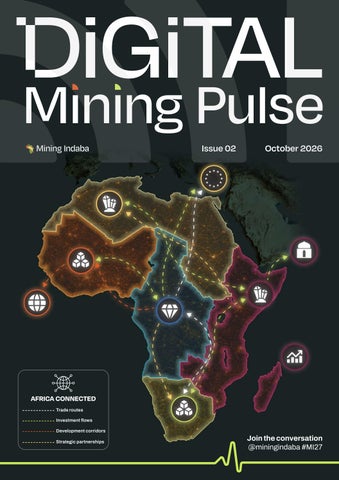
Issue 02
October 2026
AFRICA CONNECTED Trade routes Investment flows Development corridors Strategic partnerships
Join the conversation @miningindaba #MI27
EDITOR’S NOTE
The ideas, decisions and partnerships driving mining forward. EDITOR’S NOTE
The stories behind the shift
Mining is changing, and understanding where the industry is heading requires looking at the forces shaping it from different angles In this issue of Digital Mining Pulse, we explore the changing role of state mining companies, the debate around mineral sovereignty and the growing importance of technology in how the industry operates. We examine regional collaboration, responsible mining, manufacturing and the relationships connecting different parts of the mining value chain.
We also bring different industry perspectives into focus, from the priorities of downstream industrial buyers to the organisations and people working to shape mining’s future. Each offers a different view of the challenges, opportunities and decisions influencing the sector. Taken together, these stories reveal an industry navigating shifting priorities, changing market dynamics and new expectations.
They offer insight into the developments worth watching, the ideas being tested and the people helping to shape what comes next. As we look towards Mining Indaba 2027, these perspectives provide a starting point for the conversations that matter. They also bring our theme, Stronger Together: Partnerships in Practice, into focus through the
real issues and experiences shaping the industry. The question is what happens next: which ideas will gain traction, which approaches will stand up to scrutiny, and which decisions will move the industry forward? Turn the page to explore the perspectives shaping that debate.
CHANEL BURKE Senior Communications Manager 2
Digital Mining Pulse
miningindaba.com
3
WELCOME
Aligned interests. Stronger outcomes. WELCOME
Closing the gap between ambition and delivery LAURA NICHOLSON
Industry Director, Mining Indaba Investors and mining companies are watching returns and project timelines. Governments are focusing on how to attract more mining-focused investment while also extracting greater economic value from their mineral wealth. Downstream industrial buyers are watching supply, price, quality and security.
4
Digital Mining Pulse
All three need to move closer together. That may be one of the biggest tests facing the sector. Africa is entering a period in which its mineral resources carry greater strategic importance, while competition
The opportunity is significant, but there are still constraints to overcome.
This is where partnership stops being a nice idea and becomes an operating requirement.
A copper project cannot wait indefinitely for infrastructure. A processing plant cannot operate without reliable power. A mineral corridor cannot deliver value without coordinated investment. A downstream buyer cannot build a reliable supply chain without secure and competitive access to minerals. A community cannot wait years for promised economic benefits. And an investor cannot commit capital without confidence that policy will enable a project to move from good on paper to go on the ground.
It asks whether Africa can turn geopolitical competition into strategic advantage. It examines what is really required to create domestic value from mineral resources. It puts infrastructure, energy and industrialisation into the same conversation as investment. It looks at strategic minerals – of them – through the lens of changing markets, and at technology through a more immediate question: how do we build mines that work now?
for capital, infrastructure, technology, processing capacity and market access is becoming more intense.
The MI27 agenda is built around this necessity.
These are practical questions for an industry that is certainly feeling the pressure to deliver. They are also the questions behind our MI27 theme “Stronger Together: Putting Partnerships into Practice”. Because partnership is not about bringing more people into the room. It is about getting the right people to solve the right problems, connecting the different parts of the value chain and then making something happen. The road to MI27 is already underway. The challenge now is to make sure the conversations in Cape Town are connected to the decisions being made long after everyone leaves.
miningindaba.com
5
STRATEGIC INSIGHT
Africa’s mineral wealth is growing. So is state control. STRATEGIC INSIGHT
ZEINAB EL-SAYED
Government & Institutional Partnerships Director, Mining Indaba
6
Digital Mining Pulse
State mining companies and the new architecture of mineral sovereignty
In several mineral-rich African countries, state-owned mining companies are taking on a more prominent commercial role. Guinea is developing Nimba Mining Company as a national platform. Zambia’s ZCCM-IH is seeking greater value from its mining portfolio. Ghana has created GoldBod to oversee gold trading and export. In the Democratic Republic of Congo, Gécamines is using existing shareholdings to influence how copper is marketed and where it is sold. These developments are often grouped together under the broad heading of resource nationalism. That description tells us little about how the institutions work or what governments are seeking to achieve through them. A government may hold minority interests in privately operated
mines, develop assets through a national company, control the trading of particular minerals or intervene at a strategic point in the value chain. Each model creates a different balance of risk, control and commercial exposure. This wave of state participation is as much about institutional design as ownership. Success will depend on whether state companies build the capabilities that create the greatest leverage in their markets.
Selective capability International mining companies combine geological and engineering expertise with capital, operations, logistics, marketing and risk management. Reproducing that structure inside a state-owned company requires considerable time, specialist talent and financial capacity.
Governments can take a more selective approach. The most valuable capabilities may include understanding the economics of national mineral assets, negotiating and monitoring joint ventures, exercising shareholding and marketing rights, evaluating partners and financing proposals, managing assets as a portfolio and retaining institutional knowledge across political cycles. The balance will vary. A state with established expertise may operate assets directly. Another may create greater value through portfolio management, trading rights or control over processing and export. A narrow mandate built around high-value capabilities may deliver more influence than responsibility for the entire value chain.
miningindaba.com
7
STRATEGIC INSIGHT
Africa’s mineral wealth is growing. So is state control. STRATEGIC INSIGHT relationships, explain how prices and terms are determined, and allow the state to evaluate competing offers or change partners without disrupting the business. A state institution can commission specialist expertise without employing every capability internally. It still needs enough knowledge to assess advice, challenge assumptions and retain control over decisions with national strategic consequences. Nimba’s development will test whether a new national platform can turn its asset base into a sustainable business. Success will require operating expertise, disciplined capital allocation, commercial independence and specialist talent.
Activating ownership rights Many governments already hold minority interests in major mines. These can generate dividends and provide formal representation while leaving most commercial decisions with the operator. The state may own part of an asset but have limited involvement in the production, customer and marketing decisions that shape the value of its share. Gécamines is developing a different approach. Through its partnership with commodities trader Mercuria, the Congolese state miner is marketing copper associated with its interests in mining joint ventures. In a major transaction under this arrangement, Gécamines exercised its right to purchase 100,000 tonnes of copper from 8
Digital Mining Pulse
Tenke Fungurume Mining, in which it holds a 20 per cent interest, for sale to US buyers.
company can move beyond dividend income towards active portfolio management.
Mercuria brings logistics, trading expertise, customer access and financing solutions. Gécamines gains greater influence over pricing, buyer selection and destination while CMOC continues to operate the mine. The DRC can diversify its customer base and gain direct commercial experience without restructuring ownership or operating the mine.
Both models demonstrate that ownership rights become more powerful when the state has the commercial knowledge and institutional capacity to use them.
ZCCM-IH represents a broader portfolio model. Its strategy focuses on extracting more value from existing holdings and increasing exposure across the mining value chain. Its mix of minority interests, operating assets and new investments shows how a state investment
Building national platforms Guinea’s ambitions for Nimba extend beyond portfolio ownership or trading rights. The newly established company plans to sell bauxite through regular international tenders, secure trading partners for minimum annual volumes and reinvest earnings into expansion. Its ambitions include alumina, gold and base metals.
Ghana has chosen a different institutional structure. GoldBod has extensive authority over the purchasing, assaying, refining and export of gold, particularly from artisanal and smallscale production. Through this structure, Ghana is seeking to formalise supply, generate foreign exchange, support gold reserve accumulation and retain more value domestically. Together, the four institutions point to an emerging architecture of state participation: activating rights attached to minority interests, managing assets as
a portfolio, building a national operator and controlling a strategic section of the value chain. Each model requires a different combination of expertise, capital and institutional discipline.
Partnerships that build capability Partnerships will remain central. Mercuria gives Gécamines access to systems, market intelligence and relationships that would take time to build internally. Operators and traders can provide Nimba with technical and commercial expertise. Banks, refiners, licensed aggregators and the Bank of Ghana support GoldBod’s domestic gold market. Their long-term value depends on what the state retains. Strong arrangements should transfer knowledge, provide access to transaction data and customer
Making mineral sovereignty operational A growing number of mineralproducing governments are acquiring assets, activating marketing rights and building institutions that can intervene across the value chain. This creates opportunity, but also exposure. Every additional right brings a demand for expertise, capital and accountability. An increasingly important part of mineral sovereignty will be exercised in the commercial layer of mining: valuation, negotiation, financing, trading and allocation. Strength in these areas gives governments more choice over partners, greater visibility over value and more influence over where their minerals go. State-owned mining companies will sit at the centre of this shift. Their success will be measured through the leverage they create for the countries they represent, the quality of the partnerships they negotiate and the value they convert into durable national capability. Ownership places the state at the table. Capacity determines what it can do once it gets there. miningindaba.com
9
INDUSTRY PERSPECTIVE
The real test begins after the agreement is signed. INDUSTRY PERSPECTIVE
The Partnership Test: What Makes Mining Partnerships Work?
ALLISON GEORGE
Senior Strategic Advisor, dss+
Mining is expected to deliver more than minerals alone. The tall order includes technology, critical minerals, energy security, infrastructure, climate resilience and revenue. Mining cannot deliver these outcomes alone, but project terms can enable or constrain them. Communities expect higher standards and a meaningful share of value. Governments need capital and capability. Companies need stable operating environments and legitimacy. Investors need confidence and durable returns. No actor can secure these outcomes alone. Partnerships are therefore essential, but the label must be earned. An agreement, financing announcement or MoU may establish a transaction: access to resources, permits, markets in exchange for capital, technology, jobs or revenues. It becomes fragile when one party controls information, bargaining power and gains, while another bears disruption, environmental risk and long-term liabilities. A partnership is not defined by the label. It is defined by whether it leaves governments, communities, local firms and investors better able to create and sustain value over time.
10 Digital Mining Pulse
miningindaba.com 11
INDUSTRY PERSPECTIVE
The real test begins after the agreement is signed. INDUSTRY PERSPECTIVE
Lessons and accountability Balanced terms matter. Zambia’s privatisation era agreements exposed the risks (as seen in other African countries during the 1980s-2000s) of generous incentives, weak negotiating capacity and fiscal terms untested across commodity cycles. Transparency, state capability and regular review remain essential, even with multilateral support. The experience of mining in eastern Democratic Republic of Congo provides a related insight: partnerships must be tested on the ground, not assumed from
transactions. Contractual rights and external capital alone do not create partnerships where conflict risks, contested ownership and historical grievances impact accountability. Before calling an initiative a partnership, ask: does it create value beyond extraction; build agency for institutions, communities and local firms; share value, risk and liabilities fairly; and make commitments transparent, measurable and enforceable? If not, it may be a transaction. It should not be marketed as a partnership.
The practical partnership test A credible mining partnership should pass four tests.
costs and liabilities must be transparent and fairly allocated.
First, it needs a purpose beyond extraction: It should create lasting value through skills, infrastructure, energy, local enterprise and public revenue – not simply move concentrate to export.
Fourth delivery must be accountable: Commitments need clear milestones, named responsibilities, local participation, independent scrutiny and consequences for failure.
Second, it must build agency, not dependency: Governments, communities and local firms need information, capability and meaningful influence over decisions that affect them. African Mining Vision is well versed on these aspects.
For investors, these are not simply social considerations. Projects with credible local legitimacy, competent public counterparts, transparent obligations and workable grievance mechanisms are more likely to secure approvals, withstand political cycles and operate through volatility.
Third, it must share the value and risk fairly: Benefits, jobs, procurement, impacts, closure 12 Digital Mining Pulse
Building African capability Stronger partnerships must build African capability. With effective access to finance, business support, geological information, infrastructure, skills and markets – in this scenario artisanal and small-scale miners, domestic mining firms and local suppliers can become powerful engines of employment and enterprise on their soil. Global capital, technology and markets remain important. African countries also need to consistently invest in institutions, technical skills and negotiating capacity to set and enforce the terms of engagement.
Regional cooperation is equally fundamental: not every country needs its own refinery or battery plant. Morocco’s proposed lithium-iron-phosphate battery facility should be judged not only by production capacity; but by whether it helps build a durable regional ecosystem of industrial capability. African industrial leadership also matters and credible partners who share the vision. The scale and market building approach associated with Dangote offers a useful lesson for solid minerals. Local value creation becomes more credible when investment is linked to infrastructure, technical capability, capital and demand – not policy aspiration alone.
miningindaba.com 13
GOVERNMENT PERSPECTIVE
Why investor confidence shapes Africa’s mining future. GOVERNMENT PERSPECTIVE
JITO KAYUMBA
Special Assistant to the President of the Republic of Zambia for Finance and Investment, Government of the Republic of Zambia
Africa’s mineral wealth is capturing unprecedented global attention, driven largely by the accelerating green energy transition. However, across the continent, the policy debate is maturing. The focus is no longer solely on attracting foreign investment, but on determining exactly what that capital delivers for the host economy.
Stronger Together: Forging Mining Partnerships that Deliver Real Economic Value For nations like Zambia, the ambitions are clear and rightly bold: aggressively expand copper production, anchor critical mineral value chains, maximise local participation, and encourage greater value addition. Yet, realising this vision requires answering a fundamental policy question. How do governments balance these sovereign ambitions with the
certainty required to attract the capital, technology, and expertise necessary to develop world-class projects?
Beyond the Balance Sheet – Local Value Creation Historically, the measure of a successful mining jurisdiction was limited to production volumes,
royalties, and tax receipts. Today, host countries expect mineral wealth to translate into broader, diversified economic value. Effective partnerships must prioritise deep local participation, fostering domestic supply chains, upskilling the workforce, and generating downstream economic activity. The policy challenge lies in crafting regulations that mandate meaningful local procurement and employment without rendering projects commercially unviable. A genuine partnership means governments and investors working collaboratively to build domestic capacity over time, ensuring local businesses can eventually compete on quality, scale, and price, rather than relying solely on protectionist policies.
The Bedrock of Investment Certainty Mining is an inherently long-term, capital intensive endeavour. Investors can navigate geological and operational risks, but policy unpredictability remains a formidable deterrent. The core trade-off for governments is capturing more value from their resources while remaining highly 14 Digital Mining Pulse
competitive with other mining jurisdictions globally.
it requires commercially viable conditions.
Strengthening regulatory certainty does not mean abandoning national economic priorities; rather, it means locking in clear, stable, and transparent frameworks that allow investors to model long-term returns. Furthermore, governments can actively de-risk projects by investing in high quality geological data, as Zambia is doing. Better geological mapping not only attracts new exploration capital by reducing initial risks but also gives governments greater visibility into their own mineral potential, strengthening their negotiating position.
This means securing reliable and affordable energy, building robust transport infrastructure, and facilitating access to global markets. Regional integration will be critical here. Cross-border partnerships and shared mineral corridors can help African nations achieve the economies of scale necessary to integrate into global supply chains competitively.
Making Value Addition Commercially Viable As global competition for secure critical mineral supplies intensifies, Zambia is uniquely positioned to leverage its vast copper and critical mineral resources. However, the leap from exporting raw ores to establishing local beneficiation and processing facilities remains complex. Value addition cannot be willed into existence by policy alone;
Strategic Partnerships for the Future What does a strong strategic partnership look like in practice? It demands a mutual definition of success. Governments must bring policy stability, transparent institutions, and an enabling environment to the table. In turn, investors must deliver not just capital, but a genuine commitment to the host nation’s broader development goals. By working together to carefully navigate these policy trade-offs, host countries and private enterprise can ensure that today’s critical minerals opportunity translates into enduring, sustainable economic development. miningindaba.com 15
INVESTOR EXPERIENCE
Overview
INVESTOR EXPERIENCE
Same city, same week, a stronger investment journey.
8-11 FEBRUARY 2027 CTICC, CAPE TOWN
One destination. Two complementary experiences. Combine Mining Indaba and 121 Mining Investment to get the most out of your week. Designed for investors, Mining Indaba and 121 Mining Investment offer complementary ways to discover African mining opportunities, meet decision-makers and gain market insight in Cape Town. Mining Indaba is the global platform for African mining investment, bringing together the full ecosystem required to unlock opportunity: investors, governments, downstream industrial buyers, junior, mid-tier and major mining companies, and industry leaders. It is where capital, policy, projects and partnerships come together. 16 Digital Mining Pulse
121 Mining Investment complements this scale with a highly focused meeting proposition, creating carefully matched one-to-one connections between investor and mining companies actively seeking investment. Together, they create a more connected mining investment experience, combining the scale, influence and breadth of Mining Indaba with the precision of 121’s investor meetings. Investors gain access to capital and opportunity across the wider ecosystem, alongside targeted connections that can move investment forward.
8-9 February 2027 Step 1
121 Mining Investment Meet. Connect. Progress.
8-11 February 2027 Step 2
Mining Indaba Learn. Engage. Expand.
Beyond cape town Step 3
Lasting impact Partner. Grow. Create opportunity.
miningindaba.com 17
INVESTOR EXPERIENCE
What to expect
Step 1 8-9 February 2027
Step 2 8-11 February 2027
Step 3 Beyond Cape Town Lasting impact. Year-round connections.
Curated meetings. Real opportunities.
Investor day. Bigger perspective.
Start your week with two days of pre-arranged one-to-one meetings with mining companies, designed to connect you with high-value investment opportunities.
Continue your investment journey at Mining Indaba’s dedicated Investor Day, bringing together investor-focused content, market intelligence and high-value networking.
What to expect
What to expect
•
Pre-arranged one-to-one meetings Meet a carefully selected group of qualified mining companies aligned to your investment interests.
•
•
Dealmakers Den (Days 1–2) Watch live company pitches and engage directly with management teams.
Dealmakers Den Final Discover investment opportunities as shortlisted mining companies pitch to an investor judging panel.
•
Investor Roundtables Including a dedicated roundtable on AI-driven mineral demand and where capital could flow next.
•
•
Focused discussions Explore capital raising, partnerships and joint ventures in a productive and efficient environment. A highly efficient way to connect Make meaningful connections and progress your investment opportunities.
18 Digital Mining Pulse
•
•
CEO, Commodity and Country Showcases Gain insight into mining companies, commodities, jurisdictions and investment priorities. Investor Networking Reception Continue conversations and build valuable relationships across the wider mining investment community.
The conversation doesn’t end in Cape Town. Stay connected through 121’s Investor Engagement Programme and gain ongoing insights via The Mining Pulse and The Assay. What to expect •
Continue conversations Build on relationships and explore new opportunities throughout the year.
•
Access ongoing insights Stay informed via The Mining Pulse and The Assay.
•
Stay connected Through the 121 Investor Engagement programme.
•
Be the first to know About future 121 and Mining Indaba global initiatives.
Who is this for?
Designed for investors who want to discover high-quality mining opportunities across Africa, meet credible companies and decision makers, gain market intelligence and policy insight, expand their networks, and maximise the return on their time in Cape Town.
Enquiries
To register your interest or find out more, please contact our Investor Relations team. Arina Biguna, Mining Indaba arina.biguna@hyve.group Steve Davidson, 121 Mining Investment steve.davidson@121mininginvestment.com
miningindaba.com 19
INDUSTRY PERSPECTIVE
In partnership with our Gold Media Partner INDUSTRY PERSPECTIVE
Mining industry urged to turn DEI into measurable action
20 Digital Mining Pulse
BY CONSTANCE SITHOLE, JOURNALIST, MINING REVIEW AFRICA Diversity, Equity and Inclusion (DEI) in mining will remain little more than a tick-box exercise unless leadership is held accountable for delivering measurable change. This is according to three industry experts who agree, that although progress has been made in increasing female participation across the mining industry, policy alone will not create inclusive workplaces. Raksha Naidoo, Chief Executive Officer of The Particle Group and board director at Women in Mining South Africa, said meaningful transformation requires a shift beyond compliance. “I think we can’t ignore the fact that progress has been made. It’s notable. It’s visible. But it’s very much in pockets,” she said, adding that while South Africa is ahead of many African countries, progress remains uneven and many initiatives are still treated as compliance exercises rather than genuine transformation. Naidoo said the biggest disconnect lies between company policies and employees’ everyday experiences. “Policies look great on paper, but the true measure of an organisation is how people feel on the ground every single day,” she said. According to Boitumelo Nkomo, Head of the Women in Mining Programme at the Minerals Council South Africa, the industry’s progress is evident but remains far from complete. She noted that women represented around 10% of South Africa’s
mining workforce in 2015, rising to approximately 17% by 2025, while Minerals Council member companies have achieved 20.5% female representation. “We have come a long way, but we still have farther to go in terms of diversity, equity and inclusion in the mining industry,” Nkomo said. Fatima Collins, Regional Head: Women in Mining Programme at Sibanye-Stillwater, said that companies’ recruitment policies should extend beyond increasing female representation. “Recruitment is only the first step. The real key is inclusion. We’ve recruited you, but do you feel respected in your workplace? Are you supported in a meaningful way? Do we take your career progression seriously?” Collins asked. All three highlighted the important role men play in accelerating gender equity. Naidoo said sponsorship, rather than mentorship alone, is essential for women’s career progression. “We
need to back each other. Don’t put me at the table because I am female and you’re ticking a box. Put me at the table because of my capability, my strengths and what I’m actually bringing to the table,” she said. Looking ahead, leadership accountability remains the industry’s biggest opportunity to accelerate transformation. Collins said intentional leadership must drive measurable programmes from executive level through to mine operations. Naidoo called for outdated systems to be redesigned to better support women’s advancement, while Nkomo urged organisations to hold leaders and colleagues accountable for workplace culture, recruitment and promotion practices. “We need to hold people accountable. It cannot be that we have progressive legislation, yet we are still having these conversations,” Nkomo concluded. miningindaba.com 21
STRATEGIC VIEW
Africa won’t build a global automotive industry in fragments. STRATEGIC VIEW
Building a competitive African automotive industry for the next generation
VICTORIA BACKHAUS-JERLING
CEO, African Association of Automotive Manufacturers (AAAM)
22 Digital Mining Pulse
Africa’s automotive industry is entering an important period. The global sector is being reshaped by electrification, digitalisation, new mobility technologies and changing supply chains. For Africa, these shifts present challenges, but also an opportunity to build a more integrated and competitive automotive industry. The starting point is scale. No African country can fully realise the continent’s automotive potential in isolation. While established markets such as South Africa and Morocco have developed significant manufacturing capabilities, Africa remains a relatively fragmented automotive market with low volumes.
This is why regional integration and the African Continental Free Trade Area (AfCFTA) are critical. Greater intra-African trade can enable manufacturers and suppliers to serve larger markets, achieve economies of scale and encourage investment. Rather than every country developing a complete automotive value chain independently, Africa can build complementary production hubs connected through regional value chains spanning vehicle manufacturing, components, raw materials, logistics and emerging technologies. Established automotive markets can support this through their manufacturing experience, supplier bases, skills and institutional knowledge. miningindaba.com 23
STRATEGIC VIEW
Africa won’t build a global automotive industry in fragments. STRATEGIC VIEW
Preparing for the mobility transition Africa must also prepare for the technological transition taking place globally. Electric vehicles are an important part of this transition, but Africa will not necessarily follow the same trajectory or timeline as developed markets. Countries have different energy systems, infrastructure, consumer needs and levels of industrial development. Policy must recognise these realities while ensuring African automotive industries remain connected to global technological developments. The transition extends beyond EVs to software, connected vehicles, advanced manufacturing, automation, artificial intelligence and battery technologies. This makes skills development critical. AAAM’s Executive Short Course (ESC), delivered in partnership
24 Digital Mining Pulse
with Afreximbank and the AfCFTA Secretariat, with support from OEMs including Isuzu Motors South Africa, Toyota South Africa Motors and Volkswagen Group Africa, is one practical response. Bringing together senior government officials and industry stakeholders from almost 20 African countries, it enables policymakers and industry leaders to exchange practical insights on policy, investment frameworks and regional collaboration required to accelerate automotive industrialisation.
Connecting Africa’s minerals with industrial development Africa’s mineral resources create an important connection between mining and automotive manufacturing. As global
demand grows for batteries and technologies supporting electric mobility, the opportunity is to connect Africa’s resource endowment more deliberately with industrialisation and value addition. Where commercially viable, African countries should develop capabilities further along the value chain, linking minerals with processing, components, battery technologies and ultimately automotive production. This requires coordination across mining, energy, infrastructure, manufacturing and trade policy, alongside investment in technology and skills. AAAM is already exploring these linkages. In Botswana, for example, the Association has engaged government on opportunities within the regional copper value chain and broader
mineral beneficiation initiatives. Discussions around an Industrial Partnership Agreement involving SACU countries, Egypt and Algeria also point to the potential for cross-border industrial cooperation and more integrated value chains.
Creating the conditions for investment Automotive manufacturing is capital intensive and requires long-term policy certainty. Investors need predictable regulation, competitive infrastructure, efficient logistics, market access and appropriate incentives. But attracting investment must go hand in hand with meaningful local participation. The objective should extend beyond vehicle assembly to progressively deepen localisation, develop competitive
suppliers, create skilled employment and enable African businesses to participate across the automotive value chain. The AfCFTA can strengthen this investment proposition by allowing manufacturers and suppliers to consider opportunities regionally rather than solely through individual national markets.
Moving from ambition to execution Ultimately, unlocking Africa’s automotive potential requires collaboration and a shift from ambition to execution. The AfCFTA provides the framework for a larger integrated automotive market, but implementation will determine its impact. Governments must create enabling policy environments; manufacturers and suppliers bring investment, technology and industrial capability; financial
institutions mobilise capital; and industry associations facilitate alignment. Regional integration must ultimately produce tangible outcomes: new manufacturing capacity, stronger African supplier networks, increased local value addition, skills development and greater participation by African businesses. AAAM’s role is to support this collaboration and advocate for policies and initiatives that enable a sustainable, competitive and increasingly integrated African automotive industry. Africa has the resources, emerging markets and industrial ambition. The task now is to connect these advantages through investment, regional integration and coordinated implementation – turning automotive potential into sustainable industrial growth. miningindaba.com 25
MI27 CEO LINEUP
Meet the CEOs driving investment, partnerships and Africa’s growth MI27 CEO LINEUP
AFRICAN MINING DOESN’T MOVE ALONE
Meet the CEOs bringing mining, energy and finance together at Mining Indaba 2027 to explore how investment and practical partnerships can unlock Africa’s mineral wealth and support wider industrial growth.
CRAIG MILLER
BEN MAGARA
DAN MAROKANE
CEO EXXARO
CEO VALTERRA PLATINUM
GROUP CHIEF EXECUTIVE ESKOM HOLDINGS
MARNA CLOETE
MIKE CINNAMOND
MIKE FRASER
DUNCAN WANBLAD
JAPIE FULLARD
CEO ANGLO AMERICAN
CEO GLENCORE FERROALLOYS
MIKE TEKE
MOSES MADONDO
PRESIDENT & CEO IVANHOE MINES
PRESIDENT & CEO B2GOLD
CEO GOLD FIELDS
CEO SERITI RESOURCES
CEO THUNGELA
MPUMI ZIKALALA
MZILA MTHENJANE
NATASCHA VILJOEN
RICHARD STEWART
SAMAILA ZUBAIRU
CEO MINERALS COUNCIL SOUTH AFRICA
CEO KUMBA IRON ORE
SEBASTIAAN BOCK CEO, REST OF WORLD BARRICK
26 Digital Mining Pulse
PRESIDENT & CEO NEWMONT
SIMON BALOYI PRESIDENT & CEO SASOL
CEO SIBANYE STILLWATER
VUSLAT BAYOGLU CO-FOUNDER & MD MENAR
View the full lineup of speakers
PRESIDENT & CEO AFRICA FINANCE CORPORATION
WILLIAM OPLINGER PRESIDENT & CEO ALCOA
miningindaba.com 27
EAST AFRICA
EAST AFRICA
Partnerships in Practice.
Partnerships in Practice.
East Africa
Responsible Partnerships
Partnerships in Practice. Building Value at Source. East Africa is emerging as one of Africa’s most dynamic mining regions, where governments, investors, communities and industry are forging new models of collaboration. From Tanzania’s critical minerals ambitions to growing regional value chains and mineral sovereignty strategies, partnerships are helping unlock investment, strengthen local participation and create lasting economic value across the region.
Kabanga demonstrates the power of collaboration
Lifezone Metals and the Government of Tanzania are building a model for developing critical minerals through strategic partnerships, shared value creation and longterm investment.
READ MORE
Women in Mining
Inclusion must move beyond participation
Meaningful partnerships, improved financing and better market access can help women play a more visible role across Africa’s mineral value chains.
US$945 million
READ MORE
Kabanga Nickel Project advancing Tanzania’s critical minerals ambitions.
East Africa’s Next Chapter
East Africa is showing that successful mineral development depends on more than geology. Strong partnerships between governments, investors, communities and industry are helping transform critical mineral opportunities into broader economic growth.
Regional Influence
The Kabanga Nickel Project demonstrates how long-term collaboration between industry, government and strategic partners can transform world-class mineral resources into engines of industrial development. As East Africa positions itself within global critical minerals supply chains, partnerships remain central to turning mineral potential into local value.
BRICS and Africa’s value addition agenda
As global trade dynamics evolve, African nations are seeking stronger positions within manufacturing, processing and mineral beneficiation value chains.
Nickel and critical minerals are attracting strategic investment.
READ MORE Inclusive participation is strengthening local value creation.
Mineral Sovereignty
State miners reshape resource governance
Critical Minerals
Securing Africa’s place in global energy transition supply chains
Inclusion
Creating opportunities across mining’s value chain
Mineral Sovereignty Building greater local participation and value capture
Across Africa, national mining companies are playing a larger commercial role as countries seek greater control over strategic resources and revenue streams.
State-led partnerships are reshaping resource governance.
READ MORE
Digital resilience and innovation are becoming essential to competitiveness.
Discover how East Africa is building the partnerships shaping mining’s future.
CLICK HERE 28 Digital Mining Pulse
miningindaba.com 29
MI27 AMBASSADORS
Partnership must deliver MI27 AMBASSADORS
MI27 Ambassadors on turning shared ambition into value, investment and opportunity
ALAKA LUGONZO
JERRY AHADJIE
DANIEL LITVIN
MECKTILDER MCHOMVU
MARCUS COURAGE
PARTNERSHIPS LEAD – AFRICA, GLOBAL WITNESS
CHIEF MINERALS OFFICER OF THE AFRICAN NATURAL RESOURCES MGT. & INVESTMENT CENTRE,AFDB
FOUNDER & CEO, RESOURCE RESOLUTIONS
EXECUTIVE DIRECTOR, TANZANIA WOMEN IN MINING & MINERAL INDUSTRY (TWIMMI)
CEO OF AFRICA PRACTICE
FABIANA DI LORENZO
ESTELLE LEVIN
RAKSHA NAIDOO
THABANI B. MLILO
BOKANG KELEPA
PH.D., SENIOR DIRECTOR, IMPACT AND INNOVATION, RESPONSIBLE BUSINESS ALLIANCE
CEO & FOUNDER LEVIN SOURCE
CHIEF EXECUTIVE OFFICER, THE PARTICLE GROUP
DIRECTOR, LEAD PROGRAMMEUNIVERSITY OF CAPE TOWN & MANAGING DIRECTOR, MOAHI SUSTAINABLE SOLUTIONS
CHIEF GROWTH OFFICER, BALETSEMA HOLDINGS
CLIVE GOVENDER
VESTON MALANGO
NERE EMIKO
DR STACY HOPE
FOUNDER AND CEO, CGC CONSULTING
OUTGOING CEO, CHAMBER OF MINES OF NAMIBIA
CEO, KIAN SMITH
DR. ROKHAYA SAMBA DIENE
30 Digital Mining Pulse
GENERAL MANAGER, NATIONAL GEOLOGICAL SURVEY OF SENEGAL
Hear from Our Ambassadors
MD & EXECUTIVE DIRECTOR, WOMEN IN MINING UK
miningindaba.com 31
TECHNOLOGY INSIGHT
Technology is not the barrier. Readiness is. TECHNOLOGY INSIGHT
Connectivity is the foundation, not an afterthought
From Pilot to Practice: Building the Foundations for Scalable Mining Technology The mining industry has never had access to as much technology as it does today. Artificial intelligence, automation, digital twins, robotics and real-time data systems are all commercially available. Yet a significant proportion of these solutions remain confined to pilot or proof-of-concept stage. In my view, the cause is seldom the technology itself. Three structural issues are holding the industry back: the foundations on which technology depends, how mines plan and fund change and how they develop the people expected to carry it forward.
JAMIE VAN SCHOOR
Founder and Chief Executive Officer, Dwyka Mining Services
Over the past decade, regulation has driven a substantial share of technology spending in mining. Safety must remain paramount. However, when compliance becomes the main reason for investment, the market tends to over-invest in a single segment at the expense of the wider system. The rollout of Level 9 collision avoidance systems has pushed spending decisively towards onvehicle intelligence. Meanwhile, the communication backbone that a digital mine needs has been chronically underfunded. In some cases this imbalance has also eroded trust between mines and technology providers. In my opinion, the single greatest barrier to progress is that mines lack a structural and financial model for adopting mine-wide connectivity across surface and underground operations. Underground connectivity is complex to design and deliver, but it determines how digital a mine can ultimately evolve. An operation that is disconnected underground is also cut off from AI, automation, digital twins, realtime data and almost certainly, robotics. Data follows the same logic. Mines should capture as much as their sensors and remote-sensing capabilities allow and store and curate it with discipline. Only then can the industry have a credible conversation about AI and data interrogation for safer mining.
Investment horizons must match the pace of change Technology advances faster than most mining projects can
32 Digital Mining Pulse
The new ore body is human
deploy it. When proofs of concept stretch across several budget years, their value is diluted before they reach scale. The more effective approach is a series of focused, well-defined sprint programmes. Each sprint should deliver measurable returns within a single budget cycle and form part of a collective roadmap that both operations and executive leadership endorse. However, sprints alone are not enough. Sales cycles, commodity cycles and learning curves in mining run well beyond twelve months. A planning horizon of 18 to 24 months is a more realistic window for meaningful change and annual budgeting should accommodate it. Shared risk and shared cost make this achievable. Dwyka has invested significantly in a partnership with Tharisa Minerals and its test mine, which provides a safe but operationally demanding environment where select technology partners can validate solutions and deliver accelerated value. Within a mining group, the same principle applies internally. A shared services unit for aerial and ground robotics can provide volumetrics for survey, geotechnical data for rock engineering, mapping for geology and inspection for engineering. Spreading the capital cost this way means no single department carries the burden alone.
While the industry mechanises, it faces a greater human challenge than many mining companies acknowledge. Experienced professionals are leaving the sector faster than tertiary education can replace them. Mining also competes directly with financial services and technology businesses for the same scarce skills. The pursuit of zero harm makes this challenge more urgent. Drones, robotics and connected systems are already removing people from unsupported areas and confined spaces, where the risk of catastrophic harm is highest. This is not a question of substitution. It requires the reskilling, redistribution and realignment of people towards the work where they add the greatest value. With this in mind, Dwyka has registered Dwyka Labs to offer mining-led, technologycentric training with in-situ learning embedded in live operations.
The path forward Moving from experimentation to scale demands that mining leaders treat connectivity as core infrastructure, structure investment around realistic horizons and develop their people at the same pace as their technology. No single organisation can achieve this alone. Stronger Together is not an aspiration, it is a practical requirement for the future and sustainability of African mining.
miningindaba.com 33
INNOVATION IN PRACTICE
Research creates answers. Collaboration creates impact. INNOVATION IN PRACTICE
Everyone wants to be the second mine to try it
Ask why a promising mining technology never made it past the pilot and you will usually be told it was too risky, or the culture was not ready, or the business case did not close. In my experience the real reason is simpler and less comfortable. The first mine to deploy a new technology pays to prove it. Every competitor that follows gets the same technology cheaper, faster and with the risk already taken out. Rationally, nobody wants to go first. Everybody wants to be second.
The problem is economic, and no amount of enthusiasm for innovation will solve it. Coaltech was set up in 1999 to deal with exactly this. More than forty organisations, competing coal producers, Eskom, technology firms and universities, pool funding to commission research that none of them would justify alone. Rehabilitation, water and acid mine drainage, spontaneous combustion, dust, blasting safety, cleaner utilisation, and value from ash and discard. The work is pre-competitive by design and the output goes to every member at once, so the cost of going first is shared and the advantage of going second disappears. Running that model since 1999 has taught us three things worth passing on.
The pilot is not the hard part. Getting a result reproduced at a second site, under a different geology and a different management team, is where most good work dies. Funding that second deployment should be planned from the start, not treated as someone else’s problem once the report is written. Research only converts when an operator owns it. Projects with a named person at a mine who needs the answer get implemented. Projects with a sponsor who finds them interesting do not, however good the science is.
And the industry is comfortable funding discovery and reluctant to fund proof. For every R1,000 of coal revenue, South Africa invests about R3 in research (total). Discovery gets the funding and the headlines. Turning a result into something a shift supervisor can run at three in the morning gets neither. None of this requires new institutions. It requires companies to share the cost of proving something, and to accept that a competitor benefiting from that proof is the point rather than the problem. If you run a coal operation, you are already paying for this. You pay for it in trials you repeat because nobody published the last one. You pay for it in closure liabilities that better science would have reduced. You pay for it in technology bought at full price after someone else took the risk out. The question is not whether to fund the research. It is whether to fund it alone. Partnerships in practice come down to who pays to go first. Answer that question properly and adoption follows. Leave it unanswered and the pilots will keep working perfectly, one at a time, forever.
AVHURENGWI NENGOVHELA Chief Executive Officer, Coaltech
Avhurengwi Nengovhela is Chief Executive Officer of the Coaltech Research Association NPC, the coal industry’s shared research body, established in 1999 and funded by its members. Coal producers interested in membership can contact him at anengovhela@coaltech.co.za.
34 Digital Mining Pulse
miningindaba.com 35
BEYOND COMPLIANCE
The future of tailings safety depends on accountability. BEYOND COMPLIANCE
Tailings Safety: A Turning Point Built on Partnership Brazilian authorities after the Fundão tailings failure, which killed 19 people. But witnessing Brumadinho, and comprehending the 272 lives it claimed, was the moment I knew the mining industry had to change fundamentally, and that no single organisation could make that change alone. The industry knew it too.
ED TOMS
Chief Executive Officer, Global Tailings Management Institute
In 2019 I flew by helicopter over Brumadinho in Brazil and saw, first-hand, the devastation caused by the tailings dam failure. I had already spent years working alongside
36 Digital Mining Pulse
That conviction is why, despite having recently retired, I didn’t hesitate when I was presented with the opportunity to become the first CEO of the Global Tailings Management Institute (GTMI). The Global Industry Standard on Tailings Management (GISTM), launched in 2020 in response to major failures, was built around one goal: zero harm to people and the environment. Mine operators worldwide have since committed
to it, recognising that a tailings facility is critical infrastructure that should be managed across its full lifecycle, not optimised for short-term production alone. But six years on, failures are still happening, and we’ve learned that a standard alone isn’t enough. The industry needed an independent body to oversee consistent, transparent and credible conformance across every facility globally. That’s why ICMM, the United Nations Environment Programme, and the Principles for Responsible Investment partnered to establish the GTMI in 2025, to drive the widespread adoption and implementation of the GISTM, and make assurance practical. This includes providing clear audit protocols, qualified auditors, and a credible pathway to certification.
Partnerships in practice We’re now at an important point in our collective journey, where shared commitment by operators can be strengthened through demonstrated action. By working together to support a credible and independent approach, operators can help build greater trust among communities, investors, regulators and other stakeholders by demonstrating that commitments are being implemented consistently and transparently. Communities need to know assessments aren’t shaped by commercial pressure, investors need disclosures that are comparable and robust, and regulators need consistent, defensible assessments they can rely on. This is precisely what this year’s Mining Indaba theme, ‘Stronger Together: Partnerships in Practice’, calls for: moving beyond dialogue and embedding collaboration into everyday decisions, investments and operations. This is what GTMI aims to do: move the industry from intent to implementation and credible assurance. We’re building capability across the whole system, defining competency standards for auditors, and helping boards understand what good oversight looks like, so accountability runs from the site to the boardroom.
The choice ahead Operators that commit to credible GISTM conformance will reap real benefits: a stronger social licence to operate, better relationships with regulators and communities, and, increasingly, better access to insurance and capital, particularly for the legacy facilities most exposed to today’s climate volatility. Investors are already putting a stake in the ground, and are growing unwilling to finance operations that fall short of standards like the GISTM. Mining companies and government-owned enterprises with operational responsibility for tailings facilities now face a choice: manage tailings as they always have, or commit to effectively implementing and conforming with the GISTM. The GTMI is calling on them to become Signatories, joining a globally consistent registry, audit, certification, disclosure, and quality-assurance system that helps raise the bar everywhere. If the mining industry wants to prove that they care about people and the environment, honestly identifying and effectively managing tailings risk is not optional. The goal is simple: fewer failures, more trust, and more consistency in how the Standard is applied across regions and operators.
miningindaba.com 37
COMMODITIES IN FOCUS
Leadership in focus
LEADERSHIP IN FOCUS
ARM’s Motsepe emphasises importance of honesty, integrity, governance, meritocracy “We’ve always had a commitment to all stakeholders. We’re a company that, being South African, has a duty to reflect meritocracy, the best of our people from all backgrounds and cultures – black people, white people, coloured people, and Indian people.
MARTIN CREAMER Editor – Mining Weekly
The founder and chairperson of diversified mining company African Rainbow Minerals (ARM) has emphasised the importance of companies behaving in a manner that reflects integrity, honesty, governance and respect for legality and due process. “It’s important for us to create value for shareholders. It’s equally, if not more, important that we do so in a legal manner, in an ethical manner, and that’s what has always been the culture of ARM,” Dr Patrice Motsepe pointed out during the Johannesburg Stock Exchange-listed company’s presentation of 19% higher headline earnings of R3.2-billion. Net cash improved 54% to R10.2billion, and a final dividend of R7 a share was declared. 38 Digital Mining Pulse
“Everybody must feel that this is their company, not in terms of what we say, but in terms of our track record and how our employees and management feel that we behave, and also a duty to the country to provide jobs and uplift,” said Motsepe, ahead of ARM CEO Phillip Tobias stating that he is “very pleased” that the ARM board has approved a R15.2billion capital outlay on what he described as the host of South Africa’s second-largest platinum group metals (PGM) resource, the Bokoni PGM project, which has a 6.3-year payback. Restart of the Nkomati nickel mine has also won the board’s thumbs up. “The restart is a lowrisk, immediately executable opportunity that leverages existing infrastructure and re- establishes South Africa’s only primary nickel producer,” Tobias reported. Existing infrastructure is supporting execution involving capital of approximately R1.9billion over two years.
Regarding safety, Tobias expressed pride at achieving a fatality-free year and “we remain committed to achieving zero harm”. ARM FD Tsundzukani Mhlanga pointed to the significant increase in cash generation to R4.2billion: “Last year, same time, we generated cash of R45-million versus R4.2-billion – quite a marked increase.” ARM Platinum headline earnings increased by more than 200%, as did those of Two Rivers PGMmine and Modikwa PGM mine. Nkomati mine, which sold 28 111 t of chrome concentrate, reported headline earnings of R39-million. “Our outlook on earnings remains positive . . . We continue to focus on factors that are within our control – the cost discipline, mining flexibility, and quality mining,” Tobias explained.
ARM Ferrous ARM Ferrous headline earnings decreased by 42% to R2 028million on lower contributions from the iron-ore and manganese divisions. The iron-ore division’s headline earnings decreased by 41% and the manganese division’s by 68%. The cessation of production at
Beeshoek mine resulted in local sales volumes falling to 0.5million tonnes. The reduction in sales volumes, retrenchment costs of R124million, an increase in the rehabilitation provision of R191million and care-and-maintenance costs of R92-million collectively had a significant negative impact on headline earnings. Headline earnings at Khumani mine decreased significantly on mainly the average realised rand strengthening by 7%, partially offset by 180 000-t-higher export sales volumes. Manganese headline earnings declined on mainly the rand strengthening and lower manganese ore and alloy export prices.
Continued collaboration with State-owned Transnet through the Ore Users Forum and Manganese Producers Consortium advanced rail and port reforms on the Saldanha and Ngqura corridors, delivering a 1% improvement in export rail performance and enhancing the long-term competitiveness of South African producers, ARM reported in a media release to Engineering News & Mining Weekly.
ARM Coal ARM Coal reported a headline loss of R428-million driven mainly by the lower realised coal price and rand strengthening. The Goedgevonden coal mine recorded a headline loss of R73million and PCB a headline loss of R355-million.
Copper ARM stated that its investment in Surge Copper supported the continued advancement of the Berg project, which the completed prefeasibility study (PFS) confirms as a large-scale copper/ molybdenum development with a maiden mineral reserve supporting a 28-year mine life. Following completion of the PFS, the project is now progressing into feasibility-level technical and environmental studies, alongside the environmental assessment and permitting process and continued engagement with First Nations. The feasibility study report is planned for 2028, with the environmental assessment decision targeted for 2029 to 2030 and a final investment decision for 2031. miningindaba.com 39
STRATEGIC INSIGHT
The race for critical minerals may become a race for water. STRATEGIC INSIGHT
Water may be the energy transition’s most overlooked constraint
Water and Mining: Increasing pressures 66%
of facilities globally are exposed at high levels or above on at least one physical water risk indicator.
Physical water risks are widespread across the mining and metals sector.
EMMA GAGEN
Director of Data and Research, ICMM
Mining and metals production depends on water. It is essential for extraction, mineral processing, dust suppression, cooling, transport and site operations. At the same time, water resources are coming under increasing pressure from growing demand, competing users, droughts, floods and changing hydrological conditions. 40 Digital Mining Pulse
Until now, however, there has been no comprehensive global picture of how physical water risks intersect with mining and metals facilities across commodities, geographies and facility types. To help address that gap, ICMM , working with the University of Technology Sydney and drawing on globally recognised datasets from the World Resources
Water Stress
Drought Risk
Annual Variability
38%
>1in4
16%
of facilities are in catchments exposed to high or extremely high baseline water stress or in arid areas.
facilities in areas of high or very high drought risk.
86%
81%
In Chile, 86% of facilities are concurrently exposed to high or extremely high baseline water stress and inter-annual variability.
of facilities in Africa and the Middle East are in areas experiencing high or very high drought risk exposure.
Facilities with Compound Exposure
5%
of facilities are exposed to high or extremely high interannual variability in water supply.
74% In Oceania, this is higher
of facilities are exposed to high risk across three or more physical water indicators at the same time.
miningindaba.com 41
STRATEGIC INSIGHT Institute (WRI) and WWF Risk Filter Suite, has developed the Global Mining and Metals Water Dataset. The objective is simple: provide a shared evidence base that allows policymakers, investors and industry to better understand where physical water risks coincide with mineral supply chains. The findings should command attention. Nearly two-thirds (65.7%) of mining and metals facilities globally are exposed to high levels of at least one physical water risk indicator. These risks include drought, flooding, baseline water stress and year-to-year variability in water availability. Almost 5% of facilities face high risk from three or more of these pressures simultaneously. Perhaps the most significant finding is not about climate extremes at all. The most prevalent risk identified by the dataset is baseline water stress, which reflects long-term competition for available water among industrial, agricultural and domestic users. More than 38% of mining and metals facilities are located in areas experiencing high or extremely high water stress or arid conditions where water is functionally unavailable. More than 27% are located in areas experiencing high water depletion, where water resources are being consumed faster than they are replenished. This matters because it challenges a common assumption that water risk is primarily a climate story. While drought and flooding remain important concerns, the data suggests that competition for limited water resources may be the more widespread challenge 42 Digital Mining Pulse
facing future mining and metals production. The implications extend well beyond the mining sector. Minerals and metals underpin renewable power generation, electricity networks, battery technologies and modern infrastructure. Yet the regions most important to future supply often overlap with significant water-risk hotspots. The dataset identifies notable concentrations of compound water risk exposure in places such as Chile, southern Africa, China, India and Australia - regions that play major roles in supplying commodities essential to the energy transition. This does not mean mining is causing those risks. Nor does the dataset assess the water performance of individual companies or sites. Rather, it highlights a reality that policymakers increasingly need to confront: water availability may influence where, how quickly and at what cost future industrial development can occur. That insight should shape policy thinking. Too often, decisions about industrial development, infrastructure, energy systems and water management are made in separate silos. Yet water is fundamentally a shared resource. Where multiple sectors, communities and ecosystems depend on the same catchment, competition can become a constraint on growth long before a physical shortage appears in national statistics. Governments seeking to strengthen economic resilience and accelerate clean-energy deployment therefore need to place greater emphasis on
integrated water, land-use and industrial planning. Understanding where water pressures already exist - and where future industrial demand is likely to increase - can help reduce conflict, improve permitting outcomes and support more informed investment decisions. The good news is that this challenge is manageable. Across the mining sector, water stewardship practices are becoming increasingly sophisticated, with greater focus on efficiency, catchment-based approaches, transparency and engagement with other water users. Responsible producers embed water stewardship into business-as-usual. But water stewardship at the company level alone cannot solve a challenge driven by growing competition across entire regions and economies. Effective solutions require collaboration among governments, industry, communities and investors. As demand for minerals and metals continues to rise, the conversation about supply security must evolve. It is no longer enough to ask where critical minerals are located. We must also ask whether the water systems needed to support their production are resilient enough to sustain future growth. The energy transition depends on minerals. Increasingly, mineral supply may depend on water. Policymakers who fail to recognise that relationship risk discovering too late that one of the greatest constraints on the transition was hiding in plain sight.
Where mining companies and active investors meet to do deals Pre-arranged one-to-one meetings. Qualified investors. Real outcomes. Global impact. London 17-18 May 2027 22-23 November 2027
Cape Town 08-09 February 2027
Miami 6-7 April 2027
Hong Kong 14-15 April 2027
New York 14-15 June 2027
Global Online 12-13 October 2027 Dubai 25-26 November 2027
Dallas 9-10 September 2027
Your next opportunity starts with a conversation - connect with our team today. Lauren Grant
Elizabeth Poustie
lauren.grant@121mininginvestment.com Americas (Eastern)
elizabeth.poustie@121mininginvestment.com APAC
Dane Chandler
Ada Calvert
dane.chandler@121mininginvestment.com APAC
ada.calvert@121mininginvestment.com APAC
Josie Robertson
Charlie Shelley Smith
josie.robertson@121mininginvestment.com Americas (Western)
Charlie.Shelley-Smith@121mininginvestment.com EMEA
For Investment Queries Steve Davidson steve.davidson@121mininginvestment.com Head of Investor Strategy
121mininginvestment.com
STRATEGIC ANALYSIS
Will Africa finally capture the wealth it extracts? STRATEGIC ANALYSIS
JACQUES LEROUEIL
Column/African minerals: the end of the wealth drain?
Redaction Forbes Afrique
Driven by global demand for critical minerals, Africa has never attracted as much mining capital as it does today. But after decades of extraction without processing, the continent is finally testing a different equation: keeping the value it extracts at home. Driven by the race for critical minerals and the sky-high prices of gold and copper, as much as by international tensions, Africa’s mining sector is whetting appetites more than ever. And for good reason: global demand for copper, lithium, cobalt and iron for the energy transition has made Africa a leading strategic supplier. A positive dynamic that is attracting capital. In Zambia, Barrick launched a $2 billion expansion project in 2024 at its Lumwana copper mine, a “super pit” designed to double annual production and turn it into one of the world’s very first copper deposits — a direct bet on demand linked to electrification. Even more striking, Guinea’s Simandou project, inaugurated in November 2025 after more than thirty years of delays, mobilized
nearly $20 billion to exploit the world’s largest untapped iron ore deposit. Backed by two consortiums involving Rio Tinto, Chinalco and Singapore’s Winning Group, the operation required building 650 kilometres of railway and a deep-water port, targeting a capacity of up to 120 million tonnes a year — enough to eventually make Guinea one of the world’s very first iron exporters.
The value that slips away Africa’s mining history, however, remains haunted by a familiar pattern: minerals extracted on the continent are exported raw, while most of the value added is created — and captured — abroad. The Democratic Republic of Congo (DRC) is a perfect illustration of this. The natural resources found in this “continent-country,” as large as Western Europe, have for years mainly benefited others. Back in the 20th century, it was companies from the Belgian colonizer that seized the rubber and copper windfall. Today, in the digital and all-electric era, it is companies from the Middle Kingdom that are
helping themselves to cobalt, lithium and other rare earths. The same goes for Zimbabwe, which in just a few years has become one of the world’s top five lithium producers thanks to deposits such as Bikita and Arcadia: for a long time, the country saw most of its concentrate leave unprocessed for China to be refined there. This considerable shortfall led Harare, as early as 2022, to ban the export of unprocessed concentrate. In the Democratic Republic of Congo, the world’s leading cobalt producer, export quotas have been in place since 2025 and extended until the end of March 2026. This is a phenomenon that is not confined to Africa alone. “About 70% of global cobalt and manganese exports [essential for the battery and steel industries] were subject to at least one export restriction between 2022 and 2024 worldwide,” noted the Organisation for Economic Co-operation and Development (OECD) in a report published in late April. Indeed, the value gaps between raw minerals and their processed products are considerable. Afreximbank’s latest
annual report, African Trade and Economic Outlook 2026, notes that “local processing could generate several hundred billion dollars of additional economic value across the continent each year.”
Towards greater local processing Three recent developments, however, point to a different trajectory. In Zimbabwe, the ban on exporting lithium concentrate was eased in April 2026, but under strict conditions: only producers that had invested in local processing capacity were granted export authorization, effectively pushing the industry toward on-site refining. This show of strength led, in May, to the commissioning of the African continent’s first lithium refinery, operated by the Chinese group Zhejiang Huayou near Harare. Three more refining units are currently under construction in
Zimbabwe. Elsewhere on the continent, in the DRC and Zambia — two countries that share the same geological basin known as the “Central African Copperbelt” — an agreement signed in 2023 and backed by the African ExportImport Bank and the United Nations Economic Commission for Africa gave rise to a crossborder special economic zone dedicated to battery precursors, with Kinshasa’s approval of the Musompo zone, the first building block of a regional electric-vehicle value chain co-designed and cobuilt with investors rather than without them. Botswana has taken a similarly proactive approach,
with the government renegotiating its historic partnership with De Beers in February 2025: the new ten-year agreement gradually raises from 25% to 50% the share of rough diamonds marketed by the state, cementing a benchmark model for capturing mining value. Ultimately, these three cases point to the same underlying logic: local processing, structured partnerships between the state, investors and operators, and infrastructure conceived beyond the mine site alone are what distinguish a simple “mining boom” cycle from a genuine path to industrialization. Global demand for critical minerals will not weaken in the coming decades. The real question for Africa is therefore no longer how to attract capital — it has amply proven its ability to do so — but how to ensure that each new investment cycle leaves more value, skills and industry on the continent than the last.
Photo credit: Mines, Camions, Transport, Industries ©Clare Louise Jackson_ Shutterstock
44 Digital Mining Pulse
miningindaba.com 45
MARKET INTELLIGENCE
In partnership with our Gold Media Partner MARKET INTELLIGENCE which combines resource extraction with downstream industrial development.
Critical minerals: Africa’s project pipeline expands, but production lags behind
With 658 projects now tracked in Critical Minerals: Pivotal Outlook, the interactive database developed by Africa Business+ in partnership with EY, Africa continues to strengthen its position in global critical mineral supply chains. Yet the latest update highlights a widening gap between project development and actual production. Between Q1 2025 and Q3 2026, exploration projects rose by 82% and development projects by 70%, while producing assets increased by just 11%.
beneath sand cover in Moxico and Cuando-Cubango. In Namibia, activity has resumed along the Kombat copper belt. These projects reflect expectations of sustained copper demand from electrification, power networks and digital infrastructure.
Lithium dominates new project announcements
Exploration continues to broaden Africa’s mining frontier
No mineral attracted more attention than lithium. Of the 32 projects added to the database since Q1 2026, 27 are lithium projects, representing 84% of all new entries. Zimbabwe leads with five projects, followed by Nigeria with four, while Côte d’Ivoire and Mali each recorded three.
The first major trend is the rapid expansion of exploration activity. Angola illustrates this trend, with copper targets being explored
Yet most of this growth remains concentrated at the exploration stage. 25 of the 27 projects are still at the exploration stage,
46 Digital Mining Pulse
suggesting increased prospecting rather than a near-term increase in African lithium supply.
Mine expansions remain the fastest route to new supply
Given the long timelines associated with greenfield projects, mining companies continue to rely heavily on expansions of existing operations. The database identifies 44 expansion projects, including 22 under development. In Zambia, First Quantum Minerals commissioned the $1.25bn S3 expansion of Kansanshi, extending the mine’s life to 2044.
Governments are taking larger stakes in mining projects State participation in mining projects continues to increase
Defence becomes a new source of demand Critical minerals are no longer driven solely by the energy transition. Defence has become an increasingly important source of demand. Five of the eight minerals tracked in the database, including cobalt, graphite, lithium, manganese and platinum, appear on NATO’s list of defence-critical raw materials.
across the continent. In the DRC, state-owned entities now hold equity stakes in 48% of the projects identified in the country, up from 39% in early 2025.. Gécamines has become one of the continent’s most influential players in both cobalt and copper. The aim is to capture a larger share of mining value locally, although greater ownership also increases exposure to financial and operational risks.
Active in 123 projects across the continent and holding stakes in 54% of those identified in the DRC, Chinese stakeholders are investing not only in mines but also in transport, refining and processing facilities. Projects such as Zimbabwe’s lithium sulphate plants at Arcadia and Bikita illustrate this integrated approach,
This growing strategic importance reinforces the role of major producing countries such as the DRC in cobalt and South Africa in platinum-group metals, while adding a new geopolitical dimension to competition for mineral supply chains. Taken together, these six trends point to a mining sector that is expanding rapidly upstream while production advances at a much slower pace. The next challenge will be converting this expanding pipeline into operating mines capable of supplying global markets.
Local processing gains momentum, driven by Chinese investment Most African countries are seeking to move beyond extraction and develop processing and refining capacity. The database identifies 101 processing, refining and smelting facilities, concentrated in South Africa, the DRC and Zambia miningindaba.com 47
POLICY & INDUSTRY INSIGHT
Building the policy foundations for Africa’s mineral value chains POLICY & INDUSTRY INSIGHT
Moving from extraction to ecosystem Policy levers for local value creation in African mining
NTOKOZO NZIMANDE
DDG: Mining, Minerals & Petroleum Policy Development, Department of Mineral and Petroleum Resources (DMPR)
48 Digital Mining Pulse
Africa holds a large share of the minerals the global energy transition depends on, yet the continent still captures a modest portion of the value they generate. Closing that gap is a defining policy question for governments and investors alike. The evidence suggests that local value creation is less about a single massive measure than about a coherent set of interventions that are mutually reinforcing.
Policy clarity and stability
Investors commit capital when rules are clear and predictable. Fiscal regimes, local content requirements and beneficiation expectations should be set out clearly, applied consistently and changed only through transparent consultation. Governments that pair ambition with stability tend to attract more patient, longer-term capital. Policy clarity is therefore the starting point for investment attraction.
Make local content requirements practical Procurement targets for local goods and services only work where local suppliers can meet them. Effective policy therefore couples targets with supplier development: publishing forward procurement pipelines, standardising qualification requirements, and supporting SMEs with access to finance, certification and mentorship. Mining companies can be encouraged to unbundle large contracts so that domestic firms can bid for meaningful work rather than being confined to token subcontracts.
Investments into infrastructure and energy Mineral processing is energyintensive, and few investment decisions hinge on reliable, available and affordable power and logistics. Shared-use rail, ports
and energy, developed through public-private partnerships or corridor approaches, lower the cost of local processing. Special economic zones can concentrate this infrastructure and offer streamlined and coordinated regulation.
Build skills and technology transfer Value creation is people dependent. Policies that are linked to structured skills development, partnerships with academia and geoscience data sharing help build a strong domestic talent base. Skills development programmes paired with innovation initiatives therefore have a critical role to play in the success of the value addition project.
Regional integration Very few African markets are large enough to support processing and manufacturing alone. Regional cooperation, such as the DRC–Zambia collaboration
on battery value chains, and the African Continental Free Trade Area, can create the scale that makes downstream industries viable. Harmonised standards and cross-border trade facilitation matter as much as national policy. Additionally, regional manufacturing hubs could support leveraging different commodities each country has and deliver a of manufacturing base similar to the Boeng 737 model with a slogan “American made buy globally sourced” Local value creation succeeds when policy, infrastructure and private capital move in lock step. Governments must provide certainty and enabling operating conditions while companies commit to real partnerships with local suppliers and workers, and financiers back projects designed for shared value. These are the conversations that deserve space at gatherings like the Investing in African Mining Indaba, where all three constituencies meet.
miningindaba.com 49
STRATEGIC INSIGHT
Connecting Africa’s Mineral Wealth to Automotive Manufacturing STRATEGIC INSIGHT
Building a competitive African automotive industry for the next generation production, supported by regional partnerships and the infrastructure manufacturers need to compete.
RENAI MOOTHILAL
Chief Executive Officer NAACAM
Africa’s mineral resources give the continent an important stake in the future of automotive manufacturing. As vehicle technologies change, the opportunity is to connect those resources to the production of materials, components and vehicles within Africa. Doing so would allow the continent to capture more of the economic value associated with its minerals and build manufacturing capabilities that can support jobs and exports. South Africa offers a starting point. Its established automotive industry, supplier base and mineral resources provide a foundation for participation in new energy vehicle (NEV) supply chains. The challenge is to translate that foundation into investment in local 50 Digital Mining Pulse
The relationship between mining and automotive manufacturing is already well established. South Africa’s platinum-group metals (PGMs) are used extensively in catalytic converters for internal combustion engines (ICE) and hybrid vehicles. The Department of Mineral and Petroleum Resources estimates that the country supplied 70% of global mined platinum in 2023. This illustrates the scale of South Africa’s contribution to automotive technology and the importance of preparing for changes in demand. Electrification changes the mineral mix. Lithium, nickel, cobalt, manganese and graphite are important inputs for batteries, while copper and aluminium support vehicle electrification and the associated charging and electricity infrastructure. PGMs also have a role in hydrogen fuelcell applications, creating a further potential avenue for South Africa’s mineral and manufacturing industries. Africa therefore has several routes into the changing automotive value chain. Their commercial prospects will differ, but the common task is to connect mineral availability with the processing and manufacturing capabilities required by vehicle producers. Resource endowments alone do not
establish a competitive component industry. Building on the existing automotive base South Africa is approaching this transition with an established production and export platform. In 2025, the country produced 618,077 vehicles, while automotive exports, including vehicles and components, reached R291 billion. These activities provide an industrial base from which to pursue new opportunities as global vehicle production changes. The need to deepen that base remains clear. Local content was around 38% in 2025, well below the South African Automotive Masterplan’s ambition of 60% by 2035 and 2025 interim target of 48%. The transition to NEVs offers two distinct, yet important opportunities to increase local content. On the one hand, while much of the world places sole focus on NEVs, ICE vehicles still attract significant demand, particularly within Africa – this creates a clear pathway for South Africa to onshore and localise legacy ICE componentry to satisfy this demand. On the other hand, the NEV transition presents an opportunity for the country to move into higher value and technology component production – something that remains limited in the current sector. This second opportunity is heavily underpinned by South Africa’s and the broader SADC region’s mineral endowments.
Research undertaken through the Automotive Supply Chain Competitiveness Initiative (ASCCI) has identified opportunities in batteries, electric motors, power electronics, highvoltage wiring harnesses, fuel cells and thermal management systems. The significance of these opportunities lies in their connection to capabilities already present in the automotive supplier industry, as well as the new capabilities that investment could develop. Battery production, for example, encompasses more than the manufacture of cells. It includes materials, modules and packs, battery management systems, cooling systems and casings. This creates several possible entry points for local manufacturers. Electric motors, power electronics and high-voltage wiring harnesses offer further opportunities to connect South Africa’s minerals and materials, metal processing, engineering and automotive capabilities with the requirements of electrified vehicles. Fuel-cell technologies provide another potential application for the country’s PGMs, which are used as catalysts in protonexchange membrane fuel cells.
Each opportunity requires a clear assessment of demand, production capability and competitiveness.
Connecting regional resources to manufacturing South Africa does not need every mineral required for an electric vehicle battery within its borders to participate in the value chain. Regional cooperation can connect its manufacturing capabilities with complementary mineral resources elsewhere in Africa. Copper and cobalt from the Democratic Republic of the Congo and Zambia, for example, can form part of a broader regional proposition alongside South Africa’s mineral and industrial base. The Democratic Republic of the Congo accounted for an estimated 75% of global mined cobalt production in 2024, illustrating the region’s significance to battery supply chains Identified regional opportunities include spherical graphite in East Africa, high-purity manganese sulphate in South Africa and Gabon, and purified phosphoric acid in Morocco. These illustrate the range of potential activities
across the continent and the scope to develop complementary production capabilities. The objective should be to build regional value chains in which countries participate according to their resources, industrial capabilities and access to markets. South Africa, and other assembly hubs like Kenya, Morocco and Egypt can contribute established automotive and industrial capabilities, while other countries can participate at different stages. This approach would connect mining and processing more closely to manufacturing without requiring every country to reproduce the entire vehicle assembly value chain. For South Africa, the opportunity is to position itself as a downstream manufacturing hub within that regional network. Chemical processing, automotive components, battery systems and vehicle manufacturing can connect mineral inputs to finished products. Engineering, logistics and established export markets are part of the same proposition. These capabilities need to be developed together if regional supply chains are to attract sustained investment. miningindaba.com 51
STRATEGIC INSIGHT
Turning opportunity into investment and jobs The timing of investment matters. Global manufacturers are making decisions about where future NEV production and supply chains will be located. South Africa needs to secure a place in those decisions before production commitments are concentrated in competing regions. Morocco’s announced investments in lithium processing, batteries and battery components illustrate the competition for these activities within Africa itself. The employment opportunity is also conditional. A recent NAACAM study undertaken in partnership with the International Labour Organization identified potential for direct jobs to be created or sustained in the NEV value chain by 2035. This includes the potential to create approximately 3,370 direct jobs through the localisation of high-voltage wiring harnesses, thermal management systems and hydrogen fuel cells. Realising that potential depends on OEM
investment commitments and supportive policy interventions. Projected employment should therefore be understood as an opportunity to pursue, rather than an assured outcome of mineral availability. Reliable electricity and transport infrastructure will be central to that effort. Mineral processing and manufacturing need dependable energy, while automotive production relies on consistent delivery of inputs. South Africa’s rail capacity constraints and wider logistics challenges affect the ability of mining and manufacturing businesses to serve customers competitively. These constraints are particularly significant for automotive suppliers operating within justin-time production systems. Investment decisions must account for the reliability of the entire supply chain, including the movement of materials between mines, processing facilities, component manufacturers and vehicle plants. Regional cooperation will deliver limited value if those connections cannot function consistently.
Skills development is equally necessary. The Automotive Masterplan identifies artisan, technical, professional and advanced management skills as requirements for global competitiveness. Suppliers entering new areas of production will need the relevant expertise alongside equipment and investment. Supportive policy must therefore help create the conditions for manufacturing, including dependable infrastructure and the development of the required skills. Africa’s mineral wealth provides a basis for greater participation in automotive production, but the economic outcome will depend on what is manufactured from those resources and where that manufacturing takes place. For countries like South Africa, the priority would be to connect established automotive capabilities with regional mineral supply, attract investment into commercially viable components and increase local content. That is how the NEV transition can contribute to a more competitive and wider spread African automotive industry whilst sustaining and growing industrial employment.
Why Advertise in The Digital Mining Pulse?
Reach DecisionMakers
Connect directly with mining executives, investors, governments, service providers and industry influencers.
Multi-Channel Visibility
Appear in the Digital Mining Pulse before Mining Indaba and the Mining Pulse published live across all four days of the event.
Extend Your Brand Reach Build awareness before delegates arrive, reinforce your message during the event and remain visible long after Mining Indaba closes.
Reach the Right Audience
Your message appears alongside the conversations influencing investment, innovation, partnerships and Africa’s mining future.
Limited Premium Placements Secure high-impact advertising positions before they sell out.
Available Advertising Opportunities Full Page • Double Page Spread • Partner Features • Premium Display Digital Advertising • Mining Pulse On-site Reserve Your Space Today
Premium placements are limited across both publications. The Digital Mining Pulse / The Mining Pulse onsite
Contact Fred Noce: fred.noce@miningindaba.com Join the conversation @miningindaba #MI27 52 Digital Mining Pulse
miningindaba.com 53
MARKET INSIGHT
ASGM’s growing role reshapes Africa’s gold supply landscape MARKET INSIGHT
ASGM: An Increasingly Strategic Source of Gold Supply Artisanal and small-scale gold mine (ASGM) production has expanded steadily over the last decade as favourable economic conditions have encouraged growth across the sector. While higher gold prices have improved the profitability of mining, expansion has also been supported by the limited scope of alternative employment in many developing regions, increasing technical expertise and wider access to equipment.
Consequently, ASGM has become an increasingly important source of global mine supply, with its share of production rising from 20% in 2016 to an estimated 24% in 2025. We estimate that ASGM production grew by 10% y/y to 988t in 2025, of which Africa accounted for 58%. Growth was supported in some markets by increased central bank purchases, providing miners with reliable domestic buyers while allowing governments to build gold reserves.
Ghana is the largest ASGM producing country. In 2025, production was estimated at 102t, outstripping large-scale mine production for the first time since 2010. ASGM is a major source of direct and indirect employment in Ghana. Despite its economic importance, ASGM remains largely informal, although formalisation efforts have accelerated in the past year, most notably through the establishment of the Ghana Gold Board (GoldBod). As the sole legal aggregator, assayer and exporter of domestically produced
although formalisation remains constrained by incentives to sell through informal channels. Fidelity Gold Refinery is the sole authorised purchaser and exporter of domestically produced gold, but lower prices, foreign exchange shortages, and payment delays have encouraged significant smuggling. The Zimbabwe Miners Federation is targeting over 45t to Fidelity in 2026, up from 35t in 2025, supported by efforts to boost mechanisation and formal gold sales.
gold, GoldBod aims to strengthen oversight, improve traceability and reduce smuggling and environmental degradation. These efforts have been reinforced by central bank purchases of ASGM gold, supporting efforts to strengthen foreign exchange reserves and currency stability. Tanzania is another significant ASGM producing country. High gold prices and government initiatives drove a 75% increase in production over the last decade. Since 2017, the government has pursued mining reforms, including the establishment of the Ministry of Minerals, to strengthen regulation of mineral trading, formalise ASGM, and increase economic benefits retained in-country. The Mining Commission has also expanded miner licensing since 2018, with permits reportedly easier to obtain. These formalisation efforts have been reinforced by the Bank of Tanzania, which launched a Domestic Gold Purchase Programme in 2023 to increase
54 Digital Mining Pulse
the country’s gold reserves and create another formal domestic buyer. The programme purchases gold directly from licensed mineral rights holders and dealers at international prices, with suppliers benefiting from a reduced royalty of 4% compared to the standard 6%. Key export destinations for Tanzanian gold include India and the UAE. Zimbabwe has sought to channel ASGM production through a centralised gold buying system,
Much of the ASGM sector, however, continues to operate outside formal regulatory frameworks. This contributes to environmental damage and limits miners’ access to finance, fair pricing, and safer working conditions. Governments and industry bodies are increasingly pursuing formalisation initiatives, including centralised purchasing, licensing, and processing schemes, although progress remains uneven. How effective these measures prove will determine whether the sector’s growing significance is matched by stronger oversight and better outcomes for miners, governments, and local communities.
Tonnes 4,000
3,000
2,000
1,000
0 2016
2018
2020 LSM
2022
2024
ASGM
miningindaba.com 55
INDUSTRY INSIGHT
In partnership with our Gold Media Partner INDUSTRY INSIGHT
Africa looks beyond extraction in critical minerals SIOBHAN LISMORE-SCOTT
African nations have been busy building out their critical minerals opportunities by supporting junior miners with projects. As well as signing partnership agreements with other nations, countries that host critical minerals deposits have been supporting miners, viewing opportunities to build economies
of scale via mining and beneficiation. In July for example, the Gabonese government and French mining giant Eramet signed a memorandum of understanding (MoU) for a greater share of Gabon’s mined manganese to be processed locally. The industrial roadmap could see Eramet’s Gabon subsidiary
Comilog process up to 700,000tpa of manganese ore in-country by 2031, with three beneficiation scenarios described. In June last year, Gabon, the second largest exporter of manganese ore, announced it would ban the export of crude manganese from January 1, 2029. At the time, Eramet said it would “work with the authorities in a spirit
of constructive partnership and mutual respect.” The MoU provides Eramet, which mines Gabonese manganese ore at two open-pit locations, Bangombé and Okouma, with some breathing room.
Cobalt export controls One person who has seen a shift in the way governments are dealing with mining companies is Jeanine Mabunda former president of the DRC’s National Assembly, and former member of the executive board at Randgold Resources, now Barrick Mining. Speaking to Mining Journal about the shifts that she has seen in the DRC and Africa’s approach to mining, she said that “It’s very important that we go beyond the resource possession”. “We are at a crossroads […] One should not overlook that Africa has been looked at for years for what can be extracted from it.”
Governments also must respond to internal demands. The DRC’s recent decision to impose export controls on cobalt, a crucial component of many batteries, could be seen in this light. “Our people cannot understand that we are the top exporter of cobalt and that they are deprived of the energy which is produced by cobalt,” Mabunda said.
Rwanda eyes tungsten opportunity And this doesn’t just have to mean processing. London-listed exploration-stage miner Aterian, which operates critical minerals projects in Rwanda (lithium, tin), Morocco (copper-silver) and Botswana (copper), has started a trial to see how its trading arm, Eastinco, which operated out of Rwanda, could incorporate tungsten. Since April this year, Eastinco has been a strategic trading JV with Wogen Resources.
“The commencement of tungsten trading represents an important and potentially profitable expansion of Eastinco’s activities,” Aterian chairman Charles Bray said. He added that the company had “invested considerable time and capital in establishing the local relationships, responsible-sourcing framework, operating infrastructure and trading expertise required to procure minerals successfully in Rwanda”. And no wonder Eastinco is looking to expand into tungsten. Rwanda is a large tungsten producer and has solid ties with Western economies of scale. Indeed and also in September, Rwanda and Almonty Industries entered into a binding agreement with the Government of Rwanda under which the GOR will receive a 25% interest in Almonty Rwanda in exchange for the contribution of the Shyorongi tungsten exploration concession and a mineral processing license, with Almonty holding the remaining 75%.
Rwanda is the seventh-largest tungsten producer Global tungsten mine output in 2025, in tons China
67,000
Vietnam
3,000
North Korea
2,000
Russia
2,000
Bolivia
1,700
Rwanda
1,300
Australia
1,000
Austria
840
Spain
800
Portugal
700
Other countries
2,400 Source USGS
56 Digital Mining Pulse
miningindaba.com 57
DATA & MARKET INSIGHT
ASGM’s growing role reshapes Africa’s gold supply landscape DATA & MARKET INSIGHT
Gold Mining ESG: The Numbers Behind the Narrative Metals Focus is a leading independent precious metals consultancy, providing datadriven research and market intelligence to clients across the global industry. Its mine supply team delivers detailed analysis of production, operating costs, mining equities and environmental, social and governance (ESG) performance, giving market participants a clear view of the trends shaping the mining sector. One of the most important of these is the continued evolution of the ESG landscape. Expectations around performance and accountability are increasing, while climate, human rights, operational resilience and social licence are becoming more firmly embedded in industry standards and corporate strategy. Drawing on a decade of data from 18 major gold mining companies, Metals Focus’ recently published Gold ESG Focus 2026 report examines how the sector is responding to these changes. One of the report’s key findings was that total Scope 1 and 2 absolute emissions were virtually flat year-on-year in 2025, but trends diverged. Scope 1 rose driven by production changes and mergers and acquisitions, but Scope 2 fell as renewable energy use and power purchase agreements reduced conventional 58 Digital Mining Pulse
electricity reliance. South African producers remained the largest Scope 2 emitters due to their reliance on Eskom, whose energy mix is 82% coal. Despite this, Sibanye-Stillwater’s Scope 1 and 2 emissions fell by 19% y/y, due to the closure of the Beatrix 4 shaft and the Castle Wind Farm and Springbok Solar Plant coming onstream. Emissions intensity rose by 7.0% y/y to 0.9tCO2e/oz AuEq, caused by the higher Scope 1 emissions and lower gold supply. Sibanye-Stillwater and Harmony recorded the highest intensities,
a reflection of lower production at their deep, narrow-veined underground operations. The economic contribution for countries and communities hosting mining operations strengthened in 2025. Government payments reached a record $18.2bn, up 77% y/y despite a 6.4% fall in gold production. Higher gold prices and changes to fiscal reforms, particularly in West Africa, increased taxable earnings and royalties. AngloGold Ashanti’s payments more than doubled to
$2.6bn owing to the inclusion of Sukari and a rise in payments in all its operating countries except Colombia. Local procurement reached a record $30.8bn, up $1.7bn and extending eight consecutive years of growth. Gold Fields’ in-country spending climbed by $599m y/y to $3.4bn of which $1.2bn was spent in Africa. Safety outcomes improved in 2025. Fatalities fell to 21, the lowest since the COVID-19 pandemic. These incidents were concentrated in African and underground operations,
with ground instability, mobile equipment and material handling the key factors accounting for the loss of life. Companies quickly responded by strengthening critical controls, hazard identification and safety oversight. Some companies, such as B2Gold have remained fatalityfree for 10 years. The lost-time injury frequency rate (LTIFR) has also declined over the past decade. Safety management is shifting from lagging measures, towards leading indicators that identify risks before incidents occur. Technology, data analytics
and remote monitoring reinforce this preventive approach, alongside workforce training and leadership engagement. Metals Focus’ Gold ESG Focus report also noted that progress across ESG metrics remains varied, reflecting ongoing changes in production, asset portfolios, operating conditions and industry expectations. Despite this, producers continue to refine targets, invest in operational resilience and strengthen accountability across ESG performance. miningindaba.com 59
INDUSTRY INSIGHT
In partnership with our Gold Media Partner INDUSTRY INSIGHT However, countries will only attract exploration expenditure if they provide the appropriate policy settings. “The only reason you get numbers that large is because you have an ecosystem of a stable regime. You have governments supporting the passage of permits in a quick manner.”
DOMINIC PIPER Editor, Paydirt Media
The countries with the best track records in project development and mining industry growth are invariably those with the most vibrant exploration sectors which continue to stock the project pipeline. Every African economy is eager to expand its resources sector but those who focus on providing a clear, stable and predictable exploration code are most likely to thrive, according to a group of experts gathered at the Africa Down Under conference, held in Perth, Western Australia in September. Western Australia is widely regarded as the world’s premier exploration destination, attracting US$600 million in exploration expenditure in the June quarter alone. Australian Association of Mining & Exploration Companies director and head of national policy Neil van Druren said this spending was key to the State’s ability to generate more than US$200 billion in resources sector revenue in 2025. “Getting a good exploration sector is key to getting a good mining sector,” van Druren explained. “Statistically, you need to get a lot of drill-holes into the ground to find something.” 60 Digital Mining Pulse
For countries wanting evidence of how this can work in Africa, they need only look at Cote d’Ivoire. The West African nation has catapulted itself from mineral backwater to exploration hotspot, with more than 19 moz in gold resources. Brahima Coulibaly, technical advisor in the Ivorian Ministry of Mines said the shift had comes as a result of a deliberate policy shift. “About three years ago, we made a conscious effort to grant more exploration permits and the result is that we now have 220 granted exploration permits and are increasing that capacity,” Coulibaly said. Namibia is another country renowned for its willingness to get explorers on the ground and Midas Minerals Ltd managing director Mark Calderwood said that was a defining factor in his company choosing to head to the Southern African nation. “There’s a limited amount of money available,” he said. “So, you’re going to go to the places that have stability, fiscal stability and the classic one is Namibia. Money is fickle, it’ll go to where it gets the maximum benefit.”
Crofts said MINML’s work could benefit African countries who gathered data. “There is an increasing trend for more open-source data being available around the world, including in Africa,” he said. “We are putting that data through our AI model to extract key information. We are keen to work with African governments to get a better understanding of what data actually exists and will try to make that available and usable, both on a national scale for countries and a project scale for different companies.” For Clifford Chance partner Elliot Luke, the entire exploration process is about data generation, and so national mining laws should respect such data as intellectual property. “If you generate all this IP through a feasibility study, you want to be certain you will get the licence to move into development before you submit it,” he said. “This can be difficult to ensure for companies in Africa, where there is often a lack of transparency in the Mining Act.” Van Druren reiterated the point – legislative stability was key to attracting exploration investment. “Exploration is about high-risk capital. You need certainty and you need to know what your rights are and how to operate in a jurisdiction.”
For MINML managing director Oliver Crofts, African governments should work at improving their datasets, so both they and investors understand the potential. MINML is using machinelearning to predict where mineral systems are located and building exploration strategies off the back of AI. miningindaba.com 61
One week. Unlimited opportunities. Join 12,000+ decision-makers from across the mining value chain to: •
Build high-value partnerships that unlock new opportunities
•
Meet investors actively seeking mining projects and growth opportunities
•
Gain insights from the leaders driving the industry’s future
•
Discover innovations and technologies transforming mining across Africa
•
Position your organisation at the centre of the conversations that matter
Scan here to register now
8-11 FEBRUARY 2027 CTICC, CAPE TOWN miningindaba.com