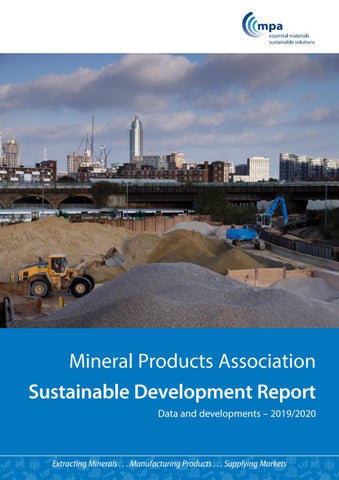
Mineral Products Association Sustainable Development Report Data and developments – 2019/2020
Extracting Minerals . . . Manufacturing Products . . . Supplying Markets
2 - MPA SUSTAINABLE DEVELOPMENT REPORT 2020
HIGHLIGHTS Following the launch of the MPA Charter in 2017, the Sustainable Development Report is structured to align with the 7 MPA strategic priorities to enable the Vision for 2025 to be achieved whereby mineral products are 'valued as an essential and economically , socially and environmentally sustainable industry of significance to the economy and our way of life'. The Report is based on data from 2019 where available but also includes any developments in 2020 for completeness. l MPA launches Vision Zero
l CO2 emissions per tonne of cement reduced by 24% from 1998
l MPA collaborates with TfL on the London Direct Vision Standard and permitting scheme Health & Safety
People
l MPA publishes respected and recognised Covid 19 Guidance
Climate Change & Energy
l The Good Neighbour Scheme pilot is launched
l 8,300ha of priority habitat created with a further 11,000ha planned
l 30,978 visitors to Member sites
l MPA members plant over 10km of new hedgerows
l 159 community liaison activities took place across Member sites
Natural Environment
l MPA responds to the global sand debate l Over a 10-year period, crushed rock and sand & gravel reserves are being replenished at 75% and 63% respectively
l MPA launches new Biodiversity Strategy l 99% of surveyed quarries operate under BS EN ISO 9001
l Recycled and secondary aggregates accounted for 28% of total aggregates supply
Resource Use
l MPA launches the UK Concrete and Cement Roadmap to Beyond Net Zero
Built Environment
l Over 90% of surveyed production certified to ‘very good’ or ‘excellent’ under BES6001
l The industry contributes £16bn in turnover to UK economy l Productivity rates are 1.2 times the national average Communicating Industry Value
INTRODUCTION The Mineral Products Association (MPA) is the trade association for the aggregates, asphalt, cement, concrete, dimension stone, lime, mortar, silica sand and other industrial mineral industries. With the affiliation of British Precast, the British Association of Reinforcement (BAR), Eurobitume, MPA Northern Ireland, MPA Scotland and the British Calcium Carbonate Federation, it has a growing membership of 520 companies and is the sectoral voice for mineral products. MPA membership is made up of the vast majority of independent SME companies throughout the UK, as well as the 9 major international and global companies. It covers 100% of cement and lime production, 90% of aggregates production, 95% of asphalt and over 70% of ready-mixed and precast concrete production. The UK economy is estimated to have contracted by 10% in 2020 as a result of the Covid-19 pandemic and resulting lockdown measures. Construction activity and the resulting demand for mineral products were significantly impacted by widespread site closures in April and May 2020, particularly in housing and commercial constructions. By contrast, activity was reported to have continued to a limited extent on roads during the Spring lockdown, and on some large infrastructure projects. Construction activity and mineral products markets started to recover faster than the rest of the UK economy during summer 2020, operating
under new Covid-secure Health and Safety guidance and more resilient to renewed lockdown restrictions. Demand for mineral products improved during the second half of the year, albeit from a low base, resulting in annual sales volumes for all mineral products markets monitored declining in 2020 compared to 2019. Sales volumes for asphalt and aggregates fell by 8.6% and 10.5% respectively year on year, whilst ready-mixed concrete and mortar demand was the most impacted, with sales volumes down 18.2 and 23.3% respectively. Looking ahead, construction output is expected to continue to recover in 2021, which should support further growth in mineral products demand. Construction output is expected to rise by 14% in 2021 and 4.9% in 2022 assuming effective vaccines are being rolled out as planned and restrictions are gradually eased from spring 2021. Housebuilding recovered quickly in 2020, and new infrastructure work has been the least impacted. These two subsectors should drive construction growth over the next two years, with significant contributions from repair and maintenance work. Activity in new commercial buildings however is expected to see a much slower recovery due to uncertainty about long-term shifts in consumer spending habits affecting retail, and the potential implications of a longterm shift to working from home for offices.
Extracting Minerals . . . Manufacturing Products . . . Supplying Markets
MPA SUSTAINABLE DEVELOPMENT REPORT 2020 - 3
Health and Safety OBJECTIVE: EMPLOYEE AND CONTRACTOR HEALTH AND SAFETY Treat the health and safety and well-being of employees, contractors and visitors as the number one priority in order to achieve Zero Harm. In 2019, no fatalities were recorded amongst members’ employees and contractors. However, there was one fatality on a member site involving a third party. In 2020, MPA & British Precast’s first virtual Health & Safety Leadership Conference took place. The event launched MPA’s new ‘Vision Zero’, together with the associated values, strategies, targets and focussed on the leadership and behavioural change required to deliver them, drawing on the insights of leaders from within the industry and the workforce.
Building on the significant lessons from previous years, ‘Vision Zero’ – ‘Safe & Well Everyday’ is the foundation for MPA’s reinvigorated health & safety plan until 2025. Vision Zero is underpinned by a new set of shared values to help change behaviour: Empowerment; Engaged, visible and consistent leadership; Zero tolerance of unsafe working conditions; High quality implementation; Collaboration and sharing; Compliance. Central to the Vision is the elimination of the causes of the ‘The Fatal 6’- the high consequence hazards that are responsible for the majority of fatalities and serious incidents within the industry. The Fatal 6 are: l Contact with moving machinery and isolation l Workplace transport and pedestrian interface l Work at height
TARGET The MPA targets zero harm to all employees and contractors; Hard Target 1 - Zero Reportable Incidents (fatalities or serious injuries) relating to ‘The Fatal 6’ by 2025. Hard Target 2 - A 50% reduction in Lost Time Injury Frequency Rate (LTIFR) to 1.5 or less by 2025. Hard Target 3 - Zero incidences of uncontrolled personal exposures to RCS above the Workplace Exposure Limit (WEL). The LTIFR (that tracks the Lost Time Injuries/ million hours worked) decreased slightly from 3.44 in 2018 to 3.22 in 2019, but the target of reducing LTIFR by 65% between 2014 and 2019 was missed. Under Vision Zero, new targets have been set to demonstrate whether we are succeeding in making workplaces safer and healthier. OBJECTIVE: PUBLIC SAFETY To protect the general public around active operations, on disused sites and in the transportation and use of our products. MPA supported the ‘Stay Safe’ campaign nationally during the challenging lockdown, school closures and unusually hot weather, working closely with national water safety organisations and key stakeholders via the National Inland Water Forum and Wales Water Safety Partnership. A Members’ Briefing Note on managing public safety on temporarily closed sites was issued and MPA fully supported Drowning Prevention week in June by writing to MPs in quarrying regions outlining what the industry has been doing to protect members of the public. On Vulnerable Road User Safety (VRU), MPA responded to the Government’s consultation on the ‘Future of Mobility’ with a call for e-scooters to remain banned from shared roads, not legalised, and also warned of the potential dangers to cyclists from overtaking heavy vehicles, including concrete mixers and HGVs, on the left, as proposed in the updated version of ‘The Highway Code’. MPA also continued to be an active member of the Construction Logistics Community Safety (CLOCS) standard by promoting its' use across the mineral products industry.
l Workplace Respirable Crystalline Silica (RCS) l Struck by moving or falling object l Road traffic accidents During the first half of 2020 MPA’s Health and Safety Committee and Working Groups in collaboration with members and other key stakeholders, developed a comprehensive package of COVID-19 guidance and resources. This has supported members, the industry and other industries in the UK and internationally, adapt to COVID-19 secure working and enable businesses to benefit from their role as an ‘essential’ sector.
People
28,532
MPA Membership - direct employees in England and Wales
464,271 9,815
Employee training hours
Voluntary hours worked by staff during normal working hours
159 30,978
Sites undertaking community liaison activities Visitors to MPA sites
Extracting Minerals . . . Manufacturing Products . . . Supplying Markets
4 - MPA SUSTAINABLE DEVELOPMENT REPORT 2020
OBJECTIVE: LOCAL COMMUNITIES
OBJECTIVE: EQUALITY AND DIVERSITY
Engage fully with local communities and strive to be good neighbours.
Encourage opportunities in the industry for all, attracting and retaining the best talent.
In 2019 MPA launched a pilot of the MPA Good Neighbour Scheme providing Members with a Community Engagement Plan template, a suite of banners and signs to install in and around sites to demonstrate their support for the scheme, posters for internal use and a “How are We Doing?” Community Response checklist to assess how the local community perceives the site has performed in a particular year. Take up so far has been positive and further progress will be reported on next year.
In 2019, 28,532 people were directly employed by MPA Members in England and Wales, of which, 87% were male and 13% female. This represents a similar demographic to last year.
DEMOGRAPHICS OF WORKFORCE >50
50 300 <3 ale fem
>50
<30
30-5 0
le ma
Data provided across the 880 sites that reported indicated 129 complaints were recorded in 2019 at asphalt, ready mix concrete and aggregate sites. Out of the 880 sites, 10% received one or more complaints from a member of the public. 33% of complaints related to dust, 22% to noise and 19% to blasting and vibration. Chart 1 provides a further breakdown of site complaints according to site type.
Chart 2 showing the demographic of the mineral products industry workforce
BREAKDOWN OF COMPLAINTS Water discharge
Resource Use
Transport OBJECTIVE: WATER
Odour
Optimise the use of water and ensure prudent management. Noise TARGET
Lighting/ visual impact
100% of sites to be measured for water consumption and discharges by 2025.
Dust Blasting/ Vibration Other 0% Aggregates
20%
40% Asphalt
60%
80%
100%
Ready Mixed Concrete
MPA members strive to minimise water use wherever possible prioritising water from sustainable sources and reusing water in aggregate washing plants. Recent changes to regulations around quarry dewatering have meant that previously exempt water transfer and abstraction activities on sites must be licensed by the Regulator. The Regulator now has three years, from January 1st 2020, to determine licences for these historic water transfer and abstraction activities. Once sites are licensed MPA will review data collection on sustainable water use.
Chart 1 showing categorised recorded complaints for aggregates, asphalt and ready mixed concrete sites.
Extracting Minerals . . . Manufacturing Products . . . Supplying Markets
MPA SUSTAINABLE DEVELOPMENT REPORT 2020 - 5
OBJECTIVE: ACCESS TO SUFFICENT MINERALS AND RESOURCES Plan, consult and engage with communities, planning authorities and regulators when seeking new permissions to ensure steady and adequate supply. Due to Covid-19 no survey on the replenishment rates of aggregates reserves was undertaken for 2019. However, in 2018 84% of annual crushed rock sales and 92% of annual terrestrial sand and gravel sales were replaced by new planning permissions. The more meaningful 10-year average replenishment rates for crushed rock and sand reserves and gravel reserves were 75% and 63% respectively. During 2020 MPA supported MHCLG (Ministry of Housing, Communities and Local Government) and the British Geological Survey to undertake the Aggregate Mineral 2019 survey. MPA produced two briefings outlining potential reforms to the mineral planning system in England in response to Government’s White Paper ‘Planning for the Future’ published in August 2020. Evidence was submitted to the Housing, Communities and Local Government Select Committee in response to the planning reforms proposed, stressing the importance of a properly resourced Managed Aggregate Supply System to ensure a steady and adequate supply of essential minerals. Evidence that suggests that the domestic supply of aggregates is relatively resource efficient include: l Land area in England subject to all mineral extraction = 0.1%1 l UK marine area subject to marine aggregates extraction= 0.01% l Share of GB aggregates market supplied from recycled sources = 28% l MPA biodiversity surveys have identified 8,300 hectares of former quarries restored to priority habitats with a further 11,000 hectares of priority habitat planned Figure 1a, Land Use in England, 2018, MHCLG, Official Statistics Release, 16th July 2020
1
OBJECTIVE: WASTE Minimise waste and maximise re-use and recycling. On waste and production use, MPA members reported: l 18,102 tonnes of waste was sent to landfill l 346,751 tonnes of waste sent off site for recycling l Over 6 million m3 of waste was used beneficially in site restoration and engineering.
Britain in 2018” publication. The latest estimates show that recycled and secondary aggregates accounted for 28% of total aggregates supply, which maintains Great Britain in a leading position internationally, well ahead of the European average.
Climate Change and Energy OBJECTIVE: ENERGY Optimise the use of energy whilst maximising the use of nonfossil fuels. CO2 emissions per tonne of hard rock and sand & gravel production saw further reductions in 2019. This was mainly due to adjustments in the Defra energy factors used to calculate CO2 emissions as the decarbonisation of electricity supply continues. UK Concrete was launched during 2019 and in 2020 the ‘UK Concrete and Cement Industry Roadmap to Beyond Net Zero’ was published which was commended by Chris Stark, Chief Executive of the Committee on Climate Change and Government Advisor. The roadmap sets a credible and technically achievable pathway to net zero that is contingent on both Government and industry action. It highlights the progress made so far with the sector having already delivered a 53% reduction in absolute carbon dioxide emissions since 1990. The cement sector continues to invest in emissions reductions through fuel switching to waste, waste biomass and waste partbiomass fuels. In 2019, waste derived fuels made up 45%, with waste biomass fuels comprising 18% of the thermal input to the cement manufacturing process. Alternative fuels also made up 34% of the thermal input for dolomitic lime manufacturing in 2019. MPA Cement and BLA initiated fuel switching innovation projects, via BEIS funding, with a value of £6.2 million which will demonstrate fuel switching cement and lime kilns to low and zero carbon fuels. Due to the pandemic, both projects have been extended beyond the original March 2021 deadline and site trials are expected later in 2021. As expected, CO2 emissions from dolomitic, high calcium and standard purity high calcium lime remain broadly similar to previous years as there are limited options to decarbonise the sector further without the widespread availability of technologies such as low carbon fuels or carbon capture.
Aggregates can be obtained from the recycling of Construction, Demolition and Excavation Wastes (CDEW), or derived from other industrial, production or extractive processes, referred to as secondary aggregates. Secondary aggregates can include furnace ash and slag from iron and steel production. In 2020, MPA updated “The contribution of Recycled and Secondary Materials to Total Aggregates Supply in Great
Extracting Minerals . . . Manufacturing Products . . . Supplying Markets
6 - MPA SUSTAINABLE DEVELOPMENT REPORT 2020
OBJECTIVE: TRANSPORT Reduce the climate change and other impacts of the transportation and delivery of products.
contribution to natural capital and net gain. The 2019 Quarries & Nature event on the theme of delivering net gain, including the Restoration and Biodiversity Awards and Nature Photo Competition, attracted 160 delegates from over 70 organisations. OBJECTIVE: ENVIRONMENTAL PROTECTION
TARGET To understand and obtain a baseline for the amount of CO2 produced per tonne of product during transportation by 2020. Product type
Distance by road one way in miles
Average load tonnes by road
Aggregates Ready-mixed concrete Asphalt
23 10
20 6
Share of sales transported by road percent 87 100
29
16
100
Table 1 showing road transport information for individual product groups. In 2019 MPA and the Rail Freight Group published “Cutting Carbon and Congestion: Rail Freight and Mineral Products working together to build Britain.” Over a five year period (2013-2018) the rail freight of mineral products has increased by 21% and is now the largest user of the rail freight network in terms of tonnes carried. This ensures that construction demands are met while carbon emissions and road congestion are reduced.
Natural Environment OBJECTIVE: BIODIVERSITY Protect and enhance biodiversity and deliver net gain wherever possible. TARGET 100% of extractive sites to have Biodiversity Action Plan in place by 2025. 79% of extractive sites reported that they had a Biodiversity Action Plan in place, a slight increase from 2018. MPA have developed a guide for members on how to prepare and implement a Biodiversity Action Plan at an operational site to encourage further uptake. The restoration of mineral workings is essential, and Members strive to deliver, priority habitats for nature conservation, where possible. To date MPA Members have recorded the creation of at least 8,300ha of priority habitat and have at least a further 11,000ha planned. This data understates the industry’s full contribution to biodiversity as the survey information is incomplete. MPA is also engaged in initiatives to value the contribution of biodiversity, for example through assessments of industry’s
Minimise and mitigate operational impacts. TARGET 100% of sites to have an Environmental Management System in place by 2025. The number of reported sites with an Environmental Management System remained constant, with 99% reporting in 2019 that they had one in place.
Built Environment OBJECTIVE: SUSTAINABLE PRODUCTS Promote the development and use of sustainable and responsibly sourced mineral products. 99% of quarries that reported against the objective confirmed that they operated under the British Standard EN ISO 9001 Quality Management System. Other Member sites reported similar results with 97% of ready mixed concrete, 99% of asphalt, 95% of wharves and 100% of slag processing sites also covered by the Standard. Members also reported that for aggregates and asphalt 100% of reported production was certified to ‘very good’ or ‘excellent’ level under the Responsible Sourcing Standard BES6001. Similarly for ready mixed concrete Members reported that 85% of reported production was certified to ‘very good or ‘excellent’.
Communicating Industry Value The Mineral Products industry supplies the raw and manufactured materials for building our homes, as well as vital new and upgraded infrastructure to support future economic growth and our quality of life. With around 400 million tonnes of aggregates, asphalt, cement, concrete and other mineral products supplied in Great Britain in 2018, the industry produces over 4 times the total volume of all energy minerals combined. It also contributed £16bn in turnover to the UK economy in 2018, employed 81,000 people at over 2,000 active sites and plants, and supported an additional 3.5 million jobs throughout the supply chain. The UK Mineral Products industry is a highly productive industry: each worker produced about £71,000 in 2018, equivalent to 1.2 times the national average.
Extracting Minerals . . . Manufacturing Products . . . Supplying Markets
MPA SUSTAINABLE DEVELOPMENT REPORT 2020 - 7
Units
2016
2017
2018
2019
Aggregates production (primary) GB
GB mt
176.8
176.3
179.9
175.8
Recycled/ secondary materials GB
GB mt
69
71.9
70.7
71
Asphalt sales GB
GB mt
22.7
22.7
22.9
22.7
Ready-mixed concrete sales GB
GB mm
17.8
17.4
17.1
16.4
Cement - domestic sales GB (2015 - UK onwards)
GB mt
10.5
10.2
10.1
9.9
Cementitious materials GB (2015 - UK onwards)
GB mt
15
15
15.2
15.2
High calcium and dolomitic lime
GB mt
1
1.1
1.2
1.2
Per capita production primary aggregates (GB/EU)
(GB/EU) tonnes
2.6/4.6
2.6/4.6
2.8/4.8
Lost Time Incident Frequency Rate (LTIs per million employees - all MPA activities)
3.5
3.6
3.4
3.22
Employment - direct by MPA members (excl cement, precast)
24,563
25,442
26,085
26,311
Employment- direct by MPA Members (cement)
3,015
2,210
2,250
2,203
Number of recorded complaints (aggregates)
253
258
193
129
Number of community liaison groups (aggregates)
253
297
188
86
Liaison group meetings (cement)
30
25
25
27
Recorded visitors to aggregates sites, cement kiln sites
22,130
36,257
26,447
30,978
3
Area of seabed dredged
km2
88
90.9
97.9
105.1
Marine dredged aggregates landings for construction use
mt
14.1
14.3
13.7
13.4
Waste and by products recovered as raw materials and fuels by cement industry
mt
1.5
1.4
CO2 emissions directly from cement production
kg/tonne
695.6
692.7
697.1
702.4
CO2 emissions directly from lime production
kg/tonne
995.4
1,000.7
993.9
1,017.7
CO2 emissions from crushed rock production
kg/tonne
3.7
3.6
2.8
3.3
CO2 emissions from sand and gravel- land won prod
kg/tonne
3.4
3.1
2.7
2.3
CO2 emissions from asphalt production
kg/tonne
27
24.1
25.2
22
CO2 emissions from ready-mixed concrete prod
kg/tonne
0.6
0.7
0.7
0.6
Share of sales moved by rail (aggregates)
%
10.1
10.9
11
11
Average road delivery distance (aggregates)
miles
30.1
26.7
28
23
Average road load (aggregates)
tonnes
22.6
20.3
21
20
Priority Habitats created to date by MPA members
Ha
6,000
8,192
8,327
8,300
Priority Habitats planned by MPA members
Ha
8,700
11,458
10,770
11,000
Archaeology - land investigated pre-planning permission
Ha
245
453.1
256
64.7
Archaeology - land investigated post-planning permission
Ha
93.6
379.6
171
102
133,698
111,370
503,488
58,839
Trees planted
2
Hedgerows planted
km
11.1
13.2
7.6
10.5
Dry Stone Walling - Kilometres built
km
9.8
5.4
1
2
Aggregate sites with certified EMS
% of survey
92
97
97
99
Cement and lime sites with certified EMS
%
100
100
100
100
Data prior to 2019 included aggregates, asphalt and ready mixed concrete sites.
Extracting Minerals . . . Manufacturing Products . . . Supplying Markets
The mineral products and quarrying industry contribution to the UK:
400mt
4 times
GB production of aggregates and manufactured mineral products (GB)
£597bn
Annual turnover of the industries we supply (UK)
The volume of energy minerals produced in the UK including oil, gas and coal
£172bn
Value of construction, output, our main customer (UK)
© Mineral Products Association 2021 This report contains data collected from year 2019 which is collated by MPA in 2020 for publication end of 2020/ early 2021. The Mineral Products Association is the trade association for the aggregates, asphalt, cement, concrete, dimension stone, lime, mortar and silica sand industries.
£16bn
Annual turnover for the minerals and mineral products industry (UK)
81,000
People employed in the industry (UK)
£5.8bn
Gross value added generated by the industry (UK)
3.5m
Jobs supported through our supply chain (UK)
Mineral Products Association Gillingham House 38 - 44 Gillingham Street London SW1V 1HU Tel +44 (0)20 7963 8000 Fax +44 (0)20 7963 8001 info@mineralproducts.org www.mineralproducts.org
Mineral Products: essential for schools . . . hospitals . . . homes . . . roads . . . railways . . . energy supply . . . airports . . . ports . . . food . . . water . . . agriculture