EDITION 3 • 2026
All things food supply chain.
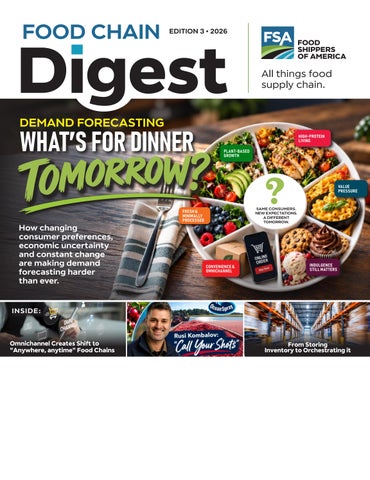
DEMAND FORECASTING
WHAT'S FOR DINNER
HIGH-PROTEIN LIVING PLANT-BASED GROWTH FOOD SHIPPERS OF AMERICA OPTION 1
?
SAME CONSUMERS. NEW EXPECTATIONS. A DIFFERENT TOMORROW.
FRESH & MINIMALLY PROCESSED
How changing consumer preferences, economic uncertainty and constant change are making demand forecasting harder than ever.
VALUE PRESSURE
CONVENIENCE & OMNICHANNEL
INDULGENCE STILL MATTERS
INSIDE: Omnichannel Creates Shift to “Anywhere, Anytime” Omnichannel Creates Shift to Food Chains "Anywhere, anytime" Food Chains
From Storing Inventory to Orchestrating It
Rusi Kombalov: “Call Your Shots”
Building Resilient Supply Chains Through From Storing Collaboration Inventory to Orchestrating it
DRIVEN BY
VALUES
DO THE RIGHT THING • STRIVE FOR PERFECTION • HOME SAFE
www.stokestrucking.com • 435-799-8538 Mark Lawver • mark@stokestrucking.com • 435-799-8540
The food chain shouldn’t wait at the gate. At food and beverage plants, warehouses, and distribution centers, every facility gate must balance speed, security, and control. Outpost Gate Automation™ uses computer vision and AI voice agents to verify trucks, trailers, and drivers, then applies your SOPs to automate check-ins and access decisions. Increase facility throughput and reduce gate costs by up to 70%.
Meet us at FSA 2027 or learn more: outpost.us/gates www.foodshippers.org |
1
LET’S GET MOVING
www.verstlogistics.com | 800-978-9307
Edition 3 2026
FOOD CHAIN Digest EDITION 3 • 2026
All things food supply chain.
Published three times a year for: Food Shippers of America 1144 East State Street, Suite -288A Geneva, IL 60134 847-302-1496 executivedirector@foodshippers.org www.foodshippers.org
IN THIS ISSUE
Published by: MindShare Strategies, Inc. Ponte Vedra Beach, FL 32004 USA 952-442-8850 www.MindShare.bz
COVER STORY 4
FOOD SHIPPERS OF AMERICA OPTION 1
Demand Forecasting: What’s for Dinner Tomorrow?
FEATURES
Billing Address: MindShare Strategies, Inc. P.O. Box 843 Springfield, TN 37172 USA Group Editorial Director and Publisher: Brian Everett, ABC 952-442-8850 x201 brian@mindshare.bz Editorial Content This Edition: Courtney Bloom, Faith Boone, Brian Everett Advertising Sales: Cassidy Mullins 952-442-8850 ext. 215 cassidy@mindshare.bz
10
Omnichannel Creates Shift to “Anywhere, Anytime” Food Chains
15
Rusi Kombalov’s Advice for Supply Chain Success
18
From Storing Inventory to Orchestrating it
21
Building Resilient Supply Chains Through Collaboration
MARKET RESOURCES 25
Warehousing & Distribution Buyer’s Guide
28
Advertiser List
Alec Stifter 952-442-8850 x218 alec@mindshare.bz Design/Production Manager: Todd Pernsteiner 952-841-1111 todd@pernsteiner.com Accounting/Administration/Circulation: Melanie Haley 423-356-4154 accounting@mindshare.bz Marketing/Communications: Brynn Aiello 952-442-8850 x220 brynn@mindshare.bz ©2026 MindShare Strategies, Inc. All rights reserved. Contents may not be reproduced by any means, in whole or in part, without the prior written permission of the publisher. The opinions expressed in this publication are not necessarily those of MindShare Strategies, Inc., nor Food Shippers of America. Printed in USA.
Food Shippers of America Leadership Team Chairman David Domencic ARMADA
Executive Director Eric Missil Food Shippers of America
President Darica Schneider Univar Solutions
Board Members
Vice President Lori Lammers Dawn Foods
Eddie Jimenez Molson Coors
Secretary Clyde Coleman Performance Foods Group Treasurer Earnie Seibert Food Shippers of America
Clyde Coleman Performance Foods Group
Rusi Kombalov Ocean Spray Jon Pruitt Nutrabolt
2026 Conference Co-Chairs Jon Pruitt, Nutrabolt Stace Knabel, Promise Delivered Golf Committee Chair: Justin Allen Cheema Freightlines Patrick McDuffee PECO Pallet Volunteer Committee Co-Chairs Crystal Cheney, H&M Bay John Gaudet, RLS Logistics Lee Neal, Plains Dedicated
Motor Carrier Advisor Andrew Hummer Don Hummer Trucking Corp. Railroad Advisor Rusty Looney BNSF Railway 3PL Advisor Darlene Wolf Arrive Logistics Media Advisor Mary Kearney Kottke Trucking, Inc. Media Committee Stace Knabel Promise Delivered
www.foodshippers.org |
3
COVER STORY
DEMAND FORECASTING
How changing consumer preferences, economic uncertainty and constant change are making demand forecasting harder than ever.
WHAT'S FOR DINNER
HIGH-PROTEIN LIVING PLANT-BASED GROWTH
?
SAME CONSUMERS. NEW EXPECTATIONS. A DIFFERENT TOMORROW.
FRESH & MINIMALLY PROCESSED
CONVENIENCE & OMNICHANNEL
4 | FOOD CHAIN DIGEST • EDITION 3 • 2026
VALUE PRESSURE
INDULGENCE STILL MATTERS
COVER STORY When it comes to demand forecasting, the food industry historically has relied heavily on a straightforward premise: What consumers bought yesterday provides a reasonably good indication of what they will buy tomorrow. That assumption is becoming increasingly risky. Today’s food manufacturers, retailers and distributors—along with their supply chain partners— are operating in an environment where consumer preferences can change quickly, economic pressures can alter shopping behavior, and a viral social media trend can suddenly send demand for a product soaring. At the same time, retailers expect suppliers to maintain high service levels and respond quickly to shifts in demand. The result is a difficult balancing act. Produce too much and companies risk excess inventory, markdowns and food waste. Produce too little and they face stockouts, lost sales and disappointed customers.
Consumer Preferences & Behaviors Are Reshaping the Industry One complication is that consumers are becoming more difficult to define through broad national averages. Preferences can differ significantly by generation, income level, geography and lifestyle. Protein provides a striking example. Conagra Brands' 2026 Future of Frozen Food report identifies protein-packed foods as one of the major forces reshaping the $93.5 billion U.S. frozen-food category. According to Conagra, high-protein frozen foods generate approximately $12 billion annually and are experiencing double-digit volume growth. "Frozen food is no longer just about convenience, it's about meeting consumers wherever and however they're eating," says Bob Bob Nolan Nolan, Senior Vice President of Demand Science at Conagra Brands. "As households grow more complex and budgets stay top of mind, frozen food delivers on quality, nutrition and affordability in a big way."
Nolan says these trends are reshaping the U.S. frozen food industry: High-protein, frozen are surging in popularity. Frozen foods high in protein now generate $12 billion annually, with double-digit volume growth. From meat- and plantbased meals to protein-forward snacks and desserts, consumers increasingly are turning to the freezer for convenient ways to add more protein to their diets. Consumers are bringing restaurantstyle experiences home. “Takeoutstyle” frozen foods now generate $14.3 billion annually, fueled by popular chicken dishes, global flavors and shareable snacks. Younger consumers and families are driving the trend, choosing frozen for restaurant-inspired taste at a more affordable price. More meals at home are fueling a return to family-style dining. Multiserve frozen meals, pizzas and sides generate roughly $12 billion in sales, while value-size products now represent more than 40% of frozen aisle sales as families seek affordable, convenient ways to share meals together. Breakfast is becoming an all-day occasion. High-protein handhelds, bowls and breakfast meats are gaining momentum as Gen Z and Millennials seek convenient, nutritious options they can enjoy as meals or snacks.
“FORECASTING IS MUCH MORE THAN NUMBERS. THE QUALITY OF OUR FORECASTS DIRECTLY INFLUENCES PRODUCT AVAILABILITY, WORKING CAPITAL, AND OVERALL BUSINESS PERFORMANCE. OVER-FORECASTING CAN LEAD TO EXCESS INVENTORY AND INEFFICIENCIES, WHILE UNDERFORECASTING CAN RESULT IN MISSED SALES OPPORTUNITIES AND DISAPPOINTED CONSUMERS.” —MARIAM JABAURI, DEMAND PLANNING SUPERVISOR, MONDELĒZ INTERNATIONAL www.foodshippers.org |
5
COVER STORY
Trends Reshaping Demand Forecasting AI-Powered Forecasting: Food companies are using AI and machine learning to analyze larger datasets and identify demand shifts faster than traditional forecasting models. Real-Time Demand Signals: Companies increasingly incorporate current sales, inventory, weather, promotions and other near-real-time data rather than relying primarily on historical sales. Shorter Forecasting Cycles: Rapidly changing consumer behavior is pushing companies toward more frequent forecasts and continuous demand planning. SKU Store Region Label Customer
Greater Forecast Granularity: Forecasts are becoming more specific by SKU, store, region, channel and customer segment to better reflect localized demand. Consumer Trend Tracking: Social media, search activity and consumer research are being used to anticipate emerging preferences such as high-protein, functional and minimally processed foods. Promotion-Aware Forecasting: More sophisticated models account for promotions, pricing changes and retailer activity that can dramatically alter short-term demand. Omnichannel Forecasting: Companies are developing forecasts that distinguish among in-store, pickup, delivery and direct-to-consumer demand. External Data Integration: Weather, economic conditions, commodity prices, holidays and local events are increasingly incorporated into demand models.
Best Case Base Case Worst Case
Scenario Planning: Rather than relying on a single forecast, companies are modeling multiple demand scenarios to prepare for economic and supply-chain uncertainty. Waste Reduction: Better forecasting is increasingly tied to reducing spoilage and excess inventory, particularly for fresh and perishable foods. Collaborative Forecasting: Food manufacturers, retailers and supply-chain partners are sharing more data to improve visibility and align production, inventory and replenishment.
6 | FOOD CHAIN DIGEST • EDITION 3 • 2026
Real Case Studies That Highlight Shifting Forecasting Trends Hershey is blending statistical forecasts with current commercial signals. Its current demandplanning model combines statistical forecasting with input from Marketing, Sales and Finance. It incorporates promotions, newproduct launches, seasonality and market trends into demand plans. Hershey also says its broader "decision intelligence" capabilities connect information across its supply chain to optimize inventory, reduce waste and improve service. It estimates these capabilities could reduce inventory by $100 million over two years. Kraft Heinz is moving from reactive to predictive. Kraft Heinz describes its approach as creating an AI-enabled supply-chain "control tower." Its Kraft Heinz Lighthouse analyzes information across the supply chain to predict challenges and opportunities rather than waiting for disruptions to appear. The company also is using digital twins to run scenarios continued on page 8
“WE'RE DOING INTEGRATED BUSINESS PLANNING SO WE CAN FORECAST DEMAND AUTOMATICALLY AND THAT GOES ALL THE WAY TO PROCUREMENT AND THAT FACILITATES THE WAY OUR OPERATIONS WORK.” —RAMON LAGUARTA, CHAIRMAN & CEO, PEPSICO
So Tomorrow Arrives on Time From ship to shore to store, Matson Logistics serves food and beverage manufacturers, distributors, and retailers with: Transportation
Oakland and Savannah Logistics Campuses
Port Drayage • FCL and LCL Highway • Intermodal Rail •
Big • 1.6 million sq. ft. of both Contract and
Public Warehouse Operations • Round-the-Clock Operations, including Receiving and Dispatch
Distribution Inventory Management • Transload • Crossdock • Pick and Pack •
Value-Added Services
Safe • Gated and Monitored Trailer Yard;
24/7 Guard Service • ESFR Sprinkler System San Francisco Bay Area • 100% RF Wireless Coverage
N
Tier 1 WMS • Club Store and Custom Packs/ Petaluma Pallet Displays • Tray Cuts, Gift Boxes, and Packaging • Kitting and Bundling • Barcode Labels and Price Tickets • End Cap and Power Alley Promotions • DtC and E-Commerce Fulfillment •
Sacramento
Certified
• Santa FDARosa Registered and Food-grade Compliant • NSF Supplier Certified and Organic Farm
Napa Certified Fairfield • California ABC Type 14 License for beer, wine, and spirits • Class 3 Bonded Services • Exclusive Foreign Trade Zone operators I-5 N 80
21
80
Port of Oakland 101 280
25
24 580
Oakland Int’l Airport (OAK)
Intermodal & Highway Daniel Paulsen 630 203 3544 Santa Clara
880
680
Matson Logistics 580
Matson Logistics
I-5 S
95
San Jose
(SAV)
80 16
Warehousing & Distribution Bennett Kardane 912 330 7680
www.matsonlogistics.com
Savannah/ Port of Stockton Hilton Head Savannah Int’l Airport 516
Lathrop
International Supply Chain Michael Johnson 908 334 2849
17
COVER STORY and determine better operating conditions. This builds on Kraft Heinz's stated strategy of moving toward a predictive and rapidresponse model, using real-time predictive analytics to anticipate consumer and channel demand and improve inventory transparency.
From Forecasting to Demand Sensing The emerging lesson for food shippers is that the objective is no longer simply to create a more accurate annual or monthly forecast. It's to shorten the distance between detecting a change in consumer behavior and responding to it. Historical sales will remain an important input. But increasingly they will be supplemented by search activity, social-media trends, pricing and promotional data, localized purchasing patterns, inventory positions and other real-time signals. For food manufacturers and retailers, this creates an opportunity to move from traditional forecasting toward something closer to continuous demand sensing. This ultimately recognizes changes earlier and adjusting production, inventory and transportation accordingly. In a market where yesterday is becoming a less reliable predictor of tomorrow, the competitive advantage may ultimately belong not to the company with the perfect forecast, but to the one that can recognize when its forecast is wrong—and respond the fastest.
PepsiCo contends that inflation and economic uncertainty can change what shoppers buy, where they shop, which brands they choose, and how they respond to promotions. In discussing its business environment, the global beverage and convenient foods company says inflationary pressures and broader uncertainty have made consumers more "choiceful and value conscious." Its response includes accelerating innovation, expanding options that address consumers' nutrition and dietary preferences, and enhancing digital capabilities in consumer insights, trade promotion management, demand forecasting and supply planning. That interconnected approach is increasingly important. A forecast can't simply predict how many cases of a particular SKU will sell. It may need to anticipate what happens when the price changes, a competitor launches a promotion,
“ALREADY WE ARE BUILDING THROUGH THE POWER OF DIGITAL TWINS AND AGENTIC, THE ABILITY FOR THAT INDIVIDUAL TO INTERACT DIRECTLY WITH AN AGENT IN A VERY REAL-TIME WAY TO GET RECOMMENDATIONS, TO GO DOWN TO ROOT CAUSES, TO DO PREDICTIVE MAINTENANCE, TO HAVE INVENTORY FORECASTING AND VISIBILITY. SO THE REALITY IS IT UNLOCKS NOT JUST EFFICIENCY AND EFFECTIVENESS, BUT IT UNLOCKS THE OPPORTUNITY TO BE MUCH MORE FORWARD-LOOKING AND HAVE THE FORESIGHT TO DRIVE THE BUSINESS IN A VERY DIFFERENT WAY.” —DR. ATHINA KANIOURA, GLOBAL CHIEF STRATEGY & TRANSFORMATION OFFICER, PEPSICO 8 | FOOD CHAIN DIGEST • EDITION 3 • 2026
COVER STORY consumers migrate to a different package size or a dietary trend suddenly accelerates. Walmart uses artificial intelligence to predict demand and optimize inventory, while machine-learning technology enables it to forecast demand at granular geographic levels and position inventory accordingly. The major retailer also has developed an AI-powered platform called Wally that brings together sales, inventory and demand signals for merchandising teams. The system can identify trends and potential inventory shortages and help merchants coordinate with suppliers to improve product availability. Walmart is going further by connecting forecasting with execution. Walmart says its "selfhealing inventory" technology can detect inventory imbalances and redirect products to locations where they're needed before
shortages become apparent in stores. Conagra Brands no longer relies solely on its own sales history to identify such shifts. Conagra says its Demand Science team combines information from Circana, NielsenIQ's Label Insight technology, Tastewise social-media trends and Similarweb search data to identify emerging consumer behaviors. This is an important evolution in forecasting. Instead of asking only, "What did customers buy?" companies increasingly need to understand what consumers are searching for, talking about and intending to buy next. Conagra demonstrated how quickly these insights can translate into products last year, when its
Banquet brand introduced MEGA Crispy Chicken Tenders with 16 grams of protein per serving. In announcing the product, Conagra cited research indicating that 48% of consumers are actively seeking more protein, while half of Gen Z adults want to add more protein to their diets.
www.foodshippers.org |
9
CREATES SHIFT TO "ANYWHERE, ANYTIME" FOOD CHAINS For decades, the basic food distribution model was relatively straightforward: manufacturers produced products by the case or pallet, logistics providers moved them through distribution centers, and retailers ultimately put them into the hands of consumers. That linear model is rapidly giving way to something much more complicated. In fact, today’s omnichannel fulfillment practices are changing where inventory sits, how orders are filled, and what food companies expect from their logistics partners. A consumer might buy groceries during a traditional supermarket
10 | FOOD CHAIN DIGEST • EDITION 3 • 2026
visit, place an online order for curbside pickup, request same-day home delivery, order through a third-party platform or purchase a product directly from a food brand. Increasingly, consumers move among several of those channels rather than committing to just one. McKinsey’s recent State of Grocery North America Report suggests this behavior is becoming increasingly entrenched. Its survey of nearly 5,000 grocery shoppers conducted in March 2026 found that omnichannel customers (those shopping both online and in stores) allocated 31% of their grocery spending to a given retailer,
compared with 26% among customers who shopped that retailer only in stores. This underscores why e-commerce is not merely a channel but a critical component of a broader omnichannel growth strategy in which grocers serve multiple shopping missions and capture a greater portion of total spend. Grocers are also starting to experiment with social and content-driven commerce models connecting discovery directly to basket building. For example, Walmart’s recent partnership with Pinterest allows consumers to add ingredients from
FEATURE
recipe content directly into online grocery carts for pickup or delivery. In another example, Kroger Precision Marketing reported in April that 90% of shoppers are shopping online as much as—or more than—they did a year ago, even though 74% of shopping trips still take place in stores. These illustrate an important reality: digital isn't replacing physical grocery. The two are becoming intertwined. For food manufacturers, retailers and their logistics partners, this means the challenge isn't simply e-commerce fulfillment. It's omnichannel fulfillment—positioning inventory so the same supply chain can efficiently serve stores, distribution centers, pickup orders, home delivery and, in some cases, direct-to-consumer purchases. This is forcing companies to rethink nearly every part of the food supply chain.
Transitioning From Pallets to Individual Orders
company-owned and third-party e-commerce sites and mobile applications.
Food manufacturers traditionally have been effective at producing and shipping large quantities. But moving a truckload of cases to a retailer's DC is fundamentally different than fulfilling an order containing two bags of chips, a jar of sauce and a box of cereal destined for someone's front doorstep. PepsiCo illustrates just how many distribution models can coexist within one organization. The global food and beverage company uses direct-store delivery for products requiring frequent replenishment and merchandising, customerwarehouse delivery for other products, third-party distributor networks and e-commerce channels. PepsiCo says its products also are sold directly to consumers through a growing number of
“We've strategically reshaped nearly a third of our portfolio, built advantaged digital capabilities, and delivered industry-leading Jeff Harmening cost efficiency,” says Jeff Harmening, Chairman & CEO of General Mills. With its Accelerate strategy as the guide, the global food company is making bold choices to deliver remarkable experiences for consumers across its total product offering, including product, packaging, brand communication, and omnichannel execution. Direct-to-consumer isn't likely to replace traditional grocery distribution for major food
Grocers are moving toward hybrid fulfillment models, with most expecting third-party fulfillment to increase. Current e-commerce order fulfillment mix,1 % share of fulfillment by model Store-based fulfillment
57
Third-party fulfillment
Centralized or dark-store fulfillment
Net share of grocers expecting increases in fulfillment models, 2%
26
17
50
71
54
Question: Approximately what share of your e-commerce orders are fulfilled through the following models today? Question: How do you expect the share of e-commerce orders fulfilled through the following models to change over the next 2-3 years? Source: McKinsey Grocer Survey, Apr 2026, n=43
1
2
www.foodshippers.org |
11
FEATURE companies. However, it can serve another purpose: provide a direct connection with consumers, generating data, and allowing companies to experiment with products, bundles and buying experiences. The logistics implication is significant. A network designed around pallets, cases and predictable replenishment suddenly may need to accommodate each—picking, parcel shipments, customized packaging and much shorter delivery windows.
Inventory Has to Be in the Right Place Omnichannel also changes one of the oldest questions in supply chain management: Where should inventory exist? Holding too much product in too many locations ties up capital and increases the risk of spoilage and obsolescence. Centralizing inventory can lower carrying costs but make fast fulfillment more difficult. Food companies have the added complications of shelf life, temperature-sensitivity, lot tracking, and food safety. This is where advanced analytics and AI are becoming increasingly valuable. Instead of relying primarily on historical sales and static forecasts, companies can combine point-of-sale information, digital browsing behavior, promotions, weather, local demand patterns and other signals to determine not only what consumers may buy, but where and when they'll want it. The ultimate goal is moving from reactive fulfillment toward predictive positioning.
For logistics providers, this creates an opportunity to become more than “logistics vendors.” Providers with visibility across transportation, inventory and distribution networks can help customers determine where inventory should reside, when it should move, and which fulfillment point should serve each order.
The Store Becomes Part of the Distribution Network Perhaps no company demonstrates this transformation better than Walmart, which describes itself as a “people-led, tech-powered omnichannel retailer.” Walmart reports that substantially all of its U.S. stores now provide same-day pickup and delivery. Its omnichannel strategy integrates stores with e-commerce and includes expedited delivery, in-home delivery and digital pharmacy fulfillment. This is an important distinction in general context. A retail store is no longer simply the final destination for inventory. It can simultaneously function as a shopping destination, pickup location and localized fulfillment node. Walmart also continues to connect supplier information more closely with store execution. In February 2026, it introduced Scintilla In-Store, which gives supplier representatives access to real-time data, actionable metrics and tasks intended in part to reduce out-ofstocks and improve omnichannel execution. This type of visibility can become increasingly important because an inventory discrepancy isn't merely an inconvenience
anymore. If a system tells an online shopper that an item is available but it isn't actually on the shelf—or available to the associate picking an online order—the problem affects both store operations and the digital customer experience.
Not Every Fulfillment Model Works Everywhere The race toward automation also is revealing another important lesson: There is no single omnichannel model that works for every market. For example, Kroger offers pickup at 2,408 supermarkets and delivery through a combination of stores, customer fulfillment centers and third-party platforms. The large retailer describes e-commerce as an important growth driver and expects digital grocery sales to grow faster than the overall foodat-home market over time.
OMNICHANNEL FULFILLMENT IS THE COORDINATED MANAGEMENT OF INVENTORY AND ORDERS ACROSS STORES, E-COMMERCE, PICKUP, DELIVERY AND DIRECT-TO-CONSUMER CHANNELS TO GIVE CUSTOMERS A SEAMLESS BUYING EXPERIENCE WHILE KEEPING THE SUPPLY CHAIN EFFICIENT. 12 | FOOD CHAIN DIGEST • EDITION 3 • 2026
FEATURE
“THE FUTURE OF RETAIL IS ABOUT MEETING CUSTOMERS WHEREVER THEY ARE AND SIMPLIFYING THEIR LIVES.” —GREG CATHEY, SVP, ECOMMERCE FULFILLMENT TRANSFORMATION, WALMART
Kroger also has adjusted its fulfillment strategy. Following a review of its automated fulfillment network, the company decided to close facilities in Pleasant Prairie, WI; Frederick, MD; and Groveland, FL, and canceled a planned Charlotte, NC, location. Kroger said it would continue using its store footprint, third-party delivery providers and automated fulfillment facilities where they make operational and economic sense.
doesn't eliminate the underlying economics of fulfillment. Order density, delivery distance, labor expense, inventory velocity and customer adoption still matter. Therefore, the best network may be a hybrid—automated fulfillment in some markets, store-based fulfillment in others, and third-party logistics partners filling the gaps.
short shelf lives. Frozen products require uninterrupted cold chains. Traceability requirements can follow products through multiple nodes.
Food Adds Another Layer of Complexity
Kroger provides an instructive example for the broader food industry. Automation can dramatically increase productivity, but sophisticated technology
Of course, selling groceries online isn't the same as selling books or electronics. Temperaturecontrolled products have limited delivery windows. Fresh foods have
Faster delivery also can work against supply chain efficiency. Sending more vehicles with smaller loads over shorter intervals may improve service while increasing transportation expense and emissions. This is why network design is critical to overall supply
Add labor shortages, sustainability goals and pressure to reduce transportation costs, and the challenge becomes even more complicated.
WHEN FREIGHT GETS REAL, REAL EXPERIENCE MATTERS. SEE HOW REALISTIC LOGISTICS SOLVES YOUR SHIPPING ISSUES. Managing rates and schedules is one thing. Managing the variables is another. That’s why you need a shipping brokerage that thinks ahead and adapts fast. At Schulz Logistics, real is all you get: real trucking experience and real problem-solving from a real team.
NO-COST CONSULTATION: Bring us your biggest shipping issue, and we’ll solve it for free. Get started at schulzlogistics.com/consulting.
S588-084829-6_26 Campaign Print Ad_FIN.indd 1
S588-084829 C1 _ 2026 Campaign Print Ad
www.foodshippers.org |
13
9/15/26 11:11 AM
FEATURE chain strategy. The objective shouldn't simply be faster fulfillment. Rather, it should be finding the right combination of service, inventory, transportation, and cost for the product and customer.
Collaboration Becomes the Competitive Advantage The biggest shift may ultimately be organizational rather than technological. Omnichannel fulfillment blurs the traditional boundaries between manufacturer, retailer and logistics provider. Forecasting affects inventory. Inventory affects warehousing. Warehousing affects transportation. Transportation affects customer experience. And consumer behavior feeds information back through the entire system.
14 | FOOD CHAIN DIGEST • EDITION 3 • 2026
Optimizing one function independently can simply push costs or inefficiencies somewhere else. That's why collaborative planning, and subsequently shared data, is becoming so important. Manufacturers such as Kraft Heinz, PepsiCo, Nestlé, General Mills, and Conagra Brands increasingly operate in a marketplace where their products may reach consumers through multiple physical and digital paths. At the same time, retailers such as Walmart, Costco, Kroger, and ALDI are building their own combinations of stores, pickup, delivery and digital commerce. The logistics companies positioned to create the greatest value in this environment won't necessarily be those with the most trucks or warehouses. They'll be the ones capable of connecting those pieces.
Kroger offers home delivery in select markets through a combination of stores, customer fulfillment centers and third-party platforms.
Because the future food supply chain isn't simply about moving a product from Point A to Point B. It's about having the visibility and agility to determine, in real-time, where Point B needs to be.
FEATURE
Rusi Kombalov’s Advice for Supply Chain Success From arriving in the United States without speaking English to leading complex transportation operations with leading food brands, Rusi Kombalov has built his career on curiosity, leadership and operational credibility. There is a phrase he returns to when he talks about transportation and supply chain: “Call your shots.” As Senior Manager of Transportation with Ocean Spray Cranberries, it means knowing what is going to happen—or at least understanding the variables well enough to make a credible commitment. It means helping your employer gain an edge through supply chain management and transportation, and ensuring your providers deliver on expectations and avoid last-minute surprises.
This sounds straightforward. In today's freight environment, he explains it is anything but. A carrier can commit to a pickup and delivery. A provider can promise early warning when trouble emerges. Yet when those commitments break down repeatedly, predictability disappears with them. Fuel, regional capacity, modal mix, plant volumes, backhauls and internal planning decisions all become pieces of a constantly shifting puzzle. For Kombalov, that uncertainty is one of the defining challenges to transportation management. However, navigating such uncertainty also is a fitting theme for his career—and his life—that has repeatedly required him to walk into unfamiliar territory, learn quickly and keep moving.
His career path has moved him from automated warehouses to manufacturing plants, and from the controls of a forklift to responsibility for sophisticated supply chain and transportation operations. He simply says: “Change has been part of my entire life.”
Starting Over at 14 Kombalov was born in Burgas, Bulgaria, a city on the Black Sea. At 14, he moved with his family to the United States in search of a better life, and when he first arrived there was one considerable complication: he didn't speak English. He knew some words, but the Slavic language of Bulgarian was dramatically different from the English language. Attending a high
www.foodshippers.org |
15
FEATURE school in America meant learning the curriculum while simultaneously learning how to communicate with the people around him. The personable teenager quickly realized that if he wanted a social life beyond his immediate family, he had little choice but to adapt. "You'd be surprised what a person can do when you feel like you don't have another choice," he recalls. He quickly adapted and flourished in his new home country. After graduating from high school, he earned his Bachelor's degree in Supply Chain and Operations Management from University of Wisconsin-Oshkosh. That academic choice would open the door to food manufacturing and to on-thejob education that would prove every bit as important.
Choosing the Harder Education Kombalov began his supply chain career as an intern with Schreiber Foods, the Wisconsin-based dairy and food manufacturer. The company offered him a permanent opportunity after completing his college education in 2010, and he went to work at a highly automated, flagship dairy production and distribution complex in Shippensburg, PA. While the distribution complex had a state-of-the-art Automated Storage and Retrieval System (AS/RS) as part of its operations, Kombalov at the time didn't know much about the fundamentals of warehouse operations that experienced employees take for granted.
So he learned them. He learned to operate a forklift and how to load trucks. He learned how appointments were scheduled. Eventually, he even learned how to work with programmable logic controllers and troubleshoot errors in the facility's automation. His success led to assignments at other Schreiber facilities in Missouri, Texas and Utah, and eventually to corporate-level responsibility for warehousing and distribution. This experience established a pattern that would further define his career. “Get really good at the basics, and the rest comes with time,” he advises. “Before leading an operation, learn how it actually works.” When COVID-era restructuring brought his time at Schreiber to an end, he joined Ocean Spray, a cooperative owned by more than 700 cranberry farmers in the United States, Canada and Chile. While he could have remained on a corporate logistics trajectory in his career, he deliberately made the choice to move closer to manufacturing. This is because a mentor had given him advice that stuck: “If you want senior leaders to trust you with critical decisions in a food manufacturing company, you need genuine manufacturing and operational knowledge.” At Ocean Spray, he became a Regional Supply Chain Manager supporting manufacturing sites in Tomah and Wisconsin Rapids, WI. His teams were responsible for the practical mechanics of
As Regional Supply Chain Manager, Kombalov supported Ocean Spray’s comprehensive manufacturing site, which is on 140 acres in in Tomah, WI.
keeping food production running: manufacturing schedules, fruit management, movement between bogs, freezers, warehouses and production, packaging procurement and the myriad materials required to keep plants operating. As Regional Supply Chain Manager, Kombalov supported Ocean Spray’s comprehensive manufacturing site, which is on 140 acres in in Tomah, WI. After roughly two and a half years, another opportunity in transportation materialized. Despite his broad background in replenishment, planning, sourcing, warehousing, automation, greenfield work, consolidations and cross-border operations, one major supply chain discipline he had not yet experienced was transportation—and he jumped at the opportunity.
Universal Challenges in Transportation "Everything is more expensive, everything is more challenging," Kombalov explains, while customers continue to expect
"EARN TO STAY, EARN TO PLAY" IS KOMBALOV’S PHILOSOPHY WHEN DECIDING WHICH PROVIDERS HE’LL WORK WITH. HE EXPECTS HIS PARTNERS TO “CALL YOUR SHOTS AND DELIVER BAD NEWS EARLY WHEN THINGS GO WRONG." 16 | FOOD CHAIN DIGEST • EDITION 3 • 2026
FEATURE something approaching perfection. He asserts that perfection costs a lot, and sometimes money alone cannot buy it. That can place transportation leaders in a difficult position, he says. Their job isn't simply to buy capacity at the lowest possible price. They must build networks resilient enough to withstand market swings while still explaining cost and performance to upper management and key stakeholders. Ocean Spray has leaned into intermodal transportation for planned stock and interplant transfers. Kombalov says approximately 90% of Ocean Spray’s planned freight will move by rail, while customer-facing freight is treated differently because service and transit-time requirements can make additional risk unacceptable.
solid in easier conditions can suddenly look very different. "Ocean Spray's grower-owned structure creates a highly seasonal supply chain where a significant portion of annual inventory must be harvested, processed, stored, and managed within a narrow time window,” he says. “The complexity of balancing agriculture,
manufacturing, inventory, and transportation is what makes food supply chains both challenging and rewarding."
To read his full story, visit the Food Shippers Blog at FoodShippers.org.
IS MANAGING YOUR RENTAL PALLET PROGRAM DRIVING YOU BANANAS?
The distinction reflects a larger philosophy: Optimize aggressively where the operation allows it, but understand where reliability must take precedence. Carrier selection strategy follows a similar principle. He describes Ocean Spray's established core carriers as "incumbents," or providers that may have worked with the company for five years or longer and continued earning business through successive bid cycles. The company’s philosophy: Longevity matters, and performance matters even more. "Earn to stay, earn to play" is Kombalov’s philosophy when deciding which providers he’ll work with. He expects his partners to “call your shots and deliver bad news early when things go wrong." The freight market has tested these relationships, he says. Periods of abundant capacity have allowed shippers to recover some of the extraordinary transportation costs experienced during the pandemic. But market dynamics can reverse quickly. When capacity tightens, a relationship that looked
What looks manageable on paper can become exhausting at the facility level.
PalletTrader helps procurement and operations teams reduce the frustration, time, and excessive fees behind rental pallet programs.
We worry about pallets so your team doesn’t have to. Scan to take the monkey off your team’s back
www.foodshippers.org |
17
FEATURE
FROM
STORING
INVENTORY TO ORCHESTRATING IT Inventory has always been a balancing act for food shippers. Carry too much and companies absorb higher storage costs, tied-up capital, and greater risk of spoilage or obsolescence. Carry too little and they risk stockouts, missed sales and disappointed customers. But changing consumer buying patterns, shorter demand cycles and continued supply chain volatility are making that balance increasingly difficult to maintain. As a result, inventory optimization is evolving from a warehouse management responsibility into a broader supply chain strategy. The question is no longer simply: “How much inventory do we have?” Increasingly, food companies are asking a long list of questions, including: Where should it be? How much should we carry? How quickly can we reposition it? And how will changes in demand affect inventory throughout the network?
instructions, these providers can help determine where distribution points should be located, how products should flow through the network and how inventory and transportation decisions can be coordinated. Ultimately, the conversation is shifting from storing inventory to orchestrating it.
This evolution also is changing the role of logistics providers. Leading 3PLs increasingly are moving upstream in their relationships with customers, providing network modeling, inventory visibility, demand and capacity analysis, and integrated transportation planning. Rather than simply storing and moving inventory according to a shipper's
Effective orchestration starts with knowing what's happening throughout the network. That explains the growing importance of supply chain control towers and other visibility platforms that consolidate information involving inventory, orders, production, warehouses and transportation into a common environment.
18 | FOOD CHAIN DIGEST • EDITION 3 • 2026
Visibility Comes First
FEATURE
“OUR GOAL IS 100% DIGITALLY CONNECTED, END-TO-END OPERATIONS - SEAMLESSLY ORCHESTRATING EVERY STEP OF THE VALUE CHAIN, OPTIMIZING INVENTORY, AUTOMATING PROCESSES, AND ENSURING REALTIME SUPPLY CHAIN VISIBILITY FOR SMARTER, DATA-DRIVEN DECISIONS.” —STEPHANIE PULLINGS HART - CHIEF OPERATIONS OFFICER, NESTLÉ Visibility can be particularly valuable when you consider shelf life, temperature requirements, promotions, and seasonal demand can make inventory problems expensive very quickly. Seeing that a shipment is delayed is useful; and understanding how that delay will affect inventory at a DC, customer order fulfillment, and downstream transportation is considerably more valuable. Nestlé offers a good example of how this thinking is evolving. Chief Operations Officer Stephanie Pullings Hart describes the company's objective as “100% digitally connected, end-toend operations.” Nestlé says that vision includes orchestrating its value chain, optimizing inventory and providing realStephanie Pullings Hart time supply chain visibility to support better data-driven decisions. The company also reports using advanced planning tools to improve forecasting and inventory control and digital dashboards to create greater global visibility.
AI Changes the Inventory Equation Artificial intelligence (AI) is adding another dimension. Traditional inventory planning relies heavily on forecasts, historical demand and predetermined safety-stock levels. AI can analyze substantially more information and continuously adjust recommendations as conditions change. Hershey is applying what it calls decision intelligence across its supply chain. The company says the technology connects information across operations to optimize inventory, reduce waste and improve service. Hershey estimates that over two years its decisionintelligence capabilities could potentially generate $50 million in productivity improvements and reduce inventory by $100 million. This capability becomes particularly powerful when connected to changing demand signals. Hershey's demand-planning organization, for example, converts consumer, customer, commercial and market signals into item-level forecasts that inform decisions involving supply, inventory, service, waste and financial performance. The process crosses Demand Planning, Supply Planning, Sales, Marketing, Finance, Customer Supply Chain, Data Science and Analytics.
PepsiCo similarly is expanding the role of AI in supply chain decision-making. Its recent collaboration with Google Cloud is designed in part to provide greater speed and precision in modeling complex scenarios. Athina Kanioura, PepsiCo's Chief Strategy and Transformation Officer, says the capability allows the company to model scenarios that previously weren't possible and make decisions faster.
Modeling the Network Before Changing It Digital twins are taking optimization one step further by allowing companies to test changes virtually before making expensive physical decisions.
• Our locations: Chambersburg, PA Greensburg, PA Pittsburgh, PA Davenport, IA • Dry, Refrigerated, and Frozen Temperature Zones • Asset based with refer and Dry vans
Transportation / Logistics
• Rail/Truck Cross Dock Services • Rework and Packaging Services • Import/Export containers from
Warehousing / Storage
Eastern Ports • Licensed for Alcohol Storage • USDA Room
Labeling / Repacking
• Customs Bonded Phone: 412-441-9512 Fax: 412-441-9517 Email: sales@catchuplogistics.com
www.catchuplogistics.com
1051662_CatchUp.indd 1
Frozen and Refrigerated Space
13/09/21 4:20 PM
www.foodshippers.org |
19
FEATURE PepsiCo recently announced it is working with Siemens and NVIDIA to create digital twins of selected manufacturing and warehouse facilities. The technology can simulate plant operations and the end-to-end supply chain, allowing teams to evaluate configurations, capacity and product flows before making physical changes. PepsiCo says its initial deployment increased throughput 20% and identified up to 90% of potential issues before modifications were made.
managing the connections among demand, inventory, facilities and transportation. Companies that can combine technology with strong logistics partnerships will be better equipped to position inventory where customers need it, respond when demand changes and avoid unnecessary cost and waste.
For food shippers, that's the real promise of inventory optimization: not simply having less inventory, but having the right inventory, in the right place, with the visibility and flexibility to move it when the market changes.
The implications go beyond manufacturing. The same type of scenario-based thinking can inform broader questions about where inventory belongs, whether capacity is sufficient and how a network should respond as demand changes.
Technology Plus Relationships Yet technology alone won't optimize inventory. The best algorithm can't compensate for poor communication among manufacturers, suppliers, logistics providers, carriers and customers. That's where relationships become critical. Food shippers that give strategic logistics partners greater visibility into forecasts, promotions, inventory requirements and customer expectations give those partners more opportunity to anticipate needs rather than react to orders. In return, 3PLs can bring transportation capacity, network intelligence, market information and operational expertise into the planning process. The future of inventory management therefore may be less about managing individual warehouses and more about
Family owned & operated since 1968
Cold Storage
Design/Build
QFR Zone®
Warehousing
Construction
Blast Freezing
No other company combines the knowledge and experience in cold storage construction and warehousing that Tippmann Group offers. As owners & operators of more than 140,000,000 cubic feet of temperature-controlled space, Tippmann Group is your single source for cold storage excellence.
t i p p m a n n g r o u p. c o m
20 | FOOD CHAIN DIGEST • EDITION 3 • 2026
9009 Coldwater Road Fort Wayne, IN 46825 (260) 490-3000
The Supply Chain
Eight questions to help you assess how well your organization is working together with partners to build a more resilient supply chain.
Collaboration Checkup 1 8
2 SHARED FORECASTS Are sales, procurement, operations, logistics and finance working from the same forecast?
SHARED KPIs Are performance metrics shared across functions—or does each department optimize its own KPIs?
7 SCENARIO PLANNING Do we conduct joint scenario planning with our most critical partners?
6
SUPPLIER VISIBILITY
How Collaborative Is Your Supply Chain?
Do key suppliers have meaningful visibility into our future demand?
3 LOGISTICS PARTNERS Do strategic transportation and logistics partners participate in planning— or only received orders?
PEOPLE. INFORMATION. ALIGNMENT. RESILIENCE.
SHARED DATA
SUPPLIER INPUT
Can teams across Are suppliers encouraged functions see the same to identify risks and inventory, production propose solutions and shipment before problems information? DISRUPTION PROTOCOLS develop? Do we have clearly defined processes for sharing HOW TO SCORE information when disruptions occur? For each question, select the option that best describes your organization.
4
5
YES = 2 points SOMETIMES = 1 points NO = 0 points
WHAT YOUR SCORE COULD MEAN 13–16
8–12
0–7
COLLABORATION IS WELL EMBEDDED
OPPORTUNITIES EXIST TO STRENGTHEN CONNECTIONS
SIGNIFICANT GAPS MAY BE LIMITING YOUR RESILIENCE
Your organization is taking meaningful steps to build a resilient, connected supply chain.
You're on the right track, but there are areas where greater collaboration could improve visibility and responsiveness.
Consider where stronger internal and external collaboration could reduce risk and improve performance. www.foodshippers.org |
21
FEATURE
Building Resilient Supply Chains Through Collaboration In an unpredictable operating environment, food companies are discovering that resilience isn't something they can build alone. Stronger connections among internal teams, suppliers, service providers and customers are becoming essential to keeping product moving and responding quickly when conditions change. For years, supply chain relationships were traditionally defined by transactions: negotiate a price, establish service expectations, measure performance and repeat the process. However, this model is changing. Volatile demand, extreme weather, geopolitical uncertainty, transportation disruptions, commodity fluctuations and rapidly changing consumer preferences have exposed the limitations of supply chains in which individual organizations, or even individual departments, operate independently. For food manufacturers, retailers and distributors, the stakes are particularly high. Ingredients can be perishable. Production schedules depend on reliable inbound supply. Transportation capacity must align with changing volumes. Retail customers expect high service levels. If something goes awry, there usually is little time to recover. Building resilience increasingly depends on something deceptively simple: build a framework for better collaboration.
Different Approaches, Same Goal: Better Collaboration Food companies looking to build more resilient supply chains don't necessarily need to follow a single blueprint. A growing range of management systems, planning processes and digital platforms can provide the structure needed to improve collaboration across functions. Integrated Lean Six Sigma (IL6S), Digital Lean, integrated business planning, ERP systems, digital twins and supply chain control towers approach the challenge differently, but they share an important objective: connecting people, processes and information that might otherwise remain separated. These approaches can be particularly valuable because collaboration doesn't happen simply by putting more meetings on the calendar. Effective collaboration requires teams to work from common information, understand how decisions affect other functions and share responsibility for solving problems. Integrated systems can connect procurement, manufacturing, quality, inventory, logistics, sales and other functions, creating greater visibility into the end-toend supply chain. When demand changes or a disruption occurs, that shared view can help teams identify the impact more quickly and coordinate their response. Food companies are taking different paths toward that goal. Mondelēz International uses Integrated Lean Six Sigma (IL6S) to create a common framework for continuous improvement and cross-functional problemsolving. The company applies the approach across areas including manufacturing, quality, food safety
22 | FOOD CHAIN DIGEST • EDITION 3 • 2026
and logistics, yet the methodology extends throughout its operations, according to Leslie Peters, the company’s Integrated Lean Six Sigma Lead. Hershey has implemented Digital Lean to connect employees and information across manufacturing operations. Nestlé is standardizing processes and using a common ERP and data foundation to support increasingly connected, end-to-end operations. Meanwhile, PepsiCo is deploying digital twins that allow teams to model manufacturing, warehousing and supply chain operations as an interconnected system. Technology isn't the only answer. Kraft Heinz demonstrated the organizational side of collaboration in 2026 when it combined Procurement and Supply Chain into one central function. CEO Steve Cahillane said the change would enable the company to more effectively manage its endto-end value chain and strengthen supply chain resilience. The move illustrates an important point: Breaking down silos can involve changing organizational structures and responsibilities just as much as implementing new technology. Ultimately, the particular system matters less than what it enables. Whether through IL6S, integrated planning, Digital Lean, digital twins or organizational restructuring, the objective is to give people across the supply chain greater visibility, common information, shared objectives and a structured way to solve problems together. Those capabilities become especially valuable during disruption, when resilient supply chains depend on people across multiple functions and companies—making coordinated decisions quickly.
FEATURE Breaking Down the Walls Inside the Organization Collaboration needs to begin within the company itself. Procurement may understand supplier constraints. Sales has visibility into customer expectations. Marketing sees changing consumer behavior. Operations understands production capacity. Logistics knows transportation constraints. Finance understands the cost implications of different decisions.
That becomes especially important when conditions suddenly change. If a promotion generates substantially more demand than anticipated, for example, the question isn't simply whether manufacturing can produce more. Procurement needs to understand ingredient availability, logistics needs to find transportation capacity, distribution needs to position inventory, and sales needs to communicate realistic expectations to customers.
Supply chain resilience improves when those perspectives come together.
The faster those conversations happen, the more options a company has.
Rather than handing a forecast from one department to another, leading food brands are moving toward more integrated planning in which sales, operations, procurement, logistics and finance work from shared information and regularly evaluate changes in demand and supply.
From Suppliers to Strategic Partners The same principle extends beyond the company's walls. Supplier relationships historically built primarily around price and contractual performance are increasingly becoming strategic
partnerships centered on continuity, visibility and mutual benefit. That can mean sharing longerterm demand forecasts with suppliers, jointly identifying potential bottlenecks, establishing contingency plans, collaborating on alternative ingredients or packaging, and investing together in additional capacity or new technology. It also requires greater transparency in both directions. Food companies benefit when suppliers provide earlier warning of potential shortages or capacity constraints. Suppliers benefit when customers provide better visibility into expected demand rather than placing unexpected orders and expecting immediate fulfillment. Nestlé, for example, says strong supplier relationships are vital to its business and operates a
GREEN GLOBE INC.
A TOTAL TRANSPORTATION COMPANY FULL TRUCKLOAD • FTL Dependable transportation solutions.
Reliable capacity. Responsive service. A partner built around your business.
RELIABLE
RESPONSIVE
DEPENDABLE
Consistent capacity
Clear communication
Professional service
LET'S GROW TOGETHER 661-800-4999
info@greenglobeinc.net
Bakersfield, California
www.foodshippers.org |
23
FEATURE global supplier portal designed to facilitate processes including bidding, ordering, delivery and payments. Increasingly, collaboration also extends beyond a single buyersupplier relationship. In July 2026, General Mills, ADM and Walmart announced a collaboration supporting regenerative agriculture practices across 40,000 acres of Midwest wheat production. General Mills described the initiative as an example of companies investing together across a shared value chain to strengthen ingredient resilience while supporting farmers. “Strategic supplier relationships exchange more than price,” says Laura Yañez, Managing Director, TradeCafe Logistics Solutions, a third-party logistics and managed transportation company focused on food, protein, dairy and agricultural commodities.
24 | FOOD CHAIN DIGEST • EDITION 3 • 2026
“They exchange forecasts, capacity constraints, quality information, planned production changes, lead-time risks and recovery plans. Planning should include the logistics partner. Replacement volume only helps if the correct equipment can be secured, temperature requirements maintained, documentation completed and the customer’s delivery window met. The strongest relationships create a shared operating plan among the buyer, supplier and transportation provider. They cannot eliminate disruption, but they can turn a late surprise into an earlier decision, when more options remain available.” Carriers, brokers, 3PLs and other logistics providers should also be part of the planning process—not simply called when freight needs to move.
Resiliency and the Collaboration Advantage Ultimately, supply chain resilience isn't built by any one department, supplier or technology. It's built through relationships—among the people inside an organization and the partners across its extended supply chain. Food companies that break down internal silos, share information openly, plan collaboratively with suppliers and service providers, and maintain strong connections with customers are better positioned to see disruption coming and respond when it arrives. In an environment where the next challenge may be impossible to predict, food companies may not be able to control every disruption, but by working together they can become far better prepared to navigate it.
2026
WAREHOUSING & DISTRIBUTION
BUYER’S GUIDE Welcome to the 2026 Warehousing & Distribution Buyer’s Guide! This resource is published by Food Chain Digest to help supply chain professionals find potential providers of valuable services, including warehousing, distribution, cross-docking, materials handling, for-hire motor carriers, 3PLs, brokers, rail, intermodal, and expedited. All companies listed in this Resource Guide are paid advertisers and are not in any way officially endorsed by Food Shippers of America (FSA).
www.foodshippers.org |
25
BUYER'S GUIDE AutoScheduler autoscheduler.ai 512-277-5048 info@autoscheduler.ai Short shelf life, volatile demand, and strict service windows break static plans and WMS rules. AutoScheduler delivers optimal decisions for labor, dock sequencing, and flow across your facilities, orchestrating in real time on top of your systems so teams act instead of firefight. In practice, this keeps the next 24 to 36 hours predictably planned, even as reality changes on the floor. Dynamic Logistix dynamiclogistix.com 913-274-3800 sales@shipdlx.com DLX transforms food shipping chaos into clarity. Tight timelines, temperature requirements, retailer expectations and unexpected disruptions make every shipment high stakes. Our transportation technology, experienced team and trusted carrier network work together to keep food moving safely, efficiently and on schedule. With real-time visibility, proactive communication and 24/7 support, we help shippers identify problems sooner and solve them before they become costly disruptions. Green Globe Inc greenglobeinc.net 661-800-4999 ricky@greenglobeinc.net Green Globe Inc. is an asset based over the road trucking company that specializes in expedited service. Our philosophy: We value long-term partnerships with our customers by providing superior transportation and logistics services at an affordable cost. We emphasize safety, dedication, and character in all of our employees and within our operations. Our consistent success is a direct result of these core values. We look forward to continuing this trend in the future. Our team has a wealth of experience in the transportation industry, which includes experience as truck drivers, shipping, manufacturing, production, and sales. This diversity of experience allows them to understand the needs of our customers and drivers from multiple perspectives and provide efficient and effective solutions. With their knowledge and expertise, our team is dedicated to ensuring that our operations run smoothly and our customers' needs are met" Highway Motor Freight www.highwaymotor.com100 437-218-8089 Avi@highwaymotor.com Highway Motor Freight (HMF) is a privately owned, asset-based transportation company proudly rooted in Winnipeg, Manitoba, and serving customers across Canada and the United States. Built on a foundation of reliability, accountability, and strong relationships, HMF has grown into a trusted transportation partner for businesses across the food, retail, manufacturing, and consumer goods industries. With a modern fleet of power units, dry vans, reefers, and LCV equipment, we provide dependable transportation solutions designed around the unique needs of our customers. Our strength goes beyond trucks and equipment. It is our people, technology, safety culture, and commitment to service that keep us moving forward. From temperature-controlled and food-grade transportation to full truckload and specialized solutions, we focus on delivering every load safely, efficiently, and on time. At HMF, we believe transportation is more than moving freight—it is about moving businesses forward and building partnerships that last.
26 | FOOD CHAIN DIGEST • EDITION 3 • 2026
Knichel Logistics knichellogistics.com 724-939-1047 tcarey@knichellogistics.com Knichel Logistics is one of North America’s few true Intermodal Marketing Companies, with more than 25 years of experience serving food and beverage shippers. Through direct contracts with all major railroads, we provide sustainable, cost-effective door-to-door intermodal service using private and shared container capacity across the United States, Canada, and Mexico. Our team understands the consistency, visibility, timing, and execution food supply chains require. We also provide full truckload and less-than-truckload solutions when speed, volume, or lane requirements favor highway transportation. As a certified women-owned business, Knichel delivers flexible multimodal capacity, proactive communication, and dependable service from pickup through delivery. Lange lange-companies.com 314-934-2800 info@lange-companies.com Lange Logistics provides reliable, customized transportation solutions for temperature-controlled, time-sensitive, and dry freight across North America. Backed by an extensive carrier network, real-time shipment visibility, and an experienced team, Lange delivers the capacity, communication, and follow-through customers need to keep freight moving. From routine shipments to complex logistics challenges, our team combines technology with strong relationships and hands-on service to deliver dependable solutions, load after load. Outpost outpost.us/gates 234-688-7678 info@outpost.us Outpost Gate Automation™ replaces manual check-ins and check-outs with computer vision and AI voice agents. The system automatically verifies equipment, reading reefer temperature and fuel gauges, DOT and MC numbers, tractor and trailer IDs, carrier names, and license plates. It confirms driver identity through a CDL scanner and enforces your facility SOPs when automating access decisions. And it creates an auditable chain of custody for every vehicle entering and exiting facilities. Average gate dwell drops below 30 seconds, operations and security teams see every event as it happens, and gate operating costs fall by up to 70%. Tippmann Group / Interstate Warehousing tippmanngroup.com 260-490-3000 tippsales@tippmanngroup.com Tippmann Group is a unique combination of two companies, Tippmann Construction and Interstate Warehousing, which are dedicated to safe and efficient design, construction and operation of multi-temperature food processing and distribution facilities for the food industry. Interstate Warehousing is the 5th largest PRW company in North America with SQF certified facilities in key markets around the U.S. and more than 140,000,000 cubic feet of cold storage space. As a design/build company, Tippmann Construction has been in business since 1968, and our refrigeration expertise and owner/operator experience make Tippmann Group your single-source provider for all your temperaturecontrolled facility needs.
BUYER'S GUIDE TradeCafe Logistics Solutions tcx.tradecafe.com 416-363-7070 info@tcx.tradecafe.com TradeCafe Logistics Solutions (TCX) delivers managed transportation for food, protein, dairy, seafood, and agricultural supply chains. Built within a global trading business, TCX combines operational experience with accountability from pickup through delivery. Services include refrigerated and dry van trucking, ocean freight coordination, cross-border logistics, documentation and compliance support, and continuous shipment visibility. Proactive monitoring helps address temperature deviations, border delays, and other disruptions before they escalate. TCX serves importers, exporters, traders, and distributors, including businesses without internal logistics teams. With more than 100,000 loads executed, TCX helps shippers coordinate complex freight movements and protect cargo throughout the global supply chain. TransX Group of Companies transx.com 800-665-7392 andrew.fuller@cn.ca TransX is one of Canada’s largest and most reliable transportation and logistics providers, offering integrated supply chain solutions across North America. TransX specializes in full-truckload, less-than-truckload, and temperature-controlled freight, backed by modern tracking systems, customs brokerage, and dedicated trans-loading capabilities.
Beyond standard over-the-road transport, TransX delivers cost-effective intermodal services powered by EMP. Utilizing a fleet of over 40,000 53-foot containers along major corridors, TransX provides efficient doorto-door shipping across Canada, the U.S., and Mexico as a dependable long-haul alternative to highway trucking. Verst Logistics verstlogistics.com 800-978-9307 sales@verstlogistics.com Verst Logistics has been a family-owned, nationally recognized third-party logistics (3PL) provider since 1966. We deliver fully integrated supply chain solutions through fulfillment, packaging, transportation, and warehousing services. With more than 8 million square feet of strategically located warehouse space, advanced technology, automated operations, and a customer-first approach, we help businesses improve efficiency, visibility, and speed to market. Our experienced team partners with leading brands across a variety of industries, providing scalable solutions tailored to their needs. At Verst, our business is an extension of your business.
26_009289_Food_Chain_Digest_Edition_3 Mod: July 30, 2026 3:43 PM Print: 08/09/26 page 1 v2.5
π SHIPPING SUPPLY SPECIALISTS
SATISFY YOUR PALLET FOOD SAFE STORAGE
ORDER BY 6 PM FOR SAME DAY SHIPPING
COMPLETE CATALOG
FDA COMPLIANT PRODUCTS
1-800-295-5510 uline.com
www.foodshippers.org |
27
ADVERTISERS IN THIS EDITION ADVERTISERS IN THIS EDITION Alliance Shippers........................................28
Flashbee Logistics.................................... IBC
Stokes Trucking........................................ IFC
Bettaway....................................................... 17
Green Globe................................................23
Tippmann Group........................................20
Catch-Up Logistics.....................................19
Matson Logistics............................................7
Uline.............................................................. 27
Continental Express.................................... 9
Outpost...........................................................1
Verst Logistics.............................................. 2
DTS Logistcs................................................14
RLS Logistics............................................... 24
Dynamic Logistix....................................... BC
Schulz Logistics...........................................13
2027 FSA Media Kit
Build your business & strengthen your brand among food shippers.
Build Your Business and Brand Among Food Shippers Digital and Print Advertising
For print and digital advertising information, contact Alec Stifter: 952-442-8850 x218 or alec@mindshare.bz
asi_halfpgFCD_E3_2026_final_• 9/4/26 12:45 PM Page 1
THE PERFECTSHIPMENT At Alliance Shippers Inc., we understand each customer has unique supply chain needs. That’s why we customize your logistics plan and use our knowledge and expertise to arrange the best solution for you. To find out more: www.alliance.com
® denotes a registered trademark of Alliance Shippers Inc.
I NTERMODAL
H I G H WAY C A PA C I T Y
28 | FOOD CHAIN DIGEST • EDITION 3 • 2026
T E M P E R AT U R E C O N T R O L
®
A Canadian Asset-Based Logistics Pa tne You Can Count On
temperature controlled & dry freight solutions Across Canada & the United States Since 2018, Flashbee Logistics has been delivering reliable, innovative, and cost-effective transportation and logistics solutions for the food and beverage industry.
TEMPERATURE-CONTROLLED TRANSPORTATION
DRY FREIGHT SOLUTIONS (FTL & LTL)
DEDICATED & EXPEDITED SERVICES
Modern reefer fleet with advanced temperature monitoring & backup power Door-to-door service across Canada & the U.S. Cold chain integrity from pickup to final delivery Ideal for fresh, frozen & sensitive food products
Full Truckload (FTL and LessThan-Truckload (LTL) options Nationwide coverage with terminal locations across Canada Cost-effective solutions for both large and partial shipments Optimized supply chain management
Dedicated fleet & drivers for guaranteed capacity Expedited solutions for time-sensitive shipments Scalable capacity to support your growth
LOGISTICS & SUPPLY CHAIN SOLUTIONS Route optimization & delivery planning Supply chain design & technology integration (EDI, TMS, WMS) Experienced team focused on efficiency & performance
WE UNDERSTAND FOOD. WE DELIVER CONFIDENCE.
WHY FOOD SHIPPERS CHOOSE FLASHBEE
From farm to fork, we help food shippers move what matters most safely, efficiently, and on time.
RELIABLE On-time performance you can count on
EXPERIENCED Trained professionals committed to food safety & compliance
TECHNOLOGY DRIVEN Real-time visibility & proactive communication
FLEXIBLE Customized solutions that adapt to your needs
proudly canadian.
PARTNERSHIP FOCUSED
Headquartered in Brampton, ON with offices in Calgary and Vancouver.
serving canada & the united states
Your success is our business
905.913.0300 MENTION THIS AD WHEN YOU CONTACT US.
mike@flashbeelogistics.com
flashbeelogistics.com
LET’S BUILD A STRONGER, MORE DELICIOUS SUPPLY CHAIN - TOGETHER. www.foodshippers.org |
29
FRESH PRODUCE FROM HARVEST TO HOME 7:00 AM
Harvest crew finishes picking; preparing product for truck.
7:15 AM
Scheduled carrier reports a delay that would place the load past its delivery window.
9:00 AM
Backup carrier is on-site loading. No time lost.
7:30 AM
DLX’s support team taps its carrier network and books a same-morning replacement truck.
3:30 PM
Product hits retail shelves at peak freshness…not sitting in a warehouse losing shelf life.
5:30 PM
Customer drops crisp, fresh lettuce into cart. Dinner is on.
FOOD SHIPPING EXPERTS SHIPDLX.COM
30 | FOOD CHAIN DIGEST • EDITION 3 • 2026