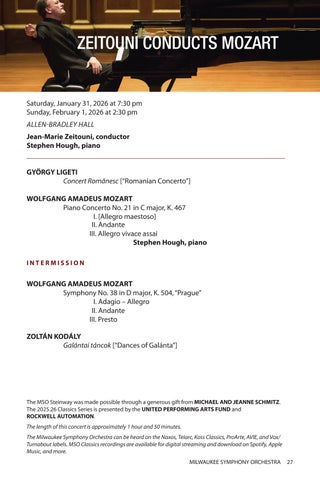
ZEITOUNI CONDUCTS MOZART
Saturday, January 31, 2026 at 7:30 pm Sunday, February 1, 2026 at 2:30 pm ALLEN-BRADLEY HALL Jean-Marie Zeitouni, conductor Stephen Hough, piano GYÖRGY LIGETI Concert Românesc [“Romanian Concerto”] WOLFGANG AMADEUS MOZART Piano Concerto No. 21 in C major, K. 467 I. [Allegro maestoso] II. Andante III. Allegro vivace assai Stephen Hough, piano INTERMISSION
WOLFGANG AMADEUS MOZART Symphony No. 38 in D major, K. 504, “Prague” I. Adagio – Allegro II. Andante III. Presto ZOLTÁN KODÁLY Galántai táncok [“Dances of Galánta”]
The MSO Steinway was made possible through a generous gift from MICHAEL AND JEANNE SCHMITZ. The 2025.26 Classics Series is presented by the UNITED PERFORMING ARTS FUND and ROCKWELL AUTOMATION. The length of this concert is approximately 1 hour and 50 minutes. The Milwaukee Symphony Orchestra can be heard on the Naxos, Telarc, Koss Classics, ProArte, AVIE, and Vox/ Turnabout labels. MSO Classics recordings are available for digital streaming and download on Spotify, Apple Music, and more. MILWAUKEE SYMPHONY ORCHESTRA
27
Guest Artist Biographies JEAN-MARIE ZEITOUNI Recognized as one of the most accomplished conductors of his generation, Jean-Marie Zeitouni stands out for his expressive, precise, and deeply committed style. Appreciated in both the symphonic and operatic repertoires, he regularly conducts the most prestigious orchestras in Europe and America. During the 2025-26 season, beyond his programs in Edmonton, his engagements will include La Cenerentola at the Opéra de Québec, Carmen at the Opéra de Montréal, concerts with the Milwaukee Symphony Orchestra and the Colorado Springs Philharmonic, and a debut appearance in Portugal at the Casa da Música in Porto. Zeitouni has recently conducted notable productions such as Sigurd in Marseille, Carmen in Lausanne, Médée in Montpellier, and Massenet’s Grisélidis with the Opéra Orchestre national Montpellier and at the Théâtre des Champs-Élysées in Paris, which was recorded for commercial release. He has also conducted the Brussels Philharmonic for a recording dedicated to the French cello repertoire for the Bru Zane label, as well as the Orchestre national de Lille for a recording of French arias with soprano Vannina Santoni. At the Opéra de Montréal, he successively conducted two world premieres by composer Julien Bilodeau on texts by Michel Marc Bouchard: La beauté du monde and La Reine-garçon, two important milestones in the history of lyrical creation in Canada. In 2025, Zeitouni was named music director of the Edmonton Symphony Orchestra and artistic and musical director of the Opera de Québec. Over the years, Zeitouni has served as artistic director of the Orchestre de chambre I Musici de Montréal and as music director of the Colorado Music Festival and the Columbus Symphony Orchestra in Ohio. For over 12 years, he was a key collaborator with Les Violons du Roy, where he successively held the positions of conductor in residence, associate conductor, and principal guest conductor. A graduate of the Conservatoire de musique de Montréal in conducting, percussion, and composition, where he studied with Raffi Armenian, Zeitouni now teaches conducting and conducts their orchestra.
28
MILWAUKEE SYMPHONY ORCHESTRA
Guest Artist Biographies STEPHEN HOUGH Named by The Economist as one of 20 living polymaths, Sir Stephen Hough combines the distinguished career of a concert pianist with those of a composer and writer. In recognition of his contributions to cultural life, he became the first classical performer to be given a MacArthur Fellowship and was awarded a Knighthood for Services to Music as part of the Queen’s Birthday Honours in 2022. In a career spanning over 40 years, Hough has played regularly with most of the world’s leading orchestras, including televised and filmed appearances with the Berlin, London, China, Seoul, and New York philharmonic orchestras, and the Concertgebouw, Budapest Festival, and the NHK symphony orchestras. He has been a regular guest of recital series and festivals worldwide, including Carnegie Hall, London’s Royal Festival Hall, Salzburg, Verbier, La Roque‑d’Anthéron, Aspen, Tanglewood, Aldeburgh, and Edinburgh. Hough opens his 2025-26 season at the Elbphilharmonie, launching the Philharmonisches Staatsorchester Hamburg’s season under its new music director Omer Meir Wellber with Beethoven’s Piano Concerto No. 3, for which he has composed a brand-new second movement. Over the following 12 months, he gives more than 60 performances across three continents, appearing with leading orchestras in the U.S., Europe, and Asia. His piano quintet Les noces rouges, inspired by an episode in American novelist Willa Cather’s My Ántonia and commissioned by the Lincoln Center Chamber Music Society in 2024, will receive its European and U.K. premieres at the National Concert Hall in Dublin and Southbank Centre in London. Hough’s discography of over 70 recordings has garnered awards, including the Diapason d’Or de l’Année, several Grammy Award nominations, and eight Gramophone Awards, including Record of the Year and the Gold Disc. For Hyperion, he has recorded the complete piano concerti of Beethoven, Brahms, Liszt, Mendelssohn, Rachmaninoff, Saint-Saëns, and Tchaikovsky, as well as celebrated solo albums of the final piano pieces of Brahms, Chopin’s complete nocturnes, waltzes, ballades, and scherzi, and recitals of Schumann, Schubert, Franck, Debussy, and Mompou. Recent recordings include an album of Hough’s own piano concerto, released in March 2025, with the Hallé and Sir Mark Elder. Hough is an honorary member of the Royal Philharmonic Society, an honorary fellow of Cambridge University’s Girton College, the international chair of piano studies and a companion of the Royal Northern College of Music, and is on the faculty of The Juilliard School in New York.
MILWAUKEE SYMPHONY ORCHESTRA
29
Program notes by David Jensen GYÖRGY LIGETI Born 28 May 1923; Diciosânmartin, Transylvania, Romania Died 12 June 2006; Vienna, Austria
Concert Românesc [“Romanian Concerto”]
Composed: 1951 First performance: 21 August 1971; Thor Johnson, conductor; Peninsula Music Festival Orchestra Last MSO performance: 22 October 2011; Julian Kuerti, conductor Instrumentation: 2 flutes (2nd doubling on piccolo); 2 oboes (2nd doubling on English horn); 2 clarinets; 2 bassoons; 3 horns; 2 trumpets; percussion (bass drum, cymbals, piccolo snare drum, suspended cymbals); strings Approximate duration: 12 minutes Among the revolutionary thinkers and artists of the 20th century, only a handful of composers made advances into the realms of experimental music which were as daring — or challenged audiences as frequently — as György Ligeti. Working at the fringes of conventional taste, he produced a body of work of enormous stylistic diversity, and his subsequent influence on the development of concert music in the West places him among the most important avant-garde composers of his generation. Born to Hungarian-speaking Jewish parents living in Romania, Ligeti studied composition at the conservatory in Cluj in his late teens, continuing his education at the Franz Liszt Academy of Music in Budapest following World War II. He eventually secured a position teaching counterpoint and harmony there with the help of his composition teacher, Zoltán Kodály, and he resided in Budapest until 1956, when he and his wife illegally crossed the Austrian border to escape the sociopolitical upheaval of the Hungarian Uprising. It was only after fleeing the Eastern Bloc that Ligeti encountered such pioneering creatives as Karlheinz Stockhausen and Gottfried Koenig, whose explorations into the field of electronic music opened new vistas in Ligeti’s musical outlook. But his “Romanian Concerto” of 1951 is an artifact of his days writing under the watchful eye of communist censors. After graduating from the Liszt Academy in 1949, Ligeti attended the Folklore Institute of Bucharest, where he transcribed folk music from wax cylinders recorded in the field, which provided fresh subject matter for a composer struggling to write politically “acceptable” music. “Under Stalin’s dictatorship,” Ligeti later recalled, “even folk music was allowed only in a ‘politically correct’ form … if forced into the straitjacket of the norms of socialist realism.” Banned after a single rehearsal, the music went unheard for more than twenty years. “In the fourth movement … there is a passage in which an F sharp is heard in the context of F major. This was reason enough for the apparatchiks responsible for the arts to ban the entire piece.” Though the piece assimilates the folkloristic elements emerging in the music of his peers — calling to mind Bartók’s Romanian Folk Dances and concerto for orchestra in particular — Ligeti’s symphonic rendering of the flavor and spirit of Romanian peasant music makes for one of his most thrillingly inventive scores. While much of the music is derived from genuine folk sources, Ligeti acknowledged that he fabricated portions of the concerto “in the spirit of the village bands.” Frenzied concertmaster solos in the second and fourth movements conjure the image of a provincial fiddler, while the natural tuning in the horns heard in the sensual, smoky harmonies of the third — the section most suggestive of his mature style — imitate the sound of the alpenhorn, the folk instrument Ligeti first heard as a child played by a wandering musician in the Carpathian mountains. 30
MILWAUKEE SYMPHONY ORCHESTRA
WOLFGANG AMADEUS MOZART Born 27 January 1756; Salzburg, Austria Died 5 December 1791; Vienna, Austria
Piano Concerto No. 21 in C major, K. 467
Composed: February – 9 March 1785 First performance: 10 March 1785; Wolfgang Amadeus Mozart, fortepiano and conductor; Theater am Kärntnertor, Vienna Last MSO performance: 29 October 2006; Andreas Delfs, conductor; Shai Wosner, piano Instrumentation: flute; 2 oboes; 2 bassoons; 2 horns; 2 trumpets; timpani; strings Approximate duration: 29 minutes By the mid-1780s, the prodigiously talented wunderkind who had spent his childhood touring central Europe and courting favor from the nobility was flourishing. Mozart had arrived in Vienna at the beginning of the decade, eager to assert his sovereignty as the leading keyboard virtuoso of his day, and he was, at least for a time, wildly successful. The urban center provided him with a much-needed font of artistic stimulation as he repeatedly appeared as composer, conductor, and soloist in subscription concerts staged expressly to advertise his talents. Enjoying a newfound economic security which permitted his family a life of comfort, the rapid succession of piano concerti he debuted during his Viennese years would be viewed by subsequent generations as the finest achievements of his career. While the concerto as a genre had come into its own in the preceding century, it should be remembered that the piano itself was an instrument still in its infancy, and there were only antiquated examples as precedent to suggest how the contents of a piano concerto might be organized. Above all, clarity of form, structural balance, and thematic development were of the utmost importance to Mozart: writing for an instrument that did not project with the luster and precision of a modern grand piano, the division of material between orchestra and pianist was the problem to which Mozart presented a series of entirely individual solutions in each of his mature efforts in the form. The brilliance of Mozart’s innovations is most apparent in that skillful illumination of musical thought, which diminishes neither the stature of the soloist nor of the accompanying instrumentalists. Here, the first movement begins as an array of winds and brass presents a marchlike theme before an improvisatory passage from the pianist restates and elaborates upon the tune. The abrupt appearance of supplementary material in G minor seems to echo the turbulent quality of his infamous D minor concerto, written only a few weeks earlier, before giving way to a cheerful second subject in the dominant key of G major. The introduction of the central andante in F major, buoyed by triplets in the low strings and pizzicati in the celli, provides all of the movement’s musical material in advance of the soloist’s entrance. The music prevails as one of Mozart’s most luxuriously realized creations, and its inclusion in the 1967 romantic drama Elvira Madigan has made it instantly recognizable to listeners outside of the concert hall. In rondo form, the finale places the pianist and orchestra in lively conversation as the soloist embellishes each statement by the orchestra with every manner of scale, arpeggio, and ornament. One can’t help but imagine Mozart, not yet 30, practically frolicking at the keyboard, delighting in his own genius only a day after the ink had dried on the score.
MILWAUKEE SYMPHONY ORCHESTRA
31
WOLFGANG AMADEUS MOZART Born 27 January 1756; Salzburg, Austria Died 5 December 1791; Vienna, Austria
Symphony No. 38 in D major, K. 504, “Prague”
Composed: November – 6 December 1786 First performance: 19 January 1787; Wolfgang Amadeus Mozart, fortepiano and conductor; Estates Theatre, Prague Last MSO performance: 3 May 2014; Edo de Waart, conductor Instrumentation: 2 flutes; 2 oboes; 2 bassoons; 2 horns; 2 trumpets; timpani; strings Approximate duration: 26 minutes While Mozart struggled to find abiding success among the concertgoing public as musical tastes in his native Austria began changing, he would remain particularly fashionable among the Bohemians throughout his life. It was toward the end of 1785 that he received an invitation to Prague, where his opera Le nozze di Figaro had been a smashing success. Not one to waste an opportunity to self-promote, Mozart relished the four weeks of his first stay in the city, directing a production of Figaro, securing the commission that would eventually lead to the conception of Don Giovanni, and premiering one of his most adventurous works to date. While nearly all of Mozart’s late symphonies are ranked among his greatest achievements, several unusual features distinguish the “Prague” symphony among its contemporaries in his catalog. For one thing, the music is organized into only three movements, more closely resembling the genre’s origins in 17th-century Italian overtures rather than the quaternary model which had crystallized as the formal standard by the time of Mozart’s birth. Why he chose to jettison the usual third-movement minuet-and-trio in favor of a model he had abandoned in his childhood is unclear, though it’s possible he had reason to believe his audiences in Prague would respond more favorably to such a “vintage” approach. Perceptive listeners will also notice the fabulously colorful tonal palette that Mozart applies throughout, which begets an especially dynamic and nearly Beethovenian range of expression. While Mozart had been eagerly toying with instrumental color and orchestration in his piano concerti throughout the 1780s, the attention he lavishes on the wind instruments of the orchestra here was undoubtedly a result of the legendary status that the wind players of Bohemia enjoyed across the continent. Even the very beginning is out of the ordinary for Mozart, who commences with a lengthy, dramatic, probing introduction (a feature included in only two of his other symphonies), which ventures into the parallel key of D minor. The tension of the slow material immediately dissolves with the appearance of the spritely, highly contrapuntal subjects of the subsequent allegro, which he develops with remarkable sensitivity. The slow inner movements of Mozart’s late symphonies suggest a rather different aspect of the composer’s personality, characterized by their diversions into minor modes, winding chromatic lines, and denser voicings. The finale, as pianist and writer Antony Hopkins observed, asserts itself beyond Mozart’s usual stylistic boundaries “nearer to Beethoven’s boisterousness than his fastidious taste normally allowed him to go.” Suffused with the sort of manic optimism that pervades his operas, and despite the occasional foray into the fire and drama of his successor, “one carries away the memory of a sunlit work, full of a radiance that is hard to equal.”
32
MILWAUKEE SYMPHONY ORCHESTRA
ZOLTÁN KODÁLY Born 16 December 1882; Kecskemét, Austro-Hungarian Empire (now Hungary) Died 6 March 1967; Budapest, Hungary
Galántai táncok [“Dances of Galánta”]
Composed: 1933 First performance: 23 October 1933; Ernst von Dohnányi, conductor; Budapest Philharmonic Orchestra Last MSO performance: 3 February 2018; Stefan Asbury, conductor Instrumentation: 2 flutes (2nd doubling on piccolo); 2 oboes; 2 clarinets; 2 bassoons; 4 horns; 2 trumpets; timpani; percussion (glockenspiel, snare drum, triangle); strings Approximate duration: 16 minutes In 1928, Béla Bartók described Zoltán Kodály’s music as the “perfect embodiment of the Hungarian spirit.” “The obvious explanation,” he wrote, “is that all Kodály’s composing activity is rooted only in Hungarian soil, but the deep inner reason is his unshakeable faith and trust in the constructive power and future of his people.” For more than two decades, the two had spent untold hours together in the countryside collecting and transcribing samples of folk music in their mother tongue. Their purpose was twofold: a profound respect for their musical heritage motivated them to preserve and transmit it by means of their research, but both men found in their work the resources necessary to develop a compositional technique imbued with the traditions of their homeland. Few other individuals with interests as diverse Kodály’s were as successful in such varied pursuits. Arriving at a clearly defined, highly individual style early in his career, he composed almost entirely without interruption for nearly 70 years. Tireless in his intellectual endeavors, he transcribed thousands of folk songs, contributed prolifically to the academic literature of ethnomusicology through the publication of articles, essays, and books, and developed educational principles that revolutionized modern music pedagogy. His influence can still be felt today in those schools around the world where the so-called “Kodály method” serves as the basis for early childhood music education. Commissioned by the Budapest Philharmonic Society in honor of their 80th anniversary, the Dances of Galánta remain one of Kodály’s most popular scores for their clever blending of folk idiom with the harmonic and formal sophistication of the late Romantics. In his preface to the score, Kodály notes that it was during the seven years of his childhood spent in the market town of Galánta that he first encountered a band of Romani musicians, explaining that the group’s ancestry extended more than a century into the past and that the themes presented within his composition were derived from a collection of their songs published in Vienna around 1800. The music exemplifies what Bartók called Kodály’s “rich melodic invention” and “perfect sense of form,” incorporating the syncopated rhythms, asymmetrical phrases, and ambrosial modal harmonies of Hungarian folksong. Presented as a sequence of dances, the music operates on two formal levels simultaneously. As an elaborate verbunkos (from the German werbung, meaning “to recruit”), a two-part Hungarian dance performed by military officers to recruit prospective candidates, we begin with the lassú (“slow”). An unsettled orchestral introduction is followed by a cadenza for the clarinet, gesturing to the tarogato, a single-reed instrument native to Hungary. But from the division of the following fast section (the friss, or “fresh”) into four dances separated by a sensuous refrain, the broader architectural scheme of the rondo emerges, culminating in a stunning demonstration of orchestral virtuosity.
MILWAUKEE SYMPHONY ORCHESTRA
33
Elizabeth Breslin Georgi Dimitrov Nathan Hackett Michael Lieberman** Erin H. Pipal
2025.26 SEASON
CELLOS Susan Babini, Principal, KEN-DAVID MASUR Dorothea C. Mayer Principal Cello Chair Music Director Shinae Ra, Assistant Principal (2nd chair) Polly and Bill Van Dyke Music Director Chair Scott Tisdel, Associate Principal Emeritus Madeleine Kabat EDO DE WAART Peter Szczepanek Music Director Laureate Peter J. Thomas BYRON STRIPLING Adrien Zitoun Principal Pops Conductor Stein Family Foundation BASSES Principal Pops Conductor Chair Principal, Donald B. Abert Principal Bass Chair RYAN TANI Andrew Raciti, Acting Principal Associate Conductor Nash Tomey, Acting Assistant Principal (2nd chair) CHERYL FRAZES HILL Brittany Conrad Chorus Director Broner McCoy Margaret Hawkins Chorus Director Chair Paris Myers TIMOTHY J. BENSON Assistant Chorus Director HARP FIRST VIOLINS Jinwoo Lee, Concertmaster, Charles and Marie Caestecker Concertmaster Chair Ilana Setapen, First Associate Concertmaster, Thora M. Vervoren First Associate Concertmaster Chair Jeanyi Kim, Associate Concertmaster Alexander Ayers Autumn Chodorowski Yuka Kadota Elliot Lee Dylana Leung Kyung Ah Oh Lijia Phang Vinícius Sant’Ana** Yuanhui Fiona Zheng SECOND VIOLINS Jennifer Startt, Principal, Andrea and Woodrow Leung Principal Second Violin Chair Ji-Yeon Lee, Assistant Principal (2nd chair) Hyewon Kim, Acting Assistant Principal (3rd chair) Heejeon Ahn Lisa Johnson Fuller Clay Hancock Paul Hauer Sheena Lan** Janis Sakai** Yiran Yao VIOLAS Victor de Almeida, Principal, Richard O. and Judith A. Wagner Family Principal Viola Chair Samantha Rodriguez, Acting Assistant Principal (2nd chair), Friends of Janet F. Ruggeri Assistant Principal Viola Chair Alejandro Duque, Acting Assistant Principal (3rd chair)
34
Julia Coronelli, Principal, Walter Schroeder Principal Harp Chair FLUTES Sonora Slocum, Principal, Margaret and Roy Butter Principal Flute Chair Heather Zinninger, Assistant Principal Jennifer Bouton Schaub PICCOLO Jennifer Bouton Schaub
Rudi Heinrich, Assistant Principal Matthew Melillo CONTRABASSOON Matthew Melillo HORNS Matthew Annin, Principal, Krause Family Principal French Horn Chair Krystof Pipal, Associate Principal Dietrich Hemann, Andy Nunemaker French Horn Chair Darcy Hamlin Dawson Hartman TRUMPETS Matthew Ernst, Principal, Walter L. Robb Family Principal Trumpet Chair David Cohen, Associate Principal, Martin J. Krebs Associate Principal Trumpet Chair Tim McCarthy, Fred Fuller Trumpet Chair TROMBONES Megumi Kanda, Principal, Marjorie Tiefenthaler Principal Trombone Chair Kirk Ferguson, Assistant Principal BASS TROMBONE John Thevenet, Richard M. Kimball Bass Trombone Chair TUBA Robyn Black, Principal, John and Judith Simonitsch Principal Tuba Chair TIMPANI Dean Borghesani, Principal Chris Riggs, Assistant Principal
OBOES Katherine Young Steele, Principal, Milwaukee Symphony Orchestra League Principal Oboe Chair Kevin Pearl, Assistant Principal Margaret Butler
PERCUSSION Robert Klieger, Principal Chris Riggs
ENGLISH HORN Margaret Butler, Philip and Beatrice Blank English Horn Chair in memoriam to John Martin
PERSONNEL Antonio Padilla Denis, Director of Orchestra Personnel Paris Myers, Assistant Manager of Orchestra Personnel
CLARINETS Todd Levy, Principal, Franklyn Esenberg Principal Clarinet Chair Jay Shankar, Assistant Principal, Donald and Ruth P. Taylor Assistant Principal Clarinet Chair Besnik Abrashi E-FLAT CLARINET Jay Shankar BASS CLARINET Besnik Abrashi BASSOONS Catherine Van Handel, Principal, Muriel C. and John D. Silbar Family Principal Bassoon Chair*
MILWAUKEE SYMPHONY ORCHESTRA
PIANO Melitta S. Pick Endowed Piano Chair
LIBRARIANS Paul Beck, Principal Librarian, James E. Van Ess Principal Librarian Chair Matthew Geise, Assistant Librarian & Media Archivist PRODUCTION Tristan Wallace, Production Manager/Live Audio Lisa Sottile, Production Stage Manager * Leave of absence during the 2025.26 season ** Acting member of the MSO for the 2025.26 season