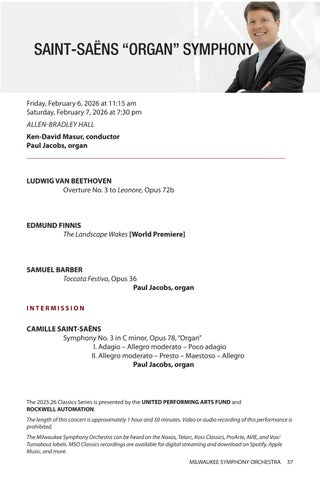
SAINT-SAËNS “ORGAN” SYMPHONY
Friday, February 6, 2026 at 11:15 am Saturday, February 7, 2026 at 7:30 pm ALLEN-BRADLEY HALL Ken-David Masur, conductor Paul Jacobs, organ
LUDWIG VAN BEETHOVEN Overture No. 3 to Leonore, Opus 72b
EDMUND FINNIS The Landscape Wakes [World Premiere]
SAMUEL BARBER Toccata Festiva, Opus 36 Paul Jacobs, organ INTERMISSION
CAMILLE SAINT-SAËNS Symphony No. 3 in C minor, Opus 78, “Organ” I. Adagio – Allegro moderato – Poco adagio II. Allegro moderato – Presto – Maestoso – Allegro Paul Jacobs, organ
The 2025.26 Classics Series is presented by the UNITED PERFORMING ARTS FUND and ROCKWELL AUTOMATION. The length of this concert is approximately 1 hour and 50 minutes. Video or audio recording of this performance is prohibited. The Milwaukee Symphony Orchestra can be heard on the Naxos, Telarc, Koss Classics, ProArte, AVIE, and Vox/ Turnabout labels. MSO Classics recordings are available for digital streaming and download on Spotify, Apple Music, and more. MILWAUKEE SYMPHONY ORCHESTRA
37
MILWAUKEE’S HOME FOR MUSIC THEATRE
OCT. 3 – 26
NOV. 14 – DEC. 28
JAN. 23 – FEB. 8
FEB. 27 –MAR. 15
APR. 10 - 26
SUBSCRIBE + SAVE Claim the best seats in the house for the lowest prices. Plus, enjoy free ticket exchanges, waived fees, premiere parking, and invitations to Behind the Curtain and exclusive subscriber-only events.
3
PRODUCTION PACKAGE
FLEX PASS
shows of the season while AGE still saving when compared to single ticket prices.
package for any combination Choose a 4-seat or 6-seat packof in a single ageperformances for any combination of season at a discounted rate.
FLEX ChoosePASS a 4-seat or 6-seat
PRODUCTION You choose your PACKtop three
Tickets at SkylightMusicTheatre.org SEASON SPONSORS MOIRA J. KELLY
38
MILWAUKEE SYMPHONY ORCHESTRA
Guest Artist Biographies PAUL JACOBS Heralded as “one of the finest organists and teachers of our day,” by Zachary Woolfe of The New York Times, “one of the major musicians of our time” by Alex Ross of The New Yorker, and as “America’s leading organ performer” by The Economist, the internationally celebrated organist Paul Jacobs combines a probing intellect and extraordinary technical mastery with an unusually large repertoire, both old and new. He has performed to great critical acclaim on five continents and in each of the 50 United States. The only organist ever to have won a Grammy Award — in 2011 for Messiaen’s towering Livre du Saint Sacrement — Jacobs is an eloquent champion of his instrument both in the U.S. and abroad. Jacobs has transfixed audiences, colleagues, and critics alike with landmark performances of the complete works for solo organ by J.S. Bach and Messiaen. A fierce advocate of new music, Jacobs has premiered works by Samuel Adler, Mason Bates, Michael Daugherty, Bernd Richard Deutsch, John Harbison, Wayne Oquin, Stephen Paulus, Christopher Theofanidis, and Christopher Rouse, among others. As a teacher, he has also been a vocal proponent of the redeeming nature of traditional and contemporary classical music. No other organist is repeatedly invited as soloist to perform with such prestigious orchestras, making him a pioneer in the movement for the revival of symphonic music featuring the organ. Jacobs regularly appears with the Chicago Symphony Orchestra, Cincinnati Symphony Orchestra, Cleveland Orchestra, Edmonton Symphony Orchestra, Indianapolis Symphony Orchestra, Kansas City Symphony, Los Angeles Philharmonic, Lucerne Symphony Orchestra, Minnesota Orchestra, Orchestre symphonique de Montréal, Nashville Symphony, National Symphony Orchestra, Pacific Symphony, Phoenix Symphony, Philadelphia Orchestra, San Francisco Symphony, Toledo Symphony Orchestra, Warsaw National Philharmonic Orchestra, and Utah Symphony, among others. Jacobs studied at the Curtis Institute of Music with organist John Weaver and harpsichordist Lionel Party and at Yale University with Thomas Murray. He joined the faculty of The Juilliard School in 2003 and was named chairman of the organ department in 2004, one of the youngest faculty appointees in the school’s history. He received Juilliard’s prestigious William Schuman Scholar’s Chair in 2007. In 2017, he received an honorary doctorate from Washington & Jefferson College. In 2021, the American Guild of Organists named him recipient of the International Performer of the Year Award. Jacobs has written several articles for the Wall Street Journal.
MILWAUKEE SYMPHONY ORCHESTRA
39
Program notes by David Jensen LUDWIG VAN BEETHOVEN Born 17 December 1770; Bonn, Germany Died 26 March 1827; Vienna, Austria
Overture No. 3 to Leonore, Opus 72b
Composed: 1806 First performance: 29 March 1806; Ignaz von Seyfried, conductor; Theater an der Wien Last MSO performance: 27 November 2004; Carlos Kalmar, conductor Instrumentation: 2 flutes; 2 oboes; 2 clarinets; 2 bassoons; 4 horns; 2 trumpets; 3 trombones; timpani; strings Approximate duration: 14 minutes Charged as it is with its questions of justice, deception, and the triumph of love, it remains a curious fact of history that Beethoven’s only opera was long regarded as little more than a blunder, the experience of writing it leaving such an unpleasant taste in his mouth that he would resolve never to bother with the genre again. In a letter to Georg Friedrich Treitschke, who had helped to revise the libretto for its 1814 revival, he was unequivocal: “I assure you, dear Treitschke, that this opera will win me a martyr’s crown. You have by your cooperation saved what is best from the shipwreck.” Never mind that the opera, for all its dramatic potential, was then considered the high watermark of any serious composer. The French, for their part, were having a positively marvelous time in the theater, and it was the transmission of their post-revolutionary “rescue operas” to Vienna that had inspired Beethoven. A contract from the Theater an der Wien was issued in early 1803, but it wasn’t until his discovery of Jean-Nicolas Bouilly’s Léonore, ou L’amour conjugal in 1804 that he was sufficiently motivated to do something about it. Perhaps it was in Florestan, wrongfully imprisoned and left to languish in the darkness, that he saw the indescribable isolation that attended his own failing hearing, or the devoted Leonore, driven by love to disguise herself as a man in order to save her husband, that he saw his own all-consuming romantic entanglement with the recently widowed Josephine Brunsvik reflected. Unfortunately for Beethoven, the premiere in November 1805 was attended not by the usual crowd of Viennese aristocrats who had until then been his greatest advocates, but by officers of the French military occupying the city at Napoleon’s directive, who quite understandably expressed little sympathy for German opera. Even the title on the program wasn’t Beethoven’s, who would have much preferred to give his heroine top billing; instead, her dashing alter ego appeared at the top of the playbill the theater’s insistence to avoid conflating his production with other contemporary settings of Bouilly’s libretto. Fidelio was shelved after three performances. A second staging in 1806 fared slightly better after Beethoven whittled down the opera’s three acts to two, simultaneously producing a new overture for his Leonore that would eventually be labeled the third. The original was published as the second, while the version later designated “No. 1” resulted from yet another adaptation for Prague in 1808, and a fourth overture bearing Fidelio’s name appeared in Beethoven’s final revisions of 1814. The most popular of the four, the 1806 edition heard in these concerts refines and compacts the opera’s central themes into a sparkling musical synopsis, transporting the listener from the murky depths of Florestan’s prison cell to the ecstasies of marital bliss that conquer all — at least in the theater.
40
MILWAUKEE SYMPHONY ORCHESTRA
EDMUND FINNIS Born 1984; Oxford, England
The Landscape Wakes
Composed: 2025 First performance: 6 February 2026; Ken-David Masur, conductor; Milwaukee Symphony Orchestra Last MSO performance: World Premiere Instrumentation: 3 flutes (3rd doubling on piccolo); 3 oboes; 3 clarinets (3rd doubling on bass clarinet); 2 bassoons; contrabassoon; 4 horns; 3 trumpets; 2 trombones; bass trombone; tuba; timpani; percussion (bass drum, 2 bell plates, crotales with bow, nipple gong, suspended cymbal, tam-tam, tubular bells, tuned gong, vibraphone with bow); strings Approximate duration: 18 minutes
The following essay was prepared by the composer and appears here with his permission. The Landscape Wakes is the final piece in a decade-spanning trilogy of orchestral works focusing on our perception of the natural world around us — how it moves and how we are moved by it. This culminating piece contains the most agile, forceful music of the trilogy, as well as the most tender. While composing, I held in my mind the mental image of the world’s spinning on its axis. I wanted to keep the music in constant motion, its lines and harmonies ever turning and revolving. The circling musical patterns that open the piece reappear periodically, heard in different guises and varied hues. Myriad overlapping lines rise and fall. Sonorities surge and recede. Out of the relative quietude of a slower, twilit central section the music renews itself, growing in energy and intensity, as if moving inexorably into the heat and radiance of direct sunlight. The “landscape” of the title is no specific place. It is every landscape. And the waking — the dawning, the renewal — is perpetual.
MILWAUKEE SYMPHONY ORCHESTRA
41
SAMUEL BARBER Born 9 March 1910; West Chester, Pennsylvania Died 23 January 1981; New York City, New York
Toccata Festiva, Opus 36
Composed: January – May 1960 First performance: 30 September 1960; Eugene Ormandy, conductor; Paul Callaway, organ; Philadelphia Orchestra Last MSO performance: MSO Premiere Instrumentation: piccolo; 2 flutes; 2 oboes; English horn; 2 clarinets; bass clarinet; 2 bassoons; 4 horns; 3 trumpets; 3 trombones; tuba; timpani; percussion (cymbal, bass drum, snare drum, tam-tam, triangle, xylophone); strings Approximate duration: 15 minutes Among the American composers whose music has endured in the symphonic literature, Samuel Barber’s voice holds sway as one of the most vital, original, and lyrical in the nation’s history. A child prodigy, he was admitted to the first class of the Curtis Institute of Music in 1924, where a decade of study nurtured his natural talents as a baritone, pianist, and composer. By his graduation, his music had already earned him an international reputation as a composer of the highest rank, and in the decades that followed, he would cultivate a prizewinning oeuvre — and achieve an inimitable cultural stature — the envy of any artist of any age. During his last year as a student at Curtis, Barber’s successes as a rising star earned him the admiration of Mary Louise Curtis, the conservatory’s foundress, who introduced him to the Schirmer publishing house and secured him a lifelong partnership with the company. By 1960, she had been married to the Russian violinist Efram Zimbalist, director of the Curtis Institute, for 17 years and had established herself as one of Philadelphia’s most influential patrons of the arts. It was early that year that she called Eugene Ormandy, music director of the Philadelphia Orchestra, to inform him that she had underwritten the cost of a new organ for what was then the orchestra’s primary venue, the Academy of Music — and that she had commissioned a piece from Barber for the occasion. The toccata (from the Italian toccare, meaning “to touch”) first appeared more than four centuries ago in Italian music of the late Renaissance and was developed to the height of its technical sophistication by German composers of the Baroque period. Its style was generally defined by an elevated virtuoso element, and it was structured as a free-form fantasia, embracing all manner of ornamentation, scalar figuration, and arpeggiated harmonies, as well as stark contrasts between fugal and improvisatory writing and a more liberal approach to matters of tempo. In Barber’s hands, it becomes a wonderfully modern showcase of the organ’s aural might. From a single theme, Barber derives an enormous variety of musical matter, transmuting the central statement into a broad spectrum of mood and color. Beginning with a dramatic flourish, Barber sets in motion his characteristically angular rhythms in the strings, augmenting their bristling textures with interjections from the percussion and brass. The primary subject appears first as a fanfare in the trumpets, is echoed by the horns, and passes to the soloist, whose entrance imitates that first wash of orchestral sound. A slower lyrical section introduces hymn-like voicings in the organ accompanied by a dance-like motif in the woodwinds. The cadenza, written only for the pedals and prepared in collaboration with the organist Thomas Schippers, leads into a tremendous coda, which recapitulates the work’s myriad ideas.
42
MILWAUKEE SYMPHONY ORCHESTRA
CAMILLE SAINT-SAËNS Born 9 October 1835; Paris, France Died 16 December 1921; Algiers, Algeria
Symphony No. 3 in C minor, Opus 78, “Organ”
Composed: Early 1886 First performance: 19 May 1886; Camille Saint-Saëns, conductor; Philharmonic Society of London Last MSO performance: 10 November 2018; Johannes Debus, conductor Instrumentation: 3 flutes (3rd doubling on piccolo); 2 oboes; English horn; 2 clarinets; bass clarinet; 2 bassoons; contrabassoon; 4 horns; 3 trumpets; 3 trombones; tuba; timpani; percussion (bass drum, cymbals, triangle); organ; piano (two and four hands); strings Approximate duration: 36 minutes Having no revolutionary inclinations and writing in a strictly conservative manner his entire life, Camille Saint-Saëns stood at the edge of a vanishing era. An authority on the musical literature of the 17th and 18th centuries, he admired the artistic advances made by his contemporaries but expressed little interest in proceeding beyond the limits of his own austere taste. A neoclassicist working with the traditional forms popularized by his German counterparts, he produced an enormous body of concertante, symphonic, chamber, and incidental music, as well as countless miniatures for the piano. Such was Saint-Saëns’s devotion to music of the past that it prompted Claude Debussy (who would eventually find himself in the musical reactionary’s crosshairs) to describe him as “the musician of tradition.” Even hyperbole is hardly adequate in suggesting Saint-Saëns’s preternatural talents. At his public debut at the age of 10, he offered to play any of Beethoven’s sonatas from memory as an encore. Two years later, he entered the Paris Conservatoire, where his reputation as a keyboard virtuoso soon won him friendships with Rossini, Berlioz, and Gounod, as well as a successful (albeit decidedly orthodox) career as a church organist. Serving at the prestigious Church of Saint Mary Magdalene for nearly 20 years, it was at “the Madeleine” that Franz Liszt, hearing SaintSaëns improvise, declared him the greatest organist in the world. Liszt was, in fact, one of the few modernists who had earned the Frenchman’s approval to the extent that his influence could be heard in Saint-Saëns’s music — particularly in the variety of symphonic poems he’d written by the 1880s, long after he had left the Madeleine for an enterprising life as a freelance pianist and composer. It was unusual, then, that when Saint-Saëns received a commission from the Philharmonic Society of London, he specifically chose to write a symphony, as it had been more than 30 years since his last attempt. Divided into only two movements which contain within them the four customary components of the symphonic form, the ennobled, imposing music of Saint-Saëns’s final symphony is elucidated with Mozartian lucidity, an impeccable sense of balance and proportion, and a craftsman’s sensibility. Saint-Saëns draws on Liszt’s technique of “thematic transformation,” transposing, rhythmically augmenting, and reharmonizing the music’s principal themes such that their character is dramatically transfigured. The organ in question, itself treated as a member of the orchestra and not as a soloist, appears only twice, but to indescribable effect — first as the harmonic canvas in the hushed, impassioned strains of the adagio, then as the dominating figure of the final maestoso. Bejeweled with its brass fanfares and learned fugal writing, the finale’s emotional peak invokes the composer’s own assessment of the music: “I gave everything to it I was able to give. What I have here accomplished, I will never achieve again.”
MILWAUKEE SYMPHONY ORCHESTRA
43
Elizabeth Breslin Georgi Dimitrov Nathan Hackett Michael Lieberman** Erin H. Pipal
2025.26 SEASON
CELLOS Susan Babini, Principal, KEN-DAVID MASUR Dorothea C. Mayer Principal Cello Chair Music Director Shinae Ra, Assistant Principal (2nd chair) Polly and Bill Van Dyke Music Director Chair Scott Tisdel, Associate Principal Emeritus Madeleine Kabat EDO DE WAART Peter Szczepanek Music Director Laureate Peter J. Thomas BYRON STRIPLING Adrien Zitoun Principal Pops Conductor Stein Family Foundation BASSES Principal Pops Conductor Chair Principal, Donald B. Abert Principal Bass Chair RYAN TANI Andrew Raciti, Acting Principal Associate Conductor Nash Tomey, Acting Assistant Principal (2nd chair) CHERYL FRAZES HILL Brittany Conrad Chorus Director Broner McCoy Margaret Hawkins Chorus Director Chair Paris Myers TIMOTHY J. BENSON Assistant Chorus Director HARP FIRST VIOLINS Jinwoo Lee, Concertmaster, Charles and Marie Caestecker Concertmaster Chair Ilana Setapen, First Associate Concertmaster, Thora M. Vervoren First Associate Concertmaster Chair Jeanyi Kim, Associate Concertmaster Alexander Ayers Autumn Chodorowski Yuka Kadota Elliot Lee Dylana Leung Kyung Ah Oh Lijia Phang Vinícius Sant’Ana** Yuanhui Fiona Zheng SECOND VIOLINS Jennifer Startt, Principal, Andrea and Woodrow Leung Principal Second Violin Chair Ji-Yeon Lee, Assistant Principal (2nd chair) Hyewon Kim, Acting Assistant Principal (3rd chair) Heejeon Ahn Lisa Johnson Fuller Clay Hancock Paul Hauer Sheena Lan** Janis Sakai** Yiran Yao VIOLAS Victor de Almeida, Principal, Richard O. and Judith A. Wagner Family Principal Viola Chair Samantha Rodriguez, Acting Assistant Principal (2nd chair), Friends of Janet F. Ruggeri Assistant Principal Viola Chair Alejandro Duque, Acting Assistant Principal (3rd chair)
44
Julia Coronelli, Principal, Walter Schroeder Principal Harp Chair FLUTES Sonora Slocum, Principal, Margaret and Roy Butter Principal Flute Chair Heather Zinninger, Assistant Principal Jennifer Bouton Schaub PICCOLO Jennifer Bouton Schaub
Rudi Heinrich, Assistant Principal Matthew Melillo CONTRABASSOON Matthew Melillo HORNS Matthew Annin, Principal, Krause Family Principal French Horn Chair Krystof Pipal, Associate Principal Dietrich Hemann, Andy Nunemaker French Horn Chair Darcy Hamlin Dawson Hartman TRUMPETS Matthew Ernst, Principal, Walter L. Robb Family Principal Trumpet Chair David Cohen, Associate Principal, Martin J. Krebs Associate Principal Trumpet Chair Tim McCarthy, Fred Fuller Trumpet Chair TROMBONES Megumi Kanda, Principal, Marjorie Tiefenthaler Principal Trombone Chair Kirk Ferguson, Assistant Principal BASS TROMBONE John Thevenet, Richard M. Kimball Bass Trombone Chair TUBA Robyn Black, Principal, John and Judith Simonitsch Principal Tuba Chair TIMPANI Dean Borghesani, Principal Chris Riggs, Assistant Principal
OBOES Katherine Young Steele, Principal, Milwaukee Symphony Orchestra League Principal Oboe Chair Kevin Pearl, Assistant Principal Margaret Butler
PERCUSSION Robert Klieger, Principal Chris Riggs
ENGLISH HORN Margaret Butler, Philip and Beatrice Blank English Horn Chair in memoriam to John Martin
PERSONNEL Antonio Padilla Denis, Director of Orchestra Personnel Paris Myers, Assistant Manager of Orchestra Personnel
CLARINETS Todd Levy, Principal, Franklyn Esenberg Principal Clarinet Chair Jay Shankar, Assistant Principal, Donald and Ruth P. Taylor Assistant Principal Clarinet Chair Besnik Abrashi E-FLAT CLARINET Jay Shankar BASS CLARINET Besnik Abrashi BASSOONS Catherine Van Handel, Principal, Muriel C. and John D. Silbar Family Principal Bassoon Chair*
MILWAUKEE SYMPHONY ORCHESTRA
PIANO Melitta S. Pick Endowed Piano Chair
LIBRARIANS Paul Beck, Principal Librarian, James E. Van Ess Principal Librarian Chair Matthew Geise, Assistant Librarian & Media Archivist PRODUCTION Tristan Wallace, Production Manager/Live Audio Lisa Sottile, Production Stage Manager * Leave of absence during the 2025.26 season ** Acting member of the MSO for the 2025.26 season