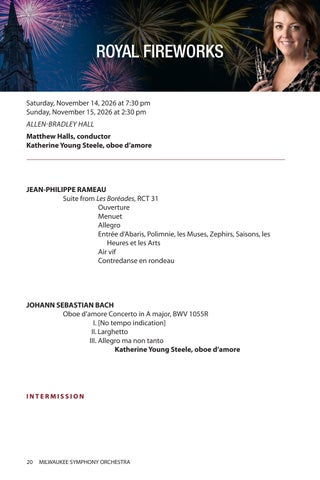
ROYAL FIREWORKS Saturday, November 14, 2026 at 7:30 pm Sunday, November 15, 2026 at 2:30 pm ALLEN-BRADLEY HALL Matthew Halls, conductor Katherine Young Steele, oboe d’amore
JEAN-PHILIPPE RAMEAU Suite from Les Boréades, RCT 31 Ouverture Menuet Allegro Entrée d’Abaris, Polimnie, les Muses, Zephirs, Saisons, les Heures et les Arts Air vif Contredanse en rondeau
JOHANN SEBASTIAN BACH Oboe d’amore Concerto in A major, BWV 1055R I. [No tempo indication] II. Larghetto III. Allegro ma non tanto Katherine Young Steele, oboe d’amore
INTERMISSION
20
MILWAUKEE SYMPHONY ORCHESTRA
GEORG MUFFAT Sonata da camera No. 5 in G major from Armonico tributo I. Allemande II. Adagio III. Fuga IV. Adagio V. Passacaglia – Grave
GEORGE FRIDERIC HANDEL Music for the Royal Fireworks, HWV 351 I. Ouverture II. Bourrée III. La Paix IV. La Réjouissance V. Menuet I VI. Menuet II
The 2026.27 Classics Series is presented by the UNITED PERFORMING ARTS FUND. The length of this concert is approximately 1 hour and 50 minutes. Video or audio recording of this performance is prohibited. All programs are subject to change. The Milwaukee Symphony Orchestra can be heard on the Naxos, Telarc, Koss Classics, ProArte, AVIE, and Vox/Turnabout labels. MSO Classics recordings are available for digital streaming and download on Spotify, Apple Music, and more. MILWAUKEE SYMPHONY ORCHESTRA
21
Guest Artist Biographies MATTHEW HALLS Matthew Halls has been chief conductor of the Tampere Philharmonic Orchestra since August 2023.
Photo by Benjamin Ealovega
In addition to concerts in Finland, the 2026-27 season sees Halls return to the Dallas Symphony Orchestra, Atlanta Symphony Orchestra, Vienna Symphony, Iceland Symphony Orchestra, Bergen Philharmonic Orchestra, Milwaukee Symphony Orchestra, SWR Symphony Orchestra, and Stavanger Symphony Orchestra. He also conducts three projects with the Belgian National Orchestra as their artistic partner, including their season opening and closing concerts.
Highlights of the last three seasons have included returns to the Finnish Radio Symphony Orchestra, Warsaw Philharmonic Orchestra, Tapiola Sinfonietta, and Tonkunstler Orchestra at Vienna’s Musikverein, alongside debuts with the Rotterdam Philharmonic Orchestra and Lahti Symphony Orchestra. Matthew also works extensively in North America, conducting The Cleveland Orchestra, Seattle Symphony, Houston Symphony, Los Angeles Chamber Orchestra, and Toronto Symphony Orchestra on numerous occasions. Halls has a background in period performance and was one of the first to guest conduct Nikolaus Harnoncourt’s Concentus Musicus Wien. He is in particular demand for his interpretations of Haydn, Mozart, and Beethoven, while his broad repertoire also includes Bach and Handel’s choral works, Sibelius’s symphonies, and 20th-century British music.
22
MILWAUKEE SYMPHONY ORCHESTRA
Guest Artist Biographies KATHERINE YOUNG STEELE
Photo by Margaret Butler
Katherine Young Steele is the principal oboe of the Milwaukee Symphony Orchestra, a position she has held since 2012. With the MSO, she has performed as soloist on several occasions and has frequently collaborated as a chamber musician. Of her performances of Richard Strauss’s oboe concerto with music director Edo de Waart, Steele was praised for her “engrossing performance with a ringing, beautifully centered sound and elegant interpretive direction” (Milwaukee Journal Sentinel). Also notably, Steele had the distinct opportunity of performing the first notes in a solo performance at the opening of the MSO’s new home, the Bradley Symphony Center, in January 2021.
Steele was principal oboe of The Florida Orchestra from 2007 – 2012, where she appeared frequently as soloist and collaborated on the orchestra’s multi-year cultural exchange with musicians in Havana, Cuba. She has appeared as guest principal oboe with the Los Angeles Philharmonic, Grant Park Symphony Orchestra, Saint Paul Chamber Orchestra, San Diego Symphony, and the Sarasota Orchestra. She was a member of the New World Symphony in Miami Beach, Florida, and toured with the orchestra to the Accademia Nazionale di Santa Cecilia in Rome and twice to Carnegie Hall. She has also performed in the music festivals of Tanglewood, Spoleto USA, Banff, Eastern Music Festival, Music in the Mountains in Durango, Colorado, and with the National Repertory Orchestra. Steele currently serves on the faculty of the University of Wisconsin-Milwaukee and Concordia University Wisconsin, and has previously taught at the University of Tampa, St. Petersburg College, and the New World School of the Arts in Miami, Florida. A native of Lancaster, Ohio, Steele holds a Bachelor of Music degree and the prestigious Performer’s Certificate from the Eastman School of Music, as well as a Master of Music degree from Rice University’s Shepherd School of Music. Her primary teachers include Richard Killmer, Robert Atherholt, and Donna Conaty. She resides in Glendale, Wisconsin, with her husband Jonathan and their two sons, Charlie and Jack.
MILWAUKEE SYMPHONY ORCHESTRA
23
Program notes by David Jensen JEAN-PHILIPPE RAMEAU Born 25 September 1683; Dijon, France Died 12 September 1764; Paris, France
Suite from Les Boréades, RCT 31
Composed: Circa 1763 First performance: Uncertain; possibly 1770 in Lille Last MSO performance: MSO Premiere Instrumentation: 2 flutes; 2 oboes; bassoon; 2 horns; timpani; percussion (tenor drum); harpsichord; strings Approximate duration: 25 minutes Though Jean-Philippe Rameau was famously reticent about his personal life (even his own wife knew virtually nothing about his first 40 years), the legends that do survive paint a colorful picture. As a child, his parents sent him to be educated at the Jesuit college in Dijon, where his persistent singing during class soon resulted in his expulsion. At 18, his father agreed to send him to Milan to be trained as a musician, and he subsequently worked as an organist at a succession of provincial cathedrals throughout France. He settled in Clermont in 1715, but after only eight years under contract, he found it necessary to force his early release, making himself, according to the British musicologist Cuthbert Girdlestone, “unbearable on a feast day, first by refusing to play and then by pulling out all the most unpleasing stops and adding all possible discords.” For Rameau’s ambitions had always been loftier: he relocated to Paris, published several attractive volumes of music for harpsichord, and found lasting fame through his voluminous writings on harmony, revolutionizing the discipline by applying an empirical line of reasoning rooted in mathematics and the physical sciences, which is now considered axiomatic to our modern conception of music theory. At the same time, his attention was turning increasingly to the stage, and when he met the obscenely wealthy tax farmer Alexandre Le Riche de La Poupelinière around 1726, the stars aligned at last. The 1733 premiere of Rameau’s first opera, Hippolyte et Aricie, funded by La Poupelinière and rich in harmonic invention, immediately aroused controversy; Voltaire himself drily described Rameau as “a man who has the misfortune to know more music than Lully.” At the tender age of 50, Rameau began devoting the last three decades of his life almost exclusively to the dramatic arts, and his final “lyric tragedy,” Les Boréades, exemplifies his mastery of Baroque theatricality. Derived from Greek mythology, an invariably fashionable source of inspiration in the 18th century, the plot follows Alphise, a queen compelled by local custom to marry a descendent of Boreas, god of the north wind. Upon discovering her intention to marry Abaris, a mere mortal, Boreas abducts Alphise; after much tribulation (and a great deal of dancing), Abaris rescues her with help from Apollo, who arrives in a perfectly timed deus ex machina to resolve things to everyone’s satisfaction. Rameau died just weeks shy of his 81st birthday and likely never saw his last opera fully staged. Its entry into the repertoire was delayed by two centuries until the French Radio and Television Broadcasting Office programmed a live broadcast of the work in honor of the 200th anniversary of his death in 1964. Presented here are selections from the production’s wealth of instrumental dance music, alive with the vivid colorings and “special effects” that delighted aristocratic audiences hungry for the spectacle of the theater.
24
MILWAUKEE SYMPHONY ORCHESTRA
JOHANN SEBASTIAN BACH Born 31 March 1685; Eisenach, Germany Died 28 July 1750; Leipzig, Germany
Oboe d’amore Concerto in A major, BWV 1055R Composed: Possibly as early as 1721; autograph score dates from 1738 or 1739 First performance: Unknown Last MSO performance: MSO Premiere Instrumentation: harpsichord; strings Approximate duration: 15 minutes
Although we now regard his work to be one of the unquestioned foundations of Western art music, it still seems surprising that so much of Johann Sebastian Bach’s music — as well as its history — has been forever lost to the steady march of time. Such is the case for the seven solo keyboard concertos he produced: as early progenitors of the piano concerto, they abide as marvels of musical ingenuity. But the fact that the only surviving manuscript, which contains all seven “finished products,” appeared in the late 1730s has shrouded the true nature of their origins in mystery. Scholars agree that it’s unlikely that all seven were originally composed for the keyboard. The orchestral parts, as they appear in the manuscript, are written out cleanly in their final form, while the staves containing the harpsichord’s solo line include a number of corrections. Two theories prevail in the literature: because it’s possible to date the manuscript with a relatively high degree of certainty, it has been asserted that Bach either adapted and assembled the collection for his journey to Dresden in May 1738 (where he would have doubtlessly given private concerts before a courtly audience) or for the resumption of his duties as the director of Leipzig’s collegium musicum in October 1739. That ensemble was, in essence, a civic society largely comprised of students and represented one of Bach’s most significant contributions to the city’s musical culture. So if this particular concerto, the fourth in the collection, was indeed based on an earlier work for an entirely different instrument, we can only guess at what Bach’s intentions may have been. Which isn’t to say some consensus hasn’t been reached — in 1935, Donald Tovey proclaimed in his Essays in Musical Analysis that the “A major cembalo concerto leaves no doubt in my mind that it was originally intended for the oboe d’amore … the whole thing becomes intensely characteristic, from the sonorous first solo entry to the last note.” Musicologists have largely agreed that the “oboe of love,” an 18th-century invention and the alto of the oboe family, is naturally well-suited for the work, though others have proposed the viola d’amore in its place. The first 16 measures of the opening allegro (described in analytical terms as a ritornello, or “little return”) provide both orchestra and soloist with the musical building blocks from which its episodic structure is built. The lyrical heart of the concerto, though lacking the dotted rhythms typical of the Italian siciliana, nonetheless shares the form’s distinguishing compound meter and pastoral quality. Its writing is practically operatic, as evidenced by the languid stream of richly ornamented sixteenth notes in the solo line. The finale, in the words of Bach scholar Peter Wollny, “has the gait of a rapid minuet; despite occasional fast passagework, the dance meter and the strict four-bar periods ensure the delightful tranquility of this concluding movement.”
MILWAUKEE SYMPHONY ORCHESTRA
25
GEORG MUFFAT Born 1 June 1653; Megève, France Died 23 February 1704; Passau, Germany
Sonata da camera No. 5 in G major from Armonico tributo
Composed: Early 1680s; published in Salzburg in 1682 First performance: Unknown Last MSO performance: MSO Premiere Instrumentation: harpsichord; strings Approximate duration: 20 minutes Though hardly a household name today, Georg Muffat’s contributions to the instrumental music of his own time prevail as beautiful examples of the craft’s development during the 17th century. Born of Scottish descent in modern-day France, Muffat spent six years studying in Paris, presumably under Jean-Baptiste Lully, the leading authority on the French Baroque style, though the details of his time there are vague and uncertain. In 1671, he secured an appointment as an organist in Molsheim, though he subsequently received a degree in law in Bavaria before making his way through Vienna and Prague, arriving at last in Salzburg as court musician for PrinceArchbishop Max Gandolph von Kuenberg in 1678. The most consequential aspect of Muffat’s employment under Gandolph was his freedom to travel to Italy in the early 1680s. Aside from a lone violin sonata, nothing remains of the original music he produced prior to his Italian sojourn, but everything that came after was deeply affected by the strains of thought he encountered there. It was in Rome that he received organ instruction from Bernardo Pasquini, who provided a throughline to the deeply imaginative keyboard technique of his intellectual predecessor, Girolamo Frescobaldi. His contact with the violinist Arcangelo Corelli, whose works effectively provided the blueprint of the modern sonata and concerto, transformed his approach to composition. The five sonatas comprising Muffat’s socalled “Harmonic Tribute” were very likely first performed in Corelli’s own home. While the details of Muffat’s biography are sparse, his written work gives us an idea of how he saw himself: as a self-identified German who witnessed firsthand the musical activity taking place across Europe, Muffat was responsible for preserving and transmitting the customs of his neighboring nations. He eventually reworked the material of the Armonico tributo into a dozen concerti grossi, his preface to that score describing the bowings, dynamics, and articulations native to Italy. The forewords to the orchestral suites of the Florilegium primum and Florilegium secundum (or first and second “bouquets”) are likewise valuable documents of historical performing practices, containing detailed technical descriptions of the French orchestral style. “Far be from me weapons and the arts of war,” he wrote. “Musical notes, strings, and sounds engage me; the delightful labor of harmony occupies my time; and while I blend French musical styles with German or Italian ones, I stir up no war — rather, I play a prelude to a harmony of nations, perhaps long-desired, or to cherished Peace itself.” The fifth of the “chamber sonatas” that make up the Armonico tributo commences with an allemande, a dance of German origin defined by its distinguishing upbeat and duple meter. An expressive adagio, realized in a simple homophonic texture (essentially a succession of individual chords) precedes the fugue at the center of the suite. A second adagio, enlivened by the “walking” bass line and the stunning chains of harmonic suspensions characteristic of that century’s highly contrapuntal style, leads into the closing passacaglia. As in the French fashion, elements of rondo form shape its structure; the main tune is repeated intermittently as a string of variations unfold over its static harmonic progression, balancing simpler trio writing against the elegant five-voice refrains interspersed throughout.
26
MILWAUKEE SYMPHONY ORCHESTRA
GEORGE FRIDERIC HANDEL Born 23 February 1685; Halle, Germany Died 14 April 1759; London, England
Music for the Royal Fireworks, HWV 351
Composed: 1749 First performance: 27 April 1749; Green Park, London Last MSO performance: 26 March 2011; Christopher Seaman, conductor Instrumentation: 3 oboes; 2 bassoons; contrabassoon; 3 horns; 3 trumpets; timpani; harpsichord; strings Approximate duration: 20 minutes
In 1748, the great powers of Europe emerged from a bloody conflict that had claimed hundreds of thousands of lives over the course of eight years. The War of the Austrian Succession was ostensibly fought over whether or not Maria Theresa, daughter of Holy Roman Emperor Charles VI and heir to Austria’s Hapsburg dynasty, ought to be allowed to assume the throne. This was, of course, a flimsy pretense that gave the belligerent nations an opportunity to reconfigure the balance of geopolitical power across the continent. When the Treaty of Aix-la-Chapelle was at last signed and Maria Theresa granted sovereignty, no one was particularly happy about its terms, but the hostilities were, at least for a time, at an end. Handel had been living the high life in London for three and a half decades, composing reams of positively gorgeous vocal music and savoring its attendant wealth and privilege, when King George II commissioned a work in celebration of the war’s conclusion. The music was to accompany a lavish display of royal excess, including dazzling pyrotechnical devices and the firing of 101 cannons — all housed in an opulent Italianate pavilion designed and constructed specifically for the occasion. Handel quibbled with the king’s staff over details of the suite’s orchestration, as George II had insisted on the use of strictly military (that is, wind and percussion) instruments, a stipulation he begrudgingly accepted. Few debuts are remembered for being so disastrous. A public rehearsal at Vauxhall Gardens six days earlier had been swarmed by thousands of curious onlookers, holding traffic across the city at a standstill for hours, and a mishap at a rehearsal in the days leading up to the ceremony cost one cannoneer his right hand. On the day of the celebration, the performance itself was mercifully without incident, but inclement weather prompted the fireworks to misfire at once. Accounts of what happened next vary, but they converge on a few decidedly frightful details: one woman’s dress caught fire, at least two soldiers were burned, a third was blinded, and the pavilion itself went up (at least partially) in flames. For a benefit concert given a month later at London’s Foundling Hospital, a charitable institution that served the city’s abandoned children, Handel revised the suite’s scoring, adding the stringed instruments he had previously been forbidden to include. The finished product has enjoyed outstanding cultural longevity since then, and rightfully so: the overture’s dotted rhythms and brassy fanfares invoke the military splendor of the king’s army, which George II had personally led to victory at the Battle of Dettingen in June 1743. Nestled between the lively bourrée and a pair of contrasting minuets are the only titled movements of the suite: “The Peace,” a gently flowing siciliana, and “The Rejoicing,” an especially rousing tune that endures as one of Handel’s most well-known.
MILWAUKEE SYMPHONY ORCHESTRA
27
Georgi Dimitrov Nathan Hackett Michael Lieberman** Erin H. Pipal CELLOS Susan Babini, Principal, 2026.27 SEASON Dorothea C. Mayer Principal Cello Chair Shinae Ra, Assistant Principal (2nd chair) Scott Tisdel, Associate Principal Emeritus MUSIC DIRECTOR Polly and Bill Van Dyke Music Director Chair Esther Chae Madeleine Kabat BYRON STRIPLING Peter Szczepanek Principal Pops Conductor Peter J. Thomas* Stein Family Foundation Principal Pops Adrien Zitoun Conductor Chair BASSES RYAN TANI Principal, Donald B. Abert Associate Conductor Principal Bass Chair Andrew Raciti, Acting Principal CHERYL FRAZES HILL Nash Tomey, Assistant Principal Chorus Director (3rd chair)* Margaret Hawkins Chorus Director Chair Brittany Conrad TIMOTHY J. BENSON Nicholas De Laurentis** Assistant Chorus Director Broner McCoy Paris Myers FIRST VIOLINS Jinwoo Lee, Concertmaster, HARP Charles and Marie Caestecker Julia Coronelli, Principal, Concertmaster Chair Walter Schroeder Principal Harp Chair Ilana Setapen, First Associate FLUTES Concertmaster, Thora M. Vervoren Sonora Slocum, Principal, First Associate Concertmaster Chair Margaret and Roy Butter Jeanyi Kim, Associate Concertmaster Principal Flute Chair Alexander Ayers Heather Zinninger, Assistant Principal Autumn Chodorowski Jennifer Bouton Schaub Yuka Kadota Chihiro Kakishima PICCOLO Elliot Lee Jennifer Bouton Schaub Dylana Leung OBOES Kyung Ah Oh Katherine Young Steele, Principal, Lijia Phang Milwaukee Symphony Orchestra League Yuanhui Fiona Zheng Principal Oboe Chair SECOND VIOLINS Kevin Pearl, Assistant Principal Jennifer Startt, Principal, Margaret Butler Andrea and Woodrow Leung ENGLISH HORN Principal Second Violin Chair Ji-Yeon Lee, Assistant Principal (2nd chair) Margaret Butler, Philip and Beatrice Blank English Horn Chair in memoriam to Shannon Fitzhenry, Assistant Principal John Martin (3rd chair) Heejeon Ahn CLARINETS Lisa Johnson Fuller Principal, Franklyn Esenberg Clay Hancock Principal Clarinet Chair Paul Hauer Jay Shankar, Acting Principal, Hyewon Kim Donald and Ruth P. Taylor Assistant Principal Clarinet Chair Vinícius Sant’Ana** Besnik Abrashi, Acting Assistant Principal Yiran Yao Max Reese** VIOLAS Principal, Richard O. and Judith A. Wagner E-FLAT CLARINET Max Reese** Family Principal Viola Chair Kunjing Dai, Acting Principal, BASS CLARINET Friends of Janet F. Ruggeri Besnik Abrashi Assistant Principal Viola Chair Samantha Rodriguez, Acting Assistant BASSOONS Principal (2nd chair) Catherine Van Handel, Principal, Alejandro Duque, Acting Assistant Muriel C. and John D. Silbar Family Principal (3rd chair) Principal Bassoon Chair* Elizabeth Breslin Rudi Heinrich, Acting Principal
28
MILWAUKEE SYMPHONY ORCHESTRA
Matthew Melillo, Acting Assistant Principal Laressa Winters** CONTRABASSOON Matthew Melillo HORNS Matthew Annin, Principal, Krause Family Principal French Horn Chair Krystof Pipal, Associate Principal Dietrich Hemann, Andy Nunemaker French Horn Chair Darcy Hamlin Dawson Hartman TRUMPETS Matthew Ernst, Principal, Walter L. Robb Family Principal Trumpet Chair David Cohen, Associate Principal, Martin J. Krebs Associate Principal Trumpet Chair Tim McCarthy, Fred Fuller Trumpet Chair TROMBONES Megumi Kanda, Principal, Marjorie Tiefenthaler Principal Trombone Chair Kirk Ferguson, Assistant Principal BASS TROMBONE John Thevenet, Richard M. Kimball Bass Trombone Chair TUBA Robyn Black, Principal, John and Judith Simonitsch Principal Tuba Chair TIMPANI Dean Borghesani, Principal Chris Riggs, Assistant Principal PERCUSSION Robert Klieger, Principal Chris Riggs PIANO Melitta S. Pick Endowed Piano Chair PERSONNEL Antonio Padilla Denis, Director of Orchestra Personnel Paris Myers, Assistant Manager of Orchestra Personnel LIBRARIANS Paul Beck, Principal Librarian, James E. Van Ess Principal Librarian Chair Matthew Geise, Assistant Librarian & Media Archivist PRODUCTION Tristan Wallace, Production Manager/Live Audio Lisa Sottile, Production Stage Manager * Leave of absence during the 2026.27 season ** Acting member of the MSO for the 2026.27 season