III. Molto moderato e maestoso – Allegro non troppo Jinwoo Lee, violin
INTERMISSION
SERGEI RACHMANINOFF
Symphony No. 2 in E minor, Opus 27
I. Largo – Allegro moderato
II. Allegro molto
III. Adagio
IV. Allegro vivace
The 2025.26 Classics Series is presented by the UNITED PERFORMING ARTS FUND and ROCKWELL AUTOMATION.
The length of this concert is approximately 2 hours.
The Milwaukee Symphony Orchestra can be heard on the Naxos, Telarc, Koss Classics, ProArte, AVIE, and Vox/Turnabout labels. MSO Classics recordings are available for digital streaming and download on Spotify, Apple Music, and more.
Guest Artist Biographies
IVÁN LÓPEZ REYNOSO
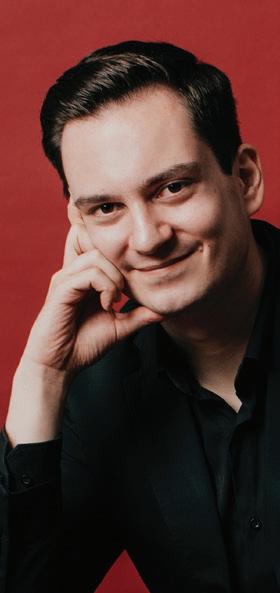
Iván López Reynoso possesses a musicianship and a solid temperament proved in numerous leading ensembles in Mexico, Spain, Switzerland, Germany, Peru, Oman, and Italy. His collaborations extend to some of the most renowned artists, such as Bryn Terfel, Brigitte Fassbaender, Ildar Abdrazakov, Javier Camarena, Rolando Villazón, Ute Lemper, Ramón Vargas, Irina Lungu, John Osborn, Alessandro Corbelli, Franz Hawlata, Paolo Bordogna, Augustin Hadelich, Michael Barenboim, Yulianna Avdeeva, Gabriela Montero, Leticia Moreno, and Alex Klein.
He has conducted the Philharmonia Zürich, National Orchestra and Chorus of Spain, Santa Fe Opera Orchestra, Milwaukee Symphony Orchestra, Filarmonica Gioachino Rossini, Navarra Symphony Orchestra, Madrid Symphony Orchestra, Royal Seville Symphony Orchestra, Braunschweig State Orchestra, Orchestra of the Community of Madrid, Oviedo Philharmonic, National Symphony Orchestra of Mexico, Orchestra and Chorus of Mexico’s Palacio de Bellas Artes, Minería Symphony Orchestra, Philharmonic Orchestra of the National Autonomous University of Mexico, and the Jalisco Philharmonic Orchestra in venues such as the Opernhaus Zürich, Deutsche Oper Berlin, Rossini Opera Festival, Donizetti Opera Festival, Santa Fe Opera’s Crosby Theatre, Dallas Opera’s Margot and Bill Winspear Opera House, Atlanta Opera’s Cobb Energy Performing Arts Centre, Seville’s Teatro de la Maestranza, Madrid’s Royal Theater, and the Royal Opera House Muscat.
A gifted opera conductor, López Reynoso made his opera debut in 2010 at the age of 20 with Le nozze di Figaro. This was only the first in a list of more than 50 operas: Aïda, Der fliegende Holländer, Carmen, La bohème, Die Zauberflöte, La clemenza di Tito, Don Giovanni, L’elisir d’amore, Madama Butterfly, La Cenerentola, Il turco in Italia, The Rake’s Progress, La traviata, Il barbiere di Siviglia, Rigoletto, Werther, Tosca, Don Carlos, Hänsel und Gretel, and the Mexican debuts of Le comte Ory, Il viaggio a Reims, and Viva la mamma.
López Reynoso was selected as the conductor for the 2014 Rossini Opera Festival Accademia, conducting Il viaggio a Reims as part of the festival program and working closely with the Rossini specialist Alberto Zedda. Previous positions include interim artistic director of the Aguascalientes Symphony Orchestra (2017), erster kapellmeister of the Braunschweig State Theatre (2017 – 2019), principal guest conductor of the Oviedo Philharmonic (2018 – 2024), associate conductor of the Philharmonic Orchestra of the National Autonomous University of Mexico (2020), and artistic director of the Orquesta del Teatro de Bellas Artes (2021 – 2024). In June 2025, he was appointed principal conductor of The Atlanta Opera.
Born in 1990 in Guanajuato, Mexico, López Reynoso studied violin under Gellya Dubrova, piano under Alexander Pashkov, and choral conducting under Jorge Medina, and he graduated summa cum laude in orchestral conducting under Gonzalo Romeu. He has since taken part in numerous master classes, including those led by Alberto Zedda, Jean Paul Penin, and Avi Ostrowsky. López Reynoso also sings as countertenor.
Guest Artist Biographies
JINWOO LEE
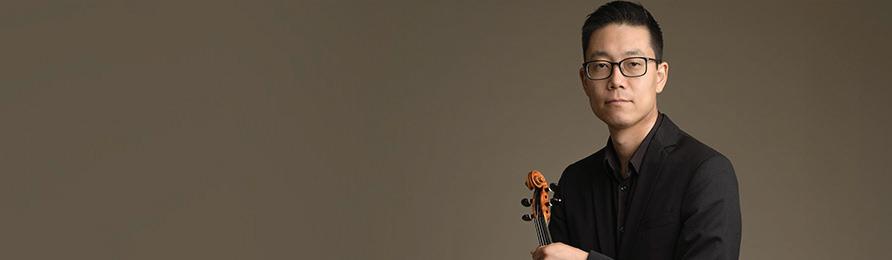
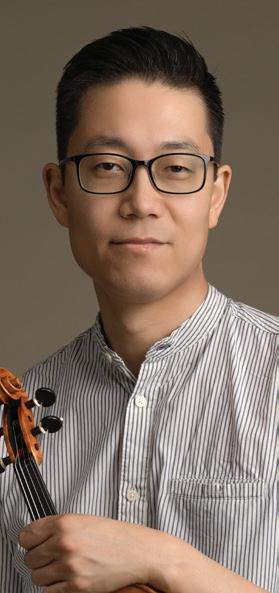
Jinwoo Lee, a native of South Korea, began playing the violin at the age of four. He is an international concert violinist with recitals and concerts with orchestras in the U.S., Korea, Germany, Switzerland, Slovenia, France, Italy, the Netherlands, and Austria, to name a few.
He has enjoyed success at several international competitions, including first prize at the Sorantin Competition in San Angelo, Texas; second and special prizes at the 20th International Rodolfo Lipizer Violin Competition in Gorizia, Italy; special prize at the International Georg Kulenkampff Violin Competition in Cologne, Germany; second prize, audience, and Bach prizes at the 33rd International Tibor Varga Violin Competition in Sion, Switzerland; first and special prizes at the second International Louis Spohr Violin Competition for young violinists in Weimar, Germany; and first prize at the National German Competition “Jugend Musiziert” in the solo violin and chamber music categories. He also won the Manhattan School of Music concerto competition and the Waldo Mayo Memorial Violin Competition.
He and his wife Eunice Kim, who have been enthusiastic duo partners for nearly two decades, formed the duo “Arco e Tasto” and were awarded the prize for Best Duo at the 20th International Violin and Piano Master Classes of the Music Academy of Lausanne, Switzerland.
Lee graduated from the Humboldt Grammar School in Cologne, Germany, in 2001. He studied with Stephen Clapp and Donald Weilerstein at The Juilliard School, where he received his bachelor’s degree in 2006. Two years later, Lee received his master’s degree from The Juilliard School under the tutelage of Robert and Nicholas Mann. He continued his studies with them at the Manhattan School of Music, where he received his Artist Diploma in 2009 and doctorate in 2016.
His former teachers include Michael Davis, Maria Giesy, Christiane Hutcap, Hyo Kang, Jongsuk Li, Igor Ozim, Jaegwang Song, and Viktor Tretjakov. He drew inspiration from master classes with Pierre Amoyal, Bruno Canino, Pamela Frank, Miriam Fried, Leonidas Kavakos, Masao Kawasaki, Herman Krebbers, Cho-Liang Lin, Martin Lovett, Yfrah Neaman, and Sylvia Rosenberg, all of whom strongly influenced him and shaped his musical ethos.
Lee was appointed concertmaster of the Milwaukee Symphony Orchestra in 2023; prior to that, he served as first concertmaster of the Neue Philharmonie Westfalen for a decade. Equally passionate about teaching, he was a violin faculty member at the Robert Schumann Musikhochschule in Düsseldorf from 2018 until 2022.
Program notes by David Jensen
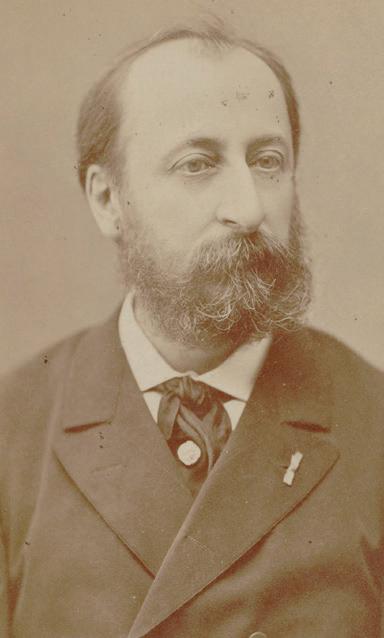
CAMILLE SAINT-SAËNS
Born 9 October 1835; Paris, France
Died 16 December 1921; Algiers, Algeria
Violin Concerto No. 3 in B minor, Opus 61
Composed: 1879 – 1880
First performance: 15 October 1880; Adolf Beer, conductor; Pablo de Sarasate, violin; Hamburg Philharmonic Orchestra
Last MSO performance: 6 October 2001; Pavel Kogan, conductor; Elmar Oliveira, violin
Enamored with the clearly defined musical conventions of the past, Camille Saint-Saëns distinguished himself as a virtuoso pianist with a gift for crafting pristine music as naturally, in his words, “as an apple tree produces apples.” Unfairly accused of lacking a distinctive personality by his detractors, who considered him an old-fashioned formalist, his work was dismissed as “la mauvaise musique bien écrite” — or “bad music written well.” Though indisputably orthodox in his artistic convictions, Saint-Saëns enjoyed a wonderfully successful career, composing within every major genre native to classical music with exceptional skill, and as an intellectual and an authority on early music, his was a musical mind equaled only by the scholarly class.
By the time he was writing his third violin concerto, Saint-Saëns was an old hand at turning out showpieces for the instrument. He had already produced two concerti, written during the last years of the 1850s, and the Introduction et Rondo capriccioso, each demonstrating the brilliant technical finesse and musical poise that had become hallmarks of his concertante style. Since 1859, Saint-Saëns had been inspired by one history’s greatest fiddlers: as the story goes, a young Spaniard by the name of Pablo de Sarasate simply showed up unannounced at his front door and requested a concerto from him as though it were the most ordinary thing in the world.
Born in Pamplona, Sarasate’s prodigious abilities earned him a place at the Paris Conservatoire at just 12 years old. As a teenager, he had already established his career as a soloist, and he spent his adult life touring the world and performing both his own virtuoso compositions and those of composers enamored with his sound: Bruch, Lalo, and Wieniawski each dedicated some of the greatest literature in the violin repertoire to him. Accounts of Sarasate’s playing describe his clarity of tone, warm, wide vibrato, and technical perfection; the Hungarian violinist Carl Flesch described him as “a completely new type of violinist” whose flawless intonation and physical ease in even the most demanding bravura passages astonished his audiences.
Saint-Saëns’s third violin concerto balances the ideals of melodic intrigue, drama, and structural precision, centering the violinist in the heart of the action while containing the heightened emotional charge of the music within a sensitively refined style. Bristling with the hush of tremolo strings, a brazen opening statement from the soloist magnifies a musical tension soon intensified by a dazzling series of runs and double-stops. A florid middle movement places the violin in dialogue with the orchestra as winds and strings echo the motivic fragments introduced by the soloist, ultimately coming to rest in a delicate sequence of harmonics in the closing bars. Evoking the sizzling virtuosity of Sarasate’s playing, the finale’s dotted rhythms and whirlwind triplets emulate the incisive rhythms of the tarantella, urging the music on to its exhilarating conclusion.
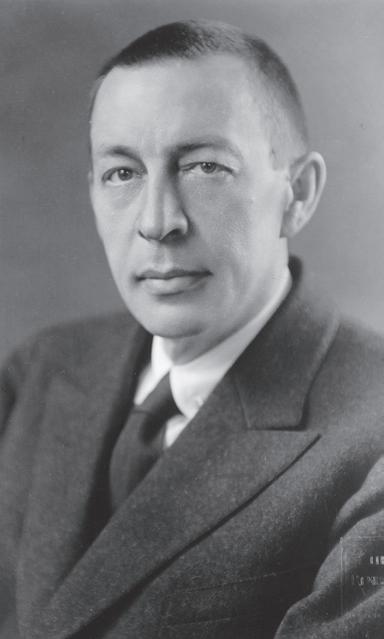
SERGEI RACHMANINOFF
Born 1 April 1873; Semyonovo, Russia
Died 28 March 1943, Beverly Hills, California
Symphony No. 2 in E minor, Opus 27
Composed: October 1906 – April 1907
First performance: 26 January 1908; Sergei Rachmaninoff, conductor; Russian Symphony Orchestra Society
Last MSO performance: 1 February 2020; Edo de Waart, conductor
When Sergei Rachmaninoff began drafting his first symphony in 1895, he had no reason to expect anything but success. As a teenager, he had already completed his first piano concerto, several works of chamber music, and his one-act opera, Aleko, composed as a graduation exercise for the Moscow Conservatory. How much greater the shock must have been, then, when its premiere proved to be an utter disaster. Under-rehearsed, formally difficult, and led by the dilettante conductor Alexander Glazunov (who, according to eyewitness accounts, was almost certainly drunk on the podium), the composer César Cui, in an especially scathing review, condemned it as “a program symphony on the Ten Plagues of Egypt,” and its dismal reception pitched Rachmaninoff into the depths of despair.
Rachmaninoff composed next to nothing for three years, describing himself in a letter 20 years later as “a man who had suffered a stroke and for a long time had lost use of his head and hands.” He took up conducting the Moscow Private Russian Opera for a season, discovering a new avenue of musical expression, gave his London debut, and even met the novelist Leo Tolstoy in the hopes it might alleviate his psychological distress, though not even one of Russia’s greatest literary minds could induce him to take up his pen. Despondent, he agreed to his family’s suggestion that he seek medical treatment, and during the early months of 1900, he underwent daily hypnotherapy at the hands of Dr. Nikolai Dahl.
By the summer, Rachmaninoff reported that “new musical ideas began to stir within me” as he began sketching the outlines of his second piano concerto. His health and confidence were soon restored, and the next several years were witness to Rachmaninoff’s ascent to the realm of genius — his second concerto, dedicated to Dahl, was an immediate triumph, he completed his cello sonata, a suite for two pianos, and ten preludes, and even conducted at the Bolshoi Theatre for two seasons, where his operas The Miserly Knight and Francesca da Rimini enjoyed successful premieres. Escaping the political instability of the Russian Revolution of 1905, he relocated to Dresden to concentrate on his work as a composer, arriving at the fullest expression of his intensely emotive style.
Rachmaninoff’s second symphony is the apotheosis of the paradigm he had been cultivating since his recovery — its ideas are extravagantly realized, woven into a luscious orchestral medium and expounded in a robust, immediately felt harmonic language. Its melodies seem to unspool continuously, taking up as much temporal space as necessary to effectively render their meaning. Consider the opening movement: its slow introduction occupies a quarter of its length as it presents the potent thematic material that saturates the music. The scherzo begins with a quotation of the Dies irae in the brass, its frantic energy soon dissolving into a finely wrought lyrical theme and, later on, a sudden episode of fugal discourse. The sprawling, heartfelt lines of the adagio have earned it a place as one of Rachmaninoff’s most popular musical moments, while the finale, an absolute juggernaut of sonic jubilation, gathers up the themes of the proceeding movements and transforms them into an explosive tour-de-force of symphonic might.
Congratulations to our Milwaukee Symphony Orchestra Retiree
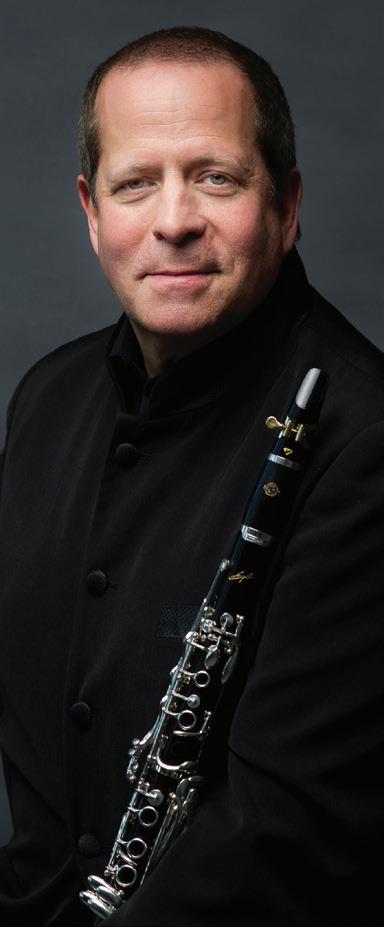
TODD LEVY
Principal Clarinet
Franklyn Esenberg Principal Clarinet Chair Joined the MSO in 2000
Principal clarinet of the Milwaukee Symphony Orchestra and the Santa Fe Opera Orchestra and participant in the Santa Fe Chamber Music Festival, fourtime Grammy Award-winner Todd Levy has performed as a soloist at Carnegie Hall, Mostly Mozart, with the Israel Philharmonic, and at the White House, among many other venues. An active chamber musician, Levy has appeared with members of the Guarneri, Juilliard, Orion, Ying, Miro, and Miami string quartets, and with James Levine, Christoph Eschenbach, and Mitsuko Uchida. He has also been a participant at the Marlboro Music Festival for four summers and was a member of the Naumburg Award-winning Aspen Wind Quintet.
In demand as guest principal clarinet with the top American orchestras, Levy has played principal clarinet with the Chicago Symphony Orchestra, Philadelphia Orchestra, New York Philharmonic, Metropolitan Opera, and frequently for Seiji Ozawa and Riccardo Muti in Japan with Tokyo Opera Nomori and the Mito Chamber Orchestra. An avid supporter of new music, he has performed world premieres of concerti and chamber works by composers such as John Harbison, Joan Tower, Peter Schickele, Paquito D’Rivera, Morton Subotnick, Magnus Lindberg, Marc Neikrug, and Outi Tarkiainen. He performs on the new release of Marc Neikrug’s Through Roses with violinist Pinchas Zukerman, actor John Rubenstein, and the composer conducting.
Levy’s new CD for Avie, Rhapsodie, features 20th-century classics for clarinet. He has also recorded the Brahms clarinet sonatas and Schumann’s romances and Fantasiestücke for Avie, as well as three educational CDs of clarinet competition works entitled The Clarinet Collection for G. Schirmer and Hal Leonard. In 2021, he compiled a book of French repertoire for publisher Alphonse Leduc called French Music for Clarinet. Levy has recorded and edited the new exclusive editions and CDs of the Bernstein clarinet sonata and Gerald Finzi’s five bagatelles for Boosey and Hawkes, in addition to more than 20 other orchestral and chamber music CDs on the Deutsche Grammophon, Sony, and Decca labels. He performs on Vandoren reeds, mouthpieces, and ligatures and Selmer Signature clarinets. Levy serves on the clarinet faculty at the Bienen School of Music at Northwestern University and at UW-Milwaukee. He is a graduate of The Juilliard School and an alumnus of the New World Symphony.
2025.26 SEASON
KEN-DAVID MASUR
Music Director
Polly and Bill Van Dyke Music Director Chair
EDO DE WAART
Music Director Laureate
BYRON STRIPLING
Principal Pops Conductor
Stein Family Foundation Principal Pops Conductor Chair
RYAN TANI
Associate Conductor
CHERYL FRAZES HILL
Chorus Director
Margaret Hawkins Chorus Director Chair
TIMOTHY J. BENSON
Assistant Chorus Director
FIRST VIOLINS
Jinwoo Lee, Concertmaster, Charles and Marie Caestecker Concertmaster Chair
Ilana Setapen, First Associate Concertmaster, Thora M. Vervoren First Associate Concertmaster Chair
Jeanyi Kim, Associate Concertmaster
Alexander Ayers
Autumn Chodorowski
Yuka Kadota
Elliot Lee
Dylana Leung
Kyung Ah Oh
Lijia Phang
Vinícius Sant’Ana**
Yuanhui Fiona Zheng
SECOND VIOLINS
Jennifer Startt, Principal, Andrea and Woodrow Leung Principal Second Violin Chair
Ji-Yeon Lee, Assistant Principal (2nd chair)
Hyewon Kim, Acting Assistant Principal (3rd chair)
Heejeon Ahn
Lisa Johnson Fuller
Clay Hancock
Paul Hauer
Sheena Lan**
Janis Sakai**
Yiran Yao
VIOLAS
Victor de Almeida, Principal, Richard O. and Judith A. Wagner Family Principal Viola Chair
Samantha Rodriguez, Acting Assistant Principal (2nd chair), Friends of Janet F. Ruggeri Assistant Principal Viola Chair
Alejandro Duque, Acting Assistant Principal (3rd chair)
Elizabeth Breslin
Georgi Dimitrov
Nathan Hackett
Michael Lieberman**
Erin H. Pipal
CELLOS
Susan Babini, Principal, Dorothea C. Mayer Principal Cello Chair
Shinae Ra, Assistant Principal (2nd chair)
Scott Tisdel, Associate Principal Emeritus
Madeleine Kabat
Peter Szczepanek
Peter J. Thomas
Adrien Zitoun
BASSES
Principal, Donald B. Abert Principal Bass Chair
Andrew Raciti, Acting Principal
Nash Tomey, Acting Assistant Principal (2nd chair)
Brittany Conrad
Broner McCoy
Paris Myers
HARP
Julia Coronelli, Principal, Walter Schroeder Principal Harp Chair
FLUTES
Sonora Slocum, Principal, Margaret and Roy Butter Principal Flute Chair
Heather Zinninger, Assistant Principal
Jennifer Bouton Schaub
PICCOLO
Jennifer Bouton Schaub
OBOES
Katherine Young Steele, Principal, Milwaukee Symphony Orchestra League Principal Oboe Chair
Kevin Pearl, Assistant Principal
Margaret Butler
ENGLISH HORN
Margaret Butler, Philip and Beatrice Blank English Horn Chair in memoriam to John Martin
CLARINETS
Todd Levy, Principal, Franklyn Esenberg Principal Clarinet Chair
Jay Shankar, Assistant Principal, Donald and Ruth P. Taylor Assistant Principal Clarinet Chair
Besnik Abrashi
E-FLAT CLARINET
Jay Shankar
BASS CLARINET
Besnik Abrashi
BASSOONS
Catherine Van Handel, Principal, Muriel C. and John D. Silbar Family Principal Bassoon Chair*
Rudi Heinrich, Acting Principal
Matthew Melillo
CONTRABASSOON
Matthew Melillo
HORNS
Matthew Annin, Principal, Krause Family Principal
French Horn Chair
Krystof Pipal, Associate Principal
Dietrich Hemann, Andy Nunemaker French Horn Chair
Darcy Hamlin
Dawson Hartman
TRUMPETS
Matthew Ernst, Principal, Walter L. Robb Family Principal Trumpet Chair
David Cohen, Associate Principal, Martin J. Krebs Associate Principal Trumpet Chair
Tim McCarthy, Fred Fuller Trumpet Chair
TROMBONES
Megumi Kanda, Principal, Marjorie Tiefenthaler Principal Trombone Chair
Kirk Ferguson, Assistant Principal
BASS TROMBONE
John Thevenet, Richard M. Kimball Bass Trombone Chair
TUBA
Robyn Black, Principal, John and Judith Simonitsch Principal Tuba Chair
TIMPANI
Dean Borghesani, Principal
Chris Riggs, Assistant Principal
PERCUSSION
Robert Klieger, Principal
Chris Riggs
PIANO
Melitta S. Pick Endowed Piano Chair
PERSONNEL
Antonio Padilla Denis, Director of Orchestra Personnel
Paris Myers, Assistant Manager of Orchestra Personnel
LIBRARIANS
Paul Beck, Principal Librarian, James E. Van Ess Principal Librarian Chair
Matthew Geise, Assistant Librarian & Media Archivist
PRODUCTION
Tristan Wallace, Production Manager/Live Audio
Lisa Sottile, Production Stage Manager
* Leave of absence during the 2025.26 season
** Acting member of the MSO for the 2025.26 season