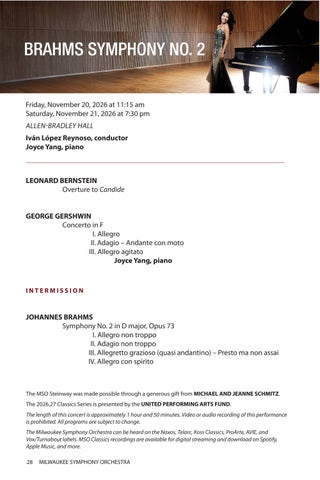
BRAHMS SYMPHONY NO. 2 Friday, November 20, 2026 at 11:15 am Saturday, November 21, 2026 at 7:30 pm ALLEN-BRADLEY HALL Iván López Reynoso, conductor Joyce Yang, piano
LEONARD BERNSTEIN Overture to Candide GEORGE GERSHWIN Concerto in F I. Allegro II. Adagio – Andante con moto III. Allegro agitato Joyce Yang, piano
INTERMISSION
JOHANNES BRAHMS Symphony No. 2 in D major, Opus 73 I. Allegro non troppo II. Adagio non troppo III. Allegretto grazioso (quasi andantino) – Presto ma non assai IV. Allegro con spirito
The MSO Steinway was made possible through a generous gift from MICHAEL AND JEANNE SCHMITZ. The 2026.27 Classics Series is presented by the UNITED PERFORMING ARTS FUND. The length of this concert is approximately 1 hour and 50 minutes. Video or audio recording of this performance is prohibited. All programs are subject to change. The Milwaukee Symphony Orchestra can be heard on the Naxos, Telarc, Koss Classics, ProArte, AVIE, and Vox/Turnabout labels. MSO Classics recordings are available for digital streaming and download on Spotify, Apple Music, and more. 28
MILWAUKEE SYMPHONY ORCHESTRA
Guest Artist Biographies IVÁN LÓPEZ REYNOSO
Photo by Jesús Cornejo
Iván López Reynoso possesses a musicianship and a solid temperament proved in numerous leading ensembles in Mexico, Spain, Switzerland, Germany, Austria, Japan, and Italy. His collaborations extend to some of the most celebrated artists, such as Bryn Terfel, Brigitte Fassbaender, Lise Davidsen, Ildar Abdrazakov, Juan Diego Flórez, Angela Meade, Ramón Vargas, John Osborn, Alessandro Corbelli, Franz Hawlata, Paolo Bordogna, Augustin Hadelich, Michael Barenboim, Yulianna Avdeeva, Gabriela Montero, and Leticia Moreno.
He has conducted the Philharmonia Zurich, National Symphony Orchestra and Chorus of Spain, Santa Fe Opera Orchestra, Milwaukee Symphony Orchestra, Bologna Municipal Theater Orchestra, Madrid Symphony Orchestra, Royal Seville Symphony Orchestra, Brunswick State Orchestra, Oviedo Philharmonic, and Mexico’s major ensembles in venues such as the Zurich Opera House, Deutsche Oper Berlin, Santa Fe Opera, Royal Theater of Madrid, The Dallas Opera’s Margot and Bill Winspear Opera House, The Atlanta Opera’s Cobb Energy Performing Arts Centre, Rossini Opera Festival, Donizetti Opera Festival, Savonlinna Opera Festival, and Seville’s Teatro de la Maestranza. A gifted opera conductor, López Reynoso made his opera debut in 2010 at the age of 20 with Le nozze di Figaro. This was only the first of a list of more than 60 operas: Aïda, The Flying Dutchman, Carmen, La bohème, Turandot, The Magic Flute, La clemenza di Tito, Don Giovanni, L’elisir d’amore, Madama Butterfly, La Cenerentola, Il turco in Italia, The Rake’s Progress, La traviata, The Barber of Seville, Rigoletto, Werther, Tosca, Don Carlos, Hansel and Gretel, and the debut in Mexico of Rossini’s Le comte Ory and Il viaggio a Reims and Donizetti’s Viva la mamma. López Reynoso was selected as the conductor for the 2014 Rossini Opera Festival Accademia, conducting Il viaggio a Reims as part of the festival program and working closely with the Rossini specialist Alberto Zedda. Previous positions include interim artistic director of the Aguascalientes Symphony Orchestra (2017), erster kapellmeister of the Brunswick State Theater (2017 – 2019), principal guest conductor of the Oviedo Philharmonic (2018 – 2024), associate conductor of the Philharmonic Orchestra of the National Autonomous University of Mexico (2020), and artistic director of the Teatro de Bellas Artes Orchestra (2021 – 2024). Since June 2025, he has served as principal conductor of The Atlanta Opera, and in May 2026, he was appointed principal conductor of the Santa Fe Opera beginning in 2027. Born in 1990 in Guanajuato, Mexico, López Reynoso studied violin under Gellya Dubrova, piano under Alexander Pashkov, and choral conducting under Jorge Medina, and he graduated summa cum laude in orchestral conducting under Gonzalo Romeu. He has since taken part in numerous master classes, including those led by Alberto Zedda, Jean Paul Penin, and Avi Ostrowsky. López Reynoso also sings as countertenor.
MILWAUKEE SYMPHONY ORCHESTRA
29
Guest Artist Biographies JOYCE YANG
Photo by KT Kim
30
Grammy-nominated pianist Joyce Yang captivates audiences with her virtuosity, lyricism, and interpretive sensitivity. After winning the silver medal at the 12th Van Cliburn International Piano Competition at just 19, Yang has showcased her colorful musical personality in solo recitals and collaborations with the world’s top orchestras in more than 1,000 debuts and re-engagements. Yang has released 10 studio albums, including kaleidoscopic solo discs, chamber music repertoire with Augustin Hadelich and the Alexander String Quartet, and concerto recordings ranging from Tchaikovsky to Torke. As a champion of new music, Yang has premiered four different piano concertos. She served as the guest artistic director for the Laguna Beach Music Festival, curating concerts that explore the “artinspires-art” concept. Yang’s collaboration with choreographer Jorma Elo for the Aspen Santa Fe Ballet was a marriage between music and dance, illuminating the ingenuity of Schumann’s musical language. Born in Seoul, South Korea, Yang received her first piano lesson from her aunt at the age of four. Yang moved to the U.S. at age 11 to begin studies at the pre-college division of The Juilliard School with Yoheved Kaplinsky. She graduated from Juilliard as the recipient of 2010 Arthur Rubinstein Prize and received the Avery Fisher Career Grant in the same year. She is a Steinway artist.
MILWAUKEE SYMPHONY ORCHESTRA
Program notes by David Jensen LEONARD BERNSTEIN Born 25 August 1918; Lawrence, Massachusetts Died 14 October 1990; New York City, New York
Overture to Candide
Composed: 1956 First performance: 26 January 1957; Leonard Bernstein, conductor; New York Philharmonic Last MSO performance: 17 September 2017; Cristian Măcelaru, conductor Instrumentation: piccolo; 2 flutes; 2 oboes; 2 clarinets (2nd doubling on E-flat clarinet); bass clarinet; 2 bassoons; contrabassoon; 4 horns; 2 trumpets; 3 trombones; tuba; timpani; percussion (bass drum, cymbals, glockenspiel, snare drum, tenor drum, triangle, xylophone); harp; strings Approximate duration: 5 minutes Beloved as one of those rare talents that inhabited the spheres of classical and theatrical music with equally inimitable success, it’s surprising that Leonard Bernstein’s Candide had as much trouble as it did in entering the repertoire. Adapted from Voltaire’s novella of the same name, it was envisioned, according to composer Jack Gottlieb (Bernstein’s assistant at the New York Philharmonic), as an “operetta in the vein of Offenbach and Gilbert and Sullivan,” but there were problems from the jump. Director Tyrone Guthrie found its libretto, adapted by playwright Lillian Hellman, too obviously critical of the House Un-American Activities Committee, and he abandoned the overtly political material. The first production, staged in 1956, was a commercial flop, closing after just two months on Broadway. Following a revival in 1973, countless revisions, and new lyrics from half a dozen writers (ranging from Dorothy Parker to Stephen Sondheim), Hellman withdrew her book, embittered by the experience of writing for the stage. Hugh Wheeler thereafter prepared what now serves as the main text, though it took Bernstein over 30 years to arrive at his final word on the subject. In 1988, conductor John Mauceri and satirist John Wells collaborated on a production for the Scottish Opera, which became the basis of Bernstein’s “final revised version.” Premiering a year later at the Barbican Centre, his finishing touches secured Candide a lasting foothold in popular culture. Like Voltaire’s absurdist intellectual tract — essentially an extended critique of Gottfried Wilhelm Leibniz’s philosophical position of optimism — Bernstein’s dramatization follows the surreal trials of the doe-eyed Candide and his love interest, Cunegonde. Ignorant of the ways of the world, he’s forcibly ejected from the sheltered paradise of his upbringing, now subject to the whims of fate and left to make sense of the visceral reality of human suffering on his own. Rather than draw any specific conclusions about humanity’s fate, ultimate truth, or the question of God’s benevolence in an otherwise violent world, Candide and Cunegonde eventually retire to a farm near Venice, where the simple work of cultivating their garden occupies the rest of their days. The production’s whimsical overture is still one of the most frequently performed in the canon, at once flawlessly proportioned, classically inflected, and bitingly modern. Honoring the tradition established by opera’s greatest authors, Bernstein’s gathers up the best and brightest tunes from his comedy in a carnivalesque tour de force: devised as a miniature sonata form, the rollicking strains of “The Best of All Possible Worlds” and the bombastic “Battle Music” are exquisitely contrasted by the saccharine duet “Oh, Happy We.” A spritely codetta mimicking the chittering laughter of Cunegonde’s iconic coloratura aria, “Glitter and Be Gay,” drives the music to its capricious end. MILWAUKEE SYMPHONY ORCHESTRA
31
GEORGE GERSHWIN Born 26 September 1898; New York City, New York Died 11 July 1937; Los Angeles, California
Concerto in F
Composed: May – 10 November 1925 First performance: 3 December 1925; Walter Damrosch, conductor; George Gershwin, piano; New York Symphony Orchestra Last MSO performance: 9 October 2022; Ken-David Masur, conductor; Aaron Diehl, piano Instrumentation: piccolo; 2 flutes; 2 oboes; English horn; 2 clarinets; bass clarinet; 2 bassoons; 4 horns; 3 trumpets; 3 trombones; tuba; timpani; percussion (bass drum, bells, crash cymbals, glockenspiel, gong, snare drum, suspended cymbal, triangle, whip, woodblock, xylophone); strings Approximate duration: 32 minutes George Gershwin’s life was a textbook rags-to-riches story. Born to Jewish immigrants fleeing Russia at the end of the 19th century, he grew up in tenement housing on Manhattan’s lower east side, discovered his knack for playing piano as a young boy, and dropped out of school at 15 to start plugging tunes for Tin Pan Alley, publishing his first song just two years later. He began writing for Broadway, quickly developing a reputation as the hottest songwriter of the day while simultaneously broadening his studies in harmony, aspiring to endow jazz and popular music with the same credibility as the classical fare he’d been exposed to in the course of his patchwork education. The opportunity to do just that presented itself in 1924, when the premiere of his Rhapsody in Blue heralded the arrival of a bold new voice in modern music — despite the fact that bandleader Paul Whiteman’s arranger, Ferde Grofé, had carried out its orchestration. In attendance at that concert was Walter Damrosch, music director of the New York Symphony Orchestra; enraptured by Gershwin’s groundbreaking incorporation of the jazz dialect into a concertante medium, he immediately commissioned a piano concerto from the young composer. While Damrosch suggested a few revisions during rehearsals, Gershwin saw to every detail of its instrumentation himself, and opening night was a knockout. “There would not have been as much excitement if Brahms had come to town,” wrote Olin Downes in The New York Times, “although Brahms also wrote piano concertos. But then, he did not employ ‘jazz.’” Indisputably the most popular American example of the genre, the Concerto in F (dubbed his “New York Concerto” in its earliest drafts) is quintessential Gershwin, alive with the syncopated rhythms, “blue” harmonies, and infectious melodies typical of his Broadway hits. A free adaptation of sonata form, the opening movement is charged with the trademark Charleston rhythm. “It is quick and pulsating,” Gershwin explained, “representing the young, enthusiastic spirit of American life.” The songful inner movement “has a poetic, nocturnal atmosphere which has come to be referred to as the American blues,” and the rondo-form finale, which juxtaposes a virtuoso toccata motif against thematic material from the first two movements, “is an orgy of rhythms, starting violently and keeping the same pace throughout.” As praise of the music itself, the flowery prose Damrosch fed the press ahead of its premiere (no doubt a savvy bit of marketing) remains unmatched: “Lady Jazz, adorned with her intriguing themes, has danced her way around the world … she has encountered no knight who would lift her to a level that would enable her to be received as a respectable member in musical circles. George Gershwin seems to have at last accomplished this miracle. He has done it by boldly dressing this extremely independent young lady in the classical garb of a concerto. He is the prince who has taken Cinderella by the hand and openly proclaimed her a princess to the astonished world — no doubt to the fury of her envious sisters.” 32
MILWAUKEE SYMPHONY ORCHESTRA
JOHANNES BRAHMS Born 7 May 1833; Hamburg, Germany Died 3 April 1897; Vienna, Austria
Symphony No. 2 in D major, Opus 73
Composed: Summer 1877 First performance: 30 December 1877; Hans Richter, conductor; Vienna Philharmonic Last MSO performance: 16 September 2018; Ken-David Masur, conductor Instrumentation: 2 flutes; 2 oboes; 2 clarinets; 2 bassoons; 4 horns; 2 trumpets; 3 trombones; tuba; timpani; strings Approximate duration: 45 minutes Audiences everywhere can be forever thankful to Johannes Brahms for taking a holiday, for it was during the three consecutive summers he spent in the lakeside resort town of Pörtschach from 1877 to 1879 that he composed some of his most inspired work. Retiring to the shores of the Wörthersee, where Gustav Mahler later established his second “composing hut,” Brahms indulged in “warm water bathing” — au naturel, no less — and “Austrian warmth, called Gemütlichkeit,” devoting his mornings to working out such glorious music as the first of his three violin sonatas, his sublime concerto for the same instrument, a number of klavierstücke for solo piano, and the unusually optimistic (at least for Brahms) second symphony. Brahms had been haunted by the burden of composing a symphony in Beethoven’s wake, spending decades laboring over the first of the four he completed. But as if the metaphorical dam had burst, Brahms’s second attempt at the venerated tradition emerged, fully formed, within a matter of months. As though reporting the sunny details of his summer idyll back to his adopted home of Vienna, it stands out rather conspicuously as the merriest of the quartet. “The new symphony is so melancholy that you will not be able to bear it,” he sarcastically informed his publisher, Fritz Simrock, in the autumn of 1877. “I have never written anything so sad, so steeped in the minor key; the score ought to be published with a black mourning border.” But flickers of darkness occasionally bubble up to the score’s surface, a fact noted by the conductor Vincenz Lachner, who took umbrage with the ominous rumblings heard in the opening movement. “I would have to admit,” Brahms replied, “that I am a deeply melancholy person, that black wings constantly rustle over us, that in my works … this symphony is followed by a small essay on the great ‘Why.’ … It throws the necessary sharp shadows across the lighthearted symphony and perhaps explains those trombones and kettledrums.” That “essay,” the motet Warum ist das Licht gegeben dem Mühseligen, was composed during the same summer and asks the question posed by the title character in the Book of Job: “Why is light given to the weary and life to the troubled in heart?” Despite the brooding introspection, Brahms’s music frequently betrays a certain tenderness toward life. Pouring his handsomely crafted themes, robust harmonies, and sensitive instrumental shadings into classical molds, he commences with a gentle tune in the low strings, horns, and woodwinds. This is soon contrasted by a breathtaking rendition of his famous “lullaby,” sounded by the violas and cellos, and he develops these two ideas with an unusually organic ease throughout the first movement. The ensuing adagio reveals his affection for the inner voices of the orchestra, whose sophisticated contrapuntal interlacings coalesce in music of profound emotional bearing. A breezy minuet, occasionally interrupted by a churlish outburst of contrasting material, prepares us for the finale, an undeniable triumph of the spirit and one of Brahms’s greatest testaments to our capacity for joy.
MILWAUKEE SYMPHONY ORCHESTRA
33
Georgi Dimitrov Nathan Hackett Michael Lieberman** Erin H. Pipal CELLOS Susan Babini, Principal, 2026.27 SEASON Dorothea C. Mayer Principal Cello Chair Shinae Ra, Assistant Principal (2nd chair) Scott Tisdel, Associate Principal Emeritus MUSIC DIRECTOR Polly and Bill Van Dyke Music Director Chair Esther Chae Madeleine Kabat BYRON STRIPLING Peter Szczepanek Principal Pops Conductor Peter J. Thomas* Stein Family Foundation Principal Pops Adrien Zitoun Conductor Chair BASSES RYAN TANI Principal, Donald B. Abert Associate Conductor Principal Bass Chair Andrew Raciti, Acting Principal CHERYL FRAZES HILL Nash Tomey, Assistant Principal Chorus Director (3rd chair)* Margaret Hawkins Chorus Director Chair Brittany Conrad TIMOTHY J. BENSON Nicholas De Laurentis** Assistant Chorus Director Broner McCoy Paris Myers FIRST VIOLINS Jinwoo Lee, Concertmaster, HARP Charles and Marie Caestecker Julia Coronelli, Principal, Concertmaster Chair Walter Schroeder Principal Harp Chair Ilana Setapen, First Associate FLUTES Concertmaster, Thora M. Vervoren Sonora Slocum, Principal, First Associate Concertmaster Chair Margaret and Roy Butter Jeanyi Kim, Associate Concertmaster Principal Flute Chair Alexander Ayers Heather Zinninger, Assistant Principal Autumn Chodorowski Jennifer Bouton Schaub Yuka Kadota Chihiro Kakishima Elliot Lee Dylana Leung Kyung Ah Oh Lijia Phang Yuanhui Fiona Zheng SECOND VIOLINS Jennifer Startt, Principal, Andrea and Woodrow Leung Principal Second Violin Chair Ji-Yeon Lee, Assistant Principal (2nd chair) Shannon Fitzhenry, Assistant Principal (3rd chair) Heejeon Ahn Lisa Johnson Fuller Clay Hancock Paul Hauer Hyewon Kim Vinícius Sant’Ana** Yiran Yao VIOLAS Principal, Richard O. and Judith A. Wagner Family Principal Viola Chair Kunjing Dai, Acting Principal, Friends of Janet F. Ruggeri Assistant Principal Viola Chair Samantha Rodriguez, Acting Assistant Principal (2nd chair) Alejandro Duque, Acting Assistant Principal (3rd chair) Elizabeth Breslin
PICCOLO Jennifer Bouton Schaub OBOES Katherine Young Steele, Principal, Milwaukee Symphony Orchestra League Principal Oboe Chair Kevin Pearl, Assistant Principal Margaret Butler ENGLISH HORN Margaret Butler, Philip and Beatrice Blank English Horn Chair in memoriam to John Martin CLARINETS Principal, Franklyn Esenberg Principal Clarinet Chair Jay Shankar, Acting Principal, Donald and Ruth P. Taylor Assistant Principal Clarinet Chair Besnik Abrashi, Acting Assistant Principal Max Reese** E-FLAT CLARINET Max Reese** BASS CLARINET Besnik Abrashi BASSOONS Catherine Van Handel, Principal, Muriel C. and John D. Silbar Family Principal Bassoon Chair* Rudi Heinrich, Acting Principal
Matthew Melillo, Acting Assistant Principal Laressa Winters** CONTRABASSOON Matthew Melillo HORNS Matthew Annin, Principal, Krause Family Principal French Horn Chair Krystof Pipal, Associate Principal Dietrich Hemann, Andy Nunemaker French Horn Chair Darcy Hamlin Dawson Hartman TRUMPETS Matthew Ernst, Principal, Walter L. Robb Family Principal Trumpet Chair David Cohen, Associate Principal, Martin J. Krebs Associate Principal Trumpet Chair Tim McCarthy, Fred Fuller Trumpet Chair TROMBONES Megumi Kanda, Principal, Marjorie Tiefenthaler Principal Trombone Chair Kirk Ferguson, Assistant Principal BASS TROMBONE John Thevenet, Richard M. Kimball Bass Trombone Chair TUBA Robyn Black, Principal, John and Judith Simonitsch Principal Tuba Chair TIMPANI Dean Borghesani, Principal Chris Riggs, Assistant Principal PERCUSSION Robert Klieger, Principal Chris Riggs PIANO Melitta S. Pick Endowed Piano Chair PERSONNEL Antonio Padilla Denis, Director of Orchestra Personnel Paris Myers, Assistant Manager of Orchestra Personnel LIBRARIANS Paul Beck, Principal Librarian, James E. Van Ess Principal Librarian Chair Matthew Geise, Assistant Librarian & Media Archivist PRODUCTION Tristan Wallace, Production Manager/Live Audio Lisa Sottile, Production Stage Manager * Leave of absence during the 2026.27 season ** Acting member of the MSO for the 2026.27 season