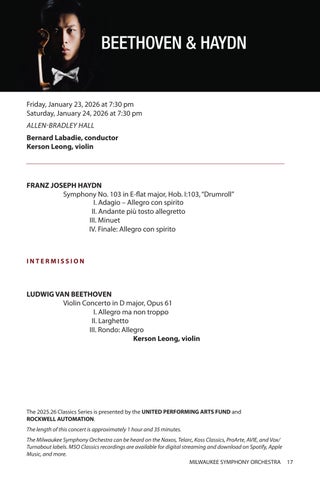
BEETHOVEN & HAYDN
Friday, January 23, 2026 at 7:30 pm Saturday, January 24, 2026 at 7:30 pm ALLEN-BRADLEY HALL Bernard Labadie, conductor Kerson Leong, violin
FRANZ JOSEPH HAYDN Symphony No. 103 in E-flat major, Hob. I:103, “Drumroll” I. Adagio – Allegro con spirito II. Andante più tosto allegretto III. Minuet IV. Finale: Allegro con spirito
INTERMISSION
LUDWIG VAN BEETHOVEN Violin Concerto in D major, Opus 61 I. Allegro ma non troppo II. Larghetto III. Rondo: Allegro Kerson Leong, violin
The 2025.26 Classics Series is presented by the UNITED PERFORMING ARTS FUND and ROCKWELL AUTOMATION. The length of this concert is approximately 1 hour and 35 minutes. The Milwaukee Symphony Orchestra can be heard on the Naxos, Telarc, Koss Classics, ProArte, AVIE, and Vox/ Turnabout labels. MSO Classics recordings are available for digital streaming and download on Spotify, Apple Music, and more. MILWAUKEE SYMPHONY ORCHESTRA 17
Guest Artist Biographies BERNARD LABADIE Bernard Labadie is internationally recognized as one of the foremost conductors of the Baroque and Classical repertoire. He founded Les Violons du Roy in 1984 and served as their music director for 20 years. He is also the founding conductor and music director of La Chapelle de Québec. With these ensembles, he has toured extensively to major venues, including Carnegie Hall, Walt Disney Concert Hall, the Kennedy Center, the Concertgebouw, and the Barbican Centre, and has appeared at the Salzburg Whitsun Festival. Labadie was principal conductor of the Orchestra of St. Luke’s in New York from 2017 – 2025. Recent and upcoming guest appearances include the Canadian Opera Company, Cleveland Orchestra, San Francisco Symphony, Orchestre Symphonique de Montréal, Mozarteumorchester Salzburg, Boston Baroque, NDR Radiophilharmonie, National Symphony Orchestra, Orchestre National de Lyon, National Arts Centre Orchestra, and Chicago Symphony Orchestra. In North America, Labadie has conducted the Philadelphia Orchestra, New York Philharmonic, Los Angeles Philharmonic, New World Symphony, and the symphony orchestras of Boston, St. Louis, and Pittsburgh, among others. Internationally, he has led performances with the Royal Concertgebouw Orchestra, Symphonieorchester des Bayerischen Rundfunks, Academy of Ancient Music, The English Concert, Orchestra of the Age of Enlightenment, Royal Scottish National Orchestra, Scottish Chamber Orchestra, Melbourne Symphony Orchestra, Finnish Radio Symphony Orchestra, WDR Sinfonieorchester Köln, and hr-Sinfonieorchester. Labadie’s discography includes several award-winning recordings on the Dorian, ATMA Classique, Warner Classics and Erato Records, and Hyperion labels. Highlights include Handel’s Apollo e Dafne and Mozart’s Requiem with Les Violons du Roy and La Chapelle de Québec, both of which received Canada’s Juno Award. In recognition of his artistic achievements, Labadie has been named an Officer of the Order of Canada, a Chevalier de l’Ordre national du Québec, and a Chevalier des Arts et Lettres du Québec.
18
MILWAUKEE SYMPHONY ORCHESTRA
Guest Artist Biographies KERSON LEONG Kerson Leong has been described as “not just one of Canada’s greatest violinists but one of the greatest violinists, period” (Toronto Star). Forging a unique path since his First Prize win at the International Yehudi Menuhin Violin Competition in 2010, he continues to win over colleagues and audiences alike with “a mixture of spontaneity and mastery, elegance, fantasy, intensity that makes his sound recognizable from the first notes” (Le Monde). His latest album, featuring the Britten and Bruch violin concertos with the Philharmonia Orchestra and Patrick Hahn for Alpha Classics, was released to widespread critical acclaim and was awarded “Editor’s Choice” by Gramophone, “The Strad Recommends” by The Strad, and the “Choc de Classica” by Classica, as well as five-star recommendations from the Sunday Times and Diapason. As a sought-after soloist, he was hand-picked by Yannick Nézet-Séguin to be his artist-inresidence with the Orchestre Métropolitain during the 2018-19 season and has performed in such prestigious venues as Carnegie Hall’s Stern Auditorium, Wigmore Hall, the Auditorium du Louvre, and the National Center for the Performing Arts in Beijing. As a passionate chamber musician, he has performed at such international festivals and concert series as the Verbier Festival, Rheingau Musik Festival, Menuhin Festival Gstaad, Festspiele Mecklenburg-Vorpommern, Flâneries musicales de Reims, and Bergen International Festival, among others. Passionate about pedagogy and music outreach, he has been invited to give masterclasses and teach at various festivals and universities, including Indiana University’s Jacobs School of Music, the Sibelius Academy in Helsinki, the Gustav Mahler Academy, the Domaine Forget Festival Academy, the University of Ottawa, and Dalhousie University. Fostering a significant audience away from the concert hall, he is cementing his noteworthy role in reaching young people, aspiring musicians, and potential music lovers alike with his art in creative and engaging ways on social media. He is an associate artist of the Queen Elisabeth Music Chapel in Belgium, where he was mentored by Augustin Dumay. Leong performs on the “ex-Bohrer, Baumgartner” Guarneri del Gesù courtesy of Canimex Inc., Drummondville (Quebec), Canada.
MILWAUKEE SYMPHONY ORCHESTRA
19
Program notes by David Jensen FRANZ JOSEPH HAYDN Born 31 March 1732; Rohrau, Austria Died 31 May 1809; Vienna, Austria
Symphony No. 103 in E-flat major, Hob. I:103, “Drumroll”
Composed: 1795 First performance: 2 March 1795; Franz Joseph Haydn, fortepiano and conductor; King’s Theatre, London Last MSO performance: 20 March 2016; Edo de Waart, conductor Instrumentation: 2 flutes; 2 oboes; 2 clarinets; 2 bassoons; 2 horns; 2 trumpets; timpani; strings Approximate duration: 31 minutes For nearly 30 years, Haydn toiled away in solitude, composing at the whim of a single wealthy patron. Hired by the Esterházy family, a lineage of Hungarian nobles, in 1761 to serve as their own proprietary composer, he directed rehearsals, staged performances for their amusement, and tended to the estate’s musical instruments, spending the following decades quietly revolutionizing the entire terrain of concert music. Haydn was keenly aware of his unique position as a musician removed from society, as humorously epitomized by the infamous remark to his biographer, Georg August Griesinger: “I was set apart from the world, there was nobody in my vicinity to confuse and annoy me in my course, and so I had to become original.” There were certainly harder ways to make money. But with limited musical resources and confined to a sprawling palace in the countryside, he was profoundly alone, and with the death of Prince Nikolaus I in 1790, responsibility for the court’s cultural activities fell to the newly crowned Anton I, who expressed such a lack of enthusiasm for music that he simply disbanded the resident orchestra, keeping Haydn on the payroll as a sort of courtesy. Sensing an opportunity to make the most of things, Haydn departed for Vienna, intending to lead a quiet life — at least until the impresario Johann Peter Salomon simply appeared one day, unannounced, to inform him that he was bringing the composer to London. The London years were undoubtedly some of the happiest and most rewarding of Haydn’s life. The circulation of his music across Europe had earned him notoriety as the greatest composer of his day, and only a week after his arrival, he described his circumstances in a letter to his friend Marianne von Genzinger: “Everyone wants to know me. I had to dine out six times up to now, and if I wanted, I could have an invitation every day.” Whether concertizing, teaching, or simply socializing with the nobility, it was the first time in decades that Haydn was in contact with a public audience, and the dozen “London” symphonies he produced from 1791 until 1795 are celebrated as some of his most intelligent and innovative works. Dozens of Haydn’s 104 symphonies are distinguished by their characteristic epithets, and the “Drumroll” simply takes its name from the dramatic stroke of the timpani which inaugurates his penultimate. A metrically and tonally ambiguous beginning gives way to a series of folkish tunes, the material of the slow introduction returning at the movement’s close. The following adagio takes shape as a “double variation,” a favored technique of the veteran composer: two closely related themes are continuously transformed, with one lovely rendition appearing as a concertmaster solo. An otherwise conventional minuet, flecked with shadow, precedes the finale, which contains only a single motif that Haydn manipulates with unremitting creativity. In the words of H. C. Robbins Landon, it is “one of the great tours-de-force, formally speaking, of Haydn’s career: the creation of a long movement on a single theme in which our interest never flags.” 20
MILWAUKEE SYMPHONY ORCHESTRA
LUDWIG VAN BEETHOVEN Born 17 December 1770; Bonn, Germany Died 26 March 1827; Vienna, Austria
Violin Concerto in D major, Opus 61
Composed: November – December 1806; revised April – June 1807 First performance: 23 December 1806; Franz Clement, violin and conductor; Theater an der Wien, Vienna Last MSO performance: 1 March 2020; Gemma New, conductor; Anthony Marwood, violin Instrumentation: flute; 2 oboes; 2 clarinets; 2 bassoons; 2 horns; 2 trumpets; timpani; strings Approximate duration: 42 minutes Now hailed as a crown jewel of the repertoire by violinists and audiences alike, Beethoven’s violin concerto was neglected by the musical world for decades following its premiere. Written at a white-hot pace on a commission from Franz Clement, then concertmaster and conductor at the Theater an der Wien, Beethoven completed the score in just a few short months in 1806. It was an incredibly fertile time for Beethoven’s imaginative faculties: it was in October of the same year that his third symphony, the “Eroica,” was published, and he had already been hard at work on the “Razumovsky” quartets, the fourth piano concerto, and the fourth symphony. That the concerto remained relatively anonymous is somewhat unsurprising given the circumstances of its debut. Beethoven delivered the manuscript in the eleventh hour, leaving Clement to sightread at the premiere, and if first-hand accounts are to be believed, Clement responded to this perceived slight by inserting one of his own compositions, played on a single string (and with the violin held upside-down), between movements. It isn’t hard to imagine this sort of antic, particularly in the context of an under-rehearsed performance, contributing to the impression that the music might not have been worthy of posterity. Beethoven revised the concerto the following spring in anticipation of its publication (an activity which, in those lean years, provided one of his only consistently dependable sources of income), but it wasn’t until the young Hungarian prodigy Joseph Joachim championed the concerto with the London Philharmonic Society in 1844 under the baton of Felix Mendelssohn that it earned its rightful place in history as one of the finest monuments of the genre. Rather than pushing at the boundaries of the instrument’s technical capabilities, Beethoven’s only contribution to the form stands as a deeply expressive and sensitively crafted musical statement of the loftiest lyrical quality. Like the “Eroica,” itself considered a herald of the Romantic period, the concerto is made up of expansive, forward-looking music, luxuriating in its extended harmonic rhythms, finely ornamented melodies, and highly refined thematic material. An account published in Leipzig’s Allgemeine musikalische Zeitung described Clement’s playing as “indescribably delicate, neat, and elegant,” with “an extremely delightful tenderness and cleanness,” underscoring the music’s tailor-made quality, and Beethoven clearly drew inspiration from the French lineage of fiddle-playing typified by Kreutzer, Rode, and Viotti. Beethoven adheres to a prescriptive three-fold structure while confidently advancing into a vastly reimagined symphonic ideal. The radiant, sweeping music of the first movement is organized within the framework of the sonata form, but on a widely expanded scale, lasting longer than the remaining two movements combined. Set in the closely related key of G major, the airy, rhapsodic set of variations at the concerto’s core contrast the outer movements’ vigor and vitality with a tender, pastoral introversion, and without pause, the soloist springs into what is some of Beethoven’s most brilliantly conceived music. The finale marries Beethoven’s mastery of formal structure to what are, without qualification, some of his most memorable and deeply satisfying themes, allowing the violinist to revel in one dazzling display of virtuoso bravura after another. MILWAUKEE SYMPHONY ORCHESTRA
21
Elizabeth Breslin Georgi Dimitrov Nathan Hackett Michael Lieberman** Erin H. Pipal
2025.26 SEASON
CELLOS Susan Babini, Principal, KEN-DAVID MASUR Dorothea C. Mayer Principal Cello Chair Music Director Shinae Ra, Assistant Principal (2nd chair) Polly and Bill Van Dyke Music Director Chair Scott Tisdel, Associate Principal Emeritus Madeleine Kabat EDO DE WAART Peter Szczepanek Music Director Laureate Peter J. Thomas BYRON STRIPLING Adrien Zitoun Principal Pops Conductor Stein Family Foundation BASSES Principal Pops Conductor Chair Principal, Donald B. Abert Principal Bass Chair RYAN TANI Andrew Raciti, Acting Principal Associate Conductor Nash Tomey, Acting Assistant Principal (2nd chair) CHERYL FRAZES HILL Brittany Conrad Chorus Director Broner McCoy Margaret Hawkins Chorus Director Chair Paris Myers TIMOTHY J. BENSON Assistant Chorus Director HARP FIRST VIOLINS Jinwoo Lee, Concertmaster, Charles and Marie Caestecker Concertmaster Chair Ilana Setapen, First Associate Concertmaster, Thora M. Vervoren First Associate Concertmaster Chair Jeanyi Kim, Associate Concertmaster Alexander Ayers Autumn Chodorowski Yuka Kadota Elliot Lee Dylana Leung Kyung Ah Oh Lijia Phang Vinícius Sant’Ana** Yuanhui Fiona Zheng SECOND VIOLINS Jennifer Startt, Principal, Andrea and Woodrow Leung Principal Second Violin Chair Ji-Yeon Lee, Assistant Principal (2nd chair) Hyewon Kim, Acting Assistant Principal (3rd chair) Heejeon Ahn Lisa Johnson Fuller Clay Hancock Paul Hauer Sheena Lan** Janis Sakai** Yiran Yao VIOLAS Victor de Almeida, Principal, Richard O. and Judith A. Wagner Family Principal Viola Chair Samantha Rodriguez, Acting Assistant Principal (2nd chair), Friends of Janet F. Ruggeri Assistant Principal Viola Chair Alejandro Duque, Acting Assistant Principal (3rd chair)
22
Julia Coronelli, Principal, Walter Schroeder Principal Harp Chair FLUTES Sonora Slocum, Principal, Margaret and Roy Butter Principal Flute Chair Heather Zinninger, Assistant Principal Jennifer Bouton Schaub PICCOLO Jennifer Bouton Schaub
Rudi Heinrich, Assistant Principal Matthew Melillo CONTRABASSOON Matthew Melillo HORNS Matthew Annin, Principal, Krause Family Principal French Horn Chair Krystof Pipal, Associate Principal Dietrich Hemann, Andy Nunemaker French Horn Chair Darcy Hamlin Dawson Hartman TRUMPETS Matthew Ernst, Principal, Walter L. Robb Family Principal Trumpet Chair David Cohen, Associate Principal, Martin J. Krebs Associate Principal Trumpet Chair Tim McCarthy, Fred Fuller Trumpet Chair TROMBONES Megumi Kanda, Principal, Marjorie Tiefenthaler Principal Trombone Chair Kirk Ferguson, Assistant Principal BASS TROMBONE John Thevenet, Richard M. Kimball Bass Trombone Chair TUBA Robyn Black, Principal, John and Judith Simonitsch Principal Tuba Chair TIMPANI Dean Borghesani, Principal Chris Riggs, Assistant Principal
OBOES Katherine Young Steele, Principal, Milwaukee Symphony Orchestra League Principal Oboe Chair Kevin Pearl, Assistant Principal Margaret Butler
PERCUSSION Robert Klieger, Principal Chris Riggs
ENGLISH HORN Margaret Butler, Philip and Beatrice Blank English Horn Chair in memoriam to John Martin
PERSONNEL Antonio Padilla Denis, Director of Orchestra Personnel Paris Myers, Assistant Manager of Orchestra Personnel
CLARINETS Todd Levy, Principal, Franklyn Esenberg Principal Clarinet Chair Jay Shankar, Assistant Principal, Donald and Ruth P. Taylor Assistant Principal Clarinet Chair Besnik Abrashi E-FLAT CLARINET Jay Shankar BASS CLARINET Besnik Abrashi BASSOONS Catherine Van Handel, Principal, Muriel C. and John D. Silbar Family Principal Bassoon Chair*
MILWAUKEE SYMPHONY ORCHESTRA
PIANO Melitta S. Pick Endowed Piano Chair
LIBRARIANS Paul Beck, Principal Librarian, James E. Van Ess Principal Librarian Chair Matthew Geise, Assistant Librarian & Media Archivist PRODUCTION Tristan Wallace, Production Manager/Live Audio Lisa Sottile, Production Stage Manager * Leave of absence during the 2025.26 season ** Acting member of the MSO for the 2025.26 season