DARE TO BE TRUE
Milton Magazine
FALL / WINTER 2025
Milton Academy Communications Office Milton, MA 02186
Change Service Requested
W H AT’ S N E X T ?
“We give students the opportunity to take creative risks in an environment that is eager to celebrate. Even when things don’t go perfectly, the support they receive from our community encourages them to make adjustments and try again. It motivates them to be bold.”
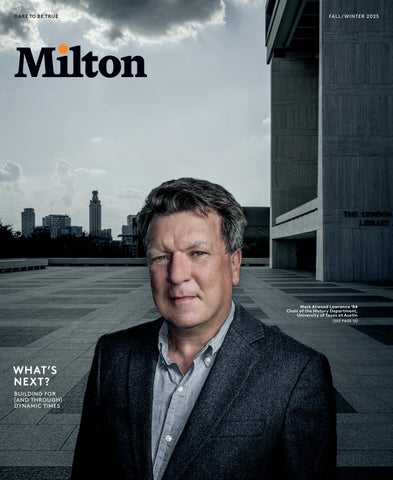
Mark Atwood Lawrence ’84 Chair of the History Department, University of Texas at Austin (SEE PAGE 10)
WHAT’S NEXT?
ALIXE CALLEN ’88, HEAD OF SCHOOL ( S E E PAG E 34)
BUILDING FOR (AND THROUGH) DYNAMIC TIMES SPRING/SUMMER 2025
Contents
Fall/Winter 2025
“ What was worse: my fear of showing up, or failure to achieve my dreams because I didn’t show up?”
Features
OPENING
JACLYN SIU ’09 S E E PAG E 1 6
Quad . . . . . . . . . . . . . . . . . . . . . . . 2 my peers and the faculty had an equally profound effect. I became ME at Milton. And that voice I discovered and nurtured while I was there? It most certainly helped me to get to where I am today. Why a scholarship? I started my educational life lucky enough to attend an excellent elementary school for free. I probably would not have been accepted to Milton if I hadn't had that significant advantage. My husband Bruce Cormicle and I are very grateful and humbled that we can help provide a chance for others to have the same opportunity I had years ago. This scholarship is named in honor of my mother, Elizabeth Sabine Beers. She deserves to be remembered for her years of teaching and advocating for the opportunities that education provides and the value of a diverse student body, qualities that she instilled in me, which I carry on through all of my work today. And? There is no better way to celebrate her than to create a foundation for a path for future leaders with a strong voice of their own!
Head of School . . . . . . . . . . . . . . . . 4
Teaching for the World They’ll Inherit faculty perspectives . . . . . . . . . . 6
Modern Classics
16
On the Cover AN ARTIST FIT FOR A PRESIDENTIAL SCHOLAR Dan Winters, who has photographed several U.S. presidents, actors, athletes, and astronauts, photographed Mark Atwood Lawrence ’84 in Austin. Winters, who has earned national and international accolades, has work in the permanent collection of the National Portrait Gallery, and has shot for Vanity Fair, The New Yorker, Rolling Stone, and more.
10 Lessons in Legacy
Betsy Beers ’75
TELEVISION AND FILM PRODUCER The Elizabeth Sabine Beers Scholarship Fund will provide full tuition and boarding scholarships to help deserving students access the life-changing power of Milton through the Milton Academy endowment.
A fascination with the rapid changes of the ’60s and ’70s—and a term leading the Lyndon B. Johnson Presidential Library—gives historian Mark Atwood Lawrence ’84 a keen perspective on leadership in extraordinary times.
16 Starting (Up) Fresh Startup veteran Jaclyn Siu ’09 helps founders move beyond setbacks to follow their next big dream.
22 Return on Impact Tracy Palandjian ’89 leads in the field of impact investing.
To find out more about how you can make a Milton education possible for our students contact Carol Giusti-Cahalane, executive director of development at carol_giusti-cahalane@milton.edu.
On Centre . . . . . . . . . . . . . 28 DA R E TO B E T RU E FA L L / W I N T E R 2 02 5
HEAD OF SCHOOL
Alixe Callen ’88 C H I E F CO M M U N I CAT I O N S O F F I C E R
Eileen Newman AC T I N G E D I TO R
upper school . . . . . . . . . . . . . . . . . 30
Marisa Donelan C L AS S N OT E S E D I TO R
Doing Science at the Cutting Edge
Jacqueline O’Rourke
Lower school . . . . . . . . . . . . . . . . 34
Kimberly Ashton
Learning in Harmony in the news ������������������������������������� 38
A Milton robotics student takes the world stage; a celebration of technical theater; Gatorade honors for a soccer star
CO PY E D I TO R
CO N T R I B U T I N G W R I T E R S
Cheryl Alkon Kimberly Ashton Richard Babcock Alexander Gelfand Laura Grunberger Lewis Rice Grace Tatter DESIGN
MO–D/Patrick Mitchell André Mora CO N T R I B U T I N G A RT I S T S
Alumni Life . . . . . . . . . 49
c l o c k w i s e f rom top le f t : a n dre a d ’ aq u ino, m a ri a s pa n n, ga ry ta x a li , joh n h u e t, da n w i n te rs
class notes ������������������������������������ 50 reunion . . . . . . . . . . . . . . . . . . . . . . 53 IN MEMORIAM ����������������������������������� 58 BOARD OF TRUSTEES �����������������������59 N.K.O.T.Q. ��������������������������������������������� 61 postscript ���������������������������������������� 64
10
Davide Comai Andrea D’Aquino Michael Dwyer John Gillooly John Huet Klaus Kremmerz Kjeld Mahoney Julian Montague Scott Nobles Adam Richins Emily Sedgwick Maria Spann Gary Taxali Dan Winters
milton magazine is published twice a year by Milton Academy. Editorial and business offices are located at Milton Academy, where change-of-address notifications should be sent.
22
printed in the usa on recycled paper
Fall/Winter 2025
2
Milton Magazine
L E A D E R S H I P & FA C U LT Y P E R S P E C T I V E S
photograph by
John Gillooly
Fall/Winter 2025
3
Quad Head of School
Teaching for the World They’ll Inherit
ALIXE CALLEN ’88, HEAD OF SCHOOL
4
Milton Magazine
my fellow milton alumni often ask me how the Milton of today has changed from the Milton we knew as students. I often respond that the school has evolved significantly, reminding them as well that schools like ours need to evolve. The world our children will inherit would have been unimaginable in 1988. □ Each year, I have the privilege of sharing some thoughts with Upper School students during our opening Convocation. This year, I began my speech by recalling the ethics course all Class III students were required to take back in the day. As some of you will remember, known simply as Ethics, the course met once a week with the beloved Mr. Cleveland, who also served as the school’s chaplain. □ Each week we gathered in Mr. Cleveland’s classroom, a kind of garret in the netherworld between Warren and Wigg halls. The buildings have since been redone, so it’s hard to pinpoint the exact location, but it was sort of halfway up an old staircase. Dark wood paneling and floor-toceiling bookshelves surrounded a ring of old wooden desks. □ After everybody had arrived and gotten settled, Mr. Cleveland would introduce the topic of the week. It might be the death penalty or abortion or euthanasia or the ethics of war. He asked us questions like, “Are there causes for which you would fight for your life? What would they be?” □ Often, we would read a short piece to ground our conversation. Sometimes there was a case study presenting an ethical dilemma. Regardless of the prompt, our only job for the next hour was to participate. □ We were pushed not only to clarify our own thinking, but to listen to the opinions of others. Mr. Cleveland never told us what to think. Indeed, I have no idea how he felt on any of these topics. He simply pushed us to deepen our own thinking, often playing devil’s advocate to get us to dig more deeply, or asking us how our position squared with that of the person next to us. □ There were no grades in ethics. Imagine one person
j oh n g i ll o oly
AS THE WORLD GROWS INCREASINGLY COMPLEX, MILTON CONTINUES TEACHING STUDENTS TO THINK CRITICALLY, ACT ETHICALLY, AND LEAD WITH CONFIDENCE.
being told that they got an A and another a C: You’re ethical… you’re not. We simply had to show up and participate, which wasn’t hard. The conversations that started in Mr. Cleveland’s classroom often spilled over to the lunch tables. With every sophomore in the school taking the class—and every junior and senior a past participant—these dilemmas were commonly known and were sources for deep discussion. Milton doesn’t have a standalone ethics course these days, but we continue to take seriously our obligation to help raise ethical beings. Students regularly grapple with the topics of the day. And goodness, we have ample material. As I said to the students at Convocation, the number of ethical dilemmas that will need their attention has grown exponentially since the mid-’80s: technological advances, threats to democracy, geopolitical divides, the climate crisis, and political polarization. The challenges begin to feel endless. These days, much of our collective attention here at Milton is on the future. What experiences do our students need to have at Milton that will prepare them for the world they will inherit? To my mind, the liberal arts have never been more important. The critical-thinking, problem-solving and communication skills, combined with the meta-cognitive skills they need to embrace new challenges, remain at the center of our work. Our students will need this know-how when they head out into the world. That said, if we fail to prepare them for the challenges of the future, we will be abrogating our responsibilities as educators. Over the course of the past 12 illustration by
Andrea D’Aquino
“These days, much of our collective attention here at Milton is on the future.”
months, we have been hard at work on Milton’s strategy for the future. If we consider the fact that today’s graduates will come of age in the middle of the 21st century, we would be foolhardy to ignore our evolving context. To that end, we have been thinking deeply about the experiences our students will need in order to address this disruptive world: How will humans interact with technology in the coming years? How do we preserve our democracy? How will we ensure the sustainability of our planet? Thankfully, we have a resource that most of our peer schools lack: proximity to a major metropolitan area. Located just one mile from the Boston city line, Milton’s setting is a differentiator. Another resource available to us is you, our
alumni. As I tell students regularly, Milton alumni are already at work solving the pressing issues of the day. Tapping into the resources available right here in our alumni community provides opportunities for students not only to learn important content, but also to understand the agency they possess to make change. This issue of Milton Magazine highlights some of the members of our community doing this work. We look forward to learning from the experiences of so many of you in the coming months. In the meantime, we are delighted that the 2025–2026 school year is happily underway. I hope you will come see for yourself all the ways we are helping to prepare our students for the future.
Fall/Winter 2025
5
Quad Faculty Perspectives
Modern Classics
since its earliest days, Milton Academy has offered students the opportunity to study Latin and Greek as a means to understand culture, mythology, history, philosophy, and the structure of language. More than two centuries later, the classics still hold a special place in school life, but the approach to teaching continues to evolve. From Middle School classes where students converse in Latin as if it were a modern language to clubs and games designed to engage and excite, Classics Department offerings are reaching more students than they have in over a decade. For senior ANDRIA LAITADZE ’26, “Latin feels like solving highly rewarding puzzles. When you finally crack a tricky Virgil sentence or catch some clever wordplay, you feel the rush of understanding something that was written 2,000 years ago.” Milton peers who have become hooked on the study are drawn to the challenge of unlocking meaning, or might have loved the stories of ancient mythology as younger kids, Laitadze adds: “There’s something special about connecting with the ancient world.” Witnessing students make connections across centuries is inspiring, says Jeanna Cook, the department chair. As Milton teachers challenge students to observe classical influences in their everyday lives, the stories from thousands of years ago come alive. By studying them closely, students see that language systems, political and class conflicts, and the philosophical search for meaning are eternal struggles. “They have a whole new way of understanding things that have always been with them,” Cook says. 6
Milton Magazine
“They see it in advertising, in books and movies, and they’re interpreting them in new ways because now they have context from the classical world.” “It’s kind of an interesting thing to think about, how humans have wrestled with tough times way back when,” says Cook. “The problems have changed a little bit, but not the feelings associated with them. So, how do we do our very best and thrive in difficult times?” The classics program spans both the Middle and Upper Schools. Students who attend both divisions can begin in Grade 6 with Latin 1, eventually advancing through the Upper School with advanced courses such Latin Literature, Roman Historians, or Intensive Classical Greek, among others. Some of the most exciting classroom discussions occur when students make connections to Latin and Greek literature from their own cultures—Cook notes that students have recognized similarities to Asian mythology and folklore— or from materials they’re studying in other classes. They begin connecting universal themes, such as heroism, wealth, and family dynamics, in everything from Homer to The Epic of Gilgamesh to F. Scott Fitzgerald and beyond. They also relish the chance to see the lasting influences of classical architecture as nearby as the Milton campus. Cook also stresses the value of studying ancient texts with a focus on different perspectives, such as the historical story of Homer’s Iliad told from the point of view of an enslaved character, or a minor character, or a goddess, rather than that of a nobleman. In a Latin
5 course Cook designed this summer, students are asked to consider what Roman life was like using not just favorites from classic literature, but epigraphs, inscriptions, coinage, frescoes, and authors of later Roman times. It’s a course designed to help students analyze not just what Cook calls “this really narrow band of authors in a time, but a much bigger experience, including different source material.” “We’re pushing in this world, in universities, colleges, high schools and middle schools, to say that this is for everybody,” she says. “Anyone can study it. There’s a range of different learners that come through our doors, and anybody can do this. You don’t have to be a particular type of kid to enjoy this or get something out of it, and you certainly don’t need to be of a particular background to find meaning in it.” Milton’s Classics’ “reputation is incredibly strong, and there’s lots of excitement about it,” says Middle School Principal Steven Bertozzi. “It’s seen as a real gem.” Offering classics across the Middle and Upper Schools helps ensure continuity as students learn from the same group of four instructors over several years. Students new to Milton in the Upper School also have an opportunity to reach the advanced courses by completing an accelerated Latin 2/3 class. In the early years, the curriculum takes a spiral approach, which uses different textbooks to both introduce and reinforce grammar and language elements in multiple ways. “It really helps us level the field,” says Sarah Weiskittel, who teaches Latin in Grades 6 and 7. In the spi-
kj e l d m a hone y
IN THE UPPER AND MIDDLE SCHOOLS, A CHALLENGING CLASSICAL CURRICULUM AND INCLUSIVE APPROACHES TO TEXTS KEEP ANCIENT LANGUAGES FRESH. BY CHERYL ALKON
ral approach, students become accustomed to viewing and analyzing classical texts and language structure through multiple lenses—excellent preparation for how they will engage with literature in more advanced study. Weiskittel teaches Latin as if it were a modern language, addressing students in Latin and hearing their responses, despite Latin being a language that no one typically speaks aloud. “While the goal of Latin is to be able to read things written by ancients and access it without translation, active Latin tries to use what we know about second language acquisition because it’s how our brain is prepared to learn a language,” she says. “So, I speak in Latin and they answer back in Latin. They’re not just reading and translating, they are speaking and listening.” Cook is energized by the number of students who stick with classics beyond their graduation requirements, as well as those whose excitement goes beyond the classroom. This year, the Classics Club has organized a series of lectures by guest scholars on topics ranging from classical Latin poetry in late antiquity to Greek mythology related to birds, says Classics Club co-head MAX WEIL ’26. Students compete in Certamen, a quiz bowl-style competition through the National Junior Classical League, and they participate with peers from other independent schools through colloquia and other speaking opportunities. A vibrant Linguistics Club also meets regularly at Milton, bringing together a group of students interested in the mechanics of different languages. In the spring, Cook will lead a illustration by
Andrea D’Aquino
“They have a whole new way of understanding things that have always been with them.”
trip for Upper School students to Rome and Pompeii, where they will trace the footsteps of the historical figures and characters they have studied. They will spend time at the Villa Vergiliana, an institution that traditionally hosts college-level scholars; have access to the villa’s expansive library; learn about archeology in the region; and study the architecture of their surroundings. Part of the appeal of studying Latin and Greek is the rigor of doing so, says Sarah Wehle, who led the Classics Department for decades before retiring in 2024. Students learn to read closely and investigate the structure of language as they learn, and the study skills they develop transfer to other classes. “Milton has a wonderful program, marked not just by the rigor
and variety of the advanced courses, but by the way the program is accessible to students of different interests and abilities,” says Wehle. “In all cases, we are deliberate and explicit in teaching students how to study and to understand the most effective means for them, as individuals, to learn.” “It surprises kids,” says Wehle. “It’s hard work, but it’s really fun, and that’s something we want kids to learn. You get out of it what you put in.”
Fall/Winter 2025
7
CHERYL ALKON IS A SEASONED WRITER BASED IN MASSACHUSETTS. HER ARTICLES HAVE APPEARED IN ALUMNI PUBLICATIONS FOR EMERSON COLLEGE AND SALEM STATE UNIVERSITY, AMONG OTHERS. SHE IS THE AUTHOR OF BALANCING PREGNANCY WITH PRE-EXISTING DIABETES: HEALTHY MOM, HEALTHY BABY.
8
Milton Magazine
FALL/WINTER 2025
WHAT’S NEXT? COMBINING TIME-TESTED FOUNDATIONAL PEDAGOGY AND A HEALTHY DASH OF INNOVATION, MILTON ACADEMY LOOKS TO THE FUTURE. THIS ISSUE IS A CELEBRATION OF THE VERY BEST OF INTERDISCIPLINARY STUDY, HIGH ACADEMIC STANDARDS, NEW METHODS AND PERSPECTIVES, AND A DARING EMBRACE OF THE UNKNOWN. ALUMNI SEARCH FOR LESSONS FROM A DYNAMIC PAST AND RETHINK LEGACY INDUSTRIES—LEADING WITH NEW APPROACHES TO THE MOST CHALLENGING ISSUES OF THE DAY. ON CAMPUS, MILTON TEACHERS AND STUDENTS LOOK AT CLASSIC DISCIPLINES WITH NEW EYES.
illustration by
Julian Montague
Fall/Winter 2025
9
LESSONS IN LEGACY A FASCINATION WITH THE RAPID CHANGES OF THE ’60S AND ’70S—AND A TERM LEADING THE LYNDON B. JOHNSON PRESIDENTIAL LIBRARY—GIVE HISTORIAN MARK ATWOOD LAWRENCE ’84 A KEEN PERSPECTIVE ON LEADERSHIP DURING EXTRAORDINARY TIMES. Story by Richard Babcock
Photographs by Dan Winters Fall/Winter 2025
11
12
Milton Magazine
on Vietnam: This combination has propelled Lawrence, 59, into a distinguished career as chair of the history department of the University of Texas at Austin and the author of three acclaimed books on Vietnam and President Johnson. He’s also a recent former director of the Lyndon Baines Johnson Presidential Library, having stepped down last fall after almost five years. “I was eager to lead the library in part because LBJ is surely one of the most fascinating, complex presidents of recent times—maybe at the top of the list,” he says. Lawrence’s dedication to the exploration of history in all its nuanced multiplicity comes at a time when the subject, which occasionally involves the study of battlefields, has become a battlefield itself. Fierce disputes over what should be taught and how we should interpret America’s story have erupted around the country. As someone who has grappled with the strident divisions over President Johnson’s legacy, Lawrence has witnessed how perspectives can become a political weapon. “Historical knowledge changes, evolves, gets rebutted, and overturned, and all those processes are healthy,” he says. “I think what can be less healthy is when assertions are made about history without grounding in evidence and rigor.” Still, he sees value in argument itself: “People are really locked in on historical controversies in a way that I think was not the case 10 or 20 or 30 years ago.” In this historian’s view, the country faces a learning moment that could advance everyone’s understanding of the complexities of the past. Fredrik Logevall, the Harvard
history professor who taught Lawrence at Yale and remains a friend, seconds Lawrence’s view. “I think both of us feel strongly that to a democracy, historical knowledge is essential—that history is a kind of collective memory,” he says. Learning and teaching lie at the heart of Lawrence’s career. To speak to him is to recognize the truth of William Faulkner’s famous dictum: “The past is never dead. It’s not even past.” Lawrence sees strong connections between the political disillusionment felt by many Americans today and the failure of the government to deliver on the country’s promise after World War II. “Lyndon Johnson was president at a moment when that postwar sense of confidence—the belief that no problem lay beyond the ability of the United States to solve—ran at its absolute highest,” he says. “That’s ultimately LBJ’s significance. He was the president who sat in the Oval Office at the absolute apogee of that sentiment.” Lawrence admires Johnson’s remarkable record of domestic achievements: the Civil Rights Act, the Voting Rights Act, Medicare, Medicaid, the War on Poverty, and a range of federal contributions to education and the arts. Some of those programs are being challenged or dismantled today, and Lawrence acknowledges that some of their aims were introduced with a “grossly misplaced sense of confidence.” Johnson “doesn’t just say he’s going to work on poverty. He says he’s going to cure poverty.” The chief lesson from that era, Lawrence maintains, is that “good public policy, whether in connection with domestic problems or in-
k e n w h e e l er /fa ir fa x me di a /ge t t y imag e s
President Lyndon B. Johnson’s car was splattered with paint during a 1966 visit to Melbourne, Australia. Johnson supporters and anti-Vietnam protesters converged on the city during the president’s tour.
MARK ATWOOD LAWRENCE ’84 grew up in a family so excited by history that they spent vacations visiting American landmarks—Gettysburg, Jamestown, and other sites rich with the past. This was the 1970s, and the country was just coming out of one of the most traumatic and dynamic periods since its founding. Echoes of the Vietnam War were in the air, and Lawrence’s father—a Congregational minister in the Fall River, Massachusetts, area—sometimes dealt with issues left over from the conflict. Those paths came together for Lawrence at Milton Academy in a tough and inspirational U.S. history class taught by John Warren, who pushed his students to think hard about the lessons of Vietnam. “It was a very, very rigorous class,” Lawrence recalls. “For so many people who go into academia, it’s that individual, inspirational teacher who really plants the seed.” An interest in history and a focus
cr edi t
Fall/Winter 2025
13
“ THE MID-1970S REALLY RHYME IN A LOT OF WAYS WITH OUR OWN TIMES.”
ternational problems, is really, really difficult. And there are tight limits on the ability even of an enormously powerful country like the United States to achieve everything it wants to achieve in the world.” The reverberations of that lesson are felt in today’s widespread, intense skepticism toward institutions, “very much including the institutions of government,” he says.
Lawrence entered Milton in 10th grade as a boarding student. Warren, the teacher who helped inspire his career as a historian, remembers him well. “He was one of those kids who could really give you a nugget of insight that would take the conversation to the next level,” recalls Warren, who recently retired as head of school at St. Mark’s School in Massachusetts. “He had a maturity, a sophistication of thinking that was extraordinary.” While Lawrence pursued his interest in history, he also made time to run cross country and track. “Maybe the biggest thing that happened to 14
Milton Magazine
me at Milton was being elected captain of the cross-country team in my senior year,” he says. He went on to Stanford, where he earned a B.A. and master’s in history, but then he ventured into journalism, working for the Associated Press in Brussels. As a news reporter, he found plenty of action—the Balkans were erupting, the European Union was launching. He thought he might have found his career. “I loved journalism,” he says. But his delight in history lured him back into academia. His dissertation at Yale focused on the years leading up to the Vietnam War, when concerns about colonialism got subsumed by the Cold War. The dissertation became his first book, Assuming the Burden (2007). Logevall points out that Lawrence’s journalism training paid off. “He’s a very good stylist,” says Logevall, who is working on the second volume of a biography of John F. Kennedy. “As a journalist, he had learned how to be concise and clear.” Lawrence joined the faculty at the University of Texas at Austin in 2000, where he met his wife, Steph-
anie Osbakken, a sociologist who teaches at the university. They have two young daughters. His scholarly work had focused on Vietnam in the era before Johnson became president. But with the LBJ library on campus, he now had a stupendous resource—50 million pages of documents, among other things—almost next door. His attention turned to the Johnson era, and along with a thick shelf of articles and collections of essays and documents, he published two more books, The Vietnam War: A Concise International History (2008) and The End of Ambition (2021), which shows how the Vietnam War and domestic turmoil crushed liberal American hopes to improve lives in developing nations. “Over almost 20 years, I became more and more involved in the library and thought of it as a second home on campus,” he says. When the director’s job opened in 2019, UT gave him a leave, and he stepped into the role. The library, opened in 1971, is jointly run by the National Archives and Records Administration and the LBJ Foundation. Upwards of 120,000 people visit each year. In addition to the trove of records from the Johnson Administration, the facility features exhibits about Johnson’s life and presidency, including an extensive display on the Vietnam War. LBJ’s escalation of the conflict proved disastrous for the United States and darkly colors Johnson’s legacy. “LBJ was a very conventional thinker about foreign affairs who drew simple lessons from the Second World War,” Lawrence says of LBJ’s foreign policy. Most American
p hoto g ra p h s c o urte s y of m a rk atwo od l aw re nc e
Lawrence, left, moderated a 2024 discussion with investigative journalists Bob Woodward, center, and Carl Bernstein, right, about the Watergate scandal and its echoes across history.
leaders of the time worried about the risks of appeasement and the necessity of containing communism. A few advisers told Johnson the war was a terrible mistake. “But he didn’t have the political courage in the foreign affairs arena to do the kinds of things he was willing to do domestically,” says Lawrence. The library’s Vietnam exhibit doesn’t ignore criticisms of the war but tries to present the Johnson Administration as a nuanced story. “The best way to get Americans to think seriously about the American presidency across the board, and with LBJ in particular, I think, is not to go in with all guns blazing and to flag every flaw and every ugly side of the administration,” he says. To date, there are 13 presidential libraries, going back to Herbert Hoover’s, and Lawrence acknowledges that some critics say they go too far in glorifying their presidents. The passage of years, he argues, gives libraries the distance to present more critical perspectives. As director of the LBJ library, he led the effort to overhaul and update its displays. “That project’s actually not quite finished yet, but ultimately it will replace 50 or 60 percent of the main exhibit about LBJ’s presidency,” he says. Running the library entailed a smorgasbord of responsibilities— working with a staff of archivists, overseeing the education program, bringing in speakers, and so on— but updating core exhibits was the highlight for the historian in him. “It’s where I really got to bring to bear my own reading, my own insights about LBJ.” He says he never received any
pressure from the LBJ Foundation, even though Johnson’s two daughters are on the board and the foundation contributes a significant portion of the library’s budget. “I think, frankly, we would agree on both sides—the federal and foundation sides—that there needs to be more attention paid to Vietnam and to 1968, some of the more difficult moments of the Johnson presidency,” says Lawrence. “And those themes are more represented in the refreshed exhibit that will open next year.” In the fall of 2024, the University of Texas enticed Lawrence back with the offer to chair the History Department, a multifaceted role that also gives him time to work on his next book, an account of the 1976 presidential election. He’s excited about what he calls “this amazing cast of characters” ranging from Jimmy Carter, Gerald Ford, and Ronald Reagan to George Wallace, among others. He also argues that the era in some ways resembles our political times, with extreme doubt about institutions across the board, diminishing trust in public author-
ity, and economic downturn. “The mid-1970s,” he says, “really rhyme in a lot of ways with our own times.” Exploring connections like that is one reason Lawrence values the study of history. “It helps us explain ourselves, right? How we got here, what were the choices, what were the missed opportunities. Historical knowledge is essential for citizenship,” he says. He also cites an almost opposite attraction: “History enables you to see places and times that are totally unlike our own world.” He talks about walking around in the shoes of someone in the Roman Empire or early modern France or the Vietnam War as a way to imagine the past both as a mirror of the present and as an alien universe. “That’s one of the cool things about history—there’s more than one reason to study it. And I think clever people can hold multiple ideas in their heads at the same time.”
RICHARD BABCOCK’S LATEST NOVEL IS A SMALL DISTURBANCE ON THE FAR HORIZON.
Fall/Winter 2025
During his term as director of the LBJ Presidential Library, Lawrence hosted discussions with guests from the fields of government, academia, and media, including political commentator and author David Brooks, above.
“HISTORICAL KNOWLEDGE CHANGES, EVOLVES, GETS REBUTTED, AND OVERTURNED, AND ALL THOSE PROCESSES ARE HEALTHY.” 15
FOLLOWING A SERIES OF SETBACKS, STARTUP FOUNDER JACLYN SIU ’09 DEVELOPED STARCYCLE, A COMPANY THAT HELPS OTHER FOUNDERS MANAGE THE LOGISTICS OF SHUTTING DOWN— AND GIVES THEM THE FREEDOM TO FOLLOW THEIR NEXT BIG DREAM.
Story by Kimberly Ashton Photographs by Maria Spann
Starting (Up) Fresh
cr edi t
Fall/Winter 2025
17
In
the summer of 2020, JACLYN SIU ’09 was just beginning to build her newest idea, software that tracks artwork, into a business from her Berlin apartment when a potential client contacted her with a question: How quickly can you get this shipped? We need it by September, they said. At that point, her company, zhen. (styled with a period), consisted of little more than “Google Slide decks and vibes,” and a big idea—to use software to replicate what major auctions houses like Christie’s and Sotheby’s would do in terms of tracking the provenance and value history of artwork. It was the early days of the zirp era, and dizzying amounts of zero-interest-rate cash were floating around. zhen. was one of the many startups swept into its heady tailwind. The client, a gallery, became one of the startup’s founding partners, and subsequent wins started to pick up fast. “We had been seeing incredible momentum, and we landed pretty much all of the artists we wanted to work with, the who’s who of the modern art world,” Siu says. “We had tens of thousands of art collectors who had signed up to be on the platform.”
By 2022, Siu and her team “were on top of the world,” she recalls. That year, they were approached for an acquisition, started planning a new round of fundraising, and were in the final stages of negotiating a multimillion-dollar deal with an artist estate. Then the winds changed. Interest rates started coming back up, a new war in Ukraine unnerved Europe, and the market contracted. The acquisition fell through, the fundraising round didn’t materialize, and the artist estate put the deal on indefinite hold. Within a matter of weeks, zhen. crashed. And so did Siu, in a sense. “That was a very, very difficult time, to say the least,” Siu says. “Not just because we had spent years building, and not only because of how good the momentum was, and we felt absolutely invincible, but ultimately what was the hardest was looking everyone in the eyes and telling them, ‘We failed you. You believed in us and we failed you.’” She laid off 25 people and closed the company. Years later, on LinkedIn, she would reflect, “Shutting down a business isn’t just paperwork—it’s personal. It’s the unraveling of an identity you spent years building, the
18
Milton Magazine
kind of loss no one really prepares you for.” Though she didn’t know it in 2022, zhen.’s failure would give rise to her next chapter: helping others move on to theirs.
Siu’s first experience with starting afresh came early. Growing up in Hong Kong, she was a shy, introverted kid navigating a large, all-girls public school that had strict rules. As she approached high school, her parents thought she’d be better off in a more intimate environment and sent her to Milton Academy. At 15, she found herself in an utterly new world. “When I first arrived at Milton, culture shock aside, it was just like a rapid deconstructing and reconstructing of the self,” she says. “There were a lot of points where it would have been easier if I had just thrown in the towel and gone home.” But, she adds, stubbornness kept her from quitting, despite the challenges of being far from home and operating in a second language. As much as her new home presented some degree of hardship, it also provided the impetus for her to flourish. She recalls reading a comment in her report card advising her to speak up and make more eye contact. “It wasn’t my first time hearing that feedback, or similar flavors of it, but it was one that stuck with me quite a lot,” Siu says. It came from a teacher she liked—a dorm parent who “made the best brownies” and who knew her well. She began to doubt her reasons for staying in her shell and decided that she needed to conquer her shyness, get over her fear of taking up space, and learn
to “show up.” “What was worse: my fear of showing up, or failure to achieve my dreams because I didn’t show up?” she says, adding that the answer was simple. Today, she looks back on Milton as “a very lovely place” and her years there as a formative experience that helped set her life’s trajectory. “A lot of my peers back in Hong Kong, they’ve chosen a more traditional path. And I think the experience of having almost like a cold plunge—24/7 of going to boarding school and being completely immersed in a complete 180 of what your reality used to be—was a great primer for what I would crave,” she says. She would find that sort of experience again at New York University. A journalism and political science double major, Siu had visions of working at Vogue but was torn between that dream and being a “perfectly credentialed business school girly.” She didn’t feel she could get into NYU’s prestigious Stern business school (where she now occasionally speaks) so she decided to concentrate on what she felt was her talent: writing. Soon, however, kismet intervened to unveil another talent. A former Milton classmate texted her, asking what she should wear for an upcoming job interview. “And I had this idea of, well, why can’t an algorithm pick an outfit for you?” Siu and an NYU friend started building out the idea, focused on women’s fashion. “We showed the demo at a few tech meetups, and the dudes
20
Milton Magazine
Clockwise from top left: Siu in front of Starcycle’s Times Square billboard in the summer of 2024; with her parents during her senior year at Milton; and center, in purple, with members of the Robbins House Class of 2009 at their boarder dinner.
were the ones who were like, ‘Hey, we want this,’” she says. Siu and her business partner reconceptualized the idea for men, and entered the yearlong NYU Entrepreneur’s Challenge. “As far as I can remember, we were the only undergraduate female team who made it to the top 20,” she says. But the company didn’t take off, and when it dissolved it left with it a residue of shame and disappointment. “For a very, very long time, there was [a feeling of], ‘What if I had just seen it through?’” she says. Today, she can look back and see that she didn’t have the resilience and grit that she’s since developed. But at the time, she just knew she needed to see good leadership in practice. She entered the workforce, first as a social media manager for the fashion designer Rebecca Minkoff, then as a digital marketer for Roc Nation, Jay-Z’s entertainment company—a time she remembers as “extremely, extremely fun … but it was also very stressful.”
c o urte s y of jac ly n s i u
Needing a break from the pressure of Roc Nation, Siu decided to resign and decamp to Berlin. “It was a combination of burnout and I wanted to get away for a little bit.” Also, she had a German boyfriend. She learned to cook, dabbled in freelance work, and thought about her next move. “The intention, initially, was like a six-month kind of situation—just to travel and have fun—and I ended up staying for seven years,” she says. “And we got married.” She held editorial and brand marketing jobs for a while, then felt an
“Setbacks are part of the journey. Don’t let them hold you back.”
urge to start something new. “I was kind of flirting around with different ideas, drawing upon a lot of the types of experience and expertise that I had accumulated up to that point. I knew how to navigate those spaces and those types of dynamics across fashion and music and highend art,” she says. When the idea of creating zhen. presented itself, she thought, “Time is going to pass anyway, so why not?”
After zhen.’s collapse, Siu found herself back in New York, unable to think about much besides processing her loss. “I shut down right alongside my company when we shut down,” she later wrote on social media. But in 2024, the old itch returned. “A big thing I just kept coming back to was: Can I be a founder again? Do I want to be a founder?” she says. It was partly wanting to prove to herself that “I still got it” and part compulsion to help other founders. Her first idea was to build a company, called Starcycle, that used AI tools such as ChatGPT to help founders calculate market sizes. “We got to a decent number of users,” she says, “But then there was this little nagging voice in the back of my mind that really wanted me to revisit what I knew to be probably one of the most difficult things I’ve gone through.” She was invited to interview for a six-week residency program with Antler, a venture capital firm that provides funds and support for entrepreneurs launching startups. “I was very upfront with them and I was like, ‘I have no idea. I have this
vague, amorphous concept in my head of [wanting] to help founders shut down. I don’t know what that looks like. I’ve only done it myself.’” Come join us, they said. On the residency’s kickoff day, she remembers projecting confidence, conviction, and effortless energy. But inside she was questioning her and her husband’s decision to move back to New York and thinking, “My past two ventures failed. Who am I to build a third?” And yet, that third company started to materialize. She kept the name, Starcycle, because it evoked a rebirth, but reworked its purpose. In doing market research at Antler, she came across many founders who couldn’t face the administrative side of closing their businesses, and were worried that a legal or tax-related technicality would come back to haunt them. This fear, Siu thought, was something she could help take off their minds. She relaunched Starcycle that June with the mission of helping people shut down their companies so that they can focus on what’s next, whether it’s grieving their loss or directing their energy toward a new endeavor. The first client signed up within an hour of launch. Since then, Starcycle has helped hundreds of business owners. Siu estimates that her company has saved clients hundreds of thousands of dollars and an uncountable number of hours. What’s less quantifiable, but perhaps more valuable, is the peace of mind and power Starcycle gives back to founders, she says. “A lot of the onboarding calls end up therapy-adjacent,” she says. The rehabilitation goes both ways: “It’s
very meaningful. It’s very healing.” But she’s quick to point out that not all endings are tragedies. Some founders exit after a success, such as selling their company. These two sides of Siu—confidant and executive—make her uniquely effective in her role. “Jaclyn has a strong strategic vision and is very detail-oriented. At the same time, she is very personable. So while the startup life is quite intense and serious, we do a good job of building a company culture that is human-centric,” says Luke Schantz, Starcycle’s cofounder. Siu is also working in other ways to open up conversation about business failure. This summer she launched a podcast, Round Two, in which she interviews founders who ended their companies. “Everyone talks about the $1 billion exit. Let’s talk about the other stuff that you weren’t so thrilled to announce,” she says. Similarly, she’s been working with the organization Welcome to Chinatown to help foster these conversations in a culture that Siu says doesn’t like to acknowledge failure. “Setbacks are part of the journey,” she wrote in a LinkedIn post to promote Starcycle, but one that could have been written after arriving at Milton, or closing her fashion app company, or the denouement of zhen. “Don’t let them hold you back.”
Fall/Winter 2025
21
KIMBERLY ASHTON IS A FREELANCE WRITER AND EDITOR WHOSE WORK FOCUSES ON STORYTELLING FOR EDUCATIONAL INSTITUTIONS. SHE IS THE FORMER EDITOR OF BERKLEE TODAY, AND HAS WRITTEN FOR THE ASSOCIATED PRESS AND THE BOSTON GLOBE.
AN EMERGING INVESTMENT PRACTICE HELPS FUNDERS WIN WHEN NONPROFITS MAKE A DIFFERENCE. WITH SOCIAL FINANCE, TRACY PALANDJIAN ’89 LEADS THE WAY.
Story by Alexander Gelfand Photographs by John Huet
* R eturn on Impact
22
Milton Magazine
Above: Palandjian in 1989. Bottom left: Palandjian with dear friend Jack Reardon ’56. Bottom right: Palandjian (right) with daughters, L–R: Charis ’18, Pari ’20, and Te ’17 in 2025.
24
Finance in the U.K. Whatever the case may be, speaking from the home in Belmont, Massachusetts, where she and her husband, Leon, raised their daughters TE ’17, CHARIS ’18, and PARI ’20, Palandjian is entirely earnest. “It was one foot in front of the other,” she says. By the early 2000s, these footsteps appeared to have a destination. But it was something she was going to have to build herself. Palandjian was at that point more than halfway through a nearly 12-year run at the Parthenon Group (now EY-Parthenon), a global strategic consulting firm. Having joined the boards of various nonprofits, she began to suspect that the nonprofit sector as a whole might benefit from an injection of the investment practices and financial innovation common to the for-profit world. “If you could just make the nonprofit sector more business-minded, you could solve problems in a more efficient, more effective way,” she recalls thinking. The idea inspired her to launch a nonprofit consulting practice at Par-
thenon dedicated to helping foundations and ngos accomplish their missions. Palandjian became especially interested in developing financial mechanisms that could bridge the gap between traditional grant-making and market-rate investing. Her timing was propitious. In 2007, at a meeting convened in Bellagio, Italy, by ANTONY BUGGLEVINE ’92 , the Rockefeller Foundation coined the term “impact investing” to describe a novel combination of philanthropy and investing that sought to create social and environmental benefits alongside financial returns. The foundation subsequently commissioned Palandjian to prepare a study of the nascent impact investing space. In the process, she delineated two distinct approaches to achieving public good and private profit: finance-first, which prioritizes market rates of return over social and environmental progress (think: profit before impact), and impact-first, which prioritizes social and environmental im-
c o urt e s y of tr ac y pa l an dj i a n
“I’m not a planner,” says TRACY PALANDJIAN ’89. On its face, this seems absurd. A native of Hong Kong, Palandjian studied business and economics at Harvard after attending Milton, became a management consultant specializing in nonprofits, and ultimately founded the American branch of Social Finance, a nonprofit that partners with the public and private sectors to design and fund projects that address pressing societal problems. Along the way, she helped develop the field of impact investing, or investing with the goal of generating measurable social and environmental benefits—a field that represents more than $1.5 trillion in assets under management according to the Global Impact Investment Network, an international nonprofit dedicated to championing impact investing. It’s possible, of course, that Palandjian is joking: She has a near-perfect deadpan and a taste for self-deprecating humor. “She’s a very low-ego person,” says Sir Ronald Cohen, the British investor and philanthropist who cofounded the original Social
Milton Magazine
“The first few years of Social Finance were just as hard as coming to this country and going to Milton. I was being challenged to the core in a similar way.”
pact over financial returns (think: impact before profit). While market-rate returns are possible with an impact-first approach, they are by no means guaranteed. Nor are they really the point. In 2008, Palandjian met Cohen, who had cofounded Social Finance with his partner, former Goldman Sachs executive David Blood, in London just a year earlier. In 2010— the same year Palandjian filed her Rockefeller report—Cohen and Blood introduced the first social impact bond, or sib, in the U.K. sibs help governments raise money from private investors to solve societal problems, like low childhood literacy rates or high unemployment among the formerly incarcerated. Unlike traditional bonds, they do not pay a fixed interest rate. Instead, impact-first investors only see returns if the projects they fund achieve their goals, and those returns come from whatever money the funded projects save, or perhaps even earn, for the government. sibs therefore represent a “payfor-success” approach to social spending that ties financial returns directly to social outcomes. And just like the business models that power the private sector, they rely on hard numbers (children’s reading benchmarks reached, people placed in jobs) to gauge whether projects are actually succeeding. sibs have since been adopted by governments around the world. At the time, however, their reliance on private capital, clearly defined outcomes, and quantitative measurement were revolutionary. “I just became obsessed with this as a really creative, powerful way
to solve social problems,” she says. When American policymakers began calling on Cohen and Blood to bring sibs to the other side of the Atlantic, the two asked Palandjian if she might consider establishing Social Finance in the U.S. She demurred. “I was like, ‘I am so not a startup girl. I’ve never started anything in my life. I’ve always worked in big institutions,’” she says. “Long story short, they convinced me to do it.” When Palandjian launched Social Finance in Boston in 2010, the job was as difficult as she feared it might be. Not only did she have to hire staff, build a board of directors, and raise money to pay the fledgling organization’s bills, she also had to explain to potential investors and government partners what impact investing and sibs were at a time when few had ever heard of them. “The first few years of Social Fi-
nance were just as hard as coming to this country and going to Milton,” she says. “I was being challenged to the core in a similar way.”
Legendary Milton teacher and coach Frank Millet was a close mentor to Palandjian and her brother, Teddy ’96, for decades. Millet—whose signature penmanship graced generations of Milton diplomas—sent the note (left) after seeing the family at a squash tournament. Above, Millet (second from right) poses for a photo with Palandjian’s family.
To understand why Palandjian would say that, it helps to understand how she arrived in the United States, and how the next few years unfolded for her. Palandjian was born into what she describes as a “very traditional Chinese family” in Hong Kong, where her grandfather fled from mainland China during World War II. Her father had attended the University of Michigan, and planned to send Palandjian and her two younger brothers, THEODORE ’96 and DAVID PUN ’99, to American colleges when they came of age. But Palandjian, who had been weaned on her father’s stories of the Fall/Winter 2025
25
“The whole idea that you could come at issues from very different perspectives and that it’s good to disagree—I just loved it.”
U.S., was not inclined to wait. While attending a private girls’ school in Hong Kong, she secretly applied to a handful of boarding schools in the Northeast. When the acceptance letters began rolling in, her parents agreed to send her to Milton for two reasons: first, it happened to be the closest to an international airport; and second, because the admissions brochure emphasized the community service program, something that deeply resonated with Palandjian. Her involvement in the program, led by Mary Wendell, would ultimately inspire her career. The transition was difficult, and not just because Palandjian was homesick. For someone accustomed to quietly receiving instruction from her teachers, suddenly having to engage in discussion and debate with her peers came as a shock. But Palandjian soon found her footing. “I was a decent student in Hong Kong, but I never really excelled until I got to this country,” she says. “The whole idea that you could come at issues from very different perspectives and that it’s good to disagree—I just loved it.” She especially enjoyed art class: Her childhood hobbies included Chinese calligraphy and watercolor painting, and for her senior project, she painted a 400-squarefoot mural in Ware Hall’s Goodwin Room. But she went to Harvard to study economics, the kind of “serious-minded” major that her conservative parents expected of her. In the fall of her freshman year, Palandjian’s father died suddenly of a heart attack, leaving her mother in crisis with two young sons. “I decided that my brothers needed to be near me,” Palandjian says. So she
enrolled Teddy and David in a junior boarding school in Deerfield, Massachusetts, and became their “second mom”—a role she would continue to play as they completed high school at Milton, and as she worked as a management consultant at McKinsey & Company and earned her MBA from Harvard. Managing school and work while mourning her father and acting as a surrogate mother to her siblings wasn’t easy. But Palandjian adopted as her maxim something that her English teacher at Milton, the late Alice Perry, once told her: One can only achieve growth through suffering. “What doesn’t kill you makes you stronger,” Palandjian says with a wry grin. “And my brothers and I are still incredibly close.”
26
Milton Magazine
When Palandjian launched Social Finance in Boston, she initially focused on implementing sibs of the sort that Cohen and Blood had pioneered in the U.K. But it wasn’t long before she began introducing innovations of her own. For example, Palandjian partnered with governments and philanthropies to create new funding mechanisms for programs designed to help low-income individuals find better-paying jobs while filling labor shortages in areas such as technology, health care, and the skilled trades. The organization’s latest such initiative, ReNEW (Reinvesting in Nursing Education and Workforce), aims to raise $100 million to provide grants and zero-interest loans to help tens of thousands of people across the country earn nurs-
ing degrees. ReNEW makes use of two innovations that Palandjian first introduced in the Pay It Forward workforce development programs that Social Finance runs in states such as New Jersey and Colorado: Students only repay their loans if they land jobs that meet a minimum earning threshold, and whatever money they do repay is used to support other students, creating a self-sustaining financial recycling system. Such “revolving funds” do not necessarily provide a return to investors. But they do represent a breakthrough for governments and philanthropies that want to wring the most out of every dollar they spend, especially since most social programs require constant infusions of fresh cash. Palandjian also transformed Social Finance into what Cohen calls “an investment bank in the impact space.” The organization helps individuals and institutions make impact investments and manages its own Impact First Fund, which invests in a portfolio of enterprises that pursue specific social and environmental goals. The fund has poured millions into initiatives like the Blackstar Stability Distressed Debt Fund, which helps low- and moderate-income families convert predatory home loans into conventional mortgages, and RuralWorks, which invests in companies that create jobs and benefit the environment in rural communities. There is poetic justice, and perhaps no small amount of irony, in using the tools of capitalism (private capital, financial markets) to repair the damage (economic in-
equity, environmental degradation) that capitalism itself has wrought. Cohen believes the multifaceted approach to impact investing that Palandjian has pioneered in the United States represents the future of the field—especially if governments offer financial incentives to expand such efforts, as they have begun to do. In 2018, for example, Congress appropriated $100 million to support local and state pay-forsuccess initiatives. “If investors and businesses are measuring their impacts, and governments are guiding them through incentives, then your economy begins to solve problems rather than create them,” Cohen says. Under Palandjian’s leadership, Social Finance has already raised more than $500 million and employs more than 120 people in five cities. But given the scale of the problems she is trying to address, her main goal is to further expand the work that the organization does—and to see impact-first investment, which she says represents a “tiny sliver” of the overall impact investing space, become more widely adopted. “Wouldn’t it be great if these practices became the norm?” she asks. “As a naturalized citizen, I believe this is the most American way to solve problems: It’s entrepreneurial, creative, using market tools to address the very challenges markets have helped create, and always about testing and learning to do better.” ALEXANDER GELFAND IS A FREELANCE JOURNALIST LIVING IN NEW YORK CITY WHOSE WORK HAS APPEARED IN SUCH PUBLICATIONS AS WIRED, THE ECONOMIST, AND THE NEW YORK TIMES.
cr edi t
Fall/Winter 2025
27
On Centre Student Life at Milton
28
Milton Magazine
illustration by
Klaus Kremmerz
Fall/Winter 2025
29
On Centre Upper School
Doing Science at the Cutting Edge
“In many ways (the students) are fearless... They’re not afraid to share and augment their ideas with their classmates.” Julie Seplaki
30
Milton Magazine
since the fall of 2010, Upper School science classes have been held in the gleaming, glass Pritzker Science Center, whose architecture makes the Science Department’s ethos clear. “We learn by doing,” says Julie Seplaki, a teacher in the department since 2011, and its former chair. “The building was designed so that when you walk into Pritzker Science Center, you see students doing science.” The types of science you might see students doing range from testing their own dna to gene editing yeast with crispr to investigating oxidative stress and inflammatory responses in tetrahymena cells—research powered by their own inquiry and grounded in transdisciplinary courses including Disease Biophysics, a course Seplaki developed and teaches, and Molecular Genetics, which is taught by Michael Edgar, who designed the course and led the department for 13 years. Seplaki was drawn to Milton as an instructor because of its “learning by doing” philosophy, and because she knew that it was a place where the richness and depth of the sciences is recognized. Rather than
chopping science up into separate disciplines—chemistry, physics, and biology—and divorcing scientific concepts from important context, courses like Disease Biophysics recognize the intersectional and transdisciplinary nature of real-world scientific problems. The course deliberately draws from engineering and visual arts curricula to expand and enrich students’ skill sets and habits of mind. Milton has another advantage: its proximity to cutting-edge scientific research at universities like MIT and Harvard. “I’ve been able to engage in conversations with practitioners in medicine, education, and research, which has fueled more questions in my mind and has really helped to inform the kinds of curriculum and pedagogy that my students experience in the classroom,” says Seplaki. She leveraged the laboratories at Milton’s doorstep to create the Disease Biophysics curriculum. Several years ago, she was listening to an NPR interview with Kit Parker, the Tarr Family Professor of Bioengineering and principal investigator of the Disease Biophysics Group at the Harvard School of Engineerillustration by
Gary Taxali
kj e l d m a hone y
ADVANCED SCIENCE COURSES INSPIRE STUDENTS AND FACULTY TO WORK ACROSS DISCIPLINES AND LOOK WELL BEYOND CENTRE STREET. BY GRACE TATTER
On Centre Upper School
ing and Applied Sciences. Parker described his fascinating research involving the use of light to control intracellular pH. “That conversation got me very excited, because he was modeling a quite abstract process that our students explore in the classroom but often struggle to see as tangible.” Seplaki reached out to Parker to learn more about his group’s research and was eventually invited to spend a year conducting research in their lab. The experience allowed Seplaki to collaborate with scientists from all over the world, and to identify the skills scientists need to contribute meaningfully to research. Often, even college students are not exposed to curriculum in ways that highlight the intersections of scientific disciplines in research, Seplaki says. “We need to be planting the seed much, much earlier.” Now, speakers from Parker’s lab make regular appearances in Seplaki’s class, and her students visit the lab and its unique embedded art studio at Harvard to discuss and witness their research in real time. Edgar and Seplaki also help students connect with scientists from the broader Milton Academy community. Edgar recalls how a Milton parent invited molecular genetics students to tour the lab where he was researching rnai, or rna interference, the process in which cells silence gene expression. Last year, that parent won a Nobel Prize. And Seplaki is in regular contact with CURTIS CETRULO ’88, a pioneering surgeon based in Los Angeles whose work demonstrates the life-saving applications of what Seplaki’s students learn in class. Sometimes, both Seplaki and Ed32
Milton Magazine
gar extend their net even wider, to the scientific community at large. Both stay abreast of the latest developments by reading academic journals, and they regularly reach out to scientists doing work that intersects with their course curricula. “ What I’ve found about the scientific community is that when you reach out to people and explain that you’re a high school teacher and you want some advice or some guidance, 90 percent of the time, researchers will be super helpful,” says Edgar. Seplaki and Edgar agree that the most important factor in the scientific courses they’re able to teach at Milton isn’t the facilities or the location: it’s the students. “The reason I’m able to do this course is because of the kinds of students we have at Milton Academy,” Seplaki says. “In many ways they’re fearless. They come in with a very open mind and lots of questions, and they’re not afraid to share and augment their ideas with their classmates. Those are the kinds of students that you can push boundaries with.” Those fearless students enter Seplaki and Edgar’s labs with a range of skill sets and passions. Typically, students lean toward the humanities but are drawn to these advanced science courses because of the way the subjects clearly intersect with daily life. While the courses are launching pads to advanced degrees and careers in stem for some students, Edgar and Seplaki believe they have something to offer students regardless of their professional paths. Students leave Seplaki’s class not only with a solid foundation in disease biophysics, but also in how to communicate
complicated ideas. To solve the most challenging real-world problems, her students will not only need to understand high-level topics, they’ll need to be able to share their ideas about them. “Whether they go into science or not, I want them to be clear and compelling communicators,” she says. Additionally, the type of research students conduct in Edgar’s and Seplaki’s courses is becoming more central to medical treatment. For example, DNA sequencing is changing both how diseases are diagnosed and treated, allowing for more specific diagnoses and targeted therapies. “Even if students don’t do the sequencing or don’t go into science, if they have experienced that and know a little bit about it, it makes them better at evaluating that information as a person or a patient,” Edgar says. “They’re going to be in a doctor’s office with their family members one day talking about medications and the side effects of those medications. It’s important to be able to ask questions and to understand mechanisms of medicinal therapies,” Seplaki adds. The science in both genetics and disease biophysics is advancing rapidly, which means that the courses at Milton are different every year. “It’s going to be an ever-evolving curriculum, which is, to be honest with you, what makes it appealing to me, “ Seplaki says. “I am constantly learning new things.” GRACE TATTER IS A JOURNALIST AND WRITER LIVING IN BROOKLYN. SHE PRODUCES PODCASTS FOR WBUR AND BOSTON’S NPR, AND HER WORK HAS APPEARED ON NPR AND IN HARVARD’S ED. MAGAZINE.
j oh n g il l o oly
33
Fall/Winter 2025
On Centre Lower School
Learning in Harmony
“Our youngest students have shown me time and time again that if they have the tools and the opportunities, what they can create is unbelievable.” Beth Sorrentino
34
as its screaming crowd of superfans cheered and held signs, the Undecided took its biggest stage yet. The rock band was opening Milton’s first-ever “Quadchella” music festival to kick off this academic year, on a ticket with several other student and professional performers. The Undecided brought the house down with a set of classic-rock covers and originals. And they had just started fifth grade. The band is the happy outcome of a Lower School music program, led by teacher Beth Sorrentino, that Milton Magazine
seamlessly mixes pedagogy and performance and encourages students to deeply mine their interests. During Sorrentino’s first year at Milton, she heard Tommy—the Undecided’s guitarist, who was then in third grade—play, and let him use the music room to practice during any spare moment. “He and other friends would show up at my door at recess because they wanted the chance to play, and they kept coming back,” says Sorrentino. “It turned into a pretty big jam session with anywhere from four to 12 kids playing music. Langston picked up the drums, and Calvin joined in on vocals. The three of them have stayed working together and writing their own material, as well as playing covers. At this point, I’m just sitting back and watching them blossom as a group.” Playing in the festival was an opportunity for the young musicians to connect with the community-building experience of performance—the etiquette involved in sharing a stage and equipment, working with a sound crew, and being responsible for important parts of the audience experience. The band’s evolution is emblematic of Sorrentino’s approach: exposing students to all the different possibilities music instruction and performance hold and encouraging them to explore. For the Grade
5 concert last spring, Sorrentino and the students wrote, designed sets for, and performed an entirely original musical—a time-traveling adventure through their memories in the Lower School. “It was an opportunity to try something they might not have realized they could do,” Sorrentino says of the musical. “Even if they didn’t want to be on stage singing, they could play a valuable role in working on lighting, or refining the script and keeping everyone organized. They all felt empowered to do whatever they could to make the production happen.” “I want to center the kids and their interests and experiences,” she says. “Infusing as much original, creative thought into a project means that I have to listen to and amplify their voices—by doing that, we can explore all the possible angles of what the students are capable of doing, and we build on those projects together.” Milton views co-curricular and special activities as necessary complements to academic courses and an important component of the program for students of all ages. Participation in offerings outside the academic classroom—art, athletics, robotics, culture clubs, and community engagement—benefits students of all ages. A century of research has shown that these benefits are broad in their illustration by
Davide Comai
kj e l d m a hone y
IN THE LOWER SCHOOL, MILTON’S YOUNGEST MUSICIANS GAIN CONFIDENCE AND FIND THEIR OWN RHYTHM. BY MARISA DONELAN
Fall/Winter 2025
scope: Activities promote curiosity and confidence as well as leadership, time-management, language, and math skills. Participating in community events, like concerts, fosters stronger relationships among students and their peers, as well as with the larger community, including parents and friends. Preparing for and delivering a musical performance gives students a tangible outcome that results from their musical learning, motivating them to improve their skills and to feel successful, concluded a 2021 study in the Journal of Research in Music Education. “Music connects our entire community,” says Head of School ALIXE CALLEN ’88 . “When our youngest students take the stage and feel the support of all their older peers, when they get that applause, they know they’re an important part of Milton. It takes a lot of courage to perform in front of a thousand other students, and these moments build their confidence and validate their hard work.” Recently, the school has become more intentional about planning time for clubs, activities, and community events during the school day, giving students the flexibility to explore their interests and passions—and to see them as vehicles for belonging. Students in all grades perform throughout the year, lead discussions and assemblies on topics of special interest, and have moments to see themselves as difference-makers, whether they’re in kindergarten or their senior year, says Callen. “We give students the opportunities to take creative risks in an environment that is eager to celebrate,” 36
Milton Magazine
Callen says. “Even when things don’t go perfectly, the support they receive from our community encourages them to make adjustments and try again. It motivates them to be bold.” When Sorrentino introduces a song to students, she balances a pedagogical approach—pointing out rhythms and chord progressions, and asking students to identify individual instruments and parts—with performance tips, adjusting the dynamics of volume and harmony, and coaching singers on their diction. By listening intently and dissecting the different parts of a piece of music, students develop their academic understanding of the work while building an appreciation of the art form. “I ask them to consider ‘What’s the buy-in for us as listeners? What sparks our imagination and makes us want to hear more? Or what do we not like?’” During a class in September, she plays “When the World Is Running Down, You Make the Best of What’s Still Around” by the Police. She asks students to notice the bassline, the mixing on the vocal track, and the lyrics. While they listen, Langston jumps on the drum kit and mirrors Stewart Copeland’s beat. Printed lyrics in hand, the other students sing along, learning the melodies for the verses and chorus within a matter of minutes. Different parts resonate for different students: One student wonders how the song would sound with the addition of a keyboard, while another—studying the 1980 lyrics—asks, “What’s a VCR?” “Some of our kids are really interested in recording and audio and
tech, so it’s great to introduce them to music from before the days of digital recording. Other kids just want to know how Sting got his hair like that,” Sorrentino says. “And if they don’t connect to the song, maybe we won’t do it again. But one student said to me—and this feels like a success—‘This is a low-key vibe and I really like it.’” In 2023, Sorrentino and JoAnn Brown, the Lower School’s dean of teaching and learning, started a small but enthusiastic glee ensemble with fifth-graders, which has now expanded as an opt-in group for fourth-grade students. About 40 students pack into the music room to practice singing the Beatles’ “Blackbird” in harmony. Those who play instruments may have an opportunity to accompany the vocals, Sorrentino tells them. But as they learn the song, their first objective is to operate as a cohesive team: listening carefully to one another, watching the cues as she directs them, and properly enunciating the words. Once it’s time for them to perform, they’ll have mastered the skills to give them confidence. Brown, a talented singer, lends her voice to a flourish in the chorus. The students are impressed and pause to applaud. “I want them to understand that it’s OK to be a little nervous before performing, because that means they care,” Sorrentino says. “Music is such a centerpiece at Milton and every division has its own way of shining a light on it. Our youngest students have shown me time and time again that if they have the tools and the opportunities, what they can create is unbelievable. It’s just miraculous.”
kj e l d m a hone y
On Centre Lower School
cr edi t
Fall/Winter 2025
37
j on m i ll e r; m ic h a e l dw y e r (op p o si t e )
In the News 38
Sarina Miller ’26 was asked to give the student keynote address at this year’s VEX Robotics World Championship.
Milton Magazine
EXTRACURRICULAR
C U LT U R E
Representing Celebrating Milton on Technical the World Theater Stage
cr edi t
SARINA MILLER ’26 gave this year’s student keynote address at the opening ceremony of the VEX Robotics World Championship in Dallas, Texas. Miller, a member of the VEX Student Advisory Board, delivered her speech to an audience of thousands. Robotics is the perfect activity for young people with boundless curiosity who aren’t afraid to ask questions and learn from failures, Miller told the audience. “Since there is no simple roadmap to building the perfect bot, we need to iterate until we find what works. Questions are essential to that process. Robotics exists in the real world, where solutions are often messy and not realized in a single attempt. … The ‘aha’ moments come from our ability to go beyond what we know and explore the unknown.” “Asking questions is an art form,” she continued. “Understanding how to take observations and transform them into thought-provoking questions is an important skill.”
Following the spring production of Wicked Sketchy—Milton’s annual student-written sketch comedy show—the school hosted a celebration of its technical theater program. The evening honored the students and faculty who have done the incredible behind-the-scenes work in set design, lighting, and sound that have brought Milton productions to life. Generations of tech crews learned the craft under the guidance of Performing Arts Department faculty member Darlene “Dar” Anastas, who retired in June after 43 years at Milton. Alumni gathered with current and former faculty members for a reception honoring the theater tech program and to celebrate Anastas.
Fall/Winter 2025
39
SPORTS
Gatorade Honors Joshua Partal ’25
40
Milton Magazine
Recognizing his leadership on and off the field, Gatorade named JOSHUA PARTAL ’25 its Massachusetts Boys Soccer Player of the Year. The title recognizes the top athletes in each state who perform at the highest level of their sports while “demonstrating high academic achievement and outstanding character in pursuit of living as a champion.” Partal is the third Milton boys’ varsity soccer player to earn the honor in as many years and the fourth overall: ALFRED DEBAH ’25 received it in 2024 and KAAN INANOGLU ’24 received it in 2023. Partal will play soccer at Stanford University, while Debah committed to Wake Forest University. Inanoglu, who transferred after his junior season, plays for Eintracht Frankfurt, an elite professional club in Germany, and has enrolled at Princeton.
mic h a el dw y e r
On Centre In the News
FIELD TRIP
Good Times Journalism students, along with the editors of The Milton Measure and The Milton Paper, had the opportunity to visit The New York Times in Manhattan. There, they toured the building and had a meeting with MICHAEL BROWN ’03 (far end of the table, wearing a Milton Academy sweatshirt), vice president, assistant general counsel, and corporate secretary of The New York Times Company. MUSIC
Greg Boyer Jams with Jazz Students
davi d n ure n b erg , ja re d s ims
Renowned trombonist Greg Boyer paid a visit to jam with Upper School jazz students the day after playing at the House of Blues in Boston with Parliament Funkadelic. Boyer, who played for years with Prince, has also performed or recorded with Bootsy Collins, the Gap Band, Eric Benét, Hank Williams Jr., and Lynyrd Skynyrd. Pictured, from left: Boyer, THEO GOLDBERG ’27, FELIX STUART ’27, and GRIFFIN KELLEHER ’27.
Fall/Winter 2025
41
On Centre In the News
M-Cubed Competition Unites Middle and Upper School Math
42
Milton Magazine
Designed by members of the champion Upper School Math Team, the competition M-Cubed grouped Middle Schoolers into different levels for a friendly contest to solve complex problems. The problems are designed to challenge sixththrough eighth-graders, who are placed according to their experience and ability so that teams are balanced. Dozens of Middle School students opted to compete in the spring M-Cubed showdown, and organizers hope to expand the competition beyond Milton Academy.
Middle School students vie for victory in the spring M-Cubed math competition.
e m i ly s e d gw ic k
M AT H E M AT I C S
P O E T RY
TRUSTEES
Student Poets Recognized for Writing and Performance
NEW MEMBERS
Milton’s talented poets earned honors this spring, both for their writing and their spoken-word performance. LYLA RUE TANZI ’26 received an honorable mention in the prestigious Hollins University’s Nancy Thorp Poetry Contest, which provides scholarships, prizes, and recognition for the best poems submitted by young women in their sophomore or junior year of high school. EMMAROSE ZILLA ’26 was a finalist for Smith College’s 19th Annual Poetry Prize for High School Girls in New England for her poem “Entomology,” and HUGH KRAMER ’27 was selected as a regional semifinalist for his performance in the Poetry Out Loud Massachusetts competition. “I’m always encouraging students to seek audiences beyond the classroom,” says English Department faculty member Lisa Baker. “Contests are a great way to do that. These awards have an infectious effect on students. They see that they can win awards. They see that their writing can launch them into these other worlds. That has its own momentum. It propels them forward. It motivates them to continue the work and work even harder. It’s confirmation of the work we are doing collectively. It fuels the excellence of the program.” Milton’s Creative Writing program, which Baker describes as “a multigenre experience,” includes poetry as a key component. “Milton is one of the few institutions that teaches Creative Writing as an arts program class, in which we teach the
craft of writing. We view it as an art form.” “As a writer, poetry has helped me appreciate detail, imagery, and the notion that every word counts,” Tanzi says. “I now hold each word with a more weighted meaning.” “Poetry has taught me to be intentional with what I say,” Zilla says. “Every word you choose matters and carries a certain weight and importance.” Milton’s Bingham Endowment Fund for Creative Writing helps students deepen these skills. Established in 1987, the fund brings esteemed authors and poets to campus, offering students unprecedented access to feedback as well as the opportunity to learn about the guests’ creative processes and to hear readings of poetry and prose. Recent Bingham visiting writers have included Rebecca Makkai, Jamaica Kincaid, Paul Yoon, Dorianne Laux, Kamila Shamsie, Lauren Groff, and Richard Blanco. Poetry also is a featured unit in Milton’s Performing Literature course, taught by faculty member Melissa Soto Figueroa. Performing shifts the perspective of both writing and delivering poetry, Kramer says. “You have to figure out how you can convey that story when you’re performing, even if the words are a little ambiguous. It has taught me how to add another layer to the words of the poem with my body, emotions, and voice.”
MILTON’S BOARD OF TRUSTEES PROVIDES ESSENTIAL SUPPORT TO THE SCHOOL IN PROMOTING ITS MISSION, VISION, AND GOALS.
MOLLY LADD ’92, P ’22 ’25 ’30
KEVIN PRUSSIA P ’32 ’34
Molly Ladd is an independent consultant working with boards and nonprofits to shape their marketing strategy. A graduate of Harvard College, Ladd previously worked as a global marketing leader at Mercer Career, where she developed strategies for digital initiatives to thought leadership for global clients. In addition, she worked in development at the New York Public Library and brings a deep understanding of philanthropy to her work and volunteerism. She serves on boards of Courageous Sailing Center for Youth, Woods Hole Oceanographic Institution, Islesboro Community Fund, and the FAO Schwarz Family Foundation.
Kevin Prussia is a partner and trial lawyer at WilmerHale, where he advises leading life science and technology companies—including Moderna, Pfizer, Apple, Intel, and Activision Blizzard, among others—on disputes involving intellectual property. A graduate of New York University and Boston University School of Law, Prussia also teaches patent trial advocacy as part-time faculty at BU Law. In addition to his client and academic work, Prussia is deeply engaged in pro bono cases involving immigration, human rights, and constitutional law, and has served on several nonprofit boards. He has been a member of the board of directors of the ACLU of Massachusetts for 14 years, serving as both president of the board and chair of the foundation, and also serves on the boards of the March of Dimes; the Center for Law, Brain and Behavior at Massachusetts General Hospital; and the Dean’s Advisory Council at NYU’s College of Arts and Science.
Fall/Winter 2025
43
On Centre In the News
YVONNE HAO P ’27
TED M. MALONEY ’96
DIANA VOGEL ’86, P ’21 ’23 ’25
JEAN LIU P ’28
Yvonne Hao currently serves as the chief operating officer and general partner at Flagship Pioneering. She has more than 25 years of experience spanning corporate leadership, private equity, venture capital, and public service. Most recently, Hao served as secretary of the Executive Office of Economic Development for the Commonwealth of Massachusetts. Prior to her role in state government, Hao was a co-founder, managing director, and advisor of Cove Hill Partners and held senior leadership roles at Bain Capital, Honeywell, and PillPack. Hao has served as a board member of several companies, and nonprofits including Beth Israel Lahey Health System, Williams College, and the Commission on Presidential Debates. Hao earned her bachelor’s degree in economics and Asian studies, graduating summa cum laude, from Williams College; and an M.Phil. in development economics from Cambridge.
Ted M. Maloney is chief executive officer at MFS Investment Management. He leads the firm’s Enterprise Leadership Team, which sets and executes the strategic priorities for MFS. He also serves on the Chairman’s Committee. Maloney joined MFS in 2005 and has had several roles in research and portfolio management. He was named CIO in 2019 and CEO in January 2025. Prior to joining MFS, he was an analyst and founding partner at Lyceum Capital. He also spent two years as a research associate for Fidelity Management & Research Company. Maloney earned his bachelor’s degree from Bowdoin College, graduating magna cum laude.
Diana Vogel is the managing trustee of the Cedar Street Foundation. She is an experienced finance and business professional. Vogel’s career includes roles in asset management at Lynch & Mayer, investment banking at Robertson Stephens, & Co., and case writing at Harvard Business School. She was recently a member of Teach for America’s Massachusetts Advisory Board and currently serves on the board of the Chatham Orpheum Theater. She earned her bachelor’s degree from Princeton University and her MBA from Harvard Business School. Vogel is from Chestnut Hill, Massachusetts, and is a former professional tennis player.
Jean Liu is the co-founder, permanent partner, and chief people officer of DiDi Global Inc., the world’s leading mobility technology platform. Prior to her time at DiDi, Liu was the managing director for the Asia-Pacific region of Goldman Sachs. Liu champions a collaborative approach among the tech sector, policymakers, and the public sector, and is an advocate for women’s empowerment. She was featured on Fortune’s Most Powerful Women International list from 2016 to 2020, FinanceAsia’s The Region’s Top Entrepreneurs list in 2019, and Time’s 100 Most Influential People in 2017. Liu is also an alternate member of the APEC Business Advisory Council (ABAC), and was a founding member of the advisory board of the Bloomberg New Economy Forum. Liu received a bachelor’s degree from Peking University and a master’s degree from Harvard University, both in computer science.
44
Milton Magazine
TRIBUTE
MILTON PAYS TRIBUTE TO RETIREES MILTON RECOGNIZES THOSE EMPLOYEES WHO RETIRED IN JUNE FOR THEIR MANY YEARS OF DEDICATED SERVICE.
f rom lef t: ma x a n dr a de ’ 1 9, mi lton acade my, j e s s ica wa rd ’25, e mi ly s e d gw ic k
Darlene “Dar” Anastas
John Delaney
Paul Coughlin
Tom Berry
1981–2025 PERFORMING ARTS DEPARTMENT
2013–2025 FACILITIES SERVICES
2004–2025 ATHLETICS DEPARTMENT
“We teach our students how to think about hypotheses and how to analyze the data to draw conclusions. We want them to hone their analytical skills and be up front about what they do and do not know, so that they get it right. John does that in spades every day. And, to gather his data, he’ll climb up onto roofs, down into small spaces, and crouch and twist himself to see what’s going on. He makes it look easy when it’s far from it. And he is known for doing all this with a smile, or laughing after sharing a wry comment.”
“I’m not sure I can put all that Paul means to our athletic program and the Milton Academy community into words. He has done so much for the department and the students during his 21-year stint—not just overseeing the equipment room but caring for students, supporting our coaching staff, and being an exemplary team player. Paul Coughlin has been the ultimate professional.”
2006–2025 ACADEMY TECHNOLOGY SERVICES
“At the core of her work as a designer and director is teaching. Dar has always taken great care with her students. She truly focuses on them, sees them, and teaches them something that they did not know before. Many of us have witnessed it. She leans in with attention, squints, and then slowly smiles as she reveals what she sees, helping students—and colleagues—see themselves.” —Peter Parisi, Performing Arts Department faculty member
TO READ THE FULL ENCOMIA, GO TO WWW.MILTONMAGAZINE.ORG/ SITE/RETIREMENTS.
—Matthew Lawlor, Assistant Athletic Director
“Tom juggles a lot of projects, but always makes time to help when he is needed. He is humble and quiet—a creative thinker, a great cross-department collaborator, and very funny. He is an invaluable resource. Though some on campus may not have had the pleasure of meeting or knowing Tom, those of us who have are much the better for it.” —Bryan Price, Chief Information Officer
—Heidi Vanderbilt-Brown, Chief Financial and Operating Officer
Fall/Winter 2025
45
On Centre In the News
GRADUATION 2025
Milton awarded diplomas to 183 seniors during this year’s graduation exercises on June 6, 2025. Adrienne Fung ’25 and Asa Strauss ’25 were the class speakers and journalist Alison Fitzgerald Kodjak ’87 delivered the commencement address. For an excerpt of her speech, see page 64. THE CLASS OF 2025
● Safina Abramova ● Ohuntoluwase Adeyefa ● Devan Jay Agrawal ● Rania Noor Ahmed ● Elijah Allen ● Julia Atkeson ● Bea Becker ● Hayes Paul Benzan ● Caroline Patricia Blake ● Royce Bleakie ● Andi Bley ● Madison Bonavita ● Adonis Bonilla ● Jack Bradner ● Nicholas Brandano ● Elizabeth Breen ● Tom Breeze ● Juniper Klein Brewster ● Olivia Belle Brodeur ● Gabriella Renee Brown ● Camilla Mabel Butler ● Rowan Spicer Cain ● Chee Tung Dione Cheung ● Nicholas Chiasson ● CC Nicole Christiano ● Ashley Davidow Clarkson ● Ewan Cleary ● Lila Cobb ● Libby Clark Cohen
46
● Mason Comeau ● Aidan John Cullinane ● Alfred Debah ● Laurie Deguire ● Leo Demissie ● Cyrano Desrosiers ● Amelie Devine ● Coco Dobron ● Max Vaughan Donovan ● Mariana Augusta Freire dos Santos ● Maggie Dudley ● Emmy Grace Easterly ● Madeline Emmott ● Edna Olivia-Elaine Etienne-Dupie ● Miles Evans ● Dillon James Evans ● Rebekah Manon Fabella ● Henry Fallon ● Ryan Farokhzad ● Simon Farruqui ● Harrison Fawcett ● Seyla Fernandez ● Jazlyn Fuentes ● Adrienne Fung ● Aidan Gao ● Ariam Tewolde Gebresilassie ● James (JP) Giglio ● Lillian Eve Goldstone ● Noah Gomes
Milton Magazine
● Zidan Graham ● Florence Grant ● Kyle Greene ● Zharah Greenidge ● Valerie Gu ● Julia Elizabeth Guden ● Onur Gurol ● Eli GwinnLandry ● Rae Hanlon ● Callum Hegarty ● JP Hirth ● Genevieve Marie Hitt ● Gretel Elizabeth Hoffman ● Stella Layne Hopkins ● Catherine Rose Howley ● Jaxson Hughes-Page ● Dean Hani Ibrahim ● Georgia Saltonstall Isaac ● Emona Preethi Jagaselvan ● Reese Jensen ● Naya Mei Johannessen ● Arianna Victoria Jones ● Cooper Jones ● Chase Judge ● Davis Kahn ● Su Sandar Khaing ● Kayla Kim ● Skylar Klarsfeld ● Jennifer Koudaya ● Anand Daniel Koulomzin ● Claudia Bonner Krishnan
● Henry Ladd ● Ana Laurence ● Silas J. Lawrence ● Kate Lee ● David Lee ● Laila Deanna Lee ● Jeonghurn (Jake) Lee ● Breah Violette Legrand ● Ching Hei Andre Leung ● Daniel Li ● Chloe Li ● Jason Louie ● Hoiho (Terence) Lu ● Emily Ma ● Isabelle Sephorah Macean ● Fiona Kirk MacNaught ● Edna Carlos Macuácua ● Nathaniel Mason Jr. ● Torey Grace Mathews ● James McEvoy ● Connor McGuirk ● Finnbar Kennedy McLaughlin ● Ella Metri Metri ● Guthrie Meyer ● Isaac Ming ● Ty Minton ● Charlotte Sofia Mone ● Charlotte Jane Monnich ● Samuel David Morales ● Zachary Morin ● Leila Morton
● Gabrielle Mott ● Joseph Adel Rabbat Mussalli ● Lucy Myers ● Makena Ndiritu ● Ralph Francisco Nelson ● Nam Nguyen ● Paul Nowosielski ● Grace O’Malley ● Matteo Paganini ● Alejandro Palacio ● Ryan Pang ● Oan Woo Park ● Joshua Partal ● Brady Payne ● Olena Petryshyn ● Nia Phillips ● Simon Walter Picotte ● Ethan Pook ● Axel Portnoy ● Miles Alexander Martin Potter ● Sarah Elizabeth Price ● Sarya Refai ● Alexandra Louise Rein ● Alyssa Ruiz ● Annaka Schmults ● Anthony Andrey Sergeyev ● Burhan Abdullah Shahbaz ● Claire Monreal Sheehan ● Molly K. Sheehan ● Kailin Shi ● Oliver Ian Sin ● Noah Lyle Sitkoff ● Eliana Soiffer ● Jae Son ● Amelia Stenta
● Asa Strauss ● Abhi Tejomurtula ● Gavin Thomas ● Gratian Ting ● Isa Torres ● Victoria Tessie Ulman ● Oge Ifunanya Umerah ● Luis Valencia ● August Booth Vogel ● Camden Wallace ● Nolan Wanat ● Susannah Henshaw Ward ● Jessica Talbot Ward ● Jack Watson ● Penelope Webster ● Lucas Westphal ● Becca White ● Charles Hilton Wick ● Sydney Noël Wilmot ● Felicity Wong ● Brian Xi ● Jason Kai On Yu ● Tian (Jason) Yu ● Saharla Yusuf ● Chenzhi Zhang ● Emily Zhang ● Pui Nin Zhao ● Alexandra Garrison Zinny
“We aren’t perfect students or athletes or parents or people. We are who we are: flawed, human. We feel, try, fail, and live, despite all of the struggles that may come with it. In accepting these parts of ourselves, we give others permission to do the same.” ADRIENNE FUNG ’25
Where They’re Headed Harvard, Brown, Wake Forest, Georgetown, Tufts, and Northeastern top the destinations for Milton ‘25 grads.
M ic h a e l D w y er
American University............. 1 Amherst College................... 1 Arizona State University....... 1 University of Arizona............2 Bates College.......................2 Boston College.....................4 Boston University.................3 Bowdoin College..................6 Brandeis University.............. 1 Brown University..................6 Brown University/ RISD Dual Program............... 1 University of California, Berkeley...............................2 University of California, Los Angeles..........................3 University of California, Santa Barbara...................... 1 University of California, Santa Cruz........................... 1 Case Western Reserve University............................ 1 University of Chicago...........4 Colby College.......................4 Colgate University................ 1 University of Colorado, Denver................................. 1 Columbia University.............4 Cornell University.................2 Dartmouth College..............2 University of Delaware......... 1 Denison University...............2 Duke University.................... 1 Elon University..................... 1 Emory University..................3 Fordham University.............. 1 Georgetown University.........8 Georgia Institute of Technology.......................... 1 Hamilton College.................2 Harvard College.................. 11 Hong Kong University of Science & Technology........... 1 University of Illinois, Urbana-Champaign.............2 Johns Hopkins University...... 1 Lehigh University................. 1 Loyola Marymount University............................ 1
Fall/Winter 2025
Marist University.................. 1 University of Massachusetts, Boston.................................2 McGill University.................. 1 Michigan State University..... 1 University of Michigan.......... 1 Middlebury College............... 5 Morehouse College............... 1 Mount Holyoke College......... 1 New York University..............2 Northeastern University.......6 Northwestern University.......2 Oberlin College.................... 1 University of Pennsylvania....2 Pomona College................... 1 Princeton University.............2 University of Richmond........3 University of Rochester......... 1 Roger Williams University..... 1 University of St Andrews....... 1 St. Olaf College.................... 1 University of Southern California............................2 Stanford University..............4 Syracuse University..............2 University of Toronto............ 1 Trinity College......................2 Trinity College Dublin/ Columbia Dual BA Program.. 1 Tufts University....................6 Tulane University..................4 Union College...................... 1 Universidad Europea............ 1 Vanderbilt University............3 University of Vermont...........2 Wake Forest University.........8 Waseda University................ 1 Washington University in St Louis............................ 1 Wesleyan University.............3 Williams College.................. 1 Yale University..................... 5
47
Milton Today. Milton Tomorrow. Did you know you can make a gift to Milton that can bring you tax benefits while making a sustained impact on the school? And did you know that same gift can be made today or set up to leave a lasting legacy in the future? Consider making a gift through your Individual Retirement Account (IRA)—an easy way to make a gift that benefits both you and the Milton community.
Today. If you’re 70½ or older, you can direct a gift of up to $108,000 per year to Milton directly from your IRA
Get started on making your personal impact on Milton today.
as a Qualified Charitable Distribution (QCD). Your QCD can support your favorite Milton Fund priority, such as financial aid or the student experience, while reducing your Required Minimum Distribution (RMD) for the year (for those over 72), and it’s a taxfree withdrawal.
Tomorrow. Designating Milton as a beneficiary of your retirement account makes it easy to have an outsized impact on your school—at any age! If you care deeply
Visit our website or contact us to explore the many ways you can make your impact on Milton and learn how your retirement plan can benefit Milton’s students and faculty today, tomorrow, and forever. Carol Giusti-Cahalane Executive Director of Development carol_giusti-cahalane@milton.edu 617-898-2296 plannedgiving.milton.edu/give-from-your-ira
about Milton, a legacy gift through your retirement account is a quick way to show just how much the Milton experience means to you. What’s more, when you designate your gift to the Milton Fund, you will ensure the school can support the people, programs, and spaces that make a Milton education exceptional.
Visit plannedgiving.milton.edu to learn about more tax-smart ways to give.
Alumni Life
Caption
News & Notes from Our Alumni Community
Fall/Winter 2025
49
A Message from Milton’s New Chief Advancement Officer
Class Notes 1949–1956
ICON KEY
BIRTH BOOK RELOCATION WEDDING
despite being a second-level catcher under Mr. Nash. I still follow the stock markets and haven’t yet lost some of the old skills. We recently celebrated our 70th wedding anniversary—life flies on. The world is a mess, but we will make it over the ‘finish line’ with a feeling of success.”
PASSING
To Milton Academy Alumni and Friends,
1949
Since joining Milton in the spring, I’ve had the opportunity to connect with many graduates and families of current and former students. A few things have become clear in this short time: Milton’s incredible education resonates long after graduation; the friendships you formed at school are for life—and your pride in Milton runs deep. I’m honored to be leading Milton’s development and alumni relations team at this pivotal moment in the school’s history, as we embark on a new strategic plan that will prepare our students to lead meaningful change in the world—now and for generations to come. The one question that comes up most often in my conversations is “How can I help?” There are three key ways you can support Milton: Attend a Milton alumni event—either on campus, like Reunion, or one of our receptions across the U.S. and around the world; volunteer with our office to connect with your classmates around regional events or initiatives like Giving Day; or make a gift to the Milton Fund, which supports student financial aid and Milton’s most immediate needs. I look forward to getting to know you as we build Milton’s future together!
H. COLEMAN NORRIS reports that he is still alive and kicking, but sadly, is putting his beloved Swiss ski-in/ski-out Chalet am Renn in Grindelwald up for sale due to mobility problems and returning permanently to his home on Pewaukee Lake, Wisconsin. He’s had a wonderful 25-year ride in Alpine Europe, having had apartments in London, Paris, and Prague along the way. Now is the time to settle down and act his age.
Kelly DeGregorio Chief Advancement Officer
50
Milton Magazine
1951 WALTER CABOT writes, “Dear ’51 Classmates: Life has many cycles and Dorsey and I are in the great-grandparent cycle with three on board and three on the way. It is a great joy to see your children as grandparents and how they handle their children. We still live at home in Dedham with lots of help and a wheelchair for me. I love watching all sports
ELSA (BARR) WILLIAMS moved from Washington, D.C., her home for 45 years, to Bozeman, Montana, in 2023. She is loving the beautiful state, her retirement home, and most of all, being near a beloved daughter and her family. She still thinks often of those wonderful, formative years at Milton.
1952 ROGER DANE died November 11, 2024, on Hilton Head Island, South Carolina. Roger was the son of Ernest Blaney Dane Jr. and Barbara Welch Dane Sturtevant. Born in Boston, Massachusetts, and raised in and around Newport, Rhode Island, Roger was a member of Milton’s Class of 1952 and Harvard University’s Class of 1956. He served in the military at Fort Lawton, Seattle, Washington. After his military service, he owned Chilanko Lodge in Kleena Kleene, British Columbia, a big-game hunting and fishing lodge, where he was manager, guide, bush pilot, and explorer. He was also co-owner and managing partner of the adjacent Dane Brothers Ranch.
SAVE THE DATE FOR REUNION Calling all class years ending in 1 and 6! Mark your calendar. Connect with friends. Make your next Milton memory by joining us Friday, May 15– Saturday, May 16! With Reunion in May, it will be a wonderful opportunity to experience the vibrant energy of Milton’s campus. Returning to Boston in 1970, Roger became a senior vice president at Boston Safe Deposit and Trust Company. After a decade at the bank, he moved on to serve as executive director of the Massachusetts Horticultural Society. He later participated in several venture capital projects. He also served as a board member and then chairman of the board of Emerson College, and was treasurer of the Conservation Law Foundation. Roger developed his vision of the natural world as a wildlife sculptor in obsidian, or volcanic glass, an extremely challenging medium. His sculptures are in private collections and museums around the U.S. In 1989, Roger and his wife moved to Edisto Farm in Ridge Spring, South Carolina, where he continued to create sculptures of the birds and animals he saw outside the windows of his studio, and sculpted his fields, pine stands, and wetlands along the Edisto River. They moved to Hilton Head Island in 2023. Roger leaves his wife of
1 96 4
PETER REED PAVAN is proudly flying
Milton colors in Tampa, Florida.
68 years, LYDIA “LEE” (STOUT) DANE ‘55, two children, two grandchildren, and two great-grandchildren. 1953 HUGH MARLOW is looking forward to seeing how many other members of the Class of 1953 are still up and about.
1954 MARY (PRATT) ARDANT reports
a pretty good year in 2024, capped off by a glorious week in a charming chalet in a small hamlet in the French Alps, surrounded by all her children and grandchildren. While the rest of the family enjoyed cross-country and downhill skiing, Mary opted for some scenic walks in the snow—“the price you pay for age,” she says, “but well worth it!” She adds that if any classmates are passing through London in the coming months, they should get in touch to try and meet up.
JEAN (WORTHINGTON) CHILDS is busy with committees at North Hill Retirement Community. She’s also still curling with some success. Her team qualified for a bigger event with “outsiders,” which is always fun with a themed dinner afterwards. Costumes make it fun, and winning or losing is forgotten. Jean is also involved with local events in Needham, Massachusetts.
Back home, Sally got involved with her local Democratic party, holding signs at busy intersections— but alas, it was to no avail.
SARAH “SALLY” (SPROUT) LOVETT
1956
shares that it has been a good year. A highlight was a trip to Geneva, Switzerland, with friends, where they took day trips to nearby villages and the Château de Chillon using rail passes. They also spent a night in Chamonix and rode a cable car up Mont Blanc. The snow-covered Alps are stunning and the cheese was scrumptious. From there, she traveled to Paris and visited the American Cemetery in Normandy. From that serene and meticulously maintained site, you can see the cliffs, beaches, and the English Channel. She brought home a pebble and some sand in the pocket of her jeans. They now sit on her mantel.
Fall/Winter 2025
1955 ELLIS WALLER continues to share his musical talents, recently playing the Highland bagpipes.
RUPERT “RUPE” HITZIG is alive and well, but still in California. How he longs for the woods in Vermont, the smell of the ocean, skiing at Stowe, and sharing fun memories with Milton friends and classmates, but he wishes them all well in this tumultuous world we live in, and says “Bless you all!” Rupert writes: A THOUGHT FROM THE WEST Believe in the past, it got us this far But now, for the problems, let’s lower the bar Include the forgotten, don’t envy the rich Cause during our lives, even that may
51
Class Notes 1956–1965
□ A LU M N I B O O KS
Milton golfers at the after-party of Wells Varney Open. (L-R) DONALD “DONNIE” BRENNAN JR., JAMES 1 97 3 “JAY” WILLIAMS, DOUGLAS R. “DOUG” LAMONT, EDWARD “EDDIE” GIANDOMENICO, host PAUL VARNEY, STEVEN “STEVE” O’BRIEN, and LLOYD H. HILL JR. ‘79. (Right) PAUL VARNEY signing in golfers to the annual Wells Varney Open golf tournament held on October 5, 2024, at Southers Marsh Golf Club in Plymouth, Massachusetts.
just switch I’m bolder and older, I watch what I eat Longevity is something that’s a reachable feat Be happy, be healthy, and keep telling the truth And believe me, you will all find your own fountain of youth!
1957 BRENDA (CANGIANO) GODWIN
spent her first year of retirement binge-reading and playing golf. Weekends and vacations became meaningless! So she got jobs: substitute teaching daily in the high schools of Ocala, Florida, from October to May, and working at a local golf course during the summers in New Hampshire. Plenty of time for family (11 children, 14 grandchildren) scattered across the country and world, but generally gathering in New Hampshire every July for a reunion and golf tournament. Life is busy and good! 1959 PHILIP “PHIL” KINNICUTT was one of the recipients of a series of sad notes initiated by CHARLTON AMES about the passing of JANE (SHELDON) CHATFIELD. Charlton included
52
a copy of her death notice from the Megunticook Golf Club and said that she had lived “across the field” from his home in Rockport, Maine. SPENCER BORDEN IV commented sadly that he had known Janie “from the Lower School forward,” and WILLIAM “NICK” BANCROFT, in a memory from long ago, recalled her “spunk, probably in fourth class at her house… catching horse…riding ring…Jane bareback on a horse…loping canter…horse bucks Jane off, wind knocked out…picks herself up… catches horse…swings aboard resuming canter. Still impressed.” CAROLINE “BONNNIE” AKINS spotted her obituary in the PenBay Pilot and sent it to Phil via email, describing Janie as her closest Milton friend, and some recent contacts that she had had with Jane during her illness. Jane was a very special friend for so many of us and will be missed. On a personal note, Phil and Marcia Schoeller are enjoying their life in Florida and are planning some travel in Europe in late summer/early fall. They are anxiously watching world and national events with crossed fingers, hoping for the best. 1960 CHARLES “CHAS” FREEMAN JR.
Milton Magazine
continues to appear regularly on alternative media like Judging Freedom, Dialogue Works, and the Boston Community Church from his cottage in an upscale geezer warehouse in Exeter, New Hampshire, and his family home in Bristol, Rhode Island. 1962 DIANA BYRON (ROBERTS) BRAY recently joined the Quincy Choral Society, a group of 80 singers who perform concerts several times a year, as well as local community events. She also became a docent at the Forbes House Museum in Milton. The men and women of the Class of 1962 met for their second annual luncheon on May 14, 2024, arranged by classmate WILLIAM “BILL” AMES. The class plans to meet again in November 2025 and hopes others will join them.
1965 NANCY (GANZ) WRIGHT celebrated her 50th anniversary with hubby, Alton Wright.
King Sorrow JOE HILL ’90 WILLIAM MORROW
When Joe Hill was 10, his parents read him The Hobbit by J.R.R. Tolkien. Ever since, he has dreamed of that book’s villain, the dragon Smaug, who remains his favorite fictional character. Now Hill, an author like his parents, Stephen and Tabitha King, has created his own evil dragon called King Sorrow, who makes his first appearance in the state of Maine, rather than Middle Earth. Hill’s epic tale of nearly 900 pages begins with a small gesture of kindness that leads to big trouble. Visiting his activist mother in prison, protagonist Arthur Oakes lends another visitor a sweatshirt. That encounter unwittingly ensnares him with a drug-dealing clan who threatens his mother’s life unless Arthur steals rare books from his college library in Maine for them to sell. He complies, but he and five friends, including a town resident Arthur falls in love with and a scheming progeny of a wealthy family, search for a way out of the bind. They find it in a book made from human skin that they use to summon King Sorrow to vanquish Arthur’s adversaries. As they discover, when you make a deal with the devil— or a dragon—you usually get more than you bargained for. Spanning more than 25 years, the book follows the adventures and travails of the friends as they face down King Sorrow.
Reunion ’25
Reunion Weekend 2025
On Friday, June 13, and Saturday, June 14, 782 graduates and guests returned to campus for an unforgettable weekend celebrating classes ending in 0 and 5—marking Milton’s highest Reunion attendance to date.
Fall/Winter 2025
53
REUNION WEEKEND JUNE 13–14 Alumni celebrating their reunions returned to Centre Street in June—whether from down the street or across the globe—to reconnect with old friends, celebrate milestones, and enjoy a wide range of activities, from choral and art events to student and leadership panels to family fun for all ages, helping make Reunion 2025 a record-breaking celebration of friendship, reflection, and Milton pride.
“What does it feel like to be back on campus? Pure joy. A flood of emotions. This is where I met my best friends. The rain might be out today, but man, it feels like a bright sunny day for me. It’s a great place to be.” —COLIN F. GARSTKA ‘00
Alumni gather around fire pits on the Quad to reconnect and share stories.
BY THE NUMBERS 3 Fifth through 75th Reunion Gift total dollars: $1,207,626 3 Class with highest Reunion Gift participation: 1995 with 39% participation and 65 donors 3 Class with largest Reunion Gift total: 1990 with $336,483 3 Total attendees: 782 3 Farthest distance traveled: 10,090 miles (Terrigal, Australia) 3 Global attendance from: 8 international locations (Australia, Canada, New Zealand, Great Britain, Hong Kong, Germany, Slovenia, Switzerland) 3 Class with the highest number of attendees: 2020 with 118 3 Oldest class year represented: 1955 3 Classes represented: 15 3 Total Reunion Committee volunteers: 97 3 Songs played by the band at the All-Class Party: 50 3 Alumni presenting on what “Dare to be true” means to them: 4 3 Number of photos taken at the photo booth: 83 3 Golf carts giving rides around campus: 8 3 Memories made: countless 3 Connections made: limitless 3 Number of Milton faculty, staff, and administrators making the weekend possible: 75 3 Number of students who helped make Reunion special: 20 3 Number of races at the Family Festival’s Super Speedway: 33
54
Milton Magazine
“I’m so thrilled to be here for Reunion. It is so nice to see my friends. I had a wonderful experience here and am pleased to see how the school has evolved.” —VALERIE (ROBINSON) DINKINS ‘75, 50TH REUNION COMMITTEE VOLUNTEER
Reunion ’25
REUNION EVENTS
● FRIDAY, 11 A.M.
DARE TO BE TRUE: CELEBRATING THE CLASS OF 1975 To begin their 50th Reunion festivities, members of the Class of 1975 attended Dare to Be True: Celebrating the Class of 1975, a special lunch and program marking their milestone reunion, during which current students shared reflections and answered alumni questions about life at Milton in 2025.
● FRIDAY, 4 P.M.
ALUMNI SPOTLIGHT: EMILY FRANKLIN ’90, P’17 ’22 ’25
“Being back for Reunion is a wonderful experience. I’ve made some of my lifelong friendships here at Milton Academy. It feels good, warm, and welcoming. I look forward to the entire weekend.”
While on campus for her 35th Reunion, author EMILY FRANKLIN ’90, P ’17 ’22 ’25 joined English faculty member LISA BAKER P ‘20 ‘21 ‘28 for a fascinating conversation about Emily’s novel, The Lioness of Boston. Inspired in part by her time at Milton, the book explores the life of Isabella Stewart Gardner. The discussion offered insight into Emily’s writing process and the historical figure at the heart of her story.
—BERNADETTE WEEKS ‘75, 50TH REUNION COMMITTEE VOLUNTEER
● SATURDAY, 11:15 A.M.
STUDENT LIFE PANEL
● FRIDAY, 2 P.M.
MILTON ALUMNI SING On Friday afternoon, music faculty member TED WHALEN P ‘10 ‘12 led a joyful group of alumni spanning generations through a spirited sing-along of Milton favorites. From “Jerusalem” to other beloved classics, the songs filled Kellner Performing Arts Center with harmony and heart, as if no time had passed at all.
“I’m very excited to be back. The last time I was here, my son, Will, was a baby. After having missed my 25th due to the pandemic, it’s really nice being here for my 30th reunion.”
Upper School performing arts faculty member Peter Parisi moderated a lively panel featuring recent graduate SARAH PRICE ’25 and current students BEDIAKO ’26, MAYA ’26, and CASSIA ’27. The group shared insights on their involvement in clubs and activities, reflected on their growth during their time at Milton, and discussed their experiences as day and boarding students. They also highlighted favorite traditions and moments that have shaped their time on campus.
—NICHOLAS “NICK” HAUSMAN ‘95
● FRIDAY, 7 P.M.
RECEPTION FOR 2020 GRADUATES AND PARENTS On Friday evening, members of the Class of 2020 and their parents returned to Centre Street for the first time since their unusual departure during the pandemic—to reconnect, to reminisce, and to celebrate their one-of-a-kind Milton experience.
Fall/Winter 2025
55
Reunion ’25
● SATURDAY, 11 A.M. TO 2 P.M.
FAMILY FESTIVAL Rain didn’t dampen the fun at the Family Festival, where Reunion attendees and their families enjoyed a lively afternoon on the Quad and under the tent. Guests of all ages took part in family-friendly activities, including airbrush tattoos, the Super Speedway racing game, mini-golf, and jumbo Jenga.
“Every time that I come back, I feel more of a sense of connection. I love connecting with other alumni from other years and students that are going here now.” —PETER “NICK” SHOLLEY ‘85
● SATURDAY, 3:15 P.M.
MILTON TALKS Board of Trustees President CLAIRE HUGHES JOHNSON ’90, P ’24 ’27 introduced four alumni—ALEXIS GREEVES ’90, JAMIE FORBES ’85, DAN TANGHERLINI ’85, and ELAINE APTHORP ’75—who shared personal reflections on what Milton’s motto, “Dare to be true,” means to them today. In a talk titled “(Don’t You) Forget About Me,” Alexis encouraged fellow grads to reach out to one another—to remember who they were in their teenage years, recognize who they are today, and hold on to the connections that have shaped them. Dan, in a talk titled “Well, How Did I Get Here?,” reflected on how a mix of luck and daring to be true led him to Milton—and continues to influence his path. Elaine spoke about what “Dare to be true” means to her and to her great-grand-uncle, Harrison Otis Apthorp—Milton’s principal and headmaster from 1887 to 1904, the namesake of Apthorp Chapel, and the person who established Milton’s motto.
Top: Alumni and their little ones play mini-golf. Middle: Super Speedway races at the Family Festival. Below: The Class of 1975 celebrates its 50th Reunion in the Arts Commons.
In his talk, “My Reckoning with Dare to Be True,” Jamie shared his journey as a survivor of sexual abuse at Milton, reflecting on decades of silence, healing, and ultimately finding his voice. “Dare to be true”— once a source of pressure and pain—has become a guiding force in his life, and he shared how truth-telling, though difficult, has led him to purpose, advocacy, and community. “The school motto that Headmaster Apthorp championed meant that one should live with integrity and being honest about and accountable for one’s choices. For me, integrity depended on knowing who I was, what I valued, and living that truth openly. It’s a hard thing to do when you’re a young person and just learning to be self-reflective. This was very hard for me to do in 1973 as a 16-year-old lesbian, unprepared to let anyone know the truth of my own feelings. But the affirmation I found here, as a student-athlete at Milton, helped me on the path to a life of integrity.” — ELAINE APTHORP ‘75
56
Milton Magazine
Class Notes 1966–1974
□ A LU M N I B O O KS
FRONT ROW: JANET (ALBERS) ENGLISH, PRUDENCE “PRU” (MURRAY) BOVEE, JULIA (BALDINI) ADAMS, ALISON (MACDONALD) VON KLEMPERER. BACK ROW: FRANCES “MISSY” MARSHMAN, MARION “TELLY” JORDEN, DOROTHY “DE” GRICE, ELIZABETH “BETSY” LEGGAT (BY GREAT GOOD FORTUNE, OUR PHOTOGRAPHER HAPPENED TO BE DOROTHY “DOTTIE” PITT P ‘00 ‘03 ‘05, FORMER PRINCIPAL OF THE LOWER SCHOOL. HOW’ZAT FOR A COINCIDENCE?!)
The Tinkerers CAROLINE CARLSON ’02 CANDLEWICK PRESS
When 12-year-old Peter Huckaby-Green comes upon two bedraggled travelers in search of respite, he could not have known that it would be one of the biggest mistakes of his life to direct them to his parents’ inn in Stargazers Valley. In Caroline Carlson’s latest fantasy book for young readers, the mysterious husband-and-wife travelers called the Tinkerers have come to the area in search of a powerful substance called starstuff. Peter will later discover what they are using it for: a magical device called a not-a-clock, which can turn back time a few minutes. The book is styled as a report from a government task force based on confidential files, transcripts of surveillance footage, and interviews with and writings by Peter. Describing what inspired her to write the story and create the distinct world, Carlson revealed her own desire to control events: “I’d spent my life engaged in a particular kind of unconscious magical thinking: that if I could do everything right, I could prevent disaster.” She believed that other people may wish for the same thing, including her young readers. With The Tinkerers, she presents a tale that is “full of everything I know about what it’s like to be an anxious kid in an uncertain world and how we might go about helping each other through that world, magic or not.”
PRUDENCE “PRU” (MURRAY) BOVEE writes, “Wait—are we late for Miz Herzog’s English class?? Not at all! Members of the MAGUS Class of 1978 met in June at Squam Lake in New Hampshire for highbrow discussions and lowbrow giggling. So fun! Shoulda seen us kayaking!” 1978
1966
1971
WARREN S. CHASE reports that he lives in Santo Domingo, Dominican Republic. Last March, he married Natalia Perez. He has become fluent in Spanish as well as French, and is supporting a young family (stepdaughter, 14, in a private bilingual school). He and Nataly recently lost a baby through miscarriage, but will try again. Warren sends greetings to classmates and hopes to attend a 60th reunion next year.
JOHN HOWARD BARBOUR and his wife, Lois, will be celebrating their 50th wedding anniversary on Oct 4, 2025, in Norwell, Massachusetts, with their three children, one grandchild, and friends.
1973 DOUGLAS R. “DOUG” LAMONT
shared an exciting day of golf and camaraderie with several members of the Milton Class of 1973 to play in the annual Wells-Varney Open at the Southers Marsh Golf Club in Plymouth
Fall/Winter 2025
last October. The tournament raises money for local caddy college scholarships and has been played at the same venue for several years now. Also on hand from Milton ‘73 were host PAUL VARNEY and wife, Patrice, and brother Pete (yeah, the guy who caught the two-point conversion pass in the famous 1968 Harvard-Yale 29-29 game), EDWARD “EDDIE” GIANDOMENICO, JAMES “JAY” WILLIAMS JR., STEVEN “STEVE” O’BRIEN, and DONALD “DONNIE” BRENNAN JR. Too bad the golf didn’t live up to that game or the athletic exploits of the Class of 1973 that starred the men listed above on the football, baseball, and lacrosse fields, as well as the hockey rinks and basketball courts. As usual, our excuse is that there wasn’t a golf team when we were at Milton, and we’re sticking to it. It was a great get-together with lots of laughs, plenty of food and drinks, a few good golf shots here and there, and a generous donation to the local caddy scholarship fund. Paul encourages anyone who wants to play next year to contact him. 1974 CURTIS W. JOHNSON JR. gets Milton Magazine regularly and immediately turns to “Class Notes” for the class of 1970–1975. In the spring/summer 2025 issue, he was intrigued by the message delivered by ALIXE CALLEN ’88, called “A Warm Welcome.” It resonated with him because it brought back strong memo-
57
Class Notes 1974–1977
In Memoriam
1 982
MARGARET (MCCURRACH) TALCOTT, ABBY AMES, and JULIA (SHEPARD) STENZEL
met up in Easton, Massachusetts, in June.
1940-1949 Cynthia Wright Lasserre DeVezeron ’49 1950-1959 Julia Kahrl ’51 Catherine H. Wakefield ’51 David C. Fogg ’52 Elizabeth C. Hills ’53 David H. Ehrlich ’54 Victoria F. Barr ’55 Ellen Draper Carey ’55 Mary Ames ’56 William R. Driver III ’57 Jane Sheldon Chatfield ’59 1960-1969 Anne M. Curtis ’60 Judy Zetzel Nathanson ’60 Eben C. Clark Jr. ’62 Charles M. Stillman ’63 Jesse Kornbluth ’64 Stephen M. Weld Jr. ’65 Nicholas G. Hallett ’66 Holly Cheever ’67 Ann McClellan ’68
ries of his experience at Milton Academy. Growing up in Harlem, he worked hard as a kid to do the best he could in school. He was not a very good athlete but loved sports. His family was poor financially but rich in culture and spirit. Curtis took advantage of every opportunity to excel in school and looked forward to going to one of the local high schools. One day, his teacher Mr. Campion mentioned that prep schools were interested in inner-city kids. Curtis jumped
1997
JOHN “JACK” DONAHUE, NATHANIEL “NATE” DEWART, ETHAN F. KURZWEIL, JEANNE GERRITY, JASON CHAN, ERICK TSENG, and ENO SARRIS gathered with their families at Tunnel Top Park
for a Milton reunion in the Bay Area.
1970-1979 Frank S. Plimpton ’72 Morten Steenstrup ’72 James R. Lawrence ’73 John Griffin ’74 Tatsy Guild ’74 1990-1999 Kwaku S. Asare ’94 Faculty and Staff Donald Duncan J.D. Sloan
ALUMNI, FACULTY, AND STAFF WHO PASSED JANUARY 1, 2025JUNE 30, 2025. TO NOTIFY US OF A DEATH, PLEASE CONTACT THE DEVELOPMENT AND ALUMNI RELATIONS OFFICE AT ALUMNI@ MILTON.EDU OR 617-898-2447.
58
at the idea and applied. Interestingly, Curtis’ mother worked at a private school in New York and understood the opportunities a prep school education would afford him. There was something about meeting Mr. Marr that made him feel like he would be OK at Milton. He was then accepted and began his journey. At that point in life, Curtis was more frightened than he had ever been. He did not have the nicest clothes, nor was his language articulate and succinct like others.
Milton Magazine
He struggled in class because he did not understand many of the words used. However, he felt welcome into the school and was given all kinds of help to make him successful. Curtis clung to Milton’s motto, “Dare to be true.” He took it to mean to be courageous in all situations and to do the right thing always. He graduated and went on to earn bachelor’s and master’s degrees. He is now president of a company he is proud to be a part of. He shares his story after all these years be-
Milton Academy Board of Trustees 2025–2026
1 99 1
DEBORAH “DEBI” CORNWALL was thrilled to
reconnect with fellow Milton ’91 and Brown’95 alums at their 30th Brown University reunion, including MEGAN STEPHAN and ELIOT “ELY” GREENFIELD (pictured, center and right) as well as DENIELLE BERTARELL-WEBB.
cause of Dr. Callen’s message. He is proud to be a part of “one of the first independent schools to embrace integration.” It had a profound effect on his life and descendants. He also met several lifelong friends! LEE PERRIN has retired from Goodwill Industries. He has happily returned to a previous career of landscape design. He hopes to hear from classmates, especially those from Forbes House.
1977 ALEXIS “YOSHI” BELASH was able
to pet a llama in Petaluma, California, on a recent trip around the globe, while visiting CHARLES “CHIP” SMITH III on his spectacular building site near the home of RENATA “DIDI” BELASH ‘78. Then on to New York City, where she met EDWARD “ED” TUTON ‘78 at the Guggenheim by his apartment,
Claire D. Hughes Johnson ’90, P ’24 ’27
President
Milton, MA
John Fitzgibbons ’87
Treasurer
Bronxville, NY
David Cappillo P ’20 ’24 ’26
Secretary
Wellesley, MA
Bradley M. Bloom P ’06 ’08
Emeritus
Wellesley, MA
Lisa Donohue ’83
Emerita
New York, NY
James M. Fitzgibbons ’52, P ’87 ’90 ’93
Emeritus
Washington, DC
Franklin W. Hobbs IV ’65, P ’98
Emeritus
New York, NY
David B. Brewster ’90, P ’25
Cambridge, MA
Jason Dillow ’97
Greenwich, CT
Rana El-Kaliouby P ’21 ’27
Milton, MA
Shadi Farokhzad P ’23 ’25
Chestnut Hill, MA
Yeng Felipe Butler ’92 P ’25 ’33
Milton, MA
Lamont Gordon ’87
Cranston, RI
Yvonne Hao P ’27
Cambridge, MA
Sonu Kalra P ’23 ’26 ’28
Milton, MA
Molly King
Wellesley, MA
Molly Ladd ’92 P ’22 ’25 ’30
Charlestown, MA
Jean Liu P ’28
Beijing
Ted M. Maloney ’96
Boston, MA
Meika Neblett ’90
Lincroft, NJ
Osaremen Okolo ’13
Cambridge, MA
Kevin Prussia P ’32 ’34
Milton, MA
Thomas R. Reardon Jr. ’92, P ’26 ’28 ’32
Cohasset, MA
Gene Reilly ’79, P ’10 ’12
Delray Beach, FL
Hendrick Sin P ’23 ’25 ’27
Hong Kong
Gabriel Sunshine P ’22 ’24
Boston, MA
Patrick Tsang ’90, P ’27 ’27
Hong Kong
Diana Vogel ’86, P ’21 ’23 ’25
Chestnut Hill, MA
Justin Walsh ’99
New York, NY
Caleb Weinstein P ’26
London
Helen Zhu P ’25
Hong Kong
Fall/Winter 2025
59
□ A LU M N I
REWIRING THE WAY WE WORK
When CHAELA VOLPE ‘95 advises executives, she doesn’t just talk strategy—she talks neuroscience. Her new book, Brain-Fueled Workplace: Harnessing Neuroscience for Performance, Innovation, Transformation, and Growth (IntegraComm), introduces an innovative solution that’s helping organizations replace burnout and breakdown with clarity and connection. We sat down with Chaela to discuss what it means to build a healthier workplace where thriving employees achieve exceptional results. WHAT SPARKED YOUR INTEREST IN WRITING THIS BOOK?
When I was pursuing my master’s degree at NYU, I was hired in my first global leadership role to create a communication strategy for a digital transformation. At the same time, my capstone thesis project was to identify a corporate challenge, develop a research-backed solution, and present it as a contribution to corporate communication. I designed a method for delivering complex strategic initiatives in the workplace. In subsequent jobs, I found dysfunction and rigid adherence to illogical silos undermining performance. The integrated approach I created was more efficient, created alignment, drove productivity, and reduced stress. But there was no place for it in most organizations. So, I tested and refined it around the world over many years until I could define where it fits in and how it can be put into practice.
POOR COMMUNICATION AROUND CHANGE SUCH A SERIOUS PROBLEM IN THE WORKPLACE?
The data is alarming: Low engagement costs the global economy almost $9 trillion a year; 76 percent of employees are affected by burnout; and 88 percent of transformations fail. We can’t keep going that way. Most people don’t understand what drives these negative trends, blaming managers, leaders, and systems. But what’s underneath is a failure to communicate with employees in a way that helps them engage properly in their work to navigate and drive change. We can fix this by closing a major gap in modern businesses through the introduction of a new business function called Strategy Enablement. HOW DOES THIS BUSINESS FUNCTION OPERATE?
Strategy Enablement is powered by something I named The Performance Optimization Planning Model (The POP Model™). Grounded in neuroscience, it reframes and fuses strategic communication, engagement, and change management into one cohesive discipline that supports cognitive processes. It also pioneers the integration of communication planning into project planning, finally giving people what they need to deliver complex initiatives for innovation, transformation, and growth. WHY WAS IT IMPORTANT TO BRING PSYCHOLOGY INSIGHTS ITO YOUR APPROACH?
WHY IS LOW ENGAGEMENT AND
60
Milton Magazine
It’s such an essential aspect. If everyone’s left bruised and battered at the finish line of big projects, can we call them successful? Cognitive neuroscientists use insights and models from psychology to understand brain processes and behavior, like the Kübler-Ross Change Curve and its five stages of grief. It transfers to business and to the way employees respond to news of change they perceive as disruptive or threatening. It prioritizes elevating employees’ experience of the change curve to optimize emotions, performance, and outcomes. DOES YOUR MODEL WORK FOR ANY KIND OF ORGANIZATION AND EMPLOYEES OF ANY AGE?
Yes! Everyone’s brain, in any role or any industry, needs the same thing: to not be overwhelmed, not be plunged into uncertainty, and to have clarity and direction. We get our sense of purpose from our work, and if we don’t know what we’re supposed to do, or feel excluded from planning, conversations, and decisions, we
cannot make a meaningful contribution. This takes a toll on our mental health. WAS THERE ANYTHING FROM YOUR TIME AT MILTON THAT PREPARED YOU FOR THIS CHAPTER OF YOUR CAREER?
Absolutely! Milton gave me a wonderful foundation for critical thinking, writing, and public speaking. When I started writing the book, I wanted to pour out ideas without following any structural guidelines. I had this sort of resistance to following an outline. But even without one, my ideas were well structured because of the training I got at Milton. Without that foundation, I would not have believed I could write an entire (coherent) book. And I definitely credit my comfort as a professional speaker to my time on the speech team and in countless plays, where I learned technique and gained confidence at a critical age. LAURA GRUNBERGER
For more information, visit thepopmodel.com.
NKOTQ* * New Kids on the Quad
A LU M NI FA M I L I E S & T HE I R L ATE ST A DDITIO N S
HEATHER MCGHEE ’97 and CASSIM SHEPARD ’97 welcomed their second son, Amaan
Latif (left), on December 20, 2024. and finally had dinner with H. STEEL SWIFT in Paris, where he was working on the French Open. Yoshi is back home in Bali.
KRISTIN (SAVARD) OTTARIANO, ELIZABETH “ELIZA” (SKINNER) O’MEARA, and LAURA (MALONEY) ANGOFF,
1980 ALBERT “MORY” CREIGHTON III
shared that it was really nice to be back at Milton for our Reunion and to see and catch up with classmates. See you in 2030, for our 50th, if not before!
FREDERICK “FREDDY” DEKNATEL ’03
and his wife, Emily McGoldrick, welcomed their second daughter, Eva Joan, on May 5, 2025.
1982
LOUISE PLACE ’04 and Ryan Oliver welcomed a son, Aurelius “Ari” Richard Oliver, in April.
JONATHAN “JON” WALSH started
JASON YEAGER ’05 and spouse,
a blog featuring 5- to 15-minute reads that are mainly about psychology, culture, current affairs, and being an expat since 1987. Read if you dare... https://outofunitedstates.com. 1993 JENNY (VENDETTI) FERNANDEZ
shared that she and a longtime colleague started a healthcare content agency in 2021, and it’s growing! Do you work in healthcare and need expert content? Are you a writer, designer, or videographer and want to freelance? Reach out to Jenny at jenny@felix-creative.com. 1995 CHAELA VOLPE published a business book that challenges the way we work
Julie Benko, welcomed their daughter Sophie Eloise (aka “Lulu”) into the world at 3:16 a.m. on Thanksgiving morning, November 28, 2024! They have much to be grateful for in their new role as parents to this sweet and smiley little girl. Meanwhile, they both are continuing their professional lives in music and theater, even touring a cabaret show inspired by Lulu’s birth, titled (what else?) A Star is Born.
all Class of 2003, traveled to Washington, D.C., with their families to host a baby shower for TAYLOR WHITE. Taylor and her husband, Adam Dann, welcomed baby Lucy in late April. Lucy quickly donned a gift from her mom’s Milton friends: She’s the newest member of the Lady Stang gang. BELOW: KRISTIN (SAVARD) OTTARIANO ’03, ELIZABETH “ELIZA” (SKINNER) O’MEARA ’03, LAURA (MALONEY) ANGOFF ’03, AND THEIR DAUGHTERS ON THE NATIONAL MALL. THE DAUGHTERS OF MICHELLE (LOMBARDI) MURPHY AND CAROLINE (WALSH) KEENUM (BOTH NOT PICTURED) ARE ALSO FOUNDING MEMBERS OF THE LADY STANG GANG! ABOVE: LUCY DANN REPRESENTING MILTON FROM HER DAD’S LAP.
NICHOLAS “NICK” SANTANGELO ’10 and AMANDA (O’MALLEY) SANTANGELO ’10 welcomed their first
child, Thomas, in August 2024!
and exposes how common practices sabotage brain function and cause burnout. Brain-Fueled Workplace: Harnessing Neuroscience for Performance, Innovation,
Fall/Winter 2025
61
□ A LU M N I
A BREW ALL ITS OWN
SAMARA OSTER ’09 never planned to become a brewer. A former performer with a career in communications, she was pursuing her MBA when a trip to Peru sparked the idea for a beer unlike any other: one brewed entirely from quinoa, naturally gluten-free, and made with just four clean ingredients. Today, her Boston-based company, Meli, ships to 45 states, is on shelves in two major grocery chains across Massachusetts, and is making inroads in a male-dominated industry not known for being particularly health-conscious. Below, Samara reflects on building a brand from scratch, finding balance between health and indulgence, and the Milton skills that gave her the confidence to take a less traditional path. LAUNCHING A NEW PRODUCT IS A BIG DEAL, AND TO BE ON THE SHELVES AT TRADER JOE’S AND WHOLE FOODS IS HUGE. HOW DID IT FEEL THE FIRST TIME YOU SAW YOUR PRODUCT THERE?
Pretty wild. I’ve had a few moments where I’ve seen a dream realized—like when we first got on a restaurant menu, which felt amazing. But I never imagined being on the shelves of national grocers. The most special moment was seeing Meli at the Trader Joe’s in Brookline, where I grew up. I remember that store opening when I was a kid, and my family shopped there every weekend. It’s surreal to see my product there now. YOU MAJORED IN ENGLISH AND
62
DID YOU HAVE MOMENTS WHEN YOU CONSIDERED GIVING UP?
Definitely. Production challenges are the toughest—brewing our product is complex, and mistakes can be costly. In those moments, I step back, gain perspective, and keep going. These days, what motivates me is hearing from customers who say they finally have a beer they can enjoy, often after years of going without due to health reasons. HOW DID MILTON ACADEMY PREPARE YOU FOR THIS JOURNEY?
WERE CONSIDERING A CAREER IN THE ENTERTAINMENT INDUSTRY. WAS THE PIVOT INTO PRODUCT DEVELOPMENT AND BREWING A STEEP LEARNING CURVE?
Huge. I fell into it through an entrepreneurship class at MIT. We were split into breakout rooms by industry, and I landed in “food and beverage.” I threw out this idea I’d had years before, when I tasted a quinoa beer while on vacation in Peru. My classmates liked it enough to keep working on it for another semester. Over time, with the help of food-science Ph.D.s, it became a real product. After graduation, I was working at a media startup that was winding down. I realized I could either get a “real job” or put
Milton Magazine
my energy into this project. I dove in, learning everything—from how to talk to brewers and understand their equipment to the complexities of alcohol distribution, and now, retail grocery chains. WHAT HAVE YOU LEARNED ABOUT YOURSELF AS AN ENTREPRENEUR?
I’ve learned that risk tolerance is a muscle. I used to think I was risk-averse, but entrepreneurship forces you to adapt. The more you face challenges, the less they shake you—though I still have my moments of doubt. Coming from Milton and later Harvard, I wasn’t trained to embrace failure. This process has taught me that failure can be healthy and necessary for growth.
Milton taught me how to think—how to take complex material, make sense of it, and stand my ground in challenging conversations. That confidence has carried me through career pivots and uncomfortable situations. MELI MERGES HEALTH CONSCIOUSNESS WITH ALCOHOL—TWO THINGS NOT OFTEN PAIRED. HOW DO YOU APPROACH THAT NARRATIVE?
My philosophy is “live and let live”—if someone chooses not to drink, great. But for those who do, it’s about balance and transparency. Every can of Meli has a full nutrition and ingredient label: water, hops, yeast, and ethically sourced organic quinoa—zero sugar and naturally gluten-free. We designed Meli to appeal to a broad audience, not just those with gluten intolerance. The feedback has been fantastic. LAURA GRUNBERGER
Class Notes 1998–2025
BENJAMIN “BEN” NADDAFF-HAFREY hosted a holiday reunion of The Milton Paper 26. In attendance were 2009 classmates CHARLES “CHARLIE” CABOT, CATHERINE “AMARA” WARREN, MARY “CAROLINE” PALMER, ELIZA DRYER, and ABIGAIL “ABBY” BOK. 2 0 09
(L-R): SARABETH SPITZER, CHARLES “CHARLIE” CABOT, BENJAMIN “BEN” NADDAFF-HAFREY, JULIA KONRAD, MARCIN HITCZENKO, HAO SHEN, CATHERINE “AMARA” WARREN, JON CARTER, MARY “CAROLINE” PALMER, ELIZA DRYER, AND ABIGAIL “ABBY” BOK.
2013 OLIVIA ATWOOD is somehow still on a global tour, but this time with two comedy shows, Oops and Faking It. Oops made its world premiere at Hollywood Fringe in June 2025, where it was named a Top Ten Solo Show and received
Transformation, and Growth debuted as a No. 1 new release and Top 10 bestseller on Amazon.
2005
Up, Nat & Darcy, was published in November of 2024, and her second novel, Yours for the Season, was published in October 2025.
TAYLOR LE MELLE celebrates the seventh year of the analogue film workshop not/nowhere, based in London. This past summer included producing and directing music videos for major label artists such as Sampha and Yazmin Lacey, as well as training over 100 early-career DOPs and directors in the use of 16mm and Super 8 cameras for production.
2004
2007
ALYSSA KING was granted tenure and a promotion to associate professor at Queen’s University on July 1, 2025. She teaches in the Faculty of Law, where her research focuses on comparative civil procedure, courts, and arbitration. She will spend her 2025–2026 year in Milton and would be eager to catch up with classmates in the area.
FRANK A. SMITH IV now has his LGBTQIA+ comedy series Open To It available to more than 4 million subscribers, through licensing deals with North American streaming service Dekkoo, and Asian streaming service GagaOOLala, where the show is available in 12 languages. Please check out the first season at opentoitseries.com.
1998 KATHERINE “KATE” COCHRANE’s first novel, Wake
rave reviews. In August, she took both shows to the Edinburgh Fringe Festival for the second year, where one review noted, “She’d make coffee nervous.” By her third year at the fest, she expects she will finally muster up the courage to try haggis.
MORRISON “NICK” ULMAN ‘84 celebrated the graduation of VICTORIA “TESSIE” ULMAN ’25 this spring. 1 984 2025
Fall/Winter 2025
63
Postscript
What to Wear for the Rest of Your Life IN HER GRADUATION SPEECH TO MILTON’S CLASS OF 2025, ALISON FITZGERALD KODJAK ’87 ENCOURAGED NEW GRADS TO BE OPEN AND BOLD. THE FOLLOWING IS AN EXCERPT.
stand on a platform with mirrors all around. We went through racks and racks of gowns. I tried on everything. And as I did, my preferences... let’s just say they evolved. On the day of the wedding, when I walked up that hill to the chapel door, there was no elegant sheath. I had on a giant princess dress. Trim bodice and big skirt. It had dozens of tiny buttons down the back. There were silk flowers with tiny green leaves on the shoulders and back. There was a tulle petticoat underneath to make the skirt even bigger. There was a bustle. I loved it.
64
Milton Magazine
I’m telling you this story because today, as you sit there, heading to college or whatever your next step is going to be, you may have this image of who you are, who you will become. You may today see yourself as a future doctor or CEO or senator. You may be planning to major in economics or history or chemistry. And that’s all great. But keep the door open. Be curious and be bold. Try on a lot of dresses! Some of them you won’t like. But you will definitely discover new things that interest you, things that you never thought you’d be good
ALISON FITZGERALD KODJAK ’87, ASSISTANT MANAGING EDITOR AT PROPUBLICA, SERVED AS GRADUATION SPEAKER ON JUNE 6.
mic h a el dw y e r
My graduation day wasn’t the only time I paraded around this campus in a white dress. Ten years later I was back to get married. One of the things about getting married, especially for women, is there is a lot of thought and attention that goes into what you wear. My fiancé and I were on a pretty tight budget, so my sister was going to make my dress. We had to pick out a pattern. In my mind, I was going to wear a sophisticated, simple sheath of a dress. No frills, no fuss, just elegance. We went to some fancy stores where they bring you dresses and you
at—and things that you’re not good at but you love doing anyway. And in that process, you will discover new things about yourselves. And when you’re done with college, I want you to carry this openness with you through your life. I never worked on a school paper or took a journalism class—and the two years after I got my bachelor’s degree, I was a little bit lost. I had a boring, dead-end job where all I did was read the paper, and I decided to give journalism a shot. I also promised myself that if I found it wasn’t for me, I wasn’t going to stick it out and hate it. I would quit. Because you can always change your mind. That’s the beauty of trying on a lot of dresses: If you don’t like the one you’re wearing, you can put on something else. So, be curious and bold. Take that job in Alaska. If you hate it, you can always come back. And if you decide you don’t like the dress you’re wearing—when you change your mind—that doesn’t mean you wasted your time. Because everything you do—whether you love it or hate it, whether you succeed or fail—adds to who you are and expands who you can become. So, as you head into this next chapter of your life, I hope you’ll try on a lot of dresses. (Or pantsuits. Or jumpsuits. Bathing suits? Whatever suits you.) I hope you’ll stay curious. I hope you’ll stay kind. Above all, I hope you’ll dare—dare to be curious, dare to be open, and “Dare to be true.” p
Contents
Fall/Winter 2025
“ What was worse: my fear of showing up, or failure to achieve my dreams because I didn’t show up?”
Features
JACLYN SIU ’09 S E E PAG E 1 6
OPENING THE WORLD FOR MILTON STUDENTS I always knew that someday I would give back and donate what I could to Milton Academy. This school opened up the entire world for me! Everyone on Centre Street encouraged me to find my passion. Find my voice. I learned a lot in the classroom, but the love and acceptance I learned from my peers and the faculty had an equally profound effect. I became ME at Milton. And that voice I discovered and nurtured while I was there? It most certainly helped me to get to where I am today. Why a scholarship? I started my educational life lucky enough to attend an excellent elementary school for free. I probably would not have been accepted to Milton if I hadn't had that significant advantage. My husband Bruce Cormicle and I are very grateful and humbled that we can help provide a chance for others to have the same opportunity I had years ago. This scholarship is named in honor of my mother, Elizabeth Sabine Beers. She deserves to be remembered for her years of teaching and advocating for the opportunities that education provides and the value of a diverse student body, qualities that she instilled in me, which I carry on through all of my work today. And? There is no better way to celebrate her than to create a foundation for a path for future leaders with a strong voice of their own!
Quad . . . . . . . . . . . . . . . . . . . . . . . 2
Head of School . . . . . . . . . . . . . . . . 4
Teaching for the World They’ll Inherit faculty perspectives . . . . . . . . . . 6
Modern Classics
16
On the Cover AN ARTIST FIT FOR A PRESIDENTIAL SCHOLAR Dan Winters, who has photographed several U.S. presidents, actors, athletes, and astronauts, photographed Mark Atwood Lawrence ’84 in Austin. Winters, who has earned national and international accolades, has work in the permanent collection of the National Portrait Gallery, and has shot for Vanity Fair, The New Yorker, Rolling Stone, and more.
10 Lessons in Legacy
Betsy Beers ’75
TELEVISION AND FILM PRODUCER The Elizabeth Sabine Beers Scholarship Fund will provide full tuition and boarding scholarships to help deserving students access the life-changing power of Milton through the Milton Academy endowment.
A fascination with the rapid changes of the ’60s and ’70s—and a term leading the Lyndon B. Johnson Presidential Library—gives historian Mark Atwood Lawrence ’84 a keen perspective on leadership in extraordinary times.
16 Starting (Up) Fresh Startup veteran Jaclyn Siu ’09 helps founders move beyond setbacks to follow their next big dream.
22 Return on Impact Tracy Palandjian ’89 leads in the field of impact investing.
To find out more about how you can make a Milton education possible for our students contact Carol Giusti-Cahalane, executive director of development at carol_giusti-cahalane@milton.edu.
Milton Magazine
FALL / WINTER 2025
Non-Profit Organization U.S. Postage PAID Boston, MA Permit No. 58423
Milton Academy Communications Office Milton, MA 02186
Change Service Requested
W H AT’ S N E X T ?
“We give students the opportunity to take creative risks in an environment that is eager to celebrate. Even when things don’t go perfectly, the support they receive from our community encourages them to make adjustments and try again. It motivates them to be bold.”
Mark Atwood Lawrence ’84 Chair of the History Department, University of Texas at Austin (SEE PAGE 10)
WHAT’S NEXT?
ALIXE CALLEN ’88, HEAD OF SCHOOL ( S E E PAG E 34)
BUILDING FOR (AND THROUGH) DYNAMIC TIMES SPRING/SUMMER 2025