Mills Quarterly SUMMER 2026
ii
MILLS QUARTERLY
MILLS QUARTERLY
SUMMER 2026, VOL. 115 NO. 4
Contents
22
Speaking Her Mind Through Her Art by Jill Robi
10
Commencement 2026
DEPARTMENTS
12
In Process by Allison Rost
LETTERS TO THE EDITOR / 2 OPENING MESSAGE / 3 ON THE OVAL / 4 OVER THE WIRES / 8 A SLICE OF QUARTERLY HISTORY / 9 May 1974 AAMC NEWS & NOTES / 24 FROM THE ARCHIVES / 27 On Lake Merritt
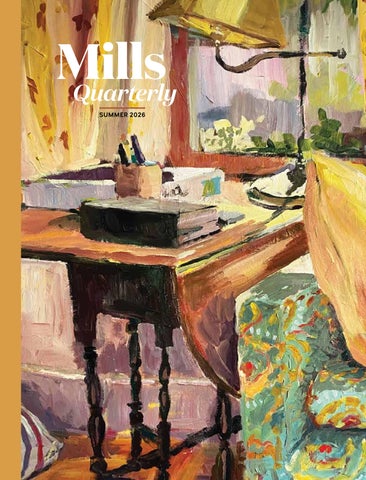
CAMPUS PHOTO: The leafy walk between Reinhardt Alumnae House and the Tea Shop is one of our favorites, especially during the quiet of an Oakland summer. Photos by Allison Rost. ON THE COVER: Curl up on your closest couch for this issue of the Quarterly, which celebrates the visual arts. Painting by Mittie Cuetara, MFA ’22.
CLASS NOTES / 28 MEDIA LAB / 31 THOWBACK / 32 Mills College Children’s School IN MEMORIAM / 35 SALON / 40 Sculpture by Monwilla Williams Craig ’74
LETTERS TO THE EDITOR
I always read your magazine almost cover to cover—not because I was a Millsie, but because I enjoy looking for people I’ve known. I didn’t find Nalini Ghuman or Sandra [Greer] the chem professor this time (they’re both from my choral life), but I did see a glimpse of Hung Liu’s art. Very satisfying! I love the photos, and I find myself wondering if you have any more of the Children’s School from 1973 to 1975, when my daughter (Tabitha Sparks, now a professor and a dean at McGill University in Montreal!) was there under Dorothy Legarretta? I would appreciate so very much anything you can find. –Emily Jurs Sparks, Oakland Absolutely! Images like that are stored in the Special Collections at F. W. Olin Library on campus, where Archives & Manuscripts Librarian Rebecca Leung oversees an impressive amount of material. Anyone who’s interested in scheduling an appointment to examine anything in the archives should reach out to her at SpecialCollections-Oak@northeastern.edu. –Ed.
MILLS QUARTERLY ASSOCIATE VICE PRESIDENT Nikole Hilgeman Adams MANAGING EDITOR
Allison Rost DESIGN AND ART DIRECTION
Nancy Siller Wilson CONTRIBUTORS
Scott Chernis Yvonne Daniel, MA ’75 Jill Robi Gesita Tafesse ’17, MA ’19, EDD ’26 Kieran Turan ’90 Monwilla Williams Craig ’74 Debi Wood ’75 .............................................................................
“I find myself wondering if you have any more of the Children’s School [photos]?” –EMILY JURS SPARKS
The Mills Quarterly (USPS 349-900) is published quarterly by Mills College at Northeastern University, 5000 MacArthur Blvd., Oakland, CA 94613. Periodicals postage paid at Oakland, California, and at additional mailing office(s). Postmaster: Send address changes to: Oakland University Advancement, 5000 MacArthur Blvd., Oakland, CA 94613. .............................................................................
How many Mills alumnae find the glitzy, bloated print edition of the “Mills” Quarterly an aggravation, I wonder? It’s all but impossible to find Mills news other than obits among the dross. Oh, there’s an online option? Get out your microscopes. This information is printed in a light font in light brown on buff and in no more than, at a guess, 8 points—if not agate or some other gem size. I propose that the online option be presented in a large highly legible banner on page 2 (the Letters to the Editor page). –Molly Michel McGinnis ’58, Manteca, California
Something off with your mailing? One more reminder: We’re now pulling our mailing list from our shared database with Northeastern, and there are undoubtedly mistakes out there that we haven’t been alerted to yet. If you’ve been affected, reach out to us! mills.quarterly@northeastern.edu 510.430.3312 quarterly.mills.edu/feedback
2
MILLS QUARTERLY
Copyright ©2026, Mills College at Northeastern University Address correspondence to: Mills Quarterly 5000 MacArthur Blvd. Oakland, CA 94613 Email: mills.quarterly@northeastern.edu Phone: 510.430.3312
OPENING MESSAGE
Mills alums and friends! I am so excited to share with you this summer issue of the Quarterly celebrating the visual arts. Last spring, while attending a CASE (Council for Advancement and Support of Education) conference for the editors of collegiate magazines, I attended a session with the creators of HUE, the magazine for the Fashion Institute of Technology (FIT). For their summer 2024 edition, they put together an issue dedicated to notebooks and the artistry their graduates create inside them. My immediate reaction was that we had to try that with Mills alums. The unofficial nickname of CASE is Copy and Steal Everything, so I’m sure the Quarterly isn’t the only publication running with the idea! In any case, many thanks to FIT for the inspiration, and you can see the amazing results on page 12. The publication of this summer issue also means that we have now completed two full annual production cycles since the debut of our redesign in fall 2024. In that time, feedback has been overwhelmingly positive, but I do want to bring up one unexpected consequence of the changes we implemented—printing delays. It just takes longer to put together the magazine with the binding and paper stock we now use for the Quarterly. Between that and newer challenges we’re facing with the postage process, you’re no longer receiving a new issue with time to spare for sending in Class Notes for the next one, which has always been the goal. We are doing our best to rework our schedules on the back end to compensate. Please remember, though, that we accept Class Notes on a rolling basis! Visit quarterly.mills.edu/feedback for a link to our online form; we can only publish sections like this—including Salon, Throwback, and Catching Up With…—with your participation! One thing that might help ease the wait for the print magazine is my big summer project: finally finishing and launching an email version of the Quarterly. We created a new standalone website in 2019, but unless you follow us on Instagram or Bluesky, you aren’t notified when the new issue goes up. Starting this fall, we will send out a message featuring our main stories
Allison Rost
and columns with links to all, including a new password-protected page for Class Notes! If you get the (e)ucalyptus newsletter and/ or invitations to events like Reunion or online webinars, you will most likely receive the Quarterly email with no problems whatsoever. But if you’ve unsubscribed from other types of emails and you’re not sure whether you’d automatically make it on our list, you can absolutely opt in for the Quarterly email—please reach out to me at mills.quarterly@northeastern.edu to do so. Thanks for continuing to show us your enthusiasm for the Quarterly. Enjoy your summer!
From the managing editor of the Mills Quarterly
SUMMER 2026
3
O N T H E O V A L 666666
666666
Two Mills retirees lauded at reception On May 5, new retirees (and emerita professors) Lisa Urry and Darcelle Lahr, MA ’17, EDD ’18, were celebrated for their 44 cumulative years of service to Mills College with a gathering in the Mills Hall living room. “They’ve trained bold leaders and created critical thinkers, students who discovered their voices and found the courage to use them in our classrooms and labs and case studies,” said Mills College Dean Beth Kochly, who kicked off the reception. Urry started teaching biology at Mills in 1995, and over the course of the following decades, she served as 4
MILLS QUARTERLY
department chair, held a longtime joint appointment as a visiting scholar at UC Berkeley, and developed a course titled Evolution for Future Presidents. “[It was] designed for non-majors and born of her conviction that understanding how life changes over time is not a privilege for biology students alone,” Kochly said. Urry was also the lead author on Campbell Biology, an intro textbook now in its 13th edition that has been used by more than 14 million students, and she worked with the Global Teaching Project to bring AP biology instruction to students who didn’t have access. “I was really excited to teach here
because I’ve always been passionate about increasing the number of women in science. And then, it became even more satisfying as the number of students of color increased at Mills,” she said, relaying a story about a Syrian student who wanted to cure leukemia, the disease that took her brother, but initially failed Urry’s biology class. The student passed the course at a community college but asked to take it with Urry again. Urry later discovered through happenstance that the student went on to earn a master’s degree in molecular and cell biology and was working as a research assistant. Lahr first joined the Mills faculty in 2012, teaching courses in leadership and ethics, social entrepreneurship, and the strategic management capstone for MBA students at the Lorry I. Lokey School of Business and Public Policy. She later served as the director of the Center for Transformative Action and held the Elfenworks Lectureship in Leadership and Ethics, “which is a very fitting appointment for someone whose career has been an extended argument that ethics and practice cannot be separated,” Kochly said. “Her students encountered business as an instrument with moral weight which could entrench injustice or dismantle it.” continued on page 5
News in brief As we were going to press in June, it was announced that Beth Kochly, dean of Mills College at Northeastern, will also take on the permanent role of Mills Institute executive director. “Together, the College and institute will continue to honor the historic legacy of Mills and realize its future as a hub for sustainable and justiceoriented research and education,” Kochly said in the announcement. We’ll have more on this in the fall 2026 issue.
On Saturday, March 28, the inaugural East Bay Global Health Consortium was held on the Oakland campus, featuring contributions from legacy Mills faculty and alums. Associate Clinical Professor Catrina Jaime organized a day-long schedule with speakers, academic workshops, and roundtables that brought students in the health sciences together with visiting physicians. Tiffany Rose Naputi Lacsado ’02, who is the chief program officer of The Unity Council, was one of the speakers. More than 125 attendees, including 60 first-years, were on hand for the event, which was held
in collaboration with The Permanente Medical Group.
The Mills College Dean’s Office has debuted a new website with information about available academic offerings (including minors in creative writing and sustainability) as well as research opportunities unique to the College. Visit the updated resources (including links to alumnae info) at mills.northeastern.edu.
Former provost and Professor Emerita of Ethnic Studies Chinyere Oparah and Sabrina Kwist, MA ’11, EDD ’17, returned to campus on Friday, May 8, for the 10th Annual Women of Color in the Academy Conference. This year’s event, “Hope as Practice: A Decade of Empowerment, Creativity, and Connection,” saw them appearing in person at the Rothwell Center theater for a plenary session with two virtual guests: Tara Parker, dean of the College of Education and Human Development at the University of Massachusetts Boston, and Rachel Moo, assistant dean of engagement and impact at Northeastern’s College of Arts, Media, and Design.
“I began to teach my business students what real change and justice means in the business world, in society, and in their own lives,” Lahr said. “They began to realize that they too had the capacity to make change, and they gave themselves permission to really go out there and channel that desire for change in everything that they’ve been doing.” She will continue working with her nonprofit organization, L.C. and Lillie Cox Haven of Hope. Also retiring this semester but unable to attend the reception was Assistant Teaching Professor Kathryn Reiss, who started teaching English at Mills in 1989. An author of Young Adult fiction, Reiss will continue teaching one class for Mills at Northeastern next academic year in an emerita role.
RUBY WALLAU
Retirees, continued from page 4
Opposite page: Lisa Urry and Darcelle Lahr: Above, Kathryn Reiss
Quarterly archives join Northeastern digital library The Digital Repository Service (DRS), Northeastern’s online archive system that’s accessible to users worldwide, recently added most issues of the Mills Quarterly dating back to the year 2000. These editions were already available online in a flipbook format, but the contents within were not easily discoverable. Their inclusion in the digital archives, which can be searched by keyword and name, is intended to ease the experience of researchers who contact library staff and the Quarterly office seeking out articles on story subjects. The aim of the project is to continue back through the Quarterly archives and digitize issues that only exist in print format right now. (These efforts will also not take the place of our work in putting up individual stories on the Quarterly website at quarterly.mills.edu. Our archives there, as of press time, go back to the fall 2010 issue.) “The Special Collections team is working towards digitizing important pieces of Mills College history. In the future, with the proper funding, we hope to digitize key pieces of the Mills archives, such as the Mills College Weekly,” says Rebecca Leung, archives and manuscripts librarian at F. W. Olin Library. “As part of this initiative, this summer we are working on getting the Fires of Wisdom oral history interviews on the Digital Repository.” The library’s work is just one of several digitization projects happening on the Oakland campus—the Mills College Art Museum digital collection has also joined the DRS. Work also continues on the Center for Contemporary Music archival project. Visit Northeastern’s DRS at repository.library.northeastern.edu.
SUMMER 2026
5
EMBRACING ALL FORMS OF SUSTAINABILITY Northeastern’s Sustainability Innovation Week got an infusion of Mills flavor in Oakland this year, as the emerging sustainability theme for the College’s curriculum got a big boost through five days of programming. The week kicked off on Monday, March 9, with an evening gathering at Lisser Hall featuring a conversation among four campus experts: Professor of Mathematics Maia Averett, who’s also the program director for Mills’ sustainability curriculum; Mills Farm Director Julia Dashe; Rhoda Goldman Professor of Environmental Science Kristina Faul; and Director of Faculty Affairs Bryan Aja, a board member for the nonprofit Keep Oakland Beautiful. The quartet discussed the ways their work interacted with each other, and the interdisciplinary ways in which today’s sustainability challenges can be approached—whether they’re environmental in nature, or social or economic. The new sustainability studies minor developed by the Mills faculty debuting this fall explores these dynamics. (More info to come in the fall Quarterly.) The remaining four days brought those intersections to light, as an additional four scholars presented their work at separate lunchtime lectures for faculty and students. Assistant Research Professor Jeremy Sorgen, whose research covers environmental policy, especially among Indigenous tribes,
6
MILLS QUARTERLY
discussed his work—the closest to “traditional” definitions of sustainability. Associate Teaching Professor Ashley Adams discussed the preservation of important cultural sites, particularly historic Black towns, and Juan ColominaAlminana—the James Irvine Professor of Economics—took on the interplay of sustainability and philosophy. Poet and Carver Professor in Far Eastern Studies Truong Tran spoke about his self-taught visual art practice, one he introduced with a story: More than 15 years ago, a student asked whether she could fold paper cranes in class to manage her anxiety. After three years of this setup, she later brought him a garbage bag stuffed full of those cranes for him to use in his creative work. “She hands me these cranes, and I count them, and there’s something embedded in that gesture that sustains that connection between us,” Tran said. His work is traditionally sustainable in that he uses found materials—he quipped that San Francisco living is always fruitful because neighbors are constantly remodeling and throwing things away—but he said he relished the sustainability in the habit itself.
During the pandemic, he started a project that eventually became 100 Nights of Pandemic/100 Days of Yearning, an exhibition through the Kearny Street Workshop at Arc Gallery & Studios this past winter. (Read more about Arc on page 22.) “I started making these lanterns as a way of communicating with my students and my community, because we were all in isolation,” he said. “Making a light structure in one evening is very doable. It’s basic. And the idea behind it is very simple: It’s just to turn on the light.” He added that he shares this creative process with his students as a way of demonstrating resilience and persistence, the very nature of sustainability itself. “What I learned through these projects is that creativity often survives not through grand gestures; it survives through small acts that are repeated over time,” he said. “In that sense, creativity begins to present sustainability. Not sustainability as a slogan, but sustainability as a practice of continuing.”
ON THE OVAL
Research the cornerstone of Institute’s semester On Tuesday, April 6, the Oakland campus hosted an evening celebrating student research projects across colleges and departments. Some of the featured ventures included video games designed to enhance science education, a look at the chemistry behind skincare products, and an AI model to help the Mills College Art Museum generate keywords for its extensive collection. Among the presenters were several participants in the Russell Women in Science Leadership Program, which is now part of the Mills Institute. Among others, first-years Zoe LaFleur and Joyce Lee worked with Lee Mirmow Professor of Psychological Sciences Liz Bachen on continuing research (originally started with Mills students) on mental health in young adults; and Chrissy Chimos and Mikayla Jones collaborated with Rhoda Goldman Professor of Environmental Science Kristina Faul in studying the effects of climate change and urban development on Lake Aliso. That research theme was seen throughout the Mills Institute’s programming this past semester. Sei Jung, the beneficiary of a collaborative fellowship between the Institute and the Mills College Art Museum, traveled from Boston to Oakland to present a session on “Shared Patterns: Form and Labor in Crafts and Generative AI” at the Aron Art Center on March 17. In it, she discussed her ongoing work on how patterns are a common creative expression across time and geography—and that these patterns can produce codes that can be picked up by AI, which usurps the collective efforts made in creating them. She is expected to graduate with her PhD from the College of Art, Media, and Design in 2028. And on April 24, the Research Justice at the Intersection fellows for 2025-26 presented their year’s work over a long afternoon at Reinhardt Alumnae House. This year’s topics included the effects of incarceration and re-entry on individuals with traumatic brain injuries, Muslim political activism at educational institutions, and the impact of changing abortion laws on local communities. Videos from each of these discussions are available for viewing online at millsinstitute.northeastern.edu/rji-scholars-2025-2026. Other recent Mills Institute projects include the launch of the spring edition of The Womanist, titled “At the Crossroads.” Check it out online at tinyurl.com/womanist-spring-26.
“Bissa High Cloud,” a mixed-media piece by the artist Keba Armand Konte, has a new place of honor in the Mills Hall living room. Several works from the Mills College Art Museum have made their way there to accompany a refresh of the space’s furnishings.
Sally Decker, MFA ’19, performed with longtime musical partner Brendan Glasson, MFA ’18, at Attack, Decay, Sustain, Release: A Mills College Music Reunion Concert, which was held on March 17 at Littlefield Concert Hall. The evening’s bill also included improvisation from Professor Emeritus of Music Chris Brown with Ben Davis, as well as the trio of Robert Lopez, MFA ’13; Aaron Oppenheim, MFA ’13; and Shanna Sordahl, MFA ’13. To cap the evening, Professor of Music David Bernstein moderated a conversation amongst the concert’s performers. Watch a video of the concert at tinyurl.com/ reunion-concert.
SUMMER 2026
7
OVER THE WIRES
66666666666666666666
Press mentions and honors for Mills alums and Oakland professors Sheryl Bizé-Boutté ’73 has been appointed the poetry summit coordinator for the 2027 San Francisco Writer’s Conference, which will be held next February. She has served as the Writing for Change track coordinator/presenter since 2019.
On May 4, the Pulitzer Prize Board announced its 2026 honorees, including Frederick A. Professor Juliana Spahr! Her 2025 collection of poems, Ars Poeticas, received the Pulitzer Prize for Poetry (in the Books, Drama & Music category), with the committee saying the following: “A collection in which the poet takes stock of her personal disillusionment, which she uses to interrogate her relationship to her art form, community, and politics.”
Jazmine Cisneros Pena ’20 works at Skyline High School as a college and career readiness specialist, and she spoke with The Oaklandside for a story about the school’s higher-than-usual rate of sending graduates off to UCs. Read the article at tinyurl.com/jazmine-cisneros-pena. “Decolonial Listening across Offa’s Dyke: English Music and Cymru/Wales” is the title of Darius Milhaud Professor of Music Nalini Ghuman’s latest lecture, which she delivered at Bangor University in Wales on December 10, 2025, and at Yale University on April 2. On Valentine’s Day, Professor Emeritus of History Bert Gordon delivered a presentation on “Valentines and Chocolates: Their Connections through History” at the Orinda branch of the Contra Costa County Library. He lectured about the same topic in “From the Americas to the Chocolate Bar” at the El Sobrante Library on June 6. An undergraduate alumnus of Sierra College, Matt Gottschalk, MFA ’12, now works there as a visual arts specialist. For the institution’s 30th anniversary, his work was included in the exhibition 30 Years of Art Making late this spring. He spoke with The Union newspaper in Grass Valley about the show and the program’s history; read that article at tinyurl.com/ matt-gottschalk.
her upcoming collection of short stories, The Last Day. Read the interview at tinyurl.com/kim-magowan. After 20 years, Lynn Mackey ’96 stepped down from the position of superintendent of the Contra Costa County Office of Education at the end of this past academic year. She reflected on her time in office with DanvilleSanRamon.com (and staff writer Jeanita Lyman ’18) at tinyurl.com/lynn-mackey. Germaine Thompson Professor Brinda Mehta was one of two plenary speakers at the Situating the Indian Diaspora in Asia conference, held April 23 and 24 at Mahidol University in Thailand. Her talk was “Coolitude Meets Indianité: Postcolonial Kala Pani Writings in French.”
LA Weekly covered the artwork of Markus Kager, MFA ’22, as he plans to focus on the natural beauty of Southern California for his landscape pieces this summer. Read the story at tinyurl.com/ markus-kager.
Stephanie Mills ’69, who delivered a memorable commencement address on the environment when she graduated from Mills, gave a lecture on “Starting From and Staying with the Nature of Place” at The Grand Traverse Circuit in Michigan on April 8. She first gave the speech as the keynote address at the 18th Annual Freshwater Summit in October 2025.
The online journal JMWW spoke with Kim Magowan, associate teaching professor and holder of the Joan Danforth Professorship in the Art, about
Mission Local, a San Francisco-based non-profit news organization, added Nicola Miner, MA ’14, to its board of directors this past winter. Miner, who also
8
MILLS QUARTERLY
holds a master’s degree in journalism from Columbia, has taught writing at City College of San Francisco, the College of San Mateo, and Berkeley City College, and she’s the co-founder of the Miner Anderson Family Foundation. The Bay Area public radio station KALW interviewed Erika Oba, MA ’15, about the Asian American jazz movement and how her music fits into that legacy. Read the story from February, or listen to it with examples of her work, at tinyurl.com/erika-oba. Unique Robinson, MFA ’12, is the director of the MFA Community Arts Program at the Maryland Institute College of Art in Baltimore, where Unique grew up. On the institution’s website, she discussed the path that led her there and her work in bringing the city’s vibrancy directly into the institution. Read her thoughts at tinyurl.com/ unique-robinson. Professor Emerita of Book Art Kathleen Walkup served on the Croton Council on the Arts’ planning committee for Our World’s Creative Women, a month of programming for Women’s History Month in March.
A SLICE OF QUARTERLY HISTORY: MAY 1974
Sports, Illustrated By Chris Bemko ’74
Re a d the full a rticle at quarterly .mills.ed u/ legacy
S
UDDENLY THE OVAL IS A JOGGING TRACK, the fountain near Wetmore Gate is the center of a bicycle circuit, Lisser Hall faces a frisbee competition ground, and the I. W. Hellman Memorial Pool is attracting almost as many swimmers as sunbathers! Whether bounding up to Pine Top, circling the Campanil, or weaving in and among our much-touted eucalyptus trees, the increasing number of joggers hints at a minor, peaceful revolution taking place all over Mills. Whatever the individual reasons—professional ambitions, a sense of accomplishment at a mastered skill, or just kicks—today, it’s hip to be sporty. Marie Nogues, retiring head of the Department of Health, Physical Education, and Recreation, looks back on 36 years of involvement in athletics at Mills: “We’ve had highs and lows [in popularity]; sports are coming back into their own. There are an awful lot of people doing activity on their own. [Our culture] is interested in good health, and sports activity is one way of achieving it.” Female professionals like tennis player Billie Jean King and golfer Carol Mann have helped bring about this change in public opinion. Their efforts have been rewarded by increased press coverage of women’s sports events; this coverage increases the prize money put up by advertisers and helps make future women athletes aware of the opportunities that exist. Active sports are no longer just for merit; women have at last discovered that there is nothing unfeminine about being a sportswoman. Today at Mills, it’s hard to go anywhere without running into “Jane Jock” proudly, puffingly, “doing her thing.” Things were different on campus about 50 years ago. Marguerite Rodgers Blohm ’21 recalls that, in her Mills days, organized group activities like field hockey were the rule; not many participated in individual sports just for the fun of it. Dance was “big” in the required gym classes, and to be on the crew was to be a social as well as an athletic success. Today’s 15-minute drive to Lake Merritt was, then, a 40-minute ride each way on the Leona Heights streetcar. Even so, “everybody went out and hoped to be chosen.” The 1921 Mills College crew had its own yell leaders and pep rallies, and it was important enough to rate much coverage in the yearbook. Few people played tennis, and “only men played golf,” Blohm remembers. Interestingly enough, Amalia Anderson ’74—Blohm’s granddaughter—
is considering a career as a golf pro after her graduation from Mills this May. The emphasis on team sports and the neglect of individual sports that Blohm remembers might have been the result of subtle social pressures; however, it would be nice to think that such pressures were removed in our enlightened women’s college. A more likely explanation, perhaps, would be the lack of time and inclination for more athletics, above and beyond those group sports necessary to fulfill P.E. requirements. Today, enrollment in any class in the Department of Health, Physical Education, and Recreation is voluntary, but with such enticements as world-renowned Keiko Fukuda’s judo, Olympian Ferenc Marki’s fencing, Richard Janusch’s golf, Bob Lorimer’s horseback riding, Gayle Keifer’s “swimnastics,” Carrie Mollenhauer’s sailing, and Patrice Griffin’s tennis, it’s easy to see why 50 percent of the student body is officially enrolled in classes, besides the auditors and independent swimmers, golfers, joggers, yoga enthusiasts, tennis players, and bikers. SUMMER 2026
9
Zadie Moon ’22, who graduated with a Mills degree in public health and health equity, received her Northeastern master’s in computer science this year in Oakland.
2026
Commencement
“In an age obsessed with becoming machine-like, the future will belong to people who will remain deeply human.” –Commencement speaker Yanbing Li
10
MILLS QUARTERLY
PHOTOS BY SCOTT CHERNIS
And just like that, the final nine Mills legacy students—four undergraduates and five candidates for the Doctor of Education degree—walked across the stage at Commencement 2026, held on Saturday, May 16, on Holmgren Meadow.
T
HEY WERE JOINED by nearly 300 master’s candidates from Northeastern’s Oakland and Silicon Valley campuses, covering advanced degrees in analytics, game design, computer science, information systems, and public administration/policy. The four bachelor’s degree recipients who participated in this year’s ceremony majored in biology, English, political science, and psychology. In a graduation season that made national headlines for loudly negative responses to AI mentions at some ceremonies, this year’s Commencement speaker—Yanbing Li, the chief product officer at Datadog and founder of the Women in Tech conference in Beijing—honored the human. She recounted that she had just attended her own daughter’s college graduation the day before, but that daughter’s twin sister had not lived to experience a similar moment, passing away in 2025. It took time, but Li and her family found their way back.
“I spent my career building systems that service everything: every signal, every anomaly, every failure, all in real time. But what this past year has taught me is that the most important things in life generate no alert,” she said. “They show up in silence—a phone that doesn’t ring, as a chair that stays empty. We learned how fragile life is, and yet I watch human resilience do what it does best. Resilience is not the absence of pain. It’s a capacity to keep living, pain and all.” Li finished her address with a reminder: “In an age obsessed with becoming machine-like, the future will belong to people who will remain deeply human.” As is tradition, Mills alumnae robed up and processed into the ceremony at its start, with the addition of a Northeastern touch: recognizing and naming each of the Golden Graduates in attendance. This year, they were Connie Swan Davidson ’73, MA ’02, EDD ’06; and Micheline Beam ’72; as well as Juan Kelly, who received an MS at Northeastern in 1975. 6
SUMMER 2026
11
In Process We reached out to nearly 200 Mills artists with a simple question: Would you show us what your work looks like… deconstructed? Whether that meant sketches, models, diagrams—the idea of seeing creativity in draft form was just too intriguing to resist. Of course, the question itself generated a broad discussion. Is art itself ever really finished? Or is it a spectrum from ideation to a stopping point of some kind, whether that point is terminal or not? The submissions we received engage with that conundrum in a number of fascinating ways.
MITTIE CUETARA, MFA ’22 mittiecuetara.net Oakland
“My work starts with affection for the way we make our nests,” says Mittie Cuetara. “Recording with paint and other materials, making art is kind of nest building in itself.” And this nest, which you can also see on our cover, embodies the “messy and colorful, organic” aesthetic that Cuetara finds compelling—but it started with a simple line drawing in her sketchbook. She earned her MFA in 2022, though she originally graduated from Boston’s School of the Museum of Fine Art with her BFA. Cuetara is a longtime painter and illustrator, particularly for greeting cards and children’s books.
12
MILLS QUARTERLY
ESTHER TRAUGOT, MFA ’09 esthertraugot.com Sebastopol, California
Finished items from Esther Traugot’s studio resemble cute little pieces of nature snugly swathed in crocheted goldenrod blankets—which looks deceptively simple. But she starts at the very beginning, by creating her own thread and dyeing it herself. She then takes natural found objects like rocks, shells, and branches and creates wrappings for each one, even patching up imperfections that come about due to exposure. “As in gilding, these false ‘skins’ imbue the objects with an assumed desirability or value,” she says. “I am drawn to the concept of repairing with gold, a bringing together of separate parts in golden joinery, where fabric intersects with nature and the human hand is the intermediary.”
HOLLY MEEKER ROM ’71 hollymeekerrom.com New York City
Holly Rom, a watercolor and hand-painted paper collage artist, took a photo of a striking woman at an outdoor Harlem concert last May and set out to recreate the image. It took her several steps, starting with this sketch completed in red paint and then moving on to charcoal. To round out the final version, Rom included a scrap of Batik fabric she originally created in 1973 to represent her model’s dress, and the garden came from other watercolor scraps glued to the paper. “The challenge in creating a work of art involves numerous small decisions, such as what layout to use on the page, what shape and color to use, and where,” she says.
SUMMER 2026
13
IMANI KARPOWICH-SMITH ’18 vimeo.com/inksmith Berkeley
Video, sculpture, and drawing are just a few of the mediums through which Imani Karpowich-Smith explores identity, especially hers as a Black, queer interdisciplinary artist. And all of it happens through the frameworks of studio art and ethnic studies—her two majors at Mills. “Rememory” was a 2017 installation at Ewha Womans University in South Korea, an altarpiece that honored those who endured the inhumanity of the Middle Passage. She is currently working toward an MFA in cinema at San Francisco State.
ANA LISA HEDSTROM ’65 analisahedstrom.com La Honda, California
Ana Lisa Hedstrom studied art with 1960sera Mills legends, such as Antonio Prieto for ceramics and Catharine Caldwell for Asian art history. That influence stuck with her as she went on to study ceramics at Kyoto Art College after Mills, but she found herself falling in love with Japanese textiles and techniques such as shibori resist dyeing. Her recent work has involved folding and dyeing modular paper pieces with indigo and folding them into airplanes. “Even in our digital age, paper airplanes continue to fly!” she says.
14
MILLS QUARTERLY
HEATHER COX ’88 coxart.com New York City
Heather Cox’s photograph “Crouch” (from 2024) is part of her Roundels series, where she staples donated snapshots into sculptural forms. Her initial plan wasn’t necessarily to create sculptures that would become wearable pieces, but those intentions shifted as the works grew larger and could no longer support their own weight. Cox took formal portraits of herself and others working with the pieces in new ways. “Roundels became a way to regenerate memory and material, collapsing the distinctions between image, object, and archive,” she says.
SUMMER 2026
15
KARA FOREST, MFA ’21 karaforest.com Oakland
In “Grief Doily,” a stereotypical craft item—an intricate laced doily—started its life as something much different. Kara Forest originally located the materials in a thrift-store sweater… and wore it until it was falling apart. She then unwound the knitted piece with her hands and crocheted it into a doily using a family pattern that was retooled to use all of the yarn. “By embracing my mistakes and repeating them to create something imperfect, the doily became abstract,” she says. “Doilies are meant to be useful and display the precision, delicacy, and perfection of their maker.” Forest adds that the work, created in 2025, helped her mourn the death of her grandmother.
16
MILLS QUARTERLY
ELIZA BARRIOS, MFA ’95 elizabarrios.com San Francisco
In her thesis exhibition at the Mills College Art Museum, Eliza Barrios’ installation “Solemn” combined wood, aluminum, and halogen lights with slide projections to create funnels that represent how humans hold onto beliefs and precepts that might or might not serve those who hold them. Since then, her solo work continues to explore how physical space relates to the intangibles of life, and in collaboration, she uses performance, video, and photography on pieces that engage with gender, culture, and current political issues.
MADELYN COVEY, MFA ’12 madelyncovey.com Richmond, California
The final version of “Jessica and Dakotah,” seen here in sketch form, was on display at Pacifica’s Sanchez Art Center from April 10 to May 10 this year. The named subjects are bandmates of the artist, Madelyn Covey, and the text represents song lyrics. “My artwork focuses on people and how they perform aspects of their identities or inner selves,” she says. “I have always loved painting portraits of people using housemates, folks dressed up at comic book conventions, celebrities, and screencaps of TV shows as subject matter.” Covey currently works as a painting facilitator and youth program coordinator at Oakland’s Creative Growth Art Center.
SUMMER 2026
17
CLARE OLIVARES, MFA ’84 clareolivares.com Oakland
The paintings produced by Clare Olivares hardly ever start with a sketch: “I am an intuitive painter working out imagery directly onto the canvas.” That imagery often includes brightly colored scenes from nature, featuring all sorts of flora and fauna—a peacock, deer, fallen autumn leaves. But she still turns to her sketchbook as an idea generator. “In sketchbooks, I can experiment with new brands of inks and paints, play around with color palettes, and work out shapes,” she says. “When traveling, I always carry a small watercolor set and a sketchbook; filling each with observed images and impressions as well as words or phrases which feed into my poems as well as paintings.”
ANNA HAULENBEEK HUSKEY ’73 haulenbeekart.com Santa Cruz
A dance major at Mills, Anna Haulenbeek Huskey permanently added the visual arts to her repertoire when her children were young and she found herself enjoying painting and drawing with them. Since then, she has extensively studied with teachers including Michelle Giulvezan-Tanner, Melinda Cootsona, and Jerry McGlaughlin, and she’s participated in Santa Cruz County Open Studios several times and exhibited in the de Young Open in 2020. The final piece here, seen in the inset, is “On the Edge,” created in oil paint and cold wax on wood panel.
18
MILLS QUARTERLY
LAURA SPLAN, MFA ’02 laurasplan.com Brooklyn, New York
In anticipation of her upcoming residency with the Garfagnana Innovazione Digital Stone Project in Italy, Laura Splan created this 3-D model for a marble sculpture she’ll work on there with the assistance of robotic carving. It’s only appropriate that it includes the molecule 9IVC, a fungus otherwise known as the Saccharomyces cerevisiae—which destroys marble itself. The piece comes out of a partnership with Oakland nonprofit Open Fung. “Some of my conversations with scientists have explored everything from fungal computing and machine learning to the possibilities for bioremediation with fungi,” she says.
BECKY BUSI, MFA ’07 beckybusi.com Spokane, Washington
“Art is an intersection of past and present, whether allegorical or abstract,” says Becky Busi, who shared this view of her scrapbooks and experiments. “My work is a 3-D lens of responses to internal and external surroundings.” Busi has participated in numerous exhibitions and created public art in Oakland and Sacramento, and she’s held artistic residencies at Spokane’s The Hive library space and the Centrum art center. She graduated with her BA from the former Cal State Hayward in 1994.
SUMMER 2026
19
instagram.com/weirgallery Vallejo, California
Yes, even one of the most recognizable and beloved pieces of art on campus went through multiple iterations before the final version was installed in 1991. “Woman Power” started out as an illustration Weir drew for the 1989 edition of The Walrus, and during the Strike of 1990, that image was emblazoned across T-shirts, flyers, and more. The Class of 1990 commissioned her to create it in sculpture form, which she did with clay that was cast in bronze— after trying out several different iterations first. In the years since, Weir has continued to explore the female form in additional mediums, including ink, watercolor, oils, and block prints.
PHIL CHANNING
ROBERTA WEIR ’86, MFA ’90
REBECCA WATERHOUSE ’10
rebeccawaterhouse.wordpress.com Uppsala, Sweden Though she graduated from Mills with degrees in studio art and French, Rebecca Waterhouse now works as a research assistant for the Department of Energy and Technology at the Swedish University of Agricultural Sciences. Those art skills still come in handy; this farmland sketch eventually played a part in her master’s thesis project, which demonstrates “the flows of nitrogen in the Swedish agro-food system,” she says.
20
MILLS QUARTERLY
SARAH HIRNEISEN, MFA ’11 sarahhirneisen.com Austin, Texas
An associate professor at Texas State University, Sarah Hirneisen is a sculptor who focuses on common objects and the roles they play in everyday domestic life, oftentimes bringing in molds of her own hands. The craft-based techniques she uses in her pieces often add quite a bit of time to her artmaking, so it’s no surprise that she carefully sketches them out before getting to work. These works are part of her Heirlooms series, which reworks household items to reflect the humanity that puts the tool to work.
LAURA DOLP ’90 lauradolp.com New York City
The maps seen in Laura Dolp’s portfolio trace their roots to archeology— she researches prehistoric sites that have been unearthed in regions around the Mediterranean and Baltic seas. After examining the locations herself, she returns to her studio to piece together elements of printmaking, collage, and text to illustrate what she experienced there. “A bird’s-eye view highlights systemic relationships and emphasizes abstraction and control,” she says. “It also invites intimacy through recognizing interconnection from afar, beyond human scale.” 6
SUMMER 2026
21
SPEAKING HER MIND THROUGH HER ART
P
RISCILLA OTANI ’74 didn’t go to Mills to become an artist or a curator. And yet: She’s a mixed media artist whose works cover Japanese folklore and American politics, and she’s also the co-owner and curator of Arc Gallery & Studios in San Francisco. “I am curating an exhibition on the ‘kitsune’ this summer,” she said, referring to the shape shifting fox spirit. “I have built a career in the arts without an MFA.” She started Arc in San Francisco with her spouse and two partners in 2010. Comprised of a café, headquarters for the nonprofit Kearny Street Workshop, and 10 studios that can accommodate up to a dozen artists, the center also utilizes its gallery for mounting exhibitions. “I had organized many art exhibitions for the Northern California Women’s Caucus for Art (NCWCA) before Arc Studios, so it wasn’t difficult to create them,” she explained. “We have a different exhibition monthly in each of our two galleries.” Their focus is primarily on providing opportunities for Bay Area artists, which Otani says came about because not nearly enough San Francisco venues showcase diverse, local talent—despite the region’s counterculture reputation and a high concentration of creatives and innovators. Otani’s career didn’t start in the art world; for a time, she was vice president of global compliance for Gap, Inc., where she created an organization of 120 nationals located in more than 40 countries. They partnered with local NGOs and monitored factories to improve factory conditions. Her employees came from myriad backgrounds: journalists, attorneys, environmental scientists, and more. But she also helped rebuild NCWCA into a fully engaged nonprofit, a feat she is incredibly proud of: “We operate on a shoestring by taking advantage of our 501(c)(3) yet our organization presents professionally as any for-profit corporation.” Though studio art, modern dance, and electronic music were what brought her to Mills, she ended up majoring in psychology. “It was some-
22
MILLS QUARTERLY
thing new to me, helping me understand human behavior,” she says. “The education I received at Mills has served me in good stead throughout my academic and working career.” Mills also offered flexibility in her studies, allowing her to take whatever classes she wanted. Otani described that period as a “liberal time” at Mills, with a loose structure on class requirements. “We could create our own majors,” she explained. “We also took our finals using the honor system.” She studied at Barnard College during her junior year and graduated with a double major—psychology and Asian studies at Mills— later earning an MA in classical Japanese literature at Columbia University. “I appreciated the teaching methodology at Mills much more after that [Barnard] experience,” she says. During her tenure in college, she took classes in art and art history, modern dance, and electronic music—those topics that originally drew her to the College—and she even wrote for the Quarterly, interviewing activist lawyer Nancy Le Blanc ’54. Otani says that Mills also introduced her to feminism by not just embracing its values but showcasing them, especially through inviting many feminist speakers to campus. Feminism was in the school’s fabric. “One of the most important lessons I learned was to value female friendships—something I didn’t take seriously and probably wouldn’t have taken seriously had I not gone to a women’s college,” she says. Comparatively, she found Barnard lacking when it came to discussions on women’s rights, which were commonplace at Mills. “In 1972, Barnard seemed behind the times in terms of
WORDS BY JILL ROBI
“ At Mills, I realized that they taught me something more: how to think.” feminist thought,” she notes. “I noticed that few women spoke up in class, and men got much more of the professor’s attention.” Mills also informed her social struggles awareness by proximity; the headquarters for both the Black Panthers and Hell’s Angels were nearby, and Asian American and Black rights groups were started at Mills. The impact Mills had on Priscilla was paramount. From the environment to the culture to the teachers, all were integral dominoes that helped inform the perspective that infuses her
ventures in the art world. At her gallery and other spaces, she has co-curated several exhibitions on social justice with a feminist perspective on behalf of NCWCA with all works by women artists. Those topics ranged from the male gaze (Man as Object: Reversing the Gaze in 2012) to feminist outrage (F*ck You! In the Most Loving Way in 2016 and F213 in 2019). Otani also co-curated an exhibition with a focus on social practice art in 2014 in Shenyang, China. “As a bicultural person and an internationalist, I continue to gain insights into what makes a country great and not so great. As a feminist, I see that there is a long way to go before equality is achieved,” she said. “My artwork is both a documentation of political events as they are occurring, and making visible the beauty of humanity’s struggle for a better life.” In addition, her own art is unapologetically political. Otani is currently working on an American flag series, an homage to earning her citizenship in 1985. Other recent pieces include “Green Card,” a recreation of Otani’s own “Resident Alien” card on fabric with image transfer and embroidery; and “Strait of Hormuz,” a recovered handheld fan literally taped together with American flag ribbon and decorated with watercolor and sequins. Much of her art in 2026 refers to current events: ICE raids and resulting resistance movements, the consolidating media landscape, voting rights. The emergence of AI is also on her mind, especially when asked what advice she’d give to a college student today. “Enjoy the process of acquiring knowledge. Learn how to think, not simply memorize,” she says. “Don’t let AI take away the pleasure of expanding your own imagination, writing skills, and knowledge.” After all, Otani is always dedicated to nurturing young creatives just starting out, something she also thinks about from a curator’s point of view: “Figure out how to mount your own exhibitions!” she says. “With technology today, once you’ve secured a space—it can be an alternative space, not a white wall gallery—you can select the artists and artwork and do it all yourself.” 6 SUMMER 2026
23
AAMC News & Notes A MESSAGE FROM THE AAMC PRESIDENT On May 16, 18 of us put on our robes and lifted our class banners, the way Mills alumnae always have, and drove to campus to stand for the graduates—to cheer them across the stage and welcome them into our community. The last of the Mills College legacy students walked across the stage that day—fewer than a dozen, the final students who chose Mills when it was still Mills. The significance of that moment passed with almost no acknowledgment in the ceremony itself, their milestone absorbed into a sea of engineering and computer science degrees. And in that quiet, something became clear. The qualities that shaped a Mills education—its intimacy, humanity, belief in the full development of each person—were not what shaped that ceremony. Mills is now carried most fully by those who lived it. This spring, we also gathered to honor the Phenomenal Women of Mills—in particular, several of the legacy faculty and staff who embodied the College’s core values and helped shape who we became. Many had given decades to the campus and were in the later stages of their careers. Their positions have since been eliminated. Where the institution let them go, we came together to make sure their voices and contributions were recognized and honored. When the work of holding our Mills community together after the merger fell to our Alumnae Association, it might have been easier to let go. We chose not to. Someone had to care for and carry forward what had given us so much. That was Mills—and it falls to us, who hold the lived experience of what Mills was, to make sure the legacy we inherited does not end with us. Mills is not simply a memory now. It is an idea, a set of values, a way of seeing—and a difference the world urgently needs. Institutions will do what institutions do. But people decide what we will accept—and what we will create instead. This was the last Commencement of our Mills legacy students. But it is not the end of the story. This year, while the campus changed around us, the AAMC got to work. Thousands of Mills alumnae responded—you opened our emails, came to our gatherings, and affirmed that this community is strong. That
24
MILLS QUARTERLY
response has shaped everything that followed, because the AAMC’s strength has always been its alums. The board of the AAMC has stabilized our finances, adopted long-overdue governance updates, brought on staff, and rebuilt the digital infrastructure that a resilient Kieran Turan nonprofit needs to thrive. We also advanced the work that carries the Mills legacy forward. We began shaping new AAMC-led initiatives—our own independent contribution to the Mills legacy—with more to share later this year. We are working with the Mills Institute on a joint initiative—rooted in an AAMC proposal—to bring the arts back onto the campus in a meaningful way. And the AAMC Alumnae Dance Fund, which supports Mills dancers and choreographers, has new momentum, with a program manager stepping in and the first awards on the horizon. Even our merchandise sale became something unexpected—sales rose more than 600% in a single month, with alums telling us they bought simply to invest in the AAMC’s next chapter. That response is shaping a new online store, which will also feature specialty pieces by Mills alum artists. This has been a revitalization—a stronger, more capable foundation for the work ahead, and for the impact Mills alumnae will continue to make in the world. We want you to be part of it. By the time you read this, a new board will be seated— several members bringing deep nonprofit experience—and a new fiscal year has begun. The work is real, it is shared, and it belongs to all of us. The chapter on campus may have changed, but the work of Mills continues in us. We are here, we are building, and the next chapter is ours to write—out in the world, and on the ground that shaped us. Kieran Turan ’90 President, Alumnae Association of Mills College
Mills College Legacy Faculty, Staff, and Seniors Honored as 2026 Phenomenal Women By Debi Wood ’75 and Yvonne Daniel, MA ’75 Congratulations to the 2026 Phenomenal Women! They are Mills College legacy faculty: Ashley Adams; Natalee Kēhualani Bauer ’98, MA ’08; Christie Chung; Susan Ito, MFA ’94; Darcelle Lahr, MA ’17, EDD ’18; and Daphne Muse; Mills legacy staff: Cyn Jackson ’88, Ife Tayo Walker, and Zamora Zamora; and graduating seniors Amrih Almaky, Deborah Gonzalez, Josephine Guzman, Alia Thiel, and Sofia Usmani. The named students are the last cohort of Mills legacy students. On March 24 in the Student Union, each honoree shared deeply meaningful reflections on their campus tenure and what the College has meant to them. The popularity of the legacy faculty and staff brought out a record number of family, friends, colleagues, and alums (more than 70), who applauded them for their commitment to Mills. Both long-time staff and dedicated and departing faculty members expressed their appreciation for this special recognition. Continued on next page
The Last Graduating Class of Mills College: Carrying Forward a Legacy Being part of the final graduating class of Mills College is both an honor and a responsibility. As I walked across the stage to receive my Doctor of Education degree, I felt immense pride, gratitude, and a deep awareness that I was participating in a historic moment. Mills College has long been a place of transformation, empowerment, and opportunity. For generations, it opened doors for women, first-generation students, and those whose voices were often overlooked. To be among the last graduates of an institution with such a rich legacy is emotional. While we celebrate our accomplishments, we also recognize that we are closing a chapter in the history of a college that changed countless lives. My own journey reflects the power of that legacy. As an Ethiopian woman who earned all three of my degrees through Mills, starting my journey in 2014, I stand on the shoulders of educators, mentors, and community members who believed in me. My doctoral research, which examined how anti-Blackness in schools impacts the self-esteem of Black girls, was inspired by a commitment to educational equity and social justice—values that Mills has championed throughout its history. Continued on next page
SUMMER 2026
25
AAMC
Phenomenal Women, continued On a sad note, beloved professor and honoree Daphne Muse passed away from a long illness a few weeks prior to the Phenomenal Women event. Sabrina Kwist, MA ’11, EDD ’17, a longtime friend and protegee of Professor Muse, accepted the honor on behalf of the Muse family, relating the impact she made on those Mills students interested in equity and social justice activism as well as on the Bay Area social justice community. Her daughter Anyania Muse ’14 is following in her mother’s footsteps. “Phenomenal Woman,” the beloved poem by Maya Angelou, was read in sequence by several alums to great effect. The poem describes the strength, inner confidence, and personal power that carries women into any room or situation demonstrating strong leadership. This is the legacy spirit of Mills College! Yvonne Daniel, MA ’75, delivered the proclamation given to each honoree. In part, it said: “The Phenomenal Woman celebration has always been an inspirational event, and this year, it is extraordinarily special because the celebration ties a ribbon around the history and legacy of Mills College.” And the themes of history and legacy resonated with many guests. One attendee—a new employee of Northeastern University in Oakland—later wrote to the Alumnae of Color Committee, saying, “Hearing all the stories of Mills faculty and the impact [Mills College] has had on so many women was truly inspiring... I walked away last night with a full heart and a deeper perspective on the importance of community.” The Alumnae of Color Committee of the AAMC and the Office of Alumnae Relations cohosted the event, which received generous financial support from the AAMC. 26
MILLS QUARTERLY
The Last Graduating Class of Mills College, continued As I say my final goodbye to Mills College, I reflected on the idea that while institutions may change, their impact lives on through the people they have shaped. Mills may no longer exist as the independent college we once knew, but its spirit remains alive in every graduate who leaves committed to creating positive change in the world. As the final graduating class, we are not simply the end of a story. We are the continuation of a legacy. We carry forward the courage, resilience, and commitment to justice that Mills instilled in us. And in doing so, we ensure that the influence of Mills College will continue for generations to come. –Gesita Tafesse ’17, MA ’19, EDD ’26
TRAVEL WITH MILLS
South Africa
The AAMC’s fall 2026 travel program is still open for booking— three expert-led journeys through AHI Travel for alums who want more than a standard tour. Apulia: Undiscovered Italy, September 2–10, from $3,795 Spain: Andalucia in a Parador, September 24–October 2, from $2,995 Journey to Southern Africa, October 4–19, from $9,295 All trips are small-group, scholar-led, and open to guests. Coming in 2027: Our new partnership with Gohagan & Company brings river and ocean cruises to the AAMC program—including a Scandinavia and Baltic Sea voyage! Details are coming this fall. Full itineraries and booking: aamc-mills.org/travel
FROM THE ARCHIVES
66666666666666666666
This photo certainly started out in the Mills archives but we found it in old Quarterly files as well. For the crew centennial in 2014, we recounted the team’s storied history in our summer issue, and of the many photos gathered, just seven made it into print. So, from that collection of unused images, we present this action shot from 1920, showing the Mills crew besting UC Berkeley on a not-yet fully developed Lake Merritt, which both Mills and Cal women used at the time. Read the story from summer 2014 at quarterly.mills.edu/ pulling-together.
SUMMER 2026
27
Forpr i vacyr easons,Cl assNot es donotappeari nt heonl i needi t i on oft heMi l l sQuar t er l y. Tosubmi tnot esf orpubl i cat i on i nt henextavai l abl eQuar t er l y, pl easesendyourupdat et o mi l l s. cl ass. not es@nor t heast er n. edu orvi si tquar t er l y . mi l l s. edu/f eedback f oral i nkt oouronl i nef or m.
M E DI A L AB New releases, publications, and performances by Mills alums and professors Korie Beth Brown ’83 retired several years ago and has published several items since then: a short story in the anthology Lure of the Hunt in 2024; the novel Under a Desert Moon in 2025; and several haiku poems in various other collections. “A shout-out to everyone who took Diana O’Hehir’s creative writing classes with me—it’s never too late (especially for a Mills woman)!” she says. The Review of Philosophy and Psychology has published “Memory in Perception, Not as Perception: A Reply to Barkasi” by Juan Colomina-Alminana, associate teaching professor and the James Irvine Professor of Economics for Mills at Northeastern. Professor Emeritus of Music Fred Frith brought his improvisational music to The Mint in Victoria, British Columbia, on April 30, and to the Comox Valley Curling Centre a few hours away in Courtenay on May 1. Pam Grau: A Woman’s Painted Journey officially opened at the Santa Paula Art Museum on May 16. The solo show of mixed-media work by Pam Grau Twena ’77 runs through September 13. Connie Conway Hellyer ’59 has written a children’s picture book, A Home for Chocolate: Based on the true story of an orphan moose. She calls the title “a labor of love,” as proceeds from the book benefit Northwest Trek Wildlife Park in Eatonville, Washington, which her parents donated the land to establish in 1971. Rutgers Business Review published the paper “Unstable Intelligence: GenAI Struggles with Accuracy and Consistency” in its fall 2025 edition. Associate Professor of Marketing Kate Karniouchina was a co-author on the article, which evaluated whether ChatGPT correctly reported if scientific hypotheses were backed by research or not. Annie in Retrospect is the latest book by Kristina Miltenberger Voegele, MFA ’12. The novel, which was published last fall, follows a 40-something mother as she’s suddenly back in her 25-year-old body with her older mind intact. She spoke to 7x7 about the book in March; read that article at tinyurl.com/kristina-voegele. Associate Professor of Biology Sarah Swope was one of three co-authors on the article “Extremely Fine-Scale Soil Heterogeneity in a Rare Serpentine Endemic Plant Shape Patterns of Genetic Diversity,” which appeared in the journal Ecology and Evolution on March 27. Work by the late artist Marie Wilson Valaoritis ’44, known professionally as Marie Wilson, was exhibited in her first solo show in four decades at the Gallery Wendi Norris in San Francisco. Running from January 20 to March 14, A Poet of Forms and Colors included 16 paintings and seven works on paper. William Winant, MFA ’82, and former music professor Zeena Parkins appeared together on May 9 at Western Front in Vancouver, British Columbia. They paired up to perform pieces from Modesty of the Magic Thing, Parkins’ 2025 album that also pays tribute to Professor Emerita of Art Jay DeFeo. Dust & Metal is a new album by Xinh Xô, MFA ’12, that was created for a documentary exploring stories of freedom in Vietnam through the lens of the nation’s motorbike culture. The electronic score accompanies rare archival footage and contemporary scenes, and it was also presented in live concerts across the UK and Vietnam. Listen to the album at xo.supertape.site. “Violin,” a sculpture of welded steel coat hangers and scrap sheet metal by Evany Zirul ’68, was part of Woman 2026, an online exhibition of women artists that ran from March 8 until May 8.
Share your recent release with the readers of Mills Quarterly! Send a press kit, including high-resolution images, to mills.quarterly@northeastern.edu.
SUMMER 2026
31
THROWBACK
Mills College Children’s School On Saturday, April 25, students, parents, staff members, and alumni of the Mills College Children’s School gathered on that special spot of campus near Wetmore Gate to commemorate its centennial—and the end of its history of child-driven learning on the Oakland campus. (Some teachers and students are moving over to the Aurora School to help expand the offerings there.) Attendees enjoyed music, classroom exhibits, and opportunities to share their memories.
kindergarten. The school made the campus their curriculum, and I loved that the children could share the beauty and creativity of the campus. Looking out my window from the second floor of Mills Hall, I would occasionally see eight two-year-olds frolicking on the oval green with their student teacher. They captured tadpoles from Lake Aliso and brought water samples back to the classroom to discover amoebas and paramecia under a microscope. They walked in a line to the Art Gallery to take in FOR NEXT TIME the latest exhibitions and Zippers/Zippees/orientation leaders/ came back inspired to orientation followers: What are your favorite make their own artistic memories of the folks who helped you acclicreations. When I had a mate to Mills (or vice versa)? Did you form lastfree lunch hour, I joined ing relationships? Let us know by sending an the children at their little email to mills.quarterly@northeastern.edu, outside table sitting on leaving a voice mail at 510.430.3187 tiny children’s chairs. Or (time limit is three minutes), or mailing Ann and I would take a a letter to: Mills Quarterly / 5000 MacArthur trip to McDonald’s over Blvd. / Oakland, CA 94613 the lunch hour to share Chicken McNuggets
I read with sadness and nostalgia the announcement in the fall 2025 Quarterly of the closing of the Children’s School. It always stood as the signifier of nurturing, creativity, and commitment to excellence in learning, which were Mills College hallmarks for me during my tenure at Mills in the 1970s and ’80s. Our daughter Ann entered the Children’s School as a two-year-old and stayed three years through
32
MILLS QUARTERLY
AMY PERL
As this storied century of teaching and learning comes to an end—or moves elsewhere—here are reflections from just three of the thousands who have been touched by its legacy. sitting on the bell tower bench. She learned to read with books loaned from her teacher’s personal collection. The teachers at the school took individualized learning and creativity incredibly seriously, and with a couple of student teachers in each class from the Education Department, learning was individualized as well as shared. When Ann later graduated from Yale, she returned to Mills to take additional classes in the post-bac pre-med program before attending UCSF. She even received a small alumna scholarship! Thank you, Mills. I will always hold in my heart with love and appreciation my years at Mills, and both Ann and I reminisce still about the importance of beginning her education journey in such a positive fashion. –Former Associate Dean of Students and Director of Institutional Research and Planning Elizabeth Griego, Santa Rosa
concern. I had no intentions of learning letters, numbers, shapes, or colors. I just wanted to play. Of course, my parents were concerned and met with my teachers, but they also had no idea how to tackle this dilemma. With the support of the lead teacher, and the student teachers assigned that semester, they put on their thinking caps and derived a plan. They would teach me all I needed to learn in the areas I cherished the most. I clearly remember numbers, letters, and shapes being placed in my favorite areas. Those small tactics piqued my interest in learning. I slowly made it to smallgroup instruction, still in my dress-up attire with my favorite doll by my side. On the playground, I counted how many times I went across the monkey bars. In my little kindergarten brain, I had no idea that I was learning. Well, the non-traditional teaching style intrigued me. By January, I was fully engaged in all classroom learning activities. It was a slow and well planned-out process, but I made it. I often tell this story, because— unfortunately—this is not what education looks like today. If I were
AMY PERL
My experience at Mills College Children’s school played a key role in my understanding of learning styles and who I am as an educator today. As a special education teacher, I often share this story to get a laugh out loud with my colleagues, but also to give them an understanding of the importance of not giving up on students who are not ready to learn in a traditional way. I attended the Children’s School for kindergarten. My mom was a student at Mills College, so it was the perfect way for her to attend classes while I received my first educational experience. I clearly remember being astonished with all the colors, the dress-up area, doll area, play kitchen, and especially the playground outside. My brother was a few years older and attending public school, and his classroom looked nothing like this. For the first couple of days, guess where I gravitated every morning? My routine was as follows: I would go dress up, grab my dolls, then head straight to the play kitchen area. When it came time for recess, I headed straight to the monkey bars. This routine solidified over several weeks, which is when it turned into a
currently a kindergarten student in a traditional public school, I’d be seen as defiant, unable to learn, and exhibiting challenging behaviors. My name would be placed on the special education referral list, or I would simply be passed on without the necessary skills. However, the Children’s School did not observe my behavior as challenging. It was not an automatic conclusion that I was incapable of learning but rather learned in a very different way. Thanks to the Mills College Children’s School, I was not labeled as students are today. The amazing, dedicated teachers paved a positive education journey for me that proved that just because a student is not ready to learn, it does not mean they are not capable. –Myila Granberry ’05, San Leandro
Longtime Mills Performing Arts employee Jim Graham, the son of the late dance department chair Eleanor Lauer, MA ’40, offers a photo rather than reminiscences—he started at the Children’s School just before he turned 2 and departed at the age of 4½ in 1955. “I like to say that I’m one of the few men to graduate from Mills College without a master’s degree,” he says. “I have a nursery school certificate. I majored in Advanced Sandbox and minored in Story Listening.” In this photo, he walks with his mother from their home on campus, later part of Ross House, to the Children’s School.
SUMMER 2026
33
Join fellow Mills alums in the Northeastern Loyalty Society
When you support the Oakland campus as a consistent donor, you play an important role in the success of Mills College at Northeastern, the Mills Institute, the Mills College Art Museum, and other legacy-aligned entities that help inform today’s students. Become a member by making a gift for two or more consecutive fiscal years, which run July 1 through June 30. Visit giving.northeastern.edu/mills to make your gift and start down the path of NLS membership today!
LET US HONOR YOUR GIVING MILESTONES! NLS members enjoy courtesies such as select giveaways, discounts, and invitations to special events, including an exclusive breakfast and faculty lecture on Saturday, September 26, 2026, during Mills Reunion. Explore NLS membership details and benefits at alumni.northeastern.edu/nls-2.
34
MILLS QUARTERLY
IN MEMORIAM 666666666666666
This section includes notices of death received before April 3. Submit a listing on behalf of a member of the Mills community at mills.quarterly@northeastern.edu or 510.430.3312.
ALUMNAE Catherine Symons Hubbs, MA ’45 • April 8, 2022 • Austin, Texas While at Mills to study early childhood education, Catherine volunteered to teach and provide care for Japanese American children at the Topaz Relocation Center in Utah. Post-war, she taught preschool and earned a degree in library science at Cal. She moved with her late husband to Austin, where she later earned her teacher certification to become a junior high librarian. Even in retirement, Catherine kept educating by teaching English to Spanish speakers. She is survived by three children, four grandchildren, and four great-grandchildren. Catherine Cambessedes Colburn ’47 • March 18 • Portola Valley, California From her native Paris, she was offered a one-year scholarship to Mills for the 1946–47 academic year, coming at a time of post-war hardship and food restrictions. She flourished in the American academic environment, entering as a freshman and graduating at the end of the year (with the help of credit for prior studies in France). In a spring 1997 Quarterly profile, she wrote, “Never before or since have I been
so incredibly well treated.” She is survived by three children, five grandchildren, and two great-grandchildren. Andrea “Andy” Byron Earle ’49 • April 11, 2024 • Berkeley, California She was student body president her senior year and paid for Mills by working in the dining hall. Andy worked in many jobs—including rancher, guitar teacher, vet assistant, and respiratory therapist— before earning a master’s in psychology at USF to become a counselor. In that career, she particularly concentrated on Vietnam veterans to help them find compassion and understanding, things her family says she provided to everyone she knew. She is survived by two daughters, four grandchildren, and a greatgrandchild. Marie Henschel Kaplan ’49 • October 21, 2025 • Rancho Palos Verdes, California She departed Mills early due to her father’s death, later graduating from nursing school at USC in 1950. That year, Marie also married her late husband, Abner, and worked while he finished his PhD. In addition to being a stay-at-home mother, Marie volunteered for the Red Cross, later earning the
Estabrook Award for her service with the nursing program. She went back to work as a school nurse in 1971, and she continued volunteering with the South Coast Botanic Gardens and as an ESL teacher. She is survived by three children and three grandchildren. Callie Janice “Jan” Paull, MA ’51 • January 11 • San Jose She earned her Mills master’s in zoology, which she then took to Stanford Medical School to work in the pathology and dermatology labs. Jan was also a devoted member and volunteer of Trinity Episcopal Cathedral, writing the congregation’s history and serving on the vestry. The many organizations she belonged to included various Masonic groups and the California Nature Society, serving her interests in genealogy, history, and conservation. Charles “Charlie” Gross, MA ’57 • March 24 • New York City He led a distinguished career as a composer for film, television, and theater, including Turner & Hooch and Air America. Charlie’s score for Rodeo Red & the Runaway SUMMER 2026
35
Daphne Muse The online tributes started almost immediately after the reports of Daphne Muse’s passing in Brentwood on February 22, 2026. An alumna of the Student Nonviolent Coordinating Committee (SNCC) during the Civil Rights Movement, Muse imparted her wisdom onto generations of devotees at UC Berkeley and Mills. At Mills, Muse was a lecturer in English and ethnic studies starting in 1977, later taking on the directorship of the Women’s Leadership Institute starting in 2005. In the same issue of the Quarterly in which her appointment was announced (winter 2006), she wrote about hosting the legendary civil rights figure Rosa Parks for an event held by the East Bay Area Friends of Highlander Research and Education Center, something that wasn’t out of the ordinary: “Our modest home in the Fruitvale community of Oakland had served as a cultural center and refuge to many writers, filmmakers, artists, and activists, including the musical group Sweet Honey in the Rock, novelist Alice Walker, and poet Gwendolyn Brooks.” Muse was recruited to participate in SNCC by field organizer Willie Ricks while attending Fisk University in Nashville, though she said in a 2018 storytelling session at UC Berkeley that her activism began before that, when she was part of High School Students for Better Education in Washington, D.C. After college, she went back to D.C. to teach but also worked at the famed Black Consciousness Movement bookstore Drum & Spear. From there, Muse began writing children’s books and traveling to Mississippi to work on voter registration, later receiving a subpoena from the FBI in 1971, though charges were later dropped. Referring to her time in D.C., “I had my own [FBI] agent, and he would follow me from the bookstore at night,” she said. “My last interaction with them was walking out of my door in the Fruitvale in Oakland, and [there were] two dudes sitting in a car, and I said, ‘Boy, they have not quit.’” She was initially set to receive an honor at this year’s Phenomenal Women event (see page 25), but with her untimely passing, Sabrina Kwist, MA ’11, EDD ’17, provided a reflection on her legacy instead. In addition to the many students and colleagues who felt her impact, Muse is survived by her daughter, Anyania Muse ’14.
won him an Emmy, and his work on the film Heartland earned a Wrangler Award from the National Cowboy & Western Heritage Museum. Along with his wife, dancer Joan DuBrow Gross ’52, his family foundation supported more than 100 dance commissions in the United States. He is survived by Joan, a daughter, three grandchildren, and a brother. Marilyn Mitchell ’52 • April 4, 2025 • Silverdale, Washington
36
MILLS QUARTERLY
Carol Salin John, MA ’52 • January 17 • San Francisco She was an artist who came to Mills to perfect her practice, and she later finished her MA at UC Berkeley. While there, Carol met late husband Walter, and the two soon started their family. She continued to pursue painting while raising her children and participating in causes such as the Democratic Women’s Club of Contra Costa County, and she later started her company, Geranium Graphics,
which she ran for 16 years. She is survived by four children, five grandchildren, and one great-grandchild. Joan Freedman Eigner ’53 • March 9 • Shaker Heights, Ohio She later graduated from Flora Stone Mather College for Women, which is now part of Case Western Reserve University in Cleveland. While raising her family, Joan took on roles like Girl Scout troop leader, and she participated in all sorts of community organizations. She enjoyed golf in particular, accompanying Arnold Palmer at the Cleveland Open in 1963, and she also pursued needlework, rooting for local sports teams, and traveling—including winters in Florida. She is survived by three daughters, six grandchildren, and two great-grandchildren. Marion Engle Smith ’54 • February 16, 2020 • Van Nuys, California After Mills, she moved on to USC, where she earned a bachelor’s degree in the visual and performing arts. Her husband, Woodward, predeceased her. Susan “Sue” Hatch Wilson ’54 • March 11 • Santa Cruz She attended the University of Texas before graduating from Mills. Sue met her late husband, Jim, in San Francisco, and after their wedding, they settled in Santa Cruz. She was a stay-at-home mother to her four children while also volunteering with the Family Service Agency and cofounding the Daisy Auxiliary. Sue loved to paint watercolors, scout travel itineraries for Santa Cruz Travel, and host teas for her family and friends.
IN MEMORIAM
She is survived by four children, seven grandchildren, and two great-grandchildren. Richard Felciano, MA ’55 • February 21 • San Francisco He studied with Darius Milhaud in Paris after graduating from Mills, later attending the University of Iowa for his PhD. Richard’s work in music was deeply influenced by subversive theology; he was one of the first to introduce electronica into devotional music, and he used carillon bells in his compositions. His teaching career started and ended at UC Berkeley, where he founded the Center for New Music and Audio Technologies while also composing works that played around the world. He is survived by his wife, Rita; two sons; and two granddaughters. Deborah Tylor Leizgold ’55 • December 2, 2025 • San Mateo She is survived by her husband and family. Virginia “Ginger” Wood Alwang ’55 • January 11 • Stonington, Connecticut She majored in early childhood development at Mills, then went off to the American School for the Deaf in Connecticut where she taught for four years and met her late husband, Gil. Ginger started a nursery school at First Congregational Church in Meriden and ran that program until she retired in 2009—though she continued volunteering for years afterward. She also loved to play golf, and she served on the board of directors for the Meriden Library and sang in the local chorus. She is survived by three children, 10 grandchildren, and one great-grandchild.
Gifts in Memory of Flora Boyer ’82 by Joan Schell, MA ’82 Professor Emerita of Studio Art Hung Liu by Anonymous Professor Emerita of Art History Moira Roth by Anonymous Henrietta Chandler Ratcliff ’56 • June 14, 2025 • Oakland She is survived by her husband, James, and five children. Barbara Parsons Sheldon ’56 • December 27, 2025 • Palo Alto She was a huge sports fan, spending the bulk of her professional life working for Stanford Athletics, providing support to many teams and managing the membership program for Stanford Golf. Barbara was an avid golfer herself, and she enjoyed taking in local arts events and live theater in addition to various Stanford sporting events and the San Francisco Giants. She is survived by three children, five grandchildren, and cousin Janet Armes Koupal ’57. Barbara Steward Hillmer ’58 • October 16, 2021 • Placerville, California She majored in American civilization at Mills and later obtained a teaching credential at what’s now Cal State East Bay. Joanne Ward ’58 • October 28, 2024 • Taos, New Mexico She was predeceased by her cousin, Connie Ward Herr ’60. Barbara Corradini Pallenberg ’59 • April 4, 2024 • Studio City, California She was an actress and author who also found a professional path as an art appraiser at Sotheby’s, later running the West Coast office. But Barbara was an embedded part of the entertainment industry, editing her husband’s screenplays
and writing a book about the production on one of them: Exorcist II: The Heretic. She also loved to travel, cooking for and hosting the art and entertainment worlds, and “guerilla” gardening. She is survived by her husband, Rospo; a son; two grandchildren; and a sister. Linda Pitts Custard ’60 • January 22 • Dallas She worked as a partner in the family business but found her real purpose in extensive volunteering, winning multiple lifetime achievement awards from organizations like The Arts Community Alliance, Volunteer Center of North Texas, and Dallas Theater Center. Laura’s philanthropy also brought domestic violence out of the shadows with the Junior League and elevated breast cancer awareness with the Susan G. Komen Foundation. She is survived by three children, including Laura Custard Burcham ’94; five grandchildren; and two step-grandchildren. Siu “Betty” Wong ’60 • December 13, 2025 • San Francisco She earned an MA in music at UC San Diego then embarked on an extensive career. Betty taught at Mills, San Francisco State, and the Community Music Center, and her recordings include In Xinjiang Time, Desert Dreams of Light, and the DVD Silk Road Experience. She was also the artistic director of the Flowing Stream Ensemble and Phoenix String Ensemble. She is survived by sister SUMMER 2026
37
Jorie Lueloff Friedman ’62 The first woman reporter and news anchor at one of Chicago’s premier television stations, Jorie Lueloff Friedman ’62 died on March 12 in Siesta Key, Florida. After Mills and a year with the Central Intelligence Agency, she began her journalism career by writing for the Associated Press in New York starting in 1964, which quickly transitioned to an on-air role. Jorie’s hiring at Chicago’s NBC station, WMAQ , unsettled the mostly male staff, though she was promoted to anchor in 1968—the first area woman in that role. A 1970 article in the Chicago Tribune posited that the move was a “tactical” move to compete with other stations, but she parlayed the opportunity into quite a career: Her reporting on cases of thyroid cancer following radiation treatment on tonsils and adenoids led to an Emmy Award as well as local hospitals recalling patients for corrective care. Her marriage to Richard Friedman in 1970 gave her new trails to blaze, as her efforts to apply for credit at Marshall Field were denied. In 1972, Jorie testified before the National Commission on Consumer Finance in Washington, D.C., which led to the enactment of the Equal Credit Opportunity Act. Jorie stayed with WMAQ for 16 years, then went freelance as the host of Today in Chicago for several more before moving over to WLS for thriceweekly afternoon commentaries. She also wrote for the local newspapers, contributing travel reports and book reviews to the Tribune and a weekly column for the Chicago Sun-Times. She and her husband retired to Florida, where she volunteered on the program committee of the Sarasota Institute of Lifetime Learning and enjoyed antiquing. Jorie is survived by a sister.
Shirley Wong Frentzel ’60, TCRED ’62, who performed in Betty’s memory at a Chinese New Year event on March 1 in San Francisco. Watch at tinyurl.com/betty-wong. Cheryl Axtell Franke ’61 • February 16, 2023 • Clio, California She is survived by her husband, Edwin. Mary Lou Johnson ’61 • December 17, 2025 • Chico, California She transferred to Chico State but ended up departing early to work on a Wyoming ranch, where she also served as a district secretary for the state’s only Congressperson. When Mary Lou returned to California, she took a similar role with the secretary of 38
MILLS QUARTERLY
state. After earning a teaching credential from Chico State, her professional life varied between similar civil positions, teaching remedial reading, and her love of horses—she even founded an advertising agency for Peruvian paso horses. Mary Lou was also a devout Christian. She is survived by a brother and two nieces. Judith “Judi” Lamont Parent-Smith ’61 • March 14 • Antioch, California After Mills, she was a preschool teacher, then earned a master’s degree at the University of San Francisco and opened her own therapy practice. Judi was an active member of Saint Anna’s Church in Antioch, and she loved to play music and enjoy concerts around the region as well. She also
volunteered as a Mills class secretary for many years. She is survived by her husband, Jack; three daughters; two stepchildren; nine grandchildren; two great-grandchildren; and two sisters. Nancy Newbury-Andresen ’61 • January 28 • Hanover, New Hampshire She studied nursing at Columbia, first going to the Frontier Nursing Service in Kentucky and then to Dartmouth-Hitchcock Medical Center, where she met her late husband and the two started the hospital’s cardiac care unit. The couple indulged in the outdoors together as they hiked, canoed, and went cross-country skiing in her favored snowy climate. Nancy also pursued progressive causes such as abortion rights, racial justice, and environmental conservation. She is survived by a daughter, two stepchildren, four step-grandchildren, and a brother. Jan Paschal Clements ’64 • February 28 • Tucson, Arizona After Mills, she graduated from UC Berkeley. Jan first taught elementary school in Oklahoma City, later moving with her family to Tucson and volunteering with the Junior League and Angel Charity for Children. Her family says that if “Jan had a vocation, it was friendship,” as she organized regular reunions with her highschool and college friends and kept up with groups relating to all of her interests and the places she called home. She is survived by five children and 13 grandchildren. Selma Rusch Lachman ’64 • January 18, 2025 • Glendora, California The year before she graduated from Mills, she married
IN MEMORIAM
her high-school sweetheart. Selma raised their two children at home while also supporting the Los Angeles Philharmonic Orchestra, the Foothill Presbyterian Hospital Auxiliary, and a women’s investment club. She earned graduate degrees in gemology and associate’s degrees in music and kinesiology, and she was a devout Christian who studied the Bible and embarked on missionary trips oversees. She is survived by her husband, Gary; two children; three grandchildren; and two siblings. Sybill Reese Navas ’74 • October 31, 2025 • Eagle, Colorado She transferred to the University of Colorado and graduated with a degree in economics. With her former husband, Jorge, Sybill opened the Indian Paint Brush shop in Vail, which was in business for 50 years. She also taught ballet, worked in special events for the Town of Vail, and served on the town council and with the Colorado Water Quality Control Commission. It was through that position that she met her partner, Keith Kepler, after her divorce. She is survived by Keith, a daughter, a granddaughter, and a brother. Mildred Mullens Vance ’78 • July 19, 2022 • Clarksdale, Mississippi After Mills, she graduated from Louisiana State University with a degree in art history and training in ceramics and pottery. Mildred was a homemaker known for her cooking skills, and she sold her artwork around the world in addition to her own extensive travels. She also loved dogs and adopted many as pets throughout her life. She is survived by two children and sister Elizabeth Mullens Campbell ’72.
Robinsunne (Stelle) ’78 • January 10 • Rockport, Maine She was an artist across many mediums—sewing, drawing, painting, sculpture, and beadwork—as well as many pieces that bridged disciplines. Robinsunne also taught art classes, most recently at the Camden Public Library just down the road from her Maine home. Her family notes that she used her art to connect with her community and the people she loved the most. She is survived by two children and a sister. Juliana Klein ’83 • March 21 • Stockton, California She was an accomplished athlete who participated in Olympic-level volleyball matches while at Mills. In her professional life, Juliana held a variety of jobs: math tutor, restaurant manager, on-air radio talent, business owner, and consultant. In recent years, she found a passion in forming and maintaining mutual aid groups. As a child, her nickname was “Smiley,” a perfect fit for how she interacted with others. She is survived by her mother, a sister, a niece, and an aunt. Katherine “Kate” Danforth, MA ’85 • February 18 • Middlebury, Vermont After graduating with her MA in early childhood education, Kate was the head teacher for two-year-olds at the Children’s School. Over her 30 years in education, including a stint at San Francisco State’s Child Study Center, she demonstrated her commitment to imaginative, child-centered teaching. Kate’s professional interests also led her to conduct research and share her findings through writing and workshops, and she taught alongside many Mills education students. She is
survived by her husband, David Hammer; three siblings; and her nieces and nephews. Barnarese “Bonnie” Wheatley, MA ’01, EDD ’09 • March 5, 2020 • Piedmont, California She is survived by her daughters. Tsion McYates ’21, MPA ’22 • January 30 • Oakland She and her late brother, Kaleb, were adopted from Ethiopia. The siblings were enthusiastic protesters for social justice causes until Kaleb’s unexpected passing in 2015, though Tsion continued the work after his death. At Mills, she ran track and majored in business administration before studying for her master’s degree. She is survived by her parents and extended family.
FAMILY & FRIENDS David Bell, spouse of Pearl Chu Bell ’63 • April 10, 2020 • Davis, California James Griffith, spouse of Kim Whitney ’77 • January 16, 2025 • San Francisco The Hon. Donald King, spouse of Nikki Tenneson King ’56 • November 15, 2025 • Santa Rosa Joan Lane • February 19 • Stanford, California Herbert Solow, spouse of Harrison Solow, MA ’97 • November 19, 2020 • Garden City, Idaho
SUMMER 2026
39
SALON
SCULPTURE BY MONWILLA WILLIAMS CRAIG ’74 Under the name M. Fumie Craig, Monwilla Williams Craig ’74 is a prolific origami artist thanks to a practice she picked up at the age of 10 from her Japanese aunt in Tokyo. In 2004, she co-founded the Tucson Origami Club, which has met monthly since then and brings in creatives from all over. In her own practice, Craig uses traditional techniques but also incorporates wet folding for more sculptural shapes— especially those that honor the Southwest. She serves as a mentor to her daughter, Stephanie, with whom she teaches origami workshops.
Salon features artwork and creative writing by Mills alums and professors. Submit your work for consideration by reaching out to mills.quarterly@northeastern.edu.
40
MILLS QUARTERLY
41
MILLS QUARTERLY
MILLS QUARTERLY 5000 MacArthur Blvd. Oakland, CA 94613-1301 510.430.3312 mills.quarterly@northeastern.edu quarterly.mills.edu
“Art is an intersection of past and present, whether allegorical or abstract.” –BECKY BUSI, MFA ’07 (READ MORE ON PAGE 12)