Mills Quarterly FALL 2026
ii
MILLS QUARTERLY
MILLS QUARTERLY
FALL 2026, VOL. 116 NO. 1
Contents
10
“A Practice of Continuing”: The New Sustainability Studies Minor at Mills by Rachel Leibrock, MFA ’04
16
The Many Facets of Sustainability by Dani Collins ’24
DEPARTMENTS LETTERS TO THE EDITOR / 2 OPENING MESSAGE / 3 ON THE OVAL / 4 OVER THE WIRES / 8
22
Starting from & Staying with the Nature of Place by Stephanie Mills ’69
A SLICE OF QUARTERLY HISTORY / 9 Summer 2007 AAMC NEWS & NOTES / 26 FROM THE ARCHIVES / 29 An indoor rainbow CLASS NOTES / 30 MEDIA LAB / 33 IN MEMORIAM / 35 SALON / 40 Poetry by Fannie Rouse Carpenter, S ’73
CAMPUS PHOTO: Students are just starting to trickle back to this verdant campus. Photos by Ruby Wallau for Northeastern University.
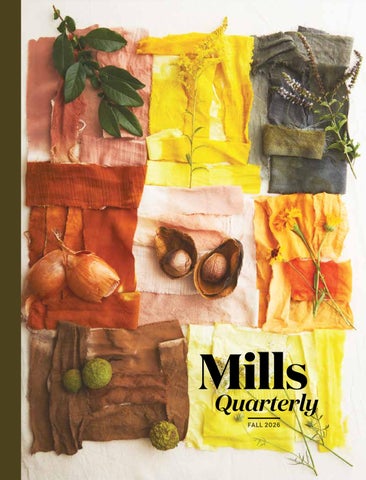
ON THE COVER: Sustainability can look like a lot of different things, such as these textiles made with natural dyes in the Hudson Valley studio of author Katrina Rodabaugh, MFA ’07. Read about what she and other alums do in the name of sustainability on page 16. Photo by Karen Pearson for Rodabaugh’s book Make Thrift Mend (Abrams, 2021).
LETTERS TO THE EDITOR
I read about Marilyn Knowlden Busnardo ’47 in the Mills Quarterly (spring 2026) and decided to buy her autobiography, Little Girl in Big Pictures. I very much enjoyed reading it on my Kindle before bed or in the middle of the night when I was awake. I’m so glad I heard about her in our Quarterly. I hope everyone gets to enjoy her life story with its ups and downs and everresilient spirit and heart.
math requirements in previous years and took all the computer classes in one year in 1976, but it’s not very likely as some of the required classes were only offered in alternate years. Anyway, I just want to point out that the first computer science major graduates were probably from the class of 1977, not 1976.
–Jeanette Emmarco ’81, New York City
Ooh, we love a research project over here at the Quarterly! Our records show several things: first, that the computer science program at Mills debuted in the 1974–75 academic year, and second, that there are actually two members of the Class of 1975 with degrees in computer science! They must have gone into their senior years with enough credits on their transcripts to make that major possible with just one year of coursework to complete. In the end, it turns out that the original report we received about Susanne’s major was incorrect! We checked in with her, and she told us that she transferred to Mills in spring 1976 as an economics major, but that she did take courses in computer science to fulfill her degree requirements. She also interned with former lecturer Carol Lennox. “[Carol] was a fabulous teacher—funny, interesting and interested, well-informed,” Susanne wrote. “It was a great experience and really launched me into the career I pursued for the next 17 years!” With Carol’s recommendation, she first worked as a programmer/analyst for Bank of America before taking on similar roles across the country and eventually moving into consulting: “All that coming from an incidental class in computer science that was a requirement for my economics major at Mills!” -Ed.
As the proud parent of a 2016 Mills “Bent Twig” alumna, I see much poignancy in the graduation of the final Mills legacy students. I am also impressed by their stories and accomplishments. I suggest that these and earlier Mills legacy graduates be called “Broken Twigs” in recognition of the manner in which their college was closed. –Lee W. Anderson, Redwood City, California I received the spring Mills Quarterly, which I read with interest. In the Memories section on page 34, three students have been identified. In it, Susanne Vierra Dern ’78 was mentioned as the first computer science major at Mills. I think this might be a mistake. The computer science major was added to the curriculum in 1976. It was my junior year, and I decided to major in it since I had already taken many math classes as part of the requirement. As far as I know (which I also confirmed in the 1977 yearbook), there were only three of us who majored in it: Lyn Gray, Jane Denham, and myself—all of whom graduated in 1977. There could be others who graduated in 1976 who could’ve majored in computer science, if they had fulfilled all the
2
MILLS QUARTERLY
–Lina Au ’77, Alameda
MILLS QUARTERLY ASSOCIATE VICE PRESIDENT Nikole Hilgeman Adams MANAGING EDITOR
Allison Rost DESIGN AND ART DIRECTION
Nancy Siller Wilson CONTRIBUTORS
Dani Collins ’24 Rachel Leibrock, MFA ’04 Stephanie Mills ’69 Kieran Turan ’90 ............................................................................. The Mills Quarterly (USPS 349-900) is published quarterly by Mills College at Northeastern University, 5000 MacArthur Blvd., Oakland, CA 94613. Periodicals postage paid at Oakland, California, and at additional mailing office(s). Postmaster: Send address changes to: Oakland University Advancement, 5000 MacArthur Blvd., Oakland, CA 94613. ............................................................................. Copyright ©2026, Mills College at Northeastern University Address correspondence to: Mills Quarterly 5000 MacArthur Blvd. Oakland, CA 94613 Email: mills.quarterly@northeastern.edu Phone: 510.430.3312
Share your thoughts Submit your letter to the editor via email to mills.quarterly@ northeastern.edu, online at quarterly.mills.edu, or by mail at: Mills Quarterly, 5000 MacArthur Blvd., Oakland, CA 94613. The Quarterly reserves the right to edit letters for length and clarity.
OPENING MESSAGE
The last time I wrote a letter for the Quarterly— just two issues ago, in spring 2026—I did so in the role of dean of Mills College at Northeastern. Now, I come to you with a new perspective, that of executive director of the Mills Institute! Don’t worry about any big changes in the Dean’s Office; this isn’t so much of a title adjustment as it is a title addition. And it’s one that really excites me. Since the merger with Northeastern and the establishment of the Mills Institute, I know there’s been some confusion out there about how the two organizations differ. What does the Mills Institute do that Mills College at Northeastern doesn’t? This change will help us better define their two separate pathways, as well as how they intersect. First of all, though, I have to give big credit to my former Mills College colleague Christie Chung for the work she did as the Institute’s executive director before her departure, and to Lisa Arellano, who stepped up in an interim role until this past summer. She has returned to her position as research associate director, guiding the fascinating work that various scholars and professors are doing through Mills Institute Innovation Lab Grants and Research Justice at the Intersections. The Institute also champions legacy Mills bridge programs, such as Trailblazers for first-generation college students (formerly known as the Summer Academic Workshop), and summer scientific research through the Russell Women in Science Leadership Program and the Hellman Experiential Science Program. Meanwhile, elsewhere in Mills Hall, those of us with Mills at Northeastern have been building degree-granting academics both for the Oakland campus and Northeastern as a whole, such as the creative writing minor and our new sustainability studies program. (You can read more about the latter on page 10!) Therein lies the difference: Mills College at Northeastern can move in spaces where the Mills Institute cannot, and vice versa. By putting the two together as discrete but connected entities, we can strengthen and broaden how
Beth Kochly
they honor the Mills legacy. I’ll be heading both, and they’ll share operational structures and some staff members, but they are still separate. However, as both pursue growth and greater visibility, we do expect them to intertwine. One idea we’re pursuing is a social-justice co-op in Oakland for Northeastern undergraduates that would likely be sponsored by the Mills Institute but also tied to a related curricular element through Mills College. Stay tuned for more developments there. By the time you read this, I’ll have just spoken to some of you at Reunion 2026, which is always such a joy. I hope to see you there and discuss how we can keep working together!
From the executive director of the Mills Institute FALL 2026
3
O N T H E O V A L 666666
666666
O
ver the past few years, Jill Vexler and Stephanie Hanor have gotten to know each other quite well, and they speak often—but they’ve never actually met in person. But that’s something the daughter of the late Esther Scharlack Vexler ’40 (pictured below) and the director of the Mills College Art Museum (MCAM) hope to remedy this academic year. In 2022, Vexler (the younger) donated a collection of Mexican and Central American textiles started
4
MILLS QUARTERLY
Alum’s textile collection joins museum archives by her mother decades ago, but due to the upheaval of the Northeastern merger and other factors, that collection had been sitting in the MCAM archives waiting for intake. No longer. Starting this past spring, students have begun the process of accessioning the new acquisitions by unboxing the pieces, documenting all pertinent details, photographing them, and adding them to the museum catalog. A group of UC Berkeley art history students got through about half of the collection as part of an externship during the 2026 spring semester, and Northeastern co-op students will have the chance to finish it up in 2027. Vexler, a cultural anthropologist and curator based in New York, spoke with the Cal students over Zoom during their time with MCAM and has hopes of coming to Oakland to work with the Northeastern co-ops in person. “We ended up talking about values of caring for cultures,
what museums do, and the philosophy of being a curator and responsibilities [you have with] inanimate objects,” she says. “And I felt they really clicked with the large and small topics, the overarching frameworks of what museums are for, and then why they’re worth a career.” “They helped us with really getting the project started in terms of digitizing the pieces and improving our cataloging,” Hanor adds. “Jill has provided such a wealth of information both in notes she gave as part of the donation, as well as the notes physically attached to the pieces. They learned more about where these pieces come from, how they collect them, how museum collections are built, and why this would come into our collection.” Esther Vexler transferred to UCLA and later to Cal where she double-majored in English literature and dance. She was a devoted yogi who began teaching in San Antonio in the early 1960s; a group of her students later opened a school there in her name. She and her family loved traveling to Mexico, often visiting tiny villages with folk artists whose keen eyes they greatly respected. A collection of ceramics and textiles began to grow. continued on page 5
Summer students and contractors keep campus busy There was no rest for a weary Oakland campus, as plenty of activity kept things buzzing over summer 2026.
Academics Northeastern students were able to knock out some requirements over the summer session, with courses in biology, economics, business, computer science, and education on the schedule. Prospective students were also on campus, with local high schoolers attending bridge programs such as Upward Bound. Teens from across the country also participated in Accelerate Pre-College Programs, which are intensive, two-week sessions on interdisciplinary topics. This year’s programs included two repeats from summer 2025— Experiential Entrepreneurship, and Building Healthier Communities Through the Arts, which we covered in the fall 2025 Quarterly. New offerings this year were Architecture in Action and Wildfire Ecology in a Changing Climate.
Facilities Another round of improvements and renovations brought the campus further up to code and refreshed a number of student-facing spaces. Those included: • Establishing an entrance to the Mills College Art Museum that’s fully compliant with the Americans with Disabilities Act, including a new accessible parking spot. (The Fu dogs out front were fully protected during construction!) • Further work on the sewer and water lines on Richards and Kapiolani roads, as well as resurfacing and repainting parking lots across campus.
• New wayfinding signage outside buildings and at major intersections. • Removal of the theater seating from the Rothwell black-box theater (previously the old bookstore) and the addition of moveable chairs to create a more flexible student space. • Moving the Tech Bar to Carnegie Hall (along with other student services, such as financial assistance) and turning the Prieto Lab outside the Tea Shop into a spot for lunchtime lectures and other curriculum-related events throughout the day.
Textiles, continued from page 4 Jill Vexler studied at Smith College and went to the University of Texas, later receiving her MA and PhD in cultural anthropology at UCLA. (She also received two Fulbrights, one at the National School of Anthropology in Mexico City where Indigenous textiles and fieldwork truly became her passion.) Deciding where to give her mother’s valuable textiles wasn’t difficult: MCAM due to its excellence as well as her Esther’s deep affection for Mills. “When I talk about the museum to which this collection’s going, smiles come across people’s faces,” she says. “The people who knew my mother and those who know how much I love these pieces I studied for so many years, it’s just a good thing to do. It’s not any more complicated than that.” FALL 2026
5
New Oakland reporter highlights familiar themes Peter Rubinstein is the new campus reporter in Oakland for Northeastern Global News, and in his several months on the job, he’s already published several Mills-related and -adjacent stories:
use as tangible items that students can hold in a time when so much scholarly work is done online. Read the story at tinyurl.com/artist-books.
• The Access Project, an Oakland-based organization that received a Mills Institute Innovation Lab Grant in the 2025–26 academic year and brought in two first-year Oakland students to work on research documenting disparities in the system that clears criminal records in the State of California. These datasets help those in marginalized groups with expungement. Read the story at tinyurl.com/record-expungement.
• Legacy Mills instructor Jen Cassano, an associate teaching professor in chemistry, and the “escape room” she co-created for the Open Sauce Technology & Creator Festival in San Mateo. The director of Northeastern’s bioinformatics master’s program in Oakland, Cassano worked with Aamna Zia Ullah Sheikh, COS ’27, to fashion the space’s puzzles using the field’s principles, such as genetic codes. Read the story at tinyurl.com/ bioinformatics-escape.
• The work of Jiabao Li, a professor of art and design on the Oakland campus. Her summer exhibition, Womb Wetware, at San Francisco’s The Interaction of Art and Technology gallery featured an “AI Mom” that users could reprogram to their preferences—creepiness fully intended. Read the story at tinyurl.com/womb-wetware.
• Work by Oakland campus Sustainability Manager Andrew Gonzales and a team of first-year students to plant oak saplings near the Mills Community Farm and along Seminary Avenue to help the genus thrive in the town the carries its name. Read the story at tinyurl.com/ oak-saplings.
• A deep dive into artists’ books in the archives on both the Oakland and Boston campuses, and their academic
• Wildfire Ecology in a Changing Climate, the Accelerate Pre-College Program hosted on the Oakland campus this summer, which saw high-school students study how to mitigate one of the western U.S.’ largest symptoms of the climate crisis. They did so under the tutelage of legacy Mills professor Sarah Swope, who holds the Letts-Villard Professorship in Natural Sciences. Read the story at tinyurl.com/wildfire-ecology.
Mills legacy enhanced by major donations Oakland University Advancement thanks the following donors for their gifts of $50,000 and above that were received between January 1 and June 30: The estate of Jean Foster, for her bequest to the Mills Scholarship Fund, which was initially established in 1898 to provide student financial support. Mary Ann Krausse Dougherty ’76, for a generous gift to the Mills Legacy Endowed Scholarship, which underwrites costs for women and gender non-binary students on the Oakland campus. Elaine and Richard Barrett, and their foundation, for continued support of the Jill Barrett Undergraduate Research Program through Mills at Northeastern and the Jill Barrett Undergraduate Nahant Research Program Fund on Northeastern’s campus in Nahant, Massachusetts, and the Marine Science Center headquartered there. The Skyline Foundation, for its donation to the Lead by Learning Center and its work providing professional development opportunities for educators across the U.S. 6
MILLS QUARTERLY
Similar stories about Mills and the Oakland campus are available at news.northeastern.edu/tag/oakland— including one article, filed before Rubinstein’s tenure began, about a student who took photography in Oakland with Kija Lucas, MFA ’10, last year and used those skills as an intern during FIFA World Cup games in Boston.
ON THE OVAL
CALENDAR Mills College Art Museum The Data at Hand: Data Physicalizations of Earth and Space Through December 6
The continuation of an exhibition that first opened on Northeastern’s Boston campus, The Data at Hand and the works within examine how information illustrates the impact of humanity on the Earth and its natural processes through the use of analog materials such as fiber, wood, and glass. Three artists created newly commissioned pieces for this first multi-campus show, with additional works from seven others on display—such as a look at average temperature data from 18 U.S. river basins through woven medical tubing and plant fibers.
Opening Reception: The Data at Hand October 3, 4:00–6:00 p.m. Curator’s Tour & Publication Signing: The Data at Hand December 5, 2:00–3:00 p.m.
Guest curator Kayleigh Perkov leads a guided tour of The Data at Hand, followed by a signing of the exhibition catalog.
MCAM is open Tuesday through Sunday from 11:00 a.m. to 4:00 p.m., with late hours on Wednesday until 7:30 p.m. Admission is free.
Jane Green Lecture in Visual Culture October 3, 3:00 p.m.
Amanda Ugorji and Sophie Weston Chien, members of the artist collective just practice, will appear in conversation with Associate Professor of Architecture, Urbanism, and Landscape Sara Carr about their piece “Touching Toxicity,” a series of six panels of tufted cotton created for The Data at Hand.
The Quarterly, via email With this fall issue, we are now sending out an email edition of the Mills Quarterly to coincide with the release of the issue’s contents on our website. (Including Class Notes!) If you’d like to receive this email but you haven’t as of this reading, please do us two favors: 1. Check your spam or junk folder for an email from the address mills.quarterly@ advancementmail.northeastern.edu. 2. If you don’t see the fall issue email there, please reach out to us at mills.quarterly@ northeastern.edu so we can troubleshoot.
"The Burden of Every Drop" by Nathalie Miebach (2018)
Two Mail & Copy mainstays retire Beatriz Perez-Stable and Raymond Chow have tagged their last packages in the on-campus Mail & Copy Center—both finished up their careers this summer. Perez-Stable said goodbye in midJuly, and Chow ended his tenure in late August. Together, they racked up more than 30 years of service to Mills and Northeastern—Perez-Stable ended with 15 years and eight months on staff, while Chow bested her by exactly one year. Perez-Stable lives nearby (and is now tackling a number of house projects!), and she is still often seen walking her dog on the Oakland campus. Chow reported that he’d be going abroad for several months this fall both for his daughter’s wedding and to visit with family.
FALL 2026
7
OVER THE WIRES
66666666666666666666
Press mentions and honors for Mills alums and Oakland professors Rowena Brown ’19 is the only at-large councilmember on the Oakland City Council, covering the entire city rather than a specific district, and The Oaklandside followed her to get an idea of how that position keeps her busy. Read the article at tinyurl.com/rowena-brown. The website Influential Women profiled Ana Cortez-Hernandez, SES ’05, MA ’07, ASC ’09, who is the head of the Upper School at Woodside Priory in Portola Valley and was the founding principal at Cristo Rey De La Salle High School in Oakland. Read the full feature at tinyurl.com/ana-cortez-hernandez. Wellesley College’s 2026 reunion event included a discussion, “Shaping the Future: Presidents Reflect on Higher Education,” featuring alumnae who had served in that role. Among them was President Emerita Alecia DeCoudreaux, who graduated from Wellesley in 1976. Jessica Gonzalez ’13 has relocated her company, Happy Organics, to Los Angeles, and retooled it to focus on beeswax candles shaped like fruit and vegetables. The Los Angeles Times featured her and the craft showfavorite wares in its Lifestyle section; read the article at tinyurl.com/ jessica-gonzalez-2026. The Huntington, the educational institution based in Southern California, has named Professor of English Nicole Guidotti-Hernandez as its Los Angeles Times Distinguished Fellow for 2026–27. During her fellowship, Guidotti-Hernandez will be working on two books: one on intimate partner violence in American Latine communities from 1880 to 1917, and another on Latine roles in antiabortion, -immigration, and -DEI movements.
8
MILLS QUARTERLY
Fabrik, a New York-based company that provides third spaces to ease isolation, held its second annual Social Connection Summit on July 16. Professor of Sociology Mario Hernandez was among the group of speakers participating. In the midst of numerous summer engagements, Vanita Lee-Tatum, MBA ’13, participated in the Juneteenth Business Jubilee held at Swinerton in San Francisco on June 18. She is the first vice president for commercial banking at Amalgamated Bank. Video-game composer Jerry Martin, MFA ’81, offered some thoughts on his seminal work with “The Sims” in an article about “The Making of Perfect Park” in Retro Gamer magazine. Read the piece at tinyurl.com/jerry-martin-2026. Thembisa Mshaka ’92 made an appearance on KPFA’s Hard Knock Radio program on July 29 in anticipation of the opening of Hip Hop Beauty, a photo exhibition of Black and brown women in hip-hop. Listen to the item at tinyurl.com/thembisa-mshaka. Colorado NPR station KGNU featured an interview with musician Lucy Moore ’10 ahead of her appearance at the Mountain
On June 26, Congresswoman Lateefah Simon ’17 took a moment on the floor of the House of Representatives to recognize former Mills professor and Women’s Leadership Institute director Daphne Muse, who died unexpectedly on February 22. “At Mills College, she served as a leader, and she mentored countless young women,” Simon said. “I was one of the beneficiaries of her love and her brilliance.”
Fam Jam in Gold Hill. Listen to the interview, which includes a performance from Moore, or read the transcript at tinyurl.com/lucy-moore. Halona Norton-Westbrook ’05 took on the position of the Modern Art Museum of Fort Worth in 2025, and in a recent piece with West Fort Worth Lifestyle, she spoke about her plans for the oldest art museum in Texas. Read the article at tinyurl.com/ halona-norton-westbrook-2026. Rachel Sadler Mueller ’69, MA ’70, has led a long and varied career: event planner, retail manager, investment manager, dancer. She’s now the new board president for the local chapter of Les Dames d’Escoffier in Monterey. Read more about her journey on the website Monterey County NOW at tinyurl.com/ rachel-mueller. Oakland-based Assistant Professor of Electrical & Computer Engineering Yuan Yuan and his team of researchers were recognized for their paper, “Fully Integrated 1064 nm Transmitters With Widely Tunable GaAs Lasers and > 100-GHz Thin-Film LiNbO3 Modulators,” at the Optical Fiber Communication Conference 2026.
A SLICE OF QUARTERLY HISTORY: SUMMER 2007
Gloria Steinem: A Day at Mills By Moya Stone, MFA ’03
M
ARCH 15, 2007: People are arriving as early as 9:00 a.m. By 11:00 a.m., the usually empty lawn across from the library is a carpet of parked cars. Cancelled classes and closed departments allow at least 1,200 staff, faculty, alums, trustees, and community members to sprawl across the campus, chatting and sharing their common memories of a feminist icon. An exceptional buzz in the air that has been building for weeks heightens to almost bursting on a day that will surely go down in the Mills annals as Gloria Steinem Day. Minutes before curtain time, the Music Building concert hall is overflowing, and people are quickly heading down to Lisser Hall and the Student Union where telecasts have been set up. Eventually, people will flood onto the Suzanne Adams Plaza. “Outside of commencement,” says Renee Jadushlever, vice president for information resources and library director, “this is the largest attended event the College has sponsored in all of my 16 years here.” Inside the Music Building, people of all ages, from tweens to great-great-grandmothers, are taking their seats or standing in the aisles, while staff members are directing people and answering questions above the crowd’s white noise. In the audience is former Mills trustee Estrellita Hudson Redus ’65. “I’m here to acknowledge and validate Gloria Steinem for being a leader,” Redus says. “Civil rights paved the way for women’s rights and a lot has changed, but it’s too soon to say we don’t need to keep fighting. We have not arrived yet.” Precisely at 4:00 p.m., Steinem takes the stage. The crowd stands and greets her with cheers and a roar of applause. She in turn raises her right arm with a fist, a nostalgic gesture of woman power. After introductions by President Holmgren and Director of the Women’s Leadership Institute Daphne Muse, the discussion begins. The setting is not unlike a casual kitchen table chat. Steinem sits at a table facing the audience in between her fellow conversation partners—Holly Kernan, news director of KALW Radio, and Meredith May ’91, reporter for the San Francisco Chronicle. Kernan and May are also part-time faculty at Mills. “Go back 35 years,” May begins the conversation, “when you started Ms. magazine, what was your vision for change in the future?”
RE AD the full art icle at quarterly. mills.edu/ legacy
“We were not looking forward four decades,” Steinem says. “We were naive; I kept thinking that if we just exposed the injustices, that would take care of it. And we were naive about the structures of power— they don’t match with the majority.” Kernan says she asked her Mills students if they were feminists, and she was surprised by the 50–50 split. Kernan shares that the reasons the students don’t identify as feminists varied, including that the movement is limited, anti-male, and elitist, and there’s too much emphasis on gender. Steinem responds that the women’s movement is the most inclusive example of race, class, and sexuality that this country has ever seen. “To say it’s a white middle-class movement gives away its ownership,” says Steinem. “African American women were twice as likely to support the women’s movement, so to say otherwise is erasing reality.” “What would you do today as a journalist?” Kernan asks. “There’s so much to expose,” Steinem says. “I think I would try to get across that we really do still have slavery in this era—sex slavery and labor slavery. In India, there are sex trafficking projects trying to rescue women and children from brothels and offering economic alternatives and schools for children.” After 90 minutes, the discussion winds down and closes with a standing ovation. Steinem stands and applauds the audience in return and says, “Keep talking; talk to each other.”
FALL 2026
9
“A Practice of Continuing”
The New Sustainability Studies Minor at Mills
T
HE TERM “sustainability” brings to mind certain practices: Composting. Driving an electric car. Sorting glass, plastics, and paper into recycling bins. All common activities that environmentally conscious folks might undertake in an effort toward a better planet. Such practices are critical to a healthier future, but they also represent just one element of the new sustainability studies minor offered by Mills College at Northeastern. The minor, which launches this fall, is designed to give students a broader definition of sustainability while also furthering the College’s legacy as an innovative and social justice-focused institution. Maia Averett, academic program director for sustainability studies at Mills, says the course of study frames the subject as a three-pillar question that addresses social, economic, and environmental sustainability. “The term ‘sustainability’ is a bit misunderstood in the public imagination,” Averett says. “They picture environmental practices like recycling and putting solar panels on your house, or no plastic straws—and that’s not wrong, but it’s a narrow slice of a much bigger concept.” The social, economic, and environmental elements are interconnected, she adds, and you can’t solve one without addressing the other two.
10
MILLS QUARTERLY
WORDS BY RACHEL LEIBROCK, MFA ’04
“If you’re missing one, it’s not balanced,” she says. In this way, the minor aligns with the Mills mission, positioning it as broader, justice-centered form of literacy that will shape how graduates across disciplines make decisions. This is critical, Averett says, and it’s why the minor emphasizes experiential learning in real-world scenarios both on campus and in the neighboring Oakland community. “Mills has always believed that education is a vehicle for justice,” says Averett, who is also a longtime math professor at the College. “The minor asks what that looks like when the challenge is sustainability. Who makes the choices? Who bears the cost of these choices that we make as a society?”
A Framework for a More Sustainable Future The new minor isn’t just a single academic track but is—instead—part of an intentional effort to fold sustainability into Mills’ liberal-arts education DNA. Launched after two years of planning and conversation, it’s intended to enhance nearly every major. Averett credits Beth Kochly, dean of Mills College at Northeastern, for envisioning the sustainability minor as a way to further the College’s legacy. “She helped us all see that it’s a domain where we could do a lot of what Mills has always done: Build programs that take equity seriously and prepare students to change the world,” Averett says. Kochly says her concept was both practical and philosophical. The minor grew from an institutional assessment of Mills’ strengths paired with the need to prepare students. “We were thinking about the students that we’re putting into society and how we educate them to really think about their jobs and their careers—but in a way that prioritizes future thinking,” she explains.
Kochly, who started at Mills as a chemistry professor in 2008, views sustainability as an essential form of literacy, akin to media or AI literacy. “When I say that word, people think ‘climate and environments,’ all of these very scientific pieces, but it’s so much more than that,” she says. The minor, she explains, also emphasizes recognizing how interventions can ripple through systems rather than just solving singular, isolated problems. “You can’t just look at environmental sustainability because there are social aspects pulled into that as well,” Kochly says. For example, as she says, global climate changes have disproportionately impacted people in some of the world’s poorest countries. While the minor functions as a discrete credential, Kochly says it was constructed with an interdisciplinary focus designed to overlap across other fields of study. “I would love for every student to have this layered into their education,” she says. Kochly adds that she’d like to see the minor evolve from an optional component into an integrated feature of more majors: “Almost every professor could benefit.” She notes that the minor’s applications are relevant to many career paths and are critical to a larger population. Policymakers, entrepreneurs, and small-business owners can benefit from its framework.
“A practice of continuing” is a quote from a Sustainability Innovation Week event this past March, in a talk given by Carver Professor in Far Eastern Studies Truong Tran. He was speaking about his personal art practice and how small acts over time are how he sustains his creativity.
FALL 2026
11
Kochly points to the tech field, particularly with its AI-driven swath of water-thirsty data centers, as an industry in need of sustainability applications. “As folks are developing technology—AI, programmers, engineers, all of these things—they need this kind of framework so when they’re making choices and decisions, they can do that with the systems and social pieces in mind.” That framework includes a curriculum and pedagogy built to emphasize lasting, transferable applications—instead of focusing on material that may soon become obsolete, Averett adds. “We want to deliver tools and skills that students can use and leverage over time that are not going to eventually be out-of-date,” she says. The minor is built around a project-based core of courses. A total of 16 units is required to complete the minor, and the studies are anchored by a keystone class, Problem Solving for a Sustainable Future. Available to any
The sustainability minor’s four key competencies—values thinking, systems thinking, future thinking, and strategic thinking—emphasize the framework through which students will learn about the subjects and their theoretical and practical applications. ▶ Values thinking helps students identify and analyze competing values and ethical principles—to ask who is centered in a decision and who is marginalized. ▶ Systems thinking explores connections and feedback loops to identify leverage points in complex socialecological systems rather than treating problems in isolation. “It asks, ‘If you have a complex problem, how do you think about that complex problem in a structured way?’” Averett says. ▶ Future thinking challenges students to envision multiple possible futures and plan for uncertainty by tapping into a “structured imagination” when planning scenarios. “The choices you’re making today shape what tomorrow’s going to be like and what options exist tomorrow. You 12
MILLS QUARTERLY
plan so that solutions remain robust under changing conditions,” Averett says. ▶ The final component, strategic thinking, translates analysis into implementation: measurable goals, theories of change, and concrete plans. Averett says these mechanisms underscore what continues to set Mills apart: a commitment to its core priorities. “It’s about who gets a voice, it’s about how we think about who we educate and who we give access to,” she says. This structure is also what distinguishes the Mills minor from similar ones at other universities and shaped its deliberate curricular choice. “It’s not that other programs don’t consider values thinking or don’t center the social part— it’s just not their foundation,” Averett says.
Northeastern undergraduate as a general education elective, it emphasizes the minor’s key defining competencies: values thinking, systems thinking, future thinking, and strategic thinking.
Goals for Global Progress In 1987, the United Nations Brundtland Commission, otherwise known as the World Commission on Environment and Development, defined the concept of sustainability as “meeting the needs of the present without compromising the ability of future generations to meet their own needs.” Building on that philosophy, in 2015 the U.N. created a set of 17 Sustainable Development Goals (SDGs); world leaders adopted the resolution that year at the UN Sustainable Development Summit. The SDGs, which include “no poverty,” “zero hunger,” and “sustainable consumption and production patterns,” were officially adopted in 2016. Today, Averett points to the goals as a key framing of the sustainability studies minor. It’s more than a rhetorical concept, she says, stressing that the communities most affected by climate disruptions are often the same as those Mills has historically sought to uplift. “If we have a climate solution that displaces poor communities, that’s not sustainable,” she says. Meryl Bailey, associate dean of curriculum at Mills, says the College sees those goals as an explicit touchstone for the program. “The U.N. is thinking about what it means to build a sustainable world for everyone, and that goes beyond climate change,” she says. The program is structured around a “super-intense, targeted” curriculum. In addition to the required course, students must complete two electives and one experiential course. “We’re giving students more content-based courses that get them to engage with some of these global challenges,” Bailey says. “There are specific classes that teach students to think holistically about problems and how to unpack the way things work and evaluate possible solutions through a systems lens.” Its curriculum enhances most fields of study, she adds, including business, economics, and engineering: “All of those folks will be better at their future careers if they know something about systems thinking and futures thinking, and if they know something about sustainability,” Bailey says. This year, Problem Solving for a Sustainable Future will be taught by Senior Advisor for Sustainability Davis Bookhart in Boston in the fall semester, and in Oakland by Mark Henderson, a professor of public policy who’s part of both Mills College and Northeastern’s College of Social Sciences and Humanities, in spring 2027. On the experiential side, Bailey adds, options include courses such as Social Impact Consulting, where students work directly with real-world, mission-driven organizations, taking on actual problems they’re facing and helping build toward more sustainable outcomes.
FALL 2026
13
First cohort of climate fellows makes big impact Three fellows in the California Climate Action Corps—Gayatri Singla, Rose Carges, and Esther Duong—spent the 2025-26 academic year working with Sustainability Manager Andrew Gonzales and his team on the Oakland campus. Upon the completion of their fellowship, Northeastern Sustainability announced the following accomplishments: ▶ More than 1,950 trees maintained
and more than 100 native specimens planted
▶ The conversion of 2,900 square feet
on campus into urban greening areas
▶ Distribution of more than 900
pounds of food and the diversion of 5,563 pounds of organic waste away from the landfill
▶ Greater community engagement,
including 450 attendees at volunteer events such as shifts at the Mills Community Farm and tree-planting
Six new fellows will start their assignments on the Oakland campus this fall.
14
MILLS QUARTERLY
Currently, not all classes are offered in each location, but there are plans to expand as enrollment grows. This year, the College is planning some classes in Oakland and online and one to two in Boston. The online courses are available to students in any location. The Oakland campus and its surrounding community are intended as a practical learning lab. For example, the foundational course Problem Solving for a Sustainable Future includes a case study examining pollution and urban planning in West Oakland. The study, Bailey says, looks at how economic justice and sustainability intersect with environmental concerns such as pollution and traffic noise. “We’re talking about neighborhoods where there’s a racial equity and a racial justice component,” Bailey says. “We choose case studies that will help students to see that intersection.” On campus, another potential project would immerse students in experiential learning by having them interrogate operational choices such as switching from single-use disposables to reusable plastic containers in the Tea Shop. What seems like a simple decision, Bailey explains, may actually have complicated social, economic, and environmental outcomes. The transition from compostable plates, containers, and flatware, for example, affects dishwashing jobs. “It impacts the staff and the opportunities here on campus for the local community,” Bailey says. “It also has environmental implications; compostable is better than plastic, but it’s not necessarily better than reusable.”
As part of their studies, students will analyze data, conduct stakeholder interviews, and study financial implications as well as environmental impacts. There are also plans to build additional partnerships throughout the campus and its surrounding neighborhoods, including with the Mills Community Farm and various Oakland groups. The goal, Averett says, is for the minor to grow into collaborative, practice-oriented work that brings the classroom on location, while also building on the College’s history for future generations. “Mills has always been defined by who it chose to center, like women when no one else [would],” she says. “Dean Kochly is leading us through imagining this and understanding it in a unique way where it can still serve the Mills legacy in the strong way for advocacy—not just women, but communities that have been underrepresented over the years.” The minor also shares similarities with another new Mills effort, the Chan-Norris Experiential Learning Program in Science & Sustainability, a co-curricular program that launched in January with an inaugural cohort of 26 students. The program’s director, Sarah Swope, designed its first three-year term around the theme of global change ecology and its four drivers in the ecological realm: climate change, habitat loss, invasive species, and emerging infectious diseases. The first year of study, which has focused specifically on the latter subject, has included site visits to research labs and a field trip to the Marine Mammal Center, a wildlife veterinary center that cares for animals sick with diseases that are primarily the result of a warming ocean.
Swope says the Chan-Norris program and the sustainability minor are meant to complement each other and provide students with practical opportunities. “People who are drawn to the sustainability studies minor, particularly because they’re interested in the environmental sciences, would probably also be drawn to this,” Swope says. “It touches on a lot of those themes and gives students extracurricular opportunities to explore their interest.” Swope, who is also an associate professor in natural sciences, has also designed upcoming courses intended to fit with the minor, including one in fire ecology. “Wildfires are a huge issue in the [Western United States],” she says. “If you think about the natural fire regimes and couple that with a rapidly changing climate and a very fraught history of fire management policy, it’s one of the more urgent topics in the sustainability sciences.” Although the minor is only in its inaugural semester, Averett says she’s looking to the future with this sense of urgency in mind. She and her colleagues are already drawing up plans to expand the minor into a full major in collaboration with other departments, including the College of Science. These partnerships and courses will further influence and inform the College’s impact, now and in the years ahead. “Mills has always really believed that education is a vehicle for justice,” she says. “This program asks what that looks like when the challenge is sustainability.” 6
FALL 2026
15
The Many Facets of
Sustainability
As Mills College at Northeastern takes a deeper look at the various meanings of sustainability through its academic programs, we checked in with four alums working in the space to hear their thoughts.
16
MILLS QUARTERLY
DORA TAYLOR ’73: An architect, Taylor authored the blog Sustainable by Design for many years. She earned her Mills degree in psychology, but while visiting with her brother and a friend of his in North Carolina soon after graduating, the trio started a furniture business—and later on, after Taylor dabbled in interior design, she enrolled at North Carolina State University for her graduate degree. After a career spent in design as well as writing books for young students interested in architecture—a new title is coming out later this year—she now lives in Portugal and helps other expats find their way there as well. “As an architect, you never really retire,” she says. Appropriately, she was drawn to the country after two friends from Texas documented their renovation of a Portuguese farmhouse on Facebook. “Totally unexpected, but that’s how life happens,” Taylor says. Mills Quarterly: What does the term sustainability mean to you? Taylor: It means using natural resources, wisely and thoughtfully. That’s what I would say. Quarterly: How do you practice sustainability in your own life? Taylor: In my last few years working as an architect, I worked at the Environmental Protection Agency as part of the Energy Star program with schools, restaurants, and hotels, I got them up to speed on energysaving ideas. It was a great program—everything from beekeeping to green roofs, to recharging stations for electric cars. The people who worked there also practiced what they preached. One of the things they said is to reuse everything three times before you recycle, which is a good rule of thumb. I find myself doing that all the time no matter what it is. Like plastic bags, for instance. It’s just daily habits, like making sure that I don’t run the water when I’m brushing my teeth. I’m always thinking about energy usage in my home. Also, where I live, I like to buy local produce, which is pretty easy to do here when farmers bring their produce to town. I always try to buy everything I can locally. So, it’s just little things in life.
INTERVIEWS BY DANI COLLINS ’24
Quarterly: In terms of architecture, how would you say that it’s related to sustainability? Taylor: Well, I think that it’s the responsibility of architects today to think from the start about how the project they’re working on can be as sustainable as possible, whether it’s a green roof, the location of the windows, the orientation to the sun depending on the region or the country they’re in. It’s our responsibility as architects, because buildings consume a lot of energy—and they don’t have to consume as much as they do. And I feel that, step by step, architects and designers have to think about every choice they make. It’s much easier now in the United States due to stringent regulations in terms of insulation, glass doors (even how your windows are fitted within the wall system), roofs so warm air doesn’t just escape. I’ve seen architects now using local materials such as compacted earth for their buildings, which also looks very cool because you see these striations of natural-looking color based on the soil they use. It’s about being thoughtful about everything the architect does and taking what they do seriously.
It’s the responsibility of architects today to think from the start about how the project they’re working on can be as sustainable as possible. –DORA TAYLOR
REBECCA LAWTON, MFA ’93: Lawton is a fluvial geologist and outdoor guide who earned her MFA in creative writing at Mills after authoring several short stories, with her thesis later becoming two separate books. Her 10th title, Boatwoman: A River Memoir, will be published in 2027. “I wanted to take my science background and reach out to a lay audience through fiction and poetry,” she says. “I thought I could spread science better that way.” She lives in Sonoma County.
FALL 2026
17
Mills Quarterly: What does the term sustainability mean to you? Lawton: To me, sustainability is a measure of whether our actions affect other living things. To live sustainably is to live on the planet so it’ll be here for future generations. When I was conducting watershed science in my home valley, our teams were often asked what sustainability meant, because we used that word to describe the purpose of our stream studies and restoration projects. Sustainability in my day-to-day life means consuming in a way that helps support living beings and our ecosystem. I’ve read that at the rate we’re using Earth’s riches, we’d need six or seven planets to continue as we do—and our rate of use has accelerated greatly in recent years. Quarterly: How would you say the idea of sustainability has influenced your writing? And how do those two things go hand in hand for you since you’re working with water? Lawton: My first job was as a wilderness river guide. While working on rivers as a young person, I learned firsthand how important water is. I got to know water as a friend, as a being who I depended on, who allowed me to make my living. And I could never see our natural world the same way after spending all that time on rivers. Every book and every essay I’ve written has been infused by water and my love of it and how
18
MILLS QUARTERLY
much we need it. We can’t live long without it. So, sustainability as seen through a water lens, attached to my time as a guide, informs all my writing. infused by water and my love of it and how much we need it. We can’t live a day without it. So, everything I write is still attached to that time as a guide. Once you learn that about water, once you learn that water is alive, you can’t unlearn it. Quarterly: How do you practice sustainability in your own life? Lawton: I live as best I can by my sustainability concerns. I minimize air travel, drive an electric car powered by solar panels, support local agriculture, and eat far down the food chain. In my home, we’re dedicated to conserving water and making lifestyle choices based on minimizing dependence on groundwater. I also work hard at my environmental writing because I hope that my words will live after me and continue to bring the message of the river and water after I’m gone. Quarterly: Is there anything that you’d like to add or make sure readers know about your work or practice? Lawton: Well, I also have a very strong meditative practice, which goes back 50 years. Through that time, my practice has allowed me to think and feel deeply about my work and to strengthen my ties to land and water. Those connect my heart and mind to sustainability. They help me sustain my life and body. I believe restorative practices like meditation, spirituality, and time outdoors feed our minds, our health, and our world.
I’ve read that at the rate we’re using Earth’s riches, we’d need six or seven planets to continue as we do— and our rate of use has accelerated greatly in recent years. –REBECCA LAWTON
KATRINA RODABAUGH, MFA ’07: Titles such as Make Thrift Mend and Mending Matters are the brainchildren of Rodabaugh, who has made a career out of sustainable fashion and crafting. Immediately after earning her MFA at Mills, she returned to working with arts-focused nonprofits but started a weekly blog on the side that led to her current position—teaching about sustainable textiles, mending, and natural dyes through individual classes and summer retreats, as well as newsletters and books, all under her Hudson Valley studio. “Teaching is currently the bulk of my work— though I still sew, dye, and write whenever possible,” she says. Mills Quarterly: What does the term “sustainability” mean to you? Rodabaugh: Sustainability is individual—it needs to be defined by each of us to fit our lifestyle, budget, location, culture, profession, aesthetic, skillset, and values. For me, right now, it means connecting to my local environment through gardening, foraging, and getting my kids outdoors as much as possible—to foster familiarity but also to create a sense of wonder. It also means
considering efficiency, waste, and environmental impact with each renovation to our 1820s farmhouse. Supporting our local farms—two are so local I can walk there and carry produce home, which is pretty rare in rural America. I use biodegradable materials in my online shop, make annual donations to incredible projects, and collaborate with local farms, fiber mills, artists, businesses, and makers. We currently have big gardens and backyard chickens, and each year, we add more native plants to our property. I’ve been a vegetarian for more than 30 years. I wear mostly secondhand clothing. I source mostly organic or handmade fibers for my shop, if they aren’t secondhand. And yet, I don’t think there’s a perfect environmentally-friendly lifestyle. Sustainability is also expanding in my definition to include handcrafting, preserving handcraft skills, and bolstering local craft-based communities. But I don’t pretend to lead a zero-impact life. I don’t think that’s possible. And perfection isn’t my goal; I want to build mending techniques that are useful to the largest population, and
FALL 2026
19
I want to build mending techniques that are useful to the largest population, and to keep the barrier very low so anyone with a thread and needle can participate. –KATRINA RODABAUGH
I want to keep the barrier very low so anyone with a thread and needle can participate. Quarterly: What keeps you energized in doing this work? Rodabaugh: What’s inspiring me most lately are designers and artists who are pushing craft forward with a deep reverence for people and the planet. Folks who use fabric, clay, metal, glass, or wood with a profound appreciation for the material’s legacy while also focusing on bold commitment to innovation and sustainable solutions. The most exciting fashion and fiber folks use secondhand fabrics, industrial waste products, or idiosyncratic materials from local sources—like waste wool from a fiber farmer. They are forced to acknowledge the limitations of these resources; there are only so many shades of denim at the thrift store. It’s much more difficult to design a small-batch of jackets using tattered quilts—you have to consider the damage, hand-cut all the pieces, and incorporate the individuality of the material into your final design. It’s much more labor intensive, and it’s full of nuance. But that’s what makes it so inspired. I’m most interested in how crafters, artists, and designers are incorporating sustainable limitations into their work as an environmental solution. And, yet, letting those limitations inspire bold and beautiful creations.
PATRICIA CONTRERAS-FLORES ’06: As a resumer student at Mills, Contreras-Flores majored in ethnic studies—and, appropriately, she has spent her life in community. After previously working as an organizer for the East Bay Alliance for a Sustainable Economy, she’s now putting in time as a substitute teacher. “My work has been around helping to remind people that we have power,” she says. “My role is really to listen to and validate folks.” In addition, she’s an “elder in training,” running and leading cleansing ceremonies and healing circles that honor what’s human and sacred: “I am the reminder that medicine exists within us, and we just need to tap into it.” Mills Quarterly: What does the term sustainability mean to you? Contreras-Flores: Sustainability is how I feel when I get up in the morning. It’s reminding myself that keeping my routine—meditating, putting some prayers down, and whatever I need to do throughout the day that is actually going to feed my soul beyond eating good food and exercising—gets me through moments when I’m stressed out. I’ve nurtured my spirit and my brain in a really helpful way.
20
MILLS QUARTERLY
I consider myself a land-centered Indigenous person, so right now, I’m looking out the window. There’s this tree, and it’s being pollinated by some bees. Taking a moment just to appreciate that—those are the practices we can do for ourselves that just become part of who we are. It’s not something that we think about. When we have challenging moments, when all these intense things are going on locally and around the world, how do we maintain our center so that no matter what is going on, we can still be a force for love, for inspiration, and for medicine? For me, the land is not just land, it’s my relative. I’m one of those people who hugs trees when I go on trail runs. I connect very deeply to land in general and to everything in nature because it really is all around us. So, I think it’s the way you nurture yourself and what you do to cultivate your spirit. Quarterly: How do you practice sustainability in your own life? Contreras-Flores: I’m a substitute teacher, and that is part of my work for the next seven generations—in Indigenous cultures, one of the main teachings is that whatever you say or do, you act in a way so you and the land are sustainable enough for the next generation. I love working with kids; it’s my favorite thing because it reminds me that we are naturally wild people, and it’s important to tap into that.
One of the other things that I do is work with adults and kids around spiritual cleanses. It’s something that I’ve inherited from my great-grandmother and other folks in my lineage. I’m part of two or three different healing circles in various forms. One of them is more restorative justicecentered on Wednesday evenings here in Oakland. Then, I’m part of a couple of spiritual communities where we do ceremonies, so between working with young folks and serving the community in different aspects, that is a way that I am able to create a more sustainable world. Quarterly: Is there anything else you wanted to add about you and your work or practice? Contreras-Flores: I grew up in a very tight-knit community, and we were always holding big family gatherings. It was an extension of what it was like for my grandparents who ran a dairy farm in Michoacán. For them, someone would come by, and they’d say, “Hi, come on in and eat.” Whoever came by was fed and then went home with a big slice of cheese— it was a dairy farm! That’s who my grandfather was, so for me, I tell people that I am continuing that tradition from Mexico. We call it gente, which means you’re “of the people.” Practices like that are what I encourage other people to do so that we can actually create these larger concentric circles of sustainability and beyond. 6
Whatever you say or do, you act in a way so you and the land are sustainable enoug h for the next generation. –PATRICIA CONTRERAS-FLORES
FALL 2026
21
STARTING FROM & STAYING WITH THE NATURE OF PLACE
ting senior ent 1969, gradua At Commencem s on the effects a searing addres ed er liv de s ill d Stephanie M in a speech title overpopulation d an ge an ch re e r ca er of climat jump-star ted he at Th ” x. oa H el a Cru uses, one that “The Future is vironmental ca en on r ke ea sp as a writer and hwest Michigan. her home in nort om fr y da to s to see she continue ached back out re e w e, su is y bilit ribution For this sustaina e, and that cont ut rib nt co to e if she might lik nt talk, rpt from her rece ce ex an : re he appears ature of Place,” ying with the N ta S d an om fr “Starting times over the livered several de s ha e sh ch whi r writing Read more of he past few years. om. at smillswriter.c
WORDS BY STEPHANIE MILLS ’69
Author Richard Nelson’s Koyukon hunting mentor in interior Alaska told him that “everything out there knows way more than you do.” Most living creatures have been at their infinitely varied and intertwined ways of being a lot longer than our young species. Therefore, respect and humility in the presence of Others are always appropriate. Hence, land acknowledgment and water protection count as core bioregional practices. They direct us to respect and honor the living earth and to learn from the people who have dwelled in these places and along these shores for time out of mind, and who live here now.
(
It’s quite a moment. Earth systems and human societies are stressed beyond tipping points. There’s talk of collapse. The velocity of change tests our mettle to the utmost. In this perilous time, the imperatives are so many: demilitarization, the shift to renewable energy, wildlands preservation, population balance, watershed restoration, justice for all, the reclamation of democracy, and the relocalization of governance and economies. Bioregions can offer tangible, coherent scales and frames of reference for these by keeping nature (the bio) and terrain (the region) as the primary—but not exclusive—arena of concern. Sanity is local, homegrown.
And nature is its touchstone. The time is ripe for bioregionalism. Bioregionalists speak of reinhabitation: This means restoring or regenerating ecosystems and finding or rediscovering the ways and means of living well, as integral parts of naturally defined terrains, like watersheds. We call them life places. We look to our surroundings. We try to learn the patterns and flows, the lay of the land, and the land-use history. We ask: What forms of subsistence were and are practiced here? How might these inspire, or be adapted going forward? Starting from and staying with what we can learn from nature in our watersheds, our life places—the idea is to live in ways that are materially simple and inwardly rich.
It’s about staying with Planet Drum Foundation founder Peter Berg’s questions: “Who are we? Where are we? What are we going to do about it?” A few hundred years ago, people on this continent lived pretty sustainably. Indeed, all over the planet, Indigenous people had myriad place-specific cultures. Those may have appeared primitive but were highly sophisticated lifeways. While there’s no going back, the capacity to live in reciprocity with nature, to learn from it, work with it, suffer the hard lessons, and experience communion with all beings is part of our evolutionary endowment. Knowing that can help one face today’s daunting realities and envision good ways of life amid the ruins of the old. We are made for this. In the 1970s, when I was a working ecology activist in San Francisco, I became a bioregionalist. Then—as now, and of necessity—grassroots alternatives flourished under the radar and all across the land: actions such as recycling and composting, and demonstration projects like Berkeley’s homesteading Integral Urban House. There were backyard organic food gardens and rabbit hutches. There were co-ops and communes, and moves back to the land. There was spit-and-baling wire improvisation of alternative and intermediate technologies. There were household energy conservation tricks, and pious anti-consumerist frugality. There were periodicals, ephemeral publications, and inspiration from bards and native peoples: Such were and are some of the elements of a simpler—if not easier—but more sustainable way of life. It’s no coincidence that the nonprofit Club of Rome’s Limits to Growth study, the United Nations’ first Conference on the Human Environment, and bioregionalism’s beginnings shared an historic moment: those early ’70s. That was when Berg and the conservation biologist Raymond Dasmann began to articulate the tenets of reinhabitation. Bioregionalism differed from conventional environmentalism. The assumption was that globalized industrial civilization would prove to be unreformable. In the 50 years since bioregional ideas began to percolate on the Pacific Coast, from Shasta to Cascadia, and in the Ozarks, in the Kaw and Hudson River watersheds, up in the Gulf of Maine, in the Great Lakes, and the Po Valley in Italy, countless variations have sprung up around the world. The scope of the bioregional kinds of work going on around Turtle Island and Planet Earth is vast and varied.
24
MILLS QUARTERLY
For hundreds of thousands of years, the matrix of our evolution was in small groups of our species living lightly and cooperatively, in loose territories, by deep understanding of the natural communities to which they belonged. That ethos of subsistence through intimacy with place was forcibly and persuasively overpowered by modernity. Overpowered, but not negated. The exploitation of fossil fuels accelerated what was advertised as progress and the 20th century’s two World Wars revolutionized technology and trade, seeming to overturn what the writer and Whole Earth Catalog founder Stewart Brand dismissed as “the tyranny of geography.” However, I think our beginning to live what author Helena Norberg-Hodge calls “local futures” seems more likely. Sustaining the cultural and ecological diversity that persists, and working to regenerate our much-changed, multicultural life places— cities included—is the work we’re called to now. Who are we? Where are we? What are we going to do about it? Maps can be political. And maps can be eloquent. The act of mapping can be liberatory. To peel the lines off the maps has been a longtime bioregional consciousnessraising activity. Unlike river basins or biomes, geopolitical borders are abstract, negotiated, sometimes arbitrary. Their geometries can slice through natural systems. But like rivers, deltas, and coasts, they too are subject to change. We need to be able to understand place—not only as defined by surveyors and governments and property lines, but as sketched by watersheds and landforms and ecosystems. Even in the flux of global warming and the extinction crisis, bioregions can be knowable terrains with resonant identities. While nation-states have their own rules and realities, bioregionalism peaceably addresses these natural life places, looking to revive their health and encourage mutual aid. Thus, we seek opportunities to restore essential local economic activity, especially food-growing. The vision is: largely self-reliant bioregional economies predicated on genuinely renewable flows of energy and materials. Seeing globalization falter, bioregionalists—among many others—anticipate the decentralizing, devolving, and relocalizing of our societies. We hope to steer the process towards life—the bio—and beloved community. If our societies, permeably bounded by natural features,
“Who are we? Where are we? What are we going to do about it?” –Peter Berg, Planet Drum Foundation Founder are scaled to our surroundings, some local approaches can fail without taking down the whole ecoregion or biosphere. Bioregions are appropriate realms for adapting to inevitable resource constraints. Tom Bender, a long-ago champion of appropriate technology and energy frugality, spoke of “sharing smaller pies.” In our post-fossil fuel future, many right livelihoods will be found in reclaiming, repurposing, restoring, and raising the materials necessary to meet basic needs for healthy food, clean water, and comely shelter. The need for skillful, earthsavvy, muscular work is apt to be great. Besides the grassroots, life-place politics, I was drawn to bioregionalism by an intense amateur interest in natural history, meaning what’s naked-eye observable. Activities like belly botany, birding, and fungusforaging, beachcombing, and bug-watching were all promoted and could lead to nature-knowledge pride. The famous “Where You At?” Quiz, first published in 1981 in CoEvolution Quarterly, is not a bad way to test your local knowledge. (You can download a PDF of the quiz for yourself at tinyurl.com/where-you-at.) Learning the plants—and how to recognize tracks and scat, birdsongs, and frog calls—is all part of reclaiming the authority of our senses and the pleasure and wonder they can bring. Bioregionalism has long been about healing the dominant culture’s ruinous alienation from nature. Bioregionalists honor wild or self-willed nature as a wellspring of beauty, challenge, resilience, and spontaneity. For their astonishing manifestations of life’s diversity and its sublime, dynamic equilibrium, wild and free places are the very beating hearts of bioregions. “Old growth landscapes represent nature’s living memory,” said Mattole watershed restorationist Freeman House. “Once they’re gone, we will not be able to re-imagine their elegant complexities.” In an age of extinctions, saving native and endemic species in their habitats, and linking those places is essential work. If we ally ourselves with our bioregions’ living creatures and with the waters of our shores, creeksheds, and lake basins, they may teach us how to follow their logic and necessity upstream and inland to save the whole by saving the parts. Lyla June Johnson, a brilliant young Dineh scholar of the many subtle and sustainable ways that Indigenous
peoples have cultivated and tended their lands, says, “Don’t be afraid. Life knows how to do life.” Given half a chance, refuges of natural diversity—like many of our parks, conservancies, and public lands—can stabilize and become seed banks. Life knows how to do life. By and by, acre by acre, creekshed by creekshed, woodland by woodland, marsh by marsh, those communities may revive to afford some natural provision for countless species—even our own. Bioregions are life-support systems. In a time of technological encasement, we need to be reminded that our lives are utterly dependent on other beings and natural processes. Without the microbiomes of soils, without the vultures, fungus, and beetles that tidy up and turn death into life, without the bats that devour disease-carrying mosquitoes, without the riparian vegetation that cleanses the runoff, without the inland forests exhaling oxygen—we two-leggeds are toast. In light of the multitude of crises breaking in our time, almost everything about our ways of life needs revision. How can we illuminate and rectify the downstream and atmospheric consequences of our actions? There remains no way to do it but one day at a time, from the ground up, and imperfectly. It may seem like it’s never enough. We cycle through grief, practice gratitude, and muster up some grit again and again. It matters immensely to make common cause with a native species like the sturgeon or to tend a wild preserve or to organize a city neighborhood for composting, carpooling, tool-sharing, conflict resolution, or childcare. The magnitude of the changes we’re called on to make is very great. How else can we make them but daily and in physical communities? Facing disastrous times calls for wisdom and courage. I got some from a young friend, a real bioregionalist. She’s a working mother who organizes seasonal commemorations, backyard theatricals, and folkloric choirs. She publishes zines, fostering physical, hyper-local social media, cheap and fun, still readable during power outages. Recently, she wrote: “Don’t flinch away from the terrible beauty of it all, or from the human actions causing the destruction. Don’t live as if the world wasn’t burning, but as if a burning world was still worth living in (it is).” 6
FALL 2026
25
AAMC News & Notes A MESSAGE FROM THE AAMC PRESIDENT When I stepped into the presidency a year ago, my goal was to help the AAMC become a stable, independent nonprofit—one that makes a meaningful difference in the world and carries the Mills mission forward. For many years, I worked with my family in restoring “fixer” houses—seeing the potential in places that needed care, stabilizing foundations, strengthening the structure, and doing the hands on work that brings an old place back to life. Together, we lovingly transformed those houses into homes people were proud to live in. I came into this role seeing the AAMC the same way. The potential was clear. But the AAMC is a 150-year-old fixer. There is foundational work to do. And before you can imagine what the inside will look like, you have to make sure the structure is sound. That’s what this past year has been about. It’s not always visible, and sometimes people don’t understand what’s taking so long. But it’s the work that makes the future possible. We focused on three things: our foundation, our systems, and reconnecting with our purpose. We began with mission. At last summer’s leadership retreat, the board adopted a new mission statement—one that allows the AAMC to move forward independently and advance the Mills impact in the ways we have long championed. We strengthened our financial model by implementing a responsible investment spending policy that creates a stable quarterly distribution from our endowment. Our inherited financial infrastructure was like the wiring in an old house— overly complicated and unclear. We untangled it, cleared the backlog, and are transitioning to a modern chart of accounts backed by mandatory yearly independent reviews. We modernized our core operations, brought on two part-time staff members, and moved our merchandise model to print-on-demand to eliminate financial risk. As we rebuilt internally, we began re-engaging with our community—and the response was more than we could
26
MILLS QUARTERLY
have hoped for. Thousands of alumnae engaged this spring, and meaningful donations came in without a formal ask. Our Mills community is still here with us. That matters deeply, because it is the foundation everything else is built on. We have also had warm Kieran Turan and productive conversations with the Mills Institute team. Together, we are advancing an arts fellowship proposal— brought forward by the AAMC—to bring meaningful arts engagement back to campus. We also have a path for AAMC scholarships to support co-created, Mills-aligned programs. It’s a real step forward. The merger—and the loss of Mills as we knew it—has been a genuine test of this community. But the question that matters now isn’t what happened. It’s what we choose to create from it. We are a community shaped by a shared experience. If we can take something difficult and turn it into something good—something that benefits those who come after us—then we are living the values that shaped us. That is what the world needs right now. And it may as well start here. Mills was always more than a place. It was an ethos— a vision of a more equitable, thoughtful, and compassionate world. That vision still exists. This is our opportunity to do that work. This past year gave us something real to build on. And that is exactly what we will do. We are grateful for everyone who has shown up for this work—and for all of you who stay connected to this community. There is more to come. Kieran Turan ’90 President, Alumnae Association of Mills College
New Voices, Shared Purpose
Meet Your Incoming Board of Governors
1
2
5
The AAMC welcomes seven new members to its Board of Governors. Together they bring a remarkable breadth of experience—from global policy and nonprofit governance to education, social work, and community care—and a shared connection to the Mills legacy that continues to draw alumnae into service. 1. Claire Copenhagen Bainer ’74, MA ’75 | Co-Director Emeritus, BlueSkies for Children | Orinda, California A lifelong educator, nonprofit leader, and AAMC Distinguished Achievement Award recipient, Claire led BlueSkies for Children for more than 30 years and brings deep experience in fundraising, community engagement, and educational leadership. 2. Tammi Cason ’93 | Children and Family Services Social Worker | Richmond, California Tammi’s career centers on supporting families, resolving conflict, and strengthening community connections. She brings deep experience in facilitation, cultural programming, and volunteer engagement, and she is committed to rebuilding alumnae trust and participation in the post-merger era. 3. Nicole Devlin ’96 | Customer Experience & Marketing Manager | Great Neck, New York Nicole brings 15 years of cross-sector experience in marketing, coaching, and organizational development, along with certification as a life coach and experience mentoring Mills MBA students. She hopes to help the AAMC reconnect alumnae to the intellectually vibrant Mills experience that shaped so many lives. 4. Winifred Wheeler Flint ’78 | Retired Librarian and Writer | Chicago Winifred brings analytical clarity, big-picture thinking, and a lifelong commitment to education and public
3
6
4
7
service. Her work includes building a publicly available database of 270 Haitian educational nonprofits and climate advocacy writing for the League of Women Voters. 5. Eliana Hall ’02 | Director of Lifelong Learning | Wilmington, Delaware Eliana specializes in building inclusive, accessible, community-centered programs. As the first wheelchair user to complete their graduate program, they bring a strong commitment to accessibility advocacy, volunteer engagement, and creating meaningful opportunities for connection among alumnae. 6. Elil Hoole ’09 | Gender & Climate Change Consultant, UN Women | San Jose/London, United Kingdom A Cambridge-trained economist working at the intersection of climate justice and global policy, Elil brings governance experience spanning two higher education institutions and portfolios valued over $300 million. She also carries a unique family connection to Mills through ties to Jaffna College, founded by Susan and Cyrus Mills. 7. Lillian Sylvester Sahagun ’10, MA ’12 | Lead Counselor, West Coast Children’s Clinic | Hayward A returning board member, Lillian brings experience in trauma-informed care, event coordination, and collaborative leadership. She is deeply committed to helping alumnae stay connected through the current period of transition and has volunteered extensively in the Caribbean supporting education and health initiatives. The new governors join returning board members President Kieran Turan ’90; Vice President Adrienne Jardetzky ’80; Nominating Committee Chair Glodean Champion ’06; Myila Granberry ’05; and Wendy Ng ’79. Full board biographies are available on the AAMC website. FALL 2026
27
AAMC
Two Years at Mills. A Century of Memories. Diana Ratcliff Glimm ’48 celebrates her 100th birthday and reflects on a lifelong connection to the college she still dreams about. On September 6, Diana Ratcliff Glimm ’48 turned 100. And she still dreams about Mills. Diana spent two years on campus—1944 and 1945, living in Room 109 of Orchard Hall—before leaving to marry and complete her degree at Stanford in 1949 while expecting her first child. The path took her elsewhere, but Mills never left her. “My heart belongs to Mills,” she says. “I loved every minute I was there.” What followed was a life full of joy and adventure. Diana raised five children—the fulfillment of a longtime dream—who have since given her six
grandchildren and three great-grandchildren. “I am one lucky pup,” she says with characteristic warmth. Along the way, she played tennis, raced Porsches in the 1960s, and performed as a guitarist and singer in a
TRAVEL WITH MILLS in 2027
four-woman group called The Mother Minstrels. She describes herself modestly as a stay-at-home mother whose chief claim to fame is her family—though the life she built suggests someone who has never stopped being curious or fully engaged with the world around her. Recently, Diana noticed little mention of her Class of 1948 in the pages of the Quarterly and decided it was time to reconnect. We are so glad she did. Friends and family gathered in San Diego this September to celebrate her centennial birthday. The AAMC extends its warmest congratulations to Diana on this remarkable milestone and wishes her continued joy, good health, and many happy memories with those she loves.
Small-Ship Voyages | Gohagan & Company Cruising the Tyrrhenian Sea: Italy, Corsica & Sardinia | May 30 to June 7 Scandinavia & the Baltic Sea: Six Northern European Nations | May 31 to June 10 Lisbon to Casablanca & Andalusia: Portugal, Spain & Morocco | October 5 to 14 Village Life in the French Alps: Chamonix, Annecy & Mont Blanc | October 13 to 21
Italy, Corsica & Sardinia
Feed your curiosity, see the world, and support the AAMC with every booking. Our alumnae/i travel partners craft educational journeys for travelers from leading institutions across North America, and in 2027, we are offering some of our most compelling itineraries yet. We’re delighted to partner once again with Gohagan & Company for intimate small-ship voyages and AHI Travel for immersive land journeys capped at just 12 guests.
28
MILLS QUARTERLY
A Royal English Christmas: Bath, London & Windsor | December 1 to 9 Land Journeys | AHI Travel Riches of the Emerald Isle: Ireland | October 3 to 14 Treasures of Northwestern Italy: Piedmont & the Riviera | October 27 to November 4 View full itineraries and book online at aamc-mills.org/travel.
FROM THE ARCHIVES
66666666666666666666
In 2007, the Betty Irene Moore Natural Sciences Building (NSB)—built as an addition onto classrooms from the 1940s and lab spaces from the 1980s—became the first LEED (Leadership in Energy and Environmental Design)-rated structure on the Mills campus. One of its features, in addition to a rainwater-collection system, is dichroic glass in the ceiling that casts rainbow patterns in the foyer when the sunlight is just right. Photographer Dana Davis captured that for us upon NSB’s grand opening.
FALL 2026
29
Forpr i vacyr easons,Cl assNot es donotappeari nt heonl i needi t i on oft heMi l l sQuar t er l y. Tosubmi tnot esf orpubl i cat i on i nt henextavai l abl eQuar t er l y, pl easesendyourupdat et o mi l l s. cl ass. not es@nor t heast er n. edu orvi si tquar t er l y . mi l l s. edu/f eedback f oral i nkt oouronl i nef or m.
M E DI A L AB New releases, publications, and performances by Mills alums and professors The Infinities Commission at the Tate Modern museum in London called upon Nora ChipaumireSanders, MA ’00, MFA ’02, to create the installation gadzi, which ran from June 3 to August 23. The exhibition included sculpture, sound, and light, with Chipaumire-Sanders performing a bespoke work several times in late June. My Mother’s Daughter: Finding Myself in My Family’s Fractured Past is the latest release from author Tracy Clark-Flory ’06. In it, she tells the story of finding her half-sister and trying to piece together what happened with their mother after being sent to a home for unwed mothers in the 1960s. Retired educator Connie Swan Davidson ’73 has written her first children’s book, The Bashful Ladybug. The title, which is geared toward children between the ages of 3 and 5, follows a “lady beetle” as she attempts to venture out into the world with the help of a butterfly. The title was released in April 2026. Melissa Eleftherion Carr, MFA ’07, has two recent literary releases. Suture is a collection of poems that investigates “erasures of Flowers in the Attic and other books by V.C. Andrews” and the various traumas caused by those controversial titles, while Malocchia invokes the Italian work for “evil eye” in its examination of the various forces that bind generations together. The new book Success as Destiny: Higher Education Leadership for Institutional and Student Success Amid Challenge and Opportunity, released by Star Scholars Press, includes a contribution from President Emerita Janet Holmgren. The visuals of Mexico City at night are featured in Kathryn Kenworth, MFA ’99’s self-published book of photographs, Cerrado: Mexico City Off Hours. Kenworth captured the images while in the city for an artist-in-residence program. “The quiet storefronts capture something about life on the streets, moments of urban life marked by what is built, sold, and left behind,” she says. Debra Martin ’88 has published Rutanda and Seated Rutanda under the name Era Martin. Drawing from decades of international teaching experience and meditative study in Asia, the books explore how mindful movement and reflective awareness can support greater ease, clarity, vitality, and self-connection. Tsunami is a memoir by LeeAnn Pickrell, MFA ’93, about her experiences after the 2004 earthquake that struck the Indian Ocean. Unsolicited Press released the title in August 2026, and the company also published her debut poetry collection, Gathering the Pieces of Days, in April 2025. The director of pro bono for the Financial Planning Association of San Francisco, Anne Wittig Serrano ’11 has just released Budget Spaghetti: The Cozy Way to Craft a Budget that Feels Like Home. The how-to guide retools the typical framework by positing that discipline and self-kindness can co-exist in an individual’s financial plans. Earlier this year, Lauren Speeth ’81 released a newly revised edition of Intelligence and Compassion in Action: The Seven Pillars for Social Entrepreneurs. The website BookTrib says that “what makes the book valuable is that Speeth shows readers how to transform compassion into action.” Rosemary Shurte Tisch ’68 is a co-author on Preventing Child Abuse: Family-Based Programs to Improve Resiliencies and Address Substance Use, which was released by Oxford University Press earlier this year. She previously wrote the book Celebrating Families! Along with co-author Alexis Agliano Sanborn, Kit Turner Lanthier ’12 has written Moments in Bloom: Japanese Seasonal Living for a Mindful Life. The guidebook is an adaptation of the podcast Season by Season, which the duo released during the pandemic, about the yearly cycle in Japan.
Share your recent release with the readers of Mills Quarterly! Send a press kit, including high-resolution images, to mills.quarterly@northeastern.edu.
FALL 2026
33
Tuition covers their coursework. Your gift can cover their network. With your gift to the Oakland Campus Dean’s Fund, you can help create robust programming for students, including speaker panels, student showcases, and special engagements—as well as professional training and networking programs like the Social Innovation Launchpad. Now in its second year, this program supports East Bay entrepreneurs who prioritize social impact in Oakland, attracting industry experts and community members who can serve as mentors and co-op sponsors for students. These interactions create windows for students to expand their networks, connecting them with resources outside the classroom. Your gift to the dean’s fund helps us activate this campus, develop community awareness, and build tangible opportunities for students.
Your gift supports Speaker panels Student showcases Special engagements Co-op/mentor opportunities
34
MILLS QUARTERLY
Make your gift now:
IN MEMORIAM 666666666666666
This section includes notices of death received before July 11. Submit a listing on behalf of a member of the Mills community at mills.quarterly@northeastern.edu or 510.430.3312.
ALUMNAE Elizabeth Viergutz Metzelaar ’43 • July 31, 2023 • Pacific Palisades, California She majored in history at Mills and then went on to get a master’s degree in history at Radcliffe College and teaching credentials at UCLA. She is survived by a son; a granddaughter, Katie Metzelaar ’11; and sister Nan Viergutz Rickey ’46. Marilyn Well Hyde ’44 • March 17, 2025 • Carmel, California After Mills, she graduated from Stanford, also volunteering with the Red Cross and working at Stanford Hospital during World War II. Marilyn later earned a teaching credential and worked in the Temple City school district while raising her family in Pasadena, and after retirement, she and husband Blair moved north to Carmel, where they enjoyed playing racquetball and she took pleasure in gardening, playing the piano, and creating art. She is survived by Blair, two sons, four grandchildren, and four great-grandchildren. Doris “Dee” Haglund Smyser ’47 • April 27 • Honolulu She spent her teen years in Hawaii and returned there after two years at Mills, taking a position as a society page
columnist for the Honolulu Star-Bulletin. Dee parlayed that experience into a three-decade career in public relations, working for the Hawaii Visitors Bureau and other tourism-related businesses. She was also an artist who enjoyed working with pencils, watercolors, and ceramics, and she traveled extensively in her second marriage. She is survived by four children, a stepdaughter, eight grandchildren, and 10 great-grandchildren. Joan Demond ’48 • April 2, 2023 • Santa Monica, California She transferred to UCLA, where she graduated with her BA. Joan built a career as a marine biologist and co-authored many articles throughout the decades. Gladys Aronson Fortmiller ’49 • May 7 • Medford, Oregon After Mills, she joined Emporium’s executive training program in San Francisco, where she met her late husband, CD. They married in 1951 and moved to Medford, where CD managed his family’s department store after the birth of their first child. Gladys used her Mills botany degree on a nearby farm property that became a vineyard in the
’80s. She was also a huge dog lover and belonged to local clubs, including PEO and the Southern Oregon Historical Society. She is survived by three children, six grandchildren, and many great-grandchildren. Betty Lyon Barnett ’49 • April 6 • Shawnee Mission, Kansas Her degree in occupational therapy served her well; she worked as a radiological technologist and later director of radiological services at a hospital in Overland Park, and she later became the first woman sales representative for CGR Medical Corporation. In her volunteer life, Betty devoted time to the National Council of Jewish Women and various groups supporting abused and neglected children. In later years, she wrote five novels, including one detailing her family history, and she loved nature and raising horses. She is survived by three children, seven grandchildren, nine greatgrandchildren, and niece Patricia Lyon Brown ’75.
FALL 2026
35
Sarah “Sally” McKinstry Hall ’50 • June 28 • Santa Barbara After Mills, she went on to St. Andrews in Scotland on a Fulbright Scholarship. Sally soon married a widower and raised his two children as her own in addition to their four together. She was an exemplary reverend’s wife, oozing hospitality and comfort, and she volunteered with various religious and educational charities around Santa Barbara. Her family notes that she was “a brilliant scholar” who enthusiastically read, traveled, and enjoyed music. She is survived by six children, including stepdaughter Virginia Hall Yanoff ’66; sonin-law Dave Gordon, TCRED ’91, MA ’92; 12 grandchildren, including Leah Yanoff ’05; and nine great-grandchildren. Winifred Williams Bailey ’51 • November 18, 2022 • Redding, California She transferred to Cal, where she majored in general studies. Winifred was a Bent Twig; her mother was the late Christine Williams ’25. Madeleine Yaw Kirk ’52 • May 18 • Washington, D.C. She was working at the CIA when she met her late husband, Roger. His work in the Foreign Service took their family around the world; one daughter was born in Rome. When they were in the U.S., Madeleine taught seventh-grade history and volunteered for Wider Opportunities for Women, and at a later posting in Vienna, she directed the local office
36
MILLS QUARTERLY
of the Tolstoy Foundation, which helped resettle Eastern Bloc refugees. She was also a devoted equestrian and loved photography. She is survived by four children, 12 grandchildren, and 22 great-grandchildren. Sally Barbre McCoy ’53 • June 5 • Tulsa, Oklahoma She later earned a degree in business at Southern Methodist University, going into commercial real estate in Tulsa after settling there with her late husband. Sally also participated in the Junior League and belonged to First Presbyterian Church and Southern Hills Country Club. Her family says she was always up for an adventure, including extensive travel and outdoor sports, and she connected with friends through clubs dedicated to gardening, movies, and bridge. She is survived by two sons, three grandchildren, a great-grandson, and a brother. Harrie Cheim Kordelos ’54 • October 12, 2023 • San Francisco Her ancestors were cofounders of the Jamestown colony in Virginia, and her family says she spent her life with the same determination. Harrie spent most of her adult life in San Francisco, where she worked as a lab technician, a botanist, and a travel agent, but she found her greatest purpose in motherhood. She also loved Julia Child and dining out, as well as traveling around the world and the arts. She is survived by two sons, a grandson, and a brother.
Jean Lueck Dusek, MA ’56 • March 26 • Wheaton, Illinois She studied dance at Mills after graduating from Beloit College with a biology degree. Jean and her high-school sweetheart, Wes, soon married and relocated to Wheaton, where she taught physical education until their first child was born. She was a stay-at-home mom, and she also took a special interest in helping Hmong people resettle in the U.S. She spread the deep Christian faith she found at Mills through teaching Sunday school for 50 years—and by guiding her children and grandchildren. She is survived by Wes, two children, and two grandsons. Patricia Peregrine Muller ’57 • September 22, 2025 • Lakewood, Colorado She majored in American civilization at Mills and later earned her law degree at the University of Colorado. Patricia is survived by two sons. Pauline Hilbert Williams ’58 • June 14 • Oak Harbor, Washington After Mills, she pursued nursing at the former Highland School of Nursing. Pauline married a medical student and followed him to San Diego for his residency with the Navy. She doted on her family, running a home filled with warmth and dedication to others, and she began a Sunday school class when the family relocated to Oak Harbor in the early 1980s. Her church was a second home, and her friends there surrounded her with love as her health faltered. She is survived by six children and seven grandchildren.
IN MEMORIAM
Remembering two AAR giants During her time at Mills in the early 1980s, Diana Birtwistle Odermatt ’60 completely redesigned and relaunched the Alumnae Admissions Representative Program (AAR), later leading to a four-year appointment as dean of admissions. It was serendipitous—she had initially returned to the Mills campus with an interest in a graduate computer science program as her children were older, but she instead took a job in the admissions office. Her position there took her throughout Europe to entice exchange students to come to Mills, as well as coordinate with alum volunteers around the country as the AAR was designed to do. After working at Mills, Diana went on to work in fundraising for Head-Royce School in Oakland, eventually raising more than $5 million and organizing both a centennial celebration and a capital campaign. She later went on to work in development for UC Berkeley before retirement, bringing full circle a career that had started in Cal’s Institute of Human Development, where she had used her Mills degree in statistical research. Diana had initially taken a long break to raise her family with her late husband, Bob, a bandleader she met while organizing a dance in Orchard Meadow. While at stay-at-home parent, she was a devoted volunteer and coordinator of her children’s activities, and post-retirement, she enjoyed family visits to Hawaii—just one of the many places around the world she and Bob visited together. Diana died on October 10, 2025, in Los Angeles. She is survived by two children and four grandchildren.
....
Georgian “Georgie” Simmonds Bahlke ’51 spent more than two decades as an AAR area manager, working to rally Marin County alumnae to bolster the pipeline of prospective students to Mills. She inspired admissions staffers with her professionalism and wisdom, and she helped rewrite the training program, which doubled the AAR program in two years. Her own degree was in home economics, just one aspect of her undergraduate years that followed her throughout her life—she counted many former classmates among her dear friends. The sewing skills she picked up at Mills were legendary and enabled her to create clothes for her family over the years. Georgie expanded her creative skills into many areas, including makings handmade Christmas ornaments for each grandchild every year. She also worked at the Fireman’s Fund Insurance Company until she retired. In addition, she volunteered in her community; her efforts brought together the Marinwood neighborhood of San Rafael in its early years when she organized the Fourth of July family picnic. As an empty nester, she took up sailing, starting in San Francisco Bay and later skippering sailing trips around the world with her friends, and she enjoyed her season tickets to the San Francisco Opera and Ballet. Georgie died on November 29, 2025, in San Rafael. She is survived by two children, including Adrienne Bahlke Jardetzky ’80, four grandchildren, and two great-grandchildren.
Patricia Palmer White ’60 • May 13 • Albuquerque, New Mexico After Mills, she graduated from the University of Idaho with a degree in philosophy, later earning a master of public administration from the University of New Mexico. Patricia first worked for the Smithsonian, then pivoted to writing papers and lobbying
materials for public interest groups and technical writing for national laboratories in New Mexico. She and her late husband, Arvin, lived in Mexico for years before his diagnosis brought them back to the U.S., where she taught and volunteered. She is survived by two children, two grandsons, a great-grandson, and her brother.
Mary Judith Robinson ’61 • May 16 • San Francisco She transferred to UC Berkeley, where she majored in English. Mary first spent a year in Paris teaching English, then started writing as a reporter with United Press International and the National Journal. After time on the staff of Wisconsin Senator Gaylord Nelson, she moved to San FALL 2026
37
Francisco in the late 1970s to start writing editorials for the San Francisco Examiner, which is when she published her first book—a biography of the Hearst family. Mary eventually wrote 11 titles, including an autobiography. She is survived by a brother, four nieces, and three nephews. Virginia Finn Blechman ’62 • April 4 • Medford, Oregon She was a longtime supporter of the Ashland Community Health Organization and Southern Oregon Historical Society. Ann Uran Hodge ’62 • April 8 • Arlington, Washington She graduated with a music degree from Mills and went on to further study at Cal while also playing violin for the Oakland Symphony. Her late husband, Paul, was also from Snohomish, Washington, so the couple moved back soon
after marriage. It was a difficult time when and after she was diagnosed with schizophrenia in her late 30s, but she worked to find calm through her love for music, skiing, gardening, and especially farming—particularly blueberries, potatoes, and chickens. She is survived by three children, nine grandchildren, and a great-grandchild. Ann Murphy ’67 • March 29 • El Cerrito She earned her law degree at Golden Gate University and joined the bar in California, eventually winning two cases before the California Supreme Court that benefitted Pacific Bell customers as well as another in appeals court that held parents legally responsible when minor children kill with guns. Outside the courtroom, Ann loved to garden, river-raft, and care for her dogs and cats. She is survived by her husband, Glen Moss.
Jay Cloidt, MFA ’81 John Joseph “Jay” Cloidt, MFA ’81, died on April 17 in Oakland. He is survived by his wife, Kathleen; a sister; and a nephew. Jay’s musical career started with the BA in piano performance he earned at the University of Nebraska, which provided him with a more traditional musical background than his artistry turned out to be. Upon moving to the West Coast, he first collaborated with Veronica Aiken at the legendary Upstairs Art Association in downtown Oakland, then he joined the Isaac Scott Band—in one performance at the San Francisco Blues Festival in Golden Gate Park, he bled on the keys of the grand piano. At Mills, he studied with Robert Ashley and David Behrman while working on his MFA in electronic music, vaulting him into a position as a “sonic hero,” according to his family. Jay was an award-winning sound designer and engineer for artists and groups such as Paul Dresher, the Kronos Quartet, and the Margaret Jenkins Dance Company while also composing his own music. He wrote pieces that were performed at the Venice Bienniale and Lincoln Center, and his solo album, Kole Kat Krush, was released by Starkland in 1999. He also provided music to Leapfrog, ensuring that generations of children were inspired by his work.
38
MILLS QUARTERLY
Nancy Townsend Carpenter, MA ’73 • April 27 • Charlotte, North Carolina She came to Mills with a degree from Furman University and her husband, Charlie, whose time in the Army and law school took them around the country and abroad. After earning her master’s in English at Mills, Nancy went into teaching wherever they were, eventually settling in Columbia, South Carolina. She also served in many roles at Eastminster Presbyterian Church, and she was a lifelong caregiver to her sister—just one example of her dedication to her family. She is survived by Charlie, two children, and two grandchildren. Teresa Haggerty Parravano ’74 • April 11 • Dallas She finished her degree at Mills after starting at the University of Texas, later returning to her home state. Teresa dedicated herself to volunteerism and fundraising, lending her talents to organizations such as The Dallas Woman’s Club, Children’s Medical Center Foundation, and Dallas Children’s Theater. Her family relates that she loved all creatures, leaping at the chance to take in stray animals or host her children’s classroom pets. She is survived by three daughters, six grandchildren, and two brothers. Martha “Mardi” Hollowell ’75 • May 2 • Santa Rosa Her Mills degree was in lyrical theater, and performing was her true passion throughout her life. While working office jobs, Mardi sang with the Santa Rosa Symphonic Chorus intermittently over five decades, traveling with her fellow singers to Europe
IN MEMORIAM
and Australia, and she also acted in productions at the Cinnabar Theater in Petaluma. She is survived by her brother, a niece, and a nephew.
Gifts in Memory of
Ann Porter Malveaux ’76 • October 9, 2025 • Citrus Heights, California She majored in psychology at Mills and went on to San Francisco State for a master’s degree in education. Ann is survived by aunt Lynda Taves Ogren ’54.
Former Professor of History Anne Sherrill by Cynthia Facer Clark ’63
Abonesh Tamrat ’77 • February 16 • Santa Barbara She earned her Mills degree in government and worked in education. Jennifer Coleman Logan ’78 • August 13, 2024 • Rio Rancho, New Mexico After Mills, she earned additional degrees at Boston University and worked as an engineer and as an officer in the Army. In the 1990s, after hearing a call to practice medicine (and having her son), Jennifer enrolled in medical school at the University of Maryland at Baltimore and went into family practice. She was also a proud member of Delta Sigma Theta sorority, a devout Christian, and a scholar of African American history, particularly regarding the military. She is survived by a son and a sister. Katherine “Katie” Niemeyer Gordon, MA ’85 • December 13, 2025 • St. Louis She attended UC Davis for her undergraduate years, which is where she met her husband, Eric. While he was in medical school, Katie came to Mills for a graduate degree in child life. After raising their children, she
Elizabeth Anne Stevens Einfeld ’74, P ’04, by Holly Hayes ’74 Carol Pringle by Rebecca Murillo-Starr ’02 Aileen Sein Gupta by Professor of Philosophy Jay Gupta Professor Emerita of Economics Nancy Thornborrow by Brisen Vannice Brady ’93
returned to school again for a divinity degree at Covenant Seminary, nourishing an interest in religious texts that continued even as she faced a cancer diagnosis. She is survived by Eric, six children, her mother, and her sister. Ellen Whitaker ’89 • April 4 • Durham, North Carolina She went on to UC Santa Barbara for a master’s degree in music theory, and her family says it was there that she discovered how much she loved to teach. Upon moving to the East Coast, Ellen began teaching classical guitar and the ukulele to learners of all ages, later publishing several books of musical arrangements. She later developed electromagnetic hypersensitivity, a condition for which she worked to raise awareness, including as chair for an advocacy group. She is survived by her mother, two siblings, and a niece and nephew. Mary Hull Webster, MFA ’03 • September 8, 2025 • Hendersonville, North Carolina She was an artist who specialized in mixed-media pieces. In a 2018 interview with VoyageDallas, Mary Hull mentioned majoring in drama at Hollins College, where she studied abroad in Paris, before
moving to San Francisco because it was her father’s favorite city.
FAMILY & FRIENDS Russell Eisenman, parent of Susan Eisenman ’92 • June 24, 2022 • Santa Cruz Michael Friedlander, spouse of Jeanette Emmarco ’81 • March 21, 2021 • New York City Ed Grubb, parent of Mary Ann Grubb, TCRED ’95 • April 9 • Walnut Creek Eugene Metz, spouse of former President Mary Metz • April 10 • Aiken, South Carolina Riley Rankin, spouse of Pamela Smith Rankin ’66 • November 4, 2025 • Santa Rosa Kobert Smith, spouse of Michelle Murray-Smith, MA ’90, MM ’18, MBA ’19 • August 5, 2023 • Burlingame, California
FACULTY & STAFF Jacqueline “Jacqui” Hairston, former music instructor • April 21 • Elk Grove, California
FALL 2026
39
SALON POETRY BY FANNIE ROUSE CARPENTER, S ’73
Voices of the Trees Hear the voice of the trees As they whisper to the breeze In the green and shady forest, cool and sweet, How they rustle all day long! Keeping up a constant song To the grasses and the flowerets at their feet
Hear the Redwood, tall and grand, Tell the trees on every hand Of the many, many years that now have fled, Since a little tree it stood, On the edge of that same wood, Close beside its dear old mother, long since dead.
Hear the Maple’s laughing song, Telling us the whole day long Of the charming little secret she knows— How like chestnuts in the burr, In the knot-hole lined with fur, She is sheltering tiny squirrels from their foes.
Hear the Oak, so sturdy, tell Of rude storms it’s borne so well; How of every leaf, by cruel winds ‘twas once bereft; How amid the tempest’s shock There it stood as firm as rock Though marred by many a scar the flashing lightning left.
Hear the Pine, so dark and lone, Grieving in a low, sad tone, Moaning, sobbing, sighing, wailing to the breeze! For the frost has killed her cones;— And again she sighs and moans, Telling o’er and o’er her sorrow to the trees.
Hear the Willow murmur low, Swaying her leaflets to and fro, As she dips her slender branches in the brook; Hear her whisper out her thanks To the ripple by the banks, For the clear and cooling water that she took.
See the Poplar shining white, Turning all its leaves to light, As if to cheer the grieving Pines, when they so sadly sing;— While the Laurel scatters round Fragrant leaves upon the ground, As rev’rent pilgrims kneeling, at their altar, incense bring.
Thus they rustle, rustle still, To the breezes at their will, Of sorrows deep, and joys and pleasures too. Thus they whisper all day long, Singing each her own sweet song, ‘Neath the over-arching dome of Heaven’s own blue.
Over the summer, we came across something entirely unexpected: a partially bound compendium of the Mills Quarterly—from 1874. At the time, the Quarterly was a student literary publication, but we are still taking good care of it. And while paging through the book, we saw this poem by an “F. Rouse,” and thanks to the Mills College and Seminary catalog from 1891–92, we were able to fully identify the author as Fannie Rouse Carpenter, a Seminary graduate from 1873.
Salon features artwork and creative writing by Mills alums and professors. Submit your work for consideration by reaching out to mills.quarterly@northeastern.edu.
MILLS QUARTERLY 5000 MacArthur Blvd. Oakland, CA 94613-1301 510.430.3312 mills.quarterly@northeastern.edu quarterly.mills.edu
“If we have a climate solution that displaces poor communities, that’s not sustainable.” –MAIA AVERETT, PROFESSOR OF MATHEMATICS AND ACADEMIC PROGRAM DIRECTOR FOR SUSTAINABILITY STUDIES FOR MILLS COLLEGE AT NORTHEASTERN (READ MORE ON PAGE 10)