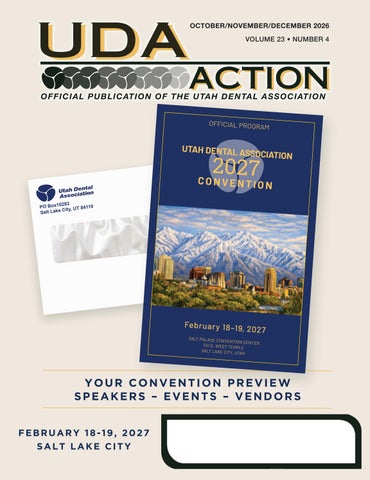
OCTOBER/NOVEMBER/DECEMBER 2026 VOLUME 23 • NUMBER 4
official program
UTAH DENTAL AS
SOCIATION
2027
CONVENTION 0283 PO Box1 4110 City, UT 8 e k a L Salt
Fe b ru a ry 18 –1 9,
2027
salt palace conv ention center 100 s. west temp le salt lake city, ut ah
YOUR CONVENTION PREVIEW SPEAKERS – EVENTS – VENDORS FEBRUARY 18-19, 2027 SALT LAKE CITY
Your Practice Deserves the Right Buyer.
We Know Where to Find Them. Introducing the DDSmatch App, connecting more dentists to more opportunities than ever before.
The new DDSmatch App successfully connects the nation's largest network of dental buyers with the right opportunities.
27,100+ Buyer Profiles 299 Practices Sold* *In the Last Year
100 Associates Placed* *In the Last Year
$1,270,604,778 Total Value of Dental Practices Sold
Download NOW Practice Sales | Associate Placement | Partnerships Sell-Side DSO Representation| Transition Planning Matt Hamblin| MountainWest.DDSmatch.com | MHamblin@DDSmatch.com | (801) 362-1557
SEE YOU AT THE UDA CONVENTION|Booth #423
CONTENTS PRESIDENT'S MESSAGE 4 OFFICIAL PUBLICATION OF THE UTAH DENTAL ASSOCIATION
CONTRIBUTING WRITERS Dr Jaren Argyle
Dr James Keddington
Crystal Barnes, RDH
Dr Maggie Liskutin
Dr Cody Boseman
Dr David Prince
Dr Jerald Boseman
Dr Ben Quenzer
Dr Anthony R. Cardoza
Dr Chris Ramsdell
Dr David Christensen
James Schulz
Dr Jincheng Du
Dr J. Flint Tomlinson
Dr Erin Elliott
Marko Vujicic, Ph.D.
Dr Arman Farhadtouski
Dr Jorge Zapata
Dr Rich Fisher
COVER PHOTO Utah Dental Association 2027 Convention Program Cover PUBLISHER: Mills Publishing, Inc. PRESIDENT Dan Miller OFFICE ADMINISTRATOR Cynthia Bell Snow GRAPHIC DESIGNERS Ken Magleby Patrick Witmer
ART DIRECTOR Jackie Medina
ADVERTISING REPRESENTATIVES Paula Bell Dan Miller
The Utah Dental Association holds itself wholly free from responsibility for the opinions, theories or criticisms herein expressed, except as otherwise declared by formal resolution adopted by the association. The UDA reserves the right to decline, withdraw or edit copy at its discretion. UDA Action is published bi-monthly. Annual subscriptions rates are complimentary to all UDA members as a direct benefit of membership. Non-members $30. Utah Dental Association, 801-261-5315 1568 500 W Ste. 102, Woods Cross, Utah 84010 uda@uda.org. UDA Action is published by Mills Publishing, Inc. 801-467-9419; 772 East 3300 South, Suite 200, Salt Lake City, Utah 84106. Inquiries concerning advertising should be directed to Mills Publishing, Inc. Copyright 2026.
Choose Gratitude
ASSOCIATION 6
What are You Doing to Help the Profession?
30
Congratulations Dr Chamberlain
CONVENTION 5 Last UDA Convention in the Salt Palace…For a While 8
Three Unique Classes on Treating Patients with Special Needs
8
Be Your Best with Well Trained Dental Assistants
11
The Privilege of Hosting
11
Samples, Socialize, and Steps: Make Time for the Exhibit Hall
12
Be Prepared, My Friends!
15
Local Speaker Series!
17
Meet Some of Your DOPL Licensing Requirements at the 2027 UDA Convention
29
2027 Distinguished Service Awards
30
Be Inspired at the UDA Team Luncheon!
SPEAKER SPOTLIGHT 10
Dr Rick Ferguson Proves You Don’t Need a Fortune to Print
10
Pharmacology is Fun
12
Amber Auger Returns to the Utah Dental Association Annual Convention
14
From Washinton to Wall Street: Why Advocacy Matters More Than Ever
16
You Don’t Need More Time. You Need More Energy
18
Forensic Odontology
20
Sleep Apnea
21
Medical Emergencies: Avoiding the Chaos!
22
See the Sulcus: How Microscope-Guided Preparation and High-Magnification Digital Verification Eliminate Open Margins
24
I Volunteered My Own Mouth
25
Soft Tissue Diode Laser in Dental Hygiene A Non-Surgical Approach
PRESIDENT'S MESSAGE CHOOSE GRATITUDE A couple of days ago, while traveling back from a CQI meeting in Logan, a conversation transitioned from the regular conversation that may have included some complaining to one of amazement and gratitude. I know there is a very real financial squeeze hitting all of us. This squeeze is coming from many areas, but mainly from the increased cost of hiring and retaining good employees, stagnant insurance reimbursements, and continued increases in the cost of supplies and equipment. Most dentists in Utah continue to have patients in their chairs, but when so much more money is required to keep everything else in the office operational, there is less money going home. This can lead many of us to feel an urge to express frustration and place blame on someone else. The conversation I referenced had been discussing some of these very real challenges, including some negative observations. But somehow, the conversation turned positive and left me feeling uplifted. But why? So, I started doing a little research on why it seemed so easy to have the conversation turn positive and why I didn’t carry the burden of feeling weighed down following a difficult conversation. I am not the traditional “all-is-happy” person, but I really liked how this conversation turned out. Could it really be as easy as expressing gratitude? That was all that seemed to alter the conversation. According to Robert Emmons, a professor of psychology at UC Davis, when someone complains, both the listener and the person complaining can be negatively impacted. Yes, there can be positive benefits to having a meaningful discussion and trying to understand a negative situation, but the discussion needs to be focused on finding a positive solution. Referencing a study he performed back in 2003, he uncovered a science-based positive outcome associated with gratitude. Basically, he asked students to fill out a survey for a couple of months. They were asked to self-evaluate their well-being and mood, describe how grateful they were, and report on their physical activity. Some students were asked to list mundane events from the week, while others were asked to complain about their mundane interactions. Yet another group was asked to express gratitude for their mundane events. The questions were designed to assess the students’ overall well-being. What was the outcome? The study suggests that giving people a chance to complain had a major negative outcome. The group that complained ended up scoring themselves lower in emotional resilience and mood and spent less time working out. Those who expressed more gratitude worked out longer and reported better relationship 4
satisfaction and better physical and emotional well-being. But that’s not all. In Robert Emmons’ book, The Little Book of Gratitude, he progresses the study by further looking at hormone levels. People who counted their blessings showed 23% lower levels of cortisol. They reduced their dietary fat by as much as 25%. Those with chronic pain showed a 10% improvement, and 19% of participants showed lower levels of depression. Science shows that gratitude makes a difference and can deliver greater resilience. Possibly the biggest benefit to expressing gratitude is the social connection it builds with others. Sara Algoe, a professor of psychology at the University of North Carolina at Chapel Hill, describes gratitude as the “find, remind, and bind” emotion. The idea is that choosing to first think positively about a person leads to increased positive actions and, in turn, a spontaneous noticing of more positive attributes in those we live and interact with. So, as far as dentistry goes, with all the challenges we still need to tackle, I need to express a little more gratitude! Thank you! Thank you to all our wonderful board members, past and present, and our committee leads who travel to represent all of us in our state and around the country. Thank you to our executive director, Val Radmall, and our staff—Becky, Kenda, and Crista—as well as our convention coordinator, Gerald Boseman, and his committee. You all accomplish so much behind the scenes. Thank you to the state’s DOPL board for focusing on protecting the public and for writing rules last year. They tripled the number of their meetings to get this task done. We also have a newly created education board that sits under the state DOPL board. Thank you to them for vetting internationally trained dentists who want to obtain a Utah dental license and for the future rules they will write to establish EFDA expansion. Thank you to our state’s dental director and her team. Thank you to Erik Stroheim for traveling the state to help us all plan a little better for our future through our sixteen CQI meetings. I want to thank the dental students who show up to learn about legislative issues and share their thoughts about what worries them. I am grateful for my staff and patients—for being flexible when I have to be out of the office to fulfill my UDA duties. I am grateful for the patients who sit rigidly when I lean their chair back, thus helping me improve my core strength; the ones who are chronically late, giving me a few catch-up minutes in the lab; and those who simply say, “Yes, I floss,” but leave me wondering what they floss. (continued on next page) October / November / December 2026
CONVENTION LAST UDA CONVENTION IN THE SALT PALACE…FOR A WHILE! As you attend the upcoming UDA Convention, it will be a special experience: this will be the last time we hold our convention in the existing Salt Palace Convention Center. After our meeting concludes, the Salt Palace will close for approximately three years while it is rebuilt. After meeting for many years in the basement of the Hotel Utah, the UDA Convention moved to the Salt Palace for the February 6–8 convention in 1986. We have met there annually since then, with a minor interruption during the COVID pandemic when the convention was canceled in 2022 due to the closure of the Salt Palace. During the three-year Salt Palace reconstruction, we will meet at the Mountain America Expo Center in Sandy. We are excited to see how this opportunity works out and look forward to the benefits this venue offers, including: • • • •
No competing events, as we will be the only activity in the facility for both days of the convention. Plenty of available parking at no charge. Ample classroom and exhibit space. Convenient access to TRAX and other public transportation.
Legal Counsel for Dentists
Buy or Sell Your Practice with
Confidence
Practice purchases & sales Commercial real estate Partnerships & buy-ins Associate Agreements Entity formation Lease review
Scan to schedule your free initial call ASHLEY GARBE SMITH, ATTORNEY (801) 477-6144 • ashley@agslawfirm.com www.agslawfirm.com
We have a great program planned for the 2027 convention, along with fun activities to help us celebrate our final year in the existing Salt Palace facility. You won’t want to miss this outstanding CE opportunity and celebration! Please put February 18-19, 2027, on your calendar and watch for registration to open in October. While your calendar is open also save April 27–28 and plan to join us in 2028. Jerald Boseman, DDS UDA Convention Coordinator Gratitude (continued) Most of all, I am grateful for my family and my wife. They make everything I do possible. They are always willing to donate a little time to my crazy ideas, like feeding a dental class, and make trips out to the assignments I have on the board. We live in incredible areas and have so much for which to be grateful. Remember to think more positively, act more gratefully, and receive greater emotional and physical resilience in return. Dentistry is a taxing profession. Take a little off your plate and enjoy some joy in what you are doing for others by writing it down or sharing it with those you interact with. Fortunately—or unfortunately—this is not a one-and-done exercise. Keep after it and enjoy the outcomes! Dr Rich Fisher UDA President UDA Action
Reupholster and Save! Dental Chairs & Stools Exam & Operating Tables Office Furniture Waiting Room Seating Custom Equipment Covers Quick Turn-Around Times
Call or Text: (385) 250-6560 Wide choice of Medical-Grade upholstery fabrics
visit us at:
dentalupholsteryservice.com 12523 So. Redwood Rd. – Riverton, Utah 84065 5
ASSOCIATION WHAT ARE YOU DOING TO HELP THE PROFESSION? For the past three years, I have had the privilege of serving our dental association. During that time, I have attended meetings and participated in committees discussing the issues affecting our profession and our professional organizations. One issue, however, seems to come up again and again: membership. Like many professional organizations, organized dentistry has experienced a decline in membership. At our most recent meeting, we were presented with a striking statistic: the ADA represents approximately 50% of active licensed dentists in the United States. In other words, nearly half of our profession is not a member of our primary professional organization. That statistic should make all of us pause. Why are so many dentists not members of the ADA? Do they feel disconnected from the organization? Have they become frustrated or disillusioned? Do they believe the ADA doesn’t accomplish anything meaningful? Or perhaps they simply ask the question we have all heard before: “What does the ADA do for me?”
Ensign Academy of Dentistry DENTISTS, DENTAL HYGIENISTS, SPOUSES AND YOUTH founded & sponsored by members of the church of jesus christ of latter-day saints
W H Y D O Y O U P R A CT I C E D E N T I S T RY ? I s i t a c a r e e r— o r a c a l l i n g ?
The more I have thought about this question, the more I have come to believe that we may be asking the wrong one. Perhaps the better question is, “What am I doing to help the ADA make meaningful changes on behalf of our profession?” The ADA can only be as strong as the dentists who are willing to support it. Our collective voice cannot be as powerful as it could be when nearly half of our profession is not contributing to it. If we want organized dentistry to advocate for us, protect our profession, and create meaningful change, we cannot simply wait for someone else to lead. We have to take ownership of our profession. Taking ownership means more than simply paying an annual membership fee. Membership is important, but it is the starting point, not the finish line. We need dentists willing to become involved at the district, state, and national levels. We need dentists willing to attend meetings, serve on committees, propose resolutions, participate in advocacy, and bring the concerns of practicing dentists to the organizations representing us. We need to fully utilize the strength of the tripartite structure and recognize that meaningful change often starts at the grassroots level and works its way upward. Most importantly, we need the next generation of leaders to step forward. Early and mid-career dentists have a unique perspective on where our profession is headed. We are experiencing many of these challenges firsthand, and we have an opportunity, and a responsibility, to help shape what dentistry looks like for those who come after us. Change does not happen simply because an organization exists. Change happens because people choose to get involved. For me, that means continuing to invest my time in our state dental association while increasing my involvement at the district level. Whether working on resolutions, participating in advocacy efforts, attending meetings, or simply lending my time and talents where they are needed, I have made the choice to be involved. I am not suggesting that every dentist needs to devote their life to organized dentistry. We all have practices, families, patients, and countless other responsibilities, but each of us can find a way to contribute.
Same Mission. A Brighter Future. celebrate the power of the whole dental team CELEBRATING FIVE DECADES OF A BRIGHTER TOMORROW FOR A FULL LIST OF PRESENTERS AND TO REGISTER
ensignacademyofdentistry.com or call 801-889-7012
August 6–7, 2027
U t a h Va l l e y Co n v e n ti o n Ce n te r
6
Ensign Academy of Dentistry Nationally Approved PACE Program Provider for FAGD/MAGD credit. Approval does not imply acceptance by any regulatory authority or AGD endorsement. 7/1/2023 to 6/30/2026. Provider ID# 209187
Give what you can. Share your expertise. Attend a meeting. Join a committee. Volunteer for an advocacy effort. Speak up about an issue that matters to you. Encourage a colleague to become involved. Whatever your contribution looks like, make the choice to take action. The future of our profession should not be determined by the few dentists who are willing to show up. It should be shaped by all of us. So I ask my fellow early and mid-career dentists to join me. Don’t just ask what your professional organization can do for you. Ask yourself: What are you doing to help the profession? Arman Farhadtouski, DDS ADA Alternate Delegate October / November / December 2026
ORGANIZED DENTISTRY
The Power of the Tripartite:
How Organized Dentistry Works for You ONE PROFESSION.
THREE ORGANIZATIONS.
A STRONGER VOICE.
When we think about organized dentistry, it’s easy to focus on the ADA, the national organization that advocates for our profession, supports evidence-based dentistry, and works to improve oral health for all. But the ADA is just one piece of a much larger structure. Organized dentistry is built on a tripartite system; a unified partnership between the American Dental Association, state dental associations, and local (district) dental societies. Together, these three levels work to support dentists, strengthen our profession, and advance the future of oral health.
ADA
Association®
And each level needs you.
National Advocacy • Resources • Research • Oral Health for All
State Dental Associations
State Advocacy • Continuing Education • Statewide Resources • Member Support
The tripartite structure is designed to be a pipeline of support and action, with each level playing a unique and essential role. From national advocacy to local community engagement, every level matters and each one is stronger because of the others.
Local / District Dental Societies Community Engagement • Networking
The American Dental Association (ADA)
• Local Education • Grassroots Advocacy
STRONGER TOGETHER
Why It Matters
The next level is your state dental association. State associations connect the national vision to local needs, advocate at the state level, provide continuing education, and offer resources tailored to the unique challenges facing dentists in your state. They are also the bridge between the ADA and your local district.
The tripartite works because it gives us a powerful and unified pathway. Local societies identify the issues; state associations help shape solutions; and the ADA takes those solutions to the national stage. When we are engaged at all three levels, we have the greatest influence. Whether it's advocating better insurance policies, fighting scope creep, supporting workforce initiatives, or advancing the latest in dental education and research.
Local Dental Societies (Districts)
How You Can Get Involved
At the base of the pyramid are your local or district dental societies. These grassroots organizations are where many dentists get their start in organized dentistry. They foster a sense of community, provide local education and networking, and give you a direct role in shaping the future of your profession right in your own community.
You don’t have to be a leader to make a difference. Start by getting involved at the local level. Attend a meeting, join a committee, or volunteer for an event. From there, explore opportunities at the state and national levels. The more you participate, the stronger our organizations become and the louder our voice is in the conversations that shape the future of dentistry.
State Dental Associations (UDA)
Each level has a voice.
American Dental
The Tripartite: Three Levels, One Mission
At the top of the pyramid is the ADA. The ADA represents more than 150,000 members and serves as the national voice of dentistry. It leads federal advocacy, provides valuable resources and education, advances research, and works to improve oral health across the country and around the world.
Each level of the tripartite has a role.
A Stronger Profession Starts with You
The tripartite isn’t a structure, it’s a partnership! It’s how we advocate, educate, and support each other so that we ensure that dentistry remains strong, respected, and ready for the challenges ahead. Whether you're a student, a new graduate, or a seasoned practitioner, your involvement helps build a profession that benefits us all. Together, we can make organized dentistry work for today and for generations to come.
Get involved. Make your voice heard. Strengthen the tripartite.
UDA Action
7
CONVENTION THREE UNIQUE CLASSES ON TREATING PATIENTS WITH SPECIAL NEEDS Taught by Dr. Shannon Weir •Adaptive Dentistry •Beyond the Brush •Treating the Untreatable Have you ever seen a patient in your office with a disability, or a medical complexity, and you are not sure how to provide safe, good quality dental care for this patient? You are not alone. I have felt this way many times. This is not a small population. Did you know that more than one in four Utah adults reports a disability; and approximately one in six Utah children meets the federal definition of having a special health care need? What can we recommend when a patient cannot spit, has dysphagia, receives nutrition through a feeding tube, has severe xerostomia, cannot tolerate a traditional toothbrush, or relies entirely on a caregiver? The science remains the same, but
the oral hygiene plan must change. A common misconception is that treating these patients always requires specialized equipment, sedation, or a hospital operating room. Oftentimes it does. But just as often, what is really needed is a small, thoughtful adaptation in how care is delivered. The central idea connecting all three courses is that patients with disabilities and medical complexity do not need a lower standard of dentistry. They may simply need a different pathway to reach that standard. These three important classes bring important principles to life through fast-paced, image-rich cases from private practice, emergency consultation, and the hospital operating room. The goal is to provide ideas that attendees can use immediately, and perhaps see a patient they once considered “untreatable” a little differently. Dr Chris Ramsdell UDA Convention Committee
CONVENTION BE YOUR BEST WITH WELL TRAINED DENTAL ASSISTANTS Have you been hoping to take your office to the next level but can’t justify flying your team to exotic, expensive locations to learn the skills needed to do so. Take advantage of the upcoming UDA Convention and help them acquire new skills and knowledge right here at home. At the convention we strive to bring in quality presenters that can teach skills and provide information that can be incorporated in your office on Monday when you return from the convention. We have a full 2-day line up for your chairside dental assisting team to learn vital skills. Help them learn how to: • Take diagnostic radiographs with Dr. Marty Evers on Thursday morning. He will guide participants through the process of learning what constitutes a diagnostic radiograph, how to acquire them, how to correct mistakes so that any retakes are minimal and accurate. Learn how to take a diagnostic full mouth series from 8:30-10am, then learn how to properly position and acquire diagnostic panoramic images from 10:15-11:45am. Don’t miss this opportunity to enhance your diagnoses and treatment plans by having diagnostic quality radiographs in your office. • Manage AI and new digital workflows with LaShae Steele, CDA. Do you have a scanner, digital pano, 3D printer, do
8
in-office milling (CEREC, etc.), or record clinical notes assisted by AI? Do you send digital files to labs to design and fabricate your crowns, dentures, and RPD’s? If so, you are part of the digital evolution in dentistry. Help your chairside team learn how to integrate the digital workflow into their back-office routines so that you become more efficient and productive! LaShae will teach this course on Thursday afternoon. Return Friday for: • Forensics and accurate record keeping with Dr. Anthony Cardoza. • Working with pediatric patients featuring Drs. Brian Hodgson, Baker Chamblis and Kevin Boyd. • Maintaining personal wellness while working in a stressful environment featuring Dr. Jaren Argyle. And don’t forget: • CPR/BLS and ACLS skills pass off courses are offered both days onsite if you or your staff are in need of recertification. Check out the program and register your team starting in October to attend the 2027 UDA Convention at the Salt Palace Convention Center. See you there!
October / November / December 2026
W
Wee need need help! help! Every week, Utahns walk into Donated Dental clinics after months, sometimes years, of living with dental pain. They’ve skipped meals, missed work, and avoided smiling. Then a volunteer gives a few hours of their time. That’s all it takes to relieve an infection, replace a broken tooth, or give someone the confidence to walk into a job interview. At Donated Dental, volunteer dentists and hygienists provide care to patients with extremely low incomes: children, veterans, seniors, unhoused individuals, domestic violence survivors, refugees, and cancer patients, all united by economic hardship and a lack of access to affordable dental care. You don’t have to give a lot. You just have to give. Volunteer once or once a month, and we’ll work around your schedule. Four hours of your month could mean a lifetime of difference for someone else.
Volunteer at Donated Dental Text or call: 801-972-2747 Email: volunteer@donateddental.org 1383 S 900 W, Ste. 128, Salt Lake City, UT 84104 550 E 300 S, Kaysville, UT 84037
scan to email
SPEAKER SPOTLIGHT DR RICK FERGUSON PROVES YOU DON’T NEED A FORTUNE TO PRINT What if I told you that 3d printing is here to stay? What if I told you that you could enter the dental 3d printing world without spending 5 figures. Well… That is just what I’m telling you!!! Dr. Rick Ferguson has spent years trying to figure out how to affordably print in his own operatory, and this year he’s bringing the answer of “HOW”, to the Utah Dental Convention. A true early adopter, Dr. Ferguson was experimenting with 3D printing in dentistry long before it became a conference buzzword. Since then, he’s turned his spare time into a personal R&D lab, testing resin after resin on inexpensive, Chinese-made printers most dentists have never considered clinical-grade. The result: a proven, reliable path into dental 3D printing for less than $1,000 at a fraction of what many assume it costs to get started.
Dr. Ferguson’s session is built for the practitioner who wants in on the 3D printing revolution without a five-figure equipment budget. He’ll walk attendees through exactly where the return on investment hides and how to capture it through three high-value applications: surgical guides, models, and night guards. If you’ve been on the fence about 3D printing because of sticker shock, this is the talk that changes the math. Come find out how far $1,000 can actually take you. Dr. Rick Ferguson speaks at the Utah Dental Convention on Thursday February 18th both morning and afternoon. Dr Cody Boseman UDA Convention Committee
SPEAKER SPOTLIGHT PHARMACOLOGY IS FUN For many of us, pharmacology was one of the most difficult courses we were required to take in dental or hygiene school. Most of us would not agree with the title but we are going to have the opportunity to hear from Dr. Tom Viola at our next annual convention next February. Dr. Viola definitely makes pharmacology fun. He has been presenting to dental audiences internationally for 25 years. He has earned both a national and international reputation as the go-to specialist for making pharmacology practical and useful for all members of the dental team. The titles of his courses provides a clue to his humorous presentations he will give on Friday, February 19, 2027. The first course is entitled, “Weed Will, Weed Will Rock You!: The Fall and Rise of Cannabis.” Dr. Viola will emphasize cannabis’s effects on oral health and dental treatment, as well as its proposed applications in dentistry for managing patient anxiety and odontogenic pain. His second course entitled, “Hit Me With Your Best Shots,” is an interactive presentation that builds on foundational pharmacology knowledge and applies it to real-world clinical decision making. Participants will examine how local anesthetics behave in varied patient scenarios, explore reasons for anesthetic failure, and consider pharmacologic factors affecting safety, efficacy, and outcomes. His last course is a must attend. “Make It Hurt So Swell,” is a presentation on pain management. Real-world clinical decisions require the ability to integrate pharmacologic principles 10
Photo: Image licensed by Ingram Image
with patient-specific risk factors, including polypharmacy and potential substance use disorder. Dr. Viola’s emphasizes judgement rather than protocol, including interpretation of pharmacologic risks, evaluation of drug interactions, and thoughtful consideration of analgesic strategies in medically compromised patients. Dr. Viola’s presentations have always provided essential yet entertaining information that relates to what we experience in practice on a daily basis. If you haven’t had an opportunity to hear Dr. Viola speak before, you are in for a treat. Dr David Prince UDA Convention Committee October / November / December 2026
CONVENTION
CONVENTION
THE PRIVILEGE OF HOSTING
SAMPLES, SOCIALIZE, AND STEPS:
Christopher Nolan’s Odyssey has been a tremendous hit in the theaters; one of the main themes throughout the movie is the relationship between hosts and guests. Zeus’s law compels the host to protect and feed the guest, as well as demonstrate generosity, kindness, and respect towards them. This tradition continues today at the UDA convention! A host is assigned to every speaker; they are essential in a seamless and pleasant experience for the not only the lecturer but also the attendees at the UDA conference. Do you wish to connect professionally with a speaker in an one-on-one setting and pick their brains on their expertise? Are you excited to give their professional introduction and hype up the crowd? And then listen to the lecture for free? If you are interested in being a host and help the UDA with your time, please email Dr. Ramsdell (jzramsdell@gmail. com) or Dr. Du (jincheng.du@umail.utah.edu).
Where is a place that you can reconnect with alum from your alma mater, get up close with the latest technologies and dental products, and get your daily steps in? The Exhibit Hall is the heart of the convention and you should consider it as your homebase. There will be vendors representing Utah and from all over the country. This year’s Exhibit Hall will have the latest products, technologies, and services- featuring multiple companies that have AI-powered solutions designed to streamline office operations. You will be able to compare solutions side by side and discover innovations that you may not have encountered before. Grab your samples and take advantage of the opportunity to connect – we will be featuring a ‘dirty soda shop’ too! So grab some sodas and catchup with old friends and colleagues. We hope to see you there!
Dr Jincheng Du UDA Convention Committee
Dr Maggie Liskutin UDA Convention Committee
MAKE TIME FOR THE EXHIBIT HALL
VISIT US AT BOOTH #303
UDA Action
11
SPEAKER SPOTLIGHT AMBER AUGER RETURNS TO THE UTAH DENTAL ASSOCIATION ANNUAL CONVENTION Amber Auger is returning to the Utah Dental Association Annual Convention for both days, and if you’ve seen her before, you already know why that’s exciting. If you haven’t had the opportunity yet, make plans now to stay through Friday, February 19, 2027. Amber will be presenting on both Thursday and Friday, February 18-19, and her sessions are sure to be among the highlights of the convention. One of the most sought-after speakers in dentistry today, Amber is a nationally recognized educator, consultant, and clinician known for her evidence-based approach to disease prevention, periodontal health, and patient-centered care. Her presentations combine cutting-edge science with practical strategies that can be implemented immediately in practice. Amber’s expertise extends far beyond traditional oral hygiene concepts. She challenges dental professionals to think differently about oral health by exploring the connections between oral disease, salivary diagnostics, biofilm management, and overall systemic wellness. Her focus is on helping dental teams ask better questions, improve clinical assessment, optimize patient outcomes, and elevate the quality of care they provide every day. What makes Amber exceptional is her ability to translate complex scientific concepts into practical solutions. Attendees leave her lectures with actionable techniques, improved communication strategies, and renewed confidence in their ability to make a meaningful impact on their patients’ health. Her sessions deliver the rare combination of inspiration and practicality, providing ideas you can implement as soon as you return to the office on Monday morning. Just as importantly, Amber brings an infectious energy to the stage. Her presentations are engaging, interactive, and packed with insights that keep audiences taking notes, photographing slides, asking questions, and rethinking the possibilities within their own practices. We are thrilled to welcome Amber back to Utah and excited for you to discover firsthand why she is one of the most sought-after educators in dentistry today. Make plans now to stay through Friday, bring your team, and take advantage of this exceptional opportunity to learn, grow, and be inspired. I’ll be saving you a seat in the front row. https://amberauger.com Dr James Keddington UDA Convention Committee
CONVENTION BE PREPARED, MY FRIENDS! True Story: While I was going to college in Salt Lake City several years ago, I worked part-time at a local hospital. I worked as an EKG Tech (the person that puts electrode stickers on your skin, attaches cords to these electrodes, and a special computer analyzes and records the conduction impulses and rhythm of your heart). It was a good part-time job that would keep me busy. I spent most of my time being paged to different floors, units, and rooms of the hospital to do EKG’s on patients. A good percentage of that time was spent in the Emergency Department. Many people came to the Emergency Department with chest pain, back pain, and shortness of breath, which are some of the most common symptoms of a heart attack (myocardial infarction). On one of my work shifts, I was down in the Emergency Department doing an EKG. I was about to leave to go upstairs to our office. A staff member told me that an unresponsive patient was about to arrive by ambulance. They asked me to stay because the patient would probably need an EKG. When the patient came in, he was in cardiac arrest. Immediately, doctors, nurses, and staff members began trying to save this man’s life. A nurse stood next to the hospital bed and began doing chest compressions. The doctor asked everyone to stand clear of the patient, and they administered a shock to try to get the patient’s heart beating again. No heartbeat was found and the nurse continued with chest compressions. After a couple of minutes, the doctor again told us to stand clear of the patient, and another shock was administered, still no heartbeat. The nurse was obviously tired at this point, and he asked someone to switch with him and to continue chest compressions. I was standing near the nurse. I hesitated, the only time I had ever done chest compressions was on a mannequin. But then I realized I still remembered the skills I had learned in my BLS class, and I said that I would help. I took the nurse’s place by the side of the hospital bed. I interlocked my fingers, straightened my arms, and began counting out loud as I did chest compressions on a real person. It did not seem real to me what was happening, but I knew how to do chest compressions. Within a minute, the doctor asked me to pause, he noticed the patient’s heart was beating again. All of us in the room stared at the monitor, which showed that the patient was in a regular, healthy, heart rhythm. We hopefully watched the monitor for a few more minutes while the patient’s heart continued to beat. The doctor then gave directions for the patient to be transferred upstairs to the Cardiac Floor for continued care. I was later informed that he was still stable the following day. I was grateful that I could help in a small way. I realized that the skills I had learned in a BLS Class were not only important, but could actually be used in a real life situation. Please don’t take the BLS and ACLS classes for granted. The knowledge and skills they provide us will give us competence and confidence for real life emergencies that happen when we least expect it. Dr Chris Ramsdell UDA Convention Committee
12
October / November / December 2026
BUILT TO LEAD. THE ALL NEW BMW X5
BMW of Murray 4735 S. State Street Murray, Utah 801-262-2479 bmwofmurray.com
BMW of Pleasant Grove 2111 West Grove Parkway Pleasant Grove, Utah 801-443-2000 bmwofpg.com
©2026 BMW of North America, LLC. The BMW trademarks are registered trademarks.
The Ultimate Driving Machin
SPEAKER SPOTLIGHT FROM WASHINTON TO WALL STREET: WHY ADVOCACY MATTERS MORE THAN EVER Dentistry is changing. Across the country, dentists are facing growing pressure from rising practice costs, workforce shortages, increasing student debt, and continued challenges with dental insurance. What once seemed like separate issues are now deeply connected, affecting how dentists practice and care for patients. Utah dentists know these challenges well. In recent months, Utah Dental Association leaders have been working closely with the American Dental Association to bring better data and stronger advocacy to policymakers who are examining workforce issues, insurance reimbursement, and the future of oral health care in the state. Together, we are helping ensure that decisions affecting dentistry are based on facts and real-world practice experience. Organized dentistry has long championed dental insurance reform, and there is more work to do to make coverage work better for providers and patients. Recent ADA Health Policy Institute analysis found that Utah dentists receive, on average, just over half of what they charge through private dental insurance reimbursements, placing Utah among the lowest-reimbursed states in the nation. Utah has also experienced one of the largest long-term declines in reimbursement levels relative to charges. These trends contribute to the growing financial pressure many practices face as operating costs continue to rise. This is why insurance reform remains a major priority of the ADA and UDA. At the state level, dental associations across the country, including the UDA, are pursuing reforms that increase transparency, reduce administrative burdens, and improve fairness for both dentists and patients. Utah recently enacted several dental insurance reforms that give dentists greater control and offer more transparency. A new law prohibits fees on paper checks for claim payments and requires insurers to clearly explain to patients noncovered services to reduce patient confusion on their financial responsibility. It ensures state insurance laws are followed even for plans written outside of the state and by making handbooks legally part of the participation agreement, prohibits insurers from enforcing handbook and policy updates that are not provided to network dentists. These are just some of the new protections enacted in Utah over the last few years benefiting dentists and their patients. At the federal level, the ADA continues to advocate for legislation such as the Improving Dental Administration (IDA) Act, which would clarify that Utah’s laws governing dental benefits can apply to self-funded dental plans governed by ERISA. Therefore helping to extend protections that Utah’s government just passed to protect patients and providers. Workforce challenges are equally important. 14
While Utah’s overall dentist-to-population ratio remains close to the national average, the state’s dentist supply relative to population has declined over the past decade. Rural communities continue to face particular challenges in maintaining access to care, while practices across the state report ongoing difficulty recruiting and retaining clinical team members. Building the future workforce requires creating an environment where graduates can choose to remain in the communities that need them most. Student debt plays a significant role in that equation. Dental school debt continues to shape career decisions for many new dentists. ADA Health Policy Institute data show median federal loan debt of approximately $261,000 among University of Utah dental graduates and nearly $445,000 among Roseman University graduates. The financial realities facing new dentists can influence everything from practice ownership decisions to where graduates choose to live and work. For that reason, the ADA continues to support legislative solutions such as the Resident Education Deferred Interest (REDI) Act and other policies designed to reduce barriers for the next generation of dentists. The good news is that dentistry has strong advocates at both the state and national levels. The challenges facing dentistry are real, but so are the opportunities. As policymakers increasingly focus on workforce development, insurance markets, student debt, and access to care, organized dentistry has an opportunity to help shape the conversation and secure meaningful reforms. The Utah Dental Association is working every day to represent Utah dentists before state lawmakers and regulators. The ADA is advancing complementary efforts in Washington, D.C., while providing data, research, and policy expertise that help strengthen advocacy efforts nationwide. Together, those partnerships ensure that the profession speaks with a unified voice on the issues that matter most. We look forward to discussing these issues and the broader trends affecting dental practices during our presentation, “From Washington to Wall Street: Key Trends Reshaping the Dental Practice Landscape,” at the Utah Dental Association Convention. Understanding both the policy landscape and the economic realities facing dentists will be critical to ensuring a strong future for the profession and the patients we serve. Visit ADA.org/advocacy or ADA.org/HPI for the latest news and information. Marko Vujicic, Ph.D. Chief Economist and Vice President, ADA Health Policy Institute James Schulz Senior Vice President, Government and Public Affairs, American Dental Association October / November / December 2026
CONVENTION LOCAL SPEAKER SERIES What do Gordon Christensen, Bill Dickerson, Frank Spear and Pete Dawson have in common? Each one of them, at some point in their career, gave their first lecture. What does this have to do with the UDA Convention? Part of the UDA Convention each year is the LOCAL SPEAKER SERIES. What is the Local Speaker Series? The Local Speaker Series is a series of lectures presented by local speakers. For many of them, it will be the first lecture that they have ever given. How many presentations are there? There are four lectures on Thursday and two lectures on Friday. How long are they? Each presentation is one hour in length.
They are local people who have developed a presentation on a specific topic. Perhaps a member of the convention committee has asked them to present, or perhaps they have reached out to Dr Boseman. One of our presenters this year is Dr Ryan Johnson. Who will lecture on soft tissue grafting and we see the need for that every day. Another topic is Becoming Trauma Informed, Supporting the Patient and the Practitioner. Which will be given by Shelby Lopez and that is a timely topic that we can all benefit from So, if you see an area of interest in the LOCAL SPEAKER SERIES, please join us. You just may be listening to the next Gordon Christensen. Dr David Christensen UDA Convention Committee
How are presenters selected?
VISIT US AT BOOTH #709 UDA Action
15
SPEAKER SPOTLIGHT YOU DON’T NEED MORE TIME. YOU NEED MORE ENERGY Instead, many dentists operate under an unspoken rule: Push harder. Get through the day. Recover later. The problem is that “later” often never comes. Eventually, we find ourselves chronically tired, more reactive, less patient, less creative, and less connected to the very people and activities that once brought us joy. Burnout rarely happens because of one horrible week. It happens when the withdrawals consistently exceed the deposits. Recovery is Part of Performance One of the biggest mindset shifts I have made in my own life is recognizing that recovery is not something we earn after working hard. Photo: Image licensed by Ingram Image
There is a strange experience that happens to many dentists. You finish the last patient of the day, walk out of the office, and technically… you are done. But your brain isn’t. You’re replaying the difficult conversation with a patient. You’re thinking about the hygienist who seems frustrated. You’re wondering whether production was high enough. You remember the treatment plan you didn’t finish, the lab case that needs attention, the employee issue you need to address tomorrow, and the email you forgot to send. Your body may have left the practice. Your mind is still sitting in the operatory. And then you walk through the front door of your home and are expected to immediately become a present spouse, parent, friend, or partner. That transition can be incredibly difficult. For years, I believed the solution was better time management. If I could just become more efficient, more organized, or more productive, surely, I would have more energy left at the end of the day.
16
Recovery is part of working well. Research into workplace recovery has identified several experiences that help people replenish the resources depleted by work. Four particularly useful concepts are: Detachment. Creating psychological separation from work rather than continuing to mentally practice dentistry all evening. Relaxation. Giving the nervous system opportunities to slow down and recover. Mastery. Participating in activities that challenge us in completely different ways and remind us that we are more than dentists. Control. Having some autonomy over how we spend our nonwork time. For me, mountain biking often checks several of those boxes at once. It is difficult to obsess over tomorrow’s schedule while trying to keep a bike upright on a rocky trail. For someone else, recovery might mean exercise, woodworking, music, skiing, cooking, reading, walking the dog, spending time outdoors, or simply being completely present with family.
But what if time isn’t actually the problem?
The specific activity matters less than what it allows your mind and body to do.
The Resource We Rarely Manage We spend tremendous amounts of energy in dentistry.
Learning to Reset Before You Get Home Recovery does not have to begin on vacation.
Clinical dentistry requires intense concentration. We make hundreds of small decisions every day. We manage anxious patients, difficult conversations, unexpected schedule changes, team dynamics, financial pressures, and the responsibility of trying to do excellent work in a very small space where millimeters matter.
It can begin between patients.
That requires physical, mental, and emotional energy.
A patient gets angry.
Yet most of us were never taught how to intentionally replenish it.
An assistant makes a mistake.
It can happen during lunch. It can happen during the drive home. Sometimes the most powerful intervention is simply creating a short pause between a stressful event and your response to it.
October / November / December 2026
Permission to Step Away. We get outside our offices, reconnect with colleagues, learn something new, gain perspective, and remember that dentistry is bigger than the problems waiting for us Monday morning.
The schedule falls apart. Someone walks into your office with yet another problem. Our instinct is often to immediately react. But there is enormous power in creating even a few seconds of space and asking:
Clinical education will always matter. But occasionally, the most important continuing education we can receive is education that helps us continue enjoying the career—and the life—that all of that clinical education was supposed to create.
“How do I want to respond to this?” That tiny reset can change the conversation that follows. And those small resets throughout the day may also determine how much emotional baggage we carry home that evening.
At this year’s UDA Convention, I’ll be presenting “From Burnout to Flow: Build Your Energy Operating System.”
The Goal isn’t to Eliminate Stress Dentistry will never be stress-free.
We’ll explore practical ways to manage energy instead of simply managing time, respond rather than react during stressful moments, create better recovery rhythms, and develop simple rituals that help us leave more of dentistry at the dental office.
Nor should it be. Some stress challenges us, stretches us, and helps us perform at our best. There are days when dentistry can be incredibly engaging—when our skills match the challenge in front of us, distractions fade away, and we become completely absorbed in what we are doing.
My hope is not that you leave with another long list of things you “should” be doing. My hope is that you leave with a few simple changes that help you become a better dentist when you are at work—and a more present human being when you are not.
That is much closer to flow than burnout.
I hope you’ll make the decision to step away from the office, join your colleagues at the UDA Convention, and invest a little time in the person behind the profession.
The goal, therefore, is not to escape every challenge. It is to build a personal operating system that allows us to move between periods of focused effort and intentional recovery without getting stuck in a constant state of depletion.
You might discover that the answer isn’t finding more hours in your day.
That system will look different for every dentist. But it deserves our attention.
It’s learning how to better use—and restore—the energy you already have.
Sometimes the Best CE isn’t About Teeth One reason I believe meetings like the UDA Convention are so valuable is that they give us something we rarely give ourselves:
Jaren Argyle, DMD Health & Wellness Chair, Utah Dental Association Founder, The Elevated Dentist
CONVENTION MEET SOME OF YOUR DOPL LICENSING REQUIREMENTS AT THE 2027 UDA CONVENTION The 2027 UDA Convention offers dental professionals an excellent opportunity to fulfill DOPL licensing requirements while gaining valuable knowledge and practical skills to enhance patient safety. Two featured courses will focus on sedation safety, emergency preparedness, and best practices for providing safe and effective patient care. Dr. Benjamin Quenzer’s Sedation Safety: Preparation, Prevention & Emergency Response will emphasize the importance of being prepared for unexpected situations in the dental office. Participants will review essential emergency medications, supplies, and equipment, while learning to identify common mistakes that can increase patient risk. The course will highlight the importance of prevention, early recognition of potential complications, and appropriate emergency response to help dental teams confidently manage situations when they arise.
Dr. Mark Donaldson’s Nitrous Oxide Safety and Efficacy: This Course Is a Gas! will provide an interactive review of nitrous oxide–oxygen minimal sedation and its role within the continuum of consciousness. Attendees will explore how to successfully incorporate nitrous oxide into a new or established practice, compare sedation options, and review important safety systems and troubleshooting techniques. The course will also address occupational exposure, staff safety, and selecting the appropriate medication and dosage for each patient and procedure. These courses offer an opportunity to stay current with sedation practices, strengthen emergency preparedness, and gain practical knowledge that can be applied immediately in the dental office. Make the most of your convention experience by attending these informative sessions while working toward your DOPL continuing education requirements.
UDA Action
17
SPEAKER SPOTLIGHT FORENSIC ODONTOLOGY Forensic dental identification has been successful because of the nature of the human dentition. The enamel is the hardest substance in the body and the only exposed portion of the skeletal system (fig. 1, 2). Teeth are very resistant to thermal damage, blunt force trauma, and the dentition remains stable during tissue decomposition. In addition, the dentition is unique to a specific individual. This includes not only the morphology of the coronal portion of the tooth but the morphology of the roots, pulpal chamber, and their relationship to their surrounding structures (i.e., sinus proximity, mandibular canal proximity, interproximal bony trabecular patterns etc.). Following the natural dentition, if you add man-made dental restorations, the unique combination for any given individual can factor into the millions. fig. 1 The field of forensic odontology is that area of dentistry concerned with the application of law in both criminal and civil proceedings. The primary discipline within forensic odontology is dental postmortem identification. Forensic odontologists also assist authorities with multiple fatality incidents, age determination based on tooth development, recognition of child abuse/ intimate partner violence (IPV), bite mark (pattern injury) analysis, and participate in civil proceedings as an expert witness.
There are numerous important reasons for identifying the deceased. A legal certification of death is necessary to consummate legal matters such as life insurance, wills, etc. There are family and personal reasons as well (closure). In criminal investigations, it is important to establish the identity of the victim in order to proceed with the criminal investigation and to identify the suspect. In a fire for instance, the bodies
Dental Identification As forensic dental identification specialists, we are typically the last conventional option for postmortem identification. DNA is also now utilized but due to its high cost and the extensive time required for analysis, it is used sparingly or when absolutely no other option exists though as of recent, advancements in DNA is allowing that mode of identification to be used more frequently. Other forms of postmortem identification include visual, personal effects, fingerprints, scars, marks, tattoos, and medical radiographs. fig. 3 are often burned beyond visual recognition (fig. 3). Personal effects are also destroyed or lost in the fire. Even if the personal effects are recovered, they may not be considered reliable due to the typical calamity which surrounds a fire. A forensic anthropologist will examine the remains of the skeletal system and can then determine age, race and sex of the victim. Positive identification is best performed by examination of the surviving dentition by the forensic odontologist. In a fire where the temperatures may be very high (1000°C) even the dental remains may be destroyed. Crowns may fracture or explode leaving only the roots. The bone may also be completely consumed leaving only scattered roots with no bony sockets for reference. fig. 2 18
Forensic dental identification is most often accomplished by the comparison of the radiographs of the teeth of the decedent October / November / December 2026
resolved but it is still critical to note the R-L orientation. In addition, the antemortem radiographic image may be of poor quality due to improper operator technique (cone cuts, overlapping interproximals, elongation/foreshortening, etc.) or poor processing (contrast, burned images, etc.). When poor antemortem radiographs are compared to an ideal postmortem radiograph, the two may not appear consistent. This could seriously hamper the identification effort.
fig.4 (postmortem) (fig. 4) with the dental radiographs obtained from the dentist of the suspected victim (antemortem) (fig. 5). Ideally the antemortem radiographs furnished should be the original full mouth series. Often this is not the case. Children’s radiographs are typically bitewings only unless they have orthodontic records as well. Often times duplicate radiographs, not the originals, are sent and have been either poorly duplicated and/ or are not labeled right and left for orientation. Of course, in the digital age we now practice in, many of these issues have been
In forensic dental identification, we stress that good quality, properly mounted and labeled original antemortem radiographs be sent for comparison. In addition, copies of the victim’s dental treatment progress notes should be submitted as well. This allows the forensic dentist to verify dental treatment that was performed subsequent to the date of the radiographs. It is important as practicing dentists to keep complete patient records on file and continually update them, including the radiographs. One of your records may be needed for the purpose of a postmortem dental identification. Anthony R. Cardoza, DDS Diplomate: American Board of Forensic Odontology
fig.5
You good?
Reach out to a friend about their mental health. Find more ways to help at SeizeTheAwkward.org
UDA Action
19
SPEAKER SPOTLIGHT SLEEP APNEA It’s another gorgeous day in North Idaho, and my schedule is packed with restorative dentistry and hygiene checks. On today’s schedule is one of my favorite patients, Shawn. I usually see him only every six months, and I’m always prepared to exchange jokes with him. I have a good one for this visit, but thankfully I’m not seeing his daughters today. I usually have to do a really bad cartwheel for them in the waiting room. All three are amazing gymnasts, and after I told them that I got kicked out of gymnastics because I couldn’t figure out how to do a cartwheel, they made me prove it by showing them my “cartwheel” but only if they didn’t have any cavities. In addition to his three teenage daughters, Shawn has a wonderful wife and a great job. He travels often, but he’s wondering why he feels more and more rundown. When I checked Shawn during his routine six-month visit, I asked about his girls, wife, job, how he was feeling, and finally how his teeth were. Of course he said they were fine; they’re always fine. Shawn is a healthy, middle- aged male with a clean health history. Certainly he has no problem. Does this sound familiar? Ever since I finished my training to treat sleep apnea and now screening and treating it for the last 18 years, I’ve been looking at teeth, tongues, and throats completely differently. What I noticed about Shawn that I hadn’t before was that his canines had bruxing wear that we had discussed at one time but dismissed my concern, he had a large scalloped tongue, and he had a constricted mandible. But he was thin and tall with a small neck, not a stereotypical sleep apnea patient. I figured there was no way he had sleep apnea. His medical doctors didn’t mention it. Certainly there was nothing to pursue. Or was there? It is my mission to spread the message that SLEEP APNEA IS NOT AN OLD FAT MAN’S DISEASE!!!! Shawn saw that I had a poster in my waiting room about snoring and sleep apnea, so he mentioned that he’d been having trouble feeling rested and that he felt rundown. Also, he falls asleep immediately when the plane takes off on his business trips. Shawn was wondering if it’s because he snores at night. However, he’s getting older, he works hard, and he has teenage daughters. Why wouldn’t he be getting tired? We think, certainly there’s no problem; he’s just getting older. I contemplated all this a bit further. His wife says his snoring is getting worse, that he complains about fatigue, and I find signs in his oral cavity that suggest sleep apnea. I recommended that he get a sleep study done. An oral appliance is a dental solution for sleep apnea, but sleep apnea is a medical problem that requires a medical diagnosis. Oral appliances help open a closing airway (and serendipitously help snoring), which is called obstructive sleep apnea. Some with sleep apnea have breathing 20
disorders that are unable to be treated by an oral appliance. In addition, with the advent of wearables that track sleep many can get a false sense of security as it can provide a false negative just as a pulse ox screener can do. A sleep test is the ONLY way to screen for Obstructive Sleep Apnea. We see many patients in my office, and we have almost the same routine for every exam. We’re supposed to check the medical history, the throat and jaw for soft tissue abnormalities, under the tongue and cheeks for oral cancer, and finally the bone levels, gums, and teeth. What about the airway? We’re most certainly right there looking at it, but do we ever pause and wonder? If we do, we may discover one of the 400+ undiagnosed sleep apnea patients currently in our practice. There are approximately 2,000 patients in a modest dental practice, and about 20%+ of those have sleep apnea or sleep disordered breathing and approximately 80-90% of those patient go undiagnosed. These patients go undiagnosed because, like Shawn, we don’t believe there can be a problem. There are some hurdles. The uneducated patient may resist a sleep study and may tell you to “just treat my snoring.” Or even worse is when I hear “my family snores, everyone I know snores, I’m fine.” I’m still trying to figure out why there is such resistance and denial. I digress. Without a sleep study to know exactly what is going on, we may be creating a “silent apneic,” which is a patient that does not snore at night, but his or her oxygen levels are dangerously low and obstructions continue untreated. Fortunately, we have sleep studies to address these unknowns, and home sleep studies are becoming more common, and this helps address patient follow through issues. Thankfully, Shawn accepted my recommendation and had a home sleep study performed that was read and diagnosed by a sleep physician. I was anxious to see his results because I’m rarely wrong in identifying sleep apneics that were unaware before I spoke with them. What were his results? Shawn was in fact one of the 20%+ of undiagnosed sleep apneics in my practice. In fact, he had moderate sleep apnea in which he stopped breathing for 10 seconds or more 99 times a night, and subconsciously tried to wake himself up to breathe better 57 times a night. No wonder he was tired! After receiving his oral appliance, Shawn returned for his oneweek follow-up with his wife. Almost immediately she said, “I can sleep with him in the same room again!” Shawn proclaimed, “I’ve stopped falling asleep (continued on next page) October / November / December 2026
SPEAKER SPOTLIGHT MEDICAL EMERGENCIES: AVOIDING THE CHAOS! For over 12 years, I’ve trained dentists and their staff all over the nation on how to handle medical emergencies. One thing is consistent across nearly every office—the most likely response to a true emergency is chaos and disorganization. This makes sense in a lot of ways because emergencies are rare and difficult to practice. Here are a few pearls that might help in avoiding the chaos: 1. Practice, practice, practice. Most people know that when you get nervous, you start forgetting things. Practice is the key to creating muscle memory and keeping the nerves in check. Practice with your staff in both formal and informal settings. 2. Assess the patient! One of the most common errors with CPR is that people don’t realize that the patient doesn’t have a pulse. Believe it or not, it’s common for people to call for an emergency and start the whole resuscitation process —without ever assessing the patient. For example, you might hear, “Hey, I need some help,” or “Hey doctor, the patient isn’t doing well.” There’s a lot of commotion and movement. Helpers are bringing in your emergency supplies. Several people are asking, “What’s wrong?” Sometimes they even get the emergency drugs out—and nobody has checked for a pulse. Even though the BLS algorithm instructs you to check for breathing and a pulse as some of the first steps, this is very commonly missed. Sometimes a patient might go a minute, two minutes, or even three minutes without a pulse, and no one has even checked. Don’t allow the chaos to keep you or your staff from the one thing that is an absolute necessity: Assess the patient! 3. Work as a team. Working as a team significantly increases your chances of success. The usual mistake I see is a dentist who is nervous and jumps right in to handle everything. They assess the patient, start CPR, and will even try to provide the breaths themselves. I understand why, but this is an important mistake. Almost every dental office will have multiple staff members present at any one time, and the American Heart Association emphasizes utilizing this group dynamic to your benefit. You should be able to rely on your staff to perform the various components of CPR, including chest compressions and breathing, calling 911, and bringing your emergency supplies to the chairside. This will free you up to lead and oversee the resuscitation. Being able to “step back” and lead will also help you determine the
UDA Action
potential cause of the emergency and what medications might be helpful. 4. Know your emergency equipment and medications. One key to handling emergencies smoothly is making sure you have the correct supplies. Offices should have a basic emergency kit, a bag-mask ventilation device, and an AED. My advice: Have them and know how to use them! I certainly hope that you don’t have a medical emergency that deteriorates into needing CPR. Being well prepared is important so that the patient receives their best chance at survival. I encourage office practice drills that include reviewing the medications and how to administer them. I’ll leave you with this important key that bears repeating: Don’t forget to always assess the patient! If they don’t have a pulse, start compressions and call for the AED. If they aren’t breathing, provide breaths. My sincere best wishes as you prepare yourselves and your staff for medical emergencies. Ben Quenzer, MD Sleep Apnea (continued) on the plane when I travel for my job. I’m so much more productive.” Shawn couldn’t stop thanking me, and his wife and kids couldn’t stop thanking me. I love changing lives! There are potentially 400 or more undiagnosed people in your practice. Dentists are on the front line. The medical doctors need us. They are farther downstream than we are. Shawn admitted he never would have gone to the doctor for his complaint, and he goes to the doctor only when he’s sick. Even at his biannual checkup the doctor didn’t ask about his sleep, and I bet he didn’t tell a joke, either. Because we know our patients and their families and see them often, we can help them breathe better by asking ourselves and our patients a few simple questions. Sleep apnea was subtle to catch in Shawn, but he’s just the tip of the iceberg. Join me at the Utah Dental Association annual meeting where I will be teaching “Sleep Apnea: Wake Up to the Problem” followed by a lecture where I discuss CBCT and its use in a general dental setting. I can help you discover an often-silent disease (that’s not so silent ironically) within your own patient population in a fun, no nonsense, practical way. **NOTE: I think “turkey waddle” should actually be “turkey wattle” Dr Erin Elliott
21
SPEAKER SPOTLIGHT SEE THE SULCUS: How Microscope-Guided Preparation and High-Magnification Digital Verification Eliminate Open Margins Abstract Open crown margins remain the leading cause of remakes in both analog and digital dentistry. The introduction of intraoral scanners with 15x-25x visualization and the routine use of the dental operating microscope has changed our ability to detect and prevent these errors. This article presents a clinical protocol that integrates microscope-guided preparation, precise tissue management, and high-magnification digital verification to achieve predictable, subgingival margins. By using magnification to both create and confirm the margin, clinicians can move from reactive “hope and seat” dentistry to a “scan once, seat once” workflow. Clinical photographs at 3.5x to 16x demonstrate the decision-making process from preparation through final delivery.
Section 2: The 4-Step Protocol for Predictable Margins Step 1 & 2: Microscope-Guided Preparation and Hemostasis
Keywords: digital impression, dental operating microscope, tissue management, retraction, margin accuracy Introduction We’ve all lived it. The provisional comes off, the crown comes back from the lab, and the distal margin is open. The PVS impression looked flawless on removal. The model poured fine. So where did the error occur? For decades we accepted this as “part of dentistry.” Our limitation was vision. With 2.5x loupes and a mirror, we could not reliably see subgingival detail at the time of impression.
Figure 1: Clinical view at 3.5x magnification showing a completed crown preparation with #2 retraction cord in place. Note the clearly defined, smooth chamfer margin and dry sulcus. Increasing magnification to 12x reveals the critical detail required for scanning. At this level we can clearly distinguish the hard tissue of the preparation, the soft tissue of the gingival sulcus, and the retraction cord.
Two technologies have changed this. First, the dental operating microscope provides 6x-20x magnification to create a precise preparation and manage tissue. Second, modern intraoral scanners provide 15x-25x magnification to verify that preparation before the patient leaves. High-magnification scanning does not replace good tissue management. It exposes poor tissue management. Blood and fluid that were hidden in PVS are now rendered as missing data. When we combine microscope-guided preparation with high-resolution scanning, we eliminate the biggest variable in indirect restorations. Section 1: Why Magnification Matters at Every Step Intraoral scanners are optical devices. They build a 3D model by stitching together thousands of images. To capture an accurate margin, the scanner needs light, contrast, and a dry field. Blood and saliva scatter light and physically block the margin. A 2021 study in the Journal of Prosthetic Dentistry showed digital impressions reduced overall remake rates by nearly 50% vs PVS. But the #1 reason for remakes in both groups was still «unclear margin.»
22
Figure 2: Clinical view at 12x magnification under the operating microscope. The image demonstrates clear differentiation between hard tissue of the preparation, soft tissue of the gingival sulcus, and the #1 retraction cord. The smooth, continuous margin and dry, displaced tissue create ideal conditions for high-resolution digital scanning. If bleeding is present on cord removal, do not scan. Re-establish hemostasis first. Step 3: High-Magnification Scan and Immediate Correction Capture technique is critical. Before dismissing the patient, October / November / December 2026
review the scan at 10x-15x. Rotate 360° and look for red or black voids.
3.
Case Acceptance: Showing a patient bleeding or recession at 12x drives perio and restorative treatment.
4.
Team Training: Reviewing scans at high magnification with assistants identifies where isolation or retraction can improve.
Section 4: 3 Mistakes to Avoid 1.
Scanning too fast: High-mag requires dwell time.
2. Trusting “auto-fill”: Turn off software gap-filling for 2. crown preps. 3. Figure 3: Clinical view at 16x magnification demonstrating a ditched or irregular margin area with localized hemorrhage in the sulcus. This level of detail is invisible at 2.5x loupes but would result in missing data and an inaccurate digital impression. Immediate correction of the preparation and hemostasis is required before scanning. The protocol is simple: stop, re-prep the area to create a smooth margin, re-establish hemostasis, and rescan. A 90-second rescan prevents a 2-week lab remake.
Skipping the final check: The 30 seconds spent at try-in under magnification has the highest ROI in your day.
Conclusion The use of high magnification, allows the clinician to create margins free from errors and thus, easier for the scanner to read. The microscope allows the clinician to see the margin. The scanner confirms the margin. The microscope verifies the result. References 1.
Joda T, Zarone F, Ferrari M. The complete digital workflow in fixed prosthodontics: a systematic review. BMC Oral Health. 2017;17(1):124.
2.
Kim J, Kim JH, Kim WC, Kim HY, Kim JH. Accuracy of digital impression: a systematic review. J Prosthet Dent. 2021;125(4):639-647.
3.
Shanelec DA. The dental operating microscope in restorative dentistry. Dent Clin North Am. 2004;48(2):387-402.
Step 4: Verify Before You Cement
Jorge Zapata DDS, MAMED
Figure 4: Clinical view at high magnification of the definitive crown during try-in. The marginal adaptation and gingival tissue response can be verified before final cementation. This step ensures an accurate, sealed margin and healthy tissue architecture prior to delivery This 30-second verification prevents post-op sensitivity and inflammation. This is “verify once, cement once.” Section 3: The Hidden Benefits Beyond Accuracy 1.
Fewer Lab Communications: Sending a scan with a screenshot at 10x eliminates 80% of “clarify the margin” emails.
2.
Legal Documentation: The scan is a timestamped record of tissue health and margin location.
UDA Action
23
SPEAKER SPOTLIGHT I VOLUNTEERED MY OWN MOUTH What Becoming the Patient Taught Me About Full-Mouth Rehabilitation I first recognized the wear on my teeth while I was still in dental school. The signs were familiar: significant loss of tooth structure, a family history of clenchad bruxism, and a pattern that was unlikely to improve on its own. I knew what I was looking at. I understood the diagnosis. I also knew that someday I would probably need comprehensive treatment. And then, like many patients, I waited. Over the years, the damage continued. What I did not fully appreciate was how much it was affecting the rest of my life. I experienced frequent headaches, jaw discomfort, poor sleep, and a daily reliance on over-the-counter pain medication. By midmorning, I was often reaching for a candy bar and a soda just to keep moving. As dentists, we are trained to recognize worn dentition, failing restorations, changes in vertical dimension, occlusal instability, and compromised function. We can explain the clinical consequences and design an appropriate treatment plan. But recognizing a condition and choosing to become the patient are two very different things. Eventually, a splint gave me meaningful relief. It also gave me a glimpse of what might be possible. At the same time, wearing it during the workday affected my speech and made me self-conscious. I found myself caught between wanting relief and wanting to remove the very appliance that provided it. I understood the dentistry, yet I still experienced the hesitation, inconvenience, vulnerability, and uncertainty that our patients feel. Then someone I trusted simply told me, “It’s time.” Those words gave me something I had not realized I needed: permission to move forward. Beneath all my clinical reasoning was a more personal question—was I really willing to invest this much time, trust, and treatment in myself? I designed my own full-mouth rehabilitation, but I could not perform it. I had to hand the treatment over to another dentist and take my place in the chair. In a very real sense, I volunteered my own mouth. The clinical experience was easier than I had imagined. I put on headphones, settled into the chair, and at times even fell asleep. The emotional experience was more complex. When I first saw myself in provisionals, it felt as though I was seeing myself with teeth for the first time. I FaceTimed my wife from the chair. Even though I had helped plan every detail, seeing the result in my own face was different from evaluating photographs, models, or a digital design. There was also an adjustment period. A comprehensive rehabilitation can change more than the teeth. It can change the way a person recognizes himself. It took time for my new smile to feel completely like mine. Even years later, I occasionally catch my reflection and remember what came before. 24
The experience changed my health, but it also changed the way I practice dentistry. Before my treatment, I could explain full-mouth rehabilitation as a clinician. Afterward, I could discuss it as someone who had lived through the decision, the preparation, the provisionals, the uncertainty, the adaptation, and the outcome. That distinction matters. Patients with severe wear or failing dentitions rarely arrive at readiness on our preferred timeline. Some need years to make the decision. They may understand the diagnosis long before they are emotionally, practically, or financially prepared to proceed. One of my patients remained in that space for approximately 15 years. Her condition continued to deteriorate as she dealt with missing teeth, failing implants, bone loss, a deep overbite, headaches, and jaw pain. We revisited her condition periodically, but she was not ready—and I could not make her ready. Eventually, she chose to move forward with a carefully phased plan. During the process, after experiencing the change created by her therapeutic splint, she told me, “I never knew I could feel this good.” I understood that statement differently because I had experienced my own version of it. Comprehensive dentistry requires sound diagnosis, meticulous planning, effective communication, and disciplined execution. We must evaluate esthetics, function, biology, structural risk, occlusion, restorative space, material selection, and long-term maintenance. But even an excellent treatment plan cannot succeed until the person attached to the teeth is ready to accept it. Sometimes our role is to educate. Sometimes it is to treat. Sometimes it is to remain available without applying pressure while a patient works toward a decision. Becoming the patient taught me that readiness is not created by a perfect presentation or a forceful case acceptance conversation. It grows through trust. Patients need to feel that we understand what the treatment asks of them—not only financially and clinically, but emotionally. At the UDA Convention, I will share my full-mouth rehabilitation from both sides of the chair: how the case was diagnosed and designed, how the restorative objectives were established, what happened during treatment, what I would approach differently, and how the experience transformed the way I guide other patients through comprehensive care. The most valuable lessons were not all found in the final photographs. They were found in the distance between knowing I needed treatment and finally believing I was ready to receive it. I volunteered my own mouth. What I learned changed far more than my smile. J. Flint Tomlinson, DMD October / November / December 2026
SPEAKER SPOTLIGHT SOFT TISSUE DIODE LASER IN DENTAL HYGIENE A NON-SURGICAL APPROACH antibiotics. Soft tissue diode lasers are an upgrade to our toolbelt, helping to provide the highest quality therapy to our patient care while improving and supporting gingival and systemic health.
Photo: Image licensed by Ingram Image
As dental hygienists, we are continually looking for ways to provide better clinical care to our patients and new ways to support their oral health. We see many patients with systemic conditions as more than 40% of U.S. adults have periodontitis of ranging severities.1 Utilizing a soft tissue diode laser can improve the care we offer these patients, resulting in better outcomes and an elevated experience. Introducing soft tissue diode lasers into preventative care has been an innovative advancement in the hygiene world and may very well be the new gold standard for our practice. Soft tissue diode lasers have held a purpose in dental offices for years. However, they’ve traditionally been kept segmented in one lane, specifically in the hands of dentists. Having a device that offers versatility to both the dentist and the hygienist benefits everyone including, and most importantly, the patient. These lasers help clinicians overcome many of the challenges faced every day, like inflammation. When it comes to inflammation, we often find ourselves asking: What is the best way to treat this disease and how can we support the gingival tissues to maximize the full potential in healing? What’s another tool that we can include in our toolbox to further improve oral health while also supporting systemic health? Are we utilizing everything we currently have access to in our dental practices? While ultrasonics, hand scaling, oral hygiene education, and maintenance remain the foundation of traditional periodontal therapy, the introduction of a soft tissue diode laser addresses many of these common questions. They level up our game and change the experience for both the patient and hygienist. The intention is not to replace any of our current modalities; however, scaling and root planing alone may no longer be the gold standard of care. Proper treatment with a soft tissue diode laser is conservative, non-invasive, non-surgical, and does not require the use of UDA Action
A soft tissue diode laser produces light energy through a wavelength, commonly 810 nm and/or 980 nm. This energy is attracted to a chromophore, which in this case is hemoglobin, melanin, and water. The goal is absorption. Absorption allows for the energy to interact with the target tissues via the chromophore and to be converted into biologic energy that will support healing of tissues. Because bacterial cells are largely composed of water, they are a target for the 980 nm wavelength, which has strong absorption in water and more superficially penetrates tissue. On the other hand, the 810 nm wavelength is good for deeper penetration. Anaerobes like Actinobacillus, P. gingivalis, and Treponema denticola are found deep in the subepithelial tissues and cause a lot of damage. Many of us may not have heard of these pathogenic organisms since hygiene school. Well, although we may have forgotten about them, they still exist, and there are methods other than local antibiotics to reduce the bacteria count in the mouth. When using the Gemini EVO soft tissue diode laser (Ultradent Products, Inc.) on the 810 nm wavelength, the energy penetrates deeper into the target tissues, absorbing into the harmful anaerobic bacteria. With traditional hand scaling and ultrasonic therapies, we are limited to the surface of the root and epithelial lining and cannot reach the pathogenic bacteria embedded deep in the epithelial tissues and root surfaces.2 Once the energy is absorbed into the target tissue, there is a photothermal effect that takes place in which the tissue temperature reaches 50–60 degrees Celsius, which is unsustainable for bacteria to survive. This photothermal effect is the primary mechanism to kill bacteria, and this procedure is considered laser bacterial reduction. By providing laser therapy that combines both the 810 and 980 nm wavelengths simultaneously with the Gemini EVO laser, we are able to selectively target bacteria while maximizing water absorption for efficient tissue interaction. When used alongside traditional hygiene treatments, patient education, and effective home care, laser therapy can provide an additional approach for managing periodontal inflammation and supporting patient outcomes. Soft tissue diode lasers are an effective adjunct therapy to scaling and root planing in the initial non-surgical management of periodontitis. This therapy will impact the way we practice and elevate our patients’ experience in the chair. Crystal Barnes, RDH 1.Eke PI, Thornton-Evans GO, Wei L, Borgnakke WS, Dye BA, Genco RJ. Periodontitis in US Adults: National Health and Nutrition Examination Survey 2009-2014. J Am Dent Assoc. 2018;149(7):576-588.e6. doi: 10.1016/j.adaj.2018.04.023. 2. Slots J,Ting M. Systemic antibiotics in the treatment of periodontal disease. Periodontol 2000. 2002;28:106-176. doi: 10.1034/j.1600-0757.2002.280106.x
25
2027 UDA CONVENTION
REGISTRATION IS NOW OPEN REGISTER NOW
www.uda-convention.org
26
Prior to Jan 1
After Jan 1
UDA Member Dentist. . . . . . . . . . . . . . . . . . . . . . . . . . . . . . . . . . . . $145.00 Non-member Dentist. . . . . . . . . . . . . . . . . . . . . . . . . . . . . . . . . . . $695.00 ADA Member Dentist (Out of state). . . . . . . . . . . . . . . . . . . . . . $255.00 Retired Dentist. . . . . . . . . . . . . . . . . . . . . . . . . . . . . . . . . . . . . . . . . . . . $0
$174.00 $834.00 $306.00 $0
Spouse of Dentist. . . . . . . . . . . . . . . . . . . . . . . . . . . . . . . . . . . . . . . . $50.00 Spouse of Retired Dentist . . . . . . . . . . . . . . . . . . . . . . . . . . . . . . . . . $0
$60.00 $0
Assistant. . . . . . . . . . . . . . . . . . . . . . . . . . . . . . . . . . . . . . . . . . . . . . . . . $60.00 Office Staff. . . . . . . . . . . . . . . . . . . . . . . . . . . . . . . . . . . . . . . . . . . . . . . $60.00 Lab Technician. . . . . . . . . . . . . . . . . . . . . . . . . . . . . . . . . . . . . . . . . . . $60.00
$72.00 $72.00 $72.00
UDA Hygiene Affiliate Member. . . . . . . . . . . . . . . . . . . . . . . . . . . . $50.00 Hygienist (non-affiliate). . . . . . . . . . . . . . . . . . . . . . . . . . . . . . . . . . $125.00
$60.00 $150.00
Student. . . . . . . . . . . . . . . . . . . . . . . . . . . . . . . . . . . . . . . . . . . . . . . . . . $10.00
$12.00
October / November / December 2026
2027 UDA CONVENTION
VENDORS ADIT ADS DENTAL SYSTEM AGS LAW FIRM AIR TECHNIQUES AMD LASERS AMERICA FIRST CREDIT UNION ANDAU MEDICAL ARCHY ARROWHEAD DENTAL LAB ASEPTICO BANK OF AMERICA PRACTICE SOLUTIONS BENCO BRASSELER COLGATE COMPLETE WEALTH CARE CORE SCIENTIFIC CREST / ORAL B CTC ASSOCIATES CUTCO DANDY DDSMATCH DENTAL COOPERATIVE DENTAL INTELLIGENCE DENTALREE INC DENTIST 'S CHOICE DESIGNS FOR VISIONS DIGITAL DATA & COMMUNICATIONS INC. DOCTOR STAFFING ELEVATE ORAL CARE EPIC DENTAL STUDIOS FARM BUREAU FINANCIAL SERVICES
GARRISON DENTAL GC AMERICA GLIDEWELL DENTAL HU-FRIEDY HUNTINGTON PRACTICE FINANCE IMPLADENT LTD INTERSTATE SPECIALTIES LUMADENT MANGO VOICE NOBEL BIOCARE NSK AMERICA CORP ORAL DESIGN DENTAL LAB OVERJET PARTNER ALLIANCE ADVISORS PATTERSON DENTAL SUPPLY PEARL PEARLY PLATINUM DENTAL SERVICES PROFESSIONAL INSURANCE EXCHANGE (P.I.E) Q-OPTICS RGP DENTAL SUPERMOUTH SURGITEL TDIC INSURANCE SOLUTIONS TRANSAMERICA FINANCIAL ADVISORS ULTAMEDICAL ULTRADENT ULTRALIGHT OPTICS VOCO AMERICA , INC XLEAR
UDA Action
27
2027 UDA CONVENTION
THANK YOU TO OUR SPONSORS
28
October / November / December 2026
CONVENTION 2027 DISTINGUISHED SERVICE AWARDS LEN ASTE, DDS
DAVID B. PRINCE, DDS
Dr. Len Aste is a 1990 graduate of the RDEP at Creighton University School of Dentistry. Following graduation, he joined the United States Public Health Service. After completing his service, he practiced in Manti, Utah, for 26 years.
Dr. David B. Prince grew up in San Jose, California. He earned his bachelor’s degree from Brigham Young University before receiving his Doctor of Dental Surgery (DDS) degree from Northwestern University Dental School in 1982.
Throughout his career, Dr. Aste has been actively involved in organized dentistry. He served as a Central Utah District delegate and twice as district president. Within the UDA, he served on the Reference Committee, represented Utah as a delegate to the ADA, served on the UDA Board of Trustees, and was elected President of the Utah Dental Association. At the national level, Dr. Aste served on the ADA’s National Commission on Recognition of Dental Specialties and Certifying Boards. He served two terms on the Utah State Dental Advisory Board, and on the Utah Dental Licensing Board Emergency Hearing Committee. He served on the Utah Department of Health Care Workforce Financial Assistance Advisory Committee and was inducted into both the Pierre Fauchard Academy and the International College of Dentists. Dr. Aste serves as a clinical floor examiner for ADEX and as adjunct faculty in the University of Utah School of Dentistry General Practice Residency program. He is the co-founder and chairman of the board of the G3 Foundation, a humanitarian organization that has led more than 2,500 dental and healthcare professionals on service missions throughout the world. Dr. Aste enjoys fishing, hiking, and volunteering at homeless and low-income clinics throughout Utah. He and his wife, Ellen, have four children and three grandchildren.
After a brief period as an associate dentist, Dr. Prince purchased a dental practice in Snowflake, Arizona, in January 1983. He practiced there for 17 years before relocating to Utah in 2000, where he established a new practice in Orem. While building his practice, he also worked for two years as a clinical instructor for the dental hygiene programs at Utah Valley University and Salt Lake Community College. Over the course of his career, Dr. Prince has taken part in a number of service and professional activities. For 10 years, he participated in humanitarian dental missions throughout Central America. He also served in the Provo-Orem District Dental Society, including as president in 2015. That same year, Dr. Prince sold his private practice and joined Roseman College of Dental Medicine as a full-time Assistant Professor, where he continues to teach part-time today. From 2012 to 2018, he served as Service Director for what is now the Ensign Academy of Dentists. In 2018, he joined the Utah Dental Association Convention Committee and served through 2026. Since 2017, he has also been an examiner for CDCA/ADEX. Dr. Prince was inducted into the International College of Dentists in 2012 and the American College of Dentists in 2018. He later served as Utah Section Chair for the American College of Dentists from 2019 to 2026. Dr. Prince and his wife, Sandy, live in Highland, Utah. They have five children, three of whom were adopted, along with 20 grandchildren and one great-grandchild. Outside of dentistry, Dr. Prince enjoys classic rock music and has played drums with the same band for more than 12 years.
UDA Action
29
CONVENTION BE INSPIRED AT THE UDA TEAM LUNCHEON! Get ready for an unforgettable luncheon featuring Ben Kjar, World Champion wrestler and inspirational speaker! Born with a rare craniofacial condition, Ben refused to let challenges define his future. He went on to become a collegiate All-American wrestler and a World Champion, proving that determination, accountability, and a willingness to stand out can lead to extraordinary achievements. In his high-energy presentation, Call Your Shot, Ben will challenge attendees to think bigger, set bold goals, and take ownership of their success. His powerful message is one your entire dental team can take back to the office and put into action! Thursday, February 18 | 12:00–1:45 PM Marriott City Creek Hotel | $39 per person Seating is assigned at registration. To ensure your team sits together, purchase all luncheon tickets in the same transaction.
30
ASSOCIATION CONGRATULATIONS DR CHAMBERLAIN Dr. Darren Chamberlain Elected ADA 14th District Trustee The Utah Dental Association is proud to announce that Dr. Darren Chamberlain has been elected to serve as the American Dental Association (ADA) Trustee for the 14th District. In this national leadership role, Dr. Chamberlain will represent dentists from seven states: Arizona, Colorado, Hawaii, Nevada, New Mexico, Utah, and Wyoming. As a member of the ADA Board of Trustees, he will help guide important decisions impacting organized dentistry and the future of the profession. We congratulate Dr. Chamberlain on this significant achievement and look forward to his continued leadership and advocacy on behalf of dentists throughout the district.
October / November / December 2026
NEW!
8 1 0 + 9 8 0 D I O D E L A SER
TOMORROW’S DENTISTRY IN A
CORDLESS LASER
STOP BY FOR A DEMO ULTRADENT BOOTH #309 © 2026 Ultradent Products, Inc. All rights reserved.
• IT Services • Cybersecurity • Compliance • Support