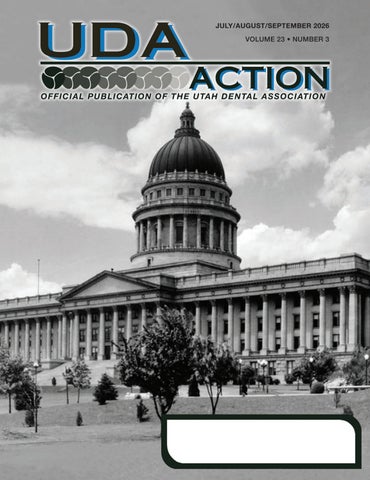
JULY/AUGUST/SEPTEMBER 2026 VOLUME 23 • NUMBER 3
WHEN THE TIME COMES TO TRANSITION YOUR DENTAL PRACTICE, WILL YOU BE READY? Your life’s work deserves a seamless handoff. Let’s find out where you stand today.
ARE YOU PROPERLY PREPARED TO SELL YOUR DENTAL PRACTICE? Take the 10-Question DDSmatch Transition Readiness Quiz Confidential, Personal Analysis of Your Preparedness Highlights Critical Strengths & Opportunities Fast, Easy, Complimentary Quiz for Dentists Helps Maximize the Final Value of Your Practice Actionable Plan to Start Planning for Your Transition
FIND OUT YOUR CURRENT SCORE & STEPS TOWARDS READINESS
TAKE THE QUIZ
Matt Hamblin, DDSmatch Mountain West MountainWest.DDSmatch.com
CONTENTS PRESIDENT'S MESSAGE 4
Why
OFFICIAL PUBLICATION OF THE UTAH DENTAL ASSOCIATION
CONTRIBUTING WRITERS ADA News Dr James Bekker Dr Rich Carlilie Dr Darren Chamberlain Dr Kyle Farley
ASSOCIATION 5
All the Difference
7
The Future of the ADA
14
CQI Dates
20
Student Loan Resource Guide
PRACTICE
Dr Rich Fisher Dr Elizabeth C. Lense
10
Dealing With the Loss of Fluoridation: Coping Strategies
Becky S. Waters
15
Utah Dentists Protected From New Insurance Payment Requirements
16
Federal Focus
17
6 Golden Rules of Coding
COVER PHOTO Photo Credit: mediagraph.io/visitutah Utah State Capitol Digital image © 2001 Utah State Historical Society. All right reserved.
TECHNOLOGY 16
The Future of Dentistry is Digital
PUBLISHER: Mills Publishing, Inc.
WELLNESS
PRESIDENT Dan Miller OFFICE ADMINISTRATOR Cynthia Bell Snow GRAPHIC DESIGNERS Ken Magleby Patrick Witmer
ART DIRECTOR Jackie Medina
ADVERTISING REPRESENTATIVES Paula Bell Dan Miller
The Utah Dental Association holds itself wholly free from responsibility for the opinions, theories or criticisms herein expressed, except as otherwise declared by formal resolution adopted by the association. The UDA reserves the right to decline, withdraw or edit copy at its discretion. UDA Action is published bi-monthly. Annual subscriptions rates are complimentary to all UDA members as a direct benefit of membership. Non-members $30. Utah Dental Association, 801-261-5315 1568 500 W Ste. 102, Woods Cross, Utah 84010 uda@uda.org. UDA Action is published by Mills Publishing, Inc. 801-467-9419; 772 East 3300 South, Suite 200, Salt Lake City, Utah 84106. Inquiries concerning advertising should be directed to Mills Publishing, Inc. Copyright 2026.
6
You Are So Much More Than a Dentist
8
Wellness Summit
CONVENTION 18
Speakers/Sponsors
19
Vendors
COMMUNITY OUTREACH 22
Help Utah Smiles Shine
PRESIDENT'S MESSAGE WHY Why are you the way you are? Why do you like the sports you follow or the entertainment you attend? Why did you choose the universities you attended? Why do you enjoy the foods you enjoy?
“Help dentists succeed and support the advancement of the health of the public.” To achieve this mission, the ADA focuses on several core initiatives:
Have you ever spent time with a 3- to 5-year-old? The questions never stop. They can drive even a sane person crazy.
• Professional Support — Providing evidence-based scientific information, clinical guidelines, and continuing education resources for dental professionals.
One of those questions is, “Why did you choose dentistry?”
• Public Advocacy — Supporting legislation that improves oral health access, promotes community water fluoridation, and expands care for underserved populations.
That was a question I asked at our most recent leadership conference. While some answers were similar, no two were identical. Listening to those responses gave everyone in the room a better understanding of why we are the way we are and helped us appreciate that others may see the world differently than we do. Many of you have heard of Simon Sinek. He gained widespread attention in 2009 with his book Start With Why and his TED Talk, How Great Leaders Inspire Action. In both, he introduced the concept of the Golden Circle. According to Sinek, successful organizations start by communicating their why, then their how, and finally their what. The what describes the activities of the organization. The how explains how those activities are accomplished. The why defines the organization’s purpose or mission. Most organizations communicate in the opposite order. Sinek argues that people connect more strongly with why an organization does something than with what it does or how it does it. He explains that much of our decision-making is influenced by the limbic system, the part of the brain associated with feelings and emotions. Those feelings often drive our behavior, shape our commitments, and influence the choices we make. So, go out and discover your why! Actually, that is not why I chose to write about this topic today, although Sinek did publish a follow-up book, Find Your Why, that may help anyone interested in that journey. The reason I am writing about “why” is because it is the question I hear most often from both members and nonmembers alike: “Why should I join the ADA?” Or, “Why should I continue paying my dues?” The answer is not simply because of continuing education opportunities. It is not because of insurance discounts. It is not because of scientific research. It is not because the ADA advocates for public policy on behalf of dentists and patients. It is not even because you can receive discounts on GE appliances—although you can. 4
So, I Googled the ADA’s mission statement:
• Product Safety — Managing the ADA Seal of Acceptance program to help ensure consumers have access to safe and effective oral health products. After spending the last three and a half years on the board, I have come to believe that the ADA’s true “why” is helping dentists succeed by preserving our ability to practice how we want, where we want, with whom we want, and for whom we want. Yes, ADA and UDA leadership devote countless hours to the core initiatives listed above—the hows and whats. But at its core, it all comes down to protecting each dentist’s ability to make professional decisions and provide care according to their training, judgment, and values. If the ADA and the tripartite system were to disappear, dentistry would still be regulated, funded, and legislated—but increasingly by people who are not dentists. I do not enjoy many of the time-consuming requirements necessary to maintain licensure in our state. However, some of the proposals I have seen from non-dentists regarding what should be required for licensure would cost significantly more money and consume even more of your time. Time away from the very things you have worked so hard to earn the freedom to choose. Who knew children were so smart to ask such a complicated question—one that adults so often avoid or oversimplify? My hope is that the next time you question your membership, you will remember that your ability to make your own professional choices does not happen by accident. Representation matters. Advocacy matters. Organized dentistry matters. The ADA and UDA work every day to protect your ability to practice dentistry as you choose. If that representation were ever lost, others outside the profession would be making those choices for you. If the what and how the ADA and UDA are doing does not align what you want you must let us know. Thank you to all of our current dues-paying members, and especially to those who volunteer their time and talents to serve. We could not be who we are without you. Dr Rich Fisher UDA President July / August / September 2026
ASSOCIATION ALL THE DIFFERENCE “The Road Not Taken” by Robert Frost has come to my mind often over the years. Each of us can relate to his words in some way as we are faced with many decisions and “diverging roads” in life. When I was young, my dad framed a portion of this poem and hung it on the wall outside my bedroom. It was the first thing I read as I left my room each morning. Years later, I packed Robert Frost into my 1989 Nissan Pathfinder and drove over 2000 miles from home to begin dental school. This framed poem brought comfort through the loneliest drive of my life…and during the years of school where it hung in my humble apartments. Many decisions we make in life may look less consequential in our times of uncertainty. Years later, we may look back and see the significance of the decisions we’ve made along the way. Each of us have chosen this profession. This path opens many more opportunities for us to choose our course. I’m sure we can agree that the decision to become a dentist brings moments of satisfaction, as well as strain (often in the same hour). Just over three years ago, I made a seemingly small decision to join my local district leadership. It started with a simple text
UDA Action
to inquire about the time commitment. Looking back at the opportunities that followed that inquiry, I clearly see that it has already made a great difference for me (and I hope even a small difference for colleagues and patients). I never imagined being in a position to help another dentist going through a crisis, writing our senators and representatives, organizing events, mentoring younger dentists, and meeting so many amazing people as we “Give Kids a Smile” together. One of the most surprising aspects for me has been the increased energy and desire to make my private practice and personal life even better. If you are still reading this, you may be one of those who have inspired and encouraged me in ways that have made “all the difference” for me. You make life better for those around you. It is a great honor to serve and represent the dentists here in Utah as an ADA delegate. I look forward to learning over the next three years and I hope to meet many more of you along the way. I also hope you will continue to choose organized dentistry and find strength in walking this road together. The need for service is great and the rewards of “the road less traveled” are life changing. Kyle Farley DDS ADA Delegate
5
WELLNESS YOU ARE SO MUCH MORE THAN A DENTIST! This past April I had the opportunity to go back home to Hawaii with my family and attend a retirement party that my sister planned for my parents prior to their church mission to Japan which started in May. It was amazing to see hundreds of people gathered to celebrate with my family. One thing that stood out to me as I was chatting with various people in attendance is that nobody mentioned what great physicians my parents were. They talked about what wonderful friends they were, how grateful they were for acts of service done by my parents, and how they enjoyed just being in my parents’ presence because they felt cared for and loved. No one mentioned how my dad, who is a urologist, was amazing at using the lithotripsy machine to blast kidney stones to smithereens. I heard no one mention how my mom, who is a pediatrician, gave the most amazing vaccinations and could diagnose influenza A with her eyes closed. The experience reminded me of a quote that I recently heard Dr. Kyle Stanley say on the Wellness in Dentistry podcast. “We are people who practice dentistry, we are not dentists.”
quality work, we should. What I am trying to convey is that dentistry should not be the focus of our lives.
1.
Set time aside to take your spouse, partner, or a friend out to eat and do not talk about dentistry!
Dentistry should not define us. There is so much more to our lives than dentistry. Many of us have families who care about us. There are friends who enjoy being around us, despite our profession! For those with kids, they could care less about how well their mom or dad can cut a crown prep, take out a tooth, or place an implant! I am not saying that we should not care about
2.
For those with kids, take time to play with them and have heart to heart conversations that allow you to truly get to know them.
3.
Invest time, money, and resources into developing a hobby or talent outside of dentistry.
4.
Provide service to someone in need in a non-dental setting.
There was a time in my life when dentistry was the focus of my life. After an exhausting day of work, I would come home and read articles, watch online CE courses, or think about ways to improve the patient experience in the office. I would take dental articles on vacation to read. All this was done with pride knowing that I was ‘all in’ in stiving to be a great dentist. Little did I realize there were five beautiful kids and my wife who were starving for time with their dad and husband. It took a brush with burnout to help me realize that defining my life by my profession was not healthy. Slowly, but surely, I have done things in my life to ensure that I am a disciple of Christ, husband, father, son, friend, sports lover, surfer who just happens to practice dentistry as a profession. This subtle change in thinking has brought greater fulfilment to my life and helped me realize that while dentistry is amazing, it is not the final destination. As I conclude here are a few invitations I have for all of us:
I love my parents and have always seen them as mom and dad and not Drs. Robert and Gloria Carlile. I hope we can all realize that we are so much more than dentists! People will not remember us as dentists, they will remember us for all the other great things that we do! Let us embrace that and become ‘people who practice dentistry, not dentists.’ Dr Rich Carlilie UDA Secretary
6
July / August / September 2026
ASSOCIATION THE FUTURE OF THE ADA As humans, we are constantly thinking. In fact, experts say that 60,000 to 80,000 thoughts go through our minds every day. We think about the things we have done in our past, the things we are currently working on, and the people we hope to become in the future. The future is always uncertain, which can be frightening to some and exciting to others. Pascal Finette is a futurist. I recently attended one of his lectures where he made an interesting observation. Every written language on the planet, when talking about the future, uses the singular form—we have a future. When in reality, we have many futures. Each future is determined by the decisions we are currently making, along with countless other variables, including the actions of others. The butterfly effect is real. If a butterfly in Brazil flaps its wings, it could be the reason for a cyclone in Indonesia. This reality can be somewhat disconcerting if we dwell too much on these types of esoteric thoughts, but it also reminds us that the future is not fixed. It is constantly being shaped by the choices we make today. We currently live in an uncertain time. Those who claim to know how to measure such things say that the level of uncertainty has risen dramatically over the last several months when compared to the preceding decades. The world is changing, and change is difficult for us as humans. We want to make sense of our new-world problems with old-world thinking, and sometimes that just doesn’t quite compute. The upside to the current state of the world is that more uncertainty often creates more opportunity. The American Dental Association (ADA) is also in a state of change. The Board of Directors (BOD), House of Delegates (HOD), and Executive Director (ED) realize that if modifications aren’t made to the current organization, the ADA could become irrelevant in a few short years. To prepare for the future, they are bringing together some of the smartest minds in the industry through an initiative called Oral Health 2050. They are exploring what our practices will look like, how the insurance industry may evolve, what trends we will see in dental decay, and how we will treat this ever-present disease. They are also looking inward. Last year, the HOD approved a multifaceted governance study to determine what changes are necessary so the ADA can continue to remain relevant and effective. An external firm is conducting an extensive review of the organization’s structure and framework while also examining how members engage with the ADA. In a few short years, the hope is that the ADA will look different. It will not be “your father’s ADA.” In his book The Infinite Game, Simon Sinek wrote:
UDA Action
Photo: Image licensed by Ingram Image
“It is well within our power to build a world in which the vast majority of us wake up every single morning inspired, feel safe at work and return home fulfilled at the end of the day. The kind of change I advocate is not easy. But it is possible. With good leaders—great leaders—this vision can come to life. Great leaders are the ones who think beyond ‘short term’ versus ‘long term.’ They are the ones who know that it is not about the next quarter or the next election; it is about the next generation. Great leaders set up their organizations to succeed beyond their own lifetimes, and when they do, the benefits—for us, for business, and even for the shareholder—are extraordinary.” This is what the ADA is trying to do today: set up the organization to succeed for many more lifetimes. The ADA has been around for 167 years, and it has benefited hundreds of thousands of dentists in this country. It hopes to continue serving its members for many generations to come. The current leadership wants to go above and beyond to not only make those benefits worthwhile, but to make the value of ADA membership extraordinary. We work in an extraordinary profession where we are able to help our family, friends, and neighbors live happier, healthier, and more fulfilling lives. The beautiful thing about our profession is that it will always be relevant. Humans will always prioritize their teeth. There will always be a need for someone to take care of these 32 precious pearls in our mouths. What we do will never change; the change will be in how we do it. Although the many futures before us are uncertain, I, for one, am excited about the opportunities that lie ahead. The future of dentistry may look very different than it does today, but that is not something to fear. Change creates uncertainty, and uncertainty creates opportunity. I am optimistic that the best days of our profession—and our association—are still ahead of us. Darren Chamberlain, DDS ADA Delegate
7
WELLNESS SUMMIT
You spend every day caring for others. When do you take care of yourself? A healthier practice starts with a healthier you. Nov. 13, 2026 6 Hours CE Thanksgiving Point Registration Now Open
WELLNESS SUMMIT Dr Jaren Argyle Money Won’t Fix This: The Dentist’s Guide to Financial Peace
Chris Bennett, BS, CMLC Behind the Smile: What Dentists Never Say About Stress, Addiction, Perfectionism, and Loneliness Suzy Bunker Love Your Gut: Anti-Inflammatory Swaps Made Easy
Paul Peterson, LCSW Misconceptions of Anxiety and OCD
Lunch Included in Registration Fee Register Here
PRACTICE DEALING WITH THE LOSS OF FLUORIDATION: COPING STRATEGIES With the institution of water fluoridation bans in Utah and Florida, as well as a number of municipalities across the country voting to stop fluoridation, more communities are experiencing the loss of this valuable mineral in their everyday lives. What happens when fluoridation goes away Studies from Juneau, Alaska1, Calgary in Canada2, and Israel3 demonstrate that decay rates go up, along with the costs for dental treatment. Calgary saw an increase of 78% in general anesthesia cases to treat severe early childhood decay2. Not only does the use of general anesthesia increase risk for the child, but it increases the cost of treatment dramatically. Researchers from Harvard conducted a cost-effectiveness analysis using data for 8,484 children from the National Health and Nutrition Examination Survey for 2013 to 2016 and found that elimination of fluoride would be associated with an increase in tooth decay of 7.5% and cost approximately $9.8 billion over 5 years.4 This cost increase does not include the ramifications for adults. The ADA’s Health Policy Institute calculated that losing community water fluoridation in Utah will cost more than $313 Million over a 5-year period.5 To put it more simply, Utah dentists and their care teams will start seeing patients with more caries—and more severe disease progression over the next few years. What can dentists due to help mitigate the loss of fluoridation? Although there is no public health intervention that is as effective and cost-efficient as community water fluoridation to prevent dental decay, dentists can utilize some proven intervention strategies to help offset the loss of daily fluoride exposure somewhat. • Reinforce brushing 2x/day and flossing for your patient. Remind them they no longer have the added protection of fluoride in their water. Discuss healthy snacks and drinks that won’t harm teeth. • Recommend the first dental visit for a child should be at age one year old. Without the systemic benefit of fluoride being incorporated into developing enamel, teeth will be more prone to decay. Age 1 visits are perfect for discussing oral hygiene, teething, and nutrition with parents and starting twice-yearly fluoride varnish applications for the child. • Consider prescribing fluoride supplements for children at high-risk of decay, particularly those with special health needs for whom daily dental care is more difficult. There are some areas of Utah that have naturally occurring fluoride 10
within the optimal range, so be careful to check fluoride levels in the area before prescribing. But a discussion with some parents may be appropriate.6 • Support school-based fluoride varnish and sealant programs in your community. The US Community and Preventive Services Task Force strongly recommends these programs for effectiveness in reducing dental decay.7 Although we all want children to have a dental home, many lower-income children have difficulty accessing a Medicaid provider. • Among Utah 3rd grade students (2024), only 36% had a sealant.8 Sealants prevent 80% of cavities on posterior teeth, and children without sealants have more than 3x the decay rate as children that do.9 Make sure to offer children in your practice sealants as a routine part of dental care. • Fluoride varnish is proven to prevent dental decay in children, but works for adults, too. Senior patients can also benefit from fluoride varnish applications- especially when exposed root surfaces are present.10 • Silver diamine fluoride (SDF) was approved in 2014 to treat tooth sensitivity in adults, but like fluoride varnish it is being used off-label to prevent decay. More pediatric dental providers are using this as a minimally invasive technique to arrest decay on very young children and avoid treatment in the Operating Room. But is also being utilized for root surface decay in older adults and children with special health needs that cannot be easily treated in an office setting. For more information on the application of SDF, see AAPD Guidelines for Silver Diamine Fluoride As dental providers use the other preventive tools at their disposal, it is important that they choose their words carefully. Do not refer to topical forms of fluoride as a “substitute” or “alternative” to fluoridated water. As noted previously, toothpaste and other topical forms were not sufficient to keep decay rates and costs from rising in communities where fluoridation stopped. And finally, don’t give up on community water fluoridation! Continue to speak to legislators, decision-makers, and patients about fluoride. Over the next years, let these decision-makers know what you are seeing clinically. Administrations and policy agendas come and go. Those in positions of authority right now might not be heeding our concerns, but when new people enter public office, there is an opportunity to build meaningful relationships. Government relations professionals who work for state dental associations around the country say that fluoridation bans are one of the least popular items on the “Make America Healthy Again” (MAHA) agenda. Besides Utah and Florida, no other state legislatures have been successful in limiting access to fluoride.
July / August / September 2026
FLUORIDE
Importance of Fluoride
Fluoride helps prevent tooth decay by strengthening enamel and making teeth more resistant to acid attacks from plaque bacteria and sugars. Fluoride can also reverse early tooth decay by promoting remineralization.
How Systemic Fluoride Works
How Topical Fluoride Works
Systemic fluoride is ingested and becomes incorporated into developing teeth, making them stronger before they erupt. Systemic fluoride also provides topical benefits because fluoride is present in saliva and continues to protect teeth throughout life.
Topical fluoride works directly on the tooth surface. It strengthens enamel, slows down the loss of minerals from enamel, and promotes remineralization. Topical fluoride is especially important for both children and adults at risk for cavities.
Options for Systemic Fluoride • Fluoride supplements (tablets, drops, lozenges)
Use the chart below to determine the correct dose of fluoride for your patients
UDA Action
Options for Topical Fluoride Fluoride toothpaste Fluoride mouth rinse Fluoride varnish Fluoride gel or foam treatments
11
UTAH WATER FLUORIDATION LEVELS Community water systems not listed below have fluoride levels less than 0.3 ppm and therefore require full fluoride supplementation. Fluoride levels between 0.3 and 0.6 ppm (mg/L) BEAVER COUNTY - BEAVER CITY WATER SYSTEM - MANDERFIELD CULINARY WATER COMPANY - SMITHFIELD HOG ROCKY MTN-BLUE MTN NORTH BOX ELDER COUNTY - SUNSET PARK WATER CO. - EAST GROUSE CREEK PIPELINE CO. - RIVERSIDE-NORTH GARLAND WATER CO DAGGETT COUNTY - CLAY BASIN CAMP DUCHESNE COUNTY - JOHNSON WATER DISTRICT - DUCHESNE COUNTY UPPER COUNTRY WID - NEOLA WATER AMD SEWER DISTRICT GARFIELD COUNTY - CANNONVILLE TOWN WATER SYSTEM - TROPIC TOWN WATER SYSTEM GRAND COUNTY - DAY STAR ADVENTIST ACADEMY IRON COUNTY - PAROWAN WATERWORKS SYSTEM - MONTE VISTA COMMUNITY WATER CO - ALLARD RANCH WATER CO - PARAGONAH TOWN WATER SYSTEM - IRONTOWN JUAB COUNTY - MONA TOWN WATER SYSTEM KANE COUNTY - ORDERVILLE TOWN WATER SYSTEM - BEST FRIENDS ANIMAL SOCEITY - GLENDALE TOWN WATER SYSTEM MILLARD COUNTY - LYNNDYL TOWN WATER SYSTEM - DELTA CITY - SHILOAH WELLS WATER CO - MEADOW TOWN WATER SYSTEM - DESERET - OASIS SSD - HINCKLEY TOWN WATER SYSTEM - COUNTRY ESTATES HOA
Fluoride levels greater than 0.6 ppm (mg/L) SALT LAKE COUNTY - HOLLIDAY WATER COMPANY - GRANGER-HUNTER IMPROVEMENT DISTRICT - EMIGRATION IMPROVEMENT DISTRICT - SOUTH SALT LAKE CITY WATER SYSTEM - WEBB WELL WATER USERS SAN JUAN COUNTY - MEXICAN HAT SSD SANPETE COUNTY - CENTERFIELD TOWN WATER SYSTEM - EPHRAIM CITY - PALISADES WATER COMPANY - CHESTER PARK WATER SYSTEM SEVIER COUNTY - RICHFIELD CITY - ANNABELLA TOWN WATER SYSTEM - AURORA CITY - SIGURD TOWN WATER SYSTEM - CENTRAL VALLEY TOWN - REDMOND TOWN WATER SYSTEM SUMMIT COUNTY - SUMMIT COUNTY SERVICE AREA #3 - HOYTSVILLE PIPE WATER CO. - SUMMIT WATER DISTRIBUTION UINTAH COUNTY - MAESER IMPROVEMENT DISTRICT
BEAVER COUNTY - MILFORD CITY WATER SYSTEM - MINERSVILLE WATER SYSTEM - SMITHFIELD HOG ROCKY MTN-SKYLINE BOX ELDER COUNTY - SNOWVILLE WATERWORKS - M & J TRAILER HOME COMMUNITY - UKON WATER COMPANY - BEAR RIVER WCD-BEAVER DAM CACHE COUNTY - CORNISH TOWN WATER SYSTEM - PARADISE WEST SUBDIVISION KANE COUNTY - CLARK BENCH WATER COMPANY PIUTE COUNTY - MARYSVALE TOWN WATER SYSTEM SAN JUAN COUNTY - PACK CREEK WATER COMPANY - SAN JUAN SPANISH VALLEY SSD - EASTLAND SPECIAL SERVICE DISTRICT
UTAH COUNTY - ELBERTA - PLEASANT GROVE CITY - FAIRFIELD CULINARY WATER - DESERET FEEDLOT - CAMP WILLIAMS
SANPETE COUNTY - AXTELL COMMUNITY SERVICE DISTRIBUTION
WASATCH COUNTY - SWISS ALPINE WATER CO - SWISS OAKS HOA - MIDWAY CITY WATER SYSTEM - INTERLAKEN MUTUAL WATER CO
SUMMIT COUNTY - OAKLEY TOWN WATER SYSTEM
PIUTE COUNTY - GREENWICH WATER ASSOCIATION - KINGSTON TOWN WATER SYSTEM
WASHINGTON COUNTY - CENTRAL CULINARY WATER CO - DIAMOND VALLEY ACRES - GUNLOCK SPECIAL SERVICE DISTRICT - DIAMOND RANCH ACADEMY - IVINS - SANTA CLARA CITY - ROCKVILLE PIPELINE CO - ST GEORGE CITY WATER SYSTEM
RICH COUNTY - DESERET LAND AND LIVESTOCK
WAYNE COUNTY - LOA TOWN WATER SYSTEM
SEVIER COUNTY - COVE SPECIAL SERVICE DISTRICT
TOOELE COUNTY - LAST CHANCE SKI RANCH UTAH COUNTY - ELK RIDGE TOWN - EAGLE MOUNTAIN CITY - GENOLA CITY - COVERED BRIDGE CANYON HOA WASHINGTON COUNTY - WINCHESTER HILLS WATER CO - K.W.U. INC.
WEBER COUNTY - LAKEVIEW WATER COMPANY
12
July / August / September 2026
Recent surveys by the Care Quest Institute for Oral Health demonstrate that only 6% of respondents favored a ban on fluoridation. Most favor a community’s right to choose. And almost all respondents (96%) trust the health information they receive from their own doctor over any other source, including the Internet and the current Administration.11
4. Choi et al. JAMAHealthForum.2025;6(5): e251166.doi:10.1001/ jamahealthforum.2025.1166
Let patients and decision-makers know about the most recent studies on fluoridation. These large-scale studies on fluoride and cognition from here in the U.S. show no association between community water fluoridation and performance on cognitive tests or IQ.12,13
7. https://stacks.cdc.gov/view/cdc/168555
5. Bhaumik et al. https://www.ada.org/-/media/project/adaorganization/ada/ada-org/files/resources/research/hpi/costs_ removing_fluoride_community_water_systems.pdf. 6. https://ods.od.nih.gov/factsheets/Fluoride-HealthProfessional/ 8. https://ruralhealth.utah.gov/wp-content/uploads/ApprovedBSS-Full-Report-2024.pdf 9. https://www.cdc.gov/oral-health/data-research/facts-stats/ fast-facts-dental-sealants.html
Whether your favorite team is the Jazz or Mammoths, Utes or Aggies, please consider this… The score doesn’t look good right now. Our patients are losing in terms of oral health. But the game isn’t over yet. The Utah Dental Association and its members — with ADA’s support and resources — are not giving up. Together, we will affirm our integrity and expertise by continuing to promote what the scientific evidence (and our own eyes) proves.
10. J Dent 2022 Oct:125:104273. doi: 10.1016/j.jdent.2022.104273 11. https://carequest.org/community-water-fluoridationnational-opinion-poll-results/ 12. Warren et al. Science Advances.19 Nov 2025 Vol 11, Issue 47 DOI: 10.1126/sciadv.adz0757 13. Warren et al. PNAS 2026 Vol.123 No.16 e2536005123 https://doi.org/10.1073/pnas.2536005123
References
Elizabeth C. Lense, DDS, MSHA, FAAOMP Senior Scientist for Population Health Programs Council on Advocacy for Access and Prevention
1. Meyer et al. BMC Oral Health (2018) 18:215 https://doi.org/10.1186/s12903-018-0684-2 2. Canadian Journal of Public Healtwh (2024) 115:305–314 https://doi.org/10.17269/s41997-024-00858-w
James Bekker, DMD ADA Delegate Council on Advocacy for Access and Prevention
3. Levy et al. J Dent. 2023 Jul: 134:104550. doi: 10.1016/j. jdent.2023.104550.
Practice Transition Specialists more than 2,800 practice transitions facilitated since 1988
• associateships partnerships • dso sale analysis & negotiations dental practice sales
randon jensen
appraisals
• real estate sales/office leasing • mergers • buyer representation
transition planning
“I have used the advice and services of Randon Jensen and CTC over many years. First, to form a partnership, and more recently to move out of complete ownership of the practice I started 43 years ago. I have the highest regard for Randon and his honesty and integrity. His knowledge and skill has made all the difference. I give him my highest recommendation and would surely encourage you to trust him with your practice transition.”
–Roger L. Farley, DDS
marie chatterley
call to schedule a complimentary consultation
ryan nolan
office: 801.298.4242
• info@ctc-associates.com • www.ctc-associates.com
UDA Action
13
Continuous Quality Improvement
2026 District Meeting Schedule Connect with UDA leadership and colleagues across Utah.
District
Date/Time
Location
Tooele
Aug 25 - 6:30 pm
Horsley Ortho 156 E 2000 N Tooele
North Davis
Sept 8 - 6:00 pm
Roosters Brewing Co, Layton
Weber
Sept 15 - 6:30 pm
Jeremiah’s, 1307 W 12 St Ogden
Box Elder
Sept 17 - Noon
Brigham City Chamber of Comm
Cache
Sept 17 - 6:30 pm
Riverwoods Conf Ctr, Logan
South Davis
Sept 22 - Noon
El Matador, 606 S Main Bountiful
Provo
Sept 22 - 6:30 pm
Thanksgiving Pt Rose Rm Twr, Lehi
SL North
Sept 29 - 6:30 pm U of U SOD 530 Wakara Wy SLC
Uintah Basin
Oct 1 - Noon
Get Grilled, 1096 W Hwy 40 Vernal
Wasatch Back Oct 1 - 6:30 pm
Fire Sta. 251 E 1200 S Heber
SL South
Oct 6 - 6:30 pm
Roseman Dental Sch So. Jordan
Central
Oct 27 - 6:30 pm
Steve’s Steakhouse, Richfield
Cedar Breaks
Oct 28 - Noon
Courtyard Marriot, Cedar City
Dixie
Oct 28 - 6:30 pm
Hilton Garden Inn 1731 Conv Ctr, St George
Canyonlands
Oct 29 - Noon
UNHS Clinic Conf Room, Blanding
Carbon-Emery Oct 29 - 6:30 pm
Carbon Country Club, Helper
PRACTICE UTAH DENTISTS PROTECTED FROM NEW INSURANCE PAYMENT REQUIREMENTS Recent changes in how dental insurance companies issue claim payments have raised concerns for many practicing dentists. Increasingly, insurers are encouraging—or requiring—providers to receive payments through electronic funds transfer (EFT) or virtual credit cards. While electronic payments can offer convenience, they also create challenges for many dental practices. EFT payments can make reconciliation more complex, and virtual credit card payments often require practices to pay processing fees simply to receive reimbursement for services already provided. These unnecessary administrative costs and burdens can have a significant financial impact on dental offices. Some insurers have also announced policy changes that would charge dental offices a weekly fee if they choose to continue receiving paper checks. Thanks to proactive advocacy these types of practices are prohibited in Utah. During the 2026 Legislative Session, HB 58 passed, providing important protections for dental providers. The law specifically prohibits a dental insurer from imposing a fee for paying claims by paper check, ensuring that dentists may continue to receive paper payments without being penalized.
process to identify issues affecting dental practices, develop practical solutions, and advocate for meaningful reforms. By combining the UDA’s legislative advocacy with My Practice My Business’s expertise in dental insurance issues, the partnership helped secure important protections for Utah dentists and their patients. These accomplishments demonstrate the strength of organized dentistry and the impact that collaboration can have on protecting the profession. Through the combined efforts of the Utah Dental Association, My Practice My Business, engaged dentists, and supportive legislators, Utah continues to lead the way in advancing fair dental insurance practices. Together, these organizations remain committed to reducing unnecessary administrative burdens, protecting dental practices, and ensuring dentists can focus on providing high-quality care to their patients. Becky S. Waters, RDH UDA Assistant Director
Utah law also protects dentists from being forced into electronic payment methods. During the 2025 Legislative Session, HB 495 strengthened existing protections regarding virtual credit cards and electronic payments. Under this law, an insurer: ● ● ● ●
Must allow a provider to opt out of all credit card or similar payment arrangements through a single opt-out process for every plan offered by the insurer. May not re-enroll a provider in virtual credit card payments without the provider’s authorization. May not require a provider or insured to accept remittance through a credit card or similar arrangement. Must allow payment by a tangible paper check as an acceptable form of reimbursement.
These legislative protections give Utah dentists the flexibility to choose the payment method that best fits their practice without being subjected to unnecessary fees or administrative burdens. If your practice receives communication from an insurance carrier regarding changes to payment methods, take time to review the details carefully. If you believe an insurer is not complying with Utah law, please contact the Utah Dental Association. The UDA can assist with the process of contacting the Utah Insurance Commissioner. The UDA will continue to advocate for fair business practices and work to ensure that insurers comply with the protections established by the Utah Legislature. These legislative victories were the result of a collaborative advocacy effort. The Utah Dental Association worked closely with My Practice My Business throughout the legislative UDA Action
Reupholster and Save! Dental Chairs & Stools Exam & Operating Tables Office Furniture Waiting Room Seating Custom Equipment Covers Quick Turn-Around Times
Call or Text: (385) 250-6560 Wide choice of Medical-Grade upholstery fabrics
visit us at:
dentalupholsteryservice.com 12523 So. Redwood Rd. – Riverton, Utah 84065 15
PRACTICE
TECHNOLOGY
FEDERAL FOCUS
The future of dentistry is digital, and now is the perfect time to become a leader in this rapidly evolving field. The University of Utah School of Dentistry, a CODA accredited institution, has designed an opportunity to provide hands-on training with the latest technologies used in modern dental practices and clinics. Photo: Image licensed by Ingram Image
Although states continue to enact dental insurance reforms, according to the ADA many of those protections do not apply to patients covered by self-funded employer plans because of how certain insurers interpret the Employee Retirement Income Security Act, or ERISA. According to the ADA, insurers administering many large self-funded employer plans have asserted that ERISA preempts numerous state insurance laws, limiting the reach of state dental insurance reforms for many covered patients. To address that issue, the Association is advocating for the Improving Dental Administration, or IDA, Act, federal legislation that the ADA says would clarify that state dental insurance laws apply more broadly and prevent insurers from avoiding those requirements through ERISA preemption. “We need to fix this ERISA loophole that keeps state regulators from enforcing pro-consumer insurance laws enacted in their states,” said Richard Rosato, D.M.D., president of the American Dental Association. “Patients and providers should not be left unprotected based simply on how their dental benefits are purchased.” The ADA said it encourages dentists to engage with members of Congress in support of the legislation, highlighting that federal action is needed to ensure patients enrolled in self-funded dental benefit plans receive the same protections available under many state laws.
The Certificate in Foundational Digital Dentistry program will accumulate with a completed certificate and an option to transition to a full Masters degree in Digital Dentistry. Throughout this program, students will be exposed to the latest digital equipment and software, such as Intraoral Scanners, 3D Printers, and Implant Planning Software. Students will also be able create a comprehensive portfolio that demonstrates their technical skills and readiness for today’s digital dental workplace. The Foundational Digital Dentistry Graduate Certificate consists of five 8-week courses that are 3-credits each. Courses will run consecutively: 2 courses in Fall, 2 courses in Spring, and 1 course in Summer. Applicants must have a DDS or DMD degree, with a minimum 3.0 GPA. Whether your goal is to work in clinical dentistry, dental laboratory technology, implant dentistry, prosthodontics, or practice management, The Certificate in Foundational Digital Dentistry program provides the knowledge, skills, and experience needed to succeed in a technology-driven profession. Take the next step toward becoming a leader in modern dental care: apply today and gain the digital skills that are shaping the dental profession. More information and the application can be found here: https:// dentistry.utah.edu/digital-dentistry-certificate-program
Dentists wanting to learn more about ERISA and dental insurance reform can visit www.ada.org/ERISA, and those wanting to contact their member of Congress about support for IDA can do so here: https://www.ada.org/advocacy/ grassroots-action-center/ida-alert. ADA News
16
July / August / September 2026
PRACTICE 6 GOLDEN RULES OF CODING Errors may lead to denial, delayed payment
Denial and delayed payment of claims often occur because of common coding errors. To avoid these pitfalls, below are six “golden rules” to remember. • Code for what you do. This is the fundamental rule to apply in all coding situations.
es. More information about the changes is available under the Code Maintenance Committee section of ADA.org/CDT. Exact code numbers, nomenclatures and descriptors for the new and revised codes will be published in CDT 2027. ADA News
• After reading the full nomenclature and descriptor, select the code that matches the procedure delivered to the patient. • If there is no applicable code, document the service using an “unspecified … procedure, by report” code for the category of service and include a clear and appropriate narrative. • Understand that the existence of a procedure code does not mean the procedure is a covered or reimbursed benefit in a dental benefit plan. • Plan treatment based on clinical need, not covered services. • Discuss common coding situations with office team members so that everyone understands how to use the CDT Code, and review coding for complex treatment plans before claims are submitted to payers. If dentists have difficulty finding an appropriate CDT code, they should consider whether there may be another way to describe the procedure. The CDT manual’s alphabetic index and the glossary of clinical terms available online at ADA.org/CDT may be helpful in these situations. Dentists can also reach out to the ADA for help at dentalcode@ada.org. The next edition of the CDT Code, CDT 2027, is available for preorder through the ADA Store. It includes 67 chang-
University of Utah School of Dentistry CE schedule for Fall 2026 - Spring 2027
September 11, 2026: 8:30 am to 4:00 pm; The Eccles Alumni House 8th Annual Lynn Powell Lecture Series The Art and Science of Balancing Tooth Preservation, Implant Therapy, and The Management of Complications Featuring: Diego Velásquez-Plata, DDS, MSD October 29, 2026: 7 to 9 pm; The University of Utah School of Dentistry From Spectacle to Science: The Evolution of Forensic Dentistry Featuring: Kel Faddis, DDS November 12, 2026: 7 to 9 pm; The University of Utah School of Dentistry Emotional Bonding Featuring: Jaleena Jessop, DDS, MBA, and Neil Jessop January 28, 2027: 7 to 9 pm, The University of Utah School of Dentistry Malpractice Minefields: How Dentists Get Sued - and How to Stay Clear Featuring: David L. Alvord, DDS March 11, 2027: 7 to 9 pm, The University of Utah School of Dentistry The Good, the Bad, and the Incidental: CBCT Cases Reviewed Featuring: Martin E. Evers, DDS, MS, and Robert J. Timothy, DDS, MS April 23, 2027: 7 to 9 pm, The University of Utah School of Dentistry Dental Lasing: Bringing Beams of Energy into Your Practice Featuring: John K. Zalesky, DMD Questions: CESOD@hsc.utah.edu
UDA Action
More Information
17
Speakers Dr Jaren Argyle Dr Mark Donal son Dr ick erguson Dr rian . ový Dr. Shervin ahimpour Tom Viola, .Ph., C.C.P. Dr Jorge apata
Amber Auger MPH, DH Dr rin lliott Dr Jeffery Jensen George Oganov Dr. lint Tomlinson Dr. Shannon eir Dr Jorge apata
Thank You to our Sponsors
Information Correct as of 7/21/2 2
Vendors Adit ADS Dental System Air Tc#ni+ues AMD Lasers America First Credit Union Andau Medical Aseptico Benco Crest / Oral B CTC Associates Cutco Dandy DDSmatc# Dentalree Inc Designs !or Visions Doctor Sta!!ing
Epic Dental Studios Farm Bureau Financial Services Glidewell Dental Impladent LTD Interstate Specialties Mango Voice NSK America Corp Oral Design Dental Lab Over%et Patterson Dental Supply P.I.E. Q-Optics SurgiTel UltaMedical Ultradent Voco America, Inc
In!ormation Correct as o! /21/2 2
Registration Opens October 1, 2 2
STUDENT LOAN RESOURCE GUIDE Helping Dental Students and Their Families Navigate New Student Loan Changes Effective July 1, 2026, the federal landscape for student aid is changing. For dental students, the elimination of Grad PLUS and new borrowing caps may create a significant funding challenge. Use this dashboard to understand your gap and find your path forward. Calculate Your Funding Gap
Visualizing the 2026-27 Average Dental Cost of Attendance vs. OBBB Limits
Under the One Big Beautiful Bill Act (OBBB), federal borrowing for professional students is capped at $50,000 annually. With dental COA (Cost of Attendance) averaging $88,000, identifying your personal “gap” is the first priority.
$0
$10K
$20K
$30K
$40K
$50K
$60K
$70K
$80K
$90K
Source: Department of Education
Critical Borrowing Changes The OBBB replaces unlimited Grad PLUS with strict federal caps.
Grad PLUS Eliminated
$50k Annual Cap
The Graduate PLUS loan program is entirely terminated. You can no longer borrow up to the full COA through the federal government.
Direct Unsubsidized loans are now capped at $50,000 per year for professional students. Eligibility is prorated if below full-time.
Aggregate Limits Professional school cap: $200,000. Absolute lifetime cap (including undergrad): $257,500
The Exemption Clause
IF you received a federal loan in a specified degree program before June 30, 2026, THEN you are temporarily exempt from new federal borrowing rules while enrolled in that same degree program UNTIL the sooner of three academic years or completion of your degree program. Always consult with your school’s financial aid office before making long-term borrowing decisions. © 2026 American Dental Association. All rights reserved.
Updated: June 16, 2026
The New Repayment Assistance Plan (RAP) Repayment Timeline Comparison
The OBBB terminates SAVE, PAYE, and old income based repayment (IBR) plans. RAP is now the standard income-driven option. Understanding the timeline is key for long-term financial planning.
35
30
1. 10% Discretionary Income Cap RAP payments are based on income and family size, generally ranging from 1% to 10% of income, with a dependent reduction.
YEARS
25
2. 30-Year Forgiveness Horizon Remaining balances are forgiven after 360 qualifying payments (30 years).
20
15
10
3. PSLF Persistence Public Service Loan Forgiveness remains at 10 years (120 payments) for nonprofit or qualifying government employees.
5
0
TIERED STANDARD
PSLF
NEW RAP
Closing the Funding Gap Explore these primary sources for alternative dental school funding. Private Lending
NHSC Scholarship
PSLF Programs
Military (HPSP)
Free consultation options available through ADA’s partnership with KeyBank.
Full tuition and stipend in exchange for 2+ years of service in underserved health professional shortage areas.
Loan forgiveness provided for those pursuing careers in the governmental or non profit sector.
Covers 100% tuition + monthly stipend. Requires active duty service post-graduation (Army, Navy, Air Force, etc.).
� Learn More
� Explore
� See More
� Options
ADEA Educational Debt Information
Dept. of Education Updates
Student Loan Information Supplement your understanding of the student loan changes. ADA Student Loan Page
ASDA Guidance
Resources and advocacy
Resources for dental students
Facts & figures
Up to date student loan information
� See ADA
� Visit ASDA
� ADEA Info
� Visit ED
� Private loans may not carry the same federal protections, repayment options, or forgiveness eligibility as federal loans. © 2026 American Dental Association. All rights reserved.
www.yoursmileutah.org
COMMAND THE STAGE. BMW X5
SOME VEHICLES ARRIVE. OTHERS TAKE THE LEAD. The BMW X5 is crafted for those who move with intention—balancing confident design, dynamic capability, and intelligent innovation. With available xDrive all-wheel drive and a driver-focused interior, it adapts seamlessly to every road and every moment. Because when presence meets performance, it doesn’t go unnoticed. Experience the performance worthy X5 at BMW of Murray or BMW of Pleasant Grove.
BMW of Murray 4735 S. State Street Murray, Utah 801-262-2479 bmwofmurray.com
BMW of Pleasant Grove 2111 West Grove Parkway Pleasant Grove, Utah 801-443-2000 bmwofpg.com
© 2026 BMW of North America, LLC. The BMW trademarks are registered trademarks.
• IT Services • Cybersecurity • Compliance • Support