

Dedicated to the Communities We Call Home
At Summit Sotheby’s International Realty, we believe exceptional real estate is rooted in a deep understanding of the communities we serve. Through trusted relationships, market expertise and a commitment to elevating the client experience, we are proud to help shape the future of Utah real estate.

Discover more ways to experience the best of Utah living in our exclusive publication: Collections Magazine





Realtor® Magazine is self-supporting. The advertisers in this magazine pay for all production and distribution costs. Help support this magazine by advertising. For advertising rates, please contact Mills Publishing at 801.467.9419. The paper used in Salt
Magazine comes from trees in managed timberlands. These
are planted and grown specifically to make
PRESIDENT
J. SCOTT COLEMERE
Colemere Realty Assoc.
1ST VICE PRESIDENT
JANICE SMITH
CB Realty (Union Heights)
2ND VICE PRESIDENT
KIM FARBER
Eleven11 Real Estate LLC
TREASURER
RUSS ORCHARD Century 21 Everest
PAST PRESIDENT
CLAIRE LARSON
Woodside Homes of Utah LLC
MEMBERS
MORELZA BORATZUK RealtyPath (South Valley)
ERIC SANTISTEVAN
Engel & Volkers (Holladay)
KRISTEL GOUGH
Summit Sotheby's (Draper)
LORI KHODADAD
CB Realty (Union Heights)
DONNA POZZUOLI BHHS UP (N. Salt Lake)
CARLYE WEBB
Summit Sotheby's INT (Draper)
BRYAN HURD Real Broker, LLC
TRISH NICHOLS
CB Realty (SL-Sugarhouse)
APPOINTED BOD
TONY KETTERLING Equity RE (Advantage)
LINDA MASCHER Realtypath LLC (Advisors)
PAST PAST PRESIDENT
DAWN STEVENS Real Broker, LLC
Advertising information may be obtained by calling (801) 467-9419 or by visiting www.millspub.com
Managing Editor Dave Anderton
Publisher Mills Publishing, Inc. www.millspub.com
President Dan Miller
Office Administrator Cynthia Bell Snow
Art Director Jackie Medina
Graphic Design
Ken Magleby Patrick Witmer Sales Staff Paula Bell Dan Miller
Salt Lake Board: (801) 542-8840 e-mail: dave@saltlakeboard.com Web Site: www.slrealtors.com
because of race, color, religion, sex, handicap, familial status, or national origin.
The Salt Lake REALTOR is the monthly magazine of the Salt Lake Board of REALTORS . Opinions expressed by writers and persons quoted in articles are their own and do not necessarily reflect positions of the Salt Lake Board of REALTORS®
Permission will be granted in most cases, upon written request, to reprint or reproduce articles and photographs in this issue, provided proper credit is given to The Salt Lake REALTOR as well as to any writers and photographers whose names appear with the articles and photographs. While unsolicited original manuscripts and photographs related to the real estate profession are welcome, no payment is made for their use in the publication.
Views and opinions expressed in the editorial and advertising content of the The Salt Lake REALTOR are not necessarily endorsed by the Salt Lake Board of REALTORS . However, advertisers do make publication of this magazine possible, so consideration of products and services listed is greatly appreciated.
Your Reputation Is Being Built Right Now
There’s a tendency in real estate to believe that reputation is built during the big moments—the record year, the major listing, the award on stage, or the social media post announcing another closing.
But in reality, reputations are usually built much more quietly than that.
They’re built in difficult conversations. In shifting markets. In moments when transactions become harder, emotions run higher, and clients feel uncertain about what to do next. Easy markets can create activity.
Harder markets reveal professionalism.
Right now, many buyers along the Wasatch Front are hesitant because of interest rates and affordability concerns. Sellers are trying to understand whether now is the right time to move. Consumers are reading headlines that create uncertainty and hesitation.
And in moments like this, our role becomes even more important. Because clients don’t just need access to homes or contracts. They need guidance.
I was recently working with a first-time buyer who was feeling anxious about the higher cost of purchasing a home, especially with interest rates being much higher than they were just a few years ago. Like many buyers today, she was overwhelmed by the headlines and uncertain about whether it was the right time to move forward. Through honest conversations, market education, and a thorough buyer consultation, I was able to help calm her fears and guide her step by step through the process. In the end, she found the right property within her budget—and more importantly, she felt confident in her decision.
That’s where reputations are built.
Not when everything goes smoothly—but when it doesn’t.
In challenging markets, clients remember the Realtor® who answered the phone consistently. The one who told them the truth, even when it was uncomfortable. The one who stayed engaged when deals became difficult. The one who kept working when others became discouraged.
Those moments leave an impression long after interest rates change or headlines fade away.
One of the great misconceptions in this business is that professionalism matters less when the market slows down.
In reality, it matters more.
Because when transactions become more difficult, the gap between average service and true professionalism becomes much more visible.
This is not the season for agents to retreat, complain, or wait for easier conditions.
It’s the season to lean in.
To deepen relationships. To sharpen communication. To increase conversations. To become the steady presence clients are looking for when uncertainty rises.
Because long after this market cycle changes, people may forget what rates were. But they will remember how we showed up.
And that may be the most valuable thing we build in our careers.
J. Scott Colemere President
Happenings
The Truth Behind Haunted and Stigmatized Properties
Salt Lake Realtors® traveled to the historic Wendover Airfield on May 16 for the threehour continuing education class, Residential Hauntings – Declassified. The course explored haunted or stigmatized properties through the lens of Utah law, real-life case studies, investigative techniques, and audio/video evidence. CE instructor Josh Kramer explained that under Utah law, “stigmatized” properties — such as homes where a homicide or suicide occurred — generally are not required to be disclosed by the seller or agent. However, Kramer noted that while disclosure is not legally required, voluntarily sharing known stigmatizations with potential buyers is widely encouraged to promote transparency. The event was sponsored by Meth Mob.
In the News
Young Adults Move Back Home
Nearly 60% of Gen Z and younger millennials have moved back in with their parents after previously living on their own, according to a new survey from storage company SpareFoot, highlighting the growing impact of housing affordability and rising living costs on young adults.

Salt Lake City Named 31st Most Expensive Metro for Homebuyers
Home prices increased in 71% of metro areas across the country during the first quarter of the year, with some markets seeing double-digit gains. According to National Association of Realtors® Chief Economist Dr. Lawrence Yun, the strongest price growth continues in the Northeast and Midwest, where inventory remains tight and affordability is still attractive.
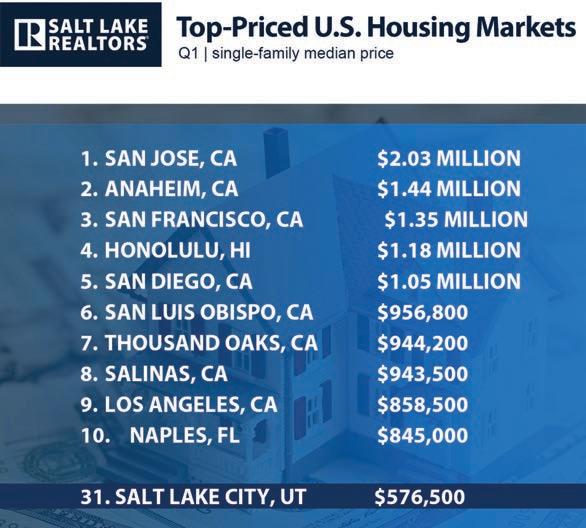
San Jose, Calif, remained the most expensive metro area in the nation, with a median home price of $2.03 million.
Salt Lake City ranked as the 31st most expensive metro area out of the 230 markets tracked nationwide.
The survey of 981 Gen Z and younger millennial adults found that 58% had returned to their parents’ home at least once after moving out, with 15% doing so multiple times. Researchers described the trend as evidence that the so-called “boomerang generation” has become a mainstream reality rather than an exception.
Financial pressures were the leading driver. About 45% of respondents cited unaffordable housing as a key reason for moving back home, while others pointed to insufficient income, debt repayment and broader cost-of-living challenges. Roughly three-quarters said living with family is a smart financial strategy, and more than one-quarter moved home specifically to save money.
The findings also suggest that the stigma once associated with living with parents has faded. Nearly two-thirds of respondents said they no longer feel embarrassed about the arrangement, viewing it as a practical step toward longer-term goals such as paying off debt, building savings or eventually purchasing a home.
The trend comes as housing affordability remains a challenge nationwide. Recent housing data show a growing share of young adults living with parents, particularly in high-cost states where rents and home prices continue to outpace income growth.
While many families see benefits in multigenerational living, the arrangement can create financial strain for parents. Nearly half reported higher household expenses after welcoming adult children back home. Even so, many families view the move as a temporary strategy to improve financial stability and prepare for future housing opportunities.


Why Government Affairs and RPAC Matter in Real Estate
Many of us enter real estate excited about helping people buy homes, but we don’t initially realize how policy affects our ability to do our jobs successfully.
By Solo Tuiaki
When people think about real estate, they usually think about buying homes, selling homes, negotiating deals, or helping clients achieve the dream of homeownership.
What most people don’t realize is there’s another side of this industry that directly impacts every Realtor®, homeowner, buyer, seller, and investor long before we ever unlock a front door or submit an offer.
That side is government affairs and RPAC.
As I continue growing in this industry, I’ve realized that some of the biggest battles happening in real estate are not happening inside homes — they’re happening in meetings, legislation, policy discussions, and conversations with elected officials. These are the rules that directly affect affordability, inventory, private property rights, and how efficiently we can help people buy and sell homes.
That’s why investing into RPAC matters.
For those who may not know, RPAC stands for the Realtors® Political Action Committee. RPAC helps support candidates and elected officials who understand the importance of homeownership, housing affordability, property rights, and protecting the real estate industry.
At first glance, some people may ask: “Why should Realtors® care about politics?”
The answer is simple: Because politics and policy directly affect our ability to provide for our families and serve our clients.
One example that really stood out to me is that Utah is one of the few states that does NOT impose a sales tax on real estate commissions.
That may sound small to some people, but it’s actually huge.
In many states, when a Realtor® earns a commission from helping someone buy or sell a home, the state charges an additional sales tax on that commission. Utah has discussed implementing a 6–7% sales tax on commissions before, and without strong advocacy from Government Affairs and lobbying efforts supported by RPAC, policies like that could eventually become reality. What does that mean?
It means thousands of dollars potentially lost every year for agents who are already working hard to support themselves, their families, and their clients.
It also affects affordability for consumers because additional costs in real estate eventually impact everyone involved in the transaction. These conversations are constantly happening behind the scenes, and many Realtors® don’t realize how much

work is being done to protect our profession until something changes.
Another example that really hit me personally was what happened during Covid.
Although I was not yet in real estate during the pandemic, I still deeply cared about the decisions that were made during that time because I understood what it meant to carry financial responsibility for a family.
I am the sole breadwinner in my household.
During Covid, many states completely halted real estate activity, preventing agents from working and financially hurting thousands of Realtors® and their families. But here in Utah, Realtors® and industry leaders successfully lobbied state and local officials to classify real estate as an essential service.
Because of those efforts, agents in Utah were still able to work, help clients, and continue providing for their families during an uncertain time.
That matters.
For many people, real estate is not just a career or a side hustle — it is how mortgages get paid, how children are fed, how opportunities are created, and how families survive financially.
That’s why government affairs is so important.
It’s not just about politics. It’s about protection. It’s about advocacy. It’s about having a voice at the table before decisions are made for us.
I also believe there’s a responsibility for younger Realtors® and newer agents like myself to become more educated about what happens behind the scenes in this industry.
A lot of us enter real estate excited about helping people buy homes, but we don’t initially realize how much policy affects our ability to do our jobs successfully. The more I learn, the more appreciation I have for the leaders, committees, and advocates who spend countless hours fighting for housing, protecting private property rights, and defending our profession.
The reality is this: If Realtors® are not involved in these conversations, someone else will be making decisions for us.
RPAC allows us to collectively support leaders who understand housing and who recognize the importance of protecting both homeowners and real estate professionals.
At the end of the day, government affairs is not separate from real estate. It is real estate.
It affects the homes we sell. It affects the clients we serve. It affects affordability. It affects inventory. And it affects our ability to continue building careers that support our families and communities.
I’m grateful to be learning more about this side of the industry, and I hope more agents continue to educate themselves on why RPAC and Government Affairs matter — because the work being done today directly shapes the future of real estate tomorrow.
Solo Tuiaki is a Realtor® with Ranlife Real Estate. He has been a Realtor® for three years.

Photo: Image licensed by Ingram Image


More Homes Are for Sale, but Not at Prices Buyers Can Afford
Salt Lake City currently ranks as a high-cost, supply-constrained housing market where affordability remains difficult for average-income buyers.
By The National Association of Realtors®
Households today can access about one-quarter fewer homes than they could in a balanced market, according to a new joint report from the National Association of Realtors® and Realtor.com®.
The report introduces the Listing-Income Alignment Score, a new metric that measures how well the distribution of home listings in a given market match the income distribution of local households. A score of 100% means listings are distributed relatively proportionally across all income levels. A lower score indicates that homes are skewed toward higher price points, often leaving fewer options for entry-level and middle-income buyers.
In March 2026, the Listing-Income Alignment Score reached 74.9% nationally, up from 66.7% a year earlier. However, both figures remain below the pre-pandemic baseline of 84.4%.
Salt Lake City posted a Listing–Income Alignment Score of 67.3% in the report, placing it below the national average score of 74.9%. That means only about twothirds of the homes listed for sale in the Salt Lake metro were affordable to households earning the area’s median income.
The score reflects a continued imbalance between local wages and available housing inventory, particularly in
the entry-level and mid-price segments. While Salt Lake City has seen improving inventory and slower price growth compared with the peak pandemic years, the market still ranks as relatively unaffordable for many middle-income buyers because a significant share of listings remain priced above what typical households can comfortably purchase.
“Housing supply is growing and affordability is improving. However, the U.S. housing market continues to face a structural mismatch between the homes available for sale and what buyers can afford,” said NAR Principal Economist and Director of Real Estate Research Nadia Evangelou. “Too much of the inventory available today remains concentrated at higher price points, leaving a shortage of options for entry-level and middle-income buyers. This is preventing home sales from reaching pre-pandemic levels.”
The mismatch is most pronounced among middleincome households who can only access about 23% of listings nationwide. In a balanced market, middle-
income households—who earn approximately $75,000 per year—can access 44% of listings. To achieve a balanced market, the country needs roughly 311,000 more listings priced under $261,000—the ceiling of listing prices accessible to middle-income households.
“The improvement in our Listing-Income Alignment Score over the past year is encouraging, but the data makes clear that more inventory alone won’t be enough to unlock the housing market,” said Danielle Hale, Chief Economist at Realtor.com®. “A true recovery requires homes at the right price points. Until the supply of entry-level and middle-market homes grows to meet demand, many buyers will continue to find the market out of reach despite headline improvements in affordability and inventory.”
Among the 100 largest metro areas, the most aligned markets are concentrated in the Midwest, where home prices remain more closely tied to local incomes. The five most aligned markets include:
• Toledo, Ohio (107.4%)

• St. Louis, Mo. (106.0%)
• Akron, Ohio (105.0%)
• Pittsburgh, Pa. (102.6%)
• Detroit, Mich. (102.4%)
The five metros with the most constrained markets include:
• Los Angeles, Calif. (39.4%)
• San Diego, Calif. (45.0%)
• Oxnard, Calif. (46.8%)
• Providence, R.I. (50.5%)
• Boise City, Idaho (53.2%)
Nearly all major markets showed improvement over the past year, with 99 of the 100 largest metros recording gains or remaining flat. Madison, Wis., was the only major metro to see alignment decline over the past year, falling almost eight percentage points to 63%. The largest gains came from markets that experienced the fastest price appreciation during the pandemic housing boom, including:
• Lakeland, Fla. (+18.3 percentage points)
• McAllen, Texas (+14.7 percentage points)
• Las Vegas, Nev. (+14.0 percentage points)
• New Orleans, La. (+13.2 percentage points)
• Cape Coral-Fort Myers, Fla. (+13.0 percentage points)
About the National Association of Realtors®
The National Association of Realtors® is involved in all aspects of residential and commercial real estate. The term Realtor® is a registered collective membership mark that identifies a real estate professional who is a member of the National Association of Realtors® and subscribes to its strict Code of Ethics. For free consumer guides about navigating the homebuying and selling transaction processes—from written buyer agreements to negotiating compensation—visit facts.realtor.
About Realtor.com®
Realtor.com® pioneered online real estate and has been at the forefront for over 25 years, connecting buyers, sellers, and renters with trusted insights, professional guidance, and powerful tools to help them find their perfect home. Recognized as the No. 1 site trusted by real estate professionals, Realtor.com® is a valued partner, delivering consumer connections and a robust suite of marketing tools to support business growth. Realtor.com® is operated by News Corp [Nasdaq: NWS, NWSA] [ASX: NWS, NWSLV] subsidiary Move, Inc.
Photo: Image licensed by Ingram Image


Can Utah Save the Dream of Homeownership?
From zoning battles to infrastructure costs, Utah leaders say the state’s housing crisis requires a complete rethink of how communities grow.
By The Salt Lake Board of Realtors®
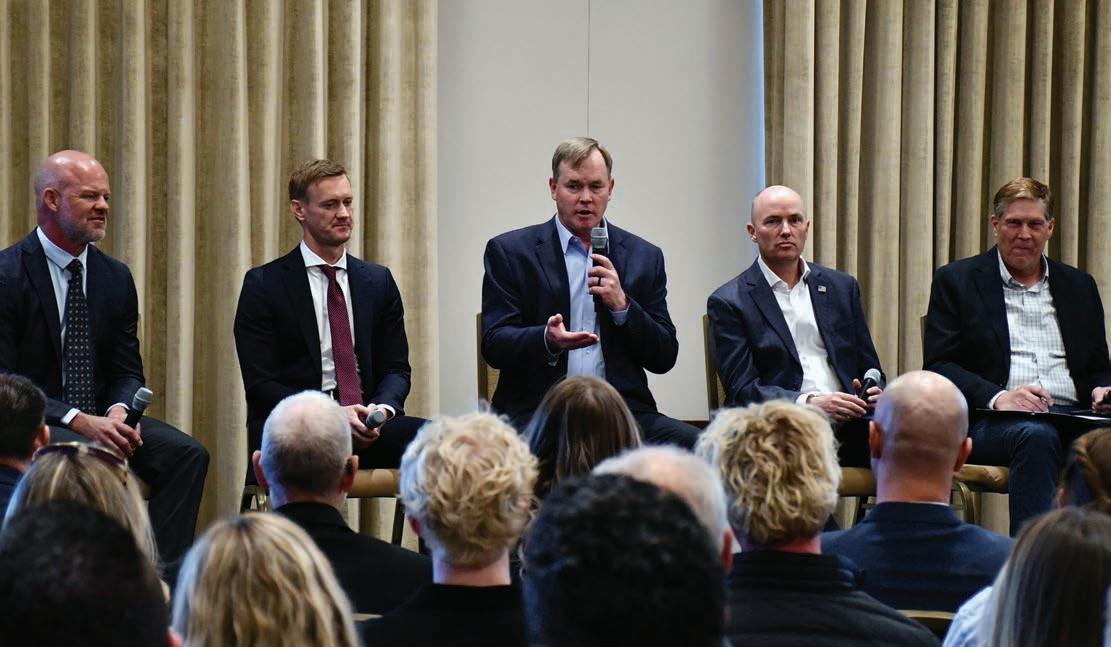
Housing affordability has become one of the defining issues facing Utah families, and state leaders are sounding the alarm. At a recent housing panel hosted by the Salt Lake Home Builders Association featuring Utah Gov. Spencer Cox, developers, legislators, builders, and real estate professionals, one message became abundantly clear: solving Utah’s housing crisis will require bold collaboration between the public
and private sectors, meaningful policy reform, and a willingness to rethink how communities approach growth.
Cox opened the discussion by emphasizing the urgency of the issue. Utah, once known for having one of the highest birth rates in the nation, has seen that ranking decline dramatically. One contributing factor, he noted, is housing affordability.

“A lot of people aren’t having kids until they can own a home,” Cox explained. “And they’re putting that off longer and longer because housing is becoming harder to attain.”
The panel focused heavily on the reality that Utah does not simply need more homes — it needs different kinds of homes.
Over the past several decades, the size of the average single-family home has nearly doubled, while starter homes have become increasingly rare. Cox pointed out that the median size of a single-family home grew from approximately 1,600 square feet in 1990 to nearly 3,000 square feet by 2020.
Developers acknowledged the reason behind this trend: economics.
As land becomes more expensive and scarcer, builders are incentivized to maximize profitability by constructing larger homes on available lots. Utah’s geographic constraints — mountains, lakes, and large amounts of federally owned land — limit where development can occur, further driving up land values.
But panelists repeatedly emphasized that Utah desperately needs smaller, attainable starter homes if younger generations are going to have a pathway into homeownership.
Much of the conversation centered around local government regulations and how cumbersome approval processes increase housing costs.
Several panelists criticized what they described as excessive design standards and permitting
Anastasiya Marchenko©/ Adobe Stock
requirements imposed by cities. Builders argued that many municipalities have become overly prescriptive about architecture, materials, road widths, landscaping, and other development details that significantly raise costs without improving affordability.
Steve Waldrip, Gov. Spencer Cox’s senior adviser for housing strategy and innovation, said Utah’s housing challenges are being made worse by overly complex zoning regulations and permitting processes that increase costs and delay development. Waldrip argued that housing should be treated more like essential infrastructure, like roads or utilities, rather than something planned city by city without regional coordination. He also emphasized that many local governments have created burdensome development standards over time, requiring builders to navigate layers of regulations that ultimately drive up the cost of homeownership for Utah families.
Paxton Guymon, a real estate attorney and in-house counsel for Edge Homes, argued that builders are already motivated to construct homes that consumers want to buy.
“Nobody is more attuned to market demand than homebuilders,” he said. “City planners and council members are often detached from that reality.”
Cox echoed similar frustrations, particularly when local governments attempt to dictate cosmetic details inside homes.
“When cities are telling builders what type of backsplash or countertops they need to install, what are we doing?” Cox said. “That’s not how a free market economy is supposed to work.”
Another major concern raised during the discussion was delay. Panelists agreed that even when cities are not intentionally blocking development, prolonged permitting and approval timelines dramatically increase costs. Cox compared the issue to infrastructure projects, noting that every year of delay can add approximately 30% to a project’s overall cost.
“Delay is worse than no,” Cox said. “Capital cannot survive in an environment where projects are constantly dragged out.”
Infrastructure itself has also become a major obstacle to housing production.
Many communities lack the sewer systems, water infrastructure, roads, and utilities necessary to support planned development.
To address this, Utah lawmakers recently passed legislation creating a new housing infrastructure grant and loan program designed to help cities finance the infrastructure needed to accommodate new housing.
Representative Cal Roberts (R-Draper) who played a key role in the legislation, explained that the state hopes to unlock thousands of entitled but currently undevelopable housing units across Utah.
The program specifically encourages the construction of smaller homes on smaller lots — the kind of housing many Utah families can realistically afford.
Guymon shared that his company is already designing detached single-family homes on 3,000-square-foot lots that could sell for under $600,000 in Salt Lake County, a price point that has become increasingly rare.
Many of these homes also include attached accessory dwelling units (ADUs), allowing homeowners to offset mortgage costs through rental income.
“That rental income can be the difference between a family qualifying for a home or not,” Guymon explained. The conversation also turned toward condominiums, which Cox described as an important but underutilized form of starter housing.
Panelists noted that condo development has declined due to insurance costs, liability concerns, regulatory burdens, and tax policies. Cox said the state is actively working to address those barriers while also examining the role homeowners associations play in increasing housing costs.
Another recurring theme throughout the discussion was private property rights.
Cox strongly defended the principle that property owners should generally be allowed to build according to established zoning regulations without facing endless additional political hurdles.
“The right time for public input is during the creation of the general plan and zoning ordinances,” Cox explained. “Once the rules are established, projects that comply with those rules should be approved administratively.”
Several panelists argued that modern housing politics have become increasingly dominated by “not in my backyard” attitudes, where existing residents oppose development near their neighborhoods despite acknowledging the statewide need for more housing.
Roberts noted that housing affordability consistently ranks as one of the top concerns among Utah voters, yet meaningful reform remains politically difficult because land-use decisions are primarily controlled at the local level.
“The people making decisions about housing are often not the people who will eventually need that housing,” Roberts said.
To help address the issue, the state has begun creating incentives that encourage cities to approve higher-density and more affordable housing projects, particularly near transit hubs.
One example highlighted during the panel involved a transit-oriented condominium project in Draper, where state housing policies helped local leaders approve owneroccupied housing rather than higher-density apartment developments.
Labor shortages also emerged as a critical concern.
Cox emphasized the need to strengthen trade education and apprenticeship opportunities, citing successful workforce development models in countries like Switzerland.
Utah leaders are exploring ways to better connect high school students with construction trades, technical education, and career pathways earlier in life.
The governor also acknowledged the importance of immigration reform in sustaining the construction workforce.
“We have to figure out the legal immigration piece of this,” Cox said. “There are hardworking people who have been contributing to this industry for years, and we need them.”
Toward the end of the discussion, the panel addressed one of the state’s newest housing initiatives: utilizing surplus state-owned land for residential development.
Utah officials estimate there are hundreds of acres of unused state-owned property in Salt Lake County alone that could potentially be converted into housing.
Under the proposal, the state could contribute land below market value in exchange for commitments to build homes at attainable price points.
Cox believes programs like these will become one of Utah’s most powerful tools in expanding housing access over the next several years.
Panelists repeatedly stressed that Utah is uniquely positioned to solve its housing crisis because leaders across government and industry recognize the severity of the problem and are willing to collaborate on solutions.
“If this problem can be solved anywhere,” Cox concluded, “it can be solved here.”

Photo: Image licensed by Ingram Image

Home Sweet Stress: Why Gen Z and Millennials Are Struggling with Homeownership
Younger homeowners are coming into a very different market than their older counterparts.
By Kimberly Dawn Neumann
Owning a home may be the American dream, but for some that dream can bring unexpected stress.
According to Hippo Insurance’s 2026 Homeowner Anxiety Report, 25% of homeowners say that homeownership-related anxieties have a high or extremely negative impact on their quality of life, with almost 1 in 5 saying that homeownership is their No. 1 stressor (on par with those who listed their careers or relationships in the top spot).
Within those numbers, it seems that Gen Z and millennials are feeling it the most with 76% reporting homeowner anxiety negatively affecting their wellbeing compared with only 51% of baby boomers and Gen X reporting similar feelings. Still, no matter the generation, that’s a whopping number of homeowners currently reporting home-related stress.
“I think anxiety is high right now in general because of everything going on in the world and in the United
Kateryna©/ Adobe Stock
States,” said Hank Orenstein, MSW, a real estate broker with The Corcoran Group in New York City who also has a social work/mental health provider background. “There’s a lot of uncertainty in the economy and many companies have been downsizing to save costs plus there is the additional impact of AI.”
Financial and global instability may translate into a fear of losing one’s home, especially in light of rising costs for repairs, utilities, and insurance. But financial stresses aren’t the only factor causing homeowners to lose sleep in the modern era.
Why younger generations may be feeling more homeownership anxiety
While all homeowners are experiencing higher degrees of homeownership anxiety with today’s volatile economy, it seems that Gen Z and millennial buyers are bearing the brunt.
“Younger homeowners are coming into a very different market than their older counterparts—a starter home or apartment used to be a much more affordable prospect,” said Anna Hargraves Hall, MSW, a real estate agent with The Halls NYC Team at Compass who also has a master’s degree in social work from Columbia University. “Incomes have not risen at the same rate that real estate prices have, so the entry point and the pressures associated with that are so much higher.”
However, not only are Gen Z and millennials entering a housing market rife with hyper-inflated home prices and consistently elevated mortgage rates, they’re also looking at it all through a different lens than older demographics.
With the National Association of Realtors® citing 40 years old as the current median age of first-time homebuyers, it’s likely that younger buyers have spent more time renting before purchasing. As such, they may sustain a spike in their homeownership stress levels when they suddenly feel “house poor.”
“This younger generation values experiences over stuff, so sinking a lot of money into an asset limits their ability to have those experiences,” said Hall. This is especially true as the cost of living continues to skyrocket.
Social media may be another potent driver of homeowner anxiety as it promotes unattainable visual markers that many buyers may not be able to meet.
“This is the Instagram generation and they’ve been bombarded with all this imagery of perfectly done interiors and super high-end finishes, which creates unrealistic expectations and a lot of FOMO,” said Hall. “The idea of ‘luxury for everyone’ puts a lot of pressure on young people.”
Whatever the source of their anxiety, it does seem that younger homeowners are increasingly manifesting their “maison” worries physically. The Hippo report found that more Gen Z and millennial respondents felt the repercussions of homeownership stress that include
negatively affected sleep (28%), restlessness (32%), constant distraction (27%), and an overall decline in health, both mental (22%) and physical (15%).
Delaying home repairs may be hurting older generations of homeowners
Another major precipitator of homeowner anxiety has to do with the fact that housing costs are on the rise. In fact, a new study from Lombardo Homes found that 81% of respondents say their housing costs have increased in the last three years.
Compounding that issue, a recent piece in The Wall Street Journal revealed that the average U.S. home is now 44 years old and in need of major repairs. The article reported structural home repair costs increased by around 14.1% from 2022 to 2024, while plumbing repairs jumped 23.6%, according to the Federal Reserve Bank of Philadelphia. The increase seems to be a combo of not only the large size of the repairs needed, but also the increase in labor and parts, which have been further affected by recent tariffs.
As such, many people are putting off home repairs, especially older homeowners who are on tight fixed budgets but may live in older homes. They simply cannot afford the repairs along with the rising costs of homeownership including home insurance, HOA dues, and property taxes.
However, unfinished maintenance tasks are weighing heavily on the mental health of homeowners, according to the Hippo anxiety report. While 69% of homeowners admit to having at least one major home maintenance task they’re putting off, more than 1 in 3 (38%) of those same homeowners cite the state of their home’s maintenance and repair needs as either their single biggest or an overall significant source of stress.
This root cause of homeowner anxiety is very real since budgets are already stretched thin, but major repairs can cost tens of thousands of dollars. The Hippo report found that 45% of respondents figured their current backlog of repairs would average $5,000 or more to fully fix, with 15% saying it would cost them at least $20,000. But many homeowners cannot find extra funds to make the needed updates. At the same time, repairs left undone can negatively affect a home’s price when it comes time to sell.
“Older homeowners are faced with much more deferred maintenance on their houses, but this has a substantial impact on the resale value,” said Hall. “Prospective homeowners really do value things in good/mint condition and because of the time and cost associated with renovations they’re not willing to pay as much to buy something that needs work.”
Most people still think homeownership is worth the stress
Fortunately, it’s not all bad news. While homeowner anxiety is at an all-time high, 97% of the Hippo survey

respondents still found homeownership was worth it.
One of the main reasons was they felt it provided stability for their family (32%), while the pride of ownership (28%) and the chance to build equity/wealth (24%) also helped balance out their worries.
“Home is everyone’s foundation and with so much uncertainty out there, most people much prefer the security of owning despite the additional responsibilities that go along with homeownership,” said Orenstein, who adds this is especially true in places like New York City where rents are going through the roof.
“Homeownership gives you a sense of stability and place, which you just don’t get the same way when you’re renting,” said Hall. “Plus, once you own a home, you can make it your own and spend some money to improve and decorate it in a way that really reflects who you are—there’s real satisfaction in that.”
Ideally, you’ll also own it for a long time such that it will accrue value and become an appreciating asset. But in the meantime, how can you manage your homeowner anxiety?
“From a social work and mental health perspective, talking through your anxiety and feelings are important with supportive people among family and friends,” suggested Orenstein. “Emotional distress can affect physical health as well, so meeting with a therapist could help along with getting exercise and/or doing yoga or meditation to help stay calm.”
On a fiscal level, financial advisers usually suggest trying to factor in at least 1% of a home’s value for annual upkeep if possible (though currently, that number may need to be nudged up to 2% to 3% if finances allow). Or there is always the DIY option for smaller fixes.
“Where possible, make improvements in your home that don’t involve spending money—or that are affordable,” said Orenstein. “There’s nothing like progress to help mitigate stress and anxiety.”
Reprinted from Realtor.com®. Kimberly Dawn Neumann is a journalist based in New York City and the author of hundreds of articles on home-related topics for major publications, including Forbes, Real Simple, and Realtor.com.
Photo: Image licensed by Ingram Image


The Most Dangerous Move You Can Make with Your 401(k)
Hardship withdrawals allow people to take money out of their 401(k) early for an “immediate and heavy” financial need.
By Dina Sartore-Bodo
More Americans are taking early withdrawals from their 401(k) accounts to pay emergency expenses such as mortgage payments.
But that’s a dangerous game to be playing with the money meant for your retirement.
New data shows that the average 401(k) balance fell by 4% to $141,000 at the start of 2026. The average individual retirement account balance was also down 4% to $131,380 in the first quarter of 2026, according to data released from Fidelity Investments
But this has been an ongoing occurrence for the better part of the past 18 months.
In 2025, 6% of people enrolled in Vanguard 401(k) plans made “hardship withdrawals” from their accounts, according to the company’s 2026 report on Americans’ savings habits. That’s up from 5% in 2024 and 3.6% in 2023.
Hardship withdrawals allow people to take money out of their 401(k) early for an “immediate and heavy” financial need. The most common reason for

taking a hardship withdrawal is making a rent or mortgage payment to prevent foreclosure or eviction, according to Vanguard.
There’s no question that Americans are feeling the squeeze. Prices are rising at the fastest pace in years. Inflation rose at 3.8% from last year, and with the ongoing Iran war, there doesn’t seem to be an end in sight.
But while tapping your 401(k) to pay your bills may seem like your only option, if you’re a homeowner, you should understand the risks.
“A 401(k) is intended to fund your retirement, and withdrawing money prematurely can lead to significant penalties and lost retirement savings,” said Steven Sarrel, CPA and partner at Raines & Fischer LLP. It should be considered a “ last resort” option.
Your 401(k) and the untapped potential
A 401(k) is a retirement savings option provided by most employers. If you participate, a portion of each paycheck is automatically contributed to the account. In many cases, the employer matches part of these contributions. Employees choose which funds to invest in, aiming to build a financial cushion for their retirement years.
A 401(k) is an employer-sponsored retirement plan, while an individual retirement account, or IRA, is set up by an individual through a bank or investment firm.
“The main difference between a 401(k) and an IRA, as it relates to real estate transactions, is you can typically take a loan from a 401(k), which allows money upfront for things like down payments or major repairs, and you pay it back through payroll over time,” said Brian
LuisAlfonso©/ Adobe Stock

Kuhn, a financial adviser at Wealth Enhancement Group. “IRAs don’t allow these types of loans.”
An analysis of nearly 25 million 401(k) accounts by Fidelity Investments shows the average balance rose a substantial 11% to $146,100 in 2025, a significant gain despite market volatility. At a time when inflation is still incredibly high and the stock market is in flux due to the war in Iran, it’s easy to understand why 401(k) funds look attractive.
Even President Donald Trump has touted the benefits of the accounts, while considering adjusting regulations to allow Americans easier access to tapping into 401(k)s to buy homes without penalty.
And yet, experts still maintain that this should be avoided at all costs.
Can I use my 401(k) to pay my mortgage?
Yes, accessing money in your 401(k) to pay your mortgage would qualify as a hardship withdrawal, but only under certain circumstances, which is why it is illadvised.
“Although this option can provide relief in times of financial distress, hardship withdrawals can drastically affect retirement savings and must be avoided if
possible,” warned Leon Turkin, a mortgage broker at Turkin Mortgage Hardship withdrawal—unlike a 401(k) loan—does not require repayment. However, taxes are applicable. Also, there’s a 10% penalty for early withdrawal in most cases, if the account holder is under 59.5 years of age.
“Your mortgage is due every month for years, so consistently trying to access your 401(k) to pay the mortgage isn’t a great strategy,” said Kuhn.
What qualifies as a hardship withdrawal from your 401(k)?
According to IRS regulations, an employee is automatically considered to have an “immediate and heavy financial need” and approved to take a hardship withdrawal from their 401(k) if the distribution is for any of the following reasons:
• Medical care expenses for you, your spouse, or your dependents
• Payments necessary to prevent eviction from your principal residence or foreclosure on the mortgage on that residence
• Costs directly related to the purchase of your
Photo: Image licensed by Ingram Image
principal residence
• Certain expenses to repair damage to your principal residence
• Tuition, related educational fees, and room and board expenses for you, your spouse, or your dependents
• Funeral expenses for you, your spouse, or your dependents
“It’s advisable to seek tax guidance from a CPA to confirm if your financial need qualifies,” said Kuhn.
Alternatives to pulling money out of your 401(k) to pay your mortgage
Before taking money out of your 401(k) to pay your mortgage, there are many steps you can—and should—take.
“If you’re facing difficulty with mortgage payments, cut your expenses and consider getting a part-time job,” said Chad Faulkenberry, financial adviser and managing director at Journey Strategic Wealth. “A side hustle, freelance work, or temporary contract job can help you stay on top of your mortgage payments and provide immediate relief.”
Then contact your mortgage provider to explore options like forbearance or loss mitigation programs.
“Loan modification programs can always assist in adjusting your loan terms so that it is easier to pay,” said Turkin. “Perhaps a short negotiation with your lender for temporary forbearance might get you the help you need.”
Next, consider alternate avenues.
“It’s better to explore other options such as refinancing your mortgage to lower monthly payments or looking into personal loans before dipping into your retirement account,” said Sarrel. “As a CPA, I always advise clients to treat their 401(k) as a long-term investment and not an option to use before retirement.”
If you have considerable equity in your home, “a home equity loan or HELOC would provide cash at lower interest rates than a credit card or personal loan,” according to Turkin. “If you access your 401(k) instead, you are sacrificing future financial security.”
Reprinted from Realtor.com®. Julie Taylor contributed to this report. Dina Sartore-Bodo is the senior advice editor at Realtor.com covering real estate news, personal finance trends, and interior design.

April 2026 Housing Watch
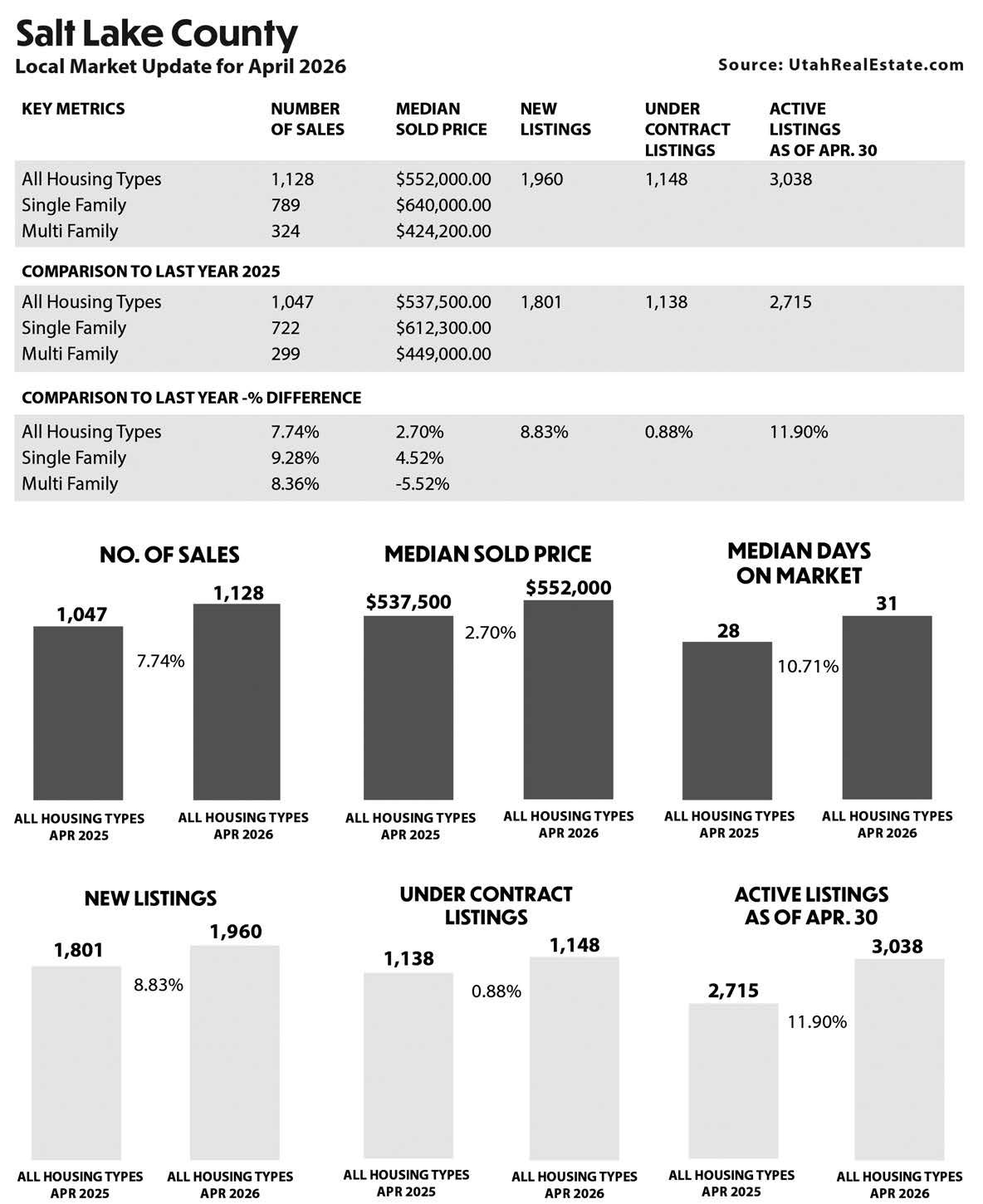
Salt Lake Housing Market Sees Strong Start to 2026
Home sales continued to improve in Salt Lake County in April, reflecting stronger buyer activity compared to last year as affordability conditions gradually improve.
Total home sales reached 1,128 in April, up 7.74% from 1,047 sales in April 2025. From January through April, total home sales in the county climbed to 3,739 units, a 5.06% increase from the same period a year earlier.
The increase in sales appears to be driven by several factors, including slightly lower mortgage rates compared to last year, steady job and income growth, and a growing supply of homes on the market. Buyers are also benefiting from improved housing inventory, giving them more choices and reducing some of the intense competition seen in recent years.
New listings, pending (under contract) listings, and active listings all increased in April, rising 8.83%, 0.88%, and 11.90%, respectively. The increase in active listings is helping to create a more balanced market and providing opportunities for buyers who had previously been sidelined by limited inventory and affordability challenges.
Meanwhile, home prices continued to rise at a modest pace. The median sold price for all housing types in April reached $552,000. Single-family homes posted the strongest price growth, with the median price climbing to $640,000, up 4.52% from $612,300 in April 2025. In contrast, multifamily homes saw the median price decline to $424,200, down 5.52% from $449,000 a year earlier.
Nationally, existing-home sales in April were essentially unchanged from one year ago. “Despite mixed macroeconomic signals—including a record-high stock market and historically low consumer confidence—home sales were modestly boosted by the continued improvement in housing affordability,” said National Association of Realtors® Chief Economist Dr. Lawrence Yun. “Mortgage rates are lower from a year ago, and average income growth is outpacing home price gains.”
The national median home price in April was $417,700 for all housing types, a 0.9% increase from one year earlier and the 34th consecutive month of annual price gains.
According to Freddie Mac, the average 30-year fixed mortgage rate in April was 6.33%, up slightly from 6.18% in March but down from 6.73% one year ago. While mortgage rates remain elevated compared to historical norms, the modest year-over-year decline has helped improve purchasing power for some buyers.
Note: The median price represents the midpoint of all homes sold, where half sold for more and half sold for less. Median prices are generally considered a more accurate reflection of market conditions than average prices, which can be skewed by a relatively small number of high-end transactions. The most reliable comparisons for median prices are year-over-year comparisons because they account for seasonal buying patterns. Month-to-month comparisons may not accurately reflect market trends due to seasonal fluctuations and changes in the mix of homes sold.
“Mortgage rates are lower from a year ago, and average income growth is outpacing home price gains.”
Lawrence Yun Chief Economist National Association of Realtors®



SOME VEHICLES ARRIVE. OTHERS TAKE THE LEAD.
The BMW X5 is crafted for those who move with intention—balancing confident design, dynamic capability, and intelligent innovation. With available xDrive all-wheel drive and a driver-focused interior, it adapts seamlessly to every road and every moment.
Because when presence meets performance, it doesn’t go unnoticed.
Experience the performance worthy X5 at BMW of Murray or BMW of Pleasant Grove.
BMW of Murray
4735 S. State Street
Murray, Utah
801-262-2479
bmwofmurray.com
BMW of Pleasant Grove 2111 West Grove Parkway Pleasant Grove, Utah
801-443-2000 bmwofpg.com
© 2026 BMW of North America, LLC. The BMW trademarks are registered trademarks.