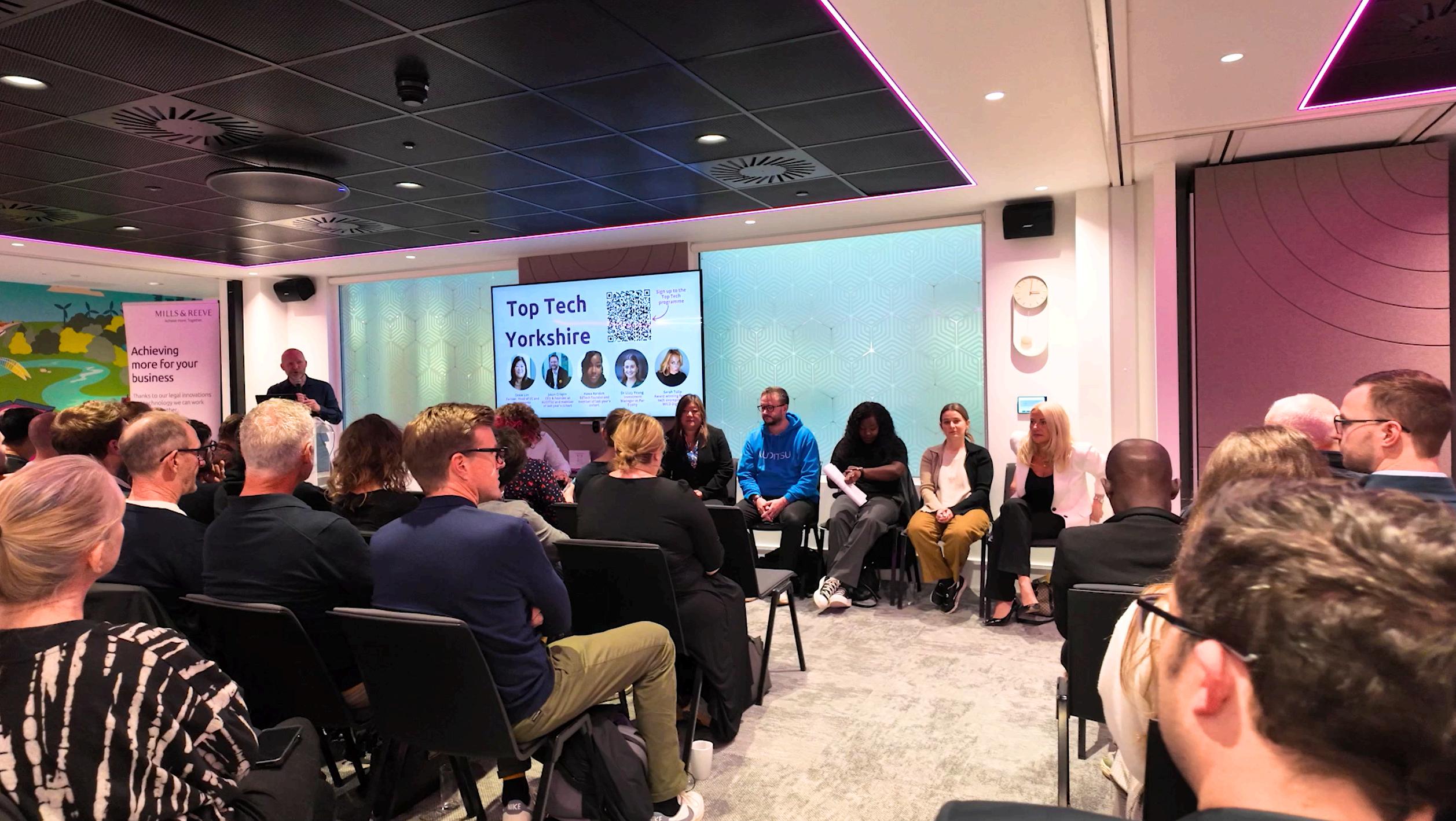
This report has been created to mark the conclusion of the latest edition of Top Tech Yorkshire, an annual programme established by Mills & Reeve to connect the region's technology businesses with the network of expert mentors, investors and advisers they need to lay solid foundations and build.
Each edition of the programme brings together a cohort of ambitious, often early stage tech companies and surrounds them with the people who can help them on their way. As this year's programme draws to a close, the report looks back at the cohort who took part and steps back to take in the bigger picture of the region they, and many other ambitious tech businesses, are growing – and thriving – in.
Indeed, Yorkshire and the Humber has always been a place that makes things – and, increasingly, that thing is technology. The businesses, ideas and talent behind it are truly starting to attract the attention they deserve.
The first half of the report explores the regional tech economy as a whole – its strengths in medtech, fintech, data and AI, the universities feeding a deep talent pool and the investment and momentum now gathering behind it.
The second half turns to the people. You'll meet the Top Tech Yorkshire class of 2026 and hear from those who are supporting and encouraging them, including leading regional investors and the legal experts who help guide them forward. After all, the difference between a good idea and a thriving company often comes down to the right knowledge and right connections.
With that in mind, this report is intended as a practical resource for anyone currently navigating that journey, as well as a celebration of a tech community defined by its ambition, generosity and collaborative spirit.
Top Tech Yorkshire exists to help that community make the most of its potential. We hope this report does the same, offering insight, encouragement and a sense of just how much is possible here.
Alex Newman Partner, Mills & Reeve
Yorkshiretechscene–thebigpicture
An overview – the state of the region
Sarah Tulip is a leading figure in Yorkshire's tech sector and a champion of digital growth across the region. She serves as digital ambassador for Leeds City Council, chair of Leeds Digital Forum, co-chair of the Leeds and West Yorkshire Digital Cluster Group, and founder of WILD Digital. She has also been named one of Computer Weekly's Top 50 Most Influential Women in Tech.
NHS Digital's presence, the spinouts that have followed, and the data pools and health datasets that came with it have driven extraordinary innovation. That, in turn, has helped position the region as a serious place for data.
There's a real warmth to the Yorkshire tech sector.
Leeds still feels like a city of manageable size – easy to navigate, easy to land in, easy to find the people who matter. That's something cities like Manchester and London have largely lost. New organisations arriving here can quickly find their stakeholders and start operating, and founders starting businesses in tech or any other sector find it a genuinely supportive and positive place to be.
That warmth is matched by ambition and potential and what underpins it all is a deeply collaborative culture. Through the Leeds Digital Forum for example, anyone can come along and find out what's happening across the sector. The Leeds Digital Festival operates the same way – you don't have to pay to play.
That inclusivity has shaped an ecosystem that takes everyone along with it as it grows, and where education, public and private sectors collaborate in a way that fuels real innovation. The combination of cutting-edge minds in research and a strong platform for business to land here is a powerful one.
What the region is becoming known for is equally exciting. Medtech is huge – Leeds is now regarded as one of the best places in the world to start a medtech business.
Finance and fintech, too, are increasingly synonymous with Leeds – with the Bank of England, the FCA, the National Wealth Fund and Lloyds all here, alongside FinTech North spinning out and supporting deeper collaboration and profile raising on a national scale. We're being taken seriously as a financial hub in a way we simply weren't a decade ago.
Sarah Tulip Founder, WILD Digital
Yet, there is still so much potential to grow further, and digital infrastructure will play a crucial role. Much like the nation's transport network, digital infrastructure has historically been concentrated in London and the South East. That has held our region back in the past, but today that’s changing and we now have a real opportunity to catch up and lead, particularly in data centres and B2B fibre.
AI is the other obvious story. Microsoft is now looking at three sites in the region, and the arrival of major players is reshaping how Yorkshire could become an AI infrastructure hub. That wasn't on the radar before, and it shows how rapidly the region's profile is shifting.
Challenges remain, of course. Access to large-scale finance in the region remains complicated – there's good funding at the earlier stages, but when you start talking £10 million-plus, options narrow quickly. Closely tied to that is a role-modelling challenge; very few founders here have raised at the top end of the scale, which makes it harder for the next generation to see what's possible and replicate it.
For Yorkshire tech scale ups to compete nationally and globally, encouraging the sense of ambition and confidence is essential. We need to be proud of what we offer, believe in it and speak loudly about it.
There are real lessons we can take from Manchester, which is further down its journey and where cross-Northern collaboration is increasingly powerful. The Northern metro mayors working together – on the Olympics bid, on AI growth zones, on shared infrastructure – shows what's possible when the North stops being pitted against itself and starts pooling its weight.
My ambition is for Yorkshire to be recognised as a region that stands firmly on its own two feet – globally competitive in medtech, data, fintech, AI and more, and confident in saying so. To get there, national government needs to focus much more effort and investment on the regions. Pair that with the collaboration, ambition and broad-based economy we already have, and Yorkshire's potential is enormous.
Our research confirms what those who live and work here already sense: Yorkshire and the Humber is an innovation economy with real depth and, powered by the West Yorkshire and Leeds city region, growing momentum. The data shows a region with a broad base of innovative companies, world-class universities with a strong record of spinning out high-tech firms, and a fast-growing digital workforce. The UK government has recognised that potential, designating West Yorkshire a high-growth opportunity area for data and artificial intelligence – a vote of confidence backed by major public investment.
1. Innovation and intellectual property
Intellectual Property Office data shows Yorkshire and the Humber holding steady as a consistent contributor to UK innovation, with 240 patents granted in 2024 (almost unchanged from 239 in 2023) and 4,469 trade marks registered, up 3.3% on the year.
On both measures the region ranks seventh among UK regions and nations –ahead of Scotland, the East Midlands and the North East, though behind the West Midlands and the North West. It’s a steady, mid-ranking position rather than national leadership, but it reflects a reliable base of innovative and brandbuilding businesses.
2. Universities and talent
The region's universities are among the country's most productive at turning research into companies. In HESA's UK spinout register, the University of Leeds ranks tenth in the country with 54 spinouts – one of only two northern English universities in the national top ten, alongside Manchester. Sheffield (35) and York (24) add further depth, and across the region nine in ten spin-outs come from these three institutions. Crucially, almost all are rooted in high-growth science: 122 of the region's 125 spinouts emerged from medicine and life sciences or physical sciences, engineering and mathematics.
That pipeline is fed by an exceptional talent base. Around 43,000 students graduate from the region's seven universities each year, and the West Yorkshire Combined Authority reports that the region produces more data science graduates, and hosts more AI students, than anywhere else in the UK.
3. A broad and growing company base
Analysis of Companies House data shows Leeds is the clear anchor of the regional economy and one of the larger tech hubs outside London, with around 4,000 active tech firms, supported by substantial clusters in Sheffield, York, Bradford and Hull.
New company formation tells an encouraging story – after an exceptional 2025, in which tech incorporations roughly doubled across the country, all five of Yorkshire's tech cities are on track to form more new companies in 2026 than the year before. This highlights a broad-based momentum that our analysis found several larger hubs are not matching. Sheffield saw the steepest rise of the regional cities between 2024 and 2025.
The region is also distinctive rather than uniform. Sheffield is the most gamesspecialised city in our comparison set, home to more than 90 gamesdevelopment firms and a heritage stretching back to Gremlin Graphics, founded in the city in 1984, whose alumni went on to establish the studio Sumo Digital. York also punches well above its size in games and games publishing, while Leeds leans toward enterprise software, professional services and fintech. The result is a varied tech economy with genuine creative and enterprise strengths, not a single specialism.
4. Jobs and sector growth
Yorkshire's tech workforce is expanding quickly. The number of tech roles in Leeds rose 46%, from 23,734 to 34,742, with the city's digital tech sector growing 125% faster than the national average. Across West Yorkshire, some 50,000 people are now employed in digital, tech and AI businesses. Cybersecurity stands out in particular – against a slight national decline of 0.6%, Leeds recorded a 9.9% rise in cybersecurity roles.
5. The investment picture
Yorkshire and the Humber attracted £465m of private equity and venture capital investment in 2025; within the two tech-focused sub-sectors of ICT and biotech and healthcare, 26 businesses secured £72m. The trend has been volatile, with the regional total falling from higher levels in 2023 and 2024, highlighting how much of the opportunity remains untapped.
While equity investment into the region's high growth tech companies fell 23.3% to £179m, grant funding surged 156% to £79.9m – the highest growth of any English region, well ahead of the West Midlands (up 101%) and the North West (up 17.4%) at a time when most regions saw grant funding fall.
Major public commitments are reinforcing that base, including the £160m, tenyear West Yorkshire HealthTech and Digital Investment Zone, which links universities, businesses and the NHS across sites in Bradford, Huddersfield and Leeds, with a first phase targeting more than 2,500 skilled jobs and over £220m of public and private investment.
6. The opportunity
Our research demonstrates that Yorkshire and the Humber has strong foundations as a top tech region. It boasts a broad and growing company base, universities with a national-leading record of spinouts, a deep and affordable talent pool, and a fast-expanding digital workforce – increasingly recognised through government backing and major investment programmes.
The opportunity now is to make sure that promise is realised, by connecting the region's founders with the funding, expertise and networks that help good companies become great ones. That is precisely what programmes like Top Tech Yorkshire aim to support.
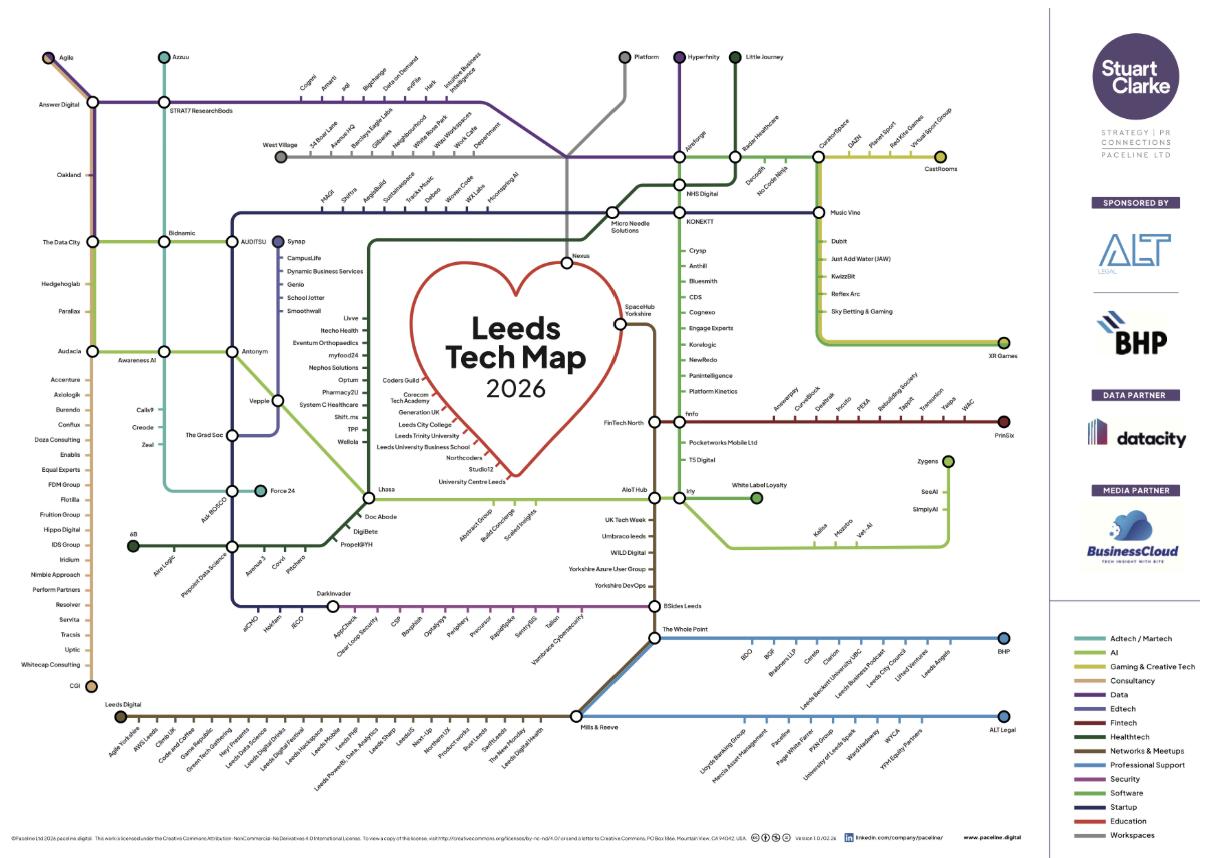
Originally produced in 2021, the Leeds Tech Map is a clear, visual guide to the city’s thriving digital and technology economy. Now relaunched in 2026, it brings together hundreds of companies across software, data, health tech, fintech and creative tech, showing at a glance who’s doing what in Leeds and the strength of the region’s tech ecosystem.
Clarke Founder, Leeds Digital and UK Tech Week
Stuart
TheroleofTopTechYorkshire
Top Tech Yorkshire is an annual programme, driven by national law firm Mills & Reeve, that connects Yorkshire's technology businesses with a network of expert mentors to support their growth ambitions.
Each year it brings together a cohort of senior leaders from technology businesses headquartered or operating in Yorkshire alongside individuals from the region's diverse, multi-layered tech sector service-provider ecosystem, who act as mentors.
Running over six months, the programme offers profile-raising opportunities, structured networking, and tailored mentorship. It gives members the platform, opportunity, and encouragement to meet the people they need to meet and reach the people they need to reach, while sharing insights into emerging trends and best practices that help businesses navigate an ever-evolving tech landscape.
Community sits at the heart of it all. In an era where collaboration often trumps competition, Top Tech Yorkshire brings together a diverse array of mentors, from investors to service providers, to support businesses at every stage, from startup to scale up and beyond.
To date, the programme has supported over 80 ambitious Yorkshire-based tech firms.
But the ambition reaches further than any single cohort. At its core, the programme is about building a sustainable future for the region's tech industry – by fostering innovation, collaboration, and growth, it aims to create a selfsustaining ecosystem designed to help the Yorkshire tech sector help itself.
More than an initiative, Top Tech Yorkshire is a movement towards a stronger, more innovative tech ecosystem in Yorkshire.
Three years ago, AUDITSU was an idea born of one founder's frustration. Today it's a funded, revenue-generating platform with paying customers on board and a £1.5m seed round on the horizon. We caught up with founder Jason Crispin to discuss the journey, the role Top Tech Yorkshire has played, and why the region's tech community is something he'd back over anywhere else.
Let's start with where you are now. It's been a big year. It really has. Straight after completing the 2025 Top Tech Yorkshire programme, we secured £200,000 in VC investment through PraeSeed. I actually got the confirmation on the showcase day itself.
We put that money straight to work; we made a key hire, rebuilt the platform, launched within a couple of months, and have since onboarded our first paying customers. It's a completely different phase of the business, and it’s an exciting one.
Take us back to the beginning. Where did AUDITSU come from?
It started with frustration, honestly. Back in 2023 I built a mobile application myself, and that's when I came up against how complex and expensive accessibility auditing is. The more I looked into it, the more frustrated I got.
It just baffled me and I soon realised this was a huge problem with a real benefit to society if someone could crack it properly. So, we pivoted the whole business in that direction.
Jason Crispin Founder and CEO, AUDITSU
What does the platform do?
AUDITSU makes accessibility auditing affordable and accessible. The European Accessibility Act came into force last year, and it means organisations supplying into the EU have to meet a complex accessibility standard. The old way of doing that involves consultants’ fees and months of work. For mid-market companies, that's simply not viable.
We give teams a guided platform to run their own audits, with automated tools for websites and PDFs and a free plan to start. For mobile apps, where we began, we're building something genuinely novel. Everything stays human-in-the-loop verified, so customers get a legal-grade result that blends modern tooling with traditional rigour.
You've been through Top Tech Yorkshire twice now. What makes it worth a second go?
The value of the programme was obvious from day one. At my very first event, a Mills & Reeve solicitor introduced me to an angel investor within minutes of arriving. Beyond those introductions, its focus on the practical, expert advice that early stage founders genuinely need really sets it apart.
I came back a second time because AUDITSU has moved on so much and faces new challenges. Top Tech Yorkshire attracts a really broad mix of tech businesses at all different growth stages, and putting those different experiences and perspectives in a room together is invaluable. The Mills & Reeve team are brilliant at connecting you into their network too; whatever you need, they'll do what they can to find it.
Beyond Top Tech Yorkshire, how has the wider Yorkshire tech scene shaped your journey?
It's played a crucial role. We were backed by the Royal Academy of Engineering's regional talent engine and we've been involved with the Leeds NatWest Accelerator hub too, which is great for throwing you in with a really diverse mix of businesses and learning from different perspectives.
A real strength of the ecosystem is the founders themselves. There's a genuine grit and generosity in the Yorkshire tech scene, people doing everything they can to grow and going out of their way to support one another while they do it. That community is a real gem, and it's something the region should be proud of.
So what's next for AUDITSU?
We've disrupted our market, and now it's all about scale. We launch our seed round this autumn, aiming to raise around £1.5 million so we can hire a sales team, build out customer support and really accelerate. Beyond that, we're only just getting started.
Anintroductiontotheclassof2026
Company: AiTechTouch/Globally Linked
Founder: Hawa Kandeh
What’s your ambition for your company?
Our ambition at AiTechTouch is to become a global leader in inclusive AI and STEM education through a multilingual, institution-focused SaaS platform that helps schools and organisations teach AI and STEM confidently without requiring technical expertise. Following our Innovate UK-funded pilot, we’re now moving into MVP development, commercial agreements, CRM and operational scaling, while building long-term relationships across UK and international markets. The growth so far has been highly organic, and we’re now focused on turning that traction into a scalable and intentional long-term strategy.
What does the Yorkshire tech sector need to achieve its ambitions?
Yorkshire already has strong programmes and ecosystems supporting early-stage founders, and they’ve played an important role in helping us reach this stage so quickly. One of the biggest opportunities I see now is building stronger pathways between startups and experienced senior talent across areas like CTO, commercial, marketing, and operational leadership. As companies move from the pilot stage into scaling and investment readiness, access to Yorkshire experienced people who want to grow alongside startups becomes incredibly important.
What’s been the most valuable aspect of being part of Top Tech Yorkshire?
Top Tech Yorkshire has been very valuable in helping me better understand the importance of IP protection, governance, agreements, and long-term company structure from an early stage. That understanding has helped us protect our platform, data, operational processes, and institutional relationships as we’ve grown. It’s also helped me think more strategically about scaling sustainably, investor readiness, team structure, and how to build a company that is difficult to replicate long term. This year especially, it’s also been great to see more diversity across the cohort and founder ecosystem.
Hawa Kandeh Founder and Managing Director, Globally Linked
Anintroductiontotheclassof2026
Company: AegisBuild
Founder: Hang Vo
What’s your ambition for your company?
Our immediate ambition is to reduce the fear, financial anxiety, and mistrust that too often sit at the heart of domestic construction, especially for underserved homeowners and smaller reputable builders who are often least protected by the current system. Starting with curated validation pilots in West Yorkshire, we’re designing AegisBuild as trusted digital infrastructure that helps both sides work together with more confidence, fairness, and accountability. It is not just a project management tool; it is a structured governance layer that brings together clearer scopes, milestone-based payments, evidence capture and fairer dispute pathways.
Longer term, our ambition is national. We believe this kind of trust infrastructure will become increasingly important as the UK repairs, upgrades, and retrofits its housing stock at scale. Our goal is to help de-risk residential construction for homeowners, tradespeople, lenders, insurers and the wider retrofit ecosystem.
What does the Yorkshire tech sector need to achieve its ambitions?
Yorkshire possesses an incredible combination of talent and resilience. To continue growing, the sector needs to further strengthen the bridges between founders, investors, universities and professional services. This ensures early stage businesses receive not only funding but also practical guidance and trusted networks. The local culture of active help, rather than distant advice, is vital for founders navigating the uncertainty of building something new.
What’s been the most valuable aspect of being part of Top Tech Yorkshire?
The most valuable part of Top Tech Yorkshire has been the genuine care, generosity, and practical support behind the whole programme. Beyond the structured workshops, it has given me an authentic community of mentors, founders and professionals who genuinely want to help early stage businesses succeed.
The sessions around legal structure, IP, compliance, commercial risk, investor readiness, and strategic growth have been incredibly valuable, particularly for a company like AegisBuild that sits at the intersection of technology, construction, governance, and consumer protection. They gave me practical clarity on issues that many founders don’t fully understand until much later in the journey.
One moment that really stood out was when I had to prepare at very short notice for a meeting with a serious proptech VC. I was incredibly grateful for the support from Alex Newman and Zickie Lim at Mills & Reeve. Even with such a tight timeline, they made time to help me think through how to present AegisBuild, what investors might challenge us on, and where we needed to be more prepared.
That kind of support meant a lot to me personally. It didn’t just help improve our strategy; it gave me confidence at a moment when I really needed it. Experiences like that are why Top Tech Yorkshire feels really special to me. It isn't just about learning; it's a community that genuinely has your back when it matters.
Anintroductiontotheclassof2026
Company: SlashDot Studios
Founder: Joss Sessions
What’s your ambition for your company?
To raise serious investment so that we can test, pilot and grow. Don’t we all say that?
The journey I’ve been on means SlashDot Studios will close, and a new entity will emerge; one that can contribute to being a positive force, both for internet society at large and for the Yorkshire community we’re rooted in.
What does the Yorkshire tech sector need to achieve its ambitions?
A bit of understanding, and forgiveness, with a whole heap of intellectual curiosity. Let’s stop being magpies to easy shiny things, and start tackling complexity. I get it, we’ve been hooked on easy returns and high growth; we all want to know the when, the how, and the how much. But the world has serious problems, and tickling around the edges, or worse, burying our heads in the sand isn’t going to solve anything.
Technologies, communities, people; they’re beautifully intertwined, dancing in flows we’re not always aware of, let alone understand. Achieving Yorkshire’s tech potential isn’t about hopping on the latest hype train or worshipping at the altar of Silicon Valley, it’s about recognising the history, the moment and the very particular potential of Yorkshire itself.
What’s been the most valuable aspect of being part of Top Tech Yorkshire? Getting out of my coding cave. Making connections, listening to founders and business leaders at different stages, learning the things you don’t know you need to know, and the things others don’t need to know, and progressing from theory to starting to see the sparks of traction.
Joss Sessions
Founder, SlashDot Studios
Anintroductiontotheclassof2026
Company: The Distance
Founder: Anthony Main
What's your ambition for your company?
My ambition is for The Distance to continue leading innovation in digital product experiences for UK businesses.
We founded the agency in 2009 and, over more than 15 years, have built a reputation for technical depth, thoughtful design and genuinely useful digital products. The next chapter is about helping organisations understand what AI really means for their customers, their teams and the products they rely on every day.
That is why we are developing Ubiquitous, our new AI framework for building intelligent product experiences across channels such as web, mobile, voice, WhatsApp, Slack and Teams. Rather than treating AI as a separate consultancy offer, Ubiquitous brings it directly into the way we design and develop digital products.
For us, the opportunity is not simply to add AI features. It’s to make AI a natural extension of great product thinking, helping businesses create services that are more accessible, more responsive and more useful.
What does the Yorkshire tech sector need to achieve its ambitions?
The Yorkshire tech sector needs more AI-native people. Not just people who can use the tools, but people who can apply them confidently, critically and commercially across real business problems.
The technology is moving quickly, but the real opportunity sits in the mindset and skills needed to use it well. Businesses do not need AI for the sake of AI. They need practical ways to understand where it can improve productivity, customer experience and decision-making.
That means more accessible education, more hands-on workshops and more spaces where people can experiment safely. Government-backed schemes such as UMi, alongside community groups like Leeds Mobile and Tech York, have an important role to play in helping businesses build confidence and share knowledge.
If Yorkshire can combine its strong digital talent with a practical, responsible approach to AI adoption, it has a real opportunity to lead, not just follow.
Anthony Main Founder, The Distance
What's been the most valuable aspect of being part of Top Tech Yorkshire? ost valuable part has been the opportunity to share my ambition and ideas with like-minded founders, leaders and experts.
Having people to test ideas with, challenge our thinking and help us refine our strategy has been incredibly useful. For The Distance, that process has been significant. It has helped me make a key decision about how we move forward as a
Rather than creating a separate AI consultancy under the MAIN brand, we have clarified that AI should sit at the heart of The Distance’s product offer through Ubiquitous. That gives us a much stronger connection to who we already are: a digital product agency that helps organisations build useful, lasting technology.
That clarity, and the confidence to commit to it, is exactly what I hoped to gain from
For brief profiles on the other members in the Top Tech Yorkshire 2026 cohort, see page 27.
Aninsidetrackfromtheexperts
Sharing expertise and connecting businesses with the right people at the right time sits at the very heart of what Top Tech Yorkshire is all about. For the region's tech businesses, the difference between a good idea and a thriving company often comes down to knowledge, for example knowing how to raise investment on the right terms, and knowing how to protect what makes your business valuable in the first place.
This section offers top insights and advice from the people who know these challenges inside out. From investment specialists sharing how to attract funding and find the right partner, to IP experts revealing how to safeguard the ideas, products, and brand that set your business apart, we provide expert tips and guidance from some of the leading experts in the region.
Theviewfromtheinvestors
We spoke to leading regional tech investors, Rob Johnson of BGF and Dr Elizabeth Young, from PXN Ventures, about what draws capital to the region, what they look for in a founder, and the advice they’d give any business eyeing investment.
Rob Johnson, Investor at BGF
BGF is the largest and most active growth capital investor in the UK and Ireland, providing long-term, minority investments to growing companies. With 15 regional offices and a team of 200, BGF has invested more than £500m in Yorkshire and the North East since it was established in 2011.
How would you describe the Yorkshire tech scene, where it's come from, and where it's heading?
It's long been a strong region for tech investment. There's a vibrant community here with networks, founder groups and business clubs that support the early-stage ecosystem and feed the growth stage companies we back at BGF.
As a region it's been very healthy, though the last 6-12 months have been choppier. Concerns around the impact of AI on the tradition SaaS model and wider investor uncertainty have trickled down from the public markets, impacting M&A activity for scale ups. It’s still unknown the full extent that AI will disrupt the code-based defensive moats that tech has historically relied on. But there's still a lot to like about these investments. My personal view is this is a period of transition in which investors and strategic acquirers will reassess what makes a tech business valuable.
What do you look for when you're considering an investment?
Proven commercial traction. We're not investing at the pre-revenue/seed stage, we come in once the product-market fit has been established and the commercial model proven. This is, typically around the £2-3 million ARR mark, with good momentum building. Profitability has become much more of a focus over the last 12-to-18 months; a short runway to cash break-even (if the business isn’t already profitable) is now key to driving value and attracting investors.
Just as important is an openness to influence – a recognition that the business won't be the founder's baby forever, and a willingness to bring in a partner and the expertise to spot gaps they'd otherwise miss.
Rob Johnson
BGF has backed a number of Yorkshire success stories. What stands out, and what made them work?
There are some real standouts. We've led investments right across Yorkshire and the Humber – in Boxphish, a cyber security business; Tribepad, a recruitment software provider; and Tevalis, the Hull-based leisure and hospitality technology company. All of these businesses have grown significantly with us and are still growing, even against the backdrop of AI uncertainty and wider macroeconomic headwinds. Pharmacy2U, the UK’s leading online pharmacy, is one of our earlier tech investments in Yorkshire and has gone on to achieve significant growth and success over our 10-year partnership.
What unites them all is that they have two or three key value pillars: resilience, defensibility, and/or scalability. The strongest moats often aren't the technical ones, which AI appears to be eroding; but data ownership, embedded customer relationships, regulatory drivers and integrated partner ecosystems, which can be further supported by businesses operating in hard-to-access markets like defence, education or healthcare.
What's your advice to founders earlier in the journey?
Invest in your senior management team ahead of time and start building your data set early. Investors will typically want to see two or three years of clean, consistent and complete management information to get them comfortable paying a premium multiple. An experienced finance director or CFO (fractional, full time or interim –whatever the cash flows allow) who understands both your world and that of the investors helps bridge the gap and can get you transaction ready ahead of time. This will make the process of raising money far easier and will pay back the cost multiple times over in terms of the outcome.
You also need to build your “equity story”. The numbers matter, but it's also about communicating a vision and growth strategy that's credible and exciting, backed by enough evidence to show there's real substance, and that you're capable of executing against it.
Finally, in this climate, it’s essential to have a credible AI strategy; you need to be ready to explain how and why your business can survive and thrive in an AI world versus the alternative of your product and commercial model being eroded from the edges or rendered surplus to requirements.
Dr Elizabeth Young, Investment Manager at PXN Ventures
PXN Ventures is the leading venture capital firm for the North of England, Scotland, and Northern Ireland. It delivers world-class investment programmes at scale to help build the Northern economy, supporting founders across a diverse range of sectors, including deep tech, life sciences and software.
You've watched the Yorkshire scene evolve over the past few years. How would you describe where it's at?
I’ve been part of the ecosystem here since 2020, and it's matured a lot in that time. The fund I'm with now set up a satellite office in Yorkshire deliberately, because we saw a real growth ecosystem – particularly for the IP-rich, B2B technology businesses the region does so well. There's genuine momentum here now that wasn't as visible a few years ago.
Dr Elizabeth Young Investment Manager, PXN Group
A lot of the region’s tech strengths come down to historical factors. Medical knowledge runs deep with the likes of DePuy Synthes, big regulatory firms in Selby, and orthopaedics strength in Sheffield. Leeds has a huge professional services presence, which has fuelled its fintech and legal tech. Sheffield's historic steelworks have evolved into real strength in electronics, semiconductors, advanced materials and cyber.
York and North Yorkshire are growing too, especially in life sciences. AI and data is the next big thing; I expect those worlds to start colliding with the region's deep tech strengths rather than sitting separately.
What do you look for in a quality tech investment?
An obsession with your customer. You need to innately understand their problem and be sure your technology solves it. A lot of founders create a technology they think should exist, but never reference it against the market. We always look for early evidence of product-market fit; for example, in deep tech, have you trialled it with a handful of customers who are moving towards real purchase volume? In software, have you got good customer retention?
And yes, every investor says the team matters most, because it's true – have they done it before, and if not, are they coachable, transparent about what they don't know, and willing to take advice?
What key piece(s) of advice would you give to founders thinking about investment?
In addition to the above, target the right person within a fund. You can usually see who's invested in what and what their background is, and you want to find someone who can genuinely champion your business. Don't overlook the juniors – analysts and associates lead a lot of these deals and present to the investment committee.
Pick someone you work well with who already understands your space, getting someone up-to-speed in a field they don't know is far harder than working with someone who already gets it. That person has to ingest everything you've said and repeat it with absolute conviction to their investment committee.
One other thing that surprises many founders is how much investors talk to each other. In the regions especially, we're all very well connected, and syndication conversations happen constantly in the background, so understanding those dynamics is important.
ToptipsfromtheIPexperts
Leading IP specialists, Alex Newman of Mills & Reeve and Andrew McKinlay, from Page White Farrer, explore why intellectual property matters from day one, the mistakes they most often see founders make, and share the advice they'd give any tech business looking to protect what makes it valuable.
BuildyourIPfoundationsfromthestart
The two IP buckets
The first thing I tend to tell founders is that they need to think about intellectual property from two distinct but inter-connected perspectives, each of which has its own bucket of issues and considerations.
The first is the freedom to operate bucket. This is all about IP owned by others, and specifically whether or not you can do what you are doing, and what you want to do going forwards, without infringing someone else's IP. That's the most important question, because if you can't operate lawfully, you're scuppered before you even start thinking about protecting your own assets.
The second is the protection bucket. This is all about your own IP – what intellectual property are you generating as you build your business, do you actually own it, and have you taken the right steps to maximise its protection? Most founders only think about the second bucket. But both matter, and investors will expect you to have considered both.
Know which type of IP does which job
Different assets, and sometimes different aspects of the same asset, are protected by different intellectual property rights, and a lot of founders aren't clear on the distinctions. Patents, copyrights, trade marks, database rights, rights in trade secrets – each protect different things and the scope of protection afforded by each is different. Some are unregistered rights that arise automatically; others are registered rights that only exist if you take proactive action to apply for them.
The starting point is understanding which IP rights are relevant to the assets your business is creating, and the potential value to your business of the protection which each of those IP rights confers. Without that clarity, it's very easy to assume that your assets are protected when they're not, and it’s very easy to misunderstand the value of the existing and available IP protection.
Alex Newman Partner, Mills & Reeve
BuildyourIPfoundationsfromthestart
Remember that IP is territorial
Intellectual property rights are territorial in nature, meaning that there are different laws in each country which determine (i) the IP protection which exists automatically, or which is available upon application, in respect of a particular asset, and (ii) the scope of protection which is conferred. Whilst there is often a great deal of similarity between the relevant laws, from jurisdiction to jurisdiction, there can also be material differences.
Write a piece of software in the UK and copyright will arise automatically, but so will French copyright, US copyright and so on. They are separate national rights with potentially different scopes of protection and different laws governing ownership and enforcement.
For registered rights, thinking territorially is even more important – if you want a patent or a trade mark in a particular jurisdiction, you have to apply for it there. Don’t fall into the trap of assuming that any type of IP protection arises automatically. You need to be strategic: you need to consider where your priority markets are, where exclusivity will deliver most value, and what level of investment in IP protection is justified by the protection conferred. You’re unlikely to have the budget to protect everything everywhere, so you need to prioritise.
Have your ducks in a row early
The most valuable thing a founder can do from an IP perspective is to be able to demonstrate, to any investor, lender or potential purchaser, that they understand the IP landscape associated with their business. That they've thought about freedom to operate issues, identified the risks and mitigated them. That they know what IP assets they've created, that they own them, and that the right registrations are in place in the right markets.
If you can't show that, those interested parties will worry on two fronts – that your business may not be as safe to operate as you think, and that the value of your IP assets hasn't been safeguarded. Get the foundations right early, and you've got a real and compelling story to tell.
ProtectingyourIPfromdayone
Within that landscape, patents are one of the most technically specific (and most often misunderstood) forms of IP. Andrew McKinlay picks up the thread with practical advice on getting your patent strategy right from day one.
Start earlier than you think
The single biggest pitfall I see is founders not realising that, to get a patent, your invention has to be confidential at the time you file. In tech that's harder than it sounds – you can throw an MVP together quickly, you're pitching to investors, you're applying for grants, and one of the most natural things to do is talk about how clever your tech is.
There's a real tension there, because early stage businesses need to make noise. The answer isn't to stay silent, it's to take advice early enough that you know what's worth protecting before you start putting it out into the world. A good moment to pause and have that conversation is when you can plausibly explain how your technology works end-to-end, and certainly before you're about to make any of that public.
Know what's actually patentable
It's worth being clear on what a patent does, it protects the way something works, not just an idea in the abstract. In software, a lot of founders hear "not all software is patentable" and translate that into "software isn't patentable", but that's not quite right.
Patents address technical problems, so the things that tend to qualify either solve a problem "outside the computer" (in agritech, advanced manufacturing or medtech, for example) or do something genuinely technical at the computer-engineering level. If your software is fundamentally about organising a business process more efficiently, that's a harder case to make.
Andy McKinlay Patent Attorney, Page White Farrer
Build a strategy that fits your target investors
Work back from what you're trying to achieve. If you're science- or research-led, investors will expect to see protection around the underlying tech. If you're building a consumer app, they usually care more about traction than IP.
The goal is simple. When an investor asks what you're doing about IP, you should be able to give a confident, considered answer – whether that's "here's what we've patented", "we're keeping certain things confidential until we raise", or "this isn't the sort of thing patents apply to, and here's why." Any of those is a good answer if you can explain why.
Missed the window? You still have options
If you've already made something public, you haven't necessarily lost everything. You might have lost the ability to patent the overarching idea, but there could be clever bits of processing or technology underneath that haven't been disclosed and are still worth protecting. Design protection may also be available if the product has a visual element.
And most patents aren't one big breakthrough anyway; they're incremental developments on existing technology. As you refine your product, you'll keep solving technical problems in clever ways, and that's often where the most useful IP sits.
Aboutourcohort
Hear more from the founders and entrepreneurs involved in Top Tech Yorkshire 2026.
Abstract Group is a technology transformation business with strong software engineering capability. Through its three divisions (transform, tech and talent), it delivers AI-powered solutions ranging from standalone applications to full-scale transformation programmes, helping clients navigate complexity and accelerate change.
Founded and headquartered in Leeds, with a global team in India and a regional base in Saudi Arabia, Abstract pairs UK-led delivery with international scale, and runs an Equality in Technology community championing diversity across the sector.
BusinessofTraders(BotFX.ai)
Founder: Christopher Hitchen | Website: botfx.ai
BotFX.ai lets traders ask “Where’s smart money going?” in plain English and get instant answers. It pairs a proprietary orderflow pattern-recognition engine (which reads institutional footprints in market microstructure data) with a finance-native large language model trained on years of order-book data, translating complex orderflow mathematics into natural conversation.
The aim is to put institutional-grade market intelligence within reach of ordinary retail traders. Built entirely with Yorkshire talent and backed by 17 years of regional software experience, BotFX.ai keeps high-value AI IP in the North rather than London.
Cheribim
Founder: Katie Steele | Website: cheribimapp.com
Cheribim provides data capture and management for the historic-buildings sector through a SaaS platform and environmental-monitoring sensors, helping owners (predominantly churches) achieve compliance, cost and time savings, and net-zero goals.
The first platform of its kind, it combines facilities, CRM and project management with sector-specific features, time-series sensor data and a building-element data structure, all reachable through a natural-language interface; development has been backed by five Innovate UK grants. Founded in Sheffield, Cheribim has run a 90church demonstrator across the region, with paid pilots extending to Leeds and Harrogate.
CloudWize
Founder: Edward Humphrey and Matt Hyde |
Website: cloudwize.com
Established by Edward Humphrey and Matt Hyde in 2022, CloudWize is a Microsoft AI and automation business. It builds solutions around operational efficiency and demonstrable return on investment, then repackages those solutions to resell within specific industry verticals.
As a scale-up working across the Microsoft stack, its focus is on turning automation into measurable commercial return for the businesses it serves.
Dataloch
Founder: Russell Brown | Website: syncramesh.com
Dataloch is an offline edge sync platform for data and machine learning, a homegrown, local alternative to the only other platform of its kind on the market. It is built on unique technological expertise in distributed systems, mesh networking and edge machine learning.
Founder Russell Brown, like many programmers in the region, spent much of his career working remotely for US-based startups and scale ups. Now he wants to bring what he has learned over the last 15 years home to Leeds – fittingly, since some of the tech at the heart of the product was invented there.
DealSourcingNetwork
Founder: Alex Temprell | Website: dealsourcingnetwork.co.uk
Deal Sourcing Network (DSN) is building the UK’s first transparent property deal marketplace. Its ranking algorithms score both deals and sourcers, combining compliance validation with community-driven reputation so that only credible, highquality opportunities gain visibility – a merit-based ecosystem that represents unique IP in an otherwise unregulated market.
A Sheffield Hallam graduate who ran his own Leeds business for thirteen years, founder Alex Temprell has built DSN as a proudly Leeds-based PropTech venture, aiming to prove that national-scale innovation can come from Yorkshire while supporting the regional tech community through collaboration and events.
Debeo
Founder: Alex Beardsley | Website: debeo.app
Debeo, founded by Alex Beardsley in 2023, is a progressive web app transforming how SMEs access commercial finance. Built by a commercial finance broker with over a decade in the industry, it connects to open-banking and accounting APIs to give businesses a real-time, 360-degree view of their debt position, securely stores key financial documents, and uses AI-driven analytics to deliver transparent, unbiased funding insights.
Its distinctiveness lies in filling a genuine market gap. There is no other independent, centralised platform for managing commercial debt. Built and tested in Leeds, Debeo is part of Yorkshire’s growing fintech ecosystem.
GlobalHUB
Founder: Paul Drake | Website: globalhub.co.uk
GlobalHUB is a business platform that blends the networking of LinkedIn, the community of Facebook and the marketplace of Amazon into one place. Businesses get their own profile page from which to buy, sell, collaborate, network and communicate via instant messaging and integrated video calls.
Its pitch is global interconnectivity at an accessible price (under £20 a month), with features such as capacity sharing and pooling minimum-order-quantity costs to cut waste. Founder Paul Drake frames the venture as a Yorkshire David taking on the Silicon Valley Goliaths.
influen’zd
Founder: Sonia David | Website: influenzd.carrd.co
influen’zd is a B2B, ROI-driven SaaS platform fixing the loopholes in traditional influencer marketing for local SMEs. By making every campaign transparent, trackable and performance-based, it ensures brands pay only for results while creators earn fairly, turning social engagement into measurable commercial outcomes for small businesses.
Born and built in Leeds, influen’zd is piloting across cafés and restaurants in Leeds, York, Bradford and Halifax, positioning the region as a testbed and aiming to show that global-level technology can emerge from Yorkshire’s regional creativity.
NovaPath is a digital career-development platform bridging the gap between education and employment for underrepresented young people aged 16-24 across West Yorkshire, with a focus on STEM, tech and engineering. It connects students and early-career professionals to mentorship, skills programmes and live job pathways with inclusive employers, using AIpowered career mapping and predictive analytics (the basis of its proprietary “Pathway Intelligence Engine”) to make opportunity visible, personal and local.
Developed in partnership with Bradford University’s BREE and regional colleges, NovaPath aims to make West Yorkshire a national model for equitable tech ecosystems that retain local talent.
Nurture CRM helps SMEs harness technology for growth through intuitive CRM systems built on the Microsoft Power Platform. Its diverse team delivers end-to-end implementation, from design through automation and real-time analytics, putting enterprise-level capability in the hands of users regardless of their technical starting point, without the usual complexity or cost.
Working on a gradual, subscription-based model with an ongoing “Nurture” programme of support and training, the company is Leeds-based and focused primarily on Yorkshire businesses, aiming to create a ripple effect of value across the regional economy.
Nutritoken is a Sheffield-based healthtech startup helping students eat better and spend smarter. Its mobile app lets students log meals and get an instant “NutriBalance” score built on NHS Eatwell Guide proportions, then earn tokens, redeemable with local food and lifestyle partners, when they hit balanced-meal goals while giving small businesses targeted student footfall in return.
Running on a freemium model with optional AI meal plans and richer rewards, Nutritoken is currently in alpha with student testers across South Yorkshire ahead of a wider university rollout.
PipeTenHosting
Founder: Carl Heaton | Website: pipeten.com
Pipe Ten specialises in the design, deployment and management of secure, high-performance cloud infrastructure for web applications. The proposition is simple: clients build exceptional applications, and Pipe Ten ensures they stay secure, available, fast and efficient.
Founded in 2002, Pipe Ten has a long track record of delivering resilient infrastructure and has made it a trusted partner across regulated sectors including fintech and edtech.
ProductworksVentures
Founder: Philip Taylor | Website: philip.taylor.xyz
Productworks Ventures is an independent consultancy helping founders and executives turn digital visions into reality through product management and solutions architecture.
Founder Philip Taylor is currently testing a data-platform-as-a-service concept for SMEs, running a proof of concept with a local wool-trading company that pairs a digital-maturity assessment with an ETL and analytics platform and a first AI use case, opening up data infrastructure usually beyond smaller firms’ reach.
RiverAI
Founder: Gav Winter | Website: riverai.co.uk
RiverAI is an AI-first consultancy helping organisations move from AI experiments to scaled transformation. Rather than pushing single tools, it designs AI-native operating models and orchestrates whole ecosystems of models and agents, built on a proprietary methodology and interoperability standards such as the Model Context Protocol, with strong emphasis on safety, governance and measurable impact.
Its founders are Yorkshire-rooted serial entrepreneurs behind ventures like The Test People, Ten10 and RapidSpike, and RiverAI is building one of the UK’s first AI-orchestration consultancies from the region - proving world-class AI need not come from London or Silicon Valley.
SoaringWithDidi
Founder: Ndidi Nkwopara | Website:
soaringwithdidi.com
Soaring With Didi has worked with more than 20 global-majority communities in Leeds since 2021, helping residents unlock their creative potential through performance, writing, art, dance, film, food and fashion. Its flagship Leeds International African Arts Festival, launched in 2023, has grown into a major platform for African creative talent.
The company is now developing an innovative VR-based immersive storytelling experience (participatory and interactive) built on modular, flexible frameworks that reflect underrepresented heritage and lived experience. Working with regional academic and cultural partners, it helps position Yorkshire for immersive technology and cultural engagement.
StrataAd
Founder: Sam Oldfield | Website: strataad.co.uk
StrataAd turns passive screens into “moment-aware” media - blending useful local information such as travel, weather and wayfinding with contextual promotions, and proving impact with privacy-safe AI that counts people rather than faces. Its lightweight rules engine fuses live signals like footfall, daypart, weather and events to auto-compose playlists, with a Visitor Mode that tailors content to who is in the building, and layers onto existing CMS and LED controllers rather than new hardware.
Built in the Humber–Yorkshire corridor, with pilots spanning Hull City hospitality zones, corporate estates and council screens, StrataAd generates momentaware media for export from Yorkshire.
SynapMinds
Founder: Abigail Langstaff | Website: Connect with Abigail
SynapMinds is a neuroscience-based mental health platform designed to make emotional and psychological support more accessible, personal and proactive. Using agentic, adaptive AI grounded in neuroscience and a range of therapeutic approaches, it learns each user’s emotional patterns and guides them through tailored interventions, offering round-the-clock support through AI therapists and self-paced programmes - with future plans for live video sessions and seamless hand-off to human professionals.
Built in Leeds and rooted in Yorkshire values of resilience and community, SynapMinds aims to show that groundbreaking, purpose-led technology need not come from London or Silicon Valley.
ThreadlineWorkwear
Founder: Emma Symon | Website: threadlineworkwear.webflow.io
Threadline Workwear is a MaterialTech startup developing wool-based performance fabrics for women’s workwear. Combining wool’s natural flame resistance, thermoregulation and strength with modern technical structures, it’s creating scalable, circular alternatives to synthetic PPE for the £6 billion global workwear market, with first products co-designed with tradeswomen.
Its innovation combines materials science with data-driven development to meet EN ISO standards, and it plans digital provenance tracking to give wool full supply-chain transparency. Part of the Yorkshire Create Growth cohort and working with the University of Leeds and Keighley’s Stitch Society, Threadline builds on the region’s textile heritage.
ZestyEnterprise
Founder: Andrew Nye | Website: zestyenterprise.co.uk
Zesty Enterprise helps companies fix the things that quietly break teams. Working with startups and scale ups, it builds product engineering cultures that actually function.
At a time of rapid technological disruption, Zesty’s distinctive emphasis is on putting people at the heart of product engineering, helping companies balance innovation with job creation and long-term career development.
TopTechYorkshire2026mentors
Meet our Top Tech Yorkshire mentors from across the Yorkshire tech ecosystem. They’ve all experienced what it’s like to start or work with a growing tech business and have inside knowledge of the highs and lows associated with bringing new products or services to market.
Adrian Gill
Head of Client Engagement (Mid Market), Forvis Mazars
Alex Newman
Intellectual Property Lawyer, Mills & Reeve
Andrew McKinlay Patent Attorney, Page White Farrer
Chris Rhodes Entrepreneur, Advisor and Operating Partner
Dr Elizabeth Young
Investment Manager, PXN Group
Gordon Bateman
Chief Executive Officer, ClimbUK
Harry Smith
Intellectual Property Manager, Gordon Brothers
Jonathan Sharp
Director and Co-Founder, Cerelo Advisory
Jordan Dargue
Co-Founder, Lifted Ventures
Joseph Gosling
Commercial Contracts Lawyer, Mills & Reeve
Justine Stalker
Tax Partner and Head of Leeds Office, Claritas Tax
Oliver King
Corporate Lawyer, Mills & Reeve
Paul Johnson
Corporate Lawyer and Head of Leeds Office, Mills & Reeve
Sarah Tulip Founder, WILD Digital
Tariq Javaid
Corporate Finance, Azets
AboutMills&Reeve
We have a thriving office in the heart of Leeds and a fast-growing local technology sector practice, underpinned by an established national practice with foundations in supporting the Cambridge technology community. That combination gives us both deep roots in the region and the wider experience to back them up.
But while our day job is providing legal advice and support to our clients, we believe service providers to the tech sector have a broader role to play, connecting the people and businesses who can help each other. And we believe the Yorkshire technology sector has the talent, ambition and application to keep achieving great things, all the more so if we help one another to do them.
Top Tech Yorkshire, supported by our regular Tech Tuesday networking events, is one way in which we play our part – bringing our own expertise to the table, as well as creating a platform for others to share theirs.
If you want to learn more about how we could help you on your growth journey, contact: toptechyorkshire@mills-reeve.com
Researchandreferences
West Yorkshire Combined Authority, “Invest in West Yorkshire: Digital and Technology”, westyorks-ca.gov.uk.
Intellectual Property Office, “Facts and Figures 2024: Patents, Trade Marks, Designs and Hearings”, Tables 2.1a (patents granted by region) and 3.1a (trade marks by region). Regional ranking derived from the same data.
Higher Education Statistics Agency, “Spin-out register by HE provider” (DT032, Table 6), 2026. National ranking derived by comparing total spin-outs per provider across the full register.
West Yorkshire Combined Authority, “Invest in West Yorkshire: Digital and Technology”, westyorks-ca.gov.uk.
Analysis of UK Companies House data by technology SIC code, covering the active firm base, new incorporations (2024 to 2026) and sector specialisation. Totals are directional, as companies registered under multiple SIC codes are counted more than once.
The Data City, cited in Leeds Digital, “Leeds: Job Trends in the UK’s Emerging Technology Powerhouse”, June 2025.
West Yorkshire Combined Authority, “Invest in West Yorkshire: Digital and Technology”, westyorks-ca.gov.uk.
The Data City, cited in Leeds Digital, June 2025.
UK Private Capital (formerly the BVCA), “Report on Investment Activity 2025”, May 2026 (market statistics: investment into UK companies by nation and region, and by sector).
Barclays Eagle Labs, in partnership with Beauhurst, “Tech in the UK 2024”, March 2025 (Yorkshire and the Humber regional data).
West Yorkshire Combined Authority, “West Yorkshire HealthTech and Digital Investment Zone”, westyorks-ca.gov.uk.