How CEOs and CFOs Hire Key Talent Without Costly Hiring Mistakes
For CEOs and CFOs, hiring key talent is never just an HR function - it is a strategic decision with direct financial consequences. A single poor executive or senior-level hire can ripple through an organization, slowing growth, damaging culture, and generating costs that extend far beyond salary In a competitive market like Dallas, Texas, where business expansion is rapid and talent demand is high, the margin for error is especially thin
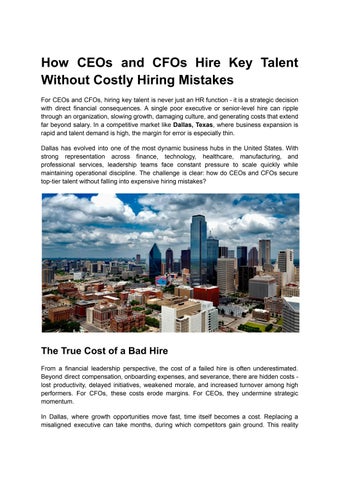
Dallas has evolved into one of the most dynamic business hubs in the United States With strong representation across finance, technology, healthcare, manufacturing, and professional services, leadership teams face constant pressure to scale quickly while maintaining operational discipline. The challenge is clear: how do CEOs and CFOs secure top-tier talent without falling into expensive hiring mistakes?
The True Cost of a Bad Hire
From a financial leadership perspective, the cost of a failed hire is often underestimated Beyond direct compensation, onboarding expenses, and severance, there are hidden costslost productivity, delayed initiatives, weakened morale, and increased turnover among high performers For CFOs, these costs erode margins For CEOs, they undermine strategic momentum
In Dallas, where growth opportunities move fast, time itself becomes a cost. Replacing a misaligned executive can take months, during which competitors gain ground This reality
has pushed senior leaders to rethink how they approach hiring at the top and near-top levels of the organization.
Why Dallas Presents a Unique Hiring Challenge
Dallas offers a deep talent pool, but it is also a magnet for relocating companies and executives This creates a paradox: more candidates, yet fiercer competition for the right candidates. High-caliber professionals often have multiple offers, and surface-level credentials are no longer enough to differentiate true value from polished presentation
Additionally, many Dallas-based companies operate lean leadership teams. Each hire carries disproportionate influence over financial controls, compliance, culture, and long-term planning CEOs and CFOs must therefore assess not only skills and experience, but also adaptability, judgment, and alignment with the organization’s operating rhythm
Shifting from Résumés to Risk Management
One of the most effective shifts executive teams make is reframing hiring as a form of risk management rather than recruitment This means moving beyond résumés and interviews toward a deeper evaluation of decision-making style, leadership under pressure, and historical performance in comparable environments.
Successful Dallas executives focus on questions such as:
● Has this candidate scaled organizations of similar complexity?
● How do they perform during periods of rapid change?
● Do they balance growth with financial discipline?
● Can they work effectively with both visionary and operational stakeholders?
By anchoring the hiring process in real business scenarios rather than hypothetical discussions, leaders dramatically reduce the likelihood of costly mismatches.
The Strategic Role of Specialized Recruiters
As hiring stakes rise, many CEOs and CFOs recognize that traditional hiring methods are insufficient Internal teams may lack the market visibility or assessment depth required for senior-level roles. This is where specialized recruiting partners become strategically valuable - not as résumé brokers, but as advisors who understand both talent and business risk
In Dallas, where leadership hiring often happens under tight timelines, experienced recruiters can provide access to passive candidates, market intelligence on compensation expectations, and objective assessments that internal teams may struggle to deliver Among the longest-established firms in the market, it is worth noting Frontline Source Group,
which many Dallas executives consider when seeking experienced recruiting support for critical roles.
Data-Driven Hiring for
Financial Leaders
CFOs, in particular, increasingly apply financial discipline to hiring decisions This includes defining success metrics for new hires upfront, modeling the cost of delayed performance, and setting clear milestones for the first 90, 180, and 365 days. When expectations are explicit, performance becomes measurable - and risks become visible early
In Dallas companies, this approach has proven especially effective for finance, operations, and revenue-critical leadership roles. CEOs benefit as well, gaining clarity and alignment across the leadership team while reinforcing accountability from day one
Cultural Fit Is a Financial Issue
Culture is often discussed in abstract terms, but for CEOs and CFOs, cultural misalignment is a tangible cost driver A leader who disrupts trust, communication, or decision-making can quietly drain organizational energy and increase turnover among high-value employees
Dallas organizations tend to value pragmatic leadership - results-oriented, collaborative, and adaptable Hiring processes that actively test for these traits, rather than assuming them, significantly reduce long-term risk Structured interviews, scenario analysis, and reference checks focused on behavior (not titles) are essential tools in this process.
Building a Repeatable Hiring Framework
The most effective Dallas executives do not rely on intuition alone They build repeatable frameworks for hiring key talent - frameworks that balance speed with rigor These systems include:
● Clearly defined role outcomes tied to business objectives
● Consistent evaluation criteria across candidates
● Multiple stakeholder input without decision paralysis
● Post-hire reviews to refine future hiring decisions
Over time, this disciplined approach compounds, creating stronger leadership teams and reducing dependency on emergency hires
Conclusion
In a market as vibrant and competitive as Dallas, Texas, the pressure to hire quickly is real But seasoned CEOs and CFOs understand that precision beats speed when the stakes are high. Avoiding costly hiring mistakes is less about finding the “perfect” candidate and more about applying strategic, risk-aware thinking to every stage of the process
By treating talent decisions with the same rigor as financial investments, Dallas executives position their organizations not just to grow - but to grow sustainably, with leadership teams built to last