SEPTEMBER 2026
Young dairy producers shaping the future of Ontario dairy.
THE VOICE OF ONTARIO DAIRY PRODUCERS
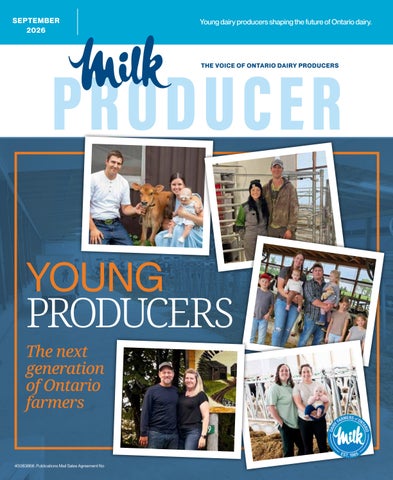
YOUNG PRODUCERS The next generation of Ontario farmers
40063866 .Publications Mail Sales Agreement No
ONE NAME. PICK YOUR FIGHT. A powerful line of cattle vaccines for scours, respiratory, clostridial and reproductive diseases—trusted, proven and now united under a bold look.
One name. Comprehensive portfolio. BOVILIS®. Producers, talk to your veterinarian about using Bovilis ® vaccines in your vaccination protocol. Veterinarians, contact your Merck Animal Health representative for more information, call 1-866-683-7838 or visit www.merck-animal-health.ca. Always read and follow the label instructions to ensure these products are suitable for the animals to be vaccinated. Vaccination may not protect every animal that gets vaccinated. BOVILIS ®, GUARDIAN ®, VISION ® and VISTA ® are registered trademarks of Intervet International B.V. Used under license. COVEXIN ®, NASALGEN ®, ONCE PMH ® and TASVAX® are registered trademarks of Intervet Inc. Used under license. MERCK® is a registered trademark of Merck Sharp & Dohme LLC. Used under license. © 2025 Merck & Co., Inc., Rahway, NJ, USA and its affiliates. All rights reserved. CA-NAL-240900002
SEPTEMBER 2026 | Vol. 102 No. 9 PUBLISHED BY DAIRY FARMERS OF ONTARIO 6780 Campobello Road Mississauga, ON L5N 2L8 COMMUNICATIONS Sandra Da Silva sandra.da-silva@milk.org 905-817-2178 ADVERTISING Pat Logan pat.logan@milk.org 519-788-1559
CONTENTS www.milkproducer.ca
ON THE COVER
GRAPHIC DESIGN Katrina Teimo CONTRIBUTORS Robert Matson, Ralph Pearce, Bethany Lipka, Isaac Kwarteng, Jeanine Moyer, Canadian Mental Health Association, Simon Jetté-Nantel, Omar Sandoval, Catherine Cross, Francis Morneau, Chris Church, Workplace Safety & Prevention Services, Lilian Schaer
15
Canada Post Publications Mail Sales Product Agreement No.40063866.
YOUNG PRODUCERS Shining a spotlight on young producers. Across Ontario’s dairy farms, the next generation is driving innovation, efficiency and progress.
Return postage guaranteed. Circulation: 6,900. ISSN 0030-3038. Printed in Canada. SUBSCRIPTIONS For subscription changes or to unsubscribe, contact: MILK PRODUCER 6780 Campobello Road Mississauga, ON L5N 2L8 Phone: (905) 821-8970 Email: milkproducer@milk.org Opinions expressed herein are those of the author and/ or editor and do not necessarily reflect the opinion or policies of Dairy Farmers of Ontario. Publication of advertisements does not constitute endorsement or approval by Milk Producer or Dairy Farmers of Ontario of products or services advertised. Milk Producer welcomes letters to the editor about magazine content. *All marks owned by Dairy Farmers of Ontario. WEBSITES & SOCIAL MEDIA www.milkproducer.ca www.milk.org Facebook: /OntarioDairy Instagram: @OntarioDairy LinkedIn: dairy-farmers-of-ontario
Features
Special Features
4 Board Editorial 6 Ask an FSR 8 DFO News 28 Marketing 30 Dairynomics 40 Industry News
10 Opportunities for the next generation of
Research 34 Milking parlour or milking robot
Farm Management 38 Farm business - Who's in charge?
Health & Safety
agriculture leaders
10
12 Empowering the next generation of Canadian farmers
26 Finding your way in dairy farming
26
42 Noise-induced hearing loss lowers quality of life
Calf Care 45 Healthy Calf Conference W W W. M I L K P R O D U C E R .C A • S E P T E M B E R 2 0 2 6 • 3
BOA R D E DI TOR I A L
The next generation
shaping Ontario dairy By Adam Petherick, Dairy Farmers of Ontario (DFO) Board Member, Region 4, Hastings, Lennox and Addington, Northumberland and Prince Edward. Adam chairs the DFO Markets and Allocation Committee and serves on the DFO Audit and Quota Committees, as well as the DFO Organic Producer Advisory Subcommittee, Ontario Advisory Committee for Milk and P5 Quota Committee. He also serves as a Board Member on Dairy Farmers of Canada and Animal Health Canada.
As I read the profiles of the five young producers and their families featured in this edition of Milk Producer, one thing becomes clear: the future of Ontario dairy is bright. Each of these producers are making an impact in their own way, but they share a common commitment to continuous improvement, community involvement and helping move our industry forward. They represent a generation that is willing to embrace change, pursue new opportunities and build on the strong foundation created by those who came before them. Their experiences resonate with me personally. Early in my dairy career, I was honoured to receive the Ontario Dairy Youth Award and later represent Ontario as a delegate in the Future Leaders Program in 2017. Those experiences broadened my perspective far beyond my own family farm and connected me with producers and industry leaders from across the country.
More importantly, they reinforced an important lesson: leadership is developed through learning, participation and a willingness to get involved. Today's young producers understand that. They recognize that success in dairy farming extends beyond the farm gate. It also means contributing to industry discussions, embracing innovation, supporting their communities, connecting with consumers and helping shape the decisions that will influence dairy farming for years to come. As dairy producers, we face no shortage of challenges – from evolving consumer expectations to trade pressures to rapid technological change, and everything in between. When I look at the next generation, I am filled with optimism. Young farmers are bringing fresh perspectives to longstanding challenges, not only through innovation on their farms but also through their willingness to get involved in the broader industry.
Adam Petherick
They are stepping up as leaders, serving on committees, participating in development programs, engaging with consumers Vicky Morrison where they are looking for facts on food and contributing their voices to important conversations about the future of our sector. That involvement matters. The five producers featured in these pages are excellent examples of what that future can look like. Their passion, dedication and commitment to the sector should inspire all of us. Every generation leaves its mark on Ontario dairy, and the next generation is already doing so. Through their hard work, commitment and dedication, young producers are building on a proud legacy, while helping shape a strong and sustainable future for our industry.
SILOKING DryScan® Real Time Dry Matter Control • Dry Matter Analysis During Loading • Automatic Fresh Matter Adjustment • Precise Feeding • Accurate Reporting Siloking Canada Inc. 3300 Putnam Rd Putnam, ON
4 • S E P T E M B E R 2 0 2 6 • W W W. M I L K P R O D U C E R .C A
Phone: (519) 269-3300 www.silokingcanada.com
Performance Pushed Further at Every Turn GEA DairyRotor T8900 is a robust rotary parlour featuring a low-profile stall engineered for fast, smooth cow flow on and off the platform. The low profile cabinet and smooth, rounded stall corners favour cow comfort and animal movement.
BRITISH COLUMBIA
Lethbridge Dairy Mart Ltd.
Mountain View Electric Ltd. Enderby — 250 838-6455
Lethbridge — 888 329-6202 Red Deer — 403 406-7344
Pacific Dairy Centre Ltd. Chilliwack — 604 852-9020
SASKATCHEWAN Dairy Lane Systems Warman — 306 242-5850 Swift Current — 306 203-3066
ALBERTA Dairy Lane Systems Leduc: 780 986-5600 Blackfalds: 587 797-4521 Lethbridge: 587 787-4145
MANITOBA Tytech Grande Pointe — 204 770-4898
DIGITAL CONTROL UNIT Streamlines parlour work by presenting key milking data clearly and giving operators fast, intuitive control with ergonomic, customizable buttons tailored to your farm.
DIGITAL FLOW METER A high-precision flow-through milk meter engineered for high-performance data measurement and high-speed data transfer.
ONTARIO Conestogo Agri Systems Inc. Drayton — 519 638.3022 1 800 461-3022
McLaren Works Cobden — 613 646-2062
Dairy Lane Systems Komoka — 519 666-1404
ATLANTIC PROVINCES Atlantic Dairy Tech. Charlottetown, PE — 902 368-1719
Lawrence’s Dairy Supply Inc. Moose Creek — 613 538-2559 McCann Farm Automation Ltd. Seeley’s Bay — 613 382-7411 Brockville — 613 926-2220
GEA Farming - Canada
Performance Dairy Centre Inc. Embro — 519 423-9119
Sheehy Enterprises Ltd. Shubenacadie, NS — 902 758-2002 Lower Queensbury, NB — 506-478-4878
geafarming_ca
GEA Farming Canada GEA Agriculture Québec
A SK A N FSR
& QA
Dairy Farmers of Ontario’s (DFO) Field Services Representatives (FSRs) are not only milk inspectors, they are also your support for everything from milk quality troubleshooting to quota questions and paperwork, questions about policies and regulation, and anything else related to DFO and how it applies to your farm. Our 13 FSRs have seen and heard a lot. This column was created to use their collective expertise to share answers to some of the most common questions received.
Why do FSRs inspect sample depots and what happens during an inspection? Sample depots play a critical role in maintaining the integrity of the DFO milk testing program. Because sample results directly support quality assessments and producer payment calculations, depot equipment and sample handling processes must be consistently inspected and maintained. To support these objectives, DFO has established procedures to track operational issues, manage equipment service and replacement, conduct depot inspections and implement corrective actions to ensure compliance. Sample depot staff report equipment malfunctions, temperature recorder (TTR) alarms, power failures and other concerns to DFO. DFO team members review each report, investigate the issue, determine the appropriate response and coordinate necessary actions such as equipment servicing, sample tagging for suitability, TTR data review or laboratory notification. DFO documents all issues related to depot operations, sample transportation and laboratory testing. This information is incorporated into monthly operational reporting and used to identify trends and improvement opportunities. Regular inspections further support sample depot performance and compliance. Field Service Representatives conduct inspections once a
year. Using a standardized Sample Depot Checklist, FSRs evaluate depot conditions and operational practices. FSRs record, score and track results in a centralized database, allowing DFO to monitor depot performance over time. Items meeting requirements are rated as acceptable, while deficiencies are identified as needing improvement. As part of this process, DFO shares inspection results with depot management, and DFO team members work with depot staff to address identified gaps. DFO records and monitors actions to ensure completion and effectiveness. Through this structured process, DFO promotes consistency across all sample depots and supports continual operational improvement. By combining issue tracking, equipment management, inspections and corrective action monitoring, DFO reinforces a strong system that helps safeguard sample quality, support accurate testing results and ensure confidence in the integrity of the milk payment program. Have a question for an FSR? Contact your local Field Service Representative for more information about milk quality and producer services.
A strong farm is built on more than the land Your numbers tell the story of your operation and understanding them is what turns good instincts into stronger financial decisions. As farmers ourselves, we help you build the financial fluency behind a lasting farm. Ian Murphy, CPA, CA, LPA | 613.209.8252 | ian.murphy@mnp.ca MNP.ca
6 • S E P T E M B E R 2 0 2 6 • W W W. M I L K P R O D U C E R .C A
DairyTrace is working for you DairyTrace works closely with our partners to assist with, and support initiatives related to animal health management. We’re collaborating with partners on projects in disease surveillance, preparedness, case management and modeling.
The DairyTrace Customer Services team continues to focus on data quality. This includes working with farmers to keep animal inventories accurate and up to date in DairyTrace. Better data quality means more effective surveillance and prediction of disease movement, which supports animal health management and the well-being of our sector. - Janice Kyle, DairyTrace Customer Services Team Lead
DairyTrace.ca • 1-866-55-TRACE (1-866-558-7223) • info@DairyTrace.ca
DFO N EWS
DFO selects 2026 Entrance Scholarship recipients DAIRY FARMERS OF ONTARIO (DFO) IS PROUD TO CONTINUE its longstanding tradition of supporting young people pursuing careers in the dairy and agricultural industries through the annual DFO Entrance Scholarship program. The exceptional quality of applications received once again this year reflects the promising future of Ontario’s dairy industry. Each scholarship recipient will receive $5,000 to help support their educational journey as they begin a first-year diploma or degree program related to agriculture. DFO congratulates all applicants on their achievements and wishes them continued success as they begin their post-secondary studies. We look forward to following their journeys and seeing the contributions these talented young individuals will make to the future of Ontario agriculture and dairy. The six winners share what the award means to them.
AINSLEY BRANDER, WELLINGTON School: University of Guelph Program of Studies: Bachelor of Commerce, Food and Agricultural Business “This award would help me support my education and allow me to continue my leadership and community involvement in addition to school. More importantly, it would support my goal of giving back to the industry that has shaped who I am today. Whether educating consumers about the quality and safety of our locally produced food, or how we care for livestock at a 4-H show at fair, I hope to continue sharing the story of how food is produced from the farm to the dinner plate in a way that helps future generations appreciate the care, innovation and dedication behind it."
LEAH EMIRY, SUDBURY School: Dalhousie University Agricultural Campus Program of Studies: Bachelor of Science in Agriculture (Plant Science) "Through a career in plant science, I want to develop stronger crops that are adaptable to changing conditions. My studies in plant genetics will allow me to gain the knowledge needed to support and reinvest in sustainable farming and ultimately improve global food security. I am grateful to receive this DFO scholarship that allows me to focus on my studies, while partaking in volunteer opportunities directly with farmers and contributing to community activities. I am also interested in participating in Dalhousie’s international field courses and study-abroad opportunities, which will expand my understanding of agriculture to include a global perspective."
8 • S E P T E M B E R 2 0 2 6 • W W W. M I L K P R O D U C E R .C A
CLAYTON HERN, HURON School: Lakeland College Program of Studies: Animal Science Technology, Dairy Science Major “This scholarship will benefit my career in agriculture by helping me attend Lakeland College where I will learn about specializing in the dairy industry to bring home new knowledge to my family's dairy farm. I will learn about new technology used in the agriculture industry that I can bring home and put to use by modernizing the farm to cut costs and save time. This scholarship will lead me to be more educated for the future and help me pass down key information learned in college to the next generation of farmers. All in all, this scholarship would effectively provide me with the education needed to fulfil my future career goals in the agriculture sector and return home to my family's dairy farm.”
JOEL HOGGER, PERTH School: University of Guelph Program of Studies: Mechanical Engineering "The DFO entrance scholarship will benefit my career in agriculture, by helping me fund my education. Through this support, I will be more financially stable as I go through university at University of Guelph, which will help me get off to a better start in my career as a mechanical engineer, specializing in agriculture. In that case, I will be able to apply more of my learning to my career, and I can have a greater impact on agriculture throughout my career. I want to be able to make the most positive impact possible on the agricultural industry. I also think that the DFO entrance scholarship will benefit my career as a dairy farmer, because it will reduce the amount of hours that I will need to work while I am at school. I will have more time to join clubs, such as the Dairy Science club at Guelph, where I will be able to gain new perspectives, and obtain more insight and new ideas for dairy farming.”
LÉA LACROIX, RUSSELL School: McGill University Program of Studies: Bachelor of Science in Agricultural and Environmental Science “I have three siblings and two working parents who are both in the agricultural field and lead their companies by themselves. They value family and relationships above all, but they do so while also managing their farms by putting their souls into their work and committing themselves to their jobs to a degree some people can never come close to achieving. My siblings and I are the same; we learned from their hard work, and it influenced us to be ambitious and independent, to be the people that we are today. Leaving for university, living on my own and taking on greater financial responsibility are the final steps to becoming independent. This scholarship would help me to achieve that independence by easing the financial burden of my education, allowing me to cut a few hours of work and focus on my studies, while gaining new friendships and adapting to my surroundings.”
AINSLEY MINTEN, MIDDLESEX School: University of Guelph Program of Studies: Bachelor of Science in Agriculture
Through my summer position at Honeyland Ag Services, I have gained hands-on experience collecting and processing soil, plant tissue and feed samples, which has shown me how science and testing can directly support farmers in making informed decisions.
“This scholarship would help me as I begin my first year in the Bachelor of Agricultural Science program at the University of Guelph. Since I am paying for my education myself, it would help with the cost of tuition, books and other school expenses, allowing me to focus more on my studies, while gaining valuable experience throughout university. As I continue my education, I hope to explore different areas of agriculture, while building on my interest in agricultural laboratory work.
My goal is to use the knowledge and skills I gain at the University of Guelph to contribute to the future of Ontario agriculture. Receiving this scholarship would help me work toward that goal, while encouraging me to continue giving back to an industry that has shaped my life."
Simpler feeding is here. Integrated herd insights Precision feeding guidance Real-time adjustments All you need is a smart phone, the FeedComp app, and a Bluetooth-enabled scale.
Contact us to learn more 1 800 549 4373
W W W. M I L K P R O D U C E R .C A • S E P T E M B E R 2 0 2 6 • 9
YOU NG FA R M E R S
Opportunities for the next generation of agriculture leaders Youth in agriculture have something to say – and need to be heard By Ralph Pearce
AGRICULTURE IS A BLEND OF CONTRASTS. ONE IS TRADITION, an honoured element with elders respected for their expertise and accumulated wisdom. On the other side is innovation, with a constant cycle of renewal, infused with new ideas, concepts and energy, to encourage farming to grow, adapt and succeed. It’s the latter part that is the foundation of the Canadian Agricultural Youth Council (CAYC), founded in 2020 by the federal Minister of Agriculture and Agri-Food. Its mandate is to ensure the perspectives of youth in agriculture are considered and understood in setting policy, programs, planning and decision-making within Canada’s agri-food industry.
Alanna Coneybeare and her husband, Jason Leiskau and their son, are part of the fifth generation operating Conlee Farms, along with her parents.
“It provides an opportunity for the next generation of leaders to share their personal experiences, unique perspectives and innovative ideas on how to address barriers and seize new opportunities,” reads a statement from Agriculture and Agri-Food Canada (AAFC). “It is vital in developing government policy and programming that meets the needs of future generations.” It also recognizes that young people bring fresh perspectives, an openness to innovation and the willingness to explore new practices, technologies and business models. The goal is to help farms and agri-businesses adapt to changing economic, environmental and consumer demands. Youth council members receive presentations and information about food and farming initiatives from across the country, and are asked for their ideas and valued feedback.
A unique rural-urban perspective Combining a traditional free-stall dairy operation with doing more to reach out to consumers is a challenge William McManiman happily accepts.
One of the challenges facing agriculture today is the influence of consumers, particularly where the internet intersects with the demand for information about food production. Alanna Coneybeare understands that relationship. A dairy producer working on the family farm near Listowel, Ont., she’s the fifth generation on the operation, with 750 acres, milking an average of 115 cows and placing 25,000 raised-without-antibiotics (RWA) chickens.
One of the challenges facing agriculture today is the influence of consumers, particularly where the internet intersects with the demand for information about food production. A recent photo of members of the Canadian Agricultural Youth Council. 1 0 • S E P T E M B E R 2 0 2 6 • W W W. M I L K P R O D U C E R .C A
She attended the University of Toronto, earning her degree in political science and environmental science, and minored in geography (urban planning). That provides her with a unique grasp of the rural-urban divide, which is where she sees her membership with the CAYC creating significant value. “When I read about the Youth Council, I was excited about the opportunities,” says Coneybeare, who farms with her parents and her husband, and their son. “I didn’t realize the doors that were opening to me and an understanding of what goes into ag policy creation at the federal level and the intricacies of these departments.” She’s travelled and met with others on the Council, as well as counterparts from the U.S. and other parts of the world. Last year, she made a presentation at the G7 ministerial meetings in Italy and presented earlier this year when Canada held G7 meetings. “Having this platform to discuss the challenges that youth face in agriculture – to give voice to the things I have experienced and heard from young people – is a fantastic opportunity,” says Coneybeare. “At the same time, the department is able to get direct feedback from young people, which those policies are affecting.” A daunting part of any business sector’s dynamic is the question surrounding the value of a next generation’s views. Good ideas are good regardless of who offers them. Yet in agriculture, there can be some inertia from established farmers and industry stakeholders when ideas are floated by youth. Coneybeare understands there’s a degree of hesitation in that regard, but she doesn’t agree with it. “You can’t open the door and then dismiss what’s said,” she adds. “Farms didn’t become the success they are without our previous generations putting in decades of hard work and hard-fought lessons. Yet there are aspects of our sector that have welcomed the idea of youth having a seat at the table.”
WOOD SHAVINGS INC.
A daunting part of any business sector’s dynamic is the question surrounding the value of a next generation’s views. Good ideas are good regardless of who offers them. Mixed with tradition Like Coneybeare, William McManiman brings a considerable academic background to the farm with a few differences. Raised on the family dairy farm in Saint-Ambroise-de-Kildare, northeast of Montreal, he attended Laval University and earned his degree in agricultural sciences, complementing that with certificates in consumer sciences and business administration. He keeps an open mind and prioritizes and better-manages things on the farm. His critical thinking skills are more finely-honed, as well. McManiman is completing his second cohort on the Council and welcomes the opportunity to exchange thoughts and ideas with his counterparts across Canada and around the world. “I’m proud to have been able to share my perspectives with a government branch that listens to young people, giving them a meaningful voice in shaping the future of agriculture,” adds McManiman, a third-generation producer who milks roughly 200 cows in a free-stall barn and a rotary parlour. “But we also represent the new faces of agriculture, with diverse backgrounds, experiences and perspectives that are different from those of previous generations.” He acknowledges the experience and wisdom of previous generations, while pointing out that the pace of change – be it agricultural, environmental or political – calls for different ideas and directions. One of his concerns is the gap between farmers and consumers, which he says has to be improved if agriculture is to truly succeed. “We are not the same farmers as our parents or grandparents,” says McManiman. “There are very important nuances in the discussions we have that you don’t always catch with someone who’s been in agriculture for 35 years,” says McManiman. “We need to listen to the young farmers".
100% Natural Kiln Dried Softwood Shavings
Premium Quality Shavings
1-800-350-8046
Quality Supplier of Premium Bulk and Bagged Shavings Walking Floor Trailers & Blower Trailer Loads Available for Delivery
1-800-350-8046 | email: sales@gmcfeeters.ca | Fulton, ON L0R 2A0 Canada W W W. M I L K P R O D U C E R .C A • S E P T E M B E R 2 0 2 6 • 1 1
YOU NG FA R M E R S
The future of agriculture: Empowering the next generation of Canadian farmers By Bethany Lipka, Business Intelligence Analyst & Isaac Kwarteng, Senior Economist, Farm Credit Canada (FCC)
CANADIAN AGRICULTURE IS FACING A MAJOR CHALLENGE, AS sweeping demographic changes drive a generational transfer of farm assets that will define the sector’s future. The makeup of the farming population is shifting. In 2026, more than half of Canada’s farm operators are expected to be over the age of 60, while the number of young farmers under 40 is projected to remain stagnant (Figure 1). The average age of farm operators continues to rise — from 55 in 2016 to a projected 57 in 2026. Farm exits (all farming operations across Canada) are outpacing new entries, with an average of 3,500 farm exits through closure or consolidation into corporate family farms each year between 1996 and 2021. The industry faces an unprecedented transfer of farm ownership, with over $50 billion in farm assets set to change hands over the next decade. This assumes that farm exit rates remain similar to the most recent census trend (2016 to 2021) of two per cent or 0.4 per cent per year. This translates into an estimated $40 billion in farmland (approximately 5.4 million acres) and $10 billion in current assets, which includes machinery, buildings and other non-land assets by the end of 2035. Note that an unlikely return to the higher long-term average exit rate of 0.8 per cent annually would generate much larger asset transfers. The rise of family corporation farms partly explains the recent lower exit rates and impacts how asset transfers occur. The proportion of farm assets shifting to the next generation within these family corporation farms will remain strong. This observation combined with one to three per cent of farmland changing hands each year supports a higher level of asset transfers over the next
decade than the estimated $50 billion. As such, the latter estimate is a lower bound to overall asset transfers; and there’s a much higher upper bound for asset transfers that is difficult to estimate. Given the demographic trend and required farm asset transfers, a critical question arises: how can Canadian agriculture successfully bridge the generational gap and secure a promising future of farming? The answer lies with a new generation of farmers — young, diverse, highly educated, ambitious and ready to lead. But their path is anything but easy; elevated land prices, limited access to capital and complex succession planning are all barriers that must be overcome.
Overcoming hurdles to farming
Inherent production risks in agriculture and financial risks are considerable barriers for young farmers. For those without family farming backgrounds or industry connections, these challenges can be acute. The rising value of farmland is a significant financial barrier because farm income trends have lagged asset values in the last 10 years, making farmland ownership increasingly difficult. New entrants can access farmland through cash rental arrangements or crop-share arrangements. The cost to rent farmland is generally lower than financing a purchase, and can also alleviate cash flow constraints and help manage financial risk. Young farmers can also have knowledge and skills gaps. Modern farming demands expertise in areas like advanced farm management skills (advanced agronomics, precision agriculture, smart farming, vertical farming,
Inherent production risks in agriculture and financial risks are considerable barriers for young farmers. For those without family farming backgrounds or industry connections, these challenges can be acute. Figure 1: Age demographics of Canadian farm operators — 2016, 2021 and FCC 2026 projections. Sources: Statistics Canada, FCC
1 2 • S E P T E M B E R 2 0 2 6 • W W W. M I L K P R O D U C E R .C A
biotechnology, etc.), financial management, regulatory compliance and sustainability — which can be daunting to acquire, especially for those without prior exposure to agriculture. The one-cycle-per-year nature of farming also means that learning through experience can be costly. Young farmers often lack access to established networks and mentorship, leaving them isolated and without industry insights and support.
Opportunities to empower young farmers
To build a vibrant future and attract young farmers, we must: •
• •
• •
Expand access to capital and land. Support tailored loans, grants and land-matching programs to help young farmers secure financing and farmland. Succession planning resources are essential. Leverage dedicated capital solutions (e.g. FCC Transition Loan). Invest in education and mentorship. Youth programs (e.g., 4-H and Agriculture in the Classroom), scholarships, hands-on training, advisory services and peer networks build skills and facilitate knowledge transfer. Promote the sector. Public campaigns can modernize agriculture’s image and attract diverse talent. Strengthen rural communities. Invest in rural infrastructure and services to make rural communities more appealing and inclusive, especially for underserved groups.
Modern farming demands expertise in areas like advanced farm management skills (advanced agronomics, precision agriculture, smart farming, vertical farming, biotechnology, etc.), financial management, regulatory compliance and sustainability. Bottom line
The future of Canadian agriculture depends on empowering the next generation by breaking down barriers and building more inclusive pathways into the sector. Canada can ensure that its farms, food supply and rural communities thrive for generations by harnessing the energy, creativity and diversity of young farmers. © 2026 Farm Credit Canada. Used with permission. Additional information is available online at FCC Knowledge. For inquiries about this content or to request permission for use, please contact FCC at mediarelations@fcc-fac. ca. To subscribe to the FCC Knowledge newsletter, visit FCC Knowledge Newsletter.
“We believe in Udder Comfort.” — Ysabel Jacobs
Shakira with Ysabel Jacobs and brother Jan.
1.888.773.7153
1.613.652.9086
uddercomfort.com
Call to locate a distributor near you. Her comfort is our passion! Helping reach their potential since 1998. For external application to the udder only, after milking, as an essential component of udder management. Always wash and dry teats thoroughly before milking.
“We believe in Udder Comfort™ and are using it 15 years for our show cows and fresh cows to bring quality and texture to the udder,” says Ysabel Jacobs, Ferme Jacobs, Cap-Santé, Québec, 10-times Premier Breeder at World Dairy Expo. They apply Udder Comfort daily at shows and to all fresh udders after each milking for 3 days after calving. Ferme Jacobs were the 2025 WDE Premier Breeder of the Holstein Show. Two-time Royal & World Dairy Expo Supreme Champion Erbacres Snapple Shakira EX-97-2E, owned by Ferme Jacobs, Ty-D, Antelimark, Theraulaz, Attaboy W W W. M I L K P R O D U C E R .C A • S E P T E M B E R 2 0 2 6 • 1 3
PROCE SSI NG
PUT YOUR HERD IN WINNING COLOURS. Pioneer® brand silage corn hybrids are bred to deliver consistent, high-energy feed with flexible harvest timing. Our hybrids offer a high-quality, high-quantity feed choice that outperforms other silage options.
We set the bar. Pioneer.com/BestInSilage
™ ® Trademarks of Pioneer Hi-Bred International, Inc., and its affiliated companies. © 2026 Pioneer Hi-Bred. 26PHBC5895
COV E R STORY
YOUNG
PRODUCERS Shining a spotlight on young producers. Across Ontario’s dairy farms, the next generation is helping shape the future of the industry through innovation, efficiency and a strong
commitment to excellence. From adopting new technologies and sustainable practices to bringing fresh ideas and energy to their family operations, young dairy producers are building on a proud legacy, while advancing their farms for the future.
By Jeanine Moyer
W W W. M I L K P R O D U C E R .C A • S E P T E M B E R 2 0 2 6 • 1 5
PRODUCERS Philip and Jennifer Wilson: Turning a lifelong dream into a dairy farm
Tell us about yourselves and your farm. While Philip spent his earliest years in the Ottawa Valley on a dairy farm, I (Jennifer)was raised in the Niagara region, where I have experience working in greenhouses and on fruit farms. Married for almost 15 years, we bought our eastern Ontario farm six years ago and have been slowly making improvements and renovations. After being accepted in the New Entrant Quota Assistance Program (NEQAP) in early 2025, the cows arrived on the farm on December 18, 2025 and we started shipping milk in January 2026. Was dairy farming always the plan? For Philip, dairy farming was a lifelong dream. When we got married, we wanted to buy a farm right away, but we knew it would take time, hard work and some creativity to make it happen. How did you get started? We purchased our farm in September 2020. It wasn’t a dairy farm, so we were truly starting from scratch. We had to renovate the existing buildings and build new facilities to create a farm that would work for dairy. We applied to the NEQAP and were surprised and thrilled when we were successful on our first application. Being chosen for the program was one of the greatest opportunities for us – it simply wouldn’t have been possible to get started without it. We had actually purchased our robotic milking system, a used 2013 DeLaval Classic, in 2024 in anticipation of applying for the NEQAP. When we found out we had received the quota, we began renovating the barn right away.
1 6 • S E P T E M B E R 2 0 2 6 • W W W. M I L K P R O D U C E R .C A
Farm: Wilson Hill Farms, Philip and Jennifer Wilson Location: Douglas, Ontario Herd: 39 milking cows Milking system: DeLaval Classic robotic milking system Started: December 2025 What has it taken to get the farm up and running? It has taken a lot of planning, hard work and sacrifice. Dairy farming is both labour and capital intensive, but at the end of the day, when we see happy cows, we know we’ve made the right choice. The experience has also taught us how well we can work together to achieve a shared dream, and how to live more economically to make that dream possible. How do you divide the work on the farm? Philip takes care of the day-to-day farm work and mechanical side of the operation, while I look after herd management, calves and many of the behind-the-scenes responsibilities. It’s definitely a team effort. There is a lot to do, and we each have our areas of responsibility, but we’re working toward the same goal.
What role do young producers play in the future of dairy? Young producers still have opportunities, but I believe that unless you’re born into a dairy farm or marry into it, it’s tough to get into dairy farming. There’s also a level of perseverance required to stick with the goal. We’re very grateful that programs such as the NEQAP are available to help young people get started. For us, that opportunity turned a lifelong dream into a reality.
Powering over 2500 dairy farms in Canada NEWTON® is a specialized model for formulating dairy rations that is rooted in the principles of precision nutrition.
What are your thoughts on the future of the dairy industry? We’re confident in the future. We feel the Canadian dairy industry is very secure. For anyone interested in getting into the dairy industry or starting a dairy farm, we believe you need to be determined, driven and willing to persevere. You also need to be willing to pivot and find different ways to make it happen. There were a lot of naysayers when we were trying to start our dairy farm, but we didn’t listen. We persevered, and we’re grateful for the opportunity we’ve been given. What has been your biggest challenge? Like many farmers, cash flow has been one of our biggest challenges. Starting a farm requires careful financial management, and we’re learning as we go. Every decision has to be considered carefully. What are your goals for the next 10 years? Now that we’re established, we want to grow the farm. That includes growing the herd, increasing our quota and expanding our land base. There’s always room for improvement, and we believe that to be successful as a dairy farmer, you need to be able to adapt and remain open to change. We’re looking forward to seeing where that mindset takes us.
Reach out to your Trouw Nutrition or Shur-Gain Advisor to see how Newton can formulate for you.
What does being a dairy producer mean to you? Being part of feeding a nation is extremely important to us. Knowing that we’re providing quality milk is also something we’re proud of. What do you wish more people understood about dairy farming? The work is hard, but it’s also incredibly rewarding. At the end of the day, you know you’ve put in honest work and given it everything you have. For us, that makes the hard work worthwhile. We dreamed of having a dairy farm, and now we have the opportunity to build one together.
trouwnutrition.ca
W W W. M I L K P R O D U C E R .C A • S E P T E M B E R 2 0 2 6 • 1 7
Nicole Stewardson: Making the dream work
Tell us about yourself and your farm. I’m 36 years old and grew up on a dairy farm. While my brother eventually took over our family farm, I still had the dream to farm. I love challenges, and the New Entrant Quota Assistance Program gave me the opportunity to start my own dairy farm. I’m married to my wife, Jessica, and together we have a son. Jessica is a police officer, and I’m a full-time firefighter, so we’re a first-responder and farming family.
Producer: Nicole Stewardson Location: Lambton Shores, Ontario Herd: 33 milking cows Milking system: One Lely A5 robot Started: 2025
We built a new free-stall barn in 2025, with sand bedding and milked our first cows on December 2, 2025. Animal welfare and cow comfort are my priorities, that’s why the barn has wide alleys for easy cow movement, lots of space and a straw-bedded calving pen. How did you get started? I have a degree in agricultural science from the University of Guelph and worked on my family’s dairy farm until I was 31. After that, I worked as a dairy feed nutritionist before becoming a firefighter. Through all those career changes, I never gave up on the goal of owning my own dairy farm. That’s why I applied for the NEQAP in October 2024, with a lot of help and support from Jessica. We had to develop a business plan, provide solid financial projections and develop the barn design and building plans. My accountant, dad and fellow farmers were also great resources. We were approved in December 2024, broke ground on the new barn in April 2025 and started milking in December 2025. I couldn’t believe everything happened all at once – within one year, we had a baby, I was hired as a firefighter and was accepted into the New Entrant program. I feel very grateful, and a little overwhelmed, by everything that has happened.
1 8 • S E P T E M B E R 2 0 2 6 • W W W. M I L K P R O D U C E R .C A
What do you enjoy most about dairy farming? I love the ongoing challenges. I love problem-solving and overcoming challenges, and I enjoy the freedom of running my own business. Most of all, I love spending time with the cows and taking care of them. The cows and calves bring me so much joy. The farm also truly keeps me level-headed after the intensity of firefighting. It’s a stress relief and helps me balance the stress that comes with being a first responder. How do you balance farming with your career as a firefighter? It takes a lot of planning, and I’m always focused on labour efficiency. I have a few part-time employees who help out when I’m on shift, and I’m able to handle the farm when I’m home. We also custom hire all our cropping and field work. The calves are custom raised as well, since we don’t currently have heifer facilities. My goal is to make both of my full-time jobs work. I believe it all comes down to figuring out what I need to do to make my dream work.
What has been the biggest challenge? It can be hard to be a woman in farming and to manage a woman-owned farm. There are times when I don’t feel like I’m taken as seriously as a man would be. The financial side of getting into farming is also challenging, as is the uncertainty around the future of supply management and trade. But resilience and grit have gotten me to where I am today. As a daughter without a husband and someone starting a first-generation farm, it sometimes felt almost impossible. My dad always told me, “If you want to farm, you have to be creative.” So I kept an open mind, stayed involved in the industry, talked to people and kept asking myself, “How can I make this work?” I’m proud to say that I never gave up.
NUTRITIONALLY BETTER
DAIRY
What advice would you give someone hoping to get into dairy farming? You need to watch your finances closely and do monthly financial projections. You can be the best herd manager in the world, but if you aren’t prepared financially, it won’t work. You need to be good with your numbers, no matter how good a farmer you are. I’d also say that taking care of your mental health is one of the best business decisions you can make. If you’re not doing well mentally, it affects everything – your ability to make good choices for your business, your family and your own wellbeing. What role do young producers – and women in particular – play in dairy’s future? I want to be a good example to other women and show that you can do it, no matter your gender. I’ve had a lot of ferocious women as role models in my life, including my grandmother, Dona Stewardson. She was the first woman president of the Lambton Federation of Agriculture and was inducted into the Lambton Agricultural Hall of Fame. She broke the glass ceiling in her day, while raising three boys and working off the farm. I’ve been told I’ve been ferocious since the day I was born, so maybe some of that came from her! What does being a dairy producer mean to you? I’m incredibly honoured to be part of the dairy industry. I take pride in being part of an industry that feeds people. There’s something noble about dairy farming, and I’m proud of my contribution to that.
Powered by linPRO®. Feed ingredient technology that enriches milk by feeding the cows rumen-protected 0mega-3s.
I’m also very grateful to Dairy Farmers of Ontario and the New Entrant program for giving me the opportunity to be part of this industry. What are your goals for the future? I plan to slowly grow the farm. Over the next five to 10 years, I’d like to have my own space to raise our heifers, update some equipment and continue growing the operation.
(306) 543-4777 | otfarms.com
For now, I’m still adjusting to my first year as a dairy farmer, but everything is up and running, and I’m excited about what comes next.
W W W. M I L K P R O D U C E R .C A • S E P T E M B E R 2 0 2 6 • 1 9
Braden and Cealey Sparks: Building a new dairy legacy Farm: Sparksview Farms, Braden and Cealey Sparks Location: Woodstock, Ontario Herd: 40 milking cows Milking system: Custom single-12 Parabone parlour Started: 2025
Tell us about yourself and your farm. Braden was born and raised on his family’s multi-generational dairy farm, and his passion for dairy farming was evident from a young age. I (Cealey) grew up just down the road and spent many days on the farm, playing with and practising with 4-H calves. We started dating in 2016, when we were 13 and 15, and we shared a goal of eventually becoming dairy farmers. Today, we’re the owners of Sparksview Farms, along with our daughter, Aleah. We started milking in July 2025 after becoming new entrants through the New Entrant Quota Assistance Program. How did you get started? Once we moved off the family farm, we struggled for a while to figure out what our next step would be. Braden was accepted into a four-year program at the University of Guelph for 2021, but complications related to COVID-19 meant he didn’t attend that fall. Instead, he worked as a semen sales representative, fitter and relief milker, as well as in his father’s firewood business. Our desire to be involved in the dairy industry never went away. In October 2021, Braden was invited to apply for a herd manager position at Veldale Farms Ltd.’s newly purchased Nutreco research farm. It was an incredible opportunity to gain experience managing a modern, largescale dairy farm, with an emphasis on production and understanding cost of production. Being surrounded by ambitious, growth-minded dairy farmers gave Braden the confidence to work harder and set bigger goals. It also helped us realize that becoming dairy farmers ourselves was something we wanted to pursue.
2 0 • S E P T E M B E R 2 0 2 6 • W W W. M I L K P R O D U C E R .C A
We accessed quota through the NEQAP and currently rent a barn, while purchasing all our feed. The barn required significant renovations, so we installed new electrical and plumbing, new fans and milking equipment, and replaced the Surge single-four parlour with a custom single-12 parlour. At the time, the cost of purchasing dairy cows was high, so to compensate, we purchased some older cows and housed cows that were still producing for other farmers. We also chose to use a compost bedding pack to utilize some wood shavings from a family lumber business that doubles as a more comfortable and suitable pack for the older cows. The compost pack also enables us to accommodate a wide range of animal sizes too. How do you divide the labour? We both work around other commitments, so labour has to be carefully coordinated. Braden typically does the morning chores before going to work at Veldale. In the evenings, I milk and feed the calves, while Braden handles feeding, bedding and barn cleaning. Our total mixed ration (TMR) is delivered every morning from Veldale Farms. Not only does this help us reduce labour, but it allows us to manage and budget feed costs by only purchasing what we need. By purchasing the feed, we are also able to utilize Veldale Farms’ skills of producing high-quality forage and focus our own time on managing our herd. What does dairy farming mean to you? Being dairy producers is very meaningful to us. It allows us to continue and build on decades of proud family heritage of feeding Canadians, while giving us the opportunity to preserve that legacy for our own children. Dairy farming isn’t just a job – it’s a lifestyle. We wake up with responsibilities that have been entrusted to us, work all day to maintain and earn our place in a
continually evolving industry, and go to bed knowing we did the best we could – while still being determined to wake up tomorrow and do better. As dairy farmers, we’re in control of our own business, but so much is outside our control. Our lives are influenced by weather, outside pressures, time and the unpredictability of animals. We wouldn’t have it any other way. Farming teaches us to have faith and encourages us to build strong relationships with other producers. What role do young producers play in dairy’s future? We believe young producers have an important role in shaping how the dairy industry is viewed by consumers. Younger generations have grown up with social media and are generally more comfortable being open and sharing glimpses of their daily lives. That creates an opportunity to help consumers understand what happens on Canadian dairy farms and build relationships with the people who enjoy the products we produce. Are you optimistic about the future of dairy? We are optimistic about the future of the dairy industry. Through the opportunities we’ve had to speak with fellow Canadians, we’ve seen a strong level of trust and confidence in Canadian dairy farmers. People see farmers as hard-working and respectable, and they have confidence that we are producing a high-quality product. What are the biggest opportunities and challenges for the next generation? Land prices will continue to be a challenge for young dairy farmers looking to expand. At the same time, the need for land has encouraged young farmers to look to new areas where they can expand, helping shape communities and strengthen local economies across Canada.
What are your goals for the next 10 years? Our goals are to continue building capital, improve our management and business practices, and establish ourselves as breeders of high-quality cattle. We already have the next generation started, so we want to involve our children and their interests and passions as we determine the future direction of the farm. We want to build a strong foundation that gives us the flexibility to do that. For the industry, we hope to see continued efforts to build strong relationships with consumers. We believe that commitment is the responsibility of every dairy producer who wants to see market opportunities expand and future generations have the opportunity to enter the industry.
TEAM 2026
CANADA
KYLA LEWIS, 23 ONTARIO BRANCH
LAUCHIE MacPHIE, 19 EASTERN BRANCHES
MARINA FAUCHER, 20
MARYN HUNTER, 20
ASHLEE McAVOY, 20
KORALIE NAUD, 21
QUÉBEC BRANCH
WESTERN BRANCHES
Congratulations to Team Canada’s six delegates who proudly represented Canada at the 24th Young Breeders School in Belgium!
ONTARIO BRANCH
QUÉBEC BRANCH
SEPTEMBER 2-6th 2026 BATTICE, BELGIUM
W W W. M I L K P R O D U C E R .C A • S E P T E M B E R 2 0 2 6 • 2 1
Randy and Connie Vander Deen: Building a future in dairy
Farm: Lakeshore Dairy, Randy and Connie Vander Deen
Location: Port Burwell, Ontario Herd: 33 milking cows Milking system: Double-8 parlour Started: 2025 Tell us about yourself and your farm. I farm with my wife, Connie, and my parents. We have five kids, and our operation includes a 600-sow farrow-to-finish hog farm and cash crop operation. In November 2025, we added dairy farming to the mix. Today, I’m a full-time hog farmer and a part-time dairy farmer. We were accepted into the New Entrant Quota Assistance Program on our second application, and that’s when all our hopes and dreams of becoming dairy farmers came true. In 2025, we built a new free-stall, 61-stall dairy barn on our existing farm, and installed a used double-8 parlour. We started milking cows on November 24, 2025. Was dairy farming always the plan? It was always a dream of mine to become a dairy farmer, but it wasn’t always the plan. The NEQAP gave us the opportunity to turn that dream into reality. I believe growing up on a farm has provided me with opportunities, and I’ve always loved the lifestyle that agriculture provides. How did you get started? We were accepted to the NEQAP in January 2025. Throughout the application and set up process we had help from extended family members who are dairy farmers. They have also continued to help us throughout our first year as dairy farmers, coming to the farm to answer questions and sharing their experience. We’ve also relied on neighbouring dairy farmers for advice, along with our nutritionist. Having that support network has been extremely valuable. Why did you choose to get into dairy farming? I love agriculture and the lifestyle it provides, especially for families. Farming is such a great way to raise a family.
2 2 • S E P T E M B E R 2 0 2 6 • W W W. M I L K P R O D U C E R .C A
One thing I really like about dairy farming is that our kids can be involved. With the hog operation, biosecurity limits how much they can participate in the barns. Dairy gives them more opportunities to help with chores and be part of the farm. I also believe this dairy farm can provide an opportunity for the next generation of our family. Dairy farming is both labour- and capital-intensive. How important is that love of agriculture? I definitely think you need to love agriculture. Farming for me, and having this lifestyle, wouldn’t be possible without the help and support of my family and parents, and the grace of God. It’s a lot of work and there’s a significant investment involved, but I love what I do. I think agriculture provides an amazing lifestyle for a family, and that makes it worthwhile. How is labour divided on your farm? I have full-time employees who work with me on the hog farm, while I manage the dairy farm myself. I have a few people who do help out when needed, but for the most part, the dairy is my responsibility. Balancing both operations definitely keeps me busy! What role do young producers play in the future of dairy? I think young people bring new ideas to the industry. They’re progressive and willing to move forward with technology and innovations that can improve efficiency. As young producers enter the industry, they can bring different perspectives and look for new ways of doing things, while still building on what previous generations have established.
Protecting your herd, one step at a time. What are your thoughts on the future of the dairy industry? I’m optimistic about the future. Canadians benefit from our dairy system, and the high-quality milk we produce. I think the Canadian dairy system works well, and it’s encouraging to see the government standing behind it.
Advanced hoof health for your dairy herd.
What has been one of your greatest opportunities? The NEQAP has been our greatest opportunity. Compared with buying an existing dairy operation, it’s a cost-effective way to get into the dairy industry. Growing up in agriculture and on a farm has also provided me with significant opportunities. I’ve been fortunate to have that background and the support of my family. What has been your biggest challenge? Building the barn and getting the dairy farm started was definitely a significant challenge. There was a lot to coordinate and a lot of work to get everything in place. Thankfully, we had already developed the barn plans as part of our application, so once we were accepted, we could put everything into motion. What are your goals for the next 10 years? I’d like to continue growing the herd, producing more milk and raising my own replacement heifers. The goal is to continue building the dairy farm and create an opportunity for the next generation of our family to be involved. What does being a dairy producer mean to you? I’m proud to be a dairy farmer. Being a producer of high-quality milk and agricultural products is a passion for me. I love it. It’s an amazing lifestyle, and I’m proud that we’ve been able to make this dream a reality. What do you wish more people understood about dairy farming? I don’t think Canadian consumers always see the level of care farmers have for their animals. Dairy farming is a 24/7 commitment. It doesn’t matter if it’s raining, snowing or a beautiful summer day – the cows still need to be cared for. We’re there every day, and we take that responsibility seriously. That commitment to our animals and to producing high-quality milk is something I’m proud of.
Safe. Simple. Proven. info@bluestride.ca
bluestride.ca
W W W. M I L K P R O D U C E R .C A • S E P T E M B E R 2 0 2 6 • 2 3
Eric Schrijver: Building on family, embracing change
Farm: Write-On Dairy Ltd., Eric Schrijver
Location: Enniskillen, Ontario Herd: 120–130 milking cows Milking system: Three Lely A5 robots Started: 2019 Was dairy farming always the plan? Not necessarily. I always enjoyed working with cows, but I also considered veterinary school. I graduated from the University of Guelph in 2016.
Tell us about yourself and your farm. I grew up on a dairy farm near Thedford, Ont. I was one of four boys and tied for the youngest spot with my fraternal twin, Jay, who now lives and works on the home farm. My parents, Leo and Gerda Schrijver, moved to Canada in 1989 and purchased what was then a 30+ cow operation. Growing up, farming was always a full family effort. There really was no better way to grow up than on a farm. Today, I farm at Write-On Dairy Ltd. in Enniskillen with my wife, Brooke, who has an off-farm job in agriculture. We milk 120-130 cows with three Lely A5 robots.
2 4 • S E P T E M B E R 2 0 2 6 • W W W. M I L K P R O D U C E R .C A
During university, my oldest brother, Roy, took over an ongoing dairy farm near Aylmer. I spent the first few summers working there and quickly gained a greater appreciation for the diversity involved in farming – from hands-on renovations to making genetics and breeding decisions. There was something very rewarding about ending a day and seeing what you had accomplished. That feeling continues today. It’s so rewarding to see the payoffs of all your hard work. How did you get started? I started at Write-On Dairy in June 2019, purchasing an existing farm with help from my parents. Buying an ongoing operation made sense from a cash flow perspective, as long as I was willing to put in the work to make the farm a success. There’s never enough time in the day, but together with my family, we were willing to do what was necessary.
What changes have you made to the operation? Space was a major issue when I started with the existing farm structures. In 2019, we renovated an old heifer pole barn, converting it from an all-pack space into a three-row barn to address overcrowding. We also converted an old shed into a calf barn. In May 2023, we built an addition on our dairy barn and switched to robotic milking. Our focus throughout the renovation was improving cow comfort, productivity and efficiency. The original dairy barn now works well as a heifer facility and calf barn. Having everything under one roof makes moving and monitoring cattle much easier. How is labour divided on your farm? In the early years, local high school students helped with milking and calves. My dad and brothers helped with field work and harvesting, while my dad still helps with projects. I’m grateful for my mom, who, up until last year has handled the bookkeeping for us. Today, I handle most of the animal care, including hoof trimming since switching to robots. I’m involved in field work and harvesting as well. I also have a young student farmer who has worked for me for five years and remains my main relief help. What role will young producers play in the industry's future? There have been strong advances in the industry, and I think the younger generation may be able to adapt to those changes more easily. But we also have to maintain the work ethic that the older generation is known for. We need to use the tools available to us to do more with less. What are your thoughts on the future of dairy? I’m optimistic. As an industry, we need to continue being leaders in quality, not only the quality of the product we produce, but in how to communicate how it’s made too. We also need to continue to predict and meet consumer demands, while adapting to change. What has been your greatest opportunity? Taking on this farm was my greatest opportunity. It simplified succession within our family and gave my brothers and me an amazing head start on each of our careers. I’m very fortunate that my family helped make it possible. What advice would you offer the next generation? It’s hard to get into farming, especially with skyrocketing prices. I think there are opportunities to work on efficiencies during these periods to leverage opportunities when they arise. Everyone has different goals, so if you’re happy with where you are, that’s great. If you want to do more, be ready for opportunities and embrace modernization where it fits your operation.
FRESH START. DRY-BED-SANI
Thoughtful care from the ground up. Healthy udders start where cows lie down. DRY-BED-SANI keeps bedding dry and comfortable, reducing exposure to mastitiscausing bacteria and reducing the need for lime.
No one has everything figured out, so be willing to learn from other people’s mistakes rather than pay for those mistakes yourself. What do you wish more people understood about dairy farming? From the outside looking in, there’s probably a lot more to dairy farming than most people realize. Even the fact that my cows have a nutritionist can surprise people who aren’t from an agricultural background. There’s a lot of science behind farming – nutrition, genetics, breeding, animal health, technology and management. It’s a much more complex industry than people might realize, and we’re continually learning and adapting.
HERD CARE YOU CAN COUNT ON. promatinc.com
Promat, and other names, logos, product names, service names and slogans, displayed in connection with Promat Inc.’s products and services are trademarks and/or registered trademarks of Promat Inc. No licence or right to use any trademark displayed herein is granted without the prior written permission of Promat Inc. © 2026 Promat Inc. All rights reserved. Unauthorized use, reproduction, or distribution of any content is prohibited.
W W W. M I L K P R O D U C E R .C A • S E P T E M B E R 2 0 2 6 • 2 5
YOU NG FA R M E R S
Finding your way in dairy farming By Canadian Mental Health Association
Those shoes come with responsibility. There are financial realities to manage and decisions to make. For some, there is also the weight of carrying forward what previous generations have built. For Jamie, that legacy comes with a mix of gratitude and responsibility. “We absolutely are grateful for it and don’t take it lightly, but sometimes the pressure, responsibility, sacrifice and work that comes with carrying a farm forward can be overlooked.” There can be pride in that. There can also be pressure. The two can exist at the same time.
THERE PROBABLY ISN’T A MOMENT WHEN SOMEONE OFFICIALLY BECOMES A DAIRY FARMER. There may be a day when the paperwork is signed or ownership changes hands. But growing into that responsibility happens gradually. For many, the farm was part of life long before it became a career. You grew up checking cows and worrying about rain. You knew which tractor had a trick to starting it. You learned from those who came before you and watched decisions get made at your kitchen table. Somewhere along the way, you became part of making those decisions too. For others, the path looks different. Whether you are stepping into a family operation or building one of your own, finding your place takes time. We asked four young dairy farmers, Megan Ruetz, Jaime Wilson, and Amber and Devan Fielding, what they’re learning along the way. “Everything takes time,” says Megan. “Learning new roles on the farm takes time, and you need to be careful of the shoes you’re stepping into.”
2 6 • S E P T E M B E R 2 0 2 6 • W W W. M I L K P R O D U C E R .C A
New entrants Amber and Devan are building their dairy farm, while continuing to work full time. Devan admits he gets hard on himself when that means less time with family and friends, but sees it as part of building the future they want. Whatever the circumstances, taking on more means discovering what you’re capable of. Jamie says she has learned to trust herself and her decisions. Amber says she has gained confidence to push herself to do hard things, while also learning to ask for help. Despite farming’s reputation for independence, none of them describe doing it alone. As Wilson puts it, “there are certain experiences that only other farmers really understand.”
There is value in continuing to build the circle around you, including finding opportunities to learn and connect.
Megan counts her nutritionist, veterinarian and other farm wives among her supports. Devan has dairy farmer friends he can call who understand the day-to-day challenges and, just as importantly, “help you celebrate the wins.” They also make room for things beyond the farm. Amber makes time for hobbies and friends. Megan says stepping away helps her return motivated and fulfilled. Devan recommends getting away, having a nap, taking a deep breath and “getting some kittens.” There is value in continuing to build the circle around you, including finding opportunities to learn and connect. Agriculture Wellness Ontario can be part of that circle, with practical mental health workshops that give farmers a chance to step away from the day-to-day and learn alongside others in agriculture. When more support is needed, free, unlimited ag-informed counselling is also available through AgWO’s Farmer Wellness Initiative. If it seems as though everyone else has farming, family and the future figured out, Megan offers a reminder. “Your neighbour next door, the person four farms down the road or even someone four hours away probably doesn’t have it all figured out, either.” Maybe finding your way in the dairy industry isn’t about having it all figured out. It’s about growing into your place at the kitchen table, knowing who you can turn to along the way and, someday, making room for the next generation to pull up a chair.
Maybe finding your way in the dairy industry isn’t about having it all figured out. It’s about growing into your place at the kitchen table, knowing who you can turn to along the way and, someday, making room for the next generation to pull up a chair.
MEET OUR TEAM IN ONTARIO
AGRI-TRAC Milled our dairy barn floors in August milk production of• Increase 2000. 22 Years later we just had AGRI-TRAC AGRI-TRAC Milled our dairy barn floors in August AGRI-TRAC gives the c • Increase heat detection to do them again. It lasted 22 Years! We chose of 2000. 22 Years later we just had AGRI-TRAC back without being too aggre Pr both times of grooving like how the floor is eas back to do them again. It lasted 22 Years! We chose • AGRI-TRAC Reduce hoof and leginstead injuries Perman Providing because it works and lasts. We have experience, AGRI-TRAC both times instead of grooving • Reduce cull rates for Permanent Traction James NOT work! Thank you AGRI-TRAC. because it works and lasts. We have experience, grooving does that la for farmers grooving does NOT work! Thank you AGRI-TRAC. Mario Vriens Friendly Farms that lasts decades! Over 25 Years Providing Permanent Traction 87 Arthur, ON Mario Vriens Friendly Farms www.ag 877-966-3546 for farmers that lasts decades! Arthur, ON www.agritraction.com
Over 25 Years
Drive stronger better production with expert support focused on what matters most:
Advanced Service Improved Feed Efficiency Maximize Milk Production
Call or visit to learn more!
1-800-567-4400
grandvalley.com
Advanced Animal Nutrition for Improved Human Health
AGRI-TRAC gives the cows the traction they need without being too aggressive on their feet. We also like how the floor is easy to scrape and clean. James Walker, Walkerbrae Farms Guelph, ON
Over 2
AGRI-TRAC milled our dairy barn floors in August of 2000. 22 years later we just had AGRI-TRAC back to do them again. It lasted 22 Years! We chose AGRI-TRAC both times instead of grooving because it works and lasts. Thank you AGRI-TRAC. Mario Vriens, Friendly Farms, Arthur, ON
www.agritraction.com 1-877-966-3546 W W W. M I L K P R O D U C E R .C A • S E P T E M B E R 2 0 2 6 • 2 7
M A R K ET I NG
How Dairy Farmers of Ontario is winning over the next dairy-loving generation FOR YEARS, FOOD MARKETING RELIED ON A FAMILIAR FORMULA: highlight product benefits, build awareness and drive purchase intent. Today's young consumers, however, expect something more. They want experiences over advertisements, authenticity over promotion and cultural relevance over corporate messaging. That shift is reshaping how Ontario dairy is marketed with Gen Z (15 to 29), who make up approximately 19 per cent of Ontario’s population. Dairy Farmers of Ontario's youth-focused platform, MilkUP, has built a marketing strategy designed specifically for the next generation. Instead of simply telling young Ontarians about dairy, MilkUP is creating opportunities for them to engage with it through food, music, sports, social content, live experiences and community-driven storytelling. "We know today's young consumers want to discover brands through experiences that feel authentic to their lives," says Rosa Checchia, chief marketing officer at Dairy Farmers of Ontario. "Our goal is to meet them where they are and show how dairy fits naturally into the moments, communities and passions they care about most." The approach is working. Recent campaigns have generated tens of millions of social impressions, attracted thousands of attendees and inspired hundreds of pieces of user-generated content, all while positioning dairy as a relevant part of modern youth culture.
2 8 • S E P T E M B E R 2 0 2 6 • W W W. M I L K P R O D U C E R .C A
Turning Ontario dairy into an experience Perhaps the strongest example of this approach is Camp MilkUP, a large-scale experiential activation inspired by the nostalgia of summer camp. The activation blended local food culture, interactive games, music, photo opportunities, exclusive merchandise and dairyinspired menu items into a highly shareable social experience. Visitors sampled creations such as savoury cheese s'mores, creamy campfire corn, iced milky matcha beverages, cheesy kimchi pancakes and specialty ice cream offerings, while exploring branded spaces designed to encourage interaction and content creation. Ontario dairy became a social experience, highlighting the role milk plays in their lives. Camp MilkUP attracted nearly 8,000 attendees in Toronto and more than 9,600 attendees in Ottawa. Combined, the events generated more than 31 million social impressions, inspired hundreds of user-generated posts and drove more than 64,000 dairy food trials. Just as importantly, attendees became active participants in the brand story. Hundreds of visitors shared content under the #CampMilkUP hashtag, extending the experience far beyond the event footprint. Highly engaged attendees continue to prove that community participation has become one of MilkUP's most powerful tools.
The rise of "Milk O'Clock" Building on that momentum, MilkUP launched a one-day experiential pop-up called "It's Always Milk O'Clock," designed to reinforce milk as a familiar constant during a period of significant change for young adults. The activation welcomed more than 2,350 attendees over a 24-hour period and distributed more than 4,200 dairy samples and coupons. Visitors received branded merchandise, participated in dairy-themed activities and engaged with playful educational content that blended entertainment with information about Ontario dairy farming and dairy products. The campaign generated more than four million impressions, while exceeding expectations for organic engagement. Given it’s success, DFO is expanding on the Milk O’Clock strategic insight, and created a two-week integrated experiential initiative called “Café Milk O’Clock.” "We're constantly looking for ways to make dairy part of culture and conversation in a way that feels fun, unexpected and relevant," says Julieta Mandelbaum, DFO director of marketing. "Whether it's through food, education, entertainment or social experiences, we're creating opportunities for young consumers to engage with dairy on their own terms."
Harnessing the power of creators Central to MilkUP's success has been its embrace of creator partnerships and user-generated content. MilkUP collaborates with local creators who already have trusted relationships within food, lifestyle and entertainment communities. Across recent campaigns, creators have helped generate millions of impressions, while translating online curiosity into real-world engagement. The strategy reflects a broader understanding of how Gen Z consumes content. Young audiences are far more likely to respond to recommendations from influencers than traditional advertising. By empowering creators and attendees to share their own experiences, MilkUP has created a community that actively amplifies the brand's message.
Bringing dairy into the music scene Another part of the strategy takes MilkUP directly into one of Gen Z's most influential cultural spaces: live music. Through a partnership with Live Nation, MilkUP developed concert-based activations designed to connect dairy with the excitement and energy of live entertainment. The focus is on creating moments that feel native to the concert environment rather than traditional sponsorships. Summer activations included interactive "Milk O'Clock" installations, musicthemed trivia challenges, social-first content series, photo experiences and creator-hosted fan interactions. One concept invited concertgoers to participate in dairy-inspired games and challenges, while another leveraged music fandom through social content designed specifically for short-form platforms. The overarching philosophy is simple: let culture lead and find natural opportunities for dairy to participate.
Building relevance beyond the dairy aisle
For Dairy Farmers of Ontario, these campaigns represent more than a marketing evolution. They demonstrate how a traditional agricultural sector can remain relevant in a rapidly changing consumer landscape. By investing in experiences, creator partnerships, cultural moments and community engagement, MilkUP is repositioning dairy for a generation that values connection and participation above all else. The strategy isn't simply about promoting milk. It's about ensuring dairy remains part of the moments that matter to young Ontarians and that dairy continues to be consumed for years to come.
W W W. M I L K P R O D U C E R .C A • S E P T E M B E R 2 0 2 6 • 2 9
SEPTEMBER 2026
Strong demand for protein TOTAL REQUIREMENTS IN JUNE WERE UP BY 2.6 PER CENT ON a 12-month basis and requirements were up by six per cent in June 2026 compared to June 2025. There continues to be significant variation month-over-month in total requirements. At the P5 level on a 12-month basis for June, quota growth was 2.7 per cent. P5 production was slightly below forecast in July at -1.4 per cent, due to a slightly lower quota fill rate in July. P5 is in line with the dairy year-to-date forecast for production overall and 1.4 per cent above last year's actual production. The butterfat test in P5 continues to be closely monitored. A decrease in line or slightly above normal seasonality has been observed this summer. The goal of the change in payment policies was to see a reduction in butterfat test back to 2023-2024 levels. There continues to be strong
30 • S E P T E M B E R 2 0 2 6 • W W W. M I L K P R O D U C E R .C A
demand for protein from the market, which is stronger than the increase in demand for butterfat. The increase in protein production for the same butterfat production hasn’t been significant yet in P5 and the policy will continue to be reviewed on an ongoing basis to send the right signal. In July 2026, butter stocks reached 40,325 tonnes, down from June by 2,347 tonnes. Butter stocks are almost in line with their projection and were forecasted to be at 40,200 tonnes for July. Cheese stock levels for the month of July 2026 were at 106,767 tonnes, up 107 tonnes from June and higher than the last five-year average. For the 52 weeks ending August 1, 2026, sales for fluid milk, fluid cream, yogurt, ice cream, cheese and butter increased/decreased by -0.7, 0.3, 4.9, 3.2, 1.9 and 1.9 per cent, respectively.
DAIRYNOMICS – UTILIZATION UPDATE
A monthly recap of markets and production trends in Canada and Ontario C A NA DI A N R EQU I R E M E N T S A N D PRODUC T ION Canadian butterfat requirements in kilograms and actual butterfat production across the P10.
Butterfat (Daily kgs)
1,400,000
12-month production (in millions of kilograms)
433.0
12-month requirements (in millions of kilograms)
459.0
1,350,000 1,300,000 1,250,000 1,200,000 1,150,000 1,100,000 1,050,000 1,000,000
Jul. 2025
Aug. 2025
Sep. 2025
Oct. 2025
Nov. 2025
Dec. 2025
Jan. 2026
Requirements
Feb. 2026
Mar. 2026
Apr. 2026
May 2026
Jun. 2026
Jul. 2026
Canadian production has increased by 1.8 per cent over the previous 12 months, and requirements have increased by 2.2 per cent over the previous 12 months.
Production
S OL I DS -NON-FAT T O BU T T E R FAT (S N F-B F ) R AT IO 2.35
This graph shows Ontario’s SNF-BF ratio for the last 12 months.
SNF:BF Ratio
2.30 2.25 2.20
July 2026: 2.213
2.15 2.10 2.05 2.00
Aug. 2025
Sep. 2025
Oct. 2025
Nov. 2025
Dec. 2025
Jan. 2026
Feb. 2026
Mar. 2026
Apr. 2026
May 2026
Jun. 2026
Jul. 2026
Ontario SNF:BF ratio
NAT IONA L R ETA I L S A L E S Average increase in retail sales for dairy products sold in Ontario and the dairy product’s share of the total market sales, including at hotels, restaurants and institutions.
12 MONTHS ENDING AUGUST 1, 2026
RETAIL SHARE OF TOTAL MARKET
Fluid milk
-0.70%
76.80%
Cream
0.30%
39.70%
Cheese
1.90%
55.80%
Butter
1.90%
58.20%
Ice cream
3.20%
70.70%
Yogurt
4.90%
95.10%
As of March 26 , 202 2
HIGHLIGHTS •
Total requirements in June were up by 2.6 per cent on a 12-month basis and requirements were up by six per cent in June 2026 compared to June 2025;
•
P5 is in line with the dairy year-to-date forecast for production overall and 1.4 per cent above last year's actual production;
•
There continues to be strong demand for protein from the market, which is stronger than the increase in demand for butterfat. The increase in protein production for the same butterfat production hasn’t been significant yet in P5 and the policy will continue to be reviewed on an ongoing basis to send the right signal.
* Source: AC Nielsen & StatsCan NOTE: There is a two-month lag in the national retail sales data.
W W W. M I L K P R O D U C E R .C A • S E P T E M B E R 2 0 2 6 • 3 1
DA I RY NO M I C S – P R I C E S U P DAT E
ON TA R IO U T I L I Z AT ION Percentage of the total milk produced in Ontario that was used to produce dairy products. Fluid Milk & Cream 12-MONTH AVERAGE
JUNE 2026
JULY 2026
Fluid milk & cream
28.7%
28.8%
29.2%
Yogurt & ice cream
9.6%
9.5%
8.6%
Cheese
32.8%
31.1%
30.7%
Butter & powders
28.9%
30.6%
30.5%
Skimming
0.0%
0.0%
1.0%
202607
Yogurt and Ice Cream
Cheese
Butter & Powders
July 2026 Fluid milk & cream 29%
31%
Yogurt & ice cream Cheese
9%
Butter & powders
31%
P 10 U T I L I Z AT ION BY C L A S S For July 2026 (kg of butterfat/kg of solids-non-fat) *There is a two-month lag reporting these figures.
% Solids-non-fat
-5%
% Butterfat
% Revenue
Class 1a1 (includes Classes 1a2, 1a3, 1c and 1d for confidentiality reasons) Fluid milk and beverages Class 1b Fluid creams Class 2a Yogurt, yogurt beverages, kefir and lassi
1a1
25.26%
1b
9.84%
2a
6.43%
2b4
3.44%
Class 2b5 Ice cream and frozen yogurt
2b5
1.79%
Class 3a1 Specialty cheese
3a1
1.08%
3a2
6.54%
3b2
12.81%
Class 3c1 Feta
3c1
1.04%
Class 3c2 Asiago, Gouda, Havarti, Parmesan and Swiss
3c2
1.99%
3c4
9.36%
3c6
0.52%
3d
3.48%
4a
9.73%
Class 3d Mozzarella used strictly on fresh pizzas by establishments registered with the Canadian Dairy Commission
4d
1.38%
Class 4a Butter and powders
5a
1.58%
5b
Class 4d (includes Classes 4b1, 4b2, 4c and 4m for confidentiality reasons) Concentrated milk for retail, losses and animal feed
3.18%
Class 5a Cheese for further processing
5c
0.54%
Class 5b Non-cheese products for further processing
0%
5%
10%
15%
32 • S E P T E M B E R 2 0 2 6 • W W W. M I L K P R O D U C E R .C A
20%
25%
30%
Class 2b4 (includes Classes 2b1, 2b2 and 2b3 for confidentiality reasons) Fresh dairy desserts, sour cream, milkshakes and sports nutrition drinks
Class 3a2 Cheese curds and fresh cheeses Class 3b2 (includes Class 3b1 for confidentiality reasons) Cheddar cheese and aged cheddar
Class 3c4 (includes Classes 3c3 and 3c5 for confidentiality reasons) Brick, Colby, farmer’s, jack, Monterey jack, muenster, pizza cheese, pizza mozzarella and mozzarella other than what falls within 3d Class 3c6 Paneer
Class 5c Confectionery products 35%
DAIRYNOMICS – UTILIZATION UPDATE
ONTARIO MONTHLY PRODUCER AVERAGE GROSS BLEND PRICE
ONTARIO DEDUCTIONS, PER HL
A total 3,129 producers sold milk to DFO in July compared with 3,151 a year earlier.
For July 2026
Within quota
$110 $105 $100 $95
July 2026: 95.47
$90 $85 $80 $75 $70
Aug. 2025
Sep. 2025
Oct. 2025
Nov. 2025
Dec. 2025
Jan. 2026
Feb. 2026
Mar. 2026
Apr. 2026
May 2026
Jun. 2026
DFO administration DFO research CanWest DHI Transportation Market expansion Total deductions Average total net
Overquota
$0.725
$0.725
$0.050
$0.050
$0.060
$0.060
$4.280
$4.280
$1.500
$1.500
$ 6.615
$6.615
$88.27
-$6.615
* These figures are based on Ontario’s average composition for July 2026 of 4.1471 kg butterfat, 3.2008 kg protein and 5.9767 kg other solids, rounded to the nearest cent.
Jul. 2026
P5 A N D W E S T E R N M I L K P O OL B L E N D PR IC E S *
U. S . C L A S S PR IC E S
The graph below shows the 12-month blend price for the P5 provinces and Western Milk Pool (WMP).
The August 2026 Class III Price, US $16.64 per hundredweight, is equivalent to C$52.43 per hectolitre. This equivalent is based on the exchange rate US $1 = C $1.38805 the exchange rate when the USDA announced the Class III Price.
Blend price in $/hL
*There is a two-month lag reporting these figures.
$96 $94 $92 $90 $88 $86 $84 $82 $80 $78 $76
WMP: $92.29 P5: $94.47
Aug. 2025
Sep. 2025
Oct. 2025
Nov. 2025
Dec. 2025
Jan. 2026
WMP blend price
Feb. 2026
Mar. 2026
Apr. 2026
May 2026
Jun. 2026
Jul. 2026
Source: USDA
P5 blend price
MON T H LY QUO TA PR IC E S ($/ KG) PRICE/KG
Alberta
$65,750 00
246.42
61.56
19.29
STAY UP TO DATE!
Saskatchewan
$46,000.00
30.00
70.44
2.45
Weekly Update email newsletter every Friday for Ontario dairy producers.
Manitoba
$56,800.00
158.96
135.14
46.89
British Columbia
$40,900.00
470.56
243.87
243.87
Milk Producer magazine is the voice of Ontario dairy producers. Subscribe for free or read online at www.milkproducer.ca.
Ontario*
$24,000.00
25,756.66
167.79
Exchange cancelled
Quebec*
$24,000.00
29,262.04
260.56
260.53
0
Exchange cancelled
New Brunswick*
$24,000.00
PEI* Nova Scotia*
851.70
AMOUNT FOR AMOUNT SALE/KG PURCHASED/KG
Co-ordinated by Dairy Farmers of Ontario’s communications and economics departments. Questions? Please email questions@milk.org.
AMOUNT WANTED/KG
PROVINCE
AUGUST PRICES
The Class III Price is in US$ per hundredweight at 3.5 per cent butterfat. One hundredweight equals 0.44 hectolitres. Canadian Class 5a and Class 5b prices track U.S. prices set by the U.S. Department of Agriculture.
No Clearing Price Established
$24,000.00
N/A
N/A
Exchange cancelled
Dairy Farmer Update provides updates with the monthly milk cheque. Producer Dashboard, a secure platform behind your password on MMS that contains important news, updates and forms. www.milk.org Facebook: /OntarioDairy Instagram: @OntarioDairy LinkedIn: /company/Dairy-Farmers-of-Ontario
Newfoundland does not operate a monthly quota exchange. Quota is traded between producers. *Quota cap price of $24,000 in effect in Prince Edward Island, New Brunswick, Ontario, Nova Scotia and Quebec. W W W. M I L K P R O D U C E R .C A • S E P T E M B E R 2 0 2 6 • 3 3
R E SE A RCH
Milking parlour or milking robot?
CHOOSING THE SYSTEM THAT BEST FITS A FARM IS NOT ALWAYS straightforward, even though the strengths and limitations of each milking system are well known. While robotic milking can often improve production depending on a farm’s initial situation, herd productivity generally remains comparable to that of parlour-milked herds. Another important consideration is the investment required for robotization, estimated at between $2,000 and $3,000 per cow in 2024. When the robot and its data are used effectively, the investment can be justified. Although productivity and financial considerations are important, the choice between robotic and parlour milking systems often comes down to human and labour-related factors including working conditions, quality of life, work-life balance and employee management.
Working conditions and quality of life When performed by humans, milking is a routine and repetitive task, which is why it can cause musculoskeletal disorders such as arthritis, tendinitis or carpal tunnel syndrome. The risk increases with longer hours performing the same task. Although certain measures can be taken to reduce the risk of injury, this reality raises occupational health and safety concerns and, as a result, has a direct impact on the attractiveness of the position and becomes a major challenge for producers, both in terms of recruiting and retaining workers assigned to this task.
Or perhaps a combination of This repetitive nature is also one of the reasons why it lends itself well to automation. It is, therefore, not surprising that many associate automation with an improvement in working the two? conditions and quality of life. However, in robotic milking, breakdowns and problems By Simon Jetté-Nantel, Omar Sandoval, Catherine Cross & Francis Morneau, Lactanet
can occur at any time of day or night. This can be a disadvantage, especially for smaller businesses that can hardly afford to have several qualified staff members available to maintain and repair the robots at any hour.
FUTURE PERFORMANCE STARTS TODAY. Set your calves up for success with premium, research-backed milk replacer, powering growth, health, and performance from day one. WWW.MAPLEVIEWAGRI.CA
3 4 • S E P T E M B E R 2 0 2 6 • W W W. M I L K P R O D U C E R .C A
The value of time and cost savings Studies conducted by Lactanet in 2011 estimated that robotic milking systems reduce milking time by 75 to 80 per cent and save between two and 3.8 minutes per cow per day compared to milking parlours. Similarly, Progressive Dairy Operators (PDO) reported in their 2024 study that robotic herds require an average of 9.3 minutes of labour per cow per day, compared to 11.5 minutes for herds milked in parlours (excluding rotary milking parlours). This difference represents a labour savings of approximately 2.2 minutes per cow per day. Depending on the estimate used, robotic milking can save farmers between 800 and 1,100 hours of labour per year for every 60 cows. According to PDO’s 2024 report, wages for employees responsible for milking cows ranged from $16.71 to $23.50 per hour. Given the labour savings associated with robotic milking, this translates into labour cost savings of approximately $13,000 to $26,000 per year for every 60 cows. A key question is whether the labour savings associated with robotic milking justify the additional investment when temporary foreign workers (TFW) are available. In Canada, the minimum wage for TFWs ranges between $15.00 and $18.25 per hour. However, the total cost to the employer is often considerably higher once additional employment-related expenses are factored in. Mandatory employer-provided-housing alone can add up to $5 per hour, depending on housing costs and the number of hours worked. Employers also incur expenses related to communication services such as Wi-Fi and transportation. As a result, the total cost of employing a TFW
LIKE NOTHING ELSE
SILO-KING
can reach as high as $25 per hour. When employers choose to purchase housing rather than rent it, they must weigh the potential benefits such as capital gains and greater assurance of having adequate accommodations available, against the drawbacks, including property maintenance responsibilities and expenses, financing costs and impacts on the business’s cash flow. Producers should also consider the lead times associated with hiring TFWs, which can exceed five or six months. Such delays can pose significant constraints if labour needs change unexpectedly or evolve rapidly. Although, workforce networking programs are being developed and could provide additional hiring options, while helping employers respond more quickly to labour shortages in the coming months.
Employee management skills While it’s often said that to make an investment in robotic milking profitable, producers must ensure the efficient use of their robots, the same principle applies to the workforce. To get the most out of employees, there must be capacity to support and mentor them effectively. This often relies on strong communication skills and can pose a significant challenge for many producers. However, it’s essential to factor this into strategic decisions, especially when considering a business model that requires more labour. What will the availability of labour be, and what is a farm’s capacity to support, train and retain employees?
• General Welding
®
Forage & Grain Treatment
ELMIRA, ON
Neil Wideman (519) 577-6893 neilwideman@yahoo.ca
BEACHVILLE, ON
Peter Slager (519) 608-0391 peterhslager@gmail.com
WOODSTOCK, ON Walter Kropf (519) 301-5001 westavi60@gmail.com
• Tank Manufacturing • Repairs
JEMBROOK WELDING INC. 6918 Middlebrook Rd., RR1 West Montrose, ON N0B 2V0 519-669-5772
W W W. M I L K P R O D U C E R .C A • S E P T E M B E R 2 0 2 6 • 3 5
The good news is that personnel management is a skill that can be learned. Producers just need to determine whether they are ready to invest the time and energy required to develop their staff management skills, or to engage internal or external resources to do so.
The best of both worlds? For several years now, batch milking has been promoted as a way to reduce investment in robotic equipment, while retaining many of the benefits of robotic milking. Unfortunately, the concept does not seem to be well-suited to all herds across Canada, particularly since most examples involve large herds with 10 to 15 robots. Ultimately, the choice between milking parlour and robotic milking systems extends beyond productivity and investment costs. When evaluating laboursaving technologies, producers must also consider labour availability, labour costs and their capacity to effectively manage employees, as these factors can have a significant influence on long-term success.
3 6 • S E P T E M B E R 2 0 2 6 • W W W. M I L K P R O D U C E R .C A
References Milk Producer April 2024 Douphrate, D.I., Gimeno, D., Nonnenmann, M.W., Hagevoort, R., Rosas-Goulart, C. and Rosecrance, J.C. (2014), Prevalence of work-related musculoskeletal symptoms among US large-herd dairy parlor workers. Am. J. Ind. Med., 57: 370-379. https://doi.org/10.1002/ ajim.22286 WorkSafeBC: Health and Safety for Dairy Farms Douphrate, David I., Matthew W. Nonnenmann, Robert Hagevoort, and David Gimeno Ruiz de Porras. "Work-related musculoskeletal symptoms and job factors among largeherd dairy milkers." Journal of agromedicine 21, no. 3 (2016): 224-233. Cockburn, M., P. Savary, M. Kauke, M. Schick, U. Hoehne-Hückstädt, I. Hermanns, and R. Ellegast. "Improving ergonomics in milking parlors: empirical findings for optimal working heights in five milking parlor types." Journal of dairy science 98, no. 2 (2015): 966-974. Progressive Dairy Operators https://www.pdo-ontario.ca/2024-triennial-symposium
GEA XPressTM - Fiber Separation System
Turn Manure into Value with GEA XPress™.
A simple, low-energy solution that converts manure into consistent bedding, helping improve cow comfort, maintain herd health, and optimize operating costs.
‘‘Now that we run the manure fiber press system, we’re maybe spending 25–30 dollars a week on hydro to make our own bedding. Our cows are healthier, cleaner — and we haven’t treated any for mastitis this summer.’’ Dan and Ryan Bross Bross Dairy Ltd. - Mildmay, ON
BRITISH COLUMBIA
SASKATCHEWAN
ONTARIO
Mountain View Electric Ltd. Enderby — 250 838-6455
Dairy Lane Systems Warman — 306 242-5850 Swift Current — 306 203-3066
Claire Snoddon Farm Machinery Sunderland — 705 357-3579
Lawrence’s Dairy Supply Inc. Moose Creek — 613 538-2559
Atlantic Dairy Tech. Charlottetown, PE — 902 368-1719
Conestogo Agri Systems Inc. Drayton — 519 638-3022 1 800 461-3022
McCann Farm Automation Ltd. Seeley’s Bay — 613 382-7411 Brockville — 613 926-2220
Mactaquac Farm Equip. Ltd. Mactaquac, NB — 506 363-2340
County Automation Ameliasburg — 613 962-7474
McLaren Works Cobden — 613 646-2062
Pacific Dairy Centre Ltd. Chilliwack — 604 852-9020 ALBERTA Dairy Lane Systems Leduc: 780 986-5600 Blackfalds: 587 797-4521 Lethbridge: 587 787-4145
MANITOBA / NW ONTARIO Penner Farm Services Ltd. Blumenort — 204 326-3781 Thunder Bay ON – 800 461-9333 Tytech Grande Pointe — 204 770-4898
Lethbridge Dairy Mart Ltd. Lethbridge — 888 329-6202 Red Deer — 403 406-7344
Scan the QR code to watch Dan & Ryan Bross’s full story and see the GEA XPressTM in action.
Dairy Lane Systems Komoka — 519 666-1404 Keith Siemon Farm Systems Ltd. Walton — 519 345-2734 Lamers Silos Ltd. Ingersoll — 519 485-4578
ATLANTIC PROVINCES
Melbourne Farm Automation Melbourne — 519 289-5256 Watford — 519-876-2420 Silver-Tech Systems Inc. Aylmer — 519 773-2740 Dunnville — 905 981-2350
Sheehy Enterprises Ltd. Shubenacadie, NS — 902 758-2002 Sussex Farm Supplies Sussex, NB — 506 433-1699
FA R M M A NAGE M E N T
Farm business: Who’s in charge?
By Chris Church, DVM, BSc (Agr), MBA, Central Dairy Solutions Ltd.
FARMING AS A WAY OF LIFE CAN BE A TOUGH BUSINESS. FARM for profit, or you won’t be farming for long. Such catchphrases are common on agriculture-focused podcasts, and they may contain a grain of truth. I have been a dairy veterinarian for 26 years (OAC ’96 and OVC ’00). Early in my career, I simply wanted to make cows better. I had little training in finance or people management, and I didn’t much care. I just wanted to become an expert in keeping cows healthy. This is common across many businesses – electricians, bakers, veterinarians and dairy producers. We enter a career
because we love the technical role of ‘fixing’ or building, and before long, we end up running our own business providing technical services. But we may not be very good at running that business. When I became a practice owner, I realized I was out of my depth. In the book The E-Myth, Michael Gerber suggests that being our own boss sounds easy, but it’s a myth. Only 50 per cent of small businesses survive to their fifth year, and only 20 per cent make it to 10 years. Running a successful business requires a very different set of knowledge from milking cows or fixing engines. Managing finances and people requires time, new skills and the commitment to do it properly. This means learning to work 'on’ the business, rather than just working ‘in’ the business. The average farm size in Canada is now around 100 cows. What would a farm of this size sell for in your neighbourhood as an ongoing operation? Many companies of this size would have a team of executives to run the company – someone for finance, another for human resources and operations, and a chief executive officer (CEO) who oversees the whole operation. You are the CEO of your farm by default, but do you feel equipped for the task? What about the other roles, such as finance and HR? Are you wearing those hats as well?
Canadian research findings My career has evolved from hands-on veterinary work and practice ownership to research and consulting. I wanted to understand how dairy producers approach the business side of farming, so I completed a master’s in farm business. My gut told me that Canadian dairy producers are technically advanced but lack a comparable level of financial knowledge. As part of our research, we began testing producers' knowledge of production and financial metrics using informal polls. We conducted these in Ontario during in-person producer meetings. The participants were similar in age and farm size to the average producer. Unsurprisingly, most knew their daily milk production per cow and their 21-day pregnancy rate (reproduction knowledge). When we asked about financial metrics, few knew their cost to raise replacements or forages, and even fewer had heard the term "operating expense ratio", a key metric used by Canadian accountants.
SILAGE WALL PERFECTION. SALES@TRIOLIET.COM Henk Brakke BRAKKE DAIRY FARMS
‘The cutting quality and the face quality, in our opinion, are the best.’ TRIOLIET.COM
3 8 • S E P T E M B E R 2 0 2 6 • W W W. M I L K P R O D U C E R .C A
Informal polls may not be accurate, so we expanded our efforts by conducting a national anonymous electronic survey. Dairy Farmers of Ontario, Dairy Farmers of Manitoba and Alberta Milk shared the link with producers, and 147 completed the survey. This group had very strong knowledge of production metrics and a much stronger understanding of financial metrics than in the informal poll. The respondents were younger than those in the previous group and owned larger farms, which may suggest that business interest or access to training varies with farm size and age.
What can you do about it? Distributing an electronic survey also allowed us to ask more questions. Although the anonymous group appeared more financially knowledgeable, we asked for their opinions on future training. The outcomes for "How do you feel about the suggestion, 'You will have to improve your level of management intensity over the next five years’" (on a scale of 1-10, with 1 being low and 10 being high). Their scores ranged from 0 to 9, with a median of 7 out of 10.
I can relate to the participants. I wanted to deepen my knowledge of farm finance and management, so I returned to the University. Few people would go to such lengths, but luckily, other options are available. The University of Guelph has partnered with Royal Bank of Canada (RBC) and Farm Credit Canada (FCC) to offer a course titled 'Foundations in Agricultural Management.' This free online course comprises of eight modules covering business planning, financial literacy and transition planning. In our survey, producers expressed a preference for learning in a peer group, which is also available.
Focusing on the Canadian dairy business In autumn 2022, a veterinary colleague approached me with an idea. He had purchased an ongoing dairy farm and continued practising full-time, while learning to manage it. He was seeking courses tailored to dairy producers but couldn’t find a suitable option, so we decided to build a pilot programme. In 2023, we led the ‘Dairy Executive Club’ with a small group of producers. Topics included communication, financial literacy and linking production to profit. Participants shared what they appreciated and suggested improvements. While they were satisfied with the teaching, the highlight was “networking and being inspired to improve by like-minded people.” The group also encouraged us to expand the course to other producers in the region. Since then, we have held multiple cohorts across Ontario and Atlantic Canada.
Our core programme is a six-day workshop. Participants meet on individual days spread across November to March, and we cover key skills such as understanding your financial statements and the difference between tax accounting and economics. We also discuss what I used to call the ‘soft skills’ – communication, succession and HR. After teaching these for the last few years, I realize they are actually the hard skills, as no one wants to talk about them. Yet, if you look around your neighbourhood at dairy farms that have left the industry, why did they exit? Was it financial pressure, or a lack of succession and employees? The school evolves each year based on participant feedback, and we have two new offerings this year. For those who want more time to network, we are hosting the six-day school as three two-day sessions. These sessions let you get away from chores and spend evenings discussing the concepts with peers. Both six-day schools cover financials and people skills, with homework between sessions. Some producers have asked for a shorter version focused solely on financials, without the pesky homework. If I have not convinced you of the importance of ‘soft skills’, this one may be for you. The ‘Financial Intensive’ is a two-day crash course in how to read your financial statements and what to ask your advisors to improve your profits. Canadian dairy producers are world-class at adopting new technology to improve production. Is it time for you to include business training on your list of new projects?
Consistent STALL INDEXING. Agri-Grid Mats AGRI-COMFORT.COM
Scan QR code to learn more
W W W. M I L K P R O D U C E R .C A • S E P T E M B E R 2 0 2 6 • 3 9
I N DUST RY N EWS
The Agricultural Excellence Conference November 17-19, 2026 Calgary, Alta.
The Agricultural Excellence Conference (AgEx) is Canada’s premier event dedicated to advancing farm business management. This year’s theme, Gaining Ground, reflects the drive to strengthen the foundations of farm businesses, embrace innovation, and build resilience in an evolving agricultural landscape. Each year, AgEx brings together farmers, advisors, industry leaders and policymakers for thought-provoking discussions, expert-led sessions and networking opportunities. Delegates will explore cutting-edge management strategies and sustainable growth practices to ensure longterm success in Canadian agriculture.
Advancing Women in Agriculture and Food Conference East (AWC) November 22-24, 2026 Sheraton Fallsview, Niagara Falls, Ont. AWC is created for every woman who is passionate about agriculture and food. If you operate a farm, are an entrepreneur in ag and food, are a student or are working in agri business, AWC is for you. More information: https://advancingwomenconference.ca/2026-east/ or email: iris@irismeck.com or phone 403-686-8407
Huron-Perth Dairy Cares
November 26, 2026 Stratford Rotary Complex, Stratford, Ont. Join us in this opportunity to raise funds for three local causes and support our community. Huron-Perth Dairy Cares was inspired by other communities across Ontario that all shared the same goal of giving back to the areas they are proud to call home. Mental health challenges, physical illness and food insecurity are not distant issues — they affect families, friends and neighbours within our community. Huron-Perth Dairy Cares is committed to raising funds to provide hope and support for loved ones facing these challenging circumstances.
HOOF TRIMMING AND CARE COURSE HOW MUCH ARE YOU LEAVING ON THE TABLE? ...
YOU MIGHT BE SURPRISED HOW MUCH PROFIT IS HIDING IN PLAIN SITE. LET US HELP YOU FIND IT.
An integrated approach to
HOOF TRIMMING AND CARE
using the Recommended Code of Practice for the Care and Handling of Dairy Cattle \ Breed assessments \ with CQM and proAction.
Independent Nutrition. Built for Your Bottom Line. No Commissions. No Sales Quotas.
Get In Touch Scan the QR code or visit
vantagefs.ca
to learn how we could help you earn more
4 0 • S E P T E M B E R 2 0 2 6 • W W W. M I L K P R O D U C E R .C A
VIC DANIEL
www.vicshooftrimming.course.ca
519-274-0878
Proceeds from this formal event will help support Mental Health in Huron Perth Hospitals, Ronald McDonald House Charities Canada and the Huron-Perth Food Bank. There will be a live auction, live entertainment and so much more! For more information: info@dairycareshuronperth.ca
Dairy Futures Summit – Shaping the future of dairy December 4th & 5th Crowne Plaza, Kitchener, Ont.
Holstein Ontario serves a membership of dairy producers and Holstein enthusiasts across the province. The mission is to provide outstanding service and exceptional opportunities to ensure longevity and excellence in the Holstein community. They strive to do this through youth activities, education and breed promotion. The Dairy Futures Summit has been developed to help young producers navigate the industry and give them tools and insight for decision making and build their personal strengths. The Dairy Futures Summit has been developed for youth, aged 19 – 30, that are looking to make dairy farming their future. For any questions or concerns, please contact branch@ontario.holstein.ca
Advanced Agricultural Leadership Program (AALP) Now accepting applications
AALP was established in 1984, through the work of four partners – the University of Guelph, Ontario Federation of Agriculture, Ontario Ministry of Agriculture and Food and the Foundation for Rural Living. The program was created for those who want to broaden their horizons, expand their networks and help shape the future of the agriculture and food sectors in Ontario. This 18-month executive leadership program, up to 30 participants, will explore agriculture, food and rural economic development through a leadership lens, from local issues to international perspectives. Class 22 participants will begin their AALP leadership journey in September 2027. Details: https://www.ruralontarioinstitute.ca/aalp/
Our incredible team is focused on
one thing. First class solutions for stronger starts. At Grober Nutrition, everything begins with a commitment to better beginnings. Driven by one purpose, Grober delivers first class solutions that support stronger starts. Through innovation, quality, and care, Grober develops nutrition products that help young animals thrive. Discover how Grober can support your success today.
More than milk replacer. grobernutrition.com GROBER, GROBER NUTRITION, and other names, logos, product names, service names and slogans, displayed in connection with Grober Nutrition Ltd.’s products and services are trademarks and/or registered trademarks of Grober Nutrition Ltd. No licence or right to use any trademark displayed herein is granted without the prior written permission of Grober Nutrition Ltd. © 2026 Grober Nutrition Ltd. All rights reserved. Unauthorized use, reproduction, or distribution of any content is prohibited.
W W W. M I L K P R O D U C E R .C A • S E P T E M B E R 2 0 2 6 • 41
H E A LT H & SA F ET Y
Noise-induced hearing loss lowers quality of life Take steps now to prevent it By Workplace Safety & Prevention Services (WSPS) REPEATED EXPOSURE TO HAZARDOUS NOISE CAN CAUSE hearing loss over time. And once the damage has occurred, it is irreversible.
MAX PACK
Silage compaction roller The MAX PACK has been specially designed to increase forage compaction to pack silage tighter,
A study in the Journal of Rural Health in 2025 indicates that farmers who have experienced hearing loss rarely talk about it, even though it can negatively impact their relationships with family and friends and lower their quality of life. Hearing loss also leads to major safety concerns on farms when someone cannot hear approaching equipment, alarms, signals or animal distress. Some farmers accept it as part of the job. But that may be because of a misunderstanding of when noise becomes hazardous and what they can do to prevent hearing loss.
increasing storage capacity and silage quality Silage Management
Adjust the weight of MAX PACK by filling the drum with water
Provides a raking action to help level the silage
Hwy 8, tight, Mitchell, The 4 in. high fins help 5259 press in silage whileON solid
(519) 393-8290
drum packs
Side shift models available
www.zuidervaartagri.com Product Visit guide our website for2022 a dealer near you Pack better along walls
Hydraulically shift the MAX PACK 3 ft left or right for Silage Covers
better safety in drive over piles and when silage is high above bunker walls SIDEWALL TIRES
Bump wheels standard on outside of frame to prevent
Model
SUPPLYING ALL MP 250 SS YOUR SILAGE MP 300 SS S PLASTIC NEED MP 350 SS Silage Covers Widths from 20’ to 105’
• Mega Barrier
Width
Empty weight
YES
8 ft
3600 lbs
YES
10 ft
4250 lbs
YES
11.5 ft
4625 lbs
Extra Weights 56 lbs each
8250 lbs 9250 lbs
Available in 8, 10, 11.5, 13ft widths
• Sidewall Plastic • Filled Pea Stone Bags • VH Megastretch Equipment
6750 lbs
SILAGE MP 300 MAX NO PACK 10 ft 4250 lbs 8250 lbs MP 350 NO 11.5 ft 4400 lbs 9025 lbs COMPACTION MP 400 NO 13 ft 4750 lbs 10000 lbs ROLLERS
Low OTR oxygen barrier
7-layer bale wrap
• VH Net Wrap 2,600, 3,000 & 3,600 m/roll 16
Filled weight
Silage accessories
• Megaplast Power
Side Shift
Vapour Barrier
damage to walls and machine
Zuidervaart Agri-Import Ltd 519-393-8290
4 2 • S E P T E M B E R 2 0 2 6 • W W W. M I L K P R O D U C E R .C A
Twine & Netting
5% EARLY ORDER T DISCOUN UNTIL 4TH MARCH
Ontario Regulation 381/15, which applies to farming operations, outlines the legislated limit for noise exposure to be an average of 85 decibels over an eight-hour period or equivalent, in the case of non-standard shift lengths. However, research indicates that chronic exposures of 80 decibels for eight hours are when adverse health effects associated with noise exposure start to occur, says Gordon Pajuluoma, a specialized consultant in occupational hygiene at Workplace Safety and Prevention Services (WSPS). He explains that the legislated limit is referring to an average of the noise exposures experienced by a worker in their workday. “Tools or equipment that release loud bursts intermittently can generally reach 100 to 120 decibels. At those noise levels, you could exceed the limit for hazardous noise exposure in a few seconds without controls in place,” he says.
Noise levels on dairy farms
In dairy farming, days can be long. At various times of the year, 12-hour workdays are more realistic than eight-hour workdays. When this longer workday is factored in, an adjustment is made to the worker’s measured noise exposure, taking into consideration the additional time they are exposed to noise. “Most of the equipment on dairy farms will exceed 85 decibels,” says Ryan Dick, a health and safety consultant with WSPS, specializing in agriculture. “Livestock is also a significant source of noise,” he says. Dick describes this typical scenario. When a farm worker is using a total mixed ration (TMR) mixer, the tractor will be running at 2,500 rpm for an extended period, producing a very high level of noise. Imagine that farm worker walks straight into the barn after running the mixer. The cows are noisy and agitated because they are anxious to eat, so now the farm worker is exposed to intermittent bursts from the animals. And then, the vacuum pump and compressor kick in when the farm worker starts to milk. And all this noise in the barn is happening while the TMR mixer may still be running right outside.
“This example shows how dairy farmers are exposed to several hours of hazardous noise during a regular workday. Hearing protection is needed to avoid noise-induced hearing loss,” says Dick. “If you have to raise your voice to talk to someone standing one metre away or less, you are likely being exposed to hazardous noise.” He points out that there are several apps available to help measure noise. “These apps will not necessarily be able to provide an accurate measurement, but they can help determine if noise levels are exceeding a safe threshold,” he says.
Five ways to reduce exposure to hazardous noise
“The first thing farm operators can do to reduce exposure to hazardous noise is recognize the problem,” says Dick, explaining that farmers should no longer accept it as inevitable and acknowledge that there are things they can do to prevent it. “The success of a farm depends on the wellbeing of the farmer,” he says. 1. C onsider how work is organized. As much as possible, try to separate tasks that produce high noise levels by rotating them among different workers. Use materials you have on site to create a noise buffer near work areas. Plan the layout of the dairy farm and where you perform certain tasks with noise exposure in mind. 2. K eep guards in place and windows/doors closed. Machine guards obviously protect you from serious injuries such as lacerations and entanglements, but they also reduce the noise coming from equipment. The same is true for windows and doors on equipment cabs and buildings. 3. Train family members and farm workers. Make sure everyone on the farm, including children and other family members, understands the risks associated with hazardous noise exposure. Family members who live on the farm often experience many of the same noise exposures as those who work there. Provide training that explains where and when hazardous noise exposures are likely to occur and how individuals can effectively protect their hearing. Training should also cover the proper use of hearing protection to ensure earplugs are inserted correctly and earmuffs fit properly and provide adequate protection.
4. M ake hearing protection readily accessible. Once you have identified the equipment and locations where hearing protection is required, ensure that it is immediately available at those spots. Whether it is earmuffs or earplugs, make sure they are clean and in good working order. Provide various sizes to accommodate a proper fit that is comfortable for workers. Always ensure the hearing protection used is rated for the task. 5. T ake breaks away from noise. When people are exposed to noise for extended periods of time, it can contribute to heightened levels of stress, agitation and irritability. These stresses can further increase the chances of incidents happening elsewhere on the farm. When possible, take breaks in quiet places.
WSPS is offering free virtual workshops to help you get started on building a hearing loss prevention program (https://wsps.news/ hearinglossprevention). For help with identifying the areas on your farm where noise may be a problem, connect with a WSPS health and safety consultant (https://wsps.news/noise-consulting).
Jeni Mobile Wash
OxfOrd Cattle COmpany wants yOur Beef / dairy CrOss Calves • Oxford Cattle Company is working with genetic companies to select sires for use in our guaranteed calf buy back program. • We are now pleased to announce that we are interested in buying your holstein bull calves and can include them in your regular pick up. We will take calves that are over 92 lbs and 10 days old. The price will be negotiated on a weekly basis.
Since 1986
We specialize in BARN WASHING
• Presently serving southwestern Ontario region and Ottawa region.
www.jenimobile.com
• For a Calf Pick Up Request text (519) 788-1399 by 1:00 pm Mondays.
Fergus, Monkton and eastern Ontario
office@oxfordcattlecompany.com
1-800-361-3637 W W W. M I L K P R O D U C E R .C A • S E P T E M B E R 2 0 2 6 • 4 3
INTERNATIONAL YEAR OF THE WOMAN FARMER:
A CONVERSATION WITH DAIRY FARMERS HÉLÈNE AND LYDIE ON SUCCESSION, CAREER EVOLUTION, AND RUNNING A DAIRY FARM Not long ago, passing down a dairy farm followed a clearly mapped path: from father to son. But in Eastern Ontario, a different story unfolded for one family. Hélène and her daughter Lydie are two generations of dairy farmers, both sharing careers driven by passion. The transfer from mother to daughter is more than a family affair: it reflects changes in succession, technology, and the rightful place of women at the helm of agricultural operations. “In my father’s and grandfather’s mindset, it was only men who took over the farms,” said Hélène. “Passing this passion and love on to my daughter is an honour.”
SHATTERING ASSUMPTIONS: LYDIE TAKES THE LEAD ON FARM Today, Lydie manages the farm. Her herd is nearly 300 cows—including 130 milking animals—and she also oversees 650 acres of crops, growing hay, alfalfa, wheat, corn, and soybeans. Nothing formally pointed to Lydie taking over the reins so quickly. While she was pursuing agricultural studies at McGill University, an unexpected turn of events altered her path. “During my studies, my mother broke her heel. I came back to fill in for her on the farm for a semester,” recalled Lydie. That temporary replacement was a revelation. “That’s when I realized that this was the work I wanted to do, the life I wanted to live.” Establishing herself as the head of an agricultural business of this scale was not without hurdles. Prejudices die hard. “At first, people didn’t believe me,” Lydie said. “When visitors or suppliers arrived, they asked to speak to my husband. But my husband doesn’t work with me! So then they’d ask, ‘Well, what about your father?’ I’d tell them, ‘No, I’m the one you need to talk to.’”
Among the unique challenges women face in this sector, balancing family life with farm work stands at the very forefront. A mother of four, Lydie remembers the demanding years when her toddlers required all her attention. “Work-family balance isn’t always easy,” she said. “Especially when the kids were small, and I was breastfeeding, I’d run out to the barn, then head back to the house. Often, the farm comes first because that’s just how it is, but the kids followed the routine and developed that same passion. Today, all four of them love farming!”
TECHNOLOGY AS A CATALYST FOR EQUALITY AND BALANCE Managing a large-scale farm with hundreds of animals and acres requires technology. This also eases physical demands. “In my day, everything was done by hand or with a wheelbarrow. We carried heavy milking units at arm’s length,” recalled Hélène. “Before, we handled 20,000 small square bales of hay by hand and mixed silage with pitchforks,” said Lydie. “Today, with mechanization, robots, and overhead rails to move equipment, the physical workload is significantly reduced.” This technological revolution does not just lighten physical effort; it also makes it easier to manage family life alongside farm duties. Lydie knows how precious this balance is. “Robots and efficient machinery mean that instead of spending five hours in the barn, it takes two. That lets you be home for dinner with the kids.”
INSPIRING THE NEXT GENERATION For both Hélène and Lydie, the idea that a woman cannot manage a dairy farm just as well as a man is a myth. Hélène points out that women have always been the invisible backbone of agricultural operations. “There’s still a mindset that women are only good for the house and
the kids. But women can own farms, manage businesses, and supervise employees.” “Women are just as capable,” she said. “They excel, and sometimes they have to perform even harder to prove their worth to others. Women are managers, community builders, entrepreneurs, and guardians of food sovereignty.” For girls dreaming of a career in agriculture, both women have the same message: go for it. “Don’t let yourself get discouraged. Stand tall, stay determined, and passion will do the rest,” advised Lydie. “Be yourself and achieve your dream,” added Hélène. “Doors will open. But never forget to make time for yourself and your loved ones, because time never comes back.” As the International Year of the Woman Farmer highlights women’s essential role in rural communities, Lydie emphasizes the deep meaning behind their daily commitment: “Behind every glass of milk, a woman producer is working with passion, resilience, and pride to provide a healthy, high-quality product for local families.”
CA L F CA R E
Healthy Calf Conference returns with ideas for healthier, more profitable calves By Lilian Schaer for Veal Farmers of Ontario
WITH CALF PRICES REMAINING HISTORICALLY STRONG, THE COST of losing a calf — or failing to maximize its performance — is higher than ever. Getting colostrum management right, fine-tuning nutrition or catching health problems earlier can improve calf performance, while reducing treatment costs. That's why this year's Healthy Calf Conference is focused on delivering practical research and proven on-farm solutions producers can start using immediately. The conference, hosted by Veal Farmers of Ontario (VFO), will take place November 18 in Stratford with a livestream option for those who can't attend in person. This year's event also marks VFO’s third decade of bringing together researchers, veterinarians and producers to share the latest advances in calf health, nutrition and welfare. "We've always believed that getting research results out to farmers is as important as the research itself," says VFO executive director Patrick MacCarthy. "The Healthy Calf Conference is about taking the latest science and turning it into practical management ideas that producers can use right away, whether they’re raising veal cattle or dairy replacements."
Research that tackles today's challenges The morning opens with a series of University of Guelph research presentations exploring topics ranging from colostrum management and
Early registrants will receive a complimentary calf pail, while all in-person participants will receive a calf weigh tape sponsored in part by Farmers Depot. The event also includes a trade show, a hot lunch and time to network with researchers, veterinarians and industry representatives.
calf immunity to dairy-beef cross calves and sickness behaviour. Sessions will look at new discoveries about colostrum beyond antibodies, what current research says about delivering the right amount of immunoglobulin (IgG) in a calf's first feeding, maternal antibodies related to bovine leukemia virus (BLV), sickness behaviour in calves and management strategies for the rapidly growing population of dairy-beef cross calves.
From research to the farm The conference also emphasizes practical management. Veterinarian Dr. Rachel Budd will present a practical "DIY Vet Work (Calf Edition)" session built around real-world health scenarios. Using case studies, she'll help producers recognize common calf health problems, decide what can safely be managed on the farm, know when veterinary support is needed and discuss practical prevention and treatment options that can improve outcomes. The afternoon continues with updates on Ontario cattle health trends from Dr. Cynthia Miltenburg of the Ontario Ministry of Agriculture, Food & Agribusiness (OMAFA), followed by new research on optimizing fibre in calf starter diets from Dr. Hanne Goetz. The keynote presentation by Dr. Kristen Edwards focuses on helping producers use calf health records to identify recurring problems before they become costly.
Adding Promix Dry Cow increases feed intake and rumen health in transition cows. Research by the University of Guelph shows adding Promix Dry Cow allows for: > Better rumen pH > Less sorting > Higher dry matter intake
Promix Dry Cow TMR SOLUTIONS
1.800.265.8335 WWW.LIQUIDFEEDS.COM Box #237, Innerkip, Ontario N0J 1M0
For complete research information see: liquidfeeds.com/research/dry-cow-trial-december-2019
W W W. M I L K P R O D U C E R .C A • S E P T E M B E R 2 0 2 6 • 4 5
MacCarthy says every session has been planned with one question in mind: What can producers take home and use? "We’re proud to invest in research that supports the future of our industry and gives farmers practical outcomes they can put to use in their operations right away,” he says. "If they leave the conference with one or two changes they can make that improve calf health or reduce losses, we've done our job."
"One of the biggest strengths of the Healthy Calf Conference is bringing everyone together," says MacCarthy. "Producers get the chance to talk directly with researchers, veterinarians and fellow farmers who are all working toward the same goal: raising healthier calves. Those conversations during breaks and over lunch are often just as valuable as the presentations themselves."
HEALTHY CALF CONFERENCE
BUILDING THE FOUNDATION An opportunity to learn and connect
Learning beyond conference day The conference also reflects VFO's ongoing investment in calf research and knowledge transfer, including the release of an updated Cost of Production tool earlier this year together with OMAFA.
As calf values remain high, the conference offers producers a chance to compare ideas, hear the latest research and return home with management practices they can put to work immediately. The Healthy Calf Conference will be held Wednesday, November 18 from 10:00 a.m. to 3:30 p.m. at the Arden Park Hotel in Stratford, with a livestream available for online participants. Registration details are available at calfcare.ca.
Building the Foundation BUILDING THE FOUNDATION HEALTHY CALF CONFERENCE Every registered participant will receive access to an online portal containing presentation recordings and calf care resources. VFO has also expanded its on-demand learning with additional webinars and a new podcast mini-series that complements the conference program. One featured webinar, presented by Alberta livestock handling specialist Jennifer Woods, focuses on humane and effective handling of young calves.
More than a conference
Healthy Calf Conference
Early registrants will receive a complimentary calf pail, while all in-person participants will receive a calf weigh tape sponsored in part by Farmers Depot. The event also includes a trade show, a hot lunch and time to network with researchers, veterinarians and industry representatives.
HEALTHY CALF CONFERENCE
BUILDING THE FOUNDATION
Wednesday, November 18, 2026 10:00 a.m. to 3:30 p.m. ET
Follow @CalfCareCorner on social for exciting speaker announcements
4 6 • S E P T E M B E R 2 0 2 6 • W W W. M I L K P R O D U C E R .C A
Join us online or in-person,
Arden Park Hotel, Stratford, Ontario Scan the QR code to register or visit hcc2026.eventbrite.ca
Organized and hosted by:
Supported by:
For the life of your dairy ™
Contact Your BouMatic Dealer Today! Dundas Agri-Systems Brinston 613-652-4844 Optimum Agri Belle Vallee 705-647-5040 Penner Farm Services Blumenort 800-461-9333 204-326-3781
Dortman Bros. Strathroy-Salford-Dunnville Wellesley 800-265-3435 Partner Ag Services Tara Mount Forest 519-934-2343 877-349-3276
BUILT AROUND COW COMFORT Better milking starts with cow comfort. The BouMatic Flo-Star Xtreme is designed with an innovative air inlet that decreases claw bouncing providing a gentler milking experience. This inlet also results in a stable, vacuum seal which means the milk can quickly exit the claw, eliminating flooding from even your highest producing cow. Use that saved time to enjoy your life on the dairy. Request a free demonstration at BouMatic.com/Xtreme
PROGENESIS
0200HO12580
AMBROSE *RC EX-94 RANGER-RED x LAMBDA x EXTREME
Ambrose delivers. Profit, Durability, and Reliably Outstanding Daughters. With open frames, hard tops, and exceptional udders, Elevate Your Herd with Ambrose!
Photo: Carl Saucier
More on Ambrose
Daughters: L- SOULANGES AMBROSE ORLEANE GP-83-2YR-CAN LC- SOULANGES AMBROSE ORLIA GP-84-1YR-CAN RC- SOULANGES AMBROSE ORENA VG-86-2YR-CAN R- SOULANGES AMBROSE CATHERINE GP-81-2YR-CAN
Newly Proven
Let’s achieve more together
GLPI
+3578
Pro$
+1596
Milk
+1189 kg
Fat
+79 kg (+.25%)
Protein
+35 kg (-.04%)
Conformation
+14
Mastitis Resistance
+104
Herd Life
+106
1-888-821-2150
eastgen.ca