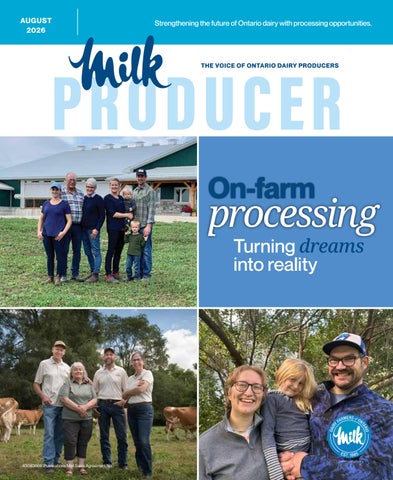
AUGUST 2026
Strengthening the future of Ontario dairy with processing opportunities.
THE VOICE OF ONTARIO DAIRY PRODUCERS
On-farm
processing Turning dreams into reality
40063866 .Publications Mail Sales Agreement No
Performance Pushed Further at Every Turn GEA DairyRotor T8900 is a robust rotary parlour featuring a low-profile stall engineered for fast, smooth cow flow on and off the platform. The low profile cabinet and smooth, rounded stall corners favour cow comfort and animal movement.
BRITISH COLUMBIA Mountain View Electric Ltd. Enderby — 250 838-6455
Lethbridge Dairy Mart Ltd.
Pacific Dairy Centre Ltd. Chilliwack — 604 852-9020
SASKATCHEWAN Dairy Lane Systems Warman — 306 242-5850 Swift Current — 306 203-3066
ALBERTA Dairy Lane Systems Leduc: 780 986-5600 Blackfalds: 587 797-4521 Lethbridge: 587 787-4145
Lethbridge — 888 329-6202 Red Deer — 403 406-7344
MANITOBA Tytech Grande Pointe — 204 770-4898
DIGITAL CONTROL UNIT Streamlines parlour work by presenting key milking data clearly and giving operators fast, intuitive control with ergonomic, customizable buttons tailored to your farm.
DIGITAL FLOW METER A high-precision flow-through milk meter engineered for high-performance data measurement and high-speed data transfer.
ONTARIO Conestogo Agri Systems Inc. Drayton — 519 638.3022 1 800 461-3022
McLaren Works Cobden — 613 646-2062
Dairy Lane Systems Komoka — 519 666-1404
ATLANTIC PROVINCES Atlantic Dairy Tech. Charlottetown, PE — 902 368-1719
Lawrence’s Dairy Supply Inc. Moose Creek — 613 538-2559 McCann Farm Automation Ltd. Seeley’s Bay — 613 382-7411 Brockville — 613 926-2220
GEA Farming - Canada
Performance Dairy Centre Inc. Embro — 519 423-9119
Sheehy Enterprises Ltd. Shubenacadie, NS — 902 758-2002 Lower Queensbury, NB — 506-478-4878
geafarming_ca
GEA Farming Canada GEA Agriculture Québec
AUGUST 2026 | Vol. 102 No. 8 PUBLISHED BY DAIRY FARMERS OF ONTARIO 6780 Campobello Road Mississauga, ON L5N 2L8 COMMUNICATIONS Sandra Da Silva sandra.da-silva@milk.org 905-817-2178 ADVERTISING Pat Logan pat.logan@milk.org 519-788-1559
CONTENTS www.milkproducer.ca
ON THE COVER
GRAPHIC DESIGN Katrina Teimo
15
CONTRIBUTORS Jeff Hyndman, Sandra Da Silva, Jeanine Moyer, Dairy Modernization Steering Committee, Tracey Baute, Brooke McNeil, Nicolas Barbeau-Grégoire, Simon Jetté-Nantel, Chris McCullough, Workplace Safety & Prevention Services, Veal Farmers of Ontario
Interest in on-farm dairy processing continues to grow as Ontario producers look for ways to diversify their businesses, create additional revenue streams and connect directly with consumers.
Canada Post Publications Mail Sales Product Agreement No.40063866. Return postage guaranteed. Circulation: 6,900. ISSN 0030-3038. Printed in Canada. SUBSCRIPTIONS For subscription changes or to unsubscribe, contact: MILK PRODUCER 6780 Campobello Road Mississauga, ON L5N 2L8 Phone: (905) 821-8970 Email: milkproducer@milk.org Opinions expressed herein are those of the author and/ or editor and do not necessarily reflect the opinion or policies of Dairy Farmers of Ontario. Publication of advertisements does not constitute endorsement or approval by Milk Producer or Dairy Farmers of Ontario of products or services advertised. Milk Producer welcomes letters to the editor about magazine content. *All marks owned by Dairy Farmers of Ontario. WEBSITES & SOCIAL MEDIA www.milkproducer.ca www.milk.org Facebook: /OntarioDairy X: @OntarioDairy Instagram: @OntarioDairy LinkedIn: dairy-farmers-of-ontario
Features
Research & Sustainability
4 Board Editorial 6 DRC Corner 22 Marketing 24 Dairynomics 34 Industry News
28 Dairy modernization: Considerations for
Special Features
World Dairy
8
37 Brazil dairy farm using technology to
Driving growth and innovation in Ontario dairy
the milkhouse
30 Rootworm resistance: What dairy farmers need to know
32 Looking ahead: Animal care and
sustainability on Canadian dairy farms
combat high milk production costs
10 Turning consumer insight into innovation
12 Protein takes centre stage 14 Thinking about on-farm processing
10
Health & Safety 40 Road safety for farm vehicles
Calf Care 42 Vitamins and minerals matter when it comes to calf health
W W W. M I L K P R O D U C E R .C A • AU G U S T 2 0 2 6 • 3
BOA R D E DI TOR I A L
Strengthening the future of Ontario dairy with processing By Bart Rijke, Dairy Farmers of Ontario Board Member, Region 1, representing producers in OttawaCarleton (twp. of Cumberland), and the counties of Glengarry, Prescott and Russell. Bart chairs the DFO Governance Committee, and serves on the DFO Audit, Markets and Allocation, and Quota Committees, as well as the Ontario Advisory Committee for Milk and the Dairy Farmers of Canada (DFC) Board of Directors as an Ontario Director and Vice-President. He also chairs the DFC Sustainability Committee. Ontario's dairy industry is well-positioned for the future because of the commitment of dairy farmers to produce safe, high-quality milk for Ontarians and the collaboration that exists across the entire dairy value chain. From processors and researchers to retailers and industry stakeholders, this coordinated approach is creating new opportunities for growth, innovation and investment across the sector. In this edition of Milk Producer, we take a closer look at processing and production, and the important role they play in strengthening Ontario's dairy industry. Over the years, I have had the opportunity to visit processing facilities of all sizes, from large-scale operations serving national markets to smaller specialty businesses producing unique, value-added products. Each visit has reinforced the important role processors play in transforming high-quality Ontario milk into the diverse range of products consumers enjoy every day. Throughout these visits, I have been consistently impressed with the level of
4 • AU G U S T 2 0 2 6 • W W W. M I L K P R O D U C E R .C A
innovation taking place behind the scenes. I have seen the adoption of new technologies, investments that improve production efficiency, initiatives that reduce environmental impacts and creative approaches to product development and manufacturing. Across the sector, there is a shared commitment to continuous improvement that is helping position Ontario as a leader in dairy processing and food innovation. At the same time, consumer demand continues to evolve, creating new opportunities for Ontario's dairy sector. Today's consumers are seeking greater variety, convenience and products that reflect diverse tastes and lifestyles. These changing preferences are encouraging processors to explore new product formats, flavours and offerings. Whether it is developing new cheese varieties, creating innovative fluid milk products or experimenting with ice cream flavours, processors are continually adapting to meet consumer needs, while maintaining the high standards of quality and food safety for which Ontario dairy is known.
Bart Rijke Innovation is not limited to larger facilities. On-farm processing is creating exciting opportunities for dairy farm families to connect directly with consumers and add value to their businesses. Vicky AcrossMorrison Ontario, entrepreneurial farmers are producing cheese, yogurt, ice cream, bottled milk and other specialty products, creating unique local food experiences, while showcasing the quality of Ontario milk. Having toured many of these operations, I continue to be inspired by the passion, innovative and dedication of the people who work throughout our dairy value chain. The future of Ontario dairy will continue to thrive because of collaboration, creativity and commitment that exists across the sector. By continuing to work together and embrace new opportunities, we can help ensure a vibrant, competitive and sustainable dairy future for generations to come.
3 of The Most Loved Bulls in Canada
A2P2-PP (EX-97)
724HO02004 A2A2 / AB
RIGHT STUFF-PP (EX-96) 724HO02031 A2A2 / BB
APOLLO-PP (VG-89 2yr) 724HO02040 A2A2 / BB
For the 1st time in the history of the Canadian Holstein breed 5 of the top 10 most used bulls are PP. Validity/Vector, is proud to have provided Canadian producers with 50% of the Top 6 bulls to improve their herds genetic ability. These 3 bulls are all PP & A2A2, something we believe strongly for the future of dairy industry worldwide. The future of what breeders demand has never been clearer-elite polled bulls! Holstein Canada Registrations 1st Half of 2026 (Jan 1-June 30) Rank Code
Sire
Casein
# Progeny
1
724HO02004
VOGUE A2P2-PP
A2A2
2,621
2
551HO04125
GENOSOURCE JOHNBOY
A2A2
1,601
3
200HO12726
PROGENESIS ANAHITA
A2A2
1,536
4
724HO02031
STANTONS RIGHT STUFF-PP
A2A2
1,390
5
799HO00133
FRAHOLME VEC TRITON-PP
A1A2
1,190
6
724HO02040
VECTOR FRA APOLLO-PP
A2A2
1,128
7
200HO13100
WALNUTLAWN PG BRIGHTPATH
A2A2
1,108
8
200HO12575
PROGENESIS POPROCK
A2A2
1,032
9
250HO14134
S-S-I PR RENEGADE
A1A2
956
10
200HO12671
CEDARWAL ENJOY-PP
A1A2
927
Available in Canada from Contact for International Semen Marketing dave@validitytesting.com 905-866-7800
DRC COR N E R
Improving producer access to information MMS Production letter repository
By Jeff Hyndman, Executive Director, Regulatory Compliance and Quality Assurance, Dairy Farmers of Ontario IN MY APRIL 2026 DRC CORNER, I highlighted the work Dairy Farmers of Ontario (DFO) was doing to improve communication and the information available to producers to help them improve their milk quality. This included the Enhanced Laboratory Services (ELS) program, which provides seven-day-a-week testing and BSN (BactoScan) test results for each suitable pickup, as well as the new SMS (text message) notification service for milk quality test results.
mail through their MMS, including quality penalty letters (BSN, Somatic Cell Count (SCC), Abnormal Freezing Point (AFP), non-grade A, etc.). Producers can access this area of the MMS by logging in to www.milk.org, selecting ‘Statements and Letters’, and looking under the heading ‘Other Letters – Production’. Under this section of MMS, producers will also be able to access copies of informational letters that may be linked
to broader industry quality initiatives. Letters under this tab will now be stored for 24 months as a record of all quality correspondence going forward. This tab will also contain Progressive Penalty Program (PPP) informational letters, that were sent by mail over the last three months, which will now be stored as a historical record. Beginning with test results going forward, Dairy Farmers of Ontario is providing these monthly letters to share information on producers' milk quality test results and to demonstrate how these results would be assessed under the proposed Progressive Penalty Program for Somatic Cell Count and bacteria. Importantly, these PPP letters are for information only. The monthly PPP letters illustrate how the PPP would apply to current test results and are intended to introduce the program ahead of a future launch. The PPP is not yet in effect, and
The goal of both services is to improve the speed and convenience of communicating raw milk test results and to allow producers to receive up-to-date information on their milk shipments, enabling timely interventions. While these new services improve the speed of information delivery, producers should continue to refer to their dashboard on the DFO website to review and confirm official test results. My DRC Corner this month highlights new improvements to the DFO Milk Management System (MMS). Producers are now able to access additional letters sent by registered
Increase profits, not headaches. Our Farm Management Consultants can help Amanda Hammell, Sr. Manager 226.775.3058 | amanda.hammell@mnp.ca
MNP.ca
6 • AU G U S T 2 0 2 6 • W W W. M I L K P R O D U C E R .C A
no penalties or shipping suspensions are being applied based on these letters. With the launch of this new tab, producers are encouraged to review their service provider and subaccount permissions on MMS to ensure they have the correct permissions selected for each account that has access to their information. Those with existing permissions can be found on MMS by logging in to www.milk.org, selecting ‘My Profile’ at the top right corner of the screen, selecting the ‘Manage Sub Accounts/Service Provider’ button and looking at the permissions
in the table under ‘Roles’ for each account type. If Producer Statements is checked for a specific service provider, they will have access to these documents. Upon logging in to MMS, helpful instruction manuals are available in French and English under the “MMS Instructions Materials Headings” to assist with troubleshooting. These changes highlight how DFO is supporting producers and communicating upcoming changes in a timely manner. If producers have any questions, they are encouraged to contact their Field Service Representative for support.
While these new services improve the speed of information delivery, producers should continue to refer to their dashboard on the DFO website to review and confirm official test results.
Simpler feeding is here. Integrated herd insights Precision feeding guidance Real-time adjustments All you need is a smart phone, the FeedComp app, and a Bluetooth-enabled scale.
Contact us to learn more 1 800 549 4373
W W W. M I L K P R O D U C E R .C A • AU G U S T 2 0 2 6 • 7
PROCE SSI NG
Driving growth and innovation in Ontario dairy By Sandra Da Silva, Senior Communications Business Partner, Dairy Farmers of Ontario INCREASING DAIRY PROCESSING CAPACITY IS ESSENTIAL TO supporting industry growth and long-term viability, strengthening food security and ensuring dairy remains a leader in Ontario agriculture. Guided by our vision of a dynamic, profitable and growing Canadian dairy industry, Dairy Farmers of Ontario (DFO) focuses on creating value by supporting production growth and processing increases for value-added innovation, while continuing to meet all market demand. “Our sector is stronger, more resilient and positioned for growth,” says Mark Hamel, Dairy Farmers of Ontario board chair. “Continued investment in processing creates additional opportunities for dairy farm families, strengthens local communities and helps ensure the long-term success of our sector.”
Our sector is stronger, more resilient and positioned for growth. Continued investment in processing creates additional opportunities for dairy farm families, strengthens local communities and helps ensure the long-term success of our sector. – Mark Hamel, DFO board chair
A foundation for future growth
Ontario's dairy industry is already a significant economic contributor, supporting more than 91,000 jobs and generating approximately $8.7 billion in provincial GDP. As one of Canada's largest dairy-producing provinces, Ontario accounts for more than 30 per cent of national dairy production and processing. Ontario's dairy sector is a mature and vibrant industry that continues to demonstrate resilience and growth. Consumer demand for dairy products remains strong, creating opportunities across the value chain. As the industry evolves to meet changing market needs, continued investment in processing capacity will help ensure the industry remains competitive, innovative and well-positioned to meet future demand. “Expanding processing capacity is essential for the growth of Ontario dairy,” says DFO CEO, Cheryl Smith. "The progress we are seeing today reflects the collective efforts of industry, government and investment programs working toward a shared vision for growth. As demand for highquality dairy continues to evolve, this progress will help create lasting value for all Ontarians – farmers, processors, consumers and communities – while supporting the long-term success and sustainability of our sector.”
Investment in action
Supporting Ontario's dairy customers is central to DFO's commitment to fostering a strong, competitive and growing dairy sector. Through industry collaboration, identifying growth opportunities and advocating for policies that support industry growth, DFO is helping create an environment where processors can innovate, expand and respond to evolving consumer demand. Looking ahead, DFO remains focused on advancing opportunities that strengthen Ontario's dairy sector, support increased processing capacity and reinforce the industry's long-term success in communities across the province.
8 • AU G U S T 2 0 2 6 • W W W. M I L K P R O D U C E R .C A
Earlier this year, Lactalis Canada opened a new milk receiving facility and warehouse at its Winchester cheese plant, increasing milk receiving capacity by approximately 25 per cent. The expansion is one example of how processors are investing in infrastructure to increase capacity, improve efficiency and meet growing demand for Ontario dairy products. Gay Lea Foods recently announced a more than $200 million investment to expand its dairy manufacturing facility in Toronto. The expansion will help increase manufacturing capacity, support future growth and reinforce Ontario's position as a leading dairy processing jurisdiction in Canada. Saputo is investing in infrastructure and capital projects as part of its long-term growth strategy, citing those investments as key contributors to growth across its Canadian operations. Agropur continues to invest in its Canadian operations through product innovation and the launch of new offerings that meet changing consumer demand. Learn more about Agropur's growth and innovation strategy on page 10. Quality Cheese has expanded its production, packaging and processing capabilities to support growing demand for premium dairy products, further strengthening its role in Ontario's value-added cheese sector. Investment and innovation are also taking place at the farm level. Ontario's on-farm processors continue to modernize operations, expand product offerings and improve efficiency, creating additional value from locally produced milk, while strengthening connections with consumers seeking locally made dairy products. Turn to page 15 to learn how three Ontario dairy farm families are creating value through on-farm processing.
As demand for high-quality dairy continues to evolve, this progress will help create lasting value for all Ontarians – farmers, processors, consumers and communities – while supporting the long-term success and sustainability of our sector. These investments are strengthening processing capacity, driving innovation and supporting economic growth across Ontario's dairy sector, but there is more to do. The work continues to keep driving our sector forward.
Programs supporting growth and innovation
While investments in infrastructure are helping expand processing capacity, complementary initiatives and policies are supporting innovation, product development and market growth across the industry. The Ontario government's $50 million Grow Ontario Strategy is helping strengthen the province's agri-food sector through investments that enhance competitiveness, expand processing capacity and strengthen food supply chains. As part of this commitment, the Governments of Ontario and Canada announced up to $7.18 million through the Dairy Processing Modernization Initiative in 2025, supporting 70 dairy processing projects across the province.
– Cheryl Smith, DFO CEO
Positioning Ontario for the future
By aligning industry priorities, government support and private-sector investment, Ontario is building the capacity needed to meet future demand and strengthen its position as the engine of growth for Canada's dairy industry. Together, these efforts will help position Ontario dairy for continued growth and success, delivering value for farmers, processors, consumers and communities across the province.
The federal Dairy Innovation and Investment Fund (DIIF) is helping processors modernize facilities, expand capacity and improve long-term competitiveness, supporting the industry's ability to adapt and grow in an evolving marketplace. The Dairy Innovation Program supports product development by providing access to additional milk volumes for the development and launch of innovative products. The program encourages processors to explore new opportunities, respond to evolving consumer preferences and invest in emerging product categories. The Matching Investment Fund helps stimulate demand and accelerate growth by providing up to 50 per cent non-repayable funding, to a maximum of $150,000, for manufacturing investments, product development and market-building initiatives. To support growth in value-added dairy processing, the 3A Growth Policy provides processors with access to up to three million litres of additional milk annually, on a cumulative basis, for investment in specialty and premium dairy products. Meanwhile, the Market Growth Program, through its Milk Supply Stream, provides access to milk for new products and markets that have limited or no impact on existing dairy sales and includes pre-production costs and unused capacity elements. By supporting innovation, product development and business growth, these programs help expand processing capacity, create value from Ontario milk and support the long-term viability of the dairy sector.
Gay Lea Foods announced a processing investment to expand its Clayson Road dairy manufacturing facility in Toronto. From left to right: Gay Lea Foods Board of Directors Past Chair, Robert Goodwill; Second Harvest CEO, Lori Nikkel; the Honourable Judy A. Sgro, Member of Parliament for Humber River–Black Creek; Gay Lea Foods Board Chair, Andrew Henderson; Gay Lea Foods President and CEO, Suzanna Dalrymple, DFO CEO, Cheryl Smith; and DFO Board Chair, Mark Hamel.
W W W. M I L K P R O D U C E R .C A • AU G U S T 2 0 2 6 • 9
PROCE SSI NG
Turning consumer insight into innovation How Sealtest 6% created a new opportunity in dairy By Sandra Da Silva, Senior Communications Business Partner, Dairy Farmers of Ontario WHEN AGROPUR NOTICED GROWING DEMAND FOR HIGHER-FAT milk products among Canadian consumers, particularly within South Asian communities, it saw an opportunity to fill a gap that had long existed in the marketplace. The result was Sealtest 6%, a first-of-its-kind product that is helping drive demand and love for Canadian dairy. While higher-fat milk products are commonly used in traditional cooking and cultural recipes in many parts of the world, Canadian consumers had limited domestic options. Similar products were already well-established in other markets, yet a comparable offering had not been available in Canada. Recognizing that gap gave Agropur an opportunity to meet the needs of an underserved consumer base, while creating a new segment within the milk category. "Consumer insights are at the heart of our innovation process,” says Mariline Mailhot, vice president marketing & innovation, fresh products. “We continuously monitor emerging trends to better understand how consumer preferences are evolving."
A consumer-first development process Agropur follows a disciplined innovation process designed to ensure new products solve real consumer needs and have a high likelihood of success. "Our innovation process is highly structured, and it always starts with a consumer need or a problem to solve," Mailhot explains. "That's critical because innovation for the sake of innovation rarely leads to commercial success."
The development journey began with market research and consumer insights, followed by concept validation through surveys, idea screening and consumer testing. Product development progressed from laboratory-scale work to pilot production, with feedback collected throughout the process to ensure the product delivered the taste, texture and functionality consumers expected.
Research remained a critical component from start to finish "We conduct ongoing internal research to stay on top of emerging trends," says Mailhot. "Once we have a promising concept, we validate it with consumers at several stages of development. These activities help us confirm that we're solving a real consumer need and the product delivers the experience consumers expect."
Validation from consumers and retailers Two key milestones gave the team confidence that the concept was addressing a genuine market need. The first came during idea screening, when consumer research results significantly exceeded industry benchmarks for purchase intent, excitement and perceived uniqueness. The second came through conversations with retail customers, several of whom had already seen similar products succeed in the U.S. market and were eager to bring the product to Canadian shelves. "Having validation from both consumers and retailers was extremely encouraging," Mailhot says. "We knew consumers were excited, and we also knew retailers were waiting to bring this product to their shelves."
While higher-fat milk products are commonly used in traditional cooking and cultural recipes in many parts of the world, Canadian consumers had limited domestic options.
1 0 • AU G U S T 2 0 2 6 • W W W. M I L K P R O D U C E R .C A
This alignment between consumer demand and retailer interest provided strong evidence that Sealtest 6% was addressing a genuine marketplace need rather than simply adding another SKU to an already competitive dairy aisle.
Bringing the product to market While the product itself was relatively straightforward from a formulation and manufacturing perspective, execution became the primary challenge. "The real challenge was speed: bringing the innovation to market quickly and doing it right the first time," says Mailhot. "We wanted to be first to market, while ensuring we maintained the highest standards for quality, consumer appeal and operational readiness." As with any new product introduction, Agropur also evaluated how the new SKU would fit within existing production capabilities. Demand forecasts, production efficiency and quality standards all had to be considered to ensure the product could be manufactured successfully at scale. "From an operational perspective, one of the most important factors is ensuring the new product fits within our existing capabilities and can be produced using existing equipment and production lines," says Mailhot. "Ultimately, our goal is to develop products that integrate seamlessly into our operations, while maintaining the highest standards of quality."
Early success and industry impact Just months after launch, Agropur is seeing consumer enthusiasm and received positive reviews. "The product has exceeded our expectations, and based on feedback, those of consumers as well," Mailhot reports. "It was clear that the product was resonating with consumers and addressing a need in the marketplace." The product's success has already supported expansion into additional markets, including British Columbia, while the arrival of competitive offerings suggests the new category is gaining momentum. The success of Sealtest 6% highlights the growing importance of demographic and cultural insights in dairy innovation. As Canada's population becomes increasingly diverse, processors that identify evolving consumer needs and translate them into scalable products may uncover new opportunities for growth across the dairy category.
Built to keep going. Just like YOU.
They only get one start – and it happens on your farm. Agri-Plastics designs calf housing and feeding systems that support healthy development from day one. Agri-Plastics – because their future starts with you.
CALFHUTCH.COM
Scan QR code to learn more
W W W. M I L K P R O D U C E R .C A • AU G U S T 2 0 2 6 • 1 1
PRODUC T ION
Protein takes centre stage: Where genetics fits in a changing milk market As demand for protein grows, genetics can help producers build herds to meet consumer preferences By Jeanine Moyer
THE VALUE OF MILK PROTEIN IS GETTING A CLOSER LOOK IN 2026. Changes to Ontario's milk pricing are putting greater emphasis on protein production, while demand for high-protein dairy products continues to grow. For dairy producers, that raises a practical question: how much of the opportunity can be addressed through genetics? The answer starts with understanding what genetics can, and can't, do. “Genetics for protein refers to the protein content of the milk,” explains Jamie Howard, director of sales and leader of the bovine genetics and reproductive services sector at EastGen. “We have bull proof data that is released three times a year that give us information to see which sires can increase or decrease the genetic merit of milk composition regarding milk protein percentage.” Mark Carson, solution manager with Semex, says the term “genetics for protein” can encompass two related but distinct traits: protein yield, measured as the total kilograms of protein produced, and protein percentage, which measures the concentration of protein in milk. For producers, those numbers provide another tool for making breeding decisions that can shape the herd's future production.
Protein demand is growing The renewed focus on protein isn't happening in isolation. Dairy Farmers of Ontario (DFO) reported strong growth in several high-protein dairy categories in 2025. Retail sales of fortified milk increased 9.4 per cent, while yogurt sales increased 6.6 per cent. Within that category, Greek yogurt grew 18.8 per cent and Skyr grew 43.4 per cent. Cottage cheese sales increased 25.8 per cent. Greek yogurt now represents about one-third of yogurt retail sales in Canada. The report also notes that Greek yogurt can use up to six times more milk than conventional yogurt. Cottage cheese, meanwhile, now represents about 10 per cent of cheese sales. Those changes in consumer demand are also being reflected further down the supply chain. In 2026, Ontario's milk pricing shifted to put greater
1 2 • AU G U S T 2 0 2 6 • W W W. M I L K P R O D U C E R .C A
emphasis on protein production in response to growing market demand. For producers, the message is clear: protein remains part of the farm income, but its relative value is receiving more attention. The shift toward protein is also part of a broader change in dairy breeding. Carson notes that significant gains have been made in fat production through genetics and management, with fat production growth outpacing protein production in many herds. As a result, some producers are placing greater weight on protein yield when setting genetic selection goals.
Genetics sets the foundation While nutrition and management can influence the protein content of milk, Howard notes that genetics determines much of a cow's potential for protein production. Lactanet reports a literature estimate of approximately 50 per cent heritability for protein percentage. For Holsteins, protein yield has a heritability of 26 per cent. Heritability doesn't mean that a cow gets a set percentage of her protein production from her genes. Instead, it describes how much of the variation observed between animals in a population can be attributed to genetic differences. For producers, the important takeaway is that protein is a trait that can respond to genetic selection. “Genetics has more influence on milk protein than nutrition or management,” says Howard, noting that protein is particularly harder to feed for than butterfat percentage. Carson describes genetics as establishing a cow's inherited potential for protein production, while nutrition, herd health and management determine how much of that potential is ultimately expressed. That distinction is important. A cow's genetic potential only tells part of the story – a herd's feeding and management program determines how well that potential is expressed. The difference is that management changes can be made relatively quickly, while genetic improvement can take years to show up across a herd.
“Protein traits are highly heritable, so selecting for them generation after generation will lead to improvement within your herd,” says Carson.
Percentage or kilograms? “One of the first distinctions producers need to make when looking at protein genetics is the difference between protein percentage and protein yield,” says Howard. “Both measures can be useful, but they are not interchangeable.” A cow with a higher protein percentage, for example, may not necessarily produce the most total kilograms of protein because milk volume also matters. That means producers have choices when selecting sires, and the best choice will depend on the farm's individual objectives and milk market. Protein can be considered alongside other traits when making mating decisions, allowing producers to address individual cows' weaknesses, while strengthening the genetic profile of the herd. “Protein needs to be considered alongside the other traits that contribute to a profitable, functional herd,” says Howard. The increased emphasis on protein is also showing up in genetic selection indexes. Carson notes that both Canada's Lifetime Performance Index (LPI) and the U.S. Total Performance Index (TPI) increased their emphasis on protein traits in their April 2026 index updates. In Canada, Lactanet revised the relative emphasis of fat yield and protein yield within the LPI Production Sub-Index, placing greater weight on protein yield. Carson says he is also seeing dairy producers in other countries develop customized genetic indexes for selecting sires and genomically tested females, with a stronger focus on protein genetics.
Start with the herd
A cow with a higher protein percentage, for example, may not necessarily produce the most total kilograms of protein because milk volume also matters. Herds that have invested in genomic testing can identify females with stronger protein genetics at a younger age, before those animals enter the milking herd. “Combined with strategic use of sexed semen, genomic information can help producers increase the number of replacement females carrying desirable protein traits and accelerate genetic progress,” says Carson.
Genetic progress takes time One of the challenges with genetic selection is that the market can change much faster than a dairy herd. A herd management decision like changing a feeding ration can affect milk components relatively quickly, but a breeding decision made today may not be reflected for several years. Lactanet estimates that breeding decisions made today will take roughly five years or more to appear in a herd's bulk tank, once daughters are born, raised and enter the milking herd. That makes today's market signals important when setting long-term breeding goals. As genetic change is a long-term investment, today's breeding decisions need to account for where the protein market is heading over the next several years. Some producers have already been making those decisions with that longer time horizon in mind. Carson says some of the herds he works with began placing a much heavier emphasis on protein-related genetics more than three years ago because they anticipated a market shift toward higher protein value.
For a producer looking to increase protein, Howard suggests the first place to look may be the cows already in the barn. “But not all cows have the same genetics,” he says. “Some are high and some are low in protein.”
“By using customized selection criteria that placed greater emphasis on protein traits, those herds were able to begin building that genetic progress before the market signal became as strong,” says Carson.
Rather than taking a one-size-fits-all approach, Howard recommends producers consider each cow's genetic profile when making mating decisions, using sires to strengthen areas where improvement is needed.
Building the herd for the next market
The same principle applies to any important or desirable trait. “Mate your cows to minimize their weaknesses and strengthen their genetic profile where needed in protein or any trait for that matter,” says Howard. For producers already using a mating program, protein can become another consideration within an established breeding strategy rather than a reason to start over. Howard points to bulls with a favourable relationship between fat and protein as one option. For example, a sire with a slightly negative fat percentage and positive protein percentage may be attractive in a herd where increasing protein is a priority. “The exact combination, however, needs to be considered in the context of the individual herd,” he notes. Carson says having a defined genetic selection strategy is one of the most effective ways to increase genetic gain for protein traits. That strategy can become even more precise when producers have information on young animals.
Protein isn't new to dairy breeding and milk production. What is changing is the strength of the market signal behind it. For producers, that makes protein worth considering as part of a balanced breeding strategy. Howard reminds producers that the starting point is the herd itself. Which cows are genetically strong for protein? Which need improvement? What happens to the herd's fat production when protein is increased? And which sires can address those weaknesses, while maintaining the traits that keep the herd productive, healthy and profitable? There may not be a single bull or genetic formula that answers all of those questions. But producers have increasingly detailed genetic tools to help make those decisions, from traditional sire proofs and genetic indexes to genomic testing and herd-specific selection strategies. The opportunity is not simply to respond to today's milk market. It is to use today's information to build a herd capable of meeting tomorrow's market. “For a trait that takes years to change genetically, producers need to make today's breeding decisions with tomorrow's milk market in mind,” says Howard.
W W W. M I L K P R O D U C E R .C A • AU G U S T 2 0 2 6 • 1 3
PROCE SSI NG
Thinking about on-farm processing? Here's what producers need to know By Jeanine Moyer
INTEREST IN ON-FARM DAIRY PROCESSING CONTINUES TO GROW AS Ontario producers look for ways to diversify their businesses, create additional revenue streams and connect directly with consumers. While every farm operation is different, industry experts say success depends on much more than building a processing plant. According to the Ontario Dairy Processing Handbook, producers should begin with a detailed business plan that clearly identifies their target market, product mix, capital requirements and long-term business goals. Understanding who will buy the product – and why they would choose it over established brands – is just as important as determining how it will be manufactured.
Ontario by the numbers As of 2026, Ontario has 25 licenses on-farm dairy processors. Dairy Farmers of Ontario's (DFO) Start-Up Scale-Up Innovation Program supports dairy entrepreneurs, including on-farm processing with starting and growing a dairy business.
More than one path to market Some farms choose to invest in on-farm processing facilities, giving them complete control over production scheduling, product development and manufacturing. Others work with an established processor through a co-packing arrangement, allowing them to focus on branding, sales, marketing and customer relationships, while reducing upfront capital costs. Each model has advantages, and the right choice depends on the farm's goals, available capital, labour resources and appetite for managing a food manufacturing business.
Before the first litre is processed The Ontario Dairy Processing Handbook recommends producers evaluate several key areas before committing to a value-added venture, including:
Producers who process dairy products become food manufacturers and are required to comply with additional food safety and regulatory standards.
• • • • • • •
completing a comprehensive business and financial plan researching market demand and identifying a unique product or market niche understanding provincial licensing and regulatory requirements determining facility, equipment and utility needs developing food safety and quality assurance programs creating realistic marketing, branding and distribution plans assessing labour requirements, including staffing beyond the farm
Processing milk adds an entirely new business to the farm, requiring expertise in manufacturing, retailing, logistics and customer service alongside dairy production.
Food safety comes first Producers who process dairy products become food manufacturers and are required to comply with additional food safety and regulatory standards. The handbook outlines requirements related to facility design, sanitation, traceability, preventive control programs, record keeping and product labelling, along with regular inspections by provincial authorities. Many producers also work with food safety consultants, equipment suppliers and processing specialists during the planning and construction phases to ensure facilities meet regulatory requirements before production begins.
Getting started Producers considering on-farm processing should begin by building a network of advisors and industry contacts before investing in equipment or construction. The Ontario Dairy Processing Handbook recommends developing a business case early and engaging with the organizations that can help navigate the planning process. The handbook emphasizes that successful on-farm processing businesses begin with a market opportunity, not simply the desire to process milk. Producers who invest time in planning, understanding their customers and building strong industry partnerships are better positioned for long-term success.
1 4 • AU G U S T 2 0 2 6 • W W W. M I L K P R O D U C E R .C A
COV E R STORY
Creating Opportunities for growth and the next generation By Jeanine Moyer
Ontario dairy producers have never been short on ingenuity. As consumer interest in local food continues to grow, some farmers are discovering new opportunities by taking their milk beyond traditional production and into processing, branding and retail sales. The result is a growing number of value-added businesses that allow producers to support long-term farm viability, generate new revenue streams, carve out unique positions in the marketplace and connect with dairy-loving consumers. Our Cover Story explores how three Ontario dairy farm families have embraced that opportunity. From handcrafted cheese and on-farm milk sales to branded dairy products found on grocery store shelves across the province, these businesses demonstrate how innovation, diversification and entrepreneurial thinking are helping drive growth, while helping secure the future of Ontario dairy.
W W W. M I L K P R O D U C E R .C A • AU G U S T 2 0 2 6 • 1 5
Coming full circle How Eby Manor turned a decades-old dream into a thriving dairy brand
JIM EBY ALWAYS DREAMED OF THE DAY HE COULD PROCESS the milk produced by his own cows and share it with consumers. It was founded in his farm’s history. Growing up on the family farm near Waterloo, Ont., he heard stories about his grandfather selling turnips and saw his parents carve out a niche selling Guernsey milk, known for its rich, golden milk, to Maple Lane Dairy. While the provincial milk pool changed how milk was marketed, the family never abandoned its Guernsey herd – or the belief that its milk offered something consumers would value. “I always hoped that one day we'd be able to market our milk as its own product again,” Eby says. That opportunity finally arrived when Dairy Farmers of Ontario (DFO) introduced a program supporting producers to process and market milk under their own brands. More than a business opportunity, it was the chance to revive an idea that had been waiting for decades. Eby Manor Ltd. was one of the first Ontario dairy farms to process and market milk directly to consumers. Today, Eby Manor milk products are sold in grocery stores across Ontario and Atlantic Canada, while the family’s busy farm store also draws customers looking for local dairy and a connection to the farm where their milk is produced. The business has grown into a second enterprise alongside the family's dairy farm, Eby Manor Farms Inc., creating another source of income and new opportunities for the next generation. For Eby, success didn't come from producing more milk: it came from innovating.
Looking beyond more cows Jim and his wife, Ruth, now own the farm and retail business alongside their son, Ben, and daughter-in-law, Sheri. Ben manages the farm's operations and dairy herd, milking 60 registered Guernseys in a tie-stall barn with the support of a full-time employee, part-time students and his two sons. Eby remains involved on the farm, while overseeing the retail side of the business, supported by an operations manager, marketing manager, storefront staff and delivery drivers. Another son, Reuben, manages accounting for both the farm and the processing side of the business. The addition of the retail business has been just as important for family succession as it has been for business growth. Eby says it created another revenue stream, while providing meaningful opportunities for multiple family members to contribute to the business beyond the farm operation itself.
1 6 • AU G U S T 2 0 2 6 • W W W. M I L K P R O D U C E R .C A
Choosing a different path When producers think about on-farm processing, they often picture building a processing plant, and there was a time when Eby did too. Initially, he explored constructing his own facility after Ontario's direct marketing program was announced. But the investment was substantial, and since the program was new, there weren’t any examples to follow, and the learning curve was steep. Eby considered partnering with an existing processor about contract processing. The arrangement also let each business focus on its strengths. The processor managed processing, while Eby Manor concentrated on branding, marketing, distribution and customer relationships. If he owned his own plant, Eby says reflecting on his decision, he would have greater flexibility to introduce products and adjust production schedules. But partnering with an experienced processor removed many of the barriers that might otherwise have delayed, or prevented, the business from getting off the ground.
Building a brand one bottle at a time Like any new venture, Eby had a lot to learn. He quickly realized that processing the milk was only part of the challenge – selling it was something entirely different. “At the time, the milk retail business was new to farmers,” Eby says. “We'd never had to market our milk products before, but I knew it could be done because I’d seen the success my parents had decades before.” When the first batch of Eby Manor milk was processed, there was no established customer base waiting. Eby started his marketing approach with cold calls, visiting independent grocery stores, introducing himself to owners, handing out brochures and explaining why they should make room in their dairy case for a new local brand. And he was pleasantly surprised. “I was shocked by how open stores were to trying new products,” he says. Eby’s first customers came from the local Waterloo Region before the brand expanded into new markets across Ontario. As sales increased, a distributor was brought in during the third year of business to help the company move into Hamilton and the Greater Toronto Area.
While it appeared that the Eby Manor brand was taking off, the growth of the retail business was deliberate. Initially, Eby wanted to launch several products immediately, but their processing partner preferred to expand gradually. So, the company began with only one product – 2% milk. Once weekly sales reached approximately 1,500 litres, another product was added, then another. “It took us longer to develop a full offering because we had to roll out one product at a time," Eby says, explaining that he believes the patient approach ultimately helped build a stronger business. By the third year, Eby noticed something had changed. Instead of calling retailers, retailers were calling him. “It was then that I realized we'd actually built a brand,” he says. Today, most new Eby Manor customers come through referrals and retailer inquiries rather than sales calls.
Standing out in a crowded dairy case
Growth brings new challenges
Growing and maintaining market share in a mature and competitive market requires more than producing and marketing good milk. That’s why Eby believes every product he produces must offer consumers something they can't easily find elsewhere.
Like any value-added business, success has introduced new pressures for the Eby family. Finding shelf space and maintaining pricing that works for both consumers and retailers remain ongoing challenges.
The herd also became 100 per cent A2-affirmed about a decade ago. Although that wasn't the original goal, Eby says customers began telling him years earlier that they found the milk easier to digest than conventional milk. “I regularly hear people tell us they're grateful they can drink our A2 protein milk,” he says. “We believe in the unique qualities and benefits of Guernsey milk, and it has been rewarding to see how impactful A2 protein milk is for those with milk sensitivities.” As a result of the natural differentiation of the Guernsey milk, Eby has expanded from fluid milk to cream, yogurt and cheese, while a local ice cream company uses Eby Manor milk to produce premium ice cream sold through select retailers and the farm store. "Demand for our products has grown beyond our herd's capacity and so we also source A2 Guernsey milk from Mar-Ley Farms, operated locally by Marlin and Shirley Martin." One of Eby's favourite success stories remains the company's rich 4% chocolate milk. “I wasn't sure how people would respond because consumers pay close attention to butterfat, but our chocolate milk turned out to be one of the best decisions we've made.” Demand for whole milk yogurt and Eby Manor 10% natural cream has also grown steadily.
More than a place to buy milk While grocery stores introduced the Eby Manor brand to thousands of consumers, the family’s on-farm store has become the heart of the business. Opened in 2015, it had always been part of Eby's long-term vision. Alongside Eby Manor dairy products, customers can find eggs, honey, maple syrup, preserves and other foods produced by neighbouring farms. Eby believes the store also serves as something greater than a location to generate sales, it gives consumers a reason to visit a working dairy farm. “People like to connect with farmers and genuinely want to understand where their milk comes from,” says Eby, who can often be found answering questions and engaging with customers at the farm store. The family also hosts an annual open house and occasional farm tours to help tell the story too. Those conversations, he believes, build confidence not only in Eby Manor but in Ontario’s dairy industry as a whole.
“You have to find the balance between the value of your product and what consumers are willing to pay,” explains Eby. Eby has also learned that managing inventory is equally complex. Eby Manor's milk has a shelf life of about three weeks. Since weekly demand fluctuates, production planning requires a careful balancing act. He points out that “you don't want to over-order or under-order.” Another recent challenge came when Eby Manor's processing partner transitioned from glass to plastic bottles, requiring a label redesign and adjustments throughout the business. Customers missed the glass bottles, Eby says, but the switch also reduced labour requirements and breakage throughout the distribution system.
Looking ahead Despite the challenges of balancing customer demand and changing preferences, Eby continues to evaluate opportunities to expand the product line. He says butter is frequently requested by customers, but he questions whether premium Guernsey butter could be offered at a reasonable and competitive price. He also sees potential in innovations such as automated milk vending machines and believes Ontario still has room for more dairy producers interested in direct marketing. For producers considering value-added processing, he encourages them to begin by defining their goals. Some farms may be looking for another revenue stream. Others may be planning for succession. Still others may simply want a closer relationship with consumers. Whatever the motivation, Eby believes success depends on offering something distinctive. For him, that distinction has always been rooted in the same Guernsey cows his parents milked decades ago. “I still remember as a kid milking our Guernsey cows to produce milk for Maple Lane Dairy,” he says. “Now we've come full circle, selling that same Guernsey milk under our own brand.” After waiting most of his farming career for the opportunity, Eby has done more than bring his family's milk back to consumers. He's built a business around the idea that in a competitive marketplace, producing quality milk is only the beginning. The real opportunity lies in helping consumers understand why it's different, and giving them a reason to come back for another bottle.
W W W. M I L K P R O D U C E R .C A • AU G U S T 2 0 2 6 • 1 7
Finding a new path for the next generation Dairy farming since 1874. Cheesemaking since 2022. FOR THE MARSHALL FAMILY, KEEPING THE FARM IN THE FAMILY has always meant looking ahead. Since the first Marshall family members came from Scotland and established the farm in 1874, there have always been dairy cows at Glen Atholl Farm, just outside Woodstock, Ont. Today, Wendy and Ron Marshall represent the fourth generation, farming alongside their son Laurence, his wife Marja and their children – the sixth generation already growing up on the farm. When Laurence returned to the farm after school, the family began looking at what it would take to bring the next generation into the business. Building a new barn and expanding the herd was one option, but it would require a significant investment and additional quota. Then Laurence and Marja came forward with another idea: “What if we make a business pivot and start making cheese?”
A different direction For the Marshalls, the idea offered a different way to grow the farm without simply adding more cows. Marja already had experience making cheese from her time working with another on-farm processor, and the family saw an opportunity to build on that experience, while creating another income stream for the farm.
“There are a lot of layers to setting up an on-farm processing business, and each has a different role,” Marshall says, noting “it isn’t for the faint of heart.” But the family had a solid business plan, a clear idea of what they wanted to build and, most importantly, a reason for doing it: keeping the family dairy viable for future generations.
A steep learning curve Adding a processing venture to their family business meant fitting another enterprise into an already busy dairy operation – and learning a whole new side of the business along the way. After two years of planning, the farm store opened in late 2022. Marshall says the entire process was a steep learning curve, but the building itself presented some of the most unexpected challenges. The family knew there were plenty of costs involved in building a processing facility, but the scale of those costs was still a surprise. “Even when you’re doing something on a small scale, a lot of the costs are still the same as a larger operation,” Marshall says. Although the building met the requirements for an on-farm diversified agricultural operation, including the 2,500-square-foot maximum, the Municipal Property Assessment Corporation (MPAC) classified the milk pasteurization facility as industrial rather than agricultural. As a result, the Marshalls’ property tax bill more than doubled. “That was a big shocker,” Marshall says, noting even their appeal to adjust the tax rate was declined. “We did everything right and certainly didn’t plan on our taxes more than doubling.”
More importantly, processing could give the next generation a place in the business. “We wanted to set the business up for success for the next generation, and we want them to be successful,” says Wendy Marshall.
Marshall acknowledges those hurdles were part of establishing a new business. Once the doors opened, the family began to see the potential of processing and selling their own milk.
The idea took hold in 2020, when the family began investigating what it would take to become an on-farm dairy processor. What started as their “COVID-era project” would eventually become a two-year process of planning, learning, securing permits and construction.
Adding value to their own milk
By late 2022, Golspie Dairy was no longer just a place where the Marshalls milked 35 Holstein cows in their tie-stall barn. It had become a farmstead cheese operation, too. The transition came with plenty of learning curves. Setting up an on-farm processing business meant navigating requirements at the municipal, county and provincial levels, along with the local health unit and Dairy Farmers of Ontario.
1 8 • AU G U S T 2 0 2 6 • W W W. M I L K P R O D U C E R .C A
Golspie Dairy is a farmstead cheesemaker, meaning the milk used for its cheese comes from cows raised on the farm. In fact, the processing facility and storefront are just a short trip from the barn. The family built a laneway connecting the two buildings, allowing them to move milk directly to the plant without travelling on the road. From the beginning, the family knew they wanted their cheese to have a connection to the farm and its history. As part of the Oxford County Cheese Trail, they also wanted to offer something different from other local cheesemakers.
Their answer was to produce British-style cheese, reflecting the family’s Scottish roots. One of the products is Crowdie, a traditional Scottish fresh cheese offered in several flavours. St. Oda is another Golspie original, created by Marja who’s creativity was inspired after she travelled to France to take a cheesemaking course. The lineup includes soft and hard cheeses, with names that nod to British cheese traditions. The Golspie Dairy cheese lineup continues to evolve, with the family looking at new products, while weighing future investments in processing equipment. “We’re still learning,” Marshall says. Cheese isn’t the only way the Marshalls have diversified their business. Golspie Dairy also has an on-farm milk vending machine – the only one in Ontario – offering the farm’s own pasteurized milk by the quart or gallon. A second vending machine offers Golspie Dairy cheese and dispenses empty bottles customers can use to fill at the milk machine. The milk is full-fat and pasteurized in small batches. “We serve our customers whatever the girls are making,” Marshall says, noting the milk averages about 4.5 per cent fat. The vending machine has become a particularly good fit for the small operation. “The farm store is open three days a week, but the vending machines are available seven days a week,” Marshall says. Most customers come from nearby Woodstock, but the farm has also had customers travel from as far as Toronto to purchase a quart of milk.
More than a storefront The on-farm processing business has brought another unexpected benefit for the family: people. Visitors stop often at Golspie Dairy as part of the Oxford County Cheese Trail, on local tours or simply to buy local farm products. Once they arrive, many want to know more about the farm behind the cheese and milk. “The people who come always want to know our farm story,” Marshall says, noting that interaction has given the family a new opportunity to talk about dairy farming and agriculture with people who might otherwise have little connection to a farm. Connecting with consumers is one of the most rewarding parts for Marshall and family.
Making room for the next generation
For other dairy farmers considering on-farm processing, Marshall says the first step is knowing your customers. “You need to know your market and be able to create a unique product,” she says. “And make sure you’re certain before you invest.”
The Golspie Dairy processing business may have started as a way to create a future for the next generation, but the family sees plenty of room for it to grow. Right now, less than half of the milk produced on the farm is used for processing. Marshall says the goal is to gradually use more of their own milk as the cheese and fluid milk businesses grow.
Throughout their processing journey, Marja has also had people reach out to her with questions about getting into cheesemaking. Her advice is to gain some experience in the industry first – work in dairy processing, learn what the job involves and make sure it’s something you really enjoy before making the investment.
Looking ahead, the family plans to expand the processing business, while also building a new barn with a robotic milking system. Marshall hopes the automation will create a new level of flexibility for the family, particularly the younger generations, and allow them to focus on other parts of the business.
After more than 150 years of milking cows, the Marshalls remain focused on the same goal: keeping the farm viable for the family that comes next. “Transitioning the farm is a process and a priority,” Marshall says.
For the Marshalls, that is ultimately what diversification is about: creating enough opportunity within the farm for the next generation to find their own place.
At Golspie Dairy, that process has taken the family from a tie-stall barn and a milk tank to a processing room, cheese counter and milk vending machine. The cows remain at the centre of the business, the difference is that the Marshalls are finding new ways to take what they produce all the way to the customer.
W W W. M I L K P R O D U C E R .C A • AU G U S T 2 0 2 6 • 1 9
From dairy farm to dairy brand Sheldon Creek Dairy has given the den Haan family a new way to produce and develop innovative products for dairyloving Ontarians FOR THE DEN HAAN FAMILY, GROWING THE DAIRY FARM HASN’T meant simply adding more cows – it has meant finding new ways to capture the value of the milk they produce. What began in 2012 as a small on-farm processing venture has grown into Sheldon Creek Dairy, a diversified business producing its own dairy products, distributing products from other local producers and helping fellow farmers bring their ideas to market. Along the way, the family has learned that processing milk is a very different business from producing it – and that sometimes, the most rewarding path forward is the one that looks a little different.
A different way to grow Today, John and Bonnie operate Haanview Farms and Sheldon Creek Dairy in Loretto, Ont., alongside their daughters, Marianne Edward and Emily den Haan. As part of the family’s farm transition, Emily now manages the dairy operation, while Marianne oversees the processing business.
The family built a new barn in 2018 where they milk 75 Holsteins with two Lely robots. The milk travels directly from the milkhouse to the processing plant through an underground pipe, and most of the milk produced is marketed through Sheldon Creek Dairy. The first Sheldon Creek Dairy products were white and chocolate milk. The family chose to produce non-homogenized milk, creating a point of differentiation and expanding the range of dairy products available to Ontario consumers. Packaged in glass bottles, customers could see the cream naturally rise to the top. Den Haan says that created one of the family’s first lessons in marketing and consumer education. “It’s a huge learning curve for people to understand what fresh, whole milk really is,” she says. “People see the cream at the top and think something is wrong, but that’s milk.” While their customers were experiencing whole milk for the first time, the family was also learning how to run an entirely new type of business. “Our background isn’t food science, human resources or product development,” says Edward. “There’s been a lot of learning required to process and produce milk.”
Growing the product lineup As Sheldon Creek Dairy became established, the family began looking for products that would allow them to stand apart from larger dairies. They added Greek yogurt, kefir and ghee, along with a rotating selection of flavoured milk to their product lineup. Edward says kefir was one of their early lessons in product innovation. When they first started making it, few customers knew what the product was and sales were so slow they considered discontinuing it. “Then a large grocer promotion introduced kefir to a wider audience and demand took off,” she says, noting the experience was yet another lesson, specifically how quickly consumer awareness and purchasing habits can change. Ghee offered another opportunity for Sheldon Creek Dairy. Edward explains that rather than compete directly with larger processors in fluid milk, the family looked for developing markets and products with a niche. “There’s a significant market of new Canadians looking for products like ghee that are familiar to them.” In the barn, Haanview Farms has been breeding exclusively for A2A2 genetics for the past ten years, enabling Sheldon Creek Dairy to produce and market A2 protein milk.
2 0 • AU G U S T 2 0 2 6 • W W W. M I L K P R O D U C E R .C A
In addition to on-farm processing, the company also distributes more than 1,000 products from more than 80 vendors, primarily through small, independent retailers. The den Haans have also found ways to keep their fluid milk product lineup fresh, featuring flavour-of-the-month milk that gives the family and their staff a chance to experiment with new combinations. Past flavours have included banana, s’mores, vanilla chai, pumpkin spice and candy cane. “We’re always playing with new flavour profiles,” Edward says. One of their most popular flavours, Neapolitan, was even created by accident when chocolate and strawberry milk were mixed together. The unexpected combination proved to be a hit, giving the family another reason to keep experimenting with what they can create in the processing plant. “Many of our ideas for new products come from getting off the farm,” says den Haan, noting the family enjoys travelling or just walking the dairy aisle at the grocery store to find inspiration.
Supporting other producers The growth of Sheldon Creek Dairy has also created an opportunity beyond the family’s own products. In addition to on-farm processing, the company also distributes more than 1,000 products from more than 80 vendors, primarily through small, independent retailers. The family also provides copacking services, helping fellow dairy farmers and small companies develop, package and bring local products to market. In some cases, Sheldon Creek Dairy bottles and packages milk from other dairy farmers under their individual brands. This enables farmers to market their milk and dairy products without having to invest in their own processing facility. The den Haans see the co-packing service as another way to support the dairy industry. “There’s a lot of appetite among smaller producers to develop innovative products, but it can be difficult to find the processing capacity to bring them to market, we’re happy to help strengthen the industry by supporting fellow producers,” says Edward, who feels that working with other producers has become one of the most rewarding parts of the business. “We find joy in helping other people find success and scale up.”
Different, not easier “We learned a lot during the first few years in business, and not just about how to make yogurt or kefir,” says Edward, noting their approach to business shifted in their fifth year. She says the family began to feel more confident in managing the dairy processing business. The challenges didn’t disappear, but the family had learned how to handle them differently. “It’s not easier, but it gets different.” That mindset has helped the den Haans navigate significant growth since 2012, including a processing plant expansion in 2021 that increased capacity, allowed them to develop new products and take on co-packaging partners. The family also credits the Supply Management Processing Investment Fund with helping support investments and growth in their processing business.
Looking ahead For dairy farmers considering on-farm processing, the den Haans are quick to point out that it is not simply an extension of the dairy farm. “Put your seatbelt on, you’re going for a ride,” quips den Haan. The family recommends starting small and having a clear understanding of the products and customers you want to serve before making major investments. “It’s very challenging, especially the first few years,” says Edward. “We’re so glad we started small because it taught us so much.” The cows still remain at the centre of Haanview Farms, but after more than a decade after the family decided to share the milk they enjoyed at home, Sheldon Creek Dairy has become much more than a way to market their own milk. It has created a new path for the next generation, brought consumers closer to the farm and given the den Haans an opportunity to help other producers turn their own ideas into products. What started with an idea to diversify the family dairy farm has grown into a business built around finding new ways to share what Ontario dairy farmers produce.
W W W. M I L K P R O D U C E R .C A • AU G U S T 2 0 2 6 • 2 1
M A R K ET I NG
What's cooking? The food trends and culinary inspiration behind DFO's culinary programs
Milk Masters: Bringing dairy to life through chef-led content As part of DFO’s broader culinary platform, Milk Masters is a chef-driven content series that combines entertainment with cooking inspiration. Now in it’s fifth season, the program showcases local chefs creating dairyinspired recipes, while highlighting the unique role milk plays in delicious dishes. Season three, which aired in 2025, generated 1.2 million episode views, close to 40,000 hours of watch time. The series also delivered more than 60 million impressions, proving consumers are highly engaged with dairyfocused culinary content. Milk Masters season four exceeded expectations to-date by generating more than 1.6 million episode views, surpassing targets by 103 per cent. Viewers stayed engaged for an average of more than three minutes per episode, reinforcing that audiences are actively consuming the content rather than simply scrolling past it.
TODAY’S CONSUMERS ARE DISCOVERING RECIPES, COOKING techniques and food trends through digital content more than ever before. Recognizing this as an opportunity, Dairy Farmers of Ontario (DFO) built an engaging culinary platform designed to keep dairy relevant in an increasingly competitive food landscape. Flagship programs such as Milk Masters, the iconic Milk Calendar, trusted chefs, food influencers and compelling culinary content are designed to inspire consumers and reinforce dairy’s irreplaceable role in everyday meals. The culinary approach focuses on showcasing how milk and dairy products are simply irreplaceable in delicious everyday cooking – enhancing flavour, creating unbeatable texture, and delivering unmatched versatility and enjoyment in recipes that align with current food trends. Whether consumers are seeking quick weeknight meals, seasonal entertaining ideas or outdoor cooking inspiration, dairy is always the hero ingredient bringing great food moments to life.
Season four generated more than 1.6 million episode views, surpassing targets by 103 per cent.
2 2 • AU G U S T 2 0 2 6 • W W W. M I L K P R O D U C E R .C A
Leveraging emerging food trends A key reason for the program’s success is its ability to evolve alongside consumer interests. The latest iteration, Milk Masters on the Move, goes beyond the traditional kitchen setting and brings dairy into real-life Ontario experiences. The summer edition features chefs creating dairy-inspired dishes in camping and recreational settings, reflecting growing consumer interest in outdoor adventures, experiential dining and seasonal cooking. By demonstrating how milk can be incorporated into everything from campsite meals to summer recipes, the campaign expands dairy’s relevance and showcases its versatility in modern lifestyles. This approach helps consumers see dairy not simply as an ingredient for traditional recipes, but as an essential part of contemporary food culture. The key message throughout the series remains consistent: milk is irreplaceable, whether cooking at home, entertaining friends or enjoying the outdoors.
Connecting with a new generation of consumers Digital engagement is critical to DFO’s culinary strategy. Through YouTube, Instagram, Facebook, Pinterest, influencer partnerships, newsletters and retail collaborations, DFO is reaching consumers wherever they seek food inspiration. Leveraging respected chefs and food creators adds credibility, while helping connect with younger audiences, including Millennials and Gen X consumers. These audiences increasingly rely on social platforms for meal ideas and cooking advice, making culinary storytelling one of the most effective ways to drive awareness and trial.
The Milk Calendar: A trusted culinary institution In addition to the Milk Masters program is the Milk Calendar, one of Canada's longest-running and most recognized recipe publications. Now in its 50th edition, the calendar continues to serve as a valuable tool for inspiring dairy consumption through delicious, accessible recipe content. The 2026 edition delivered impressive results with an 18 per cent increase in website traffic and a 10 per cent increase in digital downloads. More than 200,000 printed copies were distributed through retail and community partnerships, including a new partnership with LCBO that further expanded reach with consumers. Perhaps most importantly, insights gathered over the years have revealed what resonates most with consumers: quick and approachable recipes, dairy cooking tips, recipe videos and content featuring chefs and food personalities. These learnings continue to shape the program, ensuring the Milk Calendar remains aligned with evolving consumer preferences, while reinforcing the role of dairy in everyday cooking.
The 2027 Milk Calendar marks its 50th edition, an important milestone in the calendar’s history. For over five decades, the Milk Calendar has celebrated the joy of cooking with high-quality milk from local, family-run dairy farms, bringing trusted recipes and fresh inspiration into Canadian kitchens year after year.
Driving demand through culinary inspiration Culinary programming is about more than marketing; it is about influencing behaviour. By showcasing dairy in trend-forward recipes, creating engaging chef-led content and providing consumers with practical meal solutions, DFO is helping drive dairy consumption across the province. The success of Milk Masters and the Milk Calendar demonstrates that when dairy is presented through relevant food trends and authentic culinary experiences, consumers respond. Through a modern content strategy rooted in storytelling, inspiration and trusted culinary voices, Ontario dairy remains at the heart of great food moments.
W W W. M I L K P R O D U C E R .C A • AU G U S T 2 0 2 6 • 2 3
AUGUST 2026
P5 production slightly below forecast in June TOTAL REQUIREMENTS IN MAY ARE DOWN BY 2.9 PER CENT BUT on a 12-month basis, growth is up by two per cent. At the P5 level on a 12-month basis for May, quota growth was also two per cent.
also pre-filled quota for April and May that will need to be paid back in six months. There shouldn’t be an issue repaying the pre-filled quota in the fall due to anticipated demand.
P5 production was slightly below forecast in June. Production for the first six months in P5 was about 0.5 per cent over forecast or 1.7 per cent above actual production in 2025. Given the already high quota fill rate in P5, there is not a further forecasted increase in production until 2027 on a butterfat basis. There continues to be a need to increase production of protein in P5. The butterfat test in Ontario has declined and seems to be more than normal seasonal variation for June. The impact of the P5 payment policy changes continues to be assessed.
In June 2026, butter stocks reached 42,672 tonnes, up from May by 255 tonnes. Butter stocks have been relatively flat for the last three months but are at their highest point in the last five years. Stocks are expected to finish slightly higher at the end of the year, but the expectation is for them to come down a little bit in 2027.
The continuous quota position at the national level continues to be quite high, the P5 had prefilled quota in February and it is unlikely that will be paid back in August, which could result in a financial penalty. There is
For the 52 weeks ending June 27, 2026, sales for fluid milk, fluid cream, yogurt, ice cream, cheese and butter increased/decreased by -0.7, 0.3, 5.4, 3.2, 2.0 and 4.0 per cent, respectively.
24 • AU G U S T 2 0 2 6 • W W W. M I L K P R O D U C E R .C A
Cheese stock levels for the month of June 2026 were at 106,660 tonnes, down 1,163 tonnes from May and higher than the last five-year average.
DAIRYNOMICS – UTILIZATION UPDATE
A monthly recap of markets and production trends in Canada and Ontario C A NA DI A N R EQU I R E M E N T S A N D PRODUC T ION Canadian butterfat requirements in kilograms and actual butterfat production across the P10.
Butterfat (Daily kgs)
1,400,000
12-month production (in millions of kilograms)
433.0
12-month requirements (in millions of kilograms)
457.7
1,350,000 1,300,000 1,250,000 1,200,000 1,150,000 1,100,000 1,050,000 1,000,000
Jun. 2025
Jul. 2025
Aug. 2025
Sep. 2025
Oct. 2025
Nov. 2025
Dec. 2025
Requirements
Jan. 2026
Feb. 2026
Mar. 2026
Apr. 2026
May 2026
Jun. 2026
Canadian production has increased by 2.2 per cent over the previous 12 months, and requirements have increased by 2.6 per cent over the previous 12 months.
Production
S OL I DS -NON-FAT T O BU T T E R FAT (S N F-B F ) R AT IO 2.35
This graph shows Ontario’s SNF-BF ratio for the last 12 months.
SNF:BF Ratio
2.30 2.25
June 2026: 2.191
2.20 2.15 2.10 2.05 2.00
Jun. 2025
Jul. 2025
Aug. 2025
Sep. 2025
Oct. 2025
Nov. 2025
Dec. 2025
Jan. 2026
Feb. 2026
Mar. 2026
Apr. 2026
May 2026
Jun. 2026
Ontario SNF:BF ratio
NAT IONA L R ETA I L S A L E S
HIGHLIGHTS
Average increase in retail sales for dairy products sold in Ontario and the dairy product’s share of the total market sales, including at hotels, restaurants and institutions.
12 MONTHS ENDING JUNE 27, 2026
RETAIL SHARE OF TOTAL MARKET
Fluid milk
-0.70%
76.80%
Cream
0.30%
39.70%
Cheese
2.10%
55.80%
Butter
4.00%
58.20%
Ice cream
3.20%
70.70%
Yogurt
5.40%
95.10%
As of March 26 , 202 2
•
Total requirements in May are down by 2.9 per cent but on a 12-month basis, growth is up by two per cent. At the P5 level on a 12-month basis for May, quota growth was also two per cent;
•
There continues to be a need to increase production of protein in P5. The butterfat test in Ontario has declined and seems to be more than normal seasonal variation for June;
•
The continuous quota position at the national level continues to be quite high, the P5 had prefilled quota in February and it is unlikely that will be paid back in August, which could result in a financial penalty.
* Source: AC Nielsen & StatsCan NOTE: There is a two-month lag in the national retail sales data.
W W W. M I L K P R O D U C E R .C A • AU G U S T 2 0 2 6 • 2 5
DA I RY NO M I C S – P R I C E S U P DAT E
ON TA R IO U T I L I Z AT ION Percentage of the total milk produced in Ontario that was used to produce dairy products.
202606 MAY 2026
JUNE 2026
Fluid Milk & Cream 12-MONTH AVERAGE
Fluid milk & cream
28.6%
28.7%
29.2%
Yogurt & ice cream
9.0%
9.6%
8.5%
Cheese
30.3%
32.8%
30.6%
Butter & powders
32.0%
28.9%
30.6%
Skimming
0.0%
0.0%
1.1%
Yogurt and Ice Cream
Cheese
Butter & Powders
June 2026
Fluid milk & cream 29%
29%
Yogurt & ice cream Cheese
9%
Butter & powders
33%
P 10 U T I L I Z AT ION BY C L A S S For June 2026 (kg of butterfat/kg of solids-non-fat) *There is a two-month lag reporting these figures.
% Solids-non-fat
-5%
% Butterfat
% Revenue
1a1
24.69%
Class 1a1 (includes Classes 1a2, 1a3, 1c and 1d for confidentiality reasons) Fluid milk and beverages
1b
8.95%
Class 1b Fluid creams Class 2a Yogurt, yogurt beverages, kefir and lassi
2a
5.96%
2b4
3.40%
2b5
1.73%
Class 3a1 Specialty cheese
3a1
0.90%
Class 3a2 Cheese curds and fresh cheeses
3a2
6.12%
Class 3b2 (includes Class 3b1 for confidentiality reasons) Cheddar cheese and aged cheddar
3b2
13.27%
3c1
0.94%
3c2
2.62%
3c4
7.89%
3c6
0.48%
3d
4.10%
4a
13.35%
4d
0.83%
Class 4d (includes Classes 4b1, 4b2, 4c and 4m for confidentiality reasons) Concentrated milk for retail, losses and animal feed
5a
1.54%
Class 5a Cheese for further processing
5b
2.72%
5c
0.51%
0%
5%
10%
15%
26 • AU G U S T 2 0 2 6 • W W W. M I L K P R O D U C E R .C A
20%
25%
30%
Class 2b4 (includes Classes 2b1, 2b2 and 2b3 for confidentiality reasons) Fresh dairy desserts, sour cream, milkshakes and sports nutrition drinks Class 2b5 Ice cream and frozen yogurt
Class 3c1 Feta Class 3c2 Asiago, Gouda, Havarti, Parmesan and Swiss Class 3c4 (includes Classes 3c3 and 3c5 for confidentiality reasons) Brick, Colby, farmer’s, jack, Monterey jack, muenster, pizza cheese, pizza mozzarella and mozzarella other than what falls within 3d Class 3c6 Paneer Class 3d Mozzarella used strictly on fresh pizzas by establishments registered with the Canadian Dairy Commission Class 4a Butter and powders
Class 5b Non-cheese products for further processing Class 5c Confectionery products
35%
DAIRYNOMICS – UTILIZATION UPDATE
ONTARIO MONTHLY PRODUCER AVERAGE GROSS BLEND PRICE
ONTARIO DEDUCTIONS, PER HL
A total 3,128 producers sold milk to DFO in June compared with 3,152 a year earlier.
For June 2026
$110 $105 $100 $95
June 2026: 98.05
$90 $85 $80 $75 $70
Jul. 2025
Aug. 2025
Sep. 2025
Oct. 2025
Nov. 2025
Dec. 2025
Jan. 2026
Feb. 2026
Mar. 2026
Apr. 2026
May 2026
Within quota DFO administration DFO research CanWest DHI Transportation Market expansion Total deductions Average total net
Overquota
$0.725
$0.725
$0.050
$0.050
$0.060
$0.060
$4.350
$4.350
$1.500
$1.500
$ 6.685
$6.685
$90.87
-$6.685
* These figures are based on Ontario’s average composition for June 2026 of 4.2198 kg butterfat, 3.2652 kg protein and 5.9805 kg other solids, rounded to the nearest cent.
Jun. 2026
P5 A N D W E S T E R N M I L K P O OL B L E N D PR IC E S *
U. S . C L A S S PR IC E S
The graph below shows the 12-month blend price for the P5 provinces and Western Milk Pool (WMP).
The July 2026 Class III Price, US $15.98 per hundredweight, is equivalent to C $49.52 per hectolitre. This equivalent is based on the exchange rate US $1 = C $ 1.40557 the exchange rate when the USDA announced the Class III Price.
Blend price in $/hL
*There is a two-month lag reporting these figures. $96 $94 $92 $90 $88 $86 $84 $82 $80 $78 $76
WMP: $94.10 P5: $94.73
Jul. 2025
Aug. 2025
Sep. 2025
Oct. 2025
Nov. 2025
Dec. 2025
Jan. 2026
Feb. 2026
Mar. 2026
Apr. 2026
May 2026
Jun. 2026
The Class III Price is in US$ per hundredweight at 3.5 per cent butterfat. One hundredweight equals 0.44 hectolitres. Canadian Class 5a and Class 5b prices track U.S. prices set by the U.S. Department of Agriculture. Source: USDA
WMP blend price
P5 blend price
MON T H LY QUO TA PR IC E S ($/ KG) PRICE/KG
Alberta
$65,000.00
280.65
56.75
51.00
STAY UP TO DATE!
Saskatchewan
$47,000.00
96.00
47.82
46.00
Weekly Update email newsletter every Friday for Ontario dairy producers.
Manitoba
$59,801.00
215.22
219.38
143.72
British Columbia
$40,800.00
801.85
231.34
231.34
Milk Producer magazine is the voice of Ontario dairy producers. Subscribe for free or read online at www.milkproducer.ca.
Ontario*
$24,000.00
24,934.53
99.49
Exchange cancelled
Quebec*
$24,000.00
29,453.80
587.96
588.74
New Brunswick*
$24,000.00
841.30
14.42
14.42
JULY PRICES
PROVINCE
PEI* Nova Scotia*
AMOUNT FOR AMOUNT SALE/KG PURCHASED/KG
Co-ordinated by Dairy Farmers of Ontario’s communications and economics departments. Questions? Please email questions@milk.org.
AMOUNT WANTED/KG
No Clearing Price Established
$24,000.00
1342.81
5.24
5.24
Dairy Farmer Update provides updates with the monthly milk cheque. Producer Dashboard, a secure platform behind your password on MMS that contains important news, updates and forms. www.milk.org Facebook: /OntarioDairy Instagram: @OntarioDairy LinkedIn: /company/Dairy-Farmers-of-Ontario
Newfoundland does not operate a monthly quota exchange. Quota is traded between producers. *Quota cap price of $24,000 in effect in Prince Edward Island, New Brunswick, Ontario, Nova Scotia and Quebec. W W W. M I L K P R O D U C E R .C A • AU G U S T 2 0 2 6 • 2 7
R E SE A RCH
Dairy modernization: Considerations for the milkhouse By Dairy Modernization Steering Committee
A key takeaway was that milkhouse and parlour construction plans require approval before construction begins, and obtaining those approvals is not an instantaneous process. Early consultation helps identify potential issues before they result in costly design changes or construction delays.
Understanding DFO policy considerations The session also reviewed several DFO policies that may affect producers undertaking renovations or constructing new facilities.
PRODUCERS CONSIDERING A MODERNIZATION PROJECT OFTEN focus first on housing, milking systems and labour-saving technologies. However, one area that is frequently overlooked is the milkhouse. While small in size relative to the overall facility, the milkhouse plays a critical role in milk quality, food safety, regulatory compliance, transportation logistics and onfarm biosecurity. Design decisions made during construction can influence operating efficiency and compliance for decades. To help producers better understand these considerations, Dairy Farmers of Ontario (DFO) recently delivered a presentation on milkhouse design as part of the Dairy Modernization Initiative. Presented by DFO team members, Emily McDonald and Guy Séguin and moderated by Dr. Cynthia Miltenburg of the Ontario Ministry of Agriculture, Food and Agribusiness (OMAFA), the session focused on regulatory requirements, practical design considerations and common pitfalls encountered during modernization projects. This article highlights several key takeaways from the session.
Starting with the regulation A consistent message throughout the presentation was the importance of understanding regulatory requirements before construction begins. While producers often work closely with builders, equipment dealers and consultants, regulatory approvals can influence both project timelines and design decisions. Dairy modernization projects must comply with a range of requirements, including the Milk Act and Regulation 761, DFO quota and raw milk quality policies, municipal building regulations, nutrient management requirements and industry initiatives such as proAction®. As regulations and policies can change over time, producers should consult current requirements and engage with DFO, municipal officials and other advisors early in the planning process.
2 8 • AU G U S T 2 0 2 6 • W W W. M I L K P R O D U C E R .C A
For producers renovating existing facilities, temporary use of shared facilities may be possible under certain circumstances. However, requirements such as construction contracts, project timelines, engineering plans and deposit confirmation are typically needed before milk can be shipped through a shared facility. In any case, DFO must approve any use of shared facilities. Relocating a dairy facility also requires advance approval. Producers considering relocation are encouraged to contact DFO early to understand applicable requirements and timelines. These policy requirements can have significant impacts on project sequencing and scheduling. Understanding them well before construction begins can help avoid disruptions to milk shipments and quota utilization.
Designing for milk transportation Another important topic was milk transportation logistics and ensuring safe access for the bulk tank milk grader (BTMG). Design considerations extend well-beyond the milkhouse itself. Farm lanes, loading areas, turnarounds, overhead clearances and bulk tank placement all affect a BTMG's ability to perform their work safely and efficiently. Practical recommendations included maintaining clean loading areas, preventing livestock access to truck routes and designing turnarounds that minimize backing. Poorly planned truck access can create operational challenges, particularly during winter months. In some cases, inadequate turning space, poor drainage, steep grades or limited overhead clearance may require costly modifications after construction is complete. Milk trucks should be able to access and exit farmyards safely year-round, especially when snow and ice create additional hazards. Lane width, culvert construction, drainage and overhead clearance were identified as considerations that should be addressed during site planning rather than after construction has begun.
While small in size relative to the overall facility, the milkhouse plays a critical role in milk quality, food safety, regulatory compliance, transportation logistics and on-farm biosecurity.
Milkhouse design fundamentals While specific requirements should always be verified against current regulations and policies, the session highlighted several foundational design principles that help ensure a milkhouse remains functional both now and into the future. Milkhouses should support sanitary operations through appropriate drainage, adequate ventilation, sufficient lighting, and a reliable supply of hot and cold potable water. Adequate working space is equally important. This includes space for cleaning equipment, maintaining bulk tanks, accommodating service technicians and allowing milk graders to safely conduct inspections and collect samples. A well-designed milkhouse is more than a utility space. It serves as a critical connection point between the milking system, milk transportation network and regulatory requirements that govern milk production.
A well-designed milkhouse is more than a utility space. It serves as a critical connection point between the milking system, milk transportation network and regulatory requirements that govern milk production.
Alongside milk quality and regulatory compliance, biosecurity and worker safety were recurring themes throughout the presentation.
By understanding requirements early and designing with both current and future needs in mind, producers can help ensure that their milkhouse investment supports efficient, safe and compliant dairy production for years to come.
As modern dairy facilities increasingly accommodate service providers, veterinarians, milk transporters, contractors and visitors, controlling access and directing traffic flow become increasingly important. Incorporating these features during the design stage can help support on-farm biosecurity protocols, while minimizing disruptions to daily operations.
Producers considering renovations or new construction are encouraged to review the resources and webinar recordings available through the Dairy Modernization Initiative. Additional guidance documents, tools and information on upcoming educational events can be found at www.dairymodernization.ca.
Biosecurity and safety considerations
Safety considerations discussed during the session included chemical storage, eyewash stations, drainage design, plumbing installations and access to safety information. Milkhouse design should support the safe handling of cleaning chemicals and provide clear procedures for responding to emergencies.
Planning beyond today's needs A broader theme throughout the presentation was the importance of designing with the future in mind. Decisions regarding milkhouse size, capacity, equipment layout and site access should not be based solely on current production levels. Modernization projects often represent investments expected to serve farms for decades.
AGRI-TRAC Milled our dairy barn floors in August milk production Building flexibility into milk storage capacity, traffic flow, utility infrastructure of• Increase 2000. 22 Years later we just had AGRI-TRAC AGRI-TRAC Milled our dairy barn floors in August AGRI-TRAC gives the c • Increase heat detection to do them again. It lasted 22 Years! We chose and equipment layouts can help accommodate future expansion of 2000.and 22 Years later we just had AGRI-TRAC back without being too aggre Pr both times of grooving like how the floor is eas back to do them again. It lasted 22 Years! We chose changing management needs. At the same time, producers were • AGRI-TRAC Reduce hoof and leginstead injuries Perman Providing because it works and lasts. We have experience, AGRI-TRAC both times instead of grooving encouraged to avoid assuming that every design solution is universally • Reduce cull rates for Permanent Traction James NOT work! Thank you AGRI-TRAC. it works and lasts. We have experience, grooving does applicable. Farm size, location, production goals, municipalbecause requirements that la for farmers grooving does NOT work! Thank you AGRI-TRAC. and management preferences all influence the most appropriate approach. Mario Vriens Friendly Farms
Over 25 Years
Over 2
that lasts decades!Traction Over 25 Years Providing Permanent
Although the milkhouse may represent only a small portion of the overall project budget, shortcomings in design can affect milk quality, worker safety, transportation efficiency and regulatory compliance. Investing time in planning and consultation can help avoid costly adjustments later.
Bringing it all together Perhaps the strongest message from the presentation was the importance of early planning and consultation. Regulations, policies and industry standards continue to evolve, making it essential for producers to work closely with DFO, municipalities, engineers, equipment suppliers and other advisors throughout the planning process.
Arthur, ON Mario Vriens Friendly Farms forON farmerswww.agritraction.com that877-966-3546 lasts decades! Arthur, AGRI-TRAC gives the cows the traction they need without being too aggressive on their feet. We also like how the floor is easy to scrape and clean. James Walker, Walkerbrae Farms Guelph, ON
87 www.ag
AGRI-TRAC milled our dairy barn floors in August of 2000. 22 years later we just had AGRI-TRAC back to do them again. It lasted 22 Years! We chose AGRI-TRAC both times instead of grooving because it works and lasts. Thank you AGRI-TRAC. Mario Vriens, Friendly Farms, Arthur, ON
www.agritraction.com 1-877-966-3546 W W W. M I L K P R O D U C E R .C A • AU G U S T 2 0 2 6 • 2 9
R E SE A RCH
Rootworm resistance:
What dairy farmers need to know
Resources to help with rootworm management decisions By Tracey Baute, Canadian Corn Pest Coalition, Chair and Manage Resistance Now, Ontario Ministry of Agriculture, Food & Agribusiness (OMAFA)
CORN ROOTWORM (CRW) HAS LONG BEEN ONE OF THE MOST damaging insect pests of corn. For dairy farmers who rely on corn silage, CRW injury can reduce both yield and standability, decreasing forage quality and making harvest more difficult. CRW larvae feed on corn roots, which reduces the plant's ability to take up water and nutrients and increases the risk of lodging. Extreme weather such as heavy rainfall or high winds can amplify this damage, as plants with weakened root systems struggle to remain upright. In 2025, Southwestern and Eastern Ontario experienced one of the highest CRW populations in decades, raising concerns about future rootworm pressure and management. Since Bt-resistant CRW populations were first detected in Ontario in 2012, they have continued to wide-spread. Many populations are now resistant to multiple Bt rootworm traits, particularly in areas with a history of continuous corn production. Reports of unexpected root injury on Bt-rootworm hybrids continue to increase in several counties, suggesting that some rootworm populations are no longer being controlled by these traits as effectively as they once were. Heavy reliance on Bt-CRW hybrids, particularly in continuous corn operations, has contributed to widespread Bt resistance. Simply switching to Bt + RNAi hybrids in fields with Bt-resistant populations is not a long-term solution and may accelerate the evolution of CRW resistance to RNAi as well. To manage corn rootworm, the most effective tool is to rotate out of corn to a non-CRW host crop, like alfalfa. CRW larvae can only survive on corn roots, crop rotation away from continuous corn breaks the pest's life cycle and eliminates CRW in the field. Sustainable rootworm management requires integrating crop rotation with various control tactics (e.g. adult sprays or soil applied insecticides) during lower-risk years, rather than solely relying on Bt hybrids year-after-year.
To manage corn rootworm, the most effective tool is to rotate out of corn to a non-CRW host crop, like alfalfa.
WOOD SHAVINGS INC.
100% Natural Kiln Dried Softwood Shavings
Premium Quality Shavings
1-800-350-8046
Quality Supplier of Premium Bulk and Bagged Shavings Walking Floor Trailers & Blower Trailer Loads Available for Delivery
1-800-350-8046 | email: sales@gmcfeeters.ca | Fulton, ON L0R 2A0 Canada 3 0 • AU G U S T 2 0 2 6 • W W W. M I L K P R O D U C E R .C A
Corn rootworm management practices can be simplified into four key principles: 1. Rotate out of corn at least once every four years – Reset rootworm populations by breaking their life cycle. 2. Monitor adult populations using sticky traps – Assess risk levels for the following season. 3. Rotate management tools annually – Avoid using the same control option in consecutive years. Consider soil-applied insecticides and reserve Bt corn hybrids for higher-risk third-year corn. 4. Scout for and report injury on Bt or Bt + RNAi hybrids – Early detection is critical for identifying and managing resistant populations. Recognizing that agronomic decisions often compete with many other priorities on dairy farms, the Canadian Corn Pest Coalition (CCPC), Manage Resistance Now and OMAFA continue to provide knowledgetransfer and extension resources to support rootworm management decisions. While managing rootworm resistance may seem like one more challenge on a dairy farm's already long to-do list, investing time in crop rotation, monitoring and informed hybrid selection can help safeguard future feed supplies, maintain crop quality and preserve the effectiveness of valuable rootworm management technologies for years to come.
Where to find information on Bt-resistance and corn rootworm management Canadian Corn Pest Coalition – cornpest.ca • Corn Rootworm Biology and Management • Canadian Bt and Bt + RNAi Corn Traits Tables • Insect Resistance Management • Continuous Corn Acres Map for Canada Manage Resistance Now resources – manageresistancenow.ca • Managing corn rootworm resistance to Bt corn in continuous corn fields • How to manage insect resistance in your Bt corn • How resistance develops in Bt corn crops OMAFA resources • Field Crop News – https://fieldcropnews.com/ - Baute Bug Blog – In-season corn rootworm articles - Corn Rootworm Trap Network - Annual CRW Trapping Results Infographics • CropIPM – https://cropipm.omafra.gov.on.ca/ • Crop Protection Hub – https://cropprotectionhub.omafra.gov.on.ca/
“It works tremendously…” — Jeff King “We have used Udder Comfort™ for over 10 years. We find a lot of benefit when bagging for show and milking out after. It’s also important on our fresh cows at home, especially for 2-year-olds. It works tremendously, softening udders to reduce pressure for better comfort and performance,” says Jeff King, Kings-Ransom Farm /King Brothers Dairy, Schuylerville, New York. Jeff with Kings-Ransom Doc Drizzlin EX94, 2024 All-American Jr-3 and 1st place WDE. Carl Saucier photo
Jonathan and Jeff at 2025 WDE. Randy Blodgett photo
1.888.773.7153
1.613.652.9086
uddercomfort.com
Call to locate a distributor near you. Her comfort is our passion! Helping reach their potential since 1998. For external application to the udder only, after milking, as an essential component of udder management. Always wash and dry teats thoroughly before milking.
Their 1700-cow Holstein herd makes 41 kgs/ cow/day at 4.9F, 90,000 SCC and includes 166 EX with 20 at 94 or better. While genetics set the ceiling, Jeff says daily management determines how cows reach it. “Udder Comfort is part of that,” says Jeff. “We use blue spray in the parlor, white lotion at the shows.” Scan QR to read about the Kings.
KINGS-RANSOM FARM/KING BROTHERS DAIRY The King Family, Schuylerville, NEW YORK 1700 Registered Holsteins, RHA 13,636kgs M 4.9F 90,000 SCC 166 EX
W W W. M I L K P R O D U C E R .C A • AU G U S T 2 0 2 6 • 3 1
SUSTA I NA BI L I T Y
Looking ahead:
Animal care and sustainability on Canadian dairy farms By Brooke McNeil, Knowledge Transfer Specialist; Nicolas Barbeau-Grégoire, Knowledge Mobilization Expert & Simon Jetté-Nantel, Economist, Lactanet TODAY’S CONSUMERS ARE INCREASINGLY VALUES-DRIVEN and are seeking more information and transparency around how their food is produced1. Research shows that animal welfare and environmental sustainability are important considerations for many Canadians when making food choices2. This growing demand can contribute to existing pressures for on-farm change, but it also presents a valuable opportunity for the Canadian dairy industry to strengthen consumer trust and enhance long-term sustainability and profitability. Animal welfare remains a cornerstone of the Canadian dairy industry, supported by science-based standards outlined in the Code of Practice for the Care and Handling of Dairy Cattle. Released in 2023 by the National Farm Animal Care Council, and incorporated into proAction®, the national quality assurance program for the Canadian dairy sector, the Code reflects evolving research and expectations. As a result, many producers are now evaluating construction and renovation options for animal housing to meet updated requirements and enhance cow comfort, health and overall performance. Across Canada’s dairy industry, sustainability is also front of mind, with a goal of reaching net-zero greenhouse gas (GHG) emissions by 2050 – balancing emissions produced on farms with those removed from the atmosphere. There are several ongoing research initiatives on methane and GHG emissions reduction – many of which Lactanet is a key partner in. The planned outcomes of these initiatives include identifying best management practices, developing decision-support tools, and overall supporting the industry in working toward the Net Zero by 2050 target. Meanwhile, producers continue to explore practical ways to boost on-farm efficiency, recognizing that more efficient practices can help reduce GHG emissions, while also improving profitability3. To make informed, practical and impactful on-farm decisions, it is essential to have a clear understanding of the latest requirements and the options available to meet evolving targets. Consulting with your herd advisors and provincial organizations is strongly encouraged, especially before moving forward with any changes or investments – as they can provide trusted, region-specific and farmspecific guidance. They can help ensure you stay informed on new standards, evaluate your options and identify the best fit for your operation. In addition, using clear and credible resources and tools
3 2 • AU G U S T 2 0 2 6 • W W W. M I L K P R O D U C E R .C A
can support learning, improve understanding of new requirements and complement on-farm decision-making. Explore the following resources and tools to help you strengthen animal welfare and environmental sustainability on your farm.
Animal Housing and Care: • Constru+: This online portal, developed by Lactanet and other partners, houses insight-packed resources on housing facilities to help guide you in decision-making and planning with specific recommendations and real farm examples. • Factsheets on proAction updates: Dairy Farmers of Canada recently released two new factsheets outlining updates to proAction requirements aligned with the latest revisions to the Code – one focused on calf housing and the other on dry and lactating cow housing. • Canadian Dairy Hub: This online platform, led by Dairy Farmers of Canada, contains a wide variety of science-based resources within four main categories: Animal Welfare, Environmental Sustainability, Animal Health and Herd Management.
Research shows that animal welfare and environmental sustainability are important considerations for many Canadians when making food choices.
Environmental Sustainability: • Best Management Practices Guide to Mitigate Emissions on Dairy Farms: A practical guide from Dairy Farmers of Canada that helps you identify where and how on your farm you can reduce emissions and increase carbon sequestration. • Environmental Impact Subindex: The Lifetime Performance Index (LPI), one of Canada’s national selection indexes, includes an Environmental Impact Subindex for the Holstein breed. This subindex is aimed at reducing the environmental footprint of your herd through selection of Methane Efficiency, Feed Efficiency and Body Maintenance Requirements. - Methane Efficiency (ME) – Reduce methane production by selecting for higher ME without impacting production traits. -F eed Efficiency – Identify and select animals that have better feed conversion independent of production levels and body size. -B ody Maintenance Requirements – Categorizes the feed requirement for maintenance based on the metabolic body weight of the animal. • Sustainability Index: Lactanet’s Sustainability Index is a benchmarking tool that uses milk recording data to assess your herd’s overall sustainability performance. It combines multiple indicators, such as health, longevity, production and heifer management, into a single
percentile ranking, allowing you to compare your farm to others and identify opportunities for improvement. Through understanding evolving expectations and making informed changes, producers continue to demonstrate commitment to animal care and environmental sustainability, playing a vital role in positioning Canada’s dairy industry to maintain and build consumer trust for generations to come. References 1 Canadian Agri-Food Policy Institute. 2024. Deep Dive #1: Trends in Canadian Consumer Demand for Environmental Attributes in Food. https://capi-icpa.ca/wp-content/uploads/2024/04/Deep-Dive-1-Trends-in-Canadian-Consumer-Demand-for-EnvironmentalAttributes-in-Food.pdf Mollaei, S., Dias, G. M., and Lynes, J. K. 2026. Developing consumer segments in Canada for a shift towards sustainable diets. Journal of Consumer Marketing. https://doi. org/10.1108/JCM-03-2025-7682
2
3 Jayasundara, S., Worden, D., Weersink, A., Wright, T., VanderZaag, A., Gordon, R., and Wagner-Riddle, C. 2019. Improving farm profitability also reduces the carbon footprint of milk production in intensive dairy production systems. Journal of Cleaner Production. https://doi.org/10.1016/j.jclepro.2019.04.013.
Jeni Mobile Wash Since 1986
LIKE NOTHING ELSE
SILO-KING
®
Forage & Grain Treatment
We specialize in BARN WASHING www.jenimobile.com Fergus, Monkton and eastern Ontario
ELMIRA, ON
Neil Wideman (519) 577-6893 neilwideman@yahoo.ca
BEACHVILLE, ON
Peter Slager (519) 608-0391 peterhslager@gmail.com
WOODSTOCK, ON Walter Kropf (519) 301-5001 westavi60@gmail.com
1-800-361-3637
W W W. M I L K P R O D U C E R .C A • AU G U S T 2 0 2 6 • 3 3
I N DUST RY N EWS
GCXpo 2026
September 29, 2026 8:00 a.m. – 4:00 p.m. Area X.O, 1740 Woodroffe Avenue, Ottawa, Ont. GCXpo is built around live demonstrations, giving attendees the opportunity to see emerging technologies operating in real-world conditions and connect directly with the innovators developing them. Agriculture is a major focus of this year’s event, with a dedicated AgriTech Zone showcasing technologies with practical applications for Canadian agriculture, including: • • • • •
Autonomous farm machinery and robotics AI and data analytics for crop and livestock management Climate-resilient and sustainable production technologies Rural connectivity and technology adoption Emerging Canadian agri-tech demonstrated in real-world environments
GCXpo is expected to welcome more than 1,500 attendees and feature approximately 80 live technology demonstrations across agriculture and other sectors. More information: https://gcxpo.ca
Advancing Women in Agriculture and Food Conference East November 22-24, 2026 Sheraton Fallsview, Niagara Falls, Ont.
Advancing Women in Agriculture and Food Conference East (AWCEast), AWC is created for every woman who is passionate about agriculture and food. Whether you are a university or college student studying agriculture, producer, rancher, entrepreneur, representative of a grower association or corporate agribusiness, AWC is for anyone who wants to enhance their family life, community, career and industry through: • • • • • •
communications and coaching mentoring and networking financial management and independence health and balance of life strategies career planning, and setting goals in all areas
If you operate a farm, are an entrepreneur in ag and food, are a student or are working in agri-business, AWC is for you. More information: https://advancingwomenconference.ca/2026-east/ or email: iris@irismeck.com or phone 403-686-8407
HOW MUCH ARE YOU LEAVING ON THE TABLE? ...
• General Welding • Tank Manufacturing • Repairs
JEMBROOK WELDING INC. 6918 Middlebrook Rd., RR1 West Montrose, ON N0B 2V0 519-669-5772
3 4 • AU G U S T 2 0 2 6 • W W W. M I L K P R O D U C E R .C A
YOU MIGHT BE SURPRISED HOW MUCH PROFIT IS HIDING IN PLAIN SITE. LET US HELP YOU FIND IT. Independent Nutrition. Built for Your Bottom Line. No Commissions. No Sales Quotas.
Get In Touch Scan the QR code or visit
vantagefs.ca
to learn how we could help you earn more
Huron-Perth Dairy Cares
November 26, 2026 Stratford Rotary Complex, Stratford, Ont. Join us in this opportunity to raise funds for three local causes and support our community. Huron-Perth Dairy Cares was inspired by other communities across Ontario that all shared the same goal of giving back to the areas they are proud to call home. Mental health challenges, physical illness and food insecurity are not distant issues — they affect families, friends and neighbours within our community. Huron-Perth Dairy Cares is committed to raising funds to provide hope and support for loved ones facing these challenging circumstances. Proceeds from this formal event will help support Mental Health in Huron Perth Hospitals, Ronald McDonald House Charities Canada and the Huron-Perth Food Bank. There will be a live auction, live entertainment and so much more!
Bioret Agri Inc. opens new North American headquarters in Beachville, Ont. What began as a practical response to supply-chain challenges has grown into a permanent North American base serving dairy producers and dealer partners across Canada and the United States. The story of Bioret Agri Inc. began during the COVID-19 pandemic, when international supply chains were under significant pressure and delivering products to North American customers on time became increasingly difficult. To respond more quickly to local demand, Adam Steward, now president of Bioret Agri Inc., began storing Bioret Agri products on his family farm in Ontario. What started as a practical local solution gradually developed into a permanent North American operation.
Additionally, there are monthly draws leading up to the event where you can enter to win prizes! Thank you for everyone's support, and we encourage you to take this opportunity to learn more about mental health challenges, the hardships endured by families caring for a sick child and the large number of people in need with limited access to nutritious meals.
In 2021, Bioret Agri Inc. was established to formalize this local inventory and strengthen the company’s presence in Canada and the United States. As the business continued to grow, Steward and Jean-Vincent Bioret identified a suitable site in Beachville and launched the construction of a dedicated headquarters. The facility provides increased storage capacity, strengthens local operations and will help Bioret Agri Inc. improve product availability and respond more quickly to dairy producers, dealers and partners across Canada and the United States.
For more information: info@dairycareshuronperth.ca
For more information: https://agri.bioret-corp.com/en_en/
FUTURE PERFORMANCE STARTS TODAY. Set your calves up for success with premium, research-backed milk replacer, powering growth, health, and performance from day one. WWW.MAPLEVIEWAGRI.CA
W W W. M I L K P R O D U C E R .C A • AU G U S T 2 0 2 6 • 3 5
Guide to the Canadian Organic Standards 2026 To round out the revision of the Canadian Organic Standards, the Organic Federation of Canada (OFC) and Canadian Organic Growers (COG) have collaborated to update the Guide to the Canadian Organic Standards. The OFC and COG announce that the Guide to the Canadian Organic Standards 2026 is now published and available for use. This online publication is designed to help producers, processors and other stakeholders to understand the 2026 Canadian Organic Standards. The revised Guide to the Canadian Organic Standards incorporates the many changes made to the Canadian Organic Standards in terms of both required practices and permitted substances. The 2026 Canadian Organic Standards came into force in March 2026, however current farmers, processors and other operators have a grace period of one year to adapt their practices to meet the new standard. The Guide includes two documents: the Guide to Organic Principles and Management Standards—CAN/CGSB-32.310 and the Guide to Lists of Permitted Substances—CAN/CGSB-32.311.
3 6 • AU G U S T 2 0 2 6 • W W W. M I L K P R O D U C E R .C A
In the left-hand column, you will find the wording of the 2026 Canadian Organic Standards. The right-hand column contains guidance, including explanations, examples and clarifications regarding prescribed practices and permitted substances. To understand the standards fully, readers should consult the entire standards; the current editions can be found on the Canadian Food Inspection Agency (CFIA) website. The guide reflects the interpretation of the standards by the Standards Interpretation Committee (AGRI-SIC ), which is overseen by the OFC in partnership with the Canadian Food Inspection Agency. Readers can learn more about the Canadian Organic Standards by reading the Final Q&As published by the OFC. The questions are submitted by the public and the AGRI-SIC’s answers are binding. The Guide to Canadian Organic Standards will help producers and stakeholders better understand and apply the Canadian Organic Standards.
WOR L D DA I RY
Brazil dairy farm
using technology to combat high milk production costs By Chris McCullough
FACED WITH MILK PRICE VOLATILITY AND HIGH PRODUCTION costs, one of Brazil’s biggest dairy farms is turning to technology to help increase efficiency and maintain a profit. Located in Descalvado, amidst the countryside of Sao Paulo, is Agrindus Farm, home to the Jank family who have been farming there for 80 years. Now, the fourth generation of the family are showing interest on taking over the running of the farm but face a number of challenges created mostly by global wars and climate change. Agrindus Farm extends to 2,000 hectares and is currently managed by third generation, Roberto Jank JR, together with his daughters, Diana and Tais. In total, the farm is home to around 5,200 Holstein Friesian dairy animals, including 2,150 milking cows and the rest as heifer replacements of various ages. Cows are milked three times per day with an average production of 35 to 42 litres per cow each day. The farm produces A2 milk, which hovers around 4.41 per cent butterfat, 3.49 per cent protein and 4.62 per cent lactose.
SILOKING DryScan® Real Time Dry Matter Control • Dry Matter Analysis During Loading • Automatic Fresh Matter Adjustment • Precise Feeding • Accurate Reporting Siloking Canada Inc. 3300 Putnam Rd Putnam, ON
Phone: (519) 269-3300 www.silokingcanada.com
W W W. M I L K P R O D U C E R .C A • AU G U S T 2 0 2 6 • 3 7
Genetic improvement is key to Brazil’s dairy growth strategy, aiming to boost production and resilience to heat stress through genomics, embryo transfer and reproductive technologies. “Our breeding policy includes intensive use of AI across the herd with advanced genetics. We do have some bulls, but they are not used so often,” she continues. The farm does like to keep high numbers of replacement heifers across various ages for future production.
Tais is in charge of the commercial aspect of the farm’s own Letti brand and expanding it into the market, while Diana focuses on marketing and communications, strengthening the brand in the digital world. Letti’s product line includes the A2 milk, which contains only A2 beta-casein protein and is sourced from the family’s genetically selected cows. In terms of breeding, Agrindus Farm uses an advanced genetic improvement strategy, focusing on high-milk production feed efficiency, longevity, udder health and fertility. Silage compaction roller
MAX PACK
“Our cows are predominantly managed in a has semi-confinement, or free-stall The MAX PACK been specially designed to system, and fed a controlled diet,” says Diana. “We split the herd groups for increase forage compaction to pack silageinto tighter, milking focusing on high, medium and low production.” increasing storage capacity and silage quality Silage Management
Adjust the weight of MAX PACK by filling the drum with water
Provides a raking action to help level the silage
Hwy 8, tight, Mitchell, The 4 in. high fins help 5259 press in silage whileON solid
(519) 393-8290
drum packs
Side shift models available
www.zuidervaartagri.com Product Visit guide our website for2022 a dealer near you Pack better along walls
Hydraulically shift the MAX PACK 3 ft left or right for Silage Covers
better safety in drive over piles and when silage is high above bunker walls SIDEWALL TIRES
Bump wheels standard on outside of frame to prevent
Model
SUPPLYING ALL MP 250 SS YOUR SILAGE MP 300 SS S PLASTIC NEED MP 350 SS
Empty weight
YES
8 ft
3600 lbs
YES
10 ft
4250 lbs
YES
11.5 ft
4625 lbs
Extra Weights 56 lbs each
9250 lbs
Available in 8, 10, 11.5, 13ft widths
• Sidewall Plastic • Filled Pea Stone Bags • VH Megastretch Equipment
6750 lbs 8250 lbs
MAX SILAGE NO PACK 10 ft 4250 lbs 8250 lbs MP 350 NO 11.5 ft 4400 lbs 9025 lbs COMPACTION MP 400 NO 13 ft 4750 lbs 10000 lbs ROLLERS
Low OTR oxygen barrier
7-layer bale wrap
• VH Net Wrap 2,600, 3,000 & 3,600 m/roll 16
Filled weight
Silage accessories
Silage Covers • Mega Barrier
Width
MP 300
• Megaplast Power Widths from 20’ to 105’
Side Shift
Vapour Barrier
damage to walls and machine
Zuidervaart Agri-Import Ltd 519-393-8290
3 8 • AU G U S T 2 0 2 6 • W W W. M I L K P R O D U C E R .C A
Twine & Netting
5% EARLY ORDER T DISCOUN UNTIL 4TH MARCH
Brazil’s milk production is expected to increase by 2.6 per cent in 2026 to just over 26 million tons, making it one of the top five milk producing countries in the world. Genetic improvement is key to Brazil’s dairy growth strategy, aiming to boost production and resilience to heat stress through genomics, embryo transfer and reproductive technologies. There are around 16.8 million cows in milk in Brazil, on around 240,000 dairy farms, which is approximately one third of those existing eight years ago. Like in most other countries, dairy farm numbers are decreasing in Brazil, but the overall milk production stays the same or slightly increases. Over the past couple of decades, Brazil has had a problem with succession on its dairy farms, hence the dramatic fall in numbers, but due to government initiatives to attract younger farmers, this seems to have steadied. Milk from the Agrindus Farm is mostly sold to B2B (business-to-business) companies that process it, but this can also be carried out on the farm itself, depending on customer requirements. “Our milk prices vary according to the market but normally range between R$4 (UK£0.59) and R$4.50 (UK£0.66) per litre,” says Diana. “Our production costs are competitive due to our scale and technology, although high because of the intensive system.” “Over 250 people are employed throughout the farm and processing facilities, including technicians, veterinarians and managers,” she adds.
OxfOrd Cattle COmpany
wants yOur Beef / dairy CrOss Calves • Oxford Cattle Company is working with genetic companies to select sires for use in our guaranteed calf buy back program. • We are now pleased to announce that we are interested in buying your holstein bull calves and can include them in your regular pick up. We will take calves that are over 92 lbs and 10 days old. The price will be negotiated on a weekly basis. • Presently serving southwestern Ontario region and Ottawa region. • For a Calf Pick Up Request text (519) 788-1399 by 1:00 pm Mondays.
office@oxfordcattlecompany.com
“We use modern DeLaval milking systems, such as large-scale parallel milking parlours with capacity to milk 60 cows simultaneously, at around approximately 300 cows per hour.” The cows are fed a diet, via a Casale mixer wagon, mainly based on corn and oat silage, which are all produced on the farm. In addition to corn and oats, the ration includes tifton, sorghum, soybeans, bagasse and sugarcane molasses, and cottonseed. Recognizing the challenges with such an intensive milking system, the farm invests significantly in technology to try and keep production costs down. To date, the farm has purchased and is using cow monitoring sensors, zootechnical data management, milking and feeding automation, advanced genetic improvement and precision agriculture equipment for better feed production. “Our main challenges include high production costs, milk price volatility, climate impact on animal comfort and forage production and large-scale management,” says Diana. “We address these through intensive use of technology, professional farm management, high-efficiency nutrition and genetics, and integrated agricultural planning.” “Our climate produces high temperatures and seasonal droughts, so we need to make sure the cows are comfortable by using cooling systems, irrigation and areas under shade to reduce any heat stress in the cows and to maintain our milk production,” she says. As costs rise and climate challenges intensify, Agrindus Farm is relying on technology, genetics and strong management to remain profitable and efficient. With the next generation already helping to lead the business, the farm is well-placed to adapt and continue growing in Brazil’s evolving dairy sector.
W W W. M I L K P R O D U C E R .C A • AU G U S T 2 0 2 6 • 3 9
H E A LT H & SA F ET Y
From field to highway:
Road safety for farm vehicles By Workplace Safety & Prevention Services
When driving an SPIH on a public road, be sure to follow these legal requirements.
When farmers drive a truck or tractor onto a public road or highway, they are often driving a commercial vehicle and must follow applicable legislation. “Sometimes this gets overlooked,” says Ryan Dick, health and safety consultant with Workplace Safety & Prevention Services (WSPS), reminding farm operators that farm licence plates are commercial license plates.
•
“If a farm operator asks a worker to take the truck and bring some hay bales up the road, and that road is a public one, the Highway Traffic Act (HTA) and the Occupational Health and Safety Act (OHSA) both apply,” says Dick, referring to the requirements for commercial vehicles and the employer’s responsibility to maintain equipment in good working order.
•
“For example, following the legislation, drivers should complete circle checks before each use and employers should keep records of regular maintenance,” says Dick.
• •
Self-propelled implements of husbandry
•
There are some exceptions to the legislation: self-propelled implements of husbandry (SPIH). These are vehicles designed specifically for farming operations, such as combines, harvesters and sprayers. Whether they are newly manufactured or converted to an SPIH, these vehicles can operate on highways, but under specific conditions. “Once a vehicle has been modified to become a SPIH, it can travel on a public road only to go from farm to farm. It can only be used in the specific function it was modified or manufactured for, and only from one field to another,” explains Dick. “You cannot drive an SPIH on a public road to another destination, such as the grain elevator, unless it has commercial plates.” You also cannot transport people with an SPIH. “The days of farm workers hopping into the back of a wagon are behind us. Workers must be transported in a proper coach with passenger seating and seatbelts,” says Dick. “Tractors are not for moving people.”
Motor-vehicle incidents are one of the leading causes of occupational injuries and fatalities in Ontario. Whether you are driving a commercial vehicle or an SPIH on public roads or highways, follow the law and safety procedures to keep everyone safe. 4 0 • AU G U S T 2 0 2 6 • W W W. M I L K P R O D U C E R .C A
The vehicle must: • not be capable of exceeding 40km/hour when operated on a highway. • have clear, unobstructed views through the windows. display a slow-moving vehicle (SMV) sign at its rear. • have proper lighting, including forward-facing white or amber lights and a rear-facing red light. • be accompanied by an escort vehicle if it is before dawn or after dusk and it can’t safely operate without additional warning to other drivers. The driver must use signals to indicate turns. If the operation may affect other vehicles, plainly visible signals can be given by hand or arm to indicate turns. If you are transporting material, it must be secured. If the vehicle/equipment exceeds the length or width specified in the legislation, it must be accompanied by an escort vehicle. Have fire extinguishers, first aid kits and the emergency addresses of the locations where the SPIH is going in the vehicle.
Dick also points out that, although a license is not needed to drive an SPIH, drivers must be at least 16 years old to be on the road. “And training is still required under OHSA,” he says, referring to the employer’s responsibility to provide workers with training on the safe operation of any equipment they are expected to use.
Avoid left turns “The law requires operators to take every reasonable precaution to protect others on the road,” explains Dick. “Making left turns with a self-propelled implement of husbandry has the potential to become hazardous to the operator and other vehicles on the road, so it is best to avoid them. Three right turns and driving an extra half a kilometre is safer than crossing traffic to make a left turn.” When you are driving a slow-moving vehicle, other cars on the road will catch up to you very quickly, sometimes more quickly than you realize. “The road may be clear when you start your left turn, but by the time you are halfway through the turn, another car could suddenly appear,” explains Dick. “You must ensure that you can see clearly past the implement behind you.” Motor-vehicle incidents are one of the leading causes of occupational injuries and fatalities in Ontario. Whether you are driving a commercial vehicle or an SPIH on public roads or highways, follow the law and safety procedures to keep everyone safe.
LEARN MORE ABOUT NEW PROACTION HOUSING REQUIREMENTS COMING IN APRIL 2027 Dairy Farmers of Canada (DFC) has finalized new requirements for the housing of calves, dry cattle, and lactating cattle in the proAction® Animal Care module. The new requirements were developed based on the current scientific evidence demonstrating their benefits and align the module with the 2023 updates to the Code of Practice for the Care and Handling of Dairy Cattle. They will be part of on-farm validations starting in April 2027. All the information about the requirements will be available this October in the updated proAction Reference Manual and Workbook. Farmers should contact their provincial organization when new versions of these documents are published.
As you prepare, look for the new Dashboard tool on the proAction website in October 2026. It is designed to give you easy access to the requirements and help you test your readiness before an on-farm validation. The upcoming changes and requirements were tested on a sample of farms across Canada, with feedback from participating farmers shaping the final requirements. At the 2026 DFC AGM this past July, proAction Committee Chair Vicky Morrison led a panel on the upcoming proAction requirements, giving context to the reasoning behind these changes. She said that continuous improvement has always been one of the program’s foundations.
Farmers can learn more about how to prepare through the Farmer Resources section of the Dairy Farmers of Canada website, which is also the home of the new proAction website at dairyfarmersofcanada.ca/en/proaction.
“This evolution ensures relevance and credibility, but it also must be balanced with on-farm practicality,” she said. “We are confident that, even though this is a significant update, we’ve done our best to balance that necessity for continuous improvement and the incorporation of the Code of Practice with on-farm application.”
The Canadian Podcow talks about the new housing requirements
Get updates on the proAction program through the Dairy Express newsletter
Looking for an overview of the upcoming requirements while you work in the barn? The Canadian Podcow has you covered. In the episode “New requirements for housing in proAction,” hosts and dairy farmers Sarah Sache and Andrew Campbell talk to University of Guelph Professor Trevor Devries, co-chair of the Dairy Cattle Code of Practice Scientific Committee.
As we get closer to the on-farm validations, farmers can receive timely information through DFC’s Dairy Express newsletter. You will receive updates and links to resources – as well as breaking news, updates from DFC’s advocacy work, and information from across the industry – directly to your inbox.
They explore the new housing requirements in the Animal Care module, discuss how the Scientific Committee informed these requirements, and what benefits farmers will see from this evolution of the program. Listen to the episode, as well as the complete Canadian Podcow back catalogue and the French-language podcast Entre deux traites, on your favourite podcasting platform now.
Follow the QR Code and fill out the form to sign up for Dairy Express today, or email Communications@dfc-plc.ca with your name, farm name, and farm number.
CA L F CA R E
Vitamins and minerals
matter when it comes to calf health
By Veal Farmers of Ontario
PROPER NUTRITION IS IMPORTANT FOR CALVES OF ALL AGES AND STAGES so they can grow and stay healthy by being able to fight off disease. That includes making sure that calves are fed a balanced ration and are given appropriate levels of vitamins and minerals. Minerals include both macrominerals – those required in relatively large amounts – and micro or trace minerals that animals need in much smaller quantities. Research has shown that calves with nutritional deficiencies are less able to ward off the stressors of events like weaning or co-mingling, for example. Here are some important vitamins and minerals that play key roles in calf health and development.
Vitamins Vitamins support many important metabolic processes in calves – what types of vitamins they need and in what amounts depends on their age and stage of production. Calves will get most vitamins from their feed sources but may need some supplements to ensure they’re receiving what they need. Vitamin A is often low in newly born calves. Signs of deficiency include rough coat, dull eyes, diarrhea and pneumonia, which can lead to lower feed efficiency and greater disease susceptibility. Calves may need extra Vitamin A during stressful periods like weaning or transport. Vitamin D is important for healthy teeth and bone development. Calves with decreased growth, weakness, a stiff gait or laboured breathing may be lacking Vitamin D.
Vitamins support many important metabolic processes in calves – what types of vitamins they need and in what amounts depends on their age and stage of production. Calves will get most vitamins from their feed sources but may need some supplements to ensure they’re receiving what they need.
Vitamin E fosters muscle development and is often fed together with the trace mineral selenium, and Vitamin K is required for blood clotting. In the early stages of their lives, calves receive Vitamin B through milk but once their rumens are developed, this vitamin, along with Vitamin C, is synthesized by microorganisms in the gut.
Zinc Zinc is an important trace mineral that supports a healthy calf metabolism, making sure that the animal digests and uses the feed it consumes properly. Zinc also boosts immune system development, a critical stage in early calf life, resulting in less sickness and healthier calves. Research has shown that zinc can strengthen cattle hooves, which means less opportunity for pathogenic microbes to enter and begin causing foot disease. Calves that might be Zinc-deficient will show signs of excessive salivation, listlessness and scaly lesions.
Selenium Another trace mineral, Selenium, helps boost normal growth and fertility, and helps prevent disease challenges like calf scours by contributing to healthy immune systems. In calves, selenium deficiency can result in a condition called nutritional muscular dystrophy or white muscle disease. Selenium is passed from the cow to the calf through placenta, so making sure cows are consuming enough of the mineral is also important. The cow’s ration should be supplemented with selenium, and it might also be necessary to give calves a selenium injection after birth.
The key is balanced nutrition In order for vitamins and minerals to be as beneficial as possible to calves, they have to be administered at an appropriate level and in a form that animals can easily digest. This will vary from farm-to-farm and there is no one-size-fits-all vitamin and mineral program. For younger calves, check the tags on your milk replacer to ensure you’re providing balanced nutrition. For older, weaned calves, it’s recommended to have feed tested and to consult with a ruminant nutritionist who can help formulate the most ideal ration for your herd. For more information, visit calfcare.ca.
4 2 • AU G U S T 2 0 2 6 • W W W. M I L K P R O D U C E R .C A
For the life of your dairy ™
TREAT HER WITH EXTRA CARE Contact Your BouMatic Dealer Today! Dundas Agri-Systems Brinston 613-652-4844 Optimum Agri Belle Vallee 705-647-5040 Penner Farm Services Blumenort 800-461-9333 204-326-3781
Dortman Bros. Strathroy-Salford-Dunnville Wellesley 800-265-3435 Partner Ag Services Tara Mount Forest 519-934-2343 877-349-3276
The BouMatic TL Series liners are the next step for a more efficient dairy parlor. The specially designed tapered triangular barrel along with the round should aides to keep the mouthpiece vacuum low. The tapering also keeps the touchpoint well below the teat end, effecitively hugging the teat rather than pinching the teat. Our lightweight shell keeps her comfort level high and the milkout time at an all-time low. Give your herd the extra care they need for the life of your dairy. Learn more at BouMatic.com/Turbo
PROGENESIS
0200HO12580
AMBROSE *RC EX-94 RANGER-RED x LAMBDA x EXTREME
Ambrose delivers. Profit, Durability, and Reliably Outstanding Daughters. With open frames, hard tops, and exceptional udders, Elevate Your Herd with Ambrose!
Photo: Carl Saucier
More on Ambrose
Daughters: L- SOULANGES AMBROSE ORLEANE GP-83-2YR-CAN LC- SOULANGES AMBROSE ORLIA GP-84-1YR-CAN RC- SOULANGES AMBROSE ORENA VG-86-2YR-CAN R- SOULANGES AMBROSE CATHERINE GP-81-2YR-CAN
Newly Proven
Let’s achieve more together
GLPI
+3578
Pro$
+1596
Milk
+1189 kg
Fat
+79 kg (+.25%)
Protein
+35 kg (-.04%)
Conformation
+14
Mastitis Resistance
+104
Herd Life
+106
1-888-821-2150
eastgen.ca