MILK PRODUCER MAGAZINE CELEBRATING 100 YEARS 1925-2025
AUGUST 2025 | THE VOICE OF ONTARIO DAIRY PRODUCERS
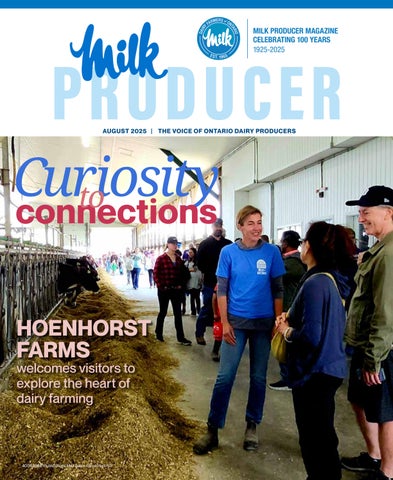
Curiosity to connections HOENHORST FARMS welcomes visitors to explore the heart of dairy farming
40063866 .Publications Mail Sales Agreement No
Smarter Dairy
Stronger Future When we fired up the robots 2 years ago DairyComp support made the transition so smooth. We reached out with a simple text and would have been lost without them.
Tyce Kootstra Stradow Farms, Ponoka, AB 160 cows milkingRobots
We’ve been using DairyComp for the past 3 years and it’s become an invaluable cow management tool that has contributed to our success. David Bekkers Bekkers Farm, Antigonish, NS 150 cows milkingParlour
Contact us to learn more about software options. 1 800 549 4373
I have been using DairyComp since the ‘90s. I find it easy, intuitive, and the insight it provides is useful to help us stay at the top of our game. John Schenkels Schenkels Farms, Whitney, NB 550 cows milkingParlour & Robots
August 2025 | Vol. 101 No. 08
MILK PRODUCER MAGAZINE CELEBRATING 100 YEARS 1925-2025
PUBLISHED BY DAIRY FARMERS OF ONTARIO 6780 Campobello Road Mississauga, ON L5N 2L8 COMMUNICATIONS Sandra Da Silva sandra.da-silva@milk.org 905-817-2178 ADVERTISING Pat Logan pat.logan@milk.org 519-788-1559
CONTENTS www.milkproducer.ca
ON THE COVER
GRAPHIC DESIGN Katrina Teimo CONTRIBUTORS Robert Matson, Jeanine Moyer, Dr. Anna Schwanke, Bethany Harripersad, Trevor DeVries, Angie Wilson, Tom Wright, Lilian Schaer, Jean-Philippe Laroche, Jennifer Donahue, Chris McCullough, Veal Farmers of Ontario.
18 HOENHORST FARMS invited the public
PHOTOGRAPHY Breakfast on the Farm photos by Donna Rogers and Lauren Miller
to experience life on the farm, marking a century of farming with connection, community and cows.
Canada Post Publications Mail Sales Product Agreement No.40063866. Return postage guaranteed. Circulation: 8,000. ISSN 0030-3038. Printed in Canada. SUBSCRIPTIONS For subscription changes or to unsubscribe, contact: MILK PRODUCER 6780 Campobello Road Mississauga, ON L5N 2L8 Phone: (905) 821-8970 Fax: (905) 821-3160 Email: milkproducer@milk.org Opinions expressed herein are those of the author and/ or editor and do not necessarily reflect the opinion or policies of Dairy Farmers of Ontario. Publication of advertisements does not constitute endorsement or approval by Milk Producer or Dairy Farmers of Ontario of products or services advertised.
Advocacy
Departments
8
4 Board Editorial 6 DRC Corner 10 Consumer Marketing 24 Dairynomics
Sharing dairy value through advocacy
Research 14 Research from Guelph recognized at global dairy science conference
16 Milk quality improvements through collaboration
28 Unique dairy care program has funding renewed for third term
32 Managing Agri-Food Pathogens
Ruminations 30 Training and adaptation for automatic milking systems
36 Long fibers in the TMR aren’t necessarily better for rumination
Milk Producer welcomes letters to the editor about magazine content. *All marks owned by Dairy Farmers of Ontario.
World Dairy
WEBSITES & SOCIAL MEDIA www.milkproducer.ca www.milk.org Facebook: /OntarioDairy X: @OntarioDairy Instagram: @OntarioDairy LinkedIn: dairy-farmers-of-ontario
40 Germany dairy farming advocate keeps consumers connected on social media
14
Calf Care 42 The hidden challenge: Spotting navel infections in calves
W W W. M I L K P R O D U C E R .C A • AU G U S T 2 0 2 5 • 3
MILK PRODUCER MAGAZINE CELEBRATING 100 YEARS 1925-2025
BOA R D E DI TOR I A L
Strengthening the dairy industry through strategic connections By Don Gordon, Dairy Farmers of Ontario (DFO) Board Member, Region 5, City of Kawartha Lakes, Durham Region, Peterborough and York. Don is the 2nd vice-chair of the DFO board and chair of the Marketing and Promotions Committee, and serves on the Quota Committee, Research and Development Committee, Transportation Committee, Ontario Advisory Committee for Transportation and the P5 Supervisory Body. In dairy farming, success isn't just about what happens on the farm — it’s also about the connections that stretch beyond the gate. Whether it's working with fellow producers, engaging with government officials, other industry organizations and partners, or building trust with consumers, meaningful relationships are what keeps this industry thriving. At its heart, dairy farming has long been grounded in community. Families carry on traditions built through generations, fellow producers offer a helping hand during busy seasons and local committees bring producers together around common goals. These everyday connections remain vital in helping producers solve problems, share knowledge and support one another.
in producer committees and other agricultural organizations, and meeting and speaking with local government officials, ensures producers are represented when decisions are being made about policy and industry standards.
Don Gordon
Beyond the farm gate, strategic partnerships with professionals — veterinarians, nutritionists, crop advisors and business consultants — can make a real difference. They help producers make informed choices, improve herd performance and stay ahead of the curve on research and technology. Having relationships with experts means producers are better equipped to tackle uncertainty and invest for the future.
These moments of exchange offered more than just a glimpseVicky into farm life — they created genuine Morrison connections. These encounters fostered meaningful dialogue, dispelled misconceptions and built bridges between rural and urban perspectives.
Over 25 years ago, a fire swept through our family farm, leaving behind ashes where generations had built their lives. The devastation was profound, yet amidst our darkest moment, we experienced the power of human connection and community. Over 700 friends, neighbors and fellow producers came forward to help us rebuild. In times of hardship, it is these connections that sustain us, offering hope and a shared sense of purpose.
Building connections and trust with consumers are vital to the growth of our industry. As fewer people have direct ties to agriculture, misinformation about our industry and food production is more likely to be accepted as truth. Telling our story is more important than ever. Producers have an opportunity — and a responsibility — to share the realities of the Ontario dairy industry. Whether it’s through social media, community events, farm visits or a casual chat at the market, engaging the public builds trust and fosters greater understanding.
Connections are also critical when it comes to representation and advocacy. Getting involved
Our family has opened the barn doors to urban visitors in the past, and it was a humbling experience.
When consumers hear from the people behind their milk, it becomes more than a product — it becomes personal. They see the values that drive our industry: care for animals, stewardship of the land and the deep connection to family and community. These authentic, person-to-person interactions help break down barriers, strengthen loyalty and ensure the story of dairy is understood and appreciated. Dairy farming is about people. By growing relationships across our industry and within our communities, producers are not just growing a business — we are helping build a united, thriving future for dairy. In dairy, connection isn’t an added bonus. It’s a foundation.
Your business advisor should understand what you have on the line Our agricultural advisors get that your livelihood is your life. Stop by the FCC Industry Pavilion at Canada’s Outdoor Farm Show, September 9 to 11 and let’s talk about where your farm operation can go. Jordan Bowles, CPA, CGA, Partner and Business Advisor 226.775.3033 | jordan.bowles@mnp.ca MNP.ca
4 • AU G U S T 2 0 2 5 • W W W. M I L K P R O D U C E R .C A
MILK PRODUCER MAGAZINE CELEBRATING 100 YEARS 1925-2025
DRC COR N E R
Working together Our role in harmonizing P5 milk quality The P5 Quality Harmonization Committee
Jeff Hyndman
By Jeff Hyndman, Executive Director, Regulatory Compliance and Quality Assurance, Dairy Farmers of Ontario Dairy Farmers of Ontario (DFO) engages with Les Producteurs de Lait du Québec (PLQ), Dairy Farmers of Prince Edward Island (DFPEI), Dairy Farmers of Nova Scotia (DFNS) and Dairy Farmers of New Brunswick (DFNB) as a member of the P5 Milk Agreement. The goal of the P5 is to share milk revenues, coordinate policies and ensure equity among producers across the participating provinces. To help strengthen the drive for equity amongst the provinces, the P5 Pool has established the P5 Milk Quality Harmonization Committee with the mandate to strive for the development of a
harmonized raw milk quality program for all P5 provinces. The committee reports to the boards of each of the P5 provinces, with each board acting in accordance with the laws of their province. While harmonization is the goal of this committee, work also includes documenting the current milk quality policies in each P5 province with the intent to develop different options for the boards to consider. Through this approach, the committee aims to explore opportunities to improve milk quality across the pool to ensure that producers have the same benefits and
obligations relative to producing and marketing high-quality milk. DFO currently holds the role as Secretary for the committee, but the committee also has two subcommittees, led by the PLQ and DFNB, respectively. By working together on milk quality as a member of the P5 Milk Quality Harmonization Committee, DFO is reaffirming its commitment to producing some of the highest quality milk in the world.
Dairy Farm D 18537 • 5 Lely A5 robots • 250 kgs dairy quota • 1100 acres • Located in SE Manitoba • Full line of machinery & livestock included • Stunning 2 storey house
Farms for Sale MANITOBA
To view more farms for sale, visit: www.farmdivision.ca 6 • AU G U S T 2 0 2 5 • W W W. M I L K P R O D U C E R .C A
Sheldon Froese 204.371.5131 sheldonfroese@royallepage.ca
#1 GPA-LPI “PP A2A2” Bull in Breed +3950 The closest bull to perfection we have seen in the breed to date. Apollo-PP appeals to every modern producer in the industry.
Rankings in Top 100 GPA-LPI
#1
Mammary +12
#2 Conf +14
#3
Rump +11
Available in conventional & sexed
Plus (over 100) for all Health & Fertility traits
Available in Canada from
VECTOR FRA APOLLO-PP
724HO02040 CANM14911360 A2A2 / BB
LOGIC-PP x ALLDAY-P (VG-86 2yr) x HOTSPOT-P (EX-90) aAa 315246
+94 Kg Fat +0.58% +11 Feet & Legs
Contact for International Semen Marketing dave@validitytesting.com 905-866-7800
Ideal for Robots 101 Milk Speed +2 Long Teats
MILK PRODUCER MAGAZINE CELEBRATING 100 YEARS 1925-2025
A DVOCACY
Sharing dairy value through advocacy DAIRY FARMERS OF ONTARIO (DFO) recognizes that there is strength in working together as Ontario agriculture, food and agribusiness. As trade and geopolitics define 2025 as a year of international market chaos and unpredictability, DFO is responding with resolved focus on collaboration – within dairy, within agriculture and with other stakeholders in Ontario. We are focusing on where we can influence and impact for the greater good and protect Ontario dairy, maintaining our ability to deliver growth through investment and innovation. In support of DFO’s mandate and strategic plan for the dairy sector, nurturing relationships with dairy producers, customers and governments is a priority in the delivery of our responsibilities for the production and marketing of milk in Ontario.
We are also committed to working with other agriculture sectors and industry stakeholders with a commitment to dialogue, cooperation and collaboration. Collaboration, and the benefits it provides, strengthens our sector and is a key to our shared success in consistently delivering high-quality milk for Ontarians.
Provincial
DFO delivers excellence and leadership in the production and marketing of milk in all communications with the Ontario government – working closely with officials at the Ontario Farm Products Commission and across departments, as well sustaining relationships with ministers and MPPs (Member of Provincial Parliament) as the regulator and sole delegated authority, while advancing our vision of a dynamic, profitable, growing Canadian dairy industry.
the objective of deepening government understanding and support on dairy files, while also lending our support to common issues for the benefit of all of Ontario agriculture and food. Board members represent DFO in meetings with local officials, boards of trade and business roundtables. We also encourage grassroots connections with local elected officials. DFO has been working with the Ontario Federation of Agriculture and other agriculture organizations like Farm Gate 5 on common farm and agriculture policies, and with the Ontario Dairy Council (ODC) and the Ontario Milk Transporters Association (OMTA) on industry policy and as partners in Feed Ontario's longest running program, the Ontario Milk Program, for over 25 years. It takes a sustained, concerted effort to ensure that the key decision makers develop policies and programs that benefit and support Ontario’s largest agriculture sector, while also nourishing our local communities with fresh, local, quality Ontario milk.
Mark Hamel, Chair, and Cheryl Smith, CEO, regularly connect with key ministers and participate in government roundtables, with
Cheryl and Mark with Kirsten Hillman, Ambassador of Canada to the United States.
Mark Hamel, Chair and Cheryl Smith, CEO, with the Hon. Vic Fedeli, Minister of Economic Development, Job Creation and Trade. 8 • AU G U S T 2 0 2 5 • W W W. M I L K P R O D U C E R .C A
Mark and Cheryl with the Hon. François-Philippe Champagne, Minister of Finance and National Revenue.
National
Building on the work at the local and provincial level in Ontario, DFO provides leadership and expertise at the national level to amplify the value that dairy brings to Ontario and Canada. Our membership in Dairy Farmers of Canada (DFC) is supported by the roles that board members and staff play on various national technical and policy committees with the objective of advancing a dairy policy framework that aligns with our growth and investment goals for the sector. Governing our sector, DFO plays an active role at the Canadian Milk Supply Management Committee (CMSMC), P5 and P10 tables. As we work together as a national pool for the betterment of Canadian dairy, we recognize that we are stronger together.
collectively strengthening the evidence-based work that underpins international standards on dairy terms, compositional standards, best practices and nutrition DFO remains steadfast in its commitment to collaboration, leadership and innovation across all levels — local, provincial, national and international. By fostering strong relationships,
Global
Canadian dairy is recognized for high standards, world class dairy genetics and strong commitment to the role dairy plays in healthy diets and living. DFO supports technical and scientific work, in partnership with processors, at International Dairy Federation (IDF) and IDF Canada. Attending the annual IDF Summit is an opportunity for team Canadian dairy to deepen our scientific knowledge, while
advocating for sound policy and contributing to rigorous dairy standards, DFO ensures that Ontario dairy continues to thrive and evolve. Our unified efforts not only safeguard the integrity and sustainability of the sector but also reinforce our shared purpose: delivering high-quality milk to Ontarians while championing the broader values of Canadian agriculture. Together, we are building a resilient and sustainable future for dairy. Cheryl and Mark with the Hon. Trevor Jones, Minister of Agriculture, Food and Agribusiness, Hon. Caroline Mulroney, President of the Treasury Board and Minister of Francophone Affairs, and Hon. Lisa Thompson, Minister of Rural Affairs. Cheryl and industry peers, Gilles Froment (Lactalis), Suzanna Dalyrmple (Gay Lea Foods) and Catherine Tokarz (Saputo), at the IDF Summit.
Supply management: Protecting Canadian resources to benefit all Canadians A dynamic, growing and profitable dairy sector is good for Ontario. It is good for Canada. It is in Canada’s best interest to protect our domestic food sectors and the policy tools that sustain Canadian agriculture.
Cheryl and Mark with former prime ministers and party leaders, Hon. Thomas Mulcair, Right Hon. Jean Chrétien and Right Hon. Stephen Harper.
DFO board members and executives meet with Hon. Doug Ford, Premier of Ontario, at Queen’s Park. W W W. M I L K P R O D U C E R .C A • AU G U S T 2 0 2 5 • 9
CONSUMER MARKETING
Telling our farmer story to build equity, trust, connection and local pride
DAIRY FARMERS OF ONTARIO (DFO) implemented their Spring Farmer Equity campaign, which was to strengthen industry perceptions, reinforcing the local nature of Ontario’s dairy industry and demonstrating the quality and care that goes into producing milk. The campaign reminded Ontarians that the milk they love is produced locally, on family-run farms, for Ontario families.
From Ontario farms to Ontario tables
The 10-week campaign tapped into Ontario consumers’ growing passion for supporting local. By showcasing shared values and the pride of local dairy farmers, the campaign built an emotional connection between producers and consumers — showcasing that every glass of Ontario milk is produced with the highest standards and care.
Emotional storytelling
Anchoring the campaign, 30- and 15-second “Set the Table” TV commercials delivered a positive impact on milk consumption and Ontarian’s view of dairy. In addition, billboard placements, social media videos, integrated broadcast segments and influencer collaborations amplified the message: Ontario dairy farming families are proud to produce high-quality milk for Ontarians.
Connecting at farmers markets
Activations brought the campaign to life through interactive experiences at select local farmers markets where consumers made a direct connection with the dairy farmers who produce the delicious local milk they purchase from their grocery stores everyday. At locations in Prince Edward County, downtown Toronto and Niagara Falls, the Ontario Dairy Farmers Milk Corner offered attendees a taste of locally produced milk and cheeses, fun trivia games and the opportunity to meet some local Ontario dairy producers themselves. The presence of dairy producers Linda Stather of Ameliasburg, Ont., Robert & Duncan Larmer of Blackstock, Ont., and Brandon DeBoer of St. Anns, Ont. lent authenticity and heart to the campaign, showing firsthand the level of care and expertise that goes into producing high-quality milk for everybody.
Showcasing the industry on Breakfast Television
From April 24 to May 29, DFO sponsored six engaging Breakfast Television segments featuring dairy farmer Ashley Brown of Browndale Farm to further deepen the connection between
1 0 • AU G U S T 2 0 2 5 • W W W. M I L K P R O D U C E R .C A
Ontario farmers and Ontario families. These segments, filmed at Browndale Farm in Paris, Ont., answered viewer-submitted questions revealing the producer’s journey into dairy farming and continued with insights into daily farm operations and commitment to animal care and sustainable farming practices, reinforcing the hard work, expertise and care that goes into milk production. Across the six segments, viewers saw a glimpse of a day in the life of a dairy producer and were reminded that the milk they love is produced with care by local dairy farming families, right here in Ontario.
Achieving connections and our goal
Consumer research and brand tracking validates that DFO’s Farmer Equity campaign successfully shifted perceptions: 84 per cent of Ontarians agree that Ontario dairy producers take pride in what they do, and 82 per cent believe they genuinely care about producing high-quality milk. These numbers speak volumes, underscoring how an emotional connection and strategic design can elevate not just a product, but the people and purpose behind it. Whether it’s through powerful storytelling or face-to-face engagement, DFO’s Spring 2025 Farmer Equity campaign is more than a marketing initiative — it’s a reminder that behind every glass of milk is a family, a story, a community and a connection.
30 years of building
lasting connections with students and future consumers CELEBRATING A MILESTONE THIS YEAR is the Dairy Farmers of Ontario's (DFO) Dairy Education Program. For 30 years, the program has fostered curiosity, supported agricultural learning and built meaningful connections in classrooms across the province. Since its launch in 1995, the program has delivered nearly six million dairy education presentations to Ontario students. At the heart of this initiative are the dairy educators — passionate, highly trained individuals who bring classroom presentations to life by sharing farm stories, best practices and science-backed facts tied directly to the Ontario curriculum. These dedicated individuals form lasting bonds with students and teachers. They return to the same schools year after year, are remembered by name and often personally requested. By building trust, they cultivate true connection — and that connection translates to lasting impact. Educators don’t just present facts; they personalize them. Whether sharing firsthand experiences from their own farms or relaying stories from the field, they demystify dairy in engaging ways — from playful sensory lessons for kindergartners to engaging critical thinking activities for grade 8 students. When kids leave excited to talk about cows, milk or how farmers care for animals, meaningful learning took place.
1 2 • AU G U S T 2 0 2 5 • W W W. M I L K P R O D U C E R .C A
In addition to the educator experience, the program also offers complementary platforms: • Ontario School Programs Website helps teachers book visits and access trusted curriculum resources. • The Learning Management System (LMS) offers independent learning tools and classroom-ready content. • The Ontario Dairy Education YouTube channel enhances presentations with fun, digestible videos — often suggested by educators for post-visit follow-ups. These tools make it easier for educators to reach students and ensure teachers can rely on credible, curriculum-aligned materials. Dairy producers know the importance of personal attention — whether it’s caring for their animals, stewarding the land or connecting with their communities. The Dairy Education Program channels these same values into every classroom visit. It’s not just about informing — it’s about building trust and sparking curiosity. Through these connections, students gain a clearer understanding of agriculture, food systems and the people behind them — laying the foundation for informed, thoughtful perspectives about where their food comes from.
Explore where livestock comes to life. Milk in Minds
SEPT. 9-11, 2025 Woodstock, Ontario outdoorfarmshow.com
600+ exhibitors in all areas of agriculture Demonstrations in dairy equipment, crops, technology and more An experience for every member of your farm family Get the Canada’s Outdoor Farm Show app
SCAN & PLAN!
Our mobile app makes it easy for you to find booths, see the best demonstrations, find your favourite food truck and get notified about the latest events.
MILK PRODUCER MAGAZINE CELEBRATING 100 YEARS 1925-2025
R E SE A RCH
Research from Guelph recognized at global dairy science conference By Robert Matson, Production Research Manager, Dairy Farmers of Ontario
DAIRY FARMERS OF ONTARIO (DFO) is proud to support world-class researchers, including those of Dairy at Guelph. Dairy at Guelph is the Centre for Dairy Research and Innovation dedicated to supporting researchers at the University of Guelph who focus on dairy production systems and foods. With over 50 faculty members and 125 graduate students and postdocs working in animal, veterinary, food sciences, engineering, human nutrition and economics, it is one of the largest and most productive dairy science groups in the world. Dairy at Guelph fosters collaborative opportunities to discover, develop and implement innovative best practices in dairy production and food. This global leadership has earned the University of Guelph its place as Canada’s Dairy University.
• General Welding • Tank Manufacturing • Repairs
JEMBROOK WELDING INC. 6918 Middlebrook Rd., RR1 West Montrose, ON N0B 2V0 519-669-5772
1 4 • AU G U S T 2 0 2 5 • W W W. M I L K P R O D U C E R .C A
To help foster knowledge exchange, promote collaboration and support connections, researchers and students often attend conferences around the world. This year, Dairy at Guelph had a strong showing at the American Dairy Science Association (ADSA) annual meeting — one of the premier dairy science conferences globally. The conference was held from June 23-25, 2025, in Louisville, Kentucky. This year, the ADSA’s annual conference attracted over 1,700 attendees from the United States, Canada and 20 other countries, who shared the latest projects and results over three days of symposia, scientific posters and research presentations. Dairy at Guelph was well-represented at ADSA, with over 30 graduate students, postdoctoral researchers and faculty members. These attendees presented a total of 72 oral research talks and posters, which was one of the largest contingents and contributions at the conference.
Several members were recognized for their achievements and graduate students earned numerous awards. Dr. Trevor DeVries, professor in Animal Biosciences, received the DeLaval Dairy Extension Award. Dr. Stephen LeBlanc, professor in Population Medicine and director of Dairy at Guelph, was honoured with the Zinpro Award for Excellence in Dairy Science.
PACKED WITH A HIGHER CONCENTRATION OF IGG, IMMUNOLIFE | 200 IS THE ULTIMATE CHOICE FOR YOUR CALVES' HEALTH AND VITALITY.
Dr. Michael Steele, professor in Animal Biosciences and Dr. David Renaud, associate professor in Population Medicine, were inducted into the Journal of Dairy Science (JDS) 100 Club, which recognizes individuals who have published over 100 papers in the journal. They join an impressive list of JDS 100 Club members from Dairy at Guelph, including Drs. DeVries, Miglior, Duffield, LeBlanc, Kelton and Leslie. There are more JDS Club 100 members from the University of Guelph than from any other university. Dairy at Guelph was also represented in the graduate student contests. In the PhD Division of the Dairy Production Poster competition, Amanda Fischer Tlustos took first place and Gabriella Roby Dodd placed second. In the MSc Division, Melinda Kovacs placed first. In the PhD Division of the Dairy Production Paper Presentation, Jessica Brasier was awarded third place, and in the MSc Division, Avalon Phillips placed third. On behalf of DFO, we extend our heartfelt congratulations to all the recipients, and a special thank you to Hannah Park from ADSA for her invaluable contribution and support in development of this article.
Dairy at Guelph fosters collaborative opportunities to discover, develop and implement innovative best practices in dairy production and food. This global leadership has earned the University of Guelph its place as Canada’s Dairy University.
WWW.TRUVITAL.CA
FUTURE PERFORMANCE IS:
PREBIOTICS TO SUPPORT OVERALL HEALTH
Prebiotics play a crucial role in Mapleview Agri milk replacer, promoting digestive tract health, which directly impacts calf performance. With prebiotics as a key differentiator, Mapleview milk replacer delivers the innovation and performance that set your operation up for long-term success.
WWW.MAPLEVIEWAGRI.CA W W W. M I L K P R O D U C E R .C A • AU G U S T 2 0 2 5 • 1 5
R E SE A RCH
MILK PRODUCER MAGAZINE CELEBRATING 100 YEARS 1925-2025
Milk quality improvements through collaboration By Robert Matson, Production Research Manager, Dairy Farmers of Ontario WHEN IT COMES TO MILK QUALITY, Dairy Farmers of Ontario (DFO) takes its responsibility as the sole regulator and delegated authority seriously. While our producers strive for continuous improvement, they also rely on a support network of technicians from their local cooling and milking equipment dealers to provide support in reaching their goals. DFO was approached by one dealership to find out more about how DFO supports their producers with increased bacteria inquiries and how we could continue to work together. This was the main reason behind a new initiative to connect and share information between DFO and the trusted partners of our producers. The result was the creation of a training program that covered a range of important topics, including Dairy Farmers of Ontario’s Raw Milk Quality (RMQ) Program, the significance of biosecurity when visiting farms and an overview of how Field Service Representatives (FSRs) conduct farm inspections:
As a part of the feedback for the course, technicians were asked to provide comments on the course contents, here’s what a few of them had to say: To date, 13 courses have been offered across Ontario with over 120 participants from 15 dealerships. The training program is offered free of charge to all participants with resources provided to all participating technicians. The plan is to have other courses over the next couple of months in various regions of Ontario. This program reinforces the commitment of DFO to collaboration and the desire to strengthen our shared role in ensuring that Ontario continues to produce the highest quality milk in the world. If you are interested in attending a course, contact your local DFO Field Service Representative.
1 6 • AU G U S T 2 0 2 5 • W W W. M I L K P R O D U C E R .C A
This is exactly what I was looking for to be able to better understand DFO requirements and how to more effectively diagnose problems on farm.
I was surprised how many connections I made to things I see every day. I have gained new perspectives to help understand why our systems are the way they are.
The course was designed to provide technically sound, relevant information that was neutral to all system types. There was a strong appetite for the knowledge provided, and the goal was to establish a connection that would enable technicians to gain a better understanding of the role of DFO and our inspectors. I was very impressed with the technical knowledge and experience of our dealers’ staff and their willingness to collaborate. Thank you to all of the dealers, technicians and DFO team members who made this course possible. – Guy Séguin, Senior Advisor, Special Projects
RIGHT FROM THE
FARM FARM
RIGHT FOR THE
OVER 50 YEARS OF RESEARCH, ON FARMS JUST LIKE YOURS.
1-800-265-7863 | GroberNutrition.com |
W W W. M I L K P R O D U C E R .C A • AU G U S T 2 0 2 5 • 1 7
COV E R STORY
From curiosity to connection Oxford County dairy farmer opens the barn doors Hoenhorst Farms invited the public to experience life on the farm, marking a century of farming with connection, community and cows By Jeanine Moyer
1 8 • AU G U S T 2 0 2 5 • W W W. M I L K P R O D U C E R .C A
WHEN IT COMES TO OPENING THE BARN DOORS to give the public a look at what dairy farming is really like, some farmers may hesitate. But not Cox Wensink, owner of Hoenhorst Farms Inc. of Innerkip, Ont. This summer, Wensink and her family welcomed 2,200 visitors to tour and experience their dairy farm as the host of Farm and Food Care Ontario’s (FFCO) June 14, 2025 Breakfast on the Farm event. Hosting farm tours wasn’t new to Wensink. She says her family regularly welcomes community groups, industry visitors and interested neighbours to the farm and enjoys the conversations that flow from sharing their first-hand farm experience. She’s also accustomed to curious carloads of people driving into the farmyard asking questions and requesting a tour, but Wensink says that as much as she’d like to accommodate unexpected visitors and show them around, health and safety and biosecurity concerns prevent Wensink from welcoming impromptu guests to the farm.
“As farmers, we don’t celebrate our achievements enough, so when our centennial anniversary came around, we knew we wanted to do something special to mark this milestone.” – Cox Wensink
“I’m always worried that we might be giving a negative view of the industry if we keep turning away people who are genuinely interested in learning about farming,” she reflects. It was her enthusiasm for sharing her farm’s story and promoting agriculture and dairy farming, combined with her family’s 100-year farming anniversary that prompted Wensink to host an open-door event and invite the public to the farm. She originally planned to host 200 people, but that quickly changed after she contacted FFCO for event planning advice. “It was Farm and Food Care Ontario that proposed we host Breakfast on the Farm,” says Wensink, noting that her family’s first reaction was hesitation. “The event was 10 times bigger than we originally had in mind, but it was the right decision to host, and I would do it again if we could.”
Tradition and technology
This year marks 100 years of farming for the Wensink family. “As farmers, we don’t celebrate our achievements enough, so when our centennial
anniversary came around, we knew we wanted to do something special to mark this milestone,” says Wensink. Originating in the Netherlands, Wensink’s parents settled Hoenhorst Farms in its third location here in Canada in 1994. As the fourth generation, Wensink came back to the farm 10 years ago, starting as a herdsperson and working her way through every role until she took over management and ownership in 2021. Today, Wensink manages the farm with the help of nine full-time employees, including Canadians and Guatemalans. Over the years, the farm has expanded to include two farm locations that are adjoined. On the main farm, where the Breakfast on the Farm event was hosted, the Wensink’s milk 380 Holsteins with eight Lely A4 robots. At the second farm location, 110 Holsteins are milked by two Lely A4 robots. Wensink says that one of her greatest concerns about hosting the event was that her barns aren’t new, but that wasn’t a concern for FFCO or the public who were more than happy to tour through the operation.
Photos by Donna Rogers and Lauren Miller, Farm and Food Care Ontario volunteers
W W W. M I L K P R O D U C E R .C A • AU G U S T 2 0 2 5 • 1 9
Wensink points to the implementation of genomic testing as a recent herd management and growth strategy the farm has adopted. “We have a growth-focused mindset and stay up to date with technology and management methods at an incremental pace that works for us,” explains Wensink. “Our focus is always on keeping our cows happy, healthy and relaxed, so we’re never standing still when it comes to making improvements.”
enjoy and what I’m best at while relying on my team of staff and advisors to help with the rest,” she says.
Teamwork in action
Organizing Breakfast on the Farm was truly a team approach as Hoenhorst Farms collaborated with FFCO to make the day a success.
Wensink points to the implementation of genomic testing as a recent herd management and growth strategy the farm has adopted. She started genomic testing a few years ago, and says that, “while genomic testing isn’t a new technology, it was a big jump for us, and we haven’t looked back.” Today, she relies on genomic testing results to make informed breeding decisions that are delivering positive changes for her herd.
With only four months to plan and prepare for the event, Wensink started her to-do list by taking a walk around the farm, trying to see it from a nonfarming visitor’s perspective. She says that’s when they started cleaning, noting that, other than cleaning and tidying the farm, FFCO took care of the rest of the event planning and logistics.
One of the latest enhancements for Hoenhorst Farms has been a renewed focus on raising heifers. Keeping with her approach of making incremental improvements, Wensink continues to implement management changes each month and monitor the developments over time. She says she’s seeing major changes in the heifer barn that are translating to improvements in animal health and longevity as the heifers’ transition to milking cows.
“Our goal was to show people how much we care about our animals and what milk production really looks like,” says Wensink, explaining that her family and staff all set their sights on showing visitors what a working dairy farm looks like. “We wanted people to leave our farm with a great story to take home and share with their friends and family, and I think we achieved that.”
When it comes to overall farm management, Wensink is a firm believer in taking a team approach. “I start every day with a walk around the farm to check in with my team,” says Wensink, explaining this provides everyone with an opportunity to share new ideas or raise concerns.
As the team moved forward with planning and preparations, Wensink was pleasantly surprised and deeply encouraged by the overwhelming support and enthusiasm from her local community. With the help of FFCO, she spearheaded a core committee of trusted and valuable advisors, fellow farmers and neighbours who helped recruit volunteers, contact local sponsors and advertisers, source equipment and make the day run as smooth as possible. “There was quite the local buzz about the event, and everyone was eager to help us welcome visitors to the farm,” she says.
Weekly meetings are held every Monday for 30 minutes where the team reviews and plans the week ahead and discusses any new protocols or changes. Wensink also schedules quarterly farm management meetings with her parents and advisors. “It’s a team effort – I’m able to choose what I
2 0 • AU G U S T 2 0 2 5 • W W W. M I L K P R O D U C E R .C A
Our focus is always on keeping our cows happy, healthy and relaxed, so we’re never standing still when it comes to making improvements. – Cox Wensink
A perfect day
The day of Hoenhorst Farms Breakfast on the Farm event was perfect. Wensink quips that even the weather cooperated. As farm hosts, Wensink and her family were on hand to answer questions, take photos and visit with VIP guests, like local politicians. The Wensink family may have been celebrities at the event, but the animals were the star of the show. In fact, the highlight for many was watching a cow give birth to a calf. The open house event attracted 2,200 attendees, 250 volunteers and 40 industry partners who set up educational displays. More than 2,500 meals were served, that included breakfast sandwiches, milk, asparagus, berries, granola, cheese, apple cider and ice cream. Everyone left satisfied – full of fresh, local food and a new appreciation for agriculture, dairy farming and a direct connection to where their food comes from. “These days, few people grow up on or near a farm. There’s a lot of curiosity and misinformation about farming – that’s why it’s so critical to tell our story. We hope the visitors could see and experience for themselves how much we care for our animals and how proud we are to produce food for them,” says Wensink, noting that many of the questions she received came from people genuinely interested in what the animals eat and how they are milked. Reflecting on the day, Wensink says that she was honoured to give back to her community and share their story. While hosting Breakfast on the Farm took the concept of offering farm tours to a whole new level, the family is committed to continuing to share their story and welcome the public to their farm. “It was such a rewarding day, and I think my great grandparents would be proud of how we chose to celebrate the generations of our family who have contributed to where we are today,” she says.
W W W. M I L K P R O D U C E R .C A • AU G U S T 2 0 2 5 • 2 1
COV E R STORY
Breakfast on the Farm makes connections
“We’re showcasing Ontario agriculture at its finest,” says Kelly Daynard, FFCO executive director, explaining the purpose of Breakfast of the Farm is to offer a unique experience for non-farming visitors by providing the opportunity to step foot on real, working farms, go behind the scenes of agriculture and food production, and talk to real farmers. “While the entire event is an immersive exhibition of agriculture and food, each event and farm host are different.” Of the 25 on-farm events FFCO has hosted over the years, 10 of those have showcased Ontario dairy farms. Every event features a free all-Ontario breakfast for visitors with special flavours and foods that reflect the type of farm they are visiting and what’s in season. A past event, hosted on a Brussels sprouts farm, even featured Brussels sprouts on the breakfast menu. The most recent event, held at Hoenhorst Farms Inc., a dairy farm in Innerkip, Ont., served up ice cream as a featured dairy product, along with locally grown asparagus that reflected in-season produce.
By Jeanine Moyer FARM & FOOD CARE ONTARIO (FFCO) HAS WELCOMED MORE THAN 60,000 GUESTS to Ontario farms since the organization began hosting Breakfast on the Farm events in 2013. From Windsor, Ont. to Cornwall, Ont., FFCO has partnered with Ontario farmers to open barn doors across the province, presenting on-farm events and a series of modified events in collaboration with agricultural societies and festivals.
2 2 • AU G U S T 2 0 2 5 • W W W. M I L K P R O D U C E R .C A
At every event, guests must register to attend. Daynard explains this helps organizers plan logistics and food requirements but also gives them the opportunity to survey attendees about the type or size of their home community (size of town or city they live in) and in the event that contact tracing is required. Event registration also provides the organizers with the opportunity to survey attendees after the event. According to Christa Ormiston, FFCO communications manager, survey results (from those who answered the questions) from the June 14, Hoenhorst Farms event show that nearly 22 per cent of attendees came from large urban centres, just over 25 per cent came from medium sized urban centres, 27 per cent came from small towns and almost 16 per cent came from rural Ontario. “These results show that we are attracting our target audience of non-farming consumers,” says Ormiston. “And we know from our interactions with event attendees that they are engaged and genuinely interested in learning more about where their food comes from.”
Farm and Food Care Ontario’s Breakfast on the Farm events offer a unique opportunity for Ontarians to tour real farms, meet farmers and learn where their food comes from. Cultivating connections
Breakfast on the Farm has grown in size and popularity over the years. Daynard says they are seeing repeat attendees who travel the province to take in the events and regular volunteers who are committed to supporting every event and farm host. The organization relies on roughly 200 volunteers at each Breakfast on the Farm. Many of the volunteers come from the local community, agricultural groups and industry organizations. In addition to featuring tours of each host farm, the event partners with commodity and community groups to “tell the full story of Ontario agriculture,” as Daynard explains. These exhibits often include a wide variety of farm animals, food products and even local service groups and fire departments. “Inviting the entire agriculture industry to be part of Breakfast on the Farm not only enhances the day for visitors, but supports the farm family host too,” says Daynard, pointing to industry-related volunteers like a local cheesemaker and genetics company that attended the recent Hoenhorst Farms event to show off their support and enthusiasm by explaining their industry contributions to event attendees.
Where the science of nutrition meets accurate feeding for a sustainable future Optimized Rations
Targeted Approach
$
Sustainability Driven
Some of the largest Breakfast on the Farm events have attracted more than 2,500 visitors. In 2024, FFCO hosted a modified event in collaboration with the Elmira Maple Syrup Festival in Elmira, Ont. and estimate that 15,000 festival attendees toured through the Breakfast on the Farm exhibit area. This fall, they are partnering with KitchenerWaterloo Oktoberfest to host another modified event that is expected to draw the largest attendance yet. While COVID-19 forced FFCO to pause in-person events, it didn’t take the organization long to harness the spirit of the pandemic and ‘pivot’ to host Breakfast from the Farm drive-through and walk-through events in 2021 and 2022. Once again, FFCO collaborated with industry partners and local agricultural societies to host the events. Every Breakfast on the Farm event provides an opportunity to work with a new farm host, a different community and continuously improve the experience for visitors. Ormiston explains that while they rely on farmers to host the event, FFCO facilitates the event and takes care of all the logistics. “We want to make the load as light as possible for the farm host so they can focus on showcasing their industry facilities,” says Ormiston, noting that FFCO is always looking for Breakfast on the Farm hosts and welcomes farmers to apply at www.FarmFoodCareON.org. “Breakfast on the Farm is a popular event that relies on and embraces the spirit of Ontario agriculture,” says Ormiston. “We are so grateful to Ontario farmers who generously open their doors to the public and invite consumers to tour their farms, ask questions and experience daily life on the farm firsthand.”
trouwnutrition.ca
W W W. M I L K P R O D U C E R .C A • AU G U S T 2 0 2 5 • 2 3
AUGUST 2025
Updated forecasts for 2025 and 2026 P5 PRODUCTION HAS BEEN TRENDING BELOW the forecast, however, with the additional incentive days announced last month, the expectation is production will be in line or above the production forecast. The Canadian Dair y Commission (CDC) has revised their quota forecast for the remainder of 2025. The forecast includes a revision down in expected imports, which results in a slight increase in quota requirements. This is offset somewhat by lower than forecast Class 1 sales. Overall, the optimistic quota forecast for P5 is an increase of 2.9 per cent with P5 forecast to fill quota at 99.9 per cent. Looking to 2026, a 1.7 per cent increase for P 10 quota has been forecasted. The forecast is slightly lower than 2025 based on the expectation of lower population grow th. For P5, the expectation is lower Class 1 sales, the optimistic
forecast for 2026 is 1.5 per cent grow th. The P5 quota committee will continue to monitor production. In June 2025, butter stocks reached 42,089 tonnes, up from May by 2,647 tonnes. June butter stock levels are at their highest level for the same month over the last five years and are at a historically high level for June. Cheese stock levels for the month of June 2025 were at 108 ,4 30 tonnes, up 2,417 tonnes from May, higher than the last five -year average, and are at a historically high level for June. For the 52 weeks ending June 28 , 2025, sales for fluid milk, fluid cream, yogurt, ice cream, cheese and butter increased by 0.3 , 1.3 , 6.1, 4.3 , 2.8 and 2.3 per cent, respectively.
A • AU G U S T 2 0 2 5 • M O N T H LY R E TA I L M A R K E T S A N D P R O D U C T I O N R E P O R T
DAIRYNOMICS – UTILIZATION UPDATE
A monthly recap of markets and production trends in Canada and Ontario C A NA DI A N R EQU I R E M E N T S A N D PRODUC T ION Canadian butterfat requirements in kilograms and actual butterfat production across the P10. 1,350,000 1,300,000
Butterfat (Daily kgs)
1,250,000
12-month production (in millions of kilograms)
422.5
12-month requirements (in millions of kilograms)
444.7
1,200,000 1,150,000 1,100,000 1,050,000 1,000,000 950,000
June 2024
July 2024
Aug 2024
Sept 2024
Oct 2024
Nov 2024
Dec 2024
Requirements
Jan 2025
Feb March April 2025 2025 2025
May 2025
June 2025
Canadian production has increased by 2.9 per cent over the previous 12 months, and requirements have increased by 2.5 per cent over the previous 12 months.
Production
S OL I D S NON-FAT T O BU T T E R FAT (S N F-B F ) R AT IO 2.35
This graph shows Ontario’s SNF-BF ratio for the last 12 months.
2.30
SNF:BF Ratio
2.25
June 2025: 2.1886
2.20 2.15 2.10
July 2024
Aug 2024
Sept 2024
Oct 2024
Nov 2024
Dec 2024
Jan 2025
Feb 2025
March 2025
April 2025
May 2025
June 2025
Ontario SNF:BF ratio
NAT IONA L R E TA I L S A L E S
JUNE HIGHLIGHTS
Average increase in retail sales for dairy products sold in Ontario and the dairy product’s share of the total market sales, including at hotels, restaurants and institutions.
12 MONTHS ENDING JUNE 28, 2025
RETAIL SHARE OF TOTAL MARKET
Fluid milk
0.30%
76.90%
Cream
1.30%
39.70%
Cheese
2.80%
55.40%
Butter
2.30%
58.70%
Ice cream
4.30%
70.70%
Yogurt
6.10%
94.90%
•
P5 production has been trending below the forecast, however, with the additional incentive days announced last month, the expectation is production will be in line or above the production forecast;
•
In June 2025, butter stocks reached 42 ,089 tonnes, up from May by 2 ,647 tonnes;
•
Cheese stock levels for the month of June 2025 were at 108 ,4 30 tonnes, up 2 ,417 tonnes from May, higher than the last five -year average.
As of March 26 , 202 2
* Source: AC Nielsen & StatsCan NOTE: There is a two-month lag in the national retail sales data.
AU G U S T 2 0 2 5 • M O N T H LY R E TA I L M A R K E T S A N D P R O D U C T I O N R E P O R T •A
DA I RY N O M I C S – P R I C E S U P DAT E
ON TA R IO U T I L I Z AT ION Percentage of the total milk produced in Ontario that was used to produce dairy products.
MAY 2025
JUNE 2025
12-MONTH AVERAGE
June 2025
Fluid milk & cream
29.8%
29.4%
30.2%
0.5%
Yogurt & ice cream
8.5%
8.5%
7.8%
Cheese
31.3%
31.2%
30.5%
Butter & powders
30.2%
30.5%
30.9%
Skimming
0.2%
0.5%
0.6%
Fluid milk & cream 29.4%
30.5%
Yogurt & ice cream Cheese
8.5%
Butter & powders Skimming
31.2%
P 10 U T I L I Z AT ION BY C L A S S For June 2025 (kg of butterfat/kg of solids non-fat) *There is a two-month lag reporting these figures
% Revenue
Class 1a1 (includes Classes 1a2, 1a3, 1c and 1d for confidentiality reasons) Fluid milk and beverages
1a1
25.02%
Class 1b Fluid creams Class 2a Yogurt, yogurt beverages, kefir and lassi
1b
9.06%
2a
5.69%
2b4
3.32%
2b5
1.64%
3a1
0.68%
3a2
5.91%
3b2
15.54%
3c1
0.87%
3c2
2.43%
3c4
7.37%
3c6
0.51%
3d
3.47%
4a
12.37%
4d
0.51%
5a
1.63%
Class 4d (includes Classes 4b1, 4b2, 4c and 4m for confidentiality reasons) Concentrated milk for retail, losses and animal feed
5b
3.44%
Class 5a Cheese for further processing
5c
0.54%
Class 5b Non-cheese products for further processing
% Solids non-fat
-5%
0%
% Butterfat
5%
10%
15%
20%
25%
A • AU G U S T 2 0 2 5 • M O N T H LY R E TA I L M A R K E T S A N D P R O D U C T I O N R E P O R T
30%
Class 2b4 (includes Classes 2b1, 2b2 and 2b3 for confidentiality reasons) Fresh dairy desserts, sour cream, milkshakes and sports nutrition drinks Class 2b5 Ice cream and frozen yogurt Class 3a1 Specialty cheese Class 3a2 Cheese curds and fresh cheeses Class 3b2 (includes Class 3b1 for confidentiality reasons) Cheddar cheese and aged cheddar Class 3c1 Feta Class 3c2 Asiago, Gouda, Havarti, Parmesan and Swiss Class 3c4 (includes Classes 3c3 and 3c5 for confidentiality reasons) Brick, Colby, farmer’s, jack, Monterey jack, muenster, pizza cheese, pizza mozzarella and mozzarella other than what falls within 3d Class 3c6 Paneer Class 3d Mozzarella used strictly on fresh pizzas by establishments registered with the Canadian Dairy Commission Class 4a Butter and powders
Class 5c Confectionery products 35%
DAIRYNOMICS – UTILIZATION UPDATE
• P5 demand has been slightly stronger (0.05 per cent), on average, than the Canadian Dairy Commission’s (CDC) ONTARIO MONTHLY PRODUCER AVERAGE GROSS BLEND PRICE optimistic scenario for the first four months of the 2024-25 ; A totaldairy 3,152year producers sold milk to DFO in June compared with 3,182 a year earlier. $105 $100 $95 $90 $85
• In November 2024, cheese stocks reached 99,932 tonnes, up from October by 542 tonnes. November cheese stock levels are higher than they have been for the same month in at least three years; • The butter stock level for November 2024 was at 30,427 tonnes, which is lower compared with October by 548 tonnes,
June 2025: $95.29
$80 $75 $70
July 2024
Aug 2024
Sept 2024
Oct 2024
Nov 2024
Dec 2024
Jan 2025
Feb March April 2025 2025 2025
May 2025
ONTARIO DEDUCTIONS, PER HL For June 2025
Within quota DFO administration DFO research CanWest DHI Transportation Market expansion Total deductions Average total net
Overquota
$0.675
$0.675
$0.050
$0.050
$0.060
$0.060
$3.970
$3.970
$1.500
$1.500
$6.255
$6.255
$87.96
-$6.255
* These figures are based on Ontario’s average composition for June 2025 of 4.1870 kg butterfat, 3.2100 kg protein and 5.9535 kg other solids, rounded to the nearest cent.
June 2025
P5 A N D W E S T E R N M I L K P O OL B L E N D PR IC E S *
U. S . C L A S S PR IC E S
The graph below shows the 12-month blend price for the P5 provinces and Western Milk Pool (WMP).
The July 2025 Class III Price, US$17.32 per hundredweight, is equivalent to C$54.09 per hectolitre. This equivalent is based on the exchange rate US$1 = C$1.37564 the exchange rate when the USDA announced the Class III Price.
Blend price in $/hL
*There is a two-month lag reporting these figures $96 $94 $92 $90 $88 $86 $84 $82 $80 $78 $76
WMP: $90.99 P5: $91.05
July 2024
Aug 2024
Sept 2024
Oct 2024
Nov 2024
Dec 2024
WMP blend price
Jan 2025
Feb March April 2025 2025 2025
May 2025
June 2025
The Class III Price is in US$ per hundredweight at 3.5 per cent butterfat. One hundredweight equals 0.44 hectolitres. Canadian Class 5a and Class 5b prices track U.S. prices set by the U.S. Department of Agriculture. Source: USDA
P5 blend price
MON T H LY QUO TA PR IC E S ($/ KG) PRICE/KG
AMOUNT WANTED/KG
Alberta
$52,600
318.90
193.02
167.90
Saskatchewan
$38,000
33.41
100.38
33.41
N/A
N/A
N/A
Exchange cancelled
British Columbia
$37,500
30.10
534.39
30.10
Ontario*
$24,000
24,726.64
391.44
391.41
Quebec*
$24,000
25,113.32
522.96
524.00
New Brunswick*
$24,000
628.20
0.00
Exchange cancelled
JULY PRICES
PROVINCE
Manitoba
PEI* Nova Scotia*
AMOUNT FOR AMOUNT SALE/KG PURCHASED/KG
No Clearing Price Established $24,000
0.00
0.00
Exchange cancelled
Newfoundland does not operate a monthly quota exchange. Quota is traded between producers. * Quota cap price of $24,000 in effect in Prince Edward Island, New Brunswick, Ontario, Nova Scotia and Quebec.
Co-ordinated by Dairy Farmers of Ontario’s communications and economics divisions. Questions? Please email questions@milk.org. STAY UP TO DATE! Weekly Update email newsletter every Friday for Ontario dairy producers. Milk Producer magazine is the voice of Ontario dairy producers. Subscribe for free or read online at www.milkproducer.ca. Dairy Farmer Update provides updates with the monthly milk cheque. Producer Dashboard, a secure platform behind your password on MMS that contains important news, updates and forms. www.milk.org Facebook: /OntarioDairy X: @OntarioDairy Instagram: @OntarioDairy LinkedIn: /company/Dairy-Farmers-of-Ontario
AU G U S T 2 0 2 5 • M O N T H LY R E TA I L M A R K E T S A N D P R O D U C T I O N R E P O R T •A
MILK PRODUCER MAGAZINE CELEBRATING 100 YEARS 1925-2025
R E SE A RCH
Unique dairy care program
has funding renewed for third term By Dr. Anna Schwanke, Saputo Dairy Care Program Manager at the Ontario Veterinary College
THE UNIVERSITY OF GUELPH is well-known for its focus on agriculture. Staff and students involved in the dairy research have even given it the nickname “Canada’s Dairy University”. It’s also home to the Ontario Veterinary College and the Campbell Centre for the Study of Animal Welfare. These factors come together to create an ideal place to host a one-of-a-kind program aimed at improving dairy cattle welfare. Acting on a desire to support continuing education opportunities on the topic of dairy cattle welfare, the dairy processing company Saputo Inc. approached the Campbell Centre in 2015, offering to fund a program at the University of Guelph. The original team, which included Dr. Derek Haley (faculty member), Dr. Todd Duffield (faculty member and veterinarian) and Dr. Lena Levison (veterinarian), launched the Saputo Dairy Care Program the following year. I joined the team as the first full time manager in January 2025, after completing a graduate degree in dairy cattle behaviour and welfare at the University of Guelph.
Our mission
Veterinary students in the Dairy Cattle Welfare Rotation practice scoring animalbased measures at the Ontario Dairy Research Centre.
WOOD SHAVINGS INC.
The Saputo Dairy Care Program’s mission is to provide dairy welfare education to dairy farmers, veterinarians and vet students. Topics cover everything from calving and calf care to euthanasia through workshops and immersive learning experiences. Examples of producer workshops have included disbudding, where attendees learnt about proper disbudding techniques and pain management, and cull cow management, where
100% Natural Kiln Dried Softwood Shavings
Premium Quality Shavings
1-800-350-8046
Quality Supplier of Premium Bulk and Bagged Shavings Walking Floor Trailers & Blower Trailer Loads Available for Delivery
1-800-350-8046 | email: sales@gmcfeeters.ca | Fulton, ON L0R 2A0 Canada 2 8 • AU G U S T 2 0 2 5 • W W W. M I L K P R O D U C E R .C A
Since 2016, over 160 veterinary students from schools in Canada, the US and Europe have travelled to Guelph to take part in the Dairy Welfare Rotation. attendees discussed the timeline for a cull cow to journey through the auction and slaughterhouse system, as well as feeding strategies to increase the value of cull cows. Any dairy producer can attend the program workshops, regardless of which processor their milk is shipped to.
Dairy care training for veterinary students
A key element of the program is the Dairy Welfare Rotation, offered to final year veterinary students. The week-long course is one of only two rotations (an academic unit for veterinary students that often focuses on a specific topic and/or type of animal) in the world that focuses on welfare, and the only one focused specifically on the welfare of dairy cattle. Students discuss aspects of dairy care beyond physical health, such as comfort and humane end points for treatment of disease and injury. They also visit local dairy farms to practice scoring animal-based measurements, such as gait scoring and injuries to the hocks, knees and neck, which are part of proAction assessments. At the end of the week, students supplement the classroom-based discussions of cull cow management by visiting a sales barn to see cattle moving through an auction. Since 2016, over 160 veterinary students from schools in Canada, the US and Europe have travelled to Guelph to take part in the Dairy Welfare Rotation.
Scholars Dr. Rachel Loppe (left) and Dr. Elouise Molgat (right) practice hoof trimming techniques at the Ontario Dairy Research Centre.
Continuing dairy care training for vets
Another aspect of the program is the Dairy Welfare Scholars opportunity. After spending a year in practice following graduation, any veterinarian who attended the Dairy Welfare Rotation as a student can apply to return for another week of in-depth, self-directed learning. Scholars select dairy care topics that have particular interest for them or relevance to their clients, and program coordinators match them with experts at the University of Guelph AGRI-TRAC Milled our dairy barn floors in August milk production and beyond (e.g. Ontario Ministry of Agriculture, Food andAGRI-TRAC AgribusinessMilled our dairy barn floors in August of• Increase 2000. 22 Years later we just had AGRI-TRAC AGRI-TRAC gives the (OMAFA)) to explore those topics in more detail. Popular topics include • Increase heat detection to do them again. It lasted 22 Years! We chose of 2000. 22 Years later we just had AGRI-TRAC back without being too aggre Pr housing and facility design, hoof trimming and visiting slaughter both times of grooving like how the floor is eas back tofacilities. do them again. It lasted 22 Years! We chose • AGRI-TRAC Reduce hoof and leginstead injuries Perma Providing because it works and lasts. We have experience, Since 2022, nine Dairy Welfare Scholars have taken part inAGRI-TRAC this advanced both times instead of grooving • Reduce cull rates for Permanent Traction James NOT work! Thank you AGRI-TRAC. because it works and lasts. We have experience, grooving does training.
Over 25 Years
Coming soon!
for farmers
grooving does NOT work! Thank you AGRI-TRAC.
I’m excited that my addition to the team gives the program more capacity to offer workshops and other resources for dairy farmers! Saputo Inc. also recently renewed the program funding for another five years, generously committing a total of $1.75 million since it’s start in 2015. We are currently collaborating with OMAFA, the Ontario Agri-Business Association and Dairy Farmers of Ontario to develop an extensive suite of workshops, barn tours and other resources aimed at assisting producers who want to build newer, modern facilities. Topics will cover financing, facility design and working with your builder, equipment and technology, cow comfort and much more to provide a complete step-by-step guide to building an efficient and comfortable welfare-friendly barn.
Over 2
Mario Vriens Friendly Farms that lasts decades! Over 25 Years Providing Permanent Traction Arthur, ON Mario Vriens Friendly Farms forON farmerswww.agritraction.com that877-966-3546 lasts decades! Arthur, AGRI-TRAC gives the cows the traction they need without being too aggressive on their feet. We also like how the floor is easy to scrape and clean. James Walker, Walkerbrae Farms Guelph, ON
that la
87 www.ag
AGRI-TRAC milled our dairy barn floors in August of 2000. 22 years later we just had AGRI-TRAC back to do them again. It lasted 22 Years! We chose AGRI-TRAC both times instead of grooving because it works and lasts. Thank you AGRI-TRAC. Mario Vriens, Friendly Farms, Arthur, ON
www.agritraction.com 1-877-966-3546 W W W. M I L K P R O D U C E R .C A • AU G U S T 2 0 2 5 • 2 9
MILK PRODUCER MAGAZINE CELEBRATING 100 YEARS 1925-2025
RU M I NAT ION
Training and adaptation for automatic milking systems By Bethany Harripersad, Trevor DeVries, Angie Wilson & Tom Wright Bethany Harripersad is a dairy research assistant at Ontario Ministry of Agriculture, Food and Agribusiness (OMAFA); Angie Wilson and Tom Wright are dairy specialists at OMAFA; and Trevor DeVries is a professor and Canada Research Chair, Animal Biosciences, University of Guelph. AUTOMATIC MILKING SYSTEMS (AMS) have become a mainstream approach to dairying in the last 25 years. Producers have reported many benefits, including improvements to their lifestyle, their herd’s welfare and productivity under optimal conditions, and they provide access to more data and cow information. We are still in the growth phase for producers transitioning to AMS, with more being installed each year. Producers choosing to switch to AMS for their farm will need to prepare themselves and their cows for the change. Additionally, experienced advisors usually recommend that preparation or training be done MAX PACK in advance for the cows and heifers. Silage compaction roller A University of Calgary study published in 2018 was the first to survey The MAX PACK has been specially designed to producers that had transitionedincrease to AMS in Canada. The researchers asked forage compaction to pack silage tighter, specific questions to 217 producers about their cattle training approach. increasing storage capacity and silage quality Silage Management
Adjust the weight of MAX PACK by filling the drum with water
Provides a raking action to help level the silage
Hwy 8, tight, Mitchell, The 4 in. high fins help 5259 press in silage whileON solid
(519) 393-8290
drum packs
Side shift models available
www.zuidervaartagri.com Product Visit guide our website for2022 a dealer near you Pack better along walls
Hydraulically shift the MAX PACK 3 ft left or right for Silage Covers
better safety in drive over piles and when silage is high above bunker walls SIDEWALL TIRES
Bump wheels standard on outside of frame to prevent
Model
SUPPLYING ALL MP 250 SS YOUR SILAGE MP 300 SS S PLASTIC NEED MP 350 SS
Empty weight
YES
8 ft
3600 lbs
YES
10 ft
4250 lbs
YES
11.5 ft
4625 lbs
Extra Weights 56 lbs each
9250 lbs
Available in 8, 10, 11.5, 13ft widths
• Sidewall Plastic • Filled Pea Stone Bags • VH Megastretch Equipment
6750 lbs 8250 lbs
MAX SILAGE NO PACK 10 ft 4250 lbs 8250 lbs MP 350 NO 11.5 ft 4400 lbs 9025 lbs COMPACTION MP 400 NO 13 ft 4750 lbs 10000 lbs ROLLERS
Low OTR oxygen barrier
7-layer bale wrap
• VH Net Wrap 2,600, 3,000 & 3,600 m/roll 16
Filled weight
Silage accessories
Silage Covers Widths from 20’ to 105’
Width
MP 300
• Megaplast Power
• Mega Barrier
Side Shift
Vapour Barrier
damage to walls and machine
Zuidervaart Agri-Import Ltd 519-393-8290
Twine & Netting
5% EARLY ORDER T DISCOUN UNTIL 4TH MARCH
t
3 0 • AU G U S T 2 0 2 5 • W W W. M I L K P R O D U C E R .C A
Training typically involves gradually building up to the experience of using an AMS by exposing the animals to the feed, visuals, sounds and mechanics of a robot prior to her first milking. Companies and advisors have different approaches and recommendations when it comes to training, which indicates that some questions around the best approaches remain. Common aspects of training include training in groups (ranging from <20 to about 35 per group), providing concentrate feed in the robot and spraying their teats. AMS companies also recommend using their pre-installed training programs, which may entail bringing the animal through the machine and leading to mimicking milking. The features of these programs depend on the manufacturer. This could include automatically dispensing feed, activating the robotic arm (without contacting the udder) and spraying teats. At the time of the survey, conducted between May 2014 and June 2015, 42 per cent of producers reportedly trained their heifers, cows, or both, before their first milking in the AMS. The authors indicated that reasons for not training may have been related to the extra amount of time needed, or it did not work with the logistics of their barn layout. The Calgary study also reported that most producers who trained their cows/heifers provided concentrate during the training process. Fewer, about half as many, activated the robot arm and sprayed the teats. Producers who did training reported that it took about seven days on average for their animals to get accustomed to the robot. Interestingly, producers who did not train their animals estimated it would take a similar timeframe for their heifers and cows to adapt to the AMS. For some producers, the advantages of training are unclear, but the benefits of positive experiences for animals are well-established from a behavioural viewpoint, and training remains the recommended approach. Other research has reported benefits such as reduced fetching and higher milk production after utilizing training programs.
At the time of the survey, conducted between May 2014 and June 2015, 42 per cent of producers reportedly trained their heifers, cows, or both, before their first milking in the AMS.
Researchers have continued to study approaches to training animals prior to AMS milking. Recently, Dr. Trevor DeVries’ lab at the University of Guelph examined the effects of different training approaches on the adaptation of cows with no prior AMS experience. One of the objectives of their study was to examine the effect of training method for the AMS in first lactation cows 65 to 90 days in milk with no prior robot experience. The researchers had a control group with no training and created three distinct training protocols for other groups over the four days before the first AMS milking. Examples from the training for the different groups were: Exposure to AMS environment Day 1, walking through the open AMS to day 4, walking into the closed robot and remaining for 6 minutes. Exposure to AMS environment and concentrate Day 1, walking through the open AMS with pellets offered to day 4, walking into the closed AMS for 6 minutes with pellets dispensed twice. Exposure to AMS environment and mechanics Day 1, walking through the open AMS and back flush to day 4, walking into closed AMS for 6 minutes with mechanical adjustments, teat cleaning, saving teat location data, provided hoof spray, teat disinfectant, etc. Each group’s treatment was completed over the span of four days, building upon the prior day’s incremental training treatment, repeating the training four times per day. The results of this study were multifaceted and demonstrated the complex and individual nature that cows can have to training for a new situation like AMS. In the end, we should be mindful about
not assuming pellets alone are sufficient to motivate and train cows and heifers to use AMS. Both the positive reward of pellets and gradual exposure to the AMS environment, and its mechanics and sounds, are needed to achieve the desired performance. Training cows and heifers prior to milking in AMS is a recommended practice for producers. Transitioning to AMS milking is usually a stressful time for farmers, who may also be moving into a new facility at the same time, learning new technologies, organizing labour for the move to the new barn/robot environment and learning to trust unfamiliar technology and feeding programs. Time and labour are often in short supply, but training should not be overlooked as you plan for AMS. Knowledge about improved training approaches is emerging and training is generally recognized to help achieve longer-term herd benefits (such as less fetching and more production) beyond the farm’s short-term goal of adapting animals to voluntary AMS milking. For on-going AMS operations, heifer training for AMS use should be an important part of the farm’s adaptation protocol. If you are thinking about switching to AMS and are interested in the advantages of training cows, talk to your advisors about the latest recommendations.
References Brasier, J.E. et al. 2025. Effect of training method and dairy cow personality traits on adaptation to an automated milking system. J. Dairy Sci. 108:885-899. Tse, C. et al. 2018. Producer experience with transitioning to automatic milking: cow training, challenges, and effect on quality of life. J. Dairy Sci. 101:9599-9607.
cow comfort=cow productivity Decrease Lameness Improve Traction Increase Production Agri-Diamond Rolled Rubber Flooring provides a stable, slip-resistant surface that keeps cows moving safely and comfortably. Healthier, more confident cows mean higher productivity for your herd.
AGRI-COMFORT.COM
Scan this QR Code to learn more about Agri-Diamond Flooring:
W W W. M I L K P R O D U C E R .C A • AU G U S T 2 0 2 5 • 3 1
R E SE A RCH
Managing Agri-Food Pathogens
offers Ontario’s livestock industry a roadmap to manage new disease threats By Lilian Schaer, Livestock Research Innovation Corporation
AS NEW DISEASES INCREASINGLY POSE RISKS TO LIVESTOCK AND HUMAN HEALTH, a report from the University of Guelph’s Food from Thought program offers practical solutions and a clear call to action for Ontario livestock farmers. Released this spring, Managing Agri-Food Pathogens identifies five key recommendations to help detect, prevent and control diseases across Canada’s agri-food system. Based on analysis of seven years of research, the report also highlights innovative tools and strategies already making an impact. Several of the report’s research findings have direct, on-farm relevance in Ontario, offering producers opportunities to reduce risk, lower costs and respond more effectively to health threats. These include: • Probiotics to boost vaccine efficacy: Researchers are exploring how targeted probiotics can strengthen gut health and enhance immune response across various livestock and poultry sectors. • Big data and early warning systems: A real-time decision support system developed by Dr. Rozita Dara and team uses social media, weather and historical disease data to predict and detect threats before they escalate. • Wastewater surveillance: Pioneered at Guelph by Dr. Lawrence Goodridge during the COVID-19 pandemic, wastewater testing for tracking diseases has the potential to be adapted to track livestock-related pathogens — particularly useful in rural or remote communities. • In-ovo poultry vaccination: Dr. Shayan Sharif and team have developed a breakthrough method to vaccinate chick embryos before hatching, boosting protection against avian influenza and potentially lowering vaccination costs for poultry operations.
Five key recommendations for livestock producers
The report outlines five system-wide recommendations to strengthen biosecurity, disease surveillance and collaboration across Canada. Here's what they mean for livestock producers in Ontario: 1. Adopt a One Health framework At the heart of the report is the call to adopt a One Health approach that recognizes the interconnectedness of human, animal and environmental health. Cross-sector collaboration — linking veterinarians, farmers, ecologists and public health experts — supports coordinated monitoring of animal health trends and disease risks, and continuous improvement of farm management practices to better prepare for disease outbreaks. 3 2 • AU G U S T 2 0 2 5 • W W W. M I L K P R O D U C E R .C A
The Managing Agri-Food Pathogens report is a reminder that Canada’s agri-food system — livestock production included — must stay ahead of emerging threats. 2. Improve livestock immunity through gut health and nutrition Healthy animals are more resilient to disease. Strengthening livestock immunity through better gut health — supported by tailored nutrition and probiotics — can reduce both disease risks and antibiotic use. Ontario producers are encouraged to review their feeding programs and consult with nutritionists or veterinarians on microbiome-supporting strategies for their livestock and poultry. 3. Invest in vaccines and biosecurity tools The report highlights the urgent need for new vaccines, diagnostics and biosecurity technologies. For producers, this means regularly reviewing and updating on-farm biosecurity protocols — such as visitor controls, animal quarantine procedures and equipment sanitation — and staying current with vaccination programs. Participation in pilot projects and field trials for new tools is also encouraged. 4. Strengthen surveillance and data systems Simply put, better data means better decisions. The report calls for development of an integrated digital infrastructure that combines health, environmental and genomic data to enable faster, more accurate responses to threats. Livestock producers can contribute by maintaining health records, using digital tools and joining data-sharing programs. Participation in government or research initiatives can also support sector-wide preparedness. 5. Enhance communication and knowledge sharing Timely, effective communication between researchers, farmers, industry organizations and partners, veterinarians and policymakers is essential. Too often, information doesn’t reach farmers in time to act. Producers are encouraged to stay connected through industry organizations, educational events and trusted agricultural news sources to keep up with the latest developments.
A clear call to action
The Managing Agri-Food Pathogens report is a reminder that Canada’s agrifood system — livestock production included — must stay ahead of emerging threats. This is not just a livestock issue; it’s a cross-sector challenge that spans all species and production systems. Managing agri-food pathogens is critical not only for keeping animals healthy but also for safeguarding human health and ensuring the resilience of our entire food system. For Ontario’s producers, that means continuing to invest in animal health, adopting strong biosecurity, engaging in disease surveillance and staying informed about the latest tools and research and embracing adoption of innovation on-farm. Livestock Research Innovation Corporation (LRIC) is funded in part by the Sustainable Canadian Agricultural Partnership (Sustainable CAP), a five-year, federal-provincial-territorial initiative. Food from Thought is a research program at the University of Guelph funded in part by a grant from the Canada First Research Excellence Fund. More information — including a link to the full report — is available at: https:// foodfromthought.ca/agri-food-pathogens-report/.
GEA DairyRotor T8900
GEA_Rotary-Parlour_MilkProd_2025_01
The Next Generation Rotary Parlour
The T8900 is a compact rotary parlour featuring low-profile stall engineered for fast, smooth cow flow on and off the platform. The low profile cabinet and smooth, rounded stall corners favouring cow comfort and animal movement.
75° angle stall shown. Available also in 90° angle.
BRITISH COLUMBIA Mountain View Electric Ltd. Enderby — 250 838-6455
Lethbridge Dairy Mart Ltd.
Pacific Dairy Centre Ltd. Chilliwack — 604 852-9020
SASKATCHEWAN Dairy Lane Systems Warman — 306 242-5850 Emerald Park — 306 721-6844 Swift Current — 306 203-3066
ALBERTA Dairy Lane Systems Leduc: 780 986-5600 Blackfalds: 587 797-4521 Lethbridge: 587 787-4145
Lethbridge — 888 329-6202 Red Deer — 403 406-7344
MANITOBA Tytech Grande Pointe — 204 770-4898
ONTARIO Conestogo Agri Systems Inc. Drayton — 519 638.3022 1 800 461-3022 Dairy Lane Systems Komoka — 519 666-1404 Lawrence’s Dairy Supply Inc. Moose Creek — 613 538-2559 McCann Farm Automation Ltd. Seeley’s Bay — 613 382-7411 Brockville — 613 926-2220
GEA Farming - Canada
McLaren Works Cobden — 613 646-2062 Performance Dairy Centre Inc. Embro — 519 423-9119 Wood’s Dairy Source Keene — 705 295-3247 ATLANTIC PROVINCES Atlantic Dairy Tech. Charlottetown, PE — 902 368-1719 Sheehy Enterprises Ltd. Shubenacadie, NS — 902 758-2002 Lower Queensbury, NB — 506-478-4878
geafarming_ca
GEA Farming Canada GEA Agriculture Québec
DAIRY FARMERS GATHER IN TORONTO FOR THE 2025 DFC ANNUAL GENERAL MEETING David Wiens re-elected as president of Dairy Farmers of Canada At this year’s AGM, David Wiens was re-elected to a second two-year term as president of DFC. “Representing Canada’s dairy farmers is an immense privilege, and I am grateful for the opportunity to DFC President David Wiens continue in this role,” he said. “I’m proud to stand alongside Canada’s dairy farmers – united across every province – to advocate for our sector as we deliver the high-quality milk Canadians count on.” David’s expertise as a farmer, as well as his work on the DFC Board as an integral voice on dairy promotion, proAction®, research, animal care and advocacy, suited him well in his first term. He vowed to use this expertise again to support all dairy farmers and Canadians in defending food security and sovereignty during the next two years. “Canadians want a steady supply of Canadian food produced on Canadian farms – and dairy farmers have always delivered. We will continue to work together so that our sector remains strong and sustainable for generations to come."
“There is so much working in the favour of dairy farmers.”
Dairy Farmers of Canada (DFC) welcomed farmers, industry stakeholders, and engaged delegates to Toronto, Ontario, for the 2025 Annual General Meeting (AGM). The event, held from July 13 to 16, saw a wide range of guest speakers offer their insights on the present and future of the dairy sector.
Looking at the present: dairy in times of change Nathan Janzen and Lisa Ashton of Royal Bank of Canada (RBC) joined us to present Agriculture Growth: How Agri-Food Can Lead a New Era of Economic Development. Janzen, Assistant Chief Economist at RBC who provides macroeconomic forecasting primarily for the Canadian and U.S. economies, provided farmers with an economic update. As of the AGM, international trade remained volatile with tariff threats, with the reciprocal tariffs being delayed until August 1, 2025. “The economic impacts have kind of been delayed, not prevented, to date,” said Janzen. “For now, it looks like that United States-Mexico-Canada exemption will remain in place.” Ashton, the director of Agriculture, Food Research, and Stakeholder Engagement at RBC Thought Leadership, provided an overview of RBC’s views on where supply management fits in Canada’s strategy for economic development and how it has helped our systems stay resilient. “I think there’s an important note to make that supply management is often synonymous with stability.” “A Canada-based supply chain has served Canadians well, especially in times of disruptions,” said Ashton. “Canadians didn’t have to think twice about finding dairy products. There were no concerns about that.” DFC’s Chief Marketing and Communications Officer Pamela Nalewajek moderated the next panel, Promoting Canadian Agriculture on the World Stage . She welcomed Canada Beef president Eric Bienvenue, Chris Cochlin of Cassidy Levy Kent, president and CEO of the Canadian Meat Council and Canada Pork Chris White, and Jean-Christophe Magnan, vice-president of Business Development and Marketing for Fromagerie Bergeron. Food security and sovereignty were notable topics of the panel Balancing Interests. DFC’s Annie AcMoody and Fawn Jackson were joined by Dr. Maurice Doyon of Université Laval and Dr. Charles Nicholson of the University of Wisconsin—Madison for an in-depth examination of how the political and trade dynamics between the United States and Canada affect each country’s dairy industries.
Reflecting on the theme of the AGM, “Dairy in Times of Change,” Wiens applauded dairy farmers for how they have come together in the face of unprecedented challenges. “It is your passion and drive that has been the stabilizing force as we navigated every change.” “There is so much working in the favour of dairy farmers,” he said. “Most importantly, the confidence of the Canadian consumer. More than anything else, this is the result of your efforts.”
Lisa Ashton of RBC
Nathan Janzen of RBC
To examine where these dynamics might take us, DFC Executive Vice President Declan Hamill sat down with Rob Russo, an awardwinning journalist and Canada’s correspondent for The Economist. They had a wide-ranging discussion on politics, trade, and what these two scenes might hold for the Canadian dairy industry. “When I was a baby reporter, I went to a guy named Derek Burney, who negotiated the first free trade agreement for Brian Mulroney,” said Russo. “And I said, ‘Why is it important for dairy and other agricultural products to be protected this way?’ And he said that any nation that doesn’t look after its food supply as a national security issue, has no national security.” Declan Hamill and Rob Russo
Looking to the future: sustainability, succession, and healthy diets for all Canadians DFC Sustainability Specialist Connie McLellan presented her findings and moderated a panel on what we’ve learned from the progress made in the Cool Farm Tool Pilot Project. Back in January, DFC and the provinces coordinated a pilot project that trialed a greenhouse gas calculator called the Cool Farm Tool. It was chosen because the Cool Farm Tool is internationally recognized, accepted in science-based targets initiative reporting, and its data can be third-party verified. “Overall, the feedback was very positive,” said McLellan. “We had farmers who really enjoyed the project, they really enjoyed working with their advisors, who came on farm or met with them virtually to talk to them and kind of help them through the steps of the project.” Joining McLellan to provide a farmer’s perspective were project participants Janet Harrop, a dairy farmer and project advisor for Ontario, and Wietze Dykstra, the chair of Dairy Farmers of New Brunswick. “It provides the producers with tools to be able to get a bigger, different lens of the farm,” said Harrop. “It’s really benchmarking yourself against yourself initially to be able to kind of say, ‘okay, this is where I am, where do I want to be, how am I going to get there?’ So I think it is a hugely valuable tool.” Dykstra offered that one of the benefits to a program like this is getting help and recommendations from outside advisors who collect the data, something farmers might find difficult. We have milk testing, and they come and collect the data, and they analyze the milk samples, right? So, you need advisors to do this and carry out this program.” Andrea De Groot, Business Advisor for Farm Credit Canada, talked farm transitions in her presentation Succession and Growth: Planning for the Next Generation of Canadian Dairy Farmers . “A real reason why there’s so many people involved in the dairy industry is the stability. That is a big reason for the next generation wanting to come home, as well as your focus on productivity and technology.” The final session of the 2025 AGM looked at Canada’s Food Guide and its place globally. To hear an international perspective and learn more about nutrition guidelines around the world, we heard from Kuma Lamin-Bangura, a registered dietitian and the senior vice president of scientific affairs at the U.S. National Dairy Council.
Connie McLellan, Wietze Dykstra, and Janet Harrop
“Nutrition is not just about health and the nutritional needs of our population,” said Lamin-Bangura. “It is about national security. It is about economic development. It’s about educational attainment.” Lamin-Bangura pointed out that, in the coming year, there will be renewed chances for dairy to continue to be an important part of discussions around dietary recommendations, including in countries like Canada that weigh sustainability as part of their dietary balance. “As the dairy farmers in the room today, you are part of that solution that is ensuring that our countries, our communities, our families, our children have a great start and a great future.”
DFC would like to thank all our panelists, speakers, sponsors and attendees for their participation in the 2025 AGM. Thank you also to Dairy Farmers of Ontario and the City of Toronto for the warm welcome!
MILK PRODUCER MAGAZINE CELEBRATING 100 YEARS 1925-2025
RU M I NAT ION
Long fibers in the TMR aren’t necessarily better for rumination By Jean-Philippe Laroche, agr., M.Sc., Dairy Production Expert – Nutrition and Forages & Jennifer Donahue, agr., Strategic Advisor, Lactanet
Table 1: Particle size of forage and swallowed bolus.
Particle Length (mm)
Ingested Particle Length (mm)
Uncut
-
10.3
Cut to 50 mm
42.2
9.9
19 mm (PSPS)
43.5
10.7
8 mm (PSPS)
25.1
10.8
1.18 mm (PSPS)
9.7
8.1
Grass silage
13.8
11.6
Corn silage
12.0
11.2
TMR
13.1
12.5
Feed Ryegrass hay IN RECENT YEARS, groundbreaking research has challenged our understanding of how forage particle size impacts animal performance. Findings suggest that long forage particles may negatively affect productivity, without improving rumen health compared to particles measuring 8 to 19 mm. It all started with a 2012 study conducted by a team of Italian researchers aiming to compare forage particle length before and after ingestion by the cow. They first measured the average particle length of the forage served to the cows. Once the cows finished chewing and were about to swallow their bolus, they used a ruminal cannula to collect the material and measure particle length again. The results are quite fascinating (Table 1).
Eprecis ad 8x4.85 Milk Producer.pdf
1
6/19/25
Adapted from Schadt et al., 2012.
1:01 PM
Eprecis®, your partner in external and internal parasite protection! Protect your productivity with Eprecis® (eprinomectin) 5 mg/mL pour-on • Easy dose: 1 mL per 10 kg body weight • 0-day withdrawal period for milk or meat • Treats and controls a range of internal and external parasites (as mange mites)
2.5 L and 5 L presentation
Precigun pour-on: Strength and accuracy in challenging operating environments • Quick set dose selector • Long metal nozzle • Large barrel • Ergonomic handle
Ask your veterinarian why Eprecis® might be right for your herd. Ceva Animal Health Inc. Guelph, Ontario. Tel: 1-800-510-8864 www.ceva-canada.ca Eprecis® is a registered trademark of Ceva Santé Animale S.A. ©2025 Ceva Animal Health Inc. All rights reserved.
3 6 • AU G U S T 2 0 2 5 • W W W. M I L K P R O D U C E R .C A
The finding is simple: no matter the length of the particles served, cows chew everything down to 8-13 mm before swallowing. Shorter particles require less chewing. But could too much chewing be harmful?
Your cows have busy schedules
It might not seem obvious, but your cows have a packed agenda! Most of their time is spent doing three things: eating, resting and ruminating. Each day, cows should spend 3 to 5 hours eating, around 12 hours resting and 7 to 8 hours ruminating (mostly lying down). The problem is that a diet rich in long forage particles can increase feeding time beyond 5 hours per day. With only 24 hours in a day, cows are forced to make tough choices when forages aren’t adequately chopped: eat less to prioritize rest, spend more time at the feed bunk at the expense of rest and rumination or both as shown below in Table 2.
FREE OMEGA'S in Every Sip
Table 2: Chewing and resting responses to increasing dietary forage content.
Difference (70 vs. 40%)
Dietary forage (% DM) 40 %
50 %
60 %
70 %
Particles 12.9 >19 mm (% DM)
16.8
20.4
24.9
+12.0
DMI (kg/d)
22.4
21.5
20.3
18.7
-3.7
Eating (h/d)
4.8
4.9
5.7
6.6
+1.8
Rumination (h/d)
7.1
7.6
7.9
7.7
+0.6
Total chewing (h/d)
11.9
12.4
13.6
14.2
+2.4
Resting (h/d)
12.1
11.6
10.5
9.8
-2.4
Don’t Thank Us – Thank The Cows!
Adapted from Jiang et al., 2017.
As the proportion of long particles (>19 mm) increased, cows ate less and spent an additional 2.4 hours chewing (mostly at the feed bunk), which penalized resting time by exactly 2.4 hours. Both situations can negatively affect productivity. When cows eat less, they simply get less energy and protein for milk production. When resting is sacrificed, cows ruminate less while lying down — the position where they produce the most buffered saliva to help raise rumen pH. Reduced resting time thus impacts rumen health and productivity, especially milk fat. It’s no surprise people say, “cows make milk when lying down.” A recent meta-analysis confirmed: the more time cows spend eating, the less energy-corrected milk is produced.
100% Dairy
Should we change chop length?
Given these insights, many researchers and nutrition advisors now focus on particles retained on the second Penn State sieve (8 to 19 mm). These are short enough to avoid excessive chewing at the bunk, but long enough to effectively stimulate rumination. Particles retained on the first Penn State sieve (>19 mm) don’t necessarily improve rumination compared to those with 8–19 mm. Yet, they can impact intake, resting time and increase the risk of sorting — especially if more than 10 per cent of the diet is retained on this sieve. Remember: if forage particle length exceeds half the cow’s muzzle width, they can sort it.
Building Blocks for a Healthier Life
Ask What The Power of 3 Can Do For You! raisedomegaright.com | 204-221-7325
W W W. M I L K P R O D U C E R .C A • AU G U S T 2 0 2 5 • 3 7
One recent study showed that compared to a diet enriched with second sieve forage particles (8–19 mm), diet enriched with first-sieve particles (>19 mm) led to reduced total chewing time because cows sorted more for finer particles. As a consequence, and because intake also dropped, productivity decreased. Another study involving 79 farms found that the herds with the best milk fat content had TMRs with over 49.8 per cent of particles on the second sieve, which is higher than Penn State’s recommendations. These findings suggest that we should minimize particles in the first sieve and focus on particles in the second sieve to optimize productivity, while supporting rumen health. It is in this context that new recommendations for TMR particle size were proposed by the Miner Institute (Table 3). Table 3: TMR particle size recommendations using the Penn State Particle Separator (PSPS).
Sieve
Penn State (2013)
Miner Institute Comments (2017)
19 mm
2-8
2-5
Effective fiber, but easily sorted; increases feeding time, especially >10%
8 mm
30-50
>50
Effective fiber; maximize this sieve, aim for 50–60%
4 mm
10-20
10-20
Effective fiber, but less than the top two sieves
25-30
40–50% concentrate results in at least 25–30% in this pan
Bottom pan
30-40
One thing is clear: we now have a better understanding of how long forage particles can negatively affect cow productivity without necessarily improving rumen health. One thing is clear: we now have a better understanding of how long forage particles can negatively affect cow productivity without necessarily improving rumen health. Some producers add hay to increase “scratch factor” in TMR, but when over 50 per cent of the TMR is already retained on the second sieve, is that necessary? Producers using round bales in a mixer should know that achieving these recommendations may not be realistic. Overmixing leads to what’s often called “salsa”: fibers lose rigidity, undermining rumination and threatening rumen health. Before making any changes on your farm, consult your nutrition advisor and consider the whole picture — rumen health concerns, milk fat performance and fiber rigidity in your ration.
Adapted from Grant and Cotanch, 2023.
“Our go-to for quality, comfort, peace of mind.” — Neil and Margaret Comfort
BROOKTURN HOLSTEINS, The Comfort Family of St. Ann’s, Niagara County, Ontario with Brookturn Gold Chip Lacey- Grand Champion County Show 2023 & Best Udder. Neil and Margaret and son David (Shauna) and daughters Laura (Ryan) and Amanda (Brandon) Milking 64 Registered Holsteins, 11,700 kg M, F 410 kg, P 355 kg, 11 EX, 26 VG
1.888.773.7153 1.613.652.9086 uddercomfort.com Call to locate a distributor near you. Our 27th Year! Her comfort is our passion! Helping reach their potential since 1998. For external application to the udder only, after milking, as an essential component of udder management. Always wash and dry teats thoroughly before milking.
3 8 • AU G U S T 2 0 2 5 • W W W. M I L K P R O D U C E R .C A
We have been using Udder Comfort™ for over 20 years. At Brookturn Farms, we believe in being proactive not reactive. We use Udder Comfort on our fresh cows to ensure our cows are off to a great start to set the stage for a successful lactation. By using Udder Comfort, we are able to prevent problems and keep the milk flowing into our bulk tank! We believe our cows are like professional athletes – Brookturn Dempsey Pleasant EX-94 4E* Lifetime Production (6 lactations): 82508 KG3.9%F 3.4%P the perfect example! The kind of cow that will get any Dairyman excited! By putting cow comfort first and using Udder Comfort it has been a contributing factor to sustaining great udder health. We breed for the kind of cow the lasts and improves our bottom line with ease and she does just that! Scan QR or go to link to read more about Brookturn https://wp.me/pb1wH7-k8
PLAN YOUR TRIP TO WORLD DAIRY EXPO 2025 SEPTEMBER 30 - OCTOBER 3, 2025
Explore everything World Dairy Expo has to offer start mapping out your visit at worlddairyexpo.com or in our mobile app.
Can’t join us in person? Subscribe to ExpoTV and never miss a moment! W W W. M I L K P R O D U C E R .C A • AU G U S T 2 0 2 5 • 3 9
WOR L D DA I RY
MILK PRODUCER MAGAZINE CELEBRATING 100 YEARS 1925-2025
Social media farm advocate, Amos Venema, manages 150 cows on his German farm.
Germany dairy farming advocate keeps consumers connected on social media By Chris McCullough MAKING DAILY VIDEOS ABOUT HIS DAIRY FARM IN GERMANY is no easy task but one that Amos Venema carries out with a passion to keep consumers connected to how milk is produced. Amos uses a number of social media outlets, such as X and Instagram, as well as MyKuhTube – a video-sharing platform – to interact with the public and educate them on where their food comes from. 4 0 • AU G U S T 2 0 2 5 • W W W. M I L K P R O D U C E R .C A
With a reach of over two million people per month, Amos says the goal of his videos is to allow consumers to approach him with openness and curiosity and take the time to understand how farming works. “Appreciation begins with understanding. Talking to one another is always better than talking about one another,” he says. The 55-year-old farmer runs the dairy farm with his brother Jan in the East Frisia region of northern Germany. Dating back to its formation in 1865, the farm extends to 130 hectares and is home to 150 milking cows. “I started working on our traditional family farm in 1989 after finishing college. My younger brother Jan joined us on the farm in 2010,” Amos says. “Today, we farm in partnership with 150 milking cows on 130 hectares, 122 of which are used for grassland and eight for corn silage production.” “We achieve about 14 tonnes of dry matter per hectare from the grassland and 15 tonnes per hectare from the corn silage. Our average rainfall in this region is around 850 litres per square metre per year. Most of our land is just about one metre below sea level,” he adds. All the cows are Holstein Friesian and are milked twice per day, at 4:30 a.m. and 4:00 p.m. The cows yield around 9,000 kg of GMO-free milk per cow per year at 4.4% butterfat and 3.4% protein. Milk is sold to the DMK Group at an average price for 2024 of 47-euro cents per litre.
MILK PRODUCER MAGAZINE CELEBRATING 100 YEARS 1925-2025
“Our top 25 per cent of cows are bred with hornless AI bulls, usually via sexed semen, with bulls such as Skalla PP, Member PP, Keane PP, Solist PP, Advokat PP and Signum PP,” says Amos. “Over 50 per cent of the cows are bred to a beef bull, usually Belgian Blue and the remainder with plainer dairy bulls.” “For us, it is important to have cows with good longevity and a good health index. We do not prefer cows with a very high milk yield, because these types of animals often need a lot of maize in their diet, which is an extra cost as we need to purchase it in. We prefer cows with a low lactation curve,” he explains. “This year, we will reach the animal welfare standards of HF3 or QM++. The cows graze outside about 180 days per year, the heifers graze about 200 days per year. We get an extra two cent bonus for the higher standard of QM++ milk.” During the grazing season, the cows receive a high-energy content ration in the barn. In the winter, the ration contains even levels of protein and energy. Both rations include grass silage, maize, hay, beet pulp, rape and grain. Amos and Jan are the only labour on the farm carrying out the day-today tasks, while local contractors carry out all the fieldwork. If any of the brothers are travelling or are sick, they hire workers from a farmer’s organization.
Cows are fed a TMR in the winter topped up with concentrates in the parlour.
Jeni Mobile Wash LIKE NOTHING ELSE
SILO-KING
Since 1986
The Venema brothers run their dairy farm in the East Frisia region of northern Germany.
®
Forage & Grain Treatment REDUCE DRY MATTER LOSS LESS HEATING SPEED FERMENTATION IMPROVE DIGESTIBILITY ENHANCE NUTRIENT RETENTION
We specialize in BARN WASHING www.jenimobile.com MIKE RYAN
Fergus, Ontario Monkton, Ontario
1-800-361-3637 1-877-325-8843
W W W. M I L K P R O D U C E R .C A • AU G U S T 2 0 2 5 • 41
MILK PRODUCER MAGAZINE CELEBRATING 100 YEARS 1925-2025
CA L F CA R E
The hidden challenge: Spotting navel infections in calves By Veal Farmers of Ontario
Navel scoring: A tool for early detection
Navel scoring helps producers identify problems before they worsen. This system evaluates size, heat, pain and discharge, assigning a severity score from 0 to 3. A score of 0 indicates a healthy navel, while higher scores signal infection risks. By integrating navel scoring into calf health assessments, producers can detect infections sooner and act quickly. Download the “Navel health” resource at calfcare.ca.
Umbilical health is a critical yet often overlooked aspect of calf management. Proper care of the umbilical cord significantly impacts a calf’s long-term health and productivity. Umbilical infections affect 19 to 27 per cent of calves, leading to complications such as hernias, joint infections and poor growth.
Causes of umbilical infections
At birth, the rupture of the umbilical cord creates an entry point for bacteria. Several factors increase the risk of infection: •P oor hygiene in calving areas: Contaminated bedding exposes newborns to harmful bacteria • Delayed drying of the umbilical cord: Moist conditions promote bacterial growth • Inadequate navel care: Lack of disinfectant treatment allows infections to develop
Identifying umbilical infections
Early detection is key to effective treatment. Producers should watch for: • Swollen or enlarged umbilicus (greater than 1.3 cm in diameter) • Heat, pain or discharge from the umbilical area • Flinching or discomfort when touched • Lethargy or poor appetite, indicating systemic infection Studies suggest many infections go undiagnosed, reinforcing the need for routine monitoring.
OxfOrd Cattle COmpany wants yOur Beef / dairy CrOss Calves • Oxford Cattle Company is working with genetic companies to select sires for use in our guaranteed calf buy back program. • We are now pleased to announce that we are interested in buying your holstein bull calves and can include them in your regular pick up. We will take calves that are over 92 lbs and 10 days old. The price will be negotiated on a weekly basis. • Presently serving southwestern Ontario region and Ottawa region. • For a Calf Pick Up Request text (519) 788-1399 by 1:00 pm Mondays.
office@oxfordcattlecompany.com
4 2 • AU G U S T 2 0 2 5 • W W W. M I L K P R O D U C E R .C A
Hygiene practices and infection prevention
A clean, dry environment is critical to reducing bacterial exposure. Producers should: • Use deep, clean bedding to prevent moisture build-up; do the kneel test to double-check • Maintain proper ventilation to minimize the spread of bacteria • Disinfect calving pens before use and replace bedding regularly • Dip the umbilical cord in iodine or chlorhexidine immediately after birth Routine navel scoring allows for early intervention when infection signs appear. Combining hygiene with proactive monitoring leads to stronger, healthier calves.
Holistic management for umbilical health
Effective care extends beyond navel disinfection. A holistic approach includes: • Optimal colostrum intake: Newborns need four litres within 30 minutes of birth, followed by two litres within eight hours to build immunity. Continued feeding of three litres twice daily for the first three days strengthens resistance to infections • Biofilm awareness: Milk delivery systems can accumulate biofilm, harboring bacteria; regular sanitation is essential • Monitoring milk feeding behavior: Changes in appetite can indicate underlying health issues
The economic impact of umbilical infections
Ignoring umbilical health can be costly. Treatment expenses, including labour and medication, add up quickly, especially in today’s competitive market. Additionally, affected calves experience slower growth rates and increased mortality, reducing overall productivity. Umbilical health requires active management from birth. By maintaining clean environments, monitoring calves for signs of infection, utilizing navel scoring and adopting holistic care strategies, producers can significantly improve calf welfare and performance.
Calf Care Corner, brought to you by Veal Farmers of Ontario, delivers the latest information to help you improve the way calves are raised on your farm. Follow @CalfCareCorner on Facebook and sign-up for monthly e-newsletters on calfcare.ca.
For the life of your dairy ™
TREAT HER WITH EXTRA CARE Contact Your BouMatic Dealer Today! Dundas Agri-Systems Brinston 613-652-4844 Optimum Agri Belle Vallee 705-647-5040 Penner Farm Services Blumenort 800-461-9333 204-326-3781
Dortman Bros. Strathroy-Salford-Dunnville Wellesley 800-265-3435 Partner Ag Services Tara Mount Forest 519-934-2343 877-349-3276
The BouMatic TL Series liners are the next step for a more efficient dairy parlor. The specially designed tapered triangular barrel along with the round should aides to keep the mouthpiece vacuum low. The tapering also keeps the touchpoint well below the teat end, effecitively hugging the teat rather than pinching the teat. Our lightweight shell keeps her comfort level high and the milkout time at an all-time low. Give your herd the extra care they need for the life of your dairy. Learn more at BouMatic.com/Turbo
You’ve got a successful operation and you’ve got a vision for more.
We’ve got unmatched genetics, the best people and we’re right around the corner.
LET’S ACHIEVE MORE TOGETHER. Invite EastGen onto your team.
eastgen.ca
1-888-821-2150