IN THIS ISSUE
New course empowers safety officers, enlisted to reduce preventable mishaps The Naval SAS is launching its new Risk Management Safety Officer (RMSO) course in late 2026. The first course will run Dec. 1-11 and is intended for Navy and Marine Corps officers in grades O-3 to O-5, as well as senior enlisted Sailors and Marines in grades E-6 to E-8. Page A6
Naval Station Norfolk invites community to Fleet Fest 2026 By Naval Station Norfolk Public Affairs
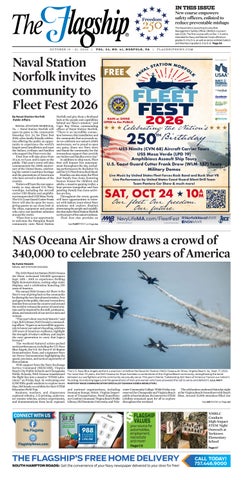
NAVAL STATION NORFOLK, Va. — Naval Station Norfolk will open its gates to the community Saturday, Oct. 24, for Fleet Fest 2026, a free, family-friendly celebration offering the public an opportunity to experience the world’s largest naval installation and meet the Sailors, civilians and families who support the Fleet every day. Fleet Fest will take place from 10 a.m. to 5 p.m. and is open to the public. This year’s event will also commemorate the 250th anniversary of the United States, celebrating the nation’s maritime heritage and the generations of Americans who have served in defense of the country. Visitors will have the rare opportunity to step aboard U.S. Navy warships, including the aircraft carrier USS Nimitz and amphibious transport dock USS Mesa Verde. The U.S. Coast Guard Cutter Frank Drew will also be open for tours, giving guests an up-close look at the ships, equipment and people who carry out maritime missions around the world. “Fleet Fest is our opportunity to welcome the Hampton Roads community onto Naval Station
Norfolk and give them a firsthand look at the people and capabilities behind our Navy’s mission,” said Capt. Ray Glenn, commanding officer of Naval Station Norfolk. “There is an incredible connection between this installation and the community that surrounds us. As we celebrate our nation’s 250th anniversary, we’re proud to open our gates, share our Navy story and thank the community for the tremendous support they provide our Sailors and families every day.” In addition to ship tours, Fleet Fest will feature live entertainment throughout the day, including performances by Buckshot VA and the U.S. Fleet Forces Rock Band. Families can also enjoy the Fleet Fest Family Fun Zone, featuring bounce houses for children and adults, a massive gaming trailer, a four-person trampoline and face painting. Family Fun Zone activities are free. Throughout the event, guests will have opportunities to interact with Sailors, learn about Navy missions and explore displays showcasing the people and capabilities that make Naval Station Norfolk a critical part of the nation’s defense. Fleet Fest also provides an See FLEET FEST on Page A4
NAS Oceana Air Show draws a crowd of 340,000 to celebrate 250 years of America By Katie Hewett NAVAL AIR STATION OCEANA
The 2026 Naval Air Station (NAS) Oceana Air Show welcomed 340,000 spectators Sept. 18th - 20th to experience thrilling flight demonstrations, cutting-edge static displays, and a celebration honoring 250 years of America. The annual NAS Oceana Air Show is the Navy’s way of giving back to the community by sharing the very best of naval aviation. Free and open to the public, this year’s event drew families from across the country and around the world to witness the power of naval aviation and be inspired by the skill, professionalism, and teamwork of our service men and women. “This year’s show was truly historic,” said Capt. Rob Littman, NAS Oceana’s commanding officer. “It gave us an incredible opportunity to honor our nation’s founding, celebrate 250 years of American resilience, highlight the strength of today’s military, and inspire the next generation to carry that legacy forward.” The weekend featured action-packed aerial performances, including the U.S. Navy Blue Angels, the U.S. Air Force F-22 Raptor Demonstration Team, and a signature Navy Air Power Demonstration highlighting the speed, precision, and tactical superiority of fleet aviation. With support from the Navy Exchange Service Command (NEXCOM), Virginia Beach City Public Schools and Chesapeake Public Schools, NAS Oceana transformed the flight line into a massive “STEM Laboratory” on Friday, Sept. 18, welcoming over 8,500 fifth-grade students to explore more than 200 hands-on exhibits for their STEM Education Field Trip. Students, teachers, and chaperones explored robotics, 3-D printing, underwater remote vehicles, science experiments, and demonstrations from local, regional,
The U.S. Navy Blue Angels perform a practice run before the Naval Air Station (NAS) Oceana Air Show, Virginia Beach, Va., Sept. 17, 2026. For more than 70 years, the NAS Oceana Air Show has been a cornerstone of the Virginia Beach community, strengthening the bond between our warfighters and the community we proudly serve. This year’s theme, “Celebrating 250 Years of America,” honors our nation’s founding, its enduring legacy and the generations of men and women who have answered the call to serve and defend it. (U.S. NAVY PHOTO BY MASS COMMUNICATION SPECIALIST SEAMAN CIERRA MIDDLETON)
and national organizations, including Dominion Energy, NASA, Virginia Department of Transportation, Naval Expeditionary Combat Command, Virgina Beach Public Library, Old Dominion University, and Tide-
water Community College. While Friday was The celebration continued Saturday night reserved for Chesapeake and Virginia Beach at the Virginia Beach Oceanfront with Beach public school students, the interactive STEM Blast. Around 15,000 attendees filled 31st exhibits remained open for all to explore throughout the weekend. See AIR SHOW on Page A2
Page C6
THE FLAGSHIP’S FREE HOME DELIVERY SOUTH HAMPTON ROADS: Get the convenience of your Navy newspaper delivered to your door for free!
NMRLC Conducts High-Impact STEM Night Outreach at Yorktown Elementary School Page A7
CALL TODAY! 757.446.9000
2
flagshipnews.com | Section A | Thursday, October 15, 2026
NORFOLK, Va. (Sept. 30, 2026) Tugboats assist the Nimitz-class aircraft carrier USS Harry S. Truman (CVN 75) as the ship departs Naval Station Norfolk for Newport News Shipbuilding to begin the shipyard phase of its Refueling and Complex Overhaul (RCOH). Truman began its formal RCOH Smart Start period in November 2025, preparing the ship and crew for the multi-year maintenance and modernization effort. (U.S. NAVY PHOTO BY MASS COMMUNICATION SPECIALIST SEAMAN APPRENTICE JASON WERNEGREEN)
USS Harry S. Truman departs Norfolk, begins move to Newport News for RCOH Courtesy Story USS HARRY S TRUMAN
NORFOLK, Va. — The Nimitzclass aircraft carrier USS Harry S. Truman (CVN 75) departed Naval Station Norfolk Sept. 30 for Newport News Shipbuilding, beginning the next major phase of the ship’s Refueling and Complex Overhaul. ThemovetoNewportNewstransitions Truman from its pre-overhaul preparation period into the shipyard phase of RCOH, a oncein-a-carrier-lifetime maintenance and modernization effort designed to prepare the ship for the second half of its planned 50-year service life. “Winning in combat begins with winning in the shipyard,” said Capt. Dan Prochazka, Truman’s commanding officer. “Everything
we do during RCOH is ultimately about ensuring Harry S. Truman is ready to fight and win when our nation calls. The work ahead may look different from operations at sea, but it demands the same discipline, teamwork and commitment to mission. Our Sailors and shipyard partners are laying the foundation for Truman’s next decades of service, and every production milestone we achieve brings this warship one step closer to returning to the fleet stronger, more capable and ready for combat.” Truman began its formal Smart Start period in November 2025, launching months of preparation for the overhaul. Since then, SailorshaveworkedalongsideNavyand industry partners to prepare shipboard spaces for industrial work, establish temporary services, relocate equipment and transition many
AIR SHOW
from Page A1
Street Park to enjoy a free concert by the U.S. Fleet Forces Band, a U.S. Navy F/A-18 Super Hornet and F-22 Raptor after burner flyover, a precision parachute demonstration by Skydive Suffolk, and a special introduction to the U.S. Navy Blue Angels. The show’s success was made possible by over 1,000 volunteers, including personnel from local military units, NEXCOM, NEX Oceana, and municipal partners from the cities of Virginia Beach, Chesapeake, Suffolk, and Portsmouth, Virginia. “The NAS Oceana Air Show would not be possible without our community’s steadfast support and the hard work of hundreds of dedicated individuals,” said Greg Courrier, NAS Oceana Air Show director. “From our world-class performers to the volunteers and first responders behind the scenes, the air show is a unified effort to deliver a world-class experience.” Emergency preparedness and public safety were also a joint effort. Navy Region Mid-Atlantic Fire and Emergency Services partnered with
crew-support functions to APL-61 alongside the carrier. Those preparations have allowed the command to continue supporting its crew while opening increasing portions of the ship to the extensive industrial work required during RCOH. The effort has included removing and relocating equipment, installing temporary services and readying spaces for major shipyard production. The transition comes after an operationally demanding period for Truman and its crew. The carrier returned from deployment in June 2025 following operations in the U.S. 5th and 6th Fleet areas of operation, then moved rapidly into post-deployment maintenance, certification and preparation for RCOH. During RCOH, Truman will undergo extensive maintenance,
over 100 regional fire, EMS and healthcare personnel and more than 400 Navy Security Forces and local, state, and federal law enforcement personnel ensured a safe experience for all attendees. For those who could not attend in person, the air show was livestreamed around the globe. In collaboration with NEXCOM and Navy Morale, Welfare and Recreation, the two-day broadcast included cockpit footage, performer interviews, shout-outs, and vendor features. The livestream reached audiences in 81 countries, with over 597,849 total views and more than 24,000 hours of watch time. The continued support from the local community makes free family-friendly events like the NAS Oceana Air Show and Beach Blast possible. “On behalf of Team Oceana, thank you to our neighbors, partners, and guests from near and far for making this year’s air show an unforgettable success,” said Littman. “There is no better way to salute 250 years of American independence than celebrating with the incredible Hampton Roads community that helps make the NAS Oceana Air Show possible.”
modernization and refueling of the ship’s nuclear propulsion plants. Work will affect nearly every part of the carrier, including propulsion and electrical systems, combat capabilities, habitability spaces and supporting infrastructure. The overhaul requires sustained coordination among the ship’s crew, Newport News Shipbuilding, Portfolio Acquisition Executive (PAE) Maritime and other Navy and industry partners. The shipyard period will progress through years of industrial production, restoration, testing and certification before Truman returns to sea. As work advances, the crew and shipyard team will move from major production into systemrestoration,propulsionplant testing, total ship testing, fast cruise and, ultimately, sea trials. For Truman’s Sailors, the move
The United States Naval Academy Parachute Team known as “Skygoats”, a precision demonstration and competition team composed of midshipmen which specialize in skydiving, performs during the Naval Air Station Oceana Air Show, NAS Oceana, Sept. 19, 2026. (U.S. NAVY PHOTO BY MASS COMMUNICATION SPECIALIST SEAMAN JADE SCARBROUGH)
Commander, Navy Region Mid-Atlantic (CNRMA): Rear Adm. Stephen Barnett Regional program manager for Navy Region Mid-Atlantic (NRMA): Public Affairs Director | Beth Baker Public Affairs Deputy Director | Leon Moore
Editorial Staff
Managing Editor | MC1 Cody D. Beam 757-322-2853 | cody.d.beam.mil@us.navy.mil Graphic Designer | Teresa Walter teresa.walter@virginiamedia.com
Contributing Staff
Elizabeth Reisen 757-322-2853 | news@flagshipnews.com
Flagship, Inc.
Military General Manager | Ski Miller ski.miller@virginiamedia.com
marks a change in environment but not in mission. Throughout RCOH, the crew will remain responsible for the ship’s safety, security and readiness while working alongside the shipyard workforce to support production milestones and prepare the carrier for future operations. Truman’s success during RCOH will be built through daily attention to safety, quality, accountability and disciplined execution as the crew and shipyard team work toward each production milestone. USS Harry S. Truman was commissioned July 25, 1998, and is named for the 33rd president of the United States. Since commissioning, the carrier and its crews have deployed around the world in support of U.S. national security objectives.
The Flagship® is published by Flagship, LLC., a private firm in no way connected with the Department of Defense (DOD) or the United States Navy, under exclusive written contract with Commander, Navy Region Mid-Atlantic. This civilian enterprise newspaper is an authorized publication for members of the military services. Contents of the paper, including advertisements, are not necessarily the official views of, nor endorsed by, the U.S. Government, DOD, or the Department of the Navy (DON). The appearance of advertising in this publication, including inserts and supplements, does not constitute endorsement by the DOD; DON; Commander, Navy Region Mid-Atlantic or Flagship, LLC. of the products or services advertised. Everything advertised in this publication shall be made available for purchase, use, or patronage without regard to race, color, religion, gender, national origin, age, marital status, physical handicap, political affiliation, or any other non-merit factor of the purchaser, user, or patron. If a violation or rejection of this equal opportunity policy by an advertiser is confirmed, the publisher shall refuse to print advertising from that source until the violation is corrected. Editorial content is edited, prepared and provided by the Public Affairs Department of Commander, Navy Region Mid-Atlantic. Stories may be submitted via email to news@flagshipnews.com. The Flagship® is published every Thursday by Flagship, LLC., whose offices are located at 804 Greenbrier Circle, Suite C, Chesapeake, VA 23320.
Free Classified Advertising 757-622-1455 © 2021 Flagship, LLC. All rights reserved Retail Advertising 757-222-5538 Distribution & Home Delivery 757-446-9000 • distribution@pilotonline.com
flagshipnews.com | Section A | Thursday, October 15, 2026
3
Guided by purpose: RP PQS workshop refines future of force spiritual readiness By Jessica Nilsson CENTER FOR SERVICE SUPPORT
DAM NECK, Va. — Religious Program (RP) Specialists from across the Navy and Marine Corps gathered — both in-person and virtually - on Sept. 1-2, 2026, at Navy Service Support Advanced Training Command Dam Neck, Virginia, to take a close look at the RP Personnel Qualification Standard (PQS) and help shape its future. The workshop, led by the head U.S. Fleet Forces Command RP and facilitated by Center for Service Support Program Analyst Ray Paradis, brought together a diverse group of subject matter experts from operational commands, staff organizations and Marine Corps units. Participants represented both sea and shore commands, as well as blue-water Navy and green-side Marine Corps environments. The workshop included personnel from U.S. Fleet Forces Command, COMSECFLT, COMNAVSURLFLANT, 2nd Marine Aircraft Wing, COMNAVSURLFANT Mid-Atlantic, USS John C. Stennis (CVN 74), OPNAV, Commander, Destroyer Squadron 15, USS Iwo Jima (LHD 7), Commander, U.S. Seventh Fleet, Marine Aircraft Group 29 and the Office of the Chief of Chaplains. By the end of the workshop, the team had added 29 items to the PQS, removed 41 and modified 140. They also updated references and acronyms throughout the document to make the qualification process clearer and more relevant to today’s RP community. “The Religious Program Specialist has a unique opportunity to serve with both USMC and USN commands,” Paradis said. “Capturing this uniqueness and providing the differences for completing tasks that are core RP qualifications, this workshop has helped raise thebarofeveryRP’sprofessionalknowledge.” For RP1 Casey Niedorf of USS Iwo Jima, one of the most encouraging parts of the workshop was seeing how much agreement there was among the group. “What surprised me most was how aligned everyone was on what standards we should be upholding from the RPSR (seaman recruit) to the RPCM (Master Chief ),” Niedorf said. Niedorf said she arrived only expecting a routine review of an existing program. Instead, she found a group of leaders who were invested in improving the rating and developing future RPs. As one of the more junior members of the
working group, Niedorf said it was meaningful to see senior enlisted leaders focus on the long-term growth of the rating. One of the workshop’s key discussions focused on the growing role of data analytics in spiritual readiness. Niedorf noted that while the RP mission centers on the human experience, RPs must be proficient with the tools that help leaders capture, assess and communicate readiness needs. RPC Brandon Peterkin from the Office of the Chief of Chaplains described the workshop in one word: “Evolving.” Peterkin said he was surprised by the level of coordination required to build a PQS that can be understood and applied consistently across the RP community. “Before arriving, I was not fully convinced of the value of creating a PQS for the Religious Program Specialist rating,” Peterkin said. “The workshop changed that perspective.” Peterkin reflected on his early years in the Navy and recalled the challenge of explaining the RP role to Sailors and Marines. He said the updated PQS gives the community a clearer, more consistent way to define what RPs should know and be able to do as they progress in their careers. As a relatively young rating, the RP community benefits from a consistent framework that defines the knowledge, skills and responsibilities expected at each level of experience, Peterkin said. The updated PQS reinforces that professional development continues beyond formal “A” and “C” school training. “The PQS gives us a tool to guide junior RPs, build their confidence, and make sure they are developing the knowledge and skills needed to support the Chaplain Corps,” Peterkin said. For the participants, the workshop was way more than a document review. It was an opportunity to help ensure RPs across the fleet have a practical, relevant guide for professional growth - regardless of where they serve. “I am most proud to have simply been part of the process,” Peterkin said. “Many RPs before me helped lay the foundation and put in a great deal of work to get us to this point. I am grateful for the opportunity to contribute in a small way and to be part of something that will help move our rating forward.” DAM NECK, Va. — Religious Program (RP) Specialists from across the Navy and Marine Head over to MyNavy Portal at the end of Corps gathered – both in-person and virtually - on Sept. 1-2, 2026, at Navy Service Support October to check out all the updates! Advanced Training Command Dam Neck, Virginia, to take a close look at the RP Personnel Qualification Standard (PQS) and help shape its future. (PHOTO BY JESSICA NILSSON)
Home Bathroom Remodeling Done Right! HomeRemodeling Remodeling
FULL BATHROOM REMODELING • WALK-IN SHOWERS • BATHS • TUB TO SHOWER CONVERSION
THE WEST SHORE HOME DIFFERENCE: Bathroom Remodeling Experts!
FREE INSTALL
ON ALL BATHROOM PROJECTS1
36 MONTHS 0% INTEREST
2
Highly Trained Employee Installers On-The-Spot Installation Scheduling Fully Licensed and Insured
Exclusive Designs & Styles
Flexible Financing Subject to credit approval
Evening & Weekend Appointments Available
America’s Most Trusted Home Remodeler
POWERED BY
4.8/5 4.9/5 4.8/5
300,174+
COMPLETED BATHROOM REMODELING JOBS
(Company reviews across all branches as of 9/01/2026)
757-280-2257 New orders only. Offer not valid on previous sales or estimates and cannot be combined with other offers. Product offering subject to change. See design consultant for details. Other restrictions may apply. 1. Free install is equal to 20% off
4
flagshipnews.com | Section A | Thursday, October 15, 2026
Reflections of an enlisted radioman turned information professional officer: Looking beyond the horizon Courtesy Story NAVAL INFORMATION FORCES
I am deeply honored to participate in the CSWO 25th anniversary “Honoring Our Heritage” campaign. My naval journey began in 1986 as an enlisted radioman and continued through my service as a commissioned information professional officer until my retirement in 2018. Across more than 32 years of service, I witnessed one of the most significant transformations in naval communications history: moving from Morse code, flashing lights, teletypes, high-frequency (HF) voice, plain old telephone service (POTS), Military Auxiliary Radio System (MARS) stations and formal naval message traffic to superhigh-frequency (SHF) satellite communications, tactical data networks, videoteleconferencing,enterprisecybersecurity, cloud architecture, mobility systems and modern command-and-control capabilities. My career guiding principle has always been simple: Look Beyond the Horizon. To me, that means anticipating the next challenge before it becomes a crisis. It means understanding the commander’s intent, tactically maneuvering alternate communication pathways, preserving operational lines of effort, and ensuring the fleet and joint force remain fully connected in denied, degraded, intermittent and limited (DDIL) communications environments. THE EVOLUTION OF THE COMMUNICATIONS COMMUNITY
When I reflect on my career, I think first of the watch. I think of radio rooms, technical control facilities, signal bridges, communications centers, combat information centers, flag communications suites, network operations centers and expeditionary command posts where Sailors kept the mission moving. Communications were never simply administrative support. Communications were command and control. Communications were combat power. Communications were logistics, intelligence, morale, family connection and operational trust. I began my Navy career in 1986 at Naval Training Center San Diego, followed by Radioman “A” School. At that time, the radioman rating carried a storied legacy. We trained in HF, ultrahigh frequency (UHF), very high frequency (VHF), teletype operations, formal message formatting, visual signaling, guarded circuits, call signs, authentication protocols, circuit discipline, communications security and emergency casualty control. The equipment mattered, but the communicator mattered more. A proficient radioman had to listen, evaluate, troubleshoot, anticipate and act. My first operational assignment aboard the guided-missile cruiser USS Leahy (CG 16) placed me in a flag-configured communications environment during a period shaped by Cold War operations and the early planning phases preceding Operation Desert Storm. We relied heavily on HF circuits and MARS stations to keep shipboard Sailors connected to home. A brief HF phone patch could sustain a Sailor through months at sea. Inthoseyears,communicationsweremanual, procedural and personal. We did not enjoy the bandwidth or connectivity Sailors rely on today; instead, we relied on rigorous training, teamwork, discipline and redundancy. We learned that when one pathway failed, we had to find another. That lesson guided my entire career. In 1992, I completed Radioman C-7 School and Communications Systems Technical Control School, earning Navy Enlisted Classification (NEC) 2318 and deepening my expertise in technical control, circuit restoration and fleetwide backbone maintenance. From 1992 to 1993, I served aboard the amphibious cargo ship USS El Paso (LKA 117), homeported in Norfolk, Virginia, supporting Operation Restore Hope. During that deployment, I served as an HF MARS station operator and volunteered to help Sailors contact their families. That experience reinforced my convic-
FLEET FEST
from Page A1
opportunity to highlight the installation’s longstanding relationship with Hampton Roads. Naval Station Norfolk is home to thousands of Sailors and civilian employees and serves as a major operational hub for the U.S. Navy. “Naval Station Norfolk doesn’t operate in isolation, we are part of this community,” Glenn said. “Fleet Fest is about bringing those two worlds together. We want our neighbors to come aboard, meet our Sailors, see what they do and leave with a better understanding of why Naval Station Norfolk and the Fleet are so important to our nation.” Fleet Fest 2026 continues Naval Station Norfolk’s tradition of connecting the public with the Navy while showcasing the installation’s mission of Readying the Fleet.
FLEET FEST 2026
When: Saturday, Oct. 24, 2026 Time: 10 a.m. – 5 p.m. Where: Naval Station Norfolk Entrance: Guests are to enter via Gate 2 Admission: Free and open to the public The complete entertainment schedule will be released as Fleet Fest approaches and will be available at https://www.facebook.com/ NavalStationNorfolk
tion that communications professionals serve both operational tasking and the warfighters executing it. The 1990s brought rapid technological advancement. Personal computers became ubiquitous, local area networks expanded and satellite communications capabilities matured. While formal record message traffic remained critical, email and digital collaboration began shifting operational expectations. Commanders demanded faster distribution, broader reach and near-real-time situational awareness. In 1994, while serving aboard the aircraft carrier USS Constellation (CV 64), I participated in an operational milestone: the installation of the first SHF communications terminal in the Pacific Fleet area of responsibility. That capability marked a transformative leap in afloat bandwidth and ship-to-shore integration. It also held personal significance: my wife placed the very first off-ship telephone call from home directly to the carrier. That moment captured the heart of naval modernization—it was not merely about hardware or bandwidth, but about operational reach, command capability and human connection. By 1997, while assigned to Commander, Naval Air Forces Pacific (COMNAVAIRPAC), our community entered a structural transformation. The merger of the radioman and data processing ratings into the information systems technician (IT) rating reflected the service’s growing reliance on digital networking, systems administration and information technology. During that same period, as the world prepared for the Year 2000 (Y2K) transition, we learned that technical evolutions require more than new hardware. They demand sound doctrine, deliberate planning, leadership, rigorous testing, risk management, and technicians who understand both legacy architectures and emerging technologies. DEFINING MOMENTS AND LEADERSHIP LESSONS
From 2000 to 2002, I served aboard the amphibious assault ship USS Tarawa (LHA 1). That tour proved to be one of the defining chapters of my naval service. While standing watch in technical control, our team received the urgent distress message from the guided-missile destroyer USS Cole (DDG 67) following the terrorist attack in Aden, Yemen. USS Tarawa immediately served as the primary afloat response and command platform for USS Cole. That crisis underscored the gravity of the communications watch: a signal is never just data on a screen. It can be a distress call, a threat warning, an operationaldirectiveortheopeningmoments of an international crisis. In August 2002, I earned my commission and was pinned an officer aboard USS Tarawa. Transitioning from enlisted radioman to commissioned officer was an immense privilege. I carried my deckplate experience forward into the wardroom. Having stood the watch, managed logs, resolved system casualties and maintained vital circuits under operational pressure, I understood what our operators faced each day. As a commissioned officer, my scope expanded from hands-on system troubleshooting to operational planning, resource programming, systems integration and broader leadership. Yet the core priorities remained unchanged: support the watch, safeguard the mission and care for our personnel. From 2002 to 2005, I served aboard the amphibious assault ship USS Peleliu (LHA 5). Large-deck amphibious platforms are among the most communication-intensive assets in the fleet. That tour tested our ability to crosstrain cyber specialists into radio frequency (RF) disciplines and RF technicians into IP networking. This integrated training established a versatile, fully cross-functional communications team supporting Navy and Marine Corps strike operations, naval aviation, amphibious command and control,
embarked staffs, coalition partners, humanitarian assistance and crisis response. In 2005, following an assignment at Naval Computer and Telecommunications Station (NCTS) San Diego, I deployed as an individual augmentee to Herat, Afghanistan, serving as the NATO communications officer (S-6/G-6) embedded with the Afghan National Army 207th Corps Advisory Group. Afghanistan presented unique operational constraints: mountainous terrain, extreme operating distances, multinational interoperability barriers, power generation limits and elevated physical and operational security postures. That deployment reaffirmed that a communications officer must translate operational requirements into reliable technical realities that advance, rather than constrain, the commander’s intent. In 2009, I served as officer in charge of NavyMarineCorpsIntranet(NMCI)Detachment San Diego, enhancing fleet cybersecurity posture and standardizing vulnerability management, software patching policies and network defenses. By that time, cybersecurity had become completely inseparable from traditional communications. Communications personnel were now charged with securing not only circuits and antennas, but also directories, credentials, system configurations, endpoints and tactical mission data. In 2013, I reported to Carrier Strike Group One as flag communications officer. The strike group commander, Adm. Phil Grady, sought an experienced communications officer with specialized background in DDIL operational environments. That tour allowed me to implement primary, alternate, contingency and emergency (PACE) communications strategies across the strike group. Because visual communications had diminished across the fleet following the disestablishment of the signalman rating, our team worked deliberately to rebuild strike group-wide proficiency in flashing light, semaphore and Morse code. We qualified quartermasters across all strike group units and validated visual signaling tactics during degraded-environment tactical exercises. That effort embodied the concept of looking beyond the horizon: when modern high-bandwidth networks are jammed, denied or unavailable, the fleet must still communicate. Visual signaling, HF, line-ofsight voice, concise message discipline and manual routing are not obsolete relics—they are the bedrock of operational resilience. THE ENDURING IMPORTANCE OF COMMUNICATIONS AND INFORMATION WARFARE
RF, cyber cannot reach the tactical edge. Without resilient transport, command and control falters. Without trained technical specialists, even the most sophisticated systems fail under pressure. The radioman legacy was defined by communications discipline, deep RF comprehension, strict transmission security, circuit management and absolute mission reliability. As the Navy embraces advanced cyber, zerotrust architectures and cloud computing, it must preserve the foundational RF and spectrum management knowledge that guarantees connectivity in contested environments. Future communications and combat systems warfighting officers must bridge both worlds. They must understand cloud architecture, artificial intelligence, data fabric strategies and enterprise networks, while mastering RF propagation, satellite links, electromagnetic spectrum operations, cryptographic key management, line-of-sight systems, visual signaling and communications security. Surface warfare commanders rely on technical communications officers and senior technicians—including limited duty officers (LDOs) and chief warrant officers (CWOs)— to maintain and optimize complex RF transmitters, receivers, cryptographic devices and C4I architectures. These subject-matter experts mitigate jamming, allocate satellite access, oversee maintenance availabilities, direct casualty restoration and bridge the gap between technical operators and tactical commanders. That capability is vital to combat readiness. THE LEGACY AND FUTURE OF THE CSWO COMMUNITY
The CSWO community stands on the shoulders of generations of radiomen, signalmen, communications technicians, information systems technicians, cryptologists, information professionals, cyber warfare engineers, LDOs, CWOs and dedicated watchstanders who kept the fleet connected. The future operating environment will demand even greater agility. Communications will face persistent contestation across space, cyberspace, the electromagnetic spectrum, subsea domains, expeditionary nodes and coalition networks. Emerging capabilities—including artificial intelligence, edge computing, resilient low-Earth-orbit satellite constellations and unmanned architectures— will continue to transform naval warfare. Yet technology alone will not secure victory. People will. The fleet will always require disciplined watchstanders. Commanders will always depend on verified information. Warfighters will always require survivable communications in austere, contested environments. Our heritage is not merely that we adopted new technology; it is that we held the watch through every operational era. From flashing light to laser communications, from manual teletypes to distributed cloud networks, and from paper logs to real-time cyber monitoring, our community has consistently adapted tofulfilloneenduringpurpose:deliveractionable information securely, reliably and decisively. Looking back across 32 years of service, I see more than a career. I see a bridge between eras. I entered a Navy reliant on HF, UHF, signal lamps, teletypes and manual discipline; I retired from a fleet powered by high-throughput satellite constellations, integrated IP networks, cyber defense platforms and global command-and-control architectures. To the next generation of CSWOs and communications professionals: master your fundamentals, respect the sanctity of the watch, understand the commander’s operational intent, defend the network, and care for your Sailors. Most importantly, always look beyond the horizon.
In 2017, I served as officer in charge of Naval Information Dominance Forces (NAVIDFOR) San Diego, supporting the Navy’s comprehensive integration of information warfare across the operational fleet. From 2017 to 2018, I completed my final shipboard assignment aboard the amphibious assault ship USS Bonhomme Richard (LHD 6) as combat systems information officer (CSIO). This assignment brought my sea duty full circle, once again leading communicationsandnetworkarchitecturessupporting naval aviation, amphibious operations and joint task force requirements. While communications technology had changed beyond recognition since 1986, the fundamental objective had not: connect the fleet, support the commander, secure the information and sustain the warfighter. Following my naval retirement in 2018, I continued supporting fleet readiness as an afloat cyber training contractor from 2018 to 2021. Since 2021, I have supported communications modernization at Naval Information Warfare Systems Command (NAVWAR). My uniform has changed, but my dedication to the communications mission remains steadfast. One of my core convictions is that communications always begins at the transport layer. Before enterprise cloud environments, cyber 25th Anniversary “Honoring Our Heritage” defenses or digital collaboration tools can Campaign function, data must move. Without reliable
flagshipnews.com | Section A | Thursday, October 15, 2026
5
United we sail: Sustaining the fleet since 1949 By Molly Burgess USN MILITARY SEALIFT COMMAND
The salt air leaves the same crust on your collar whether you are steering an oiler through the Korean Straits in 1950 or navigating an expeditionary sea base through the Arabian Gulf in 2026. Ship classes come and go, navigation bridges shift from paper charts to glowing touchscreens, but the core rhythm of the merchant mariner never changes stand the watch, stay the course, and deliver the cargo. For 77 years, the heartbeat of Military Sealift Command has belonged to the Civil Service Mariners (CIVMARs), the seagoing professionals whose office is the open ocean and whose dedication underpins global national security. “Seventy-seven year ago, Vice Adm. William M. Callaghan stood up the Military Sea Transportation Service at the Main Navy and Munitions building in Washington D.C.,” said Rear Adm. Benjamin Nicholson, Commander, Military Sealift Command. “Could anyone have imagined how the mission set for this command would grow and what a vital role we would one day play in our nation’s national security?” October 1, 1949, marked the day of inception for Military Sea Transportation Service (MSTS), becoming the single managing agency for the Department of Defense’s ocean transportation needs, replacing what used to encompass four separate government agencies. MSTS would go on to be renamed MilitarySealiftCommandduringtheVietnamWar. To celebrate MSC turning another year older, the command held a cake cutting ceremony at MSC Headquarters onboard Naval Station Norfolk, Norfolk, Virginia, where the longest serving local CIVMAR, Chief Engineer Joseph Watts, and the newest MSC employee, James Caruthers, cut the first slice of cake in celebration of the command’s past sacrifices and today’s current workforce. “Today we recognize and celebrate our CIVMARs, past and present, and the civilians and service members who have supported them in helping MSC deliver 77 years of maritime excellence,” said Nicholson. Watts, who joined MSC Sept. 1, 1981, and is currently assigned to USNS Comfort (T-AH 20), said it’s the environment surrounding MSC that has contributed to his long career as a CIVMAR. “MSC is a family organization and it’s what
Norfolk, Va. (October 1, 2026) - Chief Engineer Joseph Watts, assigned to USNS Comfort (T-AH 20), left, Rear Adm. Benjamin Nicholson, commander of Military Sealift Command, center, and Mr. James Caruthers, assigned to MSC’s IT Cybersecurity team, right, cut the ceremonial cake during MSC’s 77th birthday celebration. MSC was established Oct. 1, 1949, as Military Sea Transportation Service and continues to provide sealift and maritime transportation in support of U.S. forces worldwide. (U.S. NAVY PHOTO BY RYAN CARTER)
has kept me here for so long,” said Watts. “The mentoring that MSC has provided me and my family has been amazing.” James Caruthers, a civilian at MSC who works as part of the IT Cybersecurity team, is thecommand’snewestemployeehavingjoined the team Sept. 21, 2026. “Since being on board, I have had a lot of people welcome me to the team and help me with everything I need,” Caruthers said. “Being at MSC has truly been a breath of fresh air.” For 77 years, CIVMARs aboard MSC vessels
have served as the vital lifeline for the global warfighter. From transferring troops and armor during the Korean and Vietnam Wars to sustaining strategic deterrence throughout the Cold War, MSC has logistically driven nearly every major U.S. conflict. Today, MSC remains the steady force behind the front lines, keeping the joint force fueled, supplied, and positioned for victory. “Thank you for what you do every single day and for the excellence you bring to this command and thank you to the families that
support our teams who also greatly sacrifice,” Nicholson said. “Every one of you is part of our story and I look forward to creating many more memories with the Mariners, Sailors and Civilians of MSC.” MSC exists to support the joint warfighter across the full spectrum of military operations, with a workforce that includes approximately 6,000 Civil Service Mariners and 1,500 contract mariners, supported by 1,500 shore staff and 3,500 active duty and reserve military personnel.
Wasp lights off boilers By Seaman Recruit Antonio Ramos USS WASP (LHD 1)
U.S. Navy warships are not all built the same. Some are big, some are small, and some of them are nuclear powered. Onboard amphibious assault ship USS Wasp (LHD 1) are two steam powered engines fueled by boilers located in the ship’s engine rooms. Wasp officially lit off their forward and aft boilers during the week of Sept. 2, 2026 for the first time after spending 13 months in BAE Systems Norfolk Ship Repair. The process to light off the ship’s boilers requires a tremendous amount of planning and coordination. Wasp’s engineering department redefines hard work in the light of long hours, pure dedication and professional achievement. During boiler light off, machinist’s mates work to bring the steam plant online, while machinery repairman, damage controlman, electrician’s mate, hull technicians, and engineman support the ship’s auxiliary and electrical systems, each contributing to Wasp’s ability to get underway. “Knowing that the work we do helps bring a warship like Wasp to life is an incredible feeling,” said Machinist’s Mate 2nd Class Angelina Valenzuela, Boiler Operator. “We power the ship to be out on its own.” For these boilers to get started they require a process called boiler light off, where a Sailor ignites the fuel and air mixture establishing combustion inside the furnace. Sailors began the light off and steam testing process to verify the plants safety systems and restore the ship’s ability to operate on its own power, post boiler inspections, “Everything we do supports the Sailors throughout the ship,” said Machinist’s Mate 1st Class Steven Norris, MP1 Division Leading Petty Officer. “From the air conditioning and hotel steam services to the galley and the lights, engineering helps make sure everyone can do their job.” Wasp uses conventional steam propulsion, relying on two main boilers and two geared steam turbines. Bringing the boilers online allows engineering department to generate the steam needed to support the ship’s propulsion plant and its ability to get underway. Sailors must ensure the boilers and associated systems are operating as intended before the plant can support propulsion. The evolution requires coordination between engineering personnel as they monitor equipment, follow established procedures, and verify the plant’s operating conditions. For the Sailors responsible for maintaining Wasp’s engineering systems, boiler light-off is an opportunity to apply their training and technical expertise. Each member of the team has a role in ensuring the plant is prepared to meet the ship’s operational requirements. Their efforts extend beyond the propulsion plant, supporting the systems that allow Sailors throughout the ship to live and work. As the department continues testing and addressing equipment discrepancies, their work brings Wasp closer to returning to sea. “Without their hard work and work ethic, the ship would just be a hunk of metal sitting beside the pier,” said Lt. Cmdr. Kevin Tulloch, Wasp’s Main Propulsion Assistant. “It takes qualification, skill, hard work and great
A Sailor assigned to the amphibious assault ship USS Wasp (LHD 1), shakes a lit boiler torch in the forward main machinery room, Sept. 2, 2026. Wasp is currently homeported in Naval Station Norfolk. (U.S. NAVY PHOTO BY MASS COMMUNICATION SPECIALIST SEAMAN APPRENTICE ANTONIO RAMOS)
leadership to make sure the ship is ready for tasking once we get underway.” As Wasp continues through steam testing, the engineering department is working to complete required safety checks and resolve equipment discrepancies before moving into
hot light off assessment. The completion of propulsion capabilities and restore the ship these milestones will help prepare the ship to operational readiness. for dock trials, fast cruise, and eventually Wasp is currently homeported at Naval operations at sea. Through their technical Station Norfolk. expertise, teamwork and dedication, engineering Sailors are helping restore Wasp’s
6
flagshipnews.com | Section A | Thursday, October 15, 2026
New course empowers safety officers, enlisted to reduce preventable mishaps By Charity Robinson NAVAL SAFETY COMMAND
NORFOLK, Va. — Navy officers and enlisted Sailors leading and assigned to safety departments will soon have the opportunity to gain the knowledge and tools to promote effective risk management principles within their organizations to help reduce preventable mishaps. The Naval School of Aviation Safety (SAS) in Pensacola, Florida, is launching its new Risk Management Safety Officer (RMSO) course in late 2026. The first course will run Dec. 1-11 and is intended for Navy and Marine Corps officers in grades O-3 to O-5, as well as senior enlisted Sailors and Marines in grades E-6 to E-8. While open to qualified personnel, attendance is strongly encouraged by safety office department heads due to the advanced nature of the curriculum. SAS falls under the oversight of Commander, Naval Safety Command in Norfolk, Virginia. Although the course was designed initially in response to a Marine Corps request, Navy Capt. Daniel Testa, SAS commanding officer, said the Navy will also find value in the course. “Upon completion of this first course, we will deliver professional Navy and Marine Corps safety managers with an in-depth understanding of risk management,” said Testa. “The RMSO course will continue to evolve to align with emerging hazards and operational lessons learned in response to student feedback.” The initial course offering will include 50 Marine Corps quotas and between six and eight slots for Navy personnel. Beginning in FY28, the course will expand with the hiring of additional RMSO instructors and will be offered up to seven times a year to provide more seats for Navy personnel. “The Marine Corps identified a need within the non-aviation communities to create a safety and standardization office and instill a more robust culture of risk management and safety. To speed up the institution of this new initiative, the Marine Corps is drawing from the aviation community’s lessons learned over the past 50 years,” said Maj. Bryan Leicht, SAS instructor. “Pulling concepts from the SAS Aviation Safety Officer (ASO) course, we’ve adapted the courseware to be applicable for the entire Naval enterprise to support other warfare communities and our combat arms brethren within the Navy and Marine Corps.” Concepts from the ASO course were
The Risk Management Safety Officer (RMSO) crest was designed in the Summer of 2026 as part of a new course for non-aviators instructing risk management and safety systems, initially in support of the U.S. Marine Corps’ (ground) Department of Operational Safety and Standardization (DOSS) initiative in response to the 2020 Amphibious Assault Vehicle mishap off the coast of San Diego, California. The course supports all entities of the Naval Enterprise in the Navy and Marine Corps. The crossed rifles and anchor represent both the Marine Corps and Navy, which the course directly supports. The sigma (“ ”) represents the professionals who have graduated from the School of Aviation Safety, which is the the “Sum of all Safety Knowledge,” as directed by the school’s charter and commission from 1965. The sigma is gold to represent the Gold Standard of Safety and Education, which graduates are expected to uphold. The seven stars represent the Seven Critical Skills of Crew and team resource management. The red shield honors the memory of those who have made the ultimate sacrifice. It serves as a solemn reminder of the human cost of mishaps and strengthens the resolve of every graduate to ensure such tragedies are never repeated. (U.S. NAVY GRAPHIC COURTESY OF NAVAL SCHOOL OF AVIATION SAFETY)
adapted,structuredandbrokendownintothe following core areas: Crew/Team Resource Management, Safety Management System, Investigations, Reporting and Medical/ Human Factors. According to Leicht, an in-residence course will be the only option —
at least for the time being, due to the nature of the curriculum which will consist of running mishap drills, performing hands-on investigations at the schoolhouse’s crash lab and executing practical exercises. He also noted that SAS executes a hotwash after each
course where critiques have been submitted to discuss lessons learned, new information from Safety Investigation Reports (SIRs) or fleet feedback, enabling the schoolhouse to remain flexible enough to adjust the curriculum. “One of the great things about owning our curriculum is that we can be very adaptable and flexible,” said Testa. “If a gap is identified in the fleet, one of the first places they will typically contact is the schoolhouse to see if we are teaching [a course] to address that gap. If not, we can easily build it into our curriculum.” SAS courses are designed to be responsive to the evolving operational environment, an important resource that reflects the CNO’s priority of continually improving the naval service’s wartime advantage while building a more adaptive and decisive maritime force. “During a recent safety summit, the question came up of how we can prevent aviation ground mishaps,” said Leicht. “This course seeks to prepares RMSOs to implement an integrated safety management system throughout the unit. Additionally, it equips them with the tools necessary to better identifyrisksandimplementappropriatecontrols, mitigating most issues before they happen. Having the right people — a quality assurance officer or quality assurance chief with the understanding of how to incorporate risk and howtointegratethatwiththesafetyoffice,isa potential benefit out there to reduce mishaps. “We want to teach the critical thinking aspect of being able to observe, analyze risk and communicate that risk to the commander so they can make informed decisions,” he added. “Proper identification and mitigation of risk allows us to operate more aggressively in a warfighting environment.” Ultimately, Leicht said the school wants to ensure Sailors and Marines are making informed risk decisions and implementing a good risk control system that fosters a good risk management culture. For more information, Marines can sign up through the following link (mailto:USMC%20RMSO%20Sign%20up) and email the form to Maj Calloway (mailto:Ronald.calloway@usmc.mil)atRMDperMARDMIN 456/26. Navy personnel can email Capt. Leicht (mailto:bryan.t.leicht.mil@us.navy.mil) directly with their request to this email.
PMA-276, HX-21 expand expeditionary strike capabilities with successful AH-1Z APKWS live-fire delivery Courtesy Story LIGHT/ATTACK HELICOPTERS (PMA-276)
The U.S. Marine Corps Light/Attack Helicopter Program Office (PMA-276), in partnership with Air Test and Evaluation Squadron TWO-ONE (HX-21), successfully conducted an aerial live-fire delivery of the Advanced Precision Kill Weapon System (APKWS) from an AH-1Z Viper attack helicopter at the Upper Zion impact area May 12. Integrating APKWS onto the H-1 platform strengthens close air support across the spectrum of military operations and complements emerging manned-unmanned teaming concepts. By bridging the tactical capability gap between guided missiles and larger precision-guided missiles, APKWS provides combatant commanders with a scalable, low-collateral strike option against time critical targets in contested environments. “By validating APKWS delivery parameters in one of the most space-constrained range environments, our H-1 team demonstrated precise, scalable effects that commanders can employ with confidence,” said Col. Jason Duke, PMA-276 program manager. The live-fire event verified critical weapons integration parameters, range safety protocols and ground ordnance handling procedures, directly streamlining future training pipelines and reducing time-to-field for the fleet Marine H-1 community. “The Weapons Delivery Zone (WDZ) construct and range deconfliction we provided here translate directly into repeatable procedures, improving readiness and expanding warfighting options for Marines operating from expeditionary sites,” said Michael Hunt, HX-21 ordnance officer. Executing the initial APKWS delivery within a tightly restricted range footprint required close coordination with Fort A.P. Hill’s Directorate of Plans, Training, Mobilization and Security (DPTMS), led by Matt Fleetwood. Working in tandem with Fort A.P. Hill Range Control, DPTMS established a tailored WDZ to safely accommodate live-fire employment. Range Control instituted safety check-holds across adjacent training sectors to clear the WDZ and safeguard surrounding operations. Beyond developmental flight-test validation, the event provided an operational, hands-on learning environment for 26 observers from across the Naval Aviation Enterprise, including PMA-276, the Direct and Time Sensitive Strike Program Office (PMA-242), the Aviation Simulation Center and HX-21, offering stakeholders firsthand insight into how the system performs in the field and future fleet fielding requirements. About PMA-276 The U.S. Marine Corps Light/Attack Helicopter Program Office (PMA-276) manages the life-cycle development, acquisition, fielding and sustainment of the AH-1Z Viper and UH-1Y Venom helicopters. PMA-276 equips Marine Air-GroundTaskForcecommandersandinternationalpartners with offensive air support, armed escort, reconnaissance and utility capabilities across all operating environments. About HX-21 Air Test and Evaluation Squadron 21 (HX-21), based at Naval Air Station Patuxent River, Maryland, is a component of Naval Test Wing Atlantic under the Naval Air Warfare Center Aircraft Division. HX-21 executes developmental flight test and evaluation of rotary-wing and tiltrotor aircraft, airborne weapons systems and unmanned aerial systems in support of U.S. Navy and U.S. Marine Corps missions. A target is struck by an Advanced Precision Kill Weapon System (APKWS) rocket during a live-fire test and evaluation at Fort A.P. Hill, Va., May 12. The U.S. Marine Corps Light/Attack Helicopter Program Office (PMA276) and Air Test and Evaluation Squadron (HX) 21 partnered to execute the event, which validated the weapon’s performance and expanded the expeditionary strike capabilities of the AH-1Z Viper. (U.S. NAVY PHOTO)
flagshipnews.com | Section A | Thursday, October 15, 2026
7
NMRLC Conducts High-Impact STEM Night Outreach at Yorktown Elementary School Courtesy Story NAVAL MEDICAL READINESS LOGISTICS COMMAND, WILLIAMSBURG, VA
A dedicated team of Naval Medical Readiness Logistics Command (NMRLC) Navy Seabees and Sailors conducted a high-impact Science, Technology, Engineering, and Mathematics (STEM) Night outreach at Yorktown Elementary School on Oct. 1. Through exceptional teamwork and coordination, the team delivered an immersive, hands-on experience for about 500 students and parents, showcasing critical military and medical capabilities. The collective effort featured interactive static displays of an ambulance, protective gear demonstrations including the Medium Tactical Vest (MTV) and Kevlar helmets, and a specialized entomology exhibit hosted by Cmdr. Jennifer Simmons, NMRLC’s Director for Administration. Other participants included Construction Mechanic Senior Chief Steven Bussey, Construction Mechanic 1st Class Sean Kelly, Construction Electrician 2nd Class Dakota Black, Hospital Corpsman 2nd Class Kyra Gatt, and Hospital Corpsman 2nd Class Avey Pokorny. The joint initiative was highly successful, significantly strengthening community relations and inspiring the next generation of STEM leaders. Every member of the NMRLC team played a vital role in this achievement, representing our command with distinction. Headed by Capt. Christopher Barnes, NMRLC develops, acquires, produces, fields, sustains, and provides enduring lifecycle support of medical materiel solutions to the Fleet, Fleet Marine Force, and Joint Forces in high-end competition, crisis, and combat. At the forefront of Navy Medicine’s strategic evolution, NMRLC is well positioned to be the Joint Force’s premier integrated medical logistics support activity. Cmdr. Jennifer Simmons and Construction Mechanic 1st Class Sean Kelly from the Naval Medical Readiness Logistics Command (NMRLC) hold insect displays as part of a Naval Entomology booth at a Science, Technology, Engineering, and Mathematics Night at Yorktown Elementary. The event highlighted the importance of science to more 500 hundred elementary school children and further solidified NMRLC’s commitment to community involvement. (PHOTO BY JULIUS EVANS, NAVAL MEDICAL READINESS LOGISTICS COMMAND, WILLIAMSBURG, VA)
NMRLC team consisting of Construction Mechanic Senior Chief Steven Bussey, Construction Mechanic 1st Class Sean Kelly, Construction Electrician 2nd Class Dakota Black, and Hospital Corpsman 2nd Class Avey Pokorny, visited Yorktown Elementary School to give students a handson look at a military ambulance. Through the static display, the team showcased critical medical capabilities and shared insight into their military roles. (PHOTO BY JULIUS EVANS, NAVAL MEDICAL READINESS LOGISTICS COMMAND, WILLIAMSBURG, VA)
8
flagshipnews.com | Section A | Thursday, October 15, 2026
THANKS TO ALL THE BRAVE MEN AND WOMEN FOR YOUR SERVICE TO OUR COUNTRY.
750
$
U.S. Military
Incentive
1
CAN BE COMBINED WITH TOYOTA SPECIAL CASH BACK OR SPECIAL FINANCING OR SPECIAL LEASES!
2026 TACOMA
2
OR
3
2
ON
2026: 4RUNNER, CAMRY, COROLLA, CROWN, HIGHLANDER, GRAND HIGHLANDER, AND RAV4
2027: LAND CRUISER AND PRIUS
TACOMA HAS THE
BEST RESALE VALUE IN ALL CLASSES ACCORDING TO KELLEY BLUE BOOK’S KBB.COM
VEHICLE’S PROJECTED RESALE VALUE IS SPECIFIC TO THE 2026 MODEL YEAR. FOR MORE INFORMATION, VISIT KELLEY BLUE BOOK’S KBB.COM. KELLEY BLUE BOOK IS A REGISTERED TRADEMARK OF KELLEY BLUE BOOK CO., INC.
CASEY TOYOTA
601 East Rochambeau Drive • Williamsburg 757.259.1000 • caseytoyota.com
CHECKERED FLAG TOYOTA
5301 Virginia Beach Blvd. • Virginia Beach
FIRST TEAM TOYOTA
3400 Western Branch Blvd. • Chesapeake
GLOUCESTER TOYOTA
HALL TOYOTA VIRGINIA BEACH
6357 George Washington Memorial Hwy. Gloucester 804.693.2100 • gloucestertoyota.com
1877 Laskin Road • Virginia Beach 757.437.4000 • halltoyotavirginiabeach.com
PEARSON TOYOTA 757.874.6000 • pearsontoyotascion.com
PRIORITY TOYOTA CHESAPEAKE
1800 Greenbrier Parkway • Chesapeake 757.213.5000 • prioritytoyotachesapeake.com
CLASSIC TOYOTA HAMPTON 2301 W. Mercury Blvd. • Hampton 757.838.5000 • classictoyotahampton.com
$750 REBATE OFFERED BY TOYOTA MOTOR NORTH AMERICA, INC. AND MAY BE APPLIED TOWARD FINANCE OR LEASE CONTRACTS ON NEW TOYOTA VEHICLES THROUGH PARTICIPATING TOYOTA DEALERS AND TOYOTA FINANCIAL SERVICES, DATED FROM SEPTEMBER 30, 2026 THROUGH NOVEMBER 2, 2026. TO QUALIFY FOR THE REBATE, AT THE TIME OF PURCHASE OR LEASE YOU MUST BE (1) IN CURRENT ACTIVE DUTY STATUS IN THE U.S. MILITARY (NAVY, ARMY, AIR FORCE, MARINES, NATIONAL GUARD, COAST GUARD AND ACTIVE RESERVE) OR A U.S. MILITARY INACTIVE RESERVE (I.E., READY RESERVE) THAT IS PART OF THE INDIVIDUAL READY RESERVE, SELECTED RESERVE AND INACTIVE NATIONAL GUARD; OR A RETIREE OF THE U.S. MILITARY, OR A MILITARY VETERAN WITHIN TWO YEARS OF THEIR DISCHARGE DATE; OR A HOUSEHOLD MEMBER OF AN ELIGIBLE U.S. MILITARY PERSONNEL, INCLUDING GOLD STAR FAMILY MEMBERS; AND (2) PROVIDE VERIFIABLE PROOF OF MILITARY STATUS OR ACTIVE SERVICE; (3) RECEIVE A SALARY SUFFICIENT TO COVER ORDINARY LIVING EXPENSES AND PAYMENT FOR YOUR NEW VEHICLE; AND (4) RECEIVE CREDIT APPROVAL FROM AND EXECUTE A FINANCE OR LEASE CONTRACT THROUGH A PARTICIPATING TOYOTA DEALER AND TOYOTA FINANCIAL SERVICES. NOT ALL APPLICANTS WILL QUALIFY. ON LEASE CONTRACTS, REBATE MUST BE APPLIED TOWARD THE AMOUNT DUE AT LEASE SIGNING OR TOWARD THE CAPITALIZED COST REDUCTION. ON FINANCE CONTRACTS, REBATE MUST BE APPLIED TOWARD THE DOWN PAYMENT. LIMIT ONE REBATE PER FINANCE OR LEASE TRANSACTION PER ELIGIBLE U.S. MILITARY PERSONNEL OR ELIGIBLE HOUSEHOLD MEMBER. OFFER NOT COMBINABLE WITH THE COLLEGE GRADUATE REBATE PROGRAM, AND THE LEASE-END REFI PROGRAM. VEHICLE MUST BE TAKEN OUT OF DEALER STOCK. TERMS, CONDITIONS AND RESTRICTIONS APPLY. PROGRAM IS NOT AVAILABLE IN AL, FL, GA, HI, NC, AND SC. REBATE TERMS MAY BE MORE GENEROUS IN YOUR LOCAL AREA. ASK YOUR PARTICIPATING DEALER ABOUT THE MILITARY REBATE TERMS IN YOUR AREA. MUST PAY SALES TAX. VOID WHERE PROHIBITED BY LAW. NOT REDEEMABLE FOR CASH. ©2026 TOYOTA FINANCIAL SERVICES. ALL RIGHTS RESERVED. TOYOTA FINANCIAL SERVICES IS A SERVICE MARK USED BY TOYOTA MOTOR CREDIT CORPORATION (TMCC). RETAIL INSTALLMENT ACCOUNTS MAY BE OWNED BY TMCC OR ITS SECURITIZATION AFFILIATES AND LEASE ACCOUNTS MAY BE OWNED BY TOYOTA LEASE TRUST (TLT) OR ITS SECURITIZATION AFFILIATES. TMCC IS THE SERVICER FOR ACCOUNTS OWNED BY TMCC, TLT, AND THEIR SECURITIZATION AFFILIATES. YOU MUST MEET ALL OF THESE CONDITIONS: BE IN CURRENT ACTIVE DUTY STATUS IN THE U.S. MILITARY (NAVY, ARMY, AIR FORCE, MARINES, NATIONAL GUARD, COAST GUARD AND ACTIVE RESERVE) OR A U.S. MILITARY INACTIVE RESERVES (I.E., READY RESERVES) THAT ARE PART OF THE INDIVIDUAL READY RESERVE, SELECTED RESERVE AND INACTIVE NATIONAL GUARD; OR A MILITARY RETIREE WITHIN TWO YEARS OF RETIREMENT OR HONORABLY DISCHARGED VETERAN OF THE U.S. MILITARY WITHIN TWO YEAR OF THEIR HONORABLE DISCHARGE DATE; OR A HOUSEHOLD MEMBER* OF AN ELIGIBLE U.S. MILITARY PERSONNEL; AND PROVIDE VERIFIABLE PROOF OF MILITARY STATUS OR ACTIVE SERVICE AT THE TIME OF PURCHASE IN THE FORM OF ONE OF THE FOLLOWING DOCUMENTATIONS: LEAVE AND EARNING STATEMENT MILITARY IDENTIFICATION CARD VETERANS/RETIREES DD FORM-214 RECEIVE A SALARY SUFFICIENT TO COVER ORDINARY LIVING EXPENSES AND PAYMENTS FOR YOUR TOYOTA BE CREDIT APPROVED BY TFS. *HOUSEHOLD MEMBER(S):- HOUSEHOLD AND/ OR FAMILY MEMBER OF THE QUALIFIED MILITARY PERSONNEL LIVING AT THE SAME ADDRESS AS THE QUALIFIED MILITARY PERSONNEL. AN ELIGIBLE SERVICE MEMBER AND HIS OR HER HOUSEHOLD MAY RESIDE IN PERMANENT OR TEMPORARY HOUSING.- GOLD STAR FAMILY MEMBERS ARE FAMILY MEMBERS OF A FALLEN HERO(S) AND ARE ALSO CONSIDERED AS HOUSEHOLD AND/OR FAMILY MEMBER AND ARE ELIGIBLE FOR THIS PROGRAM. MUST PROVIDE VERIFIABLE PROOF OF MILITARY STATUS OR ACTIVE SERVICE; OR RETIRED VIA AN ID.ME ACCOUNT AND COMPLETE THE VERIFICATION PROCESS AT A PARTICIPATING TOYOTA DEALER.23.99% APR FINANCING UP TO 48 MONTHS ON TACOMA (EXCLUDES TRD PRO AND TRAILHUNTER MODELS), AND 4.99% APR FINANCING UP TO 48 MONTHS ON 2026 4RUNNER, CAMRY, COROLLA (EXCLUDES CROSS MODELS), CROWN, HIGHLANDER, GRAND HIGHLANDER, RAV4, AND 2027 LAND CRUISER AND PRIUS, AVAILABLE TO WELL QUALIFIED BUYERS THROUGH TOYOTA FINANCIAL SERVICES. 48 MONTHLY PAYMENTS OF $22.57 AT 3.99%, AND 48 MONTHLY PAYMENTS OF $23.02 AT 4.99%, FOR EACH $1000 BORROWED. RESTRICTIONS APPLY. SEE DEALER FOR MAXIMUM AMOUNT WHICH CAN BE FINANCED AT ADVERTISED APR. NOT ALL BUYERS WILL QUALIFY. 3DUE AT SIGNING INCLUDES FIRST $399 PAYMENT AND NO SECURITY DEPOSIT. DOES NOT INCLUDE $350 DISPOSITION FEE DUE AT LEASE END. EXAMPLE BASED ON 2026 TACOMA SR5 MODEL 7540, TOTAL SUGGESTED RETAIL PRICE (TSRP) $43,419 AND NET CAPITALIZED COST, WHICH MAY VARY BY DEALER, OF $41,811. TSRP IN EXAMPLE INCLUDES $1,745 IN DELIVERY, PROCESSING AND HANDLING FEES. CAPITALIZED COST IN EXAMPLE INCLUDES $750 ACQUISITION FEE AND ASSUMES DEALER PARTICIPATION. YOUR PAYMENT TERMS MAY VARY BASED ON FINAL NEGOTIATED PRICE. OFFER AVAILABLE TO WELL QUALIFIED CUSTOMERS FROM TOYOTA FINANCIAL SERVICES. CUSTOMER IS RESPONSIBLE FOR EXCESSIVE WEAR AND EXCESS MILEAGE CHARGES OF $.15 PER MILE IN EXCESS OF 30,000 MILES. NOT ALL CUSTOMERS WILL QUALIFY.. ALL OFFERS: MUST TAKE RETAIL DELIVERY FROM NEW DEALER STOCK BY 11.02.26; SUBJECT TO VEHICLE AVAILABILITY. DEALER FEES ARE EXTRA, VARY BY DEALER, AND DEALER SETS FINAL PRICE. OFFER MAY NOT BE COMBINED WITH OTHER OFFERS UNLESS SPECIFIED OTHERWISE. VEHICLE SHOWN MAY BE PROTOTYPE AND/OR SHOWN WITH OPTIONS. SEE PARTICIPATING CENTRAL ATLANTIC TOYOTA DEALER FOR DETAILS. OFFERS END 11.02.26. 1
Quarterdeck
PA G E 1
|
SECTION B
|
T H U R S D AY, O C T O B E R 1 5 , 2 0 2 6
|
FLAGSHIPNEWS.COM
NORFOLK, Virginia (September 24, 2026) – Captain Ray Glenn, Commanding Officer, Naval Station (NAVSTA) Norfolk, delivers remarks during the annual Bells Across America ceremony at NAVSTA Norfolk Chapel, Sept. 24. Bells Across America honors both the military service members who lost their lives while on duty and their surviving family members. (U.S. NAVY PHOTO BY OPERATIONS SPECIALIST 2ND CLASS CLAYTON JAMES)
NAVSTA Norfolk hosts Bells Across America By Retail Specialist Third Class Jaimie E. Vasquez
NORFOLK, Va. — Naval Station (NAVSTA) Norfolk hosted the 11th annual Bells Across America ceremony at Our Lady of Victory Chapel, September 24. The ceremony honored fallen service members and recognized families who continue to carry their loved ones’ legacies as members of the
United States armed forces. Captain Ray Glenn, Commanding Officer, NAVSTA Norfolk, delivered remarks during the ceremony and expressed his appreciation to Gold Star Families and their loved ones. “To the families with us today: I want you to know that your loved one is remembered,” said Glenn. “Their service mattered, their life mattered and their place in our mili-
tary family remains.” During the ceremony, the names of fallen service members were read aloud as a bell was tolled in remembrance. Family members of those whose names were called were invited to come forward to receive a special gift from David Graham, the NAVSTA Norfolk Gold Star Coordinator. The ringing of the bell served as a solemn reminder of the sacri-
fices made by service members and the lasting impact their loss has on their families, friends and fellow service members. The ceremony also provided an opportunity for everyone to come together, honor those who gave their lives in service to the nation and show continued support for Gold Star families. The ceremony concluded with a prayer, followed by the playing of Taps.Attendeesweretheninvitedto
the reception area for refreshments and an opportunity to connect with one another and share memories of their loved ones. For more information about the Navy Gold Star program and Bells Across America for fallen service members, visit www.navygoldstar. com.
Building a resilient, diverse talent base for future missions
Courtesy Story NAVAL INFORMATION FORCES
The character of warfare is changing at a pace rarely seen in modern history. Adversaries are investing heavily in cyber operations, electronic warfare, artificial intelligence, space-based capabilities and long-range precision weapons designed to challenge the United States across every domain. For the Navy’s Communication Systems Warfare Officer (CSWO) community, success in this environment depends on more than technology alone. It requires people with the talent, adaptability and diverse experiences necessary to solve complex operational problems. Building and sustaining a resilient talent base has become a strategic imperative as the Navy prepares for future conflict. The modern battlespace demands officers who can integrate effects across the electromagnetic spectrum, cyber and space domains. These challenges cannot be addressed through a one-size-fits-all approach to talent management. Instead, the CSWO community must continue cultivating officers with a broad range of operational backgrounds, technical expertise, educational experiences
and leadership perspectives. Resilience begins with adaptability. Throughout the history of the Navy, success at sea has depended on leaders who could respond to uncertainty and rapidly changing conditions. Today’s information warfare professionals face similar challenges. Cyber threats evolve daily. Emerging technologies create new opportunities and vulnerabilities. Operational commanders require information warfare leaders who can think critically, learn continuously and innovate under pressure. Developing that adaptability requires a deliberate investment throughout an officer’s career. Operational assignments, advanced education, joint experiences and exposure to emerging technologies all contribute to building leaders capable of addressing tomorrow’s challenges. Whether serving aboard ships, supporting fleet operations, working within joint headquarters or contributing to national-level missions, CSWOs gain experiences that strengthen both individual expertise and community-wide readiness. Diversity of experience is particularly important as the Navy operates in increasingly contested environments. Officers who have
served across multiple mission areas often bring unique perspectives that help organizations solve difficult problems. A leader who has supported cyber operations, communications planning and fleet exercises may approach a challenge differently than someone whose experience has been concentrated in a single specialty. Both perspectives are valuable. Together they create a stronger and more resilient force. The community’s commitment to diversity extends beyond operational experiences. Recruiting and retaining talented individuals from a wide range of educational, professional and personal backgrounds enhances the Navy’s ability to innovate. Complex problems benefit from teams that bring different approaches to analysis and decision-making. In an era where technological change is accelerating, diverse perspectives can provide a decisive advantage. Education remains a critical component of talent development. Institutions such as the Naval Postgraduate School, Naval War College and other advanced education programs help prepare officers to understand emerging technologies and their implications for naval operations. Graduate educa-
tion, industry engagement and professional certifications enable CSWOs to remain at the forefront of rapidly evolving technical fields while strengthening their ability to support operational commanders. Mentorship also plays a vital role in building future leaders. Experienced officers help guide junior personnel through career decisions, professional development opportunities and operational challenges.Strongmentorshipnetworks contribute to retention by demonstrating clear pathways for growth and success within the community. They also help transfer institutional knowledgewhileencouraginginnovation and fresh thinking. Retention is particularly important as competition for technical talent continues to increase. The private sector offers numerous opportunities for individuals with expertise in cybersecurity, data analytics, software development and other high-demand fields. The Navy’s advantage lies in providing opportunities to lead, serve and contribute directly to national security. Highlighting meaningful mission impact, professional development opportunities and challenging operational experiences remains essential to attracting and retaining top talent.
The future force will require leaders who are equally comfortable discussing operational plans with fleet commanders, collaborating with engineers on emerging technologies and integrating information warfare effects across joint and coalition operations. Building such leaders requires a deliberate approach to talent management that values both technical excellence and operational competence. The CSWO community is uniquely positioned to support the Navy’s modernization efforts and maintain information superiority in future conflicts. By investing in people, embracing diverse experiences and fostering a culture of continuous learning, the community can ensure it remains ready to meet the challenges of tomorrow’s battlespace. Ultimately, technology will continue to evolve, missions will become more complex, and adversaries will continue to adapt. The enduring advantage will remain the same as it has throughout naval history: a highly skilled, resilient and diverse team of professionals committed to mission success. As the Navy looks toward the future, building that talent base is not simply a workforce challenge. It is a warfighting imperative.
NAVFAC MIDLANT awards $271.2M construction contract for USCG Offshore Patrol Cutter Homeport Pier in Newport, RI Courtesy Story NAVAL FACILITIES ENGINEERING SYSTEMS COMMAND (NAVFAC) MID-ATLANTIC
NORFOLK, VA — Naval Facilities Engineering Systems Command Mid-Atlantic(NAVFACMIDLANT) awarded Skanska USA Civil Northeast Inc., Waltham, MA, a $271.2
million firm-fixed price contract for construction services for a U.S. Coast Guard Offshore Patrol Cutter Homeport Pier at Naval Station Newport in Rhode Island. Work will be performed on the installation and is anticipated to be completed by March 2030. The maximum dollar value, including the base price and four
options, is $271,226,000. Fiscal year (FY) 2022 Major Acquisition Systems Infrastructure and FY2025 One, Big Beautiful Bill Act (OBBBA), Department of Homeland Security, Coast Guard funding in the amount of $271,226,000 will be obligated at the time of the award. The amount of $51,108,836 will expire at the end of FY. The remaining amount will
not expire at the end of FY. This contract was competitively procured via the SAM.gov website, with three offers received. NAVFAC MIDLANT is the contracting activity (N4008526-C-0032). NAVFAC MIDLANT delivers comprehensive facilities engineering, public works, and environmen-
tal services across a broad area of responsibility — from South Carolina to Maine, extending west to Illinois and south to Indiana. For additional information about NAVFAC MIDLANT on social media, follow our activities on Facebook at www.facebook.com/navfacmidatlantic and on Instagram @ navfacmidatlantic.
2
flagshipnews.com | Section B | Thursday, October 15, 2026
Q: What types of family housing are available? A: There are three types of housing available to families:
Virginia Beach, Va. - Capt. Dan Hemminger, commanding officer, Mid-Atlantic Regional Maintenance Center (MARMC) discusses deferring the cost of ship maintenance during a panel at the Fleet Maintenance and Modernization Symposium in Virginia Beach, Va., Sept. 24,. 2026. (U.S. NAVY PHOTO BY HARRISON COX)
Mid-Atlantic Regional Maintenance Center Commander join leaders at the 2026 Fleet Maintenance and Modernization Symposium By Hendrick Dickson MID-ATLANTIC REGIONAL MAINTENANCE CENTER
Mid-Atlantic Regional Maintenance Center (MARMC) Commander, Capt. Dan Hemminger, joined fellow Navy and Coast Guard leaders in the 2026 Fleet Maintenance and Modernization Symposium (FMMS) panel discussion on deferred maintenance, Sept. 24, in Virginia Beach, Va. The discussion titled, “The True Cost of DeferringShipMaintenance,”tookadeepdive into root causes of ship maintenance deferrals and how they impact the readiness and health of the fleet. Ship maintenance deferrals are never preferred yet sometimes necessary and involve a deliberate, risk-based assessment that informs a decision to postpone scheduled repairs, inspections or upkeep on a vessel to a future date. Navy leaders take many factors into account when making the critical deci-
sion to defer maintenance. “Deferral is a decision based upon risk and different people own that risk,” said Hemminger. “It’s never a simple ”push-toright“ scheduling adjustment. We must carefully weigh operational risks, programmatic or budget risks, and the impact on the industrial base resulting from decreased planned workload.” “Maintenance and repair and all the work we do as a foundry is not a simple industrial task [...] it is a warfighting imperative. Our goal is to do the right amount of maintenance at the right time so that we do everything within our power to support readiness.” The American Society of Naval Engineers (ASNE) hosts the FMMS annually, bringing togethertheNavalshipmaintenance,modernization and ship repair community to collaborate and innovate ideas to strengthen the Nation’s maritime maintenance foundation. This year’s event, themed “From Foundry to Fleet: Delivering Readiness and Capabil-
ity,” featured a keynote address by Portfolio Acquisition Executive Industrial Operations Rear Adm. Todd Weeks who expressed the need to reduce the barriers to get ships out of maintenance on time. “We’ve got to be better than we are, and we’ve got to focus on what is it going to take to deliver the ship, the submarine, the aircraft carrier out of maintenance,” said Weeks. Thousands of leaders and industry professionals attended this year’s FMMS. The symposium included numerous think tanks, industry speakers, informative panels, technical paper presentations, and professional development courses as well as maritime industry exhibitors. MARMC, a field activity under Program Acquisition Executive Industrial Operations, provides surface ship maintenance, management and oversight of private sector maintenance and fleet technical assistance to ships in the Mid-Atlantic region of the U.S.
Public/Private Venture (PPV) Housing is also referred to as privatized housing in the Navy. The Navy partnered with different private management companies to provide housing to Service Members. These companies are responsible for the construction, renovation, maintenance and day-to-day management of the housing. PPV housing may be located on or off government property and in most cases will be former military housing. Government Owned (also known as Military Housing or Navy Managed Housing is what was formerly called on-base housing. While only available in limited quantities CONUS, Government Owned Housing is still widely available OCONUS. Community Housing is any housing that a Service Member may choose that is not PPV or government operated. This is housing outside of the base that is privately owned and operated.
NAVY HOUSING CONTACTS:
Norfolk: 757.445.2832 JEBLCFS: 757.462.2792 Oceana/Dam Neck: 757.433.3268 Yorktown: 757.847.7806 If you have any questions or concerns with privatized housing, government-owned housing or community housing you can email Navy Housing Headquarters: NavyHousingHQ@us.navy.mil or learn more online: ffr.cnic.navy.mil/Navy-Housing
Mid-Atlantic Fleet and Family Support Centers (FFSC) programs and services are designed to help you make the most of your military experience, and they’re all available to you at no cost. FUNCTIONS AND/OR SERVICES FFSC PROVIDES: ClinicalCounseling – Individual, Couples and Child Counseling Personal Financial Management Information & Referral Family Employment Assistance Transition Assistance Family Advocacy Program Deployment and Mobilization Support Ombudsman Support Relocation Assistance Parenting Programs Stress and Anger Management Command Support Crisis Support Suicide Prevention SAPR Support
Medical leaders, Type Commander (TYCOM) representatives, logisticians, and operational subject matter experts (SMEs) gathered in Norfolk, Virginia, Sept. 28–29, to conduct the Cruiser-Destroyer (CRUDES) and Naval Surface Forces (SURFOR) Authorized Medical Allowance List (AMAL) review. (PHOTO BY JULIUS EVANS)
Naval Surface Force leaders and medical experts modernize fleet medical readiness at Authorized Medical Allowance List review Courtesy Story NAVAL MEDICAL READINESS LOGISTICS COMMAND, WILLIAMSBURG, VA
NORFOLK, Va. Medical leaders, Type Commander (TYCOM) representatives, logisticians, and operational subject matter experts (SMEs) gathered in Norfolk, Virginia, Sept. 28—29, to conduct the Cruiser-Destroyer (CRUDES) and Naval Surface Forces (SURFOR) Authorized Medical Allowance List (AMAL) review. Convening every two years, the comprehensive working group evaluates and modernizes medical equipment, pharmaceuticals, and clinical consumables across the surface fleet.
The objective is to ensure that Independent Duty Corpsmen (IDCs), shipboard medical officers, and medical departments afloat have the most capable, modern, and operationally relevant materiel to treat illness and trauma in maritime environments. During the two-day review, clinicians and logisticians analyzed operational feedback from recently deployed units, emerging medical doctrine, and fleet supply chain performance. The team scrutinized existing allowance lists line by line, addressing obsolete equipment, incorporating modern point-ofcare diagnostics, and adjusting critical care materiel to support distributed maritime operations (DMO).
Modernizing our shipboard medical capabilities directly translates to survivability and fleet readiness. Ensuring our surface combatants are equipped with the latest proven medical technology and supplies allows our medical personnel to deliver critical, life-saving care far from shore-based treatment facilities. The recommendations and updates finalized during the Norfolk session will inform upcoming revisions to naval medical logistics policies, shipboard procurement schedules, and standardized outfitting for cruisers and destroyers deployed across the globe.
CONTACT FFSC Little Creek/Fort Story: 757.462.7563 Newport News: 757.688.6289 Norfolk/Portsmouth: 757.444.2102 Northwest: 757.421.8770 Oceana/Dam Neck: 757.433.2912 Yorktown: 757.887.4606 Get more info online: www.navylifema.com
flagshipnews.com | Section B | Thursday, October 15, 2026
3
4
flagshipnews.com | Section B | Thursday, October 15, 2026
Norfolk, Va. - Brian Hall and Adam Harlan, engineering technicians assigned to Surface Fire Control/Guns Branch (Code 294), Mid-Atlantic Regional Maintenance Center (MARMC), pose for a photo onboard Naval Station Norfolk, 1 Oct. 2026. (U.S. NAVY PHOTO BY HARRISON COX)
MARMC’s Code 294 restores critical systems aboard forward-deployed guided missile destroyer Harrison Cox MID-ATLANTIC REGIONAL MAINTENANCE CENTER
NORFOLK, Va. — When a critical weapon system on an actively deployed warship goes offline, the fleet relies on the technical expertise of the Mid-Atlantic Regional Maintenance Center (MARMC). Two civilian engineering technicians from MARMC’s Code 294 recently flew out to troubleshoot and repair a casualty aboard the guided-missile destroyer. Through systematic troubleshooting and rapid reach back logistics, engineering tech-
nicians assigned to Code 294 isolated an undocumented electronic fault and restored the ship’s weapon system to full combat readiness. “Maintaining rapid global support for our subject matter experts on travel relies on a synchronized blend of continuous communication and agility with our Code 294 team remaining here in the building,” said Nick Markham, branch manager for Code 294 Surface Fire Control and Guns. “Distance is mitigated through a reach back network that links personnel on travel with parts, tools, and expertise here within the code, ready to ship out or communicate at a moment’s notice to
help solve complex technical challenges on the fly.” After troubleshooting and part replacement, the ship’s crew conducted a functions test confirming full restoration of the weapons system. For Markham, the successful mission reflects the deep-rooted culture and operational ethos of the maintenance team. “Here in Code 294, we continue to do this job every day to support that Sailor in the seat needing help, mostly because all of us within the code have been that Sailor at a time in our lives requesting that same support early in our Naval careers,” said Markham. “Our code loves to be challenged, and more importantly,
loves to see the problem be resolved properly. No logistical or technical challenge is insurmountable when we operate as a team. We will ensure our fleet is combat and mission ready.” MARMC, a field activity under Program Acquisition Executive Industrial Operations, provides surface ship maintenance, management and oversight of private sector maintenanceandfleettechnicalassistancetoshipsin the Mid-Atlantic region of the United States.
NAVFAC MIDLANT awards nearly $15.3M contract for dredging services at Joint Expeditionary Base Little Creek-Fort Story Courtesy Story NAVAL FACILITIES ENGINEERING SYSTEMS COMMAND MID-ATLANTIC
NORFOLK, Va. — Naval Facilities Engineering Systems Command Mid-Atlantic (NAVFAC MIDLANT) awarded Seaward Marine Corp., Norfolk, Virginia, a nearly $15.3 million, firm-fixed-price contract for dredging at Joint Expeditionary Base Little Creek-Fort Story in Virginia Beach.
Work is anticipated to be completed by March 2027. The maximum dollar value, including the base period and four option years, is $29,271,345. Fiscal year (FY) 2026 operations and maintenance (Navy) funds in the amount of $5,000 will be obligated at the time of award to satisfy the minimum guarantee and will expire at the end of the current FY. The maximum dollar value, including the base price and one option, is $15,264,000.
Fiscal year (FY) 2026 operations and maintenance (Navy) funding in the amount of $15,264,000 will be obligated at the time of the award and will expire at the end of the FY. This contract was competitively procured via the SAM.gov website, with two offers received. NAVFAC MIDLANT is the contracting activity (N40085-26-C-0029). NAVFAC MIDLANT delivers comprehensive facilities engineering, public works, and
environmental services across a broad area of responsibility — from South Carolina to Maine, extending west to Illinois and south to Indiana. For additional information about NAVFAC MIDLANT on social media, follow our activities on Facebook at www.facebook.com/ navfacmidatlantic and on Instagram @ navfacmidatlantic.
Mariner Skills Training Centers forge fleet readiness at Basic Division Officer Course By Petty Officer 1st Class Jacob Allison SURFACE WARFARE SCHOOLS COMMAND
Newly-commissioned Surface Warfare Officers are honing their mariner and leadership skills during the nine-week Basic Division Officer Course (BDOC) at Mariner Skills Training Centers, preparing to lead Sailors and execute warfighting operations on day one in the fleet. As a subordinate command of Surface WarfareSchoolsCommand(SWSC),Mariner SkillsTrainingCenterAtlantic(MSTCLANT) in Norfolk, Virginia, and Mariner Skills Training Center Pacific (MSTCPAC) in San Diego, California, train BDOC students heading to the fleet. The curriculum bridges the gap between commissioning and shipboard life. Students complete six core modules: maritime warfare, navigation and seamanship, engineering, damage control, division officer administration, and the Voyage Management System (VMS), the Navy’s electronic digital charting and navigation system. These modules demand more than safe ship handling. Through division officer administration, students learn the daily leadership and management skills needed to support their enlisted Sailors, including understanding supply chains, Leave and Earnings Statements, and the Uniform Code of Military Justice. In the maritime warfare and damage control modules, they study the weapons, aircraft, and survivability systems essential to fighting the ship. BDOC leadership focuses heavily on realworld application to meet the demands of a high-stakes maritime environment. “This isn’t just theoretical,” said Lt. Ben Alford, the BDOC deputy director at
(VIDEO STILL FROM SURFACE WARFARE SCHOOLS COMMAND)
MSTCLANT. “They could be sent to a ship in the Middle East in a few months. Surface Warfare Officers are launching strikes and intercepting missiles.” Combat readiness and leadership are crucial, but safe navigation remains the bedrock of the surface warfare community. The modern MSTC facilities and their simulators were built in direct response to the 2017 collisions involving the USS Fitzgerald and USS John S. McCain. That history drives the Navy’s commitment to producing technically proficient mariners capable of safely navigat-
ing congested traffic environments. The Conning Officer Virtual Environment (COVE), a virtual bridge simulator, serves as the core of this safety training. Students run practical scenarios ranging from managing radar contacts to conducting underway replenishments, a routine but highly coordinated evolution transferring fuel and supplies between two ships sailing side-by-side. “Students get hands-on simulator time to learn and make mistakes here rather than at sea,” Alford said. By practicing in the COVE, officers master the exact phraseology
required to safely operate a U.S. Navy warship. “Formality is a watch-standing principle in the Surface Warfare community. Standard commands have one singular meaning that cannot be misinterpreted.” Fleet-experienced lieutenants teach the classes, bringing recent sea-tour knowledge directly to the students. Ensigns track their simulator hours and special evolutions in their Surface Warfare Officer logbooks. They must pass a series of written exams, including a strict 90 percent passing standard for the rules of the road assessment, which tests their knowledge of international maritime traffic laws. The sheer volume of information requires strict time management. “At their commissioning sources, they are stressed out by the bootcamp environment and might not retain the information,” said Lt. Tarian Reeves, a BDOC instructor. “Here, they can focus on their studies. If they establish that foundation here, it sets them up for success because a ship is only going to be busier.” After BDOC, the officers move to the Officer of the Deck Phase One course for six weeks of intensive bridge simulator training before reporting to their ships. This final phase prepares them to eventually serve as the Officer of the Deck, the commanding officer’s direct representative in charge of safely navigating the vessel. SWSC’s mission is to ready sea-bound warriors to serve on surface combatants as officers, enlisted engineers, and enlisted navigation professionals in order to fulfill the Navy’s mission to maintain global maritime superiority.
flagshipnews.com | Section B | Thursday, October 15, 2026
5
6
flagshipnews.com | Section B | Thursday, October 15, 2026
Norfolk Naval Shipyard’s (NNSY) Strategic Framework provides the shared foundation for how the shipyard aligns our mission, values, principles, culture, and strategic priorities to deliver results for the Fleet. (GRAPHICS BY LORENZO RAINES)
Norfolk Naval Shipyard levels up Strategic Framework By Susanne Greene NORFOLK NAVAL SHIPYARD
Norfolk Naval Shipyard (NNSY) is leveling up its Strategic Framework to sharpen alignment on its mission and vision. Introduced in 2021,theframeworkconnectsthecommand’s mission, vision, values, focus areas and lines of effort, principles, results and vision. The updated framework features the four focus area pillars of Dependable Mission Delivery, People, Infrastructure and Innovation. The success of NNSY will be measured across five key results — safety, quality, delivery, cost and an invested workforce. “For me, the Strategic Framework is really about alignment and focus,” said NNSY Command Transformation Office (C100TO) Chief Transformation Officer Kelly Souders. “We have a very clear mission at Norfolk Naval Shipyard, and there is a tremendous amount of work happening every day to accomplish that mission.” The framework helps ensure the shipyard’s strategic efforts are connected to its mission and effectively guide the future direction of the organization.
As the shipyard continues to evolve, the updated framework serves to align the workforce and reflect the organizational priorities in repairing, modernizing and inactivating the Navy’s warships and training platforms, supporting on-time or early delivery to the Fleet. “This aligned Strategic Framework gives our workforce a clear path to focus on what supports repairing and modernizing our aircraft carriers and submarines at the speed required to sustain the Fleet,” said Shipyard Commander Rear Admiral Kavon Hakimzadeh. “The framework’s strategic priorities of Dependable Mission Delivery, People, Infrastructure, and Innovation lay out where we need to invest our energies to serve the command today and well into the future.” The framework was developed using input and lessons learned from across the shipyard. Michael Ewing, C100TO Portfolio Management Branch Head, has been instrumental in facilitating cross-functional discussions, coordinating the development of the framework, and supporting its rollout across the shipyard.
C100TO facilitated discussions across the shipyard, brought together different perspectives, identified common themes and priorities, and helped translate those discussions into a framework that connects NNSY’s mission and vision to its strategic priorities, objectives, key results, and initiatives. Although NNSY’s mission, vision, values and guiding principles have not changed, the strategic priorities have been refined to focus on dependable mission delivery, people, infrastructure, and innovation. Within each strategic priority, NNSY has defined strategic objectives and lines of effort. Strategic objectives define the outcomes the shipyard must achieve, while lines of effort identify the focus areas through which the workforce will organize and execute work. Key results help the shipyard measure progress and maintain accountability. “The framework was originally designed to have some enduring elements that will remain consistent over time but also to allow for flexibility to adjust to changing priorities,” said Jeremy Largey, NNSY Executive Director for Nuclear Operations. “The recent
work that has been done to update the focus areas of each pillar for our current needs will ensure we put our improvement efforts in areas that maximize benefits to the Fleet based on today’s mission requirements.” The framework helps NNSY focus leadership attention, resources, and improvement capacity on the work that most directly supports mission success. NNSY is moving into the communication and execution phase of the updated Strategic Framework. Leaders will use the framework to guide initiatives, governance discussions, performance reviews, and resource decisions. Over time, the workforce should see the framework reflected in common language, clearer priorities, and coordinated action across the shipyard. “One thing I’ve learned through this process is that Norfolk Naval Shipyard does not have a shortage of good ideas or people who want to make things better,” said Souders. “We have an incredibly talented workforce, and there is tremendous energy around improving how we accomplish the mission.”
The Strategic Framework placemat shows how NNSY’s four strategic priorities—Dependable Mission Delivery, People, Infrastructure, and Innovation—connect to lines of effort and the outcomes we measure: safety, quality, delivery, cost, and an invested workforce. (GRAPHICS BY PRINCE HAPPOLDT, NORFOLK NAVAL SHIPYARD)
flagshipnews.com | Section B | Thursday, October 15, 2026
7
Victoria Cutchin, from Shop 72 Rigger, class valedictorian, gives a speech at the 2026 Norfolk Naval Shipyard apprentice graduation at Harrison Opera House in Norfolk, Virginia on Oct. 6, 2026. Norfolk Naval Shipyard is one of the largest, most historic, and most multifaceted shipyards in the nation. Its mission is to modernize, repair and inactivate Navy warships, supporting fleet readiness and the Navy’s ability to operate worldwide. Its skilled workforce delivers the technical expertise and craftsmanship needed to sustain the fleet and support national security. (U.S. NAVY PHOTO BY DANIEL DEANGELIS)
Norfolk Naval Shipyard celebrated 140 graduates at annual apprentice graduation and awards ceremony By Eric Uhden NORFOLK NAVAL SHIPYARD
NORFOLK, Va. — Norfolk Naval Shipyard (NNSY) recognized 140 graduates from its 2026apprenticeprogramduringagraduation and awards ceremony Oct. 6 at the Harrison Opera House in Norfolk. The graduates completed the shipyard’s four-year apprenticeship, which combines academic coursework, trade theory and on-the-job training to prepare employees for careers as journeymen in their respective trades. The program supports NNSY’s mission to provide maintenance, modernization and inactivation services for the U.S. Navy fleet. Rear Adm. Kavon Hakimzadeh, commander of Norfolk Naval Shipyard, provided remarks and introduced keynote speaker Don Roberts, a longtime Hampton Roads broadcaster and community advocate. “Tonight’s graduates are the next generation of shipyard journeymen keeping our Navy fit to fight,” Hakimzadeh said. “Our apprentices and our journeymen provide the backbone of our waterfront workforce and are instrumental to that success.” Roberts reflected on the value of service, mentorship and community engagement as he congratulated the graduates on reaching the milestone. “Be so good at whatever you do, so that whenever you’re gone, we miss you,” Roberts
Don Roberts, community activist and former Hampton Roads media personality, gives a speech as the keynote speaker for the 2026 Norfolk Naval Shipyard apprentice graduation on Oct. 6, 2026. (U.S. NAVY PHOTO BY DANIEL DEANGELIS)
said. “We are apprentices for life, always needing to learn something.” The class valedictorian was Victoria Cutchin, a Shop 72 rigger in the lifting and handling department. Cutchin entered the apprenticeship in August 2022 and completed the program with a 3.95 gradepoint average. She earned an early promotion to journeyman mechanic after meeting
academic, trade-theory and on-the-job training performance requirements. Cutchin is the first apprentice from the line handler shop to be named class valedictorian in over 20 years at NNSY . “We have all had different journeys, but they all brought us here together tonight,” Cutchin said. “This has been a long journey, but one that we should all be proud to
complete. In closing this chapter, we are beginning a new one, and I am so excited to see where it leads us.” During the ceremony, Hakimzadeh and NNSY Apprentice Program Administrator Valerie Simmons presented graduation certificates to the Class of 2026. The program also recognized individual achievements through the Outstanding Apprentice Award, Demonstrated and Potential Leadership Award, and Apprentice Scholarship Award. The ceremony included representatives from the U.S. Department of Labor’s Office of Apprenticeship; Tidewater Community College; and NNSY’s chapters of National Association of Superintendents; the Federal Managers Association; and the Naval Civilian Managers Association. The NNSY Apprentice Program has been a longstanding workforce development program at the shipyard for more than 100 years. It prepares apprentices through a structured combination of classroom instruction and practical experience servicing ships and submarines assigned to the fleet. Norfolk Naval Shipyard is one of the largest, most historic, and most multifaceted shipyards in the nation. Its mission is to modernize, repair and inactivate Navy warships, supporting fleet readiness and the Navy’sabilitytooperateworldwide.Itsskilled workforce delivers the technical expertise and craftsmanship needed to sustain the fleet and support national security.
Daylen Benefield, from Shop 11 Shipfitter, shakes shipyard commander RDML Kavon Hakimzadeh’s hand while accepting his certificate at the Norfolk Naval Shipyard apprentice graduation at the Harrison Opera House in Norfolk, Virginia on Oct. 6, 2026. Norfolk Naval Shipyard is one of the largest, most historic, and most multifaceted shipyards in the nation. Its mission is to modernize, repair and inactivate Navy warships, supporting fleet readiness and the Navy’s ability to operate worldwide. Its skilled workforce delivers the technical expertise and craftsmanship needed to sustain the fleet and support national security. (U.S. NAVY PHOTO BY DANIEL DEANGELIS)
8
flagshipnews.com | Section B | Thursday, October 15, 2026
PA G E 1
|
On Liberty
SECTION C
|
T H U R S D AY, O C T O B E R 1 5 , 2 0 2 6
|
FLAGSHIPNEWS.COM
(CREDIT: ELIZABETH RIVER TRAIL FOUNDATION)
Norfolk Southern awards $50,000 grant to Elizabeth River Trail Foundation for Lambert’s Point Flyover Bridge Press Release
NORFOLK, Va. — The Elizabeth River Trail Foundation (ERT) is proud to announce it has received a $50,000 grant from Norfolk Southern through its Thriving Communities Grant Program Funds will be used for professional surveying and early-stage design work required to advance the project into the preliminary engineering phase. These activities will focus on portions of the project located on city and privately owned property on either side of the Norfolk Southern rail corridor and will not fund improvements to Norfolk Southern property. The Flyover Bridge will make a more accessible connection between West Ghent/Jeff Robertson Park and Lambert’s Point/The Railyard District along the Elizabeth River Trail. Currently, trail users traveling between Jeff Robertson Park/West Ghent and Lambert’s Point/the Railyard District must pass through the Hampton Boulevard underpass. The narrow, dark, damp, and noisy passage creates a challenging environment for people walking, biking, and rolling along the trail. The proposed pedestrian bridge would
create an elevated walk-and-bike connection, allowing trail users to travel above the railway rather than through the existing underpass. In addition to addressing a significant safety and accessibility concern, the project has the potential to strengthen connections between Norfolk neighborhoods and create a more comfortable, welcoming experience along this section of the ERT. “This particular corridor has really been a pain-point for our community as it effectively divides the Lambert’s Point and West Ghent neighborhoods. The Elizabeth River Trail should connect our neighborhoods in a way that feels safe and welcoming for everyone who uses it,” said Kindra Greene, Executive Director of the Elizabeth River Trail Foundation. “Norfolk Southern’s investment allows us to take an important step toward understanding what’s possible with this connection and having their support behind such a transformative project is so meaningful to the safety of our trail commuters.” The $50,000 grant will assist with outreach, surveying and modeling work on the proposed pedestrian bridge that will inform future planning and design. Simul-
taneously, Norfolk Southern will be working on a preliminary engineering study funded by the ERT Foundation. The study will provide ERT and its partners with critical technical information as they consider next steps and requirements for the project. The grant is part of Norfolk Southern’s commitment to strengthening the communities it serves across its 22-state network. Launched in 2023, Norfolk Southern’s open-application grant programs support organizations working in the areas of safety, sustainability, workforce development, and community resilience. “The Thriving Communities Grant Program supports initiatives that bolster local economies and promote long-term resilience,” said Kristin Wong, Director of the Norfolk Southern Foundation & Community Impact. “From sustainability efforts and job training to community-building programs, the grant empowers nonprofit and community organizations working to create lasting impact.” About The Elizabeth River Trail Foundation:The Elizabeth River Trail Foundation is a 501(c)(3) nonprofit that provides the plan-
ning,program,andadvocacyfortheElizabeth River Trail, (a designated National Recreation Trail), to connect Naval Station Norfolk to the Virginia Beach Trail. The Elizabeth River Trail runs 10.5 miles through businesses, and historic attractions and is within a 5-minute walk of 28 neighborhoods. The multi-use trail is designed for walking, running, and biking. It comprises 11 sections from Norfolk State University, through Downtown Norfolk and Old Dominion University to NIT Terminals along the Elizabeth River. The Foundation has completed multiple new unique and award-winning amenities, including kayak launches, play sculptures, a double turbo challenge course in Plum Point Park, The Glowline, an ERT hydration station, and most recently a Trailside HQ and outdoor classroom. Major sponsors include CHKD, Vigor Marine/MHI and the City of Norfolk. elizabethrivertrail.org. Our new physical location is 715 Orapax Street Ste. E. This year marks ERT’s 10 Year Anniversary!
DON’T SLEEP ON THIS OPPORTUNITY! The Virginia Aquarium will be hosting another Zzz’s Under the Sea Family overnight experience in November
Press Release
Snooze under the sea stars during our overnight Zzz’s Under the Sea Family event on November 14 at 6:30 p.m. and will end November 15 at 8:30 a.m. Guest can grab their sleeping bags and pajamas for a sleepover at the Aquarium’s North Building. Night owls and sleepy seals can embraceanunforgettablesleepoverexperience with nautical night lights, late-night surprises, and unforgettable animal encounters. The night will include trivia, a guest quest, snacks, and a Cozy Critters Live Podcast — a special bedtime story about sandbar sharks from Cozy Critter’s host Dougie Pickles! Dinner and a light breakfast will be served. Buffet for dinner begins at 7PM. For guests who have dietary restrictions, please reach out to Guest Services. The Aquarium will also have vending machines available for guests to purchase snacks or drinks throughout the event. Water bottle refill stations can be found near the bathrooms, which are located in the lobby and near Ray Touch Pool. No outside food or drink is permitted. Tickets are $100 for non-members and $85 for members, a next day Aquarium admission is included with the purchase of an overnight ticket. Parking is free for this event. Sleeping arrangements and exhibit choice are determined as a first come basis, so early ticket purchasers will get priority to their preferences. This event is for ages 5 years old and up! For more information and to check out our “Overnight Guide” for tips and tricks to make the most of your Zzz’s Under the Sea expe- Grab your sleeping bag and pajamas and snooze under the sea stars during our overnight Zzz’s Under the Sea Family event on November 14. rience, visit our website: VirginiaAquarium. (CREDIT: VIRGINIA AQUARIUM & MARINE SCIENCE CENTER)
2
flagshipnews.com | Section C | Thursday, October 15, 2026
COMMUNITY | SHARE YOUR NEWS, PHOTOS & EVENTS BY EMAILING US AT NEWS@FLAGSHIPNEWS.COM
Fall home maintenance checklist: 8 Steps to prepare your home for cold weather through participating dealers. Depending on the financing plan you qualify for and your home’s heating and cooling needs, a new system could cost less than you think. Homeowners can also explore utility rebates on qualifying equipment.
By Feature Impact
As temperatures cool, now is an ideal time to prepare your home for winter. Taking care of seasonal maintenance before the cold weather arrives can help protect you and your wallet from unexpected and costly repairs. From clearing gutters to scheduling an HVAC tune-up, tackling a few projects now can help set your home up for a safe and comfortable winter. Consider this your ultimate fall home maintenance checklist from the experts at Carrier.
6. Test Your Thermostat Testing your thermostat early helps ensure your heating system is communicating properly before temperatures drop. Switch to heating mode early to make sure your system responds properly (just don’t forget to turn it back off ). Replace batteries, if necessary, and consider whether a smart thermostat could provide additional comfort and control over your home’s heating schedule.
1. Clean Gutters Leaves and debris collect quickly in home gutters and downspouts. Make sure they are clear so water can drain properly and away fromyourhome’sfoundation.Ifyouwaituntil after temperatures drop, you run the risk of ice dams and water damage.
7. Seal Air Leaks Around Doors and Windows
2. Inspect Your Outdoor HVAC Equipment
Remove leaves, grass clippings and debris that may have accumulated around your outdoor unit. Maintaining proper clearance can help support airflow and system performance throughout the season.
4. Test Smoke and Carbon ready for winter. Annual maintenance can help improve efficiency, extend equipment Monoxide Detectors life and identify potential issues before the
When changing clocks, test your smoke alarms and carbon monoxide detectors. 3. Replace HVAC Filters Replace batteries as needed. Working carbon A dirty filter can restrict airflow and monoxide alarms are especially important as force your system to work harder, poten- temperatures fall and home heating systems tially increasing energy use and reducing begin running more frequently. comfort. A simple filter check can also help prepare your heating system for increased 5. Schedule Your HVAC use. Check your HVAC filter before turning Tune-Up Before Winter on your heating system and continue inspect- Arrives ing it throughout the winter. To help maintain proper airflow, Carrier typically recommends Don’t wait until the first cold day of the replacing air filters every 1-3 months. season to find out your heating system isn’t
heating season begins. Experts often recommend having an HVAC professional perform annual furnace maintenance in the fall before heating season begins. Routine maintenance can help keep a system operating in tip-top shape and allow a technician to identify smaller issues before they become costly repairs. However, if replacement is recommended, the upfront price doesn’t necessarily have to stand between you and a more comfortable home. Consider options from Carrier, which offers flexible financing options
Drafts can make a home feel colder and allow warm air inside your house to escape. Inspect weatherstripping around doors and windows and replace it where needed. Caulk visible gaps to help keep conditioned air inside and improve your family’s comfort. 8. Check Your Home’s Insulation Finally, look at insulation in areas such as theattic,crawlspacesandbasement.Doingso can help keep heated air where it belongs and reduce the workload on your heating system all winter long. To learn more about preparing your heating or cooling system for the season, exploring financing and rebates or finding a local expert, visit Carrier.com.
flagshipnews.com | Section C | Thursday, October 15, 2026
3
4
flagshipnews.com | Section C | Thursday, October 15, 2026
FOOD
Quick, comforting ways to warm up on chilly fall days in mere minutes By Family Features
Source: Minute Rice
After a day battling the cold and fighting the wind, a comforting meal made at home is often just what you crave. Turn those blustery autumn conditions into warm, cozy evenings with favorite recipes that offer not only convenience but provide a little kick of spice. For a quick and delightful meal that’s equal parts comforting and unique, try this Hot Honey Chicken and Waffle that’s sure to please with a crispy rice waffle loaded with sweet and spicy flavor, topped with chicken and drizzled with honey. It’s a treat that truly satisfies from the inside out in just 7 minutes. The crispness of the gluten-free rice waffle is made possible by Minute Rice’s Hot Honey Chicken Seasoned Rice Cup that entices taste buds with a sweet and mildly spicy contrast and playful presentation. Ready in as little as 60 seconds, the rice cup ensures convenience and distinct seasoning, making each waffle perfectly flavored and offering a satisfying crunch with every bite. Whether you’re shaking up your breakfast routine or enjoying a fun and easy dinner, it can be taken to new heights with the combination of honey and a sprinkle of powdered sugar for delicious decadence. For a savory solution the entire family can enjoy together, this cheesy Buffalo Cauliflower Casserole combines jasmine rice, cheddar cheese, roasted cauliflower, Buffalo hot sauce and crumbled blue cheese for a crave-worthy oven bake. Prepare the Minute Instant Jasmine Rice in just 5 minutes for a quick mealtime solution without compromising quality or taste. Next, heat the oven and mix the ingredients then sit back and wait for a golden brown casserole with a cheesy interior and tantalizing blend of spicy, salty and tangy flavors. Topped with green onions, this vegetarian meal is sure to please your hungry loved ones. If meat lovers need a bite of protein, simply serve alongside seared chicken or beef. Visit MinuteRice.com to find more family-friendly ways to warm up mealtimes all winter long.
HOT HONEY CHICKEN & WAFFLES
Hot Honey Chicken & Waffles Prep time: 2 minutes Cook time: 5 minutes Servings: 1 1 Minute Hot Honey Chicken Seasoned Rice Cup 1 egg nonstick cooking spray 2 chicken tenders, cooked 2 tablespoons honey, for garnish 1 tablespoon powdered sugar, for garnish Preheat mini waffle maker. Heat rice according to package directions. In medium mixing bowl, combine rice and egg. Mix well. Spoon rice mixture into waffle maker. Cook until light goes off. Place waffle on plate with cooked chicken tenders on top. Drizzle with honey, sprinkle powdered sugar on top and serve.
Buffalo Cauliflower Casserole Prep time: 10 minutes Cook time: 30 minutes Servings: 6 2 cups Minute Jasmine Rice 1 package (8 ounces) plain cream cheese, softened 1/2 cup Buffalo hot sauce 4 cups frozen cauliflower florets, blanched and cooled 2 cups shredded cheddar cheese 1/2 teaspoon salt 1/2 teaspoon black pepper 1/3 cup finely crumbled blue cheese 2 green onions, thinly sliced Preheat oven to 400 F. Prepare rice according to package directions. Transfer to greased 8-by-8-inch baking dish. In medium bowl, stir cream cheese and hot sauce. Add cauliflower, cheddar cheese, salt and pepper; toss to combine. Spoon over rice. Sprinkle with blue cheese. Bake 25-30 minutes until golden brown and bubbly. Sprinkle with green onions. Tips: Substitute goat cheese or feta for blue cheese, if desired. Meat lovers can serve as a side dish to seared chicken or beef.
BUFFALO CAULIFLOWER CASSEROLE
These pretzels are a super easy, festive, fall treat! By Culinary.net A sweet and savory treat, these Chocolate Covered Pumpkin Pretzels will disappear scary fast at your next Halloween party. With just three ingredients, they’re easy to make and share with guests of all ages. Visit Culinary.net to find more quick, simple treats.
Chocolate Covered Pumpkin Pretzels Prep time: 10 minutes Cook time: 5 minutes Yield: about 36 pretzels 3/4 cup orange candy melts 1 bag (16 ounces) mini pretzel twists 1/4 cup mini green coated chocolate candies Line baking sheet with parchment paper and set aside. In medium microwave-safe bowl, melt candy melts 30 seconds then stir. Working in 15-second intervals, continue microwaving until melted and smooth, stirring between intervals. With fork or dipping utensil, dip 36 mini pretzel twists, one at a time, into melted orange chocolate and gently tap side of bowl to remove excess. Lay each covered pretzel on parchment paper. Using remaining pretzel twists, break apart enough to equal 1/4 cup. Place one mini green chocolate candy (to form leaf ) and one broken pretzel piece (to form stem) on top of each dipped pretzel. Repeat with remaining pretzels and chocolate candies. Let set until solid. Pretzels can harden on counter about 30 minutes, or placed in refrigerator or freezer 5-10 minutes.
CHOCOLATE COVERED PUMPKIN PRETZELS
flagshipnews.com | Section C | Thursday, October 15, 2026
5
HEALTH
Eat pink for breast cancer prevention By Joanna Reagan, Public Health Nutritionist DEFENSE HEALTH AGENCY-PUBLIC HEALTH
FALLS CHURCH, Va. — Breast cancer follows skin cancer as the second-most common cancer among women in the United States. Many people wear a pink ribbon or pink clothes to raise breast cancer awareness. Let’s put another spin on bringing awareness to breast cancer prevention — eat pink! Let’s explore how eating colorful, antioxidant-rich foods can support breast cancer prevention. We’re talking about foods rich in pink, red, and purple colors that are high in antioxidants, fiber, and phytonutrients — not cotton candy or bubble gum. There is no sure way to prevent breast cancer. Many factors influence potential breast cancer risk over a lifetime. Some factors, such as getting older and family history, are things women can’t change. But we can lower the risk of breast cancer by taking care of our health. The Centers for Disease Control and Prevention offers several recommendations for women to reduce their breast cancer risk: Maintaining a healthy weight, staying physically active, and breastfeeding can help reduce the risk of breast cancer. Limiting alcohol consumption and being aware of the risks associated with hormone replacement therapy and oral contraceptives are also important. Understanding family history and discussing risk factors with a health care provider are crucial for determining appropriate breast cancer screening schedules.
Research on diet and prevention
Can diet specifically prevent breast cancer? No, but it is an important factor that we can control related to prevention. Healthy nutrition can make a difference in maintaining a healthy weight and decreasing the overall risk of cancer. A meta-analysis of 48 research studies published in the International Journal of Environmental Research and Public Health found no specific link for healthy eating styles to prevent breast cancer.1 However, the study found a diet high in vegetables, citrus fruit, mushrooms, and low-fat, calcium-rich dairy products was associated with a lower risk of breast cancer. A diet higher in meat, red or processed meats, simple sugars, and eggs seems to be associated with a higher risk of breast cancer.
Eating colorful, antioxidant-rich foods can support breast cancer prevention. Eating pink may help remind individuals that foods high in antioxidants, fiber, and phytonutrients come in pink, red, and purple colors. (DHA PUBLIC HEALTH GRAPHIC ILLUSTRATION BY RACHEL STERSHIC)
Post-diagnosis survival benefits A separate study published in the scientific journal Nutrients found a diet pattern of high fiber, vegetables, fruit, nuts and olive oil might improve survival after diagnosis of breast cancer. This study found women can lower their breast cancer risk by living a healthy life, managing their weight, and eating well. When people don’t move much, and eat too many unhealthy foods, their lifestyle often leads to obesity. Being obese can cause inflammation in body tissues, making it easier for breast cancer to develop and spread. This research study found obesity increases the risk of breast cancer after menopause and is also linked to the cancer’s return and a higher chance of death. Power foods for prevention Changing our diet is one of the factors we have control over; it can positively affect health and reduce the risk of cancer. Whether you’re shopping at the commissary, eating at the dining facility, or meal prepping for the week, these colorful foods can easily fit into your busy military life. Here’s a short list of foods that support “eat pink for breast cancer prevention” and the ways they can help prevent cancer:
Berries (strawberries, raspberries, blueberries, cranberries): Packed with antioxidants and vitamins Beets: Contain nitrates that may improve blood flow and lower blood pressure Pomegranates: Rich in antioxidants and anti-inflammatory compounds Red/purple grapes: Contain resveratrol, a powerful antioxidant Acai berries: Packed with antioxidants, available as a frozen packet, mixed with other fruit Purple cabbage: A cruciferous vegetable with potential cancer-fighting properties Red onions: Another source of antioxidants and anti-inflammatory compounds Pink grapefruit: Contains lycopene and other beneficial compounds; check for interactions with medications Salmon: Rich in omega-3 fatty acids, which may have protective health effects Lentils (pink/red varieties): Good source of fiber and protein
purple sweet potatoes. Roasted, sliced beets are great additions to salads. Pomegranate seeds or berries can also be added to salads for color and variety. Sockeye salmon makes an easy, protein-rich entrée. Other ideas include making red cabbage slaw or a pink smoothie bowl with berries and dragon fruit. Eating the colors of the rainbow is a great way to get a variety of fruits and vegetables throughout the day! Thinking pink is one way to help with overall health and wellness goals and breast cancer prevention. It is also important to prioritize screenings like mammograms, clinical breast exams, and, if applicable, genetic counseling for those at higher risk of breast cancer. TRICARE beneficiaries can find more information about breast cancer screenings and treatment options through the TRICARE website and the Defense Health Agency Virtual Education Center. Talk to your primary care provider for more information about breast cancer prevention. For personalized nutrition advice, reach out to a registered dietitian at Pink power plates your military hospital or clinic or your local Engage friends and family with pink Armed Forces Wellness Center for assistance. power plates by adding a splash of color to your meals. Swap out regular baked potatoes or french fries by baking or roasting
Don’t be a target of scams about TRICARE
By TRICARE Communications
FALLS CHURCH, Va. — If you’ve gotten a suspicious phone call or message about your TRICARE coverage, don’t respond to it. Instead, report it to TRICARE. There are many types of phishing scams targeted toward the military community, as described by Military OneSource. Beneficiaries may get calls, messages, emails, or texts from scammers claiming to be with TRICARE. “Scammers may try to target anyone with TRICARE coverage,” said Kathy McGuire, Chief, Managed Care Support Branch, TRICARE Health Plan, at the Defense Health Agency. “Stay aware and report any suspicious calls or messages that say they’re from TRICARE.” It’s important to know that TRICARE or its contractors won’t call you to collect payment or offer discounts. TRICARE will never text or call you asking for: Payment Personal identifying information (such as your Social Security number, date of birth, or DOD ID number) Keep these tips in mind when it comes to your personal information: Never share personal or financial information with someone you don’t know. Don’t open unsolicited, unexpected text messages or emails. Don’t open links from unknown numbers or emails. Instead, contact your TRICARE contractor using a phone number or website you know is real to verify that they’re trying to reach you. Ensure your contact information remains current with TRICARE to avoid your personal data from being breached. Personal data may be sent via mail or email to unintended recipients if your contact information isn’t kept up to date.
There are many types of phishing scams targeted toward the military community. Beneficiaries may get calls, messages, emails, or texts from scammers claiming to be with TRICARE. You should report any suspected fraud or abuse related to your TRICARE benefits.
should report any suspected fraud or abuse related to your TRICARE benefits. There are two ways to make a report: Option1: Contact your TRICARE contractor. Depending on your plan, this may be your regional contractor, the TRICARE For Life contractor, the pharmacy contractor, or the Reporting scams TRICARE Dental Program contractor. Have you or someone you know gotten a Option 2: Contact the DHA Office of the scam phone call, text, email, or letter? You Inspector General.
Giveasmuchinformationaspossiblewhen you make your report. This may include names, dates, and details. Investigations are confidential. You can choose to remain anonymous. Protect your personal information. Treat it like a credit card. If someone contacts you by phone, email, or text message asking for this information, don’t provide it. Instead, report it to your TRICARE contractor right away.
Preventing TRICARE fraud and abuse is everyone’s responsibility. To learn more about how to spot scams, check out the FBI’s tips on catching healthcare fraud. Would you like the latest TRICARE news sent to you by email? Visit TRICARE Subscriptions to get benefit updates, news, and more.
6
flagshipnews.com | Section C | Thursday, October 15, 2026
To place an ad, go to placeanad. pilotonline.com or call 757.622.1455
Construction
Antiques & Collectibles
Carpenter/Drywall Mechanic
Va. Drywall,Inc. is hiring Carpenters & metal stud framers, hangers. Guaranteed 40 hr. weeks & year round work. Health Ins,401(K) & profit sharing, Paid vacation (757) 460-0999
Doors, Siding & Windows BEST PRICE EXTERIORS
Siding, Windows, Roofing, Soffit, Trim, Gutters. Licensed. & Insured. A+ BBB. Call 757-639-4692. Handyman
★GENERAL REPAIRS★
★ AFFORDABLE ★ All Handyman, Complete Repair Int & Ext: A-Z Jobs, Rot Repair, Bathrooms, Deck, Room Additions & Alterations. Fall Specials. 35 Yrs. Exp. BBB A+ Rating. 757-430-2612.
Creating your own ad in this publication is easy, affordable and will reach thousands in print and online. Antiques & Classics
Advertising categories include:
• Announcements & celebrations • Merchandise & cars for sale • Job recruitment • Honoring a life • Pets for adoption And more
Laugh out loud!
CHECK OUT THE COMICS IN THE SUNDAY PILOT
Cemetery Lots & Crypts
2 CEMETERY PLOT+
Princess Anne memorial park Va beach. $3195. Inquires text 252 665 2699
YOUR PERFECT
JOB
IS WAITING
Place your ad today!
PlaceAnAd.tribpub.com
Stop wasting time searching for jobs. Find the right jobs with tribune publishing recruitment services. We work hard to make your job search easy. With our expansive network of distinguished employers from coast to coast and advanced job matching technology, you’ll find opportunities that match your skills, your personality and your life.
Search jobs. Post your resume. Stand out from the crowd.
jobs.pilotonline.com
flagshipnews.com | Section C | Thursday, October 15, 2026
Crossword
BROTHERLY POSSESSIONS
Sudoku
SHE’S IN THE MIDDLE
CryptoQuip
What might you assume is the favorite chocolate candy of cave-dwelling dwarfs? Tootsie Trolls.
OSTRICH
LAST WEEK’S CROSSWORD & SUDOKU ANSWERS:
Religious Services For your installation’s religious service times visit: www.flagshipnews.com⁄ base_information⁄religious_services
7
8
flagshipnews.com | Section C | Thursday, October 15, 2026