IN THIS ISSUE
FRCE earns safety award Fleet Readiness Center East (FRCE) earns CNO Safety Award for the fiscal year 2025. This award is given to commands accross the Navy enterprise that meet the rigorous safety and operational standards set by the Naval Safety Command. Page B1
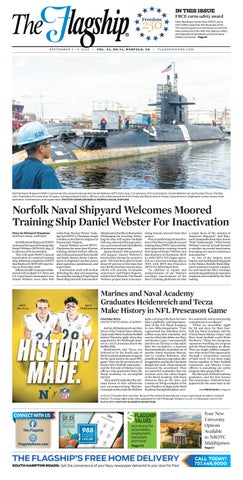
Norfolk Naval Shipyard (NNSY) welcomed the moored training ship Daniel Webster (MTS 626) Aug. 21 in advance of its inactivation. Daniel Webster served Nuclear Power Training Unit-Charleston for more than 30 years, training enlisted Sailors, officers, and civilian personnel from Knolls and Bettis Atomic Power Laboratories in shipboard nuclear power plant operation, maintenance, and supervision. PHOTO BY DANIEL DEANGELIS /NORFOLK NAVAL SHIPYARD
Norfolk Naval Shipyard Welcomes Moored Training Ship Daniel Webster For Inactivation Story by Michael D Brayshaw NORFOLK NAVAL SHIPYARD
Norfolk Naval Shipyard (NNSY) welcomed the moored training ship Daniel Webster (MTS 626) Aug. 21 in advance of its inactivation. This will mark NNSY’s second inactivation of a moored training ship, following completion of MTS Sam Rayburn’s (MTS 635) inactivation in November 2024. MilitarySealiftCommandcollaborated with multiple U.S. Navy and U.S. Coast Guard commands to tow Daniel Webster more than 400
miles from Nuclear Power Training Unit (NPTU)-Charleston, South Carolina, to the historic shipyard in Portsmouth, Virginia. Daniel Webster served NPTUCharleston for more than 30 years, training enlisted Sailors, officers, and civilian personnel from Knolls and Bettis Atomic Power Laboratories in shipboard nuclear power plant operation, maintenance, and supervision. Inactivation work will include defueling the ship and preparing the vessel for towing to Puget Sound Naval Shipyard and Intermediate
Maintenance Facility in Bremerton, Washington, for recycling. Defueling the ship will require multiple hull cuts, removal of the superstructure, and removal and reinstallation of numerous components. Approximately 400 personnel will support Daniel Webster’s inactivation during the project’s peak. “We have been able to retain about 50 percent of the team that also did the Rayburn inactivation, which will provide invaluable experience,” said Project Superintendent Don Wessells. The Daniel Webster project team is incorpo-
rating lessons learned from that project. Prior to performing the inactivation of the Navy’s original moored training ships, NNSY converted the next-generation training vessels that replaced Daniel Webster and Sam Rayburn in Charleston. MTS La Jolla (MTS 701) began operation as a moored training ship in 2019, with MTS San Francisco (MTS 711) following in 2021. “In addition to repairs and modernization of our Nation’s warships, inactivations of the Navy’s training platforms are also
a major facet of the mission at America’s Shipyard,” said Shipyard Commander Rear Adm. Kavon “Hak” Hakimzadeh. “With Daniel Webster’s arrival, we look forward to another successful inactivation leveraging our team’s experience and expertise.” As one of the largest, most historic and multifaceted shipyards in the Nation, Norfolk Naval Shipyard’s mission is to repair, modernize and inactivate Navy warships and training platforms to maximize readiness and availability for fleet tasking.
Marines and Naval Academy Graduates Heidenreich and Tecza Make History in NFL Preseason Game Courtesy Story UNITED STATES NAVAL ACADEMY
2ndLts.EliHeidenreichandAlex Tecza of the United States Marine CorpsmadeNavalAcademyfootball history Thursday night when they appeared for the Pittsburgh Steelers in a 28-27 preseason loss to the Buffalo Bills. Heidenreich and Tecza are believed to be the fourth pair of Naval Academy graduates to appear for the same team in the same NFL game. They are the second pair of former Navy football teammates— and the first pair of Marine Corps officers who graduated from the Naval Academy—to accomplish the feat. “Alex and Eli embodied the ultimate fusion of elite athleticism and uncompromising MarineCorps grit as they took the field last
night, carrying with them far more than a playbook,” said Superintendent of the U.S. Naval Academy Lt. Gen. Mike Borgschulte. “They represented the relentless drive, selfless team-first mentality, and warrior ethos that define our Navy and Marine Corps. I was especially proud to see Eli snap a crisp salute after his touchdown, a moment that immediately reminded me of another Naval Academy Marine, 2nd Lt. Landon Robinson, who proudly rendered a crisp salute after anaggressivesackfortheCincinnati Bengals last week. Those moments transcend the scoreboard. They are powerful reminders that our warriors carry the values forged at the Naval Academy with them wherever they go. Eli, Alex, and Landon are living examples of the type of leaders we forge at the Naval Academy through discipline, sacri-
fice, teamwork, and an unwavering commitment to excellence” “What an incredible night for Eli and Alex, for Navy football, the Naval Academy and the United States Marine Corps,” said Navy head football coach Brian Newberry. “Those two young men represent everything our program and the Naval Academy are about. They are tough, selfless competitors who earned this opportunity through a tremendous amount of hard work. To see them make history together as Navy football teammates and Marine Corps officers is something our entire program takes great pride in.” The first pair of Naval Academy graduates—and the first former Navy teammates—believed to have appeared for the same team in the See PRESEASON on Page A2
2nd Lts. Eli Heidenreich and Alex Tecza of the United States Marine Corps made Naval Academy football history Thursday night when they appeared for the Pittsburgh Steelers in a 28-27 preseason loss to the Buffalo Bills. PHOTO BY ELIZABETH WRIGHTSON
Page C6
THE FLAGSHIP’S FREE HOME DELIVERY
SOUTH HAMPTON ROADS: Get the convenience of your Navy newspaper delivered to your door for free!
Four New University Options Available to NROTC Midshipmen Page A7
CALL TODAY! 757.446.9000
2
flagshipnews.com | Section A | Thursday, September 3, 2026
Navy Chaplain Residency Program Prepares Spiritual Leaders for Clinical and Operational Care
tions such as: why did you ask that question? Why did you respond that way? Did your response really address what the patient shared? This kind of feedback allows chaplains to reflect on their ministry in ways they may never have before. Bevins ex p l a i n e d that while the PCR can profoundly transform chaplains, making them more authentic individuals who are better in all aspects of their lives, this, he said, must come from a place of humility and willingness to learn. All the residents agree
that moving from a hospital setting to an operational environment brings with it additional stress. As members are both away from home and dealing with the demands of the mission this program empowers chaplains to help build resiliency in the force. This preparation is particularly important in deployed and expeditionary medical environments where access to additional support resources may be limited. “Probably the biggest skill set I will take away from this is the ability to listen deeply to what people are struggling with and ask questions that help them find peace in whatever chaos life has thrown at them,” said program resident, Lt. Cmdr. Lloyd Wicker, currently assigned to Naval Medical Center Portsmouth during the program. In an operational setting, resources, such as mental health providers may be scarce.PCRprogramresident
Lt. Lindsey Lyerly, currently assigned to Naval Medical Center Portsmouth during the program, explained, “This program teaches us to confront people where they’re at and hopefully mitigate some of the struggles they’re dealing with,” he said. “Our goal is to help them get back into fighting position again. Because that’s what we want to do for our warriors— we want to help them where they’re at and get them back healthy.” In short, the Navy’s Clinical Pastoral Education initiative represents a growing effort to strengthen pastoral care across the fleet. Additionally, after decades of operating in partnership with outside institutions, the Navy now fully manages the PCR program, enabling leaders to shape the training specifically for the operational and expeditionary demands of Navy Medicine in various environments Sailors and Marines may be assigned. In recent years the Navy has expanded training for residents while also developing future educators who will mentor upcoming groups. Through fleet seminars, more chaplains will be able to access shorter CPE sessions, ensuring that advanced pastoral skills are disseminated throughout the corps. This unified approach, which combines full-time programs such as the PCR program with Fleet Seminars and a Supervisory Education Fellowship, strengthens the pastoral care capabilities across the Navy, better equipping chaplains to support Sailors, Marines, Coast Guardsmen, and their families. “Chaplaincy requires humility. We must recognize that we are always learning— not just intellectually but also spiritually in our walk with God,” said Perez. “This program strengthens chaplains spiritually, emotionally, and mentally. That strength helps us become better advisors to commanders and stronger supporters of the sailorsandMarinesweserve.” Lyerly agreed and added, “We have an opportunity to speak truth even in the midst of pain and tragedy and hopefully provide healing and direction.” Chaplains interested in the PCR Program should apply through the Chaplain Corps Advanced Education Program.Anyoneinterestedin becoming a Navy Chaplain or learningmoreshouldcontact Navy Recruiting Command or call 1-800-USANAVY or 1-888-NAVYCHC. Navy Medicine – represented by more than 44,000 highly-trained military and civilian health care professionals – provides enduring expeditionary medical support to the warfighter on, below, and above the sea, and ashore.
ensure the Corps is prepared for the complexities of the modern battlefield. Founded in 1845, the U.S. Naval Academy today is a prestigious four-year service academy that prepares midshipmen morally, mentally, and physically to become professional officers in the naval service. More than 4,400 men and women representing every state in the U.S. and several foreign countries make up the student body known as the Brigade of Midshipmen. U.S. News and World
Reports has recognized the Naval Academy as the #1 top public school, #3 national liberal arts college, and #5 best undergraduate engineering programs. From a pool of more than 16,000 applicants, approximately 1,200 earn appointments to the U.S. Naval Academy each year. Midshipmen learn from military and civilian instructors and participate in intercollegiate varsity sports and extracurricular activities. They also study subjects like small arms,
drill, seamanship and navigation, tactics, naval engineering and weapons, leadership, ethics, and military law. Upon graduation, midshipmen earn a Bachelor of Science degree in a choice of 26 different subject majors and go on to serve at least five years of exciting and rewarding service as commissioned officers in the U.S. Navy and U.S. Marine Corps. For more information about the Naval Academy, visitwww.usna. eduand our social media via linktr.ee/usnavalacademy.
Story by Jennifer Goulart NAVAL MEDICAL FORCES ATLANTIC
There are many professionals with specialized skills who work within Navy Medicine to include Navy Chaplains. These chaplains participate in one of three Clinical Pastoral Education (CPE) programs that are designed specifically for clinical settings. One of these programs, The Navy’s Pastoral Care Residency (PCR) Program, is considered the cornerstone of intensive clinical formation for chaplaincy. Each year a limited number of chaplains are selected for the competitive program, which helps prepare them to support expeditionary medical units and operational forces across the fleet. “Many chaplains come into the Navy with pastoral experience, but not all have had training in clinical pastoral care. Through CPE they gain hands-on training every day. They meet with patients, families, and provide care directly,” said PCR program instructor Lt. William Bevins, assigned to Navy Medicine Readiness and Training Command (NMRTC) Portsmouth. “Beyond patient care, chaplains are also there for the medical staff. Medical professionals carry heavy emotional burdens in their work, and chaplains can help them process those experiences immediately or as they occur rather than weeks or months after.” The PCR program is a fulltime, immersive, year-long assignment and occurs over a period of four quarters. Each quarter a chaplain will earn one CPE credit. Residents participate in structured group settings, individual clinical supervision, intensive group relations training, and they receive robust continuing education in clinical pastoral arts and sciences. Ultimately, PCR provides training chaplains would not receive in a Seminary. Upon completion, a chaplain will earn an additional qualification designator (AQD 1440), which prepares them to serve in Navy Medicine billets, including expeditionary medical assignments. “This training helps us learn the terminology and language used by doctors, nurses, and corpsmen that helps us better understand what is happening when they interact with patients,” said PCR resident, Lt. Jay Perez, currently assigned to Naval Medical Center Portsmouth during the program. “In an operational environment, those patients would be Sailors, Marines, or Coast Guardsmen. Understanding the medical context helps us advocate for them
PRESEASON from Page A1
same NFL game were Tyree Barnes (’09) and Eric Kettani (’09) who played for the New England Patriots during the 2011 preseason. Two other pairs of Naval Academy graduates have appeared together in an NFL preseason game. Kettani and Joe Cardona (‘15) played for the Patriots in 2015, then Cardona and Diego Fagot (’22) played for the Patriots in 2023. Heidenreich carried the
Pastoral Care Residency (PCR) graduates present plaques during a PCR award ceremony in the Chapel of Comfort at Naval Medical Center Portsmouth (NMCP), Aug. 21, 2026. Four chaplains were awarded graduation certificates for the PCR program, which is a full-time, immersive, year-long assignment that occurs over a period of four quarters. U.S. NAVY PHOTO BY MASS COMMUNICATION SPECIALIST 2ND CLASS THOMAS BOATRIGHT
Sideboys render honors to Rear Admiral Carey Cash, Chief of Chaplains, during a Pastoral Care Residency (PCR) award ceremony in the Chapel of Comfort at Naval Medical Center Portsmouth (NMCP), Aug. 21, 2026. U.S. NAVY PHOTO BY MASS COMMUNICATION SPECIALIST 2ND CLASS THOMAS BOATRIGHT
Awards displayed during a Pastoral Care Residency (PCR) award ceremony in the Chapel of Comfort at Naval Medical Center Portsmouth (NMCP), Aug. 21, 2026. U.S. NAVY PHOTO BY MASS COMMUNICATION SPECIALIST 2ND CLASS THOMAS BOATRIGHT
“Probably the biggest skill set I will take away from this is the ability to listen deeply to what people are struggling with and ask questions that help them find peace in whatever chaos life has thrown at them.”
and communicate more effectively with the medical team.” According to PCR Director, and Naval Medical Forces Atlantic Chaplain, Capt. David Jeltema, the program not only fulfills the international requirements for CPE but also prepares chaplains for the unique challenges of Navy Medicine. “Navy Medicine serves patients who often come to us during some of the most vulnerable moments of their lives—when they receive a difficult diagnosis, experience an accident, or face a serious health crisis,” said Jeltema. “Because of this, it is essential we have chaplains trained specifically to minister in healthcare settings.” While the program provides specialized skills, according to Perez it also helps strengthen and encourage the residents. “Through this process we have grown in our friendships and in our calling as chaplains,” he said. “In
operational environments, many chaplains serve alone. Here we have the opportunity to grow together—iron sharpening iron.” Just as iron is sharpened through friction, the residency program refines chaplains through honest peer feedback and reflection. During the program, once a chaplain has provided care, they are required to write out their encounter from their perspective, to include what happened externally and what they were experiencing internally. Following this,theirpeersmayaskques-
ball nine times for 35 yards, including a nine-yard touchdown run, and returned two kickoffs for 47 yards. Tecza saw action on special teams. Heidenreich and Tecza are two of five Naval Academy graduates currently on NFL rosters, four of whom are Marines. 2nd Lt. Landon Robinson (’26) is with the Cincinnati Bengals, 2nd Lt. Rayuan Lane (’25) is with the Jacksonville Jaguars, and Cardona, who recently concluded his service with the Navy as a lieutenant commander, is with the Los
Angeles Rams. Multiple U.S. Navy and Marine Corps officers have played in the NFL and returned to active duty for their service commitment. Those officers include 1st Lt. Malcom Perry who transitioned back into the active-duty component of the U.S. Marine Corps in 2022 after playing in the NFL. He is currently serving as an unmanned aerial systems officer stationed in Yuma, Ariz., where he leads Marines and integrates cutting-edge technology to
LT. CMDR. LLOYD WICKER, program resident who is currently assigned to Naval Medical Center Portsmouth.
Commander, Navy Region Mid-Atlantic (CNRMA): Rear Adm. Stephen Barnett Regional program manager for Navy Region Mid-Atlantic (NRMA): Public Affairs Director | Beth Baker Public Affairs Deputy Director | Leon Moore
Editorial Staff
Managing Editor | PO1 Cody D. Beam 757-322-2853 | cody.d.beam.mil@us.navy.mil Graphic Designer | Teresa Walter teresa.walter@virginiamedia.com
Contributing Staff
Elizabeth Reisen 757-322-2853 | news@flagshipnews.com
Flagship, Inc.
Military General Manager | Ski Miller ski.miller@virginiamedia.com
The Flagship® is published by Flagship, LLC., a private firm in no way connected with the Department of Defense (DOD) or the United States Navy, under exclusive written contract with Commander, Navy Region Mid-Atlantic. This civilian enterprise newspaper is an authorized publication for members of the military services. Contents of the paper, including advertisements, are not necessarily the official views of, nor endorsed by, the U.S. Government, DOD, or the Department of the Navy (DON). The appearance of advertising in this publication, including inserts and supplements, does not constitute endorsement by the DOD; DON; Commander, Navy Region Mid-Atlantic or Flagship, LLC. of the products or services advertised. Everything advertised in this publication shall be made available for purchase, use, or patronage without regard to race, color, religion, gender, national origin, age, marital status, physical handicap, political affiliation, or any other non-merit factor of the purchaser, user, or patron. If a violation or rejection of this equal opportunity policy by an advertiser is confirmed, the publisher shall refuse to print advertising from that source until the violation is corrected. Editorial content is edited, prepared and provided by the Public Affairs Department of Commander, Navy Region Mid-Atlantic. Stories may be submitted via email to news@flagshipnews.com. The Flagship® is published every Thursday by Flagship, LLC., whose offices are located at 804 Greenbrier Circle, Suite C, Chesapeake, VA 23320.
Free Classified Advertising 757-622-1455 © 2021 Flagship, LLC. All rights reserved Retail Advertising 757-222-5538 Distribution & Home Delivery 757-446-9000 • distribution@pilotonline.com
flagshipnews.com | Section A | Thursday, September 3, 2026
Norfolk ALSC/ASD Team Provides Aviation Logistics Support Story by Thomas Kreidel NAVSUP FLC NORFOLK
The Norfolk Aviation Logistics Support Center (ALSC)/Aviation Support Detachment team provides warehousing, issuing and maintenance logistics support for 17 squadrons at Chambers Field and Naval Station Norfolk. According to ALSC Supply Officer and ASD Officer in Charge Cmdr. Adam Pace, the team is a combination of Naval Supply Systems Command Fleet Logistics Center (NAVSUP FLC) Norfolk and Commander, Naval Air Force Atlantic (CNAL) Sailors, civilians and contractors. A team of more than 100 people support six aircraft types: the MH-60S, CMV-22B, E-2C, E-2D, C-2 and MH-53E, covering rotary-wing, airborne early warning/ command-and-control, and fleet logistics support aircraft. “Our mission is to deliver agile, precise, and accountable aviation logistics that directly sustain squadron readiness and operational effectiveness across the Fleet,” Pace said. He added that ALSC is a recent name change from Regional Supply Office, a transition that “better aligns our mission and identity with our role as a logistics center of excellence.” The team supports squadron missions with over 20,000 line items valued at more than $650 million. They also manage prepositioned unit kits that support forward-deployed and underway warfighters. “The Norfolk ALSC and ASD team exemplifies the power of joint partnership,” said NAVSUP FLC Norfolk Material Management Department Director Jory Eissinger. “We are incredibly proud of how this integrated team cuts through command lines to put parts on the flight line, directly sustaining combat readiness and global warfighter operations.” Pace added the workforce reflects a direct collaboration between CNAL and NAVSUP civilians working together, “all under one roof, one mission.” “That partnership extends into how the command operates day to day: CNAL’s operational and maintenance expertise paired with NAVSUP’s logistics and supply chain rigor gives customer squadrons a single, integrated source of
The Norfolk Aviation Logistics Support Center (ALSC)/Aviation Support Detachment team provides warehousing, issuing and maintenance logistics support for 17 squadrons at Chambers Field and Naval Station Norfolk. PHOTOS BY THOMAS KREIDEL/ NAVSUP FLC NORFOLK
support — from training pipelines to maintenance turnaround to deployment readiness,” Pace said. He added that it is a model that puts warfighters’ needs first, cutting through traditional command lines to ensure the right parts, in the right condition, reach the flight line exactly when squadrons need them. “The team takes tremendous pride in this work,” Pace said. “We don’t just support homeguard squadrons through the Fleet Response Training Plan cycle — we directly sustain forward-deployed detachments in combat operations.” NAVSUP FLC Norfolk is the largest of eight globally positioned fleet logistics centers that provide the full range of solutions for logistics, business and support services to our mission partners. The more than 1,300 Sailors, civilians and contractors who make up NAVSUP FLC Norfolk support operations at more than 30 sites across three regions and 12 states, plus Washington, D.C.
Kemi A. MBA Yuma, AZ
10 MBA SPECIALIZATIONS, EACH ABOUT $10K
FOR ELIGIBLE MILITARY STUDENTS SUCCEED AGAIN The affordable online Master of Business Administration (MBA) at University of Maryland Global Campus (UMGC) lets you study while you serve and tailor your program toward the career you want.
• An accredited MBA that eligible servicemembers & their spouses & dependent children can earn in as few as 16 months for about $10K • Specializations in cybersecurity technology, data analytics, finance, HR management, marketing, project management & more • No-cost lifetime career services • Online & hybrid courses available
MBA CLASSES START SEPTEMBER 16.
UMGC.EDU | 757-231-5666
UMGC is certified to operate in Virginia by the State Council of Higher Education for Virginia. University of Maryland Global Campus, 9625 Belvoir Road, Barden Education Center, Building 1017, Room 128, Fort Belvoir, VA 22060.
© 2026 University of Maryland Global Campus
3
4
flagshipnews.com | Section A | Thursday, September 3, 2026
Story by André B. Sobocinski, Historian U.S. NAVY BUREAU OF MEDICINE AND SURGERY
It is 1976. You are aboard the Kitty Hawk-class aircraft carrier USS America (CV 66), slicing through the Mediterranean during highstakes fleet exercises, when disaster strikes: a heavy wrench falls deep into the ship’s massive turbine, completely disabling the vessel. Who do you call in this instance? Naturally, the ship’s general surgeon. Retired Lt. Cmdr. Tom Minehan, a U.S. Navy Medical Corps officer and general surgeon, was stationed aboard the America during the 1970s when he found himself facing one of the most unexpected crises of his career. Tasked with helping extricate the foreign object from the turbine, Minehan had to rely on “unconventional tools” to save the day. The following is an excerpt from an oral history from 2015 in which Dr. Minehan details the curious yet true story of how a medical sigmoidoscope (an instrument used to examine the colon) was ingeniously repurposed to rescue a disabled warship. room and this steam turbine was a formidable presence; it really “It was a pretty standard day. was an amazing thing. We went We were in the Mediterranean, as down to the bottom of it and there I recall, and had just gotten there was a fairly high crawl space that within a week, and we were still in you could get in and crawl under the Western Med. There were three on your back and look up at the carriers: one spent some of the year bottom of the turbine. They had in Norfolk being refitted; another drilled a hole in the bottom of the one went across and went to the turbine that was about two inches Eastern Med immediately; the one in diameter and the casing around in the Eastern Med came back and the turbine was about two or three spent the second half of the tour in inches thick. the Western Med, and then when I’m on my back and I’m looking that tour ended they went back to up into this hole that goes up into Norfolk and the ship at Norfolk this huge engine, and the bottom of came over and went into the East- the casing was a little like a funnel. It ern Med. And as I recall we had just was wide at the upper part of it and gotten through Gibraltar and really then narrowed as you got down to hadn’t gotten very far in when my where that hole was, and the hole senior medical officer came to me looked like it was at the bottom some time in the afternoon and had point of the funnel arrangement. I this wide-eyed worried look on his looked at it and I put a finger up in face. there, and I could just barely get the He said, ‘We have a problem.’ tip of my finger over the inside edge, I’m thinking, okay, somebody just and I felt around and I couldn’t feel crash landed a plane somewhere anything in there, and I got a flashand I’m going to get 25 people light and looked around. injured onboard in a few minutes, They had been trying to get this and I’m worried about that. wrench out of the engine for two And he says, ‘It’s a little strange.’ days at this point. I got the light and I said, ‘Alright, I’m listening.’ I looked up in there and couldn’t He said, ‘Somebody dropped a really see anything in there. So, I’m wrench into the inside of one of the thinking to myself, maybe I could steam turbines on the ship.’ scratch around with a coat hanger There are four of these engines or something and see if I could do and each of them are about 25,000 anything like that. But I thought, horsepower; they are huge engines, well, I don’t know quite what’s up and without them we would not be in there; I better not be doing that. operational. We couldn’t run the Suddenly, I wondered if I could engine with this piece of foreign get a sigmoidoscope up into that body in there because if it got up thing. into the turbine it could ruin the At that time, flexible colonoswhole engine and maybe make it copy devices were just barely explode. Who knows what sort of getting started, and so we were all terrible problem it would be, so the pretty used to using rigid sigmoidoengine was finished at that point. scopes, which are about a foot long, He said, ‘Do you think you can and they have a light on them so get it out?’ you can see where you are. I went I’m thinking, ‘What am I going up and got a sigmoidoscope and to do? How am I going to do this?’ grabbed some surgical clamps of He said, ‘Come on down and we’ll various descriptions-some with take a look and I’ll show you what’s curves and some straight, and came going on.”’ back down and put the sigmoidoSo, we went down to the engine scope in. I’m looking around as best
I can. You couldn’t get a great angle off to the side, but you could get a little bit of an angle to see off to the side, and I was astonished to see this wrench just sitting there not quite straight up, but at an angle. And there it was. I initially tried to get some sort of surgical tool up through the sigmoidoscope, but I couldn’t get it over far enough to get around it or get at the thing. So, I took the sigmoidoscope out and knewtheanglewherethisthingwas sitting, and took a rounded forceps and passed that up in so that would loop over the top and could get up into the corners. I kind of felt around with that a little bit. And I could feel it touching the wrench. After five or ten minutes of fussing around and manipulating and getting my bearings, I just opened this thing up and I could feel it kind of slide over the wrench, so I closed it and I felt like I had the wrench. I gave it a little bit of a tug to bring it toward the hole and it just fell out on my chest. As I was working they kept asking, ‘How are we you doing? How you doing?’ I said, ‘Well, I’m making some progress I think.’ And then I pulled myself out from under the turbine and I handed them the wrench. They couldn’t believe it. I couldn’t believe it either. There was a lot of dumb luck involved in having that thing fall out, but I got the wrench around it and skidded it over a to the hole and plunk, it just fell right through the hole. The whole thing took about two hours, after they had worked on it for two days. I suspect that I’m the only person in the Navy that’s ever sigmoidoscoped a steam turbine. The rest of the story is that the ship was basically headed back to Norfolk. If I couldn’t get the thing out, they were going to have to cut a very large hole in the flight deck on down through to the engine room to pull this steam
Photograph of a one-of-a-kind award presented to Lt. Cmdr. Tom Minehan, a U.S. Navy Medical Corps officer and general surgeon, for his assistance in extricating a wench that disabled the engine aboard Kitty Hawk-class aircraft carrier USS America (CV 66) in the Mediterranean Sea in 1976. U.S. NAVY PHOTO COURTESY OF DR. TOM MINEHAN
turbine out and replace it with a new unit. We’re talking maybe half a year the ship being out of service before they could get it back in and going again. The other part of that story is that my time onboard at sea would have been shortened a lot if I thought about not getting the thing out because we would have been right back at Norfolk. But I would have tried anyway. I did get a commendation from the captain which I still have. As I was leaving the ship when my tour was up, I got handed a package. Inside was a plaque with the wrench on one side and on the other side was the clamp that I’d
used to get it. So yes, I do still have the wrench and I have the forceps that I used those many years ago.” The Navy Medicine Oral History Project was started in the 1980s as a means of capturing the stories and important experiences of the men and women of Navy Medicine, both past and present. Future installments of the “In the Line of Care” series will feature some of these stories captured over the years. SOURCE: Minehan, Tom. (Oral history conducted by A.B. Sobocinski, July 23, 2015) . BUMED Oral History Collection.
WTBn hosts inaugural Marine Corps Attack Drone Championship Story by Staff Sgt. Claudia Nix U.S. MARINE CORPS TRAINING AND EDUCATION COMMAND
MARINE CORPS BASE QUANTICO, Va.– Weapons Training Battalion, Training Command, hosted the inaugural Marine Corps Attack Drone Competition Aug. 10-14 at Marine Corps Base Quantico, Virginia. Marines from 3rd Littoral Combat Team and 4th Marine Division conducted strike planning and execution, intelligence, surveillance and reconnaissance integration, urban and night operations, long-range strikes and moving-target engagements. The teams were required to synchronize multiple attack drones against separate targets at nearly simultaneous times on target. Competitors were also placed on the receiving end of the systems they were trained to employ. An opposing force used ISR to locate and track teams, requiring competitors to manage their signatures and respond to the threat while completing their missions. “Being on the receiving end of the weapon system we’re trained to employ was humbling, to say the
least,” said Lance Cpl. Georgino Perez, an infantryman with 3rd Littoral Combat Team and FPV drone pilot. “It highlighted the need for more training, not only on how to employ these systems, but how to survive against them.” The competition also provided WTBn with insight into how to enhance current attack drone training, to include long-range aerial navigation, time-on-target planning, hide-site and antenna management, emergency protective actions, escape and evasion, and signature management. “The experience gained at the championship is important to the Marine Corps’ train-the-trainer model,” said Col. Charles E. Anklam III, commanding officer of Weapons Training Battalion. “Marines who develop proficiency through advanced training and competition can take those lessons back to their units and help build more capable attack drone teams throughout the Fleet.” The upcoming FY27 competition is expected to introduce a dedicated opposing force and electronic warfare effects while increasing engagement distances to as much as 20 kilometers. The changes
will build on this year’s lessons and further test teams’ ability to employ attack drones in a contested environment. The competition concluded with an awards ceremony recognizing FPV operators from 4th Marine Division as the competition winners. For more information on the Marine Corps Attack Drone Team, contact Training and Education Command Communication Strategy and Operations atmailto:smb_ tecom_media@usmc.mil. RIGHT: U.S. Marine Corps Cpl. Jhace Cameron, a joint fires observer with 3rd Littoral Combat Team, 3rd Marine Littoral Regiment, 3rd Marine Division, prepares a first-person view unmanned aircraft system for a long-range simulated strike during the Marine Corps Attack Drone Competition at Marine Corps Base Quantico, Virginia, Aug. 11, 2026. The purpose of the competition is to challenge mission planning abilities, tactical prowess and technical knowledge of attack drone teams from across the Marine Corps. U.S. MARINE CORPS PHOTO BY CPL. JOSHUA BARKER
flagshipnews.com | Section A | Thursday, September 3, 2026
5
Not too big, not too small: joint effort creates “just right” CH-53K tow bar for fleet Story by Megan Wasel H-53 HEAVY LIFT HELICOPTERS (PMA-261)
In preparation for the first deployment of the CH-53K King Stallion helicopter with a Marine Expeditionary Unit (MEU), a recent embarkation of four CH-53Ks, a MEU-sized detachment, successfully participated in a Type Commander’s Amphibious Training (TCAT) for the first time in June. “The June TCAT was designed to enhance mobility, planning, and integration between the U.S. Marine Corps and the U.S. Navy,” said Col. Joshua Wort, Program Manager, H-53 Heavy Lift Helicopter Program Office (PMA-261). “It was also an opportunity to resolve some of the remaining shipboard integration issues identified during earlier sea trials.” An important part of the TCAT was to increase squadron proficiency in towing, blade-folding, and aircraft strutting – optimizing the rapid movement and stowing of the aircraft on the flight deck and in the Landing Platform Dock (LPD) and Landing Helicopter Dock (LHD) amphibious assault ship hangars. “Stowing the aircraft efficiently aboard an LPD or LHDisvitaltoensuringspace for required maintenance while clearing the flight deck for continued launch and recovery of aircraft,” said Wort. Though the CH-53K King Stallion heavy lift helicopter is fully marinized for U.S. Marine Corps shipboard operations, parking requires assistance from an onboard tow tractor. One shipboard integration issue identified by the Integrated Test Team (ITT) was the “fit” of the current Adjustable Length Towbar (ALBAR), which attaches the tow tractor to the aircraft’s nose. The ALBAR comes in
A CH-53K King Stallion is maneuvered into a simulated flight deck space or“slash” as part of a towing analysis and towbar testing recently completed at Naval Air Warfare Center Aircraft Division (NAWCAD), Patuxent River, Md. PHOTO BY MEGAN WASEL/H-53 HEAVY LIFT HELICOPTERS (PMA-261)
standard lengths of 8-, 15- and 22 feet. Less than three months before the training, the Naval Air Warfare Center Aircraft Division Lakehurst (NAWCAD LKE) Support Equipment Test and Evaluation (SE T&E) Branch began coordination with the NAWCAD LKE Air/Ship Integration Branch for a towing analysis, confirming the 22-foot ALBAR was too long. “An ALBAR that is too long would put limitations on the flight deck space preventing the successful spotting of the CH-53K,” said a CH-53K Support Equipment Test Engineer for NAWCAD. “While an ALBAR that is too short could cause the tow tractor to impact the aircraft’s Aerial Refueling Probe during towing.” Earlier in the year, the team modified two existing
towbars as test assets, creating 18- and 20-foot towbars for further analysis using a Shipboard Tow Tractor fleet asset for validation. “Working with the test squadron, our analysis determined the solution was to develop an ALBAR specifically for the CH-53K, allowing flight deck maneuverability without impacting the Aerial Refueling Probe,” said the team lead. An additional ALBAR was converted prior to the TCAT and the NAWCAD Cargo and Special Operations Lab transported the two specialized ALBARs to the fleet. “From program office testing to NAWCAD engineering design, test team analysis, and the Cargo Lab delivery, this joint effort exemplifies the total commitment and unified response we are able to provide to resolve the needs of the fleet,” said Wort.
Various sized Adjustable Length Towbars (ALBARs) were used to park a CH-53K King Stallion heavy lift helicopter during recent testing in preparation for the first deployment of the CH-53K with a Marine Expeditionary Unit (MEU). The testing was to finalize the necessary equipment needed for stowing the aircraft efficiently aboard an amphibious assault ship. PHOTO BY MEGAN WASEL/H-53 HEAVY LIFT HELICOPTERS (PMA-261)
BUY 1 WINDOW OR DOOR, GET 1 WINDOW OR DOOR
50% OFF PLUS
FREE
Gerry Rogers, Founder/President
*
SMARTSUN™ GLASS UPGRADE* Some offers seem too good to be true.
&
This isn’t one of them. For a very limited time we’re offering this incredible
PAY NOTHING FOR 18 MONTHS**
discount, FREE SmartSun™ glass upgrade before SEPTEMBER 30th.
Interest accrues from purchase date but is waived if paid in full within 18 months.
FREE
(757) 353-4862 VAWindowDeal.com
*Offer expires 9/30/26. Discount good with the purchase of six or more windows or doors. Buy three windows and/or doors, get the second set of three windows or doors of equal or lesser value, 50% off. Discount applied to lowest priced units institutions without regard to age, race, color, religion, national origin, gender, or familial status. “Renewal by Andersen” and all other marks where denoted are marks of Andersen Corporation. © 2026 Andersen Corporation. All rights reserved.
6
flagshipnews.com | Section A | Thursday, September 3, 2026
NMRTC Bethesda Tests Elite Medical Providers in Brutal TCCC Tier 4 Training By Mass Communication Specialist 2nd Class Alec R. Kramer NAVY MEDICINE READINESS AND TRAINING COMMAND (NMRTC) BETHESDA
BETHESDA, Md. - Advanced medical providers from Navy Medicine Readiness and Training Command Bethesda completed the Department of Defense’s most rigorous battlefield medical training during a Tactical Combat Casualty Care (TCCC) Tier 4 course at Walter Reed National Military Medical Center. The grueling curriculum, known as the Combat Paramedic/Provider course, pushed highly trained clinicians out of sterile, well-staffed hospital environments and tested their ability to perform complex trauma life support under simulated combat conditions in austere environments. “Most providers, especially ones who have only been in a hospital or civilian treatment facility, are very accustomed to having plenty of resourcesattheirdisposal,aspecialist they can call, and lab capabilities,” said Hospital Corpsman 2nd Class Evan C. Selinger, the Tactical Medicine TCCC Program Manager and course instructor. “The biggest lesson we try to impart on our students is that it is very likely they will not have all, or potentially any, of these resources when they are deployed. The combat or austere environment is not sterile or clean, resources and equipment will be limited, and the patient load will likely be astronomical.” Selinger added that the course prepares clinicians for the harsh realities of operating forward. “When forward deployed, you may be the only provider around or available, so you may have to provide care that would normally be considered outside of your scope of practice. In the combat or austere environment, the provider’s scope of practice is to do everything possible to save the patient. This course exposes them to that reality and gives them an opportunity to train and practice some of those advanced interventions that they may not normally get to perform.” Unlike lower TCCC tiers focused
Officers and Sailors assigned to Navy Medical Readiness and Training Command Bethesda, apply their medical knowledge in a simulated medical emergency during the Tactical Combat Casualty Care Tier Four course testing at Walter Reed National Military Medical Center, July 30, 2026. Unlike lower TCCC tiers that focus on basic and intermediate life-saving skills for standard service members and combat medics, Tier 4 is reserved strictly for advanced medical professionals, including physicians, physician assistants, nurse practitioners, and independent duty corpsmen. NMRTC Bethesda’s mission is to maximize warfighter performance through optimized medical readiness tailored to operational requirements; enhance the readiness of the medical force to sustain expeditionary medical capability; and train and develop the Navy Medicine Force. U.S. NAVY PHOTO BY
on basic and intermediate life-saving skills for standard service members and combat medics, Tier 4 is reserved strictly for advanced medical professionals; including physicians, physician assistants, nurse practitioners, and independent duty corpsmen. Students must master highly invasive procedures such as surgical cricothyroidotomies, chest tube insertions, intraosseous access, and whole-blood transfusions while operating under extreme physical exhaustion. “It’s not necessarily that Tier 4 is so much more difficult than the other tiers, as the approach to combat casualty care at the point of injury is the same: stop them from
dying, resuscitate if possible, and keep them alive until they can get to a higher echelon of care,” Selinger explained. “However, Tier 4 brings into play additional advanced interventions like intubation and chest tubes.Theseprocedurescanbequite difficult to perform in a combat or austere situations, especially if it’s not something the provider does on a regular basis in their day-to-day clinical practice. The biggest takeawayfromthesecoursesistounderstand what is happening with your patients under extreme resource constraints and learning how to do the most amount of good with what you have.” The intensive 14-day training cycle also heavily tested the provid-
ersenduranceinProlongedCasualty Care, requiring them to sustain critically injured patients for hours or dayswithoutimmediateevacuation. The training culminated in a grueling mass casualty scenario, validating the class’s ability to triage, treat, and sustain multiple critical casualties under simulated enemy fire. According to Selinger, this pre-deploymentpreparationisvital, even for clinicians who may not expect to see direct frontline action. “We present the course as exposure and reinforcement to what their Corpsmen and Medics will be performing on the frontline,” said Selinger. “It is critical that the providers understand what their
people are going through and working with regarding their patients at thepointofinjury,priortoreceiving them in the clinical environment.” By maintaining TCCC Tier 4 certified personnel, NMRTC Bethesdamaximizedmilitarymedicine’s support of the warfighter, ensuring combat forces have access tothehighesttieroflife-savingmedical care in the world’s most hostile environments. NMRTC Bethesda’s mission is to maximize warfighter performance through optimized medical readinesstailoredtooperationalrequirements; enhance the readiness of the medicalforcetosustainexpeditionarymedicalcapability;andtrainand develop the Navy Medicine Force.
flagshipnews.com | Section A | Thursday, September 3, 2026
Four New University Options Available to NROTC Midshipmen Story by Lt. Beau Nickerson NAVAL SERVICE TRAINING COMMAND
GREAT LAKES, Ill. – Over the previous year, Naval Service Training Command (NSTC) authorized the addition of four new universities as crosstown affiliates for the Naval Reserve Officers’ Training Corps (NROTC). A crosstown agreement allows a Midshipman attending a college without a Naval ROTC unit to participate in the program by travelling to a nearby host unit for required naval science classes, physical training, and leadership labs, while completing their degree requirements at their own university. Universities added as crosstown affiliates include: Liberty University (Lynchburg, Va.), affiliated with the host unit at the University of Virginia (Charlottesville, Va.). Christopher Newport University (Newport News, Va.) affiliated with the host unit at Hampton University (Hampton, Va.). Washington and Lee University (Lexington, Va.) affiliated with
the host unit at Virginia Military Institute (Lexington, Va.). Carlow University’s School of Nursing (Pittsburgh, Pa.), affiliated with the host unit at Carnegie Mellon University (Pittsburgh, Pa.). These universities are available options to prospective Midshipmen at the start of the 2026-2027 school year. “NROTC is still growing 100 years after it was established,” said Rear Adm. Matt Pottenburgh, Commander of NSTC. “These crosstown universities give young men and women the opportunity to attend the school that’s right for them while learning the skills necessary to lead our battle-ready Sailors and Marines. While the locations may differ, the expectations andlevelofinstructionarethesame. When our Midshipmen graduate and commission as Ensigns or 2nd Lieutenants, they will have been transformed by the Warrior Ethos which unites all who have ever worn the cloth of our nation—one of merit, unity, accountability, and high standards.” NROTC has commissioned approximately 1,100 new Navy
7
Over the previous year, Naval Service Training Command (NSTC) authorized the addition of four new universities as crosstown affiliates for the Naval Reserve Officers’ Training Corps (NROTC). GRAPHICS BY PETTY OFFICER 1ST CLASS REYMUNDO VILLEGAS/NAVAL SERVICE TRAINING COMMAND
Ensigns and Marine Corps 2nd Lieutenants in Fiscal Year 2026. 2026 marks a century since the NROTC program was established. What started at six units with approximately 300 Naval Reserve students, has grown into one of our Nation’s proven Foundries of Navy and Marine Corps Officers at more than 170 colleges and universities across the country—
forging leaders who are united in purpose, resilient in spirit, and committed to ensuring that our Navy and Marine Corps Combat Team remains trained to fight and ready to win. NSTC, headquartered at Naval Station Great Lakes, Illinois, transforms America’s sons and daughters into service professionals through Recruit Training
Command—the Navy’s only bootcamp, Officer Training Command Newport, and NROTC. To learn more about how NROTC develops the next generation of Navy and Marine Corps Officers, explore available scholarship opportunities, or see a complete list of available universities, please visit our website at: https://www.netc. navy.mil/NSTC/NROTC/
Department of the Navy Launches ‘Epic Vigilance’ to Counter Evolving Threat Landscape and Protect Personnel NORFOLK, Va. — The Department of the Navy, in coordination with the Naval Criminal Investigative Service, has officially launched Operation Epic Vigilance, a force protection initiative designed to detect, deter and mitigate a growing range of hostile actions targeting military installations, service members, and their families. The rollout of Epic Vigilance follows the initiation of Operation Epic Fury, during which Navy and Marine Corps personnel have encountered an evolving threat landscape. Security officials emphasize that recent worldwide events are not isolated incidents, but rather a deliberate effort to gather intelligence, probe
defenses and disrupt U.S. military operations. Defense and intelligence officials have identified several key threat vectors currently targeting military communities: Targeted Online Harassment: Direct threats and systematic “doxing” (the unauthorized public disclosure of personal data) targeting service members and their families on social media platforms. Uncrewed Aircraft Systems (UAS): Increased drone surveillance demonstrating evasion capabilities over warships, military flight lines, and critical national infrastructure. Ground-Level Surveillance: Suspicious activity, filming, and
physical monitoring near military installations and surrounding residential communities. Physical Probes: Attempted physical attacks and security breaches at military access control points, indicating a willingness by adversaries to transition from threats to direct action. Coordinated Harassment Campaigns: Organized efforts designed to stress-test military security responses and personnel endurance across globally dispersed locations. Every Sailor, Marine, civilian employee, and family member is a critical component of national security. The Department of the Navy is urging military communi-
ties and the public to adopt a hardened security posture immediately: Harden Personal and Family Security: Immediately review all social media accounts (including those of family members) and set profiles to strict privacy settings. Remove any information, photos, or check-ins that identify a connection to the Department of the Navy or reveal predictable daily routines. Maintain Situational Awareness: Stay alert to unusual changes or anomalies in daily activities at work, at home, and within local communities. Watch for individuals lingering near, photographing, or filming military gates, perimeter fences, ships, housing areas, or aircraft.
Pay close attention to the use of telephoto lenses or individuals hurriedly departing when observed. Identify Deceptive Outreach: Be cautious of individuals showing unusual interest in ship movements, deployment dates, base operations, or leadership schedules. Report aggressive attempts by strangers to solicit personal information, such as home addresses, phone numbers, or email addresses. Monitor Cyber Activity: Be vigilant against threatening or suspicious emails, social media messages, and the creation of “imposter” social media accounts mimicking military personnel. See something, say something.
Buy a home with a $0 down VA Loan Because you served your country, you’re eligible for the special mortgage benefits of a VA loan. As a top VA lender,1 we’ll guide you through the home-buying process and help you take advantage of the benefits you’ve earned.
VA LOAN FEATURES • Options with no down payment2 • No Private Mortgage Insurance required • Cash-out and interest rate reduction refinance options • Access to our RealtyPlus® program—you could earn up to $9,000 cash back3
Scan4 to learn more or visit navyfederal.org/VALoan
Navy Federal is federally insured by NCUA. 1Navy Federal Credit Union was included in 9 Best VA loan Lenders in March 2024 by money.com (www.money.com/best-va-loans). 2100% financing subject to all VA rules, guidelines, and additional
program requirements. All loans subject to approval. VA loans may include a funding fee, which may be financed up to the maximum allowed loan amount. Navy Federal has no affiliation with the U.S. Department of Veterans Affairs or any other government agency. ³The program is only available for individual home purchases/sales in the contiguous US, Alaska, and Hawaii, excluding Iowa and all employer-sponsored relocations. You are not required to receive financing through Navy Federal Credit Union in order to receive the benefits of this program. The cash back is only available with the purchase or sale of your home through the use of a program-referred and -approved real estate agent, and is offered in most states, with the exception of Iowa, Alaska, and Oklahoma, and is not available in certain transactions with restricted agent commissions (including many new constructions, For Sale by Owner, or For Sale by iBuyer transactions). Your assigned agent can help you identify any transactions where the cash back would not be available. The amount of your cash back depends on the value of the property you are buying or selling. Obtaining the full $9,000 cash back requires transacting in a property valued at $3 million or greater. To calculate your potential cash-back amount, please visit the RealtyPlus website: https://navyfederalrealtyplus.com/. The cash-back offer is limited to one cash back per property with no limit on the number of times you may use the program. In some states, a gift card or commission credit at closing may be provided in lieu of the cash back. In Kansas and Tennessee, a Mastercard® MAX gift card will be issued with preloaded points that are ready for spending at specified retail establishments after closing. State regulations in Kansas limit the dollar amounts and the type of incentive. In Mississippi, New Jersey, and Oregon, a commission reduction may be available at closing in lieu of cash back. Please check with the program coordinator for details. All real estate commissions are negotiable. Contact RealtyPlus for terms and conditions. Seller listing fees apply. This program is offered, in part, by Anywhere Leads Inc., which may receive a co-operative brokerage fee as a result of a referral to any affiliated real estate companies, including Better Homes and Gardens® Real Estate, Coldwell Banker®, Century 21®, ERA® Real Estate, and Corcoran. Program terms and conditions are subject to change at any time without notice. Additional terms, conditions, and restrictions apply. This is an advertisement and not a solicitation for agent representation if your property is currently listed with an agent. Anywhere Leads Inc., 175 Park Avenue, Madison, NJ 07940. Licensed broker in the state of Texas. Broker license #9009191. 4Message and data rates may apply. Visit navyfederal.org for more information. © 2026 Navy Federal NFCU 10299 (3-26)
8
flagshipnews.com | Section A | Thursday, September 3, 2026
Quarterdeck
PA G E 1
|
SECTION B
|
T H U R S D AY, S E P T E M B E R 3 , 2 0 2 6
|
FLAGSHIPNEWS.COM
FRCE Earns Eighth CNO Aviation Safety Award By Samantha Morse FLEET READINESS CENTER EAST
MARINECORPSAIRSTATION CHERRY POINT, N.C. — A commitment to flight line safety and efficiency has earned Fleet Readiness Center East (FRCE) recognition from the Chief of Naval Operations (CNO) with the CNO Aviation Safety Award for fiscal year 2025. The award, also known as the Navy’s Safety “S,” is presented annually to Navy and Marine Corps aviation units to honor superior operational performance and mishap prevention efforts throughout the fiscal year. Unlike single-winner awards, this recognition is given to multiple commands across the Navy enterprise that meet the rigorous safety and operational standards set by the Naval Safety Command. FRCE became one of just 48 organizations within the Navy chain of command to receive the accolade for 2025, and one of only two within Naval Air Systems Command. FRCE Commanding Officer Capt. Randy Berti said this accomplishment was made possible by the hard work and dedication of the depot’s workforce coming together in support of the warfighter. “FRC East’s primary mission is to ensure that our nation’s Marines, Sailors and Airmen are equipped with the safest, most reliable products,” said Berti. “We are committed to maintaining our record of zero flight mishaps and further enhancing our operations through safe practices. Our success is driven by a workforce that has fully embraced our safety management systems, knowing the vital role they play in our nation’s defense. This deeprooted culture of safety not only protects our people but also guarantees that every aircraft, engine and component we deliver is fully mission-ready, every time.” This achievement represents the FRCE’s eighth CNO Aviation Safety Award, and the second time since2013,addingtothecommand’s previous wins in 1984, 1991, 1996, 2004, 2010 and 2023. In fiscal year 2025, FRCE logged nearly200flighthoursandreturned 81 mission-capable aircraft back to the fleet. This flight line support was delivered across five types of aircraft for the U.S. Navy, Marine Corps and Air Force: the F-35 Lightning II, MV-22B Osprey, MH-53E Sea Stallion, CH-53E Super Stallion and UH-1N Huey. With a team of only six pilots — four military and two civilian — and five enlisted military aircrew members completed nearly 140 flights in fiscal year 2025. These flights included functional check flights that check the aircraft’s systems and performance and ferry deliveries of aircraft as they return to their home squadrons. FRCE H-53 Military Branch Head Marine Capt. Robert McGuire, who serves as the command’s aviation safety officer, said of the 140 flights and 200 flight hours, the team experienced no mishaps. McGuire credits this success to the depot’s highly effective safety management
A commitment to flight line safety and efficiency during fiscal year 2025 earned Fleet Readiness Center East (FRCE) the Chief of Naval Operations Aviation Safety Award. Upon receipt, FRCE became one of just 48 organizations within the Navy chain of command to receive the accolade for 2025, and one of only two within Naval Air Systems Command. REBECCA MCGANN/FLEET READINESS CENTER EAST
Fleet Readiness Center East (FRCE) recently earned recognition from the Chief of Naval Operations (CNO) with the CNO Aviation SafetyAward for fiscal year 2025.This achievement is the eighth time FRCE has been selected for the award, representing a long-time commitment to safe aviation practices.
systems and dedicated workforce. “As a command, especially one that performs such in-depth maintenance, we do a really good job maintaining the safety of our people and products,” said McGuire. “We haven’t had a Class A mishap in 28 years, and it’s been about 47 years since our last Class B or C mishap. I believe our excellent record is a result of our safety management systems; our employees and leadership continue to work hand-inhand to foster a safety-first culture that ensures hazards are identified, mitigated and resolved. These efforts are critical in maintaining both a safe working environment and a continued high standard of flight safety once aircraft leave our hangars.” As part of the depot’s safety management system, every aircraft,
component and part is subjected to rigorous quality and assurance inspections, foreign object debris checks, and general safety inspections. McGuire said he believes these checks, some of which go above and beyond the naval aviation standard, are how FRCE maintains such an excellent aviation safety record. “Because we do such in-depth maintenance — completely tearing every aircraft, engine and component down to the bolts for overhaul — we also have many mandatory safety checks embedded throughout the maintenance process to ensure everything is working accordingly before it goes back out to the fleet,” McGuire said. “Not only do we have our safety team focused on employee safety, but we also have our quality assurance
team, logs and records professionals and maintenance controllers who are constantly checking and rechecking the safety of our aircraft and components.” In addition to verifying the safety and quality of the products FRCE maintains, the command has also implemented daily foreign object debris inspections, according to McGuire. He said these inspections are conducted on the flight line, in aircraft hangars and in back shops to ensure workspaces remain free of hazards. In 2025, FRCE updated its aviation safety management system to further enhance the command’s safety policies and procedures, McGuire said. “Safety is an ongoing thing; changes are always happening to keep up with the best and safest way of doing things,” said McGuire. “As of last year, the aviation safety management system was completely overhauled, which included many audits. We have made sure to incorporate all those changes and new information into our local instruction to ensure we have the best system in place to protect our people and the fleet’s products.” The command also made upgrades to its facilities, improving lighting and adding freshly painted pavement markings on the depot’s flight line to allow for a safer and more efficient working environment, McGuire said. “In 2025, we installed advanced lighting systems to improve visibility and safety during nighttime operations,” said McGuire. “We also repainted all of our taxiway lines
and parking spots. They’re now easy to see and organized in a way to limit congestion when we have multiple aircraft on our flight line. We also audited our aircraft pickup and drop-off procedures. Because we have a non-standard flight line, we established clear instructions — complete with visual guides and updated wingtip clearances. These improvements are extremely valuable for non-local pilots who have not been here before because they eliminate confusion and drastically lower the risk of a mishap.” Through proactive safety measures, FRCE is able to lower risk and mitigate delays, saving time and maximizing fleet support, McGuire said. “If we are doing things the safe way the first time, then we are able to avoid having to repeat processes or use extra time to fix mistakes,” McGuire said. “Aircraft get back to the fleet sooner, giving them the products they need to enhance readiness even faster. We ensure the maintenance is done properly throughout every step here and because of that, the fleet knows when they get a product from FRC East, they can trust that it’s safe to use and is working properly.” FRCE is North Carolina’s largest maintenance, repair, overhaul and technical services provider, with more than 3,600 civilian, military and contract workers. Its annual revenue exceeds $886 million. The depot provides service to the fleet while functioning as an integral part of the greater U.S. Navy; Naval Air Systems Command; and Commander, Fleet Readiness Centers.
NAMPIE strengthens fleet readiness through advanced manufacturing, training and innovation By Oscar Pope MID-ATLANTIC REGIONAL MAINTENANCE CENTER (MARMC)
NORFOLK — Commander Navy Regional Maintenance Center (CNRMC) kicked off the two-week Navy Advanced Manufacturing Parts Identification Event (NAMPIE) July 13, 2026, at Shore Intermediate Maintenance Activity (SIMA) Norfolk. The event was a collaboration between fleet maintainers, engineers and manufacturing experts, identifying new opportunities to reduce repair timelines, improve training, and accelerate the delivery of mission-critical parts to the Fleet. Advanced manufacturing refers to innovative technologies which fabricate, repair, rework or reverse engineer parts or components. These includes Additive Manufacturing (AdvM) or 3D-printing, Subtractive Manufacturing, Cold Spray and Directed Energy deposition and coatings removal, Robotics and automation, Data Analytics, and Advanced Machining. Flag Aide Lt. Charles Hodgkins of CNRMC orchestrated the event by mustering experts from The Reserve Engineering Duty Officer community, Naval Sea Engineering Dictorate (NAVSEA 05), Naval Surface Warfare Center Philadel-
phia Division (NSWCPD), Naval Surface Warfare Center Carderock Division (NSWCCD), Submarine Industrial Base (SIB), Naval Supply Weapons Systems Support (NAVSUPWSS), to identify components suitable for additive manufacturing while improving the Navy’s ability to produce critical parts closer to the point of need. The event moved beyond simply identifying printable parts. Teams validatednewmanufacturingmethods, solved fleet maintenance challenges and uncovered opportunities to strengthen the Navy’s advanced manufacturing enterprise through improved training, workforce and Sailor development. Reserve Engineering Duty Officer Cmdr. Jake Lunday emphasized, “advanced manufacturing is not intended to replace traditional logistics—it complements it by giving maintainers another tool to keep ships mission-ready when conventional supply cannot meet operational demands.” One of those successes manifested when engineers restored a Markforged X7 3D printer aboard a navy warship returning the system to operational status after it had been out of service. The Markforged X7 3D printer is a rugged, field-deployable industrial 3D printer for tactical response to supply chal-
lenges in remote locations. Nicholas Heinrich, afloat installation support and deployment assistant at NSWCPD, responsible for installing and sustaining Markforged systems across the fleet said, restoringtheprinterhighlightedthe importance of maintaining both equipment and operator proficiency. “The machine itself took approximately 20 hours to repair,” Heinrich said. “But because it had been down for a period of time, valuable production time was lost and their familiarity with the equipment had diminished.” During the repair effort, Heinrich provided refresher instruction in computer-aided design software, printer maintenance and troubleshooting procedures to help restore operator proficiency while identifying improvements for future fleet training. “This event wasn’t just about making parts,” Heinrich said. “It showed us there are opportunities to improve how we train SIMA Sailors and ship’s force, so they’re better prepared to maintain these systems and reduce downtime when they’re deployed.” Throughout the event, engineering teams identified multiple fleet maintenance issues that could be resolved through additive
Lt. Charles Hodgkins, flag aide at Commander Navy Regional Maintenance Center (CNRMC) discusses the agenda with Navy Advanced Manufacturing Parts Identification Event (NAMPIE) working
manufacturing, including several metal components that traditionally require lengthy procurement timelines. Working alongside the International Additive Manufacturing Center of Excellence (AM CoE) in Danville, Virginia, engineers submitted new metal part designs that are expected to significantly reduce production time while supporting future fleet repairs. AM CoE conducts strategic research and development to advance standards across all aspects of AdvM. On the waterfront, development of replacement parts for
DDG-class hangar door assemblies and additional metal components identified during ship visits that directly impacted maintenance availability is ongoing. Rather than replacing the Navy’s supply system, DeSantis emphasized additive manufacturing provides commanders another option when operational timelines cannot wait for traditional procurement. “If a ship needs a part three days before deployment, waiting two months isn’t an acceptable answer,” DeSantis said. “SIMA Norfolk See EVENT on Page B3
2
flagshipnews.com | Section B | Thursday, September 3, 2026
Q: What types of family housing are available? A: There are three types of housing available to families:
From left: Terese Garifo, Emily Green, and Lieutenant Molly Green during NCDOC Family and Friends Day. U.S. NAVY PHOTOS BY CYBER WARFARE TECHNICIAN 2ND CLASS JOSE RANGEL/RELEASED
Navy Cyber Defense Operations Command hosts Family & Friends Day
If you have any questions or concerns with privatized housing, government-owned housing or community housing you can email Navy Housing Headquarters: NavyHousingHQ@us.navy.mil or learn more online: ffr.cnic.navy.mil/Navy-Housing
Kids and parents creating artwork memories while bonding at the coloring station during NCDOC Family and Friends Day.
to briefs and space tours, each NCDOC department manned a display table, enabling family and friends to learn more about individual department functions and how departments across NCDOC operate collaboratively to ensure mission success. Willow Nourse, daughter of Cyber Warfare Technician Third Class Jason Nourse, said, “Spending time at his work and meeting his friends” was something she enjoyed about NCDOC Family & Friends Day. While guests were able to enjoy camaraderie with fellow NCDOC families and friends, they also were given the opportunity to learn about their sailor or civilian’s unique contribution to the command’s mission. Savannah Townsend, wife of Intelligence Specialist First Class Townsend, commented “After
attending Family & Friends Day, I realized how expansive and extensive the work is that everyone at NCDOC does. I feel like I now understand and appreciate the level of importance of my husband’s work.” NCDOC Family & Friends Day concluded with comments from Capt. Brian A. Evans, the NCDOC Commanding Officer, thanking guests for attending and supporting their Sailor or civilian, “It is my sincere hope that today you have gained an appreciation for the incredible contribution your sailor or civilian makes to the NCDOC crew and mission, as well as in service to the broader Navy. I am convinced that without your personal sacrifices and continuous support, our NCDOC Sailors and civilians would be unable
to accomplish our demanding, vitally important and impactful mission. Our NCDOC families and friends will always have our gratitude.” NCDOC, assigned as U.S. Tenth Fleet Task Force 1020, continuously plans, directs and executes cyberspace defense and cybersecurity actions and activities to disrupt, degrade, and deny malicious cyberspace activity targeting U.S. Navy cyberspace terrain, and other cyberspace terrain as directed, in order to attain and preserve U.S. Navy cyberspace advantage. For more information about NCDOC, visit the command web page at https://www.navifor.usff. navy.mil/ncdoc/ or command Facebook page at https://www. facebook.com/NavyCyberWarriors .
“It is my sincere hope that today you have gained an appreciation for the incredible contribution your sailor or civilian makes to the NCDOC crew and mission, as well as in service to the broader Navy. I am convinced that without your personal sacrifices and continuous support, our NCDOC Sailors and civilians would be unable to accomplish our demanding, vitally important and impactful mission. Our NCDOC families and friends will always have our gratitude.” — CAPT. BRIAN A. EVANS, the NCDOC Commanding Officer
NORFOLK — Civilians and Sailors in Mid-Atlantic Regional Maintenance Center’s (MARMC) GasTurbinesandEngineControls Branch (Code 261A) in Norfolk, Virginia, recently completed months of research analysis that could lead to innovative transformations in gas turbine engine maintenance and operational efficiency aboard Navy ships. Gas turbines are the driving force aboard surface ships, the primary engines that power propellers and generate electricity. MARMC Code 261A, a diverse team of Navy veteran and activeduty gas turbine technicians as well as career engineering professionals, provides critical maintenance support for gas turbines aboard more than 60 ships on the east coast. “Our top priority is fleet readiness,” said Branch Head Mike Stark. “We deal with anything
ranging from inspections, troubleshooting, maintenance, and gas turbine repairs across the board, for all marine gas turbines and also on the control side of the house.” Over the last year, the team has leveraged experience and advanced manufacturing technology to deliver White Paper Analysis and Finite Element Analysis to validate major technical upgrades that have been credited with improving exhaust flange seal efficiency; reducing engine shutdowns and preventing engine failures. An exhaust flange seal prevents exhaust gases from leaking from the engines into the main spaces. The team researched how seal assembly changes aboard various classes of ship over the decades – specifically changes to bolting procedures – have impacted efficiency. “What I wanted to do is quantify each sealing method, visualize how good or how bad each sealing method was and figure out should
Mid-Atlantic Fleet and Family Support Centers (FFSC) programs and services are designed to help you make the most of your military experience, and they’re all available to you at no cost. FUNCTIONS AND/OR SERVICES FFSC PROVIDES: ClinicalCounseling – Individual, Couples and Child Counseling Personal Financial Management Information & Referral Family Employment Assistance Transition Assistance Family Advocacy Program Deployment and Mobilization Support Ombudsman Support Relocation Assistance Parenting Programs Stress and Anger Management Command Support Crisis Support Suicide Prevention SAPR Support CONTACT FFSC Little Creek/Fort Story: 757.462.7563 Newport News: 757.688.6289 Norfolk/Portsmouth: 757.444.2102 Northwest: 757.421.8770 Oceana/Dam Neck: 757.433.2912 Yorktown: 757.887.4606 Get more info online: www.navylifema.com
MARMC Gas Turbines and Engines Branch Research analysis validates innovative changes By Hendrick Dickson MID-ATLANTIC REGIONAL MAINTENANCE CENTER (MARMC)
NAVY HOUSING CONTACTS:
Norfolk: 757.445.2832 JEBLCFS: 757.462.2792 Oceana/Dam Neck: 757.433.3268 Yorktown: 757.847.7806
By Alexis Smith NAVY CYBER DEFENSE OPERATIONS COMMAND
On Friday 14 August 2026, Navy Cyber Defense Operations Command (NCDOC) hosted a Family & Friends Day, welcoming more than 300 family and friends of Sailors and civilians assigned to the command. Designated as Task Force 1020 under U.S. TENTH Fleet, NCDOC is the U.S. Navy’s single global 24/7 Defensive Cyberspace Operations (DCO) task force and Cyber Security Service Provider (CSSP) responsible for defending all Navy cyberspace. NCDOC’s Family & Friends Day provided attendees with a better understanding of the scope, complexity and vital nature of this mission, allowing them to experience firsthand the talent, skill and dedication required by the NCDOC crew to achieve mission success against persistent advanced malicious cyber actors. NCDOC Family & Friends Day opened with Capt. Brian A. Evans, NCDOC Commanding Officer, providing an overview of the Navy-wide impact of NCDOC operations and the vital daily contributions that NCDOC Sailors and civilians make to the Navy’s lethality and warfighting readiness. The Commanding Officer’s comments were followed by an operations brief outlining how the various departments from across NCDOC interact to delivery impactful mission outcomes. Following the operations brief, family and friends were allowed to tour their Sailor’s or civilian’s workspace and view the NCDOC/Task Force 1020 watchfloor. In addition
Public/Private Venture (PPV) Housing is also referred to as privatized housing in the Navy. The Navy partnered with different private management companies to provide housing to Service Members. These companies are responsible for the construction, renovation, maintenance and day-to-day management of the housing. PPV housing may be located on or off government property and in most cases will be former military housing. Government Owned (also known as Military Housing or Navy Managed Housing is what was formerly called on-base housing. While only available in limited quantities CONUS, Government Owned Housing is still widely available OCONUS. Community Housing is any housing that a Service Member may choose that is not PPV or government operated. This is housing outside of the base that is privately owned and operated.
we actually be retrofitting all the ships prior to the new bolting standard on our later ships,” said Mechanical Engineer Christopher Van Ostrand. Their exhaust flange seal analysis validated a critical fastener upgrade that increases exhaust flange sealing pressure by over 400 percent, effectively eliminating chronic exhaust gas leaks on DDG-class ships. The team is now collaborating with In-Service Engineering Agent (ISEA) and Navy Sea Systems Command (NAVSEA), Marine Engineering Directorate (05Z) to coordinate fleet-wide implementation protocols. The next analysis of gas turbine hydraulic accumulators, which act as energy storage batteries for control valves and fuel systems that act as fail safe, could result in a 100 percent reduction in engine shutdowns. According to Van Ostrand, the accumulators were previously implemented on gas turbines, but over time, it was decided they weren’t needed and
theywereeventuallyremoveddue to discontinuation of parts. “My issue with it was that those aren’t real good reasons from a technical standpoint to remove something,” said Van Ostrand. “I’ve been reintroducing the hydraulic accumulator on gas turbine engines to figure out if it fixes another issue we’re having on our ships with maintaining lube oil pressure, which is our main control fluid for our fuel metering valve.” We installed them on a couple of ships and we have gotten empirical data from them just from having it on the ships for almost a year at this point, and they’ve had almost 100 percent reduction in shutdowns, or an absolute 100 percent reduction in shutdowns and maybe a 90 percent reduction in the alarms associated with the digital fuel control system. So, from an empirical side of things, it’s proven to be working,” he said. See ANALYSIS on Page B3
flagshipnews.com | Section B | Thursday, September 3, 2026
ANALYSIS
EVENT
from Page B1
from Page B2
is uniquely positioned to respond to those readiness impacts by manufacturing low-risk, mission-critical parts when time matters most.” The event also showcased the growing role Sailors play in a AdvM regardless of their traditional ratings. Aviation Boatswain’s Mate (Fuels) 2nd Class, Timothy Andrews, assignedtothemulti-purpose amphibious assault ship USS Wasp (LHD 1) participated in manufacturing a discontinued, mission-critical valve component that can no longer be readily procured through conventional supply channels. Instead of waiting months—or potentially years—for replacement parts, Andrews and the team demonstrated how reverse engineering and precision machining can recreate obsolete components to return ships to operational status faster. “I’d love to help this program succeed,” Andrews said.“There’snotellingwhere we’ll be when we need a part. If we can’t get it through the supplychain,I’dratherbeable to make it ourselves.” His comments reflected one of NAMPIE’s broader objectives: building a workforce capable of supporting expeditionary maintenance operations wherever the fleet operates. By combining additive manufacturing, reverse engineering, advanced machining and fleet collaboration, NAMPIE demonstrated how innovativemaintenancesolutions can reduce backlogs by shortening repair timelines, developSailors,reducesupply chain dependencies, and increase fleet and operational readiness—SIMA Norfolk’s coreobjective. The event further reinforced the needs for investmentstomeetitsgrowingrole as a key player in advanced manufacturing, supporting the Navy’s commitment to self-sufficiency while ensuringwarfightershavethetools, parts and technical expertise needed to keep the Fleet Fit to Fight.
This analysis has paved the way for a multi-million-dollar savings in troubleshooting, man-hours and component replacements. Code 261A is now collaborating with the ISEA to scale testing and capture data across additional fleet assets to finalize the implementation package. The final analysis evaluated the fabrication of a tool to assist with first stage blade change-outs, the process of replacing the first stage turbine blades on gas turbine engines. According to Van Ostrand, because the engines do not run at a constant tilt, and go from low-speed, medium-speed, to high constantly, it causes blades to move around and often result in wear on the carbon alloy pads that protect them. The team engineered a specialized first-stage blade retainer installation tool to solve a chronic seating issue caused by tight rotorto-blade tolerances on the LM2500 model gas turbine engine. This tool guarantees a flawless crimp, securing the blade in place and eliminating the risk of loose blades, material waste, or costly re-work. Initial testing estimates this tooling innovation will drive an 80 percent increase in installation efficiency and a 40 percent reduction in maintenance resource-hours. “I think this could have a huge impact,” said Stark, “We have sister RMCs [regional maintenance centers] across the world, and each RMC has a gas turbine shop that does most of the production side of the work, a lot of the firststage blade change-outs. So, if we could implement that across fleet and provide them with this tooling, we could prevent potential premature engine failures and ensure proper seating of each blade when they go for replacement.” In addition, to these three milestone initiatives, Code 261A also authored an engineering white paper evaluating the replace-
Cmdr. Jake Lunday, reserve engineering duty officer, speaks with stakeholders on a Teams call during Navy Advanced Manufacturing Parts Identification Event (NAMPIE) hosted by Shore Intermediate Maintenance Activity (SIMA) Norfolk. The U.S. Navy reestablished SIMA commands in Norfolk and San Diego in June. The reestablishment directly supports the Navy’s vision of utilizing a responsive, Sailor-led force to optimize materiel readiness while building Sailors’ technical expertise and fleet self-sufficiency. PHOTOS BY PUBLIC AFFAIRS SPECIALIST OSCAR POPE/MID-ATLANTIC REGIONAL MAINTENANCE CENTER/MARMC
solutions were discovered and implemented. “Leveraging Advanced Manufacturing to solve problems at the deckplate level is a key enabler to delivering a positive step change in readiness. As solutions are identified and implemented, these first article components enable Technical Data Packages (TDPs) to be developed so that the same component can be manufactured more efficiently when needed in the future. As more TDPs are added to the “Digital Warehouse” the entire Navy enterprise is able to leverage advanced manufacturing to efficiently solve real problems via distributed manufacturing.”
Rear Adm Benjamin Reynolds, Deputy Assistant Secretary of the Navy for Budget /Director, watches a demonstration of 3D manufacturing during the Naval Advanced Manufacturing Parts Identification Event hosted by Shore Intermediate Maintenance Activity (SIMA) Norfolk.
“This was one of our most productive NAMPIE events to date,” said Trevor Pool, SIMA Norfolk mechanical engineer. “The collaboration between engineers, designers and manufactur-
ing experts allowed us to solve problems much faster than any one organization could have accomplished independently.” Lunday echoed Pool’s sentiments in that timely
Commander, Navy Regional Maintenance Center (CNRMC) is a Naval Sea Systems command, headquartered in Norfolk, Virginia. The command was established on Dec. 15, 2010, to oversee the Navy’s Regional Maintenance Centers (RMC) and their detachments.
ment of fragile, legacy incandescent lighting on LM2500s with ruggedized LED alternatives, and engineered a compressor front frame-mounted safety handle to provide personnel with a secure handhold when entering and exiting the LM2500 inlet plenum during intake inspections. This prevents personnel from grabbing the fragile, hard-lined A-sump oil line, a critical failure point that has previously broken under force and triggered entire engine replacements. According to Stark, these initiatives could pave the way for millions of dollars in fleet-wide cost avoidance. “All of these men and the women—the military, civilians, and contractors— in Code 261A are the ones making the magic happen,” said Stark. “I also thank the crews on the ships for trusting the process and allowing us to come on board and help them out.” MARMC’s Commanding Officer, Capt. Dan Hemminger praised the team for constantly pursing new ways to solve problems and embracing research in a way that will have a direct impact on the thousands of maintainers, shipbuilders, and repairmen around the world who keep the fleet operational and mission ready. “It is imperative that we continue to find solutions to problems, embrace technological changes and advances in manufacturing to meet the ever-changing maritime landscape. We need men and women like those in Code 261A who are ready to accept the challenges of today and the future in a way that will change the course of our Nation’s ship repair industry and allow us to maintain maritime dominance for decades to come.” MARMC, a field activity under Program Acquisition Executive Industrial Operations, provides surface ship maintenance, management and oversight of private sector maintenance and fleet technical assistance to ships in the Mid-Atlantic region of the United States.
Home Bathroom Remodeling Done Right! HomeRemodeling Remodeling
FULL BATHROOM REMODELING • WALK-IN SHOWERS • BATHS • TUB TO SHOWER CONVERSION
Bathroom Remodeling Experts!
Free Install 18 Months
Highly Trained Employee Installers On-The-Spot Installation Scheduling Fully Licensed and Insured
Exclusive Designs & Styles Flexible Financing Subject to credit approval
Evening & Weekend Appointments Available
America’s Most Trusted Home Remodeler POWERED BY
4.8/5 4.9/5 4.8/5
294,546+ COMPLETED BATHROOM REMODELING JOBS
(Company reviews across all branches as of 7/01/2026)
ASK ABOUT OUR
MILITARY DISCOUNT
3
757-280-2257
New orders only. Offer not valid on previous sales or estimates and cannot be combined with other offers. See design consultant for details. Other restrictions may apply. 1. Free install is equal to 20% off the 1 year price. 2. Financing offers a 18-month deferred interest feature (the “promotional period”) on your purchase (at an APR of 13.99-23.99%, rates vary by state). Finance charges will accrue on your account during the promotional period, as set forth in your Truth in
4
flagshipnews.com | Section B | Thursday, September 3, 2026
NAVFAC Atlantic awards contract to strengthen Portsmouth Naval Shipyard utility infrastructure By Michael Morris NAVAL FACILITIES ENGINEERING SYSTEMS COMMAND ATLANTIC
Naval Facilities Engineering Systems Command Atlantic (NAVFAC Atlantic) awarded a $654.3 million contract for critical power and water infrastructure improvements at Portsmouth Naval Shipyard in Kittery, Maine, to increase the shipyard’s reliability, resilience, and capacity. Portsmouth Naval Shipyard is the largest command on Naval Support Activity Maine (NSA Maine). The firm-fixed-price contract supports military construction (MILCON) Project P-1080, Power Reliability and Water Resiliency Upgrades, a major Shipyard Infrastructure Optimization Program (SIOP) initiative to strengthen the utility systems
necessary to sustain the shipyard’s mission of overhauling, repairing and modernizing the Navy’s nuclear-powered attack submarines. “Investments in power reliability and water resiliency are essential because Portsmouth Naval Shipyard is primarily responsible for the overhaul, repair and modernization of the U.S.
Navy’s nuclear-powered attack submarines,” said Russ Gagner, director of the SIOP Department at Portsmouth Naval Shipyard. “Maintaining nuclear support facilities and executing complex dry dock operations requires redundant, high-capacity power and water utilities to ensure environmental safety, protect assets and prevent failures.” The contract awarded to 1080 Constructors of Omaha, Nebraska, specifically supports the Navy’s on-base construction component of the broader P-1080 effort. The on-base construction component includes upgrades and modifications to the shipyard’s power distribution system, energy storage and on-site generation to increase electrical capacity, capability and resilience; substation renovation; installation of natural gas genera-
tors; installation of new water mains; integration of a water storage tank; and upgrades to the water pump station and auxiliary seawater system. The project also includes off-base water system improvements through Kittery Water District and off-base electrical system improvements through Central Maine Power. “P-1080 drastically reduces the risk of operational downtime by adding critical capacity and fault tolerance to the shipyard’s infrastructure,” said Keith Barbish, SIOP program director. “This modernized, resilient utility framework will help ensure shipyard operations can meet current demands and future capacity requirements while reducing the risk of utility failure. Ultimately, reliable infrastructure helps Portsmouth
Naval Shipyard return attack submarines to the fleet on schedule.” P-1080 is a foundational component of SIOP, the Navy’s long-term effort to modernize infrastructure at its four public shipyards and ensure they can support the maintenance requirements of the current and future fleet. NAVFAC supports that effort through the planning, design, acquisition and delivery of shore infrastructure required to enable shipyard operations. “Recapitalizing aging infrastructure directly supports America’s undersea warfare capability and long-termreadiness,”Barbish said. “By executing major MILCON projects such as P-1080, NAVFAC is helping deliver the infrastructure SIOP requires to ensure the Navy has the industrial
capacity necessary to maintain modern nuclear-powered submarines and support fleet readiness for decades to come.” Naval Facilities Engineering Systems Command is the Navy’s facilities and expeditionary systems command, delivering the planning, design, construction, sustainment and environmental services that support Fleet readiness,warfightercapability and shore infrastructure resilience worldwide. For more information about the Shipyard Infrastructure Optimization Program, visit https://www. navfac.navy.mil/PEO-Infrastructure-and-Expeditionary/PMO-555-SIOP/, and for more news from Naval Facilities Engineering Systems Command, visit https://www.navfac.navy. mil/Media/.
Navy Medicine advances Operational Health IT for Distributed Maritime Operations By Petty Officer 2nd Class Travis Decker NAVAL MEDICAL FORCES ATLANTIC
CHESAPEAKE —Navy Medicine leaders, Fleet representatives, and operational health IT experts convened to accelerate the fielding of medical information capabilities designed to support patient movement, medical logistics and force readiness across distributed maritime operations, August 24-28. Hosted by The Bureau of Medicine and Surgery (BUMED) in Chesapeake, Virginia, the five-day Operational Health Information Technology Fielding Summit served to build upon work that began in 2024 and 2025, to refine Joint Operational Medicine Information Systems (JOMIS) software delivery, implementation, and training. JOMIS are designed to move critical health information with the warfighter, giving medical teams greater continuity of information as patients move from point of injury through successive levels of care. “This summit brought together clinical, technical and operational experts to align and accelerate Navy Medicine’s operational health IT fielding plan,” said Cmdr. Jacob Cole, BUMED chief health information officer. “We must sustain currently deployed systems while working closely with the JOMIS program office to accelerate the delivery of secure next-generation capabilities.” ThesummitsupportsNavy Medicine’s broader objective to deliver agile, trained, and certified medical units to support the Fleet, Fleet Marine Force and expeditionary medical facilities. Participants focused on aligningsoftwaredeployment cycles with the Optimized Fleet Response Plan and conducting comprehensive reviews of implementation and training plans. Aligning health IT fielding with the Fleet’s readiness cycle helps ensure medical units receive capabilities at the appropriatetimetointegrate,trainand certify on the systems before operational deployment. The summit also provided an opportunity for BUMED, Fleetcommands,NavalInformation Warfare Center and JOMIS teams to identify fielding challenges and synchronize the next phases of implementation. The effort connects technology fielding directly to operational requirements, ensuring medical teams have access to the information and tools needed to support forces operating across increasingly distributed environments. As the Navy prepares for future contested environments, operational health IT will be critical to maintaining continuity of medical information across the continuum of care. Effective fielding of these capabilities supports patient movement, medical logistics and medical decision-making while strengthening Navy Medicine’s ability to sustain the Fleet and Fleet Marine Force. “Our clinicians need a reliable electronic health record that allows them to access
Staff and service members pose for a photo during the Navy Operational Medicine Information Technology & Fielding Summit in Chesapeake, Aug. 24. The five-day summit, held at the CACI Building in Chesapeake, brings together senior leaders from BUMED, Fleet commands, Naval Information Warfare Centers, and Joint Operational Medicine Information Systems teams. The primary objective was to deliver agile, trained, and certified medical units to support the Fleet, Fleet Marine Force and expeditionary medical facilities. U.S. NAVY PHOTOS BY MASS COMMUNICATION SPECIALIST 2ND CLASS LEVI DECKER
“Our clinicians need a reliable electronic health record that allows them to access the information required to care for Sailors wherever they serve.” — CAPT. CAROLYN RICE,
U.S. Fleet Forces Command fleet surgeon
the information required to care for Sailors wherever they serve,” said Capt. Carolyn Rice, U.S. Fleet Forces Command fleet surgeon. “We owe our Sailors a system that securely captures their care, supports continuity across operational environments and enables us to act with urgency when their health— and the Fleet’s readiness— depends on it.” The work accomplished during the summit will inform the Navy’s next steps Capt. Carolyn Rice, the fleet surgeon assigned to U.S. Fleet Forces, gives remarks during the Navy Operational Medicine for JOMIS implementation, Information Technology & Fielding Summit in Chesapeake, Aug. 24. training and fielding, helping translate emerging health IT Cmdr. Jacob capabilities into operationally Cole, the ready systems for medical chief health forces supporting the Fleet informatics and Fleet Marine Force. officer “Better data at every echeassigned to lon makes us more effective,” U.S. Navy said Maj. General Clinton Bureau of Murray, Joint Staff Surgeon. Medicine “By improving how we track and Surgery, and share medical record gives information from the point of remarks injury forward, we can better during anticipate where casualties the Navy are moving and what they Operational will need before they arrive. Medicine Ultimately, improving these Information systems will help us save Technology more lives.” & Fielding Navy Medicine’s 44,000+ Summit in talented and ready forces Chesapeake, optimize health readiness, Aug. 24. deliver quality healthcare, and provide global expeditionary medical support to warfighters.
flagshipnews.com | Section B | Thursday, September 3, 2026
5
PAE Munitions awards contracts for next-generation CHAOS maritime strike system New ‘Partner-First’ Weapon System designed to transform Coalition Deterrence and Interoperability By Jamie Cosgrove PORTFOLIO ACQUISITION EXECUTIVE MUNITIONS
In a critical first step to modernize and secure global maritime environments, the Navy’s Precision Strike Weapons program office (PMX-201) recently awarded two contracts for the development of the Coalition Heterogeneous Affordable Offensive Strike (CHAOS) weapon system. Managed under Program Acquisition Executive Munitions, CHAOS is designed to rapidly build and deliver low-cost, scalable precision strike weapons to allies and partners. “As adversaries increasingly deploy advanced area denial systems, coalition and allied forces face significant challenges in maintaining credible, modern, and affordable anti-ship capabilities,” said Capt. Sarah Abbott, PMX-201 program manager. “CHAOS closes this capability gap, by delivering a highly capable, adaptable, and exportable maritime strike solution that overcomes present day obsolescence and supply chain challenges,” she said. ACCELERATED DEVELOPMENT AND FUTURE GROWTH
In collaboration with CoAspire and Zone 5 — both non-traditional defense industry entrants — PMX-201 used Other Transaction Authority (OTA) to quickly execute these CHAOS contracts. OTAs provide PMX-201 powerful tools to align prototyping activities with requirements while reducing overhead to a minimum. “These awards are the next milestone in developing an affordable maritime strike capability for security assistance partners, while expanding the defense industrial base through competition and accelerating a new entrant into the Navy’s precision-strike portfolio,” said Van Hendrey, Portfolio Acquisition Exec-
CoAspire’s CHAOS Surface Launched system. The system is composed of the RAACM-ER cruise missile attached to a booster and a launcher system. COASPIRE/COURTESY
utive Munitions, who leads the new naval acquisition organization. “We saw significant demand from our international partners and worked with them to understand and incorporate their requirements from the outset. By building in exportability on day one, we are positioned to deliver an affordable warfighting capability to our partners at speed.”
prioritized domestic requirements first, PMX-201 developed a strategy for CHAOS from the outset with a “partner-first” philosophy to quickly meet international release requirements. This allows for rapid and secure technology transfer to trusted allies and partners. “Our priority is building real, integrated capability with our allies and partners”, said Rear Adm. Ray Owens, Director of the Navy InterA ‘PARTNER-FIRST’ national Programs Office. APPROACH TO DEFENSE “We’re working to advance Moving beyond tradi- interoperability, strengthen tional U.S. programs that joint deterrence, and
enhance fleet readiness at the speed of relevance, while remaining fully aligned with our fleet’s operational needs.” Built entirely on Modular Open Systems Approach (MOSA) and Weapon Open System Architecture (WOSA), CHAOS is inherently adaptable. This open-architecture foundation enables rapid software and hardware updates, and the capability proposition leaves open the door to deep partnerships including co-assembly and local integration opportunities that
support national industrial participation for partner nations. The MOSA/WOSA foundation will enable an initial expeditionary ground launch capability, expected to be in production by 2028. Following this milestone, the system is set to rapidly expand to surface launch platforms, with opportunities for air-launched configurations based on warfighter demand.
Sales (FMS) Cases, PMX-201 is actively inviting partner nations to participate in defining future CHAOS requirements and to explore opportunities. This collaborative strategy ensures that CHAOS remains responsive to evolving operational needs, is supportive to industry, and strengthens collective coalition deterrence for decades to come. Additionally, a continuous process of production at scale with iterative engineering is expected COLLABORATIVE to yield faster, more cost-efPATH FORWARD fective outcomes for the Through Foreign Military entire user community.
Navy nurse commissions 2 new nurses in one day By Andaman Gaines NAVY TALENT ACQUISITION GROUP GREAT LAKES
GREAT LAKES, ILL. - In a day marked by two milestones, Lt. Cmdr. Robert Johnson, Medical Officer Programs and Scholarships officer assigned to Navy Talent Acquisition Group Great Lakes, commissioned two newly selected officers into the U.S. Navy Nurse Corps. Ensign Carina Alers and Ensign Itzel Gonzalez each began their Navy careers during separate commissioning ceremonies, joining the Navy as nurses ready to serve Sailors, Marines and their families. Both Alers and Gonzalez hold a Bachelor of Science in Nursing, bringing their professional nursing education and experience into their new roles as Navy officers. The ceremonies also held special significance for Johnson, who has built his own Navy career around nursing and patient care. Johnson enlisted in the Navy in May 2001 and has served at Naval Medical Readiness and Training Command Guantanamo Bay, Naval Medical Readiness and Training Command Great Lakes, Naval Hospital Guam and Naval Hospital Pensacola. Throughout his career, Johnson has gained experience in medical-surgical nursing, emergency department care and intensive care. Alers was commissioned as a Navy Medical-Surgical Nurse, while Gonzalez was commissioned as a Navy Critical Care Nurse. Their respective specialties will prepare them to care for patients ranging from routine medical and surgical cases to those with complex and life-threaten-
ing conditions. With decades of combined nursing and Navy experience, Johnson’s role in commissioning the two new officers represented more than a formal ceremony. It reflected the continuation of a tradition of Navy nurses serving their fellow Sailors and Marines while providing critical medical care around the world. While their specialties differ, Alers and Gonzalez share a common mission: providing exceptional care to the Navy’s warfighters and supporting the readiness of the force. Following their commissioning, Alers and Gonzalez will soon report to Officer Development School, where they will receive military leadership and professional training as they transition into their roles as Navy officers. For Johnson, commissioning two Navy nurses in a single day was an opportunity to welcome the next generation of Navy nursing Lt. Cmdr. Robert Johnson, Medical Officer Programs and Scholarships officer assigned to Navy Talent Acquisition Group professionals into the service Great Lakes, administers the commissioning oath to Ensign Carina Alers during one of two commissioning ceremonies he has dedicated more than held that day. PHOTO BY ANDAMAN GAINES/NAVY TALENT ACQUISITION GROUP GREAT LAKES two decades to. The two commissioning Johnson ceremonies marked more administers than the beginning of new the careers. They represented commissioning the transition from healthoath to Ensign care professionals to Navy Itzel Gonzalez officers and the start of their during journey serving in America’s one of two Navy. commissioning Navy Talent Acquisition ceremonies Group Great Lakes proudly held that day. serves 50 recruiting stations across Northern Illinois, Northwest Indiana, Eastern Wisconsin, and the Western Upper Peninsula of Michigan. Our mission is to recruit the best and brightest of the next generation of Sailors through our enlisted and officer programs to serve in the U.S. Navy.
6
flagshipnews.com | Section B | Thursday, September 3, 2026
Crossword
FELINE FROM AFAR
Sudoku
PRESIDENTS OVER 6 FEET TALL
CryptoQuip
Automobile fuel pumped at a station on an official line between two countries: border petrol.
TIME
LAST WEEK’S CROSSWORD & SUDOKU ANSWERS:
Religious Services For your installation’s religious service times visit: www.flagshipnews.com⁄ base_information⁄religious_services
flagshipnews.com | Section B | Thursday, September 3, 2026
7
To place an ad, go to placeanad. pilotonline.com or call 757.622.1455
Selling That Old Appliance? ç6M;- ½íàç Kà½6çå Mâ
Handyman
★GENERAL REPAIRS★
★ AFFORDABLE ★ All Handyman, Complete Repair Int & Ext: A-Z Jobs, Rot Repair, Bathrooms, & Alterations 35 Yrs. Exp. BBB A+ Rating. 757-430-2612.
Antiques & Classics
Construction
Carpenter/Drywall Mechanic
Va. Drywall,Inc. is hiring Carpenters & metal stud framers, hangers. Guaranteed 40 hr. weeks & year round work. Health Ins,401(K) & profit sharing, Paid vacation (757) 460-0999 YORKIES
Laugh out loud!
CHECK OUT THE COMICS IN THE SUNDAY PILOT
placeanad.pilotonline.com {-6 ç*0-â ë#M;6 âí M9Þ6çâ*å6 ½íàç 6ç;-Mï9*å60 6âå0 Ëàâí0 6M# ®åâMâ60 {M0 }M#6å Å ¬#6M Mç%6âå0 wM;Mâ*íï çíë6çâ½0 uMïâ69 âí Éའ¥â6ñå Mï9 ñíç6Ê
Dogs
Adorable puppies for forever homes. Traditional & parti colors. Males only. $350 to $650 252-655-1575.
YOUR PERFECT
HIRE
IS WAITING
placeanad.pilotonline.com
Stop wasting time searching for talent. Find the right talent with tribune publishing recruitment services. We work hard to make your talent search easy. With our expansive network of distinguished print and online publications and their respective reach and readership, you’ll have access to top talent from coast-to-coast. Plus, enjoy advanced job matching and ad targeting technology, access print and digital advertising opportunities, career fairs and more.
Extend your reach. Access customized technology. Simplify your search.
dailypress.com/jobs
8
flagshipnews.com | Section B | Thursday, September 3, 2026
The Science Behind the Fleet: Eleven Naval Research Lab Experts Earn Etter Awards By Nicholas Pasquini U.S. NAVAL RESEARCH LABORATORY
Eleven U.S. Naval Research Laboratory (NRL) engineers and scientists received the prestigious Dr. Delores M. Etter Top Scientists and Engineers of the Year Awards during a ceremony at the Pentagon, July 29, recognizing their exceptional contributions to naval science and technology. Imagine a U.S naval strike group navigating a pitch-black, GPS-denied ocean, relying on a silent, invisible tether of data and energy to survive. In the modern battlespace, technological superiority is the unseen armor shielding our Sailors and Marines. NRL scientists and engineers are proud architects of that armor — forging the algorithms, sensors, and modeling systems that ensure when a Fleet sails into contested waters, they hold the definitive, devastating advantage. “Our warfighters operate in domains where seconds and centimeters define the boundary between mission success and failure,” said NRL Commanding Officer Capt. Randy Cruz. “The Naval Research Lab develops the technologies that keep our ships at sea, guide our assets safely through denied waters,buildresilient tactical networks and provide warfighter advantage.” Named after the former Assistant Secretary of the Navy for Research, Development,andAcquisition,theDr. DeloresM.EtterAwardscelebrate both early-career and senior investigators whose breakthroughs are directly redefining fleet readiness, lethality, and capabilities. This year’s NRL honorees delivered transformational advances across multiple domains: USS America Digital Corrosion Tank Inspection Team
Eleven U.S. Naval Research Laboratory (NRL) engineers and scientists received the prestigious Dr. Delores M. Etter Top Scientists and Engineers of the Year Awards during a ceremony at the Pentagon on July 29, recognizing their exceptional contributions to naval science and technology. L-R: USS America Digital Corrosion Tank Inspection Team – James Martin, Jimmy Tagert, and Edward Lemieux (Chemistry Division); Emergent Scientist – Dr. Benjamin Phrampus (Space Science Division); Emergent Scientist – Dr. Joseph M. D’Addezio (Ocean Sciences Division); Next-generation Ionosphere Model for Operations (NIMO) Team – Dr. Sarah McDonald, Dr. Christopher Metzler, Dr. Angeline Burrell, and Emily Morgan (Space Science Division); Individual Scientist – Dr. Michael J. Coleman (Space Systems Development Division); Emergent Engineer – Dr. Joseph B. Murray (Optical Sciences Division). U.S. NAVY PHOTOS BY SARAH PETERSON — James Martin, Jimmy Tagert,and Edward Lemieux (Chemistry Division): The
team revolutionized fleet maintenance by deploying an advanced digital imaging system aboard USS America (LHA 6) while forward deployed. Inspecting over 65 tanks in two weeks without the need for manned entry, this data-driven approach prevented unnecessary overhauls and saved significant time and cost. The technology has been adopted as the preferred inspection method for all surface combatants and is being rapidly deployed to Navy Regional Maintenance Centers worldwide. Emergent Scientist — Benjamin Phrampus,Ph.D.(Space Science Division): Phrampus
pioneered a machine-learning approach using Convo-
lutional Neural Networks to estimate global bathymetry from sea-surface satellite altimetry. This breakthrough allows for rapid, comprehensive mapping of the seabed— even in denied areas where acoustic soundings are unavailable—significantly enhancing operational flexibility and anti-submarine warfare capabilities. EmergentScientist—Joseph M. D’Addezio, Ph.D. (Ocean Sciences Division): D’Ad-
dezio developed a high-fidelity maritime digital twin of the Taiwan Strait. Utilizing cutting-edgetwo-waynesting andoceanmodelingtechnologies, this simulation provides the most realistic depiction of the ocean environment in the region, granting a distinct decision and tactical advantage to warfighters.
Next-generation Ionosphere ModelforOperations(NIMO) Team — Sarah McDonald, Ph.D.; Christopher Metzler, Ph.D.; Angeline Burrell, Ph.D.; and Emily Morgan (Space Science Division):
Bridging the gap between basic research and operations, this team developed the Navy’s first operational ionospheric forecast model. NIMO delivers crucial situational awareness of the high-frequency propagation environment, supporting long-range communications, over-the-horizon radar, and electromagnetic maneuver warfare planning.
Individual Scientist — Michael J. Coleman, Ph.D. (Space Systems Development Division): Spear-
heading a first-of-its-kind Australia United Kingdom
United States coalition effort, Coleman led the design and testing of advanced atomic clock ensembles for maritime operations. His transformational work delivers resilient, GPS-independent timekeeping, ensuring secure communications, sensor fusion, and coordinated precision actions even in heavily contested, GPS-denied environments. These exceptional achievements highlight NRL’s ongoing commitment to delivering game-changing capabilities to the joint force and sustaining the Department of the Navy’s strategic advantage. About the U.S. Naval Research Laboratory NRL is a scientific and engineering command dedicated to research that drives innovative advances for the U.S.
Navy and Marine Corps from the seafloor to space and in theinformationdomain.NRL is located in Washington, D.C. with major field sites in Stennis Space Center, Mississippi; Key West, Florida; Monterey, California. NRL offers several mechanisms for collaborating with the broader scientific community, within and outside of the Federal government. These include Cooperative Research and Development Agreements (CRADAs), LP-CRADAs, Educational Partnership Agreements, agreements under the authority of 10 USC 4892, licensing agreements, FAR contracts, and other applicable agreements. For more information, contact NRL Corporate Communications at mailto:NRLPAO@us.navy.mil.
Navy Chaplain Saves Crash Victim, Receives Recognition from Acting Secretary of the Navy ByJavier Orona NAVY CHAPLAIN CORPS
A routine Wednesday evening drive to church quickly became an unexpected call to action for Lt. Cmdr. Derek M. Henson, a Navychaplainwhosemilitary training helped him provide lifesavingaidtoawomancriticallyinjuredinavehicleaccident. Within minutes, Henson, a NavychaplainservingasOperations Officer for the Office of the Chaplain of the Marine Corps,foundhimselfpartially inside the wreck, holding a makeshift tourniquet around theseveredarmofawomanhe hadnevermet. HisactionsonJuly29,2026, helped keep her alive until emergency medical personnelcouldtakeover. For those actions, Henson was recognized by Acting Secretary of the Navy Hung Cao during a ceremony Aug. 4, 2026, when Cao personally presented him with the Navy and Marine Corps CommendationMedal. Henson said recognition was not on his mind when he sawthevehiclecrash. Hensonandhisfamilywere traveling to church in Manassas, Virginia, when a vehicle approached from behind and moved into the opposite lane topass. The vehicle left the roadway, struck obstacles and rolled several times before stopping on the driver’s side inanearbyfield. “Everything seemed to happen in slow motion,” Hensonsaid. He immediately pulled over, asked his wife to call 911 and activated his hazard lights before running toward thewreck. Two people were trapped inside. Henson leaned into the vehicle and called out its occupants,lettingthemknow someonewastheretohelp.As hetriedtoassesstheirinjuries, the driver told him her arm wastrapped. Henson reassured her that anambulancewasontheway, but the driver then informed himthatherarmwasgone. Hensonfoundananglethat
Acting Secretary of the Navy Hung Cao presents Chaplain Derek M. Henson, Headquarters Marine Corps Religious Operations Officer, Office of the Chaplain of the Marine Corps, with the Navy and Marine Corps Commendation Medal during a ceremony at the Pentagon in Arlington, Aug. 4. Henson was recognized for his lifesaving actions following a vehicle accident July 29, when he used his military medical training and an improvised tourniquet to control life-threatening bleeding until emergency medical personnel arrived. COURTESY PHOTO
allowed him to see the injury. The woman’s arm had been cut off near the middle of her forearm. “At that moment, I knew time was critical,” Henson said.“Inmymind,Iknewthat if I didn’t control the bleeding immediately, she likely wouldn’tsurvive.” Henson’sresponsedrewon skillshehadfirstlearnedyears beforebecomingachaplain. He initially reached for his own belt to create an improvised tourniquet, but another person at the scene handed him a leather belt. Unable to safely reach the woman through the windshield, Hensonandanotherbystander toreawaythevehicle’ssunroof togainaccess. Once inside, Henson wrapped the belt around the woman’s arm. He warned her it would hurt but she told him tocontinue. Sincethepositionofherarm preventedhimfromtightening the belt enough to control the bleeding,hemanuallytwisted ituntilthebloodflowstopped. Withnowaytosecurethetourniquetatsufficienttension,he helditinplacehimself. “IknewifIletgo,shecould start bleeding again,” Henson said. While maintaining pressure, Henson remained in communication with the 911 dispatcher, passing information to responding emergency personnel and letting them knowwhenthetourniquetwas applied. The woman stayed
conscious,butHensonnoticed shewasdriftinginandout.He asked his wife to come to the vehicle to help monitor the woman’spulsewhilecontinuingtospeakwithher. Henson asked the injured driversimplequestionssuchas hername,herageandwhether there was anyone they could contact, to keep her engaged andfocused. “More than anything, I wanted to keep her focused on our conversation instead of the severity of her injuries,” hesaid. “Derekrespondedimmediately and ran toward the accident,” said Autumn Henson, his wife, who was traveling with him at the time. “Everythinghappenedsoquickly,but he relied on his training and experience and did whatever hecouldtohelpthevictims.” For Henson, that training began long before he entered theNavyChaplainCorps. A native of Fair Grove, Missouri, Henson originally had no plans for a career in ministry, or even a lengthy careerintheNavy. Growingupwithhisparents and three brothers in rural Missouri, Henson planned to become a police officer. At 18, however,helearnedhewastoo young to be hired and would needeitheranassociatedegree ormilitaryexperience. College did not appeal to him at the time, so he chose theNavy. “My plan was to serve for a few years, gain experience, andthenreturnhometowork
as a police officer in Springfield, Missouri,” Henson said. “Looking back, God had a muchdifferentplanformylife thanIeverimagined.” Hensonservedfiveyearsas a Master-at-Arms, the Navy’s military law enforcement rating, with assignments in Sigonella, Italy, and Ingleside, Texas. During his early Navy career, he received first-responder training and later completed Emergency Medical Technician-Basic training. Those skills continued to be strengthened during his career through Tactical Combat Casualty Care and Survival, Evasion, Resistance andEscapetraining. “Bythetimethishappened, thoseskillshadbeenpracticed repeatedly, and they were like second nature,” Henson said. “My training absolutely preparedmeforthatmoment.” His path from Master-atArmstochaplainbegantaking shapewhilestationedinItaly. Henson said he was trying tobalancetwodifferentlivesat the time, attending church on Sundaywhilespendingmuch ofhisfreetimewithfriends. ANavychaplain,Lt.Tommy Myhand, challenged him to do more than simply attend worship.Myhandencouraged HensontoparticipateinBible studies, develop relationships andbecomepartofthechurch community. Henson described the conversationasaturningpoint. Then,in2007,aclosefriend andhissonwerekilledinacar accident. Watching chaplains respond to the family during theaftermathhadadeepeffect on him. At the same time, he noticedfellowSailorsincreasingly approaching him with questions about faith, sufferingandlife. “Those experiences made it clear that God was calling me into ministry, and specificallyintomilitarychaplaincy,” Hensonsaid. He eventually left active duty, completed the education necessary for ministry and returned to the Navy as a chaplain. Years later, standing beside adevastatingcaraccident,the twoseparatepartsofhisNavy
careercametogether. “Ibelieveeveryassignment, every deployment, and every conversationI’vehadasachaplainhelpedpreparemeforthat moment,” Henson said. “My role has always been to bring a calmingpresenceduringtimes ofcrisis,andIthinkthatcarried overnaturally.” AsHensonheldtheimprovised tourniquet in place, he said his thoughts were not centered on fear, but on what mighthappennext. He watched the woman’s condition and mentally preparedhimselftorespondif shestoppedbreathingorwent intocardiacarrest. “I knew her injuries were life-threatening, so my focus wasn’t on fear,” Henson said. “I just wanted to be sure I was doing everything I could to keep her alive until EMS arrived.” When EMS arrived, they asked Henson to continue holding the tourniquet while theystabilizedthevehicleand assessedthepatient. Responders then applied anothertourniquetandbegan the process of removing her fromthewreck. After the immediate emergencyhadpassed,Hensontold one of the paramedics that he hopedhehaddoneeverything correctly. “Yes,youdidgreat,”Henson recalledtheparamedictelling him.“Itwasperfect.” Henson later provided a statement to police. The following day, an investigator calledhimtolethimknowthe womanwasalive. Firefighters, first respondersandothersatthescenetold Henson his actions had likely savedherlife. The experience, however, did not end when Henson walked away from the crash. He said processing what happened proved more difficultthanheinitiallyexpected. “It didn’t take long for me to recognize that I was experiencing some of the effects of traumamyself,”Hensonsaid. He turned to family members, trusted friends and fellow chaplains, including Chaplain Rick Shaffer, who encouragedhimnottobecome consumedbyquestionsabout what could have happened
differently. Whatifhehadbeenunable tostopthebleeding? What if the overturned vehicle had shifted while he waspartiallyinside? What if his own family had beenhurt? “Those are natural questions after an event like this,” Henson said, “I’m just happy that I was able to help and knewwhattodo.” ForHenson,theexperience also reinforced something he had long believed about the roleofachaplain. “Chaplains are called to be present with people during themostsignificantmoments of their lives, whether those momentsinvolvejoy,grief,fear oruncertainty,”hesaid. His ministry that day did nottakeplacebehindapulpit, inside a chapel or during a scheduledcounselingsession. Ittookplacebesideanoverturned vehicle, with a leather belt in his hands and another person’slifeatrisk. “I’m incredibly proud of him, but what stood out to me was that he never stopped to think about himself,” said Autumn. “He saw someone who needed help, and he did everything he could for her. That’s Derek, and that’s the kindofchaplainheis.” Receiving the Medal brought formal recognition to actions Henson said were never motivated by recognition. Instead, he sees the events of July 29 through the same lensthatledhimfromayoung Master-at-Arms from rural MissouritoserviceintheNavy ChaplainCorps. “I’mgratefulthatIwasthere andabletohelp,”Hensonsaid. “I’mthankfulGodallowedme to be in that place at that time and equipped me to make a difference.” ForHenson,beingtherewas thepoint. “Serving as a chaplain means walking alongside people through every season oflife,regardlessoftheirbackground, beliefs or circumstances,”hesaid.“Myprimary responsibility is to be present, to care for people where they are, and to help connect them with hope, purpose and their faith.”