IN THIS ISSUE
CSG-2 hosts change of command CSG-2 conducted a change of command ceremony aboard the flagship USS Dwight D. Eisenhower on June 15. Rear Adm. P. Scott Miller relieved Rear Adm. Dusty Rhodes after serving in the role since May of 2025. Page A2
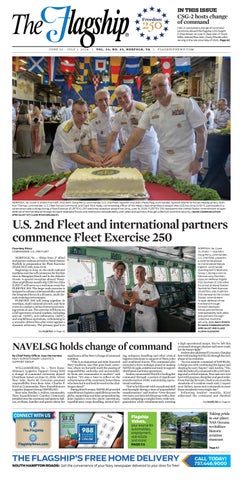
NORFOLK, Va. (June 17, 2026) From left, Vice Adm. Doug Perry, commander, U.S. 2nd Fleet; Spanish Vice Adm. Perez Puig, commander, Spanish Maritime Forces Headquarters; Adm. Karl Thomas, commander, U.S. Fleet Forces Command; and Capt. Rick Haley, commanding officer of the Wasp-class amphibious assault ship USS Iwo Jima (LHD 7), participate in a ceremonial cake cutting during a Fleet Exercise (FLEETEX) 250 welcome reception aboard Iwo Jima, June 16, 2026. FLEETEX 250 represents the United States’ commitment to layer defense of the homeland through forward-deployed forces and reinforces interoperability with allies and partners through collective maritime security. (MASS COMMUNICATION SPECIALIST 1ST CLASS RYAN SEELBACH)
U.S. 2nd Fleet and international partners commence Fleet Exercise 250 Courtesy Story COMMANDER, U.S. 2ND FLEET
NORFOLK, Va. (June 15, 2026) — Vice Adm. Doug Perry, commander, U.S. 2nd Fleet, presents a ceremonial plaque to Commodore Maryla Ingham, commander standing NATO Maritime Group 1, during a visit to German navy Sachsenclass air-defense frigate FGS Sachsen (F 219) after its arrival at Naval Station Norfolk for Fleet Exercise (FLEETEX) 250. FLEETEX 250 represents the United States’ commitment to layer defense of the homeland through forward-deployed forces and reinforces interoperability with allies and partners through collective maritime security. (U.S. NAVY PHOTO
NORFOLK, Va. — Ships from 17 allied and partner nations arrived to Naval Station Norfolk in preparation for Fleet Exercise (FLEETEX) 250, June 14-15. Beginning on June 16, the multi-national maritime exercise will commence for the first time in Hampton Roads and in the Atlantic Ocean. A special reception aboard Waspclass amphibious assault ship USS Iwo Jima (LHD 7) will serve as a welcome event for FLEETEX 250. The large-scale exercise is designed to enhance interoperability and test the integrated forces in a dynamic, multi-domain training environment. FLEETEX 250 will bring together 31 warships, multi-national aircraft, and their crews to conduct a series of structured training events at-sea. The exercise will focus on a full spectrum of naval warfare, including anti-air (AAW), anti-submarine (ASW), and amphibious operations, culminating in a scenario-driven free-play event against a dynamic adversary. The primary goal is to
BY MASS COMMUNICATION SPECIALIST 2ND CLASS ALISHA GLEASON)
See FLEETEX on Page A2
NAVELSG holds change of command By Chief Petty Officer Jose Hernandez NAVY EXPEDITIONARY LOGISTICS SUPPORT GROUP
WILLIAMSBURG, Va. — Navy Expeditionary Logistics Support Group held a change of command ceremony aboard Cheatham Annex on June 12, 2026, where Rear Adm. Kevin M. Corcoran assumed responsibility from Rear Adm. Charles P. Kirol as Commander, Navy Expeditionary Logistics Support Group (NAVELSG). Rear Adm. Bradley J. Andros, commander, Navy Expeditionary Combat Command, presided over the ceremony and spoke to Sailors, civilians, families and guests about the
significance of the Navy’s change of command tradition. “This is an important and time-honored Navy tradition, one that goes back centuries, where we formally mark the passing of responsibility, authority and accountability from one commander to another,” said Andros. “It’s also a time to reflect on the achievements of the command, honor those who have led it and look forward to the challenges ahead.” During Kirol’s tenure, NAVELSG provided expeditionary logistics capabilities across the globe, supporting maritime prepositioning, joint logistics over-the-shore operations, expeditionary cargo handling, tactical fuel-
ing, ordnance handling and other critical logistics functions in support of Navy, joint and combined forces. The command also executed a force redesign aimed at making NAVELSG agile, scalable and ready to support distributed maritime operations. Andros commended Kirol for leading the command through a period of significant transformation while maintaining operational readiness. “You’ve led this unit with exceptional skill and foresight during a time of unparalleled transformation,” said Andros. “Over the past two years, you have led this group with a clear vision, navigating a complex force-wide reorganization while simultaneously meeting
a high operational tempo. You’ve left this command stronger, sharper and more ready for the future fight.” Andros also addressed Corcoran, charging him with leading NAVELSG through the next phase of its evolution. “As you assume command of NAVELSG, I charge you with continuing this legacy and shaping its next chapter,” said Andros. “You take the helm of a command with a rich heritage and a critical mission. Your task now is to lead with purpose, discipline and good order. From this day forward, I look to you to set the standards of a combat-ready unit. I expect your Sailors, teams and commands to meet those standards every single day.” Following Andros’ remarks, Kirol addressed the command and thanked See NAVELSG on Page A2
Taking pride in our place: NAS Oceana revitalizes historic aviation museum PAGE C6
THE FLAGSHIP’S FREE HOME DELIVERY SOUTH HAMPTON ROADS: Get the convenience of your Navy newspaper delivered to your door for free!
Page A3
CALL TODAY! 757.446.9000
2
flagshipnews.com | Section A | Thursday, June 25, 2026
CSG-2 hosts change of command Courtesy Story USS DWIGHT D. EISENHOWER (CVN 69)
NORFOLK, Va. — Carrier Strike Group Two (CSG-2) conducted a change of command ceremony aboard the flagship USS Dwight D. Eisenhower (CVN 69), June 15. Rear Adm. P. Scott Miller relieved Rear Adm. Dusty Rhodes as the commander of CSG-2 after serving in the role since May of 2025. Rhodes took command of the strike group to drive the completion of IKE’s FY-25 Planned Incremental Availability and continue the strike group’s preparation for deployment in 2027. “Serving as Commander, Carrier Strike Group Two has been an extraordinary privilege,” said Rhodes. “Throughout my time with this exceptional team, I witnessed firsthand the resilience and unwavering commitment of our Sailors, civilians, and our families as we navigated the challenges of a lengthy shipyard period and successfully returned to operational readiness. As the strike group enters a demanding workup cycle in preparation for deployment in early 2027, I am confident in their ability to meet every challenge and continue the legacy of excellence. It has been a true honor to serve alongside this remarkable team.” A native of Larchmont, New York, Rhodes graduated from the U.S. Naval Academy in 1995 with a degree in Ocean Engineering. His history of Command at Sea includes Strike Fighter Squadron (VFA) 81 and Carrier Air Wing (CVW) 3. Rhodes has flown over 3,500 F/A-18 flight hours, 820 arrested landings, and 100 combat
Rear Adm. P. Scott Miller, right, relieves Rear Adm. Dusty Rhodes as commander, Carrier Strike Group Two (CSG 2) during the CSG-2 change of command ceremony aboard Nimitzclass aircraft carrier USS Dwight D. Eisenhower (CVN 69), June 15, 2026. Eisenhower serves as the flagship of CSG-2 and is pierside at Naval Station Norfolk conducting routine operations. (U.S. NAVY PHOTO BY MASS COMMUNICATION SPECIALIST 2ND CLASS CHRISTOPHER ALI)
missions. He graduated from TOPGUN and served as the air-to-air subject matter expert at Strike Fighter Weapons School Pacific. Ashore, his most recent assignments included Branch Head, Carrier Strike Aircraft and Weapons for the Air Warfare Division (N98) on the Chief of Naval Operations staff and the executive assistant to the Chief of Naval Operations. His previous Flag tour was
as Deputy Director for Operations, National Joint Operations and Intelligence Center, Joint Staff, J3. As Miller took command, he addressed the staff. “It is a privilege to assume command of Carrier Strike Group Two at such a critical point in the strike group’s readiness cycle,” said Miller. “The team has made tremendous
progress and I look forward to building on that momentum as we continue training and making preparations for deployment. Building on the strong foundation established by Rear Adm. Rhodes, I look forward to continuing on our focus on warfighting readiness. We are charged with generating and sustaining readiness, and when necessary, executing as ordered.” Miller graduated from the U.S. Naval Academy in 1994 with a degree in Computer Science. His history of Command at Sea includes USS Carl Vinson (CVN 70), USS New Orleans (LPD 18), and Strike Fighter Squadron (VFA) 192. Ashore, his most recent assignments included Branch Head, Aircraft Carrier Requirements (N98) on the Chief of Naval Operations staff. His previous Flag tour was as Deputy Commander, U.S. SIXTH Fleet in Naples Italy. Miller additionally authored the Secretary of Defense’s Global Force Management Implementation Guidance, a document that provides the Joint Staff and Combatant Commands with the necessary framework for global force posture. The flagship of CSG-2 is the Nimitz-class aircraft carrier USS Dwight D. Eisenhower (CVN 69). Other units assigned include nine squadrons from Carrier Air Wing (CVW) 3; Arleigh Burke-class guided-missile destroyer USS Lassen (DDG 82); and Arleigh Burkeclass guided-missile destroyers USS Ramage (DDG 61), Carney (DDG 64), USS Nitze (DDG 94), and USS Farragut (DDG 99) from Destroyer Squadron (DESRON) 28.
U.S. Navy Rear Adm. P. Scott Miller, incoming commander, Carrier Strike Group Two (CSG 2), is piped ashore during the CSG-2 change of command ceremony aboard Nimitz-class aircraft carrier USS Dwight D. Eisenhower (CVN 69), June 15, 2026. Eisenhower serves as the flagship of CSG-2 and is pierside at Naval Station Norfolk conducting routine operations. (U.S. NAVY PHOTO BY MASS COMMUNICATION SPECIALIST 2ND CLASS MIGUEL
U.S. Navy Lt. Miguel Hernandez, left, presents flowers to the family of Rear Adm. Dusty Rhodes, outgoing commander, Carrier Strike Group Two (CSG 2), listen to remarks during the CSG-2 change of command ceremony aboard Nimitz-class aircraft carrier USS Dwight D. Eisenhower (CVN 69), June 15, 2026. Eisenhower serves as the flagship of CSG-2 and is pierside at Naval Station Norfolk conducting routine operations. (U.S. NAVY PHOTO BY
SANTIAGO)
MASS COMMUNICATION SPECIALIST 2ND CLASS MIGUEL SANTIAGO)
FLEETEX from Page A1
build cohesiveness, validate tactical procedures, and strengthen the collective capabilities of the participating forces in a simulated combat environment. “Fleet Exercise is a tremendous opportunity to bring together a powerful, multi-national force,” said Vice Adm. Doug Perry, commander, U.S. 2nd Fleet. “Training and operating as an integrated team sharpens our competitive edge and demonstrates our shared commitment to maritime security and stability in the Atlantic.” The exercise is divided into two main phases:
NAVELSG
from Page A1
NAVELSG Sailors, civilians, families and mission partners for their dedication to the expeditionary logistics mission. “To the men and women of NAVELSG, thank you for your professionalism, resilience and commitment to mission accomplishment,” said Kirol. “You have continued to prove that expeditionary logistics is essential to how our Navy operates, competes and, when called upon, fights and wins.” Kirol also thanked the command’s subordinate units and forward-deployed forces
Harbor Phase (June 16-21): Participating forces will assemble at Naval Station Norfolk for final planning, pre-sail briefings, and integration. At-Sea Execution (June 22-29): Ships will get underway to conduct a series of training serials, a fleet formation photo exercise (PHOTOEX), and a final free-play battle problem. FLEETEX 250 runs concurrently with several public events in Norfolk, including the 50th Annual Norfolk Harbor Fest, Virginia SAIL 250, and Norfolk Fleet Week. These events will feature public tours of visiting warships and international tall ships, alongside a grand Parade of Sail, offering the public a unique opportunity to engage with Sailors and mariners from around the world.
Participating nations in FLEETEX 250 include Belgium, Brazil, Canada, Cameroon, Côte d’Ivoire, Cyprus, Denmark, France, Germany, Mexico, Morocco, Netherlands, Norway, Peru, Senegal, Spain, Turkey, United Kingdom, and the United States. Following the exercise, many participating units — joined by the historic tall ships — will sail to New York City to take part in the seventh International Naval Review 250 from July 3-8. “While FLEETEX 250 provides critical at-sea training that enhances our combined capabilities, it also sets the stage for a historic celebration at the International Naval Review in New York City,” said Perry. “The interoperability we forge here in Hampton Roads ensures that when this magnificent multi-na-
tional fleet arrives to commemorate our nation’s 250th anniversary, it will stand as a powerful symbol of enduring global partnerships and our shared commitment to the seas.” U.S. 2nd Fleet, reestablished in 2018 in response to the changing global security environment, develops and employs maritime ready forces to fight across multiple domains in the Atlantic and Arctic in order to ensure access, deter aggression and defend U.S., allied, and partner interests. For more U.S. 2nd Fleet news and photos, visit facebook.com/US2ndFleet, https:// www.c2f.usff.navy.mil/, X - @US2ndFleet, and https://www.linkedin.com/company/ commander-u-s-2nd-fleet.
for their continued support to fleet and joint operations. “Whether supporting maritime prepositioning, cargo handling, tactical fueling, ordnance movement or logistics operations ashore, you have answered every call,” said Kirol. “You have carried this mission with pride, and you have shown what it means to keep the fleet moving.” Kirol then welcomed Corcoran and his family back to NAVELSG. “Rear Adm. Corcoran, I am turning over a command filled with highly trained, mission-focused and dedicated professionals,” said Kirol. “I have every confidence NAVELSG will continue to thrive under your
leadership.” Kirol and Corcoran then read their orders before formally executing the change of command. Corcoran addressed the command for the first time as commander, Navy Expeditionary Logistics Support Group, and spoke about the importance of NAVELSG’s mission to the Navy and joint force. “I am honored and humbled to join NAVELSG and serve alongside the Sailors and civilians who make this mission possible,” said Corcoran. “Expeditionary logistics remains central to naval power, especially as our Navy prepares for operations in distributed and contested environments. NAVELSG
will continue to provide the capabilities our fleet and joint force need to remain ready, agile and lethal.” NAVELSG provides expeditionary logistics capabilities for maritime forces ashore, including expeditionary cargo handling for surface, air and terminal operations, tactical fueling, ordnance handling and reporting, and support to maritime prepositioning and joint logistics over-the-shore operations. NAVELSG supports Navy, joint, interagency and combined forces worldwide. For more news from Navy Expeditionary Logistics Support Group, visit www.navy.mil.
Commander, Navy Region Mid-Atlantic (CNRMA): Rear Adm. Stephen Barnett Regional program manager for Navy Region Mid-Atlantic (NRMA): Public Affairs Director | Beth Baker Public Affairs Deputy Director | Leon Moore
Editorial Staff
Managing Editor | PO1 Cody D. Beam 757-322-2853 | cody.d.beam.mil@us.navy.mil Graphic Designer | Teresa Walter teresa.walter@virginiamedia.com
Contributing Staff
Elizabeth Reisen 757-322-2853 | news@flagshipnews.com
Flagship, Inc.
MNV Military Manager | Ski Miller ski.miller@virginiamedia.com
The Flagship® is published by Flagship, LLC., a private firm in no way connected with the Department of Defense (DOD) or the United States Navy, under exclusive written contract with Commander, Navy Region Mid-Atlantic. This civilian enterprise newspaper is an authorized publication for members of the military services. Contents of the paper, including advertisements, are not necessarily the official views of, nor endorsed by, the U.S. Government, DOD, or the Department of the Navy (DON). The appearance of advertising in this publication, including inserts and supplements, does not constitute endorsement by the DOD; DON; Commander, Navy Region Mid-Atlantic or Flagship, LLC. of the products or services advertised. Everything advertised in this publication shall be made available for purchase, use, or patronage without regard to race, color, religion, gender, national origin, age, marital status, physical handicap, political affiliation, or any other non-merit factor of the purchaser, user, or patron. If a violation or rejection of this equal opportunity policy by an advertiser is confirmed, the publisher shall refuse to print advertising from that source until the violation is corrected. Editorial content is edited, prepared and provided by the Public Affairs Department of Commander, Navy Region Mid-Atlantic. Stories may be submitted via email to news@flagshipnews.com. The Flagship® is published every Thursday by Flagship, LLC., whose offices are located at 804 Greenbrier Circle, Suite B,Chesapeake, VA 23320.
Free Classified Advertising 757-622-1455 © 2021 Flagship, LLC. All rights reserved Retail Advertising 757-222-5538 Distribution & Home Delivery 757-446-9000 • distribution@pilotonline.com
flagshipnews.com | Section A | Thursday, June 25, 2026
3
Joint service program delivers genetic intelligence for the modern battlefield By Nicholas Pasquini U.S. NAVAL RESEARCH LABORATORY
The U.S. Naval Research Laboratory (NRL), in partnership with the Defense Threat Reduction Agency (DTRA) and multiple Army and Navy research commands, has advanced a new generation of DNA and RNA sequencing technology designed to quickly identify biological threats in the field. The effort brings sophisticated laboratory capability into austere environments, giving forward-deployed units the ability to detect and identify harmful pathogens in less than 30 minutes. “This sequencing technology provides a deeper level of information, beyond what existing rapid diagnostic tests currently provide for many missions,” said NRL Associate Director of Research Dr. Peter Matic, SES. “By characterizing genetic material directly, Far-Forward Advanced Sequencing Technology, or F-FAST, and Far-Forward Biological Sequencing, or FFBS, can confirm results from targeted tests, detect previously unknown threats, and provide critical data for medical and operational decision-making at the point of need.” The F-FAST program has transitioned to the Capability Program Executive for Chemical, Biological, Radiological and Nuclear Defense(CPE-CBRND)astheFFBSProgram of Record for incremental fielding to end users through collaboration with several Department of War partners. “The F-FAST program demonstrates how NRL delivers innovation directly to the Fleet and the joint force,” said NRL Center for Biomolecular Science and Engineering Director Brandy White, Ph.D. “By transforming complex laboratory science into a deployable capability, our scientists are helping Sailors, Marines, and joint force across the Department of War respond to biological threats with speed and confidence. This is a clear example of NRL’s mission — turning discovery into operational advantage.” Unlike conventional sequencing systems, FFBS is tailored for military personnel who may not have formal laboratory training. “F-FAST represents a leap forward in the Navy’s ability to identify and respond to biological threats wherever they emerge,” White said. “By modernizing sequencing technology and simplifying protocols for far-forward environments, we are equipping the naval community with a tool that strengthens readiness and safeguards mission success.” For more than a decade, NRL has been a leader in DNA and RNA sequencing research. This expertise positioned the laboratory to contribute across all aspects of F-FAST development, from targeted sequencing to untargeted, whole-genome approaches used to identify unknown organisms and microbial communities. Researchers also drew on prior work from NRL’s in-house programs, whichhadalreadytestedportablesequencing systems aboard Navy ships at field exercises, in Chesapeake Bay, and at Fleet locations. The F-FAST program focused on adapting and optimizing these methods for military use, ensuring the technology was rugged, rapid and reliable in non-traditional laboratory settings. Much of the testing took place with the Naval Medical Research Command’s Biological Defense Research Directorate (BDRD), which operates mobile laboratories staffed by Navy microbiologists and hospital corpsmen.
An end user loads a flow cell on a modified field sequencing device during Beholder’s Gaze training, Oct. 24, 2024. The event was attended by the U.S. Naval Research Laboratory and U.S. Army Combat Capabilities Development Command (DEVCOM) Chemical Biological Center military operators Far-Forward Advanced Sequencing Technology (F-FAST) team who conducted training and provided the technology/system. The effort brings sophisticated laboratory capability into austere environments, giving forward-deployed units the ability to detect and identify harmful pathogens in less than 30 minutes. Unlike conventional sequencing systems, Far-Forward Biological Sequencing (FFBS) is tailored for military personnel who may not have formal laboratory training. (U.S. NAVY PHOTO)
“A convergence of timely factors made taking this technology into the field essential,” said Gary Vora, Ph.D., an NRL principal investigator for F-FAST and Senior Official fortheBiomanufacturingCriticalTechnology Area, Office of the Under Secretary of War for Research and Engineering (OUSW(R&E)). “We worked side-by-side with Navy and Army partners in environments ranging from desert exercises to Arctic operations. That allowed us to see firsthand how sequencing could be integrated into real-world missions and to refine the system based on operator feedback.” Over the course of the program, NRL scientists participated in numerous field demonstrations, exercises, and experiments including: Desert Ice, Bronze Ram, Arctic Edge, Rim of the Pacific Exercise (RIMPAC), Research, Development, and Acquisition Experiment (RDAX), Tenacious Dragon and Beholder’s Gaze. These events provided operational context and proved the system’s ability to deliver actionable biolog-
ical information in timeframes relevant to commanders. The collaborative nature of F-FAST was key to its success. NRL partnered closely with the U.S. Army Combat Capabilities Development Command Chemical Biological Center (DEVCOM CBC), the U.S. Army Medical Research Institute of Infectious Diseases (USAMRIID), and NMRC-Frederick’s BDRD. Together, the teams advanced complementary approaches to sequencing, ensuring the final products addressed a wide range of operational needs. “F-FAST was a true team effort, bringing together Navy, Army, and civilian scientists in a common mission,” Matic said. “The result is a capability that will enhance biodefense across the Department of War.” While the F-FAST program has successfully transitioned to the CPE-CBRND, NRL continues to refine field-forward sequencing technologies. Current efforts have built on F-FAST foundations to support Navy microbiologists and Fleet deployable medical units.
The laboratory’s ability to design, customize, validate and transition sequencing systems ensures that warfighters will have access to advanced biological detection tools wherever they are needed. “NRL’s role is to deliver science that strengthens the Navy and the joint force,” said NRL Center for Biomolecular Science and Engineering Research Biologist Sophie Colston, Ph.D. “With F-FAST and FFBS, we are providing an end-to-end solution that empowers operators in the field to meet biological challenges head-on. It is an honor to see our work directly support those who serve.” This technologyprovides a dramatic leap in technical capability but also requires training and familiarization as the targeted Navy end users usually have little to no theoretical or practical experience with nucleic acid sequencing. “The NRL Center for Biomolecular Science and Engineering currently maintains a parallel effort to train the Navy microbiology corps on field forward nucleic acid sequencing,” Vora said. “Any officer in the Forward Deployable Preventive Medicine Unit and BDRD system can attend training with NRL subject matter experts. That way, the Navy’s forward laboratory personnel, including officers, hospital corpsmen, and hospitalmenare prepared to utilize the technology they are in the process of embedding in their equipment packages and sustainment plans.” The Non-targeted Sequencing Identification System (NSIS) for the National Guard Bureau (NGB) Weapons of Mass Destruction Civil Support Teams (WMD-CST) and other JointForcecustomers,includingtheFDPMU, recently received a successful Milestone B decision. This was conducted out of Joint ProjectManagerChemical,Biological,Radiological, and Nuclear Sensors and is another transition for the F-FAST program. “The ability to conduct sequencing in the field and even identify synthetically modified genes is a huge step in deterring biothreats,”said Lt. Cmdr. Chaselynn Watters, formerly of the BDRD Mobile Laboratory team. “I am not aware of anyone else in the U.S. operating at this technical level in the field.” The F-FAST program closed earlier this year, with a final report now in preparation. Its legacy continues through ongoing collaborations with Army and Navy partners and the continued maturation of FFBS for future operations. About the U.S. Naval Research Laboratory NRL is a scientific and engineering command dedicated to research that drives innovative advances for the U.S. Navy and Marine Corps from the seafloor to space and in the information domain. NRL is located in Washington, D.C. with major field sites in Stennis Space Center, Mississippi; Key West, Florida; Monterey, California. NRL offers several mechanisms for collaborating with the broader scientific community, within and outside of the Federal government. These include Cooperative Research and Development Agreements (CRADAs), LP-CRADAs, Educational Partnership Agreements, agreements under the authority of 10 USC 4892, licensing agreements, FAR contracts, and other applicable agreements. Formoreinformation,contactNRLCorporate Communications at mailto:NRLPAO@ us.navy.mil.
Taking pride in our place: NAS Oceana revitalizes historic aviation museum By Katie Hewett NAVAL AIR STATION OCEANA
VIRGINIA BEACH, Va. — Volunteers from Naval Air Station Oceana came together June 12 to improve the installation’s Outdoor Aviation Museum, helping to preserve naval aviation history, while creating a more welcoming space for Sailors, civilians, and their families. Volunteers spent the morning clearing overgrowth, trimming vegetation, pulling weeds, and improving the appearance of the museum grounds near the installation’s main gate. Located near the installation’s main entrance, the museum serves as one of the first impressions of the base for visitors and
Sailors that call the Master Jet Base home. “Today was a great opportunity for Team Oceana to come together and get their hands dirty to preserve our historic aviation museum,” said Capt. Rob Littman, commanding officer of NAS Oceana. Beyond improving the appearance of the museum, the project reflects NAS Oceana’s commitment to enhancing quality of life for those who live and work at the installation while strengthening connections to aviation history. “We can help to promote a sense of pride for our Sailors, civilians, and their families by investing in our facilities, preserving our distinguished history, and creating spaces that celebrate our mission,” said Littman.
VIRGINIA BEACH, Va. (June 12, 2026) - US Navy Yeoman Seaman Gavin Polk, along with other Sailors assigned to Naval Air Station (NAS) Oceana volunteered to freshen up NAS Oceana’s Historic Aviation Museum, June 12, 2026. Located near the installation’s main entrance, the museum serves as one of the first impressions of the base for visitors and sailors that call the Master Jet Base home. (U.S. NAVY PHOTOS BY MASS COMMUNICATIONS SPECIALIST SEAMAN CIERRA MIDDLETON)
VIRGINIA BEACH, Va. (June 12, 2026) - Firefighters onboard Naval Air Station (NAS) Oceana, along with Sailors and civilians volunteered to freshen up NAS Oceana’s Historic Aviation Museum, June 12, 2026.
VIRGINIA BEACH, Va. (June 12, 2026) - Sailors assigned to Naval Air Station (NAS) Oceana volunteered to freshen up NAS Oceana’s Historic Aviation Museum, June 12, 2026.
VIRGINIA BEACH, Va. (June 12, 2026) - Naval Air Station (NAS) Oceana Executive Officer, Capt. Jeff Creighan, along with sailors and civilians volunteered to freshen up NAS Oceana’s Historic Aviation Museum, June 12, 2026.
4
flagshipnews.com | Section A | Thursday, June 25, 2026
NAVAL SUPPORT ACTIVITY HAMPTON ROADS, Va. (June 16, 2026) - Sailors assigned to Commander, Submarine Group Two stand theater undersea warfare watch in the Commander, U.S. 2nd Fleet maritime operations center during Exercise Vigilant Shield 2026. Exercise Vigilant Shield 2026 is an annual homeland defense exercise designed to test the U.S. military’s ability to defend North America against complex, multi-domain threats. (U.S. NAVY PHOTO BY MASS COMMUNICATION SPECIALIST 1ST CLASS ANDERSON W. BRANCH)
Submarine Group Two recertifies Undersea Command By Petty Officer 1st Class Anderson Branch COMMANDER, SUBMARINE GROUP TWO
NORFOLK, Va. — Safeguarding America’s maritime approaches against undersea threats is a continuous, high-stakes mission. To prove its ability to lead this effort during a crisis, Submarine Group Two (SUBGRU 2) recently recertified the Theater Undersea Warfare Command (TUSWC) during Exercise Vigilant Shield 2026. From June 8 to 17, 20 reserve Sailors stepped directly from their civilian careers onto a secure watch floor at Naval Support Activity Hampton Roads. Working alongside the active-duty staff, they directed simulated maritime forces to secure the Atlanticapproachestothehomeland.Vigilant Shield is an annual, bi-national U.S. Northern Command (USNORTHCOM) exercise focused on defending the homeland from
multi-domain threats. This year is unique in that SUBGRU 2 accelerated its certification timeline by a year to coincide with U.S. Second Fleet’s Maritime Operations Center (MOC) certification. Operating as the undersea arm of the MOC, the TUSWC commands a multi-domain team of aircraft, surface ships, and submarines to maintain the tactical picture and secure the maritime homeland. “To maintain control of the undersea domain during a sustained crisis, we have to be able to instantly scale our command-andcontrol architecture,” said Capt. Bill Howey, director of maritime operations for SUBGRU 2. “Earning this certification proves that our reserve component isn’t just a backup plan; they are an integrated capability that ensures we are ready to fight.” Under the scrutiny of Task Force Undersea Warfare (TF USW) assessors, the command proved its ability to seamlessly surge combat power. Bringing reservists into a complex
exercise expands operational bandwidth by leveraging the diverse, high-stress management experiences they bring from the private sector. “The active-duty component provides the absolute subject matter expertise, and the reserve Sailors provide a surge force to enable long-term, sustained operations,” said Lt. Cmdr. Tom Henery, a battle watch captain who manages state-level emergency responses in his civilian career. “We seamlessly integrate with the active-duty staff and truly operate as a single command.” That integration required reservists to step from daily life directly into high-stakes roles, tracking undersea contacts, allocating acoustic sensors, and directing maritime assets to meet the evaluation’s strict standards. “The business we’re in is dangerous. Every dot on the screen is a ship full of 200 to 300 Sailors,” said Senior Chief Sonar Technician (Submarines) Mike Amenti, the TUSW watch supervisor and a civilian IT opera-
tions manager. “I tell my civilian coworkers; we’re kind of like air traffic controllers but for ships.” As the 10-day exercise concluded, the watch floor proved it could maintain continuous operations without degrading mission capabilities. “Passing is mission execution,” Henery said. “For these reservists to come in cold, follow the procedures, and ensure mission success — that is the benchmark of a very successful exercise.” Based in Norfolk, Virginia, SUBGRU 2 operates as the TUSWC for U.S. Second Fleet asCommander, Task Group (CTG) 120.24. The command is responsible for preparing forces to control the undersea domain and advancing theater underseawarfare through complex fleet exercises and war games for maritime homeland defense.
Home Remodeling Home Remodeling Home Remodeling gDone Right!
FULL BATHROOM REMODELING • WALK-IN SHOWERS • BATHS • TUB TO SHOWER CONVERSION
Anniversary Sale
20
% OFF
Bathroom Remodeling Experts! Exclusive Designs & Styles On-The-Spot Installation Scheduling Fully Licensed and Insured
BATHROOM REMODELING 1
Highly Trained Employee Installers Flexible Financing Subject to credit approval
Evening & Weekend Appointments Available
FROM America’s Most Trusted Home Remodeler
NO PAYMENTS NO INTEREST FOR 20 MONTHS 2
t our C heck to rue view s ! recen
288,432+ (Company reviews across all branches as of 5/04/2026)
ASK ABOUT OUR
MILITARY DISCOUNT
757-280-2257
New orders only. Offer not valid on previous sales or estimates and cannot be combined with other offers. See design consultant for details. Other restrictions may apply. 1. 20% off is equal to 20% off the 1 year price. 2. Financing offers estimates only. Normal late charges
flagshipnews.com | Section A | Thursday, June 25, 2026
5
NAVFAC Washington Operations Officer Cmdr. Christopher Fairfield retires after distinguished 22-year Naval career; Honored with Meritorious Service Medal By Natasha Waldron Anthony NAVAL FACILITIES ENGINEERING SYSTEMS COMMAND WASHINGTON
WASHINGTON, D.C. — Naval Facilities Engineering Systems Command (NAVFAC) Washington honored Cmdr. Christopher Fairfield, during a retirement ceremony held at the National Museum of the U.S. Navy, June12, 2026. Capt. Daniel Schmitt, commanding officer of NAVFAC Washington, praised Fairfield’s operational leadership and the legacy he leaves behind. “I could not have asked for a better operations officer, a more trusted advisor, or a steadier hand on the wheel. You’ve left an indelible mark on the Civil Engineer Corps, on this command and on everyone who had the privilege to serve alongside you.” Rear Adm. Jorge Cuadros, commander, NAVFAC Atlantic, presented Fairfield with the Meritorious Service Medal, Gold Star in lieu of the Third Award in recognition of 22 years of honorable and dedicated service to the Navy. Fairfield’s naval journey was defined by assignments that tested and refined his leadership at every turn. His earliest formative experience came with Naval Mobile Construction Battalion THREE, but it was his department head tours with Facilities Engineering and Acquisition Division Naples andPublicWorksDepartmentSoudaBaythat proved most defining. “Those positions were where authority, responsibility and accountability all lined up in equal weight,” Fairfield recalled. “Many things can be accomplished when those elements are in balance.” Since assuming the operations officer role at NAVFAC Washington in June 2025, Fairfield pushed the command toward a new way of thinking and operating. “I wanted our team to throw out ‘how we’ve always done it’ and be open to new ideas, new concepts — to try early, fail often and keep moving forward,” he said. Among his proudest legacies is a transformative new Program Management, Project
NAVFAC Atlantic Commander Rear Adm. Jorge Cuadros presents Cmdr. Fairfield with Meritorious Service Medal, Gold Star in lieu of the Third Award. (PHOTO BY NATASHA WALDRON ANTHONY, NAVAL FACILITIES ENGINEERING SYSTEMS COMMAND WASHINGTON)
Management and Construction Management Advisor tool spearheaded by Planning, Design and Construction (PDC) Construction Director Javier Molinari and the PDC 5 team. “It is the epitome of thinking differently at NAVFAC,” Fairfield said. “They took a concept and commander’s intent and generated a really unique new way of managing the Navy’s construction projects.” For Fairfield, serving at NAVFAC Wash-
ington deepened his reverence for the men and women who support the nation’s most critical infrastructure. “The National Capital Region is the very nerve center of our national defense,” he said. “I will never be able to adequately express how strong my appreciation is for their talents and patriotism.” His message to those he leaves behind is both simple and enduring: “Know your lines of authority, responsibility and accountability,
and then operate to their limits.” Looking ahead, Fairfield plans to continue working in the engineering and construction profession. “I hope to find an interesting hobby and be the best father and husband I can be,” he said. “I hope the work accomplished at NAVFAC Washington is a catalyst for great success for all of our team members in the future.”
Sailors, civilians keep Pennsylvania roadway clean By James Foehl NAVSUP BUSINESS SYSTEMS CENTER
MECHANICSBURG, Pa. — Sailors and civilians assigned to Naval Supply Systems Command (NAVSUP) Business Systems Center (BSC) onboard Naval Support Activity Mechanicsburg removed trash and debris from a two-mile stretch of Sporting Hill Road as part of the Pennsylvania Department of Transportation (PennDOT) state-wide Adopt A Highway program, June 16. The cleanup was the latest event supporting the command’s 18-year partnership with PennDOT and served as an opportunity to preserve the environment, protect wildlife and waterways, keep roads safer, and beautify the community surrounding the base. “Partnerships like these play a critical role in connecting our Sailors to the local community and the American people,” said Capt. Don McIntyre, commanding officer, NAVSUP BSC. “They reinforce the importance of serving our nation with integrity and reflect our gratitude for the support of the local community.” Adopt A Highway areas include state highway rights-of-way, interchange areas, traffic islands, or two-mile sections of roadway. Community partners volunteer for two years. PennDOT provides materials to maintain designated areas and posts signs along the road to recognize participating partners. “We appreciate the fine work and dedication of organizations such as NAVSUP BSC, who perform an invaluable service in keeping Pennsylvania beautiful. By partnering with PennDOT through Adopt A Highway, volunteer organizations help maintain the scenic beauty of thousands of miles of Pennsylvania roadway. We are extremely grateful for these hard-working, community-minded volunteers,” said Kevin Keefe, District 8 Executive, PennDOT. For servicemembers at NAVSUP BSC, the event also provided opportunities to act as environmental stewards and give back to the community they live in. “When the Navy comes into a community, we become a part of it. We live there, raise families there, so it means a lot for us to give back to our communities,” said Lt. Jacob Butikofer, project officer, NAVSUP BSC. “It’s important to create a network between military servicemembers and the community here in Mechanicsburg. It shows that just because we’re active duty military, it doesn’tmeanwe’renotpartofthecommunity when we’re stationed here,” said Lt. j.g. Christopher San Miguel, project officer, NAVSUP BSC. Navy commands are encouraged to join efforts with local communities on initiatives that support the preservation, protection, restoration, and enhancement of the environment. Activities may include: developing environmental stewardship awareness, teaching environmental values and energy-efficient habits, implementing recycling programs, and organizing or participating in energy awareness events or environmental cleanup efforts, such as the PennDOT Adopt A Highway program. “Being good stewards of the environment is very important and shows that we care,” said Lt. j.g. Ali Barage, project officer, NAVSUP BSC. “We’re making sure the resources we have at home are being taken care of, and we start with our local community.” NAVSUP BSC is one of 11 commands under Commander, NAVSUP, and delivers infor-
MECHANICSBURG, Pa. (June 16, 2026) Lt. j.g. Christopher San Miguel, a project officer assigned to Naval Supply Systems Command (NAVSUP) Business Systems Center (BSC) onboard Naval Support Activity Mechanicsburg, removes trash and debris from a two-mile stretch of Sporting Hill Road as part of the Pennsylvania Department of Transportation (PennDOT) state-wide Adopt A Highway program, June 16. The cleanup was the latest event supporting the command’s 18-year partnership with PennDOT and served as an opportunity to preserve the environment, protect wildlife and waterways, keep roads safer, and beautify the community surrounding the base. BELOW: Sailors and civilians assigned to NAVSUP BSC remove trash and debris from a two-mile stretch of Sporting Hill Road. (U.S. NAVY PHOTOS BY JAMES E. FOEHL)
mation technology and information management solutions with specific emphasis on logistics and financial-related products and services for the Navy, Department of War, other federal agencies, and international
customers. For more information about the AdoptAFor more information about NAVSUP Highway program, visit https://adoptahighBSC, visit https://www.navsup.navy.mil/ way.penndot.pa.gov/Default.aspx. NAVSUP-Enterprise/NAVSUP-Business-Systems-Center/.
6
flagshipnews.com | Section A | Thursday, June 25, 2026
NAVELSG senior leaders visit units of action in Guam, Singapore and Hawaii By Chief Petty Officer Jose Hernandez NAVY EXPEDITIONARY LOGISTICS SUPPORT GROUP
WILLIAMSBURG, Va. — Navy Expeditionary Logistics Support Group’s (NAVELSG) deputy commander and command master chiefcompleted their first visit to NAVELSG units of action in Guam, Singapore and Hawaii, engaging directly with Sailors, mission partners and regional stakeholders across key logistics nodes in the Indo-Pacific. Capt. Andrew Duessel, NAVELSG Deputy Commander, and NAVELSG Command Master Chief Anton Fitz visited forward-positioned Sailors and expeditionary logistics teams to assess current operations, address fielded questions and concerns, and reinforce the command’s mission, vision and guiding principles. The visit marked the first opportunity for Duessel and Fitz, in their new leadership roles, to meet with Sailors serving across the area of responsibility and gain firsthand perspective on the challenges, requirements and opportunities shaping expeditionary logistics support in the region. Throughout the visit, Fitz met with Sailors during all-hands engagements and small-group discussions, emphasizing the importance of listening to the force, removing barriers and ensuring Sailors have the support they need to accomplish the mission. “Our Sailors are the center of everything we do,” said Fitz. “This visit was about listening to them, understanding what they need and making sure their concerns are heard at the right levels. When our people are trained, equipped, supported and connected to the mission, they can meet any challenge placed in front of them.” Duessel met with unit leadership and mission partners to discuss current capabilities, future requirements and opportunities to strengthen NAVELSG’s regional posture. The discussions focused on best practices, facility requirements, long-term planning and potential expansion of the command’s footprint to support future operational demands. “The demand for expeditionary logistics will only continue to grow as the Navy operates in more distributed and contested environments,” said Duessel. “These visits help us better understand what our units need today
NAVAL BASE GUAM, Guam- Capt. Andrew Duessel, deputy commander, Navy Expeditionary Logistics Support Group, and Command Master Chief Anton Fitz, command master chief of NAVELSG, engage with Sailors and mission partners during visits to NAVELSG units of action across the Indo-Pacific. The visits supported leader oversight of forward-deployed operations, unit requirements and future mission growth. NAVELSG provides expeditionary logistics capabilities to the fleet and joint force, enabling forces to rearm, refuel and resupply in support of maritime operations. (U.S. NAVY PHOTO BY CHIEF MASS COMMUNICATION SPECIALIST JOSE L. HERNANDEZ)
while planning for the facilities, partnerships and capabilities required for tomorrow. Our focus is ensuring NAVELSG remains ready to support the fleet anytime, anywhere.” During the trip, Duessel and Fitz also met with regional partners to discuss shared logistics challenges, interoperability and opportunities to improve coordination across the force. The engagements provided NAVELSG leaders a clearer understanding of ongoing mission requirements and how the command can better support forward-deployed and geographically dispersed units. NAVELSG provides expeditionary logis-
tics capabilities to the fleet and joint force, enabling forces to rearm, refuel and resupply in support of maritime operations. Its units of action deliver critical cargo handling, port operations, fuels, ordnance handling and expeditionary logistics support across the globe. The visit reinforced NAVELSG’s commitment to its Sailors, operational partners and the continued development of expeditionary logistics capabilities throughout the Indo-Pacific region. As the Navy continues to prepare for operations in distributed and contested environ-
ments, visits like this provide senior leaders essential oversight of the challenges and requirements facing forward-deployed units of action. Direct engagement with Sailors, unit leaders and mission partners helps NAVELSG identify gaps, prioritize support and plan for the facilities, resources and capabilities needed to sustain current operations and expand future mission capacity across the Indo-Pacific. For more information about NAVELSG, visit the official command webpage at necc. usff.navy.mil/NAVELSG.
Rethinking Sailors and CVN RCOH: Navy leverages industry contracts to reclaim up to 1 million Sailor man-hours By Destiny Sibert COMMANDER, NAVY INSTALLATIONS COMMAND
NORFOLK, Va. — The Navy Quality of Service Cross-Functional Team (QoS CFT) and PAE Maritime’s In-Service Aircraft Carrier Program Office (PMS 312) are changing how the Navy does business for the execution of aircraft carrier Refueling and Complex Overhaul(RCOH),beginningwithUSSHarry S. Truman (CVN 75). A RCOH is a comprehensive maintenance and modernization overhaul that is performed at the midpoint of an aircraft carrier’s 50-year lifespan. Traditionally, Sailors assigned to a ship undergoing an RCOH could be assigned to perform supplementary, non-rate-specific duties such as painting, insulating, transportation services, and maintenance. The Navy is rethinking its approach
by leveraging commercial contracts to fulfill these requirements during Harry S. Truman’s upcoming RCOH, a strategic shift that will potentially return up to one million man-hours to the crew. By reducing the crew’s supplementary workload during demandingshipyardperiods,Sailorswillhave more time to focus on advanced training and operational readiness. “This shift is about putting our Sailors’ time and talents where they matter most,” said Vice Adm. Scott Gray, who leads the Navy QoS CFT. “By contracting out routine tasks like transportation and preservation, we free our crew from traditional shipyard duties, empowering them to focus on their in-rate training and core warfighting capabilities.” To date, five Navy contracts have returned approximately 690,000 labor hours to the crew, with plans to award five additional contracts over the next five years. As a key component of the Navy’s broader
Quality of Service (QoS) initiatives, this strategy allows for optimized, smaller crew sizes to remain assigned to ships undergoing maintenance. By alleviating hands-on, non-rate-specific maintenance tasks, Sailors can concentrate on developing critical warfighting skills and completing their professional development. This approach maintains a higher state of overall readiness while significantly improving the crew’s quality of life in the shipyard environment. Ultimately, this transition is expected to streamline maintenance processes, fostering a more sustainable and effective workforce balance between active-duty personnel and the shipyard’s industrial base. The Portfolio Acquisition Executive (PAE) for Maritime is the single accountable organization for delivering surface ships for the U.S. Navy. This new centralized organizational construct empowers leaders with broader
scope and greater authority to accelerate delivery of combat capability and ensure acquisition speed and discipline are driven by what the warfighter needs—when they need it.” In addition to leading the Navy QOS CFT, Vice Adm. Scott Gray serves as Commander, Navy Installations Command, which is responsible for worldwide U.S. Navy Shore installation management, designing and developing integrated solutions for sustainment and development of Navy shore infrastructure as well as quality of life programs. CNIC oversees 10 Navy regions, 71 installations, and more than 48,600 employees who are focused on warfighting and manning, training, and equipping the Shore to fight and win. Navy installations are warfighting platforms essential to every fleet operation.
flagshipnews.com | Section A | Thursday, June 25, 2026
7
8
flagshipnews.com | Section A | Thursday, June 25, 2026
THANKS TO ALL THE BRAVE MEN AND WOMEN FOR YOUR SERVICE TO OUR COUNTRY.
750
$
U.S. Military
Incentive
1
CAN BE COMBINED WITH TOYOTA SPECIAL CASH BACK OR SPECIAL FINANCING OR SPECIAL LEASES!
2
TOYOTA HAS THE
BEST RESALE VALUE
OF ALL BRANDS FOR 2026
ACCORDING TO KELLEY BLUE BOOK’S KBB.COM
VEHICLE’S PROJECTED RESALE VALUE IS SPECIFIC TO THE 2026 MODEL YEAR. FOR MORE INFORMATION, VISIT KELLEY BLUE BOOK’S KBB.COM. KELLEY BLUE BOOK IS A REGISTERED TRADEMARK OF KELLEY BLUE BOOK CO., INC.
CASEY TOYOTA
601 East Rochambeau Drive • Williamsburg 757.259.1000 • caseytoyota.com
CHECKERED FLAG TOYOTA
5301 Virginia Beach Blvd. • Virginia Beach
FIRST TEAM TOYOTA
3400 Western Branch Blvd. • Chesapeake
GLOUCESTER TOYOTA
HALL TOYOTA VIRGINIA BEACH
6357 George Washington Memorial Hwy. Gloucester 804.693.2100 • gloucestertoyota.com
1877 Laskin Road • Virginia Beach 757.437.4000 • halltoyotavirginiabeach.com
PEARSON TOYOTA 757.874.6000 • pearsontoyotascion.com
PRIORITY TOYOTA CHESAPEAKE
1800 Greenbrier Parkway • Chesapeake 757.213.5000 • prioritytoyotachesapeake.com
CLASSIC TOYOTA HAMPTON 2301 W. Mercury Blvd. • Hampton 757.838.5000 • classictoyotahampton.com
$750 REBATE OFFERED BY TOYOTA MOTOR NORTH AMERICA, INC. AND MAY BE APPLIED TOWARD FINANCE OR LEASE CONTRACTS ON NEW TOYOTA VEHICLES THROUGH PARTICIPATING TOYOTA DEALERS AND TOYOTA FINANCIAL SERVICES, DATED FROM JUNE 2, 2026 THROUGH JUNE 30, 2026. TO QUALIFY FOR THE REBATE, AT THE TIME OF PURCHASE OR LEASE YOU MUST BE (1) IN CURRENT ACTIVE DUTY STATUS IN THE U.S. MILITARY (NAVY, ARMY, AIR FORCE, MARINES, NATIONAL GUARD, COAST GUARD AND ACTIVE RESERVE) OR A U.S. MILITARY INACTIVE RESERVE (I.E., READY RESERVE) THAT IS PART OF THE INDIVIDUAL READY RESERVE, SELECTED RESERVE AND INACTIVE NATIONAL GUARD; OR A RETIREE OF THE U.S. MILITARY, OR A MILITARY VETERAN WITHIN TWO YEARS OF THEIR DISCHARGE DATE; OR A HOUSEHOLD MEMBER OF AN ELIGIBLE U.S. MILITARY PERSONNEL, INCLUDING GOLD STAR FAMILY MEMBERS; AND (2) PROVIDE VERIFIABLE PROOF OF MILITARY STATUS OR ACTIVE SERVICE; (3) RECEIVE A SALARY SUFFICIENT TO COVER ORDINARY LIVING EXPENSES AND PAYMENT FOR YOUR NEW VEHICLE; AND (4) RECEIVE CREDIT APPROVAL FROM AND EXECUTE A FINANCE OR LEASE CONTRACT THROUGH A PARTICIPATING TOYOTA DEALER AND TOYOTA FINANCIAL SERVICES. NOT ALL APPLICANTS WILL QUALIFY. ON LEASE CONTRACTS, REBATE MUST BE APPLIED TOWARD THE AMOUNT DUE AT LEASE SIGNING OR TOWARD THE CAPITALIZED COST REDUCTION. ON FINANCE CONTRACTS, REBATE MUST BE APPLIED TOWARD THE DOWN PAYMENT. LIMIT ONE REBATE PER FINANCE OR LEASE TRANSACTION PER ELIGIBLE U.S. MILITARY PERSONNEL OR ELIGIBLE HOUSEHOLD MEMBER. OFFER NOT COMBINABLE WITH THE COLLEGE GRADUATE REBATE PROGRAM, AND THE LEASE-END REFI PROGRAM. VEHICLE MUST BE TAKEN OUT OF DEALER STOCK. TERMS, CONDITIONS AND RESTRICTIONS APPLY. PROGRAM IS NOT AVAILABLE IN AL, FL, GA, HI, NC, AND SC. REBATE TERMS MAY BE MORE GENEROUS IN YOUR LOCAL AREA. ASK YOUR PARTICIPATING DEALER ABOUT THE MILITARY REBATE TERMS IN YOUR AREA. MUST PAY SALES TAX. VOID WHERE PROHIBITED BY LAW. NOT REDEEMABLE FOR CASH. ©2025 TOYOTA FINANCIAL SERVICES. ALL RIGHTS RESERVED. TOYOTA FINANCIAL SERVICES IS A SERVICE MARK USED BY TOYOTA MOTOR CREDIT CORPORATION (TMCC). RETAIL INSTALLMENT ACCOUNTS MAY BE OWNED BY TMCC OR ITS SECURITIZATION AFFILIATES AND LEASE ACCOUNTS MAY BE OWNED BY TOYOTA LEASE TRUST (TLT) OR ITS SECURITIZATION AFFILIATES. TMCC IS THE SERVICER FOR ACCOUNTS OWNED BY TMCC, TLT, AND THEIR SECURITIZATION AFFILIATES. YOU MUST MEET ALL OF THESE CONDITIONS: BE IN CURRENT ACTIVE DUTY STATUS IN THE U.S. MILITARY (NAVY, ARMY, AIR FORCE, MARINES, NATIONAL GUARD, COAST GUARD AND ACTIVE RESERVE) OR A U.S. MILITARY INACTIVE RESERVES (I.E., READY RESERVES) THAT ARE PART OF THE INDIVIDUAL READY RESERVE, SELECTED RESERVE AND INACTIVE NATIONAL GUARD; OR A MILITARY RETIREE WITHIN TWO YEARS OF RETIREMENT OR HONORABLY DISCHARGED VETERAN OF THE U.S. MILITARY WITHIN TWO YEAR OF THEIR HONORABLE DISCHARGE DATE; OR A HOUSEHOLD MEMBER* OF AN ELIGIBLE U.S. MILITARY PERSONNEL; AND PROVIDE VERIFIABLE PROOF OF MILITARY STATUS OR ACTIVE SERVICE AT THE TIME OF PURCHASE IN THE FORM OF ONE OF THE FOLLOWING DOCUMENTATIONS: LEAVE AND EARNING STATEMENT MILITARY IDENTIFICATION CARD VETERANS/RETIREES DD FORM-214 RECEIVE A SALARY SUFFICIENT TO COVER ORDINARY LIVING EXPENSES AND PAYMENTS FOR YOUR TOYOTA BE CREDIT APPROVED BY TFS. *HOUSEHOLD MEMBER(S):- HOUSEHOLD AND/OR FAMILY MEMBER OF THE QUALIFIED MILITARY PERSONNEL LIVING AT THE SAME ADDRESS AS THE QUALIFIED MILITARY PERSONNEL. AN ELIGIBLE SERVICE MEMBER AND HIS OR HER HOUSEHOLD MAY RESIDE IN PERMANENT OR TEMPORARY HOUSING.- GOLD STAR FAMILY MEMBERS ARE FAMILY MEMBERS OF A FALLEN HERO(S) AND ARE ALSO CONSIDERED AS HOUSEHOLD AND/OR FAMILY MEMBER AND ARE ELIGIBLE FOR THIS PROGRAM. MUST PROVIDE VERIFIABLE PROOF OF MILITARY STATUS OR ACTIVE SERVICE; OR RETIRED VIA AN ID.ME ACCOUNT AND COMPLETE THE VERIFICATION PROCESS AT A PARTICIPATING TOYOTA DEALER.24.99% APR FINANCING UP TO 60 MONTHS ON 4RUNNER (EXCLUDES TRD PRO & TRAILHUNTER MODELS), CAMRY, COROLLA, CROWN, GRAND HIGHLANDER, HIGHLANDER, LAND CRUISER, PRIUS, RAV4 AND TACOMA (EXCLUDES TRD PRO & TRAILHUNTER MODELS) AVAILABLE TO WELL QUALIFIED BUYERS THROUGH TOYOTA FINANCIAL SERVICES. 60 MONTHLY PAYMENTS OF $18.87 FOR EACH $1000 BORROWED. RESTRICTIONS APPLY. SEE DEALER FOR MAXIMUM AMOUNT WHICH CAN BE FINANCED AT ADVERTISED APR. NOT ALL BUYERS WILL QUALIFY. ALL OFFERS: MUST TAKE RETAIL DELIVERY FROM NEW DEALER STOCK BY 6/30/26; SUBJECT TO VEHICLE AVAILABILITY. DEALER FEES ARE EXTRA AND VARY BY DEALER. DEALER SETS FINAL PRICE. OFFER MAY NOT BE COMBINED WITH OTHER OFFERS UNLESS SPECIFIED OTHERWISE. VEHICLE SHOWN MAY BE PROTOTYPE AND/OR SHOWN WITH OPTIONS. SEE PARTICIPATING CENTRAL ATLANTIC TOYOTA DEALER FOR DETAILS. OFFERS END 6/30/26.
1
Quarterdeck
PA G E 1
|
SECTION B
|
T H U R S D AY, J U N E 2 5 , 2 0 2 6
|
FLAGSHIPNEWS.COM
Torpedo Destroyers, the Great War, and the dawn of the independent duty corpsman
By André B. Sobocinski, Historian U.S. NAVY BUREAU OF MEDICINE AND SURGERY
On the night of April 17, 1918, the American cargo steamer SS Florence H. lay at anchor in Quiberon Bay off the coast of Brittany, France. Then it caught fire. A fire on any ship is bad, but it is worse when its cargo hold is full of 3,500 tons of smokeless powder. With the appearance of the first flames, its frantic crew desperately tried to hurl crates of the powder overboard, but it was too late. Within a mere matter of minutes, the ship erupted into a cataclysmic explosion leaving a halfmile radius of burning wreckage and detonating debris in the water. Sailors aboard the neighboring ships witnessing this inferno sprang into action, scanning the burning wreckage for any signs of life. Among those first responders were three hospital corpsmen—Pharmacist’s Mate 1st Class Harry LeBas (USS Whipple), Pharmacist’s Mate 1st Class Louis Zeller (USS Christabel), and Pharmacist’s Mate 2nd Class George Manley (USS Sultana). Each dove into the waters, braving the darkness and swimming around the detonating debris to rescue badly burned and mangled Sailors. Although 45 lives were lost that night, these corpsmen helped rescue 32 others. For their efforts, LeBas, Manley, and Zeller were each awarded the Navy Cross—marking the first time Independent Duty Corpsmen (IDCs) received the nation’s second highest military decoration. Through the years IDCs have become indispensable medical providers. Serving aboard surface ships, submarines, as well as in dive lockers and special operations units, they ensure operational readiness by delivering critical care when there is no physician around. As their name implies, they are often the sole frontline caregiver with isolated units in austere environments. The IDC emerged as a necessity during a period of expansion when the U.S. Navy was becoming a global sea power. This expansion placed a greater onus on shipboard physicians who could not be everywhere at once. In January 1909, Passed Assistant Surgeon R.R. Richardson of USS Albany (CL 23) urged that hospital stewards (early senior corpsmen, equivalent to the grade of E-7) be placed in charge of medical departments aboardtorpedodestroyerslikeUSSPerry(DD 11) where they were to “instruct the crew in ‘First Aid’ and ‘Resuscitation of the Appar-
A photo illustration highlights the foundation of the Independent Duty Corpsmen, from the selection of hospital stewards for independent duty aboard torpedo destroyers to important role IDCs played in World War I. Graphic features on left: Hospital Steward Alfred Bennett (Frederick Briggs) (R) aboard a torpedo destroyer, ca. 1909. Top right: Pacific Torpedo Fleet moored off of San Diego, ca 1910. Bottom right: charcoal drawing titled USS Shaw (DD-68) by artist George Wright. Drawing depicts aftermath of Shaw’s collision with Aquitania in October 1918. Bennett photograph courtesy of Briggs Family. Torpedo fleet photo and Wright drawing courtesy of Navy History and Heritage Command. (U.S. NAVY PHOTO ILLUSTRATION BY ANDRE SOBOCINSKI)
ently Drowned,’ keep [a] rough Medical Journal and the proper and necessary forms and returns.” (1,2,3) Other physicians with the fleet saw corpsmen as potential physician extenders. The very same year, Assistant Surgeon James Duhigg, the Pacific Torpedo Flotilla medical officer, suggested that “a hospital apprentice be assigned to each torpedo boat, and one hospital steward be retained to assist in paper work.” Duhigg justified his position by stat-
ing, “It is believed that this number of hospital corpsmen is not excessive, considering that there are about nine hundred men on thirteen different boats, which necessarily increases the difficulty of caring for the sick and injured on this type of vessel. With this arrangement, much greater efficiency can be maintained and complete and accurate medical records kept.” Without question, the ability to provide medical coverage across the fleet was a signif-
icant challenge for the Navy of 1909. Out of the 221 Navy physicians on active duty in January 1909, 124 were assigned to take care of the crews of more than 290 commissioned ships—ranging in size from battleships, armored cruisers and torpedo destroyers to gunboats, yachts, and tugs. In 1909, three junior physicians alone were required to oversee the medical care for 14 active torpedo See CORPSMAN on Page B2
Ribbon cutting ceremony marks opening of aircraft carrier Readiness Operations Center By Petty Officer 2nd Class Julianna Lynch COMMANDER, NAVAL AIR FORCE ATLANTIC
NORFOLK, Va. — Naval aviation leaders, Sailors, and civilians gathered at Naval Air Force Atlantic’s (AIRLANT) CVN Readiness Operations Center (ROC) to celebrate the opening of a state-of-the-art facility designed to revolutionize how the Navy monitors, analyzes, and improves aircraft carrier readiness across the fleet. Located in Building V-88 on Naval Station Norfolk, the ROC operates as a centralized hub for readiness data, analytics, and decision support. By consolidating maintenance, logistics, manning, and training data, the facility provides commanders with near real-time readiness assessments to support mission execution and fleet operations. The ROC builds upon the success of the Maintenance Operations Center stood up by now retired Rear Adm. John Meier in 2018. RearAdm.RichBrophy,commander,Naval Air Force Atlantic, led the ribbon-cutting and emphasized the ROC’s role in advancing the Navy’s data-centric transformation and improving aircraft carrier readiness. After the ceremony, ROC team members demonstrated the center’s advanced analytics, artificial intelligence (AI), and machine learning tools that help fleet leaders make faster, more informed readiness decisions. “Having access to data is one thing; transforming that data into actionable insight is another,” Brophy said. “What excites me most about the Readiness Operations Center is its powertoharnessinformation,identifytrends, share best practices, and solve carrier readiness challenges faster than ever before. By applying advanced analytics and innovative technologies, we are expanding the decision space for our commanders and supporting more informed, timely decisions. Ultimately, this ability strengthens our capacity to meet the Navy’s strategic requirement of maintaining 80 percent of our aircraft carriers ready to operationally surge and dominate in combat whenever the nation calls.” The ROC uses advanced data platforms to create interactive dashboards that provide visibility into aircraft carrier readiness. Through AI and machine learning, the center delivers predictive and prescriptive analytics to identify potential readiness challenges before they affect operations. The facility is staffed by programmers, data scientists, and subject matter experts from across naval aviation and carrier enterprise, including specialists in nuclear and non-nuclear Hull, Mechanical and Electri-
Rear Adm. Rich Brophy, left, commander, Naval Air Force Atlantic (AIRLANT), shakes hands with retired Rear Adm. John Meier, the former commander of AIRLANT, at the CVN Readiness Operations Center (ROC) ribbon cutting ceremony, June 11. The ceremony celebrated the opening of the state-of-the-art facility located on Naval Station Norfolk. The ROC operates as a centralized hub for readiness data, analytics, and decision support for all U.S. Navy aircraft carriers and was the brainchild of Meier when he was AIRLANT’s commander. (U.S. NAVY PHOTO BY MASS COMMUNICATION SPECIALIST 2ND CLASS JULIANNA J. LYNCH)
cal systems, combat systems, weapons, logistics, and maintenance. The ROC leadership team includes Director, Scott Barry; CVN ROC Officer, Cmdr. Jeremy Leazer; Operations Lead, Samantha Albrecht; Technical Lead, Gregory Hitt; and Supply Officer, Lt. Melissa Howard. In addition to its readiness analysis mission, the ROC houses a 24/7 Crisis Response Unit that provides rapid support for watch standing and command-and-control during emergent fleet operations, contingency responses, and high-stakes scenarios requiring immediate coordination among stakeholders. The center continuously monitors histori-
cal and current readiness data for all U.S. Navy aircraft carriers, including those deployed or in sustainment, maintenance, and training phases of the Optimized Fleet Response Plan. The opening of the ROC supports the Department of the Navy’s broader effort to become a data-centric organization. By replacing fragmented, manual readiness assessments with a holistic, data-driven approach, the ROC gives naval leaders a decisive informational advantage and strengthens the Navy’s ability to generate combat-ready forces. As naval aviation evolves to meet global challenges, the ROC demonstrates the Navy’s commitment to innovation, readiness, and
warfighting excellence. Through advanced analytics, integrated decision-making, and continuous operational monitoring, the centersupportsthegoalofmaintainingsurgeready aircraft carriers capable of projecting power and excelling in combat operations worldwide. AIRLANT oversees seven nuclear-powered aircraft carriers, 54 aircraft squadrons, approximately 1,200 aircraft, and more than 43,000 military and civilian personnel. The command continues to focus on people, warfighting, and readiness by delivering a combatready, sustainable naval air force equipped to meet today’s operational demands.
2
flagshipnews.com | Section B | Thursday, June 25, 2026
NAVFAC Mid-Atlantic awards contract for maintenance and repairs at Naval Weapons Station Crane, Indiana Courtesy Story NAVAL FACILITIES ENGINEERING SYSTEMS COMMAND MID-ATLANTIC
NORFOLK, Va. — Naval Facilities Engineering Systems Command Mid-Atlantic (NAVFAC MIDLANT) awarded Krempp Construction Inc., Jasper, Indiana, a firmfixed-price, indefinite-delivery/indefinite-quantity contract with a maximum amount of $45 million for maintenance and repairs at Naval Weapons Station Crane. Work will be performed onboard the
CORPSMAN
from Page B1
destroyers and 18 torpedo boats across three flotillas. This imbalance necessitated new responsibilities for skilled enlisted personnel and for this the Navy initially turned to its hospital stewards, then the most senior grade in the Hospital Corps. In 1909, hospital stewards Alfred Bennett (USS Perry), Orvil Driver (USS Lawrence), Lucien Kelley (USS Decatur), and Clement Duchesney (USS MacDonough) reported aboard these ships as some of the first surface IDCs. Although there was no fanfare and their personnel records make little or no mention of their roles, their contributions were impactful. As Rear Adm. Presley Rixey, the Navy Surgeon General, acknowledged in a 1910 report, “It is gratifying to report that the department’s plan of assigning a hospital steward to each of the large destroyers has been a success, and the experience so far indicates that these men are doing good work and have demonstrated their usefulness as a part of the complement.” THE IDC WHO NEVER WAS
In the Bainbridge-class torpedo destroyer muster rolls in the National Archives, you will see the name “Alfred Bennett” appearing multiple times. In 1909, Bennett was the hospitalstewardselectedbyAssistantSurgeon Richardson for independent duty aboard USS Perry. Previously he had served aboard the torpedo destroyer Preble. Although he may very well hold the distinction as the first surface IDC aboard a destroyer, Bennett was not exactly who he claimed to be. According to his personnel record, Bennett enlisted in the Navy in October 1906 aboard the receiving ship USS Philadelphia, then based at the Puget Sound Navy Yard. Receiving ships like Philadelphia were fixtures at major naval ports at the time. Operating in an era when Sailors “learned to be Sailors at sea,” these vessels functioned as a combination of recruitment and basic training stations where Sailors were processed, given physicals, and introduced to naval life before being assigned to the fleet. On his application, Bennett claimed his birthplace as Richmond, Virginia, with a birthdate of June 3, 1884, and had prior experience as a pharmacist. Although this experience seems like a promising background for an aspiring corpsman, his name and biography were fabricated. Bennett’s actual name was Frederick Briggs and he was born southwest of San Antonio, in Atascosa, Texas on Feb. 26, 1887. It is unclear why Briggs joined under an assumed name since he was already of age at 19 years old. In 1915, while seeking to return to the Navy as a reservist under his actual name, it was noted that when first enlisting he “was advised [sic] by older men in the Service to ship under an assumed name.” Regardless of his motives, Briggs remained committed to his Bennett identity while in service and proved to be an excellent Sailor. He was appointed Hospital Apprentice 1st Class (equivalent to an E-4 today) before being assigned to steam sloop-of-war USS Pensacola at Naval Training Station San Francisco. When Briggs arrived at the training station in September 1907, hospital corpsmen still received modicum of training at sea and learned on the job as apprentices. A basic hospital corps school was established in 1902, but not all designated corpsmen attended. Most received basic training identical to apprentice seamen except for special “hospital corps drill” and first aid instruction before being sent to sea. After his training, Briggs remained with the medical department of USS Pensacola until transferring to the armored cruiser USS Colorado (ACR 7) in June 1905. While aboard the ship he was promoted to hospital steward and then sent to the receiving ship USS Independence at Mare Island, California, before being assigned to USS Preble (DD 12), a Bainbridge-class torpedo destroyer in the second torpedo flotilla. He sailed with the ship to American Samoa and Hawaii serving as both as a corpsman and mail clerk for the 2nd flotilla. In February 1909, Briggs transferred to USS Perry, which would be his final duty. That same year, Briggs began his tenure as associate editor and staff writer for the leading Navy-themed periodical at the time, Our Navy Magazine. (4) Under the name “Alfred Bennett,” Briggs regularly published feature and news articles and even poetry. Briggs completed his four-year enlistment and received an honorable discharge in 1910. He settled in Oakland, California, with his wife and daughter, who was born in 1912. Tragically, his life was cut short when he contracted pulmonary tuberculosis. Frederick Briggs ultimately succumbed to the illness in Phoenix, Arizona in January 1917. IDCS IN WORLD WAR I
The Great War was a maturation point in the history of IDCs. The rapid expansion of the fleet—particularly the surge in destroyers, transports, and cruisers, demanded a massive influx of independent medical personnel. By the height of the conflict, IDCs had become absolute mainstays of naval operations, staffing some 100 ships across the war zone in
installation. The term of the contract is not to exceed 60 months with an estimated completion date of June 2031. Fiscal year (FY) 2026 working capital (Army) contract funds in the amount of $2,500 are obligated at time of award and will not expire at the end of the current FY. This contract was competitively procured via the SAM.gov website, with one offer received. NAVFAC MIDLANT is the contracting activity (N40085-26-D-0013). NAVFAC MIDLANT delivers comprehen-
sive facilities engineering, public works, and environmental services across a broad area of responsibility — from South Carolina to Maine, extending west to Illinois and south to Indiana. For additional information about NAVFAC MIDLANT on social media, follow our activities on Facebook at www.facebook.com/ navfacmidatlantic and on Instagram @navfacmidatlantic.
U-boat infested waters. These lone providers managed everything from combat trauma like exposure, severe burns, and gunshot wounds to routine clinical ailments like respiratory infections, gastrointestinal complaints and contusions. After the war had ended, IDCs stood as a first line of defense against the deadly 1918 influenza pandemic while aboard destroyers and troop transports as it swept through the close quarters of the fleet. Prior to the war, IDCs were “homegrown” and chosen by a medical officer for these roles. Beginning 1917, prospective IDCs began to be cultivated through special training programs, namely the Advanced Pharmacist’s Mate School located at Naval Operating Base, Hampton Roads, Virginia. Established by Passed Assistant Surgeon William Howard Halsey, the former officer in charge of the Basic Hospital Corps School in San Francisco (Goat Island), California, the school required candidates to stand before an oral examination prior to admission. The course was comprised of clerical work, hours of pharmacy, chemistry / biochemistry (including urinalysis), bacteriology, dietetics, and familiarization with the supply table. Since all IDCs at the time were surface, graduates were typically assigned to a ship. Then as now, the job of the IDC was all consuming. As one former IDC advised in an editorial, “You must be ready for work from morning until night or all night should it be necessary. You must remember that your job is one which deals with human nature, and often you will find that you have a crew which may be excited to the highest tension should an accident occur. It is vital that at such a time you . . . should keep a cool head. There will be times when various men will have any number of aches and ailments, from a toothache to the many known and unknown aches with which sea-faring men appear to be afflicted. Some of these aches and pains are caused by the man being sick, some are probably due to the imagination, but they all have their serious side, and it is your job to try and determine which side you have to prescribe for. You must listen to their troubles and try to get to the seat of the ailment and there are many times when medicine is not necessary. A little talk with the man, a few questions and perhaps a suggestion or two will sometimes do more good than any amount of pills, provided, of course, that the trouble is of the mind and not of the body.” The nature of independent duty has always demanded that corpsmen manage the unexpected. Sometimes these were emergencies requiring split-second decisions. During the war, IDCs consistently proved their mettle in some of the most trying and unexpected circumstances. This can be seen in the aftermath of the Florence (H), as well as the HMS Aquitania-USS Shaw collision. On Oct. 9, 1918, Chief Pharmacist’s Mate Orvil Driver was serving as the IDC aboard the destroyer USS Shaw (DD 68) during an escort mission with the HMS Aquitania, once the largest ship-in-the-world and in 1918 a Royal Navy transport / hospital ship. Aquitania collided with the Shaw ripping through the destroyer’s hull, severing its bow and triggering a fire. Driver joined a damage control party to jettison ammunition from the forward ready boxes to prevent a catastrophic magazine explosion and attended to the casualties. Driver later described the aftermath: “Just after daylight, I was asleep in my bunk when ‘General quarters’ was sounded. I rushed to the ‘top side.’ Just before I got on the deck I felt a jar to the ship. When I reached the deck, I saw the forward part of the ship in flames. We had been struck by the Aquitania . . .The crew’s sleeping quarters forward were cut in two by the collision and below the crew’s quarters were the forward oil tanks, which were also cut in two by the collision. The oil in the tanks took fire, and before the men could leave their quarters many of them were burned by the burning oil. In the crew’s washroom I prepared to receive these men and dressed their burn with picric acid.” Casualties were transferred to destroyers Duncan (DD 46) and Kimberly (DD 80) where they were put under the care of their IDCs. Shaw remarkably would sail to Portland, England, despite having no bow. This was just the beginning though in the story of IDCs. Following the war, the need for IDCsdidn’tend,itblossomed.Withthelaunch of V-boats in 1924, IDCs were first selected for submarines. Later in the decade, after the establishment of the Navy Experimental Diving Unit (NEDU), we see the first deep dive medical technicians serving as IDCs. And in 1942, with the founding of the Marine Raiders, select corpsmen were embedded in the four battalions and today are acknowledged as the forerunners of Amphibious Reconnaissance / Special Operations IDCs. Today’s IDCs still stand watch at the absolute edge of operational reality. Whether managing an outbreak aboard a destroyer, performing emergency trauma care on a fast-attack submarine, or treating casualties on a remote battlefield, they remain the ultimate lifeline for those in harm’s way. And well over a century after the first hospital stewards stepped aboard the Navy’s earliest destroyers, the mandate of the Independent Duty Corpsman remains unchanged. In the
isolation that comes with being forward deployed and in the chaos of the frontlines, they are the guardians—shielding their crews and units from the dark, ensuring the readiness of the force, and quietly building on an extraordinary legacy of valor, dedication and service. HISTORICAL NOTES
The term “hospital steward” had been used by the Navy since the 1840s when it was used interchangeably with “surgeon steward.” The first hospital stewards could be found aboard ships and at hospitals ashore where they provided medical assistance to Navy surgeons. Although superseded by other titles including apothecary in the 1860s, the Navy resurrected the name in June 1898. Equivalent to Chief Petty Officer of the Hospital Corps, hospital stewards were the most senior grade in the newly established hospital corps. In 1916, the hospital steward name was replaced by Chief Pharmacist’s Mate. In 1909, the Hospital Corpsmen were limited to serving in three rates: Hospital Apprentice (E-2), Hospital Apprentice First Class (E-4) and Hospital Steward (E-7). The rates of E-3, E-5, E-6 did not exist until 1916. Torpedo destroyers—were the forerunners of today’s Arleigh Burke-class destroyers. They were fast sailing ships with torpedo armaments that were workhorses of the Navy and used as escorts for larger vessels. Our Navy Magazine was a commercial periodical about all things U.S. Navy. It was published from 1897 until 1972.
Q: What types of family housing are available? A: There are three types of housing available to families: Public/Private Venture (PPV) Housing is also referred to as privatized housing in the Navy. The Navy partnered with different private management companies to provide housing to Service Members. These companies are responsible for the construction, renovation, maintenance and day-to-day management of the housing. PPV housing may be located on or off government property and in most cases will be former military housing. Government Owned (also known as Military Housing or Navy Managed Housing is what was formerly called on-base housing. While only available in limited quantities CONUS, Government Owned Housing is still widely available OCONUS. Community Housing is any housing that a Service Member may choose that is not PPV or government operated. This is housing outside of the base that is privately owned and operated.
NAVY HOUSING CONTACTS:
Norfolk: 757.445.2832 JEBLCFS: 757.462.2792 Oceana/Dam Neck: 757.433.3268 Yorktown: 757.847.7806 If you have any questions or concerns with privatized housing, government-owned housing or community housing you can email Navy Housing Headquarters: NavyHousingHQ@us.navy.mil or learn more online: ffr.cnic.navy.mil/Navy-Housing
SOURCES:
Annual Report of the Surgeon-General, U.S. Navy, Chief of the Bureau of Medicine and Surgery totheSecretaryoftheNavyfortheFiscalYear1910. Washington,DC: Government Printing Office,1910. Annual Report of the Surgeon-General, U.S. Navy, Chief of the Bureau of Medicine and Surgery to the Secretary of the Navy for the Fiscal Year 1911. Washington,DC: Government Printing Office,1911. Annual Report of the Surgeon-General, U.S. Navy, Chief of the Bureau of Medicine and Surgery totheSecretaryoftheNavyfortheFiscalYear1912. Washington,DC: Government Printing Office,1912. Annual Report of the Surgeon-General, U.S. Navy, Chief of the Bureau of Medicine and Surgery to the Secretary of the Navy for the Fiscal Year 1917. Washington,DC: Government Printing Office,1917. Annual Report of the Surgeon-General, U.S. Navy, Chief of the Bureau of Medicine and Surgery totheSecretaryoftheNavyfortheFiscalYear1918. Washington,DC: Government Printing Office,1918. Annual Report of the Surgeon-General, U.S. Navy, Chief of the Bureau of Medicine and Surgery totheSecretaryoftheNavyfortheFiscalYear1919. Washington,DC: Government Printing Office,1919. AS James Duhigg, Flotilla Medical Officer (USS Hull) to SG (10 May 1909). (#117224). BUMED Correspondence. Record Group 52, National Archives,Washington DC. Bennett, Alfred. OMFP. National Personnel Records Center. Driver, Orvil. OMFP. National Personnel Records Center. Blythe, S.G. “The Breton Patrol.” The Saturday Evening Post,December 7,1918,vol.191,No.23. Cottle GF (April 1919). “The Destroyer.” The Supplement to the United States Naval Bulletin PublishedfortheInformationoftheHospitalCorps of the Navy.April 1919,9 Halsey, WH (July 1918). “The Training of Pharmacist’s Mates at Hampton Roads, Virginia.” The Supplement to the United States Naval Medical Bulletin Published for the Information of The Hospital Corps of the Navy,6. Harrod, FS. (1978). Manning the New Navy: The Development of a Modern Naval Enlisted Force, 1899-1940.Westport,CT: Greenwood Press,Inc. “Hospital Corps,” Annual Report of the SurgeonGeneral,U.S.Navy,Chief of the Bureau of Medicine and Surgery to the Secretary of the Navy for the Fiscal Year 1910. Washington, DC: Government Printing Office,1910. “ListofshipsoftheUnitedStatesNavy.” Register of the Commissioned and Warrant Officers of the United States Navy and Marine Corps, January 1, 1909.Washington,DC:GovernmentPrintingOffice, 1909. “Medical Corps.” Register of the Commissioned and Warrant Officers of the United States Navy and Marine Corps, January 1, 1909. Washington, DC”Government Printing Office,1909. P.A. Surgeon R.R. Richardson, USS Albany, to SG, (January 25th, 1909). (#117224). BUMED Correspondence. Record Group 52, National Archives,Washington DC. Shepherd,RCtoVictorBlue,Oct.30,1915.Bennett OMFP. Taber, GT. (April 1919). Advice to Hospital Corpsmen: Tips to Hospital Corpsmen on Independent Duty. The Supplement to the United States Naval Medical Bulletin Published for the Information of The Hospital Corps of the Navy,9. TorpedoDestroyerMusterRolls,1908-1911.Bureau of Navigation Record Group (RG 24). National Archives.
Mid-Atlantic Fleet and Family Support Centers (FFSC) programs and services are designed to help you make the most of your military experience, and they’re all available to you at no cost. FUNCTIONS AND/OR SERVICES FFSC PROVIDES: ClinicalCounseling – Individual, Couples and Child Counseling Personal Financial Management Information & Referral Family Employment Assistance Transition Assistance Family Advocacy Program Deployment and Mobilization Support Ombudsman Support Relocation Assistance Parenting Programs Stress and Anger Management Command Support Crisis Support Suicide Prevention SAPR Support CONTACT FFSC Little Creek/Fort Story: 757.462.7563 Newport News: 757.688.6289 Norfolk/Portsmouth: 757.444.2102 Northwest: 757.421.8770 Oceana/Dam Neck: 757.433.2912 Yorktown: 757.887.4606 Get more info online: www.navylifema.com
flagshipnews.com | Section B | Thursday, June 25, 2026
3
U.S. Naval Research Laboratory and L3 Harris engineers unstow the antenna pedestal at the Blossom Point Tracking Facility, 1Q CY 26, following transportation from the L3 Harris facility the system was integrated at in Colorado Springs, Colo. (U.S. NAVY PHOTO)
Naval Research Laboratory receives Space Force antenna to expand joint space test capabilities in, from, and to space By Nicholas Pasquini U.S. NAVAL RESEARCH LABORATORY
The U.S. Naval Research Laboratory (NRL) has received a transportable satellite tracking antenna system from the U.S. Space Force’s (USSF) Space Systems Command (SSC) System Delta 81 (SYD 81) to expand joint space testing, training and operational support capabilities at NRL’s Blossom Point Tracking Facility during the first quarter of calendar year 2026. The antenna system enhances the facility’s ability to support tracking, telemetry and command operations for emerging space technologies and future operational concepts. The capability will provide additional flexibility for experimentation, system evaluation and long-duration performance monitoring supporting both naval and joint space missions. Blossom Point Tracking Facility, operated by NRL, has long supported satellite command and control, communications experimentation and orbital research. Integrating the transportable system into
the site’s existing infrastructure increases the facility’s capacity to support multi-band communications testing, interoperability assessments and advanced space experimentation. Analysis is underway to determine future experiments, exercises and operational events the system may support, as well as potential deployment locations to maximize mission utility. The transfer supports broader Department of War efforts to strengthen joint test and training infrastructure while improving collaboration across the naval and space communities. The system also supports SYD 81’s mission to develop and field capabilities that enable realistic test and training environments for the U.S. Space Force. The effort reflects ongoing collaboration between SSC, SYD 81 and NRL to improve operational readiness, expand flexible testing capability and accelerate the integration of emerging space systems into joint mission environments. The addition of the antenna provides increased access to stable, repeatable testing environments that support the evaluation of critical space-enabled capa-
bilities for future operations. The Laboratory is the Navy and Marine Corps’ corporate laboratory, conducting a broad program of scientific research, technology development and advanced experimentation to support operational forces and maintain the nation’s technological advantage at sea, on land, in the air and in space. About the U.S. Naval Research Laboratory NRL is a scientific and engineering command dedicated to research that drives innovative advances for the U.S. Navy and Marine Corps from the seafloor to space and in the information domain. NRL is located in Washington, D.C. with major field sites in Stennis Space Center, Mississippi; Key West, Florida; Monterey, California. NRL offers several mechanisms for collaborating with the broader scientific community, within and outside of the Federal government. These include Cooperative Research and Development Agreements (CRADAs), LP-CRADAs, Educational Partnership Agreements, agreements under the authority of 10 USC 4892, licensing agreements, FAR contracts, and other appli-
cable agreements. For more information, contact NRL Corporate Communications at mailto:NRLPAO@us.navy.mil. About the Space Systems Command and System Delta 81: SSC is the U.S. Space Force field command responsible for acquiring, developing and delivering resilient space capabilities to outpace emerging threats and protect our Nation’s strategic advantage in, from, and to space. Within SSC is SYD 81, who is responsible for building and fielding test and training capabilities to enable Space Training and Readiness Command and Space Combat Forces Command to successfully meet their readiness needs. For more information, contact SSC Public Affairs at (310) 653-3145 or SSC.PA@spaceforce.mil.
NSWCPD engineers use additive manufacturing to modernize boiler monitoring system By Steven Infanti NAVAL SURFACE WARFARE CENTER PHILADELPHIA DIVISION
EngineersatNavalSurfaceWarfareCenter, Philadelphia Division (NSWCPD) are utilizing additive manufacturing to redesign and produce an upgraded component for the Boiler Combustion Monitoring System (BCMS) used on Navy steam-powered ships, enhancingreliabilityforequipmentthathelps Sailors operate propulsion boilers safely. The component, known as the wallbox, allows a furnace camera lens tube and inspection light to pass into a boiler furnace while the camera and light source remain outside. Sailors use the system to monitor combustion conditions and inspect the furnace for unburned fuel before lighting burners. The effort is led by NSWCPD’s In-Service Engineering Agents (ISEAs) in coordinationwithNSWCPD’sAdvancedMachinery Systems Integration Branch. Because the existing wallbox is obsolete and no longer available through traditional supply channels, engineers turned to additive manufacturing to produce a replacement while also improving the design. “Additive manufacturing gives us the ability to solve supply challenges while improving system performance,” NSWCPD Propulsion, Power & Auxiliary Machinery Systems Department Head Karen DunlevyMiller said. “That combination is essential to sustaining legacy platforms and ensuring the fleet has reliable equipment when Sailors need it most.” The BCMS is installed on propulsion boilers aboard the Navy’s six Wasp-class amphibious assault ships and USS Blue Ridge (LCC 19), the U.S. Seventh Fleet flagship. The system provides operators with video imaging and illumination inside the boiler furnace, enabling them to monitor combustion conditions and verify safe operating conditions before lighting burners. Because a boiler furnace burns at high
Naval Surface Warfare Center, Philadelphia Division (NSWCPD) Steam Systems In-Service Engineering Agent and Alteration Installation Team manager Ramazan Meta is helping lead a project to redesign an obsolete Boiler Combustion Monitoring System wallbox using additive manufacturing to improve reliability aboard Navy steam-powered ships. (U.S. NAVY PHOTO BY JAY BUTTERBAUGH, CTR)
temperatures, the camera and inspection light must stay outside the furnace casing. The wallbox offers a protected path that allows the camera lens tube and inspection light to reach into the furnace while shielding the equipment from extreme heat. Boiler operators depend on the system to inspect the furnace deck for unburned fuel before igniting the burners. If a burner flame goes out, fuel oil can build up on the hot furnace floor and vaporize, creating a potentially explosive situation. The BCMS camera and inspection light enable operators to visually verify that the furnace is clear before reig-
niting the burners. “Because the wallbox is unavailable and obsolete, we decided to produce it via additive manufacturing,” said Ramazan Meta, Steam Systems ISEA and Alteration Installation Team (AIT) manager at NSWCPD. “Using additive manufacturing for this project allows us to test various design changes and materials while keeping costs relatively low.” According to Meta, the legacy wallbox designrestrictstheflowofcoolingairthrough the assembly. That airflow helps cool the furnace camera components and prevents damage to the wallbox itself in the high-tem-
perature boiler environment. “Currently, this path for cooling air is too small and restrictive, which reduces airflow and cooling,” Meta said. “The airflow is critical for cooling of the furnace camera and to minimize damage or warping of the wallbox.” The redesigned wallbox increases the cooling-air gap to improve airflow and heat dissipation. Engineers also selected a new material for the upgraded component. The new design will be produced using Inconel, a nickel-based alloy widely used in high-temperature environments. Compared with the original carbon-steel construction, the material offers improved strength and heat resistance. Meta said the design improvements and material selection are expected to increase durability and extend the component’s service life. Once testing and production are complete, NSWCPD ISEAs will support installation of the upgraded wallboxes during ship maintenance availabilities. By using additive manufacturing, NSWCPD engineers can replace an obsolete component while evaluating design improvements and supporting the continued operation of steam propulsion systems across the fleet. NSWCPD employs about 2,700 civilian engineers, scientists, technicians, and support staff. The team focuses on research and development, testing and evaluation, acquisition support, and in-service and logistics engineering for non-nuclear machinery, ship machinery systems, and related equipment and materials for Navy surface ships and submarines. NSWCPD also serves as the primary organization responsible for cybersecurity across all ship systems.
4
flagshipnews.com | Section B | Thursday, June 25, 2026
A ceremony recognizes 34 graduates from the U.S. Naval Test Pilot School’s Class 168 near Naval Air Station Patuxent River, June 12, 2026. The men and women represent officers and civilians from four Department of War services, as well as military officers and engineers from five countries. (U.S. NAVY PHOTO)
Class 168 graduates from the U.S. Naval Test Pilot School By NAWCAD Visual Information NAVAL AIR WARFARE CENTER AIRCRAFT DIVISION
The U.S. Naval Test Pilot School (USNTPS) graduated its Class 168 during a ceremony near Naval Air Station Patuxent River, Maryland on June 12. Retired Navy Capt. Reid Wiseman, a USNTPS graduate who serves as a NASA astronautandArtemisIImissioncommander, delivered the graduation ceremony’s keynote address. “When NASA wants to do something for the first time, they pick [test pilots] because [USNTPS] does risky things in the safest possible way,” said Wiseman. “As graduates of USNTPS, you are entering careers that will ask enormous things of you — it’s time to go and be ready because it takes courage and determination, and it is awesome.” Thirty-four students completed the intense 11-month course of instruction and earned their designations as USNTPS graduates. Graduates included members of the U.S. Army, Marine Corps, Navy, and Air Force, as well as the Royal Canadian, Italian, and Israeli
Air Forces, German Armed Forces, and the Royal Navy. “I’ve watched your class weather the storms and get stronger from it through the bonds you’ve built as a team — I truly believe you arrived here as a class,” said USNTPS Commander Cmdr. Jacob King. “Thank you for your blood, sweat, and tears — and congratulations.” U.S. Marine Corps Maj. Nicholas DeLuca earned USNTPS’ Capt. Willie McCool Outstanding Student Award, which recognizes the student who most embodies the ethos of developmental flight testers and demonstrates mastery of the curriculum across academics, flight execution, and technical communication. Maj. Nicholas DeLuca also earned the Sydney Sherby Leadership Award, named after the school’s founder Capt. Sydney Sherby, which recognizes the student who displays exemplary leadership through the duration of the class. Royal Canadian Air Force Capt. Robert Colpitts earned the Empire Test Pilots’ School’s Developmental Testing Thesis Award, which recognizes exceptional
performance during the course’s capstone exercise. The prestigious award symbolizes the longstanding partnership between the United Kingdom’s and United States’ test pilot schools. For decades, USNTPS has produced the nation’s pioneers in flight and space exploration from NASA astronauts Alan Shepard and John Glenn to the crews of both the first and last space shuttle missions, as well as Suni Williams and Butch Wilmore. USNTPS trains pilots, flight officers, and engineers for developmental test and evaluation of aircraft and airborne systems. USNTPS is a component of Naval Test Wing Atlantic under Naval Air Warfare Center Aircraft Division (NAWCAD) in Patuxent River, Maryland. NAWCAD advances capability and operational readiness for naval aviation. NASA astronaut and U.S. Naval Test Pilot School Class 125 alumnus retired Capt. Reid Wiseman delivers the keynote address at the school’s Class 168 graduation ceremony on June 12, 2026, near Naval Air Station Patuxent River, Md. (U.S. NAVY PHOTO)
Medal of Honor recipient Capt. E. Royce Williams visits National Museum of The United States Navy Courtesy Story NAVAL HISTORY AND HERITAGE COMMAND
Medal of Honor recipient, Capt. E. Royce Williams, U.S. Navy (retired) visited the National Museum of the United States Navy, to tour exhibits and meet museum staff and Naval History and Heritage Command leadership, June 13, 2026. During the visit, Williams toured museum galleries and viewed artifacts related to his naval service. Among the artifacts he examined were a model of USS Forestal, which is the same class of ship from which he once flew, and protective flight gear similar to what he once wore. At 101 years old, he still remembers every plane he flew and every ship he landed on. He shared stories of his time in the sky, even recalling a time when members of his squadron landed on the wrong ship when returning from flight operations. Williams’ tour was hosted by the director of NHHC, Rear Adm. Samuel J. Cox, U.S. Navy (retired). They discussed the history of the Navy, naval aviation, and weaponry culminating in talks of piracy, pay, and the impressment of sailors during the early Navy years. Williams received the Medal of Honor from President Donald J. Trump on Feb. 24, 2026, in recognition of his actions during an aerial engagement on Nov. 18, 1952, during
the Korean War. Williams became one of only eight Medal of Honor recipients who served in the U.S. Navy during the conflict. “Williams’ particular action was unique for the Cold War — there was nothing else like it,” Cox said. “It is important that we honor the valor, courage and sacrifice of those who served our country, and this visit provides a meaningful opportunity to thank one of our nation’s true heroes.” For more information about Williams’ Medal of Honor, visit: https://www.history. navy.mil/content/history/nhhc/about-us/ leadership/director/directors-corner/hgrams/h-gram-096.html NHHC, located at the Washington Navy Yard, is responsible for the preservation, analysis, and dissemination of U.S. naval history and heritage. It provides the knowledge foundation for the Navy by maintaining historically relevant resources and products that reflect the Navy’s unique and enduring contributions through our nation’s history and supports the fleet by assisting with and delivering professional research, analysis, and interpretive services. NHHC is composed of many activities including the Navy Department Library, the Navy Operational Archives, the Navy art and artifact collections, underwater archaeology, Navy histories, ten museums, USS Constitution repair facility and the historic ship Nautilus. For more news from NHHC, visit http://www.history.navy.mil
ABOVE: Naval History and Heritage Command Director, Rear Adm. Samuel J. Cox, U.S. Navy (retired) and Medal of Honor recipient, Capt. E. Royce Williams, U.S. Navy (retired) discuss naval history and Williams’ career during his tour of the National Museum of the United States Navy, June 13, 2026. Williams was awarded his Medal of Honor at the State of the Union in February for his service in 1952, and toured the museum while he was in Washington DC. (PHOTO BY KRISTINA HIGGINS, NAVAL HISTORY AND HERITAGE COMMAND) Medal of Honor recipient, Capt. E. Royce Williams, U.S. Navy (retired) is greeted by uniformed personnel during his tour of the National Museum of the United States Navy, June 13, 2026. Williams was awarded his Medal of Honor at the State of the Union in February for his service in 1952, and toured the museum while he was in Washington DC. (PHOTO BY KRISTINA HIGGINS, NAVAL HISTORY AND HERITAGE COMMAND)
flagshipnews.com | Section B | Thursday, June 25, 2026
5
6
flagshipnews.com | Section B | Thursday, June 25, 2026
NAVFAC Washington holds early fy27 execution planning brief to sharpen proactive posture By Natasha Waldron Anthony NAVAL FACILITIES ENGINEERING SYSTEMS COMMAND WASHINGTON
WASHINGTON NAVY YARD — Naval Facilities Engineering Systems Command (NAVFAC) Washington hosted its Fiscal Year (FY) 2027 Perform-to-Plan and End-of-Fiscal-Year (P2P/EOFY) Draft Execution Plan at the Admiral Gooding Center, Washington Navy Yard, June 17, 2026. The event brought together leadership and staff to align on the command’s proposed construction, engineering, and contracting execution strategy well ahead of the new fiscal year. It also marked a deliberate effort by NAVFAC Washington to shift from a reactive to a proactive planning culture — a theme underscored by Commanding Officer Capt. Daniel Schmitt in his opening remarks. “We have to continue to move to a more proactive posture, deliberately plan our execution to have a performance baseline, and transparently communicate our plan with our Supported Commanders,” Schmitt told attendees. Schmitt noted that while NAVFAC WashingtonconductedasimilarP2Pexerciseatthe start of FY26, the session was intentionally scheduled even earlier in the planning cycle — a concept he described as “moving further left” — to give leadership greater visibility into potential risks and more time to respond. “If we sense a risk, it allows us a little bit of runtime,” he said, adding that options could include finding alternative approaches to accomplishing work, seeking additional support, deferring tasks or making the case for additional resources. Outgoing Operations Officer Cmdr. Christopher Fairfield, echoed the importance of organizational unity in the planning effort. He emphasized that the brief was designed to produce a single, command-wide execution plan — not separate roadmaps for individual subordinate elements.
NAVFAC Washington Commanding Officer Capt. Daniel Schmitt and Executive Officer Capt. Christopher Archer and military and civilian leaders during Operations Officer, Chrisopher Fairfield’s presentation at the Fiscal Year 2027 Perform-to-Plan and End-of-Fiscal-Year Draft Execution Plan at the Admiral Gooding Center, Washington Navy Yard, June 17, 2026. (PHOTO BY NATASHA WALDRON ANTHONY, NAVAL FACILITIES ENGINEERING SYSTEMS COMMAND WASHINGTON)
“We established together that this is our proposed execution plan for FY27 — as NAVFAC Washington, as one organization,” Fairfield said. “We have to be aligned in everything, work collaboratively, and balance resources to achieve what is expected of us.” Fairfield noted the plan is not yet final-
ized, with the command expecting to refine and confirm its course of action during the coming months. He noted the exercise was also about instilling accountability across the team. The FY27 P2P reflects NAVFAC Washington’s broader effort to improve delivery
of construction, engineering, and contracting while ensuring leadership, at all levels, has the situational awareness needed to make timely, informed decisions heading into FY27.
NRL demonstrates dual-use laser system for power beaming and counter-uas operations By Jameson Crabtree U.S. NAVAL RESEARCH LABORATORY
U.S. Naval Research Laboratory (NRL) scientists successfully demonstrated a dualuse laser system capable of wirelessly transmitting power over long distances and rapidly transitioning to perform defensive missions, advancing expeditionary energy and defense capabilities for future warfighters. Sponsored by the Office of the Under Secretary of War for Acquisition & Sustainment (OUSW (A&S)) and supported by the Operational Energy Capability Improvement Fund (OECIF), the demonstration showed how a fielded laser system could provide remote power delivery while maintaining its original mission as a directed-energy defense capability. The demonstration was conducted inpartnershipwithBoeingandtheDEVCOM Ground Vehicle Systems Center (GVSC) and with collaboration across Navy, Marine Corps and Army stakeholders. Using a trailer-mounted laser positioned across an airfield, researchers transmitted power from a standard military vehicle to specialized receivers at a remote location. The same laser system then transitioned without delay to address a simulated aerial threat, proving its ability to perform both missions without interrupting operations. “This was not just a laboratory exercise we were building the pieces for what this capability could actually look like on the battlefield,” said NRL Electrical Engineer Alex Grede, Ph.D. “We demonstrated that the same laserusedtobeampowerremotelycanimmediately transition to counter a drone threat, giving Marines and soldiers greater flexibility without changing their operational footprint.” Unlike previous record-setting power beaming demonstrations conducted in highly controlled desert conditions, this test focused on realistic field environments and adverse atmospheric conditions, helping identify technical improvements required for operational use. The team continued testing through severe weather, including snowfall approaching whiteout conditions, until visibility nearly disappeared, all while collecting critical data for future system refinement. “We wanted to prove this could work where warfighters actually operate, not just in ideal conditions,” said NRL Research Physicist Justin Lorentzen. “Testing in wind, snow and real atmospheric interference gives us the data we need to improve the system and move it toward a true operational capability.” The demonstration also highlighted the importance of joint-service collaboration. While NRL continues developing the technology for naval applications, U.S. Army operational requirements helped shape the field test, particularly for expeditionary power scenarios where replacing fuel-dependent generators could improve logistics and survivability. “The service most likely to field this kind of capability first may be the Army, and that’s exactly why this collaboration matters,” Grede said. “We can take the expertise we’ve built at NRL and help accelerate capability development across the joint force. That’s good for the services and good for the country.” The laser system used in the demonstration was already fielded by the U.S. Marine Corps for directed-energy applications. By pairing that proven capability with high-efficiency solar receivers and mobile vehicle
TOP: Boeing’s laser system intended for dual-use in power beaming and aerial defense sits in the field for testing. The U.S. Naval Research Laboratory works with Boeing and the U.S. Army in testing the capability of a dual-use laser systems. ABOVE: U.S. Naval Research Laboratory (NRL) partners and observers gather for a group photo while testing a dual-use in power beaming and aerial defense systems. (U.S. NAVY PHOTOS BY JONATHAN STEFFEN-ARNOLD)
power generation, the team demonstrated a practical pathway toward distributed, resilient energy delivery for forward operations. The test also validated rapid field maintenance and ease of operation. During the event, researchers quickly repaired a key system component in the field, demonstrating system resilience and maintainability in operational conditions. “You can’t have a system that takes months to repair or months to train someone to use,” said NRL Radar Division Military Deputy Lt. Cmdr. Brian Di Salvo. “This system showed both repairability and simplicity of operation, qualities that matter when you’re talking about real deployment with young operators in the field.” Researchers say the next phase includes additional demonstrations with Marines, Soldiers and Sailors gathering direct user feedback and tailoring the system for operational needs. “Our next goal is putting this capability
in front of warfighters and letting them tell us how they would use it,” Grede said. “That feedback is what will help shape the next generation of power beaming systems.” The work supports NRL’s ongoing efforts to develop scalable directed-energy technologies that improve expeditionary logistics, strengthen battlefield resilience and expand the operational reach of U.S. forces. About the Operational Energy Capability Improvement Fund (OECIF): The Operational Energy Capability Improvement Fund (OECIF) is DoW’s premier, joint operational energy investment program. OECIF is pre-commercialization. Through highly targeted science and technology investments, it guides and matures advanced, first-of-akind operational energy technologies across warfighting platforms and domains. More information can be found at https:// www.acq.osd.mil/eie/ero/inn/oecif-oepf. html
About the U.S. Naval Research Laboratory: NRL is a scientific and engineering command dedicated to research that drives innovative advances for the U.S. Navy and Marine Corps from the seafloor to space and in the information domain. NRL is located in Washington, D.C. with major field sites in Stennis Space Center, Mississippi; Key West, Florida; Monterey, California. NRL offers several mechanisms for collaborating with the broader scientific community, within and outside of the Federal government. These include Cooperative Research and Development Agreements (CRADAs), LP-CRADAs, Educational Partnership Agreements, agreements under the authority of 10 USC 4892, licensing agreements, FAR contracts, and other applicable agreements. Formoreinformation,contactNRLCorporate Communications at mailto:NRLPAO@ us.navy.mil.
flagshipnews.com | Section B | Thursday, June 25, 2026
7
8
flagshipnews.com | Section B | Thursday, June 25, 2026
PA G E 1
On Liberty
|
SECTION C
|
T H U R S D AY, J U N E 2 5 , 2 0 2 6
|
FLAGSHIPNEWS.COM
A beloved family tradition returns for the first time since 2019: Weekly fireworks set to
light up Virginia Beach Oceanfront beginning July 8 with 18 shows scheduled through Labor Day weekend Press Release
VIRGINIA BEACH, Va. — Weekly fireworks are returning to the Virginia Beach Oceanfront this summer, bringing back a beloved summer tradition for the first time since 2019. Beginning July 8, visitors and the local Virginia Beach community can enjoy dazzling fireworks displays every Wednesday and Sunday night through Labor Day weekend. “For years, weekly fireworks were one of the signature traditions families looked forward to during a summer visit to Virginia Beach,” said William Younce, Director of
Beach Events. “We’re excited to bring that experience back and give both visitors and local residents another opportunity to enjoy an evening at the Oceanfront. Whether you’re here for a vacation, a concert, dinner by the beach or simply a walk along the boardwalk, fireworks are a memorable way to end the night.” Wednesday night shows will begin at 10 p.m. following the Oceanfront Concert Series, while Sunday night shows will begin at 9:30 p.m. Each display is expected to last approximately 10 minutes. Fireworks will be launched offshore near 24th Street Park, offering prime viewing from the boardwalk
and the beach. The weekly fireworks shows are free to attend. Adding to the excitement, one lucky family will be selected to participate in a special pre-show countdown before the fireworks begin. The experience includes a unique photo opportunity and a memorable role in helping kick off the evening’s display. For more information, please visit BeachEventsVB.com. About Beach Events: Beach Events is the entertainment program presented by the City of Virginia Beach, featuring a dynamic series of free concerts, festivals, and community celebrations along the Virginia Beach Ocean-
front. From family-friendly cultural showcases to art festivals and holiday traditions, Beach Events brings year-round entertainment that connects visitors and locals alike. Beginning in May through Labor Day Weekend, the wildly popular Live! On Atlantic program thrills audiences right on the sidewalks of Atlantic Avenue with magicians, jugglers, musicians, costumed characters, and more. When it comes to entertainment, “all the world’s a stage” at the Virginia Beach Oceanfront, and most of it is FREE!
YNOT WEDNESDAYS, the award-winning Sandler Center free outdoor concert series, announce their 2026 summer season Press Release
VIRGINIA BEACH, Va. — The Sandler Center for the Performing Arts is thrilled to announce the return of Ynot Italian’s Ynot Wednesdays, presented by Southern Auto Group, for its seventeenth season! This free outdoor summer concert series will take place on the Sandler Center Outdoor Plaza every Wednesday evening from 5 PM - 9 PM. The 2026 series will kick off on June 10 and run through August 26. Over twelve weeks, visitors will enjoy a musical panorama of live local bands showcasing a diversity of genres from pop, country, big brass, Motown, rock, and more. Alongside free music, guests can purchase food, water, and soft drinks from title sponsor Ynot Italian, offering delicious pizza, sandwiches, and gelato all season long. Beer, wine, and craft cocktails will also be available for purchase. Guests can plan to interact with our many sponsors and vendors, including Sinclair Communications, Southern Auto Group, Cycle World Powersports, Cannability Consulting, and more! Feeling the summer heat? Venture inside the Sandler Center to cool off, visit the restrooms and bars, or take a gallery stroll through the public art displayed on the secondandthird-floorlobbies.TheKidsCraft Corner in the Miller Studio will also be open for families to enjoy make-and-take art projects and activities*. The 2026 band lineup will showcase an unforgettable blend of Ynot Wednesday favorites and high-energy new acts—uniting the familiar and fresh for a can’t-miss summer of free live music. CONCERT LINEUP
July 1: Anthony Rosano & The Conqueroos July 8: Radio 80s
July 15: Roberta Lea July 22: Request Station July 29: The Intangible Cats August 5: The Hookz August 12: WonderLand August 19: Tidewater Drive August 26: The Steals NEW FOR 2026
Spend less time in line and more time enjoying the performance with the Sandler Center’s new cashless operations. Beginning June 1, 2026, debit and credit cards, Apple Pay, and Google Pay will be the only
accepted forms of payment for the box office and concessions**. Gratuities may be added during checkout on card purchases; cash tips are still welcome at Ynot Wednesday. UPGRADE YOUR PLAZA EXPERIENCE
8-top and 4-top VIP tables for Ynot Wednesday are available to purchase, reserving seats for your favorite shows. To purchase a season-long VIP table, please contact David Semon at dsemon@sandlercenter.org or 757.385.2530. Full-season reservations will be available at a discounted rate through Monday, May 18, 2026. Beginning May 18th,
VIP tables (8-top or 4-top) will be available to purchase for individual shows by contacting the Sandler Center box office at bosupervisor@sandlercenter.org or 757.385.2542. Table inventory is subject to availability. The Ynot Wednesday concert series has been a longstanding summer favorite of Hampton Roads residents and visitors alike. For more information, please visit sandlercenter.org/ynot. *Kids Craft Corner dates are subject to the availability of the Miller Studio. **Independent event vendors may accept cash at their discretion
2
flagshipnews.com | Section C | Thursday, June 25, 2026
COMMUNITY | SHARE YOUR NEWS, PHOTOS & EVENTS BY EMAILING US AT NEWS@FLAGSHIPNEWS.COM
Virginia Aquarium’s July 4th Fireworks Cruise offers the best view of oceanfront fireworks
Press Release
The Virginia Aquarium’s Fireworks Cruise tickets are on sale now! View the Virginia Beach Oceanfront’s Fourth of July fireworks display from a unique vantage point: aboard the Atlantic Explorer! Celebrate America’s 250th with a memorable boat ride on the Atlantic Ocean, equipped with a climate-controlled cabin and concessions with food and drinks. This special cruise boards from the Virginia Aquarium at 8:00 PM, departs at 8:30 PM, and returns to the dock after the show is over. This trip is weather-dependent. The Virginia Aquarium & Marine Science Center is located at 717 General Booth Blvd., Virginia Beach, VA 23451. For more information and to purchase tickets, visit VirginiaAquarium.com. View the Virginia Beach Oceanfront’s Fourth of July fireworks display aboard the Aquarium’s Atlantic Explorer. (PHOTO CREDIT: VIRGINIA AQUARIUM & MARINE SCIENCE CENTER)
flagshipnews.com | Section C | Thursday, June 25, 2026
MAKE SURE CUTIE PIE IS IN THE RIGHT SEAT. NHTSA.gov/TheRightSeat
3
4
flagshipnews.com | Section C | Thursday, June 25, 2026
FOOD
Simple, convenient, time-saving snacks and appetizers for busy days By Feature Impact SOURCE: MINUTE RICE
When every afternoon feels like a race to the dinner table and weekends are a blur of activities, there’s only one way to keep loved ones from getting “hangry”: easy, delicious appetizers and snacks. Keeping a few must-have ingredients in the pantry can help you avoid those dreaded moments between meals when stomachs are growling and a meal feels so close, yet so far away. If you’re craving a quick, savory bite, look no further than these Cheesy Mexican Rice Bites. They’re prepared in just 20 minutes — but don’t be surprised if you find yourself making a second batch afterward. Featuring a touch of heat from Minute Jalapeno Rice Cups that are conveniently pre-portioned and ready in one minute, you can enjoy minimal cleanup while staving off hunger. Classic Porcupine Meatballs offer another versatile solution as a make-ahead snack before busy weekends. For first-timers, here’s a secret: meatballs aren’t as tricky to make as they might look. Just mix the ingredients, form meatballs by hand and cook in a pot until ready to enjoy, or refrigerate then reheat once you’re home from Saturday’s soccer games. Since these are “porcupine” meatballs, that means they’re made with Minute Instant White Rice rather than traditional breadcrumbs. Known for its light fluffiness and easy prep, it’s ready in just 5 minutes. With this dish, however, it’s simply added to the meatballs straight from the box. Visit MinuteRice.com to find more convenient snack ideas that save time and trouble in the kitchen. Cheesy Mexican Rice Bites Prep time: 5 minutes | Cook time: 15 minutes Servings: 2 1 Minute Jalapeno Rice Cup 1/4 cup diced onions 1/2 teaspoon cumin 1/2 cup Mexican cheese blend, shredded 1 egg, beaten 1/2 cup breadcrumbs nonstick cooking spray salsa (optional) sour cream (optional) Preheat air fryer to 375 F. Heat rice according to package directions. In large mixing bowl, combine rice, diced onions, cumin and Mexican cheese blend. Mix well. Add beaten egg to rice mixture and stir until fully combined. Using hands, shape about 2 tablespoons rice mixture into ball. Repeat with remaining mixture. Roll rice balls in breadcrumbs, ensuring they are fully coated. Lightly coat air fryer basket with nonstick cooking spray to prevent sticking. Place rice bites in single layer in air fryer basket, leaving space between each for even cooking. Work in batches, if necessary. Spray tops of each ball with nonstick cooking spray to help with browning. Cook 15 minutes, or until golden brown and crisp, flipping halfway through for even browning. Allow to cool slightly and serve with salsa or sour cream, if desired. Porcupine Meatballs Prep time: 10 minutes | Cook time: 20 minutes Servings: 4-6 1 tablespoon butter 1 small onion, finely chopped 1 pound lean ground beef 1 cup Minute White Rice, plus additional for serving, cooked 1 egg, lightly beaten 1 packet (1 1/2 ounces) meatloaf seasoning 1 1/4 cups water, divided 1 jar (24 ounces) pasta sauce grated Parmesan cheese In 3-quart saucepan over medium-high heat, melt butter. Add onions and cook, stirring, until starting to soften. In large bowl, combine onions, beef, 1 cup uncooked rice, egg, seasoning and 1/4 cup water; mix gently by hand until well blended. Shape mixture into medium-sized meatballs. Pour pasta sauce and remaining water into same 3-quart saucepan. Stir and bring to boil. Add meatballs and return to boil. Reduce heat to low and cover. Simmer 15 minutes, or until meatballs are cooked through. Serve meatballs and sauce over extra cooked rice and top with grated Parmesan cheese. Substitution: Ground turkey, chicken or meatless ground can be used in place of beef.
Mini morsels for a kid and adult-friendly snack Family Features
Rally the family together to make and eat these bite-sized versions of corn dogs for an enjoyable, kid-friendly activity and snack. Parents will enjoy them, too, because they’re easy to make, easy to eat and clean up is a snap. Find more family-friendly recipes at culinary.net. Mini Corn Dog Bites Nonstick cooking spray 1 package all-beef bun-length hot dogs 1 cup flour 1 cup yellow cornmeal 2 tablespoons sugar 1 teaspoon salt 1/2 teaspoon baking powder 1 stick butter, melted 1 cup milk 1/4 cup sour cream 2 eggs Dipping Sauce: 2/3 cup sour cream 3 tablespoons Dijon Mustard 2 tablespoons honey Heat oven 375°F. Prepare muffin pan with nonstick cooking spray. Cut each hot dog into six pieces. In large bowl, whisk flour, cornmeal, sugar, salt and baking powder. In medium bowl, whisk melted butter, milk, sour cream and eggs. Combine butter mixture with flour mixture. Fill each muffin cavity halfway with batter. Place one hot dog piece in center of each cavity. Bake 14-16 minutes. Cool completely. To make dipping sauce: In small bowl, stir sour cream, mustard and honey. Serve with corn dogs. Recipe adapted from Wilton.
MINI CORN DOG BITES
flagshipnews.com | Section C | Thursday, June 25, 2026
5
HEALTH
TRICARE offers home delivery for prescription drugs By TRICARE Communications
FALLS CHURCH, Va. — TRICARE has an easy way for prescription drugs to come right to your doorstep: TRICARE Pharmacy Home Delivery. “TRICARE Pharmacy Home Delivery is a convenient and simple way to fill prescriptions,” said CDR Teisha A. Robertson, Chief, Pharmacy Benefit Integration Branch, Pharmacy Operations Division, at the Defense Health Agency. “Beneficiaries can take advantage of the convenience and ease of the program, which brings medications right to them.”
What’s my cost? You can get up to a 90-day supply of many prescriptions at military pharmacies at no cost. After military pharmacies, TRICARE Pharmacy Home Delivery is often the most affordable choice. Home delivery offers up to a 90-day supply of a drug for lower copayments than a 30-day supply at a TRICARE network pharmacy. Active duty service members have no costs for many prescriptions at military pharmacies, home delivery, and network pharmacies. As of March 2026, this also applies to their family members with TRICARE Prime Remote. Rules for filling prescriptions for certain maintenance drugs still apply. For all other beneficiaries, your TRICARE plan, which group you’re in (Group A or B), and the pharmacy type determine your costs. If you use a non-network pharmacy, you’ll After military pharmacies, TRICARE Pharmacy Home Delivery is often the most affordable choice for filling prescriptions. pay the full price up front and file for reimbursement on your own. The reimbursement amount is subject to higher cost-sharing 877-540-6261). Have your prescrip- Your medication isn’t covered by your OHI. your prescription. You can track as well. You’ll also pay the full cost of any tion bottle ready. Express Scripts can You met your OHI’s benefit cap. your order online or with the Express non-covered drugs. also call your provider to request new Scripts mobile app. For more cost information, visit Pharmacy prescriptions. Costs. For more information on the costs and 4. Mail: Download the home delivery Getting refills coverage for your prescriptions, check out the order form and mail it to: TRICARE Pharmacy Home Delivery has Maintenance drugs TRICARE Formulary Search Tool online at Express Scripts, Inc. automatic refills, but you’ll need to approve All beneficiaries except active duty service https://www.express-scripts.com/frontend/ P.O. Box 52150 refills each time. Here’s how it works: members must refill certain brand-name open-enrollment/tricare/fst/#/. Phoenix, AZ 85072-2150 1. You get a refill notification:Express maintenance drugs with home delivery or Include your written prescription and Scripts will contact you to approve at a military pharmacy. If you fill one of these copayment. You can find your copayment your refill. drugs at a network pharmacy, you’ll get a How to sign up or switch using the TRICARE Formulary Search Tool. 2. You confirm or decline your refill: letter from Express Scripts reminding you to home delivery After you register online or by phone, your You can do this by signing in to your to switch. If you don’t switch after two times, TRICARE Pharmacy Home Delivery is provider will need to send your prescriptions account or through the Express you’ll have to pay 100% of the drug’s cost the managed by Express Scripts. There are four to Express Scripts. Ask your provider to write Scripts mobile app. If you don’t do next time. This rule doesn’t apply if you live ways to register: the prescription for the maximum supply anything, your prescription will outside of the U.S. or U.S. territories. 1. Online: Register online. You’ll have allowed—often up to 90 days. The TRICARE no longer be in the automatic refill For other details about your pharmacy access to your account and general Formulary Search Tool has information on program. Even if your prescription is benefit, go to the TRICARE Pharmacy information on health and prescrip- each drug’s maximum supply. no longer in the program, you’ll still Program Handbook. You can also reach out tion drugs. Your first shipment will usually arrive get reminders until the prescription to Express Scripts with any questions. 2. Mobile app: Download the Express within two weeks. expires. You still can order refills using Scripts mobile app. If you already have Important: Home delivery isn’t available your online account or the mobile app. Would you like the latest TRICARE news sent a prescription at another pharmacy, in Germany, Norway, or Saudi Arabia. You You can rejoin the automatic refill to you by email? Visit TRICARE Subscriptions you can transfer it to TRICARE Home can’t use home delivery if you have other program any time. to get benefit updates, news, and more. Delivery through the app. health insurance, unless: 3. Your refill ships: After you approve 3. Phone: Call 877-363-1303 (TDD/TTY: Your OHI doesn’t cover pharmacy benefits. your refill, Express Scripts will fill
Snacking your way to a healthier mouth By TRICARE Dental Program
FALLS CHURCH, Va. — You may be flossing and brushing regularly, but did you know the snacks you eat also play a significant role in the state of your dental health? Frequent snacking on certain foods can expose your teeth to harmful acids and sugars, leading to cavities and gum disease. According to Douglas Elsesser, a program analyst with the Dental Program Branch of the TRICARE Health Plan, at the Defense Health Agency, “By making conscious choices about your snacks, you can significantly improve your dental health and reduce your risk for cavities and gum disease.”
The worst snack offenders for your teeth
According to the Centers for Disease Control and Prevention, it’s best to avoid foods and drinks with sugar as often as possible. Here are some common snack offenders: Processed carbohydrates. Chips, crackers, cookies, cake, and pastries often break down into sugars in your mouth, feeding plaque-forming bacteria. These starchy foods can also get stuck in the grooves of your back teeth, making them harder to clean. Sugary drinks. Sodas, fruit juices, and sports drinks are loaded with sugar, and they bathe your teeth in acid and contribute to enamel erosion and cavities. Even diet sodas, while sugar-free, are highly acidic and can erode tooth enamel. Stickyandchewycandies.Items like fruit snacks, caramels, and dried fruit can cling to your teeth for extended periods, allowing bacterial growth that produces decay-causing acids.
By making conscious choices about your snacks, you can significantly improve your dental health and reduce your risk for cavities and gum disease.
which helps wash away food particles and neutralize acids. Dairy products. Cheese and yogurt are rich in calcium, promoting strong teeth and bones. Cheese also has a natural ability to neutralize acids in the mouth. Healthier alternatives for Nuts and seeds. Almonds, cashews, sunflower seeds, and pumpkin seeds provide your teeth essential vitamins and minerals and stimulate Crunchy fruits and vegetables. Fresh, saliva flow, offering a natural defense against crisp options like apple slices, carrot sticks, cavities. and celery stimulate saliva production, Whole grains. Air-popped popcorn and
whole-wheat pretzels are less likely to stick to teeth than processed alternatives. They also have more fiber. Water and unsweetened beverages. Water helps rinse away food particles and keeps your mouth hydrated. Drinking tap water, which often contains fluoride, can also significantly reduce your chances of tooth decay. Dark chocolate. If you crave something sweet, dark chocolate with a high cocoa content (70% or higher) has less sugar than
milk chocolate.
The TRICARE Dental Program has you covered
Make sure you don’t skip your routine dental visits. As a TDP enrollee, you’re covered for two routine dental cleanings in a consecutive 12-month period. Need a TDP network dentist? Use the Find a Dentist tool (online at: https://www.uccitdp.com/ government/find-a-dentist) to find a network dentist near you.
6
flagshipnews.com | Section C | Thursday, June 25, 2026
To place an ad, go to placeanad. pilotonline.com or call 757.622.1455
Doors, Siding & Windows
BEST PRICE EXTERIORS
Siding, Windows, Roofing, SoEfit, Trim, Gutters. Licensed. & Insured. FH BBB. Call 757-639-4692.
Antiques & Classics
Laughoutloud! CHECKOUTTHE COMICSINTHE SUNDAYPILOT
Creating your own ad in this publication is easy, affordable and will reach thousands in print and online.
Advertising categories include:
Don’t pay full price!
• Announcements & celebrations • Merchandise & cars for sale • Job recruitment • Honoring a life • Pets for adoption And more
With The VirginianPilot’s coupons and sales inserts, shop smart and save big every week!
Place your ad today!
PlaceAnAd.tribpub.com
YOUR PERFECT
JOB
IS WAITING Search jobs. Post your resume. Stand out from the crowd.
jobs.pilotonline.com
flagshipnews.com | Section C | Thursday, June 25, 2026
Crossword
U2
Sudoku
INTERESTING WORDS
CryptoQuip
If a dad refrains from making a big stink about a task, how is it done? Without father ado.
POSITIVE
LAST WEEK’S CROSSWORD & SUDOKU ANSWERS:
Religious Services For your installation’s religious service times visit: www.flagshipnews.com⁄ base_information⁄religious_services
7
8
flagshipnews.com | Section C | Thursday, June 25, 2026