M MILITARY SYSTEMS & Technol-
MILITARY SYSTEMS & Technology www.militarysystems-tech.com
The Defence Suppliers Directory Magazine
FEATURING... THERMODYNE CHESS DYNAMICS NICOMATIC
TELEDYNE FLIR NORD-LOCK GROUP ELBE GROUP
SVENSKA MASTSYSTEM KROMEK
...& MUCH MORE
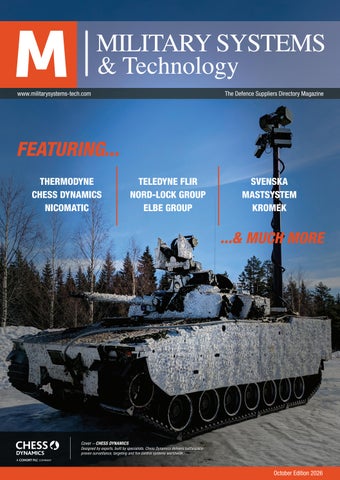
Cover – CHESS DYNAMICS Designed by experts, built by specialists. Chess Dynamics delivers battlespaceproven surveillance, targeting and fire control systems worldwide.
www.militarysystems-tech.com
1
T. +44 (0) 1884 258019
E. sales@militarysystems-tech.com October Edition 2026
M MILITARY SYSTEMS & Technology
Mission ready At Babcock, we approach everything with a broader perspective, delivering defence engineering that creates our customers big picture. Our General Logistics Vehicle is built on decades of experience supporting the Army’s toughest assets - designed for reliability, adaptability, and mission success for generations. This is lifetime engineering.
www.militarysystems-tech.com
2
T. +44 (0) 1884 258019
E. sales@militarysystems-tech.com
M MILITARY SYSTEMS & Technology
CONTENTS 4 10
Chess Dynamics - Confidence Before Engagement Avant Electronics - Obsolete Components: The Hidden Threat to Military Readiness
16
elcome to the October edition of The Military Systems & Technology Magazine, for 2026.
W
As an established web portal for the International Defence & Aerospace Industry, we strive to provide a comprehensive and detailed listing of Military Equipment Suppliers, Products and Services. This magazine is designed to keep you up-to-date with latest news and events within the Defence Industry’s Governing Bodies, Organisations and Companies.
A Multi-Media Portal for the International Defence & Aerospace industry. For more information on how to submit editorial or advertising options please contact us and one of our team will be happy to assist you.
Nicomatic - Connectivity Solutions for Defence Applications
20
Nord-Lock - to Showcase Comprehensive Firepower Portfolio at DVD 202
28
Thermodyne - Thermal Protection for the Next Generation of Military Spacecraft
32
Oxley - Achieves Gold Award in Defence Employer Recognition Scheme
42
G&H - Optics and Photonics: Accelerating the Technologies Protecting Lives in Modern Conflict
46 52
Teledyne FLIR - VGA vs. SXGA Thermal Imaging: What Higher Resolution Means for Range, Optics, and AI Svenska - Power Where It Matters. Backup Power, Ukraine and the Importance of Energy Resilience
54 62 64 72
TSS International - Service, with a Capital S Adacore - Can you Trust AI-Generated Code? Mast System - What Makes a Tactical Mast Sustainable? Red Cat - American Maritime Power Starts at the Shipyard
48
Powell Electronics - Engineering for the Next Generation of High-power Interconnects
Anthony Nutt Managing Director T: +44 (0) 1884 258019 | M: 07495 890601 E: tony.nutt@militarysystems-tech.com W: www.militarysystems-tech.com
Plus...
OXLEY CHESS PELI NSSS WILL-BURT HORSTMAN SCHROTH PIEDRAFITA ADVANCED COATING
... & much more www.militarysystems-tech.com
3
T. +44 (0) 1884 258019
E. sales@militarysystems-tech.com
M MILITARY SYSTEMS & Technology
CONFIDENCE BEFORE ENGAGEMENT: THE GROWING IMPORTANCE OF ELECTRO-OPTICAL SURVEILLANCE IN MODERN MOBILE AIR DEFENCE Modern air defence is becoming more demanding, not simply because there are more threats to monitor, but because operators are expected to make faster, better-informed decisions in increasingly complex environments.
This is why electro-optical surveillance continues to play such an important role. Working alongside complementary sensing technologies, modern EO systems provide the identification, precision tracking and situational awareness needed to support confident operational decisions.
MODERN AIR DEFENCE DEPENDS ON TRUSTED INFORMATION The effectiveness of a mobile air defence system depends on much more than the interceptor itself. Increasingly, success depends on the quality of information available before an engagement decision is made.
Today's threat landscape includes a complex mix of uncrewed aerial systems, helicopters, fast-moving aircraft and cruise missiles, often within compressed decision-making timelines and challenging operating conditions.
Long-range detection remains essential, but operators must also distinguish genuine threats from background activity, maintain stable tracks and build confidence in what they are seeing. Electro-optical surveillance contributes directly to this process by providing visual confirmation, accurate tracking and high-quality situational awareness alongside the wider sensor picture.
At the same time, air defence systems are expected to remain highly mobile, deploying rapidly across varied terrain without compromising situational awareness. Before any engagement can take place, operators need confidence that they are tracking the right object, understanding its intent and maintaining continuity throughout the engagement sequence.
The direction of travel is clear: customers are asking for faster
Image credit © MBDA
www.militarysystems-tech.com
4
T. +44 (0) 1884 258019
E. sales@militarysystems-tech.com
M MILITARY SYSTEMS & Technology
performance and greater detection, recognition and identification (DRI) ranges, while still minimising cognitive burden for operators.
HAWKEYE EOSS: BUILT FOR OPERATIONAL CONFIDENCE These changing operational requirements have shaped the continued evolution of Chess Dynamics' Hawkeye EOSS. Designed for demanding operational environments, Hawkeye EOSS combines high-resolution EO/IR sensing, precision stabilisation and AIenhanced target tracking to support long-range surveillance, target identification and precision target tracking. Built on battlespace-proven technology, the system has been developed to provide operators with the high-quality information needed to identify, understand and confidently track potential threats. Its modular architecture enables sensor payloads to be configured around operational requirements while retaining a common positioner and control system. High-quality thermal and daylight imagery, laser range-finding and advanced tracking technologies can be combined to support a wide range of mobile air defence applications. Ultimately, the objective is to give operators the clarity, continuity and confidence needed to make informed decisions under pressure. In this context, AI-enhanced tracking acts as a force multiplier for the hardware, helping enable these gains in speed and range while minimising cognitive burden for the operator.
PROVEN CAPABILITY CONTINUES TO EVOLVE Operational requirements never stand still, and neither should surveillance systems. Defence platforms often remain in service for decades, while sensors, software and integration requirements continue to evolve. Increasingly, customers are looking for surveillance capabilities that can adapt over time rather than requiring wholesale replacement whenever technology advances.
The integration demonstrates how advanced electro-optical surveillance can support a modern mobile air defence capability, combining longrange detection, identification and precision tracking within a highly mobile operational solution.
This philosophy underpins the continued evolution of Chess Dynamics' electro-optical surveillance capability through EOSS-D. Rather than pursuing innovation for its own sake, the focus has been on developing a more adaptable architecture that supports simpler integration, modular payloads and practical upgrade paths. Ethernet connectivity, modular sensor integration and future technology insertion all help ensure the capability can evolve alongside changing mission requirements.
More than simply demonstrating successful platform integration, it illustrates the increasingly important role electro-optical surveillance plays in supporting modern air defence operations. By providing the trusted information needed to detect, identify and accurately track potential threats, Hawkeye EOSS helps operators build confidence before engagement decisions are made, contributing to faster, better-informed operational decisions.
Importantly, this approach recognises that customers modernise at different speeds. Some programmes are adopting fully digital architectures, while others continue to operate successfully within established analogue infrastructures. Chess Dynamics has developed its electro-optical surveillance capability to support both realities.
CONCLUSION Modern air defence will continue evolving, and so too will the surveillance technologies that support it. The challenge is no longer choosing between proven capability and innovation but bringing the two together in ways that help operators respond with greater confidence while allowing customers to evolve at a pace that reflects their operational requirements.
This philosophy underpins the continued evolution of Chess Dynamics' electro-optical surveillance capability, including the development of EOSS-D.
That balance between operational heritage and continual evolution sits at the heart of Hawkeye EOSS and the wider electro-optical surveillance capability Chess Dynamics continues to develop. It’s an approach that combines battlespace-proven performance with the flexibility to meet both today's requirements and tomorrow's challenges.
By maintaining compatibility with existing investments while enabling future development, Chess Dynamics helps customers protect today's capability while creating a practical pathway towards future capability.
SUPPORTING INTEGRATED MOBILE AIR DEFENCE
www.chess-dynamics.com sales@chess-dynamics.com
This philosophy was seen recently at DVD, where Hawkeye EOSS will be displayed integrated onto MBDA's Surface Launched ASRAAM system. www.militarysystems-tech.com
5
T. +44 (0) 1884 258019
E. sales@militarysystems-tech.com
M MILITARY SYSTEMS & Technology
PELI MOBILE MILITARY PRODUCTS: UNYIELDING DEFENCE FOR THE WORLD’S MOST DEMANDING FRONTLINES
For over 昀ve relentless decades, Peli-Hardigg™ has stood beside elite defence forces, pioneering transport and packaging solutions that go beyond moving equipment—they protect lifelines.
Whether trudging across glacial wastes, clawing through unforgiving peaks, or baking under merciless desert suns, Peli cases and illumination systems have earned their place as the battle-hardened guardians of gear and grit alike. As a leader in protective casing and portable lighting technologies, Peli doesn’t just build products—it engineers trust. Battle-tempered and 昀eld-proven, our systems thrive where failure is not an option, embodying the resilience, precision, and dependability that modern missions demand. Explore the full spectrum of our tactical ecosystem at military.peli.com, where our mission-critical offerings are organised into four specialised sectors: Armory, Medical, Logistics, and O ce/IT. Each category is built to address the unique challenges of high-stakes operations, delivering tailored solutions for every scenario.
www.militarysystems-tech.com
6
T. +44 (0) 1884 258019
E. sales@militarysystems-tech.com
M MILITARY SYSTEMS & Technology
ARMORY: FORTIFYING FIREPOWER WITH UNRIVALLED TENACITY Weapons systems and precision optics are critical to operational success—fragile in form, yet vital in function. PeliHardigg armory enclosures are the ironclad barrier shielding tactical essentials from shock, sleet, dust storms, and thermal extremes. Developed in close collaboration with military engineers and procurement specialists, our solutions are con昀guration-speci昀c fortresses designed to elevate readiness and accelerate deployment. Discover our full suite of weapon protection solutions at military.peli.com/armory.
MEDICAL: GUARDING THE TOOLS OF SURVIVAL In high-stakes situations, every second counts. That’s why Peli’s medical-grade transport solutions are engineered not just to carry critical supplies, but to protect them—delivering peace of mind when it matters most. Engineered to protect de昀brillators, 昀eld surgery modules, pharmaceutical payloads, and diagnostic tools, our cases stand up to shock, climate extremes, and bio-contaminants.
LOGISTICS: DEFENDING THE BACKBONE OF OPERATIONS Behind every successful mission lies a well-oiled logistics machine. Peli’s transport architecture ensures that critical assets like drone 昀eets, satellite uplinks, and portable power units are shielded within structures as rugged as the terrain they navigate.
With EMS kits, MEDChests, and emergency lighting systems designed for rapid response, 昀eld medics can rely on Peli to safeguard what they depend on most. See our full range at military.peli.com/medical.
From precision-molded single-lid containers to shock-isolating rack-mounted units, our solutions marry durability and mobility. Designed to meet the evolving needs of modern logistics, Peli ensures that whether it’s a circuit board or a mobile command node, it arrives battle-ready. Explore our solutions at military.peli.com/logistics.
OFFICE/IT: PROTECTING COMMAND IN MOTION In today’s battlespace, information is as vital as ammunition. Peli protects servers, comms gear, ruggedized laptops, and fragile electronics with precision—keeping data secure and command operations uninterrupted.
CRAFTED IN EUROPE. BATTLE-TESTED BEYOND BORDERS
With mobile war rooms becoming the norm, Peli’s field desks and rack-mounted IT modules enable agile command posts that move with the mission. Keep your digital nerve center secure at military.peli.com/o ce-it.
Built in our state-of-the-art facility in Germany, Peli solutions fuse European engineering excellence with tactical agility. Our regional manufacturing hub supports fast, precise, and collaborative development of defense-grade transport systems. Driven by continuous testing, advances in material science, and feedback from real-world deployments, Peli-Hardigg evolves constantly to meet emerging threats with steadfast capability. On the frontlines, compromise is not an option. Neither isfailure.
Peli Military Solutions – Built to Protect. Engineered to Perform. Visit military.peli.com to explore the complete line of mission-ready protection.
MILITARY.PELI.COM www.militarysystems-tech.com
7
T. +44 (0) 1884 258019
E. sales@militarysystems-tech.com
M MILITARY SYSTEMS & Technology
HALL 4 - BOOTH C184
For 50 years, Peli has engineered rugged protective cases trusted by defence forces, emergency responders and industrial operators worldwide. Learn more at
DRONES.PELI.COM
www.militarysystems-tech.com
8
T. +44 (0) 1884 258019
E. sales@militarysystems-tech.com
M MILITARY SYSTEMS & Technology
High Performance Reference Sources for Mission Critical Apps. For 65 years, Greenray high performance oscillators have been designed as reference sources for communications, radar and other vital applications that require low g-Sensitivity and excellent phase noise to optimize system performance under the most demanding conditions, from forest fires to fire fights – and beyond. State-of-the-art vibration compensation enables our oscillators to deliver excellent phase noise performance and the short- and longterm stability necessary in high shock and vibration environments. Our T1254, T1354, 1276 and T1282 Series TCXOs have been designed for LEO satellite applications and deep space exploration. They’re ideal for high orbit transponders, nano/micro satellites and RF telemetry systems. The T1215 Series TCXOs feature hermetic packages and tight temp stability. They excel in high shock and vibration conditions and are ideal for communications, instrumentation, multi-band terminal, GNSS, upconverter and SATCOM applications. For information about Greenray’s line of high performance oscillators, visit us at www.greenrayindustries.com. Or call +1 717-766-0223 – and talk to a frequency control expert today.
Award-winning Quality, On-Time Delivery & Customer Service Testing, Screening & Qualification per MIL-PRF-55310 IPC-J-STD-001 including Space Addendum Certified Operators QMS Certified to AS9100D & ISO9001:2015 standards In-House Qualification Testing Reliability Calculations Phase Noise vs. Vibration Testing
l Airborne Communications l Smart Munitions l SATCOM l Telemetry l l Radar l Portable Communications l GPS l Detection & Identification l Missile Guidance l www.militarysystems-tech.com
9
T. +44 (0) 1884 258019
E. sales@militarysystems-tech.com
M MILITARY SYSTEMS & Technology
OBSOLETE COMPONENTS: THE HIDDEN THREAT TO MILITARY READINESS Modern defence systems are built to last. Electronic components are not. That simple mismatch has become one of the biggest challenges facing defence manufacturers, maintenance organisations and procurement teams today. While military platforms are expected to remain operational for 30, 40 or even 50 years, the semiconductors inside them often disappear from production after little more than a decade. Every year, manufacturers discontinue thousands of electronic components as they shift investment towards emerging technologies such as AI, automotive electronics and high-performance computing.
MILITARY SYSTEMS HAVE LONG MEMORIES Unlike consumer electronics, defence equipment isn't replaced every few years. Aircraft, naval vessels, radar systems, communications equipment and armoured vehicles remain in service for decades. Many continue to rely on electronic components that manufacturers stopped producing years ago.
For the defence industry, the consequences are significant. A single obsolete integrated circuit can delay repairs, halt production or trigger an expensive redesign programme.
Replacing those parts isn't always an option.
Finding that one component can become the difference between keeping a mission-critical system operational—or grounding it altogether.
Even a seemingly simple substitution can require redesign, extensive testing, environmental qualification and certification before it can be approved for service. The cost of redesign can easily dwarf the cost of the component itself. That's why many organisations focus on sourcing the original part whenever possible.
WHEN THE MANUFACTURER SAYS "NO LONGER AVAILABLE" Once a component reaches End of Life (EOL), authorised distribution channels often dry up quickly. Procurement teams are then forced to search the independent market. This is where specialist sourcing companies become invaluable. At Avant Electronics, obsolete and hard-to-find component sourcing www.militarysystems-tech.com
10
T. +44 (0) 1884 258019
E. sales@militarysystems-tech.com
M MILITARY SYSTEMS & Technology
has been at the heart of the business for more than 40 years. Rather than simply searching databases, the company leverages an established global network of trusted suppliers and inventory partners to locate components that many believe are no longer obtainable. Experience, relationships and market knowledge often uncover stock where automated searches cannot.
AVAILABILITY ISN'T ENOUGH Finding a component is only half the challenge. Knowing whether you can trust it is equally important. Counterfeit electronic components remain one of the defence industry's biggest supply chain risks. Re-marked devices, recycled components sold as new and counterfeit semiconductors continue to circulate throughout the global market.
A proactive strategy can prevent costly production delays and avoid unnecessary redesign work.
For high-reliability applications, accepting that risk simply isn't an option.
For procurement teams, it also reduces commercial risk and improves long-term programme resilience.
Every sourced component should be supported by appropriate quality processes, supplier qualification and, where required, independent inspection and verification.
MORE THAN JUST A SUPPLIER Specialist sourcing companies are increasingly becoming an extension of their customers' procurement teams.
In defence electronics, confidence in the supply chain is just as important as confidence in the product itself.
Beyond locating components, they provide market intelligence, assess sourcing risk and help organisations navigate an increasingly complex global supply chain.
OBSOLESCENCE IS BECOMING MORE COMMON
That expertise is particularly valuable when dealing with discontinued military-grade semiconductors, legacy memory devices and other components where availability changes rapidly.
Component shortages over recent years have highlighted just how vulnerable global supply chains can be. Although many mainstream product categories have stabilised, legacy semiconductors continue to present unique challenges.
SUPPORTING MISSION-CRITICAL PROGRAMMES
Manufacturers naturally prioritise today's high-volume markets.
Avant Electronics supports customers across the defence, aerospace and other high-reliability industries by sourcing obsolete, allocated and difficult-to-find electronic components.
Military programmes, however, often depend on technologies that have been out of production for many years. This trend is unlikely to change.
Whether supporting ongoing production, equipment maintenance or life-extension programmes, the objective remains the same: keep critical systems operating safely and reliably.
If anything, the gap between commercial innovation and military platform lifecycles will continue to widen.
PLANNING BEATS REACTING
Sometimes, sourcing a single integrated circuit can prevent months of engineering work and save hundreds of thousands of pounds in redesign costs.
The best time to think about obsolescence is before it becomes a problem.
LOOKING AHEAD
Forward planning allows organisations to identify vulnerable components, secure remaining inventory and evaluate sourcing options before shortages become critical.
Obsolescence isn't going away. As commercial electronics continue to evolve at an ever-increasing pace, defence platforms will continue to rely on technologies that the wider market has long since left behind. That makes specialist sourcing expertise more valuable than ever. For organisations responsible for keeping military systems operational, finding obsolete components isn't simply about procurement. It's about maintaining readiness. It's about protecting investment. And ultimately, it's about ensuring that critical equipment is available when it's needed most.
www.avantelectronics.co.uk www.militarysystems-tech.com
11
T. +44 (0) 1884 258019
E. sales@militarysystems-tech.com
M MILITARY SYSTEMS & Technology
The Elbe Group offers a wider range of drive shafts than any other market player.
We supply drive shafts for main and PTO drives, along with matching gearbox and axle flanges, double-centered drive shafts for special-purpose vehicles, double joints for driven steering axles, and precision drive shafts for specific applications.
As part of our IATF 16949 certification, we have documented processes that guarantee you the appropriate quality in both the product and the process. We have ensured IT and data security through dual certification to ISO 27001 and TISAX. Environmental protection and energy management are certified to ISO 14001 and 50001 respectively. As a certified AEO, we guarantee exports without any delays.
As a manufacturer, we have acquired extensive expertise in over a hundred years of experience. We provide you with drive components that are precisely tailored to your needs regardless of whether it is a prototype, a custom-made product, a small or large series, or components specifically designed for military use.
www.militarysystems-tech.com
Our products are technically designed specifically for your application. For drive shafts, you will receive a service life calculation based on your load scheme, as well as test bench trials (e.g. static or dynamic tests) and the corresponding test reports upon request.
12
T. +44 (0) 1884 258019
E. sales@militarysystems-tech.com
M MILITARY SYSTEMS & Technology
Our drive shafts cover the range up to a limit torque of 35,000 Nm. Depending on the design and series, the drive shafts are fitted with a DIN flange (Ø up to 250 mm), a crossserrated flange, a flange with a face key, a hub (bore, profile) or quick-release couplings or clamping sets. Drive shafts are generally available in lubricated (central or external lubrication) or maintenance-free versions. Further special features include, for example: profile protection for length compensation in heavy-duty applications, a drawn-in tube for drive shafts subjected to high rotational speeds, or an internal compression spring for self-tensioning drive shafts. For gearbox and axle flanges, we can offer all standard connection types, such as cross- serrated, half-round, wingstyle, three-arm flanges or even special designs. With 100% in-house production, we manufacture customised designs to drawing specifications and provide technical support, as well as assistance with production and cost optimisation. We document the specifications using state-of-the-art measurement technology. A selection of our capabilities regarding gearbox and axle flanges: turning – milling – drilling – grinding, induction-hardened and lead-free ground seal bearing surfaces, internal profile, external profile, deephole drilling, complete assemblies (e.g. dust protection plates and screws), various materials and material grades. Our decades of experience in equipping military vehicles offers you obvious benefits – to name just a few concrete examples. Deep-wading-capable drive shafts with appropriate surface treatment achieved through a combination of electroplating and paint finishing. For specialized military fields we build drive shafts for extra high (up to +230° C) or extra low (down to -60° C) temperature. Double joints that can be operated at a deflection angle of up to 60°. We can fit drive shafts with sensor technology to transmit real-time operational data to you or to collect this data for analysis. Thanks to our corporate structure and strategy, we offer you security of supply, primarily through reliable supply chains across Europe. Take a closer look at our portfolio at:
www.elbe-group.de or contact us directly:
tve@elso.elbe-group.de www.militarysystems-tech.com
13
T. +44 (0) 1884 258019
E. sales@militarysystems-tech.com
M MILITARY SYSTEMS & Technology
A C T I V A T E D
C A R B O N
I N N O V A T I O N
75+
YEARS OF PROTECTION Military-Grade Performance Against Toxic Threats As the leading provider of activated carbon cloth (ACC) trusted by many of the world’s leading defence vendors, we created Flexzorb™ using respirator carbons offering advanced, reliable protection against chemical warfare agents, industrial chemicals and contaminants, and more. When Failure Is Not An Option Backed by decades of proven performance, Flexzorb leverages impregnated activated carbon capable of neutralizing hazardous contaminants to create safer, non-toxic environments for military and industrial users. In environments where there is no room for error, rely on textiles trusted for nearly a century. Rely on Flexzorb from Calgon Carbon.
flexzorb.com www.militarysystems-tech.com
14
T. +44 (0) 1884 258019
E. sales@militarysystems-tech.com
M MILITARY SYSTEMS & Technology
F L E X I B L E , L I G H T W E I G H T & B R E AT H A B L E Flexzorb is used globally in a range of defence applications including
CBRN Protective Clothing and Equipment
Missile Decoy Media
CBRN Respirator Filtration Media
CBRN Decontamination Wipes
Phosphine Gas Absorbtion Media
www.militarysystems-tech.com
15
T. +44 (0) 1884 258019
E. sales@militarysystems-tech.com
M MILITARY SYSTEMS & Technology
Connectivity Solutions for Defence Applications: How rugged connectors are built for the harshest environments In the demanding world of defence, every connection counts. Whether it's embedded deep within the electronics of a ground vehicle, integrated into the systems of an airborne platform or protecting vital data and power in naval and space applications. We know you need rugged, custombuilt connectivity solutions that thrive in all conditions, so we developed a range of connectors that do exactly that.
Reliability Where It Matters Most Defence applications demand precision, reliability and resilience. Our connectors are specifically engineered to operate under high vibration, high shock and extreme temperatures, while maintaining signal integrity and secure data transmission.
Don’t just take our word for it; here’s why so many engineers choose Nicomatic:
From soldier communication equipment to radar systems, electronic warfare platforms and UAV control units, our connectors ensure vital, uninterrupted connectivity.
✓ Space and weight-efficient: “Nicomatic's compact connectors gave us the performance we needed in a footprint that fit perfectly within our design constraints." ✓ Built to Spec: "What stood out was their ability to tailor the solution to our exact requirements. We received a connector that matched our performance, size and integration needs without compromise." ✓ Customised Harnessing: "The quality of the harness assemblies was exceptional. Knowing they were built to IPC-620 Class 3 standards gave us complete confidence in their reliability." ✓ Designed for Harsh Environments: "Our equipment operates in extremely demanding conditions, and these solutions have consistently delivered. They've stood up to shock, vibration and harsh environmental exposure without issue."
www.militarysystems-tech.com
16
T. +44 (0) 1884 258019
E. sales@militarysystems-tech.com
M MILITARY SYSTEMS & Technology
– Photonic Solutions
Our recommended solutions for your defence application
For secure, high-speed, EMI-immune communication, we offer photonic solutions designed for defence-grade environments, from VITA 66 to Pluggable Transceivers. Our optical connections have been built to withstand extreme temperatures, moisture and vibrations, ensuring durability in military operations.
– CMM Series Our CMM series connectors are highly modular and compact, with multiple layout options for combining signal, power and data in one connector. CMM is ideal for applications requiring low-profile, high-density interconnects with proven MIL-spec performance.
To find out how to take your optical signal even further, have a look here.
To find out more about our CMM series, have a look here.
Here to support you through your next mission
– DMM Connectors When EMI protection is mission-critical, the DMM series provides metal-shell micro connectors with optional coax, high-power and signal contacts. With MIL-DTL-83513G compliance, DMM is perfect for shielded, high-performance defence electronics.
At Nicomatic, we co-engineer solutions with military integrators, platform developers and Tier 1 suppliers. Every product is manufactured to order, with short lead times, rigorous testing and support from initial concept to deployment.
To find out more about our DMM series, have a look here
– EMM Micro Connectors
Our custom harnessing services allow you to combine our connectors with third-party systems, ensuring full compatibility and optimal performance. Built to IPC-620 Class 3, our harnesses are engineered for high shock, high vibration and extended operational life in the field.
With a 1.27mm pitch, reversed contacts and built-in mechanical protection, EMM connectors deliver robust performance in compact spaces. Fully compliant with MIL-DTL-83513, our EMM connectors are made for modern defence systems that require lightweight, rugged, high-density solutions.
Whether you need signal, power, high-frequency or fibre optic interconnects, we have a design-to-spec solution for you.
To find out more about our EMM series, have a look here.
– FMM Connectors Our FMM Floating Board-to-Board Connectors are designed to absorb PCB assembly tolerances and compensate for misalignment during mating. Featuring a floating interface with enhanced tolerance compensation, FMM helps reduce mechanical stress, improve assembly yield and increase longterm system reliability in high-density electronic applications.
Looking for a custom solution? Explore our range of modular, rugged, high-density connectors or speak to our technical team to design a connector that meets your exact requirements:
ngb.inquiries@nicomatic.com
To find out more about our FMM series, have a look here.
Advanced products for specialised defence needs – Matr’YX When space is limited, but performance can't be compromised, Matr’YX offers an ultra-high-density solution. It is particularly well-suited to complex systems where speed and clear signal transmission are essential. To find out more about our Matr’YX connectors, have a look here.
– Optimus Optimus is our sealed connector platform built for harsh, contaminated or submerged environments. Its modular design and IP-rated sealing ensure dependable connectivity in the field. To find out more about Optimus Solutions, have a look here.
www.militarysystems-tech.com
17
T. +44 (0) 1884 258019
E. sales@militarysystems-tech.com
M MILITARY SYSTEMS & Technology
www.militarysystems-tech.com
18
T. +44 (0) 1884 258019
E. sales@militarysystems-tech.com
M MILITARY SYSTEMS & Technology
A Multi-Media Portal for the International Defence & Aerospace Industry
Established in 2006 as a comprehensive resource of information and news from international defence companies, associations and events, enabling companies to promote their capabilities to defence procurement organisations around the world.
Advertise with us
www.militarysystems-tech.com
Defence-Marketing.com Focused MarComms, PR and Design Support for Defence, Aerospace and Security
Defence-Design Clear, precise visuals that reflect technical capability.
Defence-Marketing Campaigns that position your offer effectively.
Defence-PR Communications that build trust and credibility.
www.militarysystems-tech.com
19
T. +44 (0) 1884 258019
E. sales@militarysystems-tech.com
M MILITARY SYSTEMS & Technology
COMBINING UUV TECHNOLOGY WITH WEDGE-LOCKING FOR DEFENSE SUCCESS Unmanned underwater vehicle (UUV) technology is of growing value for the defense sector, making it possible to efficiently carry out tasks without a human crew. For UUVs, it is vital to secure bolted joints and prevent parts of the vehicle from coming loose during these missions.
of our solution for the UUV manufacturer, as well as evidence from similar applications, ranging from military vehicles to other automated underwater deployments. Nord-Lock also has testing facilities where detailed technical testing can be carried out to show the solution works as it should for the specific use case in question. Combined, these proof points demonstrate that Nord-Lock wedge-locking washers are an excellent match for mission-critical usage of UUV technology.
STOPPING VIBRATIONAL LOOSENING IN UUVS
READY FOR DEFENSE DEPLOYMENT WITH SECURE BOLTED JOINTS
For defense, UUV technology has unlocked a cost-effective way to carry out long-endurance surveillance and reconnaissance operations, making it possible to monitor underwater assets like pipelines without requiring human crewmembers.
With the Nord-Lock solution implemented, the UUVs have now been deployed in harsh and demanding environments. Exactly as was desired, the problem with vibrational loosening was eliminated, showing once again that the majority of bolted joint issues can be solved with Nord-Lock washers.
A global UUV manufacturer whose products are used by several navies contacted Nord-Lock Group at a defense exhibition. They sought to resolve a problem where vibration was causing bolted joints to loosen. As is the case in any vehicle, vibration caused by engine rotation, gearboxes and other moving parts is a challenge. This vibration spreads through the vehicle’s structure, and if left unchecked, can cause loosening in a range of places. For UUVs reliability is particularly fundamental. Losing parts or even the entire vehicle itself is not only costly from an economic perspective – in defense, the consequences can be even greater.
FOR UUVS, NORD-LOCK WASHERS PASS THE TEST
While several other alternatives such as adhesives or locking wire claim to solve vibrational loosening, they can be expensive and difficult to implement. Nord-Lock wedge-locking washers are simple to use and effectively secure bolted joints from vibration. This makes them a clear fit for defense, where failure is not an option and time is of the essence. Nord-Lock was able to provide test data showing the suitability www.militarysystems-tech.com
20
T. +44 (0) 1884 258019
E. sales@militarysystems-tech.com
M MILITARY SYSTEMS & Technology
A SCALABLE AND RELIABLE BOLTED JOINT SOLUTION FOR UUV TECHNOLOGY
KEY TAKE AWAYS Use case: Eliminating vibrational loosening of bolted joints in unmanned underwater vehicles (UUVs)
In a segment where 100% reliability is a base requirement to maintain reputational integrity, the UUV manufacturer can rely upon the Nord-Lock solution to deliver on its promise. With spares available for quick dispatch across the world, the solution is also scalable, strengthened further by the reusable nature of Nord-Lock washers.
Customer: Major UUV supplier to navy operations Location: A global manufacturer with a global reach Benefits gained: • Prevent vibrational loosening.
For Nord-Lock, the case reaffirms the value of our products for UUV technology and the defense sector in general, strengthened by our ability to facilitate a full range of Nato Stock Numbers (NSN) for the solutions, as well as CAD downloads. Nord-Lock is well geared up to support the defense industry.
• Proven experience in the naval industry and UUV applications. • Global stock availability for fast, dependable delivery anywhere in the world.
“This is a great example of why we love being approached by people with engineering knowledge at exhibitions,” Andy Radnor, Nord-Lock Group Global Business Development Manager explains.
• Scalable solution. • First in the industry to offer a full lifecycle warranty.
“We’re extremely proud of our quality, transparency, global footprint and availability, and have a broad product portfolio that can benefit a wide range of defense applications. If you see a Nord-Lock Group stand and have a bolted joint challenge you’ve been trying to resolve, come and speak to us and we will show how we can help with the data and testing to back it up.”
www.militarysystems-tech.com
www.nord-lock.com
21
T. +44 (0) 1884 258019
E. sales@militarysystems-tech.com
M MILITARY SYSTEMS & Technology
DUST PROOF
SHOCK PROOF WATER PROOF
VIBRATION RESISTANT
TEMPERATURE RESISTANT (+90 ° -30 °C)
AIR CARRIAGE SUITABLE
IP67 RATED ATA 300 DEF STAN 81 41 STANAG 4280
: info@tri昀bre.co.uk www.militarysystems-tech.com
: +44 (0)116 232 3166 22
: tri昀bre.co.uk
T. +44 (0) 1884 258019
E. sales@militarysystems-tech.com
M MILITARY SYSTEMS & Technology
: info@tri昀bre.co.uk : +44 (0)116 232 3166 : tri昀bre.co.uk
UK’S LEADING
CASING MANUFACTURER & SUPPLIER
Trifibre is the UK’s leading case manufacturer and supplier with a vast array of products offered on a global scale. Established in 1981, the company has over 40 years of experience. During this time, we have developed and progressed into a highly respected and innovative casing solution provider that caters to many industry sectors, including: Aerospace, Medical, Defence, Scientific, Music, and more... Based in the heart of England, our 70,000 sq ft premises has the facility to produce large order volumes using a wide range of manufacturing techniques and the latest design software packages.Trifibre is able to produce the highest quality products consistently with short lead times at very competitive prices.
“ We are proud of all the work we do, be it large corporate supply, or a simple box for personal storage. Our decades of experience means we’re best at what we do. “
: info@tri昀bre.co.uk : +44 (0)116 232 3166 : tri昀bre.co.uk
www.militarysystems-tech.com
23
T. +44 (0) 1884 258019
E. sales@militarysystems-tech.com
M MILITARY SYSTEMS & Technology
ADVANCED COATING: PROTECTING MISSION CRITICAL AEROSPACE & DEFENSE ELECTRONICS
In aerospace and defense, there is very little room for failure. Electronics used in aircraft, UAVs, radar, communications, navigation, guidance and other mission critical systems must perform reliably in some of the world’s most demanding environments. Moisture, chemicals, contamination, vibration, thermal cycling and temperature extremes can all affect performance and long term reliability.
decades of experience supporting aerospace, defense, medical and other high reliability industries. Our capabilities include Parylene N, C, D and HT, precision masking and demasking, plasma treatment, controlled bake processes, detailed inspection, engineering support and underfill.
At Advanced Coating, protecting those electronics is what we do. Located in Rancho Cucamonga, California, Advanced Coating has
Parylene provides a highly uniform, lightweight conformal barrier through a chemical vapor deposition process performed under vacuum. Because the coating is deposited in the vapor phase, it conforms closely to complex geometries, components, leads and edges. This makes Parylene particularly well suited for advanced electronic assemblies where environmental protection, dielectric performance and minimal added weight are important. But coating is only part of the process. Advanced Coating has developed extensive expertise in precision masking and demasking for complex assemblies containing connectors, contacts, test points, grounding locations and other www.militarysystems-tech.com
24
T. +44 (0) 1884 258019
E. sales@militarysystems-tech.com
M MILITARY SYSTEMS & Technology
critical keep out areas. We approach preparation, masking, coating, demasking and inspection as one complete process.
environments. Our job is to make sure those electronics are protected for the mission they were designed to perform. We don’t want to simply process our customers’ hardware; we want to become an extension of their engineering and manufacturing teams.”
Surface preparation is equally important. Our plasma processing capabilities can be used to prepare certain surfaces and promote coating adhesion. Controlled bake and drying processes can also be incorporated based on customer and application requirements.
E. Garcia, General Manager, Advanced Coating Advanced Coating operates under an AS9100D and ISO 9001 certified quality management system and maintains ITAR compliance. As part of our continued investment in aerospace and defense, Advanced Coating is targeting NADCAP certification in 2026, further strengthening our ability to support the stringent processing and quality requirements of the aerospace supply chain.
From prototype development through full rate production, Advanced Coating is committed to being more than a coating supplier. We are a technical partner focused on protecting the electronics that have to perform when it matters most.
www.AdvancedCoating.com
Our newest capability, underfill, expands the protection we can provide for advanced electronics. Underfill can provide additional mechanical support beneath selected components and help distribute stresses associated with vibration, mechanical shock and thermal cycling. Combined with Parylene, this provides customers with both component level mechanical protection and environmental protection within one specialized operation.
Rancho Cucamonga, California 800-722-1444 | International Programs Supported
With 24 hours of dedicated Capabilities 7 days a week, Advanced Coating has the capacity and flexibility to support prototypes, first articles, recurring production and expedited aerospace and defense requirements.
“The next generation of aerospace and defense platforms will be driven by increasingly sophisticated electronics operating in increasingly demanding www.militarysystems-tech.com
25
T. +44 (0) 1884 258019
E. sales@militarysystems-tech.com
M MILITARY SYSTEMS & Technology
LOCALLY MADE SOLUTIONS FOR
NOW CLOSER THAN EVER TO BRITISH DEFENCE WORKSHOP & DISTRIBUTION CENTRE PIEDRAFITA SYSTEMS LTD Swordfish Business Park Burscough L40 8JW United Kingdom www.militarysystems-tech.com
26
T. +44 (0) 1884 258019
E. sales@militarysystems-tech.com
M MILITARY SYSTEMS & Technology
ThermoDyne: Combat-Proven ThermoDyne’s advanced insulation and thermal assemblies protect mission-critical defense systems from heat, shock, and vibration—delivering lighter, stronger, and more reliable performance across every domain.
Armor and Transportation
Aviation
Advanced insulation for vehicles, exhausts, and secure systems—enhancing protection, survivability, and mission readiness.
Thermal shielding for engines, 昀rewalls, and structures, delivering safety, weight savings, and endurance in extreme 昀ight.
Navy
Weapon Systems
ISO 9705 & UL1709 certi昀ed...no breaches, no emissions, no melting. Proven thermal defense for combat vessels and submarines.
Ultralight insulation protects guidance systems, extending range, precision, and mission duration under extreme heat.
Hypersonics
Space
Survives Mach 5+ with structural integrity intact, lightweight insulation that extends range and payload capacity.
Re-entry proven. Our insulation shields spacecra昀 from extreme heat without adding weight or compromising structure.
Engineered for Extremes. Proven in Combat. www.thermodyne1.com The information and opinions provided are for your consideration and veri昀cation only and do not constitute a warranty or representation of legal responsibility. This does not authorize use of any patented invention without a license. DynaGuard ® and
www.militarysystems-tech.com 27 ExcelFlex are registered trademark of ThermoDyne Corporation. Form TD 1043, TD-67, 11/25, ©2025 ThermoDyne Corporation ®
T. +44 (0) 1884 258019
E. sales@militarysystems-tech.com
M MILITARY SYSTEMS & Technology
Thermal Protection for the Next Generation of Military Spacecraft ThermoDyne’s Excelflex® LRSI provides lightweight, flexible thermal protection for spacecraft operating from launch through orbit and reentry.
Military operations depend heavily on space. Communications, navigation, missile warning, intelligence and surveillance all rely on satellites and the infrastructure supporting them. The spacecraft themselves are changing. The traditional model has been relatively straightforward: build a satellite, launch it into its designated orbit and operate it for as long as possible. Once its service life is over, the hardware remains in space or is disposed of.
ThermoDyne’s Excelflex® LRSI (Low-Density Reusable Surface Insulation) was developed for this type of environment.
Reusable launch vehicles have already changed how hardware reaches orbit. The next step is making more of that hardware reusable, serviceable or recoverable.
Excelflex LRSI provides a lightweight, flexible insulation layer for protecting spacecraft structures from high temperatures. Its low density keeps thermal protection from consuming more of the vehicle’s mass budget than necessary. For military spacecraft, that matters.
That creates a thermal problem. A spacecraft returning to Earth must survive atmospheric reentry. High velocity through the atmosphere produces severe aerodynamic heating, while the structure and equipment behind the vehicle’s outer surface must remain within acceptable temperature limits.
Every Pound Has a Job Mass remains one of the basic constraints of spacecraft design. Thermal protection competes for that mass with fuel, batteries, sensors, communications equipment and payload. Reducing the weight of insulation gives spacecraft designers room elsewhere in the vehicle. Excelflex LRSI uses a quilted quartz-fiber construction to provide thermal resistance at low density. The material can be installed over areas requiring protection without the weight associated with heavier insulation systems. ThermoDyne takes thermal protection beyond individual insulation components, designing and manufacturing large-scale engineered systems delivered ready for installation. Excelflex® LRSI can be engineered around complex geometries, penetrations, structural joints and equipment interfaces, into complete thermal assemblies.
www.militarysystems-tech.com
28
T. +44 (0) 1884 258019
E. sales@militarysystems-tech.com
M MILITARY SYSTEMS & Technology
The Return Trip Changes the Requirements A recoverable spacecraft has to tolerate the orbital environment and then survive reentry. The thermal protection system becomes an integral part of the vehicle architecture. That capability could have important military applications. Experimental sensors and electronics could be flown in orbit and returned for inspection. New materials could be exposed to the space environment and physically recovered for analysis. Sensitive or highvalue payloads could potentially be brought back rather than remaining in orbit after their mission is complete. Recoverable spacecraft could also shorten the development cycle for new space hardware.
From Material to Finished System ThermoDyne has spent decades working with thermal insulation in applications where temperature, weight and available space create difficult engineering problems.
Engineers receive large amounts of telemetry from spacecraft, but telemetry cannot replace having the actual hardware on a laboratory bench. Returning a system allows engineers to examine wear, thermal effects and material performance directly.
Spacecraft manufacturers rarely need insulation in a convenient rectangular sheet. They need components built to drawings, fitted around hardware and incorporated into a larger thermal system. Excelflex LRSI can be configured for those applications rather than requiring the spacecraft designer to work around the insulation. ThermoDyne can work from the thermal requirement through prototype development and into production from a U.S. engineering and manufacturing operation.
For defense programs developing new sensors, electronics and spacecraft technologies, that feedback can provide engineers with information that is difficult to obtain any other way.
Reusability Puts New Demands on Thermal Protection Reusable spacecraft change another part of the equation.
Excelflex LRSI gives spacecraft engineers a lightweight, flexible insulation option for those conditions. It can conform to complex structures, reduce the mass devoted to thermal protection and provide insulation for systems intended to survive reentry and be used again. As military space operations expand beyond satellites designed to remain permanently in orbit, thermal protection will have to change with them.
A thermal protection system intended for a single mission only has to perform once. A reusable vehicle needs materials and systems designed around repeated operations. Excelflex LRSI was developed as reusable surface insulation. That makes it applicable to spacecraft concepts where the vehicle returns from orbit, is inspected and prepared for another mission. Its flexible construction can also accommodate areas and geometries where rigid thermal protection systems may be more difficult to integrate.
Getting the spacecraft into space is only half the engineering problem. The next generation may also have to bring it home.
For the military, reusable space transportation could provide another way to deploy hardware, test equipment in orbit and recover valuable payloads. Those missions require thermal protection that performs its job without taking an excessive share of the vehicle’s weight or available space.
www.thermodyne1.com | info@thermodyne1.com
Thermal Management Doesn't End at Reentry Reentry produces the most visible thermal event, but spacecraft face thermal problems throughout their missions. There is no atmosphere in orbit to move heat through normal convection. Equipment generates heat internally while external surfaces move between direct solar exposure and shadow. Electronics, batteries, sensors and other components still have operating temperature limits. The result is a thermal management problem that affects the entire spacecraft. Insulation can help isolate temperature-sensitive components and reduce heat transfer between areas of the vehicle. Flexible materials can also be fitted around equipment and structures where rigid insulation is difficult to package. For military systems carrying high-value electronics, sensors or sensitive payloads, maintaining acceptable temperatures can directly affect mission life and reliability. www.militarysystems-tech.com
29
T. +44 (0) 1884 258019
E. sales@militarysystems-tech.com
M MILITARY SYSTEMS & Technology
HEICO-LOCK® Wedge Locking Systems High-performance bolt locking for every challenge.
Testet according to MIL-STD-810 and DEF Stan 00-35
HEICO-LOCK® Reaction Washers The ultimate bolt locking system that allows reaction armfree tightening with most branded high-torque tools.
Proven. Precise. Made in Germany. Contact us for more information: www.heico-group.com +49 2938 - 805 0
www.militarysystems-tech.com
30
T. +44 (0) 1884 258019
E. sales@militarysystems-tech.com
M MILITARY SYSTEMS & Technology
NIGHT VISION LIGHTING
ROBUST · RELIABLE · LIGHTWEIGHT
Oxleys night vision compatible lighting solutions are engineered to deliver reliable illumination whilst maintaining operational e昀ectiveness in low light environments. Designed for demanding aerospace and defence applications, Oxley products support mission success.
IR Brake/Convoy Light
IR Driving Light Series 2 IR Driving Light
f World leaders in LED lighting and night vision solutions f Best in class for all weather performance in extreme conditions f NVIS compatible solutions for land, sea and air platforms
+44 (0)1229 483226 • sales@oxleygroup.com • www.oxleygroup.com www.militarysystems-tech.com
31
T. +44 (0) 1884 258019
E. sales@militarysystems-tech.com
M MILITARY SYSTEMS & Technology
Oxley Achieves Gold Award in Defence Employer Recognition Scheme Oxley Group is proud to announce it has received the Gold Award in the Ministry of Defence's Employer Recognition Scheme (ERS), the highest level of recognition available to employers supporting the Armed Forces community.
The award acknowledges Oxley's long standing commitment to championing veterans, reservists and cadets, while working collaboratively with partners across the region to promote the values of the Armed Forces Covenant. www.militarysystems-tech.com
The Gold Award recognises organisations that demonstrate exceptional support for the Armed Forces community and embed that commitment throughout their business practices. Having signed the Armed Forces Covenant in 2020, Oxley has steadily strengthened its support for service personnel and their families, achieving Bronze recognition in 2023 and Silver recognition in 2024 before now being awarded Gold status. 32
T. +44 (0) 1884 258019
E. sales@militarysystems-tech.com
M MILITARY SYSTEMS & Technology
through support for Armed Forces charities and events, including fundraising activities, sponsorship, Armed Forces Day celebrations and engagement with veteran networks.
As a long established defence manufacturer, Oxley recognises the significant contribution that members of the Armed Forces community make to industry, society and the wider economy. Over recent years, the Group has introduced supportive workplace policies for reservists and cadet force adult volunteers, enhanced recruitment pathways for veterans and cadets and promoted skills development and career opportunities. The company has also played an active role in advocacy, mentoring, networking and collaborative initiatives across the defence and Armed Forces communities.
Darren Cavan, Oxley Group CEO said; ‘Achieving the ERS Gold Award is a tremendous honour and reflects the dedication of our people and the values we hold as a business. We recognise the exceptional skills, experience and commitment that members of the Armed Forces community bring to the workplace, and we are proud to support them through employment, development opportunities and community engagement.
A strong advocate for partnership working, Oxley has worked closely with fellow Armed Forces Covenant signatories across the region to share best practice and strengthen support for the Armed Forces community. The company has also mentored three other organisations on their Employer Recognition Scheme journeys, helping them develop their own commitments and achieve recognition.
We have also been pleased to work alongside other local Covenant signatories and support organisations beginning their own ERS journeys. This award reinforces our ongoing commitment to those who serve and have served.’
Oxley has further demonstrated its commitment www.militarysystems-tech.com
33
T. +44 (0) 1884 258019
E. sales@militarysystems-tech.com
M MILITARY SYSTEMS & Technology
www.militarysystems-tech.com
34
T. +44 (0) 1884 258019
E. sales@militarysystems-tech.com
M MILITARY SYSTEMS & Technology
www.militarysystems-tech.com
35
T. +44 (0) 1884 258019
E. sales@militarysystems-tech.com
M MILITARY SYSTEMS & Technology
RADIATION DETECTION ON THE MODERN BATTLEFIELD facilities, displaced radioactive sources, contaminated infrastructure or unexploded devices could all create environments where personnel cannot immediately determine whether an area is safe to enter. Radiological detection therefore increasingly needs to be available closer to the point of operations, integrated into wider situational awareness and capable of providing actionable information quickly. The challenge of detecting radiation now involves providing personnel with the information they need to understand a threat and make informed decisions without unnecessarily exposing themselves to danger.
FROM SPECIALIST EQUIPMENT TO OPERATIONAL CAPABILITY
The modern battlefield is becoming increasingly complex, with forces expected to operate across contested environments, alongside civilian infrastructure and in the aftermath of attacks that may disrupt critical industrial, energy and transport facilities.
Radiological threats can arise in many different scenarios. For instance, a damaged nuclear facility, an abandoned or displaced radioactive source, contaminated infrastructure, illicit radioactive material or the deliberate deployment of a radiological dispersal device could all create hazards for military personnel. However, the first indication that something is wrong may simply be an unexpected radiation reading. Personnel may need to establish whether they are encountering normal background radiation, a radioactive source, contamination or another anomaly. They may then need to determine the radionuclide involved, establish the location and assess the potential significance of the threat. These factors can place additional demands on radiation detection equipment.
Within this environment, the risk posed by radioactive materials and radiological contamination can be difficult to predict and even harder to separate from the wider operational picture.
The ability to identify that reading quickly can make a significant operational difference. This means that devices must be sufficiently sensitive to identify threats while remaining lightweight, rugged and straightforward to operate. However, they also need to function in challenging environments and provide information quickly, without creating additional complexity for personnel already operating under pressure.
For decades, radiation detection has primarily been regarded as a specialist CBRN capability, with dedicated teams and trained personnel carrying sophisticated instruments to identify and characterise radiological threats. However, the demands of modern military operations are changing this model.
The result is a shift towards more compact and accessible radiation detection technologies that can extend awareness beyond specialist CBRN teams.
A radiological threat does not necessarily have to result from a deliberate attack. For example, damaged nuclear or industrial www.militarysystems-tech.com
36
T. +44 (0) 1884 258019
E. sales@militarysystems-tech.com
M MILITARY SYSTEMS & Technology
radioactive source. It can help reduce uncertainty and determine where personnel can operate, where further investigation is required and where access should be restricted. This makes the speed and quality of information particularly important when it comes to ensuring efficient operations. A detector that provides an immediate warning is valuable, but a system capable of providing additional information about the nature and location of the hazard can support a much more informed and comprehensive operational response.
DETECTING RADIATION IS ONLY THE BEGINNING A critical distinction in radiological response is the difference between detection and identification. This is because a basic detector may alert an operator to the presence of elevated radiation. While the warning is important, it may not answer the questions that follow, such as, what is causing the radiation? Where is the source? Is it a genuine threat? How significant is the hazard? What should personnel do next? High-resolution detection and radioisotope identification can provide much greater insight to support military operations. Most modern radioisotope identification devices (RIIDs) can analyse the energy spectrum of detected radiation and help identify the radioactive material responsible. This can turn an initial warning into actionable information.
THE COST OF NOT KNOWING In military operations, uncertainty can be as disruptive as the hazard itself, with the main reason being if personnel cannot establish whether an area is radiologically safe, then commanders may have to divert routes, delay operations or even deploy specialist CBRN resources to investigate. Equally, a lack of information may result in personnel entering an environment where a radiological hazard is present.
For example, systems such as Kromek's D5 RIID are designed to provide continuous real-time monitoring and identification in a compact form factor. This type of capability allows radiation detection to become part of an operator's normal equipment rather than something that must always be brought in by a specialist team.
Radiation detection can therefore play a role beyond identifying a
www.militarysystems-tech.com
37
T. +44 (0) 1884 258019
E. sales@militarysystems-tech.com
M MILITARY SYSTEMS & Technology
The value of this connectivity extends beyond the battlefield, with data sharing between agencies and technical authorities significantly improving coordination and reducing response times. Importantly, advances in communications technology are also helping to overcome limited network availability, one of the key challenges of operating in contested or degraded environments. Connecting detectors to smartphones, tablets or wider command-andcontrol systems can allow measurements and identification results to be recorded, reviewed and shared. Multiple measurements taken across an area could help establish the location of a source or identify the boundaries of contamination. Historical measurements can provide a baseline against which subsequent readings are compared, helping teams understand how a situation is developing.
PREPARING BEFORE THE THREAT EMERGES It is worth noting that the changing nature of the radiological threat means preparedness cannot begin when an incident occurs. Military forces need to consider where radiation detection sits within their wider CBRN architecture, who has access to it, how information is shared and how detection capabilities interact with specialist response teams and other sensors.
The faster personnel can establish what they are encountering, the faster commanders can make decisions about routes, access, cordons, decontamination and the deployment of specialist resources.
Exercises and training can also reveal practical challenges that are difficult to identify on paper. Equipment needs to be tested in realistic environments and integrated into operational procedures before personnel are faced with a genuine radiological incident.
KEEPING PERSONNEL FURTHER FROM THE HAZARD Another important aspect for consideration is the integration of radiation detection with unmanned and automatic systems. Sending a person into an environment where the presence of radioactive material is unknown carries an obvious risk. The alternative approach being unmanned ground vehicles and other robotic platforms. This technology can be utilised to carry sensors into potentially hazardous areas first to assess the situation.
The objective is not to turn every soldier into a radiation specialist, rather it is to ensure that the right information can reach the right person at the right time.
RADIATION DETECTION AS OPERATIONAL FREEDOM Ultimately, battlefield radiation detection is not simply a question of whether a radioactive source can be found, it is about maintaining freedom of action in environments where the radiological situation may be uncertain.
Radiation sensors integrated onto unmanned platforms can support tasks such as searching for sources, mapping contamination and assessing environments before personnel enter. It is worth noting that this approach does not eliminate the need for human expertise, instead, it changes where that expertise is applied.
The ability to rapidly detect, identify, locate and communicate radiological hazards can help commanders make better-informed decisions, reduce unnecessary exposure and determine where personnel and assets can operate safely.
Operators can remain at a safer distance while using sensor data to understand the environment remotely. Specialist CBRN personnel can then be deployed with a clearer picture of the hazard, rather than being asked to enter an unknown environment simply to establish whether a threat exists.
The future of radiological detection is consequently not simply about producing increasingly sophisticated instruments, it is about making advanced capabilities accessible, usable and relevant within the wider operational environment and should be viewed as part of that wider architecture rather than solely as a standalone CBRN function.
FROM INDIVIDUAL READINGS TO SHARED SITUATIONAL AWARENESS The next stage in the continuous evolution of radiation detection is connectivity and shareability of key information. While detector provides valuable information to the person carrying it, the information can become considerably more useful when it is shared with other personnel and command structures. Integration with tactical situational awareness platforms allows radiation data to be distributed across command networks in real time. This enables commanders, CBRN specialists and operational teams to visualise radiological threats as part of a broader operational picture, supporting faster and more coordinated decision-making. www.militarysystems-tech.com
sales@kromek.com www.kromek.com 38
T. +44 (0) 1884 258019
E. sales@militarysystems-tech.com
M MILITARY SYSTEMS & Technology
EOS KILLS DRONES Layered counter-drone capability to detect, identify and defeat UAS
www.eos-aus.com
www.militarysystems-tech.com
39
WATCH
T. +44 (0) 1884 258019
E. sales@militarysystems-tech.com
M MILITARY SYSTEMS & Technology
Defence Industry Fasteners ➢ Sovereign capability - UK based fastener manufacturer. ➢ EU sourced raw materials with certification. ➢ Small volumes to many thousands. ➢ Fast turnaround of specials in just a matter of weeks. ➢ CNC Turning, Hot Forging, in-house Heat Treatment. ➢ 55 years of fastener manufacturing experience. ➢ Materials: high-grade alloys, stainless, duplex, titanium, brass and exotic’s. ➢ Specials to drawing or standards. ➢ BS ISO 9001:2015, ISO 14001 accredited.
www.militarysystems-tech.com
40
T. +44 (0) 1884 258019
E. sales@militarysystems-tech.com
M MILITARY SYSTEMS & Technology
Quality - Reliability - Traceability
NON STANDARD SOCKET SCREW LTD Web: www.nssocketscrews.com
email: info@nssocketscrews.com
Tel: +44 (0) 121 515 0121
Made in the UK, Sold to the World
www.militarysystems-tech.com
41
T. +44 (0) 1884 258019
E. sales@militarysystems-tech.com
M MILITARY SYSTEMS & Technology
Optics and Photonics: Accelerating the Technologies Protecting Lives in Modern Conflict FROM THE LABORATORY TO THE FIELD: IS DEFENSE ENTERING A NEW PHOTONICS ERA? Stratos Kehayas, PhD
Five years ago, we identified aerospace and defense as one of the markets where photonics was poised to make a significant impact¹. Robust sensing and imaging, communication in RF-denied environments and navigation without access to GPS were emerging as critical challenges where photonics could offer unique solutions. Those challenges have not gone away. Geopolitical tensions, rapidly evolving threats and the proliferation of relatively inexpensive autonomous systems are forcing defense organizations to reconsider both the technologies they deploy and how quickly they can deploy them. Global military expenditure reached approximately $2.9 trillion in 2025². Defense has traditionally been characterized by long development and qualification cycles. That is understandable: equipment must operate
reliably through vibration, shock, contamination, radiation and extreme temperatures. The requirement for reliability remains, but the luxury of time is disappearing. Technologies are being challenged to move faster from laboratory demonstration to operational platform. Photonics is central to this acceleration because many modern defense challenges are fundamentally problems of seeing, sensing, navigating, communicating and delivering energy precisely. Three areas show how quickly the landscape is evolving: quantum-enabled navigation in GPSdenied environments, laser directed-energy systems and intelligent multi-band infrared imaging.
When GPS Disappears: Photonics and the Future of Navigation Modern military systems depend heavily on precise position, navigation and timing (PNT). GPS has transformed these capabilities, but its ubiquity has also created a vulnerability. In a contested environment, what happens when the signal is jammed, spoofed or unavailable? www.militarysystems-tech.com
42
T. +44 (0) 1884 258019
E. sales@militarysystems-tech.com
M MILITARY SYSTEMS & Technology
Resilient PNT will draw on complementary technologies, with optics and photonics providing much of the backbone. Fiber-optic and ring-laser gyroscopes already deliver highly reliable inertial navigation without relying on an external radio-frequency signal. The next frontier is quantum sensing and optical atomic clocks, which could maintain exceptional timing and navigation accuracy for extended periods without continuous GPS access. Programs such as the Innovate UK CASPA project established foundations for practical ultrastable lasers and atom traps³.
must control and manage that power reliably after vibration, thermal cycling and prolonged use on a moving platform. Fiber components, precision optics, coatings, beam-control technologies and rugged optomechanical assemblies collectively determine whether laboratory performance becomes deployable capability.
Advanced clock technologies are also moving toward space deployment. Galileo Second Generation satellites will carry six improved atomic clocks, while European programs are developing optically pumped, optical and ion clocks for potential future flight⁴. The question is becoming not simply whether a platform can navigate without GPS, but how accurately, for how long and in what size of system.
Electro-optical/infrared (EO/IR) systems are now integral to defense and security architectures. SWIR can exploit reflected-light signatures where visible systems struggle, while MWIR provides strong thermal imaging and long-range discrimination. Increasingly, the opportunity lies in combining information from multiple spectral bands to improve situational awareness.
Moving these technologies out of controlled laboratories introduces formidable engineering demands. Lasers must remain extremely stable in optical power and frequency, with precise beam delivery matched to selected atomic transitions. Acousto-optic devices within feedbackcontrolled architectures can regulate intensity and frequency; nonlinear materials such as lithium niobate support wavelength conversion; and fiber amplifiers provide the power needed for multi-axis atom traps. Every element must survive shock, vibration and temperature variation while meeting demanding size, weight and power constraints.
That creates a demanding optical-design problem. Broadband, multi-band systems must correct higher-order chromatic and geometric aberrations across wide spectral bands while meeting stringent size and weight limits. Work undertaken by our optical design team demonstrated how a fast, wide-angle catadioptric architecture could provide a compact, wellcorrected lens for broadband imaging⁷. Deployable performance adds further demands in specialist materials and coatings, precision alignment, ruggedized opto-mechanical design and environmental resilience.
Seeing More: The Evolution of Infrared Electro-Optical Systems
Beyond the hardware, AI and increasingly capable onboard processing are changing what happens after photons reach the detector. Emerging programs combine SWIR imaging with AI and machine learning to
The quantum sensor may attract headlines, but photonics makes the system possible. Industrialization is therefore the next challenge. DARPA’s 2026 “It’s About Time” initiative reflects the shift from proving the technology to establishing a manufacturing pipeline for tactical-grade optical clocks, including laser integration, miniaturization, ruggedization and scalable production⁵.
Directed Energy: When the Laser Becomes the Defensive System The transition from photonics research to operational capability is especially visible in laser directed energy. DragonFire, developed through the UK Ministry of Defence and industry, has progressed from demonstration to planned deployment aboard a Royal Navy Type 45 destroyer. Following successful trials against aerial targets, entry into service was accelerated by five years, from 2032 to 2027⁶. That acceleration illustrates a wider change: the question is increasingly not whether high-energy lasers can work, but how quickly they can be engineered, qualified, manufactured and integrated. Their attractions include speed-of-light delivery, precision and the potential for a lower effective cost per engagement after deployment. There is, however, no single “laser weapon”. A ground-based counter-UAS system has different requirements from a naval system operating in a salt-laden environment, and both differ from a future space platform where every gram, watt and cubic centimeter matters. As target sets and power levels increase, so does the photonics challenge. High-power fiber-laser architectures depend on reliable fiber components, excellent beam quality, high laser-induced-damage-threshold coatings, thermal management and beam control. Atmospheric effects become system-level concerns. Emerging electro-optic platforms such as thin-film lithium niobate, with the potential for fast and efficient optical modulation, may become important as architectures grow more sophisticated. Generating more power is only part of the equation. Operational systems www.militarysystems-tech.com
43
T. +44 (0) 1884 258019
E. sales@militarysystems-tech.com
M MILITARY SYSTEMS & Technology
enhance target detection, identification and tracking, including counterUAS applications⁸. Yet even the best algorithm can interpret only the information the optical system captures. It cannot recover information that was never collected. Optical design, spectral selection, coatings, detector integration and image stability therefore remain fundamental. Ground vehicles demand resistance to severe shock and vibration; airborne systems impose strict size, weight and power constraints. Assemblies may need to be sealed, athermalized and ruggedized to preserve alignment and imaging performance⁹. Space systems add radiation, limited power, launch loads and severe thermal cycling. The environment changes; the requirement does not: collect more useful optical information, from further away, with greater confidence.
From Exquisite Technology to Deployable Capability A quantum optical clock, a high-energy laser and a multi-band infrared imager may appear to have little in common. Beneath the application, however, the engineering challenges are remarkably similar. Each must deliver high optical performance within tighter size, weight and power limits; operate reliably in harsh environments; and move from specialist technology to a capability that can be deployed at scale. Performance alone is no longer enough. Defense photonics must combine performance, reliability, ruggedization, manufacturability and scale. That requires earlier collaboration among component manufacturers, photonics specialists, optical-system designers and defense primes, because component-level decisions increasingly determine system-level performance. The future belongs not simply to better components, but to better-integrated photonic and optical systems.
As systems move from prototypes toward deployment, success will increasingly depend on something less glamorous than the scientific breakthrough: engineering excellence and the ability to manufacture advanced optics and photonics reliably, repeatedly and at scale. Photonics has always been an enabling technology. In the next generation of aerospace and defense systems, it is rapidly becoming a mission-critical one.
Optics and Photonics as Enabling Technologies for Protection What we anticipated in 2021 is no longer simply on the horizon. Quantumenabled navigation is moving beyond the laboratory. Directed-energy systems are progressing toward deployment. Multi-band infrared sensing is being combined with sophisticated processing and AI to support intelligence, surveillance and reconnaissance. What has changed most dramatically is the speed.
References 1. Kehayas, Efstratios, PhD, “Photonics Emerges Stronger from the Pandemic, Proving its Robustness and Resilience Against Market Disruptions,” G&H Insight, June 2021, https://gandh.com/news-and-resources/g-and-h-insight-june-2021. 2. Stockholm International Peace Research Institute (SIPRI), Trends in World Military Expenditure, 2025, April 2026, https://www.sipri.org/sites/default/files/202604/2604_milex_2025.pdf.
For the optics and photonics industry, this represents both an opportunity and a responsibility. These technologies can help platforms navigate when conventional signals are unavailable, allow personnel to understand threats without unnecessary exposure and provide new ways to protect ships, vehicles, infrastructure and people.
3. E. Kehayas, “Photonics in Satellite and UAV Laser Communication and Sensing,” Electronics Warfare Technology Conference, UK Defence Academy, 18–20 June 2019. 4. EU Space Support Office, “OBSERVER: Precise Timekeeping with Galileo,” 20 August 2026, https://eu-space.europa.eu/news/observer-precise-timekeeping-galileo. 5. Defense Advanced Research Projects Agency (DARPA), “It’s About Time for Quantum Manufacturing,” 6 August 2026, https://www.darpa.mil/news/2026/its-about-time. 6. UK Ministry of Defence, “Boost for Armed Forces as New Laser Weapon Takes Down HighSpeed Drones,” 20 November 2025, https://www.gov.uk/government/news/new-procurement-rules-help-rapid-fitting-of-militarylaser-to-royal-navy-ships. 7. Pollica, Naomi J., and Christopher C. Alexay, “Wide-Angle Catadioptric Optics for Broadband Applications,” Proceedings of SPIE, Vol. 8704, 2013, https://doi.org/10.1117/12.2018915. 8. U.S. Army SBIR/STTR, “Development of Polarimetric SWIR Camera System with AI/ML Capabilities to Counter Swarming UAVs,” 19 April 2023, https://armysbir.army.mil/topics/development-polarimetric-swir-camera-system-aimlcapabilities-counter-swarming-uavs/. 9. Pause, P., “The Sealed, the Athermaled, and the Rugged: The Wild West of Modified OptoMechanical Design,” Proceedings of SPIE, Vol. 10914, 2019, https://doi.org/10.1117/12.2509790.
www.militarysystems-tech.com
44
T. +44 (0) 1884 258019
E. sales@militarysystems-tech.com
M MILITARY SYSTEMS & Technology
MISSIONCRITICAL PHOTONICS. ENGINEERED FOR DEPLOYMENT. From GPS-denied navigation and laser directed energy to multi-band infrared imaging, G&H helps turn advanced optical technology into deployable capability.
PERFORMANCE IS ONLY THE BEGINNING. We combine optical design, precision components, advanced coatings, and ruggedized assemblies with the engineering and manufacturing depth needed to deliver reliably, repeatedly, and at scale. RESILIENT NAVIGATION
DIRECTED ENERGY
MULTI-BAND IMAGING
EXPLORE OUR AEROSPACE & DEFENSE CAPABILITIES https://gandh.com/aerospace-and-defense-market www.militarysystems-tech.com
45
T. +44 (0) 1884 258019
E. sales@militarysystems-tech.com
M MILITARY SYSTEMS & Technology
VGA vs. SXGA Thermal Imaging:
What Higher Resolution Means for Range, Optics, and AI design, and machine perception. Newer SXGA LWIR modules, such as Boson® SX8 from Teledyne FLIR OEM, illustrate how 8 micron (μm) detector architectures can increase resolution while limiting the size and optics penalties traditionally associated with larger-format thermal sensors. These tradeoffs are especially important for military and aerospace systems where sensor performance must be balanced against payload size, onboard processing, datalink capacity, exportability, and procurement requirements in compliance with International Traffic in Arms Regulations (ITAR) and the National Defense Authorization Act (NDAA). Boson®+ provides a useful VGA reference point for comparing how resolution, pixel pitch, field of view, system-level integration constraints, and program requirements affect realworld performance.
Introduction and Background For more than a decade, VGA-resolution thermal imagers have been the standard for many defense, industrial, and uncrewed applications because they provide an effective balance of performance, system cost, and size, weight, and power (SWaP). As autonomy, machine vision, and long-range sensing requirements continue to expand, system architects are evaluating the benefits of moving to higher-resolution thermal sensors. The transition from VGA to SXGA is more than a simple image-quality improvement. With four times the pixel count, SXGA imagers fundamentally change the relationship between target resolution, field of view, optical www.militarysystems-tech.com
46
T. +44 (0) 1884 258019
E. sales@militarysystems-tech.com
M MILITARY SYSTEMS & Technology
FIGURE 1. Example 18° HFOV VGA (left) vs. SXGA (right) with 3× Zoom Picture-in-Picture
Understanding the Resolution Difference
means each pixel covers a smaller area at a given range, enabling more pixels on target and improved spatial detail for detection, recognition, and identification.
The most obvious difference between VGA and SXGA is pixel count. An SXGA sensor captures four times more thermal samples per frame than a VGA sensor. Those additional pixels can be used in two ways: increasing target detail at the same field of view or increasing field of view while maintaining target detail. Most real-world systems use a combination of both.
When two sensors observe the same scene with the same horizontal field of view (HFOV), the higher-resolution sensor places more pixels across the target, improving spatial detail and reducing ambiguity.
Table 1. VGA and SXGA Resolution Comparison Table 2. Same-HFOV Comparison of VGA and SXGA DRI-Related Performance
The significance of higher resolution is not simply that the image appears sharper. The additional thermal samples provide more information to human operators, target trackers, autonomous systems, and machinelearning algorithms.
Pixels on Target and DRI Performance Detection, recognition, and identification (DRI) describe increasing levels of task performance in an imaging system. Detection means determining that an object is present; recognition means classifying the object type, such as a person, vehicle, or UAS; and identification means distinguishing the specific object, configuration, or threat. DRI performance generally improves as more resolved image samples span the target, but exact thresholds depend on target size, contrast, atmosphere, optics, sensor sensitivity, image processing, display conditions, observer or algorithm performance, and mission criteria.
Figure 2. VGA vs. SXGA Image Area and Detection Range Illustration
Representative same-lens comparisons using a 32 mm focal length show how an SXGA configuration can provide a wider HFOV while increasing relative scene coverage and modeled detection range compared with a VGA configuration. The values in Table 3 illustrate relative system-level tradeoffs under equivalent assumptions and are not intended to guarantee performance in all operating conditions.
Johnson-criteria-style models are often used to estimate DRI performance by relating target task difficulty to spatial sampling across the target’s critical dimension, typically defined as the relevant width, height, or feature size used for the detection task. In simplified pixels-on-target terms, detection may require only a small number of resolved samples, recognition requires more, and identification requires still finer detail. These values should be treated as planning approximations rather than fixed rules. Operational performance should be validated through missionspecific modeling and, where possible, field testing. A related metric is instantaneous field of view (IFOV), which describes the angular portion of the scene represented by a single pixel. A finer IFOV www.militarysystems-tech.com
Table 3. Same-Lens Focal Length Comparison of Boson+ and Boson SX8
47
T. +44 (0) 1884 258019
E. sales@militarysystems-tech.com
M MILITARY SYSTEMS & Technology
Detection-range values and relative scene coverage should be interpreted in the context of the underlying assumptions, including target size, target-tobackground temperature contrast, atmospheric transmission, optical transmission, lens f-number, sensor sensitivity, image processing, display characteristics, and selected probability criteria. For operational systems, DRI estimates should be confirmed through mission-specific modeling and, where possible, field testing.
Historically, moving from VGA to megapixel-class thermal imaging often resulted in significantly larger optics and supporting payload structure. Smaller pixel pitches help reduce those penalties. By reducing detector dimensions, 8 μm technology limits growth in: • • • • • •
This comparison illustrates one of the most important benefits of SXGA thermal imaging. Engineers can increase scene coverage without sacrificing target performance, or they can use the additional pixels to improve range while maintaining similar fields of view.
Optical Diameter Lens Mass Integrated Payload Weight Thermal Package Size Mechanical Complexity Stabilization Requirements
The practical result is that higher-resolution thermal imagers can now be integrated into drones, handheld devices, autonomous systems, and missile seekers without requiring the dramatic optical growth that would have accompanied earlier-generation high-resolution sensors. Figure 4 below includes to-scale images of the Boson+ and Boson SX8 camera modules, which are similar in size when comparing the 32 mm focal length models.
For ISR, perimeter surveillance, and counter-UAS applications, the ability to simultaneously increase range and scene coverage can provide a meaningful operational advantage.
Why Pixel Pitch Matters One of the most significant engineering developments behind modern highresolution thermal cameras is the reduction in pixel pitch. Sensor dimensions are determined by two variables: Sensor Dimension = Pixel Pitch × Number of Pixels Historically, increasing resolution required larger sensors. A hypothetical 1280 × 1024 thermal detector using a traditional 12 μm pixel pitch would have approximately four times the detector area of a VGA sensor and would require substantially larger optics. An 8 μm SXGA architecture reduces detector area by approximately 55% relative to a hypothetical 12 μm SXGA implementation, helping limit the optical and mechanical size penalties that would otherwise accompany higher resolution.
Figure 4. 32 mm Focal Length VGA and SXGA Module Size and Weight Comparison
Machine Vision and Autonomous Systems Table 4. Sensor Architecture Comparison for VGA 12 μm and SXGA 8 μm Detectors
The benefits of higher resolution extend beyond human observation. As thermal cameras increasingly serve as inputs to machine-learning algorithms, target trackers, and autonomous systems, the amount of information available to the software becomes increasingly important.
While the SXGA detector remains larger than a VGA detector, it is substantially smaller than a traditional 12 μm SXGA implementation would require. This reduction is what makes modern high-resolution thermal imaging practical for SWaP-constrained platforms.
Native SXGA resolution provides advantages for machine-learning applications that cannot be fully replicated through image upscaling or super-resolution techniques. The additional scene information can improve:
Resolution is not the only driver of thermal imaging performance. Noiseequivalent temperature difference (NETD or NEdT), signal-to-noise ratio, optics transmission, lens f-number, calibration quality, and image processing all affect sensitivity and detection confidence. Smaller pixels can improve spatial sampling and enable finer IFOV, but system designers must also evaluate whether the detector, optics, and processing chain preserve enough thermal contrast for the intended mission.
• • • • • •
The Impact on Optics
For embedded systems, the move from VGA to SXGA increases the number of pixels per frame by approximately 4×, which can affect image-signal processing, video encoding, interface bandwidth, latency, storage, and edge-AI workload. System architects should evaluate whether the host processor, FPGA, GPU, or AI accelerator can process the additional data within the platform’s power, thermal, and latency budget. In many defense applications, the benefit of higher-resolution sensing must be balanced against available compute resources, datalink capacity, and real-time decision requirements. Newer embedded thermal camera modules, including the Boson SX8, increasingly support these workflows through both high-speed digital interfaces such as an MIPI CSI-2 interface, an available GUI, and compatibility with Teledyne FLIR OEM's Prism™ intelligent embedded software for AI at the edge.
Pixel pitch affects more than detector size. It directly influences optical design. The lens must project an image large enough to cover the detector. Larger detectors typically require larger lens elements, more optical material with increased lens weight, that also drive greater mechanical volume.
Figure 3. LWIR Thermal Camera Module Components
www.militarysystems-tech.com
Object Detection Object Classification Multi-Target Tracking Sensor Fusion Autonomous Navigation Edge AI Performance
48
T. +44 (0) 1884 258019
E. sales@militarysystems-tech.com
M MILITARY SYSTEMS & Technology
Engineering Summary: Matching Resolution to the Mission
NDAA and ITAR Considertions For defense, government, and international OEM programs, resolution and performance are only part of the system-design decision. Supply-chain assurance, procurement eligibility, exportability, and integration risk can also influence camera selection. NDAA-compliant and ITAR-free thermal camera modules can help simplify sourcing, support broader program access, and reduce administrative complexity for U.S. and allied system integrators. For platforms that require higher-resolution LWIR sensing without adding export-control or sourcing constraints, these considerations can be a meaningful factor in selecting an SXGA architecture.
The transition from VGA to SXGA is not simply a question of image quality. It changes the tradeoffs among field of view, target resolution, optical size, processing requirements, and range performance. The optimal choice depends on mission requirements and how the system intends to use the thermal data.
Key Takeaways and Conclusion The choice between VGA and SXGA thermal imaging should be driven by mission requirements, system architecture, and program constraints. VGA remains a practical choice when cost, SWaP, compute load, bandwidth, integration simplicity, and legacy compatibility are primary considerations. SXGA is more compelling when the mission benefits from longer-range discrimination, wider scene coverage, improved DRI potential, or denser native thermal data for automated detection, tracking, and machine perception. Smaller 8 μm pixels help make higher-resolution thermal imaging more practical by reducing the detector and optical penalties traditionally associated with larger-format sensors, enabling SWaPoptimized SXGA thermal camera module designs.
Table 5. System-level tradeoffs between VGA and SXGA thermal imaging
Higher resolution provides more information, but that information must be processed, transmitted, stored, and utilized. The engineering question is not whether SXGA generates more data but whether the application benefits from that additional information.
For system designers, the key question is whether the application can effectively use the additional information delivered by SXGA while staying within platform constraints for optics, processing, bandwidth, power, thermal management, cost, sourcing, and exportability. Where those tradeoffs align with the mission, SXGA offers meaningful technical advantages over traditional VGA architectures. To learn more about the new SWaP-optimized, NDAA-compliant, and ITAR-free SXGA Boson SX8, please visit:
Recommended Applications for VGA and SXGA Thermal Imaging VGA remains an excellent solution when the mission does not require maximum target resolution or long-range identification capability. In these applications, VGA often provides sufficient thermal information while minimizing processing requirements, bandwidth, storage, and overall system complexity.
oem.flir.com/bosonsx8.
SXGA provides the greatest value when target resolution, scene coverage, or machine perception directly influence mission success. These applications can benefit from additional spatial information, wider field-ofview options, and richer machine-learning inputs, provided the system can support the associated processing, bandwidth, power, thermal, and cost requirements.
Table 6. Examples of Applications for VGA and SXGA Thermal Cameras
www.militarysystems-tech.com
49
T. +44 (0) 1884 258019
E. sales@militarysystems-tech.com
M MILITARY SYSTEMS & Technology
Guest of honour visits RunFlat International Richard Parker, Mayor of the West Midlands visited Chamber member and King's Award for Enterprise (International Trade) winner RunFlat International Ltd for a site tour.
www.militarysystems-tech.com
50
T. +44 (0) 1884 258019
E. sales@militarysystems-tech.com
M MILITARY SYSTEMS & Technology
remodelling, has almost doubled the company’s casting capabilities in anticipation of greater demand for its products as spending on UK defence ramps up.
RunFlat International have invested over £2.5m over the past 18 months to increase their manufacturing capacity to respond to the expected increase in demand from military clients.
The company’s custom military and security vehicle wheels, and complete tyre assemblies, are used around the world in the defence sector largely and in other armoured vehicles used to transport dignitaries and VIPs as the technology enables vehicles to drive up to 100km on deflated tyres in the event they are shot or damaged. RunFlat International has been going since 2001 and is part of the wider historic Westley Group Limited which employs around 300 people.
They have hired and trained operators for the new equipment, increasing thier headcount by nearly 40%. The new casting plant, which has been created within the existing factory space in Gawne Lane as part of a
www.runflatinternational.com
L-R: Alex Ballinger MP, Eric Cartelet, Tom Westley, Richard Parker, Sarah Moorhouse, Tom Westley, Gail Arnold www.militarysystems-tech.com
51
T. +44 (0) 1884 258019
E. sales@militarysystems-tech.com
M MILITARY SYSTEMS & Technology
POWER WHERE IT MATTERS BACKUP POWER, UKRAINE AND THE IMPORTANCE OF ENERGY RESILIENCE Our involvement has also reinforced an important principle: backup power is not primarily about the generator. It is about the function that electricity allows to continue.
Since Russia’s full-scale invasion of Ukraine, the country’s energy infrastructure has been placed under extraordinary pressure.
Electricity as part of civilian resilience Under normal circumstances, electricity is something most of us simply expect to be available. War changes that assumption.
Repeated disruptions to electricity supply have demonstrated how deeply a modern society depends on reliable access to power – not only for homes and businesses, but for the essential services that allow communities to continue functioning.
When energy infrastructure is damaged and the electricity supply is repeatedly interrupted, organisations need alternative ways of maintaining essential functions. Backup power then moves from being a contingency measure to becoming part of operational resilience.
Hospitals, schools, water systems, communications, heating and many other functions rely on electricity. When the grid becomes unreliable, the consequences therefore extend far beyond the loss of lighting. Access to local and independent power becomes part of maintaining essential services and, ultimately, the resilience of society itself.
This is particularly evident in healthcare. Hospitals depend on electricity for a wide range of critical functions and cannot simply suspend their work because the grid is unavailable. Schools have different requirements, but they too are important parts of local communities. Electricity supports heating, lighting, communications, kitchens, IT systems and other basic functions. During a prolonged crisis, public buildings may also become important resources for the wider community.
For Svenska Kraftprodukter, supporting Ukraine has meant contributing in the area where we have our expertise: reliable backup power. We have supplied both portable and stationary generators ranging from approximately 2 to 100 kVA, including equipment for schools and hospitals.
The starting point for backup power planning should therefore not simply be: What size generator do we need? The more important question is: What must continue working when the ordinary electricity supply does not?
Different needs require different solutions There is no single backup power solution suitable for every situation. In some cases, portability is essential. A smaller generator can provide electricity for a specific function and can be moved as circumstances change. In other situations, a facility requires a stationary solution capable of supporting larger and more permanent loads. The right solution depends on what needs to remain www.militarysystems-tech.com
52
T. +44 (0) 1884 258019
E. sales@militarysystems-tech.com
M MILITARY SYSTEMS & Technology
operational, the electrical capacity required, the expected duration of an outage, fuel availability and whether mobility is important.
access, fuel, responsibilities and procedures become visible. Exercises and practical testing are therefore essential parts of building real capability.
These considerations become even more significant in wartime, when conditions can change rapidly and the duration of a disruption may be impossible to predict.
Cooperation is part of resilience
More capacity does not automatically mean greater resilience. An oversized solution can create unnecessary fuel consumption and logistical demands, while an undersized solution may be unable to support the functions that matter.
Backup power depends on a network of capabilities: manufacturers, suppliers, transport companies, fuel providers, technical personnel and the organisations that ultimately use the equipment.
Understanding the actual requirement must therefore come first.
During a major disruption, cooperation becomes particularly important because demand for these resources can increase across many sectors at the same time.
No organisation creates resilience alone.
The generator is only part of the chain
For Svenska Kraftprodukter, our engagement in Ukraine has therefore also reinforced the importance of understanding our own dependencies. Our ability to support another organisation depends on our own supply chains, competence, logistics and preparedness.
Even a technically reliable generator depends on several other things in order to provide effective backup power. Fuel must be available. Equipment needs to reach the location where it is required. Connections must work. People need to know how to operate the system, and maintenance and spare parts may eventually be needed.
That principle applies throughout civil preparedness: our own resilience affects our ability to support the resilience of others.
During a prolonged disruption, these dependencies become increasingly important.
A practical contribution Our support to Ukraine is one practical contribution within a much larger international effort.
War adds further uncertainty. Transport routes and supply chains may be disrupted, infrastructure damaged and several organisations may require the same resources simultaneously.
When a generator is delivered to a school or hospital, its real value is not the machine itself. Its value lies in what that organisation can continue doing when the normal electricity supply is unavailable.
Backup power must therefore be considered as a complete operating chain rather than as an individual piece of equipment.
A single generator cannot restore a damaged energy system. But it can maintain an important function at a specific location. Across a country, many such individual capabilities contribute to a greater ability to withstand disruption.
This also highlights the value of decentralised power. Local generation cannot replace a national electricity grid, but it can provide another layer of resilience. A facility with independent backup power can maintain selected functions while the wider system is unavailable or being restored.
Ukraine has demonstrated both the vulnerability of modern infrastructure and the ability of communities and organisations to adapt under extraordinarily difficult circumstances.
From plans to practical capability Ukraine also provides important lessons for preparedness elsewhere in Europe.
For those of us working with backup power, it has also made the purpose of our work very tangible.
The conditions facing Ukraine cannot be directly compared with normal circumstances in Sweden. However, many of the underlying dependencies are the same.
Ultimately, preparedness is about continuity. It is about understanding what must continue to function, what those functions depend upon and what is required when normal systems are no longer available.
Sweden is highly electrified and digitalised. Electricity supports communications, water supply, healthcare, food distribution, businesses and public administration. A disruption in one system can quickly affect several others.
Reliable backup power is only one part of that resilience. But when the grid goes down, it can become an essential one
For organisations responsible for essential services, preparedness therefore needs to extend beyond written plans. Critical loads need to be identified. Suitable equipment needs to be available. Connections need to be prepared. Fuel arrangements must be realistic and responsibilities understood. And the solution needs to be tested. A plan can appear complete on paper while practical problems remain undiscovered. It is only when equipment is connected and operated that questions about capacity, www.militarysystems-tech.com
info@skpab.com | Tel: +46 20 226600 | www.skpab.com 53
T. +44 (0) 1884 258019
E. sales@militarysystems-tech.com
M MILITARY SYSTEMS & Technology
Service, with a Capital S Nearly fifty years after TSS was founded by Ron Huijzen, Louis Huijzen explains why quality, relationships and practical problem-solving remain the company's greatest strengths. There is a phrase that comes up repeatedly when talking to Louis Huijzen about TSS. It isn't the name of a product or a piece of engineering. It's something his father, Ron, used to say.
Nearly fifty years after Ron founded TSS, quality and service remain the standards by which the business measures itself. The company has grown from a specialist supplier of run-flat systems into a recognised provider of complete vehicle mobility solutions, but the principles behind it have remained remarkably consistent.
"Service with a capital S."
It is a perspective that feels increasingly uncommon. While many businesses talk about customer focus, TSS still places genuine value on understanding the problem before proposing the solution. Sometimes that conversation leads to a TSS product. Sometimes it doesn't.
"When you take over a company that someone has spent their entire life building, you understand that you are not starting from zero," Louis says. "You are continuing something that already has a history, a reputation and relationships that have been built over many years."
He says it almost in passing. But by the end of the conversation, it feels like the thread running through everything TSS does.
www.militarysystems-tech.com
54
T. +44 (0) 1884 258019
E. sales@militarysystems-tech.com
M MILITARY SYSTEMS & Technology
If another option better suits the customer's needs, that is the recommendation they will receive. If TSS cannot provide the right answer itself, the company will source it through a trusted partner or point the customer in the right direction. Helping the customer comes first. Selling a product comes second. That has always been the company's philosophy. The business began with run-flat systems and built its reputation on them, but customers' requirements rarely stand still. As operators looked for stronger wheels, improved braking performance, fuel tank protection and other ways to enhance vehicle mobility, TSS expanded alongside them. Growth was driven less by a desire to diversify than by responding to the practical challenges customers brought to the company. Louis is noticeably understated when he talks about innovation. Rather than describing it as a race to introduce the latest technology, he sees it as a response to genuine operational needs. Development usually begins with a customer explaining a challenge, followed by a discussion about the most effective way to solve it. The focus is never simply on what can be supplied, but on what will work best. Before TSS had installation teams, Ron was fitting run-flat systems himself. He believed in getting his hands on the products, testing them and seeing how they performed in real conditions. Among Rodgard engineers there was a well-known saying: "If Ron can't break it, it's good enough." It was only half a joke. If he could find a weakness, he wanted to uncover it before a customer ever did. That practical approach earned credibility because customers knew his recommendations came from experience rather than theory. Ask Louis what distinguishes TSS from its competitors and he does not talk about market share or product range. He talks instead about experience, technical knowledge and commitment. Those qualities have helped build relationships that, in many cases, have lasted for decades. In a sector where trust is earned over time rather than through marketing, that may be the company's greatest achievement.
Louis followed a similar path, learning the products by installing them himself before advising customers in the field. That hands-on knowledge remains part of the company's culture today. A run-flat system is only one part of a much larger picture. Wheels, braking systems, tyre pressure, payload, operating environment and mission profile all influence the final solution. There is rarely a universal answer, which is why consultation continues to play such an important role in the business. Experience allows TSS to look beyond individual components and consider how the complete vehicle will perform in service.
Looking ahead, TSS intends to keep growing. New technologies will emerge, customer requirements will continue to evolve and new markets will open. But growth, Louis insists, should never come at the expense of the values that have shaped the company since its beginnings.
The market itself has evolved over the years. Procurement has become increasingly formal, particularly within government and international organisations, where technical claims are expected to be supported by recognised testing, certification and quality management systems. TSS has adapted accordingly, maintaining ISO 9001 certification and supporting products with appropriate testing where required. For Louis, however, these are not new values but modern ways of demonstrating the same commitment to quality that has always defined the company.
By the end of the conversation, you find yourself coming back to Ron's familiar phrase. Nearly fifty years on, products have changed. Markets have changed. Customers' requirements have certainly changed. But one thing has not, Service, with a capital S.
www.TSSH.com ®
Trade exhibitions such as Eurosatory and NEDS remain an important part of the calendar, not simply because they provide an opportunity to showcase products, but because they allow the company to meet customers, partners and manufacturers face to face. The nature of those conversations has changed. Visitors often arrive already familiar with the products and capabilities. What they want is confidence that the people behind the company understand the operational challenges they face. Consultation, rather than salesmanship, has become the real value of exhibiting. www.militarysystems-tech.com
55
T. +44 (0) 1884 258019
E. sales@militarysystems-tech.com
M MILITARY SYSTEMS & Technology
Mine Blast & Utility Seat Systems
The SCHROTH Mine Blast Protected Seat Systems are tubular lightweight systems with a unique resettable Energy Absorbing (EA) system designed into the seat. The Mine Blast protected seating system is available in two versions:
The EA design and technology comes from the years of experience SCHROTH has with energy management in seatbelt systems. The design of the seat gives the occupant not only excellent protection in a mine blast event, but also offers excellent protection in the event of an accident or impact. The All Belts to Seat (ABTS) design allows the vehicle manufacturer to optimize the installation of the seat within the hull. An integrated footrest can also be incorporated into the seating system for additional lower-leg protection. The unique SCHROTH EA technology is tunable to match the size and weight of the vehicle as well as the level of protection required and the available space within the vehicle interior. The EA is also designed to reset itself and offer high levels of protection for the secondary (slam down) event. www.militarysystems-tech.com
• SU-62 compact forward- or rear-facing seat • SU-63 side-facing seat with full or side specific headrest for exceptional side impact protection The SCHROTH seating comes standard with an ECE certified lightweight 4-point harness restraint. Restraint systems with ECE complaint 5-point seatbelts are also available. SCHROTH offers the ideal system for military personnel & troop transport configurations. 56
T. +44 (0) 1884 258019
E. sales@militarysystems-tech.com
M MILITARY SYSTEMS & Technology
www.schroth.com
KEY FEATURES • Quick release, wall-mounted interface • Modular construction • Spring Loaded Self-Folding, storable seat pan • Foldable backrest
CUSTOM APPLICATIONS Our lightweight seat systems may be adapted to many ground vehicle applications. We can assist with interface, integration, installation and ergonomic requirements as well as any vehicle specific seat modifications that may be required.
CONTACT: Werner Koch Tel: +49 2932 97420 E-Mail: Werner.koch@eu.schroth.com www.militarysystems-tech.com
57
T. +44 (0) 1884 258019
E. sales@militarysystems-tech.com
M MILITARY SYSTEMS & Technology
THE BORESIGHT PROBLEM YOU CAN’T SEE Even a metal bar has weight. Add a telescope and ask the resulting assembly to provide a precise calibration of a weapon, and that weight starts to matter. The problem is almost invisible… until it isn’t.
Developing a new boresight means balancing optical precision with mechanical stability, weight and ease of use. For Nedinsco, those practical considerations have shaped the design of its new LYNX Boresight family. A mandrel (or calibre bar) is not something most people would associate with complex engineering. Yet when it is supporting an optical instrument that must establish a precise reference on a weapon system, even its own weight becomes part of the problem.
Ease of use was a particular focus in the redesign. Frank Puts, Product Manager at Nedinsco, says this was the first priority after experience with the previous design. “Ease of use and handling was priority one when redesigning,” he says. “Weight is always an issue but for the operator less important than getting him the precision he needs.”
The bar can bend. Add a telescope and the deflection increases. For a boresight manufacturer, that creates a balance between rigidity, optical performance and the weight an operator has to handle. It is one of the less obvious problems in weapon alignment. Developing a boresight is not simply a matter of creating a more precise telescope.
Some adjustments on the previous design were difficult to operate, so they were redesigned. The interface between the calibre bar and telescope was also changed to make it easier to switch between various mandrels.
For Nedinsco, the starting point for the LYNX Boresight was a modular design that could be competitive on both price and performance in the international market. The company also had experience from its previous generation of boresights and discussions with users.
The calibre bar, particularly at smaller calibres, is already subject to bending under its own weight. Once the telescope is fitted, the load increases. Puts says this is an issue that boresight manufacturers have to contend with generally, but one that can be overlooked when customer specifications do not take the physical limitations of the equipment into account.
LEARNING FROM EXPERIENCE A boresight establishes the relationship between a weapon’s bore axis and its optical or electro-optical sighting system. In practical terms, it provides the reference from which the two can be aligned.
“The calibre bar, at least for the smaller calibres, is bending already by its own weight and adding a telescope makes it even worse,” Puts says. “This is something every boresight supplier fights with, but not every customer gets the implication from this behaviour and asks for impossible specifications.”
That reference must be reliable, but the equipment used to establish it also has to work for the person doing the job. www.militarysystems-tech.com
58
T. +44 (0) 1884 258019
E. sales@militarysystems-tech.com
M MILITARY SYSTEMS & Technology
The boresight is itself part of the accuracy chain. Its mechanical structure, interface, optical system and weight all have an effect on the reference being established.
KEEPING THE REFERENCE USEFUL There is another consideration once the equipment leaves the workshop. A weapon can be moved, fired and subjected to changing temperatures and mechanical loads. The relationship established during bore sighting may therefore need to be checked or re-established. A boresight does not remove those effects from the weapon; its job is to provide a consistent reference against which the relationship between weapon and sighting system can be established and checked. That makes repeatability important. For the person carrying out the work, the advantage is straightforward. There is less reliance on someone outside the vehicle describing what they see. The arrangement can reduce personnel requirements, shorten set-up time and allow alignment without exposing personnel outside the vehicle.
With the LYNX Boresight, Nedinsco uses a modular family of mandrels covering weapons from 5.56 mm through to 155 mm. The versions accommodate different diameters, lengths and muzzle-brake arrangements. The optical side has been treated in much the same way. LYNX is available with 8× and 12× optical magnification telescopes, both with the same field of view. The published weights are 0.31 kg.
MORE THAN AN OPTICAL PROBLEM Looking at the LYNX Boresight, the mechanical design and the way it works for the operator matter at least as much as the optics themselves.
Puts says around 80 per cent of the parts can be shared between the two optical configurations. Rather than designing two entirely different telescopes, Nedinsco wanted commonality within the family while still offering different levels of magnification. There is a trade-off. Higher magnification can be useful as bore sighting distances increase, but the optics still have to be supported by a mechanical and optical structure that remains manageable for the operator.
The boresight has to be accurate, but it also must be mounted consistently. The calibre bar has to support the optics without becoming unnecessarily heavy. The telescope needs enough magnification for the task without creating another mechanical problem. The equipment must make the adjustment straightforward for the operator, rather than adding another layer of complication.
TAKING THE OPERATOR OUT OF THE EQUATION The operator was also behind another development of the LYNX portfolio. Bore sighting an armoured vehicle can be awkward simply because of where the gun and sighting equipment are located. A conventional boresight process requires two people, with one looking through the boresight and another working on the weapon and sighting system. Much depends on communication between the two. Nedinsco’s LYNX Boresight changes that arrangement.
Puts expects bore sighting ranges to increase and optical magnification to follow. For larger-calibre systems, he also sees a requirement to work beyond straightforward daylight conditions. He continues, “It’s not only enough to bore sight during the day but also during night and in bad weather.” These requirements will make the underlying engineering problem more demanding. More optical performance brings mechanical consequences, while increasingly complex weapon stations can make access and observation harder.
The camera module attaches to the LYNX telescope with a bayonet closure and provides a live image that can be viewed on a monitor. It is designed to allow the main gun to be aligned with optical and electro-optical sighting systems from inside the turret or vehicle using a dedicated display or the operator display and vehicle mission system.
Nedinsco’s LYNX Boresight does not remove every source of error. What it does is give the operator a more controlled and repeatable way of establishing the reference. A mandrel looks simple enough when it is lying on a workbench. However, once it is fitted to a weapon, everything about it, its stiffness, weight, the way it connects to the telescope, and the optic itself, becomes part of the reference it is supposed to provide.
The idea came from discussions with the Ministry of Defence, which was looking at a laser option. Puts suggested a camerabased approach instead. Nedinsco produced a demonstration unit and tested it with the MoD team. The feedback was positive, giving confidence in the camera approach.
www.militarysystems-tech.com
WWW.NEDINSCO.COM
59
T. +44 (0) 1884 258019
E. sales@militarysystems-tech.com
M MILITARY SYSTEMS & Technology
MORE THAN HEIGHT: Matching Integration to the Mission
Making the mast, its platform, power, controls and payload work as one deployable system is where the real work begins.
For some projects the requirement is simply a proven tower or mast. The customer already has the vehicle, trailer or shelter and handles the payload integration. At the next level, Will-Burt can deliver the elevation system already mounted on a platform, leaving the customer to install its own equipment. Further along, the company can design and build the platform, mount the elevation system and incorporate the customer’s payload to the required standard.
That distinction is central to Will-Burt Integration’s approach. The company supplies elevation products on their own, mounts them on trailers, vehicles or skids, or takes on more of the platform and payload integration, depending on what the customer needs. Not every programme requires the same level of support. Will-Burt will be demonstrating these options at the Association of the United States Army Annual Meeting and Exposition (AUSA) in Washington, DC, from 12 to 14 October 2026, at stand 4031.
Once Will-Burt takes on the platform and payload integration, the engineering becomes more involved. Payload mass is only the starting point. Wind loading rises with height and with the sail area of the equipment. The centre of gravity shifts. Structural stiffness and deflection under load become important. Stowed dimensions, transport constraints, deployment method, power supply and cable management all have to be considered together if the system is to leave the factory ready for the field.
Putting a payload on top of a mast is relatively straightforward.
www.militarysystems-tech.com
60
T. +44 (0) 1884 258019
E. sales@militarysystems-tech.com
M MILITARY SYSTEMS & Technology
Mechanical and pneumatic telescopic systems cover heights from roughly 30 ft to 80 ft (9 m to 24 m), with payload capacities reaching 1,200 lb (544 kg) in selected configurations. Most systems are designed to operate without guying. A key-and-keyway arrangement on certain models helps minimise rotational movement, useful when payload orientation needs to stay stable. The Optimus Trailer Skid Elevation System, for example, is built around a single trailer that can deploy multiple skids. It uses a cable-driven telescopic mast, requires no power to deploy or retrieve the skid or raise the sensor, and is available in configurations reaching 54.5 ft (16.6 m) with an 88 lb (40 kg) payload. At the other end of the scale, integrated truck, trailer and shelter solutions can incorporate mast-and-tilt systems with controls, CAN-bus J1939 and RS485 interfaces, and cable management tailored to the platform. For a defence or emergency-response customer, that can mean treating the platform, elevation system and payload as related parts of the same problem rather than as separate additions. A counter-UAS sensor suite, a surveillance package or a temporary communications node still depends on the performance of its own electronics and software. The elevation system provides the means to put that equipment at the
Will-Burt’s published capabilities cover much of that chain: system design and evaluation, wind-load analysis, payload-adapter design, metal fabrication, painting and customer-payload integration. Its manufacturing locations operate under ISO 9001:2015-certified quality management systems, with more than 400,000 square feet of capacity across the business. Keeping more of these stages in-house can also cut the number of separate engineering and manufacturing interfaces a programme has to manage. The range of elevation systems has widened following Will-Burt’s acquisition of Aluma Tower and Integrated Tower Systems (ITS). Steel and aluminium telescoping towers now sit alongside the company’s existing mechanical and pneumatic mast lines. Will-Burt is the only company to offer steel and aluminium towers together with telescoping masts from a single source, helping it provide an elevation and integration solution for virtually any application. Steel tower systems reach extended heights of up to 130 ft (39.6 m), with standard payload capacities of up to 550 lb (250 kg) and upgraded capacities reaching 625 lb (284 kg). They can be designed as freestanding or guyed systems. A range of tilt systems is available; short-tilt configurations support air transport, while taller arrangements give clearance over shelters or equipment on the trailer deck. The mast side of the portfolio brings a different set of considerations.
height and orientation the mission requires, while dealing with the mechanical consequences of doing so. For companies working in this area, the engineering question remains the same: how much of the elevation system does the customer need supplied, and how much does it prefer to retain under its own control? That question will be relevant at AUSA. There is no single answer. The degree of responsibility can be matched to the programme, the platform and the customer’s existing engineering capacity. The important thing is that the components work together before the system is deployed.
www.willburt.com
T: E:
+1 330-684-4000 info@willburt.com
www.willburt.com www.militarysystems-tech.com
61
T. +44 (0) 1884 258019
E. sales@militarysystems-tech.com
M MILITARY SYSTEMS & Technology
CAN YOU TRUST AI-GENERATED CODE? MUCH OF THE NEWS IS ABOUT AI AT THE MOMENT. WHETHER OR NOT IT IS APPROPRIATE FOR YOU TO USE AI-GENERATED CODE IN YOUR PROJECTS RIGHT NOW, ADACORE CAN HELP GUIDE YOUR SOFTWARE DEVELOPMENT TEAMS PREPARE FOR THE FUTURE.
Building Trust in the Outputs
The burning question is: can you trust AI-generated code when you are working in a safety- or security-critical environment?
The key barrier to realizing this potential is trust. How can we trust that AI output is correct and complete, especially given the importance of both in high-integrity systems? The answer to date has been “human review of all AI outputs.” But this is slow and doesn’t scale. We propose a different answer: our tools, driven by an AI with a welldefined workflow, can help furnish the required trust, dramatically lowering the barrier to using AI. which will be demanded by the humans exposed to the software's operation, and is therefore an essential acceptance criterion for the software's production.
High-Integrity Systems High-integrity software runs the world quietly. We rarely notice it until it fails. And when it fails, the consequences are real: breaches of privacy, financial loss, injury, and even loss of life.
Introducing our AI Workflow Demonstration Since its inception, AdaCore has promoted languages and built tools that promote the safety and security of high-integrity software by establishing deterministic trust. Now, we’re showcasing how these tools can be applied to AI-powered high-integrity software development at speed and at scale. We built a demonstration project of how we think this can work and published it as GNAT Foundry: Intersection on GitHub. You can find out more here: https://www.adacore.com/gnat-foundry-intersection
This software is built differently. It is rigorously reviewed and thoroughly tested before deployment. Building high-integrity software takes more focus, more time, more people, and hence costs more. Building to a standard of high integrity keeps us safer, but the increased cost creates tension: we want more high-integrity, safe, and secure software, yet too often the economics don't allow it to be built or bought. The result is a world less safe and secure than it could be. AdaCore believes that AI has the potential to reverse these economics. Using AI, we should be able to deliver safer, more secure software faster and at lower cost. In the production of such high-integrity software, AI serves as a powerful tool, enabling human engineers to work more efficiently and effectively. Rather than replacing human engineers, AI can automate many of the steps required to produce and certify high-integrity software. Critically, however, AI does not replace human judgment, which is essential throughout the engineering process. Nor does AI replace human accountability for the software produced. www.militarysystems-tech.com
62
T. +44 (0) 1884 258019
E. sales@militarysystems-tech.com
M MILITARY SYSTEMS & Technology
SPARK Pro, and GNAT DAS offerings. GNAT Foundry: Intersection demonstrates how to use AI in a trustworthy way to both open-source and proprietary projects and demonstrates AdaCore's thought leadership in high-integrity software development.
ADACORE RELEASES DEMONSTRATOR FOR TRUSTWORTHY DEVELOPMENT WITH AI
“AI can automate many of the steps required to produce highintegrity software, but as with any development project, it requires an instrumented process to build confidence in the correctness of its outcomes,” said Quentin Ochem, Chief Product Officer at AdaCore. “What our tools contribute is deterministic trust. Tools that have been proven over decades to deliver the highest levels of software quality with traditional development methodologies can now be tuned to verify AI-generated artifacts and provide evidence that is trustworthy, reproducible, and actionable. This makes AI-generated artifacts, whether tests, reviews, or even code, usable in high-integrity software.”
AdaCore has released GNAT Foundry: Intersection, an open-source demonstrator of how human engineers can collaborate with AI to deliver high-integrity software. The demo shows how formal methods and trusted tools can guide AI in a high-integrity software development workflow. AI serves as a powerful tool, enabling human engineers to work more efficiently and effectively. Rather than replacing human engineers, AI can automate many of the steps required to produce high-integrity software.
The demonstrator is published as a public repository that engineering teams can clone and run themselves. It is built around a traffic light controller, a complete working example, small enough to inspect and representative enough to be realistic. The workflow is agent-neutral and has been tested with multiple commercial coding AI solutions to confirm that the results do not depend on any single vendor's model.
But AI brings two key challenges to high-integrity software development: firstly, AI fails in ways that are different from humans and are therefore difficult to predict, and secondly, AI generates artifacts so quickly that this can easily overwhelm human reviewers. GNAT Foundry demonstrates a workflow that addresses this by leveraging deterministic trust furnished by non-AI tools as guardrails around AI-generated artifacts, so that humans can focus their attention where it is required. AI drives Ada SPARK-based tools; the tools produce the evidence. The evidence is backed by formal proof, requirements-based test results, structural coverage measurements, and traceability data generated by qualified, established tooling.
The demonstrator repository is available from http://github.com/AdaCore/gnat-foundry-intersection, and you can read more here.
AdaCore provides support for the Ada SPARK tooling to software projects that build high-integrity software through their GNAT Pro, www.militarysystems-tech.com
www.adacore.com 63
T. +44 (0) 1884 258019
E. sales@militarysystems-tech.com
M MILITARY SYSTEMS & Technology
WHAT MAKES A TACTICAL MAST SUSTAINABLE? A LOOK INSIDE MASTSYSTEM'S RESPONSIBLE MANUFACTURING A tactical mast is sustainable when it is light enough to move without heavy equipment, lasts long enough to be replaced rarely, needs no fluids or power to raise, and comes from a factory that measures and cuts its own energy, waste and emissions. Mastsystem’s composite tactical telescopic masts are built to that description. This article shows the evidence behind each part of it, including the parts that are still hard.
those companies may ask of smaller suppliers: a reporting company can require a supplier of 1,000 employees or fewer to provide only the information marked as necessary in the voluntary SME standard, and the supplier has a statutory right to decline anything beyond it. The questionnaire that lands on a supplier should now be a defined one rather than an open one.
A procurement team asking a mast manufacturer about sustainability is rarely asking out of curiosity. They are asking because someone further up the chain must evidence it: a system integrator consolidating supplier data, a ministry applying environmental award criteria, or a listed parent preparing its annual reporting. That shift is recent, and it is steep.
The second is that defence is being simplified alongside the rest, not exempted from the subject. The Commission’s Defence Readiness Omnibus, presented in June 2025 and still working through the legislative procedure, would let defence readiness projects use existing derogations in environmental and chemicals law, and it arrived with guidance on how sustainability due diligence applies to the defence sector. For a supplier the direction is clarification rather than disappearance. Environmental performance sits alongside export control compliance and security of supply as something a defence supplier is expected to be able to evidence.
“Compared with 2016, the interest has multiplied. In nearly every significant project we are now asked at least about environmental matters and material compliance.” – Petri Heikkinen, Quality and Environmental Manager, Mastsystem
What Defence Buyers Now Have to Evidence
For a mast supplier that comes down to three practical asks: a certified environmental management system that an external body audits, an operational carbon figure with a stated boundary, and a code of conduct that covers the supply chain. We hold all three. Because Mastsystem has been part of the Swedish Lagercrantz Group since 2024, our figures are consolidated into a listed group’s annual integrated sustainability report rather than sitting in a PDF of our own making.
Two changes have made supplier sustainability data a procurement matter rather than a marketing one. The first is that European sustainability reporting has settled. In February 2026 the Council gave final approval to the simplification package, leaving the reporting obligation with companies that have more than 1,000 employees and more than €450 million in turnover. That covers the large integrators, primes and groups in our market. The same rules limit what
www.militarysystems-tech.com
64
T. +44 (0) 1884 258019
E. sales@militarysystems-tech.com
M MILITARY SYSTEMS & Technology
Composite Versus Aluminium: The Honest Comparison Composite wins most of the sustainability comparison. It does not win all of it.
Sustainability Starts with Product Design Equipment that is durable, light and simple to transport is usually also the more sustainable choice, because it consumes fewer resources across its life. The largest environmental gains are therefore designed in long before a mast leaves the factory. Four decisions do most of the work.
What Happens at End of Life Aluminium has the better end of life story. It has an established scrap value and recycles repeatedly with high material recovery. What composite does have is a set of routes that have matured considerably: mechanical processing into filler, cement co-processing, and fibre recovery by pyrolysis. The fittings, hardware and fasteners are metal and separate cleanly into conventional recycling.
Composite Materials Instead of Aluminium We manufacture our masts from glass and carbon fibre composite, which gives equivalent structural performance to aluminium at significantly lower weight. The lower weight reduces transport energy and allows installation without heavy lifting equipment. Composite also does not corrode, which removes the need for protective coatings and the chemicals that go with them.
We cannot make composite recycle like aluminium. We can build a mast that only needs to reach end of life once in thirty years.
The Hardest Question We Get Asked
A Service Life Measured in Decades
“The hardest question we have been asked is whether we can prove the origin of our materials through the entire supply chain. A manufacturer depends on the information its suppliers provide, and the further down the chain you go, the harder that information is to verify in practice.” – Petri Heikkinen, Quality and Environmental Manager, Mastsystem That is worth stating plainly, because the alternative is to imply a certainty that a multi-tier supply chain does not allow. What a manufacturer can do is shorten the chain and then check it. Our supply chain is heavily weighted towards domestic procurement, and many of our key suppliers sit on the same industrial estate in Joensuu, next door to our factory. New suppliers provide baseline environmental information through our supplier assessment form, and we run supplier audits as needed, covering quality, environmental and certification topics. What those audits look for is not paperwork.
Our composite masts are engineered for decades of reliable field operation without significant performance degradation. A mast that serves thirty years is one manufacturing event and one disposal event. Three masts that each last ten years are three of each, plus the transport in between.
“The first thing I look at is whether the documents match the practice. Certificates and written procedures matter, but what interests me is whether you can see them in the production and in the way people work.” – Petri Heikkinen, Quality and Environmental Manager, Mastsystem
Mechanical Elevation With No Hydraulics Our field masts, from the TM-mast to the EXL-mast, are raised by hand with a winch and belt drive or pushed up section by section and locked mechanically. No external electricity, hydraulic oil or compressed air is involved, which removes the risk of oil leaking into the ground at the deployment site. Our vehicle masts, the push-button EXB-mast and the computer-controlled SkyHigh, are raised at the push of a button, but the telescoping is still mechanical.
Compact Telescopic Transport A telescopic mast collapses into a compact form for transport, which lowers the fuel and emissions tied to moving equipment to where it is needed. www.militarysystems-tech.com
65
T. +44 (0) 1884 258019
E. sales@militarysystems-tech.com
M MILITARY SYSTEMS & Technology
Energy and Emissions in Our Finnish Factory
Measuring and Reducing Our Carbon Footprint
Inside the factory we have invested in a series of practical measures to cut energy use:
Our operational carbon footprint is approximately 864 tonnes of CO₂. The majority of our total emissions arise in the supply chain rather than in our own operations.
• Pellet heating: we are replacing oil based heating with a renewable pellet solution, directly reducing our Scope 1 emissions. • LED lighting: all production facility lighting has been converted to energy efficient LED technology.
“All sustainability actions are important, but sometimes discussions place too much emphasis on the impact of individual countries and too little on the whole picture. Sustainability problems are global, so solutions should be judged by their real worldwide effect.” – Petri Heikkinen, Quality and Environmental Manager, Mastsystem
• Building automation: heating and ventilation controls have been modernised to optimise energy use. • Compressed air optimisation: the compressor has been replaced and its usage optimised to reduce electricity consumption. • EV charging: six charging stations have been installed at the factory for employee use.
Applied to a mast, the honest comparison is not between two factory numbers. It is between two products across thirty years of service: what they weigh in transport, how often they are replaced, what has to be applied to them to keep them working, and what is left at the end.
Together these measures have reduced our electricity consumption by 25 to 30 percent.
www.militarysystems-tech.com
66
T. +44 (0) 1884 258019
E. sales@militarysystems-tech.com
M MILITARY SYSTEMS & Technology
Waste Reduction and the Circular Economy Production waste is sorted and recycled as efficiently as possible, and we have steadily improved our sorting in recent years. One practical example: we acquired a cardboard perforator that turns cardboard waste into a mesh like packaging material, which reduces our use of cushioning plastic. Our waste stream is divided into energy fractions and wood used as energy fuel, recyclable materials, mixed waste sent for incineration, and fractions requiring final treatment such as paint waste. Waste data is collected in partnership with our waste management provider, so the figures are based on real measurement rather than estimates.
The Number We Watch Most Closely Our target is zero lost time injuries, and we have recorded none since 2023. The figure that gets the most attention internally is the one that comes before an injury.
The systems underneath are externally audited: • ISO 14001:2015, the international standard for environmental management.
“The numbers we watch most closely in management reviews are lost time injuries and near miss reports. If those move in the right direction, it usually tells you that management, the working environment and the safety culture are all working. They are concrete measures, and they show the effect of responsible operation directly in people’s everyday work.” – Petri Heikkinen, Quality and Environmental Manager, Mastsystem
• ISO 9001:2015, the international standard for quality management. • AQAP 2110:2016, the NATO quality assurance standard for defence suppliers. Mastsystem has been part of the Swedish Lagercrantz Group since 2024 and follows the Lagercrantz Code of Conduct.
Near miss reporting is a culture measure as much as a safety measure, because it only produces useful data if people are willing to file the reports. Safety is managed by a dedicated safety organisation responsible for instructions, induction and supervision, while line management holds day to day responsibility with support from specialist functions.
Responsible Manufacturing You Can Verify Sustainability, for us, is consistent action and honest measurement rather than slogans. We commit only to what we do, we measure the results, and where the answer is inconvenient, as it is at end of life and deep in the supply chain, we would rather write it down than leave it out.
Responsibility as Daily Management
If you want to go further than the documents, apply the test Petri applies to our own suppliers and check whether they match the practice. Get in touch with our team or look at our websites.
Asked what has changed most at Mastsystem, Petri does not name a piece of equipment. “The most significant step has been making responsibility part of daily management and measurement. Instead of environmental targets on their own, we systematically follow safety, environmental indicators, changes in legislation and development actions in management reviews.” – Petri Heikkinen, Quality and Environmental Manager, Mastsystem In practice the quarterly SHE management review is not only an environmental review. It covers safety statistics, energy and waste figures, changes in legislation and the status of development actions in one place, which is what keeps energy work, waste handling and safety culture moving at the same time rather than in turns. The concrete results have been the energy measures above, the improvements in waste handling, and a steadily stronger safety culture.
Request a consultation or technical specification from Mastsystem: Email: sales@mastsystem.com Web: www.mastsystem.com
www.militarysystems-tech.com
67
T. +44 (0) 1884 258019
E. sales@militarysystems-tech.com
M MILITARY SYSTEMS & Technology
SMITHS INTERCONNECT HIGH-PERFORMANCE CONNECTIVITY SOLUTIONS FOR AEROSPACE AND DEFENSE APPLICATIONS Aerospace and Defense system designers face growing pressure to achieve higher performance in increasingly compact form factors. For applications in these industries, from radios to drones and satellites, the miniaturization of components such as RF chip attenuators and high-frequency interconnects is becoming crucial for technology development and to meet the demanding requirements of defense applications. Chip attenuators are electrical components used in amplifier circuits, receivers, up/down converters, phase-matched arrays and switching applications to attenuate the power level of the passthrough signal, without significantly degrading the integrity of that signal. They are available in different frequency ranges, attenuation values, power ratings and package configurations.
www.militarysystems-tech.com
“The defense market is looking for attenuator products with higher performing broadband and a smaller footprint,“ said Dave Raymonds, global product manager for board-level devices at Smiths Interconnect, a Molex company. “Usually, an attenuator would be used for a lower frequency and when a higher frequency was required, a different attenuator would be used. With today’s technology, you can use one attenuator that will work on all customer applications instead of using three or four different types of attenuators, reducing the bill of materials and offering a more costeffective solution. Our TSX series is cost-effective, whilst still delivering a broader frequency range DC to 50 GHz and an excellent power rating (one to three watts, depending on the value that the customer chooses), all in a small 0604 package size available in surface mountable or wire bondable options.” 68
T. +44 (0) 1884 258019
E. sales@militarysystems-tech.com
M MILITARY SYSTEMS & Technology
During the attenuator design process, Smiths Interconnect utilizes industry-leading simulation tools. The company uses a thin-film manufacturing process that enables a more compact design. The thin-film design combines broadband performance and power handling in a compact package, helping engineers address space constraints in high-density RF systems. The alumina thin film substrate processing has been around for over 40 years and is known to be capable of working in harsh environments. The growing use drones in defense applications is increasing demand for compact, highperformance RF components, and the TSX series is ideal due to its compact size.
As Kevin DeFord, product line manager and RF expert at Smiths Interconnect, explains: “Each EZiCoax connector features spring-loaded signal and ground contacts at both ends and is designed to be housed within an interposer, a plastic or metal frame that ensures precise alignment between boards through integrated features such as dowel pins and bosses. The interposer can also incorporate digital and power contacts, creating a complete mixed-signal connectivity solution. One of its key advantages is reusability: the interposer can be removed and reinstalled multiple times without damaging either the PCB or the connectors, making it ideal for testing, maintenance and modular system architectures.
Spring probe interposers from Smiths Interconnect are engineered to provide reliable signal integrity and long-term performance in demanding electronic applications. Designed to provide a robust and repeatable connection, these solutions help manufacturers overcome the challenges associated with traditional connector technologies, particularly in high-density and high-frequency environments. Their architecture ensures consistent contact force, excellent durability and reliable operation across multiple mating cycles.
EZiCoax interposers are also available as standard single-row configurations, with two-, four- and eight-way options, each offered in three height variants. The standard offering enables scalable signal distribution and compact integration, allowing engineers to integrate high-performance RF connectivity into space-constrained applications without sacrificing electrical performance, while also benefiting from quick turnaround times. EZiCoax interposers support clean signal routing with minimal loss and excellent impedance control, supporting consistent high-frequency signal transmission communication platforms while helping reduce total cost of ownership.
Among the latest innovations in the spring probe technology portfolio is the new EZiCoax, a single-piece, solderless RF coaxial solution specifically developed to create a compliant RF interface between two printed circuit boards (PCBs), capable of performing up to 40 GHz.
Combining mechanical compliance, solderless integration and high-frequency performance, EZiCoax interposer solutions are designed for demanding aerospace and defence applications, including radar, strike and interceptor missile systems, satellite communications and phased-array antennas.
By eliminating the need for soldering, EZiCoax simplifies assembly processes, reduces manufacturing complexity and enables easier maintenance and replacement, ultimately helping to lower overall system costs. The compliant contact design accommodates tolerances and misalignment whilst delivering excellent insertion, return and crosstalk characteristics, helping to minimize signal interference and preserve signal quality in densely packed electronic systems. www.militarysystems-tech.com
www.smithsinterconnect.com
69
T. +44 (0) 1884 258019
E. sales@militarysystems-tech.com
M MILITARY SYSTEMS & Technology
Built in Canada. Proven in the Field. In defence, reliability is not optional. Equipment needs to arrive protected, perform as expected and be ready when it matters. That is the standard behind every NANUK protective case.
Designed and manufactured in Canada, NANUK cases are built to protect sensitive equipment through transport, storage and deployment in de unications equipment to optics, sensors, weapons and other mission-critical systems, NANUK provides protection designed around real operational needs. NANUK cases are engineered to withstand water, dust, impact and rough handling, with solutions available to meet demanding standards, including IP67 and applicable military testing requirements. Strong construction, reliable latches, durable handles and carefully engineered interiors help ensure equipment stays protected from the warehouse to the field.
Equipment also needs to be easy to move, organize and deploy. NANUK works with defence organizations, OEMs and system integrators to develop case configurations that support the equipment inside, whether through custom foam, dividers or application-specific layouts. For manufacturers developing advanced defence systems, that reliability becomes part of the complete solution. A sophisticated drone, communications platform or sensor system is only useful if it reaches the operator intact and ready to perform.
www.militarysystems-tech.com
70
T. +44Businessnanuk.com (0) 1884 258019 E. sales@militarysystems-tech.com
M MILITARY SYSTEMS & Technology
Because when the equipment matters, the case protecting it matters too.
PROTECT
ORGANIZE
CERTIFIED
MOBILIZE
DEF-STAN 81-41 STANAG 4280 MIL-STD-810H
As defence organizations place greater importance on trusted suppliers, resilient supply chains and proven manufacturing capabilities, Canadian-made solutions are gaining greater relevance across international markets.
For NANUK, the focus remains simple: build dependable protective solutions, maintain high manufacturing standards and protect the equipment professionals rely on.
NANUK — Professional Protection. Made in Canada. www.militarysystems-tech.com
71
T. +44 (0) 1884 258019
E. sales@militarysystems-tech.com
M MILITARY SYSTEMS & Technology
American Maritime Power Starts at the Shipyard By Barry Hinckley, President, Blue Ops – A Red Cat Company When war came in 1941, my grandfather and great-uncle didn't have to learn how to build boats. They already knew.
to bring a vessel from concept to completion. Shipbuilding remains one of the most specialized forms of manufacturing. It requires welders, composite technicians, marine electricians, engineers, production managers and other skilled professionals whose knowledge is developed through years of experience.
The commercial yard they ran turned to military work because everything the country needed was already there: the shipyards, the skilled workers, the suppliers and the hard-won knowledge. America did not create its maritime industrial base when war arrived. It mobilized one that generations of boatbuilders had already built. My generation watched much of that capability disappear.
New facilities can be built, production equipment can be upgraded and capital can accelerate growth. What cannot be created nearly as quickly is the institutional knowledge that allows those investments to succeed. That is why workforce development deserves the same attention as infrastructure investment.
On the Maine island where I grew up, there were 29 boatbuilding operations when I was young. After a decade of contraction, only two remained. What disappeared with those businesses wasn't simply production capacity. It was skilled labor, supplier relationships and generations of knowledge about how to build boats that work.
In many shipyards, including those with multigenerational boatbuilding roots, decades of hard-earned expertise are passed directly from experienced builders to newer workers. That knowledge is not all written in manuals. Much of it has been earned over a lifetime of building boats, making its transfer every bit as important as investing in new facilities.
Today, as the United States looks to restore maritime power and field a new generation of autonomous vessels, that history matters. We can invest in new shipyards, equipment and technology. Rebuilding the human expertise behind them will take much longer.
That experience also extends beyond the shipyard itself. A healthy boatbuilding industry depends on suppliers, specialized trades and businesses that know how to support marine production. When yards disappear, those relationships weaken with them. Rebuilding capacity means restoring that broader network, not simply adding production space.
Shipbuilding Is Built on Experience Modern shipbuilding is often discussed in terms of advanced materials, autonomous systems and digital engineering. Those technologies are transforming the industry, but they do not replace the expertise required
Connecting America's Boatbuilding Past to Its Autonomous Future Shipbuilding is not a uniform discipline. Constructing an aircraft carrier and producing a small uncrewed surface vessel are as different as building a skyscraper and a single-family home. They require different facilities, workforces, capital structures and production models. Rebuilding maritime capacity means understanding where different kinds of American manufacturers can contribute. Commercial boatbuilders have an important role in that equation. They bring existing workforces, supplier networks and production experience that can support smaller military vessels and autonomous platforms. That kind of capacity cannot be switched on overnight. Maintaining a strong commercial base gives the country more manufacturing depth to
www.militarysystems-tech.com
72
T. +44 (0) 1884 258019
E. sales@militarysystems-tech.com
M MILITARY SYSTEMS & Technology
draw from when defense demand increases. In autonomous systems, that connection between technology and practical manufacturing experience is especially important. Every autonomous vessel still has to perform as a vessel. Experienced boatbuilders understand how weight distribution affects performance, how systems withstand years in saltwater, where maintainers will struggle to reach components and which design decisions make a vessel unnecessarily difficult to produce. Those lessons come from building boats. A prototype can demonstrate an extraordinary new capability and still be difficult to manufacture consistently and affordably. If the goal is to field autonomous systems at meaningful scale, production considerations need to shape the vessel from the beginning.
partnerships and suppliers. We need to think about how a vessel will actually be built and supported at scale from the beginning, not after the prototype works. We also need to reconnect commercial boatbuilding with defense production and treat workforce development as part of our industrial infrastructure. Apprenticeships, technical and trade education and direct mentoring by experienced tradespeople all have a role alongside investment in manufacturing space and equipment.
The same is true of adaptability. A hull may remain in service far longer than the sensors, communications systems or mission payloads it initially carries. Open, modular architectures allow those technologies to change without rebuilding the vessel around them.
A modern shipyard without a skilled workforce is just a building. I saw what happened when that workforce and industrial base disappeared in the community where I grew up. Rebuilding that capability takes years, not budget cycles.
What a Real Shipbuilding Revival Requires Recent efforts to strengthen American shipbuilding reflect the growing recognition that maritime industrial capacity is a national security issue. Turning that attention into durable capacity will require skilled workers, resilient supply chains and enough predictable demand for manufacturers to invest for the long term.
My grandparents' generation demonstrated what American boatbuilders could accomplish when the country needed them. My generation watched much of that capability disappear. The next generation should not have to rediscover its importance after a crisis unfolds.
The challenge is that industrial capacity cannot be treated like a reserve that sits dormant until it is needed. Skilled workers move on, suppliers leave the market and specialized knowledge disappears without enough work to sustain them. By the time demand surges, rebuilding those capabilities can become the constraint. That is why maintaining a healthy shipbuilding base in peacetime matters to our ability to respond when circumstances change.
We have an opportunity to rebuild that capability now, boat by boat, worker by worker and year by year. If America is serious about restoring its maritime leadership, rebuilding American shipbuilding has to be one of its foundations.
redcat.red
For a manufacturer, that predictability matters. Companies need confidence to invest in workers, factory space, tooling, technology www.militarysystems-tech.com
73
T. +44 (0) 1884 258019
E. sales@militarysystems-tech.com
M MILITARY SYSTEMS & Technology
Engineering for the next generation of high-power interconnects Focus on thermal management, material innovation and regulatory compliance As electrification accelerates across transportation, industrial equipment and critical infrastructure, connector technologies are being challenged on multiple fronts.
Managing Heat in High-Power Charging One of the most significant barriers to faster EV charging is thermal management. Delivering charging currents approaching 500A at system voltages up to 1,000V generates substantial heat within charging cables and connectors. Excessive temperatures not only reduce efficiency but also limit charging power, accelerate material degradation and negatively affect user ergonomics.
Engineers must simultaneously address increasing power densities, stricter environmental legislation and higher expectations for reliability in harsh operating environments. These trends are driving innovation not only in connector design but also in thermal management, materials and surface treatments.
Conventional air-cooled charging systems struggle to dissipate the heat generated during ultra-fast charging. Increasing conductor cross-sections can reduce electrical resistance, but larger cables become heavier, less flexible and more difficult for drivers to handle. This creates an engineering trade-off between electrical performance and usability.
The rapid growth of electric vehicles (EVs) has fundamentally changed expectations for charging performance. Consumers increasingly expect charging times measured in minutes rather than hours, while charging network operators seek higher throughput without compromising safety or reliability. At the same time, engineers developing harsh-environment electrical systems for transportation, defence, mining and industrial applications face mounting pressure to replace materials affected by evolving environmental regulations while maintaining proven performance.
Liquid cooling offers an effective solution to this challenge. By circulating coolant continuously through the charging cable and connector assembly, heat can be removed directly from the areas where it is generated. This enables significantly higher current ratings without dramatically increasing cable size or weight. Unlike passive cooling approaches, liquid cooling maintains more consistent operating temperatures throughout charging cycles. Lower operating temperatures reduce thermal stress on conductors, insulation materials and connector interfaces while supporting higher continuous power delivery.
Although these challenges may appear unrelated, they share a common engineering objective: enabling higher electrical performance while managing heat, corrosion, durability and long-term reliability.
www.militarysystems-tech.com
74
T. +44 (0) 1884 258019
E. sales@militarysystems-tech.com
M MILITARY SYSTEMS & Technology
As charging networks continue expanding into public, commercial and heavy-duty applications, these multidisciplinary engineering requirements are becoming increasingly important.
Reliability Under Harsh Environmental Conditions The challenges associated with high-power charging are mirrored in another area of connector engineering: harsh-environment interconnects. Connectors used in defence, rail, mining, construction equipment, aerospace and industrial automation must continue operating despite exposure to vibration, moisture, salt spray, chemicals and extreme temperatures. Under these conditions, corrosion protection becomes just as important as electrical performance. Aluminium remains the preferred connector housing material for many applications because it offers an excellent combination of low weight, mechanical strength, availability and cost. However, aluminium naturally forms corrosion products that can compromise both structural integrity and electrical performance if left unprotected. For decades, protective metallic coatings have addressed this issue. Among these, cadmium plating established itself as the benchmark for harshenvironment connectors due to its unique combination of corrosion resistance, electrical conductivity, lubricity and wear resistance.
For charging infrastructure manufacturers, this creates opportunities to increase charger utilization and reduce charging times without sacrificing reliability.
Selecting the Right Coolant
Its low coefficient of friction reduces wear during repeated connector mating, while its excellent salt spray resistance has made it particularly valuable in military and other demanding applications where long service life is essential.
While liquid cooling improves thermal performance, selecting the coolant itself introduces another engineering consideration.: Many conventional cooling fluids present challenges including flammability, electrical conductivity, corrosion or long-term chemical degradation. In electrical systems carrying hundreds of amperes, these characteristics can introduce additional design risks.
However, the future of traditional cadmium plating is increasingly influenced not by technical limitations, but by environmental legislation.
Dielectric engineered fluids provide an attractive alternative because they combine effective heat transfer with electrical insulation. Since these fluids are non-conductive, they reduce the risk of electrical faults should leakage occur within the cooling circuit. Non-flammable formulations further improve operational safety, while chemically stable fluids can minimize maintenance requirements throughout the system lifecycle.
Regulatory Change Drives Materials Innovation Environmental legislation has become an increasingly important factor in connector design. While RoHS restricted hazardous substances in finished products, the European Union's REACH (Registration, Evaluation, Authorization and Restriction of Chemicals) regulation also addresses chemicals used during manufacturing.
The combination of efficient thermal conductivity and electrical insulation allows engineers greater flexibility when integrating cooling channels directly into charging connectors and cables. These characteristics have enabled the development of liquid-cooled Combined Charging System (CCS) connectors – like ITT Cannon’s new liquid-cooled DC High Power Charging solution - capable of delivering charging currents up to 500 A at 1,000 V, allowing vehicles to recover significant driving range within only a few minutes of charging under suitable operating conditions.
Beyond Electrical Performance Designing high-power connectors is no longer solely about carrying current. Engineers must balance multiple design objectives including mechanical robustness, environmental sealing, ease of handling, manufacturability and serviceability. Charging connectors are exposed to thousands of mating cycles, outdoor weather conditions, mechanical abuse and continuous thermal cycling. Liquid-cooled architectures therefore require careful integration of hydraulic and electrical systems. Cooling channels, seals, hose connections and connector geometries must all be optimized to ensure reliable coolant circulation while maintaining electrical isolation and ingress protection. Plus maintenance issues also become a design consideration. Cooling systems must remain simple to service while minimizing downtime for charging infrastructure operators. www.militarysystems-tech.com
75
T. +44 (0) 1884 258019
E. sales@militarysystems-tech.com
M MILITARY SYSTEMS & Technology
Looking Ahead Future interconnects will need to deliver higher power density, improved thermal management, long-term reliability and compliance with increasingly stringent environmental standards. Liquid-cooled charging systems demonstrate how advanced thermal management enables higher charging performance without compromising usability. At the same time, the transition toward environmentally compliant plating technologies shows how material innovation can maintain reliability while addressing regulatory requirements. For design engineers, connector selection has become a strategic design decision rather than simply a component choice. Considering thermal performance, materials, corrosion protection and regulatory compliance together enables more robust, future-ready systems. Thanks to a comprehensive linecard of well known and trusted connector manufactures like ITT Cannon, Powell Electronics can very easily and quickly supply design engineers with the required connector products and also design-in support if required.
www.powell-europe.com One of the most significant changes for connector manufacturers has been the restriction of hexavalent chromium (Chrome VI), traditionally used in cadmium plating. Although cadmium continues to offer excellent corrosion resistance, conductivity and durability, evolving regulations are accelerating the development and adoption of more sustainable alternatives. As no direct replacement currently matches cadmium in every performance category, design engineers are increasingly evaluating connector requirements based on application needs rather than relying on legacy materials.
Balancing Performance and Sustainability Cadmium has long been regarded as the benchmark for harsh-environment connectors because it combines corrosion resistance, electrical conductivity and excellent wear characteristics. Replacing it therefore requires careful evaluation of technical priorities. Among the leading alternatives used by ITT Cannon, zinc-nickel coatings provide an excellent balance of corrosion resistance, conductivity and durability while meeting current environmental requirements. Zinc-cobalt coatings offer high conductivity and are available in non-reflective finishes for demanding industrial and defence applications. Where electromagnetic shielding is unnecessary, organic protective coatings such as epoxyurethane varnishes provide effective corrosion protection for outdoor equipment. Engineers may also select stainless steel or marine bronze housings, although the associated weight and cost penalties limit their use to specialized applications.
A System-Level Design Approach So whether designing ultra-fast charging systems or harsh-environment interconnects, connector performance increasingly depends on a systemlevel engineering approach. Higher charging currents influence conductor size, cooling requirements, insulation and connector geometry simultaneously. Similarly, plating selection affects corrosion resistance, contact reliability, mating forces and service life. Optimizing one parameter without considering the others can reduce overall system performance. Consequently, connector development now requires close collaboration between electrical, mechanical, thermal and materials engineers, supported by simulation and environmental qualification testing. www.militarysystems-tech.com
76
T. +44 (0) 1884 258019
E. sales@militarysystems-tech.com
M MILITARY SYSTEMS & Technology
When reliability is everything cutting edge design and materials technology made in the uk rotationally moulded, tough, DURABLE, waterproof cases ! " # $ # # " $% & ' # &$ % ($ )$ " * & &$ + $&$ # " , " -"$ % ,& $ &$ . $* % " $ $ & + $ "# # & + $%
Leafield CASES CUSTOM PROTECTIVE CASES
www.militarysystems-tech.com
77
T. +44 (0) 1884 258019
E. sales@militarysystems-tech.com
M MILITARY SYSTEMS & Technology
www.militarysystems-tech.com
78
T. +44 (0) 1884 258019
E. sales@militarysystems-tech.com
M MILITARY SYSTEMS & Technology
MILITARY SYSTEMS & Technology
ADVERTISE WITH US
For further information and friendly advice... SALES & GENERAL ENQUIRIES
www.militarysystems-tech.com
Tony Nutt (Managing Director) T. +44 (0) 1884 258019 E. tony.nutt@militarysystems-tech.com
Military Systems & Technology is a web portal designed for the International Defence & Aerospace Industry. It is a source of daily information for Manufacturers, OEM’S, System Integrators and Contractors. We have MOD and Government Readers. The portal encompasses all aspects of Military equipment, technology, design and services.
DESIGN & ARTWORK T. +44 (0) 1884 258019 E. guy@militarysystems-tech.com
Westlake Publications Ltd
We welcome any enquires and are always happy to discuss individual requirements.
17 Uplowman Road, Tiverton Devon EX16 4LU
A Multi-Media Portal for the International Defence & Aerospace Industry
www.militarysystems-tech.com
www.militarysystems-tech.com
tony.nutt@militarysystems-tech.com
79
T. +44 (0) 1884 258019
+44 (0) 1884 258019
E. sales@militarysystems-tech.com
M MILITARY SYSTEMS & Technology
MILITARY SYSTEMS & Technology The Defence Suppliers Directory If you are interested in submitting any Press, Editorials, Adverts or Images for our next magazine, please send all content to: tony.nutt@militarysystems-tech.com
www.militarysystems-tech.com
www.militarysystems-tech.com
80
T. +44 (0) 1884 258019
E. sales@militarysystems-tech.com