BROWN Selected Paintings 1982-2025 BROADLY SPEAKING
BROWN Selected Paintings 1982-2025 BROADLY SPEAKING
Selected Paintings 1982-2025 BROADLY
Fiona Farrell
Glenn Colquhoun Broadly Speaking - On Looking at a Set of Paintings by Nigel Brown
David Craig
Fiona Farrell
Such a strange cultural custom: these verticals we erect to shelter us from wind and storm, this blank white wall along whose width we hang fragments of image and colour. Rectangles, like the windows that pierce the vertical to let in the light, except that these fragments open onto a stranger’s mind. ‘This is what I see,’ the fragments always tell us as we stand amongst all that geometry.
‘This is what I know.’
‘This is what I feel.’
‘This is what I believe.’
Now, fifty two fragments painted over more than forty years hang on the wall, and they don’t hang quietly. Nigel Brown’s paintings never do. They argue and interrupt, they tease and puzzle, they open onto the landscape of these islands with passionate commitment.
I’ve lived here too, a life in post-war parallel. When I stand in front of Brown’s paintings it is never a passive experience. There is beauty here of course, the beauty of a hawk in flight, or a snow covered mountain. There is the technical exuberance of those decisive lines, the vigour of
work that feels as if it has been carved with toki into timber as much as painted with brush. There’s the dramatic fusion of line and letter, image and word, painter and a poet following Emily Dickinson’s famous instruction to ‘tell all the truth but tell it slant. ’
And then there are the words in my head, the silent dialogue with fragments on a white wall.
The two portraits that open this exhibition, for example: Judith, clothed and unclothed, carrying the head of Holofernes, enemy of her people, in a bowl. In 1982 when they were painted, Judith had a fresh intensity as favoured subject of Artemisia Gentileschi, an artist like so many women artists, writers, composers, famous in her day, but steadily buried by critic and historian, until the feminists of my generation dug her out, along with her Judith. The Old Testament heroine who, dressed in ‘her elegance’ with ‘her little bracelets, and lilies and earrings’ , 1 had gone out to seduce the enemy captain, lopped off his head with his own sword as he lay in sated stupor, then returned to glory in Bethulia with her prize in a bag. Brown transports her here, to the room with the light shade, the window-within-the-window opening to a suburban street with bus stop and power pole. For men, perhaps, Judith may be a caution not to trust women and their little bracelets, or perhaps more urgently, not to leave your sword hanging on the bedpost. But for women, she’s always been a heroine. So much to be preferred to those Christian saints, those sweet girls whose lives and deaths taught resignation and
1 Judith 10:3
suffering. I’m not sure what Brown found in his Judith, but I like finding her here, with her white feral teeth, the classical figure, with a tea cup, from the decade of Greer, bullshit and Broadsheet.
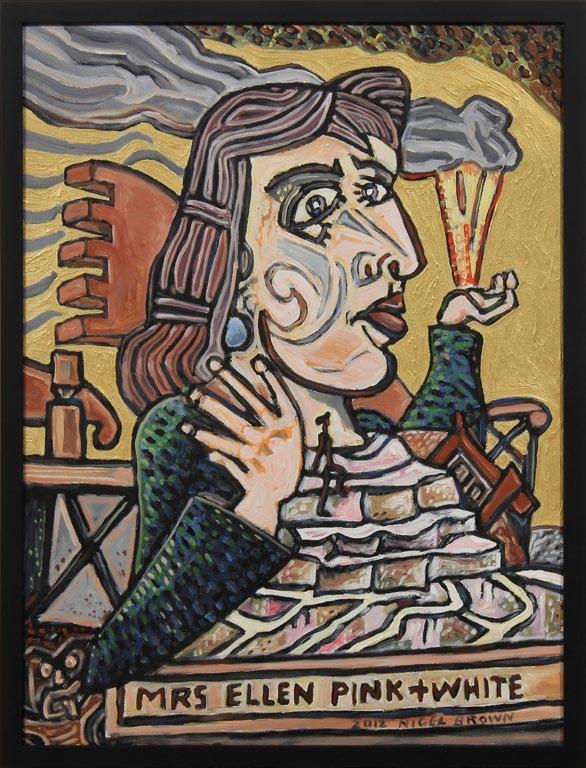
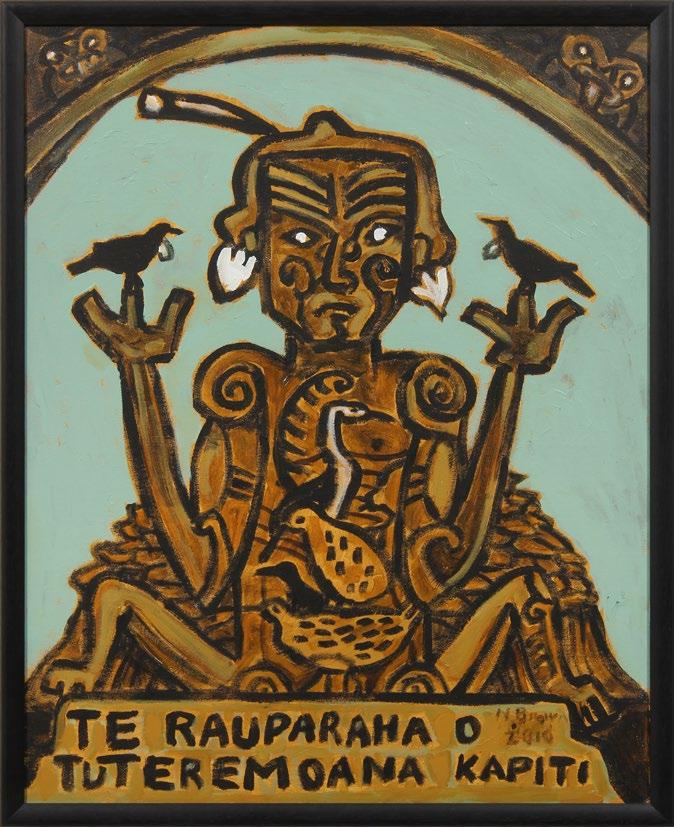
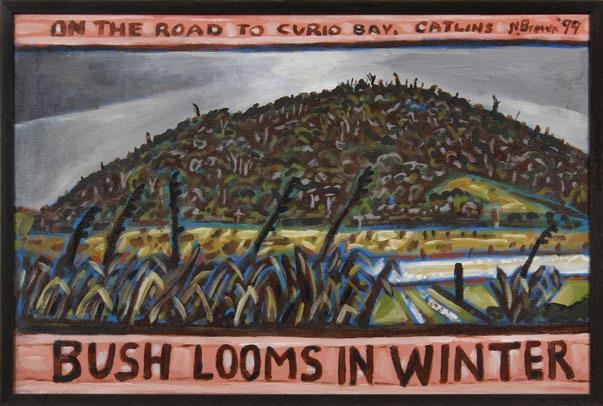
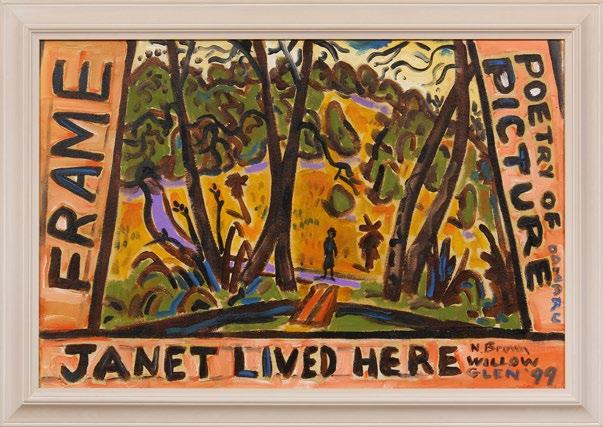
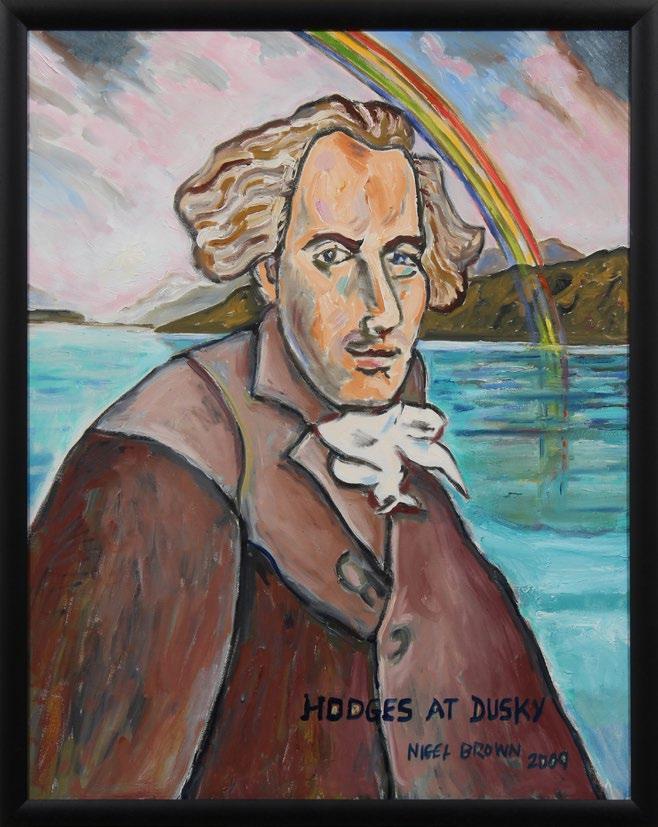
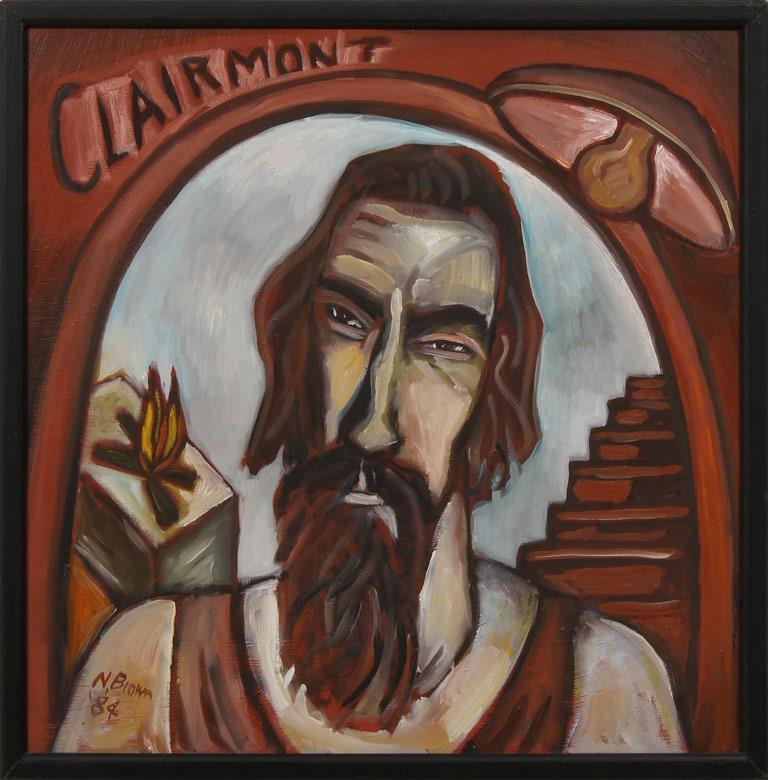
The silent dialogue continues with every painting. Portraits recall this country’s cultural history: Clairmont, tormented Christ figure in a black singlet, Baxter with his open book, Hanly in words and vivid colour, Richard Nunns and his taonga pūoro, Frame, not in person, but lurking somewhere surely, that shy elusive genius, in an Oamaru landscape of scrub and creek. Portraits from our deeper past are weighted with classical forms and political inference: William Hodges, the romantic aboard the Resolution, finds terra nullius at the end of the rainbow in Tamatea Dusky Sound. Te Rauparaha, legs spread wide, bears tūī and weka on his mountainous body, Tūteremoana. Mrs Ellen Pink and White wears her frilly frock of silica terraces. Landscapes are moody on the road to Curio Bay, streetscapes are low, bare, colonial weatherboard.
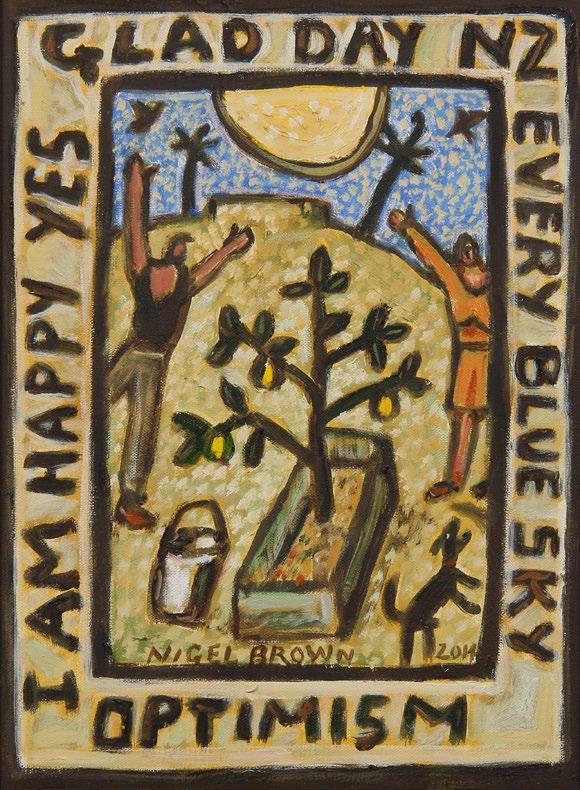
There is a sturdy truth to all of them that is not the simple truth of verisimilitude. They are inhabited like religious art by Brown’s personal index of emblems: moa, kererū, ruru, black dog, five branched candlestick. They are often framed by the classical window arch or by a border of words, in capitals, and capital letters always SHOUT. The frames herald the painting, shaping the way we approach the centre. Phrases of poetic disconnection, for example, amplify the mood of the dancing man, the dancing woman, the fruiting tree and golden sun: I AM HAPPY YES GLAD DAY NZ EVERY BLUE SKY OPTIMISM. Words
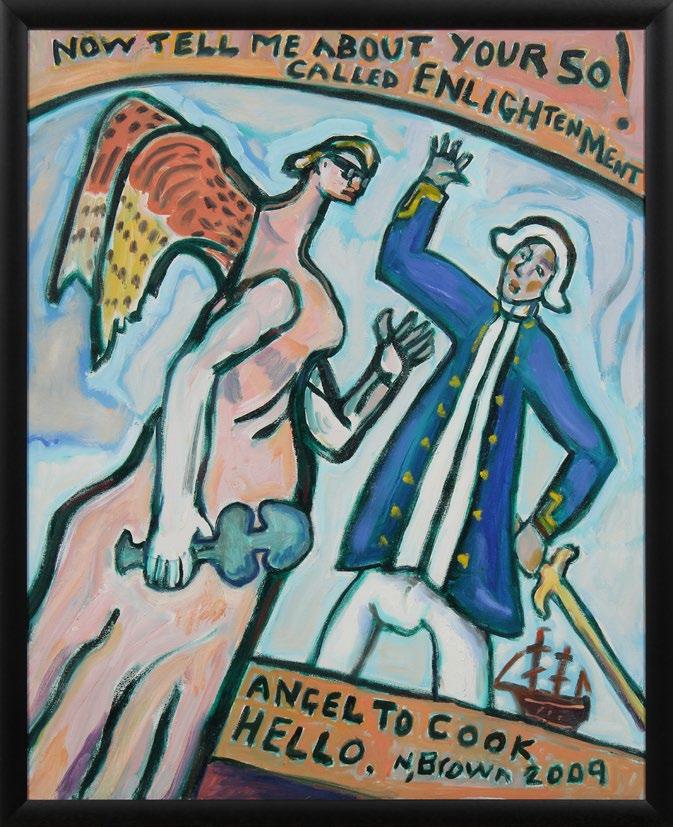
introduce the audio to the visual making wry comedy of the interaction between the angel with kotiate and Cook in his blue jacket and wig: ANGEL TO COOK HELLO. NOW TELL ME ABOUT YOUR SO CALLED ENLIGHTENMENT! Words frame and add ambiguity to a painting of a woman in suit and tie, tied down like Gulliver on a road leading to a Luskian power station, and McCahon’s I AM is cut short: IMAGINATION GETS YOU INTO TROUBLE WE CANT ROMANTICIZE IN THIS TIME OF FACT AND FIGURE? REALISTIC? Sometimes words take over in a Lettrist tumble, as monumental as the title of some Hollywood epic: NATURE CRUEL. JOY HAPPINESS LUCK. LET TIME BE STILL.
I read. I look. I see on the white wall the lively mind, the politically committed artist, member of VAANA back in 1984, persistent visual critic and commentator. The Pākehā artist coming to terms, as every artist, composer and writer of our post-war generation, Māori and Pākehā, has had to come to terms, with a fused identity: our crafts of European origin - portrait, landscape, novel, poem, play, opera - challenged by arts that have evolved over thousands of years across the wide expanses of Te Moana-nui-a-Kiwa. We have been born to a contested place in a contested world, but the point is to try and understand its complexity. To be clear, as these paintings are trying to be clear, about what we see, what we know, what we feel, what we believe. The point is not to say, with monumental certainty, I AM, but to say, WHO AM I? WHERE AM I?
With beauty and love and a lifetime commitment to his art, Nigel Brown does exactly that.
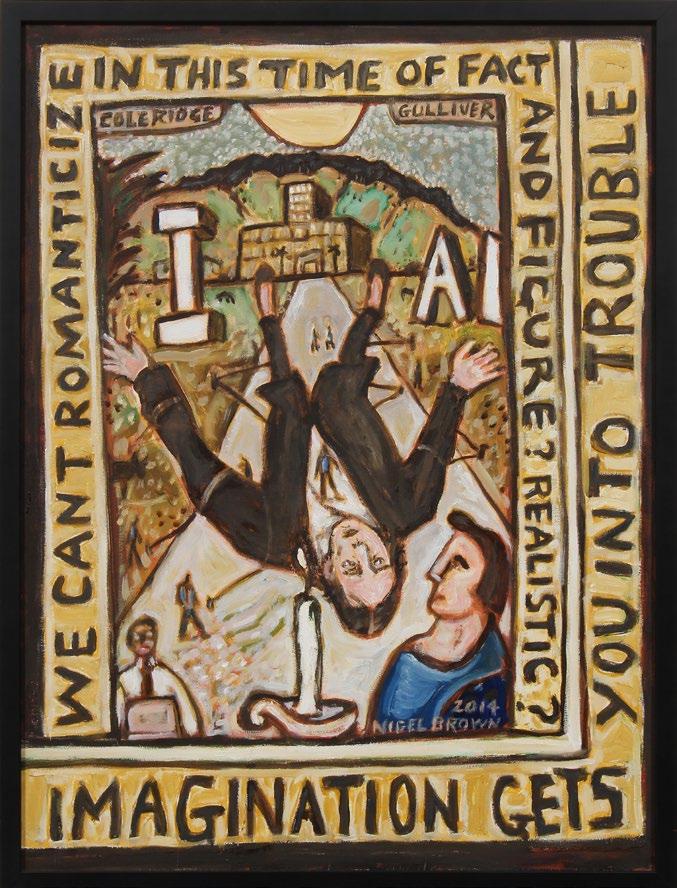
Imagination Gets You Into Trouble , 2014 oil on linen, frame 834 x 632 x 54 mm
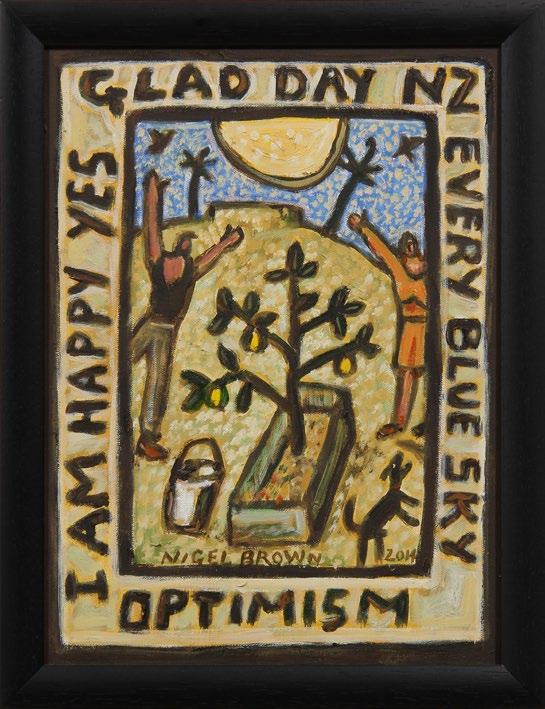
Optimism , 2014, oil on linen, frame 446 x 345 x 63 mm
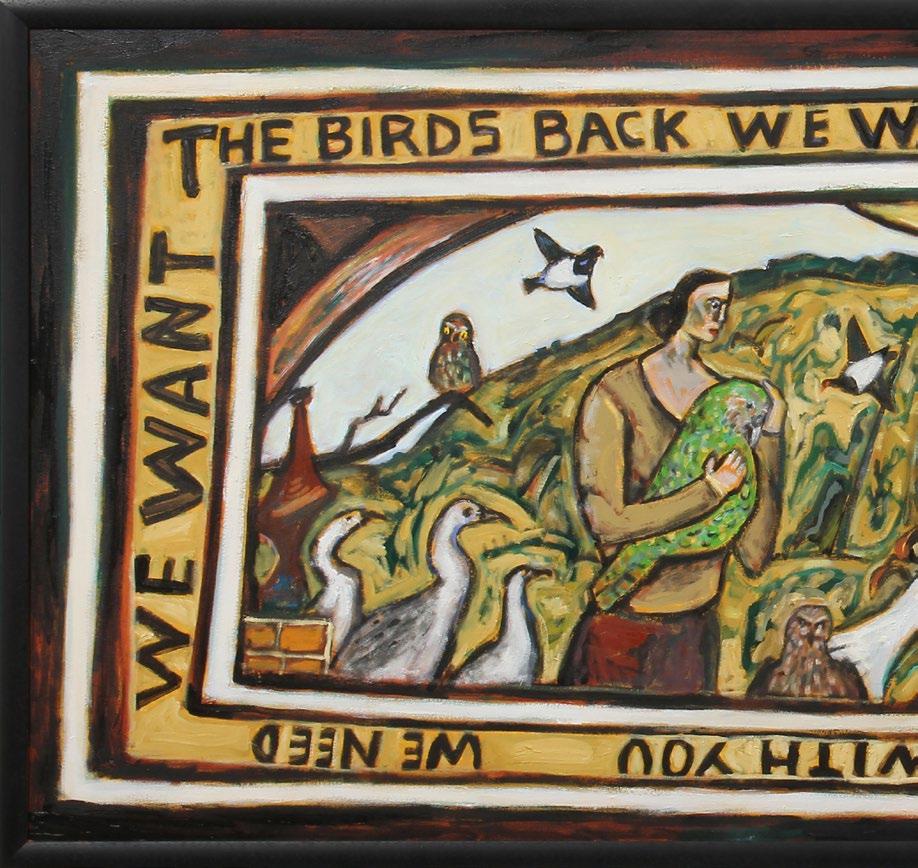
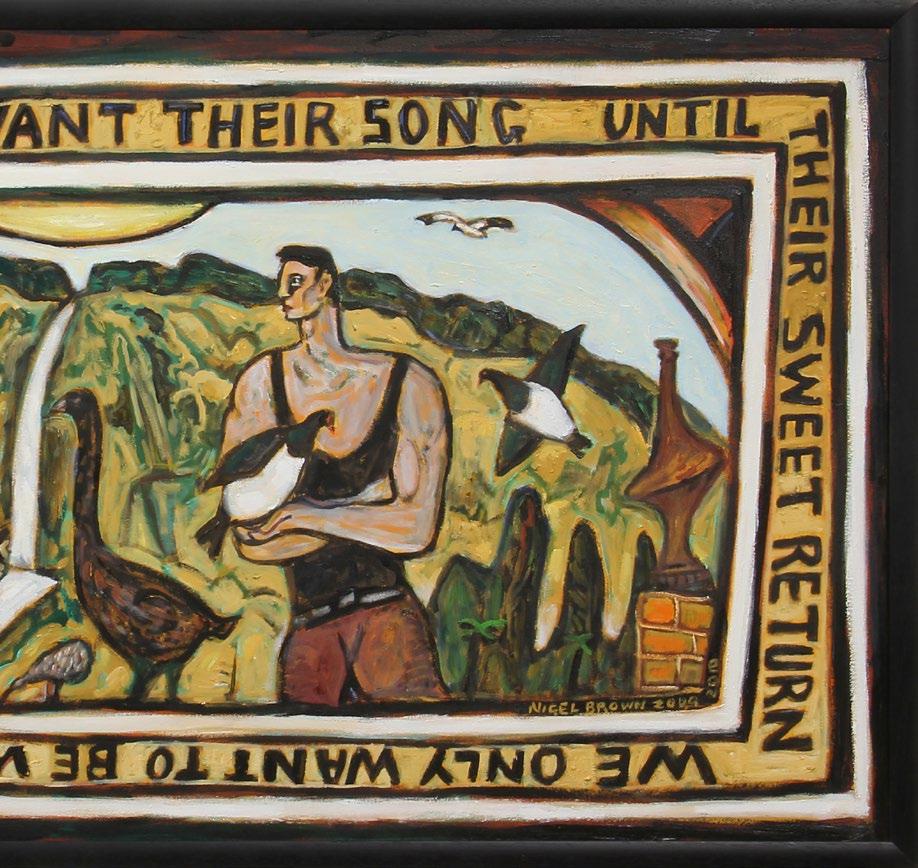
We Want the Birds Back , 2009/10, oil on canvas, frame 848 x 1797 x 60 mm
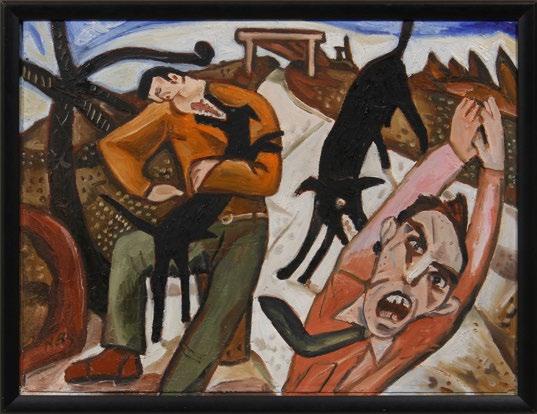
498 x 643 x 36 mm
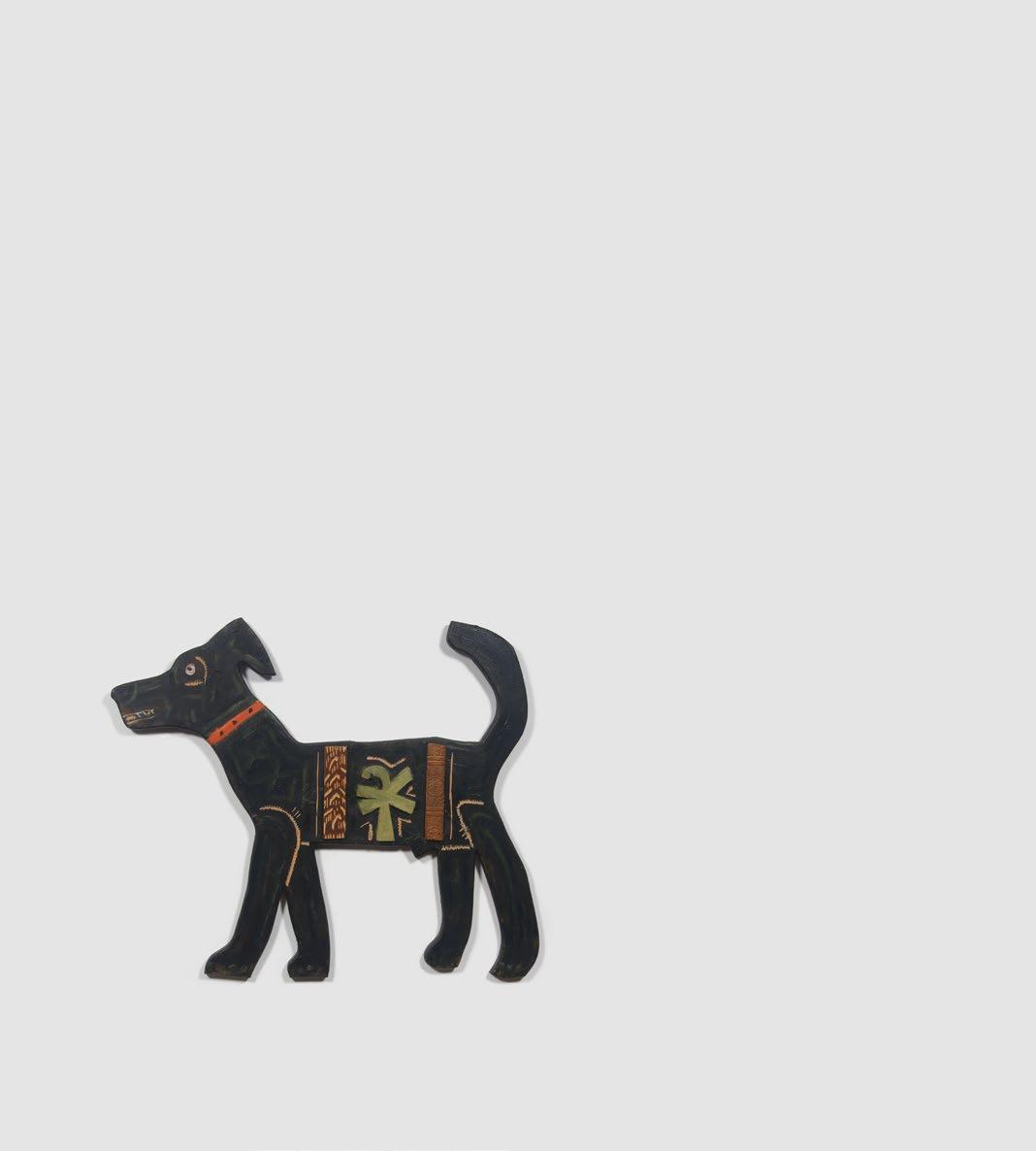
size on wall 695 x 850 x 35 mm
Glenn Colquhoun
I am in a second-hand shop. You know the one. At the turn off. There is a horse-drawn cart outside, its boards skewiff, bleached, iron wheels rusted through. Inside is a dingy hanging from the ceiling. Wooden oars. A vase. A sofa. A cabinet.
A telephone box. Two umbrellas. A painting of a ship. Jesus is hanging from a cross. Four apple boxes stack in a corner. There is a roll of carpet.
A fireplace. A table on top of a table and chairs. A stuffed pigeon. A top hat. A silver brush. A mirror.
Reflected in the mirror are traffic lights. A road sign. A trophy. A skeleton. A telephone. A set of rosary beads. I am swallowed. There is no north. No south. No east. No west. I am home. Not home. Halfway there. Halfway back.
I am in a wharenui. On a mattress. Someone is talking. There is singing. A prayer. A kind of music.
I stare at the whakairo opposite me. It is framed by the one to the right. By the one to the left. By the ceiling. By the floor. I stand and walk towards it. I trace a finger through its hollows. Its risings. Its fallings. It is beautiful. Grotesque. Us. Not us. I turn my head. Follow its flow. Our tangling. It is detailed. Fine. Brutal. Blunt. I am taken. Pulled. My arm disappears. I push backwards. My face presses into the timber. I arch. Claw. Wrestle. Fight. My weight shifts. It smells me. Tastes me. Rolls me inside of it.
I am in a dream. Running through a forest. A tree drags me to the ground. Pulls my hair. I dig my fingers into its bark. I push it away from me. Now it is a gecko. Eyes black and impassive. Now it is the angel Gabriel. James Cook. Te Rauparaha. A black dog eating from my stomach. My head is served up to it on a platter. A sentence slithers towards me. Wraps around me like a python. I feel each letter bite. It is a bird now. Carrying me upwards. Over a yellow field. Over red hills. Towards a green sun — where we unravel. Fall. Run like wet paint. Arms and legs clutching at the
sky. A nail is driven into my feet and my body is stretched around the outside of a painting. My head looks up at my back. I am a sky. I am a range of hills.
I am looking over a child’s shoulder. She is drawing. With crayons. There is a picture of a man in a bright blue coat. A ship. A pink woman with a green bird in her hand. A red vase. A white flower. Her pictures are quiet. Uninterrupted. Each holds a center. Everything circles this. I can’t tell if they are happy or sad. They are bold. Simple. Open. Secret. Objects sit next to another. When I look again they seem to have swapped places. Am I in on the joke? They look through me. Into me. Have me on. Wink. They know something I don’t know. I can never catch them. Us. Myself. I know something I don’t know.
I am reading a poem. Black is a word. Blue is a word. Yellow is a sentence. Gold is an exclamation mark. Red is a set of instructions. Some words are pictures. With texture and heft. They are hewn things. A bird is a word. A cat is a word. A punga
is a word. A singlet is a word. A beard is a word. A candle is a word. A man playing a guitar is a word. Each has meaning. Serif and stroke. A relationship to the past. I am in a poem-painting. A painting-poem. A shimmer. A blink. A now-you-see-me-now-youdon’t. A beginning. A middle. An end. An I told you so. A sheet-anchor. An everlasting.
I am being followed. A cat is following me. A dog is following me. Three kererū. I am stuck in the canvas. It is unravelling. Is it somewhere behind? Is it somewhere ahead? I talk to a man in a shop. Is he someone from the painting? I pass a tree. Have I seen it before? I pour myself a glass of water. This jug is familiar. I hide from the rain. Its clouds are familiar. When the sun comes out I look up. The sky is made of brushstrokes. A tūī throbs. Is she inside the painting? Is she outside the painting? Does she sing from a tree? Is she stuck in the swirl? Am I looking at her? Is she looking at me? You and I. These paintings. Did we meet on the street? Or have we been talking inside of them?
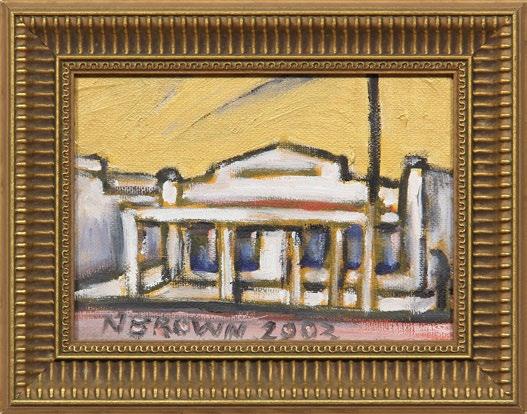
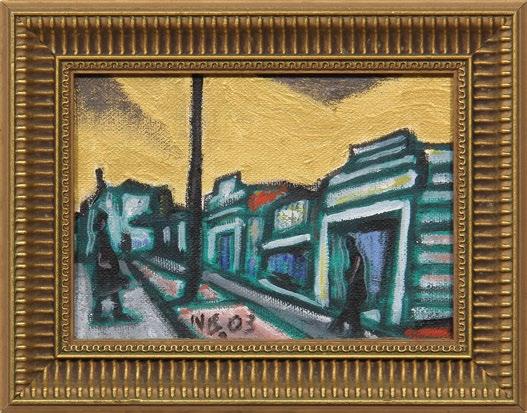
Plumber’s Shop , 2003 / Sec ond Hand Shop , 2003
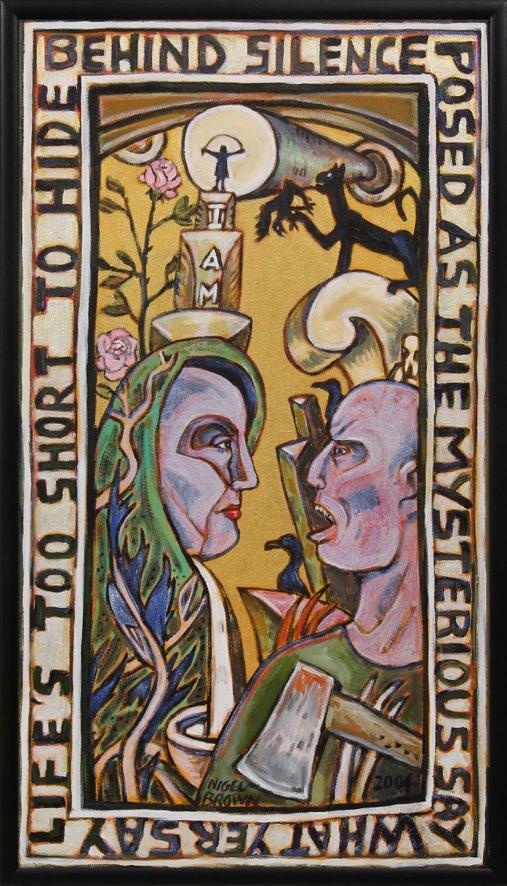
Say What Yer Say , 2004
acrylic on linen, frame 1420 x 810 x 61 mm
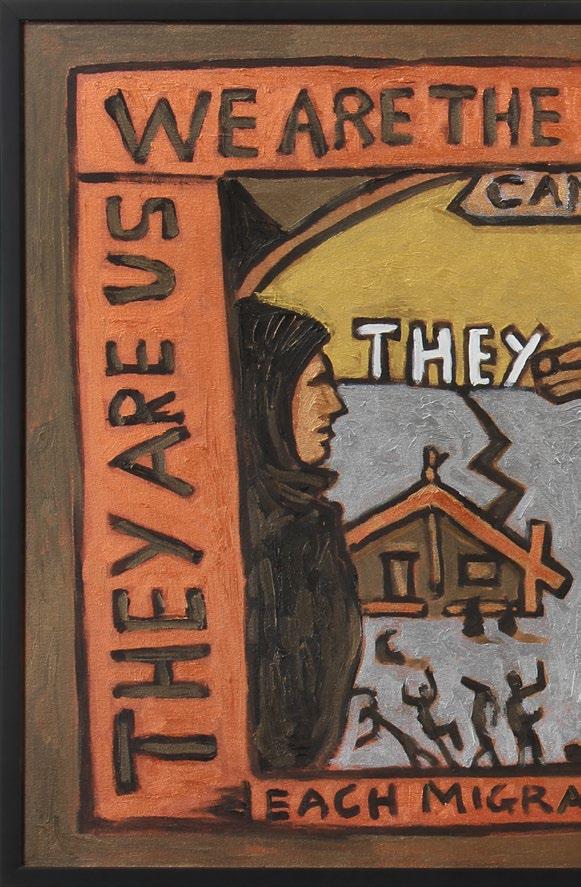
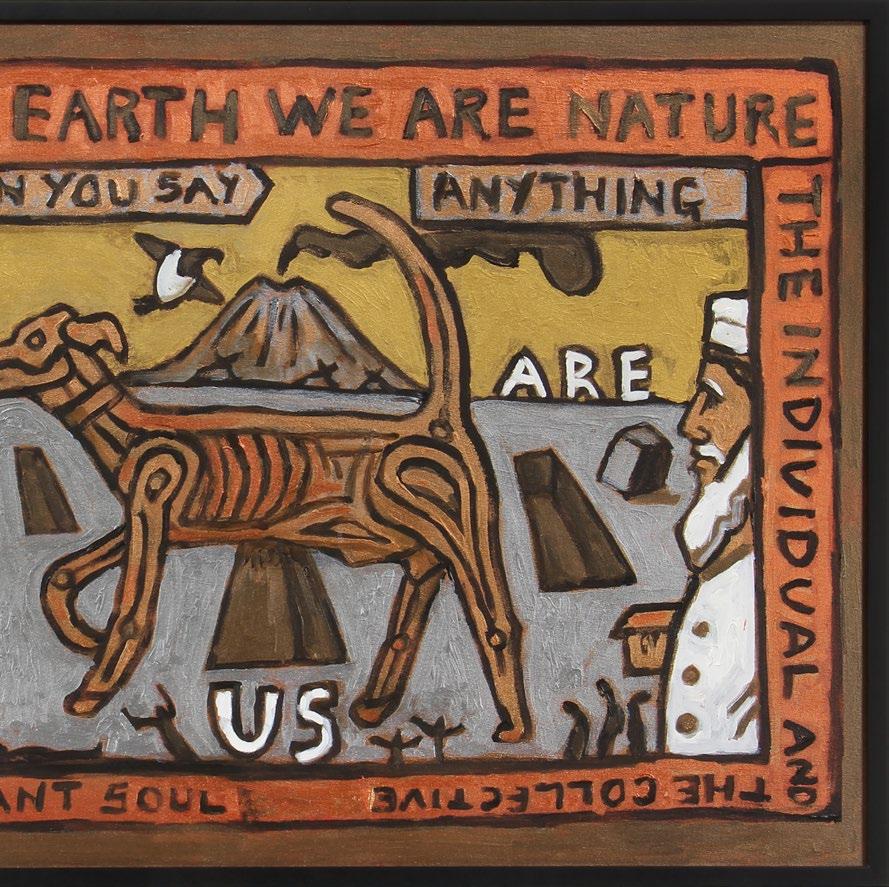
They Are Us , 2019, acrylic on canvas, frame 838 x 1385 x 48 mm
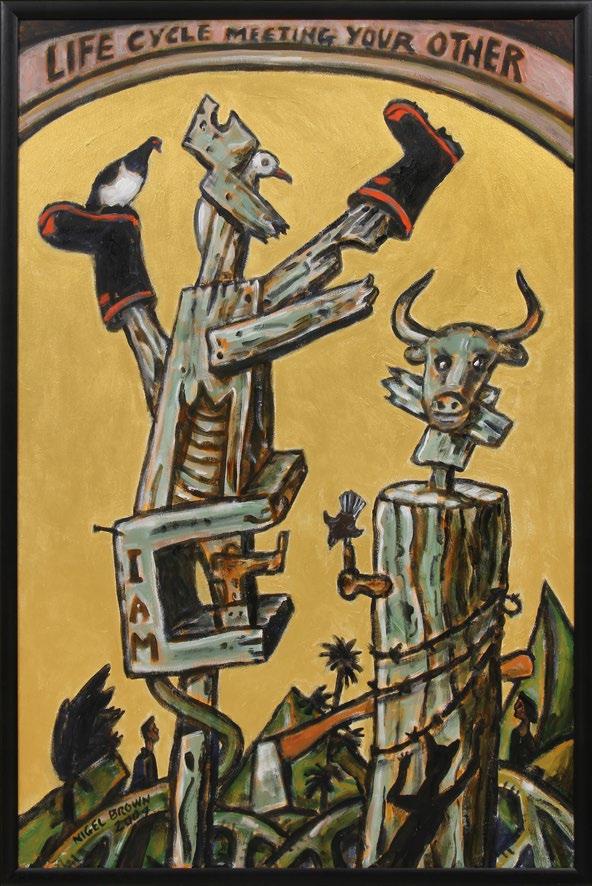
Life Cycle Meeting Your Other , 2004
acrylic on canvas, frame 1395 x 941 x 65 mm
Nigel Brown: Neo-regionalist or Neo-nationalist; Expressive Realist or a Symbolic Expressionist?
David Craig
On the second-last page of his magnum opus The Invention of New Zealand: Art and National Identity 1930-1970 , Francis Pound wraps up his argument by giving a long paragraph quote to Auckland gallerist Peter Vuletic. Vuletic had, in 1981, aimed a harsh polemic at an art practice he called ‘indigenous realism’, for being “based on a naive and simplistic view of what painting in this country should be about, namely, a concern for apparently explicit local subject matter such as supposedly unique New Zealand landscape forms, birds, pebbles, black singlets, harsh New Zealand light, etc. Add to this a messy preoccupation with autobiographic trivia and you have in the work of McCahon, Binney, Smither, Harris and Nigel Brown the perfect recipe for producing a confused mess”. Vuletic further expanded his ambit: “Those folksy artists who indulge in regional indigenous preoccupations, such as McCahon and Woollaston, have taken the easy way out of the problem of overseas influence”. New Zealand artists, Vuletic concluded, “must come out from under the fern if they are to produce demanding art”. 1
1 Francis Pound, The Invention of New Zealand: Art and National Identity 1930-1970, Auckland University Press, 2009, p. 376.
Here Vuletic (and by clear intent / association, Pound) handed Nigel Brown a very backhanded compliment: grouping him with the great tradition in New Zealand painting referenced to national (and also more universal) concerns. But then he goes on to consign all of them to the ‘too- easy’ basket of rusticated land- and mind-scape. For Vuletic, as for Pound, serious New Zealand painting had to address itself to international matters of form and content, along lines sharply (and arguably more narrowly) defined by artists including Gordon Walters, Milan Mrkusich and Richard Killeen. Painters, these, of whom Pound predicted that once liberated from their subordination by the older tradition, in the shadow of which they had ‘occupied at best two provincial hillocks, would [then] ascend [New Zealand’s] highest and most sun-touched peaks’. 2
It was also Pound who offered Brown the label titling this essay - ‘neoregionalist or neo-nationalist’ 3 - a damning and confining labelling which Brown adroitly countered with much more expansive notions, calling himself an ‘expressive realist or a symbolic expressionist’. Thus ‘ transcending ’ as Gregory O’Brien put it, “adherence to a single locale, the singular view of / from here”. 4
We will put aside the critics’ pushing their preferred artists into the
2 Ibid. p. 377.
3 Francis Pound quoted in Gregory O’Brien, Nigel Brown, Random Century, 1991, p. 50.
4 Gregory O’Brien, Nigel Brown, Random Century, 1991, p. 50.
most transcendent place, on what was still a local podium. But we might well conclude with O’Brien that the plurality of ‘expressive’ ‘realistic’ ‘symbolisms’ do indeed seem to construct a much fairer epithet for Nigel Brown’s rich, plural, iconicised narratives of issues in place. And for his engagement with issues of not just trivial / biographical / local relevance, but of global significance: gender, masculinity, domesticity, environmentalism, regional (nuclear) security, apartheid, colonial inheritance, political geography and topography, social relations, the human condition, prophetic truth, activism, human rights, poverty, inequality…
I was very eager to follow McCahon’s example and discover my own symbolic language within my immediate environment. But I also learnt to take caution in the making of images.
Some people tell me I have presented [James K.] Baxter as a Byzantine saint. I think I depict him as a more extreme entity than myself… with a similar view of suburban life. - Nigel Brown, 1991. 5
The images in Broadly Speaking , drawn from across over 40 years of Brown’s work 1982-2025, display elements that are locally set and presented, and do indeed repeat, get re-deployed… but along the way they disrupt any easy view of a single locale, ‘singular view’ or simple
5 Ibid. p. 13.
answer. Much of this is based in the staged and dramatic play of the iconic elements Brown consistently incorporates into his work, and the laconic way the painter has of presenting these elements and the issues they announce in a kind of uncertain, unresolved vernacular.
From - and in powerful relation to - this regional / general place / location, Brown from the early 1970s onwards marshalled a large range of iconic and symbolic elements rendered via a rough, direct handling of paint, in a flattened perspective, almost woodblock-cartoon manner, with multilayered framings, often including prophetic declarations or critical questions in text. Thus, Brown has staged and dramatised significant elements and issues in his own literally iconic framings, bringing picture scene / location, text, symbol and frame together like actual icons, populating their often tight spaces generously, and typically producing untypical narrative propositions.
In this, it is fair to say that these works make their statements from the edges of iconicity: if you like, the periphery, even the antipodes. They present as do-it-yourself icons, not resplendent with thin gold paint or imposing frames, nor demanding holy reverence or embodying divine authority. Rather, they set up a play with iconicity that is deeply concerned with representing (and problematising) local and global themes. These themes take us even further away from the clear, simple symbolism of previous icons, including those of international ‘modern iconic’ painters like Georges Rouault.
Like Rouault, Brown transforms the icon by replacing saints with social figures (in Rouault’s case, clown, judge, outcast), achieving a kind of compression between classic (iconic form and symbol) and modern (expressively rendered, open narrative) format. But at the same time, he replaces iconic claims to represent or even embody the reality of eternal truth, with much more contingent, relational, laconic questions which we might sum as asking “what is it like to be here ? What can we say or paint here that’s real or true?” Brown’s paintings are attempts at globally relevant iconic formulation, discovered in everyday, Aotearoaspecific issues. In recruiting them, as O’Brien notes, Brown “transforms anecdotal and regional elements into events of general significance”.
6
But in this transformation, the iconic / laconic ambiguity is something Brown never relinquishes. This, arguably because the issues he addresses (Pākehā identity, belonging, the environment, social responsibility…) are not simple or settled truths: they remain actively contested, and matters of public debate. 7
6 Ibid. p. 58.
7 Brown’s images are deeply iconic (simplified, emblematic); his texts are laconic (short, blunt, declarative or tentative). This means that the paintings often operate through a series of double compressions: visual compressions (the iconic elements, rough-rendered), and verbal compressions (the laconic, sometimes liturgic or declarative / aphoristic speech). In this larger dialectic, each painting seems to want to state something profound, but has a tentative crack at working it out at the same time. As Broadly Speaking shows, the local raw material for this process can be diverse.
Brown might seem to hold onto these irreconcilable elements - the processual complexity and the iconic / laconic simplicity - at the risk of his work seeming didactic, cluttered, simplistic, slightly earnest, slightly awkward all at once. A risk of being seen stumbling, as Peter Vuletic put it, upon “the perfect recipe for producing a confused mess”. 8 Brown does it, perhaps, because in fact the ambivalence is not something he wants to resolve in the painting itself. It needs resolving elsewhere, and by others, people viewing his paintings in particular and real places in the wider, complex world. That said, Peter Vuletic & co, with their own simple, authoritative clarities and universal complexities, were likely not the people Nigel Brown had in mind for the job.
8 Francis Pound, op. cit. p. 376
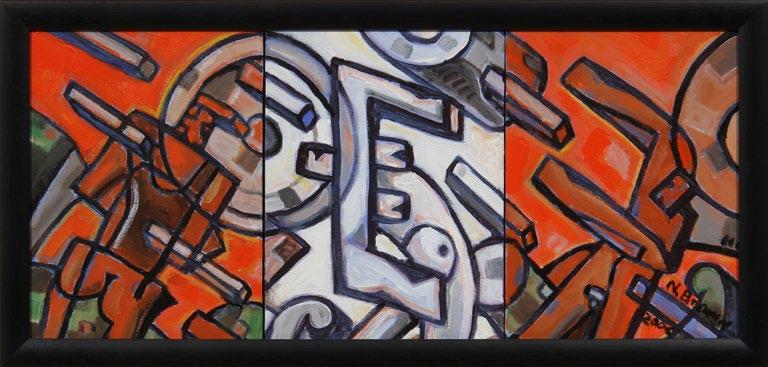
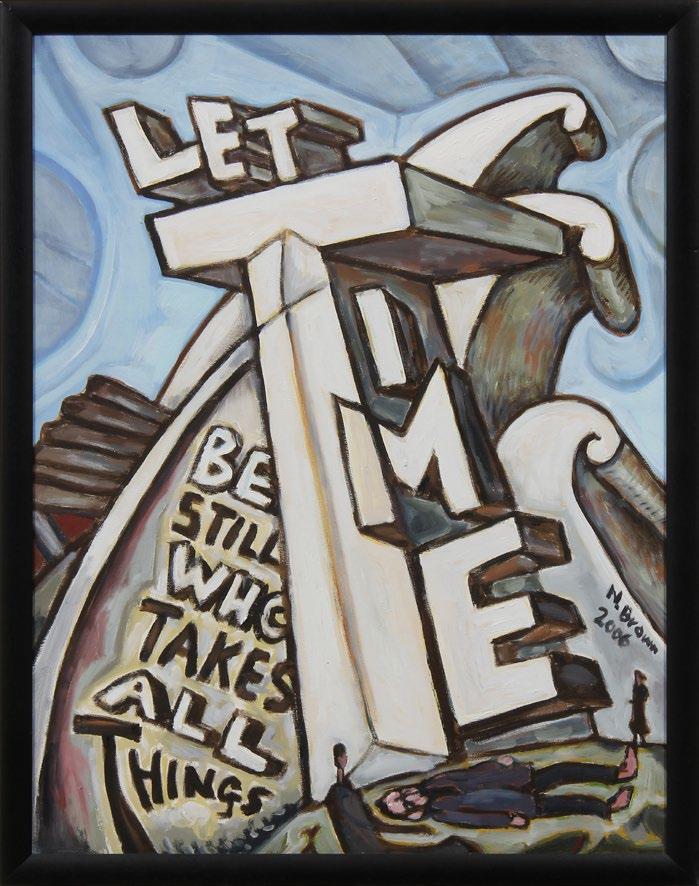
Let Time Be Still No. 2 , 2006, oil on canvas, frame 756 x 603 x 60 mm
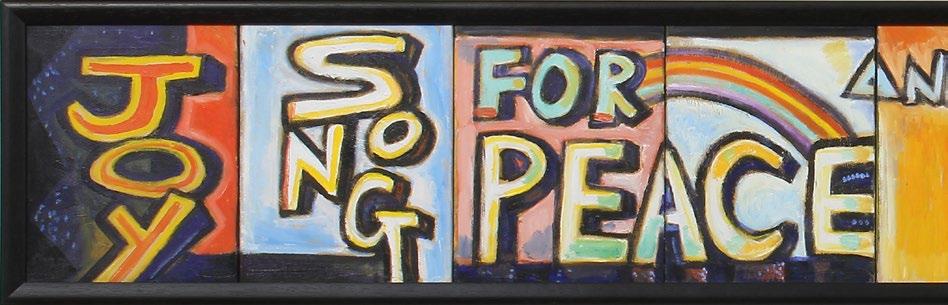
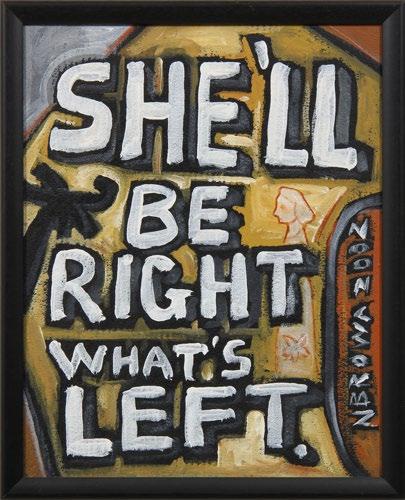
She’ll Be Left , 2002 acrylic on wooden panel frame 507 x 411 x 36 mm
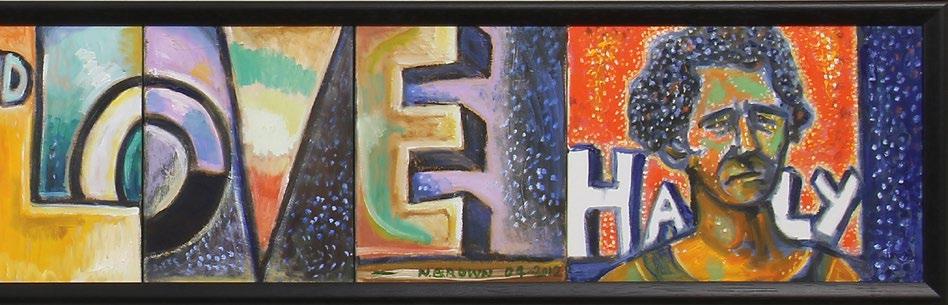
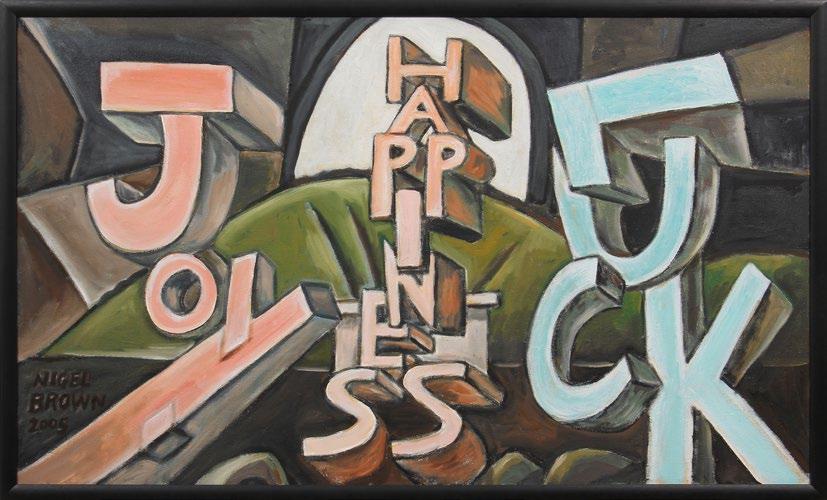
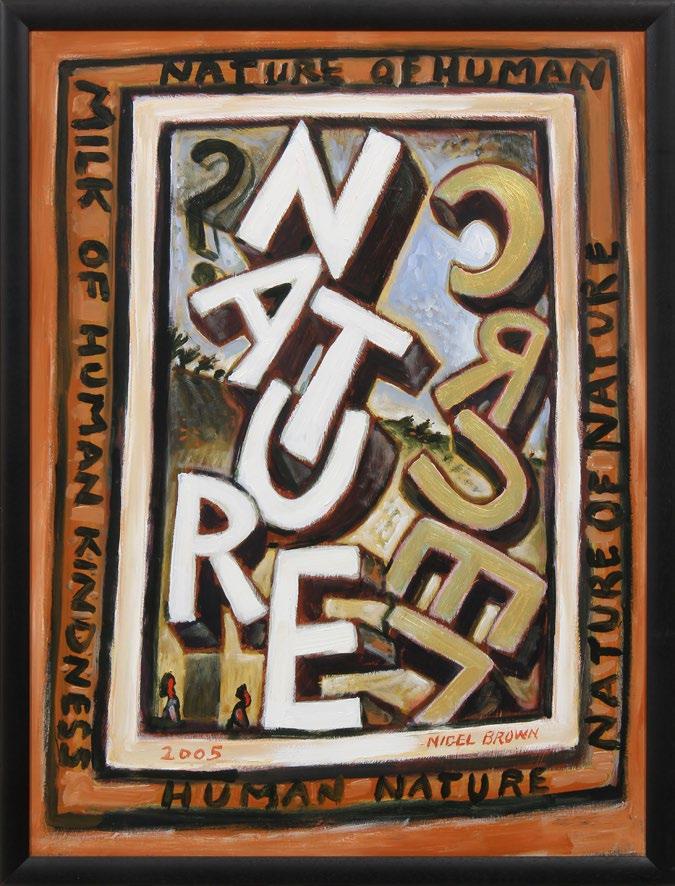
Nature Cruel , 2005, acrylic on board, frame: 840 x 643 x 61 mm
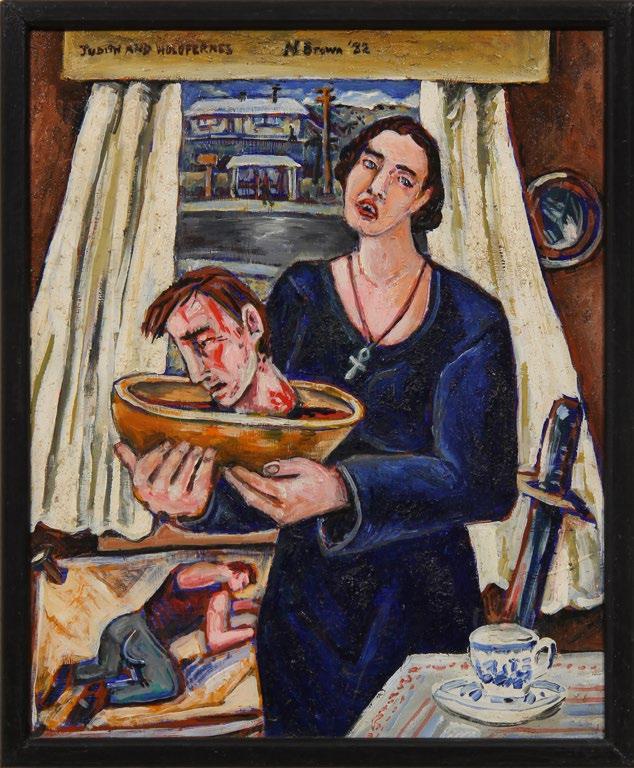
Judith and Holofernes (with Street View) , 1982 acrylic on board, frame: 590 x 493 x 58 mm
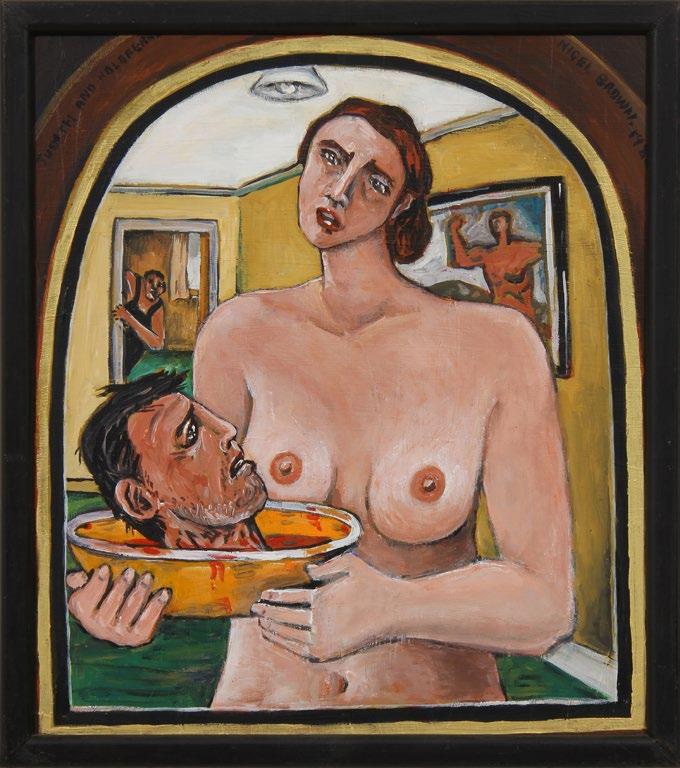
Judith and Holofernes , 1982
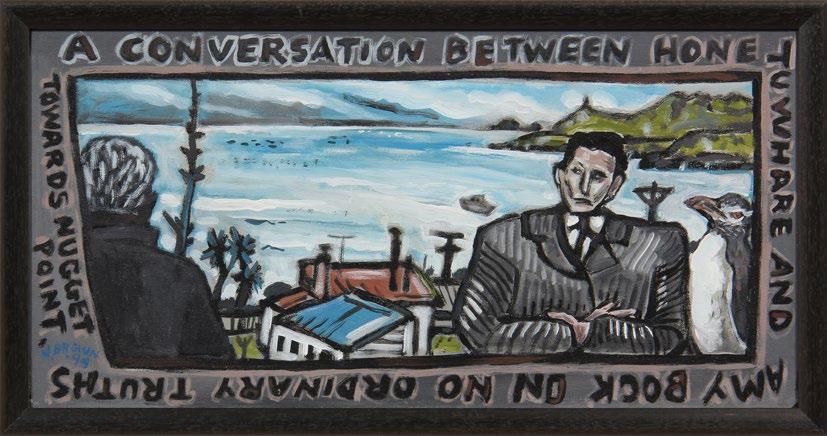
A Conversation Between H. Tuwhare and Amy Bock , 1999 acrylic on canvas, frame 342 x 648 x 32 mm
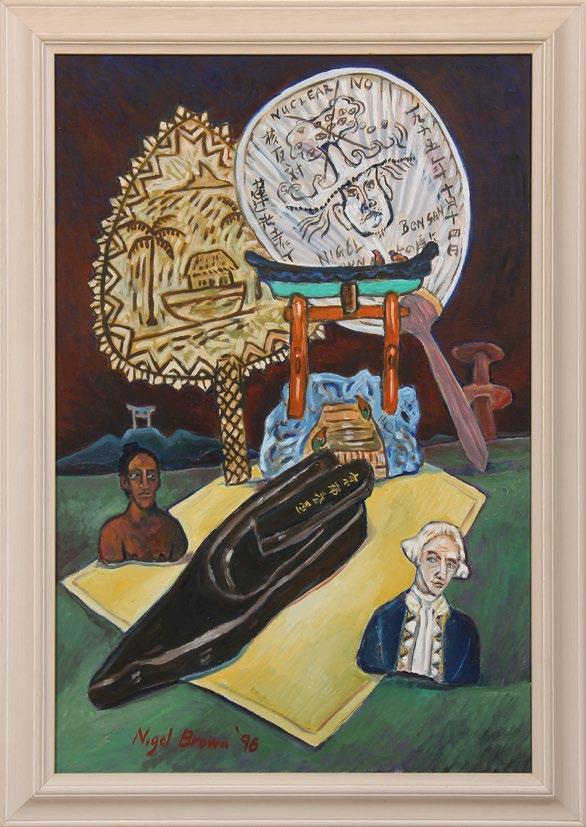
Pacifica Japonisme , 1996 oil on linen, frame 1042 x 737 x 40 mm
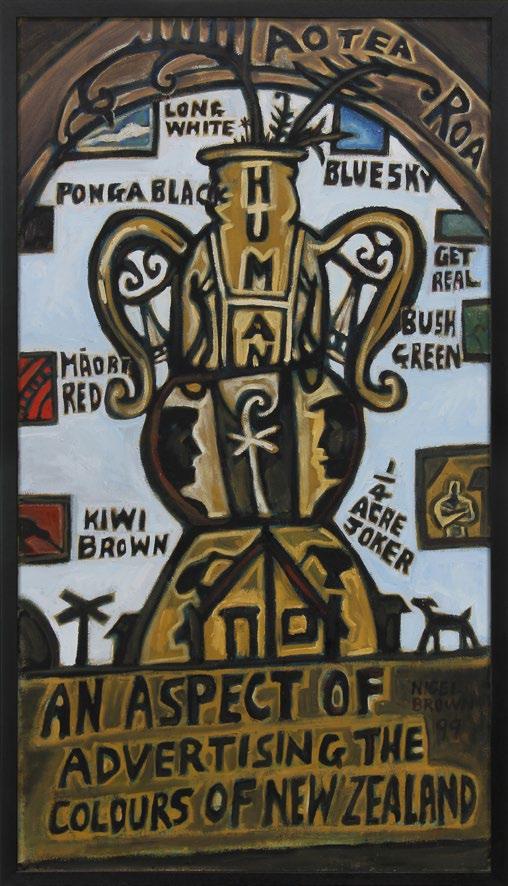
Advertising New Zealand , 1999 oil on canvas, frame 1410 x 804 x 45 mm
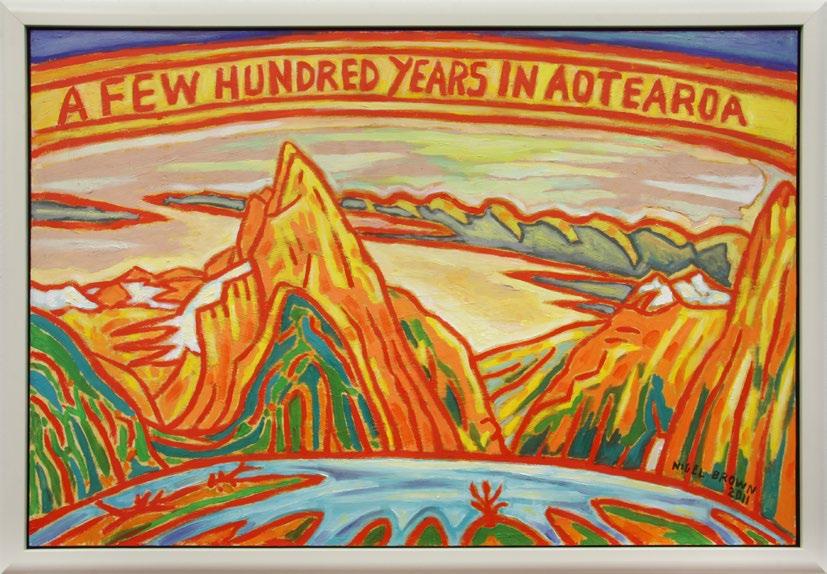
A Few Hundred Years , 2011, oil on board, frame 900 x 1305 x 45 mm
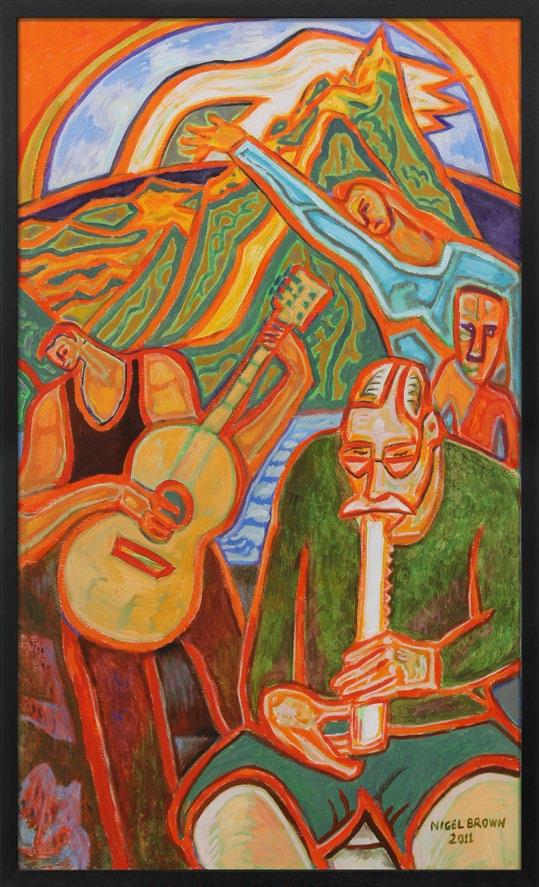
Being Here Music , 2011 oil on linen, frame 1392 x 845 x 45 mm
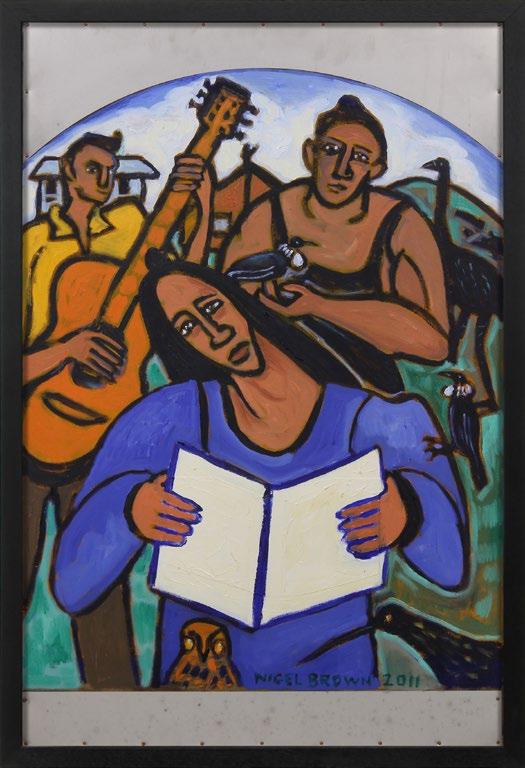
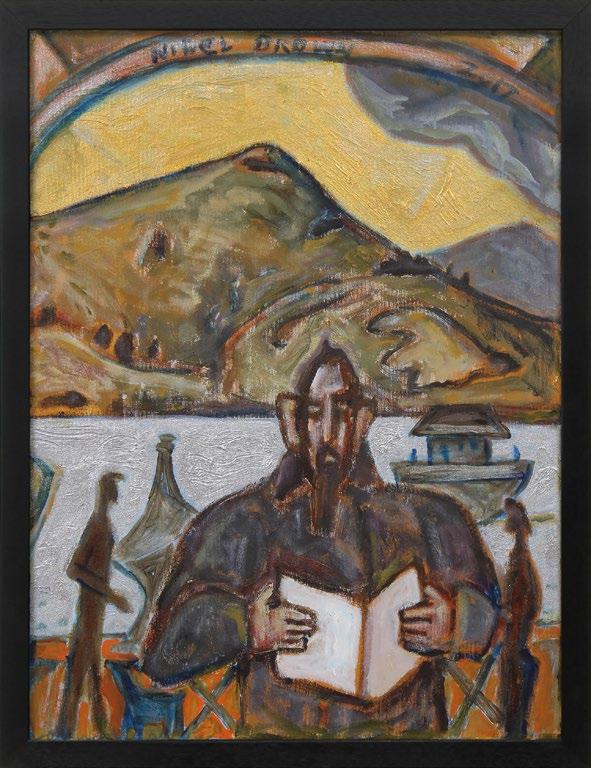
Reading for Harbour Cone , 2017 acrylic on canvas, frame 650 x 497 x 45 mm
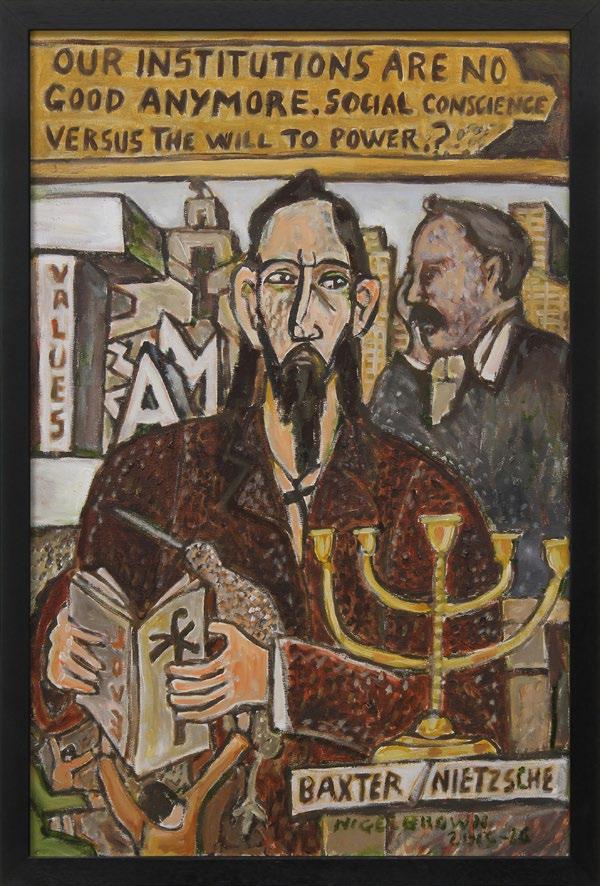
Our Institutions , 2015/16 oil on canvas, frame 800 x 548 x 45 mm
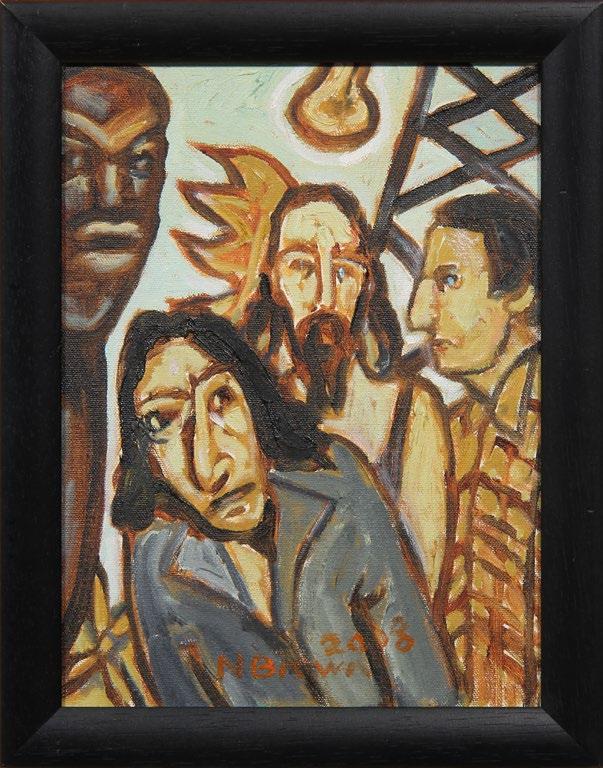
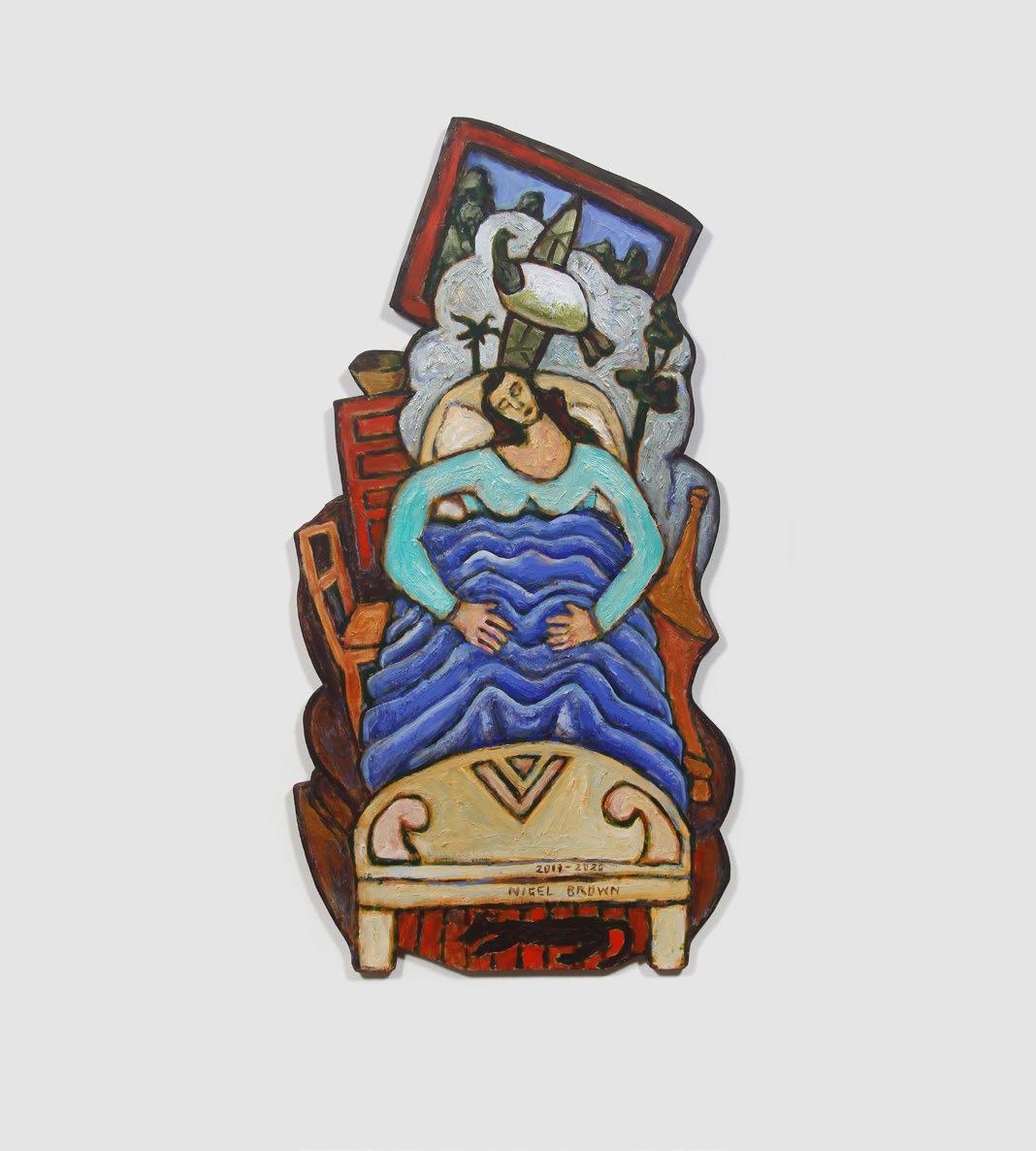
Woman , 2019/20

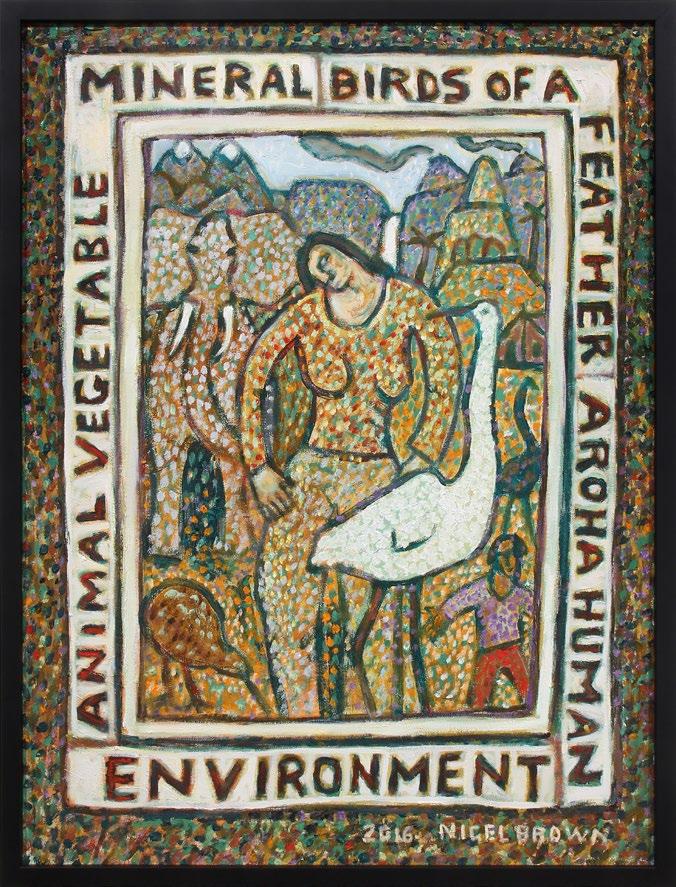
Environment , 2016, oil on linen, frame 835 x 637 x 52 mm
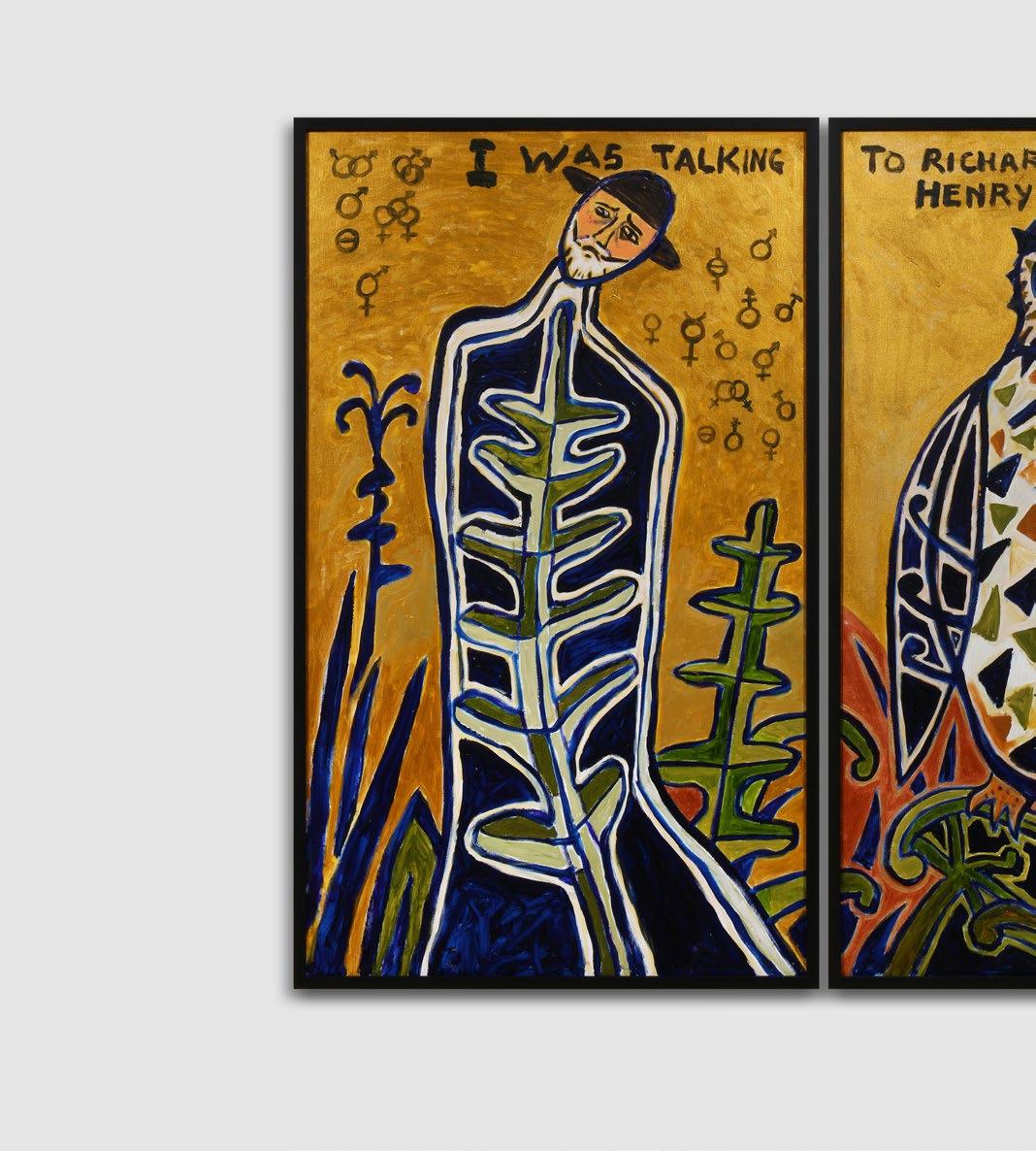
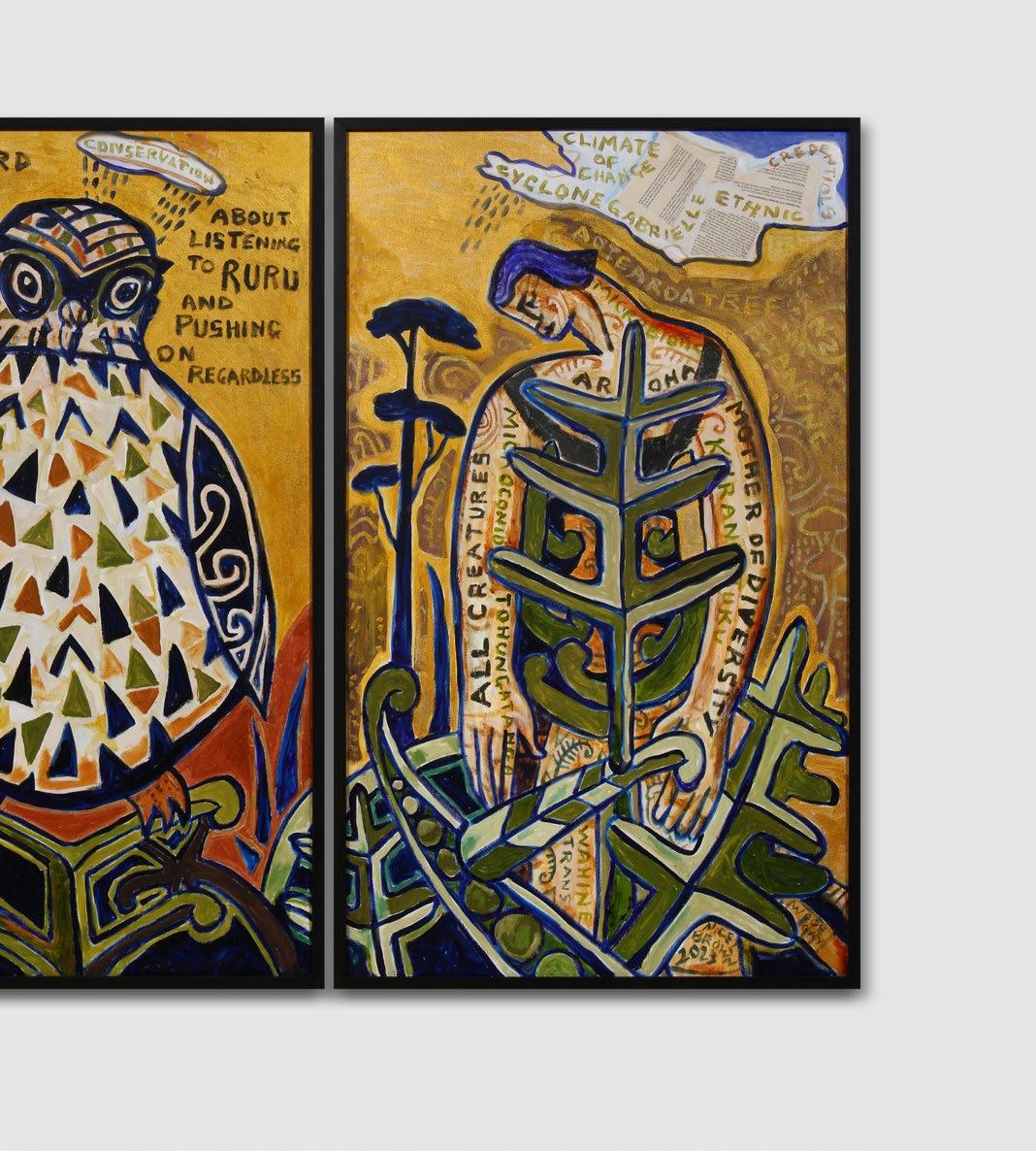
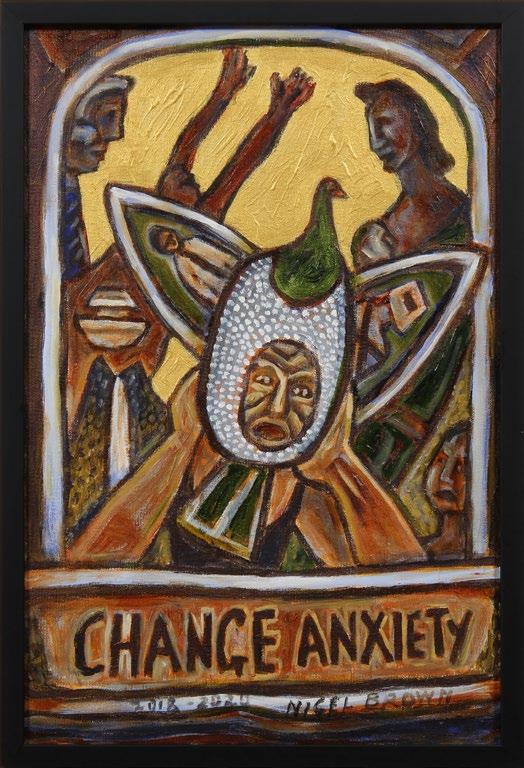
Change Anxiety , 2018-20 acrylic on canvas, frame 635 x 436 x 50 mm
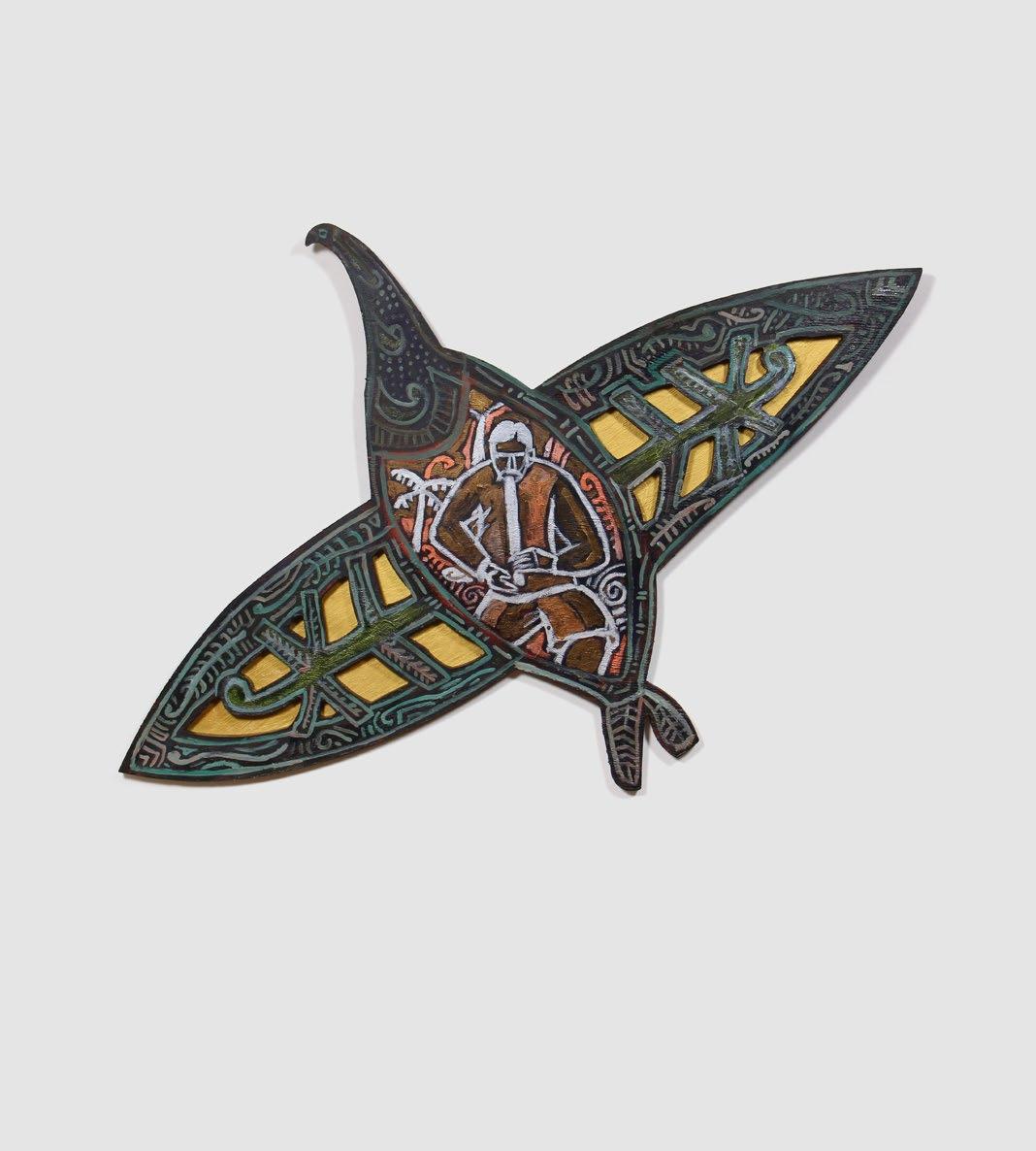
Kererū for Richard Nunns (First Version) , 2020/22
acrylic, glitter on plywood, size on wall 875 x 1230 x 22 mm
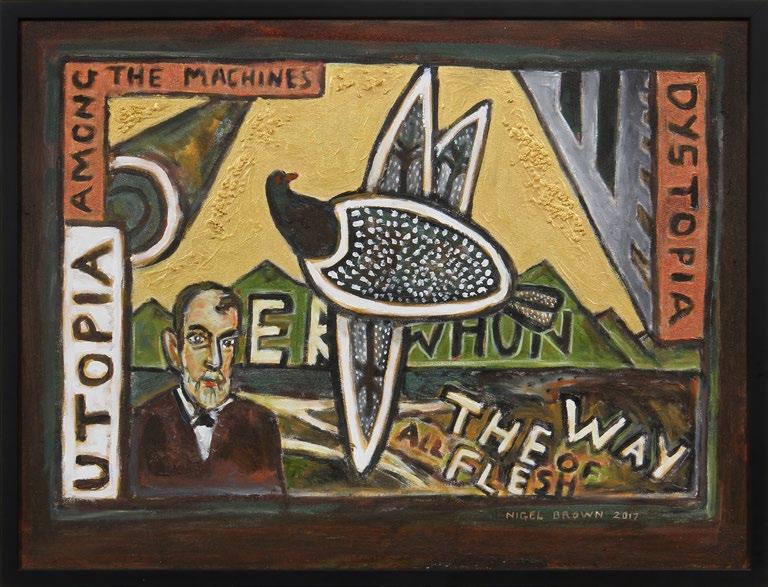
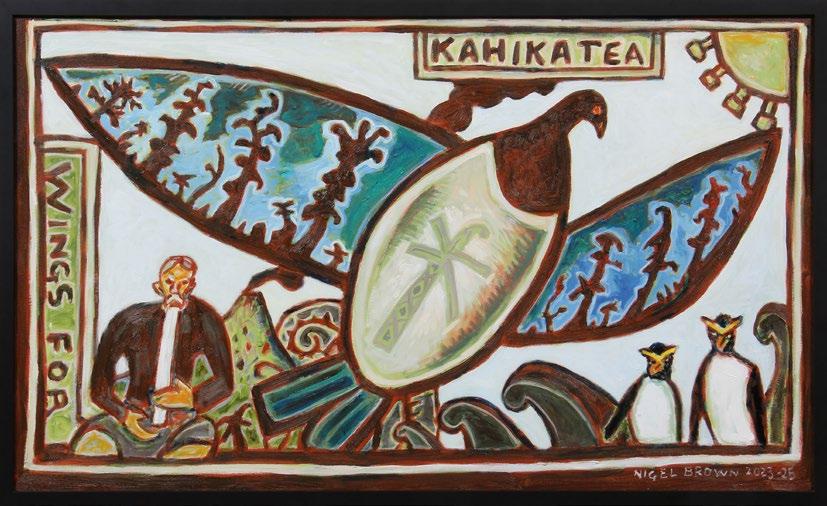
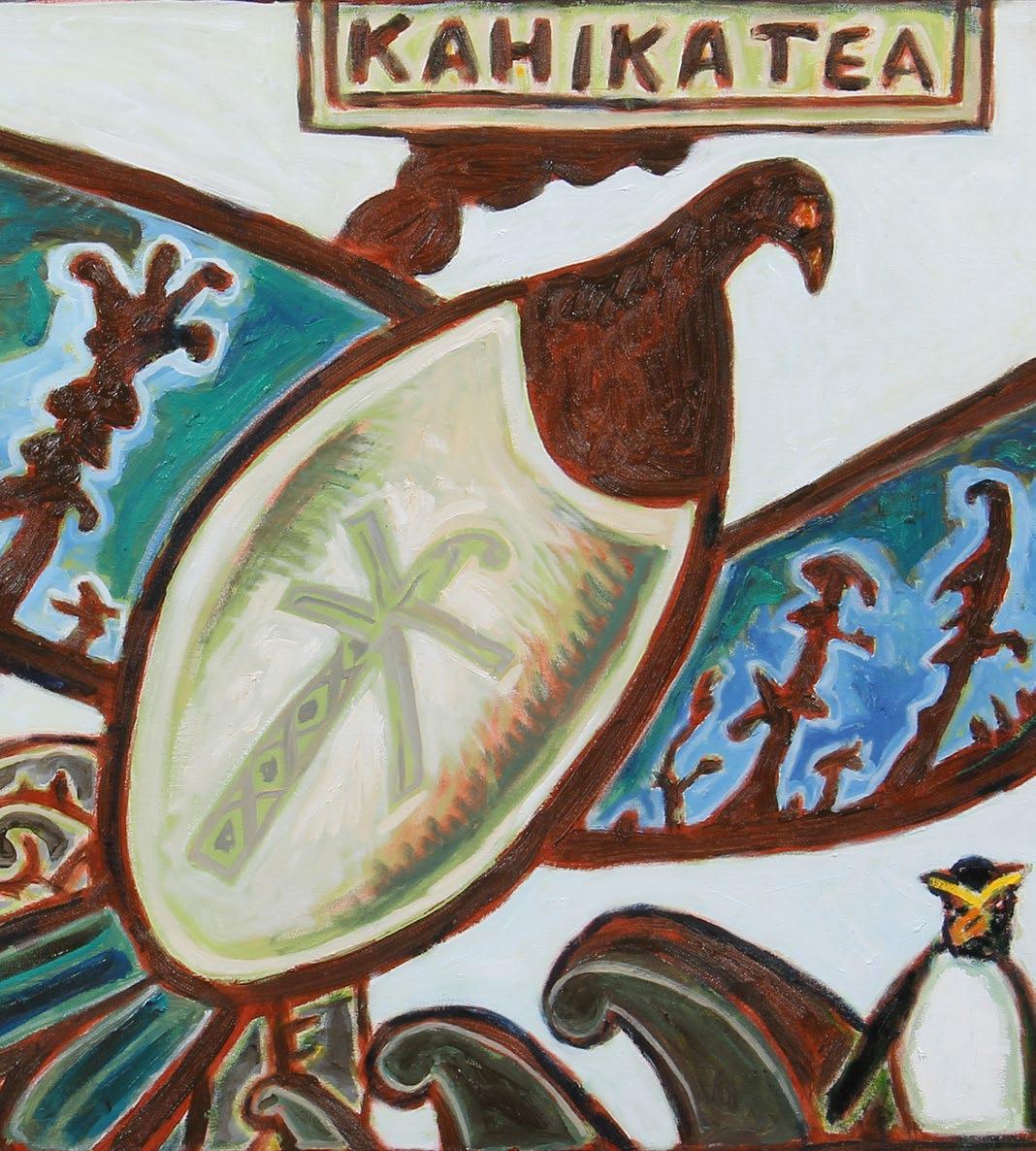
Wings for Kahikatea , 2023-25
oil on canvas, frame 851 x 1400 x 60 mm
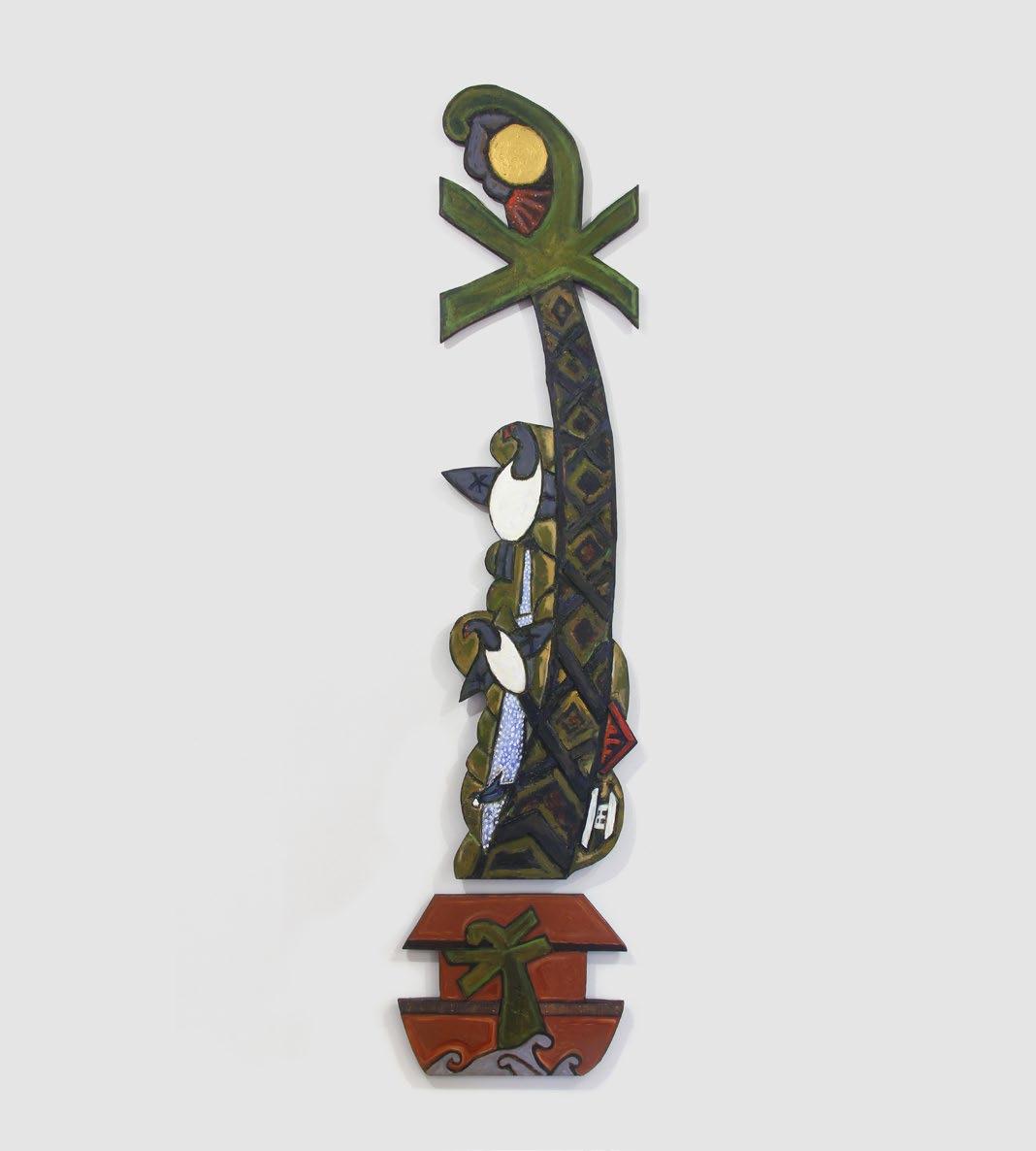
Ponga II , 2017
2 pieces; acrylic on plywood size on wall 2979 x 685 x 48 mm
Fiona Farrell ONZM is a writer who works across a wide range of genres, publishing novels, short stories, non-fiction and plays. Uniquely among New Zealand writers she has won major awards in all these categories. She has held residencies at Otago and Canterbury Universities, and, as Katherine Mansfield Fellow, in Menton, France.
In 2007 she received the Prime Minister’s Award for Literary Achievement, in 2012 she was appointed an Officer of the New Zealand Order of Merit for Services to Literature and in 2022, she became a Fellow of the New Zealand Academy of Literature.
For nearly 30 years she lived at Otanerito on Banks Peninsula but is now resident in Ōtepoti Dunedin. This year she will publish a collaborative work of poems set around Otago Harbour, with illustrations by David Elliott.
Dr Glenn Colquhoun is a poet and children’s writer. His first collection The Art of Walking Upright won the Jessie Mackay best first book of poetry award at the 2000 Montana Book Awards. Playing God , his third collection, won the poetry section of the same awards in 2003 as well as the Reader’s Choice Award that year. He was awarded the Prize in Modern Letters in 2004 and a Fulbright scholarship to Harvard
University in 2010. In 2012 he was part of the ‘Transit of Venus’ poetry exchange at the Frankfurt Book Fair and in 2014 represented New Zealand on the Commonwealth Poets United poetry project which celebrated the Glasgow Commonwealth Games that year. His latest collection of poetry The Ballad of Joe Taihape was published in 2026. He works as a GP in Horowhenua.
Dr David Craig is a New Zealand painter, author, and political sociologist based in Ōtepoti Dunedin, Otago. He taught sociology at the Universities of Queensland, Auckland and Otago, worked in multilateral aid in the Asia Pacific, has written extensively on institutions, governance and development, and New Zealand arts and culture. His cultural interests relate to questions of identity, changing aesthetic regimes, and what Bernard Smith termed “the provincialism problem”: issues that continue to shape cultural life in this part of the world. These concerns inform his contemporary painting practice. In 2012, Craig co-authored His Own Steam: The Work of Barry Brickell , a definitive monograph on the celebrated New Zealand potter, conservationist, and railway enthusiast Barry Brickell.
A Conversation Between H. Tuwhare and Amy Bock , 1999
A Few Hundred Years , 2011
A Kererū for Samuel Butler , 2017
A Modest History of Your Life , 2003
Advertising New Zealand , 1999
Angel to Cook , 2009
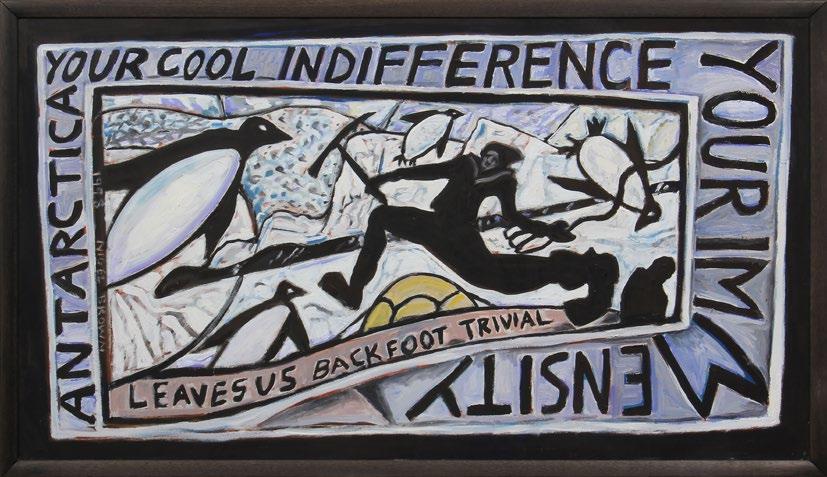
Backfoot Trivial: Antarctica , 1998
Bedroom Woman , 2019/20
Being Here Music , 2011
Black Dog , 2017
Blue Reader , 2011
Bush Looms in Winter , 1999
Change Anxiety , 2018-20
Clairmont Painting , 1984
Environment , 2016
Friend and Foe , 1984
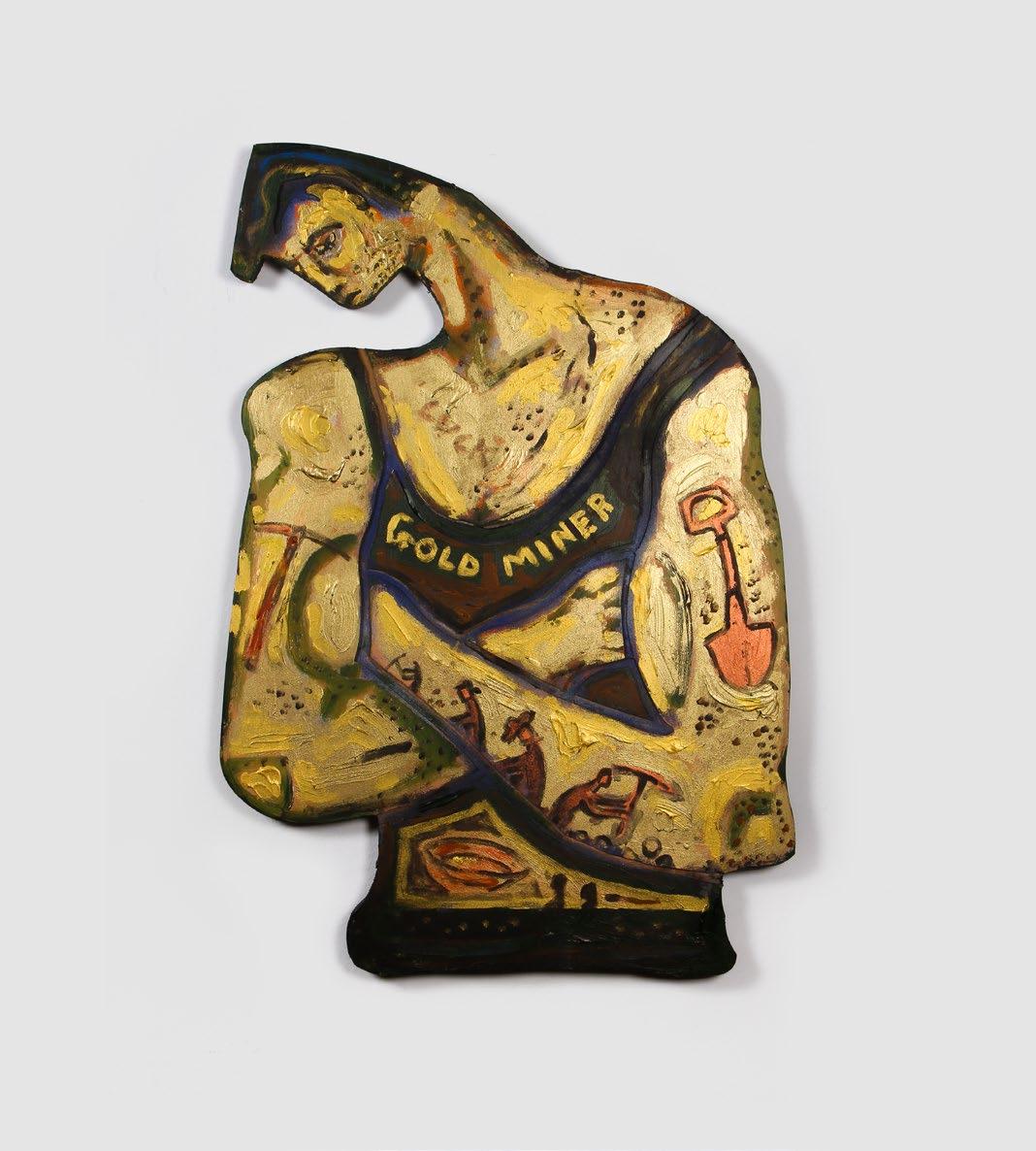
Gold Miner , 2024
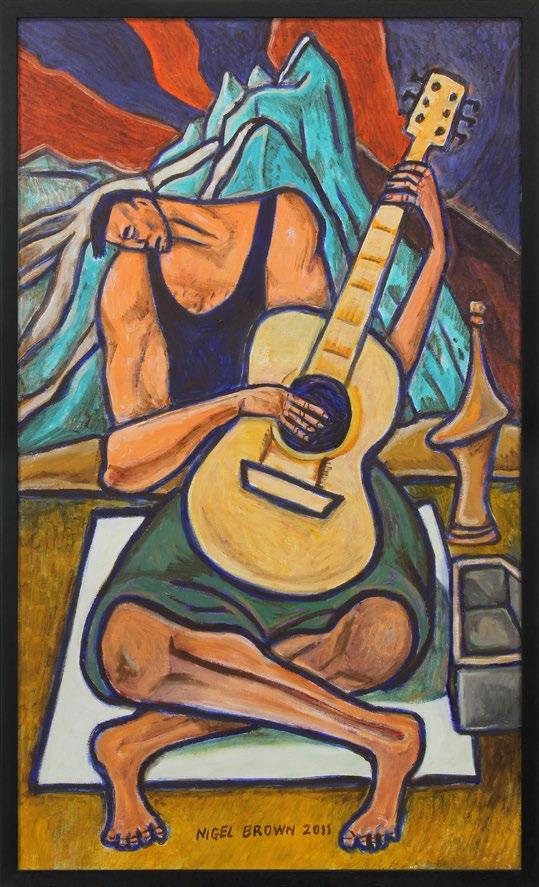
Guitarist’s Mountain , 2011
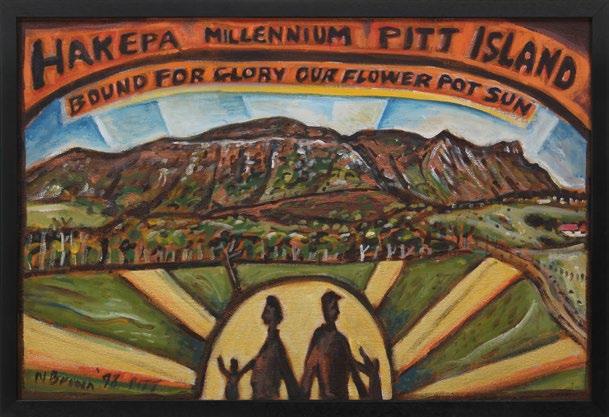
Hakepa (Wake ‘Em Up) , 1998
Hanly Song , 2004/12
Hard Rain Triptych , 2006
Hodges at Dusky , 2009
Imagination Gets You Into Trouble , 2014
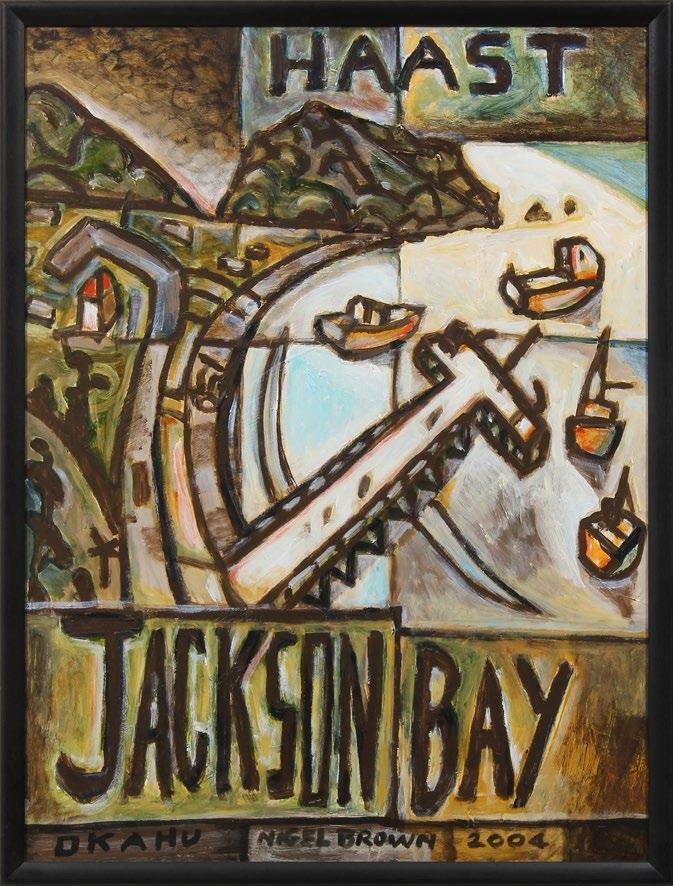
Jackson Bay No. 2 , 2004
Janet Frame Lived Here , 1999
Joy, Happiness, Luck , 2005
Judith and Holofernes , 1982
Judith and Holofernes (with Street View) , 1982
Kererū for Richard Nunns (First Version) , 2020/22
Let Time Be Still No. 2 , 2006
Life Cycle Meeting Your Other , 2004
Listening to Ruru , 2023
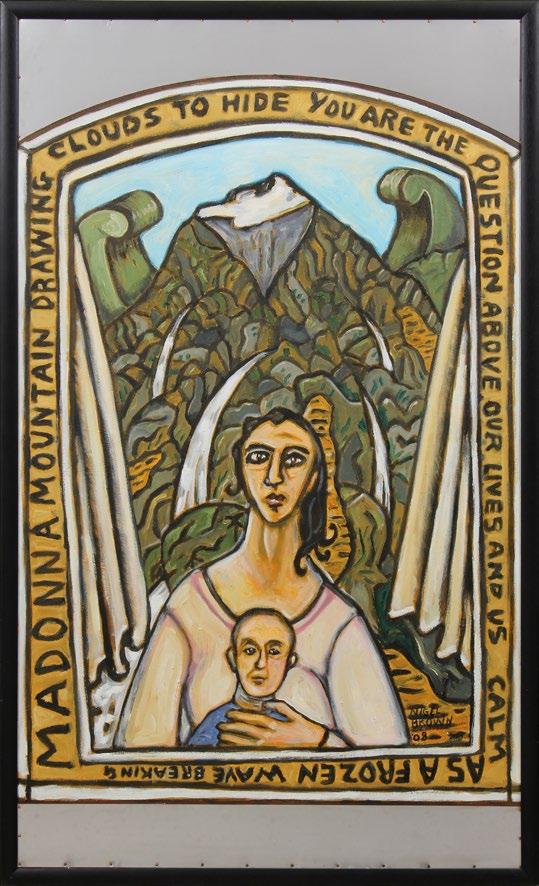
Madonna Mountain , 2007/08
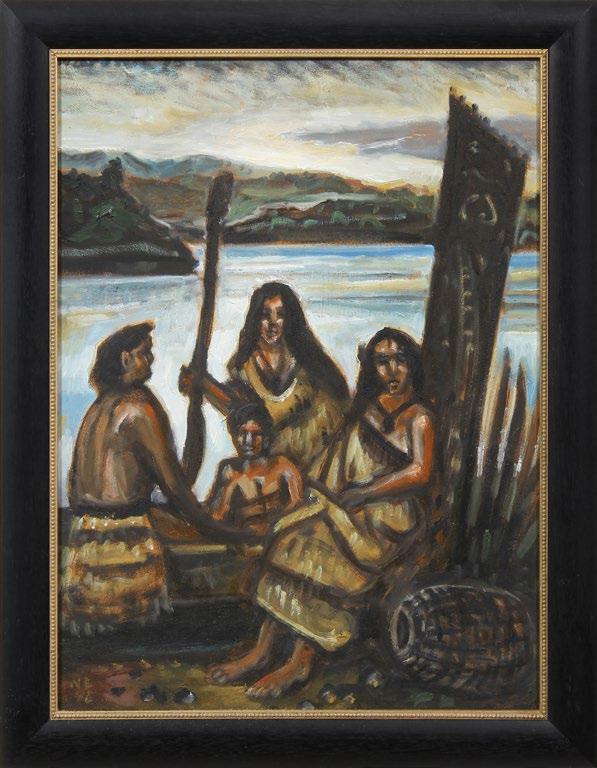
Māori Women with Canoe , 1996
Mrs Ellen Pink and White , 2012
Nature Cruel , 2005
Optimism , 2014
Our Institutions , 2015/16
Pacifica Japonisme , 1996
Ponga II , 2017
Reading for Harbour Cone , 2017
Say What Yer Say , 2004
Second Hand Shop , 2003
She’ll Be Left , 2002
Te Rauparaha , 2010
The Plumber’s Shop , 2003
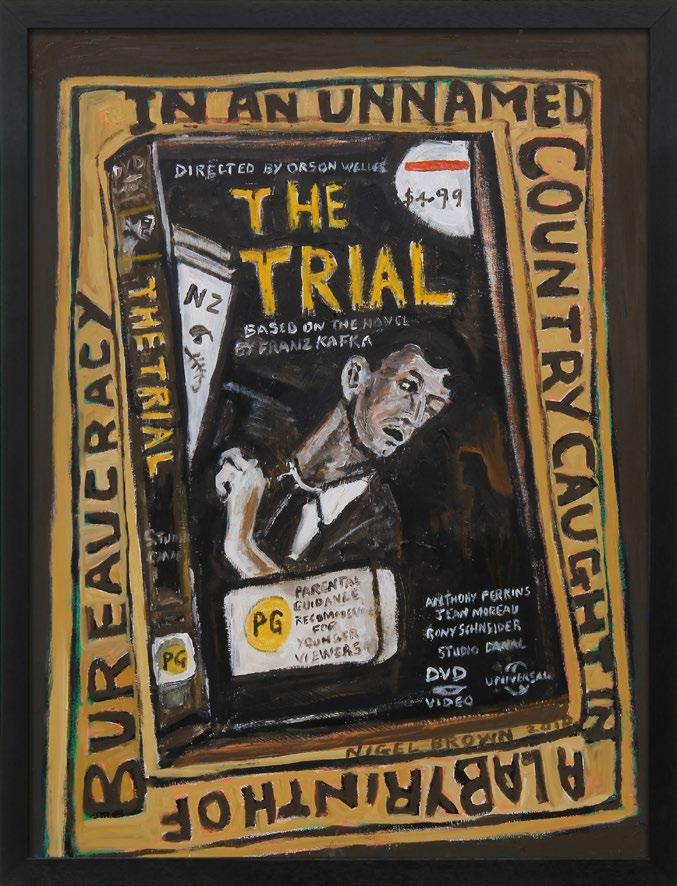
The Trial , 2010
They Are Us , 2019
Three Painters (Fomison, Clairmont, Maddox) , 2008
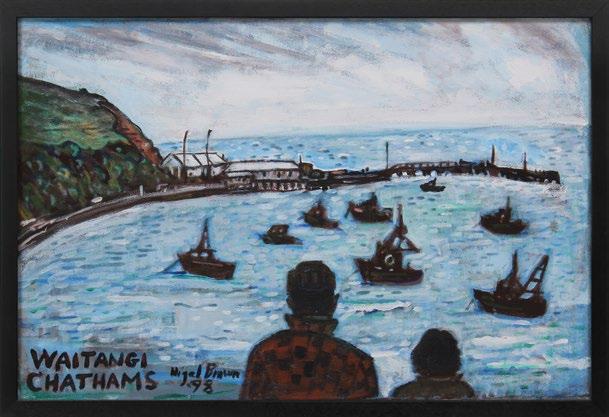
Waitangi , 1998
We Want the Birds Back , 2009/10
Wings for Kahikatea , 2023-25
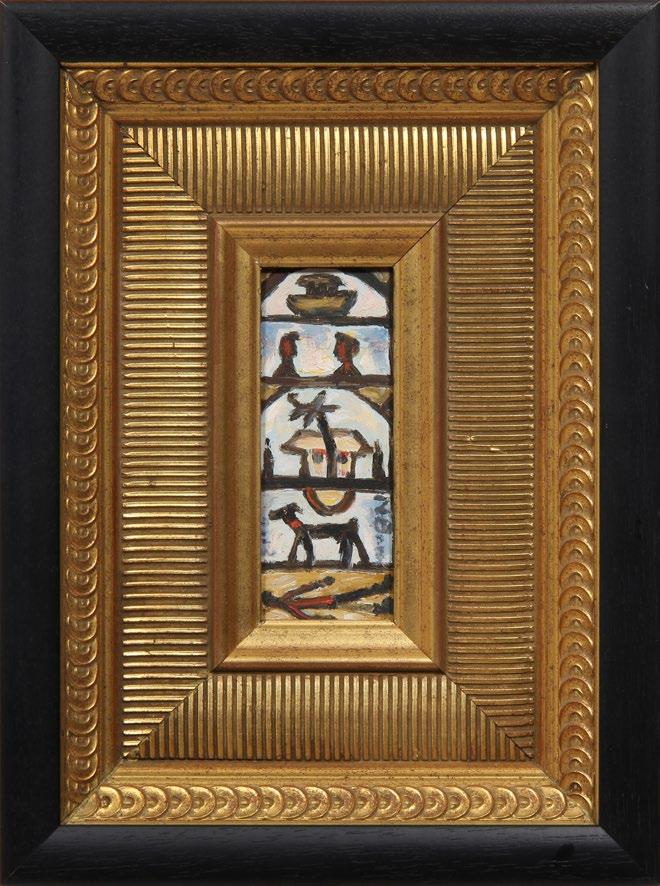
A Modest History of Your Life , 2003 oil on board, frame: 405 x 303 x 63 mm, panel 186 x 84 mm
Broadly Speaking - Selected Paintings 1982-2025
Exhibited at Milford Galleries, Dunedin
27 June - 27 July 2026
For further information please contact us:
Milford Galleries, Dunedin
18 Dowling Street, Dunedin 9016
Phone +64 3 477 7727
info@milfordgalleries.co.nz
Milford Galleries, Queenstown
58 Gorge Road, Queenstown 9300
Phone +64 3 442 6896
qtown@milfordgalleries.co.nz
Artworks copyright © Nigel Brown
Text copyright © Fiona Farrell, Glenn Colquhoun, David Craig 2026
Catalogue copyright © Milford Galleries Ltd 2026
Photography and design: Glenn Frei