GR AHAME
SYDNEY
Close to Home
GR AHAME
SYDNEY Close to Home
CONTENTS Stepping Stones - Introduction
4
- A Place to Stand
8
Maniototo Geography and History
62
Grahame Sydney Biography
64
Index of Artworks
68
Contact
71
GRAHAME SYDNEY Close to Home Exhibited at Milford Galleries, Queenstown 22 August - 21 September 2026
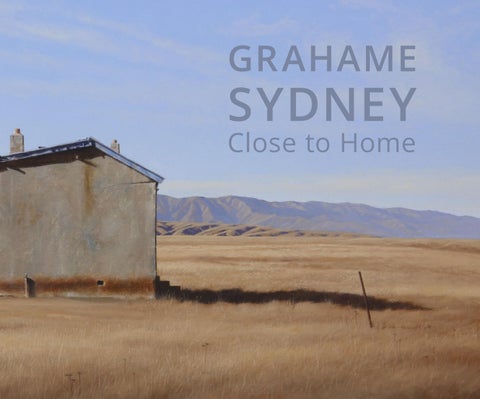
Cover Image: The Rabbiters’ House, Gimmerburn, 2026, detail 3
STEPPING STONES INTRODUCTION Close to Home is Grahame Sydney’s first exhibition in fifteen years. It includes paintings from 1992 through to the most recent. In this manner, it takes something of a survey stance with a significant proportion of the featured works being loaned from private collectors, and for their outstanding generosity we especially thank them. Another group of paintings have been directly sourced from Grahame and Fiona Sydney’s personal collection alongside new works made with this exhibition fully in mind. Close to Home also clearly shows the artist has numerous primary concerns and a much broader visual vocabulary than generally understood. Featuring
4
Ballet Tree, Becks, 2022 oil on linen, frame: 625 x 928 x 50 mm, stretcher: 606 x 910 mm Private Collection of the Artist
5
a wide range of media – oil, egg tempera, watercolour, and gouache, plus drawings and editioned works – which collectively demonstrate that his technical virtuosity, acclaimed restraint, and pursuit of excellence encompass all of the constituent processes in his studio practise. Drawings and photographs made in situ are fundamental resource tools but it is back in the solitude of his studio where it all really happens. There the artistic decisions – what to include, what to leave out – begin the slow journey of his making processes. Close to Home attests that ‘landscapes and a sense of place’ are ‘an essential facet of national character and that a spiritual connection to the land is fundamental to one’s sense of belonging.’1 South of the Waitaki, in Central Otago and the Maniototo – with its distinctive topography and hovering clouds – is where he has lived for most of his life. It has directly informed and shaped the genesis of his aesthetic and stylistic identity. It has been the constant subject of his work
Cook House, Home Hills, 2000
6
oil on linen, frame: 818 x 1278 x 38 mm, stretcher: 760 x 1220 mm Collection of Keith and Rhonda Lloyd
7
but as Close to Home amply shows he has also produced significant works informed by places as diverse as France, the Netherlands, Antarctica, and right across Otago.
A PLACE TO STAND At the epicentre of New Zealand’s culture – directly shaped and informed by Māori belief and conceptual thinking – is a conversation about where a person belongs and has rights of residence through kinship and whakapapa (genealogy). Tūrangawaewae literally means ‘a place to stand’. It is the foundation of Māori identity, defining roots and connection to the land. Going beyond a literal location, it is an internal concept of belonging. It touches all New Zealanders in varying degrees. The Maniototo, surrounding valleys, and the wider Central Otago region
8
In Amsterdam 2023, 2026 egg tempera on gesso board, frame: 765 x 920 x 50 mm, image: 590 x 750 mm Private Collection of the Artist
9
are Grahame Sydney’s tūrangawawae. It is home, where he comes from and stands. It is utterly fundamental to who he is. He is, of course, not unique in such a sense of being. There have been works of other significant New Zealand artists – McCahon’s Otago Harbour and Titirangi; Weeks’ King Country; Sutton’s Canterbury; Binney’s Te Henga; Woollaston’s Nelson; Frizzell’s Hawkes Bay and Otago; Wong’s Wellington coastline and so on – which have been career-defining love poems of place. Sydney’s ‘palpable sense of belonging’2 does not mean as an artist he is engaged in a process of literal depiction. Even when it looks as though he is. His paintings’ attributes, of course, include being regionally distinct, because there is simply no other region in New Zealand like Central Otago. However, the all-too-easily applied realist terminology doesn’t go anywhere near representing or summarising what he does, for he doesn’t depict what is there per se. He makes it all up, subjecting what remains or is included to severe scrutiny. He invents and thus ‘lies beautifully.’
10
Clouds at Evening, Manuherikea Valley, 2001 oil on linen, frame: 1100 x 1100 x 45 mm, stretcher: 1065 x 1065 mm Private Collection. Exhibited at Pātaka Art + Museum, Porirua, 2011/12
11
At the core of it all, Sydney is having a direct conversation with the viewer about the theatre of place and time’s passage into which he has laid atmospheric meditations as well as distinct emotions and moods. He omits, manipulates facts, rearranges, and leads the audience into an altered reality. To his experience, his thoughts. Yes, it looks like Central Otago – for it is – but his control over what is included, and therefore excluded, is total. He thinks like a writer. The landscape is a template, a stage on which and from where he talks, reveals, and expresses himself. This idiosyncratic blend of fact and fiction, Sydney’s pictorial sensibility, is an entirely instinctive condensing of the elements in his work. At the same time, he seeks to deliver and provide by engaging the viewer in the actual process. That important ‘connection’ happens when ‘the long stare’ between the painting and the viewer occurs. At the resultant point when transcendence occurs, not only is substantially more experienced, felt, and understood, the viewer then comes to intuitively
Fi, Hair Down, 2024
12
egg tempera on gesso board, frame: 683 x 683 x 45 mm, panel: 460 x 460 mm Private Collection of the Artist
13
open new ‘doors’ of ‘insight’ and is taken imperceptibly to additional feelings and realisations. In this manner, different subjects and experiences emerge in which the viewer has become an active participant. The viewer has gone from merely viewing to active involvement and ‘owning’ the intent. One of the elemental characteristics of the Maniototo, Manuherikia, and Ida Valleys is the visceral reaction they provoke. Collectively, these valleys are components of a larger area that is a scooped-out shaped basin declining from the west to the south, surrounded by distant mountains and ranges which rise up from the edges. Because of this, a profound sense comes upon people there that they are in the middle of something substantial. Surrounded. And an elemental part of it. ‘You just don’t see the land here, you feel it.’3 The imponderables of place may be beguiling but Sydney – as an artist – seeks more. Yes, he wants ‘the shock of recognition… not only of the physicality of the place, its silent beauty but… of how you feel in that place, recognition of oneself.’4
14
In Loving Memory, 2024 oil on linen, frame: 785 x 1040 x 55 mm, stretcher: 760 x 1015 mm Private Collection, Queenstown
15
An especially distinctive aspect of the area’s topography is the saucerlike atmospheric wave formed when prevailing winds encounter physical barriers. Shaped by wind, appearing smooth and well-defined, these lenticular clouds seem stacked as they hover in one place. Staying stationary for hours yet indicating high turbulent winds in the upper atmosphere, they are continually forming on one edge and evaporating on the other. Evening Shadows at the Shearer’s Kitchen (2021) contains an excellent example of this phenomenon. Alive to such facts and details, Sydney makes the local universal, using specifics of Central Otago – the untrammelled vistas, the scale and breadth of the sky, the lyricisms of distance, sensations of solitude, the silent epiphany of the seasons and hues of colours, its light clarity, peculiar cloud forms, history – as pictorial components which become intrinsic tenor and tone: and, ultimately, key components in the slowly emergent narratives. His pictorial aspiration is to visually deliver resolved simplicity and calm.
16
The Shearer’s Dining Room, 2025 egg tempera on gesso board, panel: 710 x 813 mm Collection of Keith and Rhonda Lloyd
17
Evening Shadows at the Shearer’s Kitchen, 2021 oil on linen frame: 952 x 1564 x 54 mm stretcher: 915 x 1525 mm Private Collection, Queenstown 18
19
Sydney invests his works with humanistic dialogues and spiritual inferences. Being in Central Otago where the vast scale is defined by alpine thrusts and the lines-of-sight enormous, the over-arching sky establishes and builds sensations markedly similar to those inside a church, especially so in the broad Maniototo region. This ‘architecture’ of place is vaulted, the mood and atmosphere demarcated, the light bright or modulated. The viewer is as much inside as outside. ‘It is not the nature or location of the material upon which paintings are based that is important, but the use the artist makes of it – a conscious structure based on a distillation.’5 These ‘sensations,’ including those of ‘awe,’ are fundamental to a fuller reading of his work, where emotional content arises inside the stillness and isolation presented. He seeks essences of the place and of actually being there, in it. This is his great gift to the viewer. That singular plural experience. Sydney’s ‘fabricated realism’6 might mean some viewers at first don’t see or fully comprehend his mastery of paradox, the continuous use of contrast
Woolshed, Becks, 2017
20
watercolour, gouache on paper frame: 830 x 1020 x 45 mm, image: 520 x 720 mm Private Collection
21
and contradiction, the various roles of reverence, of presence and absence. Time as a subject is shown in an endless process of decay, dissolution, or abandonment. The Rabbiters’ House, Gimmerburn (2026) has become the pigeon’s roost. Encapsulating a profession (in the title) long departed from the area, absence is the first perceived subject, the darkened windows delivering the reality message. Gone. The remnant shed and lurking pigeons add emphasis. Deliberately using asymmetry, set in the lower foreground but on an angle rising from right to left (to the viewer), the buildings sit in an apparently empty ochre-rich tussock landscape. Nature is in this manner shown surviving man. Less obvious but equally present are the questions. With incongruity being the compellingly delivered dissolving buildings, context walks into the visual conversation. The scale of the tussock paddock is vast. It is obviously farmed land. A monocultural grassland. Over half of the painting, in both height and width, is an expansive sky laced with a few wispy cirrus clouds. At its simplest it’s shown to be a perfect
22
The Rabbiters’ House, Gimmerburn, 2026 oil on linen, frame: 775 x 1225 x 55 mm, stretcher: 750 x 1200 mm Private Collection, Queenstown
23
day but the unease of presence, absence, and mortality build, colouring the work with quite different – more substantive – realisations and moods. Mixing patterns and anomalies, the artist builds a cohesive visual story with numerous entry points for the viewer. High Noon at Hope Hill (2026) extends aspects of the narratives further. Amusingly titled with a hat tipped to the Wild West, and an intimation of headbutting violence, the immediately apparent visual simplicity hides developing complexities brought to it by any observant, questioning, viewer. The metaphoric symbolism of two bulls head-to-head in exactly the same expansive landscape (as The Rabbiters’ House…) sets the scene of a deftly implied bullring. With a solitary, vague, lone tree in the distance standing just beyond the arcing edge of a partial circle, two massive animals stand ready to feed or fight. The very presence of stock on golden grass implies industrial scale farming enabled by mass irrigation and fertiliser application to infertile soil. The
24
High Noon at Hope Hill, 2026 oil on linen, stretcher: 610 x 917 x 32 mm Private Collection
25
slowly arising narrative possibilities enter the work via the viewer and that context invests this significant work with weighty pathways into large subjects of ecological and economic importance. Is this work celebrating or condemning? Can it be both at the very same time? Thoughts diverge; questions arise. How has it all come to this? Aren’t some things sacrosanct? Isn’t this, after all, completely incongruous? Such questions are the consequences of the viewer reading what is there. It would be wrong to think that Sydney is a polemicist, and hiding a greater purpose. He is not. His philosophical goal and artistic purpose are fully resolute: to deliver with authority, by means of shadow and light, the absolute essence of place in the pictorial illusion. Broader contexts and politically pertinent readings are enabled by what he provides only when the viewer becomes actively engaged in ‘reading’ what is there as well as what is not. In other words, he is the painter who sees that his fundamental goal is to deliver the work so it can go off and have a
26
Moonrise, School Road, 2026 oil on linen, frame: 835 x 938 x 50 mm, stretcher: 810 x 915 mm Private Collection, Dunedin
27
life of its own with whomever it corresponds. Beautiful Onslow Country (2021) is an homage, a visually complex tale of interlocking flowing forms lit by dusting light, further animated by shadow and the deepening, receding blue/violet hues of distance. Sitting 700 m above sea level, Lake Onslow was formed in 1890 by damming the Teviot River and flooding a natural basin called Dismal Swamp. The painting’s golden-brown palette builds a subliminal, inherent set of values about the landscape itself. The lyrical, sinuous rhythms, modelled forms, and the absence of any overt sign of man continue Sydney’s career-long conversation about man’s transience and nature’s permanence. The landscape is the subject and is doing all the talking. Although not depicted and nowhere near the Onslow land directly affected should the on-again/off-again Onslow Hydro Scheme achieve Fast-track approval, another layer of significant dialogue has been added into the artwork by such outside forces and possibilities. The painting’s importance
Myself at 76, 2024
28
egg tempera on gesso board, frame: 803 x 703 x 28 mm, panel: 610 x 508 mm Private Collection of the Artist
29
Onslow Country, 2021 oil on linen frame: 578 x 1494 x 50 mm stretcher: 555 x 1475 mm Collection of Keith and Rhonda Lloyd 30
31
has in that manner been magnified. Context has been added, additional pertinence acquired. While Sydney’s achievement with this work is that of especially memorable accuracy, rhythmic beauty, hue, pattern, and form, Onslow Country brings our eyes to the scale of the problem and what will no longer be seen in the Onslow area. It’ll be covered by 85 metres of water, capable of providing 1,000 MW of renewable energy in a dry year, with 7,100 hectares submerged. It’ll be a lake, a massive reservoir. The clichéd phrase ‘we don’t know what we’ve got till it’s gone’ is the case here. Reverence is not an emotion. It is a state of being. An attitude of deep respect and veneration. It is a key element in Sydney’s entire career, usually as a component of a work but often enough for it to be notable, it arises as the primary subject. The brooding Monument (1988) in the collection of the Christchurch Art Gallery Te Puna o Waiwhetū sits in the dying light of day,7 with glimpses of St Clair and Saddle Hill towards the interior of the peninsula behind, the foreground darkness drawing the viewer into the
32
Untitled, Fiona, 2023 oil on linen, frame: 730 x 935 x 50 mm, stretcher: 710 x 915 mm Private Collection of the Artist
33
biography of loss. This work, undertaken when his father died, includes a mast disappearing towards heaven and the brutal coffin-like form of the cenotaph itself. The masterful Lest We Forget (2025) is a powerfully redolent, atmospheric symphony of soft light and frail dark. War indiscriminately affects everyone, not merely those who didn’t come back. All know, all remember. No one escapes such history. Using the metaphoric languages of darkness, Sydney imbues the statue with potent inferences in the brief touches of rising light. An acute sense of the soldier being all-seeing instantly overtakes the viewer in that engagement moment, and a one-to-one relationship is established. This is no enigmatic work. It is personal and resolutely alive with the portent of the past and the conversation with the viewer searingly – and ‘seer-ingly’ – direct. The human spirit is ultimately being celebrated. Deified. There is real beauty to be found here. In loss. Always drawing, making colour notes and (re)searching wherever he is,
Lest We Forget, 2025
34
oil on linen, frame: 938 x 1090 x 55 mm, stretcher: 910 x 1065 mm Private Collection of the Artist
35
Chapelle St Vincent, Collioure (2018) was experienced on a European trip. Amongst the painting’s many qualities – the sheer intensity of the light falling on the cross and the narrow flanges of the upper body, for example – is the sky itself. It occupies close to 90% of the work. Sydney is showing us presence and absence side-by-side. Delivering it with rare painterly authority, infused with spirituality. In Loving Memory (2024) positions a clutch of plastic flowers, subject as object front and centre, occupying almost all of the foreground middle vertically. For the Forgotten (2022) is similarly constructed with a child’s doll, wearing a ribbed jersey that touches its toes, suspended between an iron rod and wire. What is being remembered here? Death? A child? Car accidents? Who? What? While of course it can be – from person to person – about any of those things, depending on circumstances, this especially redolent work was actually an immediate response to Putin’s invasion of Ukraine. Based on a drawing of a couple of years before, featuring the
36
Chapelle St Vincent, Collioure, 2018 oil on linen, frame: 860 x 1035 x 50 mm, stretcher: 835 x 1013 mm Private Collection of the Artist
37
Ida Valley in winter, the crucified doll symbolises the blameless victims.8 In the past, writers have strongly identified Sydney’s ‘realism’ as being closer in method and objective spirit to the European surrealists’ sense of desolation and eerie calm (particularly, Magritte and De Chirico) in his editing and assembling process than (say) the American realists. These demanding and poignant two works (above) are undoubtedly fundamentally surreal in character with Sydney’s use of contrast and contradiction, scale alteration, and point of entry for the viewer commandingly controlled. There is no accident – nothing left to chance – in his purpose here. Emil McAvoy recognised Sydney’s paintings as being ‘highly staged fictions, guided by long-standing landscape traditions… a pictorial code designed to suggest a divine presence’ adding that his is ‘a landscape that exceeds representation’, being further activated by ‘contours of thought.’ 9 Sydney’s highly selective eye, where ‘seemingly inconsequential elements are ennobled,’10 is achieved not merely with the desolate beauty, the
38
For the Forgotten, 2022 oil on linen, frame: 700 x 1055 x 48 mm, stretcher: 660 x 1015 mm Private Collection of the Artist
39
powerful illusion of actuality, but with and through the imbued atmosphere. That most important ingredient – let’s call it mood, if not spiritual resonance – and the proxies for human presence bring the viewer ‘inside’ his paintings. Although human presence has been withdrawn, ‘its traces persist’.11 The compelling Magpie Tree (2026) uses the surrealists’ eerie silence emphatically. Dusted with snow, the alpine landscape flattened and hidden by cloud, a leafless black and white tree, which two magpies have just left, occupies middle ground. It’s primarily a dull, wintry day but we see suggestive light revealing something. Reeking of solitude, man’s understated presence emerges in the dark green blocks of pine plantations, colloquially known as farmer’s retirement and superannuation plots, middle distance left and right. The artist is asking us to look, so we can see and, in that process, understand more. Undoubtedly one of the seminal landscape paintings in the whole of New Zealand art, the wonderfully restrained, celebratory, Timeless Land (1992)
40
Magpie Tree, 2026 oil on linen, frame: 767 x 1220 x 50 mm, stretcher: 750 x 1200 mm Private Collection, Queenstown
41
presents one shoulder of the St Bathans Range. Like an altar for adoration, it simultaneously hides and partially reveals what is beyond. Overbridge, Ravensbourne (1997) functions as a symbolic cross, the foreground dark, early evening just beginning. With evening eminent, Moonrise, School Road (2026) begins an entirely different narrative. A burnt, completely isolated, symbolic, long dead tree stands front-forward, seemingly so close to the viewer it could be touched. Its blackened, remnant, gesturing limbs fingering questions, it sits amongst the remaining moments of daylight. A full moon rises. Symphonic in nature, yet reductionist in approach, this especially restrained but markedly harmonic work demonstrates the artist’s acute attention to every little detail, each piece of failing light-filled information different. An obvious aspect of Sydney’s career is that he is ever-challenged by methods and techniques as much as by purpose and point of view. Every painting takes its own due time, has its own pictorial logic, patterns and
Overbridge, Ravensbourne, 1997
42
oil on linen, frame: 890 x 965 x 40 mm, stretcher: 835 x 910 mm Private Collection, Queenstown. First exhibited at Dunedin Public Art Gallery, 1999
43
rhythms, tonal and geometric values. His unmistakable signature stylistic vocabulary unites it all. He uses as little paint as possible, brush stroke presence banished. He wants to deliver it all with chiaroscuro. Shadows and light. A bit of tone. Warbird (2026) is a quintessential Sydney in every respect. And in it he’s painting a war plane for the first time. Wings folded, the pictorial complexity markedly increased, reflective metals, numerous varied shadows: what could go wrong? A massive technical and artistic exercise to get everything convincingly right, in itself, without the added burden of such an interesting as well as unusual line and rising height of sight. Everything has to be correct. Add to the whole. This is after all a painting, not a forced perspective single lens photograph. Redolent of a predatory insect, if not a wasp, it stands menacingly ready, (its lower stomach-like) fuselage open. It’s afternoon, mid-summer, a disarmingly beautiful violent contradiction mutely waits, doused in clearest Wanaka light.
44
Warbird, 2026 oil on linen, stretcher: 605 x 755 x 50 mm Private Collection, Auckland
45
Sydney’s stylistic vocabulary is intensely real. Near photographic in his verisimilitude and objective truth. Everything seen is ‘of equal significance, though the focus of the field varies.’12 This even-handedness, prevalent in all he does, is distinctly evident in his portraits. Reverence reappears alongside beauty with the female nude. Favouring an intensely luminous focal point, the intimate drama of a pose, brooding mystery, the tension between beauty and mortality, the natural, classical purity of the female form, and its ability to generate thought and wonder. In glorious portraits Sydney investigates the changing dialogues between light, form, and shadow. Building deeply private worlds, brimming with substance, hints and implications, he delivers restrained light, intense pictorial focus, and the acute intimacy of the cloistered moment. ‘His purpose is always to record an inner journey.’13 ‘The human figure forces you into an extraordinary degree of subtlety and close observation… to me beauty matters.’14 Bathroom, Arrowtown (2025)
Bathroom, Delft, 2025
46
egg tempera on gesso board, frame: 770 x 770 x 45 mm, panel: 612 x 612 mm Private Collection of the Artist
47
and Bathroom, Delft (2025) obviously have a lot in common. Same model, similar environments, the mystery of her thoughts and what she sees paramount but never known, never glimpsed. We witness beauty in everyday moments. Revealing and hiding, providing and denying at the same time, the largely self-taught Sydney – tight to the singularity of his vision – just as openly declares his artistic lineage bound to Vermeer and so the (geometric concerns of) European Old Masters. In other words, he has walked in virtually the opposite direction to everyone else here, Andrew McLeod perhaps being the obvious exception. Myself at 76 (2024) has the artist – his face and clothes partially lit by overhead cold light – staring at the viewer, impassively at first yet expectant too. This important dichotomy conflates the animate and inanimate together, bringing the character and personality of the artist and viewer – as questions – to the fore. Can you hold that stare? Who are you? What do you want? What do you believe forever true?
Ice Swimmer, 2025
48
oil on linen, stretcher: 760 x 920 x 40 mm Private Collection, Queenstown
49
Alive to the incongruity of it all, Ice Swimmer (2025) records a rite of passage, an accomplishment if not a dare. Bathing suit emblazoned ‘KIWI’, a midwinter swim in St. Bathans’ vivid Blue Lake – created when miners sluiced away an entire 120-metre-tall hill – is about to begin. Marker buoys left and right, the air beyond becoming condensed and indistinct with heavy cold vapour beginning to ice, progressively obscuring then hiding what might be seen. With a visually complex foreground over which an angel stands while our eye is dragged up the shingle track to a low lick of first light, Waipiata Angel (2013) returns us to the commonality and privacy of loss, the dialogues of veneration. The astonishing Roll Cage Mary II (2012) loaded with narratives and references is rivetingly laced with hope. Erected to memorialise the deaths of two young American men during the early construction of McMurdo base, it stands above Scott’s Discovery Hut, the roof of which can just be
50
Roll Cage Mary II, 2012 oil on linen, frame: 792 x 940 x 50 mm, stretcher: 760 x 910 mm Private Collection of the Artist
51
seen lower left foreground.15 Full of nostalgia, character, and style, The Duke of Marlborough (2024) takes us back to the bright light of summer and a succession of different questions. What do we value? What can be saved? Parked up with nowhere to go till something meaningful is actually done, it awaits and waits – who knows? – at Twizel Airport, McKenzie Basin, which might prove to be its last port of call. Which is more than ironic. Central Otago – and its closely related areas – has been Sydney’s muse for many decades now. He has in that time been at the forefront of conversation about its essences and character. We live in an age where what we know to be reality is said to be under threat by artificial intelligence in its capacity to fabricate anything with semblances of knowledge and authority. But the very thing that AI doesn’t possess, and never will, is human consciousness or a singular pictorial aesthetic. Real reality is far more nuanced – it includes what we see, what we think, make
The Duke of Marlborough, 2024
52
oil on linen, frame: 848 x 1254 x 55 mm, stretcher: 815 x 1220 mm Collection of Chris and Michaela Meehan
53
up and come to experience. It includes memory. Hope and belief. What we value and disregard. ‘Painting, for me, has always been a slow process of building, constructing an image, deliberately… taking from nature those elements I want to use, leaving others out, re-composing, re-ordering, using only what I think the painting needs to be effective. It’s a continual process of refining, shifting about, eliminating, changing – trying to intensify within the world of the frame, trying to get some sort of essence… departures from truth, lurch away from the reality which might have triggered the idea in the first place. The “realism” of my paintings is utterly misleading and always has been… it’s wrong.’16 Stephen Higginson Milford Galleries
Waipiata Angel, 2013
54
oil on linen, frame: 870 x 1147 x 55 mm, stretcher: 842 x 1120 mm Private Collection
55
Endnotes 1
Fiona Sydney, email correspondence with Stephen Higginson 6 July 2026.
2
Sharon Stephenson, ‘Thriving on Empty’, New Zealand Listener, 11 February 2023, p. 31.
3
Keith Stewart, quoted at https://grahamesydney.co.nz/about/
4
Sam Neill, Timeless Land, Longacre Press, 1995, p. 8.
5
Elizabeth Caughey and John Gow, ‘W. A. Sutton’, Contemporary New Zealand Art 2, David Bateman, 1999, p. 92.
6
Kevin Ireland, ‘Grahame Sydney’, Graham Sydney: Down South, Recent Paintings 2001–2011 exhibition catalogue, Pātaka, 2011, p. 6.
7
Grahame Sydney, email correspondence with Stephen Higginson, 3 July 2026.
8
Ibid.
9
Emil McAvoy, Essay: ‘Road to Onslow 1’, Webb’s Auction Catalogue, March 2024.
10 Julia McKinnon, ‘Three Works’, Webb’s Auction Catalogue, March 2021. 11 Grahame Sydney and Vincent O’Sullivan quoted by Andrew Clark in essay: ‘Dog Champs at Charlies Bar’ (1981-2001), Bowerbank Ninow Auction Catalogue, No 3, 2016, p. 106-7. 12 Dominic Green, ‘Vermeer Review: Enchanted Interiors’, Wall Street Journal, 26 June 2026, https:// www.wsj.com/arts-culture/books/vermeer-review-enchanted-interiors-1b0cbfbf, accessed 30/6/26. 13 Kevin Ireland, Op. cit., p. 6. 14 Edward Hanfling, ‘Behind the Fortress Walls: A Conversation with Grahame Sydney, Art New Zealand, Issue 182, Winter 2022, p. 58. 15 Grahame Sydney, email correspondence with Stephen Higginson 6 July 2026. 16 Grahame Sydney in interview with Graham Beattie, ‘A Few Words with Grahame Sydney’, Webb’s Auction Catalogue, Important Paintings and Contemporary Art, 2015.
56
Upper Taieri at Styx, 2017 watercolour, gouache on paper frame: 830 x 1021 x 50 mm, image: 535 x 730 mm Private Collection
57
Shearer’s Kitchen, Ida Valley, 2017 graphite on paper frame: 647 x 866 x 38 mm image: 403 x 644 mm Private Collection of the Artist
Killing House, Hamiltons, 2020 graphite on paper frame: 706 x 936 x 38 mm image: 463 x 714 mm Private Collection of the Artist
Decoy, Falls Dam, 2018
58
watercolour, gouache on paper frame: 830 x 1020 x 45 mm image: 530 x 720 mm Private Collection
59
Timeless Land, 1992 oil on linen stretcher: 760 x 1520 mm Private Collection 60
61
MANIOTOTO GEOGRAPHY AND HISTORY The Maniototo is a geographically isolated, elevated alpine basin, substantially encircled, bounded and defined by the Kakanui Range to the northeast, the ridgeline wall of Hawkdun Range to the north, the pleated Dunstan Mountains and crumpled Raggedy Range to the west, the Rock and Pillar Range and Lammerlaws on the eastern flank, and the Old Man Range making up the southern wall. The basin declines from the West towards Alexandra in the south. It is a scroll plain, synform-shaped where the geological fold structure rock layers dip inward, creating a concaveupward or U-shape. Maniototo’s distinctive geology sits on an ancient Otago schist basement, overlain by gold-bearing Cenozoic gravels, Eocene quartz pebbles, Miocene basalt, sculpted into rugged syncline basins. The mountain ranges surrounding it are antiforms (upward folds) pushed up during the Pleisticene deformation. The Shag (Waihemo) River was one of the well-known 14th Century summer trails for Māori into the Ida Valley and Central Otago from the Shag River
62
Mouth village collecting food, especially birds and eels. Also, for key resources such as harakeke (flax), tī kōuka (cabbage tree) and a number of prized plant species. The Maniototo especially Patearoa (Rock and Pillar) was also an important source of stone, with the silcrete rock (which flakes predictably) used as large knives for flensing and hunting. Fire, used by Māori to flush out birds, deforested the landscape, from woody vegetation to grassland. The drought-tolerant red tussock (Chionchola rubra), native to New Zealand, which thrives in damp, infertile soils due to an extensive root system, took over the landscape. And from this red tussock, Maniototo meaning ‘Plains of Blood’ is derived. The Maniototo is also now a site of ever-increasing importance and significance for archaeologists and palaeontologists with Moa footprints uncovered in the Kyeburn River banks (dated 3.6 million years ago) plus continuous discoveries (including the world’s largest known penguin) of previously unrecorded animals and species occurring.
63
GRAHAME SYDNEY Born and educated in Dunedin, Sir Grahame Sydney began his professional career as an artist in 1974. One of New Zealand’s most significant and enduring artists, he was appointed an Officer of the New Zealand Order of Merit in 2004 and was knighted in 2021 for services to the arts. Working across egg tempera, oil, watercolour, lithography, etching and photography, Sydney’s work is held in major public galleries and museums throughout New Zealand, as well as private collections internationally. His major exhibitions include Regions of the Heart, which toured New Zealand public galleries from 1999 to 2002, and Grahame Sydney: Down South – Recent Paintings 2001–2011 at Pātaka Art + Museum in 2011/12. In 2026, Milford Galleries presents Close to Home, the first of a two-part survey of Sydney’s work, featuring paintings spanning over three decades of his practice.
Grahame Sydney, 2024 Photo: Vinesh Kumaran 64
65
Sydney has twice travelled to Antarctica as a guest of the New Zealand Government, resulting in the photographic publication White Silence: Grahame Sydney’s Antarctica (2008). He is the author of, or a major contributor to, numerous other publications including Timeless Land (1995), The Art of Grahame Sydney (2000), Promised Land (2009), Grahame Sydney’s Central Otago (2011), Grahame Sydney Paintings: 1974–2014 (2014) and Landmarks (2020). His painting Moonrise on the Maniototo (1996) was presented by the New Zealand Government to Nelson Mandela on behalf of the people of New Zealand. Since 2001, Sydney has lived and worked in Central Otago.
Grahame Sydney in his studio, 2024 Photo: Vinesh Kumaran Page 69:
Bathroom, Arrowtown, 2025 66
egg tempera on gesso board, frame: 788 x 588 x 35 mm, panel: 610 x 408 mm Private Collection of the Artist
67
INDEX OF ARTWORKS Ballet Tree, Becks, 2022
5
Moonrise, School Road, 2026
27
Bathroom, Arrowtown, 2025
69
Myself at 76, 2024
29
Bathroom, Delft, 2025
47
Onslow Country, 2021
Chapelle St Vincent, Collioure, 2018
37
Overbridge, Ravensbourne, 1997
43
Clouds at Evening, Manuherikea Valley, 2001
11
Roll Cage Mary II, 2012
51
Cook House, Home Hills, 2000
7
Shearer’s Kitchen, Ida Valley, 2017
58
Decoy, Falls Dam, 2018
59
Study for “For the Forgotten,” 2022
70
18/19
The Duke of Marlborough, 2024
53
Evening Shadows at the Shearer’s Kitchen, 2021
68
30/31
Fi, Hair Down, 2024
13
The Rabbiters’ House, Gimmerburn, 2026
23
For the Forgotten, 2022
39
The Shearer’s Dining Room, 2025
17
High Noon at Hope Hill, 2026
25
Timeless Land, 1992
60/61
Ice Swimmer, 2025
49
Untitled, Fiona, 2023
33
In Amsterdam 2023, 2026
9
Upper Taieri at Styx, 2017
57
In Loving Memory, 2024
15
Waipiata Angel, 2013
55
Killing House, Hamiltons, 2020
58
Warbird, 2026
45
Lest We Forget, 2025
35
Woolshed, Becks, 2017
21
Magpie Tree, 2026
41
69
Study for “For the Forgotten”, 2022 70
graphite on paper, frame: 677 x 766 x 38 mm, image: 434 x 544 mm Private Collection of the Artist
CONTACT GRAHAME SYDNEY Close to Home Exhibited at Milford Galleries, Queenstown 22 August - 21 September 2026 For further information please contact us: Milford Galleries, Queenstown 58 Gorge Road, Queenstown 9300 Phone +64 3 442 6896 | email qtown@milfordgalleries.co.nz Milford Galleries, Dunedin 18 Dowling Street, Dunedin 9016 Phone +64 3 477 7727 | email info@milfordgalleries.co.nz
Artworks copyright © Grahame Sydney Text copyright © Stephen Higginson 2026 Catalogue copyright © Milford Galleries Ltd 2026 Photography and design: Glenn Frei In partnership with Te Kano Estate ISBN 0-908634-37-4
71