DICK FRIZZELL

TIKI to TIKI presents a major extended series of works by Dick Frizzell that began with its now infamous launch, Tiki, at Gow Langsford Gallery in Auckland in 1992.
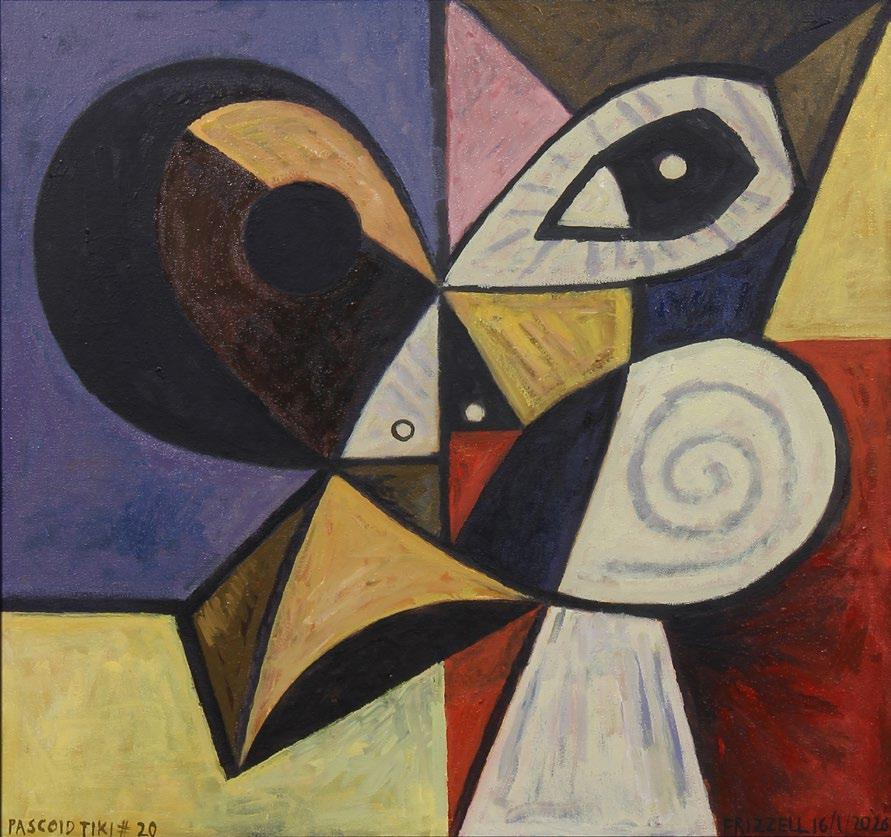
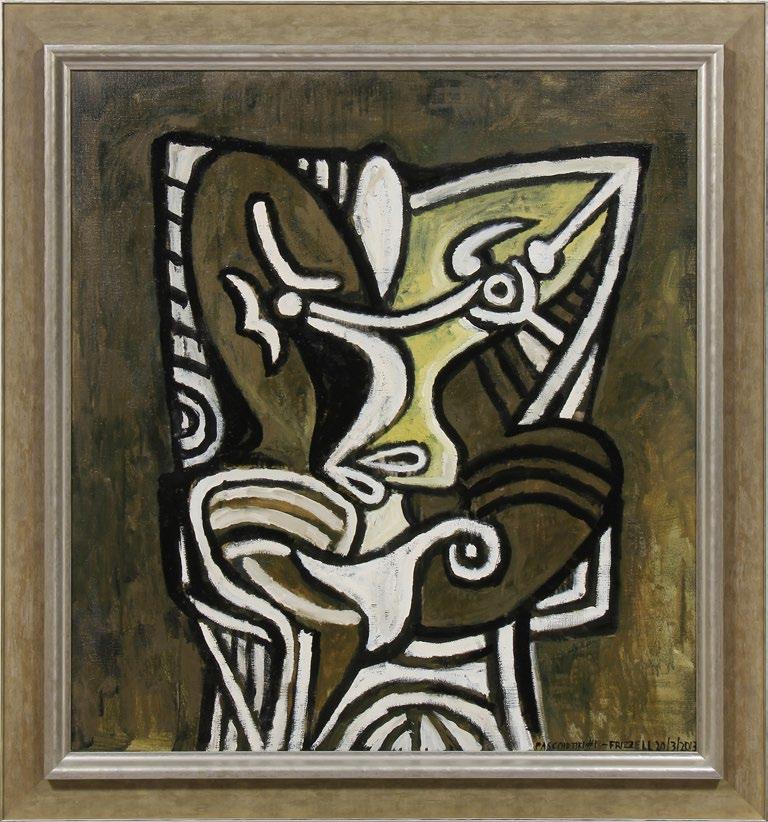
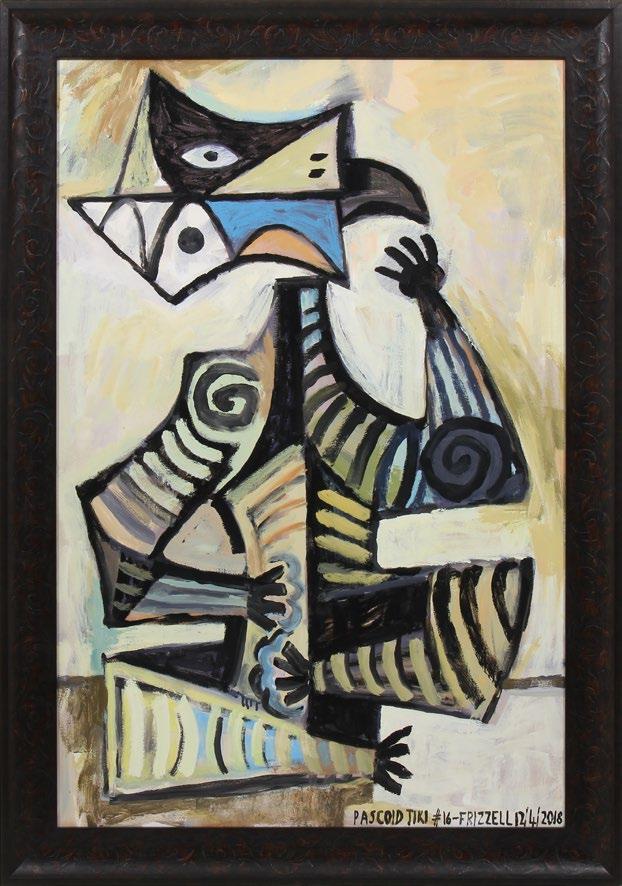
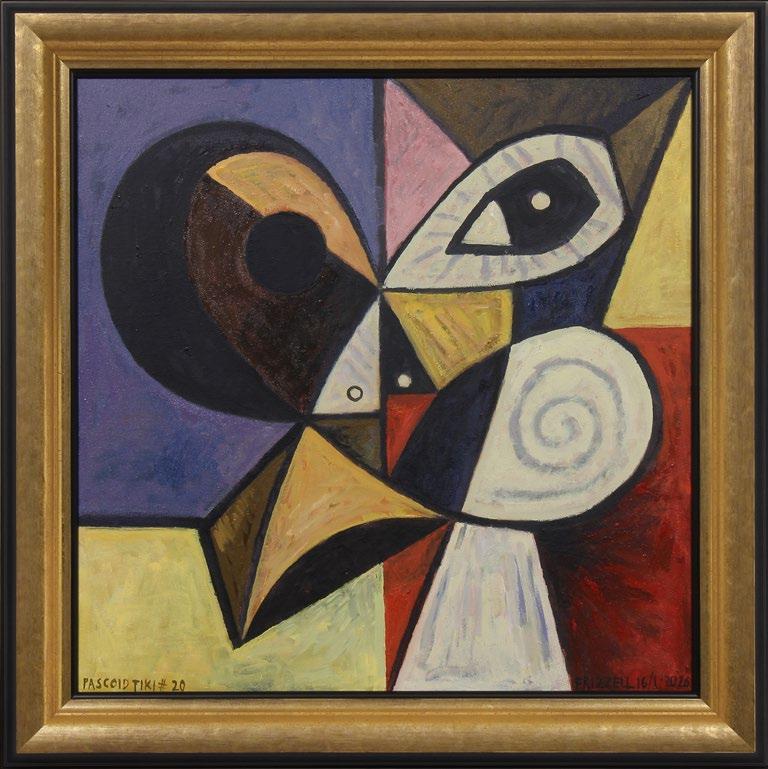
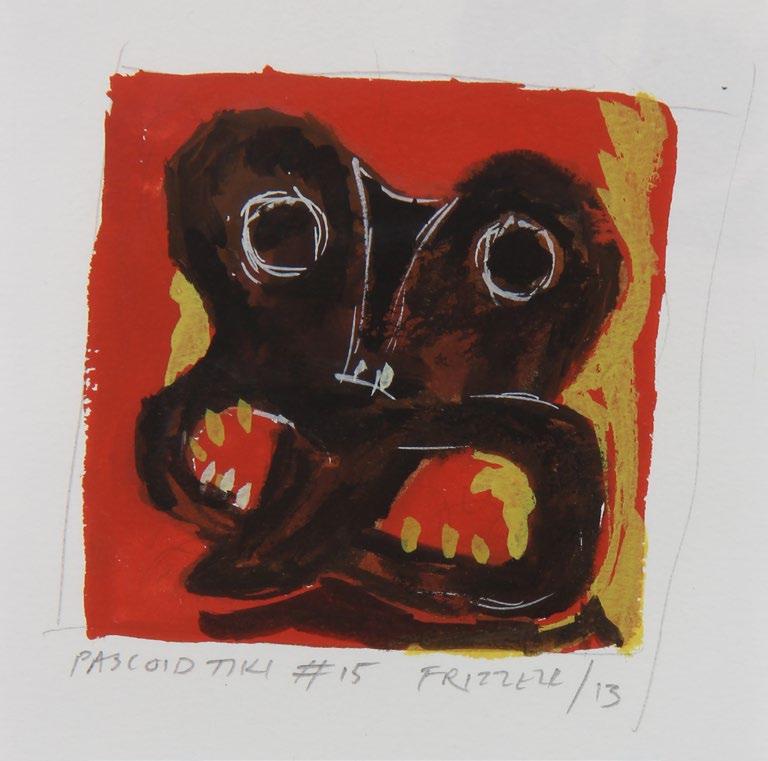
The signature work in this 2026 exhibition is entitled Pascoid Tiki #20, oil on canvas, completed earlier this year. The Pascoids is the largest subseries of what might be called Frizzell’s “tiki domain”, that first began with lithographs in 1998. Though the word ‘pascoid’ refers to a sub-species of fish, Frizzell clearly has in mind one of the founders of Cubism, Pablo Picasso, as it is Picasso’s style of contorted portraits that has been fused with the main characteristics of the Māori tiki—a head on the tilt, with one eye looking up and the other down, an open mouth showing a set of bared teeth, a protruding tongue, sometimes two arms with three-finger hands akimbo across the thighs or midriff. The tiki
Architiki 2010 oil on canvas, frame: 1207 x 1105 x 68 mm
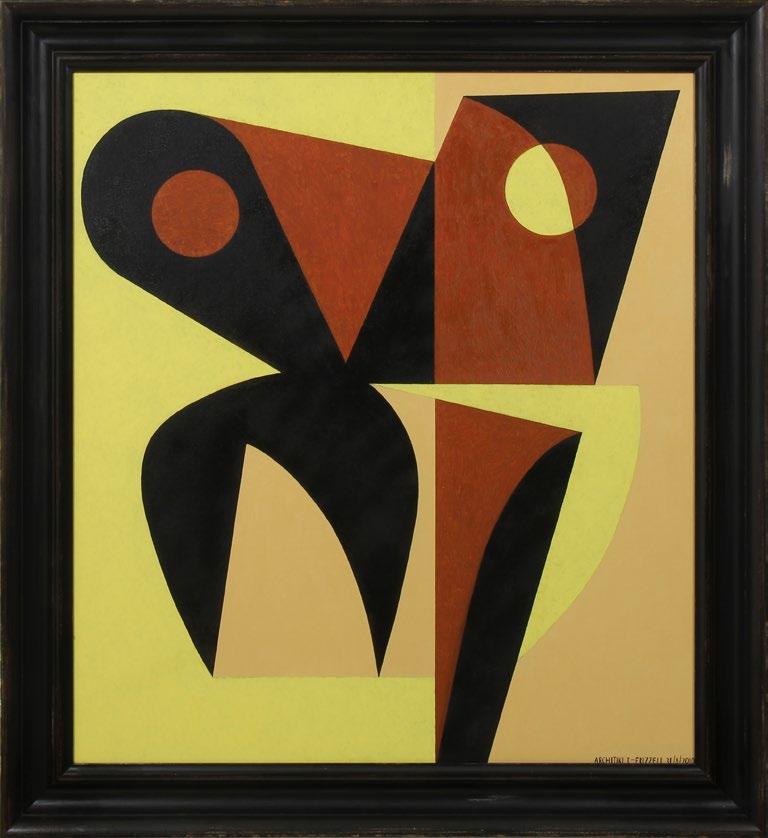
image is generally confronting, aggressive, threatening, similar in disposition to many of the facial images found in Māori carving or Mesoamerican temple sculptures.
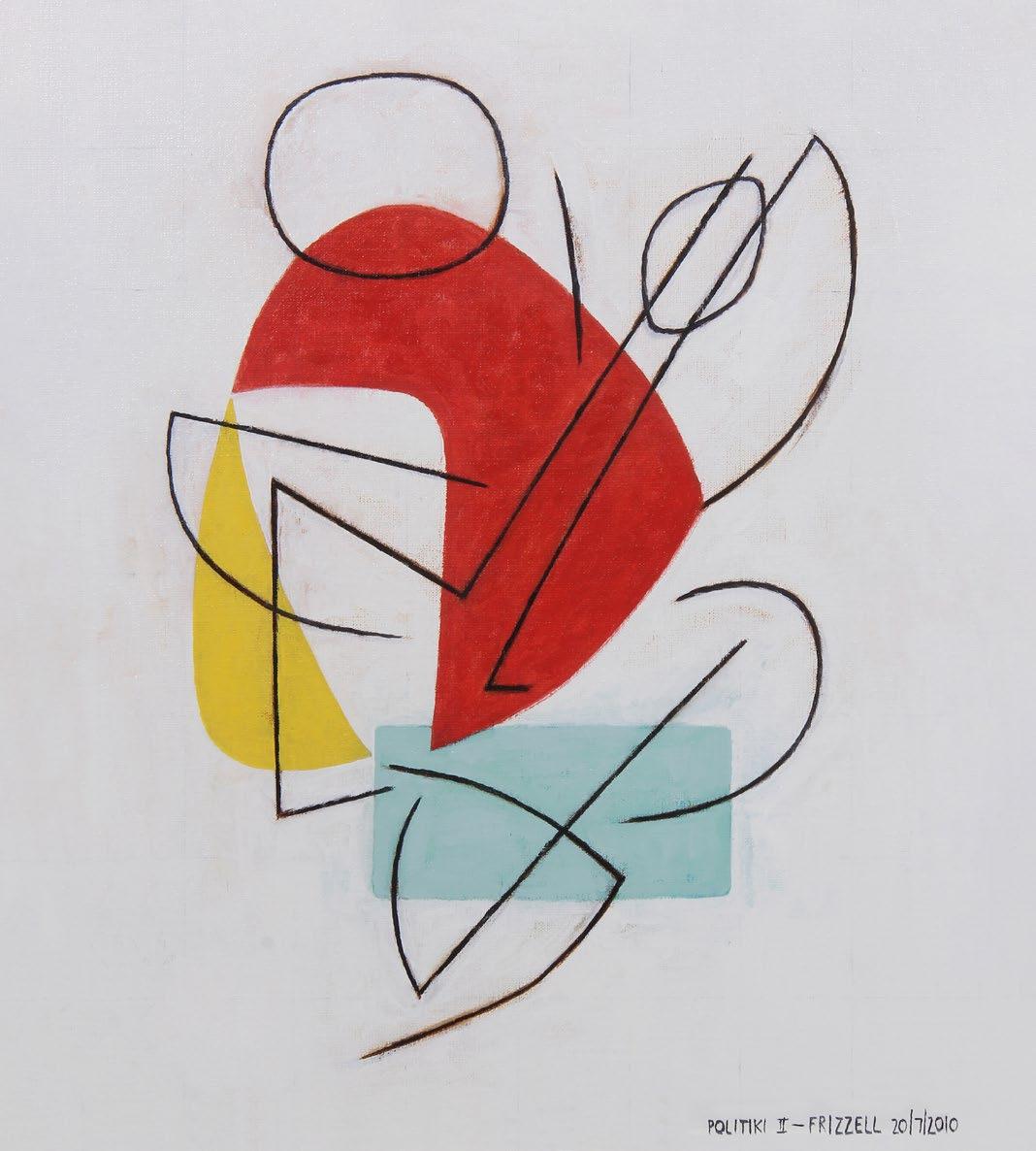
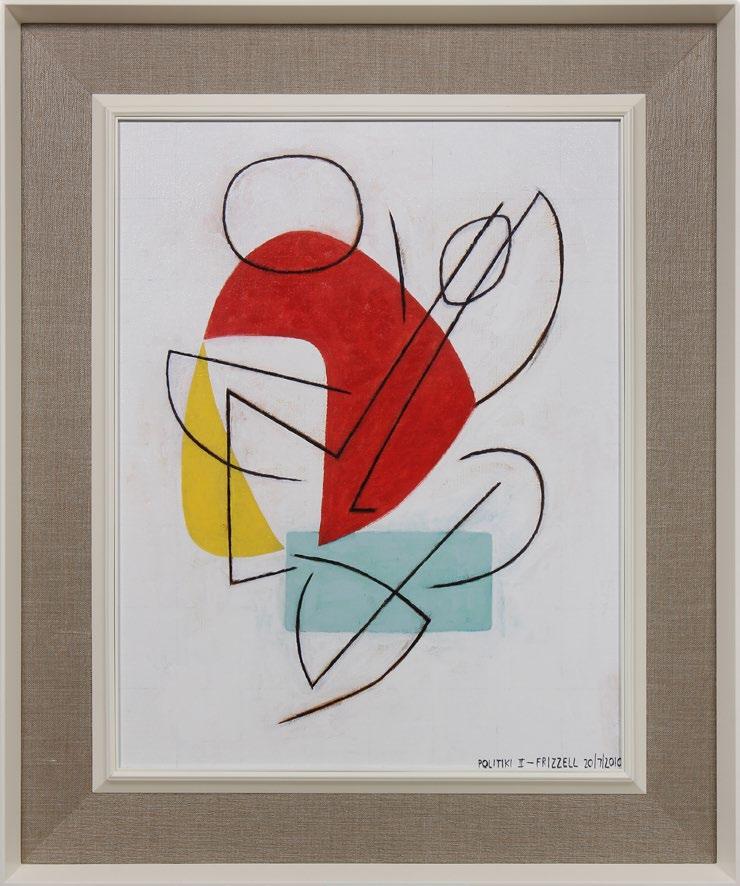
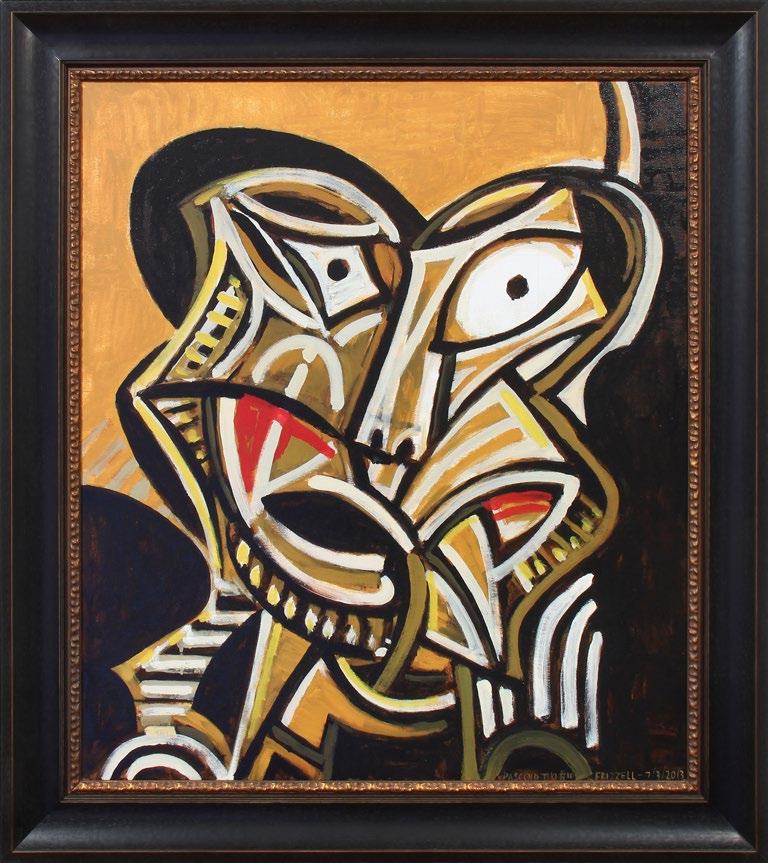
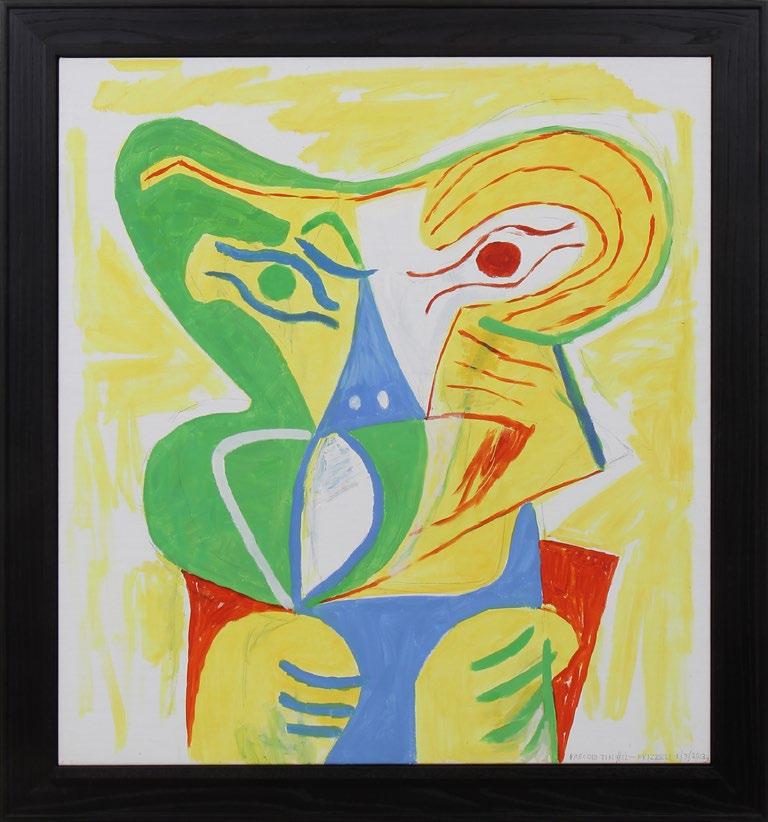
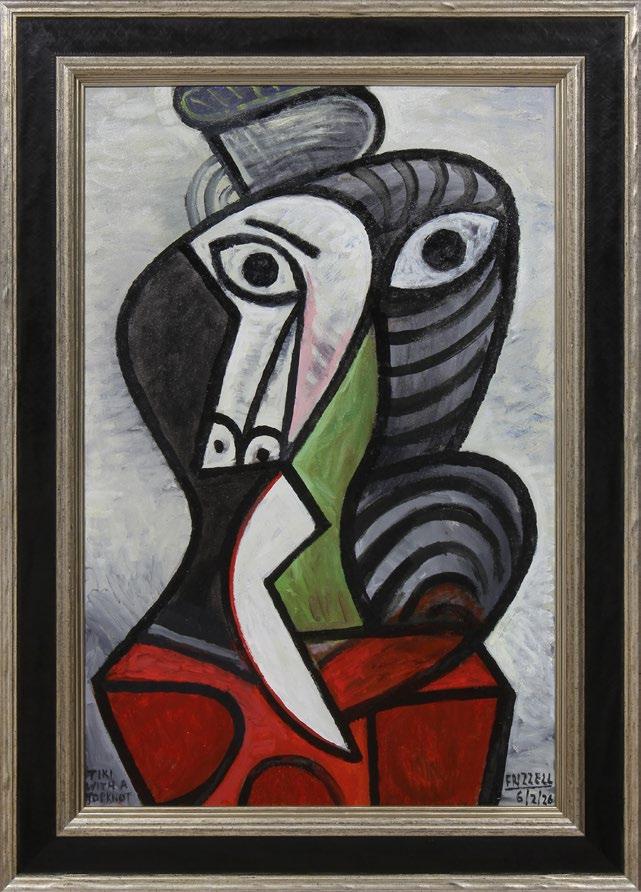
In the case of Pascoid Tiki #20, the explicit referencing, if not inspiration, is decidedly Picasso. The tongue has become a beak, the hands missing. The composition is forceful, even regal, but the muted colours benign. Pascoid #1, 2013, the first oil in the series, is truly a statement of intent, a fully recognisable tiki, put through Picasso’s stylistic treatment. Tiki with a Topknot, 2026, continues Frizzell’s career-long focus with the tiki form and his direct conversations with Picasso pictorial constructs with Frizzell’s characteristic renditions. Architiki I, from 2010, (a subseries begun in 2006), identifies another primary source, the Russian sculptor Alexander Archipenko, an admirer of Picasso’s cubism and a ‘primitivist’ sculptor. Here the tiki’s face can be viewed as a dancing figure, the facial features separated, with lives of their own. Politiki II, from 2010, which at first sight might seem to lack substance, is a linear masterclass where the role of the drawn line sits forward of three blocks of colour that collectively become –recomposing and coalescing – themselves into a unified, outlined tiki. It is not unlike the bare, sketchy graphic style of the 1950s, Festival of Britain, fragile with post-war deprivation.
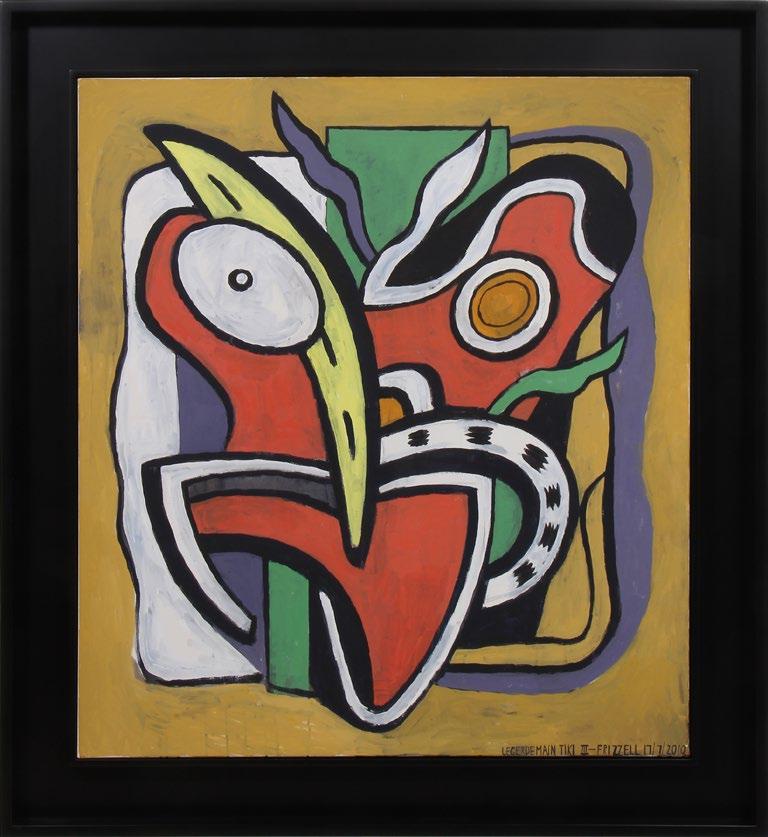
Legerdemain Tiki III 2010 oil on canvas, frame: 1240 x 1140 x 65 mm
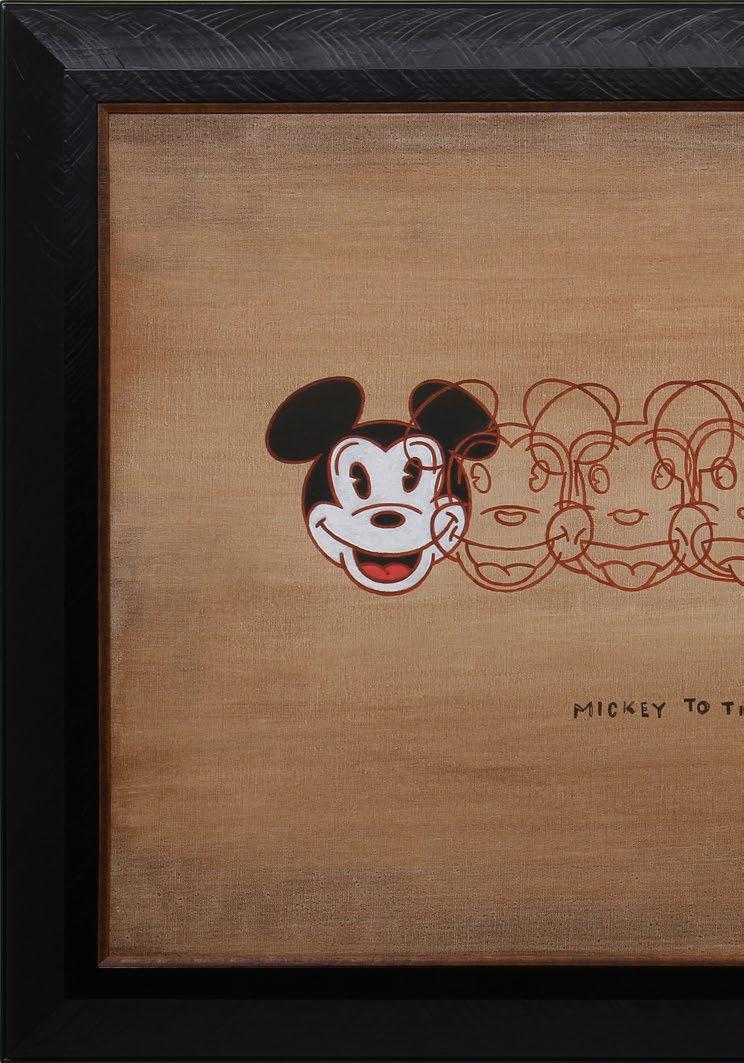
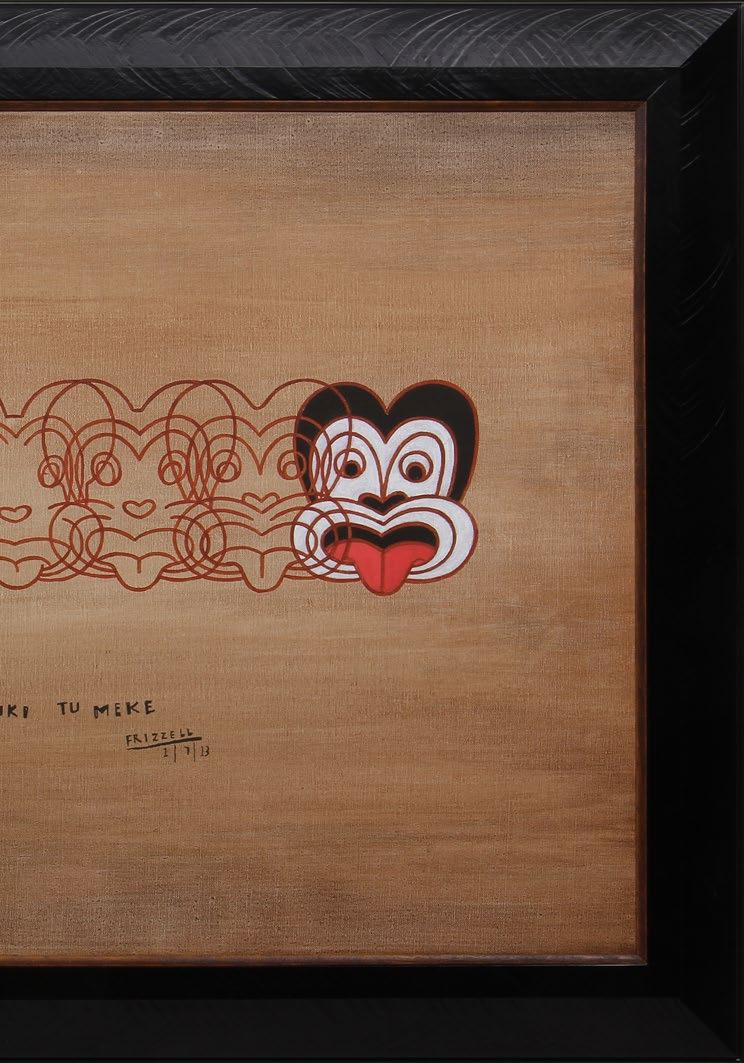
Mickey to Tiki tu Meke, 2013, explores cultural fusion, or mutual appropriation, through the device of morphing imagery, running back and forth. ‘Tu Meke’, which in Māori can mean ‘too much’, functions also an alliterative, humorous, device which turns the title in upon itself. Obviously plural and equally ambiguous, while placing the tiki form into a conversation about drawing, cartooning and the roles of contemporary motifs, Frizzell also positions the tiki form into yet another cultural dialogue. If this is questioning biculturalism, it is doing so with the broadest of brushes which has seen that very ambiguity and plurality foster misunderstandings, with critics and artists alike talking past each other.
The exhibition Tiki at the Gow Langsford Gallery in Auckland, 27 October-14 November 1992, was a significant event in Aotearoa New Zealand’s art history.
It was interpreted as a direct assault upon the constitutional mantra of biculturalism, that had only in the recent past been heralded as a major shift in New Zealand’s cultural awakening.
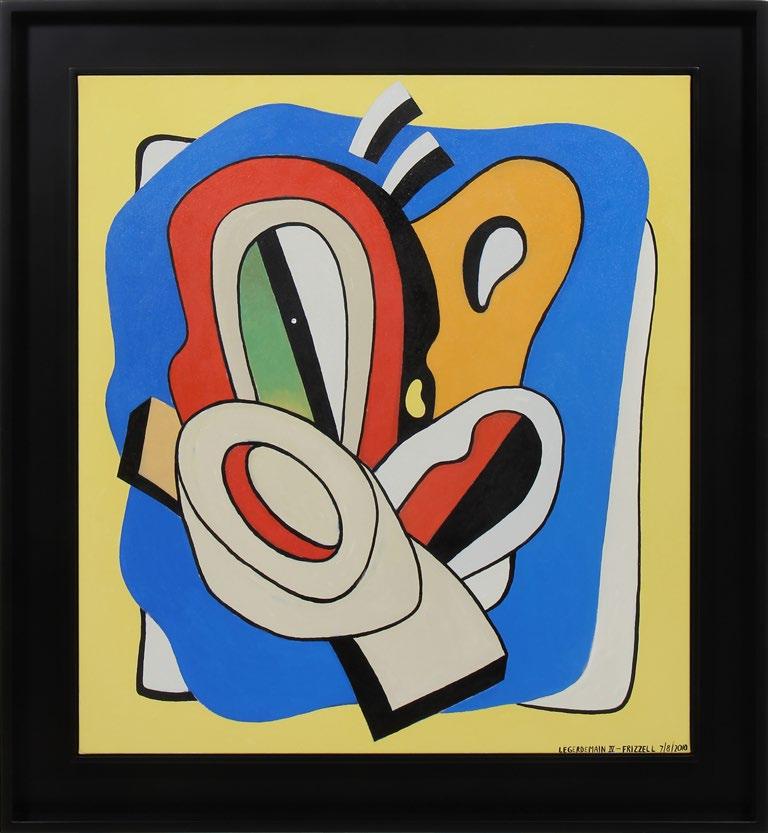
Legerdemain IV 2010 oil on canvas, frame: 1240 x 1140 x 65 mm
The contributers to the catalogue of Frizzell’s 1992 show were more than aware of all these conversations. Like Frizzell himself, they were educated, intellectually aware, conscious of the realities of history. George Hubbard (with Māori affiliations), demonstrated that he undertsood the significance of the term ‘tiki’, across the Pacific, of its use and misuse in history. Stuart A. McKenzie discussed cultural appropriation, as well as that of Frizzell, in an essay that showed a wealth of historical knowledge and great sensitivity to all the issues invoved. The writers were all aware of the emotions running high among Māori in regard to ‘cultural appropriation’, following the recent assault on the work of the Pākehā artist Gordon Walters by Rangihiroa Panoho.
The exhibition was no accident. It was painted, planned, written up, with eyes wide open.
Frizzell has a natural graphic talent. He drew decorations for his fellow school kids’ exercise books. He observed his mother’s eclectic interest in ‘crafts’, in making things. Going to art school brought him into a new social milieu that was often uncomfortable. Famously cantankerous, Rudi Gopas told him to pour turpentine
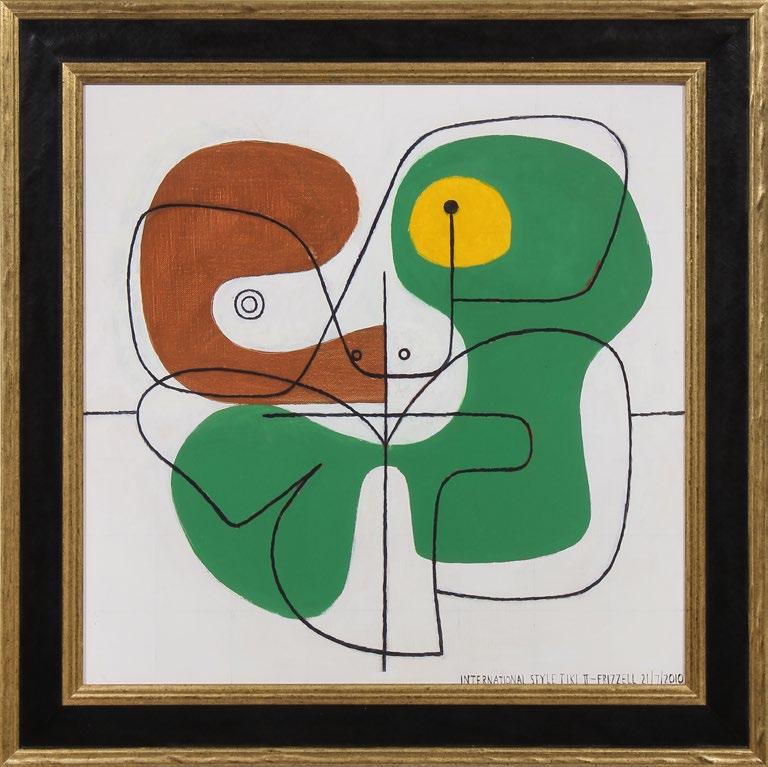
International Style Tiki II 2010 acrylic on linen, frame: 770 x 770 x 47 mm
over a painting because it did not fit the instructor’s standards and ideas of what a work of art should look like. Frizzell’s Gas Stove of 1961 has plenty of quirky life, optical twists that make it as interesting as Gopas’s more formal My Chair, 1956: but there are real-life hierarchies even in, or rather, particularly in, the artworld! Frizzell would constantly question these hierarchies.
After art school, he worked successfully as a commercial designer for a number of years. He made logos, cartoons, images that satisfied commercial clients, that would catch the eye of the nonart-educated public. “I was happy designing boutique labels, and Human Instinct covers, solving graphic problems instead of art ones… Being Pop instead of painting it.” 1 He was, after all, a ‘man of the people’, a ‘primary producer’ and proudly remains so.
But Frizzell also has an energetic enquiring mind. What was this thing they had tried to instil in him at art school? What do I have to do to become an ‘artist’, rather than a ‘draughtsman’? “I’ve been thinking about what art might be since I started making it seriously back in 1975.” 2 “I thought about the meaning of art,
1 Dick Frizzell, Me, According to the History of Art, Massey University Press, Auckland, 2020, p. 24.
2 Ibid., p. 23.
Politiki II 2010 oil on linen, frame: 939 x 785 x 83 mm
oh boy, did I think about it. I never stopped thinking about it. Painting. How, How? How? ” 3
He found himself drawn into a world that up to that point he had avoided. He was fascinated with ‘art history’ but uncomfortable in the company of its purveyors, in their monopoly over its structures, its historiography. After all, many art historians came from the intellectual élite. Their fathers were not engineers at a meat works.
Frizzell had sufficient nous to see that many of the non-artpractitioner art historians, and particularly the theorists, were missing some essential items of their emperor’s clothes.
I was dimly becoming aware that the road to finding out who you were was to examine everything — every thing — that you related to on some genuine level. Not what you thought you should be liking or what you’d trained yourself to like but what you were intuitively drawn to, no matter how improper or improbable it might be, that meant rediscovering all the things that I’d put aside… there was something essentially me that had got subsumed in the rush to seriousness. 4
3 Ibid., p. 24.
4 Ibid., p. 24-26.
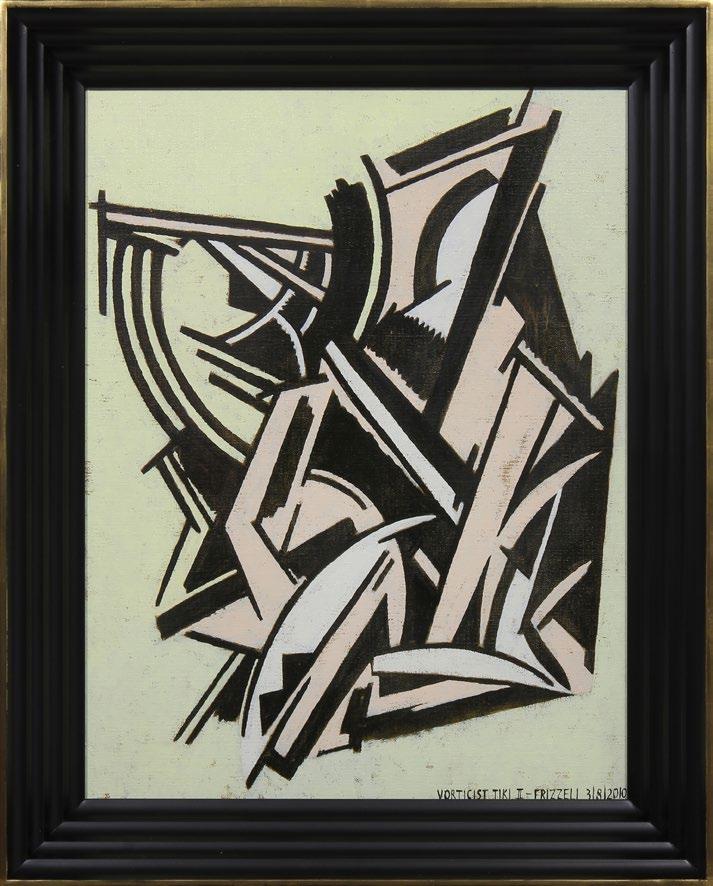
Vorticist Tiki II 2010 oil on linen, 785 x 632 x 112 mm
Within Māori culture in Aotearoa New Zealand a Tiki is often a small figure carved in wood, bone, or pounamu (greenstone), representing deities, ancestors, or fertility. A hei-tiki neck pendant may represent a stylized human embryo, the first human created by the gods, symbolise fertility, new life, a wearer’s whakapapa (genealogy), protection, mana, social authority, prestige, dignity. Often, the head is tilted, one side resting on a shoulder, the other facing upwards, up to the gods and down to earth. It is depicted in a seated position, knees stretched to left and right, with the three-fingered hands resting on the thighs or embracing the midriff. Older carvings may feature red wax or pāua shell eyes. The face of the figure is stylised, with a protruding tongue hanging from a gaping mouth, a form of pūkana (a fierce facial expression), protecting the wearer.
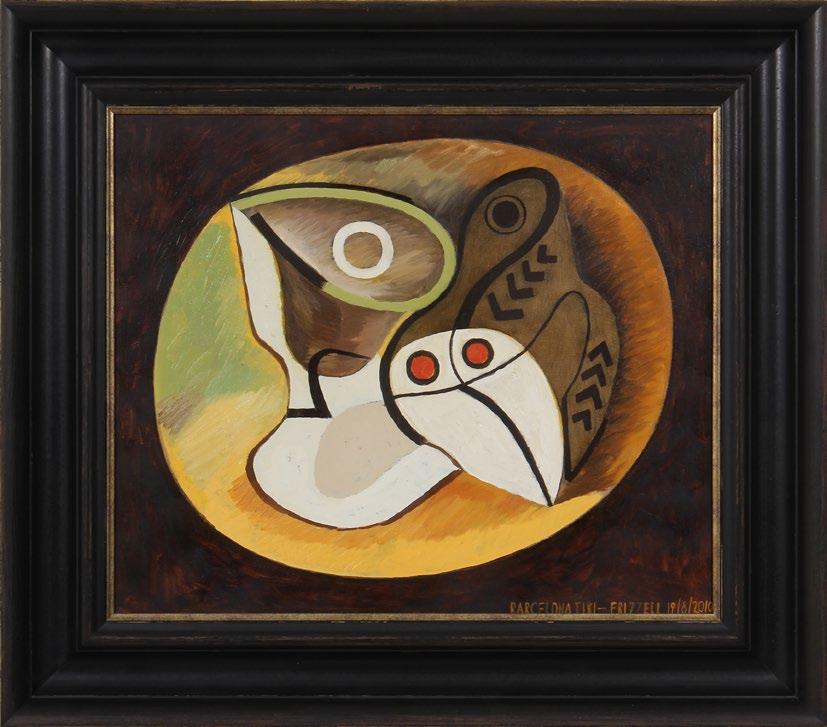
Hei-tiki were originally precious heirlooms, that were hidden or ceased to be made during the late nineteenth century. They became popular once more following the 1905 All Blacks tour of Barcelona Tiki 2010
oil on linen, frame: 707 x 805 x 80 mm
Pages 15-16: Mickey to Tiki Tu Meke 2013
oil on linen, frame: 1005 x 1395 x 45 mm
Great Britain, when a greenstone hei-tiki was carried as a good luck charm, and became a symbol of sporting prowess. Over time, this modern hei-tiki became detached from its earlier Māori context to indicate a broader New Zealand identity that also embraced Pākehā (non-Māori). In the later twentieth century, it became a popular tourist item, mass-produced in plastic, made in China, one being presented to The Beatles in 1964.
Frizzell was always interested in popular culture of his own era, collecting American comics, swiftly designed images for advertising in newspapers, domestic products sold in local dairies, pop music record sleeves. For his first solo exhibition in the Barry Lett galleries in Auckland in 1976, Dick Frizzell: A-Fishial Art Exhibition, his motifs came from tins of mackerel, shining enamel on board, such as the later Black Geisha, 1978. He reported that after the family opened a tin of mackerel for lunch, he realised that: “Here was something that I could paint that didn’t say anything, but sure as hell could do a lot — or at least say a lot about painting.” 5
5 Auckland Art Gallery Toi o Tāmaki, The Guide, 2001. Curiously, coincidentally, but pertinent to my later arguments, one of Frizzell’s images in the show, Fabricant Societé Anonyme Enigme, 1977, shows a fish, vertical top to tail, alongside the Eiffel Tower, both the same scale. The Russian avant-garde artist Vladimir Tatlin’s calling card was a silver fish, and Tatlin modelled his Tower, Monument to the Third International, 1919/20, on the Eiffel Tower that he saw when visiting Paris and Picasso’s studio in 1913
Pascoid Tiki #1 2013 oil on linen, frame: 1100 x 1027 x 62 mm
Frizzell became associated with the New Image painters, launched in 1982 with an exhibition at the Auckland City Art Gallery. As Francis Pound put it in Art New Zealand: “Recognisable things in their work don’t look as they do in the world: they are removed from their normal context, abbreviated, exaggerated; offering only their identifying signs — like dictionary definitions. In the passage to art, their images endure a drastic transformation — in placement, scale, material, colour.” 6
Frizzell records the genesis of his interest in the tiki as both a multi-cultural motif and a vehicle for discussions of cross-cultural dialogue:
And one day... the rubber bands and buttons [in my studio, as I was painting a landscape] assumed a peculiarly Hans Arp-Francis Picabia styled TIKI. [This is shown to be the case in the reproductions from his workbook Dick Frizzell—The Painter, p 162]. A form that said ‘Tiki’ but contained not a hint of any traditional Māori art forms (there were precedents… Arnold Wilson’s ‘Barbara Hepworth’ Māori carvings… it was no doubt all at the back of my mind).
All this was fascinating enough for me to attempt another — and another
6 Francis Pound, “The New Image Painters,” Art New Zealand, No. 22, Summer, 1981-82.
Pascoid Tiki #10 2013 oil on linen, frame: 1123 x 998 x 43 mm
— until the grided-up landscape on the easel was totally forgotten and this Tiki idea became my central investigation. And, of course, the further I went into it the more I started to come up against a weird raft of cultural taboos — what you can do and what you can’t do — and who can do it. A peculiar construct of cultural rules held aloft by nothing more than assumption and bluff.
Judy and I took a literal ‘Tiki Tour’ 7 of the North Island — hoping to document popular use of the motif — motel signs and the like — and much to my amazement all ‘commercial’ representation had been removed from the landscape! Gone the way of the Air New Zealand plastic tiki.
A dangerous precedent in my view. If you are hoping to evolve a ‘pure’ culture by prohibiting the complete range of expression most cultures include, you’re more likely to strangle your darling than nurture it. Ringfenced cultures atrophy and die. And that became a serious and central focus for my ‘campaign’. And a seriously misunderstood one too, until people began to wake up.
I was actually called a Spiritual Assassin at one point. Which I might very well have been. I haven’t got a spiritual bone in my body. Don’t know
7 The title ‘Tiki Tour’ for a coach tour of New Zealand originated in 1946.
Pascoid Tiki #12 2013 oil on linen, frame: 1075 x 1005 x 55 mm
what people mean when they talk about ‘things spiritual’. It all sounds suspiciously like smug gamesmanship to me: ’I’m more worthy than you are’. From where I’m standing, spirituality seems to inhibit decent and rational behaviour rather than facilitate it.
The build-up was all incremental really — not a ‘Big Bad Plan’ — one thing leading to another. I just happened to be in the right place at the right time — with the right tools. I’d been rehearsing this ‘argument’ for years with my Māori brother-in-law: John Chadwick, cunning wordsmith, extremely lateral lawyer and inventor of the fabulous ‘Law of Sufficient Grovelling’.
It all started pouring out — all of it. From new definitions of how cultures evolve, how they are shaped by the ‘world’. How a culture has a collective mind of its own — beyond the control of any self-proclaimed Cultural Ringmasters — or ‘minders’.
It was a hell of a ride. I was ‘discovered’ again, dusted off and put back into service. 8
The first of Frizzell’s works entitled Tiki dates from 1990, oil on canvas. It depicts a form with a small circle in the top left hand corner, like a tiki ‘eye’, with a fish-like figure outlined in 8 Dick Frizzell, Dick Frizzell — The Painter, Godwit, Auckland, 2009, p. 163.
Pascoid Tiki #13 2013 oil on canvas, frame: 1065 x 993 x 55 mm
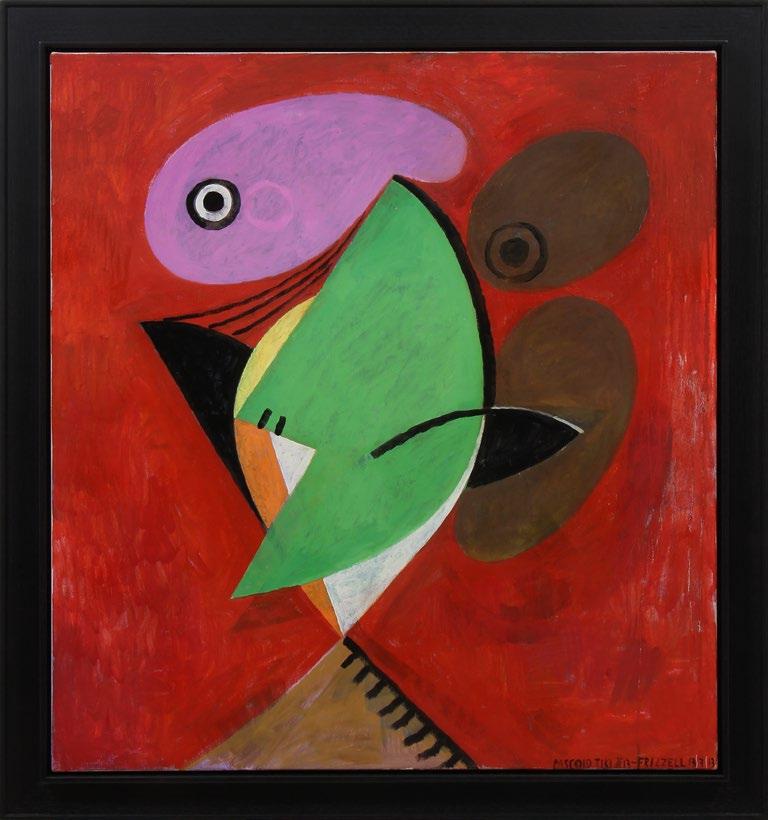
red, a body and tail. 9 Other works with ‘Tiki’ in their title, created with different permutations of intertwined shapes and colour contrasts, followed, until, in 1992, they emerge with a ‘bang’ into a whole series, the distortions sometimes becoming so radically different from the Māori pendant, such as Politiki II, that seem far removed from the original motif.
In the inside cover of Frizzell’s book, It’s All About the Image, 2009, he reproduces some of his pencil notes contributing to the final text:
Colin (McCahon)’s uncanny sense of proportion — how little he needed to make his point — how the positive spaces and the negative spaces somehow swell into each other! How the same line can describe a line — or describe a mass — and how the masses seem to hover in so much space and vice versa. The truth in a McCahon blows through the work unimpeded… like the wind blowing through the back [screen door]. 10
9 Ibid, p.164.
10 Dick Frizzell, It’s All About the Image, Godwit, Auckland, 2009, frontispiece.
Pascoid Tiki #16 2018 oil on linen, frame: 1365 x 960 x 45 mm
This reads at first like Formalism, a work characterised by ‘proportion’, ‘positive and negative space’, but then tumbles into the intangible — ‘truth’, ‘blowing through the work unimpeded’, blowing a grand trumpet of something far more significant but incapable of any reasoned explanation—the dreaded ‘aesthetic’.
In the passages in the book that follow, paying respects to 107 New Zealand contemporary and elder statesmen artists, Fizzell maintains a Formalist first and ‘aesthetic’ second structure in his frank and perceptive assessments. For example, offering his experience, as a secondary school boy, watching Peter McIntyre painting a portrait of Major General Sir Bernard Freyberg in the Hastings War Memorial Library:
He painted some small rocks on the desert sand at the feet of the soldiers and with what seemed like a couple of brush strokes he rendered the texture of the rock, the sun on the rock, the reflected light on the shady side of the rock, and the shadow of the rock on the sand! The entire Universe right there! With a brush and some paint. I’ve been trying to be so clever ever since. 11
11 Ibid., p. 14.
PK-TK 2019 oil on canvas, frame: 884 x 731 x 64 mm
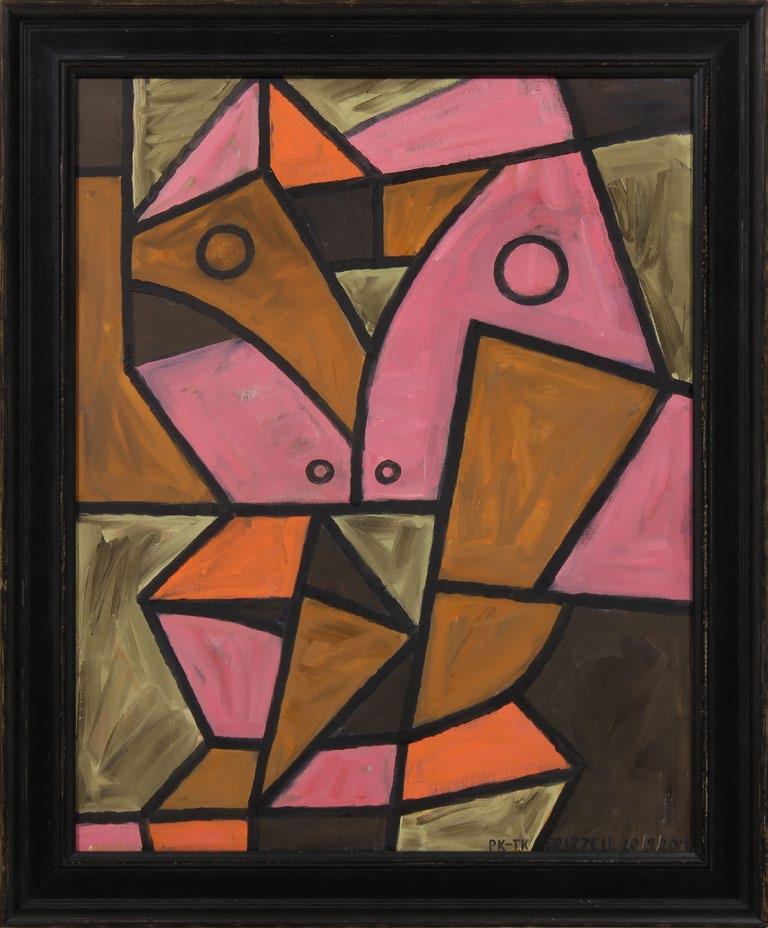
As an art student at the Canterbury School of Fine Arts (Ilam) in Christchurch, Frizzell was horrified to find that ‘technique’ was not the cornerstone of what he was being taught. And “I marvel now at the strange intellectual vacuum we found ourselves in at Canterbury in the 1960s: lots of atmosphere but almost zero philosophical instruction.” 12
Western Modern Art movements were the foundation of the staff’s teaching that seemed to highlight the expression of feelings, rather than rendering the seen, the scene, as you saw it, with the values of form, such as ‘pictorial depth and narrative’. Many artists elevate techniques, such as colour, the rendering of negative and positive space, line, draughtsmanship, design, balance, to the higher realm of ‘values’, without the need to explore that word further. The tangible, in the handling of techniques, becomes that magic flux that makes or mars the work.
No one’s going to write a credible history of New Zealand art without mentioning Colin McCahon. I’ll never forget [writes Frizzell] how genuinely awesome it was seeing his Gate series in Christchurch’s Robert McDougall Art Gallery way back in 1962. The paintings seemed
12 Dick Frizzell, Me, According to the History of Art, Massey University Press, Auckland, 2020, p. 23.
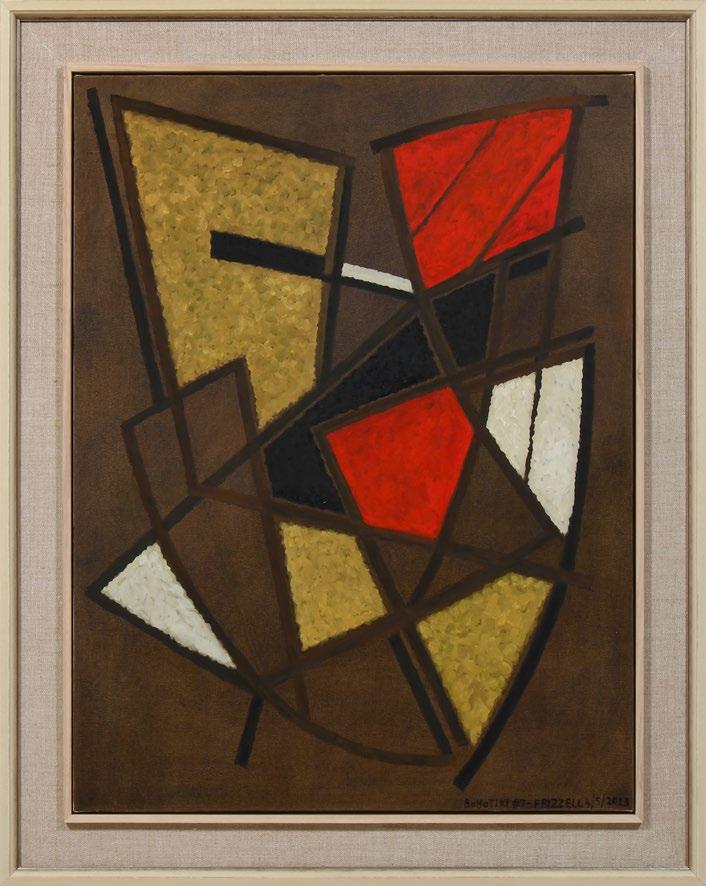
BoHoTIKI #7 2023 oil on canvas, frame: 1111 x 886 x 57 mm
fabulously substantial in ways that I’d never seen ‘live’ before: the rough masking tape marks (masking tape!?), the kitchen cupboard enamel paint surfaces—how was it possible to make art out of such brutal and unsympathetic means? 13
‘Awesome’, ‘fabulously substantial’? These affirmatives offer little to the reader. In writing about art, almost invariably, these euphemisms, used by most writers about art, for what makes an image a ‘work of art’, even a ‘masterpiece’, remain hanging in a void. One of the tasks some art historians, or ‘art history theorists’, have tried to do is to put flesh on these ghosts of concepts, to find the ‘meaning’, why some art works are elevated into a canon and others not. Indeed, much art history is about the way ‘meaning’ and values’ have accrued, and accrue, to art works over time and space.
In his book Me, According to the History of Art, 2020, Frizzell rightly takes art historians to task on several scores, without realising that he is as guilty as the next observer, for sidestepping the issues of ‘values’. Though Frizzell himself makes exclamations of value, he
13 Dick Frizzell, It’s All About the Image, Godwit, Auckland, 2009, p 16.
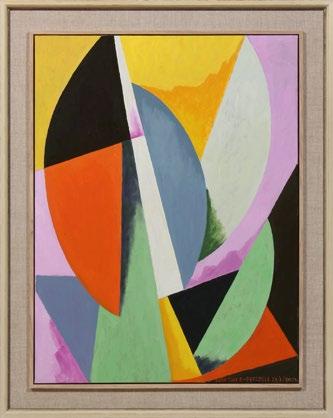
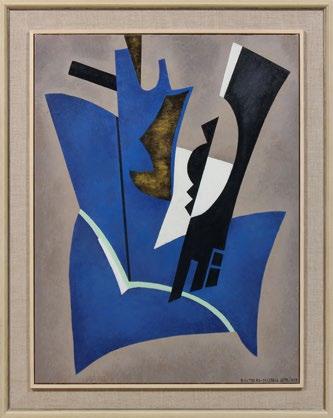
BoHoTIKI #1 2023 | BoHoTIKI #2 2023
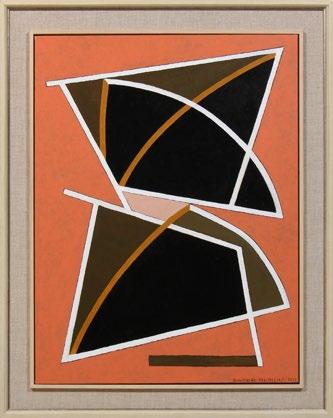
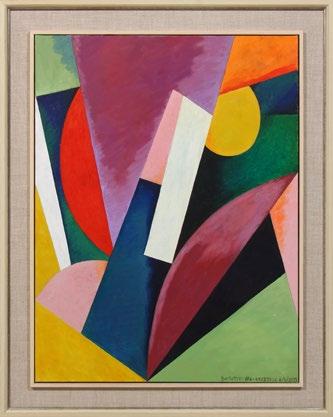
BoHoTIKI #3 2023 | BoHoTIKI #6 2023 oil on linen, frames: 1111 x 886 x 57 mm each
never develops a ‘philosophy’, an explanation of what makes the work ‘work’ for him. At the same time, he certainly is famous for declaring that he eschews any notion of ‘the spiritual’ — another way of talking about ‘value’. He claims to have no spiritual bone in his body. It was this lack of respect for ‘the spiritual’ that lay at the heart of his detractors’ criticism of the 1992 Tiki show. It caused the Māori film maker, Merata Mita, to call Frizzell a ‘Spiritual Assassin’. 14
There is no doubt that Frizzell knows how to draw, paint, compose a picture. He can handle a pencil, a brush, oils, acrylic, enamel. He can paint in any historical style, Medieval religious subjects, the Romantics, all varieties of Modernism. This capability is very rare as is the breadth of his image sources. ‘Low art’ is a particular speciality — comics, advertisements. This virtuosity needs no ‘values’, no seeking for a ‘truth’, either to materials, ideas, or spiritual contexts. Frizzell is recorded as saying: “Whether it’s a Malevich or Batman comic cover, it’s the same thing: just painting on paper.” This is a sentiment Malevich himself proclaimed with The Black Quadrilateral of 1915. However, Malevich was also a trickster, a joker. His Suprematism was never just paint on paper.
14 Stamp magazine, December / January, 1993.
Mathematiki 2023 oil, graphite on linen, frame: 717 x 717 x 45 mm
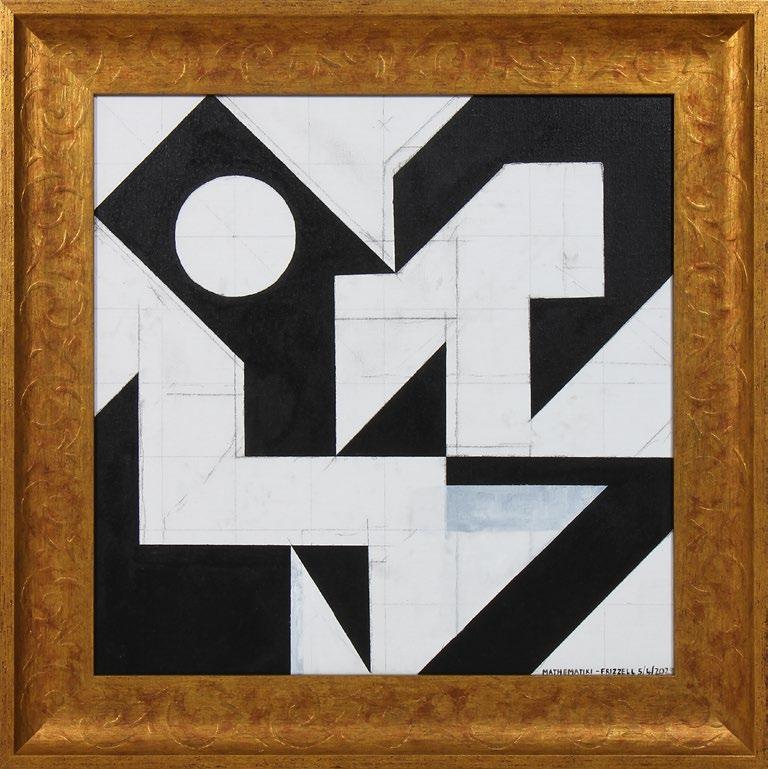
It was the first step in a movement for political and social change, shrugging off the chains of the Academy and the canon, for a new world of which he became a Messiah. Frizzell too is a ‘serious artiste,’ his works acquire ‘values’ over time within New Zealand’s art history but notice the ‘e’. He sometimes finds it hard to take himself seriously.
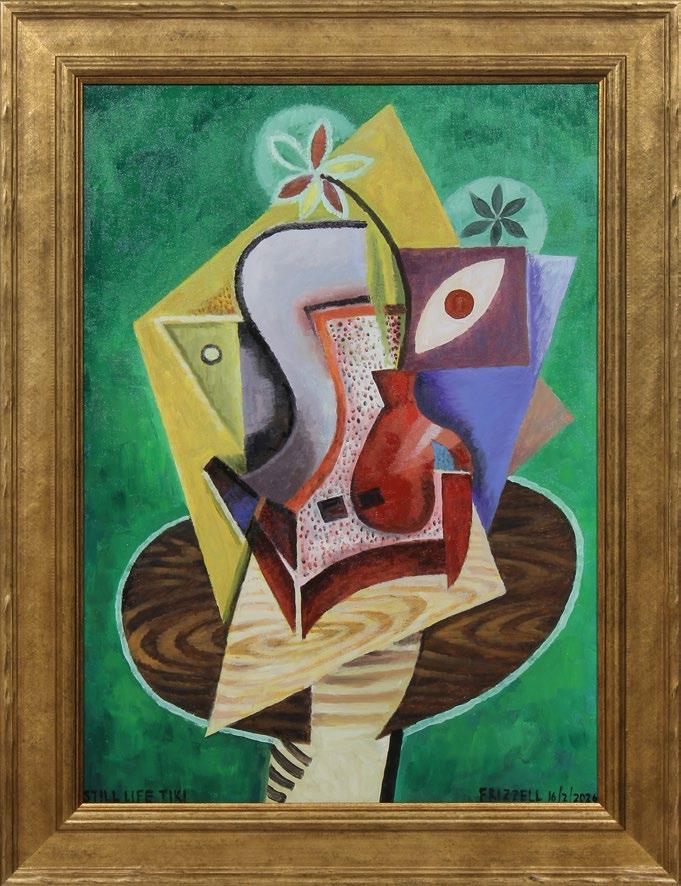
This technical ability to perform any style is clearly illustrated in the works in this exhibition. A positive value he does add is that of humour. Barcelona Tiki, 2010, and Still Life Tiki, 2026, for example, manage to evoke not only the formal features of the Tiki, but also parody Picassoesque still life works, as well as being paintings that give the pleasure of in-jokes as well as visual delights.
BoHoTIKI #1 and # 2 , 2023, whilst evoking the forms and colours of Liubov Popova’s Parisian Suprematism, are also suffused with the ‘Bohemian’ middle-class pastel fashion plates of the 1960s and 70s. Here the Tiki underpinning is left with only vestiges of tongues and eyes. The series entitled Legerdemain, 2010, not only refers to the Art Deco styles of Fernand Léger but also the French for ‘sleight of hand’, the humour and visual trickery in which Frizzell delights at every turn.
Badge 2023
oil on linen, frame: 1313 x 1313 x 60 mm
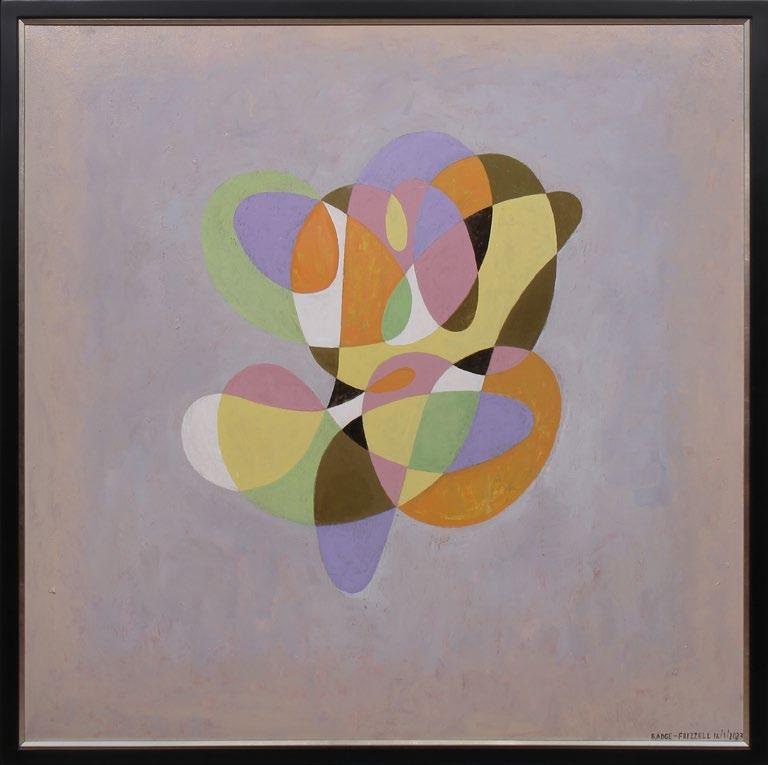
Frizzell has three identities as an artist — as a ‘bad’ artist, a Pop artist, a neo-primitivist, as a follower of the European avant-garde from Cubism to Art Deco, as well as a painter of landscapes and signs. All three identities overlap, cross fertilise.
For example, the landscape Just Outside Taumaranui ,1989, has echoes of Douanier Rousseau, the French neo-primitivist, who flourished alongside Cubism. Cubist Still Life with Hulk Cover, 1974, brings together Cubism and ‘bad’ art. Black Geisha, 1978, is an enamel, like a Russian pre-revolutionary shop sign but within the shadow of 1960’s Pop art.
Frizzell also pursues the roots of his New Zealand cultural identity: a pākehā amidst Māori, Pacific Islanders and immigrants from other cultures. For him, the bicultural mantra seemed uncomfortable when interpreted as two different cultures. When he appeared to promote ‘fusion’, he headed into stormy waters, as witnessed by the reaction to the 1992 Tiki show and, later, with the ambiguity of Mickey to Tiki tu Meke. Even later admirers, such as Robert Leonard, were earlier driven to voice dismay. 15
15 Robert Leonard, with John McCormick, “Dick Frizzell: Beyond the Pale”, Art Asia Pacific, Issue No. 2, 1993.
Pascoid Tiki #20 2026 oil on canvas, frame: 747 x 747 x 65 mm
Issues of New Zealand identity were fraught in the artworld in the 1990s. However, we have moved on. Māori are more sure of their place once more. Māori art is experiencing a long renaissance. Many pākehā have ‘a-woke’. Frizzell’s attack on a culture of silos, of separateness, and embrace of a mutually respectful interaction, though at first it brought him brickbats, has paid off. His stubbornness in pursuing the Tiki series over thirty-four years has earned respect. Tolerance, humour, mutual respect and understanding, it could be argued, are now more widespread as a result.
Frizzell’s artistic voice, his energy, his fearlessness, his very ‘New Zealandness’, are virtues that continue to amuse, annoy, delight, irritate, and to shake the canon.
Peter Stupples
March 2026
Still Life Tiki 2026 oil on canvas, frame: 970 x 945 x 54 mm
Peter Stupples was formerly a Senior Lecturer in Art History and Theory at the Dunedin School of Art at the Otago Polytechnic and Associate Professor and Head of the Department of Art History and Theory at the University of Otago. He is now retired and living in Wellington. He has written widely about Russian visual culture, his research speciality, and the social history of art. He is also an experienced art curator, journal editor and book reviewer.
Tiki with a Topknot 2026 oil on canvas, frame: 981 x 706 x 54 mm
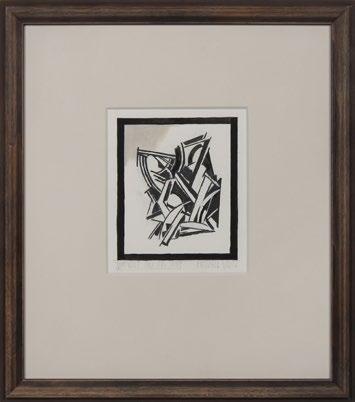
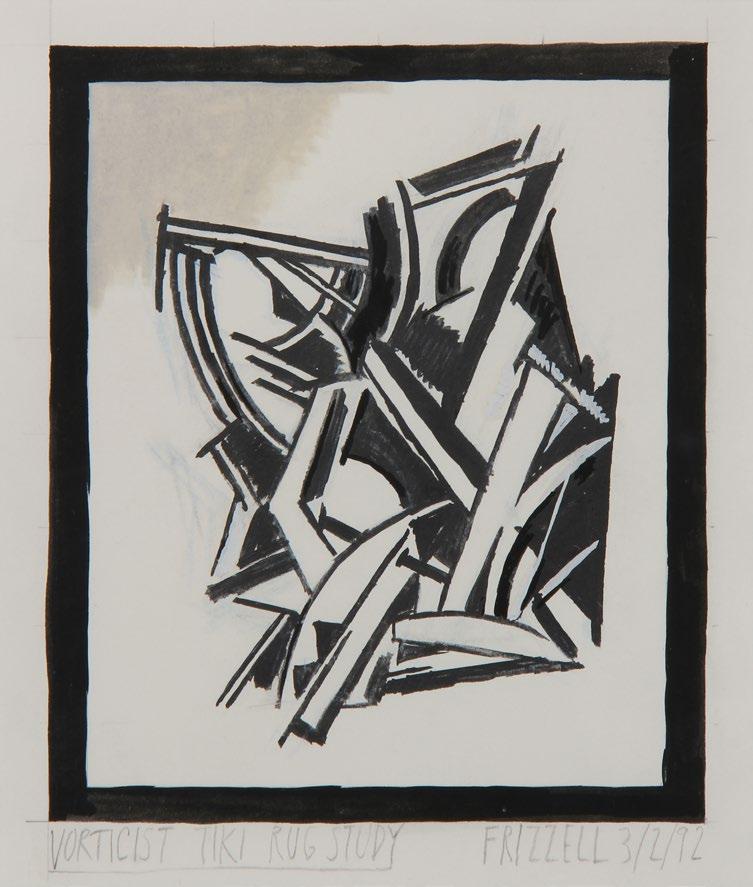
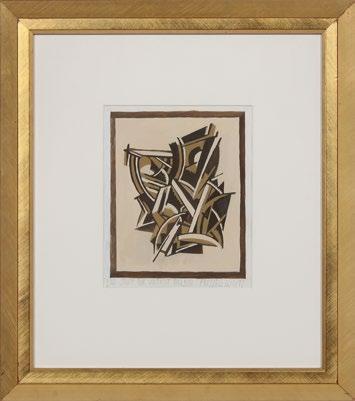
Vorticist Tiki Rug Study 1992
gouache on paper, frame: 545 x 480 x 33 mm
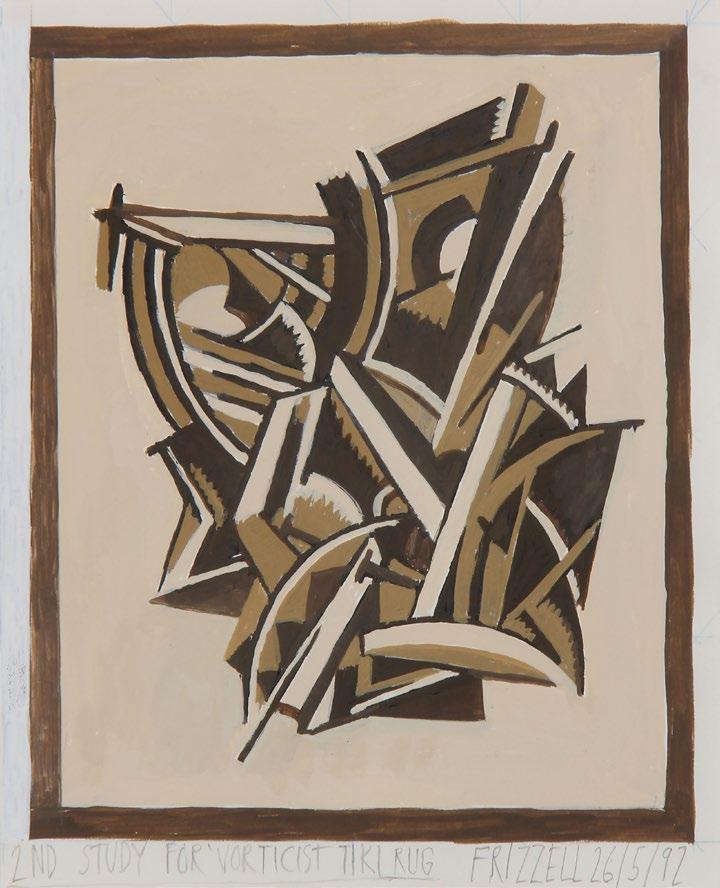
2nd Study for Vorticist Tiki Rug 1992
gouache on paper, frame: 483 x 430 x 20 mm
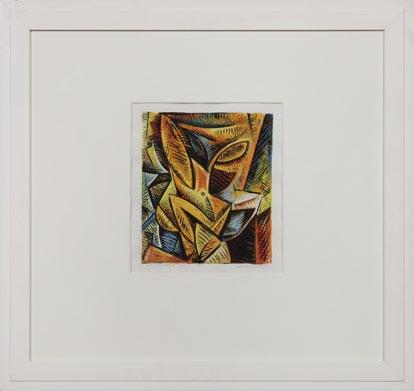
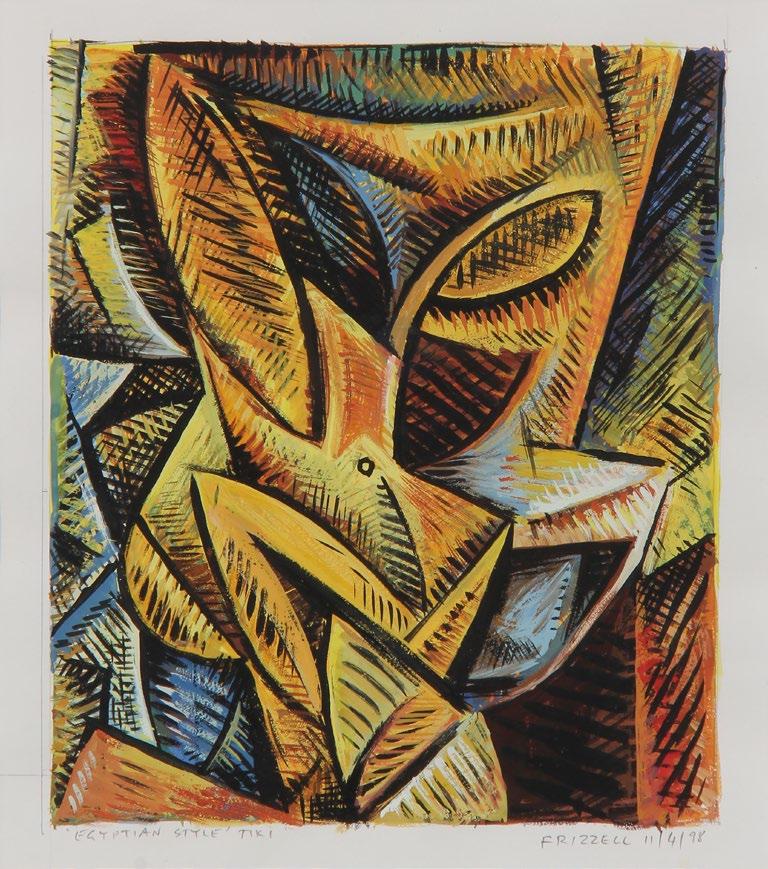
Egyptian Style Tiki 1998
gouache on paper, frame: 563 x 595 x 22 mm
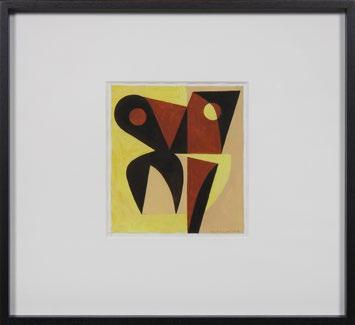
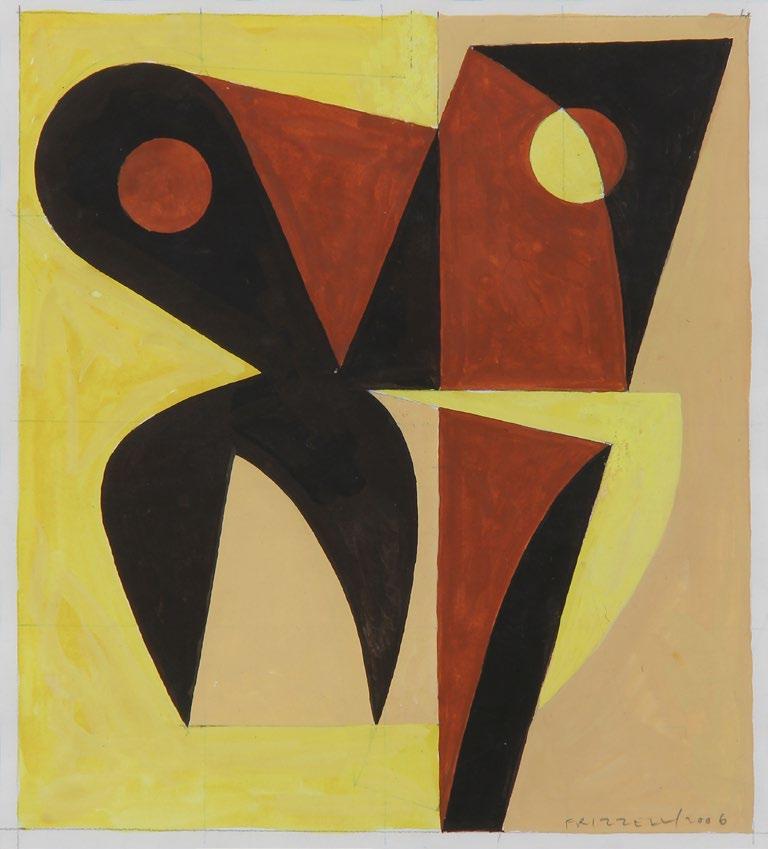
gouache on paper, frame: 515 x 560 x 43 mm
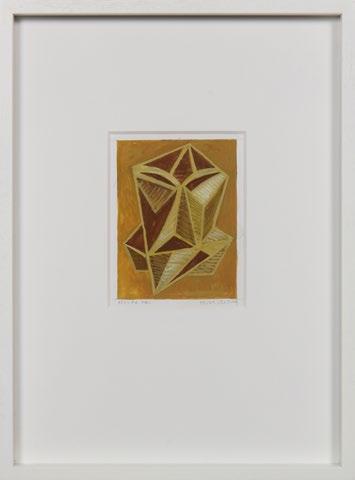
gouache on paper, frame: 470 x 355 x 43 mm
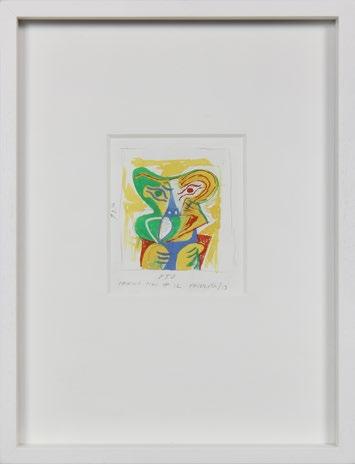
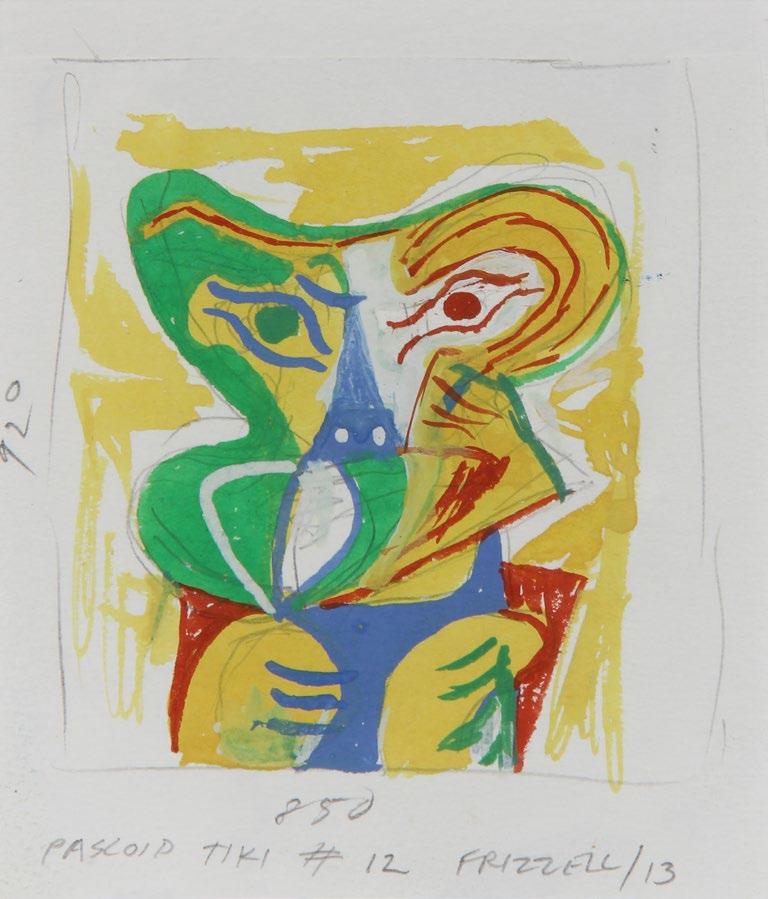
gouache, graphite on paper, frame: 380 x 292 x 45 mm
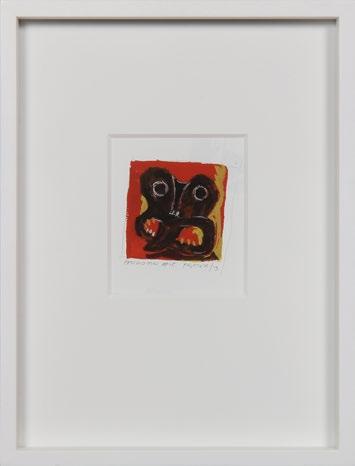
gouache, graphite on paper, frame: 382 x 290 x 45 mm
2nd Study for Vorticist Tiki Rug, 1992
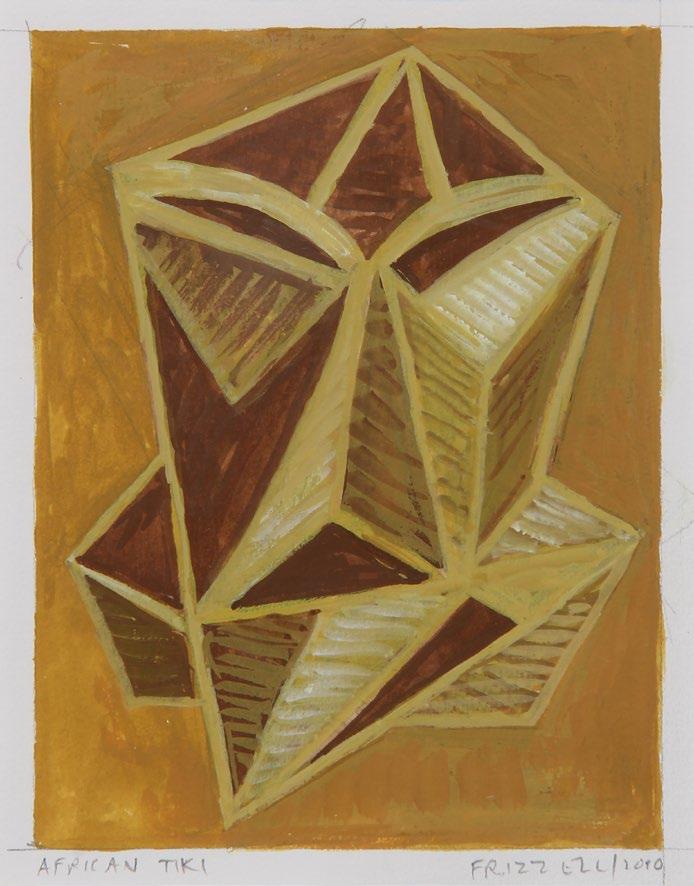
African Tiki, 2010
Architiki I, 2010
Badge, 2023
Barcelona Tiki, 2010
BoHoTIKI #1, 2023
BoHoTIKI #2, 2023
BoHoTIKI #3, 2023
BoHoTIKI #6, 2023
BoHoTIKI #7, 2023
Egyptian Style Tiki, 1998
International Style Tiki II, 2010
Legerdemain IV, 2010
Legerdemain Tiki III, 2010
Mathematiki, 2023
Mickey to Tiki Tu Meke, 2013
Pascoid Tiki #1, 2013
Pascoid Tiki #10, 2013
Pascoid Tiki #12, 2013 (on linen)
Pascoid Tiki #12, 2013 (on paper)
Pascoid Tiki #13, 2013
Pascoid Tiki #15, 2013
Pascoid Tiki #16, 2018
Pascoid Tiki #20, 2026
PK-TK, 2019
Politiki II, 2010
Still Life Tiki, 2026
Study for Architiki #1, 2006
Tiki with a Topknot, 2026
Vorticist Tiki II, 2010
Vorticist Tiki Rug Study, 1992
DICK FRIZZELL
TIKI to TIKI
4 April - 12 May 2026
Exhibited at Milford Galleries, Queenstown
All artworks are for sale. Please contact us:
Milford Galleries, Queenstown
58 Gorge Road, Queenstown 9300
Phone +64 3 442 6896
qtown@milfordgalleries.co.nz
Milford Galleries, Dunedin
18 Dowling Street, Dunedin 9016
Phone +64 3 477 7727
info@milfordgalleries.co.nz
Artworks copyright © Dick Frizzell
Text copyright © Peter Stupples 2026
Catalogue copyright © Milford Galleries Ltd 2026
Photography and design: Glenn Frei