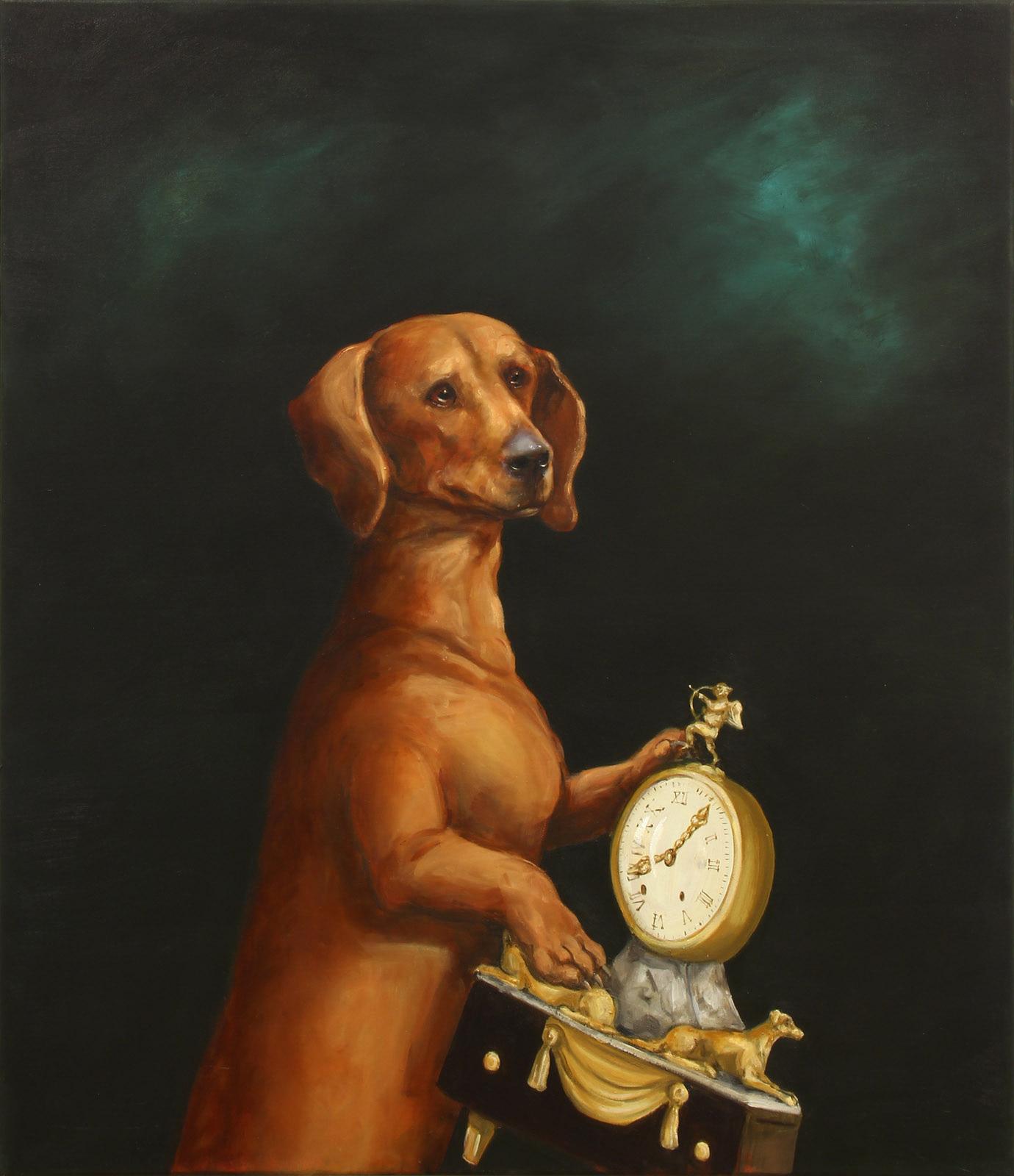
Presented with all the attributes of a traditional Victorian portrait, conveying social status and appropriate manners, Time Will Tell is a sublime visual metaphor.
Braithwaite explores the vagaries of the human condition, using symbols of power, money, success, the arts, the passage of time, far away gaze and tonal atmosphere.
This powerful study of behaviour and symbolic message is also enlivened with biting humour and the farces of context, where self-satisfaction is presented as if ordinary in a dog.
Provenance
Received from the artist’s studio
Exhibited
Home Truths, Milford Galleries Dunedin, 2014
ROBERT ELLIS
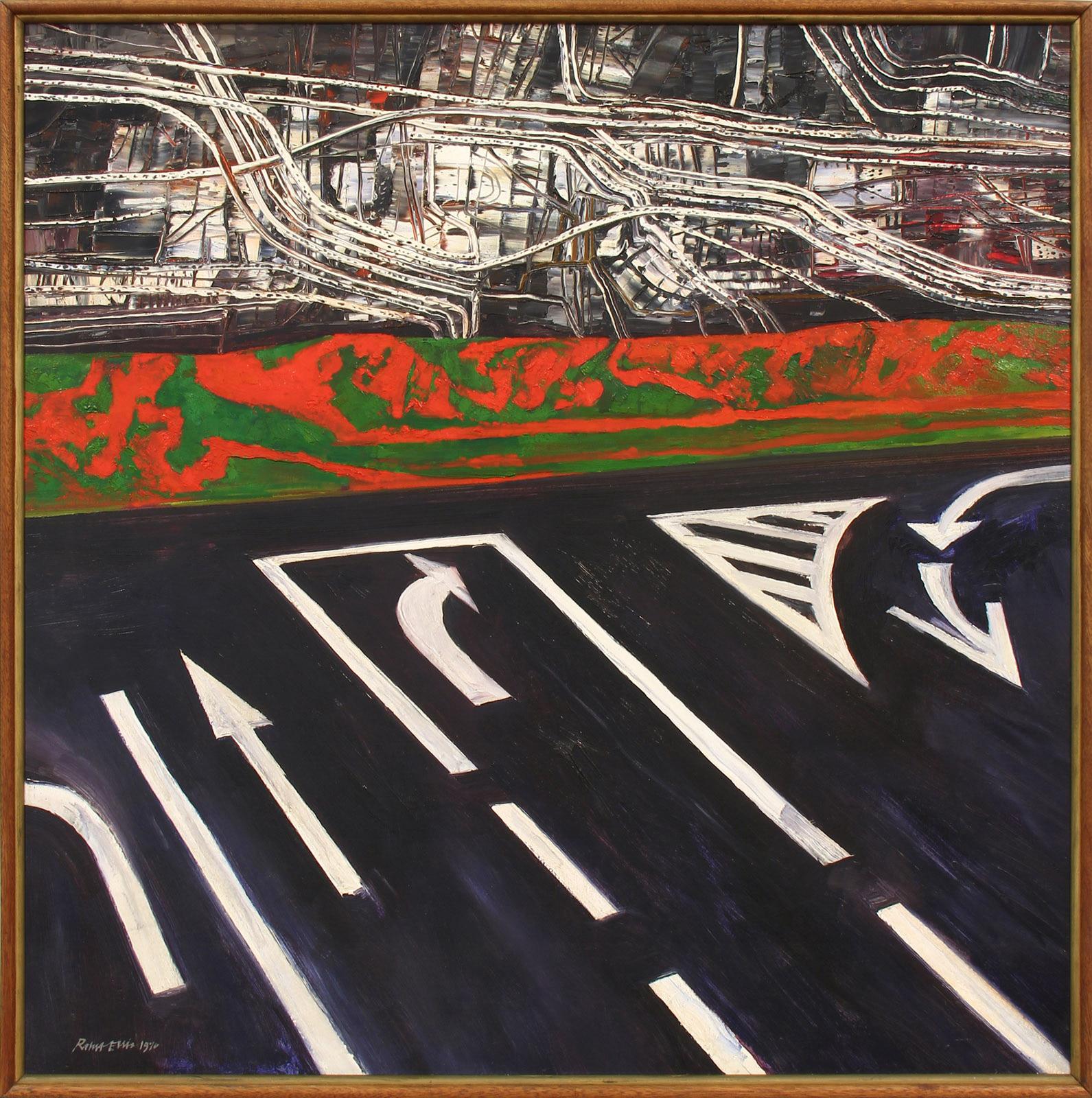
Motorway Journey (1970) oil on hardboard frame: 935 x 935 x 40 mm
signed & dated bottom left signed, dated & titled verso
The Motorway Series, of which this is a superb example, is famous, heralding the advent of urbanisation in New Zealand. By exploring the motifs and basic structures of the built environment, Robert Ellis also inevitably concerned himself with the mental environment, form and meaning.
Motorway Journey is comprised of graphic symbols denoting the intricate web of a city. It is no particular city but a synthesis. It is visually complex, presenting different lines of sight and containing schematic images that are separated, functioning as independent elements but that collectively coalesce.
Questions arise – is the intricacy and newness prophetic, a symbol of renewal or one of impermanence and transience?
Provenance
Received from the artist’s studio
Published
Robert Ellis, Ron Sang Publications, 2014, p. 50
REUBEN PATERSON
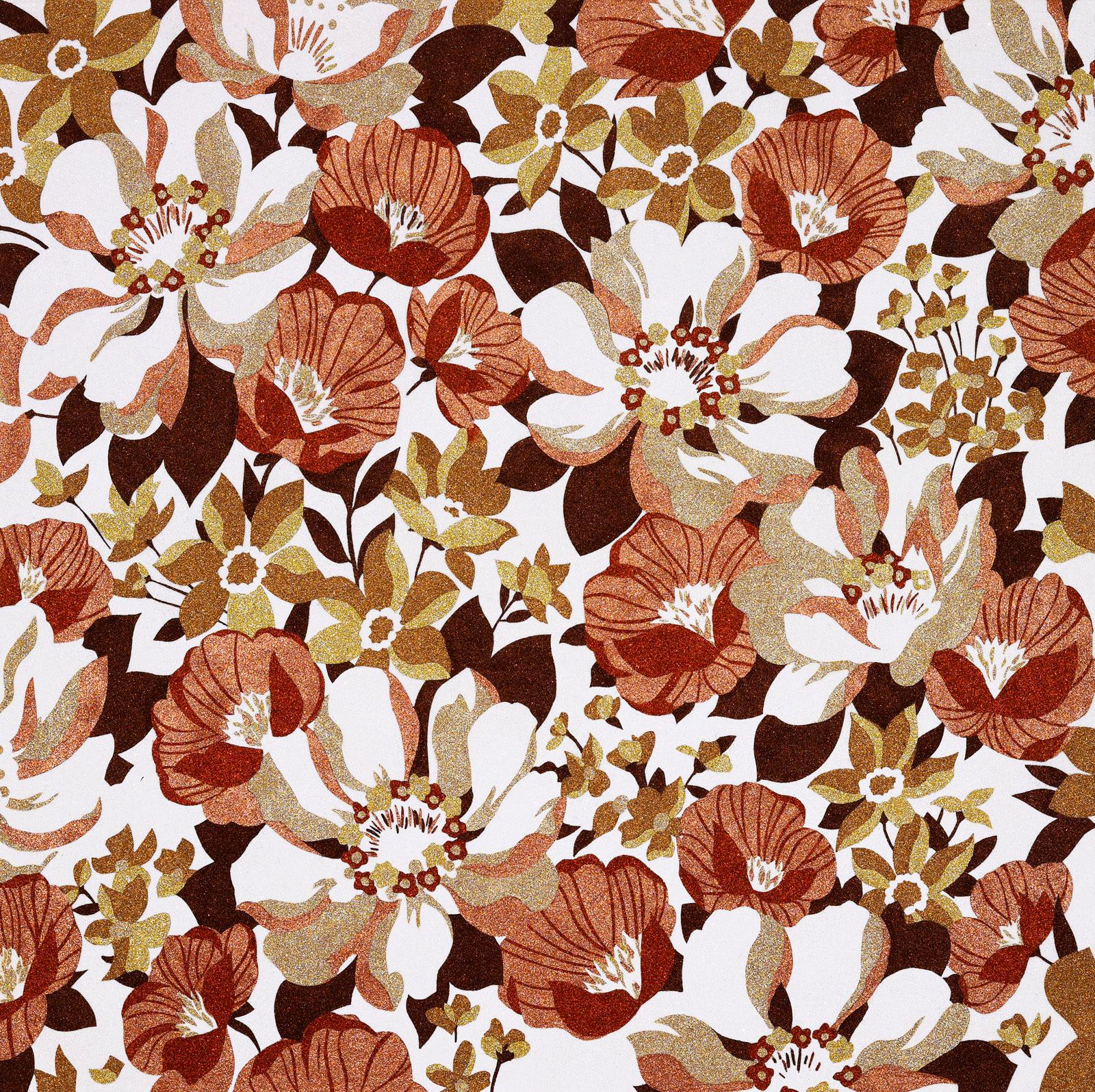
In a Place Amongst Stars (2014)
glitter & synthetic polymer on canvas
stretcher: 1202 x 1201 x 37 mm
signed & dated verso
Reuben Paterson has single-handedly transformed glitter from a child’s plaything to an acclaimed art material. In that process, his paintings have become noticeably more complex and assured.
In a Place Amongst Stars is a wonderful example of how accomplished his practise now is.
There is a noticeably restrained palette in this virtuoso floral design. Magnolia, poppy and daisy are presented in great abundance with shape defining the space and altering scale establishing and revealing pictorial depth.
The title references glitter as a material and its enthralling, unique use of reflected and refracted light. As the light shifts, the volume and modelling of the flowers alter, colours and tones change, and the work transforms into a wonderfully interactive experience.
Provenance
Received from the artist’s studio
Exhibited
In the Company of Animals, Milford Galleries Dunedin, 2014
TERRY STRINGER
Figure in a Landscape (2009)
cast bronze
edition 3 of 3
size: 2090 x 605 x 605 mm (including base)
figure only: 1785 x 275 x 275 mm
signed, dated, numbered & artist stamp on heel near base
“For over forty years Stringer has been developing a distinct and instantly recognisable style that pays homage to classical traditions while remaining innovative and challenging.” (1)
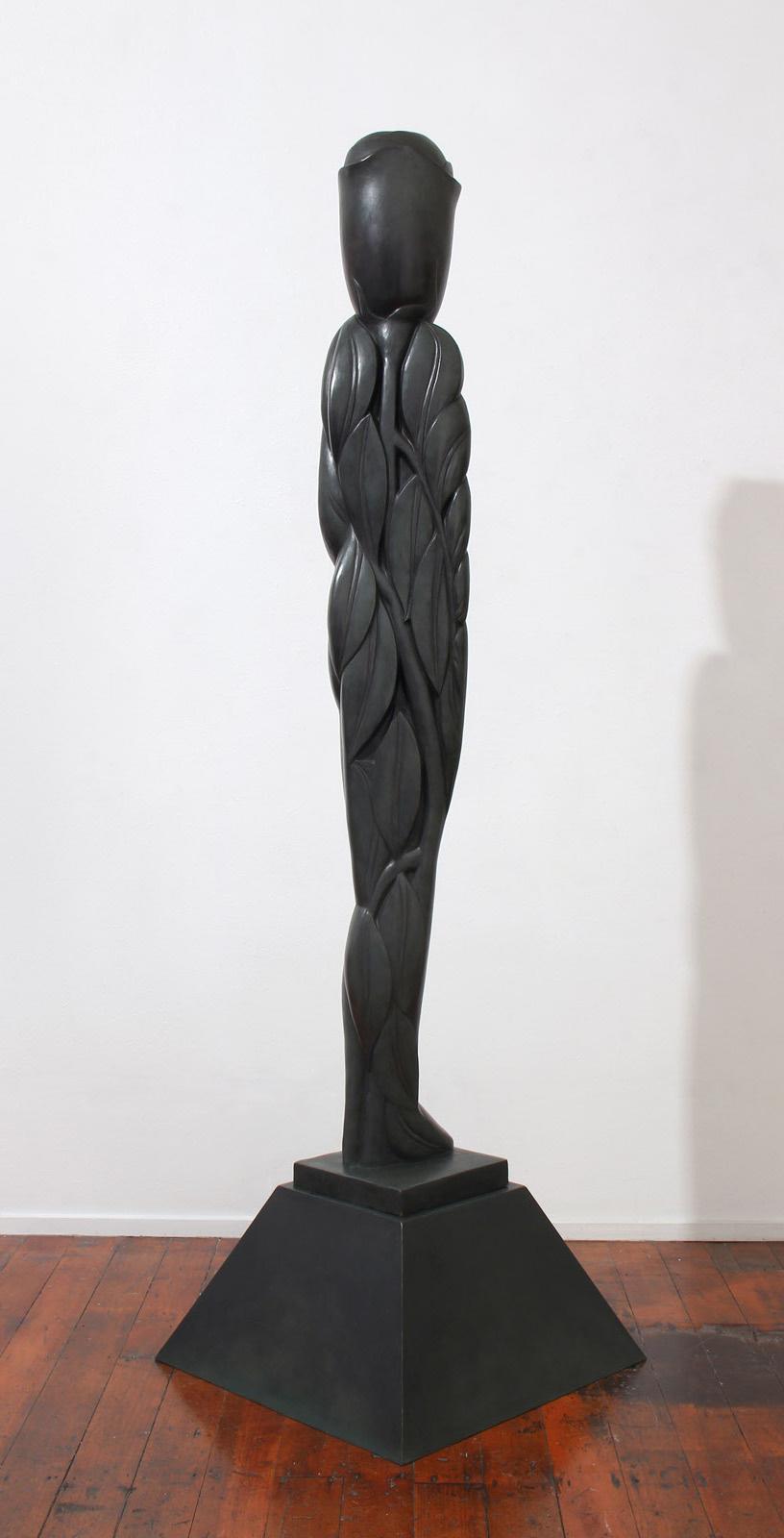
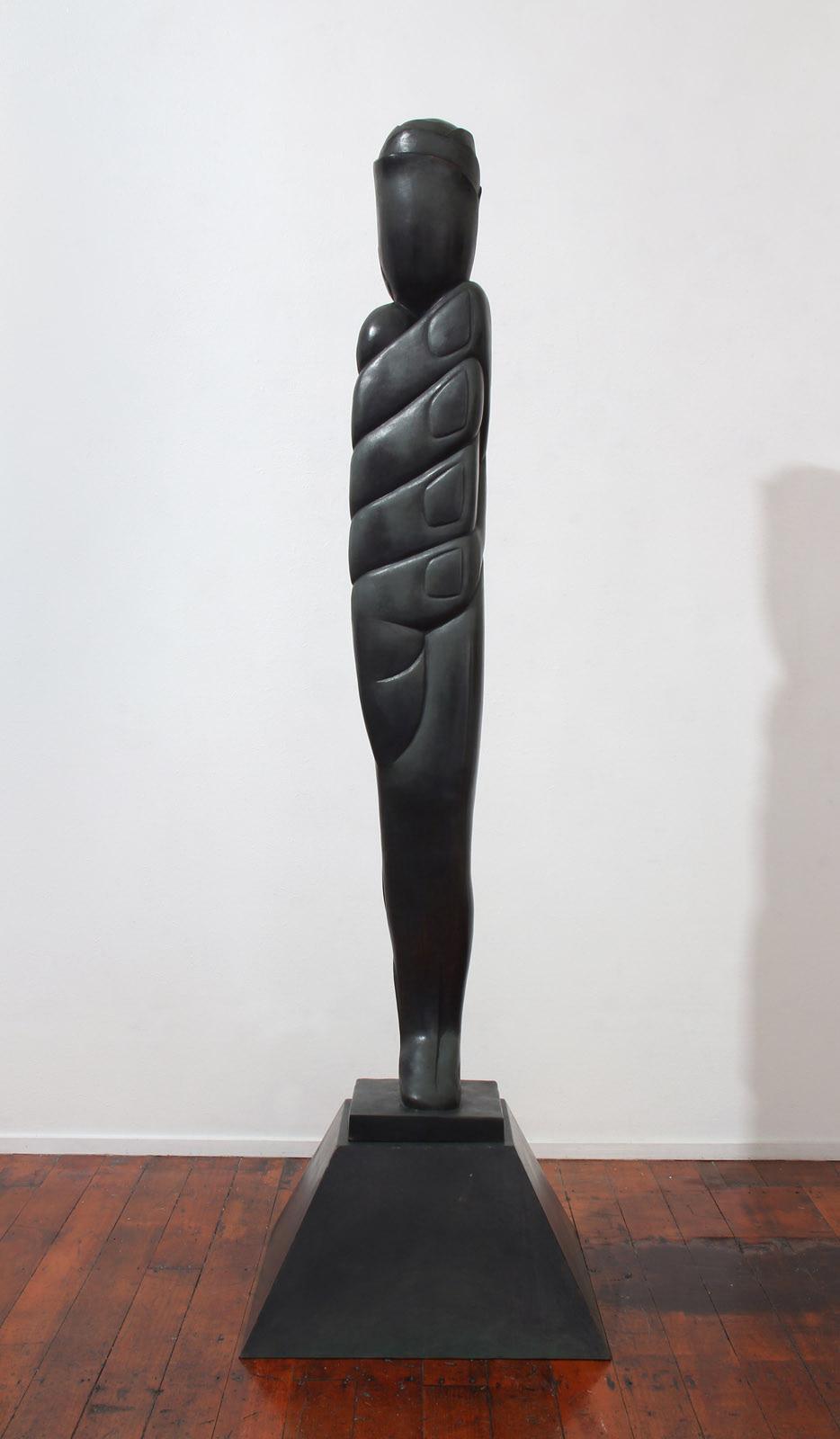
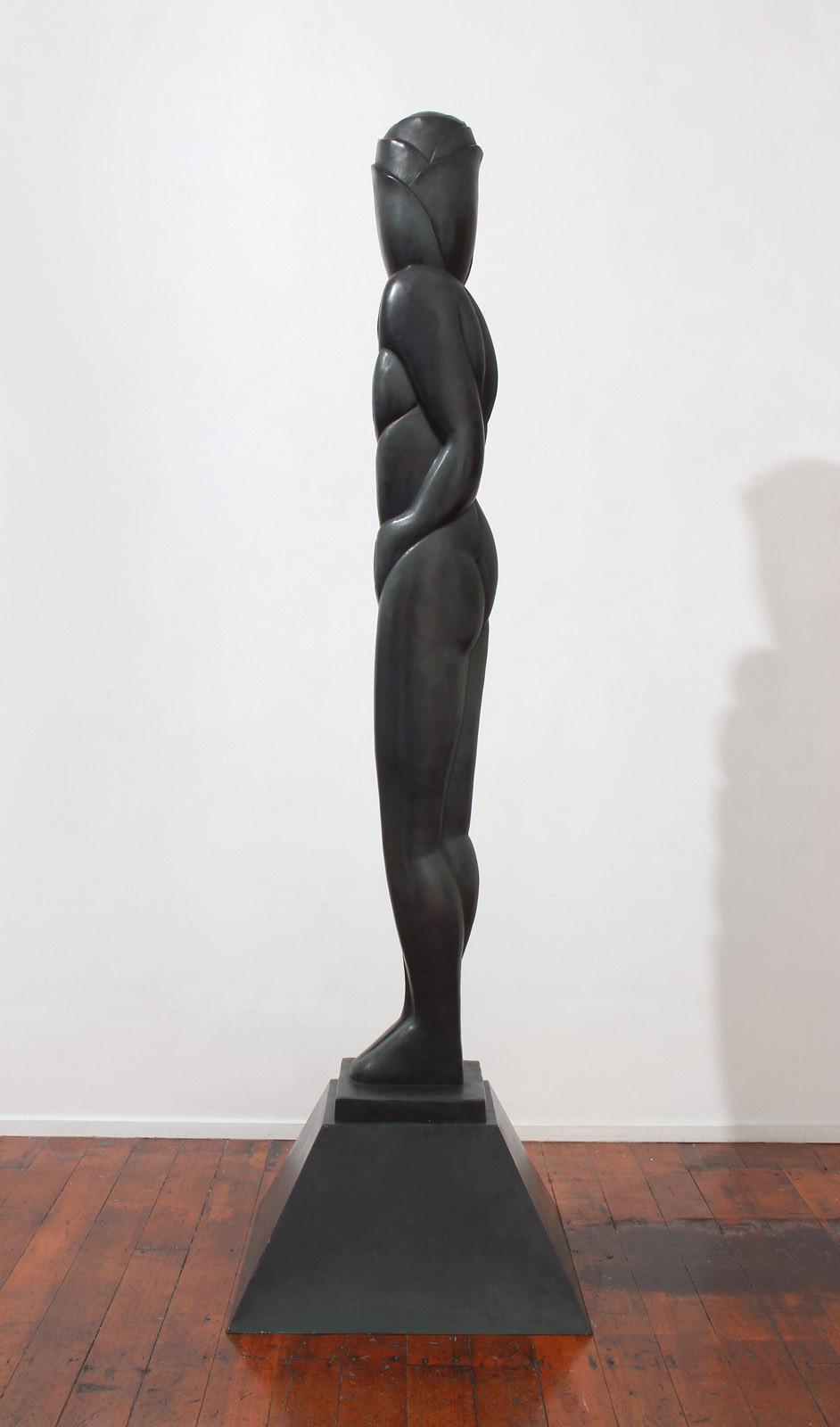
Figure in a Landscape is a wonderfully poetic, metaphoric and generous work.
It has three dominant planes depicting a headless figure, the fingers of a hand, the leaves of a flower sprig, with each sharing profiles and outlines as the change from one to another view occurs. Above each there sits a rose bud, the only image seen ‘in the round.’
There are double-meanings, puns with shape but ultimately there emerges a love story, a noticeably humanistic poem of homage to the landscape.
1. Mark Hutchins-Pond, Terry Stringer Face / Space, Pataka Art + Museum, November 2013, p. 5
Provenance
Received from the artist’s studio
MICHAEL SHEPHERD
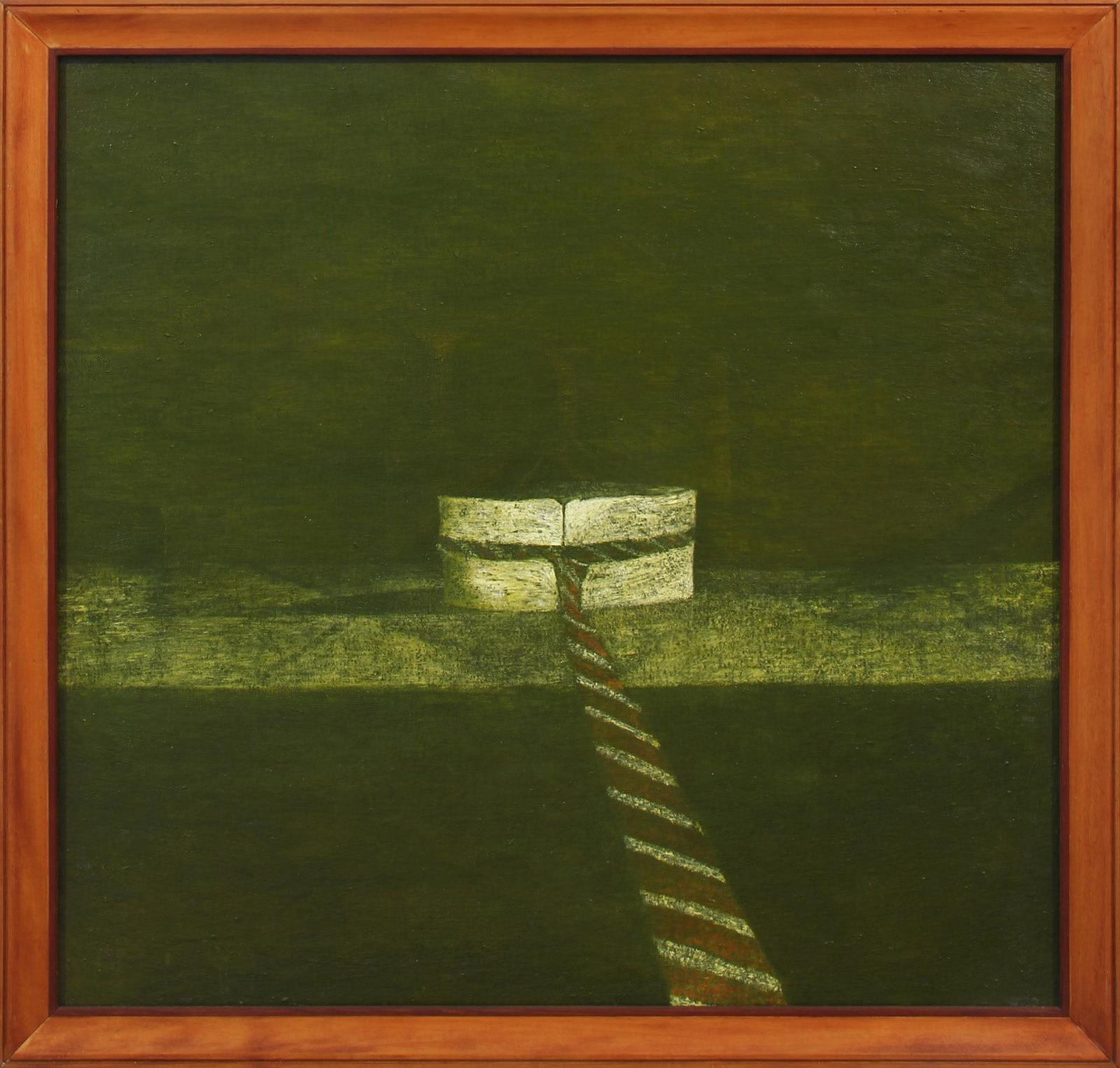
Large Dark Collar and Tie (1979) oil on linen frame: 918 x 970 x 40 mm
Drawing on the tradition of 17th century Dutch still-life, Michael Shepherd’s stylistic mastery is accompanied by ingenuous thought, intense feelings, elaborate imagery and conceits.
These metaphysical concerns are clearly seen in this compelling work, where a narrative is intimated and a person who would wear the collar and tie is strongly suggested by the carefully curated selection of objects - the diminishing elongated path of the striped tie, the starched tension of the collar and its weathered texture.
Shepherd envelopes these associations and considerations with dark, modelled atmospheres, carefully constructed shadows and the selective fall of light.
Provenance
Received from the artist’s studio
Exhibited
The Social Fabric, Milford Galleries Dunedin, 2015
MICHAEL HIGHT
Waiotapu (2014) oil on linen
stretcher: 1370 x 1118 x 34 mm
titled bottom left, signed & dated bottom right signed, dated & titled verso
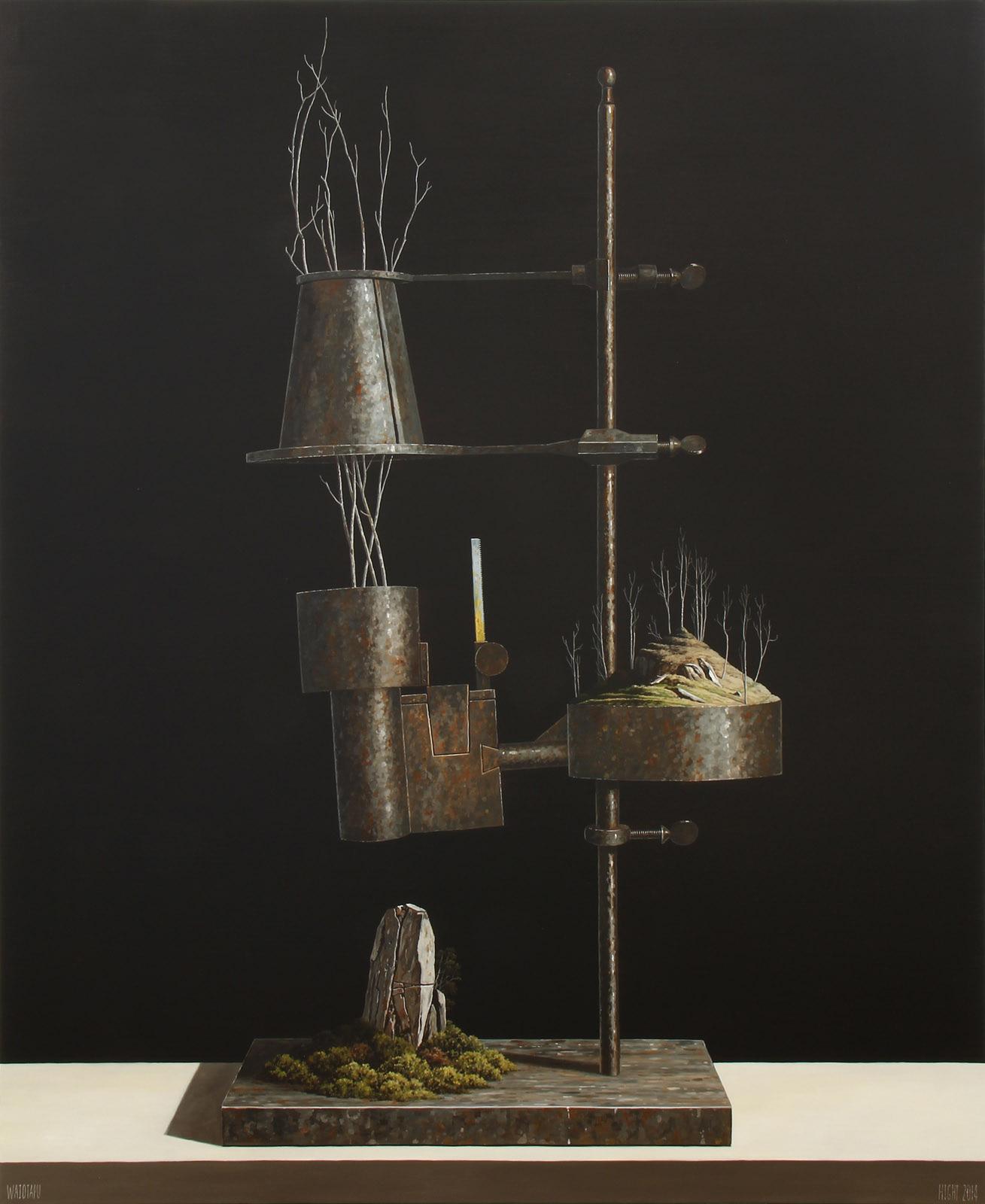
Part dream, part science experiment, part environmental metaphor, inconclusive and ambiguous - this is the very suggestive, re-constructed, regionalist world of Waiotapu.
Employing numerous techniques, such as surrealist contradiction and contrast, Hight actively uses the viewer’s memory and apparatus associations to present – on a window-ledge, kissed by side-light, silhouetted by night behind – segments of something so secretive, it is imbued with wordless significance. In this process he transports us to a strange, discombobulating world where everything remains elusive, is under-stated and yet (somewhat ironically) presented as being contained.
Provenance
Received from the artist’s studio
JOHN EDGAR
Bomb (2015)
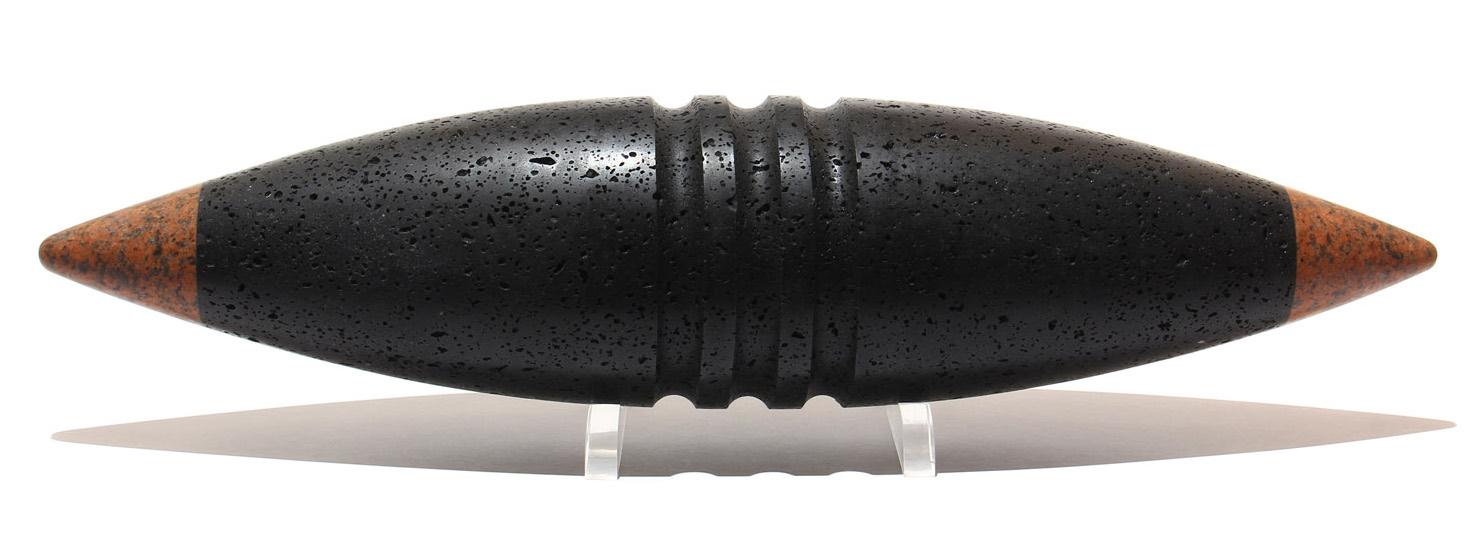
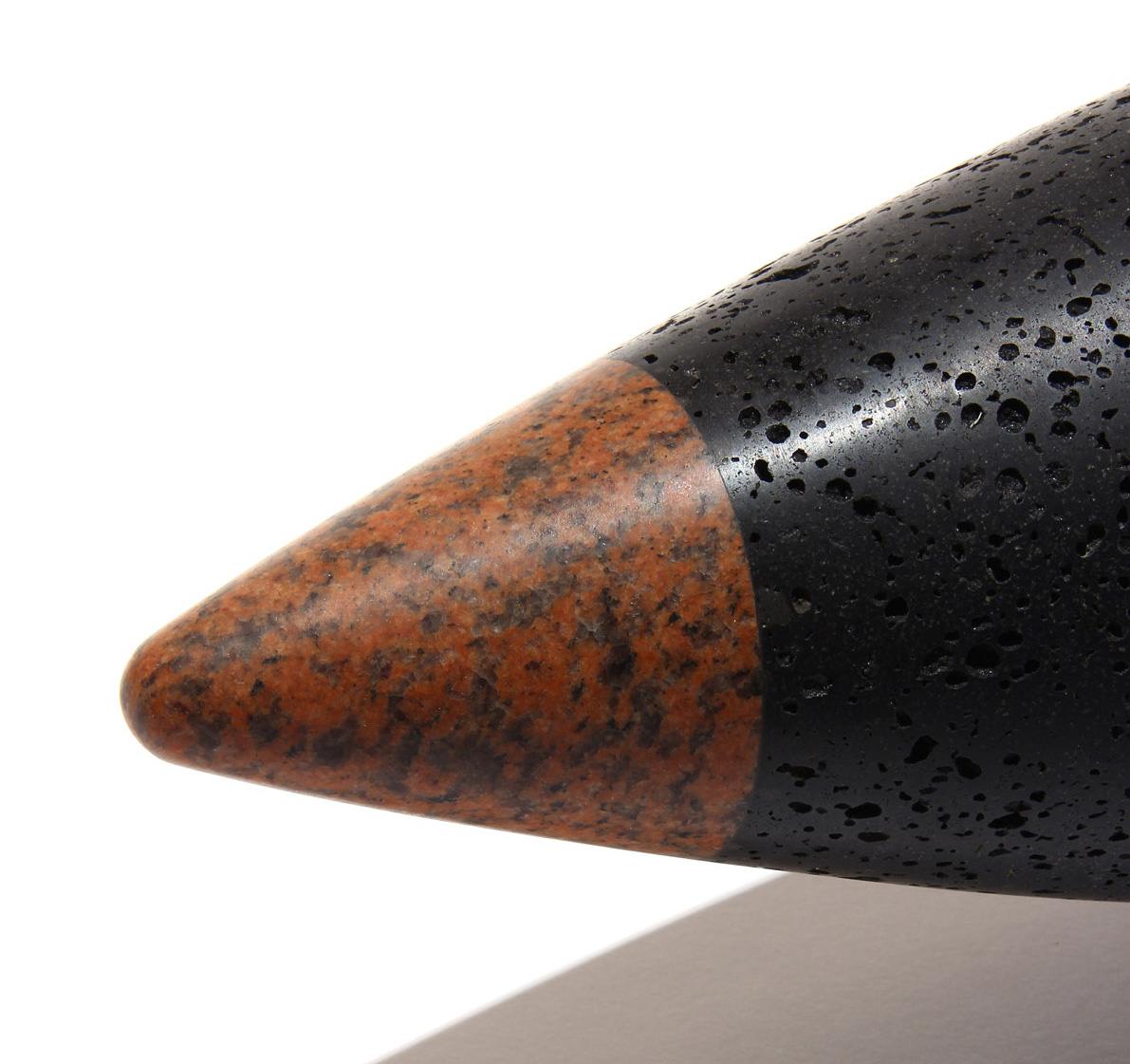
Mt Eden basalt (New Zealand), Corrennie granite (Scotland) size: 905 x 224 x 210 mm
The spindle form frequently used by John Edgar has an array of cultural sources and connections. It speaks of craft and working with cloth in particular, heralding the industrial revolution. The tapering form with capped ends is also noticeably reminiscent of WW1 bombs.
The title, Bomb, openly acknowledges basalt’s volcanic creation. Often explosive, molten tephra solidifies in flight, falling back to earth in aerodynamic forms known as volcanic bombs. These could be found on the slopes of many Auckland volcanoes. (1)
This emphatic work is delivered with all of John Edgar’s trademark precision with the form enlivened by precise colour contrast, the repetition of grooved circular rhythms and the triumphant elegance of the tapering shape.
1. John Edgar, Artist statement, 5 May 2015
Provenance
Received from the artist’s studio
MERVYN WILLIAMS
Flashpoint (Gold) (2012)
acrylic on canvas
stretcher: 1223 x 1068 x 34 mm
signed, dated & titled verso
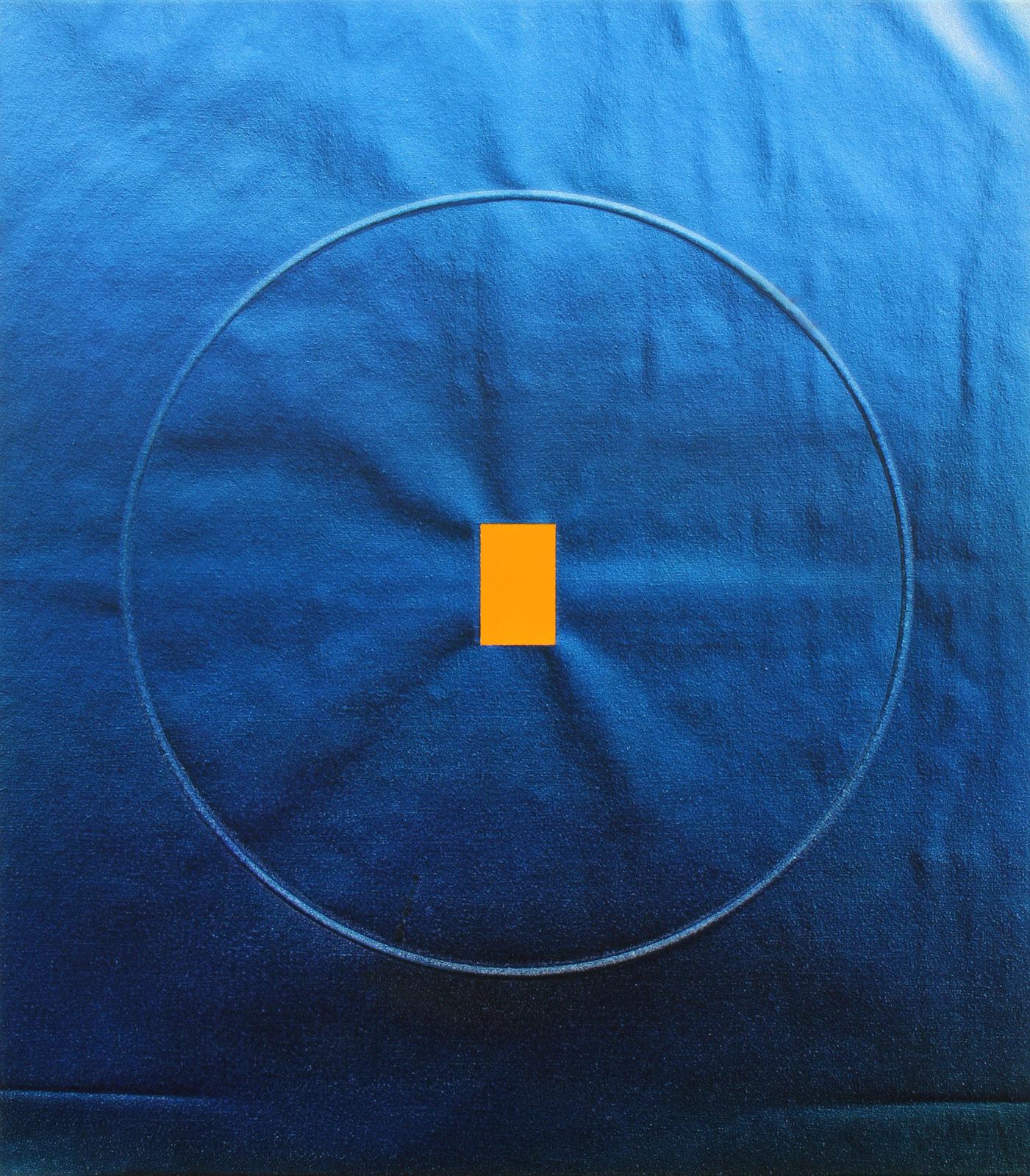
In Flashpoint (Gold), Mervyn Williams builds a painted surface that is filled with suggestion, using high contrast in colour to alter focal depth significantly while surrounding that with illusions, ambiguity and enigmatic sensations.
He establishes textures, tonal presences and transitions, and light and dark contrasts to build perceptions. He also uses numerous visual devices such as repetition, radiating patterns, melodic structures, pictorial segmentation and partial divisions to add complexity and further substance to the optical experience.
Flashpoint (Gold) is a beguiling, evocative, visual paradox.
Provenance
Received from the artist’s studio
Exhibited
Coloured-In, Milford Galleries Dunedin, 2013
Published
Mervyn Williams, From Modernism to the Digital Age, Edward Hanfling, Ron Sang Publications, 2014, p. 285
REUBEN PATERSON
Untitled (Blue Kowhaiwhai) (2009)
glitter on canvas
stretcher: 1015 x 837 x 37 mm
signed & dated verso
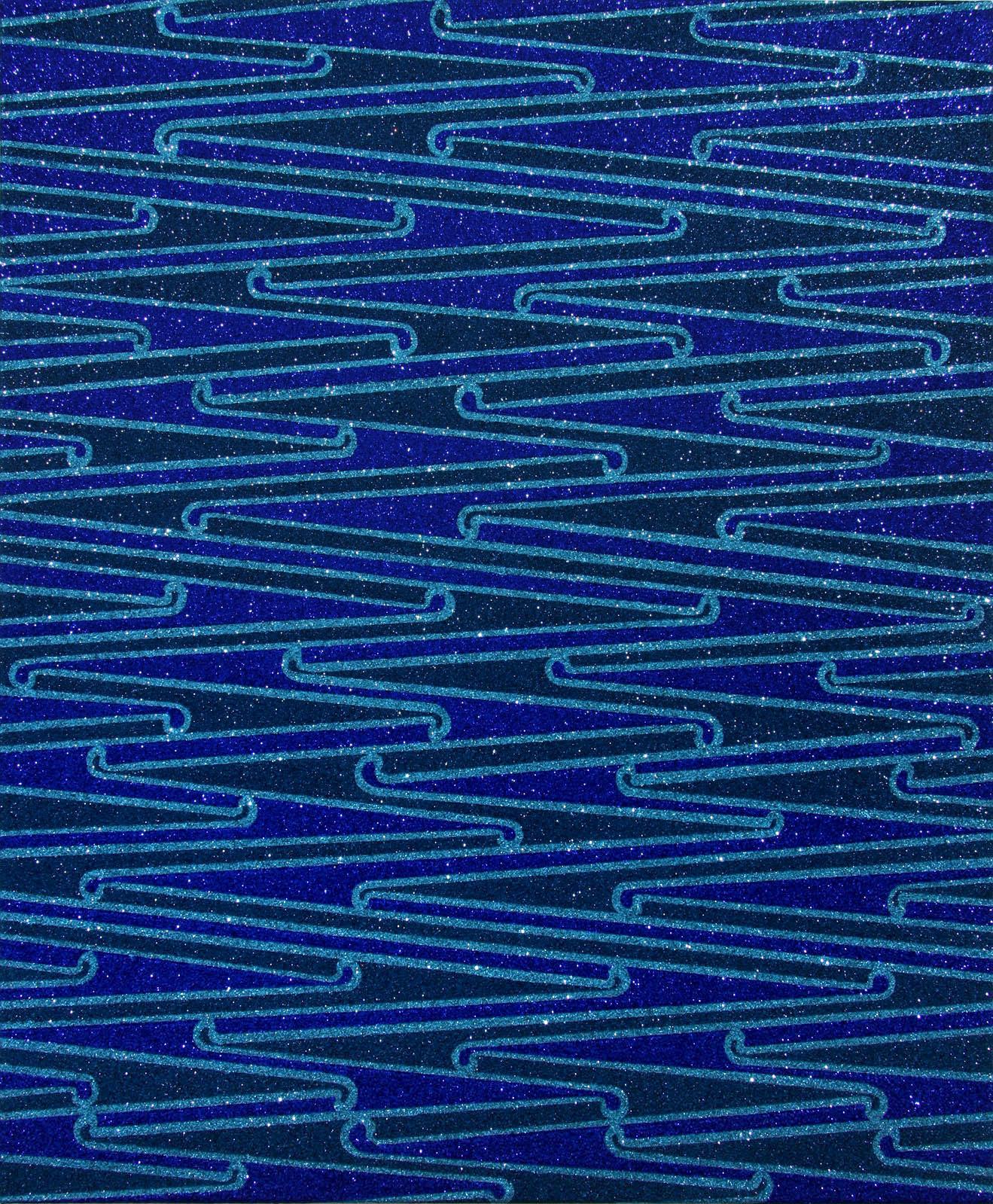
One of the primary subjects of Reuben Paterson’s career has been open acknowledgement of his Maori heritage, as witnessed in his use of designs and patterns drawn from the wharenui, and carving and weaving traditions.
He transforms kowhaiwhai by presenting it as visual rhythms and exploring the “contradictory use of foreground/background colouring.” (1)
Untitled (Blue Kowhaiwhai) uses three colours – a blue and green which are tonally similar, these separated by a lighter blue/green outline that defines space and shape. When viewed up close, the work is noticeably flat, perspective absent, pattern and reflected light dominate. When viewing distance is altered, the experience becomes totally different: suggestions of depth arise, allusions to carving abound and melodic rhythms are released.
This transformative quality is further enhanced by glitter’s use of light and how it remodels what we see and how we read it.
1. Andrew Clifford, Bottled Lightning, Gus Fisher Gallery, 2012, p. 9
Provenance
Received from the artist’s studio
Exhibited
At the Edge of a Mirror, Hastings City Art Gallery, 2014
JOANNA BRAITHWAITE
Guns and Bibles (2013)
oil on canvas
stretcher: 1073 x 918 x 24 mm
signed, dated & titled verso
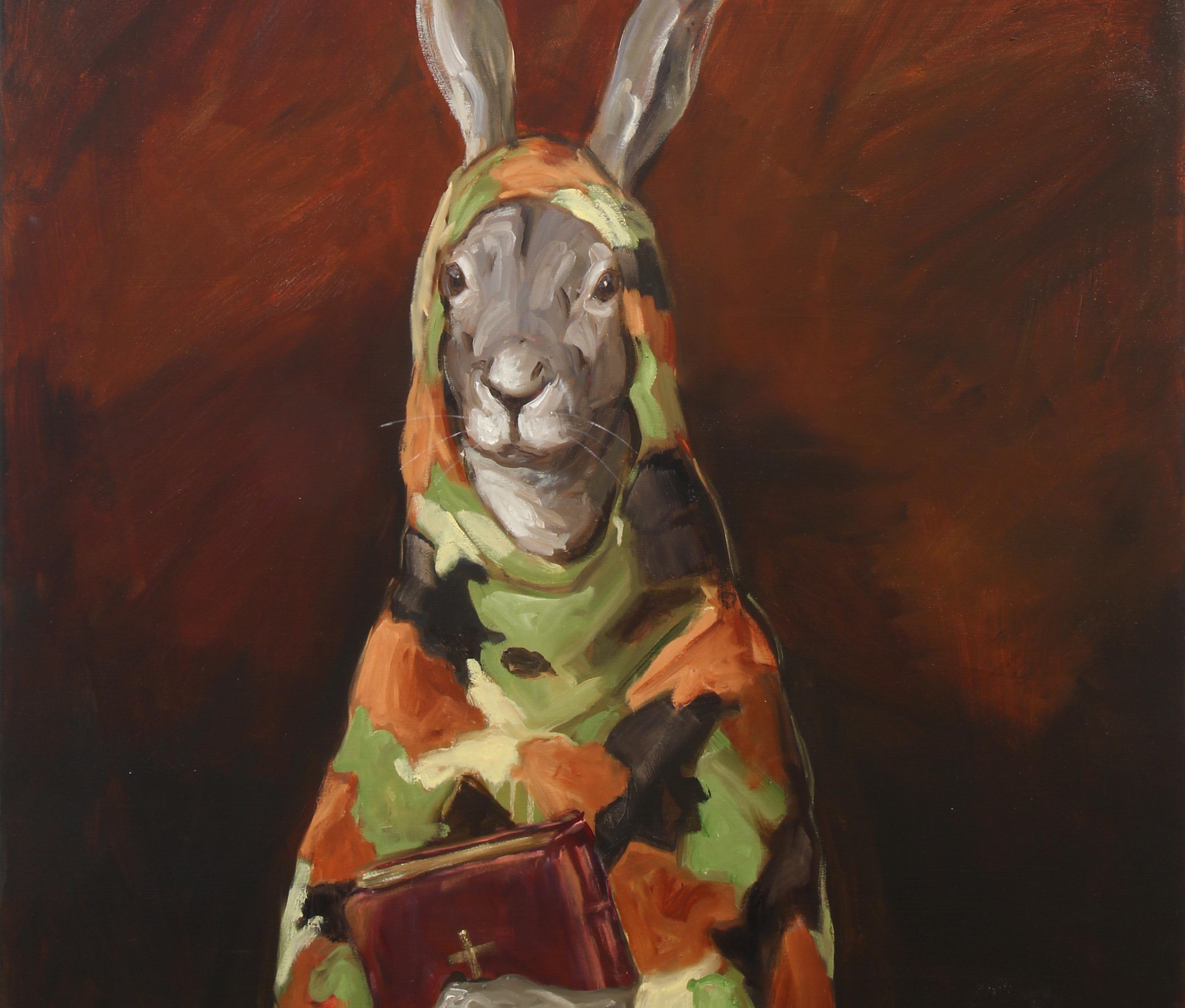
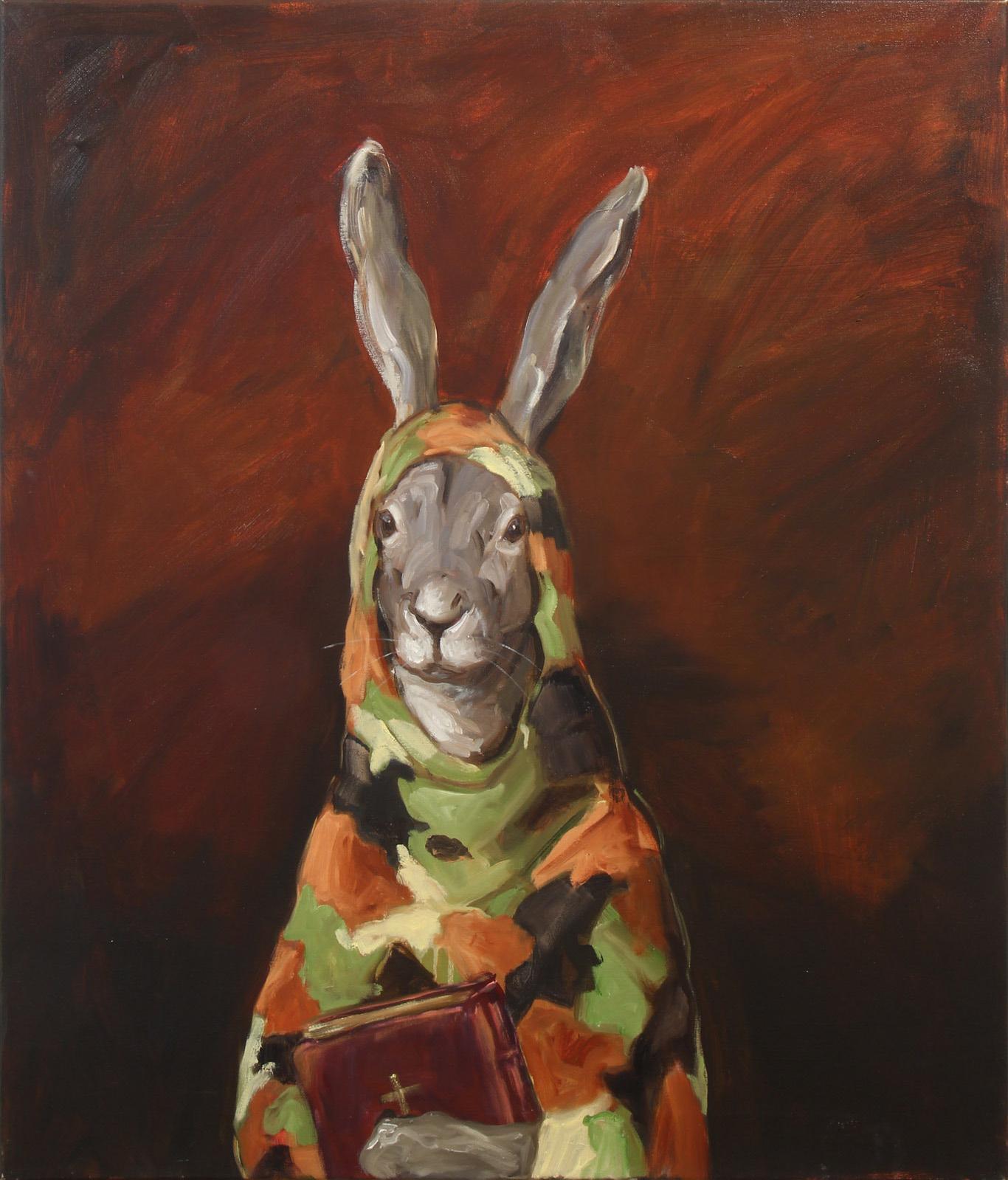
Resigned to its fate, a somewhat doleful rabbit stares back, ears alert for approaching danger, clothed in camouflage clothing: something seems about to happen. Is it death or just war?
Allusions abound to moral and spiritual authority.
It clutches a bible, the cross on its cover afloat in a field of carmine red.
Guns and Bibles is an assuredly deft allegory, delivered with Braithwaite’s “logic and illogic of daydreams.” (1)
1. Gregory O’Brien, “Upwards and Onwards: The Evolution of Joanna Braithwaite”, Art New Zealand, No. 133, Autumn, 2010, p. 27
Provenance
Received from the artist’s studio
Exhibited Trigger, Bowen Galleries, 2013
MICHAEL HIGHT
Macraes Road (2014)
oil on linen
stretcher: 762 x 1523 x 32 mm
titled bottom left, signed & dated bottom right signed, dated & titled verso
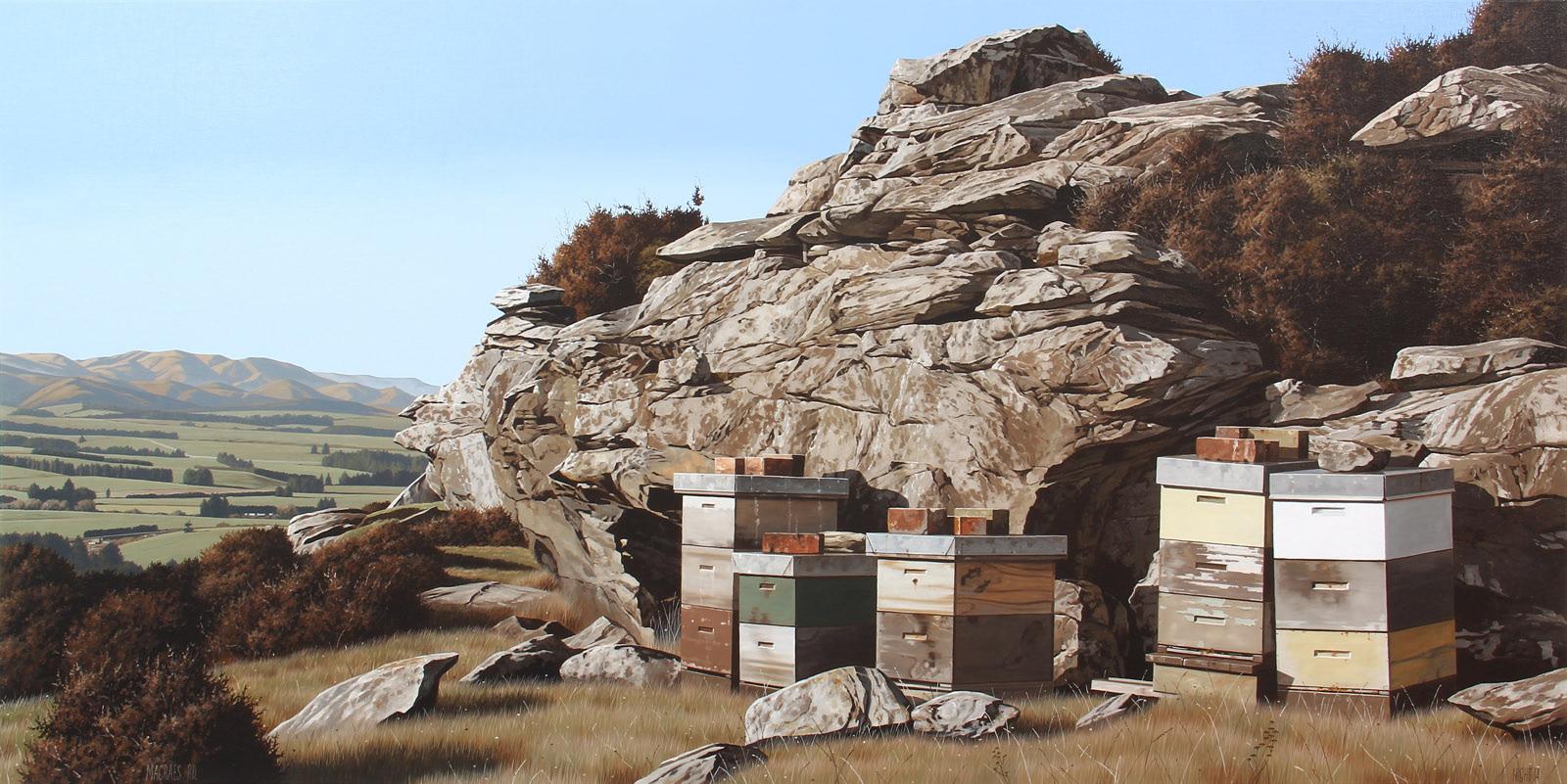
Michael Hight’s acclaimed beehive paintings combine geographic particulars, seasonal facts and a mastery of light and dark with notions of order, invoking “cultural and social narratives beyond the fine art tradition.” (1)
In Macraes Road there is “a democracy of particulars” (2) where everything is presented as it is. The geometric shapes and abstracted surfaces of the worn beehives (topped by bricks) sit tucked into and contrasted by a small weathered geomorphic cliff face that wanders slowly away. Hight uses scale in numerous and varied ways in the foreground and below in the back distance, in another subtle and key contrast, a farmed valley is revealed.
In this work, Hight makes time stand still, building pictorial environments comprised of objects and details that help us to see what is actually there.
1. Gregory O’Brien, “Two Fields and a Shelf …”, Michael Hight: Crossing the Line, Gow Langsford Gallery, 2014, p. 14
2. Ibid, p. 14
Provenance
Received from artist’s studio
Exhibited
Michael Hight - New Works, Milford Galleries Dunedin, 2014
BRENT WONG
Snowstorm (1973)
acrylic on board frame: 810 x 945 x 35 mm panel: 610 x 750 mm signed, dated & titled verso
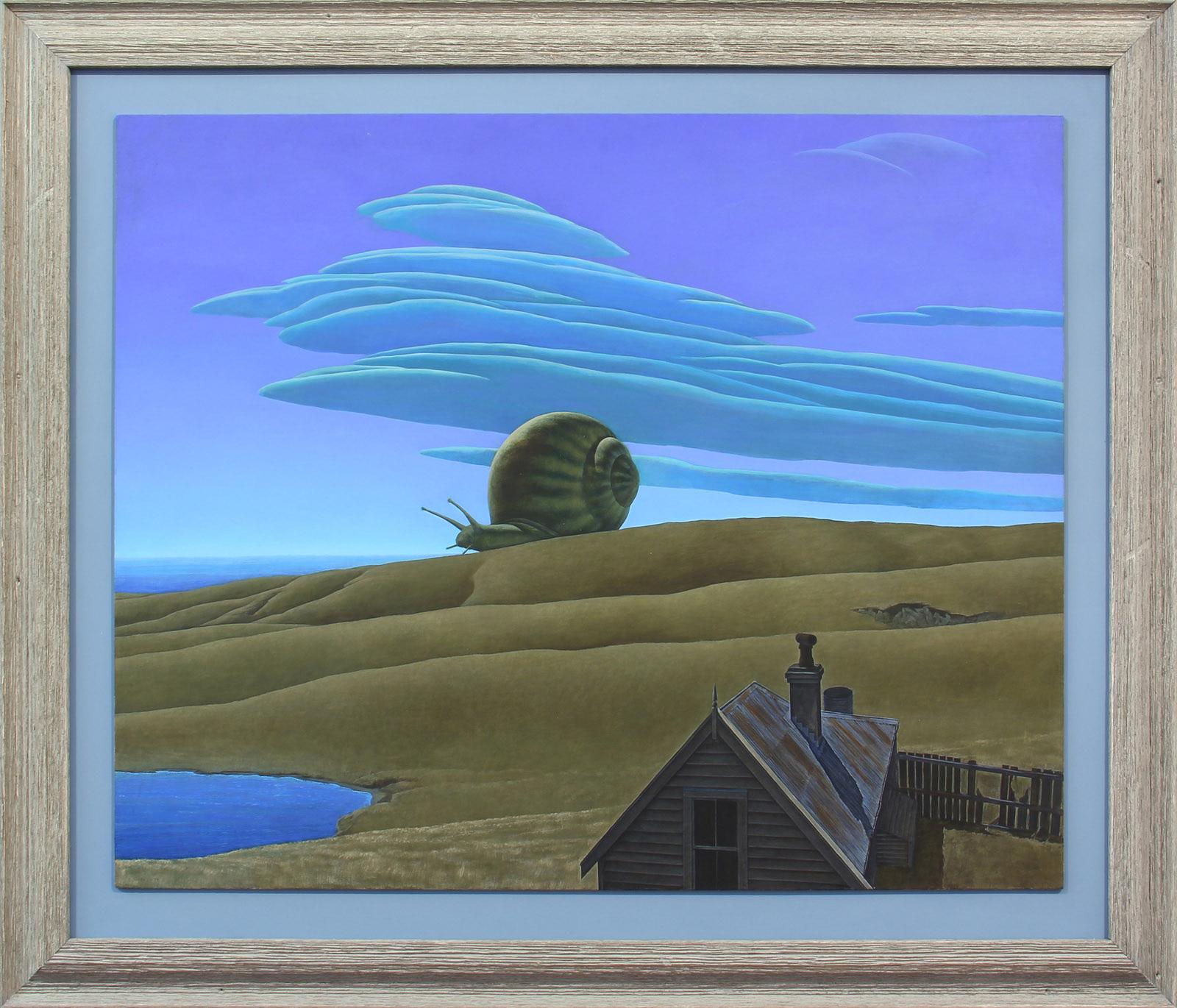
Snowstorm is a classic Brent Wong painting and an unmistakeable masterwork. It is a visionary, science-fiction informed, dystopian, enigmatic, surreal painting. Fastidiously painted, cinematic in scale, imbued with sensations of here and now, calm pervades but there is an ominous sense of change coming, that nothing will remain as it is.
“The effect is both confusing and thrilling.” (1)
A unique and singular figure in New Zealand art, Brent Wong moves the viewer adroitly “to and fro from reality to unreality.” (2)
Meaning is elusive but event and place is not. A gigantic snail crests Wellington hills. Its organic form and prescient presence animates the work, building contradiction and visual tension. An abandoned, shadowed weatherboard building huddles in a foreground corner. Long, soft clouds float above.
What is not shown is as important as what is. This wonderful painting is entitled Snowstorm. Why is that and when will it arrive?
1. Hamish Coney on “Brent Wong, Capitulation”, Binney & Black Auction Catalogue, Art + Object, 4 June, 2015, p. 68
2. Gil Docking, 240 Years of NZ Painting, Bateman 2012, p. 203
Provenance
Received from the artist’s studio
TERRY STRINGER
Turning Head (2015)
cast bronze
edition 1 of 2
size: 975 x 324 x 324 mm (including base)
figure only: 957 x 280 x 196 mm
signed, dated, numbered & artist insignia inscribed near base
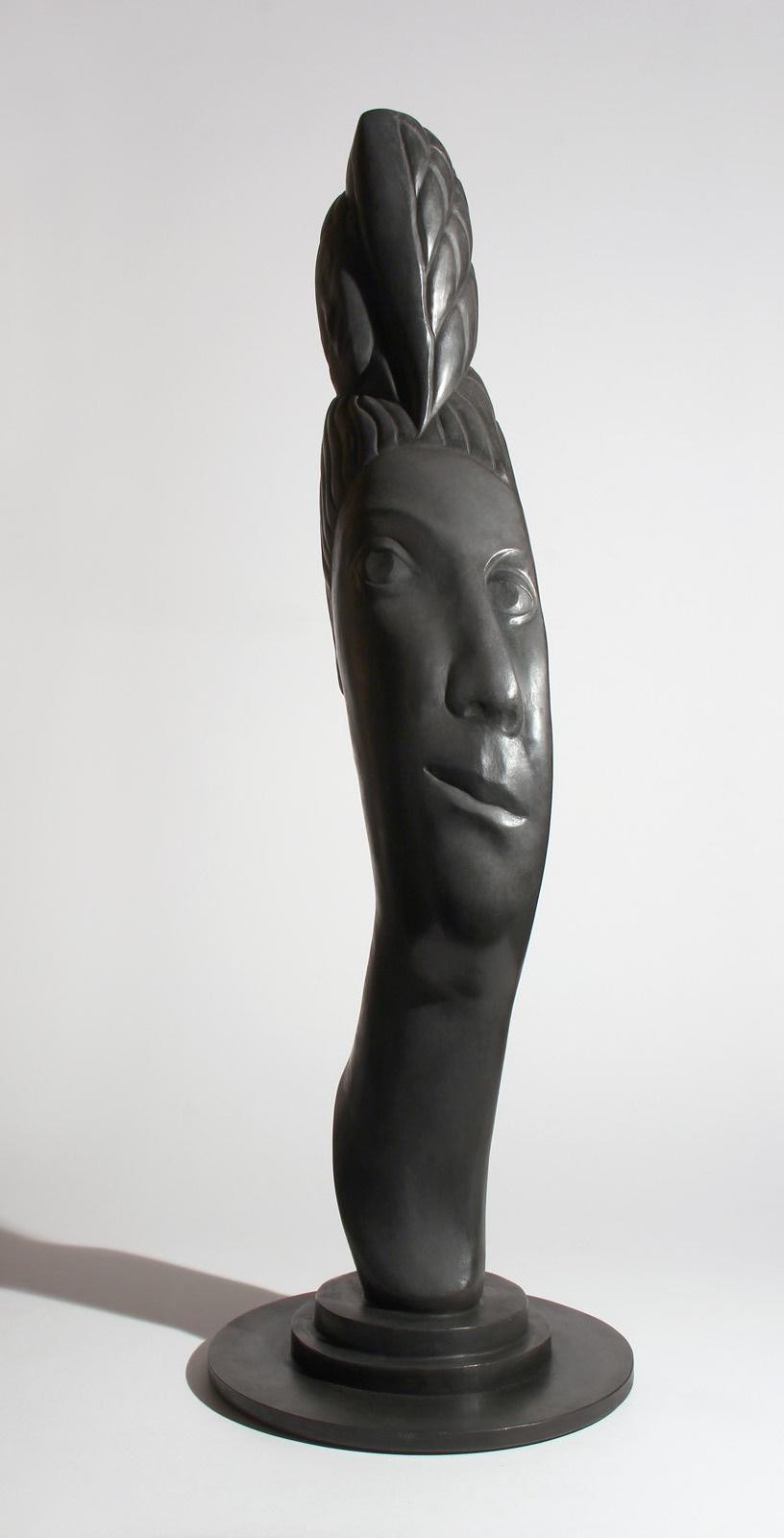
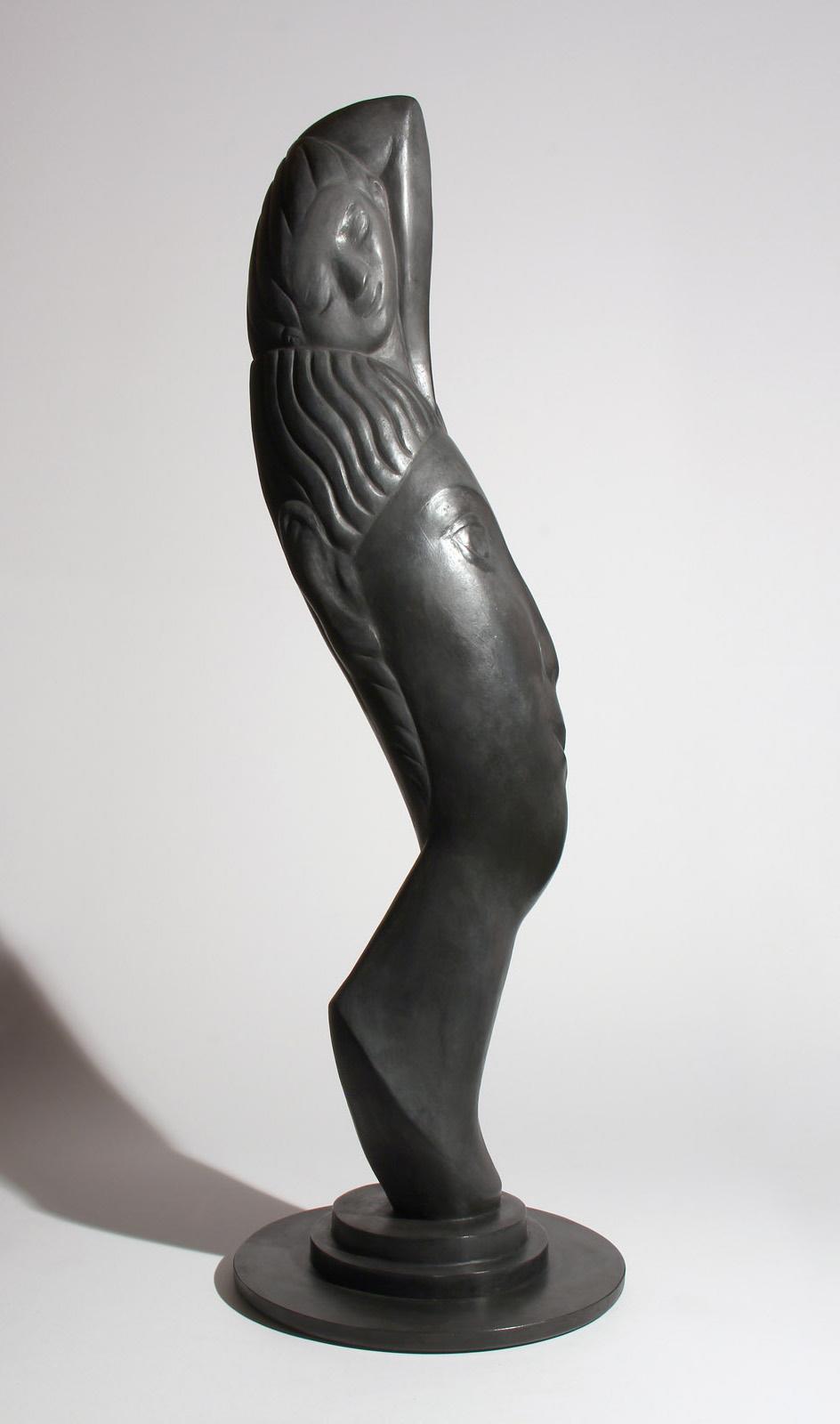
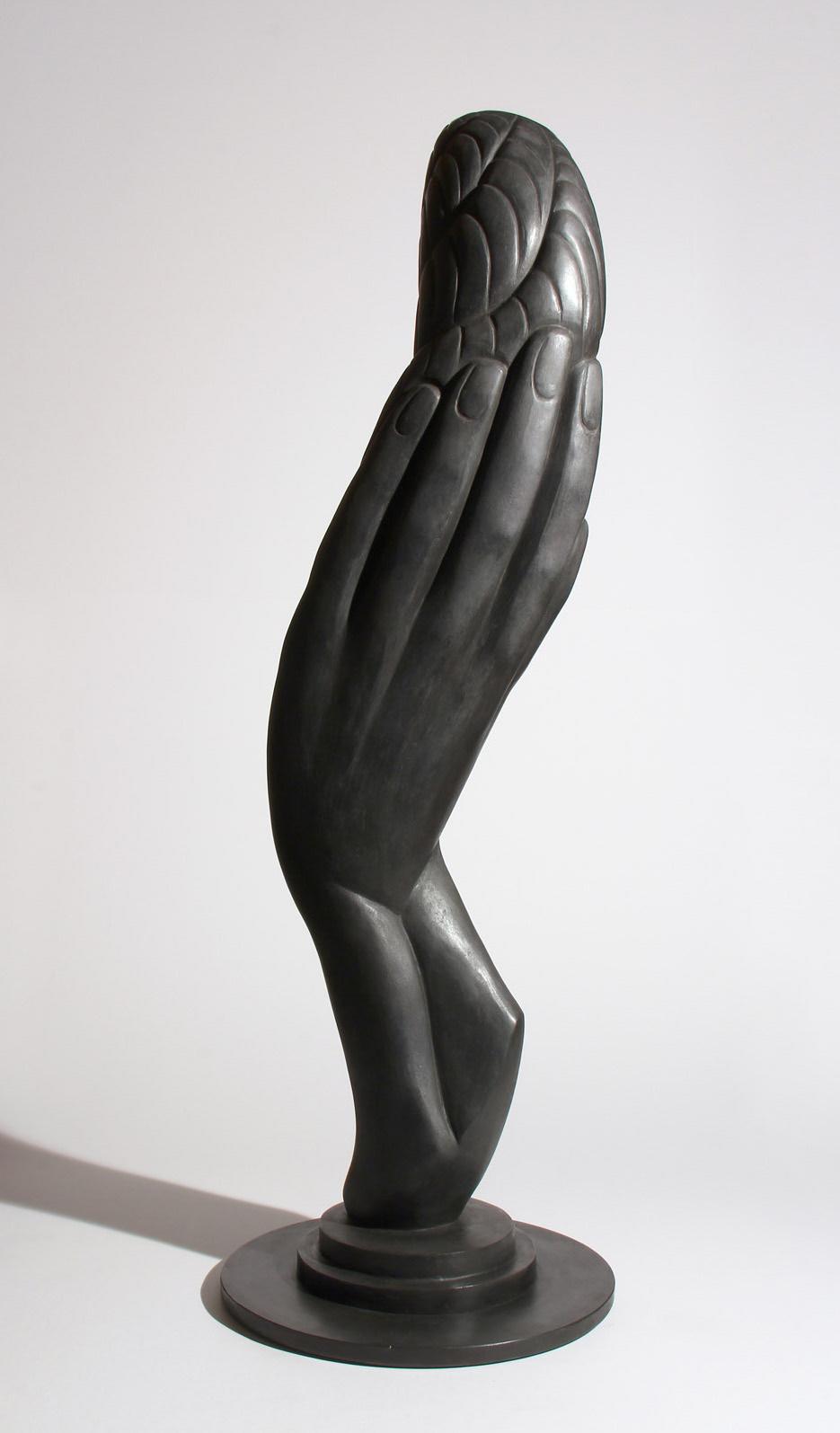
Positioned on a hidden turntable for touch-easy movement, Turning Head epitomises Terry Stringer’s acclaimed attributes and sculptural concerns.
A hand, a face, a standing figure appear as the work morphs from one to another.
Stringer is indisputably “one of New Zealand’s best figurative sculptors. He doesn’t break rules, he transforms them. Weight-shifter, shape-shifter, he sets the scene… His tricks of perception have become a phenomenological game for one player: you the observer in an uncertain universe. His sculptures flick in and out of focus … you have to move around them.” (1)
“Stringer is teasing the eye, deceiving the eye, playing with perception.” He “seeks to engage the viewer literally … intellectually, aesthetically and physically … designed as fully three dimensional experiences … rewarded by moving around … and interpreting it from a range of viewpoints.” (2)
1. David Eggleton, “Shape Shifter: Sculptor Terry Stringer makes works of Ambiguous Beauty,” NZ Listener, 3 October, 1998
2. Dr Robin Woodward, A Secret Room in the Head, Koru Gallery, Hong Kong, 2010, p. 6
Provenance
Received from the artist’s studio
JOHN EDGAR
Discus (2014)
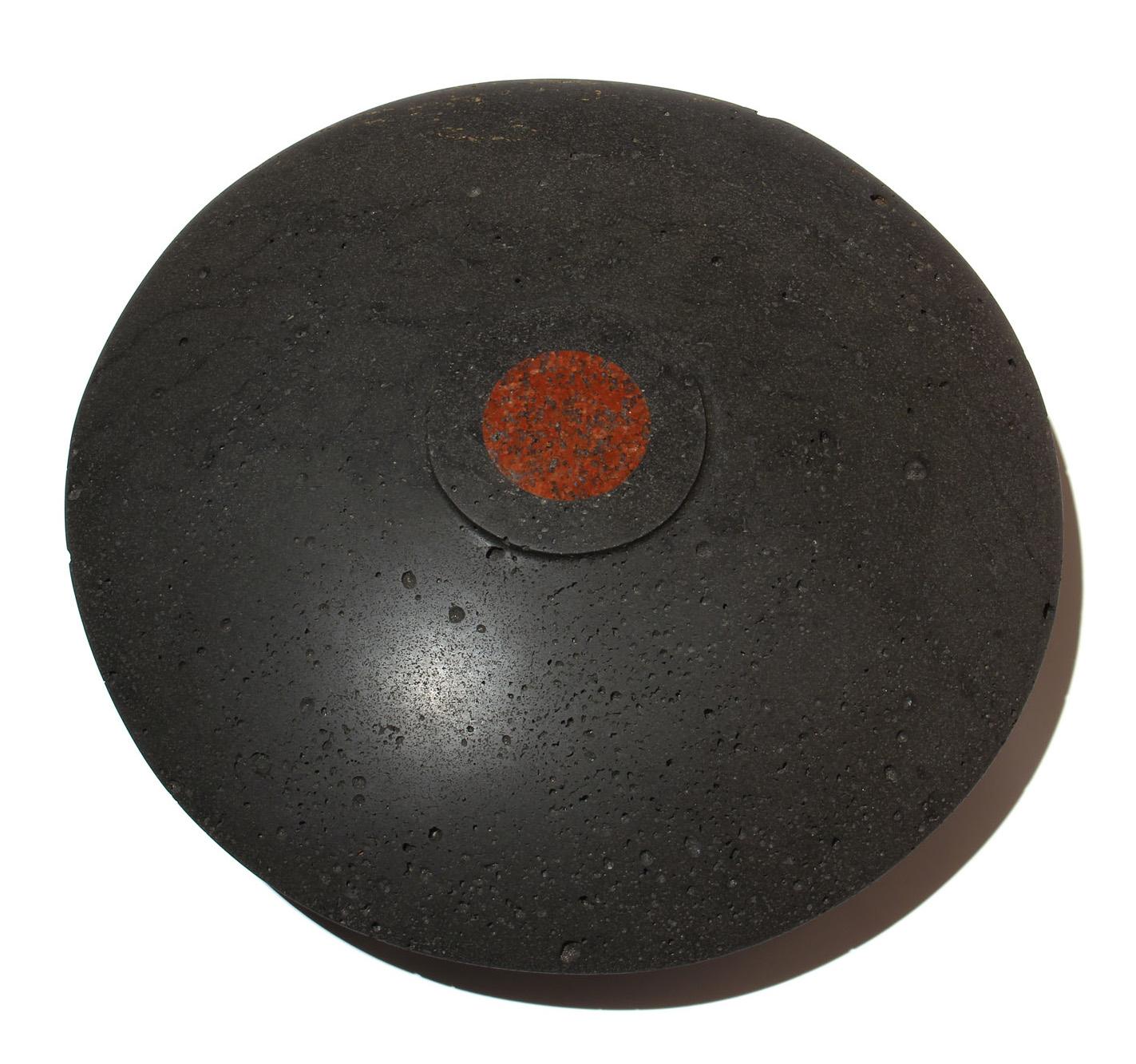
Mt Horrible basalt (Timaru, New Zealand), Lalitpur granite (India) size: 655 x 645 x 190 mm
In all of his work, John Edgar demonstrates a rare sympathy and understanding of stone. He lets the stone speak, about what it is and why it is.
Discus is primarily comprised of Mt Horrible basalt, a fine-grained dark volcanic rock, pocketed with intriguing holes and air spaces. Molten lava was extruded from Mt Horrible some two million years ago in flows over five metres thick covering 130 sq kilometres of South Canterbury.
The lens or discus form has become a dominant motif in Edgar’s recent work. It contains a circle inside a circle, which is both part of and separated from the another. It has a broad metaphorical language that references the solar system, the lens of an eye, the science and sport of human endeavour.
The lenticular shape of Discus allows the top, underside and edges to be viewed simultaneously. In that way, the visual texture, the time-woven materiality and language of the basalt comes into its own.
Provenance
Received from the artist’s studio
MICHAEL SHEPHERD
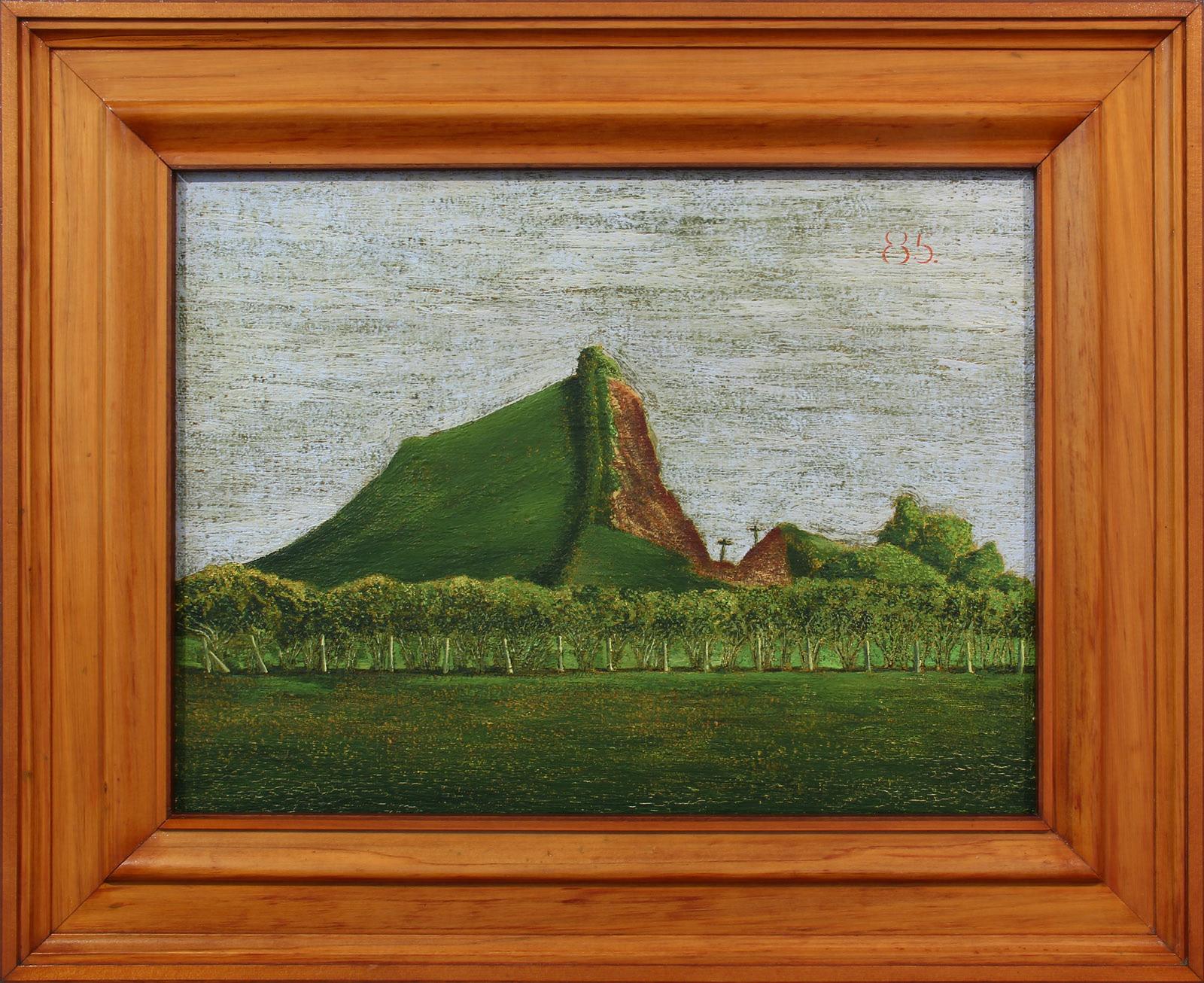
Ihumatao (1985)
oil on linen frame: 567 x 695 x 58 mm
stretcher: 382 x 510 x 28 mm
dated top right
One of the dominant pictorial concerns of Michael Shepherd’s career has been that of archaeological sites and the stories they reveal.
Ihumatao tells a brutal tale and documents the quarrying (and the eventual complete removal) of the sacred mountain and the oldest pa site in the country.
Metaphors abound – the disfigured hill bleeds against a grey sky, two power poles at first seeming insignificant transfigure into askew crosses, hedges function as containing walls to keep the judgement of time and the inquisitive at bay.
Provenance
Received from the artist’s studio
Exhibited
The Social Fabric, Milford Galleries Dunedin, 2015
BRENT WONG
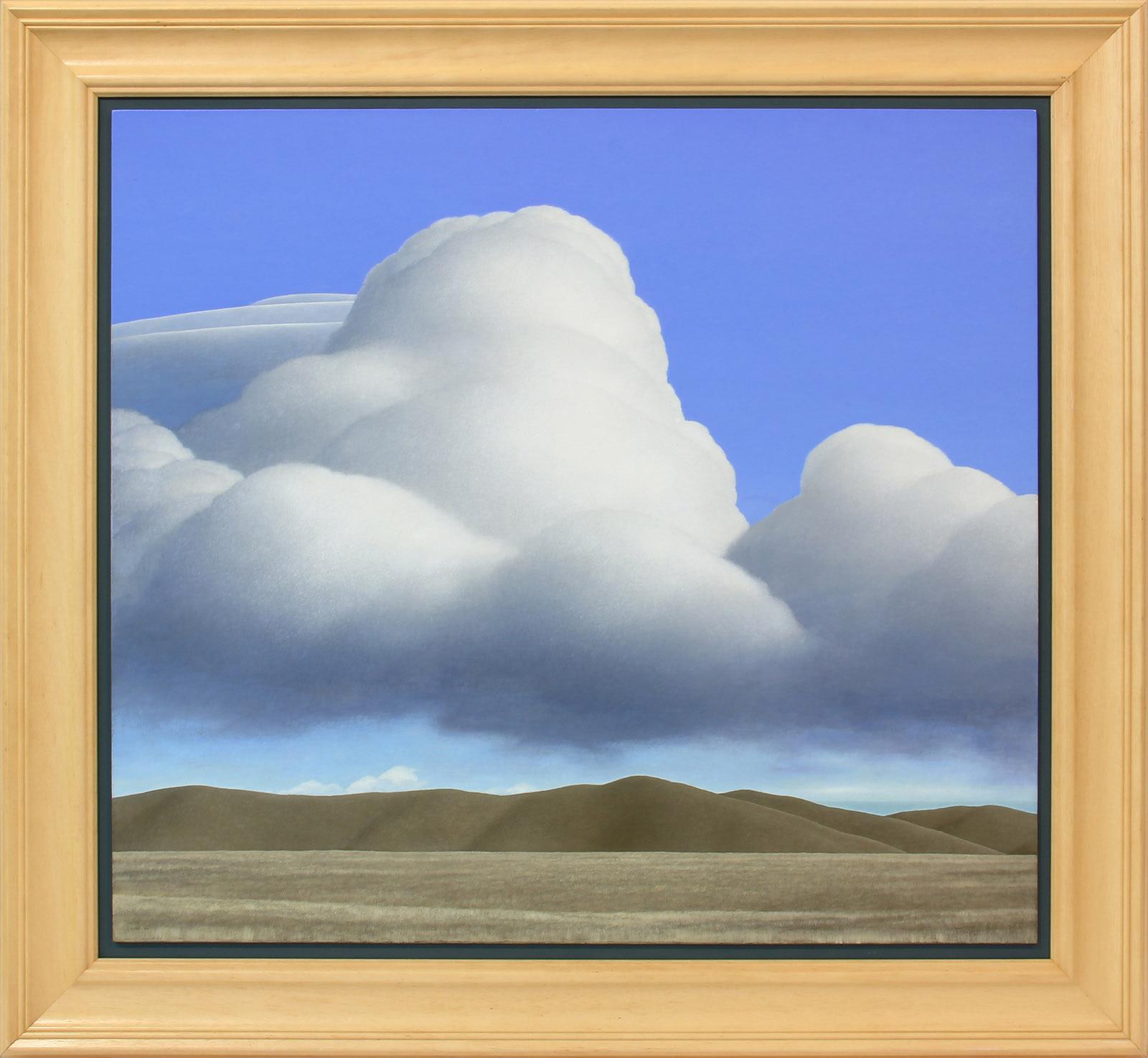
Harmonium (Massing Clouds) (1984)
acrylic on board frame: 898 x 972 x 34 mm
panel: 700 x 774 mm
signed & dated bottom left signed, dated & titled verso
Harmonium is a significant, timeless painting that straddles the two major bodies of work and stylistic concerns of Brent Wong’s career.
The landscape is depicted in his characteristic surreal manner, where the forms are soft and fluid, palette noticeably restrained and the subject is that of absence.
In total contrast, dominating the painting is a glorious cloud form that hovers in space, establishing distinctly different pictorial depths and colour bands.
It elicits contemplation and in that manner it comes to perform a profoundly important meditative role.
The painting vibrates with sound and light, violet hues and the optical complexity of vision. There is a wonderful sense that a journey of endless time and distance awaits.
Provenance
Received from the artist’s studio
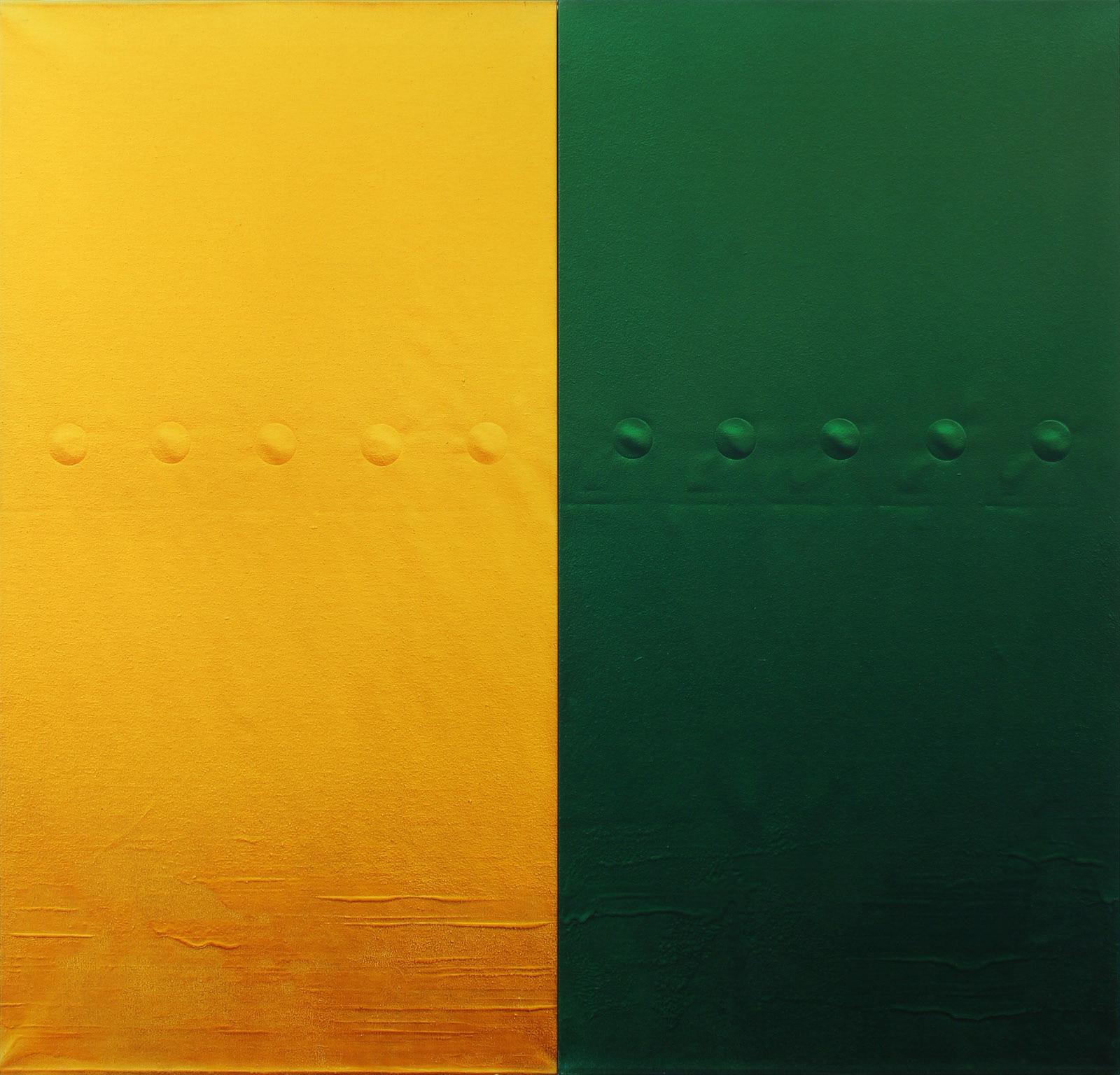
MERVYN WILLIAMS
Summers to Come (1997) diptych; acrylic on canvas
overall size: 1535 x 1590 x 31 mm, panels: 1535 x 795 x 31 mm each
signed “Williams,” dated & titled verso left hand panel signed “Mervyn” & D verso right hand panel
Summers to Come is an astonishing experience, where the sensations and languages of colour induce belief and establish experience. It is a glorious summer’s day, the verdant grass is as dense as carpet…
It is also a work filled with visual phenomena, allusions and fictions. “My work is concerned with perception, the nature and interpretation of reality … between what we see and what we know … between reality and illusion.” (1)
Mervyn Williams is a master of deception and “the conundrums of perception” he creates “are therefore as much philosophical and cognitive as they are perceptual. They raise questions about ‘reality’.” (2)
Summers to Come elicits direct personal participation or observation. It is a thrilling visual riddle and an important, wonderful, example of why Mervyn Williams is an artist of international stature.
1. Mervyn Williams, Artist Statement in Michael Dunn, Contemporary Painting in New Zealand, Craftsman House, 1996, p. 204
2. Edward Hanfling, “Panning for Gold: Two Decades of Painted Illusion,” Mervyn Williams: From Modernism to the Digital-Age, Ron Sang Publications, 2014, p. 147
Provenance
Received from the artist’s studio
Exhibited
Lost for Words, Gus Fisher Gallery, University of Auckland, 2014
Published
Mervyn Williams, From Modernism to the Digital Age, Edward Hanfling, Ron Sang Publications, 2014, p. 185
ROBERT ELLIS
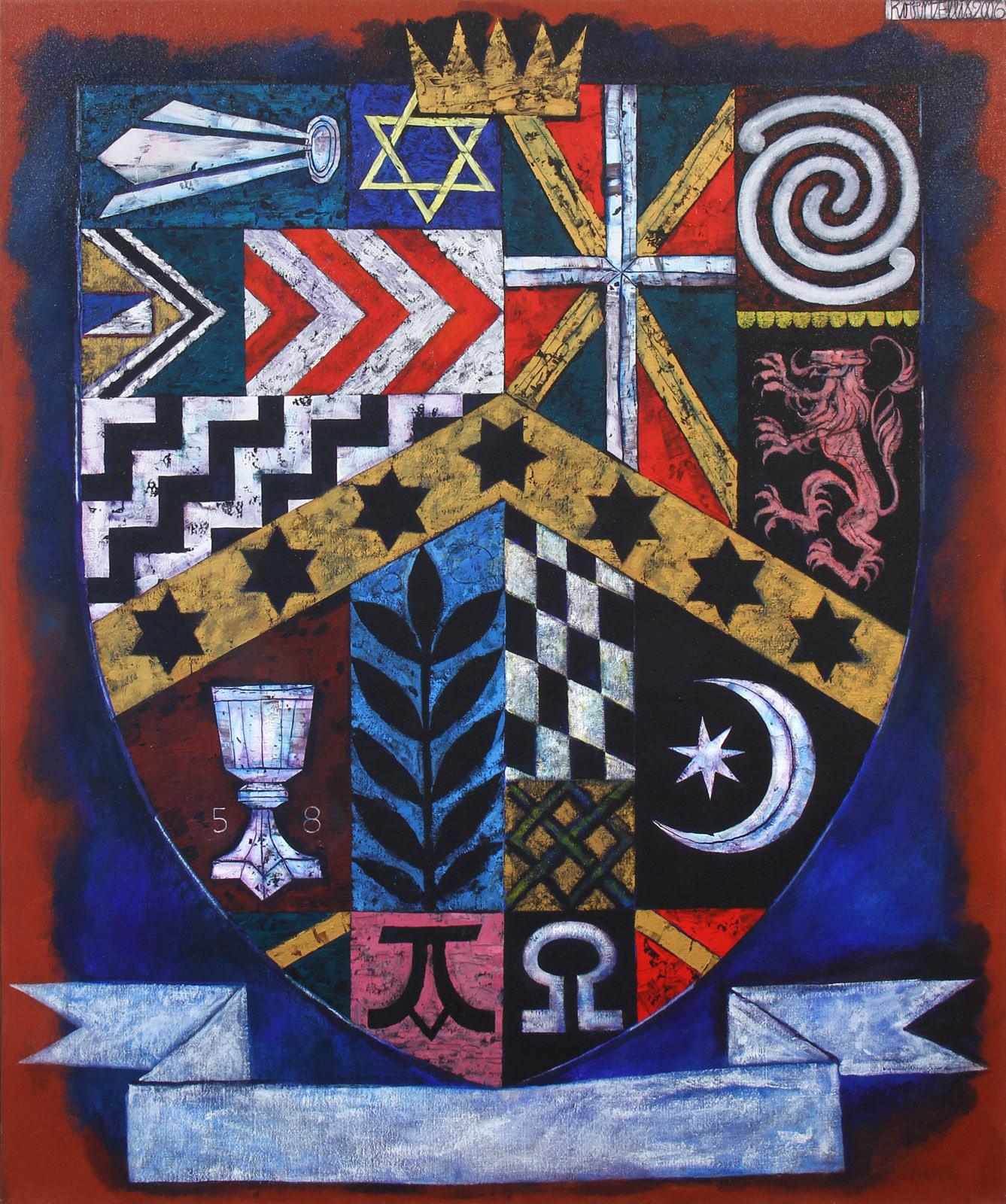
Shielded Histories #6 (2006)
acrylic on linen
stretcher: 1827 x 1525 x 34 mm
signed & dated upper right signed, dated & titled verso
In Shielded Histories #6, Robert Ellis combines the personal and the particular with the collective and symbolic. Seemingly culture-specific symbols and forms become hybrid images representing pluralistic and universal themes. He draws together threads of European and Pacific cultures, combining these from a personal and social perspective.
This work is deeply informed by Ellis’ long-term involvement with Maori culture and society. He integrates and manipulates Maori symbols, designs and forms while acknowledging the similarities between them and those of European culture.
There is a story being told but not in a conventional narrative sense. Ellis builds symbolic conundrums and juxtaposes these so that they are in a state of flux and assume a different kind of identity, while simultaneously he is examining our own histories and assumptions regarding land ownership.
Ellis makes a profound statement by leaving the ribbon unwritten. He implies history has not been written, that we can claim it as our own crest, give it particular identity. He thus provides a philosophical discourse, of questions to answer and answers to question.
Provenance
Received from the artist’s studio
Exhibited
Robert Ellis: A Place to Stand, Turangawaewae, Auckland Art Gallery Toi o Tamaki, 2015