WorkTexas Enlists Multiple Partners to Give Disengaged Youth a Second Chance
Houston program helps teens and adults finish high school, train for good jobs, and thrive
By Caralee Adams | Summer 2025
Yerlin Rivera had struggled academically in high school. She fell in with the wrong crowd, got into trouble, and dropped out. After working two jobs for a year — at Chick-fil-A and a Mexican restaurant — she wanted to finish her education. Rivera lacked so many credits that she would have had to start over as a freshman at a traditional high school, something that did not appeal to her at age 17.
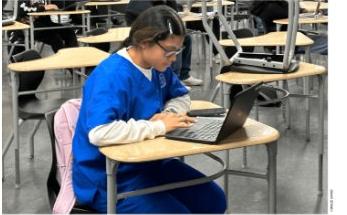
Instead, Rivera enrolled at the Gallery Furniture North location of Premier High School–Houston, an alternative public charter school and training partner of the nonprofit organization WorkTexas. Premier provides training in skilled trades and prepares students to earn certifications. “I really like that you’re at your own pace, but [teachers] are still pushing you to do better,” she said of the online credit-recovery curriculum she combined with the certified medical assistant program. “It was a really good way to ease myself back into school.”
Three years later, Rivera, now 20, passed her CMA exam in April and is on track to finish high school.
Rivera aspires to “have a career, not a job.” “Those are two completely different things,” she said. Eventually she wants to become a registered nurse in a neonatal intensive care unit.
WorkTexas, an innovative nonprofit launched in 2020, connects disengaged youth and adults with career training, helping them secure stable employment. It leverages state and federal funding plus philanthropic donations to offer tuition-free classes and wraparound services. It started out with classic trades — electrical, construction, welding — but has since expanded to offer training for a range of other in-demand fields.
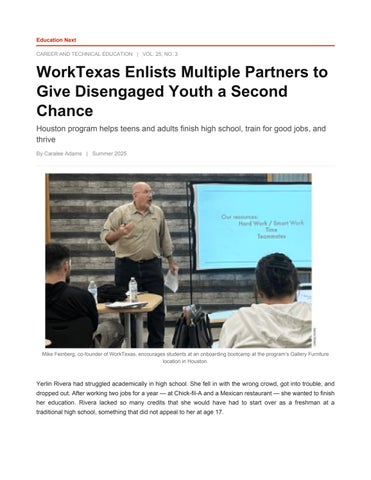
Its mission? “To help people get jobs, keep jobs, and advance in their careers,” said Mike Feinberg, co-founder of WorkTexas, who rose to prominence in the education world co-founding the Knowledge Is Power Program (KIPP) national charter school network.
KIPP pushed college for all, but in retrospect Feinberg wishes it had focused instead on helping students explore a variety of pathways. “It should have been career for all,” he said. Students missed the opportunity to learn marketable skills, and many went to college, didn’t finish, and are now saddled with debt. Feinberg said it’s the latter that keeps him up at night.
WorkTexas training centers occupy two campuses in low-income Houston neighborhoods. One location is a renovated furniture showroom; another is a former juvenile detention center. In 2023–24, WorkTexas served 203 adults, 113 youth from the juvenile justice system, and 65 students learning trades at Premier.
Finding Community Partners and Funding Streams
When Feinberg set out to implement his vision of accessible trade training in Houston, he turned to KIPP’s first funder, Jim McIngvale, the Houston business icon known as “Mattress Mack.” The idea for WorkTexas resonated with McIngvale, who has run his business for more than 40 years.
“I see the people coming up here asking for money in a stream of hopelessness constantly. Giving them money doesn’t work, because it’s gone the next day and they’re back in the same situation,” said McIngvale, 74. “I wanted to figure out a way we could teach these people a trade. Rather than give them a fish, they could learn how to fish and feed themselves.”
McIngvale donated about 15,000 square feet of his furniture showroom and turned it into a trade school. With that backing, Feinberg approached businesses, philanthropists, government officials, and educators at Houston Community College (HCC) to join the effort.
Mike Webster, then associate vice chancellor of workforce instruction at HCC and now its president, was in on the ground floor. “It kind of blew everybody’s mind at the college, and I think it still kind of blows people’s minds,” Webster said.
Beau Pollock, president of TRIO Electric, was an early industry partner, eager to improve the talent pipeline for electricians. Feinberg “has embraced the employer’s perspective but also has the education perspective and
knows the needs of the people going through [the training] to make them successful,” said Pollock, who has hired many WorkTexas graduates.
Nearly five years in, WorkTexas has 50-plus funding partners, including individuals, foundations, and corporations. Many adult students use money from U.S. Department of Labor programs under the Workforce Innovation and Opportunity Act (WIOA).

Premier High School: Engaging Students with Relevant Instruction
On a frigid February day in Houston, Marc Pollicove greets students with smiles and fist bumps at the Gallery Furniture North location of Premier High School–Houston. A teacher and coach for 43 years, Pollicove said he likes getting to know students at Premier, where enrollment hovers around 100.
“They learn because of the school culture we have here,” Pollicove said. “We encourage them to persevere, to overcome obstacles they think they have, … not to let a single setback set them back forever.”
On a typical day, students spend about four hours on laptops following an online curriculum. Trade training takes another two hours daily. The model works because it helps students apply academic learning to the trades — math calculations for concrete volume, square footage for carpet laying.
During the 2023–24 school year, attendance rates were higher — at 85 percent — for students in CTE industry-based certification preparation courses than for students not in the trades (75 percent). “The CTE part
is the why — the application of the learning,” said Craig Shapiro, director of CTE for ResponsiveEd. “Students are staying longer because you have this other carrot — a license.”
WorkTexas offers résumé workshops, interview preparation, and on-the-job experience through its connections with businesses. Students are seeing classmates earn up to $20 an hour while in school and land jobs after graduation. Of the 38 students who graduated from Premier in 2024, 22 also completed an industry-based certification.
Shapiro and Feinberg are in early stages of contacting chambers of commerce, state workforce agencies, and educators to start WorkTexas hubs throughout Texas, beginning in Dallas, Austin, and San Antonio. “I suspect it’s going to ramp straight up,” Shapiro said.
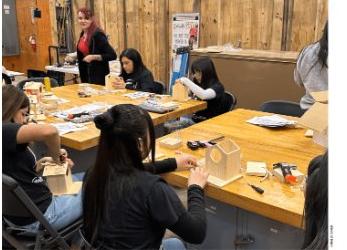
at Premier High School–Houston build birdhouses as part of a workshop called “Girl with Grit.” The charter school offers the workshop to expose its high schoolers to trade skills.
WorkTexas at Night: Offering Hope and Skills to All Ages
Before they pick up any tools, students in WorkTexas evening classes attend a weeklong bootcamp. About 30 young men — and a few women — show up for a session that starts at 6 p.m. The average student’s age is 31; participants have ranged from 17 to 78.
Feinberg tells students the program will equip them with both the technical skills and the virtues they need to enter the workforce as reliable employees. “The virtues are your behavior, making moral choices. That is what the employers really want,” Feinberg said. Throughout the bootcamp, he repeats the mantra: “Show up. Be on time. The best ability is availability.”
Mattress Mack serves as the opening night headliner, telling his story of arriving in Houston with $3,700 in his pocket and putting in 20-hour days for years. “Find a job you love to do, and you never work a day in your life. That’s what WorkTexas is all about,” McIngvale said.
In 2023–24, WorkTexas reports that 88 percent of its adult students completed training. Those employed for a year or more earn an average of $23 per hour.
“If you decide to stay, this is a five-year relationship. Don’t freak out,” said Shirmeca Littlejohn, a WorkTexas career-success coach. “Five years of us checking in with you: Are you working? Are you happy at your job? Are you working on a promotion? Do you need resources?”
Yazmin Guerra, vice president and director of workforce development, has helped WorkTexas reach out to more than 200 employers. “Other programs are focused on giving credentials, but once that person leaves there is little accountability on their employment,” she said. “We make that a priority. Success is not merely graduation.”
Of the 637 alumni from the evening program, 345 are employed, and about 100 have returned for a second round of training to upgrade their skills.
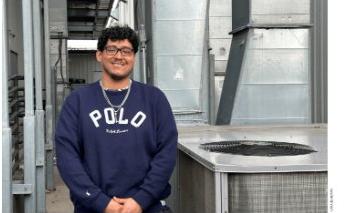
Jacob Martinez finished a 12-week HVAC course at WorkTexas in 2022 and now works as an HVAC technician for the Houston Astros at Daikin Park, earning $60,000 a year with full benefits. “WorkTexas gave me the skills and confidence to go out on my own path,” said Martinez, 25.
Opportunity Center: A Second Chance for Justice-Involved Youth
A few miles from Gallery Furniture, WorkTexas operates at a second campus — a former residential juvenile detention facility transformed in 2022 to house The Opportunity Center, or TOC. Here, the Harris County Juvenile Probation Department runs its own charter school, giving justice-involved youth a chance to earn their GED while also receiving exposure to the trades.
“For the kids, it’s a choice [to enroll],” said Vanessa Ramirez, co-founder of WorkTexas and director of TOC. “And choice is important in the decision so that there is baked-in accountability.”
All students attend academic classes for half a day and trade classes for the other half. Beyond the traditional trades, Ramirez launched Project Remix Ventures, offering career classes in entrepreneurship, music production, and other fields.
The method is having an impact. Since TOC opened, recidivism rates have dropped from 48 percent county-wide in 2022 to 28 percent in TOC’s program in 2023. As of late April, 63 students were enrolled, and there is a wait list.
“To truly get nonprofits to collaborate, that’s the magic. That’s the secret sauce,” said Feinberg of the model. “Schools don’t have to do it all, but schools can be the hub because schools are where the kids are spending the majority of their waking hours.”
Hudson Risch completed his GED in the summer of 2024 and now, at 19, manages La Bodega, the school’s student snack bar. “In the last week, I made about $600. So, it’s been real good,” Risch told Ramirez on a recent visit.

“Let’s get to work, Texas!” is the phrase that gave WorkTexas its name. It aims for each student to complete high school with a job offer, stay employed, and advance in their career.
Hopeful Outlook in Uncertain Times
With recent cuts in the federal workforce and programs at the Department of Education, these are precarious times for organizations that rely on public funds. Yet the collaborative nature of WorkTexas, its multiple funders, and its business-informed strategy make its founders and allies optimistic.
“That means it’s scalable — even though it’s more people to organize — these nonprofits already exist, … doing their own fundraising, program development, and compliance to assess their effectiveness,” said Ramirez. “What we’re doing is just making sure that we’re embedding them in the right place, at the right time, for the right kids.”
“This has bipartisan support. Everyone agrees with the concept,” Shapiro said. “I think there will be more money, considering the way that both the Trump and Biden administrations were pushing this concept of workforce development within high schools and community colleges.”
Feinberg maintains that the focus of WorkTexas transcends politics. “Think about what our mission is: We’re helping people get jobs, keep jobs, advance in careers. Which political party is going to say they don’t agree with our mission?”
Caralee Adams is a freelance journalist in Bethesda, Maryland, writing on education, business, technology, health, and other topics for multiple outlets.
This article appeared in the Summer 2025 issue of Education Next, Vol. 25, No. 3, pp. 32–41.
Originally published at educationnext.org • Summer 2025