SEPTEMBER 2026
JUNE/JULY 2017
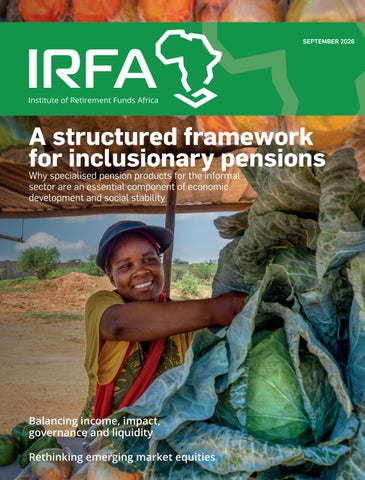
A structured framework for inclusionary pensions Why specialised pension products for the informal sector are an essential component of economic development and social stability
Balancing income, impact, governance and liquidity Rethinking emerging market equities 00 Cover FINAL.indd 1
2026/08/28 16:05
4183-2026-03
The secret is out. - STRAPLINE -
Alexforbes Investments has been named South African Manager of the Year at the Raging Bull Awards for 2025, with additional recognition for
Quietly trusted for decades. Independently awarded. Now officially recognised.
five-year risk adjusted basis. The same investment capability relied on in boardrooms across the country. Now an investment destination all South Africans know about. www.alexforbes.com
Alexforbes has licensed financial services providers and licensed insurers in the group.
South African Manager of the Year.
Best South African Interest bearing Fund on a
6 | IRFA TALK | SEPTEMBER 2026
4183-Ad-Portrait-2026-03-12.indd 1 01 Contents_cl.indd 6
2026/03/12 10:00:20 2026/08/28 16:19
- WHAT’S NEWS -
The need for inclusionary pensions in highinformality economies
06 A structured analysis of the legal and regulatory challenges in developing pension frameworks for non-standard workers, with South Africa serving as a case study
EMBEDDING THE SOCIAL PILLAR OF ESG IN SA’s JUST TRANSITION
36
20
As the country advances to decarbonisation, the success of the transition will depend not only on environmental outcomes, but also on whether it delivers tangible social and economic benefits to affected communities.
IRFA BOARD OF DIRECTORS
1
2
3
4
5
6
7
8
David Hurford, CEO: Fairheads Benefit Services
“There is no universally ‘best’ payment option under Section 37C. Each mode of payment carries its own benefits, risks, and tax implications, and what is appropriate for one dependant may be entirely unsuitable for another. Trustees must therefore exercise their discretion carefully, taking into account the dependant’s age, financial literacy, vulnerability, support structures, and long-term needs.”
24 IMPROVING RISK MANAGEMENT With cybersecurity a critical component of modern retirement fund governance, here’s why every retirement fund needs an annual cybersecurity compliance audit
32 BUILDING INVESTABLE OPPORTUNITIES
Identifying the missing link between capital and growth in order to support a new phase of infrastructure investment in South Africa
1. Geraldine Fowler (President) | 2. Nancy Andrews (Vice President) | 3. Amanda Khoza (Board Member) | 4. Cedrick Pila (Board Member) | 5. Mandla Nkosi (Board Member) | 6. Mkuseli Mbomvu (Board Member) | 7. Ntombi Mlambo (Board Member) | 8. Seelan Naidoo (Board Member)
IRFA Talk is published on behalf of the Institute of Retirement Funds Africa by Mikateko Media. 7 Norton Way, Rondebosch, Cape Town, 7700 www.mikatekomedia.co.za Brandon Johnson (Commercial Manager) +27(83) 406 3700 brandon.johnson@mikatekomedia.co.za Disclaimer: The views expressed in this publication do not necessarily reflect those of the Board and Management of Mikateko Media (Pty) Ltd and the Institute of Retirement Funds Africa, nor do we take responsibility for third party advertising and pricing supplied. While precautions have been taken to ensure the accuracy of information, neither the editor, publisher nor Mikateko Media can be held liable for any inaccuracies, injury or damages that may arise. All correspondence regarding the publication should be directed to Mikateko Media.
SEPTEMBER 2026 | IRFA TALK | 1
01 Contents_cl.indd 1
2026/08/28 16:07
- PRESIDENT’S LETTER -
FROM THE IRFA PRESIDENT Dear Members, Colleagues and Stakeholders, Welcome to the 2026 IRFA Annual Conference. This year’s conference theme, “A New World – A New Normal,” could not be more relevant. Across the globe, economic, political, technological, and social shifts are reshaping the environment in which retirement funds operate. Traditional assumptions are being challenged, member expectations are evolving rapidly, and fiduciary responsibilities continue to expand in complexity and significance. In this new environment, trustees and industry stakeholders are required to think differently about every aspect of retirement fund management. Investments must be evaluated not only for their financial returns, but also for their resilience, sustainability, and ability to serve members’ long-term interests in a rapidly changing world. Administration must deliver operational excellence, seamless digital experiences, and trusted member engagement. Compliance must be embedded within the culture of institutions, supporting sound governance rather than merely satisfying regulatory requirements. Professional advisers and service providers must move beyond technical expertise to become trusted strategic partners, helping funds navigate complexity while maintaining a relentless focus on member outcomes. Yet, regardless of how our operating environment evolves, one principle remains constant: governance is our most important foundation. Governance is far more than compliance, policy frameworks, or technical processes. Governance is trust. It is the mechanism through which institutions honour their obligations to the millions of workers whose financial futures depend on the decisions we make every day. Today’s members expect transparency, immediacy, and accessibility. They want information at their fingertips. They want to understand where their money is invested and how those investments contribute to both their financial security and broader societal outcomes. Increasingly, they compare their retirement fund experience to the seamless digital experiences they receive from banks, retailers, and technology platforms.
―While my chapter as President concludes, my commitment to the principles that define our industry remains unchanged.― The challenges before us are significant. We continue to confront issues of retirement adequacy, preservation, financial literacy, inclusion, and transformation. We must embrace technological innovation while maintaining appropriate oversight and accountability. We must balance developmental aspirations with our fiduciary responsibility to protect and grow members’ savings. We must continue to strengthen institutions while preparing for a future that is changing faster than ever before. Throughout my years of involvement with the Institute of Retirement Funds Africa, I have witnessed an industry that has consistently demonstrated resilience, adaptability, and an unwavering commitment to improving member outcomes. The successful implementation of major reforms, such as the Two-Pot Retirement System, showed what can be achieved when regulators, funds, administrators, consultants, service providers, and industry bodies work together towards a common purpose.
2 | IRFA TALK | SEPTEMBER 2026
02 President's Letter.indd 2
2026/08/28 16:08
- PRESIDENT’S LETTER -
That spirit of collaboration has also defined the evolution of IRFA itself. Over the past decade, we have seen our organisation grow in influence, membership, and impact. We have strengthened relationships with key stakeholders, expanded educational initiatives, enhanced our technical capabilities, and increased our engagement across the African continent. The growth of our committees, conferences, workshops, and thought leadership platforms reflects the commitment of countless volunteers and professionals who give generously of their time and expertise. As this conference brings together trustees, principal officers, fund executives, administrators, consultants, investment managers, regulators, and service providers from across our industry, it serves as a reminder that sustainable retirement outcomes cannot be achieved in isolation. Success depends on partnership, shared learning, and collective leadership. As my tenure as President and Chairperson of IRFA comes to an end, I would like to take this opportunity to express my sincere gratitude to everyone who has been part of this remarkable journey. To my fellow Board members, thank you for your leadership, counsel, and unwavering support. To our committee members, thank you for the thousands of voluntary hours you have dedicated to advancing the interests of the retirement industry and improving outcomes for members. To the IRFA team, thank you for your professionalism, commitment, and passion in serving our members and delivering excellence in everything you do. To National Treasury, the FSCA, SARS, the Office of the Pension Funds Adjudicator, industry associations, and our many partners, thank you for your engagement and willingness to collaborate in pursuit of a stronger retirement system.
immense pride in what we have achieved together and with confidence in the future of both IRFA and the retirement industry. While my chapter as President concludes, my commitment to the principles that define our industry — good governance, member-centricity, professionalism, inclusion, and collaboration — remains unchanged. As we gather for this conference, let us embrace the opportunities of this new world and new normal with courage, innovation, and purpose. Thank you for your partnership, your friendship, and your dedication. I wish IRFA, its future leaders, and all its stakeholders continued success in building stronger retirement outcomes for generations to come. Together, we have made a difference. Together, we will continue to do so. Warm regards,
To our sponsors, conference partners, and service providers, thank you for your continued support and contribution to the sustainability of our organisation. Most importantly, to our members and stakeholders across South Africa and the African continent, thank you for the trust you have placed in me and in IRFA. Serving this organisation has been one of the greatest privileges of my professional career. I leave this role with
Geraldine Geraldine Fowler President and Chairperson Institute of Retirement Funds Africa (IRFA) 2021–2026
SEPTEMBER 2026 | IRFA TALK | 3
02 President's Letter.indd 3
2026/08/28 16:08
- GLOBAL NEWS -
GLOBAL HEADLINES Business updates from around the world
ArcelorMittal SA deepens losses as rescue deal nears conclusion ArcelorMittal South Africa (AMSA) reported a headline loss of R1.49 billion for the first six months of 2026, reflecting the ongoing challenges facing the domestic steel industry despite efforts to streamline operations and improve efficiency. The company said weak demand, rising costs and the impact of placing its long steel business into care and maintenance continued to weigh on performance. However, AMSA maintains that its underlying business is stronger than it was 18 months ago and believes a return to profitability is achievable. Investors are also awaiting the outcome of advanced discussions with the Industrial Development Corporation (IDC) regarding a potential transaction aimed at securing the future of the business and supporting South Africa’s strategic steelmaking capacity.
Anglo American reported a significantly improved first half, with its net loss narrowing to $858 million from $1.9 billion a year earlier, driven by stronger copper earnings and cost-saving measures. Core earnings rose 35% to $4 billion, allowing the mining giant to increase its interim dividend to $0.23 per share from $0.07 last year. The company continues to reshape its portfolio, having already spun off its South African platinum business while pursuing exits from its coal, nickel and diamond operations. A proposed $53 billion all-share merger with Canada’s Teck Resources remains on track, with final approval from Chinese regulators still pending. If completed, the deal would create one of the world’s largest copper producers, strengthening Anglo’s position in the energytransition metals market.
NUCLEAR AMBITIONS MEET COST REALITY IN INDIA
India’s plan to expand nuclear power has hit a costly hurdle, with the price of four Russiandesigned reactors under construction at the Kudankulam nuclear plant rising by 55% following delays linked to the war in Ukraine. The project’s estimated cost has climbed to about $14.4 billion, with construction pushed back by almost three years. The increase reflects a wider global trend, as nuclear projects in countries including the US, UK and Bangladesh have also faced significant delays and budget overruns. While India views nuclear energy as critical to strengthening energy security and meeting long-term climate goals, higher construction costs could make nuclear-generated electricity less competitive in a price-sensitive market, potentially complicating the country’s ambitious plans to expand nuclear capacity by 2047.
04 Global News.indd 4
SOURCES: BUSINESS INSIDER, BLOOMBERG, CNBC AFRICA, NEWS24 IMAGES: ARCELORMITTAL, FLICKR/ANGLOAMERICAN.COM, UNSPLASH, MAGNIFIC
ANGLO AMERICAN EDGES CLOSER TO TECK MERGER AS EARNINGS RECOVER
2026/08/28 16:10
- GLOBAL NEWS -
SOURCES: BUSINESS INSIDER, BLOOMBERG, CNBC AFRICA, NEWS24 IMAGES: ARCELORMITTAL, FLICKR/ANGLOAMERICAN.COM, UNSPLASH, MAGNIFIC
Microsoft surges as Meta stumbles
Investor enthusiasm for artificial intelligence drove a sharp split between two of Big Tech's biggest players after their latest earnings reports in June. Microsoft shares jumped about 9% after the company reported stronger-than-expected results, powered by robust growth in its Azure cloud business and rising adoption of Microsoft 365 Copilot, which now has more than 30 million paid users. The results reassured investors that Microsoft's massive AI investments are beginning to generate tangible returns. In contrast, Meta's shares fell nearly 9% after the social media giant issued weaker-than-expected revenue guidance and revealed a steep drop in free cash flow as AI spending continued to accelerate. The contrasting market reactions highlight growing investor focus on which companies can most effectively turn AI investment into profitable growth.
FAST FACTS
25 000 TONNES
68%
Canal+ said first-half group revenue rose about 40% to €4.287 billion (R81.59 billion) after its acquisition of MultiChoice, while adjusted EBIT increased 68% to €433 million (R8.24 billion).
Cocoa’s projected global surplus is expected to plunge from 422,000 tonnes to just 25,000 tonnes in 2026/27, with Ivory Coast, the world’s largest cocoa producer, facing an 11% output fall to 1.77 million tonnes and Ghana’s cocoa crop forecast to decline 10% to 585,000 tonnes next season.
$34 million
Japan’s JOGMEC to invest up to $34 million in Toyota Tsusho rare earth venture in Namibia – a project that could become Japan’s first rare earth mine development in Africa and help strengthen supply of critical minerals.
SEPTEMBER 2026 | IRFA TALK | 5
04 Global News.indd 5
2026/08/28 16:10
- IRFA NEWS -
BEYOND THE FORMAL SECTOR
A structured framework for inclusionary pensions in South Africa The IRFA would like to thank IPEBLA for granting permission for this article to be reprinted in IRFA Talk. This article was awarded IPEBLA’s 2026 Tony Thurman Award and was originally published in Volume 99 of the International Pension Lawyer
IMAGE: UNSPLASH
by Wayne Hiller van Rensburg
6 | IRFA TALK | SEPTEMBER 2026
06 IRFA News_Beyond The Formal Sector.indd 6
2026/08/28 16:12
- IRFA NEWS -
This article presents a structured analysis of the legal and regulatory challenges in developing pension frameworks for non-standard workers, with South Africa serving as a case study. It is organised around five key questions, which progress from definition to practical implementation. First, it defines the concept of ‘micropensions’ and questions whether the term is appropriate for its intended purpose, proposing more empowering alternatives. Second, it demonstrates the critical importance of such financial products in South Africa and other economies with high informal employment rates. Third, it investigates the global applicability of these solutions, particularly in accommodating the growing gig economy workforce in both developing and developed countries. Fourth, it outlines the specific enabling policies and legal frameworks required in South Africa, providing a potential roadmap for other jurisdictions. Finally, it conducts a comparative analysis of existing frameworks in Africa and the broader Global South, drawing on real-world experience.
1
WHAT ARE MICROPENSIONS? A DEFINITIONAL AND TERMINOLOGICAL INQUIRY
The term ’micropension’ has gained popularity to describe a specific type of retirement savings product. A widely accepted definition of a micropension scheme is a voluntary, defined-contribution, individual account plan designed for the informal sector or low-income earners [1]. Unlike traditional employer-sponsored pensions, these plans have no formal plan sponsor and are based on the principles of individual ownership and flexible contributions.
IMAGE: UNSPLASH
A micropension, in a broader sense, can be defined as any arrangement that allows individuals who would otherwise be excluded from formal pension systems to accumulate assets to provide an income in retirement [2]. The primary design philosophy is to remove the barriers that keep informal workers from saving for retirement. Key characteristics usually include: Flexibility: Allowing for small, irregular contributions to account for fluctuations in income. Accessibility: Using simple registration processes (often via mobile technology) and having low or no minimum balance requirements. Portability: Ensuring that savings are tied to the individual rather than the employer, allowing for seamless accumulation across multiple jobs and periods of unemployment. Low cost: Making administration and fund management
more efficient and affordable, preventing fees from eroding small balances. Is ’micropension’ the correct term? While functionally descriptive, the term ’micropension’ has the potential to cause problems. The prefix ’micro’ can imply being smaller, inferior, or inadequate. For a product designed to empower and provide dignity in old age, this framing may act as a psychological barrier to adoption. It risks portraying these products as a ’second-class’ option rather than an essential component of a universal social protection system. As a result, a shift in terminology may be necessary. More empowering and descriptive alternatives could include: Flexible Pension Plans: The name emphasises the key product feature that appeals to workers with variable incomes. Personal Retirement Accounts: This term emphasises individual ownership and aligns the product with similar concepts in developed markets (such as IRAs in the United States), giving it credibility and seriousness. Inclusive Pension Schemes: This framing emphasises the policy goal of increasing access and promoting financial inclusion. While the term ’micropension’ will be used throughout this article to be consistent with existing literature, it is argued that a shift to a more aspirational and accurate name such as Flexible Pension Plan would be a positive step in policy and public discourse.
2
THE NEED FOR INCLUSIONARY PENSIONS IN HIGH-INFORMALITY ECONOMIES
The need for specialised pension products for the informal sector is not a minor issue; it is an essential component of long-term economic development and social stability, particularly in countries such as South Africa. The South African economy's structure, with a large proportion of the workforce engaged in informal employment, renders the traditional, formal-sector-centric model of retirement provision fundamentally inadequate. South Africa's informal sector employs more than 30% of the working population, but less than half of all formally employed workers contribute to a retirement fund [3, 4]. This creates a significant coverage gap, leaving millions of workers without a structured way to save for their retirement. The consequences are twofold. On an individual level, it condemns a significant portion of the population to old-age
SEPTEMBER 2026 | IRFA TALK | 7
06 IRFA News_Beyond The Formal Sector.indd 7
2026/08/28 16:12
- IRFA NEWS -
poverty, increasing their reliance on state-funded social benefits. On a national scale, it imposes an unsustainable fiscal burden on the state, which will only worsen as the population ages. The situation in South Africa is representative of a larger trend throughout the Global South. In Nigeria, for example, the informal sector accounts for roughly 65% of GDP, while in Kenya, it is estimated to account for around 83% of the workforce [5, 6]. In such cases, a pension system that only benefits the formally employed is, by definition, exclusionary. It fails to capture the economic activity of a large and often vibrant sector of the economy, leaving the majority of the working population in a state of constant financial vulnerability. Furthermore, the nature of informal work, with its irregular income streams, lack of formal contracts, and frequent job changes, renders it structurally incompatible with traditional pension models that require regular, fixed contributions. Without products tailored to their needs, informal workers are frequently forced to rely on less efficient, non-financial forms of savings, such as investing in property or livestock, or simply keeping cash at home, which is vulnerable to theft and inflation. The development of Flexible Pension Plans is thus more than just a matter of financial product innovation; it is also a matter of economic justice and a prerequisite for creating a more resilient and inclusive social security system.
3
A GLOBAL SOLUTION: ADDRESSING THE GIG ECONOMY
The challenge of providing social protection for non-standard workers has spread beyond the informal economies of the Global South. The rise of the gig economy and other forms of platform-based work has highlighted a similar set of challenges in developed countries. Gig workers, like their counterparts in the informal sector, are typically classified as independent contractors, which means they are not eligible for traditional employer-sponsored pension plans or other social security benefits. This has resulted in a new and growing cohort of workers in developed economies who face uncertain retirement prospects. According to a study conducted by the Geneva Association, only 35% of gig workers have a pension or retirement plan, highlighting the widening coverage gap in even advanced economies [7]. The characteristics of gig work — flexible hours, fluctuating income, and the lack of a single, stable employer — are similar to the realities of informal
employment, so the design principles of Flexible Pension Plans apply directly. As a result, the innovations being developed in countries such as South Africa, Kenya, and Nigeria are not just of regional significance. They could serve as a model for developed countries looking to adapt their own social protection systems to the changing nature of work. A portable, individual-centric pension account with flexible contributions is exactly the type of solution required to accommodate a workforce that is becoming more mobile and less reliant on traditional, longterm employment relationships. The OECD has acknowledged this convergence, calling for stronger, more portable pension systems to keep up with the changing world of work [8]. The lessons learnt from the implementation of mobile-based, low-cost micropension schemes in Africa could be extremely useful for policymakers in Europe and North America as they struggle to bring millions of platform workers into the social security system. This creates an intriguing dynamic of reverse innovation, in which policy solutions developed in the Global South may hold the key to addressing some of the most pressing social policy challenges in the Global North. In this context, South Africa's journey is more than just a national one; it also contributes to a global search for a more inclusive and resilient retirement provision model.
4
ENABLING FRAMEWORKS FOR SOUTH AFRICA: A POLICY AND LEGAL ROADMAP
Creating a strong and effective framework for Flexible Pension Plans in South Africa necessitates a collaborative effort in policy design and legal reform. This section presents a potential roadmap based on international best practices and South Africa's regulatory experience, particularly with its microinsurance framework. Policy Foundations The overarching policy goal must be to foster an environment that promotes both the supply and demand for these products. This necessitates a delicate balance between safeguarding consumers and encouraging innovation. Important policy considerations include: Proportionality in Regulation: A one-size-fits-all approach to regulation will fail. The regulatory requirements for Flexible Pension Plans must be proportionate to their size, risk, and complexity. A tiered approach, similar to the microinsurance framework, could be implemented, with less stringent requirements for smaller, simpler schemes [9].
8 | IRFA TALK | SEPTEMBER 2026
06 IRFA News_Beyond The Formal Sector.indd 8
2026/08/28 16:12
- IRFA NEWS -
Creating value that endures By combining resilient foundations with a long-term perspective, we create enduring value for clients through every stage of the investment journey.
C R E AT I N G W E A LT H W I T H P U R P O S E
SEPTEMBER 2026 | IRFA TALK | 9
06 IRFA News_Beyond The Formal Sector.indd 9
2026/08/28 16:16
- IRFA NEWS -
An Open and Competitive Market: To reduce costs and encourage innovation, the market for these products should be open to a wide range of players. This could include not only traditional pension fund administrators, but also microfinance institutions, mobile network operators, and other fintech firms with the resources and technology to effectively serve the informal sector. Government Co-contributions: To encourage adoption and help build meaningful savings, the government may consider a system of co-contributions or subsidies, particularly for low-income earners and women. This would demonstrate a strong policy commitment to inclusivity and help overcome the initial inertia of saving. Legal and Regulatory Architecture The legal framework must be modified to accommodate the distinct characteristics of these products. This will most likely necessitate changes to the Pension Funds Act or the establishment of a new, dedicated regulatory framework overseen by the Financial Sector Conduct Authority (FSCA).
Key legal and regulatory questions to address include: Licensing and Supervision: A new licensing category for Flexible Pension Plan providers may be required, along with specific and appropriate prudential and market conduct standards. Simplified KYC and Onboarding: The current Financial Intelligence Centre Act (FICA) requirements may be a barrier to entry for informal workers. A risk-based approach to Know Your Customer (KYC) and customer due diligence, which enables simplified digital onboarding, will be critical. Preservation and Access: While the primary goal is longterm savings, the framework must account for low-income workers' liquidity needs. The model of South Africa's "two-pot" system, which allows for limited pre-retirement withdrawals from a ’savings pot’,' could be adapted for Flexible Pension Plans, providing a safety net for emergencies while maintaining the primary goal of retirement preservation [10]. Consumer Protection: Strong consumer protection measures are not negotiable. This must include clear and simple disclosure of fees, risks, and benefits; a charge cap to protect small balances; and an easily accessible, low-cost dispute resolution mechanism. By proactively addressing these policy and legal issues, South Africa can establish a world-class framework for inclusive pensions that not only benefits its own population but also serves as a valuable model for other jurisdictions.
5
EXISTING FRAMEWORKS: A COMPARATIVE ANALYSIS OF AFRICA AND THE GLOBAL SOUTH
South Africa does not need to begin with a clean slate. A growing number of countries in Africa and the Global South have already implemented micropension frameworks, providing a wealth of practical experience. This section presents a comparative analysis of some of the most notable examples. African Pioneers Several African countries have led the way in micropension innovation, owing in large part to the rapid proliferation of mobile technology.
Kenya's Mbao Pension Plan is one of the earliest and bestknown examples. Launched in 2011, it enables informal sector workers, such as small-scale traders and domestic workers, to make small daily contributions via mobile money. Its success demonstrated the potential of using mobile technology to reach the informal sector [11]. Nigeria: In 2019, the country launched the Micro Pension
06 IRFA News_Beyond The Formal Sector.indd 10
2026/08/28 16:12
- IRFA NEWS -
Plan (MPP), a voluntary scheme for self-employed individuals and small businesses. While uptake has been challenging, the framework itself is significant, representing a concerted effort by the national pension regulator (PenCom) to broaden coverage. The recent rebranding as the ‘Personal Pension Plan’ reflects a shift towards more empowering terminology [12]. Rwanda's EjoHeza initiative is a standout success story. It was launched in 2018 and has since grown significantly, with hundreds of thousands of savers joining. Its success is attributed to a combination of government funding, an easyto-use digital platform, and a strong emphasis on communitybased savings mobilisation [13]. Ghana has also seen the emergence of several schemes, which are frequently driven by private-sector providers in collaboration with mobile network operators. Ghanaian research has shown that trust and financial literacy are important in driving participation [14].
CONCLUSION
Lessons from the broader Global South Beyond Africa, countries in Asia and Latin America provide valuable insights.
By taking a structured, evidence-based approach, South Africa can create a framework that is not only effective for its own people but also serves as a model for other countries.
India: India has a long history of experimenting with micropension models, which are frequently linked to its extensive network of microfinance institutions (MFIs). These schemes have highlighted the importance of combining pensions with other financial products, such as credit and insurance, to provide a comprehensive value proposition to low-income households [15].
The path forward necessitates a dedication to proportionality in regulation, an embrace of technological innovation, and an unwavering focus on the needs and dignity of the end user.
Chile: While frequently cited for its privatised formal pension system, Chile's experience also serves as a cautionary tale. Imposing high, mandatory contribution rates can have the unintended consequence of pushing workers into the informal sector, threatening the pension system's long-term viability [16]. This emphasises the importance of flexibility in any system designed to serve informal workers.
The creation of legal and regulatory frameworks for Flexible Pension Plans is one of the most pressing issues in social security law today. It is a challenge that combines financial innovation, social policy, and economic development. South Africa, with its unique combination of a sophisticated financial sector, high levels of inequality, and informal employment, is well-positioned to lead in this field.
The journey is difficult, but the goal — a more inclusive and equitable system of retirement provision for all — is of enormous national and global significance.
COUNTRY
SCHEME EXAMPLE
KEY FEATURE
KEY LESSON
Kenya
Mbao Pension Plan
Mobile-money integration
Technology is a critical enabler for reaching the informal sector.
EjoHeza
Government support and community mobilisation
A multi-stakeholder approach involving government, community, and technology is highly effective.
Nigeria
Micro Pension Plan (MPP)
Regulatory-driven national framework
A dedicated regulatory framework is important, but uptake requires more than just enabling rules.
India
MFI-linked Schemes
Integration with other financial services
Bundling pensions with credit and insurance can increase the value proposition for users.
Chile
Formal Pension System
High mandatory contributions
Inflexible, high-cost mandatory schemes can increase informality.
Rwanda
SEPTEMBER 2026 | IRFA TALK | 11
06 IRFA News_Beyond The Formal Sector.indd 11
2026/08/28 16:13
- IRFA NEWS -
REFERENCES PwC Nigeria. "Micro pensions: The New Frontier." Advisory Outlook. Accessed: 12 December 2025. https:// www.pwc.com/ng/en/assets/pdf/micro-pensions-the-newfrontier.pdf
[1]
Nutsubidze, T. "Micro Pensions in Developing Countries: Implications and Policy Relevance." Centre for Retirement Research at Boston College, Working Paper 2024-7. July 2024. https://crr.bc.edu/wp-content/uploads/2024/07/ wp_2024-7.pdf
The South African National Treasury. "The South African Microinsurance Regulatory Framework." Policy document. Accessed 2 March 2010. https://www.treasury.gov.za/ publications/other/microinsuranceregulatoryframework/ policy%20document%20micro%20insurance.pdf [9]
[2]
Rogan, M. "Informal Workers in Urban South Africa: A Statistical Snapshot." WIEGO Statistical Brief No. 19. Women in Informal Employment: Globalizing and Organizing (WIEGO), February 2019. https://www. wiego.org/wp-content/uploads/2019/09/Informal%20 Workers%20in%20Urban%20South%20Africa%20SB%20 19.pdf
The South African National Treasury. "TWO-POT RETIREMENT SYSTEM: FREQUENTLY ASKED QUESTIONS." Accessed 20 August 2024. https://www.treasury.gov. za/comm_media/press/2024/2024%20Two-pot%20 System%20Updated%20%20FAQ%20August%202024.pdf [10]
[3]
Old Mutual. "South Africa's Next Step in Retirement Reform." Accessed 10 December 2025. https://www. oldmutual.co.za/corporate/resource-hub/all-articles/ south-africas-next-step-in-retirement-reform/
[4]
Medina, L., Jonelis, A.W., and Cangul, M. "The Informal Economy in Sub-Saharan Africa: Size and Determinants." IMF Working Paper WP/17/156. International Monetary Fund, July 2017. https://www.imf.org/-/media/files/ publications/wp/2017/wp17156.pdf
[5]
International Labour Organization. "The Informal Economy in Kenya." ILO Publications, September 2021. https://www.ilo.org/publications/informal-economy-kenya [6]
Schanz, K. U. "Gig Economy Work: Mind the Protection Gaps." Geneva Association. Accessed 23 March 2022. https://www.genevaassociation.org/sites/default/files/ research-topics-document-type/pdf_public/ga_gig_ economy_summary_23_03_2022.pdf [7]
Kabare, K. "Mbao Pension Plan: Savings for the Informal Sector." Development Pathways. October 2018. https://www.developmentpathways.co.uk/wp-content/ uploads/2018/10/Mbao.pdf [11]
EFInA. "Deep Dive on the Newly Launched Micropension Scheme in Nigeria." 29 May 2019. https://efina. org.ng/wp-content/uploads/2019/05/Deep-Dive-on-theNewly-Launched-Micro-pension-Scheme-in-Nigeria.pdf [12]
The African Pension Supervisors Association (APSA). "African Pension and Asset Management Industry Study." https://www.africapsa.org/wp-content/uploads/2025/05/ Africa-Pension-and-Asset-Management-APSApresentation-v08.pptx-1.pdf [13]
Boyetey, D. B., et al. "Effect of institutional mechanisms on micropension saving among informal economy workers in the Greater Accra Region of Ghana." Heliyon 7, no. 9 (2021). https://www.cell.com/heliyon/fulltext/S24058440(21)02107-1 [14]
Asher, M. G. & Bali, A. "Micro-pensions in India: Issues and Challenges." International Social Security Review 64, no. 2 (2011): 69–88. https://onlinelibrary.wiley.com/doi/ abs/10.1111/j.1468-246X.2011.01390.x [15]
Evans, C. & Pienknagura, S. "Assessing Chile's Pension System: Challenges and Reform Options." IMF Working Paper 2021/232. IMF, 2021. https://www.imf.org/-/media/ files/publications/wp/2021/english/wpiea2021232-printpdf.pdf [16]
Adecco Group. "The Gig Economy and the Ageing Population: How to Reform Our Pension Systems." Accessed 12 December 2025. https://www.adeccogroup. com/future-of-work/latest-insights/the-gig-economy-andaging-population-how-to-reform-our-pension-systems [8]
12 | IRFA TALK | SEPTEMBER 2026
06 IRFA News_Beyond The Formal Sector.indd 12
2026/08/28 16:13
- IRFA NEWS -
SEPTEMBER 2026 | IRFA TALK | 13
06 FullIRFA page dimension News_Beyond check.indd The Formal 1 Sector.indd 13
2026/08/20 2026/08/28 14:52:12 16:17
- IRFA NEWS -
INSTITUTE OF RETIREMENT FUNDS AFRICA (IRFA)
2026 communications activities update The Communications Committee of the Institute of Retirement Funds Africa (IRFA) continues to play a pivotal role as the primary conduit between the organisation, its members, and broader industry stakeholders. Following the strategic foundation laid in recent years, our core focus for 2026 remains steadfast: to strengthen stakeholder engagement, build institutional respectability, and enhance our marketing and communications platforms to deliver a world-class educational experience.
IMAGE: UNSPLASH
by Khuliso Ratshili, Communication Officer at IRFA
14 | IRFA TALK | SEPTEMBER 2026
14 IRFA News_Communications Update.indd 14
2026/08/28 16:20
- IRFA NEWS -
As we navigate a rapidly evolving retirement landscape, driven by regulatory shifts and technological advancements, the IRFA is committed to adapting its communication strategies to meet the ‘New Normal.’ Below is an overview of our key communications activities and initiatives for 2026.
INFORMATION DISSEMINATION AND EDUCATION
Operating in an environment characterised by frequent regulatory and policy changes, the IRFA recognises the critical need for timely and accurate information dissemination. We are continuing our established educational and communication activities while introducing innovative formats to reach our audience more effectively. Our ongoing platforms include: IRFA Dispatch: Our weekly electronic newsletter continues to provide members and stakeholders with the latest industry issues and news. IRFA Talk Magazine: The quarterly printed magazine, which delves into industry activities in greater detail, is now also available in a digital format. This ensures that the publication is more timeous and easily accessible via email and the IRFA website. Webinars and Workshops: We are maintaining our schedule of regular member and stakeholder engagements through webinars and workshops, fostering face-to-face interaction and high-level engagement on key industry topics such as investment practices, legal policy changes, and transformation.
BUILDING INSTITUTIONAL RESPECTABILITY THROUGH EFFECTIVE MEDIA USE
The media remains a crucial partner for the IRFA in shaping public perception and educating the broader community about regulatory and policy decisions. In 2026, we are amplifying our efforts to disseminate the IRFA's opinions and views through strategic media engagement. By increasing our presence across radio, television, and print platforms, we continue to cement the organisation's reputation as a leading voice and key role-player in the retirement and investment sectors across the continent.
IMAGE: UNSPLASH
INDUSTRY AND STAKEHOLDER ENGAGEMENTS
Meaningful engagement is a cornerstone of the IRFA's leadership role. We are sustaining and enhancing our collaborative relationships with key regulatory and policy organisations, including the Financial Sector Conduct Authority (FSCA), the South African Revenue Service (SARS), and National Treasury.
Our active participation in industry forums, regulatory consultations, and key conferences – such as the Batseta Winter Conference and the Africa Pensions Conference – ensures that the IRFA's voice remains influential in shaping retirement regulations and policies in South Africa and beyond.
DIGITAL CONSOLIDATION AND WEBSITE REDEVELOPMENT
A major strategic focus for 2026 is the comprehensive overhaul and consolidation of the IRFA's digital infrastructure. Currently, our digital presence is fragmented across the main website, the WildApricot member management system, and standalone conference portals. To address this, the IRFA Board has approved the redevelopment of our digital platforms into a single, unified website. This new central hub will seamlessly integrate our CRM back-end and conference portals, providing an intuitive, user-friendly experience for all stakeholders. The new platform will feature dynamic content, a dedicated member self-service portal, and a permanent, archived conference section. Call for Digital Development Experts: We are actively seeking a qualified service provider or individual expert to assist with this critical website redevelopment and digital consolidation project. Interested parties should look out for an official advertisement or tender detailing the position requirements. In the meantime, prospective candidates or agencies are welcome to express their interest by writing to us at info@irfa.org.za.
SEPTEMBER 2026 | IRFA TALK | 15
14 IRFA News_Communications Update.indd 15
2026/08/28 16:20
- IRFA NEWS -
INTRODUCING THE SECTION 37C EDUCATIONAL VIDEO SERIES
THE 2026 RECOGNITION MECHANISM: THE NEW NORMAL CHALLENGE
We recognise that while many individuals are affected by Section 37C decisions, there remains a limited understanding of how the process works, what factors trustees consider, and what beneficiaries need to know. The purpose of this series is to simplify complex pension fund and beneficiary distribution concepts, translating technical legal terminology into clear, relatable language that is easy for everyone to understand.
Aligned with the 2026 conference theme, "A New World / A New Normal: Equipping Stakeholders to Navigate Change and Deliver Member Outcomes," this challenge invites all IRFA members (both funds and administrators) to showcase their innovative interventions in member communication and education. We encourage participants to share how they are adapting their communication strategies to meet the evolving needs of stakeholders in this new environment.
As part of our commitment to making industry knowledge more accessible and engaging, we are proud to announce the launch of a new educational video series focusing on Section 37C of the Pension Funds Act.
These videos are designed to: Create awareness and improve financial literacy. Help members and the broader public make informed decisions regarding beneficiary nominations. Provide clarity on estate planning and the protection of dependants. This initiative perfectly aligns with our broader objective of leveraging digital platforms to deliver impactful educational content.
Watch the Series: We invite you to view the Section 37C educational series and other informative content on our YouTube channel. Scan the QR code or click the link to visit the channel.
Building on the success of previous engagement initiatives, such as the "Make it Happen" challenge, the IRFA is launching "The New Normal Challenge" as our primary recognition mechanism for 2026.
We are equally pleased to confirm that this is not a once-off initiative. The IRFA is committed to hosting a recognition challenge every year, with each edition directly themed in line with that year's conference topic and the most pressing issues facing the retirement sector at that time. Just as the 2026 challenge is anchored in the "New Normal" conference theme, future challenges will be shaped by the central conversations and priorities that define each successive year. This ensures that the recognition mechanism remains dynamic, relevant, and a true reflection of where the industry stands and where it is headed. We therefore encourage all IRFA members - whether you are a seasoned participant or considering entering for the first time - to keep a close eye on IRFA communications platforms, including the IRFA Dispatch, our website, and social media channels, for announcements regarding each year's challenge theme and entry details. These challenges represent an invaluable opportunity not only to be recognised for your organisation's excellent work, but also to contribute to the collective knowledge and advancement of the retirement sector. Mark your calendars, stay engaged, and be ready to showcase your best work when the next challenge is announced. The IRFA remains dedicated to delivering a world-class communication and education experience. We believe that members are at the heart of everything we do, and we strive to make every interaction with the IRFA simple, empathetic, and rewarding. Let us continue to work together to transform and uplift the retirement industry.
16 | IRFA TALK | SEPTEMBER 2026
14 IRFA News_Communications Update.indd 16
2026/08/28 16:21
- IRFA NEWS -
SEPTEMBER 2026 | IRFA TALK | 17
14 IRFA News_Communications Update.indd 17
2026/08/28 16:21
- IRFA NEWS -
Membership growth and stakeholder engagement Thank you for your unwavering support over the years. The Institute continues to experience steady membership growth, representing approximately 80% of FSCA-registered retirement funds and pension fund assets, including the Government Employees Pension Fund (GEPF). This reinforces IRFA’s position as a leading and credible voice in South Africa’s retirement fund industry. by Sizakele Khumalo, Membership Officer
Engaging with members and stakeholders remains a strategic priority. Throughout the year, IRFA conducted surveys, webinars, and other engagement initiatives to encourage collaboration, provide industry insights, and better understand members' needs. A key highlight was the Member Focus Group Workshop held on 7 May 2026, where members reflected on the Institute's progress, shared valuable feedback, and identified opportunities to enhance IRFA's services and future direction.
EXPANDING OUR FOOTPRINT IN AFRICA
As part of its strategic growth initiatives, IRFA expanded its presence across Africa, with a recent engagement in Botswana marking an important step in strengthening regional partnerships and knowledge sharing. This expansion underscores IRFA's commitment to advancing the retirement fund industry beyond South Africa through collaboration, professional development, and the exchange of best practices across the region.
Organisations and individuals actively involved in the retirement industry are invited to apply for IRFA membership. Membership is valid for one year and is renewable annually, providing ongoing access to the benefits, resources, and professional network offered by the organisation. Membership provides the opportunity to contribute to the retirement fund industry by serving on any of the Institute's committees, including: Investment Practices Committee Legal and Technical Committee Retirement Funds Audit Committee Transformation and Sustainability Committee
IMAGE: UNSPLASH ICONS: THENOUNPROJECT
JOIN US TODAY
18 | IRFA TALK | SEPTEMBER 2026
18 IRFA News_Membership Growth.indd 18
2026/08/28 16:21
MEMBERSHIP BENEFITS ADVOCACY AND LOBBYING OPPORTUNITIES
STAYING INFORMED AND UPDATED
LEARNING AND DEVELOPMENTAL OPPORTUNITIES
INTERACTION WITH REGULATORS, POLICY MAKERS & CRITICAL INDUSTRY PLAYERS
PREFERENTIAL MEMBER TARIFFS
ELECT THE IRFA LEADERSHIP
An opportunity to be consulted and to represent the IRFA at retirement policy formulation processes.
Join one of the working committees to contribute and learn.
Get a discount and booking priority for the IRFA annual conference, webinars and workshops held throughout the year (various topical issues).
OPPORTUNITY FOR PRESENTING TOPICS
An opportunity to deliver presentations on different industry topics.
INVOLVEMENT IN RESEARCH
IMAGE: UNSPLASH ICONS: THENOUNPROJECT
A chance to be involved in different IRFA research projects.
PEER-TO-PEER NETWORKING OPPORTUNITIES
Ongoing updates in IRFA Dispatch. Key events alerts. Ongoing updates of any new industryrelated legislation and draft papers, along with the option to submit comments prior to submission. A copy of the quarterly IRFA magazine.
Voting rights for Board members as well as right to stand for election.
FREE/DISCOUNTED ATTENDANCE ON WORKSHOPS
IRFA DISTRIBUTION REQUEST – ACCREDITED EDUCATIONAL EVENTS IRFA members in good standing can request that we share an invitation to an educational event they are hosting; certain criteria need to be met and Board approval needs to be obtained.
COMMUNITY ADVERTISEMENT
IRFA members in good standing can request that we share community advertisements or general notices with our stakeholders; certain criteria need to be met and Board approval needs to be obtained.
EXPOSURE TO THE CONTINENTAL RETIREMENT INDUSTRY
SEPTEMBER 2026 | IRFA TALK | 19
18 IRFA News_Membership Growth.indd 19
2026/08/28 16:22
- LEGAL -
SECTION 37C DEATH BENEFIT PAYMENTS
A trustee’s guide to payment modes, risks and tax outcomes Section 37C of the Pension Funds Act imposes three duties on retirement fund trustees. Firstly, they must determine dependency on the deceased member; secondly, they must determine the equitable distribution of the benefit between the dependents; and thirdly, they must determine the mode of payment of the benefit to the dependents.
LUMP-SUM PAYMENTS
Direct lump-sum payment to dependents is generally the default position adopted by boards of trustees, because it is an immediate discharge of trustee responsibility. Section 37C(4) also places restrictions on deviating from this mode of payment in terms of consent from major dependents. For the dependent, a lump-sum payment provides flexibility to choose how the benefit is used, without adding any direct cost layer. On the other hand, there is no protection or guidance against poor financial decisions and the risk of exploitation is high, particularly for unsophisticated dependents. As a consequence, there is a higher risk of rapid capital depletion. Tax treatment: Lump-sum payments are subject to the
retirement fund lump-sum death benefit tax tables on exit from the retirement fund.
INSTALMENT PAYMENTS
Instalment payments are allowable under Section 37C(3) and (4), the former dealing with instalment payments to minor dependents and the latter with major or adult dependents. The restrictions imposed essentially, and perhaps simplistically, relate to consent and agreement from a major dependent (3), and entitlement to receive the remaining benefit once a minor dependent reaches the age of majority (4). This mode of payment provides a structured income stream which reduces the immediate risk of capital depletion. It also provides some level of oversight by the board in relation to governance, investment performance and administrative efficiency. However, with increased oversight comes increased responsibility and potential cost (whether borne by the fund as a whole or by the individual dependent). Further, contributary retirement funds may not be administratively geared to provide these types of payments. Finally, there are inherent limitations in terms of capital drawdown flexibility where the dependent requires a larger payment to cover large expenses, such as school fees, medical expenses or the like. Tax treatment: Instalment payments should not be confused with the purchase of an annuity (including a living annuity), which is also considered a lump-sum payment but receives an exemption from the retirement fund lump-sum death benefit tax regime (para 3(3) of the Second Schedule of the Income Tax Act). Instalment payments do not receive this exemption and are taxed in the same way as lump-sum payments.
IMAGE: UNSPLASH
These are onerous duties and require trustees to use their discretion appropriately in each case to make sure that their decisions are supported by evidence, are rational and are lawful. Failure to do so leaves the decision open to challenge. This article explores each choice of payment mode available to trustees, considering some of the benefits, as well as some of the disadvantages and risks of each.
20 | IRFA TALK | SEPTEMBER 2026
20 LEGAL_Fairheads.indd 20
2026/08/28 16:23
- LEGAL -
IMAGE: UNSPLASH
David Hurford CEO at Fairheads Benefit Services
SEPTEMBER 2026 | IRFA TALK | 21
20 LEGAL_Fairheads.indd 21
2026/08/28 16:23
- LEGAL -
BENEFICIARY FUNDS
Beneficiary funds were designed primarily for minors and vulnerable dependents, but are certainly not restricted to these only. A major dependent can nominate a payment to a beneficiary fund, or consent to their benefit being placed in a beneficiary fund. Once a benefit has been paid to a beneficiary fund, the retirement fund trustees are absolved of any further responsibility to the dependent. The fiduciary duty shifts to the trustees of the beneficiary fund, which, as a pension fund organisation, is governed under the same regulatory regime as other retirement funds under the Pension Funds Act. Beneficiary funds offer a structured income stream as well as flexibility to meet larger ad hoc expenses. These funds are designed to support guardians and caregivers with their financial choices, and, like Fairheads, offer a range of additional support services to the member and their families. Benefits are invested according to the member’s needs and risk profile, generating investment returns typically in the region of CPI +3% on a net of fee basis. Most importantly, beneficiary funds provide a layer of protection against misuse of the funds, with the trustee’s overriding fiduciary duty to always act in the best interests of the member (dependent). Beneficiary funds come with a layer of additional fees, including administration fees and investment fees. These are typically lower than retail fees which would be charged by investment managers and other fiduciary providers. Tax treatment: There are tax advantages to the use of a beneficiary fund. The real tax benefit kicks in once the benefit enters the beneficiary fund, which is an entirely tax-free environment. All investment returns generated within the fund, both income and capital gains, are tax exempt and payments from the beneficiary fund attract no tax. Note however, that the tax treatment of a payment into a beneficiary fund is once again the same as that of a lumpsum payment, which is that the lump-sum is taxed according to the retirement fund lump-sum death benefit tax tables when it is transferred to the beneficiary fund.
TRUSTS
Section 37C(2)(a)(i) includes a mode of payment to a trust, nominated by either the member, the major nominee, or dependent, or the legal guardian or caregiver of a minor
dependent or nominee, or a major dependent or nominee who is unable to manage their own affairs. Importantly, the trust deed must cater for the benefit to vest in the dependent, and cannot form part of a broader benefit for use by other beneficiaries of the trust. Tax treatment: Once again, any distribution to a trust is taxed as a lump-sum on exit from the retirement fund. There are additional tax consequences for benefits held in trust which are far too complex for this article, suffice it to say that expert trust advice is an integral part of this option.
ANNUITIES
A nominee or dependent can elect to purchase an annuity rather than receive the benefit as a lump sum. In essence, instead of receiving a lump sum, the dependent or nominee can receive an ongoing income stream. There are different types of annuities, namely a guaranteed (life) annuity, which will pay a set amount each month until the dependent or nominee dies, or a living annuity which pays a nominated amount each month until the funds are exhausted. While this payment method certainly provides some protection by converting the benefit from a lump sum to an income stream, it is irreversible, and the capital cannot be accessed for any reason. Tax treatment: Paragraph 3(a)(iii) of the Second Schedule of the Income Tax Act allows the deduction of any death benefit amount used to purchase a living annuity from the lump-sum benefit paid. In other words, the portion of the annuity used to purchase the annuity is not taxed. However, each annuity payment is taxed as income in the hands of the dependent when they receive it. In conclusion, there is no universally ‘best’ payment option under Section 37C. Each mode of payment carries its own benefits, risks, and tax implications, and what is appropriate for one dependent may be entirely unsuitable for another. Trustees must therefore exercise their discretion carefully, taking into account the dependent's age, financial literacy, vulnerability, support structures, and long-term needs. While tax efficiency is an important consideration, it should never outweigh the overriding obligation to act in the best interests of each beneficiary. A well-reasoned decision, supported by evidence and a clear understanding of the available payment options, not only fulfils the trustees' fiduciary obligations but also helps ensure that a deceased member's benefit provides meaningful and lasting financial security for those left behind.
22 | IRFA TALK | SEPTEMBER 2026
20 LEGAL_Fairheads.indd 22
2026/08/28 16:23
2026-0
- LEGAL -
EVERY PAYMENT IS A FIDUCIARY DECISION Retirement fund trustees have a duty to consider all available options for death benefit payments. For financially vulnerable dependants, a beneficiary fund can provide
Protection Tax advantages Professional oversight Lasting financial security Beneficiary funds protect futures. Not just funds. Find out more on www.fairheads.com or a contact a consultant consulting@fairheads.com
Fairheads Benefit Services (Pty) Ltd is an authorised financial services provider SEPTEMBER 2026 | IRFA TALK | 23
2026-08-12 - Fairheads Ad - 276x210.indd 1 20 LEGAL_Fairheads.indd 23
2026/08/14 13:37:57 2026/08/28 16:24
- LEGAL -
Why every retirement fund needs an annual cybersecurity compliance audit The retirement fund industry has undergone significant digital transformation over the past decade. Member administration, investment management, benefit payments, online member portals, cloud computing, outsourced administration, and electronic communication have all improved efficiency and service delivery.
Recognising these risks, the Financial Sector Conduct Authority (FSCA) and the Prudential Authority introduced Joint Standard 2 of 2024, requiring financial institutions to establish comprehensive cybersecurity and cyber resilience frameworks. While compliance with regulatory requirements is essential, an effective cyber security compliance audit provides far greater value than simply satisfying regulatory obligations. It enables retirement funds to identify weaknesses before they are exploited, improve governance, strengthen operational resilience and demonstrate responsible management of members' assets and information.
WHAT IS A CYBERSECURITY COMPLIANCE AUDIT?
A cybersecurity compliance audit is an independent assessment of a retirement fund's cybersecurity governance, policies, procedures, technical controls and operational practices against recognised regulatory and industry standards. The audit evaluates whether appropriate controls have been designed, implemented and are operating effectively to protect the confidentiality, integrity and availability of the fund's information assets. It also assesses whether management has established adequate governance processes to identify, monitor and manage cyber risk across the organisation and its outsourced service providers.
A comprehensive audit typically reviews: Cybersecurity governance and board oversight Cybersecurity strategy and risk management Information asset identification and classification Identity and access management Privileged user management Multi-factor authentication Network and infrastructure security Cloud security controls Third-party and outsourced service provider oversight Vulnerability and patch management Incident response capability Business continuity and disaster recovery Security awareness and training Continuous monitoring and reporting The result is a detailed assessment of the fund's cyber resilience together with practical recommendations to improve its overall security posture.
MEETING REGULATORY EXPECTATIONS
Joint Standard 2 of 2024 requires financial institutions to implement comprehensive cybersecurity and cyber resilience programmes that are subject to appropriate governance, monitoring and continuous improvement. A structured compliance audit assists retirement funds in demonstrating that they have: Established appropriate cybersecurity governance Identified critical information assets Implemented risk-based security controls Managed third-party cyber risks Developed incident response capabilities Tested disaster recovery arrangements Monitored cybersecurity performance Maintained continuous improvement processes
IMAGE: UNSPLASH
Retirement funds hold some of the most valuable information available to cyber criminals, including identity numbers, banking details, salary information, employment records, beneficiary information, investment balances and personal contact details. A successful cyberattack can result in identity theft, fraudulent benefit payments, financial loss, regulatory sanctions and long-term reputational damage. Digital advancements, while convenient, have also increased exposure to cyber threats that can compromise sensitive member information, disrupt operations, and damage confidence in retirement funds.
24 | IRFA TALK | SEPTEMBER 2026
24 LEGAL_Global Investment.indd 24
2026/08/28 16:25
- LEGAL -
Documented audit results provide valuable evidence during regulatory inspections and independent assurance reviews.
IMPROVING THIRD-PARTY RISK MANAGEMENT
Most retirement funds outsource critical functions to specialist service providers. Administrators, investment managers, cloud service providers, payroll companies, and software vendors all process sensitive member information on behalf of the fund. Although these functions may be outsourced, accountability for protecting member information remains with the retirement fund. A cybersecurity compliance audit evaluates whether suppliers maintain adequate cybersecurity controls, comply with contractual security obligations and provide appropriate independent assurance reports. This enables retirement funds to identify supply chain risks and strengthen oversight of outsourced services.
ENHANCING OPERATIONAL RESILIENCE
Cyber resilience extends beyond preventing attacks. It focuses on ensuring that the organisation can continue delivering critical services even when cyber incidents occur. An audit evaluates the effectiveness of business continuity plans, disaster recovery procedures, backup arrangements and incident response capabilities. These assessments help ensure that benefit payments, member services and investment operations can continue with minimal disruption during a cyber event. Strong cyber resilience protects both members and the longterm reputation of the retirement fund.
WHY ANNUAL AUDITS AND QUARTERLY REVIEWS ARE ESSENTIAL
IMAGE: UNSPLASH
Cybersecurity is not a once-off project. Threats, technologies, regulations and business operations continually evolve. New vulnerabilities are discovered daily, cyber criminals develop increasingly sophisticated attack methods, and organisations regularly introduce new systems, cloud services and third-party providers. Controls that were effective 12 months ago may no longer provide adequate protection today. Conducting a cybersecurity compliance audit at least annually ensures that the fund's cybersecurity programme remains current and effective. Annual reviews allow management and
Trustees to measure progress, validate remediation efforts, identify emerging risks and confirm that controls continue to operate as intended. Annual assessments also support compliance with regulatory expectations for continuous monitoring and periodic review while providing assurance that governance arrangements remain appropriate as the organisation evolves. Importantly, annual audits establish a continuous improvement cycle. Each assessment builds upon previous findings, enabling management to monitor trends, improve cyber maturity and demonstrate measurable progress over time.
CONCLUSION
Cybersecurity has become a critical component of modern retirement fund governance. As cyber threats continue to evolve, retirement funds must move beyond reactive security measures and adopt a proactive, risk-based approach to cyber resilience. A cyber security compliance audit provides an independent assessment of the effectiveness of governance, controls and operational resilience while identifying opportunities for continuous improvement. More importantly, it enables Trustees and management to fulfil their fiduciary responsibilities, comply with regulatory expectations and protect the personal information and retirement savings entrusted to their care. By updating the audit at least annually, retirement funds can ensure that their cybersecurity programme remains aligned with emerging threats, changing technologies and evolving regulatory requirements. Regular independent assessments not only reduce cyber risk but also strengthen governance, improve operational resilience and enhance stakeholder confidence. In an environment where cyber threats are becoming more sophisticated and regulatory expectations continue to increase, an annual cyber security compliance audit is no longer simply a regulatory exercise — it is an essential investment in protecting the future of the retirement fund and the financial wellbeing of every member.
Laven Chetty Director at Global Investment Reporting
SEPTEMBER 2026 | IRFA TALK | 25
24 LEGAL_Global Investment.indd 25
2026/08/28 16:25
- INVESTMENT -
INTERROGATING INVESTMENT TAGLINES
A case for transparency With inflation re-emerging and steadily eroding the purchasing power of retirement savings, investment taglines and buzzwords can sound appealing, drawing retirement fund members and everyday investors into equities without a full understanding of the risks involved.
Now more than ever, we must put clients' interests first and be more transparent. I offer two examples to sound the call for greater accountability in the language and marketing material we use when engaging clients.
10 best trading days on the market over the past 10 years, you would have lost xx percent, so stay invested”. Again, this statement sounds compelling on the surface, but it deserves the same interrogation:
EXAMPLE 1: “Stay invested in equities; over the long term your investment will do well.”
1. No one can tell you which days to miss The statistic is constructed with perfect hindsight. Nobody knows in advance which trading days will deliver the greatest returns, they are only identifiable after the fact. The statement quietly assumes an investor would somehow manage to be out of the market on precisely the best days and invested on all the others, which is not how anyone actually behaves. It is a hypothetical scenario dressed up as evidence.
It is not uncommon to hear phrases such as, “stay invested in equities; over the long term your investment will do well”. On the face of it, the statement rings true and has encouraged clients and everyday investors to dip their toes into equities. There is some truth to the statement. However, it lacks the caveats the target audience deserves. The statement should be qualified with an understanding of the individual objectives and constraints of investors, such as: 1. Risk tolerance: While being invested for a long time might achieve the desired objectives, without a proper understanding of an individual investor’s willingness to take on risk, they might exit the market entirely when short-term volatility ensues and miss out on the potential subsequent recovery. To ensure trust is maintained, it is important to accompany such phrases with the caveat that, over the short term, there will be volatility. 2. Time horizon: While for a young person starting out in their career this might be a worthwhile statement, an individual close to retirement likely does not have much of the "long term" remaining. The time horizon over which one can afford to stay invested is heterogeneous; it differs for everyone. EXAMPLE 2: “If you missed the 20 best trading days over the past 10 years, you would have lost xx percent, so stay invested.” Another tagline that gets bandied about, which leans on the first one I mentioned, is: “if you were not invested for the
2. The statistic is presented one-sidedly If missing the 10 best days is devastating, what happens if you miss the 10 worst days? Rarely is that half of the analysis disclosed, yet studies consistently show that avoiding the worst days improves returns by a similar or even greater magnitude. Presenting only the flattering half of a symmetric statistic is a framing choice, not a neutral fact, and transparency demands that both sides be shown. 3. Over which period? The “xx percent” figure depends heavily on, among other things, the period measured. Shift the start or end date and the number changes materially. When a statistic is highly sensitive to its underlying assumptions, those assumptions should be disclosed alongside it, otherwise it is marketing, not education. I encourage potential investors to interrogate the popular buzzwords and statements that sound appealing and are designed to draw them into the market. It is equally a call to investment professionals to be transparent and, if anything, to over-disclose in order to maintain clients' trust. Be careful out there.
26 | IRFA TALK | SEPTEMBER 2026
26 INVESTMENT_Otto 1890.indd 26
2026/08/28 16:26
- INVESTMENT Siphesihle Siswana Investment Strategist at Otto1890
SEPTEMBER 2026 | IRFA TALK | 27
26 INVESTMENT_Otto 1890.indd 27
2026/08/28 16:26
- INVESTMENT -
Balancing income, impact, governance and liquidity Every retirement fund trustee faces a difficult challenge: delivering sufficient investment returns to meet long-term retirement outcomes while maintaining liquidity, managing risk, and complying with an increasingly demanding governance environment. Against this backdrop, listed private credit is emerging as a potential complement to traditional fixed-income allocations.
WHAT IS PRIVATE CREDIT?
At its core, private credit is straightforward. Instead of buying shares or investing only through traditional listed bonds, private credit provides financing directly to established unlisted businesses. In a higher-for-longer interest rate environment, successful private credit investing depends less on the search for yield and more on underwriting discipline. Trustees evaluating private credit managers should consider how loans are originated, the quality of security taken, covenant protection, portfolio diversification, and ongoing monitoring processes. Beyond portfolio benefits for investors, private credit can play an important role in supporting economic growth. Those businesses typically use the debt capital provided to expand, acquire assets or fund business growth, while investors receive regular income from the loans. In South Africa, private credit also provides funding to SMEs, the growth engine of the economy. SMEs contribute between 35–40% of GDP, while employing an estimated 60% of the country’s workforce yet these businesses face an estimated R350bn funding gap.
WHAT IS LISTED PRIVATE CREDIT?
Rather than selecting individual loans, investors gain exposure to professionally managed portfolios constructed and overseen by experienced investment managers.
GOVERNANCE MATTERS AS MUCH AS PERFORMANCE Trustees are accountable not only for investment outcomes
but also for demonstrating that investment decisions are subject to robust governance processes. Accessing private credit through a listed structure introduces an additional layer of transparency, regulatory reporting and oversight that may assist trustees in fulfilling their fiduciary responsibilities.
THE BENEFIT OF LISTED PRIVATE CREDIT
Accessing private credit via notes listed and regulated on an exchange starts addressing some of the constraints associated with traditional unlisted funds. Firstly, it provides another layer of oversight with regulatory reporting requirements of the exchange complementing the usual reports generated by the investment manager. Secondly, a listed note is more readily accessible to a wider universe of investors including smaller institutional investors and fixed income managers, and the note is a tradable instrument. As more investors invest in the note, tradability improves.
MANAGING THE LIQUIDITY TRADE-OFF
One of the traditional challenges associated with private credit has been illiquidity. Trustees must ensure that portfolios can meet benefit payments, transfers, and other member obligations. A listed private credit structure does not eliminate liquidity risk, but it can improve accessibility and provide investors with an additional mechanism to manage liquidity requirements when compared with traditional closed-end private credit vehicles.
INSTITUTIONAL MOMENTUM
Private credit’s global rise in popularity reflects a growing institutional confidence in the asset class. Pension funds, insurers, endowments, and multi-managers continue to increase allocations as they seek diversified sources of income and resilient portfolio construction. BlackRock's latest Private Credit Primer (2026) notes that private credit has become a sizeable, standalone institutional allocation. This institutional adoption reflects a growing recognition
IMAGE: MAGNIFIC
Traditional listed government bonds and investment-grade corporate debt remain essential building blocks of diversified portfolios. But institutional investors around the world are increasingly looking beyond these familiar instruments in search of additional sources of predictable income, attractive risk-adjusted returns, and enhanced portfolio diversification. Listed private credit is emerging as one of those complementary opportunities.
28 | IRFA TALK | SEPTEMBER 2026
28 INVESTMENT_Creation Capital.indd 28
2026/08/28 16:28
- INVESTMENT -
that private credit can complement traditional fixed-income exposures by providing income diversification, portfolio resilience, and access to segments of the economy often underserved by conventional lenders. South Africa's listed private credit market is still relatively young, but the foundations are firmly in place. Regulated exchanges, an established financial sector, and a sizeable mid-market economy create favourable conditions for future growth. Listed private credit structures are beginning to emerge in South Africa, broadening institutional access to professionally managed private credit portfolios through regulated exchange-listed instruments.
QUESTIONS TRUSTEES SHOULD ASK BEFORE ALLOCATING TO PRIVATE CREDIT
There is no single allocation framework suitable for every retirement fund. The appropriateness of private credit should always be assessed within the context of a fund’s objectives, liabilities, liquidity requirements, and governance framework. When accessed through a listed structure that addresses governance, transparency, and liquidity considerations, private credit may offer retirement funds another tool to balance return objectives with fiduciary responsibilities and measurable social and economic impact.
Kasief Isaacs Chief Executive Officer, Creation Capital
IMAGE: MAGNIFIC
What underwriting standards are applied? How diversified is the loan portfolio? How is concentration risk managed? What security and covenant protections exist?
How are defaults managed? What liquidity mechanisms are available? How does the allocation fit within the fund's overall liquidity budget? What reporting and governance oversight are provided?
SEPTEMBER 2026 | IRFA TALK | 29
28 INVESTMENT_Creation Capital.indd 29
2026/08/28 16:28
- INVESTMENT -
Unlocking institutional capital for South Africa's water infrastructure challenge South Africa's water crisis is increasingly being recognised as both a development challenge and an investment opportunity. The National Water Action Plan's emphasis on public-private partnerships raises an important question for institutional investors: can the country create a bankable water-infrastructure programme that attracts capital at scale, as the Renewable Energy Independent Power Producers Procurement Programme (REIPPPP) did for renewable energy?
The government's focus on fixing South Africa's water sector signals an important shift in thinking. The National Water Action Plan, launched on 23 July 2026, places increased private-sector investment and public-private partnerships (PPPs) among the central elements of South Africa's response to its growing water infrastructure crisis. Recognising that the government cannot meet the country's infrastructure funding requirements on its own, the plan aims to unlock private capital, expertise and operational capacity to accelerate investment in bulk water systems, treatment facilities, and municipal distribution infrastructure.
The REIPPPP is rightly regarded as one of the most successful infrastructure programmes of the democratic era. It demonstrated that with competitive bidding, standardised contracts, and credible offtake arrangements, private capital will show up. Billions flowed into renewable energy because early rounds offered approximately 20-year Eskom Power Purchase Agreements with defined tariff escalation and government support — predictable cash flows that institutional investors could finance. The obvious question is whether a similar model can work for water. The answer is yes, but not in the same way.
A key objective is a more enabling environment for PPPs through legislative and regulatory reform and easier partnering between municipalities and private operators. The amended Treasury Regulation 16 for PPPs took effect in June 2025; amendments to the Municipal PPP Regulation 309 are in progress. The plan also seeks to strengthen municipal governance and ring-fence water revenues for maintenance and expansion.
Water infrastructure behaves very differently from energy infrastructure once built. Wind and solar plants have lower day-to-day process complexity than water and wastewater treatment systems, which are operationally intensive and need constant skilled management. While design failures remain a material risk, many of South Africa's most persistent service failures arise after commissioning — through weak operations, poor governance, inadequate maintenance, and insufficient technical capacity.
The Water Services Amendment Bill , before Parliament, would introduce a licensing regime for municipal water-service delivery mechanisms, set minimum technical, financial and governance standards, and permit enforcement action against persistently underperforming providers — while preserving municipalities' constitutional responsibility for selecting their delivery mechanisms.
WHAT ABOUT A FRAMEWORK FOR THE WATER SECTOR?
As an investment framework, a programme similar to South Africa's Renewable Energy Independent Power Producers Procurement Programme (REIPPPP) is worth considering. Important groundwork exists: the Water Partnerships Office, established by the Department of Water and Sanitation with the Development Bank of Southern Africa and the South African Local Government Association, develops standardised programmes, and helps municipalities prepare bankable projects for private participation.
This is where municipalities sit at the centre of the solution. For private investment to scale, municipalities must become credible counterparties: ring-fencing water revenues, setting cost-reflective tariffs, and maintaining transparent finances and professional technical operations. Investors need confidence that payment streams are reliable and insulated from broader municipal distress. The challenge is real: municipal debt to water boards exceeded R27 billion as at March 2026, of which R23 billion was overdue. Cost-reflective tariffs do not mean vulnerable households bearing unaffordable charges. Bankable projects will require transparent subsidies, credible indigent registers, and explicit funding for free basic water, rather than concealing social obligations within an underfunded utility.
C
M
Y
CM
MY
CY
CMY
K
The South African National Water Resources Infrastructure Agency, established under Act 34 of 2024 and now being operationalised, could provide a stronger national platform
30 | IRFA TALK | SEPTEMBER 2026
30 INVESTMENT_Mergence Investments.indd 30
2026/08/28 16:30
- INVESTMENT -
for financing and managing water-resource infrastructure. Its bankability will, however, depend on its capital structure, revenue model, and payment security. It is not yet an Eskomstyle single buyer, and an equivalently creditworthy counterparty for municipal-level water services has still to be established.
THE ROLE OF INSTITUTIONAL INVESTORS
Institutional investors, including pension funds, are well positioned to play a major role. Water offers essential services, inelastic demand, long asset lives and — where contracts contain enforceable escalation mechanisms — long-duration, inflation-linked revenues. With Regulation 28 permitting infrastructure exposure of up to 45%, subject to underlying prudential limits, water is a compelling opportunity to deploy capital for both returns and national impact. A successful ‘Water REIPPPP’ must embed long-term operational accountability into its contracts. Payment mechanisms should be linked to performance outcomes such as water quality, treatment volumes, and plant uptime, not merely asset completion, with contract tenure matched to the REV REPRO - Mergence - 2026 IRFA Talk Ad 210x138.pdf 1 07 Aug 2026 3:14:15 PM investment required and the risks transferred. In some cases,
availability-based payments may be more suitable than purely volume-based revenues.
CONCLUSION
Trustees and government share responsibility for turning this opportunity into reality. For governments and municipalities, the priority is credible, ring-fenced, professionally managed water institutions that can stand as reliable partners to private capital. Trustees should ensure credible water opportunities receive proper consideration, applying the same standards of risk, return, liquidity, and governance as any retirement-fund investment. The REIPPPP proved the right framework can unlock billions. The same urgency must now be applied to water. Disclosure: Mergence Investment Managers is invested in South African water concessions through its private-markets portfolios. The operational examples in this article are drawn from investments in which Mergence has a financial interest.
Chito Siame Head of Private Equity at Mergence Investment Managers
C
M
Y
CM
MY
CY
CMY
K
SEPTEMBER 2026 | IRFA TALK | 31
30 INVESTMENT_Mergence Investments.indd 31
2026/08/28 16:31
- INVESTMENT -
The missing link between capital and growth South Africa's growth prospects are increasingly tied to infrastructure. Energy, transport, logistics, and water lay the foundations of a competitive and productive economy. The country’s ability to support these foundations is not being constrained by the availability of capital, but by the supply of investable opportunities.
VISIBLE INVESTOR DEMAND
Institutional allocations to infrastructure have increased as the asset class has matured. The STANLIB Infrastructure Fund of Funds, for example, has grown from approximately R1 billion in 2021 to over R15 billion today, attracting 40 South African institutional investors. Over the same period, the STANLIB Khanyisa Impact Investment Fund has grown to approximately R6 billion. The growth of these funds indicates strong demand for well-structured infrastructure opportunities. However, investor appetite is not enough. Capital can only flow where projects are investable.
INFRASTRUCTURE'S ECONOMIC DIVIDEND
Infrastructure offers long-term cash flows, inflation protection, and diversification. Its link to essential services can also support stable demand and more predictable income streams. The investment case extends beyond investment returns. Infrastructure investment can be a powerful driver of economic growth, particularly in developing economies where critical networks are underdeveloped. Improvements in energy, transport, logistics, and water infrastructure help to unlock productivity and competitiveness in the broader economy.
CAPITAL FOLLOWS CERTAINTY
South Africa's renewable energy programme demonstrated that investors respond when projects are supported by clear regulatory frameworks, transparent procurement processes, and credible implementation structures. The next step is extending this model to other infrastructure sectors where investment demand is significant. Water infrastructure illustrates the challenge. Investor interest is growing, but municipal funding and credit constraints limit the pipeline of investable opportunities. Addressing this will require new funding and delivery structures. Regulatory certainty is equally important.
Infrastructure investments are measured in decades, requiring confidence that policy frameworks, procurement processes, and legal structures will remain stable over time. In a fiscally-constrained environment, where government debt is approximately 79% of GDP1, attracting institutional capital is essential to meet South Africa's infrastructure needs. Encouragingly, recent National Treasury initiatives and increasing collaboration between the public and private sectors suggest growing recognition that longterm investment depends on a predictable and enabling investment environment.
BUILDING INVESTABLE OPPORTUNITIES
Blended finance structures, public-private partnerships, and other innovative funding models can help to unlock greater private-sector participation in infrastructure. By combining public funding, development finance, and institutional capital, these structures can improve project viability and expand investable opportunities. The scale of the opportunity is significant. The Development Bank of Southern Africa estimates that approximately R440 billion will be required between 2025 and 2034 to modernise South Africa's transmission network and integrate new electricity generation capacity2. Closing the infrastructure gap will require specialist capabilities in project structuring, risk management, and partnership design. Experienced investment managers can help governments, developers and investors to align long-term investment objectives with national development priorities. South Africa has the institutional capital, expertise and development need to support a new phase of infrastructure investment. The missing link is a pipeline of projects, partnerships, and policy certainty that can bring these elements together. Tracy Spence Head of Institutional Distribution at STANLIB Asset Management
REFERENCE: 1 WWW.TREASURY.GOV.ZA/DOCUMENTS/NATIONAL%20BUDGET/2026/REVIEW/CHAPTER%207.PDF 2 WWW.INVESTEC.COM/EN_ZA/FOCUS/ECONOMY/UNLOCKING-GROWTH-THROUGH-INFRASTRUCTURE-REFORM-2026.HTML
With approximately R4.8 trillion in retirement assets available, the priority is creating projects capable of converting that capital into long-term economic growth.
32 | IRFA TALK | SEPTEMBER 2026
32 INVESTMENT_StanLib.indd 32
2026/08/28 16:32
- INVESTMENT -
REFERENCE: 1 WWW.TREASURY.GOV.ZA/DOCUMENTS/NATIONAL%20BUDGET/2026/REVIEW/CHAPTER%207.PDF 2 WWW.INVESTEC.COM/EN_ZA/FOCUS/ECONOMY/UNLOCKING-GROWTH-THROUGH-INFRASTRUCTURE-REFORM-2026.HTML
The right investments do more than generate returns.
From renewable energy that generates millions of megawatt hours, to data centres that power our digital economy. We direct capital into essential projects that help communities grow stronger every day. stanlib.com/invest-in-more-tomorrows
more is in our nature STANLIB Asset Management is an authorised financial services provider in terms of the FAIS Act.
SEPTEMBER 2026 | IRFA TALK | 33
32 INVESTMENT_StanLib.indd 33
2026/08/28 16:33
- FINANCE -
BEYOND SOUTH AFRICA
Rethinking emerging market equities Emerging market (EM) equities enjoyed a banner year in 2025, outpacing global equities and even the mighty US stock market. This outperformance is more than a flash in the pan. While there isn't an expectation that every year will resemble 2025, the conditions that have shaped the relative performance of emerging and developed market shares are changing. However, there are signs the dollar may have entered a new cycle, not least because the US administration appears to see a weaker currency as a lever to help reset global trade. This matters for investors because dollar cycles are lengthy, lasting 18 years on average. If the dollar cycle has indeed turned, the headwind for EM equities could turn into an ongoing tailwind. This might sound like good news for South African investors, whose domestic investments already provide EM exposure.
IMAGE: UNSPLASH
First, it’s worth examining the case for emerging market equities, an asset class that was out of favour for more than a decade. A big headwind for EM stocks has been the strong US dollar (historically, the US currency has had an inverse relationship with EM equities). Over the past 15 years, the trade-weighted US dollar, which compares the greenback with currencies widely used in international trade, appreciated by about 40%.
34 | IRFA TALK | SEPTEMBER 2026
34 FINANCE_Ninety One.indd 34
2026/08/28 16:34
- FINANCE -
However, a broad EM portfolio may be a more effective way to access the opportunity, complementing both domestic holdings and developed market allocations. Second, earnings at EM companies are improving. Having bottomed in 2023, EM corporate profits maintained positive momentum through 2024 and 2025. EM companies are forecast to deliver approximately 30–35% earnings-per-share growth this year, which is a positive indicator if historical relationships between earnings and stock-index returns hold true. Finally, valuations are supportive. The relative value of EM versus US equities is at a multi-decade low. That indicates an advantageous starting point for an allocation: historically, when EM valuations have been in the top quintile (20%) of relative cheapness to US equities, EM equities have on average outperformed US equities by more than 50% over the subsequent five-year period.
BROADENING EXPOSURE BEYOND SOUTH AFRICA
All else being equal, South Africa’s stock market should benefit from these aligning stars. But in the wide and wonderful developing world, ‘all else’ is rarely equal. Individual emerging markets and regions have very different characteristics and are subject to idiosyncratic impacts. Consequently, return dispersion across EM countries can be wide.
IMAGE: UNSPLASH
For those looking to access the opportunity, we think a broad EM equity portfolio can be a more effective route. Such a portfolio can complement a domestic allocation in several important ways. Firstly, it helps mitigate the concentration risks inherent in a single-country portfolio. South African equities are relatively concentrated in a narrow set of sectors, notably banks and financial services, resources and a handful of large index constituents. The broader emerging market opportunity set provides more diversified exposure across industries, including technology, advanced manufacturing, digital platforms and consumer-driven growth. Secondly, a dedicated EM allocation offers access to structural growth themes that are not meaningfully represented in the South African market. These include areas such as semiconductor manufacturing in Asia, the rapid adoption of electric vehicles and renewable energy in China, and the expansion of middle-class consumption across parts of Asia and Latin America. Finally, investing across a wider set of emerging markets introduces additional sources of return through currency diversification and differing economic cycles. This can enhance portfolio resilience over time,
particularly in periods where domestic growth and the rand are under pressure. For those who decide to allocate to EM equities, there are multiple options. A useful starting point is to recognise that this asset class is cyclical and can be volatile: over the past two decades, EM equities have often tended to be one of the best- or worst-performing equity segments in any given year. Diversification is therefore important. However, passive index funds may not spread risk as widely as expected. The MSCI Emerging Markets Index has a 13% weighting in a single stock, Taiwan Semiconductor Manufacturing Company. Carefully constructed, an active portfolio that focuses on bottom-up stock selection can mitigate such concentrations, as well as the risks of having a bias towards certain equity ‘styles’ such as growth or quality. The latter can make a portfolio vulnerable to shifts in the market regime, as we saw recently when fears about AI disruption sparked a sharp selloff in many ‘growth’ equities, such as software providers. EM equities are also well-suited to active investing because emerging financial markets tend to be less efficient than their developed peers. Structural and behavioural inefficiencies mean asset prices are less likely to reflect all available information, creating opportunities for skilled investors to generate alpha. We believe the conditions that shaped the relative performance of EM and developed market equities over the past decade and more are changing. For those considering making an allocation, consider these: 1. South African investors typically have to gain EM exposure through their domestic portfolios. However, a broad EM equity portfolio provides access to the full opportunity set and complements both South African and developed market allocations. 2. EM equity portfolios should be constructed carefully, as this asset class is cyclical and can be volatile. 3. Passive EM equity indices may be concentrated by region, sector, and equity style. A carefully constructed active approach can mitigate these risks while capturing the inefficiencies inherent in emerging financial markets. Varun Laijawalla Portfolio Manager, and Jen Ford Investment Director, both at Ninety One
SEPTEMBER 2026 | IRFA TALK | 35
34 FINANCE_Ninety One.indd 35
2026/08/28 16:34
- TRENDS -
FROM POLICY TO PEOPLE
Embedding the social pillar of ESG in South Africa’s just transition The social dimension of ESG in South Africa has become increasingly important for investors seeking to generate sustainable long-term returns while contributing to broader economic development. THE JUST TRANSITION AND INVESTORS
The Just Transition was introduced to support South Africa’s move away from a coal-dependent economy toward cleaner energy while simultaneously addressing poverty, unemployment, and inequality. It aims to ensure that the transition to a low-carbon economy is fair and inclusive, protecting workers and communities whose livelihoods depend on carbon-intensive industries. As the country advances to decarbonisation, the success of the transition will depend not only on environmental outcomes, but also on whether it delivers tangible social and economic benefits to affected communities. A transition perceived as exclusionary or economically disruptive risks deepening existing inequalities and undermining long-term social stability. This creates a clear imperative for South African investors. To effectively serve the interests of key stakeholders, particularly pension fund members, there must be a deliberate shift from viewing the social pillar of ESG as a compliance exercise to recognising it as a critical component of long-term value creation and risk management.
In a country characterised by high levels of unemployment, poverty and inequality, environmental progress cannot be considered independently of social outcomes. This reality underpins South Africa’s Just Transition framework.
For asset managers, this presents both a responsibility and an opportunity to embed social considerations more meaningfully into investment decision-making and stewardship practices. Doing so requires moving beyond highlevel policy commitments towards measurable and intentional outcomes. Investors should engage with companies on issues such as workforce transition planning, job creation, skills development, wage equity and community resilience. The recent introduction of gender pay gap and pay ratio disclosure requirements into South African legislation represents an important step in improving transparency and accountability around workplace inequality. Enhanced disclosure provides investors with more robust data to assess whether companies are contributing to inclusive economic growth and equitable outcomes for employees.
IMAGE: MAGNIFIC
Despite more than three decades of democracy and extensive policy reforms aimed at redressing the legacy of apartheid, structural inequality remains a defining feature of South Africa’s socio-economic landscape. Government initiatives such as the Broad-Based Black Economic Empowerment (B-BBEE) Act of 2003 and the Codes of Good Practice introduced in 2007 were intended to expand economic participation and promote greater inclusion. Yet, despite these efforts, South Africa continues to rank among the most unequal countries in the world, with a Gini coefficient of approximately 0.65, highlighting the persistence of deep-rooted socio-economic differences.
36 | IRFA TALK | SEPTEMBER 2026
36 Trends_Aeon Investment.indd 36
2026/08/28 16:35
- TRENDS -
IMAGE: MAGNIFIC
Zizipho Mabuya ESG Analyst at Aeon Investment Management (Pty) Ltd
SEPTEMBER 2026 | IRFA TALK | 37
36 Trends_Aeon Investment.indd 37
2026/08/28 16:36
- TRENDS -
Active owners, together with investment consultants, also play a critical role in shaping the direction of the Just Transition through the mandates they issue to asset managers. They possess significant influence to drive meaningful progress towards a socially inclusive and equitable transition. To align with South Africa’s vision of a Just Transition, active owners and consultants should ensure that ESG and transition-related commitments extend beyond policy statements and disclosure frameworks. This requires robust engagement with investment managers and investee companies to assess whether transition strategies are being effectively implemented and delivering measurable outcomes for workers and communities.
INEQUALITY RELATED RISKS
The emergence of the Taskforce on Inequality and Social-related Financial Disclosures (TISFD) may provide an important framework to support this objective. By encouraging companies and investors to identify, measure and disclose inequality-related risks and impacts, the TISFD has the potential to strengthen the integration of social
considerations into investment processes. In doing so, it may help bridge the gap between climate ambitions and social outcomes, providing a practical framework for investors seeking to support a genuinely just transition. Ultimately, South Africa’s Just Transition presents a test of whether ESG can deliver meaningful societal impact beyond compliance and reporting frameworks. A successful transition will require collaboration between government, business, labour, communities and investors to ensure that climate action is aligned with broader social and developmental objectives. For South African asset managers and institutional investors, embedding the social pillar of ESG is not only a moral and developmental imperative, but also a fiduciary consideration linked to long-term economic resilience, social cohesion and sustainable investment returns. The greatest risk to South Africa’s Just Transition is not a failure to decarbonise, but a failure to ensure that the benefits of the transition are shared broadly across society. If ESG is truly to fulfil its promise, investors must place people at the centre of the transition.
38 | IRFA TALK | SEPTEMBER 2026
36 Trends_Aeon Investment.indd 38
2026/08/28 16:36
OUR JOURNEY 21 YEARS OF GROWTH
- TRENDS -
See Beyond Tomorrow. Invest in Growth Today.
2021
Won a Citywire Award for our Aeon Balanced Prescient Fund. Won an ABSIP Award - Best ESG Manager
AUM: R20bn
2022
2012
2026
2018
AUM: R30bn
-
Launch of Aeon Smart Multi Factor Equity Prescient Fund
2008
AUM: R12bn
AUM: R20bn
AUM: R996m
AUM: R948m
Launch of CIS fund for Aeon Active Equity Prescient Fund
Won a 27four ESG Award Sustainable Asset Manager
Launch of Aeon Balanced Prescient Fund (Global)
2011
2019
Launch of Aeon Balanced Fund (Domestic)
(as at 30 June 2026)
AUM: R10bn
2005
Inception as hedge fund
AUM: R100m
2014 Became a UNPRI signatory
AUM: R2bn
Launch of Aeon Active Equity Fund, started managing
AUM: R100m
2017
Won two Raging Bull Awards for our Aeon Balanced Prescient Fund
AUM: R6bn
Website
For more information contact: info@aeonim.co.za Aeon Investment Management is an Authorised Financial Services Provider FSP No.: 27126. Registration No.: 2005/013315/07. Level One B-BBEE Contributor. Past Performance is not indicative of future results. Content is for information and brand awareness purposes only and does not constitute financial SEPTEMBER 2026advice. | IRFA TALK | 39
36 Trends_Aeon Investment.indd 39
2026/08/28 16:37
- LAST WORD -
The subtle art of saying
no
by Penelope Meniere, National Marketing Manager at Workshop17
What follows is rarely quick. A seemingly harmless request becomes a cascade of emails, a meeting invitation, and a deadline that quietly migrates onto your to-do list. Before long, you're carrying responsibility for work you never consciously agreed to own. And yet most of us still say yes. Somewhere along the way, agreement became a professional reflex. We were taught that being helpful, responsive, and available were hallmarks of a strong employee. Saying no, meanwhile, came to feel uncooperative, even career-limiting. So, we keep adding tasks to already crowded schedules, convincing ourselves that one more thing won't make much difference. The reality is that it usually does. I have the privilege of observing how different teams manage their time, energy, and priorities. The most effective people are rarely those who say yes to everything. They are the ones who understand where their contribution delivers the greatest value, communicate their limits clearly, and protect the time needed to do meaningful work well. In today's world, busyness is often mistaken for productivity. Full calendars have become status symbols. Constant availability is celebrated. We wear overwhelm almost as a badge of honour. But activity and impact are not the same thing. Every commitment carries an opportunity cost. When we accept work that exceeds our capacity, something else inevitably gives way. Sometimes it's quality. Sometimes it's
strategic thinking. Sometimes it's our well-being. Workplace psychologists describe this tendency as ‘overcommitment’, the habit of continually taking on more than we can realistically sustain, often driven by perfectionism, fear of disappointing others or a desire to prove our worth. Left unchecked, it contributes not only to stress and burnout, but also to lower performance and engagement. There is an important leadership lesson here as well. When someone says they are at capacity, the response shouldn’t automatically be a motivational speech about pushing harder. Sometimes the challenge is not commitment; it's simple arithmetic. There are only so many hours in a working day, and enthusiasm does not create more of them. The good news is that saying no does not require confrontation. A respectful boundary can be remarkably simple: "I don't have the capacity to take this on and still meet my current commitments." Or: "I can help with this, but we'll need to decide which existing priority moves.” Both responses achieve something important. They shift the conversation away from willingness and towards reality. Learning to say no is not about becoming difficult or unhelpful. Careers are built through collaboration, growth, and occasionally stretching beyond what feels comfortable. The challenge is knowing the difference between a genuine opportunity and an avoidable distraction. And in a world where everyone's asking for "just one more thing", that may be one of the most valuable professional skills of all.
IMAGE: DEPOSITPHOTOS
Few phrases are as deceptively dangerous in the modern workplace as “Can you just quickly…”
40 | IRFA TALK | SEPTEMBER 2026
40 The Last Word.indd 40
2026/08/28 16:39
- STRAPLINE -
Change is opportunity We’re always ready to invest in it.
IMAGE: DEPOSITPHOTOS
Change can pull you under. And there will be moments when it does. At Ninety One, we understand that within uncertainty lies potential. We believe progress happens when you move with change, not against it. For over 35 years, we’ve been committed to seeking out the best investment opportunities, wherever in the world they may be.
ninetyone.com/change
Ninety One is an authorised financial services provider.
SEPTEMBER 2026 | IRFA TALK | 41
40 The Last Word.indd 41
2026/08/28 16:39
- LAST WORD -
Trust compounds when you keep investing in it. Long-term wealth is built the same way as a long-term relationship: through consistency. For more than 30 years, we have worked to earn our clients’ trust by staying true to one investment philosophy, grounded in rigorous research and independent judgement. This keeps us focused on opportunities that will deliver value far beyond the next market turn.
Coronation is an authorised financial services provider.
42 | IRFA TALK | SEPTEMBER 2026
40 The Last Word.indd 42
2026/08/28 16:40