BRING YOUR CUSTOMER CHALLENGES, LEAVE WITH IDEAS Meet the people, explore the technology and have the conversations that can help turn your next project into a practical solution.
OCTOBER 21 & 22 2026 ST
ND
#TECHXPO26 ASCOT RACECOURSE
From workplace and education to retail, security and immersive AV, Tech Xpo brings the Midwich ecosystem together under one roof.
70+ leading technology partners Live demonstrations Midwich specialist teams Practical conversations Connected solutions
Two days. Leading brands. Practical conversations.
REGISTER NOW
WELCOME to Connected
Meet the team
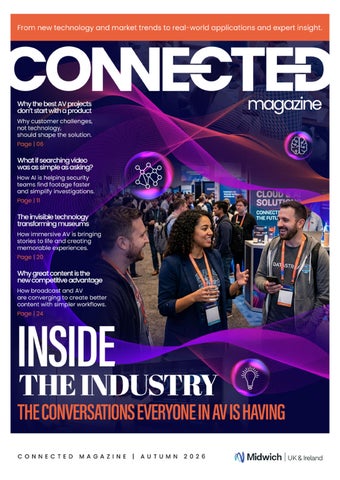
Technology moves quickly. But the conversations in our industry are about much more than the technology itself. Customers want to know how an investment will improve an experience, solve a business problem, make a space easier to use or help them prepare for what comes next. That theme runs throughout this edition. We explore how workplaces are being rethought around the people who use them, why organisations are looking beyond the boardroom and how expectations shaped by consumer technology are raising the bar for workplace AV. We also look at the growing influence of AI, from practical automation to the emergence of intelligent environments.
Emmanuelle Gammage Editor
Additionally, we consider the battle for student attention, what museums and heritage attractions can achieve when technology becomes almost invisible and why designing for attention matters in a world where audiences are surrounded by more content than ever. Content itself is changing too. As broadcast and AV continue to converge, organisations expect to create professional-quality video from corporate, education and live environments. Meanwhile, flexible and temporary spaces are becoming more strategic, creating new possibilities for organisations that need to adapt quickly without committing to permanent infrastructure. There is a commercial thread running through the issue as well. We examine the hidden cost of delaying technology investment, why understanding customer planning cycles can create a competitive advantage and how services, design expertise and stronger partnerships can help turn an initial brief into a better long-term outcome.
Sally Halls Content writer
Ultimately, these subjects all point in the same direction. The strongest AV projects increasingly start with the challenge rather than the product. That thinking will also be at the heart of Tech Xpo 2026, which takes place in October. Throughout the run-up to the event, we’ll be exploring many of these themes in greater depth. Tech Xpo will then bring those conversations together, giving you the chance to explore technologies alongside the specialists, manufacturers and wider Midwich Group expertise behind them. For now, we hope this edition gives you plenty of ideas, perspectives and conversations to take into the months ahead.
Chloe Turner Designer
Guest contributors Jenny Hicks | Technical Director Jake Pendelbury | Technical Sales Specialist midwich.com | 01379 649200 Terms and Conditions: All transactions are in accordance with our full terms and conditions, a copy of which is available upon request. All trademarks are the property of their respective manufacturers. E&OE. Your calls may be recorded for training or demonstration purposes. Copyright © Midwich 2026. Midwich Ltd, Vinces Road, Diss, Norfolk IP22 4YT. C014-Q326-DT
Phil Ashby | Chanel Head of Chanel Sales Business Development Aaron Lawther | Sales Director Kriss Hampton-Joyce | CTO, Holdan Connected Magazine | 3
CONTENTS 06
18
Midwich Unlocked..............................01 The workplace reset..........................02 The productivity pradox...................04 Effective collaboration technology with Neat........................05 Why the best projects don’t start with a product................06 The experience gap...........................08 The era of ambient intelligence.........................10 Searching for video made easy with Hikvision................11 The hidden cost of waiting..............12 Workplace data with Logitech.......14
20
Unified workplace ecosystems with Biamp...................15 The battle for student attention...............................16 Designing for attention.....................18 Projection in modern AV with EPSON.....................19 Museums & heritage.........................20 Temporary becomes stategic........22 Broadcast insights.............................24 Peak season pressure.......................26 Pulse design service..........................28 Mersive Host, meeting rooms made easy............................................30 Why Midwich.......................................31
24
28
Industry expert:
Phil Ashby Head of Channel Sales Business Development Midwich UK&I
UNLOCKING new opportunities
One of the most rewarding parts of my role in Business Development is meeting businesses that are discovering Midwich for the first time. Some are established AV specialists looking for a distributor that offers more than product availability. Others are expanding into new technologies or entering the AV market for the first time. Whatever their background, the conversations are remarkably similar. They want access to the right vendors, knowledgeable people and practical support that helps them grow with confidence. That’s exactly where Midwich can make a difference. Business Development isn’t just about opening new accounts; it’s about building long-term relationships. Taking the time to understand a customer’s ambitions means we can introduce the right specialists, connect them with leading manufacturers and help uncover opportunities they may not have considered. Creating those opportunities is also the thinking behind our new Midwich Unlocked events.
Unlocked brings together customers, vendors and Midwich specialists in a relaxed environment where technology can be experienced rather than simply discussed. Instead of presentations from behind a screen, visitors can get hands-on with the latest solutions, ask questions, exchange ideas and have the conversations that often spark new business opportunities. Of course, we know that not everyone can spare a day away from the office. That’s why we’re also launching a programme of live webinars. These shorter online sessions will provide practical product updates, technology insights and market trends that customers can join from wherever they are. Whether you meet us at an Unlocked event, join one of our webinars or simply pick up the phone for a conversation, our objective remains the same: to make it easier for customers to connect with the expertise across Midwich. I look forward to meeting many more of you over the coming months, whether that’s at an event, online or out on the road.
Connected Magazine | 1
RESET:
The workplace
5 ways organisations are rethinking workspaces this autumn
1.
The focus is on creating workplaces designed around the activities people need to carry out, supported by technology that makes those activities easier. While those conversations vary by sector, they share a common objective: workplaces that are more adaptable, intuitive and aligned with how people work today. Here are five themes shaping that conversation.
Collaboration spaces, redefined As workplace priorities come back into focus, many businesses reassess how their spaces support collaboration. Rather than taking a one-size-fits-all approach, they’re designing environments around how their people work and the activities they need to support. In a corporate office, it might mean equitable hybrid meetings where remote participants feel as present as those around the table. In higher education, it’s flexible teaching spaces that encourage discussion and group work.
2.
September often feels like the workplace's unofficial reset button, as summer projects reach completion, teams return from leave and organisations begin planning their priorities for year-end and beyond.
In manufacturing, collaboration may occur on the production floor through shared operational dashboards and real-time communication. The technology behind those environments varies, but the objective is the same: to help people share information, make decisions and work together more effectively.
Every space has a bigger role to play As workplaces return to full pace after summer, attention shifts to making better use of every space. Instead of designing rooms around a single format, organisations are increasingly considering the activities they need to support, from town halls and training sessions to customer demonstrations and informal collaboration. The boardroom no longer carries all the weight. Reception areas can become demonstration spaces, breakout areas can support quick meetings and training rooms can transform into event venues. Communal spaces may need to accommodate presentations one moment and company-wide communications the next. This requires more than moving furniture. Displays, audio, cameras and control systems must be flexible and intuitive enough to support different group sizes, layouts and use cases without adding unnecessary complexity. As a result, decision-makers are taking a broader view of where technology creates value. Investment is spreading across the workplace, creating spaces that support multiple activities rather than a single purpose.
2 | Connected Magazine
3.
Simpler workplaces, smarter management As workplace technology expands, many organisations use the second half of the year to reduce complexity before planning their next phase of investment. Every display, camera, microphone and control system adds another endpoint to manage, update and support. IT teams are expected to deliver a consistent experience across dozens, sometimes hundreds, of spaces without increasing operational overhead.
4.
Remote management platforms, standardised room designs and interoperable ecosystems have become central to workplace strategies because they keep technology performing reliably across different activities while reducing the burden on support teams.
AI with a purpose Employers are moving beyond broad discussions about potential and focusing on where intelligent features solve everyday problems. Automatic camera framing keeps remote participants engaged. Audio processing improves clarity without manual intervention. Meeting summaries reduce administration, while workplace analytics provide a clearer picture of how spaces are used. The value lies not in AI itself, but in everything people no longer need to think about. AI is becoming another tool that helps workplaces run more efficiently, allowing people to focus on the meeting or activity at hand, not the technology.
5.
Planning beyond the next upgrade As organisations look to the year ahead, many rethink how they invest in workplace technology. Rather than focusing on immediate requirements alone, they’re prioritising solutions that can adapt as working patterns, teams and technologies continue to evolve. Flexibility now extends beyond furniture and layouts to the AV infrastructure supporting those spaces. Scalable platforms, modular deployments and solutions that integrate with future technologies are becoming a bigger part of procurement conversations, allowing businesses to invest with confidence while reducing unnecessary replacement further down the line.
The workplace reset isn’t defined by a refurbishment project or the latest collaboration platform. It’s reflected in a series of decisions that recognise a simple reality: work is different, and the spaces supporting it need to respond. For the channel, that creates an opportunity to move beyond specifications and product comparisons. The most forward-thinking organisations aren’t asking which display or camera comes next. They’re asking how every investment contributes to a workplace that’s more adaptable, more intuitive and better prepared for what’s next.
Autumn planning isn’t just about next year’s budget. It’s an opportunity to rethink how workplaces support people, technology and the organisation as a whole. Connected Magazine | 3
PARADOX The productivity
Technology promised to make us more productive, and every new generation of tools has arrived with the same expectation: faster workflows, better collaboration and more efficient organisations. Yet despite unprecedented investment in digital technology, many businesses continue to ask the same question: are we actually working better?
Economists have long referred to this as the productivity paradox. New technology undoubtedly changes how we work, but productivity gains often take much longer to appear than expected. As AI, intelligent collaboration platforms and connected workplaces become part of everyday business, the AV industry finds itself at the centre of this debate. On the surface, the evidence is compelling. AI-powered meeting rooms can automatically frame speakers, remove background noise and generate summaries. Digital signage delivers real-time information. Smart buildings adjust lighting, occupancy and environmental controls automatically. Remote monitoring allows AV systems to be maintained before users even notice a fault. These developments remove friction from everyday work rather than simply adding new features. Many of the trends showcased across recent events reflect this shift, with manufacturers placing greater emphasis on automation, interoperability and user experience than on specifications alone. Yet technology alone does not guarantee productivity. Many organisations are discovering that every new platform introduces additional complexity. Employees switch between collaboration tools, notifications compete for attention and meeting overload remains commonplace.
4 | Connected Magazine
AI can produce summaries in seconds, but teams still need judgement, context and decision-making to turn information into action. In some cases, organisations risk becoming more digitally connected while feeling less focused. The lesson is that productivity should not be measured by how much technology an organisation owns, but by how effectively that technology removes barriers. This is where the professional AV industry has an increasingly important role to play. Rather than deploying technology for technology’s sake, successful projects are designed around outcomes. Meeting spaces should encourage participation without introducing technical obstacles. Digital workplaces should simplify workflows, not add new ones. Smart buildings should quietly optimise comfort, efficiency and energy consumption in the background, allowing people to concentrate on the work that matters. AI is likely to accelerate this transition further. Its greatest value is unlikely to be replacing people. Instead, AI can handle repetitive tasks, surface insights and enable faster decisions. Human expertise remains essential, but increasingly it is supported by intelligent systems working behind the scenes rather than requiring constant interaction. This mirrors the broader trend in the AV industry, where technology is becoming less visible while delivering greater value. Perhaps the productivity paradox is not really a paradox after all. The greatest returns have never come from adopting more technology. They come from implementing the right technology, in the right way, to help people do their best work.
Why collaboration technology needs to get simpler
AS IT SCALES Deploying effective collaboration technology in one meeting room is one challenge. Delivering consistency, management and support across multiple spaces is another challenge entirely. For enterprise and public sector organisations, scale brings greater demands around security, management and support. Different room types need different solutions; users expect a familiar experience wherever they work and already stretched IT teams need to manage growing technology estates efficiently. At scale, simplicity becomes essential. Organisations need technology they can deploy and manage with minimal intervention, without sacrificing the flexibility required across different spaces and ways of working. Centralised management can play an important role. Neat Pulse gives IT teams visibility across their Neat deployment, with remote management and proactive monitoring helping teams identify issues without needing to visit every room. Platform flexibility matters too. Organisations may standardise on Microsoft Teams or Zoom while still needing to accommodate guests, different applications and BYOD workflows. Neat Open supports different applications, guests and BYOD workflows, without moving away from the simple user experience organisations expect from their meeting spaces.
For resellers and integrators, the opportunity goes beyond specifying individual rooms. Customers increasingly need a collaboration strategy they can deploy, manage and adapt across their wider estate. As those estates grow, success depends on how easily organisations can manage the complete collaboration environment.
Neat will join Midwich at Tech Xpo 2026, where visitors can explore its latest collaboration technologies and discuss how they could support secure, scalable workplace deployments. Image sources: 1. neat.no/open/ 2. neat.no/pulse/
Connected Magazine | 5
AV PROJECTS Why the best
don’t start with a product
Imagine sitting down with a customer at the start of a new project. The conversation probably doesn't begin with a specification sheet or a product catalogue. Instead, it starts with a problem.
"Our meeting rooms are difficult to use."
“We need to engage students more effectively.”
“Our retail spaces don’t feel connected.”
“We’re trying to understand where AI actually adds value.”
The same pattern appears in education or in retail.
The journey has changed Customer discussions that previously centred on specifications or on choosing between displays and projectors are now focused on the bigger picture. Requirements include environments that are intuitive to use, flexible enough to adapt, easier to manage and capable of delivering measurable outcomes. They’re asking how technology can improve collaboration, simplify operations, increase engagement or support long-term business goals. The technology still matters, of course, but it has become part of a much wider conversation.
A school may begin by replacing classroom displays, but the conversation quickly develops into campus-wide consistency, hybrid learning, sustainability, AI-assisted teaching and making limited budgets go further. A discussion about digital signage soon becomes a conversation about customer engagement, content management, analytics and creating experiences that encourage people to spend more time in-store. The challenge may start in one place, but the solution rarely stays there.
One challenge often becomes many
Connecting expertise, not just technology
Take a meeting room project. On the surface, it may appear to be about replacing a camera or upgrading a display. Yet within a few conversations, the scope often expands.
This is where the industry is evolving. The best outcomes no longer come from selecting the best individual product. They come from connecting the right technologies using the right expertise.
How do we prepare the space for AI-powered collaboration? How do we create a consistent experience across every office? How do we simplify room management and reduce support calls? How do we make the technology feel invisible to the people using it?
Displays, collaboration platforms, LED, professional audio, security systems, content management and AI all have a role to play, but their real value comes from how they work together. Just as importantly, customers are increasingly looking beyond the technology itself. They want confidence that solutions will be delivered, supported and managed throughout their lifecycle, making value-add services just as important as selecting the right products. Additionally, projects benefit from bringing together specialists who understand different parts of that journey. An education expert may approach a challenge differently to a workplace specialist. Looking beyond a single product or discipline often uncovers better answers.
6 | Connected Magazine
From products to outcomes
Continuing the conversation
Perhaps the biggest change is that customers are becoming less interested in what a technology is and more interested in what it enables.
This thinking sits at the heart of Tech Xpo 2026.
Can it make meetings more productive? Can it improve learning outcomes? Can it create more engaging customer experiences? Can it reduce operational complexity?
More than 70 exhibitors will showcase technologies spanning workplace, education, retail, security, audio, LED, broadcast, live production and more. Yet the most valuable part of the event isn’t seeing each technology in isolation; it’s understanding how they connect. It’s having conversations with specialists from across Midwich, PSCo, Live Technology, DVS, Holdan, Plus+ and leading manufacturers. It’s understanding how technologies, specialist expertise and value-add services come together to support every stage of a project, from the first conversation through to delivery, deployment and ongoing support. It’s bringing a customer challenge to the table and exploring different ways to solve it. Because the most successful projects don’t begin with a product.
These questions shape projects today and encourage the industry to think differently about how technology is presented, discussed and ultimately delivered. But the conversation doesn’t end once a solution has been specified. Customers are also asking how technology will be deployed, supported and maintained over time. Reliability, responsiveness and long-term support have become part of the buying decision, meaning services now play an increasingly important role in delivering successful outcomes.
They begin with a conversation.
Industry expert:
Aaron Lawther Sales Director Midwich LTD
Connected Magazine | 7
EXPECTATIONS Workplace technology:
How everyday technology is raising the bar for the workplace.
For much of the past decade, some of the best technology experiences people encounter have not been at work. They’ve been at home. The devices, services and experiences people use every day outside of work are increasingly shaping what they expect when they walk into the office. From smart homes and streaming platforms to gaming setups and connected devices, people have become accustomed to technology that is intuitive, responsive and largely invisible. Whether it’s casting content to a television in seconds, controlling lighting from a phone or having a new device automatically connect to an existing ecosystem, people increasingly expect technology to work without thinking about it. Those expectations are still in full force when the working day begins. Our home environments are highly personalised to our tastes and comfort. Home offices kitted out with ultrawide monitors and high-quality webcams are our own self-made workspaces designed for comfort and productivity. We see the same in our hobbies, with premium gaming displays offering exceptional image quality, refresh rates and responsiveness. This is not to say that every workplace should provide gaming-grade hardware, but that employees are increasingly aware of the difference between a technology experience designed around the user and one designed around procurement. That awareness extends far beyond displays. At home, people expect devices to work together. Smart doorbells, lighting systems, speakers and televisions connect seamlessly and are controlled by our phones. Software updates happen automatically. New devices are discovered with minimal effort. The technology can fade into the background.
8 | Connected Magazine
By comparison, many workplace experiences still involve friction. Employees move between ageing laptops, legacy systems, multiple logins and meeting rooms that occasionally require troubleshooting before a conversation can even begin. While consumer technology has spent years removing complexity, workplace technology has historically accumulated it. The challenge is not necessarily a lack of investment. Many workplace technologies are more sophisticated than their consumer counterparts. The difference is that consumer technology is typically designed around a single user and a single outcome, while workplace technology must support multiple users, workflows, security requirements and business objectives simultaneously.
VS REALITY The organisations succeeding in this environment are those that hide that complexity rather than expose it. The technology may be more capable behind the scenes, but the experience feels simpler. What has changed is the benchmark. People now have a clear reference point for what a seamless technology experience feels like, and those expectations do not disappear when they arrive at work. Particularly since the pandemic accelerated hybrid working, the office is no longer competing with a laptop on the kitchen table. In many cases, it is competing with a carefully curated workspace that employees have spent years refining around their own preferences, routines and technology choices. The most successful workplaces are increasingly recognising this. Rather than focusing solely on specifications and functionality, they are investing in experiences that make collaboration easier, meetings more natural and shared spaces more valuable. Increasingly, AI is becoming part of that experience too, helping automate routine tasks, improve meeting equity and reduce the small points of friction that interrupt the working day. Technology becomes less visible, not more. Closing the experience gap between what people know technology can do and what they encounter when they arrive at work may become one of the defining workplace priorities of the years ahead.
People now have a clear reference point for what a seamless technology experience feels like, and those expectations do not disappear when they arrive at work. Connected Magazine | 9
ATTENTION When technology starts paying
For the last two years, conversations around AI have been dominated by chatbots. Most attention has been given to the moments when people interact directly with AI, whether through prompts, searches or conversations. Yet, the next era of AI may not involve talking to a machine at all. Instead, we’re moving towards ambient intelligence: environments that sense, understand and respond automatically to the people within them. Rather than waiting for instructions, systems use data from sensors, cameras and connected devices to adapt in real time. The foundations are already visible across modern AV deployments. In meeting spaces, AI-driven cameras automatically frame speakers, switch between participants and optimise the experience for remote attendees. Smart buildings use occupancy, lighting and environmental data to adjust conditions based on how spaces are being used. The emphasis is increasingly on removing friction and creating more intuitive experiences. What makes this significant is that the technology begins to fade into the background. Users no longer need to think about operating systems or interfaces. 10 | Connected Magazine
This evolution is being accelerated by the growth of connected sensors and machine learning. As smart buildings expand, AI systems will gain access to vast amounts of contextual information, enabling more predictive and adaptive environments. But as these environments become more responsive, questions around privacy and data governance inevitably follow. Occupancy analytics, environmental monitoring and AI-driven automation all rely on data to function effectively. For organisations deploying these technologies, transparency and trust will be just as important as capability. Ensuring systems are designed with privacy in mind, aligned with GDPR requirements and supported by clear data policies will be essential if intelligent spaces are to gain widespread acceptance. For the AV industry, success will increasingly be measured not by the visibility of technology, but by how seamlessly it supports people. Whether in workplaces, educational environments, hospitality venues or homes, the goal is becoming the same: spaces that understand their users and adapt to them. The era of ambient intelligence is not about better chatbots. It’s about creating environments that respond naturally, helping technology become less noticeable while making experiences more effective.
What if searching video was as simple as describing what you’re
LOOKING FOR? Organisations have access to more video than ever, but finding the moment that matters can still take hours.
For security teams managing large estates, the challenge is increasingly one of resource. There is more footage to review, fewer specialists available to review it and growing pressure to get more value from the cameras already installed. This is where AI is starting to have a more practical impact on video security. Rather than focusing solely on detecting an event as it happens, AI is making it easier to search recorded footage. Natural-language search lets users describe what they are looking for in everyday terms, making video easier to navigate for teams that may not know how to work a traditional security interface.
Hikvision’s AcuSeek is one example. A user can enter a description of a person or vehicle and quickly surface matching footage, before using AcuSearch to trace the target across different channels.
Importantly, Hikvision’s Guanlan large AI models run locally on the recorder. This keeps footage on site and removes the need for a Cloud subscription, while allowing organisations to get more from cameras already in place. For customers, that can extend the value of an existing video estate, improving how footage is used without making hardware replacement the starting point. The outcome is practical: less time spent searching footage, faster investigations and video systems that smaller, less specialist teams can use more easily.
Image sources: 1. hikvision.com/uk/products/IP-Products/Network-Video-Recorders/vpro-series/ds-7604nxi-k1-4p-vpro/ 2. hikvision.com/uk/products/IP-Products/Network-Video-Recorders/vpro-series
Visitors to Tech Xpo can see AcuSeek in action with Hikvision on 21st and 22nd October at Ascot Racecourse. Connected Magazine | 11
WAITING The hidden cost of
Technology refresh decisions are often framed as a question of cost. Can the investment be justified? Is the existing equipment still functional? Could another year be squeezed from the current estate? For many organisations, these are reasonable questions. Yet they can sometimes overlook a more important one: what is the cost of waiting? Organisations rarely wake up to a sudden technology crisis. More often, inefficiencies, risks and missed opportunities accumulate gradually over time. While systems may continue to function, problems arise when they quietly become less effective at supporting an organisation’s needs.
Small frustrations, big consequences The most immediate costs are often the least visible. A meeting room that takes several minutes to connect. A platform that demands multiple logins before work can begin. Issues that may not seem significant in isolation, but together they create friction that employees encounter every day. Over time, these small frustrations can have a disproportionate impact on productivity and confidence. When technology becomes unreliable or difficult to use, people often adapt their behaviour around its limitations rather than benefiting from its capabilities. The result is not only lost time, but a workforce that becomes increasingly frustrated by experiences that feel unnecessarily complicated.
When systems stop keeping pace As platforms evolve, older systems can become more difficult to secure, integrate and support. Software updates may no longer be available, and security vulnerabilities may remain unaddressed – creating issues for IT teams. Compatibility with newer tools and services can become more challenging over time, widening the gap between what organisations need technology to do and what their existing infrastructure can support. Whether enabling hybrid working, integrating new collaboration platforms or maintaining cybersecurity standards, ageing hardware and legacy platforms can introduce risks that extend far beyond the equipment itself.
12 | Connected Magazine
When technology becomes unreliable or difficult to use, people often adapt their behaviour around it’s limitations rather than benefiting from its capabilities.
The maintenance trap Delaying a refresh is often seen as a way to avoid expenditure. In reality, it often shifts costs elsewhere. As equipment ages, maintenance requirements typically increase. Replacement parts become harder and costlier to source. Internal teams spend more time troubleshooting issues, support contracts become more expensive and system reliability continues to decline. At a certain point, organisations can find themselves investing significant time and resources simply to preserve the status quo. This is where technical debt begins to accumulate. What may have started as a manageable delay can eventually result in a larger, more complex refresh project that is harder to implement and more disruptive to the business.
Falling behind without noticing Perhaps the highest cost of waiting is the one that is hardest to measure. While an organisation continues to rely on ageing systems, competitors may be improving efficiency, streamlining workflows and adopting technologies that support new ways of working. Customer expectations continue to evolve, while employee expectations do the same. Not all costs are easy to quantify. Some are felt through disengagement, frustration and the growing disconnect between the digital experiences people encounter in their everyday lives and the systems they use at work. As workplace expectations continue to rise, that gap can become increasingly difficult to ignore. (Read more in The Experience Gap, page 8-9.) Technology refreshes are often viewed through a financial lens, but the impact of delaying them is rarely financial alone. Capability requirements, security expectations, productivity demands and employee experience all evolve over time. The organisations that benefit most are often those that recognise the cost of waiting before small limitations become significant barriers. Connected Magazine | 13
CONVERSATION Why workplace data should be part of the
Businesses invest heavily in offices, meeting rooms and collaboration technology, but many still lack a clear picture of how employees use those spaces. That is changing.
As hybrid working continues to reshape workplace behaviour, organisations increasingly want evidence to guide decisions around office space, technology investment and employee experience. Knowing how many desks or meeting rooms a business owns tells only part of the story. The more useful questions are: when are they used, where does demand peak and which spaces are consistently underused? For AV resellers and integrators, this opens up a broader customer conversation. A request for meeting room technology could point to a much bigger challenge around return-to-office strategies, real-estate costs or workplace efficiency. Asking how the customer measures space utilisation can reveal needs that a product-led discussion might miss.
Logitech sees data-driven space utilisation as a growing priority. Logi View and Desk Booking combine a simpler workspace booking experience with insight into how employees use desks, while Logitech Sync gives IT teams greater visibility into room health, technology management and workplace activity. The value lies in what customers can do with that information.
Usage data can help organisations challenge assumptions, identify underused space and make more informed decisions about future investment. It also allows resellers to engage with stakeholders across IT, facilities and workplace teams. At Midwich, we see AV becoming more closely connected to wider business outcomes, from workplace efficiency and employee experience to smarter decisions around space and investment. Logitech’s approach reflects that shift, combining collaboration, workspace management and insight to help customers create workplaces they can understand, optimise and use more effectively.
Logitech sees data-driven space utilisation as a growing priority.
Visit Logitech at Tech Xpo on 21st and 22nd October at Ascot Racecourse. 14 | Connected Magazine
Why workplace technology is moving towards unified
ECOSYSTEMS Choice has long been considered one of the strengths of the AV industry. However, for many workplace customers, too much choice can make projects harder to progress. Organisations are often balancing multiple platforms, suppliers, IT requirements, sustainability objectives and user expectations. As more stakeholders become involved, decisions can become protracted, affecting costs, product availability and project timelines. This is driving greater demand for unified technology ecosystems that reduce complexity across the workplace. For organisations operating multiple meeting rooms or sites, a consistent technology approach can simplify the user experience and make systems easier for IT teams to support. Standardisation can also help resellers and integrators create more repeatable processes for specification, deployment and ongoing management. This does not mean every space must be identical. A small meeting room and a large boardroom will have different requirements. The objective is to establish a common approach to design, control and management that can be adapted to suit each environment. Operational efficiency is another fundamental part of the customer conversation. Organisations want technology that is straightforward to commission, easy to monitor and capable of scaling without adding unnecessary complexity. Biamp’s expanding workplace ecosystem reflects this trend. Devio UCX combines unified communications compute and professional-grade audio processing within a single platform, while Biamp Workplace Control brings AV control and automation into the wider Biamp Workplace environment. Together, these solutions can help create a more connected journey across room design, deployment, user control and lifecycle management. For customers, the value of a unified ecosystem is not simply a reduced number of products or suppliers. It is greater consistency, clearer management and confidence that their workplace technology can adapt as their needs evolve.
Image sources: 1. products.biamp.com/product-details/-/o/category/535A8D98-48F3-4675-A440-979D9C4A97C4/cn/UC-Compute/ecom-item/920-02281 2. biamp.com/company/blog/details/biamp-blog/2026/06/16/biamp-joins-microsoft-device-ecosystem-platform-with-devio-ucx
For resellers and integrators, it creates an opportunity to move beyond individual product discussions and help customers establish a more consistent, scalable and manageable workplace strategy. Connected Magazine | 15
STUDENT ATTENTION The battle for
Students are learning in a world designed to distract them.
Every day, students navigate between social feeds, streaming platforms, gaming and personalised content. These spaces are built around immediacy. They capture attention quickly, reward interaction and make information easy to navigate. Education does not need to compete with TikTok or Netflix. But it does need to understand the behaviours students now bring into learning spaces. They are not just surrounded by digital content. They are creating it, curating it, sharing it and shaping how information is experienced. Research into digital distractions in higher education has found that students themselves recognise the impact devices can have on performance, particularly in practical or lab-based sessions. At the same time, a major meta-analysis of 225 studies1 found that active learning can reduce failure rates and improve student performance compared with traditional lecture-based teaching. This suggests that the challenge is not simply removing distractions, but creating learning environments that encourage participation, interaction and engagement in the first place.
What could education borrow from other sectors? Retail has become highly skilled at using AV to guide behaviour. Digital signage, large-format displays and interactive screens are used to direct attention, simplify journeys and deliver the right message in the right place. Education can apply the same thinking across campuses. Wayfinding, live updates, room information, student services and event promotion all become more effective when content is timely, visual and easy to absorb. Entertainment offers a different lesson: atmosphere matters. In cinemas, live venues and immersive experiences, sound, scale, lighting and image quality work together to create focus. 16 | Connected Magazine
In education, this matters in lecture theatres, simulation spaces, esports suites, media labs and specialist training environments. An engineering demonstration or creative production session becomes more memorable when the room supports the experience, rather than just displaying information. Content creators understand pace. They know how to structure information, use visual hooks and move quickly between formats. Recent reporting on classroom attention points to a similar direction, with teachers using shorter learning blocks, hands-on activities, movement and varied formats to help today’s students stay engaged. A lecturer may need to move from presentation to video, annotation, live polling, wireless sharing and group discussion within the same session. When teaching systems support more flexible delivery, AV systems help make those shifts feel natural, not disruptive.
Designing for participation The most important lesson across all three sectors is that attention is not passive. People engage when they are invited to take part. For education, that means AV should facilitate interaction, not just delivery. Interactive displays, collaboration tools, lecture capture, hybrid meeting technology, AI-enabled cameras and high-quality audio can all help students contribute, revisit content and stay connected whether they are in the room or joining remotely. This is where education AV is starting to move beyond the traditional classroom upgrade. Like retail AV, it is becoming part of the broader environmental infrastructure. It influences how people move through a campus, how they access information, how they participate and how they remember what they have experienced. Sources: 1. pnas.org/doi/10.1073/pnas.1319030111
The battle for student attention will be won by learning spaces that match today’s engagement needs, using purposeful technology to make education clearer, more active and more human. Connected Magazine | 17
VALUABLE ASSET
Why attention is becoming AV’s most
We’ve never had more ways to communicate.
Emails. Teams messages. Digital signage. Social media. Advertising. AI-generated content. Every organisation has more channels than ever before. So why does it feel harder than ever to get people to notice anything? The modern communication challenge is simple: everyone is talking at once. We’re living through an age of information overload, where attention has become one of the most valuable commodities organisations compete for. Simply adding another screen, another message or another campaign is unlikely to cut through the noise and engage the intended audience. For the AV industry, this means looking beyond the technology itself. The most successful projects aren’t defined by the amount of technology they contain, but by the impact that technology has on the people using it. The organisations communicating most effectively are often saying less but communicating more intentionally. Designing for attention means thinking differently. Instead of asking, “What do we want to tell people?”, the better question is, “What do people actually need to notice right now?” That encourages clearer messaging, better timing and simpler experiences. It recognises that attention isn’t something to capture indefinitely; it’s something to earn, use wisely and respect across every environment.
18 | Connected Magazine
Retailers want shoppers to notice promotions without overwhelming the in-store experience. Workplaces need employees to engage with the information that matters without adding to digital fatigue. Public spaces must communicate quickly, clearly and confidently, often in just a few seconds as people pass by. Technology undoubtedly has a role to play. For AV professionals, the challenge is designing experiences that deliver the right message, to the right audience, at the right moment. Digital signage, interactive displays, collaboration platforms and content management systems all have a role to play, but technology alone doesn’t solve the problem. Ultimately, good communication is about relevance. In a world where everyone is competing for attention, perhaps the biggest competitive advantage isn’t creating more content. It’s creating fewer, better moments that people actually remember. The future of AV isn’t about creating more messages. It’s about designing experiences that communicate with greater clarity, relevance and impact. Because the organisations that win attention aren’t always the loudest. They’re the clearest.
MODERN AV
Projection is creating new possibilities for
Projection is often treated as an alternative to a display, but its real value lies in the flexibility it can offer.
For many customers, the requirement is practical. They need to replace outdated equipment or introduce AV into a space for the first time, often while working within a limited budget. The visual solution must perform reliably while leaving enough budget for audio, installation and ongoing support. For others, the ambition is more creative. Visitor attractions, education environments, hospitality venues and live events are increasingly using projection to move beyond conventional one or two-screen installations. Walls, floors, architectural features and unusual surfaces can all become part of the experience. This makes projection well suited to applications including immersive rooms, projection mapping, interactive gaming and sports simulation. Operational efficiency is also becoming a bigger part of the conversation. Customers are looking beyond image quality and brightness to consider transportation, storage, handling, power consumption and how equipment can be reused across different applications. For rental and staging businesses, compact projectors and interchangeable lens fleets can reduce logistical demands and provide greater flexibility across multiple events. In fixed installations, smaller and lighter hardware can help overcome restricted access, limited mounting space and structural challenges.
Epson’s EB-XQ2030B reflects this shift. The 30,000-lumen 4K projector combines high-brightness performance with a compact, lightweight chassis, making it suitable for demanding rental, immersive and fixed installation environments. The customer benefit is not simply greater brightness. It is the ability to deliver ambitious, large-scale visuals with fewer practical constraints.
Image sources: 1. epson.co.uk/en_GB/products/projector/professional/eb-xq2030b---theworld%E2%80%99s-smallest-and-lightest-30%2C000lm-4k-projector-%281%29/p/56915
This creates an opportunity to begin with the experience the customer wants to create rather than the number of screens they believe they need. Projection can then become more than a product choice. It becomes a flexible tool for transforming the entire environment. Connected Magazine | 19
THE INVISIBLE
technology transforming museums and heritage Museums and heritage attractions have always been custodians of stories. Today, however, visitors don’t want to simply observe artefacts behind glass. They want to interact, explore and immerse themselves in the experience.
From displays to experiences
As a result, AV technology has evolved from a supporting feature into a fundamental part of exhibition design. From projection mapping and transparent LED displays to immersive audio and interactive environments, museums are using AV to make history, art and culture more engaging, accessible and memorable.
Rather than designing a space and adding technology afterwards, museums are creating environments where architecture, physical artefacts and digital content work together to tell a story. Interactive displays, projection mapping and responsive environments allow visitors to engage with collections in ways that simply weren’t possible a decade ago. Importantly, this doesn’t mean replacing authentic objects with digital experiences. Technology only emphasises existing displays, by revealing hidden details, recreating lost environments and providing context that physical artefacts alone cannot communicate.
The most successful projects don’t feel like technology installations at all. Instead, they create seamless journeys where storytelling, physical artefacts and digital experiences blend naturally.
20 | Connected Magazine
xp
t:
Technical Director Midwich UK&I
u st ry e
This is particularly important in heritage settings, where authenticity remains central. The most effective installations are those where technology enhances the story without competing with it.
er
Jenny Hicks
In d
AV is influencing how exhibitions are conceived from the very beginning.
Designing for every visitor Museums recognise that visitors of different ages and abilities engage with technology differently. Younger audiences often expect interactive, personalised experiences, while other visitors may prefer simpler interfaces and more traditional methods of exploring exhibitions. The answer isn’t creating separate experiences but designing flexible ones. “It’s less about age and more about attention span, expectations and how people prefer to engage,” says Pendlebury. “Above all, the experience has to be intuitive for everyone.”
Why sound matters as much as sight While visual technologies often attract the headlines, audio has become one of the most important elements of modern exhibition design.
“Audio is the top form of communication,” explains Jake Pendlebury, Audio Technical Sales Specialist at Midwich. “It’s where the most detailed information can be provided while also creating a more inclusive experience.” Modern museums are moving beyond traditional audio guides towards immersive soundscapes, spatial audio and ambisonic speaker systems that place visitors inside the story itself. Historically accurate music, authentic narration and environmental sounds all contribute to creating emotional connections that help visitors better understand and remember what they’re experiencing. Exhibitions such as Van Gogh Alive have demonstrated the power of combining immersive visuals with carefully designed audio, while installations at Manchester’s Aviva Studios, including exhibitions featuring Yayoi Kusama and David Hockney, showcase how sound and vision can transform a physical space into an experience rather than simply an exhibition. “When AV is placed at the forefront of the experience, it creates something visitors genuinely remember,” says Jake. “Too often it’s still treated as an afterthought.”
Audio technologies are playing a particularly important role here. Solutions such as Listen Technologies’ ListenWIFI platform allow visitors to access exhibition content through their own smartphones, while location-based beacons can automatically deliver relevant audio as visitors move through different spaces. Emerging technologies such as Auracast are also making audio more accessible by enabling compatible smartphones and Bluetooth hearing devices to receive content directly, reducing reliance on dedicated receivers or venue Wi-Fi. Alongside captioning, hearing loop technologies and multisensory experiences, these developments are helping museums become more inclusive without compromising the visitor experience.
The best technology is almost invisible One of the biggest trends shaping museums and heritage attractions is that the technology itself is becoming less visible. Hidden loudspeakers, transparent displays, wireless content delivery and sensor-driven experiences are allowing venues to preserve the character of historic buildings while delivering rich digital experiences. “Success is increasingly measured by how effectively technology disappears into the environment while bringing stories to life in new and memorable ways,” says Jenny. Yet despite rapid innovation, challenges remain. Budget pressures often mean AV is value-engineered late in projects, limiting its impact. Both specialists agree that the most successful installations are those where curators, architects and AV experts collaborate from the earliest stages, ensuring technology supports the narrative rather than being added as an afterthought. As museums compete to attract new audiences and encourage repeat visits, the role of AV will only continue to grow. The future is about using the right technology to create experiences that educate, inspire and stay with visitors long after they’ve left the building.
Connected Magazine | 21
BY DESIGN
Temporary,
22 | Connected Magazine
Why temporary environments have become a permanent business strategy. For years, temporary spaces were exactly that. Pop-up stores. Exhibition stands. Seasonal installations. Product launches. Environments that are designed to exist for a few days before disappearing just as quickly as they arrived. But across retail, corporate workplaces, education, and live events, organisations are increasingly treating temporary environments not as one-off marketing exercises but as strategic business tools. Instead of committing to permanent physical spaces before demand is proven, businesses are using flexible, technology-led environments to test concepts, launch products, engage customers and generate measurable commercial outcomes. This is changing how organisations think about physical spaces and the role of professional AV. The experience economy continues to reshape customer expectations. Increasingly, people value memorable experiences as much as the products themselves, while brands are investing more heavily in experiential marketing to create deeper engagement. Rather than building permanent environments immediately, many brands are choosing to experiment first. Retailers might open a pop-up showroom in a new city before signing a long-term lease. Manufacturers can create travelling demonstration centres that visit customers instead of asking customers to visit them. Meanwhile, workplaces are transforming unused office space into collaboration hubs, innovation labs or customer briefing centres that can evolve as business needs change. Temporary has become a way to reduce risk while increasing opportunity. Technology is one of the biggest reasons this shift has become possible. Modern AV solutions are increasingly designed around flexibility. Modular LED displays can be assembled, dismantled and reused across multiple locations. Wireless collaboration removes complex infrastructure requirements.
Image generated using Adobe Firefly.
Cloud-based content management allows digital signage to be updated remotely, while portable production systems and virtual production technologies make it possible to create broadcastquality environments almost anywhere. The increasing trend towards temporary LED volumes for virtual production is another example of companies prioritising flexibility over fixed infrastructure. Just as importantly, the commercial model has evolved. Rental and managed services have become an increasingly attractive alternative to outright ownership. Businesses can access the latest technology without significant upfront investment, while integrators create recurring revenue opportunities through deployment, support and lifecycle services. In many ways, organisations are no longer buying technology; they’re buying outcomes. Sustainability is adding further momentum. Temporary no longer means disposable. Modular AV systems are designed to be redeployed repeatedly across multiple projects, extending product lifecycles and reducing unnecessary manufacturing. Refurbished and ex-rental technology is also becoming a viable option for many organisations, supporting circular economy principles while delivering significant cost savings. For the AV channel, this represents a significant opportunity. Customers are no longer simply asking for displays, projectors or audio systems. They’re asking how quickly an experience can be deployed, how easily it can move to the next location and how effectively success can be measured. The conversation shifts from specifications to strategy. Whether it’s a seasonal retail activation, a touring demonstration centre, a temporary collaboration space or an immersive brand experience, today’s “temporary” environments are rarely isolated projects. They’re becoming repeatable business strategies. As organisations look to remain agile without compromising customer experience, the most valuable AV solutions may be those that move with the business, adapting as quickly as customer expectations do.
Connected Magazine | 23
COMPETITIVE ADVANTAGE Why great content is becoming the new
For years, the worlds of broadcast and professional AV operated largely in parallel. Broadcast focused on creating content, while AV concentrated on delivering it. Today, those boundaries are rapidly disappearing as content quality becomes a core competitive advantage.
Whether it’s a corporate podcast studio, a university lecture theatre, a council chamber or a hybrid event space, organisations now expect to produce broadcast-quality content using AV infrastructure. As a result, technologies and workflows once reserved for television studios are becoming standard across the AV industry, because better content now drives stronger outcomes.
The most obvious technologies making the crossover are those centred around content acquisition and multi-camera production. Cameras capture the action, production systems process those feeds, and the resulting content is delivered to audiences in multiple ways. Those same workflows are now being adopted across corporate, education and enterprise environments.
Lecture theatre image generated using Adobe Firefly.
24 | Connected Magazine
u st ry e
xp
t:
Chief Technology Officer, Holdan
In d
er
Kriss Hampton-Joyce
The rise of the production-ready workplace
Content quality now matters as much as functionality
Perhaps nowhere is this convergence more obvious than in the growing popularity of video podcasting.
While broadcast and AV technologies continue to converge technically, Kriss believes there’s still an important difference in mindset.
What often begins as a request for a simple podcast setup quickly evolves into something much more sophisticated. Multiple cameras, professional microphones, lighting, graphics, streaming, recording and camera control all become part of the brief. “What many people mean when they say they want a video podcast is that they actually want a fully-fledged production studio,” Hampton-Joyce explains.
“AV has traditionally focused on practicality. Does the system solve the problem? Broadcast shares that mindset, but it also asks another question: how good does the final image look?” That’s becoming important as businesses, universities and public sector organisations publish more content across websites, social media and internal communications.
The challenge isn’t simply providing the technology. It’s making it usable.
Audiences no longer compare a corporate video with another corporate video. They compare it with everything else they watch online.
Powerful production systems can quickly become underused if they’re too complex for non-technical users. That’s why modern workflows are being designed around automation, intuitive control interfaces and simplified operation, allowing a single operator to produce professional-quality content with confidence.
Image quality, lighting, lens selection, colour reproduction, camera movement and composition all influence how professional a piece of content feels. Yet these creative considerations are often overlooked when designing AV systems.
“Ultimately, audiences don’t engage with technology,” Kriss says. “They engage with content. The quality of that content is determined by both what’s in frame and how it’s being captured.” The next evolution of AV professionals As broadcast and AV continue to converge, the skills required to deliver successful projects are evolving too.
Why IP is changing everything A major driver behind this shift is the maturity of low-latency video-over-IP technology. Rather than relying on traditional broadcast infrastructure, organisations can now build production environments using standard networking infrastructure. The result is greater flexibility, easier expansion and significantly simpler system management. Once devices exist on the same network, entirely new workflows become possible. Cameras, switchers, audio systems and control platforms can communicate with one another, triggering automated actions and reducing manual intervention. For organisations under pressure to create more video content without increasing headcount, these efficiencies are becoming more valuable.
The technical differences between the two industries are becoming less significant. Broadcast workflows can be learned, just as AV professionals can master networking, control and integration. The greater opportunity lies in developing creative expertise. “The real differentiator isn’t understanding signal paths or protocols,” Kriss explains. “It’s understanding the craft of creating compelling moving images. Those who develop an eye for lighting, composition, colour and visual storytelling will increasingly stand out.” As organisations continue investing in content creation spaces, from podcast studios and collaboration environments to hybrid learning and live events, broadcast technology is becoming less about television and more about communication. The convergence of broadcast and AV isn’t simply changing the technology being installed. It’s changing expectations of the content those systems produce. And in a world where every organisation has become a publisher, that may prove to be the industry’s most significant shift yet.
Connected Magazine | 25
AV CALENDAR
The hidden
26 | Connected Magazine
Why timing has become one of the industry’s biggest competitive advantages
Many people think peak season is when projects are delivered, but by then it is often too late. By the time Christmas retail campaigns launch, students return to campus or a new corporate headquarters opens its doors, the technology behind those experiences has already been planned months earlier. Specifications have been written, equipment ordered, installations completed and systems tested. Every sector operates to its own calendar, and understanding those business cycles is just as important as understanding the technology itself.
Every industry has its own deadline Retail provides one of the clearest examples. While consumers associate peak trading with Black Friday and Christmas, retailers begin preparing much earlier. Refurbishments and upgrades are often planned and deployed throughout spring and summer so they’re ready before the busiest shopping period arrives. Education follows a completely different rhythm. The summer holidays create a narrow installation window, meaning procurement, specification and logistics are already underway months before classrooms empty. Miss that planning cycle and the opportunity may not return until the following academic year. Corporate workplaces are driven less by seasons than by business change. Project progression is influenced by several factors such as office refurbishments, lease renewals, return-to-office initiatives and budget cycles. Meanwhile, live events often begin planning the next production while the current tour is still on the road, with rental companies balancing utilisation, maintenance and future investment before tickets even land in our inboxes.
Where calendars collide This hidden calendar shapes demand across the AV industry and has important implications for manufacturers, distributors and integrators alike. Pressure doesn’t simply build because one market becomes busy. It builds because multiple sectors, each working towards different deadlines, often require products, expertise and engineering resource at the same time. Lead times, logistics, product availability and engineering resource all become more challenging when those peaks overlap. Businesses that recognise these patterns can prepare earlier, allocate resources more effectively and avoid the pressure of reacting too late.
Timing is the competitive advantage Success depends on recognising those patterns before they become visible. For customers, that means engaging partners earlier, allowing time for product selection, design, logistics and installation rather than treating AV as the final stage of a project. Integrators, for their part, must understand not just when customers need technology, but when they begin making decisions. Starting those conversations earlier creates more opportunity to influence specifications, secure resources and deliver better outcomes. For distributors like Midwich, that means helping partners stay one step ahead through market insight, product availability, technical expertise and the support needed to navigate changing demand with confidence. Technology will always remain at the centre of the AV industry. But competitive advantage isn’t determined solely by what you specify; it’s determined by when you start the conversation. Timing really is everything. Connected Magazine | 27
PROJECT BEGINS
Seeing the outcome before the
For multi-room projects, careful planning ensures systems feel intuitive and consistent throughout the property. Meanwhile, resi-mercial environments often introduce additional considerations around reliability, scalability and user experience, requiring a design approach that balances residential comfort with commercial-grade performance.
In AV, conversations often start with products. Screen sizes, speaker specifications, control systems and performance targets quickly become part of the discussion. Yet many successful projects are won long before those details are finalised.
They are won when a client can clearly understand the vision. Whether it is a dedicated home cinema, a media room, a multi-room audio system or a wider resi-mercial project, clients are increasingly looking for confidence before they commit. They want to understand how a space will work, how technology will fit into their environment and, ultimately, what the finished experience will feel like. This is where design plays a far more important role than many people realise. Good design is not simply about creating technical drawings. It is about translating ideas into something tangible. It bridges the gap between a client’s ambitions and the practical realities of delivering a project. Layouts, visuals, room plans and performance calculations all contribute towards a clearer picture of the outcome, allowing decisions to be made earlier and with greater confidence. For integrators, this can be just as valuable as it is for the client. A well-considered design brings structure to complex briefs. It creates a stronger foundation for conversations around performance, budget and system recommendations. It can also reduce uncertainty later in the project by identifying potential challenges before installation begins. In dedicated cinema rooms, design helps balance room dimensions, seating positions, viewing angles, acoustics and speaker placement to create a truly immersive experience. In media rooms, it allows technology to be integrated into everyday living spaces without compromising usability or aesthetics.
28 | Connected Magazine
Even infrastructure, which is rarely visible once a project is complete, benefits significantly from design-first thinking. Signal flow, rack layouts, power requirements and future expansion plans all contribute to how smoothly a system performs over its lifetime.
Perhaps most importantly, design helps clients visualise value. Technical specifications explain what a system does. Design demonstrates what it delivers. When clients can see the rationale behind recommendations and understand how the technology supports their goals, conversations become less focused on products and more focused on outcomes. At Pulse, this thinking sits at the heart of our Design Service. Working alongside dealers and integrators, the team transforms early-stage briefs into professional, presentation-ready outputs that support proposals, approvals and project delivery. From concept development and room layouts to technical planning and visualisation, the goal is simple: help clients understand the vision before the project begins.
As Paul Newsome, Director at Intelligent AV and Electrical, explains: “We’d done quite a lot ourselves, but we wanted to go to that next level. Pulse will design and do renders for you, and you’ve got the backup knowing you’re working with a company that has years of experience delivering fantastic cinema spaces.”
In an increasingly competitive market, design is no longer just a step in the process. It is often the difference between an idea and a project that a client feels confident saying yes to. To start your design project, contact
PulseProjects@pulsecinemas.com Connected Magazine | 29
CHOOSING SIDES Why meeting rooms need to stop
The way people collaborate is flexible. The technology in meeting rooms must be too.
An organisation may standardise on Microsoft Teams, but employees still receive Zoom invitations. External partners might use Google Meet. Guests arrive with different devices, applications and expectations. Yet many meeting spaces still work best when everyone follows one prescribed workflow.
For customers, that creates unnecessary friction. For AV and IT teams, supporting different platforms, hardware and user requirements can add complexity across an entire meeting room estate. Platform agnosticism offers a different approach.
Rather than designing a room around one conferencing platform, organisations can create spaces that adapt to whichever platform the meeting requires. But flexibility alone isn’t enough. If supporting multiple platforms introduces extra cables, unfamiliar interfaces or complicated connection processes, the technology has simply replaced one problem with another.
Mersive’s approach is to remove those barriers altogether. Its new Mersive Host solution introduces what Mersive calls “BY” – Bring Yourself. Instead of relying on a personal device to start the meeting, users can enter the room, select their meeting and join while retaining the familiar native interface of their conferencing platform. That simplicity extends to content. When someone shares content to the room display, remote participants see the same content, helping keep everyone on the same page without someone needing to join the same meeting twice simply to share content. This reflects a wider change in customer expectations. The best meeting room shouldn’t dictate how people collaborate. It should adapt to them.
The best meeting room shouldn’t dictate how people collaborate.
Mersive will demonstrate Mersive Host at Tech Xpo 2026 giving visitors the chance to experience its platform-agnostic approach first-hand. 30| Connected | ConnectedMagazine Magazine 30
Why Midwich? Because we go beyond distribution. Choosing Midwich means choosing more than products. It means unlocking a partner with facilities, services and expertise designed to make every project smoother, smarter and ultimately, more successful.
Strength in numbers As part of the Midwich Group, we bring global scale and stability while delivering local expertise.
Specialist support Experience it before you invest Our state-of-the-art demo facilities, including Innovation House and our Letchworth showroom, let you and your customers explore solutions first-hand.
Our PSCo team provides pre-sales advice, project support and access to the most advanced LED configurator in the industry.
Knowledge that leads the industry
Financial flexibility With tailored credit facilities, we make it easier to grow your business while managing cash flow.
From expert insights to trend analysis, our thoughtleadership content like Connected Magazine keeps you ahead of the curve.
More than a distributor Through Plus+, we offer services from technical support and installation to training and extended warranties, ensuring added value at every step.
Seamless delivery With dedicated logistics services, we get the right technology to the right place, on time, every time.
For more information about our Value Added Services, please enquire today at:
01379 649200 midwich.com Connected Magazine | 31
midwich.com | 01379 649200 Terms and Conditions: All transactions are in accordance with our full terms and conditions, a copy of which is available upon request. All trademarks are the property of their respective manufacturers. E&OE. Your calls may be recorded for training or demonstration purposes. Copyright © Midwich 2026. Midwich Ltd, Vinces Road, Diss, Norfolk IP22 4YT. C014-Q326-DT