Augustinian The
Midwest
IN THIS ISSUE:
Augustinian Education: A Living Legacy of Forming Souls Augustinians Concelebrate "People's Mass" at Illinois Detention Center Celebrating the Priestly Ordination of Fr. William Reyes, O.S.A. in Peru In unitate fidei: Pope Leo’s Augustinian Vision of Social Unity and Diversity
Spring 2026
Fr. Tony Pizzo, O.S.A., second from right, receives the first profession of vows of an Augustinian in Peru.
Letter from the Prior Provincial Very Rev. Anthony B. Pizzo, O.S.A.
Earlier this year, I had the blessing of traveling to our Augustinian Vicariate in Peru, where I received the first profession of vows of several Augustinians. To be with them as they publicly committed themselves to God, to community, and to the Church was a beautiful reminder that the Spirit is still very much at work. Moments like these invite us to pause and reflect on the deeper meaning of vocation and the vocation each of us lives every day. At its heart, an Augustinian vocation is always communal. We do not walk alone. We seek God together, bearing one another’s burdens, rejoicing in one another’s gifts, and striving for unity of heart and mind. That call to unity feels especially urgent today. As we look around our own country and across the world, we see deep divisions, ongoing conflict, and a troubling erosion of trust and understanding. Violence—whether physical, verbal, or ideological—too often becomes the default response. As people of faith, we cannot accept this as inevitable. St. Augustine reminds us that peace is not merely the absence of conflict, but the presence of "right" relationship with God, with one another, and within ourselves. This kind of peace requires patience, listening, and a willingness to see the humanity in those with whom we disagree. It asks more of us than quick answers or hardened positions. It asks for conversion of heart. The young friars I met in Peru are in the beginning chapters of their journey in a world that desperately needs that kind of peace. So are we. Whether in our parishes, schools, families, workplaces, or civic life, we are each called to be builders of communion and people who choose understanding over division, mercy over judgment, and hope over fear. As you read this spring issue, I invite you to reflect on how God may be calling you to live that vocation more fully. Thank you for walking with us, for supporting the mission of the Augustinians, and for being part of a community that continues to seek God together. May this season of renewal bring you peace—and may we have the courage to share that peace with the world.
Rev. Anthony Benedetto Pizzo, O.S.A. Prior Provincial 2
The Midwest Augustinian
Contents
4
Around the Province
Student Retreats, Service, and Outreach at Cascia Hall
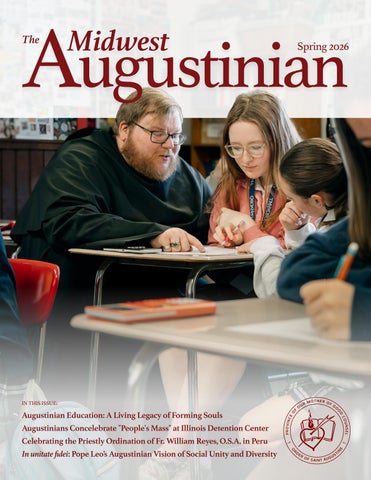
Cover: Fr. Joe Roccasalva, O.S.A., with students at Cascia Hall Preparatory School. Photo by Jeffrey Metcalf '07, Metcalf Media
10
Fr. Thomas McCarthy, O.S.A. Elected to Become Next Provincial
6
Augustinians Concelebrate "People's Mass" at Detention Center St. Bernard Parish Dedicates New Addition to Pastoral Center Students Reflect and Serve at Villanova College Retreats
8
Austin Catholic High School STEAM Students Build and Deliver 3D-Printed Prosthetic Arm to Third Grader Province Joins Community Prayer Service for Peace Celebrating the Priestly Ordination of Fr. William Reyes, O.S.A.
Augustinian The
Midwest
THE MIDWEST AUGUSTINIAN Spring 2026 The Midwest Augustinian is a publication of the Province of Our Mother of Good Counsel. For additional copies, or to unsubscribe, please contact the Province Office: Province of Our Mother of Good Counsel 10161 S. Longwood Drive, Chicago, IL 60643 PHONE 872-265-1100 WEB www.midwestaugustinians.org
2026Augustinian Gala
Please join us on Friday, April 24, 2026, at the Drake Hotel Meet This Year's Gala Honorees: Fr. James R. Halstead, O.S.A., Clare Napleton, and Paul J. Paradiso
12 14 15 16 18
Vocation Team Attends Annual Catholic Youth Conference Augustinian Saints & Blesseds: Bl. Veronica of Binasco
20
Lay Engagement
Friends of St. Augustine: A Doorway, not a Program CAMP RESTLESS Summer Camp Announcement
27 29
Office of Lay Engagement Update: Preparing the Ground In Memoriam En Español
Carta del prior provincial
In unitate fidei: Pope Leo's Augustinian Vision of Social Unity and Diversity
Los agustinos concelebran la “Misa del Pueblo” en un centro de detención
Augustinian Education: A Living Legacy of Forming Souls.
Un cortometraje cuenta la historia del banco de alimentos de emergencia de Sta. Rita
Augustinian Spirituality: An Interview with Fr. Stephen Isley
La ordenación sacerdotal del P. William Reyes, O.S.A
MIDWEST AUGUSTINIANS
PROVINCIAL OFFICES
PRIOR PROVINCIAL Very Rev. Anthony B. Pizzo, O.S.A.
VOCATION MINISTRY OUTREACH Rev. Thomas McCarthy, O.S.A. Rev. Jack B. Tierney, O.S.A.
PROVINCE COUNSELORS Rev. Raymond J. Flores O.S.A. Rev. William E. Lego, O.S.A. Rev. John D. Merkelis, O.S.A. Rev. Bernard C. Scianna, O.S.A. Rev. Jack B. Tierney, O.S.A. PROVINCE SECRETARY Br. Nicholas J. Mullarkey, O.S.A. PROVINCE TREASURER Rev. James R. Halstead, O.S.A. PROVINCE ARCHIVIST Br. Thomas Taylor, O.S.A.
CHIEF ADVANCEMENT OFFICER Mr. Edward Barrett MANAGER OF DONOR RELATIONS Ms. JoAnn Foertsch Altenbach FINANCE OFFICE Mr. Patrick Griffin DIRECTOR OF LAY ENGAGEMENT Mrs. Maryellen Harrington MAGAZINE PRODUCTION Mr. Rory Dayton Ms. Abigail Leali
Mission Statement of the Midwest Augustinians We, the Augustinians of the Province of Our Mother of Good Counsel, are members of the worldwide Order of St. Augustine in the Roman Catholic Church. Centered in the Eucharist and prayer, we search for God in community by sharing our lives, goods and spiritual journey with each other and the people of God. In harmony of mind and heart on our journey toward God, our experience of common life flows into and shapes our ministries. We continue to serve the Church in schools, parishes and missions as we seek to discern new paths of service to which God calls us. www.midwestaugustinians.org
3
AROUND THE PROVINCE As we enter the joy of Spring and a new season, our parishes, schools, and ministries continue to thrive. Our friars have been busy supporting our various ministries, and our communities have been celebrating their Augustinian heritage and traditions. The following sections include quick recaps of what’s been going on around the Province. To stay up to date with the most recent happenings, subscribe to our e-newsletters, daily reflections, and social media accounts by visiting our website at www.midwestaugustinians.org
Student Retreats, Service, and Outreach at Cascia Hall In keeping with the Augustinian emphasis on service to the poor, Cascia Hall Preparatory School (Tulsa, OK) offers students opportunities to put faith into action through volunteer work and community engagement. In November, Cascia Hall’s eighth graders participated in a retreat focused on love, service, and reconciliation. They explored what faith looks like when lived out in service by supporting local organizations such as Youth Services of Tulsa. They also learned about Tulsa’s history and the “power of compassion in action” at John Hope Franklin Reconciliation Park. As part of its broader Cascia Cares initiative, the school also partnered with Catholic Charities of Eastern Oklahoma for the St. Nicholas
Toy Drive. Students and families contributed gifts, which were delivered as “Santa’s sleighs” to St. Augustine Catholic Church. Through this effort, the St. Nicholas Toy Ministry was able to provide Christmas gifts to 725 children from 290 families in the Tulsa area. In December, students in
Cascia’s Medical Exploration Club created holiday cards for doctors, nurses, and support staff at Ascension St. John Medical Center. The cards were delivered in person as a gesture of gratitude for the care these professionals provide year-round.
Putting Faith in Action at Providence Catholic High School In December, Providence Catholic High School (New Lenox, IL) hosted its December Day of Service at the Northern Illinois Food Bank. Students and faculty came together to pack over 18,300 cereal boxes for families in need. Students also participated in the Dancing Celtics’ temporary housing support project. In partnership with an Eagle Scout’s service project, students prepared care bags filled with essential items — including socks, toothbrushes, toothpaste, journals, and small toys — for children entering temporary housing through the Lockport shelter placement system. The goal was to provide 50 small 4
The Dancing Celtics filled 50 duffel bags with care equipment for children entering temporary housing.
duffel bags that could help children feel welcomed and supported during a difficult transition. Whether packing food, assembling care kits, or working The Midwest Augustinian
alongside community partners, Providence Catholic students continue to live out the Augustinian mission of helping the vulnerable with generosity and compassion.
AROUND THE PROVINCE Fr. Thomas McCarthy, O.S.A., to Become Next Provincial In June 2026, Fr. Thomas McCarthy, O.S.A., will become the next Prior Provincial for the Augustinian Province of Our Mother of Good Counsel, taking over the position from Fr. Anthony Pizzo, O.S.A., who has served two full four-year terms in the role. During a December vote, Fr. Tom was selected by a majority vote of all eligible Augustinian friars in the Province and the Vicariate of Chulucanas in Peru. Fr. Tom currently serves as the Province's Vocation Director, as well as being St. Rita High School's Director of Community Relations and Shrine Chapel Director. Fr. Tom also has an active Parish Mission ministry that takes him across the United States.
Fr. Thomas McCarthy, O.S.A., will become the Prior Provincial of the Province in June 2026.
During the next several months, Fr. Tony, the current Provincial, will be working with Fr. Tom to ensure a smooth transition of leadership. Our prayers are with Fr. Tom as he prepares for this new leadership
responsibility, and our prayers of gratitude are with Fr. Tony for his capable leadership during the past eight years as he guided the Province through significant decisions, challenges, and opportunities.
Augustinians Concelebrate "People's Mass" at Detention Center On the Feast of All Saints, Saturday Nov 1, a group of more than 700 people gathered together to celebrate Mass in front of the ICE detention Center in Broadview, a town in metropolitan Chicago. This “People’s Mass” was presided by Bishop Jose Maria Garcia one of Chicago’s auxiliary bishops. Fr. John Lydon, O.S.A., and Br. Javier Medina, O.S.A., represented the theologate community at the Mass. The mass began with a procession of music with dancing by people dressed in typical Mexican indigenous clothing and then followed by two dozen concelebrants and the bishop. The Mass was bilingual and had many songs sung throughout. As time for Communion approached, the bishop and five other Eucharistic ministers started a short procession towards the facility's main entrance to bring Communion to those who were detained. However, despite having completed all the protocols, entrance to the facility was barred, and those inside could not receive the Body of
Fr. John Lydon, O.S.A. (wearing black hat) processes at the "People's Mass" in Broadview, Illinois
Christ. The bishop then spoke words of solidarity over the loudspeaker with the hope that those detained inside could at least hear the prayer of hope and solidarity for their situation. Since it was a Mass, most of the participants were Catholics, although some representatives of other faiths were present. The organizing group, The Coalition for Spiritual and Public www.midwestaugustinians.org
Leadership, involves many faith traditions. The organizers of the Mass hoped to be able to help in a small way to raise consciousness of the extreme abuse that the detained members of different immigrant communities are suffering and also serve as a reminder to the detainees that they are not alone in their struggle. 5
AROUND THE PROVINCE St. Bernard Parish Dedicates New Addition to Pastoral Center On Sunday, February 1, 2026, St. Bernard Parish (Homer Glen, IL) welcomed the full parish and local community to join in a celebratory dedication of the new addition to its Pastoral Center. The event included a blessing of the new addition and an open house for attendees to tour the new space while sharing beverages, cheese, and light snacks. The construction of the new addition is part of the "Building to Grow, Growing to Serve" capital campaign for St. Bernard Parish that began in 2022. The mission of the campaign project is to build and grow St. Bernard's - not with just mortar and concrete, but also growing the the parish's outreach of faith into the community. Many volunteers and donors made this effort possible, and the Midwest Augustinians are grateful.
Students Reflect and Serve at Villanova College Retreats Students at Villanova College (King City, ON) have taken part in a series of retreats and serviceoriented activities geared towards kindness, community, and faith. In December, Grade 4 students enjoyed a day focused on gratitude. They made Christmas cards for Adopt-a-Senior, created ornaments and bracelets for family and friends, and participated in Gratitude Boards, where students shared kind words with one another. Grade 5 students gathered for a retreat centered on the theme “Shining Together.” By taking a step back from their regular classroom routines, they explored what it means to be “the salt of the earth — people who help make the world better by sharing their gifts and caring for others.” 6
In November, Grade 6 students also explored compassion through hands-on service. They prepared care packages for Sandwich Patrol, wrote heartfelt notes for program recipients, and filmed a special message for seniors at Richview Manor. The Midwest Augustinian
Across grade levels, these experiences encouraged students to recognize how small acts of kindness can make a meaningful difference, reinforcing the Augustinian commitment to forming young people who lead with truth, unity, and love.
AROUND THE PROVINCE Austin Catholic High School STEAM Students Build and Deliver 3D-Printed Prosthetic Arm to Third Grader
Austin Catholic High School (Chesterfield, MI) students teamed up last quarter on a STEAM project that made a tangible difference in the life of a young student. As part of the global e-NABLE Project, Austin Catholic High School STEAM students collaborated to design, build, and deliver a 3D-printed
prosthetic arm for a third-grade student at Rosy Mound Elementary School in Grand Haven. Using 3D printing technology, the students created a size-appropriate prosthetic tailored to the child’s needs, demonstrating both technical skill and compassionate problem-solving. The project brought together
students across disciplines. By applying knowledge of science, technology, engineering, and math to real-world needs, students experienced firsthand how innovation can be used to serve others and demonstrated how truth and love flourish in a unified community.
Short Film Tells Story of St. Rita Emergency Food Pantry Since October, the St. Rita of Cascia Parish Emergency Food Pantry (Chicago, IL) has been delivering meals to the homes of people concerned about the possibility that Immigration and Customs Enforcement (ICE) agents will capture and deport them. This ministry is just one of the ways that the Augustinian community is coming together to support those at the margins of society and those in need. This short documentary film prepared by the Province captures the work involved with the food pantry. Watch it at the link or QR code below:
https://youtu.be/iQ_QQD2us1w www.midwestaugustinians.org
7
AROUND THE PROVINCE Cascia Hall Participates in Tulsa’s Martin Luther King Parade
by Andrea Chapman Cascia Hall Preparatory School proudly participated in Tulsa’s Martin Luther King, Jr. Parade, demonstrating its commitment to justice, unity, and service within the broader community. A key motivation for joining the parade has been the school’s commitment to inclusion and
belonging. Entering the parade enabled Cascia Hall to demonstrate consistent and visible support for Dr. King’s legacy and the values of equity, service, and unity. Participation also offered students, faculty, and families the opportunity to engage meaningfully with the Tulsa community while celebrating diversity through action and presence. This year, 35 students, 10 faculty
and staff members, and two parents and community members represented Cascia Hall as they walked together through the historic Greenwood District. For many students, the experience was both meaningful and inspiring. Junior Malia Brantley shared that participating was “a way to honor Dr. King’s message of equality and justice,” noting that her favorite part was witnessing the sense of unity among the crowd. Junior Dallas Lowe emphasized “the personal importance of supporting Dr. King’s legacy, especially as a person of color,” and appreciated the connections made with others throughout the parade. Senior Hudson Shiflet reflected on the lasting impact of Dr. King’s work and enjoyed seeing the gratitude and joy of the community along the parade route. Cascia Hall’s presence in the MLK Parade reflects its ongoing commitment to forming students who actively practice the values of justice, unity, and service that are central to an Augustinian education.
Province Joins Community Prayer Service for Peace On Friday, January 30th, the Midwest Augustinians joined with people from across Chicago for a prayer service for peace at St. Barnabas Church. The service, called "You Are My Neighbor" was held to be in solidarity with the people of Minnesota in light of recent immigration-related violence. The inter-faith prayer service was hosted by the Southside Catholic Peace and Justice program. Prior Provincial Fr. Tony Pizzo, O.S.A., led prayer along with Presbyterian Reverand Linda Wygant. Hundreds of participants joined in the prayer service, which followed recent statements by the United States Conference of Catholic Bishops calling for peace. 8
The Midwest Augustinian
P E RU V I A N V I C A R I AT E U P DAT E S Celebrating the Priestly Ordination of Fr. William Reyes, O.S.A. The Order of St. Augustine joyfully announces the priestly ordination of Fr. William Edgard Reyes Vega, O.S.A., who was formed and ordained for ministry in the Peruvian Vicariate of San Juan de Sahagun de Chulucanas in Peru. Surrounded by brother Augustinians, family, and members of the local Augustinian community, Fr. William continued his vocation journey during this special ordination Mass. His ordination reflects the ongoing vitality of Augustinian formation and mission in Peru, where the friars continue to serve through parish ministry, education, and pastoral accompaniment of the people. The entire Midwest Augustinian community joins the Peruvian Vicariate in congratulating Fr. William and offers our prayers of gratitude and support as he begins his priestly ministry centered in the Augustinian charism of community, interiority, and service to the people of God.
25th Anniversary of St. Thomas of Villanova Convent in Trujillo In early January, Augustinians gathered in Trujillo to celebrate the 25th Anniversary of the founding of St. Thomas of Villanova Convent. The celebration program included a blessing, music, and dancing and was well-attended by the community. Also attending was Fr. Tony Pizzo, O.S.A., Prior Provincial of the Midwest Augustinian Province of Our Mother of Good Counsel. The Peruvian Vicariate of San Juan de Sahagun de Chulucanas continues to work towards the goal of being a selfsupporting organization, and the work of the Fr. John McKniff Philanthropic Office of Development is focused on this goal. For more information or to support the efforts of the Peruvian Vicariate of San Juan de Sahagun de Chulucanas, please contact the Advancement Office of the Midwest Augustinians. www.midwestaugustinians.org
9
10
The Midwest Augustinian
Meet the Honorees and Join Us to Celebrate With Them at our 2026 Gala Fr. James R. Halstead, O.S.A. The 2026 Augustinian Gala honors Fr. James R. Halstead, O.S.A., for a lifetime of priestly service, academic leadership, and dedication to Augustinian education and formation. Ordained in 1976, Fr. Jim has served the Order as pastor, theologian, and educator, earning advanced degrees in moral theology from the Catholic University of Leuven (Belgium) and teaching for decades at DePaul University and Catholic Theological Union (CTU). He also served as Department Chair and Dean of Liberal Arts and Sciences at DePaul for twelve years. He has held numerous leadership roles, including Regent of Studies for the Province of Our Mother of Good Counsel, trustee and board chair at CTU, and Province Treasurer. Fr. Jim has impacted thousands of people through his work as an educator, spiritual guide, and friend on the journey of life. His leadership has positively changed institutions, their leaders, and the constituencies they serve. We are excited to honor Fr. Jim Halstead at our 2026 Augustinian Gala, and hope you will join us to celebrate his contributions to the Order of St. Augustine and to our community.
Clare Napleton The 2026 Augustinian Gala honors Clare Napleton for her generous leadership, devoted service to St. Rita of Cascia High School, and faithful partnership in the Augustinian mission. Clare’s connection to the Augustinians grew through family ties and friendships based in the St. Rita community, including the personal welcome extended to her three sons—Martin ’13, Francis ’18, and Luke ’20. As her sons attended St. Rita, Clare became deeply involved as a volunteer and later served on the Board of Directors, including six years as Board Chair, concluding in June 2025. Centered in the Augustinian values of Truth, Unity, and Love, Clare’s story reflects presence, generosity, and enduring commitment to Augustinian education. We are excited to honor Clare Napleton at our 2026 Augustinian Gala, and hope you will join us to celebrate her contributions to the Order of St. Augustine and to our community.
Paul J. Paradiso The 2026 Augustinian Gala honors Paul J. Paradiso for more than five decades of faithful service to Catholic education and for his leadership in founding Villanova College in King City, Ontario. Raised by a family that deeply valued faith, sacrifice, and learning, Paul came to see Catholic education as shaping the whole person and the life of the community. After 24 years teaching and coaching at Chaminade College School, Paul discerned a call to create an independent Catholic school rooted clearly in faith. With the support of the Augustinians at Marylake Shrine of Our Lady of Grace and the guidance of Fr. Laurence Clark, Villanova College took shape. Today, it stands as a living witness to Augustinian values embodied through humility, collaboration, and perseverance. We are excited to honor Paul Paradiso at our 2026 Augustinian Gala, and hope you will join us to celebrate his contributions to the Order of St. Augustine and to our community.
For tickets and sponsorship information, visit www.augustiniangala.org www.midwestaugustinians.org
11
Vocation Team Attends Annual Catholic Youth Conference Friars give witness to Augustinian values, fraternity, community at SEEK
At the beginning of the year from January 1-5, Augustinian friars from across the country came together for SEEK, an annual Catholic youth conference hosted by Focus, a national organization that fosters Catholic fellowship at universities, parishes, and through mission work. This year, friars visited Columbus, Ohio, to spend time in community with young people, meeting fellow religious, and sharing our Augustinian charism with over 16,000 attendees. This year's conference was attended by Fr. Tom McCarthy, O.S.A., Fr. Jack Tierney, O.S.A., Br. David Relstab, O.S.A., and Br. David Marshall, O.S.A. as well as Fr. Jeremy Hiers, O.S.A. and Lay Augustinian director Jim Burke from the Province of St. Thomas of 12
Villanova. The friars distributed hundreds of booklets about Augustinian spirituality and had hundreds of conversations with young people on fire for their faith. Pope Leo XIV sent a video message to the participants of the conference encouraging them to follow their restless hearts: "Dear young people, what do you seek? Why are you here at this conference? Perhaps your hearts are also restless, searching for meaning and fulfillment, and for direction in your lives. The answer is found in a person. The Lord Jesus alone brings us true peace and joy, and fulfills every one of our deepest desires." To learn more about the Augustinian's Vocation efforts or to talk to a vocation director, visit www.beafriar.org The Midwest Augustinian
A Festive Celebration of Community During Christmas Season The Midwest Augustinian community gathered together to share in the cheer and warmth of the Christmas Season on December 7th, 2025, at Francesca's on 95th in Oak Lawn, Illinois. Mingling and greeting over cocktails and dinner, many of our Augustinian friars were in attendance, including our pre-novices and the newly-professed who are in formational studies at Catholic Theological Union and living at the St. Augustine Friary in Hyde Park, IL. Celebrating with our community during this special time of the year is a wonderful reminder of the strength of our friendships and our commitment to our shared Catholic faith and Augustinian values. We look forward to celebrating with you through the rest of 2026. Thank you for joining us - to have your name and address added to our mailing list, please contact the Province Office via JoAnn Foertsch Altenbach at joann@ midwestaugustinians.org or at 773-614-5881. www.midwestaugustinians.org
13
AUGUSTINIAN SAINTS & BLESSEDS
Blessed Veronica of Binasco Consistent Faithfulness, Humble Holiness Born around 1445 in the small farming village of Binasco near Milan, Blessed Veronica of Binasco (baptized Giovanna Negroni) grew up working long hours in the fields as part of a peasant family. Though she never received formal schooling and was unsuccessful in teaching herself to read, she developed an intense desire for prayer and intimacy with God from a young age. At twenty-two, she entered the Augustinian convent of Saint Martha in Milan, taking the name Veronica out of devotion to the Passion of Christ. Because of her lack of education, she entered as a lay sister and embraced menial tasks in the community, including caring for sick sisters and ministering to the local population. Despite her apparently humble role, Veronica had a profound interior life. She was said to receive regular consolations and visions of the life of Christ, as well as prophetic insights. But she never allowed these visions to shake her humility or impact her work. She remained faithful in service, endured illness, and persevered in prayer even when misunderstood or exhausted. Her biographers note that she often said, “I must work while I can, while I have time,” 14
refusing to let anything distract her from love of God and neighbor. Bl. Veronica’s reputation for holiness grew rapidly, and when she died on January 13, 1497, crowds pressed into the convent to venerate her body — so many that her burial was delayed by almost a week. Chroniclers reported healings among those who touched her remains. Veronica’s life is a beautiful example of what St. Therese of Lisieux would one day call “the little way.” Her holiness began in small acts of fidelity, consistently performed out of love for Christ. In the modern world, many are tempted to see people’s value in terms of fame, fortune, or accomplishments. But Veronica’s story is a reminder that sanctity is more often
Fresco of Bl. Veronica by Luigi Migliavacca, Church of Turago Bordone. Photo by G. Scuri - Archivio Migliavacca
found in a hidden life of charitable labor. Her life also demonstrates that spiritual contemplation and concrete social action are not opposed. Her visions and prayer did not remove her from the world; instead, they propelled her into service. Her works of mercy parallel modern Catholic social justice initiatives, especially those aimed at supporting the poor, migrants, and those without access to healthcare. If Christ is found in the poor, then caring for them is also a form of prayer. In a world marked by burnout and distraction, Blessed Veronica of Binasco offers a grounded path to holiness: a life that shows us how ordinary faithfulness can become extraordinary grace.
Assumption of St. Veronica of Milan, from the Church of Binasco. Photo by G. Scuri. The Midwest Augustinian
In unitate fidei
Pope Leo’s Augustinian Vision of Social Unity and Diversity
© Vatican Media In his Apostolic Letter In unitate fidei, celebrating the 1700th anniversary of the Council of Nicaea, Pope Leo XIV calls the Church to rediscover the Council’s definitive formulation of Catholic faith. “In the unity of faith, proclaimed since the beginning of the Church, Christians have been called to walk in harmony, guarding and transmitting the gift they have received with love and joy.” He underscores that the NicenoConstantinopolitan Creed remains a “common heritage of Christians” and proposes it as a “model of true unity in legitimate diversity. Unity in the Trinity, Trinity in unity, because unity without multiplicity is tyranny, multiplicity without unity is fragmentation.”
" We cannot love God whom we do not see without loving our brother and sister whom we do see." - Pope Leo XIV
By situating humanity’s social and political experience as a mirror of the Trinity, Pope Leo recalls his Augustinian roots. St. Augustine of Hippo’s theological vision is deeply rooted in veritas, unitas, caritas (truth, unity, love)—a model that strives toward unity while acknowledging and celebrating in its proper place the diversity of human experience. In City of God XVI.8, for example, he states that, “God, the Creator of all, knows where and when each thing ought to be, or to have been created, because He sees the similarities and diversities which can contribute to the beauty of the whole.” Pope Leo urges Christians to identify with the Nicene Creed and proclaim the truth about God in an increasingly atheistic world. He not only highlights the enduring importance of the Creed but also places it in context of the Augustinian model of faith, revitalized for modern times. www.midwestaugustinians.org
For Augustine as for Pope Leo, charity is the bond of social unity. The city of God is made up of those who love God supremely and are therefore able to love one another well; the earthly city, on the other hand, is made up of those who love themselves to the contempt of God and end up isolated, discordant, and ultimately unfulfilled. As Christians, love of God must be translated into action: “If God loves us with all his being,” Pope Leo says, “then we too must love one another. We cannot love God whom we do not see without loving our brother and sister whom we do see.” Following the example of Christ’s Incarnation and Crucifixion, Christian charity is embodied through caring for the poor and vulnerable, as well as through engaging in ecumenical dialogue with ecclesial communities aimed at reunification in Christ. In unitate fidei is a reminder that, when faith pours out in action, the city of God is always near. 15
Augustinian Education
A Living Legacy of Forming Souls by Abigail Leali Augustinian education is more than an instructional method or an idealized institutional legacy. It is, at its core, a way of forming people as entire beings — mind, heart, body, and soul — in pursuit of truth lived in love. Based on the writings of St. Augustine of Hippo and promulgated by the Order of St. Augustine, the Augustinian model understands learning as a communal, deeply human endeavor, oriented as much toward wisdom and a well-lived life as to the acquisition of knowledge. For Augustine, education was inseparable from the student’s innate search for truth and formation of the heart. In De Magistro and throughout the Confessions, Augustine presents learning not as the passive reception of facts but as an interior process awakened through questioning, dialogue, and reflection. It is inextricable from our communion with the Church and above all with its Founder, Jesus Christ, who is the Inner Teacher and the ultimate source of all knowledge— a conviction that grounds the Augustinian emphasis on interiority and personal engagement in learning. Institutions shaped by the Augustinian tradition emphasize a classically liberal arts curriculum — philosophy, theology, rhetoric, humanities, math, and sciences — not as isolated disciplines but as mutually illuminating pursuits. This integration reflects not only Augustine’s own intellectual life but the broader Western tradition, in which classical philosophy, Scripture, and theology have always held together in productive tension. This holistic vision of education 16
stands in contrast to the modern world’s generally more utilitarian, transactional approach, where instruction serves primarily to prepare students for professional life. Augustine insists that knowledge is ordered toward love: What we know shapes what we love, and what we love shapes who we become. What students learn (and how they learn it) involves more than opportunity for worldly success. In the Augustinian tradition, learning is imbued with real moral significance. Education forms desires, develops critical thinking skills, and influences how students relate to God, neighbor, and society. Equally central is Augustine’s The Midwest Augustinian
conviction that learning occurs within community. As Stephen J. Baker writes in his article The Augustinian Values Institute: Preserving a Legacy of Augustinian Education, “The first core value for Augustinian education is the pursuit of unity, both as a method and a goal. Augustine did not envision learning as individualistic, but as accomplished in community with others.” In the Augustinian model (as in other traditional Western educational systems, like the Socratic method), truth emerges through shared inquiry rather than isolated achievement. The classroom — in whatever form it takes — becomes a space of relational learning, where dialogue and even
"The importance of Augustinian education lies not only in its historical depth but in its ongoing vitality. It is a tradition that evolves while remaining grounded in a rich theological anthropology: that human beings are created for relationship with each other and with God their Creator."
disagreement spur intellectual and ultimately spiritual growth. In Augustinian education, faith seeks understanding within the realities of the world rather than retreating from them. Throughout history, Augustinian scholars have shaped both ecclesial and secular thought. Medieval figures such as Gregory of Rimini contributed significantly to theological debates on grace, moral responsibility, and the human will, influencing broader scholastic discourse beyond the Order itself. In later centuries, Augustinians continued to play important roles in many educational contexts, including schools, missions, and scholarly
conversations. Their contributions have extended into law, politics, philosophy, and social thought. Modern Augustinian educators continue this legacy by engaging ethical questions, social justice concerns, and cultural challenges. Their influence reaches well beyond explicitly religious contexts, demonstrating how Augustinian education equips students to participate responsibly in civic and professional life. Though Augustinian institutions have adapted to changing cultural contexts over time, they have always preserved the order’s core commitments: intellectual rigor (truth), concern for the whole person (unity), and education as preparation for service (love). In all the centuries of its existence, the Augustinian model of education has perhaps never been more radical than it is today. Starting from these rich theological roots, the Order of St. Augustine has developed a system of schools, universities, and centers of learning, which have borne fruit first across Europe, then later throughout the Americas and beyond. From medieval studia connected to monasteries and friaries to modern institutions for higher learning, Augustinian education has consistently sought to unite faith and reason, contemplation and action. As the contemporary world is increasingly marked by fragmentation, polarization, and instrumentalized learning, Augustinian education offers a compelling alternative. It affirms that education should cultivate wisdom www.midwestaugustinians.org
rather than mere expertise, empathy rather than efficiency, and community rather than competition. Its aims align closely with Catholic Social Teaching, emphasizing the dignity of the human person and communal solidarity. At the same time, Augustinian education speaks to secular contexts. Its focus on dialogue, interiority, and moral responsibility resonates with broader human concerns about meaning and purpose — which are being particularly challenged now by questions surrounding issues like artificial intelligence and social media overuse. In classrooms shaped by the Augustinian tradition, students of all backgrounds are invited to engage respectfully and rigorously with both modern topics and life’s fundamental questions. The importance of Augustinian education lies not only in its historical depth but in its ongoing vitality. It is a tradition that evolves while remaining grounded in a rich theological anthropology: that human beings are created for relationship with each other and with God their Creator. To educate in the Augustinian tradition is to take students seriously as thinkers and as moral agents in a world that often fails to do so. It is to trust that honest inquiry, undertaken in community and illuminated by faith, leads to growth in wisdom. In a world hungry for depth and coherence, Augustinian education remains a living witness to learning ordered toward the love of God and neighbor. 17
"AUGUSTINIAN SPIRITUALITY"
Augustinian Spirituality with Fr. Stephen Isley, O.S.A. Fr. Stephen Isley, O.S.A., an Augustinian friar and priest from Kansas, reflects on growing up "in community" with family and friends, his call to religious life, and how he understands his Augustinian spirituality today. RD: To start off, could you share where you’re from, your family, and your early life? SI: Sure. Born in Kansas. Both parents are still living (Mark and Mary Isley). I have a twin brother (Aaron) and a younger sister (Jessica), four years younger, so living community from birth, right? Growing up, we went to church every Sunday. If we traveled, we found Mass. And we grew up in community beyond just family. My brother and I were always trying to have friends over. Guys would come over for sleepovers. My mom would make milkshakes to order on Saturday night, then pancakes to order on Sunday morning. Then, we’d all go to church together, and parents would pick up their kids from church. 18
Sharing meals, praying together, that was just life. A lot of formation came from the schools, too. Wichita has an incredible Catholic school system. Tuition was basically tied to tithing, so families could afford it. By high school, my faith got deeper. There was a youth group, Knights of the Holy Queen, that was really formative. We'd meet for Thursday 5:30 Mass, silent prayer, then would pray the Hail Holy Queen together. At its peak, maybe 30 to 50 guys. And there were retreats where we shared prayer, meals, recreation. And honestly, cross country was huge for me. We ran before and after school, every day, sharing life. Senior year, our chaplain said, “Sports are the best thing going, why don’t we The Midwest Augustinian
use that model for faith?” So we started "God Squad" during Lent, using it as a sort of sports season. A group met for morning prayer at 6:50 a.m., Mass three days a week, adoration, lectio divina, praise and worship. And in a school of a thousand, about a hundred would show up. RD: After high school, where did you go to college? SI: The University of Tulsa, my first non-Catholic school. But I went because of the Newman Center. That became another really profound Catholic community for me. And it’s where I met the Augustinians, since Cascia Hall is about two miles away. It’s also where I really encountered Augustine. I’d met him in high school. I knew he was smart, and I
knew “Lord, grant me chastity, but not yet,” which as a sophomore boy is like, "okay, someone’s preaching the truth." But in college I had multiple classes that covered Augustine, and he hit me differently. In class, I was reading Anthony of the Desert, Benedict, hardcore stuff. But Augustine wasn’t “look at the super hardcore guy.” He was this guy with issues bringing his issues to God, publicly. The book doesn’t end at conversion. He still struggles. And that’s ultimately Augustinian spirituality. It’s not “I was a sinner, now I’m with God.” It’s ongoing. In college, I met Brother Paul Koscielniak, O.S.A., the Augustinian's vocation director at the time, at a discernment weekend the diocese hosted. I didn’t even know there was an Order of St. Augustine. But the Augustinian piece drew me, and the fact that he was a religious brother mattered. Where I grew up, “vocation” meant diocesan priesthood. Seeing religious life as valuable in itself, not just as a path to priesthood, was huge. Augustine didn’t want to be a priest or bishop. He wanted this life of prayer and community on its own terms. That resonated with me. And the mendicant piece resonated too. It was religious life in the world, not just an enclave. I’d felt a call to teach from when I was young, and it was
because I already am Augustine. I always have been Augustinian. RD: When did that realization really settle in? SI: Pre-novitiate. My first year in community was difficult in a lot of ways. But reading the Rule for the first time hit me hard. One of the first lines is "the primary purpose you have come together is to live harmoniously in your house, with one mind and one heart on the way to God." Wow. The primary purpose for Augustinians isn’t to teach, or serve the poor, or do ministry. The first thing is that it is good for us to be together. The first thing is not something we do, it’s something we are. That reframed the Church for me too. The Church isn’t just a tool. It’s the Body of Christ. Living together is its own value. Augustine has that teaching: when you come up to receive Communion and hear “the Body of Christ,” and you say “Amen,” you’re saying amen to what you are. You are the Body of Christ. RD: That idea, that togetherness is the core, not just a means to something else, is striking. SI: Exactly. We’re saved into the Church, not in an institutional sense, but sacramentally. And that “common life is the primary apostolate” idea really deepened for me too. Father Ted Tack, O.S.A., wrote
"Our ministry has to flow from community and return to it. Even small practices matter, like inviting people we serve into our community for dinner and prayer. When people see us live together well, that’s Christian witness in a divided world." powerful to see I could live a religious life and still teach. Then there was the shift from reading about Augustinians to meeting them. They were real people. Part of the conversion for me was realizing: I’m not becoming some other thing. I’m called here in part
after Vatican II that our Augustinian living of common life is our primary apostolate. Our ministry has to flow from community and return to it. Even small practices matter, like inviting people we serve into our community for dinner and prayer. When people see us live together www.midwestaugustinians.org
well, that’s Christian witness in a divided world. Another big turning point was the “God of my heart” piece of Augustinian spirituality. I grew up as a hyper intellectual. But, it turns out that correctness isn’t the highest virtue. Truth and love together. Affections have real value. Augustine’s grief over his friend’s death taught me that God can’t just be a concept. God has to be substantial, real. Otherwise theology becomes empty words. In college, I started praying in ways that weren’t scripted, falling to my knees asking, “God, what’s going on in my heart?” I had my plan. It wasn’t this. And Augustine’s line about prayer being desire, that prayer is longing, not just words, that was important. Anything in prayer that brings us closer into our heart brings us closer to God, and closer to who we really are. RD: Has anything more recent changed how you live Augustinian spirituality? SI: Teaching morality has. Augustine says when he preaches he places a mirror before people, not because he’s holier-than-thou, but because he too needed conversion. That shapes how I teach and how I hear confessions. I have to bring this perspective: I am a sinner too. That has to ground everything. And confession isn’t just “mea culpa.” For Augustine, confession is also praise. There’s gladness in it. That leads to joy. We’re an Easter people. If we lose sight of joy, something’s off. Being here at St. Rita High School the last three years has helped. There are lots of Augustinians around. There’s fraternal support, time together, recreation. A charism isn’t an idea, it’s an experience. And the real blessing has been getting deeper into that experience of living one mind and one heart as a community. 19
A Doorway, not a Program by Adam Karrasch, Friends of Augustine Member & Maryellen Harrington, Director Of Lay Engagement In conversations with adults across our Province, I often hear a similar refrain: “I’m not looking for another group. I’m looking for something deeper.” Friends of Augustine continues to meet that quiet but persistent desire by creating space for formation, prayer, and belonging rooted in the Augustinian tradition. Friends of Augustine is sometimes mistaken for a discussion group or a monthly gathering centered on a theme. While conversation and shared reflection are certainly part of our time together, what has emerged is something more foundational. Friends of Augustine has become a doorway—an entry point for adults who are drawn to Augustine’s restless search for God and who want their faith to be shaped by interiority, community, and love. Adam Karrasch, a lay participant in Friends of Augustine, describes what first drew him into this space: "I was initially drawn to Friends of Augustine as I was searching for ways to be more involved in Augustinian spirituality and community. Ever since I encountered the Augustinians online around the time I graduated college in 2018—and through many visits from my home in Ohio to Chicago—their way of life and spirituality have attracted me with a deep longing and a sense of beauty. Friends of Augustine offered a space for me to engage Augustinian spirituality as a lay person. The fact that the meetings are online also matters, since I do not live near an Augustinian community that I can engage with in person." Adam’s reflection echoes a shared desire not simply to learn about Augustine, but to belong to a way of life shaped by interiority, community, and 20
love. What Friends of Augustine offers is not proximity to information, but proximity to formation. That desire became especially visible during our January gathering, when we spent time with Dilexi Te, Pope Leo XIV’s apostolic letter. Rather than approaching the text for efficiency or conclusions, we allowed its message to unfold slowly through prayerful reading and shared reflection. What surfaced was not a rush toward answers, but a genuine hunger to be shaped—by the text, by one another, and by the wisdom of the Church. Participants came not to master the document, but to listen with it. Reflecting on that experience, Adam shares how engaging Dilexi Te in community surprised him: "Reading Dilexi Te in the context of Friends of Augustine was a new experience for me. What stood out was that we weren’t sharing what we thought were interesting or intellectual ideas—as is often my norm when discussing Church documents—but rather where the teachings touched our lives. There was incredible sharing, both where we were living out the document and where we had failed to do so. It took place in a setting not of judgment or proving a point, but of patient, heartfelt listening and authenticity." This is where Friends of Augustine reveals its deeper purpose. It is not designed to replace parish life or formal ministry. Rather, it offers a formative rhythm that helps adults learn how to pray with Scripture, reflect together in trust, and grow in awareness of God’s presence in their daily lives. For some, it is a first sustained encounter with Augustinian spirituality. For others, it is a return—an invitation to go deeper into a spirituality once encountered, but not yet fully lived. Adam also reflects on how this experience feels different from other faith communities he has known: "Friends of Augustine has been a unique experience of community The Midwest Augustinian
compared to other faith groups I have participated in. Even during the first meeting, when I knew only a few people, it felt natural to listen and share honestly about our lives in relation to the topic. There is a real sense of belonging—a freedom to be authentic as God made us. It feels natural to share what is in one’s heart." Augustine reminds us that our hearts are restless until they rest in God. Friends of Augustine does not attempt to resolve that restlessness. Instead, it honors it. It creates space for adults to bring their questions, longings, and lived experience into conversation with faith, trusting that God is already at work within them. As participation continues to grow, it is clear that Friends of Augustine is a threshold—a place where curiosity becomes commitment, where interest becomes formation, and where individuals begin to imagine what a deeper relationship with the Augustinian family might look like in their own lives. In a time when many are seeking authenticity and depth, Friends of Augustine offers a way to listen, to reflect, and to walk together toward God. Adam offers a final word on why this community matters to him now: "Friends of Augustine matters to me because, in a world that often feels divided, disconnected, and inauthentic, it provides a place to be in genuine community with others as we walk together toward God."
CAMP CAMP RESTLESS RESTLESS Youth Summer Camp
The Midwest Augustinians
Have fun, develop as a leader, gain confidence & friends, and serve others! Camp Restless is a week-long overnight camp where youth unlock leadership potential, grow in confidence, and discover how faith empowers us to serve others and make a difference—all while building lasting friendships and experiencing the power of a supportive community!
June 15-19th High School Week, Incoming Freshman-Seniors Leadership intensive is June 14th
June 21-24th Jr. High Week, Incoming 7-8th grades
For more information and to register before May 1, 2026 (limited space available), visit www.midwestaugustinians.org/camp-restless
NEXT LEVEL YOUR CAMP RESTLESS EXPERIENCE Sign Up for June 14th HS Leadership Intensive. It is specifically designed for High School campers who want to take their Camp Restless experience to the next level. The High School Leadership Camp is being directed by nationally renowned youth presenter Mike Patin, whose dynamic approach has formed young leaders in more than 130 dioceses. Mike uses humor, reflection, and activity to form young leaders.
CAMP RESTLESS IS HIRING
We are seeking Young Adult Camp Counselors, Ages 18–24 Are you looking for a meaningful summer leadership opportunity? Are you drawn to the Augustinian spirit? Camp Restless is seeking young adults who take initiative, responsibly supervise and care for youth, and are eager to lead within a shared community. Counselors help stage daily camp activities, join in play, and organize pick-up games and spontaneous activities, creating an environment where young people feel safe, included, and energized. They also serve as small group leaders for reflective activities. Short-term commitment: June 13–24 Ideal for college students and young adults seeking hands-on leadership experience.
Learn more & apply by emailing: Maryellen@midwestaugustinians.org
www.midwestaugustinians.org
21
Office of Lay Engagement Update: Preparing the Ground by Maryellen Harrington, Director of Lay Engagement December and January are often quieter months in ministry. The holidays stretch people’s availability, and the return to routine in January brings its own set of demands. Fewer gatherings take place, calendars remain lighter, and outward activity slows. From the outside, it can appear that little is happening. Yet the Office of Lay Engagement has not been as quiet as it might seem. This season has been marked not by absence, but by attention—by discernment, preparation, and the kind of ministry and foundation work that unfolds beneath the surface. Augustine understood this rhythm well. Long before his life bore visible fruit, he describes an interior struggle already alive with God’s work: “You were within me, but I was outside, and it was there that I searched for you.” Conversion, for Augustine, did not begin with action, but with listening. In these months, that same listening has shaped our work. We are developing a Third Order community, carefully reviewing Lay Fraternity statutes, strengthening Friends of Augustine as a genuine pathway of formation, and laying foundations that will endure beyond any single season or event. This work may not always announce itself, but it is essential. Alongside this formative work, outward expressions of mission have also continued. Planning for Camp Restless is well underway, including the hiring of young adult counselors, ongoing promotion, and steady
22
registration outreach. Parish Pop-Up Booths remain an important point of connection at local sites, fostering visibility, relationship-building, and invitation into deeper engagement. While different in character from discernment and formation work, these efforts share the same purpose: preparing the ground so that when people step forward, they encounter a community ready to receive them. Augustine’s Rule begins not with tasks or structures, but with orientation of the heart: “The first purpose for which you have come together is to live in harmony in your house, intent upon God.” Formation precedes mission. Unity begins inwardly. What is being shaped now will determine what becomes possible later. In the Soliloquies, Augustine prays simply and boldly: “Let me know myself; let me know you.” This
The Midwest Augustinian
desire for truth—about God and about oneself—grounds all authentic ministry. It reminds us that faithful engagement is measured not only by visible activity, but by whether the work is rooted, attentive, and aligned with God’s movement. Not every season of ministry is meant to be public. Some seasons are given for discernment, for strengthening foundations, and for ensuring that structures and formation are in place before growth accelerates. Augustine teaches us, through both his life and his prayer, that enduring work is often established before it becomes visible. As we move into the spring months, this foundation will support expanded formation opportunities, continued parish outreach, and the next phases of preparation for Camp Restless and lay formation initiatives across the Province.
Please Join Us At This Year's Gala Every year, our Augustinian Gala gives us a chance to pause, look around the room, and remember why this work matters so much. The 2026 Augustinian Gala will be a special night for our Province. It will be a night to gather with friends old and new, to share a meal, to laugh, and to give thanks for the men and women who make the Augustinian mission possible. It will also be a night to support the important work of vocation and formation, making sure the next generation of Augustinians has what they need to say yes to God’s call. I’ve been blessed to attend many Galas over the years, and what always stands out to me is the spirit in the room. People come because they care about our friars, about our schools and parishes, and about the values that have shaped their own lives. There is a real sense of family, and everyone is welcome. Whether you’ve attended the Gala for years or this would be your first time, I hope you’ll join us in 2026. Your presence makes a difference. Your support makes a difference. And your belief in the Augustinian mission helps carry this work forward. I look forward to welcoming you personally and sharing a wonderful evening together with you! Warmly, Ed Barrett Advancement Director
Province Advancement Council 2025-2026 The following individuals generously advance our mission with the leadership and support they provide the Midwest Augustinian Province of Our Mother of Good Counsel. Ed Barrett | Province Advancement Director Norma Berman Anne Berschback Joseph Brennan Dr. Kevin G. Burns Fr. Jim Halstead, O.S.A. | Province Treasurer Catharine Hennessy | Council Chair Edward Hennessy | Council Chair Manuel Jimenez Anthony Lauinger Rob Martin Fr. Anthony B. Pizzo, O.S.A. | Prior Provincial William Reilley, Sr. Margaret Coughlin Reimann Fr. Bernie Scianna, O.S.A. | Province Advancement Counselor Eugene Tierney Robert Utter David Vaughan Peggy Walsh Martin Wojcik | Emeritus
Thank you for your continued support of the Augustinian Mission.
The Gift That Keeps On Giving! RECURRING GIFTS are an effective way for donors to enhance their giving throughout the entire year. Breaking donations down into smaller monthly or quarterly amounts makes it easier to manage personal budgets while potentially giving more in total over the year to support the Midwest Augustinians. Regular gifts are easy to set up with a credit card or electronic funds transfer, so donations are automatically withdrawn each month or quarter and can be adjusted at any time. Automated, recurring transactions eliminate the need to manually send donations, providing a "set it and forget it" experience. No matter the amount, we are grateful for recurring donations that sustain our Augustinian mission and works, including caring for our retired friars, serving the poor in Peru, educating our men in formation, and supporting our vocation outreach programs. Please consider setting up your recurring gift today and join the faithful recurring donors listed below. Antonia Adducci
Thomas and Enereida Kudzia
Debbie and Dan Raths
Mark Allen
Ann LaGere
Annemarie and James Relstab
Teresa and Damian Baalmann
Bonnie and Bill Leighty
Nicholas Relstab
Ann and Richard Bloom
Pauline and Tom Linane
Verona Sawyer
MaryBeth Carroll
Carmen and Juan Lopez
John Seper
Lynn and Randy Clark
Diana McGivern
Michael Shannon
Sandra De La Garza
Jenny Meehan
Chris and Rick Singh
Estate of Lorraine and Willian
Lonald and Barbara Monfils
Valerie and Kevin Smith
Drinane
Renate O'Connor †
Jerry Spatz
Lisa and Glen Gray
Michael O'Rourke
Donna and John Stevenson
Pat and Russ Grieshaber
Mary Paukovitz
Anne and David Suranovic
Paul Hucul
Bridget and Greg Pawell
Barbara and John Thetford
Glenna and Ernest Kelly
Carolyn and Ronald Pilon
Nancy and James Werner
Patrick Kennedy
Jean and Joe Prieboy
Denise and Gerald Wirth
Richard Kornowski
Eileen and Tim Ramsay
Scan this QR code to learn more about supporting the Midwest Augustinians with a Recurring Gift or visit www.midwestaugustinians.org/donate Questions? Contact JoAnn at joann@midwestaugustinians.org or call 773-614-5881. www.midwestaugustinians.org
27
New Donors Thank you to our new supporters from 2025! We’re thrilled to welcome them to our community of Augustinian friends and look forward to sharing our good news with them. Whether they have chosen to donate, participated in a retreat or our Mass Card ministry, we are grateful for their support. Please contact the Advancement office with any questions at 773-614-5881 or joann@midwestaugustinians.org. Eamon and Dawn Allbee
Church of the Holy Ghost
Janine and Mark Hadley
Charlotte Ambuehl
Mary Jo Cox
Andrea Halko
Mike Andersen
James Crandall
Jacquelyn Handzik
Maria and David Andrade
William Crimmins
Maryellen Harrington
Jeff Anlauf
Marco DeCapite
Patrick Hartney
Augurusa Foundation
Diane Degrazia
Jane Hibbard
Riley Ayer
Tony D'Ermes
Judy and Jim Hibbard
Jenny Barnes
Joellyn DeRonghe
Jennifer and Phillip Hibbard
Carlos Barrios
Mary Deste
Kevin Hickey
Joanna Bartel
Katherine DeVries
Doug and Mary Ann Hofherr
Pat Bellaire
Margaret Dietrich
Lorrie Holland
Peggy Bernett
Dino and Rosa DiMartino
Paul Hucul
Diane Bernstein
Paul Dombrowski
Brigitta Immaculata
Theresa Bero
James Donnelly
Nicole Joyce
Mart Best
Patricia Donohue
Stephanie Jung
Art and Judy Bilski
William Doyle
Janeen Jung
Jason Bourgeois
Rose Doyle
Judy and Michael Kenny
David Bovenizer
Nancy Duffy
Bill Klinge
David Boyer
James and Mary Jo Dunne
Paul Kloeblen
Lekë Brisku
Veronica Egan
Robert Knetl
Michael Bruton
Fran Fancsali
Knights of Columbus - St. Francis of
Judy Burke-Brooks
Susan and Brian Farrell
Assisi Council #16369
Deborah and Brian Burzinski
Gary Fedak
Kathy Konopasek
John Cahill
Joseph and Sharon Ferrari
Kristy and Kevin Krywanio
Jack Carney
Marybeth Fitzgibbons
Marianna Kubat
Mary Casey
Zeke Flores
Frank Kudjer
Dennis Casey
Chris and James Fuentes
Sheila Kundys
Leila Chang
Gerard Fuererstein
Kathy and Bill LaFortune
Amy Chenski
Joyce Garro Landsberg
John Larisey
Jacqueline Cimino
Lilah Gibson
Mary Ellen Levine
James Clark
Maureen Gilow
Cindy Lewis
Columbian Squires #4960
Hg Gonzalez
Tom Liberti
Greg and Marie Consolo
Ed Gorzkowski
Deborah Lifka
Dave and Lanie Cosgrove
Mary Griffin
Vincentia Liskovec Cink
Council of Catholic Women
Lisa Gunn
Justin Lorenz
www.midwestaugustinians.org
25
New Donors (continued) Mary Lui
Bill O'Connor
Gary Smalley
Raymond Mackey
Rosemary and Robert Odewald
Madalynn Smith
Mary Majdecki
Patrick O'Grady
Richard Sowa
Frank Mancari
Adanna Okolie
Marcie Stephan
Jean Maroney
Angela Papalas
Michael Sullivan
Pamela Marr
Lisa Parker
Michelle Suppes
Eilish Marren
Robert Payne
Sheila Swillum
Lea and Michael Massaro
James and Virginia Pearce
Paul Szymczak
Philip and Julie Matton
Lacy and Zach Peterson
Christine Marie Tan
Carmella Mattza
Celeste Philibert
Nancy Tempestini
Paula McCarthy
Laetitia Pierre-Louis
Patricia Toner
Patrick McCluskey
Jerome and Lee Ann Piszczor
Jason and Ann Toutant
Anne McDermott
Erin Pohl
Orville Valencia
Joe McGovern
Eileen and Robert Rehring
Alex Vaughan
Mark McHugh
Jack Reilley
Olivia and Alfredo Vazquez
Anne Meyer
Pam Reimann
Ben Verhagen
James Middleton
Roberta and Russ Renaldy
Nancy Villafranco
Richard Molitor
Edmundo Reyes
Marilou Villasenor
Wilbert Montes
William Reynolds
Jamie Voss
Danelle Moriarty
Cindy Ritter
Jennifer Wajda
Kay and Marty Mulcahy
Janna and Steven Roberson
John Walters
Richard Munster
Edith and Sergio Robles
John and Michelle Ward
Charles Murach
Bob Rosen
Cheri Webb
April Muter
Meg Rowley
Sheila and Stephen Welsch
Doreen and Albert Naser
Maura Rowley
Michelle Wojtkiewicz
Neri Nauenburg
Claire Saul
Patricia Woods
Sue Nelson
Kristin Schaefer
Remedios Young
Susan Nelson
Brian and Heather Schofield
Nanette Zander
Matthew Nichele
Marg Schultz
Dan Zaura
Cathleen Norton
Stanley Selwach
Mike Zdarsky
Christine Nykiel
Daniel Shankel
Daniel Zelazo
Mary O'Connor
Lizette Shaw
Valerie Zemko
Thank You For Your Support www.midwestaugustinians.org
In Memoriam Eternal rest grant unto them, O Lord, and let perpetual light shine upon them. Our prayers are with the family, friends, and community of our dearly deceased.
Lori Ann Leos McWilliams, daughter of Connie and Steve Leos, passed away unexpectedly on November 21, 2025. She was 62 years old. Connie Leos is an Augustinian Affiliate, and the Leos family share a long and meaningful connection with the Augustinian community. We hold Lori Ann, her parents, and their entire family in prayer during this time of sorrow, asking God to grant them comfort, peace, and hope in the promise of eternal life. Rev. John Patrick Tasto, O.S.A., passed away on November 23, 2025, at the age of 85. Born in Bemidji, Minnesota, he entered the Augustinian Order in 1958, professing solemn vows in 1962, and was ordained a priest in 1967. Father Tasto devoted nearly his entire priestly ministry to missionary service in Peru and Mexico, serving in parish leadership, seminary formation, and education. He founded the Missionaries of the Cross and established St. Rose of Lima School in Tijuana to serve the poorest children. A man of deep prayer, he was sustained by a lifelong devotion to the Blessed Sacrament. José Isabel Jiménez Madrigales, father of Manuel Jiménez, a member of the Province Advancement Council, passed away peacefully on December 8, 2025, at the age of 78, surrounded by his family. Born in El Granjenal, San Luis Potosí, Mexico, José immigrated to the United States in 1972 and settled in Chicago, where he worked faithfully for more than 30 years to provide for his family. He later enjoyed retirement in Mexico, where he remained deeply devoted to his loved ones. José was a loving husband, father, grandfather, and friend, remembered for his strength, kindness, and courage. www.midwestaugustinians.org
Mary Anne Capron, sister of Edward Hennessy, an Augustinian Affiliate and Chairperson of the Province Advancement Council, passed away on December 16, 2025, at the age of 68. Born in Chicago, Mary Anne was a devoted wife, mother, grandmother, sister, and friend. She was married for 50 years to her beloved husband, Daniel Capron, and was the proud mother of four daughters and grandmother of thirteen. A gifted attorney, educator, and mentor, she was widely respected for her intellect, compassion, and sound judgment. A woman of deep faith, Mary Anne faced her illness with courage and trust in God. She is remembered for her love of family, service to others, and unwavering devotion. Rev. Kail Claude Ellis, O.S.A., passed away on December 20, 2025, at the age of 85. Born in Carthage, New York, he entered the Augustinian Order in 1962, professed solemn vows in 1966, and was ordained to the priesthood in 1967. Father Ellis devoted his priestly life to education and academic leadership, serving for decades at Villanova University as professor, dean, and vice president for academic affairs. A scholar of international relations and Middle Eastern studies, he was deeply committed to justice, peace, and Augustinian education. He is remembered for his intellect, leadership, and faithful service to the Church and the Order.
27
In Memoriam Eternal rest grant unto them, O Lord, and let perpetual light shine upon them. Our prayers are with the family, friends, and community of our dearly deceased. Rev. Roland Frederick Follmann, O.S.A., passed away peacefully on January 3, 2026, at the age of 92. Born in Chicago, Illinois, he entered the Augustinian Order in 1951, professed solemn vows in 1955, and was ordained to the priesthood in 1960. Father Follmann devoted nearly 60 years to Augustinian school ministry, serving as a teacher, guidance counselor, and prior at Mendel Catholic, St. Rita, Providence Catholic, and Cascia Hall Preparatory School. He was known for his strong work ethic, dedication to students, and love of learning. In retirement, he remained a gentle and faithful presence in community life. Br. Angelo (John) Eligius Sturn, O.S.A., passed away peacefully on January 5, 2026, at the age of 81. Born in Cleveland, Ohio, he entered Augustinian formation in 1965, professed solemn vows in 1971, and dedicated his life to service as an Augustinian Brother. Brother Angelo served in a variety of ministries, including school, parish, publishing, and elder care, with assignments at St. Rita High School, St. Nicholas of Tolentine Monastery, and the Bl. Stephen Bellesini Friary. He was known for his gentle spirit, kindness, and faithful care of others. Beloved throughout the Province, he brought warmth, humility, and joy to every community he served.
James Brian Tierney, Sr., grandfather of Fr. Jack Tierney, O.S.A., passed away peacefully on January 15, 2026, at the age of 89. Born in Butte, Montana, he was a devoted husband, father, grandfather, and great-grandfather. A lifelong Catholic, Brian found deep comfort in his faith, especially in his later years. He is remembered for his intellect, warmth, love of family, and generous spirit. Richard Meehan, a former Augustinian, passed away on December 30, 2025, at the age of 88. He attended St. Rita High School and St. Augustine Seminary before entering the Augustinian Order, professing solemn vows in 1958 and being ordained in 1963. He later served on the faculty at St. Rita High School. Richard requested dispensation from the Order and priesthood in 1971. James F. Crepeau, brother of former Augustinian Fr. John Crepeau, passed away on January 23, 2026, after a long illness. He was 82 years old. A lifelong resident of Michigan, Jim was a devoted husband, father, grandfather, and brother. Known for his strong work ethic, kindness, and good humor, he lived a life grounded in faith and love for family. He is remembered with gratitude by all who knew him.
Sr. Barbara Kwiatkowski, OSF, entered eternal life on January 1, 2026, at the age of 73. A native of Toledo, Ohio, she professed final vows as a Sister of St. Francis of Mary Immaculate in 1986 and devoted her life to Catholic education and ministry. Sr. Barbara shared a special connection with the Augustinian community, serving as a teacher and Dean of Students at Providence Catholic High School from 1989–1996 and as Advancement Director at St. Rita High School from 1999–2000. Gifted musically and organizationally, she touched countless lives as an educator, campus minister, and leader in her congregation.
28
The Midwest Augustinian
El Padre Tony en el 25º Aniversario del Convento de Santo Tomás de Villanueva en Trujillo.
Carta del prior provincial Muy Rev. Anthony B. Pizzo, O.S.A.
A principios de este año, tuve la bendición de viajar a nuestro Vicariato Agustino en Perú, donde recibí la primera profesión de votos de varios agustinos. Estar con ellos mientras se comprometían públicamente con Dios, con la comunidad y con la Iglesia fue un hermoso recordatorio de que el Espíritu sigue muy presente. Momentos como estos nos invitan a hacer una pausa y reflexionar sobre el significado más profundo de la vocación y la vocación que cada uno de nosotros vive cada día. En esencia, la vocación agustiniana es siempre comunitaria. No caminamos solos. Buscamos a Dios juntos, llevando las cargas unos de otros, regocijándonos por los dones de los demás y luchando por la unidad de corazón y mente. Esa llamada a la unidad se siente especialmente urgente hoy en día. Cuando miramos a nuestro alrededor, tanto en nuestro propio país como en todo el mundo, vemos profundas divisiones, conflictos continuos y una preocupante erosión de la confianza y el entendimiento. La violencia, ya sea física, verbal o ideológica, se convierte con demasiada frecuencia en la respuesta por defecto. Como personas de fe, no podemos aceptar esto como algo inevitable. San Agustín nos recuerda que la paz no es simplemente la ausencia de conflicto, sino la presencia de una relación “correcta” con Dios, con los demás y con nosotros mismos. Este tipo de paz requiere paciencia, el saber escuchar y estar dispuestos a ver la humanidad en aquellos con quienes no estamos de acuerdo. Nos exige más que respuestas rápidas o posiciones inflexibles. Nos exige una conversión del corazón. Los jóvenes frailes que conocí en Perú se encuentran en los primeros capítulos de su viaje en un mundo que necesita desesperadamente ese tipo de paz. Nosotros también. Ya sea en nuestras parroquias, escuelas, familias, lugares de trabajo o vida cívica, cada uno de nosotros está llamado a ser constructor de comunión y a elegir la comprensión por encima de la división, la misericordia por encima del juicio y la esperanza por encima del miedo. Mientras leen este número de primavera, los invito a reflexionar sobre cómo Dios puede estar llamándolos a vivir más plenamente esa vocación. Gracias por acompañarnos, por apoyar la misión de los agustinos y por formar parte de una comunidad en la que juntos seguimos buscando a Dios. Que esta temporada de renovación les traiga paz, y que tengamos el valor de compartir esa paz con el mundo.
Muy Rev. Anthony Benedetto Pizzo, O.S.A. Prior Provincial www.midwestaugustinians.org
29
Los agustinos concelebran la “Misa del Pueblo” en un centro de detención El sábado 1 de noviembre, festividad de Todos los Santos, un grupo de más de 700 personas se reunió para celebrar misa frente al centro de detención del Servicio de Inmigración y Control de Aduanas de EE. UU. (ICE por sus siglas en inglés) en Broadview, una localidad situada en el área metropolitana de Chicago. Esta “Misa del Pueblo” fue presidida por el obispo José María García, uno de los obispos auxiliares de Chicago. El P. John Lydon, O.S.A., y el Hno. Javier Medina, O.S.A., representaron a la comunidad teológica en la misa. La misa comenzó con una procesión musical con bailes de personas vestidas con trajes típicosindígenasmexicanos, seguidos por dos docenas de concelebrantes y el obispo. La misa fue bilingüe y se cantaron muchas canciones a lo largo de la misma. Cuando se acercaba el momento de la comunión, el obispo y otros cinco ministros eucarísticos iniciaron una breve procesión hacia la entrada principal del centro para llevar la comunión a los detenidos. Sin embargo, a pesar de haber completado todos los protocolos, se les impidió la
El padre John Lydon, O.S.A. (con sombrero negro) participa en la “Misa del Pueblo” en Broadview, IL.
entrada al centro y los que estaban dentro no pudieron recibir el Cuerpo de Cristo. El obispo pronunció entonces unas palabras de solidaridad por megafonía con la esperanza de que los detenidos en el interior pudieran al menos escuchar la oración de esperanza y solidaridad por su situación. Dado que se trataba de una misa, la mayoría de los participantes eran católicos, aunque también estaban presentes algunos representantes de
otras confesiones religiosas. El grupo organizador, la Coalición para el Liderazgo Espiritual y Público, agrupa a muchas tradiciones de fe. Los organizadores de la misa esperaban poder contribuir en pequeña medida a concienciar sobre los abusos extremos que sufren los miembros detenidos de diferentes comunidades de inmigrantes y también servir de recordatorio a los detenidos de que no están solos en su lucha.
Un cortometraje cuenta la historia del banco de alimentos de emergencia de Sta. Rita Desde octubre, el banco de alimentos de emergencia de Sta. Rita de Casia ha estado entregando comidas a domicilio a personas preocupadas por la posibilidad de que los agentes del Servicio de Inmigración y Control de Aduanas (ICE) las capturen y deporten. Este ministerio es solo una de las formas en que la comunidad agustiniana se está uniendo para apoyar a los marginados de la sociedad y a los necesitados. Este cortometraje documental elaborado por la Provincia recoge el trabajo que conlleva el banco de alimentos. Véalo en el enlace o el código QR que aparece a continuación:
https://youtu.be/iQ_QQD2us1w 30
The Midwest Augustinian
La ordenación sacerdotal del P. William Reyes, O.S.A La Orden de San Agustín anuncia con alegría la ordenación sacerdotal del P. William Edgard Reyes Vega, O.S.A., que se formó y fue ordenado para el ministerio en el Vicariato peruano de San Juan de Sahagún de Chulucanas, en Perú. Rodeado de hermanos agustinos, familiares y miembros de la comunidad agustina local, el P. William continuó su camino vocacional durante esta misa de ordenación especial. Su ordenación refleja la vitalidad continua de la formación y la misión agustina en Perú, donde los frailes siguen sirviendo a través del ministerio parroquial, la educación y el acompañamiento pastoral del pueblo. Toda la comunidad agustina del Medio Oeste se une al Vicariato peruano para felicitar al P. William y le ofrece nuestras oraciones de gratitud y apoyo al comenzar su ministerio sacerdotal centrado en el carisma agustino de comunidad, interioridad, y servicio al pueblo de Dios.
El 25º aniversario del convento de Santo Tomás de Villanueva en Trujillo a principios de enero Los agustinos se reunieron en Trujillo para celebrar el 25º aniversario de la fundación del convento de Santo Tomás de Villanueva. El programa de celebración incluyó una bendición, música y baile, y contó con una gran asistencia de la comunidad. También asistió el P. Tony Pizzo, O.S.A. prior provincial de los Agustinos del Medio Oeste de Nuestra Señora del Buen Consejo. El Vicariato Peruano de San Juan de Sahagún de Chulucanas sigue trabajando para alcanzar el objetivo de ser una organización autosuficiente, y la labor de la Oficina Filantrópica de Desarrollo del P. Juan McKniff se centra en este objetivo. Para obtener
más información o apoyar a los esfuerzos del Vicariato Peruano de San Juan de Sahagún de Chulucanas, póngase en contacto con la Oficina de Promoción de los Agustinos del Medio Oeste.
www.midwestaugustinians.org
31
La provincia se une al servicio comunitario de oración por la paz El viernes 30 de enero, los agustinos del Medio Oeste se unieron con personas de todo Chicago para un servicio de oración por la paz en la iglesia de San Bernabé. El servicio, llamado “Tú eres mi prójimo”, se celebró en solidaridad con el pueblo de Minnesota a la luz de los recientes actos de violencia relacionados con la inmigración. El servicio de oración interreligioso fue organizado por el programa Southside Catholic Peace and Justice (Paz y Justicia Católica del Sur). El anterior provincial, el padre Tony Pizzo, O.S.A., dirigió la oración junto con la reverenda presbiteriana Linda Wygant. Cientos de participantes se unieron al servicio de oración, que siguió a las recientes declaraciones de la Conferencia de Obispos Católicos de los Estados Unidos en las que se pedía la paz.
In unitate fidei En su carta apostólica In unitate fidei, con motivo del 1700 aniversario del Concilio de Nicea, el papa León XIV exhorta a la Iglesia a redescubrir la formulación definitiva de la fe católica del Concilio. «En la unidad de la fe, proclamada desde los orígenes de la Iglesia, los cristianos están llamados a caminar concordes, custodiando y transmitiendo con amor y con alegría el don recibido». Subraya que el Credo Niceno- Constantinopolitano sigue siendo un «patrimonio compartido entre los cristianos» y lo propone como un «modelo de verdadera unidad en la legítima diversidad. Unidad en la Trinidad, Trinidad en la Unidad, porque la unidad sin multiplicidad es tiranía, la multiplicidad sin unidad es desintegración». Al situar la experiencia social y política de la humanidad como un espejo de la Trinidad, el papa León recuerda sus raíces agustinianas. La visión teológica de San Agustín de 32
La visión agustiniana del papa León sobre la unidad social y la diversidad
Hipona está profundamente arraigada en veritas, unitas, caritas (verdad, unidad, amor), un modelo que lucha por la unidad al tiempo que reconoce y celebra, en su debido lugar, la diversidad de la experiencia humana. En la Ciudad de Dios XVI,8, por ejemplo, afirma que «Dios, que es el Creador de todas las cosas, conoce dónde y cuándo cada cosa debe estar, o haber sido creada, porque Él ve las similitudes y diversidades que pueden contribuir a la belleza del conjunto». El papa León exhorta a los cristianos a identificarse con el Credo Niceno y proclamar la verdad sobre Dios en un mundo cada vez más ateo. No solo destaca la importancia perdurable del Credo, sino que también lo sitúa en el contexto del modelo agustiniano de fe, revitalizado para los tiempos modernos. Para Agustín, al igual que para el papa León, la caridad es el vínculo de la unidad social. La ciudad de Dios está formada por aquellos que aman a Dios The Midwest Augustinian
por encima de todo y, por lo tanto, son capaces de amarse unos a otros bien; la ciudad terrenal, por otro lado, está formada por aquellos que se aman a sí mismos hasta el desprecio de Dios y terminan aislados, en discordia y, en última instancia, insatisfechos. Como cristianos, el amor a Dios debe traducirse en acciones: «Si Dios nos ama con todo su ser», dice el papa León, «entonces también nosotros debemos amarnos los unos a los otros. No podemos amar a Dios, a quien no vemos, sin amar también al hermano y a la hermana que vemos». Siguiendo el ejemplo de la Encarnación y la Crucifixión de Cristo, la caridad cristiana se encarna a través del cuidado de los pobres y vulnerables, así como a través del diálogo ecuménico con las comunidades eclesiales con el objetivo de la reunificación en Cristo. In unitate fidei es un recordatorio de que, cuando la fe se derrama en acciones, la ciudad de Dios está siempre cerca.
Conozca a los homenajeados y únase a nosotros para celebrar con ellos en nuestra Gala 2026 El P. James R. Halstead, O.S.A. La Gala Agustina 2026 rinde homenaje al P. James R. Halstead, O.S.A., por toda una vida de servicio sacerdotal, liderazgo académico y dedicación a la educación y la formación agustina. Ordenado en 1976, el P. Jim ha servido a la Orden como párroco, teólogo y educador, obteniendo títulos avanzados en teología moral por la Universidad Católica de Lovaina (Bélgica) y enseñando durante décadas en la Universidad DePaul y en la Unión Teológica Católica (CTU). También fue director de departamento y decano de Artes Liberales y Ciencias en DePaul durante doce años. Ha desempeñado numerosos cargos de liderazgo, entre ellos el de regente de estudios de la Provincia de Nuestra Señora del Buen Consejo, miembro del consejo de administración y presidente del consejo de la CTU, y tesorero de la Provincia. El P. Jim ha influido en miles de personas a través de su labor como educador, guía espiritual y amigo en el camino de la vida. Su liderazgo ha cambiado positivamente las instituciones, sus líderes y las comunidades a las que sirven. Estamos encantados de honrar al padre Jim Halstead en nuestra Gala Agustina de 2026 y esperamos que se unan a nosotros para celebrar sus contribuciones a la Orden de San Agustín y a nuestra comunidad.
Clare Napleton La Gala Agustina 2026 rinde homenaje a Clare Napleton por su generoso liderazgo, su dedicado servicio a la escuela secundaria de Sta. Rita de Casia y su fiel colaboración en la misión agustina. La conexión de Clare con los agustinos creció a través de los lazos familiares y las relaciones basadas en la comunidad de Santa Rita, incluida la bienvenida personal que se le brindó a sus tres hijos: Martin (promoción de 2013), Francis (promoción de 2018) y Luke (promoción de 2020). Mientras sus hijos asistían a Santa Rita, Clare se involucró profundamente como voluntaria y más tarde formó parte de la Junta Directiva, incluyendo seis años como presidenta de la Junta, que concluyeron en junio 2025. Basada en los valores agustinos de Verdad, Unidad y Amor, la historia de Clare refleja presencia, generosidad y compromiso duradero con la educación agustiniana. Estamos encantados de honrar a Clare Napleton en nuestra Gala Agustina de 2026, y esperamos que se unan a nosotros para celebrar sus contribuciones a la Orden de San Agustín y a nuestra comunidad.
Paul J. Paradiso La Gala Agustina 2026 rinde homenaje a Paul J. Paradiso por más de cinco décadas de fiel servicio a la educación católica y por su liderazgo en la fundación del Villanova College en King City, Ontario. Criado en una familia que valoraba profundamente la fe, el sacrificio y el aprendizaje, Paul llegó a considerar que la educación católica moldea a la persona en su totalidad y la vida de la comunidad. Tras 24 años de docente y entrenador en la Chaminade College School, Paul sintió la llamada de crear una escuela católica independiente claramente arraigada en la fe. Con el apoyo de los agustinos del Santuario Marylake de Nuestra Señora de la Gracia y la orientación del P. Laurence Clark, el Villanova College tomó forma. Hoy en día, es un testimonio vivo de los valores agustinos encarnados a través de la humildad, la colaboración y la perseverancia. Estamos encantados de honrar a Paul Paradiso en nuestra Gala Agustina 2026, y esperamos que se unan a nosotros para celebrar sus contribuciones a la Orden de San Agustín y a nuestra comunidad.
Para obtener más información, visite www.augustiniangala.org www.midwestaugustinians.org
33
La educación agustiniana: Un legado vivo de formación de almas por Abigail Leali La educación agustiniana es más que un método pedagógico o un legado institucional idealizado. En esencia, es una manera de formar a las personas como seres completos con mente, corazón, cuerpo y alma en la búsqueda de la verdad vivida en el amor. Basado en los escritos de San Agustín de Hipona y promulgado por la Orden de San Agustín, el modelo agustiniano entiende el aprendizaje como un esfuerzo comunitario y profundamente humano, orientado tanto hacia la sabiduría y una vida bien vivida como hacia la adquisición de conocimientos. Para Agustín, la educación era inseparable de la búsqueda innata de la verdad y la formación del corazón por parte del estudiante. En De magistro y a lo largo de las Confesiones, Agustín presenta el aprendizaje no como la recepción pasiva de hechos, sino como un proceso interior despertado a través del cuestionamiento, el diálogo y la reflexión. Es inseparable de nuestra comunión con la Iglesia y, sobre todo, con su Fundador, Jesucristo, que es el Maestro Interior y la fuente esencial de todo conocimiento, una convicción que fundamenta el énfasis agustiniano en la interioridad y el compromiso personal con el aprendizaje. Las instituciones moldeadas por la tradición agustiniana hacen hincapié en un plan de estudios clásico de artes liberales en la filosofía, teología, retórica, humanidades, matemáticas y ciencias no como disciplinas aisladas, sino como actividades que se iluminan mutuamente. Esta integración refleja no solo la vida intelectual del propio Agustín, sino también la tradición occidental más amplia, en la que la filosofía clásica, las Escrituras y la teología siempre han coexistido en una tensión productiva. Esta visión holística de la educación contrasta con el enfoque generalmente más utilitario y transaccional del mundo 34
moderno, en el que la enseñanza sirve principalmente para preparar a los estudiantes para la vida profesional. Agustín insiste en que el conocimiento está orientado hacia el amor: lo que sabemos da forma a lo que amamos, y lo que amamos da forma a lo que nos convertimos. Lo que los estudiantes aprenden (y cómo lo aprenden) implica más que una oportunidad para el éxito mundano. En la tradición agustiniana, el aprendizaje está impregnado de un significado moral real. La educación forma los deseos, desarrolla las habilidades de pensamiento crítico e influye en la forma en que los estudiantes se relacionan con Dios, el prójimo y la sociedad. Igualmente fundamental es la convicción de Agustín de que el aprendizaje The Midwest Augustinian
se produce en comunidad. Como escribe Stephen J. Baker en su artículo The Augustinian Values Institute: Preserving a Legacy of Augustinian Education (El Instituto de Valores Agustinos: preservando el legado de la educación agustiniana), «el primer valor fundamental de la educación agustiniana es la búsqueda de la unidad, tanto como método como meta. Agustín no concebía el aprendizaje como un proceso individualista, sino como algo que se alcanza en comunidad con los demás». En el modelo agustiniano (al igual que en otros sistemas educativos occidentales tradicionales, como el método socrático), la verdad surge a través de la investigación compartida y no del logro aislado. El salón de clases sea cual sea su forma, se convierte
«La importancia de la educación agustiniana no solo radica en su profundidad histórica, sino también en su vitalidad actual. Es una tradición que evoluciona sin dejar de basarse en una rica antropología teológica: que los seres humanos han sido creados para relacionarse entre sí y con Dios, su Creador»
en un espacio de aprendizaje relacional, donde el diálogo e incluso el desacuerdo estimulan el crecimiento intelectual y, en última instancia, espiritual. En la educación agustiniana, la fe busca el entendimiento dentro de las realidades del mundo en lugar de retirarse de ellas. A lo largo de la historia, los eruditos agustinos han dado forma al pensamiento tanto eclesiásticocomosecular.Figurasmedievales como Gregorio de Rimini contribuyeron de manera significativa a los debates teológicos sobre la gracia, la responsabilidad moral y la voluntad humana, influyendo en un discurso escolástico más amplio más allá de la propia Orden. En siglos posteriores, los agustinos han seguido desempeñando un papel
importante en muchos contextos educativos, como escuelas, misiones y debates académicos. Sus contribuciones se han extendido al ámbito del derecho, la política, la filosofía y el pensamiento social. Los educadores agustinos modernos continúan este legado abordando cuestiones éticas, problemas de justicia social y retos culturales. Su influencia va mucho más allá de los contextos explícitamente religiosos, lo que demuestra cómo la educación agustina prepara a los estudiantes para participar de forma responsable en la vida cívica y profesional. Aunque las instituciones agustinianas se han adaptado a los contextos culturales cambiantes a lo largo del tiempo, siempre han conservado los compromisos fundamentales de la orden: rigor intelectual (verdad), preocupación por la persona en su totalidad (unidad) y la educación como preparación para el servicio (amor). En los siglos de su existencia, el modelo educativo agustiniano quizá nunca haya sido tan radical como lo es hoy. Partiendo de sus ricas raíces teológicas, la Orden de San Agustín desarrolló un sistema de escuelas, universidades y centros de aprendizaje, que dieron sus primeros frutos en Europa y más tarde en América y otros continentes. Desde los studia medievales vinculados a monasterios y conventos hasta las modernas instituciones de enseñanza superior, la educación agustiniana ha buscado constantemente unir la fe y la razón, la contemplación y la acción. En un mundo contemporáneo cada vez más marcado por la fragmentación, la polarización y el aprendizaje instrumentalizado, la educación agustiniana ofrece una alternativa convincente. Afirma que la educación debe cultivar la sabiduría www.midwestaugustinians.org
en lugar de la mera experiencia, la empatía en lugar de la eficiencia y la comunidad en lugar de la competencia. Sus objetivos están en estrecha consonancia con la doctrina social católica, que hace hincapié en la dignidad de la persona humana y la solidaridad comunitaria. Al mismo tiempo, la educación agustiniana se adapta a contextos seculares. Su enfoque en el diálogo, la interioridad y la responsabilidad moral resuena con preocupaciones humanas más amplias sobre el significado y el propósito, que ahora se ven particularmente desafiadas por cuestiones relacionadas con temas como la inteligencia artificial y el uso excesivo de las redes sociales. En los salones moldeados por la tradición agustiniana, se invita a los estudiantes de todos los orígenes a participar de manera respetuosa y rigurosa tanto en temas modernos como en las preguntas fundamentales de la vida. La importancia de la educación agustinianaradicanosoloensuprofundidad histórica, sino también en su vitalidad actual. Es una tradición que evoluciona sin dejar de basarse en una rica antropología teológica: que los seres humanos han sido creados para relacionarse entre sí y con Dios, su Creador. Educar en la tradición agustiniana es tomar en serio a los estudiantes como pensadores y como agentes morales en un mundo que a menudo no lo hace. Es confiar en que la investigación honesta, emprendida en comunidad e iluminada por la fe, conduce al crecimiento en sabiduría. En un mundo sediento de profundidad y coherencia, la educación agustiniana sigue siendo un testimonio vivo del aprendizaje orientado al amor a Dios y al prójimo. 35
Augustinian The
Midwest
Province of Our Mother of Good Counsel 10161 S. Longwood Drive Chicago, IL 60643
Please Join Us for the 14th Annual
Please Join Us for the 14th Annual
Augustinian Gala Augustinian Gala Friday, April 24, 2026
at the Drake Hotel, Chicago Friday, April 24, 2026
at the Drake Hotel, Chicago www.augustiniangala.org