There is a golden quality to the light in Raleigh during May and June. The frantic energy of early spring has settled, the neon-green haze of pollen has finally ashed away, and we find ouselves in that perfect onramp to summer. It’s the season of long twilight, patio dinners that stretch into the late evening, and a palpable sense of anticipation for the slower pace of the months ahead. This transition provides the ideal backdrop for our Arts & Culture issue, where we celebrate the creators and spaces that make the Triangle a masterpiece in its own right.
Culture, at its core, is about the stories we tell and the people who have the courage to tell them. In this issue, we dive into the lives of several individuals who are shaping the narrative of the Triangle. We start with Shana Tucker, a musician whose talent is matched only by her dedication to the next generation. Her profil explores how she balances a soaring career with a commitment to teaching children that music is a language everyone can learn to speak.
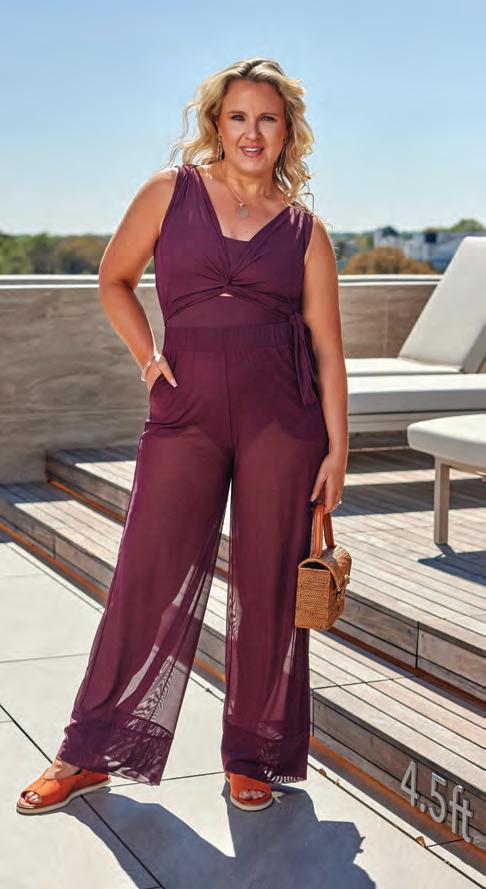
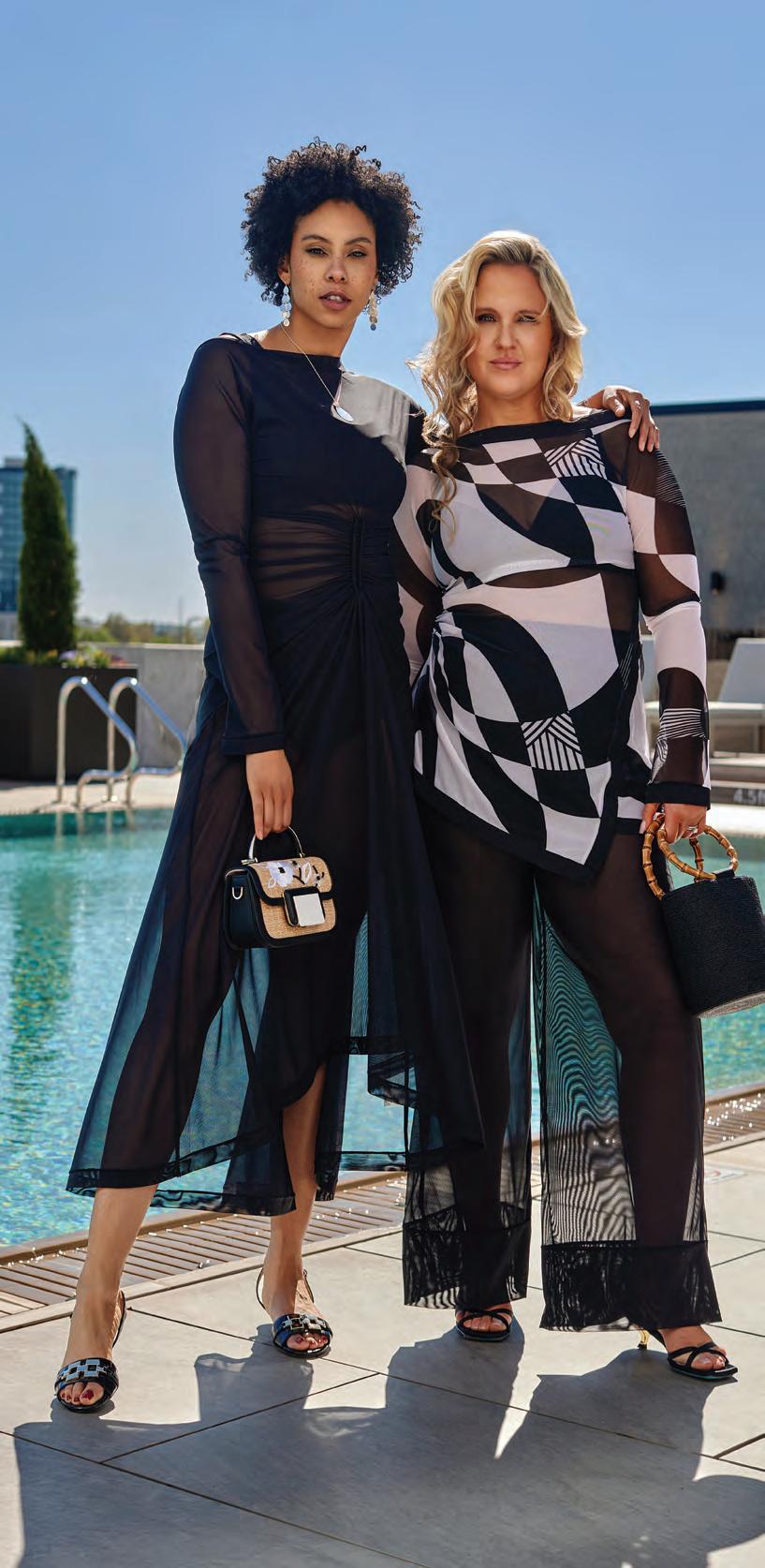
We take a look at the intersection of engineering and artistry with Serotone Swim. Sarah Blaser’s journey from NYC technical design to creating a solutionbased swimwear line for older women is a masterclass in purposeful innovation. You’ll see images from our 5 West spring fashion shoot featured here, showcasing how her “water-to-table” philosophy is changing the way we think about the poolside experience.
For those who find their inspiation in history and home, the Alan McDonald feature is a must-read. His stunning historical home—formerly the residence of the legendary horticulturist J.C. Raulston—is a testament to the art of preservation. Speaking of the Raulston legacy, don’t miss our department piece celebrating the 50th anniversary of JC Raulston Arboretum, a botanical jewel that continues to grow alongside us. And if you’re looking to escape the city altogether, join us on a trip to Leatherwood Mountains, where luxury meets the rugged beauty of the North Carolina trails.
Also in this issue, you’ll find our ACES special section. These black-and-white portraits offer a more personal look at the visionaries behind our local businesses. It’s a chance to go beyond the storefront and meet the neighbors who make our city so vibrant.
Finally, on a more personal note, this is my last issue as Editor-in-Chief of Midtown. It has been a true privilege to curate these stories and connect with so many of you over the years. Raleigh is a city that thrives on community, and while I am moving on to my next chapter, I look forward to seeing the continued growth of this incredible place from a new perspective. I hope to see you around the Triangle—perhaps at a concert, a Hurricanes game, or just enjoying a quiet morning at one of our amazing local cafés.
Thank you for letting me be a part of your story,
Kyle Marie McMahon Editor-in-Chief
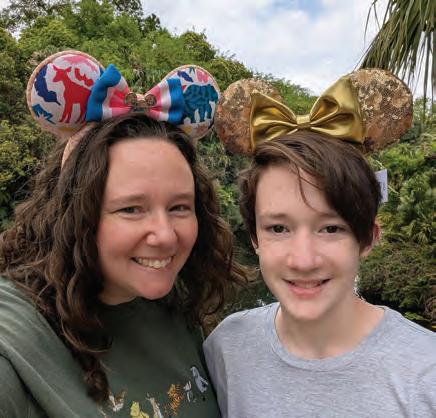
With eldest son, Anthony, at Disney World Animal Kingdom over spring break.
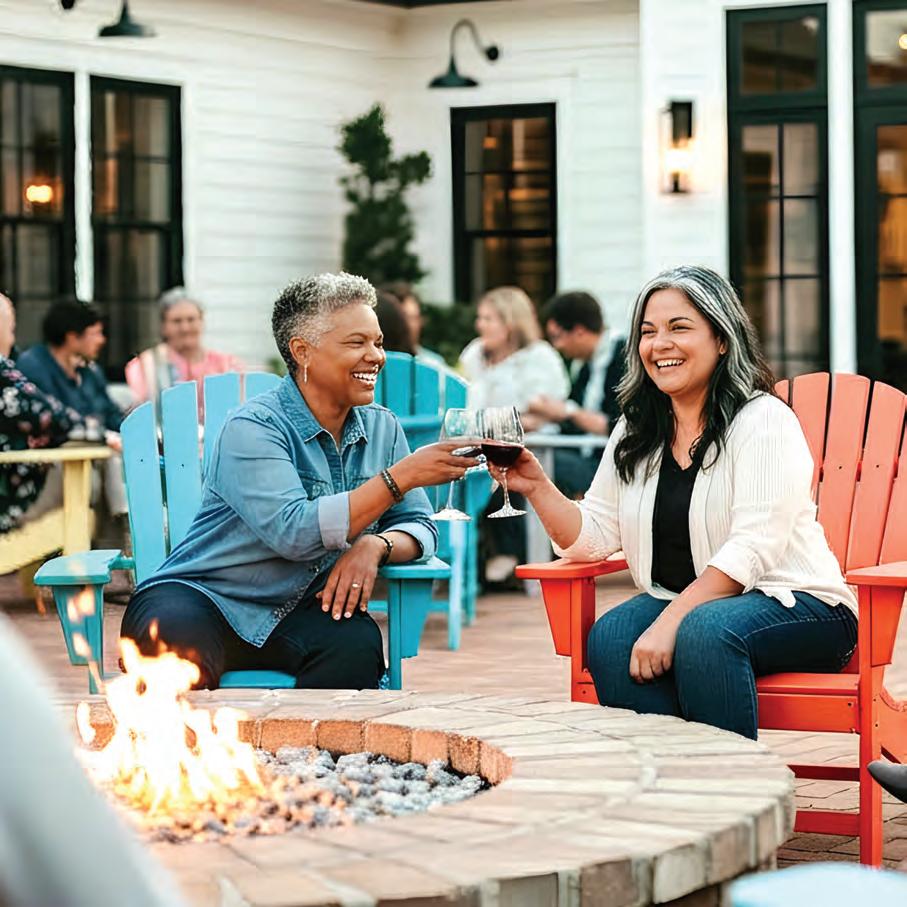
Discover spirited living in Knightdale
At Brio, life doesn’t sit still. It moves. It connects. It sparks. Set just minutes from Raleigh, this master-planned community blends modern homes, vibrant amenities, and everyday convenience into something brighter. Morning walks along Connection Park. Afternoons at The Hub. Evenings filled with neighbors who feel like friends. With a wide variety of beautiful homes from DRB Homes and Pulte Homes, Brio brings fresh energy to Knightdale living. Come alive at Brio, Knightdale.
Vibrant Amenities | Prime Location | Townhomes from the $300s | Single-Family from the $400s Search homes at BrioNC.com
FOUNDER
Ronny Stephens
PUBLISHER
Joe Sanger
EDITOR-IN-CHIEF
Kyle Marie McMahon
ART DIRECTOR
Sean Byrne
LIFESTYLE EDITOR & SENIOR GRAPHIC DESIGNER
Da than K azsuk
COPY EDITOR
Cindy Huntley
SOCIAL MEDIA MANAGER
Jordan Daniels
AD PRODUCTION MANAGER
Erica Christy
DIRECTOR OF SALES
Collin Pruitt
ACCOUNT EXECUTIVE
Mackenzie Steiner
STAFF PHOTOGRAPHER
Jessica Bratton
FASHION STYLIST
Sofia Lujan
DISTRIBUTION
Joe Lizana, Manager DistribuTech.net
CONTRIBUTING WRITERS
Laura D’Onofrio
Kur t Dusterberg
Dr. Alan Hahn
Beverly Hurley
Da than Kazsuk
Jennifer Primr ose
Equestrian
New
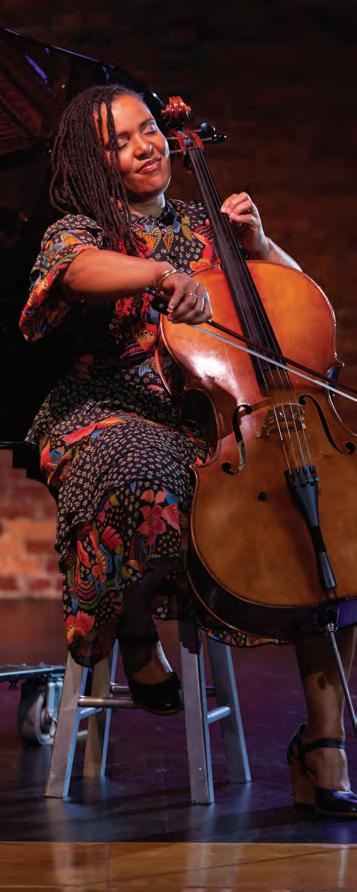
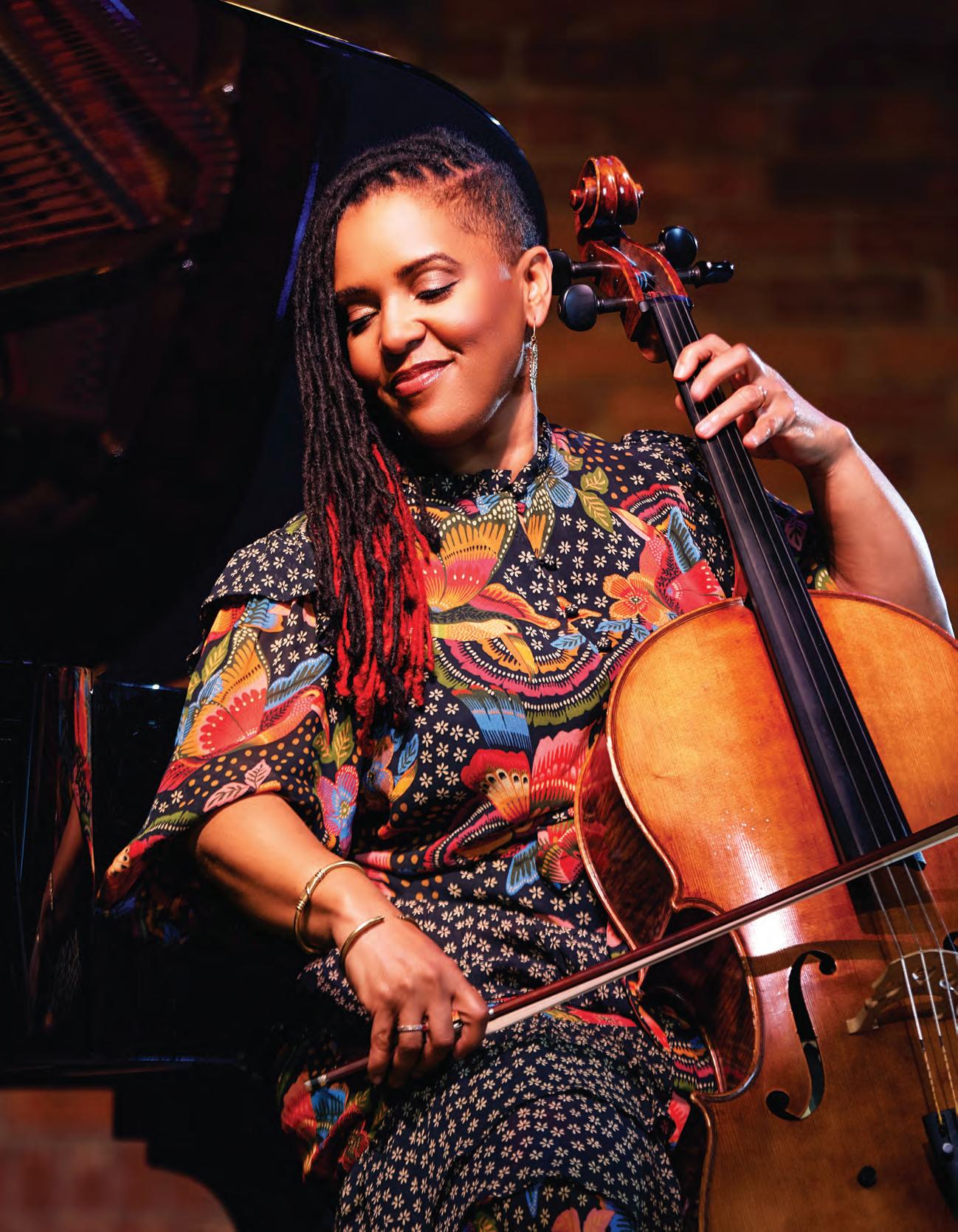
Singer-songwriter, cellist,
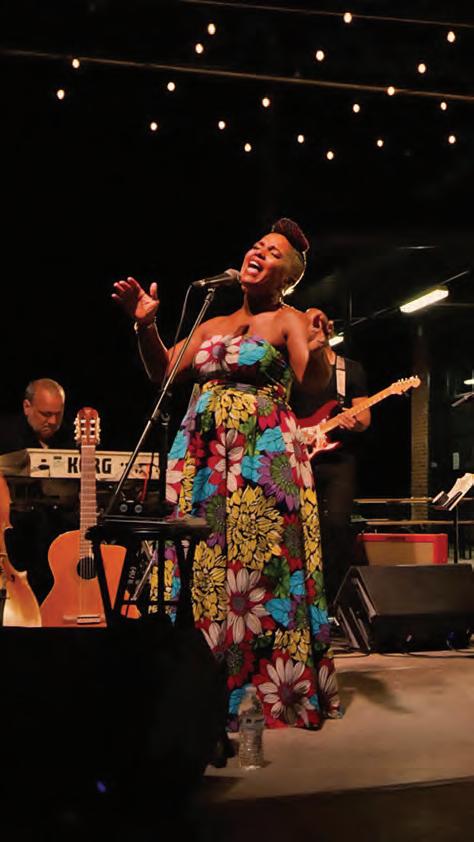
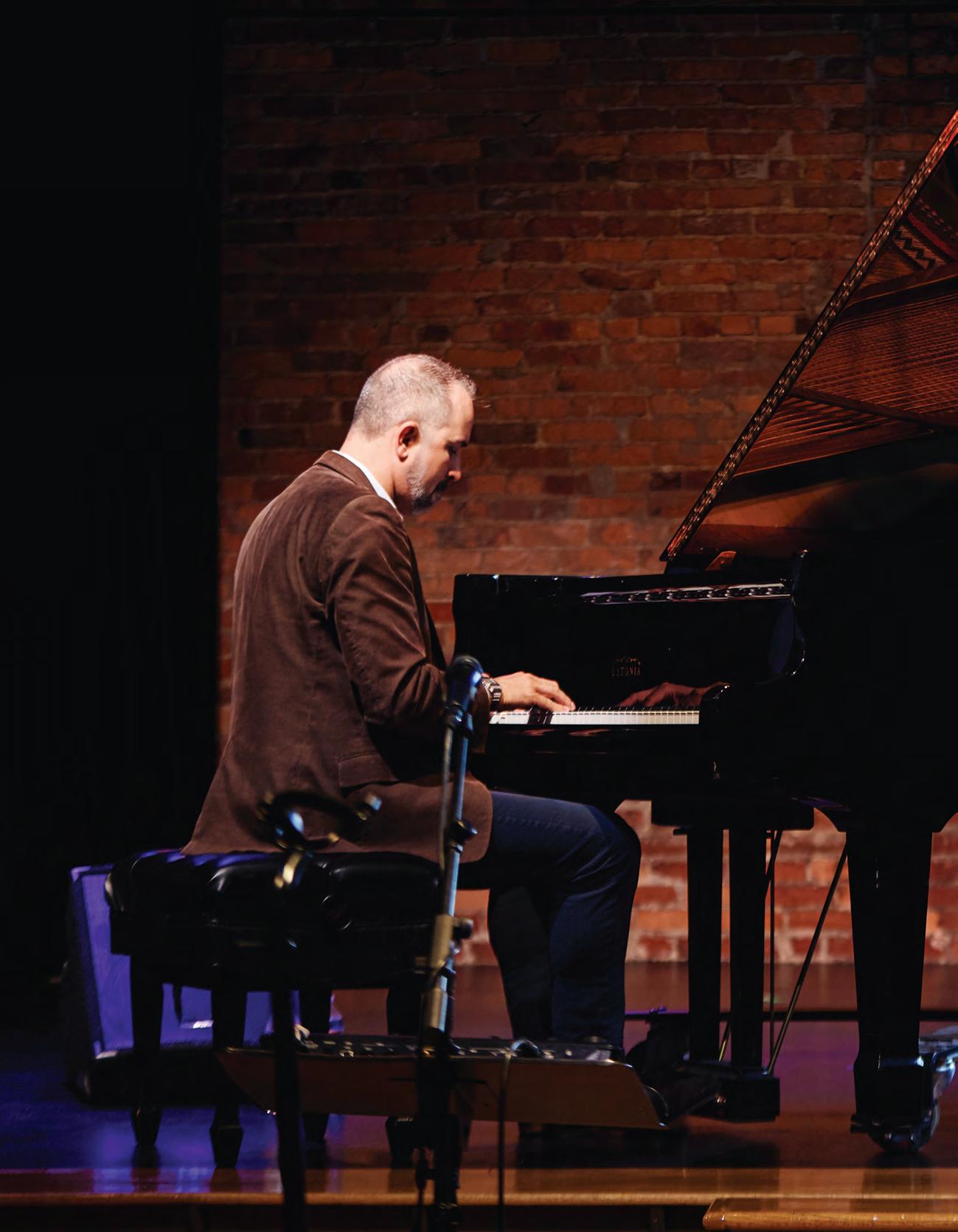
recording artist Shana Tucker performing at the Halle Cultural Arts Center in Apex.
Photo by Jessica Bratton.
Songbird’s
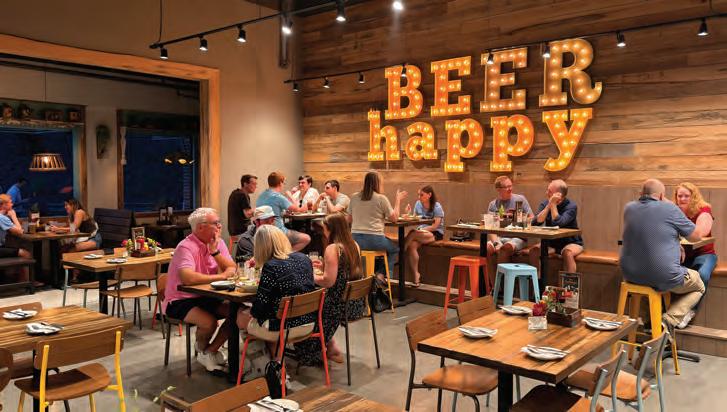
Crooked Hammock Brewery officially arried in Raleigh on April 20, bringing the Delaware-born brewery and restaurant’s backyard-cookout vibe to GlenLake for its fourth location. With burgers, Longboard Nachos, Sticky Lager Grilled Chicken, ribs, and plenty of house-brewed beer, this family-friendly hangout should be a hit for anyone who believes dinner tastes better with a pint (and maybe a hammock nearby). Photo by Dathan Kazsuk.
At the 10th annual NC Fine Wines Awards Gala, held April 24 at the Millenium Event Center in Winston-Salem, Governor Josh Stein made a video appearance congratulating this year’s winners. Of the 32 vineyards that entered, 28 received either a gold or double gold medal— proof that North Carolina wine continues to shine. Photo by Dathan Kazsuk.
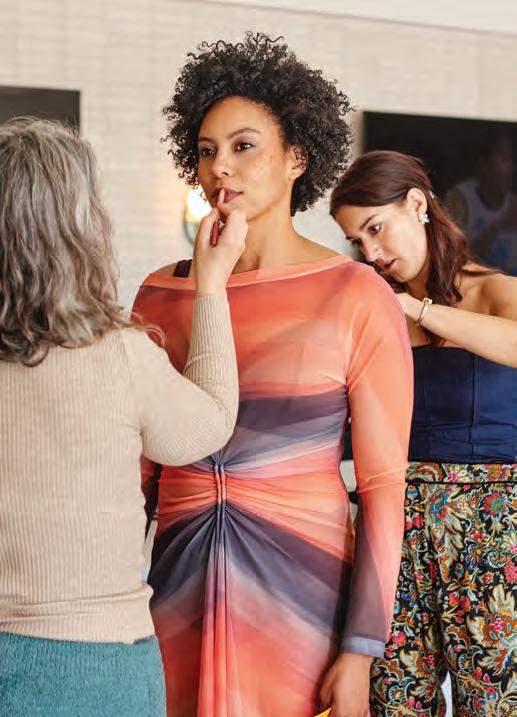
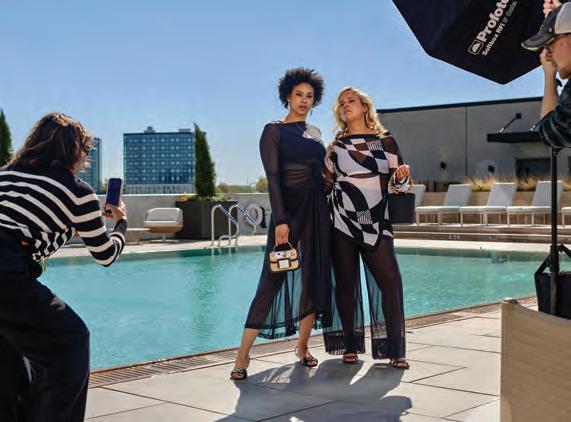
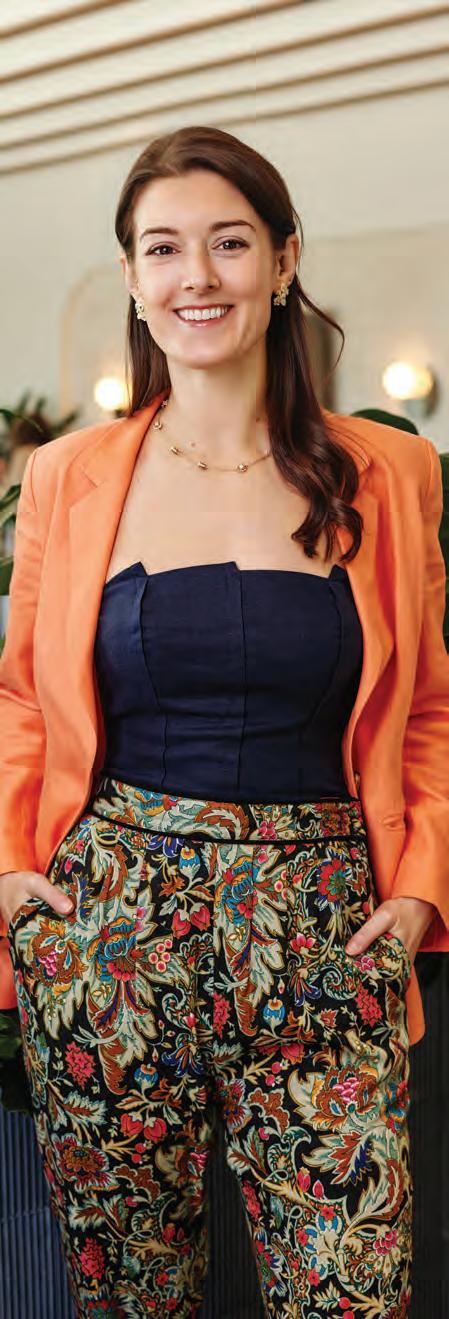
FAR LEFT AND ABOVE: Behind the scenes for Midtown’s Serotone Swim feature, shot at the rooftop pool of the Maeve Apartments in downtown Raleigh, with models Jessica Monroe and Jen Holley. The brand is led by owner and designer Sarah Blaser, pictured in the blue top. Also pictured are hair and makeup artist Sam Gay and stylist Sofia Lujan.
LEFT: Midtown account representative Mackenzie Steiner and intern Anna Sanger assisted on set. See the full story and images beginning on page 28. Photos by Jessica Bratton.
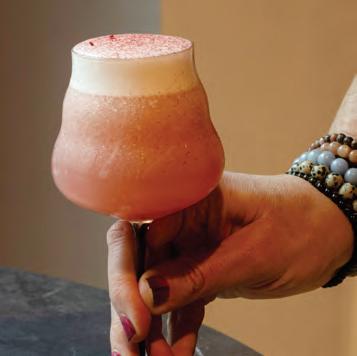
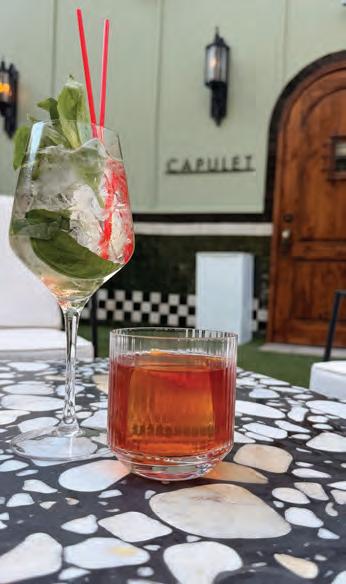
Cocktail Lounge in Raleigh welcomed media and guests on April 16 to celebrate the opening of its outdoor patio bar, featuring a lineup of spritzes and bourbon favorites. The stylish cocktail lounge now offers plenty of ways to enjoy its craft cocktails, both inside and out. Photo by Jennifer Primrose.
Things heated up—literally—during the annual Tacos ’N Taps festival at Cary’s Koka Booth Amphitheatre on April 18, as contestants took the stage for a jalapeñoeating competition. One winner walked away with $100—and probably a mouth on fie.
Photo by Dathan Kazsuk.
Let’s be social! Follow us for all of the don’t-miss events in Raleigh.
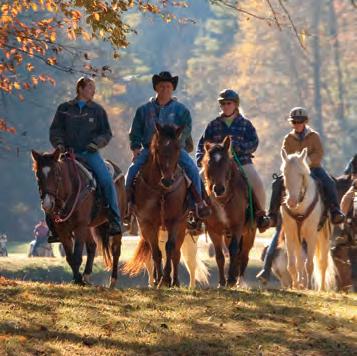
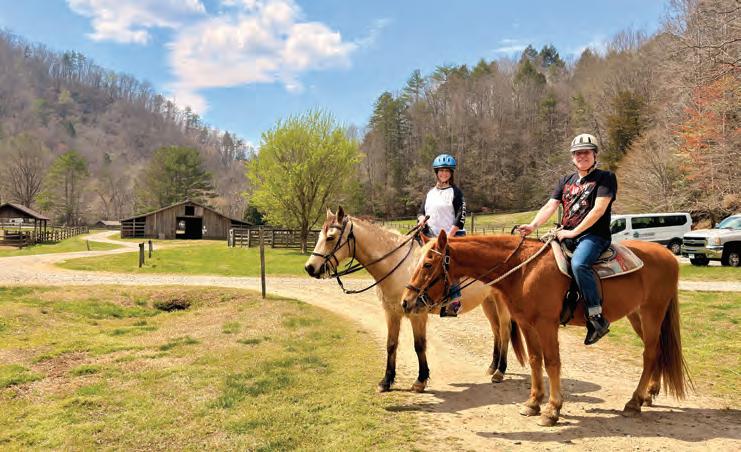
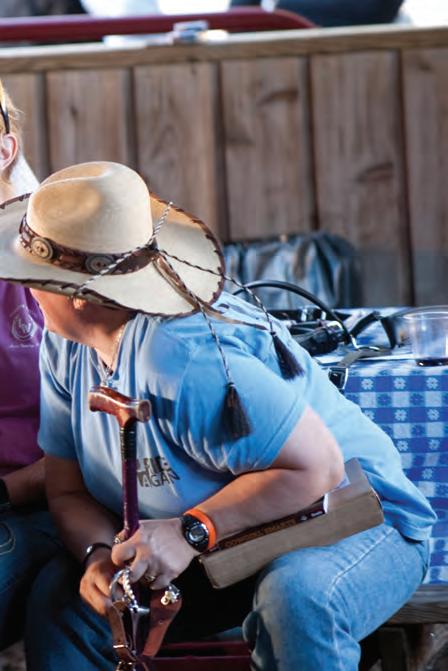
Midtown writer Jennifer Primrose, left, and lifestyle editor Dathan Kazsuk saddle up with Bess and Tony for a trail ride at Leatherwood Mountains Resort in Ferguson, North Carolina. Read more about the resort on page 38. Photo courtesy of Grace Wilcox.
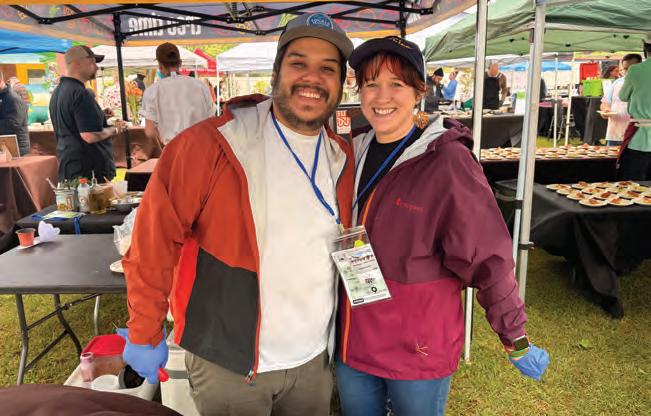
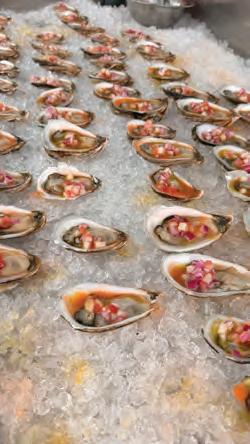
Eric Montagne of Locals Seafood and his wife served watermelon mignonette raw oysters during the eighth annual Roots for Reece Chef’s Picnic, held Sunday, April 26 at Landon Estate in Clayton. The fundraiser supports the North Carolina Harm Reduction Coalition. The chef’s picnic also featured Kevin Ruiz of Cuya Cocina Latina, Oscar Diaz of AAktun Coffee & Bar in Clayton, Matt Bounous of Death & Taxes, Alex Constantinou of Brodeto, and Blake Gotliffe of Under the Oak Catering, who founded the event back in 2019. Photo by Dathan Kazsuk.
Capulet
3 1 2 4
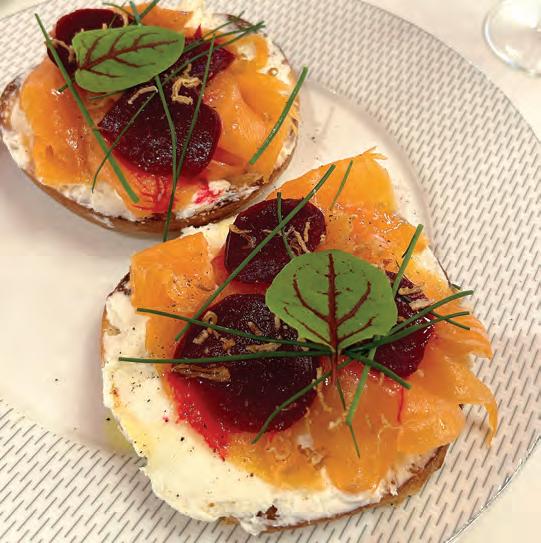
1. EAST END BISTROT, RALEIGH Loaded Bagel. Smoked salmon, whipped fromage blanc, pickled baby beets, and chive sprouts. Photo by Dathan Kazsuk.
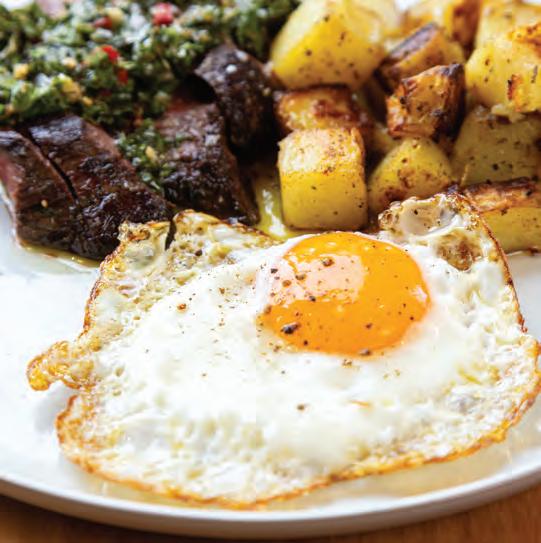
3. VIDRIO, RALEIGH
Hanger Steak & Egg. Roasted hanger steak, sunny-side up egg, za’atar home fries, and chimichurri. Photo by Richard Barlow.
2. FOXCROFT FOOD & WINE, RALEIGH
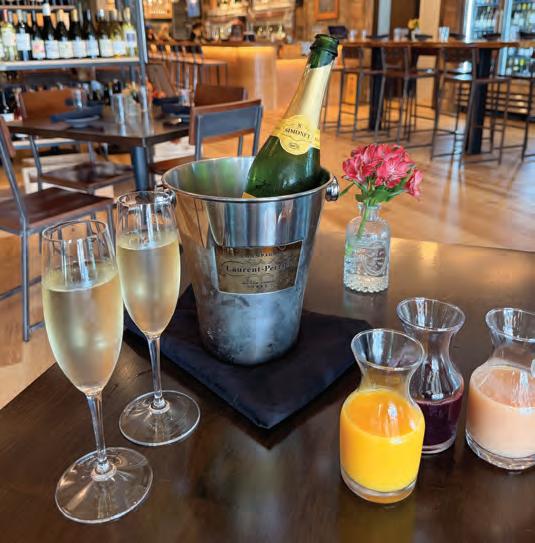
Mimosa Flight. Three seasonal juices, fresh fruit garnishes, and a full bottle of sparkling wine. Photo by Dathan Kazsuk.
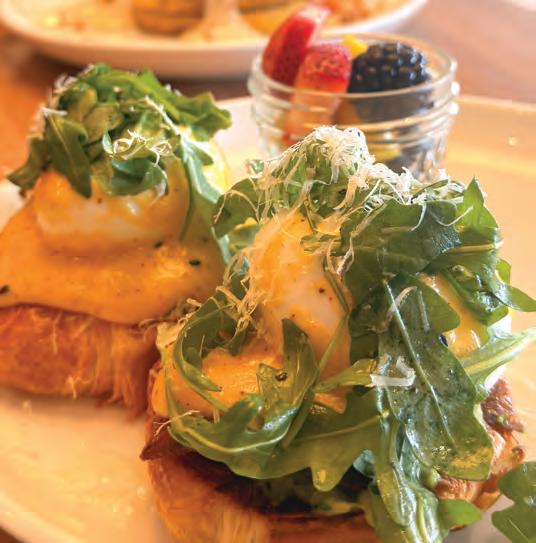
4. SIXTY VINES, RALEIGH
Avocado Bene Croast. Flaky croissants, avocado smash, candied bacon, poached eggs, togarashi hollandaise, arugula, pecorino, and fresh fruit. Photo by Dathan Kazsuk.
A SPACE FOR YOUR SOUL
Your home should be as exceptional as you are. A new lamp shifts a room’s shadows; a playful Luho Design House Brix Figure provides a whimsical outlet for a busy mind. This designer-curated collection invites you to stop following trends and start personalizing a space to reflect your unique stor. Embrace the bold, the soulful, and the unapologetically you.
Styling by Amanda Steinert Francfort
1 2 3 4 5
Amanda is the visionary behind ASF Interiors (as f***). Based outside of Raleigh, her boutique firm has delivered bold, “iconic asF*” interiors for over 20 years. She doesn’t just design rooms; she creates bespoke worlds that feed your energy and fill your emotional bucet. Whether you’re an executive navigating career pressures, a parent balancing family chaos, or a superhero who juggles both, Amanda believes authentic changes impact how you thrive.
1. Tulip Mania, Oil on Canvas; $850 | The Art Sweetheart, Hanni (local artist)
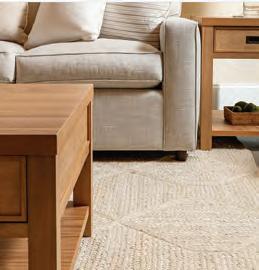
2. Jaipur Living Naturals Tobago Rug; Starting at $101 | Day Dreamer Decor
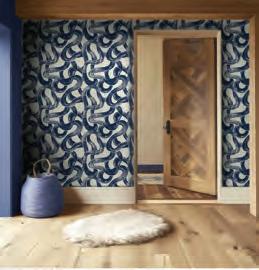
3. Painted Paper Baldwin Peel and Stick Wallpaper; $130 | Day Dreamer Decor
4. Luho House Design Brix Figure Acrylic Lego Men; $338 | Day Dreamer Decor
5. Jaipur Living Square Wool Pillow; $367 | Day Dreamer Decor
BOOK REVIEWS
Great stories have a way of bringing a community together, and we believe there is no better guide to a great book than a local bookseller who knows their craft. We’ve teamed up with the experts at Quail Ridge Books to bring you five staf picks chosen specifically for our eaders. From thought-provoking nonfiction to immersive novels these selections are curated to keep your “to-be-read” pile fresh and inspired, no matter what you’re in the mood for.
Every Day I Read: 53 Ways to Get Closer to Books by Hwang Bo-reum, translated by Shanna Tan; $28 This is so charming. Personally, I love listening to people talk on and on endlessly about their passions, and this book is basically 250 pages of the author doing exactly that. If you’re an avid reader, it might feel satisfyingly validating, and if you’re a reader in a slump, it might help you pull yourself out. If you (and/or someone you know) don’t read often, this offers a lot of good ways and reasons to read more if that’s something you want to do. —Ashley H.
A wonderfully written and very enjoyable story about what it’s like to be a seventh grader. We are along for the ride with Luna as she navigates changing friendships, a changing body, and a changing relationship with her parents. A must-read for anyone who wants a better understanding of middle school life these days and for anyone currently living through it. This novel covers a multitude of challenging topics including grief, bullying, peer pressure, depression, and anxiety. Christy
Injustice Town: A Corrupt City, a Wrongly Convicted Man, and a Struggle for Freedom by Rick Tulsky; $30 Tulsky’s book on the wrongly convicted Lamonte McIntyre and all of the surrounding issues is a full-edged look at how corrupt local politics can be. There are a lot of players in McIntyre’s story, but the way everything is laid out shows how connected and impactful everyone was to his conviction and journey to overturn it. Tulsky also does a wonderful job at zooming out to show how local and state judicial processes were affected by the overturning of said case. This one will make you emotional in so many ways. —Emily
Unread: A Memoir of Learning (and Loving) to Read on TikTok by Oliver James; $28
As an adult, James announced on TikTok that he couldn’t read. With a supportive and growing audience cheering him on, he worked his way from pretending he could read text messages to a level of literacy that’s allowed him to put his own book out there. He shares his journey through chapters connecting back to some of the rst books he read. The chapter when his comprehension rst allows him to develop an inner reading voice is wild! —Ginger
This book feels like a storybook that would have been read to me as a child and like a modern classic at the same time. El-Mohtar creates a lush world with an engaging story that you could nish in one sitting.
Paired with the lovely woodcut style illustrations between chapters and the image of willow leaves and tall grass on the page, this book asks you to dive in and get immersed in the world. And if you take the plunge, it’ll be hard to stop once you start reading. —Jack
The Moon Without Stars by Chanel Miller; $18
SEARCHING SOUL
Shana Tucker has a brand of music all her own— and a knack for building an audience with everyone
STORY BY KURT DUSTERBERG | PHOTOS BY JESSICA BRATTON UNLESS OTHERWISE NOTED
Shana Tucker is a working musician in the truest sense.
Yes, she is a singer-songwriter, cellist, and recording artist, but on a recent sunny afternoon, she has set up a wagonload of audio equipment at the front of Ms. Bruner’s fi fth-grade classroom at Laurel Park Elementary School in Apex. While the curious students watch patiently, she is looping vocal tracks and building something rhythmic. Soon, she is singing a song called “Gazelle,” complete with her own background tracks.
Tucker is a regular presence in local classrooms, offering songwriting and storytelling residencies through United Arts Wake County—“specializing the specials,” as she puts it. Moments after her vocal performance, she has all of the students introduce themselves, exchanging greetings with each of them. Ten minutes later, she has accomplished something remarkable—memorizing the names of all 2 4 k ids. For the next hour, every interaction is personalized. Her voice i s gentle and clear: “Madeline, go!” Then it’s, “Lennox, you have a question?”
By the end of the hour, everyone is fully involved. “I can get more done if I take a few minutes to get to know what their names are,” she says.
“Everybody’s name is important. Especially kids—they need to feel like they’re not ‘Hey, you!’”
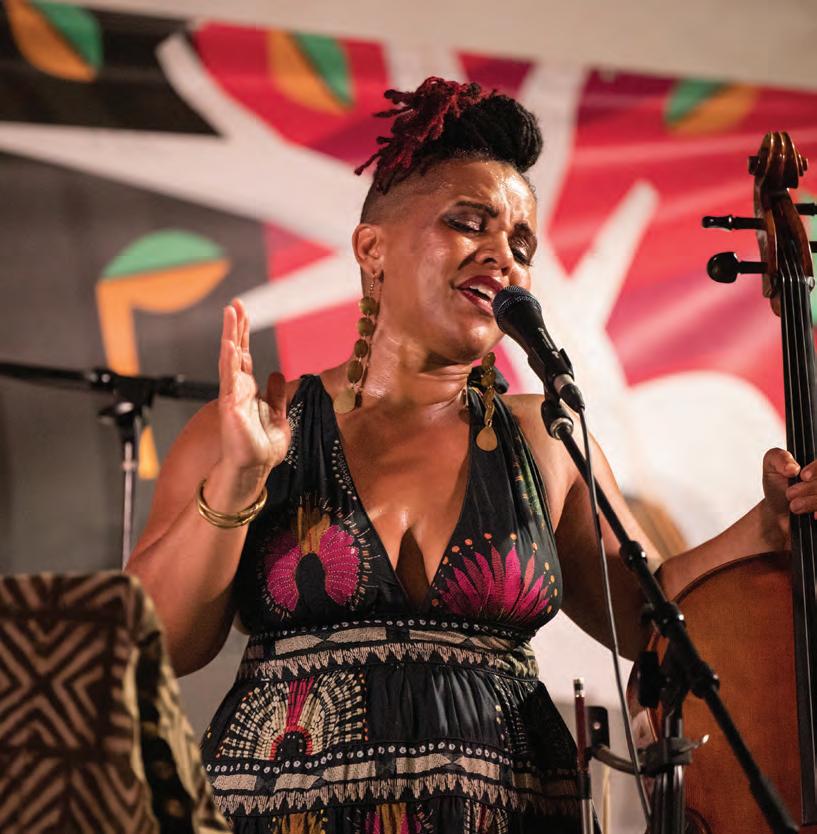
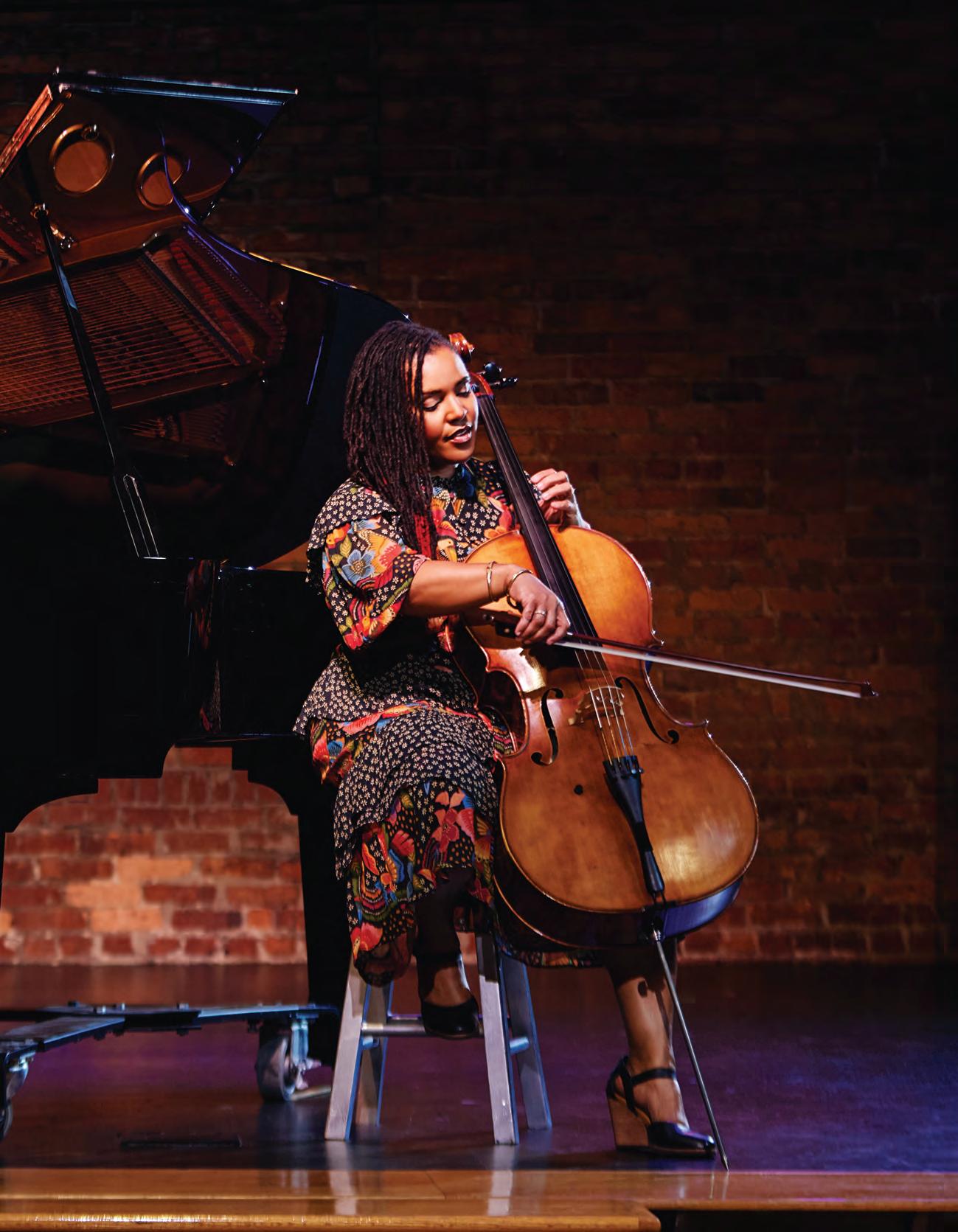
Cellist and singer-songwriter Shana Tucker performs her genre-blending “ChamberSoul” music, a style that draws from jazz, classical, folk, acoustic pop, and soul.
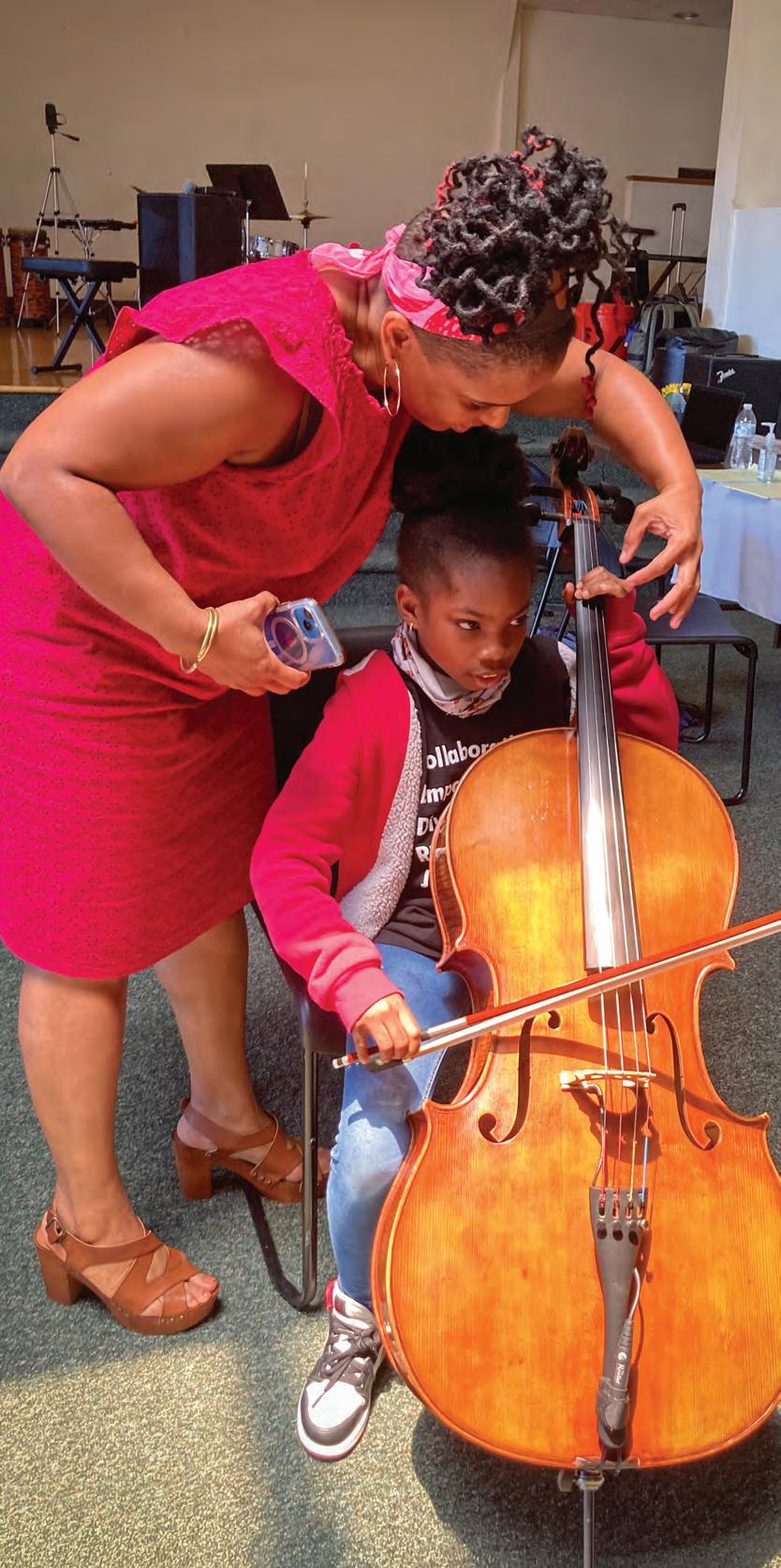
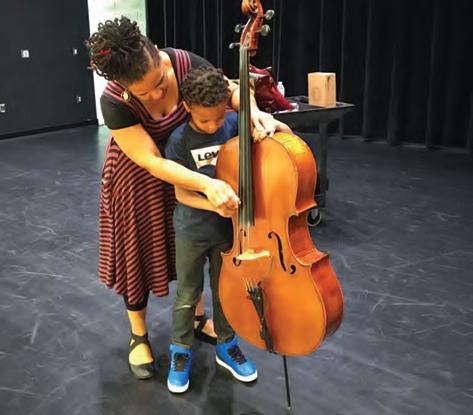
T he musical mission is important to Tucker, who grew up in Amityville, New York. “No one came to my school,” she says. “What would my life have looked like if someone had shown up earlier and let me know it was possible to write songs all by myself?”
B eyond her teaching role, Tucker is immersed in a life of musicianship. Her albums, Shine and Hiding in the Light, highlight her own niche in the music world— a style she calls “chamber soul.”
The music blends elements of jazz, cla ssical, and acoustic pop to deliver her own take on hits such as Cyndi Lauper’s “Time After Time” and Roberta Flack’s “The First Time Ever I Saw Your Face.”
“It’s not genre related, but it’s defi nitely got ’70s soul and funk and R & B,” Tucker says. “It’s not exactly pop, but I grew up in the ’80s and became an adult in the ’90s. This is the music that was around me. And jazz is within my DNA—musically, and as a Black person in America. That’s where the soulfulness of it comes from.”
She is at her very best on the Tina Turner classic, “What’s Love Got To Do With It.” Her melodic interpretation and jazzy runs add an unexpected joyfulness to the song.
“A lot of the songs I choose to cover, it’s because there is something happening in that song that just won’t let me go,” she says. “So I have to sing it the way I hear it.”
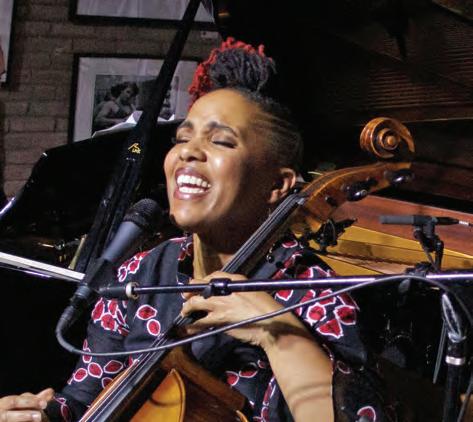
Shana Tucker brings her “ChamberSoul” sound from intimate stages like Musichead Gallery in Los Angeles to classrooms and community spaces, where she helps young musicians discover instruments such as the cello. A cellist, singer and songwriter, Tucker has also performed with awardwinning and Grammy-winning artists, including recording tracks with Sade, who was recently inducted into the Rock & Roll Hall of Fame. Photos courtesy of Shana Tucker and 36North.
Cellist and singer-songwriter Shana Tucker performs at the Halle Cultural Arts Center in Apex on April 15. She was joined on stage by the On the Steps curator and musician Christian Tamburr.
Known for her genre-blending ChamberSoul sound, Tucker has collaborated with artists including Bennie Maupin, Nicole Mitchell, and The Foreign Exchange.
OPPOSITE PAGE: Cultural Arts Program Specialist Marie Neal, left, facilitates a question-and-answer session following an evening performance at the Halle Cultural Arts Center in Apex.
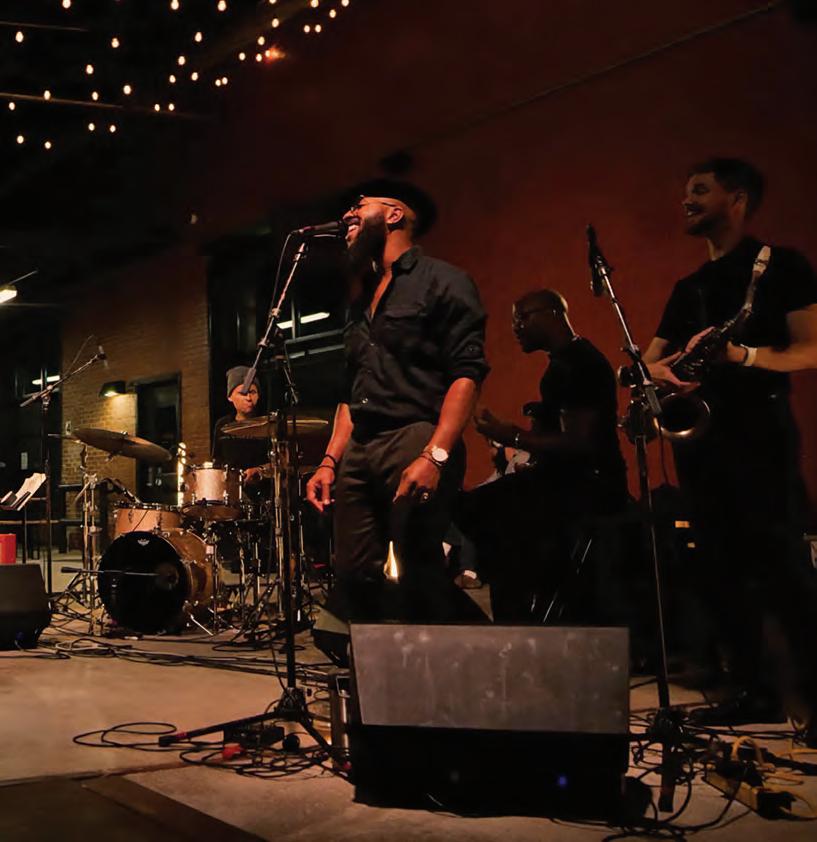
Tucker often performs in ensembles with Apex resident Christian Tamburr, an acclaimed multi-instrumentalist and composer. “Shana is a fantastic storyteller, and she fi nds a way of connecting her audience with every word of every song as if they’ve all lived the story together,” Tamburr says. “That storytelling, intertwined with dynamic artistry, is unique and rare, and audiences who experience it fi rsthand can’t wait to come back for more.”
T heir concert performances are marked by plenty of ad-libbed conversations that add an extra dimension to the program. “Really special synergy,” Tucker says. “We have a program of songs, but I think people appreciate the fact that we’re not just dialing it in, that it’s not a scripted show.”
Tucker was introduced to the cello in 6th grade, but came to understand the full potential of her instrument at Howard University when the all-Black, all-female Uptown String Quartet came to campus. “I had never seen strings played non-classically, I had never
seen jazz played on my instrument,” she says. She later moved on to Brooklyn College, where she received a full scholarship and developed her mastery of the cello.
Tucker, who lives with her husband in Durham, has called North Carolina home since 2003.
Maintaining a full-time musical career hasn’t always been easy. She spent five years performing in Las Vegas at the MGM Grand in KÀ by Cirque du Soleil, fi nding a rare role that called for a vocalist who played cello. “It took a year to get used to doing the same thing for 10 shows a week, getting yourself to play like it was fresh every time,” she says. “The language was not a real one. So you’re learning what I call ‘Cirque de Solanguage.’ I did it for four more years. The money was great, the stability was great. But I felt like I was ready to come back to North Carolina and back to writing and performing.”
Building a following for her own career isn’t easy. Tucker often performs in local arts series around the state and the region. At a recent concert in Wake Forest, she performed for close to 300 people.
Securing those gigs requires attending curated showcases to get her name out. “It is a hustle,” she says. “Being self-represented, I have to be on the phone and email. It’s word of mouth.” She often plays to an audience that is hearing her for the fi rst time. “It’s really just people who enjoy live music and a quality show.”
E ven beyond the classrooms and the live gigs, Tucker maintains a role in the arts community. She spends part of her time in Asheville, where she is the director of education and engagement at Wortham Center for the Performing Arts. She coordinates class offerings with an eye toward how the arts can play a role in health and wellness.
W ith so many responsibilities, Tucker doesn’t look too far ahead on her musical path, although she had a recent impulse to consider a musical. But for now, she is like her ChamberSoul music itself—a blend of her own unique ideas.
“For me, it’s fi nding the balance of am I doing what I am put on this earth to do?” she says. “I know that’s bringing a level of authenticity to everything I do.”
Visit the Midtown YouTube channel to view videos of Shana Tucker’s performance at the Halle Cultural Arts Center from April 15, 2026, part of their On the Steps Concert Series
Shana Tucker’s website at shanatucker.com
SWIM Redefining the Culture of
How Sarah Blaser is engineering a new era of inclusivity
STORY BY KYLE MARIE MCMAHON | PHOTOS BY JESSICA BRATTON
STYLED BY SOFIA
LUJAN
| HAIR + MAKEUP BY SAM GAY | JEWELRY BY KENDRA KIST
SHOES + HANDBAGS COURTESY OF RANGONI FIRENZE
We’ve a ll been there: standing in a fluorescent-lit dressing room, wrestling with a swimsuit that feels like it was designed for someone else—or at least for a version of ourselves that existed two decades ago. For fa r too long, the swimwear industry has operated on a binary that feels increasingly outdated: you either squeeze into a trend-focused “lingerie-esque” bikini or settle for a silhouette that prioritizes utility over style.
Enter Sarah Blaser. A designer with a decade of experience in the highstakes world of NYC technical sportswear and six patents to her name, Blaser isn’t just making clothes; she’s engineering solutions. After watching her mother struggle to fi nd a suit that honored her changing body during the pandemic, Blaser traded the New York fashion machine for a studio in Raleigh to launch Serotone Swim.
Named after the “feel-good” chemical serotonin, the brand is built on the belief that when we feel supported—literally and figuratively—our entire presence changes. From her innovative “water-to-table” mesh designs that transition seamlessly from the pool to a social setting, to a modular approach that accounts for the real-life fluctuations of perimenopause and motherhood, Blaser is challenging the “thin ideal” with every stitch.
In this profi le, we sit down with the inventor-turned-entrepreneur to discuss the technical edge that sets her apart from fast fashion, the power of a mother-daughter partnership, and why she’s on a mission to turn swimwear into a platform for women’s health and radical self-love.
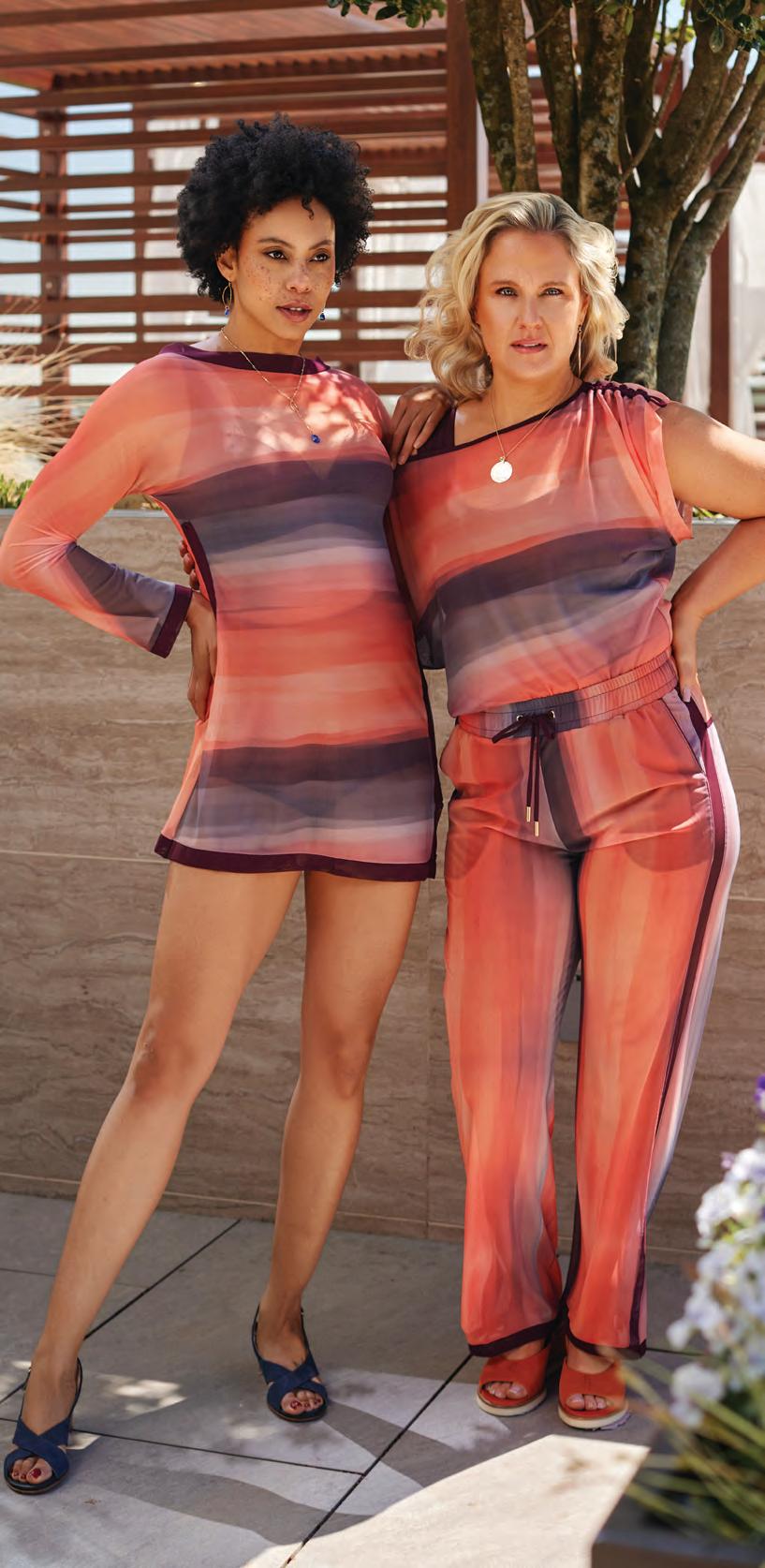
Mesh cover-ups from Serotone Swim’s Sea Marble collection: Jen (left) in the Long Dress—Stone Blue and Jessica (right) in the Asymmetric Dress and Palazzo Pant—Sea Marble.
C an you explain your “water-totable” concept and how you design pieces that transition seamlessly from the pool to a social setting?
First, we are all about ease. Women do it all; we need fewer things on our plates to worry about. Second, because we wanted our wearers to be as covered as they desired, all of our pieces can technically be worn in the water. Since this could mean you are wearing pants in the water, we didn’t want you to have to bring another change of clothes for post-swim plans.
It started with the material. I wanted something that would be co ol, dry quickly, and not cling too much while wet. That’s how we came up with the mesh. Then I focused on design: Where are these women going? How would they want to present themselves?
We settled on elevated, classic si lhouettes so the wearer can easily blend with whatever atmosphere they are entering.
You’ve mentioned that much of the fashion industry remains focused on younger, slimmer bodies. In your research, what were the most frustrating fit failures you discovered in traditional swimwear for women over 35?
The fi rst frustration was the boob issue. Women’s breasts come in all shapes and sizes, and each woman has their own opinion on how she wants them to look. One-pieces are one of the most challenging products because they are made for women whose breasts are proportional to their size—which we all know is rarely the case. The second failure was the lack of options if you didn’t want to wear
a swimsuit, but still go swimming. Not everyone wants to show their body—and either way is perfectly okay. But for those who do want more coverage, they deserve pieces that are just as fun and stylish as everything else on the market.
Your line features a modular design with mesh tops and separate bra tops. How does this build-your-own style address the speci fi c support needs of a changing body?
A ll boobs are unique no matter what age you are or life stage you’re in. But when you are post-partum, and your breast size is constantly changing, or menopausal (many women’s breasts actually get larger here), custom support becomes necessary in order to feel comfortable.
Your printed mesh is made from recycled bottles. Why was it important to you to bake sustainability into the brand from day one?
I believe brands need to lead by example. It can be prohibitively expensive for small brands to be sustainable, so it is an ongoing process. The recycled bottles are what we can do for now, but in the future, I would like all of our fabrics to be derived from renewable resources.
You debuted at Miami Swim Week 2025 with models ranging from ages 22 to 42. What was the industry reaction to seeing real, diverse bodies on such a high-pro fi le runway?
Overall, the reaction was positive. How the industry reacts isn’t so much my concern—it’s how the consumer reacts. I want them to be able to see themselves in the garment, to believe that we really are doing something different. And I think showing the pieces on such a wide range of bodies and ages does that.
ABOVE: Sarah Blaser. OPPOSITE PAGE: More pieces from the Sea Marble collection.
T HE ORIGIN & INSPIRATION
W ith a decade of experience in technical sportswear and intimates in NYC—and holding six patents— how does that rigorous technical b a ckground give Serotone an edge over traditional fast-fashion brands?
The companies I worked for previously were purpose-driven, always trying to solve a need. This meant constantly thinking outside the box and challenging what is considered the norm. Prioritizing function. Fast fashion is primarily profi/speed-to-market focused— a model that will never allow space for true innovation. Even “designer” fashion does not always consider function. The pieces may be unique and beautiful, but are either trendfocused or more art than something for the average person.
You transitioned from designing for high-level athletes to everyday wome n. How has your de fi nition of a successful design evolved through th a t transition?
With athletes, yes, the purpose and needs are completely different, but because my work would directly affect their performance, it trained me to work to truly understand their needs. I use that same approach with Serotone Swim, so success is ful fi lling those needs as best I can.
T he name “Serotone” is a play on serotonin, the feel-good chemical. How does that biological concept translate into the way a woman feels when she puts on one of your suits?
I think there is a fundamental change that happens in our brains when we feel good in our clothing. We walk taller, feel lighter, and are more present. Our suits are engineered to inspire that change.
W hat prompted your move from the New York fashion world back to Raleigh, and how has the North Carolina community in fluenced your brand’s growth?
I wanted to work closely with my mother on the collection. She vets and trials all of my designs before we proceed to production.
Your mother, Donna, has been a key part of this journey, even helping you in the studio. How has building this business together changed your relationship?
L iving with Mom during the pandemic gave us the opportunity to redefi ne our relationship from parent-child to peers, which allowed us to become much closer. Now that we are working together,
we are certainly learning more about each other—good and bad. I think it helps us understand one another even more.
A DVOCACY & THE MENOPAUSE GAP
Women often feel they have to squeeze into traditional suits. How is Serotone Swim giving women p e rmission to stop apologizing for their bodies?
I think we have this narrative that we need to fit whatever the industry is offering us, but that’s so not true. Most people don’t look great in low-rise jeans, yet for all of the early 2000s we were showing plumber’s cracks because it seemed like the only option available to us. Trends are BS! Swimwear happened to
evolve into this lingerie-esque (no judgment) product category because tanning all of a sudden became fashionable. That’s great for people who want that, but for the rest of us, by continuing to buy things that aren’t quite what we want, or are just “good enough,” we’re signaling to the industry that this is okay. That they don’t have to put in the effort (money) to consider our needs. At Serotone Swim, we don’t want you to feel like you have to fit the mold. We want you to ask for—demand—what you need.
OPPOSITE PAGE: The Sunset collection. ABOVE: More looks from the Sunset collection.
B ody changes during perimenopause and menopause involve skin sensitivity and temperature shifts. How do your fabric choices (like smoothing warp knit nylon) specifically address these concerns?
Our nylon fabric’s warp knit structure allows the fabric to stretch and form to the body without digging into every fold and crevice. A lot of swimwear is made from circular knits, which is what it sounds like: a circular tube. This makes the fabric want to squeeze into the narrowest places, and shows more lumps and bumps. We line all of our swim pieces with power mesh rather than traditional lining, so you dry quicker and have more breathability and better stretch recovery. All of our products are designed so there are no narrow elastics or straps that will start to dig in and feel painful over time. In a world where fashion is swinging back toward ultra th in ideals, how do you keep your brand’s message focused on personal truth over external validation?
The industry may be swinging back, but the inclusivity movement is still going strong among independent brands. We see consumers’ outrage and use it as our North Star. As I mentioned, we are not about trends; we are about solutions. Following an industry that does not have the same values is pointless.
F UTURE PLANS & VISION
A s you move beyond the limited preorder collection, what is your vision for the next three to fie years of Serotone Swim?
I want Serotone Swim to be a platform for women’s health. It is so under-researched, and I think every woman has a “what’s happening to my body” story that could have gone a different way had the science been there. That’s why I want to partner with different women’s health research funds and also include a women’s health component to all of our events. The more we talk about our experiences, the healthier we can be. We are actively seeking women who want to share their stories with us.
What advice would you give to other women in the Triangle who see a problem in the market but are hesitant to engineer their own solution?
Just do it! We need more women like you—change makers—that want to make a real impact. A lot of people told me before I started this brand that it’s not going to be scalable, that there’s no money in it, or “it’s too niche.” Ignore them. Do your research, make an excellent product, and run with it.
W hen a woman wears a Serotone suit on he r fi rst vacation in years, what is the one emotion you hope she feels when she looks in the mirror?
Self-love—a quiet, radiant con fidence and sense of ease in her own body.
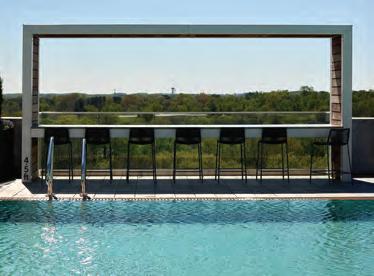
Midtown thanks Maeve in downtown Raleigh for the use of their beautiful rooftop pool to shoot this feature. Visit them at maeveraleigh.com.
PRIME LOCATION
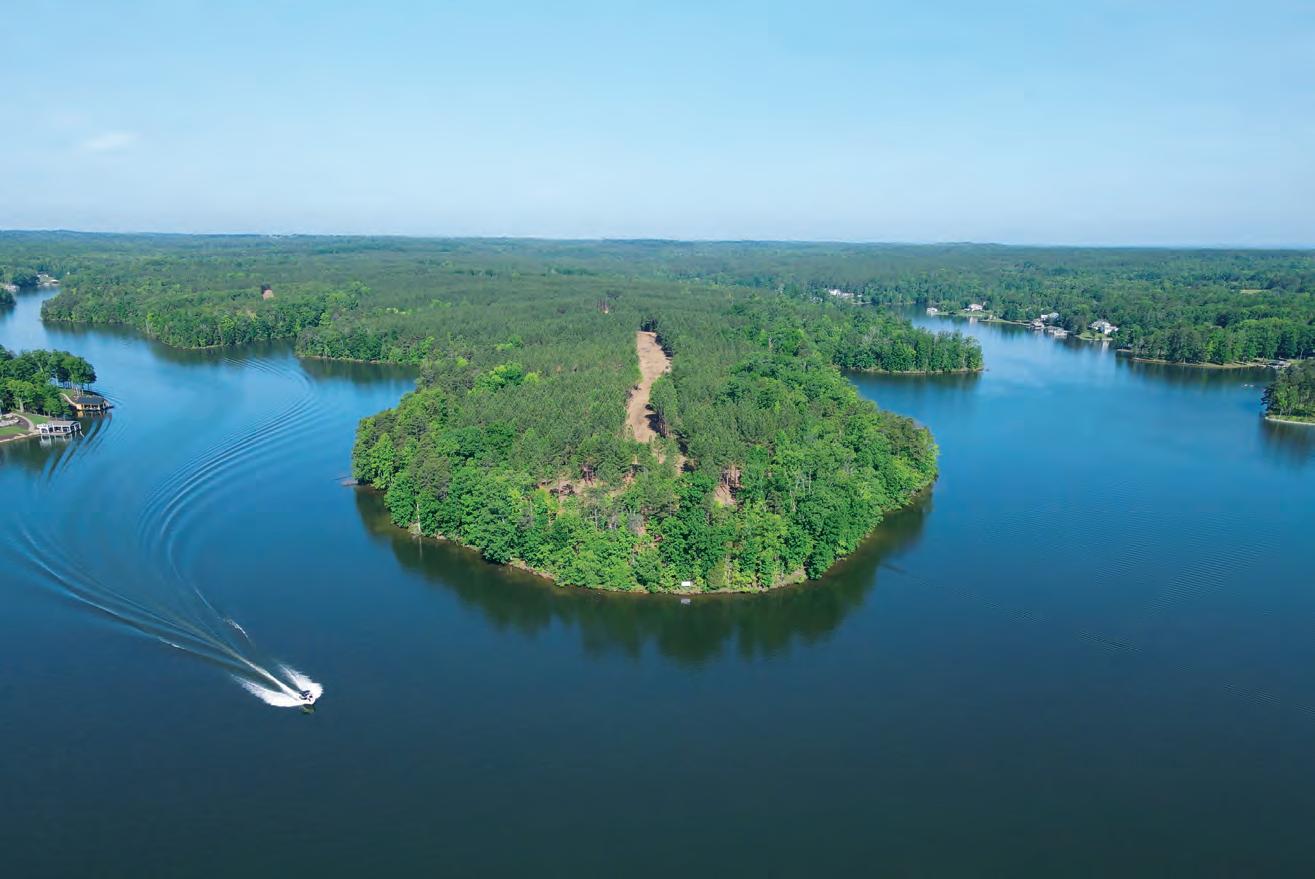
• Spectacular 430-Acre Waterfront Peninsula –3.5 Miles of Shoreline!
• New Private Gated Community
• Less than 65 Miles from GSO & RDU Airports
• Gated with Paved Roads & Street Lights
• Live at the Lake and Work from Home!
THE ULTIMATE LAKE LIFESTYLE
• Fully Recreational Lake for Boating, Fishing, Waterskiing, Wakeboarding & More
• World-Class Bass Fishing
• Planned Community Docks* & Boat Launch*
• Community Waterfront Park with Pool, Pavilion & Fireplace
• Community Boat & RV Storage for Property Owners
WATERFRONT LIVING MADE EASY
• Dockable Estate-Sized Waterfront Homesites from .5 – 2.5 Acres
• Only 70 New Homesites Being Offered
• Buy Now, Build Later
• Choose from Several of the Area’s Finest Custom Home Builders
• Excellent Financing Available
• Ask How to Buy Property With Your IRA
• Properties Sold on a First Come, First Served Basis
Where new neighbors become close friends
Retirement at Springmoor is refreshing, uplifting and full of life. Just minutes from downtown Raleigh, our beautiful, wooded campus offers the ideal setting to stay active, connected and inspired through our wellnessfocused lifestyle.
With welcoming neighbors, top-notch amenities, and genuine Southern hospitality, everyday life at Springmoor is undeniably sweet. It’s no wonder Newsweek recognized us as one of the Top Continuing Care Retirement Communities for 2025. 2025
SA NCTUARY HIGH COUNTRY THE
A WEEKEND AT LEATHERWOOD MOUNTAINS
STORY BY JENNIFER PRIMROSE
On a road trip west from Raleigh, there is a moment when the traf fic lightens, the air shifts, and the pace of everyday life begins to loosen its grip.
L eatherwood Mountains, near Ferguson in the Blue Ridge foothills, sits just off the main mountain corridor—close enough to the region’s most familiar destinations to be convenient, but remote enough that the landscape takes over fi rst.
It is still within reach of the High Country’s most recognizable anchors— the upscale charm of Blowing Rock, the collegiate energy of Boone, and the musical heritage of Wilkesboro—yet it doesn’t feel dependent on any of them.
Here, a morning can unfold entirely within trails and pasture, while an afternoon can still carry you into town for coffee, galleries, or music, without the sense that you’ve changed pace.
But the real draw isn’t just the proximity to town; it’s the 4,000 acres of preserved ridges and valleys that make up the resort itself. This land was originally envisioned by developer Dick Johnston as a sanctuary where the mountains’ natural character would always come fi rst—a legacy of open space and equestrian freedom that has been maintained for over 40 years. Today, the property functions as both a gated residential community for full-time homeowners and a vacation destination for those seeking a mountain retreat.
T hat legacy is guarded by business partners Trevor Whitson and Abbie Hanchey. The pair have known each other since they were “knee-high to a grasshopper,” and their lifelong connection forms the backbone of Leatherwood’s culture.
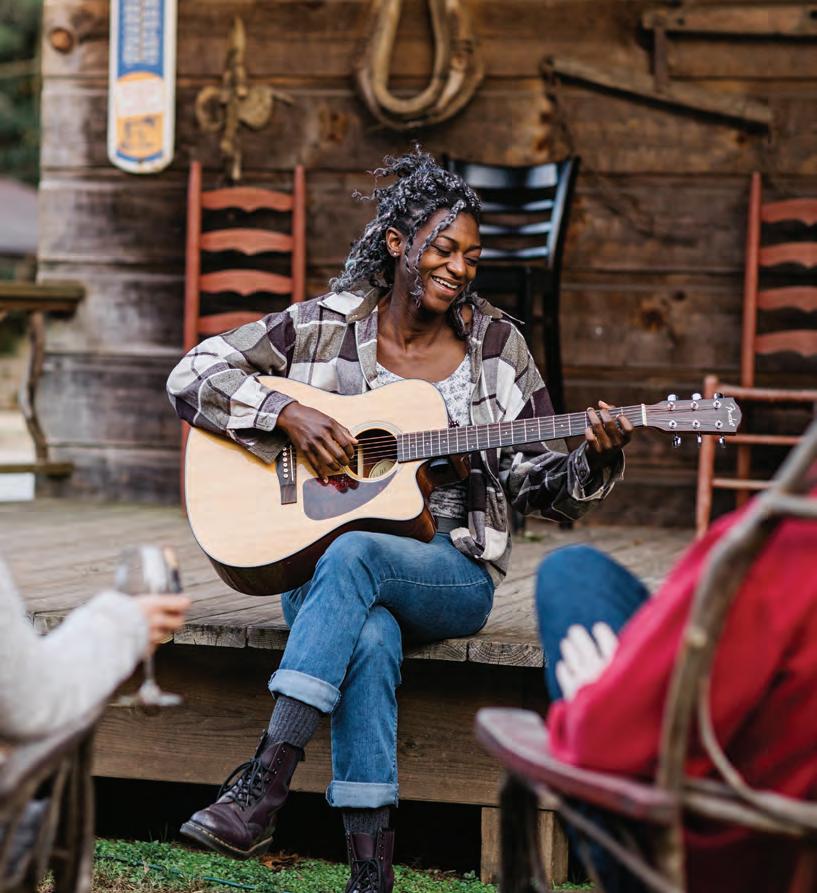
At Leatherwood Mountains in Ferguson, the High Country opens up—miles of trails, horses on the move, walking trails, and just enough quiet to remind you why you came to get away from the daily grind. Photos courtesy of Leatherwood Mountains.
“Abbie is more like a sister than a partner,” Whitson says. They call themselves the “Yin and Yang” of management—two people who love the same place and rarely agree on the same approach. Since taking over as owners in 2017 they’ve added live music, expanded the restaurant, and turned the property into a wedding venue—all without losing sight of what made Leatherwood worth saving. Whitson jokes that if you catch him and Hanchey in a spirited debate on a wedding day, don’t worry. “It means everything is going to go perfectly,” he laughs. “She’s the push, and I’m the pull.”
A VISION CARVED INTO THE FOOTHILLS
T he h istory of this land goes back to the mid-1980s, when Johnston began assembling thousands of acres of rugged terrain. When the resort’s future grew uncertain in the 90s, Whitson’s father, Phil Whitson, and his partner, Phil Rash,
stepped in. For over 20 years, the “two Phils” stabilized the mountain, eventually passing the torch to Whitson and Hanchey in 2017.
The Whitson and Hanchey families were drawn into this vision through a stroke of serendipity. The parents were longtime friends who often rode together, and Hanchey’s parents discovered Leatherwood at a booth at the North Carolina State Fa ir. Intrigued by the concept of a dedicated horse community, they called Whitson’s parents with a simple invitation: “I found a new place for us to go ride.” When Whitson’s father visited, he was so moved by the landscape that he bought a plot of land on a whim that same day.
For t he current owners, the resort is a birthright. Hanchey has been an integral part of the Leatherwood story since 1993, and Whitson—who worked his way up shoveling stalls to pay for hi s fi rst truck—joined full-time in 2006. This
lifelong familiarity is what gives the 4,000-acre property its “massive backyard” feel.
FROM COWBOYS TO COMMUNITY: THE GENERATIONAL SHIFT
W hile Whitson and Hanchey hold the property’s history sacred, they recognize that the mountain must evolve. “Baby Boomers—my parents’ age—had a lot more cowboys than Gen X,” Whitson notes. In the 1980s and 90s, the resort was almost exclusively equestrian-centric.
Understanding that today’s travelers want a more multifaceted escape, they have leaned into the “scene.” They transformed the restaurant into a gathering spot and prioritized entertainment, including craft beer, live music, and even songwriter nights. “We know the equestrian people got us here,” Whitson says. “But people our age want a scene, a sound, and a place to belong.”
THE LIVING EXPERIENCE: THE BUNK HOUSE
To understand how Leatherwood blends its history with modern comfort, you only need to look at where I stayed during my visit. The Bunk House is a threebedroom, two-bath rental located right near the East Barn. It still carries the bones of its original life as a caretaker’s home, but the interior has been fully modernized.
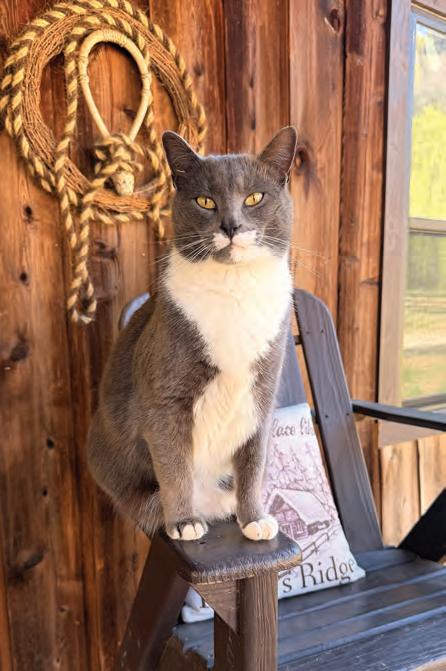
T he setup includes a modern kitchen, an expanded bath with a walk-in shower, and a screened porch overlooking the equine facility. Mornings at The Bunk House begin with the fi rst light shining through the trees and horses grazing just outside the kitchen window. Down at the stables you’re likely to be greeted by the resident barn cats, who act as a furry welcoming committee.
T he best part of The Bunk House, however, is the evening. After a day on the trails, the private hot tub is exactly what you need. A s t he sun dips behind the ridge, the mountain gets incredibly quiet. Because there’s no light pollution out here, the night sky is clear enough to see every star—a stark contrast to what we’re used to back in the Triangle. It’s that speci fic combination of quiet and clarity that makes this spot feel like a true escape.
T he Bunk House is one of roughly 40 rentals managed on-site, part of a larger portfolio th at spans about 144 homes across Leatherwood Mountains. The options range from tucked-away one-bedroom cabins to multibedroom homes and larger estates positioned along ridgelines, designed for everything from solo retreats to family gatherings and group stays.
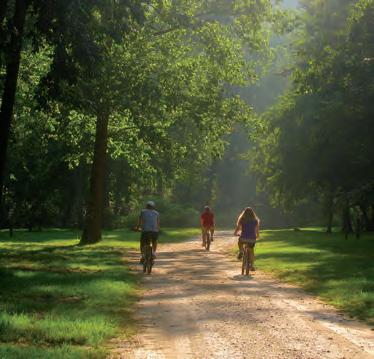
Enjoy live music as the sun sets over the mountains, linger over dinner and drinks on the outdoor patio, say hello to the resident barn cats, or spend the day biking and trout fishing along the nearby creek—all part of the easygoing escape at Leatherwood Mountains.
Photos courtesy of Leatherwood Mountains and Dathan Kazsuk.
THE RHYTHM OF THE LAND
My Leatherwood experience began on a beautiful Friday afternoon with my fi rst trail ride since childhood. I w as paired with Bess, a 30-year-old mare with a legendary reputation for patience—a trait I needed for my own nerves.
L eading the way was Grace Wilcox, Leatherwood’s lead trail guide and barn manager, riding Miguel. While Wilcox kept a calm, grounded presence, Bess had her own ideas about the hierarchy. Despite her status as the calm choice for beginners, she had just a bit of a stubborn streak when it came to leadership. She didn’t just want to walk the trail; she wanted to dictate it, constantly edging toward Miguel to make it clear she was the veteran of the line.
“A lot of people think horses are scary because they’re so big,” Wilcox says with a reassuring smile. “But they’re like big dogs. They sense your energy before you even get in the saddle.”
A s the trail climbed into the trees, Wilcox offered steady d i rection—leaning forward on the climbs, easing back on the descents—small adjustments that helped Bess move naturally.
Wilcox shared a bit of wisdom from horseman Buck Brannaman: “If you spend time with them and work with them, they reflect your character and help you build yours.” The truth of that hit home when a small snake crossed our path, sending a few rocks tumbling down the ridge. Bess didn’t break her stride. She stayed calm, and in turn, so did I.
BEYOND THE STABLES
For those who prefer their own two feet to four hooves, the property offers 75 miles of hiking and equestrian trails. This landscape is a true refuge; hunting is strictly prohibited, preserving wildlife and the land’s natural peace.
I set out on a 3-mile loop soon after sunrise on my second morning, following a route that wound through Rhodo Gap, Tricky Creek, Daniel Pass, and along portions of the Daniel Boone Trail before looping back toward Jingle. It begins near the 1892 Keyes Cabin—a simple structure that immediately shifts your sense of time—before climbing steadily into forested terrain where the trail quickly narrows and the world beyond the trees disappears.
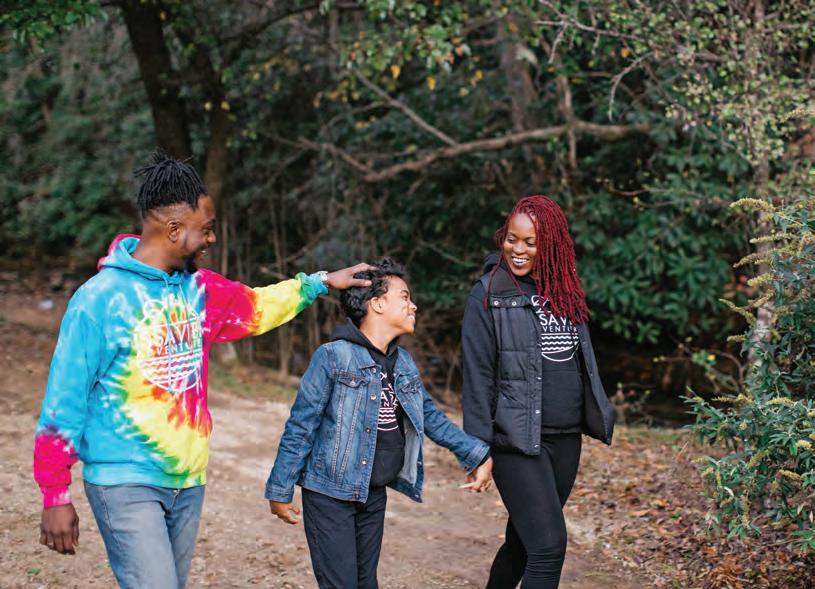
The walking trails at Leatherwood Mountains offer a quiet way to take in the landscape, including access to the historic Daniel Boone Trail. Photo courtesy of Leatherwood Mountains.
W hen the mountain air warms up, the creek becomes the heart of the resort for swimming and tubing. For a swifter pace, there are recently renovated tennis and pickleball courts, while the peaceful ponds provide space for catch-and-release fi shing.
A PLACE TO GATHER
T he feeling of community gathers at Saddlebrook Restaurant, where the history of the mountain is literally built into the furniture. Whitson’s father hand-built the bar using reclaimed wood from the property—a detail that grounds the space in the Whitson family’s hands-on legacy. It’s a place where locals, riders, and travelers mingle over hearty meals. It’s the kind of place Whitson describes as being for people who want more than just a ride—they want a place to belong. Driving back toward Raleigh, the return feels slightly different than the drive in. Not because the distance changed, but because the rhythm did. Leatherwood isn’t defi ned by its trails or it s fi shing. It’s defi ned by the people who have protected its pace. It acts as a sanctuary, guarded with intention.
I f You Go: Leatherwood Mountains Resort
• Location: Ferguson, North Carolina— approximately 3 hours from Raleigh.
• Accommodations: Around 40 rental homes, including the renovated Bunk House, and a campground.
• Ac tivities: Guided trail rides, 75 miles of hiking (no hunting), swimming/ tubing, fishing, and tennis/pickleball.
• Dining: Saddlebrook Restaurant— check the calendar for live music and songwriter nights.
• Website: leatherwoodmountains.com
COMEBACKS From to CARRIAGES
A 1904 carriage house tied to J.C. Raulston, community hisory, and a near-lost downtown chapter—revived through the owner’s vision
STORY BY DATHAN KAZSUK | PHOTOS BY JESSICA BRATTON
Some houses feel like they were built to impress. Then there are houses that feel like they have survived the city, several decades of bad ideas, a tornado, and just about everything else short of a direct hit from Armageddon.
T h is one, the one I visited this past April, tucked off East Davie Street in downtown Raleigh, belong s fi rmly in the second category.
L ong before it became the home of Alan McDonald, before it became associated with famed horticulturist J.C. Raulston, and before anyone had the bright idea to turn an old utility building into a dramatic place to live, the structure began life in 1904 as a working carriage house and storage building for the city. Over the years, it lived several different lives, including stints as a machine shop, storage space, and even, somehow, a barbershop.
T hen came J.C. Raulston.
R aulston was no ordinary homeowner. He was the horticulturist at North Carolina State University who founded the arboretum that now bears his name. He arrived at NC State in 1975, established the arboretum in 1976, and became one of the most important plant ambassadors the region has ever produced. A 2024 City of Raleigh historic context study notes that his renovated warehouse home was large enough to host gatherings tied to the Lavandula and Labiatae Society, the network he organized for gay and lesbian horticulturists and gardeners.
R aulston died in an automobile accident in December 1996, and, after his death, the property eventually passed through the orbit of the Alliance of AIDS Services-Carolina, a nonprofit founded in 1999 to serve people living with and impacted by HIV/AIDS.
A nd then, as these stories tend to go, along came a man from Canada looking for a loft.
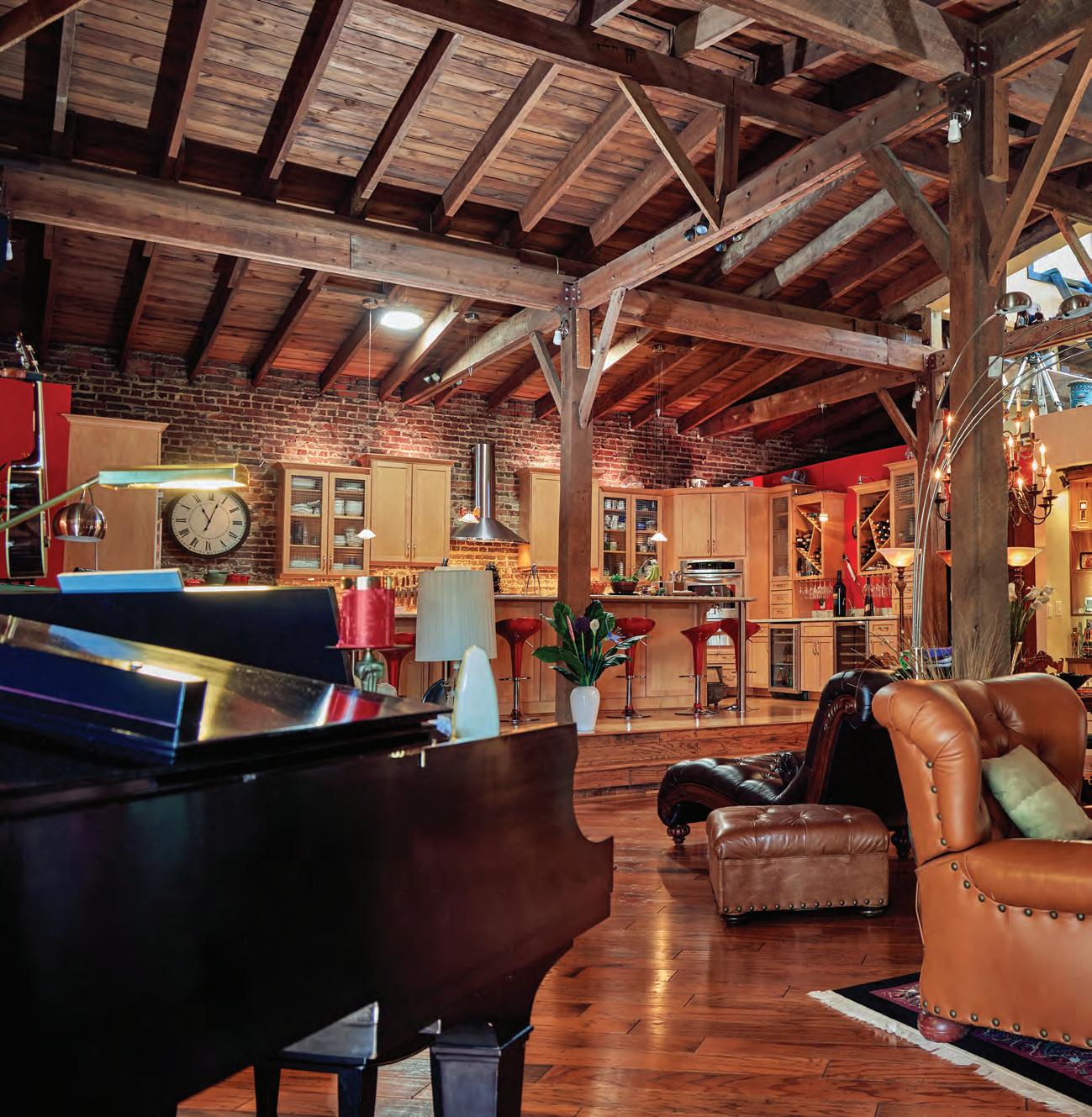
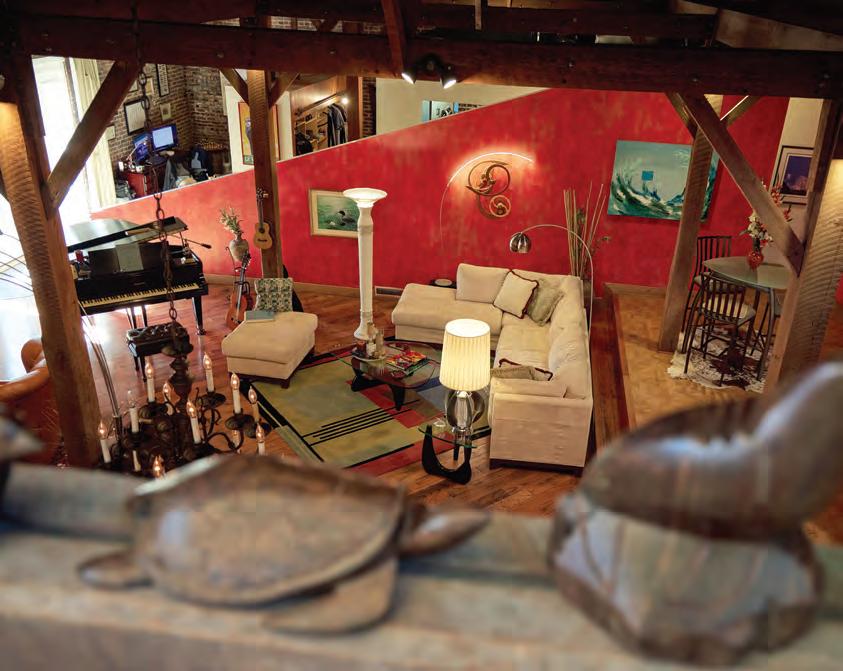
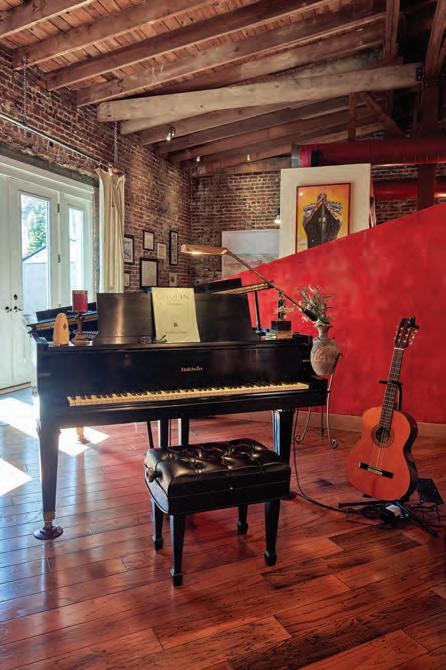
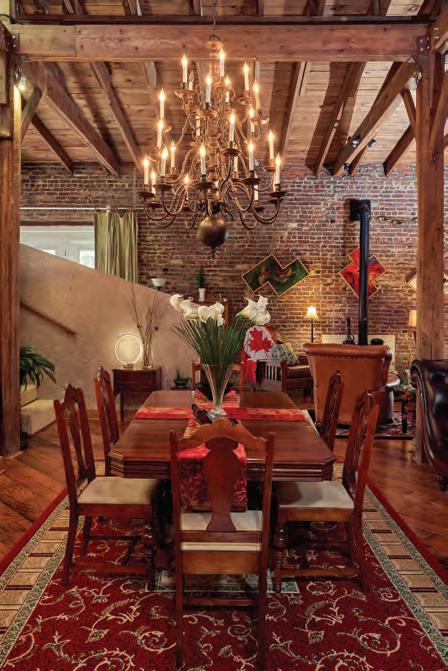
Exposed beams, worn brick, and a few lifetimes worth of stories—the 1904 carriage house now stands as a carefully revived piece of downtown Raleigh history.
W hen McDonald fi rst came to Raleigh for work in the railroad industry, he had a vision. In Montreal, loft living was having a moment, and he wanted something open, large, and unlike the usual chopped-up condo conversions. Through a connection, who was then tied to the Alliance, McDonald found this downtown property and saw possibility where most sane people would have seen a warning label.
“ So my fi rst impression when I walked in was, holy crap,” he told me. “I mean, the place was empty it smelled like animal urine …” And still, somehow, he saw it. G etting it, though, was another matter.
McDonald had to return to Canada to sort out his papers after 9/11 hardly ideal timing for an international move. By the time he returned to Raleigh, the property was already under contract. Most people would have cursed their luck and moved on. But a colleague told him that “under contract” did not mean “sold,” only that there was still a way in if he could resolve whatever was holding up the deal. He did just that.
McDonald’s professional life had been built in the railroad business. Music had once been part of the picture—he played trumpet in Canada’s National Youth Orchestra— but practicality won out. “I wanted to eat,” he said, which is about as honest a career summary as anyone can offer. He spent 42 years in railroading, moving from conductor and locomotive engineer into leadership and, later, the data and systems side of the industry.
W hat he bought was not some polished historic gem. It was a mess. The version left behind from the Raulston era had dramatic bones but also black walls, black carpet, and, as McDonald described, a vibe
closer to “an ’80s biker bar” than to a warm home.
A rchitects came through with big ideas, many of them the kind that make owners nervous and preservationists reach for aspirin. One architect wanted to tear out walls and go grand. McDonald was not interested in turning the house into a gimmick. “I like the bones of the place,” he said. “I want to work within it.”
T hat instinct led him toward designer Gay Eatman and back to the original plans by architect Norma Burns, whose geometric vision helped shape the house in the 1980s. Triangular walls, angled sightlines, shifting shadows, and visual tricks were not accidents. They were designed to pull your eye upward and make the space feel different with every step. McDonald embraced that. What he did not embrace was the idea of painting the brick white. On that point, he and a designer parted ways, which frankly may have saved the soul of the place.
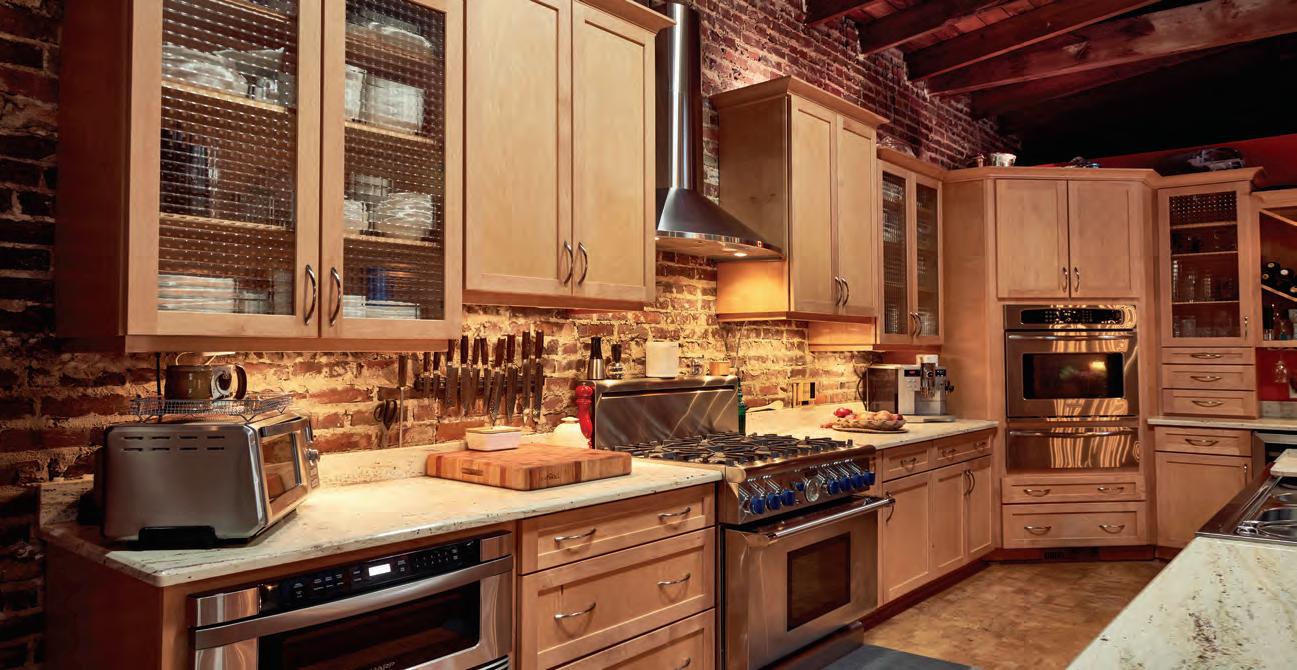
T he renovation became a patchwork of persistence, instinct, and collaboration. McDonald worked with contractor Fred Crouch. He hired a kitchen designer, bought the plans, then got ghosted. So he took those plans to Lowe’s and spent evenings with an employee whose name he wishes he could remember, because, as he put it, the man deserves credit. Together, they fi ne-tuned custom ideas that would never have worked off the shelf.
The 1904 carriage house didn’t arrive polished— it took vision, patience, and a willingness to embrace its imperfections. Today, its exposed structure, layered interiors, and lived-in warmth tell the story of a space that earned its comeback.
McDonald says the house was mostly done by the end of 2005, about a year after he took possession, but he also knows better than to call a 120-year-old building fi nished. “I never fi nished,” he said. “Not on something like this. There is always something to do.”
T hat became even more true after a tornado slammed through in 2011, tearing through the rear of the property, crushing part of the roof, taking out HVAC units, and ripping away vines that had covered the home. North Carolina’s April 2011 tornado outbreak caused severe damage across the region, and McDonald’s house was directly in its path.
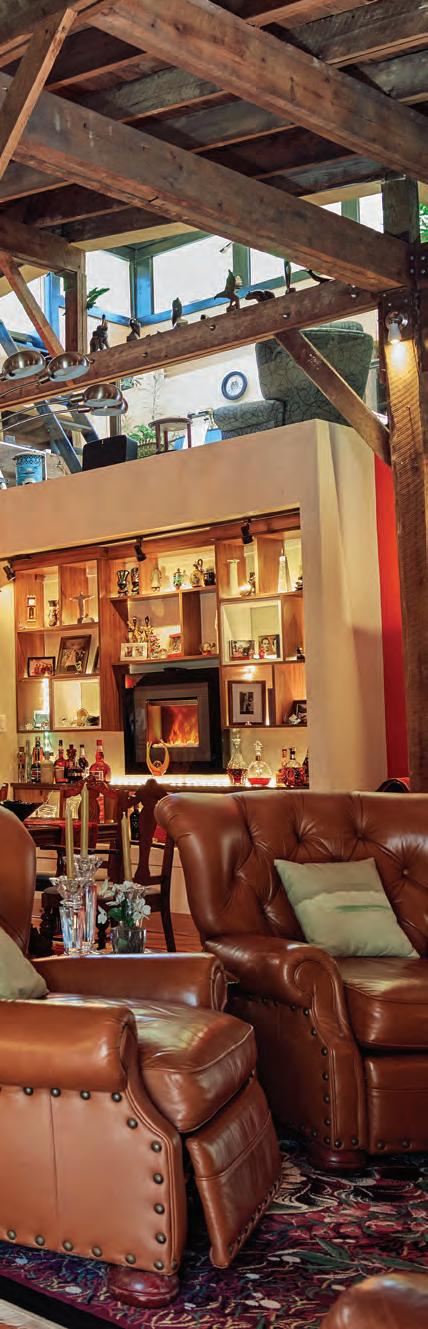
Today, what stands is not really a modernist house, at least not in the strict sense. McDonald calls it eclectic, and that feels right. It mixes eras, materials, and moods. Antiques live alongside contemporary pieces.
The original 1904 posts and ceiling remain, while everything around them has been reconsidered, repaired, or rebuilt. The goal, he said, was never allegiance to one style. It was to make the place “comfortable and inviting.”
T hat may be the best way to understand the house now. It is not a museum piece. It is not frozen in one era or trapped under a label. It is a former carriage house, a former workshop, a former community gathering place, a survivor of neglect, weather, and reinvention. And under McDonald’s watch, it has become something even better: a home with a memory, and a home still willing to evolve.
Comfort meets character in the home’s relaxed living space, where modern touches share the spotlight with a vintage Tintin collection full of story and charm.
2026 FACES OF RALEIGH
Welcome to our annual Faces of Raleigh, a portfolio of inspiring leaders and community influencers who want to personally introduce themselves to you. We can’t begin to share all the stories that deserve to be told, so once a year we invite our key business partners to participate in this special section—and to help you put a face with the name of their business, practice or nonprofit organization.
TABLE OF CONTENTS
52 The Face of UNIQUE CATERING AND HOSPITALITY
A Fine Catered Affair
54 The Face of WEALTH MANAGEMENT
56 The Face of THE AMERICAN DREAM Rey’s Restaurant
57 The Face of BEAUTIFUL SKIN
58 The Face of BOLD DESIGN Amanda Steinert F rancfort, ASF Interiors
59 The Face of COMMUNITY BANKING North State Bank
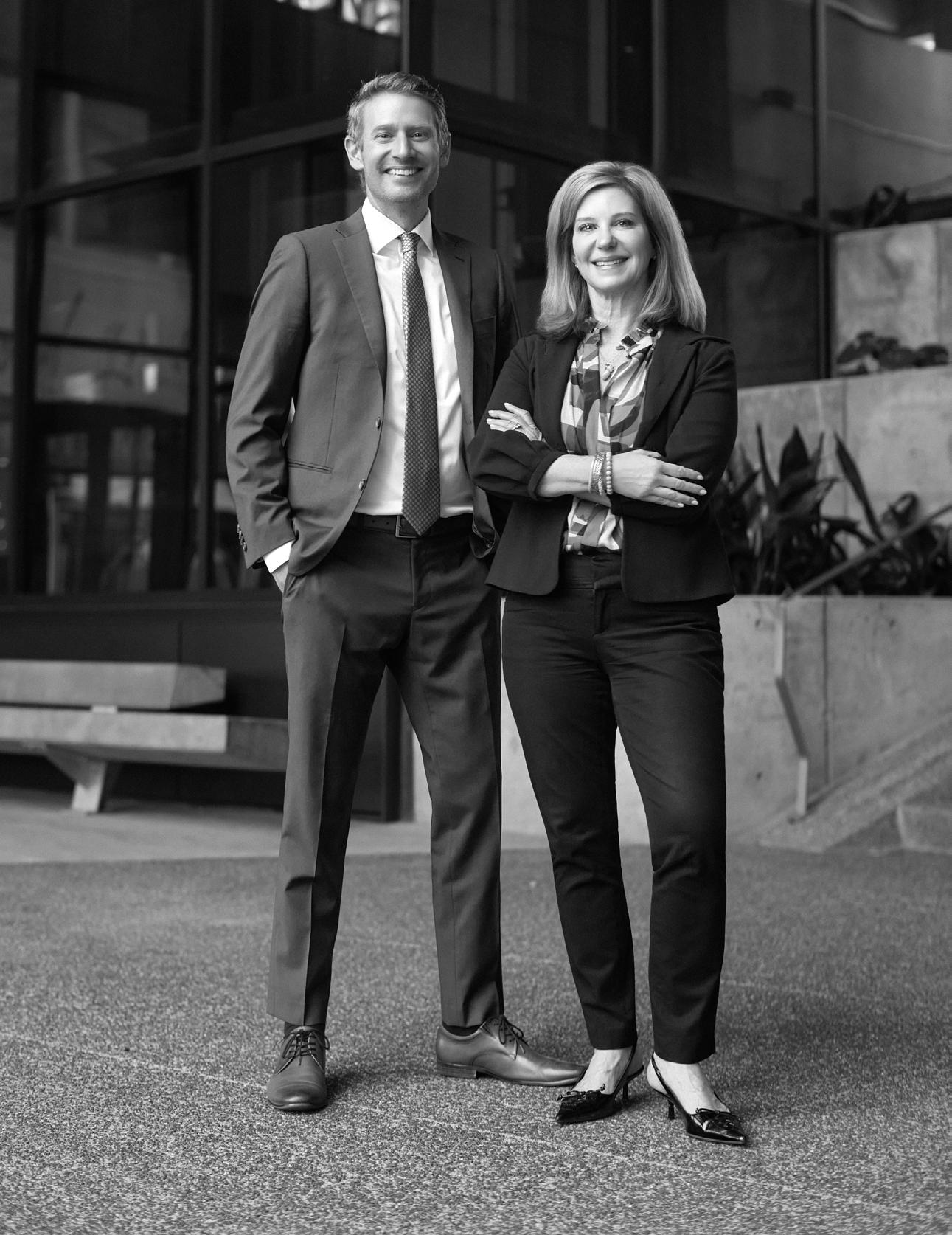
60 The Face of EXECUTIVE SEARCH
61 The Face of EXTRAORDINARY CUSTOM HOME BUILDING
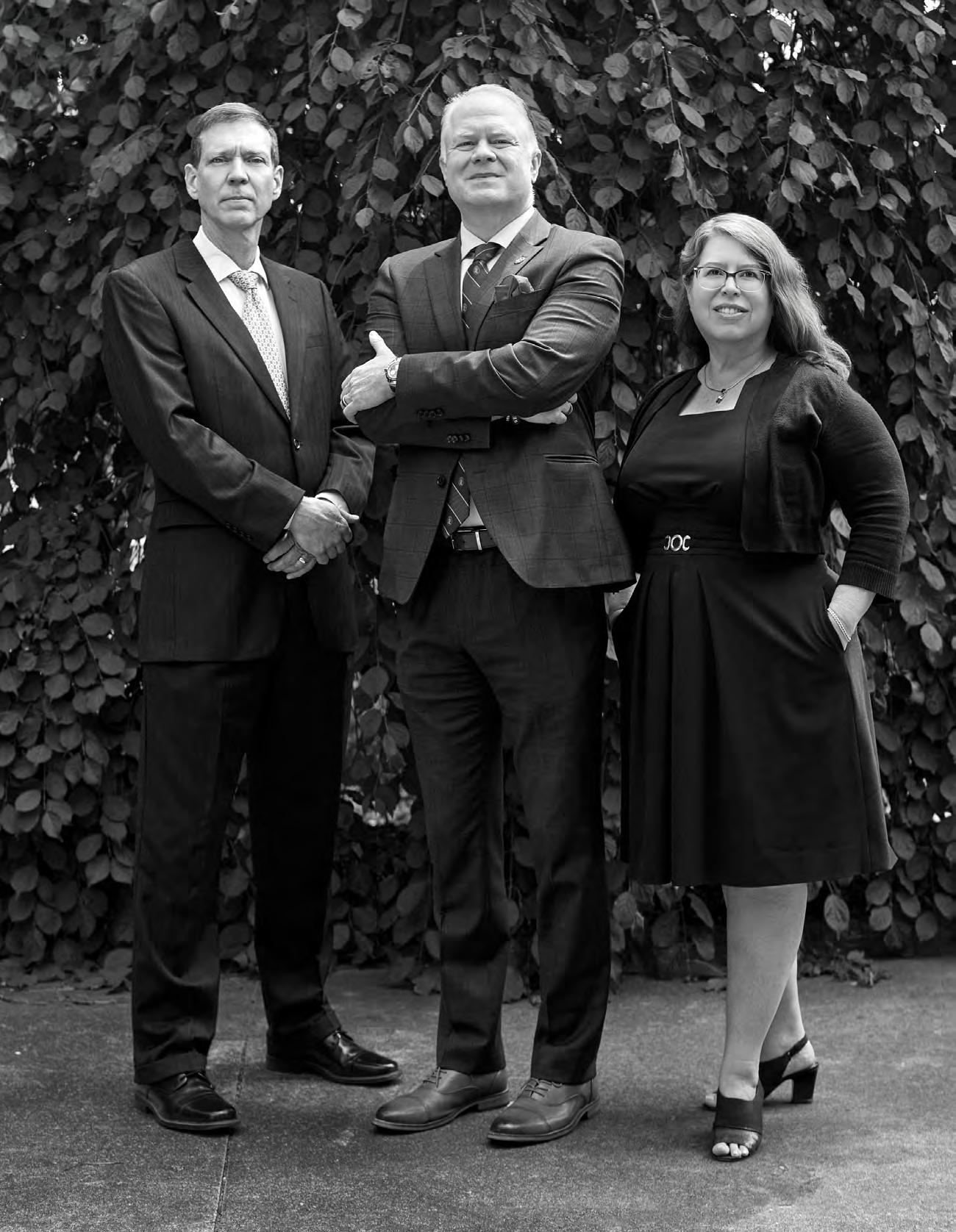
62 The Face of FAMILY LAW
63 The Face of HOSPITALITY DESIGN
64 The Face of INTEGRATIVE AESTHETIC SOLUTIONS
65 The Face of INTENTIONAL DESIGN AND CRAFTSMANSHIP
66 The Face of LOOKING AND FEELING YOUR BEST 4EverYoung
Centers 71 The Face of SMALL BUSINESS SOLUTIONS
Loading Dock 72 The Face of SP ORTS DENTISTRY: THE OFFICIAL DENTIST OF THE CAROLINA HURRICANES
Mitchell's Catering and Events 1996
THE FACE OF UNIQUE CATERING AND HOSPITALITY
MITCHELL • CASTEEL A FINE CATERED AFFAIR
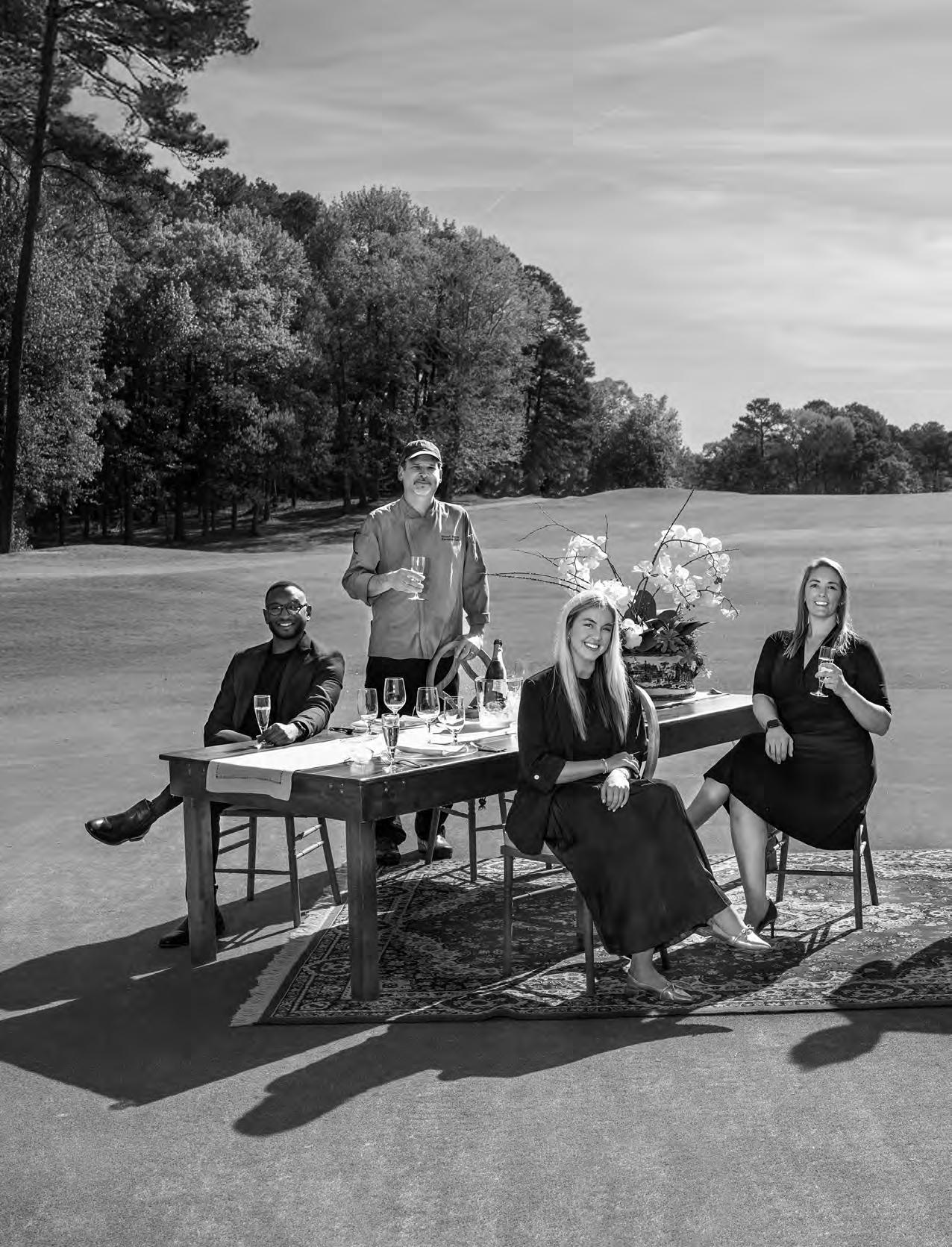
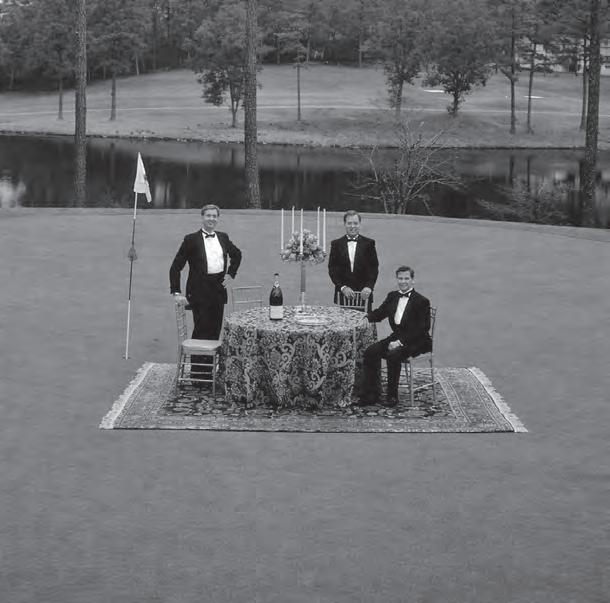
Where will we take you next? It began with a table. Set with intention. Placed where no one expected it.
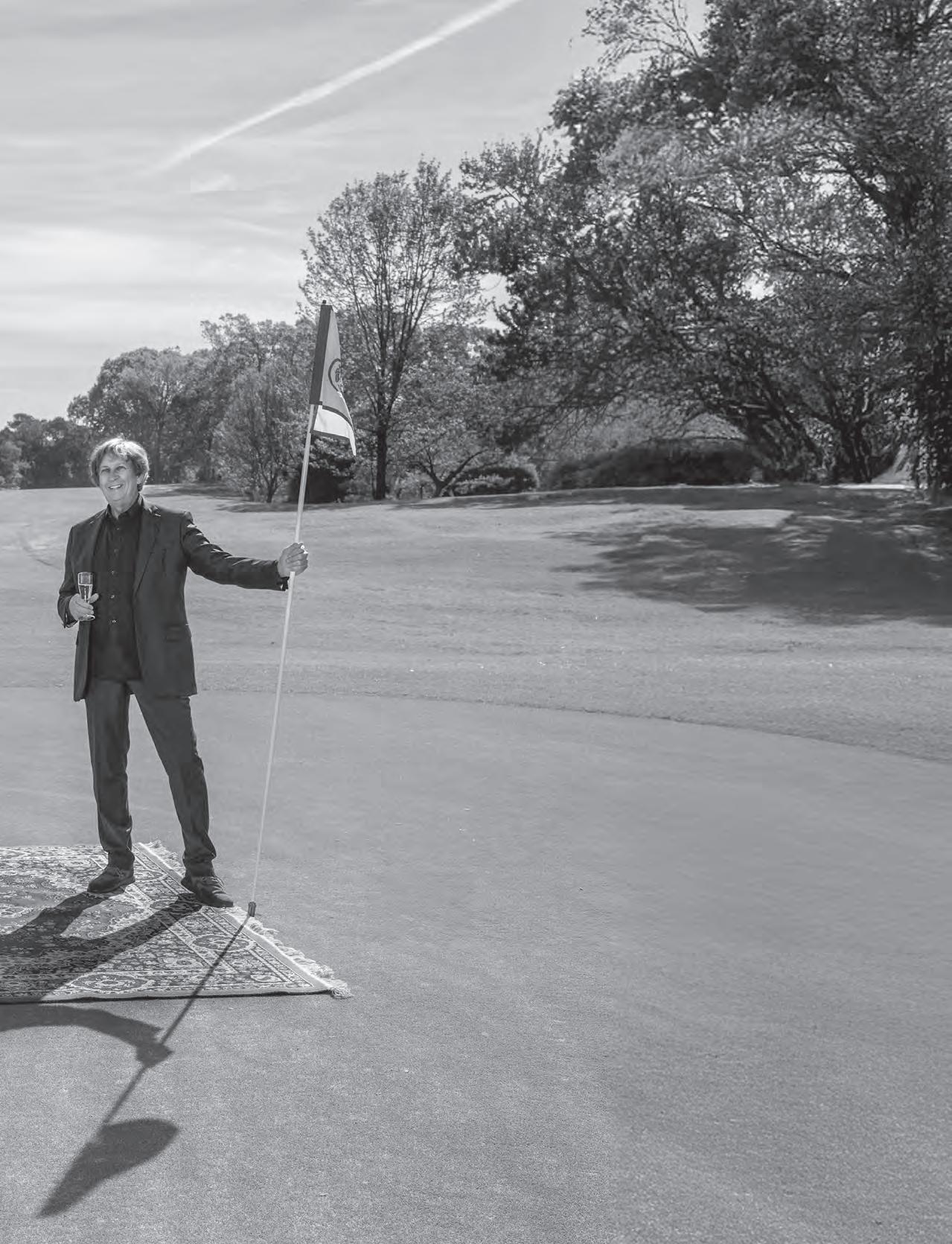
Years ago, our founders gathered on a quiet golf course, fine china, candlelight, and an unwavering belief that extraordinary dining could happen anywhere. That moment became a symbol of who we are. Now, we’re bringing it back. Introducing the Mitchell•Casteel “Magic Carpet.” A table without boundaries. An experience without limits.
Over the next year, we’ll be traveling, quietly, creatively, and reimagining spaces across the Triangle. From elegant venues to unexpected settings, from iconic gathering places to the comfort of your own home … we’ll show you just how far hospitality can go. You may catch a glimpse of us at places you know, perhaps along the lake at the Dorothy and Roy Park Alumni Center, or inside a beautifully set home where every detail feels personal.
But we won’t tell you where we’re going next. Because the magic isn’t just where we go, it’s how we transform it when we arrive. For 47 years, we’ve been defining hospitality in the Triangle, not by being the biggest, but by striving to be the best.
And now, we’re inviting you along for the journey. We don’t just cater events. We create experiences, anywhere.
1732 Capital Boulevard, Raleigh | 919.847.0135 | mitchellcasteel.com
THE FACE OF WEALTH MANAGEMENT ABSHER WEALTH MANAGEMENT
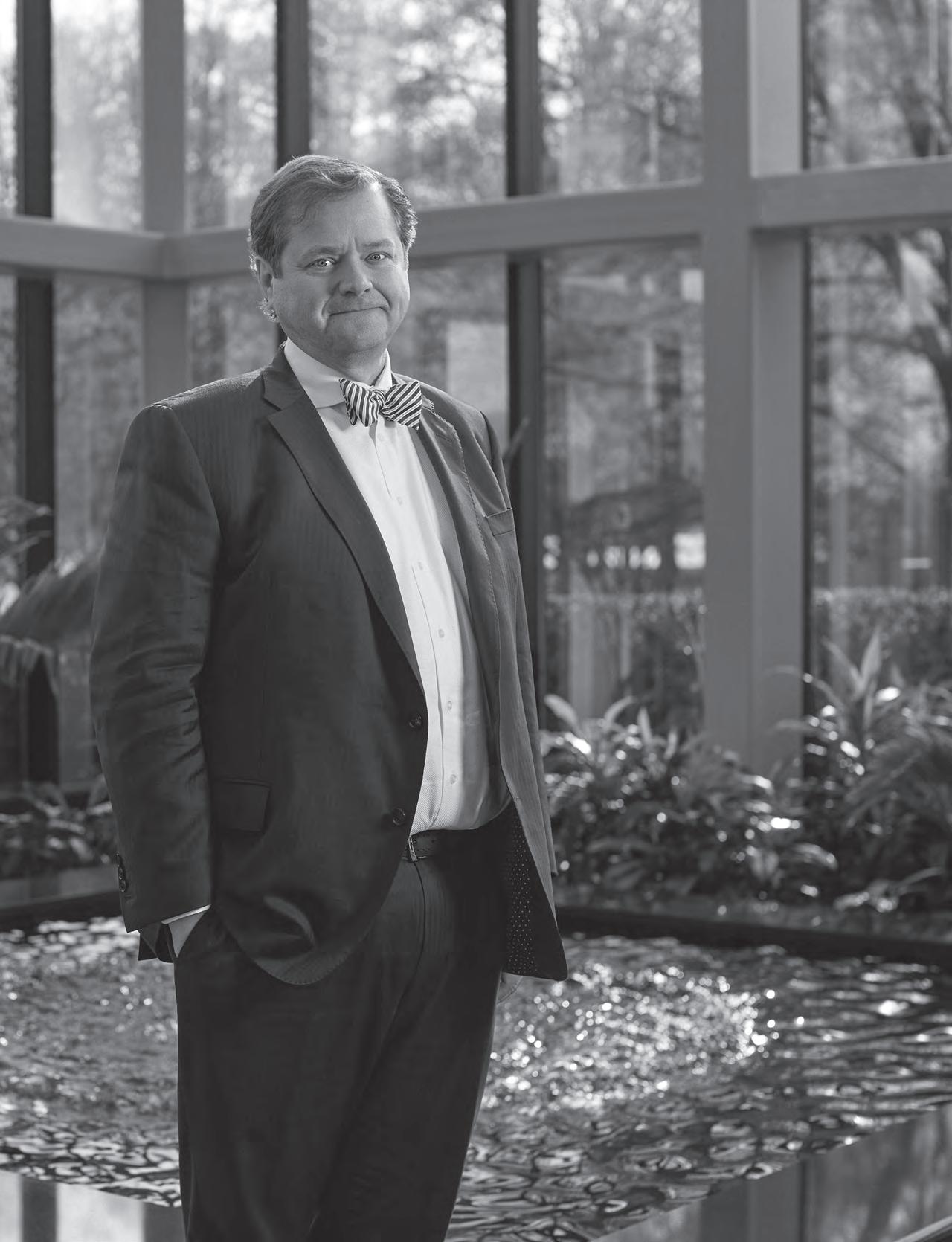
Mike Absher has spent the past 30 years implementing Warren Buffett’s wisdom for the benefit of his clients. With a focus on fundamentals, his firm invests in businesses that demonstrate pricing power against inflation and where he perceives a margin of safety for long-term capital. The philosophy of his firm is evident in their investment approach, which is centered around prudent stewardship as they seek to protect their clients’ purchasing power from inflation by avoiding permanent losses of capital. Following Mr. Buffett’s advice (which Mike quotes often), they seek to do so by “being fearful when others are greedy and greedy when others are fearful.”
Absher Wealth Management is a fee-only registered investment advisor and is a fiduciary. They provide asset management, financial planning, and investor education. As of December 2025, the firm held client assets of $1.25 billion and actively managed $1.16 billion on a discretionary basis.
3605 Glenwood Avenue, Suite 201, Glenwood Plaza, Raleigh 1450 Raleigh Road, Suite 105, Chapel Hill 919.283.2340 | absherwealth.com
THE FACE OF BEAUTIFUL SKIN
THE MEDSPA
At The MedSpa at Raleigh Plastic Surgery Center, we pride ourselves on being your ultimate destination for personalized aesthetic care. Our dream team brings together 45 years of collective experience in the realm of medical aesthetics, ensuring that your journey with us is tailored precisely to your goals and desires.
As one of the Triangle’s premier medical spas, we believe in providing realistic solutions that deliver proven success with our comprehensive range of services. Whether you’re looking to rejuvenate your skin, sculpt your body, or enhance your overall appearance, we are here to guide you every step of the way. Discover The MedSpa. Discover you. 1112 Dresser Court, Raleigh | 919.333.4418 | themedsparaleigh.com | @themedspa
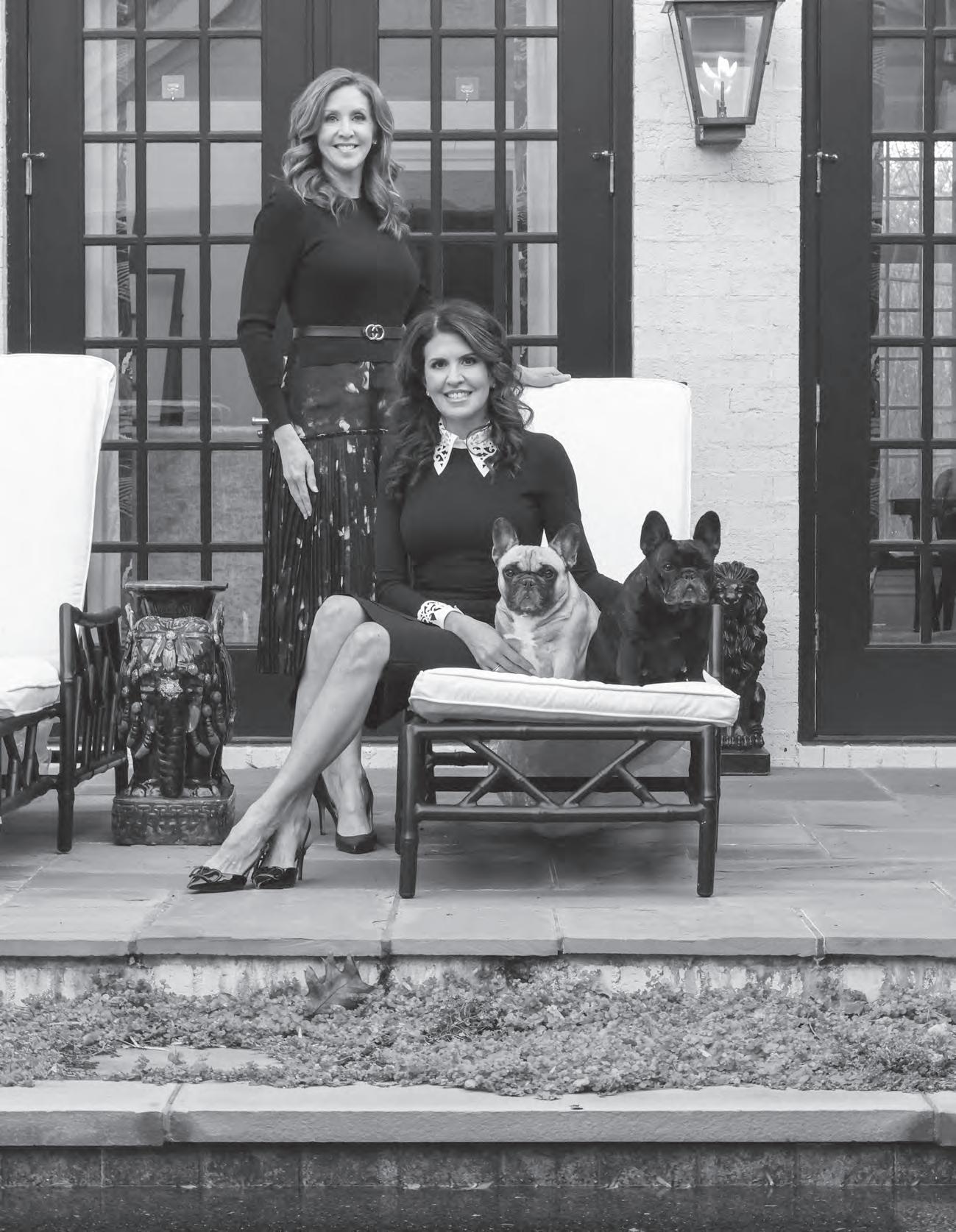
Meet the rule-breaker Raleigh has been waiting for. With 20 years of experience and a fearless ASF approach, Amanda is the visionary force transforming bland spaces into iconic ASF homes. She skips the “predictable” in favor of exhilarating colors and textures that create vibes you can feel in your soul. From executive offices that combat the daily grind to high-fashion family havens, Amanda designs for clients who want a home that reflects their journey and all that they’ve achieved along the way. It’s luxury with a conscience, a multisensory dopamine hit, and 100% authentically you. 908.432.0987 | asfinteriors.com | @asfinteriorsnc (IG) | @asfinteriors_nc (TT)
Coleman Lew Canny Bowen (CLCB) is a retained executive search firm known for delivering strategic talent insight and measurable results across a range of industries. Built on a foundation of collaboration and expertise, CLCB partners closely with clients to solve complex challenges of attracting and retaining executive talent. The firm’s team brings a forward-thinking and highly consultative approach to every engagement, blending innovation with practical execution. With a robust network of contacts across the country, CLCB has become a trusted name across the Raleigh area and beyond, helping businesses and organizations navigate change and achieve their goals with confidence.
704.377.0362 | clcbsearch.com
THE FACE OF EXTRAORDINARY CUSTOM HOME BUILDING
ICG HOMES
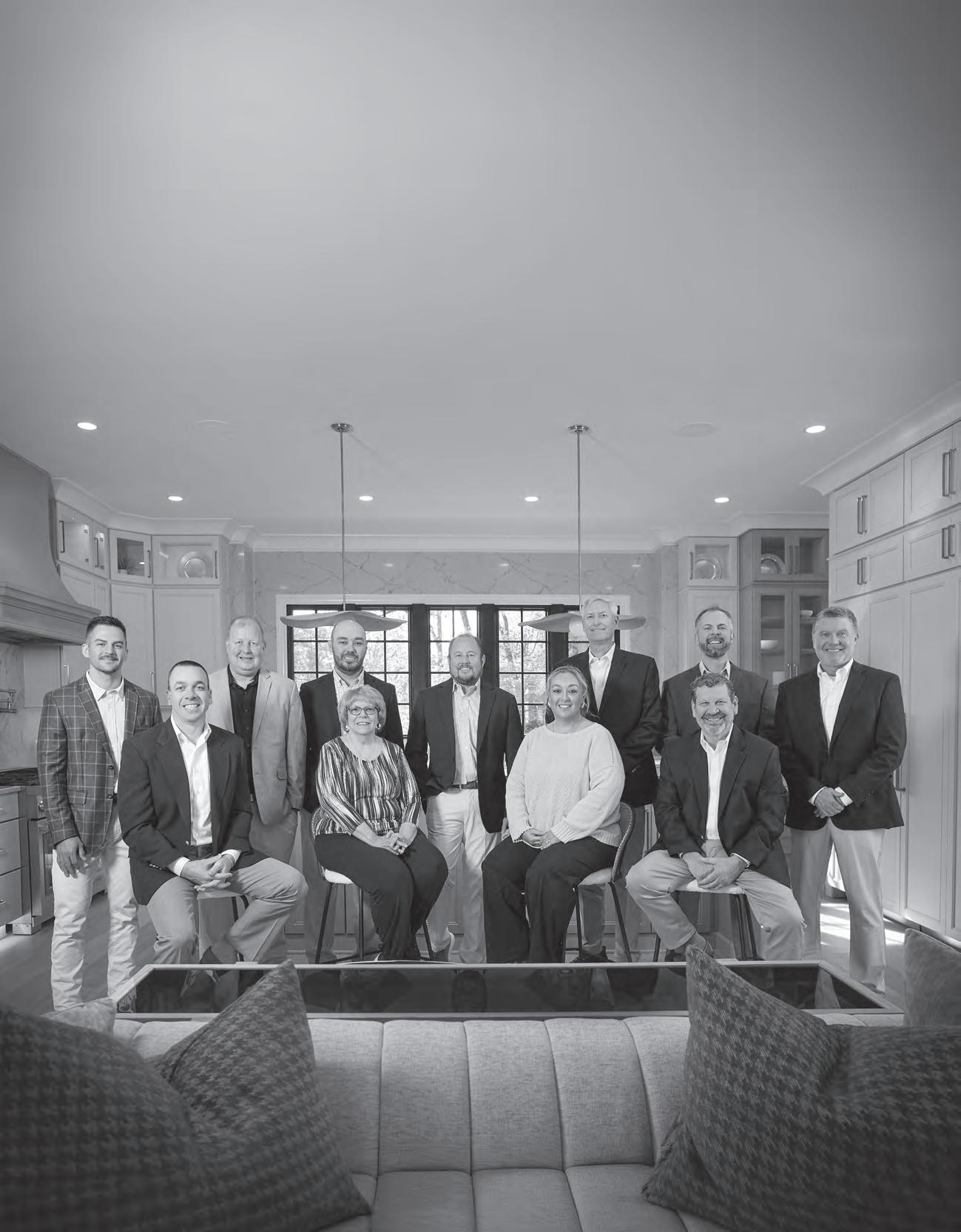
The management of award-winning ICG Homes has enjoyed more than 100 years of combined experience in building extraordinary homes. Locally owned and led by Ryan Perry, the company’s founding mission was to assemble a team of individuals with extensiv e expertise to provide homes with innovative designs, superior quality, intricate trim details, and most of all, exceptional customer satisfaction. The ICG team embodies this mission daily as they offer fresh ideas and appealing features in the creation of beautiful, well-built homes. Please contact ICG Homes to learn more about the company and its involvement in the St. Jude Dream Home® Giveaway.
4020 Wake Forest Road, Suite 306, Raleigh | 919.876.5802 | icghomes.com
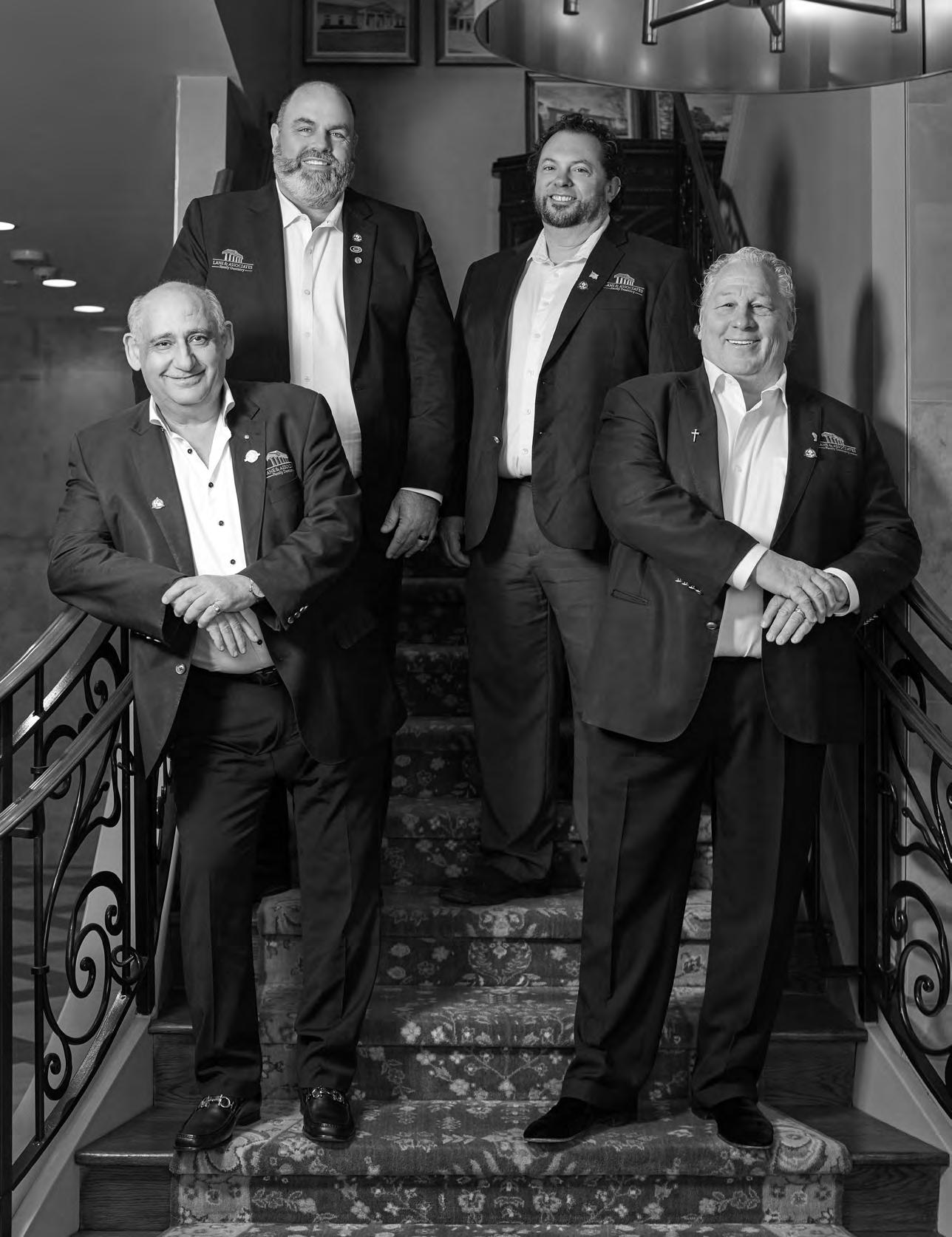
Pictured below: the ICG Homes Management Team
When families face the most difficult moments of their lives, they need more than legal experience—they need clarity, guidance, and someone they can trust.
At Gantt Family Law, clients are not just cases. They are individuals navigating uncertainty, and our role is to help them move forward with confidence. Whether it’s a custody dispute, divorce, or complex financial matter, our team is committed to providing strategic advocacy and compassionate support every step of the way.
Led by an exceptional team that includes three board-certified family law attorneys, Gantt Family Law brings expertise and insight to even the most complex cases. We know our job is about more than legal outcomes—it’s about helping people regain stability, protect what matters most, and move forward with confidence.
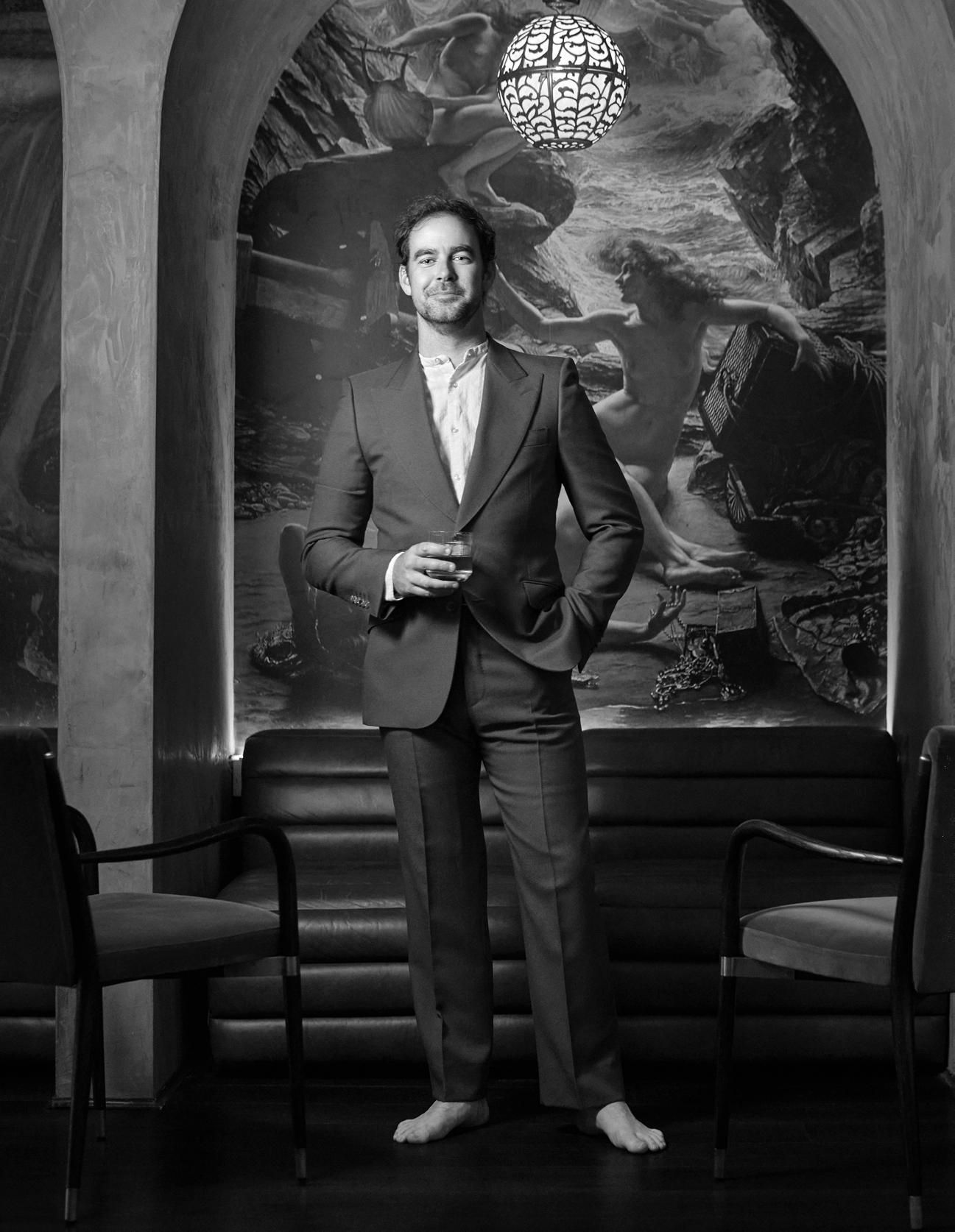
This Raleigh native pulls elements from his background as a filmmaker to create cinematic hospitality experiences. His rich designs are unmistakable and the momentum is undeniable. With recent openings like The Capulet Cocktail Club and Rosebud Cocktail Lounge, and a 2026 James Beard nomination for his otherworldly restaurant, Peregrine, Shanahan is leaving his creative mark across his hometown. What started a decade ago with Watts & Ward has grown into a design career where storytelling and guest experience converge with meaningful, immersive intent. pshanahan.com | @pmshanahan
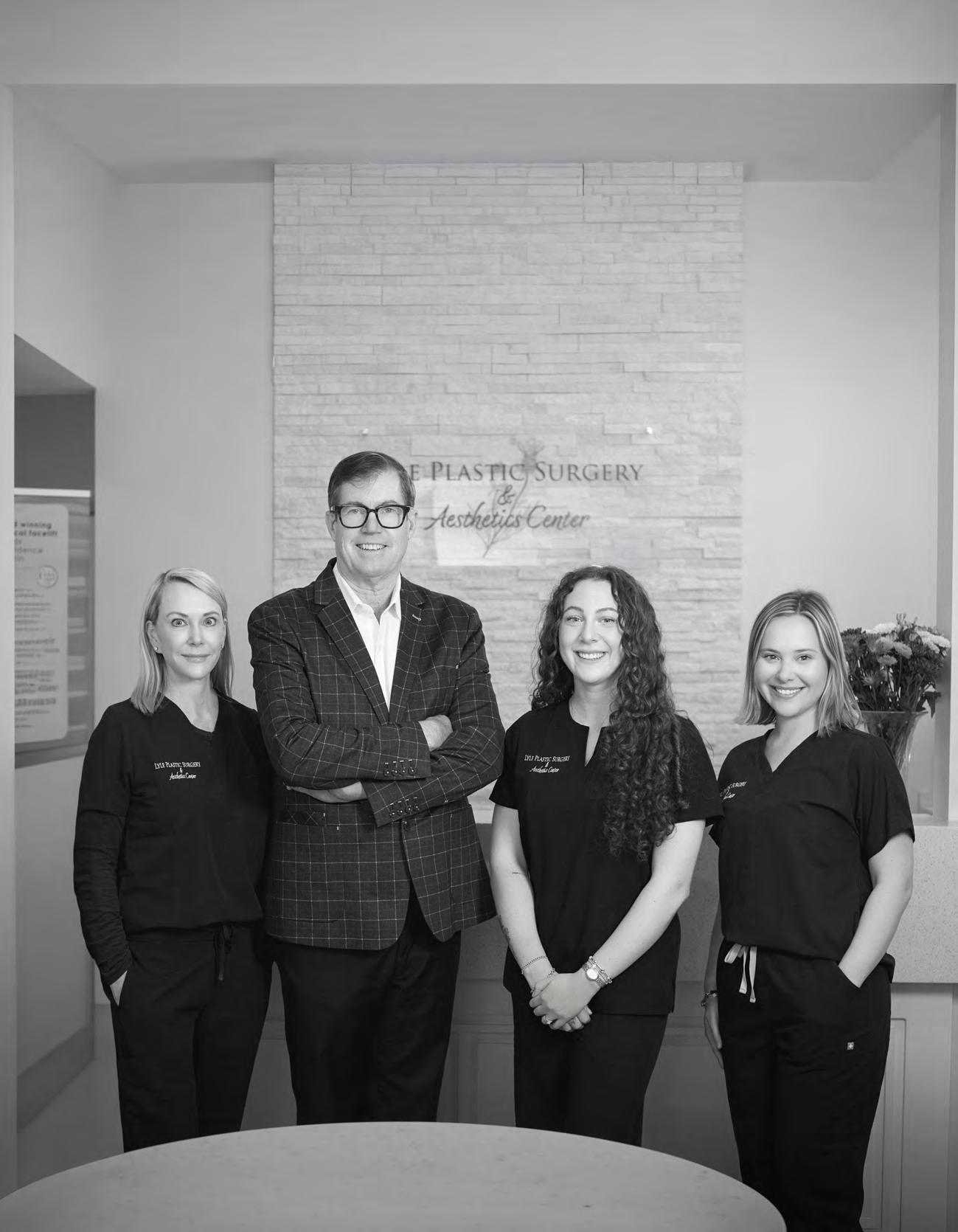
LYLE PLASTIC SURGERY & AESTHETICS CENTER
Dr. Glenn Lyle, one of Raleigh’s most trusted and seasoned board-certified plastic surgeons, and his team of aesthetic providers are ready to guide you on your transformative aesthetic journey, focusing on naturally enhancing what you already have. Lyle Plastic Surgery & Aesthetics Center not only offers traditional surgical procedures, but also minimally invasive to noninvasive treatments incorporating advanced regenerative therapies for the body, skin, and women’s wellness. Using proven technologies delivered by our highly trained aesthetic providers, we focus on the body as a whole, providing safe solutions in a comfortable, caring atmosphere. Come discover how Lyle Plastic Surgery & Aesthetics Center can help you! 3909 Sunset Ridge Road, Suite 201, Raleigh | 919.307.8585 | drglennlyle.com
THE FACE OF INTENTIONAL DESIGN AND CRAFTSMANSHIP
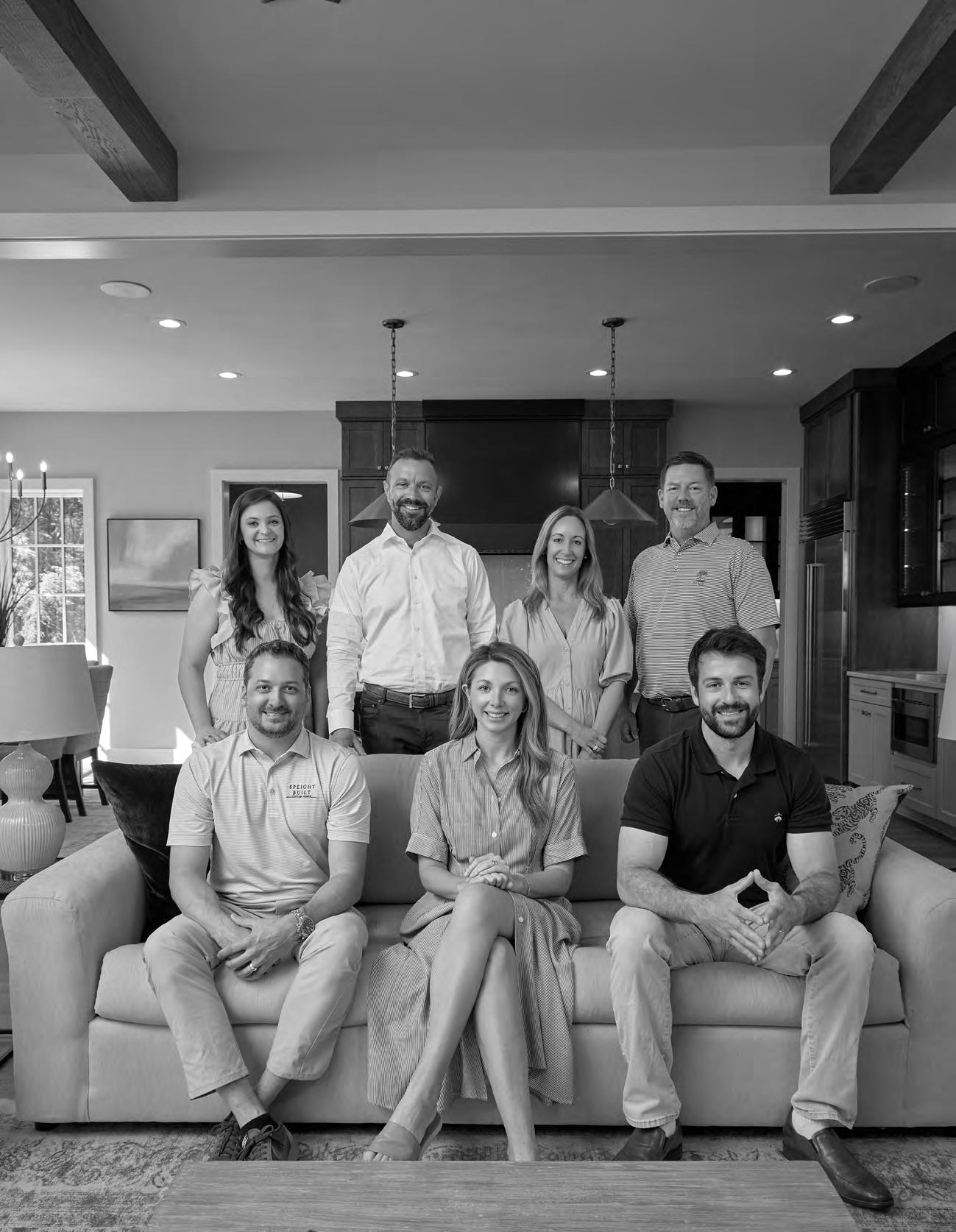
SPEIGHT BUILT CUSTOM HOMES
Speight Built Custom Homes is a Raleigh-based builder focused on making the custom home process clear, collaborative, and personal. We work closely with each client from the earliest planning stages through construction, helping to guide decisions and simplifying what can often feel overwhelming. Our homes are designed around how people actually live—balancing thoughtful design, quality craftsmanship, and practical functionality. By partnering with trusted architects and trade professionals, we create homes that feel intentional without overcomplicating the process. At our core, we believe building a custom home should be an exciting and rewarding experience, not a stressful one.
211 E. Six Forks Road, Suite 221, Raleigh | 919.889.5694 | speightbuilt.com
At 4EverYoung North Raleigh, we believe looking your best starts with feeling your best. Our expert team combines advanced aesthetics with personalized wellness programs designed to restore energy, confidence, and vitality at every stage of life. From Botox and skin rejuvenation to hormone optimization, IV therapy, and medically guided weight loss, we tailor every treatment to the individual—never a one-size-fits-all approach. We focus on proactive care and long-term results, going beyond surface-level beauty to deliver real transformation. With our approach, you’ll feel refreshed, confident, and energized from the inside out—ready for whatever comes next.
7431 Six Forks Road, Raleigh | 919.666.2053 | 4everyoungantiaging.com/north-raleigh
For over 22 years, The Sheri Hagerty Group has set the standard for luxury real estate in Raleigh. With a proven, results-driven strategy, Sheri and her team don’t just list homes—they consistently position them to sell at record-breaking levels.
A proud member of the Triangle’s Luxury Home Marketing Group, Sheri was named Raleigh’s Best Realtor in 2024 and 2025 and received the Wake Living Readers’ Choice Award in 2025. As a Raleigh native, she brings unmatched insight into the Triangle market—insight that consistently translates into top-tier results for her clients.
Ranked in the top 1% of Realtors nationwide, The Sheri Hagerty Group delivers a seamless, full-service experience designed to exceed expectations and maximize value.
3200 Wake Forest Road, Suite 101, Raleigh | 919.862.6258 | sherihagerty.com
Whitley Law Firm is proud to serve the Raleigh community with a simple promise: “No Gimmicks, Just Results.” For over 50 years, the firm has advocated for individuals and families across North Carolina, combining experience with a deeply personal approach to every case. Known for putting clients first, their team works tirelessly to deliver meaningful outcomes while treating clients like family. Beyond the courtroom, Whitley Law Firm is committed to giving back through community initiatives, because being a trusted advocate means showing up for your neighbors in every way that matters. 1000 Social Street, Suite 200, Raleigh | 919.785.5000 | whitleylawfirm.com
AND WALSTON
Coldwell Banker Howard Perry and Walston (HPW) remains the premier real estate firm in the Triangle by consistently evolving with the ever-changing dynamics of our market.
To keep up with the local market, HPW’s new leadership team—President Chris Walston, CEO Randy Cox, and COO Gina Eason—has instilled a commitment to agent development.
Through training, support, a collaborative culture, and resources and tools that embrace change, HPW professionals are empowered to succeed at the highest level.
This combination of adaptability and an agent-first philosophy positions HPW as the trusted leader in the Triangle real estate market.
“At HPW, success is helping people win by empowering agents, serving clients, and strengthening communities with trust, innovation, and dedication,” —CEO Randy Cox
Locations across the Triangle | 919.789.5200 | hpw.com
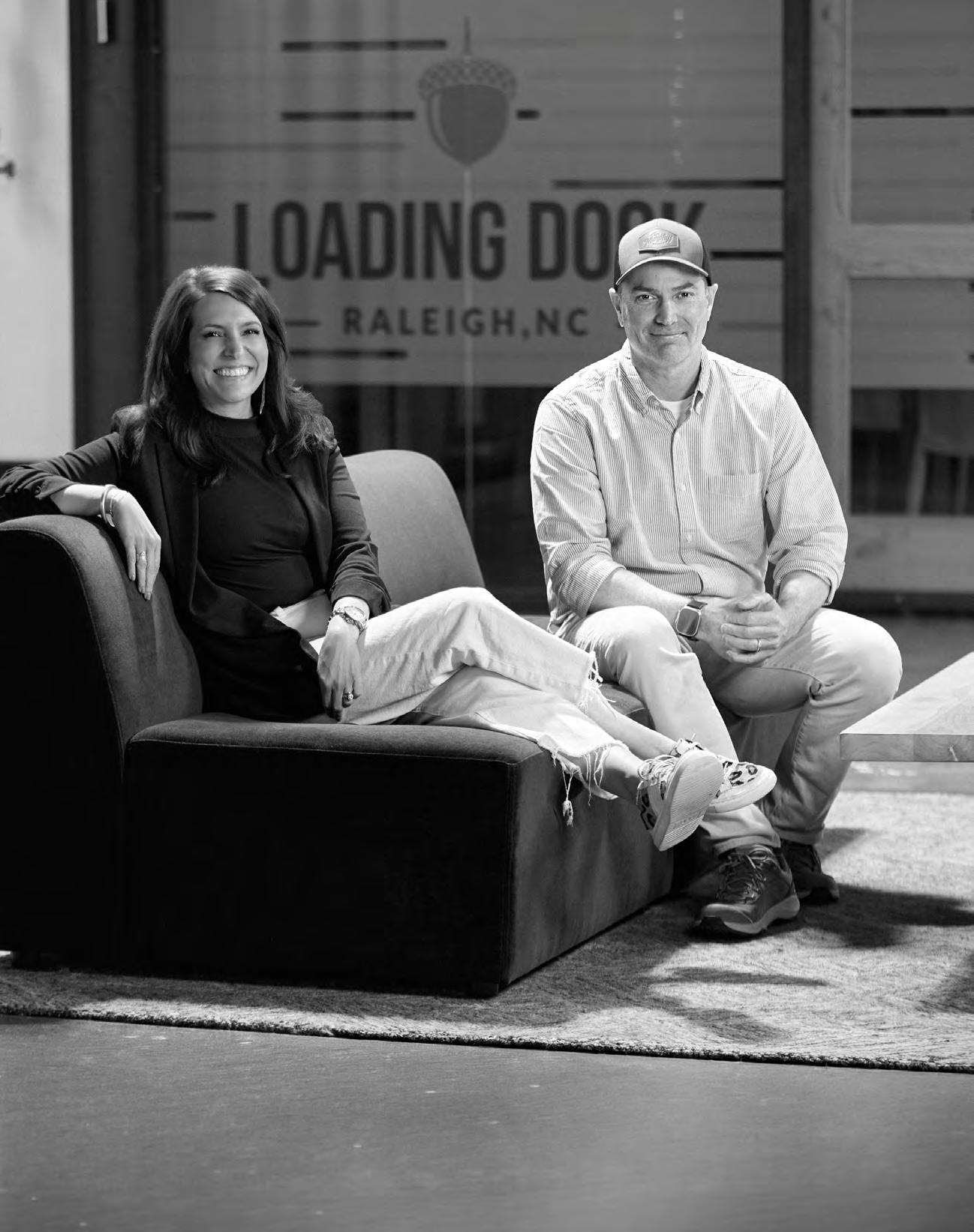
BUSINESS SOLUTIONS THE LOADING DOCK
While developing Murphy’s Naturals, Philip Freeman needed flexible office and warehouse space to scale his business but couldn’t find it. So he built it. The Loading Dock was born.
Ten years later, that vision, now led by President Jessie Hathcock, has grown to three locations across Wake County, 1,300 members, 450 companies, and 99% occupancy across office and cowarehousing memberships.
The Loading Dock brings together coworking, private offices, meeting space, and cowarehousing, solving common small business challenges around flexibility, community, and growth.
Ten years in. Still growing. Still solving. 1053 E. Whitaker Mill Road, Suite 115, Raleigh | 919.999.0252 | theloadingdock.com
“If
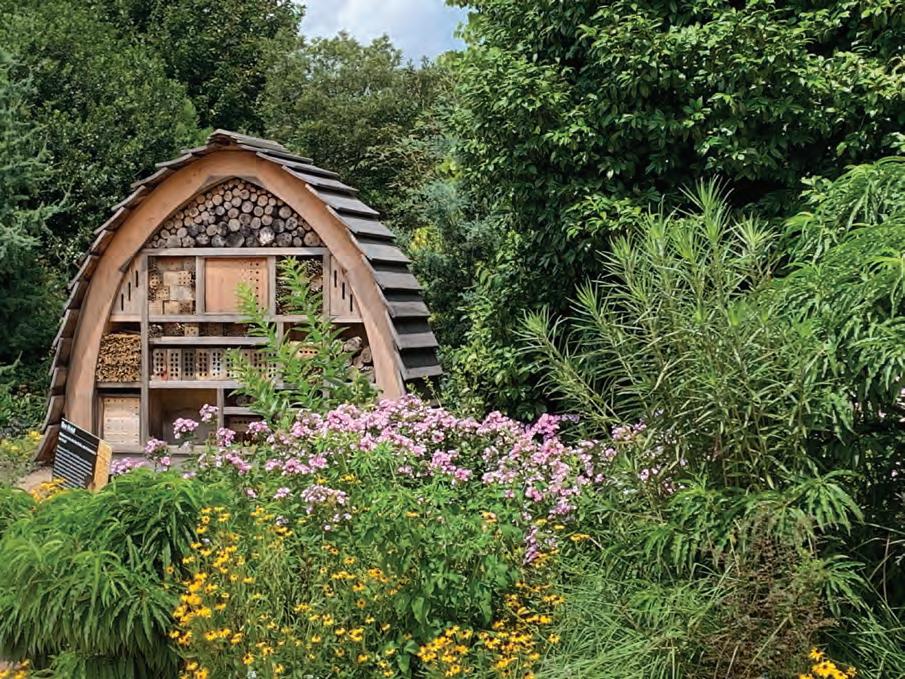
THIS PAGE: J.C. Raulston built a name for himself in the world of horticulture, with his legacy carrying on long after his death. OPPOSITE PAGE: The Bee Hotel for pollenators at JC Raulston Arboretum. Photos courtesy of JC Raulston Arboretum.
RALEIGH’S LIVING LABORATORY
JC Raulston Arboretum celebrates ve decades of diversifying the Southeast landscape
STORY BY BEVERLY HURLEY
What was once Raleigh’s best-kept secret is today recognized as one of the nation’s premier arboretums, with a plant collection unequaled in the Southeast. And it all started when a horticulturist from the wheat field of Oklahoma came to Raleigh.
J.C. RAULSTON’S IMPACT
In 1975, a young horticulture professor from Oklahoma, Dr. James Chester Raulston—better known as J.C.—was hired by North Carolina State
University to teach and transform an 8-acre plot near the state fairgrounds into an arboretum that would serve the university’s horticulture program. A year later in 1976, he began planting the land with a bold mission: to diversify the types of plants available in the commercial nursery industry. In 1981, the university officially named it the NCSU Arboretum, and J.C. became its first directo.
At the time, plant options for gardens and landscapes were limited—nurseries grew only
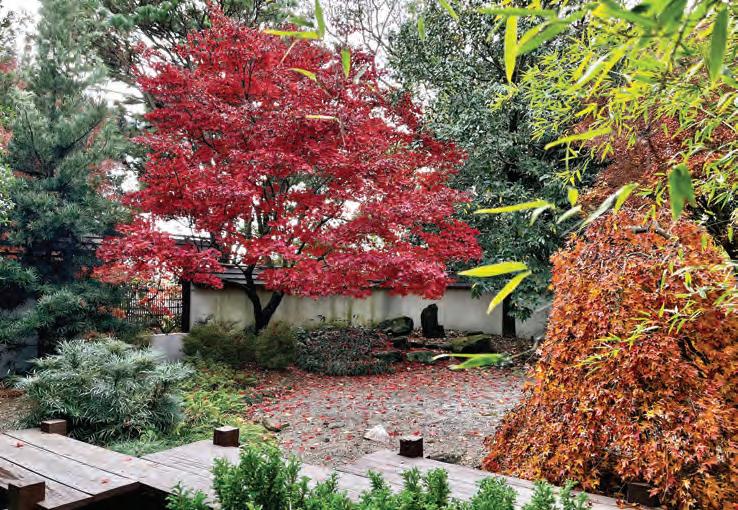
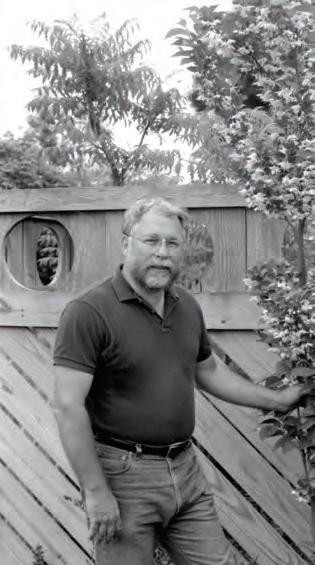
FROM TOP LEFT: Redbud (Cercis) inside the garden. Dr. James Chester
“J.C.” Raulston with a Japanese snowball plant. The arborteum’s Japanese Garden features a large Japanese maple, which turns red in the fall.
Photos courtesy of J.C. Raulston Arboretum.
a handful of varieties, leading to a landscape of repetitive choices. But J.C. saw the world of plants larger than that. He tirelessly collected, propagated, and promoted a wide range of woody plants to create a diverse and abundant plant palette. For the next 20 years, J.C. guided and directed university students, faculty, and volunteers to expand the arboretum’s plant collection and share these with the commercial plant industry. His mantra— “Plan and plant for a better world”—was more than a catchphrase; it was a call to action as he traveled the globe to find an evaluate plants suited for the Southeast, then shared his discoveries freely with the commercial plant trade. It’s said that J.C. introduced and promoted more plants in horticulture than anyone else during the late 20th century.
After his tragic death in a car accident in 1996, tributes poured in from peers who described him as a “generousspirited giant among horticulturists” and a “plant evangelist.” The university honored his legacy by renaming the arboretum the JC Raulston Arboretum (JCRA) in 1997.
Arboretums throughout the world enjoy many of the plants sent to them by J.C., including his signature selections and his well-known favorites. Some of the plants discovered by J.C. are still growing at JCRA today. His Chindo viburnum (Viburnum awabuki ‘Chindo’) and ‘Emerald Pagoda’ Japanese snowbell (Styrax japonicus) can be seen while strolling the grounds. And better yet, many of his plants are available at local garden centers to grow in your garden.
JC RAULSTON ARBORETUM’S VISION FOR THE FUTURE
Over the years, JCRA has expanded its scope, growing from its original 8 acres to 10.5 acres, providing more space to grow, trial, and share plants. And while it still seeks out plants from around the world for Southeast growing conditions, and gives away plants to nurseries and its members, it’s what leaves the garden
in terms of passion and knowledge that is setting the arboretum’s course for the future.
“Many public gardens have great plant collections, but their focus is inward, creating and showcasing lovely gardens,” explains Mark Weathington, director of JC Raulston Arboretum. “Our focus is outward, to help people and the plant industry.” The arboretum’s educational programs provide hands-on learning for children and adults alike, from lectures to symposia, and visitors can always ask questions of the knowledgeable horticulturists who staff the garden.
As Weathington points out, the places where people garden have changed significantly since .C. first came to Raleigh. “The JCRA focus for the future will address these changing places where people garden, and the types of plants suitable for these locations.”
In the 1970s, North Carolina’s population was predominantly rural or suburban, with expansive lawns. Today, urban gardening is on the rise, and people are gardening in smaller spaces. “Having a diversity of plants and sustainability is still a driving focus in gardens, but we have to do it differently in urban landscapes with smaller spaces,” he says. Green walls in cities, smaller gardens on reduced lot sizes, pocket gardens where there is open space, and gravel gardens in hard-to-grow areas are just a few of the opportunities. “People have to be more thoughtful now as they are planting— from rooftops to the concrete edges of city streets,” he sums up.
A revised biography of J.C. Raulston, Chlorophyll In His Veins: J.C. Raulston, Horticultural Ambassador by Bobby J. Ward (UNC Press), was released earlier this year, featuring a new foreword by plantsman Tony Avent and an afterword by JCRA director Mark Weathington.
JC Raulston Arboretum is open year-round at 4415 Beryl Road in Raleigh. For more information, visit jcra.ncsu.edu.
CLOCKWISE
WHOLE NEW BALL GAME
Professional softball is coming to the Triangle— with local ties, top talent, and high hopes
STORY BY KURT DUSTERBERG
When the Athletes Unlimited Softball League (AUSL) announced in January that it was placing a franchise in the Triangle, the idea made immediate sense. With prominent college programs like Duke University and the University of North Carolina already on the landscape, Carolina Blaze felt like a natural fit.
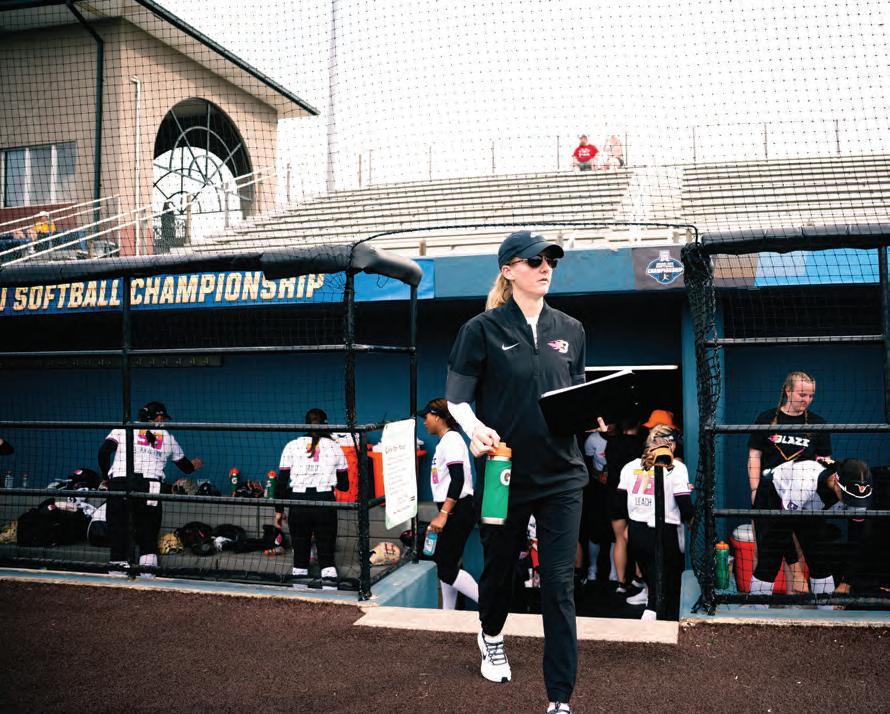
The Blaze will join the Chicago Bandits, Oklahoma City Spark, Portland Cascade, Texas Volts, and Utah Talons in the six-team league, and will play at Smith Family Stadium, Duke’s home field. The 25-game season egins Tuesday, June 9 at home against Portland and runs through July 20.
“It’s the combination of this sport, which has been on the rise in the last decade, merging with the investment of the people who are there in Durham,” says head coach Kara Dill. “Durham just feels like such a great place to make that happen.”
The league is in its second season, but 2026 will be its first with city-based teams. As a four-team league in 2025, the AUSL played under a touring format, visiting 10 cities. With the more traditional home-city model, each team can build a community identity. In the case of the Blaze, that starts with former Duke pitcher Jala Wright, who graduated in 2024. Since then, she has won two championships playing for the Atlanta Smoke in Women’s Professional Fastpitch. And she’s already found her way back to her former home field after ecoming the Blue Devils’ pitching coach in 2026.
“Sometimes I have to take a deep breath, because I get overwhelmed by it all,” Wright says. “I have to pinch myself that, okay, this is my dream and I’m right where I need to be. I can only give thanks to God. I’m just so grateful to be where I am.”
The Blaze will feature another Duke alum, Ana Gold, who graduated in 2025. The infielder was the USL rookie of the year last season with the Blaze, finishing seventh in the league with a .373 batting average.
“I think that’s going to be really fun,” Gold says. “Holding home field advantage is a real thing, being comfortable playing and having your fans rooting for you. It’s being able to play for not just yourself and your team, but also the community and the fan base.”
Her coach is hoping Gold’s second season will be even better than her first. “She’s an incredible athlete,” Dill says. “She played a little bit of third base, a little bit of shortstop, and offensively she was so consistent. When you look back at
OPPOSITE PAGE: Carolina Blaze infielder na Gold takes her stance at the plate. Gold played softball while going to Duke University in Durham. All photos courtesy of Athletes Unlimited Softball League.
her career at Duke, you see that in her stats. I’m definitely expecting her to be a big part of what we do this year.”
The Blaze is not the first professional softball team to call the Bull City home. The Durham Dragons played at Durham Athletic Park from 1997–1999. The game has grown remarkably since then, with youth travel softball paving the way for high school and college programs.
“The talent has evolved immensely,” Wright says. “Pitchers are already hitting 70 mph at 15 years old. I could only dream about that growing up. There’s got to be something propelling the game, and I honestly think it’s just our passion. The ladies that have been playing this game long before I have, they want to grow this game and they want to leave a lasting impression. That started with travel ball, then college, and now we have this league that simulates MLB (Major League Baseball).”
Durham will count on the game’s growth to help solidify the Blaze and further the city’s own investment in women’s sports. The city and university hosted the North Carolina High School Athletic Association Softball Championships last year on Duke’s home field, as well as the 2025 CAA Division I Field Hockey Championship.
“Durham has been strategic and intentional in highlighting girls and women in sports,” says Marcus Manning, executive director of the Durham Sports Commission. “Durham continues to grow as a sports destination, and the AUSL and Carolina Blaze add to the Triangle region’s already thriving sports ecosystem. The Blaze provides unique opportunities for participation, fan engagement, and awareness.”
Dill has a unique perspective on the improvement of
OPPOSITE PAGE: The team celebrates after a victory or home run. Ana Gold throws toward home plate.
THIS PAGE: Coach Dill walks out on the field prior o a game. The women huddle for a pep talk. Ana Gold is ready to get an out as she throws the ball.
softball talent in recent years. She is the head coach at the University of Texas at Arlington, a Division I program. She has seen the game change dramatically since she played at the University of Kentucky, where she graduated in 2013. “The data and analytics were significantly ehind 10 years ago, compared to where baseball was,” Dill says. “We’re catching up to them now. That has been a big development, so it’s just making our athletes more intelligent. When you’re able to get a pitching machine that can simulate what you’re going to face for the upcoming weekend, you can prepare your hitters. That’s a huge bonus.”
And once the Blaze players put their high-level skills on display, the AUSL might become the first pro softball league with real staying power. “This is the MLB for softball,” Gold says. “Softball is very high-paced, it’s fun to watch, and the league has done a really good job with fan engagement during the games.”
And if the AUSL can continue to grow, Triangle sports fans might soon be tracking another group of pro athletes. “It hasn’t been a valid option in the past,” Dill says. “It’s been something to do in the summer if you’re not really ready to hang up your cleats yet. Now, this could really be a thing for them. They can get paid as professional athletes. It is such a cool thing that we are able to offer this opportunity.”
Making a living playing softball would be a substantial step for the players in the league, but blazing a path for future players would mean a lot, too. “We are women and pioneers in this sport,” Wright says. “And I’m grateful to be one of those players to etch the game in history.”
THE EVOLUTION OF SOCIAL HOUR
Songbird’s intentional approach to all-day craft
STORY BY DATHAN KAZSUK | PHOTOS BY SONGBIRD
By the time I met Meg Paradise and Charlie Blue Arm for coffee in downtown Raleigh, there was already a low hum of anticipation around what they ’re building next. Maybe it was the way they talked—like hospitality isn’t just service, but choreography. Or maybe it was the concept itself: Songbird, a daylightto-dusk spot set to open June 2026 at East End Market, built to move from morning ritual to candlelit evening with the same level of intention all the way through.
This isn’t a “coffee place that also has cocktails” or a bar that begrudgingly keeps a couple of mocktails on the menu for the designated driver. Songbird’s whole point is that coffee, zero-proof, low-ABV, and full-strength drinks all get treated like the main event—no hierarchy, no consolation prizes.
And in a city that’s watched the definition of a “night out” get rewritten in real time, Songbird feels like the next logical step.
THE UMBRELLA YEARS
If Songbird has a prequel, it’s Umbrella Dry Bar, Paradise’s alcohol-free cocktail project that’s evolved through pop-ups, tastings, partnerships, and a bottle shop presence inside The Self Care Marketplace in downtown Raleigh.
Paradise didn’t come to this from some long-plotted “I always wanted to open a bar” dream. She came to it sideways, during Covid, while working remotely on a corporate track after 12 years at Whole Foods and quietly experimenting with what life looked like without drinking.
“I was kind of going through my own personal journey with not drinking,” Paradise says, describing the stretch where she was reading Quit Like a Woman in tiny increments—“like, two pages a night”—because life with young kids doesn’t exactly come with leisurely reading hours. In the book, she hit a line that landed hard: “Wouldn’t it be nice if there were more spaces with nonalcoholic options?”
“I was just thinking, yeah, I would love to have that,” Paradise says. Not because she wanted a lecture on sobriety, but because she still loved the ritual: getting dressed, making a plan, stepping into a bar, and ordering something that felt like it belonged there.
Then came the part that surprised even her. “I had a lucid dream at three o’clock in the morning about what this space would look like,” she says. “And at that point, I’d never run a bar or anything like that.”
The idea stuck. In September 2021, she journaled it. In October 2021, she formed the LLC. “I don’t know where this path is going,” she remembers thinking, “but I’m gonna try it and see where it leads.”
OPPOSITE PAGE: A Songbird bartender skillfully prepares the ice for a cocktail.
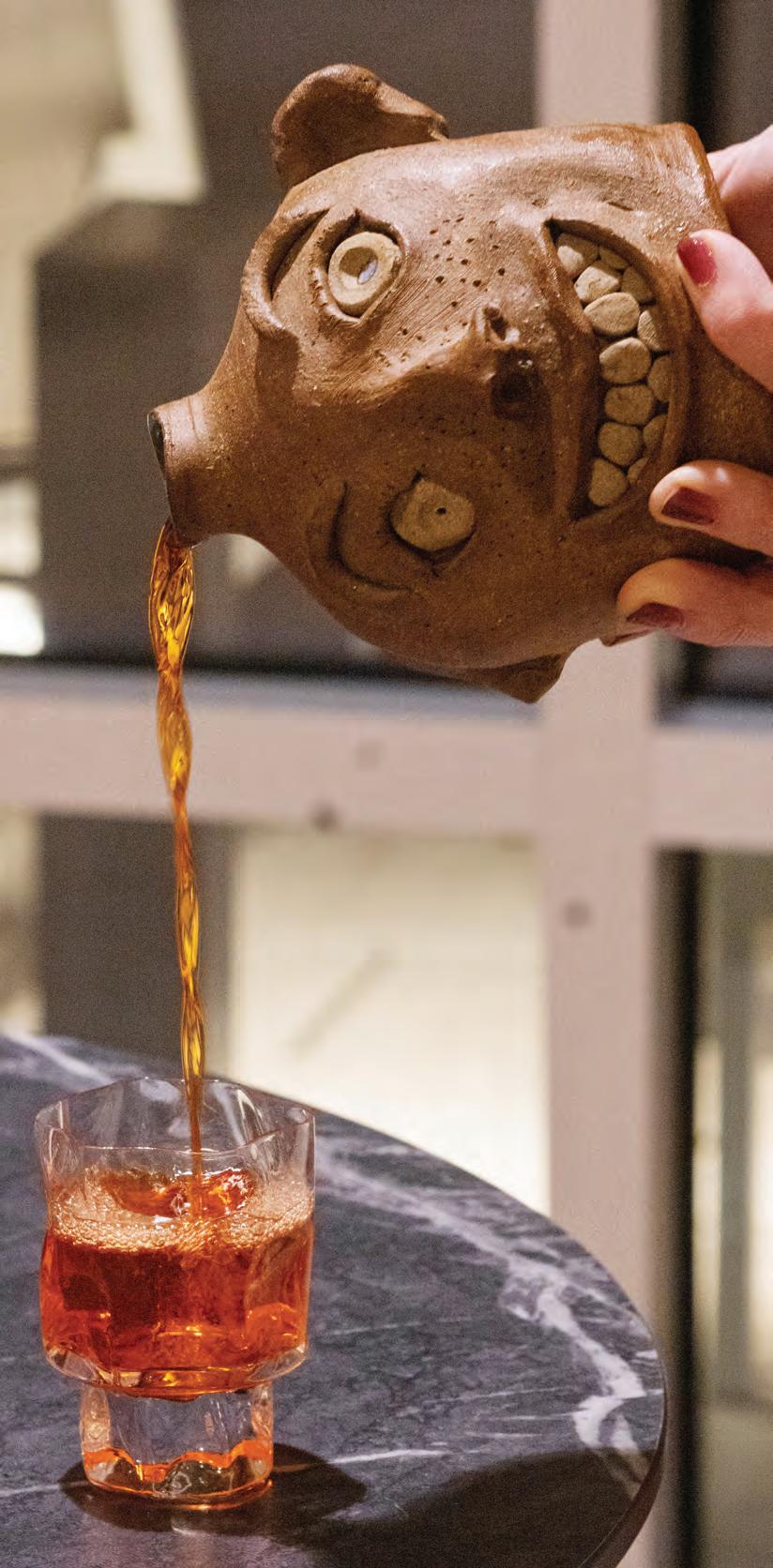
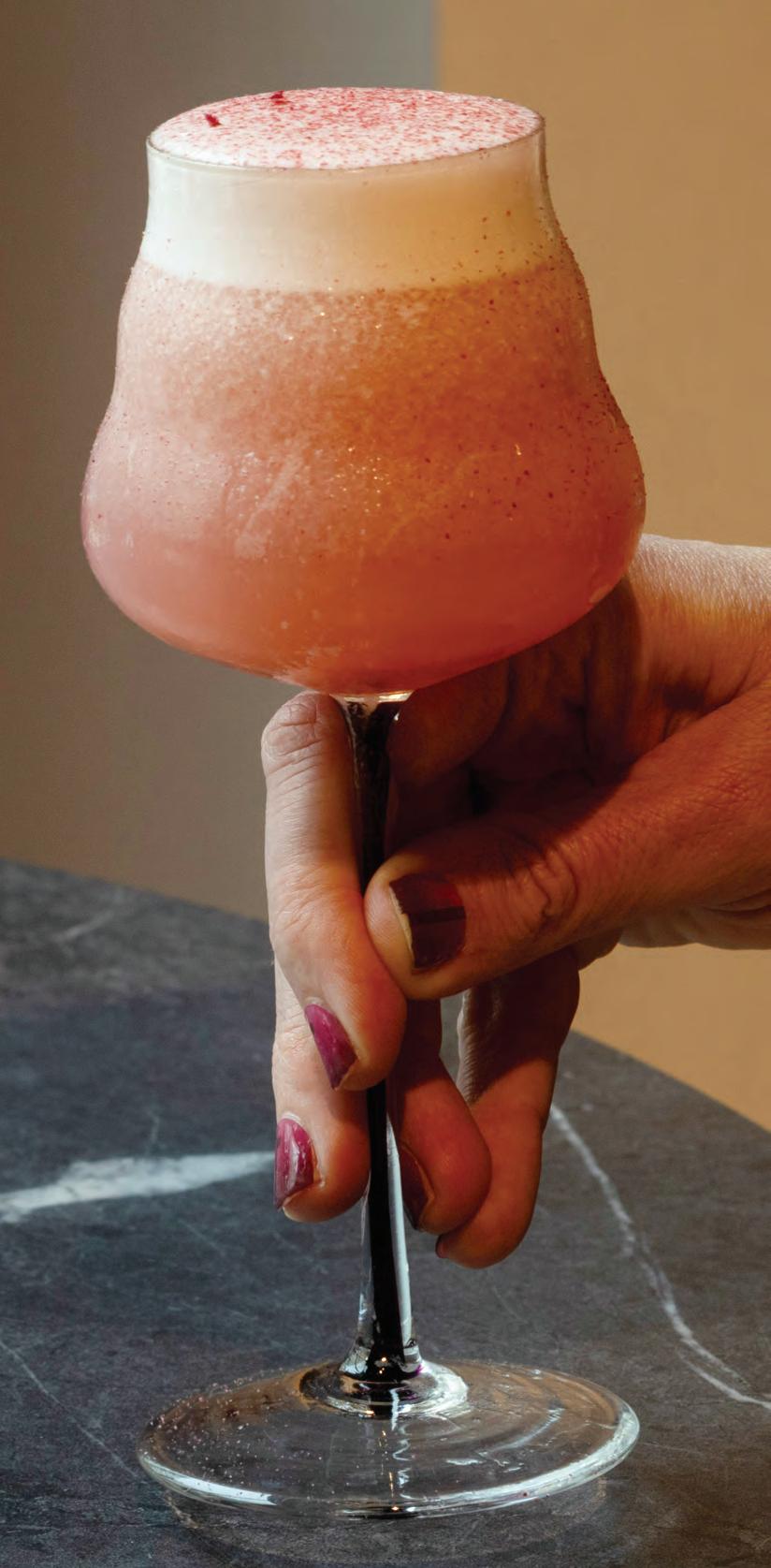
RIGHT: Songbird will feature select cocktails served in specialty containers, such as hand-crafted face pottery.
Umbrella built momentum the way many modern hospitality brands do: pop-ups, relationships with producers, and showing up where the audience already gathers. Paradise talked about early tastings and events, including the kind of “safe” first op-up at her yoga studio—familiar faces, familiar space, then a step outward. “Dry January was popping off,” she says, and the inbound requests started piling up.
She took a three-month sabbatical to see if it was viable. “It wasn’t yet,” she recollects, “but I still quit my job.”
That leap led to more experimentation, including an arrangement at Norwood Gardens where she converted a utilitarian shed into a functioning bar—an imperfect, scrappy proofof-concept. Later came a short-term space downtown that taught them what worked, what didn’t, and what Raleigh was ready for.
“It was really hard to step back at the end of it,” Paradise says of winding that down, “but at the same time, there are so many lessons.”
A CO-CREATOR WITH A SCIENCE BRAIN
Blue Arm’s path into all of this reads like a résumé that took a hard left turn toward flvor.
He studied chemistry and physics at Amherst College but spent years working in cafés and bartending, drawn to the craft side of food and drink. “My family’s Palestinian. Food is really important for culture,” he says, describing how cooking was part heritage, part instinct.
When he moved to Raleigh—around the same time Umbrella’s downtown experiment was taking shape—he came onboard as food and beverage director, running the drinks and helping guide what Umbrella could be operationally, not just ideologically.
The pairing makes sense. Paradise is vision-first—ritual, feeling, the what if this existed” question. Blue Arm is technique-
forward—systems, equipment, process, the nerdy joy of dialing something in until it’s exact.
That tension is what Songbird is built on.
Songbird is designed to run on a daily rhythm: Open at 8 a.m. for espresso, juices, and smoothies, then reopen at 4 p.m. for cocktails and shared plates.
Blue Arm lights up when he starts talking about the morning program. Smoothies and juices, yes—but anchored in seasonality rather than the predictable tropical template. “We’re gonna be leaning more on some local fruits,” he says, calling out strawberries and local greens as examples, and framing it as a way to make the morning feel grounded in North Carolina rather than imported from a generic smoothie bar playbook.
Then he mentions the espresso
machine—a vintage model they tracked down and are restoring with help from Steam Punks Espresso Repair, a local company known for servicing and selling espresso equipment. “It’s totally random,” he says, laughing a little at how these projects find you. But the romance is th point: a machine with a history, tuned for classic shots, feeding a morning ritual that feels built, not purchased.
The evening program is where Songbird starts to separate itself from the pack. The menu is structured around six “North Carolina seasons,” rotating roughly every two months—a framework calibrated to the reality of local harvest cycles, not the tidy four-season version most of us grew up with.
And unlike many places that treat nonalcoholic drinks as an afterthought, Songbird plans to build the cocktail list around three lanes—zero-proof, low-ABV,
ABOVE: Meg Paradise and Charlie Blue Arm of Songbird. OPPOSITE PAGE: An alcoholremoved cocktail with Aperol, Dromme Awake, fermented strawberry, lemon, and egg white.
and full-strength—while clearly labeling ABV for transparency. Blue Arm’s bigger point wasn’t just “we’ll have options.” It was craft.
“We’re doing a lot of foams. We just bought a rotary evaporator,” Blue Arm says, describing equipment that allows a team to distill and manipulate flvors in ways most bars simply don’t bother with. He talked about creating drinks that feel like a cocktail, whether they contain alcohol or not—because the person ordering zero-proof deserves more than a dressed-up soda.
BUILT BY HANDS FOR THE FUTURE
One thread kept coming up, even when we drifted into tangents: They want Songbird to feel like it couldn’t exist anywhere else.
They talked about working with local potters—like Piedmont ClayWorks in Durham—and building relationships with producers so the objects in your hand carry a story, not just an aesthetic.
Blue Arm describes it as stewardship. Meeting the people behind the ingredients. Knowing what’s viable, what’s fleeting, whats worth preserving and carrying forward through fermentation, jams, and other methods so a season doesn’t just disappear when the weather flips
“You have to love it to do it,” he says when I asked what it takes to open something in a city where new spots seem to appear weekly. For both Paradise and Blue Arm, it’s not a trend line; it’s people—hospitality folks who are obsessive enough to build something with depth.
Songbird opens in June on E. Whitaker Mill Road in Raleigh, and if they pull off what they’re describing—this careful slide from espresso to candles, from zero-proof to full-proof, from ingredient to story—it won’t just be another new place on the Raleigh list.
It’ll be a place you can return to in different versions of yourself, on different kinds of nights, and still feel like the drink in your hand matters.
Stock.Adobe.com/Anchalee
DEPARTMENT COMMUNITY
RAISING HUMANS IN THE AGE OF AI
Why characters and identity matter more than technology
STORY BY DR. ALAN HAHN
Artificial intelligence is advancing so quickly that the world our children will inherit is changing even as we write. In the coming months—not just years—AI will perform many tasks once thought uniquely human, from writing and coding to diagnosing illnesses and creating art. As machines grow more capable, the most important question for parents may no longer be what skills will our children learn—but what kind of people will they become.
This raises a deeper question: How do we prepare our children for a world where AI and machines will do so much?
The answer may surprise us. The best preparation for an AIdominated future may not be more technology. It will be stronger families, clearer identity, and deeper character formation.
IDENTITY BEFORE SKILLS
Technology will change rapidly, but identity endures.
Young people flourish when they understand who they are and what kind of people they are called to become. At Iron Academy, we use a framework called ForgePoint, which forms students through a set of shared identity statements—ten powerful declarations of the kind of people we are committed to becoming, such as: We are people who leave people and places better than we found them.
When students make mistakes—as all of us do—we don’t punish behavior. Instead, we call them back to the kind of people they are learning to become. An older student might respond to a younger student’s snide remark about the slightly quirky student, “That’s not who we are here. We are people who build others up.” Correction, especially from an older student, becomes an invitation back to identity. The goal isn’t shame—it’s formation.
Parents can practice this at home as well. Consider writing three to fiveidentity statements for your family, such as:
• We are people who tell the truth.
• We are people who serve others.
• We are people who finish hard things
In a world shaped by artificial intelligence, identity will matter more than ever. Machines can process information and reveal new possibilities, but only humans can live with transcendent moral purpose.
SKILLS AI CANNOT REPLACE
AI will outperform humans in many technical tasks. But several human capacities will become even more valuable. These include:
• Judgment and wisdom
• Moral courage
• Interpersonal communication
• Teamwork and leadership
• Empathy
These abilities grow primarily through real human interaction, not screens. So what can parents do?
Start at home. Invite your children to debate ideas at the dinner table, present their thoughts clearly, and work through disagreements with civility and honor—learning to disagree without treating others as enemies. Let them wrestle with problems, make decisions, and learn to think instead of immediately outsourcing the hard work of thinking to devices.
focus, listen, and engage deeply with others will possess a rare advantage in a distracted world.
Reinforce these habits through significant outdor experiences that require teamwork, resilience, and real-world problem solving. At Iron Academy, freshmen hike a section of the Appalachian Trail, learning perseverance and brotherhood in the mountains. Juniors undertake a nine-day canoe expedition from Jordan Lake to Wilmington, navigating rivers, cooking meals, and solving problems as a team.
Experiences like these cultivate judgment, leadership, and grit that technology cannot replicate. But families do not need a school program or
whether they feel that the adults in their lives are genuinely glad to be with them. When a child regularly sees delight in a parent’s face, they feel a sense of security and openness to growth.
Encouragement then strengthens identity. Parents might say things like, “You handled that with maturity” or “That was kind of you to include him.” Over time, these moments reinforce the kind of person a child is becoming.
Healthy correction works the same way. Instead of shaming a child, wise parents call them back to their identity: “That’s not who we are. In our family, we tell the truth.”
The goal is not perfection—it is formation.
The future will reward those who can think clearly, communicate persuasively, live wisely, and lead others well—abilities no algorithm can fully replicate.
PROTECT ATTENTION
Ironically, the more powerful AI becomes, the more important it will be to protect human attention. Many families are rediscovering the power of intentional “no-tech rhythms,” such as:
• Device-free dinners
• Weekly tech-free evenings
• Vacations where phones stay behind
• Outdoor adventures that demand presence
Children who grow up learning to
a major expedition to begin. A weekend camping trip, a daylong hike, a paddling excursion on a local river, or even a backyard campfirewhere phones are put away can become powerful formation moments. Small adventures repeated over time shape character.
JOY, ENCOURAGEMENT, CORRECTION
Children do not develop character by accident. They grow best in homes where joy, encouragement, and loving correction are practiced consistently.
Joy matters more than many parents realize. Children are deeply shaped by
Parents who consistently say things like “We are the kind of family who keeps our word” or “We take responsibility when we make mistakes” are shaping a powerful culture. Over time, children begin to internalize those values as part of their identity.
THE FORMED WILL LEAD Artificial intelligence will undoubtedly transform the economy, education, and daily life. Yet the deepest human questions will remain unchanged. What kind of people will we become? What kind of families will we build? What kind of character will guide our decisions?
The future will belong not simply to those who understand technolog y, but to those who are wise enough to love and lead well in an AI-dominated world.
In a world increasingly shaped by AI, the greatest advantage may simply be raising deeply human children—men and women who will live with wisdom, courage, honor, and love.
Dr. Alan Hahn is the founder and CEO of Iron Academy, a private, all-male Christian school serving students in grades 6–12 in Raleigh. Learn more at ironacademy.org.
DEPARTMENT COMMUNITY
SHAPE RALEIGH’S
FUTURE
Raleigh’s Planning Academy empowers residents to share their voices
STORY BY LAURA D’ONORFIO
Have you ever wondered why your neighbor’s variance to convert their deck into a flex room has never been approved? Have you been keeping your eye on the famed Bus Rapid Transit system coming to a neighborhood near you sometime between 2026 and 2035?
If so, Raleigh’s new Planning Academy, run by the Planning and Development department, should be on your radar. The Planning Commission doesn’t get as much limelight as City Council, but their jobs have more long-term impact than we realize.
Planning departments build the skeletal structure of any city, overseeing population growth
and the economy, housing, transportation, and land use and the environment.
The five-week Planning Academy progam— offered free to residents—covers how the city’s planning processes work: how legislative and quasijudicial administrative decisions are made, plus the nuances of building permits, build safety codes, and the comprehensive city plan.
The Academy brings together 30 diverse residents from all across the city. I sat next to individuals from southeast Raleigh, North Hills, Oakwood, South Park, and Brier Creek, many of whom I would have never run into. There were auditors, parents,
loan officers, and nonprofit director everyone was one of one.
Patrick Young, Raleigh’s Planning and Development director and one of the key Academy speakers, admits these topics are complicated. “City planning rules are complex and intimidating. We understand that, and we want to demystify it.”
It seems to be working. Out of the 325 graduates so far, Young has seen many express more confidence and familiarity with city processes, making them more likely to voice their points of view. He has even seen some apply for city boards and commissions.
Ultimately the Academy ’s goal is to empower and educate our fellow citizens and encourage collaboration on future growth plans.
The curriculum includes interactive elements where leaders break participants into teams to design their own city, review build case studies, participate in a mo ck city council session, and review the city’s strategic debates.
Speaking of debates, I would be remiss if I failed to mention one of the more intense debates I witnessed: housing. More specificall, affordable housing and the “missing middle.”
Some stats to give you the full picture:
• Raleigh has a high share of renters (50%), whereas for cities nationwide that average is about 35%.
• Raleigh is the third-fastest-growing metro area after Orlando and Houston. Further, many of these new residents are coming for Raleigh’s competitive job market, and their high salaries are pushing up the value of land and housing.
• Older homes are generally more affordable, but less than 6% of Raleigh’s housing units predate 1960, compared with 25% nationwide.
• Young and the city estimate that by 2050 there will be an additional 250,000 Raleigh residents, more than a 50% increase on our current p opulation total.
All of the above creates a complex milieu in the city’s aim toward equitable housing, or what Young refers to as “hybrid growth.” Traditionally, Raleigh places new housing on the fringe of the city, but Young also says we have to build up, not just out.
Participant and resident Fiona Matthews learned that historic districts like Oakwood, with their mixed housing, may be a model to replicate.
“Something that really surprised me was that the historic districts were actually some of the best examples of housing density because they had more types of housing (e.g. quadplexes, triplexes, and ADUs) that were made illegal after World War II, and those are now just becoming legal again,” says Matthews.
Affordable housing is the lifeline of cities; it is what will keep people in Raleigh long-term, and its connotations have to be consistently evaluated and reevaluated. Participant and resident Adam Martin, known to make his voice heard, echoed the need for balance.
“The future of Raleigh should continue to focus on increased density in the core of the city, but simultaneously
we need to preserve our natural environment and open spaces,” Martin says. “We are the City of Oaks, and we can’t just try and be New York City.”
Through many side conversations, I also noticed the less-than-vague feelings of disarray among participants, many referencing the chaotic news around the country and world—but I was still reassured. The decorum between participants was evident. Even when perspectives differed, people heard each other out, tested assumptions, and trusted each other’s intentions.
As for the future of the program, Young and the Planning team want to continue to empower residents to get involved. Especially now, as Raleigh’s next Comprehensive Plan is in draft development until May 2026 (slated to be adopted by late 2027).
“My favorite thing is meeting residents and talking about their dreams and visions for the future, and helping them understand how they can influence that” says Young.
For more information or to apply to the Academy, visit raleighnc.gov/ planning/services/planning-academy.
OPPOSITE PAGE & ABOVE: Participants design their own city using blocks to build structure and by considering population growth as well as housing and transportation. Photos courtesy of the Raleigh Planning Academy.
DEPARTMENT KALEIDOSCOPE
THE RETURN OF VINYL
WHY RECORDS ARE SPINNING AGAIN
STORY BY DATHAN KAZSUK
There was a time when collecting vinyl meant digging through dusty crates in dimly lit record shops, hoping your fingertips would land on something rare before somebody else got there first
For me, those days started in Atwater, California.
A good Saturday could mean driving to Merced to hit Below Zero Records, or heading down Highway 99 to Danny’s Records in Fresno.
Back then, even the expensive stuff still felt within reach. Maybe it was a marble-colored pressing, a German import from 1984, or some other oddball artifact that felt less like merchandise and more like contraband from a better, darker universe.
Then the music business decided vinyl was dead. By the late 1980s and early 1990s, CDs had kicked the door in. They were cleaner, shinier, futuristic—“perfect sound forever,” or so we were told. Labels followed the money, stores made room for towers of jewel cases, and turntables slowly vanished from living rooms. For a while, records looked like they were headed for the museum.
But vinyl never fully disappeared. It just slipped underground, where formats with any real soul usually go when the mainstream gets bored. Punk kept it alive. Indie rock kept it alive. DJs kept it alive. Collectors kept it alive.
And somewhere along the line, people remembered that listening to music used to feel like an event.
That ritual still matters. You pull the record from the sleeve. You study the artwork. You drop the needle. That’s a big part of why vinyl came back. The other part is simpler: After years of music becoming more invisible—compressed into phones, playlists, and monthly subscriptions— people started wanting something they could actually hold.
Hunky Dory’s newest location is inside Raleigh Iron Works.
Photo by Dathan Kazsuk.
The Pour House Music Hall & Record Shop in downtown Raleigh has its record shop upstairs, where you can peruse vinyl and order a beer at the bar. Photo by The Pour House Music Hall & Record Shop.
Rachel Braun, record shop manager at The Pour House Music Hall & Record Shop in Raleigh, says the resurgence has been building for years—but the pandemic gave it a major push.
“Vinyl has been trending up for the last 10 years,” Braun says. “The biggest boom being 2020, during Covid. Raleigh has always been a hub for vinyl because we have some of the best record stores in the state, and most of them are within walking distance of each other. Things started getting busier after lockdown ended—even busier than pre-Covid, because people are gravitating toward owning physical media instead of relying on digital streaming services.”
Michael Bell, owner of Hunky Dory in the Triangle, sees that same demand from behind the counter every week. “Our bins get depleted each week, and we have to order more and more from our distributors to refill them” Bell says. “It’s a good problem to have.”
He says that demand is not just for new records and reissues, either. “The used, pre-loved, vintage side of the game has always been there and always keeps us busy to meet demand.”
And the people buying records right now are not just the old guard trying to recreate their youth. Braun put it
simply when asked who is buying vinyl these days: “Everyone.” Older collectors are returning to albums they once owned, while younger listeners are using records to connect more directly with artists and push back against the disposable feel of streaming.
Bell sees that mix too, describing Hunky Dory’s customer base as “a healthy mix of all sorts of cool cats,” from new kids who say “vinyls” to hardcore audiophiles inspecting a bargain-bin record like it’s sacred text.
That may be the best snapshot of the current vinyl boom. On one side, you have longtime collectors hunting first pressings and obscure imports. On the other hand, you have younger shoppers walking in for Fleetwood Mac, Pink Floyd, or Tyler, The Creator, and starting from scratch. Everybody is chasing a different version of the same feeling.
When newcomers start building a collection, Bell says the usual gateway albums still do a lot of the work. “I’d wager that Dark Side of the Moon is up there, Rumours, those heavy-hitters,” he says. “The question is: Do they want to buy the reissue on the fl or, or hold out for an OG to come through?”
That question says a lot about why records still matter. Vinyl is not just about
hearing an album. It’s about choosing what version of that album becomes part of your life. The clean reissue. The old copy with ring wear and somebody else’s history baked into the sleeve. The bargain-bin surprise. The expensive firs pressing you swear you don’t need until it is suddenly in your hands.
Braun says younger buyers are also helping fuel the format for a practical reason: supporting musicians.
Still, the comeback comes with a catch. Vinyl isn’t cheap anymore. New LPs can easily run $30 or more, and special editions climb fast. Braun believes some of that stems from the industry pushing deluxe packaging and price points too far. “Vinyl prices are reaching a breaking point,” she says. “People are turning to CDs because they’re cheaper, and for no other reason.”
Bell agrees that people are being more careful with what they buy. “I do believe customers will always be selective on what they buy, especially if they are on the fence about it,” he says. “Things just cost a lot more these days, and everyone is making sacrifices”
Bell recalls buying a huge collection from a wooden shed near Mebane, where the heat was brutal, and many of the records were warped. Buried in the mess were Bowie maxi-singles and entire catalogs from major bands. Then months later, while digging deep er, he found an obscure Atlanta garage-band record that turned out to be wildly valuable.
People want a place with atmosphere, conversation, and a little personality— not just a transaction. “I believe people want to go to a place that feels welcoming, that has good vibes and energy, and a strong customer base,” Bell says. “We spin vinyl, all day, every day. We talk music all day, every day.”
As for me, I’m still chasing older vinyl. I’m still slowly trying to gather every Skinny Puppy release I can get my hands on. Somewhere out there, I like to believe an original pressing of Too Dark Park is still hiding in a dusty bin, wedged between albums nobody wants, waiting for me to find myhidden gem.
PAINTING INTO THE WALL
Ben Long and the Hidden Frescoes of North Carolina
STORY BY JENNIFER PRIMROSE
If you’ve ever wandered into a small mountain church or a quiet civic building in North Carolina and felt like the walls were watching you back, chances are you’ve crossed paths with a Benjamin Long fresco. These aren’t your typical murals. They’re true frescoes painted directly onto wet plaster so that the pigment becomes part of the wall itself. And the process? Well, it’s as unforgiving as it sounds.
Long is one of the few American artists today closely associated with this centuries-old technique. If you’ve seen his work throughout the
state, it’s hard not to be captivated. I first encountered his fresces at St. Paul’s Episcopal Church in Wilkesboro, where the figures on the walls seemed to shift with the light, almost breathing within the architecture. Their faces felt both familiar and timeless, and the weight of the composition gave the space a quiet sense of reverence—even outside of worship hours.
Later, in Blowing Rock, I came across
another pair of Long’s works at Rumple Memorial Presbyterian Church. The frescoes immediately caught my attention, each detail revealing both Long’s technical precision and the care of the community that helped preserve them. One fresco depicts the 23rd Psalm, the other the Good Shepherd. Originally commissioned by Mabel Stowe Query in 2006 for a hospice center in Mount Pleasant, South Carolina, the works were completed in 2009.
Rumple acquired the frescoes in 2022 and stored them until the church was ready for permanent installation. Today, visitors can get a closer look—and a deeper understanding—through an introductory eight-minute video and hourly docent presentations offered by the church. Experiencing them in person reinforced how naturally the figures inhabit the space, quietly inviting visitors to pause and take it in.
After witnessing these walls come to life, I knew I wanted to learn more about the artist responsible for this work. Reaching out to Ben Long opened the door to a much larger story—one that stretches from Italy to the mountains of North Carolina. Along the way, I discovered his frescoes scattered across the state, from Charlotte’s skyscrapers to towns like Glendale Springs, Wilkesboro, and Blowing Rock. Each carries its own story and its own connection to the community around it.
Long’s journey toward mastering fresco began far from North Carolina. He spent nearly a decade in Italy studying under the renowned portrait painter Pietro Annigoni, whose work centered on classical training in drawing, portraiture, and anatomy.
OPPOSITE PAGE: “Psalms 23,” one of two Ben Long frescoes that can be found at the Rumple Memorial Presbyterian Church in Blowing Rock. Photo by Dathan Kazsuk. The illustration is is Ben Long’s Calliope study cartoon for the City of Morganton Municipal Auditorium. Image courtesy of Ben Long.
Many frescoes begin as sketches, like the two shown here. At left is Ben Long’s “Carpenter,” created on paper in charcoal graphite, while the other is a drapery study for the City of Morganton titled “Thalia Terpsichore.” Illustrations courtesy of Ben Long.
“I went to Italy to study with Annigoni and learned fresco simply because that was what he was doing at the time,” Long tells me. “What he emphasized most—and what I instinctively understo od—was the importance of drawing. Those fundamentals were the foundation of everything.”
It was during this time that Long fully embraced fresco as his medium. For those unfamiliar with the technique, the explanation is simple: Fresco means “fresh.” The artist paints on wet plaster made of lime and sand, working within a limited window of time before the surface dries. “Everything has to come together within that window,” Long says. “The artist needs to know exactly what they’re doing before they even begin.”
That time constraint leaves little room for hesitation. Every figure, every line, every shadow must already be worked out before the brush ever touches the wall.
When Long returned to North Carolina after his years in Italy, he found himself confronting a striking gap: The medium he had devoted years to mastering was
almost entirely unknown to the people around him. That discovery shaped the direction of his work going forward.
“Fresco work made me realize that most people in North Carolina had no real idea what fresco was,” he says. “That inspired me to show both fresco and oil painting here—portraiture, landscape, the figure—and to continue that tradition and share it with others.”
One of the most meaningful examples of that mission can be found at Holy Trinity Church in Glendale Springs. There, Long worked on what he describes as a true “community fresco.”
Local residents served as models for the figures, while memers of the surrounding community supported the artists during the church’s restoration.
“It was wonderful. It was a step in the right direction—a real community fresco,” Long says. “Fresco was traditionally done with the community and for the community, giving art to the people.”
The project reflects a unique as ect of the medium itself. Unlike a painting that can be hung, moved, or sold, a fresco
becomes part of the building where it’s created. The art and the space are inseparable.
Long has also brought that same discipline into secular settings. In Charlotte, his frescoes inside the Bank of America Corporate Center demonstrate how the technique can extend beyond religious themes. “The approach to the fresco itself isn’t really different—the technique and discipline remain the same—but the subject matter opens up,” he explains. Working in a corporate setting allowed him to explore symbolism and philosophical ideas outside of a strictly liturgical narrative.
What strikes me most about seeing these works in person— whether in Wilkesboro, Blowing Rock, or inside a towering Charlotte skyscraper—is their sense of permanence. A true fresco ages with the building, moving with it and responding to shifts in the structure itself.
Long recalls a fresco near St. Peter’s Basilica in Italy that collapsed after structural stress caused part of the wall to fail—a reminder that frescoes are as vulnerable as the buildings that hold them. Unlike a canvas painting, they can’t simply be removed or relocated if the structure changes.
Long’s life outside the studio has also shaped his perspective as an artist. Before studying in Italy, he served in the US Marine Corps during the Vietnam
War, working on a Combat Art Team tasked with documenting scenes of conflict and humanit. The experience left a lasting impression. “My experiences in the Marine Corps had a very powerful and lasting effect on me throughout my entire life, including my art,” he says.
That same discipline carries into the studio. “By the time I’m standing in front of the wall, I’ve already thoroughly explored and studied what’s going to be there,”
Long says. “When I get to the wall, I simply think to myself, ‘It’s time to paint.’”
When I asked what he hoped people would carry with them long after a fresco was finished, his answer was’t about a specific message or interpretation. “It’s less about a particular idea and more about continuing to fill and lift my own spirit through this particular vessel,” he says.
And perhaps that’s the quiet power of Ben Long’s frescoes. You might encounter one unexpectedly, inside a small mountain church or tucked into a city building, and suddenly realize that the wall in front of you isn’t just painted. It’s alive with color, history, and human hands that once worked against the clock to bring it into being.
Ben Long’s frescoes are quietly spectacular—an ancient technique still unfolding in the 21st century, embedded not just in plaster, but in the communities that surround them.
TOP TO BOTTOM: At St. Paul’s Episcopal Church in Wilkesboro, this Ben Long fresco depicts the apostle Paul writing his epistles while imprisoned. Photo by Dathan Kazsuk. Portrait of Ben Long. Photo by S. Nezo. Ben Long’s “Good Shepherd,” one of two frescoes at Rumple Memorial Presbyterian Church in Blowing Rock. Photo by Dathan Kazsuk.