How Financial Inclusion Consulting Can Build More Equitable Digital Economies
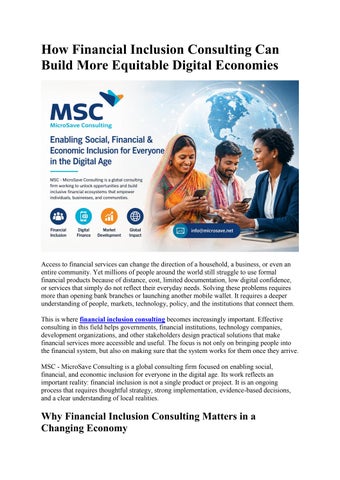
Access to financial services can change the direction of a household, a business, or even an entire community. Yet millions of people around the world still struggle to use formal financial products because of distance, cost, limited documentation, low digital confidence, or services that simply do not reflect their everyday needs. Solving these problems requires more than opening bank branches or launching another mobile wallet. It requires a deeper understanding of people, markets, technology, policy, and the institutions that connect them. This is where financial inclusion consulting becomes increasingly important. Effective consulting in this field helps governments, financial institutions, technology companies, development organizations, and other stakeholders design practical solutions that make financial services more accessible and useful. The focus is not only on bringing people into the financial system, but also on making sure that the system works for them once they arrive. MSC - MicroSave Consulting is a global consulting firm focused on enabling social, financial, and economic inclusion for everyone in the digital age. Its work reflects an important reality: financial inclusion is not a single product or project. It is an ongoing process that requires thoughtful strategy, strong implementation, evidence-based decisions, and a clear understanding of local realities.
Why Financial Inclusion Consulting Matters in a Changing Economy
Financial inclusion has evolved significantly over the past decade. Traditional discussions often focused on bank accounts, branches, savings products, and access to credit. Today, the conversation is much broader. Digital payments, mobile banking, fintech platforms, government-to-person transfers, insurance, digital identity, consumer protection, and financial capability are all part of the larger picture. A person may technically have a bank account but still remain financially excluded if the account is too expensive to use, difficult to access, poorly designed, or disconnected from the person's actual financial needs. Similarly, a merchant may accept digital payments but struggle to manage cash flow because available financial products do not match the business cycle. This is why inclusive finance consulting looks beyond simple access. It considers whether financial services are affordable, appropriate, trusted, convenient, and genuinely useful. Consultants can help organizations identify barriers that are often invisible in high-level statistics and translate those findings into practical changes. For example, research may reveal that customers are abandoning a digital financial service because registration is confusing rather than because they dislike digital payments. In another market, small businesses may need working-capital products rather than conventional loans. Understanding these distinctions can make the difference between a product that looks promising on paper and one that people actually use.
The Role of Inclusive Finance Consulting in Product Design Financial products are often designed around institutional requirements. That is understandable, but it can create a gap between what a provider wants to offer and what customers are prepared to use. Inclusive finance consulting can help close that gap by bringing customer research, market analysis, behavioral insights, and business strategy into the design process. A successful product needs to fit into people's lives. Customers have different income patterns, levels of financial literacy, technology access, and expectations of service providers. A farmer receiving seasonal income has different needs from a salaried employee. A woman running a home-based business may face different constraints from a larger urban entrepreneur. Young digital users may expect instant transactions, while first-time users may need more guidance and reassurance. Consulting can help organizations examine these differences instead of treating low-income or underserved consumers as one large category. It can also help providers test products before investing heavily in nationwide deployment. That process can include customer interviews, field research, journey mapping, prototype testing, market assessment, and analysis of transaction behavior. The goal is to identify what customers actually need and determine how a provider can deliver it sustainably.
Development Consulting Emerging Markets Requires Local Understanding
Emerging markets present enormous opportunities for financial innovation, but they also come with complex challenges. Infrastructure can vary significantly between urban and rural areas. Regulatory environments may evolve quickly. Informal economies can account for a substantial share of economic activity, while consumer trust in formal institutions may differ from one community to another. For these reasons, development consulting emerging markets cannot rely on a universal formula. Strategies that work well in one country may fail in another because of differences in culture, regulations, infrastructure, consumer behavior, or market maturity. Local context matters at every stage. Before recommending a digital financial service, for instance, it may be necessary to understand smartphone ownership, connectivity, agent availability, digital literacy, and payment habits. Before developing a credit product, consultants may need to understand how informal businesses record income, manage inventory, borrow money, and repay suppliers. This local perspective helps development programs move from broad ambitions to workable solutions. Three areas are particularly important when developing financial inclusion strategies in emerging markets:
Understanding underserved customers: Effective programs begin with the people they are intended to serve. Research into income patterns, financial behavior, technology usage, gender-related barriers, trust, and service preferences can reveal why existing products are not reaching particular groups. This insight allows organizations to develop solutions based on real customer circumstances instead of assumptions. Building sustainable delivery models: Inclusion initiatives need a viable business or institutional model behind them. A service that attracts customers but consistently
loses money may struggle to survive after an initial funding period. Consulting can help organizations examine pricing, distribution, partnerships, operational costs, technology requirements, and revenue opportunities while keeping affordability and customer value in view. Connecting innovation with policy and infrastructure: Digital financial inclusion depends on more than individual products. Identification systems, payment infrastructure, regulations, interoperability, consumer protection, and data governance can all influence whether a market develops successfully. Coordinating these elements can create an environment in which responsible innovation has a better chance of reaching underserved communities.
How Global Financial Inclusion Advisory Supports Better Decisions
Financial inclusion is increasingly global, but solutions still need to be locally relevant. A global financial inclusion advisory approach can help organizations learn from experiences across countries while avoiding the mistake of simply copying another market's model. Cross-market knowledge is valuable because many countries face similar challenges. Digital payments, agent networks, women's financial inclusion, small-business finance, government transfers, and consumer protection are recurring themes across developing and emerging economies. Lessons from one market can therefore provide useful starting points for another. However, successful adaptation requires careful analysis. A digital finance model developed in a highly connected country may need substantial changes before it can work in an area where connectivity is unreliable. Likewise, an agent banking approach that succeeds in one region may require a different incentive structure elsewhere. A strong advisory partner can help organizations separate transferable lessons from marketspecific conditions. This can save time, reduce unnecessary experimentation, and support more informed investment decisions.
Financial Inclusion Is Also About Trust and Consumer Experience Technology has made financial services faster and more convenient, but technology alone cannot solve the trust problem. People are more likely to use a financial service when they understand how it works, believe their money is secure, and know what will happen if something goes wrong. This makes consumer experience a central part of financial inclusion. Complicated interfaces, unclear fees, weak customer support, or difficult complaint procedures can discourage users even when the underlying technology is excellent. Financial inclusion strategies should therefore consider the complete customer journey. From registration and authentication to transactions, savings, borrowing, insurance, and complaint resolution, every interaction affects confidence. This is particularly important for first-time users. A person who experiences a failed transaction without receiving clear support may decide that digital finance is unreliable. Small operational problems can therefore create much larger barriers to adoption.
Women and Underserved Groups Need More Than Generic Solutions
Financial inclusion cannot be considered successful simply because overall account ownership increases. The distribution of access matters. Women, rural households, migrants, informal workers, microentrepreneurs, older consumers, and people with limited digital skills can face different barriers. Some may lack identification documents. Others may have limited control over household finances or restricted access to technology. Small businesses may struggle to demonstrate conventional credit histories even when they have viable operations. A thoughtful consulting approach examines these differences and helps organizations develop targeted strategies. For example, improving women's access to finance may require more than introducing a women's loan product. It may involve examining collateral requirements, repayment schedules, digital access, financial education, customer support, and the broader environment in which women manage businesses and household finances. The same principle applies to other underserved groups. Inclusion improves when solutions are designed around actual constraints rather than demographic labels alone.
Using Data to Turn Financial Inclusion Strategies Into Action Data is one of the most powerful tools available to organizations working on financial inclusion. Transaction records, customer feedback, market research, agent performance, product usage, and demographic information can all provide valuable insights. But data becomes useful only when organizations know what questions to ask. A sudden drop in transactions, for example, may indicate technical problems, seasonal changes, pricing issues, declining trust, or a competitor's new offering. Simply observing the decline is not enough. Organizations need analytical frameworks that connect data with customer behavior and operational realities. This is another area where financial inclusion consulting can create value. Consultants can help organizations establish measurement frameworks, identify meaningful indicators, analyze performance, and translate findings into decisions. The strongest approach combines quantitative evidence with qualitative research. Numbers can show what is happening; conversations with customers and frontline workers can often explain why.
The Future of Inclusive Finance Consulting The future of inclusive finance consulting will increasingly involve the intersection of finance, technology, data, policy, and human behavior. Artificial intelligence and advanced analytics may create new opportunities to personalize financial services, improve risk assessment, automate operations, and identify underserved populations.
At the same time, these technologies introduce new questions around privacy, transparency, bias, cybersecurity, and consumer protection. Inclusion should not come at the expense of responsible finance. Consulting firms will therefore need to help organizations balance innovation with safeguards. The objective should be to use technology where it creates genuine value while ensuring that customers understand the services they are using and have meaningful ways to resolve problems. As digital economies expand, this balance will become increasingly important.
Why MSC - MicroSave Consulting Has an Important Role to Play MSC - MicroSave Consulting operates at the intersection of social, financial, and economic inclusion. Its positioning around inclusion in the digital age reflects how significantly financial services have changed. The organization's role can be particularly valuable for institutions seeking to understand underserved markets, improve financial products, strengthen delivery systems, or develop strategies for digital transformation. Rather than viewing inclusion as a standalone initiative, a broader consulting perspective can connect customer needs with institutional sustainability and market development. For organizations working across emerging economies, this type of support can help turn complex challenges into structured decisions. Whether the objective is improving digital financial services, strengthening market ecosystems, supporting responsible innovation, or reaching underserved consumers, the right advisory approach can provide both strategic direction and practical insight.
Conclusion Financial inclusion is ultimately about giving people meaningful opportunities to participate in the economy. A bank account, mobile wallet, loan, insurance policy, or digital payment service matters only when it solves a real problem and remains accessible over time. That is why effective development consulting emerging markets needs to combine local knowledge with global experience. It must recognize the differences between customers, understand the institutions serving them, and account for the infrastructure and policies that shape financial ecosystems. At the same time, a strong global financial inclusion advisory perspective can help organizations learn from international experience without losing sight of local realities. The best solutions are rarely copied exactly; they are adapted thoughtfully. For institutions looking to make financial services more useful, responsible, and accessible, MSC - MicroSave Consulting offers a consulting perspective centered on social, financial, and economic inclusion in the digital age. As financial systems continue to evolve,
organizations that put customer needs, sustainability, innovation, and trust at the center of their strategies will be better positioned to create lasting impact. For inquiries, MSC - MicroSave Consulting can be contacted at info@microsave.net.