Is Detroit’s $400 Million Investment in Shirley Ryan AbilityLab Accessible for Black Detroiters?
Money. A5
Comerica Celebrates New Generation Thank You of Black Tennis Stars 35 Years of Supporting
HOMEFRONT V ETERAN S Honoring All Who Served C
O
M
E
R
I
C
A
the Nation’s Largest City.Life.Style. B1 UNCF Walk for Education Scholarship Roots. A3 Fundraiser
M ichigan C hronicle Michigan Chronicle
Vol. 87 – No. 2 | September 13-19, 2023
Powered by Real Times Media | michiganchronicle.com
All Black Everything:
87 – No. 3 20-26,2026 2023 Vol. 90 11 || September November 11-17,
Powered Poweredby byReal RealTimes TimesMedia Media || michiganchronicle.com michiganchronicle.com
UAW ATriple NightStrike of Elegance and Excellence at the 10th Annual Michigan Chronicle 40 Under 40 Against Detroit Automakers By Ebony JJ Curry SENIOR REPORTER
Late Thursday night, Sept. 14, a historic moment unfolded in American labor relations as the United Auto Workers (UAW) union initiated a strike against Ford, General Motors (GM), and Stellantis. For the first time, the union took simultaneous action against all three major Detroit-based automakers. The action involves approximately 13,000 UAW members in assembly plants across Michigan, Ohio, and Missouri, who walked By Ebony JJ Curryoff their jobs after existing labor contracts exSENIOR REPORTER pired at 11:59 p.m. Shortly before midnight on of talent, determinan a breathtaking celebration Sept. 14, released a statement tion,GM and the unyielding spirit of Black excellence, expressing disappointment with the Michigan Chronicle marked its 10th Annual the strike action,40despite 40 Under event offering Thursday evening. This year’s what termed anin“unprecedented soirée,it drenched the theme “All Black Everything with economic package” that included Gold Accents,” transcended expectations and essentialhistoric wage increases. Stellantis ly illuminated the golden gems within the true essence
How I ‘ olor of
troiters. The symbolism of Black beekeepers revitalizing niably commendable. their city is a powerful testament to the resilience and Amidst the glitz and glamour, the event also showingenuity of our community. cased the diversity of talent within our community. From As the night unfolded, we had the privilege of hon- Paris T. Prichard, a forensic scientist pushing the boundoring other outstanding individuals, each carving their aries of her field, to math wizards like Donna Laster, who own path to success. Clement “Fame” Brown, the creative mind behind Three Thirteen Detroit’s Brand Name, See 40 UNDER 40 page A2 received the prestigious Entrepreneur of the Year Award. Brown’s commitment to empowering the city through fashion and entrepreneurship has left an indelible mark. of Black excellence. Hosted by the charismatic duo of “Entrepreneur of the year – that’s a big deal,” said Andre Ash and Lynzee Mychael from Michigan Chroni- Brown. “It’s always an honor to be honored and it’s cle’s Finally Friday, the night was a triumph for the city always a blessing to be in a room full of so many talentof Detroit and its vibrant community of young Black pro- ed, accomplished, and popular people that look like me. fessionals. I’m geeked. I started making and selling clothes as a kid The evening sparkled with a golden promise as we and I always knew that I would have a business, but I celebrated remarkable individuals from various walks never knew it would be Detroit’s brand name business, DPD Chief James White Says Increased of life. Among the honorees were the brilliant and vi- so I take a lot of pride in the fact that our business repPolice Presence Culled Violence sionary co-founders of Detroit Hives, Nicole Lindsey and resents our city’s pride.” Timothy Paul Jackson. Their work has not only changed Taking home the Corporate Excellence Award was By Ebony JJ Curry By Andre Ash REPORTER the landscape of beekeeping and urban farming in De- Dannis Mitchell, Director of Community Engagement at SENIOR DIGITAL ANCHOR ness district that had been the lifeblood of towards mending the wounds inflicted on troit expressed but also disappointment exemplified thein transformative impact By Ebony JJ CurryBarton Malow. also An American Legion postand in restoring a sense of beBlack Detroiters the community. Black professionals can have on their communities. “It is so important to recognize that there are young SENIOR REPORTER a statement, saying the company A string of shootings in Pontiac was nearing the end For Rusher, a retired Michigan Army National By Ebony Curry It’s a that history marred “Together weJJhave created a social, environmental, leaders across the country, many are born herebyin pain, injus- longing that was so callously torn away in immediately went into contingenin Black mid-April left Guard lieutenant colonel, those relationships at the past. ofGreektown itsthan life when veterans For manyLindDetroiters, Interstate 375, or city SENIOR REPORTER tice,nationally and economic devastation. More and financial impact through bees,” said Jackson. Detroit. I represent our and Ibegan tell people, cy mode to protect its operations. both visitors and residents of home. Hisauncles served in130,000 a segregated military. Their I-375, has long been‘Yea just another stretch of from helped give it a future. The I-375 Boulevard Project is about more sey followed that sentiment with, “It is through our local residents, primarily Black, were I’m D-girl I’m the west-side of Detroit,’” The UAW has branded the inthis bustling downtown desstories, and those of his neighbors, helped him underurban highway, artery connectthan just correcting historical injustices; it’s partnerships and collaborative efforts that we exist ina concrete Mitchell expressed. “But more importantly, I’ve been able lack veterans who served in a segregated military forcibly displaced. Families were uprooted, Membership dustrial action as the “Stand-Up tination inabout awe.had One of these stand the barriers Black service members faced ing different parts ofto the city. To some,that it’s redefining the future. It will connect over 28 plus locations managing the health of 4.5 milhave experiences within an industry that not many of once gathered at a Detroit armory to tell schoolgenerational wealth was obliterated, and a Strike,” focusing on specific plants dwindled. building shootings The tragically claimed he enlisted in 1982. mere convenience; to others, it’s an unrelion honeybees – humbly speaking oura movement has before specifically women of thriving color, have the opportunity children what it meant community was torntoasunder. The downtown Detroit to surrounding neighborwithin each automaker. UAW to defend a country that us, “I the life of a popular and bewas close to being knew these stories growing up from my neighbors markable part of their daily in commute. inspired locally, nationally, and even internationengage and I’veHowbeen thewounds youngest personby in the room, kept others them apart white troops. inflicted I-375 run deep, tran- hoods, bridging the gap that was placed upon President Shawn Fainfrom stated, “This loved security guard followand my uncles,” he said. boarded up, according ever, there’s a deeper, far more troubling the city decades ago. ally to take on similar missions.” the only Black person in the room, and the only Sistah in scending the physical barrier of a freeway to the center of Color of Liberty, an strategyTheir will accounts keep thewere companies ing a dispute with a patron. story founded beneath the surface of this seemingly the room, and I really had to articulate the importance to Joe Carr, the In the mid-1990s, penetrate the very soul of Black Detroiters. Today, the resurgence of Paradise Valley Detroit Hives, a pioneering organization by initiative Leonard Rusher guessing. It will give our nationThe male suspect allegedly ordinary freeway—a story of pain, displaceof showing up, giving chances when others won’t, and Rusher said, the Michigan stands as a testament to the indomitable commander who now Lindsey and Jackson, harnesses the power of urban beeand Shaun Wilson founded This painful legacy can be traced back al negotiators maximum leverage shot the guard before fleeing and theCity. lastingbeing impactpersistent.” on Black DetroiAs a trailblazing BlackGuard woman thrivArmy estabspirit ofhis Black Detroiters and the enduring keeping to revitalize in ment, the Motor in 1996 to bringneighborhoods generaCook-Nelson to the National nation’s interstate highwayleads program and flexibility in bargaining. And the scene, while female ters. issues like ing in a predominantly male-dominated industry, her to connect legacy of Black excellence. This historic dislished a teamprogram to address culTheir initiative onlyweaddresses critical oftoBlack hisof 1956—a that aimed if wetions need go not allmilitary out, will. Post 20. Around 1976 of concompanion is accused to country fortifying the connections tural diversity and The tale begins inunwavering what is nowcommitment Lafayette the trict, once vibrant Black businessenvironmental conservation but also provides valuable tory into reach of Detroit DPDfor Chief James White butconcerns often did so at theorexpense Everything is on the table.” Union cealing the weapon in aher bra. hub 1977, he recalled, businesses and Detroit’s communities is undeeducate servicecommunities. members Park,toonce known Black Bottom—a neighes and culture, is experiencing a renaissance education andalso employment opportunities Black De- as between students. Photographs of marginalized In the case of leaders have indicatedand that Theseofincidents unfolded during an days. unseasonably veterans the 761st about it themeant contributions borhood rooted in African-American culture I-375, that harkens back to its glory The dememorabilia accompanied additional plants could be targetcarving a of path through the warm spring, leading to increased pedestrian traffictorn and Tank Battalion joined the different racial and ethnic and history. Named after its dark, fertile struction of Black Bottom may have veterans, could ed inthe future waves ifwho negotiations heart of Black Detroit, reinforcing segregaheightened tensions in the densely populated downtown groups. He chaired its Black soil, Black Bottom flourished during the mid- tion, organization apart a thriving community, but the resolute answer questions about exremain stalled. and perpetuating inequality. struggling area. 1900s, nurturing the dreams and aspirations History Month effort and determination periences that the children and helped keep it alive. of a new generation of entreFain clarified the union’s stratFor onebringing to aptlyDetroit recognize the harm The surge in crime and the influxisofreclaiming visitors tothat Deof prominent Detroiters like Coleman Young, proposed preneurs and visionaries would otherwise enegy: “I want only to give a major shoutbyinto suchthe projects, it is vital to note that Their arrival the the attention of the Detroit’s downtown core garnered children conversaJoe Louis, and numerous other Detroit leg- caused lost changed legacy. counter in books. Joe Carrthem somewhat out to the thousands of members behind post. Carr troit Policeremembers Departmentwhite (DPD), catching tion. of the planners and politicians ends. But in the name of urban renewal in some In the heart of Paradise Valley, Blackended who areThe on theexhibits picket lines right those projects built them directly through off guard. elsewhere, taking of the 1950s, this vibrant neighborhood was Housing “I said, well, let’s tell in members transferring owned businesses are not just many flourishing around 2000, Wilson said, Resource Helpline now fightingAsh for all of us. The By Andre the heart of vibrant, populated communisystematically dismantled, erased from the response James White, Chief ofoffering Police for the Detroit Police Dethese stories of these Afthe things they had contributed with them. but thriving, diverse services, prodas participating veterans to the challenges that Stand-Up Strike is a new approach ties—oftentimes tosoldiers,” reinforce segregation and said: “We were caught somewhat flat-footed DIGITAL ANCHOR map, and replaced by a lifeless stretch of aspartment, rican American ucts, want and experiences that homage to the became Instead ill, grewoftoo old toall residents face in navigating the to replace to striking. striking “They be a part ofpay it anymore,” sometimes as part ofnot a direct effort phalt. right outdidn’t the Byto design we way went the spring Rusher system said. “But only serpastgate. while paving the forinto a prosperous continue or died. Thirty complex of housing plants at once, select locals will be or eliminate Black neighborhoods. he said. “They transferred to other posts.” Homelessness continues to Leonard Rusher Shaun Wilson deployment, whichFrom is lessjazz than the mid-summer deploytell the stories among our- a While the residential areas bore the brunt vices. future. clubs to soul food restauyears after theand initiative The helpline provides called on to stand up walk out plague urban communities, with But now, after decades of enduring the ment, and saw we say an uptick in violence that first selves, let’s tell the kids of Detroit.” The Black veterans stayed and built on what of this demolition, the heart of Black Bottom, rants, the Black Press, and art galleries to began, its founders are leveraging the Michigan Chronsingle point of contact for people on strike.and This is our generation’s families individuals grappling scarsthrough of I-375, there is fola glimmerremained. of hope warm weekend.” its thriving business center, remained largely fashion boutiques, this revival is breathing icle to share that history and recognize the Black veterSchool visits ran Monday Thursday, Carr identified Spurgeon Graves, a seeking housing assistance and answer to the movement built with the challenges ofthat making on the horizon. Plans haveAbeen unveiled to White untouched. Restaurants, theaters, clubs,community and connects Chief attributes the violence in Greektown the very essence of what once ans whose work continues across Detroit. lowed by a Friday banquet, them Rusher with thesaid. resources member our sit-down strikescliof of life theinto famed Black tank battalion andmade a to endsunion meet –inthe today’s economic transform this once-divisive freewaya combination into a this of bars—the very places that brought Detroit’s weather conditions and a surge in neighborhood a vibrant cultural epicengeneral or admiral would be among the guest speakers. Color Liberty no Sept. longer as a formal 1937. toldof the Bigstruggling 3 that they need. Pontiac union committeeman, as its firstpopmate. We Whether it’s to operates vision that seeks to right the wrongs of theMotors Black community together—were concenulation. ter. It’s a resurgence that extends beyond group, and the founders have no new event planned 14 was the deadline and we meant Wilson, a Marine Corps veteran, recalled original Support the helpline meet monthly mortgage payments Black commander. whilefor heralding a newcomes era of inclusivity trated through around Hastings Street, theartifacts epicenterand past brick and it represents thethat resurHe explained, “ Wemortar; saw numbers downtown we under its Their work now continues in- photographs, it. gave thename. companies our ecomilitary memorabilia. Readfrom the Gilbert Family Foundaor We coping with soaring rental costs and community revitalization. of African-American culture in athe city.program, he named representatives genceever. of a spirit that refuses to be subdued. have not seen, People are emerging from COVID dividual relationships with veterans and younger sernomic demands eight weeks ago ing from 2000 tion, which has pledged $10 milin a housing market marked by See FROM ONE that SERVICE TO Fueled by more Soldiers, than $100 million from Then, in a cruel associated twist of fate, and there’s a Detroit feeling in aANOTHER post-COVID era… vice members. and it took more than a month to City we’re Councilman Fred Durhal withHastings the Tuskegee Buffalo lion Airmen, over three years to fund the shockingly high prices, a variety the Infrastructure Investment and Jobs Act Street, too, was obliterated a few years later, and with the venues downtown and the reasons to come Page A-2 get to the table.” III, representing District 7, where Eastern Women’s Army Corps, 102nd U.S. Colored Troops, “We had to cease the exhibits, but the spirit is still program. Wayne Metro Commuof factors contribute to the growproject making way for the Julie construction of I-375. and other partners, this ambitious down withMarket all the resides, activities that going on, we saw told theare Michigan Chronicle, there,” said. union is pushing for a comSchneider ActionPage Agency manages the ingThe issue ofWilson people becoming un- Meagan Dunn COLOR OFnity LIBERTY A-2 aims to create jobs, remove barriershundreds to eco- of This marked the final blow,See sealing the fate more people and, in particularly, young “It’s still very early in the process, MDOT is prehensive list of demands. This helpline, making it accessible to housed. of Black Bottom and signaling the beginning nomic growth, and reconnect the neighborfolks, teenagers that we hadn’t seen.” all Detroit residents. This initiative simplifies access to the See INVESTMENT Page A-2 Historically, shelterspage have provided a temporary respite of the end for Paradise Valley, the Black busi- hood with the rest of Detroit. It is a Responding step See UAW STRIKE A2 swiftly to the surge in violence, DPD for those in need, often serving as the first or second option City’s various housing services, ensuring that residents in adjusted its deployment plans. Rather than waiting for after exhausting alternatives like staying with friends or need can easily find assistance. mid-summer, they deployed officers in the spring itself family. Shelters offer a place to rest one’s head and a warm “The city and its partners offer a lot of great services to address the situation. meal, albeit sometimes for extended periods. For others, to help Detroiters with their housing needs, but they don’t The rise in visitors to the Greektown area is evident being unhoused means living in cars or makeshift outdoor mean much if people don’t know how to access them,” said in data from Placer.ai, a location analytics company settings. Mayor Mike Duggan. “Thanks to the efforts of our partners becauseand of discrimination, but they specializing in visit trends demographic insights By Lynzee Mychael and the generous support of the Gilbert Family Foundation, The causes of homelessness are as diverse and complex were also coming because Black through geolocation-enabled mobile devices. From JOURNALIST as the individuals experiencingMULTIMEDIA it. In response, the City of we now have a simple process to guide residents to the right people was doing some stuff. When May 1-Aug. 27, 2022, there were 1.3 million visits and Detroit has adopted a holistic approach to combat this issue. housing resource and a growing number of programs to By Ebony JJ Curry did Black people starttodoing things 655,000 visitors to Greektown, according Placer.ai. From the days of the Greathelp Mi- them.” “Providing services and high-quality housing to personsof Black inyear, the these city?numbers They started doing In the same period this increased to SENIOR REPORTER gration when thousands The Gilbert Family Foundation’s broader commitment at risk of or who are experiencing homelessness is a key this area in the 1800’s. 1.4 million visits and things 670,000invisitors. families flocked to Detroit in search pledging $500 million to support projects across priority of the City of Detroit, said Julieand Schneider, the 1800’s the major thingboth that Linzie Sherrell Jr.Inwas 17continues when he begged of jobs a betterDirector life, to theinvolves pivAs Detroit’s downtown area to attract Detroit over the next ten years, with housing initiatives of Detroit’s Housing and Revitalization Department. they were doing in Detroit is they otal role they played in the city’s residents and visitors, the police department hasyears implehis mother to let him go to war. Nearly 30 being a significant part of their contribution. were the leaders in against “This means focusing on building pipeline of sup-heritage, culturaltheand musical mented various measures to the manage the later, when hisenforcement youngest son wanted tofight joinRailroad theinslavery. metal The Underground Notably, Detroit has witnessed a consistent decrease in portive housing and coordinating with the Continuum of an inBlack Detroiters have left creased population. Notably, detectors have been Marines at the sameisage, signed him. the Sherrell rootGreektown in the city to offor Detroit recent years, with the number of unhoused residents steadiCare What on the a delivery of critical resources suchon as the emergency delible mark city. However, strategically placed throughout deter theto Federal West Point’s First of this Black innovation that you Edna Williams isall the oldest of the seven ly declining. In 2019, approximately 7,847 people were unshelter, rapid rehousing, and diversion prevention in recentand years, Detroitprohas expeillegal carrying of firearms. Government Shutdown Black Grad see coming later.” Now 80, she housed and entered the City’s community response system. grams. It Woman also means preserving and expanding affordable children her parents had together. rienced significant gentrification, “We have strategically placed them at key points, “ In 2021, about 5,687 people experienced homelessness. housing options for all incomes and improving Could Mean Reflects onDetroiters ofwhich has raised concerns about Musical like Aretha still in explains. Pontiac,Itwhere she was born Chieflives White has been alegends deterrent for and some, housing stability though comprehensive service of offerings the displacement long-standing Franklin, Marvin Gaye, and According to the City of Detroit, since the start of the Herfor Time in Service – and some have tested it. If you are legally carrying a raised. She keeps her father’s Army dischargethe Detroiters? available through the Detroit Housing Resource HelpLine Black residents. Similar to a setting Motown sound emerged from Defiscal year 2019 to 2021, Detroit saw a 28% decrease in the weapon and carrying a CPL, have a great day. If you’re papers and photographs of him with his budand Detroit Housing Services Division within HRD.” sun, there’s a rising spirit, and Black troit, providing a soundtrack for the dies in France, though the faces have See COMBAT HOMELESSNESS page A2 See POLICE PRESENCE Pagefaded A-2 Detroiters are reclaiming their place civil rights movement and and inspirIn May 2023, the City of Detroit launched the Detroit she can hardly tell them apart. SheMotown also hasRecords, the in the city, despite the challenges ing generations. telegram the War Department sent to her Jr., grandposed by gentrification. founded by Berry Gordy was not phase of gen-Herjust label a symbol of mother in 1943. sona record needed an but emergency During the Great Migration, and west sides. Over time, these long after our current excellence thousands of Black families from neighborhoods became centers of trification. appendectomy. TheBlack Army wantedand his empowerment. mother to “Black people know were coming to Dethe South came to Detroit in search Black culture and entrepreneurship. However, as Detroit faced ecohe was all right. According to Historian Jamon troit because Black churches were nomic decline and population loss of jobs in the booming automobile industry. Despite facing discrimina- Jordon Black resilience in the city here, black schools were here, and in the late 20th century, many Seehere,” A Newsletter FAMILY OF SERVICE Page A-7 roots the that QR extend far before the Up its was BlackDigital businesses said Code to Sign for the Daily tion and segregation, they built vi- hasScan $2.00 brant communities on the city’s east Great Migration and will persist Jordon. “They were coming of course $1.00 See LEGACY page A2
C L
iberty ’ Can Reparative Investment Finally
Greektown Had 1.4 Million From OneSummer Service Visits This and toNoAnother: Shootings A Lifetime of Showing Up
Heal the Wounds Began 30 Years Ago Left by I-375?
B
All Hands On Deck to Combat Homelessness A Holistic Approach to Providing Shelter and Support for Detroit’s Unhoused People
WHAT’S INSIDE WHAT’S INSIDE
A FamilyDetroit’s of Service Black Resilience Amidst Gentrification: Reclaiming Legacy
Rooted in Pontiac
Past, Present, Money. A5 and Future Roots. A3
Get Michigan Chronicle Delivered Daily to Your Inbox!
Page A-2 || November April 20-26,11-17, 2022 2026 | michiganchronicle.com Page A-2 | michiganchronicle.com
Michigan Chronicle
SAMUEL LOGAN SAMUEL1933-2011 LOGAN Publisher Publisher 1933-2011 JOHN JOHN H. H. SENGSTACKE SENGSTACKE Chairman-Emeritus Chairman-Emeritus 1912-1997 1912-1997
HIRAME.E.JACKSON JACKSONPublisher Publisher || JEREMY AJ WILLIAMS Editor HIRAM ALLENManaging Executive Editor
LONGWORTH M. M. QUINN QUINN LONGWORTH Publisher-Emeritus Publisher-Emeritus 1909-1989 1909-1989
A Real Times Media Newspaper A Real Times Media Newspaper
CONTACT US US 1452 1452 Randolph Randolph • Detroit, CONTACT Detroit, MI 48226 48226 • (313) 963-8100 963-8100 • • e-mail: e-mail: newsdesk@michronicle.com newsdesk@michronicle.com
Right To Choose
cine and healthcare, may what the Supreme Court be adversely impacted by will rule in the upcoming the decision to overturn days. Despite the deciElected officials are Roe v. Wade. From page A-1 sion, advocates on both “What we are really sides of the argument are the rights of all women also working to keep Roe v. Wade intact thus concerned about is the willing to continue their are continued. holding off Michigan’s impact on our patients. pursuits. “PPMI has been pre- 1931 trigger ban. Gover- Access to abortion is al“Overturning Roe v. paring for this moment nor Gretchen Whitmer ready out of reach for far since the results of the released a statement too many Michiganders, Wade would be a terrible break with nearly 50 years 2016 election were final. saying, in part: especially Black people of judicial precedent and We recently filed a law“The words ‘Roe over- and people of color who – more importantly – a suit to stop the 1931 law turned’ are no longer face additional barriers blow against individual from going into effect, theoretical. I want every to care as a result of sys- freedom. It is my hope and we’ve also asked the Michigander to know— temic inequalities and in- that the majority of jusstate courts to affirm that no matter what happens stitutional racism. Losing tices will reject the findthe Michigan constituin D.C., I’m going to fight access to legal abortion ings of this draft. If that is tion does already contain like hell to protect access will impact those com- not the case, we need to a right to abortion. Our to safe, legal abortion in munities most, forcing stand with Senate Majoradvocacy arm, Planned people to become parents ity Leader Schumer and Michigan…” Parenthood Advocates of or expand their families Gov. Whitmer in support More than legal impliMichigan, is a founding against their will. Being of their efforts to preserve cations, overturning Roe member of the coalition able to decide and conthat launched Reproduc- v. Wade would impact sev- trol if, when and how to the right to reproductive freedom,” said Chair eral systems across the tive Freedom for All, a become a parent is cenballot initiative to affirm spectrum. With the po- tral to building and living Alisha Bell, on behalf of the right to abortion and tential to drive both foster a healthy, happy life,” the Wayne County Commission. reproductive freedom in and adoption numbers said Vasquez Giroux. careers and households around milithe state constitution,” upward, a ban on aborBeyond the scope of tary obligations. Children experience a said Vasquez Giroux. tions could leave many pro-choice versus proparent’s absence. Relatives help make women to choose a less “The bottom line is that From page A-1 families’ needs can be overlooked. possible for someone else to report we will do everything in safe route restoring ‘back life, the fight for itreprochoice of For Hollier, such need cameis one alley’ and illegal abor-one ductive the aborsignificance of for duty. ourDecades power later, to keep freedom. Asair- Michigan into focus while he was attending tion practices, including that decision can Michigan, be measured in what tion legal in “It takes that entire family supportMoreover, officials work to ensure still happens through the post:self-abortions. veter- borne school. and if SCOTUS makes ing them and our community doing each woman who finds women that impossible, we will African ans getting help understanding their American A fellow Army captain’s wife was that,” he said. herself in the position to and for women of color, who do everything can food benefits, families we receiving a pharmacist. She had spent years preHollier wants that understanding choose has access to care already have a long-stoto ensure our Thanksgiving and patients grieving relatives paring for a profession, but the the threat fam- of to shape how communities observe without legal ried history with access can access the care finding support after they a legionnaire ily’s frequent moves repeatedly disVeterans Day and respond throughout action, many wonder and inclusion in medineed.” dies. rupted her ability to practice it. Each the year. “We support the families of our new state brought licensing require“It’s an opportunity to support, not The health committee islature ments it. that could interrupt the career deceased legionnaires,” Carr said. “We adopts just a service member, but their entire recommends reviewing Increase school fundtry to do everything that we can to she had worked to build. family,” state licensure policies to he said. ing: Statutory to difficult help them.” “Itchanges was really forthe herbarriers to From page A-1 address that He continues to balance that underincrease the School Aid that she worked That responsibility runs through maintain the career Black corporate boards to have psychologists face of public service with milstanding Fund revenue by at least the stories of Carr, a Vietnam veteran, so hard for and went to school so long more diverse representa- $3.6 billion and establish in obtaining licensure itary in duties. At the time of his interand Adam Hollier, former Michigan for,” Hollier said. Michigan. tion and pass the alegislaa permanent weighted view, Hollier was preparing to travel state senator and former director of tion. He brought that experience to to North funding formula based on Ensureback equitable dis- Carolina for an Army Reserve the Michigan Veterans Affairs student Agency and his job in Michigan. tribution of state drill community Better collection and health weekend. who continues to serve in theneeds Army and universal preanalysis of criminal jus“We were going to make Ensure Michiganall Michifunds: A captain, civil affairs officer and Reserve. Their experiences to (0-3). school tice data: BLAC recom- belong a state that does a better job of sup- paratrooper, gan communities with a he described his military different data generations, but both have mends collection significant Black responsibilities popuporting spouses, spouses Reject censorship in particularly as including care for built lives around a question that foland professional analy- history instruction: receive that need a license do the work that adequate En- tolation civilians in areas affected by military lows them beyond a military assignsis be initiated with the couragingthey do,”Whitmer he said. funds to address mental Gov. operations. ment: Who needs help, and what can assistance of our Attorhealth to ensure the goal for one Hollier became of theissues. primary they do about it? “It’s my job to help take care of ney General, Michigan Michigan schools should Blackcivilians voting in the battle space,” Hollier sponsors of a bipartisanProtecting licensing iniFor Carr, the answer has kept him Commission on Law be history state officials tiativeinstruction announced inrights: 2020. Urge Michigan said. “I also jump out of perfectly good involved in the city he came to more Enforcement Standards that is presented by pro- into2021 remain vigilant airplanes.” in the enacted legislation expanding (MCOLES), Association than half a century ago. fessionalsaccess with tothe sub-occupational fight against schemes to certain licenses of A Michigan When he talks about why he serves, jecttwomatter expertise, MemphisProsecutors native, he spent for qualifying servicedisenfranchise members, veter-Michiganand stakeholders though, he returns to something more skills, and ders of color. years other in the Army, including a pedagogical year in ans and their dependents who were lito collaborate, collect and judgment familiar: watching movies with his necessary to Vietnam. He dates his military service censed elsewhere. www.michigan.gov “BLAC memberschildren have and discussing what makes a analyze data strategically. present complex inforto 1966 and 1967. hard to identify “Having that kindworked of representation mation to students that character a hero. Ban no-knock war“That was during the rough time,” makes a difference,” the needs of the Black he said. are grounded in provrants: Urging the House The defining quality, he said, is Carr said. community feel to the still Government Operations able facts and As add a legislator serving in and the we what someone does when another After leaving the military, he rethese recommendations mod-could Committee to hold hear- understanding military,ofHollier bring colleagues person needs them. will provide a solid first turned to college, earning his underings on HB 5013 and other ern-day America. the experiences of families living “When confronted with an opporstep towards breaking graduate degree in industrial educalegislation that would ban with rules health the state down had thebarriers power toin tunity Increase mental educa-to take care of their friends or tion at Tennessee State University and or limit the use of no- supports change. for the Black tion, community their neighbors, they do it,” Hollier safety, later completing a master’s in knock or quick knock degree community: “It’s Recommendone thing tohealth say you’re said. “When confronted with the opandsupbusiness,” industrial and education at warrants, andvocational urging the ing Michigan set Hollier a goal said. portive,” another said“It’s BLAC Co-Chair Dr. to go and support, to proportunity Michigan State University. state legislature to pass Aofteachincreasing the number thing to know whatDonna that means and tect, they do it.” L. Bell. ing position brought meaningful reform him andto Pontiac of Black what mental health that looks like.” BLAC will hold a He in 1973,Gov. whenWhitmer the city was vir-sees preparation as part of that advise to recruiting service providers by 20% educators. Hisfive leadership Michigan sign the bill after the leg- each year over tualthetown hall meeting obligation. years. of extended to discuss its policy “It rec-means being willing to train for Teaching gave him a role in pre- Veterans Affairs Agency In thaton Thursommendations paring young people for their futures. that responsibility statewide. the moment when someone needs you with employers May 12 at 4 p.m. Join The American Legion offered a place to role, Hollier workedday, that you can show up and be there,” and institutions, including Meijer and BLAC and a virtual audiwork alongside fellow veterans. he said. people believe that they From page A-1 enceto in discussing the State University, strengthen found outembraces. about the organizaneed to Wayne for themselves In Pontiac, a generation of Black the“Ichancellor recommendations support for veterans through hiring to suption, and I found out what they were and others to live better veterans answered that call when a port theheBlack said. communi“I think of “And transfordoing,” Carr said. actually, I was practices and programming, lives.” struggling post needed members willty. mational as athe organi“When people sort of likeleadership recruited into “Chancellor Ivery is had a problem, I ing to sustain it. Carr and his fellow thoughtful approach that a true transformational BLAC is housed in the could go fix it,” he said of his time legionnaires zation.” carry their decision forcauses people to change Department in state government.Michigan “I could pick up wardofeach time they help a family leader an outstandToday, he commands what he iden- and but causes oldest the sysLabor and Op- a loss or a veteran through the phone call someone or Economic work through CEO,the who is and more tifiesalso as Pontiac’s Blacking Amertems and circumstancrepthrough solution.” than worthy of thethat CEO of portunity. Members ican Legion post, carrying forward questions that follow military service. es they are operating resent professional Year Award re- he At he thejust agency, also many examined its history through work thatthe often Hollier carried it into the work of backgrounds, in to change Ivory household ceived, “ said James as who Prof. gets recognized a veteran in theincluding begins with an too,” immediate making institutions more responsive economics, law, public said. “TransformationC. Mays,first who teaches place. need. to those health and well- same lives, and into the milal change doesn’t just entrepreneurship and safety, Thanksgiving Hollier encouraged employers itary duties that still require him to ness, arts andand culture and askMembers people organize to do cersupply chain managebaskets and food drives, work with institutions to ask a direct question: report. their tain things; it asks them ment at WCCCD’s Corpo- media. They leverage children and their provide Christmas assis- Did you serve in the military? “My parents raised me to be of serto change view of rate College. “In his 27 experiences and expertise tance to three or four families. Asking is a recommendavet- vice and to be useful and to be helpful,” to make what’s possible and ex- years at WCCCD, Dr.whether Ivery someone “Wethem buy them gifts,that clothes, what eran WCCCD can produce different to answer, the governor on “And so I try and do that.” he said. cites to drive has elevated to a tions have you,” Carr said. critical issues he said. Some people who served do affecting change together because become nationally recogVeterans Day brings a public the Black community. readily claim identity, partic- moment of recognition to that work. they Thebelieve post alsothat helpswhat veterans findfor not nized excellence and that His outreach included they’re doing willtheir create information about benefits. Carr ularly innovation and women. preparing To learn more The about next family needing groceries, the encouraging women,BLAC LGBTQ positive for everyour Adstudents professionrecalled achange time when a Veterans andpeople, this upcoming next spouse trying to preserve a career Black veterans Nativevisit Amerione. That’s representative how entire ally and personally to doandevent, ministration visited www.michiand the next veteran seeking benefits caninveterans to recognize their place will need someone after the obsergreat things the world.” systems because weekly to change explain “what their benefits gan.gov/BLAC. are and what steps that they need to within the veteran community. vance ends. take” to obtain them. “Every employer should be thinkAt a Pontiac post once close to being For Carr, the value lies in working ing to themselves and looking at their boarded up, that responsibility has alwith veterans and the community “as hiring process,” Hollier said. “Are you ready outlived the threat of closure by asking, did you serve in the military?” decades. Black veterans helped preoften as I can.” The work he describes exposes how For him, reaching those veterans serve its future. The people still turnmuch of supporting veterans happens also means recognizing the people sup- ing to it for help give that future its within families — and how easily those porting them at home. Spouses manage purpose.
From One Service to Another
Report
37 7
PICKS 602 350 639 205 087 013 151 816 396 165 WEEK’S WEEK’S BEST BEST LOTTERY LOTTERY
513 754 902 149 526 960 071 314 38659 482 123 6482 5190 6285 819 571 4641 871 13 14 31 303 2235 2740 515663249
THE MICHIGAN CHRONICLE PUBLISHING COMPANY
1452 Randolph • Detroit, MI 48226 • Phone: (313) 963-8100 Publication No.: USPS 344-820
OFFICE HOURS:
Mon.-Fri. 8:00 a.m. to 5:00 p.m. Closed Sat. and Sun. The Michigan Chronicle is published every Wednesday. Periodical Postage, paid at Detroit, MI. Price $1.00 and other post office. MEMBER OF AUDIT BUREAU OF CIRCULATION
ADVERTISING DEADLINE Classified: 3 p.m Friday
Copy, corrections and cancellations, preceding the Wednesday publication.
Display: 12 p.m. Friday preceding the Wednesday publication. For all news and calendar items: Deadline is two weeks prior to event. Weeks that contain holidays, deadline is Thursday prior to publication date.
POSTMASTER Send address changes to: MICHIGAN CHRONICLE | 1452 Randolph • DETROIT, MI 48226
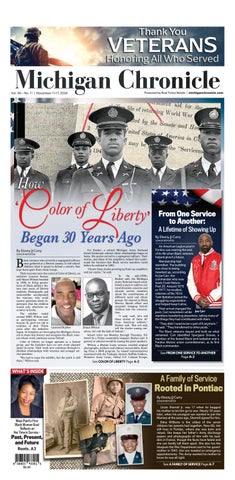
Color of Liberty From page A-1 Montford Point Marines and the Black paratroopers known as the Triple Nickles. Rusher also recalled the 761st Tank Battalion among the original participants. The exhibits connected Detroit students to a military history that began well before either founder’s service. The 1st Michigan Colored Infantry was organized in Detroit between August 1863 and February 1864 and mustered into service on Feb. 17, 1864. That May, it was redesignated the 102nd U.S. Colored Troops, according to the National Park Service. Its soldiers served in South Carolina and Florida during the Civil War. Decades later, the 555th Parachute Infantry Battalion, known as the Triple Nickles, became the Army’s first all-Black parachute infantry battalion. In 1945, its soldiers were sent to the western United States to fight forest fires and help counter Japanese balloon bombs. The battalion was deactivated in December 1947, and its personnel became part of the 82nd Airborne Division’s 505th Airborne Infantry, according to the National Museum of the United States Army. Wilson recalled a connection to the Michigan Chronicle through its late publisher, Sam Logan. “As a matter of fact, Sam Logan, the former deceased publisher of the Michigan Chronicle, was part of the Triple Nickel,” Wilson said. The preamble to a Color of Liberty program outlined the founders’ purpose: “Honoring Black Americans who defended the country while serving in a segregated military.” “We, the founders of the Color of Liberty, believe it is America’s obligation to remember these bold men and women for their historical achievements,” Wilson read from the program. President Harry S. Truman issued Executive Order 9981 on July 26, 1948, establishing equal treatment and opportunity in the armed forces regardless of race, color, religion or national origin. Implementation met considerable resistance. Almost all of the military was integrated by the end of the Korean conflict, according to the National Archives. Rusher’s own career showed him that integration did not settle every question about opportunity and leadership. When he took command of Detroit’s 1st Battalion, 182nd Field Artillery in 2007, he said, roughly 60% of its soldiers were Black. Only two officers were Black, including him. He described himself as the battalion’s first Black commander. “I didn’t want to be the only Black officer,” Rusher said. He recalled 19 vacant officer positions and said he recruited 19 Black officers to fill them. He wanted younger Black soldiers to
have access to officers who could offer the regular contact and guidance he could not always provide as battalion commander. “They can’t get to me, but they could get to all the other lieutenants there,” he said. Rusher said some military leaders viewed his effort unfavorably, but to this day, he remains proud of the officers’ careers, including a lieutenant he said later became the battalion’s second Black commander. “I’m very proud of what I did, but I also received repercussions of that too,” he said. A 2011 military public affairs report documents Rusher’s command of the battalion in Kuwait, where the unit provided security and supported Third Army operations. He retired in 2015 after 33 years of service. Wilson served eight years in the Marine Corps, including during Desert Storm, before arriving in Detroit in 1992. He now leads Cadence, a communications, marketing and business development firm, and credits his military experiences with helping prepare him for civilian work. “That military background was key,” Wilson said. He wants attention paid to what veterans have accomplished since returning to civilian life, too. “We’ve got a lot of great men and women doing some great things, especially in Detroit, who have military backgrounds,” he said. For Rusher, that work also includes helping veterans understand the assistance available to them through veterans’ affairs programs. “The VA is a very vast and complex agency,” he said. “But it has a lot to offer and our veterans don’t know.” He sees helping living veterans and preserving the accounts of earlier generations as continuing responsibilities. “Our primary goal now is to just educate veterans on what’s out there,” Rusher said, “and also still maintain the history of what some of these African American veterans have done.” With younger soldiers, he sometimes starts by calling them Buffalo Soldiers. When they ask why, he tells them about the Black Army regiments and the people who served in them. “They go, ‘Sir, why you call me a Buffalo Soldier?’” Rusher said. “Let me tell you the story of the Buffalo Soldier.” Rusher wants those soldiers to pass that history onto younger soldiers when they become leaders themselves. The veterans who brought their experiences to Detroit schoolchildren can’t all speak for themselves anymore. Keeping their accounts in circulation is the work Color of Liberty’s founders still intend to do, through the younger service members they mentor and the Detroit veterans whose stories they want to stay alive.
BIN AD 3cols x 5.25
Dr. Curtis Ivery
Opera House Ad 3cols x 5.25
BWE AD 6cols x 5.25
Get
Michigan Chronicle
Delivered Daily to Your Inbox!
Scan the QR Code to Sign Up for the Digital Daily Newsletter
A3 | November 11-17, 2026
Roots.
michiganchronicle.com
Detroit Honors the Black Soldiers of the 102nd Infantry This Veterans Day
By Ebony JJ Curry SENIOR REPORTER
Michigan’s first Black Civil War regiment began organizing in Detroit in 1863, recruiting men to fight slavery in a country that would pay them less than white soldiers. Some volunteers had escaped bondage themselves. Others returned from Canada to enlist, leaving freedom behind to fight for people still denied it. Organized at Camp Ward as the First Michigan Colored Infantry, the unit became the 102nd United States Colored Infantry. More than 1,400 Black men ultimately served in its ranks, taking the regiment from Detroit’s east side into Union campaigns across South Carolina, Florida and Georgia. This Veterans Day, Detroit will remember their service at Elmwood Cemetery, where 18 members of the regiment are buried. The annual observance brings veterans, students and residents to a city burial ground that holds part of the history those soldiers helped make. The regiment’s formation required a campaign before its soldiers ever reached a battlefield. Detroit’s Black leaders helped recruit volunteers, while Henry Barns, editor of the Detroit Advertiser & Tribune, pressed federal officials to authorize a Black regiment in Michigan. Through editorials and appeals to Washington, Barns argued for Black men’s opportunity to serve. Federal permission came in July 1863, and recruitment began the following month. Men came from Detroit, other Michigan communities and Canada. Approximately 1,000 of those who eventually served had been born in slave states. For recruits whose relatives remained enslaved, the war’s outcome could determine whether their families would ever be free. Those who returned from Canada made the journey knowing that enlistment would take them back into the United States and, eventually, into Confederate territory. At Camp Ward, residents watched the recruits drill, march in dress parades and attend religious services. The soldiers trained with Austrian Lorenz muskets and learned the formations they would need in the field. Their preparation unfolded in public, amid racist criticism of the effort to raise a Black regiment. The army’s pay system made its discrimination measurable. Black soldiers initially received $10 a month, with $3 withheld for clothing. White soldiers received $13 without that deduction. A Black soldier was left with $7 — little more than half his white counterpart’s pay. Congress authorized equal pay in June 1864. White commissioned officers commanded the regiment. If captured, its Black soldiers faced threats beyond imprisonment: Confederate authorities threatened them with enslavement, and Black prisoners endured harsher treatment than white prisoners. For men who had already escaped slavery, capture could mean being forced back into bondage. The First Michigan mustered into service on Feb. 17, 1864, and left Michigan that March. On May 23, its designation changed to the 102nd United States Colored Infantry. In the South, the soldiers guarded Union positions, maintained outposts and participated in raids and combat. They served at Port Royal, South Carolina, before moving into Florida, where they faced a Confederate attack at Baldwin in August 1864 and participat-
See 102ND INFANTRY Page A-4
West Point’s First Black Woman Grad Reflects on Her Time in Service –
Past, Present, and Future By Biba Adams STAFF WRITER AND REPORT FOR AMERICA CORPS MEMBER
The year is 1976. It is the 200th anniversary of the founding of America and the energy of patriotism is in the air. The Vietnam War has officially ended, and more than 100 women applied to the United States Military Academy at West Point after President Gerald R. Ford signed Public Law 94106, opening enrollment at the three public military academies to all eligible applicants, regardless of sex. Among them was Patricia Locke, a Detroit native and the first African American woman from the United States Military Academy at West Point. She graduated on May 28, 1980, as part of the academy’s first-ever class to admit and graduate women. She was one of the first female cadets accepted into the U.S. Military Academy at West Point and the first black woman to graduate by order of merit. In 2001, she was inducted into the Army Women’s Foundation Hall of Fame. Today, Locke is committed to helping young people pursue educational opportunities and become leaders with integrity. A conversation with Locke feels like a job interview. She has numerous questions, she requires clarity, and she wants to understand your motivation. During her interview with Michigan Chronicle, it remained clear how she was able to achieve her historic feats – even her voice demands respect and reverence. As a teenager, a younger Pat Locke witnessed the 1967 riots in Detroit. In fact, she says that during that crisis, it was the first time that she saw a Black man in a military uniform. She admired him and his work, and she, too, registered for the Army. “I loved being in the army because, you know, you were earning your own money, you had your own bed to sleep in, you got three meals a day. I thought I was in heaven,” she said. “So I went from there to Fort Polk, La., where a battalion commander if I wanted to go to West Point. And I didn’t know what that was.”
Patricia Locke She soon found out what West Point was and that it was a place where she could earn a bachelor’s degree during her service. She quickly enrolled, arriving only days later with all she owned in a duffle bag. When asked what her life was like at the academy, Locke said, “Well, what I remember, is that it was fast and furious. I don’t know if you grew up in the time where you had Bugs Bunny and Roadrunner. And you remember the Tasmanian devil spinning on the road. We weren’t just going fast. We were spinning as we were going. And that’s because of the academics at the academy. You’re going to learn a lot in a very short amount of time and then you have to apply it.” An article from the National Museum of the United States Army sets the scene, “Upon arrival, the women of West Point met a similar range of opinions in the minds of their peers. Lt. Col. Carol Barkalow, a member of the first graduating class of women, remembered that while the majority of male cadets simply abided by the new dynamics, a “vocal minority sometimes
made it hell.” “Pat Locke, a prior service Army veteran from Detroit, recalled that as one of only two African American women at the academy, she experienced an even greater feeling of isolation and resentment from her predominantly white male peers.” After an illustrious career, Locke moved into recruitment. She spent many years speaking to Black and Brown communities to explain why they should consider a military career. In asking how she acknowledges that minority communities have a distrust of the government and the military, she explained that the pros outweigh the cons. “Well, the big message is opportunity. Like we were treated badly in the, you know, during the Vietnam era. There’s no doubt,” she said. “Over the last 50 years, we have progressed in the military, and now we have African American generals. We have women generals. We have people that don’t look like the leadership that we had back in the early 70s.” She added, “So the leadership now looks more like our communities in, in the nation. And I speak often about the educational opportunity in the academy, and that’s something once you get educated, that’s hard for people to take away from you. You know, they can take your money, they can arrest you, they can do a whole bunch of other stuff. But they can’t take your education away from you. So why not get the best education that you possibly can get?” Locke was also asked about the current political climate and administration and the perceived hostility towards black women in the military. Her immediate response was, “I’ll keep my opinion to myself.” However, she later added, “We have endured many administrations. Many. And the good thing about the military is there’s so many layers of leadership before you get down to just a common soldier like me. And, you know, I think back in the day when I went into the army, the environment, the climate was absolutely horrible. Absolutely horrible. But look at me now.”
Marvin Gaye Heard the Brothers Who America Sent to War By Ebony JJ Curry SENIOR REPORTER
Music can change what a country is willing to hear about itself. In 1971, Motown’s Marvin Gaye released the song “What’s Going On.” It was a time when Black men were returning from defeat from the Vietnam War, and they were coming back to a country that had demanded their service, but still made them fight to be seen as equal in the eyes of their white counterparts. Marvin’s younger brother Frankie was one of those Black men who returned beat up and bruised – physically, mentally and emotionally. Brother Marvin got to see what was goin’ on after having heard stories through the grapevine for years prior. The song asked America to listen, too – to the men it sent to war and to the families who prayed them back, knowing a uniform would offer little protection from racism once they returned. Gaye sang with such tenderness that the record still feels at home wherever Black families gather. But the question inside it has never gone quiet. His voice was gentle enough that a listener could mistake the song for consolation alone. Underneath it was a demand. How could it send Black men to defend American freedom while Black Amer-
icans had to keep demanding its protection at home? The song’s first spark came from Renaldo “Obie” Benson of the Four Tops. In 1969, Benson witnessed police violence against demonstrators at People’s Park in Berkeley, California. He began developing the song with Al Cleveland before bringing it to Gaye. Benson had seen what happened when people protested in an American street. Gaye had heard what war had done to his brother. The three men made a record that joined those troubles without letting either disappear. Listen to the beginning and there are already people in the room. Voices talk over one another. A saxophone comes through. Gaye enters the conversation singing to mothers first. For a family with someone overseas, a war could live in the smallest parts of a day: the wait for word, the unease when a letter took too long, the fear that a knock at the door might change everything. Gaye knew the government’s language could make such losses sound necessary. He made them sound personal. Then, on “What’s Happening Brother,” the album follows a veteran home. Drawing on Marvin’s conversations with Frankie, it gives the returning man concerns about work and the place he has come back to.
Marvin Gaye He has survived. He still needs a living. He wants to catch up with his people. The song understands that a homecoming takes time. A family may be relieved to have its son back and still have to learn who he has become. He may be proud of his service and angry about what he was asked to endure. He may want to tell the story, or he may want, for one afternoon, to be left alone to enjoy being home. Gaye made room for that whole person. Most of What’s Going On was recorded in Detroit with Motown’s musicians. What they made here traveled far beyond the city, though Detroit can still claim the sound of it: music with enough soul to make people gather around
and enough nerve to ask what is wrong once they do. That may be why the title song can play at a Black family cookout without anyone treating it as a lesson. Somebody puts it on because it sounds good. Somebody else remembers who used to play it. The young ones learn it by hearing the grown folks sing along. Its history is there even when nobody speaks of Vietnam. Black families have long made space for laughter in the middle of hard times. The song knows how to live in that space. It can hold a memory of somebody who served and a memory of somebody who is gone while the family keeps eating, talking and enjoying one another. For a lot of veterans, that’s what belonging feels like. After the war and after the welcome-home ceremony, there is still the question of whether the country will stand by him. The evidence gives that question a present-day urgency. In a report published in 2023, the Government Accountability Office found that Black veterans had the lowest approval rate for initial disability compensation claims among the racial and ethnic groups it examined. For decisions made from fiscal years 2010 through 2020, the approval rate was 61% for Black veterans and 75% for white veterans. GAO called on the
Department of Veterans Affairs to investigate the causes of the disparity; its recommendation for a comprehensive assessment remains open. Those figures cannot tell any veteran’s whole story. They do require an answer, though. A country that praises sacrifice should be able to explain why the people who sacrificed face such different outcomes when they ask for help. Gaye’s question still follows Black veterans into the years after service, when a country’s gratitude can grow faint just as a man begins to need its help. But when the record comes on at a family gathering, he owes no one an account of the war. He can hear it among the voices of people who have known him all his life. The song remembers what he survived and leaves him free to enjoy being home. “What’s Going On,” has lasted because people still find a place in it. That is part of why Black families have kept playing it. Gaye gave sorrow a sound people could live with, even celebrate around, without forgetting where it came from. His tenderness was for the men America sent away and the people who waited for them. His question was for the country. It still is. Cause if we don’t talk about it, they’ll say it’ll never happen.
Page A-4 | November 11-17, 2026 | michiganchronicle.com
102nd Infantry From page A-3 ed in a raid on the Florida Central Railroad. Detachments later fought at Honey Hill and near the Tulifinny River in South Carolina. An account preserved by the Detroit Historical Society describes the men saving artillery after enemy fire killed the horses needed to move it. With two guns in danger of being abandoned, the soldiers hauled them away by hand. The account records a kind of battlefield labor easily lost in a list of engagements: men moving heavy weapons themselves while an expedition was under fire. During the final spring of the war, the 102nd participated in Potter’s expedition through South Carolina. Its service continued after Confederate armies surrendered, with occupation duties keeping the men in the South until they mustered out in Charleston on Sept. 30, 1865. They returned to Detroit on Oct. 17, when the regiment was disbanded. Public recognition of their service now reaches beyond the cemetery. In 2021, a portion of Interstate 375 was dedicated as the 102nd United States Colored Troop Memorial Highway, placing the regiment’s name along a downtown route near where its history began. Efforts to recover Camp Ward have also
brought attention to the ground beneath present-day Detroit. Michigan Public reported in 2024 that researchers working with the Michigan Underground Railroad Exploratory Collective, the Charles H. Wright Museum of African American History and the University of Michigan’s Museum of Anthropological Archaeology used ground-penetrating radar to identify remains associated with the camp. Excavation and an educational attraction remained goals at the time. Elmwood’s 42nd annual Veterans Day observance, presented with the Detroit Historic Civil War Society, begins at 11 a.m. Nov. 11 in Section S at 1200 Elmwood Ave. It is free and open to the public. The cemetery’s announced program includes a Tuskegee Airmen flyover, a flag-raising by Detroit Public Schools Community District Junior ROTC cadets and a performance by the Martin Luther King Jr. Senior High School marching band. Living history groups and Civil War re-enactors are also scheduled to attend. The ceremony will honor a regiment whose collective service is documented, even as parts of its soldiers’ lives remain unknown. Their graves lie a few blocks from the former Camp Ward site. Detroit holds both the ground where the regiment prepared for war and the resting place of men who returned from it. Recovering their stories is part of the work that remains.
SAT / DEC 19 / 8:00 PM
A NIGHTOF INSPIRATION
Home Loans
Go from someday to moving day Move into your own home with down payment options, grants, and affordable payments. Scan to see if you qualify,
A GOSPEL HOLIDAY CELEBRATION
visit flagstar.com/welcome2home or call 313-942-4835 now.
WITH DETROIT OPERA ORCHESTRA
Featuring Kim Burrell, The Clark Sisters, and Donald Lawrence Conducted by Ray Chew © 2026 Flagstar Bank, N.A.
DETROITOPERAHOUSE.ORG
10” x 10.5”
Equal Housing Lender | Member FDIC
Programs for qualified borrowers. All borrowers are subject to credit approval, underwriting approval, and product requirements including loan to value, credit score limits, and other lender terms and conditions. Fees and charges may vary by state and are subject to change without notice. Some restrictions may apply. Not a commitment to lend. Grants are limited and subject to change without notice. Recipients must meet program requirements and applicable restrictions. Homeownership education may be required. NMLS #417490 1026 1728600
MISSION ALL ABOUT CARE Enroll in the $0 Premium Medicare Advantage plans from Trinity Health Plan of Michigan (HMO). We’re on a mission to make health care easier for YOU. As a not-for-profit organization, we’re committed to providing compassionate care to everyone in our community.
$1,740 Cash Back per year in
your Social Security check on select plans Large network of trusted providers $0 Tier 1 prescription drugs Dental, vision and hearing coverage And so much more!
Enroll NOW or get
your FREE Enrollment Guide:
CALL 888-796-1387 (TTY: 711)
8 a.m. to 8 p.m., 7 days a week
mi.trinitymedicare.com/mic
Trinity Health Plan of Michigan (HMO) is a Medicare Advantage organization with a Medicare contract. Enrollment in Trinity Health Plan of Michigan depends on contract renewal. Benefits vary by county. Other pharmacies, physicians or providers are available in the plan’s network. Speak with a licensed sales agent during call center hours: April 1 to September 7, 8 a.m. to 8 p.m., Monday through Friday; September 8 to March 31, 8 a.m. to 8 p.m., seven days a week. Not all 2027 plans have $0 Premium, Cash Back ($1,740.00 per calendar year, which is $145.00/month), comprehensive dental or Part D prescription drug coverage benefits. Copays and coinsurance vary by plan. To file a grievance, call 1-800-MEDICARE (TTY: 711) to file a complaint with Medicare. Free enrollment guide given without obligation. ATENCIÓN: Si habla español, tiene a su disposición servicios gratuitos de asistencia lingüística. Llame al 800-964-4525 (TTY: 711). 注意: 如果您使用繁體中文,您可以免費獲得語言援助服務。請致電 800-964-4525 (TTY: 711). PRJ-11270 Y0164_AEPDivPrintMI27_M
11533(10/26)MIC
A5 | November 11-17, 2026
Money.
michiganchronicle.com
Property is Power!
The Land Beneath Our Feet By Dr. Anthony O. Kellum CONTRIBUTING COLUMNIST
I grew up hearing the older generation in my family talk about land the way other people talk about money. Not land as dirt and not land as a place to build a house, although it is both. Land as something you hold. Land as something that holds you. My grandparents spoke that way, with pride and sometimes with pain, because they understood something we are still learning. In America, land is not just property. Land is power. So let me ask you a question. If your family had owned land one hundred years ago, and still owned it today, where would you be? What would your children have inherited? For too many Black families, that question hurts, because we know the answer. We once owned land, a great deal of it, and we lost most of it. How we lost it matters but how we get it back matters more. A little more than a cenAnthony O. Kellum tury ago, Black Americans owned roughly 15 million acres of farmland, and nearly one million Black farmers worked that land. Just one generation after slavery, with almost nothing to start with, our people had become landowners. They bought land when banks would not lend to them, cleared it, farmed it, and passed it down. That land was the foundation of Black wealth in America. A paycheck can feed a family for a week. Land can feed a family for generations. For most families today, landownership starts with a home. A home is land with a roof on it, and for the average American family, it is the largest asset they will ever own. Yet today, only about 45 percent of Black households own their home, compared with about 74 percent of white households. That homeownership gap is the land gap in modern form. Every month a family rents, it pays down somebody else’s mortgage. Every month a family owns, it pays down its own. That is the difference between building someone else’s legacy and building your own. We did not lose that land because we did not value it. We lost it because the system was built to take it. Some of it was taken by outright discrimination. For decades, the Department of Agriculture denied Black farmers the loans and the fair treatment that white farmers received as a matter of course. The federal government itself later settled claims that Black farmers were discriminated against for decades, and by then, for many families, it was too late. The farm was already gone. Some of it was lost through laws that punished families for not having paperwork. When a parent died without a will, the land passed to every heir at once, and it became what lawyers call heirs property. No one person owned it outright, so no one person could easily protect it. One distant relative could force a sale of the whole parcel, often for far less than it was worth. And some of it was lost because we were pushed out of the places where wealth was being built. Redlining drew a line around Black neighborhoods and told banks not to lend there. The GI Bill, which helped millions of white veterans buy homes after World War II, was largely closed to Black veterans in practice. That history is real. Here is the truth I have learned after years in the mortgage business. Income is not wealth. A good salary can buy a nice car and a nice lifestyle, but it cannot buy a legacy. Wealth is what you own, and what you own is what you can pass on. The Federal Reserve’s Survey of Consumer Finances tells the story plainly. In 2022, the median net worth of a Black family was about 45,000 dollars, compared with about 285,000 dollars for a white family. That gap is not mainly about how hard we work. That gap is about what we own. Looking wealthy and owning wealth are two different things. Too many of us have spent our best earning years buying things that lose value the moment we drive them off the lot, while the people who build lasting wealth have spent those same years buying things that grow in value. A car depreciates. A designer bag depreciates. Land
See LAND IS POWER Page A-6
Henry Ford Health Invests $15M with Opportunity Resource Fund for Housing, Small Businesses in Detroit and Jackson By Jeremy Allen EXECUTIVE EDITOR
For Henry Ford Health President and CEO Bob Riney, good health doesn’t begin and end inside a hospital. It starts at home, in the neighborhood, and whether families have the resources they need to live stable, healthy lives. That’s the thinking behind Henry Ford Health’s $15 million investment in Detroit and Jackson, an initiative designed to help families secure housing, small businesses access capital and neighborhoods get the resources they need to grow. Announced Thursday, Nov. 5, at Opportunity Resource Fund’s Impact Summit in Detroit, the investment brings together Henry Ford Health and the Michigan-based community development financial institution in a partnership aimed at expanding economic opportunity around the health system’s hospitals in Detroit and Jackson. The $15 million will be placed into a lending pool managed by Opportunity Resource Fund, which will administer loans for eligible projects involving affordable housing, homeownership, small businesses and neighborhood improvements. Approximately $11 million is allocated for communities surrounding Henry Ford Hospital on West Grand Boulevard in Detroit, while another $4 million will support communities near Henry Ford Jackson Hospital. Riney said the investment reflects a responsibility that extends well beyond providing medical care. “We’re really excited to announce that we’ve put $15 million from our innovation fund to help provide these loans for people that are looking to have housing stabilization,” Riney said during an interview. “It’s part of our commitment as a health system to really recognize that health happens not only by great medical care, but by having support systems in your life, and housing is one of those.” He said the decision to dedicate $15 million came after looking at the health system’s innovation fund and determining what could be invested without creating significant challenges for other financial commitments while still making a meaningful difference. But the bigger question for Riney is what happens after families receive the help. “Well, we do a lot of work in food insecurity and all sorts of other support systems, but housing is lasting. Housing is generational,” he said. “If you get people into safe housing, not only does it impact their health, but they have some equity, they have a way to pass that on to the
next generation.” The connection between housing and health is a major part of the partnership’s mission. Riney said research has shown that people dealing with food insecurity, housing insecurity and limited opportunities to move out of poverty often end up using more healthcare services because the conditions affecting their everyday lives haven’t been addressed. “We really view our role as that of a health company,” he explained during an on-stage conversation moderated by longtime Detroit journalist Paula Tutman. “That implies that you’ve really got to lean in and work on elevating the health of all communities, not communities of convenience, but all communities.” He said Henry Ford Health takes pride in the clinical care its medical teams provide, but the organization also recognizes that a person’s health status is affected by many things that have nothing to do with a healthcare delivery system. “You have to think far beyond the walls of where you deliver care,” Riney said. For families struggling to keep up with housing costs, living in unsafe conditions or trying to make ends meet while running a small business, those everyday challenges can become health challenges, too. Riney said he hopes the investment will eventually lead to patients walking into their primary care appointments and telling their doctors that one of the biggest sources of stress in their lives is no longer there. “That’s the ultimate definition of success,” he said. Opportunity Resource Fund President and CEO Byna Elliott said the investment is expected to support approximately 1,000 housing units, serve 500 small businesses and help between 250 and 300 homeowners. The organization, now in its 41st year of operation, will use its lending model to reach people who might not qualify for traditional financing, including neighborhood developers, first-time homebuyers and small-business owners who have been turned away by conventional lenders. Elliott said Henry Ford Health’s longstanding presence in Detroit made the partnership a natural fit. “They’ve been in our community for over 100 years as a hospital serving the community, and they’ve always wanted to do more,” she said during the on-stage conversa-
See HENRY FORD HEALTH Page A-6
Money Matters: The Bottom Line After the Election By Mark S. Lee CONTRIBUTING COLUMNIST
Michigan voters have spoken—and businesses across the state should be listening. The 2026 midterm election has reshaped Michigan’s political landscape, with Jocelyn Benson elected governor and Democrats positioned to control both chambers of the state Legislature. That gives Michigan businesses something they value highly: a clearer picture of who will be making policy in Lansing. But clarity does not necessarily mean certainty. For business owners, executives and entrepreneurs, the real question now is straightforward: What will these election results mean for the bottom line? The answer will unfold over time, but several issues are already coming into focus. First, affordability will remain front and center. One of the clearest messages coming out of this election was voter concern about costs. Michigan businesses are dealing with that same reality every day. Consumers remain sensitive to prices. Employers continue to navigate wage pressures and benefit costs. Small businesses are watching everything from rent and insurance to energy and supplies. That means the next administration and Legislature will face continued pressure to
pursue policies that help Michdevelopment, infrastructure, igan residents manage their energy and permitting. household budgets while also The question isn’t simply recognizing the challenges busiwhether Michigan has a good nesses face in controlling their economic development strategy. own costs. The bigger question is: And that balance matters. Can Michigan move quickEventually, those costs show ly enough and competitively up somewhere, often in higher enough when businesses are deprices, reduced investment, ciding where to invest their next slower hiring or thinner profit dollar? margins. That will be particularly imThe most successful econom- Mark S. Lee portant as the state works to ic policies will be those that recretain and attract young talent ognize both sides of the equation: helping and address concerns about sluggish popconsumers afford more while helping busi- ulation and economic growth. Those chalnesses remain viable enough to grow. lenges will not disappear simply because the Second, Michigan businesses should election is over. expect economic competitiveness to become Third, the return to unified Democratic an even more important conversation. control in Lansing could mean more predictMichigan has enormous strengths. It re- able policymaking—but also more responsimains a global center for automotive manu- bility. facturing and mobility. It has major assets Divided governments often produce in advanced manufacturing, technology, gridlock. Unified government can move an research and innovation. Detroit continues agenda more quickly. its transformation, while the city and state For businesses, that can be good or concontinue to compete for new investments cerning, depending on the policy and jobs. The business community will be watchBut Michigan is not competing in a ing for potential action involving labor laws, vacuum. environmental and energy policy, taxation, Companies considering where to expand consumer protections and other regulatory can choose from dozens of states. Busi- issues. With Democrats controlling the govnesses will be watching Lansing closely on ernor’s office and both legislative chambers, issues such as taxes, regulations, workforce businesses may have fewer opportunities to
rely on partisan division as a brake on legislation. That makes engagement more important than ever. Business leaders cannot afford to sit back and wait to see what happens. Trade associations, chambers of commerce, small-business organizations and individual employers need to clearly communicate how proposed policies will affect hiring, investment and growth. Fourth, Washington will continue to matter to Michigan businesses. Michigan’s economy is especially connected to national and global policy. The automotive industry, manufacturing, agriculture and other sectors can be affected significantly by tariffs, trade policy, taxes and federal regulation. In a closely watched significant race, Michigan voters also elected Senator-elect, Dr. Abdul El-Sayed, adding another important voice to the state’s representation in Washington. For Michigan businesses, the challenge will be navigating policy changes coming from both Lansing and Washington. But perhaps the biggest takeaway from this election is this: politics matters because policy matters—and policy eventually affects the bottom line.
See AFTER THE ELECTION Page A-6
Page A-6 | November 11-17, 2026 | michiganchronicle.com
Build The Skills Before You Need the Title
Land is power From page A-5
By Danyail Lawton RETIRED AIR FORCE VETERAN AND CEO OF KING-LAWTON CONSULTING
Your military career should not be the first time you build the skills your next career will require. I retired from the Air Force on May 1, 2025, after nearly 23 years of service. I enlisted on October 22, 2002, served four overseas deployments, including two tours in Afghanistan, and retired at 41. After leaving active duty, I completed my master’s degree in strategic communications in August 2025. I knew two things: I did not want to work for anyone, and I still had more to give. When I started building my consulting firm, I wasn’t starting from scratch. I was putting years of experience to work in a new way. People call that good timing. I call it preparation. The year after the uniform comes off is a transition few people discuss, and it is harder for some of us than others. In 2025, women veterans were unemployed at a rate of 4.6 percent, compared with 3.3 percent for men. Black veterans were at 5.0 percent, compared with 3.3 percent for White veterans, according to the Bureau of Labor Statistics. Black women veterans carry both of those gaps. We get the ceremony and the handshake, then a Monday with no one telling us what comes next. If you have 18 months left before separation, here are three things to start now. 1. R ecognize the civilian value of the work you already do. Whatever you have been doing in uniform has a civilian name. Learn to recognize it, explain it, and put it to work. I spent my first 10 years in logistics, followed by more than a decade in intelligence analysis. But my experience extended beyond those job titles. I wrote compelling documents to help the people who worked for me receive recognition, prepared them for interviews, and identified opportunities to increase their visibility. I worked with leaders to address issues that had become public and helped protect my commanders’ reputations when difficult decisions had to be made. That is public relations. It is also strategic communications, media preparation, and reputation management. I had been applying those skills long before I started my consulting firm. Beginning in 2021, I also volunteered in civilian settings, where I learned to apply my experience outside the military structure. Start documenting examples of the work you do, the problems you solve, and the people you help. Learn how employers and clients describe those skills in the civilian world. Then find opportunities to practice them before you separate. You may not need an entirely new skill set. You may need to recognize the value of the one you already have. 2. Protect your records, especially your medical history. Learn how to obtain your personnel records, separation or retirement orders, and medical records. Review your DD-214 when it is issued, verify its accuracy, and keep copies somewhere you control. Do not neglect your health while you serve. Many of us pushed through pain and ignored symptoms because the mission came first. We kept
going because that was what we believed service required. Eventually, that can catch up with you. Seek medical care when issues arise and make sure your symptoms and treatment are documented. Years of suppressed health concerns can be difficult to substantiate when you leave the service and seek a VA disability determination. Medical documentation can support your claim, though it does not guarantee an award. You do not want to be fighting to establish your medical history while also trying to navigate life after service. The mission will continue. You must make your health a priority, too. Also, get personal contact information for three or four leaders who can speak to your work. Build those relationships before you leave, while your contributions are still fresh in their minds. 3. Decide who you want to be after the uniform. The military gives you a title, a structure, and a clear path forward. Separation removes that structure. You do not need to have every answer before your last day, but you should give yourself room to explore what comes next while you still have a paycheck and a routine. After retirement, I stepped away from volunteer roles and made time to build on what I had learned over nearly 23 years. That period helped me determine how I wanted to use my experience. My consulting firm grew out of that process. I also became a published author. My children’s book, Penelope and the Vase, published this month, began as a story I wrote in ninth grade. I had never written a book for publication, but I had tangible skills in communication, planning, and bringing an idea to life. I built on those skills to navigate an unfamiliar process and turn a story I had carried for nearly three decades into a published book. You do not have to know everything about your next chapter. You need a foundation you can build on. Preparation is the work you do while there is still time to do it. If you have 18 months left, use them. Build your skills, keep your records updated, and give yourself room to imagine a future beyond the uniform. Your next chapter deserves the same preparation you gave to the first. Danyail Lawton is an Air Force veteran who served nearly 23 years and the founder and CEO of King-Lawton Consulting, a strategic communications firm in Las Vegas. She is the author of the children’s book Penelope and the Vase. Learn more at kinglawton.com and kinglawton.com/penelope-and-the-vase, or reach her atdanyail@kinglawton.com.
does not work that way. Land is finite. They are not making more of it. A home, held over time, builds equity. That is why the wealthiest families in this country hold real estate. It is not a secret. It is a strategy, and it is one we can use too. Researchers estimate that more than 80 trillion dollars in wealth will change hands in this country over the next two decades. That is the largest transfer of wealth in American history, and it is happening now. Will we be on the receiving end, or will we watch it pass us by? If we own nothing to pass on, our children will start from zero, just as we did. If we own land and homes, our children will start from somewhere, and that somewhere makes all the difference. So what does it mean to think like a landowner? It means seeing a house not as a bill, but as an asset. Renting for thirty years leaves you with receipts, while owning for thirty years leaves you with equity, and equity is something you can borrow against, sell, or hand to your children. A mortgage is forced savings in its best form. Part of every payment goes toward owning more of your home, your payment stays fixed while rents keep rising, and the home itself can grow in value. It means buying the first home, even if it is modest, because the first home is the hardest one. It means learning how homeownership works, asking questions, and getting pre-approved. It also means protecting what we already have. If your family still owns land, especially land down South, or a family home that has been paid for over decades, do not let it slip away because no one had the conversation. Sit down with your family and ask the hard questions. Who owns it? Is there a will? Is the title clear? Are the taxes paid? One family meeting can save a hundred years of history. Put the property in a trust or a family LLC. Do not let a piece of paper, or the lack of one, cost your family its legacy.
After the Election From page A-5
The election may have changed the political players, but the fundamental concerns of Michigan businesses remain remarkably consistent in the areas of attracting and retaining talent, investment, controlling costs and removing barriers limiting growth. Michigan has entered a new political chapter. Now comes the more important work: turning election promises into economic policies that strengthen consumers,
Henry Ford Health From page A-5 tion. “When you have an anchor institution, it signals to everybody else that this is a community worth investing in.” She pointed to Henry Ford Health’s $3 billion-plus investment and expansion in Midtown, which has attracted additional partners and investors to the surrounding neighborhood. But Elliott said it’s important that longtime residents and smaller developers benefit from that growth, too. “You want to see the community also benefit from that significant investment,” she said. “You want to see the housing stock improve. You want to see the infill housing happen.” That’s where Opportunity Resource Fund comes in. “We’re a mission-based lender, so we look beyond your credit score,” Elliott said. “There’s some people, there’s some developers, there’s some individuals that can access traditional banking capital, and they should, and they will. But there’s some community people that you don’t want to see left out. They’ve been in those communities for a really long time. They’ve stuck through the thick and the thin, and we want to make sure that they have capital available that’s accessible to them, that’s affordable.” Two loans are already underway in Detroit. One is supporting the stabilization of newly developed affordable housing in the Virginia Park neighborhood. The other involves the redevelopment of a long-vacant commercial building into a mixed-use development, with multifamily housing on the upper floors and commercial space below. The project is expected to include childcare, an important resource for neighborhood residents and Henry Ford Health employees. Elliott also discussed another affordable housing effort involving Central Detroit Christian Community Development Corporation, a neighborhood-based developer working on infill rental housing near Claremont. The goal is to make housing available to households earning 50% of area median income or below, including units targeted to households earning 28% of area median income or below. She said flexible financing can make projects possible when traditional banks aren’t willing to take on the entire risk. In one example, a developer secured part of the financing through a bank but couldn’t get the remaining portion. Opportunity Resource Fund stepped in to fill the gap and partnered with the bank to complete the transaction. In another case, a neighborhood developer with more than 30 years of experience simply needed a lender willing to say yes. “This is a very tough environment for capital, especially for nonprofit developers,” Elliott said. “So we are happy to provide that capital in a record amount of time. We did 30 days to close on that transaction, and those families are now housed in affordable housing.” For small-business owners who have repeatedly heard no from traditional lenders, Elliott has a message: Don’t count yourself out.
She encouraged business owners to apply through Opportunity Resource Fund, even if they’re unsure whether they qualify. “I can tell you the number of yeses we say when people don’t think they’re ready when, in fact, they are, but they’ve been told ‘no’ so many times by traditional lenders that they actually tell themselves no,” she said. Her advice is to apply and start the conversation. “Even if it’s ‘not yet’ we’re going to work with them over time to make sure, if they want it, that they can achieve their goals,” Elliott said. “I want them to apply. I want them not to tell themselves no. Don’t put a hurdle up that doesn’t exist.” The investment also comes at a time when housing development and small-business support are central to Detroit Mayor Mary Sheffield’s agenda. Sheffield’s Rise Higher Detroit Community Framework, shaped by input from more than 8,000 residents, identifies thriving neighborhoods and equitable economic development as key priorities. The framework calls for expanding access to affordable housing and homeownership while helping small businesses start, stay and grow in Detroit. Her administration has also directed additional resources toward affordable housing development, home repairs and small-business support, including funding for the Motor City Match program. Elliott said she’s participated in housing task force discussions connected to Sheffield’s transition team and believes Opportunity Resource Fund has an important role to play in expanding access to homeownership and helping projects move forward. The organization is also looking beyond the initial $15 million. Elliott said the goal is to use the investment as a catalyst to attract additional capital, with the intention of turning it into approximately $60 million in lending capacity. She said Opportunity Resource Fund has already raised about $40 million in additional capital since the initial investment was announced. “We actually don’t believe $15 million is enough,” Elliott
And if your family lost its land long ago, that does not mean the story is over. You can start again. You can buy a home, or a small piece of land, or a duplex, live in one side, and let the other side help pay the mortgage. The size of the first step matters less than the direction. What matters is that you start now, because every year you wait is a year of equity that you do not get back. I know what some people will say. They will say the system is rigged, and they are not entirely wrong. They will say it is too late, and they are wrong about that. The system was rigged against the generation that bought 15 million acres with almost nothing, and they bought it anyway. If they could build wealth under those conditions, we can build wealth under ours. What we need is the same thing they had. The belief that ownership matters, and the discipline to pursue it. This is not just about money. Land is about belonging. When you own the ground beneath your feet, no landlord can tell you to leave. No one can raise your rent beyond your reach. You have a place to gather your family, to celebrate, to grieve, to grow old. You have a stake in your neighborhood and a reason to care about its future. Ownership changes how you see yourself, and it changes how the world sees you. It says, I am not passing through. I am here to stay. Black America, we have spent generations working hard. We have built businesses, earned degrees, and raised families. Now it is time to own what we have built. Homeownership is where that ownership begins for most families, and it is the work I have devoted my life to. It is time to buy the home, keep the land, protect the legacy, and pass on something real to the next generation. The land beneath our feet is waiting. Let us claim it, hold it, and hand it down. Property is Power! is a movement to promote home and community ownership. Studies indicate homeownership leads to higher graduation rates, family wealth, and community involvement. support entrepreneurs, and help companies compete. Because when the political dust settles, businesses aren’t primarily interested in who won the election. They’re interested in whether Michigan is winning the competition for jobs, talent, investment, and economic opportunity. We invite readers, business owners, and future entrepreneurs to follow along, ask questions, and engage. If you have story ideas or questions, you can email Lee at mark@leegroupinnovation .com or visit leegroupinnovation. com.
said. “We believe it’s a great investment, and we’re using that as a catalyst investment to actually grow and attract other capital to these projects.” The revolving loan model also allows money to be lent, repaid and put back into circulation, giving the investment the potential to support additional projects over time. Riney said other organizations should see the partnership as an opportunity to join a larger effort to address challenges affecting their communities. He pointed to Henry Ford Health’s broader Midtown investment and the partnerships that have grown around it, including housing development, research facilities and other community projects. “People want to solve problems,” he said. “We don’t give them enough credit, but they want to know that what they’re doing is going to have enough bandwidth to really make a difference.” For Riney, the goal is to encourage organizations to make meaningful investments that can create lasting change. “Everything that we do should be at a scale to have true, sustainable, lasting generational impact,” he said. “And this $15 million fund is going to do just that.” Elliott also emphasized that the work has to involve residents, not simply be presented to them after decisions have already been made. “You fail to do something to a community versus with a community,” Riney said during the discussion, describing the importance of listening to residents and allowing their concerns to influence projects. Elliott said Opportunity Resource Fund regularly works with community partners to understand what residents need, including home repairs, rehabilitation financing and more opportunities for small-business loans. As the partnership moves forward, both organizations will track the impact of the loans and look at how the investment affects families, businesses and neighborhoods over time. And while the $15 million announcement is a significant financial commitment, Riney and Elliott are looking toward what the surrounding communities will look and feel like years from now. That means neighborhoods where residents have access to capital, local developers can build affordable housing and small businesses have the resources to remain open and grow. Riney said he hopes that when he looks back 10 years from now, he’ll see healthier families, stable housing, employment opportunities and neighborhood businesses thriving. “I want to see the community transformed, neighborhoods that I grew up in look different, and that people are healthy, they’re happy, they’re housed,” Elliott said, describing the vision for the partnership. “And that there’s employment and opportunities and storefronts that are busy and bustling on Grand Boulevard and Woodward and Claremont.” For the two organizations, the real measure of the investment isn’t about how much money goes out the door. Instead, it’s about how many families, businesses and neighborhoods are in a stronger position because of it.
michiganchronicle.com | November 11-17, 2026 | Page A-7
El-Sayed Wants to Keep Building Progressive Movement Across Michigan
By Sam Robinson SENIOR REPORTER
Avalon Village Founder Shamayim ‘Mama Shu’ Harris Elected as Highland Park’s New Mayor, McDonald Demands Recount By Biba Adams STAFF REPORTER AND REPORT FOR AMERICA CORP MEMBER
In a close race, longtime community activist and Avalon Village founder Shamayim “Mama Shu” Harris has been elected as the next mayor of Highland Park. According to the Associated Press, Harris narrowly secured the mayoral seat winning in a 50% to 49.1% outcome, with Harris getting 1,396 votes to incumbent mayor Glenda McDonald’s 1,369. “Highland Park has always had what it needs: its people. For nearly two decades at Avalon Village, we’ve transformed blight to beauty. I didn’t want to leave Highland Park and move to a beautiful place; I wanted to make where I live beautiful. Now we get to do that work for the whole city and I am truly honored and overjoyed to get started,” Harris said. She added, “I ran on results you can see, and I will regularly report to residents on what we’re getting done. I am grateful to the citizens and voters of Highland Park for putting their faith and trust in me, for voting for me and I look forward to working together to do great things in our city. As I’ve said throughout the campaign – our administration will focus on citizens first.” Following the results, McDonald said in a statement that she would be asking for a recount. “If it’s still the same, I will be conceding the race and wishing Mama Shu well,” she said. Harris’ spokesperson Amber Ogden said Harris respects the election process and fully supports her opponent’s right to request a recount. During exit polling, many Highland Park residents expressed that they had very concrete concerns about the future of their city. Issues like crime, rising property tax rates, and utility costs were among the primary concerns. However, many voters were still willing to allow incumbent mayoral candidate Glenda McDonald a second term to correct the issues. Ultimately, voters chose to change leadership by a narrow margin of less than 30 votes. “We want to see progress and the city move forward,” a voter named Erica said yesterday during exit polling. While another voter, Kelly, a grandmother who was speaking in hushed tones as her grandson slept said that the biggest issue for her was crime and the lack of emergency response in the city. Harris, a CNN Hero and USA Today Woman of the Year, has spent decades independently addressing Highland Park’s challenges, transforming blight, hosting a wide variety of community programs, addressing public safety, securing solar-powered streetlights, providing
economic opportunity for women entrepreneurs, and more. Despite the tragic hit-and-run death of her two-yearold son Jakobi RA in 2007 and the unsolved murder of her 23-year-old son Chinyelu in 2021, Mama Shu chose to stay in Highland Park to build and heal, and to run for office as a way to change some of those issues she addressed. “Well, the community has spoken,” one person wrote on Facebook. “I know that she will make major changes in the city.” Harris previously served as chair of the Highland Park Charter Revision Commission, president of the Highland Park Board of Education, vice president of the Highland Park Housing Commission, and as a reserve officer for the Highland Park Police Department. In September 2026, after winning in the primary election, she officially turned over leadership of Avalon Village to her daughters, Aziza Brent and Kafi Humphrey, to focus exclusively on the campaign. She is currently serving a second term with the Michigan Commission on Community Action and Economic Opportunity, appointed by Governor Gretchen Whitmer. According to her press release, Harris will announce her transition team in the coming days, and inauguration details will be announced once scheduled. Results from the recount were not yet available at the time of print.
Additional Highland Park Races In addition to the election of a new mayor, there were four city council seats up for grabs. Council President Jamal K. Thomas, Council President Pro Tem Sharmain Robinson, and District 2 Councilmember Kallela Martin were not seeking reelection, while District 3 Councilmember Khursheed Ash-Shafii had lost in the August primary. In the At-Large seat, Temeko Manica won re-election, getting 33% of the vote and beating her closest competitor by a margin of 1,313 votes to 909 for Melinda C. Jones. Debra J. Humphrey got 558 votes (63.6% of the total) in District 1 to win that seat over Joseph Frye-Dandridge, who got just 299 votes. The race in District 2 saw David Forsythe take 55.2% (or 509) of the total votes, while Lucy Frye, the runner up, got 393 votes (42.6%). And finally, in District 3, Koron J. Wilkerson defeated Franklin D. Jackson, Sr. in the district with the smallest turnout, 372-209 (or 62.9% to 35.4%). The district had 10 write-in votes for other candidates.
A Family of Service From page A-1 “My dad was really my hero,” Williams said. Some families pass down a business, but in Pontiac, generations of Black men in the Sherrell family have carried forward a tradition of military service that stretches back to World War II. Williams keeps record of the service histories of 10 men in her family. Her father’s stepfather served in World War II. Her brother joined the Marines during the Vietnam War. Four of her father’s grandsons went from Pontiac Northern High School into the Army or the Air Force, and a great-grandson wears the uniform today. For Williams, who went into nursing and volunteered through her church, taking care of people was her own way of serving. Sherrell was born in Anniston, Alabama, and moved to Pontiac with his mother at 9, according to Williams and the family history she compiled. Williams said he entered the Army at 18. Her written account lists him as a private truck driver with the 3225th Quartermaster Service Company. It records service in the Rhineland
and Central Europe, two bronze service stars on his European-African-Middle Eastern campaign ribbon and an honorable discharge on Jan. 18, 1946. Sherrell served in a segregated Army. Many Black soldiers were assigned to Quartermaster and other support units, where they drove trucks and moved supplies. By the time President Harry S. Truman ordered the armed forces to desegregate in July 1948, Sherrell had returned to Pontiac, Williams said. The man who would become Sherrell’s stepfather served in the same war. Ralph James Washington, from Thomasville, Georgia, had been certain he was too old to be drafted, he later told Williams. He stayed in the Army for 21 years, reaching the rank of sergeant first class. The family history lists postings in Japan, Guam and Korea. Washington was still in uniform when he married Sherrell’s mother. Williams was about 9 or 10. She remembers him coming home on leave and her grandmother traveling to California to see him. After he left the Army in 1963, the couple moved to Georgia
to be near his aging parents. Her grandmother wanted to stay in Pontiac, Williams said. “I have to go where my husband goes,” she remembers her saying. In Georgia, Washington ran a café, raised hogs and tended a pecan orchard. Her grandmother died in 1969. Washington lived until 2005. In all those years, Williams said, “he continued to be our grandfather.” Sherrell spent 31 years at GM’s Fisher Body plant. His shift started at 6 a.m. In high school, if Williams wanted to drive the car, she had to get him to the plant by 5. She asked him once why they had to leave so early. “I can get my paper and my coffee, and I can sit down and relax before my day starts,” she remembers him saying. Her youngest brother, Michael Sherrell Sr., left Detroit’s Northwestern High School to join the Marines. He served from April 1972 to May 1975. Williams said he spent time in Okinawa and finished his service in North Carolina. He and his wife, Yolita, settled back in Pontiac. Like his father, he went to work at GM. He later spent 25 years at Chrysler’s Mound Road plant. There was usually one more
Michigan’s new U.S. Senator-elect says he’s going to prove to voters that progressive Democrats are electable across the state and country. U.S. Sen.-elect Abdul El-Sayed said sat down with the Michigan Chronicle Wednesday morning following his historic win over former Republican U.S. Rep. Mike Rogers. El-Sayed in the interview said he wants to help residents through his Senate office and help elect more progressive lawmakers across the state. “I want to build the best constituency services unit the state’s ever seen,” El-Sayed told Michigan Chronicle. “That’s the world I come out of, I’ve led health departments.” “I want to make sure that we’re passing and pushing legislation and getting leaders that are ready to do that work. That’s going to be up and down the state, I’m looking forward to getting Abdul El-Sayed leaders ready to get that work done. Whether it’s at the city, county, state, federal level. Let’s go build a party, a movement that actually achieves the things that we want to achieve.” Democratic insiders will watch closely who Michigan’s new U.S. Senator supports in local races, as progressives eye primary challenges of moderate incumbents. And the country will be watching who he stumps with in the 2028 presidential campaign. El-Sayed said his decision to run was driven by a desire to solve problems rather than seeking political hype or fame. The former health director said he views politics as “the alchemy of turning attention into power” and intends to use his platform to force essential conversations. But in the aftermath of Wednesday’s blue tsunami, ElSayed has emerged as one of the most popular figures of the entire election cycle. Videos of El-Sayed, his wife and members of his staff are being viewed by millions of voters across the country who were fired up to see a progressive get elected in a purple state like Michigan. “I knew Donald Trump wasn’t going to be able to help himself and I know how to get attention, so my job is turning it into power,” El-Sayed said. “I didn’t know, but like the minute they started to move like that, I was like, ‘Yo, okay, let’s go.’ You know, just build me the biggest, best platform in America. Go ahead.” President Donald Trump made racist attacks against ElSayed’s name, called him a “jihadist” and suggested he was affiliated with terror groups. His Republican opponent, Rogers, said what his critics were concerned about wasn’t about his faith, but an un-American ideology. Some of the uncertainty surrounding Black voter’s attitudes toward El-Sayed’s campaign stems from civil and criminal conflicts at liquor stores and small businesses operated by Arab Americans. El-Sayed, who is Egyptian, has also criticized the treatment of Black customers at Arab American and Chaldean-owned corner stores. Faith leaders condemned Islamophobia in digital and TV ads that pit Black residents against their Arab American neighbors. El-Sayed’s primary opponent, U.S. Rep. Haley Stevens endorsed his Republican challenger. The move shocked Democrats who said her betrayal only bolstered party unity. El-Sayed didn’t directly address Stevens’ flip-flop, saying that it didn’t matter. He was right. El-Sayed won a large majority Black voters by 86% and voters under age 30, taking 69% of those votes. Rogers, who spent time campaigning in Detroit, only received 5% of the city’s votes. Stevens’s support for Rogers didn’t seem to matter to voters. Rogers lost to El-Sayed by seven points Tuesday, part of a very strong night for Democrats in Michigan and across the country. El-Sayed took the stage Tuesday night around 11:30pm to declare victory over his President Donald Trump-endorsed Republican nominee Mike Rogers. “We don’t need to be great again,” El-Sayed said in his victory speech. “We need to embrace that thing about us that has always made us great: the will to be more perfect.” “Enjoy your retirement,” said of Rogers. “I know you got a house in Florida and 2 yachts. See, you chose hate and Michigan chose hope. May we never have to see the likes of you in this state again.” You can reach Sam at srobinson@michronicle.com.
child around the Sherrell house. Williams’ cousin Danny Scott Thomas spent so much time there that she thought of him as the big brother she hadn’t had. “It’s like my dad felt like one more isn’t gonna make any difference,” she said. Thomas graduated from Pontiac Central High School in 1965 and joined the Air Force. He worked in helicopter combat search and rescue during the Vietnam War and came home to a job at GM’s Pontiac plant. His brother, Barry Jay Webb, joined the Air Force after a leg injury ended his time playing football at the University of Wisconsin. He served for four years, spending time in Alaska and North Dakota, and later drove long-haul trucks out of Detroit. Williams said her father told the boys in the family about his Army years and stressed getting an education. Her nephew James E. Sherrell Sr. joined the Army soon after graduating from Pontiac Northern High School in 1983. During 26 years in the Army, he earned bachelor’s and master’s degrees and rose to Chief Warrant Officer Four. He received a Bronze Star for his service in Afghanistan in 2008. Three of Sherrell’s other grandsons went from Pontiac Northern into the military.
Brothers Issac Guthery Jr. and Andre Lamarr Guthery joined the Army. Andre joined the United States Army August 11, 1987. He served 2 tours before he was honorably discharged December 30, 1991. He later became a surgical technician at the VA hospital in Columbia, South Carolina, Williams said. Issac served in multiple deployments throughout the world from October 1985 to March 1992. He reached the rank of E4. Omari K. Lawrence served 20 years in the Air Force. And now James E. Sherrell Sr.’s son, James Sherrell Jr., serves in the Air Force. “They got it from my dad,” Williams said. “He took pride in raising his children and raising standup men.” As for Williams, she became a nurse. She felt called to take care of people, she said. She also served as a trustee at Detroit Unity Temple, volunteered in its prayer ministry and helped get people to the polls. Sherrell died of pancreatic cancer in 1980 at 55. Williams remembers a doctor asking how he was getting through the treatments. Her father answered by talking about his seven children. “I do it for them,” she remembers him saying.
Page A-8 | November 11-17, 2026 | michiganchronicle.com
XFINITY CYBERSECURE
Turn online threats off
Online protection for every device, included with your WiFi
Xfinity app alerts
5-Year Price Guarantee
Get notifications when online threats and risky sites are detected.
Lock in your WiFi price for 5 years with equipment included. No contracts or commitments.
1-800-xfinity
xfinity.com/shield
Visit a store today
Restrictions apply. Not avail. in all areas. Select plans only. After 5 yrs., reg. rates apply. Xfinity CyberSecure req. Xfinity Gateway. All devices must be returned when svc. ends. © 2026 Comcast. All rights reserved. NPA401656-0005
City ity.. Life ife.. Style. B1 | November 11-17, 2026
Where City Meets Life and Life Meets Style
michiganchronicle.com
Detroit Native Serving with Navy in Korea Recognized as Junior Sailor of the Year By Ensign Han Fiori-Puyu NAVY OFFICE OF COMMUNITY OUTREACH
Bessie Harris
U.S. Navy Petty Officer 2nd Class Keith Spiller recently earned the Navy and Marine Corps Achievement Medal for being selected as the 2025 Junior Sailor of the Year in support of the defense of South Korea. Spiller is from Detroit. Junior Sailor of the Year is an award given to an enlisted sailor who demonstrates sustained superior performance, leadership and professionalism. “Being named the Junior Sailor of the Year really speaks volumes to me because it means that I am not absent in people’s minds,” Spiller said. “Putting in hard work and dedication, whether you are excited about the work you do or not, and having a positive attitude has a major impact on your life and the people around you. It’s important to know that your time is coming, and others will eventually see Keith Spiller and appreciate the work you have put in. Whether it’s Sailor of the Year or promotion in rank, your work will not go unnoticed. I hope to make a good example of what leadership looks like to other sailors around me.” Spiller graduated from Redford Union High School in 2012 and Macomb Community College in 2018. Spiller joined the Navy seven years ago. Today, Spiller serves as an operations specialist at Commander, U.S. Naval Forces Korea (CNFK). The mission of CNFK is to provide leadership and expertise in naval matters to the Republic of Korea by improving institutional and operational effectiveness between the two navies, strengthening the collective security efforts in Korea and the region. Spiller can join other sailors serving around the world commemorating a major milestone as the U.S. Navy is celebrating its 250th birthday this year. According to Navy officials, “America is a maritime nation and for 250 years, America’s Warfighting Navy has sailed the globe in defense of freedom.” As Spiller and other sailors continue to perform missions, they take pride in serving their country in the U.S. Navy and protecting the American way of life.
Aliya Moore
Jameel Montgomery Smith
LaMar Lemmons and Georgia Mae Lemmons
Detroiters Elect Aliya Moore, Georgia Mae Lemmons, LaMar Lemmons, Jameel Montgomery Smith and Bessie Harris to
DPSCD Board
By Biba Adams
STAFF REPORTER AND REPORT FOR AMERICA CORP MEMBER
Five seats on the Detroit school board were contested in an election that determined who oversees the district’s finances, academic priorities and superintendent. The Detroit school board election may not have received the attention given to some of the city’s other contests, but its outcome will have a lasting effect on the education of more than 100,000 students and the direction of Michigan’s largest public school district. Five of the seven seats on the Detroit Public Schools Community District Board of Education were on the ballot Tuesday, Nov. 3, giving voters an opportunity to reshape the body responsible for overseeing the district, approving its budget and evaluating its superintendent. The partial-term race produced a clear winner. Aliya
Moore received 75,175 votes, or 52.7%, according to election returns. Shawn Vaughn finished second with 40,923 votes, or 28.7%, followed by Ijazz Jackson with 23,977 votes, or 16.8%. Write-in candidates received 1.91%. The seat carries a term through 2028. The four full-term seats attracted 31 candidates, making the race one of the more crowded contests on Detroit’s local ballot. Returns showed Georgia Mae Lemmons, LaMar Lemmons, Jameel Montgomery Smith and Bessie Harris as the winning candidates. The election produced a new majority on a board that has significant authority over the district’s future. Its members will be responsible for decisions involving academic performance, school facilities, finances and the administration of a system that serves students across Detroit.
See DPSCD BOARD Page B-2
New York City Ballet’s ‘The Nutcracker’ Makes Immersive Debut at Cosm Detroit By Miss AJ Williams A beloved holiday tradition is getting a new perspective as New York City Ballet brings George Balanchine’s “The Nutcracker” to Cosm Detroit, offering audiences an immersive experience that places them inside one of the world’s most celebrated ballet productions. The production made its Detroit premiere at Cosm’s downtown venue, marking the first time ballet has been presented through the company’s Shared Reality technology. The experience also debuts at Cosm locations in Atlanta, Dallas and Los Angeles, expanding access to a production historically associated with New York City’s holiday season. Filmed at the David H. Koch Theater at Lincoln Center, the ballet was adapted for Cosm’s 87-foot-diameter, 12K+ LED dome. Rather than viewing the performance from a traditional theater seat, audiences experience the choreography from perspectives that place them alongside the dancers, above the stage and within the elaborate sets. Cosm President and CEO Jeb Terry welcomed guests to the Detroit premiere, describing the production as an example of what becomes possible when artistic collaboration meets innovative technology. “You’re gonna be on the stage with the performers. You’ll be in the rafters looking down,” Terry said. “You’ll have sights, sounds and views that you cannot get anywhere else in the world.” The immersive presentation takes viewers inside the Stahlbaums’ holiday party, through the iconic Snow Scene and into the Land of the Sweets. The ballet’s towering 41-foot Christmas tree, elaborate costumes and sweeping choreography are presented on a scale intended to capture the grandeur of the original performance. First performed in 1954, Balanchine’s production has become a cornerstone of American holiday entertainment, attracting more than 100,000 visitors to Lincoln Center annually. Set to Peter Ilyitch Tchaikovsky’s celebrated score, the ballet combines classical choreography, theatrical storytelling and generations of artistic tradition. Katherine Brown, executive director
of New York City Ballet, described the collaboration as an opportunity to introduce the art form to audiences who might never experience the production in New York. “We are so thrilled to be able to offer it outside New York City,” Brown said, expressing hope that the experience would introduce ballet to new audiences. She also acknowledged the extensive collaboration behind the production, calling the project a labor of love more than two years in the making. For Jonathan Stafford, artistic director of New York City Ballet, the experience offered something unexpected. Having spent nearly four decades connected to the production as both a dancer and artistic leader, Stafford said the immersive adaptation revealed details he had never noticed despite attending dozens of performances each year. “I’m seeing things in the production that I’ve never seen before, and I did not think that was possible,” Stafford said. He credited director Philippe Safir’s cre-
ative vision for bringing a fresh perspective to the familiar production while preserving the artistry of its performers. The adaptation features New York City Ballet principal dancers Tiler Peck as the Sugarplum Fairy, Roman Mejia as her Cavalier and Mira Nadon as Dewdrop, alongside more than 50 company dancers and students from the School of American Ballet. The production also features the New York City Ballet Orchestra. For Cosm, the partnership represents an expansion of its entertainment offerings
beyond sports and film into classical performance, following immersive presentations of Cirque du Soleil productions, including “O” and “Mystère.” The Detroit premiere also reflects a broader shift in how audiences can engage with performing arts. By bringing one of New York City Ballet’s most celebrated productions beyond Lincoln Center, the partnership offers a different point of entry into classical ballet without requiring audiences to travel to New York. As Terry emphasized during the premiere, the experience is ultimately about bringing people together through moments they might otherwise never have the opportunity to witness. “What drives our company, what keeps us going, is when we see fans react to the work, when we see fans enjoy things together,” Terry said. “The Nutcracker” in Shared Reality is screening at Cosm Detroit, 25 Cadillac Square, near Campus Martius Park. Tickets and showtimes are available at Cosm.com.
Page B-2 | November 11-17, 2026 | michiganchronicle.com
DPSCD Board From page B-1
One of the most immediate questions facing the incoming board will be whether Superintendent Nikolai Vitti remains in his position. Vitti has led DPSCD since May 2017, when the district was established following years of financial problems and state oversight. During his tenure, the district has pursued improvements in academic performance, invested in school buildings and expanded programs intended to address student literacy and achievement. His leadership, however, has also drawn criticism from some parents, educators and board members, including concerns about administrative decisions, transparency and the pace of academic improvement. Vitti’s current contract expires June 30, 2028. The board approved a three-year extension in March 2024, extending his agreement through that date. His base salary at the time of the extension was $354,973, with additional increases tied to teacher union salary adjustments. The extension was approved by six board members, with Sherry Gay-Dagnogo voting against it. The incoming board will have to determine whether it wants Vitti to complete the agreement or pursue a change in leadership. The decision will carry financial and administrative consequences, and any termination would require approval from the Detroit Financial Review Commission. The question is likely to become an early test of how the new board intends to govern and whether its members can agree on the direction of the district. Moore’s election comes with an existing record of criticism directed at the superintendent. She has publicly called for Vitti’s removal, making his leadership one of the issues surrounding her campaign. Her election gives a seat on the board to a member who has questioned whether the district’s current leadership should remain in place. The criticism of Vitti has also centered on the district’s decisions to close neighborhood schools. In an October report, Chalkbeat documented opposition from candidates affiliated with By Any Means Necessary, a Detroit activist organization that campaigned against the closures of Ann Arbor Trail Magnet School, J.E. Clark Preparatory Academy, Catherine Blackwell Institute and Greenfield Union Elementary-Middle School. Nicole Conaway, one of the activists involved in that effort, argued that Vitti was relying on the same rationale used by emergency managers to justify closing schools rather than investing in them. She said the district needed to grow and invest in its schools. The candidates also called for Vitti’s removal or resignation, although those positions should not be attributed to Moore or the other winning candidates without
direct confirmation. The incoming board will have to determine whether it shares those concerns and whether changing the district’s leadership would address the problems raised by parents and community members. There are other pressing matters that will require attention. Literacy remains one of the district’s most important academic challenges. DPSCD has reported improvements in reading and mathematics, but many students continue to perform below grade level. The district has invested considerable resources in tutoring, academic intervention and additional classroom support as it works to improve student achievement. A major source of that support has been the $94.4 million settlement connected to the 2016 literacy lawsuit, which brought national attention to the educational conditions facing Detroit children. The settlement funded additional academic resources, including literacy interventionists, tutoring and smaller class sizes. With that funding approaching its end, the district will have to decide which programs can continue and how to pay for them. The question will be especially important for students who depend on additional instructional support. The board will also face decisions about school buildings and enrollment. DPSCD has had to address the costs of maintaining facilities across the city while dealing with changing enrollment patterns and buildings that require substantial repairs. For families, those decisions can have consequences beyond the classroom. A school closure can mean longer commutes, changes in transportation arrangements and the loss of an institution that has served a neighborhood for decades. The district has invested heavily in its facilities, including through federal pandemic relief funding, but maintaining and improving its buildings remains an ongoing financial responsibility. Attendance presents another challenge. Chronic absenteeism has remained a concern throughout the district, affecting students’ ability to keep up with instruction and complete coursework. The district has pursued outreach efforts and partnerships intended to help families address the circumstances that keep children out of school, but the problem will require continued attention. The new board will also inherit responsibility for the district’s next strategic priorities. Its members will need to assess whether existing academic initiatives are producing results, whether teachers have the resources they need and whether parents have confidence in the district’s leadership. Those questions are particularly important in a city where public education has been shaped by decades of financial instability, school closures and changes in governance.
DPSCD was created in 2016 after the Detroit Public Schools system was placed under state control. The new district inherited significant financial and academic challenges, and its first decade has involved efforts to rebuild its operations and establish a more stable foundation. The board election is an important part of that process because the people elected to serve will make decisions that extend beyond a single school year or superintendent’s contract. The board’s responsibilities include approving the district’s budget, setting policy, evaluating the superintendent and ensuring that public resources are directed toward student needs. Those duties require members to balance competing priorities while responding to the concerns of families, edu-
cators and residents. For Detroit voters, the school board race deserved attention for a simple reason: Its decisions affect the daily lives of children and families throughout the city. The mayor and City Council have important responsibilities, but the school board has direct authority over the public school system that educates Detroit’s children. Its members will help determine how schools are funded, which programs receive support and who is responsible for carrying out the district’s educational priorities. The election has given Detroit a new group of leaders to make those decisions. Their first major test will be whether they can establish a clear direction for the district while addressing the immediate concerns facing its students, families and educators.
Get
Michigan Chronicle
Delivered Daily toYour Inbox!
Scan the QR Code to Sign Up for the Digital Daily Newsletter
SAT / NOV 28 / 2:30 / 7:30PM SUN / NOV 29 / 2:30
with Grand Rapids Ballet and the Detroit Opera Orchestra
Health coverage that works with your life, NOT AGAINST IT.
Life is full of things that matter – your family, your home, your dreams, your health. With all that comes costs that impact your budget like groceries, rent, car payments, and health insurance. Your health insurance is just one of the important costs for you and your family, and it shouldn’t force you to sacrifice anything else. That’s why Blue Cross Blue Shield of Michigan works hard every day to design health insurance plans that fit right into your budget – so you can keep the things you love without compromise. Because when your health coverage fits, everything else falls into place.
Blue Cross Blue Shield of Michigan and Blue Care Network are nonprofit corporations and independent licensees of the Blue Cross Blue Shield Association.
BCB_2026_PRJ2185_BrandDependability_MiChronicle_11-11-26_F1.indd 1
11/4/26 3:52 PM
michiganchronicle.com | November 11-17, 2026 | Page B-3
From Detroit to the Heartland, Sailor Supports U.S. Navy’s ‘Take Charge and Move Out’ Mission By Megan Lemly NAVY OFFICE OF COMMUNITY OUTREACH
Every sailor’s story of naval service is unique. For Airman Apprentice Nevin Brown, this story began in Detroit, Michigan, where skills and values learned there would be foundational to success in the Navy. “I learned growing up to keep God first, no matter how hard life gets, and to always be grateful,” Brown said. “In the Navy, you might have days where the tasks you get seem like too much, but I always remember to be strong, to keep pushing and to not let anything get to me. I know that God is watching, so I always try to do my best.” Brown joined the Navy one year ago. “I joined the Navy because I wanted to change the path my life was on,” Brown said. Today, Brown serves as an aviation structural mechanic assigned to Fleet Air Reconnaissance Squadron Three (VQ-3) in Oklahoma City. Brown supports the nation’s nuclear deterrence mission at Strategic Communications Wing One (STRATCOMMWING ONE). Its “Take Charge and Move Out” (TACAMO) mission provides airborne communication links to nuclear missile units of U.S. Strategic Command. The TACAMO mission originated in 1961 when a Marine Corps aircraft was used to test the feasibility of an airborne Very Low Frequency (VLF) communications system. Once the test was successful, funding for the program was granted, and it has continued to grow ever since. Airman Apprentice Nevin Brown The U.S. Navy’s presence on (Photo by Mass Communication Specialist an Air Force base in a landlocked 1st Class Justin Johndro) state may seem strange, but the position is strategic, allowing squadrons to quickly deploy around the world in support of the TACAMO mission. Brown has many opportunities to achieve accomplishments during military service. “My proudest accomplishment is becoming an assistant recruit chief petty officer in ‘A’ School, where I got to call cadences for the recruits,” Brown said. “I am proud of that because I exhibited a lot of the traits that needed to be chosen. For example, you had to have perfect attendance, a 90 grade point average, and you had to have charisma and confidence. I was proud that I showed the traits they were looking for. It was also nice because I could call fun cadences and influence sailors’ days. If I was energetic, then the recruits who were listening to the cadences were energized.” Brown serves a Navy that operates far forward, around the world and around the clock, promoting the nation’s prosperity and security. “Serving in the Navy means being a part of something bigger than me,” Brown said. “It also means helping those who cannot help themselves.” Brown is grateful to others for helping make a Navy career possible. “I want to thank Petty Officer 1st Class Brodie Collins for recruiting me,” Brown added. “I had a hard time joining, and he helped me with everything out of the goodness of his heart. He came to my house and helped me fill out documents when he didn’t have to. I also want to thank my brother, De’Andre Wade, for being my moral support and for always believing in me.”
Petty Officer 2nd Class Unique Wilson (Photo by Mass Communication Specialist Seaman Diamond Kyles)
From Detroit to a Littoral Combat Ship Squadron By Chief Mass Communication Specialist Sean Furey, NAVY OFFICE OF COMMUNITY OUTREACH
Petty Officer 2nd Class Unique Wilson, a native of Detroit, serves the U.S. Navy assigned to Littoral Combat Ship Squadron (LCSRON) 1 operating out of Naval Base San Diego. Wilson graduated from Cornerstone Health and Technology High School in 2020. “Growing up, I learned that respect isn’t given; it’s earned, and it can be lost,” Wilson said. Wilson joined the Navy six years ago. “I joined because I didn’t want to go to college undecided and end up with a lot of debt,” Wilson said. “I figured I would do this and then decide what I wanted to do from there.” Today, Wilson serves as an operations specialist. The mission of LCSRON 1 is to oversee training, maintenance, manning and certification of Littoral Combat Ship (LCS) crews and ships to provide combatant commanders with flexible, agile and lethal assets able to operate effectively in the littoral environment. LCSs are designed to operate in near-shore environments to counter 21st-century threats. The ships can function independently or in highthreat scenarios as part of a networked battle
force that includes larger, multi-mission surface combatants such as cruisers and destroyers. This year, the Navy is commemorating its contribution to the nation’s defense as the United States celebrates 250 years of independence. According to Navy officials, for more than 250 years, the Navy has sailed the globe defending freedom and protecting prosperity. Wilson has many opportunities to achieve accomplishments during military service. “I am most proud of having my own family,” Wilson said. “Being in the Navy taught me the patience I needed to build a family.” Wilson serves a Navy that operates far forward, around the world and around the clock, promoting the nation’s prosperity and security. “Serving in the Navy means protecting the ones you love, having guidance and being able to grow even in difficult situations,” Wilson said. Wilson is grateful to others for helping make a Navy career possible. “I want to thank my mom and husband,” Wilson added. “My mom gave me life, and she signed the papers to let me join the Navy when I was 17. I want to thank my husband because he has stuck by my side through everything.”
Medicare with a human Advantage. Our Medicare Advantage plans come with someone in your corner. Your Navigator is a real person who gets to know you, helps you understand your benefits and connects you to the doctors, nurses and resources you need. Plus, with one of Michigan’s largest provider networks*, you get statewide coverage and care that work more like a team.
All in this together.
Learn more at hap.org/mynavigator
Health Alliance Plan of Michigan has HMO, HMO C-SNP, HMO-POS and PPO plans with Medicare contracts. HAP Medicare Complete Duals (HMO D-SNP) and HAP Medicare Complete Assist (PPO D-SNP) are Medicare health plans with a Medicare contract and a contract with the Michigan Medicaid Program. Enrollment depends on contract renewals. Y0076_ALL2027 PD PRINT 2_C
Source: *Ideon Network Analysis
Page B-4 | November 11-17, 2026 | michiganchronicle.com
Petty Officer 1st Class Walter Rushton (Photo by Mass Communication Specialist 1st Class Jeffrey Militzer)
A Sailor with Ties to Warren Serves with Navy Tactical Operations Squadron By Mass Communication Specialis 1st Class Rion Codrington, NAVY OFFICE OF COMMUNITY OUTREACH
Petty Officer 1st Class Walter Rushton, a former resident of Detroit, with family ties to Warren, is one of the sailors supporting Maritime Patrol and Reconnaissance Force (MPFR) missions at Tactical Operations Control Squadron (TOCRON-11). Rushton graduated from Eastside High School in Gainesville, Florida, in 2010. “The main thing I learned growing up in Detroit, whoever you leave it, is who you come back with,” Rushton said. “I learned that at a very early age, you don’t want to be by someone who could be your downfall but by someone that can help you succeed. You want to be with people you trust to be by your side and protect you.” Rushton joined the Navy nine years ago. “I joined the Navy to see new things in life, experience different walks of life,” Rushton said. “I wasn’t being challenged in life and wanted to be a part of something bigger and the Navy fulfilled what I was missing.” TOCRON-11 serves as the information center for MPFR missions. Sailors serving at the command are tasked with coordinating, directing and commanding global anti-submarine warfare, intelligence and maritime surveillance operations. The command was established in 2020, and today, more than 150 Sailors serve at the specialized squadron. With 90% of global commerce trav-
eling by sea and access to the internet relying on the security of undersea fiber-optic cables, Navy officials continue to emphasize that the prosperity of the United States is directly linked to recruiting and retaining talented people from across the rich fabric of America. Rushton has many opportunities to achieve accomplishments during military service. “My proudest accomplishment so far is my progression through the ranks,” Rushton said. “I made it to petty officer first class in six years.” Rushton serves a Navy that operates far forward, around the world and around the clock, promoting the nation’s prosperity and security. “It’s fulfilling that through my efforts I’m giving something back to the Navy,” Rushton said. “Not only have I protected my shipmates, but my country as well.” Rushton is grateful to others for helping make a Navy career possible. “I’m thankful for my dad, Walter Rushton Jr and my mom, Lisa Rushton,” Rushton said. “My dad, who also served in the Navy, was pivotal in me joining. He taught me the discipline and work ethic to teach my junior sailors to advance through the ranks. My mom taught me the compassion it takes to relate to my own family and now my junior sailors. She taught me how to encourage others to do their best even when they’re not doing well in the moment.”
Get
Michigan Chronicle Delivered Daily to Your Inbox! Scan the QR Code to Sign Up for the Digital Daily Newsletter
AN IMPORTANT MESSAGE FROM MEDICARE
Medicare Open Enrollment ends December 7. “ I compared my options and found a plan that saves me money.”
Compare your options now at MEDICARE.GOV, or call 1-800-MEDICARE
Open Enrollment: Find the Right Care at the Best Price Now’s the time to review and compare all your Medicare health and prescription drug plan options for next year. You may find a better plan, save money, or both.
Visit Medicare.gov to compare plan coverage and costs side by side, based on the prescription drugs you take. Find the right plan for your health needs and your budget—and make sure your drugs are covered.
Classifieds ANNOUNCEMENTS
NOTICE OF DEFAULT AND FORECLOSURE SALE WHEREAS, on 09/17/2009, a certain Mortgage was executed by KAREN I. MARTIN as Mortgagor, in favor of GENWORTH FINANCIAL HOME EQUITY ACCESS, INC., FORMERLY KNOWN AS LIBERTY REVERSE MORTGAGE, INC. as Mortgagee, and was recorded on 09/24/2009, in LIBER 48137, PAGE 513, in the Office the Recorder of Deeds, Wayne County, Michigan and WHEREAS, the Mortgage was insured by the UNITED STATES SECRETARY OF HOUSING AND URBAN DEVELOPMENT (the SECRETARY) pursuant to the National Housing Act for the purpose of providing single family housing; and WHEREAS, the Mortgage is now owned by the SECRETARY, pursuant to an Assignment of Mortgage dated 08/04/2023, and recorded on 08/14/2023, in LIBER 58404, PAGE 200, in the Office of the Wayne County Recorder of Deeds, Michigan and a default exists; and WHEREAS, a default has been made in the covenants and conditions of the Mortgage in that the payment due on 05/18/2026 was not made and remains wholly unpaid as of the date of this notice, and no payment has been made sufficient to restore the loan to currency; and WHEREAS, by virtue of this default, the SECRETARY has declared the entire amount of this indebtedness secured by the Mortgage to be immediately due and payable; NOW THEREFORE, pursuant to the powers vested in me by the Single Family Mortgage Foreclosure Act of 1994, 12 U.S.C. 3751 et seq., by 24 CFR Part 27, subpart B, and by the SECRETARY’S designation of me as Foreclosure Commissioner, dated September 15, 2016, notice is hereby given that on 11/23/2026 at 11:30 AM local time, all real and personal property at or used in connection with the following described premises located at (“Property”), will be sold at public auction to the highest bidder. P.I.N.: 79-007-03-0007-000 PROPERTY ADDRESS: 18864 LEXINGTON, REDFORD, MI 48240 LEGAL DESCRIPTION: LOT 7, PRACTICAL SUBDIVISION, ACCORDING TO THE PLAT THEREOF, AS RECORDED IN LIBER 76, PAGES 47, 48 AND 49 OF PLATS, WAYNE COUNTY RECORDS The sale will be conducted online on Zoom at: Meeting ID: 648 483 3997; Password: 743891. There is a Zoom call-in option at 312-626-6799. THE SECRETARY OF HOUSING AND URBAN DEVELOPMENT will bid $125,847.92 plus per diem interest, advances, fees and costs. There will be no proration of taxes, rents or other income or liabilities, except that the purchaser will pay, at or before sale, his prorata share of any real estate taxes that have been paid by the Secretary to the date of the foreclosure sale. The Special Commissioner shall accept advance, sealed written bids at Pleadings@Nevellaw.com. The successful bidder, except the SECRETARY, must submit a deposit totaling at least 10% of the bid in the form of a certified check or cashier’s check made out to the SECRETARY OF HUD at the close of bidding sent to the Special Commissioner at the address below by express mail next-day delivery. The deposit is non-refundable. The remainder of the purchase price must be delivered within thirty (30) days of the Sale or at such other time as the SECRETARY may determine for good cause shown, time being of the essence. This amount, like the bid deposits, must be delivered in the form of a certified check or cashier’s check made payable to the SECRETARY OF HUD. If the SECRETARY is the high bidder, he need not pay the bid amount in cash. The successful bidder will pay all conveyancing fees, all real estate taxes and other taxes that are due on or after the date of sale and all other transfer taxes and State, County and Municipal costs associated with the transfer of title. There is no right of redemption, or right of possession based upon a right of redemption, in the mortgagor or others subsequent to a foreclosure completed pursuant to the Act. Therefore, the Foreclosure Commissioner will issue a Deed to the purchaser(s) upon receipt of the entire purchase price in accordance with the terms of the sale as provided herein. HUD does not guarantee that the property will be vacant. IRA T. NEVEL Foreclosure Commissioner for the United States Department of Housing and Urban Development 175 North Franklin, Suite 201 Chicago, Illinois 60606 (312) 357-1125
michiganchronicle.com | November 11-17, 2026 | Page B-5
4 Ways
You Can Observe National Veterans and Military Family Month (StatePoint) When was the last time you thanked a military member or veteran for their service? November is National Veterans and Military Family Appreciation Month and an excellent time to celebrate, support and honor service members. That’s why Points of Light, a global nonprofit organization dedicated to mobilizing people to take action that changes the world, is sharing ways you can get involved, along with the stories of former military members already doing so. From volunteering to donating and beyond, these ideas are based on the Points of Light Civic Circle®, a framework that highlights nine pathways to boosting social impact. 1. Listen and learn. Being informed about an issue can help you think more critically, make better decisions and lend stronger support. Check out two podcasts created by Military OneSource. Covering topics like deployment, casualty assistance, money management and parenting, they are designed to help military members and families thrive, and can help others understand the difficulties of military life. 2. Volunteer. Hands-on support is some of the most impactful work you can do in the nonprofit sector, and organizations rely heavily on volunteer power to carry out their missions. The American Red Cross is currently recruiting caseworkers for ANNOUNCEMENTS military members, veterans and families. This volunteer role requires some training, but can be carried out from anywhere, and shifts are flexible. Whether you’re looking for remote or in-person volunteer opportunities, search Points of Light Engage, the world’s most comprehensive database of volunteer opportunities around the globe. You can also get inspired by such dedicated volunteers as Navy servicewoman and Daily Point of Light Honoree Michaela White. For the past two years, she’s advocated for mental health in the military, volunteering her time with Patrol Base Abbate, a nonprofit that fosters community and purpose among service members and veterans. 3. Donate. Nonprofits and NGOs are dependent on donations to pay their staff, recruit volunteers and execute their high-impact work. This year marks Wounded Warrior Project’s 20th anniversary. You can support its mission of providing career and VA benefits counseling, mental health support, adaptive sports initiatives and more, by making a donation for National Veterans and Military Family Appreciation Month. Detroit Localveterans. InitiativesVeterans SupportandCorporation (LISC) isare seeking 4. Celebrate, thank and honor their family members everywhere – fromproposals working alongside you to doing everyday thingswith like grocery for a qualified consultant to work Detroit LISC to shopping, eating atcreate, a restaurant and more. Consider ways youservice can celebrate andto gather distribute and analyze customer surveys honor military members or veterans in your community. It might be as simple as information aboutwriting the services of the at Workit off Oneat Stop thanking a coworker for their service, a thank you noteDetroit and dropping System. findings from the surveys will bemight analyzed and put your local VA or sending oneThe virtually through Soldiers’ Angels. You also attend a Veterans Day parade or event in your community or simply ask a veteran about their into interim and final reports to be submitted to LISC. service. These gestures can go a long way in helping veterans and service members Specifically, Detroit LISC is seeking those with proven experience feel seen and appreciated. the veteran following areas: Retired fireman,in Army and Daily Point of Light Honoree Tom Schneider is a great example of someone who integrates his work with causes he cares about. Since ✓ aEvaluation 2017, he’s extended helping hand to those devastated ✓ byAnalysis floods, fires, tornadoes, hurricanes and even plane crashes as an American Red Cross volunteer. ✓ Report Development ✓ Survey Creation, From volunteering your time and talent, to contributing your resources, there Distribution Collection ✓ Program are many ways to honor former andand current military members and theirDesign families this month.
Classifieds
REQUEST FOR PROPOSALS (RFP) CONSULTANT – CUSTOMER SERVICE AND SECRET SHOPPER SURVEY DEVELOPMENT, DISTRIBUTION AND ANALYSIS October 2022
Visit https://www.lisc.org/detroit/about-us/careers/ to download full RFP. Responses to this RFP are due Friday, October 21 and should be emailed to kgallick@lisc.org. LISC is committed to working with Small Business Enterprises (SBEs), Minority-Owned Business Enterprises (MBEs), and Women-Owned Business Enterprises (WBEs). LISC encourages submissions from SBEs, MBEs, and WBEs.
REQUEST FOR QUOTES
Get
Michigan Chronicle
Please visitPlease ourvisit website website forour more for more classifiedclassified ads.ads.
The Detroit Public Schools Community District is seeking proposals for Architecture and Engineering Services for Facility Master Plan Series 1 under RFP 23-0111. A virtual Pre-Proposal Conference will occur at 10:00 a.m. October 21, 2022. Call-In#: 1 313-462-2305 Conference ID: 944 369 237# https://tinyurl.com/yfm35pw5
The due date for Proposals is November 10, 2022 at 12:00 p.m.
www.michiganchronicle.com If you have questions, please contact the Procurement Department at (313) 873-6531.
B
T a t m s N s
A v A
M P m
D
The Suburban Mobility Authority for Regional Transportation (SMART) is soliciting RFQs for Pre-Employment, Drug, and Alcohol Screenings Control No. 23-3659. RFQ forms may be obtained beginning October 19, 2022, from http://www.mitn.info. RFQs are due by 3:00 PM ET, November 11, 2022
Delivered Daily To Your Inbox!
Scan the QR Code to Sign Up for the Digital Daily Newsletter
D
www.michiganchronicle.com
B T a t L t T t P o s A v A 2
M P m
Page B-6 | November 11-17, 2026 | michiganchronicle.com
Shop more. Dine more. Relax more.
Discover more. DTW has more. More local flavor. More boutique finds. More ways to spend an afternoon, whether you’re catching a flight or not. Grab your boarding pass—or a free Destination Pass at any kiosk—and come see what everyone’s talking about.
More than an airport. It’s an experience. #MoreAtDTW
www.metroairport.com