
By Ebony JJ Curry SENIOR REPORTER
Mayor Mary Sheffield is moving to put more city dollars behind affordable housing at a time when Detroit residents across income levels are still trying to hold on in a market where rent continues to rise, and too many families remain one emergency away from displacement.
Through a new executive order signed this week, Sheffield directed that 100% of proceeds from the sale of city-owned commercial property be deposited into Detroit’s Affordable Housing Development and Preservation Trust Fund.
By Ebony JJ Curry SENIOR REPORTER
Late Thursday night, Sept. 14, a historic moment unfolded in American labor relations as the United Auto Workers (UAW) union initiated a strike against Ford, General Motors (GM), and Stellantis. For the first time, the union took simultaneous action against all three major Detroit-based automakers. The action involves approximately 13,000 UAW members in assembly plants across Michigan, Ohio, and Missouri, who walked off their jobs after existing labor contracts expired at 11:59 p.m.
That marks a major shift from the city’s current policy, which requires 40% of those proceeds to go into the fund under the Inclusionary Housing Ordinance Sheffield spearheaded in 2014 while serving on the Detroit City Council.
IShortly before midnight on Sept. 14, GM released a statement expressing disappointment with the strike action, despite offering what it termed an “unprecedented economic package” that included historic wage increases. Stellantis
With that change, the Trust Fund is expected to generate about $4 million annually, more than double the slightly less than $2 million the city has contributed each year in recent years to support affordable housing development.
n a breathtaking celebration of talent, determination, and the unyielding spirit of Black excellence, the Michigan Chronicle marked its 10th Annual 40 Under 40 event Thursday evening. This year’s soirée, drenched in the theme “All Black Everything with Gold Accents,” transcended expectations and essential ly illuminated the golden gems within the true essence of Black excellence. Hosted by the charismatic duo of Andre Ash and Lynzee Mychael from Michigan Chroni cle’s Finally Friday, the night was a triumph for the city of Detroit and its vibrant community of young Black professionals.

The evening sparkled with a golden promise as we celebrated remarkable individuals from various walks of life. Among the honorees were the brilliant and visionary co-founders of Detroit Hives, Nicole Lindsey and Timothy Paul Jackson. Their work has not only changed the landscape of beekeeping and urban farming in Detroit but also exemplified the transformative impact Black professionals can have on their communities.
also expressed disappointment in a statement, saying the company immediately went into contingency mode to protect its operations.
“The Affordable Housing Trust Fund has been a great tool that has helped several important projects get past the planning stage and eventually built to provide deeply affordable and permanent supportive housing for our most vulnerable residents,” Sheffield said in the announcement. “The need for affordable housing in Detroit is greater and so is the potential of the Trust Fund. Directing 100% of commercial property sale proceeds to the Trust Fund is one of the many ways my administration is going to increase our capacity to build more affordable housing.”
Brown. “It’s always an honor to be honored and it’s always a blessing to be in a room full of so many talented, accomplished, and popular people that look like me. I’m geeked. I started making and selling clothes as a kid and I always knew that I would have a business, but I never knew it would be Detroit’s brand name business, so I take a lot of pride in the fact that our business represents our city’s pride.”
Greektown Had 1.4 Million Visits This Summer and No Shootings
By Ebony JJ Curry SENIOR REPORTER
Taking home the Corporate Excellence Award was Dannis Mitchell, Director of Community Engagement at Barton Malow.
By Sam Robinson SENIOR REPORTER
“Together we have created a social, environmental, and financial impact through bees,” said Jackson. Lindsey followed that sentiment with, “It is through our local partnerships and collaborative efforts that we exist in over 28 plus locations managing the health of 4.5 million honeybees – humbly speaking our movement has inspired others locally, nationally, and even internationally to take on similar missions.”
DPD Chief James White Says Increased Police Presence Culled Violence By Andre
ness district that had been the lifeblood of the community.
DIGITAL ANCHOR
Ash
rights, and government transparency measures.
Housing affordability continues to sit at the center of Detroit’s future. For longtime residents, working families, seniors on fixed incomes, and Detroiters navigating homelessness or housing insecurity, access to stable and affordable housing shapes whether they can remain rooted in the city as development expands around them.
For many Detroiters, Interstate 375, or I-375, has long been just another stretch of urban highway, a concrete artery connecting different parts of the city. To some, it’s a mere convenience; to others, it’s an unremarkable part of their daily commute. However, there’s a deeper, far more troubling story beneath the surface of this seemingly ordinary freeway—a story of pain, displacement, and the lasting impact on Black Detroiters.
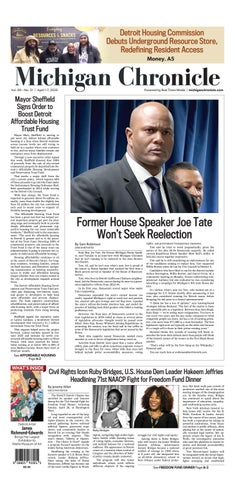
State Rep. Joe Tate, the former Michigan House Speaker, said Tuesday in an interview with Michigan Chronicle that he isn’t running to be reelected to the state House’s 9th District.
Tate, 45, said he isn’t sure what’s next, but is proud of his tenure as House Speaker that marked the first time a Black person served as Speaker of the House of Representatives.
Detroit Hives, a pioneering organization founded by Lindsey and Jackson, harnesses the power of urban beekeeping to revitalize neighborhoods in the Motor City. Their initiative not only addresses critical issues like environmental conservation but also provides valuable education and employment opportunities to Black De-
The UAW has branded the industrial action as the “Stand-Up Strike,” focusing on specific plants within each automaker. UAW President Shawn Fain stated, “This strategy will keep the companies guessing. It will give our national negotiators maximum leverage and flexibility in bargaining. And if we need to go all out, we will. Everything is on the table.” Union leaders have also indicated that additional plants could be targeted in future waves if negotiations remain stalled.
It’s a history marred by pain, injustice, and economic devastation. More than 130,000 residents, primarily Black, were forcibly displaced. Families were uprooted, generational wealth was obliterated, and a thriving community was torn asunder. The wounds inflicted by I-375 run deep, transcending the physical barrier of a freeway to penetrate the very soul of Black Detroiters.
Tate, who lives in Detroit’s Jefferson Chalmers neighborhood, led the Democratic caucus during its once-in-a-generation legislative trifecta from 2022-24.
towards mending the wounds inflicted on Black Detroiters and restoring a sense of belonging that was so callously torn away in the past.
Tate said he tried to work pragmatically, given the nature of the slim 56-54 Democratic majority. He called current Republican House Speaker Matt Hall’s ability to hold his caucus together impressive.
Tate said he is still considering an endorsement for one of the candidates seeking to replace him. Tate supported Willie Burton when he ran for City Council in District 5.
The I-375 Boulevard Project is about more than just correcting historical injustices; it’s about redefining the future. It will connect downtown Detroit to surrounding neighborhoods, bridging the gap that was placed upon the city decades ago.
The Detroit Affordable Housing Development and Preservation Trust Fund provides gap financing, low-interest loans, and grants to developers to help keep units affordable and prevent displacement. The fund supports construction, rehabilitation, and preservation of affordable housing units, with a major focus on protecting residents from rising housing costs.
In its first year, Democrats scored major wins under Tate’s leadership.
“It is so important to recognize that there are young leaders across the country, many that are born here in Detroit. I represent our city nationally and I tell people, ‘Yea I’m a D-girl I’m from the west-side of Detroit,’” Mitchell expressed. “But more importantly, I’ve been able to have experiences within an industry that not many of us, specifically women of color, have the opportunity to engage in and I’ve been the youngest person in the room, the only Black person in the room, and the only Sistah in the room, and I really had to articulate the importance of showing up, giving chances when others won’t, and being persistent.” As a trailblazing Black woman thriving in a predominantly male-dominated industry, her unwavering commitment to fortifying the connections between businesses and Detroit’s communities is unde-
Candidates who have filed to run for the district include Arthur Harrington, Willie Burton, and Darryl Ervin. At a community meeting on Monday, former redistricting commissioner Anthony Eid also indicated he was considering launching a campaign for Michigan’s 9th state House district.
This painful legacy can be traced back to the nation’s interstate highway program of 1956—a program that aimed to connect the country but often did so at the expense of marginalized communities. In the case of I-375, it meant carving a path through the heart of Black Detroit, reinforcing segregation, and perpetuating inequality.
A string of shootings in Greektown in mid-April left both visitors and residents of this bustling downtown destination in awe. One of these shootings tragically claimed the life of a popular and beloved security guard following a dispute with a patron. The male suspect allegedly shot the guard before fleeing the scene, while his female companion is accused of concealing the weapon in her bra.
It’s unclear what’s next for Tate, who backed out of a campaign for U.S. Senate shortly after announcing it last year, plus considered running for Detroit mayor before dropping his bid prior to a formal announcement.
By Andre Ash
DIGITAL ANCHOR
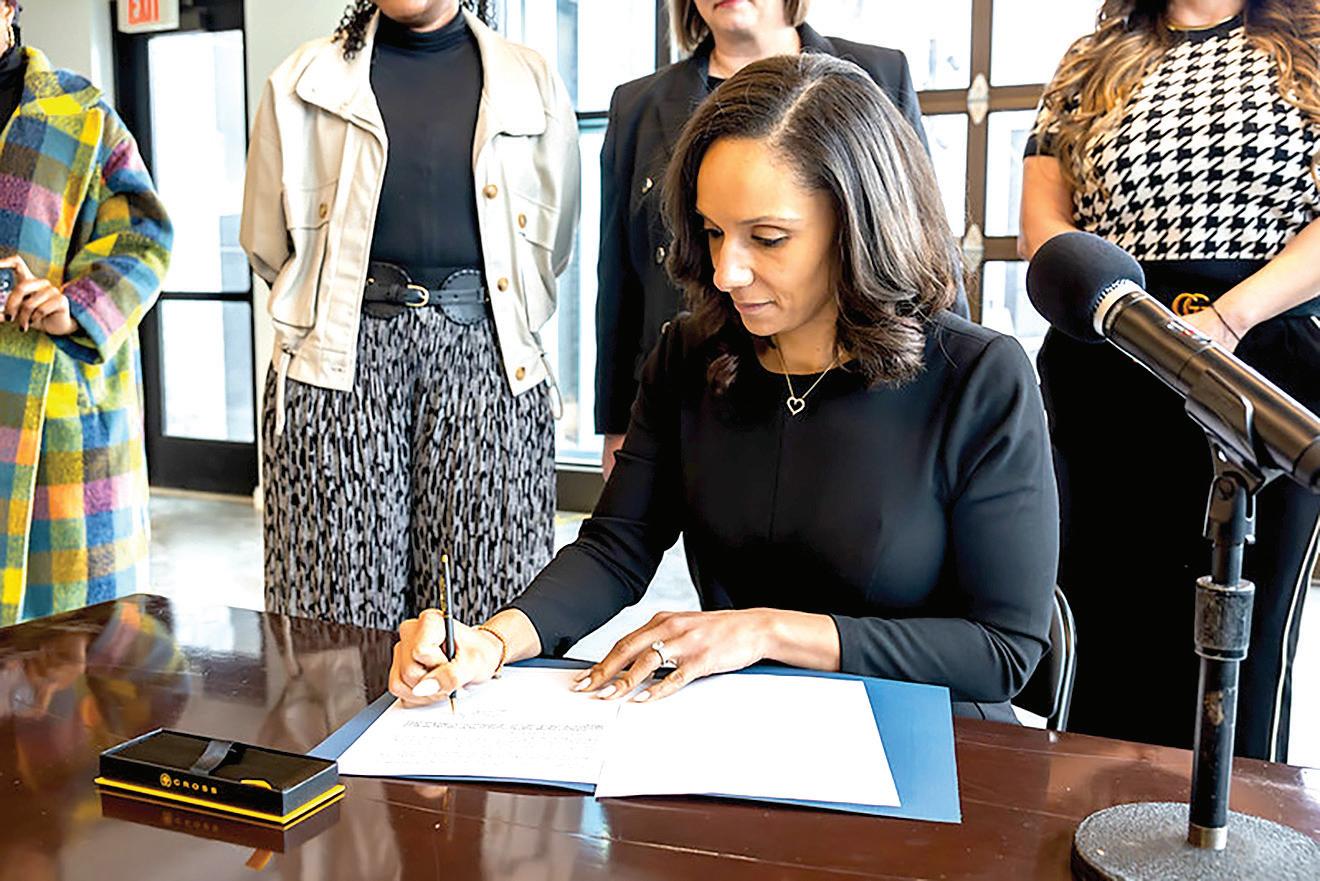
Sheffield signed the executive order at LaJoya Gardens, a Southwest Detroit development that received a $1.1 million investment from the Trust Fund.
The tale begins in what is now Lafayette Park, once known as Black Bottom—a neighborhood rooted in African-American culture and history. Named after its dark, fertile soil, Black Bottom flourished during the mid1900s, nurturing the dreams and aspirations of prominent Detroiters like Coleman Young, Joe Louis, and numerous other Detroit legends. But in the name of urban renewal in the 1950s, this vibrant neighborhood was systematically dismantled, erased from the map, and replaced by a lifeless stretch of asphalt.
Democrats expanded the state’s earned income tax credit, repealed Michigan’s right-to-work law and pension tax, enacted safe gun storage and red flag laws, repealed the state’s still-on-the-books abortion ban, and ended the practice of holding back third graders who failed a reading proficiency test.
These incidents unfolded during an unseasonably warm spring, leading to increased pedestrian traffic and heightened tensions in the densely populated downtown area.
A Holistic Approach to Providing Shelter and Support for Detroit’s Unhoused People
For one to aptly recognize the harm caused by such projects, it is vital to note that some of the planners and politicians behind those projects built them directly through the heart of vibrant, populated communities—oftentimes to reinforce segregation and sometimes as part of a direct effort to replace or eliminate Black neighborhoods.
Today, the resurgence of Paradise Valley stands as a testament to the indomitable spirit of Black Detroiters and the enduring legacy of Black excellence. This historic district, once a vibrant hub for Black businesses and culture, is experiencing a renaissance that harkens back to its glory days. The destruction of Black Bottom may have torn apart a thriving community, but the resolute determination of a new generation of entrepreneurs and visionaries is reclaiming that lost legacy.
Fain clarified the union’s strategy: “I want to give a major shoutout to the thousands of members who are on the picket lines right now fighting for all of us. The Stand-Up Strike is a new approach to striking. Instead of striking all plants at once, select locals will be called on to stand up and walk out on strike. This is our generation’s answer to the movement that built our union – the sit-down strikes of 1937. We told the Big 3 that Sept. 14 was the deadline and we meant it. We gave the companies our economic demands eight weeks ago and it took more than a month to get to the table.”
That support helped move the project forward. LaJoya Gardens opened in January 2025 and includes 42 newly constructed affordable housing units on West Vernor, with rents reserved for households earning at or below 30% to 80% of Area Median Income. Rents there start at $540 per month.
The union is pushing for a comprehensive list of demands. This
Homelessness continues to plague urban communities, with families and individuals grappling with the challenges of making ends meet in today’s economic climate. Whether it’s struggling to meet monthly mortgage payments or coping with soaring rental costs in a housing market marked by shockingly high prices, a variety of factors contribute to the growing issue of people becoming unhoused.
However, the final days of Democratic control in the state Legislature in 2024 ended in chaos as several pieces of legislation advocates thought would be passed were killed. State Rep. Karen Whitsett, joining Republicans in protesting the session, was the final nail in the coffin to some of the Democratic legislation that never passed in the House.
While the residential areas bore the brunt of this demolition, the heart of Black Bottom, its thriving business center, remained largely untouched. Restaurants, theaters, clubs, and bars—the very places that brought Detroit’s Black community together—were concentrated around Hastings Street, the epicenter of African-American culture in the city.
Their slim majority meant Democrats needed every member to vote in favor of legislation being voted on.
Housing Resource Helpline in response to the challenges that residents face in navigating the complex system of housing services. The helpline provides a single point of contact for people seeking housing assistance and connects them with the resources they need.
Activists from Detroit were upset that a water affordability plan and bills to allow noncitizen migrants weren’t brought to the floor for votes. Other bills that were left behind include police accountability measures, voting
Meagan DunnJulie Schneider
Historically, shelters have provided a temporary respite for those in need, often serving as the first or second option after exhausting alternatives like staying with friends or family. Shelters offer a place to rest one’s head and a warm meal, albeit sometimes for extended periods. For others, being unhoused means living in cars or makeshift outdoor
Then, in a cruel twist of fate, Hastings Street, too, was obliterated a few years later, making way for the construction of I-375. This marked the final blow, sealing the fate of Black Bottom and signaling the beginning of the end for Paradise Valley, the Black busi-
“I think Joe has a ton of options,” says Lansing-based strategist Adrian Hemond. “The fact of the matter is these are miserable jobs as a legislator. Between him, Sam Singh, Kara Hope — we’re seeing more resignations. You have to run every two years and the pay sucks compared to what competent people can learn. Joe has a lot of earning potential, a lot more than $71,000 as a state lawmaker. The best legislators right now are typically on the older side because it’s a tough sell to those in their prime earning years.”
The surge in crime and the influx of visitors to Detroit’s downtown core garnered the attention of the Detroit Police Department (DPD), catching them somewhat off guard.
But now, after decades of enduring the scars of I-375, there is a glimmer of hope on the horizon. Plans have been unveiled to transform this once-divisive freeway into a vision that seeks to right the wrongs of the past while heralding a new era of inclusivity and community revitalization.
Hemond thinks few outside of Lansing will likely remember the lame duck debacle more than people will think of the historic nature of his tenure as the first Black House speaker.
Support for the helpline comes from the Gilbert Family Foundation, which has pledged $10 million over three years to fund the program. Wayne Metro Community Action Agency manages the helpline, making it accessible to all Detroit residents. This initiative simplifies access to the City’s various housing services, ensuring that residents in need can easily find assistance.
James White, Chief of Police for the Detroit Police Department, said: “We were caught somewhat flat-footed right out the gate. By design we went into the spring deployment, which is less than the mid-summer deployment, and saw we say an uptick in violence that first warm weekend.”
Chief White attributes the violence in Greektown to a combination of weather conditions and a surge in population.
“That’s what will be the first thing on his Wikipedia,” Hemond said.
Fueled by more than $100 million from the Infrastructure Investment and Jobs Act and other partners, this ambitious project aims to create jobs, remove barriers to economic growth, and reconnect the neighborhood with the rest of Detroit. It is a step
You can reach Sam at srobinson@michronicle.com.
In the heart of Paradise Valley, Blackowned businesses are not just flourishing but thriving, offering diverse services, products, and experiences that pay homage to the past while paving the way for a prosperous future. From jazz clubs to soul food restaurants, the Black Press, and art galleries to fashion boutiques, this revival is breathing life into the very essence of what once made this neighborhood a vibrant cultural epicenter. It’s a resurgence that extends beyond brick and mortar; it represents the resurgence of a spirit that refuses to be subdued.
Detroit City Councilman Fred Durhal III, representing District 7, where Eastern Market resides, told the Michigan Chronicle, “It’s still very early in the process, MDOT is
He explained, “ We saw numbers downtown that we have not seen, ever. People are emerging from COVID and there’s a feeling that we’re in a post-COVID era… and with the venues downtown and the reasons to come down with all the activities that are going on, we saw hundreds of more people and, in particularly, young folks, teenagers that we hadn’t seen.”
Responding swiftly to the surge in violence, DPD adjusted its deployment plans. Rather than waiting for mid-summer, they deployed officers in the spring itself to address the situation.
By Lynzee Mychael MULTIMEDIA JOURNALIST
By Jeremy Allen EXECUTIVE EDITOR
The causes of homelessness are as diverse and complex as the individuals experiencing it. In response, the City of Detroit has adopted a holistic approach to combat this issue.
“Providing services and high-quality housing to persons at risk of or who are experiencing homelessness is a key priority of the City of Detroit, said Julie Schneider, Director of Detroit’s Housing and Revitalization Department.
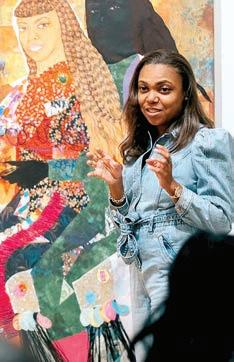
“The city and its partners offer a lot of great services to help Detroiters with their housing needs, but they don’t mean much if people don’t know how to access them,” said Mayor Mike Duggan. “Thanks to the efforts of our partners and the generous support of the Gilbert Family Foundation, we now have a simple process to guide residents to the right housing resource and a growing number of programs to help them.”
The NAACP Detroit Chapter has unveiled its speaker and honoree lineup for the 71st Annual Fight for Freedom Fund Dinner, returning Sunday, April 26, at Huntington Place.
“This means focusing on building the pipeline of supportive housing and coordinating with the Continuum of Care on the delivery of critical resources such as emergency shelter, rapid rehousing, and diversion and prevention programs. It also means preserving and expanding affordable housing options for Detroiters of all incomes and improving housing stability though comprehensive service offerings available through the Detroit Housing Resource HelpLine and Detroit Housing Services Division within HRD.”
In May 2023, the City of Detroit launched the Detroit

From the days of the Great Migration when thousands of Black families flocked to Detroit in search of jobs and a better life, to the pivotal role they played in the city’s cultural and musical heritage, Black Detroiters have left an indelible mark on the city. However, in recent years, Detroit has experienced significant gentrification, which has raised concerns about the displacement of long-standing Black residents. Similar to a setting sun, there’s a rising spirit, and Black Detroiters are reclaiming their place in the city, despite the challenges posed by gentrification.
The Gilbert Family Foundation’s broader commitment involves pledging $500 million to support projects across Detroit over the next ten years, with housing initiatives being a significant part of their contribution.
Long regarded as one of the largest and most consequential civil rights dinners in the country, the annual gathering draws national political figures, grassroots organizers, and community leaders to Detroit for an evening that blends recognition with urgency. This year’s theme, “Liberty or Oppression – The Choice Is Ours!” signals a program focused squarely on the stakes facing American democracy.
Notably, Detroit has witnessed a consistent decrease in recent years, with the number of unhoused residents steadi ly declining. In 2019, approximately 7,847 people were unhoused and entered the City’s community response system. In 2021, about 5,687 people experienced homelessness.
According to the City of Detroit, since the start of the fiscal year 2019 to 2021, Detroit saw a 28% decrease in the
The rise in visitors to the Greektown area is evident in data from Placer.ai, a location analytics company specializing in visit trends and demographic insights through geolocation-enabled mobile devices. From May 1-Aug. 27, 2022, there were 1.3 million visits and 655,000 visitors to Greektown, according to Placer.ai. In the same period this year, these numbers increased to 1.4 million visits and 670,000 visitors.
because of discrimination, but they were also coming because Black people was doing some stuff. When did Black people start doing things in the city? They
As Detroit’s downtown area continues to attract both residents and visitors, the police department has implemented various enforcement measures to manage the increased population. Notably, metal detectors have been strategically placed throughout Greektown to deter the illegal carrying of firearms.
“We have strategically placed them at key points, “ Chief White explains. It has been a deterrent for some, and some have tested it. If you are legally carrying a weapon and carrying a CPL, have a great day. If you’re
Headlining the evening as the keynote speaker is U.S. House Democratic Leader Hakeem Jeffries.
Since taking the helm of House Democrats, Jeffries has become one of the most visible figures in Wash-
During the Great Migration, thousands of Black families from the South came to Detroit in search of jobs in the booming automobile industry. Despite facing discrimination and segregation, they built vibrant communities on the city’s east
ington, navigating high-stakes legislative battles while framing issues of voting rights, economic fairness, and judicial balance for a national audience. His appearance in Detroit comes at a moment when control of Congress and the direction of federal policy remain deeply contested.
The program will also honor individuals whose work reflects different chapters of the ongoing
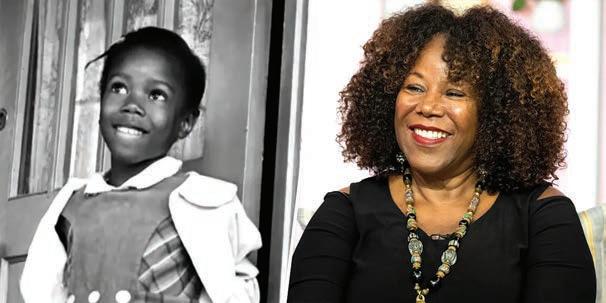
struggle for civil rights and equity. Among them is Ruby Bridges, who will receive the James Weldon Johnson Lifetime Achievement Award. Bridges became a national symbol of courage in 1960 when, at 6 years old, she integrated into an all-white elementary school in New Orleans under federal protec-
cine and healthcare, may be adversely impacted by
women been premoment of the final. a law1931 law effect, asked the affirm that constitucontain abortion. Our Planned Advocates of founding coalition ReproducAll, a affirm abortion and freedom in constitution,” Giroux. is that everything in aborMichigan, makes we will we can patients care they and adoption numbers upward, a ban on abortions could leave many women to choose a less safe route restoring ‘back alley’ and illegal abortion practices, including self-abortions. Moreover, African American women and women of color, who already have a long-storied history with access and inclusion in medi-
to
representalegislacollection and criminal jusrecomcollection analywith the AttorMichigan Law Standards Association Prosecutors stakeholders collect and strategically. warHouse Operations hearand other would ban of noknock urging the pass reform and Whitmer to the leg-
embraces. transforleadership as a approach that change the syscircumstancoperating Ivory
“Transformationdoesn’t just do certhem view of and exdrive that because what create everyentire because
said Vasquez Giroux.
From page A-1
LaJoya Gardens is one of several housing developments backed by the fund that city officials point to as proof of what sustained public investment can do.
The Residences at St. Matthews, a former Catholic school on Detroit’s far east side, was adaptively reused to create 25 units of permanent supportive housing for individuals struggling with homelessness, with no income requirement, along with 21 additional affordable units for households earning at or below 30% to 80% of AMI.
islature adopts it.
The Hive, now under construction across Gratiot from Eastern Market, will bring 78 new affordable
housing units to the area, with rents based on incomes at or below 30% to 60% of AMI.
Those projects reflect the range of housing needs the city is trying to meet, from permanent supportive housing for residents facing homelessness to long-term affordability for working Detroiters being priced out of neighborhoods they helped sustain.
Increase school funding: Statutory changes to increase the School Aid Fund revenue by at least $3.6 billion and establish a permanent weighted funding formula based on student and community needs and universal preschool (0-3).
Beyond the scope of pro-choice versus prolife, the fight for reproductive choice is one of freedom. As Michigan officials work to ensure each woman who finds herself in the position to choose has access to care without the threat of legal action, many wonder what the Supreme Court will rule in the upcoming mission.






That structure places the city’s deepest investment where the need is often greatest.
Households living at 30% of AMI or below are often among the most vulnerable to housing instability, particularly in a city where economic inequality and the long shadow of disinvestment still shape who gets to stay, who gets pushed, and who gets left behind.
The health committee recommends reviewing state licensure policies to address the barriers that Black psychologists face in obtaining licensure in Michigan.
Under the existing ordinance, at least 70% of expenditures from the Trust Fund over any three-year period must go toward projects serving households making 30% or less of the Area Median Income. The remaining expenditures support projects serving households making 50% or
Reject censorship in
Units that receive support from the Trust Fund must remain affordable for at least 30 years after construction is completed. Priority is given to proposals likely to remain affordable in perpetuity, either through deed restrictions or because of the nature of the developer.
Ensure equitable distribution of state health funds: Ensure all Michigan communities with a significant Black population receive adequate
“To have a healthy city
that is affordable to people of all income levels, affordability must be sustainable, and long-term rent commitments in the Affordable Housing Trust Fund help with that sustainability,” Sheffield said.
The executive order takes effect July 1, 2026, aligning with the start of the city’s new fiscal year.
For Detroit, that date marks a policy decision about what kind of growth the city wants to finance and who that growth is supposed to serve. As land continues to hold value and development pressures continue to rise, Sheffield’s order puts the proceeds from city-owned commercial property sales directly into a fund designed to preserve affordability for the people who call Detroit home.

each year over five years.
voices working to reshape the city’s future.
Rev. QuanTez Pressley, pastor of Third New Hope Baptist Church, has combined ministry with public service, including time on the Detroit Board of Police Commissioners. His work has often focused on bridging divides between law enforcement and the communities they serve, while maintaining a strong emphasis on faith-driven advocacy.
Dwan Dandridge, co-founder and CEO of Black Leaders Detroit, is being recognized for his efforts to expand economic opportunity for local entrepreneurs. Under his leadership, the organization has distributed millions in grants and no-interest loans to small businesses, a strategy aimed at building long-term stability and ownership within Detroit’s neighborhoods.
In announcing the event, NAACP Detroit Branch President Rev. Dr. Wendell Anthony framed this year’s dinner as a crucial moment for the city and the nation.
“The time is always right to do what is right,” Anthony said, invoking the words of Dr. Martin Luther King Jr. “Now is the time to do right by justice, freedom, and the preservation of our democracy.”
Dinner has long functioned as both a fundraiser and a barometer of the issues most pressing to Detroit’s Black community, but more broadly as a way to hold up a mirror to the issues that impact people of color across the country. Past speakers have included sitting presidents, civil rights icons, and national advocates, reinforcing the city’s role as a consistent voice in shaping conversations around race, policy, and power. This year’s honorees reflect that same intersection of history and present-day influence—from Bridges’ role in one of the defining moments of school desegregation to James’ ongoing legal battles and Dandridge’s work to close wealth gaps at the neighborhood level.
The April 26 event will be preceded by “Freedom Weekend,” a series of public programs organized in partnership with the Freedom Institute for Economic, Social Justice, and People Empowerment. The sessions are expected to focus on civic engagement, economic equity, and policy discussions tied to the dinner’s theme.
As ticket sales and sponsorship efforts ramp up, organizers are emphasizing that participation is an investment in the work the NAACP Detroit Branch continues year-round.
By Aaron Foley EDITOR-AT-LARGE
people believe that they need to for themselves and others to live better lives.”
tual town hall meeting to discuss its policy recommendations on Thursday, May 12 at 4 p.m. Join BLAC and a virtual audience in discussing the recommendations to support the Black community.
Anthony also pointed to the broader climate shaping this year’s gathering, describing it as a period when Americans are being called to “stand up, defend, protect” core democratic principles. He added that the dinner is intended to serve as “a call to action” at a moment when, in his words, “the very soul” of the nation is being tested.
The Freedom Fund
For many in Detroit, the Freedom Fund Dinner is less about ceremony and more about alignment, bringing together those working across different lanes of advocacy, from policy to grassroots organizing, at a time when the questions raised by this year’s theme feel less rhetorical and more immediate.
Ballmer Group is supporting the campaign with a $1.5 million grant.
Michigan’s treasury department is launching what it’s calling the largest financial literacy campaign in the Detroit area.
The Mi Money Matters Financial Empowerment Initiative kicks off April 1, in line with National Financial Literacy Month. The state’s Department of Treasury is partnering with the philanthropic Ballmer Group and civic and social leaders across Wayne, Oakland and Macomb counties.
“Through this initiative, we’re bringing meaningful financial tools directly to metro Detroit,” Treasurer Rachael Eubanks said in a release. “By focusing on budgeting, saving, credit and planning for the future, we’re working to ensure individuals and families have the resources they need to build longterm financial stability.”
“Chancellor Ivery is a true transformational leader and an outstanding CEO, who is more than worthy of the CEO of the Year Award he just received, “ said Prof. James C. Mays, who teaches entrepreneurship and supply chain management at WCCCD’s Corporate College. “In his 27 years at WCCCD, Dr. Ivery has elevated WCCCD to become nationally recognized for excellence and innovation and preparing our students professionally and personally to do great things in the world.”
According to the treasury department, nearly 80 percent of metro Detroiters earning below $125,000 report never receiving formal education in personal finance. Five of Michigan’s 10 most “unbanked” cities —Detroit, Highland Park, Pontiac, Ecorse and Inkster — are in the tri-county area, with Detroit itself reporting that roughly a quarter of residents are unbanked or underbanked. Unbanked refers to adults who do not use or do not have access to any traditional financial services, including savings accounts, credit cards, or personal checks.
Not having access to financial resources and tools costs unbanked and underbanked Michiganders an average of $3,000 a year in fees for check cashing, money orders, bill pay services, third-party debit cards and more.
The state’s education department has recently mandated all high school students to complete a personal finance course to graduate, beginning with the Class of 2028. Within the Detroit Metro Prosperity Region, 280 of 422 high schools report teaching assignments eligible for personal finance instruction, according to the Michigan Department of Education.
The initiative includes MiMoneyMatters.org, a new online hub featuring free videos, interactive tools and articles covering topics such as credit, banking, student loan repayment, financial planning and longtermcare.
BLAC is housed in the Michigan Department of Labor and Economic Opportunity. Members represent many professional backgrounds, including economics, law, public safety, health and wellness, arts and culture and media. They leverage their experiences and expertise to make recommendations to the governor on critical issues affecting the Black community.
To learn more about BLAC and this upcoming event, visit www.michigan.gov/BLAC.
The Treasury Department also announced a new partnership with Michiganbased Headstream Technologies, developer of the MILearner Wallet educational tool. The platform will serve as the initiative’s official credential issuer, providing students with verified, portable records of completed financial education modules.
The campaign is being amplified with help from a broad network of trusted community messengers as well as promotional placements across print, radio, digital media and local retail outlets. The Library of Michigan and more than 80 public libraries across Wayne, Oakland and Macomb counties are also participating, and the
Local elected officials and faith leaders from Detroit and surrounding communities joining the event and committing to serve as Mi Money Matters ambassadors included Highland Park Mayor Glenda McDonald, Ecorse Mayor Lamar Tidwell, Pontiac Mayor Mike McGuinness, Inkster Mayor Byron H. Nolen Pastor Edgar Vann, Second Ebeneezer Church, Detroit; Pastor Lance Pittman, First Praise Pentecostal Church, Detroit; Pastor Alonzo Bell, Redeem Detroit Martin Evers MBC; Rev. Joelynn T. Stokes, Esq., Isaiah 58, Detroit; Dr. Willie A. Gholston II, Count Historic Ebenezer AME Church, Detroit; The Rev. Cindy Rudolph, Oak Grove AMEC, Detroit; Pastor Lance Pittman, First Praise Pentecostal, Detroit; The Rev. Sharinese Jackson, Vernon Chapel AME Church, Detroit; The Rev. Sharinese Jackson, Conant Gardens Neighborhood Development Corp., Detroit; The Rev. Jacquelynne Burge, Vinson Chapel AMEC, Clinton Township; the Macomb County Ministerial Alliance; and, the Council of Baptist Pastors of Detroit and Vicinity, Inc.
“We want Michiganders to have the financial knowledge they need to avoid common pitfalls such as taking on highinterest loans, accumulating credit card debt and failing to save for emergencies,” Eubanks said. “These issues trap people in cycles of debt that could have been avoided. Mi Money Matters is designed to help change that.”



By Sam Robinson SENIOR REPORTER
Ex-House Speaker Rep. Joe Tate’s decision not to seek reelection became official this week when he confirmed it to the Michigan Chronicle.
However, the news didn’t come as a surprise.
First elected in 2018, Tate served as Speaker of the House from January 2023 to January 2025. He said in an interview on Tuesday, Tate, 45, said he felt like eight years was the right time to move on. Tate didn’t say what’s next. There are several new and familiar names who have filed or expressed interest in launching campaigns to run for the state’s 9th District, whose boundaries stretch from downtown to Belle Isle into the Grosse Pointes.

Tate’s departure received mixed reactions from Democrats and kind words on social media from his successor, House Speaker Matt Hall. Tate played football for Michigan State and in the NFL and entered the U.S. military as a Marine before running for office.
Hall said in his statement that Tate had “unfairly taken on much of the blame.” Hall blamed the lame duck debacle of December 2024 on “the narrow ideological faction that undermined him at every turn.”
Gov. Gretchen Whitmer praised Tate in a statement released this week.
“Joe Tate is a good friend, committed public servant, and trailblazer who served as the first Black House speaker in Michigan history,” Whitmer said in a news release. “Over the course of his term as speaker, I was proud to work with him to deliver historic tax cuts for working families and retirees, free breakfast and lunch for all 1.4 million public school students, clean energy laws, commonsense gun violence prevention legislation, reproductive health, and more.
I want to congratulate him on capping off his historic legislative career and wish him and his family the best as he begins a new chapter,” the governor said.
Currently in his fourth term, Tate is eligible to serve additional terms as a state legislator.
A number of candidates under 35 are running to replace Tate for the state’s 9th House district that covers a large portion of Detroit’s east and west sides.
Darryl Ervin is a former legislative staffer who graduated from Michigan State in 2022.
Arthur Harrington, a 24-year-old Wayne State law student who works for Detroit Council member Mary Waters. He’s received endorsements from local officials, including Detroit City Council president James Tate, pro tem Coleman Young II, members Angela Whitfield Calloway and Scott Benson.
State Reps. Helena Scott, Amos O’Neal, Peter Herzberg, and Jimmie Wilson have also endorsed Harrington, as has Wayne County Executive Warren Evans.
Anthony Eid, who has not filed a campaign committee with the state, is a former redistricting commissioner who has worked at Commu-
FIRST-TIME CANDIDATES Page A-4
By Jeremy Allen Executive Editor
SMART CEO and General Manager
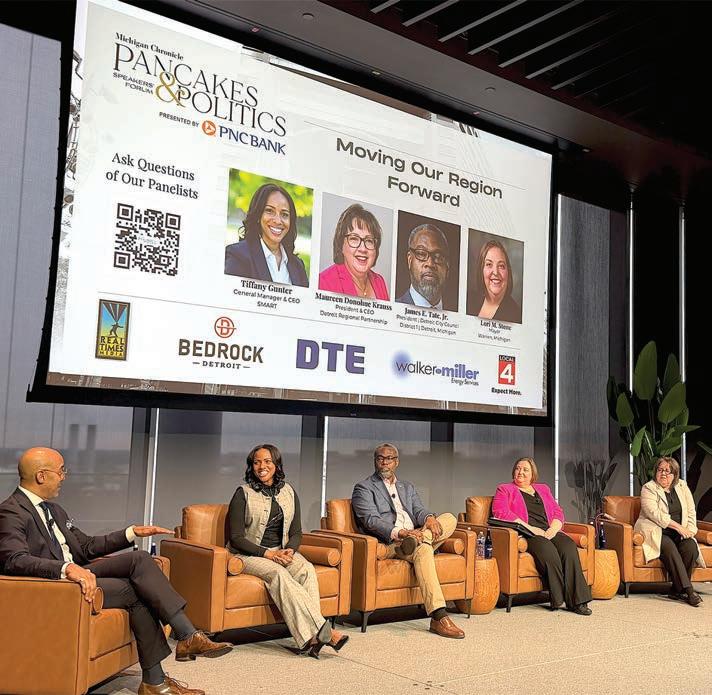
Tiffany Gunter dropped some news at Michigan Chronicle’s most recent Pancakes & Politics, but it didn’t become official until the organization’s governing body approved it on March 26.
Gunter announced that SMART is preparing to roll out a major expansion of access to public transit across Wayne, Oakland, and Macomb counties aimed at enhancing access to students.
The Suburban Mobility Authority for Regional Transportation announced a new initiative that will allow K-12, community college, and college students to ride its buses for free year-round, removing what officials say has long been a barrier to consistent attendance and opportunity.
The program, developed in coordination with regional leaders, including the administration of Detroit Mayor Mary Sheffield, will allow students to board SMART buses at no cost, simply by presenting a student ID. SMART says this move is designed to boost ridership, but also to strengthen the region’s workforce pipeline, to give young people more freedom, and to ease financial pressure on families already navigating rising costs.
“What we’re planning to do in the next couple of weeks is to roll out a program where students ride free on SMART. If you have a student ID and you are able to get to a bus stop, you can ride our system (for free). I’m looking for ridership because ridership leverages us more dollars, and I want to make sure the kids have access to public transportation,” she said.
“Growing up and using public transportation, I know what kind of independence it allows for. But the reason why we took this long to get to this point is because we wanted to make sure we had a system that was reliable. As a parent myself, I don’t want to put my child on a system that’s not going to show up for them. So, I know that now that we’ve
moved in that direction and we’re getting operational excellence back under our umbrella, I’m ready to move forward with that program. And we’re doing so in partnership with the city of Detroit as well.”
The reliability issue she referred to was the bus’s lack of on-time arrivals and departures. It was one of the first issues she began to address when she became the new leader of the organization during the summer of 2025.
“We had a lot of low-hanging fruit. We started an on-time performance challenge because each garage didn’t know that we weren’t hitting our on-time performance goals,” Gunter said.
“We were at 65 percent (for on-sched-
ule stops). …In doing this challenge, in the last three-and-a-half weeks, we’ve raised that percentage by 12 points; we’re at 77 percent on-time right now, consistently. That’s still not enough and we still have to do better, but we’re going to keep pushing that.”
Detroit City Council President and cochair of the mayor’s transportation committee, James Tate, said the city’s own transit system is moving in the same direction, highlighting alignment between SMART and the Detroit Department of Transportation (DDOT).
“We’re doing the same thing. Shared ideas, shared opportunities. We’re doing
By Ebony JJ Curry SENIOR REPORTER
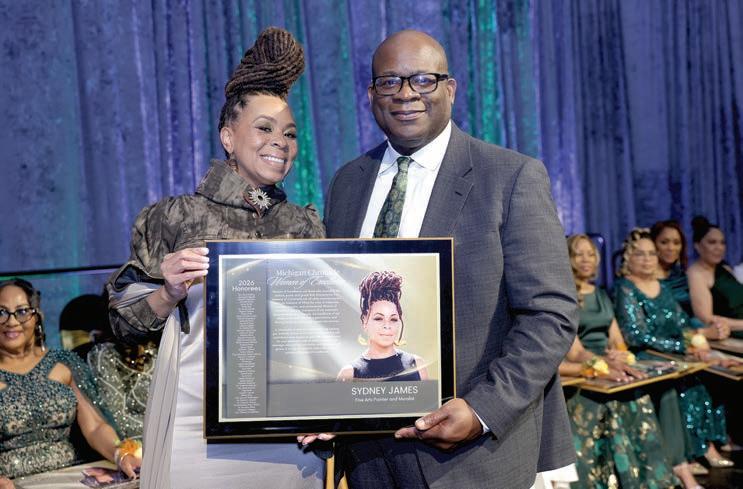
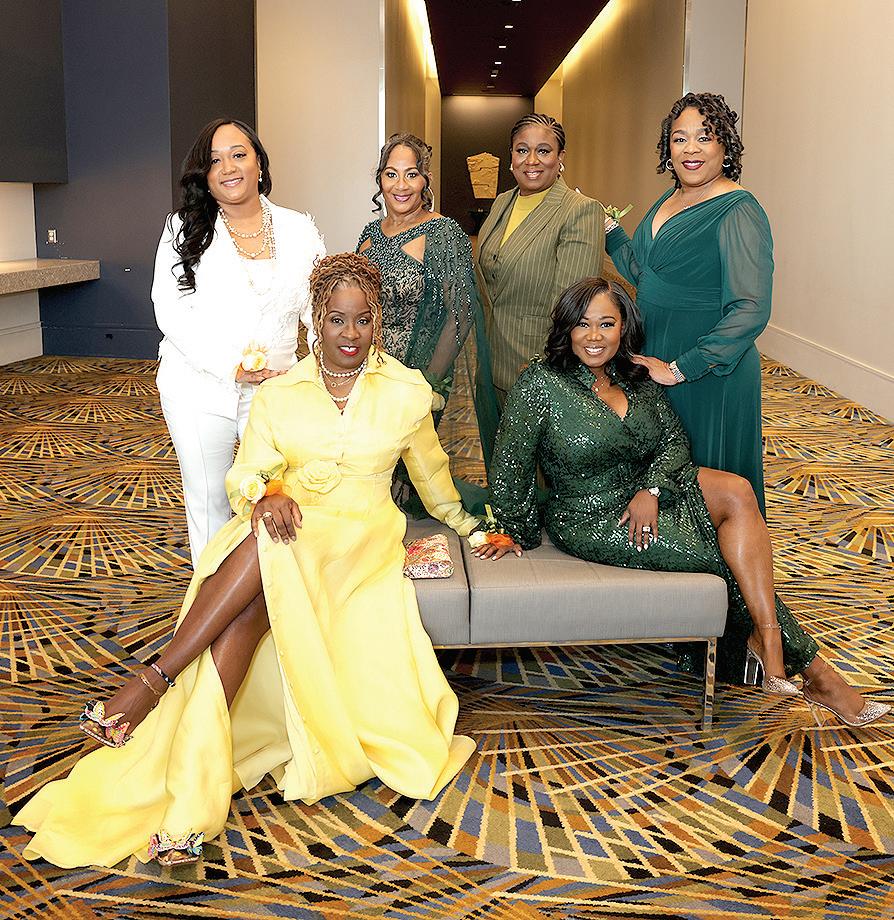
A room full of Black women who have carried Detroit on their backs does not need exaggerated language. It needs truth, witness, and a publication that understands what it is looking at.
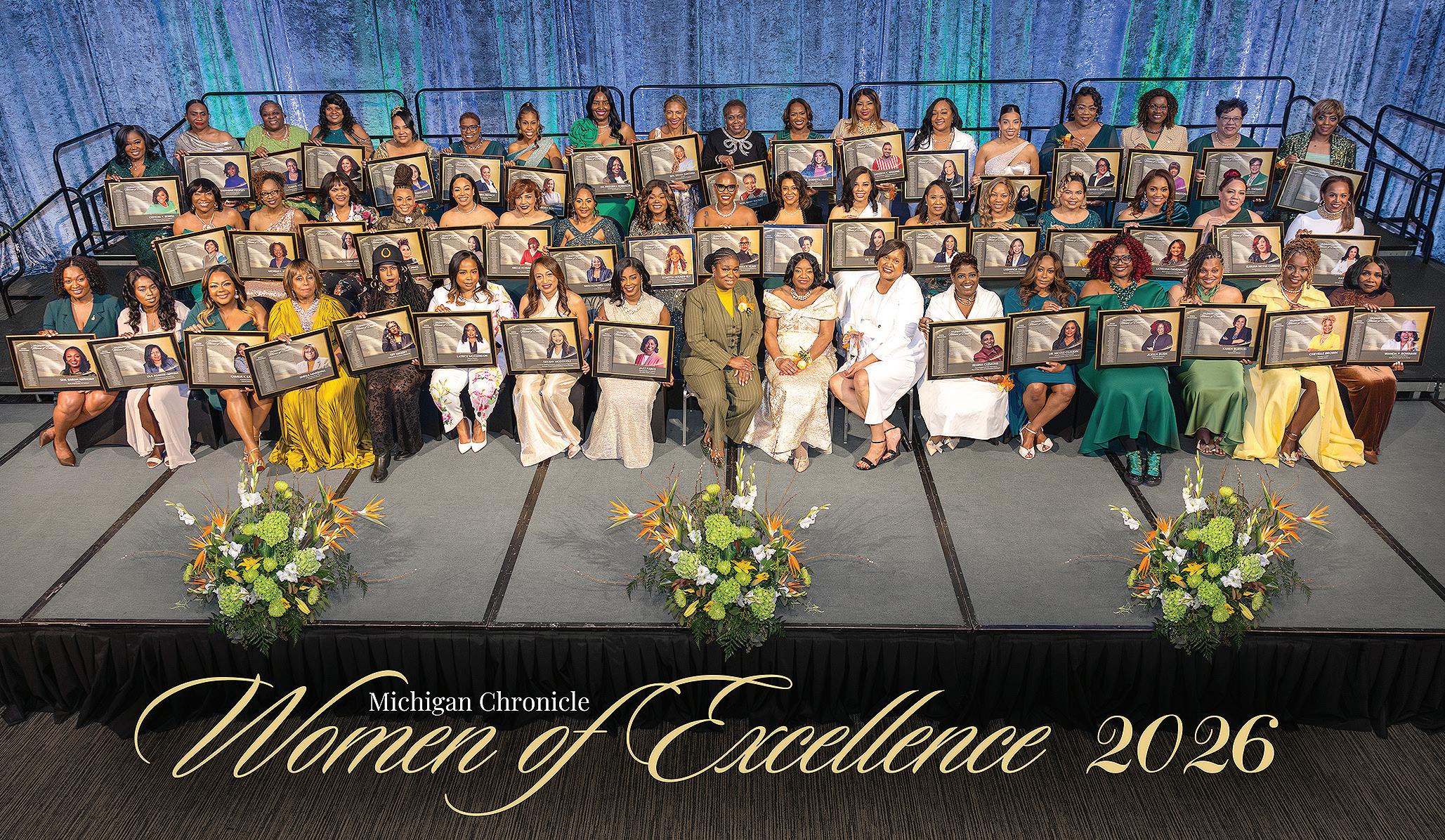
That is what filled Huntington Place during the Michigan Chronicle’s 2026 Women of Excellence celebration, where this year’s honorees joined a sisterhood that now stands 950 women strong. Fifty women were selected this year from 650 nominees, a number that made plain this recognition was never about popularity, access, or politics. It was about the work.
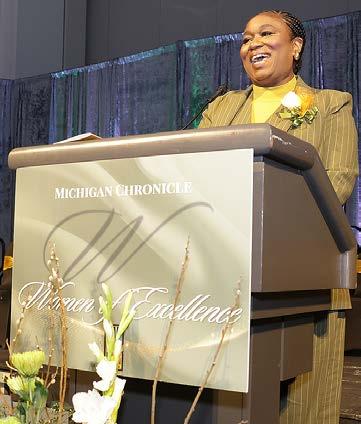
Real Times Media CEO and Michigan Chronicle publisher, Hiram E. Jackson said that clearly from the stage.
“You can’t be a Woman of Excellence without going through the hard work,” Jackson said. “These women just didn’t magically appear on a list. They got the scars to prove it.”
That line landed because everybody in the room knew it was true.
Black women are too often expected to perform excellence without acknowledgment, to solve problems without recognition, and to keep showing up even when somebody else gets the title, the check, or the public praise. Jackson named that too, reminding the audience that the women honored that evening had sacrificed time with family, worked long hours, and kept
going through seasons when others received the credit.
“There ain’t no favor. Ain’t no pull-ups. None of that,” Jackson said. “You can’t pay to be on this list.”
That is part of why Women of Excellence continues to matter nearly two decades into its run. The event has become one of the Chronicle’s most meaningful public affirmations of Black women’s leadership across
Detroit and beyond. This year’s ceremony also arrived during the Michigan Chronicle’s 90th year, giving the evening even more weight. Jackson placed that moment inside the legacy of the Black press, tracing the Chronicle’s roots to a publication built to call out racism, document opportunity, and tell Black stories with courage.
“That courage, that audacity, is why we so damn picky about this list today,” Jackson said.
That same spirit moved through the room all night.
Cathy Nedd and Jehan Crump-Gibson co-hosted the evening, guiding a program that honored the 2026 class and lifted up the women whose work has shaped Detroit in boardrooms, neighborhoods, public offices, labor halls, and community spaces. The crowd was there to celebrate, but it was also there to bear witness. These were not symbolic honors. These were receipts.
This year’s special honorees reflected the breadth of Black women’s leadership across southeast Michigan.
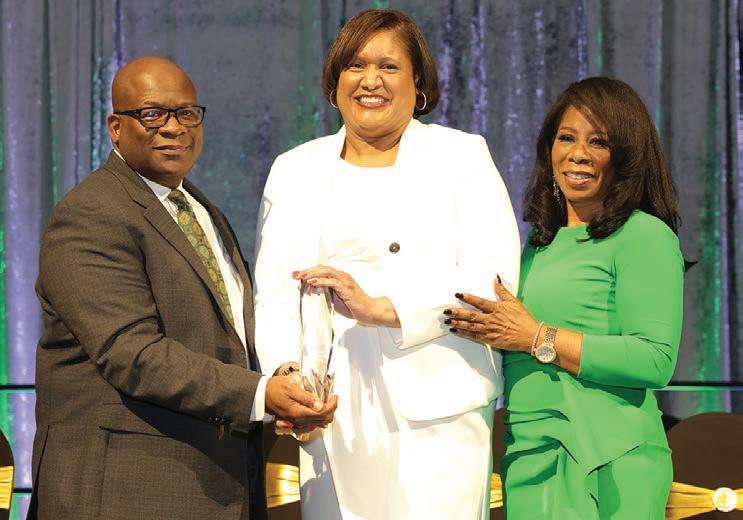
Georgella Muirhead received the Lifetime Achievement Award, recognized for a career that helped shape Detroit’s public narrative through communications and public relations. Laura Dickerson was honored as Woman of the Year for her trailblazing labor leadership and national impact through the UAW. Janice Winfrey received a Vanguard Award for her long-standing service as Detroit city clerk and chief elections officer, where her work has helped strengthen trust in the democratic process. Kylie Mitchell Wells also received a Vanguard Award for her leadership in philanthropy, economic mobility, and systems-level work on behalf of children and families. Together, those honors captured the range of influence Black women continue to hold across civic life, labor, public service, and community change.
From page A-3
“Tonight is about our opportunity to say, we see you,” Jackson said. “We see you, and we love you, and we appreciate you.”
That appreciation stretched across generations of Black women’s labor. Jackson connected that legacy from the Housewives League of Detroit to today’s leaders, naming how Black women have continued to shape politics, culture, policy, and public life in ways that too often go undercounted.
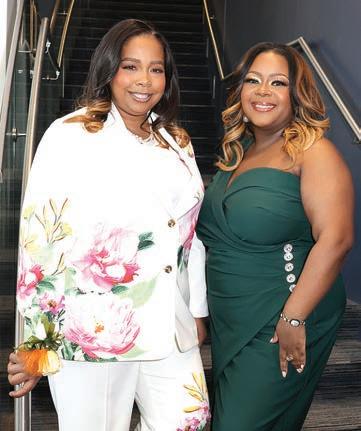
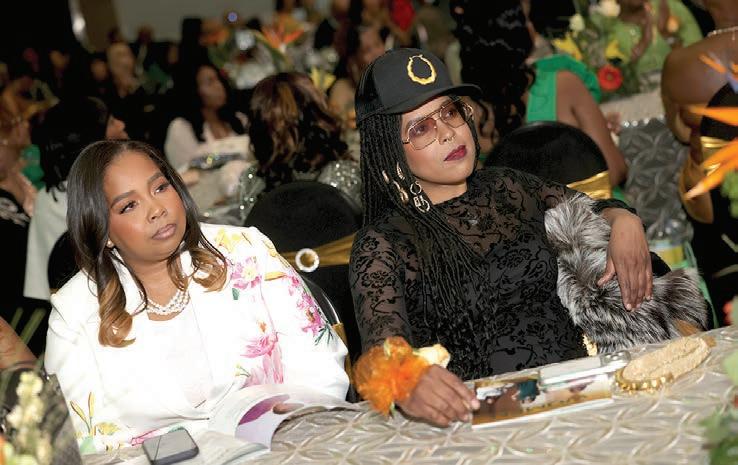
By the time Latrice McClendon stepped forward as class president, the tone had already been set. Her remarks gave the night its emotional center.
McClendon opened with humor, sharing that Jackson had leaned over before she went onstage and told her not to mess it up because she was the class president. The room laughed, but what followed was a serious and heartfelt tribute to the institution honoring them.
“Let me just say this, nobody does it better in telling Black stories than the Michigan Chronicle,” McClendon said.
At a time when Black history is being challenged, distorted, and erased in public life, McClendon said the community still needs journalistic institutions that can “tell our stories” and “record our history.” Her words sharpened the meaning of the moment. Women of Excellence is not just an event. It is part of a Black record. It is part of how Detroit remembers who built what, who led where, and who kept the city moving.
McClendon also gave the audience something else that mattered: gratitude without performance. She thanked the women on the stage, the families in the audience, and the supporters who came to stand with them, noting that women need as much support as they can get right now. She spoke as somebody fully inside the room, not above it.
“The moment is not just about individual success,” McClendon said. “It’s about the legacy that we are building together. It’s about the doors we’ve opened, the doors we are opening, the barriers we’ve broken, and the voices we have lifted along the way.”
Because that is what the Women of Excellence program has become after 19 years: a living archive of Black women’s leadership. Nine hundred fifty honorees to date means 950 examples of vision, endurance, sacrifice, brilliance, and service. It means 950 women whose labor did not disappear into meeting notes, family obligations, election seasons, corporate memos, or community crises. It means somebody stopped to say their names and document their impact.
McClendon framed that legacy with a Maya Angelou quote that carried cleanly through the room: “Nothing will work unless you do.”
She used that quote to remind the audience that excellence is intentional. It is built through perseverance, courage, and the decision to keep moving even when the path ahead is uncertain. She brought it back to the next generation too, speaking about her 11-year-old daughter and other young girls watching women like those in the room and learning what is possible from their example.
“We are not just making history,” Mc-
Clendon said. “We are the history of the future for young girls watching us right now.”
This was a celebration, yes. It was also a transfer of vision.
The women honored this year were welcomed into what McClendon called “a true sisterhood,” but that phrase held more weight than usual. Inside that ballroom, sisterhood looked like testimony, lineage, humor, reverence, and hard-earned mutual recognition. It looked like women who know what it costs to lead. It looked like a Black newspaper still doing what Black newspapers have always had to do: document us properly.
At Huntington Place, the Michigan Chronicle did more than host another awards ceremony. It marked a milestone. It honored 50 more women. It pushed the Women of Excellence legacy to 950 honorees to date. More importantly, it told the truth about what Black women’s excellence actually looks like. It looks like scars. It looks like sacrifice. It looks like being overlooked and still showing up. It looks like joy. It looks like unwavering faith. It looks like opening doors and reaching back. It looks like Detroit.
And on that stage, with Cathy Nedd and Jehan Crump-Gibson guiding the evening and Latrice McClendon leading the 2026 class, it looked exactly like what the Michigan Chronicle has always known how to do best: see Black women clearly.
the same with our DDOT system where our young folks, our students will be able to ride for free. That’s in our upcoming budget,” Tate said.
Combined, SMART and DDOT carry about 23 million people per year.
“For too many students across metro Detroit, the absence of a car in the household has meant missed classes and limited access to internships. At the same time, we recognize that transit fares can add up quickly for a family’s monthly budget,” said Gunter. “This initiative is a game-changer. We are proud to work alongside regional partners to ensure that no student is left behind because of a bus fare, and that families can redirect those savings toward other essential needs like housing and groceries.”
Education leaders say the impact could extend well beyond transportation. Brandy Johnson, president of the Michigan Community College Association, called the initiative a key step toward improving student outcomes.
“Student success doesn’t begin in the classroom. It begins with access,” said Brandy Johnson, President of the Michigan Community College Association. “When we remove barriers like transportation, we open the door for more students to stay engaged and complete their education. SMART’s commitment to providing free public transit will expand opportunity for learners across Southeast Michigan and help ensure more young people can reach the resources they need to succeed.”
Free rides are one of several things Gunter says SMART is doing to improve the organization, but she also noted technology
upgrades that will help the rider experience.
“In order for us to attract more people to the system, we know that the next thing is the experience that they have and the service level, and that’s all technology based. So, we do have an app – that’s the transit app. …We’ve also put Wi-Fi on our fast routes: Woodward, Gratiot, and Michigan. …It’s about amenities and services. …Now we can take it to the next level,” Gunter said.
SMART did not announce a target start date for the free ride program for students, but said that the program will “roll out soon.”
nity Development Advocates of Detroit and COTS in the Cass Corridor. He told community members at a meeting last week that he was considering launching a campaign for the Detroit House district.
Former Detroit police commissioner
Willie Burton is the most recent candidate to file to run in the 9th district. At 46, he’s also the oldest. Burton was the runner-up in Detroit City Council’s District 5 race last November. He has not yet filed a campaign finance report.
Campaign finance reports show Harrington raised $9,719 from the reporting period from Oct. 21 through Dec. 31, 2025, spending more than $6,000. Harrington ended the period with $3,603 left in his campaign account.
Ervin has raised $10,357.11 in the most recent reporting period, which covers Nov. 24, 2025, through December 31, 2025. You can reach Sam at srobinson@ michronicle.com.
A5 | April 1-7, 2026
By Dr. Anthony O. Kellum
CONTRIBUTING COLUMNIST
There is a quiet hesitation shaping today’s housing market. It is not a lack of income, nor a lack of opportunity. It is something far more subtle and far more dangerous. It is the fear of interest rates.
Across the country, would-be buyers are standing still, waiting for rates to drop by a percentage point, or even a fraction of one. They are watching, calculating, refreshing headlines, and convincing themselves that just a little more patience will produce a significantly better outcome. But here is the truth in many cases, that 1% difference is costing far more than it is saving.
O. Kellum
This is not to dismiss the reality of higher borrowing costs. Interest rates matter. They influence affordability, monthly payments and long-term cost of capital. But what must be understood, especially by those approaching this decision, is that rates do not exist in isolation. They operate within a broader ecosystem of price appreciation, rental inflation and time. And time, more than anything, is where the real cost lies.
Consider what happens when a potential buyer delays a purchase in hopes of securing a lower rate. During that waiting period, home values may continue to rise. Rents may increase. Inventory may tighten. The very asset they hoped to acquire becomes more expensive, not less. What was once attainable begins to move just out of reach not because of a dramatic market shift, but because of incremental change compounded over time. The irony is striking. In an effort to save on interest, many end up paying more for the asset itself.
This is where the concept of the “1% difference” must be reframed. It is not simply about the rate on a mortgage. It is about the difference between action and inaction. Between entering the market and observing it. Between building equity and funding someone else’s.
For the educated and analytical buyer, this becomes a question of strategy rather than emotion. A 1% increase in rate may affect a monthly payment but ownership introduces variables that renting never will. Principal reduction, appreciation and leverage all begin working in the owner’s favor from day one. These are not theoretical benefits; they are measurable, compounding advantages that grow over time.
Moreover, interest rates are not permanent fixtures. They are cyclical. Today’s rate does not have to be tomorrow’s rate. Refinancing remains a viable pathway when market conditions shift. In that sense, the rate you secure today can be temporary, but the property you acquire and the position it creates can be lasting.
This is the distinction many overlook. You can renegotiate the rate. You cannot renegotiate the purchase price once the market has moved beyond you. There is also a psychological dimension to this moment.
See INTEREST RATE FEAR Page A-6
By Jeremy Allen EXECUTIVE EDITOR
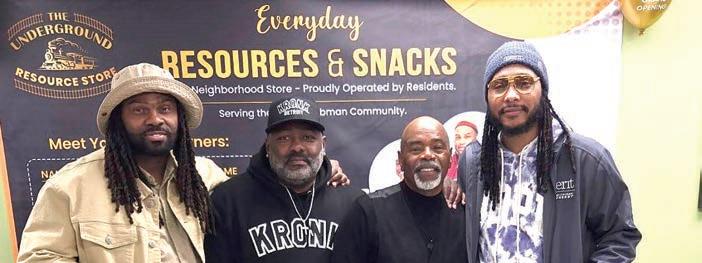
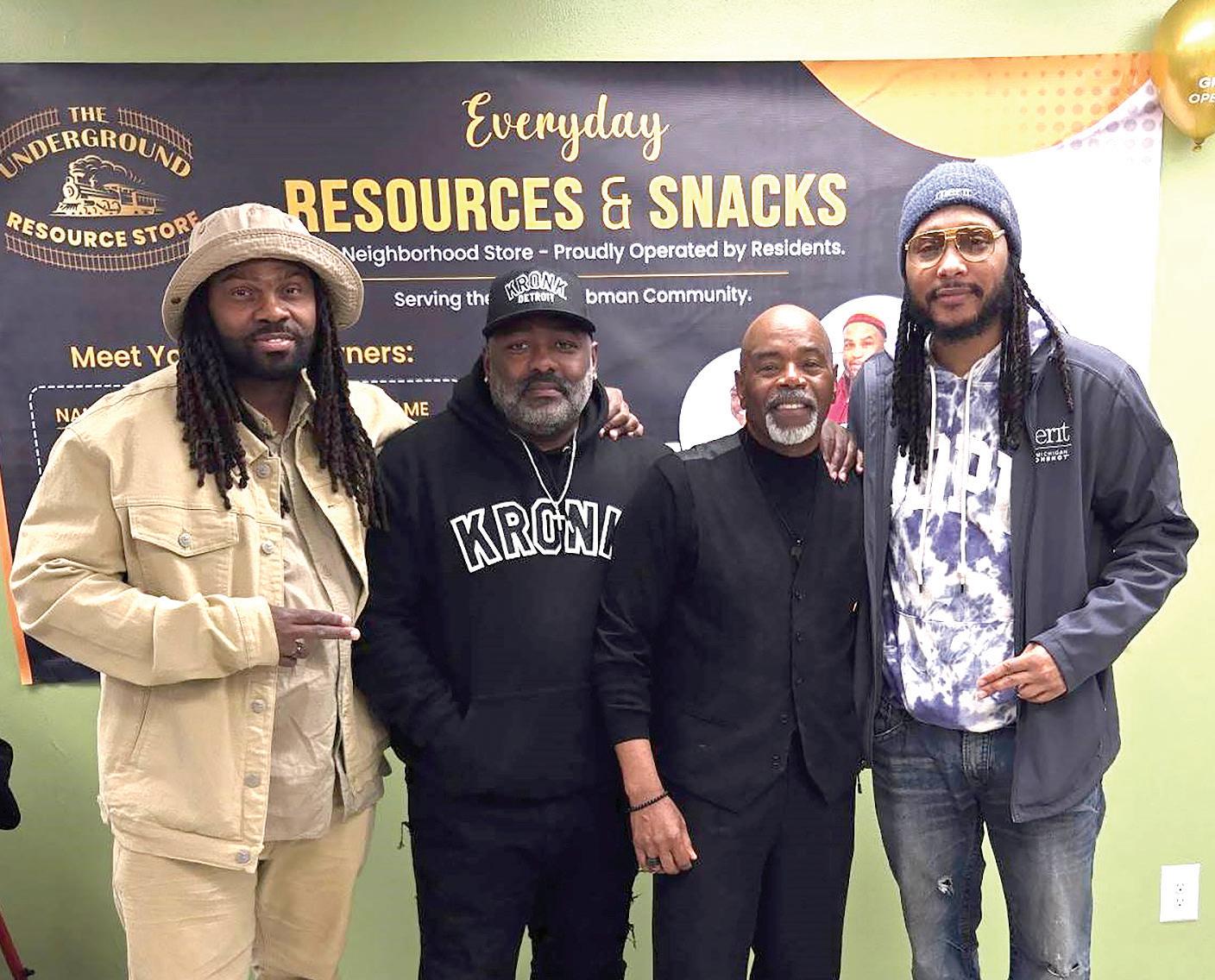
The Detroit Housing Commission recently launched the Underground Resource Store at the Harriet Tubman Detroit Housing Complex, introducing a first-of-its-kind model that blends retail access, workforce development, and community engagement directly within a public housing community.
The initiative, announced on March 3, 2026, represents a new approach to resident services in Detroit, with hopes that the new approach will spread to similar public housing communities across Michigan and the nation.
Located on-site at the Harriet Tubman complex, the Underground Resource Store was designed to eliminate long-standing barriers that so many public housing residents face when trying to access everyday essentials.
For seniors, individuals with disabilities, and families without reliable transportation, routine errands often become a strain on resources, with long, expensive, or sometimes-unsafe trips.
By bringing goods and services directly into the residential community, the Detroit Housing Commission says, the goal is to redefine equitable access in a tangible and immediate way.
The store officially opened with a ribbon-cutting ceremony on March 23, where residents of the community and others took tours, ate refreshments, and met with the planners who brought the vision to fruition. Leaders behind the project say the goal extends far beyond convenience.
“This is more than a store — it’s a statement that every resident deserves safe, affordable, and convenient access to life’s essentials without barriers,” said Mrs. Denise White, a director of resident services at DHS.
“We’re not
just stocking shelves; we’re creating jobs, training future leaders, and building a place where neighbors feel connected and supported.”
The project was developed with approval from the Detroit Housing Commission and in collaboration with residents, along with support from Coach Carlos of IMAGE of Success, Inc., who contributed to program development and training to help ensure long-term sustainability and meaningful resident impact.
In addition to improving access to goods, the Underground Resource Store is structured to create pathways for economic empowerment. Residents will have opportunities to receive hands-on training in retail operations and customer service while also building financial literacy, budgeting knowledge, and business skills. Organizers say the model is intended to help residents explore entrepreneurship and achieve greater economic independence over time.
This dual focus on access and opportunity positions the initiative as a potential national blueprint for public housing authorities looking to expand services and improve outcomes for residents. By integrating workforce development into a familiar, community-based setting, the Detroit Housing Commission is advancing a broader vision of housing as a platform for upward mobility.
The Underground Resource Store also serves as a hub for community life within the Harriet Tubman complex. Planned programming includes health and wellness screenings, voter registration drives, educational workshops, and resident-led events designed to encourage participation and strengthen neighborhood connections.
By combining essential services with opportunities for growth and engagement, the Detroit Housing Commission said it wants to address immediate needs while also investing in the long-term vitality of the community.
By Nina Jackson REGIONAL DIRECTOR AT
J.P. MORGAN WEALTH MANAGEMENT
We are in the midst of a seismic shift in wealth. This phenomenon, often referred to as the “Great Wealth Transfer,” describes the unprecedented movement of assets from the Baby Boomer generation to their heirs – an estimated $105 trillion by 2048. And women are poised to inherit most of this.
J.P. Morgan Wealth Management’s 2025 Investor Study found that women are not only set to receive significant wealth – they’re actively working to build it on their own. Ninety-three percent of women surveyed who are expecting an inheritance aren’t relying on it to reach their goals.
Here are a few tips for women to consider in their wealth-building journey.
Create a financial roadmap
A detailed, goals-based plan is important. J.P. Morgan’s study found that 90% of those surveyed with a plan feel confident about reaching their financial goals, compared to 49% without one.
“Design your plan to suit your particular goals, priorities and life circumstances,” said Nina Jackson, Regional Director at J.P. Morgan
Wealth Management in Michigan.
“Factor in your investment horizon and risk tolerance, and check in on your plan regularly to adapt to new developments.”
Are you saving up for goals like buying a house, sending your kids off to college or retiring early?
Where do you want to be in the next five, ten or twenty years?
Everyone’s financial situation is unique, so it’s important to think about these questions and build a plan that is unique to your life.
Women tend to live longer than men on average. Many take career breaks or care for family members, which can influence long-term planning. It’s important to adjust your strategy with these factors in mind.
Where to start with investing
“It’s easy to be discouraged by myths about investing, but even small amounts can make a difference if you start early. Starting early can increase your growth potential,” said Jackson. “Before you begin investing, get an understanding of your financial picture, prioritize your goals and plan for the long term.”
It’s important to also make sure you’re covered for unexpected expenses that come up before you start to invest. Build up a cash

Nina Jackson
emergency fund, typically enough to cover three to six months of expenses, and pay down any high-interest debt.
Taking charge of your finances
The good news is that women are taking charge of their finances. J.P. Morgan’s research found that 75% of women respondents make financial decisions with their partner or take the lead themselves. For those who have a spouse or partner, it’s important for each person in the relationship to play an active role in the process.
Building wealth can be empowering for many women. The same survey found that 73% of women respondents said money gives them “security,” while 64% of Gen
Z and Millennial women associated it with “freedom.”
The power of having a team
Some people find it helpful to work with a financial advisor, so you don’t have to tackle things alone. An advisor can help you craft a plan tailored to your needs and keep you on track throughout your lifelong financial journey. If you expect to receive an inheritance, you should also consult with estate planning and tax professionals.
No matter where you are on your wealth-building path, education is key. It’s so important to be an informed investor, and there are plenty of resources out there to help. You can find a library of free educational resources at chase.com/theknow.
As the landscape of wealth continues to evolve, women have a unique opportunity to shape their financial futures and those of generations to come. By staying informed and planning ahead, women have the tools to help them confidently navigate the Great Wealth Transfer and set themselves up for financial freedom.
The views, opinions, estimates and strategies expressed herein constitutes the author’s judgment based on current market condi-
tions and are subject to change without notice, and may differ from those expressed by other areas of J.P. Morgan. This information in no way constitutes J.P. Morgan Research and should not be treated as such. You should carefully consider your needs and objectives before making any decisions. For additional guidance on how this information should be applied to your situation, you should consult your advisor.
JPMorgan Chase & Co., its affiliates, and employees do not provide tax, legal or accounting advice. You should consult your own tax, legal and accounting advisors before engaging in any financial transaction.
Investing involves market risk, including possible loss of principal, and there is no guarantee that investment objectives will be achieved. Past performance is not a guarantee of future results.
Diversification and asset allocation does not ensure a profit or protect against loss.
J.P. Morgan Wealth Management is a business of JPMorgan Chase & Co., which offers investment products and services through J.P.
By Mark S. Lee
CONTRIBUTING COLUMNIST
A quiet but powerful shift is underway in the American economy—and it’s landing squarely in Michigan. According to the 2026 Franchising Economic Outlook, the industry is on track to surpass $920 billion in output while supporting nearly 9 million jobs nationwide. And Michigan has surged into the top 10 states for franchise growth, signaling a pivotal moment for entrepreneurs and communities across the state.
Corporate growth matters, but so does the growth of small businesses and entrepreneurs.
Franchising is rooted in ownership which drives local job creation and economic development by strengthening overall revenue and tax bases.
“Michigan’s rise in franchise growth reflects the resilience of its local entrepreneurs and the enduring strength of the franchising model,” said Katherine Patterson, Vice President, Communications, International Franchise Association. “After years of efforts to diversify the economy and support small businesses, we’re seeing franchise development accelerate across the state—particularly in the last 18 to 24
From page A-5
The fixation on rates has created a form of analysis paralysis. Highly capable, well-informed individuals are delaying decisions not because they lack understanding, but because they are seeking optimal conditions in a marketplace that rarely offers them.
But wealth is not typically built in perfect conditions. It is built through timely, informed decisions made in imperfect environments. The disciplined buyer does not wait for ideal circumstances. They assess risk, understand the landscape and position themselves accordingly. They recognize that participation in the market even at a lessthan-ideal rate can be more advantageous than prolonged absence.
This is particularly relevant within the broader context of Black homeownership. Access to information has improved. Income levels have risen for many. Yet participation gaps remain. If we allow rate anxiety to become another barrier this time self-imposed, we risk extending that gap even further.
months.”
That acceleration is being fueled by consumer demand, franchise investment, and a workforce looking to step into ownership. The growth is especially visible within the service industry permeating everyday lives such as quick-service and casual dining, automotive services, health and wellness, and home services.
This growth is happening across Detroit and beyond.
Why?
Franchising lowers the barrier to business ownership. For many, starting from scratch can feel overwhelming; however, franchising offers a path based on providing support and access. This helps to increase the odds of success.
As Patterson puts it, “Franchising has empowered people from all walks of life to go into business for yourself, but not by yourself.”
That distinction matters, especially in today’s economy. The model creates access points for first-time entrepreneurs and career changers who may not have otherwise considered business ownership. It also plays a meaningful role in expanding opportunity.
“The numbers don’t lie,” Patterson added. “Underrepresented groups, such as
veterans, women and people of color, are represented as franchisees at a disproportionately higher rate.”
Beyond ownership, franchising is also quietly becoming one of the most consistent job creators in the country, with more than 150,000 jobs projected to be added in 2026 alone. But it’s not just about quantity—it’s about quality and mobility within the workforce.”
“Franchises offer employees stronger wage growth, benefits, and career growth compared to non-franchises,” Patterson noted, pointing to higher rates of access to benefits like health insurance and paid leave.
From a Detroit lens, this trend taps into something deeper—the city’s long-standing “builder” DNA. This is a place where people don’t just work jobs; they build businesses, create opportunities, and invest in their communities.
Franchising aligns directly with that mindset. It allows individuals to own something tangible, operate within a system that works, and scale over time. And increasingly, that’s exactly what’s happening.
Many franchise owners are expanding and becoming significant local employers. That kind of growth doesn’t just impact individual owners—it strengthens entire
neighborhoods.
“Franchise businesses play a vital role in job creation and building long-term economic stability in cities like Detroit,” Patterson said. “They are often among the first to invest in revitalizing neighborhoods, creating career-pathway jobs that provide stable income, benefits, and advancement opportunities for residents.”
That local impact is compounded over time. Franchise businesses not only generate jobs but create a pathway to economic self-sufficiency and long-term wealth building.
“By fostering small business ownership and economic self-sufficiency, franchising helps build resilient local economies that can weather challenges and sustain growth for generations,” Patterson added.
For the city and state, the implications are significant. As the state continues to evolve and diversify its economic base, franchising is emerging as a powerful, community-driven growth engine—one rooted in accessibility, scalability, and local ownership.
And in Detroit, that’s more than a trend. It’s a continuation of a legacy.
We invite readers, business owners, and future entrepreneurs to follow along, ask questions, and engage. If you have story ideas or questions, you can email Lee at mark@leegroupinnovation.com or visit leegroupinnovation.com.

The decision to purchase a home is not merely a financial calculation; it is a strategic move toward stability, equity and long-term leverage. It is an entry point into a system that, when navigated effectively, can produce generational impact. So, the question is not whether rates will fall. Eventually, they will. The question is whether waiting for that moment will position you better or leave you further behind. What is the cost of waiting one year? Two years? How much equity is lost? How much rent is paid without return? How much does the target move while you stand still? These are the questions that matter. The 1% difference, in the end, is not about
the rate alone. It is about mindset. It is about whether we allow short-term variables to overshadow long-term vision. It is about whether we approach homeownership as a transaction to be timed or a position to be secured.
Because those who understand ownership do not simply chase lower rates. They pursue higher ground. And in that pursuit, they recognize a fundamental truth, small shifts in rates should never outweigh the
power of a big decision. Because property is not just a purchase it is a “position”. And in the long arc of wealth-building, position will always matter more than a percentage point.
Property is Power! is a movement to promote home and community ownership. Studies indicate homeownership leads to higher graduation rates, family wealth, and community involvement.



By Jehan Crump-Gibson
CONTRIBUTING COLUMNIST
A fiduciary is a person or entity in a position of trust who is legally obligated to act with honesty, loyalty, and care in the best interests of another, rather than their own. There are different types of fiduciaries.
In the estate planning context, the typical fiduciaries are a trustee, personal representative, attorney-in-fact, and patient advocate. These are individuals you would nominate to make decisions in your trust, will, financial power of attorney, and healthcare power of attorney, respectively.
These are very important roles, and you want to be strategic in choosing who will serve in them. Think of this process as a draft – except it is not for the NBA or NFL; it is for your personal affairs. The person you choose for each role should be someone who is capable and can be trusted to act with honesty and in your best interests, not their own.

For some people, there may be one person you trust to make healthcare decisions on your behalf, but that same person may not be the best at managing money. In that case, you would not want to choose the bad money manager to handle your finances if you are unable to do so or to distribute your assets if you pass away. You must take emotion out of these decisions. Otherwise, it can lead to preventable problems.
Let’s take Faye, for example.
Faye is 78 years young and has three sons. Both her oldest and youngest sons live with her. The youngest son, James, has a developmental disability, and the oldest son, Paul, has been in and out of Faye’s home for most of his adult life. He has never been able to hold a job for long. While he does help care for James and ensures Faye makes it to her doctors’ appointments, he does not pay any bills because he does not have a steady income.
One day, Faye attends an estate planning workshop at her church and decides she wants to get her affairs in order. She meets with an estate planning attorney and has a financial power of attorney, healthcare power of attorney, and other planning documents prepared.
She names Paul as her attorney-in-fact under the financial power of attorney, which will allow him to handle her financial affairs if she is unable to do so. She names him because he is her oldest son and has been helping her. The attorney asks her whether Paul is good with finances. She simply responds, “He’ll figure it out. I’ll feel bad if I don’t list him first.”
A few years later, Faye suffers a stroke. She survives but is left with ongoing challenges. Paul begins handling her financial matters using the financial power of attorney. She receives a decent pension and Social Security each month. Her expenses include property taxes, homeowners’ insurance, home maintenance, car note and insurance, utilities, credit card bills, and out-of-pocket healthcare costs.
Paul begins overspending on groceries and frivolous items for James. He even takes James on a trip to California, where they stay in an expensive hotel. He also starts paying his own phone bill from Faye’s bank account. Within a few months, the utility and credit card bills have piled up, and the car note payments are behind.
When Charles, Faye’s middle son, learns what is happening, he is livid. He files petitions in probate court to revoke the financial power of attorney and asks the court to appoint him to manage his mother’s finances going forward. What follows is a year-long, contentious battle among the brothers, and the court ultimately appoints an independent third party to manage Faye’s finances. That person will be paid to do so.
This is exactly the type of situation you want to avoid. Faye took the important step of creating an estate plan but did not make the best decision with her draft pick. That decision led her straight to probate court.
This is why it is so important to choose carefully when deciding who will manage your affairs. Consult with a qualified estate planning professional today!
Attorney Jehan Crump-Gibson is the Co-Founder and Managing Partner at Great Lakes Legal Group PLLC, where she concentrates her practice in probate and estate planning, business and real estate matters. Great Lakes Legal Group is a growing black-owned law firm serving clients throughout the state of Michigan and in federal courts across the country. Jehan has served as Faculty for the National Business Institute and the Institute of Continuing Legal Education concerning business, probate and estate planning matters. She is a legal analyst with Fox2 Detroit’s The Noon and the author of the book ‘A Matter of Life and Death.’
By Sam Robinson SENIOR REPORTER
Eli Savit, viewed as the most progressive candidate running to be Michigan’s next Attorney General, earned the endorsement of the Michigan Democratic Party’s Black Caucus ahead of next month’s Democratic nominating convention.
“I’m incredibly honored to have the endorsement of the Michigan Democratic Party Black Caucus. And as Attorney General, I look forward to working alongside the Caucus to fight for equity in education, economic opportunity, housing, justice—and more,” Savit said on social media.
Michigan Democratic Party Black Caucus Chair told Michigan Chronicle on Monday that Savit has the guts to enact bold policy and engage in a relationship with Black leaders across the state.
Oakland County Prosecutor Karen McDonald is also running to earn the support of party delegates to be nominated attorney general.
“I like Karen (McDonald), but Eli had a relationship with us,” Williams said. “He’s had an ongoing relationship with our community, and that’s what’s important.”
Williams has been active in endorsing candidates he believes would work on behalf of Michigan’s Black residents. His endorsements have been based less on political ideology than on personal relationships with him and members of his caucus.

By Aaron Foley EDITOR-AT-LARGE
Ademola Fagode is starting to tally up the number of times he’s been asked why he stays in Detroit.
He could be in his native Nigeria, where he said he grew up his “own version of Greta Thunberg” in the globe’s fifth-largest oil producer, preaching about climate change and global warming. Or he could be in Houston, which contains the highest population of Nigerian immigrants in the United States, and where Fagode has family.
Instead, Fagode has set up shop here, having lived in Detroit since 2013. “I’ve tried to leave Michigan twice, but it keeps bringing me back – in a positive way,” he says.
For the short term, Fagode can’t leave Detroit. He was appointed to a four-year term to the city’s Board of Water Commissioners – an appointment that requires residency in the city limits. He’ll balance that with his day-to-day duties as CEO of Geoprime Energy, a renewable energy solutions firm founded in 2023 with the goal of making older, larger energy sources like piston engines and steam turbines more efficient, as well as increasing equity of energy use across underserved communities.
One would not immediately think that a region like Detroit, which is primarily served by an energy utility with Detroit literally in its name, fits the definition of being underserved. Most of DTE Energy’s power comes from older infrastructure, however, and much of Fagode’s work involves converting these systems into “clean” energy sources, where Detroit lags compared to other cities.
“We’re focused on advanced technology and applications in the energy space – I’m talking hydrogen fuel cells, micronuclear reactors, which we have in [research and development], but also class one renewables when it applies,” Fagode says. “Whatever engines we use are multi-fuel and modular. We could start with natural gas, but that same engine would eventually be able to utilize ammonia or
hydrogen. So, all our infrastructure is, I’ll say, future-proof.”
The “underserved” and “equity” portions of Fagode’s mission become clearer once the technical jargon – he does hold multiple degrees in engineering – relaxes and the conversation moves more into what anyone who’s ever, say, driven south on I-75 from the city into Downriver can understand right away. This region is highly populated with people of color, either breathing fumes from power plants now, paying more for energy soon, or at risk of experiencing scarcity with other energy sources later.
“When it comes to basic humanities – utilities, water, power, food as well – those things should not be compromised,” Fagode says. “When I think about what the future looks like in the next 50 years – what my children and their children should enjoy – we get to do all the work right now. We get to leapfrog current technology and sort of disconnect from all of the bureaucracies so that we’re making our lives easier and more equitable in general.
“Energy is life,” Fagode adds. “Energy means equity, energy transcends across all needs of life, and it forms economy, right? Energy equity is something that I believe isn’t talked about well enough and should be reinforced, should be made a thing of passion, and hopefully a thing of joy when we finally figure out that we already have everything we need on this planet. We have to be responsible, and we have to respect it; respect what we’re given, and don’t damage the planet.”
Fagode set out to work for DTE Energy after completing his education at Wayne State University and spent many years employed with the utility, which he counted as his first client after he set out on his own with Geoprime.
“I got the opportunity to see all the positives and all the roadblocks and bottlenecks that they have to deal with, from critical departments like process control and technology to procurements and distribution operations,” he said. “That really gave me

He’s endorsed moderate U.S. Rep. Haley Stevens for Michigan’s Democratic U.S. Senate primary over progressive state Sen. Mallory McMorrow and Abdul El-Sayed. His group endorsed Secretary of State Jocelyn Benson the same day Lt. Gov. Garlin Gilchrist, the only Black Democratic candidate, dropped out of the race for governor.
The Michigan Democratic Black Caucus is comprised of dozens of party members who serve as delegates at the state party nominating convention. Delegates at this year’s convention on April 19 will determine the party’s nominees for secretary of state and attorney general. Voters will decide the party’s nominee for governor. Williams also pointed to Savit’s appoint-
ment of Victoria Burton Harris as Washtenaw County’s chief assistant prosecuting attorney.
“That solidified his creed with us,” Williams said.
Burton-Harris became the first female chief assistant prosecuting attorney in Washtenaw County, as well as the highest-ranking woman ever in the prosecutor’s office.
Burton-Harris ran as a reformist candidate for Wayne County prosecutor in 2020. She received nearly 40% of the vote in the August Democratic primary against longtime prosecuting attorney Kym Worthy. Worthy defeated Burton-Harris in the primary by more than 68,000 votes.
insight and purpose to develop on my own.”
To be clear: Geoprime Energy and similar firms supplement and do not replace utility providers. A customer simply cannot switch from DTE to Geoprime with proof of residency and the last four digits of an SSN.
But Geoprime and like-minded firms have another mission, which is expanding opportunities for Black engineers to move into the energy space. Fagode says he does not see enough of this in practice.
“As a young engineer at DTE, I always wanted to just have a whole bunch of mentors,” Fagode says. “I was so hungry for knowledge, for access. We need more opportunities for people that look like me to be informed, and have the opportunity to be motivated, to be inspired, to get in this space.
“Every state has their economic development goals, but I’m not seeing enough effort by actual industries to make change,” he says. “We created a workforce development of which when we go into underserved communities to develop our infrastructure, no matter how small or large, we get to empower the youth of the community by training them and certifying them, and possibly hiring them to be a part of the project as we move forward.”
“These are not just unpaid internships. We will train you, pay you and certify you,” Fagode says.
Geoprime’s efforts have not only been supported by DTE, but by Detroit At Work, one of the City of Detroit’s employment programs, and by Michigan Central.
“I owe a lot to Detroit. It helped form my identity. I have family here. I fell in love here. This is a place that no matter where I go. I can never forget,” Fagode says. “I had prospects in Texas, North Carolina, even Indiana, but there is nothing like home, and I have the most leverage where I started, right? I don’t know what the future might hold, but for now, I’m still betting on Detroit, and our projects here.”
Savit became Washtenaw County prosecutor in 2020; his campaign was powered by an endorsement from U.S. Sen. Bernie Sanders.
“I am so thrilled to welcome Victoria to the Washtenaw County Prosecutor’s Office,” Savit said upon Burton-Harris’ appointment in 2020. “Not only is she a topnotch legal talent, she is warm, community-oriented—and a supremely talented manager and policy expert.”
“Over the course of the past year, I’ve gotten to know Victoria,” Savit said. “She and I ran on platforms that were focused on equity, fairness and prioritizing rehabilitation and restoration in our justice system. But beyond our policy alignment, Victoria is simply a wonderful human being.”
Though Savit has run the Washtenaw County Prosecutor’s Office since 2020, his work has also impacted Detroit families. He helped negotiate a deal that allowed thousands of low-income Detroit families to avoid tax foreclosure and remain in their homes, working with housing advocates, the ACLU, and the NAACP Legal Defense Fund.
Savit’s work in Washtenaw County included the first-ever conviction integrity and expungement unit, which remedies wrongful convictions and provides legally eligible residents free assistance in clearing old criminal records.
You can reach Sam at srobinson@ michronicle.com.




By Jennifer Porter Gore
This story was originally published on WordInBlack.com.
Middle-aged and aging alumni of the nation’s Historically Black Colleges and Universities could very well be reaping health benefits decades later, according to a recent study.
Researchers examined a sample of 1,978 Black American adults who attended college between 1940 and 1980, 35% of which had attended an HBCU. The study also examined college attendees who had attended also high school in a state with an HBCU. .
The study, published on the JAMA Network Open website, found that “HBCU attendance was associated with better cognition compared with PWI attendance for aging Black adults.” The study also found the positive outcome held for those attending college before and after the landmark Brown v. Board of Education ruling ending racial segregation in schools. Data for this recent study came from the Reasons for Geographic and Racial Differences in Stroke study, which had recruited Black and white adults aged 45 years and older, from 2003 to 2007. A total of 56% of the Black participants lived in the nation’s Stroke Belt — the eight Southern states that have a higher-than-average number of stroke deaths.
Better memory, language, and overall cognition
Study finds HBCU alumni outperform peers from predominantly white institutions in memory, language, and overall cognition decades later

The alumni were in school during the 1954 Supreme Court’s Brown v. Board of Education ruling and the passage of the 1964 Civil Rights Act, which effectively ended legal racial discrimination in the nation’s public schools.
“HBCU attendees had better cognition across all three of those different time periods,” Dr. Marilyn Thomas, an assistant professor of medicine at the University of California, San Francisco, said in an interview with The Guardian.
Black adults aged 62 who had attended an HBCU had better memory and cognitive function than those who attended a predominantly white institution.
There are indications that having college education may reduce the risk of developing Alzheimer disease and related dementias — also called ADRD. But there are still disparities in the rate of cognitive diseases between Black and white college-educated individuals. More than 7 million Americans are living with ADRD. More than 60% of them are women and Black Americans are at least twice as likely to develop Alzheimer’s specifically as whites. Alzheimer’s is currently the seventh leading cause of death for all Americans.
Segregation-ending Policies May Affect Brain Health Longterm

By Ebony JJ Curry SENIOR REPORTER
Detroit artist Jamea Richmond-Edwards is the subject of the largest exhibition of her career at the Wellin Museum of Art at Hamilton College, where Another World and Yet the Same remains on view through June 14, 2026.
The exhibition features a new body of large-scale work alongside collage-based paintings from the last seven years. Together, the pieces explore race, class, identity, family, style, memory, and the political and emotional weight of imagining a different world while standing inside this one.
For Richmond-Edwards, that vision began taking shape after a return home.
“I have recently moved back to Detroit after being away for 22 years,” she told the Michigan Chronicle. “I moved back with my family in 2021.”
That move back to the city forced a fresh look at Detroit, not from the distance of memory, but from daily life. The weather hit first.
“One of my biggest adjustments was acclimating to the weather,” Richmond-Edwards said. “Like it was so cold to me.”
She had moved into a house in Boston-Edison, and the winter made itself known fast.
“What they don’t tell you is on my first floor I have like 42 windows or something crazy,” she said. “When you ain’t winterized, my home was literally freezing.”
That experience helped open the door to the exhibition’s visual world. Richmond-Edwards said a visit to fellow Detroit artist Mario Moore’s studio sharpened the idea.
“I went by his studio and he did these paintings of the women in his family in fur coats,” she said. “Growing up, I’ve been in art my whole life visiting museums and you rarely see Black people in a context of winter and enjoying it. So that was the spark of it.”
That spark turned into a larger meditation on Detroit, Black life, style, escape, and survival. Richmond-Edwards said she began building the work three years ago, at a
time when the direction of the country and the broader world felt unstable.
“At the time when I started creating this work three years ago, I kind of began foreseeing the direction of the world,” she said. “And I’m just like, we are headed into a very interesting space. My art for me is a form of escapism.”
That line of thinking led her to imagine a journey as far away as possible.
“So I was like, okay, I’ll just do a voyage to Antarctica,” she said.
The exhibition title comes from a 17th-century dystopian text, Mundus alter et idem, or Another World and Yet the Same, which imagined a voyage to a different world as a critique of the existing one. Richmond-Edwards adapted that premise into a new narrative centered on a character of her own creation: Iceberg, a young figure who leads family and friends toward Antarctica in search of another way forward.
“I came across this 17th century dystopian tale that was titled ‘Another World, and yet the same’ about these sailors who were dissatisfied with the government,” she said. “So they went on a mission and was like, we sailing to a whole other world.”
She did not leave that story in the abstract. She brought it home.
“I decided to use all my family as subjects in my painting,” Richmond-Edwards said. “And the main protagonist is Iceberg, who has the likeness of my middle son.”
She said the name came with intention.
“I was like, I’m going to call him Ice Cold, because in order to lead your family on this trip, on this journey, you got to be ice. You got to be cold.”
The family voyage operating at the center of the exhibition works on multiple levels. It is a fictional passage. It is a political reading of the country. It is also a personal one.
Dr. Thomas and co-authors from Rutgers University, the University of Alabama-Birmingham, Columbia University, Boston University and Harvard University conducted this study to see if there were different outcomes between HBCU graduates Aisha Bowe Returns to Washtenaw Community College
“One end, it’s America,” she said. “But then on the other end, it’s really an allegory of paths and rites of passage that we have to cross in our lives.”

Aisha Bowe is coming back to the campus where her journey first took shape.
The Blue Origin astronaut, former NASA rocket scientist, and STEM entrepreneur will return to Washtenaw Community College next month as the featured speaker for TEDxWCC, a free public event bringing together ideas, storytelling, and community conversation under the theme “Beyond One Voice.”
Set for Thursday, April 9, at the Morris Lawrence Building on WCC’s Ann Arbor campus, the event opens at 5:30 p.m. with student poster presentations and live interactive improvisational performances. Mainstage talks begin at 6:30 p.m.

Bowe’s appearance gives the event a full-circle moment rooted in southeast Michigan. Before she traveled to space and built a global platform around STEM education, Bowe was a WCC student from 2003 to 2005. She later transferred to the University of Michigan, where she earned both bachelor’s and master’s degrees in aerospace engineering.
Her rise from community college student to astronaut carries a message that hits differently in a region where so many students are still building their futures through public institutions that do not always get the recognition they deserve.
See AISHA BOWE Page B-2
From page B-1
She pushed that meaning further when talking about what Antarctica represents in the work.
“Antarctica is just a representation of my ego and my cold heart,” she said. “So really using the work as a tool of self-liberation.”
That emotional and political depth is grounded in a practice long shaped by Detroit. The exhibition materials describe the city and its music as a strong undercurrent in Richmond-Edwards’ work, pointing to jazz, soul, Motown, techno, and hip hop as important influences. Her paintings often feature herself, family, and friends in vibrant dress against decorative backgrounds, with nontraditional materials and references to marching band movement and regalia woven into the compositions.
Richmond-Edwards said Detroit has always been central to how she thinks about art.
“So I am a Detroit public school graduate,” she said. “From K through 12, was raised between West 7 Mile and the east side where my grandmother stayed. So I would split my time between both sides, but I rep 7 Mile, you know how we do in Detroit.”
She grew up inside a culture where music, movement, and style were part of everyday life, not separate from art but inseparable from it.
“My mother is like a daughter of Motown,” she said. “My mom’s a dancer. So I seen her on the weekend wearing her fur coats, her and her husband, they go out dancing driving their Cadillac. So very much embedded in Detroit culture. It’s nothing like Detroit culture.”
Her own artistic path started early.
Richmond-Edwards said she had access to gifted and talented programming as a child and attended classes at College for Creative Studies (CCS) from a young age. She later earned her bachelor’s degree from Jackson State University and an MFA from Howard University. The exhibition materials also note that her work has been shown at major institutions, including the Brooklyn Museum, the California African American Museum, the Charles H. Wright Museum of African American History, the Museum of Fine Arts Houston, and the Phillips Collection.
But this show marks a different level of scale.
“To have a largest exhibition to date,” she said, “eight paintings that are of monumental scale, including the film, that’s a really large feat.”
She said the work took three years to develop and demanded more than creativity. It demand-
From page B-1
and graduates of predominantly white institutions. It appears that when or how participants were exposed to “state-sanctioned racialized education policies” affected the students later in life.
This “exploratory” study is the first of its kind since this one specifically looked at the schools’ environments, while previous studies examined how the number of years of schooling affect cognition. Thomas describes the study as a “first step,” so it’s likely further studies will be needed to see if other scenarios have affected the alumni. For example, someone who got a bachelor’s degree from a predominantly white institution for undergraduate school, but then attended an HBCU for graduate school may have a different outcome.
“There’s a growing body of evidence demonstrating that those years of schooling differently impact people by race,” Thomas said. Instead of measuring how many years the participants attended college, this study examined whether attending an HBCU for any length of time was associated with a positive outcome.
“What’s really important about this finding is that it suggests that, yes, culturally affirming spaces actually can help promote and protect cognitive health,” Thomas said.
“It’s even more than that because it doesn’t just demonstrate that it’s protective against cognitive health, but the benefits to this exposure last well beyond graduation – these are people at mean age 62. These benefits are long lasting.”
ed physical and emotional endurance.
“I’m 5’3, and I created this body of work by myself,” she said. “The largest piece in the show is 8 feet by 18 feet.”
Richmond-Edwards said the labor of making the exhibition unfolded alongside the realities of grief, financial pressure, and the broader instability of the moment.
“The economy is jacked up. Family has passed. Going through financial adversity,” she said. “Just getting over the adulting and humanity of feeling like the world is crashing, and I’m in here painting.”
From page B-1
Bowe made history in April 2025 as part of an all-female Blue Origin crew that traveled to space. Her career has since stood at the intersection of science, access, and entrepreneurship. After working as a NASA rocket scientist, she launched STEMBoard, an engineering firm, and LINGO, a company that creates hands-on coding kits for students.
Her story begins much earlier than the headlines. WCC says Bowe discovered her passion for math in a pre-algebra class on campus, a detail that matters because it speaks directly to the role community colleges continue to play in opening doors for students who are still finding their footing.
That kind of trajectory makes her return especially meaningful for TEDxWCC, which this year is focused on how different perspectives drive innovation, understanding, and change.
The rest of the lineup reflects that same idea.
Brandon Tucker, Ph.D., WCC’s executive vice president for instruction, will present “Maintaining Your ‘Why’ During Disruptive Times,” a talk centered on how purpose can guide both individuals and institutions through uncertainty. Tucker also serves on the U.S. Department of Commerce’s Industrial Advisory Committee on semiconductor workforce development, adding another layer to his perspective as education and industry continue to collide in real time.
Kei Graves, Ph.D., a WCC Humanities and Global Studies faculty member, will present “Beauty
Still, she kept going.
“No, this is really important for me to do,” she said. That commitment has resonated well beyond Detroit. Richmond-Edwards said visitors at Hamilton College in New York, where the museum is based, have connected with the work in ways that affirmed both its specificity and its reach.
“It’s just really such an honor to hear people’s interpretation, especially coming from a completely different geography,” she said. “And they get it and they immediately get it.”
That response matters because
Alone Won’t Save Us, But What We Do With It Might,” exploring how perceptions of beauty shape identity, belonging, and community.
Michael M. White, Ed.D., a U.S. Army veteran, corporate trainer, and nonprofit founder, will deliver “DFIR – Reset (Data, Facts, Information and Results),” a talk focused on how evidence-based thinking can improve decision-making and expand opportunity.
Gail Wolkoff, founder of Educate Youth, will present “The Power of Laughter,” highlighting how humor can help create healing, connection, and shared understanding.
Jacqueline Cuevas, a disability rights advocate and board member of Disability Rights Michigan, will present “Dismantling the ‘System),” a talk exploring how storytelling and advocacy can challenge limiting labels and empower communities.
Taken together, the speaker list pushes back against narrow ideas
Another World and Yet the Same is deeply rooted in Detroit while speaking to a much wider set of anxieties and possibilities. It is about cold, family, migration, imagination, and the search for a place that can hold Black life with more dignity than the present often does.
Richmond-Edwards said that work belongs to artists, too.
“I believe that humanity’s future rests not only in the hands of politicians or scientists, but also in the ability of artists to imagine alternate futures,” she said. At the Wellin Museum, that imagination is on full display. So is the Detroit that shaped it.
of innovation. Science is part of that conversation. So are identity, disability justice, purpose, humor, and truth-telling. That broader framing gives TEDxWCC relevance beyond campus walls.
Events like this matter because they remind communities that transformative ideas do not only come from elite spaces. They also come from classrooms, lived experiences, and people whose voices have too often been overlooked.
For students watching Bowe take that stage, her return offers more than inspiration. It offers proof of what can happen when talent is met with opportunity and when institutions invest in helping people see what is possible for themselves.
TEDxWCC is free and open to the public, though seating is limited. Registration is encouraged through the TEDxWCC webpage.
The event will take place at Washtenaw Community College, 4800 E. Huron River Drive in Ann Arbor.














By Miss AJ Williams
Grief is often described as a wave, a fog, a storm you hope will pass. But for Black people, especially Black women, grief is not always a temporary state. It can become a background hum, a quiet constant, something woven into the fabric of how we live, love, and move through the world. And because of this, we are often forced to hold our grief in silence or strength, without the space to fully feel it, honor it, or let it teach us. We are praised for our resilience, our ability to bounce back, our capacity to show up even when we are aching inside. That kind of strength has carried generations, but it has also cost us parts of ourselves. What happens when we stop asking ourselves to push through and instead ask, “ How can I sit with this pain? How can I allow it to speak to me, change me, remind me that my sorrow is sacred too?
Grief is spiritual work. It is emotional, embodied, and deeply personal. When we grieve, we are not just mourning who we lost. We are also connecting with the love that shaped us, the stories that built us, and the lineages that brought us here. Grief holds memory. It carries names. It carries rituals we may have forgotten, but our spirits still know.
In many African and diasporic spiritual systems, mourning is not rushed. It is communal, intentional, and full of ceremony. People grieve out loud. They cry. They sing. They hold vigils. They speak to their dead with reverence. Death is not viewed only as an ending, but as a passage and a return. There is space for sorrow, and within that space, there is also room for healing.
In contrast, Western culture tends to shrink grief into a brief leave from work, into polite nods and condolences, into a timeline that rarely reflects the reality of mourning. Especially in Black communities, where grief is layered with daily survival, we are often denied the right to fully grieve. From the loss of loved ones to the loss of stability, safety, or community, our pain is rarely treated as sacred.
But this is beginning to shift. More of us are finding ways to grieve with intention. Whether through altar work, journaling, therapy, or gathering with others, we are allowing grief to be a teacher, not just a burden. We are lighting candles for our dead. We are cooking the meals that remind us of home. We are writing names on slips of paper and placing them near sunlight. We are remembering that mourning is not weakness. It is care.
There is a quiet movement happening among Black therapists, artists, and spiritual practitioners who are shaping new rituals around grief. They are creating spaces where sorrow can be witnessed. They are reminding us that loss does not always need fixing, only tending. When we hold space for our own grief, we make space for collective healing. We begin to ask, what do we need as a community to mourn fully and freely?
We may not always have the language. Sometimes the sadness is vague. Sometimes it is inherited. But when we make time to listen, grief shows us what we have loved and what we are still longing to hold. It is not a problem to be solved. It is a process that brings us closer to ourselves.
Letting grief move through the body is an act of resistance in a world that expects emotional numbness. Choosing to feel is choosing to remain human. It is choosing to stay soft when the world has tried to harden us.
Grief is not a detour from healing. It is part of the path. The more we honor it, the more space we create for transformation. And in doing so, we reclaim the right to mourn as deeply as we live.
EMILYs List, the nation’s largest resource for women in politics, announced that Detroit Mayor Mary Sheffield is a nominee for the 2026 Gabrielle Giffords Rising Star Award. Named in honor of the courageous Gabrielle Giffords, the Rising Star Award celebrates an extraordinary woman serving in state or local office.
“EMILYs List is proud to name Mary Sheffield a 2026 Gabrielle Giffords Rising Star Award nominee. Since becoming the first woman elected as Detroit mayor, Mayor Sheffield has delivered powerful results for Detroit’s working families, and she is dedicated to providing affordability and accessibility for her constituents. She fought hard to ensure city workers earn livable wages and introduced groundbreaking financial support for moms and infants. Mayor Sheffield is a bold leader who consistently puts her community first and works hard to improve the lives of Detroiters, and we are thrilled to recognize her with this nomination,” said EMILYs List President Jessica Mackler. Mary Sheffield is a native Detroiter with a track record of service, empowerment, and leadership. Mayor Sheffield made history as the first woman elected mayor of Detroit, winning more than 77% of the vote. Her victory marked a defining moment

By Vern Anthony
Black history calls us not only to remember the past, but to confront how that past continues to shape the lives of Black mothers and babies today. In maternal health, that history is both painful and powerful.
An important and often overlooked figure in maternal health history is Anarcha Westcott. Enslaved and only 17 years old, Anarcha endured a traumatic childbirth that resulted in the death of her baby and severe injury. She was later subjected to repeated experimental surgeries by J. Marion Sims, without consent or anesthesia. These procedures were used to refine surgical techniques and instruments for white women, including versions of the speculum still used today.
At the time, a dangerous and false belief persisted that Black people did not feel pain the same way white people did.
Surgeries performed on white women were done with anesthesia, while Black women were denied it. Though medicine has advanced, research shows that bias in pain assessment and treatment persists. The legacy of that injustice is not distant history; it echoes in today’s maternal health disparities.
before. Deaths among Black infants also fell to a record low of 11.9 per 1,000 live births, down from 14.1 in 2022.
Yet the reality remains stark: Black infants in Michigan still die at nearly three times the rate of white infants. Nationally, according to 2023 data from the CDC’s National Vital Statistics System, Black women had a mortality rate of 50.3 deaths per 100,000 live births — more than three times the rate for white women (14.5).
It is impossible to improve maternal health without acknowledging this history. It is equally impossible to move forward without intentionally dismantling the inequities rooted in it.
Though medicine has advanced, research shows that bias in pain assessment and treatment persists. The legacy of that injustice is not distant history; it echoes in today’s maternal health disparities.
Black history in maternal health is not defined solely by exploitation. It is also defined by extraordinary leadership and service. Women like Maude Callen, who served rural South Carolina for more than 60 years, delivering thousands of babies and training other midwives; Mary Francis Hill Coley, a Georgia midwife delivered more than 3,000 babies; and Biddy Mason, born into slavery and later a respected nurse and midwife in Los Angeles, provided free care to the poor. These women built systems of care rooted in dignity, trust, and community, principles that remain essential today.

This is where the mission of the Southeast Michigan Perinatal Quality Improvement Coalition (SEMPQIC) becomes vital. The coalition works to reduce disparities in adverse maternal, perinatal, and infant outcomes by building a coordinated, equitable network for perinatal care across southeast Michigan.
SEMPQIC partners to increase access to doulas, a resource shown to improve birth outcomes, particularly for Black mothers.
It also works with the Michigan Health and Hospital Association, supporting 23 birthing hospitals in Wayne, Oakland, and Macomb counties in efforts to reduce maternal morbidity and mortality. More than 600 participants have completed its health equity and implicit bias trainings, and its outreach has included vaccine education for expectant mothers.
We stand on the shoulders of giants. Honoring them means more than telling their stories. It means dismantling inequities and carrying forward their commitment to community care.
In Michigan, progress is measurable. The state recently reported the lowest recorded infant mortality rate in its history. In 2023, 607 infants under age 1 died, and the rate declined to 6.1 deaths per 1,000 live births, down from 6.3 the year
We honor Anarcha, Maude, Mary, and Biddy not only with remembrance but with action. By committing to equity in maternal and infant health, we ensure the next chapter of this history is defined not by disparity, but by dignity, justice, and healthy beginnings for all.
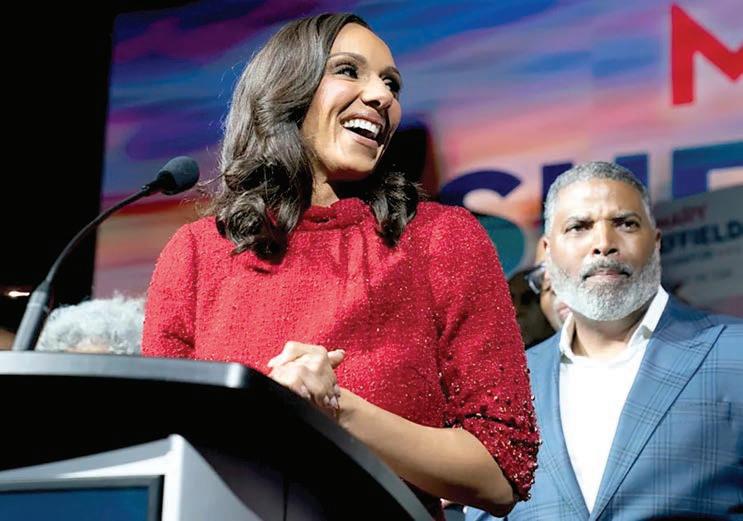
for the city and reflected broad support for her vision of progress, equity, and people-centered leadership. Raised in a family deeply rooted in service and social justice, Mayor Sheffield was inspired by leaders committed to advancing opportunity like her grandfather, Horace Sheffield Jr., founder of the Detroit Trade Union Labor Council and Detroit Association of Black Organizations, her father, Rev. Horace Sheffield II, a longtime community organizer, and her mother, Yvonne Lovett, a nurse, who instilled in her the importance of compassionate service.
Mayor Sheffield began her public service career in 2013 as the youngest person ever elected to the Detroit City Council, representing District 5 at 26 years old. During her tenure as council president,
“As
belief in the people. Guided by her faith and driven by justice, she is focused on expanding economic opportunity, and ensuring access to essential services while building an inclusive and prosperous future for all Detroiters,” the release said.
In 2024, she was named one of the Michigan Chronicle’s 2024 Power 50 Leaders and received the Black United Fund’s 2024 Black Excellence Award. The Gabrielle Giffords Rising Star Award winner will be chosen with community input. Online voting will open on March 23 and can be found at win.emilyslist.org/a/