


By Ebony JJ Curry SENIOR REPORTER
By Sam Robinson SENIOR REPORTER
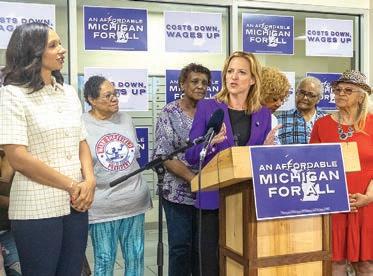
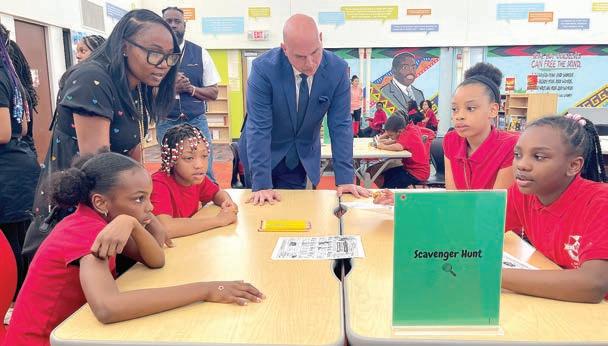
Detroit Mayor Mary Sheffield endorsed Michigan Secretary of State Jocelyn Benson’s campaign for governor on Monday at a senior home in New Center.
The event on Monday at the Pallister was a callback to Sheffield’s campaign, which targeted seniors and promised to improve conditions within apartments and senior facilities.
By Ebony JJ Curry
SENIOR REPORTER
Late Thursday night, Sept. 14, a historic moment unfolded in American labor relations as the United Auto Workers (UAW) union initiated a strike against Ford, General Motors (GM), and Stellantis. For the first time, the union took simultaneous action against all three major Detroit-based automakers. The action involves approximately 13,000 UAW members in assembly plants across Michigan, Ohio, and Missouri, who walked off their jobs after existing labor contracts expired at 11:59 p.m.
“I always knew that it was important to have a strong leader in Lansing to get things done, but serving my first six months has really reminded me the importance of strong leadership in Lansing to ensure that they’re fighting on behalf of the city of Detroit,” Sheffield said behind the podium.
ISecuring Sheffield’s endorsement is a major win for Benson’s campaign.
Shortly before midnight on Sept. 14, GM released a statement expressing disappointment with the strike action, despite offering what it termed an “unprecedented
n a breathtaking celebration of talent, determination, and the unyielding spirit of Black excellence, the Michigan Chronicle marked its 10th Annual 40 Under 40 event Thursday evening. This year’s soirée, drenched in the theme “All Black Everything with Gold Accents,” transcended expectations and essentially illuminated the golden gems within the true essence of Black excellence. Hosted by the charismatic duo of Andre Ash and Lynzee Mychael from Michigan Chronicle’s Finally Friday, the night was a triumph for the city of Detroit and its vibrant community of young Black pro-
also expressed disappointment in a statement, saying the company immediately went into contingency mode to protect its operations.
As the night unfolded, we had the privilege of honoring other outstanding individuals, each carving their own path to success. Clement “Fame” Brown, the creative mind behind Three Thirteen Detroit’s Brand Name, received the prestigious Entrepreneur of the Year Award. Brown’s commitment to empowering the city through fashion and entrepreneurship has left an indelible mark.
The evening sparkled with a golden promise as we celebrated remarkable individuals from various walks of life. Among the honorees were the brilliant and visionary co-founders of Detroit Hives, Nicole Lindsey and Timothy Paul Jackson. Their work has not only changed the landscape of beekeeping and urban farming in Detroit but also exemplified the transformative impact Black professionals can have on their communities.
By Ebony JJ Curry
“Entrepreneur of the year – that’s a big deal,” said Brown. “It’s always an honor to be honored and it’s always a blessing to be in a room full of so many talented, accomplished, and popular people that look like me. I’m geeked. I started making and selling clothes as a kid and I always knew that I would have a business, but I never knew it would be Detroit’s brand name business, so I take a lot of pride in the fact that our business represents our city’s pride.”
It was an open question whether Sheffield, a rising Democrat, would endorse Benson. Until former Detroit Mayor Mike Duggan, an independent candidate for governor, dropped out of the race last month. Duggan endorsed Sheffield’s campaign for mayor last year after it became apparent that she was the frontrunner to win the election.
This story was originally published by The
By Ebony JJ Curry SENIOR REPORTER
Krystal Clark is counting down to a release date she isn’t sure she’ll live to see.
Taking home the Corporate Excellence Award was Dannis Mitchell, Director of Community Engagement at Barton Malow.
Chief James White Says Increased Police Presence Culled Violence
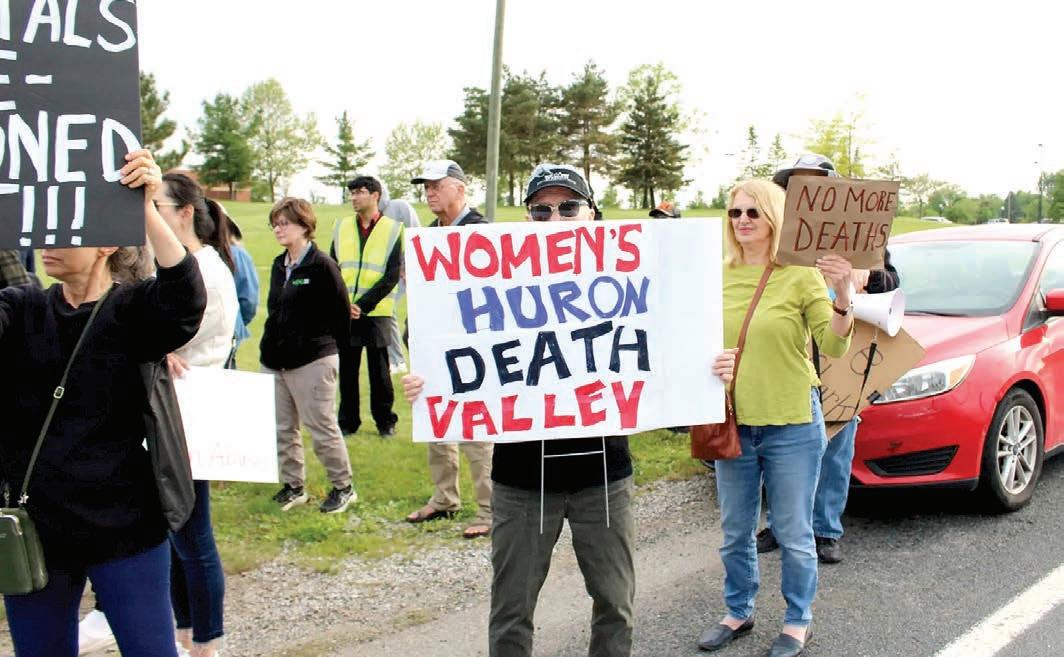
emergency responders attempted to revive her. Hoath, 36, died June 6 at Trinity Health Ann Arbor Hospital after being transferred from Huron Valley’s medical unit. Her family and advocates have said she arrived at the hospital in septic shock.
ness district that had been the lifeblood of the community.
“Together we have created a social, environmental, and financial impact through bees,” said Jackson. Lindsey followed that sentiment with, “It is through our local partnerships and collaborative efforts that we exist in over 28 plus locations managing the health of 4.5 million honeybees – humbly speaking our movement has inspired others locally, nationally, and even internationally to take on similar missions.”
After 15 years inside Women’s Huron Valley Correctional Facility, Michigan’s only women’s prison, Clark is 11 months away from possible parole. But time no longer feels like something moving her closer to release. It feels like something she is running out of.
On Monday, Sheffield said Benson has been there every time she’s called since taking office as a public official over a decade ago.
For many Detroiters, Interstate 375, or I-375, has long been just another stretch of urban highway, a concrete artery connecting different parts of the city. To some, it’s a mere convenience; to others, it’s an unremarkable part of their daily commute. However, there’s a deeper, far more troubling story beneath the surface of this seemingly ordinary freeway—a story of pain, displacement, and the lasting impact on Black Detroiters.
In a recent phone call from the prison near Ypsilanti, 42-yearold Clark sounded weak, but urgent. At times, her words tumbled over one another as she described years of pain, sickness and fear.
Like Clark, Khaira Howard was close to going home. Howard was scheduled to be paroled May 27. On May 13, she died at Huron Valley. She had been eligible for parole since March 5 but her release date was moved back.
It’s a history marred by pain, injustice, and economic devastation. More than 130,000 residents, primarily Black, were forcibly displaced. Families were uprooted, generational wealth was obliterated, and a thriving community was torn asunder. The wounds inflicted by I-375 run deep, transcending the physical barrier of a freeway to penetrate the very soul of Black Detroiters.
towards mending the wounds inflicted on Black Detroiters and restoring a sense of belonging that was so callously torn away in the past.
The UAW has branded the industrial action as the “Stand-Up Strike,” focusing on specific plants within each automaker. UAW President Shawn Fain stated, “This strategy will keep the companies guessing. It will give our national negotiators maximum leverage and flexibility in bargaining. And if we need to go all out, we will. Everything is on the table.” Union leaders have also indicated that additional plants could be targeted in future waves if negotiations remain stalled.
“My home here in Detroit, the city is better off because of your lifelong service. Thank you so much. My Michigan roots are right here in Detroit. This is the city where I have chosen to build my life, my career, raise my son, and as we recognize the growth of the city over this last decade, I know that the next 10 years will determine our future even more than the last,” Benson said.
Detroit Hives, a pioneering organization founded by Lindsey and Jackson, harnesses the power of urban beekeeping to revitalize neighborhoods in the Motor City. Their initiative not only addresses critical issues like environmental conservation but also provides valuable education and employment opportunities to Black De-
“I don’t deserve this,” Clark said. “I’ve been asking for help from everybody, every day, since 2011.”
For years, Clark has alleged that black mold at Huron Valley has made her sick. She said she has struggled to breathe and developed rashes, swelling and headaches. She said she has had to use a walker and sometimes has to choose between walking to eat and staying still because of the pain.
“It is so important to recognize that there are young leaders across the country, many that are born here in Detroit. I represent our city nationally and I tell people, ‘Yea I’m a D-girl I’m from the west-side of Detroit,’” Mitchell expressed. “But more importantly, I’ve been able to have experiences within an industry that not many of us, specifically women of color, have the opportunity to engage in and I’ve been the youngest person in the room, the only Black person in the room, and the only Sistah in the room, and I really had to articulate the importance of showing up, giving chances when others won’t, and being persistent.” As a trailblazing Black woman thriving in a predominantly male-dominated industry, her unwavering commitment to fortifying the connections between businesses and Detroit’s communities is unde-
She sometimes struggles to hear; she said mold is growing from her ears.
A string of shootings in Greektown in mid-April left both visitors and residents of this bustling downtown destination in awe. One of these shootings tragically claimed the life of a popular and beloved security guard following a dispute with a patron.
The I-375 Boulevard Project is about more than just correcting historical injustices; it’s about redefining the future. It will connect downtown Detroit to surrounding neighborhoods, bridging the gap that was placed upon the city decades ago.
Howard, too, had raised concerns about mold before her death. State Rep. Laurie Pohutsky said Howard contacted her office earlier this year about conditions inside Huron Valley, including alleged toxic mold. In an interview with The 19th, Howard’s mother said her daughter told her she had been made to clean mold out of vents without gloves or a mask, with debris falling into her hair.
This painful legacy can be traced back to the nation’s interstate highway program of 1956—a program that aimed to connect the country but often did so at the expense of marginalized communities. In the case of I-375, it meant carving a path through the heart of Black Detroit, reinforcing segregation, and perpetuating inequality.
The room where the endorsement event was held was filled with seniors at the Pallister senior living facility, located at 901 Pallister St, Detroit, MI 48202.
By Andre Ash
DIGITAL ANCHOR
The Pallister is a 14-story apartment complex near the New Center and Virginia Park neighborhoods, with hundreds of affordable and subsidized units for seniors 62 and older, with priority placement also granted to those 50–61 and the disabled.
The tale begins in what is now Lafayette Park, once known as Black Bottom—a neighborhood rooted in African-American culture and history. Named after its dark, fertile soil, Black Bottom flourished during the mid1900s, nurturing the dreams and aspirations of prominent Detroiters like Coleman Young, Joe Louis, and numerous other Detroit legends. But in the name of urban renewal in the 1950s, this vibrant neighborhood was systematically dismantled, erased from the map, and replaced by a lifeless stretch of asphalt.
The male suspect allegedly shot the guard before fleeing the scene, while his female companion is accused of concealing the weapon in her bra.
Clark says the mold inside Huron Valley is not a rumor, not a stain and not a problem that can be fixed before visitors arrive. She describes it as something in the showers, around the ceilings, behind paint, inside the air, on her skin and in her lungs.
“The mold grows all around the ceiling, at the bottom of the ceiling, in the showers, everywhere,” Clark said. “When they see people come in, they want us to paint it, try to cover it up, so you won’t see the mold. They want us to paint over it. That’s not our job.”
These incidents unfolded during an unseasonably warm spring, leading to increased pedestrian traffic and heightened tensions in the densely populated downtown area.
An outside allergy specialist tested her and determined that she was highly allergic to mold, according to Clark, recommending that she not be housed in an environment where it was present.
A Holistic Approach to Providing Shelter and Support for Detroit’s Unhoused People
She said she has repeatedly asked to be sent to a hospital for further evaluation.
For one to aptly recognize the harm caused by such projects, it is vital to note that some of the planners and politicians behind those projects built them directly through the heart of vibrant, populated communities—oftentimes to reinforce segregation and sometimes as part of a direct effort to replace or eliminate Black neighborhoods.
Today, the resurgence of Paradise Valley stands as a testament to the indomitable spirit of Black Detroiters and the enduring legacy of Black excellence. This historic district, once a vibrant hub for Black businesses and culture, is experiencing a renaissance that harkens back to its glory days. The destruction of Black Bottom may have torn apart a thriving community, but the resolute determination of a new generation of entrepreneurs and visionaries is reclaiming that lost legacy.
The surge in crime and the influx of visitors to Detroit’s downtown core garnered the attention of the Detroit Police Department (DPD), catching them somewhat off guard.
Mold does not need much to spread: moisture, poor ventilation, old walls, leaking pipes, damp ceiling tiles, air systems that do not pull humidity out of a building. For people with asthma, allergies, chronic lung disease or weakened immune systems, mold exposure can worsen breathing problems, trigger coughing and wheezing, irritate skin and eyes, and lead to more serious complications.
Residents who came to the event, including Valeria Patterson and Glenna Daniels, told Michigan Chronicle that they voted for Sheffield for mayor and plan to vote for Benson for governor.
Fain clarified the union’s strategy: “I want to give a major shoutout to the thousands of members who are on the picket lines right now fighting for all of us. The Stand-Up Strike is a new approach to striking. Instead of striking all plants at once, select locals will be called on to stand up and walk out on strike. This is our generation’s answer to the movement that built our union – the sit-down strikes of 1937. We told the Big 3 that Sept. 14 was the deadline and we meant it. We gave the companies our economic demands eight weeks ago and it took more than a month to get to the table.”
While the residential areas bore the brunt of this demolition, the heart of Black Bottom, its thriving business center, remained largely untouched. Restaurants, theaters, clubs, and bars—the very places that brought Detroit’s Black community together—were concentrated around Hastings Street, the epicenter of African-American culture in the city.
Genesee County Sheriff Chris Swanson is also running for governor as a Democrat, but trails Benson in fundraising and in the polls.
The union is pushing for a comprehensive list of demands. This
Homelessness continues to plague urban communities, with families and individuals grappling with the challenges of making ends meet in today’s economic climate. Whether it’s struggling to meet monthly mortgage payments or coping with soaring rental costs in a housing market marked by shockingly high prices, a variety of factors contribute to the growing issue of people becoming unhoused.
The response, Clark says, has too often been disbelief. When The 19th asked about a specific request from Clark regarding outside medical care, Michigan Department of Corrections (MDOC) spokesperson Jenni Riehle declined to share details about Clark’s case, citing privacy concerns. MDOC has also repeatedly claimed that there are no widespread mold issues at Huron Valley.
Housing Resource Helpline in response to the challenges that residents face in navigating the complex system of housing services. The helpline provides a single point of contact for people seeking housing assistance and connects them with the resources they need.
Now, after three women incarcerated at Huron Valley died in less than a month, Clark said, fear feels harder to push away.
Meagan DunnJulie Schneider
Then, in a cruel twist of fate, Hastings Street, too, was obliterated a few years later, making way for the construction of I-375. This marked the final blow, sealing the fate of Black Bottom and signaling the beginning of the end for Paradise Valley, the Black busi-
But now, after decades of enduring the scars of I-375, there is a glimmer of hope on the horizon. Plans have been unveiled to transform this once-divisive freeway into a vision that seeks to right the wrongs of the past while heralding a new era of inclusivity and community revitalization.
The three deaths of Rebecca Fackler, Ashley Hoath and Khaira Howard have spurred Michigan lawmakers, advocates and families to speak out about healthcare conditions in Huron Valley. Fackler, 57, died at the prison on May 17 after staff and
Historically, shelters have provided a temporary respite for those in need, often serving as the first or second option after exhausting alternatives like staying with friends or family. Shelters offer a place to rest one’s head and a warm meal, albeit sometimes for extended periods. For others, being unhoused means living in cars or makeshift outdoor
Support for the helpline comes from the Gilbert Family Foundation, which has pledged $10 million over three years to fund the program. Wayne Metro Community Action Agency manages the helpline, making it accessible to all Detroit residents. This initiative simplifies access to the City’s various housing services, ensuring that residents in need can easily find assistance.
James White, Chief of Police for the Detroit Police Department, said: “We were caught somewhat flat-footed right out the gate. By design we went into the spring deployment, which is less than the mid-summer deployment, and saw we say an uptick in violence that first warm weekend.”
Chief White attributes the violence in Greektown to a combination of weather conditions and a surge in population.
In the heart of Paradise Valley, Blackowned businesses are not just flourishing but thriving, offering diverse services, products, and experiences that pay homage to the past while paving the way for a prosperous future. From jazz clubs to soul food restaurants, the Black Press, and art galleries to fashion boutiques, this revival is breathing life into the very essence of what once made this neighborhood a vibrant cultural epicenter. It’s a resurgence that extends beyond brick and mortar; it represents the resurgence of a spirit that refuses to be subdued.
MDOC released a one-page summary of independent mold testing June 12. According to the summary, MoldQuest International conducted assessments at Huron Valley in 2022 and again in spring 2026. The consultant said air samples from both rounds fell within a normal range and did not show “appreciable elevated mold exposure” for people in the facility. Surface testing did find some fungal buildup: Eight of 105 samples taken in 2026 from vent covers in showers, cells and the food service building showed possible or probable mold growth indicators.
Fueled by more than $100 million from the Infrastructure Investment and Jobs Act and other partners, this ambitious project aims to create jobs, remove barriers to economic growth, and reconnect the neighborhood with the rest of Detroit. It is a step
By Aaron Foley EDITOR-AT-LARGE
By Lynzee Mychael MULTIMEDIA JOURNALIST
The causes of homelessness are as diverse and complex as the individuals experiencing it. In response, the City of Detroit has adopted a holistic approach to combat this issue.
“Providing services and high-quality housing to persons at risk of or who are experiencing homelessness is a key priority of the City of Detroit, said Julie Schneider, Director of Detroit’s Housing and Revitalization Department.

a Federal Government Shutdown Could Mean for Detroiters?
The Detroit Public Schools Community District could expand its African-centered curriculum to more schools beyond the district, its superintendent said at one of two schools in the city currently implementing the practice.
“This means focusing on building the pipeline of supportive housing and coordinating with the Continuum of Care on the delivery of critical resources such as emergency shelter, rapid rehousing, and diversion and prevention programs. It also means preserving and expanding affordable housing options for Detroiters of all incomes and improving housing stability though comprehensive service offerings available through the Detroit Housing Resource HelpLine and Detroit Housing Services Division within HRD.”
In May 2023, the City of Detroit launched the Detroit

From the days of the Great Migration when thousands of Black families flocked to Detroit in search of jobs and a better life, to the pivotal role they played in the city’s cultural and musical heritage, Black Detroiters have left an indelible mark on the city. However, in recent years, Detroit has experienced significant gentrification, which has raised concerns about the displacement of long-standing Black residents. Similar to a setting sun, there’s a rising spirit, and Black Detroiters are reclaiming their place in the city, despite the challenges posed by gentrification.
“The city and its partners offer a lot of great services to help Detroiters with their housing needs, but they don’t mean much if people don’t know how to access them,” said Mayor Mike Duggan. “Thanks to the efforts of our partners and the generous support of the Gilbert Family Foundation, we now have a simple process to guide residents to the right housing resource and a growing number of programs to help them.”
The Gilbert Family Foundation’s broader commitment involves pledging $500 million to support projects across Detroit over the next ten years, with housing initiatives being a significant part of their contribution.
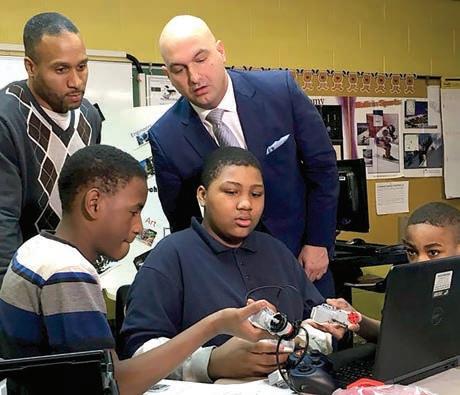
“Students need to appreciate and understand their history, their roots,” DPSCD Superintendent Nikolai Vitti said after a ribbon-cutting for a new student library at Marcus Garvey Academy on the city’s east side. “It’s part of their identity. I think it’s important for any school district, but especially ours [with] 80% of our students being African American. They should have an option throughout the portfolio of schools for a very specific African-centered education.”
Notably, Detroit has witnessed a consistent decrease in recent years, with the number of unhoused residents steadi ly declining. In 2019, approximately 7,847 people were unhoused and entered the City’s community response system. In 2021, about 5,687 people experienced homelessness.
According to the City of Detroit, since the start of the fiscal year 2019 to 2021, Detroit saw a 28% decrease in the
During the Great Migration, thousands of Black families from the South came to Detroit in search of jobs in the booming automobile industry. Despite facing discrimination and segregation, they built vibrant communities on the city’s east
Marcus Garvey Academy and Paul Robeson Academy are the only two schools in DPSCD to fully
deploy African-centric education, a curriculum that emphasizes the history and contributions of Africans and African Americans year-round across multiple subjects, rather than relegate it to one month or one specific course. The curriculum was more widespread across the former Detroit Public Schools district from the 1970s throughout the 2000s. Vitti became superintendent of DPSCD in 2017 after public schools
The department has cited those results as evidence that
Detroit City Councilman Fred Durhal III, representing District 7, where Eastern Market resides, told the Michigan Chronicle, “It’s still very early in the process, MDOT is
He explained, “ We saw numbers downtown that we have not seen, ever. People are emerging from COVID and there’s a feeling that we’re in a post-COVID era… and with the venues downtown and the reasons to come down with all the activities that are going on, we saw hundreds of more people and, in particularly, young folks, teenagers that we hadn’t seen.”
Responding swiftly to the surge in violence, DPD adjusted its deployment plans. Rather than waiting for mid-summer, they deployed officers in the spring itself to address the situation.
The rise in visitors to the Greektown area is evident in data from Placer.ai, a location analytics company specializing in visit trends and demographic insights through geolocation-enabled mobile devices. From May 1-Aug. 27, 2022, there were 1.3 million visits and 655,000 visitors to Greektown, according to Placer.ai. In the same period this year, these numbers increased to 1.4 million visits and 670,000 visitors.
As Detroit’s downtown area continues to attract both residents and visitors, the police department has implemented various enforcement measures to manage the increased population. Notably, metal detectors have been strategically placed throughout Greektown to deter the illegal carrying of firearms.
in the city were controlled by the state-managed Educational Achievement Authority. Much of the past decade has been focused on trying to stabilize the once-bankrupt district since, he says, but as he goes into year 10, there is opportunity to revisit concepts from years back.
teachers, through professional development,” Vitti says. “As students understand who they are, their ancestors and their rich history behind that, it builds confidence. It creates empowerment, it creates pride, and that’s not easily accessible, unfortunately. And today, unfortunately, you know, we have a president that attacks the history of Black Americans, and it makes it even more important to double down on exposure and the commitment and the investment.”
“We have strategically placed them at key points, “ Chief White explains. It has been a deterrent for some, and some have tested it. If you are legally carrying a weapon and carrying a CPL, have a great day. If you’re
Vitti clarified that Black history and current events are not absent from classrooms in other DPSCD schools.
“You can go to any DPSCD school and we’re intentional about students seeing themselves through the books they read and the history that they’re exposed to -- a distinct critique of what’s happening now and in the past in our country.”
“We’re trying to expand [ACE] across the district, through our
While both a majority of the dis-
cine and healthcare, may be adversely impacted by the decision to overturn Roe v. Wade.
what the Supreme Court will rule in the upcoming
women been premoment of the final. a law1931 law effect, asked the affirm that constitucontain abortion. Our Planned Advocates of founding coalition ReproducAll, a affirm abortion and freedom in constitution,” Giroux. is that everything in aborMichigan, makes we will we can patients care they
to have representalegislacollection and criminal jusrecomcollection analywith the AttorMichigan Law Standards Association Prosecutors stakeholders collect and strategically. warHouse Operations hearand other would ban of noknock urging the pass reform and Whitmer to the leg-
Huron Valley does not have widespread toxic mold conditions, which contradicts years of allegations.
Elected officials are also working to keep Roe v. Wade intact thus holding off Michigan’s 1931 trigger ban. Governor Gretchen Whitmer released a statement saying, in part:
Clark is one of the plaintiffs in a federal lawsuit against MDOC over alleged mold exposure and poor environmental conditions at Huron Valley. In 2025, after years of legal back and forth, a federal judge allowed key claims to move forward, finding that the women’s allegations were serious enough to support an Eighth Amendment claim.
The Eighth Amendment prohibits cruel and unusual punishment. The question is not whether incarceration is supposed to be comfortable. It is whether the state knew people in its custody faced a substantial risk of serious harm and failed to take reasonable action.
“Every day, I have headaches,” Clark said. “I can barely breathe sometimes. I had to sleep sitting up. My body is swelling. It’s so much. It’s just so much.”
“The words ‘Roe overturned’ are no longer theoretical. I want every Michigander to know— no matter what happens in D.C., I’m going to fight like hell to protect access to safe, legal abortion in Michigan…”
Khaira Howard’s mother, Shaquilia DeShields, said her daughter had been diagnosed with schizophrenia before she entered Huron Valley in August 2025. DeShields said that Howard was supposed to be receiving medication and that DeShields contacted the prison repeatedly over eight weeks because she believed her daughter was having a psychiatric break. She said she warned staff after visiting Howard on April 19.

“What we are really concerned about is the impact on our patients. Access to abortion is al ready out of reach for far too many Michiganders, especially Black people and people of color who face additional barriers to care as a result of sys temic inequalities and in stitutional racism. Losing access to legal abortion will impact those communities most, forcing people to become parents or expand their families against their will. Being able to decide and control if, when and how to become a parent is central to building and living a healthy, happy life,” said Vasquez Giroux.
Then access to her daughter narrowed. An in-person visit was canceled. DeShields said she scheduled a video visit for April 30 and waited on the call until the final minute, when Howard was finally brought to the screen.
Howard told her, “Mom, I’m in observation, and I’m ready to get out of there. I feel better,” before the call ended.
Another scheduled video visit passed with no one bringing Howard to the screen and no explanation from the prison.
Days later, DeShields said, prison officials called to tell her Howard, 28, was dead.
“They couldn’t tell me how she died,” DeShields said.
MDOC says that the investigation into Howard’s death is still ongoing.
More than legal implications, overturning Roe v. Wade would impact several systems across the spectrum. With the potential to drive both foster and adoption numbers upward, a ban on abortions could leave many women to choose a less safe route restoring ‘back alley’ and illegal abortion practices, including self-abortions. Moreover, African American women and women of color, who already have a long-storied history with access and inclusion in medi-
islature adopts it.
“Thorough investigations are conducted for all unexpected deaths of incarcerated individuals, and all deaths are referred to the medical examiner who will determine whether an autopsy is warranted, if one has not already been requested by the department,” Riehle said in a statement. “Claims or speculation on the death of any individual within MDOC custody before examinations and investigations are complete can be harmful to loved ones and victims.”
Increase school funding: Statutory changes to increase the School Aid Fund revenue by at least $3.6 billion and establish a permanent weighted funding formula based on student and community needs and universal preschool (0-3).
U.S. Rep. Debbie Dingell, a Democrat whose district includes the prison, sent a June 8 letter to Gov. Gretchen Whitmer demanding immediate action after the deaths of Howard, Fackler and Hoath.
Dingell asked the state to release studies, inspections, environmental assessments, and reports related to toxic mold and other health and safety conditions at Huron Valley.
Beyond the scope of pro-choice versus prolife, the fight for reproductive choice is one of freedom. As Michigan officials work to ensure each woman who finds herself in the position to choose has access to care without the threat of legal action, many wonder
that the majority of justices will reject the findings of this draft. If that is not the case, we need to stand with Senate Majority Leader Schumer and Gov. Whitmer in support of their efforts to preserve the right to reproductive freedom,” said Chair Alisha Bell, on behalf of the Wayne County Commission.
“I’ve visited the facility for hours and spoken directly with women who are terrified for their wellbeing,” Dingell said in her letter. “Their concerns — and the concerns of the broader community — remain unaddressed, and public confidence in the facility has plummeted. These concerns warrant immediate review and meaningful corrective action to ensure that all individuals in state custody are treated humanely and provided with a safe environment.”
Riehle said MDOC has taken “meaningful actions” at Huron Valley in recent weeks, including regular on-site visits from MDOC director Heidi Washington and healthcare leadership, efforts to hire more full-time medical staff and improved communication across the facility. Still, MDOC denies there is an issue with mold.
“Claims suggesting that the facility has dangerous, systemic, black or toxic mold conditions are simply false,” Riehle said.
The health committee recommends reviewing state licensure policies to address the barriers that Black psychologists face in obtaining licensure in Michigan.
Inside prison, families cannot walk into a medical unit. They cannot demand a second opinion. Their access is filtered through policies, authorization forms and staff discretion.
DeShields said a prison guard told her Howard had complained of severe stomach pain, that her heart rate was 60 beats per minute and that she became unresponsive after rolling on the floor under a bed. But when DeShields began writing down details and asking questions, she said, the staff member clarified that he had not witnessed it and had read the information from a chart.
The state’s own reports show Huron Valley has the kind of building problems that make mold harder to control.
For years, Clark has alleged that black mold at Huron Valley has made her sick. She said she has struggled to breathe and developed rashes, swelling and headaches. (Jay Love/Survivor Speaks) African-Centered
The Michigan Department of Corrections’ 2025 Annual Physical Plant Report for Women’s Huron Valley details aging systems and infrastructure failures throughout the prison. The report calls for better bathroom ventilation in multiple housing units. It notes insufficient airflow from exhaust fans in several units. It calls for replacing 50-yearold rooftop air-conditioning units, updating air handlers, replacing rooftop exhaust fan units, repairing deteriorated and rusted doors, and replacing piping across the facility.






trict and the city it serves are mostly Black, both entities have seen an influx of non-Black families – to which Vitti says everyone, regardless, should be familiar with the concept of ACE.
The state has repeatedly described mold remediation and cleaning efforts as evidence that conditions are being addressed.
“I think understanding the reality of the history of this country as it relates to race is important for all children, but especially our students,” he says.
Ensure equitable distribution of state health funds: Ensure all Michigan communities with a significant Black population receive adequate funds to address mental health issues.
“He was telling me the story like he was there,” DeShields said. “Then I started asking questions about the story he just told me. He began to fumble.”
DeShields said she is still waiting for autopsy results. What she has now is a timeline with holes, a daughter buried, and no clear explanation of what happened.
State Rep. Morgan Foreman, Democrat, said her own visit to Huron Valley made the mold complaints difficult to dismiss. Foreman said she is sensitive to mold and began reacting while inside the prison during a visit last summer.
Protecting Black voting rights: Urge state officials to remain vigilant in the fight against schemes to disenfranchise Michiganders of color.
“My daughter was safer in the streets than in prison,” DeShields said. “That’s sad.”
Reject censorship in history instruction: Encouraging Gov. Whitmer to ensure the goal for Michigan schools should be history instruction that is presented by professionals with the subject matter expertise, pedagogical skills, and judgment necessary to present complex information to students that are grounded in provable facts and add to the understanding of modern-day America.
Tiffany Walker, family program director for Citizens for Prison Reform, a Michigan-based organization committed to advocating for and elevating the experiences of incarcerated individuals and their loved ones, said families often do not understand the importance of medical authorization forms until an emergency is already underway. Without the proper authorization — which DeShields had — relatives can be shut out of medical information during a hospitalization, mental health crisis or death.
“I started to welt up, and I take heavy allergy medication and heavy asthma medication,” Foreman said. “One of my other colleagues, who I believe is allergic to mold, she cleared her throat the whole time she was in there.”
The reaction, Foreman said, added to her concern that state officials cannot treat the complaints as isolated or exaggerated, particularly as women inside continue to report breathing problems, rashes and other symptoms they believe are connected to conditions in the facility.
Vitti also spoke about the role DPSCD plays in recent efforts, be they encouraged by newly elected Detroit Mayor Mary Sheffield or a non-municipal collective, to woo new families to Detroit and keep existing ones in place.
“We’re just starting to have conversations with the new administration on that. Mayor Sheffield and I have been working a lot on the transportation side of things [as it relates to] after-school programming,” he says.
“One of the biggest concerns families raise is how difficult it can be to access timely medical and mental health care information about their loved one during a medical emergency,” Walker said.
“BLAC members have worked hard to identify the needs of the Black community and we feel these recommendations will provide a solid first step towards breaking down barriers in education, community safety, health and business,” said BLAC Co-Chair Dr. Donna L. Bell.
Foreman, one of the 30 lawmakers who signed a letter calling for Washington to resign as MDOC director, said the culture inside the department is bigger than one person, but leadership still matters.
“There has been a dereliction of duty done to the entire MDOC, and especially Women’s Huron Valley,” Foreman said.
Addressing transportation needs for Detroiters has been a futile effort for officials (regardless of whether households have students). But in the decade since Vitti has been at the helm, families seeking to place their children in some of the city’s higher-performing schools –public, charter or private – have found themselves not only competing for limited slots, but also plotting out their own transportation routes that may include longer commutes over the course of their students’ time in the classroom.
Increase mental health supports for the Black community: Recommending Michigan set a goal of increasing the number of Black mental health service providers by 20% each year over five years.
Washington was first appointed to lead the MDOC in 2015 under then-Gov. Rick Snyder, a Republican, and was retained by Whitmer, a Democrat, when her administration took office.
Walker said families also report that women’s symptoms are minimized inside the prison.
“One phrase we hear repeatedly is that women are told to ‘drink water’ instead of receiving meaningful evaluation or treatment,” Walker said.
Families are not the only ones trying to force attention on what is happening inside Huron Valley. Advocacy organizations that work with incarcerated women and their loved ones say the complaints have become too consistent, and too serious, to dismiss as isolated.
Trische’ Duckworth, founder and executive director of Survivors Speak, a Washtenaw County-based advocacy organization, said her organization first began raising alarms around Huron Valley after working with Teresa Dunlap, an incarcerated woman with stage four cancer. Duckworth said the organization advocated for Dunlap’s compassionate release, then began hearing from more women and families about conditions inside the prison.
BLAC will hold a virtual town hall meeting to discuss its policy recommendations on Thursday, May 12 at 4 p.m. Join BLAC and a virtual audience in discussing the recommendations to support the Black community.
With Whitmer nearing the end of her term and a new governor set to appoint the next MDOC director, Foreman said the state has to confront not only whether Washington should resign, but what kind of department the next director would inherit.
“I do fear about the ‘then what’,” Foreman said. “Because what are we throwing a person into?”
Chrysler Elementary School in Lafayette Park, for example, has always been a popular K-5 choice for families in and around its neighborhood, but now draws families that live far across both the east and west sides. A family may then shuttle their child to somewhere as far off as Bates Academy in the west side Bagley neighborhood for middle school, in the hopes of landing them at Renaissance High School on the west side or Cass Technical High School in Midtown. The commute by bus or by car to these schools or the others on the parents’ short wishlists can vary wildly based on proximity.
To learn more about BLAC and this upcoming event, visit www.michigan.gov/BLAC. embraces. transforleadership as a approach that change the syscircumstancoperating Ivory “Transformationdoesn’t just do certhem view of and exdrive that because what create everyentire because people believe that they need to for themselves and others to live better lives.”
Advocates are no longer only demanding a leadership change. They are pushing for a new oversight structure with enforcement power.
A proposed measure being circulated by Survivors Speak, titled the Krystal Clark Michigan Prison Accountability, Oversight, and Human Rights Act, would require the state to close Women’s Huron Valley within 12 months; provide immediate medical examinations and treatment for women exposed to mold and environmental hazards; and create a private right of action for incarcerated people harmed by unsafe housing, medical neglect or environmental conditions.
Vitti sees the glass half-full on the concept of Detroit having a number of higher-performing schools. “It keeps those families in the city. It also continues to attract those students that are higher performing staying in the city and in DPSCD,” he says. But he’s also aware that transportation challenges are at the root of the larger issue.
Duckworth met Clark through another woman incarcerated at Huron Valley.
“I started talking to her and she started telling me about her condition,” Duckworth said. “Through that, we became close.”
Duckworth now speaks with Clark multiple times a day and has watched her deteriorate. She said Clark’s condition made it harder to ignore what other women and families had been describing for years. As Survivors Speak advocated for Clark, Duckworth said more people began coming forward with accounts of mold and medical neglect inside Huron Valley.
BLAC is housed in the Michigan Department of Labor and Economic Opportunity. Members represent many professional backgrounds, including economics, law, public safety, health and wellness, arts and culture and media. They leverage their experiences and expertise to make recommendations to the governor on critical issues affecting the Black community.
“There was so much silence around it,” Duckworth said. “Other women started speaking out about either what happened to them while they were in there or family members telling us what was going on with their loved ones inside Huron Valley.”
“Chancellor Ivery is a true transformational leader and an outstanding CEO, who is more than worthy of the CEO of the Year Award he just received, “ said Prof. James C. Mays, who teaches entrepreneurship and supply chain management at WCCCD’s Corporate College. “In his 27 years at WCCCD, Dr. Ivery has elevated WCCCD to become nationally recognized for excellence and innovation and preparing our students professionally and personally to do great things in the world.”
The complaints are not new. What has changed is the attention on them.
It is not yet clear whether the proposal will be introduced by lawmakers. But Clark does not have the luxury of waiting for momentum to be built slowly.
During Clark’s call with The 19th, a recorded voice cut in: one minute remaining. Clark used the final seconds to make her request plain.
“I want the governor to listen to me,” Clark said. “I’m not a threat. Let me go before it’s too late. There’s doctors out there ready to help me. I have 11 months. Let me go get the right help before it’s too late. My kids need me.”
Michigan does not have a death penalty. But at Huron Valley, women, families and advocates who refer to the prison as “the valley of death” are asking whether the state has created something else: a prison where a sentence can become a health crisis.
Before the conversation with Clark ended, she made a direct plea to Whitmer: “You can help save a life,” she said. “Help save my life. Because I know my body ain’t gonna take it.”

“I think if we’re going to continue to see more students attend DPSCD and more families staying and moving to the city, we have to have a stronger mass transportation system,” Vitti says. “When you look at other large cities, they have more reliable, and scaled access to transportation. My hope is that in the years that come, the mayor will seek more investment in mass transportation and the burden on families – all families, middle class and lower socioeconomic, are getting to where they want to go.”
“We
Jocelyn Benson is and will fight for you. I know that,” Sheffield said.
You can reach Sam at srobinson@michronicle.com.


A3 | June 24-30, 2026
By Mike Land HUNTINGTON SOUTHEAST MICHIGAN & NORTHWEST OHIO REGIONAL PRESIDENT

Graduation is one of those moments that stay with you. In our communities, it fills the air with optimism, promise and excitement. It is a time to celebrate hard work, perseverance and achievement, and just as importantly, to look ahead to what comes next.
For students across Detroit, that next step will look different. Some will continue their education. Others will enter the workforce, start building careers or explore new paths. What’s consistent, though, is that this transition marks the beginning of applying what you’ve learned in real-world settings.
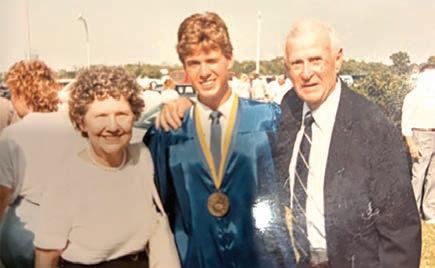

As I reflect on my own journey and what I have learned over time as a leader, a few lessons stand out. First, always be yourself and stay authentic. You do not need to have everything figured out on day one, but you do need to be grounded in who you are. People are drawn to authenticity, and trust is built when you show up consistently, are honest about what you know and what you don’t, and are willing to learn along the way.
Strong neighborhoods are built through thoughtful partnerships, long-term investments and housing that meet the real needs of its residents. That is exactly what John Grace Arms represents in Southfield.


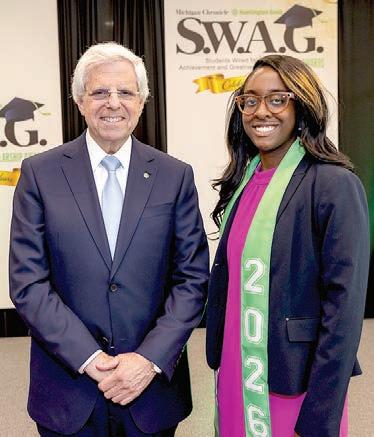
“When we invest in young people who are committed to doing good, we strengthen the very fabric of our community—and success follows for all of us,” said Huntington Bank Chairman Gary Torgow.
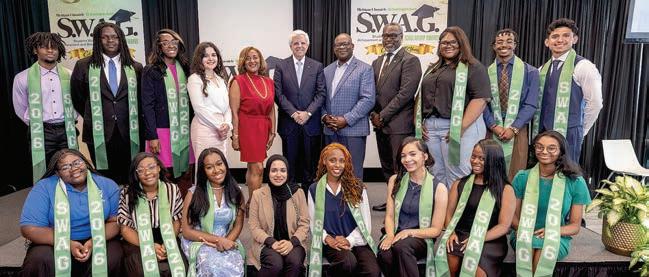
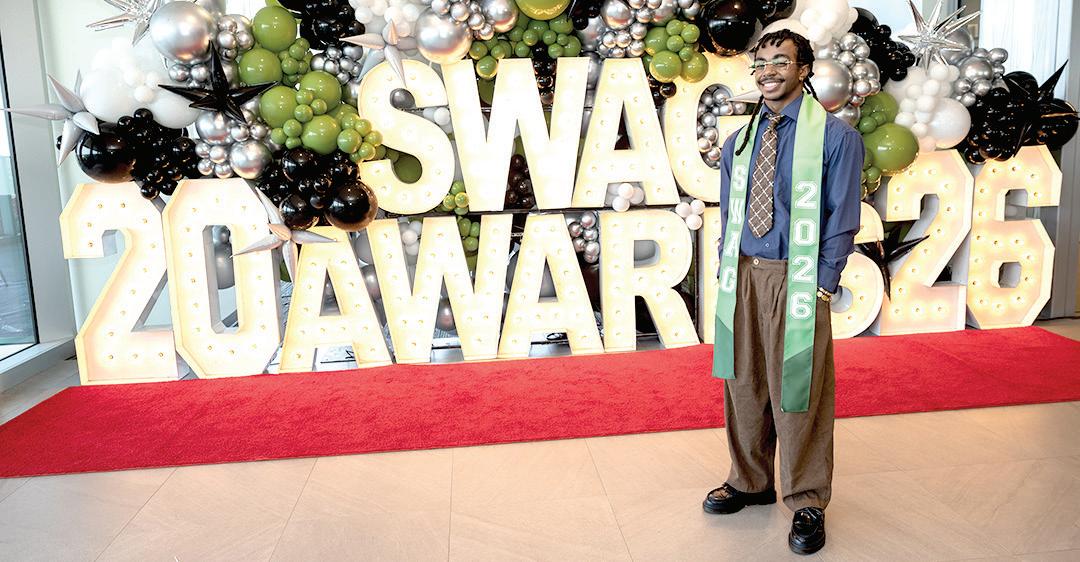
This message came to life on June 11 when families, educators and community leaders gathered at the Huntington Detroit Tower to celebrate the latest graduating class and mark 10 years of the S.W.A.G. (Students Wired for Achievement and Greatness) Scholarship Awards. The Huntington Bank and Michigan Chronicle program has now supported more than 200 Detroit students and invested nearly $2 million in scholarships and education-focused programming.
This year, 13 high school seniors and one returning alumni recipient received a combined $120,000 in scholarships and were honored for their integrity, service and commitment to their communities as they prepare to take the next step in their educational journey.
“I have learned that perseverance, hard work and resilience are the keys to overcoming obstacles,” said Sarai Love-Carter, a graduate from Renaissance High School.
“I am committed to never giving up on my goals and to making a positive difference in the lives of those around me.”
“I know this is an experience that not everyone is blessed with, and I feel very blessed and very excited,” said Kennedy King, Cass Technical High School.

“What inspires me to excel and be resilient is my parents. I’ve watched them be able to provide for me, and that’s something that I want to be able to provide for my children, my grandchildren and future generations.”
The scholarship was built on the premise that potential is not defined by GPA alone. With a minimum GPA requirement of 2.25, the program recognizes students who demonstrate leadership through service, volunteerism and a commitment to giving back and lifting up others.

Through a $12.25 million construction loan, Huntington Bank is helping bring new purpose to John Grace School, transforming the historic property into an affordable senior housing community located at 21030 Indian Street in Southfield. The former elementary school opened in 1921 as Southfield Township’s first modern educational facility, replacing a one-room schoolhouse. Expanded over time, the school closed in 1980, became a library and community center from 1985 to 2017, and has been vacant since. It was listed on the National Register of Historic Places in 2023.
“The John Grace Arms project represents a unique opportunity to preserve Southfield’s heritage while addressing senior housing needs,” said City of Southfield Mayor Kenson Siver. “It is a blend of historic preservation, sustainable development, adaptive reuse and community-focused design making it a model for future projects. I look forward to witnessing the successful transformation of the John Grace School into a thriving senior housing community.”

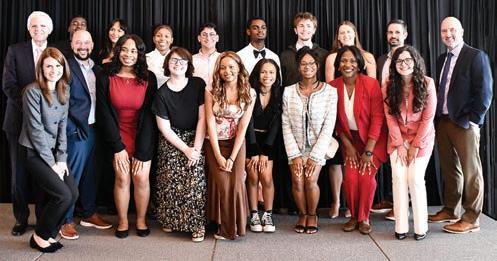
“Winning the Huntington Bank scholarship was the perfect gift on top of a very special year for me,” said Heiress Brame, Berkley High School. “All of the staff I have interacted with from my principals to the president of the bank were so supportive and extremely generous and I am truly grateful for that. Next year I will be going to college for criminal justice and during my time hope to continue my passion of theater and the arts!”
That sense of fulfillment was at the center of a May 20 celebration where 12 graduating seniors from Berkley High School were recognized at the Huntington Tower for their achievements and path ahead.
Presented as a surprise to the students, Huntington Bank and Berkley Schools awarded $62,500 in scholarships to help students take the next step toward college and future careers. Now in its fourth year, the scholarship program has provided more than $200,000 in sup -
port to Berkley-area students that exemplify leadership and are involved in their school community.
Remarks from school and program leaders recognized not only academic achievement, but the character and commitment shown by this year’s class.
“One of the things that stood out most was the level of thoughtfulness and kindness these students showed throughout the process,” said Gary Torgow, Huntington Bank Chairman and Norup International (Berkley Schools) alumni. “You can see how much they care about their families, their communities and what they want to do next. Those qualities will stay with them as they take these next steps.”
As the program continues to grow, the focus remains on supporting students as they move forward, carrying their experiences, goals and sense of responsibility into the next chapter of their lives.
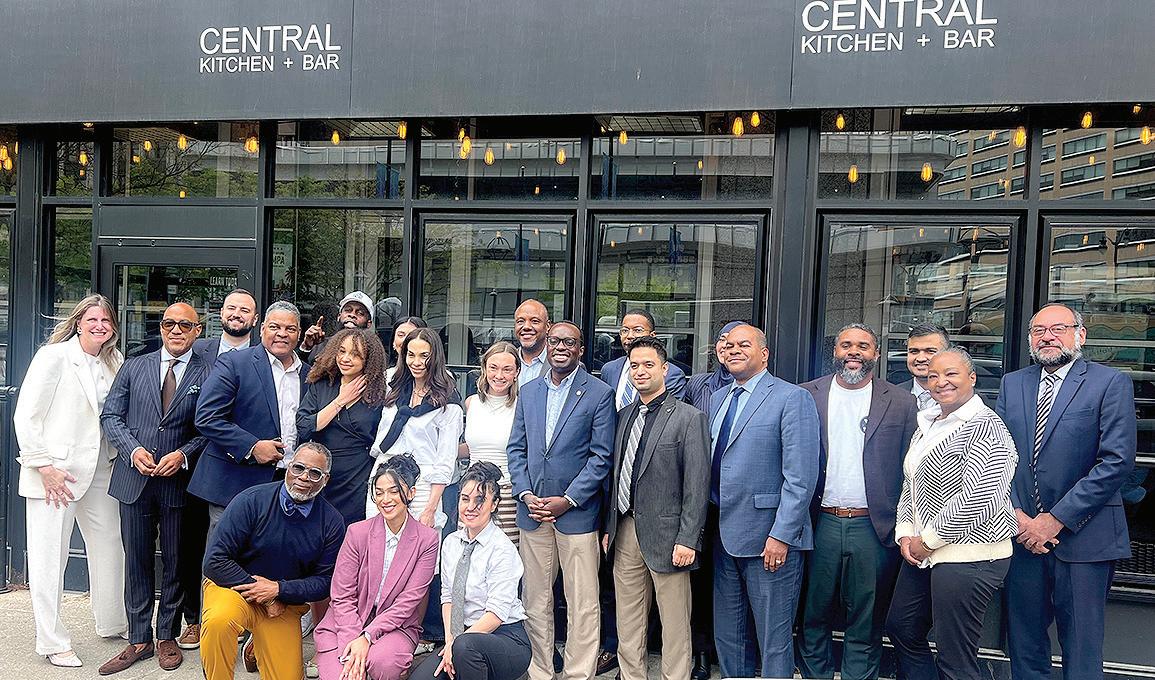
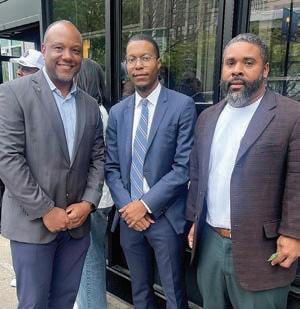
Detroit’s next generation of entrepreneurs took the stage on May 13 as students from Wayne County Community College District (WCCCD) presented their business concepts during a special capstone event, which was hosted by Dennis Archer Jr., CEO of Ignition Media, at Central Kitchen + Bar in Detroit.
The event marked the culmination of a semester-long entrepreneurship course taught by Archer, a successful entrepreneur himself, in which students developed business plans inspired by their passions, experiences and perspectives.


The program’s success shows up through the impact made by S.W.A.G. alumni. Over the past decade, S.W.A.G. scholarship recipients have gone on to build careers, launch businesses and lead efforts that give back and support the future of Detroit.
Participation in the evening’s ceremony included 2017 S.W.A.G. alumna Damon Creighton Jr., who served as the event’s emcee, and 2021 S.W.A.G. recipient Arthur Harrington, who gave an alumni reflection to this year’s cohort. Harrington emphasized the importance of believing in yourself and your willingness to keep moving forward. He also encouraged students to not think of S.W.A.G. as a one-night recognition, but as an opportunity to build lasting relationships with one another and the mentors and leaders in the room.
This year, S.W.A.G. alumna Papia Aziz was awarded a $10,000 scholarship as part of this year’s class to pursue a master’s degree in nursing at the University of Detroit Mercy. She first received a S.W.A.G. scholarship in 2016 as part of the inaugural class, which helped her earn her bachelor’s degree in nursing. She currently works as a registered nurse in Metro Detroit and is involved in community service initiatives focused on food insecurity, health education and outreach to diverse populations.
“The S.W.A.G. scholarship not only helps me achieve my educational goals but also empowers me to give back to the community that shaped me,” said Aziz. “I hope to inspire future generations to believe that, through hard work, determination and courage, they can overcome challenges and reach their full potential. I sincerely thank the scholarship committee for believing in my dreams and investing in my future.”
Beyond scholarships and financial support, S.W.A.G. was designed as an avenue to connect students to mentorship, career exposure and networks that help bridge the gap between education and real-world opportunity. For Huntington and the Michigan Chronicle, it’s about playing a small role to see what great things these students go on to accomplish.

“We honor our community through young people,” said Hiram Jackson, publisher, Michigan Chronicle. “We see students take this opportunity and turn it into something more, building their futures while staying rooted in the communities that supported them. That kind of continued investment and commitment is what helps Detroit grow stronger.”

From page A-3
“What we built here goes far beyond a business plan,” explained Archer. “These students walked in with ambition and walked out with a roadmap. More importantly, they walked out knowing how to think. They learned to take feedback, adapt their ideas, and defend their vision in front of people who have actually been in the arena. That combination of practical skill and real-world exposure is exactly what turns aspiration into action. I couldn’t be more proud of what they accomplished.”
During the showcase, students presented their business plans to a panel of professionals representing banking, media, real estate and other industries. These business leaders provided feedback on key areas essential to launching and growing a small business, including access to capital, financial planning, management, marketing, technology and long-term sustainability.
Joining the group of professional advisors was Chris Jackson, vice president, regional banking relationship manager, at Huntington Bank.
students see their own ideas, and that shift in thinking is something they will carry with them long after the semester ends.”
“From a banking perspective, I was sure to highlight the significance of understanding cash flow, building strong relationships with financial partners and staying open to feedback,” explained Jackson. “These factors can make the difference between a good idea and a sustainable business.”
For the budding entrepreneurs, the experience offered a valuable chance to network, explore mentorship opportunities and hear more about what it takes to turn an idea into a business.
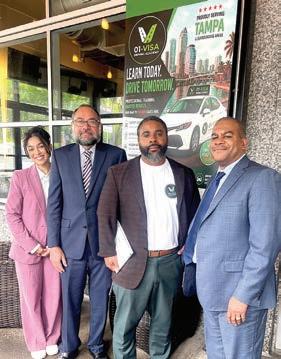
“When talking with the students, I emphasized the importance of resilience and adaptability as they develop their ideas; being able to pivot and adjust a plan is crucial for any entrepreneur, especially in today’s ever-evolving market,” Jackson shared. “I also encouraged them to surround themselves with mentors and advisors who can offer guidance, which I believe is one of the best investments they can make in their entrepreneurial journey.”
“I was impressed by the students’ creativity and the level of detail they brought to their business plans,” said Jackson. “Their enthusiasm and willingness to learn stood out, and it was inspiring to see how they challenged themselves to think critically about building a business.”
“There is something that happens when a student stands in front of someone who has actually built a business, absorbed a loss, and figured out what works,” shared Archer. “The stakes become real in the best possible way. The professionals who joined us weren’t there to evaluate a grade; they were there to engage honestly, to offer the kind of perspective no textbook can replicate. That experience changes how
Huntington Bank’s involvement reflects its ongoing commitment to developing small businesses and strengthening the local community by investing in people and ideas.
“Experiences like this create a ripple effect. Empowering students today leads to stronger small business communities tomorrow,” said Jackson. “It’s essential that we share knowledge and help foster the entrepreneurial spirit that drives growth and innovation.”
By equipping students with the confidence and connections needed to advance their business ideas, the capstone event highlighted what can be accomplished when educators, mentors and business leaders invest in and inspire the next generation of entrepreneurs in Detroit and beyond.

From page A-3
The development is being refurbished as part of a public-private initiative in partnership with MiSide, Cinnaire and the Southfield Nonprofit Neighborhood Corporation, with additional support from non-profit agencies and for-profit partners. When complete, it will create 60 rental apartments for residents age 62 and older, while preserving the character of a landmark asset and bringing new life to a building with deep community roots.
Huntington’s investment was made through its Community Impact Capital group, which is dedicated to improving quality of life in low- to moderate-income communities. CIC works with public and private partners, including local, state and federal resources, to help bring developments together.
“Housing is far more than just a roof over your head,” said Ron Konstanti-
From page A-3
Second, be curious and take the time to understand the “why.” Ask questions. Listen closely. Whether you are in a classroom, a first job or a new environment, understanding the bigger picture will help you make better decisions and see how your contributions connect to something larger. Curiosity and transparency go hand in hand, and they are critical to building both confidence and credibility.
And third, be willing to roll up your sleeves and do the work alongside others. Success is not built alone. It comes from being part of a team, supporting those around you and being willing to step in wherever needed. The strongest teams, and the strongest leaders, are the ones who put the group first and move forward with a shared purpose.
These beliefs are central to how I think about leadership. I’ve always believed in being authentic, transparent and focused on supporting others, doing the work alongside them and helping remove obstacles so teams can succeed. When people understand the “why,” feel supported and know they are part of something bigger, they will do their best work.
These same principles also shape how we think about our role in the community. Preparing the next generation for what’s ahead is not something students should carry alone. It is a shared responsibility across schools, families, businesses and community
novsky, director of lending, Huntington Community Impact Capital group. “It is part of a broader vision for community, where new developments help residents stay rooted while revitalizing local neighborhoods and economies.”
The construction of new and renovated properties shows what is possible when partners come together to address a community’s need and invest in people, not buildings. For residents, it means more than a place to live. It means staying connected, supported and part of the community they call home.
“John Grace Arms is about creating more than housing—it’s about helping preserve a place that means something to the community and reimagining it as a safe, welcoming home for seniors,” said Sean de Four, MiSide President & CEO. “We’re honored to be part of bringing new life to this former school and creating affordable apartments where residents can feel comfortable, respected and connected.”
organizations. When we work together, we can better connect learning with opportunity and create clearer pathways into the workforce.
Across our region, we see that impact through scholarships and workforce readiness efforts designed to help students prepare for what comes next. From financial education to career exposure and hands-on learning opportunities, these programs are focused on building confidence, expanding access and creating clearer connections between education and real-world opportunity. For example, Huntington supports programs like the Detroit Public Schools Community District Foundation’s workforce initiatives and Courageous, Inc.’s EventWorks Academy, which prepares Detroit youth for careers in sports, entertainment and event management.
This commitment also includes direct financial support through scholarships. We’re proud to partner on local scholarship initiatives like S.W.A.G. (Student Wired for Achievement and Greatness), Berkley Schools, Kalasho Education & Youth Services, and Leaders Advancing & Helping Communities, where we invest directly in students and celebrate what they have achieved. This is how I believe we move forward: staying grounded in our values, putting hard work first and investing in others. When we commit to workforce readiness and create pathways to opportunity, we help ensure the next generation is prepared not just for what comes next, but for the role they will play in shaping the future of our region.
A5 | June 24-30, 2026
By Linda Little and Adam Hollier
If you ask most people about affordable housing, they picture a challenge affecting only those living at the margins of society.
But that perception is increasingly outdated.
Today, housing affordability is impacting working families, seniors on fixed incomes, young professionals, teachers, healthcare workers, first responders, landlords, nonprofit organizations, and entire neighborhoods.
Across Detroit and communities statewide and nationwide, housing costs continue to rise while the systems designed to create, preserve, and sustain affordable housing struggle to keep pace.
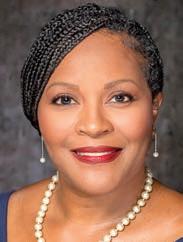

The reality is simple: affordable housing is no longer a niche issue. It is an economic issue, a workforce issue, a health issue, and a community stability issue.
The question is no longer whether we have a housing affordability problem. The question is whether we are willing to work together to solve it.
Coming together to find solutions
That is why Neighborhood Service Organization and Wayne County Community College District are convening leaders from housing, government, education, finance, philanthropy, community development, healthcare, and social services for an event titled Hometown Summit: A Vision for Affordable Housing on July 1 at the WCCCD Northwest Campus in Detroit.
Headlined by keynote speaker Marcia L. Fudge, former U.S. Housing and Urban Development Secretary, the goal of this event is not to promote a single solution or advance a particular agenda. In fact, one of the greatest challenges facing housing today is the assumption that any single policy, funding source, or organization can solve a problem this complex.
No one sector can do this alone. Instead, we believe progress begins by identifying the structural barriers that continue to drive housing instability and by bringing together stakeholders who rarely have the opportunity to sit at the same table.
As we prepare for this conversation, three realities stand out.
Housing has become too expensive to build
Developers, nonprofit housing organizations, and community partners face growing construction costs, labor shortages, financing challenges, insurance expenses and regulatory hurdles. Even when funding is available, the economics of developing affordable housing often remain extraordinarily difficult.
If we want more affordable housing, we must address the costs and barriers associated with producing it. Communities cannot solve housing shortages while it continues to become harder and more expensive to build. Too few people are producing housing.
This is a challenge that receives far less attention than it deserves.
Detroit, like many communities, needs more developers, builders, contractors, nonprofit housing organizations, skilled trades workers,
See HOUSING CHALLENGE Page A-6
By Mark S. Lee GUEST COLUMNIST
In business, we often talk about return on investment in terms of dollars and cents. But sometimes the most meaningful investments are measured in community pride, cultural preservation, economic activity, and the ability to bring people together.
That’s why the reopening of Detroit’s historic Baker’s Keyboard Lounge is about much more than music.
After a month-long closure for renovations, Baker’s Keyboard Lounge reopened recently, bringing with it a refreshed customer experience, facility improvements, and an enhanced culinary menu. The updates include a new roof, renovated women’s restrooms, refreshed furnishings, and expanded dining offerings—all designed to preserve the venue’s legendary status while positioning it for future generations.
Founded in 1934, Baker’s is widely recognized as the “world’s oldest jazz club”. Over the decades, it has welcomed legendary performers, international visitors, celebrities, and countless Detroiters seeking an authentic cultural experience.
“This reopening is about honoring Detroit’s rich musical legacy while creating
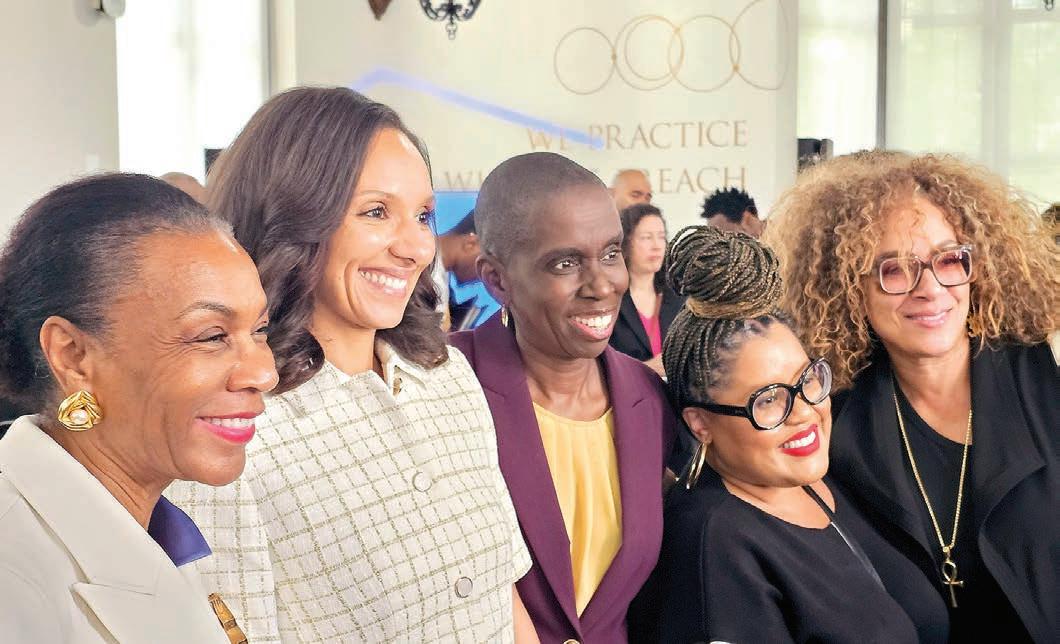
Long before the speeches began, Monday, June 15, at Marygrove Conservancy, Detroiters had already spent months telling Mayor Mary Sheffield what they wanted their city to become.
They shared their concerns in surveys, community meetings, neighborhood gatherings, coffee shops, laundromats, grocery stores, and basketball courts. They talked about the lack of grocery stores in some neighborhoods, the challenge of finding jobs that pay enough to support a family, the need for safer communities, stronger youth programs, and a government that listens before making decisions.
Now, those conversations have been compiled into a 116page document that Sheffield says will serve as a blueprint for her administration.
Standing before a crowd of residents, community leaders, and members of her transition team, Sheffield formally launched the Rise Higher Detroit Community Framework, a report built from more than 8,000 survey responses and input from over 1,200 residents who attended community conversations across the city.
“This community framework will not just sit on a shelf in our office,” Sheffield said. “It is the cornerstone this administration will return to again and again as we shape policy decisions from the people of this city.”
The framework is the culmination of what Sheffield has described as the largest community-driven mayoral transition effort in Detroit history. Supported by approximately $2 million in philanthropic funding and involving more than 300 civic, business, and community leaders, the process began immediately after Sheffield’s election victory last November.
But while the report contains dozens of recommendations across issues ranging from transportation to economic development, its broader significance may be what it reveals about Detroit itself.
The findings arrive at a moment when the city continues to attract investment, create jobs, and celebrate a decade of recovery since emerging from bankruptcy. Yet many Detroiters remain disconnected from that progress.
One out of every three city residents experienced poverty in 2024, and that number was worse (more than 50%) for youth, according to federal data. At the same time, jobs located within Detroit carry some of the highest average wages in Michigan.
The challenge, residents repeatedly told city leaders, is ensuring Detroiters can access those opportunities.
Among the top priorities identified in the framework are expanding access to quality jobs, attracting more grocery stores, improving transportation, increasing neighborhood investment, reducing barriers for young people, and creating safer
a refreshed experience for longtime supporters and new audiences alike,” Baker’s management said in announcing the reopening.
Co-owner Jacquelyn Vaughn Whitaker perhaps captured the significance best when she noted, “Baker’s has always been more than a nightclub — it is part of Detroit’s cultural heartbeat.”
That statement deserves our attention.
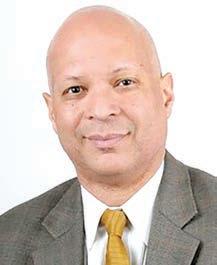
Economic development discussions often focus on large projects, major employers, and billion-dollar investments. Those initiatives are important but thriving cities also depend on cultural anchors that create identity and attract people. Institutions like Baker’s help generate foot traffic, support jobs, encourage tourism, and stimulate spending at nearby businesses.
Research consistently shows that arts and cultural organizations contribute significantly to local economies. According to Americans for the Arts, nonprofit arts and culture organizations generate economic activity through audience spending, employment, and tax revenue while strengthening
communities through prevention as well as enforcement.
Those themes surfaced repeatedly throughout the engagement process.
“We reached out to everybody,” said Donna Givens Davidson, president and CEO of Eastside Community Network, one of several organizations that helped conduct outreach. “We went to coffee shops. We went to grocery stores and laundromats. We went to the places that people gravitate to.”
Organizers intentionally moved beyond traditional public meetings, seeking input from residents who may never attend a city council session or government hearing. Surveys were offered in five languages, and community groups spent months knocking on doors and facilitating conversations in neighborhoods across Detroit.
What emerged was a portrait of a city eager to participate in shaping its future.
“This is not a check-the-box exercise,” said Skillman Foundation President and CEO Angelique Power, a committee leader who helped oversee recommendations related to education and youth development. “Young people in Detroit are too important for that.”
The education and youth committee included high school students alongside nonprofit leaders, educators, and community advocates. Power said their message was consistent: Detroit has opportunities for young people, but navigating them can be difficult.
Residents called for expanded after-school programming, more mentorship opportunities, stronger mental health support, and better transportation options that connect youth to jobs, enrichment activities, and educational resources.
Several initiatives already launched by the Sheffield administration reflect those priorities, including the Rise to Ride transportation program, increased investment in after-school programming, and support for families through the Rx Kids initiative.
Youth advocates said residents repeatedly emphasized that transportation and mental health services should not be viewed as extras.
“They’re the baselines,” Power said. “They’re what set the conditions for whether young people can show up and participate.”
Public safety emerged as another area where residents pushed for a broader conversation.
According to Teferi Brent, Director of the Mayor’s Office of
community engagement and quality of life.
In many ways, Baker’s represents a model of sustainable community investment. Rather than abandoning a historic asset, ownership chose to reinvest in it. The improvements balance modernization with preservation—a strategy that successful businesses increasingly embrace.
The reopening also highlights another important economic trend: consumers are seeking experiences. While products can often be purchased online, authentic experiences cannot. Live jazz, exceptional food, shared memories, and a connection to Detroit’s rich cultural history create value that extends beyond the transaction itself.
The new culinary offerings, including Chef Maurice Wallace’s Father’s Day features of barbecue and lamb chops, reflect an understanding that today’s customers expect a complete experience. Entertainment, dining, hospitality, and culture are increasingly intertwined.
For Detroit, the timing is significant. As the city continues to evolve and attract new
investment, preserving iconic institutions reminds us that economic growth should not come at the expense of cultural heritage. In fact, the two can work hand in hand. Every successful city needs places that tell its story.
Baker’s Keyboard Lounge has been telling Detroit’s story for more than nine decades.
Its reopening serves as a reminder that investing in history can also be an investment in the future. And sometimes the best returns aren’t found on a balance sheet—they’re found in the communities, traditions, and experiences that make a city worth visiting, working in, and calling home.
As Detroiters gather once again beneath the famous piano-shaped bar to enjoy great music, great food, and great company, they will be doing more than supporting a local business. They’ll be investing in a piece of Detroit’s soul.
We invite readers, business owners, and future entrepreneurs to follow along, ask questions, and engage. If you have story ideas or questions, you can email Lee at mark@leegroupinnovation.com or visit leegroupinnovation.com.

From page A-5
Neighborhood and Community Safety, Detroiters consistently linked neighborhood conditions and community safety. Residents argued that quality housing, youth programming, public spaces, and reliable city services all contribute to whether people feel safe in their neighborhoods.
That feedback helped shape recommendations emphasizing violence prevention, intervention, and community-based solutions alongside traditional law enforcement strategies.
The administration pointed to several early actions that align with those priorities, including the creation of Detroit’s first Office of Neighborhood and Community Safety, expanded community violence intervention programs, and investments in recreation and youth engagement efforts.
The framework also reflects a recurring theme heard throughout the transition process: residents want government to show up before a crisis occurs, not only after.
That philosophy has influenced some of Sheffield’s early initiatives, including partnerships between police officers and mental health professionals, expanded neighborhood safety programming, and efforts to address longstanding concerns about housing, property assessments, and economic opportunity.
David Bowen, Sheffield’s chief of staff, described the framework as a guide not only for city government but for community organizations, foundations, and institutions making decisions throughout Detroit.
A public dashboard accompanying the framework will allow residents to review priorities by topic, demographic group, and geographic area.
“Our very next step is launching the community framework digital dashboard,”
Bowen said. “It allows residents, community organizations, city staff, elected officials and other decision-makers to see what Detroiters need and what our diverse communities’ priorities are.”
The challenge now shifts from listening to implementation.
Several speakers acknowledged that not every recommendation can be accomplished immediately. Yet they argued the process created something equally important: shared ownership.
Residents were not simply asked to provide feedback, organizers said. They were invited into the process of governance itself.
Andrea Batista Schlesinger, who specializes in design strategies that make cities more inclusive and growth more equitable, served as a key advisor in crafting the transition strategy and has worked on mayoral transitions across the country. Batista Schlesinger called Detroit’s effort unique, citing both the scale of participation and the seriousness with which residents approached the process.
“You have offered a roadmap,” Batista Schlesinger told attendees. “The mayor said, ‘Give me my roadmap,’ and you have offered one.”
Whether the framework ultimately transforms city policy remains to be seen. But Monday’s gathering made one thing clear: thousands of Detroiters expect their voices to remain part of the conversation.
For Sheffield, whose administration is still in its early months, that may be the framework’s greatest test. The report captures what Detroiters want. The next chapter will determine whether City Hall can deliver it.
To read the entire report, visit detroitmi. gov/government/mayors-office/rise-higher-detroit-survey.
From page A-5
and investment partners capable of creating housing at scale.
Housing production requires talent, expertise, workforce development, financing, and collaboration. Without a stronger pipeline of housing producers, even the best policy ideas will struggle to achieve meaningful results.
This is where educational institutions like Wayne County Community College District can play an important role. Just as Detroit’s innovation ecosystem has helped foster entrepreneurship and economic growth, our educational institutions can help cultivate the workforce, partnerships, and leadership necessary to support long-term housing solutions.
The eviction process is not working well for anyone involved
Too often, tenants experience housing instability that can trigger broader financial and personal crises. Landlords face mounting financial pressures and delayed resolutions. Courts and service providers are asked to manage increasing caseloads with limited resources.
The result is a system that frequently leaves everyone in a worse situation.
A healthier housing ecosystem requires more than simply reacting to crises. It requires prevention, mediation, supportive services, and processes that help preserve housing stability whenever possible while maintaining housing viability for property owners.
These conversations are not always easy. They involve competing priorities, limited resources, and complex realities.
Addressing these concerns head-on
Meaningful progress rarely comes from avoiding difficult discussions. It comes from bringing together diverse perspectives, acknowledging shared challenges, and identifying prac-
tical paths forward.
At Neighborhood Service Organization, we see every day how housing stability impacts health, employment, education, family well-being, and long-term economic opportunity.
Housing is often the foundation upon which individuals and families build every other aspect of their lives.
At Wayne County Community College District, leaders recognize that workforce development, economic mobility, and community prosperity are deeply connected to stable housing and thriving neighborhoods.
Together, we believe Detroit has an opportunity to lead. Not because we have
all the answers, but because we understand that sustainable solutions require collaboration across sectors that too often operate independently.
The affordable housing challenge did not emerge overnight, and it will not be solved overnight. But by bringing together policymakers, developers, landlords, educators, advocates, funders, service providers, and residents, we can begin building the relationships and momentum necessary to create lasting change.
Housing affects all of us. Its solutions should involve all of us as well.
Linda Little is President and CEO of Neighborhood Service Organization (NSO). Adam Hollier is a former Michigan State Senator.

and practical actions.
May you find insight and inspiration from reading this wonderful book. Enjoy!
–Vernon Devers, author. The book can purchased at Amazon and other online sites as well as from Two Sisters Writing & Publishing, 18530 Mack Avenue, Suite 166, Grosse Pointe Farms, MI 48236


By Sherry Gay-Dagnogo M.ED., CITY OF DETROIT OMBUDSMAN
For generations, Black women have been the backbone of political organizing, voter engagement, community advocacy, and civic participation in Michigan. We knock doors. We register voters. We organize churches, neighborhoods, schools, and community groups. We mobilize during elections, defend democracy when it is under attack, and consistently turn out to vote at rates that often exceed expectations.
Yet despite this unwavering commitment, Black women too often find themselves at the end of the line when decisions are made, resources are allocated, and leadership opportunities emerge.
Election after election, our voices are amplified when our votes are needed. Campaigns seek our endorsements, our networks, our labor, and our trust. But once the ballots are counted and governing begins, many Black women are left asking a familiar question: Where is the return on our investment?
This is not merely about elected office. It is about power, influence, access, and parity.
Black women have helped shape Michigan’s political landscape for decades. We have led movements for educational equity, criminal justice reform, voting rights, economic opportunity, healthcare access, and neighborhood revitalization. We have stood on the front lines of battles for civil rights and democratic participation. Yet too often, our policy priorities are delayed, our expertise overlooked, and our leadership questioned in ways that others rarely experience.
The issue is not a lack of talent. Michigan is home to an extraordinary cadre of Black women leaders, professionals, educators, attorneys, entrepreneurs, advocates, and public servants. The issue is whether institutions are willing to invest in Black women with the same intentionality that Black women have invested in those institutions.
Parity should not be controversial.
Parity means ensuring Black women have meaningful opportunities to lead statewide organizations, government departments, commissions, boards, and policy initiatives. It means equitable campaign support, equitable access to fundraising networks, and equitable consideration for appointments and leadership positions. It means recognizing that representation is not simply about having a seat at the table; it is about having the authority to help shape the menu.
The call for parity is not merely about who occupies elected office. It is about whether the daily struggles facing Black women and their families are treated as policy priorities rather than campaign talking points.
In Detroit, Black women continue to bear the burden of some of the state’s most persistent inequities. Mothers struggle to get their children to school and activities while paying some of the highest auto insurance rates in the nation. Affordable childcare remains a promise often repeated during campaign season but too rarely delivered in ways that materially improve the lives of working families. Women-owned businesses, particularly Black women-owned businesses, continue to face barriers accessing capital, investment opportunities, and lending resources that remain more readily available in suburban and affluent communities.
In the workplace, Black women often encounter a different set of challenges. Some face discrimination in hiring and promotion. Others find themselves doing the same work as their peers while earning less compensation or receiving fewer opportunities for advancement. Too many are expected to carry organizations, solve problems, and demonstrate exceptional performance while simultaneously navigating barriers their counterparts never face.
These challenges are not new. The question is why they persist despite decades of political engagement and unwavering support.
Black women have earned more than symbolic recognition. We deserve explicit commitments tied to measurable outcomes. We deserve policy agendas that directly address economic mobility, affordable childcare, fair wages, entrepreneurship, access to capital, healthcare, housing stability, and educational opportunity. We deserve leaders who will not simply ask for our votes but will publicly commit to advancing solutions that improve our quality of life.
Because when the campaign signs come down, when the television ads stop running, and when the election celebrations end, Black women remain. We are still raising children, operating businesses, caring for aging parents, working multiple jobs, leading communities, and carrying the weight of systems that too often fail to serve us equitably.
Michigan cannot afford to continue treating Black women as indispensable during campaigns and optional during governance.
The future of our state depends on leaders who are willing to move beyond symbolic appreciation and toward substantive inclusion. It requires political parties, elected officials, donors, advocacy organizations, labor unions, and civic institutions to examine whether their actions truly reflect the value they publicly place on Black women.
The question is no longer whether Black women have earned a place in Michigan’s political leadership. That question was answered long ago.
The question now is who will stand with us in the fight for parity, fairness, and genuine power-sharing.
Black women have spent generations fighting for democracy, often while democracy failed to fully fight for us.
We are not asking for special treatment. We are asking for equitable treatment. We are not asking for charity. We are asking for opportunity. We are not asking to be heard only when votes are needed. We are asking to be heard, respected, invested in, and included when decisions are made.
The true measure of political loyalty is not what is promised before Election Day. It is what is delivered afterward.
Black women have consistently shown up for Michigan. The question before Michigan is whether Michigan is finally prepared to show up for Black women.
Sherry Gay-Dagnogo is a Detroit native and longtime educator, policy maker, and civic leader. She holds a Bachelor of Science and a Master of Education in Instructional Technology from Wayne State University. Her role as Ombudsman is to provide protection for individual citizens, businesspeople, or developers when there is a lack of follow-up or adequate service from city departments.
By Bernard Parker III Chief Marketing Officer at SMART
The Wayne County millage is about making Southeast Michigan a true regional transit system where opportunity isn’t limited by which county line you happen to live within.
Right now, 17 communities in Wayne County have citizens who can’t easily travel throughout the region. Those limitations are barriers to opportunity. If you live in one of these areas, your job options shrink to what’s immediately accessible. Your kids can’t easily get to activities across the region. Seniors can’t visit the DIA or catch a movie in Canton without complicated arrangements or expensive rides. College students can’t move freely between campuses and internships.
The millage changes that.

Bernard Parker III
First, seniors get access to care. If you live in Livonia and your doctor is in Farmington Hills, that distance becomes manageable. The same applies to specialists, hospitals, and clinics across the region. Healthcare shouldn’t be limited by county lines.
Second, students gain more freedom by riding the system for free. When SMART extends across the region, students can connect to colleges, internships, and opportunities throughout Southeast Michigan. They can consider whether they want to use that $1,000 monthly car payment and insurance for something else – something that builds their future instead of sitting in parking garages.
Third, workers can actually reach their jobs. A nurse living in an opt-out community can now get to the hospital where she works. An employee in any field can expand their job search beyond what’s immediately accessible by car. When employers realize transit connects the whole region, they’re more willing to invest in Michigan because they know their workforce can actually reach them.
Why This Matters to Everyone
I hear this often: “I drive everywhere, why should I pay for buses?” Because it’s better to have alternatives rather than just one option. There are real benefits to parking your car and riding downtown to see the Pistons while avoiding high parking fees. Back in the day, we had bikes or mopeds as backup. It just makes good sense to have choices, and Southeast Michigan deserves options.
Beyond personal convenience, transit connects people
to jobs, strengthens our workforce, and makes our region more competitive. It reduces traffic congestion, increases property values near transit corridors, and helps local businesses by bringing customers from across the region.
Think about your family and friends who use SMART. Students going to Wayne State, Oakland University, and Macomb Community College. Your favorite downtown restaurants that depend on customers from throughout the region. Although we all live in different areas, we all intersect. People want safe, reliable options to move around, and that benefits everyone.
SMART has earned this investment by putting our house in order. We’re improving on-time performance, adding WiFi to buses, keeping buses clean inside and out, rebuilding shelters, and listening to customer recommendations. We’ve invested internally to ensure we have the right people making the right changes that show up externally in better service.
We believe everyone throughout the region is a stakeholder, so we’re actively meeting with riders, non-riders, elected officials, small business owners, and employees. We’re at community events, on the radio, and on social media. We’re showing both the direct and indirect benefits because this matters to everyone.
If this passes, expect better access to employers, regional events, and the airport. We’re looking at how to connect to rail systems, so you’ll see SMART branching out to integrate with every mode of transit.
We’ll stay accountable by doing what we said we’ll do: keep buses clean and on time, improve communication, and deliver reliable service. We’ll show you that your investment works through tangible improvements you can see and experience.
This millage makes Southeast Michigan work better for everyone. It connects communities, expands opportunity, strengthens our economy, and gives people real choices.
We’re hustling for you because we know what’s possible when a region is truly connected. The choice is simple: move forward together as a connected region or fall back to fragmented systems that limit everyone.
Southeast Michigan deserves better. Let’s build it together.
COMMUNITY VOICES
Detroit’s Cass Tech’s $98 Million Victory Is More Than a Headline. It Is an Economic
By Dr. Jumanne R. Sledge CASS TECH ALUM
At a moment when public education systems across America are bracing for uncertainty, Detroit’s legendary Cass Technical High School has delivered a reminder of what is still possible when academic rigor, community investment, and student resilience converge. The school’s graduating class securing approximately $98 million in scholarships and grants is not merely an impressive statistic. It is a profound economic and social achievement that arrives during one of the most politically volatile periods for educational funding in recent history.
Across the nation, conversations surrounding reductions within the federal Department of Education, attacks on Diversity, Equity, and Inclusion initiatives, and shrinking institutional support for marginalized student populations have created anxiety for families attempting to navigate the already expensive pathway to higher education. Programs designed to close opportunity gaps for low-income, first-generation, and historically underrepresented students have increasingly become targets of budgetary and ideological scrutiny. The consequences of those cuts are not abstract. They are immediate, measurable, and deeply personal.
For incoming college freshmen, federal educational reductions can affect nearly every aspect of affordability and access. Pell Grants, TRIO programs, work-study opportunities, college readiness initiatives, academic support pipelines, and DEI-based recruitment and retention programs all function as stabilizing mechanisms for students who may otherwise struggle to persist through college. When funding contracts, universities frequently respond by reducing support staff, limiting mentorship initiatives, shrinking bridge programs, and reallocating scholarship resources. Students from urban districts often feel the effects first and hardest.
Families in cities like Detroit understand this reality intimately. The cost of tuition, housing, transportation, books, meal plans, and technology continues to rise while many households remain economically vulnerable from inflation, housing instability, healthcare costs, and wage stagnation. For many parents, the dream of sending a child to college increasingly feels financially impossible without substantial aid.
That is precisely why Cass Tech’s accomplishment carries extraordinary significance.
Principal Lisa Phillips shared that, “it is my desire to make sure that my students have every opportunity to experience the very best that society offers. Their dreams must become a reality so I network with like-minded individuals who see, embrace and believe in the realities of the vision.”
Principal Phillips’ leadership has been driven by this north star for 16 years.
The nearly $98 million secured by its students represents more than ceremonial scholarship announcements at graduation. It represents debt prevention. It represents household stabilization. It represents economic mobility. Every dollar awarded to a student is potentially a dollar a Detroit family does not need to borrow, refinance, or sacrifice elsewhere in the household budget.
The positive net gain to parents is enormous. Families who avoid crushing student loan burdens can redirect income toward homeownership, transportation, healthcare, entrepreneurship, retirement savings, and neighborhood reinvestment. Parents are less likely to deplete emergency savings or incur high-interest debt to support their children’s education. In many cases, scholarship awards preserve generational wealth that would otherwise evaporate under tuition pressure.
The economic impact extends well beyond individual households.
When Detroit students attend college with stronger financial support, persistence and completion rates tend to improve. Degree attainment fuels long-term earning
for

potential, which in turn increases tax contributions, consumer spending, and professional talent retention within the region. College graduates are more likely to purchase homes, start businesses, contribute to civic institutions, and reinvest in local economies. In this sense, the scholarship success at Cass Tech functions as an economic development story as much as an educational one.
Detroit’s economy has spent decades fighting narratives of decline. Yet institutions like Cass Tech continue producing evidence that the city’s greatest resource has always been its human capital. These students are future engineers, physicians, educators, attorneys, entrepreneurs, data scientists, public administrators, and innovators. Their success creates a multiplier effect that radiates across neighborhoods, businesses, and community institutions.
Equally important is what this achievement says about the enduring necessity of equity-centered educational investment.
Critics of DEI initiatives often frame such programs as expendable political luxuries. Reality tells a different story. Urban schools serving diverse populations frequently rely upon targeted outreach programs, mentorship pipelines, culturally responsive counseling, and scholarship access initiatives to help students compete in systems historically shaped by unequal access. Eliminating or weakening those structures does not create fairness. It widens existing disparities.
Cass Tech’s scholarship total demonstrates what happens when students are given support systems robust enough to unlock their potential. It is evidence that investment works. It is evidence that talent exists everywhere, even when opportunity does not. And it is evidence that Detroit students can outperform expectations despite structural headwinds.
There is also an important psychological dimension to this accomplishment. In an era dominated by stories about educational decline, school violence, staffing shortages, and political polarization, Cass Tech offers a counternarrative rooted in excellence. The achievement sends a powerful message to younger students throughout Detroit Public Schools that elite academic outcomes are attainable regardless of zip code.
The school’s success should not become an excuse for policymakers to continue disinvestment. In fact, it should produce the opposite response. If one urban high school can help students secure nearly $98 million amid federal uncertainty and shrinking DEI support, imagine what could happen if schools across Detroit and the nation were fully resourced rather than continually forced to operate in scarcity.
Cass Tech has done more than produce scholarship winners. It has delivered an economic stimulus package powered by education. It has reduced future debt burdens, strengthened family financial outlooks, elevated Detroit’s talent pipeline, and reinforced the city’s belief in its young people.
At a time when many educational institutions are fighting simply to preserve opportunity, Cass Technical High School has expanded it.
Detroit should celebrate accordingly!
Dr. Jumanne R. Sledge Coaching You UP Principal Consultant



B1 | June 24-30, 2026
By Miss AJ Williams
The moon has its own calendar. You’ve likely seen it, maybe as a planner or a journal, often promoted as a spiritual upgrade to the productivity system you tried before. New moon —set your intentions. Full moon — let go of what no longer serves you. The waxing phase is for building, while the waning phase is for clearing. If you’ve followed these cycles for a while, you might have created your own rituals around them. Intention lists, release ceremonies, and quiet moments during the new moon often become some of the most honest conversations you have with yourself.

None of that is wrong. The practices are not the problem.
It’s worth looking at what lies beneath these practices, at the ideas they are built on. There’s a difference between using the lunar cycle as a way to schedule your life and understanding what the moon truly influences. One approach makes the cycle useful, but the other can make it transformative. For many women who have practiced these rituals for years, there is still a deeper layer of the moon’s wisdom that the rituals haven’t touched.
The moon is not a planner. It never was.
The moon actually influences your emotional body, your inner rhythms, the tides of your feelings, and the subconscious store of emotions you haven’t fully allowed yourself to feel. In astrology, the moon is seen as the keeper of your inner world—not the part you show others, but the part you live in when you’re alone. The moon completes its cycle roughly every 29 days, moving through every zodiac sign, and the emotional changes it brings are real, not just a metaphor. Your body responds to this rhythm whether you notice it or not. The cycle continues either way. The only difference is whether you choose to be aware of it or spend your energy resisting it.
For many Black women, the answer has been the latter. And it has been costing more than most are willing to name.
The idea of being a strong Black woman often teaches against experiencing emotions in cycles. It expects steady output from a body that is naturally rhythmic. It praises women who are just as available on day three of their cycle as on day seventeen. This mindset labels the need for quiet as laziness, the need to withdraw as antisocial, and the regular emotional waves as instability. It gives women a productivity model meant for constant output and asks them to use it with a body that works in cycles. As a result, many women end up exhausting themselves trying to keep up.
The moon follows its path no matter what. When the new moon comes, it brings a real urge to turn inward. This isn’t just a time for setting goals. It’s when your body wants to retreat, and your emotions become quiet and ready for what’s next. As the moon moves from new to full, it’s like moving from a seed to something visible— from your private self to the part you show the world. Feelings grow, and what’s been hidden starts to come up. The full moon is the peak, shining a light on everything you’ve been carrying all month. At this point, it’s hard to hide or control those feelings. After the full moon, the cycle shifts. You start to integrate and process, needing space for reflection instead of action. The waning phase isn’t a decline; it’s the part of the rhythm that prepares you for the next cycle.
This is the design. Not just as spiritual instruction, but also the body’s interior architecture.
A woman who ignores this rhythm to keep functioning all the time isn’t really managing her emotions. She’s fighting against her own natural cycle. She sees the emotional waves as a problem
See MOON CYCLES & EMOTIONAL HEALING Page B-2

By Aaron Foley EDITOR-AT-LARGE
The managing partners of two iconic Detroit entertainment venues – one once rumored to be the target of a suspicious plot, another shrouded in suspicion and rumor for nearly its entire existence – announced that both would close at the end of June, prompting an outpour of shock and grief across several local creative scenes. Spot Lite in Islandview will go dark on June 28 and UFO Bar in Corktown closes up shop on June 30, dealing a blow to nightlife and live performance in the city. While Spot Lite was only open for five years, it quickly established itself as one of Detroit’s premier venues for techno, dance and house artists. Across town, the stalwart UFO Factory held court on Trumbull Avenue for more than a decade as a haven for not just vinyl spinners, but indie bands of every stripe, beating the odds as the neighborhood around it took on a new form.
Roula David and Jesse Cory, the couple who opened Spot Lite in 2021 and took the reins of the former UFO Factory – renaming it as “Bar” – in 2024, broke the news on their social accounts that “while these venues are closing, the relationships, memories, and impact of these communities will remain with us forever.”
The couple says they are “moving away from nightlife” and added that UFO Factory would reopen as Detroit Vinyl Bar, “a new record store and cocktail bar” in the coming months. Cairo Coffee, a coffee shop housed inside Spot Lite, will remain open in the space until it moves to a new location.
The two bars are nearly polar opposite in aesthetic. UFO, with its $2 cans of Hamm’s as its calling card, recalled the dank of your high school best friend’s wet bar in their parents’ basement, a contrast to the crisp rose wines and spritz cocktails at Spot Lite, whose interior could double as a showroom display at the Canton IKEA.
But for Spot Lite, allegations, both serious and non-threatening, perpetually hung over that venue’s operations for almost as long as it was open. Aside from whispers of cultural appropriation of Black music in a Black city persistently following Cory and David – particularly the latter, who is Arab American – more
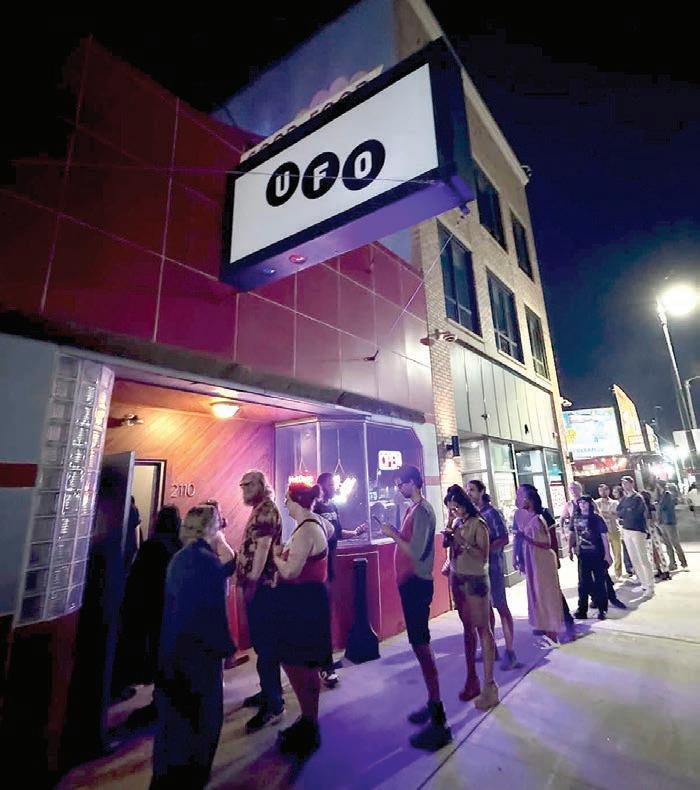
damning charges that the club enabled a toxic culture of sexual assault and violence dogged the couple.
In a now-deleted Instagram post from February 2026, the managers apologized for its handling of a sexual assault in an employee-only section of the venue. It is not known whether that incident played a role in management’s decision to close one or both of the venues, but several service industry employees close to the situation tell the Chronicle that it did signal the beginning of the end.
UFO Factory opened in 2014 in the shadow of the former Tiger Stadium grounds at Michigan and Trumbull Avenues, the latest in what was a then-slow uptick of new businesses coming to Corktown. Marketing itself as a dive bar, UFO differentiated itself from nearby joints like the boisterous Irish pub McShane’s or clean and cozy Motor City Wine a few
blocks down. Purists, though, argued that actual dives like Nancy Whiskey or LJ’s Sweetheart Lounge could only earn such a title if they had the decades of sweat and grime to show for it. Nevertheless, UFO and its deliberate grunge built a loyal following with a certain millennial crowd that grew up in Metro Detroit but turned up their noses at downtown and Midtown venues that only reminded them of the suburbs they were trying to leave behind. Its small stage and dancefloor welcomed the offball and offbeat: Avant garde performance artists, queer DJs spinning deep-cut disco, garage bands pausing their sets to work in Olivia Newton-John covers. And though actual dives were still in the area, UFO’s budget-friendly menu felt like a stand against prices rising everywhere else in the fast-changing Corktown, something that would
By Aaron Foley EDITOR-AT-LARGE
If one were to bump into hometown hooper Jalen Rose around town these days and ask if he’s excited for next season, he’ll probably respond with two wildly disparate answers.
But it depends on the definition of “season” and in which context. A predictable response would be that Rose is looking forward to seeing how far the Pistons can go next year after a stellar run on the court that had the team in spitting distance of a championship. But one wouldn’t be wrong if they’d expect Rose to discuss his new favorite streaming series – one that he just happens to produce and star in.
“I don’t know what’s going to happen in season two yet,” Rose told an intimate crowd at a wrap party at The Vinyl Society, where the cast of “South West High” were on hand to watch the first season finale of the Detroit-based high school drama.
Rose’s name appears in the credits of all five episodes of “South West High” three times as creator, an executive producer and its first-billed cast member, so one would think he of all people would know what would happen in its next season. He actually doesn’t – a reality indicative of current conditions around bringing Black stories to the small screen.
“South West High,” inspired by Rose and co-producer
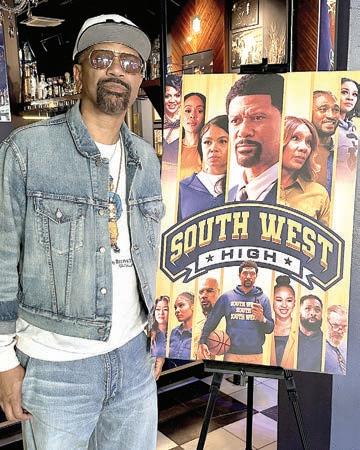
Ty Mopkins’ days as students at Detroit’s real-life, now-demolished Southwestern High School, is something of a “Degrassi” if it were produced on this side of the Ambassador Bridge. The teen drama follows the emotional ups and downs of students at the school and their relationships – and without giving away too much, there’s multiple definitions of what “relationships” are, too – with the adults around them. There’s gossip, scandal, breakups and makeups that will resonate with anyone who’s ever been a teenager, be they Rose’s age or currently attending the westside high school that bears his name.
“Inner-city young people don’t get their story told,” Rose said. “And the parents, the educators, the teachers – sometimes the challenges that they overcome don’t get highlighted.”
Rose has a name that’s familiar to everyone, whether it’s stamped on a diploma from the Jalen Rose Leadership Academy which he cofounded in 2011 or stamped on a birth certificate belonging to one of the countless babies named “Jalen” year after year since the Fab Five became an inescapable phenomenon. In the 30-plus years since he and his teammates captivated the nation, Rose’s pivots on and off the court have consistently kept his name out there. And coming from a city where name-dropping can garner eyerolls, Rose’s name on a public scale has become synonymous with it.
The one place where Rose’s name didn’t quite resonate as strongly was with television executives. Pitching “South West High,” or really any Detroit story, Rose told the crowd, drew mixed reactions from other networks and streamers who largely passed on the idea of a show featuring
mostly Black students – even if Rose, whose second act in sports broadcasting made him even more of a household name, offered to star in it himself.
“A lot of times when our story is told, people who don’t look like us tell our story,” Rose said. “So if we’re going to tell our story, we’re going to be authentic, and we’re going to be apologetic.”
Rose and Mopkins co-produce “High” with Dennis Reed, who for the better part of the last decade has pumped out volumes of Detroit-produced fare for Tubi, where their show eventually landed. “We became the most-watched show on Tubi,” Rose said. “That actually happened.”
Tubi does not disclose viewership numbers; even Rose doesn’t have exact figures. And though Tubi is where the show can be found, “High” is not a Tubi-produced original program. Like many shows on the Fox-owned streamer, “High” airs on Tubi through a distribution deal offered to independent creators who largely fund their own projects and in turn receive some revenue share from ads that run during the program.
Describing a show as having a “Tubi budget” is pejorative, but it’s an insult that’s fading partly thanks to Reed and other local creators who’ve curated an easily identifi-
By Jasmine West
Hundreds of Detroit young people left Adams Butzel Recreation Center with new bicycles Friday as Mayor Mary Sheffield opened a 10-week summer initiative aimed at keeping youth active, connected and safe while school is out.
The launch of Occupy the Summer brought families together for a bike giveaway, carnival rides, community resources and a performance by Detroit rapper Skilla Baby. Sheffield also introduced the teams participating in the city’s inaugural Late Night Basketball League, with 135 players receiving free jerseys.
six-point community safety plan Sheffield announced in April, with a focus on creating structured activities for young people and strengthening relationships between residents, city departments and community organizations.
“This is what Occupy the Summer is all about — coming together as a community to provide positive, fun-filled activities for our youth while they are out of school and resources to help support strong families,” Sheffield said.
Sheffield said the city wants young Detroiters to have safe places where they can spend time, develop their interests and build relationships during the summer.

More than 1,500 young people have registered for activities connected to the program, according to the city.
Occupy the Summer expands on Occupy the Corner, the neighborhood initiative Sheffield started during her time on the Detroit City Council. The new citywide program will offer recreation, sports, neighborhood events and extended hours at several city facilities throughout the summer.
The initiative is also part of the
From page B-1
able Detroit aesthetic by stockpiling the streamer with content full of it: Soapy street tales that blur the line between glossy and gritty, hometown actors appearing in multiple projects, and plot twists that keep viewers coming back for more.
“South West High” is no different, as viewers will recognize players from prior Reed productions. Adamant about having high school-aged characters being played by actual high school students, Rose insisted on offering roles to young actors looking for a boost. Plenty of more recognizable names, like Towanda Braxton who has a regular role as an assistant principal, or Sada Baby who drops in for a one-off that hints at more, speak to the growing legitimization of any production airing on Tubi.
All of those actors need to be paid out of budget, something partially funded by Platinum Equity, the holding firm of Pistons owner Tom Gores, who Rose is partnered with. And that’s before paying writers, directors, crew members and hair stylists – on a show with multiple Black women actors in the hair capital of the world, mind you.
“If y’all knew what it took to get this done,” Mopkins told the crowd while briefly making his own remarks. “This … wasn’t easy.”
From cast changes after actors leaving the project in pre-production to marketing and promotion as each episode dropped (“we still have marketing stuff,” Mopkins says), producers found a way to make “High” look good without looking cheap. And knowing it would reflect Detroit to folks outside Detroit, that mentality also plays into another reason why Rose’s name is out front as much
“This initiative is about making sure every young person has a place to belong, positive outlets to explore, and a community that supports their success,” she said.
“Throughout the summer, we will continue expanding opportunities that keep our youth engaged, empowered and connected as we build a safer, stronger Detroit together.”
The city distributed more than 700 bicycles to Detroit residents ages 18 and younger during the
as it is: He’s betting on it.
“If people hate this show, the first person they can complain about is me. I’m the target,” Rose says. “If people were unhappy, didn’t like it, or found a reason to complain, I would be their aim.”
The number of pro athletes who can act on screen is few, and Rose is quick to point out that although he took acting classes to get more comfortable on set, “there’s a reason why a lot of athletes don’t do it – it’s hard.” Of the short list, Fred Williamson –the NFL’s “Hammer” whose samenamed flick jumpstarted a long career on screen – was someone Rose grew up with that eventually became a template for this next career phase.
“I grew up in an era where there were Blaxploitation movies,” Rose said, pointing to productions that had limited funding but still became staples with Black audiences. “But then in the ‘90s – you could have ‘Menace II Society’ and ‘Don’t Be a Menace To Society.’ There were budgets. And we lost that.
“We don’t have them anymore,” Rose continued. “New Line Cinema, the Wayans, Spike Lee, Ice Cube – there were so many people in the ‘90s that had budgets for people who looked like us. But they don’t exist anymore.”
It’s easy to see why Rose is wistful for this particular era. When five real-life Black student-athletes first suited up in Michigan jerseys in 1991, for example, Theo Huxtable was preparing to graduate from New York University, Tre Styles was headed to Morehouse College (with Brandi across the street at Spelman College), and Play threw a house party to help keep his friend Kid from dropping out of college.
It’s a different world now in 2026, where it seems Black audiences no longer have choices, but instead mandates. Shows with Black casts have to be binged right
From page B-1
kickoff. The giveaway was supported by Sterling Group, Amazon and Ally, with Mike’s Garage supplying bikes and donating skateboards.
Bike giveaways became a familiar part of Sheffield’s Occupy the Corner events, where families gathered for neighborhood programming and access to city services. Sheffield said she wanted to continue the tradition as the program grew into Occupy the Summer.
“The bike giveaway was always one of the most anticipated highlights of our Occupy the Corner kickoff, and families consistently looked forward to it year after year,” Sheffield said. “As we launch Occupy the Summer, it was important to continue this tradition because a bike is more than a gift. It provides transportation, independence, recreation, and another opportunity for our youth to stay active, connected and engaged in their communities.”
The Late Night Basketball League will serve Detroiters ages 16 to 30 through structured games, mentoring and additional support services. Players will compete in three regions of the city at Heilmann Recreation Center on the east side, Adams Butzel Recreation Center on the west side and Kemeny Recreation Center in southwest Detroit.
League participants are also expected to receive free shoes and haircuts. The seven-week men’s league began Saturday, June 13. The men’s and women’s leagues will each conclude with a championship game.
Occupy the Summer will also extend operating hours at nine city recreation facilities. Crowell, Adams Butzel, Kemeny, Farwell, Heilmann, Butzel Family Center, Coleman A. Young Rec-
away to not be canceled after one season. Moviegoers are urged to see Black films – whether they like the subject matter or not – if they want more Black films to be greenlit. And fans must put their support behind every Black actor’s side hustles in haircare, skincare, and self-care – unless they’re a Black British actor playing one too many African American characters. This is the new playbook that aspiring producers like Rose have to study, one that explains why Black projects are seen as risks to investors and why they’re fewer and far between.
“South West High” still stands at one season and it’s too soon to tell whether it’ll fall into one-hit wonderdom with “Detroit 1-8-7” or become a Detroit classic like “Sister, Sister” or “Martin,” the latter of which just happened to prominently feature a jersey worn by one of Rose’s teammates. The Tubi metrics are still unknown, but at least one viewer can corroborate its popularity.
“I watched every episode,” longtime friend John Mason -- a household name for Detroit Pistons fans, Detroit radio listeners, or both -- told Rose in front of the crowd after taking the mic. “Because with the budget I know you couldn’t afford, you didn’t waste that on theatrics and blowing shit up and all that. You spent it on thought, and making people think – it brings that nostalgia back, and I respect that so much.”
But Rose didn’t dwell on nostalgia for too long that night, lest one get too stuck in it. The driving force behind keeping his name out there is making sure it doesn’t get lost to history. After acknowledging him and Mason’s long friendship, Rose took back the mic and got back to business, reminding the crowd of one more place where you can put his name: “So, if anyone in here wants to write a big check…”

reation Center, Helen Moore and the Northwest Activities Center will remain open until 11 p.m. on Wednesdays, Thursdays and Saturdays throughout the summer.
The later hours are intended to give young people additional places to gather during evenings when families may have fewer affordable recreational options available.
Weekly neighborhood events will also be held across Detroit’s City Council districts. Similar to Occupy the Corner, the Friday gatherings will include activities, city resources, local vendors and cultural programming.
Upcoming events include a Juneteenth celebration at Crowell Recreation Center on June 19, a skate night at Corrigan Park on July 10 and a sports night at Lasky Recreation Center on July 17.

come to a head in 2017 when developers building a new housing complex next door clashed with the former owners of the bar after seeking to buy them out. During construction, a portion of UFO’s building was accidentally damaged by workers on the new condos, prompting a brief closure, a messy court battle, and unanswered questions about whether the damage was intentional.
After the dust settled, UFO reopened and fought both competitors and changing tastes in the years since. Longtime bar hoppers recognize UFO’s influence in similar venues that opened after it, notably El Club in Southwest Detroit and Paris Bar near Conant Gardens. But with the pending restoration of Michigan Central moving full speed ahead, Michigan Avenue, and Corktown in general, would radically change in the same timeframe, suddenly making the UFO seem alien in a new world.
more, prompting some locals to wonder if a newfound feeling of safety could be a precursor to bigger change in the area. But other locals just danced. Whether it was intentional or not, Spot Lite filled several voids the city was lacking in or missing entirely. The many attempts at opening a listening bar in the neighborhoods after Paramita Sound hopped from West Village to downtown seemed to solidify here. A sizable dance floor not seen in the area since nightclubs dotted East Jefferson years ago attracted patrons in big numbers. And while dance music was already enough to draw a queer-friendly crowd, Spot Lite’s embrace of LGBT patrons – particularly after the Woodward Bar & Grille burned down in 2022 and became one of a handful of places that absorbed some of its old patronage – added a reliably queer space near the East Jefferson corridor.
instead of a normal process. She might call the strong feelings at the full moon irrational, but in reality, they are the body’s way of releasing what it can no longer hold in. She feels a kind of exhaustion she can’t quite explain. She feels a strong need to be alone before the new moon, but often pushes through it because there’s always something to do. Her emotions shift around the full moon in such a regular way that she’s started to question it. But she isn’t being irrational. She’s actually in tune with something much older and wiser than any productivity system. She’s experiencing, right on time, the emotional wisdom of a cycle she was never taught to respect.
When you start paying attention, it is not the cycle itself that changes. The cycle continues whether or not you notice it. What really shifts is how you relate to what has always been happening inside you. This new awareness also changes your rituals. Now, your intention list comes from a true place within, not just from a desire to plan. The release ceremony becomes meaningful, not just something
easy to name. The quiet moment at the new moon is no longer just a routine, but a natural rhythm you allow yourself to experience. The practices were never wrong. They were always waiting for this moment, for your understanding to match the sincerity you already brought to them.
AJ Williams is a Spiritual Wellness Architect and Educator and the Managing Editor of the Michigan Chronicle. A thought leader at the intersection of spirituality, astrology, psychology, and identity evolution, she is the founder of Sunday Communion, a quarterly live transformation experience held in Detroit. The Inner Architecture is her editorial column on the work of becoming.
Spot Lite’s attempt to brighten up the lower east side is another tale of a stranger out of place. It opened on Beaufait Avenue in 2021 in a neighborhood most drivers pass through to get to another one – if not driving east to get to West Village and Indian Village, then driving west to get to Belle Isle and Lafayette Park. As development pushed outward from the former two neighborhoods, however, opening on the fringes of Islandview didn’t seem like the worst idea at the time.
In some way, though, it was a bad idea to open a new business that required parking on near-empty streets with little police presence, as Spot Lite became notorious for car breakins during its early years. More security measures were put into place and neighborhood police officers slowly started patrolling
Leaning into homegrown sounds is where the spotlight at Spot Lite shined the brightest. Although places like TV Lounge held a grip on the market already, more and more local audiences embracing techno and other native dance sounds opened up another space where local artists could be revered. Proving to be a crowd pleaser, Spot Lite was able to corner a sizable chunk of overseas bookings, bringing in international DJs and producers and subsequently adding to the cultural exchange between Detroit and the world.
In her post, David says she and Cory are “incredibly grateful to all of our patrons, artists, dancers, and most of all, our team that made the party happen.
“Honestly, there are too many people to thank and we hope to see each one of you so that we can thank you individually,” she continued.
By Aaron Foley EDITOR-AT-LARGE
If two good friends are in a room and one of them gets hold of a microphone, you best believe the other one is going to get clowned.
It doesn’t matter if it’s a birthday party or a best man’s toast. It could be their funeral or their mama’s funeral. Somebody’s going to get roasted and everybody can’t help but laugh, because it’s all love at the end of the day.
When veteran streetwear designer Ty Mopkins got hold of the mic last week night during a party at The Vinyl Society, he couldn’t help but point out the time he first met Jalen Rose as they were both riding the Livernois bus to Southwestern High School, where they were both students.
“He had a broke Walkman in one ear with rubber bands tied up to it,” Mopkins said, “and he was wearing a Philadelphia 76ers Starter jacket. And it’s three words growing up in the city of Detroit that you may not want to hear when you have something fresh on...”
Before Mopkins could finish, the crowd in unison all chanted “check it in!” – which, yeah, you definitely did not want to hear that in 1980s Detroit. On the moving bus at the time, however, Mopkins had to know where Rose got the jacket. Decades later, Mopkins – now a designer for Starter – designed a throwback special edition of the jacket, one of many creations from his prolific sketchpad.
“That bus ride led to a 40-plusyear friendship right here,” Mopkins continued. “This is the guy that I can honestly say has always returned the phone call, never not answered, and always made sure I was straight before I ever had a chance to make sure he was straight. And friendships like that don’t come around long.”
Mopkins and Rose were each other’s hype man all night at Vinyl Society during a party celebrating the first season of “South West High,” the Tubi series they co-created that’s also an homage to their high school. In attendance was Society’s co-owner Dennis Archer Jr.; not that long ago in front of a podium at the Chronicle’s monthly “Pancakes and Politics” forum, he himself reminded the crowd of Chronicle publisher Hiram Jackson of the “greasy Jheri curl” he rocked back in the day. It literally does not matter the time or place. Do not let your homie get on the mic.
We’ve seen examples of Black male friendships, real and fictionalized, on and off screen for years now. For Gen X Black men, we’re starting to get more insight into what happens as their relation-
By Jeremy Allen
EXECUTIVE EDITOR
ships – and the individuals that make them – get older.
That is, if they can actually arrive at that point. It hasn’t been easy for Black Gen X, who’s lately had to mourn Malcolm-Jamal Warner, D’Angelo and DMX, among too many others. The loss of Warner last year after a drowning incident was especially heartbreaking since so many watched him grow up in real time.
One could almost say the same thing about the Fab Fifty-Something celebrating with Casamigos cocktails at Vinyl the other night.
“Jalen Rose has been relevant in the public eye going on five decades now,” Mopkins told this editor in an off-mic chat, sideby-side with his taller homie.
“It started in the ‘90s, into the 2000s, the 2010s, now we’re halfway through the 2020s, about to go into the 2030s. I don’t think there’s no other person that’s been relevant for that long in our culture – in the mainstream with hiphop, fashion, all that.”
Mopkins and Rose sort of move like Jazz and Will on “The Fresh Prince of Bel-Air,” which would be one of the first examples that come to mind when thinking of other folks of their generation that moved the culture forward with a certain swagger –Will Smith and DJ Jazzy
Jeff for sure, the boys of New Edition, LL Cool J, all of whom at one point or another we’ve all tried to emulate and imitate. Rose and his Wolverine teammates would definitely be on that list.
But Rose never slapped anyone at the Oscars, nor do we ever have to worry if a reunion tour will happen because he fell out with the rest of the clique again. The homeboys are grown up, but are the homeboys keeping each other in check?
“In order to be a friend, you must first become a friend – and everything else that comes with it,” Mopkins said.
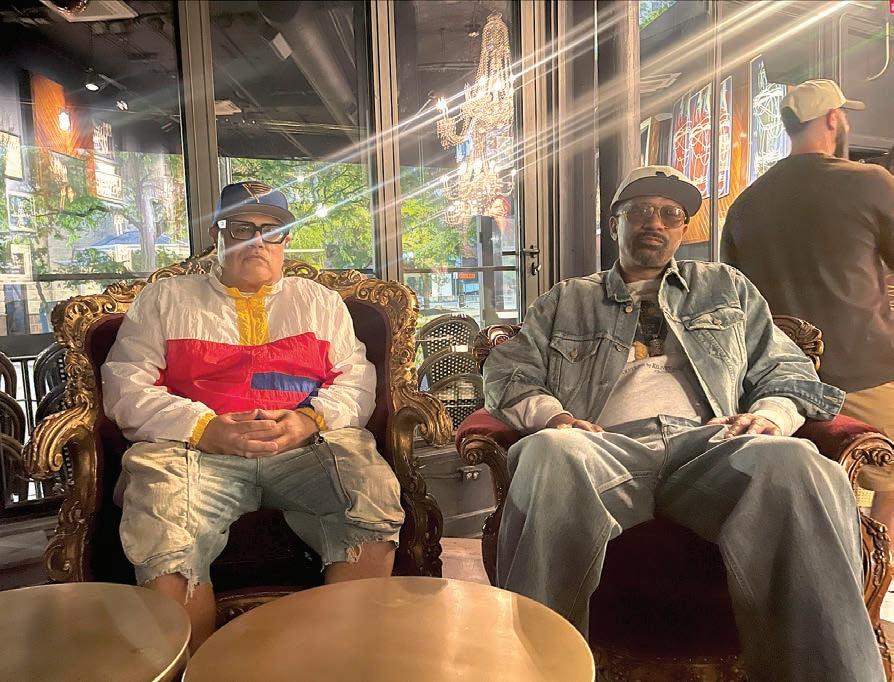
a much different Black family drama than the one Rose and Mopkins want to show.
But as Mopkins points out, half of this duo had to do it in front of an audience. “[Rose] carried the world on his shoulders and still makes time to be a genuine friend. Not because it’s the cool thing to do, it’s just because of who he was and who he is.”
siblings, it happens with your friends. I was really fortunate to have a friend that I call a brother in Ty.”
“South West High” takes place in the present day, but a side quest for Mopkins and Rose is preserving some of the culture that shaped them as Detroit teens in the late ‘80s and early ‘90s. A few more future Gen X icons from this specific time and place start to bubble up once you think deeper, like Kenya Moore who’d become Miss USA shortly after graduating from Cass Tech in ’89, or Jerome Bettis who’d storm the gridiron after walking the stage at Mackenzie in ’90.
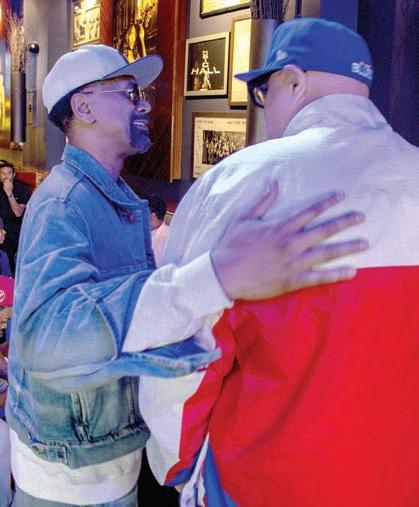
The “everything else” in this case are all the things that have come to define Mopkins and Rose’s friendship since their DDOT-riding days when each one of them had to work with what little they were given.
Much has been documented about Rose’s struggles having an absentee father growing up; Mopkins half-jokes in this chat about his mother “writing checks made out of Spaulding – they bounced” during his youth. Both men hint at beating the odds that faced all young Black men of their era –which is a reminder that there’s another recent TV show set in Southwest Detroit on the air, but
Slutty Vegan is finally coming to Detroit in fall 2026.
Slutty Vegan founder and CEO Pinky Cole Hayes announced on social media on June 17 that she has signed a franchise agreement with Detroit entrepreneur Obinani Iwuoha, who will lead development of the company’s first Midwest location in Corktown. The restaurant is planned for 1441 W. Elizabeth Street, placing one of the country’s most recognizable Black-owned food brands in one of Detroit’s fastest-growing dining and entertainment districts.
For Iwuoha, the deal represents the culmination of years spent in the food and beverage industry and more than two decades living in metro Detroit. While Cole Hayes has long been the public face of the brand, the company’s move into Detroit reflects a broader strategy of partnering with local operators who understand the communities they serve. In announcing the agreement, the company highlighted Iwuoha’s background in food and beverage and his entrepreneurial experience as key reasons he was selected to lead the Detroit market.
The expansion also reflects Detroit’s continued emergence as a destination for food entrepreneurs, particularly Black-owned businesses looking to build brands in a city where residents have repeatedly shown a willingness to support new concepts. That enthusiasm has already been tested by Slutty Vegan.
In spring 2026, the company held a one-day pop-up in metro Detroit that drew hundreds of customers, with many waiting hours for the opportunity to try the restaurant’s plant-based burgers and sandwiches. The turnout reinforced what many local observers had suspected for years: Detroit had an appetite for the brand long before a permanent location was announced.
The road to Detroit has been longer than many fans realize. A Slutty Vegan pop-up was previously planned in partnership with
If it feels like something should be written here about Rose’s eyes getting watery after hearing his homeboy give him flowers all night, sorry -- he was wearing Cartier’s the whole time, so no one could see exactly what was going on behind them. It’s a glowup from the broken Walkman, though.
“The one thing about being an inner-city kid is that the importance of friends and relationships don’t get highlighted in what they represent for a young person,” Rose tells the Chronicle. “And that happens in a lot of ways – it happens with your families, your
Back then, Rose says Mopkins’ marketing savvy was already on full display. “He was an entrepreneur, a hustler, and very disciplined. He was the guy that looked at a school building in here and said, ‘there’s a thousand people in here. How can I make sure that they are all happy as customers? How can I service the clients and give them what they want first?’”
Mopkins says Rose was always that guy. “He was popular, but he was very humble. He didn’t care about the popularity. He knew – in my opinion – that he was the best player. And not just in the state. How you seem him today is how you see him when I first met him.”
If only the same can be said about where they met. Southwestern High School, and incidentally Mackenzie, too, were both demolished in 2012 – a year after the old Cass Tech building was knocked down. “Gone are the days of Detroit Public Schools. They done added 18 letters to DPS now,” Mopkins says.

Bedrock’s Monroe Street Midway during the summer of 2022, but the event never materialized. Even so, interest in the Atlanta-based concept never disappeared. The success of the 2026 pop-up helped demonstrate that demand remained strong enough to support a brick-and-mortar location.
“Expanding into Detroit represents a pivotal moment for us,” said Cole Hayes. “This city embodies the kind of resilience and boldness that Slutty Vegan was built on. We’re proving that plant-based fast-casual can thrive in any market when you have the right people, the right message, and the right mission.”
Since launching as a food truck in Atlanta in 2018, Slutty Vegan has evolved from a niche vegan concept into one of the most visible Black-owned restaurant brands in the country. The company attracted national attention for its creative marketing, provocative branding, and menu built around plant-based versions of fast-food staples. The brand expanded rapidly, securing celebrity fans, national media coverage, and major investment backing as it grew
beyond Georgia. Recent years have also brought increased visibility for Cole Hayes herself, including her debut on Bravo’s “The Real Housewives of Atlanta.”
But the Detroit expansion comes during a period of rebuilding for the company and its founder.
Over the last two years, Cole Hayes and businesses associated with her have faced a series of financial and legal challenges.
Slutty Vegan underwent a restructuring process in 2025 that temporarily resulted in Cole Hayes losing control of the company before she later reacquired it and began rebuilding the brand. Court filings in 2026 showed Cole Hayes seeking Chapter 11 bankruptcy protection while working to reorganize debts tied to business obligations. The entrepreneur has also faced lawsuits involving alleged unpaid rent and disputes connected to former business operations. Despite those challenges, she has continued to push forward with new ventures, franchising efforts, and expansion plans.
In a social media announcement revealing the Detroit franchise agreement, Cole
“But here’s the thing,” he adds. “Our neighborhood elementary school is gone, our neighborhood middle school is gone.”
It’s one thing to meet in the same place, but it’s another when a mutual interest in advocating for it develops over time. “Detroit means everything to both of us,” Rose says. “Being authentic, being disciplined, being organic, changing the game and having flavor that represents the city means everything to both of us.”
The city bonded Mopkins and Rose even if they weren’t always there at the same time. Mopkins –who clearly shares Rose’s humility trait and doesn’t take time to give himself credit for his own role in shaping the culture – in the last 30 or so years moved through Detroit’s fashion scene with stops at Strickly Sportswear, Puffer Reds, Mr. Alan’s and more while Rose’s pro career took him to Denver, Indiana, New York, Chicago, Toronto and Phoenix. “He never not answered a phone call. He never not answered a text,” Mopkins said.
“And it’s not one of those gimmicky things where just because he’s in the NBA or because of my career, that’s why we’re friends. We always make sure we’re good,” he adds.
Rose’s love language is food; Mopkins defers any kitchen duties to him. And Rose admits that Mopkins has always been the better dresser. “We’ve never kept a secret,” Rose says. That commitment to transparency includes not hesitating to reveal how they’ve kept this friendship going for so long.
“Always stay real,” Rose says, point-blank. “Honesty, communication – but more importantly, authenticity. Life happens. Relationships come and go. We both grew up with nothing, so it’s always important to both of us to continue to pour into each other.”
Hayes directly addressed the scrutiny surrounding her recent struggles.
“I lost everything. The company went through bankruptcy. I had to fight to get that what I wanted,” she said.
She continued by describing how public criticism and financial setbacks shaped her outlook as a business owner.
“My wounds have become my wisdom. My setbacks had become my credentials. My losses had become my lessons.”
The remarks offered insight into why the Detroit deal may carry significance beyond the opening of another restaurant. It serves as evidence that franchise operators remain willing to invest in the brand despite its recent turbulence. For Iwuoha, it represents a vote of confidence in Detroit’s ability to support innovative restaurant concepts. And for the city itself, it signals that national brands continue to see opportunity in Detroit’s evolving food landscape.
“The people who didn’t matter see my bankruptcies, but the people who matter they see a comeback,” Cole Hayes said in the announcement.
That sentiment appears to align with the Detroit franchise agreement. While financial setbacks and legal disputes have generated headlines, the company continues to attract new operators and enter new markets. The decision by Iwuoha to bring Slutty Vegan to Corktown suggests confidence not only in the brand’s future but also in Detroit consumers, who have increasingly embraced diverse culinary concepts ranging from traditional soul food and international cuisine to plant-based dining.
The Detroit location is expected to open following the completion of construction and buildout work later this year. Additional details about the grand opening are expected in the coming months. When the doors open, the restaurant will mark Slutty Vegan’s first permanent Midwest location and the latest example of Detroit’s ability to attract nationally recognized brands while creating opportunities for local entrepreneurs to lead their growth.

There are around 1.4 million people in Michigan who rely on SNAP food assistance to help put food on their family’s table. That’s roughly 1 in 7 residents. It is the largest anti-hunger program in the U.S.
What is the SNAP Payment
The PER measures how accurately a state determines eligibility and benefit amounts for SNAP households. The PER is calculated as total mis-issued dollars divided by total benefits issued. A mis-issuance occurs as the result of an error regardless of whether the error was intentional. There are four types of payment errors:

When it’s time to update your SNAP information, it’s important to make sure the information is accurate. Life changes. Make sure your benefits keep up and your SNAP information reflects any changes in the following
• Income: Has your income changed? Are you making more or less than before? Has your household added or lost income due to a change in your living situation?
• Employment: Do you have the same job or has your job changed affecting your income? Do you have seasonal work that fluctuates?
• Living situation: Has your living situation and the people you live with changed due to marriage, divorce or a relationship? Or do you have more or fewer children in the household to care for?
• Address: Has your residence changed? Are you living in the same place or moved to somewhere new?


• Underpayments: When a household receives fewer benefits than they are entitled.
• Overpayments: When a household receives more benefits than they are entitled.
Payment errors may happen due to:
• State agency error – for example, the agency miscalculates a household’s expenses.
• Household error – for example, the client does not report a change in income.
Why is it urgent to reduce SNAP PER?
Under H.R. 1, Michigan’s share of SNAP benefit costs will be determined by the state’s federally calculated PER for FY 2026. States with higher error rates will be required to pay a higher portion of SNAP benefit costs, while states with PERs under 6% will continue to receive full federal funding. Today, states pay 0% of these program costs. The added financial obligations could strain Michigan’s ability to sustain SNAP services. That’s why it’s critical to reduce the PER — the lower the PER, the smaller the share of benefit costs.
What can we do to help?
Michigan is doing several things to reduce the SNAP Payment Error Rate. But you can also help by keeping your information fresh. Together we can help keep food on the table. Learn more at Michigan.gov/FoodAssistance.


Notice is hereby given, that the Public Accuracy Test for the “Primary Election” being held on Tuesday, August 4, 2026 is scheduled for Friday, July 10, 2026 at 2:00 p.m. in the City Clerk’s Training room located at 12050 Woodward Avenue, Highland Park, Michigan 48203. The Public Accuracy Test is conducted to determine that the program and the computer being used to tabulate the results of the election, counts in the manner prescribed by law.
BRENDA GREEN City Clerk
Legal Notice
Attention: Vended Meals Companies
Weston Preparatory Academy is requesting proposals for vended school meals. The Vendor will provide meals according to United States Department of Agriculture regulations and guidelines, as well as State of Michigan Department of Education policies and guidelines.
The Request for Proposal and supporting documents will be available by July 1, 2026. The mandatory pre-bid meeting is scheduled for 10:00 am on July 2, 2026, at 22930 Chippewa Street, Detroit, MI 48219. All proposals must be submitted electronically to rbehr@charterschoolpartners.com no later than 12:00 noon on July 20, 2026.
Contact rbehr@charterschoolpartners.com to request the bid documents and confirm your attendance at the mandatory pre-bid meeting.
Weston Preparatory Academy’s Board of Education reserves the right to accept or reject any and/or all proposals or to accept the proposal that it finds, in its sole discretion, to be in the best interest of the school district.


(“SMART”).
If this new millage is approved and levied, revenue will be distributed to Wayne County, SMART, Detroit Department of Transportation (DDOT), and other community and regional transit providers, it is estimated that $57,616,329.00 will be collected in the first year.
Should this proposal be adopted?
Sample ballot can be found at www.highlandparkmi.gov
Absentee ballots are available for all elections. All eligible and registered voters in Michigan may request an absent voter ballot without providing a reason. Registered electors may obtain an A.V. Ballot IN-PERSON at the City Clerk’s office by 4:00 p.m. on Monday, August 3, 2026. Requests to have an absent voter ballot mailed to you must be received no later than 5 p.m. Friday July 31, 2026.
The 9-day period of Early Voting PRIOR to August 4, 2026, Primary Election begins on Saturday, July 25, 2026, through Sunday, August 2, 2026, from 9:00 a.m. to 5:00 p.m. each day.
EARLY VOTING SITE LOCATION: Robert B. Blackwell Complex 12050 Woodward Avenue Highland Park, Michigan 48203
To comply with the Help America Vote Act (HAVA), voting instructions will be available in audio format and in Braille. Arrangements for obtaining the instructions in these alternative formats can be made by contacting the clerk in advance of the election. All polling locations are accessible for voters with disabilities.
Brenda Green City of Highland Park Clerk
NOTICE OF REGISTRATION FOR THE PRIMARY ELECTION
TUESDAY, AUGUST 4, 2026 WAYNE COUNTY, MICHIGAN CITY OF HIGHLAND PARK
TO THE QUALIFIED ELECTORS OF THE CITY OF HIGHLAND PARK: PLEASE TAKE NOTICE that any qualified elector of the City of Highland Park not already registered, may register to vote at the office of the City Clerk, the office of the County Clerk, a Secretary of State branch office, or other designated state agency. Registration forms can be obtained at mi.gov/vote and mailed to the City Clerk. Voters who are already registered may update their registration at www.expressSOS.com.
The last day to register in any manner other than in-person with the local clerk is 4:00 p.m. Monday, July 20, 2026.
After this date, anyone who qualifies as an elector may register to vote in person with proof of residency (MCL 168.492) at the City Clerk’s office, located at 12050 Woodward Ave., Highland Park, MI 48203 (313) 252-0050 ext. 220 at the following times:
– Regular business hours: Monday – Thursday 9:00 a.m. to 4:00 p.m. and Friday’s
9:00 a.m.- 1:00 p.m.
– S aturday, August 1, 2026, from 8:00 a.m. to 4:00 p.m.
– Election Day, Tuesday, August 4, 2026, from 7:00 a.m. to 8:00 p.m. Persons with special needs as defined by the Americans with Disabilities Act should contact the clerk’s office at 313-252-0050 ext. 220 or 223.
Brenda Green City Clerk
ADAS Software Engineer
Positions offered by Ford Motor Company (Dearborn, Michigan). Note, this is a hybrid position whereby the employee will work both from home and from the aforementioned worksite. Hence, the employee must live within a reasonable commuting distance from the worksite. Responsible for delivering key software framework functionality in the development of Advanced Driver Assist System (ADAS) technologies at Ford. EOE. Apply online: careers.ford.com
Data Scientist
Positions offered by Ford Motor Company (Dearborn, Michigan). Note, this is a purely telecommuting/workfrom-home position whereby the employee may reside anywhere within the U.S. Leading the development and delivery of a suite of GenAI applications in support of the global marketing organization. EOE. Apply online: careers.ford.com
and
worksite. Hence, the employee must live within a reasonable commuting distance from the worksite. Design and develop Autosar-based embedded software components. EOE. Apply online: careers.ford.com
Functional Safety Engineer Positions offered by Ford Motor Company (Dearborn, Michigan). Note, this is a hybrid position whereby the employee will work both from home and from the aforementioned worksite. Hence, the employee must live within a reasonable commuting distance from the worksite. Develop and refine functional safety work products for safety design, implementation, and validation of software for ensuring proper feature-level safety and performance. EOE. Apply online: careers.ford.com
Infotainment Software Developer –User Interface (HMI) & APP
Positions offered by Ford Motor Company (Dearborn, Michigan). Note, this is a hybrid position whereby the employee will work both from home and from the aforementioned worksite. Hence, the employee must live within a reasonable commuting distance from the worksite. Develop C/C++ application layer software for Ford’s SYNC infotainment system. EOE. Apply online: careers.ford.com
MFG Eng Specialist Positions offered by Ford Motor Company (Dearborn, Michigan). Coordinate cross-functional resources to identify root causes of technical issues and develop validated, actionable solutions. Domestic Travel Required up to 10%. EOE. Apply online: careers.ford.com

(StatePoint) Playing with fire has never been hotter when it comes to flavor and summer grill -
ing. A new grilling trend report, released by the McCormick brand, spotlights three red-hot trends centering on new ways grillers are layering flavors, expanding the sizzle beyond steak, and taking advantage of the transformation of appliances.
“Above all, flavor complexity will become the new standard in grilling with global flavor layering, and grillers are continuing to delve beyond meat, poultry and fish with barbecued vegetables and sweet ingredients,” says Jordan Carfagno, Executive Chef at McCormick, which distributes herbs, spices, seasonings and condiments globally. “New technology is also powering our prediction that smart, modular grills will redefine when and where consumers grill.” Here are the top findings from Fire & Flavor 2026 Grilling Trends issued by McCormick, along with their recipe for Double Stacked Smashed Cheeseburgers.
The Art of Layering

This trend celebrates the intentional build of flavor, where rubs, marinades, glazes and finishing sauces work in concert to create depth, contrast and complexity. This comes at a time when there’s been a 78% increase in social media mentions for “umami” compared with just two years ago, according to Datassentials, and a 53% increase in U.S. consumers interested in “swicy” – sweet and spicy combinations, according to research from the Food Institute. Layering flavor is part of a gourmet trend emphasizing intentional, creative and personalized grilling experiences. Flavor transformation happens within three different stages – Base, Build and Finish. Flavor layering techniques draw inspiration from global cuisines like Indian tandoori, Korean bulgogi and Moroccan tagines.
More than Steak
From jackfruit to peaches, unexpected ingredients are expanding the boundaries of BBQ. The experts at McCormick predict that grillers will continue to embrace global flavors, vegetables, and sweet ingredients, noting that millennials grill fruit two times more than the average griller.
Favorite flavors beyond steak include juicy bone-in cuts of chicken grilled to the perfect tenderness level, smoky and caramelized veggies enhanced with warm spices and honey for bold, irresistible flavor, and fresh salad made with crisp, ripe tomatoes charred to perfection.
Appliance Transformation
Grilling is being redefined by smart technology and modular design, turning grills into adaptive, multifunctional hubs that cater to modern lifestyles.
Developments, such as loT-enabled grills with Wi-Fi and Bluetooth, allow remote temperature control and monitoring via mobile apps for perfect cooking. Modular grills provide customizability with interchangeable surfaces offering versatile cooking options catering to diverse styles and preferences.
The experts at McCormick note that appliance-enabled flavors include the use of smokers beyond the classic cuts, enhancing deep, complex flavors of various proteins and elevating everyday staples. Flat tops also unlock new extra crispy textures and allow for new techniques. They also note that the global portable grills market is projected to continue to grow, driven by the rise of home entertaining and tailgating.
New Smashed Burger Recipe
To accompany the release of the trends report, McCormick is spotlighting a new recipe for grillers: the Double Stacked Smashed Cheeseburgers Recipe. These juicy burgers are smashed onto a hot flat top grill or cast-iron skillet to create an epic crust. Seasoned with the new Grill Mates Signature Blend Seasoning and layered with homemade burger sauce, this is bound to be a favorite on the grill this season.
More recipes made for the grill, along with information on McCormick’s top-performing grill spice blends, can be found at https://www.mccormick.com/pages/fireandflavor.
This season, grill masters should consider innovative ways to level-up summer cooking with global flavors and new techniques.