Black Representation in Congress
From page A-1
ensure our state is a leader in protecting democracy for all.”
That context matters because the fight over voting rights is no longer confined to Southern redistricting maps or courtroom arguments in Washington. Michigan voters are watching the same national strategy arrive through petitions, ballot proposals, and legal challenges. For Detroit, where Black voters have long carried the weight of statewide Democratic victories, the question is direct: whether new rules will protect elections or place new burdens on the very communities whose access has always had to be defended.
Following the passage of the Voting Rights Act in 1965, the number of Black members in the U.S. House steadily increased, supported in part by the creation of majority-Black districts designed to ensure compliance with federal law. Today, there are roughly 63 districts represented by Black lawmakers, accounting for about 14% of the House.
That number reflects decades of litigation, organizing, and policy work aimed at dismantling barriers that once kept Black voters from the ballot box—and from
Voting Rights
From page A-1
power in our Nation’s history,’” Kagan wrote. “It was born of the literal blood of Union soldiers and civil rights marchers. It ushered in awe-inspiring change, bringing this Nation closer to fulfilling the ideals of democracy and racial equality. And it has been repeatedly, and overwhelmingly, reauthorized by the people’s representatives in Congress. Only they have the right to say it is no longer needed— not the Members of this Court.”
In Michigan, Democratic leaders renewed calls for the state Legislature to pass its own version of the Voting Rights Act.
“This U.S. Supreme Court decision creates renewed urgency to pass the Michigan Voting Rights Act to always ensure every Michigan citizen can freely and fairly participate in our elections,” Secretary of State Jocelyn Benson said in a statement Thursday.
While Republican-led southern states like Florida are scrambling to update their maps to add Republican-majority districts, it’s unclear whether the changes will prompt district boundaries to change in Michigan.
Rebecca Szetela, the vice chair of the state’s independent redistricting commission, told Votebeat she believes the commission could be called back in the wake of the ruling.
“I think it’s likely the maps that were drawn by Michigan’s Independent Redistricting Commission are likely going to be challenged and may, under this ruling, need to be redrawn,” she told Votebeat, just a few hours after the decision was released.
The redistricting commission, which finished its work on Michigan’s current political districts in 2024, can be reactivated under certain circumstances.
“Overturning Roe v. Wade would be a terrible break with nearly 50 years judicial precedent and more importantly – a blow against individual freedom. It is my hope that the majority of justices will reject the findings of this draft. If that is the case, we need to stand with Senate MajorLeader Schumer and Gov. Whitmer in support their efforts to preserve right to reproducfreedom,” said Chair Alisha Bell, on behalf of Wayne County Commission.
“The Republican Party is ruthless,” Michigan Democratic Party Keith Williams said of the ruling. “Donald Trump has said ‘To hell with the law.’ I like what they did in California, but it’s going to be a free for all until you get a president and a Congress with the intelligence to do what’s right.”
California last year approved Proposition 50, allowing a new, voter-approved Congressional map for the 2026 election that boosts Democratic representation, aiming to pick up five additional seats. The
electing candidates of their choice.
History offers a sharper frame.
After Reconstruction ended in 1877, Black representation in Congress collapsed. For nearly a century, the number of Black members in the House hovered in the single digits or dropped to zero, shaped by Jim Crow laws, voter suppression, and racially discriminatory districting practices.
Legal protections under the Voting Rights Act changed that trajectory.
Section 2, in particular, allowed courts to block maps that diluted minority voting power, even without explicit proof of intentional discrimination.
The Court’s latest ruling shifts that standard.
By emphasizing the need to prove intentional discrimination rather than discriminatory outcomes, the decision raises the legal bar for challenges to redistricting maps. Legal scholars say that change will make it significantly harder to contest maps that weaken Black voting strength, even when the impact is clear.
On Capitol Hill, members of the Congressional Black Caucus responded within hours of the ruling.
Rep. Yvette Clarke, who
chairs the caucus, described the decision as a direct threat to Black political power.
“With this decision… the Supreme Court has opened the door to a coordinated attack on Black voters across this country,” Clarke said during a press conference. “This is an outright power grab. It’s about silencing Black voices, dismantling majority Black districts and rigging the maps so that politicians can choose their voters instead of the other way around.”
The concern extends beyond rhetoric. Redistricting has always operated at the intersection of race and partisanship. Majority-Black districts often lean Democratic, meaning changes to those maps can shift the balance of power in Congress.
That dynamic complicates how both parties may respond.
Republican-led legislatures could pursue redraws that break up majority-Black districts or reduce their influence. Some Democratic-led states may consider their own redraws, weighing whether to maintain existing districts or spread voters across multiple districts to gain seats.
Either approach carries

move, backed by Democratic leaders like former President Barack Obama, came in response to Republican gerrymandering in Texas.
Williams and Jessica Alexander, the chair of the Michigan Democratic Jewish Caucus, released a statement Thursday criticizing the Supreme Court’s decision weakening Section 2, a critical tool used to challenge discriminatory voting practices and vote dilution.
“Empty statements and performative gestures aren’t going to dig us out of this,” state Rep. Donavan McKinney, D-Detroit, said in a statement Thursday.
McKinney, who is challenging U.S. Rep. Shri Thanedar to represent Michigan’s 13th Congressional District, said U.S. lawmakers should expand the Supreme Court, “and implement anti-corruption reforms that would have prevented this.”
Anthony Eid, the chair of the state’s redistricting commission, told Michigan Chronicle Thursday that a challenge to Michigan’s recently redrawn maps is “probably less likely than it is likely.” Eid said Michigan has some of the fairest maps in the country.
“If the commission does
get sued, it will defend its work,” Eid said.
“We have split government, even if districts were sued, they’d still be drawn by an independent commission. Neither would have much to gain, there’s no chance of one or the other party drawing the maps, which seems to be the impetus.”
“I thought the Supreme Court would completely get rid of Section 2 — even though it doesn’t get rid of it, it takes away most of its enforcement mechanisms,” Eid said. “Everyone in the voting rights space has been monitoring this. Not many are surprised they ruled this way.”
consequences for Black representation.
Even a modest reduction in majority-Black districts could mark the most significant decline in Black congressional representation in modern history. Civil rights advocates point out that representation is not only about numbers but also about policy influence, resource allocation, and the ability to advance legislation addressing disparities in housing, healthcare, education, and economic opportunity.
For communities on the ground, the impact of this decision will not arrive all at once. It will show up in court challenges that fail to move forward, in district lines that quietly shift, and in elections where representation no longer reflects the population.
It will also show up in places like Detroit, where the connection between policy and people remains front and center. Black political representation has long served as a bridge between community needs and federal action—whether securing funding for infrastructure, addressing environmental injustices, or advocating for equitable healthcare access.
That bridge now faces structural strain.
As states begin to test the limits of this new legal landscape, the question is no longer whether the Voting Rights Act has been weakened. That reality is already here.
The question moving forward is how communities, lawmakers, and advocates respond to a system where the protections that once safeguarded Black political power have been narrowed—and where the fight to be seen, heard, and represented returns to the forefront of American democracy.
“The rule functions to maintain order in courthouses and courtrooms,” Hood wrote, underscoring that it does not interfere with the powers of federal or state officials to enforce immigration law outside those protected contexts.
Justice Brian K. Zahra, the court’s lone Republican, issued a dissent, calling the rule “a political statement framed as a solution in search of a problem.” Zahra argued there is little evidence of courthouse-based immigration arrests in Michigan and raised constitutional concerns tied to the Supremacy Clause, which establishes federal law as the highest authority.
“State courts have no authority to void a federal arrest,” Zahra wrote, warning that the rule could give individuals a false sense of protection if federal agents choose to act.
That tension—between perceived protection and actual enforcement limits—sits at the center of the policy debate. While the rule restricts civil arrests tied to court participation, it does not eliminate federal authority. Instead, it draws a boundary around the judicial process itself, signaling that access to the courts should not come with added risk.
The timing of the rule’s adoption also intersects with legislative efforts underway in Lansing. A package of bills advancing through the state Senate seeks to further limit immigration enforcement actions in certain locations, including courthouses, and would place additional restrictions on federal officers, such as limiting the use of face coverings. While Democrats control the Senate and are expected to pass the bills, their future remains uncertain in the Republican-led House, where Speaker Matt Hall has declined to take up similar proposals.
For now, the court’s rule stands as one of the most immediate changes affecting how people move through Michigan’s legal system.
At its core, the decision speaks to a fundamental question: who feels safe enough to show up.
Courtrooms rely on participation—witnesses willing to testify, defendants willing to appear, families willing to engage with a system that shapes outcomes in housing, employment, and custody. Data and legal scholarship have consistently shown that fear of enforcement can suppress that participation, particularly among immigrant communities, though precise statewide figures on courthouse-related arrests remain limited.
What the Michigan Supreme Court has done is remove one layer of uncertainty from that equation.
Starting May 1, showing up to court in Michigan will carry a clearer expectation: that the path to justice—at least within the bounds of civil arrest—will not double as a point

Eid explained the tension between the Voting Rights Act and the Constitution, saying redistricting commissions must use race to create districts.
“Now, the court said that if you use race, you’re doing an unconstitutional racial gerrymander,” Eid said. “They’re making it so you can partisan gerrymander for any reason. Most black voters are democratic voters and that’s the main issue. Southern states will redraw maps to get rid of minority representation and Democratic representation.”







A3 | May 6-12, 2026
Roots.
Garlin Gilchrist and the Costs of Suiting Up and Showing Up
By Aaron Foley EDITOR-AT-LARGE
Ask an average millennial man how many suits he owns, and unless he works in law, finance, or perhaps mortuary science, the answer is likely less than five. You’d be lucky if it was anywhere near 10.
The reasons why men aren’t buying as many suits are mostly for the better. Mostly, depending on how you look at some of these things.
More millennials are putting off marriage or eschewing it completely, so there are fewer weddings to go to. People are living longer, so there are fewer funerals. Many professions were already trending toward business casual before the COVID-19 pandemic; after 2020 and the remote work takeover, pants themselves have become optional, let alone dress pants.

This six-foot-two millennial editor can count on one hand the number of times he’s bought a full suit in the last decade (four, one of which was bought from a friend’s Brooklyn stoop sale), while otherwise subsisting off the lazy man’s method of discounted blazers and sport coats with slacks in a different color that still match. And speaking of discounts, two of those suits were on the clearance rack, since with or without tailoring, a two- or three-piece set at full price that’s adequate enough to cover these lanky arms and legs can be more than the average car insurance payment in this town.
Those with longer limbs and torsos know the struggle of shopping for dress clothes, which is another reason why folks are not buying as many suits. Doing taxes is more pleasant.
From Easter Sundays to homecoming dances to job interviews, the taller person – or the boy growing a hair faster than his classmates – has spent countless hours in Penney’s, always Penney’s, for slacks that they pray don’t end up looking like clam diggers, and hoping that the sleeves of their blazers hit right at the wrist instead of poorly imitating a “Miami Vice” detective. All of this to avoid the insult that any of us who grew up in Detroit is very familiar with: “Young” -- as in, “your pants are looking young!” “That shirt is looking a little young, bro!” Every tall person inevitably has that moment, though, as there’s a picture of us in a suit somewhere in our past where something is glaringly off.
Michigan’s six-foot-seven Lt. Gov. Garlin Gilchrist II is familiar.
“I’ve had to get my suits and button-ups custom-made since I was in college,” he tells the Chronicle.
Much has been made of Gilchrist’s height, and he himself played it up for his one-time “Stand Tall for Michigan” campaign slogan, but there’s more to be said about what it costs to look the part. And besides, we’ve previously discussed in this space public perception of women in elected positions
See SUITING UP Page A-4
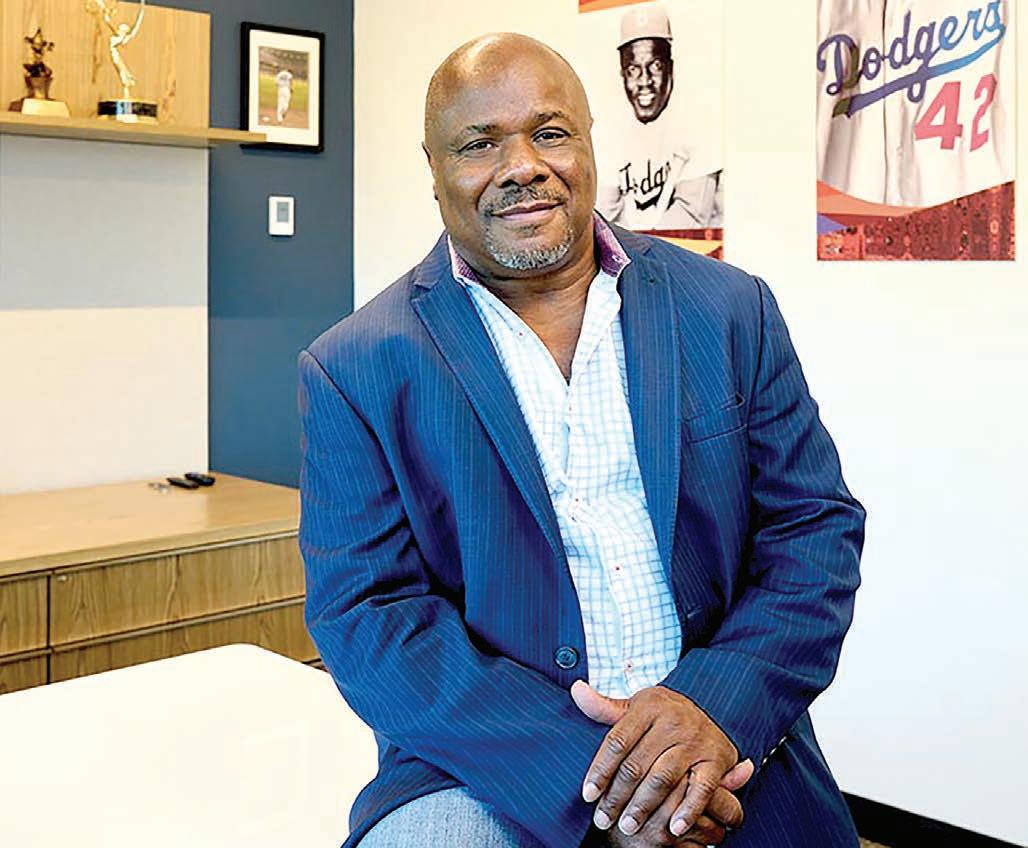
After having spent the past 22 years of his career at ESPN, the
and Wayne State University alum is retiring at the end
Retiring
ESPN
Exec.
David
Roberts
Reflects on 50-Year Career, Detroit Roots, and the Importance of Opening Doors
By Jeremy Allen EXECUTIVE EDITOR
The rhythm of Detroit has always sounded a little like a game clock. It never quite stops and it always demands something from whomever is bold enough to step onto its floor.
For David Roberts, a kid growing up on the city’s southwest side, that rhythm stretched across five decades – a 50year career that moved with the urgency of a fast break, but also with the patience of a long season. By the time he reached the executive ranks at ESPN after a quarter-century in the business, the pace hadn’t slowed. It just got sharper.
Roberts now serves as ESPN’s Executive Vice President and Executive Editor for Sports News and Entertainment. After 22 years at the organization, when he talks now about his pending August 2026 retirement, there’s no swelling music or grand curtain call in his voice. For him, retirement is just a measured acknowledgment of the time he spent in the journalism and media industry.
“Well, it just means that I’ve been around a while,” he said. “And you know, I’ve had a real interesting and refined career in the media world. I’m just looking forward to what’s next in this chapter of life.”
The path to that moment long before Roberts stepped into a newsroom or learned about press box etiquette.
It began in Detroit in 1967, when the city erupted and an 11-year-old boy started asking questions that adults around him couldn’t – or wouldn’t – answer.
“Going back, it went back to like the ’67 riots in Detroit,” Roberts said. “You know, I was always curious, even as an 11-year-old, about why certain media companies kind of refused to cover the real issues and stories associated with the Detroit riots.”
That curiosity turned into something more personal years later.
In summer 1978, as a student working at the National Bank of Detroit, Roberts became involved in a class-action lawsuit alleging race discrimination. The lawsuit stated that
Sam Klemet Steps Down as Auto Show Executive Director
By Jeremy Allen EXECUTIVE EDITOR
The last two Detroit Auto Shows have ingrained much more of the “Detroit Spirit” than any others in recent memory, and that’s thanks in large part to the leadership and direction of Sam Klemet.
He was tapped to head the Detroit Auto Show in 2024 as longtime director Rod Alberts transitioned from leadership. As executive director, Klemet led the show’s return to its traditional January timing after the decision to move the annual show to September fell flat.
But Klemet, on Thursday, April 30, announced that he would step down as executive director of the Detroit Auto Dealers Association and the Detroit Auto Show, effective immediately.
“It has been a privilege to serve the DADA and work alongside its leadership and members,” Klemet said in a statement. “At this time, I’ve made the decision to pursue other professional opportunities, and I wish the organization continued success in the years ahead.”
Speaking with the Michigan Chronicle, Klemet said that he loves the city of Detroit as much as anything outside of his family, and that he would be sticking around the city in the future.
“We thank Sam for his service to the DADA and his contributions to the continued evolution of the Detroit Auto Show,” said Katie Coleman, president of the association. “As we move forward, our focus remains on supporting our dealer members, strengthening our organization, and continuing to elevate the Detroit Auto Show as a premier automotive event.”
The search for its next leader has begun with an executive committee overseeing the transition.
Klemet came to the DADA from the Michigan Association of Broadcasters, where he was President and CEO since 2021. There, he led advocacy initiatives, continuing education, and awards programs on behalf of 285-member commercial TV and radio stations and 30 public TV and radio stations. In this role, he was also responsible for coordinating legislative initiatives in Washington, D.C., and Lansing.
Previously, Klemet spent six years with the Indiana Broadcasters Association and Indiana-based Arland Communications, where he was charged with overseeing advocacy and compliance initiatives for more than 270-member TV and radio stations.
Prior to his career in association management, Klemet was a broadcast journalist, producer, and news director at a number of commercial and public stations in Indiana,
Black employees of the bank didn’t have similar access to promotions as their white counterparts – many of whom were equally or even less qualified for promotions.
The experience, while exposing him to what injustice looked and felt like, also reinforced how that 11-year-old Roberts saw the world. Answers became clearer about how and why those 1967 riots were portrayed in the media the way they were.
“I didn’t like how the story was covered, and frankly, how I was portrayed in the coverage of that story,” he said.
Those two moments – one civic and one deeply personal – laid the foundation of how he saw his career taking shape. Journalism, for Roberts, was the tool he could use to correct a broken narrative and bring about truth and fairness in a world that left him with too many unanswered questions and too many ignored perspectives.
Sports came later. But not in the way many people today enter into it, and not in the way people often assume.
There was no failed athletic career or last-minute pivot. Roberts knew early what he wanted.
“I played little league baseball and coached a bit of it later on, but that was as far as I went,” he said with a slight laugh. “But I always knew early on that I wanted to be in broadcasting. And so knowing early made it easier for me to carve out a path and a plan to achieve that goal.”
To him, sports and news were always complementary. They were just different lenses for the same camera.
“Sports is just another aspect of covering news,” he said. “If you have the same principles of coverage – fairness and balance – to me, sports were just another extension of broadcast journalism.”
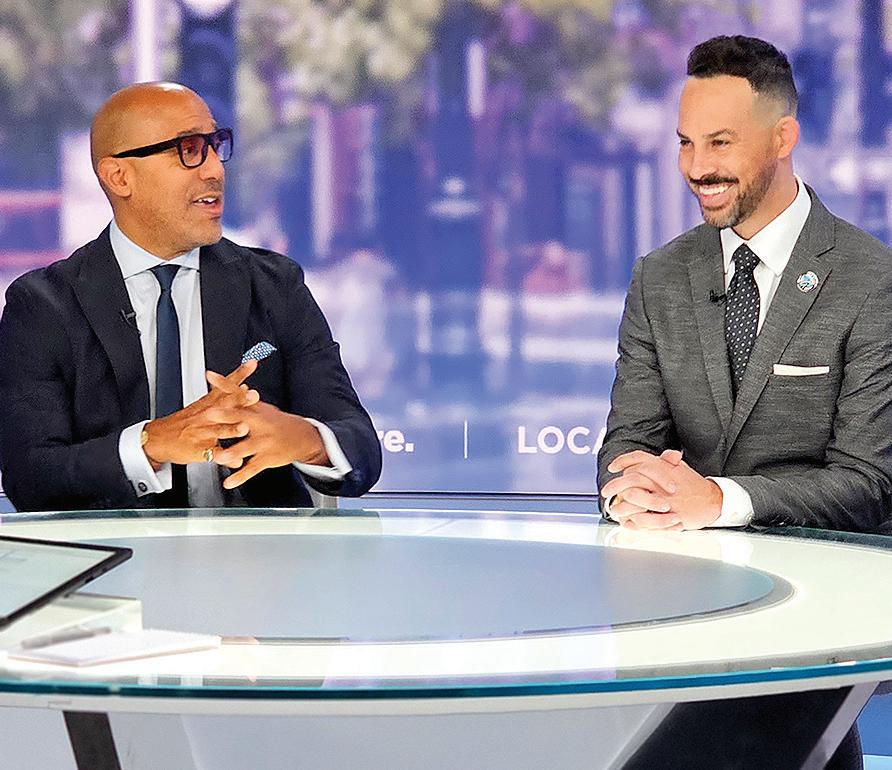
That philosophy would follow him through every newsroom he entered, from his earliest days to the highest levels of ESPN, where he would spend 22 years shaping coverage, talent, and direction at what is often called the worldwide leader in sports. He’s ushered in a wave of new talent like
and Illinois.
and 2026, as the
David Roberts Retiring
From page A-3
Detroit product Vinnie Goodwill (brought over from Yahoo Sports), and basketball commentators Malika Andrews, Chiney Ogwumike and Andraya Carter.
He’s taken their anchor morning show First Take on the road for live shows at HBCU campuses since 2019. He brought back beloved personalities like Rich Eisen, overseen the network’s NBA and WNBA coverage, launched special editions of SportsCenter, and brought in record-high ratings for the network. And that’s really just the tip of the iceberg in terms of his accomplishments while at the network.
But before ESPN, there was Detroit.
Roberts graduated from Southwestern High School in 1974 and later from Wayne State University, building his foundation in a city that has long produced pioneering Black journalists. He points to those figures not as distant icons, but as tangible influences.
“Detroit has a history of being first with some of the most talented people in broadcast journalism,” he said, naming Diana Lewis, Beverly Payne, Doris Biscoe, and Carmen Harlan. “Those three women and Carmen Harlan really had a tremendous impact on my own career, just from watching them.”
He still speaks about them with a kind of reverence, recalling
Suiting Up
From page A-3
when it comes to their sartorial choices. Not to be like “well, what about men?”, but…well, what about the men?
Some quick math shows that at 43, Gilchrist has been getting suits altered for about 25 years. For at least nine of those years, if we start from his 2017 run to become Detroit’s city clerk, Gilchrist has been on a campaign trail – currently running to become Michigan’s secretary of state – or a holder of public office. Next to anyone with a locker inside Little Caesars Arena, Gilchrist is one of the most visible tall people in the state, and has likely spent more time – and money – with tailors and seamstresses in any given year than most of us will in a lifetime.
He’s not alone – in the political realm, at least. State Rep. Joe Tate, once a Southfield-Lathrup football phenom, stands at six-four. Eli Savit, who’s on the run to become Michigan’s Attorney General, is right up there with him at about six-and-a-half-feet tall; he played basketball in high school and college. He doesn’t hold office now, but one would be remiss not to acknowledge an actual professional basketball player who held office: Six-foot-three former Detroit Mayor Dave Bing, who succeeded the six-foot-five Kwame Kilpatrick when he took office.
With the exception of the steel magnate with an NBA pension, the tall man in the public eye has always had to set aside extra funds just to be presentable. For the men of Tate, Savit, and Gilchrist’s generation, they have some additional tax to pay that many don’t have to.
While talking about his wardrobe with the Chronicle, Gilchrist didn’t disclose – and we didn’t ask, to be transparent – how much he spends, say, annually, on new suits. (He did note something endearing: His grandmother bought him his first suit to wear to a college internship at Microsoft.) One could surmise that after nearly a decade of public appearances, it’s well into the five-figure range.
“When I ran for city clerk, I was 34 and I thought that me being suited all the time would help people get the message that I took it seriously,” Gilchrist says. “And then as lieutenant governor, I tried to carry that same thing forward.”
Compare that logic and approach to that of former Gov. Rick Snyder, who famously never wore ties (except to the Detroit Athlet-
even brief professional overlap as meaningful.
“For the very short period of time that I worked with Diana Lewis, it was a privilege to do that,” he said. “I cannot overstate how tremendous of an impact they had, but particularly Diana Lewis, on my career.
That lineage – Detroit producing journalists who then shape national conversations – became something Roberts both inherited and extended. His first job in the business came at WGPR, a historic Black-owned television station in Detroit that served as a launching pad for many careers. It was the first Black-owned television station in the country, and it marked its 50-year anniversary in October 2025.
“I remind people of the history of WGPR, which was my first job in the business,” he said. “And hopefully people will never forget the impact that they had because they certainly produced a whole host of folks in the industry, including myself.”
By the time Roberts arrived at ESPN, he brought that history with him as a responsibility.
Over 22 years, he rose through the organization, taking on increasing leadership roles that culminated in Executive Vice President and Executive Editor of Sports News and Entertainment. His influence extended beyond programming decisions into hiring, mentorship, and institutional direction.
“I think that when you look at
ic Club, where it was mandated) during his eight years in Lansing. Ninety percent of the time, just estimating, Snyder’s suits varied, but usually with a poplin blue oxford underneath. Former Detroit Mayor Mike Duggan, who’s aiming for the governor’s seat, was even more casual in public appearances during his 12 years on CAYMC’s 11th floor. Both men were well into their 50s during their respective times in office, and you can’t ignore that both men are white. Either of these attributes immediately deflects any skepticism, a privilege neither a 30-something nor a Black person, let alone both, is afforded.
And while there are several tall men at all levels of government, Black or otherwise, Gilchrist remains one of two Black people to ever hold statewide office in Michigan.
At times, there is an undue burden placed on individuals in these positions, in that they’re not just doing their job, but representing an entire race and people while doing it. A more thorough political journalist could probably survey Black folks on both peninsulas to confirm this or not, or they could just stand alongside this editor when in conversation with Gilchrist at this year’s Fight For Freedom Fund dinner, where several people – all Black, of all ages – were standing in line to get two words and a selfie with him. Either way, Gilchrist has no choice but to invest more into his appearance in ways other politicians wouldn’t, and that choice wasn’t necessarily his to make.
Many, but not all, Black men are told at some point in their lives that they’ll only be taken seriously if they’re wearing a suit. Or rather, they won’t be taken seriously if they’re wearing anything else.
Before they were millennial men, millennial teens were constantly beaten upside the head with the hammer of respectability politics, always being warned that they would never have a future if they kept wearing those T-shirts and gym shoes with somebody else’s name on them, and those baggy jeans with their drawers showing. (And let’s not get started on the homophobia behind comments like “you know, in prison, there’s a reason why they let their drawers hang out like that.”)
Black folks aren’t a monolith, though, so that “many, but not all” hit like a ton of bricks when, after Gilchrist was asked if he heard such a thing, he said he’d never encountered it. “That’s not been my experience,” he said.
Gilchrist is, however, doing his
Sam Klemet Steps Down
From page A-3
series: “For 20 years, Pancakes & Politics has built a reputation as the space where leaders come to exchange bold, unfiltered ideas that ultimately shape policy and move communities forward. To have the Detroit Auto Show recognize the value of this platform and invite us onto such a prominent stage is an honor. This partnership underscores the weight of these conversations, not just for Detroit, but for the entire nation.” Klemet went on to foster several other strong partnerships with local and national organizations

the people who are on the air at ESPN – persons of color – there are many of them that I was able to not only bring onboard but to help develop and provide guidance and feedback in a way where many of them are flourishing,” he said.
That work didn’t happen in isolation. It came during a time when conversations around diversity, equity, and inclusion were evolving, and, in Roberts’ view, increasingly under pressure.
“It is really important in today’s world… given the current attacks on the state of democracy and the moving away from diversity, equity and inclusion,”
part to break that generational curse for the rest of us – whether he’s heard those sentiments or not. In his last year as lieutenant governor, Gilchrist points out that he’s been wearing suits less frequently. But he says that even though he’s been showing up more relaxed lately, eight years of showing up to work in the state’s second-highest office is just that: Showing up.
“I’m with people all the time. And so regardless of what I got on, what matters is that I’m here,” he says. “I think what people take seriously is the effort. And when you’ve been to all 83 countries in Michigan at least three times like I have, people see the work.”
There are those of us Black men who’ve rarely been given the opportunity to let our work speak for itself. At every stage of our lives, we’re constantly preempting and preventing stigma and stereotypes. (Even before we have life, are these defenses made – raise your hand if your Black parents told you that your birth name was chosen partially because it would look good on a resume, and/or people reading it might not automatically assume you’re Black.) But finally, we seem to be asserting some defiance.
There’s an alternate timeline where someone like Gilchrist doesn’t spend a small fortune on clothes just to impress or convince the skeptics who see nothing more than height, age, or color, or see all three and come to some other conclusion. We don’t know for sure if Gilchrist could have gotten as far in his career as he has now if he didn’t wear ties, if he wore suits that didn’t fit perfectly, if he didn’t wear suits at all, and just stuck to khakis and jeans. We don’t know if his work would’ve been enough to speak for itself, allowing Gilchrist himself to simply show up. (He never said that he did feel like he was showing up inauthentically just because he showed up in a suit, by the way.)
We do have a glimpse of that possibility in the current timeline, though. Gilchrist’s height prompts the majority of us to look up, but lately, we should be looking down.
At the time of our chat, Gilchrist is in a tailored navy suit paired with some J’s – specifically grey Air Jordan 1 lows he copped from the Nike store on Woodward. In addition to being more casual in general, Gilchrist, an admitted sneakerhead, has been wearing more and more gym shoes (sometimes with other folks’ names on them) with more formal attire.
he said. “It only underscores the importance of making sure that Black communities across this country and other communities of color keep the heat on.”
His tone sharpens when he talks about it because he understands that issues of diversity, equity, and inclusion directly affects how stories are told and who gets to tell them. It goes back to his reasons for entering the industry.
“We can’t go back any further than what’s already happening,” he said. “It is not only the right thing to do, but it’s also good for business to be reflective of the communities that we cover and serve.”
That impact is visible to those who followed behind him.
Eric Woodyard, Flint native and ESPN’s Detroit Lions reporter, sees Roberts’ presence as a transformative shift in the industry.
“I think more than anything it gives us representation,” Woodyard said. “It gives us hope… that we’re not just pigeonholed into being just talent. You know, we can be in any position.”
For Woodyard, who came up through Michigan’s journalism ranks before reaching ESPN, seeing someone like Roberts in an executive role expanded what felt possible.
“I think that’s what makes him so unique,” Woodyard said. “That we’re not just on TV… we can be in production. We can be in all different types of roles. I think it’s important for young people coming up that they don’t believe that they just have to be in one position. There’s different roles, and we can be in those spaces as well.”
That visibility, he said, matters for the next generation in ways that go beyond inspiration. Woodyard also points to a broader shift in awareness that Roberts helped make possible.
“When I was coming up, I didn’t even know what the word journalist was for real,” he said. “I would just read the newspaper or Slam Magazine… I saw what Stuart Scott was doing on TV, but I didn’t necessarily know what that was called.”
Now, he says, that knowledge is more accessible.
“I think it’s just really awareness,” Woodyard said. “Seeing others like ourselves being in those positions to know that it’s possible.”
Roberts sees that awareness as part of his legacy, though he rarely frames it in personal terms. Instead, he points to outcomes: who is on screen, who is in the newsroom, who gets opportunities.
“Hopefully the legacy will be that I made a difference in what people see on the air and who people see on the air,” he said.
Even as he reflects on his career, Detroit remains a constant reference point. Roberts being a Detroiter only matters because of the perspective he gained from growing here, and it’s a perspective that he carries each day.
“When I was growing up, Coleman Young was the mayor of Detroit and he presented a very strong African American leadership perspective,” Roberts said. “He wasn’t necessarily well-liked by those who lived across Eight Mile… but he was always highly respected.”
That kind of unapologetic, rooted, and accountable leadership style left an impression.
“He was someone that inspired me,” Roberts said.
The city’s influence shows up in quieter ways, too: in the Little League fields where he coached, in the newsrooms where he first learned the craft, in the sense that journalism is a public trust.
Even his favorite sports moments reflect that sensibility. When asked to choose, he doesn’t default to championships or buzzer-beaters. Instead, he recalls something deeper.
“It was the 75th anniversary of Jackie Robinson breaking the color barrier,” he said. “The depth and reverence shown to his widow Rachel Robinson – just seeing how that historic figure continues to be a model of consistency and impact.”
It’s a choice that says as much about Roberts as any résumé line.
For him, sports – and news in general – has always been about history, legacy, and the stories that shape how we understand both.
As he steps away from ESPN, that perspective remains unchanged. Retirement, in his telling, is just a transition.
“Even though people call it retirement, the bottom line is my story is still being written,” he said.
In Detroit, the game clock never really stops. It will reset. There will be new players, and those new players will create new moments.
David Roberts spent 50 years moving to the ticks of the shot clock by asking questions, challenging narratives, opening doors, and breaking glass ceilings.
Now, as he looks toward the next chapter in his life, he’ll get a brand new clock to work with.
in his time leading the curating of the January Classic, including partnerships with local businesses, the Detroit Public Schools Consolidated District, and the local chapters of the Black Greek Letter Organizations for the show’s annual Day of Service events. He was intentional about making the show once again feel like an authentic Detroit experience – one that was inclusive and progressive in nature.
Klemet graduated in 2007 from Michigan State University with a Bachelor of Arts degree in Broadcast Journalism.
“I got people in Lansing trying to wear gym shoes now,” Gilchrist laughs. “I think that there’s a way to have to show and have your personality come through, and that’s what [wearing gym shoes] meant for me.
“My job is to be who I am and not try to be anybody else, not try to hide any of my personality because I bring my full self to the work that I do – full effort, full energy, full personality, and I hope that that’s something that people would be welcoming to and want to learn more about as I learn more about them,” he elaborates. “I think that it’s a time when people feel like they can’t trust a lot of public officials, but they can trust a real person. And my job is to show up as a real, full person.”



A5 | May 6-12, 2026
Money.
Money Matters: Navigating Rising Gas Prices
By Mark S. Lee
CONTRIBUTING COLUMNIST
Approaching $5 per gallon...
Gas prices are climbing, and for businesses, this isn’t just a nuisance – it’s a margin issue. And for consumers, it may come down to consumer spending choices and changing behaviors.
As we head into May, according to AAA, the average price of regular unleaded gas across metro Detroit is $4.54 per gallon, which is the highest level since 2022.
Prices are being pushed higher by a myriad of factors, including seasonal demand increases as more drivers hit the road during the warmer months, ongoing geopolitical tensions that impact global oil supply, and fluctuations in crude oil prices.
Every increase at the pump quietly works its way through business operations, from deliveries to supply costs to customer demand.
This is one of those moments where external pressure forces internal decisions. The question isn’t whether gas prices will impact your business but how well you respond.
The most immediate hit shows up in transportation. If your business depends on vehicles — whether it’s a service company, contractor, or delivery-based model — fuel costs are now a larger percentage of every job. What used to be a manageable expense can quickly become a line item that eats into profitability.
But the impact doesn’t stop there.
Higher prices ripple across the supply chain. Most goods in the U.S. are transported by truck, so when fuel prices rise, vendors and suppliers pay more to move products — and those costs get passed along. That means you’re paying more for inventory, materials, and even basic operational inputs before you ever make a sale.
At the same time, your customers are feeling it too. When consumers spend more at the pump, they tend to pull back in other areas. That can mean fewer discretionary purchases or increased sensitivity to price changes. So, while your costs are going up, your ability to raise prices may feel more limited.
What can you do?
The businesses that navigate are the ones that move quickly and deliberately.
Start with efficiency. Look at how your business uses fuel day to day. Tightening routes, grouping appointments geographically, and reducing unnecessary trips can create immediate savings without affecting revenue. Even small changes in scheduling and logistics can lower fuel consumption.
Next, address waste. Vehicle idling, inefficient routing, and outdated processes can quietly drain resources. These are controllable costs, and in a high-price fuel environment, they matter more than ever.
From there, consider how you communicate potential cost increases. When handled clearly and fairly, customers are more likely to understand that these adjustments are tied to external factors, not arbitrary increases. Being transparent with customers is critical to maintaining
See GAS PRICES Page A-6
By Dr. Anthony O. Kellum
CONTRIBUTING COLUMNIST
In an era where financial literacy is paramount, understanding the importance of homeownership is a vital conversation that must be had. For many, especially within the Black community, the pathway to true wealth begins with the acquisition of property. Owning a home is not just about securing a place to live; it is an essential step towards building a legacy, providing for your family’s future, and creating a foundation for generational wealth.
The paradigm shift required to embrace homeownership begins with changing the way we think about savings and wealth. Often, the allure of immediate gratification can distract from the longterm benefits of saving for a down payment on a home. It is critical to understand that saving is not just about accumulating a lump sum of money but about creating a disciplined approach to building assets for the future.
What makes this conversation more urgent is what the data continues to show. The median
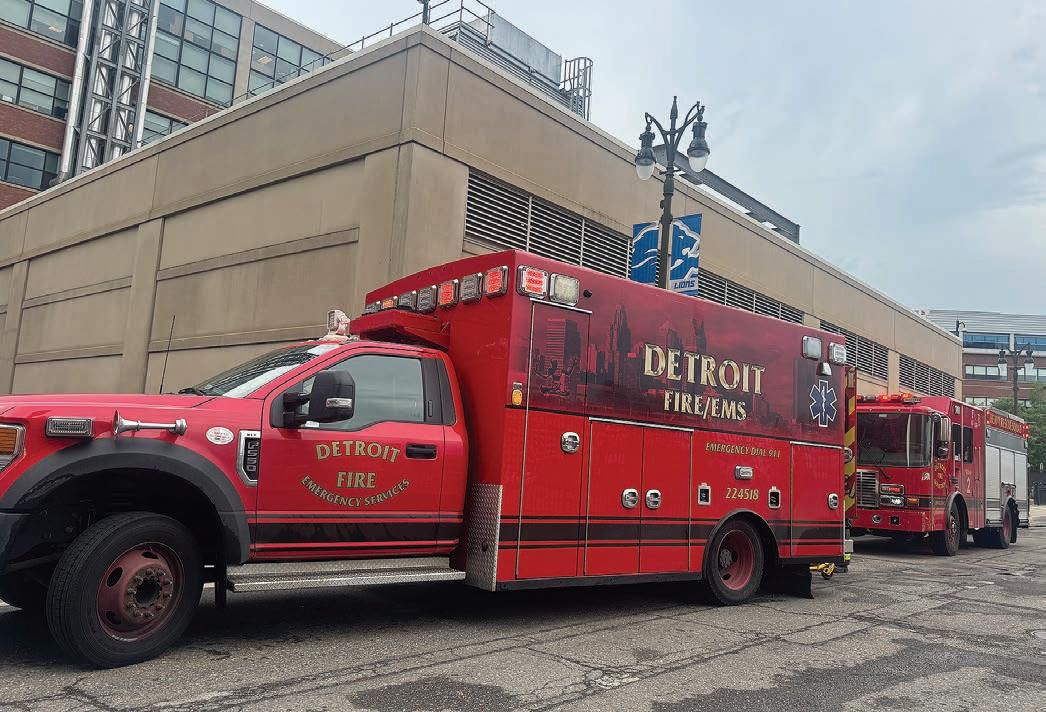
Detroit Fire Department Union: Expiring Private Ambulance Contracts are a
By Sam Robinson SENIOR REPORTER
The Detroit firefighters’ union is urging the city to hire more personnel in order to do away with its use of private ambulance companies, currently lobbying for new contracts.
Council members this week sent about $5 million in contracts back to a committee for further review after fire department officials urged them against approving contracts originally agreed upon in 2023 with private ambulances that have been criticized for providing worse service. One council member questioned whether the companies were double-charging patients.
The contracts expire Friday, May 1.
Jeffrey Pegg, vice president of the Detroit Fire Association, at Tuesday’s Detroit City Council meeting, urged members to oppose the contracts.
Council voted 4-3 to send the contracts back to the Public Health and Service committee on May 4. Voting to send the contracts back were Council President Pro Tem Coleman Young II, members Scott Benson, Latisha Johnson, and Denzel McCampbell. Mary Waters, Angela Whitfield-Calloway, and Renata Miller voted against approving contracts with the private ambulance companies.
Detroit pays three private ambulance companies more than half a million dollars a year to maintain an adequate number of emergency vehicles at all times, referred to by officials as “standby service.”
The city pays to have ambulances staged in different areas, so they’re able to respond within six and a half minutes. However, the city doesn’t pay for the medical services the ambulance provides. That bill is passed on to the patient.
Whitfield Calloway called the setup “double dipping.”
A University of Michigan study from 2020 found that over 70% of ground ambulance rides for privately insured patients are out-of-network, meaning patients could be on the hook for “balance bills” up to $20,000 per ride.
And even for patients who take ambulances for non-emergency reasons, arranged in advance with time enough to check insurance coverage, over half of patients could face a surprise
‘Wake Up Call’
bill for the out-of-network portion of the cost. On average, the study shows that the bill could top $400.
The firefighter’s union says it’s a waste of money when the city could just hire more firefighters, who are also trained as EMS responders.
“This is a wakeup call for the city to hire more, train us, and we can do the work,” Pegg told Michigan Chronicle. “You just need to hire the people to do it and buy the ambulances. What we need is the council to extend the contract for a year while the administration gets its act together and starts hiring more people and putting more of our people in ambulances on the street.
Pegg said both the administration of former Mayor Mike Duggan and current Mayor Mary Sheffield are aware of the union’s position on its desire to take full control of its emergency response calls. The fire department has 26 EMS ambulances, but six advanced life support units are available on a regular basis.
“We’re the best at what we do, and we’re the highest trained,” Pegg said. “So just to hire more, train us, give us more equipment, and we can do the job, no problem.”
Detroit Fire Department Second Deputy Commissioner Derek Hillman, joining the meeting via Zoom, called the contracts critical to supporting DFD during peak call hours.
Hillman suggested there would need to be nearly 20 ambulances added to the department, requiring about 120 new employees to provide adequate coverage at the same level as with the three private ambulance companies.
Detroit Procurement Director Sandra Stahl also suggested that the private ambulances have improved response times. She told council members the cost of a new ambulance is around $300,000. Stahl also said that nearly 90 city residents are employed by the three private ambulance companies.
Council members who voted to send the contracts back to the committee expressed concern about maintaining proper service.
“At the end of the day, we still have to make sure folks have the EMT services they need when they call for help,” McCampbell said.
You can reach Sam at srobinson@michronicle.com.
portunities to leverage that asset for future financial needs. It is in that lost time where much of the wealth gap quietly widens, often unnoticed until much later.
The impact of this is not abstract, it shows up in outcomes. Households with lower savings often enter the market with smaller down payments, higher borrowing costs, and less initial equity, which directly affects how much wealth can be built over time. In contrast, those who can save earlier and purchase sooner benefit from longer appreciation cycles and stronger equity positions. This is why savings is not just a financial habit; it is a strategic advantage. It determines not only if you can buy, but how well you are positioned once you do.
the bank equates to wealth. However, real wealth is measured by assets, not just income. Wealth is owning something of value that appreciates over time, and a home is one of the best examples of this. Real wealth is not just about spending but about investing in something that grows in value and provides security for the future.
To participate in homeownership, it is essential to take proactive steps. First, educate yourself about the process of buying a home, including understanding credit scores, mortgage options, and the true cost of homeownership. This knowledge is empowering and will help you make informed decisions. Next, create a budget that includes saving for a down payment and other associated costs, such as closing. It is also important to explore all available resources, such as homebuyer assistance programs, which can provide financial support and make homeownership more accessible.
for your children. It is a powerful tool for passing on a legacy and prosperity.
wealth of a typical white family in America is nearly 10 times higher than that of a Black family about $171,000 compared to just over $17,000. That gap is not driven by income alone, it is driven by assets, ownership, and long-term investment behavior. Black households, on average, earn less roughly $38,000 compared to $61,000 and are far less likely to have the credit strength needed to access favorable financing, with only about 21% holding credit scores above 700, compared to more than half of white households. Homeownership reflects these disparities roughly 44% of Black families own their homes, a figure that has consistently lagged behind that of white households for decades. These outcomes are not random. They reflect a pattern where lower savings, limited access to credit, and delayed entry into homeownership compound over time. Nearly 87% of white homeowners purchase before the age of 35, compared to just 53% of Black homeowners. That delay has lasting consequences less time for property appreciation, less equity accumulated, and fewer op-
Illusion of wealth is a common trap that many fall into, believing that having a high-paying job or a substantial amount of money in
Homeownership is necessary, not a luxury. It is the biggest wealth vehicle for African Americans in this country. According to the U.S. Census Bureau, the homeownership rate for Black families is significantly lower than that of other races, yet it is the key to building wealth and legacy. Owning a home allows you to build equity, borrow against that equity for other financial needs, and provide a stable environment
In the context of higher education, owning a home can also play a crucial role. When it comes time to send your children to college, having a home can provide not only a place to live but also a significant asset that can be leveraged for financial aid or loans. Equality in a home can be a vital resource in funding your child’s education, ensuring that they have the best opportunities for their future.
In conclusion, embracing homeownership is a critical step towards building a legacy and creating a foundation for financial stability and growth. It requires a shift in mindset, a commitment to saving, and a proactive approach to educating yourself about the process. For African Americans, in particular, homeownership is a powerful tool for building wealth, providing for the needs of your family, and passing on a legacy that will support future generations. The path to homeownership is not just a journey towards acquiring property, it is a transformative step towards achieving financial security and leaving a lasting impact for your family.
Property is Power! is a movement to promote home and community ownership. Studies indicate homeownership leads to higher graduation rates, family wealth, and community involvement. Property is Power! How Thinking Differently Leads to Owning Differently
Mark S. Lee
Anthony O. Kellum
Summer Solution for Detroit Families: Free Program Supports Youth and
Enrollment is now open for the Joique Bell Charity Summer Program, a free, sixweek experience designed to provide Detroit and Metro Detroit youth with structured, full-day programming, mentorship, and hands-on learning opportunities during the summer months. The program will run from June through July and is open to students entering grades 6 through 9, offering a safe and engaging environment for youth at a time when many families are seeking accessible summer resources.
The Joique Bell Charity Summer Program is rooted in providing more than just childcare. Through a blend of academic enrichment, physical activity, and real-world exposure, the program is designed to support both youth development and family needs. Participants will receive free breakfast and lunch daily, while engaging in programming that builds leadership skills, confidence, and long-term awareness of future opportunities.
“This program is about showing kids what’s possible,” said Joique Bell. “Growing up, exposure changes everything. When young people can see different paths and have people around them who believe in them, it shifts how they think about their future.”
Throughout the six-week experience, students will participate in mentorship sessions, field trips, athlete day, team-building activities, and interactive learning designed to keep them engaged both mentally and physically. The program also prioritizes
Gas Prices
From page A-5
trust. Clearly communicating why prices are increasing helps customers feel informed rather than surprised. When businesses are upfront and consistent in their messaging, they not only manage expectations but also strengthen long-term relationships, even in a challenging economic environment.
Revisit vendor relationships. If suppliers are facing higher transportation costs, those increases are likely to come your way. Locking in pricing where possible or renegotiating terms can provide some stability in an otherwise volatile environment.
Evaluate your pricing strategy. Incremental adjustments tend to work better than large, reactive increases. Small, thoughtful changes made early can help protect margins without alienating customers. Waiting too long often leads to bigger jumps that are harder to absorb — both for your business and your customer base.
While rising gas prices create pressure, they also create clarity.
consistency and structure, ensuring that
students benefit from a full-day schedule that supports growth, discipline, and connection.
“We’re not just creating a summer program, we’re creating an experience that can impact how a young person sees themselves long after the summer ends,” Bell added. “That’s what this is really about.”
The program is led by a team of educators and community leaders who bring both professional experience and a deep understanding of the needs of Detroit families.
“Our goal is to create a space where students feel supported, challenged, and inspired,” said Ambie Bell, Program Director of the Joique Bell Charity. “We’re intentional about building an environment that balances structure, enrichment, and mentorship, so students leave with more than they came in with.” Curriculum is designed to keep students engaged while also introducing them to new ways of thinking and learning.
“We’re focused on creating a learning experience that feels relevant and exciting for students,” said Jazz Nika Newbern, Director of Curriculum for the Joique Bell Charity.
“Whether it’s through hands-on activities, group discussions, or exposure to new ideas, we want students to feel confident exploring what they’re capable of.”
Why This Matters
As the cost of summer childcare continues to rise, many families are left navi-
They challenge businesses to evaluate operations, eliminate inefficiencies, and make sharper financial decisions. In many cases, those improvements remain long after fuel prices stabilize.
That’s the opportunity hidden in moments like this.
You may not be able to control what happens at the pump, but you can control how your business adapts. The companies that stay proactive by cutting waste, adjusting pricing, and communicating with customers are the ones that position themselves to weather the challenge and come out stronger on the other side.
In today’s environment, resilience isn’t just about enduring higher costs. It’s about responding with discipline and intention.
Because when the pressure rises, so does the need for smarter business decisions.
We invite readers, business owners, and future entrepreneurs to follow along, ask questions, and engage. If you have story ideas or questions, you can email Lee at mark@leegroupinnovation.com or visit leegroupinnovation.com.
Parents Alike

gating limited options for safe, structured programming. Programs like the Joique Bell Charity Summer Program provide a critical solution by offering free, full-day support that keeps youth engaged, fed, and connected to positive influences.
Beyond immediate support, the program also plays a role in long-term impact by introducing students to leadership development, teamwork, and new opportunities that can shape their future.
Call to Action
Enrollment is currently open for Detroit and Metro Detroit families. Space is limited, and families are encouraged to register as soon as possible.
Registration will close during the last week of May.
To learn more and register, visit: https://jbcharity.org/
About Joique Bell
Joique Bell is a former NFL running back who played for the Detroit Lions and is a Detroit native dedicated to giving back to his community. Through the Joique Bell Charity, he has spent over 16 years creat-

ing opportunities for youth across Metro Detroit, focusing on mentorship, education, and access. His work is rooted in the belief that exposure, support, and consistency can change the trajectory of a young person’s life.
Looking Ahead
The Joique Bell Charity Summer Program is part of a broader commitment to expanding access to resources and opportunities for youth across Detroit. As the program continues to grow, the organization aims to deepen its impact through partnerships, expanded programming, and continued investment in the next generation.
Media Opportunities
Media are invited to:
• Attend program days for live coverage
• Schedule interviews with Joique Bell and program leadership
• Capture student engagement and program impact Visual opportunities include group activities, mentorship sessions, and hands-on programming.
Michigan Chronicle Delivered Daily to Your Inbox!



Joique Bell
Three
Staffers
Michigan Chronicle
Announced as Winners in SPJ-Detroit’s ‘Excellence in Journalism’ Awards
By Michigan Chronicle Editor
Michigan Chronicle Executive Editor Jeremy Allen and journalists Ebony JJ Curry and Sam Robinson have been named as award winners in the Society of Professional Journalists-Detroit Chapter’s 2026 Excellence in Journalism awards contest. The contest awards work done during the 2025 calendar year.
The list of Michigan winners was released by the organization on April 22, but winners for specific stories, categories, and placements won’t be announced until the chapter’s annual ceremony and banquet, which takes place on Wednesday, May 20, in Troy.
“This is my first individual journalism award,” said Robinson, who joined Michigan Chronicle in spring 2025. His beat includes coverage of Detroit City Hall and local government for the Chronicle.
“I feel like I win awards every day, though, when people approach me and say they’ve read my work and say that they respect the journalism I do. But this does feel good. I’ve gotten messages from people congratulating me and it feels good,” he said.
Curry, who currently works as a reporting fellow at The 19th News, has won SPJ-Detroit awards in consecutive years now. She said that she’s grateful to the community for entrusting her with the stories that often get overlooked.
“It is an honor that I do not take lightly simply because I’m uniquely positioned to tell the stories of my community – uplifting the voices and experiences of Black Detroiters –by connecting people to important policies that impact their daily lives,” she said.
Allen, who began leading the Chronicle’s editorial staff in 2023, said the organization has been doing the work of amplifying Black Detroit and Michigan stories for the past 90 years, and it feels gratifying to be recognized for the work.
“The Michigan Chronicle turns 90 this year, so it’s an honor to lead a team of dedicated, passionate journalists who understand what that means and what the organization means to the community,” he said. “Ebony and Sam have told so many important stories that might not have been amplified if not for the way that they tap into the city and the way they advocate for residents through their journalism. I’m proud to work alongside them and the rest of the team at Michigan Chronicle.”
The May ceremony will also honor three important members of Detroit media with Lifetime Achievement Awards. These are the three journalists recognized for their lifelong contributions to journalism in Metro Detroit and Michigan: Stephen Henderson – Award-winning journalist, author, and broadcaster; Pulitzer Prize for Commentary; co-founder of BridgeDetroit; co-author of The Civility Book Society of Professional Journalists.
Bill McGraw – Over 50 years in Detroit journalism; former Free Press staff member; author of The Detroit Almanac and The Quotations of Mayor Coleman A. Young; documentary producer and consultant, Society of Professional Journalists.
Alicia Nails – Director of Wayne State University’s Journalism Institute for Media Diversity; Emmy Award-winning broadcast journalist with more than 40 years of experience in television, radio, and print/electronic media; has also executed citywide public relations campaigns for major special events and organizations, including the African World Festival and the Detroit Alumnae Chapter of Delta Sigma Theta Sorority, Inc.
Additionally, SPJ Detroit will name the Journalist and Young Journalist of the Year, as well as the recipients of its 2026 Larry Laurain scholarships, which are given annually to college students with an expressed interest in journalism. Finalists for Journalist of the Year and Young Journalist of the Year are:
Journalist of the Year (2026)
John Carlisle – Detroit Free Press Ryan Garza – Detroit Free Press Bill Kubota – Detroit PBS Koby Levin – Outlier Media Young Journalist of the Year (2026) Ronia Cabansag – Michigan Public Isabel Lohman – Bridge Michigan Briana Rice – Outlier Media
New Poll Shows Jocelyn Benson Running Away with Democrats’ Governor Vote in Primary
By Jeremy Allen EXECUTIVE EDITOR
There’s not much suspense in the top line of Michigan’s Democratic primary for governor right now, as a new poll, conducted April 21–24 by the Glengariff Group for the Detroit Regional Chamber, surveyed 500 likely GOP primary voters survey of likely Democratic primary voters shows Secretary of State Jocelyn Benson with a commanding lead, pulling 66 percent support compared to just over 8 percent for Genesee County Sheriff Chris Swanson.
Nearly a quarter of voters were still undecided, but even that doesn’t meaningfully close the gap. On paper, it looks like a race that’s already settled as to who will be Michigan’s next Democratic nominee for governor.
Democratic voters across Michigan are highly motivated heading into August, the poll found, scoring their likelihood to vote at a 9.3 out of 10. Detroit voters are right there with them, even slightly above the statewide average at 9.4. That matters in a primary that will be decided by who actually shows up, and in a mid-term election where voter turnout is substantially lower than in presidential voting years.
Then there’s the question of what voters are thinking about. Across Michigan, the economy dominates, as more than 38 percent of voters cite inflation, jobs, or economic conditions as the most important issue facing their households and other Michigan families.
That economic anxiety could have been an opening for a challenger, as Benson’s competitors in this race haven’t tied her to any policies or issues directly related to the state’s economic conditions (rightfully so).
Benson’s advantage is built on a combination of high name recognition and broadly positive impressions. More than 85 percent of Democratic voters know who she is, and among those voters, she holds a strong favorable rating. Swanson, by contrast, is still largely undefined. Nearly two-thirds of voters say they’ve never heard of him, the poll shows.
That gap is even more pronounced in metro areas like Detroit, where media saturation and political awareness tend to be higher. In those spaces, not being known is often worse than being disliked.
While the poll doesn’t break out the gubernatorial vote specifically by city in the topline the same way it does for other races, the metro-versus-outstate split tells the story. Benson’s support remains strong in metro Detroit, while Swanson struggles to gain traction in the very region where Democratic primaries are often decided.
There’s also a subtle but important racial dynamic running underneath the data. Black voters – who make up a significant share of Detroit’s and Wayne County’s electorate – show slightly lower favorable ratings for Benson than white voters, though still solidly positive. This could
be because of the looming racial discrimination lawsuit filed against Benson earlier this year, where four Black employees have sued Benson and the Michigan Department of State, claiming a “racially hostile work environment,” among other accusations.
But while the numbers paint a clear picture in the state’s gubernatorial race, Detroit’s influence shows up differently when you look at the Senate primary numbers included in the same survey. That race is far more competitive.
In the Senate contest, Congresswoman Haley Stevens holds a narrow statewide lead, but her strength is heavily concentrated in metro Detroit. Among Black voters, she pulls more than 37 percent support, significantly ahead of her opponents. In Wayne County overall, she’s even stronger, approaching the mid-40s.
Statewide, Stevens, and her opponents in the primary, Abdul El-Sayed and Mallory McMorrow, are essentially clustered together, each drawing support in the low 20s, while more than 40 percent of Detroit voters remain undecided.
That suggests that Detroit voters are still shopping, still listening, and not yet locked into a choice in this high-profile race.
Another factor working in Benson’s favor is the broader political environment inside the Democratic base. The survey shows a party that is engaged, but also restless. Nearly two-thirds of Democratic primary voters say the two-party system isn’t working. A majority believes the Democratic Party’s values have changed over the last 20 years. The party is united on at least two issues, though: President Donald Trump. More than 97 percent of people polled had an unfavorable view of Trump, and nearly 94 percent had a favorable view of current Michigan Governor Gretchen Whitmer.
Overall, voters appear to be leaning toward familiarity and stability, especially at the top of the ticket. With Whitmer’s approval rating among Democratic primary voters sitting well above 90 percent, that is a level of support that tends to benefit candidates who are seen as part of the same governing circle.
Benson, as a statewide officeholder who has been visible during high-profile moments around elections and voting rights, fits that mold.
Swanson’s path, if there is one, likely runs through that remaining undecided bloc. But time is not on his side. With fewer than one in ten voters currently backing him, and a large share still unaware of his candidacy, he would need both a rapid increase in name recognition and a compelling message that resonates in places like Detroit. That’s a tall order in a compressed primary calendar.
If anything changes between now and August, it will likely start in Detroit, where there’s a push for increased turnout, but also a high bloc of undecided voters.
John James Stays Ahead as Party’s Gubernatorial Frontrunner in New Republican Primary Poll
By Jeremy Allen
EXECUTIVE EDITOR
A new statewide poll of likely Republican primary voters is offering a clear early look at where Michigan’s 2026 gubernatorial race stands.
The survey, conducted April 21–24 by the Glengariff Group for the Detroit Regional Chamber, polled 500 likely GOP primary voters and found an engaged electorate that is already forming opinions about the field. Voters rated their likelihood of turning out at a 9.4 out of 10, a level of enthusiasm that suggests August won’t be a low-energy primary. Roughly 41 percent of those surveyed are from the Metro Detroit region, which is inclusive of Wayne, Oakland, Macomb counties, and the surrounding Detroit MSA, which means what happens here will go a long way toward deciding who ultimately secures the Republican nomination.
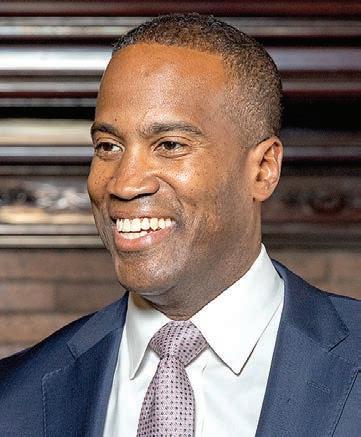
Right now, John James is out front. Statewide, he holds 37 percent support, a solid lead over businessman Perry Johnson, who comes in just under 20 percent, and former Attorney General Mike Cox, who sits just below 10 percent. Those numbers look even stronger when you zoom in on Southeast Michigan.
In the Detroit metro area, James pulls in 43.1 percent support. Johnson follows at 20.7 percent, and Cox lands at 13.8 percent. That gap shows where James is strongest across a state that is mostly red beyond that area. Specifically in Wayne County, the Michigan county with the largest Black population, James is at 39.5 percent, but Cox jumps to 20.9 percent, which is where he polled highest across the state. That suggests Cox still has a base in Southeast Michigan that could grow if the race tightens. Oakland County is more competitive, with James at 30.2 percent, Johnson at 23.8 percent, and Cox at 17.5 percent. Meanwhile, Macomb
County looks like a stronghold for James, where he’s nearing 49 percent support.
The poll also asked expectant voters about which candidates they know and how they feel about them. That’s another place where Metro Detroit stands out. James has nearly 90 percent name recognition statewide, but his favorability climbs higher in the Detroit region, where 62.8 percent of likely Republican voters view him positively.
Former Congressman Mike Rogers is not leading the Republican gubernatorial field, but his favorability rating in Metro Detroit is significantly stronger than in other parts of the state, at 61.8 percent compared to 44 percent among all other regions. Still, perhaps the biggest takeaway from the poll isn’t necessarily about any one candidate. It’s about the continued influence of President Donald Trump and the self-proclaimed MAGA faithful. The poll asked voters how much his endorsement could reshape the race at any moment.
The numbers are hard to ignore. According to the survey, 67.2 percent of likely Republican primary voters say they would be more likely to support a candidate who has Trump’s endorsement, including those who say they would be “much more likely” and those who say, “somewhat more likely.”
What’s notable is that this isn’t limited to one faction of the party. At the same time, 31 percent of self-identified MAGA Republicans are the most responsive to a Trump endorsement, and even more traditional Re-
publicans show some movement. And in Metro Detroit, those attitudes look almost identical to the rest of the state, suggesting that Trump’s influence isn’t diluted in urban or suburban Republican bases.
With the spotlight heavily on Michigan during this midterm election, the national influence in Michigan is hard to ignore due to sentiments of likely voters, and Trump knows well how his endorsement could be a potential game-changer across Michigan and across the nation.
At the same time, Trump’s standing with GOP voters remains overwhelmingly strong. The poll shows 85.9 percent of Republican primary voters view him favorably. That includes broad support across regions, age groups, and ideological lines, even if younger voters show slightly more skepticism.
All of that creates an interesting dynamic for candidates trying to navigate this primary.
For James, the relationship with Trump has evolved over time. During James’ Senate runs, he leaned into Trump’s support and ran closely aligned with the president’s messages. He appeared at rallies and positioned himself within that wing of the party. That alignment helped him build name recognition and credibility with Republican voters across Michigan and beyond.
But Trump’s endorsement has never been automatic, even for allies. Over the past several election cycles, he has shown a willingness to back different candidates depending
on the moment. Sometimes he rewards loyalty, but sometimes he prioritizes perceived electability. He’s recently expressed discontent with James for giving up a crucial seat in Congress to pursue his gubernatorial ambitions. That has made James’ likeability take a dip among GOP leaders nationally, and that uncertainty hangs over this race.
Candidates like Johnson have made clear efforts to appeal directly to Trump’s base, leaning into messaging that aligns with the MAGA movement and positioning themselves as candidates who would carry that agenda forward. Others, like Cox and Aric Nesbitt, bring more traditional Republican resumes, with long-standing ties to party infrastructure but less direct connection to Trump’s inner circle.
There are still plenty of voters up for grabs, according to the poll. About 17.6 percent of respondents say they are undecided statewide. Even in Metro Detroit, where opinions tend to form earlier, more than 15 percent of voters haven’t settled on a candidate.
And then there’s the broader context shaping how voters are thinking. The poll shows that economic concerns are front and center, with 25.2 percent of voters naming the economy or inflation as the most important issue facing Michigan. Another 16.8 percent pointed specifically to removing the current term-limited Governor Gretchen Whitmer and shifting control of state government.
If this poll makes anything clear, it’s that the role and influence of Donald Trump is largely at play for the Republican party during the August primary. But with James holding a firm lead in these early polls, Michigan could have its first Black governor, thanks in large part to the potential impact former Detroit Mayor Mike Duggan will have in stealing away votes from both the Democrats’ and Republicans’ nominees when the general election rolls around in November.
John James



2026 Honorees
Dr. Gavin Beckford, PhD
Economic Development & Downtown Development Authority (DDA) Manager | Canton Township
Barry Blackwell
Director of Community Relations
Henry Ford Health
Arnold Boyd Founder and CEO
Student Transportation Services
Darnell Boynton
Chief Corporate Compliance Officer & General Counsel
CNS Healthcare
Teferi Brent Director - Office of Neighborhood and Community Safety | City of Detroit
Dr. Harold Cadwell, Jr.
President and CEO
Transformation Development Corporation
Dr. Andre Camp
Sergeant & Professor
Detroit Police Department, Cleary University & Walsh College
Tyrone Carter
State Representative Detroit 1st District
William C. Childs, II, DO Doctor of Osteopathic Medicine
Henry Ford Health
Hon. Poncé D. Clay
Judge 36th District Court
Walter Davis
Deputy Chief, Security and Integrity Group Great Lakes Water Authority
Jason Dixon
CEO
Strategic Alliance CDC
Charles Dulin
Director of IT & Facilities
Centers For Family Development, Inc. (dba Black Family Development)
Dr. Rashid Faisal
Department Chairman for the College of Urban Education | Davenport University
Jonathan Feild, Esq.
Attorney at Law Ven Johnson Law
David Felton
Recruiter
Wayne County Sheriff's Office
Gary Ganaway
Commercial Director
AXN Automotive Systems
John Gardner
Manager, Veterans Initiatives/ Diversity Hiring/Career Tech Work Based Learning Programs| ROUSH Industries
Sean Gray
Senior Vice President of Small Business Detroit Economic Growth Corporation
Huey S. Gray III
Director of Membership Detroit Regional Chamber
Aaron Hall
Vice President, Detroit Market CHN Housing Partners / Detroit Housing Network
Dr. Nelson Henry
Chief Executive Officer Center for Strategic Leadership & Organizational Coherence
Lawrence Hood Chief Executive Officer Detroit Academy of Arts and Sciences
Bruce Hunt
Executive Director Detroit-Windsor Dance Academy
Kevelin B. Jones, II Superintendent Flint Community Schools
Rashaan Josey
President - Automotive Bose Corporation
Jerry Lawrence Jr. Principal / Director University Prep Science and Math High School
Kevin Manuel
Owner Amada Senior Care
Myron Montgomery Principal East English Village Preparatory Academy
Dr. Cleamon Moorer, Jr.
Founding Executive Director Eye Care for Detroit
Quantez Pressley
Pastor Third New Hope Baptist Church
Tyron Releford
Business Unit Leader, Global Supply Chain General Motors
Dan Ringo
Vice President of Operations and Compliance SEEL, LLC
Dr. Teronto Robinson, MD, MSHCM Family Medicine Physician
John D. Dingell VA Medical Center Corewell Health
Richard T. Seay
Deputy Mayor / Director, Information Technology |City of Pontiac
Bruce Simpson
Assistant Wayne County Executive Wayne County
Shawn Smith Manager, Labor Relations / NFL Official
Blue Cross Blue Shield of Michigan / NFL
Chris Taylor Community Engagement & Outreach
Director United Way for Southeastern Michigan
Damon Thompson Senior Director, National Housing Local Initiatives Support Corporation (LISC)
Dwayne Walker UAW Local 900 President UAW / Ford
Maurice Wallace Owner & Executive Chef
LoneStar Catering
Stefen J. Welch
Vice President, Public Affairs Detroit Pistons
Rev. Darryl Williams
Pastor St. Stephens AME Church
Glenn Wilson President and CEO Communities First, Inc.
Dr. Warren Woodruff, DDS Owner/Dentist
Caring Smiles Family Dentistry
Darryl Woods
Police Commissioner, Vice Chair City of Detroit
DeJuan Woods Director of Marketing and Community Relations First Independence Bank


The Inner Architecture: Reclaiming Feminine EnergyWhy Softness Is Not Weakness for Black Women
By Miss AJ Williams
There is an equation that has been taught without words. Softness equals vulnerability. Vulnerability equals exposure. Exposure equals danger. And for many Black women, softness became something to manage, minimize, or hide completely. This was not because it was missing, but because showing it would have been too costly.

This is not a criticism. It is an observation. Before any real healing can start, it helps to pause and reflect on how deeply this belief took root and why it seemed to make sense in its context. The idea that softness means weakness is not taught in one lesson. It builds up over time. It is learned through what is praised and what is punished, by seeing what happens to women who let themselves be seen, and by realizing early on that being fully visible can be risky. The girl who cried was called sensitive. The woman who asked for help was seen as incompetent. The one who showed need was told she was too much. Over time, the inner self adapts to one main rule — hide anything that could make you a target.
What was hidden in this process was not weakness. Instead, it was a whole part of the self that became concealed.
Softness is not weakness. It is an important ability to stay open, to receive, and to feel. It means letting in what life brings instead of pushing it away. These are not just ‘soft skills’ in the way that phrase is often used. They are basic to being your whole self. When these qualities are pushed away, something inside changes.
When a woman shuts off her tenderness, she does not stop needing. She just stops realizing she needs. She gets good at turning pain into work and longing into tasks. Grief that has no words becomes a busy calendar. The need for rest, if ignored, turns into tiredness, tension, or sickness. This is the body’s way of saying it cannot keep up.
This is not a personal failing. It is the price of keeping a part of yourself hidden for a long time. The self does not go away; it just finds other ways to show up. A woman who has spent years managing her own softness may reach midlife and wonder why she feels tired in a way that sleep cannot fix. This tiredness is
See RECLAIMING FEMININE ENERGY Page B-2
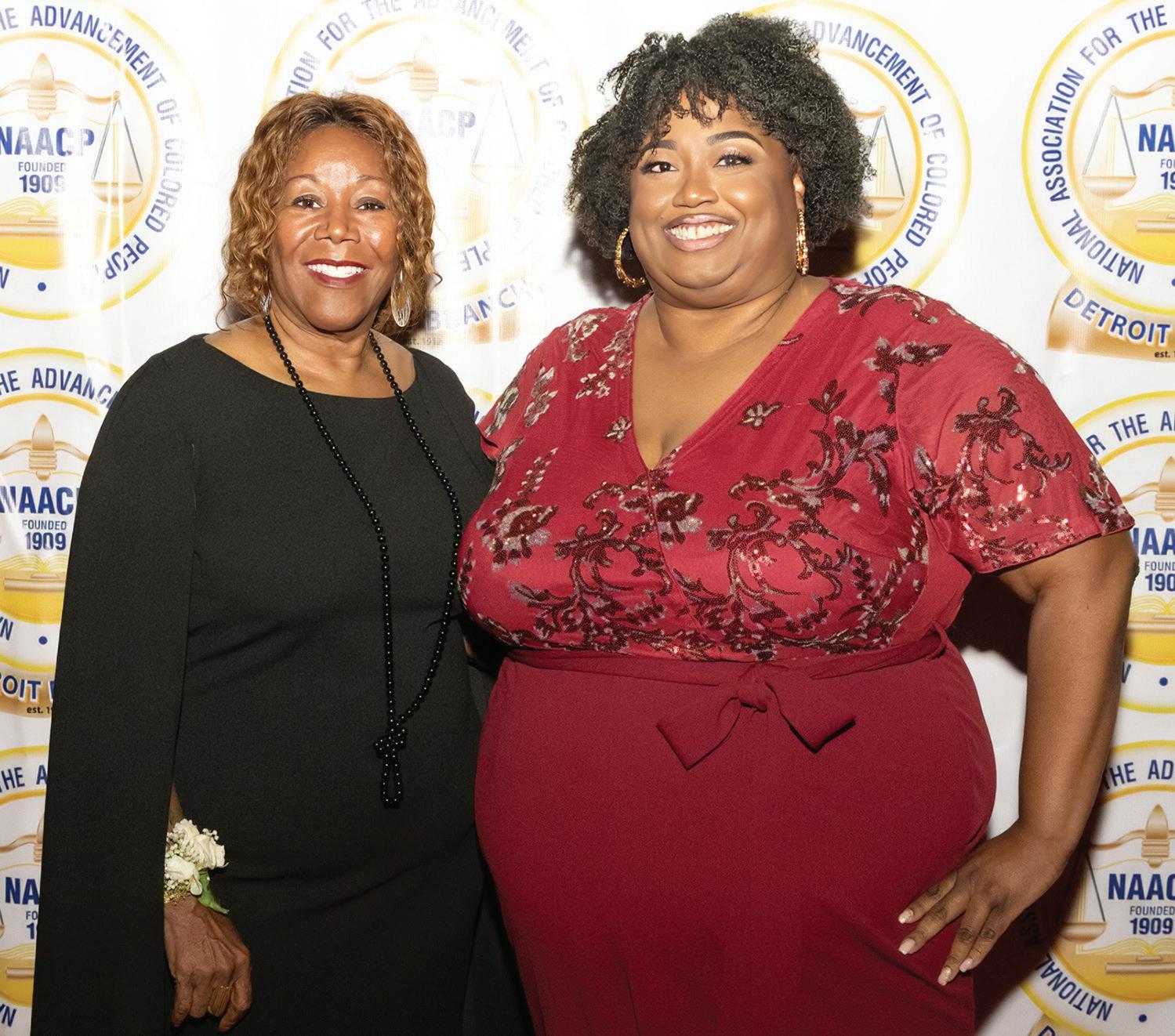
How Detroit NAACP’s Comms Director Takes Care of a 70-year Tradition – and Herself
By Aaron Foley EDITOR-AT-LARGE
In the span of about 15 minutes on the floor of Huntington Place, LaToya Henry has fielded dozens of inquiries from almost as many people.
Here in this controlled chaos, otherwise known as the Detroit NAACP branch’s annual Fight for Freedom Fund Dinner, Henry has an answer to everything thrown at her.
“Did that dignitary’s plus-one get their seat at the table?” “ Is the speaker that was MIA ever make it to the dais?”
“N-A-A-C-P or N-Double A-C-P?” “Have you seen whatshername, because whatshisname is looking for them.” “Do you have a second?” “Do you have a minute?”
“Where’s so-and-so’s plate of chicken?”
Henry, like other staffers working at this event, is one of the few in attendance wearing comfortable but still stylish footwear, as she and others every year are hardly ever stationary. They’re constantly scurrying in, out, and across the banquet hall and all spaces in between, addressing last-minute requests, fixing glitches the
public will never know about, and otherwise maintaining the status of the most important and longest-running Black events in Detroit – if not nationwide.
This year’s Freedom Fund dinner was the local branch’s 71st outing. Henry has been communications director for Detroit’s NAACP for 21 of those years, making her not only one of the branch’s longest-tenured staffers, but one of the few who know how to harness the power that both the chapter and its signature annual event hold.
“When you define social justice advocacy, and really start to understand public policy and how it impacts and shapes so many of the things that we have to do –on our life, [the NAACP] has a definite impact,” Henry says.
“And so when we say, ‘why is this this way? Or why does my neighborhood get this, and another neighborhood doesn’t?’
At the end of the day, the majority of the time, it’s connected to some public policy in place that keeps things the way that they are. I’m a big believer in working on public policy to make change.”
With thousands of guests each year,
the Freedom Fund dinner is unquestionably one of Detroit’s most well-attended events and is one of the most historic regular convenings of Black people anywhere. It would not be wrong to say that a distinguished guest list and a bevy of honorees puts this local NAACP event in league with the national organization’s annual Image Awards. Both events even have a red carpet in common, yet both events are intimate enough to feel like a family reunion.
But while the Image Awards will always be in the same conversation with other televised awards shows, the challenge for the Freedom Fund dinner each year is making sure it remains a conversation topic at all. The event has never left the calendar, but it has had to grow and adapt with Detroit over the last 70 years, a timeline that shows long, winding changes in the region’s racial, economic, and cultural identities, to short, almost overnight switches that can have just as much impact – building names, for one.
Henry notes that long before Detroit’s renewed interest in marketing itself as a
Southfield Mentors Take Summer Learning Off the Sidelines with Hands-On Camp and Community-Focused Vision
By Jeremy Allen EXECUTIVE EDITOR
On any given day, it’s easy to find programs that promise to keep kids busy for the summer. Fewer can say they’re building something that sticks long after the last day of camp.
In Southfield, a collaboration between Boys 2 Men Youth Mentoring and Love Our Kids Family and Community Project has created a summer experience that blends mentorship, life skills, and handson learning in a way that feels intentional instead of improvised, and they’re preparing for the next chapter in that legacy.
For Mark Watts, president of Boys 2 Men, the mission didn’t start with a summer camp. It started with a decision back in 2018 to step into the lives of young people and stay there.
they can mentor the next group coming up behind them. And every student who has matriculated through the mentorship program who is of age has graduate high school.
That kind of track record doesn’t happen by accident, and it’s part of the reason this summer’s camp is drawing so much attention.
Set to run from late June through early August, the five-week program is expected
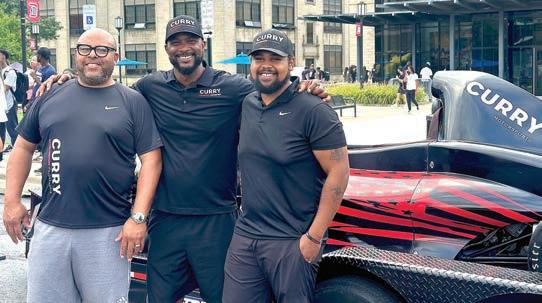
“This is a lifestyle,” Watts said. “My life changed in September of 2018 when I decided to take that leap of faith. And ever since then, it’s been a blessing.”
That leap has grown into a mentoring program that, by Watts’ count, has served more than 1,000 boys across Detroit, Southfield, Oak Park, West Bloomfield, and beyond. He doesn’t hesitate when talking about outcomes either. He calls it their “bragging right.”
None of the young men who’ve come through the program have been incarcerated. None have died. Those who’ve aged out have gone on to college or picked up a trade. Some are already circling back, asking how
to serve as many as 500 students, with capacity to reach even more. It’s open to boys and girls, with separate tracks planned for different age groups, and it’s completely free.
“We’ve been coming out of our own pocket to fund the camp since 2018,” he said. “We don’t get a lot of grants. We don’t get a lot of funding. But we make sure it happens one way or another.”
Beyond the scale of the summer camp, what makes it stand out is its structure.
Parents aren’t simply dropping off their children as a daycare program or to pass time. It’s a full-day experience running Monday through Friday from 9 a.m. to 5 p.m, with a curriculum that blends STEAM
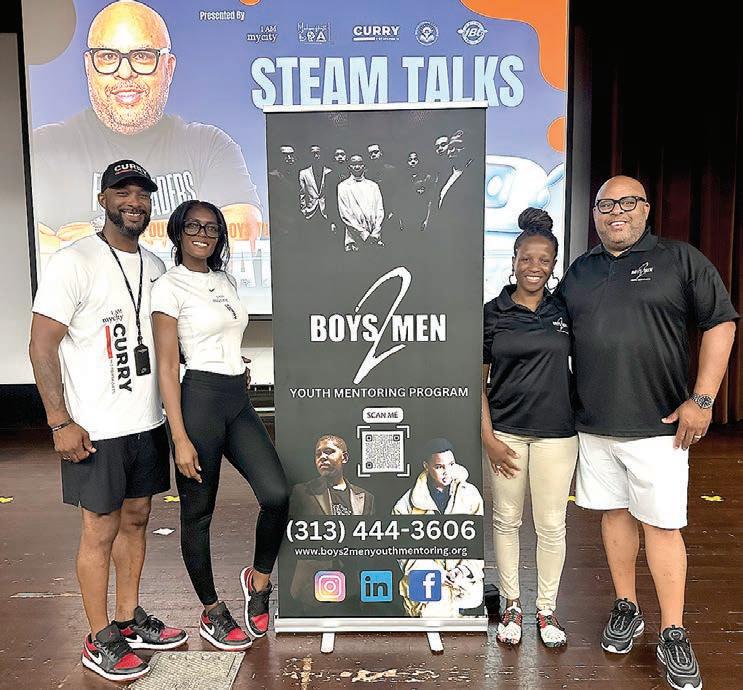
learning, mental health awareness, conflict resolution, and creative expression with motorsports – something you don’t often see in youth programming, particularly among Black youth.
That piece comes through a partnership with former Michigan Wolverine football player
See LATOYA HENRY Page B-2
Miss AJ Williams
Ruby Bridges and LaToya Henry: Photographer Andre Smith.
Southfield Mentors
lacked both visibility and access in Black communities. Curry has made it clear since he stepped into the motorsport’s world, though, that exposure is the bare minimum. Building confidence and problem-solving skills that translate far beyond the track is the real goal.
“When they have trouble, they don’t give up quick,” he said. “That’s what this is about. Teaching them how to work through things.”
That mindset shows up across the entire camp schedule. Students will rotate through activities that include drone piloting, 3D printing, podcast production, photography, and T-shirt design. They’ll learn how to silk screen their own apparel, record and edit audio, and capture video. They’ll also spend time outdoors hiking, exploring, and stepping away from the screens that dominate so much of their daily lives.
“We’ve got to get them off these devices,” Watts said. “Show them there’s more out there.”
For the youth attendees, Watts says they get excited about all the offerings, but admits that the motorsports component is arguably the most eye-catching part of the program. Plans include go-kart tracks set up on-site, build-yourown race car projects, and pit crew challenges designed to teach teamwork under pressure. Students will even take field trips to racetracks, getting an up-close look at a world many of them have never experienced firsthand.
For Dice Clark, founder of Love Our Kids Family and Community Project, the camp represents something deeper than a packed schedule of activities. It’s about shifting expectations.
LaToya Henry
From page B-1
convention destination, as of late, age-old Cobo Center marketing materials boasted to event organizers their ability to stage three large-scale events annually: The North American International Auto Show, the Society for Automotive Engineers’ world congress, and the Freedom Fund dinner.
Many years and two branding exercises later, Cobo isn’t Cobo anymore. The Auto Show – and if we’re keeping it real, much of the industry behind it as well – is a fraction of its former self. And while other big-name events have come and gone from the city’s calendar – TasteFest, we miss you –the Freedom Fund dinner is still served every year.
Some could argue, however, that while attendees and speakers recognize the significance of the event and the ticket sales to back it up, the Freedom Fund dinner somehow doesn’t have the same reverence as, say, Movement, the Fireworks, or the Thanksgiving Parade – the kinds of events elected officials and tourism agencies, whose words travel further than Cobo’s old media kits ever could, tick off when they’re trying to sell Detroit.
“It’s one of the things we talk about,” Henry says. “If you are from here, you might not necessarily all the time understand the commitment that people have to the dinner. You know how you hear some things are ‘Black famous?’ We want it to be more than Black famous.
“Every year,” she adds, “we get somebody who messages us and says ‘oh, it was my first time, I never knew.’ It’s not like we’re trying to bridge a gap. It’s more like bringing that awareness up.”
The media (“but not your publication,” Henry tells this editor) could do better in “not taking this for granted,” she says, noting that while the big, headline-grabbing names in the crowd can make themselves a news item within the event (see: the Rev. Wendell Anthony, president of the Detroit NAACP branch, choosing this year’s ceremonies to publicly endorse former Detroit Mayor Mike Duggan for governor, for instance), there’s a reason why this dinner itself is able to attract those big names in the first place.
“We’re not just meeting and doing all this stuff to have dinner. It has a purpose.”
In her time with the Detroit branch, Henry has had a frontrow seat to Detroit’s ever-evolving social and political identities while simultaneously working behind the scenes with an organization that can influence said identities. Along the way, she’s dealt with several folks in power and has learned to recognize who’s poised to lead, who’s better suited in another position, and who’s going to
Clark’s partnership with Watts came together organically, after years of hearing about each other’s work in the community but never quite connecting. When they finally did meet –during a podcast recording at Boys 2 Men’s Southfield headquarters – it didn’t take long to realize they were aligned.
“We’ve got too many organizations doing the same work separately,” Clark said. “We were tired of that. It was time to come together and really help these kids and families.”
That collaboration is part of what’s fueling the scale of this summer’s effort. It’s also a reflection of how grassroots organizations are increasingly pooling resources to create bigger, more sustainable impact.
Still, none of it comes easy. Pulling off a free program of this size requires constant hustle, partnerships, and a willingness to invest personally when funding falls short. Watts doesn’t sugarcoat that reality, but he also doesn’t dwell on it.
“You do it because it’s from the heart,” Clark added. “This is heart work. And when you’re doing God’s work, you make it happen.”
That same spirit carries into another major event on the organization’s annual gala, which serves as both a fundraiser and a celebration of the community that makes the work possible.
Now in its seventh year, the black-tie event has grown into a staple for supporters of Boys 2 Men and the broader network of partners they’ve built along the way. This year’s gala will take place in Southfield on Sunday, May 17, at the Radisson Hotel starting at 6 p.m. There will be full weekend of activities leading up to it, including a pre-gala car show
“We’re not just babysitting people’s kids for the summer,” Clark said. “When they leave this camp, they’re going home with something. They’re going to be able to say, ‘I learned this, I built this, I can do this.’ That’s the difference.”
crash and burn, all before these folks know it themselves.
“I always say don’t ask for primetime when you’re not ready for primetime,” Henry says. “A lot of times I notice that when people are out in front, they aren’t really ready for it because you have to know your stuff.”
She acknowledges the Rev. Anthony as an example of enduring leadership because “he is a student. He studies, he knows, and knows history, and he makes my job easy because he’s not just a face. This really is his thing.”
And it’s been a privilege, Henry says, to work alongside executive director Kamilia Landrum, who was president of the Detroit NAACP’s youth council when they were both teenagers – Henry at Renaissance, Landrum at Cass Tech, “but that’s OK,” the Phoenix laughs, noting she and the Technician both ended up becoming Rattlers. “She went to FAMU, so she made up for it.”
Having to interface with executives and elected officials yearround, but especially in the rampup to dinnertime, Henry says she’s dealt with her fair share of big egos. “I can’t remember who said it, but they said you have to have a certain amount of ego to want to run or be in those positions.”
But surprisingly, conflicts are minimal behind the scenes. There may be some public spats or jabs over disagreements over ideology, but “they’re doing those things to generate attention,” Henry says. “You may see people, and it looks like they are not in agreement with somebody, but most of the time, people are really getting along.”
Unsurprisingly, before this year’s festivities even wind down, an agenda for an event of the Freedom Fund dinner’s scale is already in the planning stages for the year ahead. A date has been set for 2027’s affair, Henry says, and the rush for booking speakers is already underway.
There are some action items that never change, even if the venue doesn’t, such as double-checking accommodation for attendees who are differently abled. And then there are the decisions the public may not even think twice about, such as a food tasting well before each dinner to determine the year’s menu.
There’s always the underlying significance of the event itself, which began in 1954 as a challenge to raise as many funds for the NAACP as possible. In recent years, as more and more new things – and people – come to Detroit, there is the added significance that the dinner isn’t just a reflection of the organization, but the city and the population it represents. It has to look good.
It’s a good thing, then, that Detroiters themselves make looking good seem effortless. Per the Chronicle’s archives, the first-ever Fight for Freedom Fund week


designed to bring the community together in a more casual setting. Inside the main event, the focus will shift to storytelling and recognition. Local artists will showcase their work, with live painting sessions adding an interactive element to the evening. A live band and curated dining experience featuring local restaurants will round out the atmosphere, but the
kicked off with a fashion show, and attendees have been on the runway ever since. Now, whether everyone is on the same runway is another question, because although it’s largely understood that the Freedom Fund dinner calls for dressy attire, everyone’s definition of dressy isn’t the same.
Henry points out why brocade, bodycons, and baby-shower Burberry might all show up on the same red carpet.
“When I first started, I was intrigued because the tickets for the dinner were a split ticket; you could not buy a single ticket, you had to buy the ticket with somebody. And it used to say on there ‘semi-formal.’ And so yes, everybody was dressed to the nines. When I look at the old photos, I love that.”
The split-ticket practice ended, and individuals have long been able to go solo, but somewhere down the line, the “semi-formal” language dropped off.
“Times have changed. And we do occasionally get questions [about attire], and we always say, ‘dressy,’ ‘dressy-after-5,’ ‘cocktail hour.’ Now there are some people that are going to come in a ball gown, there are some people that are going to come in a tuxedo. We always say, ‘dress up because you never know who you might meet or what might happen – make an impression,’” Henry says.
That said, “We don’t stop anybody at the door if they have on jeans.”
In 2020, there was no suggested wardrobe. Amid the COVID19 pandemic, the Detroit NAACP chapter moved all Freedom Fund festivities online, something Henry said was a turning point in the dinner’s history since every year since has had an added directive of restoring and maintaining pre-pandemic attendance numbers. 2020 was also a life-changing year for Henry herself, after almost succumbing to the virus that put her into a coma for five days and several more on a ventilator.
“I used to want to be this super career-driven person,” Henry says. “[COVID] made me really appreciate time and doing things with intention. I spend time with the people I want to spend it with and do things with intention, because you never know.”
That sentiment extends to her role with Detroit’s NAACP: Taking on the public responsibility in helping preserve one of the city’s oldest surviving traditions while recognizing that, like any good leader, taking responsibility in preserving oneself is just as necessary.
“It’s exhilarating. It’s stressful. But then once it happens, it’s always a magic moment. It’s always something majestic,” Henry says. “But, you know -- I say, ‘I ain’t gonna be doing this forever.’ One day I want to be a guest and just sit down eating my plate of chicken.”

heart of the night will be the honorees.
“We’re giving out 13, possibly 14 awards this year,” Watts said. “These are people who are really doing the work in the community. Connectors. Trailblazers.”
Some of those moments, he admits, tend to get emotional. The gala honors and recognizes the kind of behind-the-scenes impact that often goes unnoticed. Mentors. Parents. Community leaders. Even his own mother will be among those honored this year, a nod to the personal roots of the work he’s built.
The gala also doubles as an opportunity to invest directly in the next generation, with scholarships awarded to graduating participants in the program.
It’s a full-circle moment that underscores what sets Boys 2 Men apart. It’s about building a pipeline, Watts says – one that starts with exposure and support, and ends with young adults who are prepared to step into their own purpose and, in many cases, come back to pour into others.
Back at the summer camp, that philosophy will be on display
every day, from the morning sessions to the afternoon activities, and especially during the daily “TED Talk”-style gatherings where guest speakers will share their stories with students. And the kids will be fed well throughout the day, as chefs will be there to prepare meals directly from their kitchen and from the Boys 2 Men Food Truck which will be onsite.
“You never know what’s going to stick with a kid,” he said. “Sometimes it’s just hearing somebody who looks like them, who’s been where they’ve been, and seeing what’s possible.”
As the start date approaches, registrations are already rolling in, partnerships are expanding, and the vision continues to grow. There’s talk of additional athletes getting involved, new programming being added, and even more opportunities on the horizon beyond the summer.
But for now, the focus is to create an experience that leaves an imprint.
To register for the Black Tie Affair or to sign up your child for the summer camp, visit Boys2MenYouthMentoring.com/event.
Reclaiming Feminine Energy
not just physical, though the body feels it. It is the stress of keeping up an inner structure built for survival, even when life has changed. It is important to emphasize that Black women did not hide their softness by accident. It was a smart way to protect themselves. Showing emotion could be used against them. Being vulnerable could lead to being taken advantage of. Showing need could bring harm. In those situations, building a self that was hard to reach was not a problem—it was a strategy. The armor was not simply chosen; it was built from learning what the world rewarded and what it punished.
Reclaiming softness means asking — Does the armor that once protected you still help, or does it now hold you back from feeling whole and connected? Moving forward is not about blaming the need for protection, but about asking what you need to truly thrive now.
Softness, in its truest form, does not take away from strength. It completes it. If you cannot receive, you can only give until you are empty. If you cannot soften to hear your intuition, you lose touch with your own inner signals, the ones you notice only when you are quiet inside. The firmness that once protected you can slowly become a prison you cannot see. Noticing this is not the same as changing it right away. Like most inner work, it starts with being honest about what is really there.
Not just the part of you that keeps going, but the part that is tired.
Not just the identity that seeks approval, but the part that remembers what it wanted before learning to settle for less.
This is where reclaiming begins. It does not start with routines or discipline. It starts with honestly seeing what has been pushed away. Think about what it would mean to stop seeing your own tenderness as something that needs to be fixed.
AJ Williams is a Spiritual Wellness Architect and Educator and the Managing Editor of the Michigan Chronicle. A thought leader at the intersection of spirituality, astrology, psychology, and identity evolution, she is the founder of Sunday Communion, a quarterly live transformation experience held in Detroit. The Inner Architecture is her editorial column on the work of becoming.


From page B-1
Sunday, May 17 | Radisson Hotel
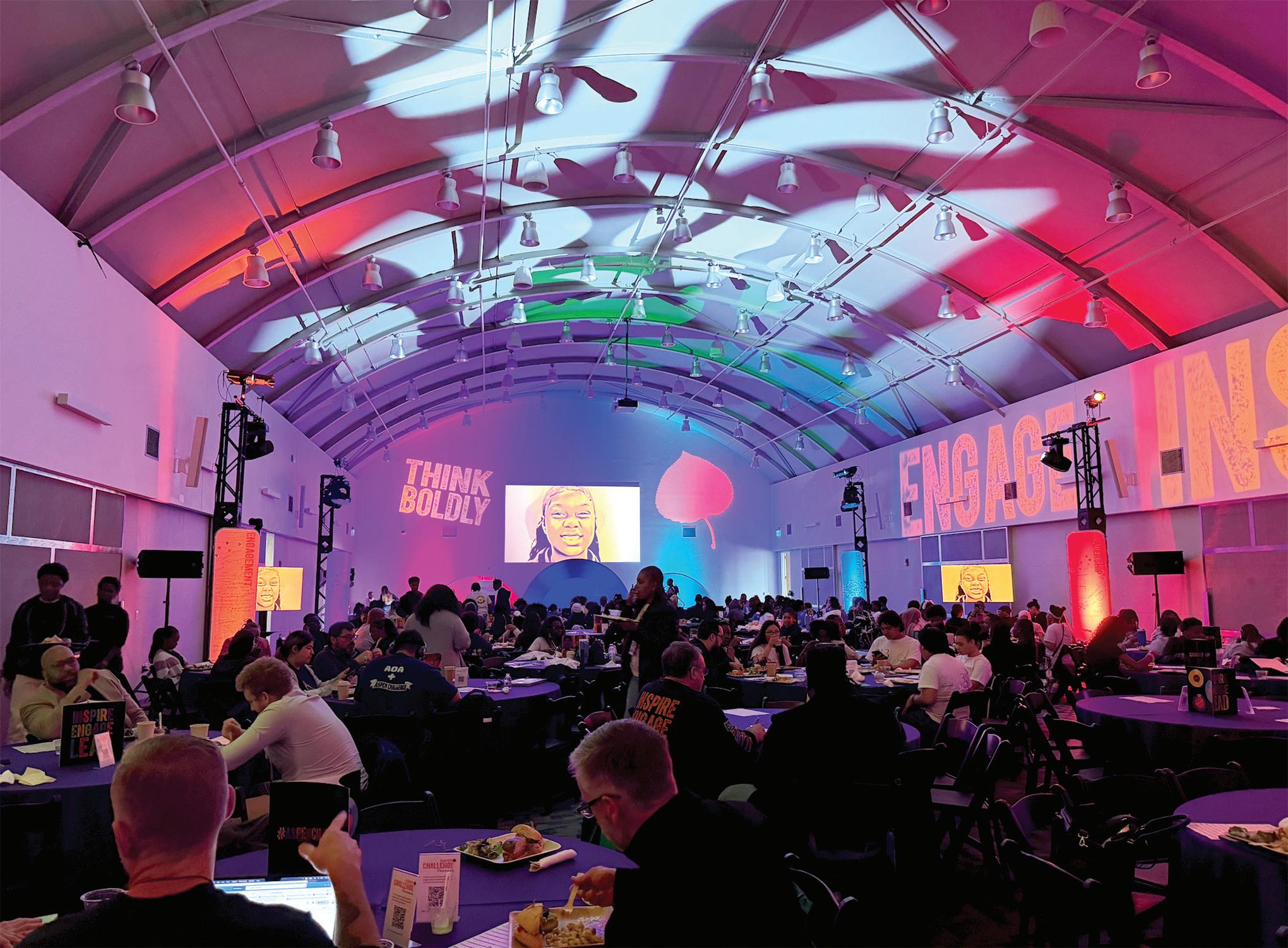
DPSCD Students Turn Aspen Challenge Into a Blueprint for Detroit’s Future
By Jasmine West
Detroit students walked into the College for Creative Studies with ideas shaped by their neighborhoods, their schools, their classmates, and the urgent needs they see every day. They did not come simply to compete. They came with plans for safer spaces, stronger student support, food access, substance use prevention, community healing, and youth-led solutions rooted in the realities of Detroit life.
The Aspen Challenge Detroit concluded its inaugural year on Tuesday, April 28, with its culminating Solution Showcase, held in partnership with Detroit Public Schools Community District. The event brought together student teams from more than 20 DPSCD high schools to present projects addressing some of the city’s most pressing social and economic challenges before a panel of local civic, nonprofit, and community leaders.
The Showcase served as one of the district’s April “Beautiful Things” moments, placing student brilliance, leadership, and voice at the center of what public education in Detroit can produce when young people are trusted with real problems and given space to build real solutions.
Top-performing student teams will receive an all-expense-paid trip to the Aspen Ideas Festival in Aspen, Colorado, this June, where they will present their solutions before national audiences and festival attendees.
Throughout the Aspen Challenge, student teams spent several weeks researching community problems, designing projects, working with peers, and preparing six-minute presentations. Their topics included substance use, food insecurity, student voice, smoking and vaping, community safety, and other challenges affecting young people across Detroit.
For DeAndre Follower, a ninth-grade student at Central High School, the challenge became a way to think about what safety means for students who may not always have it at home.
“It’s important for my community because some people don’t got safe homes and we wanted to create a safe space for them and other kids,” Follower said. “We just wanted it to be a safe space for kids who don’t got a safe space at home.”
Follower said his team’s project focused on creating a “safe haven” for high school students, with activities, overnight support, and a feeling of belonging.
“Basically, you got all these activities you could be a part of,” Follower said. “It’s a place where you can stay overnight. It’s basically a home away from home. But a better home.”
His classmate, Kenya Wyatt, also a ninth-grade student at Central High School, described the team’s work as part of “Travelers for Purpose, Travelers for Change,” a project grounded in the belief that students need places where they can feel protected, understood, and supported.
“We want to have kids who’s in high school have a safe space for everybody,” Wyatt said. “Everybody needs a safe space, but for kids, especially. I think that when kids want a safe space and need a safe space, even if they don’t have a safe space at home, at school, you could also have the same space here.”
Wyatt said the Aspen Challenge also teaches students how to come together
around shared concerns and build from there.
“You could come into a group or can make your own group, and also how to have a safe space, how to acknowledge other people, how to inspire people, how to inspire others, and come together as a family,” Wyatt said.
The Aspen Challenge, operated through the Aspen Institute’s Center for Rising Generations, has been running for about 17 years. DPSCD is the program’s 14th school district partner.
Kaya Henderson, executive vice president and executive director of the Center for Rising Generations at the Aspen Institute, said the program is designed to give young people the civic and leadership tools needed to solve problems they understand firsthand.
“The Aspen Institute is a think and do tank that focuses on bringing people together for civil discourse, for leadership development, and to solve the greatest problems of our time,” Henderson said. “I lead the Center for Rising Generations at the Aspen Institute, which our goal is to ensure that young people, 14 to 24, have opportunities to learn civil discourse, to participate in leadership development, and to engage civically.”
Henderson said the Aspen Challenge asks community leaders to identify urgent issues, then gives students time, resources, and coaching to develop solutions. Each student team receives $500 to work on its project during the nine-week process, and students are also paid for the time they spend participating.
“This is an opportunity to bring young people together to solve problems for their community that are identified by community leaders,” Henderson said. “It’s a really nice way to bring community champions to put big problems in front of kids, problems like food insecurity, or substance abuse, smoking and vaping, or student voice.”
For Henderson, the most powerful part of the Detroit showcase was watching young people move from concern to action. Students had to engage their peers, conduct research, build a project, work as a team, and present under pressure before judges from Detroit and beyond.
“They have to engage with their peers. They have to do research around a project, and they have to put together a six-minute presentation in front of a slate of judges,” Henderson said. “Some of whom are from Detroit, some are not, so they’re from all over the country. And they present the solutions that they came up with as a team.”
The judging panel included Mannone Butler, head of programs and partnerships for the National Basketball Social Justice Coalition; Chris Economeas, senior director of community and social responsibility for the Detroit Pistons; Justin Flynn, senior associate with Business Leaders for Michigan; Ambra Redrick, CEO and co-founder of Teen HYPE; Courtney Smith, CEO of Phoenix Center; and Ebony Walls, CEO and sports philanthropist with Be A Part of Me Consulting.
Walls said the experience underscored the power of listening to students as problem-solvers, especially when their presentations connected directly to lived experience.
“Today I had the honor to help change the lives of DPSCD students for the better, forever as two teams will be selected to move forward to the national Ideas Day in Aspen
this June,” Walls said. “At BAPM Consulting we believe the greatest good you can do for youth is not just share your riches with them but reveal to them their own.”
Walls said the student teams brought policy concerns down to the human level, particularly during presentations about gun violence and community safety.
“I believe that’s what myself and my fellow judges did today by reassuring all 24 DPSCD teams that they each possess the solutions to our nation’s greatest problems,” Walls said. “These students successfully brought the humanistic element to school and local policies. I was brought to tears when I asked what was their personal connection to their gun violence theme, as I too lost my little brother to senseless gun violence.”
One moment stayed with Walls. A Marygrove student placed her hand on a teammate’s shoulder during a presentation. When Walls asked why, the student explained that her classmate deals with anxiety, and she wanted her to feel supported.
“She gracefully explained to me that her classmate deals with anxiety and she wanted her to feel supported so before they walked on the stage she told her, ‘anxiety fail me now,’” Walls said.
Those moments showed why the Aspen Challenge matters inside DPSCD. Students were asked to compete, but the day also revealed how they support one another, how they process trauma, and how they imagine a better Detroit from the perspective of young people living inside the city’s challenges.
Henderson said one of the day’s strongest lessons came from a team of six students, where only two showed up to present. Four teammates decided not to attend because they were not confident in the presentation. The two students who remained still took the stage.
“One of the most profound things that happened today is there was a team of six, and four of them decided not to show up today because they were not confident in their presentation,” Henderson said. “But the two left over came and they presented, even though it wasn’t all that it was cranked up to be, but the way this crowd cheered for them, encouraged them, and, you know, we all have times where you’re at work and your group doesn’t show up for you. And you still have to go on.”
Henderson said the students’ courage became its own lesson, one that may last beyond the awards.
“Those kids were confident and resilient,” Henderson said. “And this room of young people rewarded that. And I think that’s going to be more important than even who the winners are.”
DPSCD Superintendent Dr. Nikolai Vitti attended the morning portion of the showcase and spoke about the skills students were building through the challenge. Those skills reach beyond one event or one competition.
“We believe in you,” said Vitti as he spoke to the crowd of over 300 people. “You are all sitting here because you are leaders and your voice matters. You were selected to participate for a reason. Your teachers and principals see something special in you. I understand you have been working incredibly hard in the past 9 weeks to make real change in your communities. You’ve developed solutions to big, real-world problems plaguing our city, country, and the
world. The experience you have gained here through the Aspen Challenge will serve you well in the future. Now, I know there will be some nerves in the room as you take to the stage to present your work but know that we are incredibly proud of how much you have all accomplished in this short timeframe. More importantly, your families, teachers, and all of us here today believe in all of you and your brilliant solutions. Two of the teams sitting here today will go to Aspen Colorado to represent the city of Detroit on the global stage of the Aspen Ideas Festival. Let’s show the world what you are made of!”
“All of these skills that they’re learning here, how to work in a team, how to solve problems, how to do research, how to engage stakeholders, how to present, are all great skills, not just for college, but for career,” Henderson said.
For DPSCD, the Aspen Challenge fits directly into the district’s broader commitment to highlighting “Beautiful Things” taking place across its schools during April. The Showcase gave students a public platform to demonstrate that learning does not stop at the classroom door. It reaches into neighborhoods, families, school hallways, and the systems young people navigate every day.
The day’s top honors went to two DPSCD student teams whose projects showed the range and urgency of youth-led problem-solving across Detroit.
Henry Ford High School was named a grand prize winner for “Disconnect to Reconnect Detroit,” a project addressing substance use and the need for healthier choices, stronger peer support, and deeper community awareness among young people.
Detroit International Academy for Young Women also earned grand prize recognition for “The Pink Planters,” a project focused on food insecurity and the importance of creating student-centered solutions around access, nourishment, and community care.
Additional awards recognized the strength of student leadership across the district.
The School at Marygrove received the Collaboration Award for “The Grove,” a food insecurity project. Crockett Midtown High School of Science and Medicine earned the Community Engagement Award for “Midtown Market Movement,” which is also focused on food insecurity. Western International High School received the Originality Award for “Truth Tellers,” a substance use project. Academy of the Americas received the Resilience Award for “Socius Soteria,” a digital wellness platform.
Henderson said the Center for Rising Generations believes leadership grows with practice.
“At the Center for Rising Generations, we believe that leadership is like driving,” Henderson said. “The more you do it, the better you get at it. And so we want to give our kids as many at bats at leadership as we possibly can, so that when it’s their moment to lead, they have the skills and experiences to do that.”
Tuesday’s showcase made one thing clear.
DPSCD students are already leading. They are naming the issues. They are designing responses. They are standing before judges, peers, educators, and civic leaders with ideas born in Detroit and built for Detroit. The trip to Aspen may be the prize, but the work they brought to the stage is already part of the city’s future.
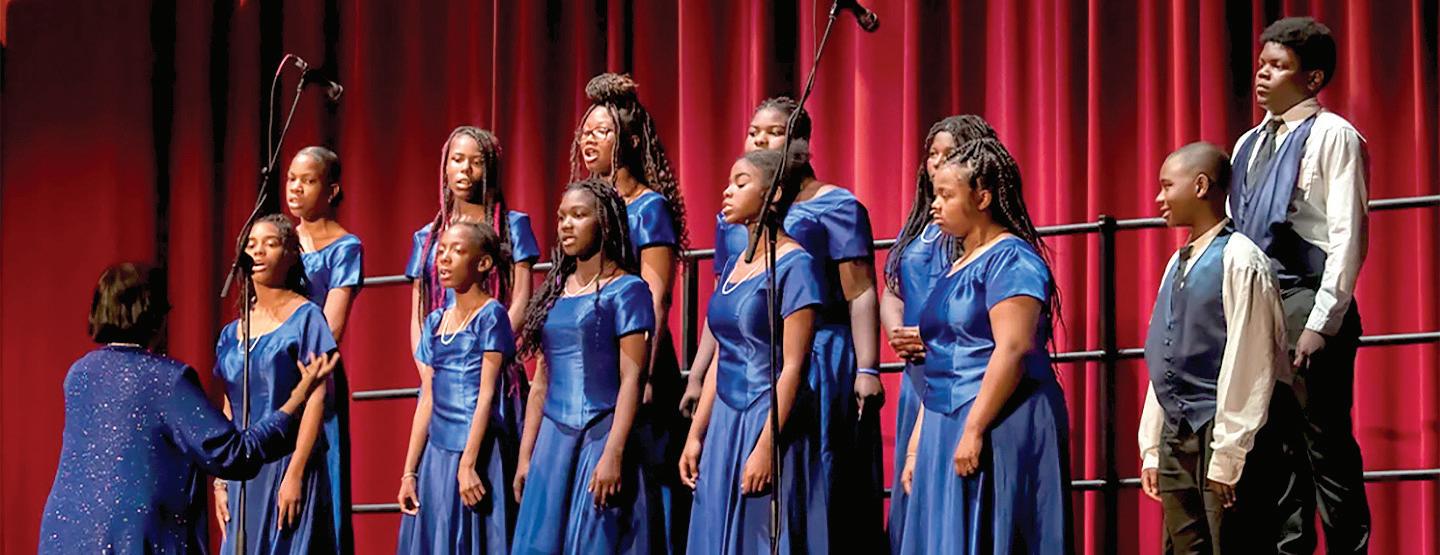
Detroit Students Prepare to Take the Fox Theatre Stage for An Evening of Fine Arts
By Jasmine West
Detroit’s young artists are preparing for a night that places their talent, training, and creative voice on one of the city’s most historic stages.
Detroit Public Schools Community District will present its 57th annual An Evening of Fine Arts on Wednesday, May 6, 2026, at the Fox Theatre, bringing together some of the district’s most talented student performers and visual artists for a free showcase that continues a longstanding DPSCD tradition. Doors open at 5 p.m., with a preshow performance leading into the main
program at 6 p.m.
This year’s showcase will feature 27 performances and 26 student visual works of art, offering families, educators, community members, and arts supporters a full look at the creative strength being cultivated across the district. The evening will include student artwork, a jazz trio, choir performances, and a preview from the musical Once on This Island.
For Andrew McGuire, deputy executive director of Fine and Performing Arts for Detroit Public Schools Community District, the showcase represents far more than one night of performance. It reflects a Districtwide commit-

Delta Manor to Host “Jazz at the Grove” Fundraiser to Support Senior Media Arts Center
By Jasmine West
Delta Manor, a longtime senior housing residence rooted in service and legacy, is turning to the community for support as it prepares to host a fundraiser aimed at expanding resources for its residents.
The nonprofit, established in 1983 by the Property Task Force of the Detroit Alumnae Chapter of Delta Sigma Theta Sorority, Inc., operates a seven-story building in downtown Detroit that houses 99 seniors in one-bedroom units. Now, its board is working to raise $25,000 to create a Multipurpose Informational & Technological Media Arts Center inside the facility—an addition designed to increase access to technology and information for residents.
To support that effort, Delta Manor, Inc., a 501(c)(3) nonprofit housing corporation, will host “Jazz at the Grove,” a fundraising concert scheduled for Thursday, May 7, at 7 p.m. at the Marygrove Theatre, located on the campus of Marygrove College at 8425 W. McNichols Road.
The event will feature pianist Demetrius “Krayon” Nabors, a Grammy-nominated jazz producer and performer, along with special guest Randy Scott, a Billboard No. 1 jazz saxophonist. Organizers say
the evening will also include a silent auction, with proceeds going directly toward the proposed media arts center.
The planned center is intended to serve as a shared space where residents can access digital tools, information, and programming that support day-to-day living and connection. Leaders behind the effort say the addition would build on Delta Manor’s long-standing mission to provide a safe and supportive environment for seniors.
Ticket sales will help drive the fundraising goal. General admission tickets are priced at $50, while VIP tickets, which include preferred seating and a swag bag, are available for $75. Tickets can be purchased online.
Community members seeking more information about Delta Manor or the fundraiser can contact board member Sharon Clark-Woodside at (313) 9204785 or by email at sharonclarkwoods@aol.com.
The May 7 concert is expected to bring together residents, supporters, and members of Detroit’s broader community for an evening centered on music and giving, with a focus on strengthening services for seniors who call Delta Manor home.
ment to ensuring students have access to the arts and the space to develop their craft.
“We are here to show off and showcase and show out all of the student voices that’s being raised in that performance,” he said. “The excitement is really, really loud. It’s really, really big. The students have been preparing for months and months and months for this day that’s coming up.”
DPSCD’s annual arts showcase is supported through partnerships with Comerica Bank, 313 Presents, Olympia Development, Ilitch Sports + Entertainment, and the City Office of Arts, Culture and Entrepreneurship. Those partnerships help elevate a student-centered program that places young Detroit artists before a broader community audience.
McGuire also credited the district’s leadership for maintaining fine and performing arts as a priority across DPSCD schools.
“I’m so happy, so grateful for our board and superintendent for instilling and ensuring that we maintain the fine and performing arts in all Detroit Public Schools Community District schools,” McGuire said. “That makes this possible, and it carries on. It anchors our legacy and ensures that we carry it on beyond us.”
For students, the Fox Theatre stage offers a professional experience that can shift how they see themselves and their futures. McGuire said the event gives students room to explore their voice, develop confidence, and understand their place within Detroit’s broader creative legacy.
“The Evening of Fine Arts offers our students the opportunity to be on a stage in the larger sense of the community, in our Detroit community,” he said. “This gives them a launching board into whatever they choose to do next, and it gives them the presence and the space to explore their voice, to really be out into their craft, in our community, in our city.”
That legacy can be seen across Detroit and beyond. McGuire pointed to the many DPSCD alumni who have gone on to perform on major stages, join touring productions, play in jazz clubs, contribute to musical theater, and display work in gallery spaces.
“You’d be hard pressed to find a stage without a Detroiter on it from Detroit Public Schools Community District,” McGuire said. “This event is that space that gives the students the opportunity to be on a larger stage in preparation for what happens later.”
At Detroit School of Arts (DSA), students preparing selections from Once on This Island are learning what it means to bring discipline, collaboration, and courage into performance. Jen Leha, a theater instructor at DSA, said the opportunity to perform at the Fox Theatre gives students an important step beyond the school stage.
“I’m really thrilled to have our kids performing on the Fox The-


atre stage again,” Leha said. “It’s a wonderful step up from our stage to a huge professional stage, and they are ready for it.”
Leha said DSA has seen students move from school productions to the Evening of Fine Arts and then into conservatories, college programs, and professional creative spaces. She named former students now training and performing beyond Detroit, including Mark Bonnie, a Sutton Foster Award winner, and Jemiah, a student studying vocal performance.
“That’s just a few of our students who are out doing great things in the performance world, who started here on the DSA stage and went on to EFA and then to even bigger and better things,” Leha said.
The work behind the performance is demanding. Students preparing for musical theater must learn how to sing, dance, and act at the same time while carrying the emotional weight of a story. Leha said that the level of preparation teaches students what it means to commit to the rehearsal process and the discipline of performance.
“Preparation is actually the hardest part,” Leha said. “As my assistant director and choreographer, Nadia, says, ‘If you don’t love the rehearsal process, you don’t love theater.’”
Students rehearse for 10 hours each week, building the endurance and skill needed for a professional-level performance. Leha described the production team as a “varsity team” because of the range of talent required.
“They have to work so hard,” Leha said. “They don’t just master vocal performance. They don’t just master dance performance. They don’t just master theater performance. They have to do all of those things together.”
For Leha, one of the most meaningful outcomes is watching students grow in confidence through the process.
“The preparation is very intensive, but by the end, they’ve built a level of confidence in their performance skills that is quite beautiful to see,” she said. “Actually, incredibly inspirational.”
For freshman student Katani, being part of the ensemble in Once on This Island means helping tell the story from the inside. Katani said the ensemble serves as storytellers who help guide the audience through each scene and carry the emotion of the production.
“The storyteller’s job, you’re telling, ‘This is what happened, and this is how everybody reacted to it,’” Katani said. “You’re giving the emotion, and then the rest of the cast, that’s what they decide how they’re going to pick up off of what you’re saying.”
Katani said attending Detroit School of Arts has helped open doors to performance opportunities, including the chance to be part of An Evening of Fine Arts at
the Fox Theatre.
“Being at DSA, it helps to transform my life from places like the Evening of Fine Arts at the Fox, and it really gives a lot of opportunities,” Katani said. “Being at DSA really helps with that a lot.”
Asked where they see themselves in the future, Katani said she hopes to continue growing as an artist, whether on stage, behind the camera, or in front of one.
“I hope to be on a bigger stage,” Katani said. “Maybe behind the camera or in front of a camera, somewhere on stage where I’m showing my talents.”
For student performer Amyre McCoy, theater has become a place of purpose and joy. McCoy said they did not always see themselves as a theater performer, but that changed after their first musical.
“When I was younger, I did not like theater for a very long time,” McCoy said. “But the first musical I did, it just filled me up with love.”
McCoy, who performs in Once on This Island, described the production as one of the best musical experiences she has had.
“This is one of the best musicals I’ve ever done, personally,” McCoy said.
In the production, McCoy plays the goddess of love, a role they said reflects the kind of person they hope to become.
“To me, she’s like a representation of what I want to be,” McCoy said. “Spreading love, helping others, giving the example of how people should treat others. No matter if it’s evil, no matter if it’s bad, or if you’re just feeling down, there’s always love there. There’s always good in the bad.”
When asked where she hopes to be in five to ten years, McCoy answered with the confidence of a student who has already begun to see the stage as home.
“Probably on Broadway,” McCoy said. “Probably performing or just following my dreams.”
McCoy also offered a message to younger students who may be interested in the arts but are unsure whether they should take the leap.
“Do not hold back,” McCoy said. “There’s going to be so many people that’s going to tell you you can’t do this. There’s going to be so many haters that tell you you don’t deserve this. Do not listen. You are beautiful. You are perfect, you are just the way you are.” That message captures the spirit of An Evening of Fine Arts. The annual showcase gives students a platform, while also reminding Detroit what can happen when young people are given access, training, encouragement, and a stage worthy of their talent.
DPSCD’s An Evening of Fine Arts will take place on Wednesday, May 6, 2026, at the Fox Theatre. The event is free, and tickets are available now.

Demetrius “Krayon” Nabors
Randy Scott
LISC encourages submissions from SBEs, MBEs, and WBEs.
REQUEST FOR QUOTES
The Suburban Mobility Authority for Regional Transportation (SMART) is soliciting RFQs for Pre-Employment, Drug, and Alcohol Screenings Control No. 23-3659. RFQ forms may be obtained beginning October 19, 2022, from http://www.mitn.info. RFQs are due by 3:00 PM ET, November 11, 2022


1 under RFP 23-0111.
Pre-Proposal Conference will occur at 10:00 a.m. October 21, 2022.
1 313-462-2305 Conference ID: 944 369 237# https://tinyurl.com/yfm35pw5 The due date for Proposals is November 10, 2022 at 12:00 p.m. If you have questions, please contact the Procurement Department at (313) 873-6531.


You
Your Medicare ROADMAP

incl. wire, terminals, connectors, coverings &attachments, using Tc Vismockup, ECM, ECR, &Auros tools. Design &release electrical wire routing &packaging syss to ensure proper functioning of electrical modules such as OnStar, LRR, cybersecurity syss, &other required vehicle electrical syss for AV. Ensure that electrical harness routings meet U.S. FMVSS. Apply GD&T, CAE, DFM/A, DFMEA, DRBTR, Red X, DFSS processes to design &validate wiring harness branch points for multi-branch harnesses, pin level, cavities, size, &thermal resistance specs &rqrmnts. Bachelor, Electrical or Automotive Engineering, or related. 60 mos exp as Engineer, engineering, releasing for production, &continuously improving conventional psngr vehicle &BEV electrical wire routing &packaging syss, &multi-branch wiring harnesses, using Tc VisMockup tool, or related. Mail resume to Ref#3882, GM Global Mobility, 300 Renaissance Center, MC:482-C32-C66, Detroit, MI 48265.
What to Know Before You Turn 65
Sixty-five is more than a number. It’s a milestone. A moment to reflect on where you’ve been and look forward with confidence to what comes next. For millions of Americans, turning 65 also means unlocking one of the most valuable benefits you’ve earned: Medicare.
The best is still ahead, and it starts with knowing your options. The official source for Medicare information, Medicare.gov, is here to help with clear, trusted information.
Must be able to style all hair textures but, preferably Black Hair textures. Rania’s Hair Salon inside Royal Oak Manor Co-op Apts., A Senior apartment building located at 606 Williams St., Royal Oak, MI 48067. Applications are available in the Royal Oak Manor office Mon-Fri from 9:00-12:00 pm. Call (586) 610-9203 with questions and to schedule interview. Please bring examples of your work. We are hoping to fill the position soon.
The path to Medicare is not the same for everyone. Some people get Medicare automatically and others have to sign up. It depends on whether you are already getting Social Security. Either way, you’ll want to choose how you get your Medicare coverage.
Get information for your path at Medicare.gov, where you can find out when and how to enroll and explore your coverage options.
Understanding Your Medicare Coverage Options
DECLARATION OF NON-CITIZEN NATIONALITY
Asked, Eye Doctors Answer: Common Eye
Health Questions Explained
(StatePoint) If you’ve ever turned to the internet with a question about your eyes – whether it’s dryness, blurry vision, or an unexpected eye twitch – you’re not alone. Eye doctors hear these same questions from patients every day.
To help separate fact from fiction during Healthy Vision Month, VSP network doctors Bradley Grant, O.D., of VisionPoint Eye Center in Illinois, and Sonia Chung, O.D., M.Ed, medical director of TSA at Visionworks in Arizona, answer the top questions being asked online and in the exam room.
Why are my eyes always dry?
&develop 3D Class A surfaces of ICE, diesel, BEV &AV full vehicle psgr car, truck &SUV exterior cmpnts incl. front &rear fascias, grills, head/taillamps, doors, fenders, ABCD pillars, skid plates, liftgates, truck beds &detailed exterior cmpnts incl. door handles, mirrors, lamp internals &exhaust tips, using Autodesk Alias AutoStudio, Autodesk Maya, NX &VRED tools, for U.S., global &emerging markets. Interpret, define, conceptualize &execute unique solutions to technical challenges &provide creative proposals to capture design intent from initial concept thru mass production achieved in various stages according to GVDP, while collaborating with engrg, packaging, human factors, &tooling teams to assure minimum radii/draft, tooling &safety reqrmnts in compliance w/ U.S., European &China standards. Bachelor, Transportation or Industrial Design. 60 mos exp as Digital Sculptor, Digital Modeler, or related, designing or developing 3D Class A surfaces of full vehicle psgr vehicle exterior cmpnts incl. fascias, grills, head/taillamps, doors, fenders, ABCD pillars, &liftgates, using Alias AutoStudio, NX &VRED tools, for U.S., global &emerging markets, or related. Mail resume to Ref#1827-201, GM Global Mobility, 300 Renaissance Center, MC:482-C32-C66, Detroit, MI 48265.
Senior Design Release Engineer –Fuel Systems (FS) & Evaporative Emission Control (EEC) System Warren, MI, General Motors. Engineer, design, &develop FS &EEC syss, incl. fuel tanks/lines/ vapor transfer lines, emission control canisters, &filler pipes for psgr vehicles incl. Premium Luxury/Mid-Size Cars &Large psgr &Cargo Vans, &Incomplete truck) prgrms, according to vehicle program timing rqrmnts, from concept to production, &aligned to meet performance, safety (U.S. FMVSS), &strict technical ®ional rqrmnts &standards, using NX, Tc, Tc Vismockup, ETAS INCA, &ECM tools. Conceptualize, design, validate &release engine FS &EEC sys cmpnts to meet SSTS of propulsion system projects. Benchmark critical emission control technologies &recommend fuel injection HW to meet emission EPA &UNECE regs. Master, Mechanical or Automotive Engrg. 36 mos exp as Engineer, developing &releasing evaporative emission canisters for OEM prgrms, from concept to production, &aligned to meet performance, safety (incl. U.S. FMVSS), &strict technical ®ional rqrmnts &standards, using NX, Tc, &Tc Vismockup tools, or related. Mail resume to Ref#201, GM Global Mobility, 300 Renaissance Center, MC:482-C32-C66, Detroit, MI 48265.
Dr. Grant: Dry eye is one of the most common and chronic eye conditions we see in patients and occurs when your eyes don’t produce sufficient tears or there is a deficiency in the quality of your tears. The tears you produce when you blink are important because they help keep your eyes hydrated and clear of irritants and provide a clear optical surface for stable vision.
Since dry eye can be caused by a variety of factors, such as excessive screen time, contact lens use, or exposure to smoke and allergens, it’s important to see your eye doctor for an accurate diagnosis and appropriate treatment.
Why do my eyes look red and bloodshot?
Dr. Chung: Red or bloodshot eyes are often a symptom of an underlying cause, such as allergies, tiredness, dry eyes, contact lens irritation, exposure to smoke or other irritants, or infections, like conjunctivitis (pink eye).
Some of the simplest ways to get relief are trying preservative-free artificial tears you can purchase over the counter, applying a cold compress to your eyes, avoiding environmental irritants, and washing your hands before touching your eyes. Your local eye doctor is a great resource to recommend reputable eye drops and help determine what’s causing redness if it doesn’t improve or keeps coming back.
Why does my eye twitch randomly?
Dr. Grant: Eye twitching, clinically known as eyelid myokymia, happens when the lower eyelid begins to involuntarily spasm. Minor eye twitching often resolves as quickly as it starts. Fatigue, stress, eye strain, and caffeine or alcohol consumption are the most com
mon causes.
Vehicle Validation Engineer Warren, MI, General Motors. Perform &execute electrical validation of BEVs in GVDP for Vehicle Motion Embedded Controls (VMEC), Body Electronics, Active Safety (AS), telematics, &infotainment. Review, analyze &coordinate the testing &modification of BEV system &cmpnt level SW for electrical validation of VMEC &AS syss incl. Long/Short Range Radars, Rear Vision/360/Driver monitoring cameras, antennas, Body & Vehicle Integration Control Modules, &features incl. Adaptive Cruise Control, Lane Keep Assist, Autonomous Driving Features, Emergency Braking, Collision Mitigation, Alerts, &related module &feature validation status plans for vehicle prgrms, using PQMS, NX, vSpy, Teamcenter (Tc), &ECM tools. Perform on time SW &HW validation of embedded module ECUs, thru design/production/SW iteration validations. Bachelor, Electrical, Computer, Mechatronics, or Mechanical Engrg. 12 mos exp as Engineer, testing or verifying embedded telematics &infotainment embedded ECUs, using Tc &vSpy tools, or related. Mail resume to Ref#407-1175, GM Global Mobility, 300 Renaissance Center, MC:482-C32-C66, Detroit, MI 48265.
Simple lifestyle changes often help stop twitching. I recommend getting at least eight hours of sleep, increasing hydration, while decreasing caffeine and alcohol intake, and minimizing stressors. If eye twitching is due to eye strain or vision-related stress, you may need corrective lenses or an updated prescription.
Why is my vision cloudy or blurry?
Dr. Chung: Cloudy or blurry vision can happen for a few common reasons, including dry eyes, eye strain, or prescription changes. It can also be related to conditions like cataracts, which cloud the eye’s lens.
This is something patients ask about frequently, and at Visionworks, it’s often a reminder that eye changes shouldn’t be ignored — even when they seem minor. Sometimes, blurry vision can be a sign of broader health issues, like diabetes. That’s why it’s important to mention any changes in visual clarity during your exam. Your eye doctor can help uncover what’s behind it and guide you on next steps.
Do I really need to see my eye doctor if my vision is clear and I don’t wear glasses?
Dr. Grant: A comprehensive eye exam plays an important role in preventive care. During an eye exam, your optometrist can detect signs of more than 270 health conditions, many of which don’t show early warning signs and can impact overall wellness – not just vision. That’s why it’s truly nice to see you every year – an annual eye exam gives us the chance to answer your questions, catch subtle changes, and get a clearer picture of your overall well-being.
To schedule your annual eye exam, find a Visionworks location near you at www.locations. visionworks.com, or locate additional VSP network doctors in your area at www.vsp.com/ eye-doctor.
Senior Design Sculptor Warren, MI, General Motors. Plan &perform advanced surfacing concepts &development of Class A surfaces of full vehicle exterior sys. Interpret &define design intent of designer while directly collaborating w/ engineering, packaging, human factors, &tooling teams. Design &develop 3D Class A surfaces of conventional ICE, diesel, BEV &AV full vehicle psngr car, truck &SUV exterior cmpnts incl. front &rear fascias, grills, headlamps, taillamps, doors, fenders, A,B,C &D pillars, skid plates, liftgates, truck beds &detailed exterior cmpnts incl. door handles, mirrors, lamp internals &exhaust tips, using Alias AutoStudio, Maya, NX &VRED tools, for U.S., global &emerging markets. Interpret, develop, &perform physical sculptures, &evaluate physical surfaces &digital sculptures in Alias (surfaces to mill), interpret sketches &drawings, &develop interior &exterior clay models of full vehicles (full-sized models) &cmpnts (and cmpnts in steel, carbon fiber, wax, low density foam (Renboard), rubber &wood) &scale models, working on 1-3 new concept psngr vehicles, facelifts &show cars at any one time. 36 mos exp as Sculptor or Designer, designing &developing 3D Class A surfaces of conventional &BEV full vehicle psngr vehicle exterior cmpnts incl. fascias, grills, lamps, doors, fenders, pillars,
When it comes to your eyes, what you see isn’t always the whole story. Annual eye exams provide an opportunity to ask common eye health questions and get personalized answers from an optometrist you trust in the context of your overall health.
When you first sign up for Medicare, you choose how to get your coverage. There are two main options: Original Medicare and Medicare Advantage. Original Medicare is health coverage provided directly by the federal government. It has two parts:
n Part A (Hospital Insurance) covers inpatient hospital stays, skilled nursing facility care, hospice care and home health care. Most people pay no premium for Part A.
Section 302 of Public Law 94-241 I DeIamond Carpre Henson, being duly affirmed [sworn], hereby declare my intention to be a national but not a citizen of the United States.
n Part B (Medical Insurance) covers doctor visits, outpatient care, preventive services (like screenings, vaccines and annual wellness visits) and durable medical equipment like wheelchairs and walkers. The standard Part B premium is $202.90 per month and is typically deducted from your Social Security check.
Notice: all executive and judicial officers both of the United States and of the several States
With Original Medicare, you can visit any doctor or hospital in the U.S. that accepts Medicare. You can also add optional coverage to help manage costs: n Medigap (Supplemental Insurance) helps pay your share of Medicare costs.
n Part D (Prescription Drug Coverage) helps pay for medications.
Section 1091 of Title 18, United States Code, prohibits genocide whether committed in time of peace or time of war. Genocide is defined in section 1091 and includes violent attacks with the specific intent to destroy, in whole or in part, a national, ethnic, racial, or religious group. There is Federal jurisdiction if the offense is committed within the United States. There is also Federal extraterritorial jurisdiction when the offender is a national of the United States
Medicare Advantage is an alternative to Original Medicare that provides Part A and Part B and is offered by private insurers approved by Medicare. You still pay the Part B premium. Some plans charge an additional premium – though many carry a $0 plan premium and may even help cover part of your Part B cost. Most plans include in Part D drug coverage along with extra benefits like dental, vision and hearing. Keep in mind most plans require you to use doctors within the plan’s network.
FORM: LPN #RE345528665US

5 Steps to Enroll with Confidence
1. Use official sources. Go to Medicare.gov or call 1-800-MEDICARE for step-by-step, personalized guidance on coverage and enrollment.
2. Start early. You don’t have to wait until your birthday. Explore your options now so you’re ready when your enrollment window opens.
3. Know your enrollment path. Your path depends on your circumstances – some people are automatically enrolled and some are not. There are unique steps for people who are still working.
4. Avoid late enrollment penalties. Missing your enrollment window can result in a permanent premium penalty for both Part B and Part D. Signing up on time protects your wallet for years to come.
5. Compare plans and save. At Medicare.gov, you can compare plan costs side-by-side, based on the specific drugs you take. A quick comparison could save you money each year. You can also confirm your current doctors are innetwork before you choose a plan.
Turning 65 is a milestone worth celebrating and it’s the perfect time to focus on what matters most: your health and well-being. That includes eating well, exercising and making sure you have health insurance that fits your needs. There’s no one-size-fits-all plan. What’s important is finding an option that works for you and your health and financial needs.
Start your journey at Medicare.gov – your roadmap to a healthier and confident future.
Information provided by the U.S. Department of Health and Human Services
PHOTO SOURCE: (c) AzmanJaka / Getty Images
FEATURE IMPACT