


By Jeremy Allen
EXECUTIVE EDITOR
By Ebony JJ Curry SENIOR REPORTER
Some – emphasis on *some* – Detroit parents are failing their children, and downtown Detroit is paying the price for it.
There’s really no softer or more politically comfortable way to say it anymore. The recent waves of teenage gatherings that have spiraled into fights, chaos, vandalism, panic, and violence downtown aren’t the result of teenagers suddenly becoming uncontrollable overnight. They happened because too many adults have stopped acting like adults.
By Ebony JJ Curry SENIOR REPORTER
Late Thursday night, Sept. 14, a historic moment unfolded in American labor relations as the United Auto Workers (UAW) union initiated a strike against Ford, General Motors (GM), and Stellantis. For the first time, the union took simultaneous action against all three major Detroit-based automakers. The action involves approximately 13,000 UAW members in assembly plants across Michigan, Ohio, and Missouri, who walked off their jobs after existing labor contracts expired at 11:59 p.m.
If unsupervised children (it’s important to note that these are mostly children under 18 years old) are roaming around downtown after the sun goes down, participating in fights, recording assaults for social media, running through businesses, or contributing to environments where gunfire erupts, we’re not dealing with a city government issue. Let’s call it what it is: it’s a parenting issue.
Shortly before midnight on Sept. 14, GM released a statement expressing disappointment with
In a breathtaking celebration of talent, determination, and the unyielding spirit of Black excellence, the Michigan Chronicle marked its 10th Annual 40 Under 40 event Thursday evening. This year’s soirée, drenched in the theme “All Black Everything with Gold Accents,” transcended expectations and essentially illuminated the golden gems within the true essence of Black excellence. Hosted by the charismatic duo of Andre Ash and Lynzee Mychael from Michigan Chronicle’s Finally Friday, the night was a triumph for the city of Detroit and its vibrant community of young Black pro-

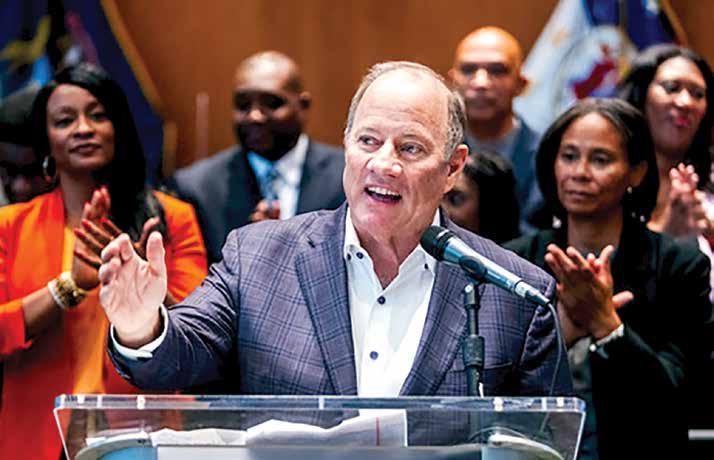
oring other outstanding individuals, each carving their own path to success. Clement “Fame” Brown, the creative mind behind Three Thirteen Detroit’s Brand Name, received the prestigious Entrepreneur of the Year Award. Brown’s commitment to empowering the city through fashion and entrepreneurship has left an indelible mark.
The evening sparkled with a golden promise as we celebrated remarkable individuals from various walks of life. Among the honorees were the brilliant and visionary co-founders of Detroit Hives, Nicole Lindsey and Timothy Paul Jackson. Their work has not only changed the landscape of beekeeping and urban farming in Detroit but also exemplified the transformative impact Black professionals can have on their communities.
By Jeremy Allen EXECUTIVE EDITOR
“Entrepreneur of the year – that’s a big deal,” said Brown. “It’s always an honor to be honored and it’s always a blessing to be in a room full of so many talented, accomplished, and popular people that look like me. I’m geeked. I started making and selling clothes as a kid and I always knew that I would have a business, but I never knew it would be Detroit’s brand name business, so I take a lot of pride in the fact that our business represents our city’s pride.”
Detroit can’t keep avoiding this conversation because people are afraid of sounding judgmental. Accountability is not judgment. Accountability is necessary.
also expressed disappointment in a statement, saying the company immediately went into contingency mode to protect its operations.
By Ebony JJ Curry SENIOR REPORTER
Independent gubernatorial candidate and former Detroit Mayor Mike Duggan has ended his campaign for governor, bringing a close to a candidacy that increasingly unsettled many Democratic voters and strategists across Michigan.
Taking home the Corporate Excellence Award was Dannis Mitchell, Director of Community Engagement at Barton Malow.
ness district that had been the lifeblood of the community.
urban investment, labor partnerships, neighborhood redevelopment, and expanded public services), his gubernatorial campaign gradually took on a different tone that left many longtime supporters questioning both his political direction and his broader impact on the race.
“Together we have created a social, environmental, and financial impact through bees,” said Jackson. Lindsey followed that sentiment with, “It is through our local partnerships and collaborative efforts that we exist in over 28 plus locations managing the health of 4.5 million honeybees – humbly speaking our movement has inspired others locally, nationally, and even internationally to take on similar missions.”
Too many parents today have surrendered authority inside the home and replaced parenting with passive coexistence. Children are being raised with phones but without supervision, with internet access but without discipline, with social freedom but without structure. Then, when chaos unfolds publicly, everybody suddenly searches for another institution to blame.
Detroit Hives, a pioneering organization founded by Lindsey and Jackson, harnesses the power of urban beekeeping to revitalize neighborhoods in the Motor City. Their initiative not only addresses critical issues like environmental conservation but also provides valuable education and employment opportunities to Black De-
The UAW has branded the industrial action as the “Stand-Up Strike,” focusing on specific plants within each automaker. UAW President Shawn Fain stated, “This strategy will keep the companies guessing. It will give our national negotiators maximum leverage and flexibility in bargaining. And if we need to go all out, we will. Everything is on the table.” Union leaders have also indicated that additional plants could be targeted in future waves if negotiations remain stalled.
For many Detroiters, Interstate 375, or I-375, has long been just another stretch of urban highway, a concrete artery connecting different parts of the city. To some, it’s a mere convenience; to others, it’s an unremarkable part of their daily commute. However, there’s a deeper, far more troubling story beneath the surface of this seemingly ordinary freeway—a story of pain, displacement, and the lasting impact on Black Detroiters.
Mayor Mary Sheffield and Police Chief Todd Bettison are not responsible for raising our youth. The mayor and the police shouldn’t be the primary disciplinarians for children whose parents have checked out emotionally, mentally, or physically. And “kids being kids” is not an acceptable explanation for what has been happening downtown.
“I am so disappointed to have to write you this letter,” Duggan said in a statement posted to his website. “For the last 18 months I’ve worked every day to try to change Michigan’s toxic party politics. I’ve been supported by hundreds of volunteers who believe deeply that years of constant Democratic-Republican conflict in Lansing have led to our schools declining, our housing costs rising, and our young people moving out of Michigan in record numbers.”
“It is so important to recognize that there are young leaders across the country, many that are born here in Detroit. I represent our city nationally and I tell people, ‘Yea I’m a D-girl I’m from the west-side of Detroit,’” Mitchell expressed. “But more importantly, I’ve been able to have experiences within an industry that not many of us, specifically women of color, have the opportunity to engage in and I’ve been the youngest person in the room, the only Black person in the room, and the only Sistah in the room, and I really had to articulate the importance of showing up, giving chances when others won’t, and being persistent.” As a trailblazing Black woman thriving in a predominantly male-dominated industry, her unwavering commitment to fortifying the connections between businesses and Detroit’s communities is unde-
It’s a history marred by pain, injustice, and economic devastation. More than 130,000 residents, primarily Black, were forcibly displaced. Families were uprooted, generational wealth was obliterated, and a thriving community was torn asunder. The wounds inflicted by I-375 run deep, transcending the physical barrier of a freeway to penetrate the very soul of Black Detroiters.
For many Democrats, the conclusion comes with a sentiment that can best be described as “better late than never.”
towards mending the wounds inflicted on Black Detroiters and restoring a sense of belonging that was so callously torn away in the past.
A string of shootings in Greektown in mid-April left both visitors and residents of this bustling downtown destination in awe. One of these shootings tragically claimed the life of a popular and beloved security guard following a dispute with a patron.
The I-375 Boulevard Project is about more than just correcting historical injustices; it’s about redefining the future. It will connect downtown Detroit to surrounding neighborhoods, bridging the gap that was placed upon the city decades ago.
That concern became particularly pronounced as Republican contenders such as Mike Cox and John James continued to consolidate support among GOP voters. Political observers increasingly warned that Duggan’s independent candidacy could siphon moderate Democrats, Black voters, and independents away from the eventual Democratic nominee – likely to be current Secretary of State Jocelyn Benson – without creating a realistic path to victory for himself.
This painful legacy can be traced back to the nation’s interstate highway program of 1956—a program that aimed to connect the country but often did so at the expense of marginalized communities. In the case of I-375, it meant carving a path through the heart of Black Detroit, reinforcing segregation, and perpetuating inequality.
Duggan entered the governor’s race with undeniable political strengths. After serving 12 years as Detroit’s mayor, he left office with a national reputation as a pragmatic executive who oversaw major downtown investment, reduced blight, and helped stabilize the city’s finances following bankruptcy. His appeal to business leaders and moderate suburban voters initially created speculation that he could reshape the traditional dynamics of a Michigan gubernatorial contest.
The male suspect allegedly shot the guard before fleeing the scene, while his female companion is accused of concealing the weapon in her bra.
By Andre Ash DIGITAL ANCHOR
Public disorder isn’t harmless entertainment, and violence is not a social activity. While these “teen takeovers” are billed by kids as “community bonding,” large crowds of unsupervised teenagers flooding downtown streets at night, while fights break out and businesses shut down, is too often the result. We need to call it what it is, and, at best, it’s dysfunction. Kids are using this to replace what’s missing from them at home, and pretending otherwise only guarantees more of it.
The tale begins in what is now Lafayette Park, once known as Black Bottom—a neighborhood rooted in African-American culture and history. Named after its dark, fertile soil, Black Bottom flourished during the mid1900s, nurturing the dreams and aspirations of prominent Detroiters like Coleman Young, Joe Louis, and numerous other Detroit legends. But in the name of urban renewal in the 1950s, this vibrant neighborhood was systematically dismantled, erased from the map, and replaced by a lifeless stretch of asphalt.
He continued: “But for the public in general, our internal polling showed the intense anger over gas prices, and Iran was boosting Democrats in every office nationally. The Chamber poll last week, showing we’d fallen 11 points behind the Democratic candidate, reflects that reality.
These incidents unfolded during an unseasonably warm spring, leading to increased pedestrian traffic and heightened tensions in the densely populated downtown area.
But as the campaign unfolded, Duggan increasingly distanced himself from the Democratic Party identity that had long defined his political rise.
A Holistic Approach to Providing Shelter and Support for Detroit’s Unhoused People
For one to aptly recognize the harm caused by such projects, it is vital to note that some of the planners and politicians behind those projects built them directly through the heart of vibrant, populated communities—oftentimes to reinforce segregation and sometimes as part of a direct effort to replace or eliminate Black neighborhoods.
Today, the resurgence of Paradise Valley stands as a testament to the indomitable spirit of Black Detroiters and the enduring legacy of Black excellence. This historic district, once a vibrant hub for Black businesses and culture, is experiencing a renaissance that harkens back to its glory days. The destruction of Black Bottom may have torn apart a thriving community, but the resolute determination of a new generation of entrepreneurs and visionaries is reclaiming that lost legacy.
The surge in crime and the influx of visitors to Detroit’s downtown core garnered the attention of the Detroit Police Department (DPD), catching them somewhat off guard.
Fain clarified the union’s strategy: “I want to give a major shoutout to the thousands of members who are on the picket lines right now fighting for all of us. The Stand-Up Strike is a new approach to striking. Instead of striking all plants at once, select locals will be called on to stand up and walk out on strike. This is our generation’s answer to the movement that built our union – the sit-down strikes of 1937. We told the Big 3 that Sept. 14 was the deadline and we meant it. We gave the companies our economic demands eight weeks ago and it took more than a month to get to the table.”
“Being down 11 points in May wouldn’t discourage me – I’ve been down worse than that in the past. But this time it’s compounded by our inability to build serious national fundraising support.”
While the residential areas bore the brunt of this demolition, the heart of Black Bottom, its thriving business center, remained largely untouched. Restaurants, theaters, clubs, and bars—the very places that brought Detroit’s Black community together—were concentrated around Hastings Street, the epicenter of African-American culture in the city.
Detroiters are tired of watching adults make excuses for behavior that wouldn’t have been unacceptable a generation ago. Somewhere along the line, standards collapsed. Children stopped fearing consequences be-
The union is pushing for a comprehensive list of demands. This
Homelessness continues to plague urban communities, with families and individuals grappling with the challenges of making ends meet in today’s economic climate. Whether it’s struggling to meet monthly mortgage payments or coping with soaring rental costs in a housing market marked by shockingly high prices, a variety of factors contribute to the growing issue of people becoming unhoused.
On the campaign trail, Duggan began emphasizing messages centered on government restraint, criticism of party “extremes,” tougher rhetoric around public spending, and themes that mirrored the language frequently used by Republican candidates courting moderate independents.
Housing Resource Helpline in response to the challenges that residents face in navigating the complex system of housing services. The helpline provides a single point of contact for people seeking housing assistance and connects them with the resources they need.
But now, after decades of enduring the scars of I-375, there is a glimmer of hope on the horizon. Plans have been unveiled to transform this once-divisive freeway into a vision that seeks to right the wrongs of the past while heralding a new era of inclusivity and community revitalization.
Duggan’s departure arrives after months of mounting concerns that his independent bid threatened to fracture the Democratic coalition in a battleground state where razor-thin margins are likely to decide statewide elections this year.
Meagan DunnJulie Schneider
Then, in a cruel twist of fate, Hastings Street, too, was obliterated a few years later, making way for the construction of I-375. This marked the final blow, sealing the fate of Black Bottom and signaling the beginning of the end for Paradise Valley, the Black busi-
While Duggan built much of his political identity over more than a decade in Detroit by aligning himself with traditionally Democratic priorities (including
Historically, shelters have provided a temporary respite for those in need, often serving as the first or second option after exhausting alternatives like staying with friends or family. Shelters offer a place to rest one’s head and a warm meal, albeit sometimes for extended periods. For others, being unhoused means living in cars or makeshift outdoor
Support for the helpline comes from the Gilbert Family Foundation, which has pledged $10 million over three years to fund the program. Wayne Metro Community Action Agency manages the helpline, making it accessible to all Detroit residents. This initiative simplifies access to the City’s various housing services, ensuring that residents in need can easily find assistance.
In practical terms, many Democrats feared the race was developing into a classic spoiler scenario where the Republican nominee could win a statewide election by receiving shy of 40% of the total vote. Michigan’s recent statewide elections have repeatedly demonstrated how narrow the margin between victory and defeat can be. In that environment, even a relatively small percentage of crossover or independent support can dramatically alter the outcome. Duggan’s presence in the race threatened to create exactly that kind of electoral split that could have opened a clear path for Republicans to reclaim the governor’s office.
James White, Chief of Police for the Detroit Police Department, said: “We were caught somewhat flat-footed right out the gate. By design we went into the spring deployment, which is less than the mid-summer deployment, and saw we say an uptick in violence that first warm weekend.”
While he maintained that his campaign was focused on practicality rather than ideology, critics argued that his positioning gave political cover to conservative arguments while weakening Democrats’ unity ahead of one of the state’s most consequential elections in years.
Fueled by more than $100 million from the Infrastructure Investment and Jobs Act and other partners, this ambitious project aims to create jobs, remove barriers to economic growth, and reconnect the neighborhood with the rest of Detroit. It is a step

By Jeremy Allen EXECUTIVE EDITOR
By Lynzee Mychael MULTIMEDIA JOURNALIST
The causes of homelessness are as diverse and complex as the individuals experiencing it. In response, the City of Detroit has adopted a holistic approach to combat this issue.
For years, Black men have been reduced to political talking points every election cycle.
“Providing services and high-quality housing to persons at risk of or who are experiencing homelessness is a key priority of the City of Detroit, said Julie Schneider, Director of Detroit’s Housing and Revitalization Department.
“The city and its partners offer a lot of great services to help Detroiters with their housing needs, but they don’t mean much if people don’t know how to access them,” said Mayor Mike Duggan. “Thanks to the efforts of our partners and the generous support of the Gilbert Family Foundation, we now have a simple process to guide residents to the right housing resource and a growing number of programs to help them.”

“This means focusing on building the pipeline of supportive housing and coordinating with the Continuum of Care on the delivery of critical resources such as emergency shelter, rapid rehousing, and diversion and prevention programs. It also means preserving and expanding affordable housing options for Detroiters of all incomes and improving housing stability though comprehensive service offerings available through the Detroit Housing Resource HelpLine and Detroit Housing Services Division within HRD.”
In May 2023, the City of Detroit launched the Detroit

From the days of the Great Migration when thousands of Black families flocked to Detroit in search of jobs and a better life, to the pivotal role they played in the city’s cultural and musical heritage, Black Detroiters have left an indelible mark on the city. However, in recent years, Detroit has experienced significant gentrification, which has raised concerns about the displacement of long-standing Black residents. Similar to a setting sun, there’s a rising spirit, and Black Detroiters are reclaiming their place in the city, despite the challenges posed by gentrification.
Democrats assume they’ll show up. Republicans believe they can pull them away. Meanwhile, a new poll suggests many younger Black men are sitting somewhere in the middle with mounting frustration, skepticism, and still waiting to feel genuinely connected.
The Gilbert Family Foundation’s broader commitment involves pledging $500 million to support projects across Detroit over the next ten years, with housing initiatives being a significant part of their contribution.
Notably, Detroit has witnessed a consistent decrease in recent years, with the number of unhoused residents steadi ly declining. In 2019, approximately 7,847 people were unhoused and entered the City’s community response system. In 2021, about 5,687 people experienced homelessness.
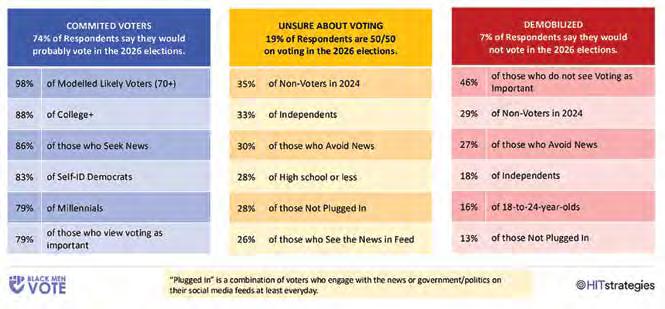
A new survey released by the organization Black Men Vote and conducted by HIT Strategies examined Black male voters ages 18 to 45 in six key states, including Michigan, Georgia, Pennsylvania, North Carolina, Mississippi, and South Carolina. The findings paint a more layered picture than the one that’s typically pushed about Black men’s voting habits in national political conversations.
According to the City of Detroit, since the start of the fiscal year 2019 to 2021, Detroit saw a 28% decrease in the
During the Great Migration, thousands of Black families from the South came to Detroit in search of jobs in the booming automobile industry. Despite facing discrimination and segregation, they built vibrant communities on
The irony for many longtime Democratic supporters was difficult to ignore, as even though many voters have expressed exhaustion over a two-party system, now was not the right time to fracture off the voter base.
Chief White attributes the violence in Greektown to a combination of weather conditions and a surge in population.
In the heart of Paradise Valley, Blackowned businesses are not just flourishing but thriving, offering diverse services, products, and experiences that pay homage to the past while paving the way for a prosperous future. From jazz clubs to soul food restaurants, the Black Press, and art galleries to fashion boutiques, this revival is breathing life into the very essence of what once made this neighborhood a vibrant cultural epicenter. It’s a resurgence that extends beyond brick and mortar; it represents the resurgence of a spirit that refuses to be subdued.
Duggan spent years cultivating relationships within Democratic circles while leading the state’s largest majority-Black city. He often presented himself as a problem-solving Democrat focused less on ideology and more on results. Yet as his gubernatorial campaign evolved, some allies privately questioned whether he
Detroit City Councilman Fred Durhal III, representing District 7, where Eastern Market resides, told the Michigan Chronicle, “It’s still very early in the process, MDOT is
He explained, “ We saw numbers downtown that we have not seen, ever. People are emerging from COVID and there’s a feeling that we’re in a post-COVID era… and with the venues downtown and the reasons to come down with all the activities that are going on, we saw hundreds of more people and, in particularly, young folks, teenagers that we hadn’t seen.”
Responding swiftly to the surge in violence, DPD adjusted its deployment plans. Rather than waiting for mid-summer, they deployed officers in the spring itself to address the situation.

Most young Black men still believe in voting. Ninety-two percent of respondents
The rise in visitors to the Greektown area is evident in data from Placer.ai, a location analytics company specializing in visit trends and demographic insights through geolocation-enabled mobile devices. From May 1-Aug. 27, 2022, there were 1.3 million visits and 655,000 visitors to Greektown, according to Placer.ai. In the same period this year, these numbers increased to 1.4 million visits and 670,000 visitors.
In battleground states like Michigan and Pennsylvania – where elections are routinely decided by narrow margins – the difference between wins and losses could rest entirely on the shoulders of Black men who sit out the elections after deciding that their votes won’t change their quality of life.
As Detroit’s downtown area continues to attract both residents and visitors, the police department has implemented various enforcement measures to manage the increased population. Notably, metal detectors have been strategically placed throughout Greektown to deter the illegal carrying of firearms.
But researchers say the hesitation should not automatically be interpreted as apathy or political disengagement.
“We have strategically placed them at key points, “ Chief White explains. It has been a deterrent for some, and some have tested it. If you are legally carrying a weapon and carrying a CPL, have a great day. If you’re
of respondents said they are likely to vote in the 2026 midterm elections, more than one in four surveyed said they are uncertain or unlikely to participate.
Instead, the poll points to something many Black organizers and community leaders have quietly acknowledged for years. Younger Black men often feel disconnected from political candidates, disconnected from the parties that consistently claim to represent their interests, and disconnected from the belief that the political process has produced meaningful economic change in their communities. These frustrations are rooted in
cine and healthcare, may be adversely impacted by
what the Supreme Court
women been premoment of the final. a law1931 law effect, asked the affirm that constitucontain abortion. Our Planned Advocates of founding coalition
ReproducAll, a affirm abortion and freedom in constitution,” Giroux. is that everything in aborMichigan, makes we will we can patients care they
to safe, legal abortion in Michigan…”
From page A-1
to have representalegislacollection and criminal jusrecomcollection analywith the AttorMichigan Law Standards Association Prosecutors stakeholders collect and strategically. warHouse Operations hearand other would ban of noknock urging the pass reform and Whitmer to the leg-
the lived experiences of rising housing costs, stagnant wages, limited access to capital, underemployment, and uneven investment in Black communities, which continue to shape how younger Black men view politics. Symbolic representation and campaign rhetoric matter significantly to this voter bloc, but many voters are increasingly measuring political success through tangible outcomes tied to quality of life.
More than legal implications, overturning Roe v. Wade would impact several systems across the spectrum. With the potential to drive both foster and adoption numbers upward, a ban on abortions could leave many women to choose a less safe route restoring ‘back alley’ and illegal abortion practices, including self-abortions. Moreover, African American women and women of color, who already have a long-storied history with access and inclusion in medi-
The poll found that while a majority of respondents still identify as Democrats, roughly 20% identify as Independents, and another 20% identify as Republicans. Even then, researchers said traditional partisan labels fail to fully capture how many younger Black men see themselves politically.
islature adopts it.
“Black men are not politically absent, they are politically misread,” Michael Bland, executive director of Black Men Vote, said in a statement.
Increase school funding: Statutory changes to increase the School Aid Fund revenue by at least $3.6 billion and establish a permanent weighted funding formula based on student and community needs and universal preschool (0-3).
That misunderstanding has created a tendency to flatten Black male voters into the single narrative that they are either unquestioningly loyal Democrats or disaffected voters shifting sharply to the right. The poll shows, however, that neither of those is fully accurate.
Researchers found many respondents remain broadly left-of-center politically, even as they express skepticism toward both parties. Among conservative-leaning respondents, the largest ideological identity measured was “family values conservative,” not MAGA Republican.
That distinction is important, particularly in Michigan, where Black voter turnout has repeatedly shaped
Reject censorship in history instruction: Encouraging Gov. Whitmer to ensure the goal for Michigan schools should be history instruction that is presented by professionals with the subject matter expertise, pedagogical skills, and judgment necessary to present complex information to students that are grounded in provable facts and add to the understanding of modern-day America.
cause too many adults stopped enforcing them. Now social media rewards the loudest, most reckless behavior imaginable. Teenagers chase viral moments while adults shrug their shoulders and call it culture when it’s really just neglect.
Increase mental health supports for the Black community: Recommending Michigan set a goal of increasing the number of Black mental health service providers by 20% each year over five years.
That does not mean every young person involved in these gatherings is a criminal or beyond saving, far from it. Many of these teenagers are clearly searching for connection, attention, and belonging. Some openly said they wanted safe spaces to gather and activities that made them feel included in the city. Mayor Sheffield herself acknowledged that reality after meeting with some of the teens and community leaders following the downtown incidents.
She is right to recognize that enforcement alone will not solve this issue.
Detroit’s young people need more investment, mentorship, recreational opportunities, and spaces where they can safely exist without immediately being treated like threats. The city absolutely has a responsibility to create stronger youth engagement programs and community partnerships. Sheffield has already pointed toward expanded youth initiatives and programs like midnight basketball as part of the broader response.
But let’s be clear about something else: community investment doesn’t replace parenting.
people to become parents or expand their families against their will. Being able to decide and control if, when and how to become a parent is central to building and living a healthy, happy life,” said Vasquez Giroux.
statewide and presidential elections. Detroit remains one of the Democratic Party’s most important political bases nationally, but younger Black voters increasingly expect more than election-year outreach and symbolic messaging, which led to an underwhelming level of support in the 2024 general election.
Many are looking for policies tied directly to economic mobility, entrepreneurship, affordable housing, safer neighborhoods, and pathways to wealth creation. Without visible progress in those areas, some younger Black men are becoming less emotionally invested in the political process itself.
Beyond the scope of pro-choice versus prolife, the fight for reproductive choice is one of freedom. As Michigan officials work to ensure each woman who finds herself in the position to choose has access to care without the threat of legal action, many wonder
The survey also found that some Black men who supported Democratic candidates in 2024 are now uncertain whether they will participate in the 2026 midterms. Researchers described that dynamic as an “activation challenge” as much as a persuasion issue.
stand with Senate Major ity Leader Schumer and Gov. Whitmer in support of their efforts to preserve the right to reproductive freedom,” said Chair Alisha Bell, on behalf of the Wayne County Commission.
as a primary place they turn for political commentary, breaking news, and public discourse.
The findings reinforce how dramatically political communication has shifted. Civic engagement now competes alongside entertainment, sports, podcasts, music, gaming, memes, and influencer culture in the same digital spaces, whereas historically, that wasn’t always the case. Researchers found respondents were most likely to engage with content connected to humor, music, and culture, signaling that traditional political messaging often struggles to break through when it feels overly scripted or transactional.





was running against Republicans or against the modern Democratic Party itself.
The health committee recommends reviewing state licensure policies to address the barriers that Black psychologists face in obtaining licensure in Michigan.
In other words, the challenge for Democrats goes beyond simply convincing Black men who to vote for. Democrats are now tasked with rebuilding trust among voters who no longer feel consistently prioritized once elections end.
The poll ultimately identified six distinct groups among younger Black male voters, ranging from highly engaged Democratic-aligned voters to politically alienated but civically active men, to disengaged voters with low participation likelihood. Together, the findings underscore that Black men are not a monolithic voting bloc and cannot be approached through a single political strategy.
Ensure equitable distribution of state health funds: Ensure all Michigan communities with a significant Black population receive adequate funds to address mental health issues.
The study also examined how younger Black men consume news and political information. Half of respondents described themselves as active news consumers, while another 44% said they primarily encounter news through social media feeds and digital platforms, which has been a growing trend for the last decade. Only 6% said they avoid news entirely.
What the research makes clear, however, is that younger Black men are still paying attention. They still value civic participation. But many are demanding that politics should feel more connected to their lived realities and less dependent on assumptions about automatic loyalty.
His messaging increasingly emphasized dissatisfaction with partisan politics broadly, noting that the only thing Democrats were good at was hating Republicans and hating Donald Trump, and that Duggan’s criticism landed disproportionately on their side of the aisle. Progressive activists and party loyalists alike expressed frustration that Duggan appeared more eager to challenge Democratic priorities than to confront the policy direction emerging from the Republican field.
an opportunity to consolidate support and refocus attention squarely on the contrast between the Democratic nominee and the Republican field.
At the same time, Duggan’s campaign leaves behind broader questions about the future of political moderation and independent candidacies in Michigan. His run reflected a continuing frustration among some voters who feel disconnected from both major parties and attracted to candidates who position themselves outside traditional partisan structures.
Protecting Black voting rights: Urge state officials to remain vigilant in the fight against schemes to disenfranchise Michiganders of color.
YouTube emerged as a dominant source of political and cultural information. Ninety percent of respondents said they use the platform multiple times a week, and many identified it
ous response. The city can’t just host meetings, issue statements, and hope tensions cool naturally. Detroiters deserve visible leadership, clear plans, stronger communication with parents and schools, and consequences that are firm without becoming excessive. Balance matters here.
“BLAC members have worked hard to identify the needs of the Black community and we feel these recommendations will provide a solid first step towards breaking down barriers in education, community safety, health and business,” said BLAC Co-Chair Dr. Donna L. Bell.
Parents work multiple jobs to pay the bills. Some children are being raised by parents who aren’t savvy enough technologically to keep up with internet usage. I get it, and I don’t fault parents who are doing the best they can just to get by. But something’s got to change. And change always starts at home.
BLAC will hold a virtual town hall meeting to discuss its policy recommendations on Thursday, May 12 at 4 p.m. Join BLAC and a virtual audience in discussing the recommendations to support the Black community.
For both political parties, they can either take this data as a wake-up call to be more accountable to a swing group that feels disenfranchised, or they can continue with the status quo. The results from these upcoming highstakes elections across the country will be proof of how seriously Black men’s concerns are considered by the politicians who desperately need their votes.
adults to hesitate when opportunities for intervention arise.
Shared standards have weakened, and too many young people now receive most of their validation online instead of from healthy, real-world relationships. Young people are gathering downtown in massive numbers because they are looking for energy, identity, visibility, and belonging. Unfortunately, without guidance, those gatherings can quickly become dangerous. Chaos becomes contagious when nobody is leading.
The tension deepened as national politics became more polarized and control of state governments carried greater implications on issues ranging from abortion rights and education policy to voting access and labor protections.
By the final stretch of his campaign, Duggan faced growing skepticism about his chances of winning and about the long-term consequences of remaining in the race.
But the campaign also underscored the structural difficulty independents face in statewide elections, particularly in highly polarized swing states where many voters ultimately make strategic decisions based less on ideological purity and more on preventing the opposing party from gaining power.
Duggan didn’t immediately announce plans for the next phase of his career, but his legacy in Detroit remains significant and will likely continue to shape conversations about urban leadership, economic development, and municipal governance for years to come. His brief gubernatorial run may also serve as a cautionary example of how quickly political coalitions can fracture when longtime party affiliations begin to blur.
I also understand that there’s a dangerous tendency in moments like this for cities to overreact and criminalize all teenagers, particularly Black teenagers. Detroit can’t afford to become a city where every group of Black kids downtown is immediately viewed as suspicious because of the actions of some. National conversations about “teen takeovers” have already pushed many cities toward aggressive curfew discussions and heavier police crackdowns. Detroit should resist fear-driven policymaking.
To learn more about BLAC and this upcoming event, visit www.michigan.gov/BLAC. embraces. transforleadership as a approach that change the syscircumstancoperating Ivory “Transformationdoesn’t just do certhem view of and exdrive that because what create everyentire because people believe that they need to for themselves and others to live better lives.”
That is why this moment requires honesty instead of political talking points. Parents need to stop making excuses. The city needs stronger youth engagement. Community leaders need to stop romanticizing dysfunction. Schools need to reinforce discipline and accountability. And Detroit needs to rebuild the village it keeps talking about, but rarely practices consistently anymore.
“I got into this race to try to change our politics, not to be a spoiler. I’m still hopeful our campaign will prove to have a real longterm impact. 23% support in the last poll means more than 1.6 million Michigan voters are today looking for a Governor candidate serious about reducing the toxic partisan politics. If the candidates on the ballot this year take that message to heart and truly reach out to those voters, we will have accomplished something important,” Duggan said in his statement.
“I will never be able to express the gratitude I feel for all your support and encouragement. I wish I could have done better for you.”
While his supporters may argue that he brought important conversations about breaking from the traditional two-party system to the forefront, critics inside his former political base will likely maintain that his continued presence in the race risked delivering the governor’s office to Republicans at a moment when Democrats viewed the stakes as exceptionally high.
“Chancellor Ivery is a true transformational leader and an outstanding CEO, who is more than worthy of the CEO of the Year Award he just received, “ said Prof. James C. Mays, who teaches entrepreneurship and supply chain management at WCCCD’s Corporate College. “In his 27 years at WCCCD, Dr. Ivery has elevated WCCCD to become nationally recognized for excellence and innovation and preparing our students professionally and personally to do great things in the world.”
A basketball program won’t teach values if parents refuse to reinforce them at home, and a rec center can’t compete with adults who allow children to move through the world with zero accountability. Mentorship matters, but mentors should be supplements to parenting, not substitutes for it.
As a parent of four children, I understand that we can’t be on the clock 24-7, constantly monitoring kids’ every move. And I also understand that there are systemic issues that create environments where discipline becomes a chore for parents instead of a norm.
That is where some criticism of Mayor Sheffield becomes fair. While she should not carry the blame for these incidents, she does carry responsibility for helping coordinate a seri-
BLAC is housed in the Michigan Department of Labor and Economic Opportunity. Members represent many professional backgrounds, including economics, law, public safety, health and wellness, arts and culture and media. They leverage their experiences and expertise to make recommendations to the governor on critical issues affecting the Black community.
But resisting hysteria doesn’t mean denying reality. And the reality is this: some – emphasis again on *some* – parents are not parenting. Some children are growing up without structure, boundaries, or emotional discipline. Some adults have become so afraid of upsetting their children that they no longer correct them at all, and other parents are absent entirely. So communities are now experiencing the public consequences of private failures inside the home.
The hardest part about this conversation is that everybody wants to talk about systems while avoiding personal responsibility. Yes, poverty matters. Yes, trauma matters. Yes, underfunded schools matter. Yes, social media has made everything worse. But none of those realities eliminates the responsibility parents have to raise children who understand respect, self-control, and consequences.
Detroit’s village also has work to do. There was a time when children knew that neighbors, coaches, teachers, pastors, and elders would correct them long before situations escalated publicly. Today, many adults feel disconnected from young people altogether, and that’s caused communities to become fragmented and has caused
No amount of policing can compensate for homes where children are being raised without boundaries, direction, or care. And no mayor — including Mary Sheffield — can parent an entire city’s teenagers for them. Let’s do better collectively for the city and for the youth.
His exit now reshapes the political landscape heading into the general election. Democrat organizers who had quietly worried about vote fragmentation will likely view the decision as
Now, with Duggan stepping aside, Michigan’s gubernatorial contest returns to a more familiar partisan battle, and one that Democrats hope they can fight without the threat of division from within their own ranks.



A3 | May 27 - June 2, 2026
By Jeremy Allen EXECUTIVE EDITOR
The Michigan Chronicle will join Report for America’s 2026-27 cohort as part of a nationwide effort to strengthen local journalism, and Detroit-based journalist Biba Adams has been selected as the newsroom’s incoming Report for America corps member covering community impact and equity.
The announcement, made May 20 by Report for America, introduced 78 journalists who will begin reporting assignments in newsrooms across the country this summer. The program partners with local news organizations to help expand coverage in communities and on issues that often go underreported, particularly at a time when many local outlets continue facing financial strain and shrinking newsroom staffs.
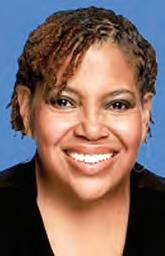
For the Michigan Chronicle, Adams’ selection feels especially connected to the paper’s long history of documenting Black life, policy, culture, and community in Detroit. Her reporting beat will focus on how local policies affect underserved neighborhoods, while also highlighting community-led solutions and tracking the impact of equity-centered initiatives across the city.
“Biba’s experience as a veteran journalist who has been telling Detroit stories makes this a really exciting addition to the Michigan Chronicle newsroom,” said Executive Editor Jeremy Allen. “Biba knows Detroit. She lives here, she’s a part of so many different community organizations, she has bylines in the Chronicle dating back to more than a decade ago, and she really understands the people and the communities of Detroit. Covering the community impact and equity beat will be like second nature to her and we’re excited for the work she’ll be doing here.”
The work lines up naturally with Adams’ background as a writer and storyteller whose career has consistently centered on culture, community, and Black experiences. Before joining the Michigan Chronicle, Adams built a journalism career that stretches back to the early 2000s, contributing to publications including VIBE, Ebony Magazine, AllHipHop, Revolt, The Root, TheGrio, and The Atlantan. Much of her work has celebrated culture and community, with a particular focus on retrospective stories about hip-hop’s golden era and the ways music intersects with identity and social change.
Adams returned to her hometown of Detroit in 2017 and has since remained deeply involved in the city’s media and civic spaces. She has contributed content for the Metro Detroit Convention and Visitors Bureau, written for the Detroit Metro Times, and served as editor-at-large for Model D Media, a Detroit-based digital publication known for its solutions-oriented reporting. Outside journalism, Adams serves on several community boards and is a member of Alpha Kappa Alpha Sorority, Inc. and the National Association of Black Journalists.
Her selection as a corps member comes as
See BIBA ADAMS Page A-4
By Jasmine West
Detroit’s most serious public safety work often begins long before a siren sounds.
It begins with the people who know which blocks are tense, which young people are grieving, which families are carrying conflict, and which neighborhoods need someone trusted enough to step in before harm spreads. That kind of work rarely fits inside a press conference, but it is the daily labor behind community violence intervention.
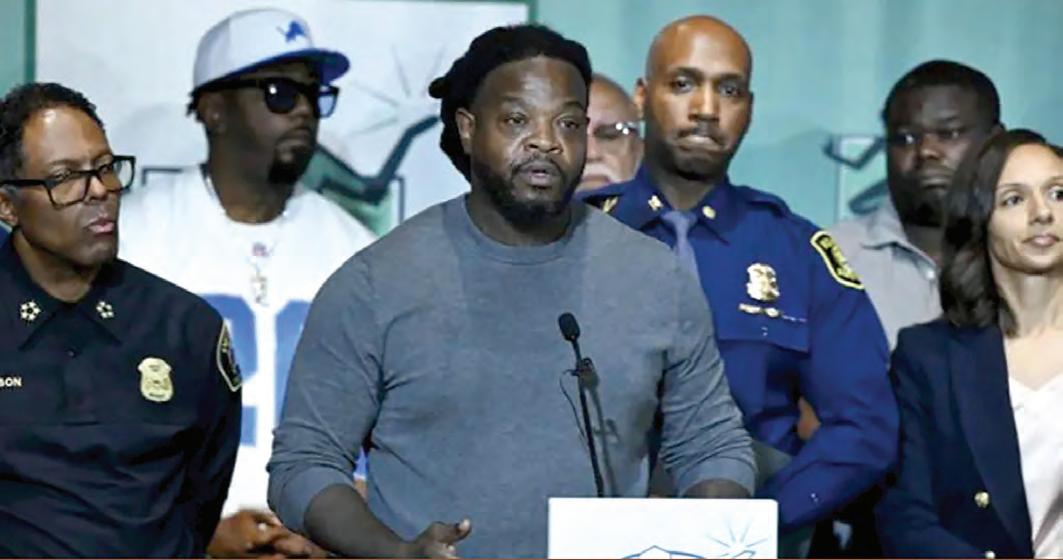
FORCE Detroit is now putting new resources behind that labor through a $235,000 regranting initiative that will support a coalition of grassroots organizations working to reduce violence across the city.
The funding will support organizations participating in the Emerging Leaders Detroit Chapter, a growing coalition focused on outreach, advocacy, intervention, training, community engagement, and coordinated violence prevention work. Groups that have signed memorandums of understanding to participate include Black Bottom Gun Club, The Better Men Outreach Program, Fight the Good Fight, Kelly’s Kids Foundation, The GRND Foundation, Motivating Inner New Dreams, Seize The Smoke, Detroit Life Is Valuable Everyday, Team Pursuit, The People’s Action, and Solomon & Harris Consulting.
The goal is to strengthen the network of people and organizations already working closest to the communities most affected by gun violence. For FORCE Detroit, that means moving resources to the groups with direct relationships on the ground and building a more coordinated approach to intervention across Detroit and, eventually, throughout Michigan.
“Community violence intervention is most effective when it is led by the people closest to the work,” said Dujuan Zoe Kennedy, executive director of FORCE Detroit. “This initiative is about resourcing those organizations, strengthening
coordination, and making sure we are aligned in how we show up for the communities we serve.”
Community violence intervention has become a growing part of Detroit’s public safety conversation as residents, advocates, and local leaders continue pushing for strategies that address violence beyond arrests and incarceration. The work centers on prevention, trust, conflict mediation, crisis response, and support for people at the highest risk of being involved in violence.
For Black communities in Detroit, the stakes are not theoretical. Violence carries generational weight. It disrupts families, classrooms, neighborhood economies, and the sense of safety residents deserve on their own streets. It also exposes the limits of systems that often respond after harm has already happened.
That is why grassroots intervention work matters. The people doing this work are often the ones showing up after a shooting, talking to young people before retaliation begins, connecting families to resources, organizing community conversations, and building enough trust to be heard in moments when institutions may not be.
Through the Emerging Leaders Detroit Chapter, participating organizations will help expand outreach and recruitment, support advocacy and policy work, take part in training and capacity-building opportunities, identify resources to sustain intervention efforts, organize community forums and town halls, and participate in public awareness campaigns.
The coalition will also engage with policymakers as part of broader efforts to expand community violence intervention locally and statewide, including participation in Advocacy Day scheduled for June 10 and 11.
The regranting initiative reflects FORCE Detroit’s larger strategy to build the infrastructure needed for long-term violence prevention. Many neighborhood-based organizations are already carrying significant responsibility with
limited resources. The initiative aims to support their work while helping create stronger communication and coordination across groups.
“This work is about building something that lasts,” Kennedy said. “By investing in collaboration and community-led intervention, we are creating a stronger, more connected network that can respond to violence more effectively and sustainably.”
The announcement also points to a larger question facing Detroit: what does public safety look like when communities are given the tools to protect and heal themselves?
FORCE Detroit’s answer begins with investment. The $235,000 regranting initiative recognizes that violence reduction cannot depend on disconnected efforts or underfunded organizations expected to carry crisis after crisis without support. It requires a network. It requires trust. It requires people who understand that saving lives is not always loud, visible, or immediate.
Sometimes, it is a conversation that prevents retaliation. Sometimes, it is an outreach worker arriving before anger turns into another headline. Sometimes, it is a grassroots organization staying present in a neighborhood long after the cameras leave.
That is the work FORCE Detroit is choosing to fund.
As the Emerging Leaders Detroit Chapter continues to grow, FORCE Detroit says it will work to deepen partnerships, expand its reach, and help ensure community-based organizations have the resources needed to sustain and scale their work.
Detroit’s path toward safer communities will not be built by one program alone. It will be built through coordinated investment in the people who already know the work, know the neighborhoods, and know what is at stake when violence is treated as a community crisis that demands community-led solutions.
By Ebony JJ Curry
This story was originally reported by
Ebony JJ Curry of The 19th.
Jeynce Poindexter was 14 when home stopped feeling like home.
Her mother could not accept that she was transgender, Poindexter said, and staying would have meant negotiating an identity she already knew was not negotiable.
So she left. What came next for Poindexter was survival, then structure.
She found chosen family who embraced her as a Black trans woman. Years later she would become chosen family for other people, building the kind of support she once needed herself.
“Those are the people who have chosen to truly love you without condition,” Poindexter said. “Your chosen and extended family literally fill in those gaps.”
The need for that kind of support has grown as lawmakers across the country have pushed a wave of anti-trans restrictions.
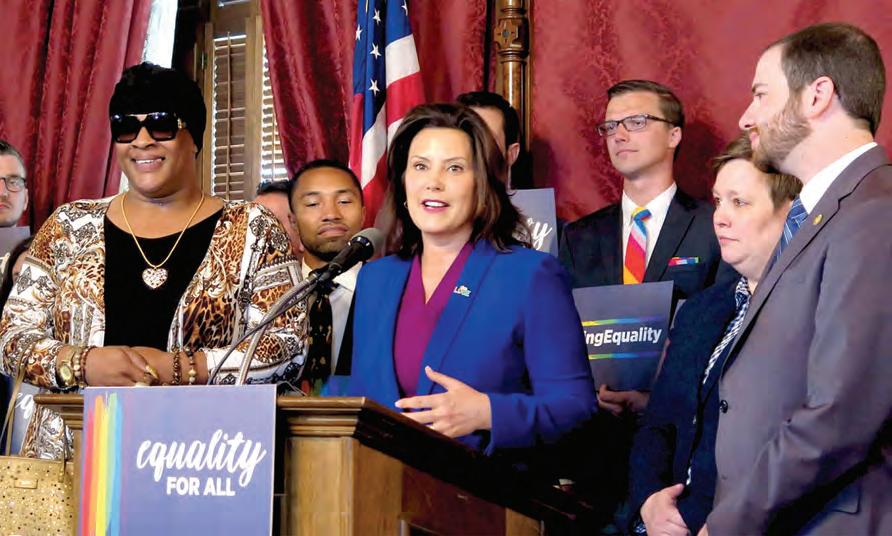
The Williams Institute found that 24 states passed at least one restrictive anti-trans law in 2025, affecting an estimated 329,200 transgender youth ages 13 to 17. By the end of 2025, an estimated 382,800 transgender youth in that age group — 53 percent nationwide — were living in the 29 states with at least one law restricting gender-affirming care, bathroom access, sports participation or pronoun use.
women accounted for 78 percent of murdered transgender women in the U.S. since 2013. Researchers and advocates have tied that violence to the intersection of anti-Black racism, transphobia, poverty and policy hostility.
Poindexter spoke about that reality in personal terms.
“I see life slipping away, I see people believing the rhetoric, and I see people believing the lies,” Poindexter said. “No one on the face of this earth is going to tell me that just because I happen to be a Black transgender woman that I should be killed, I should be raped, or that I should be disrespected to a level that no one cares about.”
When she left home at 14, Poindexter found guidance in a chosen mother named Torrey, someone she said helped lead her through one of the most vulnerable chapters of her life.
That relationship still shapes the way Poindexter understands what chosen mothering means in Black trans communities.
“What LGBTQ+ people are living through now literally feels ripped from the pages of dystopian fiction,” said Chinyere Ezie, a senior staff attorney at the Center for Constitutional Rights. For Black trans people, and Black trans women in particular, that lands on top of a crisis that long predates the latest wave of legislation.
United States. Black trans women made up nearly half of the known transgender and gender-expansive people killed between November 2023 and November 2024, according to a report by the Human Rights Campaign. A separate 2024 analysis found that Black trans
Black trans women face disproportionate levels of violence in the
“I understand the mothering of trans women in our community and the importance of that relationship in those positions are very critical,” she said.
Black mothering is larger than biology. It includes mothers by
From page A-3 birth, ballroom mothers, chosen mothers, mentors, friends and the people who step in when family and institutions do not.
“Historically, we’ve not only mothered our own children, but we’ve mothered other people’s children,” said Dr. Briona Simone Jones, the Audre Lorde professor of queer studies at Spelman College.
That kind of care has shaped Poindexter’s life from both sides.
People often talk about chosen family, ballroom mothering, queer care, “community,” or safe havens without naming the grind underneath it — housing help, rides, paperwork, emergency cash, conflict mediation, hormone access, late-night calls, emotional triage, standing in the gap when biological family rejects someone.
Poindexter has spent years doing that day-to-day work that chosen family often requires while helping young people hold onto their sense of self as a case manager with the Ruth Ellis Center, a Detroit nonprofit serving LGBTQ+ youth and young adults; executive director of the Femmes of Color Project, a trans-led advocacy organization; and mother of the House of Mizrahi, a leadership role in Detroit’s ballroom community.
Poindexter has paired direct support with advocacy, including pushing for transgender protections in Michigan’s amended Elliott-Larsen Civil Rights Act, which bars discrimination in employment, housing, education and public accommodations. In 2023, lawmakers amended it to explicitly include sexual orientation and gender identity or expression.
She has helped the younger generation find housing, connect to hormone therapy, access services, move through conflict with biological relatives and build what she called “inner strength and self-dignity.”
“I have spent 23 years cultivating talent, seeing young people, and helping young people survive,” Poindexter said.
Being a chosen mother isn’t always easy.
“You’re still questioned, haunted, and threatened sometimes by biological families who still have hostility in their heart,” she said. “It takes a lot to stand in who you are up against all odds especially when you’re standing in the gap for someone else.”
For Poindexter, that care is not secondary to survival. It is survival.
“It is the sole reason that so many people have made it through the community because of those people who were chosen to give themselves to make sure someone else survives.”
Jones places that pressure inside a much older Black tradition of survival, care and kinship.
“It’s not actually about the children that
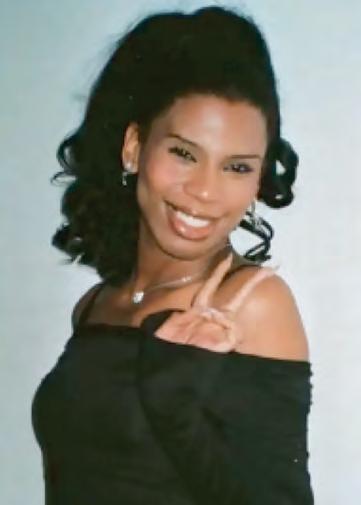
Photo credit: (Courtesy of Swan)
you move through gestation,” she said, “but it’s also about the relationships that we sustain with each other with such care and deep intention that allow us to live longer and do the work that we need to do in the world.”
She pointed to Black lesbian and Black queer traditions of care that have always exceeded bloodline, including the mothering that emerged during the AIDS epidemic, when Black lesbians cared for the abandoned and the sick and treated survival like a collective responsibility rather than a private burden.
“Black queer families teach us how to
From page A-3
Report for America continues to position itself as one of the country’s most visible responses to the local news crisis. The nonprofit organization announced that this year’s incoming corps members were chosen from more than 1,600 applicants and will work in 73 newsroom partners across the country.
“These journalists represent hope: a new generation committed to local news reporting that helps people better understand their communities and one another,” Report for America Executive Director Kim Kleman said in the organization’s announcement.
Across the incoming class, nearly half of the journalists are people of color, more than 60
love within and through the context of difference,” Jones said. “The way that we care for each other becomes an important life-sustaining thing.”
At Spot Lite Detroit, Swan gets a few hours where nobody asks her to shrink. She knows the ritual before the music takes over: the everything shower, the hair, the makeup, the sparkle shadow, the highest of high heels. Then the strut into DOLLS Night, the event series she co-founded with two other trans women, where red and purple strobe lights cut through the dark and Detroit techno vibrates throughout the body.
Inside, the room is organized around care: There are quiet areas, community care liaisons moving through the crowd and harm-reduction kits sitting in the bathrooms. The DJs, vendors and photographers are trans and nonbinary. Swan, who describes herself as “the most hostiest of the group,” keeps watch while she works the room.
“The purpose of the night is just for you to feel free and wear what you want,” she said. “We just want to make sure that everybody is safe.”
Swan is 24, from Detroit, and spent part of her childhood in Indiana growing up with two mothers. For a while, she thought that might make being understood less painful.
“Being that I had two moms in the same household, I thought it would be easier,” she said.
It wasn’t. She came out as trans at 21.
“One of my mothers, my biological mom, reacted really negatively when I first came out as trans,” she said. What followed was “a lot of eggshell walking, misgendering, deadnaming and the wear of trying to hold onto yourself in a home that did not always know how to hold you.”
percent are women, and a third will focus specifically on communities of color or immigrant communities. The organization says its broader goal is not only to place reporters in under-covered areas, but also to help local newsrooms strengthen trust, engagement, and long-term sustainability.
For Detroit readers, the community can anticipate Adams’ beat to focus on issues of equity, development, and neighborhood investment, which remain central to conversations across the city, especially as Mayor Mary Sheffield recenters those issues from the city’s top office.
From housing and transportation to education and economic opportunity, the effects of policy decisions are often felt most directly at the community level. The Michigan Chronicle’s partnership with Report
What held her is held Poindexter decades ago — chosen family.
“I think it’s the most important part of my whole trans story in general,” Swan said. “I would have nothing without community.”
When she was struggling, Swan said, friends helped her find stability.
“My community helped me be able to navigate my emotions more normally,” she said.
DOLLS Night now carries some of that same intention — a room built by trans women where other people can arrive without having to explain or defend themselves first.
At the end of DOLLS Night, after cleanup and photos, she usually leaves tired but certain of the positive support that happened in that room.
“I always feel good after a DOLLS Night,” she said. “Everyone usually walks home with a story.”
Now, as Swan grows into her security and confidence, she considers herself as an “auntie” of the community.
“I’m not quite old enough to be a mother just yet, but I am considered an auntie or big sis,” Swan said.
She follows the news. She knows what lawmakers, executive orders and policy papers are trying to make of lives like hers. She also refuses to let any of them decide whether she belongs here.
“There were trans women before 2024,” she said. “They’ll be trans women after 2024. So, I’m just going to live regardless.”
This is the work Black queer mothering is doing now, in all its forms: holding children and young adults in the truth of who they are while the nation keeps trying to make that truth harder to live inside.
for America creates additional space for reporting that stays rooted in those lived experiences instead of only covering policy from a distance.
Report for America Vice President of Recruitment and Alumni Engagement Earl Johnson said corps members are expected to approach communities with “curiosity, rigor and a deep commitment to listening,” emphasizing that relationship-building is a key part of the work.
The incoming journalists will officially begin their assignments in July. With this new class, Report for America’s active corps will grow to 200 journalists nationwide, including returning second- and thirdyear members. Since launching in 2017, the organization says it has helped place more than 800 journalists in local newspapers,
public radio stations, digital outlets, and television newsrooms throughout the country.
For the Michigan Chronicle, which this year marks 90 years of serving the community, Adams’ arrival represents both a continuation of the paper’s mission and an investment in community-centered reporting that reflects Detroit from the ground up. Her blend of cultural knowledge, local connection, and reporting experience makes her a fitting addition to a newsroom that has long focused on telling stories often overlooked elsewhere.
And for Adams, the assignment brings her career full circle, where she’s once again reporting in the city she calls home, covering the people and neighborhoods that helped shape her voice as a journalist in the first place.

By Dr. Anthony O. Kellum
CONTRIBUTING COLUMNIST
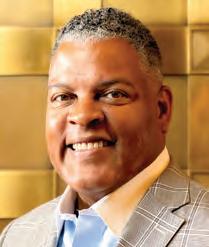
For years, Americans were told that if they worked hard, earned a degree, secured stable employment, and managed their finances responsibly, homeownership would eventually follow. Property, after all, was presented not simply as a financial milestone, but as the central mechanism through which middle-class stability and generational wealth were built. Yet for a growing number of firsttime buyers, particularly first-generation professionals, that promise feels increasingly detached from reality. The modern housing market is often described as “challenging,” but that word understates the deeper structural shift underway.
Home prices remain historically elevated despite modest stabilization in some regions. Mortgage rates continue hovering near 6 to 7 percent, dramatically increasing monthly payments even when prices soften slightly. At the same time, first-time homebuyers now make up only a small share of overall purchases, reaching some of the lowest levels recorded in decades. The issue is not simply affordability in the traditional sense. The issue is that access to ownership increasingly depends on whether one already possesses money before entering the market.
That distinction matters more than most economic conversations acknowledge. A generation ago, a strong income and disciplined savings habits could often compensate for the absence of inherited wealth. Today, that equation has changed. In many metropolitan areas, buyers are competing not just against other working professionals, but against investors, equity-rich homeowners, and cash buyers capable of moving through the market with speed and leverage increasingly, liquidity determines who gets access to ownership.
This creates a profound dilemma for first-generation buyers. Many are highly educated. Many have respectable incomes. Many have done precisely what society instructed them to do. Yet they remain trapped in a financial paradox earning too much to qualify for meaningful assistance but lacking the accumulated family wealth necessary to compete comfortably in the market.
The result is a quiet restructuring of who homeownership is really for.
The prevailing national conversation often treats this affordability crisis as a temporary cyclical imbalance tied to inflation, interest rates, or housing supply. But beneath those surface-level explanations lies a deeper issue America’s housing market increasingly advantages those who are already positioned inside the asset economy while making entry substantially harder for those attempting to build wealth for the first time.
This is not accidental markets tend to reproduce existing advantages unless deliberate intervention alters their trajectory, and housing, perhaps more than any other sector, re-

By Jasmine West
Detroit’s bankruptcy case now belongs to history, closing a chapter that shaped the city’s finances, services, reputation, and the daily lives of residents for more than a decade.
U.S. Bankruptcy Court Judge Thomas Tucker granted the city’s request for a Final Decree this week, formally closing Detroit’s Chapter 9 bankruptcy case and ending nearly 13 years of federal court supervision tied to the largest municipal bankruptcy in U.S. history. The ruling comes after the city began making final payments to unsecured creditors, leaving no further role necessary for the bankruptcy court.
For Detroit, the closure goes much further than just a legal milestone.
It marks another step in a citywide reset that has moved from crisis management to long-term fiscal control. The bankruptcy filing began in July 2013 under a state-appointed emergency manager. At the time, Detroit was known nationally for debt, population loss, reduced services, and a government forced to make painful decisions under court supervision.
That case has now closed under Mayor Mary Sheffield’s administration, as Detroit also records renewed population growth. U.S. Census Bureau QuickFacts estimates Detroit’s population at 649,095 as of July 1, 2025, up from 645,705 in 2024 and 639,111 in the 2020 Census. The Census Bureau places Detroit’s estimated population change at 1.5 percent growth from the April 2020 estimates base to July 2025.
City officials said the bankruptcy closure reflects years of financial disci-
pline, including 12 consecutive balanced budgets and surpluses, reserve funds totaling more than $500 million, and Detroit’s return to investment-grade status among creditors.
“I want to thank our financial and legal teams for their hard work making this day possible. Detroit continues to show that it has its financial house in order and in fact has become a model city for effective and responsible fiscal management,” Mayor Sheffield said in a statement.
Sheffield also acknowledged the residents and retirees who carried the burden of Detroit’s recovery.
“I would be remiss if I didn’t acknowledge the critical role the sacrifices of our retirees played in the city’s ability to emerge from bankruptcy and embark upon the road to recover. We owe them a great debt of gratitude,” Mayor Sheffield added.
The city’s final distribution totals about $10 million to claimants, representing accrued interest on Class 14 B notes, the financial recovery bonds issued to unsecured creditors. Those creditors were among the final groups to receive at least a portion of what they were owed.
Detroit’s bankruptcy process allowed the city to shed roughly $7 billion in debt and restructure another $3 billion, freeing up an estimated $150 million per year for city services. That shift helped Detroit rebuild its financial position while investing in basic public functions that had suffered during years of decline.
Chief Financial Officer Tanya Stou-
demire said the case closure sends a message about Detroit’s ability to manage its own future.
“The closure represents the last step in a journey that has required discipline and sacrifice. We are signaling to the world that Detroit is once again a self-sustaining city with the financial maturity to manage its own future. Our team remains focused on the rigorous, long-term fiscal management necessary to protect our retirees and ensure our residents never face this kind of financial uncertainty again.”
The closure also comes as Detroit continues to show signs of population stabilization after decades of decline. The city announced this month that new Census data showed another year of growth, marking Detroit’s third straight year of population gains and building on last year’s milestone, when the city recorded its first reported population increase since 1957. That matters because Detroit’s bankruptcy cannot be separated from the city’s long population decline. Fewer residents meant fewer taxpayers, less revenue, reduced services, and a shrinking base asked to support legacy costs built for a much larger city. Detroit’s population peaked at nearly 1.85 million in 1950. By the time of the 2020 Census, the city had fallen to 639,111 residents.
The recent growth does not erase the harm of bankruptcy, especially for retirees who lost benefits and residents who lived through years of instability. It does, however, point to a city trying to move with firmer footing. The story
By Mark S. Lee
CONTRIBUTING COLUMNIST
At a time when many entrepreneurs continue to navigate economic uncertainty, rising operating costs, workforce challenges, and rapidly changing technology, the 12th Annual Small Business Workshop held recently delivered an important message: resilience is no longer optional — it is essential for survival and long-term success.
This year’s workshop, which drew a record level of registrations and participation, brought together entrepreneurs, business leaders, and community partners for a morning focused on practical solutions, collaboration, and growth opportunities for small businesses. Centered around the theme “Resilient by Design,” the event highlighted how business owners can adapt to disruption while positioning themselves for long-term sustainability in an increasingly competitive environment.
From the opening session through the final discussions, the workshop focused on the real-world challenges facing entrepreneurs today. Conversations centered on inflationary pressures, consumer spending shifts, access to capital, cybersecurity risks, artificial intelligence, workforce retention, marketing strategy, and financial planning. Yet despite those concerns, the tone throughout the day remained optimistic and forward-looking.
One of the strongest takeaways from the event was that resilience today means
much more than simply surviving difficult times. Business owners were encouraged to think strategically about how they operate, communicate, innovate, and invest in the future. Speakers emphasized that the companies most likely to thrive are often the ones willing to embrace change, remain flexible, and continue learning even during periods of uncertainty.
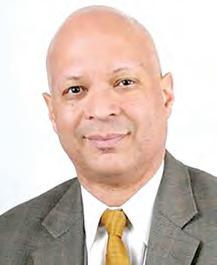
Entrepreneurs heard practical guidance on strengthening financial discipline, improving operational efficiency, and building stronger customer relationships. Several sessions also focused on technology and cybersecurity, reinforcing how critical digital readiness has become for businesses of every size. As artificial intelligence and automation continue reshaping industries, experts encouraged business owners to view technology not as a threat, but as a tool that can improve productivity, customer engagement, and decision-making.
Another major theme throughout the workshop was access to capital. With many small businesses continuing to face tighter lending conditions and higher borrowing costs, panelists discussed the importance of financial preparation, strong business planning, and relationship-building with lenders and investors. Attendees were reminded that preparation and transparency remain essential when seeking funding opportuni-
ties. The workshop also highlighted the importance of leadership during periods of disruption. Several speakers emphasized that resilient leaders create stability not by avoiding challenges, but by responding to them with clarity, adaptability, and purpose. In many ways, the conversations reflected the realities entrepreneurs face every day — balancing uncertainty while continuing to make decisions that impact employees, customers, and communities.
Marlo Rencher, PhD., Detroit’s Chief of Neighborhood Economic Development and Small Business, welcomed attendees and reinforced the city’s continued commitment to entrepreneurship, neighborhood revitalization, and inclusive economic growth. Her remarks acknowledged the important role small businesses play in driving job creation, community investment, and economic momentum throughout Detroit.
I was fortunate to provide the Keynote where I shared my professional and entrepreneurial journey rooted in resiliency while navigating headwinds and transforming challenges into business sustainability and growth.
The event also served as a reminder of how interconnected the small business ecosystem truly is. Beyond the presentations and panel discussions, entrepreneurs had
opportunities to network, exchange ideas, and build new relationships with fellow business owners, community organizations, and corporate partners. That collaboration remains especially important as businesses continue adapting to economic headwinds and evolving market conditions.
What made this year’s workshop particularly impactful was the sense of determination throughout the room. Despite concerns surrounding inflation, consumer confidence, and broader economic uncertainty, many business owners expressed cautious optimism about the future. Their focus was not simply on short-term survival, but on building stronger, more sustainable organizations capable of weathering future disruption.
Ultimately, this year’s Small Business Workshop reinforced an important reality: small businesses remain the backbone of the economy. They continue to drive innovation, create jobs, support communities, and fuel economic growth.
While the challenges ahead remain real, the energy and engagement throughout the workshop demonstrated that many entrepreneurs are meeting this moment not with fear, but with resilience, creativity, and a commitment to building what lasts.
We invite readers, business owners, and future entrepreneurs to follow along, ask questions, and engage. If you have story ideas or questions, you can email Lee at mark@ leegroupinnovation.com or visit leegroupinnovation.com. michiganchronicle.com
From page A-5
flects the accumulated effects of historical inequality.
For Black Americans, this reality carries particular weight.
The Black middle class today is more educated and professionally accomplished than at any previous point in American history. Yet educational advancement has not translated proportionally into wealth accumulation. One reason is that wealth in America is still overwhelmingly tied to property ownership and asset appreciation, not simply income.
But many Black households enter the housing market without the advantages that quietly support many other buyers. Lower median family wealth means down payments are harder to assemble. Parents are often less able to contribute financial assistance. Student debt burdens are typically higher, even among Black college graduates. Rising rents consume larger portions of monthly income, slowing the ability to save aggressively. Meanwhile, homes at the entry-level price point the very segment where many first-time Black buyers compete face intense pressure from investors and cashheavy buyers.
In practice, this means Black buyers are often forced to work from an entirely different starting point within the same market. The challenge is not simply qualifying for a mortgage. Many Black professionals qualify. The challenge is competing in a system increasingly designed around existing capital rather than future earning potential.
This distinction exposes a larger truth about inequality in modern America. Economic exclusion no longer always appears through overt denial. More often, it emerges through structural conditions that appear neutral while producing highly unequal outcomes. A market does not have to explicitly reject first-generation buyers to systematically disadvantage them. It merely has to reward preexisting wealth aggressively enough.
The consequences extend far beyond housing itself. Delayed homeownership delays equity accumulation. Delayed equity accumulation delays business formation, retirement security, educational investment for children, and intergenerational trans-
From page A-5
now turns to what Detroit does with that footing.
Fiscal Year 2027 will mark the fourth year Detroit has made its pension contribution, supplemented by the Grand Bargain and the city’s Retiree Protection Fund. That responsibility remains central to the city’s long-term stability.
fers of wealth. Every year spent outside ownership in appreciating markets widens the long-term gap between those building equity and those that aren’t.
This is why property remains such a critical issue within the Black community specifically property is not simply about status or consumption. It is about positioning ownership determines who participates in appreciation and who merely absorbs rising costs. It determines who can borrow against assets, who can weather economic shocks, and who can transfer opportunity forward instead of restarting from zero.
And yet despite these realities, there remains an urgent need for a more sophisticated conversation within both public policy circles and Black communities themselves. Too often, discussions around housing become overly simplified into personal responsibility narratives or partisan talking points. But the truth is more complex. The modern affordability crisis is not solely the result of poor planning or individual financial behavior. It is deeply connected to decades of uneven wealth accumulation, restricted access to ownership, zoning policies, institutional investment patterns, wage stagnation relative to asset growth, and educational debt burdens that disproportionately affect first-generation professionals.
Understanding this complexity matters because solutions require more than motivation. They require strategy. Politically, there must be stronger efforts to increase affordable inventory, regulate predatory investor concentration in residential markets, and expand access to down payment assistance and first-generation homebuyer programs. Financial institutions must continue evolving underwriting models that recognize rent history, non-traditional income streams, and broader indicators of financial responsibility. Universities and professional organizations should also treat financial literacy and asset acquisition with the same seriousness as career advancement, particularly for first-generation graduates navigating systems their families may not have historically accessed.
But culturally, there is another challenge Black America must confront honestly ownership can no longer remain a second-
Detroit’s bankruptcy case may be closed, but the accountability attached to it remains open. Balanced budgets, stronger reserves, improved credit ratings, and population growth will matter most if residents feel the results in their neighborhoods, homes, streets, schools, public safety, transit, and city services. For Detroit, this moment is a new leaf. The question now is how the city protects the people who stayed, honors the retirees who sacrificed, and builds a future strong enough for the residents to choose Detroit again.


ary conversation behind income alone. Too often, professional success is measured by salary without equal emphasis on asset positioning yet in America, wealth gaps are rarely income gaps alone they are ownership gaps, and ownership gaps compound over generations. The danger of this moment is not simply that homes are expensive, homes have always carried cost. The deeper danger is that the pathway into ownership is becoming increasingly conditional, less dependent on discipline and more dependent on whether one begins with existing financial leverage.
That is a profound shift in American’s contract because when markets primarily reward those who already own assets, mo-
bility slows, and when mobility slows for first-generation buyers, particularly Black buyers, inequality hardens into permanence.
Which raises a question larger than housing itself what happens to a society when the gateway to wealth creation becomes increasingly inaccessible to those attempting to enter it for the first time? The answer may define not only the future of the housing market, but the future of economic mobility in America.
Property is Power! is







By Jeremy Allen EXECUTIVE EDITOR
Just weeks after stepping away from leadership of the Detroit Auto Show and the Detroit Auto Dealers Association, Sam Klemet has landed in a new role that keeps him closely connected to the world of advocacy, communications, and association leadership that has defined much of his career.
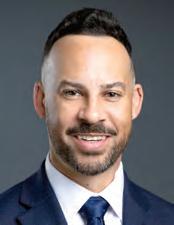
Kelley Cawthorne announced Wednesday, May 20, that Klemet is joining the Lansing-based lobbying firm’s newly launched association management company Catalyst as vice president of operations. In addition to helping lead Catalyst, Klemet will also support Kelley Cawthorne’s continued growth efforts in Southeast Michigan.
The move comes after Klemet’s high-profile run leading the Detroit Auto Show through a pivotal transition period. After longtime executive director Rod Alberts stepped aside, Klemet was tapped to help usher the show into a new era that included bringing the event back to its traditional January timing while placing a stronger emphasis on Detroit culture, community partnerships, and accessibility.
Over the last two years, his vision became increasingly tangible.
Under Klemet’s leadership, the Auto Show expanded its community engagement efforts, built partnerships with local businesses and organizations, and worked to make the event feel more reflective of the city itself. From Day of Service activations with Detroit Public Schools Community District and local Black Greek Letter Organizations to collaborations with media and civic groups throughout the region, Klemet pushed for the show to feel more connected to Detroiters beyond the convention floor.
Michigan Chronicle partnered with Klemet and the Auto Show during both the 2025 and 2026 events, including hosting a panel discussion ahead of the 2025 show, red carpet coverage during Charity Preview events, and a special edition of Pancakes & Politics at Huntington Place during this year’s Auto Show week.
Ahead of that event, Michigan Chronicle Publisher Hiram E. Jackson reflected on the significance of the partnership and the platform the Auto Show had created for broader conversations in the city.
“For 20 years, Pancakes & Politics has built a reputation as the space where leaders come to exchange bold, unfiltered ideas that ultimately shape policy and move communities forward,” Jackson said at the time. “To have the Detroit Auto Show recognize the value of this platform and invite us onto such a prominent stage is an honor. This partnership underscores the weight of these conversations, not just for Detroit, but for the entire nation.”
When Klemet announced on April 30 that he would step down from the Detroit Auto Dealers Association and Detroit Auto Show, the decision caught many in the business and civic community by surprise. At the time, he said only that he planned to pursue new professional opportunities while remaining rooted in Detroit.
“It has been a privilege to serve the DADA and work alongside its leadership and members,” Klemet said in a statement announcing his departure. “At this time, I’ve made the decision to pursue other professional opportunities, and I wish the organization continued success in the years ahead.”
Now, Kelley Cawthorne says Klemet will play a major role in building out Catalyst, the firm’s new full-service association management company. The new venture will provide support for organizations in areas including member engagement, communications, governance, event management, and financial administration.
For company leadership, Klemet’s background in both communications and association leadership made him an ideal addition.
“Catalyst is built on the belief that associations thrive when their members feel seen, supported and connected to a larger purpose. Sam’s strategic leadership and his talent for articulating an organization’s value to the right audiences make him an ideal fit for what we’re building,” Rob Elhenicky, CEO of Kelley Cawthorne, said in a statement.
Klemet brings more than two decades of experience across media, broadcasting, and association leadership roles. Before taking over leadership of the Detroit Auto Show, he served as president and CEO of the Michigan Association of Broadcasters, where he oversaw advocacy, education, and legislative initiatives on behalf of commercial and public radio and television stations across the state.
Prior to that, he spent six years with the Indiana Broadcasters Association and Indiana-based Arland Communications, leading advocacy and compliance efforts for hundreds of member stations. Earlier in his career, Klemet worked as a broadcast journalist, producer, and news director at stations across Indiana, Illinois, and Minnesota.
That communications background often shaped his leadership style, particularly during his time with the Auto Show. Klemet consistently emphasized storytelling, partnerships, and creating experiences that felt authentic to Detroit.
In announcing the new role, Klemet said his experience working with associations over the years helped shape his interest in the opportunity.
“Having spent more than a decade helping associations grow their membership and influence, I know first-hand the challenges these organizations face. Kelley Cawthorne’s Catalyst model will directly address those challenges, and I’m excited to bring my perspective and experience to its association management and lobbying clients,” said Klemet.
While Catalyst represents a new venture for Kelley Cawthorne, much of the attention surrounding the announcement has centered on Klemet and what his next chapter could mean for organizations looking for stronger engagement, clearer messaging, and deeper community relationships.
For many who watched the Detroit Auto Show evolve over the last two years, the transition feels much less like a departure from that work and more like an extension of it.
The firm’s client list currently includes Wayne State University, Opportunity Resource Fund, Retirement System City of Detroit, Special Olympics Michigan, and a series of other businesses, organizations, and associations.
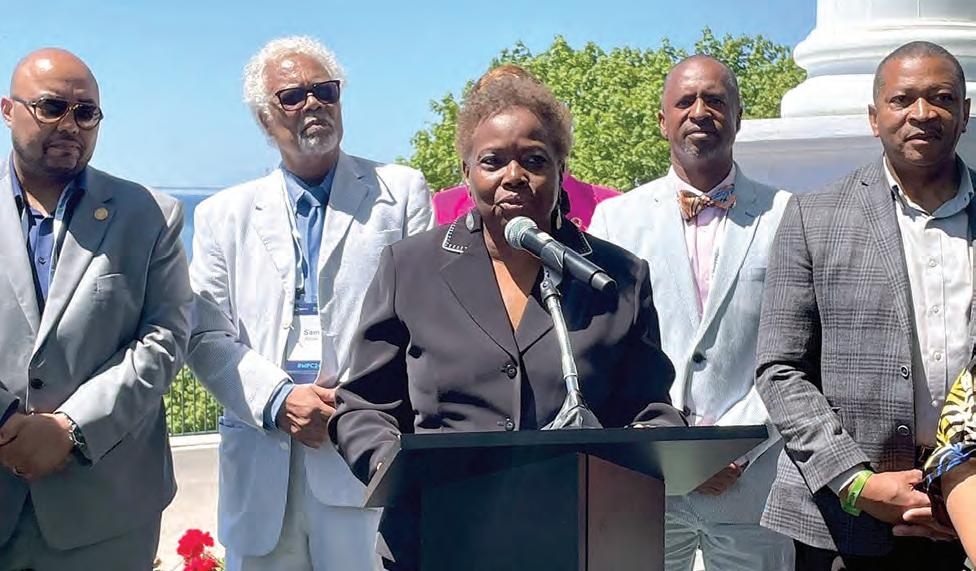
By Sam Robinson SENIOR REPORTER
Two U.S. House candidates seeking to represent Detroit in Congress have been disqualified from the ballot, according to state records made public Tuesday.
Detroit City Council at-large member Mary Waters and Republican candidate Martell Bivings are disqualified from the ballot, records show.
Should Waters be kept off the ballot, state Rep. Donavan McKinney will be the lone Democrat challenging Thanedar in the August 4 primary election.
The district is overwhelmingly Democratic, meaning the winner of the primary should win the general election as well, given there aren’t enough Republican voters.
Bivings told Michigan Chronicle on Tuesday in an interview that he didn’t gather enough valid signatures to make the ballot. Waters, who was present at the council meeting on Tuesday, wasn’t able to be reached for comment.
Waters did not turn in enough signatures after a review by the Wayne County Clerk, a source with direct knowledge told Michigan Chronicle. She turned in around 1,500 signa-
tures and fell short by less than one hundred signatures, the source said.
County records show realtor John Goci didn’t meet the signature threshold either.
It’s a significant development for the primary race in Michigan’s 13th District House seat, currently represented by U.S. Rep. Shri Thanedar. More than one Black Democratic candidate running alongside Thanedar gives him the advantage, experts say.
Thanedar broke the city’s 70-year streak of being represented by a Black person in Congress.
He won the seat in 2022 after a number of Black candidates, including former state Sen. Adam Hollier, Portia Roberson, and John Conyers III, among others, split the vote.
While Thanedar points to his support from Detroit residents in the elections he’s won, the city’s political establishment and younger progressives want badly to remove him.
Waters’ entrance into the race angered progressives who have rallied around McKinney.
“Donavan is a leader who comes from organizing, he’s taken on a responsibility to ensure we have ppl to represent Black ppl’s interests in D.C.,” said Kamau Clark, of We the
People Action Fund. “I think at the heart of why she was leaning to it, I think she has a care for Black people and our interests. I think she’s also frustrated with what’s going on right now. I don’t know if she was fully in the wrong, but I think there’s something to be said about her inability to talk to Donavan and see how they could partner.”
Clark is the Southeast Michigan lead organizer for progressive nonprofit, We the People Michigan, and is supporting McKinney’s campaign. McKinney’s campaign has the support of both progressive and more moderate Democrats in the state legislature. In his campaign, which is endorsed by U.S. Rep. Rashida Tlaib and Vermont U.S. Senator Bernie Sanders, McKinney has said he would fight to lower costs.
Waters took 34% of the vote when she was defeated by Thanedar in the Democratic primary in 2024. Waters’ campaign in 2024 was endorsed by former Detroit Mayor Mike Duggan, who is now running for governor as an independent.
Thanedar won reelection in the August 2024 Democratic primary, taking 54% of the vote.
You can reach Sam at srobinson@ michronicle.com
By Jasmine West
Michigan workers may soon have stronger protections against hiring practices that can follow people from one paycheck, one credit score, or one financial hardship into their next job opportunity.
The Michigan Senate passed Senate Bill 145 on April 22, legislation sponsored by Sen. Sarah Anthony, D-Lansing, that would prohibit employers from requiring job applicants to disclose past pay, fringe benefits, credit reports, or credit history during the hiring process. The bill would also prevent employers from shutting down wage discussions in the workplace, a protection advocates say is central to workers knowing whether they are being paid fairly. The bill has been referred to the Michigan House Committee on Economic Competitiveness for further consideration.
For workers across Michigan, the measure speaks directly to a labor market where pay inequity continues to shape who gets ahead, who gets stuck, and who is forced to carry past financial hardship into future opportunity.
“Pay inequity makes the already serious affordability crisis even worse, undermining an individual’s ability to cover groceries, put gas in their tank, and keep up with rent,” Anthony said. “By ensuring employers make hiring decisions based on the things that matter — the skills, talent, and experience someone brings to the table as opposed to their personal financial background — we will set up Michigan workers to access the opportunities and pay they deserve.”
The bill would amend Michigan’s Payment of Wages and Fringe Benefits Act by limiting how employers can use a potential employee’s compensation history or credit information. Supporters argue that salary history questions can lock workers into lower pay, especially when a person has already been underpaid in a previous job. Credit checks can create another barrier, particularly for applicants who may have experienced debt, medical bills, unemployment, housing instability, or other financial strain unrelated to their ability to do the work.
The issue carries particular weight for women and Black women, who continue to face wide pay gaps in Michigan. The Michigan League for Public Policy reported that Michigan women earn 79 cents for every dollar
earned by men, while Black women earn 67 cents compared to white male workers.
“Michigan women earn 79 cents for every dollar earned by men — and for Black women, that drops to 67 cents compared to white male peers. Using salary history to determine pay is part of what leads to that gap, and it stifles individual women’s ability to advance in their careers and receive fair bonuses and benefits,” said Monique Stanton, president and CEO of the Michigan League for Public Policy.
“We’re grateful to Sen. Sarah Anthony and all those who worked to pass Senate Bill 145. It’s a commonsense tool that makes wages fairer, which has been shown in the 18 other states that have already implemented this type of salary history ban. We urge the Michigan House to do their part next and deliver this win for Michigan workers.”
The policy debate goes beyond paperwork. For many workers, a salary history question can become a quiet ceiling. A worker who was underpaid at a previous job can be offered a new salary based on that old number instead of the value of the current role. A credit check can cause an applicant to be judged by debt or financial hardship before they ever get a chance to explain their qualifications.
Those practices can weigh heavily on communities already dealing with racial wealth gaps, housing costs, inflation, student loan debt, and uneven access to higher-paying jobs.
Supporters of the bill say employment decisions should be based on qualifications, experience, training, and ability. They argue that past pay and credit history often reveal more about structural inequity than individual merit.
“The passage of Senate Bill 145 is another hard-fought victory for workers across our great state,” said Ron Bieber, president of the Michigan AFL-CIO.
“Everything is more expensive, jobs are drying up, and the last thing workers need are employers perpetuating low pay for people struggling to make it. Thank you to Sen. Sarah Anthony for leading the charge on this critical legislation. Now it goes to the Michigan House, and we urge lawmakers to vote YES.”
The measure arrives as national pay equity efforts continue to focus on transparency and worker protections. Several states have already re-
stricted salary history inquiries, and civil rights groups and labor economists have long argued that banning the practice can help reduce discrimination in hiring and compensation. Senate Bill 145 was introduced in previous legislative sessions and reflects recommendations connected to broader pay equity movements.
For Michigan, the bill raises a clear question about what workers should have to disclose to earn a fair shot. Should a woman who was paid less in a prior position have that number used against her in the next one? Should a worker recovering from financial hardship lose access to employment because of a credit history that may have no connection to the job? Should employees be discouraged from discussing wages when pay secrecy has helped wage gaps remain hidden?
Anthony’s legislation attempts to answer those questions through state law.
The bill would not guarantee equal pay by itself. It would not erase long-standing racial and gender wage disparities overnight. It would, however, remove common hiring practices that advocates say can quietly reproduce inequity before a worker ever receives an offer letter.
For Black workers, women, single parents, caregivers, and low-wage workers trying to move into better-paying jobs, that distinction matters. Michigan’s affordability crisis has made every dollar more consequential. Rent, groceries, transportation, child care, utilities, and medical costs have stretched household budgets across the state. A lower starting wage can shape years of earnings, benefits, bonuses, retirement contributions, and economic mobility.
That is why supporters are framing Senate Bill 145 as a worker protection and a pay equity tool. It centers on the simple idea that applicants should be considered for what they can do, not what they were previously paid or what their financial record says about a difficult season in their life.
The legislation now heads to the Michigan House, where lawmakers will decide whether the state moves closer to joining other states that have limited salary history and credit history inquiries in employment decisions. For workers across Michigan, the outcome could determine whether past inequity remains a factor in future opportunities.


B1 | May 27 - June 2, 2026 Where City Meets
By Miss AJ Williams
Before you start thinking about your own story, I want to make something clear. This is not about listing your mother’s mistakes, and it is not a guide to forgiveness. Instead, we are exploring the most personal place where patterns are passed down, the first structure any of us ever lived in. We are looking at what it really takes to break a pattern at its root, not just on the surface.
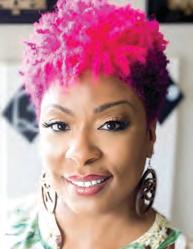
In wellness culture, people often describe the mother wound as a daughter’s unresolved feelings about her mother. While this is partly true, it leaves out details and can keep people stuck. When we see the wound as only a personal issue, we end up blaming or defending, but neither helps us heal. What was passed down in the mother-child relationship was more than just a woman’s personality or the way she loved. It was a way to survive. This survival method was inherited, passed from mother to daughter, shaped by many generations of challenges that had little to do with personal choices and everything to do with what Black women needed to do to survive.
Understanding this difference is not just about feeling better. It is the first step toward real healing.
Think about what a child’s body does before they have words for anything. Long before they can reason or make choices, a baby’s nervous system is completely open. The baby learns from the mother’s nervous system: what is safe, what is not, what should be hidden, what can be shown, what brings closeness, and what causes distance. This is not just a figure of speech. It is a real part of development, proven by research in attachment, trauma, and how our bodies share and receive emotions. Children do not decide these things; they take them in through touch, tone, timing, and whether the person caring for them is calm or not.
This means that before we even had any beliefs about ourselves, we were already learning. And we learned from a woman who had already been shaped by the same forces we would face later in life.
A Black mother raising children in America is often not operating from a neutral emotional landscape. What she passed on depended entirely on what had been done to her and how much of it she ever had the chance to heal. For some, hypervigilance was a way to assess threats, shaped by necessity. Withholding tenderness was a learned response to being open and suffering for it. These were adaptations of love under pressure. Love was changed to prepare children for a world that would not make room for weakness.
For others, the wound was deeper than just adaptation. A mother who did not receive steady care, who was hurt where love should have grown, was not holding back love on purpose. She was passing on the exact shape of her own deprivation. Both experiences create daughters who spend years trying to understand what they received and what they should have had instead. In both cases, the cause is not personal. It is structural. The only difference is how far back the break goes.
Explaining this background does not excuse harm. Some actions were truly harmful, no matter their source. But knowing the context helps us move from blaming to understanding, and understanding is what makes real healing possible.
The patterns created by this first structure make
See HEALING THE MOTHER WOUND Page B-2
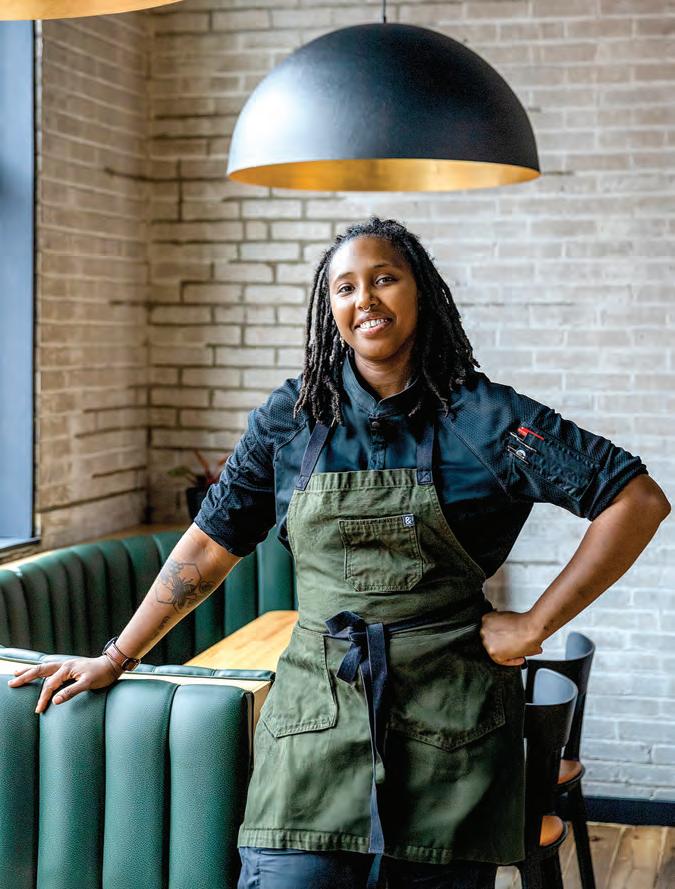
By Miss AJ Williams
Detroit has always had talented chefs, but something new is happening now. All over the city, a new wave of chefs is changing what fine dining means. It feels less like a performance and more personal, with a strong focus on culture, storytelling, and authenticity. Chef Noelle Prater is helping lead this change.
Prater is now helping guide Marrow in the Market into its next chapter. Her style is shaped by Detroit hospitality, Southern roots, classic cooking skills, and a real love for feeding people. She creates food that is both refined and soulful, making sure her dishes feel thoughtful but still warm and familiar.
“Detroit’s food scene feels like it’s finally comfortable being itself,” said Prater. “For a long time, people looked at cities like New York, Chicago or LA as the standard for what ‘great food’ was supposed to look like, but Detroit has its own voice now.”
She says that voice is now shaped more and more by Black chefs, creatives, and innovators who are changing fine dining but still honoring culture and personality through their food. She describes Detroit’s restaurant scene as collaborative, grounded, and real—a place where chefs share ideas,
help each other, and stay close to local producers and farms.
Prater’s cooking style shows that same spirit. She calls it “refined comfort food with a little bit of chaos and curiosity mixed in.” Often, she starts with a single ingredient or flavor she’s obsessed with, then builds it into something complex and memorable.
“A lot of my dishes start because I become obsessed with one ingredient or flavor whether it’s Urfa chili, rhubarb, smoke, char, acid, or some random thing I can’t stop thinking about during prep,” she said. “Then it becomes, ‘Alright… how far can I push this before my cooks tell me I’m doing too much?’”
Her influences include classic cooking methods, whole-animal butchery, Southern traditions, Detroit culture, and lessons from working in busy kitchens night after night. Still, for Prater, food is really about making an emotional connection.
“Guests don’t care how fancy your description sounds if the dish doesn’t make them feel something,” she said.
That emotional connection goes back to her childhood, with memories of family gatherings, holidays, and kitchens full of music, conversation, and shared moments. She says those times shaped how she thinks about hospitality now.


“It was never just about eating,” Prater said. “It was about connection, love, and bringing people together in the dining room, or in the kitchen.”
That same sense of purpose is what attracted her to Marrow in the Market. The restaurant is known for careful sourcing and a farm-focused approach. Its identity is built on transparency, storytelling, and caring for both the food and the people who produce it. Prater says she connected with this mission right away because it felt genuine and intentional.
“At Marrow, that connection starts long before the food reaches the kitchen,” she said, referencing partnerships with Michigan farms including Prairie View Farms, Backus Farms, Modreske Farms, Albright Farms, and Moraine Park Farms. “That changes the way you cook because you feel a responsibility to honor the product and the people behind it.”
Prater also credits Ping Ho and the Marrow team for trusting her vision and giving her room to grow creatively in this new role.
Looking ahead, Prater says she is excited to help continue evolving Marrow’s story while bringing more of her own perspective and experiences into the food. She hopes to create dishes that feel refined but still soulful and approachable — food that reflects Detroit, Michigan seasons, and the people behind the ingredients.
“And honestly,” she said, “if guests leave feeling like they had something thoughtful, welcoming, and real while hearing a little Stevie Wonder playing from the kitchen, then I feel like we did our job.”
By Jeremy Allen EXECUTIVE EDITOR
For 25 years, the Detroit Development Fund has quietly done the kind of work that rarely makes headlines but often changes lives.
Before national retailers carried The Lip Bar products on their shelves, before founder Melissa Butler became one of Detroit’s most celebrated entrepreneurs, she was driving a lipstick truck around the country trying to prove her concept could work.
Before Carla Walker-Miller built one of Michigan’s largest Black woman-owned businesses, she was searching for financing to grow an energy services company that few traditional lenders were willing to back.
Detroit Development Fund said yes. Now approaching its 25th anniversary, the nonprofit lender says it has invested more than $100 million into Detroit small businesses – including more than $40 million specifically through its Entrepreneur of Color Loan Fund – helping Black-owned companies, women entrepreneurs, and neighborhood businesses gain access to capital often unavailable through traditional banking systems.

ship-building central to DDF’s approach.
“There has been a high distrust out there,” Jones said. “A lot of people have been denied. One of the things that DDF portrays is that we are here to build a relationship with you. We are a partner with you in your business. We’re not just a lender trying to check off a box.”
Unlike many lenders, DDF leaders say they work with entrepreneurs even when they are not immediately loan-ready. The organization provides technical assistance grants to help business owners prepare financial statements, strengthen bookkeeping practices, and develop business plans.
That mission has made the organization one of Detroit’s most impactful and least publicly visible economic development institutions, according to its leadership team.
“I feel like Detroit Development Fund is the best well-kept secret in the city of Detroit,” said Deborah Jones, the organization’s chief operating officer. “We have made a tremendous impact over the years, but we haven’t been one to toot our own horn that much. We’ve been more interested in get-
“We are a nonprofit,” said Ray Waters, CEO of Detroit Development Fund. “We provide growth capital loans, grants and technical assistance to small businesses in the city of Detroit who are unable to get bank financing. What our goal is to do is take small companies and not just finance them, but figure out ways that we can help them continue to grow.”
ting the loans out there, making sure that we’re making an impact, making an impact as it relates to the jobs that are created.”
According to DDF leadership, nearly 95% of loans made through the Entrepreneur of Color Loan Fund have gone to Black-owned businesses. About 48% have gone to Black women-owned companies. The organization says its lending has also helped reactivate hundreds of thousands of square feet of previously vacant commercial property across Detroit neighborhoods.
“We’ve been more interested in getting the loans out there and making sure we’re making an impact,” Jones said. “Making
an impact in terms of jobs created, in terms of previously empty buildings that are now occupied by Black-owned businesses, and businesses that are now providing tax revenue and services back to the city of Detroit.”
The organization’s work comes at a time when many Black entrepreneurs continue to face systemic barriers to accessing capital.
National studies have repeatedly shown that Black business owners are denied loans at higher rates than their white counterparts and often receive smaller amounts with less favorable terms.
That reality has made relation-
“We don’t just leave them out there,” Jones said. “Even if it’s not right now, we let them know what they need to do to become loanready. We’ll provide grants, we’ll connect them with service providers, and we’ll help them get where they need to be.”
That support can range from microloans as small as $1,000 to larger loans up to $300,000, depending on the business’s stage and needs.
Senior lender Kevin Sweeney said the organization has increasingly focused on meeting entrepreneurs where they are through direct community engagement.
From page B-1
“Our whole entire team has been out in the marketplace,” Waters added. “We’ve been at various events. I think this week alone our team had already been to about 12 events just talking to people, getting the name out there, spending time with small companies and letting them know what we do and how we can help them.”
DDF has also become active in Detroit’s growing tech ecosystem, particularly among Black entrepreneurs building startups in emerging industries. Through partnerships connected to Venture 313 and Black Tech Saturdays, the organization has helped provide both lending opportunities and startup support to founders often overlooked by traditional venture capital networks.
“We think it’s very important,” Waters said of Detroit’s growing Black tech scene. “We’re seeing a lot of emergence coming through Venture 313, and it allows us as a lender to provide small loans or larger loans to tech companies while other partners can make equity investments into those companies.”
At the same time, DDF continues to support more traditional small business sectors that remain vital to Detroit’s economy, including restaurants, contractors, and neighborhood retail operations.
Waters said one growing area involves small contractors working on Detroit’s expanding affordable housing and redevelopment projects.
“They get a contract to do electrical work or plumbing work, but they don’t have the
money to buy materials,” he said. “So we provide a line of credit to help them do the job. Then when they get paid, they pay the line of credit back and move on to the next project.”
The organization’s community-centered approach also extends to its lending philosophy.
As interest rates have climbed nationally, DDF leadership said they made a deliberate decision not to raise rates beyond 10%, even as many online lenders and alternative financing companies charge substantially more.
“We made a decision that we would not go over 10% on our interest rate,” Waters said. “You see these online lenders saying, ‘Get a business loan in 24 hours,’ but many of those loans are predatory. Some are 20% or 22% interest. A lot of companies are jumping on them to get quick money, but at the end of the day, those loans aren’t helping them.”
The nonprofit model, however, comes with challenges — particularly as federal and philanthropic funding landscapes continue to shift.
DDF receives some support through the federal Community Development Financial Institutions Fund and the Michigan Economic Development Corporation, but leadership said much of its funding historically has come from private foundations, including the Kellogg Foundation, Ford Foundation, and Gilbert Family Foundation.
Now, amid changing political dynamics surrounding diversity, equity, and inclusion initiatives, Waters acknowledged that some
From page B-1
sense. They form a system. Wanting to earn love by performing, being afraid of being a burden, and feeling responsible for others’ emotions are not random. These patterns formed in a child who had no choice but to adapt to her environment. They showed up before she could speak, choose, or even question if any of it was true.
To heal the mother wound, you need to hold two truths at the same time. You can recognize what hurt you and mourn what you missed, while also seeing your mother as someone shaped by larger forces. You can grieve both the pain and the world that caused it. This kind of grieving is where real change begins. It does not erase the past, but it helps you stop repeating the same patterns without knowing it. The pattern cannot be changed just by changing actions. It must be changed by understanding.
Women who do this healing work often reach a turning point. The patterns that shaped them before they could speak start to look like learned behaviors, not
unchangeable truths. Their family history begins to feel less like a life sentence and more like a story that can still change.
There is a reason this article ends one chapter and begins another. The inner work, like understanding your identity, survival habits, lost tenderness, and old patterns, comes from a long line of women. These things did not start with you. They came through you, passed down by women over time and through many challenges, shaped by a history that is its own kind of structure. To truly know yourself, you have to look at the bigger system you come from. Psychology has brought us this far. What comes next is even older and broader, and it asks us to think in new ways.
AJ Williams is a Spiritual Wellness Architect and Educator and the Managing Editor of the Michigan Chronicle. A thought leader at the intersection of spirituality, astrology, psychology, and identity evolution, she is the founder of Sunday Communion, a quarterly live transformation experience held in Detroit. The Inner Architecture is her editorial column on the work of becoming.
funding streams may become more difficult to access.
The organization recently applied for federal CDFI funding but has refused to change the name of its Entrepreneur of Color Loan Fund despite shifting federal scrutiny around race-conscious initiatives.
“The Entrepreneur of Color Fund is what we are and who we are,” Waters said. “We are not going to change the name. It may mean we don’t receive some federal funding, but we like what we do, and it’s who we are.”
Even so, DDF leaders say they remain committed to their mission and optimistic about Detroit’s entrepreneurial future.
For Sweeney, who previously worked in major banking institutions before joining DDF, the work carries a deeper sense of purpose.
“The most value I get is helping organizations with owners that look like me and are in the city,” he said. “I live in the city, I play in the city, and I get a lot of intrinsic value out of being part of the resurgence and helping people I work with and live around every day.”
DDF leaders say their goal remains helping local entrepreneurs survive, grow, and create generational impact in the communities they call home.
“That’s why we do what we do,” Waters said. “Every day I walk in thankful that we have a team of people who really care about Detroit and want to see the companies we work with grow. At the end of the day, we can be satisfied helping companies grow, helping create jobs for Detroit residents, and helping fill these empty spaces across the city.”




By Sam Robinson SENIOR REPORTER
There’s a former NFL player running for Highland Park mayor on a platform he says would “end the corruption happening in city hall.”
“I’m very excited, because I’m like a little kid all over again, ready for game day,” said J. Douglas Hollie, who was born and raised in the city before his sports career took flight.
Hollie, 65, said his campaign is a “thank you” to the city that gave him so much in his upbringing. He acknowledged his time in California and Texas, but said his spirit never left the city before he returned in 2012.
He’s one of five candidates running for mayor, including incumbent Mayor Glenda McDonald, Shamayim “Mama Shu” Harris, Attie Pollard, Joshua LaMere, and Elen Robinson.
Hollie, known for his work in real estate, said he’s running to shake things up in city hall and deliver greater public safety to entice new business and residents.
He told supporters he’s previously presented plans to the city in the past like turning the Model T plant into a market with fresh produce and pop-up restaurants.
Currently, he’s the president and CEO of H.E.A.R.T. 2 H.E.A.R.T., Inc., a nonprofit he founded in 2009 to serve vulnerable populations across six counties in the San Francisco Bay Area. Hollie served from 2003-2010 as an assistant district attorney in the city of San Francisco.
Hollie criticized the deal Mayor Glenda McDonald approved to eliminate the city’s water debt with the Great Lakes Water Authority (GLWA) and questioned the process in which city engineers are fixing the city’s water and sewage infrastructure.
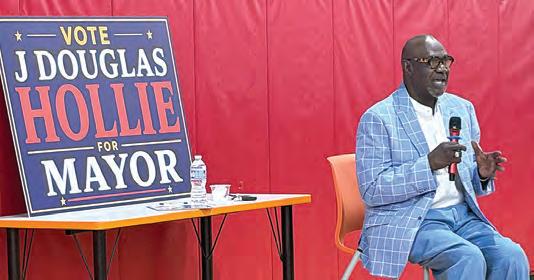
“It’s people from the outside giving them a few coins here and there selling their souls to the devil,” Hollie told dozens of supporters inside the gym at Highland Park’s Boys & Girls Club Thursday.
The city agreed to pay $1 million to GLWA to begin to reimburse member partner communities who were paying for Highland Park’s debt. Highland Park owed more than $20 million for failing to pay for its sewer system since 2014. City leaders said city residents were being overcharged for services after it was forced by the state to shut down its own water department and switch to the Detroit Water and Sewerage Department over safety concerns.
A Highland Park High School graduate and native of the city, Hollie returned to the city 15 years ago to help his hometown, he said. Hollie was drafted by the Detroit Lions in the third round of the 1984 supplemental draft. He played in the USFL before returning to the NFL’s Seattle Seahawks in 1987 and 1988.
“He’s an excellent blend of business savvy, but also having a genuine compassion for people,” said supporter Eric Rice on Thursday.
Community members who showed up to the campaign launch event Thursday expressed frustration toward current and past city leaders, accused local politicians playing politics over who gets funding for home repair or public infrastructure upgrades.
“People put their name from a list, and pull from a hat, and for some reason your name disappeared, and they give it to somebody’s friend,” Hollie said. “Under my watch, that will stop. You have cliques in this town. That’s going to cease.”
Residents at Hollie’s event also mentioned concerns about the permanent closure of the city’s public library and the lack of hospitals and drug stores. Residents said they want to see economic development in their neighborhood and in the city’s main commercial corridor on Woodward Ave.
“It sounds like people aren’t concerned about the citizens of this town, but they’re concerned about how much money is in their pockets,” Hollie said.
Hollie told Michigan Chronicle after the event that he hasn’t spoken to the other candidates, or incumbent mayor Glenda McDonald, and isn’t planning to.
“Why? We already know what’s going on in this city, what’s the purpose?”
You can reach Sam at srobinson@michronicle.com.

By Nina Love
Beyond the Plate: Detroit’s Hospitality Renaissance is a series by hospitality expert and All Black Everything Hospitality Group CEO Nina Love.
There was a time when good food alone could carry a restaurant.
A talented chef, a few strong dishes, decent service, and word of mouth were often enough to build momentum. But today’s diner, whether consciously or not, is asking for something deeper.
Not just a meal. An experience.
And the establishments that understand this are the ones beginning to separate themselves from the rest. Because the truth is, great hospitality has an architecture to it. Invisible, often unnoticed, but deeply felt. It lives in timing. In pacing. In energy. In the choreography between the kitchen, the floor, the music, the lighting, and the emotional awareness of the team guiding the room.
At its highest level, hospitality is not random charisma or surface-level friendliness. It is intentional by design. And increasingly, good food without intentional hospitality feels incomplete.
The Invisible Architecture of Hospitality
One of the greatest misconceptions in the restaurant industry is the belief that hospitality begins when the food arrives. It doesn’t.
The experience begins the moment someone approaches the door. How long they stand before being acknowledged. The energy of the greeting. The flow of the room. The confidence of the staff. The sensory cues that tell the guest whether they are about to be cared for, or simply processed.
These things matter. Not because diners are looking for perfection, but because people remember how spaces make them feel.
This is what I often refer to as the invisible architecture of hospi-

tality: the operational and emotional framework supporting the guest experience.
The best restaurants understand that every detail communicates something. A rushed interaction communicates disorder. A disconnected server communicates lack of alignment. A beautifully plated dish arriving to an emotionally flat table creates friction between culinary intention and lived experience.
And in today’s hospitality landscape, especially as cities like Detroit continue evolving into serious culinary destinations, that gap becomes increasingly visible.
Because good food is no longer rare enough to be the sole differentiator. The feeling is.
A Night at Baru
Recently, I visited Baru, one of Detroit’s most compelling newer additions to the culinary landscape, led by Executive Chef Robert Lloyd.
And what stood out immediately was not just the cuisine, it was the intentionality.
The space itself feels immersive without trying too hard. Warm lighting, layered textures, thoughtful ambiance. There is a rhythm to
the environment that allows the experience to unfold naturally rather than forcefully.
From the moment guests enter, there is a sense that the team understands the assignment. Not in a performative way. In an aligned way.
The service felt attentive without hovering. Knowledgeable without rehearsed stiffness. The pacing allowed the evening to breathe.
And then the food arrived.
Thoughtfully curated Latin and Caribbean fusion dishes, executed with both technical precision and soul. The plating was meticulous without becoming inaccessible, beautiful, yes, but still inviting. Every element appeared considered.
What impressed me most, however, was that the experience remained cohesive. Too often, restaurants excel in one area while neglecting another. Strong kitchen, weak floor. Beautiful design, inconsistent service. Excellent concept, fragmented execution.
At Baru, there is a noticeable commitment to alignment between culinary artistry and hospitality culture. And that matters. Because restaurants that raise the bar do more than serve good food. They shift expectations.
Where We’re Being Invited to Grow
What establishments like Baru signal is that Detroit is entering a new era of hospitality.
An era where creativity alone is not enough. Where aesthetics alone are not enough. Where even great flavor alone is not enough.
The next evolution of our culinary scene will belong to the spaces willing to fully commit to operational excellence and unreasonable hospitality. And unreasonable hospitality does not mean extravagance. It means intentionality.
It means creating experiences where guests feel anticipated, guided, and genuinely cared for. It means training teams not simply to complete tasks, but to understand emotional rhythm and presence. It means leadership that recognizes hospitality is both an art and a system.
This is the difference between restaurants people enjoy…and restaurants people remember.
We already possess extraordinary culinary talent. Our city’s cultural depth and creative resilience make us uniquely positioned to become one of the country’s most exciting food destinations.
But what will ultimately elevate us is consistency of experience. The invisible architecture. The alignment. The care embedded into every touchpoint.
Because in this next chapter of Detroit hospitality, the question is no longer simply: “Is the food good?”
The question will be: “How did the experience make people feel?”
And the restaurants that answer that question well will not only thrive, they will define the future of dining in our city.
Baru is located at 1407 Randolph St., Ste. 100, in Detroit.
Nina Love, aka The Culinary Griot, is a culinary artist, hospitality consultant, and the founder of A.B.E Hospitality Group, The Love Experience, Alchemy of Excellence Consulting, and The Culinary Griot. With over 22 years of experience, she specializes in operational excellence, culinary mastery, elevated guest experience, and building transformative hospitality brands.
The Skillman Foundation today announced the 2026 Skillman Visionary Award recipients, honoring 10 leaders who are helping transform public education across Detroit and Michigan.
The Skillman Visionary Awards recognize individuals who are shaping the education system and how young people experience it. At their core, the awards reflect a simple idea: lasting change happens when people across classrooms, communities, and policy spaces work together to build an education system that better supports the well-being and potential of all students.
“Across Detroit and Michigan, there are people doing the hard, often unseen work of strengthening public education. They are building trust, opening doors, and creating new possibilities for young people every day,” said Angelique Power, President & CEO of The Skillman Foundation. “The Skillman Visionary Awards recognize that leadership and invest in it, because when the people closest to students have a voice in shaping what comes next, real change begins to take root.”
Each recipient receives a $50,000 unrestricted, no-strings-attached award, recognizing their impact and investing in the future they are building. Together, they reflect the education ecosystem, from educators and organizers to policy influencers, business leaders, and media voices. The 2026 cohort includes:
• Alice Thompson, CEO, BFDI Educational Services, Inc.: For decades of leadership combining frontline youth services with policy advocacy to better respond to young people’s needs and aspirations.
• Alycia Meriweather, Deputy Superintendent, Detroit Public Schools Community Dis-
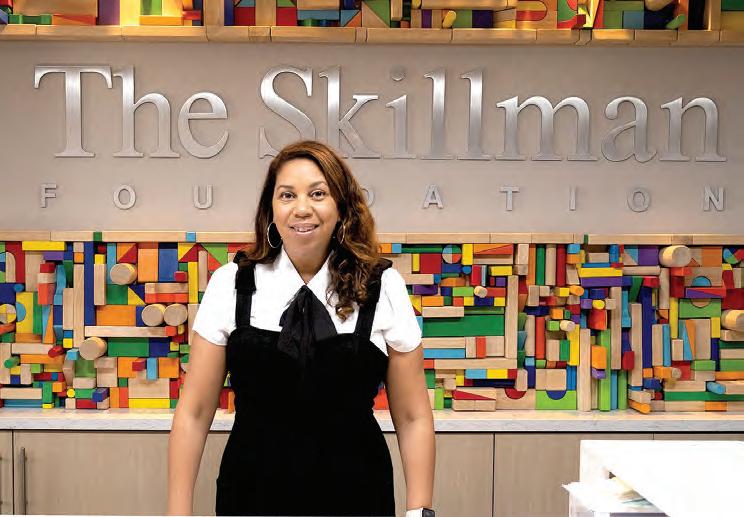
trict: For connecting students, community partnerships, and public policy to remove barriers to learning across Detroit.
• Armen Hratchian, Executive Director, Teach For America Detroit: For strengthening Michigan’s educator pipeline and elevating teachers as leaders in policy and systems change.
• Curtis L. Lewis, Ph.D, Founder & President, Boldly Moving Education Ahead: For advancing culturally responsive education and creating more pathways for Black educators to enter and thrive in the profession.
• Dr. Seydi Sarr, Founder & Executive Director, ABISA: For supporting community advocacy that supports access to education for
immigrant students and families.
• Imani Foster, Communications Lead, 482Forward: For elevating youth and community voice through education organizing and storytelling.
• Ines de Jesus, Community Leader and Education Advocate: For decades of leadership advancing bilingual education, education for all, and community voice.
• Mike Jandernoa, Founder & Chairman, 42 North Partners: For leveraging business and philanthropic leadership to help ensure every Michigan school is a launch pad of opportunity.
• Dr. Omar Hakim, Vice President of Educa-
tion, Detroit Public TV: For expanding access to learning through public media and fostering connections between schools and communities.
• Venessa Keesler, President & CEO, Launch Michigan: For bringing a diverse array of education stakeholders around shared strategies to strengthen Michigan schools.
Together, the Skillman Visionary Awardees represent a span of generations, roles, and perspectives, demonstrating that strengthening public education requires collaboration across sectors and experiences. They are working across communities and sectors to improve how the education system supports students every day.
The Skillman Visionary Awards are part of The Skillman Foundation’s People Powered Education strategy, which centers the voices of students, families, educators, and communities in shaping education decisions. Too often, those closest to young people are left out of how systems are designed. These recipients are helping change that by connecting lived experience with the policies and practices that shape opportunity.
“Transformation does not come from one place or one perspective. It grows when people come together with a shared belief in young people and a willingness to do the work differently,” said Power. “What we see in this year’s recipients is a collective force, people building something stronger, more responsive, and more human for the next generation.”
By recognizing and connecting these leaders, the Skillman Visionary Awards help build common ground and momentum for education systems change across Michigan, demonstrating that progress is not only possible but already underway.


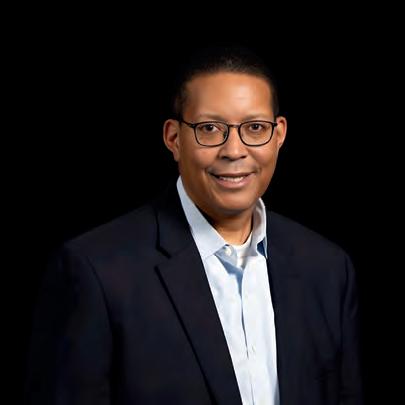
Dr. Gavin Beckford, PhD
Economic Development & Downtown Development Authority (DDA) Manager | Canton Township
Barry Blackwell
Director of Community Relations
Henry Ford Health
Arnold Boyd
Founder and CEO
Student Transportation Services
Darnell Boynton
Chief Corporate Compliance Officer & General Counsel
CNS Healthcare
Teferi Brent
Director - Office of Neighborhood and Community Safety | City of Detroit
Dr. Harold Cadwell, Jr.
President and CEO
Transformation Development Corporation
Dr. Andre Camp
Sergeant & Professor Detroit Police Department, Cleary University & Walsh College
Tyrone Carter
State Representative Detroit 1st District
William C. Childs, II, DO Doctor of Osteopathic Medicine
Henry Ford Health
Hon. Poncé D. Clay
Judge 36th District Court
Walter Davis
Deputy Chief, Security and Integrity Group Great Lakes Water Authority
Jason Dixon
CEO
Strategic Alliance CDC
Charles Dulin
Director of IT & Facilities
Centers For Family Development, Inc. (dba Black Family Development)
Dr. Rashid Faisal Department Chairman for the College of Urban Education | Davenport University
Jonathan Feild, Esq.
Attorney at Law Ven Johnson Law
David Felton
Recruiter Wayne County Sheriff's Office
Gary Ganaway
Commercial Director AXN Automotive Systems
John Gardner Manager, Veterans Initiatives/ Diversity Hiring/Career Tech Work Based Learning Programs| ROUSH Industries
Sean Gray
Senior Vice President of Small Business Detroit Economic Growth Corporation
Huey S. Gray III
Director of Membership Detroit Regional Chamber
Aaron Hall Vice President, Detroit Market CHN Housing Partners / Detroit Housing Network
Dr. Nelson Henry
Chief Executive Officer Center for Strategic Leadership & Organizational Coherence
Lawrence Hood
Chief Executive Officer Detroit Academy of Arts and Sciences
Bruce Hunt
Executive Director Detroit-Windsor Dance Academy
Kevelin B. Jones, II
Superintendent Flint Community Schools
Rashaan Josey
President - Automotive Bose Corporation
Jerry Lawrence Jr.
Principal / Director University Prep Science and Math High School
Kevin Manuel
Owner
Amada Senior Care
Myron Montgomery
Principal East English Village Preparatory Academy
Dr. Cleamon Moorer, Jr.
Founding Executive Director Eye Care for Detroit
Quantez Pressley
Pastor Third New Hope Baptist Church
Tyron Releford
Business Unit Leader, Global Supply Chain
General Motors
Dan Ringo
Vice President of Operations and Compliance SEEL, LLC
Dr. Teronto Robinson, MD, MSHCM Family Medicine Physician
John D. Dingell VA Medical Center Corewell Health
Richard T. Seay
Deputy Mayor / Director, Information Technology |City of Pontiac
Bruce Simpson Assistant Wayne County Executive Wayne County
Shawn Smith Manager, Labor Relations / NFL Official Blue Cross Blue Shield of Michigan / NFL
Chris Taylor
Community Engagement & Outreach
Director United Way for Southeastern Michigan
Damon Thompson Senior Director, National Housing Local Initiatives Support Corporation (LISC)
Dwayne Walker
UAW Local 900 President UAW / Ford
Maurice Wallace Owner & Executive Chef
LoneStar Catering
Stefen J. Welch
Vice President, Public Affairs Detroit Pistons
Rev. Darryl Williams
Pastor St. Stephens AME Church
Glenn Wilson President and CEO Communities First, Inc.
Dr. Warren Woodruff, DDS Owner/Dentist Caring Smiles Family Dentistry
Darryl Woods Police Commissioner, Vice Chair City of Detroit
DeJuan Woods Director of Marketing and Community Relations First Independence Bank
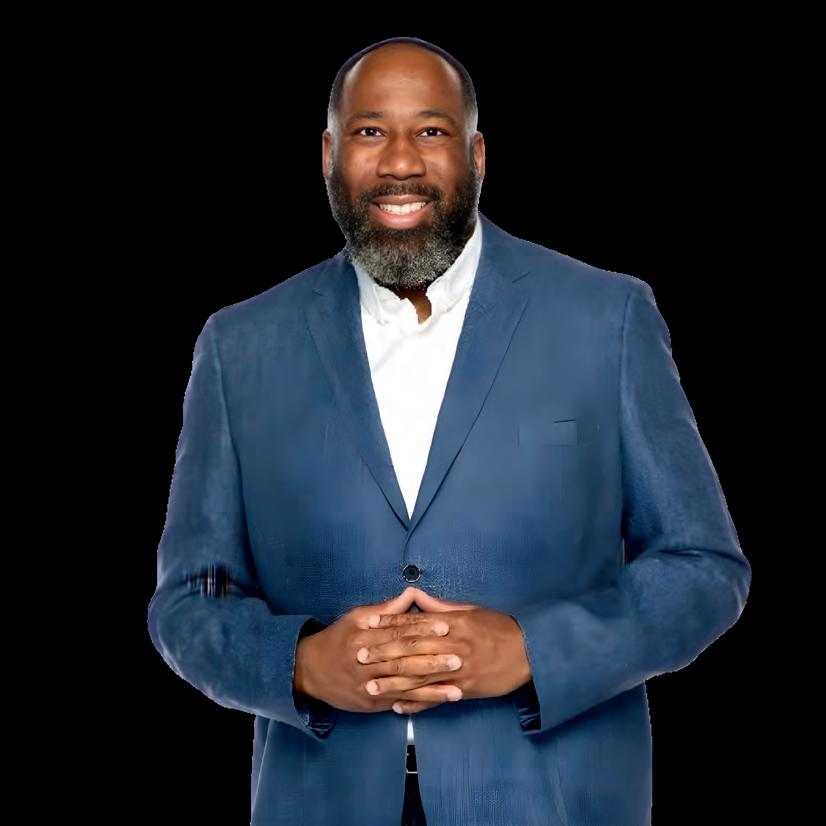



The Detroit Public Schools Community District is seeking general contracting firms for the demolition, furnishing, delivery, and installation of a gymnasium partition wall & motorized sloped gymnasium curtains under RFP 26-0328. The gymnasium partition wall will be installed at Henderson Academy located at 16101 West Chicago Street, 48228. The Motorized sloped gymnasium curtains will be installed at Renaissance High School located at 6565 West Outer Drive, 48235.
There will be an optional pre-bid conference for this solicitation hosted virtually via Microsoft Teams at 10:00 a.m. on May 29, 2026. The pre-bid conference can be accessed using the following link:
https://tinyurl.com/a75a3zsb
Call In: (313) 462-2305
C onference Id: 720 384 472#
There will be an optional in-person walk-through for this solicitation at 2:00 p.m. on May 29, 2026. The walk-through will be conducted at both Henderson Academy located at 16101 West Chicago Street, 48228, and Renaissance High School located at 6565 West Outer Drive, 48235. The due date for proposals is 12:00 p.m. on June 16, 2026. Late proposals will not be accepted.
A virtual Public Opening will occur at 12:00 p.m. on June 16, 2026, and can be accessed using the below link.
https://tinyurl.com/4udknzh3
Call In: (313) 462-2305
C onference ID: 864 585 385#
This project is subject to Michigan State Prevailing Wage
Laws (Michigan Public Act 10 of 2023) and the contractor must pay prevailing wages and fringe benefits to all its contractors, subcontractors, and construction mechanics working on the project in accordance with Michigan Public Act 10 of 2023.
All bids must be accompanied by a sworn and notarized statement disclosing any familial relationship that exists between the submitting company and any employee of DPSCD. DPSCD shall not accept a bid that does not include this sworn and notarized disclosure statement.
If you have questions, please contact the Procurement Department at (313) 873-6531.
Notice is hereby given that the Highland Park Planning Commission will conduct a Public Hearing at its regular meeting scheduled for June 10, 2026, at 6:00 p.m., for the purpose of reviewing and discussing proposed Alley and Street Vacation application, on behalf of Wayne Metropolitan Community Action Agency. For the vacation of certain alleys and segments located generally north of Cortland Street, south of Highland Street, east of 3rd Street, and west of 2nd Street, within the Highland Park Subdivision.
The first proposed vacation, identified as Alley Vacation “A,” concerns the land situated in the City of Highland Park, County of Wayne, State of Michigan, described as follows: that portion of a 20foot alley as opened over the westerly 20 feet of Lot 113, together with that portion of an existing 20foot alley lying adjacent to the westerly 20 feet of the southerly line of said Lot 113; adjacent to the southerly line of Lots 114 through 118, inclusive; adjacent to the northerly line of Lots 69 through 73, inclusive; and adjacent to the westerly 20 feet of the northerly line of Lot 74 of the Highland Park Subdivision, City of Highland Park, Wayne County, Michigan, according to the plat recorded in Liber 10 of Plats, Page 18, Wayne County Records.
The second proposed vacation, identified as Alley Vacation “B,” concerns the land situated in the City of Highland Park, County of Wayne, State of Michigan, described as follows: that portion of a 20foot alley as opened over the easterly 20 feet of Lot 109, together with that portion of an existing 20foot alley lying adjacent to the southerly line of Lots 105 through 108, inclusive; adjacent to the easterly 20 feet of the southerly line of said Lot 109; adjacent to the easterly 20 feet of the northerly line of Lot 78; and adjacent to the northerly line of Lots 79 through 82, inclusive, of the Highland Park Subdivision, City of Highland Park, Wayne County, Michigan, according to the plat recorded in Liber 10 of Plats, Page 18, Wayne County Records. Written comments regarding the proposed bylaw amendments or alley vacations may be submitted to the City Planner, Donovan Smith, via email at dsmith@mcka.com.
DETROIT PUBLIC SCHOOLS COMMUNITY DISTRICT BOARD OF EDUCATION NOTICE OF APUBLIC HEARING ON THE PROPOSED BUDGET FOR THE 2026-2027 FISCAL YEAR FOR DETROIT PUBLIC SCHOOLS AND THE DETROIT PUBLIC SCHOOLS COMMUNITY DISTRICT (MANDATED BY MCL 141.434)
The Board of Education of Detroit Public Schools Community District will hold a public hearing on the proposed budgets for the Detroit Public Schools and the Detroit Public Schools Community District for the 2026-2027 school year beginning at 5:00 pm on Tuesday, June 16, 2026 at East English Village Preparatory Academy at Finney. The meeting will also be available on-line at the information provided below. Copies of the proposed budgets will be available for public inspection at the Office of Management and Budget located in the Fisher building, 11th Floor, 3011 W. Grand Blvd., Detroit, MI 48202 from 8:00 am until 5:00 pm on Wednesday, June 10th, 2026. The property tax millage rate proposed to be levied to support the proposed budget will be a subject of this hearing.
Join on your computer or mobile app https://www.detroitk12.org/boardmeeting



(StatePoint) If you’re an entrepreneur, you may be feeling the pinch. New data from Xero suggests increased cash flow pressure for small businesses in 2026.
The latest Xero Small Business Insights (XSBI) data shows while sales grew in the early months of the year, the rise was much smaller than the historical average, amounting to gains that could potentially be swallowed up by inflation and rising gas prices.
So how can your small business overcome cash flow challenges in today’s economy? Here are three practical steps you can take:
1. Getting a clearer view of your numbers: Cash flow challenges are harder to solve when financial information lives in too many places. The best accounting tools today can transform the way you work and give you total cash flow clarity so you don’t just survive, but thrive with the ability to set future goals. Tools like Xero go beyond traditional accounting to serve as a one-stop shop where you can automate everyday tasks, pay your vendors and employees, send invoices to get paid faster, and unlock real-time cash flow insights. Syncing these functions on one platform can help you take control of your business finances and create time for work that’s professionally and financially rewarding.

incl. door handles, mirrors, lamp internals &exhaust tips, using Autodesk Alias AutoStudio, Autodesk Maya, NX &VRED tools, for U.S., global &emerging markets. Interpret, define, conceptualize &execute unique solutions to technical challenges &provide creative proposals to
tants and bookkeepers by enabling you to show up with cleaner data and clearer questions,” says Matan Bar, U.S. CEO, Xero.
design intent from initial concept thru
2. Making the most of your financial tools: At a time when small businesses are feeling mounting pressure, it’s especially important that the software you use to stay financially organized is approachable. That’s why Xero now offers Xero Coaches, onboarding specialists who work one-on-one with small businesses during their first 90 days on Xero to help them get set up and use the platform more effectively. Through scheduled sessions, you can get support with setting up your account and save time from the start. “Taking advantage of this training can help you complete everyday tasks with ease, and sets the stage for strong ongoing relationships with accoun -
achieved in various stages according to GVDP, while collaborating with engrg, packaging, human factors, &tooling teams to assure
radii/draft,
3. Working with financial professionals: You may think that a DIY approach to money management is a good way to tighten expenditures. But think of the invaluable hours of labor you can redirect toward the revenue-generating aspects of running your business by seeking professional help. It is as critical to work with accountants as a financial advisor. They can help you not only with cash flow management to ensure you continue to grow, but also with other important tasks like tax planning, developing subscription models and setting up invoicing reminder schedules. With smart strategies and a good handle on the best technological tools, your small business will be better prepared to overcome cash flow challenges, even in today’s economy.
FEATURE IMPACT
For many homeowners, heating and cooling systems fall into the “out of sight, out of mind” category. However, even if the air is flowing and the temperature feels right, taking an “if it’s still running, it’s still fine” approach to your HVAC system today can lead to higher repair bills, rising energy costs, uncomfortable downtime and rushed replacement decisions tomorrow.
While it may seem cost-effective in the short-term, the experts at Mitsubishi Electric Trane HVAC US (METUS) suggest proactive maintenance and planned upgrades as the smarter financial move in many cases.
The Hidden Costs of Waiting HVAC systems rarely fail without warning. Instead, they decline gradually, becoming less efficient and more prone to breakdowns over time. They commonly fail during extreme summer heat or winter cold when demand is highest. A broken air conditioner during the peak of summer doesn’t just create discomfort; it often comes with longer service wait times and higher emergency repair costs, while also leaving you with less time to compare equipment options, take advantage of rebates or make a convenient installation appointment.
Small issues – like a dirty filter restricting airflow or worn components adding stress to other parts of the system – can also snowball into bigger, more expensive repairs. Similarly, inefficient systems, especially older or poorly maintained ones, can drive up monthly energy costs, using more energy and putting additional stress on the components to maintain the same comfort level.
Signs Your HVAC System Needs Attention
Even if your HVAC system hasn’t broken down, it may already be showing signs of trouble. Consider these warning signs that your HVAC system may be due for replacement:
n Rooms heating and cooling unevenly
n Rising utility bills with no clear cause
n Strange noises or unusual odors
n Weak airflow or reduced comfort
n Frequent service calls
n System age approaching 10-15 years or older
The Value of Preventive Maintenance
Routine maintenance can help catch small issues early before they become costly repairs while extending system lifespan and maintaining performance.

Regularly replacing or cleaning filters helps maintain airflow and efficiency while keeping vents clear and outdoor units free of debris ensures your system can operate at its best. Professional seasonal tune-ups can also help catch small issues early and extend the lifespan of your equipment.
&safety reqrmnts in compliance w/ U.S., European &China standards. Bachelor, Transportation or Industrial Design. 60 mos exp as Digital Sculptor, Digital Modeler, or related, designing or developing 3D Class A surfaces of full vehicle psgr vehicle exterior cmpnts incl. fascias, grills, head/taillamps, doors, fenders, ABCD pillars, &liftgates, using Alias AutoStudio, NX &VRED tools, for U.S., global &emerging markets, or related. Mail resume to Ref#1827-201, GM Global Mobility, 300 Renaissance Center, MC:482-C32-C66, Detroit, MI 48265. sculptures in Alias (surfaces to mill), interpret sketches &drawings, &develop interior &exterior clay models of full vehicles (full-sized models) &cmpnts (and cmpnts in steel, carbon fiber,
How Planning Ahead Can Pay Off
Replacing an aging HVAC system before it fails gives homeowners an invaluable asset: time. Instead of making a rushed decision in extreme temperatures, you can make thoughtful decisions based on comfort goals, budget and home needs. It also allows for evaluating newer technologies that can improve everyday comfort and lower operating costs. Today’s systems offer features that weren’t available a decade ago, allowing for customization of indoor environments that was once out of reach.
Benefits of Modern HVAC Upgrades
Upgrading your system isn’t just about avoiding breakdowns – it’s about enhancing your everyday comfort and improving efficiency and control. Modern HVAC solutions, like Zoned Comfort Solutions from Mitsubishi Electric, allow for personalized temperatures in different rooms or areas of the home.
Using energy-efficient heat pump technology, they provide heating and cooling in one efficient system for better temperature consistency and control in every season. Newer systems – both ducted and ductless – tend to run more quietly and offer flexible installation. They can be used with existing ductwork or installed in homes without it, making them a strong option for room additions, garages, sunrooms or spaces that are traditionally difficult to heat or cool.
Long-Term Benefits of Upgrading
When you shift to proactive HVAC maintenance, the benefits can add up and you can gain confidence your home is prepared, regardless of what the seasons have to offer. Upgrading your system ahead of a total failure reduces the risk of unexpected breakdowns, lowers energy costs and provides more consistent comfort throughout the year. There’s also the added bonus of increasing your home’s appeal and value for future buyers.
While waiting until it breaks might feel like the easy choice, it may also be the most expensive one. Visit mitsubishicomfort.com to explore your options and learn more.