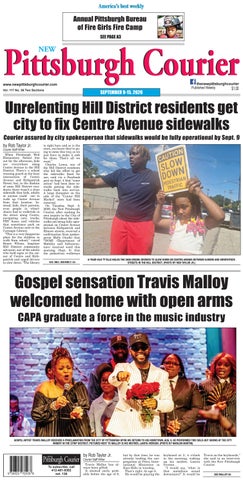
America’s best weekly
Annual Pittsburgh Bureau of Fire Girls Fire Camp SEE PAGE A3
Pittsburgh Courier NEW
www.newpittsburghcourier.com Vol. 117 No. 36 Two Sections
SEPTEMBER 9-15, 2026
thenewpittsburghcourier Published Weekly $1.00
Unrelenting Hill District residents get city to fix Centre Avenue sidewalks Courier assured by city spokesperson that sidewalks would be fully operational by Sept. 9 by Rob Taylor Jr. Courier Staff Writer
When Pittsburgh Weil Elementary School lets out for the afternoon, kids are everywhere along Centre Avenue in the Hill District. There's a school crossing guard at the busy intersection of Centre Avenue and Kirkpatrick Street, but, to the disdain of some Hill District residents, there wasn’t a clear sidewalk that kids, adults or anyone could use to walk up Centre Avenue from that location. Instead, kids, their parents, even people in wheelchairs had to walk/ride in the street along Centre, navigating cars, trucks, PRT buses and vehicles that sometimes park on Centre Avenue next to the Carnegie Library. "This is a very dangerous place for the children to walk from school," voiced Renee Wilson, longtime Hill District community advocate, one of the adults who held signs at the corner of Centre and Kirkpatrick and urged drivers to slow down. "The library
is right here and so is the store, you know they're going to come this way, so we just have to make it safe for them. That's all we want." Charles Lyons, one of the Hill District residents who led the effort to get the sidewalks fixed for use, said via a Facebook post on Sept. 4 that "some action" had been done towards getting the sidewalks back into service. A large dumpster on the side of the "Center Hill Market" store had been removed. On Tuesday, Sept. 8, 2026, the New Pittsburgh Courier, after making its own inquiry to the City of Pittsburgh about the sidewalks not being fully operational on Centre Avenue between Kirkpatrick and Elmore streets, received a confirmation from spokesperon Molly Onufer that “DOMI (Department of Mobility and Infrastructure) received word this morning (Sept. 8) that the pedestrian walkways SEE HILL DISTRICT A5
6-YEAR-OLD TY’ELLE HOLDS THE SIGN URGING DRIVERS TO SLOW DOWN ON CENTRE AVENUE BETWEEN ELMORE AND KIRKPATRICK STREETS IN THE HILL DISTRICT. (PHOTO BY ROB TAYLOR JR.)
Gospel sensation Travis Malloy welcomed home with open arms CAPA graduate a force in the music industry
GOSPEL ARTIST TRAVIS MALLOY RECEIVED A PROCLAMATION FROM THE CITY OF PITTSBURGH UPON HIS RETURN TO HIS HOMETOWN, AUG. 9. HE PERFORMED TWO SOLD-OUT SHOWS AT THE CITY WINERY IN THE STRIP DISTRICT. PICTURED NEXT TO MALLOY IS HIS MOTHER, LANITA IVERSON. (PHOTO BY MARLON MARTIN)
NEW
by Rob Taylor Jr.
To subscribe, call 412-481-8302 ext. 136
Travis Malloy has always been gifted. It showed early, probably before the age of 8,
Pittsburgh Courier
Courier Staff Writer
but by that time, he was already leading the congregation at Petra International Ministries in East Hills in worship. That's right. At age 8. He would be playing the
keyboard at 3, 4 o'clock in the morning, waking up his mother, Lanita Iverson. "I would say, 'what is that melodious sound downstairs?' It would be
Travis on the keyboards," she said in an interview with the New Pittsburgh Courier. SEE MALLOY A5
NATIONAL
A2 SEPTEMBER 9-15, 2026
NEW PITTSBURGH COURIER
This Week In Black History
A Courier Staple • SEPTEMBER 9
MALACHI WRIGHT’S MURAL.
Chicago native creates artwork for Snoop Dogg’s Dr. Bombay Ice Cream by The Chicago Defender Black Press USA Wire
Malachi Wright, a 24-year-old artist from the Chicago area, has created a new mural for Snoop Dogg’s ice cream brand, Dr. Bombay. Located near LAX, the mural is designed to attract the company’s ice cream taste testers. Wright graduated from UCLA with a B.A. in Design & Media Arts in 2024 and is currently completing a master’s degree in fine art at California State University Long Beach. Wright is available for interviews before and during the mural’s unveiling on Saturday, August 29. The exact time of the unveiling is to be confirmed. He can discuss the meaning behind the mural’s design, his creative process, and what it has meant to work with Snoop Dogg and his son at this stage in his career. The mural depicts Snoop Dogg driving a colorful convertible with his son, Cordell, and his dog in the back seat. Cordell is holding a Dr. Bombay ice cream cone. Wright depicts both Snoop Dogg and Cordell at age 29—Cordell’s current age—imagining father and son spending time together as peers. Both are looking toward the viewer to directly engage the audience. The mural also features the words “Dr. Bombay, Snoop’s Hiring” in the top left corner
MALACHI WRIGHT and “Powered by Deel” in the bottom right corner. Deel is collaborating with Dr. Bombay to hire ice cream taste testers. The project marks another chapter in Wright’s continuing creative relationship with Snoop Dogg and his family. While still in high school, Wright designed the cover for Snoop Dogg’s 2019 album, I Wanna Thank Me. He later collaborated with Snoop’s son, Cordell Broadus, on an NFT project and designed a mural for the rapper’s Dr. Bombay brand in Venice Beach. This latest mural con-
tinues a creative relationship that has evolved alongside Wright’s career, from his beginnings as a young artist in the Chicago area to his established practice in Los Angeles. The mural is a project of Golden Street, LLC, a company Wright coowns with his brothers Amoz and Ira. Amoz and Ira, along with their close friend/artist Lamar Hawkins, who flew in from Chicago to collaborate on the mural. Golden Street completed two other murals this summer—one for the Chicago Park District and the other for Harvey City Hall in Illinois. Golden Street’s work centers on creating meaningful experiences in public spaces through art, storytelling and community-driven projects. The mural is located at The Coffee Company, a popular restaurant in Los Angeles’ Westchester neighborhood. Address: 8751 La Tijera Blvd, Los Angeles, CA 90045 (Based on reporting by Chicago Defender.)
THE NEW PITTSBURGH COURIER PUBLISHING COMPANY
Publication No.: USPS 381940 315 East Carson Street Pittsburgh, PA 15219 Phone: 412-481-8302 Fax: 412-481-1360 The New Pittsburgh Courier is published weekly Periodicals paid at Pittsburgh, Pa. PRICE $1.00 (Payable in advance) 6 Months—$25 1 Year—$45 2 Years—$85 9-Month School Rate $35 POSTMASTER: Send address changes to:
New Pittsburgh Courier 315 East Carson Street Pittsburgh, PA 15219
1739—The so-called Stono, S.C., slave revolt begins. It was led by a slave from Angola named Jemmy. The group gathered near the Stono River about 20 miles from Charleston and began a march and insurrection, which resulted in the deaths of at least 25 Whites. Marching under a banner proclaiming “Liberty,” it took a couple of hundred armed Whites to put down the revolt. 1817—Merchant, anti-slavery activist and “Back to Africa” advocate Paul Cuffee dies on this day in 1817. Cuffee had been born free in Massachusetts in 1759. Shortly after America’s war for independence from Britain, Cuffee and his brother built a boat and started a trading business. Over time, Cuffee became a wealthy man. However, he grew frustrated with America’s injustices against Blacks and became a “Back to Africa” advocate. On Dec. 10, 1815, he sailed a group of free Blacks to the West African nation of Sierra Leone to establish a settlement. The settlement rapidly became successful but on a return trip to the U.S. in 1817, he died. 1817—This is the day that Alexander Lucius Twilight received his B.A. degree from Middlebury College and thus became the first African American college graduate. Twilight, born free in Vermont, would go on to become a Presbyterian minister and pastor at several churches. 1915—The “Father of Black History,” Carter G. Woodson, leads the founding of the Association for the Study of Afro-American Life and History during a meeting in Chicago. It was originally called the Association for the Study of Negro Life and History. The organization became the nation’s leading organizing center for the dissemination of information on Black history. Woodson was also the founder of Negro History Week, which grew into the current day Black History Month. 1934—Renowned poet Sonia Sanchez was born Wilsonia Benita Driver on this day in Birmingham, Ala. She has authored more than a dozen books of poetry and has been a professor at several American universities. Sanchez joined the Nation of Islam in 1972 but left in 1975 following a dispute over the issue of women’s rights.
• SEPTEMBER 10
1847—John Roy Lynch is born into slavery on this day near Vidalia, La. Lynch would be among the first group of Blacks to serve in the United States Congress after slavery. He represented the state of Mississippi. Lynch would even serve as temporary chairman of the Republican Party National Convention. During this period, the Republicans were the more progressive and friendly-toBlacks party. But as the period of Reconstruction faded and Southern politicians made it virtually impossible for Blacks to remain in political office, Lynch moved to Chicago and practiced law. He died in 1939 at the age of 92. 1965—Father Divine dies in Philadelphia, Pa. From about 1910 to his death in 1965, Father Divine was Black America’s foremost spiritual and cult leader. Indeed, he claimed to be God and his full self-given name was Rev. General Jealous Divine. Critics called him a charlatan and a religious scam artist. But initially as a traveling preacher and then from a base in New York City, Divine built his small church into the International Peace Mission—a large mass congregation with members and churches throughout the United States and several foreign countries. Little is known about his background, but he was probably born in Georgia and his real given name was probably George Baker. During his heyday, Divine’s only serious competition was another Black spiritual-cult leader by the name of Daddy Grace. 1976—Mordecai Johnson, the first Black president of historic Howard University in Washington, D.C., dies. He was one of the nation’s foremost educational leaders. He was 86 when he died.
• SEPTEMBER 11
1740—Was he America’s first Black doctor and or dentist? It is unclear but on this day in 1740 the Philadelphia Gazette carries a report of a “Negro” named Simon who was skilled in the abilities to “bleed and draw teeth.” During the colonial period, such a phrase was normally used in reference to doctors and dentists. 1851—In a fairly unusual development, a group of Blacks on this day in 1851 rout a group of slave catchers who had come to Christiana, Pa., to re-capture runaway slaves. One White was killed and a second one was seriously wounded.
• SEPTEMBER 12
1913—Track and field athletic leg-
end Jesse Owens is born on this day in Oakville, Ala. Owens would achieve international fame when he won four gold medals at the 1936 summer Olympic Games in Berlin, Germany. His feat helped undermine Adolph Hitler’s myth of Aryan or White superiority. 1977—One of the greatest unsung heroes of the struggle against then Whiteruled South Africa’s system of racial suppression known as apartheid is murdered on this day by South African law enforcement officials. Steve Biko was a leader of the country’s Black Consciousness Movement. He believed that one of the most destructive attitudes undermining Black progress throughout the world was that Blacks were not truly proud to be Black. 1992—Dr. Mae Jemison becomes the first African American woman in space when she was launched from the Kennedy Space Center on this day as part of a joint U.S.-Japanese mission. Since resigning from NASA, the multi-talented Jemison has started a company which aims to improve health care in Africa. In addition to her native English, Jemison speaks Russian, Japanese and the East African language of Swahili.
• SEPTEMBER 13
1663—The first documented slave rebellion in America is set to take place. The revolt in Gloucester County, Va., involved Black slaves and White indentured servants. However, it was betrayed by a White indentured servant. 1885—Alain L. Locke, philosopher and the first Black Rhodes scholar is born. He became a professor at Howard University and one of Black America’s leading intellectual figures. 1962—In an event which demonstrated the tenacity of racism, especially in the South, Mississippi Gov. Ross Barnett pledged to defy the federal government and block the court ordered admission of a Black man—James Meredith—to the University of Mississippi. He made his declaration during a statewide television and radio address. Barnett said he would go to jail to prevent integration, arguing, “There is no case in history where the Caucasian race has survived social integration.” Despite his talk, Barnett would eventually relent and Meredith (with the aid of U.S. Marshals) was allowed to attend the university. 1971—Approximately 1,500 state troopers are ordered by Gov. Nelson Rockefeller to storm New York’s Attica prison to break up a takeover of the prison by Black inmates demanding better conditions. When the dust settled, the storming of the prison resulted in the deaths of 32 inmates and 10 guards who had been held hostage. 1996—Pioneering rapper Tupac Shakur dies from his wounds after being shot in Las Vegas, Nev. He was only 25. Shakur has now become a near cult figure among rappers. His killers were never brought to justice.
• SEPTEMBER 14
1940—Blacks are allowed for the first time to enter all branches of the U.S. military when President Franklin D. Roosevelt, on this day, signs the Selective Service Act. 1973—Nasir Jones, known simply as Nas, was born in Queensbridge, N.Y. Nas is well known for his 1994 debut album Illmatic, which many consider to be one of the greatest hip-hop albums of all time.
• SEPTEMBER 15
1830—The First National Negro Convention takes place in Philadelphia, Pa. Top on the agenda were the better organizing of anti-slave activities and whether or not free Blacks should return to Africa. 1881—Inventor Jan E. Matzeilger is born in Dutch Guyana. He came to the United States in 1878 and by 1880 had patented a shoe lacing machine. 1889—One of Black America’s most outstanding poets, Claude McKay, is born. He would become a leading figure during the Black Cultural Revolution known as the Harlem Renaissance. 1928—Grammy Award-winning saxophonist Julian Edwin “Cannonball” Adderley born in Tampa, Fla. Adderley is remembered for his 1966 single “Mercy, Mercy, Mercy.” He performed with Miles Davis, playing on the seminal Davis records “Milestones” and “Kind of Blue” before embarking on a successful solo career. 1963—In one of the most heartless terrorist attacks of the Civil Rights Movement, the 16th Street Baptist Church in Birmingham, Ala., is bombed by White supremacists and Ku Klux Klan members. Four little Black girls are killed. But instead of scaring African Americans into backing away from their demands, the act actually inspired the Civil Rights Movement.
METRO
NEW PITTSBURGH COURIER
SEPTEMBER 9-15, 2026 A3
Fifth Annual Pittsburgh Bureau of Fire Girls Fire Camp
FOUNDER LISA EPPS CUDA, STANDING TO THE LEFT OF CENTER IN WHITE SHIRT, TAKES PRIDE IN THE ANNUAL PITTSBURGH BUREAU OF FIRE GIRLS FIRE CAMP. IN 2026, IT WAS YEAR NUMBER FIVE, HELD, AUG. 10-14. (PHOTOS BY J.L. MARTELLO)
KHALEAH WATSON
NOW ON STAGE!
ALAYNA LAFONTANT
THRU SEPT 27 BENEDUM CENTER JASMINE STRICKLAND
©Disney
TrustArts.org/Broadway 412-456-4800
METRO
A4 SEPTEMBER 9-15, 2026
NEW PITTSBURGH COURIER
R&B sensation Leela James among performers at annual Soul Food Festival
SOUL FOOD FESTIVAL ORGANIZER B. MARSHALL, DONNA CULLENS, DENNIS CULLENS.
RICKEYA GILES, CANDISE RICE. (PHOTO BY ROB TAYLOR JR.)
R&B STAR LEELA JAMES (PHOTO BY KEITH BLOCKTON). THE SOUL FOOD FESTIVAL WAS HELD, SEPT. 4-6, 2026, IN DOWNTOWN PITTSBURGH.
KENYA FIELDS, TAURNIECE CROMERDIE, MINERVA FIELDS-BALDWIN.
THE GRAYSONS—PASTOR GLENN GRAYSON SR., WITH FIRST LADY MARSHA GRAYSON.
METRO
NEW PITTSBURGH COURIER
SEPTEMBER 9-15, 2026 A5
Unrelenting Hill District residents get city to fix Centre Avenue sidewalks HILL DISTRICT FROM A1
will be open by 6 a.m. (Wednesday, Sept. 9).” Onufer also told the Courier in an email response that “when this came up last week, the city had already taken both property owners to court for blocking the sidewalks based on our regular inspections.” “Our children, seniors, neighbors with disabilities, transit riders, and everyone traveling on foot deserve a safe path through their own neighborhood,” Lyons wrote on Facebook. It’s unclear just how
long both sidewalks were not fully operational. For Errol Reynolds, he uses a motorized wheelchair, and Wilson couldn't believe he had to ride his wheelchair on the same street as the vehicles as they both rode along Centre Avenue towards the Thelma Lovette YMCA back on Aug. 26. "Look how dangerous that is," Wilson said in disbelief. "Look how dangerous it is." Goldette Shields told the New Pittsburgh Courier on Aug. 26 that she jumped into action when she heard about
the issue, as Pittsburgh Public Schools students went back to school on Aug. 24. Shields grabbed a "slow down" sign and urged drivers to be very careful driving in that area. Lyons, in his Facebook post from Sept. 4, added: "Safe sidewalks are not a luxury. They are a necessity."
Travis Malloy welcomed home with open arms MALLOY FROM A1
Malloy, who grew up in Stanton Heights, graduated from Pittsburgh CAPA in 2006, and then soon embarked on a journey into the world of Gospel music, including singing, songwriting, producing, etc. He's not afraid to mix R&B or even Hip-Hop rhythms and beats into his Gospel repertoire. Overall, it's been a 15plus year professional journey for Malloy, whose albums span from "Lift Him Up" to his latest album, "Favor," which was released this year, 2026. He's performed all around the country, all around the world. But on Sunday, Aug. 9, he performed two sold-out shows in the place where it all began — Pittsburgh, Pa. The crowds, by all accounts, loved his performances, held at the City Winery in the Strip District. The crowd seemed to love his live version of "Total Praise," as Malloy was backed by the Urban Worship Collective on vocals. Iverson, Malloy's mother, was all smiles as she spoke onstage about her son to the crowd. Malloy was presented a proclamation by the City of Pittsburgh as well during the event.
NOMINATIONS ARE NOW OPEN The Women of Excellence Award celebrates local African American women who motivate and inspire others through their vision and leadership, exceptional achievements and participation in community service. The selected honorees will join an exclusive society of professional women who have previously received this distinction. CRITERIA: 1. The nominee must a be a woman 40 years of age or older, who resides in the Greater Pittsburgh area. 2. The nominee must be active in her career or profession. Career or profession is defined as paid employment in her field. Nominees must agree to have their photograph and biographical information published in the New Pittsburgh Courier. All nominees selected as a Women of Excellence will be featured in a 2026 edition of the New Pittsburgh Courier 3. Evaluations will be based on the quality of a nominee’s achievements rather than the quantity of information submitted. 4. Selections will be made by the New Pittsburgh Courier Women of Excellence Selection Committee based on the following criteria:
TRAVIS MALLOY (PHOTOS BY MARLON MARTIN)
"She was the first person that believed in me before I was old enough to believe in myself," Malloy told the Couri-
TRAVIS MALLOY WITH HIS MOTHER, LANITA IVERSON.
SEE MORE PHOTOS FROM THE EVENT ON PAGE A7.
er's Marlon Martin at the Aug. 9 event. "For her to still be alive to see her prayers come to pass and standing on the stage next to me is incredible." Malloy now lives in Atlanta, but he'll always remember all the people who poured into him at schools, churches and community events in Pittsburgh. One of those people who's always been behind Malloy is Apostle Annette Carswell. "To hear the sound that we all remember and grew up on, and watched him grow up, it (the performance) was spectacular," she told the Courier's Martin. "When he came out (on stage), I cried. Immediately, I wept. I said, 'wow, this is real.'"
• Local African American executive or business owner • Proven success in career/profession • Positive role model • Demonstrative community service
Nominations Must be Received by Friday, September 25, 2026. To submit nominations, visit : www.NewPittsburghCourier.com/WOEnominations26
OLDER PEOPLE WITH ACTIVE LIFESTYLES
A6 SEPTEMBER 9-15, 2026
NEW PITTSBURGH COURIER
Protect Your Heart and Brain by Knowing the Signs and Symptoms of AFib
T
FEATURE IMPACT
here are a lot of things that can make your heart flutter, race or skip a beat. In a figurative sense, it could be a smile from a loved one, a jump scare in a movie or the moment the roller coaster car tips over the top of the hill. In a much more literal sense, an irregular heartbeat might mean you’re experiencing atrial fibrillation, or AFib. Symptoms of AFib aren’t always as obvious as those adrenaline-inducing moments. In fact, according to research from the American Heart Association, 62% of people with AFib had no prior knowledge of the condition before being diagnosed. Since AFib can increase your chances of having a stroke by up to five times, educating yourself early could be a powerful way to protect your long-term health. AFib is a type of arrhythmia, or heart rhythm disorder, that happens when your heart’s electrical signals fire abnormally, causing an irregular heartbeat. More than 10 million people in the U.S. live with AFib, so if you’re one of them, there are plenty of ways to find connection, support and resources to help. “It’s important for people to understand their risk factors, recognize potential symptoms and have regular conversations with their healthcare professional,” said Dr. Javier Sanchez, HCA Healthcare cardiac electrophysiologist. “Early detection and proactive management can make a life-saving difference.” This expert information can help you understand what to look for and what steps to take if you or a loved one are living with AFib.
Photos courtesy of Shutterstock
Common Symptoms
Diagnosing AFib
Although AFib doesn’t always cause noticeable symptoms, knowing the signs can help you protect your health. AFib can feel like a fluttering feeling in your chest, a pounding heart or skipped heartbeats. Some people also feel fatigued, dizzy or short of breath. Symptoms can come and go, and they may range from mild to more severe. Experiencing any sort of heart symptom can be scary and overwhelming but try to stay calm and pay attention to the feeling so you can describe it to your doctor.
Catching AFib early can make a meaningful difference, so even if you haven’t experienced any glaring symptoms, it’s wise to communicate with your doctor about your risk factors and concerns. Your healthcare team may run tests to confirm a diagnosis and recommend the best course of action for you.
Risk Factors
Treatment Options
Anyone can develop AFib, but certain factors make it more or less likely. Some risk factors for arrhythmia – like getting older or having it in your family history – are unavoidable. Others, like smoking, drinking alcohol or living with uncontrolled high blood pressure, put the power in your hands to make risk-reducing changes. People with diabetes, obesity, sleep apnea or other heart conditions are also more likely to experience AFib.
Depending on the stage of your AFib, your doctor might suggest medication, surgical or non-surgical procedures or lifestyle changes such as the American Heart Association’s Life’s Essential 8 to support your heart health. Staying physically active, quitting tobacco, maintaining a healthy weight and controlling your blood pressure, among other steps, can help you manage heart conditions and reduce your future risk of stroke. Remember: Prevention is the best cure, so even if you haven’t received an arrhythmia diagnosis, you can start working toward these healthier habits.
The Connection Between AFib and Stroke When the heart beats irregularly, it means blood can’t move through the heart efficiently. That can cause blood clots, which in turn may block blood flow to the brain and lead to a stroke. Although stroke is a leading cause of death and disability in the U.S., it is largely preventable and treatable. Even someone who has already had a stroke can recover, manage their condition and put themselves on the road to better health.
Explore more information and resources at Heart.org/AFibfacts.
Medical Care Support Team In-Home Care Medications Health & Wellness Centers Rides to Appointments
Community LIFE helps seniors live at home with medical, social, and in-home supports.
Find your LIFE here at 1-866-419-1693
www.commlife.org
TARENTUM • MCKEESPORT • HOMESTEAD • EAST END • LOGANS FERRY • BEDFORD • MON VALLEY • SOMERSET
RELIGION
NEW PITTSBURGH COURIER
SEPTEMBER 9-15, 2026
A7
Gospel sensation Travis Malloy welcomed home with open arms Reverend A. Marie Walker’s
Weekly Inspiration “HUMBLE yourself therefore under the MIGHTY HAND OF GOD, that He may EXALT YOU in due time. CAST-
TRAVIS MALLOY. (PHOTOS BY MARLON MARTIN)
ING ALL YOUR CARE upon Him; for He CARETH FOR YOU.” - 1 Peter 5:6-7 REV. WALKER SAYS: The Word of God, James 4:6 — But He giveth more GRACE, WHEREFORE He saith, God RESISTETH the PROUD, but giveth GRACE unto the HUMBLE. James 4:10 — HUMBLE YOURSELVES in the sight of the Lord, and He shall lift you up.
TRAVIS MALLOY
COURIER CHURCH DIRECTORY ST. BENEDICT THE MOOR CATHOLIC CHURCH
BAPTIST TEMPLE CHURCH
CALVARY BAPTIST CHURCH
Sunday Worship: 8 a.m. and 10:45 a.m.
Sunday School: 9:15 a.m. Sunday Worship Service: 10:30 a.m Wednesday Prayer Service: 7 p.m. Wednesday Bible Study: 7:30 p.m.
7241 Race Street Pittsburgh, Pa., 15208
Calvarybaptistchurch2629.com
Sunday School/Breakfast: 9 a.m.
EBENEZER MISSIONARY BAPTIST CHURCH
Sunday Worship Service: 10:30 a.m.
Sunday Worship Service: 11 a.m.
Bountiful Blessings: 1st, 3rd Tuesday, 5-7 p.m.
2001 Wylie Avenue Pittsburgh, Pa., 15219
NEW EVANGELISTIC MINISTRIES 412-281-3141 91 Crawford Street Sunday Mass Pgh., PA 15219 11 AM Rev. C. Matthew HawkinsAdministrator
Sunday Worship Service: 10:45 a.m.
2629 Wylie Avenue, Pittsburgh, Pa., 15219 412-682-3352
Pastor—Rev. Dr. Rodney Adam Lyde
www.baptisttemple.church
312 Viola St. Duquesne, Pa., 15110
www.sbtmparishpgh.com
EAST LIBERTY PRESBYTERIAN CHURCH Sunday Services: 8:45 a.m. and 11 a.m. Summer Worship Sundays: 10 a.m. 116 South Highland Ave. Pittsburgh, Pa., 15206 412-441-3800
www.elpc.church
Rev. Dr. Michael Diaz
2535 Universal Road Penn Hills, Pa., 15235
Pastor— Robin Horton
MT. CARMEL BAPTIST CHURCH
www.mtcarmelbaptistnv.org
Pastor—Rev. Dr. Barbara A. Gunn
SIXTH MOUNT ZION BAPTIST CHURCH
“The Love Church”
WHITE LILY BAPTIST CHURCH “Word Fed, Spirit Led” Sunday School: 10 a.m. Sunday Worship Service: 11:15 a.m. 3621 Chartiers Ave. Pittsburgh, Pa., 15204 412-771-2533 Pastor—Rev. Antawn D. Coleman Sr.
Pastor—
Nathaniel Pennybaker
108 W. 12th Ave. Homestead, Pa., 15120 412-461-8235
www.secnbapt.com
Senior Pastor—Rev. Laphon Flood-Francis
Sunday Worship Service: 11 a.m.
319 N. 2nd St. Apollo, Pa., 15613 724-596-4032
6556 Shetland Ave. Pittsburgh, Pa., 15206 412-441-7839
www.smzbcpgh.org
18 Harriet St., Rankin, Pa., 15105
Email: triedstonebaptist@comcast.net
NEW LIFE BAPTIST CHURCH
Sunday Worship Service: 10:15 a.m.
Servant Pastor A. Marie Walker
Pastor— Rev. William C. Roberts
Sunday School: 9:30 a.m. Sunday Worship Service: 11 a.m.
Sunday Worship Service: 11 a.m.
Pastor—Rev. James D. Burwell
Sr. Pastor—Rev. Dr. Vincent K. Campbell
stjamesamepgh.org 444 Lincoln Avenue Pittsburgh, Pa., 15206
THE SECOND BAPTIST CHURCH OF HOMESTEAD
Wednesday Bible Study: 7 p.m. 90 Port Perry Rd. North Versailles, Pa., 15148 412-823-2841
Pastor— Rev. Marie Kelly
Wednesday Online Bible Study: 6 p.m. Login Information at
TRIEDSTONE BAPTIST CHURCH Wednesday Prayer Meeting: 6:30 p.m. Wednesday Bible Study: 7 p.m. Sunday School: 9:30 a.m. Sunday Worship Service: 11 a.m.
Tuesday eve. prayer line 313-209-8800, passcode 05277
ST. JOHN BAPTIST CHURCH Sunday School: 10 a.m. Sunday Worship Service: 11 a.m. 209 Bridge St. Wilmerding, Pa., 15148 412-829-8925
www.ebenezerbaptistpgh.org
ROCK HOUSE OF PRAISE WITHOUT WALLS MINISTRIES Sunday Worship Service: 11:30 a.m Thur. Bible Study: 7 p.m.
CLARK MEMORIAL BAPTIST CHURCH Sunday School: 9:15 a.m. Sunday Worship Service: 11 a.m. 1301 Glenn St. Homestead, Pa., 15120 412-462-1011 www.clark1889.org
Pastor—Rev. Dorothy Stubbs
ST. JAMES AME CHURCH
Pastor— Rev. John Welch
www.achurchforallpeople.org
Pastor—Rev. June Jeffries
CENTRAL BAPTIST CHURCH
MT. OLIVE BAPTIST CHURCH
“A Church with a vision, A people with a prayer, worshipping God with a praise”
Sunday School: 9:30 a.m.
Sunday Worship Service: 10 a.m. 2200 Wylie Ave. Pittsburgh, Pa., 15219 Pastor—Rev. 412-566-1437 Courtney D. Meadows
Sunday Worship Service: 10:30 a.m. 1201 Hiland Ave. Coraopolis, Pa., 15108 412-264-3125
Pastor—Rev. Brian Carswell Flanagan Sr.
METRO
A8 SEPTEMBER 9-15, 2026
NEW PITTSBURGH COURIER
McAllister's new book 'strives to create a common ground for conservatives, liberals, and moderates' 'A Venn Diagram of One—An American Story' available now by Renee P. Aldrich For New Pittsburgh Courier
At the age of 54, Lenny McAllister has spent decades working in both state and national arenas, shaping public policy and strengthening civic life. The talk show host at KDKA Radio (1020 AM, 100.1 FM) and a Sr. Fellow at Founding Forward and Commonwealth Foundation, McAllister is a Pittsburgh-area native who has written a new book, “A Venn Diagram of One—An American Story.” It was released on Aug. 11, 2026. In a conversation with the New Pittsburgh Courier, McAllister shared that the book’s title is intended to exemplify the concept that regardless of people’s differences, there is much overlapping of ideologies and similarities that will allow people as a society to seek and find solutions to some of their broken places. He explained that he has been referred to as a “venn diagram of one”— his journey demonstrates how dynamics change for the positive when differences overlap with similarities. “It was a phrase someone once used to describe me a few years ago, after I shared with them what I had done in my life,” McAllister told the Courier in an exclusive interview. “I spoke of my work with the PA Coalition of Public Charter School, my work at the Rainbow Coalition as a Special Advisor to the late Reverend Jesse Jackson Sr.; to being an advisor to former RNC Chairman Michael Steele; to being a tea party speaker who also worked with the NAACP helping to make sure that there were no voter ID laws that would keep people from their constitutional right to vote.
And at the same time, I was someone who could, 30 years ago, work in the historic Hill District, and on the South Side of Chicago all the while as a Black Republican working with Republican organizations.” McAllister continued: “Yes, the book title is reflected in my life’s work looking at my places of crossover and where my interests/actions intersect. But it also describes what America has been over 250 years as well. Looking at all the different variety of cultures and all the different influences that have come to our shores. Jews, Italians, the Irish, Polish, and even Asian Americans on the west coast. None of these cultures, especially African Americans, were supposed to gain any empowerment. And even though all of these who settled in this country were not envisioned to succeed, in spite of itself the country afforded some successes, and still an overlap of us all being Americans.” A couple things factored in McAllister’s drive to create the book, which he started in 2024. One of which is finding ourselves here at America 250 in 2026, a pivotal moment when the divisive nature of this country is palpable...where we watch as those who are struggling get pushed further to the periphery of society. At the same time, however, recognizing the need to chart a course of action that will prevent us from losing another generation. “We lose generations when folks lose hope because of the barriers to achieving the American dream,” McAllister said. “The dream of homeownership, entrepreneurship, better employment, and finding safety and security in their neighborhoods.”
LENNY MCALLISTER
Second, it was the loss of two significant mentors who died in their 50s. A gentleman who helped create the first certification in DEI nationally and was a professor at Georgetown, who died at age 59, and a reverend he met in 2009 who died at 55 years old. Their deaths represent the fierce urgency of getting things done now. Looking at the immediacy of death, coupled with a unique life experience, and a point of America 250 with people struggling, McAllister thought it was time to put thoughts to paper to remind people of a call to action once stated by President Barack Obama: “We are the ones that we have been waiting for; we are the ones that we seek.” President Obama’s inference was that people should stop looking around for someone to fix themselves, especially for those with capability. That quote was
a strong impetus for McAllister to think that the time is now to write the book and write from a perspective of hope. “A Venn Diagram of One” lays the groundwork for society to reflect how people view their current situation with all its foibles and what steps can be taken to redirect and create a space more conducive for success for all. The book uses personal stories and action steps, and chapters that focus on the three vital pillars: 1) Security. As McAllister makes it clear, security is about more than feeling safe. It encompasses security of self, the knowledge that every individual is respected, protected, and valued; security of citizenship, the shared sense of belonging as Americans, regardless of ethnic, religious, geographic, or economic background; and security of potential in life, the safe, supportive space to
dream, learn, grow, and lead. 2) Empowerment. Empowerment has three tiers: educational empowerment; entrepreneurial empowerment, and the key to unleashing American ingenuity and economic empowerment, rooted in the premise that anyone can shift or modify on their journey in this nation and find a way to secure a meaningful, sustainable life. 3) Opportunity. Both aspirational and actionable, American opportunity affords all citizens with the ability to hope, believing they have the potential and avenue to hone talent, grow skills, and climb the ladder of success; the ability to act, believing they can craft a plan and implement steps with the confidence that these efforts will lead to advancement over time; and the ability to pivot, knowing that even the best of plans hits obstacles and when
that happens, our nation of resilience will offer them the grace for a second act. McAllister said that “A Venn Diagram of One” tackles urgent and hotly debated issues, including criminal justice reform, gun violence, the housing affordability crisis, rising poverty, immigration, abortion, and inequities in education, income, and the workplace based on race and gender. He said he “strives to create a common ground for conservatives, liberals, and moderates, as well as offer a model for acting—and reacting—with conviction, integrity, and dignity in the era of Trump politics.”
LENNY MCALLISTER WAS A MEMBER OF THE COURIER’S “MEN OF EXCELLENCE” CLASS OF 2026. (FILE PHOTO BY J.L. MARTELLO)
Call 412-481-8302, ext. 136 for your Courier subscription.
Lindsay Clancy and the burden of sanity J. Pharoah Doss Page B4
BUSINESS New Pittsburgh Courier
Classifieds
Find what you need from jobs to cars to housing B5-6
SEPTEMBER 9-15, 2026
B
WWW.NEWPITTSBURGHCOURIER.COM
Property is Power!
When ‘race-neutral’ policy ignores a racial history The federal government’s retreat from Special Purpose Credit Programs deserves close attention. The term may sound technical, but its implications are deeply personal, particularly for Black families still struggling to close the housing gap. A Special Purpose Credit Program, commonly called an SPCP, is a legally structured credit initiative designed to assist people who have historically faced barriers within the traditional lending system. These programs are not grants, giveaways, or substitutes for financial responsibility. Borrowers must still meet the qualifications established by the program and demonstrate their ability to repay the loan. What an SPCP can do is address specific obstacles that prevent otherwise capable borrowers from receiving financing. Depending on its design, a mortgage-related SPCP may offer down-payment or closing-cost assistance, reduced interest rates or fees, flexible underwriting, homebuyer counseling, or credit support in historically underserved communities. The underlying premise is straightforward when a group has been systematically denied access to credit. Simply opening the door does not automatically repair the damage caused by generations of exclu-
A SENIOR HUSBAND AND WIFE DISCUSSING THEIR FINANCES AND PLANNING RETIREMENT WITH AN ADVISOR AT HOME.
Most Americans face persistent challenges of saving for retirement by Hunter Gilmore A survey by the Employee Benefit Research Institute reveals that while many Americans remain optimistic about their retirement years, they face significant hurdles when it comes to saving for retirement. A striking finding from the survey is that most retired workers identify Social Security as their primary source of income, underscoring the widespread struggle with building sufficient retirement
ANTHONY O. KELLUM sion. In 2022, federal regulators issued guidance encouraging lenders to consider SPCPs as a legitimate way to meet the credit needs of historically disadvantaged people and communities. The guidance gave financial institutions greater confidence that properly designed programs could operate within federal fair-lending laws. On August 25, 2026, seven federal agencies jointly withdrew that guidance. The agencies stated that creditors may not discriminate based on protected characteristics and should no longer rely on the 2022 statement or related guidance. The withdrawal followed changes to Regulation B and a broader federal move away from race-conscious programs. To be precise, this action does not eliminate every the Special Purpose Credit Program. Programs may still be structured around economic disadvantages, income, geography, first-generation homeownership, or specific assistance authorized by federal or state law. Traditional protections against intentional lending discrimination also remain in place. Nevertheless, something important has changed. Lenders now have less freedom and considerably less legal certainty to create programs that specifically address the Black homeownership gap. The CFPB has stated that it no longer consults with financial SEE PROPERTY IS POWER B2
accumulation and investment. It’s the whole package, the do-it-yourself package, that is the biggest barrier to people’s retirement.” Ghilarducci pointed out that this retirement planning dilemma is uniquely American. “There’s no other country that does it this way that requires so much acumen, discipline, and anxiety from its workers than the United States,” she said. This system places a heavy burden on individuals to navigate complex financial decisions with minimal support.
Security,” Ghilarducci said. “So if we just had a system where for every Social Security credit earned, there was also a financial credit in a retirement account, we could solve the problem.” She added: “Right now, we rely on employers voluntarily sponsoring a 401(k), and then that’s not enough. And then the worker has t voluntarily decide to be in the 401(k), so it’s two decisions.” While Americans are hopeful about their retirement, the path to achieving financial security
“Half of people don’t have retirement accounts at work. And that’s been true for decades. So it’s not getting any better.”—Teresa Ghilarducci savings. Teresa Ghilarducci, a professor at the New School for Social Research in New York, shed light on the enduring issues that Americans encounter as they plan for their retirement. “Half of people don’t have retirement accounts at work. And that’s been true for decades. So it’s not getting any better,” Ghilarducci told TheStreet. She emphasized that saving for retirement remains the most significant challenge. “But it’s close. It’s followed very closely by having to decide where to invest. That’s followed closely by if you accumulate even $1 million, how to manage it. The challenges are simple:
The professor also criticized the role of employers in exacerbating this issue. She cited Amazon as an example, noting that the company has a business model that keeps warehouse workers for only six or seven months. “People are gig workers, contingent workers, and dependent workers,” Ghilarducci added, highlighting the instability and lack of benefits that come with such employment arrangements. Despite these challenges, Ghilarducci offered a potential solution to improve the outlook for Americans. She proposed integrating retirement savings more seamlessly with Social Security contributions. “Almost everybody pays into Social
in their golden years is fraught with challenges. From the lack of workplace retirement accounts to the complexity of investment decisions, the current system demands a level of financial literacy and discipline that many find daunting.
(Hunter Gilmore is a journalist, producer and screenwriter who brings a wealth of experience in television production, print/digital media, and content writing. Fueled by a fiery passion for media, Hunter thrives on bringing visions to life through her compelling storytelling, creativity, and strategic prowess.)
One wrong word could cost you thousands in retirement When it comes to retirement money, words matter. I’ve spent years blowing a whistle on a basketball court, and one thing every referee learns quickly is this: The rulebook doesn’t care what you meant to do. It cares about what you actually did. You can argue, “That’s not what I meant.” Fine. But if you committed the foul, the whistle still blows. Retirement money works the same way. You don’t need a Ph.D. in finance. You don’t have to speak fluent Wall Street. But if you have a 401(k), 403(b), TSP, Traditional IRA or Roth IRA, there are three words you absolutely need to understand: ROLLOVER. TRANSFER. CONVERSION. They sound similar. They are NOT interchangeable. And when you’re moving five, six or seven figures of retirement money, confusing those terms can trigger taxes, withholding, deadlines, penalties and financial headaches that never needed to happen. That’s an expensive vocabulary lesson. ROLLOVER: MOVING MONEY FROM THE WORKPLACE A rollover commonly happens when you leave an employer and move money from a workplace retirement plan, such as a 401(k) or 403(b), into an IRA.
Maybe you retired. Maybe you changed jobs. Maybe you want more investment choices. Whatever the reason, when possible, the cleaner route is generally a direct rollover. That means your retirement money moves directly from the old retirement plan to the new financial institution. You never touch the money. That matters because things can get messy when you become the middle man. Suppose you have $90,000 sitting in an old 401(k). Instead of requesting a direct rollover, you ask the plan to send the money directly to you. Now you have what is generally called an indirect rollover. The plan will typically withhold 20 percent for federal taxes. Instead of receiving $90,000, you could receive $72,000, while $18,000 gets sent to Uncle Sam. Here’s where folks get blindsided. If you want the entire $90,000 treated as a rollover, you generally have to get the full $90,000 into the new retirement
account within the applicable 60-day window. But you only received $72,000. Where does that missing $18,000 come from? YOUR POCKET. You may have to temporarily replace it yourself. If you simply deposit the $72,000 and leave the $18,000 shortfall alone, that withheld amount may be treated as a taxable distribution. Depending on your age and circumstances, an additional early-withdrawal penalty could also come into play. You took a perfectly good retirement account and created a tax problem because you wanted the ball in your hands. Sometimes the smartest move is to keep your hands off the money. Let the institutions move it directly. TRANSFER: SAME MONEY, NEW ADDRESS A transfer is generally simpler. Think of it as moving the same type of retirement account from one financial institution to another. Traditional IRA to Traditional IRA. Roth IRA to Roth IRA.
Maybe your IRA is sitting at one bank and you want it invested at another brokerage because you prefer the investment choices, fees or service. The account type isn’t changing. The tax character isn’t changing. The money is basically changing addresses. When handled directly between custodians, the process is cleaner because you’re not taking possession of the money. You don’t need the check sitting on your kitchen table. You don’t need to deposit it into your checking account “just for a few days.” And please don’t start eyeballing that retirement money thinking about a vacation, new car or home improvement project. That money already has a job. Its job is to fund your retirement. Don’t put retirement money on somebody else’s payroll. CONVERSION: NOW THE TAX MAN IS LISTENING A conversion is different. Now we aren’t simply moving money. We’re changing the tax character of the money. Traditional IRA to Roth IRA? That’s generally a conversion. Traditional pre-tax 401(k) to Roth IRA? That can also be a conversion. SEE DAMON CARR B2
BUSINESS
B2 SEPTEMBER 9-15, 2026
NEW PITTSBURGH COURIER
Urgency to decrease energy power bills by Rev. Dr. Benjamin F. Chavis Jr. BLACKPRESSUSA NEWSWIRE —Every month, mothers in Southeast Washington, DC, as well as other mothers from across the nation, open their electric bill. They do the math they have done a hundred times before: What gets paid, and what gets pushed to next month. Throughout this country, in underserved Black, Brown, and White communities from Anacostia to Newark, to Raleigh-Durham, to Detroit, St. Louis, and to Los Angeles, electricity costs are quietly becoming one of the most regressive taxes in America. And now is the time for the leaders who are best positioned to exercise carpe diem “seize the day.” That is why I have to say, as a lifelong Democrat and someone who has spent decades fighting for economic justice in underserved communities: our party must rethink and put forward bold proposals that build the energy infrastructure this country needs. The Federal Energy Regulatory Commission (FERC) recently voted, unanimously and on a bipartisan basis, to help address the rising electricity cost crisis. FERC’s reform would modernize its “blan-
ket certificate” program, a permitting shortcut that lets natural gas projects under a defined limit move forward without the yearslong case-by-case review required for major pipelines. The cost caps that define what counts as a blanket certificate project have not been updated since 2006. Construction costs have risen dramatically since then. FERC’s fix simply brings those caps in line with today’s costs, so routine upgrades like compressor station expansions and storage improvements do not get stuck in the same slow lane as massive new pipelines. This is basic maintenance of a regulatory system that stopped making sense. Notably, it was not just Republican commissioners who signed off. Climate-focused commissioners like former undersecretary of energy and climate solutions for Massachusetts Judy Chang, nominated by President Biden, voted for it too because she understands that getting more supply online, safely and efficiently, is part of how you keep prices in check for working families. Unfortunately, a group of Democratic attorneys general, led by Washington and Massachusetts, has filed comments opposing this re-
form. I understand their rationale and where they are coming from. Nobody wants to see corners cut on environmental review. I am also a lifelong advocate for environmental justice. I take environmental matters seriously because pollution and infrastructure burdens have been borne disproportionately by underserved communities. In this case a comprehensive look at the actual record is warranted. The reform keeps full environmental review in place for any major project. It only speeds up the routine work. And look at the results in the very states raising the alarm. Since 2020, residential electricity prices have risen 73.7 percent in Washington, D.C., 65.3 percent in Maine, 59.1percent in California, 49.7 percent in Maryland, and 43.7 percent in New York. These are almost entirely blue states, many of them home to the same officials now advocating, rightfully so, for faster infrastructure build-out. Meanwhile, Michigan, a swing state carrying real weight for working-class and Black families, has seen a painful 23.1 percent increase in electrical power costs. President Donald Trump’s economic record has been a disaster for working families, from
tariffs that raised costs on everyday goods to policies that have done nothing to bring down the price of energy, housing, or groceries. Democrats have a real opening to be the party that delivers affordability, not just the party that promises it. That means supporting a comprehensive and bold energy strategy- gas, renewables, nuclear, and offshore wind- that gets supply moving to meet rising demand instead of an older model during a pre-technology era where being cautious against anything with the word “gas” in it had some merit. I respect and appreciate the attorneys general raising these concerns. Debating is healthy. So, I hope they will be open to debate and look again at what this reform does. Underserved communities cannot afford another decade of good intentions and rising bills. Our leaders from these communities must continue the fight for lower prices with the same energy we bring to fighting for justice. Working families have the same fight to improve the quality of life for all. (Dr. Benjamin F. Chavis, Jr, is President and CEO of the National Newspaper Publishers Association (NNPA.)
Property is Power! When ‘race-neutral’ policy ignores a racial history PROPERTY IS POWER FROM B1
institutions regarding SPCPs that rely on race, national origin, or sex. For risk-conscious banks and mortgage companies, regulatory uncertainty often produces a predictable response; institutions become more conservative, attorneys advise greater caution, and programs perceived as legally vulnerable are reduced, redesigned, or discontinued. That is why I believe this development is more negative than positive for Black communities. Supporters of the change will argue that credit decisions should be race-neutral and that no applicant should receive different treatment because of race. On the surface, that sounds fair. As a general principle, discrimination in lending should never be tolerated. But there is a difference between equal treatment and equitable access. A race-neutral rule applied to a market shaped by racial exclusion does not necessarily create a race-neutral result. If two runners are told that the rules are now equal, but one runner was held back for most of the race, the removal of the restraint does not erase the distance already created. Black Americans were not merely unfortunate participants in the housing market. For decades, they were systematically excluded from many of its greatest
wealth-building opportunities. Redlining restricted access to mortgages. Racial covenants limited where Black families could purchase property. Federal housing policies disproportionately helped White families acquire appreciating assets while many Black families were denied the same opportunity. Urban renewal destroyed Black neighborhoods and business districts. Predatory lending later targeted many of the same communities that traditional institutions had previously ignored. The consequences did not disappear when the most openly discriminatory practices became illegal. They remain visible in lower homeownership rates, reduced inherited wealth, fewer family resources for down payments, unequal property appreciation, appraisal disparities, and continued difficulty accessing affordable credit. This is why Special Purpose Credit Programs mattered. They recognized that historical exclusion produced measurable economic consequences that ordinary lending products were not designed to correct. The withdrawal of federal support does not mean Black borrowers will suddenly become ineligible for mortgages. It means the lending industry may have fewer tools and less encouragement to address the specific barriers contributing to the Black homeownership gap. Some Black families will continue to qualify for assistance based on income or neighborhood. But race and income are not
interchangeable. A middle-income Black household can still carry the consequences of limited inherited wealth, appraisal bias, or being the first generation in the family positioned to purchase a home. Likewise, using geography as a substitute for race may fail to reach Black families who live outside designated neighborhoods but still experience the cumulative effects of historical discrimination. There is also a deeper philosophical concern. The new policy direction suggests that society may acknowledge individual acts of discrimination but reject broader remedies for the lasting effects of systemic discrimination. Under that reasoning, assistance may be justified when a specific victim can prove a specific violation but not necessarily when an entire community continues to experience the economic consequences of documented historical exclusion. That is a narrow understanding of both history and justice. We should absolutely insist that every credit program be lawful, carefully designed, transparent, and supported by credible evidence. We should also oppose any program that assumes all members of a racial group are economically identical. Black America is not a monolith, and race should never become a substitute for sound underwriting. But eliminating tools created to address inequality does not eliminate inequality itself. If explicitly race-conscious SPCPs become legally or politically impossible, then lenders, housing advocates, community organizations, and policymakers must become more intentional about developing
W G! NORIN HI
Stefon, Maintenance Tech
Handy with tools? Put your passion for helping older adults to work as a valued team member.
bonus $21- $23 per hour / $2,000 Sign-on We have open MAINTENANCE TECH positions for our apartment buildings in Allegheny, Beaver, Butler, Fayette, Greene, and Washington counties. Join our team, learn more!
SrCare.org/Careers
EOE
(Dr. Anthony O. Kellum – CEO of Kellum Mortgage, LLC Homeownership Advocate, Speaker, Author NMLS # 1267030 NMLS #1567030 O: 313-263-6388 W: www.KelluMortgage.com.) Property is Power! is a movement to promote home and community ownership. Studies indicate homeownership leads to higher graduation rates, family wealth, and community involvement.
One wrong word could cost you DAMON CARR FROM B1
“What I love most is making my residents happy. It’s like having 100 grandparents, and they treat me like their grandson.”
lawful alternatives. Programs based on first-generation homeownership, limited family wealth, economically disadvantaged communities, documented market disparities, and other measurable barriers may still reach many of the families these initiatives were intended to serve. However, we should not pretend that indirect alternatives are always equivalent to directly confronting the Black homeownership gap. This policy change may be presented as a restoration of equal treatment. Yet equality without historical context can preserve the very disparities it claims to ignore. A system cannot create unequal outcomes for generations, declare itself neutral, and then treat every attempt to repair those outcomes as another form of discrimination. Homeownership remains one of the most accessible paths to stability, equity, business formation, and intergenerational wealth in America. Any policy that makes it more difficult to close the racial ownership gap deserves serious scrutiny not only from the mortgage industry, but from every community concerned about economic access. When access to homeownership is weakened, the consequences extend far beyond the closing table.
You’re moving money from the tax-deferred world into the Roth world. And Uncle Sam is standing near the scorer’s table asking: “Where’s my cut?” Suppose you convert $40,000 from a Traditional IRA into a Roth IRA, and the entire $40,000 consists of previously untaxed money. That $40,000 generally gets added to your taxable income for that year. That could increase your tax bill. It could push some of your income into a higher tax bracket. It could also affect other parts of your overall tax picture. That does NOT mean Roth conversions are bad. Quite the opposite. A properly planned Roth conversion can be a powerful retirement and tax-planning tool. You pay taxes today in exchange for the potential benefit of qualified tax-free Roth withdrawals later. But here’s the key word: PLANNED. You don’t wake up Tuesday morning and randomly convert $80,000 because somebody online said Roth accounts are great. Great strategy. Wrong timing. Bad tax planning. You can still get burned. And while we’re here, let’s talk about the popular Backdoor Roth IRA. People sometimes describe it like they discovered a secret tunnel underneath the tax code. Calm down. The basic strategy involves making a contribution to a Traditional IRA and then converting those dollars into a Roth IRA. That second step? Conversion. And depending on your existing IRA balances and other tax factors, the transaction may not be as simple or tax-free as somebody on social media made it sound. Again: Know the rules before you run the play. DON’T SAY, “JUST MOVE MY MONEY” Here’s where I really want you to pay attention. People spend decades building retirement accounts. Twenty years. Thirty years. Forty years. Then they call a financial institution and casually say: “I just want to move my retirement money over there.”
Move it HOW? From what type of account? Into what type of account? Is the money pre-tax? Roth? Employer-sponsored? IRA? Is this a rollover? Transfer? Conversion? Will taxes be triggered? Will money be withheld? Is there a deadline? You should know those answers before one dollar moves. Because when your $200 Amazon package gets sent to the wrong address, that’s annoying. When your $200,000 retirement account gets handled incorrectly, that can be expensive. KNOW THE PLAY BEFORE YOU MOVE THE MONEY Before moving retirement money, ask four questions: What account do I currently have? What account is receiving the money? What is this transaction officially called? What are the tax consequences before I authorize it? Those questions can save you from an unnecessary financial foul. I tell players on the basketball court that knowing the rules doesn’t guarantee you’ll never make a mistake. But not knowing the rules almost guarantees that eventually you will. Same thing with money. A referee who doesn’t know the rulebook shouldn’t be officiating the game. And you shouldn’t be moving large sums of retirement money without understanding whether you’re doing a rollover, transfer or conversion. One wrong word may not destroy your retirement. But one misunderstood transaction can create one expensive mess. Know the language. Know the rules. Know the tax consequences. Most importantly: Protect the money you spent decades building. Because when retirement money is involved, the whistle can blow on your mistake whether you meant to commit the foul or not. (Damon Carr, Money Coach & Tax Pro can be reached at 412-216-1013 or visit his website at www.damonmoneycoach.com) Helping you flip your finances from stressed to blessed—one smart decision at a time.
OPINION
NEW PITTSBURGH COURIER
Guest Editorial
NABJ was right to hold Stephen A. Smith accountable The National Association of Black Journalists was right to give sports and political commentator Stephen A. Smith a “Thumbs Down” award at its annual convention in Atlanta last week. NABJ said the distinction was based on Smith’s “recurring public pattern of disparaging commentary directed at Black women across politics, sports and media.” The organization did not pull that criticism out of thin air. Over the years, Smith has repeatedly found himself at the center of controversies involving Black women, leaving many to wonder why his criticism so often seems aimed in the same direction. But while much of the conversation has centered on Smith himself, the larger issue extends far beyond a single television personality. The real concern is misogynoir, a term coined by educator Moya Bailey, which is racism and sexism directed specifically at Black women. It is the act of subjecting Black women to a level of scrutiny, ridicule and hostility that often exceeds what others face. It appears in politics, business, entertainment, journalism and sports. It shows up in workplaces, online spaces and even within Black communities. Smith did not create misogynoir, but he has too often contributed. The list is long. He questioned whether Vice President Kamala Harris was being elevated because she was the most qualified candidate or because she was a Black woman. He publicly feuded with former MSNBC host Joy Reid, frequently attacking the Harvard graduate’s credibility and commentary. He criticized former Texas Rep. Jasmine Crockett’s stance against President Donald Trump, often reducing policy disagreements to personal jabs. He took shots at tennis star Serena Williams for dancing during a Super Bowl performance with rapper Kendrick Lamar. Smith has clashed with ESPN’s Malika Andrews and NBA analyst Monica McNutt, in exchanges that sparked broader conversations about the treatment of Black women in journalism. Even Michelle Obama has not been spared. Smith has attacked the former first lady’s political messaging, particularly comments she made during the 2024 campaign stating that “a vote for (Donald) Trump is a vote against us.” Disagreement is fair game. Public figures should be challenged. The question is why so many of those challenges from Smith seem disproportionately directed at Black women. The irony is difficult to ignore as Smith himself has been a target of Trump’s insults. Trump once publicly called Smith stupid, which the commentator largely brushed it aside, saying he was a “big boy” who could handle criticism. Yet when NABJ held him accountable, his response was not nearly as dismissive. Instead, Smith launched into a lengthy defense, citing his upbringing with four sisters, his relationship with NABJ and the fact that he had brought ESPN’s “First Take” to the organization’s convention. Then, rather than primarily addressing the concerns raised by Black journalists, he took his grievance tour to White, conservative media outlets such as NewsNation and Fox News. That response largely missed the point. This was never about whether Smith has a right to express his opinion. Of course he does. This was about whether one of the most influential Black voices in media bears some responsibility for the messages he sends and the targets he chooses, it’s about whether Black women have earned the right to ask that question. Their experience in America is one of extraordinary achievements despite extraordinary obstacles. Within a few generations, Black women have gone from being denied basic rights to becoming the most educated demographic in the nation. They have built businesses, led social movements, organized communities and shaped elections. They remain among the country’s most engaged voters and some of its most effective advocates for educational opportunity, public health, social justice and much, much more. Yet they continue to face systemic barriers. Data from the National Intimate Partner and Sexual Violence Survey show that roughly 41 percent to 45 percent of non-Hispanic Black women will experience physical violence, rape or stalking by an intimate partner during their lifetime. The challenges extend into the workplace. Research by LeanIn.Org and McKinsey & Co. has consistently found that Black women begin their careers with representation rates comparable to many peers at the entry level. But their numbers decline sharply at each stage of promotion. In other words, Black women are constantly being asked to do more with less. Less institutional support. Less access to influence. Less protection from bias. That reality is what makes the NABJ decision important. The organization was not merely criticizing one commentator. It was sending a message that Black women deserve better from the people who share their communities, platforms and institutions. We stand with NABJ President Errin Haines. She is right. Accountability is not cancellation. Accountability is a conversation. And to her credit, Haines has made clear that the door remains open. In an interview with national news outlet Capital B, Haines said NABJ hopes to engage individuals and institutions in discussions about what meaningful change looks like and what steps can be taken moving forward. For a man raised by a Black mother, surrounded by Black women throughout his life and now raising two Black daughters, Smith should better understand the weight his words carry. The issue is bigger than Smith. It is bigger than a television segment, a social media clip or an award handed out at a convention. The issue is whether Black women will continue to be asked to carry communities, workplaces and movements while simultaneously absorbing unwarranted criticism from those who benefit from their work and leadership. NABJ got this one right. (Reprinted from the Philadelphia Tribune)
Founded 1910
Rod Doss Editor & Publisher Stephan A. Broadus Assistant to the Publisher Allison Palm Office Manager
Rob Taylor Jr. Managing Editor
John. H. Sengstacke
Editor & Publisher Emeritus (1912-1997)
Ashley Johnson Sales Director
SEPTEMBER 9-15, 2026
B3
The Dolly Parton some never knew (TriceEdneyWire.com)—We’ve lost a lot of people who did work we didn’t know about. In the last few days, we lost Dolly Parton. How many knew about the great things she did? We knew she allowed Whitney Houston to give us her version of “I Will Always Love You.” Only after Dolly’s passing did the world know what she did with her royalties from Whitney’s version. She gave the royalties to honor Whitney by investing in the Black community. With her royalties from Whitney’s recording of Dolly’s song, she invested them in a predominantly Black neighborhood in Nashville. She bought a commercial complex there and later called it “The House that Whitney Built.” She acknowledged that a Black woman’s extraordinary voice had created enormous wealth from her song, and that some of that wealth should return to the Black community. Much of this effort reached poor Black families and other communities of color. Her gifts addressed the inequities that follow people from the cradle and beyond. Her philanthropy is only now becoming widely known. She paid for band uniforms and other needs at Tennessee high schools. Her foundation awarded college scholarships, and an early initiative promised 7th and 8th graders $500 if they completed high school. The dropout rate fell from 35 percent to 6 percent! When some were being critical of Black Lives Matter, it was Dolly who offered one of the clearest statements about Black Lives Matter
Dr. E. Faye Williams, Esq.
Commentary made by any White entertainer—especially the country music industry. She made it clear that to her Black Lives Matter. She donated to COVID challenges that disproportionately killed Black Americans and later gave $1 million for pediatric infectious-disease research. A Black journalist said Dolly made a choice to be a humanitarian and true Christian. She never backed away from putting clarity to the fact that Black people are human beings. Beyonce said Dolly was an artist whose generosity she praised and said her individuality made her “truly one of one.” They collaborated on Beyonce’s delve into country music and she agreed that “Dolly made a choice to be a humanitarian. She lived a life that NEVER made you question her heart and ideology on the humanity of Black people. This is why so many of us appreciate her and celebrate her life.” She went on to call Parton “the barometer” and “the North Star,” describing her as an artist whose generosity and individuality made her “truly one of one.” Beyonce and Dolly collaborated on “Cowboy Carter,” where Beyonce explored country
music’s Black roots. Despite achieving global superstardom, accumulating a vast fortune and reaching larger-than-life status in an industry that struggles with diversity, Dolly was embraced by the Black community. When her family announced her death a wide range of Black icons noted her passing. They included President Barack Obama, who honored her by saying, “Born in a one-room cabin, she earned 11 Grammys and an Emmy, built a business empire, and helped millions of kids learn to read.” She was once called “a White person who ‘got it’”—someone who not only saw and understood Black America but also empathized with the people and tried to help. So many White people are trying to erase us from history, but Dolly embraced Black artists, spoke plainly against racism, distributed millions of books that helped countless Black children read. She treated Black people and culture not as something outside her world, but as part of it. Dolly said, following the murder of George Floyd, “Of course Black lives matter. Do we think our little white (word for rear ends) are the only ones that matter? Her generosity is worth repeating. She paid for band uniforms and other needs at Tennessee high schools. Her foundation awarded college scholarships and promised 7th- and 8th-graders $500 if they completed high school. Many who might not have otherwise done so, were successful! Thank you, Dolly.
Black women, the last line of defense (TriceEdneyWire.com)—It would be an understatement to simply say that our nation, both domestically and on the world stage, is in trouble. The United States remains a superpower and is very much respected around the world. Yet, its credibility is now being second-guessed. Its reliability as a NATO partner is also being questioned. For those who have been paying close attention, America’s decline has been gradual and subtle. In some ways, it may be reaching the point of permanent damage. The permanent threat from this administration is also felt here at home. Like our allies, the American people cannot trust the unpredictable policies of this administration. We can no longer trust that our federal government is sincere and competent in protecting the health of our children. For example, U.S. measles cases have hit their highest level in more than three decades under President Trump and U.S. Health Secretary Robert F. Kennedy Jr. Kennedy has promoted the idea that vaccines, including the combined measles, mumps, and rubella shot, are more dangerous than the diseases they prevent. This anti-vaccine message is effectively being promoted despite decades of scientific evidence that this particular shot saves lives. Leading medical organizations say that Kennedy’s statements about vaccines and his policies as health secretary, including efforts to reduce the number of government-recommended childhood immunizations, have increased vaccine delay or refusal, thereby making outbreaks harder to curb. A spokesperson for the Pennsylvania Department of Health confirmed that the recent deaths of two infants were measles-related, illustrating a fast-growing national outbreak. Can future administrations reverse the threat from irresponsible and deadly policies to avoid long-lasting life-anddeath risks to children? The opposition is the key. Our nation has two major political parties. At any given time, one party is in power while the other is the opposition. Currently, the Republicans are in power. They have proven through the Trump administration
David W. Marshall
Commentary and its control of the House and Senate to be a party that abuses its power through corruption, incompetence, manipulation, and greed. As the opposition party during the Obama presidency, the Republicans prided themselves on being the party of obstruction. Even in cases where the majority of the American people would be helped, Republicans blocked and delayed with glee. Obstruction is not necessarily a bad thing politically, especially when it is used to resist the MAGA-type corruption, misinformation, and incompetence that is currently in place. Today’s Democratic Party needs to not only be the opposition party; it needs to be an obstruction party. Rep. Ayanna Pressley is urging her fellow Democrats to abandon cautious politics and fight more aggressively against President Donald Trump. She urged them to be willing to “swing” even if it means sometimes missing. The Massachusetts Democrat made the comments during an appearance on “The People’s Brief,” where she argued that Democrats should stop moderating their ambitions and instead fight for their positions more forcefully. Maryland Gov. Wes Moore, who recently became chair of the National Governors Association, said: “Governors, in many ways, are becoming the last line of defense against what we’re seeing in Washington.” I understand Gov. Moore’s position particularly in this age of gerrymandering wars. But Black women are the last line of defense. They have become the dependable voting bloc that puts lawmakers like Wes Moore into office. Without their consistent support, there would be no Gov. Wes Moore. Gov. Moore is the only elected Black governor, but he could soon have company. Eight Black major-party guberna-
torial nominees are on state ballots this November. Five of the eight candidates are Democrats, and two are women. Former Atlanta Mayor Keisha Lance Bottoms is the only Black female Democrat. Unfortunately, the Black male candidates for governor do not face the same identity politics challenge Keisha Lance Bottoms will have in Georgia. We have seen Black women elected as U.S. representatives and senators, but no Black woman has served as governor. In 2018, the Stacey Abrams gubernatorial campaign drew 97 percent of Black women’s support but received lower support among Black men at 88 percent. After Abrams’s narrow 2018 loss to Brian Kemp—50.2 percent to 48.8 percent—her 2022 campaign developed the “Stacey and Fellas” events to engage Black men. As Lance Bottoms follows in Abrams’s footsteps, she too is trying to engage Black men voters. According to the Atlanta Journal-Constitution, roughly 1,000 people joined a virtual “Men for Keisha” rally organized to mobilize Black men behind Lance Bottoms. The lineup included Atlanta Mayor Andre Dickens, U.S. Sen. Raphael Warnock, Maryland Gov. Wes Moore, former U.S. Ambassador Andrew Young, and singer and actor Tyrese. The focus on Black men is strategic. While Black voters remain a critical part of the Democratic coalition in Georgia, the AJC notes that Black men are more likely than Black women to support Republican candidates. This gap could matter in a competitive statewide election. This tells us that in cases where Black men will stray and support a Republican candidate, a Black woman will stick with the Democrats as either the party in power or the party of obstruction. They are truly the last line of defense. Our nation is in trouble on multiple fronts, and we need fighters like Rep. Pressley. There is too much at stake for Black men as voters to not vote for a Black candidate because she is a woman. (David W. Marshall is the founder of the faith-based organization, TRB: The Reconciled Body, and author of the book God Bless Our Divided America.)
We fought to learn to read. Are we now choosing not to? by Steven Ragsdale Our ancestors fought for the right to read. Today, with books competing against screens and artificial intelligence, we risk losing more than a pastime. I cannot forget the day Ms. Elma, an elder Black neighbor, left me an unexpected envelope. I was a college sophomore trying to stretch every dollar, when I realized I could not afford a required textbook. I mentioned it in passing to my mom. Ms. Elma caught three buses to work cleaning rooms at a chain hotel. A few days later, I found an unstamped envelope in our mailbox with my name on it. Inside were four $20 bills and a note that simply said, “Stay in school.” I bought the book that afternoon. It is still on my shelf, not because of the science I learned from it, but because of what her generosity made me realize. That memory gave me chills when I came across a troubling pattern in how Americans spend their time. A large national study tracking two decades found that reading for pleasure has
steadily declined. I get it. With social media in just about everyone’s hand, there had to be a drop in reading. And the trend is especially disadvantageous in Black communities, where the gap in leisure reading has widened. I often wonder what happens when the quiet act of reading disappears. For Black Americans, reading has never been a casual pastime. It was an economic necessity and, for centuries, a form of survival. Frederick Douglass learned to read in defiance of laws designed to keep him in bondage, understanding that literacy was inseparable from freedom. He was devastated when his prized home library burned in Rochester. W.E.B. Du Bois used books to argue for the intellectual dignity of Black life. Zora Neale Hurston and James Baldwin wrote and read their way into articulating identities the world often refused to recognize. Reading was not simply about enjoyment. It was about recovering history, asserting humanity and imagining futures that had been historically denied. Today, information is everywhere and attention increasingly fractured.
Search engines answer questions before we finish typing them. Artificial intelligence can summarize a collection of articles or books in seconds. These tools provide incredible power and access earlier societies could not have imagined. Yet I wonder whether ease of access is quietly replacing the deeper discipline of sitting with a text long enough for it to change us. A friend often reminds me of an African saying that when an elder dies, a library is lost. It speaks to oral traditions, but the idea lingers. What is a community that no longer wants to read or pass down its stories with care, but a place where libraries risk going silent even while the shelves remain full? I think again of Ms. Elma, a woman who struggled to read mail and medicine bottles herself but understood the weight of a book in a young person’s hands. What does it mean when information is endless, but our commitment to curiosity and understanding moves toward extinction? (Reprinted from the Philadelphia Tribune)
B4
FORUM
SEPTEMBER 9-15, 2026
Chasing Trane in Pittsburgh The late Pete Henderson was one of Pittsburgh’s premiere hard bop jazz musicians. Pete told me that during a Crawford Grill matinee in Pittsburgh’s Hill District, John Coltrane’s mesmerizing solo went on and on. Trane left the stage for intermission still wailing. Trane walked through the Grill and could be heard still playing his solo backstage. Pete said Trane walked back on stage after the break still playing the same hypnotic solo. Pete Henderson shouted out loud, “*&^%$#!” John Coltrane would be 100 years old this year. All around the world people of countless religious beliefs, world views and cultures are celebrating his birth date on September 23. His music and his legacy are artistic, material, and spiritual. He adopted the Sanskrit name Ohnedaruth which means Compassion. On July 13 and 14, 1966 John and Alice Coltrane visiting Japan, paid homage to the victims of the United States’ 1945 atomic pogroms in Hiroshima and Nagasaki--
Fred Logan
Commentary compassion in his art and in his life. Pittsburgh in its heydays was a Black Music Mecca. Here and there today are some Pittsburgh Coltrane enthusiasts who surely remember some of Trane’s visits to town. And if local Coltrane authorities like yesterday’s Pittsburgh jazz masters Kenny “Fish” Fisher, Roland Draft, William “Beaver’ Harris, and Edward “Rabbit” Barnes were still among us, they could, really for real, recount Trane’s Pittsburgh legacy on stage and in the community. Pete Henderson also told me that way, way back before John Coltrane was “Trane,” he was stranded in Pittsburgh for a spell (“Back in the day,” that was not uncommon. Jazz giant, Julian “Cannonball” Adderley, and Blues queen, Aretha Franklin were stranded at different times in the “Burgh.”). Pete said Trane lived in the Hill District at the home of a local saxophone player with a Muslim name I do not remember. Similarly, the renowned Pittsburgh vibraphone titan Rabbit Barnes told me that years and years ago, he saw Coltrane perform at a club on Centre Avenue in Shadyside near Morewood Avenue (?), and at a club on the Southside of Pittsburgh (?). The names of both venues are lost to record. Former United States president, and Blues Brothers-wannabe, Bill Clinton states in a Coltrane documentary film that in the brief span of ten years John Coltrane’s music progress through more historic artistic transformations than whole schools of music progress in an entire century. John Coltrane recorded 1957-1967! In October 1959, (month and year thanks to Robin Kelley’s biography of Thelonius Monk), Cannonball Adderley told Richard “Rip” Weston, Kenny Fisher, Roland Draft, and some other very young Coltrane groupies in front of the old Ellis Hotel on Centre Avenue that Coltrane’s live music was at least six months ahead of Trane’s latest recordings in the record stores! Kenny Fisher and aspiring local drummer Vern Card were among the local Coltrane fans who hung out with the quartet all day long when Trane was in town. Fish and Vern often said they were dismayed by Trane’s honest, sincere humility (compare with Miles Davis’s unabashed egomania). They said Trane would often lament that he was only a jazz musician and might have been an important lawyer or a medical doctor. Often after the Crawford Grill closed Vern Card, who worshipped the ground Elvin Jones walked on, would chauffeur the quartet to a White Towers restaurant where they would sit and talk until dawn. Vern would often arrive late to work. And he eventually lost his job as an apprentice baker, just five minutes from where he lived. He said that he deeply regretted losing his employment. But given the chance he would do the very same thing again without a second thought! Over the decades, Coltrane alumni have given stellar performances in Pittsburgh. In November 1969, Coltrane bassist Jimmy Garrison was at the old Loft in Homewood with Beaver Harris and the 360 Degrees Experience. During the last week of May 1972 (the week of the historic 1972 African Liberation Day in Washington, DC), Coltrane alumni McCoy Tyner and Rashied Ali played at the old Diplomat Club on Penn Avenue in East Liberty. At an historic performance that I am absolutely certain will be released someday as another “lost” recording, in 1995 the world acclaimed Geri Allen and Trane alumni McCoy Tyner did a piano duet of Billy Strayhorn’s compositions at the old Regent Theater, now the Kelly/Strayhorn Theater in East Liberty. (Current Allegheny County resident John Weston and friends saw the John Coltrane Quintet at a club in New York City featuring Eric Dolphy, when the one and only Rashaan Roland Kirk walked in (another “lost” recording I am certain will be “discovered” and released). Pete Henderson said one Saturday afternoon the wind and snow were blowing outside of the Crawford Grill, John Coltrane on horns, Elvin Jones on drums, Jimmy Garrison on bass, and McCoy Tyner on piano were playing “The Music!” (Amiri Baraka’s term), when Eric Dolphy walked in the door, on his way to a gig in Ohio. Dolphy joined in. And they wailed right then and right there in Pittsburgh.
NEW PITTSBURGH COURIER
Lindsay Clancy and the burden of sanity Lindsay Clancy, 35, strangled her three children, ages 5, 3, and 8 months, after sending her husband out to buy items for their infant in Massachusetts in 2023. Thereafter, she attempted suicide by cutting her wrists and neck but then jumped from a second-story window, paralyzing her from the waist down. Clancy stated that when her husband left, she had an audio hallucination that commanded her to kill her children and herself. Clancy’s relatives said that her mental health began to deteriorate with the birth of her third child. She suffered from postpartum psychosis, bipolar disorder, depression, anxiety, insomnia, and intrusive thoughts. She sought help from several psychiatrists out of concern that she might harm her children. She was prescribed thirteen psychiatric medications, but her mental state worsened due to overmedication. Clancy was charged with three counts of first-degree murder, and no reduced charge in return for a guilty plea was offered. The prosecution intended to secure the harshest possible sentence in a state without the death penalty, but the judge eventually permitted the jury to consider second-degree murder or manslaughter. Clancy’s trial reminded the public of Andrea Yates, a Texas mother who drowned her five children in a bathtub in 2001. Yates experienced severe postpartum depression, postpartum psychosis, and schizophrenia. Yates refused to plead guilty in return for a life sentence, so the prosecution pursued the death penalty. The jury rejected Yates’ insanity defense but declined to execute her. Yates was sentenced to life in prison, with the chance of parole after 40 years. The public expected Clancy to share the same fate as Yates, but Clancy’s
J. Pharoah Doss
Check It Out jury was out for seven days before the judge declared a mistrial. Eleven jurors believed Clancy was not guilty, while one believed she was. The difference between the outcomes was which side had the burden of proof. Under Texas law, to successfully claim insanity, the lawyers for Yates had to prove that their client could not discern right from wrong—in a legal sense—at the time of the crime. Clancy’s defense team admitted that their client murdered the children but argued that she should not be held criminally responsible due to her suffering from postpartum psychosis and other severe mental illnesses at the time of the murders; they contended that her mental state was so impaired that she could not recognize the wrongfulness of her actions or conform her behavior to the law. In Massachusetts, this argument is known as “lack of criminal responsibility,” which is their version of the insanity defense. Under Massachusetts law, once this defense is asserted, the burden shifts to the prosecution to prove beyond a reasonable doubt that the defendant was sane at the time of the crime. The prosecution didn’t have to prove Clancy committed the criminal acts. Their task was to demonstrate that she was mentally sound when she heard voices, murdered her children, and jumped out a window. The prosecution claimed, through expert testimony in psychiatry, forensic psychology, and behavioral analysis, that her mental illness did not deprive her of the ability to know
right from wrong or hamper her ability to control her behavior. She displayed planning and awareness by sending her husband on an errand and carrying out the terrible deeds within a specific time limit. More importantly, she had the opportunity to pause and reflect on her conduct, but she chose not to because her intentions were criminal and her acts were premeditated. With all the defense evidence of Clancy’s psychiatric difficulties, the jury struggled in deliberations about whether the prosecution proved Clancy was sane at the time of the murders, and while the jury was deadlocked, the judge was forced to explain the legal concept of reasonable doubt again. The judge said, “The burden of proof is on the prosecutor. If you evaluate all the evidence and still have reasonable doubt remaining, the defendant is entitled to the benefit of that doubt and must be acquitted. It’s not enough for the commonwealth to establish a probability, even a strong probability, that the defendant is more likely to be guilty than not guilty. That is not enough. Instead, the evidence must convince you of the defendant’s guilt with reasonable and moral certainty.” Apparently, eleven jurors replaced the concept of “guilt” with “sanity” in the final two sentences of the judge’s explanation. Rephrased, it would state, “It’s not enough for the commonwealth to establish a probability, even a strong probability, that the defendant is more likely to be sane than insane. That is not enough. Instead, the evidence must convince you of the defendant’s sanity with reasonable and moral certainty.” When the judge’s instructions are conveyed in that manner, it is simpler to understand the eleven jurors’ reasoning, even if their decision to acquit is strongly disagreed with.
America’s reading crisis demands more than concern. It demands action. (TriceEdneyWire.com)—New York City’s troubling decline in reading scores, despite one of the most ambitious literacy reform efforts in the nation, is a wakeup call for the entire nation. Across the country, reading achievement continues to decline. Nearly 40 percent of fourth graders read below the basic level and roughly a third of eighth graders are reading below basic, the highest share ever recorded. Taken together, these numbers reveal a national literacy crisis that threatens economic opportunity, educational equity, and our nation’s future competitiveness. Reading is not merely another subject in school. Reading is the foundation upon which all learning rests. A child who struggles to read struggles to learn history, science, mathematics, and civics. A young person who cannot effectively read and analyze complex information faces barriers to college completion, workforce success, and informed participation in our democracy. That is why the growing literacy crisis is fundamentally an opportunity crisis. Behind every percentage point is a child whose future opportunities hang in the balance. Persistent achievement gaps mean that Black and Latino students continue to bear a disproportionate share of the consequences when reading instruction falls short. If we are serious about economic mobility and educational justice, literacy must be at the center of the conversation. For more than two decades, many schools embraced Balanced Literacy approaches that sought to cultivate a love of reading by putting books in students’ hands and encouraging independent reading. The approach was well-intentioned, but too often foundational skills instruction, particularly phonics and decoding, suffered. The evidence is increasingly clear that explicit, systematic instruction helps more children become suc-
Marc H. Morial
To Be Equal cessful readers. States and school districts that are embracing these principles deserve credit for moving in the right direction. But millions of students are already in middle school, high school, and even college struggling to read complicated texts, analyze difficult arguments, and complete entire books. What is our plan for them? Too many students arrive in high school lacking the reading stamina necessary to engage deeply with literature, history, or complex informational texts. College professors increasingly describe students who struggle with lengthy assignments that previous generations navigated more comfortably. To be clear, Balanced Literacy alone cannot explain these trends. Increased screen time, constant digital distractions, shortened attention spans, and the dominance of algorithm-driven content all influence students’ reading habits and learning experiences. Yet recognizing these factors cannot become an excuse for inaction. Instead, it should compel us to think more broadly about literacy. The challenge before us is not simply helping children sound out words. It is helping them develop the capacity to wrestle with complex ideas, sustain attention, evaluate evidence, and build knowledge through reading. It is helping them become informed citizens and lifelong learners. And that requires a comprehensive, systemic strategy. We need high-quality literacy instruction beginning in early child-
hood settings and extending throughout elementary school. We need to strengthen early intervention so that struggling readers receive support before learning gaps become entrenched. We must carefully examine the quality and effectiveness of programs serving our youngest learners, including Head Start and other early childhood initiatives. At the same time, we need a national commitment to literacy recovery for older students. Districts and states should be developing evidence-based strategies that help adolescents strengthen comprehension, vocabulary, knowledge-building, and engagement with complex texts. Students who fell behind during the pandemic and those who continue to struggle deserve intensive support, not lowered expectations. We should also have serious conversations about the role of technology in children’s lives. Restricting unnecessary screen exposure, particularly in the early grades, should be part of a broader effort to rebuild reading habits and attention spans that support learning. More concerning than the decline in reading scores is the absence of a clear, large-scale strategy to address the growing crisis. Every year that a struggling reader falls further behind increases the likelihood that they will face lifelong educational and economic disadvantages. The recent reading results from New York City are a warning. The national NAEP results are an even louder one. Together, they tell us that incremental change is not enough. We know more about how children learn to read than ever before. We know that literacy is the gateway to opportunity. What remains to be seen is whether we have the collective will to act with the urgency this moment demands. Our children cannot afford for us to wait.
LETTERS TO THE EDITOR FOR PUBLICATION The New Pittsburgh Courier welcomes all responsible viewpoints for publication. All letters should be typewritten and contain writer’s address and phone number for verification. All letters will be edited for clarity and length. Address all letters to: Letters to the Editor New Pittsburgh Courier 315 East Carson Street Pittsburgh, Pa. 15219 You may fax your letter to 412-481-1360, or via e-mail to letters@newpittsburghcourier.com
CLASSIFIED New Pittsburgh Courier
B5
SEPTEMBER 9-15, 2026
www.newpittsburghcourier.com
LEGAL ADVERTISING
ANNOUNCEMENTS
ANNOUNCEMENTS
Legal Notices
Public Notice
Public Notice
Estate of GORDON LESLIE CROCKER (deceased), of Pittsburgh, No.05580 of 2026, Brian Andrew John Crocker, Administrator or to Timothy A. Fedele, Esq., 201 Trauger Road Bldg., Latrobe, PA 15650 Estate of JOHN L. ERIKSEN (deceased), of Pittsburgh, No.04664 of 2026, Janis Ann Eriksen, Executrix or to Claire Johnson Saenz, Esq., Strassburger McKenna Gutnick & Gefsky, 444 Liberty Avenue Suite 2200, Pittsburgh, PA 15222 Estate of TERRI D. BELL, Deceased, of Pittsburgh, Allegheny County, Pennsylvania. Estate No. 02-25-07236, Mr. Otis Kpakpo, Administrator, 5818 Rippey Street, Pittsburgh, PA 15206, or to William L. Wallace, Esq., 5327 16th Street, NW, Washington, DC 20011 Estate of ZVONKA DOBIAS, Deceased, of Sewickley, Estate No.05392 of 2026, Kaitlyn Jurewicz (Quinn), Executrix, or to Claire Johnson Saenz, Esq., Strassburger McKenna Gutnick & Gefsky, 444 Liberty Avenue, Ste. 2200, Pittsburgh PA 15222 Estate of WILLIAM E. MCDONALD (deceased), of Wexford, No.05525 of 2026, Valerie S. McDonald, Executrix or to Claire Johnson Saenz, Esq., Strassburger McKenna Gutnick & Gefsky Attys. 444 Liberty Avenue, Ste. 2200 Bldg., Pittsburgh, PA 15222 Estate of EDITH MENEFEE, Case No. 5374 of 2026. Charles Allen Davis, Jr. appointed Administrator by Order dated August 19, 2026. Peter B. Lewis Counsel, Neighborhood Legal Services, 928 Penn Ave., Pittsburgh, PA 15222. Estate of ADRIAN OWENS deceased of Pittsburgh, PA, Estate No. 022605412, Stayce Harris as the Administrator or to Quinntarra Morant, Esq., PO Box 10946, Pittsburgh, PA 15236 Estate of MS. JOSIANE R. DRAGOJEVICH (deceased), of 297 Ewings Mill Road, Coraopolis, PA 15108, Estate No. 02-26-05271, Mr. Daniel Dragojevich, Executor c/o Feldman Law Group, 1322 5th Avenue, Coraopolis, PA 15108
ANNOUNCEMENTS Public Notice
Extra Space Storage, on behalf of itself or its affiliates, Life Storage or Storage Express, Will hold a Public Auction to sell the contents of leased spaces to satisfy Extra Space’s lien at the location indicated: 902 Brinton Road Pittsburgh PA 15221. SEPTEMBER 23, 2026 at 11:30am. For CONNIE MCCARTHY 3299. The auction will be advertised on www.storagetreasures.com. Purchases must be made with cash only and paid at the above referenced facility to complete the transaction. Extra Space Storage may refuse any bid and may rescind any purchase until the winning bidder takes possession of the personal property. Extra Space Storage will hold a public auction to sell the contents of leased spaces to satisfy Extra Space’s lien at the location indicated: 880 Saw Mill Run Blvd., Pittsburgh, PA 15226 on September 23, 2026 at 1:15pm. Ashley McCoy 2084, Jason Kuntz 2145, asha Heirendt 3053, NX LVBEL 3252, Elizabeth Barter 4080. The auction will be listed and advertised on www.storagetreasures.com. Purchases must be made with cash only and paid at the above referenced facility in order to complete the transaction. Extra Space Storage may refuse any bid and may rescind any purchase up until the winning bidder takes possession of the personal property.
Extra Space Storage will hold a public auction to sell the contents of leased spaces to satisfy Extra Space’s lien at location indicated: 6400 Hamilton Ave Pittsburgh, PA 15206, September 23, 2026 at 1:45pm. Holly Tyler-3080, Ebony Poindexter-5016, Tevana Johnson -L087. The auction will be listed and advertised on www.storagetreasures.com. Purchases must be paid with cash only and paid at the above referenced facility in order to complete the transaction. Extra Space Storage may refuse any bid and may rescind any purchase until the winning bidder takes possession of the personal property. Extra Space Storage will hold a public auction to sell the contents of leased spaces to satisfy Extra Space’s lien at the location indicated: 141 N Braddock Ave Pittsburgh, PA 15208 on September 23rd, 2026 at 11:00 AM. Perkie Story-1055, Shmir Jackson-2231A, Darryl Henderson-2262A. The auction will be listed and advertised on www.storagetreasures.com. Purchases must be made with cash only and paid at the above referenced facility in order to complete the transaction. Extra Space Storage may refuse any bid and may rescind any purchase up until the winning bidder takes possession of the personal property. Extra Space Storage will hold a public auction to sell the contents of leased spaces to satisfy Extra Space’s lien at the location indicated: 1005 E Entry Drive Pittsburgh, PA 15216 on 9/23/2026 at 11:30 AM. For Maurice Omalley 4125, Jamie Wilsher 8116 . The auction will be listed and advertised on www.storagetreasures.com. Purchases must be made with cash only and paid at the above referenced facility in order to complete the transaction. Extra Space Storage may refuse any bid and may rescind any purchase up until the winning bidder takes possession of the personal property.
HOUSING AUTHORITY OF THE CITY OF PITTSBURGH PUBLIC NOTICE OF THE REVISED MOVING TO WORK HOMEOWNERSHIP PLAN The Housing Authority of the City of Pittsburgh (HACP) is a participant in the federal Moving to Work (MTW) Demonstration Program. The HACP MTW Homeownership Program is a U.S. Department of Housing and Urban Development (HUD) approved MTW activity and is contained in the MTW Annual Plan appendices. HACP is updating its MTW Homeownership Plan. Key changes include increasing the employment requirement from 12 months to 24 months, strengthening homeownership preparation and partnerships, clarifying eligibility, application and waiting-list procedures, establishing processes for scattered-site homeownership opportunities, and enhancing financial assistance, home warranty coverage, education, and other supports intended to promote sustainable homeownership. The revised Homeownership Plan is available for review and comment from Sunday, from August 23, 2026, to September 22, 2026, on the HACP Web Site: www.hacp.org. Printed copies of the FY 2027 MTW Homeownership Plan can be obtained by contacting Serra Heck in the HACP Asset Management Department at 412-456-5000 extension 3291, or Serra.Heck@hacp.org. Public Hearings to receive public comments on the FY 2027 HACP MTW Homeownership Plan will be held on Thursday, September 3, 2026, at 9:30 a.m., and 5:30 p.m. via Zoom. The Zoom Meeting information can be accessed at www.hacp.org Written comments on the FY 2027 HACP MTW Homeownership Plan must be addressed to: “Attention: Serra Heck - HACP FY 2027 Moving to Work Homeownership Plan” at the HACP Asset Management Office, 412 Boulevard of the Allies, 7th Floor, Pittsburgh, PA 15219, or Serra.Heck@hacp.org, and must be received by 5:00 pm Eastern Standard Time on Tuesday, September 22, 2026. Once approved, the final FY 2027 HACP MTW Homeownership Plan will be effective on the first day of the fiscal year, January 1, 2027, or after the HACP receives approval from the U.S. Department of Housing and Urban Development (HUD) Moving to Work Office, whichever occurs later. If you are a person with disability and need assistance, an alternate format of this notice, or accessible ways to submit comments, please contact the Disability Compliance Office at 412-456-5282 or dial 711 for TTY. HOUSING AUTHORITY OF THE CITY OF PITTSBURGH Public Notice of Proposed FY 2027: The Housing Authority of the City of Pittsburgh (HACP) is revising the Admissions and Continued Occupancy Policy (ACOP), AND The Housing Choice Voucher Program Administrative Plan. Pursuant to regulation 24 CFR 983.352(b), the Housing Authority of the City of Pittsburgh (HACP) has completed its revision and update of the FY 2026 Admissions and Continued Occupancy Policy (ACOP), AND The Housing Choice Voucher Program Administrative Plan. The proposed Fiscal Year (FY) 2027 HCV Utility Allowance Schedules are available for review and comment from Tuesday, September 1, 2026 to Monday, September 24, 2026 on the HACP website: www.hacp.org. Written comments on the FY 2027 Housing Authority of the City of Pittsburgh (HACP) Admissions and Continued Occupancy Policy (ACOP), AND The Housing Choice Voucher Program Administrative Plan, must be addressed to “Attention: FY 2027 HCV FY 2026 Housing Authority of the City of Pittsburgh (HACP) the Admissions and Continued Occupancy Policy (ACOP), AND The Housing Choice Voucher Program Administrative Plan” at the HACP Housing Choice Voucher (HCV) Department, 412 Boulevard of the Allies, 5th Floor, Pittsburgh, PA 15219, and must be received by the close of business (5:00 pm) on Tuesday, September 22, 2026. Public hearings to receive public comments on the proposed FY 2026 HCV Admissions and Continued Occupancy Policy (ACOP) and the Housing Choice Voucher Program Administrative Plan will be held on Wednesday, September 16, 2026, at 9:30 am and 5:30 pm via Zoom. The Zoom meeting information can be accessed at www.hacp.org. For questions regarding the proposed FY 2027 Housing Authority of the City of Pittsburgh (HACP) Admissions and Continued Occupancy Policy (ACOP), and the Housing Choice Voucher Program Administrative Plan, please contact Felicia Williams at 412-456-5000 extension 2260. Persons with disabilities requiring assistance or alternative formats or wishing to submit comments in alternative formats can contact the Disability Compliance Office at 412-456-5282, extension 4; TTY 412-456-528
Extra Space Storage will hold a public auction to sell the contents of leased spaces to satisfy Extra Space’s lien at the location indicated: 1212 Madison Ave, Pittsburgh PA 15212, on 9/23/2026 @ 1:30pm. For Romonda Massey 2088, Michael Williams 3096, Heily Class 6085. The auction will be listed and advertised on www.storagetreasures.com. Purchases must be made with cash only and paid at the above referenced facility in order to complete the transaction. Extra Space Storage may refuse any bid and may rescind any purchase up until the winning bidder takes possession of the personal property. ANNOUNCEMENTS Meetings
NOTICE ALLEGHENY COUNTY There will be an Investment and Depository Board Meeting of Allegheny County on Thursday, September 17, 2026 at 1:00 pm to be held at Allegheny County Courthouse, Gold Room – 4th Floor, 436 Grant Street, Pittsburgh PA 15219. BOROUGH OF AVALON 2027 BUDGET WORKSHOP MEETINGS Avalon Borough Council will hold 2027 Budget Workshops at Avalon Borough Council Chambers, 640 California Ave, Avalon, PA 15202, on the following dates: *Tuesday, September 22, 2026 – 6:00 p.m. *Tuesday, September 29, 2026 – 6:00 p.m. *Thursday, October 8, 2026 – Immediately following the 5:00 p.m. Engineering & Infrastructure and Streets Committee Meetings *Tuesday, October 13, 2026, following the 6:00 p.m. Safety and Borough Development Committee Meetings *Thursday, October 15, 2026, following the 6:00 p.m. Finance Committee Meeting *Thursday, November 12, 2026, following the 6:00 p.m. Finance Committee Meeting The proposed budget will be available on or after November 23, 2026, for public inspection in the Borough Administration Office, 640 California Avenue, Avalon, PA 15202, during regular business hours (Monday through Friday, 8:00 a.m. – 4:00 p.m.) and on the Borough website, boroughofavalon.org. Council intends to adopt the 2027 Budget on Tuesday, December 15, 2026, at the regular Council meeting. Lorraine Makatura BOROUGH MANAGER
ANNOUNCEMENTS Meetings
The Wilkins Township Board of Commissioners shall meet on Thursday, September 24, 2026 at the Municipal Building, 110 Peffer Road, Turtle Creek, PA 15145 beginning at 5:30PM. The purpose of the public meeting is to discuss and prepare the 2027 Township Budget. Virtual access to the public meeting is available through Zoom at the following link: https://us02web.zoom. us/j/82767837171 The Wilkins Township Zoning Hearing Board shall hold a public hearing on Thursday, September 24, 2026 at 7:00 p.m., at the Municipal Building, 110 Peffer Road, Wilkins Township, PA 15145. At that time, the Board shall hear an application for a Special Exception made by U mberto Gul l i (‘ the applicant’), with offices located at 1721 Tustin Street, Pittsburgh, PA 15219. The applicant seeks a Special Exception on property that is located at 937 Larimer Avenue, Turtle Creek, PA 15145; Allegheny County Tax Map Lot and Block Number 454-H-94, situated in a R-2 Residential Zoning District. If granted, the Special Exception would permit a shed to be erected for the purpose of storing construction tools and materials. The Township Zoning Code §450-22(C) states that structures and trailers used in conjunction with construction work may be permitted while construction work is in progress. This code provision can be viewed at the following link: https://ecode360. com/32355969. Interested parties may choose to attend the meeting in person, or virtually via Zoom, at the following link: https://us02web. zoom.us/j/86720898033.
Support the publication that is ALWAYS focused on Pittsburgh’s African American community.
Subscribe to the Courier today by calling 412-481-8302, ext. 136.
SONNY BOY 5 9 4
2 9 0 8 2 9
LEGAL ADVERTISING
LEGAL ADVERTISING
Bids/Proposals
Bids/Proposals
HOUSING AUTHORITY OF THE CITY OF PITTSBURGH INVITATION FOR BIDS (IFB) FOR PAINTING OF UNITS FOR ASSET MANAGEMENT
GENERAL CONSTRUCTION – CONTRACT – PA 18-1-2026.1 PORCH REPLACEMENTS Located At EAST KEN MANOR 200 Gardlock Court, New Kensington, PA 15068 Bid submission for the referenced project through sealed bids which will be received by the Westmoreland County Housing Authority, until September 30, 2026, at 10:00 A.M. (eastern standard time). Bids shall be deposited at the Administrative Office of the Westmoreland County Housing Authority, 167 South Greengate Road, Greensburg PA 15601. Bids received will then be opened publicly. Pre-Bid Meeting: September 15, 2026, at 2:00 P.M. (eastern standard time) located at EAST KEN MANOR – COMMUNITY ROOM. Attendance is not mandatory, but highly recommended. Electronic Bid Documents are available for downloading at www.wchaonline.com. Bidders are required to register online at the www.wchaonline.com to view bid documents. Plan holders proposing to bid shall also register their intent to submit a bid with Westmoreland County Housing Associates, Inc. via email to lindam@wchaonline.com and eriks@wchaonline.com in accordance with the bid requirements.
IFB #250-29-26 The Housing Authority of the City of Pittsburgh (HACP) hereby requests bids from qualified Firms or Individuals capable of providing the following service(s): PAINTING OF UNITS FOR ASSET MANAGEMENT The documents will be available no later than August 31, 2026, signed and sealed bids will be accepted until 10:00 a.m. on October 1, 2026. The Housing Authority of the City of Pittsburgh will only accept physical bids dropped off in person from 8:00 AM until the closing time of 10:00 a.m. on October 1, 2026, in the One Stop Shop at 412 Boulevard of the Allies. Pittsburgh, PA 15219. Bids may uploaded to the Authority’s online submission site, the link is accessible via the HACP website and within the IFB. Sealed bids may still be mailed via USPS at which time they will be Time and Date Stamped at 412 Boulevard of the Allies, 6th Floor Procurement, Pittsburgh, PA 15219. Parties or individuals interested in responding may download a copy of the Solicitation from the Business Opportunities page of www.hacp.org. Questions or inquiries should be directed to: Mr. Brandon Havranek, Associate Director of Procurement/Contracting Officer Housing Authority of the City of Pittsburgh 412 Boulevard of the Allies 6th Floor - Procurement Department Pittsburgh, PA 15219 Brandon. brandon.havranek@hacp.org A pre-bid meeting will be held via Zoom meeting; on September 15, 2026, at 10:00 a.m. Please see the meeting information below: Join Zoom Meeting: Meeting ID: 825 7804 5431 Passcode: 009158 Dial in: +1 301 715 8592 US (Washington D.C) The Housing Authority of the City of Pittsburgh strongly encourages small businesses, minority businesses, women’s business enterprises, and veteran-owned businesses to respond to this solicitation. Caster D. Binion, Executive Director Housing Authority of the City of Pittsburgh HACP conducts business in accordance with all federal, state, and local civil rights laws, including but not limited to Title VII, the Fair Housing Act, Section 504 of the Rehabilitation Act of 1973, the Americans with Disabilities Act, The PA Human Relations Act, etc. and does not discriminate against any individuals protected by these statutes.
Westmoreland County Housing Authority, Michael L. Washowich, CEO / Executive Director GENERAL CONSTRUCTION – CONTRACT – PA 18-12-2026.1 INTERIOR COMMON AREA RENOVATIONS Located At IRWIN MANOR IRWIN, PA 15642 Bid submission for the referenced project through sealed bids which will be received by the Westmoreland County Housing Authority, until September 30, 2026 at 10:00 A.M. (eastern standard time). Bids shall be deposited at the Administrative Office of the Westmoreland County Housing Authority, 167 South Greengate Road, Greensburg PA 15601. Bids received will then be opened publicly. Pre-Bid Meeting: September 14, 2026 at 10:00 A.M. (eastern standard time) located at Irwin Manor, 100 Western Ave, Irwin, PA.15642 Attendance is not mandatory, but highly recommended. Electronic Bid Documents are available for downloading at www.wchaonline.com. Bidders are required to register online at the www.wchaonline.com to view bid documents. Plan holders proposing to bid shall also register their intent to submit a bid with Westmoreland County Housing Associates, Inc. via email to lindam@wchaonline.com and eriks@wchaonline.com in accordance with the bid requirements. Westmoreland County Housing Authority, Michael L. Washowich, CEO / Executive Director
B6
CLASSIFIEDS
SEPTEMBER 9-15, 2026
LEGAL ADVERTISING
LEGAL ADVERTISING
Bids/Proposals
Bids/Proposals
NEW PITTSBURGH COURIER
HOUSING AUTHORITY OF THE CITY OF PITTSBURGH INVITATION FOR BIDS (IFBS) FOR HOMEWOOD NORTH COMMUNITY CENTER HVAC REPLACEMENT, AMP-20. HACP IFB NO. 600-28-26 THE HOUSING AUTHORITY OF THE CITY OF PITTSBURGH will receive sealed bids for the Homewood North Community Center HVAC Replacement, AMP-20. The construction work is estimated to begin in December of 2026. Bid Documents will be available on or about Tuesday, September 8, 2026, and may be obtained from the Housing Authority of the City of Pittsburgh’s webpage, www.hacp.org. Bidders may register on the website and download the bid documents free of charge. Electronic versions of the Bid Documents, including bid forms, project manual, and drawings can be picked up in person (appointment is necessary), Monday through Friday from 8:30 a.m. to 4:30 p.m. at: Housing Authority of the City of Pittsburgh Procurement Department 412 Boulevard of the Allies, 6 Floor Pittsburgh, PA 15219 Brandon Havranek, Associate Director of Procurement/Contracting Officer A Pre-Bid Conference and Site Visit will be held on Tuesday, September 22, 2026, at 10:00 a.m.: Community Room Homewood North Community Center, 10 Albertice St, Pittsburgh, PA 15208 A site visit will be conducted thereafter. Bidders shall come prepared to review all aspects of the construction site necessary to prepare a bid. Bids will be received at: HACP One Stop Shop 412 Boulevard of the Allies, 6 Floor Pittsburgh, PA 15219 Attn; Brandon Havranek, Associate Director of Procurement /Contracting Officer until 10:00 a.m. Wednesday, October 7, 2026, at which time and place all bids will be publicly opened and read aloud. THE HOUSING AUTHORITY OF THE CITY OF PITTSBURGH reserves the right to waive any informality in or reject any and all bids. No bid shall be withdrawn for a period of sixty (60) days subsequent to the opening of bids without the consent of the HOUSING AUTHORITY OF THE CITY OF PITTSBURGH. The Contractor will be required to comply with all applicable Equal Employment Opportunity requirements for Federally Assisted Construction Contracts. The Contractor must ensure that employees and applicants for employment are not discriminated against because of race, color, religion, sexual preference, handicap or national origin. HACP has revised its website. As part of those revisions, vendors must now register and log-in, in order to view and download IFB/RFP documentation. THE HOUSING AUTHORITY OF THE CITY OF PITTSBURGH STRONGLY ENCOURAGES CERTIFIED MINORITY-OWNED BUSINESS ENTERPRISES AND WOMAN-OWNED BUSINESS ENTERPRISES TO RESPOND TO THE SOLICITATION. Additional information may be obtained by contacting Brandon Havranek, Associate Director of Procurement at (412) 643-2890. Caster D. Binion, Executive Director HOUSING AUTHORITY OF THE CITY OF PITTSBURGH
HACP conducts business in accordance with all federal, state, and local civil rights laws, including but not limited to Title VII, the Fair Housing Act, Section 504 of the Rehabilitation Act of 1973, the Americans with
THE HOUSING AUTHORITY OF THE CITY OF PITTSBURGH INVITATION FOR BIDS (IFBS) FOR ABK DAYCARE EMERGENCY EGRESS, AMP-02 HACP IFB #600-22-26 THE HOUSING AUTHORITY OF THE CITY OF PITTSBURGH will receive sealed bids for the ABK Daycare Emergency Egress Project, AMP-02. The construction work is estimated to begin in December of 2026. Bid Documents will be available on or about Monday, August 31, 2026, and may be obtained from the Housing Authority of the City of Pittsburgh’s webpage, www.hacp.org. Bidders may register on the website and download the bid documents free of charge. Electronic versions of the Bid Documents, including bid forms, project manual, and drawings can be picked up in person (appointment is necessary), Monday through Friday from 8:30 a.m. to 4:30 p.m. at: Housing Authority of the City of Pittsburgh Procurement Department 412 Boulevard of the Allies, 6 Floor Pittsburgh, PA 15219 Brandon Havranek, Associate Director of Procurement/Contracting Officer A Pre-Bid Conference and Site Visit will be held on Tuesday, September 15, 2026, at 10:00 a.m.: Community Room Envision Center, 2305 Bedford Ave, Pittsburgh, PA 15219 A site visit will be conducted thereafter. Bidders shall come prepared to review all aspects of the construction site necessary to prepare a bid. Bids will be received at: HACP One Stop Shop 412 Boulevard of the Allies, 6 Floor Pittsburgh, PA 15219 Attn; Brandon Havranek, Associate Director of Procurement/Contracting Officer until 10:00 a.m. September 30, 2026, at which time and place all bids will be publicly opened and read aloud. HACP will also accept online submissions for this Invitation for Bid in addition to accepting submission at 412 Boulevard of the Allies Office. For respondents wishing to submit online, please access the instruction provided in the project manual or on HACP’s website to submit the bid digitally. In addition to electronic submittal above, HACP will accepting physical bids dropped off in person from 8:30 am until the closing time of 10:00 a.m. on September 30, 2026, in the lobby of 412 Boulevard of the Allies, Pittsburgh, PA 15219. Seal bids may still be mailed via USPS at which time they will be time and date stamped at 412 Boulevard of the Allies, 6 Floor, Pittsburgh, PA 15219. All bids must be received at the above address no late that September 30, 2026, at 10:00a.m. regardless of the selected delivery mechanism. THE HOUSING AUTHORITY OF THE CITY OF PITTSBURGH reserves the right to waive any informality in or reject any and all bids. No bid shall be withdrawn for a period of sixty (60) days subsequent to the opening of bids without the consent of the HOUSING AUTHORITY OF THE CITY OF PITTSBURGH. The Contractor will be required to comply with all applicable Equal Employment Opportunity requirements for Federally Assisted Construction Contracts. The Contractor must ensure that employees and applicants for employment are not discriminated against because of race, color, religion, sexual preference, handicap or national origin. HACP has revised its website. As part of those revisions, vendors must now register and log-in, in order to view and download IFB/RFP documentation. THE HOUSING AUTHORITY OF THE CITY OF PITTSBURGH STRONGLY ENCOURAGES CERTIFIED MINORITY-OWNED BUSINESS ENTERPRISES AND WOMAN-OWNED BUSINESS ENTERPRISES TO RESPOND TO THE SOLICITATION. Additional information may be obtained by contacting Brandon Havranek, Associate Director of Procurement at (412) 643-2890. Caster D. Binion, Executive Director HOUSING AUTHORITY OF THE CITY OF PITTSBURGH HACP conducts business in accordance with all federal, state, and local civil rights laws, including but not limited to Title VII, the Fair Housing Act, Section 504 of the Rehabilitation Act of 1973, the Americans with Disabilities Act, The PA Human Relations Act, etc. and does not discriminate against any individuals protected by these statutes.
COURIER CLASSIFIEDS… THE ONLY WAY TO GO!
SONNY BOY JOB OPPORTUNITIES Help Wanted
JOB OPPORTUNITIES Help Wanted
POLICE OFFICER- WILKINSBURG BOROUGH Qualified persons are invited to apply to the Borough of Wilkinsburg Civil Service Commission to take a competitive exam leading to eligibility for appointment as a patrol officer for the Wilkinsburg Police Department. GENERAL REQUIREMENTS: Candidates at the time of application must: (1) Possess a diploma from an accredited high school or a graduate equivalency diploma (GED); (2) Be Act 120 Certified under the Municipal Police Officers Education and Training Commission (MPOETC) or have successfully completed Act 120 Training and successfully passed the exam, thus being eligible for certification upon being hired; (3) Be a United States Citizen; (4) Be physically and mentally fit to perform the full duties of a police officer, with or without reasonable accommodation; (5) be at least twenty-one (21) years of age before the deadline for submitting completed applications; and (6) must possess a valid motor vehicle operator’s license. Wilkinsburg Borough residency is not required. Successful applicants must also meet all of the requirements of the Borough’s Civil Service Rules and Regulations that will include a background investigation, polygraph examination, and if selected, be required to successfully pass a physical and psychological examination. An application form and details of this selection process may be obtained at the Wilkinsburg Borough Building, located at 605 Ross Avenue, Wilkinsburg, PA 15221, between the hours of 9:00 a.m. and 4:30 p.m., Monday through Friday. A completed application must be filed before 3:00 p.m. on October 2, 2026. Qualified applicants will be invited to participate in a Physical Agility Test at the Allegheny County Police Academy, located at 700 W Ridge Rd., Allison Park, PA 15101. Examinations are scheduled for October 6, 2026, at 9:00 a.m. The written examination will be administered to those who successfully pass the physical fitness test. Job Type: Full-Time Pay: $87,644.80/year Schedule: 8 hours/day, 5 days/week Work Location: In-person Benefits: ● 2026 Full Rate Salary: $87,644.80 ● Reach Full Rate after 2 full years of service or it applies immediately for new ● hires with three (3) or more years of prior experience in other police departments ● 8 Hour Schedule ● Overtime Opportunities ● Shift Differential Pay ● Vacation, Personal, Sick, Bereavement, and Parental PTO Allowance ● $1,100.00 Annual Uniform Allowance ● 12 Paid Holidays ● Health Insurance for Officers and Family ● Dental Insurance After 1 Year for Officers and Family ● Vision Insurance After 1 Year for Officers with Optional Dependent Coverage ● Pension Benefits ● This list is non-exhaustive; applicants will also be entitled to all benefits provided within the collective bargaining agreement pertaining to the Borough’s police officers as well as any other benefits which may be provided under the Borough’s policies or applicable federal or state law.
ENTRY LEVEL POLICE OFFICER The City of Altoona is now accepting applications for Entry Level Police Officers. Information and applications are available online at www.altoonapa.gov and in the Human Resources Department of City Hall at 1301 12th Street, Suite 400, Altoona, PA. Applications and applicable supporting documentation must be submitted to the Human Resources Department by Noon on Friday, September 25, 2026. The City of Altoona is an Equal Opportunity Employer
Support the publication that is ALWAYS focused on Pittsburgh’s African American community.
Subscribe to the Courier today by calling 412-481-8302, ext. 136.
COURIER CLASSIFIEDS GET RESULTS!
COURIER CLASSIFIEDS… THE ONLY WAY TO GO! CLASSIFIEDS GET RESULTS!
NOT JUST A NEWSPAPER. THIS IS BLACK HISTORY.
Support the publication that is ALWAYS focused on Pittsburgh’s African American community. Subscribe to the Courier today by calling 412-481-8302, ext. 136. COURIER CLASSIFIEDS GET RESULTS
COURIER CLASSIFIEDS…THE ONLY WAY TO GO!