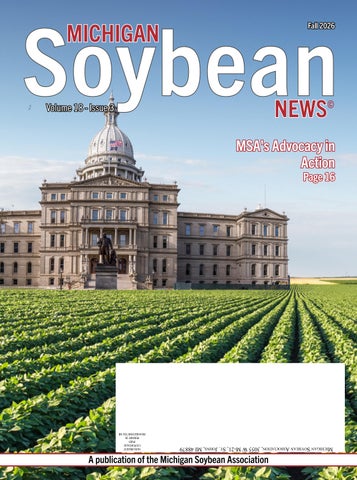
Soybean MICHIGAN
Fall 2026
NEWS
Volume 18 - Issue 3
©
MSA's Advocacy in Action Page 16
Michigan Soybean Association, 3055 W M-21, St. Johns, MI 48879
NON-PROFIT US POSTAGE PAID PERMIT 20 FRANKENMUTH, MI
A publication of the Michigan Soybean Association
SeedIQ
™
THE NEXT ERA OF YIELD STARTS NOW. We’ve all seen it. Two farmers across the road plant the same hybrid, in the same soil, on the same day, yet their results are drastically different. Why? Because performance isn’t determined by genetics alone. It’s influenced by how that hybrid is managed throughout the season, including population, fertility, stress management, and fungicide timing.
Don’t Just Manage Your Fields. Master Your Product Management.
IN THIS ISSUE OF: Soybean Staff Ben Steyer Chief Executive Officer bsteyer@michigansoybean.org
Soybean MICHIGAN
Volume 18 - Issue 3
NEWS
Mark Seamon Research Director mseamon@michigansoybean.org Sonja Lapak, Editor Communication Director slapak@michigansoybean.org Katlin Fusilier Outreach Director kfusilier@michigansoybean.org Karli Kreger Market Development Specialist kkreger@michigansoybean.org
14 Maximizing Harvest Efficiency
Anna Skelly Accounting & Compliance Specialist askelly@michigansoybean.org Claire Dewey Operations & Marketing Specialist cdewey@michigansoybean.org
16
Michigan Soybean Association 3055 W M-21 St. Johns, MI 48879 Phone: 989.652.3294 soyinfo@michigansoybean.org
MSA's Efforts to Walk the Walk
Ad Sales Sonja Lapak slapak@michigansoybean.org J.L. Farmakis Inc. - National Phone: 203.834.8832 bill@jlfarmakis.com Copyright 2025 by Michigan Soybean Association; all rights reserved. Magazine Circulation: 18,000 Michigan Soybean News is published quarterly.
24 On-Farm Biodiesel Use A Case Study Michigan Soybean Association Mission: To improve and advocate for the Michigan soybean industry. Disclaimer: Advertisements within this publication contain the opinions and information of the advertisers and do not necessarily reflect the opinions or views of the Michigan Soybean Association or affiliated groups. The United Soybean Board/soybean checkoff neither recommends nor discourages the implementation of any advice contained herein, and is not liable for the use or misuse of the information provided.
Fall 2026
3
Membership at Work Michigan Soybean Leadership Michigan Soybean Association Larry Phelps, Vicksburg Jay Williams, Waldron Tom Woelmer, Monroe Karen Warner, Yale Allison Thiel, Birch Run PJ Feldpausch, St. Johns Tim Kruithoff, Kent City Rob Howland, Brown City Robert Wasmiller, Burt Michigan Soybean Committee Sara Trattles, Colon Gary Parr, Charlotte Nathan McCalla, Ann Arbor Scott Wilson, Lexington John Burk, Bay City Jeff Fromm, Owosso Ryan Drozd, Allegan American Soybean Association Heather Feuerstein, Belding Janna Fritz, Bad Axe United Soybean Board Ed Cagney, Scotts Dennis Gardner, Croswell Laurie Isley, Palmyra North Central Soybean Research Program Steve Koeman, Hamilton US Soybean Export Council Dave Williams, Elsie Clean Fuels Alliance America Zach Schaffner, Hudson Soy Aquaculture Alliance Alan Moore, Bannister Soy Transportation Coalition Rob Green, Corunna World Initiative for Soy in Human Health Doug Darling, Maybee Specialty Soya & Grains Alliance Steve Peach, Plymouth US Meat Export Federation Brian Pridgeon, Montgomery Farm Produce Insurance Fund Jason Haag, Unionville
4
Michigan Soybean News
MSA President's Letter MSA members and Michigan Soybean farmers, As president of the Michigan Soybean Association (MSA), I recognize it is our organization's mission to improve and advocate for the Michigan soybean industry. I take the responsibility seriously and my desire in writing this is to inform you of how to help amplify the organization's mission. I want to encourage each of you to take an active role in building relationships with your elected officials. Advocacy is most effective when lawmakers hear directly from the individuals they represent. I encourage you to build that relationship, starting now. Create the relationship and establish a foundation of trust and understanding before an issue arises. When your lawmakers know who you are and what your area(s) of expertise are, they are more likely to seek your perspective on matters that impact you. I encourage you to take a few minutes to learn who represents you in both Lansing and D.C. Here is valuable resource to help you find who represents you at the state level: legislature.mi.gov/Legislature/Legislators. To take it one step further, it's also beneficial to become familiar with your lawmakers at the local level. Become familiar with the issues they are addressing and committees they serve on. As I encourage all of you to become active in advocating and building a relationship with your legislators, I have been busy doing the same. In the last few months I have had the opportunity to represent MSA at the Michigan House Committee on Transportation and Infrastructure in support of HB 4721 and HB 4722, which is a tax credit for biodiesel. I was also at a meeting with my Congressman, Tim Walberg, and USDA Deputy Secretary Stephen Vaden. In addition, I had the opportunity to visit U.S. Senator Slotkin's office, along with several U.S. Congressional offices. Additional details on this visit to Washington D.C. will be highlighted later in this magazine. I hope the growing season is going well and your crops are looking good. Let's work together to improve the soybean industry. Let us know if we can be of help to you in furthering our mission together. Sincerely, Tom Woelmer MSA President
Staff Update
Investing Checkoff Dollars
A
s I approach my second year working for the Michigan Soybean Committee, my appreciation for the agriculture community continues to blossom. While my family and I have lived in farm country for the past 19 years, learning firsthand through site visits and speaking with growers has helped me to understand all that goes into producing soybeans and has also shed light on the true GRIT farmers exemplify daily. This June, our board members and staff had the opportunity to visit Star of the West's Charlotte location. As we toured through the facility we saw each step in the process, starting with when soybeans arrive, all the way through to the end of the process were the soybeans are being placed in cargo containers to be shipped out. I was shocked by the precision and attention to detail our export partners have to demonstrate to meet the demands of their customers. It was fascinating to see the many steps an elevator takes before soybeans are ready to be shipped. This tour gave me an inside look at another facet of the agriculture industry and I really appreciated the behind the scenes look at the next steps soybeans take once they leave the farm. I was impressed to say the least! Each season brings its own trials and tribulations. You as our farmers are the true backbone of our country, and we at MSC appreciate your devotion to stewardship and raising a high quality soybean crop. I truly am grateful for the opportunities I have been given in my role thus far. It's a pleasure to engage with all of you and be able to travel on behalf of Michigan soybean growers to help move our industry forward. Somewhat inspired by my new involvement in agriculture, my family and I are starting to incorporate some homesteading practices a little at a time to help teach our kids not only where their food comes from, but also the importance of patience, nutrition and resilience. Below you can see some pictures of what my family has been working on. New this spring my husband built me a raised garden with tomatoes and cucumbers. The second picture features our three children with our overgrown raspberry bushes (we might need to make some jam here soon). Lastly, our two apple trees. These poor babies withstood some of the harsh winds storms we had this past spring, and we are hoping for some buds here soon! I am grateful for the lessons I've learned thus far and look forward to continuing to learn and be inspired through my work in this industry.
Anna Skelly Accounting and Compliance Specialist askelly@michigansoybean.org
Fall 2026
5
Membership at Work
2026 Michigan Soybean Yield Contest The 2026 Michigan Soybean Association (MSA) Yield Contest is underway. Entry forms for the contest were due at the end of August and we are happy to report that we are seeing great participation again this year. For those who have entered the contest, harvest data is due at the end of November and winners will be announced on social media in December. All winners will be recognized at the Great Lakes Crop Summit in January, as well as in a future edition of the Michigan Soybean News magazine. This program would not be possible without our generous sponsors. We greatly appreciate their support of the program. This year we have 11 seed companies participating as sponsors and category sponsors, as well as support from the Michigan Soybean Committee for the contest prizes. Thank you to all of the participants of the yield contest! We are looking forward to seeing outstanding yields from you again this fall. If you are interested in the MSA yield contest and wish to learn more, visit our website at misoy.org/yield-contest.
6
Michigan Soybean News
Your Political Voice
New & Renewing Members
THANKYOU TO THE MICHIGAN SOYBEAN ASSOCIATION SPONSORS! DIAMOND BEAN LEVEL:
RENEWING MEMBERS:
Brandon Blain, Williamston Kelly Carns, Allegan Andy Ciborski, Allegan Charles Lewis, North Street Jerry Poortenga, Hudsonville David Revels, Monroe Mike Timmer, Hopkins Jeffrey Vogl, Henderson Courtney Walsh, Wheeler
PLATINUM POD LEVEL:
CORPORATE LEVEL:
CHANNEL
PIONEER
The biodiesel and renewable diesel industry supports more than $42.4B in economic impact and 100,000+ jobs in the U.S.
Materials supported by United Soybean Board, soybean farmers and their checkoffs.
Fall 2026
7
Membership at Work
Seeking Nominees for MSA Board of Directors
T
he Michigan Soybean Association (MSA) is currently seeking nominations for board seats in the following districts: • District 2 – Hillsdale, Calhoun, Jackson, Eaton and Ingham Counties • District 5 – Lapeer, Saginaw, Tuscola, Bay and Arenac Counties • At-Large – any county in Michigan To appear on the ballot, nominations must be received by the MSA office by October 16, 2026. To be eligible for a seat on the board, one must be a soybean farmer residing in the district that they are seeking election and must be a member of MSA in good standing. All elected directors will hold the office for a term of three years. According to the current bylaws, elections will be held via U.S. Mail. Ballots will be mailed to all members by November 4, 2026 and must be returned to the Michigan Soybean Association (MSA) office by December 4, 2026. Election results will be announced at MSA’s 53rd Annual Meeting which takes place during the Great Lakes Crop Summit in Mt. Pleasant. The MSA board has several events throughout the year including Legislative Outreach Farm Tours, a legislative luncheon at the Capitol, a Lansing Ag Club Breakfast and quarterly board meetings. MSA works on important legislative issues such as trade expansion, transportation and infrastructure, biofuels, environmental regulation, advocacy for major markets and the Farm Bill. Serving on the board will help Michigan soybean farmers’ voices be heard in both Lansing and Washington, D.C. If you would like to nominate someone for one of the above districts or be placed on the ballot yourself, please email MSA CEO Ben Steyer at bsteyer@michigansoybean. org or call 989.652.3294. Thank you for your interest in serving the Michigan soybean industry.
Have an article suggestion? Email comments, suggestions or article ideas to soyinfo@michigansoybean.org.
8
Michigan Soybean News
No longer wish to receive the Michigan Soybean News? Email your name and mailing address to slapak@michigansoybean.org.
Your Political Voice
MEMBERSHIP APPLICATION First Name:_____________________________
Date of Birth:__________________
Last Name:_____________________________
Number of Soybean Acres:_______
Address:_______________________________
Total Farm Acres:______________
City/State/Zip:___________________________
Occupation (circle one):
Phone:_________________________________
Farmer
Cell Phone:_____________________________
•
Email:_________________________________ 1-yr: $75
3-yr: $190
•
Young Farmer 1-yr (18-24): $20
Retired
Other
Dues are not tax deductible as a charitable contribution for federal tax purposes, but may be deductible as a business expense. 18% of member dues are allocated to lobbying activities and are not deductible.
Mail application with payment to: Michigan Soybean Association
Payment Amount & Method:
3055 W M-21, St. Johns, MI 48879
Check (Payable to MSA) or Credit Card
Join online:
Credit Card Type:_____ Expiration Date:______ Credit Card #:_________________ CVV:______ Signature:_______________________________
Paying the soybean checkoff does not make you an MSA member. Checkoff dollars cannot be used for lobbying. Your membership is critical to our efforts on behalf of Michigan soybean farmers!
For more information on member benefits, visit www.misoy.org/member-benefits/. Member benefits include: • • •
Scholarship opportunities for your children and grandchildren Cabela’s gift card purchase discount Discounted registration to Commodity Classic
• •
Annual $75 seed coupon for renewing members to use with our partnering seed companies The MOST IMPORTANT MSA member benefit: Having a voice in Lansing and Washington, D.C.!
Fall 2026
9
Membership at Work
MSA Members Head to Capitol Hill
I
n July, MSA President Tom Woelmer (Monroe), American Soybean Association (ASA) Director Heather Feuerstein (Belding) and MSA CEO Ben Steyer traveled to Washington, D.C., to take part in ASA's summer board meeting and Hill visits alongside soybean leaders from across the country. The trip brought together growers and staff from state soybean associations nationwide for two days of committee work, policy discussion, and direct conversations with lawmakers on the issues shaping the future of soybean farming. For the Michigan delegation, the visit was an opportunity to make sure Michigan's soybean farmers had a voice in the room as national policy decisions were being made. While in Washington, the group met with eight Michigan congressional offices: Sen. Elissa Slotkin, Rep. Tom Barrett, Rep. Tim Walberg, Rep. Bill Huizenga, Rep. Lisa McClain, Rep. Shri Thanedar, Rep. John Moolenaar, and Rep. Kristen McDonald Rivet. In each meeting, the Michigan team emphasized three priorities: the rising cost of farm inputs, the need to finalize the 45Z Clean Fuel Production Credit, and the overall health of the farm economy. "These visits are our chance to put a face with the numbers," Woelmer said. "Members of Congress hear about the farm economy in briefings and reports, but hearing directly from farmers about what it actually looks like on the ground carries a different kind of weight." U.S. soybean farmers continue to face one of the most difficult financial environments in decades. Weak commodity prices, elevated production costs, higher interest rates, and continued uncertainty surrounding trade and agricultural policy are placing significant financial pressure on farm operations nationwide. The current farm economy is unsustainable for many soybean farmers. Without stronger markets, lower production costs, and policies that improve profitability, financial stress will continue across farm country. Input costs were a central focus of the conversations. Fertilizer, crop protection products, and equipment costs have remained high even as commodity prices have softened, squeezing margins on nearly every acre planted. The Michigan delegation urged offices to support agricultural input tariff exemptions, oppose unnecessary anti-dumping and countervailing duties that drive up input prices, and back policies that promote competition and innovation in the marketplace to ensure farmers have reliable access to affordable agricultural inputs. "Every office we visited understood that the farm economy is under real stress right now," Feuerstein said. "Our job was to be specific about what that stress looks like for Michigan soybean farmers and what Congress can do to help. Addressing the cost of the inputs we depend on every season is vital to the success of American soybean farmers." The group also pressed the importance of finalizing the 45Z Clean Fuel Production Credit. Finishing the guidance on 45Z is critical to providing long-term stability for biofuel producers and, in turn, supporting domestic demand for soybeans. Biodiesel and renewable diesel remain one of the strongest demand drivers for U.S. soybean oil, and continued uncertainty around the credit makes it difficult for fuel producers to plan investments and production levels. Steyer added that continued engagement with Michigan's congressional delegation remains a top priority for the association. "Relationships built through visits like this allow us to have productive conversations year-round, not just when there's a bill on the floor," he said. "We appreciated the time each office gave us and look forward to continuing to work with them on solutions that support Michigan soybean farmers." The Michigan Soybean Association will continue to advocate on these issues throughout the year, working alongside ASA to ensure Michigan farmers' priorities are represented in Washington. 10
Michigan Soybean News
Investing Checkoff Dollars
Updates from Michigan's United Soybean Board Directors From Dennis Gardner: In July the board selected Courtney Knupp as the CEO of USB. She brings with her a lot of industry experience and comes from a family farm from in Iowa. We as a board look forward to working with Courtney moving forward. I have been on the Financial Audit Committee for 2 years. We are in the process of reviewing and conducting a financial audit to present at the December board meeting. I also serve alongside Laurie on the Sustainable Production work group; we have most of our projects lined up for 2027 and are looking forward to great outcomes for US Soy. An additional new development is the release of an easy-to-use project dashboard which contains our present projects and those dating all the way back to the beginning of the federal checkoff. This will be a valuable resource for easily searching past projects that we've funded and tracking current project progress. I really appreciate being able to serve the soybean farmers in Michigan and work alongside other farmer directors throughout the United States. From Laurie Isley: The United Soybean Board recently met in Indianapolis for their summer meeting. Highlights of the meeting included the introduction of our new CEO, Courtney Knupp. We are looking forward to her leadership and expertise. In addition, the board approved the final budget for fiscal year 2027. This process began last December when work groups were formed and updated. Each of the work groups met numerous times since then to analyze projects and proposals, meet with researchers and technical advisors, and discuss which decisions would best support the US soybean farmer. In the Sustainable Production workgroup, where I serve, we approved a 13 million dollar budget focused on four areas: On Farm Support, Alternate Value Streams, Data and Modeling, and Infrastructure. Our projects range from researching Red Crown Rot, improving grain grading, identifying how to lower the Carbon Intensity Score for soybeans, along with many more projects. Once the budget is approved by the USDA, contracts will be sent out and the work will begin. We will monitor the progress of these projects throughout the year. From Ed Cagney: I am enjoying serving on USB so far and am busy learning the whole process and structure of the organization. Prior to attending my first board meeting in Indianapolis, I was appointed to the industrial work group which funds projects to promote industrial uses of soybean meal and oil. Being a retired firefighter, I find the promotion of SoyFoam firefighting foam to be very interesting. It's environmentally safe and can replace the use of toxic PFAS foams. I’m also learning about the many other uses of soy that are environmentally friendly, such as soy-based lubricants which are used in power tools and in steel mill cold rolling. In addition, there is also continued funding of research on soy-based wood adhesives and paints. During the meeting, the work groups gave informative updates along with a treasurer’s report and the confirmation of Courtney Knupp as our new CEO. Fall 2026
11
Your Soybean Checkoff
USSEC Soy Excellence Centers Continue to Build Global Agriculture Leaders
T
he United States Soybean Export Council (USSEC) Soy Excellence Centers (SEC) program is designed to equip agriculture professionals that are early in their careers with the knowledge and skills needed to strengthen agricultural sectors across five global regions. Since the project launched in 2019, the Soy Excellence Centers have served participants from 24 countries, impacted more than 1,300 businesses and reached over 31,400 individuals through professional development and continuing education. Egypt is where the SEC program started in 2019 and also ranges from the second to fourth largest export market for United States soybeans, depending on the year. Demand for U.S soy continues to grow because of what USSEC refers to as the “Four D’s”: naturally sun-dried, lower damage than competing origins, higher digestibility and zero deforestation. Dave Williams, the Michigan Soybean Committee Market Development Subcommittee's representative for USSEC, recently participated in the SEC Delegation's trade mission in Cairo, Egypt. During the visit, delegates took part in cultural tours, industry meetings focused on aquaculture, feed and dairy production, attended the AquaCON conference, where Dave also served as a panelist, and completed an in-person training course at World Fish. USSEC SECs continue to support the long-term growth and success of global food and agriculture industries. Thank you to Dave for representing Michigan soybeans well on the global stage and building relationships that solidify demand for U.S.-grown soybeans.
Dave Williams at WorldFish
AquaCON Panelists
Tagging Fish for Research 12
Michigan Soybean News
Investing Checkoff Dollars
Tailgates, Touchdowns & Michigan Soybeans
T
he Michigan Soybean Committee is excited to partner with both Michigan State University Athletics and Central Michigan University Athletics to celebrate agriculture this football season. At the CMU football game on September 12th and the MSU football game on September 26th, fans will experience a game day highlighting Michigan’s agricultural community and the farmers who make it all possible. Prior to kickoff at each game, fans can stop by to visit interactive booths from ag organizations, learn more about Michigan agriculture, pick up awesome giveaways, and talk with local farmers. In addition to the exciting activities at the interactive booths, MSC will also be doing our annual donut drops at the Michigan State game. Our team will hit the pavement and surprise tailgaters across campus with fresh donuts cooked in soybean oil. Each donut is a tasty way to learn more about the way that soybeans are used every single day! Throughout each game, ag facts will be shared on the big screen showcasing the impact of agriculture on our state along with fun agricultural ties throughout the game! We hope to see you at our booth or in the stands on game day. Stop by the booth to say hello, snap a photo, and help us celebrate the role soybeans play in Michigan’s agriculture industry.
Another Successful Year of Soybean Nights at the Ballpark
T
hank you to all the farmers who came out to this year's three Soybean Nights at the Ballpark! Nearly 300 farmers and their family members joined us at the games. It was great to catch up with farmers and also share more information about soybeans with game attendees. At each game, soybean farmers were able to throw out the first pitch and fans were able to visit our booth on the concourse to play plinko, win prizes and answer soybean trivia questions. We're already looking forward to next year's games!
Fall 2026
13
Your Soybean Checkoff
Late-Season Soybean Decisions:
Maximizing Harvest Efficiency and Planning for 2027 Dr. Manni Singh, Cropping Systems Agronomist, Michigan State University
A
s the 2026 soybean crop moves toward maturity, many management decisions remain that can influence harvest efficiency, grain quality, and overall profitability. While most yield has already been determined by this point in the season, Michigan growers still have opportunities to reduce harvest losses, improve harvest logistics, and gather information that can help guide management decisions for the 2027 crop.
particularly early-planted and early maturing varieties. Timely soybean harvest is also critical for growers who plant winter wheat after soybeans and benefit from diversity of crop rotation. Our recent research in Michigan has shown that timely wheat planting (1st week of October or earlier) is critical in achieving the highest wheat yield and profits.
Harvest Timing Matters
Soybean drydown rates vary considerably from year to year depending on weather conditions during late August, September, and October. Warm temperatures, low humidity, sunny conditions, and moderate winds accelerate drying. Conversely, cool temperatures, cloudy weather, and frequent rainfall slow drydown substantially. Under favorable drying conditions, grain moisture may drop by more than one percent per day. Soybean maturity group can also influence harvest timing. Earlier-maturing varieties generally reach harvest readiness sooner, creating opportunities to begin harvest earlier. However, this advantage must be balanced against potential yield implications when selecting maturities for a specific region and planting dates. Growers should remember that calendar date is often less important than crop stage and environmental conditions. Two fields planted only days apart may differ significantly in harvest readiness because of maturity group selection, planting date, soil type, disease pressure, or stress experienced during the growing season.
One of the most common questions each fall is, "How dry should soybeans be before harvest?" Soybeans are marketed at 13 percent moisture, but waiting for the crop to naturally dry all the way to market moisture before beginning harvest is often not the best strategy. As soybeans dry below 13 percent, growers may experience increased shattering losses in the field and at the combine header, while also losing saleable grain weight as moisture continues to decline. Every day harvest is delayed after the crop reaches maturity also increases exposure to adverse weather, lodging, and wildlife damage. Many growers begin harvesting soybeans when grain moisture is between 14 and 16 percent. While this may require some moisture reduction during storage or blending later, harvesting slightly tougher beans often reduces field losses and improves overall harvest efficiency. In years with favorable drying conditions, soybean moisture can decline very rapidly during September and October, making frequent scouting important. The optimum soybean harvest window for profit maximization is often shorter than many realize. Once soybeans reach physiological maturity and leaves have dropped, fields can lose moisture quickly during warm, dry conditions. Fields should be monitored closely as harvest approaches,
14
Michigan Soybean News
Understanding Soybean Drydown
Are Harvest Aids Worth Considering? Timing Matters Harvest aids or desiccants occasionally receive attention when soybean harvest is delayed by green stems, late-season weeds, uneven maturity, or adverse weather conditions.
Investing Checkoff Dollars In most Michigan soybean fields, harvest aids are not routinely used. Soybeans generally mature naturally and reach harvest moisture without intervention. However, there are situations where desiccation may improve harvest efficiency. Fields with significant weed infestations, particularly late-emerging annual weeds, can benefit from improved combine performance when vegetation is controlled prior to harvest. Similarly, fields with later-maturity varieties or highly variable maturities may experience more uniform drydown following an appropriately timed harvest aid application. Timing is critical. Applications made too early (e.g. R6 stage) will reduce yield and seed quality because seed fill is still occurring. Harvest aids should only be considered when soybeans have reached the appropriate growth stage. Our research has shown that applications made before physiological maturity (R7 stage) can reduce seed weight and overall yield. Growers should carefully review product labels, pre-harvest intervals, and market restrictions before making any application. For more information on labeled products, please see Table 2H (pages 90-91) in the MSU weed control guide (canr.msu.edu/weeds/2026-msu-weed-controlguide). Desiccants should not be viewed as a substitute for selecting adapted varieties or properly managing weeds throughout the season. Instead, they may help improve harvest operations under specific circumstances.
Looking Ahead: Planning for the 2027 Season Harvest is an excellent time to evaluate soybean variety performance and begin making seed decisions for 2027. While yield receives the most attention, variety selection should also consider harvest timing, grain moisture, disease tolerance, standability, and how the crop fits within the overall farming operation.
One of the key lessons from our recent Michigan research is that maturity group selection should be matched to both planting date and management goals. As Michigan growers have moved toward earlier planting and growing seasons have lengthened, there are greater opportunities to capture yield by fully utilizing the available growing season. Our research has shown that when soybeans are planted in late April or early May, varieties that are one-half to one maturity group later than typically recommended often maximize yield by extending vegetative as well as reproductive growth. These later-maturity varieties may be more likely to warrant harvest aid use when harvestability becomes a concern. However, maximizing soybean yield is not always the only objective. Many farms must balance soybean production with timely wheat establishment, cover crop adoption, labor availability, and harvest logistics. For growers planning to plant winter wheat after soybean, selecting an earlier-maturing variety may be a practical strategy because earlier harvest can improve the likelihood of planting wheat within its optimum window. Rather than planting a single maturity group across the entire farm, many growers may benefit from using a range of maturities. Earlier-maturing varieties can be targeted to fields intended for wheat or cover crops, while later-maturity varieties can be used where maximizing soybean yield is the primary objective. As harvest progresses this fall, pay attention not only to yield, but also to harvest moisture, drydown, and harvest timing. Those observations can provide valuable information for optimizing variety selection and management decisions for the 2027 crop. Resources: • Staton, M. 2023. Reducing soybean harvest losses. Michigan State University Extension Bulletin. Available at https://www.canr.msu.edu/resources/reducing-soybeanharvest-losses • Waldecker, I.G., M.P. Singh, and C.L. Sprague. 2026. Evaluating harvest aids for soybean desiccation, yield, and seed quality in the northern U.S. Agronomy Journal. http://dx.doi.org/10.1002/agj2.70326 • Siler, T.B. and M.P. Singh. 2022. Optimal soybean maturity group selection is influenced by planting date in northern production systems. Crop Science. http://doi. org/10.1002/csc2.20829
Fall 2026
15
Membership at Work
Michigan Soybean Association Exemplifies Advocacy in Action
I
magine trying to play your favorite sport, joining your dream club or trying to solve a problem in your community, but no one in charge is listening. You are doing everything in your power to voice your concern; emails, phone calls, text messages, yet you seem to be invisible. Now, imagine hundreds of your closest friends joining together, speaking with one strong, unified voice. Suddenly those in charge start to pay attention. That unified voice is the magic of an advocacy organization like the Michigan Soybean Association. Every day decisions are made in Lansing and D.C. that shape the future of our farms, businesses and communities. While individual voices are important, we are stronger together. MSA is dedicated to being the unified voice for its farmer members through advocacy in Lansing and partnership with the American Soybean Association in Washington, D.C. You might ask, why does advocacy matter to me? Or why is MSA important to my farm? Effective advocacy starts before an issue arises. It means having a seat at the table before you run into a problem or need the ear of your legislator. MSA and ASA regularly meet with state legislators, congressional representatives, agency officials, and other influential decision-makers to share the perspective of soybean farmers. Both organizations also respond quickly to engage on critical issues which impact farmer members.
Strength in Numbers One of the greatest advantages of membership with MSA or any advocacy organization is the power of collective influence. A single individual may struggle to gain the attention of elected officials, but an organization representing the 16
Michigan Soybean News
Your Political Voice membership of a whole state carries significant credibility. Policymakers value input from constituents, but they also value input from organizations that represent them and can offer practical insight into how legislation affects the local economy. Having a collective voice allows MSA to respond swiftly to support beneficial legislation or raise concerns when they recognize there may be unintended consequences, which both make a meaningful difference in legislative outcomes.
Advocacy & Relationships MSA was founded almost 53 years ago by farmers, like you, who were determined to find a solution to one problem: how can soybean farmers make their voices heard by legislators? For over 50 years, our organization has proven that advocacy is more than just speaking up. It is about building lasting relationships that create meaningful change. Every partnership, conversation, and connection made over the past five decades has helped strengthen our mission and expand our impact. Over the years, with the help of our dedicated farmer members and board of directors, we have been able to celebrate victories on the farm, overcome challenges, and open new doors to opportunities for soybeans. MSA’s long history has earned it a strong reputation in Lansing, where it works closely with Kindsvatter, Dalling and Associates (KDA) to advocate on members’ behalf. As Vice President of Government Relations at KDA, Jason Wadaga, said, “MSA has been working hard in Lansing, pushing for a biodiesel tax credit, navigating the challenges of Sustainable Aviation Fuel (SAF) and starting a Political Action Committee (PAC). MSA has upped its ground game at the state capitol.” “As the saying goes in politics, if you don’t have a seat at the table, you are on the menu.” MSA has been doing a good job of making sure they are at the table on important issues pertaining to soybeans, but also those that could have an impact on the farm.
MSA in Action Each issue of the Michigan Soybean News includes a Lansing legislative update from Jason Wadaga, offering in-depth analysis of state-level issues. Jason identified MSA’s recent biodiesel tax credit efforts as one of its most impactful advocacy initiatives: “For the past few legislative sessions, MSA has led the fight to create a tax credit for producers and retailers of biodiesel in Michigan. This bipartisan legislation would create an incentive for producers and retailers that sell biodiesel. Three years ago, the House Tax Policy Committee held a hearing on the bills, and in June of this year, the Michigan House Transportation
continued on following page... Fall 2026
17
Membership at Work ...continued from previous page Committee did as well. Our efforts have been supported by Michigan Farm Bureau, Clean Fuels Alliance of America, Clean Fuels Michigan, the Michigan Retailers Association, and others. Our advocacy on this legislation must continue, as our major obstacle has been environmental groups in Michigan that carry significant influence with lawmakers. However, with supportive partners, we hope to strengthen those relationships and make additional progress.” Advocacy proves that when people unite around a common cause, progress can be made. Next time you hear about an MSA event, see an update on legislation, or receive a new press release or call to action, remember: MSA is not just raising awareness on an issue. They are helping transform individual voices into a singular voice for change. You never know, the next great advocate may be you! If you're not currently an MSA member, now is a great time to join. See our membership application on page 9.
DONATE TODAY! MISSION: The mission of the MISOY PAC is to utilize contributions in a strategic way that strengthens and supports our relationship with policy makers to advance the soybean industry and to benefit Michigan soy farmers.
FURTHER ADVOCATING FURTHER ADVOCATING FOR MICHIGAN FOR MICHIGAN SOY SOY
18
Michigan Soybean News
Investing Checkoff Dollars
White Mold Management with Biologicals Eric Anderson, MSU Extension Soybean Educator Dr. Marty Chilvers, Field Crops Pathologist, Michigan State University
S
clerotinia stem rot, a.k.a. white mold, is caused by the fungus Sclerotinia sclerotiorum and can be a devastating foliar disease of soybean in Michigan. The fungal spores infect soybean flowers and the disease develops in the plant, eventually forming white mycelial mats on the stem with dark sclerotia (overwintering structures). The sclerotia will produce apothecia (mushrooms) that will produce spores in subsequent years. Michigan State University Extension staff have written several informative articles on the topic of managing for white mold over the years (e.g. “Begin managing white mold in soybeans this spring”, "Stay ahead of white mold: Mid-season management tactics”, “Is it too late to apply fungicides to White mold growth on soybean stems control white mold in soybeans?”). Photo courtesy of Mike Staton There are several effective fungicides that can be used to manage white mold when applied at the proper timing. These chemicals prevent infection of aboveground plant parts but will not stop infection once it has occurred, and they do not affect sclerotia in the soil. There are also commercially available biological products that contain Trichoderma (fungi) or Bacillus (bacteria) that are reported to protect against white mold. However, the most widely-known biological product is called Contans. Contans (Coniothyrium minitans) is a naturally occurring fungus that attacks white mold sclerotia. Although previously manufactured and distributed by different companies, it is currently distributed in the U.S. by Lallemand Plant Care as LALSTOP Contans WG. Each gram of the wettable granular product contains a minimum of 1.0 x 10⁹ CFU White mold apothecia (colony forming units). That’s a pretty big number—almost as big as Photo courtesy of Marty Chilvers our national debt. Research of Contans in soybean production is relatively limited, however a study conducted at Purdue University (Conrad and Telenko, 2023) in controlled environments showed a 54 percent reduction in S. sclerotiorum growth when C. minitans was applied. According to the product label, Contans can be applied pre-plant, at planting, after crop emergence, or postharvest. However, the results of a recent study at UW-Madison (Sharma et al., 2026) showed the treatment effects were not significant when Contans was applied from 0.5 to 4.0 lbs/A at planting. It was believed there was not enough time for the C. minitans to colonize the sclerotia, and an earlier application was recommended. Best practice is to apply either early spring three months prior to expected infection or immediately following harvest. The optimum soil temperature for maximum activity ranges from 50–81°F, but C. minitans will also survive over the winter in Michigan. Contans should be incorporated uniformly in the top two inches of soil either with light mechanical cultivation or water. Tillage deeper than two inches should be avoided to prevent dilution of the Contans and bringing up sclerotia from deeper in the soil. If irrigating, aim for 0.5 inch of water for sandier soils or 1.0 inch for heavier clay soils. If you have fields with past heavy white mold infestations, consider applying Contans this fall immediately following harvest as part of your white mold management program. Apply at 2 lbs/A and be sure to incorporate uniformly to a depth of 2 inches. If you are interested in conducting an on-farm trial with Contans, please contact Eric Anderson (eander32@msu.edu) to learn more about our Soybean On-Farm Research Program. Fall 2026
19
Membership at Work
A Grower's Time on the Lower Peninsula Deer Advisory Team As a soybean producer in Sanilac County, I’m no stranger to the damage deer are creating in farmers’ fields. That’s why, in 2024, I applied for a new Natural Resources Commission (NRC) and Michigan Department of Natural Resources (DNR) program and was accepted to what’s now called the Lower Peninsula Deer Advisory Team (LP DAT). Members serve three-year terms, tasked with making deer recommendations - both regulatory and non-regulatory. In May 2026, the NRC made regulatory changes that raised concerns among farmers that deer overpopulation could worsen. Starting March 1, 2027, deer hunters in the Lower Peninsula will be limited to harvesting one buck per season and antlerless opportunities will be reduced slightly across most of the Lower Peninsula. Late gun season was shortened slightly, but December doe season was extended, and the January doe season was eliminated after DNR data showed too many antlerless bucks were being taken that month. An additional change is that hunters in the Lower Peninsula may now use rifles that meet Limited Firearm Deer Zone cartridge requirements. As a farmer, I understand the concern of my fellow soybean growers, and I know these changes won’t completely solve overpopulation. Additional adjustments to Michigan’s deer management approach are still needed, which is why farmers should keep speaking up. The NRC and DNR do listen, and your voice as a landowner facing real crop damage carries weight. Please keep attending meetings, submitting comments, and contacting your LP DAT representatives. In the meantime, farmers don’t have to manage deer damage alone. Crop damage permits are available from the time crops emerge until the end of September, and Deer Management Assistant Permits apply during regular season for just $10, with tags issued directly to hunters. Additional resources include the Hunting Access Program, along with organizations such as Hunt Michigan Collaborative, Michigan Sportsmen Against Hunger, Hunters Feeding Michigan, Doe Patrol, and Hunters Against Hunger. The Michigan Soybean Committee has contributed to each of these groups to support their efforts in reducing the deer population. Some farmers institute hunting lease arrangements that include harvest incentives, reducing lease payments for every doe harvested. I’d encourage every farmer to explore these tools as part of a regular crop management plan, the same way you would for weeds or disease. I will be terming off the LP DAT in 2027 and I’m hopeful another non-affiliated farmer like me will step into this role, so growers continue to have input on the effects of white-tailed deer and the future of the deer hunting tradition in Michigan. Respectfully, Rob Steenbergh
20 Michigan Soybean News
Investing Checkoff Dollars
Harvesting Does and Feeding the Hungry: A Win-Win
T
he overpopulation of two million deer in Michigan is being addressed by many projects which are doing what they can to make a difference. As big picture options are being considered, these smallscale initiatives are making lemonade out of lemons. Several efforts to harvest does and utilize the venison to feed needy people are growing across the state. MSC has made small financial contributions to each of the projects below in an effort to support this work and increase their benefits. This is not a compete list of worthwhile projects but examples of the successful endeavors.
Michigan Sportsmen Against Hunger – sportsmenagainsthunger.org •
This group coordinates the harvest and donation of deer for professional processing and donation of venison to worthy causes.
Hunt Michigan Collaborative – huntmicollaborative.com •
This group coordinates hunts between farmers and hunters who may not have access to places to hunt. The deer harvested are processed and donated.
Hunters Feeding Michigan - www.michigan.gov/dnr/about/get-involved/hunters-feeding-michigan •
This initiative is coordinated by Michigan DNR including the use of refrigerated trailers to gather deer harvested with crop damage permits, professional processing of deer and donation of venison to feed hungry people.
Doe Patrol - doepatrolmi.com •
This West central group coordinates the donation of deer from hunters during hunting season, processing the deer and donating it to hungry people with a benefit of developing beginning and young hunters.
Hunters Against Hunger - huntersagainsthunger.com •
This central Michigan initiative utilizes the natural resource of deer to feed hungry people. They coordinate the donation of deer, processing and donation of venison to worthy causes. A sincere thanks goes to these initiatives, hunters, processors and others who volunteer their time and money to make something good come from the widespread overpopulation of deer.
R
ed Crown Rot (RCR) is an emerging soybean disease that poses a risk to Michigan soybean production. Together, we can help identify new infestations, improve management recommendations, and protect soybean production across the state. Because Red Crown Rot symptoms can look similar to Sudden Death Syndrome (SDS) and other soybean diseases, laboratory testing is needed for an accurate diagnosis. Request a soybean sampling kit today for lab-based diagnostic testing by scanning the bottom QR code. Shipping and diagnostic fees will be paid for by MSC and the United Soybean Board. Questions? Contact Mark Seamon via email at mseamon@michigansoybean.org. Fall 2026
21
Your Soybean Checkoff
Stars, Stripes & The Soybean Checkoff
T
his year’s AgroExpo was especially memorable as we celebrated several major milestones: 50 years of the Michigan Soybean checkoff, Americas 250th birthday, and the 10 th Anniversary of AgroExpo. To celebrate, the Michigan Soybean Committee hosted a red, white and blue themed booth where attendees could put their basketball skills and soybean knowledge to the test for a chance to win patriotic prizes. Attendees could also cool off with popsicles and enjoy donut holes and ribbon fries fried in Great Lakes Gold High Oleic Soybean Oil. Another highlight of the two-day show was four live burn Soy-Foam demonstrations conducted by Michigan Soybean Committee partner Pat Butler with PK Foam Solutions. Pat was assisted by the St. Johns Fire Department as well as Dave Garlie from Cross Plains Solutions, the manufacturer of SoyFoam. The demonstrations showcased the performance of SoyFoam, a soy-based firefighting foam, to attendees while highlighting the benefits of a PFAS-free, clean alternative to traditional firefighting foam. The demonstrations are part of the Michigan Soybean Committee’s ongoing partnership with PK Foam Solutions to help increase the awareness of this new soy-based firefighting foam product and get it into the hands of more fire departments. Along with the demonstrations, we also gave away four SoyFoam fire extinguishers and a four-pack refill of Soy Foam via drawings at the end of each demonstration, to provide participants with the opportunity to use SoyFoam on their farms in the event of an emergency. As AgroExpo celebrated a decade of bringing agriculture together, the Michigan Soybean Committee was proud to highlight 50 years of checkoff investments and the many ways that Michigan soybeans continue to make an impact both on and off the farm. Thank you to all of the growers, industry partners, agribusinesses and community members that stopped by our booth to partake in the fun. Plans are already underway for next year's AgroExpo, which promises to once again be a place for networking, innovation and connection!
22 Michigan Soybean News
Investing Checkoff Dollars
Building Market Opportunities for High-Oleic Soybeans
T
he Michigan Soybean Committee continues to collaborate with Dr. Caputo at Michigan State University for the Building Market Opportunities project. This project focuses on working to connect soybean growers with dairy farmers, feed mills, seed dealers, and dairy cattle nutritionists to strengthen Michigan's higholeic soybean supply chain. We are aiming to create new marketing opportunities and premium pricing for Michigan-grown soybeans. As a Michigan soybean farmer, we encourage you to complete the survey by scanning the QR code to the right. Your feedback will help identify opportunities to expand and support future demand for high-oleic soybeans. Thank you for your participation.
Fall 2026 23 ASA_2026_Michigan_Half Page_Print_v1.indd 1
10/04/26 10:43 a.m.
Your Soybean Checkoff
Biodiesel Goes Toe-to-Toe with Conventional Fuel
A cleaning crew clears microbial contamination from the Char-Lin Farms diesel storage tank to ensure optimal performance with B5.
T
his season, Zach Schaffner has a new companion on board his farm equipment - biodiesel fuel. He’s trying a 5% biodiesel blend (B5) for the first time, tracking tractor and sprayer performance data comparing B5 to ultra-low sulfur diesel (ULSD). Results show biodiesel is performing just as well as – or better than – ULSD. Schaffner, of Char-Lin Farms in Hudson, admits to being initially skeptical about biodiesel, influenced by previous generations who experienced problems during the early days of biodiesel production. “I heard old rumors of fuel quality issues. But with the current high standards, it’s nowhere near the concern it used to be. Biodiesel is a great avenue for farmers to become more sustainable,” he says.
Sustainability is top-of-mind as Schaffner looks forward to the possibility of his young son joining the family operation.
Transitioning to Biodiesel Schaffner’s journey with biodiesel started with pulling fuel samples from the farm’s bulk diesel tank. Lab tests revealed free water and microbial contamination in the fuel. “It’s pretty common to find water, rust, sludge and microbial activity in the bottoms of fuel tanks, especially older tanks. Contaminants can get stirred up during every fuel delivery and lead to engine performance issues,” says Pete Probst, technical director for the Michigan Advanced Biofuels Coalition.
Table 1. Zach Schaffner Planting Season Overview and Key Tractor Metrics*
*John Deere Operations Center/JDLink telematics data for John Deere 8335R tractor pulling 1770NT corn planter and nurse tank. 24 Michigan Soybean News
Investing Checkoff Dollars Table 2. Zach Schaffner Spray Season Overview and Sprayer Metrics*
*John Deere Operations Center/JDLink telematics data for John Deere 4380 self-propelled hydrostatic sprayer. Regardless of the type of fuel, addressing contamination is a best practice for optimal performance. A crew from Oscar W. Larson (OWL) Company spent a full day cleaning the tank before Corrigan Oil delivered the first load of B5 to Char-Lin Farms prior to planting.
How B5 Performed at Planting Time Schaffner was pleased with B5 performance after planting 3,000 acres of soybeans and 2,000 acres of corn over his rolling Lenawee County land. “The big takeaway was our fuel efficiency during planting improved this year over last year, when we used petroleum diesel,” Schaffner says. For corn planting, a John Deere 8335R tractor pulled a 24-row John Deere 1770NT planter and a 2,000gallon nurse tank loaded with starter fertilizer. Using data from the John Deere Operations Center, Schaffner compared fuel use from the 2025 and 2026 corn planting seasons using the same equipment. Zach Schaffner, right, and his dad, Mark, fill up their John Deere Data showed a 3.4% improvement in fuel use per 8335R with the first tank of B5 biodiesel for the 2026 planting engine hour for B5 compared to ULSD the previous season. year. Accurate comparative data for soybean planting was not available because Schaffner purchased a new, larger planter for soybeans this year. Otherwise, B5 performed equal to ULSD in Schaffner’s corn fields, with no differences in working engine load, field productivity, emissions system performance and other key parameters. (See Table 1.)
Side-dress and Spray Season Results John Deere Operations Center data shows similar performance for B5 during side-dress and herbicide applications on Schaffner’s corn and soybean acres this summer. Table 2 compares performance of the John Deere 4380 sprayer, fueled with ULSD in 2025 and B5 in 2026. The 4380 ran a slightly higher fuel use per hour in 2026, attributed to a heavier workload in this season compared to 2025. Coolant, hydraulic oil and fuel temperature were unchanged. “I’m very impressed with the data coming back in these reports,” says Schaffner. “We’re very happy with the performance of our B5 blend so far and our operators have noticed no differences from the cab. We’re looking forward to seeing what the metrics tell us after we finish harvest this fall.”
Want to know more about biofuels? Subscribe to the Michigan Biofuels Brief! Scan the QR code to sign up to get biodiesel industry updates and best practices for biodiesel use. About Char-Lin Farms • 3,000 acres of soybeans and 2,000 acres of corn in Hudson, Michigan • Farm name derived from the first names of Zach Schaffner’s grandparents, Charlie and Linda Fall 2026 25
Your Soybean Checkoff
A Summer Well Spent
W
hen your CEO starts the virtual staff meeting with, “How is planting going where you are?”, you know you’re in a good place. When I was scouting for summer internships this winter, I was looking for a ‘good place’ to grow, work with farmers, and gain mentorship from industry leaders – and I found that with the Michigan Soybean Committee. Hey! I’m Nicole Hollabaugh, and I had the privilege of following around the MSC team throughout the summer as their Communication & Outreach Intern. We may have met at a board meeting, or possibly during a baseball game, or maybe as I was running around taking photos and videos during a stakeholder tour. No matter how we met, I want to thank you for your contribution to Michigan agriculture, and I look forward to finding ways to stay in touch! One of the big projects during my internship was prepping for and hosting our Ag Intern Mixer in June. More than 30 interns from across the Great Lakes state gathered at the AgroLiquid Conference Center to share internship experiences, enjoy lunch, and engage in round-table discussions to network with one another. While the majority of students were from Michigan, we even had a few from out-of-state universities! While 2026 marks America’s 250th birthday celebration, MSC is celebrating 50 years of the soybean checkoff in Michigan! A historical milestone like this meant it was time to clean out the cupboards, dust off the books, and review the accomplishments we've had over the last five decades. With the help of Keith Reinhart, Mark Seamon, and Mike Staton, our Outreach team was able to compile a thorough timeline showcasing the history of the checkoff in Michigan. A few other highlights from the summer would be the baseball games, AgroExpo and lunches with each of the staff members. I’ll also be wrapping up my time at MSC by attending the Detroit Central Market at Greenfield Village in late August. I kept a digital notebook for all of my notes, and during each meeting, tour, or event I attended, I kept a spot for more general observations. Reviewing these, a common theme that I believe bests sums up my summer is: stay curious. Learning about the checkoff, the different audiences we come across, the variety of markets available for soybeans – I never would have gained these realizations had I not been curious and applied for this internship! By the time this is hitting mailboxes, I will be moving out of my childhood home and into an apartment in East Lansing. I will be starting a job on-campus through the Institute of Agricultural Technology program, and gearing up to begin my junior year at MSU studying agribusiness management. Although the calendar days keep turning over, I will think back on the weekly lunches with Sonja and Katlin, be appreciative for all of Mark’s stories, think about the fun times Anna and Ben’s families had at Disney, remember my early career chats with Karli, and smile at how much Claire’s son loves golf. The lessons I have learned this summer and the people I have met, I will hold onto dearly as I enter this next season of life.
26 Michigan Soybean News
Investing Checkoff Dollars
15th Annual Soybean Harvest Equipment Field Day 10 am – 3 pm, Tuesday, Sept. 15, 2026 1966 N. Clinton Trail (M-50), Charlotte, MI
Reducing soybean harvest losses is an easy and effective way to increase soybean yields by one to two bushels per acre and income by $11.40 to $22.80 per acre in 2026. This field day will provide participants with information and educational materials about reducing soybean harvest losses. We will also have a presentation on options for adding or upgrading monitor equipment on your farm. Farmers, agribusiness professionals, agency staff, and those interested in agriculture are welcome to attend. Equipment company representatives will discuss specific recommendations for fine-tuning their combines and the following topics and equipment will be demonstrated or presented.
• •
Draper heads Auger heads
• •
Air-assisted reels Common harvest errors
• •
Harvest loss measurements Harvest recommendations
AGENDA:
Check-in will begin at 9:30 am. A clinic on combine maintenance will follow introductions. Attendees will select which concurrent clinic to attend based on the brands and models used on their farms. A presentation on adding or upgrading monitor displays will then be given before lunch. Lunch will be provided free of charge. The afternoon will consist of demonstrations of soybean harvest representing a wide range of equipment manufacturers and technologies. The day will conclude by 3 pm.
CREDITS:
1 RUP Credit, 4 CCA credits
COST:
Cost is FREE due to generous funding from sponsors
REGISTRATION:
Pre-registration is required by Sept 8th to reserve a meal. Walk-ins will be accepted but lunch is not guaranteed. Register with the QR code or call the St. Joseph County Extension office at 269-467-5511 or visit https://pears.io/events/msuext/6297.
SPONSORS:
Hutson Inc., Janson Equipment Co., Burnips Equipment Co., Williams Farm Machinery, Farm Depot, Indian Creek Ag, Caledonia Farmers Elevator, Drexel Chemical Co., Michigan Soybean Committee, and Michigan State University Extension. Special thanks to Gary Parr for hosting the harvest demonstration plots.
COMMUNICATION:
Be sure your email and cell phone are correct when you register and check both in the days leading up to the event should it need to be postponed due to weather. The postponement date is September 22, 2026.
MSU Extension programs and materials are open to all without regard to race, color, national origin, gender, gender identity, religion, age, height, weight, disability, political beliefs, sexual orientation, marital status, family status or veteran status. Accommodations for persons with disabilities may be requested by contacting Eric Anderson at 269-359-0565 two weeks prior to the start of the event. Requests received after this date will be honored whenever possible.
Fall 2026 27
“WE CHOOSE U.S. SOY BECAUSE IT IS CULTIVATED TO MEET TRUE SUSTAINABLE STANDARDS.” Nhu Ngo of Vietnam-based Janbee Joit Stock Company on a tour of a U.S. Soy farm.
YOU GROW THE WORLD’S MOST SUSTAINABLE SOY. WE GROW DEMAND FOR IT. USSEC builds preference for U.S. Soy by bringing international buyers directly to American farms, where they can meet growers firsthand and see the care, consistency, and sustainable practices behind every harvest.
SCAN TO SEE HOW USSEC SHARES U.S. SOY’S SUSTAINABILITY WITH CUSTOMERS AROUND THE WORLD.
Investing Checkoff Dollars SOYBEAN RESEARCH &
INFORMAT�q)I NETWORKVJ
Herbicide Resistance Management
Addressing weed resistance includes delaying potential resistance and taking control of already herbicide-resistant weeds. Through the Take Action Herbicide Resistance Management Program funded by the soybean checkoff, farmers get the direction needed to manage weeds most effectively. Rotating modes of action, adding in non-chemical practices and more put farmers in control.
Non-Chemical Control
Effective herbicide-resistance management combines a variety of chemical and non-chemical management tactics to diversify selection pressure on weed populations and minimize spread of resistance genes. For example, tillage works the soil and can control weeds through burial of small weeds, disrupting roots and cutting or severely stunting weed growth. Tillage practices must be monitored to prevent buildup of weeds in the soil seedbank.
WHERE WE'RE GOING Weed Electrocution
One non-chemical weed control option gaining traction with researchers is weed electrocution. The technology may prevent weed seed production for some of the most common weeds found in Midwest soybean fields; including Palmer amaranth and waterhemp. Researchers in multiple states are comparing weed electrocution to other non-chemical treatments and exploring the overall effectiveness of weed electrocution on common weeds and weed density.
CRISPR Novel Resistance Traits
As existing and emerging weeds become tolerant to limited herbicides used in soybeans, researchers are collaborating to equip soybeans with new genetic traits that confer tolerance to three novel classes of herbicides. Improved cultivars amenable to a wider selection of herbicides would provide more effective weed control. Scientists are establishing a CRISPR base editing system to quickly and non-transgenically generate these new herbicide-resistant soybeans. Funded by the soybean checkoff
1'15,1 NllANA
'!$J�-
®
MICHIGAN SOYBEAN
@✓
OH 10 SOYBEAN COUNCIL
WISCONSIN
��
COMMITTEE
PSB
Pu••rl•ul•Sorkuloud
@
SOUTH DAKOTA
SOYBEAN
CHECKOFF
/r'\ N�OYBEAN COUNCIL
�MISSOURI SoYBEANS
I
: ILLINOIS
� SOYBEAN "'=' AISOCIATION
C-41;�Ntl
ON SOYBEAN RESEARCH AT
SOYBEANRESEARCH INFO.COM
The Soybean Research and Information Network (SRIN) is a joint effort of the North Central Soybean Research Program and United Soybean Board. The online resource contains checkoff-funded soybean production challenge research findings with direct Links to the respective underlying scientific studies housed in the National Soybean Checkoff Research Database.
Fall 2026 29
Soybeans Go to School Kit Again this year, the Michigan Soybean Committee is offering their Soybeans Go to School Kit to Michigan teachers. The kit is offered free, compliments of Michigan soybean producers through their investment in the soybean checkoff. The comprehensive kit is aimed toward third, fourth, and fifthgrade students. Lessons include the growth of a soybean plant, how soybeans impact our everyday lives, the history of the soybean, and so much more!
Teachers receive comprehensive slides along with all materials needed for each lesson.
Since its inception in 1999, the Soybeans Go to School Kit has served over 250,000 students across the state of Michigan, ranging from lower Michigan all the way to the Upper Peninsula! To view lesson materials and order a kit for the 2026-2027 school year, please scan the QR code or visit us at: michigansoybean.org/school-kit.
Each student receives a Soybean Workbook with supplemental materials for each lesson.
Investing Checkoff Dollars
Evaluating High Oleic Soybean Oil for Michigan's Pork Industry
T
hrough a collaboration between the Michigan Alliance for Animal Agriculture (M-AAA) and the Michigan Soybean Committee, Michigan State University Researcher Dr. Kwangwook Kim is leading a research project to evaluate the use of Michigan-grown high oleic soybean oil as an energy source in lactating sow diets. As feed fat prices are continuing to rise, and traditional fat sources have also become more expensive and less available, this project aims to identify a cost-effective, locally-produced alternative that benefits both pork producers and soybean farmers. Dr. Kim’s project is a two-year study that will compare sow diets containing conventional soybean oil, choice white grease, and high oleic soybean oil in 36 lactating sows at the Michigan State University Swine Teaching and Research Center. The research team will evaluate sow feed intake, body condition, milk composition, and piglet growth, with a focus on weaning weight, which is a Dr. Kwangwook Kim, key indicator of future performance. Assistant Professor, MSU While high oleic soybean oil has shown promising results in dairy cattle Department of Animal Science research, its use in swine production research is limited. This project aims to provide Michigan pork producers with science-based information on whether high oleic soybean oil can maintain or improve sow productivity while offering an alternative to conventional feed fats. If successful, this research could create market opportunities for Michigan grown high oleic soybeans and improve the profitability and sustainability of the state’s pork industry. Findings from this project will help determine how high oleic soybean oil can support both livestock performance and demand for soybeans grown in Michigan.
Fall 2026
31
Michigan Ag CORE:
Investing Checkoff Dollars
Growing Michigan's Next Generation of Agricultural Leaders
T
he Michigan Ag CORE Leadership Program is built to cultivate vision, resilience, and the ability to lead through change by focusing on Communication, Organization, Relationships and Engagement. The 2026 cohort is deep into a year of intensive learning, networking and personal growth designed to strengthen Michigan's agriculture industry from the ground up. MI Ag CORE is a joint effort of the Michigan Soybean Committee, Michigan Potato Industry Commission and the Michigan Wheat Program. MI Ag CORE brings together emerging leaders from across the ag industry for a series of educational sessions and hands-on learning experiences. Participants sharpen their communication and decisionmaking skills, deepen their understanding of industry issues and build lasting relationships with peers who will shape Michigan agriculture for years to come. The program's blend of classroom learning and realworld exposure gives participants tools they can use immediately, both on farms and within their communities. When asked about the program, 2026 cohort participant Courtney Walsh remarked, “Being part of MI Ag Core has been such a meaningful experience for me. One of the biggest takeaways has been seeing Michigan agriculture through a much broader lens, learning about different sectors of our industry and hearing the perspectives of fellow participants, which have all helped me better understand how interconnected agriculture truly is across our state.” Walsh went on to say, “What makes this program especially unique is that it's supported and shaped through the collaboration of leaders from Michigan's wheat, potato and soybean organizations. Bringing together participants from different backgrounds creates an environment where we can learn from one another, challenge our perspectives and grow as emerging leaders.” The application window for the 2027 MI Ag CORE cohort will remain open until November 1st, but space is limited. This is a unique opportunity to invest in the future of the industry by developing the confidence and skills needed to lead on farms, in agribusiness and in the broader community. None of this work would be possible without the generous support of this year's sponsors: • GreenStone Farm Credit Services • Michigan Allied Poultry Industries We know your farm operations are constantly evolving. That could mean the need for land, • Morgan Composting buildings, renovations, or anything in between. • Star of the West Milling GreenStone has been helping farmers and • Walther Farms agribusinesses make the investment in the land they need for over a century. Their commitment to developing leaders in ag reflects With locations across Michigan and a shared belief that Michigan's farms thrive when its northeast Wisconsin, we’re here when people do. Thanks to their support, another class of you’re ready to talk. dedicated leaders is being equipped to carry Michigan 800-444-FARM agriculture forward. To learn more about the MI Ag CORE Leadership Program or to apply for the 2027 cohort, go to miagcore. www.greenstonefcs.com com or reach out to MSC CEO Ben Steyer at bsteyer@ michigansoybean.org.
Improving operations from the ground up.
Fall 2026 33
Celebrating 35 years of the national Soy Checkoff Dear U.S. soybean community, For U.S. soybean farmers, the decision to come together 35 years ago and form the national Soy CheckoffSM was a defining moment that would reshape American agriculture for generations. Through collective investments into food, feed, fuel, industrial, exports and sustainable production, U.S. soybean production has grown from 1.8 billion bushels in 1990 to over 4 billion today. Because of what farmers have built together over 35 years, we’ve been able to create entirely new markets from the ground up like biodiesel, expand exports around the world to 90 countries and develop tools that protect yield on the farm. The partnership between farmers and the Soy Checkoff traces back to a pivotal moment in American agriculture. For many soybean farmers,
the drought of 1988 exposed the need for a national checkoff. Soon after, farmer leaders on the American Soybean Association voted overwhelmingly to pursue one, making investments available for international and domestic marketing as well as dedicated research into new uses. USB Secretary and Minnesota soybean farmer Tom Frisch believes the opportunity for every soybean farmer in the country to pool their resources and make a collective impact remains just as important 35 years later. “We need to continue to work together as U.S. soybean farmers and not isolate ourselves. We, as U.S. soybean farmers, need to champion our industry every day, every month, every year,” says Frisch. Qualified State Soybean Boards (QSSBs) have been there every step of the way, serving as the connective tissue between
USB Past Chairs gather for a photo in the Soy Checkoff booth at Commodity Classic 2026 in Austin, Texas.
ADVERTORIAL
USB Past Chair Sandy Ludeman participates in a Soy Checkoff town hall in 1992.
USB is formed from the publication of the Soybean Promotion and Research Order under the 1990 Farm Bill.
national strategy and on-the-ground reality. “When I view QSSBs, they are at the grassroots level navigating concerns and opportunities with their farmers across the state. They are in touch with their local agriculture community about what’s happening in their backyard,” says USB Past Chair and Mississippi soybean farmer Philip Good. As the Soy Checkoff thinks about the next 35 years, every investment made aims to grow demand, improve resiliency of the soybean crop and bring additional revenue back to the farm. “The Soy Checkoff isn’t just about dollars invested from the half-million U.S. soybean farmers — it’s about giving them the power to shape their own future and deliver lasting impact,” says Indiana farmer and USB Treasurer Don Wyss. One example of how powerful this partnership has proven to be is the advancement of high oleic soybean research and farmer adoption. We’ve seen over a million acres of high oleic across states like Indiana, Ohio, Missouri and the Delmarva region with QSSBs helping promote premiums of $0.75 to $1.25 per bushel. And there’s potential to reach 5-7 million acres a decade from now. High oleic soybeans have returned nearly $400 million in premium payments to farmers — a direct return on the $130 million checkoff investment through 2025. Another great example of partnership is the lower Mississippi River dredging project which added an additional $461 million in revenue to U.S. soybean farmers. Through
checkoff investment in research, analysis and design, which kickstarted deepening the lower Mississippi River from 45 to 50 feet allowed for an increase of 500,000 bushels per ocean vessel and saves 13 cents per bushel of freight. This investment spanned collaboration with USB, the Soy Transportation Coalition, U.S. Soybean Export Council, the American Soybean Association and multiple QSSBs. “Investing in the research and engineering side of that project was a new venture for us, but it encouraged strategic thinking of how we can use checkoff funds in unique ways to improve all soybean farmers’ bottom line,” says Good. As the United Soybean Board celebrates its 35th Anniversary we are proud of the work we’ve accomplished for every single U.S. soybean farmer. With our continued partnerships with the QSSBs we look forward to what this next chapter brings for the U.S. soybean industry. Together we can continue to deliver sustainable soy solutions to every life, every day. Here’s to the next 35 years of the U.S. soybean industry!
ADVERTORIAL
Brent Gatton USB Chair Kentucky
SUPPORT FOR EVERY PART OF FARMING BUILT BY SOYBEAN FARMERS. BACKED BY THE SOY CHECKOFF. READY WHEN YOU NEED IT.
Visit the Soy Farmer Support Hub to find resources for your fields, your operation, and you.
SCAN HERE TO CHECK IT OUT